EP3661455B1 - Haarimplantate mit verbesserten verankerungs- und medizinischen sicherheitsmerkmalen - Google Patents
Haarimplantate mit verbesserten verankerungs- und medizinischen sicherheitsmerkmalen Download PDFInfo
- Publication number
- EP3661455B1 EP3661455B1 EP18841122.7A EP18841122A EP3661455B1 EP 3661455 B1 EP3661455 B1 EP 3661455B1 EP 18841122 A EP18841122 A EP 18841122A EP 3661455 B1 EP3661455 B1 EP 3661455B1
- Authority
- EP
- European Patent Office
- Prior art keywords
- hair
- implant
- anchor
- chamber
- anchor body
- Prior art date
- Legal status (The legal status is an assumption and is not a legal conclusion. Google has not performed a legal analysis and makes no representation as to the accuracy of the status listed.)
- Active
Links
Images

















Classifications
-
- A—HUMAN NECESSITIES
- A61—MEDICAL OR VETERINARY SCIENCE; HYGIENE
- A61F—FILTERS IMPLANTABLE INTO BLOOD VESSELS; PROSTHESES; DEVICES PROVIDING PATENCY TO, OR PREVENTING COLLAPSING OF, TUBULAR STRUCTURES OF THE BODY, e.g. STENTS; ORTHOPAEDIC, NURSING OR CONTRACEPTIVE DEVICES; FOMENTATION; TREATMENT OR PROTECTION OF EYES OR EARS; BANDAGES, DRESSINGS OR ABSORBENT PADS; FIRST-AID KITS
- A61F2/00—Filters implantable into blood vessels; Prostheses, i.e. artificial substitutes or replacements for parts of the body; Appliances for connecting them with the body; Devices providing patency to, or preventing collapsing of, tubular structures of the body, e.g. stents
- A61F2/02—Prostheses implantable into the body
- A61F2/10—Hair or skin implants
-
- A—HUMAN NECESSITIES
- A61—MEDICAL OR VETERINARY SCIENCE; HYGIENE
- A61B—DIAGNOSIS; SURGERY; IDENTIFICATION
- A61B17/00—Surgical instruments, devices or methods
- A61B17/00491—Surgical glue applicators
-
- A—HUMAN NECESSITIES
- A61—MEDICAL OR VETERINARY SCIENCE; HYGIENE
- A61B—DIAGNOSIS; SURGERY; IDENTIFICATION
- A61B17/00—Surgical instruments, devices or methods
- A61B17/04—Surgical instruments, devices or methods for suturing wounds; Holders or packages for needles or suture materials
- A61B17/0401—Suture anchors, buttons or pledgets, i.e. means for attaching sutures to bone, cartilage or soft tissue; Instruments for applying or removing suture anchors
-
- A—HUMAN NECESSITIES
- A61—MEDICAL OR VETERINARY SCIENCE; HYGIENE
- A61B—DIAGNOSIS; SURGERY; IDENTIFICATION
- A61B17/00—Surgical instruments, devices or methods
- A61B17/34—Trocars; Puncturing needles
- A61B17/3468—Trocars; Puncturing needles for implanting or removing devices, e.g. prostheses, implants, seeds, wires
-
- A—HUMAN NECESSITIES
- A61—MEDICAL OR VETERINARY SCIENCE; HYGIENE
- A61B—DIAGNOSIS; SURGERY; IDENTIFICATION
- A61B17/00—Surgical instruments, devices or methods
- A61B2017/00743—Type of operation; Specification of treatment sites
- A61B2017/00747—Dermatology
- A61B2017/00752—Hair removal or transplantation
-
- A—HUMAN NECESSITIES
- A61—MEDICAL OR VETERINARY SCIENCE; HYGIENE
- A61B—DIAGNOSIS; SURGERY; IDENTIFICATION
- A61B17/00—Surgical instruments, devices or methods
- A61B17/04—Surgical instruments, devices or methods for suturing wounds; Holders or packages for needles or suture materials
- A61B17/0401—Suture anchors, buttons or pledgets, i.e. means for attaching sutures to bone, cartilage or soft tissue; Instruments for applying or removing suture anchors
- A61B2017/0412—Suture anchors, buttons or pledgets, i.e. means for attaching sutures to bone, cartilage or soft tissue; Instruments for applying or removing suture anchors having anchoring barbs or pins extending outwardly from suture anchor body
-
- A—HUMAN NECESSITIES
- A61—MEDICAL OR VETERINARY SCIENCE; HYGIENE
- A61F—FILTERS IMPLANTABLE INTO BLOOD VESSELS; PROSTHESES; DEVICES PROVIDING PATENCY TO, OR PREVENTING COLLAPSING OF, TUBULAR STRUCTURES OF THE BODY, e.g. STENTS; ORTHOPAEDIC, NURSING OR CONTRACEPTIVE DEVICES; FOMENTATION; TREATMENT OR PROTECTION OF EYES OR EARS; BANDAGES, DRESSINGS OR ABSORBENT PADS; FIRST-AID KITS
- A61F2220/00—Fixations or connections for prostheses classified in groups A61F2/00 - A61F2/26 or A61F2/82 or A61F9/00 or A61F11/00 or subgroups thereof
- A61F2220/0008—Fixation appliances for connecting prostheses to the body
-
- A—HUMAN NECESSITIES
- A61—MEDICAL OR VETERINARY SCIENCE; HYGIENE
- A61F—FILTERS IMPLANTABLE INTO BLOOD VESSELS; PROSTHESES; DEVICES PROVIDING PATENCY TO, OR PREVENTING COLLAPSING OF, TUBULAR STRUCTURES OF THE BODY, e.g. STENTS; ORTHOPAEDIC, NURSING OR CONTRACEPTIVE DEVICES; FOMENTATION; TREATMENT OR PROTECTION OF EYES OR EARS; BANDAGES, DRESSINGS OR ABSORBENT PADS; FIRST-AID KITS
- A61F2230/00—Geometry of prostheses classified in groups A61F2/00 - A61F2/26 or A61F2/82 or A61F9/00 or A61F11/00 or subgroups thereof
- A61F2230/0002—Two-dimensional shapes, e.g. cross-sections
- A61F2230/0004—Rounded shapes, e.g. with rounded corners
- A61F2230/0008—Rounded shapes, e.g. with rounded corners elliptical or oval
-
- A—HUMAN NECESSITIES
- A61—MEDICAL OR VETERINARY SCIENCE; HYGIENE
- A61F—FILTERS IMPLANTABLE INTO BLOOD VESSELS; PROSTHESES; DEVICES PROVIDING PATENCY TO, OR PREVENTING COLLAPSING OF, TUBULAR STRUCTURES OF THE BODY, e.g. STENTS; ORTHOPAEDIC, NURSING OR CONTRACEPTIVE DEVICES; FOMENTATION; TREATMENT OR PROTECTION OF EYES OR EARS; BANDAGES, DRESSINGS OR ABSORBENT PADS; FIRST-AID KITS
- A61F2230/00—Geometry of prostheses classified in groups A61F2/00 - A61F2/26 or A61F2/82 or A61F9/00 or A61F11/00 or subgroups thereof
- A61F2230/0002—Two-dimensional shapes, e.g. cross-sections
- A61F2230/0004—Rounded shapes, e.g. with rounded corners
- A61F2230/0013—Horseshoe-shaped, e.g. crescent-shaped, C-shaped, U-shaped
-
- A—HUMAN NECESSITIES
- A61—MEDICAL OR VETERINARY SCIENCE; HYGIENE
- A61F—FILTERS IMPLANTABLE INTO BLOOD VESSELS; PROSTHESES; DEVICES PROVIDING PATENCY TO, OR PREVENTING COLLAPSING OF, TUBULAR STRUCTURES OF THE BODY, e.g. STENTS; ORTHOPAEDIC, NURSING OR CONTRACEPTIVE DEVICES; FOMENTATION; TREATMENT OR PROTECTION OF EYES OR EARS; BANDAGES, DRESSINGS OR ABSORBENT PADS; FIRST-AID KITS
- A61F2230/00—Geometry of prostheses classified in groups A61F2/00 - A61F2/26 or A61F2/82 or A61F9/00 or A61F11/00 or subgroups thereof
- A61F2230/0002—Two-dimensional shapes, e.g. cross-sections
- A61F2230/0017—Angular shapes
- A61F2230/0019—Angular shapes rectangular
-
- A—HUMAN NECESSITIES
- A61—MEDICAL OR VETERINARY SCIENCE; HYGIENE
- A61F—FILTERS IMPLANTABLE INTO BLOOD VESSELS; PROSTHESES; DEVICES PROVIDING PATENCY TO, OR PREVENTING COLLAPSING OF, TUBULAR STRUCTURES OF THE BODY, e.g. STENTS; ORTHOPAEDIC, NURSING OR CONTRACEPTIVE DEVICES; FOMENTATION; TREATMENT OR PROTECTION OF EYES OR EARS; BANDAGES, DRESSINGS OR ABSORBENT PADS; FIRST-AID KITS
- A61F2230/00—Geometry of prostheses classified in groups A61F2/00 - A61F2/26 or A61F2/82 or A61F9/00 or A61F11/00 or subgroups thereof
- A61F2230/0002—Two-dimensional shapes, e.g. cross-sections
- A61F2230/0028—Shapes in the form of latin or greek characters
- A61F2230/006—Y-shaped
-
- A—HUMAN NECESSITIES
- A61—MEDICAL OR VETERINARY SCIENCE; HYGIENE
- A61F—FILTERS IMPLANTABLE INTO BLOOD VESSELS; PROSTHESES; DEVICES PROVIDING PATENCY TO, OR PREVENTING COLLAPSING OF, TUBULAR STRUCTURES OF THE BODY, e.g. STENTS; ORTHOPAEDIC, NURSING OR CONTRACEPTIVE DEVICES; FOMENTATION; TREATMENT OR PROTECTION OF EYES OR EARS; BANDAGES, DRESSINGS OR ABSORBENT PADS; FIRST-AID KITS
- A61F2230/00—Geometry of prostheses classified in groups A61F2/00 - A61F2/26 or A61F2/82 or A61F9/00 or A61F11/00 or subgroups thereof
- A61F2230/0063—Three-dimensional shapes
- A61F2230/0073—Quadric-shaped
- A61F2230/0076—Quadric-shaped ellipsoidal or ovoid
-
- A—HUMAN NECESSITIES
- A61—MEDICAL OR VETERINARY SCIENCE; HYGIENE
- A61F—FILTERS IMPLANTABLE INTO BLOOD VESSELS; PROSTHESES; DEVICES PROVIDING PATENCY TO, OR PREVENTING COLLAPSING OF, TUBULAR STRUCTURES OF THE BODY, e.g. STENTS; ORTHOPAEDIC, NURSING OR CONTRACEPTIVE DEVICES; FOMENTATION; TREATMENT OR PROTECTION OF EYES OR EARS; BANDAGES, DRESSINGS OR ABSORBENT PADS; FIRST-AID KITS
- A61F2230/00—Geometry of prostheses classified in groups A61F2/00 - A61F2/26 or A61F2/82 or A61F9/00 or A61F11/00 or subgroups thereof
- A61F2230/0063—Three-dimensional shapes
- A61F2230/0082—Three-dimensional shapes parallelepipedal
- A61F2230/0084—Three-dimensional shapes parallelepipedal cubical
-
- A—HUMAN NECESSITIES
- A61—MEDICAL OR VETERINARY SCIENCE; HYGIENE
- A61F—FILTERS IMPLANTABLE INTO BLOOD VESSELS; PROSTHESES; DEVICES PROVIDING PATENCY TO, OR PREVENTING COLLAPSING OF, TUBULAR STRUCTURES OF THE BODY, e.g. STENTS; ORTHOPAEDIC, NURSING OR CONTRACEPTIVE DEVICES; FOMENTATION; TREATMENT OR PROTECTION OF EYES OR EARS; BANDAGES, DRESSINGS OR ABSORBENT PADS; FIRST-AID KITS
- A61F2240/00—Manufacturing or designing of prostheses classified in groups A61F2/00 - A61F2/26 or A61F2/82 or A61F9/00 or A61F11/00 or subgroups thereof
- A61F2240/001—Designing or manufacturing processes
Definitions
- This invention relates to the field of hair replacement and more particularly to artificial hair implantation and implants.
- Treating hair loss with the current available options falls short of meeting the vast majority of patient expectations, regardless of whether the treatment is surgical, medical, or non-medical.
- a hair restoration treatment that meets most if not all of the patient's key expectations such as the hair looking and feeling natural, providing good hair density, having a low risk of complications, being affordable, and having very low maintenance, would not only be in great demand but would also reduce the stress, anxiety, social, and physical impacts on one's life.
- a more natural looking hair loss solution would engender a very happy, confident, positive attitude and sense of wellbeing, which, if it can be calculated, would eliminate many financial, social, and emotions burdens carried by those who are afflicted (2-6).
- hair replacement techniques and methods exist, such as hair pieces and toupees, hair weaves and extensions, hair implants, hair transplant surgery, and certain medical treatments that claim to grow hair such as minoxidil, finasteride, and the like. All these remedies provide limited success in one aspect or another, and these limitations not only prevent optimization of expectations but result in emotional setbacks.
- Hair pieces, hair weaves, and hair extensions often do not look and feel so natural, resulting in not only banule but also a self-conscious sense or real awareness of how unnatural the hair system may look.
- these hair pieces or weaves may cause chronic skin irritation resulting in damage and permanent loss of the remaining natural healthy hair.
- Hair transplant surgery another remedy to hair loss (26,27), is not only very expensive, but is a very invasive surgical procedure having numerous medical risks including infection and scarring of the scalp, hair growth failure, and an unnatural look (26-30,54,55,57,95,96,99).
- Medical therapy of the underlying illness causing hair loss may treat the condition but typically does not result in the recovery of hair due to hair follicular organ trauma and death, and thus patients seek a hair restoration solution (1,7).
- Medical pharmacological therapy can prevent or stimulate hair growth directly, such as finasteride and minoxidil (10-14,59). These medications not only perform poorly regarding hair regrowth, but are also not benign treatments having no risks or side effects. Finasteride, for example, can not only cause a loss in libido but it can increase the risk of developing a more aggressive type of prostate cancer. Minoxidil, a topical medication, is problematic because it can grow hair in other parts of the body such as the face arms legs and chest, and this is a side effect that many men and especially women find disturbing. In addition, minoxidil can lower your blood pressure and cause to you faint or pass out.
- Hair implants are associated with many risk factors such as pain, scarring, scalp infections, chronic inflammation, and deep scalp abscess and granuloma formation.
- a hair implant is taught in US5061284 of Laghi (101), in which a hair plug consists basically in a human hair on which an artificial follicle is formed.
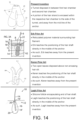
- US3596292 of Erb (100) teaches a hair implant structure having an anchoring portion extending below the surface of the skin and into the subcutaneous tissue, comprising tissue-pervious structures in the form of microvelours, microporous polymers, reticulated foam polymers or hydrated hydrogels (See Fig. 14 )
- a further example a hair implant is disclosed in US9492196 of Keren (87), which teaches an anchor formed with a rough surface and a slit or opening through which hair is inserted so that the bulbous root end is implanted into the target tissue.
- the opening of the slit is sized to restrain the bulbous end of the hair from passing through.
- the materials used in the current manufacturing of artificial hair implants involve primarily natural or artificial hair.
- Hair is a very antigenic reactive substance when confronted or seen by the immune system (22, 23).
- the immune system 22, 23.
- Considering the hyper-reactivity and immune response to the materials currently being used there appears to be little to no medical consideration regarding material selection and how to minimize this negative interaction with the body.
- this hair implant is placed deep into the scalp, a lengthy portion of the hair is directly in contact and totally unshielded from the blood or immune system. This deep placement and direct contact of the hair with the body will dramatically increase the potential to invoke an intense and chronic inflammatory response, which is the source of chronic inflammation, pain, infection, granuloma formation, and other serious issues.
- the current hair implant design is rather rudimentary, once again, reflecting no medical consideration for natural anatomy, physiology, immunology nor the microbiological factors involved. This design promotes inflammatory interactions with the body and does not provide an appropriate barrier for microbiological (bacterial) protection. In addition, there is no hair implant design element even attempting to stop foreign invaders (bacteria) from entering the body which, by having no barrier as part of the hair implant design, can cause serious acute and long term chronic infections.
- the current hair implant technique involves placement of the artificial hair deep into and under the skin. This deep placement involves tunneling the artificial hair under the skin and then attaching it to the deep fascia that lies just above the skull, called the Galea Aponeurotica. Looping and mounting the artificial hair into the Galea is the anchoring mechanism which secures the hair from falling out. Even though this is a very secure mounting technique, it does not allow for, once again, medical consideration regarding adverse immune system interactions or an appropriate bacterial barrier preventing infection, and thus inflammation and infectious complications will follow. Keep in mind that this technique, with very deep and specific placement into fascia type tissue, is limited to the scalp area and does not allow for hair placement in any other part of the body.
- artificial hair implants which provide a natural appearance, are configured for secure implantation in the skin, do not elicit an antigenic or inflammatory response, and can be implanted in a variety of densities and patterns.
- the present invention provides a hair implant according to claim 1.
- Preferred embodiments of the present invention are set out in the dependent claims.
- the at least two strands are synthetic hairs comprising a filament of a polymer selected from the group consisting of polypropylene, polyvinyl chloride, polyamide, polyethylene, polyacrylonitrile, polyvinylidene chloride, polyurethane, polyester and copolymers thereof.
- the at least two strands have a diameter from 0.01 to 3 mm, or from 0.02 to 0.2 mm.
- the at least two strands have a length from 1 mm to 500 cm or from 1 cm to 50 cm.
- the anchor has a largest dimension of 0.1 mm to 2.5 mm or 0.1 to 5 mm.
- the anchor has a diameter that decreases from a proximal end to a distal end thereof.
- the anchor has a diameter that increases from a proximal end to a distal end thereof.
- the anchor has a diameter that is substantially constant from a proximal end to a distal end thereof.
- the anchor has a mid-section concavity that is roughly equidistant from a proximal end to a distal end of the hair implant.
- the anchor has an open tunnel on at least one of the distal end and the proximal end of the anchor.
- the anchor has at least one open tunnel, at least one closed tunnel and at least one bridge between two vertical components.
- the anchor has an undulation on a distal lateral side thereof, said undulation being effective to inhibit bacterial infection.
- the anchor has at least one tunnel configured to receive and retain collagen ligatures so as to bind the anchor to the hair implant recipient.
- the anchor consists of silicone.
- the anchor is free of hinged leaves.
- the hair implant is free of metal components.
- An aspect not forming part of the invention is a hair restoration method comprising: inserting a needle into the skin to form an incision; inserting an implant of the invention in the incision such that 0.1-2 mm of a silicone coating on a proximal end of each of the at least two strands remains: (a) outside the skin, (b) above the epidermis, (c) under the skin, or (d) below the epidermis; and applying an adhesive to the incision.
- the incision is made to a depth of 2-8 mm.
- the adhesive is cyanoacrylate.
- collagen infiltrates tunnels of the anchor to form ligatures binding the implant.
- the implant is inserted in the incision such that 0.1-2 mm of the silicone coating on the proximal end of each of the at least two strands remains outside the skin or above the epidermis.
- the implant is inserted in the incision such that 0.1-2 mm of the silicone coating on the proximal end of each of the at least two strands remains under the skin or below the epidermis.
- An aspect not forming part of the invention is a method for manufacturing the implant of the invention, said method comprising: providing a mold comprising at least one cavity for forming the anchor; filling the at least one cavity with a silicone liquid; coating 2-10 mm of a proximal end of the at least one strand with a silicone coating; submersing in the silicone liquid the proximal end of the at least one strand to a depth such that 0.1-2 mm of the silicone coating remains outside of the silicone liquid in the cavity; curing the silicone liquid to provide a solid product; removing the solid product from the mold; and sterilizing the solid product so as to provide the implant.
- An aspect not forming part of the invention is a hair implant, comprising: at least one strand comprising at least one of mammalian hair and synthetic hair; and an anchor, which: (a) comprises silicone, (b) is configured for subcutaneous implantation, (c) comprises a fracture line configured to facilitate fracturing of the anchor along the fracture line for ease of removal of the implant after subcutaneous implantation, and (d) is configured to provide a scaffold for collagen growth after subcutaneous implantation, wherein the at least one strand is in an internal hair chamber leading from a first distal orifice to a second distal orifice such that each end of the at least one strand remains outside the anchor.
- an anchor which: (a) comprises silicone, (b) is configured for subcutaneous implantation, (c) comprises a fracture line configured to facilitate fracturing of the anchor along the fracture line for ease of removal of the implant after subcutaneous implantation, and (d) is configured to provide a scaffold for collagen growth after subcutaneous implantation, wherein the at least one strand is in an
- An aspect not forming part of the invention is a hair implant suitable for subcutaneous implantation, comprising:
- said hair strand is a human hair strand or a synthetic hair strand.
- said anchor body is constructed from a biocompatible polymer, silicone, silicone polymer, metal, or metal alloy.
- At least one end of the hair strand projects from a distal end of the anchor body.
- said first hair chamber is fluidly connected to said second hair chamber to form a U-shaped hair chamber, wherein said hair strand is retained in said U-shaped hair chamber such that both ends of said hair strand project from a distal end of the anchor body.
- the hair implant comprises at least two hair strands, wherein a proximal end of each hair strand is disposed and encased within one of said hair chambers.
- the tunnel is an open tunnel disposed through the anchor body at a distal end or a proximal end thereof.
- the tunnel is a closed tunnel disposed through the anchor body.
- the anchor body has at least two tunnels disposed therethrough.
- the at least two tunnels are parallel open tunnels, disposed on opposing ends of the anchor body.
- the at least two tunnels are parallel closed tunnels disposed through the anchor body.
- At least one of the tunnels is an open tunnel disposed on a distal end or a proximal end of the anchor body, and at least one of the tunnels is a closed tunnel disposed through the anchor body.
- the tunnel through the anchor body effectively creates a longitudinal fracture line through said anchor body that intersects the tunnel.
- a sixth aspect not forming part of the invention is a hair implant suitable for subcutaneous implantation, comprising:
- said hair strand is a human hair strand or a synthetic hair strand.
- said hair strand anchor is constructed from a biocompatible polymer, silicone, silicone polymer, metal, or metal alloy.
- each of said anchor bodies has a hair chamber disposed therein.
- the hair implant comprises at least two hair strands, wherein a proximal end of each hair strand is disposed and encased within one of said hair chambers.
- said hair chamber of the first anchor body is fluidly connected to said hair chamber of the first anchor body to form a U-shaped hair chamber, wherein said portion of the hair strand is retained in said U-shaped hair chamber such that both ends of said hair strand project from a distal end of the hair strand anchor.
- a portion of said U-shaped hair chamber is disposed in said bridge.
- a seventh aspect not forming part of the invention comprises a method of subcutaneously implanting a hair implant in a hair implant recipient.
- the method comprises:
- the hair will not be glued first but will first be inserted into the proximal orifice of the vertical component hair chamber, then the hair is pushed through until only 6mm of the proximal end is visible, then glue is added to this 6mm end, and finally the hair is continued to be pulled through until completely in the hair chamber.
- the hair will not be glued first but will first be knotted at its proximal end or otherwise treated or handled (e.g., by melting or by augmenting with a bolus of bonding agent, such as glue) to provide a bulbous end smaller than the larger opening of the knot chamber and larger than the smaller opening of the knot chamber, and then fed into the proximal opening of the knot chamber until only about 6 mm of the proximal end of the hair is visible. Glue is then applied to this 6 mm end (which will contain the knots), and then the hair is continued to be fed through the hair chamber until reaches the most distal end of the knot chamber.
- a bolus of bonding agent such as glue
- said at least one void effectively creates a longitudinal fracture line through said hair strand anchor that intersects said bridge.
- the hair implant further comprises at least a second bridge connecting said first anchor body to said second anchor body, and bridging at least one void between said anchor bodies.
- said second bridge is parallel to the first bridge.
- An aspect not forming part of the invention is an anchor comprising: (a) a first hair chamber configured to receive at least one hair strand; (b) a second hair chamber configured to receive at least one hair strand; and (c) at least one tunnel disposed through said anchor between the first hair chamber and the second hair chamber, wherein: (i) the anchor is configured for subcutaneous implantation with at least one hair strand fixed in at least one of the first hair chamber and the second hair chamber; (ii) the tunnel is configured to support collagen ligature growth after subcutaneous implantation by receiving and retaining collagen ligatures that are capable of anchoring the anchor to a hair implant recipient.
- At least one tunnel defines a longitudinal fracture line through the anchor that intersects the tunnel, such that the anchor is configured to fracture along the fracture line upon application of sufficient force to facilitate removal of the anchor.
- the plurality of closed tunnels are two parallel closed tunnels.
- An aspect not forming part of the invention is a hair implant suitable for subcutaneous implantation, comprising: (a) an anchor comprising: (i) an anchor body; and (ii) at least one collagen receiving structure selected from the group consisting of a tunnel disposed through the anchor body and an external surface feature of the anchor body; and (b) at least one hair strand projecting from a distal end of the anchor body, wherein the at least one collagen receiving structure is configured to support collagen ligature growth after subcutaneous implantation of the hair implant so as to anchor the anchor to a hair implant recipient.
- the at least one hair strand has a diameter from 0.02 to 0.2 mm.
- the at least one hair strand has a length from 1 cm to 50 cm.
- the at least one hair strand is a human hair strand or a synthetic hair strand.
- the at least one hair strand is a synthetic hair comprising polymer filaments selected from the group consisting of polypropylene, polyvinyl chloride, polyamide, polyethylene, polyacrylonitrile, polyvinylidene chloride, polyurethane, polyester and copolymers thereof.
- the anchor has a largest dimension of 0.1 to 2.5 mm.
- the anchor body comprises a biocompatible polymer, silicone, a silicone polymer, a metal or a metal alloy.
- the hair implant is free of metal components.
- a retained portion of the at least one hair strand is retained in an internal hair chamber of the anchor body.
- the internal hair chamber leads from a first distal orifice to a second distal orifice such that both ends of the at least one hair strand project from the distal end of the anchor body.
- a proximal end of the at least one hair strand is disposed and encased within the internal hair chamber, and a distal end of the at least one hair strand projects from the distal end of the anchor body.
- the hair implant is unitary in structure.
- the at least one collagen receiving structure comprises at least one tunnel.
- the at least one tunnel comprises an open tunnel disposed through the anchor body at a distal end or a proximal end thereof.
- the at least one tunnel comprises a closed tunnel disposed through the anchor body.
- the anchor body has at least two tunnels disposed therethrough.
- the at least two tunnels comprise parallel open tunnels disposed on opposing ends of the anchor body.
- the at least two tunnels comprise parallel closed tunnels disposed through the anchor body.
- At least one of the tunnels is an open tunnel disposed on a distal end or a proximal end of the anchor body, and at least one of the tunnels is a closed tunnel disposed through the anchor body.
- the at least one tunnel defines a longitudinal fracture line through the anchor body that intersects the at least one tunnel.
- the anchor has an undulation on a distal lateral side thereof, said undulation being effective to inhibit bacterial infection.
- the anchor has a diameter that decreases from a proximal end to a distal end thereof.
- the anchor has a diameter that increases from a proximal end to a distal end thereof.
- the anchor has a diameter that is substantially constant from a proximal end to a distal end thereof.
- the anchor has a mid-section concavity that is roughly equidistant from a proximal end to a distal end of the hair implant.
- the anchor comprises silicone; (b) the anchor is configured for subcutaneous implantation; (c) the anchor comprises a fracture line configured to facilitate fracturing of the anchor along the fracture line for ease of removal of the implant after subcutaneous implantation; (d) the anchor is configured to provide a scaffold for collagen growth after subcutaneous implantation; (e) the hair implant comprises at least two hair strands; and (f) at least one of the at least two hair strands is joined to the anchor on one side of the fracture line and at least one of the at least two hair strands is joined to the anchor on an opposite side of the fracture line such that each fragment formed by fracturing the implant comprises at least one of the at least two hair strands.
- the anchor body comprises a first internal hair chamber and a second internal hair chamber
- the at least one collagen receiving structure comprises at least one tunnel disposed between the first internal hair chamber and the second internal hair chamber, the at least one tunnel is free of hair
- the hair implant comprises a plurality of hair strands
- the first internal hair chamber encases a retained portion of at least a first one of the hair strands
- the second internal hair chamber encases a retained portion of at least second one of the hair strands.
- the at least one collagen receiving structure comprises at least one tunnel
- the anchor comprises a first anchor body and a second anchor body connected by at least one bridge that spans the at least one tunnel, the at least one tunnel is free of hair
- the first anchor body comprises a first internal hair chamber
- the second anchor body comprises a second internal hair chamber
- the hair implant comprises a plurality of hair strands
- the first internal hair chamber encases a retained portion of at least a first one of the hair strands
- the second internal hair chamber encases a retained portion of at least a second one of the hair strands.
- the at least one collagen receiving structure comprises at least one tunnel;
- the at least one tunnel is free of hair; and
- the anchor body comprises a first tapered side, a second tapered side, a first internal hair chamber disposed within the anchor body parallel to the first tapered side and encasing a retained portion of at least one first hair strand, a second internal hair chamber disposed within the anchor body parallel to the second tapered side and encasing a retained portion of at least one second hair strand.
- the at least one collagen receiving structure comprises at least one tunnel;
- the at least one tunnel is free of hair; and
- the anchor body comprises a first vertical side, a second vertical side, a first internal hair chamber disposed within the anchor body parallel to the first vertical side and encasing a retained portion of at least one first hair strand, a second internal hair chamber disposed within the anchor body parallel to the second vertical side and encasing a retained portion of at least one second hair strand.
- a retained portion of the at least one hair strand is retained in a single internal hair chamber positioned along a central longitudinal axis of the hair implant, and the at least one collagen receiving structure comprises two parallel closed tunnels at a distal end of the hair implant.
- a retained portion of the at least one hair strand is retained in a single internal hair chamber positioned along a central longitudinal axis of the hair implant, and wherein the at least one collagen receiving structure comprises one closed tunnel at a distal end of the hair implant.
- the at least one bridge comprises four parallel bridges which are oval-shaped in cross-section and span three closed tunnels and two open tunnels.
- the hair implant comprises five parallel closed tunnels disposed through the anchor body along a central longitudinal axis, wherein: (a) the tunnels are flanked by the first internal hair chamber and the second internal hair chamber; (b) the three uppermost tunnels are substantially identical in size; (c) the two lowermost tunnels are larger than the three uppermost tunnels; (d) the lowest tunnel is the largest tunnel; and (e) the anchor has a diameter that decreases from a proximal end to a distal end thereof.
- the anchor body comprises a first internal hair chamber and a second internal hair chamber
- the at least one collagen receiving structure comprises an external surface feature of the anchor body comprising three protrusions on each of two opposite sides of the hair implant
- the hair implant comprises a plurality of hair strands
- the first internal hair chamber encases a retained portion of at least a first one of the hair strands
- the second internal hair chamber encases a retained portion of at least second one of the hair strands.
- the anchor body has a cruciform configuration comprising two hair element arms and two anchor arms, a first hair element arm comprises a first internal hair chamber, a second hair element arm comprises a second internal hair chamber, the hair implant comprises a plurality of hair strands, the first internal hair chamber encases a retained portion of at least a first one of the hair strands and the second internal hair chamber encases a retained portion of at least second one of the hair strands.
- the anchor body has an inverted Y-shaped configuration comprising one hair element arm and two anchor arms, a first internal hair chamber in the hair element arm, a second internal hair chamber in the hair element arm, the hair implant comprises a plurality of hair strands, the first internal hair chamber encases a retained portion of at least a first one of the hair strands and the second internal hair chamber encases a retained portion of at least second one of the hair strands.
- the anchor body comprises a first internal hair chamber and a second internal hair chamber
- the at least one collagen receiving structure comprises an external surface feature of the anchor body comprising a plurality of protrusions on a proximal end of the anchor body that curve upward toward the distal end of the anchor body
- the hair implant comprises a plurality of hair strands
- the first internal hair chamber encases a retained portion of at least a first one of the hair strands
- the second internal hair chamber encases a retained portion of at least second one of the hair strands.
- the anchor body comprises a first internal hair chamber and a second internal hair chamber
- the at least one collagen receiving structure comprises an external surface feature of the anchor body comprising a plurality of cup-shaped protrusions encircling the anchor body with concavities opened toward the distal end of the anchor body
- the hair implant comprises a plurality of hair strands
- the first internal hair chamber encases a retained portion of at least a first one of the hair strands
- the second internal hair chamber encases a retained portion of at least second one of the hair strands.
- the anchor body comprises a first internal hair chamber and a second internal hair chamber
- the at least one collagen receiving structure comprises an external surface feature of the anchor body comprising a thread helically encircling the anchor body
- the hair implant comprises a plurality of hair strands
- the first internal hair chamber encases a retained portion of at least a first one of the hair strands
- the second internal hair chamber encases a retained portion of at least second one of the hair strands.
- the anchor body has a cuboid configuration
- the anchor body comprises at least four internal hair chambers each of which contains a retained portion of at least one hair therein
- the at least one collagen receiving structure comprises at least one tunnel running lengthwise between hair chambers and at least one tunnel running widthwise between hair chambers, and the tunnels are free of hair.
- the anchor body has an ovoid configuration
- the anchor body comprises more than two internal hair chambers
- the at least one collagen receiving structure comprises at least one tunnel disposed at a proximal end of the anchor body, the at least one tunnel is free of hair
- the hair implant comprises a plurality of hair strands with retained portions thereof being encased in the hair chambers.
- the at least one collagen receiving structure comprises at least one closed tunnel and at least one open tunnel, which are disposed in parallel through the anchor body along a central longitudinal axis, and wherein 1-5 hair strands are disposed at a distal end of the hair implant.
- An aspect not forming part of the invention is a hair restoration method comprising: (1) forming an incision in the skin; (2) inserting an implant of the invention in the incision such that 0.1-2 mm of a silicone coating on a proximal end of each of the at least two hair strands remains: (a) outside the skin, (b) above the epidermis, (c) under the skin, or (d) below the epidermis; and (3) applying an adhesive to the incision.
- collagen infiltrates tunnels of the anchor to form ligatures binding the implant.
- the anchor material assists in protecting the hair implant from immune system attacks and oxidation by invoking a foreign body reaction.
- the foreign body reaction will allow the body to envelope the hair implant with a collagen wall and thus "shut down" the immune system since the goal and final reaction of the foreign body reaction is the quarantining of the foreign body, which is, in this case, the hair implant itself.
- a more durable material will resist oxidation from interaction between the implant material and the body. This oxidative process may come from the immune system or local cells releasing certain chemicals causing this reaction.
- the material preferably allows for a linear fracture (or break) line and eliminates fragmenting.
- the material preferably allows for limited risk of breaking into small pieces. References teaching other implantation methods, such as Erb et al. (100), Laghi (101) and Keren (87), do not recognize the potential problem of fragmentation, which may result in device fragment retention and chronic inflammation, and do not propose a solution to this very significant issue.
- the cross-sectional shape of the anchor and subcomponents thereof is round or oval in certain embodiments of the invention.
- the anchors have overall shapes like letters of the alphabet. These embodiments (collectively referred to as “the Alphabetical Anchors”) are identified herein with the term “Anchor” followed by the letter that the anchor most resembles (e.g., Anchor A, Anchor H, Anchor W and Anchor V). There will be some variations to anchors corresponding to a designated letter, but the general designated letter shape will still be evident.
- Each Alphabetic Anchor comprises at least one tunnel and at least one bridge.
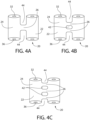
- FIG. 4A Preferred Anchor H embodiments are shown in Figs. 4A, 4B and 4C .
- Each embodiment includes two vertical components 24 joined by at least one bridge 26 and further includes two open tunnels 44 of substantially similar size. The embodiments differ according to the number of closed tunnels they have.
- the embodiment of Fig. 4A has no closed tunnel
- the embodiment of Fig. 4B has one closed tunnel 42
- the embodiment of Fig. 4C has two closed tunnels 42.
- the tunnels are substantially centered along the fracture line of the anchors.
- the horizontal component also called the "bridge" will be the attachment site connecting adjacent vertical components.
- Bridges are preferably 100 microns to 4 mm long and 100 microns to 4 mm in diameter.
- the number of bridges present, which attach the vertical components, is related to the number and type of tunnels formed.
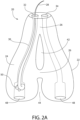
- each vertical component 24 comprises internal hair chamber 30 having distal orifice 32 at distal end 34 of anchor 22.
- Internal hair chamber 30 preferably has a diameter from 25-250 microns.
- Fig. 2B has proximal orifice 36 at proximal end 40 of each internal hair chamber 30.
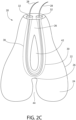
- Fig. 2C shows an embodiment with a "looped" internal hair chamber 30, which passes from one vertical component 24 through bridge 26 to the other vertical component 24.
- a single hair 28 enters internal hair chamber 30 at one distal orifice 32 and exits the chamber at the other distal orifice 32. Placement of hair 28 would preferably involve inserting one strand into one distal orifice 32 and pushing it through the looped internal hair chamber to then exit from the other distal orifice 32 until the exposed lengths of hair differ in length by about 12 mm.
- a small amount of glue is then placed on the longer exposed segment of hair just above the distal orifice, and the glue-bearing segment of hair is pulled into the internal hair chamber (about 12 mm) such that substantially equal lengths of hair are exposed.
- the glue is allowed to set, which helps to stabilize or anchor the hair within the internal hair chamber.
- Each vertical component preferably has a round or oval cross-sectional shape.
- Adjacent vertical components can combine with bridges to form many suitable shapes, including the alphabetical shapes discussed above.
- adjacent vertical components can be parallel with one another and form an "H" shape in combination with a bridge.
- adjacent vertical components can be angled relative to each other such that they diverge in a distal direction so as to provide a "W" or "V” shape.
- Anchor A can be provided when the adjacent vertical components are angled relative to each other such that they diverge in a proximal direction.
- the anchor may have an external concavity 52 located at the mid-longitudinal area on both lateral sides ( Fig. 6B ).
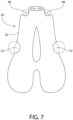
- Fig. 7 shows an embodiment comprising concavity 52 and undulation 66.
- Concavity 52 and undulation 66 can be described in circle diameter and arc degrees.
- the circle size diameter preferably ranges from 100 microns to 75 mm or 1 mm to 50 mm, and the arc size preferably ranges from 1 degree to 180 degrees.
- Figs. 10A and 10B show alternative embodiments of the implant 20, having concavities 52 located at the mid-longitudinal area on both lateral sides, undulations 66 at the distal end of the anchor 22 and three or four hairs 28. It is preferred that each vertical component 24 contain only one internal hair chamber 30 regardless of the number of hairs therein, such that implant 20 has two internal hair chambers 30, with one on each side of the fracture line (excluding the looped hair embodiment described above and shown in Fig. 2C ).
- Fig. 9 shows another external surface feature, wherein rounded indentation 68 is formed in distal end 34 of anchor 22 between distal orifices 32.
- Rounded indentation 68 is preferably a distal sagittal mid-line U-shaped indentation that will not follow the pattern of a circle and arc description.
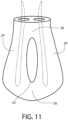
- Fig. 11 shows another embodiment of an implant of the invention, which comprises two vertical components 24 joined by bridges 26 and one closed tunnel 42.
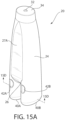
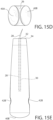
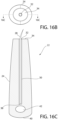
- Figs. 15A - 15E and 16A-16D depict additional aspects of the implant anchor 20 that comprises a single internal hair chamber 30 and either two proximal ends 40A/40B ( Figs. 15A - 15E ) or a single proximal end 40 ( Figs. 16A-16D ).
- the implant anchor 20 comprises a single anchor body 24 having a centralized internal hair chamber 30.
- the lower end of the anchor body 24 comprises an open tunnel 44, thereby forming two proximal ends 40A and 40B of the anchor body 24.
- Adjacent a bridge 26 connecting the two proximal ends 40A/40B at the closed end of the open tunnel 44 are respective closed parallel tunnels 42A and 42B.
- the outer front and back surfaces of the anchor 20 comprise a respective connecting surface 27A and 27B between the sides of the anchor body 24.
- Fig. 15D depicts the two rounded proximal ends 40A and 40B
- Fig. 15E depicts one hair strand 28 positioned within the centralized internal hair chamber 30 and protruding from the distal orifice 32 at the distal end 34.
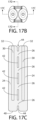
- Figs. 17A-17D depict a further variation of the implant anchor 20 which uses a pair of internal hair chambers 30 and a plurality of closed parallel tunnels 42 with open parallel tunnels at the distal end 34 and the proximal end 40.
- the implant anchor 20 of Figs. 17A and 17C comprises a plurality of closed tunnels 42 (e.g., three closed tunnels), each separated by a bridge 26, and vertically-aligned along a central portion of the anchor body 24.
- An open tunnel 44 is present at the distal end 34 and at the proximal end 40.
- the bridges 26 comprise an oval-shape as shown most clearly in Fig. 17D . As shown most clearly in Fig.
- a hair chamber 30 that is oriented vertically and each chamber 30 has a distal opening 32 at one end as well as a proximal closure 38 at the other end; these vertically-oriented chambers 30 are parallel to the vertical side walls shown in Fig. 17C .
- These vertically-oriented hair chambers 30 are also referred to as "straight" chambers since if their axis lines were extended, they would not intersect.
- the anchor aspect described in Figs. 17A-17D comprises similar materials and utilizes the closed tunnels for supporting collagen ligature growth after subcutaneous implantation to receive and retain collagen ligatures that are capable of anchoring the hair strand anchor to a hair implant recipient.
- the open and/or closed tunnels can also define a fracture line as discussed above.
- Fig. 18 depicts a further variation of the implant anchor 20 which uses a pair of internal hair chambers 30 and a plurality of closed parallel tunnels 42 but no open tunnels at the distal end 34 and the proximal end 40.
- the implant anchor 20 of Fig. 18 comprises a plurality of closed tunnels 42 (e.g., five closed tunnels), each separated by a bridge 26, and vertically-aligned along a central portion of the anchor body 24.
- a hair chamber 30 On each side of a longitudinal anchor body axis, is a hair chamber 30 that is parallel with the side of the hair implant 20 and each channel 30 having a distal opening 32 at one end as well as a proximal closure 38 at the other end.
- the upper three closed tunnels may be identical in size (e.g., 100 microns in width and 200 microns in length) while the lower two tunnels are of larger size, e.g., the fourth closed tunnel 42 from the top may comprise a larger size (e.g., 200 microns in width and 400 microns in length) while the bottom-most closed tunnel 42 may comprise an even larger size, e.g., 300 microns in width and 500 microns in length.
- the sides of the anchor body 24 are not vertical but rather splay or taper outward from the top (i.e., distal end 34) to the bottom (i.e., proximal end 40). As such, the sides of the anchor body are “tilted” or “tapered.” The hair chambers 30, being parallel to these sides, are therefore "crossed” as described above.
- the anchor aspect described in Fig. 18 comprises similar materials and utilizes the closed tunnels for supporting collagen ligature growth after subcutaneous implantation to receive and retain collagen ligatures that are capable of anchoring the hair strand anchor to a hair implant recipient.
- the open and/or closed tunnels can also define a fracture line as discussed above.
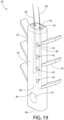
- Fig. 19 depicts a further variation of implant anchor 20 that utilizes a pair of internal hair chambers 30 and a plurality of upwardly swept anchor protrusions 70.
- the protrusions 70 emerge from the entire length of the vertical anchor body 24 and project upward at an angle toward the distal end 34 in a "tree-like" fashion.
- the protrusions 70 promote anchoring the hair strand anchor into the scalp of a hair implant recipient.
- the anchor possesses a closed tunnel 42 but no open tunnels on the distal end 34 and the proximal end 40.
- tunnels, protrusions, tunnels in protrusions and other features can be added to or subtracted from those shown (or not shown) in the drawings to provide modified versions of the depicted embodiments.
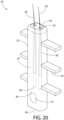
- Fig. 20 depicts a further variation of implant anchor 20 that also utilizes a pair of internal hair chambers 30, a plurality of lateral anchor protrusions 70, and a closed tunnel 42 but no open tunnels on the distal end 34 and the proximal end 40.
- this embodiment features protrusions 70 that project perpendicularly from the anchor body 24.
- the protrusions 70 form a "cross-like" pattern because of the way the protrusions 70 intersect with the anchor body 24 of the anchor 22.
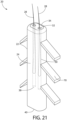
- Fig. 21 depicts a further variation of implant anchor 20 that utilizes a pair of internal hair chambers 30, a plurality of downwardly-swept anchor protrusions 70, and no open or closed tunnels.
- the protrusions 70 emerge from the entire length of the anchor body 24 and project downward at an angle toward the proximal end 40 in a way that resembles the fins of a rocket.
- the anchor aspects described in Figs. 19-21 comprise similar materials and utilize the closed tunnels (of Figs. 19-20 ) and the protrusions for supporting collagen ligature growth after subcutaneous implantation to receive and retain collagen ligatures that are capable of anchoring the hair strand anchor to a hair implant recipient.
- the open and/or closed tunnels can also define a fracture line as discussed above.
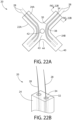
- Figs. 22A and 22B depict a further aspect of implant anchor 20.
- Fig. 22A depicts an implant having a cruciform configuration 22A with two hair element arms 24A and two anchor arms 24B.
- the hair element arms 24A comprise respective distal ends 34
- the anchor arms 24B comprise respective proximal ends 40.
- Each hair element arm 24A comprises internal hair chambers 30 with proximal closures 38, distal orifices 32 and each chamber 30 containing one hair 28.
- the implant anchor contains one closed tunnel 42, which is located at a central point 43.
- Fig. 22B shows a partial perspective view of a distal end 34 of the one of the hair element arms depicted in Fig. 22A .
- the cross-section illustrates two hairs 28 emerging from the two distal orifices 32.
- the anchor aspect described in Figs. 22A and 22B comprises similar materials and utilizes the closed tunnels for supporting collagen ligature growth after subcutaneous implantation to receive and retain collagen ligatures that are capable of anchoring the hair strand anchor to a hair implant recipient.
- the open and/or closed tunnels can also define a fracture line as discussed above.
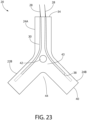
- Fig. 23 depicts a further aspect of the implant anchor 20 utilizing an inverted Y-shaped configuration 22B having a single hair element arm 24A and two anchor arms 24B.
- the hair element arm 24A comprises internal hair chambers 30 with proximal closures 38, and orifices on the distal end 34 of the arm 24A.
- the implant anchor 22B is shaped like an inverted "Y.”
- a closed tunnel 42 is positioned at a central point where arms 24A and 24B are coupled.
- Fig. 24 depicts a perspective view of a further aspect of the implant anchor 20 utilizing two internal hair chambers 30 with proximal closures 38 and distal orifices 32 of the vertical anchor body 24.
- Beneath the internal hair chambers on the vertical component is a closed tunnel 42 that is flanked by two bridges 26 above and below the closed tunnel.
- From the proximal end 40 extend four curved protrusions 70 that curve upward toward the distal end of the anchor.
- the entire anchor 22 resembles a "fishhook" or barbed anchor body 22C structure, with each of the curved protrusions 70 spaced radially, 90 degrees apart from each other.
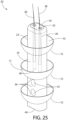
- Fig. 25 depicts a further aspect of the implant anchor 20 utilizing a plurality of equally spaced "cup-shaped" structures 71 encircling the anchor body with concavities 52 opened toward the distal end 34 of the anchor body and convexities 72 pointed downward toward the proximal end 40 of the anchor body.
- the anchor body features two closed tunnels 42 that are vertically aligned along a central position of the anchor body 24.
- the embodiment also features two internal hair chambers 30 with proximal closures 38 and distal orifices 32.
- Fig. 26 depicts a further aspect of the implant anchor 20 utilizing a vertical anchor body 24 with a "screw-shaped" anchor 22G configuration, wherein the anchor body is helically encircled by a thread 76.
- the pitch ratio of thread 76 is preferably 1 to 5, wherein the pitch ratio as used herein is defined as the diameter of the anchor body (not including the thread) divided by the distance along the longitudinal axis of the anchor body between adjacent crests of the thread (i.e., the height of one complete rotation of the helical thread).
- Two internal hair chambers 30 having proximal closures 38 emerge from two distal orifices 32 on the anchor. Adjacent the proximal end of the anchor, two bridges 26 are vertically aligned with a closed tunnel 42.
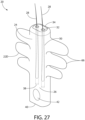
- Fig. 27 depicts a further aspect of the implant anchor 20 utilizing two internal hair chambers 30 that emerge from distal orifices 32 and have proximal closures 38.
- the anchor 22D resembles a racket and possesses a plurality of protrusions 70 extending laterally from a distalmost "head" portion of the anchor body with no such protrusions on the "handle” portion proximal to the "head”.
- a closed tunnel 42 is positioned proximal to the internal hair chambers and centrally aligned on the anchor body 24.
- the anchor aspects described in Figs. 23-27 comprise similar materials and utilize closed tunnels and projections (i.e., protrusions, undulations, etc.) for supporting collagen ligature growth after subcutaneous implantation to receive and retain collagen ligatures that are capable of anchoring the hair strand anchor to a hair implant recipient.
- closed tunnels and projections i.e., protrusions, undulations, etc.
- the open and/or closed tunnels can also define a fracture line as discussed above.
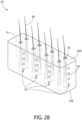
- Fig. 28 depicts a further aspect of the implant anchor 20 utilizing a horizontal anchor body 74 having a bar-shaped anchor 22E configuration, with multiple distal orifices 32 arranged in a gridlike pattern on the upper surface 34A of the bar-like configuration that forms the distal end of the implant anchor.
- each distal orifice is an opening to an internal hair chamber 30 that contains a hair 28.
- Four closed tunnels 42 are located between each pair of adjacent hair chambers 30.
- twelve parallel closed tunnels 42 run through the full width of the anchor between hair chamber chambers 30 and four parallel closed tunnels 42 run through the full length of the anchor between hair chambers 30.
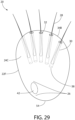
- Fig. 29 depicts a further aspect of the implant anchor 20 having an irregular spherical configuration or ovoid configuration 22F and utilizing a plurality of internal hair chambers 30, each containing one hair 28 that emerges from a distal orifice 32 on the curved distal surface 34B of the anchor 22.
- the anchor body 24C is ovoid or egg-shaped, with the curved distal surface 34B of the anchor being wider than the proximal bulbous shape 54.
- a closed tunnel 42 is located below proximal closures 38 of the internal hair chambers 30 and is centrally aligned on the anchor body.
- the anchor aspects described in Figs. 28-29 comprise similar materials and utilize tunnels for supporting collagen ligature growth after subcutaneous implantation to receive and retain collagen ligatures that are capable of anchoring the hair strand anchor to a hair implant recipient.
- the open and/or closed tunnels can also define a fracture line as discussed above.
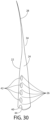
- Fig. 30 depicts an embodiment of a complete one-piece hair implant unit in which the hair 28 forms the unit's distal end 34. More particularly, the hair element 28 is formed from the same material as the anchor body 24 itself.
- the anchor body 24 comprises a distal end 34 and a proximal end 40.
- the anchor possesses a plurality of parallel closed tunnels 42, each separated by a bridge 26 and vertically aligned along a central portion of the anchor body 24.
- An open tunnel 44 is centrally aligned on the proximal end.
- Fig. 31 depicts a further embodiment of a complete one-piece hair implant unit in which a plurality of hairs 28 are formed at the distal end 34 of the anchor 22 from the body 24 itself.
- An open tunnel 44 is centrally aligned on both the distal end and the proximal end 40.
- a plurality of parallel closed tunnels 42, each separated by a bridge 26, is vertically aligned along a central portion of the anchor body 24.
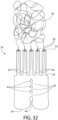
- Fig. 32 depicts an embodiment of an implant of the invention wherein the anchor 20 comprises a plurality of distal orifices 32 with open tunnels 44 between each distal orifice. Each distal orifice comprises a hair element 28 that emerges from the anchor.
- the hair elements are arranged into a hair bundle construction 78.
- the hair elements are attached to an independently one or more hairs woven, braided, twisted, rolled, wrapped or otherwise constructed through mechanical or chemical means.
- the hair bundle construction may take on a form that includes but is not limited to a dreadlock, braid, twist, roll, or interlocking hair formation.
- the anchor aspect described in Fig. 32 comprises similar materials and utilize tunnels for supporting collagen ligature growth after subcutaneous implantation to receive and retain collagen ligatures that are capable of anchoring the hair strand anchor to a hair implant recipient.
- the open and/or closed tunnels can also define a fracture line as discussed above.
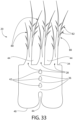
- Fig. 33 depicts a further embodiment of a one-piece (or unitary) hair implant of the invention wherein the anchor 20 comprises a plurality of primary hair elements 28 extending from the distal end 34 of the implant.
- Each primary hair element is a branched hair containing at least one ancillary hair element 80.
- the ancillary hair element stems off of the side or trunk of the primary hair element and is attached in a permanent fashion, allowing the primary and ancillary hair elements to be molded together as one unit.
- each primary hair element in addition to containing at least one permanent ancillary hair element, may also contain at least one hair bud structure 82.
- the hair bud structures emerge from the sides or trunks of the primary and/or secondary
- hair elements and serve as points of attachment in which additional ancillary hair elements may be added and removed as desired.
- the anchor aspects described in Figs. 30-31 and 33 comprise similar materials and utilize tunnels for supporting collagen ligature growth after subcutaneous implantation to receive and retain collagen ligatures that are capable of anchoring the hair strand anchor to a hair implant recipient.
- the open and/or closed tunnels can also define a fracture line as discussed above.
- Such unitary hair implants from materials that simulate human hair.
- Such materials are preferably capable of forming synthetic hairs having the texture, flexibility, color and dimensions that are the same as or substantially similar to those of human hair.
- the hair portion and the anchor portion of the unitary hair implants are preferably formed from the same material(s), it is within the scope of the invention to modify different portions of the unitary hair implants differently so as to provide different properties to different portions of the implant.
- dyes and/or pigments can be selectively applied to change the color of the hair portion of the implant, and crosslinking agents can be applied to selectively change the mechanical properties of desired portions of the implant.
- Preferred materials for use in preparing the unitary hair implant embodiments of the invention include those materials suitable for use in other anchor and hair embodiments discussed herein.
- the tunnels and protrusions of the anchor help anchor the implant within recipient by supporting collagen ligature growth associated with the foreign body reaction.
- the protrusions also provide mechanical resistance to removal.
- the foreign body reaction discussed above also provides protection from bacteria.
- This collagen envelope or wall will prevent bacteria, which may have migrated beyond the distal implant zone, from entering the dermal or subcutaneous space of the skin.
- the direct contact between the implant and living skin tissue, called the interface, is a bond created by a biochemical reaction. This bonding force will also help with the attachment of the implant to the surrounding skin, and thus assist in preventing a corridor for bacterial entrance.
- Patient scalp cleanliness is also an important aspect. Keeping the bacterial load or quantity low on the scalp skin, or wherever the implants are placed will be beneficial in preventing infection.
- Inflammation is a reaction to the foreign materials placed into the skin, such as the hair and the silicone rubber component of the hair implant. This inflammatory reaction will naturally occur when the hair implant is placed, however, it is important to design the implant to yield a self-limiting inflammatory and immune system resulting in chemical and physical changes, and this includes hair implants as well. Hair implant oxidation, erosion, fracture and more importantly subsequent implant fragment retention must be considered potential hazards of implantation and thus it is preferred to include in the inventive hair implant safety features designed to deal with these hazards. If oxidation and erosion of the implant were to occur to a significant degree fragmentation of the implant may occur.
- a fracture line to facilitate a safe conclusion to the potential fragmentation and the retention of the fragment.
- the fracture line is a feature of the implant having reduced resistance to fracturing relative to the balance of the implant, such that if there is fragmentation it occurs along the fracture line.
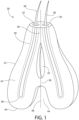
- Fig. 1 shows an example of a fracture line 46 colinear with a line of tunnels 42,44. This planned vertical (or longitudinal) fracture line can facilitate the release of the implant from collagen ligatures through tunnels 42,44, thus allowing for an easier release of the now two vertical fragments of the fractured implant. Each fragment will contain at least one hair and silicone structure.
- the fracture line prevents or at least minimizes the likelihood of the formation of random fragments that cannot be removed from the scalp by pulling on hair.
- the fracture line predisposes the implant to splitting into two fragments. If fracturing occurs, it is easier for the hair implant to fall out since it has lost one of its key anchoring mechanisms. Minimal pulling forces will allow the fractured implant to be completely removed. This safety feature will drastically reduce or eliminate any retained fragments of hair, or portions of the implant which, in turn, reduces or eliminates any acute or chronic inflammatory reactions. If the implant has been totally released, or pulled out, the subsequent collagen envelop will dissolve over time, and the subcutaneous architecture will be remodeled.
- the collagen envelope structure would provide continued protection and serve its function by surrounding the foreign body and protecting it from the immune system. If an inflammatory reaction were to occur, the body would attempt to discharge this retained fragment. This reaction would be limited to the very superficial skin surface (as opposed to the deep-rooted designs of current hair implants deep in the galea aponeurotica, with no escape or discharge mechanism), involving the epidermal and dermal layers. The more superficial inflammation will most likely result in the formation of a pimple type structure with the subsequent discharge of pus and the fragments, not unlike the typical pimple formation found in certain conditions such as acne.
- the preferred implantation technique involves several steps including pre-treatment with antibiotics and anti-inflammatories, recipient skin site preparation, anesthesia, recipient site formation, hair implant selection and placement, temporary hair implant stabilization and skin closure by medical glue, artistic concerns, and post procedure care with antibiotics, corticosteroids, and instruction regarding the proper cleansing of the scalp.
- antibiotics and anti-inflammatory medications and recipient site anti-bacterial preparation are very important first steps in the process. Considering that potentially thousands of hair implants will be placed, with the corresponding thousands of needle pokes into the skin, it is prudent to begin medical therapy to prevent infection and a hyperinflammatory response. Infection or a hyperinflammatory reaction may result in skin surface or epidermal and/or dermal skin damage. This damage may translate into a pitting effect, or visible indentations where the recipient site and subsequent hair implant were placed. This type of imperfection will draw attention to the scalp, especially under certain lighting which will accentuate this pitting look.
- Recipient skin site preparation involves washing the designated skin area with soap and water, then betadine or an acceptable surgical cleansing solution is applied, then, after the cleansing solution dries, it is wiped off with sterile alcohol.
- This sequence of skin cleansing with the appropriate donning of staff in addition to having the treatment room air purity level at an ISO 4 or 5, will eliminate or significantly reduce any bacteria or spores in the field of operation.
- Recipient site formation is another critical step not only to form a hole for the hair implant, but to minimize the actual puncture (e.g., by an appropriately sized needle) or cut size (e.g., by an appropriately sized scalpel) which will minimize the healing needed and potential visible signs of skin pitting.
- the site formed needs to parallel the natural angle that hair would normally exit. This will allow for the hair to fall naturally forward, to the side or back according to the patient's natural angulation and thus natural hair style look.
- the actual process of recipient site formation involves a very similar technique currently used in surgical hair transplant procedures.
- the recipient site formation technique involves using a 22-32-gauge sterile needle, a size 11 or 15 blade or similar instrument.
- the needle is used to poke the scalp at a very specific angle and depth, depending on what hair pattern and density is desired. For example, if the patient desires to fill in the scalp crown area with hair implants, it will be observed that a 'whirl' pattern naturally exists there. Considering this, the needle used to poke the skin in this scalp area will need to emulate this type of 'whirl' pattern. This is accomplished by poking the needle at an acute angle to the scalp and with a rotating type pattern. Then, when the hair implants are placed in, they will stick out of the scalp in a whirl pattern. The depth of the needle poke needs to approximate the normal follicular depth of 6 mm (in this case of scalp hair placement).
- the needle pokes need to be more superficial, about 3-4 mm deep, etc. Lastly, the needle poke incisions will be placed as close together as possible. Considering that an inflammatory reaction is a normal response to a needle poke and foreign body reaction to the silicone tipped hair implant, it is advisable to space out the implants by 3-4 mm, and proceed with subsequent implants in the same manner over 3-4 treatments to ultimately fill in the skin area to the desired density.
- Hair implant selection is very important to maintain a natural look.
- the hairline on the scalp has thinner hair fiber diameters than hairs just 1.25 cm behind it. This transition of finer to more coarse hair is common and is what is natural. The selection of thinner fiber diameter hairs will need to be selected for the hairline areas to mimic the natural.
- the silicone tipped portion of the hair implant is surgically placed with an approximate depth of 3-6 mm under the skin depending on whether scalp, pubic, or other body hair is being restored.
- This silicone tipped portion of the hair will not impair the natural look of the hair implant because the clear type of silicone used will be invisible to the eye and will remain mostly under the skin, with a small 0.1 to 0.5 mm segment remaining above the skin (or below in certain embodiments), keeping it out of view.
- Appropriate anesthesia allows for the proper placement of the hair implants with the proper depth placement.
- Anesthesia involves the application of a topical cream lidocaine type anesthetic on the recipient site, or area of skin that will receive the hair implants. After 30 minutes of topical anesthetic application, the area is cleaned and then an injectable form of tumescent lidocaine anesthetic solution is administered in a field block manner. The anesthetic cream is administered after the area is cleaned with soap and water, then the anesthetic is removed, wiped down with sterile alcohol, then the area is injected with a tumescent solution of lidocaine, then the betadine or other type solution is administered, etc.
- the hair implant placement first involves opening a sterile pack of either the anchor portion of the implant only, which will need subsequent attachment of the hair component, or the anchor portion with the hair already attached. If the sterile pack only has the anchor component, then the pack will be opened at the physician's office or clinic, and the anchors will be placed onto a sterile tray. Hair components are then added to the anchors.
- a sterile pack of either the anchor portion of the implant only, which will need subsequent attachment of the hair component, or the anchor portion with the hair already attached. If the sterile pack only has the anchor component, then the pack will be opened at the physician's office or clinic, and the anchors will be placed onto a sterile tray. Hair components are then added to the anchors.
- a fine jeweler type sterile tweezer can be used to pick up the hair implant by the silicone tipped area and insert it into the recipient site hole made by the needle. After all of the hair implants have been placed into position, the technician places a tiny drop of medical adhesive (e.g., cyanoacrylate or another fast drying medical glue) to immediately stabilize the hair implant.
- medical adhesive e.g., cyanoacrylate or another fast drying medical glue
- the hair implant technique using very close recipient site placement, recipient site with appropriate angulation, the use of delicate jeweler's forceps, and a glue down technique to stabilize the hair implant, will allow for high dense packing and appropriate hair pattern.
- the angle by which the recipient site is made is critical to the hair pattern formed. For example, if one wants to have a natural whirl pattern on the crown of the scalp, a very deliberate rotating angulation pattern will need to be prepared to emulate a natural hair pattern.
- the use of fine and delicate jeweler's forceps is important in the handling and proper placement of the hair implant itself.
- the jeweler's forceps allows for a gentle hold on the implant, preventing damage, and allows an unobstructed view of the placement of the implant into the scalp, due to the forceps holding only a small portion of the distal portion of the implant without obstructing a direct view of the proximal end of the implant for easy placement into the recipient site.
- the final glue down of the hair implant will immediately stabilize and temporarily anchor the implant and prevent premature pull out. Since the foreign body reaction and anchoring of the hair implant takes 14-21 days, this temporary anchoring mechanism will prevent hair fall out and a reduction in hair density.
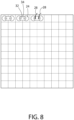
- Fig. 8 is schematic top view of a plan for the placement in the scalp of implants 20 comprising vertical components 24, distal ends 34, distal orifices 32 and hairs 28. Overlaying the scalp is a 10 x 10 grid wherein each cell of the grid represents a 1 mm x 1 mm area of the scalp. Each implant 20 occupies two cells in the embodiment of Fig. 8 . Completion of this placement scheme would result in fifty implants (or follicular units) per cm 2 , or one-hundred hairs per cm 2 when the follicular units have two hairs each.
- the recipient site being a surgical step by poking a needle into the skin, is the key method of allowing the hair implant access and approximation to the living tissue and the very important immune system reaction. This hair implant and skin issue approximation will allow for the foreign body reaction and all the anchoring effects to occur (see the anchoring section above).
- the final glue down of the hair implant will immediately stabilize and temporarily anchor the implant and prevent premature pull out. Since the foreign body reaction and anchoring of the hair implant takes 14-21 days, this temporary anchoring mechanism will prevent hair fall out.
- the recipient site being a surgical step by poking a needle into the skin, is the key method of allowing the hair implant access and approximation to the living tissue and the very important immune system reaction.
- This hair implant and skin tissue approximation will allow for the foreign body reaction to take place and form the collagen envelope.
- the foreign body reaction After the collagen envelope has completely formed, the foreign body reaction has completed its objective to protect the body by entombing the "foreign body” with this thick collagen shell and will then terminate the immune system reaction.
- This collagen shell provides dual protection, protecting the implant from further immune system reactions, and protects the body from the implant harming the body (foreign body reaction assumes the foreign body is dangerous and thus walls it off to protect the body).
- the hair implant is placed into the scalp as deeply as natural hair fibers are in the scalp, about 5-6 millimeters deep (only into the subcutaneous/dermal areas where normal natural hair resides).
- the term "subcutaneous” as used herein is defined in its broadest sense as encompassing the epidermal, intradermal, and subcutaneous spaces, including adipose tissue. If the hair implant needs to be removed, this can be done by a simple plucking motion (like plucking out normal hair). So to remove the hair is a safety factor just in case there is a follicle that becomes infected. It is normal for natural hair follicles to sometimes become infected, so it follows that the same risk applies to the inventive hair implant.
- Infection and inflammation of hair bearing skin is not uncommon. Many people naturally develop low level folliculitis or inflammation of the hair follicles. This can be due to a multitude of causes including bacterial and non-bacterial sources, ingrown hairs, poor hygiene, hair fall out and regrowth, etc. Some other causes of infection and inflammation are from simple shaving, others from hormonal issues, or even from the natural bacteria found in the hair follicular and skin areas. Even though infection and inflammation is found naturally, and typically at minor levels, the goal of hair implantation is to improve upon what is observed as the natural occurrence of hair bearing skin infections and inflammation.
- the incidence of skin infections and inflammation associated with the inventive implants will be less than that found naturally.
- the lack of glandular organs and their secretions will make the implant area less conducive to bacterial growth.
- the anchor of the invention has no hormone receptors to trigger an inflammatory response, unlike natural hair follicles.
- the anchor of the inventive implant can be formed by a variety of different processes, including by injection molding and 3-D printing.
- the anchor preferably comprises a material selected for certain characteristics such as the appropriate durometer, molecular weight, crosslinking, and strength. These characteristics will not only help provide the appropriate strength to withstand oxidation and fracturing, but will easily withstand the pressure forces of the tweezer implantation technique.
- This aspect of tweezer placement is significant mainly in hair transplant surgery when working with live hair follicular units. Tweezer placement can traumatize and crush living hair follicles, but in the case of hair implants that, of course, is not a risk.
- Medical grade silicone is the most preferred material for forming the anchor.
- Other materials suitable for use in forming the anchor include but are not limited to metals (including but not limited to precious metals, metalloids, and other metals), biocompatible polymers (including but not limited to silicones, silicone elastomers, acrylic and other resins, plastics, polyethylene, PTFE, polyesters, PVC, PMMA, hydrogels, etc.), ceramics (including but not limited to silicates, glass, porcelains, carbons, etc.), natural biomaterials (including bone, calcium phosphate based, etc.), and any combination thereof (defined herein as composites).
- metals including but not limited to precious metals, metalloids, and other metals
- biocompatible polymers including but not limited to silicones, silicone elastomers, acrylic and other resins, plastics, polyethylene, PTFE, polyesters, PVC, PMMA, hydrogels, etc.
- ceramics including but not limited to silicates, glass, porcelains, carbons, etc.
- implantable medical grade silicone is used for implant production.
- the silicone material is typically in a liquid form and in two parts. Upon mixing the two parts, part A and part B, a chemical reaction will occur and cause a silicone rubber to be formed.
- This liquid to solid reaction can be controlled by keeping the mixture cold to slow down the liquid to solid reaction and allow time to inject the liquid silicone into the mold. After being injected into the mold, heat is applied to complete the liquid to solid formation reaction.
- the mold preferably comprises a multitude of cavities for receiving the liquid to be solidified to form the anchors of the implants.
- the number of cavities is not particularly limited, and in certain embodiments can range from 1 or 10 or 100 or 1,000 or 10,000 cavities to 10 or 100 or 1,000 or 10,000 or 100,000 cavities per mold.
- the dimensions of a cavity are dictated by the desired dimensions of the resulting implant.
- the cavities are 1-10 mm or 3-9 mm or 5-7 mm or 6 mm deep with a maximum diameter of 0.2-1.2 mm or 0.4-1.0 mm or 0.6-0.8mm or 0.7 mm.
- the anchor mold comprises two plates which are used in a process that minimizes or avoids air bubbles - a first plate having a plurality of holes through it and a second plate that closes off the holes in the first plate.
- the two plates are immersed in silicone liquid with the second plate being used to force the silicone liquid through the holes in the first plate (like a plunger on a syringe) until the two plates are in contact with each other.
- the excess silicone fluid is then scraped off the surface of the first plate to provide a mold having a plurality of cavities filled with substantially bubble-free liquid silicone.
- hair strands are formed with or as a portion of the anchor body using, e.g., molds including anchor body and hair and/or by drawing filaments from the anchor body while it is still in an uncured state.
- the strands of hair to be inserted in the anchors are preferably pre-coated with silicone (or other bonding agent or primer compatible with silicone, such as alkoxy silane monomers or polymers as taught by US 5061284 (101 )) to a length of, e.g., 2-10 mm or 6-8 mm or 7 mm and then allowed to form a solid.
- the length of this coating applied to the hair strands is preferably selected to be 1 mm longer than the depth of the anchors in which the hair strands will be placed, such that the coating extends 1 mm above the anchor and remains external to the surface of the epidermis after implantation. In other embodiments, the length of the coating is 0.1 or 0.5 mm to 1.5 or 2 mm longer than the anchor depth.
- the hair strands are placed into the silicone liquid filled mold cavities. Each mold cavity can receive 1, 2, 3, 4 or more hair strands.
- the mold is then heated to solidify the silicone to form implants having one or more hairs each.
- the implants are then removed from the mold, sterilized and packaged for distribution and use.
- the hair will be inserted and then anchored by several potential mechanisms.
- glue is applied to approximately 6 mm of the proximal end of the hair and is then fed into the distal orifice of the internal hair chamber until it reaches the proximal closure of the internal hair chamber.
- the hair will not be glued first but will first be inserted into the proximal orifice of the vertical component hair chamber, then the hair is pushed through until only 6mm of the proximal end is visible, then glue is added to this 6mm end, and finally the hair is continued to be pulled through until completely in the hair chamber.
- the hair will not be glued first but will first be knotted at its proximal end, and then fed into the proximal opening of the knot chamber until only about 6 mm of the proximal end of the hair is visible. Glue is then applied to this 6 mm end (which will contain the knots), and then the hair is continued to be fed through the hair chamber until reaches the most distal end of the knot chamber.
- the hair chamber opening through which the hair will be inserted have a conical shape so as to facilitate hair insertion by the technician (or if automated, by a machine) and to allow a greater amount of glue to remain at that location for increased adhesion.
- the knot chamber is an enlarged proximal end of the hair chamber configured to receive the knotted hair portion which has a greater diameter than the unknotted portion of the hair shaft.
- the hair chamber distal to the knot chamber has a narrower diameter than the knot chamber such that the knotted hair is too wide to leave the knot chamber and enter the hair chamber.
- the diameter of the knot chamber is preferably 500-600 microns, and the length of the knot chamber is preferably from 500 microns to 6 mm.
- the vertical component will have a proximal outer surface end which will be rounded.
- the arc will be 180 degrees, and the circle diameter will be 500 microns to 2 mm. If there is an oval shape, the largest dimensions of the oval will be the same.
- edges of the anchor are rounded. This includes the embodiments depicted in the figures.
- hairs on the body including scalp, facial, eyebrow, arm and leg, pubic, eyelash, etc.
- the manufacturing process can be modified to produce the appropriate hair implants for the skin area in question.
- eyebrow hair implants will be smaller than scalp hair implants.
- final assembly of hair implants is performed by the end user (physician, physician's assistant, hair technician, etc.).
- Sterile anchors are supplied to the user, who selects appropriate hair for a given patient and procedure and bonds the hair to the anchors prior to implantation, using, e.g., an adhesive suitable for bonding hair (or synthetic hair) to the anchor material.
- Suitable adhesives included but are not limited to cyanoacrylates.
- the exit angle of hair strands from the anchor is preferably varied for different implantation locations.
- the placement of hair strands in the mold cavities can be varied to provide implants with hair exit angles ranging from 1-90°. It is also possible to use curved, angled or otherwise non-linear hair strands in the manufacturing process to achieve the same or similar effect.
- a hair stand having a 100° angle 5 mm from its proximal end can be inserted in a 6 mm deep mold cavity such that the hair strand exits the resulting anchor at a 10° angle to the surface.
Landscapes
- Health & Medical Sciences (AREA)
- Life Sciences & Earth Sciences (AREA)
- Animal Behavior & Ethology (AREA)
- General Health & Medical Sciences (AREA)
- Transplantation (AREA)
- Engineering & Computer Science (AREA)
- Biomedical Technology (AREA)
- Heart & Thoracic Surgery (AREA)
- Veterinary Medicine (AREA)
- Public Health (AREA)
- Surgery (AREA)
- Molecular Biology (AREA)
- Medical Informatics (AREA)
- Dermatology (AREA)
- Nuclear Medicine, Radiotherapy & Molecular Imaging (AREA)
- Cardiology (AREA)
- Oral & Maxillofacial Surgery (AREA)
- Vascular Medicine (AREA)
- Rheumatology (AREA)
- Pathology (AREA)
- Prostheses (AREA)
- Materials For Medical Uses (AREA)
Claims (33)
- Haarimplantat (20), das für eine subkutane Implantierung geeignet ist, umfassend:(a) eine Verankerung (22), umfassend:(i) einen Verankerungskörper (24); und(ii) mindestens eine Kollagen-aufnehmende Struktur, ausgewählt aus der Gruppe, bestehend aus mindestens einem Tunnel (42, 44), der durch den Verankerungskörper (24) angeordnet ist, und einem äußeren Oberflächenmerkmal (52, 66, 70, 72, 76) des Verankerungskörpers (24); und(b) mindestens einen Haarstrang (28), der von einem distalen Ende (34) des Verankerungskörpers (24) vorragt,wobei die mindestens eine Kollagen-aufnehmende Struktur zum Unterstützen eines Kollagenligaturwachstums nach einer subkutanen Implantierung des Haarimplantats (20) ausgebildet ist, so dass die Verankerung (22) an einem Haarimplantatempfänger verankert wird, und wobeidie Verankerung (22) Silikon umfasst;die Verankerung (22) für eine subkutane Implantierung ausgebildet ist;die Verankerung (22) eine Bruchlinie (46) umfasst, die zum Erleichtern eines Brechens der Verankerung entlang der Bruchlinie (46) für eine einfache Entfernung des Implantats (20) nach einer subkutanen Implantierung ausgebildet ist;die Verankerung (22) zum Bereitstellen eines Gerüsts für ein Kollagenwachstum nach einer subkutanen Implantierung ausgebildet ist;das Haarimplantat (20) mindestens zwei Haarstränge (28) umfasst; undmindestens einer der mindestens zwei Haarstränge (28) mit der Verankerung (22) auf einer Seite der Bruchlinie (46) verbunden ist und mindestens einer der mindestens zwei Haarstränge (28) mit der Verankerung (22) auf einer gegenüberliegenden Seite der Bruchlinie (46) verbunden ist, so dass jedes Fragment, das durch Brechen des Implantats (20) gebildet wird, mindestens einen der mindestens zwei Haarstränge (28) umfasst.
- Haarimplantat nach Anspruch 1, wobei der Verankerungskörper (24) eine erste innere Haarkammer (30) und eine zweite innere Haarkammer (30) umfasst, die mindestens eine Kollagen-aufnehmende Struktur mindestens einen Tunnel (42, 44) umfasst, der zwischen der ersten inneren Haarkammer (30) und der zweiten inneren Haarkammer (30) angeordnet ist, der mindestens eine Tunnel (42, 44) frei von Haar ist, das Haarimplantat (20) eine Mehrzahl von Haarsträngen (28) umfasst, die erste innere Haarkammer (30) einen gehaltenen Abschnitt von mindestens einem ersten der Haarstränge (28) umschließt und die zweite innere Haarkammer (30) einen gehaltenen Abschnitt von mindestens einem zweiten der Haarstränge (28) umschließt.
- Haarimplantat nach Anspruch 1, wobei die mindestens eine Kollagen-aufnehmende Struktur mindestens einen Tunnel (42, 44) umfasst, die Verankerung (22) einen ersten Verankerungskörper (24) und einen zweiten Verankerungskörper (24) umfasst, die durch mindestens eine Brücke (26) verbunden sind, die den mindestens einen Tunnel (42, 44) überspannt, wobei der mindestens eine Tunnel frei von Haar ist, der erste Verankerungskörper (24) eine erste innere Haarkammer (30) umfasst, der zweite Verankerungskörper (24) eine zweite innere Haarkammer (30) umfasst, das Haarimplantat (20) eine Mehrzahl von Haarsträngen (28) umfasst, die erste innere Haarkammer (30) einen gehaltenen Abschnitt von mindestens einem ersten der Haarstränge (28) umschließt und die zweite innere Haarkammer (30) einen gehaltenen Abschnitt von mindestens einem zweiten der Haarstränge (28) umschließt.
- Haarimplantat nach Anspruch 1, 2 oder 3, wobei der mindestens eine Haarstrang (28) einen Durchmesser von 0,02 bis 0,2 mm oder eine Länge von 1 cm bis 50 cm aufweist oderwobei der mindestens eine Haarstrang (28) ein menschlicher Haarstrang oder ein Kunsthaarstrang oder ein Kunsthaar ist, das Polymerfilamente, ausgewählt aus der Gruppe, bestehend aus Polypropylen, Polyvinylchlorid, Polyamid, Polyethylen, Polyacrylnitril, Polyvinylidenchlorid, Polyurethan, Polyester und Copolymeren davon, umfasst, oderwobei der mindestens eine Haarstrang (28) ein verzweigtes Haar ist, das mindestens eines von einem Zusatzhaarelement (80) und einer Haarknospe (82) umfasst.
- Haarimplantat nach Anspruch 1, 2 oder 3, wobei die Verankerung (22) eine größte Abmessung von 0,1-2,5 mm aufweist oder aus Silikon besteht oder frei von angelenkten Blättern ist oder ein Merkmal aufweist, das aus den folgenden ausgewählt ist:eine Wellenform auf einer distalen lateralen Seite davon, wobei die Wellenform zum Hemmen einer bakteriellen Infektion wirksam ist,einem Durchmesser, der von einem proximalen Ende (40) zu einem distalen Ende (34) davon abnimmt,einem Durchmesser, der von einem proximalen Ende (40) zu einem distalen Ende (34) davon zunimmt,einem Durchmesser, der von einem proximalen Ende (40) zu einem distalen Ende (34) davon im Wesentlichen konstant ist,einer Mittelabschnittkonkavität (52), die von einem proximalen Ende (40) zu einem distalen Ende (34) des Haarimplantats etwa gleich weit entfernt ist.
- Haarimplantat nach Anspruch 1, 2 oder 3, wobei der Verankerungskörper (24) ein biologisch verträgliches Polymer, Silikon, ein Silikonpolymer, ein Metall oder eine Metalllegierung umfasst.
- Haarimplantat nach Anspruch 1, 2 oder 3, wobei das Haarimplantat frei von Metallbestandteilen ist.
- Haarimplantat nach Anspruch 1, wobei ein gehaltener Abschnitt des mindestens einen Haarstrangs (28) in einer inneren Haarkammer (30) des Verankerungskörpers (24) gehalten ist.
- Haarimplantat nach Anspruch 8, wobei die innere Haarkammer (30) derart von einer ersten distalen Öffnung (32) zu einer zweiten distalen Öffnung (32) führt, dass beide Enden des mindestens einen Haarstrangs (28) von dem distalen Ende (34) des Verankerungskörpers (24) vorragen.
- Haarimplantat nach Anspruch 8, wobei ein proximales Ende (40) des mindestens einen Haarstrangs (28) innerhalb der inneren Haarkammer (30) angeordnet und umschlossen ist und ein distales Ende (34) des mindestens einen Haarstrangs (28) von dem distalen Ende (34) des Verankerungskörpers (24) vorragt.
- Haarimplantat nach Anspruch 1, 2 oder 3, das eine einheitliche Struktur aufweist.
- Haarimplantat nach Anspruch 1, 2 oder 3, wobei die mindestens eine Kollagen-aufnehmende Struktur mindestens einen Tunnel (42, 44) umfasst, wobei insbesondere der mindestens eine Tunnel einen offenen Tunnel (44) umfasst, der durch den Verankerungskörper (24) an einem distalen Ende (34) oder einem proximalen Ende (40) davon angeordnet ist, oder wobei der mindestens eine Tunnel einen geschlossenen Tunnel (42) umfasst, der durch den Verankerungskörper (24) angeordnet ist.
- Haarimplantat nach Anspruch 1, 2 oder 3, wobei der Verankerungskörper (24) mindestens zwei Tunnel (42, 44) aufweist, die durch diesen angeordnet sind.
- Haarimplantat nach Anspruch 13, wobei die mindestens zwei Tunnel parallele offene Tunnel (44) umfassen, die auf gegenüberliegenden Enden des Verankerungskörpers (24) angeordnet sind, oder wobei die mindestens zwei Tunnel parallele geschlossene Tunnel (42) umfassen, die durch den Verankerungskörper (24) angeordnet sind.
- Haarimplantat nach Anspruch 13, wobei mindestens einer der Tunnel ein offener Tunnel (44) ist, der an einem distalen Ende (34) oder einem proximalen Ende (40) des Verankerungskörpers (24) angeordnet ist, und mindestens einer der Tunnel ein geschlossener Tunnel (42) ist, der durch den Verankerungskörper (24) angeordnet ist.
- Haarimplantat nach Anspruch 1, 2 oder 3, wobei der mindestens eine Tunnel (42, 44) eine Bruchlinie in Längsrichtung (46) durch den Verankerungskörper (24) festlegt, die den mindestens einen Tunnel schneidet.
- Haarimplantat nach Anspruch 1, wobei:die mindestens eine Kollagen-aufnehmende Struktur mindestens einen Tunnel (42, 44) umfasst;der mindestens eine Tunnel (42, 44) frei von Haar ist; undder Verankerungskörper (24) eine erste sich verjüngende Seite, eine zweite sich verjüngende Seite, eine erste innere Haarkammer (30), die innerhalb des Verankerungskörpers (24) parallel zu der ersten sich verjüngenden Seite angeordnet ist und einen gehaltenen Abschnitt von mindestens einem ersten Haarstrang (28) umschließt, eine zweite innere Haarkammer (30) umfasst, die innerhalb des Verankerungskörpers (24) parallel zu der zweiten sich verjüngenden Seite angeordnet ist und einen gehaltenen Abschnitt von mindestens einem zweiten Haarstrang (28) umschließt.
- Haarimplantat nach Anspruch 1, wobei:die mindestens eine Kollagen-aufnehmende Struktur mindestens einen Tunnel (42, 44) umfasst;der mindestens eine Tunnel (42, 44) frei von Haar ist; undder Verankerungskörper (24) eine erste vertikale Seite, eine zweite vertikale Seite, eine erste innere Haarkammer (30), die innerhalb des Verankerungskörpers (24) parallel zu der ersten vertikalen Seite angeordnet ist und einen gehaltenen Abschnitt von mindestens einem ersten Haarstrang (28) umschließt, eine zweite innere Haarkammer (30) umfasst, die innerhalb des Verankerungskörpers (24) parallel zu der zweiten vertikalen Seite angeordnet ist und einen gehaltenen Abschnitt von mindestens einem zweiten Haarstrang (28) umschließt.
- Haarimplantat nach Anspruch 1, wobei ein gehaltener Abschnitt des mindestens einen Haarstrangs (28) in einer einzelnen inneren Haarkammer (30) gehalten ist, die entlang einer zentralen Längsachse des Haarimplantats (20) angeordnet ist, und die mindestens eine Kollagen-aufnehmende Struktur zwei parallele geschlossene Tunnel (42A, 42B) an einem proximalen Ende (40A, 40B) des Haarimplantats (20) umfasst.
- Haarimplantat nach Anspruch 1, wobei ein gehaltener Abschnitt des mindestens einen Haarstrangs (28) in einer einzelnen inneren Haarkammer (30) gehalten ist, die entlang einer zentralen Längsachse des Haarimplantats (20) gehalten ist, und wobei die mindestens eine Kollagen-aufnehmende Struktur einen geschlossenen Tunnel (42) an einem proximalen Ende (40) des Haarimplantats (20) umfasst.
- Haarimplantat nach Anspruch 3, wobei die mindestens eine Brücke (26) vier parallele Brücken mit einem ovalen Querschnitt umfasst und drei geschlossene Tunnel (42) und zwei offene Tunnel (44) überspannt.
- Haarimplantat nach Anspruch 2, das fünf parallele geschlossene Tunnel (42) umfasst, die durch den Verankerungskörper (24) entlang einer zentralen Längsachse angeordnet sind, wobei:die Tunnel (42) durch die erste innere Haarkammer (30) und die zweite innere Haarkammer (30) flankiert sind;die drei obersten Tunnel (42) im Wesentlichen identische Größen aufweisen;die zwei untersten Tunnel (42) größer sind als die drei obersten Tunnel (42);der unterste Tunnel der größte Tunnel ist; unddie Verankerung (22) einen Durchmesser aufweist, der von einem proximalen Ende (40) zu einem distalen Ende (34) davon abnimmt.
- Haarimplantat nach Anspruch 1, wobei der Verankerungskörper (24) eine erste innere Haarkammer (30) und eine zweite innere Haarkammer (30) umfasst, die mindestens eine Kollagen-aufnehmende Struktur ein äußeres Oberflächenmerkmal (52, 66, 70, 72, 76) des Verankerungskörpers (24) umfasst, das drei Vorwölbungen (70) auf jeder von zwei gegenüberliegenden Seiten des Haarimplantats (20) umfasst, das Haarimplantat (20) eine Mehrzahl von Haarsträngen (28) umfasst, die erste innere Haarkammer (30) einen gehaltenen Abschnitt von mindestens einem ersten der Haarstränge (28) umschließt und die zweite innere Haarkammer (30) einen gehaltenen Abschnitt von mindestens einem zweiten der Haarstränge (28) umschließt.
- Haarimplantat nach Anspruch 1, wobei der Verankerungskörper (24) einen kreuzförmigen Aufbau aufweist, der zwei Haarelementarme (24A) und zwei Verankerungsarme (24B) umfasst, wobei ein erster Haarelementarm (24A) eine erste innere Haarkammer (30) umfasst, ein zweiter Haarelementarm (24A) eine zweite innere Haarkammer (30) umfasst, das Haarimplantat (20) eine Mehrzahl von Haarsträngen (28) umfasst, die erste innere Haarkammer (30) einen gehaltenen Abschnitt von mindestens einem ersten der Haarstränge (28) umschließt und die zweite innere Haarkammer (30) einen gehaltenen Abschnitt von mindestens einem zweiten der Haarstränge (28) umschließt.
- Haarimplantat nach Anspruch 1, wobei der Verankerungskörper (24) einen umgekehrten Y-förmigen Aufbau aufweist, der einen Haarelementarm (24A) und zwei Verankerungsarme (24B), eine erste innere Haarkammer (30) in dem Haarelementarm (24A), eine zweite innere Haarkammer (30) in dem Haarelementarm (24A) umfasst, wobei das Haarimplantat (20) eine Mehrzahl von Haarsträngen (28) umfasst, wobei die erste innere Haarkammer (30) einen gehaltenen Abschnitt von mindestens einem ersten der Haarstränge (28) umschließt und die zweite innere Haarkammer (30) einen gehaltenen Abschnitt von mindestens einem zweiten der Haarstränge (28) umschließt.
- Haarimplantat nach Anspruch 1, wobei der Verankerungskörper (24) eine erste innere Haarkammer (30) und eine zweite innere Haarkammer (30) umfasst, die mindestens eine Kollagen-aufnehmende Struktur ein äußeres Oberflächenmerkmal (52, 66, 70, 72, 76) des Verankerungskörpers (24) umfasst, das eine Mehrzahl von Vorwölbungen (70) an einem proximalen Ende (40) des Verankerungskörpers (24) umfasst, die zu dem distalen Ende (34) des Verankerungskörpers (24) aufwärts gekrümmt sind, wobei das Haarimplantat (20) eine Mehrzahl von Haarsträngen (28) umfasst, die erste innere Haarkammer (30) einen gehaltenen Abschnitt von mindestens einem ersten der Haarstränge (28) umschließt und die zweite innere Haarkammer (30) einen gehaltenen Abschnitt von mindestens einem zweiten der Haarstränge (28) umschließt.
- Haarimplantat nach Anspruch 1, wobei der Verankerungskörper (24) eine erste innere Haarkammer (30) und eine zweite innere Haarkammer (30) umfasst, die mindestens eine Kollagen-aufnehmende Struktur ein äußeres Oberflächenmerkmal (52, 66, 70, 72, 76) des Verankerungskörpers (24) umfasst, das eine Mehrzahl von becherförmigen Vorwölbungen (70) umfasst, die den Verankerungskörper (24) mit Konkavitäten (52) umgeben, die zu dem distalen Ende (34) des Verankerungskörpers (24) geöffnet sind, wobei das Haarimplantat (20) eine Mehrzahl von Haarsträngen (28) umfasst, die erste innere Haarkammer (30) einen gehaltenen Abschnitt von mindestens einem ersten der Haarstränge (28) umschließt und die zweite innere Haarkammer (30) einen gehaltenen Abschnitt von mindestens einem zweiten der Haarstränge (28) umschließt.
- Haarimplantat nach Anspruch 1, wobei der Verankerungskörper (24) eine erste innere Haarkammer (30) und eine zweite innere Haarkammer (30) umfasst, die mindestens eine Kollagen-aufnehmende Struktur ein äußeres Oberflächenmerkmal (52, 66, 70, 72, 76) des Verankerungskörpers (24) umfasst, das ein Gewinde (76) umfasst, das den Verankerungskörper (24) helikal umgibt, wobei das Haarimplantat (20) eine Mehrzahl von Haarsträngen (28) umfasst, die erste innere Haarkammer (30) einen gehaltenen Abschnitt von mindestens einem ersten der Haarstränge (28) umschließt und die zweite innere Haarkammer (30) einen gehaltenen Abschnitt von mindestens einem zweiten der Haarstränge (28) umschließt.
- Haarimplantat nach Anspruch 1, wobei der Verankerungskörper (24) einen quaderförmigen Aufbau aufweist, der Verankerungskörper (24) mindestens vier innere Haarkammern (30) umfasst, wobei jede davon einen gehaltenen Abschnitt von mindestens einem Haar (28) darin enthält, die mindestens eine Kollagen-aufnehmende Struktur mindestens einen Tunnel (42, 44), der in der Längsrichtung zwischen Haarkammern verläuft, und mindestens einen Tunnel (42, 44) umfasst, der in der Breitenrichtung zwischen Haarkammern verläuft, und die Tunnel (42, 44) frei von Haar sind.
- Haarimplantat nach Anspruch 1, wobei der Verankerungskörper (24) einen eiförmigen Aufbau aufweist, der Verankerungskörper (24) mehr als zwei innere Haarkammern (30) umfasst, die mindestens eine Kollagen-aufnehmende Struktur mindestens einen Tunnel (42, 44) umfasst, der an einem proximalen (40) Ende des Verankerungskörpers (24) angeordnet ist, wobei der mindestens eine Tunnel (42, 44) frei von Haar ist, und das Haarimplantat (20) eine Mehrzahl von Haarsträngen (28) umfasst, wobei gehaltene Abschnitte davon in den Haarkammern (30) umschlossen sind.
- Haarimplantat nach Anspruch 1, wobei die mindestens eine Kollagen-aufnehmende Struktur mindestens einen geschlossenen Tunnel (42) und mindestens einen offenen Tunnel (44) umfasst, die parallel durch den Verankerungskörper (24) entlang einer zentralen Längsachse angeordnet sind, und wobei 1-5 Haarstränge (28) an einem distalen Ende (34) des Haarimplantats (20) angeordnet sind.
- Haarimplantat nach Anspruch 1, das eine einheitliche Struktur aufweist, wobei die mindestens eine Kollagen-aufnehmende Struktur ein äußeres Oberflächenmerkmal (52, 66, 70, 72, 76) des Verankerungskörpers umfasst und das Haarimplantat (20) frei von Tunneln (42, 44) ist.
- Haarimplantat nach Anspruch 1, wobei der mindestens eine Haarstrang (28) ein verzweigtes Haar (28) umfasst, das mindestens ein Zusatzhaarelement (80) enthält und wobei das mindestens eine Zusatzhaarelement (80) mindestens eine Knospenstruktur (82) umfasst, die als Anbringungspunkte dient, an denen zusätzliche Zusatzhaarelemente (80) hinzugefügt oder davon entfernt werden können.
Priority Applications (1)
| Application Number | Priority Date | Filing Date | Title |
|---|---|---|---|
| EP25159426.3A EP4534044A3 (de) | 2017-07-31 | 2018-07-30 | Haarimplantate mit verbesserten verankerungs- und medizinischen sicherheitsmerkmalen |
Applications Claiming Priority (3)
| Application Number | Priority Date | Filing Date | Title |
|---|---|---|---|
| US15/665,369 US9993334B1 (en) | 2017-07-31 | 2017-07-31 | Hair implants comprising enhanced anchoring and medical safety features |
| US15/718,637 US10105212B1 (en) | 2017-07-31 | 2017-09-28 | Hair implants comprising enhanced anchoring and medical safety features |
| PCT/US2018/044298 WO2019027864A1 (en) | 2017-07-31 | 2018-07-30 | HAIR IMPLANTS HAVING IMPROVED MEDICAL ANCHOR AND SECURITY FEATURES |
Related Child Applications (1)
| Application Number | Title | Priority Date | Filing Date |
|---|---|---|---|
| EP25159426.3A Division EP4534044A3 (de) | 2017-07-31 | 2018-07-30 | Haarimplantate mit verbesserten verankerungs- und medizinischen sicherheitsmerkmalen |
Publications (3)
| Publication Number | Publication Date |
|---|---|
| EP3661455A1 EP3661455A1 (de) | 2020-06-10 |
| EP3661455A4 EP3661455A4 (de) | 2021-04-28 |
| EP3661455B1 true EP3661455B1 (de) | 2025-02-26 |
Family
ID=63833052
Family Applications (2)
| Application Number | Title | Priority Date | Filing Date |
|---|---|---|---|
| EP25159426.3A Pending EP4534044A3 (de) | 2017-07-31 | 2018-07-30 | Haarimplantate mit verbesserten verankerungs- und medizinischen sicherheitsmerkmalen |
| EP18841122.7A Active EP3661455B1 (de) | 2017-07-31 | 2018-07-30 | Haarimplantate mit verbesserten verankerungs- und medizinischen sicherheitsmerkmalen |
Family Applications Before (1)
| Application Number | Title | Priority Date | Filing Date |
|---|---|---|---|
| EP25159426.3A Pending EP4534044A3 (de) | 2017-07-31 | 2018-07-30 | Haarimplantate mit verbesserten verankerungs- und medizinischen sicherheitsmerkmalen |
Country Status (18)
| Country | Link |
|---|---|
| US (4) | US10682223B2 (de) |
| EP (2) | EP4534044A3 (de) |
| JP (1) | JP2020529909A (de) |
| KR (2) | KR102686939B1 (de) |
| CN (1) | CN111432750B (de) |
| AR (1) | AR118238A1 (de) |
| AU (1) | AU2018311972B2 (de) |
| BR (1) | BR112020002066A2 (de) |
| CA (1) | CA3071849C (de) |
| CL (1) | CL2020000280A1 (de) |
| CO (1) | CO2020002241A2 (de) |
| ES (1) | ES3027942T3 (de) |
| MX (1) | MX2020001324A (de) |
| SA (1) | SA520411223B1 (de) |
| SG (1) | SG11202000886YA (de) |
| TW (1) | TW201929790A (de) |
| WO (1) | WO2019027864A1 (de) |
| ZA (1) | ZA202001271B (de) |
Families Citing this family (14)
| Publication number | Priority date | Publication date | Assignee | Title |
|---|---|---|---|---|
| US11564789B2 (en) | 2017-07-31 | 2023-01-31 | Loria Products Llc | Hair implants comprising enhanced anchoring and medical safety features |
| ES3027942T3 (en) | 2017-07-31 | 2025-06-17 | Loria Hair Implant Company Llc | Hair implants comprising enhanced anchoring and medical safety features |
| US12279946B2 (en) | 2017-07-31 | 2025-04-22 | Loria Hair Implant Company Llc | Hair implants comprising enhanced anchoring and medical safety features |
| US10561490B2 (en) | 2017-07-31 | 2020-02-18 | Loria Products Llc | Hair implants comprising enhanced anchoring and medical safety features |
| US10925718B2 (en) | 2017-07-31 | 2021-02-23 | Loria Products Llc | Extension apparatus for artificial hair implants |
| KR101891549B1 (ko) * | 2017-11-01 | 2018-08-27 | 주식회사 휴먼웰니스 | 인조모발 및 이의 제조방법 |
| WO2020106320A1 (en) * | 2018-11-21 | 2020-05-28 | Loria Products Llc | Extension apparatus for artificial hair implants |
| USD916290S1 (en) | 2019-03-05 | 2021-04-13 | Loria Products Llc | Hair implant |
| CN113924061A (zh) | 2019-03-05 | 2022-01-11 | 罗利亚产品股份有限公司 | 包括加强锚定及医药安全特征之植发物 |
| CN118767255A (zh) | 2019-06-05 | 2024-10-15 | 里珍纳龙药品有限公司 | 用于精确剂量递送的装置及方法 |
| USD917050S1 (en) | 2019-08-26 | 2021-04-20 | Loria Products Llc | Hair implant |
| CN115607201A (zh) * | 2021-07-16 | 2023-01-17 | 赵廷军 | 一种植发中用于固定假发的植发管及其使用方法 |
| USD1007154S1 (en) * | 2022-05-12 | 2023-12-12 | Nikhil Gupta | Chalk liner with brush |
| USD1120314S1 (en) | 2022-11-30 | 2026-03-24 | Regeneron Pharmaceuticals, Inc. | Dose delivery device |
Family Cites Families (232)
| Publication number | Priority date | Publication date | Assignee | Title |
|---|---|---|---|---|
| US3003155A (en) * | 1956-07-06 | 1961-10-10 | Felix C Mielzynski | Hair darts for implanting in live or artificial media |
| US3596292A (en) * | 1969-02-20 | 1971-08-03 | Franklin Institute | Hair implant structure |
| US3811425A (en) | 1970-08-03 | 1974-05-21 | G Widdifield | Method and apparatus for mounting hair |
| US3699969A (en) | 1971-06-01 | 1972-10-24 | William Glenn Allen | Method for implanting natural or synthetic fibers into living tissue |
| US3998230A (en) | 1974-10-22 | 1976-12-21 | Hairegenics, Inc. | Hair transplant process |
| JPS5418389Y2 (de) * | 1975-08-01 | 1979-07-11 | ||
| US4160453A (en) | 1975-12-05 | 1979-07-10 | Hairegenics, Inc. | Apparatus for implanting hair |
| USD251184S (en) | 1977-01-26 | 1979-02-27 | K-D Manufacturing Company | Charging system analyzer |
| US4210145A (en) | 1978-04-05 | 1980-07-01 | Nestor Engineering Associates, Inc. | Surgical hole cutter for square hair transplant plugs |
| DE2912043A1 (de) * | 1978-07-12 | 1980-01-24 | Hairegenics Int Inc | Haarartiger faden zum einpflanzen in hautgewebe |
| CA1152841A (en) | 1979-03-29 | 1983-08-30 | Shiro Yamada | Treated hair for implantation |
| USD276594S (en) | 1982-01-12 | 1984-12-04 | Dart Industries Inc. | Container for candy or the like |
| USD277650S (en) | 1982-07-09 | 1985-02-19 | Mulvaney Dennis W | Magnetic tester |
| USD290820S (en) | 1984-08-20 | 1987-07-14 | Pro Water Systems, Inc. | Portable water quality tester |
| IT1183190B (it) | 1985-02-14 | 1987-10-05 | Claudio Santi | Protesi di capelli |
| US4793368A (en) | 1986-05-22 | 1988-12-27 | Shiro Yamada | Artificial hair for hair implantation and method of preparation thereof |
| US4812120A (en) * | 1987-11-02 | 1989-03-14 | Flanagan Dennis F | Implantable percutaneous device |
| EP0365527A1 (de) * | 1988-04-05 | 1990-05-02 | S + B Hairimplant Ag | Verfahren zur perkutanen implantation künstlicher haare |
| USD377096S (en) | 1994-06-03 | 1996-12-31 | Sofamor Danek Properties, Inc. | Interbody spinal implant |
| US5137533A (en) | 1988-12-27 | 1992-08-11 | Giampapa Vincent C | Hair implantation structure |
| US4969903A (en) * | 1989-11-13 | 1990-11-13 | Wilfredo Valle | Hair implant system |
| US5485649A (en) | 1990-03-16 | 1996-01-23 | Miceli; Gary L. | Beach brush |
| US5061284A (en) | 1990-04-10 | 1991-10-29 | Laghi Aldo A | Silicone follicled hair implant |
| USD339438S (en) | 1991-06-03 | 1993-09-14 | Moran Charles E C | Container for recyclable materials |
| USD333629S (en) | 1991-12-02 | 1993-03-02 | Honeywell Inc. | Photoelectric sensor housing |
| USD351465S (en) | 1993-04-02 | 1994-10-11 | Eli Lilly And Company | Medication injector |
| USD351466S (en) | 1993-04-02 | 1994-10-11 | Eli Lilly And Company | Medication injector |
| USD354592S (en) | 1993-11-02 | 1995-01-17 | Powers Donald B | Brush-type cleaning device |
| CA2121398C (en) | 1994-04-15 | 2007-04-24 | Ahmad Amiri | Method and apparatus for implanting synthetic hair |
| USD377095S (en) | 1994-06-03 | 1996-12-31 | Sofamor Danek Properties, Inc. | Interbody spinal implant |
| USD404628S (en) | 1994-06-06 | 1999-01-26 | Kendrick Gary A | Socket-driven cleaning brush |
| US5417683A (en) | 1994-07-13 | 1995-05-23 | Shiao; I-Shen | Mini-graft hair implanting device for implanting multiple clumps of hair follicles at one time |
| US5792169A (en) | 1995-02-28 | 1998-08-11 | Markman; Barry Stephen | Method and apparatus for forming multiple cavities for placement of hair grafts |
| US20030036770A1 (en) | 1995-02-28 | 2003-02-20 | Markman Barry S. | Device and method for inserting tissue anchor implants |
| US6206922B1 (en) | 1995-03-27 | 2001-03-27 | Sdgi Holdings, Inc. | Methods and instruments for interbody fusion |
| US5767152A (en) * | 1995-05-04 | 1998-06-16 | Nielsen; Thor Bagger | Composition and methods for stimulating hair growth |
| WO1996040301A1 (en) * | 1995-06-07 | 1996-12-19 | Shiro Yamada | Man-made hair for hair implanting and process for producing the same |
| JPH10234754A (ja) | 1997-02-26 | 1998-09-08 | Toshirou Miyamoto | 植毛用人工毛髪及びその製造方法 |
| USD392871S (en) | 1997-05-08 | 1998-03-31 | Tsung-Chieh Chang | Handle for a hand tool |
| US6280472B1 (en) | 1997-07-23 | 2001-08-28 | Arthrotek, Inc. | Apparatus and method for tibial fixation of soft tissue |
| US5957901A (en) | 1997-10-14 | 1999-09-28 | Merit Medical Systems, Inc. | Catheter with improved spray pattern for pharmaco-mechanical thrombolysis therapy |
| USD399151S (en) | 1997-10-29 | 1998-10-06 | Fluke Corporation | Electrical tester |
| USD400455S (en) | 1997-12-12 | 1998-11-03 | Fluke Corporation | Electrical tester |
| USD402757S (en) | 1997-12-30 | 1998-12-15 | Alza Corporation | Implanter |
| USD405335S (en) | 1998-02-18 | 1999-02-09 | Chang-Ming Lin | Screw driver |
| US6027512A (en) | 1998-05-28 | 2000-02-22 | Bridges; Ronzee M. | Hair follicle harvesting device |
| DE19843254C2 (de) | 1998-09-10 | 2000-07-06 | Schering Ag | Verwendung von Polymermischungen, die Cyanacrylat oder Methylenmalonester enthalten, zur Beschichtung medizinischer Geräte und Implantate, medizinische Implantate und Verfahren zu ihrer Herstellung |
| US6884427B1 (en) * | 1999-02-08 | 2005-04-26 | Aderans Research Institute, Inc. | Filamentary means for introducing agents into tissue of a living host |
| US6537310B1 (en) | 1999-11-19 | 2003-03-25 | Advanced Bio Prosthetic Surfaces, Ltd. | Endoluminal implantable devices and method of making same |
| USD434223S (en) | 2000-01-26 | 2000-11-28 | Dombrowski Larry H | Box |
| USD446941S1 (en) | 2000-02-15 | 2001-08-28 | Smithkline Beecham Gmbh & Co. Kg | Toothbrush head |
| USD439336S1 (en) | 2000-05-04 | 2001-03-20 | Bhs International, Inc. | Monofilament holder |
| USD456077S1 (en) | 2000-10-26 | 2002-04-23 | Grieshaber & Co. Ag Schaffhausen | Surgical instrument |
| USD484242S1 (en) | 2002-03-14 | 2003-12-23 | Becton, Dickinson And Company | Needle holder assembly |
| US20030195625A1 (en) | 2002-04-15 | 2003-10-16 | Garcia Castro Marco A. | Biodegradable follicle hair implant |
| USD472827S1 (en) | 2002-05-01 | 2003-04-08 | Ideal Industries, Inc. | Voltage tester |
| USD481963S1 (en) | 2002-05-31 | 2003-11-11 | Hioki Denki Kabushiki Kaisha | Digital multi-meter |
| USD478267S1 (en) | 2002-07-26 | 2003-08-12 | Chang-Rong Chen | Grip for hand tool |
| US6938624B2 (en) | 2003-01-30 | 2005-09-06 | Hairlocs, Inc. | Methods and devices for applying hair extensions |
| USD492995S1 (en) | 2003-04-03 | 2004-07-13 | Valera Pharmaceuticals, Inc. | Implanting device |
| USD510863S1 (en) | 2003-12-10 | 2005-10-25 | Penguin Brands, Inc. | Aerosol can cap |
| US8177557B2 (en) | 2003-12-15 | 2012-05-15 | Delmonico Frank E | Dental device, such as bridge or insert |
| USD497259S1 (en) | 2003-12-22 | 2004-10-19 | Mastrad Sa | Brush |
| WO2005109799A2 (en) | 2004-04-08 | 2005-11-17 | Hsc Development Llc | Follicular extraction method and device |
| USD523557S1 (en) | 2004-06-03 | 2006-06-20 | Advanced Neuromodulation Systems, Inc. | Stimulator lead adapter |
| USD519353S1 (en) | 2004-08-17 | 2006-04-25 | Plus Craft Industrial Co., Ltd. | Hand tool handle |
| USD519031S1 (en) | 2004-09-28 | 2006-04-18 | Kranson Industries, Inc. | Angled bottle |
| JP2008517173A (ja) | 2004-10-15 | 2008-05-22 | ヨン サン キム | エクステンションヘア用リング |
| USD583055S1 (en) | 2005-03-04 | 2008-12-16 | Rti Biologics, Inc. | Orthopedic bone block assembly |
| TWD115290S1 (zh) | 2005-06-17 | 2007-02-01 | 中西股份有限公司 | 手持型研磨工具本體 |
| USD573866S1 (en) | 2005-09-08 | 2008-07-29 | Smith John I | Tool grip |
| US20070067033A1 (en) * | 2005-09-16 | 2007-03-22 | Bonati Alfred O | Hair replacement method |
| CA112754S (en) | 2005-09-21 | 2006-11-21 | Caplan Ind Inc | Screwdriver |
| RU2008129096A (ru) | 2005-12-16 | 2010-01-27 | Унилевер Нв (Nl) | Композиция для лечения волос |
| USD627056S1 (en) | 2006-01-30 | 2010-11-09 | Ultrazonix Dnt Ab | Component of a minimal-invasive disc system |
| BE1017068A3 (nl) | 2006-04-19 | 2008-01-08 | Easy Hair Group Holding Ltd | Haarlok en werkwijze voor het bevestigen ervan. |
| US20070282364A1 (en) | 2006-05-31 | 2007-12-06 | Haber Robert S | Method and system for harvesting donor strips |
| USD546176S1 (en) | 2006-08-14 | 2007-07-10 | Patrafico | Dispenser for hard candy |
| AU313437S (en) | 2007-01-17 | 2007-03-23 | Needle | |
| USD606190S1 (en) | 2007-02-08 | 2009-12-15 | Aderans Research Institute, Inc. | Device for delivering cellular material and physiologic fluids to a subject |
| USD581212S1 (en) | 2007-03-27 | 2008-11-25 | Ammm Patent Holdings, Llc | Dual spike insert for dispensing liquid from a bag |
| USD608545S1 (en) | 2007-06-18 | 2010-01-26 | The Gillette Company | Power toothbrush handle |
| KR100943512B1 (ko) | 2007-12-31 | 2010-02-22 | 김윤성 | 이식용 천연모 및 인공모의 모발구조 |
| USD600576S1 (en) | 2008-01-25 | 2009-09-22 | Liaisons Electroniques-Mecaniques Lem Sa | Current sensor |
| US8158116B2 (en) | 2008-03-03 | 2012-04-17 | Lubrizol Advanced Materials, Inc. | Method for treating hair damaged by color treatments |
| USD604413S1 (en) | 2008-03-26 | 2009-11-17 | Gc Corporation | Impression coping |
| USD584640S1 (en) | 2008-04-10 | 2009-01-13 | Cal Tan, Llc | Tanning lotion bottle |
| USD606833S1 (en) | 2008-05-12 | 2009-12-29 | Ibt Holdings, Llc | Screwdriver head |
| USD619255S1 (en) | 2008-07-26 | 2010-07-06 | Ulrich Gmbh & Co. Kg | Spinal implant |
| USD589013S1 (en) | 2008-07-28 | 2009-03-24 | Atico International, Usa | Electronic image display |
| USD590788S1 (en) | 2008-07-28 | 2009-04-21 | Atico International, Usa | Electronic image display |
| USD589479S1 (en) | 2008-07-28 | 2009-03-31 | Atico International, Usa | Electronic image display |
| USD615652S1 (en) | 2008-11-07 | 2010-05-11 | Globus Medical, Inc. | Vertical inline plate |
| USD611145S1 (en) | 2009-01-02 | 2010-03-02 | Medshape Solutions, Inc. | Intramedullary medical device |
| USD635271S1 (en) | 2009-01-21 | 2011-03-29 | Ultragen, Ltd. | Aesthetic medical device |
| USD622853S1 (en) | 2009-02-06 | 2010-08-31 | Osteomed L.P. | Hand bone fracture fixation plate |
| USD754346S1 (en) | 2009-03-02 | 2016-04-19 | Nuvasive, Inc. | Spinal fusion implant |
| USD621938S1 (en) | 2009-03-23 | 2010-08-17 | Karl Storz Gmbh & Co. Kg | Instrument for testing a thickness of a tendon graft |
| US20110046639A1 (en) | 2009-08-24 | 2011-02-24 | Konstantinos Giotis | Method of direct hair implantation |
| USD641876S1 (en) | 2009-09-17 | 2011-07-19 | Graham Thomas J | Olecranon osteolomy plate |
| EP2503945B1 (de) * | 2009-11-27 | 2018-01-03 | Hairstetics Ltd. | Haarimplantatverankerungen und -systeme |
| USD643121S1 (en) | 2010-05-27 | 2011-08-09 | Ebi, Llc | Orthopedic wrist spanning bone plate |
| USD641475S1 (en) | 2010-05-28 | 2011-07-12 | Graham Thomas J | Wave plate |
| USD649633S1 (en) | 2010-06-01 | 2011-11-29 | Zimmer, Inc. | Drill guide handle |
| USD628917S1 (en) | 2010-06-01 | 2010-12-14 | Dongguan Huayi Mastech Co., Ltd | Voltage tester |
| USD634421S1 (en) | 2010-07-14 | 2011-03-15 | Teva Pharmaceutical Industries, Ltd. | Auto injection device with over mould grip |
| USD640470S1 (en) | 2010-08-10 | 2011-06-28 | Rose Spagnuolo | Hair highlighter nozzle |
| US9510940B2 (en) | 2011-02-17 | 2016-12-06 | Ethicon, Inc. | Bioabsorbable multilayer nasal valve spreader graft |
| USD655010S1 (en) | 2011-03-25 | 2012-02-28 | Zimmer, Inc. | Bone plate fixation device |
| USD679391S1 (en) | 2011-07-19 | 2013-04-02 | Timothy Mark Chinowsky | Cartridge for medical device |
| USD711531S1 (en) | 2011-09-27 | 2014-08-19 | Nanbu Plastics Co., Ltd. | Injection needle |
| CA145831S (en) | 2012-04-05 | 2013-02-07 | Fujikura Ltd | Optical connector cleaner |
| USD735404S1 (en) | 2012-07-25 | 2015-07-28 | Albéa Services | Applicator for cosmetics |
| JP6113987B2 (ja) | 2012-09-24 | 2017-04-12 | 尚美 田中 | 増毛方法 |
| AU345247S (en) | 2012-09-28 | 2012-10-30 | Sampling brush for cervical screening | |
| USD718106S1 (en) | 2012-10-26 | 2014-11-25 | PSP (Societe Par Actions Simplifiee) | Corkscrew |
| DE102012023735A1 (de) | 2012-12-05 | 2014-06-05 | NOU HAIR GmbH | Verfahren zum Verlängern von Eigenhaarsträhnen |
| USD721435S1 (en) | 2013-01-15 | 2015-01-20 | Research Institute At Nationwide Children's Hospital | Medical marking apparatus |
| USD697036S1 (en) | 2013-03-04 | 2014-01-07 | Medtronic Ardian Luxembourg S.A.R.L. | Remote control |
| USD719739S1 (en) | 2013-03-12 | 2014-12-23 | Carie Brescia, Llc | Retractable cosmetic device |
| JP6212814B2 (ja) | 2013-05-21 | 2017-10-18 | 国立研究開発法人科学技術振興機構 | 多点プローブ及びそれを構成する電子接点シート、多点プローブアレイ並びに多点プローブの製造方法 |
| WO2014196643A1 (ja) | 2013-06-06 | 2014-12-11 | 株式会社カネカ | 毛髪用繊維束及び頭飾製品 |
| US10182807B2 (en) | 2013-07-31 | 2019-01-22 | Nuvectra Corporation | Suture anchor apparatus |
| USD726316S1 (en) | 2013-10-23 | 2015-04-07 | Claire A. Marquez | Micro-needling tattoo head |
| USD747228S1 (en) | 2013-11-04 | 2016-01-12 | Fibar Group S.A. | Door/window sensor |
| USD747477S1 (en) | 2014-01-29 | 2016-01-12 | B. Braun Melsungen Ag | Handle for a tunneler |
| USD806244S1 (en) | 2014-01-31 | 2017-12-26 | Nordson Corporation | Catheter actuation handle |
| USD733599S1 (en) | 2014-02-04 | 2015-07-07 | Hamamatsu Photonics K.K. | Spectrometer |
| TWD167889S (zh) | 2014-02-04 | 2015-05-21 | Hamamatsu Photonics Kk | 分光器之部分 |
| USD771812S1 (en) | 2014-02-21 | 2016-11-15 | Amanda Ira Shayle | Intradermal needle |
| CA165006S (en) | 2014-02-25 | 2015-11-13 | Nicoventures Holdings Ltd | Electronic cigarette |
| USD740940S1 (en) | 2014-02-28 | 2015-10-13 | American Eagle Instruments, Inc. | Irrigation tip |
| USD733882S1 (en) | 2014-02-28 | 2015-07-07 | American Eagle Instruments, Inc. | Multi-directional tissue reamer tip |
| USD904616S1 (en) | 2014-03-14 | 2020-12-08 | Paragon 28, Inc. | Intramedullary fastener |
| USD774310S1 (en) | 2014-04-30 | 2016-12-20 | Geka Gmbh | Applicator brush |
| USD728943S1 (en) | 2014-05-20 | 2015-05-12 | Scott Carpentier | Rotating brush |
| KR101503014B1 (ko) * | 2014-06-12 | 2015-03-16 | 김두희 | 모발 임플란트 |
| BR112017001704A2 (pt) | 2014-07-28 | 2018-02-14 | Hairstetics Ltd. | sistemas, dispositivos e métodos para implantação de cabelos |
| USD790615S1 (en) | 2015-01-16 | 2017-06-27 | Dewertokin Gmbh | Linear actuator |
| USD771956S1 (en) | 2015-02-20 | 2016-11-22 | Geka Gmbh | Dosing brush for local application |
| KR102305747B1 (ko) * | 2015-03-03 | 2021-09-27 | 김두희 | 모발 임플란트 및 이를 이식하는 방법 |
| USD779670S1 (en) | 2015-06-15 | 2017-02-21 | Echo Therapeutics, Inc. | Abrasion device with abrasive tip |
| USD787680S1 (en) | 2015-06-18 | 2017-05-23 | Maureen Donohue | Glucose monitor and lancet combination |
| USD795424S1 (en) | 2015-09-01 | 2017-08-22 | Deka Products Limited Partnership | Endoscope |
| CN105232185A (zh) * | 2015-10-30 | 2016-01-13 | 刘知迪 | 一种人造毛囊 |
| USD822196S1 (en) | 2016-01-14 | 2018-07-03 | Water Pik, Inc. | Oral irrigator |
| USD801523S1 (en) | 2016-01-21 | 2017-10-31 | Roger Khouri | Needle cartridge |
| USD858247S1 (en) | 2016-01-26 | 2019-09-03 | Tectran Mfg. Inc. | Flex taper grip |
| USD795596S1 (en) | 2016-01-28 | 2017-08-29 | Paris Presents Incorporated | Cosmetics brush |
| USD814197S1 (en) | 2016-01-28 | 2018-04-03 | Paris Presents Incorporated | Cosmetics brush |
| USD824177S1 (en) | 2016-01-28 | 2018-07-31 | Paris Presents Incorporated | Cosmetics brush |
| USD802308S1 (en) | 2016-01-28 | 2017-11-14 | Paris Presents Incorporated | Cosmetics brush |
| USD791936S1 (en) | 2016-02-11 | 2017-07-11 | Warsaw Orthopedic, Inc. | Surgical shield device |
| USD819337S1 (en) | 2016-02-22 | 2018-06-05 | Koninklijke Philips N.V. | Electric toothbrush |
| USD796354S1 (en) | 2016-02-24 | 2017-09-05 | Stevens Water Monitoring Systems, Inc. | Turf analysis device |
| USD801622S1 (en) | 2016-03-08 | 2017-11-07 | Forcans Inc. | Feed for a pet |
| USD870283S1 (en) | 2016-04-12 | 2019-12-17 | Jason P. Adams | Single strand bi-directional suture with coating shield |
| USD870282S1 (en) | 2016-04-12 | 2019-12-17 | Jason P. Adams | Single strand bi-directional barb suture with coating shield |
| USD869656S1 (en) | 2016-04-12 | 2019-12-10 | Jason P. Adams | Single strand bi-directional barb suture with coating shield |
| WO2017180370A1 (en) | 2016-04-13 | 2017-10-19 | Doubt Ruxton C | System and method of supplementing human hair volume |
| USD787054S1 (en) | 2016-04-14 | 2017-05-16 | Becton, Dickinson And Company | Pen needle hub |
| US20170099901A1 (en) | 2016-04-20 | 2017-04-13 | Chang Moo LEE | Spun and Tapered Faux Hair With Crochet Portal |
| USD829446S1 (en) | 2016-05-04 | 2018-10-02 | Linzer Products Corp. | Paintbrush handle |
| USD809656S1 (en) | 2016-06-10 | 2018-02-06 | Fisher & Paykel Healthcare Limited | Connector for a breathing circuit |
| JP1578064S (de) | 2016-06-16 | 2017-06-05 | ||
| USD799743S1 (en) | 2016-07-11 | 2017-10-10 | Joyetech Europe Holding Gmbh | Electronic cigarette |
| USD818636S1 (en) | 2016-07-11 | 2018-05-22 | Joyetech Europe Holding Gmbh | Electronic cigarette |
| USD876628S1 (en) | 2016-07-20 | 2020-02-25 | Nyxoah S.A. | Medical implant |
| USD800566S1 (en) | 2016-07-27 | 2017-10-24 | ILNP Cosmetics Inc. | Bottle |
| USD866950S1 (en) | 2016-07-27 | 2019-11-19 | Charles Bradley Schubert | Needle |
| US11331499B2 (en) | 2016-07-28 | 2022-05-17 | University Of Utah Research Foundation | Medical device implant carrier for fragile medical implants |
| AU201711357S (en) | 2016-09-08 | 2017-05-22 | 5Th Element Ltd | An automated hand |
| USD813375S1 (en) | 2016-09-12 | 2018-03-20 | Iris I Dillworth | Trach tie |
| USD817279S1 (en) | 2016-09-13 | 2018-05-08 | Timotion Technology Co., Ltd. | Controller for linear actuator |
| USD834833S1 (en) | 2016-10-17 | 2018-12-04 | Chartpak, Inc. | Brush handle |
| USD873518S1 (en) | 2016-11-29 | 2020-01-21 | R&R International Group, Inc. | End cap for mop stick |
| USD838494S1 (en) | 2016-12-02 | 2019-01-22 | Geka Gmbh | Eyeliner with microbristles |
| USD821100S1 (en) | 2016-12-12 | 2018-06-26 | Anurag Sanghi | Paint brush |
| USD834369S1 (en) | 2017-01-11 | 2018-11-27 | Jason Gettig | Utensil handle |
| USD865956S1 (en) | 2017-01-25 | 2019-11-05 | Becton, Dickinson And Company | Catheter assembly |
| USD857469S1 (en) | 2017-01-27 | 2019-08-27 | Daniel C. Whitcomb | Stake driver |
| USD813001S1 (en) | 2017-01-30 | 2018-03-20 | Daniel Whitcomb | Ultra-light stake driver |
| USD856588S1 (en) | 2017-02-09 | 2019-08-13 | Traska French-Artis | Cosmetic container |
| USD858770S1 (en) | 2017-03-08 | 2019-09-03 | Paragon 28, Inc. | Graft implant |
| USD834246S1 (en) | 2017-04-17 | 2018-11-20 | Joyetech Europe Holding Gmbh | Electronic cigarette |
| USD851760S1 (en) | 2017-06-05 | 2019-06-18 | Bomtech Electronics Co., Ltd. | Needle unit for automatic injecting device |
| WO2019014677A1 (en) | 2017-07-14 | 2019-01-17 | The General Hospital Corporation | SYSTEMS AND METHODS FOR HAIR TRANSPLANTATION |
| US9993334B1 (en) | 2017-07-31 | 2018-06-12 | Lorstan Pharmaceutical, LLC | Hair implants comprising enhanced anchoring and medical safety features |
| ES3027942T3 (en) | 2017-07-31 | 2025-06-17 | Loria Hair Implant Company Llc | Hair implants comprising enhanced anchoring and medical safety features |
| US10925718B2 (en) | 2017-07-31 | 2021-02-23 | Loria Products Llc | Extension apparatus for artificial hair implants |
| US10561490B2 (en) | 2017-07-31 | 2020-02-18 | Loria Products Llc | Hair implants comprising enhanced anchoring and medical safety features |
| USD831199S1 (en) | 2017-08-02 | 2018-10-16 | Gyrus Acmi, Inc. | Bronchial biopsy needle handle |
| USD869849S1 (en) | 2017-08-07 | 2019-12-17 | Shenzhen Enimei Technology Development Co., Ltd | Electronic makeup brush |
| USD833064S1 (en) | 2017-08-29 | 2018-11-06 | VMR Products, LLC | Cartridge for a vaporizer |
| USD835841S1 (en) | 2017-10-31 | 2018-12-11 | Avail Vapor Llc | Microvaporizer shield |
| USD847336S1 (en) | 2017-10-31 | 2019-04-30 | Sicage Llc | Parallel surgical guide spacer |
| KR101847009B1 (ko) | 2017-11-01 | 2018-04-10 | 주식회사 휴먼웰니스 | 인조모발 식립장치 |
| USD894610S1 (en) | 2017-11-02 | 2020-09-01 | Braun Gmbh | Handle for electric toothbrush |
| USD837372S1 (en) | 2017-11-03 | 2019-01-01 | Xu-Peng Zu | Permanent make-up pigment detector pen |
| USD837371S1 (en) | 2017-11-03 | 2019-01-01 | Xu-Peng Zu | Permanent make-up drawing and mixing pen |
| USD857333S1 (en) | 2017-11-30 | 2019-08-27 | Ims Trading, Llc | Pet chew |
| USD867764S1 (en) | 2017-12-11 | 2019-11-26 | Kenneth C. Stubbs | Air nozzle with bristles |
| USD846883S1 (en) | 2017-12-12 | 2019-04-30 | Colgate-Palmolive Company | Handle of an oral care implement |
| USD855804S1 (en) | 2017-12-15 | 2019-08-06 | Spinal Generations, Llc | Intraosseous needle and stylet |
| USD880871S1 (en) | 2017-12-20 | 2020-04-14 | Koninklijke Philips N.V. | Handle for toothbrush |
| USD903111S1 (en) | 2018-01-15 | 2020-11-24 | Hollister Incorporated | Catheter gripping aid |
| USD870889S1 (en) | 2018-03-02 | 2019-12-24 | Restor3D, Inc. | Cutout airway stent |
| USD882087S1 (en) | 2018-04-25 | 2020-04-21 | Dentsply Sirona Inc. | Dental tool having a removable peripheral ring and transponder |
| EP3787526B1 (de) | 2018-05-04 | 2023-04-19 | Arch Day Design, LLC | Vorrichtung zur nahtdurchführung |
| USD865072S1 (en) | 2018-05-16 | 2019-10-29 | Quentin Christopher Gambucci | Finger gadget |
| USD885665S1 (en) | 2018-05-25 | 2020-05-26 | Henkel Ag & Co. Kgaa | Mixing and dispensing device |
| USD890341S1 (en) | 2018-06-29 | 2020-07-14 | Kaltenbach & Voigt Gmbh | Dental camera |
| USD858637S1 (en) | 2018-07-10 | 2019-09-03 | Flocon, Inc | Applicator |
| USD858282S1 (en) | 2018-07-16 | 2019-09-03 | Dts Mg Co., Ltd | Cap for a medicine container |
| USD895828S1 (en) | 2018-07-24 | 2020-09-08 | Ian Peter Marshall | Vibrator |
| USD885059S1 (en) | 2018-08-17 | 2020-05-26 | Sunstar Americas, Inc. | Power toothbrush |
| USD896385S1 (en) | 2018-08-28 | 2020-09-15 | National University Hospital (Singapore) Pte Ltd | Medical implant |
| USD867840S1 (en) | 2018-08-29 | 2019-11-26 | Proprietary Technologies, Inc. | Portion of an open-end wrench jaw |
| JP1631029S (de) | 2018-09-27 | 2019-05-13 | ||
| USD874650S1 (en) | 2018-10-23 | 2020-02-04 | DePuy Synthes Products, Inc. | Distal femur plate |
| USD893198S1 (en) | 2018-11-02 | 2020-08-18 | Anisa International, Inc. | Brush with thinned handle |
| USD884177S1 (en) | 2018-11-07 | 2020-05-12 | Vascular Graft Solutions Ltd | Sheath of an anastomosis device |
| USD888957S1 (en) | 2018-11-15 | 2020-06-30 | Forward Science Technologies, LLC | Skin cancer screening device |
| USD888240S1 (en) | 2018-11-19 | 2020-06-23 | Importla, Llc | Tattoo needle cluster |
| US20200155300A1 (en) | 2018-11-19 | 2020-05-21 | Electronics And Telecommunications Research Institute | Automatic hair implant apparatus |
| USD901178S1 (en) | 2018-12-27 | 2020-11-10 | Harman International Industries, Incorporated | Electronics case |
| USD877906S1 (en) | 2018-12-28 | 2020-03-10 | Curiteva, Inc. | Cervical bone plate device |
| USD890987S1 (en) | 2019-01-03 | 2020-07-21 | Veronica B. Lorenz | Eyebrow applicator |
| USD888435S1 (en) | 2019-06-30 | 2020-06-30 | Daj Global Partners Llc | Electric toothbrush handle |
| USD898531S1 (en) | 2019-07-22 | 2020-10-13 | James Kerr | Toilet tightening tool |
| USD882274S1 (en) | 2019-11-13 | 2020-04-28 | Cixi Xiubi Sizhuang Stationery Manufacturing Co., Ltd. | Water brush pen |
| USD891117S1 (en) | 2020-01-29 | 2020-07-28 | Si/Tko Holdings, Inc. | Cosmetics brush |
-
2018
- 2018-07-30 ES ES18841122T patent/ES3027942T3/es active Active
- 2018-07-30 WO PCT/US2018/044298 patent/WO2019027864A1/en not_active Ceased
- 2018-07-30 BR BR112020002066-4A patent/BR112020002066A2/pt active IP Right Grant
- 2018-07-30 AU AU2018311972A patent/AU2018311972B2/en active Active
- 2018-07-30 KR KR1020207006184A patent/KR102686939B1/ko active Active
- 2018-07-30 MX MX2020001324A patent/MX2020001324A/es unknown
- 2018-07-30 CN CN201880064623.1A patent/CN111432750B/zh active Active
- 2018-07-30 EP EP25159426.3A patent/EP4534044A3/de active Pending
- 2018-07-30 KR KR1020247023914A patent/KR102697892B1/ko active Active
- 2018-07-30 JP JP2020529095A patent/JP2020529909A/ja active Pending
- 2018-07-30 CA CA3071849A patent/CA3071849C/en active Active
- 2018-07-30 EP EP18841122.7A patent/EP3661455B1/de active Active
- 2018-07-30 SG SG11202000886YA patent/SG11202000886YA/en unknown
- 2018-07-31 TW TW107126485A patent/TW201929790A/zh unknown
-
2019
- 2019-03-05 US US16/293,171 patent/US10682223B2/en active Active
-
2020
- 2020-01-31 CL CL2020000280A patent/CL2020000280A1/es unknown
- 2020-02-02 SA SA520411223A patent/SA520411223B1/ar unknown
- 2020-02-27 ZA ZA2020/01271A patent/ZA202001271B/en unknown
- 2020-02-28 CO CONC2020/0002241A patent/CO2020002241A2/es unknown
- 2020-03-03 AR ARP200100586A patent/AR118238A1/es unknown
- 2020-05-07 US US16/869,174 patent/US11583385B2/en active Active
- 2020-05-07 US US16/868,884 patent/US11642214B2/en active Active
- 2020-05-07 US US16/868,737 patent/US11452592B2/en active Active
Also Published As
Similar Documents
| Publication | Publication Date | Title |
|---|---|---|
| US11452592B2 (en) | Hair implants comprising enhanced anchoring and medical safety features | |
| US10105212B1 (en) | Hair implants comprising enhanced anchoring and medical safety features | |
| US10561490B2 (en) | Hair implants comprising enhanced anchoring and medical safety features | |
| JP2020529909A5 (de) | ||
| EP3934578B1 (de) | Haarimplantate mit verbesserten verankerungs- und medizinischen sicherheitsmerkmalen | |
| WO2023086439A1 (en) | Hair implants comprising enhanced anchoring and medical safety features | |
| US11564789B2 (en) | Hair implants comprising enhanced anchoring and medical safety features | |
| US20250152331A1 (en) | Hair implants comprising enhanced anchoring and medical safety features | |
| US12279946B2 (en) | Hair implants comprising enhanced anchoring and medical safety features | |
| US20220061982A1 (en) | Hair implants comprising enhanced anchoring and medical safety features | |
| RU2812035C2 (ru) | Волосяные импланты, обеспечивающие улучшенное крепление и усиленные меры медицинской безопасности |
Legal Events
| Date | Code | Title | Description |
|---|---|---|---|
| STAA | Information on the status of an ep patent application or granted ep patent |
Free format text: STATUS: THE INTERNATIONAL PUBLICATION HAS BEEN MADE |
|
| PUAI | Public reference made under article 153(3) epc to a published international application that has entered the european phase |
Free format text: ORIGINAL CODE: 0009012 |
|
| STAA | Information on the status of an ep patent application or granted ep patent |
Free format text: STATUS: REQUEST FOR EXAMINATION WAS MADE |
|
| 17P | Request for examination filed |
Effective date: 20200228 |
|
| AK | Designated contracting states |
Kind code of ref document: A1 Designated state(s): AL AT BE BG CH CY CZ DE DK EE ES FI FR GB GR HR HU IE IS IT LI LT LU LV MC MK MT NL NO PL PT RO RS SE SI SK SM TR |
|
| AX | Request for extension of the european patent |
Extension state: BA ME |
|
| DAV | Request for validation of the european patent (deleted) | ||
| DAX | Request for extension of the european patent (deleted) | ||
| REG | Reference to a national code |
Ref country code: HK Ref legal event code: DE Ref document number: 40031630 Country of ref document: HK |
|
| A4 | Supplementary search report drawn up and despatched |
Effective date: 20210330 |
|
| RIC1 | Information provided on ipc code assigned before grant |
Ipc: A61F 2/10 20060101AFI20210324BHEP Ipc: A61B 17/00 20060101ALI20210324BHEP Ipc: A61F 2/02 20060101ALI20210324BHEP |
|
| P01 | Opt-out of the competence of the unified patent court (upc) registered |
Effective date: 20230503 |
|
| STAA | Information on the status of an ep patent application or granted ep patent |
Free format text: STATUS: EXAMINATION IS IN PROGRESS |
|
| 17Q | First examination report despatched |
Effective date: 20240313 |
|
| GRAP | Despatch of communication of intention to grant a patent |
Free format text: ORIGINAL CODE: EPIDOSNIGR1 |
|
| STAA | Information on the status of an ep patent application or granted ep patent |
Free format text: STATUS: GRANT OF PATENT IS INTENDED |
|
| INTG | Intention to grant announced |
Effective date: 20240927 |
|
| GRAS | Grant fee paid |
Free format text: ORIGINAL CODE: EPIDOSNIGR3 |
|
| GRAA | (expected) grant |
Free format text: ORIGINAL CODE: 0009210 |
|
| STAA | Information on the status of an ep patent application or granted ep patent |
Free format text: STATUS: THE PATENT HAS BEEN GRANTED |
|
| RAP1 | Party data changed (applicant data changed or rights of an application transferred) |
Owner name: LORIA HAIR IMPLANT COMPANY LLC |
|
| AK | Designated contracting states |
Kind code of ref document: B1 Designated state(s): AL AT BE BG CH CY CZ DE DK EE ES FI FR GB GR HR HU IE IS IT LI LT LU LV MC MK MT NL NO PL PT RO RS SE SI SK SM TR |
|
| REG | Reference to a national code |
Ref country code: GB Ref legal event code: FG4D |
|
| REG | Reference to a national code |
Ref country code: CH Ref legal event code: EP |
|
| REG | Reference to a national code |
Ref country code: DE Ref legal event code: R096 Ref document number: 602018079664 Country of ref document: DE |
|
| REG | Reference to a national code |
Ref country code: IE Ref legal event code: FG4D |
|
| REG | Reference to a national code |
Ref country code: ES Ref legal event code: FG2A Ref document number: 3027942 Country of ref document: ES Kind code of ref document: T3 Effective date: 20250617 |
|
| REG | Reference to a national code |
Ref country code: NL Ref legal event code: MP Effective date: 20250226 |
|
| PG25 | Lapsed in a contracting state [announced via postgrant information from national office to epo] |
Ref country code: RS Free format text: LAPSE BECAUSE OF FAILURE TO SUBMIT A TRANSLATION OF THE DESCRIPTION OR TO PAY THE FEE WITHIN THE PRESCRIBED TIME-LIMIT Effective date: 20250526 |
|
| PG25 | Lapsed in a contracting state [announced via postgrant information from national office to epo] |
Ref country code: FI Free format text: LAPSE BECAUSE OF FAILURE TO SUBMIT A TRANSLATION OF THE DESCRIPTION OR TO PAY THE FEE WITHIN THE PRESCRIBED TIME-LIMIT Effective date: 20250226 |
|
| PG25 | Lapsed in a contracting state [announced via postgrant information from national office to epo] |
Ref country code: PL Free format text: LAPSE BECAUSE OF FAILURE TO SUBMIT A TRANSLATION OF THE DESCRIPTION OR TO PAY THE FEE WITHIN THE PRESCRIBED TIME-LIMIT Effective date: 20250226 |
|
| REG | Reference to a national code |
Ref country code: LT Ref legal event code: MG9D |
|
| PG25 | Lapsed in a contracting state [announced via postgrant information from national office to epo] |
Ref country code: IS Free format text: LAPSE BECAUSE OF FAILURE TO SUBMIT A TRANSLATION OF THE DESCRIPTION OR TO PAY THE FEE WITHIN THE PRESCRIBED TIME-LIMIT Effective date: 20250626 Ref country code: NO Free format text: LAPSE BECAUSE OF FAILURE TO SUBMIT A TRANSLATION OF THE DESCRIPTION OR TO PAY THE FEE WITHIN THE PRESCRIBED TIME-LIMIT Effective date: 20250526 |
|
| PG25 | Lapsed in a contracting state [announced via postgrant information from national office to epo] |
Ref country code: NL Free format text: LAPSE BECAUSE OF FAILURE TO SUBMIT A TRANSLATION OF THE DESCRIPTION OR TO PAY THE FEE WITHIN THE PRESCRIBED TIME-LIMIT Effective date: 20250226 |
|
| PG25 | Lapsed in a contracting state [announced via postgrant information from national office to epo] |
Ref country code: HR Free format text: LAPSE BECAUSE OF FAILURE TO SUBMIT A TRANSLATION OF THE DESCRIPTION OR TO PAY THE FEE WITHIN THE PRESCRIBED TIME-LIMIT Effective date: 20250226 |
|
| PG25 | Lapsed in a contracting state [announced via postgrant information from national office to epo] |
Ref country code: PT Free format text: LAPSE BECAUSE OF FAILURE TO SUBMIT A TRANSLATION OF THE DESCRIPTION OR TO PAY THE FEE WITHIN THE PRESCRIBED TIME-LIMIT Effective date: 20250626 Ref country code: LV Free format text: LAPSE BECAUSE OF FAILURE TO SUBMIT A TRANSLATION OF THE DESCRIPTION OR TO PAY THE FEE WITHIN THE PRESCRIBED TIME-LIMIT Effective date: 20250226 |
|
| PG25 | Lapsed in a contracting state [announced via postgrant information from national office to epo] |
Ref country code: GR Free format text: LAPSE BECAUSE OF FAILURE TO SUBMIT A TRANSLATION OF THE DESCRIPTION OR TO PAY THE FEE WITHIN THE PRESCRIBED TIME-LIMIT Effective date: 20250527 Ref country code: BG Free format text: LAPSE BECAUSE OF FAILURE TO SUBMIT A TRANSLATION OF THE DESCRIPTION OR TO PAY THE FEE WITHIN THE PRESCRIBED TIME-LIMIT Effective date: 20250226 |
|
| REG | Reference to a national code |
Ref country code: AT Ref legal event code: MK05 Ref document number: 1769916 Country of ref document: AT Kind code of ref document: T Effective date: 20250226 |
|
| PG25 | Lapsed in a contracting state [announced via postgrant information from national office to epo] |
Ref country code: SE Free format text: LAPSE BECAUSE OF FAILURE TO SUBMIT A TRANSLATION OF THE DESCRIPTION OR TO PAY THE FEE WITHIN THE PRESCRIBED TIME-LIMIT Effective date: 20250226 |
|
| PG25 | Lapsed in a contracting state [announced via postgrant information from national office to epo] |
Ref country code: SM Free format text: LAPSE BECAUSE OF FAILURE TO SUBMIT A TRANSLATION OF THE DESCRIPTION OR TO PAY THE FEE WITHIN THE PRESCRIBED TIME-LIMIT Effective date: 20250226 |
|
| PGFP | Annual fee paid to national office [announced via postgrant information from national office to epo] |
Ref country code: ES Payment date: 20250819 Year of fee payment: 8 |
|
| PG25 | Lapsed in a contracting state [announced via postgrant information from national office to epo] |
Ref country code: DK Free format text: LAPSE BECAUSE OF FAILURE TO SUBMIT A TRANSLATION OF THE DESCRIPTION OR TO PAY THE FEE WITHIN THE PRESCRIBED TIME-LIMIT Effective date: 20250226 |
|
| PGFP | Annual fee paid to national office [announced via postgrant information from national office to epo] |
Ref country code: DE Payment date: 20250725 Year of fee payment: 8 |
|
| PGFP | Annual fee paid to national office [announced via postgrant information from national office to epo] |
Ref country code: TR Payment date: 20250725 Year of fee payment: 8 Ref country code: IT Payment date: 20250731 Year of fee payment: 8 |
|
| PGFP | Annual fee paid to national office [announced via postgrant information from national office to epo] |
Ref country code: GB Payment date: 20250724 Year of fee payment: 8 |
|
| PG25 | Lapsed in a contracting state [announced via postgrant information from national office to epo] |
Ref country code: AT Free format text: LAPSE BECAUSE OF FAILURE TO SUBMIT A TRANSLATION OF THE DESCRIPTION OR TO PAY THE FEE WITHIN THE PRESCRIBED TIME-LIMIT Effective date: 20250226 |
|
| PGFP | Annual fee paid to national office [announced via postgrant information from national office to epo] |
Ref country code: FR Payment date: 20250723 Year of fee payment: 8 |
|
| PG25 | Lapsed in a contracting state [announced via postgrant information from national office to epo] |
Ref country code: CZ Free format text: LAPSE BECAUSE OF FAILURE TO SUBMIT A TRANSLATION OF THE DESCRIPTION OR TO PAY THE FEE WITHIN THE PRESCRIBED TIME-LIMIT Effective date: 20250226 Ref country code: EE Free format text: LAPSE BECAUSE OF FAILURE TO SUBMIT A TRANSLATION OF THE DESCRIPTION OR TO PAY THE FEE WITHIN THE PRESCRIBED TIME-LIMIT Effective date: 20250226 |
|
| PGFP | Annual fee paid to national office [announced via postgrant information from national office to epo] |
Ref country code: IE Payment date: 20250724 Year of fee payment: 8 |
|
| PG25 | Lapsed in a contracting state [announced via postgrant information from national office to epo] |
Ref country code: RO Free format text: LAPSE BECAUSE OF FAILURE TO SUBMIT A TRANSLATION OF THE DESCRIPTION OR TO PAY THE FEE WITHIN THE PRESCRIBED TIME-LIMIT Effective date: 20250226 |
|
| PG25 | Lapsed in a contracting state [announced via postgrant information from national office to epo] |
Ref country code: SK Free format text: LAPSE BECAUSE OF FAILURE TO SUBMIT A TRANSLATION OF THE DESCRIPTION OR TO PAY THE FEE WITHIN THE PRESCRIBED TIME-LIMIT Effective date: 20250226 |
|
| REG | Reference to a national code |
Ref country code: DE Ref legal event code: R097 Ref document number: 602018079664 Country of ref document: DE |
|
| PLBE | No opposition filed within time limit |
Free format text: ORIGINAL CODE: 0009261 |
|
| STAA | Information on the status of an ep patent application or granted ep patent |
Free format text: STATUS: NO OPPOSITION FILED WITHIN TIME LIMIT |
|
| REG | Reference to a national code |
Ref country code: CH Ref legal event code: L10 Free format text: ST27 STATUS EVENT CODE: U-0-0-L10-L00 (AS PROVIDED BY THE NATIONAL OFFICE) Effective date: 20260107 |
|
| 26N | No opposition filed |
Effective date: 20251127 |
|
| REG | Reference to a national code |
Ref country code: CH Ref legal event code: H13 Free format text: ST27 STATUS EVENT CODE: U-0-0-H10-H13 (AS PROVIDED BY THE NATIONAL OFFICE) Effective date: 20260224 |
|
| PG25 | Lapsed in a contracting state [announced via postgrant information from national office to epo] |
Ref country code: LU Free format text: LAPSE BECAUSE OF NON-PAYMENT OF DUE FEES Effective date: 20250730 |