EP3638418B1 - Zusammengesetzter hierarchischer zeolithkatalysator zur schwerreformatumwandlung zu xylenen - Google Patents
Zusammengesetzter hierarchischer zeolithkatalysator zur schwerreformatumwandlung zu xylenen Download PDFInfo
- Publication number
- EP3638418B1 EP3638418B1 EP18726579.8A EP18726579A EP3638418B1 EP 3638418 B1 EP3638418 B1 EP 3638418B1 EP 18726579 A EP18726579 A EP 18726579A EP 3638418 B1 EP3638418 B1 EP 3638418B1
- Authority
- EP
- European Patent Office
- Prior art keywords
- zeolite
- catalyst
- zsm
- mordenite
- composite
- Prior art date
- Legal status (The legal status is an assumption and is not a legal conclusion. Google has not performed a legal analysis and makes no representation as to the accuracy of the status listed.)
- Active
Links
Images


Classifications
-
- B—PERFORMING OPERATIONS; TRANSPORTING
- B01—PHYSICAL OR CHEMICAL PROCESSES OR APPARATUS IN GENERAL
- B01J—CHEMICAL OR PHYSICAL PROCESSES, e.g. CATALYSIS OR COLLOID CHEMISTRY; THEIR RELEVANT APPARATUS
- B01J37/00—Processes, in general, for preparing catalysts; Processes, in general, for activation of catalysts
- B01J37/0009—Use of binding agents; Moulding; Pressing; Powdering; Granulating; Addition of materials ameliorating the mechanical properties of the product catalyst
- B01J37/0018—Addition of a binding agent or of material, later completely removed among others as result of heat treatment, leaching or washing,(e.g. forming of pores; protective layer, desintegrating by heat)
-
- B—PERFORMING OPERATIONS; TRANSPORTING
- B01—PHYSICAL OR CHEMICAL PROCESSES OR APPARATUS IN GENERAL
- B01J—CHEMICAL OR PHYSICAL PROCESSES, e.g. CATALYSIS OR COLLOID CHEMISTRY; THEIR RELEVANT APPARATUS
- B01J29/00—Catalysts comprising molecular sieves
- B01J29/04—Catalysts comprising molecular sieves having base-exchange properties, e.g. crystalline zeolites
- B01J29/06—Crystalline aluminosilicate zeolites; Isomorphous compounds thereof
- B01J29/18—Crystalline aluminosilicate zeolites; Isomorphous compounds thereof of the mordenite type
- B01J29/20—Crystalline aluminosilicate zeolites; Isomorphous compounds thereof of the mordenite type containing iron group metals, noble metals or copper
- B01J29/22—Noble metals
-
- B—PERFORMING OPERATIONS; TRANSPORTING
- B01—PHYSICAL OR CHEMICAL PROCESSES OR APPARATUS IN GENERAL
- B01J—CHEMICAL OR PHYSICAL PROCESSES, e.g. CATALYSIS OR COLLOID CHEMISTRY; THEIR RELEVANT APPARATUS
- B01J29/00—Catalysts comprising molecular sieves
- B01J29/04—Catalysts comprising molecular sieves having base-exchange properties, e.g. crystalline zeolites
- B01J29/06—Crystalline aluminosilicate zeolites; Isomorphous compounds thereof
- B01J29/18—Crystalline aluminosilicate zeolites; Isomorphous compounds thereof of the mordenite type
- B01J29/20—Crystalline aluminosilicate zeolites; Isomorphous compounds thereof of the mordenite type containing iron group metals, noble metals or copper
- B01J29/24—Iron group metals or copper
-
- B—PERFORMING OPERATIONS; TRANSPORTING
- B01—PHYSICAL OR CHEMICAL PROCESSES OR APPARATUS IN GENERAL
- B01J—CHEMICAL OR PHYSICAL PROCESSES, e.g. CATALYSIS OR COLLOID CHEMISTRY; THEIR RELEVANT APPARATUS
- B01J29/00—Catalysts comprising molecular sieves
- B01J29/04—Catalysts comprising molecular sieves having base-exchange properties, e.g. crystalline zeolites
- B01J29/06—Crystalline aluminosilicate zeolites; Isomorphous compounds thereof
- B01J29/18—Crystalline aluminosilicate zeolites; Isomorphous compounds thereof of the mordenite type
- B01J29/26—Crystalline aluminosilicate zeolites; Isomorphous compounds thereof of the mordenite type containing arsenic, antimony, bismuth, vanadium, niobium, tantalum, polonium, chromium, molybdenum, tungsten, manganese, technetium or rhenium
-
- B—PERFORMING OPERATIONS; TRANSPORTING
- B01—PHYSICAL OR CHEMICAL PROCESSES OR APPARATUS IN GENERAL
- B01J—CHEMICAL OR PHYSICAL PROCESSES, e.g. CATALYSIS OR COLLOID CHEMISTRY; THEIR RELEVANT APPARATUS
- B01J29/00—Catalysts comprising molecular sieves
- B01J29/04—Catalysts comprising molecular sieves having base-exchange properties, e.g. crystalline zeolites
- B01J29/06—Crystalline aluminosilicate zeolites; Isomorphous compounds thereof
- B01J29/40—Crystalline aluminosilicate zeolites; Isomorphous compounds thereof of the pentasil type, e.g. types ZSM-5, ZSM-8 or ZSM-11, as exemplified by patent documents US3702886, GB1334243 and US3709979, respectively
- B01J29/42—Crystalline aluminosilicate zeolites; Isomorphous compounds thereof of the pentasil type, e.g. types ZSM-5, ZSM-8 or ZSM-11, as exemplified by patent documents US3702886, GB1334243 and US3709979, respectively containing iron group metals, noble metals or copper
- B01J29/44—Noble metals
-
- B—PERFORMING OPERATIONS; TRANSPORTING
- B01—PHYSICAL OR CHEMICAL PROCESSES OR APPARATUS IN GENERAL
- B01J—CHEMICAL OR PHYSICAL PROCESSES, e.g. CATALYSIS OR COLLOID CHEMISTRY; THEIR RELEVANT APPARATUS
- B01J29/00—Catalysts comprising molecular sieves
- B01J29/04—Catalysts comprising molecular sieves having base-exchange properties, e.g. crystalline zeolites
- B01J29/06—Crystalline aluminosilicate zeolites; Isomorphous compounds thereof
- B01J29/40—Crystalline aluminosilicate zeolites; Isomorphous compounds thereof of the pentasil type, e.g. types ZSM-5, ZSM-8 or ZSM-11, as exemplified by patent documents US3702886, GB1334243 and US3709979, respectively
- B01J29/42—Crystalline aluminosilicate zeolites; Isomorphous compounds thereof of the pentasil type, e.g. types ZSM-5, ZSM-8 or ZSM-11, as exemplified by patent documents US3702886, GB1334243 and US3709979, respectively containing iron group metals, noble metals or copper
- B01J29/46—Iron group metals or copper
-
- B—PERFORMING OPERATIONS; TRANSPORTING
- B01—PHYSICAL OR CHEMICAL PROCESSES OR APPARATUS IN GENERAL
- B01J—CHEMICAL OR PHYSICAL PROCESSES, e.g. CATALYSIS OR COLLOID CHEMISTRY; THEIR RELEVANT APPARATUS
- B01J29/00—Catalysts comprising molecular sieves
- B01J29/04—Catalysts comprising molecular sieves having base-exchange properties, e.g. crystalline zeolites
- B01J29/06—Crystalline aluminosilicate zeolites; Isomorphous compounds thereof
- B01J29/40—Crystalline aluminosilicate zeolites; Isomorphous compounds thereof of the pentasil type, e.g. types ZSM-5, ZSM-8 or ZSM-11, as exemplified by patent documents US3702886, GB1334243 and US3709979, respectively
- B01J29/48—Crystalline aluminosilicate zeolites; Isomorphous compounds thereof of the pentasil type, e.g. types ZSM-5, ZSM-8 or ZSM-11, as exemplified by patent documents US3702886, GB1334243 and US3709979, respectively containing arsenic, antimony, bismuth, vanadium, niobium tantalum, polonium, chromium, molybdenum, tungsten, manganese, technetium or rhenium
-
- B—PERFORMING OPERATIONS; TRANSPORTING
- B01—PHYSICAL OR CHEMICAL PROCESSES OR APPARATUS IN GENERAL
- B01J—CHEMICAL OR PHYSICAL PROCESSES, e.g. CATALYSIS OR COLLOID CHEMISTRY; THEIR RELEVANT APPARATUS
- B01J29/00—Catalysts comprising molecular sieves
- B01J29/04—Catalysts comprising molecular sieves having base-exchange properties, e.g. crystalline zeolites
- B01J29/06—Crystalline aluminosilicate zeolites; Isomorphous compounds thereof
- B01J29/80—Mixtures of different zeolites
-
- B—PERFORMING OPERATIONS; TRANSPORTING
- B01—PHYSICAL OR CHEMICAL PROCESSES OR APPARATUS IN GENERAL
- B01J—CHEMICAL OR PHYSICAL PROCESSES, e.g. CATALYSIS OR COLLOID CHEMISTRY; THEIR RELEVANT APPARATUS
- B01J35/00—Catalysts, in general, characterised by their form or physical properties
- B01J35/50—Catalysts, in general, characterised by their form or physical properties characterised by their shape or configuration
-
- B—PERFORMING OPERATIONS; TRANSPORTING
- B01—PHYSICAL OR CHEMICAL PROCESSES OR APPARATUS IN GENERAL
- B01J—CHEMICAL OR PHYSICAL PROCESSES, e.g. CATALYSIS OR COLLOID CHEMISTRY; THEIR RELEVANT APPARATUS
- B01J35/00—Catalysts, in general, characterised by their form or physical properties
- B01J35/60—Catalysts, in general, characterised by their form or physical properties characterised by their surface properties or porosity
- B01J35/63—Pore volume
- B01J35/633—Pore volume less than 0.5 ml/g
-
- B—PERFORMING OPERATIONS; TRANSPORTING
- B01—PHYSICAL OR CHEMICAL PROCESSES OR APPARATUS IN GENERAL
- B01J—CHEMICAL OR PHYSICAL PROCESSES, e.g. CATALYSIS OR COLLOID CHEMISTRY; THEIR RELEVANT APPARATUS
- B01J35/00—Catalysts, in general, characterised by their form or physical properties
- B01J35/60—Catalysts, in general, characterised by their form or physical properties characterised by their surface properties or porosity
- B01J35/64—Pore diameter
- B01J35/643—Pore diameter less than 2 nm
-
- B—PERFORMING OPERATIONS; TRANSPORTING
- B01—PHYSICAL OR CHEMICAL PROCESSES OR APPARATUS IN GENERAL
- B01J—CHEMICAL OR PHYSICAL PROCESSES, e.g. CATALYSIS OR COLLOID CHEMISTRY; THEIR RELEVANT APPARATUS
- B01J35/00—Catalysts, in general, characterised by their form or physical properties
- B01J35/60—Catalysts, in general, characterised by their form or physical properties characterised by their surface properties or porosity
- B01J35/64—Pore diameter
- B01J35/647—2-50 nm
-
- B—PERFORMING OPERATIONS; TRANSPORTING
- B01—PHYSICAL OR CHEMICAL PROCESSES OR APPARATUS IN GENERAL
- B01J—CHEMICAL OR PHYSICAL PROCESSES, e.g. CATALYSIS OR COLLOID CHEMISTRY; THEIR RELEVANT APPARATUS
- B01J37/00—Processes, in general, for preparing catalysts; Processes, in general, for activation of catalysts
- B01J37/02—Impregnation, coating or precipitation
- B01J37/0201—Impregnation
- B01J37/0213—Preparation of the impregnating solution
-
- B—PERFORMING OPERATIONS; TRANSPORTING
- B01—PHYSICAL OR CHEMICAL PROCESSES OR APPARATUS IN GENERAL
- B01J—CHEMICAL OR PHYSICAL PROCESSES, e.g. CATALYSIS OR COLLOID CHEMISTRY; THEIR RELEVANT APPARATUS
- B01J37/00—Processes, in general, for preparing catalysts; Processes, in general, for activation of catalysts
- B01J37/08—Heat treatment
-
- B—PERFORMING OPERATIONS; TRANSPORTING
- B01—PHYSICAL OR CHEMICAL PROCESSES OR APPARATUS IN GENERAL
- B01J—CHEMICAL OR PHYSICAL PROCESSES, e.g. CATALYSIS OR COLLOID CHEMISTRY; THEIR RELEVANT APPARATUS
- B01J37/00—Processes, in general, for preparing catalysts; Processes, in general, for activation of catalysts
- B01J37/16—Reducing
- B01J37/18—Reducing with gases containing free hydrogen
-
- C—CHEMISTRY; METALLURGY
- C01—INORGANIC CHEMISTRY
- C01B—NON-METALLIC ELEMENTS; COMPOUNDS THEREOF; METALLOIDS OR COMPOUNDS THEREOF NOT COVERED BY SUBCLASS C01C
- C01B39/00—Compounds having molecular sieve and base-exchange properties, e.g. crystalline zeolites; Their preparation; After-treatment, e.g. ion-exchange or dealumination
- C01B39/02—Crystalline aluminosilicate zeolites; Isomorphous compounds thereof; Direct preparation thereof; Preparation thereof starting from a reaction mixture containing a crystalline zeolite of another type, or from preformed reactants; After-treatment thereof
- C01B39/026—After-treatment
-
- C—CHEMISTRY; METALLURGY
- C07—ORGANIC CHEMISTRY
- C07C—ACYCLIC OR CARBOCYCLIC COMPOUNDS
- C07C15/00—Cyclic hydrocarbons containing only six-membered aromatic rings as cyclic parts
- C07C15/02—Monocyclic hydrocarbons
- C07C15/04—Benzene
-
- C—CHEMISTRY; METALLURGY
- C07—ORGANIC CHEMISTRY
- C07C—ACYCLIC OR CARBOCYCLIC COMPOUNDS
- C07C15/00—Cyclic hydrocarbons containing only six-membered aromatic rings as cyclic parts
- C07C15/02—Monocyclic hydrocarbons
- C07C15/06—Toluene
-
- C—CHEMISTRY; METALLURGY
- C07—ORGANIC CHEMISTRY
- C07C—ACYCLIC OR CARBOCYCLIC COMPOUNDS
- C07C15/00—Cyclic hydrocarbons containing only six-membered aromatic rings as cyclic parts
- C07C15/02—Monocyclic hydrocarbons
- C07C15/067—C8H10 hydrocarbons
- C07C15/08—Xylenes
-
- C—CHEMISTRY; METALLURGY
- C07—ORGANIC CHEMISTRY
- C07C—ACYCLIC OR CARBOCYCLIC COMPOUNDS
- C07C6/00—Preparation of hydrocarbons from hydrocarbons containing a different number of carbon atoms by redistribution reactions
- C07C6/08—Preparation of hydrocarbons from hydrocarbons containing a different number of carbon atoms by redistribution reactions by conversion at a saturated carbon-to-carbon bond
- C07C6/12—Preparation of hydrocarbons from hydrocarbons containing a different number of carbon atoms by redistribution reactions by conversion at a saturated carbon-to-carbon bond of exclusively hydrocarbons containing a six-membered aromatic ring
- C07C6/126—Preparation of hydrocarbons from hydrocarbons containing a different number of carbon atoms by redistribution reactions by conversion at a saturated carbon-to-carbon bond of exclusively hydrocarbons containing a six-membered aromatic ring of more than one hydrocarbon
-
- C—CHEMISTRY; METALLURGY
- C10—PETROLEUM, GAS OR COKE INDUSTRIES; TECHNICAL GASES CONTAINING CARBON MONOXIDE; FUELS; LUBRICANTS; PEAT
- C10G—CRACKING HYDROCARBON OILS; PRODUCTION OF LIQUID HYDROCARBON MIXTURES, e.g. BY DESTRUCTIVE HYDROGENATION, OLIGOMERISATION, POLYMERISATION; RECOVERY OF HYDROCARBON OILS FROM OIL-SHALE, OIL-SAND, OR GASES; REFINING MIXTURES MAINLY CONSISTING OF HYDROCARBONS; REFORMING OF NAPHTHA; MINERAL WAXES
- C10G35/00—Reforming naphtha
- C10G35/04—Catalytic reforming
- C10G35/06—Catalytic reforming characterised by the catalyst used
- C10G35/065—Catalytic reforming characterised by the catalyst used containing crystalline zeolitic molecular sieves, other than aluminosilicates
-
- B—PERFORMING OPERATIONS; TRANSPORTING
- B01—PHYSICAL OR CHEMICAL PROCESSES OR APPARATUS IN GENERAL
- B01J—CHEMICAL OR PHYSICAL PROCESSES, e.g. CATALYSIS OR COLLOID CHEMISTRY; THEIR RELEVANT APPARATUS
- B01J2229/00—Aspects of molecular sieve catalysts not covered by B01J29/00
- B01J2229/10—After treatment, characterised by the effect to be obtained
- B01J2229/14—After treatment, characterised by the effect to be obtained to alter the inside of the molecular sieve channels
-
- B—PERFORMING OPERATIONS; TRANSPORTING
- B01—PHYSICAL OR CHEMICAL PROCESSES OR APPARATUS IN GENERAL
- B01J—CHEMICAL OR PHYSICAL PROCESSES, e.g. CATALYSIS OR COLLOID CHEMISTRY; THEIR RELEVANT APPARATUS
- B01J2229/00—Aspects of molecular sieve catalysts not covered by B01J29/00
- B01J2229/10—After treatment, characterised by the effect to be obtained
- B01J2229/18—After treatment, characterised by the effect to be obtained to introduce other elements into or onto the molecular sieve itself
- B01J2229/183—After treatment, characterised by the effect to be obtained to introduce other elements into or onto the molecular sieve itself in framework positions
-
- B—PERFORMING OPERATIONS; TRANSPORTING
- B01—PHYSICAL OR CHEMICAL PROCESSES OR APPARATUS IN GENERAL
- B01J—CHEMICAL OR PHYSICAL PROCESSES, e.g. CATALYSIS OR COLLOID CHEMISTRY; THEIR RELEVANT APPARATUS
- B01J2229/00—Aspects of molecular sieve catalysts not covered by B01J29/00
- B01J2229/10—After treatment, characterised by the effect to be obtained
- B01J2229/18—After treatment, characterised by the effect to be obtained to introduce other elements into or onto the molecular sieve itself
- B01J2229/186—After treatment, characterised by the effect to be obtained to introduce other elements into or onto the molecular sieve itself not in framework positions
-
- B—PERFORMING OPERATIONS; TRANSPORTING
- B01—PHYSICAL OR CHEMICAL PROCESSES OR APPARATUS IN GENERAL
- B01J—CHEMICAL OR PHYSICAL PROCESSES, e.g. CATALYSIS OR COLLOID CHEMISTRY; THEIR RELEVANT APPARATUS
- B01J2229/00—Aspects of molecular sieve catalysts not covered by B01J29/00
- B01J2229/10—After treatment, characterised by the effect to be obtained
- B01J2229/20—After treatment, characterised by the effect to be obtained to introduce other elements in the catalyst composition comprising the molecular sieve, but not specially in or on the molecular sieve itself
-
- B—PERFORMING OPERATIONS; TRANSPORTING
- B01—PHYSICAL OR CHEMICAL PROCESSES OR APPARATUS IN GENERAL
- B01J—CHEMICAL OR PHYSICAL PROCESSES, e.g. CATALYSIS OR COLLOID CHEMISTRY; THEIR RELEVANT APPARATUS
- B01J2229/00—Aspects of molecular sieve catalysts not covered by B01J29/00
- B01J2229/10—After treatment, characterised by the effect to be obtained
- B01J2229/22—After treatment, characterised by the effect to be obtained to destroy the molecular sieve structure or part thereof
-
- B—PERFORMING OPERATIONS; TRANSPORTING
- B01—PHYSICAL OR CHEMICAL PROCESSES OR APPARATUS IN GENERAL
- B01J—CHEMICAL OR PHYSICAL PROCESSES, e.g. CATALYSIS OR COLLOID CHEMISTRY; THEIR RELEVANT APPARATUS
- B01J2229/00—Aspects of molecular sieve catalysts not covered by B01J29/00
- B01J2229/30—After treatment, characterised by the means used
- B01J2229/34—Reaction with organic or organometallic compounds
-
- B—PERFORMING OPERATIONS; TRANSPORTING
- B01—PHYSICAL OR CHEMICAL PROCESSES OR APPARATUS IN GENERAL
- B01J—CHEMICAL OR PHYSICAL PROCESSES, e.g. CATALYSIS OR COLLOID CHEMISTRY; THEIR RELEVANT APPARATUS
- B01J2229/00—Aspects of molecular sieve catalysts not covered by B01J29/00
- B01J2229/30—After treatment, characterised by the means used
- B01J2229/38—Base treatment
-
- B—PERFORMING OPERATIONS; TRANSPORTING
- B01—PHYSICAL OR CHEMICAL PROCESSES OR APPARATUS IN GENERAL
- B01J—CHEMICAL OR PHYSICAL PROCESSES, e.g. CATALYSIS OR COLLOID CHEMISTRY; THEIR RELEVANT APPARATUS
- B01J2229/00—Aspects of molecular sieve catalysts not covered by B01J29/00
- B01J2229/30—After treatment, characterised by the means used
- B01J2229/42—Addition of matrix or binder particles
-
- B—PERFORMING OPERATIONS; TRANSPORTING
- B01—PHYSICAL OR CHEMICAL PROCESSES OR APPARATUS IN GENERAL
- B01J—CHEMICAL OR PHYSICAL PROCESSES, e.g. CATALYSIS OR COLLOID CHEMISTRY; THEIR RELEVANT APPARATUS
- B01J2235/00—Indexing scheme associated with group B01J35/00, related to the analysis techniques used to determine the catalysts form or properties
- B01J2235/15—X-ray diffraction
-
- B—PERFORMING OPERATIONS; TRANSPORTING
- B01—PHYSICAL OR CHEMICAL PROCESSES OR APPARATUS IN GENERAL
- B01J—CHEMICAL OR PHYSICAL PROCESSES, e.g. CATALYSIS OR COLLOID CHEMISTRY; THEIR RELEVANT APPARATUS
- B01J29/00—Catalysts comprising molecular sieves
- B01J29/04—Catalysts comprising molecular sieves having base-exchange properties, e.g. crystalline zeolites
- B01J29/06—Crystalline aluminosilicate zeolites; Isomorphous compounds thereof
- B01J29/70—Crystalline aluminosilicate zeolites; Isomorphous compounds thereof of types characterised by their specific structure not provided for in groups B01J29/08 - B01J29/65
- B01J29/7034—MTW-type, e.g. ZSM-12, NU-13, TPZ-12 or Theta-3
-
- B—PERFORMING OPERATIONS; TRANSPORTING
- B01—PHYSICAL OR CHEMICAL PROCESSES OR APPARATUS IN GENERAL
- B01J—CHEMICAL OR PHYSICAL PROCESSES, e.g. CATALYSIS OR COLLOID CHEMISTRY; THEIR RELEVANT APPARATUS
- B01J29/00—Catalysts comprising molecular sieves
- B01J29/04—Catalysts comprising molecular sieves having base-exchange properties, e.g. crystalline zeolites
- B01J29/06—Crystalline aluminosilicate zeolites; Isomorphous compounds thereof
- B01J29/70—Crystalline aluminosilicate zeolites; Isomorphous compounds thereof of types characterised by their specific structure not provided for in groups B01J29/08 - B01J29/65
- B01J29/7042—TON-type, e.g. Theta-1, ISI-1, KZ-2, NU-10 or ZSM-22
-
- Y—GENERAL TAGGING OF NEW TECHNOLOGICAL DEVELOPMENTS; GENERAL TAGGING OF CROSS-SECTIONAL TECHNOLOGIES SPANNING OVER SEVERAL SECTIONS OF THE IPC; TECHNICAL SUBJECTS COVERED BY FORMER USPC CROSS-REFERENCE ART COLLECTIONS [XRACs] AND DIGESTS
- Y02—TECHNOLOGIES OR APPLICATIONS FOR MITIGATION OR ADAPTATION AGAINST CLIMATE CHANGE
- Y02P—CLIMATE CHANGE MITIGATION TECHNOLOGIES IN THE PRODUCTION OR PROCESSING OF GOODS
- Y02P20/00—Technologies relating to chemical industry
- Y02P20/50—Improvements relating to the production of bulk chemicals
- Y02P20/52—Improvements relating to the production of bulk chemicals using catalysts, e.g. selective catalysts
Definitions
- Embodiments of the present specification generally relate to zeolite composite catalysts, and specifically relate to zeolite composite catalysts and methods of preparing and using the same to convert heavy reformate to xylenes.
- Aromatic hydrocarbon compounds derived from petrochemical sources, benzene (C6H6), toluene (methylbenzene, C7H8), and xylenes (dimethylbenzenes, C8H10 isomers) may be used as starting materials for a wide range of consumer products.
- the xylenes include three isomers of dimethylbenzene, namely: 1,2-dimethylbenzene (orthoxylene or o -xylene), 1,3-dimethylbenzene (meta-xylene or m -xylene), and 1,4-dimethylbenzene (para-xylene or p -xylene).
- the three isomers of xylene may be used in the synthesis of a number of useful products.
- the p -xylene isomer yields terephthalic acid, which may be used in the manufacture of polyester plastics and synthetic textile fibers (such as Dacron ® ), films (such as Mylar ® ), and resins (such as polyethylene terephthalate, used in making plastic bottles).
- the m -xylene isomer may be used in the manufacture of plasticizers, azo dyes, and wood preservers, for example.
- the o -xylene isomer may be used as a feedstock for phthalic anhydride production, which in turn may be used to make polyesters, alkyl resins, and PVC plasticizers. Therefore, the demand for xylenes remains strong as markets for polyester fibers and polyethylene terephthalate continue to demonstrate high growth rates.
- heavy reformate contains 90 weight (wt.) % to 95 wt. % C 9 and 5 wt. % to 10 wt. % C 10 aromatic compounds.
- C 9 components trimethylbenzenes (TMBs) (50 wt. % to 60 wt. %) and methylethylbenzenes (MEBs) (30 wt. % to 40 wt. %) are the major constituents.
- TMBs trimethylbenzenes
- MEBs methylethylbenzenes
- Heavy reformate can be subjected to transalkylation either alone or with toluene (C 7 ) for the production of xylenes (C 8 ) and benzene (C 6 ). Because many different compounds may be present in the heavy reformate, multiple parallel and consecutive reactions may take place.
- Transalkylation reactions for converting aromatic hydrocarbon compounds to compounds having a different number of carbon atoms may include the disproportionation reaction of toluene which is two molecules of toluene reacting to form one molecule of benzene and one molecule of xylene (by transfer of a methyl group from one molecule of toluene to the other, a transalkylation reaction).
- Transalkylation reactions are not limited to the disproportionation of toluene.
- Other methods of increasing xylene yields operate through inducing transalkylation by adding aromatic hydrocarbon compounds having nine or more carbon atoms into the starting materials, resulting in such reactions as the addition of one mole of toluene to one mole of a C 9 aromatic hydrocarbon to produce two moles of xylene.
- These parallel and consecutive reaction methodologies may also be accompanied by multiple chemical equilibria, including isomerization of xylenes, TMBs (trimethylbeneze) and MEBs (methylethylbenzene).
- the transalkylation and disproportionation reactions are equilibrium constrained, while the dealkylation reactions are kinetically controlled.
- US 2016/220987 A1 is directed to the transalkylation of a heavy reformate in the presence of a composite catalyst being an extrudate comprising ZSM-5 and mesoporous mordenite bound with alumina and impregnated with Pt.
- the present disclosure is directed to hierarchical zeolite catalysts, their preparation methods and performance, particularly to the synthesis of such catalysts having an ordered/disordered mesostructure and hydrothermal stability.
- the zeolite composite catalysts may convert a mixture of heavy aromatic compounds (such as those present in heavy reformate), particularly C 9 aromatic hydrocarbons to benzene, toluene, and xylenes, and particularly to commercially valuable xylenes.
- the conversion reactions include dealkylation, transalkylation, disproportionation and isomerization.
- the zeolite composite catalysts have a high ethyldealkylation activity as well as high methyl-transalkylation activity to improve the yield of xylenes.
- the invention provides a method of producing a hierarchical zeolite composite catalyst, as defined in appended claim 1.
- the method includes dissolving, in an alkaline solution and in the presence of a surfactant, a catalyst precursor comprising mesoporous zeolite while heating, stirring, or both to yield a dissolved zeolite solution.
- the mesoporous zeolite comprises both mordenite and ZSM-5.
- the method also includes condensing the dissolved zeolite solution to yield a solid zeolite composite from the dissolved zeolite solution.
- Condensing the dissolved zeolite solution includes adjusting a pH of the dissolved zeolite solution and aging the pH adjusted dissolved zeolite solution.
- the method also includes heating the solid zeolite composite to remove the surfactant. Further, the method includes impregnating the solid zeolite composite with one or more active metals selected from the group consisting of molybdenum, platinum, rhenium, nickel, and combinations thereof to yield impregnated solid zeolite composite.
- the method includes calcining the impregnated solid zeolite composite to produce the hierarchical zeolite composite catalyst, where the hierarchical zeolite composite catalyst has a mesostructure comprising at least one disordered mesophase and at least one ordered mesophase.
- a method of converting C 9+ alkyl aromatic hydrocarbons to a product stream comprising benzene, toluene, and xylene is provided, as defined in appended claim 14.
- the method including reducing with hydrogen gas at 400 to 500 °C a hierarchical zeolite composite catalyst having a mesostructure with at least one disordered mesophase and at least one ordered mesophase.
- the hierarchical zeolite composite catalyst includes mordenite, ZSM-5, and one or more impregnated active metals as prepared according to the method of appended claim 1.
- the method further includes contacting a feed comprising C 9+ alkylaromatic hydrocarbons with the reduced composite zeolite catalyst and hydrogen in a transalkylation zone of a reactor to produce a transalkylation product. Further, the method includes stripping C 1 -C 5 and lighter hydrocarbons and stripping unreacted feed from the transalkylation product and collecting at least the xylenes product from the transalkylation product.
- a hierarchical zeolite composite catalyst is provided, as defined in appended claim 13.
- the hierarchical zeolite composite catalyst has a mesostructure comprising at least one disordered mesophase and at least one ordered mesophase.
- a hierarchical zeolite composite catalyst comprising a mesostructure comprising at least one disordered mesophase and at least one ordered mesophase.
- the ordered mesophase is a hexagonal mesophase
- the disordered mesophase comprises a hexagonal mesophase.
- hierarchical zeolite composite catalyst with ordered and disordered mesophase formation provides improved transalkylation catalyst activity, which provides improved yield of xylenes.
- “ordered mesophase” means a crystalline zeolite uniform arrangement of mesopores, where "mesopores" have an average pore diameter between 2 and 50 nanometers.
- disordered mesophase means a non-uniform arrangement of pores, where mesopores have an average pore diameter between 2 and 50 nanometers.
- ordered/disordered phase means the surface has a combination of at least one ordered mesophase and at least one disordered mesophase. Induction of an ordered/disordered phase into the zeolite structure increases the probability of larger molecules in a feed of having access to the active sites inside the hierarchical zeolite composite catalyst. Access to these active sites allows the feed to undergo chemical transformation and decreases the requisite residence time inside the framework of the hierarchical zeolite composite catalyst helping to avoid undesirable side reactions.
- the hierarchical zeolite composite catalyst may also comprise at least one additional zeolite, for example, selected from the group of ZSM-11, ZSM-12, ZSM-22, ZSM-23, NES topology zeolite, EU-1, MAPO-36, SAPO-5, SAPO-11, SAPO-34, and SAPO-41.
- the amount of this at least one additional zeolite may range from 10 to 90 weight (wt.) % of the hierarchical zeolite composite catalyst in the final dried and calcined form.
- the amount of this at least one additional zeolite may range from 15 to 80 wt. %, 10 to 30 wt. %, 40 to 90 wt. %, or 10 to 20 wt. % of the hierarchical zeolite composite catalyst in the final dried and calcined form.
- the hierarchical zeolite composite catalyst is impregnated with active metals selected from the group consisting of molybdenum, platinum, nickel, rhenium or combinations thereof.
- the active metal is molybdenum.
- the active metal component may exist within the final hierarchical zeolite composite catalyst as an elemental metal.
- the metal component may exist within the final hierarchical zeolite composite catalyst as a compound, such as a metal oxide, a metal sulfide or a metal halide, in chemical combination with one or more of the other ingredients of the hierarchical zeolite composite catalyst, or as the active elemental metal.
- the metal oxide may be reduced under hydrogen pressure and an elevated temperature, for example 450 °C, to form the active elemental metal.
- the active metal component may be present in the final hierarchical zeolite composite catalyst in any amount that is catalytically effective, generally from 0.01 to 6.0 wt. %, or from 2 to 5 wt. % of the zeo
- the hierarchical zeolite composite catalyst may comprise mordenite and ZSM-5 in a 3:1 weight ratio.
- the hierarchical zeolite composite catalyst may comprise mordenite and ZSM-5 in a 2:1 weight ratio, a 4:1 weight ratio, a 5:1 weight ratio, or a 1:1 weight ratio.
- the mordenite may have a Si/Al molar ratio of at least 20, of 20 to 300, of 20 to 100, of 25 to 50, or of 28 to 32.
- the ZSM-5 may have a Si/Al molar ratio of at least 5, of 5 to 500, of 10 to 100, of 20 to 75, of 30 to 50, of 35 to 45, or of 38 to 42.
- the molar ratio of silica to aluminum in the hierarchical zeolite composite catalyst is from 18 to 500. In another embodiment, the molar ratio of silica to aluminum in the hierarchical zeolite composite catalyst is at least 30. Moreover, the molar ratio of silica to aluminum may be from 30 to 100, or from 40 to 80.
- the hierarchical zeolite composite catalyst may have a surface area defined by a Brunauer-Emmett-Teller (BET) analysis (also known as the Specific Surface Area) of at least 600 meters 2 per gram (m 2 /g), or a BET surface area of at least 700 m 2 /g.
- BET Brunauer-Emmett-Teller
- the BET surface area represents the total surface area of a material per unit of mass.
- the hierarchical zeolite composite catalyst may have an external surface area of at least 300 m 2 /g, of at least 350 m 2 /g, of at least 400 m 2 /g, or 400 to 700 m 2/g.
- the hierarchical zeolite composite catalyst may have a total pore volume of 0.20 to 3.0 cubic centimeters per gram (cm 3 /g), or 0.30 to 1.0 cm 3 /g. Moreover, the hierarchical zeolite composite catalyst may have a total pore volume of at least 0.30 cm 3 /g, or of at least 0.40 cm 3 /g, or at least 0.50 cm 3 /g. In another embodiment, the hierarchical zeolite composite catalyst may have an average pore diameter of at least 30 angstroms (3 nanometers (nm)) or 3 nm to 3.5 nm.
- the method of producing the hierarchical zeolite composite catalyst may comprise the steps of providing a catalyst precursor 10 comprising a mesoporous zeolite and dissolving in an alkaline solution while heating, stirring, or both to yield a dissolved zeolite solution 20.
- the mesoporous zeolite comprises mordenite and ZSM-5.
- the catalyst precursor comprises the mordenite and the ZSM-5 as well as at least one additional zeolite selected from the group consisting of ZSM-22, ZSM-12, and combinations thereof.
- Large pore zeolites are defined as zeolites with 12 membered rings forming the zeolite framework.
- Medium pore zeolites are defined as zeolites with 10 membered rings forming the zeolite framework.
- the combination of medium pore zeolite and large pore zeolite provide distinct reaction steps.
- medium pore zeolite such as ZSM-5, facilitates enhanced dealkylation of ethyltoluenes to produce toluene and large pore zeolites, such as mordenite, facilitates processing of toluene or trimethylbenezenes into xylenes.
- the dissolving step is conducted in the presence of a surfactant 30,
- the surfactant is a cationic surfactant.
- the cationic surfactant may include a quaternary ammonium compound.
- the quaternary ammonium cationic surfactant may be cetyltrimethyl ammonium bromide (CTAB).
- CTAB cetyltrimethyl ammonium bromide
- Various amounts of surfactant are contemplated for inclusion in the catalyst precursor.
- the catalyst precursor may include 1 wt. % to 10 wt. % surfactant, for example CTAB, or 2 wt. % to 8 wt. % surfactant, or 3 wt. % to 6 wt. % surfactant, or 4 wt. % to 5 wt. % surfactant.
- the mesoporosity in the zeolite is generated by desilication using standard conditions. For example, desilication may be performed using 0.4 Molarity (M) NaOH with 30 minutes (min) of stirring at 100 °C.
- M Molarity
- the present method utilizes that desilicated source to generate mesoporosity using the surfactant template.
- loss in the catalyst yield generally occurs due to zeolite dissolution such that approximately 15% of the expected catalyst yield is lost.
- the present methods include recrystallization of the dissolved silica species such that the wasted silica through desilication is effectively utilized and the final yield of hierarchical zeolite composite catalyst is maintained at or near 98%.
- the dissolution may occur slowly in the presence of a surfactant template by gradual heating for 24 hours (h.).
- the filtrate is collected and mesopores are generated using a template mediated technique.
- a template mediated technique a partially dissolved zeolite is thermally recrystallized around a selected template which dictates the pore size of the regrown structure.
- the unutilized desilicated source is utilized to produce the mesophases.
- the heating may be hydrothermal heating.
- the hydrothermal heating may occur at a temperature of 50 to 150 °C, or a temperature of 90 to 110 °C.
- the duration of hydrothermal heating may range from 30 minutes to 48 hours.
- the alkaline solution comprises NaOH.
- the alkaline solution comprises 0. 1 to 0.6M NaOH, 0.2 to 0.5M NaOH, 0.35 to 0.45M NaOH, or 0.4M NaOH.
- controlling the molarity of the NaOH is a parameter that impacts the ordered/disordered phase mesostructure of the hierarchical zeolite composite catalyst. It is believed the NaOH is responsible for breaking the chemical structure of the zeolites, thus a larger concentration of the NaOH leads to increased dissolution of the zeolite structure which is recrystallized in the presence of CTAB to form the mesostrucures of the hierarchical zeolite composite catalyst.
- the method comprises the step 40 of adjusting the pH of the dissolved zeolite solution.
- the adjustment of the pH is performed by an acidic solution.
- the acidic solution comprises sulfuric acid.
- the acid is 2 Normality (N) (equivalents/liter) dilute sulfuric acid.
- the pH is adjusted to 8 to 10, 8.5 to 9.5, or substantially 9.0.
- various additional steps 50 may be utilized, for example, hydrothermal aging, filtering, washing, drying, ion-exchanging and calcining the pH adjusted dissolved zeolite solution.
- the method comprises aging the pH adjusted dissolved zeolite solution.
- Hydrothermal aging may involve maintaining the pH adjusted dissolved zeolite solution at a temperature of 75 to 125 °C for a duration of 12 to 48 hours.
- the pH adjusted dissolved zeolite solution may be aged at 100 °C for a duration of 24 hours.
- the soluble aluminosilicate species are hydrothermally condensed to form mesophases.
- the condensing of the dissolved zeolite solution may be performed under still conditions or agitated conditions. Specifically, under still conditions, the dissolved zeolite solution is not stirred or mixed where conversely under agitated conditions the dissolved zeolite solution is mixed or stirred.
- the solid products formed from condensing the dissolved zeolite solution may be filtered to form a solid zeolite composite, washed thoroughly using distilled water, and then dried. For example, the solid zeolite composite may be dried overnight at a temperature of 100 °C.
- the ion exchange may occur in the presence of a nitrate solution, for example and not by way of limitation, a solution comprising NH 4 NO 3 .
- the solid zeolite composite is ion exchanged thrice with 0.05M NH 4 NO 3 solution at 80 °C for 5 hours.
- the solid zeolite composite is heated to remove the entrained surfactant.
- the solid zeolite composite may be heated to 500 to 600 °C for 5 to 8 hours, 570 °C for 7 hours, or 550 °C for 6 hours to vaporize and remove the surfactant template.
- stage 60 the solid composite zeolite with ordered/disordered mesophase is formed.
- the process includes the step 70 of extruding the solid zeolite composite in the presence of binder.
- a refractory binder or matrix is utilized to facilitate fabrication of the catalyst, to provide strength, and to reduce fabrication costs.
- Suitable binders include inorganic oxides, such as one or more of alumina, magnesia, zirconia, chromia, titania, boric, phosphate, zinc oxide and silica.
- the binder is an alumina based binder.
- One commercial embodiment of the alumina binder is Cataloid AP-3, obtained from Catalysts & Chemicals Industries Co., Ltd (CCIC), Japan.
- the zeolites may be mixed in dry powdered form with the alumina binder in aqueous form to yield a homogeneous mixture, thus ensuring homogeneous composition of the extrudates formed.
- the ratio by weight of solid zeolite composite to binder is 4 to 1 (80 wt. % solid zeolite composite and 20 wt. % binder), 3 to 1 (75 wt. % solid zeolite composite and 24 wt. % binder), or 2 to 1 (67 wt. % solid zeolite composite and 33 wt. % binder).
- the extrusion with binder step 70 may be conducted at a temperature of 100 to 150 °C for a duration of 30 minutes to 2 hours.
- the process comprises the step 80 of impregnating solid zeolite composite with one or more active metals prior to a calcining step.
- the one or more active metals are selected from the group consisting of molybdenum (Mo), platinum (Pt), rhenium (Re), nickel (Ni), and combinations thereof.
- the active metals comprise 0.01 to 6.0 wt. % of the impregnated solid zeolite composite.
- the active metal may comprise molybdenum at 2 to 6% by weight of the impregnated solid zeolite composite, including 4% by weight molybdenum.
- the solid zeolite composite is impregnated with 4 wt.
- the impregnated solid zeolite composite may be dried after wet impregnation. In one embodiment, the drying occurs for at least 2 hours at 100 °C.
- another calcining step 90 is utilized to produce the hierarchical zeolite composite catalyst, which is effective as a transalkylation catalyst 100.
- the calcining step may occur for 4 to 8 hours at a temperature of 400 to 500 °C, for 4 hours at a temperature of 400 °C, for 5 hours at a temperature of 450 °C.
- the produced hierarchical zeolite composite catalyst is a transalkylation catalyst suitable for converting C 9+ alkyl aromatic hydrocarbons to a product stream comprising benzene, toluene, and xylene, particularly to commercially valuable xylenes.
- the feed stream to the conversion process generally comprises alkylaromatic hydrocarbons in the carbon number range C 9 to C 11+ that may include, for example, such hydrocarbons as propylbenzenes, ethylmethylbenzenes, tetramethylbenzenes, ethyldimethylbenzenes, diethylbenzenes, methylpropylbenzenes, and mixtures thereof.
- the heavy aromatics feed stream characterized mainly by C 9+ aromatics, permits effective transalkylation of light aromatics such as benzene and toluene with the heavier C 9+ aromatics to yield additional C 8 aromatics, such as xylenes.
- the heavy aromatics stream preferably comprises at least 90 wt. % C 9 aromatics, and may be derived from the same or different known refinery and petrochemical processes, and may be recycled from the separation of the product from transalkylation.
- the method of using the produced hierarchical zeolite composite catalyst as a transalkylation catalyst may optionally include heating a feed stream 110 comprising C 9+ alkylaromatic hydrocarbons from a feed source 105 with a heater unit 111.
- the heater unit 111 may be a heat exchanger which receives a heated stream 108, for example, a heated water stream to heat the feed stream 110 prior to delivery to a reactor 113.
- the heated stream 108 may also be the effluent of the reaction zone. Other methods of heating the feed are contemplated.
- the reactor system may include a reactor 113 with the produced hierarchical zeolite composite catalyst used in transalkylation catalyst zone 115 as shown in FIG. 2 , or may include multiple reactors 113 or stages.
- the reactor 113 is depicted as a downflow 114 reactor but that is one of many possibilities.
- the reactor 113 has a fixed cylindrical bed of catalyst; however, other reaction configurations utilizing moving beds of catalyst, radial-flow reactors, or fluidized beds may be employed.
- the produced hierarchical zeolite composite catalyst in transalkylation catalyst zone 115 is reduced, for example, reduced with hydrogen gas 112.
- the hierarchical zeolite composite catalyst is reduced by hydrogen gas 112 at a temperature of 350 to 450 °C, or 400 °C.
- the feed stream 110 contacts the produced reduced hierarchical composite zeolite catalyst and hydrogen 112 in the transalkylation catalyst zone 115 of the reactor 113.
- the feed stream 110 is transalkylated in the vapor phase and in the presence of hydrogen 112.
- the hydrogen 112 may be delivered with the feed stream 110 in an amount from 0.1 to 10 moles of hydrogen per mole of alkylaromatics. This ratio of hydrogen to alkylaromatics is also referred to as the hydrogen-to-hydrocarbon ratio.
- the transalkylation results in the production of a transalkylation effluent stream 116 comprising product hydrocarbons, specifically, hydrocarbons having mixed xylene content, as well as unconverted feed, toluene, and benzene.
- the transalkylation catalyst zone 115 may include a temperature between 50 °C and 600 °C, 200 °C and 540 °C, or 340 °C and 450 °C, for example, and moderately elevated pressures of 0.5 megapascal (MPa) to 15.0 MPa, 1.0 MPa to 5.0 MPa, or 1.5 MPa to 3.5 MPa, for example.
- the liquid hourly space velocity (LHSV) is in the range of 1.0 hr -1 to 5.0 hr -1 or 1.0 hr -1 to 15.0 hr -1 , for example.
- the transalkylation effluent stream 116 may be cooled using a cooler 117.
- the cooler 117 may be a heat exchanger, condenser, or any other suitable cooling device. As shown, the cooler 117 is a heat exchanger which includes a cooling stream 118.
- the transalkylation effluent stream 116 is fed to a stripper column 120, where C 1 -C 5 and lighter hydrocarbons 122 are separated from the transalkylation effluent stream 116.
- the product 124 of the stripper column 120 may include a light recovery stream 126 comprising benzene and toluene, a mixed C 8 aromatics product 128, and a heavy recycle stream 130. These all may subsequently be separated in one or more reaction vessels 125, 127, 129.
- the mixed C 8 aromatics product 128 can be sent for recovery of p -xylene 132 and other valuable isomers 134.
- the light recovery stream 126 may undergo benzene and toluene recovery 136 with the remainder portion recycled as a light recycle stream 138 to the transalkylation zone or the feed source 105.
- the heavy recycle stream 130 may contain substantially all of the C 9 and heavier aromatics and may be partially or totally recycled to the transalkylation reaction zone, or delivered to the feed source 105 for recycle, or removed from the process for disposal or other processing.
- Example 3 For demonstration purposes, the preparation of composite catalysts is provided as follows.
- the synthesis of Catalyst A which includes combined treatment of mordenite and ZSM-5 with NaOH followed by still crystallization in CTAB, is described in Example 1.
- the synthesis of composite Catalyst B which includes combined treatment of mordenite and ZSM-5 with NaOH followed by agitated crystallization in CTAB, is described in Example 2.
- the synthesis of composite Catalyst C which includes separate treatment of mordenite and ZSM-5 with NaOH followed by still crystallization in CTAB and physical mixing of the separately treated mordenite and ZSM-5 in a 3:1, is presented in Example 3, which is not according to the invention.
- Catalysts A, B, and C were compared with comparative examples representing physical mixtures of untreated constituents of Catalysts A, B, and C (untreated commercial samples of mordenite and ZSM-5) as well as the treated constituents of Catalysts A, B, and C individually (treated mordenite and ZSM-5 individually).
- the performance of Catalysts A, B and C were compared with one of their constituents (treated mordenite) in Comparative Example 4 (Catalyst D).
- the performance of Catalysts A, B and C were compared with the other of their constituents (treated ZSM-5) in Comparative Example 5 (Catalyst E).
- Catalysts A, B and C were compared with untreated commercial samples of mordenite and ZSM-5 in Comparative Example 6 (Catalyst F).
- the performance of Catalysts A, B and C were compared with one of their constituents (treated mordenite) and the other constituent untreated (untreated commercial ZSM-5) in Comparative Example 7 (Catalyst G).
- the performance of Catalysts A, B and C were compared with one of their constituents (treated ZSM-5) and the other constituent untreated (untreated commercial mordenite) in Comparative Example 8 (Catalyst H).
- the catalyst composition comprises 48.24 wt. % mordenite, 16.08 wt. % ZSM-5, 31.68 wt. % binder, and 4 wt. % active metal except Catalyst D and E where mordenite and ZSM-5 comprise 64.32 wt. %.
- the binder is an alumina binder (Cataloid, AP-3, obtained from Catalysts & Chemicals Industries Co., Ltd (CCIC), Japan) and the active metal is molybdenum in each example.
- Catalyst compositions Catalyst Constituents Treatment
- Catalyst composition (wt. % ) Catalyst A (Example 1) Mordenite + ZSM-5 Combined treatment with 0.4 N NaOH Solution followed by still crystallization in the presence of CTAB Mordenite (48.24%) ZSM-5 (16.08%) Binder (31.68%) Active Metal (4%)
- Catalyst B Example 2 Mordenite + ZSM-5 Combined treatment with 0.4 N NaOH Solution followed by agitated crystallization in the presence of CTAB Mordenite (48.24%) ZSM-5 (16.08%)
- Catalyst C Example 3) Mordenite + ZSM-5 Separate treatment with 0.4 N NaOH Solution followed by still crystallization in the presence of CTAB Mordenite (48.24%) ZSM-5 (16.08%) Binder (31.68%) Active Metal (4%) Catalyst D (Comparative Example 4) Mordenite Treatment with 0.4 N NaOH Solution
- Example 1 Combined treatment of Mordenite and ZSM-5 with 0.4 N NaOH Solution followed by still crystallization in the presence of CTAB.
- the solid zeolite composite was filtered, washed thoroughly using distilled water, dried at 80 °C overnight, then calcined at 570 °C for 7 h to remove the surfactant (CTAB).
- CTAB surfactant
- the solid composite material thus obtained was ion-exchanged three times with 0.05 M NH4NO3 solution at 80 °C for 5 h.
- the resulting zeolite meso-structured mordenite and ZSM-5 was made into extrudates by mixing 67 wt. % solid zeolite composite and 33 wt. % alumina binder (Cataloid AP-3) and then loaded with 4 wt.
- Example 1 % of molybdenum in the form of ammonium molybdate tetrahydrate through wet impregnation. Then, the impregnated solid zeolite was calcined at 450 °C for 5 h. The resulting zeolite mordenite/ZSM-5 composite is designated as Example 1 (Catalyst A). Table 2 includes selected properties of Example 1 (Catalyst A).
- Example 1 (Catalyst A) Data Catalyst BET Surface Area (m 2 /g) Micropore Surface Area (m 2 /g) External Surface Area (m 2 /g) Total Pore Volume (cm 3 /g) Micropore Volume (cm 3 /g) Mesopore Volume (cm 3 /g)
- Example 1 533 288 245 0.5519 0.128 0.4239
- the XRD pattern indicates the formation of meso-structure based on the position of the indicated peak and the shape of the indicated peak indicates the ordered and disordered mesophase.
- Example 2 Combined treatment of Mordenite and ZSM-5 with 0.4 N NaOH Solution followed by agitated crystallization in the presence of CTAB.
- the solid zeolite composite was filtered, washed thoroughly using distilled water, dried at 80 °C overnight, then calcined at 570 °C for 7 h to remove the surfactant (CTAB).
- CTAB surfactant
- the solid composite material thus obtained was ion-exchanged three times with 0.05 M NH4NO3 solution at 80 °C for 5h.
- the resulting zeolite meso-structured mordenite and ZSM-5 was made into extrudates by mixing 67 wt. % solid zeolite composite and 33 wt. % alumina binder (Cataloid AP-3) and then loaded with 4 wt.
- Example 2 % of molybdenum in the form of ammonium molybdate tetrahydrate through wet impregnation. Then the impregnated solid zeolite was calcined at 450 °C for 5 h. The resulting zeolite mordenite/ZSM-5 composite is designated as Example 2 (Catalyst B). Table 3 includes selected properties of Example 2 (Catalyst B).
- Example 2 (Catalyst B) Data Catalyst BET Surface Area (m 2 /g) Micropore Surface Area (m 2 /g) External Surface Area (m 2 /g) Total Pore Volume (cm 3 /g) Micropore Volume (cm 3 /g) Mesopore Volume (cm 3 /g)
- Example 2 (Catalyst B) 550 280 260 0.5826 0.132 0.4506
- the dissolution of mordenite and ZSM-5 using 0.40M NaOH solution and agitated crystallization in the presence of CTAB leads to meso-structure formation with ordered and disordered mesophase as shown in FIG. 4 .
- the XRD pattern indicates the formation of meso-structure based on the position of the indicated peak and the shape of the indicated peak indicates the ordered and disordered mesophase.
- Example 3 Separate treatment of Mordenite and ZSM-5 with 0.4 N NaOH Solution followed by still crystallization in the presence of CTAB.
- the solid zeolite composites were individually filtered, washed thoroughly using distilled water, dried at 80 °C overnight, then calcined at 550 °C for 6 h to remove the surfactant (CTAB).
- CTAB surfactant
- Each solid composite material (mordenite and ZSM-5) thus obtained was ion-exchanged three times with 0.05 M NH4NO3 solution at 80 °C for 5h.
- the resulting zeolite meso-structured mordenite and ZSM-5 were physically mixed in a 3:1 ratio and made into extrudates by mixing 67 wt. % solid zeolite composite (mordenite + ZSM-5 at 3:1 ratio) and 33 wt. % alumina binder (Cataloid AP-3) and then loaded with 4 wt.
- Example 3 % of molybdenum in the form of ammonium molybdate tetrahydrate through wet impregnation. Then, the impregnated solid zeolite was calcined at 450 °C for 5 h. The resulting zeolite mordenite/ZSM-5 composite is designated as Example 3 (Catalyst C). Table 4 includes selected properties of Example 3 (Catalyst C).
- Example 3 Data Catalyst BET Surface Area (m 2 /g) Micropore Surface Area (m 2 /g) External Surface Area (m 2 /g) Total Pore Volume (cm 3 /g) Micropore Volume (cm 3 /g) Mesopore Volume (cm 3 /g)
- Example 3 641 220 421 0.8573 0.099 0.7583
- mordenite and ZSM-5 are provide as a physical mixture in a 3:1 ratio in FIG. 5 .
- Comparative Example 4 Treatment of Mordenite with 0.4 N NaOH Solution followed by still crystallization in the presence of CTAB.
- CTAB surfactant
- the solid composite material thus obtained was ion-exchanged three times with 0.05 M NH4NO3 solution at 80 °C for 5h.
- the resulting zeolite meso-structured mordenite was made into extrudates by mixing 67 wt. % mordenite and 33 wt. % alumina binder (Cataloid AP-3) and then loaded with 4 wt. % of molybdenum in the form of ammonium molybdate tetrahydrate through wet impregnation. Then, the impregnated solid zeolite was calcined at 450 °C for 5 h.
- the resulting zeolite mordenite composite is designated as Comparative Example 4 (Catalyst D).
- Table 5 includes selected properties of Comparative Example 4 (Catalyst D).
- Table 5 Comparative Example 4 (Catalyst D) Data Catalyst BET Surface Area (m 2 /g) Micropore Surface Area (m 2 /g) External Surface Area (m 2 /g) Total Pore Volume (cm 3 /g) Micropore Volume (cm 3 /g) Mesopore Volume (cm 3 /g) Comparative Example 4 (Catalyst D) 622 240 382 0.7724 0.139 0.6334
- Comparative Example 5 Treatment of ZSM-5 with 0.4 N NaOH Solution followed by still crystallization in the presence of CTAB.
- HSZ-840NHA was disintegrated using 0.40M NaOH solution by gradual heating (without stirring) at 100 °C for 24 hours (h).
- the heating was carried out in the presence of CTAB (4.45 wt. %).
- CTAB dilute sulfuric acid (2N).
- the mixture was then stirred for 24 hours (h) and then aged at 100 °C for 24 h to form a solid zeolite composite.
- the solid zeolite composite was filtered, washed thoroughly using distilled water, dried at 80 °C overnight, then calcined at 570 °C for 7 h to remove the surfactant (CTAB).
- CTAB surfactant
- the solid composite material thus obtained was ion-exchanged three times with 0.05 M NH4NO3 solution at 80 °C for 5h.
- the resulting zeolite meso-structured ZSM-5 was made into extrudates by mixing 67 wt. % ZSM-5 and 33 wt. % alumina binder (Cataloid AP-3) and then loaded with 4 wt. % of molybdenum in the form of ammonium molybdate tetrahydrate through wet impregnation. Then, the impregnated solid zeolite was calcined at 450 °C for 5 h.
- the resulting zeolite ZSM-5 composite is designated as Comparative Example 5 (Catalyst E).
- Table 6 includes selected properties of Comparative Example 5 (Catalyst E).
- Table 6 Comparative Example 5 (Catalyst E) Data Catalyst BET Surface Area (m 2 /g) Micropore Surface Area (m 2 /g) External Surface Area (m 2 /g) Total Pore Volume (cm 3 /g) Micropore Volume (cm 3 /g) Mesopore Volume (cm 3 /g) Comparative Example 5 (Catalyst E) 655 256 399 1.024 0.146 0.878
- Comparative Example 6 Untreated, Commercial samples of Mordenite and ZSM-5 physically mixed.
- Untreated forms of mordenite (HSZ-660 HOA, Tosoh Chemicals) and ZSM-5 (HSZ-840 NHA, Tosoh Chemicals) in their ammoniated forms were physically mixed in a 3:1 weight ratio and made into extrudates by mixing 67 wt. % zeolite mixture (untreated mordenite + untreated ZSM-5 at a 3:1 weight ratio) and 33 wt. % alumina binder (Cataloid AP-3) and then loaded with 4 wt. % of molybdenum in the form of ammonium molybdate tetrahydrate through wet impregnation. Then, the impregnated solid zeolite was calcined at 450 °C for 5 h.
- Comparative Example 6 The resulting zeolite mordenite/ZSM-5 composite is designated as Comparative Example 6 (Catalyst F).
- Table 7 includes selected properties of Comparative Example 6 (Catalyst F).
- Comparative Example 6 (Catalyst F) Data Catalyst BET Surface Area (m 2 /g) Micropore Surface Area (m 2 /g) External Surface Area (m 2 /g) Total Pore Volume (cm 3 /g) Micropore Volume (cm 3 /g) Mesopore Volume (cm 3 /g) Comparative Example 6 (Catalyst F) 405 370 35 0.2455 0.179 0.0665
- the XRD pattern for Comparative Example 6 (Catalyst F) is provided in FIG. 8 .
- Comparative Example 7 Only mordenite treated with 0.4 N NaOH Solution followed by still crystallization in the presence of CTAB and physically mixed with untreated commercial ZSM-5.
- the solid zeolite composite was filtered, washed thoroughly using distilled water, dried at 80 °C overnight, then calcined at 550 °C for 6 h to remove the surfactant (CTAB).
- CTAB surfactant
- the solid composite material (mordenite) thus obtained was ion-exchanged three times with 0.05 M NH4NO3 solution at 80 °C for 5h.
- the resulting zeolite meso-structured mordenite was physically mixed in a 3:1 weight ratio with untreated ZSM-5 in its ammoniated form and made into extrudates by mixing 67 wt. % solid zeolite composite (mordenite + ZSM-5 at 3:1 weight ratio) and 33 wt. % alumina binder (Cataloid AP-3).
- FIG. 9 provides the XRD pattern for the treated mordenite physically mixed with untreated commercial ZSM-5 in ammonia form.
- Comparative Example 8 Only ZSM-5 treated with 0.4 N NaOH Solution followed by still crystallization in the presence of CTAB and physically mixed with untreated commercial mordenite.
- HSZ-840NHA HSZ-840NHA
- CTAB 4.45 wt. %
- the mixture was cooled down and then the pH was adjusted to 9.0 through the addition of dilute sulfuric acid (2N).
- the mixture was then stirred for 24 hours (h) and then aged at 100 °C for 24 h to form a solid zeolite composite of mordenite and ZSM-5 respectively.
- the solid zeolite composite was filtered, washed thoroughly using distilled water, dried at 80 °C overnight, then calcined at 550 °C for 6 h to remove the surfactant (CTAB).
- CTAB surfactant
- the solid composite material (ZSM-5) thus obtained was ion-exchanged three times with 0.05 M NH4NO3 solution at 80 °C for 5h.
- the resulting zeolite meso-structured ZSM-5 was physically mixed in a 1:3 weight ratio with untreated mordenite in its ammoniated form and made into extrudates by mixing 67 wt. % solid zeolite composite (mordenite + ZSM-5 at 3:1 weight ratio) and 33 wt. % alumina binder (Cataloid AP-3).
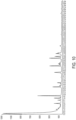
- FIG. 10 provides the XRD pattern for the treated mordenite physically mixed with untreated commercial mordenite in ammonia form.
- Table 10 Heavy reformate composition Major Hydrocarbons Amount (wt.
- the pressure of the reactor was increased to 20 bar and the flow of the industrial reformate feedstock was started at 4.2 grams/h.
- the reaction was allowed to run at least one hour at 400 °C before collecting the product sample.
- the reactor was allowed to further run for 48 hours without exhibiting loss of activity before termination.
- the liquid product obtained from the reactor was analyzed using a gas chromatograph.
- the reaction product was directly injected into an on-line gas chromatograph equipped with one thermal conductivity detector (TCD) and two flame ionization detector.
- TCD thermal conductivity detector
- the gas chromatography uses a plurality of columns to conduct the analysis of the liquid product obtained from the reactor.
- a Hayesep N precolumn with a 0.5 meter (m) length, a Hayesep Q column with a 1.5 m length, a CP-Wax capillary column with a 5.0 m length and 0.32 mm inner diameter, and a 13C molecular sieve with a 1.2 m length were utilized. Each column was manufactured by Agilent Technologies (Santa Clara, California). Table 11 The experimental results provided in Table 11 shows the comparison of the gas chromatograph liquid product analysis of Catalysts A, B, C, D, E, F, G, H. Table 11: Catalyst Experimental results Catalyst Average MEB Conversion (wt. %) Average TMB Conversion (wt.
- Catalyst A (Example 1) 96.8 39.7 37.7 15.2 1.8 Catalyst B (Example 2) 96.9 40.8 38.1 15.5 1.8 Catalyst C (Example 3) 97.41 44 39 17.03 2.15 Catalyst D (Comparative Example 4) 93.3 41.2 36.9 14.5 1.7 Catalyst E (Comparative Example 5) 98.62 4.55 17.94 17.44 2.66 Catalyst F (Comparative Example 6) 97.7 36.7 36.2 14.1 1.7 Catalyst G (Comparative Example 7) 96 37 37 14 2 Catalyst H (Comparative Example 8) 98.3 35.2 37.3 14.2 1.6
- Catalyst F (Comparative Example 6) represents a mix of untreated commercial samples of Mordenite and ZSM-5. Comparison of Catalyst F (Comparative Example 6) with Catalysts A, B, and C (Examples 1, 2, and 3 respectively) provides indication of the improved yields provided by the treated Mordenite and ZSM-5. Catalyst F (Comparative Example 6) resulted in a yield of 36.2 wt.
- Example 1 % of xylenes and Catalyst A (Example 1), which is a hierarchical composite of Mordenite and ZSM-5 in 3:1 ratio as described supra, resulted in a yield of 37.7 wt. % of xylenes. This represents a 1.5 wt. % increase. This increase can be explained due to the structure of Mordenite and ZSM-5 in Catalyst A (Example 1) which improved the transport properties which in turn boosted the conversion of trimethylbenzenes from 36.7 wt. % with Catalyst F (Comparative Example 6) to 39.7 wt. % with Catalyst A (Example 1).
- Catalyst B (Example B) exhibited a 38.1 wt. % xylenes yield representing a 1.9 % increase over Catalyst F (Comparative Example 6). Yet an even better result was achieved when Mordenite and ZSM-5 were separately treated and physically mixed in a 3:1 ratio after recrystallization as in Catalyst C (Example 3). Specifically, Catalyst C (Example 3) exhibited a 39 wt. % xylenes yield representing a 2.8 wt. % increase over Catalyst F (Comparative Example 6).
- the catalysts G (Comparative Example 7) and H (Comparative Example 8) were synthesized with one treated component (either Mordenite or ZSM-5) and one other untreated component (the other of Mordenite or ZSM-5) to understand the effect of treatment on both the components and overall catalyst formulation.
- Catalyst G (Comparative Example 7) represented a physically mixture of 3 parts of treated Mordenite and one part of commercial untreated ZSM-5 while
- Catalyst H (Comparative Example 8) represented a physically mixture of 3 parts of commercial untreated Mordenite and one part of treated ZSM-5.
- Catalyst G (Comparative Example 7) which has the treated Mordenite component demonstrated higher Trimethylbenzenes conversion compare to Catalyst H which is comprised of untreated Mordenite, indicating the treated mordentite has higher capabilities of trimethylbenzene conversion or transalkylation with toluene.
- Catalyst H (Comparative Example 8) was made with treated ZSM-5 and Catalyst G (Comparative Example 7) with untreated ZSM-5, and Catalyst H (Comparative Example 8) demonstrated higher methylethylbenzenes conversion of 98.3 wt. % compared to Catalyst G (Comparative Example 7) of 96 wt. %.
- Catalyst D (Comparative Example 4)
- Catalyst D (Comparative Example 4)
- Catalyst D (Comparative Example 4) has a 41.2 wt. % conversion of trimethylbenzenes and only a 93.3 wt. % ethylmethylbenzenes conversion, which again indicates that treated Mordenite is a more efficient transalkylating agent than de-alkylating agent.
- Catalyst E (Comparative Example 5)
- Catalyst E (Comparative Example 5)
- This conversion of trimethylbenzenes and xylene yield is far less than any of the other catalyst formulations.
- the efficiency of Catalyst E (Comparative Example 5) in methylethylbenzenes conversion is the highest among all the catalyst formulations at 98.62 wt. % which is directly translated to the highest toluene yield of 17.44 wt. %.
Landscapes
- Chemical & Material Sciences (AREA)
- Organic Chemistry (AREA)
- Chemical Kinetics & Catalysis (AREA)
- Engineering & Computer Science (AREA)
- Materials Engineering (AREA)
- Crystallography & Structural Chemistry (AREA)
- Oil, Petroleum & Natural Gas (AREA)
- Life Sciences & Earth Sciences (AREA)
- General Life Sciences & Earth Sciences (AREA)
- Geology (AREA)
- General Chemical & Material Sciences (AREA)
- Inorganic Chemistry (AREA)
- Physics & Mathematics (AREA)
- Thermal Sciences (AREA)
- Catalysts (AREA)
- Organic Low-Molecular-Weight Compounds And Preparation Thereof (AREA)
- Nanotechnology (AREA)
- Low-Molecular Organic Synthesis Reactions Using Catalysts (AREA)
- Silicates, Zeolites, And Molecular Sieves (AREA)
Claims (15)
- Verfahren zur Herstellung eines hierarchischen Zeolithverbundstoff-Katalysators, umfassend:Auflösen eines Katalysatorvorläufers, der Zeolith umfasst, in einer alkalischen Lösung in Gegenwart eines Tensids unter Wärmen, Rühren oder beidem, um eine Lösung von gelöstem Zeolith zu erhalten, wobei der Zeolith sowohl Mordenit als auch ZSM-5 umfasst, und wobei die alkalische Lösung eine 0,1 bis 0,6 M NaOH-Lösung ist;Kondensieren der Lösung von gelöstem Zeolith, um einen festen Zeolithverbundstoff aus der Lösung von gelöstem Zeolith zu erhalten, wobei Kondensieren der Lösung von gelöstem Zeolith umfasst:Einstellen des pH-Werts der Lösung von gelöstem Zeolith; undReifen der Lösung von gelöstem Zeolith mit eingestelltem pH-Wert;Erhitzen des festen Zeolithverbundstoffs, um das Tensid zu entfernen;Extrudieren des festen Zeolithverbundstoffs mit Bindemittel;Imprägnieren des extrudierten festen Zeolithverbundstoffs mit einem oder mehreren aktiven Metallen ausgewählt aus der Gruppe bestehend aus Molybdän, Platin, Rhenium, Nickel und Kombinationen davon, um imprägnierten festen Zeolithverbundstoff zu erhalten; undKalzinieren des imprägnierten festen Zeolithverbundstoffs, um den hierarchischen Zeolithverbundstoff-Katalysator zu erhalten, wobei der hierarchische Zeolithverbundstoff-Katalysator eine Mesostruktur aufweist, die wenigstens eine fehlgeordnete Mesophase und wenigstens eine geordnete Mesophase umfasst.
- Verfahren gemäß Anspruch 1, wobei das Bindemittel ein Bindemittel auf Aluminiumoxidbasis ist.
- Verfahren gemäß Anspruch 1 oder Anspruch 2, wobei die geordnete Mesophase eine hexagonale Mesophase ist.
- Verfahren gemäß einem der vorstehenden Ansprüche, wobei das Reifen mit Halten der Lösung von gelöstem Zeolith mit eingestelltem pH-Wert bei einer Temperatur von 75 bis 125 °C für eine Zeitdauer von 12 bis 48 Stunden verbunden ist.
- Verfahren gemäß einem der vorstehenden Ansprüche, wobei ein Verhältnis von Mordenit zu ZSM-5 1:1 bis 5:1 nach Gewicht beträgt.
- Verfahren gemäß einem der vorstehenden Ansprüche, ferner umfassend Ionenaustausch an dem festen Zeolithverbundstoff.
- Verfahren gemäß einem der vorstehenden Ansprüche, wobei das Tensid Cetyltrimethylammoniumbromid ist und die Lösung von gelöstem Zeolith 1 bis 8 Gew.-% an dem Cetyltrimethylammoniumbromid umfasst.
- Verfahren gemäß einem der vorstehenden Ansprüche, wobei der Katalysatorvorläufer ferner wenigstens einen zusätzlichen Zeolith ausgewählt aus der Gruppe bestehend aus ZSM-22, ZSM-12 und Kombinationen davon umfasst.
- Verfahren gemäß einem der vorstehenden Ansprüche, wobei das Einstellen des pH-Werts durch eine saure Lösung zum Einstellen des pH-Werts auf unter 9 durchgeführt wird.
- Verfahren gemäß einem der vorstehenden Ansprüche, wobei der Zeolithverbundstoff-Katalysator ein Porenvolumen in dem Bereich von 0,2 bis 3,0 cm3/g aufweist.
- Verfahren gemäß einem der vorstehenden Ansprüche, wobei ein Molverhältnis von Siliciumdioxid zu Aluminium in dem Zeolithverbundstoff-Katalysator von 18 bis 500 beträgt.
- Verfahren gemäß einem der vorstehenden Ansprüche, wobei die aktiven Metalle 0,01 bis 6,0 Gew.-% des imprägnierten festen Zeolithverbundstoffs umfassen.
- Hierarchischer Zeolithverbundstoff-Katalysator, hergestellt durch das Verfahren gemäß einem der vorstehenden Ansprüche.
- Verfahren zum Umwandeln von alkylaromatischen C9+-Kohlenwasserstoffen zu einem Produktstrom, der Benzol, Toluol und Xylol umfasst, wobei das Verfahren umfasst:Reduzieren eines hierarchischen Zeolithverbundstoff-Katalysators gemäß Anspruch 13 mit Wasserstoffgas bei 400 bis 500 °C;Inkontaktbringen eines Einsatzmaterials, das alkylaromatischen C9+-Kohlenwasserstoffe umfasst, mit dem reduzierten Zeolithverbundstoff-Katalysator und Wasserstoff in einer Transalkylierungszone eines Reaktors, um ein Transalkylierungsprodukt zu erzeugen;Abstreifen von C1-C5 und leichteren Kohlenwasserstoffen und Abstreifen von nichtreagiertem Einsatzmaterial von dem Transalkylierungsprodukt; undSammeln wenigstens des Xylolprodukts aus dem Transalkylierungsprodukt.
- Verfahren gemäß Anspruch 14, wobei die Transalkylierungszone bei einem Druck von zwischen 1,0 und 3,0 MPa, einer Temperatur von 200 °C bis 500 °C, einer Raumgeschwindigkeit von 1,0 bis 5,0 h-1 und einem Wasserstoff-zu-Kohlenwasserstoff-Verhältnis von 1 zu 4 vorliegt.
Applications Claiming Priority (3)
| Application Number | Priority Date | Filing Date | Title |
|---|---|---|---|
| US201762520155P | 2017-06-15 | 2017-06-15 | |
| US15/958,394 US11097262B2 (en) | 2017-06-15 | 2018-04-20 | Composite hierarchical zeolite catalyst for heavy reformate conversion to xylenes |
| PCT/US2018/028798 WO2018231340A1 (en) | 2017-06-15 | 2018-04-23 | Composite hierarchical zeolite catalyst for heavy reformate conversion to xylenes |
Publications (2)
| Publication Number | Publication Date |
|---|---|
| EP3638418A1 EP3638418A1 (de) | 2020-04-22 |
| EP3638418B1 true EP3638418B1 (de) | 2023-06-14 |
Family
ID=64657069
Family Applications (1)
| Application Number | Title | Priority Date | Filing Date |
|---|---|---|---|
| EP18726579.8A Active EP3638418B1 (de) | 2017-06-15 | 2018-04-23 | Zusammengesetzter hierarchischer zeolithkatalysator zur schwerreformatumwandlung zu xylenen |
Country Status (8)
| Country | Link |
|---|---|
| US (1) | US11097262B2 (de) |
| EP (1) | EP3638418B1 (de) |
| JP (1) | JP2020523187A (de) |
| KR (1) | KR20200019690A (de) |
| CN (1) | CN110785233B (de) |
| SA (1) | SA519410796B1 (de) |
| SG (1) | SG11201911916VA (de) |
| WO (1) | WO2018231340A1 (de) |
Families Citing this family (17)
| Publication number | Priority date | Publication date | Assignee | Title |
|---|---|---|---|---|
| KR102456344B1 (ko) * | 2016-12-08 | 2022-10-21 | 쉘 인터내셔날 리써취 마트샤피지 비.브이. | 트랜스알킬화에 의한 벤젠의 합성을 위한 몰리브덴-백금-기재 촉매의 제조 방법 |
| US10661260B2 (en) | 2017-06-15 | 2020-05-26 | King Fahd University Of Petroleum And Minerals | Zeolite composite catalysts for conversion of heavy reformate to xylenes |
| EP3539651B1 (de) | 2018-03-14 | 2025-09-17 | Saudi Arabian Oil Company | Verfahren zur umwandlung schweren reformats zu btx über metall-imprägniertem zsm-5+schicht- mordenit-zeolithkompositkatalysator |
| EP3539649B1 (de) | 2018-03-14 | 2020-11-18 | Saudi Arabian Oil Company | Verfahren zur herstellung von zusammengesetzten zeolithkatalysatoren zur umwandlung von schwerem reformat in xylole |
| EP3834931A1 (de) | 2018-03-14 | 2021-06-16 | Saudi Arabian Oil Company | Zeolithverbundkatalysator für schwerreformatumwandlung zu xylenen |
| EP3539652A1 (de) | 2018-03-14 | 2019-09-18 | Saudi Arabian Oil Company | Verfahren zur umwandlung schweren reformats zu btx über metall-imprägniertem zsm-5+mesoporösem mordenit-zeolithkompositkatalysator |
| CN112585093A (zh) * | 2018-08-27 | 2021-03-30 | 埃克森美孚研究工程公司 | 分子筛和制造分子筛的方法 |
| US10981160B1 (en) * | 2019-12-19 | 2021-04-20 | Saudi Arabian Oil Company | Composite hierarchical zeolite catalyst for heavy reformate conversion to xylenes |
| US11103859B2 (en) | 2020-01-06 | 2021-08-31 | Uop Llc | UZM-54 and transalkylation process using same |
| CN111151255B (zh) * | 2020-01-16 | 2021-04-30 | 厦门大学 | 一种催化剂、制备方法及电催化分解水产氢工艺 |
| CN111167456B (zh) * | 2020-01-16 | 2023-07-07 | 厦门大学 | 一种催化剂、制备方法及在电解水制氢的应用 |
| CN114054076B (zh) * | 2020-08-06 | 2024-10-29 | 中国石油天然气股份有限公司 | 一种用于催化轻汽油芳构化的催化剂及其制备方法 |
| US11578276B2 (en) | 2021-07-01 | 2023-02-14 | Saudi Arabian Oil Company | Two stage catalytic process for pyrolysis oil upgrading to BTX |
| US11377400B1 (en) | 2021-07-01 | 2022-07-05 | Saudi Arabian Oil Company | Three stage catalytic process for pyrolysis oil upgrading to xylenes |
| CN113880110B (zh) * | 2021-10-25 | 2023-01-03 | 南昌大学 | 一种纳米多级孔mor/mtw共晶分子筛及其制备方法和应用 |
| CN114950541B (zh) * | 2022-06-14 | 2023-07-14 | 西北大学 | 一种用于重劣质油制备btx的催化剂及制备方法 |
| CN120515481A (zh) * | 2024-02-20 | 2025-08-22 | 中国石油化工股份有限公司 | 一种柴油加氢裂化催化剂及其制备方法和应用 |
Family Cites Families (46)
| Publication number | Priority date | Publication date | Assignee | Title |
|---|---|---|---|---|
| US4861739A (en) | 1987-06-04 | 1989-08-29 | Uop | Microporous crystalline composite compositions |
| EP1144113B1 (de) * | 1998-12-24 | 2006-03-22 | SK Corporation | Katalysator zur disproportionierung und transalkylierung von aromatischen kohlenwasserstoffen und verfahren zu seiner herstellung |
| US7084087B2 (en) | 1999-09-07 | 2006-08-01 | Abb Lummus Global Inc. | Zeolite composite, method for making and catalytic application thereof |
| FR2802120B1 (fr) | 1999-12-14 | 2002-02-01 | Inst Francais Du Petrole | Solide silicoaluminate micro et mesoporeux, procede de preparation, utilisation comme catalyseur et en conversion d'hydrocarbures |
| US6746659B2 (en) * | 2000-05-25 | 2004-06-08 | Board Of Trustees Of Michigan State University | Ultrastable porous aluminosilicate structures |
| US6793911B2 (en) * | 2002-02-05 | 2004-09-21 | Abb Lummus Global Inc. | Nanocrystalline inorganic based zeolite and method for making same |
| US6815570B1 (en) | 2002-05-07 | 2004-11-09 | Uop Llc | Shaped catalysts for transalkylation of aromatics for enhanced xylenes production |
| ES2327753T3 (es) | 2004-04-14 | 2009-11-03 | Institut Francais Du Petrole | Catalizador que comprende un zaolita 10mr y una zeolita 12mr y su utilizacion en un procedimiento de transalquilacion de hidrocarburos alquilaromaticos. |
| US20130292300A1 (en) * | 2004-04-23 | 2013-11-07 | Massachusetts Institute Of Technology | Mesostructured zeolitic materials suitable for use in hydrocracking catalyst compositions and methods of making and using the same |
| US7589041B2 (en) * | 2004-04-23 | 2009-09-15 | Massachusetts Institute Of Technology | Mesostructured zeolitic materials, and methods of making and using the same |
| DK1830956T3 (da) | 2004-12-28 | 2023-02-06 | Neste Oyj | Fremgangsmåde til forberedelse af katalytiske materialer |
| JP5041373B2 (ja) | 2005-03-31 | 2012-10-03 | エクソンモービル・ケミカル・パテンツ・インク | 芳香族化合物のトランスアルキル化用の高活性触媒を用いるプロセス |
| EP1866271B1 (de) | 2005-03-31 | 2016-09-21 | ExxonMobil Chemical Patents Inc. | Verfahren und katalysator zur transalkylierung aromatischer verbindungen |
| US7566810B2 (en) * | 2006-09-12 | 2009-07-28 | Uop Llc | Xylene production processes employing rhenium-containing catalysts |
| FR2909012B1 (fr) | 2006-11-23 | 2009-05-08 | Inst Francais Du Petrole | Catalyseur a base d'un materiau a porosite hierarchisee comprenant du silicium et procede d'hydrocraquage/ hydroconversion et d'hydrotraitement de charges hydrocarbonees. |
| ES2319007B1 (es) * | 2006-12-07 | 2010-02-16 | Rive Technology, Inc. | Metodos para fabricar materiales zeoliticos mesoestructurados. |
| US7919421B2 (en) | 2006-12-21 | 2011-04-05 | Exxonmobil Chemical Patents Inc. | Catalyst composition, the method of manufacturing and the process of use thereof in aromatics alkylation |
| US20080214882A1 (en) | 2007-02-16 | 2008-09-04 | Board Of Trustees Of Michigan State University | Acidic mesostructured aluminosilicates assembled from surfactant-mediated zeolite hydrolysis products |
| US7803977B2 (en) | 2007-03-16 | 2010-09-28 | Uop Llc | Transalkylation of heavy alkylate using a layered catalyst |
| US8653315B2 (en) | 2008-07-30 | 2014-02-18 | King Fahd University Of Petroleum And Minerals | Multiple zeolite catalyst and method of using the same for toluene disproportionation |
| US20100029467A1 (en) | 2008-07-30 | 2010-02-04 | Tomoyuki Inui | Multiple zeolite catalyst |
| CN101898145B (zh) * | 2009-05-27 | 2012-12-12 | 中国石油化工股份有限公司 | 烷基芳烃异构化催化剂及其制备方法 |
| US8685875B2 (en) | 2009-10-20 | 2014-04-01 | Rive Technology, Inc. | Methods for enhancing the mesoporosity of zeolite-containing materials |
| CN102039200B (zh) | 2009-10-22 | 2012-07-18 | 中国石油天然气股份有限公司 | 一种Y-Beta/MCM-41双微孔-介孔复合分子筛及制备方法 |
| US20110171121A1 (en) * | 2010-01-08 | 2011-07-14 | Rive Technology, Inc. | Compositions and methods for making stabilized mesoporous materials |
| US8071828B2 (en) | 2010-02-03 | 2011-12-06 | Exxonmobil Chemical Patents Inc. | Transalkylation of heavy aromatic hydrocarbon feedstocks |
| US8435909B2 (en) | 2010-02-18 | 2013-05-07 | King Fahd University Of Petroleum And Minerals | Dual-zeolite catalyst for production of ethylbenzene |
| US20110201860A1 (en) | 2010-02-18 | 2011-08-18 | Muhammad Naseem Akhtar | Process for conversion of alkanes to aromatics |
| AU2012240093B2 (en) | 2011-04-08 | 2015-06-11 | W. R. Grace & Co.-Conn. | Mesoporous framework-modified zeolites |
| US20130165315A1 (en) | 2011-12-27 | 2013-06-27 | King Fahd University Of Petroleum And Minerals | Method of forming a hydrocarbon cracking catalyst |
| US9376324B2 (en) | 2012-01-13 | 2016-06-28 | Rive Technology, Inc. | Introduction of mesoporosity into zeolite materials with sequential acid, surfactant, and base treatment |
| WO2013123299A1 (en) | 2012-02-17 | 2013-08-22 | Kior, Inc. | Mesoporous zeolite-containing catalysts for the thermoconversion of biomass and for upgrading bio-oils |
| US8697593B2 (en) | 2012-03-12 | 2014-04-15 | King Fahd University Of Petroleum And Minerals | Zeolite catalyst for the alkylation of toluene with methanol |
| WO2013151689A1 (en) | 2012-04-02 | 2013-10-10 | Saudi Arabian Oil Company | Multimetal zeolites based catalyst for transalkylation of heavy reformate to produce xylenes and petrochemical feedstocks |
| JP6034224B2 (ja) | 2012-04-10 | 2016-11-30 | ユニゼオ株式会社 | ベータ型ゼオライト及びその製造方法 |
| US9000247B2 (en) | 2012-04-19 | 2015-04-07 | Saudi Arabian Oil Company | Combined heavy reformate dealkylation-transalkylation process for maximizing xylenes production |
| US9573121B2 (en) | 2012-11-08 | 2017-02-21 | Rive Technology, Inc. | Mesoporous zeolite catalyst supports |
| US9724680B2 (en) | 2012-12-07 | 2017-08-08 | Exxonmobil Research And Engineering Company | Fiber reinforced zeolite extrudates with enhanced physical properties |
| CN103626655B (zh) | 2013-11-27 | 2017-01-04 | 安徽大学 | 一种暴露晶面可控的金属有机骨架材料制备方法 |
| US9662640B2 (en) * | 2013-12-27 | 2017-05-30 | Rive Technology, Inc. | Introducing mesoporosity into zeolite materials with a modified acid pre-treatment step |
| EP3166910B1 (de) | 2014-07-11 | 2018-10-03 | Total Research & Technology Feluy | Verfahren zur herstellung mesoporöser mikroporöser kristalliner materialien unter verwendung eines wiederherstellbaren und wiederverwendbaren mesoporenformungsmittels |
| CN107001056B (zh) | 2014-12-11 | 2019-04-02 | 瑞弗科技有限公司 | 以减少的处理制备介孔沸石 |
| US10118165B2 (en) | 2015-02-04 | 2018-11-06 | Exxonmobil Chemical Patents Inc. | Catalyst compositions and use in heavy aromatics conversion processes |
| US20160221897A1 (en) | 2015-02-04 | 2016-08-04 | Exxonmobil Chemical Patents Inc. | Transalkylation of Heavy Aromatic Hydrocarbon Feedstocks |
| EP3319908A1 (de) | 2015-07-09 | 2018-05-16 | Total Research & Technology Feluy | Mesoporöses zeolithisches material, verfahren zur herstellung davon und verwendung |
| ITUB20154284A1 (it) | 2015-10-09 | 2017-04-09 | Eme International Ltd | Pyrolysis process and plasma pyrolysis reactor for carrying out said process |
-
2018
- 2018-04-20 US US15/958,394 patent/US11097262B2/en active Active
- 2018-04-23 SG SG11201911916VA patent/SG11201911916VA/en unknown
- 2018-04-23 JP JP2019565837A patent/JP2020523187A/ja active Pending
- 2018-04-23 KR KR1020207001171A patent/KR20200019690A/ko not_active Ceased
- 2018-04-23 CN CN201880039431.5A patent/CN110785233B/zh active Active
- 2018-04-23 EP EP18726579.8A patent/EP3638418B1/de active Active
- 2018-04-23 WO PCT/US2018/028798 patent/WO2018231340A1/en not_active Ceased
-
2019
- 2019-12-12 SA SA519410796A patent/SA519410796B1/ar unknown
Also Published As
| Publication number | Publication date |
|---|---|
| EP3638418A1 (de) | 2020-04-22 |
| SA519410796B1 (ar) | 2022-10-17 |
| US20180361372A1 (en) | 2018-12-20 |
| SG11201911916VA (en) | 2020-01-30 |
| CN110785233B (zh) | 2022-09-09 |
| KR20200019690A (ko) | 2020-02-24 |
| WO2018231340A1 (en) | 2018-12-20 |
| CN110785233A (zh) | 2020-02-11 |
| JP2020523187A (ja) | 2020-08-06 |
| US11097262B2 (en) | 2021-08-24 |
Similar Documents
| Publication | Publication Date | Title |
|---|---|---|
| EP3638418B1 (de) | Zusammengesetzter hierarchischer zeolithkatalysator zur schwerreformatumwandlung zu xylenen | |
| US10981160B1 (en) | Composite hierarchical zeolite catalyst for heavy reformate conversion to xylenes | |
| US11351527B2 (en) | Zeolite composite catalysts for conversion of heavy reformate to xylenes | |
| JP4067122B2 (ja) | 芳香族変換方法及びこの方法に有用なゼオライト触媒 | |
| US7456124B2 (en) | Rhenium-containing transalkylation catalysts and processes for making the same | |
| US7544849B2 (en) | Catalyst treatment useful for aromatics conversion process | |
| US8329973B2 (en) | Multiple zeolite catalyst | |
| US8653315B2 (en) | Multiple zeolite catalyst and method of using the same for toluene disproportionation | |
| US7154014B1 (en) | Alumina guard bed for aromatics transalkylation process | |
| EP2773603B1 (de) | Katalysator und verfahren zur umwandlung von kohlenwasserstoffen | |
| US20240351010A1 (en) | Methods of converting toluene to benzene and xylene using mesoporous mordenite | |
| US20240262766A1 (en) | Methods for producing xylenes with limited ethylbenzene production | |
| CN119524921A (zh) | 一种液相二甲苯异构化反应的催化剂及制备方法、液相二甲苯异构化方法 | |
| CN119528674A (zh) | 一种液相二甲苯异构化方法、液相非临氢二甲苯异构化反应的催化剂及制备方法 |
Legal Events
| Date | Code | Title | Description |
|---|---|---|---|
| STAA | Information on the status of an ep patent application or granted ep patent |
Free format text: STATUS: UNKNOWN |
|
| STAA | Information on the status of an ep patent application or granted ep patent |
Free format text: STATUS: THE INTERNATIONAL PUBLICATION HAS BEEN MADE |
|
| PUAI | Public reference made under article 153(3) epc to a published international application that has entered the european phase |
Free format text: ORIGINAL CODE: 0009012 |
|
| STAA | Information on the status of an ep patent application or granted ep patent |
Free format text: STATUS: REQUEST FOR EXAMINATION WAS MADE |
|
| 17P | Request for examination filed |
Effective date: 20200101 |
|
| AK | Designated contracting states |
Kind code of ref document: A1 Designated state(s): AL AT BE BG CH CY CZ DE DK EE ES FI FR GB GR HR HU IE IS IT LI LT LU LV MC MK MT NL NO PL PT RO RS SE SI SK SM TR |
|
| AX | Request for extension of the european patent |
Extension state: BA ME |
|
| DAV | Request for validation of the european patent (deleted) | ||
| DAX | Request for extension of the european patent (deleted) | ||
| GRAP | Despatch of communication of intention to grant a patent |
Free format text: ORIGINAL CODE: EPIDOSNIGR1 |
|
| STAA | Information on the status of an ep patent application or granted ep patent |
Free format text: STATUS: GRANT OF PATENT IS INTENDED |
|
| INTG | Intention to grant announced |
Effective date: 20230130 |
|
| GRAS | Grant fee paid |
Free format text: ORIGINAL CODE: EPIDOSNIGR3 |
|
| GRAA | (expected) grant |
Free format text: ORIGINAL CODE: 0009210 |
|
| STAA | Information on the status of an ep patent application or granted ep patent |
Free format text: STATUS: THE PATENT HAS BEEN GRANTED |
|
| AK | Designated contracting states |
Kind code of ref document: B1 Designated state(s): AL AT BE BG CH CY CZ DE DK EE ES FI FR GB GR HR HU IE IS IT LI LT LU LV MC MK MT NL NO PL PT RO RS SE SI SK SM TR |
|
| REG | Reference to a national code |
Ref country code: CH Ref legal event code: EP |
|
| P01 | Opt-out of the competence of the unified patent court (upc) registered |
Effective date: 20230514 |
|
| REG | Reference to a national code |
Ref country code: DE Ref legal event code: R096 Ref document number: 602018051830 Country of ref document: DE |
|
| REG | Reference to a national code |
Ref country code: AT Ref legal event code: REF Ref document number: 1578824 Country of ref document: AT Kind code of ref document: T Effective date: 20230715 |
|
| REG | Reference to a national code |
Ref country code: NL Ref legal event code: FP |
|
| REG | Reference to a national code |
Ref country code: LT Ref legal event code: MG9D |
|
| PG25 | Lapsed in a contracting state [announced via postgrant information from national office to epo] |
Ref country code: SE Free format text: LAPSE BECAUSE OF FAILURE TO SUBMIT A TRANSLATION OF THE DESCRIPTION OR TO PAY THE FEE WITHIN THE PRESCRIBED TIME-LIMIT Effective date: 20230614 Ref country code: NO Free format text: LAPSE BECAUSE OF FAILURE TO SUBMIT A TRANSLATION OF THE DESCRIPTION OR TO PAY THE FEE WITHIN THE PRESCRIBED TIME-LIMIT Effective date: 20230914 Ref country code: ES Free format text: LAPSE BECAUSE OF FAILURE TO SUBMIT A TRANSLATION OF THE DESCRIPTION OR TO PAY THE FEE WITHIN THE PRESCRIBED TIME-LIMIT Effective date: 20230614 |
|
| REG | Reference to a national code |
Ref country code: AT Ref legal event code: MK05 Ref document number: 1578824 Country of ref document: AT Kind code of ref document: T Effective date: 20230614 |
|
| PG25 | Lapsed in a contracting state [announced via postgrant information from national office to epo] |
Ref country code: RS Free format text: LAPSE BECAUSE OF FAILURE TO SUBMIT A TRANSLATION OF THE DESCRIPTION OR TO PAY THE FEE WITHIN THE PRESCRIBED TIME-LIMIT Effective date: 20230614 Ref country code: LV Free format text: LAPSE BECAUSE OF FAILURE TO SUBMIT A TRANSLATION OF THE DESCRIPTION OR TO PAY THE FEE WITHIN THE PRESCRIBED TIME-LIMIT Effective date: 20230614 Ref country code: LT Free format text: LAPSE BECAUSE OF FAILURE TO SUBMIT A TRANSLATION OF THE DESCRIPTION OR TO PAY THE FEE WITHIN THE PRESCRIBED TIME-LIMIT Effective date: 20230614 Ref country code: HR Free format text: LAPSE BECAUSE OF FAILURE TO SUBMIT A TRANSLATION OF THE DESCRIPTION OR TO PAY THE FEE WITHIN THE PRESCRIBED TIME-LIMIT Effective date: 20230614 Ref country code: GR Free format text: LAPSE BECAUSE OF FAILURE TO SUBMIT A TRANSLATION OF THE DESCRIPTION OR TO PAY THE FEE WITHIN THE PRESCRIBED TIME-LIMIT Effective date: 20230915 |
|
| PG25 | Lapsed in a contracting state [announced via postgrant information from national office to epo] |
Ref country code: FI Free format text: LAPSE BECAUSE OF FAILURE TO SUBMIT A TRANSLATION OF THE DESCRIPTION OR TO PAY THE FEE WITHIN THE PRESCRIBED TIME-LIMIT Effective date: 20230614 |
|
| PG25 | Lapsed in a contracting state [announced via postgrant information from national office to epo] |
Ref country code: SK Free format text: LAPSE BECAUSE OF FAILURE TO SUBMIT A TRANSLATION OF THE DESCRIPTION OR TO PAY THE FEE WITHIN THE PRESCRIBED TIME-LIMIT Effective date: 20230614 |
|
| PG25 | Lapsed in a contracting state [announced via postgrant information from national office to epo] |
Ref country code: IS Free format text: LAPSE BECAUSE OF FAILURE TO SUBMIT A TRANSLATION OF THE DESCRIPTION OR TO PAY THE FEE WITHIN THE PRESCRIBED TIME-LIMIT Effective date: 20231014 |
|
| PG25 | Lapsed in a contracting state [announced via postgrant information from national office to epo] |
Ref country code: SM Free format text: LAPSE BECAUSE OF FAILURE TO SUBMIT A TRANSLATION OF THE DESCRIPTION OR TO PAY THE FEE WITHIN THE PRESCRIBED TIME-LIMIT Effective date: 20230614 Ref country code: SK Free format text: LAPSE BECAUSE OF FAILURE TO SUBMIT A TRANSLATION OF THE DESCRIPTION OR TO PAY THE FEE WITHIN THE PRESCRIBED TIME-LIMIT Effective date: 20230614 Ref country code: RO Free format text: LAPSE BECAUSE OF FAILURE TO SUBMIT A TRANSLATION OF THE DESCRIPTION OR TO PAY THE FEE WITHIN THE PRESCRIBED TIME-LIMIT Effective date: 20230614 Ref country code: PT Free format text: LAPSE BECAUSE OF FAILURE TO SUBMIT A TRANSLATION OF THE DESCRIPTION OR TO PAY THE FEE WITHIN THE PRESCRIBED TIME-LIMIT Effective date: 20231016 Ref country code: IS Free format text: LAPSE BECAUSE OF FAILURE TO SUBMIT A TRANSLATION OF THE DESCRIPTION OR TO PAY THE FEE WITHIN THE PRESCRIBED TIME-LIMIT Effective date: 20231014 Ref country code: EE Free format text: LAPSE BECAUSE OF FAILURE TO SUBMIT A TRANSLATION OF THE DESCRIPTION OR TO PAY THE FEE WITHIN THE PRESCRIBED TIME-LIMIT Effective date: 20230614 Ref country code: CZ Free format text: LAPSE BECAUSE OF FAILURE TO SUBMIT A TRANSLATION OF THE DESCRIPTION OR TO PAY THE FEE WITHIN THE PRESCRIBED TIME-LIMIT Effective date: 20230614 Ref country code: AT Free format text: LAPSE BECAUSE OF FAILURE TO SUBMIT A TRANSLATION OF THE DESCRIPTION OR TO PAY THE FEE WITHIN THE PRESCRIBED TIME-LIMIT Effective date: 20230614 |
|
| PG25 | Lapsed in a contracting state [announced via postgrant information from national office to epo] |
Ref country code: PL Free format text: LAPSE BECAUSE OF FAILURE TO SUBMIT A TRANSLATION OF THE DESCRIPTION OR TO PAY THE FEE WITHIN THE PRESCRIBED TIME-LIMIT Effective date: 20230614 |
|
| REG | Reference to a national code |
Ref country code: DE Ref legal event code: R097 Ref document number: 602018051830 Country of ref document: DE |
|
| PLBE | No opposition filed within time limit |
Free format text: ORIGINAL CODE: 0009261 |
|
| STAA | Information on the status of an ep patent application or granted ep patent |
Free format text: STATUS: NO OPPOSITION FILED WITHIN TIME LIMIT |
|
| PG25 | Lapsed in a contracting state [announced via postgrant information from national office to epo] |
Ref country code: DK Free format text: LAPSE BECAUSE OF FAILURE TO SUBMIT A TRANSLATION OF THE DESCRIPTION OR TO PAY THE FEE WITHIN THE PRESCRIBED TIME-LIMIT Effective date: 20230614 |
|
| PG25 | Lapsed in a contracting state [announced via postgrant information from national office to epo] |
Ref country code: SI Free format text: LAPSE BECAUSE OF FAILURE TO SUBMIT A TRANSLATION OF THE DESCRIPTION OR TO PAY THE FEE WITHIN THE PRESCRIBED TIME-LIMIT Effective date: 20230614 |
|
| 26N | No opposition filed |
Effective date: 20240315 |
|
| PG25 | Lapsed in a contracting state [announced via postgrant information from national office to epo] |
Ref country code: SI Free format text: LAPSE BECAUSE OF FAILURE TO SUBMIT A TRANSLATION OF THE DESCRIPTION OR TO PAY THE FEE WITHIN THE PRESCRIBED TIME-LIMIT Effective date: 20230614 Ref country code: IT Free format text: LAPSE BECAUSE OF FAILURE TO SUBMIT A TRANSLATION OF THE DESCRIPTION OR TO PAY THE FEE WITHIN THE PRESCRIBED TIME-LIMIT Effective date: 20230614 |
|
| PG25 | Lapsed in a contracting state [announced via postgrant information from national office to epo] |
Ref country code: BG Free format text: LAPSE BECAUSE OF FAILURE TO SUBMIT A TRANSLATION OF THE DESCRIPTION OR TO PAY THE FEE WITHIN THE PRESCRIBED TIME-LIMIT Effective date: 20230614 |
|
| PG25 | Lapsed in a contracting state [announced via postgrant information from national office to epo] |
Ref country code: MC Free format text: LAPSE BECAUSE OF FAILURE TO SUBMIT A TRANSLATION OF THE DESCRIPTION OR TO PAY THE FEE WITHIN THE PRESCRIBED TIME-LIMIT Effective date: 20230614 |
|
| PG25 | Lapsed in a contracting state [announced via postgrant information from national office to epo] |
Ref country code: MC Free format text: LAPSE BECAUSE OF FAILURE TO SUBMIT A TRANSLATION OF THE DESCRIPTION OR TO PAY THE FEE WITHIN THE PRESCRIBED TIME-LIMIT Effective date: 20230614 Ref country code: BG Free format text: LAPSE BECAUSE OF FAILURE TO SUBMIT A TRANSLATION OF THE DESCRIPTION OR TO PAY THE FEE WITHIN THE PRESCRIBED TIME-LIMIT Effective date: 20230614 |
|
| REG | Reference to a national code |
Ref country code: CH Ref legal event code: PL |
|
| PG25 | Lapsed in a contracting state [announced via postgrant information from national office to epo] |
Ref country code: LU Free format text: LAPSE BECAUSE OF NON-PAYMENT OF DUE FEES Effective date: 20240423 |
|
| GBPC | Gb: european patent ceased through non-payment of renewal fee |
Effective date: 20240423 |
|
| REG | Reference to a national code |
Ref country code: BE Ref legal event code: MM Effective date: 20240430 |
|
| PG25 | Lapsed in a contracting state [announced via postgrant information from national office to epo] |
Ref country code: LU Free format text: LAPSE BECAUSE OF NON-PAYMENT OF DUE FEES Effective date: 20240423 |
|
| PG25 | Lapsed in a contracting state [announced via postgrant information from national office to epo] |
Ref country code: BE Free format text: LAPSE BECAUSE OF NON-PAYMENT OF DUE FEES Effective date: 20240430 |
|
| PG25 | Lapsed in a contracting state [announced via postgrant information from national office to epo] |
Ref country code: GB Free format text: LAPSE BECAUSE OF NON-PAYMENT OF DUE FEES Effective date: 20240423 |
|
| PG25 | Lapsed in a contracting state [announced via postgrant information from national office to epo] |
Ref country code: GB Free format text: LAPSE BECAUSE OF NON-PAYMENT OF DUE FEES Effective date: 20240423 Ref country code: BE Free format text: LAPSE BECAUSE OF NON-PAYMENT OF DUE FEES Effective date: 20240430 Ref country code: CH Free format text: LAPSE BECAUSE OF NON-PAYMENT OF DUE FEES Effective date: 20240430 |
|
| PG25 | Lapsed in a contracting state [announced via postgrant information from national office to epo] |
Ref country code: IE Free format text: LAPSE BECAUSE OF NON-PAYMENT OF DUE FEES Effective date: 20240423 |
|
| PGFP | Annual fee paid to national office [announced via postgrant information from national office to epo] |
Ref country code: DE Payment date: 20250319 Year of fee payment: 8 |
|
| PG25 | Lapsed in a contracting state [announced via postgrant information from national office to epo] |
Ref country code: CY Free format text: LAPSE BECAUSE OF FAILURE TO SUBMIT A TRANSLATION OF THE DESCRIPTION OR TO PAY THE FEE WITHIN THE PRESCRIBED TIME-LIMIT; INVALID AB INITIO Effective date: 20180423 |
|
| PG25 | Lapsed in a contracting state [announced via postgrant information from national office to epo] |
Ref country code: HU Free format text: LAPSE BECAUSE OF FAILURE TO SUBMIT A TRANSLATION OF THE DESCRIPTION OR TO PAY THE FEE WITHIN THE PRESCRIBED TIME-LIMIT; INVALID AB INITIO Effective date: 20180423 |
|
| PGFP | Annual fee paid to national office [announced via postgrant information from national office to epo] |
Ref country code: NL Payment date: 20260325 Year of fee payment: 9 |
|
| PGFP | Annual fee paid to national office [announced via postgrant information from national office to epo] |
Ref country code: FR Payment date: 20260319 Year of fee payment: 9 |