EP3634830B1 - Verfahren und vorrichtung zum schutz eines fahrzeugführers - Google Patents
Verfahren und vorrichtung zum schutz eines fahrzeugführers Download PDFInfo
- Publication number
- EP3634830B1 EP3634830B1 EP18739800.3A EP18739800A EP3634830B1 EP 3634830 B1 EP3634830 B1 EP 3634830B1 EP 18739800 A EP18739800 A EP 18739800A EP 3634830 B1 EP3634830 B1 EP 3634830B1
- Authority
- EP
- European Patent Office
- Prior art keywords
- rail vehicle
- living
- facility
- vehicle
- vision
- Prior art date
- Legal status (The legal status is an assumption and is not a legal conclusion. Google has not performed a legal analysis and makes no representation as to the accuracy of the status listed.)
- Active
Links
Images
Classifications
-
- B—PERFORMING OPERATIONS; TRANSPORTING
- B61—RAILWAYS
- B61L—GUIDING RAILWAY TRAFFIC; ENSURING THE SAFETY OF RAILWAY TRAFFIC
- B61L23/00—Control, warning or like safety means along the route or between vehicles or trains
-
- B—PERFORMING OPERATIONS; TRANSPORTING
- B61—RAILWAYS
- B61C—LOCOMOTIVES; MOTOR RAILCARS
- B61C17/00—Arrangement or disposition of parts; Details or accessories not otherwise provided for; Use of control gear and control systems
- B61C17/04—Arrangement or disposition of driving cabins, footplates or engine rooms; Ventilation thereof
-
- B—PERFORMING OPERATIONS; TRANSPORTING
- B61—RAILWAYS
- B61D—BODY DETAILS OR KINDS OF RAILWAY VEHICLES
- B61D25/00—Window arrangements peculiar to rail vehicles
-
- B—PERFORMING OPERATIONS; TRANSPORTING
- B61—RAILWAYS
- B61L—GUIDING RAILWAY TRAFFIC; ENSURING THE SAFETY OF RAILWAY TRAFFIC
- B61L23/00—Control, warning or like safety means along the route or between vehicles or trains
- B61L23/04—Control, warning or like safety means along the route or between vehicles or trains for monitoring the mechanical state of the route
- B61L23/041—Obstacle detection
-
- B—PERFORMING OPERATIONS; TRANSPORTING
- B60—VEHICLES IN GENERAL
- B60J—WINDOWS, WINDSCREENS, NON-FIXED ROOFS, DOORS, OR SIMILAR DEVICES FOR VEHICLES; REMOVABLE EXTERNAL PROTECTIVE COVERINGS SPECIALLY ADAPTED FOR VEHICLES
- B60J3/00—Antiglare equipment associated with windows or windscreens; Sun visors for vehicles
- B60J3/04—Antiglare equipment associated with windows or windscreens; Sun visors for vehicles adjustable in transparency
Definitions
- the invention relates to a method and a device for protecting a vehicle driver of a rail vehicle traveling on a route.
- From the DE 10 2015 219 690 A1 is a method for detecting the route for a rail vehicle and from the WO 2017/071911 A1 a vehicle is known that minimizes human reactions.
- the invention solves the problem by a method for protecting a vehicle driver of a rail vehicle traveling on a route, in which at least one driver is in front of the rail vehicle living being on the route is detected by a sensor device and in which the driver's view in the direction of the detected living being is blocked with a blocking device.
- the invention also achieves the object with a device for protecting a vehicle driver of a rail vehicle traveling on a route with at least one blocking device which is designed to block the driver's view in the direction of at least one living being that has been identified and is located on the route in front of the rail vehicle.
- the device according to the invention can be designed, for example, as a windshield of a rail vehicle.
- the solution according to the invention has the advantage that the train driver does not experience the impact of the person on the front of the rail vehicle, at least visually, and the traumatizing experience is reduced or even prevented as a result. Since visual experiences have a strong impact on the human psyche, the driver's blocked view can prevent trauma and thereby have a positive impact.
- the living being that is threatened with a collision with the rail vehicle can be recognized by a sensor device according to the invention.
- this knowledge of the detected living being is coupled with the blocking device, which blocks the vehicle driver's view in the direction of the detected living being.
- the driver of the vehicle can also recognize the imminent collision himself and activate the blocking device. According to the invention, the psychological impairment of the vehicle driver is reduced by preventing the visual perception of the accident. With the invention, the vehicle driver can no longer see the direct impact of the person on the rail vehicle and its consequences.
- a distance between the detected living being and the rail vehicle can be determined by the sensor device and the view can be blocked by the blocking device if the distance falls below a predetermined limit value.
- the sensor device determines whether the living being is a human being or an animal, and according to the invention, the view is only blocked by the blocking device if the living being is a human being. This has the advantage that the view is not blocked if, for example, it is a small animal that the driver of the vehicle may or must continue to drive according to his instructions.
- a windshield of the rail vehicle can be made at least partially opaque to block the view.
- the windshield can be made of liquid crystal glass, also known as monochrome or smart glass. The glass darkens when a predetermined electrical voltage is applied, is easy, for example, via the vehicle control switchable.
- the front pane can also be darkened by other means, such as curtains, roller blinds, venetian blinds or the like.
- the device according to the invention has at least one sensor device which is designed to detect at least one living being located in front of the rail vehicle on the route. In this way, the danger is automatically recognized and the blocking device is automatically activated. Alternatively, manual activation would be possible.
- the sensor device can include at least one sensor, in particular a camera, an infrared sensor or an ultrasonic sensor. These sensors are each particularly well suited to reliably detecting a person on the route. In addition or as an alternative, radar or lidar sensors can also be used.
- the blocking device can comprise at least one liquid crystal glass.
- the blocking device made of liquid crystal glass can be designed as a windshield of a rail vehicle.
- the blocking device can include at least one set of glasses for the vehicle driver that can be activated and block the view, a curtain or a roller blind. These are also devices that can reliably block the driver's view.
- the sensor device can include at least one computing device, which is designed to determine the probability of the living being colliding with the rail vehicle, and the blocking device can be designed to block the view if the probability exceeds a predetermined limit value.
- the sensor device or its computing device can be designed to determine a distance between the detected living being and the rail vehicle and the blocking device can be designed to block the view when the distance falls below a predetermined limit value. This has the advantage, also described above, that the driver's view is only blocked in this way if an impact is unavoidable.
- the sensor device is designed to determine whether the living being is a human being or an animal
- the blocking device is designed to block the view if the living being is a human being.
- the device for carrying out a method can be designed according to one of the embodiments described above.
- the invention also relates to a rail vehicle that has a device for protecting a vehicle driver according to one of the above-mentioned embodiments.
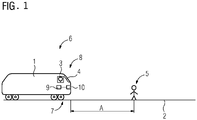
- the only figure shows a schematic representation of a exemplary embodiment of a rail vehicle according to the invention with a device for protecting a vehicle driver.
- the figure shows an exemplary embodiment of a rail vehicle 1, which drives on a route 2 and is operated by a driver 3.
- the vehicle driver 3 is in a driver's cab behind a windscreen 4 according to the invention of the rail vehicle 1.
- the rail vehicle 1 also has a device 6 for protecting the vehicle driver 3 , which in this embodiment includes a sensor device 7 and a blocking device 8 .
- the sensor device 7 is designed to detect a living being, such as the person 5 , who is on the route 2 in front of the rail vehicle 1 .
- the sensor device 7 includes a sensor 10, for example a camera, an infrared sensor or an ultrasonic sensor, with which the person 5 on the route 2 is detected.
- the sensor device 7 also has a computing device 9 with which, among other things, the distance A can be determined. For this purpose, the computing device 9 evaluates the signals from the sensor 10 . Additionally or alternatively, the computing device 9 uses the signals from the sensor 10 to determine a probability that the person 5 will collide with the rail vehicle 1.
- the blocking device 8 is designed to block the view of the vehicle driver 3 in the direction of the person 5 .
- the blocking device 8 in the exemplary embodiment shown in the figure includes the front pane 4, which is made of liquid crystal glass.
- Liquid crystal glass also known as monochrome or intelligent glass or smart glass, can be activated and darkened by applying an electrical voltage. The darkening of the windscreen 4 blocks the view of the vehicle driver 3 of the route 2 and the person 5 so that the vehicle driver cannot see the person 5 impacting the rail vehicle 1 .
- the blocking device 8 instead of the liquid crystal glass for example, also have a curtain, a roller blind or the like for the windshield 4, which blocks the view of the vehicle driver 3 through the windshield 4 when activated.
- the blocking device 8 can alternatively also include intelligent glasses (not shown) for the vehicle driver 3 , the glasses of which darken when activated and block the view of the vehicle driver 3 .
- the blocking device 8 can reliably prevent the vehicle driver 3 from seeing the route 2 from the driver's cab.
- the sensor device 7 is connected to the blocking device 8 in terms of control technology in such a way that when the sensor device 7 has detected a living being, such as the person 5, on the route 2, the blocking device 8 is activated and the view of the vehicle driver 3 is blocked.
- both the sensor device 7 and the blocking device 8 can be connected to a vehicle control (not shown).
- the blocking device 8 is only activated when a collision between the person 5 and the rail vehicle 1 seems unavoidable. It is concluded that the impact is unavoidable if, for example, the distance A between the person 5 and the rail vehicle 1 falls below a predetermined limit value. This limit value can depend on the current braking distance of the rail vehicle 1, for example.
- the impact can also appear unavoidable because a calculated probability of the impact exceeding a predetermined limit value.
- the distance A and the braking distance can be included in the calculation of the probability.
- Other parameters can be, for example, the speed of the rail vehicle 1 and the mass of the train.
- the blocking device 8 can also only be activated after the activation of the brake, in particular an emergency stop.
- the regulations of certain rail vehicle operators 1 may prescribe that for certain animals no braked and the journey of the rail vehicle 1 is to be continued. So that a reliable distinction can be made between an animal and a person 5, the sensor device 7 can determine whether a recognized living being is a human being or an animal. This can be done, for example, by evaluating the signals from sensor 10 using stored reference patterns.
- the device 6 can also only have the blocking device 8 .
- the blocking device 8 could be activated manually by the vehicle driver 3, for example.
Landscapes
- Engineering & Computer Science (AREA)
- Mechanical Engineering (AREA)
- Automation & Control Theory (AREA)
- Transportation (AREA)
- Traffic Control Systems (AREA)
- Forklifts And Lifting Vehicles (AREA)
- Vehicle Body Suspensions (AREA)
- Emergency Alarm Devices (AREA)
- Window Of Vehicle (AREA)
- Fittings On The Vehicle Exterior For Carrying Loads, And Devices For Holding Or Mounting Articles (AREA)
- Devices For Checking Fares Or Tickets At Control Points (AREA)
- Steering Control In Accordance With Driving Conditions (AREA)
- Train Traffic Observation, Control, And Security (AREA)
Description
- Die Erfindung betrifft ein Verfahren und eine Vorrichtung zum Schutz eines Fahrzeugführers eines auf einer Fahrstrecke fahrenden Schienenfahrzeugs.
- Aus der
DE 10 2015 219 690 A1 ist ein Verfahren zur Fahrwegserkennung für ein Schienenfahrzeug und aus derWO 2017/071911 A1 ist ein Fahrzeug bekannt, das menschliche Reaktionen minimiert. - Leider kommt es vor, dass Menschen sich selber umbringen wollen, indem sie sich vor einen fahrenden Zug werfen. Selbst bei einem frühzeitigen Erkennen hat der Fahrzeugführer des Zugs, aufgrund eines sehr langen Bremswegs und fehlender Ausweichmöglichkeiten bei Schienenfahrzeugen, kaum eine Möglichkeit, den drohenden Unfall zu verhindern. Durch die Position des Fahrzeugführers an der Front des Zugs sieht dieser den Aufprall der Person auf dem Schienenfahrzeug und dessen Folgen unmittelbar. Dieses traumatische Erlebnis stellt für viele Fahrzeugführer, insbesondere durch die Bilder des Unfalls, eine sehr starke psychologische Belastung dar. Diese psychologische Belastung kann langfristige Folgen für den Fahrzeugführer, wie beispielsweise jahrelange Beeinträchtigungen oder Berufsunfähigkeit, zur Folge haben. Schienennetzbetreiber haben durch den Ausfall der traumatisierten Fahrzeugführer erhebliche Probleme und hohe Aufwendungen für die Wiedereingliederung betroffener Mitarbeiter.
- Es ist daher die Aufgabe der vorliegenden Erfindung, ein Verfahren und eine Vorrichtung der eingangs genannten Art bereitzustellen, um diesem Problem zu begegnen.
- Die Erfindung löst die Aufgabe durch ein Verfahren zum Schutz eines Fahrzeugführers eines auf einer Fahrstrecke fahrenden Schienenfahrzeugs, bei dem wenigstens ein sich vor dem Schienenfahrzeug auf der Fahrstrecke befindliches Lebewesen von einer Sensoreinrichtung erkannt wird und bei dem die Sicht des Fahrzeugführers in Richtung des erkannten Lebewesens mit einer Blockadeeinrichtung blockiert wird.
- Weiterhin löst die Erfindung die Aufgabe durch eine Vorrichtung zum Schutz eines Fahrzeugführers eines auf einer Fahrstrecke fahrenden Schienenfahrzeugs mit wenigstens einer Blockadeeinrichtung, die zum Blockieren der Sicht des Fahrzeugführers in Richtung wenigstens eines erkannten und sich auf der Fahrstrecke vor dem Schienenfahrzeug befindlichen Lebewesens ausgebildet ist. Die erfindungsgemäße Vorrichtung kann beispielsweise als Frontscheibe eines Schienenfahrzeugs ausgebildet sein.
- Die erfindungsgemäße Lösung hat den Vorteil, dass der Triebfahrzeugführer den Aufprall der Person auf die Front des Schienenfahrzeugs zumindest optisch nicht miterlebt und das traumatisierende Erlebnis dadurch abgeschwächt oder sogar verhindert wird. Da visuelle Erlebnisse einen starken Einfluss auf die menschliche Psyche haben, kann die blockierte Sicht des Fahrzeugführers ein Trauma verhindern und dadurch positiven Einfluss haben.
- Dabei kann das Lebewesen, dem die Kollision mit dem Schienenfahrzeug droht, durch eine erfindungsgemäße Sensoreinrichtung erkannt werden. Diese Erkenntnis über das erkannte Lebewesen wird erfindungsgemäß gekoppelt mit der Blockadeeinrichtung, die die Sicht des Fahrzeugführers in Richtung des erkannten Lebewesens blockiert.
- Der Fahrzeugführer kann auch selbst die drohende Kollision erkennen und die Blockadeeinrichtung aktivieren. Erfindungsgemäß wird die psychologische Beeinträchtigung des Fahrzeugführers durch das Verhindern der visuellen Wahrnehmung des Unfalls gemindert. Der Fahrzeugführer kann durch die Erfindung den unmittelbaren Aufprall der Person auf das Schienenfahrzeug und dessen Folgen nicht mehr sehen.
- Die erfindungsgemäße Lösung kann durch vorteilhafte Ausgestaltungen weiterentwickelt werden, wie sie im Folgenden beschrieben sind.
- So kann in einer vorteilhaften Ausgestaltung des erfindungsgemäßen Verfahrens ein Abstand zwischen dem erkannten Lebewesen und dem Schienenfahrzeug durch die Sensoreinrichtung ermittelt werden und die Sicht durch die Blockadeeinrichtung blockiert werden, wenn der Abstand einen vorbestimmten Grenzwert unterschreitet. Dies hat den Vorteil, dass die Sicht des Fahrzeugführers erst blockiert wird, wenn der Abstand zum Lebewesen so klein ist, dass ein Aufprall unvermeidlich ist.
- Ferner wird erfindungsgemäß von der Sensoreinrichtung ermittelt, ob es sich bei dem Lebewesen um einen Menschen oder ein Tier handelt, und die Sicht wird erfindungsgemäß durch die Blockadeeinrichtung nur blockiert, wenn es sich bei dem Lebewesen um einen Menschen handelt. Dies hat den Vorteil, dass die Sicht nicht blockiert wird, wenn es sich beispielsweise um ein kleineres Tier handelt, bei dem der Fahrzeugführer ggf. entsprechend seinen Vorschriften weiterfahren kann oder muss.
- Um eine zu schnelle Sichtblockierung zu verhindern, kann eine Wahrscheinlichkeit eines Aufpralls des Lebewesens mit dem Schienenfahrzeug durch eine Recheneinrichtung (9) ermittelt werden und die Sicht durch die Blockadeeinrichtung blockiert werden, wenn die Wahrscheinlichkeit einen vorbestimmten Grenzwert überschreitet. So wird die Sicht auf die Fahrstrecke nur versperrt, wenn der Unfall unvermeidlich erscheint. In einer vorteilhaften Ausgestaltung kann zum Blockieren der Sicht eine Frontscheibe des Schienenfahrzeugs zumindest teilweise undurchsichtig gemacht werden. Dies hat den Vorteil, dass die Sichtblockierung auf technisch einfache und zuverlässige Weise hergestellt werden kann. Beispielsweise kann die Frontscheibe aus einem Flüssigkristallglas hergestellt sein, das auch unter den Namen monochromes oder intelligentes Glas (Smart Glass) bekannt ist. Hierbei verdunkelt sich das Glas durch Anlegen einer vorbestimmten elektrischen Spannung, ist also beispielsweise über die Fahrzeugsteuerung leicht schaltbar. Alternativ kann die Frontscheibe auch durch andere Hilfsmittel, wie beispielsweise Vorhänge, Rollos, Jalousien oder ähnliches, verdunkelt werden.
- Die erfindungsgemäße Vorrichtung weist wenigstens eine Sensoreinrichtung auf, die zum Erkennen wenigstens eines sich vor dem Schienenfahrzeug auf der Fahrstrecke befindlichen Lebewesens ausgebildet ist. So wird die Gefahr automatisch erkannt und die Blockadeeinrichtung automatisch aktiviert. Alternativ wäre die manuelle Aktivierung möglich.
- Ferner kann die Sensoreinrichtung wenigstens einen Sensor, insbesondere eine Kamera, einen Infrarotsensor oder einen Ultraschallsensor, umfassen. Diese Sensoren sind jeweils besonders gut geeignet, um eine Person auf der Fahrstrecke zuverlässig zu erkennen. Zusätzlich oder alternativ können auch Radar- oder Lidarsensoren eingesetzt werden.
- In einer weiteren vorteilhaften Ausgestaltung kann die Blockadeeinrichtung wenigstens ein Flüssigkristallglas umfassen. Dies hat den oben bereits beschriebenen Vorteil, dass Flüssigkristallglas einfach und zuverlässig aktiviert und dadurch verdunkelt werden kann und die Frontscheibe des Schienenfahrzeugs zumindest teilweise daraus hergestellt werden kann. Insbesondere kann die Blockadeeinrichtung aus Flüssigkristallglas als Frontscheibe eines Schienenfahrzeugs ausgebildet sein. Alternativ kann die Blockadeeinrichtung wenigstens eine aktivierbare und die Sicht blockierende Brille für den Fahrzeugführer, einen Vorhang oder ein Rollo umfassen. Dies sind ebenfalls Vorrichtungen, mit denen die Sicht des Fahrzeugführers zuverlässig blockiert werden kann.
- Ferner kann die Sensoreinrichtung wenigstens eine Recheneinrichtung umfassen, die zum Ermitteln einer Wahrscheinlichkeit eines Aufpralls des Lebewesens mit dem Schienenfahrzeug ausgebildet ist, und die Blockadeeinrichtung zum Blockieren der Sicht ausgebildet sein, wenn die Wahrscheinlichkeit einen vorbestimmten Grenzwert übersteigt. Dies hat den oben bereits beschriebenen Vorteil, dass eine vorschnelle Sichtblockade verhindert wird, wenn beispielsweise ein Aufprall noch unwahrscheinlich ist und noch verhindert werden kann.
- Weiterhin kann die Sensoreinrichtung oder deren Recheneinrichtung zum Ermitteln eines Abstands zwischen dem erkannten Lebewesen und dem Schienenfahrzeug ausgebildet sein und die Blockadeeinrichtung zum Blockieren der Sicht ausgebildet sein, wenn der Abstand einen vorbestimmten Grenzwert unterschreitet. Dies hat den ebenfalls den oben bereits beschriebenen Vorteil, dass auch auf diese Weise die Sicht des Fahrzeugführers nur blockiert wird, wenn ein Aufprall unvermeidlich ist.
- Die Sensoreinrichtung ist erfindungsgemäß ausgebildet, zu ermitteln, ob es sich bei dem Lebewesen um einen Menschen oder ein Tier handelt, und die Blockadeeinrichtung ist zum Blockieren der Sicht ausgebildet, wenn das Lebewesen ein Mensch ist. Dies hat den oben bereits beschriebenen Vorteil, dass zwischen Mensch und Tier unterschieden werden kann.
- In einer vorteilhaften Weiterbildung kann die Vorrichtung zur Durchführung eines Verfahrens nach einer der oben beschriebenen Ausführungsformen ausgebildet sein.
- Schließlich betrifft die Erfindung auch noch ein Schienenfahrzeug, das eine Vorrichtung zum Schutz eines Fahrzeugführers nach einer der oben genannten Ausführungsformen aufweist.
- Die erfindungsgemäße Lösung wird im Folgenden mit Bezug auf die beigefügte Figur beschrieben.
- Die einzige Figur zeigt eine schematische Darstellung einer beispielhaften Ausführungsform eines erfindungsgemäßen Schienenfahrzeugs mit einer Vorrichtung zum Schutz eines Fahrzeugführers.
- Die Figur zeigt eine beispielhafte Ausführungsform eines Schienenfahrzeugs 1, das auf einer Fahrstrecke 2 fährt und von einem Fahrzeugführer 3 bedient wird. Der Fahrzeugführer 3 befindet sich in einem Führerstand hinter einer erfindungsgemäßen Frontscheibe 4 des Schienenfahrzeugs 1. Auf der Fahrstrecke 2 vor dem Schienenfahrzeug 1 befindet sich in einem Abstand A eine Person 5.
- Das erfindungsgemäße Schienenfahrzeug 1 weist ferner eine Vorrichtung 6 zum Schutz des Fahrzeugführers 3 auf, die in dieser Ausführung eine Sensoreinrichtung 7 und eine Blockadeeinrichtung 8 umfasst.
- Die Sensoreinrichtung 7 ist zum Erkennen eines Lebewesens, wie beispielsweise der Person 5, ausgebildet, die sich auf der Fahrstrecke 2 vor dem Schienenfahrzeug 1 befindet. Die Sensoreinrichtung 7 umfasst einen Sensor 10, beispielsweise eine Kamera, einen Infrarotsensor oder einen Ultraschallsensor, mit dem die Person 5 auf der Fahrstrecke 2 detektiert wird. Die Sensoreinrichtung 7 weist weiterhin eine Recheneinrichtung 9 auf, mit der unter anderem der Abstand A ermittelt werden kann. Hierfür wertet die Recheneinrichtung 9 die Signale des Sensors 10 aus. Zusätzlich oder alternativ ermittelt die Recheneinrichtung 9 aus den Signalen des Sensors 10 eine Wahrscheinlichkeit für einen Zusammenstoß der Person 5 mit dem Schienenfahrzeug 1.
- Die Blockadeeinrichtung 8 ist zum Blockieren der Sicht des Fahrzeugführers 3 in Richtung der Person 5 ausgebildet. Hierfür umfasst die Blockadeeinrichtung 8 in der in der Figur dargestellten beispielhaften Ausführungsform die Frontscheibe 4, die aus Flüssigkristallglas hergestellt ist. Flüssigkristallglas, das auch als monochromes oder intelligentes Glas oder Smart Glass bezeichnet wird, kann durch Anlegen einer elektrischen Spannung aktiviert und dadurch verdunkelt werden. Durch die Verdunkelung der Frontscheibe 4 ist die Sicht des Fahrzeugführers 3 auf die Fahrstrecke 2 und die Person 5 blockiert, so dass der Fahrzeugführer einen Aufprall der Person 5 auf dem Schienenfahrzeug 1 nicht sehen kann. Alternativ kann die Blockadeeinrichtung 8 anstatt des Flüssigkristallglases beispielsweise auch einen Vorhang, ein Rollos oder ähnliches für die Frontscheibe 4 aufweisen, die bei Aktivierung die Sicht des Fahrzeugführers 3 durch die Frontscheibe 4 blockiert. Ferner kann die Blockadeeinrichtung 8 alternativ auch eine intelligente Brille (nicht dargestellt) für den Fahrzeugführer 3 umfassen, deren Gläser sich bei Aktivierung verdunkeln und die Sicht des Fahrzeugführers 3 blockieren. Durch die Blockadeeinrichtung 8 kann die Sicht des Fahrzeugführers 3 aus dem Führerstand auf die Fahrstrecke 2 zuverlässig verhindert werden.
- Erfindungsgemäß ist die Sensoreinrichtung 7 steuerungstechnisch so mit der Blockadeeinrichtung 8 verbunden, dass wenn die Sensoreinrichtung 7 ein Lebewesen, wie die Person 5, auf der Fahrstrecke 2 erkannt hat, die Blockadeeinrichtung 8 aktiviert und die Sicht des Fahrzeugführers 3 blockiert wird. Hierfür können sowohl die Sensoreinrichtung 7 als auch die Blockadeeinrichtung 8 mit einer Fahrzeugsteuerung (nicht dargestellt) verbunden sein. Erfindungsgemäß wird die Blockadeeinrichtung 8 erst aktiviert, wenn ein Aufprall der Person 5 mit dem Schienenfahrzeug 1 unvermeidbar erscheint. Auf eine Unvermeidbarkeit des Aufpralls wird dadurch geschlossen, dass beispielsweise der Abstand A der Person 5 zum Schienenfahrzeug 1 einen vorbestimmten Grenzwert unterschreitet. Dieser Grenzwert kann beispielsweise vom aktuellen Bremsweg des Schienenfahrzeugs 1 abhängen. Alternativ oder zusätzlich kann der Aufprall auch dadurch unvermeidbar erscheinen, dass eine ausgerechnete Wahrscheinlichkeit für den Aufprall einen vorbestimmten Grenzwert überschreitet. Der Abstand A und der Bremsweg können in die Berechnung der Wahrscheinlichkeit mit einfließen. Weitere Parameter können beispielsweise die Geschwindigkeit des Schienenfahrzeugs 1 und die Masse des Zugs sein. Die Blockadeeinrichtung 8 kann auch erst nach dem Aktivieren der Bremse, insbesondere einer Vollbremsung, aktiviert werden.
- Die Vorschriften von bestimmten Betreibern von Schienenfahrzeugen 1 können vorschreiben, dass für bestimmte Tiere nicht gebremst und die Fahrt des Schienenfahrzeugs 1 fortgesetzt werden soll. Damit zuverlässig zwischen einem Tier und einer Person 5 unterschieden werden kann, kann die Sensoreinrichtung 7 ermitteln, ob es sich bei einem erkannten Lebewesen um einen Menschen oder ein Tier handelt. Dies kann beispielsweise durch eine Auswertung der Signale des Sensors 10 mit abgespeicherten Vergleichsmustern geschehen.
- Alternativ zu der in der Figur beispielhaft dargestellten Ausführungsform kann die Vorrichtung 6 auch nur die Blockadeeinrichtung 8 aufweisen. In dieser Ausführung könnte die Blockadeeinrichtung 8 beispielsweise manuell vom Fahrzeugführer 3 aktiviert werden.
Claims (12)
- Verfahren zum Schutz eines Fahrzeugführers (3) eines auf einer Fahrstrecke (2) fahrenden Schienenfahrzeugs (1), bei dem wenigstens ein sich vor dem Schienenfahrzeug (1) auf der Fahrstrecke (2) befindliches Lebewesen (5) von einer Sensoreinrichtung (7) erkannt wird,
dadurch gekennzeichnet, dassdie Sicht des Fahrzeugführers (3) in Richtung des erkannten Lebewesens mit einer Blockadeeinrichtung (8) blockiert wird, von der Sensoreinrichtung (7) ermittelt wird, ob es sich bei dem Lebewesen (5) um einen Menschen oder ein Tier handelt, unddie Sicht durch die Blockadeeinrichtung (8) nur blockiert wird, wenn es sich bei dem Lebewesen um einen Menschen handelt. - Verfahren nach Anspruch 1,
dadurch gekennzeichnet, dassein Abstand zwischen dem erkannten Lebewesen (5) und dem Schienenfahrzeug (1) durch die Sensoreinrichtung (7) ermittelt wird unddie Sicht durch die Blockadeeinrichtung (8) blockiert wird, wenn der Abstand einen vorbestimmten Grenzwert unterschreitet. - Verfahren nach Anspruch 1 oder 2,
dadurch gekennzeichnet, dasseine Wahrscheinlichkeit eines Aufpralls des Lebewesens (5) mit dem Schienenfahrzeug (1) durch eine Recheneinrichtung (9) ermittelt wird unddie Sicht durch die Blockadeeinrichtung (8) blockiert wird, wenn die Wahrscheinlichkeit einen vorbestimmten Grenzwert überschreitet. - Verfahren nach einem der oben genannten Ansprüche,
dadurch gekennzeichnet, dass
zum Blockieren der Sicht eine Frontscheibe (4) des Schienenfahrzeugs (1) zumindest teilweise undurchsichtig gemacht wird. - Verfahren nach Anspruch 4,
dadurch gekennzeichnet, dass
zum Undurchsichtig machen Flüssigkristallglas aktiviert wird. - Vorrichtung (6) zum Schutz eines Fahrzeugführers (3) eines auf einer Fahrstrecke (2) fahrenden Schienenfahrzeugs (1), wobei die Vorrichtung (6) wenigstens eine Sensoreinrichtung (7) aufweist, die zum Erkennen des vor dem Schienenfahrzeug (1) auf der Fahrstrecke (2) befindlichen Lebewesens (5) ausgebildet ist,
gekennzeichnet durch
wenigstens eine Blockadeeinrichtung (8), die zum Blockieren der Sicht des Fahrzeugführers (3) in Richtung wenigstens eines erkannten und auf der Fahrstrecke (2) vor dem Schienenfahrzeug (1) befindlichen Lebewesens (5) ausgebildet ist, wobei die Sensoreinrichtung (7) ausgebildet ist, zu ermitteln, ob es sich bei dem Lebewesen (5) um einen Menschen oder ein Tier handelt, und die Blockadeeinrichtung (8) zum Blockieren der Sicht ausgebildet ist, wenn das Lebewesen (5) ein Mensch ist. - Vorrichtung (6) nach Anspruch 6,
dadurch gekennzeichnet, dass
die Blockadeeinrichtung (8) wenigstens ein Flüssigkristallglas umfasst und insbesondere als Frontscheibe (4) eines Schienenfahrzeugs (1) ausgebildet ist. - Vorrichtung (6) nach Anspruch 6 oder 7,
dadurch gekennzeichnet, dass
die Blockadeeinrichtung (8) wenigstens eine aktivierbare und die Sicht blockierende Brille, einen Vorhang oder ein Rollo umfasst. - Vorrichtung (6) nach einem der Ansprüche 6 bis 8,
dadurch gekennzeichnet, dassdie Sensoreinrichtung (7) wenigstens eine Recheneinrichtung (9) umfasst, die zum Ermitteln einer Wahrscheinlichkeit eines Aufpralls des Lebewesens (5) mit dem Schienenfahrzeug (1) ausgebildet ist, unddie Blockadeeinrichtung (8) zum Blockieren der Sicht ausgebildet ist, wenn die Wahrscheinlichkeit einen vorbestimmten Grenzwert übersteigt. - Vorrichtung (6) nach einem der Ansprüche 6 bis 9,
dadurch gekennzeichnet, dassdie Sensoreinrichtung (7) zum Ermitteln eines Abstands zwischen dem erkannten Lebewesen (5) und dem Schienenfahrzeug (1) ausgebildet ist unddie Blockadeeinrichtung (8) zum Blockieren der Sicht ausgebildet ist, wenn der Abstand einen vorbestimmten Grenzwert unterschreitet. - Vorrichtung (6) nach einem der Ansprüche 6 bis 10,
dadurch gekennzeichnet, dass
die Vorrichtung (6) zur Durchführung eines Verfahrens nach einem der oben genannten Ansprüche 1 bis 5 ausgebildet ist. - Schienenfahrzeug (1),
dadurch gekennzeichnet, dass
das Schienenfahrzeug (1) eine Vorrichtung (6) zum Schutz eines Fahrzeugführers (3) nach einem der oben genannten Ansprüche 6 bis 11 aufweist.
Priority Applications (2)
| Application Number | Priority Date | Filing Date | Title |
|---|---|---|---|
| HRP20230429TT HRP20230429T1 (hr) | 2017-08-01 | 2018-07-03 | Postupak i uređaj za zaštitu vozača željezničkog vozila |
| RS20230306A RS64165B1 (sr) | 2017-08-01 | 2018-07-03 | Postupak i uređaj za zaštitu vozača vozila |
Applications Claiming Priority (2)
| Application Number | Priority Date | Filing Date | Title |
|---|---|---|---|
| DE102017213261.2A DE102017213261A1 (de) | 2017-08-01 | 2017-08-01 | Verfahren und Vorrichtung zum Schutz eines Fahrzeugführers |
| PCT/EP2018/067905 WO2019025105A1 (de) | 2017-08-01 | 2018-07-03 | Verfahren und vorrichtung zum schutz eines fahrzeugführers |
Publications (2)
| Publication Number | Publication Date |
|---|---|
| EP3634830A1 EP3634830A1 (de) | 2020-04-15 |
| EP3634830B1 true EP3634830B1 (de) | 2023-02-22 |
Family
ID=62874886
Family Applications (1)
| Application Number | Title | Priority Date | Filing Date |
|---|---|---|---|
| EP18739800.3A Active EP3634830B1 (de) | 2017-08-01 | 2018-07-03 | Verfahren und vorrichtung zum schutz eines fahrzeugführers |
Country Status (12)
| Country | Link |
|---|---|
| EP (1) | EP3634830B1 (de) |
| CN (1) | CN212738117U (de) |
| DE (1) | DE102017213261A1 (de) |
| DK (1) | DK3634830T3 (de) |
| ES (1) | ES2944614T3 (de) |
| FI (1) | FI3634830T3 (de) |
| HR (1) | HRP20230429T1 (de) |
| PL (1) | PL3634830T3 (de) |
| PT (1) | PT3634830T (de) |
| RS (1) | RS64165B1 (de) |
| RU (1) | RU2736243C1 (de) |
| WO (1) | WO2019025105A1 (de) |
Families Citing this family (2)
| Publication number | Priority date | Publication date | Assignee | Title |
|---|---|---|---|---|
| DE102018132630A1 (de) * | 2018-12-18 | 2020-06-18 | Bombardier Transportation Gmbh | Schienenfahrzeug mit Fensterscheiben mit steuerbarer Transparenz |
| RU2752155C1 (ru) * | 2020-12-25 | 2021-07-23 | Акционерное общество "Научно-исследовательский и проектно-конструкторский институт информатизации, автоматизации и связи на железнодорожном транспорте" | Инфраструктурная система технического зрения обеспечения безопасности движения поездов в области ограниченной видимости |
Family Cites Families (7)
| Publication number | Priority date | Publication date | Assignee | Title |
|---|---|---|---|---|
| US5599042A (en) * | 1995-12-14 | 1997-02-04 | Chorng Rong Shyr | Safety air curtain for vehicles |
| DE102004018394B4 (de) * | 2004-04-16 | 2014-07-24 | Daimler Ag | Insassenschutzsystem |
| JP2006264416A (ja) * | 2005-03-22 | 2006-10-05 | Takata Corp | 対象物検知システム、保護システム、車両 |
| DE102009008077A1 (de) * | 2009-02-10 | 2010-08-19 | Siemens Aktiengesellschaft | Anordnung und Verfahren zur Detektion von Wärmestrahlung emittierenden Objekten auf Gleiskörpern |
| DE102011010947A1 (de) * | 2011-02-10 | 2012-08-16 | Deutsches Zentrum für Luft- und Raumfahrt e.V. | Blendschutz |
| DE102015219690B4 (de) * | 2015-10-12 | 2019-05-09 | Siemens Aktiengesellschaft | Verfahren zur Fahrwegerkennung für ein Schienenfahrzeug |
| GB201519082D0 (en) * | 2015-10-28 | 2015-12-09 | Vlyte Innovations Ltd | An autonomous vehicle that minimizes human reactions |
-
2017
- 2017-08-01 DE DE102017213261.2A patent/DE102017213261A1/de not_active Withdrawn
-
2018
- 2018-07-03 RS RS20230306A patent/RS64165B1/sr unknown
- 2018-07-03 PT PT187398003T patent/PT3634830T/pt unknown
- 2018-07-03 PL PL18739800.3T patent/PL3634830T3/pl unknown
- 2018-07-03 EP EP18739800.3A patent/EP3634830B1/de active Active
- 2018-07-03 HR HRP20230429TT patent/HRP20230429T1/hr unknown
- 2018-07-03 FI FIEP18739800.3T patent/FI3634830T3/fi active
- 2018-07-03 WO PCT/EP2018/067905 patent/WO2019025105A1/de not_active Ceased
- 2018-07-03 CN CN201890001058.XU patent/CN212738117U/zh not_active Expired - Fee Related
- 2018-07-03 RU RU2020104009A patent/RU2736243C1/ru active
- 2018-07-03 DK DK18739800.3T patent/DK3634830T3/da active
- 2018-07-03 ES ES18739800T patent/ES2944614T3/es active Active
Also Published As
| Publication number | Publication date |
|---|---|
| RU2736243C1 (ru) | 2020-11-12 |
| DK3634830T3 (da) | 2023-05-01 |
| FI3634830T3 (fi) | 2023-05-05 |
| RS64165B1 (sr) | 2023-05-31 |
| ES2944614T3 (es) | 2023-06-22 |
| EP3634830A1 (de) | 2020-04-15 |
| PL3634830T3 (pl) | 2023-05-29 |
| DE102017213261A1 (de) | 2019-02-07 |
| HRP20230429T1 (hr) | 2023-07-07 |
| PT3634830T (pt) | 2023-05-24 |
| WO2019025105A1 (de) | 2019-02-07 |
| CN212738117U (zh) | 2021-03-19 |
Similar Documents
| Publication | Publication Date | Title |
|---|---|---|
| DE102017212277B3 (de) | Gefahrerkennung bei beabsichtigtem Spurwechsel | |
| EP3227826B1 (de) | Verfahren zum bestimmen eines fahrerspezifischen totwinkelfeldes für ein fahrerassistenzsystem, fahrerassistenzsystem sowie kraftfahrzeug | |
| EP2879116B1 (de) | Verfahren und Vorrichtung zur Erkennung der Durchfahrtsmöglichkeit eines Fahrzeugs | |
| DE19647283A1 (de) | Vorrichtung zur Vermeidung und/oder Minimierung von Konfliktsituationen im Straßenverkehr | |
| DE102011116822A1 (de) | Überwachungssystem zur Überwachung des Umfeldes von Fahrzeugen, insbesondere von Kraft- und/oder Nutzfahrzeugen | |
| DE102009038421B4 (de) | Kraftfahrzeug | |
| DE102016201522A1 (de) | Verfahren zur Verringerung einer Kollisionsgefahr, Sicherheitssystem und Fahrzeug | |
| EP3634830B1 (de) | Verfahren und vorrichtung zum schutz eines fahrzeugführers | |
| DE102016217741B4 (de) | Verfahren für den Betrieb einer Sicherheitseinrichtung eines Kraftfahrzeugs | |
| DE102014202324A1 (de) | Verfahren und Vorrichtung zum sicheren Parken eines Fahrzeugs | |
| DE102011016777A1 (de) | Verfahren und Vorrichtung zum Betrieb einer Sicherheitsvorrichtung für ein Fahrzeug | |
| DE102004028822B4 (de) | Verfahren zur Erkennung einer Ausrichtungsänderung eines Umgebungsfahrzeugs | |
| DE102015013842A1 (de) | Verfahren zum Absetzen eines Notrufs von einem Fahrzeug | |
| DE102018001927A1 (de) | Verfahren zum Betrieb eines autonom fahrenden Fahrzeuges | |
| DE102015002960A1 (de) | Verfahren zum Betrieb eines Fahrzeuges und Vorrichtung zur Durchführung eines solchen Verfahrens | |
| EP3898376B1 (de) | Autonomes schienenfahrzeug mit fensterscheiben mit steuerbarer transparenz | |
| DE102014011630A1 (de) | Verfahren zur Reaktion eines Fahrzeuges auf einen haltenden Bus sowie ein Fahrzeug | |
| DE102017223406A1 (de) | Adaptierbare Steuerung für ein Fahrzeug | |
| DE102016212727A1 (de) | Vorrichtung und Verfahren zum Anpassen von Bereichen für das Warnen eines Fahrers | |
| EP3594078A1 (de) | Verfahren zum betrieb eines fahrerassistenzsystems eines kraftfahrzeugs und kraftfahrzeug | |
| DE102013222946A1 (de) | Vorrichtung zur Ausgabe von Unfall- und/oder Panneninformationen | |
| DE102015217339A1 (de) | Gesichtsfelderkennung in Schienenfahrzeugen | |
| DE102009024527A1 (de) | Abstandsregelungsvorrichtung | |
| DE102014015067A1 (de) | Verfahren zum Betrieb eines Fahrzeuges | |
| DE102016007978A1 (de) | Fahrzeug |
Legal Events
| Date | Code | Title | Description |
|---|---|---|---|
| REG | Reference to a national code |
Ref country code: HR Ref legal event code: TUEP Ref document number: P20230429T Country of ref document: HR |
|
| STAA | Information on the status of an ep patent application or granted ep patent |
Free format text: STATUS: UNKNOWN |
|
| STAA | Information on the status of an ep patent application or granted ep patent |
Free format text: STATUS: THE INTERNATIONAL PUBLICATION HAS BEEN MADE |
|
| PUAI | Public reference made under article 153(3) epc to a published international application that has entered the european phase |
Free format text: ORIGINAL CODE: 0009012 |
|
| STAA | Information on the status of an ep patent application or granted ep patent |
Free format text: STATUS: REQUEST FOR EXAMINATION WAS MADE |
|
| 17P | Request for examination filed |
Effective date: 20200109 |
|
| AK | Designated contracting states |
Kind code of ref document: A1 Designated state(s): AL AT BE BG CH CY CZ DE DK EE ES FI FR GB GR HR HU IE IS IT LI LT LU LV MC MK MT NL NO PL PT RO RS SE SI SK SM TR |
|
| AX | Request for extension of the european patent |
Extension state: BA ME |
|
| DAV | Request for validation of the european patent (deleted) | ||
| DAX | Request for extension of the european patent (deleted) | ||
| RIC1 | Information provided on ipc code assigned before grant |
Ipc: B60J 3/04 20060101ALI20220411BHEP Ipc: B61D 25/00 20060101ALI20220411BHEP Ipc: B61C 17/04 20060101ALI20220411BHEP Ipc: B61L 23/04 20060101ALI20220411BHEP Ipc: B61L 23/00 20060101AFI20220411BHEP |
|
| GRAP | Despatch of communication of intention to grant a patent |
Free format text: ORIGINAL CODE: EPIDOSNIGR1 |
|
| STAA | Information on the status of an ep patent application or granted ep patent |
Free format text: STATUS: GRANT OF PATENT IS INTENDED |
|
| INTG | Intention to grant announced |
Effective date: 20220927 |
|
| GRAS | Grant fee paid |
Free format text: ORIGINAL CODE: EPIDOSNIGR3 |
|
| GRAA | (expected) grant |
Free format text: ORIGINAL CODE: 0009210 |
|
| STAA | Information on the status of an ep patent application or granted ep patent |
Free format text: STATUS: THE PATENT HAS BEEN GRANTED |
|
| AK | Designated contracting states |
Kind code of ref document: B1 Designated state(s): AL AT BE BG CH CY CZ DE DK EE ES FI FR GB GR HR HU IE IS IT LI LT LU LV MC MK MT NL NO PL PT RO RS SE SI SK SM TR |
|
| REG | Reference to a national code |
Ref country code: GB Ref legal event code: FG4D Free format text: NOT ENGLISH |
|
| REG | Reference to a national code |
Ref country code: CH Ref legal event code: EP |
|
| REG | Reference to a national code |
Ref country code: AT Ref legal event code: REF Ref document number: 1549338 Country of ref document: AT Kind code of ref document: T Effective date: 20230315 Ref country code: IE Ref legal event code: FG4D Free format text: LANGUAGE OF EP DOCUMENT: GERMAN |
|
| REG | Reference to a national code |
Ref country code: DE Ref legal event code: R096 Ref document number: 502018011639 Country of ref document: DE |
|
| REG | Reference to a national code |
Ref country code: DK Ref legal event code: T3 Effective date: 20230427 |
|
| REG | Reference to a national code |
Ref country code: SE Ref legal event code: TRGR |
|
| REG | Reference to a national code |
Ref country code: PT Ref legal event code: SC4A Ref document number: 3634830 Country of ref document: PT Date of ref document: 20230524 Kind code of ref document: T Free format text: AVAILABILITY OF NATIONAL TRANSLATION Effective date: 20230519 |
|
| REG | Reference to a national code |
Ref country code: LT Ref legal event code: MG9D |
|
| REG | Reference to a national code |
Ref country code: ES Ref legal event code: FG2A Ref document number: 2944614 Country of ref document: ES Kind code of ref document: T3 Effective date: 20230622 |
|
| REG | Reference to a national code |
Ref country code: NL Ref legal event code: MP Effective date: 20230222 |
|
| REG | Reference to a national code |
Ref country code: NO Ref legal event code: T2 Effective date: 20230222 |
|
| REG | Reference to a national code |
Ref country code: HR Ref legal event code: T1PR Ref document number: P20230429 Country of ref document: HR Ref country code: HR Ref legal event code: ODRP Ref document number: P20230429 Country of ref document: HR Payment date: 20230628 Year of fee payment: 6 |
|
| PG25 | Lapsed in a contracting state [announced via postgrant information from national office to epo] |
Ref country code: NL Free format text: LAPSE BECAUSE OF FAILURE TO SUBMIT A TRANSLATION OF THE DESCRIPTION OR TO PAY THE FEE WITHIN THE PRESCRIBED TIME-LIMIT Effective date: 20230222 Ref country code: LV Free format text: LAPSE BECAUSE OF FAILURE TO SUBMIT A TRANSLATION OF THE DESCRIPTION OR TO PAY THE FEE WITHIN THE PRESCRIBED TIME-LIMIT Effective date: 20230222 Ref country code: LT Free format text: LAPSE BECAUSE OF FAILURE TO SUBMIT A TRANSLATION OF THE DESCRIPTION OR TO PAY THE FEE WITHIN THE PRESCRIBED TIME-LIMIT Effective date: 20230222 |
|
| PGFP | Annual fee paid to national office [announced via postgrant information from national office to epo] |
Ref country code: RS Payment date: 20230623 Year of fee payment: 6 Ref country code: PT Payment date: 20230620 Year of fee payment: 6 |
|
| PG25 | Lapsed in a contracting state [announced via postgrant information from national office to epo] |
Ref country code: IS Free format text: LAPSE BECAUSE OF FAILURE TO SUBMIT A TRANSLATION OF THE DESCRIPTION OR TO PAY THE FEE WITHIN THE PRESCRIBED TIME-LIMIT Effective date: 20230622 Ref country code: GR Free format text: LAPSE BECAUSE OF FAILURE TO SUBMIT A TRANSLATION OF THE DESCRIPTION OR TO PAY THE FEE WITHIN THE PRESCRIBED TIME-LIMIT Effective date: 20230523 |
|
| PGFP | Annual fee paid to national office [announced via postgrant information from national office to epo] |
Ref country code: HR Payment date: 20230628 Year of fee payment: 6 |
|
| PG25 | Lapsed in a contracting state [announced via postgrant information from national office to epo] |
Ref country code: SM Free format text: LAPSE BECAUSE OF FAILURE TO SUBMIT A TRANSLATION OF THE DESCRIPTION OR TO PAY THE FEE WITHIN THE PRESCRIBED TIME-LIMIT Effective date: 20230222 Ref country code: RO Free format text: LAPSE BECAUSE OF FAILURE TO SUBMIT A TRANSLATION OF THE DESCRIPTION OR TO PAY THE FEE WITHIN THE PRESCRIBED TIME-LIMIT Effective date: 20230222 Ref country code: EE Free format text: LAPSE BECAUSE OF FAILURE TO SUBMIT A TRANSLATION OF THE DESCRIPTION OR TO PAY THE FEE WITHIN THE PRESCRIBED TIME-LIMIT Effective date: 20230222 |
|
| PGFP | Annual fee paid to national office [announced via postgrant information from national office to epo] |
Ref country code: BG Payment date: 20230719 Year of fee payment: 6 |
|
| REG | Reference to a national code |
Ref country code: DE Ref legal event code: R097 Ref document number: 502018011639 Country of ref document: DE |
|
| PG25 | Lapsed in a contracting state [announced via postgrant information from national office to epo] |
Ref country code: SK Free format text: LAPSE BECAUSE OF FAILURE TO SUBMIT A TRANSLATION OF THE DESCRIPTION OR TO PAY THE FEE WITHIN THE PRESCRIBED TIME-LIMIT Effective date: 20230222 |
|
| PLBE | No opposition filed within time limit |
Free format text: ORIGINAL CODE: 0009261 |
|
| STAA | Information on the status of an ep patent application or granted ep patent |
Free format text: STATUS: NO OPPOSITION FILED WITHIN TIME LIMIT |
|
| 26N | No opposition filed |
Effective date: 20231123 |
|
| PG25 | Lapsed in a contracting state [announced via postgrant information from national office to epo] |
Ref country code: SI Free format text: LAPSE BECAUSE OF FAILURE TO SUBMIT A TRANSLATION OF THE DESCRIPTION OR TO PAY THE FEE WITHIN THE PRESCRIBED TIME-LIMIT Effective date: 20230222 |
|
| PG25 | Lapsed in a contracting state [announced via postgrant information from national office to epo] |
Ref country code: MC Free format text: LAPSE BECAUSE OF FAILURE TO SUBMIT A TRANSLATION OF THE DESCRIPTION OR TO PAY THE FEE WITHIN THE PRESCRIBED TIME-LIMIT Effective date: 20230222 |
|
| PG25 | Lapsed in a contracting state [announced via postgrant information from national office to epo] |
Ref country code: MC Free format text: LAPSE BECAUSE OF FAILURE TO SUBMIT A TRANSLATION OF THE DESCRIPTION OR TO PAY THE FEE WITHIN THE PRESCRIBED TIME-LIMIT Effective date: 20230222 |
|
| REG | Reference to a national code |
Ref country code: BE Ref legal event code: MM Effective date: 20230731 |
|
| PG25 | Lapsed in a contracting state [announced via postgrant information from national office to epo] |
Ref country code: LU Free format text: LAPSE BECAUSE OF NON-PAYMENT OF DUE FEES Effective date: 20230703 |
|
| PG25 | Lapsed in a contracting state [announced via postgrant information from national office to epo] |
Ref country code: LU Free format text: LAPSE BECAUSE OF NON-PAYMENT OF DUE FEES Effective date: 20230703 |
|
| REG | Reference to a national code |
Ref country code: IE Ref legal event code: MM4A |
|
| PG25 | Lapsed in a contracting state [announced via postgrant information from national office to epo] |
Ref country code: BE Free format text: LAPSE BECAUSE OF NON-PAYMENT OF DUE FEES Effective date: 20230731 |
|
| PG25 | Lapsed in a contracting state [announced via postgrant information from national office to epo] |
Ref country code: IE Free format text: LAPSE BECAUSE OF NON-PAYMENT OF DUE FEES Effective date: 20230703 |
|
| PG25 | Lapsed in a contracting state [announced via postgrant information from national office to epo] |
Ref country code: IE Free format text: LAPSE BECAUSE OF NON-PAYMENT OF DUE FEES Effective date: 20230703 |
|
| REG | Reference to a national code |
Ref country code: HR Ref legal event code: PBON Ref document number: P20230429 Country of ref document: HR Effective date: 20240703 |
|
| PG25 | Lapsed in a contracting state [announced via postgrant information from national office to epo] |
Ref country code: PT Free format text: LAPSE BECAUSE OF NON-PAYMENT OF DUE FEES Effective date: 20250103 Ref country code: HR Free format text: LAPSE BECAUSE OF NON-PAYMENT OF DUE FEES Effective date: 20240703 |
|
| PG25 | Lapsed in a contracting state [announced via postgrant information from national office to epo] |
Ref country code: BG Free format text: LAPSE BECAUSE OF NON-PAYMENT OF DUE FEES Effective date: 20240703 |
|
| PG25 | Lapsed in a contracting state [announced via postgrant information from national office to epo] |
Ref country code: RS Free format text: LAPSE BECAUSE OF NON-PAYMENT OF DUE FEES Effective date: 20240703 |
|
| PGFP | Annual fee paid to national office [announced via postgrant information from national office to epo] |
Ref country code: PL Payment date: 20250623 Year of fee payment: 8 |
|
| PG25 | Lapsed in a contracting state [announced via postgrant information from national office to epo] |
Ref country code: CY Free format text: LAPSE BECAUSE OF FAILURE TO SUBMIT A TRANSLATION OF THE DESCRIPTION OR TO PAY THE FEE WITHIN THE PRESCRIBED TIME-LIMIT; INVALID AB INITIO Effective date: 20180703 |
|
| PGFP | Annual fee paid to national office [announced via postgrant information from national office to epo] |
Ref country code: CZ Payment date: 20250625 Year of fee payment: 8 |
|
| PG25 | Lapsed in a contracting state [announced via postgrant information from national office to epo] |
Ref country code: HU Free format text: LAPSE BECAUSE OF FAILURE TO SUBMIT A TRANSLATION OF THE DESCRIPTION OR TO PAY THE FEE WITHIN THE PRESCRIBED TIME-LIMIT; INVALID AB INITIO Effective date: 20180703 |
|
| REG | Reference to a national code |
Ref country code: DE Ref legal event code: R081 Ref document number: 502018011639 Country of ref document: DE Owner name: SIEMENS MOBILITY GMBH, DE Free format text: FORMER OWNER: SIEMENS MOBILITY GMBH, 81739 MUENCHEN, DE |
|
| REG | Reference to a national code |
Ref country code: CH Ref legal event code: U11 Free format text: ST27 STATUS EVENT CODE: U-0-0-U10-U11 (AS PROVIDED BY THE NATIONAL OFFICE) Effective date: 20251006 |
|
| PGFP | Annual fee paid to national office [announced via postgrant information from national office to epo] |
Ref country code: FI Payment date: 20250725 Year of fee payment: 8 |
|
| PGFP | Annual fee paid to national office [announced via postgrant information from national office to epo] |
Ref country code: DK Payment date: 20250725 Year of fee payment: 8 Ref country code: DE Payment date: 20250919 Year of fee payment: 8 |
|
| PGFP | Annual fee paid to national office [announced via postgrant information from national office to epo] |
Ref country code: NO Payment date: 20250710 Year of fee payment: 8 |
|
| PGFP | Annual fee paid to national office [announced via postgrant information from national office to epo] |
Ref country code: IT Payment date: 20250718 Year of fee payment: 8 |
|
| PGFP | Annual fee paid to national office [announced via postgrant information from national office to epo] |
Ref country code: GB Payment date: 20250811 Year of fee payment: 8 |
|
| PGFP | Annual fee paid to national office [announced via postgrant information from national office to epo] |
Ref country code: AT Payment date: 20250606 Year of fee payment: 8 Ref country code: FR Payment date: 20250716 Year of fee payment: 8 |
|
| PGFP | Annual fee paid to national office [announced via postgrant information from national office to epo] |
Ref country code: SE Payment date: 20250707 Year of fee payment: 8 |
|
| PG25 | Lapsed in a contracting state [announced via postgrant information from national office to epo] |
Ref country code: TR Free format text: LAPSE BECAUSE OF FAILURE TO SUBMIT A TRANSLATION OF THE DESCRIPTION OR TO PAY THE FEE WITHIN THE PRESCRIBED TIME-LIMIT Effective date: 20230222 |
|
| PGFP | Annual fee paid to national office [announced via postgrant information from national office to epo] |
Ref country code: CH Payment date: 20251006 Year of fee payment: 8 |
|
| PGFP | Annual fee paid to national office [announced via postgrant information from national office to epo] |
Ref country code: ES Payment date: 20251020 Year of fee payment: 8 |