EP3605125B1 - Vorrichtung zur schätzung der gespeicherten strommenge, stromspeichermodul, verfahren zur schätzung der gespeicherten strommenge und computerprogramm - Google Patents
Vorrichtung zur schätzung der gespeicherten strommenge, stromspeichermodul, verfahren zur schätzung der gespeicherten strommenge und computerprogramm Download PDFInfo
- Publication number
- EP3605125B1 EP3605125B1 EP18777306.4A EP18777306A EP3605125B1 EP 3605125 B1 EP3605125 B1 EP 3605125B1 EP 18777306 A EP18777306 A EP 18777306A EP 3605125 B1 EP3605125 B1 EP 3605125B1
- Authority
- EP
- European Patent Office
- Prior art keywords
- voltage value
- soc
- storage amount
- charge
- energy storage
- Prior art date
- Legal status (The legal status is an assumption and is not a legal conclusion. Google has not performed a legal analysis and makes no representation as to the accuracy of the status listed.)
- Active
Links
Images






Classifications
-
- G—PHYSICS
- G01—MEASURING; TESTING
- G01R—MEASURING ELECTRIC VARIABLES; MEASURING MAGNETIC VARIABLES
- G01R31/00—Arrangements for testing electric properties; Arrangements for locating electric faults; Arrangements for electrical testing characterised by what is being tested not provided for elsewhere
- G01R31/36—Arrangements for testing, measuring or monitoring the electrical condition of accumulators or electric batteries, e.g. capacity or state of charge [SoC]
- G01R31/382—Arrangements for monitoring battery or accumulator variables, e.g. SoC
- G01R31/3842—Arrangements for monitoring battery or accumulator variables, e.g. SoC combining voltage and current measurements
-
- G—PHYSICS
- G01—MEASURING; TESTING
- G01R—MEASURING ELECTRIC VARIABLES; MEASURING MAGNETIC VARIABLES
- G01R31/00—Arrangements for testing electric properties; Arrangements for locating electric faults; Arrangements for electrical testing characterised by what is being tested not provided for elsewhere
- G01R31/36—Arrangements for testing, measuring or monitoring the electrical condition of accumulators or electric batteries, e.g. capacity or state of charge [SoC]
-
- G—PHYSICS
- G01—MEASURING; TESTING
- G01R—MEASURING ELECTRIC VARIABLES; MEASURING MAGNETIC VARIABLES
- G01R31/00—Arrangements for testing electric properties; Arrangements for locating electric faults; Arrangements for electrical testing characterised by what is being tested not provided for elsewhere
- G01R31/36—Arrangements for testing, measuring or monitoring the electrical condition of accumulators or electric batteries, e.g. capacity or state of charge [SoC]
- G01R31/367—Software therefor, e.g. for battery testing using modelling or look-up tables
-
- G—PHYSICS
- G01—MEASURING; TESTING
- G01R—MEASURING ELECTRIC VARIABLES; MEASURING MAGNETIC VARIABLES
- G01R31/00—Arrangements for testing electric properties; Arrangements for locating electric faults; Arrangements for electrical testing characterised by what is being tested not provided for elsewhere
- G01R31/36—Arrangements for testing, measuring or monitoring the electrical condition of accumulators or electric batteries, e.g. capacity or state of charge [SoC]
- G01R31/382—Arrangements for monitoring battery or accumulator variables, e.g. SoC
- G01R31/3835—Arrangements for monitoring battery or accumulator variables, e.g. SoC involving only voltage measurements
-
- H—ELECTRICITY
- H01—ELECTRIC ELEMENTS
- H01M—PROCESSES OR MEANS, e.g. BATTERIES, FOR THE DIRECT CONVERSION OF CHEMICAL ENERGY INTO ELECTRICAL ENERGY
- H01M10/00—Secondary cells; Manufacture thereof
- H01M10/42—Methods or arrangements for servicing or maintenance of secondary cells or secondary half-cells
- H01M10/4285—Testing apparatus
-
- H—ELECTRICITY
- H01—ELECTRIC ELEMENTS
- H01M—PROCESSES OR MEANS, e.g. BATTERIES, FOR THE DIRECT CONVERSION OF CHEMICAL ENERGY INTO ELECTRICAL ENERGY
- H01M10/00—Secondary cells; Manufacture thereof
- H01M10/42—Methods or arrangements for servicing or maintenance of secondary cells or secondary half-cells
- H01M10/48—Accumulators combined with arrangements for measuring, testing or indicating the condition of cells, e.g. the level or density of the electrolyte
-
- H—ELECTRICITY
- H01—ELECTRIC ELEMENTS
- H01M—PROCESSES OR MEANS, e.g. BATTERIES, FOR THE DIRECT CONVERSION OF CHEMICAL ENERGY INTO ELECTRICAL ENERGY
- H01M10/00—Secondary cells; Manufacture thereof
- H01M10/42—Methods or arrangements for servicing or maintenance of secondary cells or secondary half-cells
- H01M10/48—Accumulators combined with arrangements for measuring, testing or indicating the condition of cells, e.g. the level or density of the electrolyte
- H01M10/482—Accumulators combined with arrangements for measuring, testing or indicating the condition of cells, e.g. the level or density of the electrolyte for several batteries or cells simultaneously or sequentially
-
- H—ELECTRICITY
- H02—GENERATION; CONVERSION OR DISTRIBUTION OF ELECTRIC POWER
- H02J—ELECTRIC POWER NETWORKS; CIRCUIT ARRANGEMENTS OR SYSTEMS FOR SUPPLYING OR DISTRIBUTING ELECTRIC POWER; SYSTEMS FOR STORING ELECTRIC ENERGY
- H02J7/00—Circuit arrangements for charging or discharging batteries or for supplying loads from batteries
- H02J7/80—Circuit arrangements for charging or discharging batteries or for supplying loads from batteries including monitoring or indicating arrangements
- H02J7/82—Control of state of charge [SOC]
-
- Y—GENERAL TAGGING OF NEW TECHNOLOGICAL DEVELOPMENTS; GENERAL TAGGING OF CROSS-SECTIONAL TECHNOLOGIES SPANNING OVER SEVERAL SECTIONS OF THE IPC; TECHNICAL SUBJECTS COVERED BY FORMER USPC CROSS-REFERENCE ART COLLECTIONS [XRACs] AND DIGESTS
- Y02—TECHNOLOGIES OR APPLICATIONS FOR MITIGATION OR ADAPTATION AGAINST CLIMATE CHANGE
- Y02E—REDUCTION OF GREENHOUSE GAS [GHG] EMISSIONS, RELATED TO ENERGY GENERATION, TRANSMISSION OR DISTRIBUTION
- Y02E60/00—Enabling technologies; Technologies with a potential or indirect contribution to GHG emissions mitigation
- Y02E60/10—Energy storage using batteries
Definitions
- the present invention relates to a storage amount estimation device that estimates a storage amount such as SOC (State Of Charge) of an energy storage device, an energy storage module including the storage amount estimation device, a storage amount estimation method, and a computer program.
- SOC State Of Charge
- a lithium transition metal composite oxide having an ⁇ -NaFeO 2 type crystal structure have been studied as a positive active material for a nonaqueous electrolyte secondary battery such as a lithium ion secondary battery, and a nonaqueous electrolyte secondary battery in which LiCoO 2 is used has widely been used.
- a discharge capacity of LiCoO 2 ranged from about 120 mAh/g to about160 mAh/g.
- the lithium transition metal composite oxide is represented by LiMeO 2 (Me is a transition metal)
- Mn was used as Me.
- a molar ratio Mn/Me of Mn in Me exceeds 0.5 with Mn contained as Me, a structure changes to a spinel type when charge is performed, and a crystal structure cannot be maintained. For this reason, charge-discharge cycle performance is significantly inferior.
- LiMeO 2 type active materials in which the molar ratio Mn/Me of Mn in Me is less than or equal to 0.5 and the molar ratio Li/Me of Li to Me is substantially 1 have been proposed and put into practical use.
- lithium-excess active material containing a lithium transition metal composite oxide in which the molar ratio Mn/Me of Mn in Me exceeds 0.5 and the composition ratio Li/Me of Li to the ratio of transition metal (Me) is greater than 1.
- a lithium-excess type Li 2 MnO 3 -based active material has been studied as the high-capacity positive electrode material.
- This material has a property of a hysteresis in which a voltage value and an electrochemical characteristic with respect to the same SOC (State Of Charge) change depending on a charge history and a discharge history.
- a method for estimating the SOC in a secondary battery includes an OCV method (voltage reference) for determining the SOC based on a correlation (SOC-OCV curve), in which the OCV (Open Circuit Voltage) and the SOC of the secondary battery are correlated with each other in a one-to-one manner, and a current integration method for determining the SOC by integrating a charge-discharge current value of the secondary battery.
- a relationship between the SOC and the OCV in a discharge process is stored as discharging OCV information for each switching SOC that is the SOC when the charge is switched to the discharge.
- the secondary battery control device is configured to calculate the SOC in the discharge process of the secondary battery based on the switching SOC when the charge is actually switched to the discharge and the discharging OCV information.
- Patent Document 1 JP-A-2013-105519
- US 2006/091863 A1 relates to a battery control for use with a battery, which includes a voltage measuring module that measures battery voltage, a current measuring module that measures battery current, and a state of charge (SOC) module that communicates with said current and voltage measuring modules.
- the SOC module determines an unfiltered SOC of said battery, a characteristic of said unfiltered SOC, and a modified SOC that is based on said unfiltered SOC and said characteristic.
- the SOC module determines first and second reset voltages, compares the battery voltage to the first and second reset voltages, and determines an unfiltered SOC based on said first and second reset voltages and said battery voltage.
- US 2015/355285 A1 relates to a state-of-charge estimation device and method, that estimate a state of charge in a battery having a large polarization, requiring a long time for depolarization, and having a large charge/discharge hysteresis in its SOC-OCV characteristics.
- the state-of-charge estimation device includes a voltage measuring unit, which measures a closed circuit voltage in a battery, a charge estimation unit, which estimates a state of charge in a charge mode by referring to charge mode information that associates a closed circuit voltage with a state of charge in the battery, and a discharge estimation unit, which estimates a state of charge in a discharge mode by referring to discharge mode information that associates a closed circuit voltage generated by use of a discharge pattern of the battery with a state of charge in the battery by use of the measured closed circuit voltage.
- US 2002/113595 A1 discloses a battery control system, which charges or discharges a storage battery installed in a hybrid vehicle to bring a state-of-charge of the storage battery into agreement with a target one.
- the system determines whether the state-of-charge lies within a given narrower range defined around the target state-of-charge and corrects the state-of-charge based on an open-circuit voltage of the battery when the state-of-charge lies within the given narrower range, thereby eliminating a cumulative error in calculating the state-of-charge of the battery caused by a variation in charge/discharge efficiency of the battery.
- US 2016/254542 A1 discloses a lithium ion secondary battery, the charged state of which can be detected from the battery voltage with high accuracy, and which is able to achieve a high capacity in a high-potential range.
- a cathode active material for lithium ion secondary batteries is used, which is composed of a lithium transition metal oxide containing Li and metal elements including at least Ni and Mn, and wherein the atomic ratio of Li to the metal elements satisfies 1.
- US 2010/213946 A1 discloses a method of estimation of the state of charge of a lead acid battery, which comprises measuring the open circuit voltage difference between an integrated liquid junction reference electrode and a negative battery terminal during at least one cut-off period, and determining the state of charge on the basis of the open circuit voltage difference and one of a charge or a discharge calibration curve.
- the SOC-OCV curve during the discharge is selected from the voltage values reached by the charge, and the SOC is estimated based on the SOC-OCV curve and the current voltage value.
- the SOC cannot be estimated based on the voltage value of a charge process. When the charge-discharge is repeated with a complicated pattern, the secondary battery can hardly be monitored with high accuracy.
- An object of the present invention is to provide a storage amount estimation device that can estimate a storage amount of an energy storage device containing an active material in which a storage amount-voltage value characteristic exhibits a hysteresis, an energy storage module including the storage amount estimation device, a storage amount estimation method, and a computer program.
- the storage amount means the SOC, a power dischargeable amount, and the like.
- a storage amount estimation device that estimates a storage amount of an energy storage device in which at least one of a positive electrode and a negative electrode contains an active material, at least two electrochemical reactions being generated in the active material depending on a transition of charge-discharge, a hysteresis of a storage amount-voltage value characteristic indicated during generation of one of the electrochemical reactions is smaller than a hysteresis during generation of the other electrochemical reaction in the active material
- the storage amount estimation device includes an estimator that estimates the storage amount based on the storage amount-voltage value characteristic when the one electrochemical reaction is generated more than the other electrochemical reaction.
- the inventors have found that a reaction having the large hysteresis and a reaction having the small hysteresis are substantially independently generated in the energy storage device in which the electrode material having the hysteresis is used, and conceived the above configuration. This knowledge has not conventionally been known, and has been newly found by the inventors.
- the storage amount can be estimated based on the voltage value in any one of charging and discharging processes, or even in the case where the charge-discharge is repeated in a complicated pattern.
- An electrode assembly of an energy storage device contains an active material in which a storage amount-voltage value characteristic has a hysteresis.
- the active material of the energy storage device is a Li-excess LiMeO 2 -Li 2 MnO 3 solid solution containing Ni and an electric quantity is the SOC will be described as an example.
- Fig. 1 is a graph illustrating a result in which a relationship between an electric quantity and a charge-discharge voltage value is obtained using a lithium cell of a counter electrode Li with respect to a Li-excess active material.
- a horizontal axis indicates the electric quantity (mAh/g), and a vertical axis indicates a charge-discharge voltage value (VvsLi/Li + : Li/Li + potential difference based on the equilibrium potential). At this point, the electric quantity corresponds to the SOC.
- an increase (charge) in SOC and a decrease (discharge) in SOC differ from each other in the voltage value. That is, the voltage values for the same SOC are different from each other, and have the hysteresis.
- a high SOC region is smaller than a low SOC region in the potential difference with respect to the same SOC, and the hysteresis is small.
- a region where the hysteresis is small and the SOC can be estimated from the voltage value using an SOC-OCV curve is determined, and the SOC is estimated in the region.
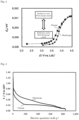
- Fig. 2 is a graph illustrating a transition of K absorption edge energy of Ni in the Li-excess active material calculated by X-ray absorption spectroscopy (XAFS measurement) with respect to the electric quantity.
- the horizontal axis indicates the electric quantity (mAh/g), and the vertical axis indicates K absorption edge energy E 0 (eV) of Ni.
- Fig. 3 is a graph illustrating the transition of the K absorption edge energy of Ni during charge-discharge.
- the horizontal axis indicates the charge-discharge voltage value (VvsLi/Li + ), and the vertical axis indicates the K absorption edge energy E 0 (eV) of Ni.
- the transition of the K absorption edge energy of Ni in a charge reaction is not matched with the transition of the energy in a discharge reaction.
- the transition of the energy in the discharge reaction is not matched with the transition of the energy in the charge reaction. That is, it can be seen that a redox reaction except for Ni that has the hysteresis is mainly generated (it is assumed that this reaction is A).
- the reaction of A is an oxidation reaction in the high SOC region, and is a reductive reaction in the low SOC region.
- the K absorption edge energy of Ni in the charge reaction and discharge reaction changes substantially linearly with respect to the SOC.
- the charge and the discharge are substantially matched with each other in the K absorption edge energy of Ni.
- K absorption edge energy of Ni is the same, it is considered that a valence of Ni is equal, that a valence change of Ni corresponds substantially to a voltage value of at 1:1 in this voltage range, and that Ni reacts reversibly. That is, in the SOC region, the redox reaction having a small hysteresis indicated by the SOC-OCP characteristic is mainly generated (it is assumed that this reaction is B).
- the OCP means an open circuit potential.
- a reaction amount of B is larger than a reaction amount of A, and resultantly the hysteresis is smaller than that in the low SOC region.
- the lower voltage value (lower limit voltage value) in the region where the reaction of B is mainly generated is obtained by an experiment. At the lower limit voltage value, existence of the hysteresis is substantially switched. The oxidation amount and the reduction amount of the reaction of B are considered to be small.
- the SOC is estimated by the voltage reference based on a reached voltage value.
- reaction of B is not limited to the oxidation-reduction reaction of Ni.
- the reaction of B refers to a reaction with the small hysteresis of the storage amount-voltage value characteristic in one or a group of reactions generated by the active material according to the transition of the charge-discharge.
- the negative electrode of the energy storage device contains the active material having the large hysteresis
- the negative electrode includes SiO and graphite as active materials
- the hysteresis generated during the electrochemical reaction of SiO is larger than the hysteresis generated during the electrochemical reaction of graphite.
- Fig. 4 is a graph illustrating a result in which the relationship between the electric quantity and the charge-discharge voltage value is obtained using the lithium cell of the counter electrode Li with respect to the energy storage device.
- a horizontal axis indicates the electric quantity (mAh/g), and a vertical axis indicates a charge-discharge voltage value (VvsLi/Li + : Li/Li + potential difference based on the equilibrium potential).
- VvsLi/Li + Li/Li + potential difference based on the equilibrium potential
- the charge curve and the discharge curve differ from each other in the voltage value. That is, the voltage values for the same SOC are different from each other, and have the hysteresis.
- a high SOC region is smaller than a low SOC region in the potential difference with respect to the same SOC, and the hysteresis is small.
- the positive electrode contains a plurality of Li-excess active materials having different positive electrodes
- the negative electrode contains a plurality of active materials having the large hysteresis
- each of the positive electrode and the negative electrode contains the active material having the large hysteresis
- the region having the large hysteresis and the region having the small hysteresis appear alternately, or appear while overlapping each other.
- the hysteresis is smaller than that in the region (3) where the voltage value ranges from b to c.
- a reaction of E having the large hysteresis and a reaction of F having the small hysteresis are generated in the region (4). Because the reaction amount of E is large in the region (4), the hysteresis is smaller than that in the region (3) as a result.
- the lower limit voltage value a in the region (2) and the lower limit voltage value c in the region (4) are obtained by the experiment.
- the determination that the charge state or discharge state exists in the region (2) corresponding to the voltage region greater than or equal to the lower limit voltage value a is made based on the increase or decrease of the voltage value
- the determination that the charge state or discharge state exists in the region (4) corresponding to the voltage region greater than or equal to the lower limit voltage value c is made based on the increase or decrease of the voltage value
- the SOC is estimated by the voltage reference based on the reached voltage value (to be described later).
- the region of the voltage value is not limited to the case where the region of the voltage value is divided into two or four regions as described above.
- the SOC is relatively high and the SOC is estimated by the voltage reference in the region where the SOC is relatively high and the hysteresis is small.
- a first embodiment will be described below by taking an energy storage module mounted on a vehicle as an example.
- An energy storage module 50 includes a plurality of energy storage devices 200, a monitoring device 100, and a housing case 300 that stores the plurality of energy storage devices 200 and the monitoring device 100.
- the energy storage module 50 may be used as a power source for an electric vehicle (EV) or a plug-in hybrid electric vehicle (PHEV).
- EV electric vehicle
- PHEV plug-in hybrid electric vehicle
- the energy storage device 200 is not limited to a prismatic cell, but may be a cylindrical cell or a pouch cell.
- the monitoring device 100 may be a circuit board disposed opposite to the plurality of energy storage devices 200.
- the monitoring device 100 monitors a state of the energy storage device 200.
- the monitoring device 100 may be a storage amount estimation device.
- a computer or a server that is connected to the monitoring device 100 in a wired or wireless manner may perform a storage amount estimation method based on information output from the monitoring device 100.
- Fig. 7 illustrates another example of the energy storage module.
- the energy storage module (hereinafter, referred to as a battery module) 1 may be a 12-volt power supply or a 48-volt power supply that is suitably mounted on an engine vehicle.
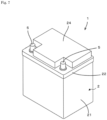
- Fig. 7 is a perspective view of the battery module 1 for the 12-V power supply
- Fig. 8 is an exploded perspective view of the battery module 1
- Fig. 9 is a block diagram of the battery module 1.
- the battery module 1 has a rectangular parallelepiped case 2.
- a plurality of lithium ion secondary batteries (hereinafter referred to as batteries) 3, a plurality of bus bars 4, a BMU (Battery Management Unit) 6, and a current sensor 7 are accommodated in the case 2.
- At least one of a positive active material included in the positive electrode plate and a negative active material included in the negative electrode plate of the electrode assembly 33 generates at least two electrochemical reactions depending on a transition of charge-discharge.
- a hysteresis of a storage amount-voltage value characteristic exhibiting during the generation of one electrochemical reaction is smaller than a hysteresis during the generation of the other electrochemical reaction.
- the positive active material examples include Li-excess active materials such as the above LiMeO 2 -Li 2 MnO 3 solid solution, a Li 2 OLiMeO 2 solid solution, a Li 3 NbO 4 -LiMeO 2 solid solution, a Li 4 WO 5 -LiMeO 2 solid solution, a Li 4 TeO 5 -LiMeO 2 solid solution, a Li 3 SbO 4 -LiFeO 2 solid solution, a Li 2 RuO 3 -LiMeO 2 solid solution, and a Li 2 RuO 3 -Li 2 MeO 3 solid solution.
- Li-excess active materials such as the above LiMeO 2 -Li 2 MnO 3 solid solution, a Li 2 OLiMeO 2 solid solution, a Li 3 NbO 4 -LiMeO 2 solid solution, a Li 4 WO 5 -LiMeO 2 solid solution, a Li 4 TeO 5 -LiMeO
- the negative active materials include hard carbon, metals such as Si, Sn, Cd, Zn, Al, Bi, Pb, Ge, and Ag or alloys thereof, or chalcogenides containing these.
- SiO can be cited as an example of the chalcogenide.
- the technique of the present invention is applicable as long as at least one of the positive active materials and negative active materials is contained.
- the battery 3 is inserted between the partition plates 26 of the case body 21.
- a plurality of metal bus bars 4 are placed on the inner lid 25.
- the inner lid 25 is disposed on a terminal surface on which the terminal 32 of the battery 3 is provided, the adjacent terminals 32 of the adjacent batteries 3 are connected to each other by the bus bar 4, and the batteries 3 are connected in series.
- the information processor 60 includes a CPU 62 and a memory 63.
- the CPU 62 performs an SOC estimation processing (to be described later) according to the SOC estimation program 63a read from the memory 63.
- the voltage measuring unit 8 is connected to both ends of the battery 3 via a voltage detection line, and measures the voltage value of each battery 3 at predetermined time intervals.
- the current measuring unit 9 measures a current value passed through the battery 3 via the current sensor 7 at predetermined time intervals.
- the external terminals 5, 5 of the battery module 1 are connected to a starter motor that starts the engine and a load 11 such as an electric component.
- An ECU (Electronic Control Unit) 10 is connected to the BMU 6 and the load 11.
- the lower limit voltage value When the OCV can be measured as the lower limit voltage value, the lower limit voltage value may be constant.
- a CCV Current Circuit Voltage
- update may be performed by lowering the lower limit voltage value according to a degree of degradation associated with the use of the energy storage device. An increase in internal resistance and an increase in deviation of capacity balance can be cited as an example of a cause of the degradation of the energy storage device.
- the deviation of the capacity balance means that a difference between an amount of side reaction except for a charge-discharge reaction in the positive electrode and an amount of side reactions except for the charge-discharge reaction in the negative electrode is generated to incompletely charge one of the positive electrode and the negative electrode, and the positive and negative electrodes have different capacities in which charged ions can reversibly enter and leave the electrode.
- the side reaction amount in the positive electrode is smaller than the side reaction amount in the negative electrode, when the "deviation of capacity balance" increases, the negative electrode cannot fully be charged and the electric quantity that can be reversibly taken out from the energy storage device decreases.
- the reached maximum voltage value is taken as the reached voltage value.
- the table 63b of the memory 63 stores a plurality of SOC-OCV curves from the lower limit voltage value to a plurality of reached voltage values. For example, an SOC-OCV curve b from the lower limit voltage value E0 V to the reached voltage value E1 V, an SOC-OCV curve c from the lower limit voltage value E0 V to the reached voltage value E2 V, and an SOC-OCV curve d from the lower limit voltage value E0 V to a reached voltage value E3 V are stored in the table 63b. At this point, E1 > E2 > E3 holds. Although also referred to in a comparative test (to be described later), the SOC-OCV curves b, c, d are not illustrated in the drawings.
- the SOC-OCV curves corresponding to all the reached voltage values are stored not discretely, but continuously. Instead of storing continuously the SOC-OCV curves, based on the adjacent SOC-OCV curves, a SOC-OCV curve to be located between the SOC-OCV curves may be obtained by interpolation calculation, and the SOC may be estimated from the voltage value and the obtained SOC-OCV curve.
- a discharge OCV curve and a charge OCV curve are obtained when SOC (%) is changed from 40% to 100% for each point of SOC (%) from 40% to 100%.
- the discharge OCV curve can be obtained by passing a minute current in the discharge direction and measuring the voltage value at that time. Alternatively, the discharge is performed from the charge state to each SOC and stopped, and the stable voltage value is measured. Similarly, the charge OCV curve can be obtained when the above measurement is performed in a charge direction.
- the OCV curve obtained by averaging a discharge OCV curve and a charge OCV curve is used because the active material has the slight hysteresis even if the SOC is greater than or equal to 40%.
- the discharge OCV curve and the charge OCV curve, or corrected those may be used.
- the discharge OCP curve and the charge OCP curve may be corrected to the SOC-OCV curve for the voltage reference of the battery 3.
- the SOC-OCV curve may previously be stored in the table 63b, or updated at predetermined time intervals in consideration of the degradation of the battery 3.
- the SOC-OCV curve is not limited to the case where the SOC-OCV curve is stored in the table 63b, but may be stored in the memory 63 as a function expression.
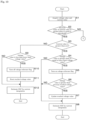
- Figs. 10 and 11 are a flowchart illustrating a procedure of the SOC estimation processing performed by the CPU 62.
- the CPU 62 repeats the pieces of processing from S1 at predetermined or appropriate time intervals.
- the CPU 62 acquires the voltage value and the current value between the terminals of the battery 3 (S1). Because the lower limit voltage value and the reached voltage value (to be described later) are the OCV, it is necessary to correct the acquired voltage value to OCV when the current amount of the battery 3 is large.
- the correction value to OCV is obtained by estimating the voltage value at the current value of zero using a regression line from the data of the pluralities of voltage values and current values. When the amount of current passed through the battery 3 is as small as a dark current (the minute current of claim 6), the acquired voltage value can be regarded as the OCV.
- the CPU 62 determines whether an absolute value of the current value is greater than or equal to a threshold (S2).
- the threshold is set in order to determine whether the battery 3 is in a charge state, a discharge state, or a resting state.
- the processing proceeds to S13.
- the CPU 62 determines whether the current value is greater than zero (S3). It is determined that the battery 3 is in the charge state when the current value is larger than zero. When the CPU 62 determines that the current value is less than zero (NO in S3), the processing proceeds to S9.
- the CPU 62 determines whether the voltage value is greater than or equal to the lower limit voltage value (S4). When the CPU 62 determines that the voltage value is less than the lower limit voltage value (NO in S4), the processing proceeds to S8.
- the CPU 62 When determining that the voltage value is greater than or equal to the lower limit voltage value (YES in S4), the CPU 62 turns on a voltage reference flag (S5).
- the CPU 62 determines whether the acquired voltage value is greater than the previous reached voltage value (S6). When the CPU 62 determines that the voltage value is not greater than the previous reached voltage value (NO in S6), the processing proceeds to S8.
- the CPU 62 When determining that the voltage value is greater than the previous reached voltage value (YES in S6), the CPU 62 updates the voltage value to the reached voltage value in the memory 63 (S7).
- the CPU 62 estimates the SOC by the current integration (S8), and ends the processing.
- the CPU 62 determines whether the voltage value is less than the lower limit voltage value in S9 (S9). When the CPU 62 determines that the voltage value is greater than or equal to the lower limit voltage value (NO in S9), the processing proceeds to S12.
- the CPU 62 When determining that the voltage value is less than the lower limit voltage value (YES in S9), the CPU 62 turns off the voltage reference flag (S10).
- the CPU 62 resets the reached voltage value (S11).
- the CPU 62 estimates the SOC by the current integration (S12), and ends the processing.
- the CPU 62 determines whether the voltage reference flag is turned on (S13). When the CPU 62 determines that the voltage reference flag is not turned on (NO in S13), the processing proceeds to S16.
- the CPU 62 determines whether a setting time elapses since the battery 3 is determined to be in the resting state in S2 (S14).
- the setting time a sufficient time for considering the acquired voltage value as the OCV is previously obtained by an experiment. It is determined whether the setting time exceeds the time based on the number of acquisition times and the acquisition interval of the current value after the battery 3 is determined to be in the resting state. Consequently, the SOC can be estimated with higher accuracy in the resting state.
- the CPU 62 estimates the SOC by the current integration in S16, and ends the processing.
- the CPU 62 determines that the setting time elapses (YES in S14), the acquired voltage value can be regarded as the OCV, and the SOC is estimated by the voltage reference (S15), and the processing is ended.
- the CPU 62 selects one SOC-OCV curve from the table 63b based on the reached voltage value stored in the memory 63.
- the charge-discharge is repeated, the voltage value rises and falls, namely, a high inflection point among inflection points where the charge is switched to the discharge is set to the reached voltage value.
- the SOC corresponding to the voltage value acquired in S1 is read in the SOC-OCV curve.
- the voltage value acquired from the voltage measuring unit 8 by the CPU 62 varies somewhat depending on the current value, so that the voltage value can be corrected by obtaining a correction coefficient through the experiment.
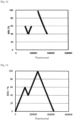
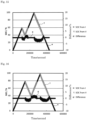
- Fig. 12 is a graph illustrating the transition of the voltage value with respect to time during the charge-discharge.
- the horizontal axis indicates time (second), and the vertical axis indicates a charge-discharge voltage value (VvsLi/Li + ). Because the charge-discharge is performed by a minute electric current in the first embodiment, it is checked that the voltage value during energization indicates the substantially same value as the OCV.
- the first charge was performed, the voltage value exceeded the lower limit voltage value E0 V and reached E3 V, and the first discharge was performed. After the voltage value reached E0 V, the second charge was performed, the voltage value reached E1 V, and the second discharge was performed.
- E3 V is stored as the first reached voltage value in the memory 63.
- the reached voltage value is updated at a point of time the voltage value exceeds E3 V during the second charge.
- the SOC-OCV curve d is used until the voltage value reaches E3 V in the first discharge and the second charge.
- Another SOC-OCV curve stored in the table 63b is used between E3 V and E1 V of the second charge.
- the SOC-OCV curve b is used from E1 V of the second discharge to E0 V of the lower limit voltage value.
- Fig. 13 is a graph which illustrating the transition of the SOC calculated by the voltage reference until the voltage value reaches E3 V in the first discharge and the second charge, and until the voltage value changes from E3 V of the second discharge to the lower limit voltage E0 V.
- Fig. 14 is a graph illustrating the transition of the SOC when the SOC is calculated by the current integration in the transition of the charge-discharge voltage value in Fig. 12 .
- Fig. 15 is a graph illustrating a difference between the estimation of the SOC by the voltage reference of the first embodiment and the estimation of the SOC by the conventional current integration when the charge-discharge in Fig. 12 is performed on the battery 3 of an initial product.
- the horizontal axis indicates time (second), the left vertical axis indicates SOC (%), and the right vertical axis indicates the difference (%).
- the discharge capacity is previously checked and a highly accurate ammeter is used, so that the discharge capacity of Q and the current value of I in equation (1) are accurate. It is considered that the discharge capacity of Q and the current value of I approximate the true values.
- e is the transition of the SOC obtained by the current integration
- f is the transition of the SOC obtained by the voltage reference using the SOC-OCV curves d and b
- g is the difference. The difference was obtained by (SOC calculated by voltage reference) - (SOC calculated by current integration).
- the difference is less than about ⁇ 4% and is small.
- Fig. 16 is a graph illustrating the difference between the estimation of the SOC by the voltage reference and the estimation of the SOC by the current integration when the charge-discharge is performed with a pattern different from one in Fig. 12 on the battery 3 of the initial product.
- the horizontal axis indicates time (second), the left vertical axis indicates SOC (%), and the right vertical axis indicates the difference (%).
- e is the transition of the SOC obtained by the current integration
- f is the transition of the SOC obtained by the voltage reference using the SOC-OCV curves c and b
- g is the difference.
- the difference is less than about ⁇ 3% and is small.
- Fig. 17 is a graph illustrating the difference between the estimation of the SOC by the voltage reference and the estimation of the SOC by the current integration when the charge-discharge is performed with the pattern different from one in Fig. 12 on the battery 3 of the initial product.
- the horizontal axis indicates time (second), the left vertical axis indicates SOC (%), and the right vertical axis indicates the difference (%).
- e is the transition of the SOC obtained by the current integration
- f is the transition of the SOC obtained by the voltage reference using the SOC-OCV curve b
- g is the difference.
- the difference is less than about ⁇ 5% and is small.
- Fig. 18 is a graph illustrating the difference between the estimation of the SOC by the voltage reference and the estimation of the SOC by the current integration when the charge-discharge in Fig. 12 is performed on the battery 3 of a degraded product.
- the horizontal axis indicates time (second), the left vertical axis indicates SOC (%), and the right vertical axis indicates the difference (%).
- the SOC-OCV curve of the degraded product is also obtained by the experiment and stored. Alternatively, as described above, the SOC-OCV curve is updated at predetermined time intervals.
- e is the transition of the SOC obtained by the current integration
- f is the transition of the SOC obtained by the voltage reference using the SOC-OCV curve of the degraded product
- g is the difference.
- the difference is less than about ⁇ 4% and is small.
- Fig. 19 is a graph illustrating the difference between the estimation of the SOC by the voltage reference and the estimation of the SOC by the current integration when the charge-discharge is performed with the pattern identical to one in Fig. 16 on the battery 3 of the degraded product.
- the horizontal axis indicates time (second), the left vertical axis indicates SOC (%), and the right vertical axis indicates the difference (%).
- e is the transition of the SOC obtained by the current integration
- f is the transition of the SOC obtained by the voltage reference using the SOC-OCV curve of the degraded product
- g is the difference.
- the difference is less than about ⁇ 4% and is small.
- Fig. 20 is a graph illustrating the difference between the estimation of the SOC by the voltage reference and the estimation of the SOC by the current integration when the charge-discharge is performed with the pattern identical to one in Fig. 17 on the battery 3 of the degraded product.
- the horizontal axis indicates time (second), the left vertical axis indicates SOC (%), and the right vertical axis indicates the difference (%).
- e is the transition of the SOC obtained by the current integration
- f is the transition of the SOC obtained by the voltage reference using the SOC-OCV curve of the degraded product
- g is the difference.
- the difference is less than about ⁇ 5% and is small.
- the hysteresis is small (substantially no hysteresis), and the SOC is estimated based on the SOC-OCV curve and the current voltage value in the range from the lower limit voltage value to the reached voltage value, so that the estimation of SOC can be estimated with high accuracy.
- the OCV reset can be performed with high accuracy.
- the SOC can be estimated in both the charge and the discharge.
- the selection of the SOC-OCV curve based on the set reached voltage value can estimate the SOC only from a history of the voltage value, when the charge-discharge is repeated in a complicated pattern. Only when the acquired voltage value exceeds the previous reached voltage value, the update of the reached voltage value can accurately estimate the SOC as compared with Patent Document 1 that selects the SOC-OCV curve based on the final voltage value during the charge.
- the storage amount is not limited to the SOC, but the current amount of energy, such as amount of power, which is stored in the battery 3, can be estimated.
- the SOC can be estimated by calculating the SOC-OCV curve between the SOC-OCV curves with no use of many SOC-OCV curves.
- the interval at which the voltage value and current value are acquired in S1 is a high frequency
- preferably many SOC-OCV curves are stored in the table 63b.
- the SOC can be estimated with high accuracy.
- the case where the SOC is estimated in real time will be described in a second embodiment.
- the configuration is the same as that of the first embodiment except for the SOC estimation processing performed by the CPU 62.
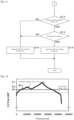
- Figs. 21 and 22 are a flowchart illustrating the procedure of the SOC estimation process performed by the CPU 62.
- the CPU 62 repeats the pieces of processing from S21 at predetermined intervals.
- the CPU 62 acquires the voltage value and the current value between the terminals of the battery 3 (S21).
- the CPU 62 determines whether the absolute value of the current value is greater than or equal to a threshold (S22).
- the threshold is set in order to determine whether the battery 3 is in a charge state, a discharge state, or a resting state.
- the processing proceeds to S33.
- the CPU 62 determines whether the current value is greater than zero (S23). When the current value is larger than zero, the battery 3 is in the charge state. When the CPU 62 determines that the current value is not greater than zero (NO in S23), the processing proceeds to S29.
- the CPU 62 determines whether the voltage value is greater than the previous reached voltage value (S24). When the CPU 62 determines that the voltage value is not greater than the previous reached voltage value (NO in S24), the processing proceeds to S26.
- the CPU 62 When determining that the voltage value is larger than the previous reached voltage value (YES in S24), the CPU 62 updates the voltage value to the reached voltage value (S25).
- the CPU 62 determines whether the voltage value is greater than or equal to the lower limit voltage value (S26). When determining that the voltage value is less than the lower limit voltage value (NO in S26), the CPU 62 estimates the SOC by the current integration (S28), and ends the processing.
- the CPU 62 When determining that the voltage value is greater than or equal to the lower limit voltage value (YES in S26), the CPU 62 estimates the SOC by the voltage reference (S27), and ends the processing.
- the table 63b stores a plurality of SOCOCV curves from the lower limit voltage to a plurality of reached voltages.
- the CPU 62 selects the SOC-OCV curve corresponding to the stored reached voltage value, and reads the SOC from the current OCV in the SOC-OCV curve.
- the CPU 62 calculates the current OCV from the voltage value and the current value acquired in S21.
- the OCV can be calculated by estimating the voltage value at the current value of zero using the regression line from the data of the pluralities of voltage values and current values. When the current value is as small as the dark current value, the acquired voltage value can be read as the OCV.
- the CPU 62 determines whether the voltage value is greater than or equal to the lower limit voltage value in S29 (S29).
- the CPU 62 estimates the SOC by the voltage reference in the same manner as described above (S30).
- the CPU 62 When determining that the voltage value is less than the lower limit voltage value (NO in S29), the CPU 62 resets the reached voltage value (S31).
- the CPU 62 determines whether the voltage value is greater than or equal to the lower limit voltage value (S33). When the CPU 62 determines that the voltage value is less than the lower limit voltage value (NO in S33), the processing proceeds to S36.
- the CPU 62 determines whether the setting time elapses since the battery 3 is determined to be in the resting state in S22 (S34). As for the setting time, a sufficient time for considering the acquired voltage value as the OCV is previously obtained by an experiment.
- the CPU 62 estimates the SOC by the current integration (S36), and ends the processing.
- the CPU 62 determines that the setting time elapses (YES in S34), the acquired voltage value can be regarded as the OCV, the SOC is estimated by the voltage reference in the same manner as described above (S35), and the processing is ended.
- the SOC can be estimated in real time during the charge-discharge.
- the SOC can be estimated in both the charge and the discharge. Even if the charge-discharge are repeated with the complicated pattern, the SOC can be estimated based only on the history of the voltage values.
- the storage amount is not limited to the SOC, and the current amount of energy, such as amount of power, which is stored in the battery 3, can be estimated.
- the storage amount can be estimated in both the charge and the discharge. Even if the charge-discharge are repeated with the complicated pattern, the storage amount can be estimated based only on the history of the voltage values.
- the storage amount is not limited to the SOC, and the current amount of energy, such as amount of power, which is stored in the energy storage device, can be estimated.
- the dischargeable energy up to SOC 0% and the charge energy required up to SOC 100% can be predicted based on the charge-discharge curve.
- the storage amount-voltage value characteristic includes a first region on a side where the charged amount is relatively high and a second region on a side where the storage amount is relatively low, and the estimator estimates the storage amount based on a storage amount-voltage value characteristic of the first region.
- the storage amount-voltage value characteristic exhibits the hysteresis.
- the storage amount is estimated based on the storage amount-voltage value characteristic of the first region on the side where the storage amount is relatively high, so that the estimation accuracy is good.
- a storage amount estimation device that estimates a storage amount of an energy storage device containing an active material in which a storage amount-voltage value characteristic exhibits a hysteresis
- the storage amount estimation device includes: a holding unit that holds a plurality of storage amount-voltage value characteristics from a lower limit voltage value, at which existence of the hysteresis is substantially switched, to a plurality of reached voltage values; a voltage acquisition unit that acquires a voltage value of the energy storage device; a setting unit that sets a reached voltage value after the voltage value acquired by the voltage acquisition unit exceeds the lower limit voltage value; a selector that selects one storage amount-voltage value characteristic based on the reached voltage value set by the setting unit; and an estimator that estimates the storage amount based on the one storage amount-voltage value characteristic and the voltage value acquired by the voltage acquisition unit.
- the storage amount estimation device estimates the storage amount based on the storage amount-voltage value characteristic and the acquired voltage value in the range from the lower limit voltage value to the reached voltage value, the hysteresis being substantially free in the range.
- the reaction having the large hysteresis and the reaction that does not substantially have the hysteresis (small hysteresis) are substantially independently generated in the energy storage device in which the electrode material having the hysteresis is used. These reactions do not interfere with each other. As long as the voltage value does not exceed the reached voltage value, the charge and the discharge are performed along a unique curve between the lower limit voltage value and the reached voltage value. Thus, the storage amount is accurately estimated.
- the storage amount can be estimated in both the charge and the discharge. Based on the increase or decrease of the voltage value, the reached voltage value is set to select the storage amount-voltage value characteristic. Even if the charge-discharge is repeated with the complicated pattern, the storage amount can be estimated based only on the history of the voltage values.
- the storage amount is not limited to the SOC, and the current amount of energy, such as amount of power, which is stored in the energy storage device, can be estimated.
- the setting unit stores the reached voltage value in a storage unit, and updates the acquired voltage value to the reached voltage value when the voltage value acquired by the voltage acquisition unit is larger than the reached voltage value previously stored in the storage unit.
- the storage amount estimation device can accurately estimate the storage amount based on the acquired voltage value by selecting the storage amount-voltage value characteristic based on the larger reached voltage value (updated reached voltage value).
- the voltage value may be an open-circuit voltage value.
- the storage amount can easily be estimated based on the open circuit voltage value and the storage amount-open-circuit voltage characteristic.
- the storage amount can be estimated by the voltage reference even in the energization by correcting the voltage value to the open circuit voltage value.
- the voltage value may be a voltage value during passage of a minute current through the energy storage device.
- the storage amount can easily be estimated from the voltage value, and the storage amount can be estimated even in the charge-discharge of the energy storage device.
- the storage amount estimation device preferably the storage amount is an SOC.
- the estimation of the SOC for a high-capacity material improves applicability to the existing control system. Based on the SOC, the storage amount such as the dischargeable energy can easily be calculated.
- the storage amount estimation device can accurately estimate the charge state of the energy storage device in which the electrode material having the hysteresis is used with no use of a special sensor or additional component, the OCV and the SOC not corresponding to each other on a one-to-one manner in the electrode material.
- the energy storage module includes a plurality of energy storage devices and any one of the above storage amount estimation devices.
- the plurality of energy storage devices are connected in series. Sometimes the plurality of energy storage devices are connected in series and in parallel.
- the SOC of each energy storage device is accurately estimated by the storage amount estimation device, so that the performance of the energy storage module can be exerted at the maximum.
- the energy storage module is suitably used as a power source for an EV or a PHEV that has a particularly high demand for the high capacity.
- a storage amount estimation method for estimating a storage amount of an energy storage device containing an active material in which a storage amount-voltage value characteristic exhibits a hysteresis includes: holding a plurality of storage amount-voltage value characteristics from a lower limit voltage value, at which existence of the hysteresis is substantially switched, to a plurality of reached voltage values; setting a reached voltage value after an acquired voltage value exceeds the lower limit voltage value; selecting one storage amount-voltage value characteristic based on the set reached voltage value; and estimating the storage amount based on the one storage amount-voltage value characteristic and the acquired voltage value.
- the storage amount is estimated based on the storage amount-voltage value characteristic and the acquired voltage value in the range from the lower limit voltage value to the reached voltage value, the hysteresis being substantially free in the range.
- the storage amount is accurately estimated.
- the storage amount of the high-capacity energy storage device containing the active material in which the storage amount-voltage value characteristic exhibits the hysteresis can be estimated well.
- the storage amount can be estimated in both the charge and the discharge.
- the inflection point relating to the increase or decrease of the voltage value is set to the reached voltage value to select the storage amount-voltage value characteristic. Even if the charge-discharge are repeated with the complicated pattern, the storage amount can be estimated based only on the history of the voltage values.
- the storage amount is not limited to the SOC, and the current amount of energy, such as amount of power, which is stored in the energy storage device, can be estimated.
- the storage amount estimation device of the present invention is not limited to the case where the storage amount estimation device is applied to a vehicle-mounted lithium ion secondary battery, but can also be applied to other energy storage modules such as a railway regeneration power storage device and a solar power generating system.
- the energy storage module through which the minute current is passed the voltage value between the positive electrode terminal and the negative electrode terminal of the energy storage device or the voltage value between the positive electrode terminal and the negative electrode terminal of the energy storage module can be regarded as the OCV.
- the energy storage device is not limited to the lithium ion secondary battery, but may be another secondary battery or an electrochemical cell having the hysteresis characteristic.
- a CMU Cell Monitoring Unit
- the storage amount estimation device may be a part of the energy storage module in which the monitoring device 100 or the like is incorporated.
- the storage amount estimation device may be configured separately from the energy storage device or the energy storage module, and connected to the energy storage module including the energy storage device that is the estimation target of the energy storage amount during the estimation of the energy storage amount.
- the storage amount estimation device may remotely monitor the energy storage device and the energy storage module.
Landscapes
- Engineering & Computer Science (AREA)
- Physics & Mathematics (AREA)
- General Physics & Mathematics (AREA)
- Manufacturing & Machinery (AREA)
- Chemical & Material Sciences (AREA)
- Chemical Kinetics & Catalysis (AREA)
- Electrochemistry (AREA)
- General Chemical & Material Sciences (AREA)
- Power Engineering (AREA)
- Secondary Cells (AREA)
- Tests Of Electric Status Of Batteries (AREA)
- Charge And Discharge Circuits For Batteries Or The Like (AREA)
Claims (7)
- Vorrichtung (6) für Schätzung einer Speicherungsmenge, die so ausgeführt ist, dass sie eine Strom-Speicherungsmenge einer Energiespeicherungsvorrichtung (3) schätzt, wobei eine positive Elektrodenplatte oder/und eine negative Elektrodenplatte der Energiespeicherungsvorrichtung (3) ein aktives Material enthält/enthalten, wobei das aktive Material, je nach einem Änderungszustand von Ladung, wenigstens zwei elektrochemische Reaktionen (A, B) erzeugt, und eine Hysterese eines Spannungswertes in Abhängigkeit von einem Lade-und-Entlade-Verlauf in einer Strom-Speicherungsmengen-Spannungswert-Kennlinie bei Erzeugung einer der elektrochemischen Reaktionen (B) kleiner ist als eine Hysterese des Spannungswertes bei Erzeugung der anderen elektrochemischen Reaktion (A) in dem aktiven Material, wobei die Vorrichtung für Schätzung einer Speicherungsmenge umfasst:eine Halte-Einheit (63b), die so ausgeführt ist, dass sie eine Vielzahl von Strom-Speicherungsmengen-Spannungswert-Kennlinien von einem unteren Grenz-Spannungswert eines Spannungswert-Bereiches, in dem der Reaktions-Betrag der einen elektrochemischen Reaktion (B) größer ist als der Reaktions-Betrag der anderen elektrochemischen Reaktion (A), bis zu einer Vielzahl erreichter Spannungswerte hält; undeine Verarbeitungs-Einheit (62), die ausgeführt ist zum:• Erfassen eines Spannungswertes der Energiespeicherungsvorrichtung (3);• Einstellen eines erreichten Spannungswertes, wenn festgestellt wird, dass der erfasste Spannungswert den unteren Grenz-Spannungswert überschreitet, wobei der erreichte Spannungswert ein maximaler Spannungswert ist, der beim Laden der Energiespeicherungsvorrichtung erfasst worden ist;• Auswählen einer Strom-Speicherungsmengen-Spannungswert-Kennlinie auf Basis des eingestellten erreichten Spannungswertes; sowie• Schätzen der Strom-Speicherungsmenge auf Basis der ausgewählten Strom-Speicherungsmengen-Spannungswert-Kennlinie sowie des durch die Spannungserfassungs-Einheit (8) erfassten Spannungswertes.
- Vorrichtung (6) für Schätzung einer Speicherungsmenge nach Anspruch 1, wobei die Verarbeitungs-Einheit (62) des Weiteren ausgeführt ist zum:• Speichern des erreichten Spannungswertes in der Speicherungs-Einheit (63), sowie• Aktualisieren des erfassten Spannungswertes auf den erreichten Spannungswert, wenn der durch die Spannungserfassungs-Einheit (8) erfasste Spannungswert größer ist als der letzte zuvor in der Speicherungs-Einheit (63) gespeicherte Spannungswert.
- Vorrichtung (6) für Schätzung einer Speicherungsmenge nach einem der Ansprüche 1 oder 2, wobei der Spannungswert ein Leerlauf-Spannungswert ist.
- Vorrichtung (6) für Schätzung einer Speicherungsmenge nach einem der Ansprüche 1 oder 2,
wobei der Spannungswert ein bei Durchgang eines Stroms, der unter einem vorgegebenen Schwellenwert liegt, durch die Energiespeicherungsvorrichtung erfasster Spannungswert ist. - Energiespeicherungs-Modul (1), das umfasst:eine Vielzahl von Energiespeicherungsvorrichtungen (3); unddie Vorrichtung (6) für Schätzung einer Speicherungsmenge nach einem der Ansprüche 1 bis 4.
- Verfahren für Schätzung einer Speicherungsmenge, mit dem eine Strom-Speicherungsmenge einer Energiespeicherungsvorrichtung (3) geschätzt wird, wobei alle der Schritte des Verfahrens von der Vorrichtung (6) für Schätzung einer Speicherungsmenge nach einem der Ansprüche 1 bis 4 oder von einem Computer ausgeführt werden, wobei eine positive Elektrodenplatte oder/und eine negative Elektrodenplatte der Energiespeicherungsvorrichtung (3) ein aktives Material enthält/enthalten, wobei das aktive Material, je nach einem Änderungszustand von Ladung, wenigstens zwei elektrochemische Reaktionen (A, B) erzeugt, und eine Hysterese eines Spannungswertes in Abhängigkeit von einem Lade-und-Entlade-Verlauf in einer Strom-Speicherungsmengen-Spannungswert-Kennlinie bei Erzeugung einer der elektrochemischen Reaktionen (B) kleiner ist als eine Hysterese des Spannungswertes bei Erzeugung der anderen elektrochemischen Reaktion (A) in dem aktiven Material, wobei das Verfahren für Schätzung einer Speicherungsmenge umfasst:Halten einer Vielzahl von Strom-Speicherungsmengen-Spannungswert-Kennlinien von einem unteren Grenz-Spannungswert eines Spannungswert-Bereiches, in dem der Reaktions-Betrag der einen elektrochemischen Reaktion (B) größer ist als ein Reaktions-Betrag der anderen elektrochemischen Reaktion (A), bis zu einer Vielzahl erreichter Spannungswerte;Erfassen eines Spannungswertes der Energiespeicherungsvorrichtung (3);Einstellen eines erreichten Spannungswertes, wenn festgestellt wird, dass der erfasste Spannungswert den unteren Grenz-Spannungswert überschreitet, wobei der erreichte Spannungswert ein maximaler Spannungswert ist, der beim Laden der Energiespeicherungsvorrichtung erfasst worden ist;Auswählen einer Strom-Speicherungsmengen-Spannungswert-Kennlinie auf Basis des eingestellten erreichten Spannungswertes; sowieSchätzen der Strom-Speicherungsmenge auf Basis der ausgewählten einen Strom-Speicherungsmengen-Spannungswert-Kennlinie sowie des erfassten Spannungswertes.
- Computerprogramm, das einen Computer, der zum Schätzen einer Strom-Speicherungsmenge einer Energiespeicherungsvorrichtung (3) ausgeführt ist, veranlasst, die Schritte des Verfahrens nach Anspruch 6 durchzuführen, wobei eine positive Elektrodenplatte oder/und eine negative Elektrodenplatte der Energiespeicherungsvorrichtung (3) ein aktives Material enthält/enthalten, wobei das aktive Material, je nach einem Änderungszustand von Ladung, wenigstens zwei elektrochemische Reaktionen (A, B) erzeugt, und eine Hysterese eines Spannungswertes in Abhängigkeit von einem Lade-und-Entlade-Verlauf in einer Strom-Speicherungsmengen-Spannungswert-Kennlinie bei Erzeugung einer der elektrochemischen Reaktionen (B) kleiner ist als eine Hysterese des Spannungswertes bei Erzeugung der anderen elektrochemischen Reaktion (A) in dem aktiven Material, in dem eine Strom-Speicherungsmengen-Spannungswert-Kennlinie eine Hysterese aufweist.
Applications Claiming Priority (2)
| Application Number | Priority Date | Filing Date | Title |
|---|---|---|---|
| JP2017064915 | 2017-03-29 | ||
| PCT/JP2018/013057 WO2018181624A1 (ja) | 2017-03-29 | 2018-03-28 | 蓄電量推定装置、蓄電モジュール、蓄電量推定方法、及びコンピュータプログラム |
Publications (3)
| Publication Number | Publication Date |
|---|---|
| EP3605125A1 EP3605125A1 (de) | 2020-02-05 |
| EP3605125A4 EP3605125A4 (de) | 2020-04-08 |
| EP3605125B1 true EP3605125B1 (de) | 2025-01-08 |
Family
ID=63920558
Family Applications (1)
| Application Number | Title | Priority Date | Filing Date |
|---|---|---|---|
| EP18777306.4A Active EP3605125B1 (de) | 2017-03-29 | 2018-03-28 | Vorrichtung zur schätzung der gespeicherten strommenge, stromspeichermodul, verfahren zur schätzung der gespeicherten strommenge und computerprogramm |
Country Status (4)
| Country | Link |
|---|---|
| US (1) | US20200018798A1 (de) |
| EP (1) | EP3605125B1 (de) |
| JP (1) | JP6409208B1 (de) |
| CN (1) | CN110476073B (de) |
Families Citing this family (8)
| Publication number | Priority date | Publication date | Assignee | Title |
|---|---|---|---|---|
| JP6477959B2 (ja) * | 2017-07-19 | 2019-03-06 | 株式会社Gsユアサ | 推定装置、蓄電装置、推定方法、及びコンピュータプログラム |
| JP6477957B2 (ja) * | 2017-07-19 | 2019-03-06 | 株式会社Gsユアサ | 推定装置、蓄電装置、推定方法、及びコンピュータプログラム |
| US11237214B2 (en) | 2017-07-19 | 2022-02-01 | Gs Yuasa International Ltd. | Estimation device, energy storage apparatus, estimation method, and computer program |
| KR102458526B1 (ko) * | 2018-02-07 | 2022-10-25 | 주식회사 엘지에너지솔루션 | 배터리의 동작 상태에 따라 soc를 추정하는 장치 및 방법 |
| JP7040284B2 (ja) * | 2018-05-23 | 2022-03-23 | トヨタ自動車株式会社 | 二次電池の劣化状態推定方法、劣化状態推定装置、制御方法、及び制御システム |
| US11789087B2 (en) | 2021-03-03 | 2023-10-17 | Semiconductor Components Industries, Llc | Battery charge support system for reducing energy loss |
| DE112022001778T5 (de) * | 2021-03-26 | 2024-02-15 | Gs Yuasa International Ltd. | Schätzvorrichtung, Energiespeichers, ein Energiespeichermodul, ein Schätzverfahren und ein Computerprogramm |
| CN118539482B (zh) * | 2023-02-21 | 2025-11-04 | 比亚迪股份有限公司 | 电池并网控制方法和装置及储能系统和存储介质 |
Citations (1)
| Publication number | Priority date | Publication date | Assignee | Title |
|---|---|---|---|---|
| US20100213946A1 (en) * | 2007-10-10 | 2010-08-26 | Commissariat A L'energie Atomique | Method of estimation of the state of charge of a lead-acid battery |
Family Cites Families (21)
| Publication number | Priority date | Publication date | Assignee | Title |
|---|---|---|---|---|
| JP4292721B2 (ja) * | 2001-02-14 | 2009-07-08 | 株式会社日本自動車部品総合研究所 | ハイブリッド車の電池状態制御方法 |
| US7570024B2 (en) * | 2004-04-06 | 2009-08-04 | Cobasys, Llc | Battery state of charge voltage hysteresis estimator |
| US8163411B2 (en) * | 2007-11-21 | 2012-04-24 | Denso Corporation | Abnormality detection apparatus for battery pack |
| US7957921B2 (en) * | 2008-02-19 | 2011-06-07 | GM Global Technology Operations LLC | Model-based estimation of battery hysteresis |
| US7682865B2 (en) * | 2008-06-10 | 2010-03-23 | Mp Technologies, Llc | Superlattice photodiodes with polyimide surface passivation |
| JP5234052B2 (ja) * | 2010-04-27 | 2013-07-10 | 株式会社デンソー | 電源装置 |
| JP2013158087A (ja) * | 2012-01-27 | 2013-08-15 | Toyota Motor Corp | 蓄電システム及び充電状態推定方法 |
| JP6065561B2 (ja) * | 2012-03-08 | 2017-01-25 | 日産自動車株式会社 | 二次電池の制御装置およびsoc検出方法 |
| JP2014059206A (ja) * | 2012-09-18 | 2014-04-03 | Toyota Industries Corp | 充電状態推定装置及び充電状態推定方法 |
| JP6221237B2 (ja) * | 2013-01-21 | 2017-11-01 | 株式会社豊田自動織機 | 充電率推定装置および充電率推定方法 |
| JP5994680B2 (ja) * | 2013-02-27 | 2016-09-21 | 株式会社豊田自動織機 | 電池残容量推定方法及び装置 |
| US9500713B1 (en) * | 2013-03-05 | 2016-11-22 | Qnovo Inc. | Circuitry and techniques for determining an SOC of a battery/cell having a silicon-based anode and a fuel gauge therefor |
| WO2015059778A1 (ja) * | 2013-10-23 | 2015-04-30 | 株式会社日立製作所 | リチウムイオン二次電池用正極活物質およびリチウムイオン二次電池 |
| DE112014006399B4 (de) * | 2014-02-25 | 2019-03-21 | Mitsubishi Electric Corporation | Ladezustandschätzvorrichtung für eine Sekundärbatterie |
| US20150276885A1 (en) * | 2014-03-25 | 2015-10-01 | Stmicroelectronics International N.V. | Method of Computing State of Charge and Battery State of Charge Monitor |
| WO2015162967A1 (ja) * | 2014-04-23 | 2015-10-29 | 三菱電機株式会社 | 電池残量推定装置および電池残量推定方法 |
| JP2015230193A (ja) * | 2014-06-04 | 2015-12-21 | ソニー株式会社 | 劣化状態推定装置、充電状態推定装置、ocvカーブ算出生成装置および蓄電装置 |
| KR101927644B1 (ko) * | 2014-06-24 | 2018-12-10 | 가부시끼가이샤 도시바 | 축전지 시스템의 열화 제어 장치 및 그 방법 |
| CN105572599B (zh) * | 2014-09-04 | 2019-08-20 | 中兴通讯股份有限公司 | 一种显示电池的电量的方法、装置及电子设备 |
| JP5857119B1 (ja) * | 2014-12-18 | 2016-02-10 | 株式会社フジクラ | 蓄電システム、及び蓄電方法 |
| CN106569143B (zh) * | 2016-11-11 | 2019-11-08 | 常州普莱德新能源电池科技有限公司 | 一种在线计算电芯容量与soh的方法、系统及电动车辆 |
-
2018
- 2018-03-28 EP EP18777306.4A patent/EP3605125B1/de active Active
- 2018-03-28 US US16/498,246 patent/US20200018798A1/en not_active Abandoned
- 2018-03-28 JP JP2018062289A patent/JP6409208B1/ja active Active
- 2018-03-28 CN CN201880023160.4A patent/CN110476073B/zh active Active
Patent Citations (1)
| Publication number | Priority date | Publication date | Assignee | Title |
|---|---|---|---|---|
| US20100213946A1 (en) * | 2007-10-10 | 2010-08-26 | Commissariat A L'energie Atomique | Method of estimation of the state of charge of a lead-acid battery |
Also Published As
| Publication number | Publication date |
|---|---|
| US20200018798A1 (en) | 2020-01-16 |
| EP3605125A1 (de) | 2020-02-05 |
| JP2018169397A (ja) | 2018-11-01 |
| EP3605125A4 (de) | 2020-04-08 |
| CN110476073B (zh) | 2021-10-29 |
| JP6409208B1 (ja) | 2018-10-24 |
| CN110476073A (zh) | 2019-11-19 |
Similar Documents
| Publication | Publication Date | Title |
|---|---|---|
| EP3605125B1 (de) | Vorrichtung zur schätzung der gespeicherten strommenge, stromspeichermodul, verfahren zur schätzung der gespeicherten strommenge und computerprogramm | |
| EP3605122B1 (de) | Vorrichtung zur schätzung der gespeicherten strommenge, stromspeichermodul, verfahren zur schätzung der gespeicherten strommenge und computerprogramm | |
| JP7111015B2 (ja) | 推定装置、蓄電装置、推定方法、及びコンピュータプログラム | |
| US11079440B2 (en) | Management device, energy storage module, management method, and computer program | |
| CN109791181B (zh) | 蓄电元件的soc估计装置、蓄电装置、蓄电元件的soc估计方法 | |
| JP7115345B2 (ja) | 推定装置、蓄電装置、推定方法、及びコンピュータプログラム | |
| WO2018181620A1 (ja) | 蓄電量推定装置、蓄電モジュール、蓄電量推定方法、及びコンピュータプログラム | |
| US11237214B2 (en) | Estimation device, energy storage apparatus, estimation method, and computer program | |
| WO2022091673A1 (ja) | 異常検知方法、異常検知装置、蓄電装置及びコンピュータプログラム | |
| US10761143B2 (en) | Storage amount estimation device, energy storage module, storage amount estimation method, and computer program | |
| JP2022101196A (ja) | 劣化推定装置、劣化推定方法及びコンピュータプログラム | |
| WO2018181624A1 (ja) | 蓄電量推定装置、蓄電モジュール、蓄電量推定方法、及びコンピュータプログラム | |
| WO2019017183A1 (ja) | 推定装置、蓄電装置、推定方法、及びコンピュータプログラム | |
| US11150303B2 (en) | Management device, energy storage module, management method, and computer program | |
| JP2021071415A (ja) | 蓄電量推定装置、蓄電量推定方法及びコンピュータプログラム | |
| WO2018221514A1 (ja) | 管理装置、蓄電モジュール、管理方法、及びコンピュータプログラム |
Legal Events
| Date | Code | Title | Description |
|---|---|---|---|
| STAA | Information on the status of an ep patent application or granted ep patent |
Free format text: STATUS: THE INTERNATIONAL PUBLICATION HAS BEEN MADE |
|
| PUAI | Public reference made under article 153(3) epc to a published international application that has entered the european phase |
Free format text: ORIGINAL CODE: 0009012 |
|
| STAA | Information on the status of an ep patent application or granted ep patent |
Free format text: STATUS: REQUEST FOR EXAMINATION WAS MADE |
|
| 17P | Request for examination filed |
Effective date: 20190923 |
|
| AK | Designated contracting states |
Kind code of ref document: A1 Designated state(s): AL AT BE BG CH CY CZ DE DK EE ES FI FR GB GR HR HU IE IS IT LI LT LU LV MC MK MT NL NO PL PT RO RS SE SI SK SM TR |
|
| AX | Request for extension of the european patent |
Extension state: BA ME |
|
| A4 | Supplementary search report drawn up and despatched |
Effective date: 20200309 |
|
| RIC1 | Information provided on ipc code assigned before grant |
Ipc: H02J 7/00 20060101ALI20200303BHEP Ipc: G01R 31/36 20200101AFI20200303BHEP Ipc: H01M 10/48 20060101ALI20200303BHEP Ipc: H01M 10/42 20060101ALI20200303BHEP Ipc: G01R 31/382 20190101ALI20200303BHEP Ipc: G01R 31/3842 20190101ALI20200303BHEP |
|
| DAV | Request for validation of the european patent (deleted) | ||
| DAX | Request for extension of the european patent (deleted) | ||
| STAA | Information on the status of an ep patent application or granted ep patent |
Free format text: STATUS: EXAMINATION IS IN PROGRESS |
|
| 17Q | First examination report despatched |
Effective date: 20221027 |
|
| GRAP | Despatch of communication of intention to grant a patent |
Free format text: ORIGINAL CODE: EPIDOSNIGR1 |
|
| STAA | Information on the status of an ep patent application or granted ep patent |
Free format text: STATUS: GRANT OF PATENT IS INTENDED |
|
| INTG | Intention to grant announced |
Effective date: 20240807 |
|
| GRAS | Grant fee paid |
Free format text: ORIGINAL CODE: EPIDOSNIGR3 |
|
| GRAA | (expected) grant |
Free format text: ORIGINAL CODE: 0009210 |
|
| STAA | Information on the status of an ep patent application or granted ep patent |
Free format text: STATUS: THE PATENT HAS BEEN GRANTED |
|
| P01 | Opt-out of the competence of the unified patent court (upc) registered |
Free format text: CASE NUMBER: APP_62895/2024 Effective date: 20241126 |
|
| AK | Designated contracting states |
Kind code of ref document: B1 Designated state(s): AL AT BE BG CH CY CZ DE DK EE ES FI FR GB GR HR HU IE IS IT LI LT LU LV MC MK MT NL NO PL PT RO RS SE SI SK SM TR |
|
| REG | Reference to a national code |
Ref country code: GB Ref legal event code: FG4D |
|
| REG | Reference to a national code |
Ref country code: CH Ref legal event code: EP |
|
| REG | Reference to a national code |
Ref country code: DE Ref legal event code: R096 Ref document number: 602018078364 Country of ref document: DE |
|
| REG | Reference to a national code |
Ref country code: IE Ref legal event code: FG4D |
|
| REG | Reference to a national code |
Ref country code: LT Ref legal event code: MG9D |
|
| REG | Reference to a national code |
Ref country code: NL Ref legal event code: MP Effective date: 20250108 |
|
| REG | Reference to a national code |
Ref country code: AT Ref legal event code: MK05 Ref document number: 1758658 Country of ref document: AT Kind code of ref document: T Effective date: 20250108 |
|
| PG25 | Lapsed in a contracting state [announced via postgrant information from national office to epo] |
Ref country code: NL Free format text: LAPSE BECAUSE OF FAILURE TO SUBMIT A TRANSLATION OF THE DESCRIPTION OR TO PAY THE FEE WITHIN THE PRESCRIBED TIME-LIMIT Effective date: 20250108 |
|
| PG25 | Lapsed in a contracting state [announced via postgrant information from national office to epo] |
Ref country code: RS Free format text: LAPSE BECAUSE OF FAILURE TO SUBMIT A TRANSLATION OF THE DESCRIPTION OR TO PAY THE FEE WITHIN THE PRESCRIBED TIME-LIMIT Effective date: 20250408 |
|
| PG25 | Lapsed in a contracting state [announced via postgrant information from national office to epo] |
Ref country code: FI Free format text: LAPSE BECAUSE OF FAILURE TO SUBMIT A TRANSLATION OF THE DESCRIPTION OR TO PAY THE FEE WITHIN THE PRESCRIBED TIME-LIMIT Effective date: 20250108 |
|
| PG25 | Lapsed in a contracting state [announced via postgrant information from national office to epo] |
Ref country code: PL Free format text: LAPSE BECAUSE OF FAILURE TO SUBMIT A TRANSLATION OF THE DESCRIPTION OR TO PAY THE FEE WITHIN THE PRESCRIBED TIME-LIMIT Effective date: 20250108 |
|
| PG25 | Lapsed in a contracting state [announced via postgrant information from national office to epo] |
Ref country code: ES Free format text: LAPSE BECAUSE OF FAILURE TO SUBMIT A TRANSLATION OF THE DESCRIPTION OR TO PAY THE FEE WITHIN THE PRESCRIBED TIME-LIMIT Effective date: 20250108 |
|
| PG25 | Lapsed in a contracting state [announced via postgrant information from national office to epo] |
Ref country code: NO Free format text: LAPSE BECAUSE OF FAILURE TO SUBMIT A TRANSLATION OF THE DESCRIPTION OR TO PAY THE FEE WITHIN THE PRESCRIBED TIME-LIMIT Effective date: 20250408 Ref country code: IS Free format text: LAPSE BECAUSE OF FAILURE TO SUBMIT A TRANSLATION OF THE DESCRIPTION OR TO PAY THE FEE WITHIN THE PRESCRIBED TIME-LIMIT Effective date: 20250508 |
|
| PG25 | Lapsed in a contracting state [announced via postgrant information from national office to epo] |
Ref country code: HR Free format text: LAPSE BECAUSE OF FAILURE TO SUBMIT A TRANSLATION OF THE DESCRIPTION OR TO PAY THE FEE WITHIN THE PRESCRIBED TIME-LIMIT Effective date: 20250108 |
|
| PG25 | Lapsed in a contracting state [announced via postgrant information from national office to epo] |
Ref country code: LV Free format text: LAPSE BECAUSE OF FAILURE TO SUBMIT A TRANSLATION OF THE DESCRIPTION OR TO PAY THE FEE WITHIN THE PRESCRIBED TIME-LIMIT Effective date: 20250108 Ref country code: PT Free format text: LAPSE BECAUSE OF FAILURE TO SUBMIT A TRANSLATION OF THE DESCRIPTION OR TO PAY THE FEE WITHIN THE PRESCRIBED TIME-LIMIT Effective date: 20250508 |
|
| PG25 | Lapsed in a contracting state [announced via postgrant information from national office to epo] |
Ref country code: BG Free format text: LAPSE BECAUSE OF FAILURE TO SUBMIT A TRANSLATION OF THE DESCRIPTION OR TO PAY THE FEE WITHIN THE PRESCRIBED TIME-LIMIT Effective date: 20250108 Ref country code: GR Free format text: LAPSE BECAUSE OF FAILURE TO SUBMIT A TRANSLATION OF THE DESCRIPTION OR TO PAY THE FEE WITHIN THE PRESCRIBED TIME-LIMIT Effective date: 20250409 |
|
| PG25 | Lapsed in a contracting state [announced via postgrant information from national office to epo] |
Ref country code: AT Free format text: LAPSE BECAUSE OF FAILURE TO SUBMIT A TRANSLATION OF THE DESCRIPTION OR TO PAY THE FEE WITHIN THE PRESCRIBED TIME-LIMIT Effective date: 20250108 |
|
| PG25 | Lapsed in a contracting state [announced via postgrant information from national office to epo] |
Ref country code: SE Free format text: LAPSE BECAUSE OF FAILURE TO SUBMIT A TRANSLATION OF THE DESCRIPTION OR TO PAY THE FEE WITHIN THE PRESCRIBED TIME-LIMIT Effective date: 20250108 |
|
| PG25 | Lapsed in a contracting state [announced via postgrant information from national office to epo] |
Ref country code: SM Free format text: LAPSE BECAUSE OF FAILURE TO SUBMIT A TRANSLATION OF THE DESCRIPTION OR TO PAY THE FEE WITHIN THE PRESCRIBED TIME-LIMIT Effective date: 20250108 |
|
| REG | Reference to a national code |
Ref country code: DE Ref legal event code: R097 Ref document number: 602018078364 Country of ref document: DE |
|
| PG25 | Lapsed in a contracting state [announced via postgrant information from national office to epo] |
Ref country code: DK Free format text: LAPSE BECAUSE OF FAILURE TO SUBMIT A TRANSLATION OF THE DESCRIPTION OR TO PAY THE FEE WITHIN THE PRESCRIBED TIME-LIMIT Effective date: 20250108 |
|
| PG25 | Lapsed in a contracting state [announced via postgrant information from national office to epo] |
Ref country code: MC Free format text: LAPSE BECAUSE OF FAILURE TO SUBMIT A TRANSLATION OF THE DESCRIPTION OR TO PAY THE FEE WITHIN THE PRESCRIBED TIME-LIMIT Effective date: 20250108 |
|
| PG25 | Lapsed in a contracting state [announced via postgrant information from national office to epo] |
Ref country code: EE Free format text: LAPSE BECAUSE OF FAILURE TO SUBMIT A TRANSLATION OF THE DESCRIPTION OR TO PAY THE FEE WITHIN THE PRESCRIBED TIME-LIMIT Effective date: 20250108 Ref country code: CZ Free format text: LAPSE BECAUSE OF FAILURE TO SUBMIT A TRANSLATION OF THE DESCRIPTION OR TO PAY THE FEE WITHIN THE PRESCRIBED TIME-LIMIT Effective date: 20250108 |
|
| REG | Reference to a national code |
Ref country code: CH Ref legal event code: H13 Free format text: ST27 STATUS EVENT CODE: U-0-0-H10-H13 (AS PROVIDED BY THE NATIONAL OFFICE) Effective date: 20251023 |
|
| PG25 | Lapsed in a contracting state [announced via postgrant information from national office to epo] |
Ref country code: RO Free format text: LAPSE BECAUSE OF FAILURE TO SUBMIT A TRANSLATION OF THE DESCRIPTION OR TO PAY THE FEE WITHIN THE PRESCRIBED TIME-LIMIT Effective date: 20250108 |
|
| PG25 | Lapsed in a contracting state [announced via postgrant information from national office to epo] |
Ref country code: SK Free format text: LAPSE BECAUSE OF FAILURE TO SUBMIT A TRANSLATION OF THE DESCRIPTION OR TO PAY THE FEE WITHIN THE PRESCRIBED TIME-LIMIT Effective date: 20250108 |
|
| PLBE | No opposition filed within time limit |
Free format text: ORIGINAL CODE: 0009261 |
|
| STAA | Information on the status of an ep patent application or granted ep patent |
Free format text: STATUS: NO OPPOSITION FILED WITHIN TIME LIMIT |
|
| PG25 | Lapsed in a contracting state [announced via postgrant information from national office to epo] |
Ref country code: LU Free format text: LAPSE BECAUSE OF NON-PAYMENT OF DUE FEES Effective date: 20250328 |
|
| REG | Reference to a national code |
Ref country code: BE Ref legal event code: MM Effective date: 20250331 |
|
| 26N | No opposition filed |
Effective date: 20251009 |
|
| GBPC | Gb: european patent ceased through non-payment of renewal fee |
Effective date: 20250408 |
|
| PG25 | Lapsed in a contracting state [announced via postgrant information from national office to epo] |
Ref country code: GB Free format text: LAPSE BECAUSE OF NON-PAYMENT OF DUE FEES Effective date: 20250408 |
|
| PG25 | Lapsed in a contracting state [announced via postgrant information from national office to epo] |
Ref country code: FR Free format text: LAPSE BECAUSE OF NON-PAYMENT OF DUE FEES Effective date: 20250331 |
|
| PG25 | Lapsed in a contracting state [announced via postgrant information from national office to epo] |
Ref country code: BE Free format text: LAPSE BECAUSE OF NON-PAYMENT OF DUE FEES Effective date: 20250331 |
|
| PG25 | Lapsed in a contracting state [announced via postgrant information from national office to epo] |
Ref country code: CH Free format text: LAPSE BECAUSE OF NON-PAYMENT OF DUE FEES Effective date: 20250331 |
|
| PG25 | Lapsed in a contracting state [announced via postgrant information from national office to epo] |
Ref country code: IE Free format text: LAPSE BECAUSE OF NON-PAYMENT OF DUE FEES Effective date: 20250328 |
|
| PG25 | Lapsed in a contracting state [announced via postgrant information from national office to epo] |
Ref country code: IT Free format text: LAPSE BECAUSE OF FAILURE TO SUBMIT A TRANSLATION OF THE DESCRIPTION OR TO PAY THE FEE WITHIN THE PRESCRIBED TIME-LIMIT Effective date: 20250108 |
|
| PGFP | Annual fee paid to national office [announced via postgrant information from national office to epo] |
Ref country code: DE Payment date: 20260219 Year of fee payment: 9 |