EP3604388B1 - Verfahren zur herstellung eines y-verzweigten hydrophilen polymercarbonsäurederivats - Google Patents
Verfahren zur herstellung eines y-verzweigten hydrophilen polymercarbonsäurederivats Download PDFInfo
- Publication number
- EP3604388B1 EP3604388B1 EP18775559.0A EP18775559A EP3604388B1 EP 3604388 B1 EP3604388 B1 EP 3604388B1 EP 18775559 A EP18775559 A EP 18775559A EP 3604388 B1 EP3604388 B1 EP 3604388B1
- Authority
- EP
- European Patent Office
- Prior art keywords
- group
- carboxylic acid
- substituted
- unsubstituted
- acid derivative
- Prior art date
- Legal status (The legal status is an assumption and is not a legal conclusion. Google has not performed a legal analysis and makes no representation as to the accuracy of the status listed.)
- Active
Links
- 0 **C(N(*C(O)=O)I)=O Chemical compound **C(N(*C(O)=O)I)=O 0.000 description 4
- JDFXJJLFADUZIY-UHFFFAOYSA-N CON(C(CC1)=O)C1=O Chemical compound CON(C(CC1)=O)C1=O JDFXJJLFADUZIY-UHFFFAOYSA-N 0.000 description 1
- BGPYJFSSJYCUPZ-UHFFFAOYSA-N CSc1ccc(CON2N=NC3C=CC=CC23)cn1 Chemical compound CSc1ccc(CON2N=NC3C=CC=CC23)cn1 BGPYJFSSJYCUPZ-UHFFFAOYSA-N 0.000 description 1
Images




Classifications
-
- C—CHEMISTRY; METALLURGY
- C08—ORGANIC MACROMOLECULAR COMPOUNDS; THEIR PREPARATION OR CHEMICAL WORKING-UP; COMPOSITIONS BASED THEREON
- C08L—COMPOSITIONS OF MACROMOLECULAR COMPOUNDS
- C08L71/00—Compositions of polyethers obtained by reactions forming an ether link in the main chain; Compositions of derivatives of such polymers
- C08L71/08—Polyethers derived from hydroxy compounds or from their metallic derivatives
- C08L71/10—Polyethers derived from hydroxy compounds or from their metallic derivatives from phenols
- C08L71/12—Polyphenylene oxides
- C08L71/126—Polyphenylene oxides modified by chemical after-treatment
-
- C—CHEMISTRY; METALLURGY
- C08—ORGANIC MACROMOLECULAR COMPOUNDS; THEIR PREPARATION OR CHEMICAL WORKING-UP; COMPOSITIONS BASED THEREON
- C08G—MACROMOLECULAR COMPOUNDS OBTAINED OTHERWISE THAN BY REACTIONS ONLY INVOLVING UNSATURATED CARBON-TO-CARBON BONDS
- C08G81/00—Macromolecular compounds obtained by interreacting polymers in the absence of monomers, e.g. block polymers
-
- C—CHEMISTRY; METALLURGY
- C08—ORGANIC MACROMOLECULAR COMPOUNDS; THEIR PREPARATION OR CHEMICAL WORKING-UP; COMPOSITIONS BASED THEREON
- C08G—MACROMOLECULAR COMPOUNDS OBTAINED OTHERWISE THAN BY REACTIONS ONLY INVOLVING UNSATURATED CARBON-TO-CARBON BONDS
- C08G65/00—Macromolecular compounds obtained by reactions forming an ether link in the main chain of the macromolecule
- C08G65/02—Macromolecular compounds obtained by reactions forming an ether link in the main chain of the macromolecule from cyclic ethers by opening of the heterocyclic ring
- C08G65/32—Polymers modified by chemical after-treatment
- C08G65/329—Polymers modified by chemical after-treatment with organic compounds
- C08G65/331—Polymers modified by chemical after-treatment with organic compounds containing oxygen
- C08G65/332—Polymers modified by chemical after-treatment with organic compounds containing oxygen containing carboxyl groups, or halides, or esters thereof
- C08G65/3322—Polymers modified by chemical after-treatment with organic compounds containing oxygen containing carboxyl groups, or halides, or esters thereof acyclic
-
- A—HUMAN NECESSITIES
- A61—MEDICAL OR VETERINARY SCIENCE; HYGIENE
- A61K—PREPARATIONS FOR MEDICAL, DENTAL OR TOILETRY PURPOSES
- A61K31/00—Medicinal preparations containing organic active ingredients
-
- A—HUMAN NECESSITIES
- A61—MEDICAL OR VETERINARY SCIENCE; HYGIENE
- A61K—PREPARATIONS FOR MEDICAL, DENTAL OR TOILETRY PURPOSES
- A61K47/00—Medicinal preparations characterised by the non-active ingredients used, e.g. carriers or inert additives; Targeting or modifying agents chemically bound to the active ingredient
-
- C—CHEMISTRY; METALLURGY
- C08—ORGANIC MACROMOLECULAR COMPOUNDS; THEIR PREPARATION OR CHEMICAL WORKING-UP; COMPOSITIONS BASED THEREON
- C08G—MACROMOLECULAR COMPOUNDS OBTAINED OTHERWISE THAN BY REACTIONS ONLY INVOLVING UNSATURATED CARBON-TO-CARBON BONDS
- C08G65/00—Macromolecular compounds obtained by reactions forming an ether link in the main chain of the macromolecule
- C08G65/02—Macromolecular compounds obtained by reactions forming an ether link in the main chain of the macromolecule from cyclic ethers by opening of the heterocyclic ring
- C08G65/32—Polymers modified by chemical after-treatment
- C08G65/329—Polymers modified by chemical after-treatment with organic compounds
- C08G65/333—Polymers modified by chemical after-treatment with organic compounds containing nitrogen
- C08G65/33396—Polymers modified by chemical after-treatment with organic compounds containing nitrogen having oxygen in addition to nitrogen
-
- C—CHEMISTRY; METALLURGY
- C08—ORGANIC MACROMOLECULAR COMPOUNDS; THEIR PREPARATION OR CHEMICAL WORKING-UP; COMPOSITIONS BASED THEREON
- C08L—COMPOSITIONS OF MACROMOLECULAR COMPOUNDS
- C08L2203/00—Applications
- C08L2203/02—Applications for biomedical use
Definitions
- the invention relates to the technical field of polymers, in particular to a method for preparing a Y-branched hydrophilic polymer carboxylic acid derivative, in particular to a Y-branched polyethylene glycol carboxylic acid derivative having a high-purity and high molecular weight.
- Polyethylene glycol is considered to be a polymer with a very low level of protein and cellular absorption among those known polymers, and it has good water solubility and biocompatibility, non-toxicity, non-immunity, no teratogenicity and no antigenicity. It has been widely used in the fields of drug modification and preparation production and as medical device materials.
- Y-type polyethylene glycol is a widely used polyethylene glycol, which can significantly reduce the loss of activity of modified drugs, especially in improving the clinical application of protein and polypeptide drugs. It prevents an antibody from approaching the protein drug, thereby greatly increasing the circulating half-life of the protein drug in vivo while greatly reducing its immunogenicity in vivo.
- the terminal group of the Y-branched PEG is a carboxyl group, it can react with an amino group, a hydroxyl group or a thiol group on a modified drug or other compound to form a covalent bond to achieve a modified linkage, and is a frequently used Y-type PEG derivative.
- (Y-cm) can be obtained by reacting (mPEG-Gly) with (mPEG-cm), and further purifying by ion exchange chromatography after the reaction is complete.
- mPEG-Gly the more the number of -COOH groups contained in the compound, the stronger the affinity with the column is. Therefore, when the number of -COOH in the PEG structure is the same, the lower the molecular weight, the stronger the affinity with the column is. Moreover, the difference in affinity due to molecular weight would become narrower as the molecular weight further increases.
- the presence of -NH- in mPEG-gly counteracts in part the acidity of the -COOH, reducing the affinity of the impurity to the ion exchange column.
- the affinity of the above three compounds on the column is ranked as mPEG- Cm, mPEG-gly and Y-cm.
- the reaction product in the above preparation method includes the target product Y-cm and the unreacted reactants mPEG-gly and mPEG-cm. In case of high molecular weight, mPEG-gly greatly interferes with the separation, which thus reduces the purity and the yield of the target product.
- EP1496076 A1 describes Y-shape branched PEG derivatives and their conjugates.
- a first aspect of the present invention provides a process for preparing a Y-branched hydrophilic polymer carboxylic acid derivative, comprising the following reaction step: wherein P a and P b are the same or different residues of one or more polymers, independently selected from the group consisting of: polyethylene glycol, polypropylene glycol, polyvinyl alcohol, polytetrahydrofuran, polypropylene oxide and polybutylene oxide, X 1 and X 3 are linking groups, independently selected from the group consisting of: -(CH 2 ) i -, -(CH 2 ) i O-, -(CH 2 ) i S- and -(CH 2 ) i CO-, or the combination thereof, i is an integer from 0 to 10, X 2 is a linking group selected from the group consisting of: -(CH 2 ) r -, -(CH 2 ) r O-, -(CH 2 ) r S-,
- the above preparation method is more suitable for preparing a higher molecular weight Y-branched hydrophilic polymer carboxylic acid derivative, and the reaction yield and product purity are higher, and it is easier to separation.
- the Y-branched hydrophilic polymer carboxylic acid derivative may have a molecular weight of 15 to 50 KDa (specifically 15, 16, 18, 20, 22, 24, 26, 28, 30, 32, 34, 36, 38, 40, 42, 44, 46, 48 or 50 KDa).
- the anhydride is a Boc anhydride.
- the molar ratio of the amount of the added acid anhydride to the reactant is from 0.01 to 10:1 (specifically, it may be 0.01:1, 0.1:1, 0.2:1, 0.3:1, 0.4: 1, 0.5:1, 0.6:1, 0.7:1, 0.8:1, 0.9:1, 1.0:1, 1.1:1, 1.2:1, 1.3:1, 1.4:1, 1.5:1, 2.0:1 , 3.0:1, 4.0:1, 5.0:1, 6.0:1, 7.0:1, 8.0:1, 9.0:1 or 10.0:1).
- the reaction duration after the addition of the anhydride is from 0.1 to 24 hours (specifically it may be 0.1, 1, 2, 3, 4, 5, 10, 15, 20 or 24 hours).
- P a and/or P b are/is polyethylene glycol residue(s).
- P a is a polyethylene glycol residue having a structure of R a -O-(CH 2 CH 2 O) m -, and R a is selected from the group consisting of: H, C 1-6 alkyl, C 3-6 cycloalkyl and C 6-10 cycloalkyl, m is an integer from 170 to 565.
- R a is selected from the group consisting of H, methyl, ethyl, isopropyl, cyclopropyl, cyclobutyl, cyclohexyl and benzyl.
- R a is H or methyl
- P a is a methoxypolyethylene glycol residue having a structure of CH 3 O-(CH 2 CH 2 O) m -, and m is an integer from 170 to 565.
- P a may have a molecular weight of 7.5-25 KDa (specifically, it may be 7.5, 8, 9, 10, 11, 12, 13, 14, 15, 16, 17, 18, 19, 20, 21, 22, 23, 24 or 25KDa).
- P b is a polyethylene glycol residue having a structure of R b -O-(CH 2 CH 2 O) n -, and R b is selected from the group consisting of: H, C 1-6 alkyl, C 3-6 cycloalkyl and C 6-10 cycloalkyl, n is an integer from 170 to 565.
- R b is selected from the group consisting of H, methyl, ethyl, isopropyl, cyclopropyl, cyclobutyl, cyclohexyl and benzyl.
- R b is H or methyl.
- P b is a methoxypolyethylene glycol residue having a structure of CH 3 O-(CH 2 CH 2 O) n -, and n is an integer from 170 to 565.
- P b may have a molecular weight of 7.5-25 KDa (specifically, it may be 7.5, 8, 9, 10, 11, 12, 13, 14, 15, 16, 17, 18, 19, 20, 21, 22, 23, 24 or 25KDa).
- n and n are the equal integer.
- X 1 is selected from the group consisting of: a single bond, -CH 2 -, -CH 2 CH 2 -, -CH 2 CH 2 CH 2 -, -CH 2 CH 2 CH 2 CH 2 -, - CH 2 CH 2 CH 2 CH 2 -, -CH(CH 3 )-, -CH 2 CH(CH 3 )-, -CH 2 CH 2 CH(CH 3 )-, -CH 2 CH 2 CH(CH 3 )-, -CH 2 CH 2 CH 2 CH(CH 3 )-, -CH 2 CH 2 CH 2 CH(CH 3 )-, -CH 2 CH 2 CH 2 CH 2 CH(CH 3 )-, -(CH 2 ) i O- and -(CH 2 ) i CO-, or the combination thereof, and i is an integer from 0 to 5 (such as 0, 1, 2, 3, 4 or 5).
- X 3 is selected from the group consisting of: a single bond, -CH 2 -, -CH 2 CH 2 -, -CH 2 CH 2 CH 2 -, -CH 2 CH 2 CH 2 CH 2 -, - CH 2 CH 2 CH 2 CH 2 -, -CH(CH 3 )-, -CH 2 CH(CH 3 )-, -CH 2 CH 2 CH(CH 3 )-, -CH 2 CH 2 CH(CH 3 )-, -CH 2 CH 2 CH 2 CH(CH 3 )-, -CH 2 CH 2 CH 2 CH(CH 3 )-, -CH 2 CH 2 CH 2 CH 2 CH(CH 3 )-, -(CH 2 ) i O- and -(CH 2 ) i CO-, or the combination thereof, and i is an integer from 0 to 5 (such as 0, 1, 2, 3, 4 or 5).
- X 2 is
- R 3 is selected from the group consisting of: -H, -CH 3 , -CH 2 CH(CH 3 ) 2 , -CH(CH 3 )CH 2 CH 3 , -CH(CH 3 ) 2 , CH 2 CH 2 SCH 3 -, -CH 2 OH, -CH 2 SH, -CH(OH)CH 3 , - CH 2 COOH and - CH 2 CH 2 COOH.
- F is selected from the group consisting of: methoxy, ethoxy,
- reaction in the preparation method is:
- a second aspect of the present invention provides a Y-branched hydrophilic polymer carboxylic acid derivative prepared by the above method, which has the following structure: wherein, P a , P b , X 1 , X 2 and X 3 have the above definitions according to the first aspect of the present invention .
- the carboxylic acid derivative has a molecular weight of 42-50 KDa (specifically it may be 42, 44, 46, 48 or 50KDa).
- P a and/or P b are/is polyethylene glycol residue(s).
- P a is a polyethylene glycol residue having a structure of R a -O-(CH 2 CH 2 O) m -, and Ra is selected from the group consisting of: H, C 1-6 alkyl, C 3-6 cycloalkyl and C 6-10 cycloalkyl, m is an integer from 170 to 565.
- R a is selected from the group consisting of H, methyl, ethyl, isopropyl, cyclopropyl, cyclobutyl, cyclohexyl and benzyl.
- R a is H or methyl
- P a is a methoxypolyethylene glycol residue having a structure of CH 3 O-(CH 2 CH 2 O) m -, and m is an integer from 170 to 565.
- P a has a molecular weight of 21-25 KDa (specifically it may be 21, 22, 23, 24 or 25KDa)
- Pb has a molecular weight of 21-25 KDa (specifically, it may be 21, 22, 23, 24 or 25KDa) and n and m are equal integers
- P b is a polyethylene glycol residue having a structure of R b -O-(CH 2 CH 2 O) n -, and R b is selected from the group consisting of: H, C 1-6 alkyl, C 3-6 cycloalkyl and C 6-10 cycloalkyl, n is an integer from 170 to 565.
- R b is selected from the group consisting of H, methyl, ethyl, isopropyl, cyclopropyl, cyclobutyl, cyclohexyl and benzyl.
- R b is H or methyl
- P b is a methoxypolyethylene glycol residue having a structure CH 3 O-(CH 2 CH 2 O) n -, and n is an integer from 170 to 565.
- the Y-branched hydrophilic polymer carboxylic acid derivative is a Y-branched polyethylene glycol carboxylic acid derivative having the following structure:
- X 1 is selected from the group consisting of: a single bond, -CH 2 -, -CH 2 CH 2 -, -CH 2 CH 2 CH 2 -, -CH 2 CH 2 CH 2 CH 2 -, - CH 2 CH 2 CH 2 CH 2 -, -CH(CH 3 )-, -CH 2 CH(CH 3 )-, -CH 2 CH 2 CH(CH 3 )-, -CH 2 CH 2 CH(CH 3 )-, -CH 2 CH 2 CH 2 CH(CH 3 )-, -CH 2 CH 2 CH 2 CH(CH 3 )-, -CH 2 CH 2 CH 2 CH 2 CH(CH 3 )-, -(CH 2 ) i O- and -(CH 2 ) i CO-, or the combination thereof, and i is an integer from 0 to 5 (such as 0, 1, 2, 3, 4 or 5).
- X 1 is -CH 2 CH 2 -.
- X 3 is selected from the group consisting of: a single bond, -CH 2 -, -CH 2 CH 2 -, -CH 2 CH 2 CH 2 -, -CH 2 CH 2 CH 2 CH 2 -, - CH 2 CH 2 CH 2 CH 2 -, -CH(CH 3 )-, -CH 2 CH(CH 3 )-, -CH 2 CH 2 CH(CH 3 )-, -CH 2 CH 2 CH(CH 3 )-, -CH 2 CH 2 CH 2 CH(CH 3 )-, -CH 2 CH 2 CH 2 CH(CH 3 )-, -CH 2 CH 2 CH 2 CH 2 CH(CH 3 )-, -(CH 2 ) i O- and -(CH 2 ) i CO-, or the combination thereof, and i is an integer from 0 to 5 (such as 0, 1, 2, 3, 4 or 5).
- X 3 is -CH 2 -.
- X 2 is
- the carboxylic acid derivative has the structure of:
- R 3 is selected from the group consisting of:-H, -CH 3 , -CH 2 CH(CH 3 ) 2 , -CH(CH 3 )CH 2 CH 3 , -CH(CH 3 ) 2 , CH 2 CH 2 SCH 3 -, -CH 2 OH, -CH 2 SH, -CH(OH)CH 3 , - CH 2 COOH and -CH 2 CH 2 COOH.
- said R 3 is -H or -CH 3 .
- n and n are equal integers.
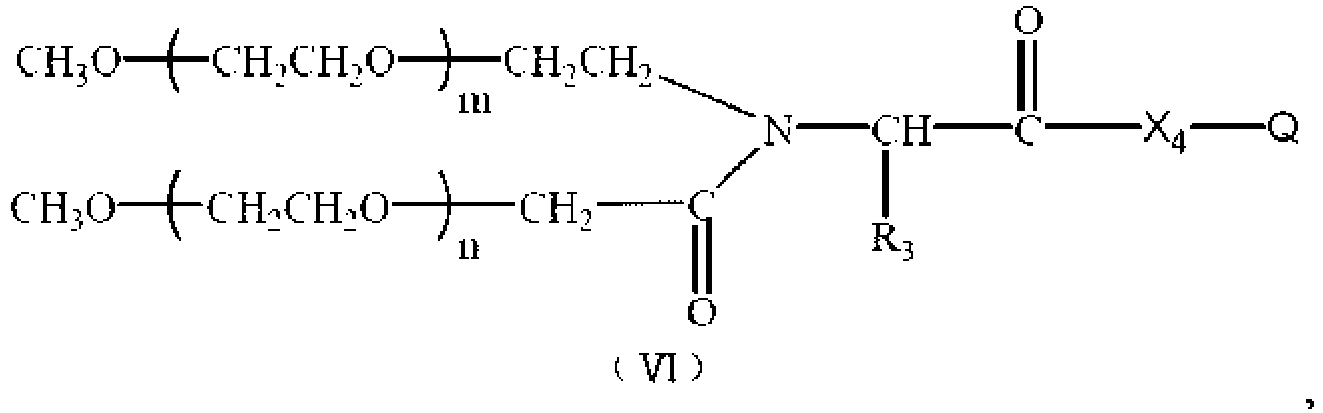
- a third aspect of the present invention also provides a Y-branched hydrophilic polymer derivative derived from the above carboxylic acid according to the second aspect of the present invention, which has the following structure: wherein P a , P b , X 1 , X 2 , X 3 have the above definition according to the first aspect of the present invention and having a molecular weight of 42-50 KDa (specifically it may be 42, 44, 46, 48 or 50 KDa).
- X 4 is a linking group selected from:-(CH 2 ) j -, -(CH 2 ) j O-, -(CH 2 ) j S-, -(CH 2 ) j CO-, -(CH 2 ) j NH-, - (CH 2 ) j CONH- and -(CH 2 ) j NHCO-, or the combination thereof, and j is an integer from 0 to 10,
- P a is a polyethylene glycol residue having a structure of R a -O-(CH 2 CH 2 O) m -, and R a is selected from the group consisting of: H, C 1-6 alkyl, C 3-6 cycloalkyl and C 6-10 cycloalkyl, and m is an integer from 170 to 565.
- P a is a methoxypolyethylene glycol residue having a structure of CH 3 O-(CH 2 CH 2 O) m , and m is an integer from 170 to 565.
- P a has a molecular weight of 21-25 KDa (specifically it may be 21, 22, 23, 24 or 25KDa)
- Pb has a molecular weight of 21-25 KDa (specifically, it may be 21, 22, 23, 24 or 25KDa)
- n and m are equal integers.
- P b is a polyethylene glycol residue having a structure of R b -O-(CH 2 CH 2 O) n -, and R b is selected from the group consisting of: H, C 1-6 alkyl, C 3-6 cycloalkyl and C 6-10 cycloalkyl, and n is an integer from 170 to 565.
- R b is selected from the group consisting of H, methyl, ethyl, isopropyl, cyclopropyl, cyclobutyl, cyclohexyl and benzyl.
- R b is H or methyl.
- P b is a methoxypolyethylene glycol residue having a structure of CH 3 O-(CH 2 CH 2 O) n -, and n is an integer from 170 to 565.
- the Y-branched hydrophilic polymer derivative is a Y-branched polyethylene glycol derivative having the following structure:
- X 4 is selected from the group consisting of: a single bond, - CH 2 -, -CH 2 CH 2 -, -CH 2 CH 2 CH 2 -, -CH 2 CH 2 CH 2 CH 2 -, -CH 2 CH 2 CH 2 CH 2 -, -(CH 2 ) j CO-, - (CH 2 ) j NH-, -(CH 2 ) j CONH- and -(CH 2 ) j NHCO-, or the combination thereof, and j is an integer from 0 to 5 (e.g., 0, 1, 2, 3, 4 or 5).
- X 4 is selected from the group consisting of: a single bond, -CH 2 -, -CH 2 CH 2 -, -CH 2 CH 2 CH 2 -, -CH 2 NH-, -CH 2 CH 2 NH-, - CH 2 CH 2 CH 2 NH-, -CH 2 CONH-, -CH 2 CH 2 CONH- and -CH 2 CH 2 CH 2 CONH-, or the combination thereof.
- Q is selected from the group consisting of: -OH, -SH, -C ⁇ CH, -NH 2 , -COOH, -CHO, and -N 3 .
- the Y-branched hydrophilic polymer derivative has the following structure:
- R 3 is selected from the group consisting of: -H, -CH 3 , -CH 2 CH(CH 3 ) 2 , -CH(CH 3 )CH 2 CH 3 , -CH(CH 3 ) 2 , -CH 2 CH 2 SCH 3 -, -CH 2 OH, -CH 2 SH, -CH(OH)CH 3 , -CH 2 COOH and - CH 2 CH 2 COOH.
- n and n are equal integers.
- Another aspect of the present invention provides a conjugate of the above Y-branched hydrophilic polymer carboxylic acid derivative or Y-branched hydrophilic polymer derivative of the present invention with a drug.
- the drug is selected from the group consisting of amino acids, polypeptides, proteins, carbohydrate, organic acids, alkaloids, flavonoids, quinones, terpenoids, phenylpropanoid phenols, steroids, and glycoside drugs.
- Another aspect of the invention also provides a pharmaceutical composition comprising the above conjugate of the invention and, optionally, a pharmaceutically acceptable carrier or excipient.
- Another aspect of the present invention provides the use of the Y-branched hydrophilic polymer carboxylic acid derivative, the Y-branched polyethylene glycol derivative, or the pharmaceutical conjugate thereof or the pharmaceutical composition thereof, in the manufacture of a medicament for treating a disease.
- alkyl group is substituted by an aryl group, it is correspondingly an "aralkyl” radical, such as benzyl, benzhydryl or phenethyl. If the alkyl group is substituted by a heterocyclic group, it is correspondingly a "heterocyclylalkyl” radical.
- Alkoxy means a substituent formed by substituting the hydrogen in hydroxy group with an alkyl group
- C1-C6 alkoxy group means an alkoxy group having 1 to 6 carbon atoms, such as methoxy or ethoxy, propoxy, butoxy, and the like.
- Cycloalkyl means an alicyclic hydrocarbon, such as those containing 1 to 4 monocyclic and/or fused rings. It may contain 3 to 18 carbon atoms, preferably 3 to 10 carbon atoms, such as cyclopropyl, cyclohexyl or adamantyl and the like.
- C3-C6 cycloalkyl in the present invention means a cycloalkyl having 3 to 6 carbon atoms, such as cyclopropyl, cyclobutyl, cyclopentyl and cyclohexyl.
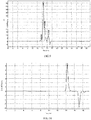
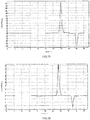
- Y-branched polyethylene glycol-acetic acid having a molecular weight of 4000 was prepared by the synthesis method of Example 5 in Patent CN1243779C : 10 g of polyethylene glycol monomethyl ether-aminoacetic acid (mPEG-Gly) having a molecular weight of 2000 and 10 g methoxy polyethylene glycol succinimidyl acetate (mPEG-OCH 2 CO-NHS) having a molecular weight of 2000 were dissolved in 200 ml of dichloromethane, 2.5 ml of triethylamine was added to the solution, and the reaction was carried out overnight at room temperature, and the solvent was concentrated by rotary evaporation.
- mPEG-Gly polyethylene glycol monomethyl ether-aminoacetic acid
- mPEG-OCH 2 CO-NHS methoxy polyethylene glycol succinimidyl acetate
- the Y-branched polyethylene glycol-acetic acid having a molecular weight of 44,000 was prepared by the synthesis method of Example 5 of Patent CN1243779C : 10g of polyethylene glycol monomethyl ether-aminoacetic acid (mPEG-Gly) having a molecular weight of 22000 and 10g of methoxy polyethylene glycol succinimidyl acetate (mPEG-OCH 2 CO-NHS) having a molecular weight of 22000 were dissolved in 200 ml of dichloromethane, 0.23 ml of triethylamine was added to the solution, and the reaction was carried out overnight at room temperature, and the solvent was concentrated by rotary evaporation.
- mPEG-Gly polyethylene glycol monomethyl ether-aminoacetic acid
- mPEG-OCH 2 CO-NHS methoxy polyethylene glycol succinimidyl acetate
Landscapes
- Chemical & Material Sciences (AREA)
- Health & Medical Sciences (AREA)
- Medicinal Chemistry (AREA)
- Chemical Kinetics & Catalysis (AREA)
- Polymers & Plastics (AREA)
- Organic Chemistry (AREA)
- General Chemical & Material Sciences (AREA)
- Epidemiology (AREA)
- Pharmacology & Pharmacy (AREA)
- Life Sciences & Earth Sciences (AREA)
- Animal Behavior & Ethology (AREA)
- General Health & Medical Sciences (AREA)
- Public Health (AREA)
- Veterinary Medicine (AREA)
- Medicinal Preparation (AREA)
- Polyethers (AREA)
Claims (16)
- Verfahren zum Herstellen eines Y-verzweigten hydrophilen Polymercarbonsäurederivats, wobei das Verfahren den folgenden Reaktionsschritt umfasst:

wobei X1 und X3 Verknüpfungsgruppen sind, die unabhängig aus der Gruppe ausgewählt
sind, die aus Folgendem besteht: -(CH2)i-,
Folgendem besteht: -(CH2)r-, -(CH2)rO-, -(CH2)rS-, und
wobei F eine Endgruppe ist, die aus der Gruppe ausgewählt ist, die aus Folgendem besteht: einer substituierten oder unsubstituierten C1-6-Alkylgruppe, einer substituierten oder unsubstituierten C1-6-Alkoxygruppe,


wobei R3 aus der Gruppe ausgewählt ist, die aus Folgendem besteht: -H, einer substituierten oder unsubstituierten C1-6-Alkylgruppe, einer substituierten oder unsubstituierten C6-10-Aralkylgruppe und einer substituierten oder unsubstituierten heterocyclischen C4-10-Alkylgruppe;
wobei, nach Beendigung der Reaktion, ein Säureanhydrid zugesetzt wird, um die Reaktion fortzusetzen, und dann eine Trennung und eine Reinigung durchgeführt werden; wobei das Säureanhydrid eines oder mehrere ist, die aus der Gruppe ausgewählt sind, die aus Di-tert-butyldicarbonat, Essigsäureanhydrid, Propionsäureanhydrid, Isobuttersäureanhydrid, Buttersäureanhydrid und Benzoesäureanhydrid besteht; und
der Schritt der Trennung und der Reinigung einen Schritt der Trennung und der Reinigung durch lonenaustauschchromatographie umfasst. - Herstellungsverfahren nach Anspruch 1, wobei das Molverhältnis der Menge des zugesetzten Säureanhydrids zu dem Reaktanten

die Reaktionsdauer nach dem Zusatz des Säureanhydrids 0,1 bis 24 Stunden beträgt. - Herstellungsverfahren nach Anspruch 1 oder 2, wobei das Y-verzweigte hydrophile Polymercarbonsäurederivat eine Molekülmasse von 15 bis 50 KDa aufweist; und/oder Pa eine Molekülmasse von 7,5 bis 25 kDa aufweist; und/oder
Pb eine Molekülmasse von 7,5 bis 25 kDa aufweist. - Herstellungsverfahren nach Anspruch 3, wobei Pa ein Polyethylenglykolrest ist, der eine Struktur von Ra-O-(CH2CH2O)m- aufweist, wobei Ra aus der Gruppe ausgewählt ist, die aus H, Methyl, Ethyl, Isopropyl, Cyclopropyl, Cyclobutyl, Cyclohexyl und Benzyl besteht, und m eine ganze Zahl von 170 bis 565 ist; und/oder
Pb ein Polyethylenglykolrest ist, der eine Struktur von Rb-O-(CH2CH2O)n- aufweist, wobei Rb aus der Gruppe ausgewählt ist, die aus H, Methyl, Ethyl, Isopropyl, Cyclopropyl, Cyclobutyl, Cyclohexyl und Benzyl besteht, und n eine ganze Zahl von 170 bis 565 ist. - Herstellungsverfahren nach Anspruch 4, wobei Ra H oder eine Methylgruppe ist; und/oder Rb H oder eine Methylgruppe ist; und/oder m und n gleiche ganze Zahlen sind.
- Herstellungsverfahren nach Anspruch 4, wobei das Y-verzweigte hydrophile Polymercarbonsäurederivat ein Y-verzweigtes Polyethylenglykolcarbonsäurederivat ist und die Reaktion wie folgt ist:
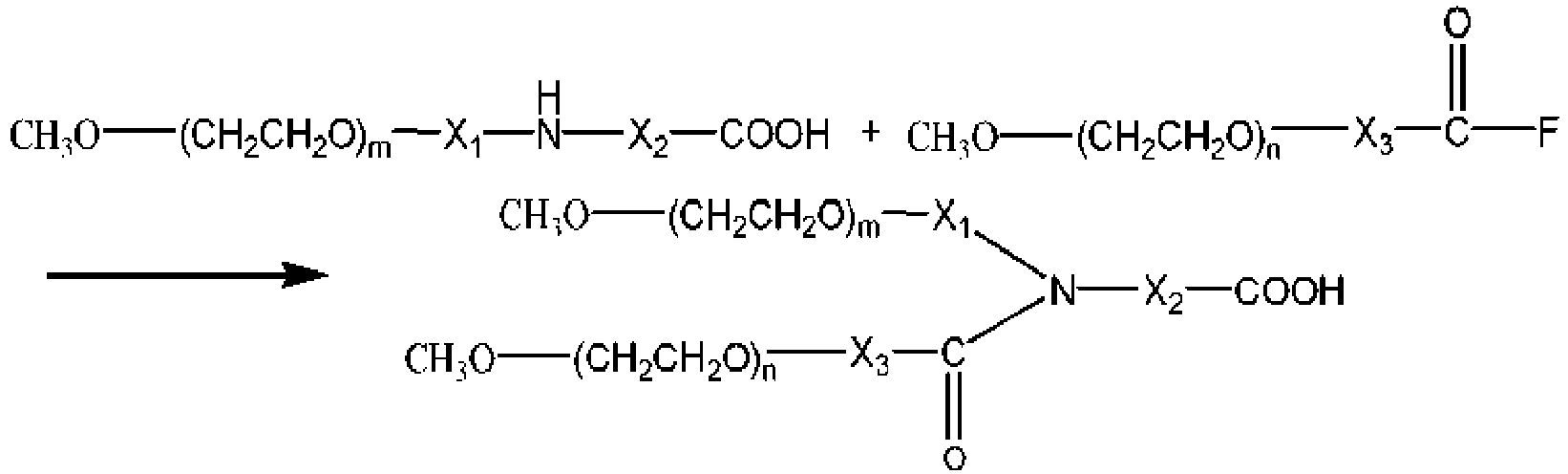
- Herstellungsverfahren nach Anspruch 1 oder 2, wobei X1 und X3 unabhängig aus der Gruppe ausgewählt sind, die aus Folgendem besteht: einer Einfachbindung, -CH2-, - CH2CH2-, -CH2CH2CH2-, -CH2CH2CH2CH2-, -CH2CH2CH2CH2CH2-, -CH(CH3)-, - CH2CH(CH3)-, -CH2CH2CH(CH3)-, -CH2CH2CH2CH(CH3)-, -CH2CH2CH2CH2CH(CH3)-, - CH2CH2CH2CH2CH2CH(CH3)-, -(CH2)iO- und -(CH2)iCO-, oder der Kombination davon, wobei i eine ganze Zahl von 0 bis 5 ist; und/oder X2


wobei F aus der Gruppe ausgewählt ist, die aus Folgendem besteht: Methoxy, Ethoxy,
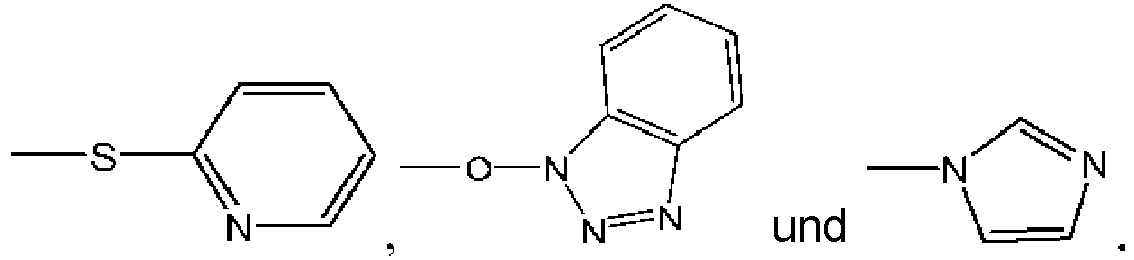
- Herstellungsverfahren nach Anspruch 7, wobei X1 -CH2CH2- ist; und/oder X3 -CH2-ist; und/oder X2 -CH2- oder -CH(CH3)- ist; und/oder, F

bevorzugt wobei die Reaktion in dem Herstellungsverfahren Folgende ist:
- Y-verzweigtes hydrophiles Polymercarbonsäurederivat, das nach einem der Ansprüche 1 bis 8 hergestellt wird, das die folgende Struktur aufweist:
 Polyethylenglykol, Polypropylenglykol, Polyvinylalkohol, Polytetrahydrofuran, Polypropylenoxid und Polybutylenoxid,wobei X1 und X3 Verknüpfungsgruppen sind, die unabhängig aus der Gruppe ausgewählt sind, die aus Folgendem besteht: -(CH2)i-, ,
 wobei R1 und R2 unabhängig aus der Gruppe ausgewählt sind, die aus Folgendem besteht: - H, einer substituierten oder unsubstituierten C1-6-Alkylgruppe, einer substituierten oder unsubstituierten C1-6-Alkoxygruppe, einer substituierten oder unsubstituierten C3-6-Cycloalkylgruppe und einer substituierten oder unsubstituierten C4-10-Alkylencycloalkylgruppe,wobei R3 aus der Gruppe ausgewählt ist, die aus Folgendem besteht: -H, einer substituierten oder unsubstituierten C1-6-Alkylgruppe, einer substituierten oder unsubstituierten C6-10-Aralkylgruppe und einer substituierten oder unsubstituierten heterocyclischen C4-10-Alkylgruppe;und wobei das Carbonsäurederivat eine Molekülmasse von 42 kDa bis 50 kDa aufweist.
 - Carbonsäurederivat nach Anspruch 9, wobei Pa ein Polyethylenglykolrest ist, der eine Struktur von Ra-O-(CH2CH2O)m- aufweist, wobei Ra aus der Gruppe ausgewählt ist, die aus H, Methyl, Ethyl, Isopropyl, Cyclopropyl, Cyclobutyl, Cyclohexyl und Benzyl besteht, und m eine ganze Zahl von 170 bis 565 ist; und/oder
Pb ein Polyethylenglykolrest ist, der eine Struktur von Rb-O-(CH2CH2O)n- aufweist, wobei Rb aus der Gruppe ausgewählt ist, die aus H, Methyl, Ethyl, Isopropyl, Cyclopropyl, Cyclobutyl, Cyclohexyl und Benzyl besteht, und n eine ganze Zahl von 170 bis 565 ist;
stärker bevorzugt wobei Ra H oder Methyl ist; und/oder Rb H oder Methyl ist; und/oder m und n gleiche ganze Zahlen sind. - Carbonsäurederivat nach Anspruch 10, wobei Pa eine Molekülmasse von 21 KDa bis 25 KDa aufweist und Pb eine Molekülmasse von 21 KDa bis 25 KDa aufweist und m und n gleiche ganze Zahlen sind.
- Carbonsäurederivat nach Anspruch 10 bis 11, wobei das Y-verzweigte hydrophile Polymercarbonsäurederivat ein Y-verzweigtes Polyethylenglykolcarbonsäurederivat ist, das die folgende Struktur aufweist:


- Y-verzweigtes hydrophiles Polymerderivat basierend auf dem Carbonsäurederivat nach einem der Ansprüche 9 bis 12, das die folgende Struktur aufweist:

wobei Q eine Endgruppe ist, die aus der Gruppe ausgewählt ist, die aus Folgendem besteht: C1-6-Alkoxy, Hydroxy, Amino, Carboxy, Thiol, Ester, Keto, Aldehyd, Orthopyridyldisulfid, Azid, Hydrazid, Alkinyl, Silan, Maleimidyl und Succinimidyl, bevorzugt wobei Q aus der Gruppe ausgewählt ist, die aus Folgendem besteht: OH, -SH, -C≡CH, -NH2, -COOH, -CHO,



- Konjugat des Y-verzweigten hydrophilen Polymercarbonsäurederivats nach einem der Ansprüche 9 bis 12, des Y-verzweigten hydrophilen Polymerderivats nach Anspruch 13 mit einem Arzneimittel.
- Pharmazeutische Zusammensetzung, die das Konjugat nach Anspruch 14 und optional eine(n) pharmazeutisch unbedenkliche(n) Trägersubstanz oder Arzneistoffträger umfasst.
- Verwendung des Y-verzweigten hydrophilen Polymercarbonsäurederivats nach einem der Ansprüche 9 bis 12, des Y-verzweigten hydrophilen Polymerderivats nach Anspruch 13, des Konjugats nach Anspruch 14 oder der pharmazeutischen Zusammensetzung nach Anspruch 15 bei der Fertigung eines Medikaments für die Behandlung einer Erkrankung.
Applications Claiming Priority (3)
| Application Number | Priority Date | Filing Date | Title |
|---|---|---|---|
| CN201710202947 | 2017-03-30 | ||
| CN201710915311.4A CN108659227B (zh) | 2017-03-30 | 2017-09-29 | 一种y型分支的亲水性聚合物羧酸衍生物的制备方法 |
| PCT/CN2018/077229 WO2018177055A1 (zh) | 2017-03-30 | 2018-02-26 | 一种y型分支的亲水性聚合物羧酸衍生物的制备方法 |
Publications (3)
| Publication Number | Publication Date |
|---|---|
| EP3604388A1 EP3604388A1 (de) | 2020-02-05 |
| EP3604388A4 EP3604388A4 (de) | 2020-05-06 |
| EP3604388B1 true EP3604388B1 (de) | 2021-04-28 |
Family
ID=63784856
Family Applications (1)
| Application Number | Title | Priority Date | Filing Date |
|---|---|---|---|
| EP18775559.0A Active EP3604388B1 (de) | 2017-03-30 | 2018-02-26 | Verfahren zur herstellung eines y-verzweigten hydrophilen polymercarbonsäurederivats |
Country Status (3)
| Country | Link |
|---|---|
| US (1) | US11359089B2 (de) |
| EP (1) | EP3604388B1 (de) |
| CN (1) | CN108659227B (de) |
Families Citing this family (4)
| Publication number | Priority date | Publication date | Assignee | Title |
|---|---|---|---|---|
| EP4509544A4 (de) | 2022-04-12 | 2025-07-02 | Xiamen Sinopeg Biotech Co Ltd | Nichtlineares pegyliertes lipid mit tertiärem amin und anwendung davon |
| CN117510828A (zh) | 2022-07-28 | 2024-02-06 | 厦门赛诺邦格生物科技股份有限公司 | 一种含氨基酸残基的三臂聚乙二醇衍生物 |
| CN116769154A (zh) * | 2023-07-06 | 2023-09-19 | 四平欧凯科技有限公司 | 单甲氧基聚乙二醇巯基的制备方法 |
| CN116970167B (zh) * | 2023-07-19 | 2024-06-28 | 湖北民族大学 | 一种聚天冬氨酸衍生物及其制备方法和应用 |
Family Cites Families (6)
| Publication number | Priority date | Publication date | Assignee | Title |
|---|---|---|---|---|
| US6258351B1 (en) * | 1996-11-06 | 2001-07-10 | Shearwater Corporation | Delivery of poly(ethylene glycol)-modified molecules from degradable hydrogels |
| WO2003076490A1 (en) * | 2002-03-13 | 2003-09-18 | Beijing Jiankai Technology Co., Ltd. | Hydrophilic polymer derivate with y type branch and preparation method of it medical composite comprising above compound |
| CN100475837C (zh) * | 2004-06-11 | 2009-04-08 | 北京键凯科技有限公司 | 多叉分支的聚乙二醇-氨基酸寡肽及其活性衍生物和药物结合物 |
| CN101029131A (zh) * | 2007-03-16 | 2007-09-05 | 中国人民解放军国防科学技术大学 | 一种分枝型聚乙二醇及其制备方法 |
| CN101259284A (zh) | 2008-04-15 | 2008-09-10 | 华东师范大学 | 一种基于树形聚合物肝靶向抗癌纳米前药系统、制备及用途 |
| CN104530415B (zh) | 2014-10-01 | 2017-09-01 | 厦门赛诺邦格生物科技股份有限公司 | 一种异官能化y型聚乙二醇衍生物、制备方法及其生物相关物质 |
-
2017
- 2017-09-29 CN CN201710915311.4A patent/CN108659227B/zh active Active
-
2018
- 2018-02-26 EP EP18775559.0A patent/EP3604388B1/de active Active
-
2019
- 2019-09-30 US US16/588,620 patent/US11359089B2/en active Active
Also Published As
| Publication number | Publication date |
|---|---|
| EP3604388A1 (de) | 2020-02-05 |
| CN108659227B (zh) | 2020-11-06 |
| EP3604388A4 (de) | 2020-05-06 |
| US11359089B2 (en) | 2022-06-14 |
| CN108659227A (zh) | 2018-10-16 |
| US20200024446A1 (en) | 2020-01-23 |
Similar Documents
| Publication | Publication Date | Title |
|---|---|---|
| EP3604388A1 (de) | Verfahren zur herstellung eines y-verzweigten hydrophilen polymercarbonsäurederivats | |
| EP1496076B1 (de) | Hydrophiles polymerderivat mit y-verzweigung und herstellungsverfahren dafür; obige verbindung enthaltender medizinischer verbundwerkstoff | |
| KR100499655B1 (ko) | 헤테로 이작용성 폴리(에틸렌 글리콜) 유도체 및 그의제조 방법 | |
| US20200138968A1 (en) | Process for preparing intermediate of antibody drug conjugate | |
| CN102898641A (zh) | 一种含单一活性官能团的y型聚乙二醇及其制备方法 | |
| JP4455760B2 (ja) | 特定の薬物の硝酸エステル及び硝酸塩 | |
| US8349969B2 (en) | Method for preparing high-purity polyethyleneglycol aldehyde derivatives | |
| WO2023040879A1 (en) | Drug delivery system for locally delivering therapeutic agents and uses thereof | |
| CN101108895B (zh) | 聚乙二醇乙醛衍生物及其与药物的结合物 | |
| WO2018177055A1 (zh) | 一种y型分支的亲水性聚合物羧酸衍生物的制备方法 | |
| CN111346234A (zh) | 去铁胺-八臂星型聚乙二醇结合物及其应用 | |
| US7550628B2 (en) | Process for preparing phenolic acid salts of gabapentin | |
| EP3950783B1 (de) | Verfahren zur herstellung von polyethylenglykol, das eine endständige carboxylgruppe enthält, und verfahren zur herstellung von aktiviertem polyethylenglykol | |
| JPS61291554A (ja) | 0(2,6−ジクロルフエニルアミノ)フエニル酢酸のエステル類およびその製法 | |
| CN1618837A (zh) | 聚乙二醇羧酸的制备方法和其用途 | |
| US20200325274A1 (en) | Tertiary alkoxy polyethylene glycol and derivatives thereof | |
| CA1274842A (en) | Esters of o(2,6-dichlorphenylamino)phenylacetic acid and method for their preparing | |
| CN1746148A (zh) | 一种合成2,4,5-三氟-3-甲氧基苯甲酸的方法 | |
| TW202547452A (zh) | 可裂解酯類化合物及其用途 | |
| CN120097852A (zh) | 一种8-(2-羟基苯甲酰胺基)辛酸钠的合成新方法 | |
| JP2000503683A (ja) | 新規ビフェニルジカルボン酸誘導体およびそれらの調製方法 | |
| CN1280559A (zh) | 新型的异丙基-甲基-[2-(3-正丙氧基苯氧基)乙基]胺磷酸盐 | |
| JPS6377865A (ja) | 異項環化合物 | |
| HK1072946A1 (zh) | 苯并氮杂环庚三烯化合物的固体盐及其在制备药物化合物中的应用 |
Legal Events
| Date | Code | Title | Description |
|---|---|---|---|
| STAA | Information on the status of an ep patent application or granted ep patent |
Free format text: STATUS: THE INTERNATIONAL PUBLICATION HAS BEEN MADE |
|
| PUAI | Public reference made under article 153(3) epc to a published international application that has entered the european phase |
Free format text: ORIGINAL CODE: 0009012 |
|
| STAA | Information on the status of an ep patent application or granted ep patent |
Free format text: STATUS: REQUEST FOR EXAMINATION WAS MADE |
|
| 17P | Request for examination filed |
Effective date: 20191030 |
|
| AK | Designated contracting states |
Kind code of ref document: A1 Designated state(s): AL AT BE BG CH CY CZ DE DK EE ES FI FR GB GR HR HU IE IS IT LI LT LU LV MC MK MT NL NO PL PT RO RS SE SI SK SM TR |
|
| AX | Request for extension of the european patent |
Extension state: BA ME |
|
| A4 | Supplementary search report drawn up and despatched |
Effective date: 20200402 |
|
| RIC1 | Information provided on ipc code assigned before grant |
Ipc: C08G 65/333 20060101ALI20200328BHEP Ipc: C08G 65/30 20060101ALI20200328BHEP Ipc: A61K 31/00 20060101ALI20200328BHEP Ipc: C08G 65/48 20060101ALI20200328BHEP Ipc: C08G 81/00 20060101ALI20200328BHEP Ipc: C08G 65/46 20060101ALI20200328BHEP Ipc: A61K 47/00 20060101ALI20200328BHEP Ipc: C08G 69/48 20060101ALI20200328BHEP Ipc: C08G 69/00 20060101AFI20200328BHEP |
|
| DAV | Request for validation of the european patent (deleted) | ||
| DAX | Request for extension of the european patent (deleted) | ||
| GRAP | Despatch of communication of intention to grant a patent |
Free format text: ORIGINAL CODE: EPIDOSNIGR1 |
|
| STAA | Information on the status of an ep patent application or granted ep patent |
Free format text: STATUS: GRANT OF PATENT IS INTENDED |
|
| INTG | Intention to grant announced |
Effective date: 20210122 |
|
| GRAS | Grant fee paid |
Free format text: ORIGINAL CODE: EPIDOSNIGR3 |
|
| GRAA | (expected) grant |
Free format text: ORIGINAL CODE: 0009210 |
|
| STAA | Information on the status of an ep patent application or granted ep patent |
Free format text: STATUS: THE PATENT HAS BEEN GRANTED |
|
| AK | Designated contracting states |
Kind code of ref document: B1 Designated state(s): AL AT BE BG CH CY CZ DE DK EE ES FI FR GB GR HR HU IE IS IT LI LT LU LV MC MK MT NL NO PL PT RO RS SE SI SK SM TR |
|
| REG | Reference to a national code |
Ref country code: GB Ref legal event code: FG4D |
|
| REG | Reference to a national code |
Ref country code: CH Ref legal event code: EP |
|
| REG | Reference to a national code |
Ref country code: AT Ref legal event code: REF Ref document number: 1386992 Country of ref document: AT Kind code of ref document: T Effective date: 20210515 |
|
| REG | Reference to a national code |
Ref country code: DE Ref legal event code: R096 Ref document number: 602018016335 Country of ref document: DE |
|
| REG | Reference to a national code |
Ref country code: IE Ref legal event code: FG4D |
|
| REG | Reference to a national code |
Ref country code: LT Ref legal event code: MG9D |
|
| REG | Reference to a national code |
Ref country code: AT Ref legal event code: MK05 Ref document number: 1386992 Country of ref document: AT Kind code of ref document: T Effective date: 20210428 |
|
| PG25 | Lapsed in a contracting state [announced via postgrant information from national office to epo] |
Ref country code: NL Free format text: LAPSE BECAUSE OF FAILURE TO SUBMIT A TRANSLATION OF THE DESCRIPTION OR TO PAY THE FEE WITHIN THE PRESCRIBED TIME-LIMIT Effective date: 20210428 Ref country code: BG Free format text: LAPSE BECAUSE OF FAILURE TO SUBMIT A TRANSLATION OF THE DESCRIPTION OR TO PAY THE FEE WITHIN THE PRESCRIBED TIME-LIMIT Effective date: 20210728 Ref country code: AT Free format text: LAPSE BECAUSE OF FAILURE TO SUBMIT A TRANSLATION OF THE DESCRIPTION OR TO PAY THE FEE WITHIN THE PRESCRIBED TIME-LIMIT Effective date: 20210428 Ref country code: LT Free format text: LAPSE BECAUSE OF FAILURE TO SUBMIT A TRANSLATION OF THE DESCRIPTION OR TO PAY THE FEE WITHIN THE PRESCRIBED TIME-LIMIT Effective date: 20210428 Ref country code: HR Free format text: LAPSE BECAUSE OF FAILURE TO SUBMIT A TRANSLATION OF THE DESCRIPTION OR TO PAY THE FEE WITHIN THE PRESCRIBED TIME-LIMIT Effective date: 20210428 Ref country code: FI Free format text: LAPSE BECAUSE OF FAILURE TO SUBMIT A TRANSLATION OF THE DESCRIPTION OR TO PAY THE FEE WITHIN THE PRESCRIBED TIME-LIMIT Effective date: 20210428 |
|
| PG25 | Lapsed in a contracting state [announced via postgrant information from national office to epo] |
Ref country code: PT Free format text: LAPSE BECAUSE OF FAILURE TO SUBMIT A TRANSLATION OF THE DESCRIPTION OR TO PAY THE FEE WITHIN THE PRESCRIBED TIME-LIMIT Effective date: 20210830 Ref country code: SE Free format text: LAPSE BECAUSE OF FAILURE TO SUBMIT A TRANSLATION OF THE DESCRIPTION OR TO PAY THE FEE WITHIN THE PRESCRIBED TIME-LIMIT Effective date: 20210428 Ref country code: RS Free format text: LAPSE BECAUSE OF FAILURE TO SUBMIT A TRANSLATION OF THE DESCRIPTION OR TO PAY THE FEE WITHIN THE PRESCRIBED TIME-LIMIT Effective date: 20210428 Ref country code: LV Free format text: LAPSE BECAUSE OF FAILURE TO SUBMIT A TRANSLATION OF THE DESCRIPTION OR TO PAY THE FEE WITHIN THE PRESCRIBED TIME-LIMIT Effective date: 20210428 Ref country code: NO Free format text: LAPSE BECAUSE OF FAILURE TO SUBMIT A TRANSLATION OF THE DESCRIPTION OR TO PAY THE FEE WITHIN THE PRESCRIBED TIME-LIMIT Effective date: 20210728 Ref country code: PL Free format text: LAPSE BECAUSE OF FAILURE TO SUBMIT A TRANSLATION OF THE DESCRIPTION OR TO PAY THE FEE WITHIN THE PRESCRIBED TIME-LIMIT Effective date: 20210428 Ref country code: GR Free format text: LAPSE BECAUSE OF FAILURE TO SUBMIT A TRANSLATION OF THE DESCRIPTION OR TO PAY THE FEE WITHIN THE PRESCRIBED TIME-LIMIT Effective date: 20210729 Ref country code: IS Free format text: LAPSE BECAUSE OF FAILURE TO SUBMIT A TRANSLATION OF THE DESCRIPTION OR TO PAY THE FEE WITHIN THE PRESCRIBED TIME-LIMIT Effective date: 20210828 |
|
| REG | Reference to a national code |
Ref country code: NL Ref legal event code: MP Effective date: 20210428 |
|
| PG25 | Lapsed in a contracting state [announced via postgrant information from national office to epo] |
Ref country code: SK Free format text: LAPSE BECAUSE OF FAILURE TO SUBMIT A TRANSLATION OF THE DESCRIPTION OR TO PAY THE FEE WITHIN THE PRESCRIBED TIME-LIMIT Effective date: 20210428 Ref country code: EE Free format text: LAPSE BECAUSE OF FAILURE TO SUBMIT A TRANSLATION OF THE DESCRIPTION OR TO PAY THE FEE WITHIN THE PRESCRIBED TIME-LIMIT Effective date: 20210428 Ref country code: ES Free format text: LAPSE BECAUSE OF FAILURE TO SUBMIT A TRANSLATION OF THE DESCRIPTION OR TO PAY THE FEE WITHIN THE PRESCRIBED TIME-LIMIT Effective date: 20210428 Ref country code: RO Free format text: LAPSE BECAUSE OF FAILURE TO SUBMIT A TRANSLATION OF THE DESCRIPTION OR TO PAY THE FEE WITHIN THE PRESCRIBED TIME-LIMIT Effective date: 20210428 Ref country code: SM Free format text: LAPSE BECAUSE OF FAILURE TO SUBMIT A TRANSLATION OF THE DESCRIPTION OR TO PAY THE FEE WITHIN THE PRESCRIBED TIME-LIMIT Effective date: 20210428 Ref country code: DK Free format text: LAPSE BECAUSE OF FAILURE TO SUBMIT A TRANSLATION OF THE DESCRIPTION OR TO PAY THE FEE WITHIN THE PRESCRIBED TIME-LIMIT Effective date: 20210428 Ref country code: CZ Free format text: LAPSE BECAUSE OF FAILURE TO SUBMIT A TRANSLATION OF THE DESCRIPTION OR TO PAY THE FEE WITHIN THE PRESCRIBED TIME-LIMIT Effective date: 20210428 |
|
| REG | Reference to a national code |
Ref country code: DE Ref legal event code: R097 Ref document number: 602018016335 Country of ref document: DE |
|
| PLBE | No opposition filed within time limit |
Free format text: ORIGINAL CODE: 0009261 |
|
| STAA | Information on the status of an ep patent application or granted ep patent |
Free format text: STATUS: NO OPPOSITION FILED WITHIN TIME LIMIT |
|
| 26N | No opposition filed |
Effective date: 20220131 |
|
| PG25 | Lapsed in a contracting state [announced via postgrant information from national office to epo] |
Ref country code: IS Free format text: LAPSE BECAUSE OF FAILURE TO SUBMIT A TRANSLATION OF THE DESCRIPTION OR TO PAY THE FEE WITHIN THE PRESCRIBED TIME-LIMIT Effective date: 20210828 Ref country code: AL Free format text: LAPSE BECAUSE OF FAILURE TO SUBMIT A TRANSLATION OF THE DESCRIPTION OR TO PAY THE FEE WITHIN THE PRESCRIBED TIME-LIMIT Effective date: 20210428 |
|
| PG25 | Lapsed in a contracting state [announced via postgrant information from national office to epo] |
Ref country code: IT Free format text: LAPSE BECAUSE OF FAILURE TO SUBMIT A TRANSLATION OF THE DESCRIPTION OR TO PAY THE FEE WITHIN THE PRESCRIBED TIME-LIMIT Effective date: 20210428 |
|
| PG25 | Lapsed in a contracting state [announced via postgrant information from national office to epo] |
Ref country code: MC Free format text: LAPSE BECAUSE OF FAILURE TO SUBMIT A TRANSLATION OF THE DESCRIPTION OR TO PAY THE FEE WITHIN THE PRESCRIBED TIME-LIMIT Effective date: 20210428 |
|
| REG | Reference to a national code |
Ref country code: CH Ref legal event code: PL |
|
| REG | Reference to a national code |
Ref country code: BE Ref legal event code: MM Effective date: 20220228 |
|
| PG25 | Lapsed in a contracting state [announced via postgrant information from national office to epo] |
Ref country code: LU Free format text: LAPSE BECAUSE OF NON-PAYMENT OF DUE FEES Effective date: 20220226 |
|
| PG25 | Lapsed in a contracting state [announced via postgrant information from national office to epo] |
Ref country code: LI Free format text: LAPSE BECAUSE OF NON-PAYMENT OF DUE FEES Effective date: 20220228 Ref country code: IE Free format text: LAPSE BECAUSE OF NON-PAYMENT OF DUE FEES Effective date: 20220226 Ref country code: CH Free format text: LAPSE BECAUSE OF NON-PAYMENT OF DUE FEES Effective date: 20220228 |
|
| PG25 | Lapsed in a contracting state [announced via postgrant information from national office to epo] |
Ref country code: BE Free format text: LAPSE BECAUSE OF NON-PAYMENT OF DUE FEES Effective date: 20220228 |
|
| P01 | Opt-out of the competence of the unified patent court (upc) registered |
Effective date: 20230529 |
|
| PG25 | Lapsed in a contracting state [announced via postgrant information from national office to epo] |
Ref country code: MK Free format text: LAPSE BECAUSE OF FAILURE TO SUBMIT A TRANSLATION OF THE DESCRIPTION OR TO PAY THE FEE WITHIN THE PRESCRIBED TIME-LIMIT Effective date: 20210428 Ref country code: CY Free format text: LAPSE BECAUSE OF FAILURE TO SUBMIT A TRANSLATION OF THE DESCRIPTION OR TO PAY THE FEE WITHIN THE PRESCRIBED TIME-LIMIT Effective date: 20210428 |
|
| PG25 | Lapsed in a contracting state [announced via postgrant information from national office to epo] |
Ref country code: HU Free format text: LAPSE BECAUSE OF FAILURE TO SUBMIT A TRANSLATION OF THE DESCRIPTION OR TO PAY THE FEE WITHIN THE PRESCRIBED TIME-LIMIT; INVALID AB INITIO Effective date: 20180226 |
|
| PG25 | Lapsed in a contracting state [announced via postgrant information from national office to epo] |
Ref country code: TR Free format text: LAPSE BECAUSE OF FAILURE TO SUBMIT A TRANSLATION OF THE DESCRIPTION OR TO PAY THE FEE WITHIN THE PRESCRIBED TIME-LIMIT Effective date: 20210428 |
|
| PG25 | Lapsed in a contracting state [announced via postgrant information from national office to epo] |
Ref country code: MT Free format text: LAPSE BECAUSE OF FAILURE TO SUBMIT A TRANSLATION OF THE DESCRIPTION OR TO PAY THE FEE WITHIN THE PRESCRIBED TIME-LIMIT Effective date: 20210428 |
|
| PGFP | Annual fee paid to national office [announced via postgrant information from national office to epo] |
Ref country code: GB Payment date: 20260219 Year of fee payment: 9 |
|
| PGFP | Annual fee paid to national office [announced via postgrant information from national office to epo] |
Ref country code: DE Payment date: 20260206 Year of fee payment: 9 |
|
| PGFP | Annual fee paid to national office [announced via postgrant information from national office to epo] |
Ref country code: FR Payment date: 20260227 Year of fee payment: 9 |