EP3581050B1 - Handschuh, insbesondere pilotenhandschuh - Google Patents
Handschuh, insbesondere pilotenhandschuh Download PDFInfo
- Publication number
- EP3581050B1 EP3581050B1 EP19179618.4A EP19179618A EP3581050B1 EP 3581050 B1 EP3581050 B1 EP 3581050B1 EP 19179618 A EP19179618 A EP 19179618A EP 3581050 B1 EP3581050 B1 EP 3581050B1
- Authority
- EP
- European Patent Office
- Prior art keywords
- glove
- index finger
- area
- finger
- blank
- Prior art date
- Legal status (The legal status is an assumption and is not a legal conclusion. Google has not performed a legal analysis and makes no representation as to the accuracy of the status listed.)
- Active
Links
Images

Classifications
-
- A—HUMAN NECESSITIES
- A41—WEARING APPAREL
- A41D—OUTERWEAR; PROTECTIVE GARMENTS; ACCESSORIES
- A41D19/00—Gloves
- A41D19/02—Arrangements for cutting-out, or shapes of, glove blanks
-
- A—HUMAN NECESSITIES
- A41—WEARING APPAREL
- A41D—OUTERWEAR; PROTECTIVE GARMENTS; ACCESSORIES
- A41D19/00—Gloves
- A41D19/015—Protective gloves
-
- A—HUMAN NECESSITIES
- A41—WEARING APPAREL
- A41D—OUTERWEAR; PROTECTIVE GARMENTS; ACCESSORIES
- A41D19/00—Gloves
- A41D19/015—Protective gloves
- A41D19/01547—Protective gloves with grip improving means
- A41D19/01558—Protective gloves with grip improving means using a layer of grip improving material
-
- A—HUMAN NECESSITIES
- A41—WEARING APPAREL
- A41D—OUTERWEAR; PROTECTIVE GARMENTS; ACCESSORIES
- A41D19/00—Gloves
- A41D19/015—Protective gloves
- A41D19/01529—Protective gloves with thermal or fire protection
-
- A—HUMAN NECESSITIES
- A41—WEARING APPAREL
- A41D—OUTERWEAR; PROTECTIVE GARMENTS; ACCESSORIES
- A41D19/00—Gloves
- A41D19/015—Protective gloves
- A41D19/01576—Protective gloves made of a patchwork of different materials
Definitions
- the invention relates to a glove, in particular a pilot's glove, according to the preamble of claim 1.
- the tactility of pilot gloves remains one of the most important features for safely and accurately flying an aircraft.
- the dashboard in an aircraft is equipped with a large number of different toggle and rotary switches and electrical push buttons, all closely spaced together. Therefore, a glove must fit snugly to the hand and fingers in order to be able to operate the selected switch or button precisely and avoid incorrect operation.
- the sense of touch of the index finger and thumb should not be restricted by the glove. This is all the more true as modern aircraft have touchscreen controls. In combat aircraft, these touchscreens are located in different places in the cockpit - often below the pilot's seat height - so that a pilot must be able to operate the touchscreen with his fingers at different angles. In addition, the joystick and rotary knobs should also be operable with as little impairment of the sense of touch as possible.
- the US$1,252,900 discloses a glove having an attached area for a complete ring finger and an attached area for a complete middle finger on the inside of the glove.
- the invention is based on the object of creating a glove which only minimally restricts the wearer's sense of touch, especially in the area of the index finger and thumb, has a long service life and has a good fit.
- the seamless design of the glove in the area of the inside of the thumb and the end of the index finger makes it possible to operate touchscreens at different angles as well as to operate switches, knobs and joysticks without impairing the wearer's sense of touch.
- the layers on the fingers of the glove give it an optimal fit. This also allows the fingers of the glove to be slightly pre-curved.
- the first cut of material can also encompass a thumb by at least 180°. This means that buttons or a touchscreen can be operated using the thumb without a seam restricting the sense of touch.
- the first material cut also forms at least part of the palm area, an inner side of a ring finger area and a little finger area of the glove.
- a further cut made of the same material as the first material cut is attached to the first material cut by a seam, this cut forming an inner side of a middle finger area.
- the middle finger area is cut separately and attached to the first material cut by a seam in the area of the base of the middle finger.
- this seam practically does not affect the tactility of the glove.
- the layer between the index finger and middle finger only extends over the lower index finger area.
- the first material cut can preferably be made of leather, a material with good tactility.
- leather is very comfortable to wear and, provided a soft leather such as goatskin is used, only restricts the sense of touch to a very small extent.
- leather also fits the hand very well and thus forms a kind of second skin on the wearer's hand.
- the leather is flame-resistant.
- the entire glove is made of a material or materials that do not build up static charge.
- the glove can have several other material cuts that form a glove back. These other material cuts can be made from a second, preferably flame-resistant material or from the same material as the first material cut. There are particular advantages for wearing comfort when the second material is a knitted fabric.
- a knitted fabric is elastic and thus ensures the necessary freedom of movement of the glove.
- a knitted fabric is also breathable and therefore very skin-friendly.
- the glove can also have a cuff, whereby the first material cut can also form part of the cuff.
- the cuff provides a protected transition to the combat suit.
- the first material cut 10 shown is made of a first material, preferably a flame-retardant leather, and forms the inside of an index finger area 11, a thumb area 12, a ring finger area 13 and a little finger area 14 as well as a large part of a palm 15, which extends over a cuff 16.
- the index finger area 11 is widened in an end area 11a, so that the finished glove encompasses the end area of an index finger by more than 180°.
- the index finger area 11 is cut longer so that a seam with a Fig.3 shown further material cut 19 for a backhand of the glove runs on the back of an index finger.
- a separate cut 17 must be provided for the inside of the middle finger, as Fig. 2
- the blank 17 made of the same material as the first material blank 10 is attached to the first material blank 10 at a seam 18.
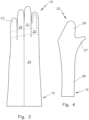
- a material cut 19 for the back part of the glove is shown.
- the cut 19 has an index finger area 20, a middle finger area 21, a ring finger area 22 and a little finger area 23.
- it completely forms a cover 24 for the back of the hand and the back of the cuff 16.
- the index finger area 20 it is narrower and shorter than an index finger, so that a seam of the index finger area 20 with the index finger area 11 of the material cut 10 in the upper area of the index finger runs completely on the back of an index finger.
- a material blank 25 which has a thumb area 26 for covering the back of a thumb, a thumb ball area 27 and an area 28 for forming part of the inside of the cuff 16.
- the material blanks 19, 25 are preferably made of a different material than the material blanks 10, 17.
- a more elastic material, for example a knitted fabric, can preferably be used for the blanks 19, 25.
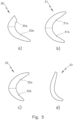
- the Fig.5 The layers 30 - 33 shown are inserted between the material cuts 10, 19 and thereby produce a three-dimensional shape for the index, middle, ring and little fingers of the glove.
- the Fig. 5a The layer 30 shown is sewn between the index finger and middle finger, with a region 30a of the layer 30 being shortened and extending laterally along the index finger to the upper end region 11a of the cut 10.
- the region 30b forms the side of the middle finger of the glove facing the index finger.
- the Schichtel 31 from Fig. 5b is sewn between the middle finger and ring finger between the cuts 10, 19.
- the longer area 3a forms one side of the middle finger and the area 31b one side of the ring finger of the glove.
- the layer 32 from Fig. 5c is sewn between the ring finger and little finger areas of the blanks 10, 19, with the area 32a forming one side of a ring finger and the area 32b forming the inside of a little finger of the glove.
- the layer 33 is made of Fig. 5d sewn between the blanks 10, 19.
- the layers 30 - 33 can preferably be made of the same material as the blanks 19, 25.
- the glove created by sewing together the cuts 10, 19, 25 and 30 - 33 allows sensitive operation of touchscreens as well as levers, switches and buttons of all kinds and at the same time is very comfortable to wear thanks to its anatomical shape.
Landscapes
- Engineering & Computer Science (AREA)
- Textile Engineering (AREA)
- Physics & Mathematics (AREA)
- Chemical & Material Sciences (AREA)
- Materials Engineering (AREA)
- Thermal Sciences (AREA)
- Geometry (AREA)
- Gloves (AREA)
- Polysaccharides And Polysaccharide Derivatives (AREA)
Description
- Die Erfindung betrifft einen Handschuh, insbesondere einen Pilotenhandschuh, nach dem Oberbegriff des Anspruchs 1.
- Die Taktilität von Pilotenhandschuhen ist nach wie vor einer der wichtigsten Eigenschaften, um sicher und genau ein Flugzeug fliegen zu können. Das Armaturenbrett in einem Flugzeug ist mit einer Vielzahl eng aneinanderliegender, unterschiedlicher Kipp- und Drehschalter sowie elektrischen Druckknöpfen versehen. Daher muss ein Handschuh eng an der Hand und an den Fingern anliegen, um genau den ausgewählten Schalter oder Knopf bedienen zu können und eine Fehlbedienung zu vermeiden.
- Insbesondere der Tastsinn von Zeigefinger und Daumen sollte durch den Handschuh nicht eingeschränkt werden. Dies gilt umso mehr, als moderne Flugzeuge über Touchscreen-Steuerungen verfügen. In Kampfflugzeugen sind diese Touchscreens an unterschiedlichen Stellen im Cockpit angeordnet - oftmals auch unterhalb der Sitzhöhe des Piloten -, sodass ein Pilot den Touchscreen mit seinen Fingern in unterschiedlichen Winkelstellungen bedienen können muss. Außerdem sollten Joystick und Drehknöpfe ebenfalls mit einer möglichst geringen Beeinträchtigung des Tastsinns bedienbar sein.
- Aus der
EP 1 278 432 B1 ist bereits ein Handschuh bekannt, der keine Nähte im Bereich der Fingerspitzen aufweist und somit auch im Bereich der Fingerspitzen den Tastsinn des Trägers nicht einschränkt. Der bekannte Handschuh ist jedoch aus nur zwei Materialzuschnitten gefertigt und hat damit keine ausreichend gute Passform. - In der
DE 20 2005 007 528 U1 , welche den Oberbegriff von Anspruch 1 offenbart, ist ein Pilotenhandschuh beschrieben, der ebenfalls keine Nähte im Bereich der Fingerkuppen aufweist. - Die
US 1,252,900 offenbart einen Handschuh, der auf der Handschuhinnenseite einen angesetzten Bereich für einen kompletten Ringfinger und einen angesetzten Bereich für einen kompletten Mittelfinger aufweist. - Der Erfindung liegt die Aufgabe zugrunde, einen Handschuh zu schaffen, der den Tastsinn seines Trägers vor allem im Bereich des Zeigefingers und des Daumens nur minimal einschränkt, eine lange Lebensdauer hat und eine gute Passform aufweist.
- Die Aufgabe wird gelöst durch einen Handschuh mit den Merkmalen des Anspruchs 1.
- Durch die nahtlose Gestaltung des Handschuhs im Bereich der Innenseite eines Daumens und des Endbereichs eines Zeigefingers ist mit dem Handschuh sowohl eine Bedienung von Touchscreens unter verschiedenen Winkelstellungen, als auch das Bedienen von Schaltern, Drehknöpfen und Joysticks ohne Beeinträchtigung des Tastsinns des Trägers möglich. Durch die Schichtel an den Fingern des Handschuhs erhält dieser eine optimale Passform. Die Finger des Handschuhs können dadurch auch leicht vorgekrümmt gestaltet werden.
- Der erste Materialzuschnitt kann zudem auch einen Daumen um mindestens 180° umfassen. Dadurch ist auch eine Bedienung von Tasten oder eines Touchscreens mit Hilfe des Daumens möglich, ohne dass eine Naht dabei den Tastsinn einschränken würde.
- Der erste Materialzuschnitt bildet auch zumindest einen Teil des Handinnenflächenbereichs, eine Innenseite eines Ringfingerbereichs und eines kleinen Fingerbereichs des Handschuhs. Durch eine Naht ist ein weiterer Zuschnitt aus dem gleichen Material wie der erste Materialzuschnitt an den ersten Materialzuschnitt angesetzt, wobei dieser Zuschnitt eine Innenseite eines Mittelfingerbereichs bildet. Auf diese Weise ist es möglich, den ersten Materialzuschnitt im Bereich des Endbereichs des Zeigefingers so breit zuzuschneiden, dass er später einen Zeigefinger um mehr als 180° umfasst. Der Mittelfingerbereich wird separat zugeschnitten und durch eine Naht im Bereich der Mittelfingerwurzel an den ersten Materialzuschnitt angesetzt. Diese Naht beeinträchtigt jedoch die Taktilität des Handschuhs praktisch nicht. Der Schichtel zwischen Zeigefinger und Mittelfinger erstreckt sich nur über den unteren Zeigefingerbereich.
- Der erste Materialzuschnitt kann vorzugsweise aus Leder, einem Material mit guter Taktilität gefertigt sein. Leder trägt sich sehr angenehm und schränkt den Tastsinn, sofern ein weiches Leder wie Ziegenleder verwendet wird, nur sehr geringfügig ein. Außerdem schmiegt sich Leder der Hand sehr gut an und bildet somit eine Art zweite Haut auf der Hand des Trägers.
- Für den Einsatz des Handschuhs für Kampfpiloten ist es außerdem von Vorteil, wenn das Leder flammfest ausgestaltet ist. Für eine Touchscreen-Bedienung ist es weiter vorteilhaft, wenn der gesamte Handschuh aus einem Material oder Materialien gefertigt ist, die sich statisch möglichst nicht aufladen.
- Der Handschuh kann mehrere weitere Materialzuschnitte aufweisen, die einen Handschuhrücken bilden. Diese weiteren Materialzuschnitten können dabei aus einem zweiten, vorzugsweise flammfesten Material oder aus dem gleichen Material wie der erste Materialzuschnitt gefertigt sein. Besondere Vorteile für den Tragekomfort ergeben sich dabei, wenn das zweite Material ein Gestrick ist. Ein Gestrick ist elastisch und sorgt somit für die erforderliche Bewegungsfreiheit des Handschuhs. Außerdem ist ein Gestrick atmungsaktiv und daher sehr hautfreundlich.
- Weiter kann der Handschuh eine Stulpe aufweisen, wobei der erste Materialzuschnitt auch einen Teil der Stulpe bilden kann. Insbesondere bei Handschuhen für Kampfpiloten ergibt sich durch die Stulpe somit ein geschützter Übergang zum Kampfanzug.
- Im Folgenden wird ein bevorzugtes Ausführungsbeispiel eines erfindungsgemäßen Handschuhs mit Bezug auf die Zeichnungen näher beschrieben.
- Dabei zeigen:
- Fig. 1
- eine Draufsicht auf einen ersten Materialzuschnitt für die Innenseite eines Handschuhs;
- Fig. 2
- eine Draufsicht auf einen Mittelfingerzuschnitt der Innenseite des Handschuhs aus
Fig. 1 ; - Fig. 3
- eine Draufsicht auf einen Materialzuschnitt für eine Rückhand des Handschuhs aus
Fig. 1 ; - Fig. 4
- eine Draufsicht auf einen Zuschnitt für eine Daumenaußenseite des Handschuhs auf
Fig. 1 ; - Fig. 5a - 5d
- Draufsichten auf Schichtelzuschnitte für den Handschuh aus
Fig. 1 . - Der in
Fig. 1 dargestellte erste Materialzuschnitt 10 ist aus einem ersten Material, vorzugsweise einem flammenhemmenden Leder, gefertigt und bildet die Innenseite eines Zeigefingerbereichs 11, eines Daumenbereichs 12, eines Ringfingerbereichs 13 und eines kleinen Fingerbereichs 14 sowie einen Großteil einer Handinnenfläche 15, wobei diese sich bis über eine Stulpe 16 hinweg erstreckt. Der Zeigefingerbereich 11 ist in einem Endbereich 11a verbreitert ausgeführt, sodass der fertige Handschuh den Endbereich eines Zeigefingers um mehr als 180° umfasst. - Außerdem ist der Zeigefingerbereich 11 länger geschnitten, sodass eine Naht mit einem in
Fig. 3 gezeigten weiteren Materialzuschnitt 19 für eine Rückhand des Handschuhs auf der Rückseite eines Zeigefingers verläuft. Damit ein solch breiterer Zuschnitt des Endbereichs 11a des Zeigefingerbereichs 11 möglich ist, muss ein gesonderter Zuschnitt 17 für die Innenseite des Mittelfingers vorgesehen werden, wieFig. 2 zeigt. Der Zuschnitt 17 aus dem gleichen Material wie der erste Materialzuschnitt 10 wird an einer Nahtstelle 18 an den ersten Materialzuschnitt 10 angesetzt. - In
Fig. 3 ist ein Materialzuschnitt 19 für das Rückenteil des Handschuhs gezeigt. Der Zuschnitt 19 weist einen Zeigefingerbereich 20, einen Mittelfingerbereich 21, einen Ringfingerbereich 22 und einen kleinen Fingerbereich 23 auf. Außerdem bildet er vollständig eine Abdeckung 24 für einen Handrücken sowie die Rückseite der Stulpe 16. Im Zeigefingerbereich 20 ist er schmaler und kürzer ausgeführt als ein Zeigefinger, sodass eine Naht des Zeigefingerbereichs 20 mit dem Zeigefingerbereich 11 des Materialzuschnitts 10 im oberen Bereich des Zeigefingers vollständig auf der Rückseite eines Zeigefingers verläuft. - In
Fig. 4 ist ein Materialzuschnitt 25 gezeigt, der einen Daumenbereich 26 zur Abdeckung der Rückseite eines Daumens, einen Daumenballenbereich 27 sowie einen Bereich 28 zur Bildung eines Teils der Innenseite der Stulpe 16 aufweist. Die Materialzuschnitte 19, 25 sind vorzugsweise aus einem anderen Material als die Materialzuschnitte 10, 17 gefertigt. Vorzugsweise kann für die Zuschnitte 19, 25 ein elastischeres Material, beispielsweise ein Strickstoff verwendet werden. - Die in
Fig. 5 dargestellten Schichtel 30 - 33 werden zwischen die Materialzuschnitte 10, 19 eingesetzt und ergeben dadurch eine dreidimensionale Form für Zeige-, Mittel-, Ringfinger und kleinen Finger des Handschuhs. Der inFig. 5a gezeigte Schichtel 30 wird zwischen Zeigefinger und Mittelfinger eingenäht, wobei ein Bereich 30a des Schichtels 30 verkürzt ist und sich seitlich bis zum oberen Endbereich 11a des Zuschnitts 10 entlang des Zeigefingers erstreckt. Der Bereich 30b bildet die dem Zeigefinger zugewandte Seite des Mittelfingers des Handschuhs. - Der Schichtel 31 aus
Fig. 5b wird zwischen Mittelfinger und Ringfinger zwischen die Zuschnitte 10, 19 eingenäht. Der längere Bereich 3 a bildet dabei eine Seite des Mittelfingers und der Bereich 31b eine Seite des Ringfingers des Handschuhs. Der Schichtel 32 ausFig. 5c wird zwischen den Ringfinger- und den kleinen Fingerbereichen der Zuschnitte 10, 19 eingenäht, wobei der Bereich 32a eine Seite eines Ringfingers bildet und der Bereich 32b die Innenseite eines kleinen Fingers des Handschuhs. Auf der Außenseite des kleinen Fingers wird der Schichtel 33 ausFig. 5d zwischen die Zuschnitte 10, 19 eingenäht. Die Schichtel 30 - 33 können vorzugsweise aus dem gleichen Material wie die Zuschnitte 19, 25 gefertigt sein. - Der durch das Zusammennähen der Zuschnitte 10, 19, 25 und 30 - 33 entstehende Handschuh erlaubt ein feinfühliges Bedienen von Touchscreens sowie Hebeln, Schaltern und Knöpfen aller Art und weist gleichzeitig durch die anatomische Formgebung einen hohen Tragekomfort auf.
Claims (8)
- Handschuh, insbesondere Pilotenhandschuh, der aus mehreren Materialzuschnitten (10, 17, 19, 25, 30 - 33) gefertigt ist, wobei ein erster Materialzuschnitt (10) nahtlos zumindest eine Innenseite eines Zeigefingerbereichs (11) und eine Innenseite eines Daumenbereichs (12) des Handschuhs bildet, wobei der erste Materialzuschnitt (10) dazu ausgebildet ist, den Endbereich eines Zeigefingers um mehr als 180° zu umfassen und sich bis über die Zeigefingerspitze hinaus zu erstrecken und wobei an den Fingern des Handschuhs, ausgenommen zwischen Daumen und Zeigefinger, Schichtel (30 - 33) angeordnet sind, wobei der erste Materialzuschnitt auch zumindest einen Teil eines Handinnenflächenbereichs (15) und eine Innenseite eines Ringfingerbereichs (13) und eines kleinen Fingerbereichs (14) des Handschuhs bildet, dadurch gekennzeichnet, dass an den ersten Materialzuschnitt (10) durch eine Naht ein Zuschnitt (17) aus dem gleichen Material wie der erste Materialzuschnitt (10) angesetzt ist, wobei der Zuschnitt (17) eine Innenseite eines Mittelfingerbereichs bildet, und dass der Schichtel (30) zwischen Zeigefinger und Mittelfinger sich nur über den unteren Zeigefingerbereich erstreckt.
- Handschuh nach Anspruch 1, dadurch gekennzeichnet, dass der erste Materialzuschnitt (10) dazu ausgebildet ist, einen Daumen um mindestens 180° zu umfassen.
- Handschuh nach Anspruch 1 oder 2, dadurch gekennzeichnet, dass der erste Materialzuschnitt (10) aus Leder gefertigt ist.
- Handschuh nach Anspruch 3, dadurch gekennzeichnet, dass das Leder flammfest ist.
- Handschuh nach einem der vorhergehenden Ansprüche, dadurch gekennzeichnet, dass er mindestens einen weiteren Materialzuschnitt (19) aufweist, der einen Handschuhrücken bildet.
- Handschuh nach Anspruch 5, dadurch gekennzeichnet, dass der oder die weiteren Materialzuschnitt/e (19) aus einem zweiten, vorzugsweise flammfesten Material oder aus dem gleichen Material wie der erste Materialzuschnitt gefertigt sind.
- Handschuh nach Anspruch 6, dadurch gekennzeichnet, dass das zweite Material ein Gestrick ist.
- Handschuh nach einem der vorhergehenden Ansprüche, dadurch gekennzeichnet, dass er eine Stulpe (16) aufweist und der erste Materialzuschnitt (10) auch einen Teil der Stulpe bildet.
Applications Claiming Priority (1)
| Application Number | Priority Date | Filing Date | Title |
|---|---|---|---|
| DE102018114151.3A DE102018114151B4 (de) | 2018-06-13 | 2018-06-13 | Handschuh, insbesondere Pilotenhandschuh |
Publications (3)
| Publication Number | Publication Date |
|---|---|
| EP3581050A1 EP3581050A1 (de) | 2019-12-18 |
| EP3581050B1 true EP3581050B1 (de) | 2024-09-18 |
| EP3581050C0 EP3581050C0 (de) | 2024-09-18 |
Family
ID=66826883
Family Applications (1)
| Application Number | Title | Priority Date | Filing Date |
|---|---|---|---|
| EP19179618.4A Active EP3581050B1 (de) | 2018-06-13 | 2019-06-12 | Handschuh, insbesondere pilotenhandschuh |
Country Status (3)
| Country | Link |
|---|---|
| EP (1) | EP3581050B1 (de) |
| CZ (1) | CZ36214U1 (de) |
| DE (1) | DE102018114151B4 (de) |
Family Cites Families (7)
| Publication number | Priority date | Publication date | Assignee | Title |
|---|---|---|---|---|
| US158008A (en) * | 1874-12-22 | Improvement in gloves | ||
| US1252900A (en) * | 1916-06-06 | 1918-01-08 | Brayton C Grinnell | Glove. |
| FR924520A (fr) * | 1946-03-27 | 1947-08-07 | Merry Hull & Company | Perfectionnements aux gants |
| US5708979A (en) | 1996-11-01 | 1998-01-20 | Acushnet Company | Glove with elastic back |
| EP1278432B1 (de) | 2000-05-04 | 2004-09-22 | Blücher GmbH | Handschuh für piloten |
| AT500761B1 (de) | 2004-09-03 | 2010-03-15 | Eska Lederhandschuhfabrik Ges | Handschuh bzw. auskleidung für einen ausrüstungsgegenstand |
| US20150196829A1 (en) | 2014-01-14 | 2015-07-16 | Black Diamond Equipment, Ltd. | Glove System and Method of Manufacture |
-
2018
- 2018-06-13 DE DE102018114151.3A patent/DE102018114151B4/de active Active
-
2019
- 2019-06-12 EP EP19179618.4A patent/EP3581050B1/de active Active
- 2019-06-12 CZ CZ2021-39136U patent/CZ36214U1/cs active Protection Beyond IP Right Term
Also Published As
| Publication number | Publication date |
|---|---|
| CZ36214U1 (cs) | 2022-07-19 |
| DE102018114151B4 (de) | 2023-10-19 |
| EP3581050C0 (de) | 2024-09-18 |
| DE102018114151A1 (de) | 2019-12-19 |
| EP3581050A1 (de) | 2019-12-18 |
Similar Documents
| Publication | Publication Date | Title |
|---|---|---|
| DE102015109959A1 (de) | Handschuh, insbesondere Torwarthandschuh, Material für einen Handschuh und Verfahren zur Herstellung eines Handschuhs | |
| DE60214176T2 (de) | Torwarthandschuh | |
| DE102018114151B4 (de) | Handschuh, insbesondere Pilotenhandschuh | |
| DE2721410A1 (de) | Handschuh, insbesondere sporthandschuh | |
| EP1278432B1 (de) | Handschuh für piloten | |
| DE19624245C1 (de) | Schnitthemmender und flüssigkeitsdichter Arbeitsschutz-Handschuh mit hohem Tragekomfort | |
| DE102011115261B4 (de) | Fingerhandschuh mit Innen- und Außennaht | |
| DE3750477T2 (de) | Eindringresistent-Operationshandschuh. | |
| EP4475712A1 (de) | Störlichtbogenschutzhandschuh | |
| EP1535650B1 (de) | Torwarthandschuh mit Daumen-Latexansatzlage | |
| EP4432986A1 (de) | Prothesenhandüberzug und verfahren zu dessen herstellung | |
| EP4226800B1 (de) | Handschuhe | |
| DE202023107470U1 (de) | Schutzhandschuh für Sportler mit flachen Rändern in der Nähe von Nahtbereichen | |
| DE202007012157U1 (de) | Fingerhandschuh | |
| EP4248781B1 (de) | Sporthandschuh | |
| DE69716928T2 (de) | Handschuh | |
| DE202011106474U1 (de) | Fingerhandschuh mit Innen- und Außennaht | |
| DE102019103141A1 (de) | Handschuh | |
| DE202015103270U1 (de) | Handschuh, insbesondere Torwarthandschuh und ein Material für einen Handschuh | |
| DE202006012570U1 (de) | Pilotenhandschuh | |
| EP2711056B1 (de) | Fingerhandschuh, insbesondere Torwarthandschuh | |
| EP0378074B1 (de) | Fingerloser Handschuh | |
| EP1784091B1 (de) | Handschuh bzw. auskleidung für einen ausrüstungsgegenstand | |
| DE9318227U1 (de) | Sporthandschuh | |
| EP4602965A1 (de) | Handschuh |
Legal Events
| Date | Code | Title | Description |
|---|---|---|---|
| PUAI | Public reference made under article 153(3) epc to a published international application that has entered the european phase |
Free format text: ORIGINAL CODE: 0009012 |
|
| STAA | Information on the status of an ep patent application or granted ep patent |
Free format text: STATUS: THE APPLICATION HAS BEEN PUBLISHED |
|
| AK | Designated contracting states |
Kind code of ref document: A1 Designated state(s): AL AT BE BG CH CY CZ DE DK EE ES FI FR GB GR HR HU IE IS IT LI LT LU LV MC MK MT NL NO PL PT RO RS SE SI SK SM TR |
|
| AX | Request for extension of the european patent |
Extension state: BA ME |
|
| STAA | Information on the status of an ep patent application or granted ep patent |
Free format text: STATUS: REQUEST FOR EXAMINATION WAS MADE |
|
| 17P | Request for examination filed |
Effective date: 20200320 |
|
| RBV | Designated contracting states (corrected) |
Designated state(s): AL AT BE BG CH CY CZ DE DK EE ES FI FR GB GR HR HU IE IS IT LI LT LU LV MC MK MT NL NO PL PT RO RS SE SI SK SM TR |
|
| STAA | Information on the status of an ep patent application or granted ep patent |
Free format text: STATUS: EXAMINATION IS IN PROGRESS |
|
| 17Q | First examination report despatched |
Effective date: 20211122 |
|
| GRAP | Despatch of communication of intention to grant a patent |
Free format text: ORIGINAL CODE: EPIDOSNIGR1 |
|
| STAA | Information on the status of an ep patent application or granted ep patent |
Free format text: STATUS: GRANT OF PATENT IS INTENDED |
|
| RIC1 | Information provided on ipc code assigned before grant |
Ipc: A41D 19/015 20060101ALN20240326BHEP Ipc: A41D 19/02 20060101AFI20240326BHEP |
|
| INTG | Intention to grant announced |
Effective date: 20240425 |
|
| GRAS | Grant fee paid |
Free format text: ORIGINAL CODE: EPIDOSNIGR3 |
|
| GRAA | (expected) grant |
Free format text: ORIGINAL CODE: 0009210 |
|
| STAA | Information on the status of an ep patent application or granted ep patent |
Free format text: STATUS: THE PATENT HAS BEEN GRANTED |
|
| AK | Designated contracting states |
Kind code of ref document: B1 Designated state(s): AL AT BE BG CH CY CZ DE DK EE ES FI FR GB GR HR HU IE IS IT LI LT LU LV MC MK MT NL NO PL PT RO RS SE SI SK SM TR |
|
| REG | Reference to a national code |
Ref country code: GB Ref legal event code: FG4D Free format text: NOT ENGLISH |
|
| REG | Reference to a national code |
Ref country code: CH Ref legal event code: EP |
|
| REG | Reference to a national code |
Ref country code: DE Ref legal event code: R096 Ref document number: 502019012134 Country of ref document: DE |
|
| REG | Reference to a national code |
Ref country code: IE Ref legal event code: FG4D Free format text: LANGUAGE OF EP DOCUMENT: GERMAN |
|
| U01 | Request for unitary effect filed |
Effective date: 20241014 |
|
| U07 | Unitary effect registered |
Designated state(s): AT BE BG DE DK EE FI FR IT LT LU LV MT NL PT RO SE SI Effective date: 20241031 |
|
| PG25 | Lapsed in a contracting state [announced via postgrant information from national office to epo] |
Ref country code: NO Free format text: LAPSE BECAUSE OF FAILURE TO SUBMIT A TRANSLATION OF THE DESCRIPTION OR TO PAY THE FEE WITHIN THE PRESCRIBED TIME-LIMIT Effective date: 20241218 |
|
| PG25 | Lapsed in a contracting state [announced via postgrant information from national office to epo] |
Ref country code: HR Free format text: LAPSE BECAUSE OF FAILURE TO SUBMIT A TRANSLATION OF THE DESCRIPTION OR TO PAY THE FEE WITHIN THE PRESCRIBED TIME-LIMIT Effective date: 20240918 |
|
| PG25 | Lapsed in a contracting state [announced via postgrant information from national office to epo] |
Ref country code: RS Free format text: LAPSE BECAUSE OF FAILURE TO SUBMIT A TRANSLATION OF THE DESCRIPTION OR TO PAY THE FEE WITHIN THE PRESCRIBED TIME-LIMIT Effective date: 20241218 |
|
| PG25 | Lapsed in a contracting state [announced via postgrant information from national office to epo] |
Ref country code: RS Free format text: LAPSE BECAUSE OF FAILURE TO SUBMIT A TRANSLATION OF THE DESCRIPTION OR TO PAY THE FEE WITHIN THE PRESCRIBED TIME-LIMIT Effective date: 20241218 Ref country code: NO Free format text: LAPSE BECAUSE OF FAILURE TO SUBMIT A TRANSLATION OF THE DESCRIPTION OR TO PAY THE FEE WITHIN THE PRESCRIBED TIME-LIMIT Effective date: 20241218 Ref country code: HR Free format text: LAPSE BECAUSE OF FAILURE TO SUBMIT A TRANSLATION OF THE DESCRIPTION OR TO PAY THE FEE WITHIN THE PRESCRIBED TIME-LIMIT Effective date: 20240918 |
|
| PG25 | Lapsed in a contracting state [announced via postgrant information from national office to epo] |
Ref country code: IS Free format text: LAPSE BECAUSE OF FAILURE TO SUBMIT A TRANSLATION OF THE DESCRIPTION OR TO PAY THE FEE WITHIN THE PRESCRIBED TIME-LIMIT Effective date: 20250118 |
|
| PG25 | Lapsed in a contracting state [announced via postgrant information from national office to epo] |
Ref country code: SM Free format text: LAPSE BECAUSE OF FAILURE TO SUBMIT A TRANSLATION OF THE DESCRIPTION OR TO PAY THE FEE WITHIN THE PRESCRIBED TIME-LIMIT Effective date: 20240918 |
|
| PG25 | Lapsed in a contracting state [announced via postgrant information from national office to epo] |
Ref country code: ES Free format text: LAPSE BECAUSE OF FAILURE TO SUBMIT A TRANSLATION OF THE DESCRIPTION OR TO PAY THE FEE WITHIN THE PRESCRIBED TIME-LIMIT Effective date: 20240918 |
|
| PG25 | Lapsed in a contracting state [announced via postgrant information from national office to epo] |
Ref country code: PL Free format text: LAPSE BECAUSE OF FAILURE TO SUBMIT A TRANSLATION OF THE DESCRIPTION OR TO PAY THE FEE WITHIN THE PRESCRIBED TIME-LIMIT Effective date: 20240918 |
|
| PG25 | Lapsed in a contracting state [announced via postgrant information from national office to epo] |
Ref country code: SK Free format text: LAPSE BECAUSE OF FAILURE TO SUBMIT A TRANSLATION OF THE DESCRIPTION OR TO PAY THE FEE WITHIN THE PRESCRIBED TIME-LIMIT Effective date: 20240918 |
|
| U20 | Renewal fee for the european patent with unitary effect paid |
Year of fee payment: 7 Effective date: 20250617 |
|
| PLBE | No opposition filed within time limit |
Free format text: ORIGINAL CODE: 0009261 |
|
| STAA | Information on the status of an ep patent application or granted ep patent |
Free format text: STATUS: NO OPPOSITION FILED WITHIN TIME LIMIT |
|
| PGFP | Annual fee paid to national office [announced via postgrant information from national office to epo] |
Ref country code: CZ Payment date: 20250530 Year of fee payment: 7 |
|
| 26N | No opposition filed |
Effective date: 20250619 |
|
| PGFP | Annual fee paid to national office [announced via postgrant information from national office to epo] |
Ref country code: CH Payment date: 20250701 Year of fee payment: 7 |
|
| PG25 | Lapsed in a contracting state [announced via postgrant information from national office to epo] |
Ref country code: MC Free format text: LAPSE BECAUSE OF FAILURE TO SUBMIT A TRANSLATION OF THE DESCRIPTION OR TO PAY THE FEE WITHIN THE PRESCRIBED TIME-LIMIT Effective date: 20240918 |
|
| GBPC | Gb: european patent ceased through non-payment of renewal fee |
Effective date: 20250612 |
|
| PG25 | Lapsed in a contracting state [announced via postgrant information from national office to epo] |
Ref country code: GB Free format text: LAPSE BECAUSE OF NON-PAYMENT OF DUE FEES Effective date: 20250612 |
|
| PG25 | Lapsed in a contracting state [announced via postgrant information from national office to epo] |
Ref country code: IE Free format text: LAPSE BECAUSE OF NON-PAYMENT OF DUE FEES Effective date: 20250612 |