EP3568302B1 - Vakuumdekoration eines trink- oder essgefässes - Google Patents
Vakuumdekoration eines trink- oder essgefässes Download PDFInfo
- Publication number
- EP3568302B1 EP3568302B1 EP18700390.0A EP18700390A EP3568302B1 EP 3568302 B1 EP3568302 B1 EP 3568302B1 EP 18700390 A EP18700390 A EP 18700390A EP 3568302 B1 EP3568302 B1 EP 3568302B1
- Authority
- EP
- European Patent Office
- Prior art keywords
- vessel
- transfer sheet
- drinking
- eating
- transfer
- Prior art date
- Legal status (The legal status is an assumption and is not a legal conclusion. Google has not performed a legal analysis and makes no representation as to the accuracy of the status listed.)
- Active
Links
- 230000035622 drinking Effects 0.000 title claims description 140
- 238000005034 decoration Methods 0.000 title claims description 106
- 238000012546 transfer Methods 0.000 claims description 220
- 238000000576 coating method Methods 0.000 claims description 118
- 239000011248 coating agent Substances 0.000 claims description 111
- 238000000034 method Methods 0.000 claims description 70
- 239000006224 matting agent Substances 0.000 claims description 38
- 239000000976 ink Substances 0.000 claims description 28
- 238000000859 sublimation Methods 0.000 claims description 16
- 230000008022 sublimation Effects 0.000 claims description 16
- 230000004888 barrier function Effects 0.000 claims description 14
- 239000007788 liquid Substances 0.000 claims description 14
- 235000021055 solid food Nutrition 0.000 claims description 13
- 229920003023 plastic Polymers 0.000 claims description 11
- 239000004033 plastic Substances 0.000 claims description 11
- 238000007639 printing Methods 0.000 claims description 11
- 238000013461 design Methods 0.000 claims description 8
- 230000009172 bursting Effects 0.000 claims description 7
- 230000032798 delamination Effects 0.000 claims description 7
- -1 polyethylene Polymers 0.000 claims description 5
- 239000004698 Polyethylene Substances 0.000 claims description 2
- 229920000573 polyethylene Polymers 0.000 claims description 2
- 230000001419 dependent effect Effects 0.000 claims 1
- 239000000203 mixture Substances 0.000 description 33
- VYPSYNLAJGMNEJ-UHFFFAOYSA-N Silicium dioxide Chemical compound O=[Si]=O VYPSYNLAJGMNEJ-UHFFFAOYSA-N 0.000 description 23
- 239000004599 antimicrobial Substances 0.000 description 19
- 239000000463 material Substances 0.000 description 17
- 241001045988 Neogene Species 0.000 description 14
- 101150091879 neo gene Proteins 0.000 description 14
- 239000002245 particle Substances 0.000 description 14
- 229920000647 polyepoxide Polymers 0.000 description 12
- 229910052751 metal Inorganic materials 0.000 description 11
- 239000002184 metal Substances 0.000 description 11
- 238000005516 engineering process Methods 0.000 description 10
- 239000000377 silicon dioxide Substances 0.000 description 9
- 230000000845 anti-microbial effect Effects 0.000 description 8
- 239000003822 epoxy resin Substances 0.000 description 8
- 239000007921 spray Substances 0.000 description 8
- 229920001296 polysiloxane Polymers 0.000 description 7
- 239000004814 polyurethane Substances 0.000 description 7
- 229920002379 silicone rubber Polymers 0.000 description 7
- 239000004945 silicone rubber Substances 0.000 description 7
- 239000000919 ceramic Substances 0.000 description 6
- 239000011521 glass Substances 0.000 description 6
- 229920002635 polyurethane Polymers 0.000 description 6
- 229910052709 silver Inorganic materials 0.000 description 6
- 239000004332 silver Substances 0.000 description 6
- 229920000642 polymer Polymers 0.000 description 5
- LLHKCFNBLRBOGN-UHFFFAOYSA-N propylene glycol methyl ether acetate Chemical compound COCC(C)OC(C)=O LLHKCFNBLRBOGN-UHFFFAOYSA-N 0.000 description 5
- LRHPLDYGYMQRHN-UHFFFAOYSA-N N-Butanol Chemical compound CCCCO LRHPLDYGYMQRHN-UHFFFAOYSA-N 0.000 description 4
- CTQNGGLPUBDAKN-UHFFFAOYSA-N O-Xylene Chemical compound CC1=CC=CC=C1C CTQNGGLPUBDAKN-UHFFFAOYSA-N 0.000 description 4
- BQCADISMDOOEFD-UHFFFAOYSA-N Silver Chemical compound [Ag] BQCADISMDOOEFD-UHFFFAOYSA-N 0.000 description 4
- 229920001971 elastomer Polymers 0.000 description 4
- 238000004519 manufacturing process Methods 0.000 description 4
- 150000002739 metals Chemical class 0.000 description 4
- 238000005507 spraying Methods 0.000 description 4
- 238000002061 vacuum sublimation Methods 0.000 description 4
- 239000008096 xylene Substances 0.000 description 4
- 241000593500 Cladium jamaicense Species 0.000 description 3
- 239000004593 Epoxy Substances 0.000 description 3
- YNQLUTRBYVCPMQ-UHFFFAOYSA-N Ethylbenzene Chemical compound CCC1=CC=CC=C1 YNQLUTRBYVCPMQ-UHFFFAOYSA-N 0.000 description 3
- DNIAPMSPPWPWGF-UHFFFAOYSA-N Propylene glycol Chemical compound CC(O)CO DNIAPMSPPWPWGF-UHFFFAOYSA-N 0.000 description 3
- 229910021607 Silver chloride Inorganic materials 0.000 description 3
- 229910000831 Steel Inorganic materials 0.000 description 3
- 239000004411 aluminium Substances 0.000 description 3
- 229910052782 aluminium Inorganic materials 0.000 description 3
- XAGFODPZIPBFFR-UHFFFAOYSA-N aluminium Chemical compound [Al] XAGFODPZIPBFFR-UHFFFAOYSA-N 0.000 description 3
- 230000015572 biosynthetic process Effects 0.000 description 3
- DKPFZGUDAPQIHT-UHFFFAOYSA-N butyl acetate Chemical compound CCCCOC(C)=O DKPFZGUDAPQIHT-UHFFFAOYSA-N 0.000 description 3
- 239000003795 chemical substances by application Substances 0.000 description 3
- 229920006334 epoxy coating Polymers 0.000 description 3
- 238000010438 heat treatment Methods 0.000 description 3
- 238000003384 imaging method Methods 0.000 description 3
- 229920001228 polyisocyanate Polymers 0.000 description 3
- 239000005056 polyisocyanate Substances 0.000 description 3
- 239000000047 product Substances 0.000 description 3
- 230000005855 radiation Effects 0.000 description 3
- HKZLPVFGJNLROG-UHFFFAOYSA-M silver monochloride Chemical compound [Cl-].[Ag+] HKZLPVFGJNLROG-UHFFFAOYSA-M 0.000 description 3
- 239000002904 solvent Substances 0.000 description 3
- 239000010959 steel Substances 0.000 description 3
- 238000012360 testing method Methods 0.000 description 3
- RTZKZFJDLAIYFH-UHFFFAOYSA-N Diethyl ether Chemical compound CCOCC RTZKZFJDLAIYFH-UHFFFAOYSA-N 0.000 description 2
- LFQSCWFLJHTTHZ-UHFFFAOYSA-N Ethanol Chemical compound CCO LFQSCWFLJHTTHZ-UHFFFAOYSA-N 0.000 description 2
- XEEYBQQBJWHFJM-UHFFFAOYSA-N Iron Chemical compound [Fe] XEEYBQQBJWHFJM-UHFFFAOYSA-N 0.000 description 2
- GWEVSGVZZGPLCZ-UHFFFAOYSA-N Titan oxide Chemical compound O=[Ti]=O GWEVSGVZZGPLCZ-UHFFFAOYSA-N 0.000 description 2
- NIXOWILDQLNWCW-UHFFFAOYSA-N acrylic acid group Chemical group C(C=C)(=O)O NIXOWILDQLNWCW-UHFFFAOYSA-N 0.000 description 2
- 125000001931 aliphatic group Chemical group 0.000 description 2
- PNEYBMLMFCGWSK-UHFFFAOYSA-N aluminium oxide Inorganic materials [O-2].[O-2].[O-2].[Al+3].[Al+3] PNEYBMLMFCGWSK-UHFFFAOYSA-N 0.000 description 2
- 210000000988 bone and bone Anatomy 0.000 description 2
- 229910052571 earthenware Inorganic materials 0.000 description 2
- 230000000694 effects Effects 0.000 description 2
- 235000013305 food Nutrition 0.000 description 2
- 229910021485 fumed silica Inorganic materials 0.000 description 2
- LNEPOXFFQSENCJ-UHFFFAOYSA-N haloperidol Chemical compound C1CC(O)(C=2C=CC(Cl)=CC=2)CCN1CCCC(=O)C1=CC=C(F)C=C1 LNEPOXFFQSENCJ-UHFFFAOYSA-N 0.000 description 2
- 239000004922 lacquer Substances 0.000 description 2
- 239000011133 lead Substances 0.000 description 2
- 235000021056 liquid food Nutrition 0.000 description 2
- 238000012423 maintenance Methods 0.000 description 2
- NJPPVKZQTLUDBO-UHFFFAOYSA-N novaluron Chemical compound C1=C(Cl)C(OC(F)(F)C(OC(F)(F)F)F)=CC=C1NC(=O)NC(=O)C1=C(F)C=CC=C1F NJPPVKZQTLUDBO-UHFFFAOYSA-N 0.000 description 2
- 239000003960 organic solvent Substances 0.000 description 2
- 239000003973 paint Substances 0.000 description 2
- 229920000728 polyester Polymers 0.000 description 2
- 229910052573 porcelain Inorganic materials 0.000 description 2
- 238000002310 reflectometry Methods 0.000 description 2
- 229910001220 stainless steel Inorganic materials 0.000 description 2
- 239000010935 stainless steel Substances 0.000 description 2
- 229910052572 stoneware Inorganic materials 0.000 description 2
- 239000000758 substrate Substances 0.000 description 2
- OGIDPMRJRNCKJF-UHFFFAOYSA-N titanium oxide Inorganic materials [Ti]=O OGIDPMRJRNCKJF-UHFFFAOYSA-N 0.000 description 2
- OAYXUHPQHDHDDZ-UHFFFAOYSA-N 2-(2-butoxyethoxy)ethanol Chemical compound CCCCOCCOCCO OAYXUHPQHDHDDZ-UHFFFAOYSA-N 0.000 description 1
- QTBSBXVTEAMEQO-UHFFFAOYSA-M Acetate Chemical compound CC([O-])=O QTBSBXVTEAMEQO-UHFFFAOYSA-M 0.000 description 1
- 229920001342 Bakelite® Polymers 0.000 description 1
- 229920002799 BoPET Polymers 0.000 description 1
- RYGMFSIKBFXOCR-UHFFFAOYSA-N Copper Chemical compound [Cu] RYGMFSIKBFXOCR-UHFFFAOYSA-N 0.000 description 1
- 241000124008 Mammalia Species 0.000 description 1
- VCUFZILGIRCDQQ-KRWDZBQOSA-N N-[[(5S)-2-oxo-3-(2-oxo-3H-1,3-benzoxazol-6-yl)-1,3-oxazolidin-5-yl]methyl]-2-[[3-(trifluoromethoxy)phenyl]methylamino]pyrimidine-5-carboxamide Chemical compound O=C1O[C@H](CN1C1=CC2=C(NC(O2)=O)C=C1)CNC(=O)C=1C=NC(=NC=1)NCC1=CC(=CC=C1)OC(F)(F)F VCUFZILGIRCDQQ-KRWDZBQOSA-N 0.000 description 1
- HCHKCACWOHOZIP-UHFFFAOYSA-N Zinc Chemical compound [Zn] HCHKCACWOHOZIP-UHFFFAOYSA-N 0.000 description 1
- DTKMDQYYUGJXQS-UHFFFAOYSA-N [O-2].[Ti+4].[Mn+2].[Fe+2].[Zn+2].[O-2].[O-2].[O-2].[O-2] Chemical compound [O-2].[Ti+4].[Mn+2].[Fe+2].[Zn+2].[O-2].[O-2].[O-2].[O-2] DTKMDQYYUGJXQS-UHFFFAOYSA-N 0.000 description 1
- IDHVFJXSQRIIPC-UHFFFAOYSA-N [O].[Sb].[Na] Chemical compound [O].[Sb].[Na] IDHVFJXSQRIIPC-UHFFFAOYSA-N 0.000 description 1
- RUEBAGWYFMVBRC-UHFFFAOYSA-N [Sb]=O.[Mn] Chemical compound [Sb]=O.[Mn] RUEBAGWYFMVBRC-UHFFFAOYSA-N 0.000 description 1
- 239000000654 additive Substances 0.000 description 1
- 125000003118 aryl group Chemical group 0.000 description 1
- 229910052797 bismuth Inorganic materials 0.000 description 1
- JCXGWMGPZLAOME-UHFFFAOYSA-N bismuth atom Chemical compound [Bi] JCXGWMGPZLAOME-UHFFFAOYSA-N 0.000 description 1
- 238000001311 chemical methods and process Methods 0.000 description 1
- 150000003841 chloride salts Chemical class 0.000 description 1
- 239000003086 colorant Substances 0.000 description 1
- 239000000470 constituent Substances 0.000 description 1
- 238000001816 cooling Methods 0.000 description 1
- 229910052802 copper Inorganic materials 0.000 description 1
- 239000010949 copper Substances 0.000 description 1
- 238000004132 cross linking Methods 0.000 description 1
- 125000005442 diisocyanate group Chemical group 0.000 description 1
- 238000003618 dip coating Methods 0.000 description 1
- 238000007598 dipping method Methods 0.000 description 1
- 230000026058 directional locomotion Effects 0.000 description 1
- 238000004851 dishwashing Methods 0.000 description 1
- 230000001747 exhibiting effect Effects 0.000 description 1
- 239000006260 foam Substances 0.000 description 1
- PCHJSUWPFVWCPO-UHFFFAOYSA-N gold Chemical compound [Au] PCHJSUWPFVWCPO-UHFFFAOYSA-N 0.000 description 1
- 229910052737 gold Inorganic materials 0.000 description 1
- 239000010931 gold Substances 0.000 description 1
- 150000004820 halides Chemical class 0.000 description 1
- 239000004615 ingredient Substances 0.000 description 1
- 230000000977 initiatory effect Effects 0.000 description 1
- 229910052742 iron Inorganic materials 0.000 description 1
- KEHCHOCBAJSEKS-UHFFFAOYSA-N iron(2+);oxygen(2-);titanium(4+) Chemical compound [O-2].[O-2].[O-2].[Ti+4].[Fe+2] KEHCHOCBAJSEKS-UHFFFAOYSA-N 0.000 description 1
- 230000033001 locomotion Effects 0.000 description 1
- IXZOTKANSDQAHZ-UHFFFAOYSA-N manganese(ii) titanate Chemical compound [O-2].[O-2].[O-2].[Ti+4].[Mn+2] IXZOTKANSDQAHZ-UHFFFAOYSA-N 0.000 description 1
- QSHDDOUJBYECFT-UHFFFAOYSA-N mercury Chemical compound [Hg] QSHDDOUJBYECFT-UHFFFAOYSA-N 0.000 description 1
- 229910052753 mercury Inorganic materials 0.000 description 1
- 229910044991 metal oxide Inorganic materials 0.000 description 1
- 150000004706 metal oxides Chemical class 0.000 description 1
- 239000000178 monomer Substances 0.000 description 1
- 239000005543 nano-size silicon particle Substances 0.000 description 1
- 150000002924 oxiranes Chemical class 0.000 description 1
- RVTZCBVAJQQJTK-UHFFFAOYSA-N oxygen(2-);zirconium(4+) Chemical class [O-2].[O-2].[Zr+4] RVTZCBVAJQQJTK-UHFFFAOYSA-N 0.000 description 1
- 239000012466 permeate Substances 0.000 description 1
- 229920000768 polyamine Polymers 0.000 description 1
- 229920005749 polyurethane resin Polymers 0.000 description 1
- 239000011148 porous material Substances 0.000 description 1
- 238000002360 preparation method Methods 0.000 description 1
- 230000002265 prevention Effects 0.000 description 1
- 238000012545 processing Methods 0.000 description 1
- 238000007650 screen-printing Methods 0.000 description 1
- 238000007789 sealing Methods 0.000 description 1
- LIVNPJMFVYWSIS-UHFFFAOYSA-N silicon monoxide Chemical class [Si-]#[O+] LIVNPJMFVYWSIS-UHFFFAOYSA-N 0.000 description 1
- 229910052814 silicon oxide Inorganic materials 0.000 description 1
- 238000003860 storage Methods 0.000 description 1
- 238000005092 sublimation method Methods 0.000 description 1
- 239000000126 substance Substances 0.000 description 1
- 238000004381 surface treatment Methods 0.000 description 1
- 229920001187 thermosetting polymer Polymers 0.000 description 1
- 238000010023 transfer printing Methods 0.000 description 1
- XLYOFNOQVPJJNP-UHFFFAOYSA-N water Substances O XLYOFNOQVPJJNP-UHFFFAOYSA-N 0.000 description 1
- 229910052725 zinc Inorganic materials 0.000 description 1
- 239000011701 zinc Substances 0.000 description 1
- 229910001928 zirconium oxide Inorganic materials 0.000 description 1
Images



Classifications
-
- A—HUMAN NECESSITIES
- A47—FURNITURE; DOMESTIC ARTICLES OR APPLIANCES; COFFEE MILLS; SPICE MILLS; SUCTION CLEANERS IN GENERAL
- A47G—HOUSEHOLD OR TABLE EQUIPMENT
- A47G19/00—Table service
- A47G19/22—Drinking vessels or saucers used for table service
- A47G19/2205—Drinking glasses or vessels
- A47G19/2227—Drinking glasses or vessels with means for amusing or giving information to the user
-
- B—PERFORMING OPERATIONS; TRANSPORTING
- B41—PRINTING; LINING MACHINES; TYPEWRITERS; STAMPS
- B41F—PRINTING MACHINES OR PRESSES
- B41F16/00—Transfer printing apparatus
- B41F16/0006—Transfer printing apparatus for printing from an inked or preprinted foil or band
-
- A—HUMAN NECESSITIES
- A47—FURNITURE; DOMESTIC ARTICLES OR APPLIANCES; COFFEE MILLS; SPICE MILLS; SUCTION CLEANERS IN GENERAL
- A47G—HOUSEHOLD OR TABLE EQUIPMENT
- A47G19/00—Table service
- A47G19/02—Plates, dishes or the like
- A47G19/025—Plates, dishes or the like with means for amusing or giving information to the user
-
- B—PERFORMING OPERATIONS; TRANSPORTING
- B41—PRINTING; LINING MACHINES; TYPEWRITERS; STAMPS
- B41F—PRINTING MACHINES OR PRESSES
- B41F16/00—Transfer printing apparatus
- B41F16/0006—Transfer printing apparatus for printing from an inked or preprinted foil or band
- B41F16/0073—Transfer printing apparatus for printing from an inked or preprinted foil or band with means for printing on specific materials or products
- B41F16/008—Transfer printing apparatus for printing from an inked or preprinted foil or band with means for printing on specific materials or products for printing on three-dimensional articles
-
- B—PERFORMING OPERATIONS; TRANSPORTING
- B41—PRINTING; LINING MACHINES; TYPEWRITERS; STAMPS
- B41F—PRINTING MACHINES OR PRESSES
- B41F16/00—Transfer printing apparatus
- B41F16/0006—Transfer printing apparatus for printing from an inked or preprinted foil or band
- B41F16/0073—Transfer printing apparatus for printing from an inked or preprinted foil or band with means for printing on specific materials or products
- B41F16/008—Transfer printing apparatus for printing from an inked or preprinted foil or band with means for printing on specific materials or products for printing on three-dimensional articles
- B41F16/0086—Transfer printing apparatus for printing from an inked or preprinted foil or band with means for printing on specific materials or products for printing on three-dimensional articles for printing on articles with cylindrical surfaces
-
- B—PERFORMING OPERATIONS; TRANSPORTING
- B41—PRINTING; LINING MACHINES; TYPEWRITERS; STAMPS
- B41F—PRINTING MACHINES OR PRESSES
- B41F17/00—Printing apparatus or machines of special types or for particular purposes, not otherwise provided for
- B41F17/002—Supports of workpieces in machines for printing on hollow articles
-
- B—PERFORMING OPERATIONS; TRANSPORTING
- B41—PRINTING; LINING MACHINES; TYPEWRITERS; STAMPS
- B41F—PRINTING MACHINES OR PRESSES
- B41F17/00—Printing apparatus or machines of special types or for particular purposes, not otherwise provided for
- B41F17/08—Printing apparatus or machines of special types or for particular purposes, not otherwise provided for for printing on filamentary or elongated articles, or on articles with cylindrical surfaces
- B41F17/14—Printing apparatus or machines of special types or for particular purposes, not otherwise provided for for printing on filamentary or elongated articles, or on articles with cylindrical surfaces on articles of finite length
- B41F17/18—Printing apparatus or machines of special types or for particular purposes, not otherwise provided for for printing on filamentary or elongated articles, or on articles with cylindrical surfaces on articles of finite length on curved surfaces of articles of varying cross-section, e.g. bottles, lamp glasses
-
- B—PERFORMING OPERATIONS; TRANSPORTING
- B41—PRINTING; LINING MACHINES; TYPEWRITERS; STAMPS
- B41F—PRINTING MACHINES OR PRESSES
- B41F17/00—Printing apparatus or machines of special types or for particular purposes, not otherwise provided for
- B41F17/08—Printing apparatus or machines of special types or for particular purposes, not otherwise provided for for printing on filamentary or elongated articles, or on articles with cylindrical surfaces
- B41F17/14—Printing apparatus or machines of special types or for particular purposes, not otherwise provided for for printing on filamentary or elongated articles, or on articles with cylindrical surfaces on articles of finite length
- B41F17/20—Printing apparatus or machines of special types or for particular purposes, not otherwise provided for for printing on filamentary or elongated articles, or on articles with cylindrical surfaces on articles of finite length on articles of uniform cross-section, e.g. pencils, rulers, resistors
-
- B—PERFORMING OPERATIONS; TRANSPORTING
- B41—PRINTING; LINING MACHINES; TYPEWRITERS; STAMPS
- B41F—PRINTING MACHINES OR PRESSES
- B41F17/00—Printing apparatus or machines of special types or for particular purposes, not otherwise provided for
- B41F17/28—Printing apparatus or machines of special types or for particular purposes, not otherwise provided for for printing on curved surfaces of conical or frusto-conical articles
-
- B—PERFORMING OPERATIONS; TRANSPORTING
- B41—PRINTING; LINING MACHINES; TYPEWRITERS; STAMPS
- B41M—PRINTING, DUPLICATING, MARKING, OR COPYING PROCESSES; COLOUR PRINTING
- B41M5/00—Duplicating or marking methods; Sheet materials for use therein
- B41M5/025—Duplicating or marking methods; Sheet materials for use therein by transferring ink from the master sheet
- B41M5/035—Duplicating or marking methods; Sheet materials for use therein by transferring ink from the master sheet by sublimation or volatilisation of pre-printed design, e.g. sublistatic
-
- B—PERFORMING OPERATIONS; TRANSPORTING
- B41—PRINTING; LINING MACHINES; TYPEWRITERS; STAMPS
- B41M—PRINTING, DUPLICATING, MARKING, OR COPYING PROCESSES; COLOUR PRINTING
- B41M5/00—Duplicating or marking methods; Sheet materials for use therein
- B41M5/025—Duplicating or marking methods; Sheet materials for use therein by transferring ink from the master sheet
- B41M5/035—Duplicating or marking methods; Sheet materials for use therein by transferring ink from the master sheet by sublimation or volatilisation of pre-printed design, e.g. sublistatic
- B41M5/0358—Duplicating or marking methods; Sheet materials for use therein by transferring ink from the master sheet by sublimation or volatilisation of pre-printed design, e.g. sublistatic characterised by the mechanisms or artifacts to obtain the transfer, e.g. the heating means, the pressure means or the transport means
-
- B—PERFORMING OPERATIONS; TRANSPORTING
- B41—PRINTING; LINING MACHINES; TYPEWRITERS; STAMPS
- B41M—PRINTING, DUPLICATING, MARKING, OR COPYING PROCESSES; COLOUR PRINTING
- B41M5/00—Duplicating or marking methods; Sheet materials for use therein
- B41M5/025—Duplicating or marking methods; Sheet materials for use therein by transferring ink from the master sheet
- B41M5/0256—Duplicating or marking methods; Sheet materials for use therein by transferring ink from the master sheet the transferable ink pattern being obtained by means of a computer driven printer, e.g. an ink jet or laser printer, or by electrographic means
-
- B—PERFORMING OPERATIONS; TRANSPORTING
- B41—PRINTING; LINING MACHINES; TYPEWRITERS; STAMPS
- B41P—INDEXING SCHEME RELATING TO PRINTING, LINING MACHINES, TYPEWRITERS, AND TO STAMPS
- B41P2217/00—Printing machines of special types or for particular purposes
- B41P2217/50—Printing presses for particular purposes
- B41P2217/60—Means for supporting the articles
- B41P2217/61—Means for supporting the articles internally, e.g. for mugs or goblets
-
- B—PERFORMING OPERATIONS; TRANSPORTING
- B41—PRINTING; LINING MACHINES; TYPEWRITERS; STAMPS
- B41P—INDEXING SCHEME RELATING TO PRINTING, LINING MACHINES, TYPEWRITERS, AND TO STAMPS
- B41P2217/00—Printing machines of special types or for particular purposes
- B41P2217/50—Printing presses for particular purposes
- B41P2217/60—Means for supporting the articles
- B41P2217/62—Means for supporting the articles externally, e.g. for bottles
Definitions
- the present invention relates to methods of decoration, in particular decoration of drinking or eating vessels under at least partial vacuum conditions. Also encompassed are drinking or eating vessels obtainable by such methods.
- Drinking and eating vessels made from hard surface substrates such as ceramic or glass are often decorated, for example with a decorative pattern or image such as a graphic image or photographic image.
- Known decoration processes include silk screen printing, either directly to the substrate or via decals. However, these decoration processes require large runs to justify the set-up costs.
- US4943684 A describes a ceramic article, a process and an apparatus for printing on ceramic articles.
- US4989508 A describes a device for facilitating sublistatic printing.
- Another known decoration process is vacuum sublimation printing.
- Said process employs the use of a transfer sheet which is printed using inks capable of sublimation.
- the transfer sheet is applied to the object to be printed under vacuum and heat (at least 200°C) allowing sublimation of the ink (and thus decoration) to said object.
- the present invention provides a solution to one or more of the above-described problems.
- the present invention provides a method for decorating a drinking or eating vessel, the method comprising:
- a supporting means comprising a recess for receiving a drinking or eating vessel for:
- the technical effects described as points i. to iv. above are a reduction/ improvement when compared to an equivalent process carried out under the same conditions but omitting the use of a supporting means of the invention.
- the use according to the present invention provides for reducing delamination of the transfer sheet and/or for reducing bursting of the transfer sheet and/or for reducing loss of the at least partial vacuum (during a contacting step) and/or for improving transfer of the printed decoration from the transfer sheet to the drinking or eating vessel.
- reducing or “reduces” as used herein encompasses partial and complete reduction (i.e. prevention). In one embodiment the term “reducing” or “reduces” means “preventing” or “prevents”.
- the term "improving transfer” as used herein encompasses improving the amount of ink (decoration) transfer from a transfer sheet to a drinking or eating vessel and/or improving the quality of the transferred decoration and/or the decorated drinking or eating vessel obtainable by said method.
- the contacting step is carried out under conditions such that the printed decoration is transferred from the transfer sheet to the outer surface of the drinking or eating vessel (e.g. the polymeric coating of said vessel) under at least a partial vacuum.
- the term "at least a partial vacuum” as used herein means a vacuum of at least -0.1 bar or -0.2 bar.
- at least a partial vacuum as used herein means a vacuum of at least -0.4 bar or -0.6 bar.
- at least a partial vacuum may mean a vacuum of at least -0.8 bar.
- the at least partial vacuum is between about -0.1 bar to about -0.9 bar, for example about -0.2 bar to about -0.9 bar.
- the at least partial vacuum is between about -0.4 bar to about -0.85 bar, suitably about -0.6 bar to about -0.8 bar.
- the unit bar is defined as exactly equal to 10 5 Pa.
- transfer conditions include a suitable temperature and transfer time.
- the person skilled in the art can optimise said conditions based on the decoration to be transferred to the drinking or eating vessel (e.g. darker designs may require additional transfer time).
- the transfer temperature is between about 120°C to about 210°C.
- the transfer temperature is between about 120°C to about 190 °C, suitably between about 130°C to about 170 °C.
- This temperature range may find particular utility when used with transfer sheets manufactured from certain materials (e.g. PET), and may be used to prevent delamination and/or bursting and/or loss of an at least partial vacuum and/or may improve transfer of a printed decoration to a drinking or eating vessel, when compared to the use of temperatures in excess of this range.
- the transfer temperature is between about 140°C to about 160 °C.
- the transfer temperature may be between about 145°C to about 155 °C, for example at about 150°C.
- Conventional vacuum sublimation decorating methods employ temperatures of at least 200 °C in order to obtain acceptable transfer of printed decoration. It is surprising that contacting in this temperature range allows for acceptable transfer of printed decoration from a transfer sheet to a drinking or eating vessel.
- the transfer time is between about 1.5 minutes to about 20 minutes or between about 5 to about 18 minutes.
- transfer time may be between about 7 to about 16 minutes.
- transfer time is between about 7 to about 9 minutes, e.g. for about 8 minutes.
- transfer time is between about 9 to about 11 minutes, e.g. for about 10 minutes.
- transfer time is between about 11 to about 13 minutes, e.g. for about 12 minutes.
- transfer time is between about 14 to about 16 minutes, e.g. for about 15 minutes.
- Advantageously increasing transfer temperature to about 10 to about 16 minutes may improve the edge-to-edge consistency of decoration applied, especially where the method comprises a second contacting step.
- the transfer temperature is between about 120°C to about 170 °C and the transfer time is between about 5 to about 20 minutes.
- the transfer temperature may be between about 140°C to about 160 °C (e.g. about 150°C) and the transfer time may be between about 7 to about 9 minutes (e.g. about 8 minutes).
- a supporting means comprises a recess for receiving a drinking or eating vessel.
- a recess may comprise an aperture and an inner surface defining an internal volume.
- the supporting means is positioned below the drinking or eating vessel and transfer sheet, and said vessel is arranged within the recess of the supporting means.
- the recess (optionally comprising a cushioning means) is dimensioned to receive a drinking or eating vessel (e.g. and to abut in a sealing manner) thereby reducing or preventing a transfer sheet from entering said recess.
- a cushioning means e.g. forming a gasket at the interface between an outer surface [i.e. an upper surface of a supporting means] and inner surface of the recess [i.e.
- a lower portion of the outer surface of the vessel is located within the recess (i.e. in the inner volume of the recess) and is thereby occluded from contact with a transfer sheet.
- the upper portion of the outer surface of the vessel is capable of being contacted with a transfer sheet. This arrangement prevents stretching of the transfer sheet around the vessel (i.e. from the upper to the lower portion) when the at least partial vacuum is applied.
- stretch of the transfer sheet refers to undesirable stretching of the transfer sheet under the contacting conditions (e.g. at least partial vacuum) that may lead to over-stressing of the transfer sheet (associated with delamination and/or bursting and/or vacuum loss). Stretching of the transfer sheet is reduced by a supporting means or component thereof.
- the supporting means comprises an upper surface, and in one embodiment the surface area of said upper surface and the surface area of a transfer sheet comprising a printed decoration are substantially the same.
- the term "the surface area of said upper surface and the surface area of a transfer sheet comprising a printed decoration are substantially the same” means that the surface area of the transfer sheet is at least 80% or 90% of the surface area of the upper surface of the supporting means.
- the term "the surface area of said upper surface and the surface area of a transfer sheet comprising a printed decoration are substantially the same” may mean that the surface area of the transfer sheet is at least 95% or 100% of the surface area of the upper surface of the supporting means.
- a supporting means and a transfer sheet form a sandwich in-between which is positioned a drinking or eating vessel.
- the drinking or eating vessel is arranged on its side (i.e. the side of the vessel when in normal use) within a recess of the supporting means.
- the supporting means typically comprises one or more apertures to facilitate initiation and maintenance of the vacuum (e.g. which initiates and maintains directional movement of ink from the transfer sheet towards the upper portion of the drinking or eating vessel).
- the apertures may be positioned around key process areas (e.g. in proximity to a drinking or eating vessel appendage) to improve forming of the transfer sheet around a drinking or eating vessel.
- Said apertures may comprise one or more temperature-tolerant seal(s).
- the temperature-tolerant seal(s) may be formed from any vacuum and/or temperature-tolerant material, for example silicone, silicone rubber or rubber.
- a temperature-tolerant seal may be applied to the edges of a supporting means, where said means abuts an inner wall of a vacuum sublimation apparatus.
- a temperature-tolerant seal in this manner may prevent a transfer sheet being stretched around the edges/sides of a supporting means and thus reduce over-stressing of the transfer sheet.
- the supporting means may be formed from any vacuum and/or temperature-tolerant material.
- a supporting means may be a metal, or plastic supporting means.
- metals may include steel, whilst suitable plastics may include polyoxybenzylmethylenglycolanhydride.
- a supporting means comprises a cushioning means.
- Said cushioning means is suitably located in the recess (e.g. within an internal volume) or at an aperture of a supporting means (e.g. at the interface between an outer and inner surface of the supporting means, for example as a temperature-tolerant seal).
- the cushioning means may be formed from any vacuum and/or temperature-tolerant material, for example the cushioning means may be a silicone, silicone rubber or rubber cushioning means or may be formed from a foam.
- use of cushioning means may reduce physical pressure on a drinking or eating vessel during a method of the invention, thus reducing breakage (e.g. shattering) of said vessel.
- a stopping means is arranged to occlude (e.g. prevent access to) a volume defined by an inner surface of a drinking or eating vessel.
- a stopping means may occupy at least a portion of the volume within the inner surface of the drinking or eating vessel to reduce or prevent contact between the inner surface of the drinking or eating vessel and the transfer sheet.
- Suitable stopping means include for example a stopper, wherein the stopper forms a seal closing an aperture in a drinking or eating vessel or a cap.
- a stopping means is positioned in the volume defined by the inner surface of a drinking or eating vessel.
- the stopping means may contact the entire circumference of the inner surface of said cylindrical drinking or eating vessel, alternatively or additionally a stopping means may fill (or substantially fill) the volume defined by the inner surface of a drinking or eating vessel.
- a stopping means prevents a transfer sheet from being forced under at least a partial vacuum into the volume defined by the inner surface of a drinking or eating vessel, and may thus reduce or prevent over-stressing of the transfer sheet (associated with delamination and/or bursting and/or vacuum loss).
- a stopping means may be manufactured from any suitable material, for example a stopping means may be a metal, silicone, silicone rubber or rubber stopping means. In some embodiments a stopping means is manufactured from a plurality of material, and for example may comprise a metal portion, and a silicone, silicone rubber, or rubber portion.
- a stopping means may take any suitable form for fulfilling its function.
- a stopping means may be disc-shaped.
- a stopping means comprises a first and second disc.
- the discs may be manufactured from the same or different materials (preferably different materials).
- one of the discs is positioned within a volume of a drinking or eating vessel, whilst the second disc is positioned externally to said vessel.
- a stopping means comprises one or more aperture(s).
- a stopping means may comprise a plurality of apertures, such as two or more or three or more apertures.
- a stopping means comprises four or more apertures (more preferably five apertures).
- said aperture(s) serve to balance the air pressure on the inside and outside of a drinking or eating vessel, and may reduce breakage (e.g. shattering) of the drinking or eating vessel.
- transfer sheet refers to a medium capable of receiving a dye sublimation ink, and subsequently transferring said ink to a drinking or eating vessel under at least a partial vacuum and under appropriate conditions (e.g. at an appropriate transfer temperature and time as described herein).
- the transfer sheet is manufactured from a formable plastic.
- a transfer sheet is a polyethylene terephalate (PET) transfer sheet.
- PET transfer sheet may be pretreated (e.g. coated with a printable coating) to facilitate printing of decoration onto said transfer sheet (e.g. by way of an Inkjet printer).
- pretreated e.g. coated with a printable coating
- a PET transfer sheet finds particular utility in the present invention as the inventors have found that it is capable of forming around the complex shape of a drinking or eating vessel, for example a drinking or eating vessel comprising an appendage such as a handle.
- a formable plastic transfer sheet e.g. a PET transfer sheet
- a printed decoration for decorating a drinking or eating vessel e.g.
- PET transfer sheets examples include: Caseblanks white film (170 micron) commercially available from Shenzhen Caseblanks Technology Co., Ltd, A-3rd Floor, Junfeng Innovation Technology Park, Chongqing Rd, Fuyong Town, Baoan District, 518103, Shenzhen, Guangdong, China; SMI technology 3D silver-backed film (270 micron) commercially available from SMI Coated Products Private Limited, 11-B-2, Gundecha Onclave, Kherani Road, Sakinaka, Andheri East, Mumbai 400 072, India; and Technotape silver film 'Xtreme 3D film' (270 micron) commercially available from Technotape, Tolweg 7, Baarn, 3741LM, Holland.
- Caseblanks white film (170 micron) commercially available from Shenzhen Caseblanks Technology Co., Ltd, A-3rd Floor, Junfeng Innovation Technology Park, Chongqing Rd, Fuyong Town, Baoan District, 518103, Shenzhen
- a transfer sheet (suitably a PET transfer sheet) has a thickness of between about 150 to about 300 microns. In one embodiment a transfer sheet (suitably a PET transfer sheet) has a thickness of between about 160 to about 180 microns (e.g. about 170 microns). In one embodiment a transfer sheet (suitably a PET transfer sheet) has a thickness of between about 260 to about 280 microns (e.g. about 270 microns).
- Decoration is printed onto a transfer sheet using any suitable technique.
- decoration is printed onto a transfer sheet using an inkjet printer (such as a Ricoh SG800 (Virtuoso® SG800) or Mimaki® JV33).
- said transfer sheet is allowed to dry (e.g. for at least 10 minutes, for example between 10-30 minutes at room temperature) following printing prior to being used in a method of the present invention.
- this can reduce or prevent blistering of the transfer sheet (e.g. PET transfer sheet) allowing for improved transfer of printed decoration.
- any sublimation ink suitable for use on ceramic or glass may be used with the present invention.
- An example of an ink suitable for use in a dye sublimation process is an organic (aqueous) ink.
- Examples of such inks are available from Sawgrass Europe, Jubilee House, Hillsborough, Sheffield, S6 1LZ, United Kingdom. Examples may include Rotech Cyan, Magenta, Yellow, Black, Black Plus, Light Cyan, Light Magenta, and Light Black.
- an ink suitable for use in dye sublimation is an ink-jet ink for transfer printing that is applied (e.g. sets or cures) at a temperature of up to 210°C, for example at a temperature of up to 190°, or in the temperature range 120 to 210°C.
- inks are available from Sensient Imaging Technologies SA, Specialty Inks and Colors, ZI Riond-Bosson 8, 1110 Morges 2, Switzerland.
- An example of such an ink has the name S4 Subli Blue 770 (article No. 648770W).
- Contacting a drinking or eating vessel with a transfer sheet may be effected by any means that facilitates transfer of the printed decoration from said transfer sheet to a polymeric coating of the drinking or eating vessel.
- the transfer sheet may be held in close proximity to the outer surface of a drinking or eating vessel.
- the height of a lower portion of a drinking or eating vessel occluded by a recess of a supporting means from contact with a transfer sheet is the same or less than the height of an upper portion of said vessel, wherein the upper portion is capable of being contacted by a transfer sheet.
- the height of the lower portion is less than the height of an upper portion as defined by the depth of the recess of said supporting means.
- the present invention encompasses both complete and partial transfer of a printed decoration from a transfer sheet to a polymeric coating of a drinking or eating vessel.
- the term "partial transfer” as used herein means transfer of 30% or more or 40% or more of a printed decoration. In one embodiment the term “partial transfer” as used herein means transfer of 50% or more of a printed decoration, for example 60% or more. Suitably partial transfer may mean transfer of 70% or more or 80% or more of a printed decoration. In one embodiment partial transfer means transfer of 90% or more or 95% or more of a printed decoration, for example 99% or more.
- an additional sheet is applied over the transfer sheet comprising the printed decoration to improve contact between the transfer sheet comprising the printed decoration and the drinking or eating vessel.
- the additional sheet may be formed of the same or different (preferably the same) material as the (first) transfer sheet comprising the printed decoration.
- a second sheet may not comprise a printed decoration.
- the term "applied over” may mean that the second sheet completely or partially (preferably completely) overlaps the transfer sheet comprising the printed decoration.
- the additional sheet may have a thickness between about 50 microns to about 150 microns, for example between about 80 microns to about 120 microns.
- an additional sheet may have a thickness of about 100 microns.
- a method of the invention is a two-step process.
- a two-step process may be employed where there is a requirement to apply printed decoration to all or substantially all of the outer surface of a drinking or eating vessel.
- a two-step process may comprise printing approximately one half of the outer surface of said drinking or eating vessel in a first step and approximately the other half of the outer surface in a second step.
- a method of the invention further comprises re-arranging the vessel within the recess of the supporting means thereby defining a different lower and upper portion of the vessel, and repeating step c. using a second transfer sheet comprising a printed decoration.
- a barrier means is applied to a drinking or eating vessel defining a non-print area.
- a “barrier means” is any means that prevents transfer of a printed decoration from a transfer sheet to a polymeric coating of a drinking or eating vessel.
- a barrier means is a tape (e.g. heat resistant tape).
- barrier means may be particularly advantageous in a two-step method described above, as it may facilitate alignment of the transferred printed decoration and/or reduce or prevent double printing/transfer and/or lack of printing/transfer.
- a barrier means is applied prior to a first transfer step, and removed prior to carrying out a second transfer step.
- a barrier means e.g. second barrier means
- Computer graphics software may also be employed to aid in preparation of the printed decoration, and provide printed decoration configured such that it is aligned when transferred to a drinking or eating vessel using the two-step method described.
- a drinking or eating vessel obtainable by a method of the invention, wherein the vessel comprises an inner surface that defines a volume for receiving a liquid or a solid food and an outer surface comprising a polymeric coating, wherein at least 80% of the total outer surface of the vessel comprises printed decoration, and wherein the printed decoration comprises one or more sublimation inks and forms a diffuse layer within the polymeric coating.
- tapping or eating vessel also includes storage vessels (for example, bottles and jars) of the type from which food products may be directly consumed.
- a “drinking or eating vessel” is a cup or a mug.
- the drinking or eating vessel may be made of any suitable material known in the art and may be of any suitable shape and design known in the art.
- the vessel is a ceramic vessel.
- the vessel may be made from bone china, porcelain, earthenware or stoneware.
- the vessel is a glass vessel.
- the drinking or eating vessel may also be made of metal, for example steel (e.g. stainless steel) or aluminium.
- a drinking vessel is a travel mug.
- a travel mug may comprise a handle, a lid, and means for reducing cooling of the contents of said mug (e.g. insulating means).
- a travel mug may comprise ceramic, glass, metal or combinations thereof.
- the travel cup or mug may comprise one or more of bone china, porcelain, earthenware, stoneware, steel (e.g. stainless steel), aluminium or combinations thereof.
- a drinking or eating vessel does not comprise (or consist of) plastic.
- the vessel has an inner surface and an outer surface.
- the inner surface is found on the inside (during normal use) of the vessel, namely the portion in which liquid or solid food is received or held, or on which said food is supported.
- the outer surface is found on the external side (during normal use) of the vessel before any coating process of the invention has been applied.
- the outer surface includes the external surface provided by the body of a vessel and includes the external surface of any appendage (e.g. a handle) thereto.
- the outer surface also includes the base (i.e. on which the drinking or eating vessel stands during normal use).
- the vessels of the invention have a polymeric coating.
- a coating is a layer of material that is applied onto a surface of the vessel.
- the polymeric coating is applied to an outer surface of the vessel, or to an inner surface of the vessel, or to both an outer and an inner surface of the vessel.
- the polymeric coating may be applied in any suitable and appropriate manner, for example by spray coating or by dip coating. Suitable spray coating processes include High Volume Low Pressure (HVLP) spray application.
- HVLP High Volume Low Pressure
- a polymeric coating may be applied using one or more HVLP spray gun(s), wherein the spray gun(s) and/or drinking or eating vessel are movable relative to each other (e.g. on multiple axes) to enable consistent application (e.g. substantially complete application) of said polymeric coating to the outer surface of the drinking or eating vessel including the base.
- HVLP spray gun(s) e.g. on multiple axes
- Such a coating method is described in Example 4 herein, and may suitably be effected via user-programmable robotics.
- drinking or eating vessels coated using this method perform particularly well when decorated using a method of the invention and exhibit improved transfer of printed decoration, e.g. at the base and handle (particularly at the upper handle, lower handle, and inside said handle).
- the improvement is observable compared to drinking or eating vessels coated using processes where application of the polymeric coating to the outer surface is less consistent, for example dipping (coating is prone to run and clump at particular regions), and/or HVLP spraying of a drinking or eating vessel movable on one axis (e.g. on a rotating pedestal - which prevents application of polymeric coating to the base).
- the drinking or eating vessel and/or spray gun(s) may be movable relative to one another on 2, 3, 4, 5 or 6 or more (preferably 6) axes.
- a plurality of spray guns e.g. two spray guns are employed.
- a plurality of spray guns may be employed to achieve substantially consistent application (e.g. substantially complete application) of a polymeric coating to the outer surface of the vessel.
- substantially complete application means that a polymeric coating is applied to at least 90% or 95% of the outer surface of a drinking or eating vessel.
- substantially complete application may mean that a polymeric coating is applied to at least 98% or 99% (preferably 100%) of the outer surface of a drinking or eating vessel.
- the polymeric coating may be a white coating.
- the polymeric coating may be a clear, colourless, transparent or translucent coating.
- the polymeric coating of the vessel may be cured onto the outer surface (and/or inner surface) of the drinking vessel at a curing temperature of less than 600°C, for example less than 400°C or less than 300°C.
- Suitable polymers are well known to a skilled person.
- the coating is a coating that is produced by curing at a temperature of 180-240°C.
- “Cured” and “curing” refers to the chemical process of curing, via which process a composition (typically containing monomers or small polymers) hardens (for example, due to the formation of cross-linking) when exposed to heat, air, ultraviolet radiation, infrared radiation or chemical additives.
- a composition typically containing monomers or small polymers
- the coating may be produced by curing a coating mixture to form a hardened coating.
- the polymeric coating is produced by applying a coating mixture to a vessel followed by curing of the coating mixture at a temperature conducive to coating formation.
- a “coating mixture” comprises (or consists of) the ingredients that cure to form a coating on a vessel.
- the polymeric coating of a drinking or eating vessel comprises a matting agent. Examples of such drinking or eating vessels are taught in WO 2015/166244 A1 and WO 2016/102963 A1 .
- a drinking or eating vessel comprising a matting agent typically comprises a polymeric coating comprising (or consisting of): (i) a polymer formed at a curing temperature of less than 250°C, and (ii) a matting agent.
- the polymer is a non-glass polymer.
- the coating may comprise (or consist of): (i) one or more of: a polyurethane (lacquer or paint), an epoxy (resin), a polyester, an acrylic, or mixtures thereof, and optionally (ii) a matting agent.
- a polyurethane lacquer or paint
- an epoxy resin
- polyester polyester
- acrylic acrylic
- a matting agent e.g., a polyurethane
- a matting agent e.g., a polyurethane (lacquer or paint)
- An epoxy may be a thermosetting copolymer that is formed by the reaction between an epoxide and a polyamine.
- the coatings may be provided as, for example, a water-based coating mixture or a solvent-based coating mixture.
- the coating comprises a cured polyurethane and/ or a cured epoxy (resin).
- the coating may comprise (or consist of): (i) polyurethane, and optionally (ii) a matting agent.
- the coating comprises (or consists of): (i) an epoxy, and optionally (ii) a matting agent.
- the coating may comprise (or consist of): (i) a polymeric blocked aliphatic diisocyanate epoxy, or an aliphatic (acrylic) polyurethane, and optionally (ii) a matting agent.
- a typical epoxy (resin) composition may comprise (or consist of):
- An example of an epoxy (resin) composition comprises (or consists of):
- DuraGlazeTM is a polymeric blocked aliphatic diisocyanate epoxy resin.
- the coating may comprise (of consist of): (i) DuraGlazeTM, and optionally (ii) a matting agent.
- a yet further example of an epoxy coating comprises (or consists of):
- Ceraglaze S1475 An example of a suitable epoxy coating is Ceraglaze S1475, which may be obtained from Neogene LLP, Watford, Hertfordshire, United Kingdom.
- epoxy coatings such as Ceraglaze S1475 typically cure in 8-14 minutes at a temperature of 180-240°C.
- the coating may comprise an organic coating, such as a Transparent Stoving Finish (TSF).
- TSF Transparent Stoving Finish
- a TSF may be a blend of polyurethane and epoxy resin.
- a typical TSF may comprise (or consist of):
- TSFs are available from Neogene LLP, Watford, Hertfordshire, United Kingdom, such as TSF product code S1805.
- the coating may comprise (or consist of): (i) a polyester, and optionally (ii) a matting agent.
- the polymeric coating is not a glass layer.
- the polymeric coating of the present invention may not be one that is obtained by glazing, which refers to heating a coating mixture at a temperature greater than 650°C (for example, 1210°C).
- the polymeric coating may be a coating which is resistant to damage when the coated vessel is washed (for example, by hand, or in a dishwasher).
- coatings include polyurethane lacquers/paints, epoxy resins and polymeric blocked aliphatic diisocyanate epoxy resins (e.g. DuraGlazeTM as described above).
- the polymeric coating of a drinking or eating vessel of the invention is formed by curing a coating mixture on the outer surface of the drinking or eating vessel, said coating mixture optionally comprising a matting agent.
- a matting agent is provided in the coating mixture produces a coated vessel that has a matt appearance and/or surface texture.
- the matt finish enhances the quality of an image reproduced as part of the decoration. Furthermore, the matt finish reduces or eliminates reflections that may render the decoration difficult for a user to see.
- a drinking or eating vessel of the invention is dishwasher resistant.
- the decorative layer may be resistant to at least 250, 300, 400, 500, 600, 700, 750, 800 or 1000 dishwasher cycles.
- Tests for assessing the dishwasher resistance of drinking or eating vessels are known to a skilled person; for example, British Standard BS EN 12875-4:2006, "Mechanical dishwashing resistance of utensils".
- the degree of matt finish displayed by said vessels may be altered by varying the amount of matting agent present in the polymeric coating.
- a low amount of matting agent will produce a finish that retains some properties of reflectivity, whereas a high amount of matting agent will produce a finish that is very matt with no reflectivity.
- At least 1, 5, 10, 20, 40, 60, 80, 100, 120, 140, 160, 180, 200, 220, 240, 260, or 280 grams of matting agent are used per litre of coating mixture. In one embodiment less than 1000, 500, 250, 200, 150 or 100 grams of matting agent are used per litre of coating mixture.
- 1 to 500 g of matting agent e.g. 1 to 250 g or 1 to 150 g of matting agent
- 10 to 500 g of matting agent is used per litre of coating mixture
- an optimum matt finish may be achieved when the matting agent is present in the polymeric coating at a concentration of between approximately 20 and 100 parts per 1000 (equivalent to approximately 20 to 100 grams of matting agent per litre of coating mixture), for example between approximately 40 and 80 parts per 1000.
- the matting agent is present in the polymeric coating at a concentration of approximately 60 parts per 1000 (approximately 60 grams matting agent per litre of coating mixture).
- the matting agent comprises (or consists of) silica particles.
- the matting agent may comprise (or consist of) precipitated silica, or the matting agent may comprise (or consist of) fumed silica.
- the precipitated silica may have undergone an after-treatment, for example with wax.
- the matting agent comprises (or consists of) precipitated silica having an average particle size of approximately 2-20 ⁇ m, for example approximately 2-16 ⁇ m, 2-12 ⁇ m, 2-10 ⁇ m, 4-12 ⁇ m, 4-10 ⁇ m, 4-8 ⁇ m, or 5-6 ⁇ m. In one embodiment, the matting agent comprises (or consists of) precipitated silica having an average particle size of approximately 2, 4, 6, 8, or 10 ⁇ m.
- the matting agent comprises (or consists of) fumed silica having an average particle size of 4-8 (e.g. 5-6) ⁇ m.
- the term "average particle size” refers to average agglomerate particle size d 50 as measured by laser diffraction.
- silica matting agent is ACEMATT® OK 412 [CAS-No. 112926-00-8 (ex 7631-86-9), 9002-88-4], a fine-grained precipitated silica after-treated with wax, having an average particle size of 6.3 ⁇ m, which is produced by Evonik Industries AG.
- a further example of a suitable silica matting agent is ACEMATT® OK 607, a fine-grained precipitated silica after-treated with wax, having an average particle size of 4.4 ⁇ m, which is produced by Evonik Industries AG.
- a further example of a suitable silica matting agent is SYLOID® ED 30, having an average particle size of 5.0-6.0 ⁇ m, a pH of 6.0-8.5, a pore volume of 1.8 ml/g and a surface treatment of 10% wax, which is produced by Neogene LLP, Watford, Hertfordshire, United Kingdom.
- a drinking or eating method described herein may comprise an anti-microbial coating, for example as described in WO2013/160630 .
- An anti-microbial coating comprises an anti-microbial particle that comprises (or consists of) at least one anti-microbial agent.
- the anti-microbial agent comprises silver.
- the anti-microbial agent comprises (or consists of) silver chloride.
- Silver chloride is known to have anti-microbial effects, which have been attributed to the anti-microbial properties of silver ions. Accordingly, other silver halides may be similarly employed.
- Other anti-microbial agents are suitable for use in the present invention, for example anti-microbial agents containing metals other than silver. Non-limiting examples include anti-microbial agents comprising one or more of the following metals: mercury, copper, iron, lead, zinc, bismuth, gold, and aluminium. Chlorides and other halides of these metals may be similarly employed.
- the anti-microbial agent may be incorporated as part of a slow release anti-microbial particle.
- the anti-microbial agent is provided in a form in which the active constituent is released at a controlled rate, thus increasing the lifetime of the anti-microbial agent and making it more effective.
- anti-microbial agent may be coated onto titanium oxide particles, which act as a carrier and provides slow release properties.
- suitable metal oxide carrier particles may be similarly employed, and include one or more of sodium antimony oxide, zinc iron manganese titanium oxide, iron titanium oxide, manganese antimony oxide, and manganese titanium oxide.
- the anti-microbial agent comprises (or consists of) titanium oxide particles coated with silver chloride. Said coated particles advantageously have slow release properties.
- the coating mixture may comprise the anti-microbial agent at a concentration of 0.1 to 5 wt.%, for example 0.1 to 1 wt.%, 0.1 to 0.5 wt.%, or 0.3 to 0.5 wt.%.
- the coating mixture (and thus the resultant coating) may comprise the anti-microbial agent at a concentration of 0.1, 0.2, 0.3, 0.4, 0.5, 0.6, 0.7, 0.8, 0.9, 1.0, 2.0, 3.0,4.0 or 5.0 %.
- the anti-microbial coating mixture is applied to a vessel already having a printed decoration (e.g. forming a decorative layer) present on the outer surface, such that the coating forms the outermost surface of the vessel.
- the coating overlays said printed decoration (e.g. forming a decorative layer).
- the coating may be transparent (or equivalent), in order for the printed decoration (e.g. forming a decorative layer) to remain visible.
- the resulting vessel demonstrates an uncompromised anti-microbial outermost layer.
- a drinking or eating vessel described herein comprises a coating described in US 2016/0046835A1 .
- a coating may comprise 70 to 99 parts of polyurethane, 0.4 to 10 parts of inorganic nano silicon oxides, 0.3 to 10 parts of inorganic nano aluminium oxides, and/or 0.3 to 10 parts of inorganic nano zirconium oxides.
- the claimed drinking or eating vessels obtainable by a method of the invention comprise a printed decoration (e.g. forming a decorative layer). Said printed decoration is transferred from a transfer sheet to the polymeric coating of the drinking or eating vessel.
- a printed decoration e.g. forming a decorative layer
- the printed decoration comprises one or more sublimation inks.
- the printed decoration (e.g. forming a decorative layer) may be a pattern or an image such as a graphic image or a photographic image.
- the printed decoration may be coloured.
- the printed decoration may comprise patterns, texts, logos, advertisements, or other designs (e.g. corporate branding or trademarks), or combinations thereof.
- the printed decoration may comprise an image or images, such as pictures or photographic images.
- the printed decoration is a complex (e.g. continuous) pattern or design.
- the drinking or eating vessel comprises an appendage (e.g. a handle)
- said drinking or eating vessel is characterised in that it comprises printed decoration (e.g. a complex (continuous) pattern or design) at a surface of the appendage facing the outer surface of the drinking or eating vessel.
- printed decoration e.g. a complex (continuous) pattern or design
- it has been difficult to apply a high quality (e.g. high resolution) printed decoration e.g. a complex (continuous) pattern or design
- the method of the present invention solves this problem, allowing for the manufacture of drinking or eating vessels printed at this portion of an appendage.
- a complex (e.g. continuous) pattern or design may be in-register across this portion of the appendage or the base of the drinking or eating vessel.
- the printed decoration may cover all, or substantially all, of the outer surface of a drinking or eating vessel.
- the term “substantially all” means at least 80% or at least 90% of the total outer surface area of a drinking or eating vessel, for example at least 95% or 98% of the total outer surface area of a drinking or eating vessel.
- the term “substantially all” may mean at least 99% or 99.5% of the total outer surface area of a drinking or eating vessel.
- the term “outer surface” encompasses an appendage (e.g. a handle). In one embodiment the term “outer surface” also encompasses the base of a drinking or eating vessel.
- the printed decoration is applied to the base of a drinking or eating vessel.
- the printed decoration of the claimed drinking or eating vessel obtainable by a method of the invention forms a diffuse layer within the polymeric coating.
- the printed decoration permeates the polymeric coating or is absorbed by the polymeric coating such that it forms a diffuse layer within the polymeric coating.
- the coating mixture is cured at a temperature of less than 250°C, or at a temperature in the range of 150-300°C (e.g. in the range of 180-240°C).
- the coating mixture may be cured for a period of time of between 1 and 30 minutes, for example, 5-25 minutes, 5-20 minutes, 5-15 minutes, or 5-10 minutes.
- the curing process requires heat.
- the heat required for the curing process may be provided by, for example, infrared radiation (such as in an infrared oven), or by convection (such as in a convection oven).
- curing may be effected by air in a process of air curing.
- a coating mixture comprises a matting agent in an amount of approximately 20 to 100 grams of matting agent per litre of coating mixture, for example approximately 40 to 80 grams per litre, or approximately 50 to 70 grams per litre. In one embodiment, the coating mixture comprises a matting agent in an amount of approximately 60 grams per litre.
- a liquid or a solid food embraces any item that a mammal (e.g. a human) might drink or eat. Said item may have any (including zero) calorific value.
- an inner surface that defines a volume for receiving a liquid or a solid food embraces any structure that is capable of supporting a liquid or a solid food item.
- Said structure may include plates and plate-like articles of manufacture (whether flat or curved in vertical cross-section), and bowls or bowl-like articles of manufacture (whether capable of retaining liquid or not).
- supports simply indicates that a polymeric coating has been applied to the outer (and/or inner) surface of the vessel.
- the polymeric coating may directly contact the outer (and/or inner) surface and/or may be separated therefrom by one or more intervening layers/coatings.
- the invention provides an apparatus for decorating a drinking or eating vessel, said apparatus comprising:
- the apparatus further comprises a drinking or eating vessel comprising an inner surface that defines a volume for receiving a liquid or a solid food and an outer surface comprising a polymeric coating, wherein the drinking or eating vessel is arranged within the recess of the supporting means.
- the apparatus may further comprise one or more of a stopping means, and a barrier means described herein.
- a stopping means or barrier means may be arranged as described herein.
- the apparatus may further comprise heating means to facilitate transfer.
- the vacuum means and heating means may be part of a vacuum oven, such as a vacuum oven described herein.
- the apparatus comprises a vacuum oven.
- the supporting means may be suitably arranged within the vacuum oven.
- the recess of the supporting means is configured for receiving a drinking or eating vessel.
- the supporting means provides a surface of the apparatus for arranging a drinking or eating vessel.
- the supporting means is arranged so that when the at least partial vacuum is generated, the supporting means supports a drinking or eating vessel against the directional force of the vacuum.
- the vacuum means is arranged at the lower portion of an apparatus (in use) or generates at least a partial vacuum with a downwards directional force
- the supporting means is arranged above the vacuum means or source of the at least partial vacuum
- any drinking or eating vessel is arranged above the supporting means (i.e. within a recess thereof).
- the skilled person will appreciate that other in use arrangements may also be relevant, e.g. based on directional force of the at least partial vacuum.
- a formable PET transfer sheet was used in place of a standard transfer paper. PET films coated for printing using an Inkjet machine were used:
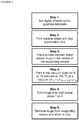
- Mugs were decorated using a modified vacuum sublimation method as summarised in the process flowchart of Figure 1 .
- mugs were pre-warmed to operating temperature (150°C) to reduce overall processing time in the press and the transfer sheet (film) pre-heated for 10 seconds before vacuum engaged to soften prior to forming.
- a mug was placed on its side in the recess of a supporting means (a false base) which reduced the extent the film needs to form around the body.
- the edge of the supporting means (a false base) was sealed using silicone sealer and a silicone rubber gasket to prevent the transfer sheet being pulled down around the edges and over-stressing the material.
- Apertures within the supporting means (false base) were provided for allowing formation and maintenance of the vacuum (e.g. in proximity to key process areas where the film may struggle to form - i.e., around handle and handle join, close to the mug apertures, etc.) and silicone gaskets were applied around said apertures.
- the underside of the mug was cushioned with silicone rubber padding (in the recess of the supporting means) to reduce stress through physical pressure on the mug body.
- the aperture of the recess of the supporting means was larger than the mug to prevent expansion during the heat cycle and crushing of the mug, and a silicone rubber gasket was used to create a seal around the enlarged aperture.
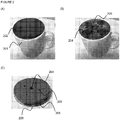
- a stopping means was inserted into the volume of the mug to prevent the transfer sheet from being pulled into the inside and over-stressing the material (see Figure 2 ). Holes were provided at 4 points of the compass and centre of the stopping means to allow the air pressure inside and outside of the mug to balance once the vacuum was fully created.
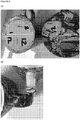
- Blue heat resistant tape (302) was used to mask a clean line down the middle of the mug (301) opposite the handle before running the first transfer cycle ( Figure 3 ).
- the tape creates a barrier preventing the mug being decorated where it has been applied.
- a transfer sheet with a printed decoration was placed over the mug and supporting means, and a second PET sheet (100 microns) applied over the transfer sheet and a vacuum of between -70000 Pa (-0.7 bar) to -80000 Pa (-0.8 bar) was applied. Transfer was carried out at a temperature of 150°C for 8 to 15 minutes in a V10 vacuum oven.
- the mug was removed, the heat resistant tape removed (the tape helps alignment between both print stages (i.e. to avoid unsightly areas of double print, or no print at all)), a second piece of tape positioned and repositioned against the very edge of the first printed side between transfer cycles to ensure a bleed of no more than 1mm, and the undecorated portion presented face up on the stopping means.
- a second transfer sheet with a printed decoration was placed over the mug and supporting means, and a second PET sheet applied over the transfer sheet and the transfer repeated.
- Transfer was carried out using the method described above using Caseblanks white film transfer sheets printed with Sublijet-HD Dye Sublimation inks (CMYK) on a Ricoh SG800 printer. Transfer time was 8-10 minutes.
- a mug printed using a method of the invention is shown in Figure 5 , and exhibits good overall coverage.
- Transfer time using said inks was tested at 12 to 14 minutes (12 showed satisfactory results) and such transfer times allowed a good level of ink transfer at the edges of the transfer sheet.
- SMI transfer sheets were printed with dye sublimation inks obtained from Sensient® Imaging Technologies printed using the Mimaki® JV33, and transfer occurred for 12 minutes.
- Automated (robotic) techniques were used to apply polymeric coating to a matt-finished Neogene Satin mug.
- a chain on edge line was used to present the mugs to the spray position, and to transit them thereafter into the ovens.
- a 6-axis robot was used to move a pair of guns through a pre-programmed series of motions enabling the polymeric coating to be applied evenly to all outer surfaces of the mug.
- the matt-finished (Neogene Satin) mugs were subjected to the decorating method described. Said mugs exhibited good transfer even on the base. Without wishing to be bound by theory, this was believed to be due to the production method yielding -100% polymeric coating of the mug.
- the DuraGlazeTM gloss coated mugs were prepared by HVLP spraying on a rotating pedestal, thus certain areas of the mug (e.g. the base and inner handle) were less likely to be exposed to the same amount of polymeric coating as other parts of the outer surface. Thus, whilst exhibiting reasonable decoration transfer said mugs showed comparatively poorer decoration around the handle likely owing to the poorer quality finishing of the polymeric coating of the mugs at this portion of the surface.
- Figure 6 shows improved transfer at: (A) the base (compare the matt-finished Neogene Satin mug (right) to the DuraGlazeTM gloss coated mug (left)); (B) the upper handle (compare the matt-finished Neogene Satin mug (lower, left) to the DuraGlazeTM gloss coated mug (upper, right)); (C) the lower handle (compare the matt-finished Neogene Satin mug (right) to the DuraGlazeTM gloss coated mug (left)); and (D) the inside of the handle (compare the matt-finished Neogene Satin mug (lower) to the DuraGlazeTM gloss coated mug (upper)).
Landscapes
- Engineering & Computer Science (AREA)
- Mechanical Engineering (AREA)
- General Engineering & Computer Science (AREA)
- Details Of Rigid Or Semi-Rigid Containers (AREA)
Claims (15)
- Verfahren zum Dekorieren eines Trink- oder Essgefäßes, wobei das Verfahren Folgendes umfasst:a) Bereitstellen:(i) eines Trink- oder Essgefäßes (201, 301), wobei das Gefäß Folgendes umfasst: eine Innenfläche, die ein Volumen zum Aufnehmen eines flüssigen oder festen Lebensmittels definiert, und eine Außenfläche, die eine Polymerbeschichtung umfasst; und(ii) eines Übertragungsblatts, wobei das Übertragungsblatt ein formbares Kunststoff-Übertragungsblatt ist und eine gedruckte Dekoration umfasst; und(iii) eines Stützmittels mit einer Aussparung zur Aufnahme des Gefäßes; undb) Anordnen des Gefäßes innerhalb der Aussparung des Stützmittels, wodurch ein unterer Abschnitt der Außenfläche des Gefäßes, der vor dem Kontakt mit dem Übertragungsblatt verschlossen ist, und ein oberer Abschnitt der Außenfläche des Gefäßes zum Kontaktieren des Übertragungsblatts definiert wird; undc) Inkontaktbringen des oberen Abschnitts der Außenfläche des Gefäßes und des Stützmittels mit dem Übertragungsblatt unter mindestens einem Teilvakuum, wobei die gedruckte Dekoration vom Übertragungsblatt auf den oberen Abschnitt der Außenfläche des Gefäßes übertragen wird, und wobei das Stützmittel die Dehnung des Übertragungsblatts vom oberen Abschnitt der Außenfläche des Gefäßes zum unteren Abschnitt der Außenfläche des Gefäßes verringert.
- Verwendung eines Stützmittels mit einer Aussparung zur Aufnahme eines Trink- oder Essgefäßes zum:(i) Reduzieren der Delaminierung eines Übertragungsblatts; und/oder(ii) Reduzieren des Berstens eines Übertragungsblatts; und/oder(iii) Reduzieren des Verlusts zumindest eines Teilvakuums; und/oder(iv) Verbessern der Übertragung einer gedruckten Dekoration von einem Übertragungsblatt auf das Gefäß während eines Kontaktierungsschritts;wobei das Gefäß (201, 301), das eine Innenfläche umfasst, die ein Volumen zum Aufnehmen einer Flüssigkeit oder eines festen Lebensmittels definiert, und eine Außenfläche umfasst, die eine Polymerbeschichtung umfasst, innerhalb der Aussparung des Stützmittels angeordnet ist, wodurch ein unterer Abschnitt der Außenfläche des Gefäßes definiert wird, der vor dem Kontakt mit einem Übertragungsblatt verschlossen ist, wobei das Übertragungsblatt ein formbares Kunststoff-Übertragungsblatt ist und eine gedruckte Dekoration und einen oberen Abschnitt der Außenfläche des Gefäßes zum Inkontaktbringen des Übertragungsblatts umfasst, und wobei der obere Abschnitt der Außenfläche des Gefäßes und das Stützmittel unter mindestens einem Teilvakuum mit dem Übertragungsblatt in Kontakt gebracht werden; wobei die gedruckte Dekoration vom Übertragungsblatt auf den oberen Abschnitt der Außenfläche des Gefäßes übertragen wird, und wobei das Stützmittel die Dehnung des Übertragungsblatts vom oberen Abschnitt der Außenfläche des Gefäßes zum unteren Abschnitt der Außenfläche des Gefäßes verringert.
- Vorrichtung zum Dekorieren eines Trink- oder Essgefäßes, wobei die genannte Vorrichtung Folgendes umfasst:a) ein Stützmittel mit einer Aussparung zur Aufnahme eines Trink- oder Essgefäßes; undb) ein Vakuummittel, wobei das Vakuummittel in der Lage ist, mindestens ein Teilvakuum zum Übertragen einer gedruckten Dekoration von einem Übertragungsblatt auf die Oberfläche eines Trink- oder Essgefäßes zu erzeugen; undc) ein Trink- oder Essgefäß (201, 301), das Folgendes umfasst: eine Innenfläche, die ein Volumen zum Aufnehmen eines flüssigen oder festen Lebensmittels definiert, und eine Außenfläche, die eine Polymerbeschichtung umfasst; wobei das Trink- oder Essgefäß innerhalb der Aussparung des Stützmittels angeordnet ist; undd) ein Übertragungsblatt, wobei das Übertragungsblatt ein formbares Kunststoff-Übertragungsblatt ist und eine gedruckte Dekoration umfasst, und wobei die Anordnung des Gefäßes innerhalb der Aussparung des Stützmittels einen unteren Abschnitt der Außenfläche des Gefäßes definiert, der vor dem Kontakt mit dem Übertragungsblatt verschlossen ist, und einen oberen Abschnitt der Außenfläche des Gefäßes zum Kontaktieren des Übertragungsblatts definiert, und wobei das genannte Übertragungsblatt den oberen Abschnitt der Außenfläche des Gefäßes berührt.
- Verfahren, Verwendung oder Vorrichtung nach einem der vorhergehenden Ansprüche, wobei das Übertragungsblatt ein Polyethylenterephalat- (PET) Übertragungsblatt ist.
- Verfahren, Verwendung oder Vorrichtung nach einem der vorhergehenden Ansprüche, wobei während des Kontaktierens ein Stoppmittel (202) angeordnet ist, um mindestens einen Abschnitt des Volumens zu verschließen, das durch die Innenfläche des Gefäßes (201, 301) definiert ist;
vorzugsweise, wobei das Stoppmittel eine oder mehrere Öffnungen (203, 204) umfasst. - Verfahren, Verwendung oder Vorrichtung nach einem der vorhergehenden Ansprüche, wobei das Stützmittel ein Dämpfungsmittel umfasst;
vorzugsweise wobei das Dämpfungsmittel eine Dichtung an der Grenzfläche zwischen einer Außen- und Innenfläche der Aussparung des Stützmittels bildet. - Verfahren, Verwendung oder Vorrichtung nach einem der vorhergehenden Ansprüche, wobei die Höhe des unteren Abschnitts, der durch den Kontakt mit dem Übertragungsblatt verschlossen ist, gleich oder kleiner als die Höhe des oberen Abschnitts ist.
- Verfahren oder Verwendung nach einem der Ansprüche 1 bis 2 oder 4 bis 7, wobei das Inkontaktbringen bei einer Temperatur zwischen etwa 120° C bis etwa 210° C erfolgt;
vorzugsweise wobei das Inkontaktbringen bei einer Temperatur zwischen etwa 120° C bis etwa 190° C erfolgt;
bevorzugter, wobei das Inkontaktbringen bei einer Temperatur zwischen etwa 130° C bis etwa 170° C erfolgt. - Verfahren, Verwendung oder Vorrichtung nach einem der vorhergehenden Ansprüche, wobei die Polymerbeschichtung des Trink- oder Essgefäßes (201, 301) ein Mattierungsmittel umfasst.
- Verfahren oder Verwendung nach einem der Ansprüche 1 bis 2 oder 4 bis 9, wobei das Übertragungsblatt nach dem Drucken der Dekoration auf das genannte Übertragungsblatt trocknet, bevor es in einem Verfahren oder unter Verwendung eines der vorhergehenden Ansprüche verwendet wird.
- Verfahren oder Verwendung nach einem der Ansprüche 1 bis 2 oder 4 bis 10, das ferner das Umordnen des Gefäßes (201, 301) innerhalb der Aussparung des Stützmittels umfasst, wodurch ein anderer unterer und oberer Abschnitt des Gefäßes definiert wird und Schritt c. unter Verwendung eines zweiten Übertragungsblatts mit einer gedruckten Dekoration wiederholt wird.
- Verfahren, Verwendung oder Vorrichtung nach einem der vorhergehenden Ansprüche, wobei vor dem Inkontaktbringen ein Barrieremittel (302) an dem Trink- oder Essgefäß (201, 301) angebracht wird, das einen Nichtdruckbereich definiert;
wobei das Barrieremittel (302) vorzugsweise ein Band ist. - Verfahren oder Verwendung nach Anspruch 12, wenn abhängig von Anspruch 11, wobei das Barrieremittel (302) vor dem Ausführen des zweiten Übertragungsschritts entfernt wird; und/oder
wobei ein zweites Barrieremittel (302) vor dem Ausführen des zweiten Übertragungsschritts angewendet wird. - Trink- oder Essgefäß, das durch das Verfahren nach einem der Ansprüche 1 oder 4 bis 13 erhältlich ist, wobei das Gefäß (201, 301) eine Innenfläche umfasst, die ein Volumen zum Aufnehmen einer Flüssigkeit oder eines festen Lebensmittels definiert, und eine Außenfläche umfasst, die eine Polymerbeschichtung umfasst, wobei mindestens 80% der gesamten Außenfläche des Gefäßes eine gedruckte Dekoration umfasst, und wobei die gedruckte Dekoration eine oder mehrere Sublimationstinten umfasst und eine diffuse Schicht innerhalb der Polymerbeschichtung bildet.
- Trink- oder Essgefäß nach Anspruch 14, wobei das Gefäß einen Fortsatz umfasst und das genannte Gefäß eine gedruckte Dekoration an einer Oberfläche des Fortsatzes aufweist, die vorzugsweise der Außenfläche des Gefäßes zugewandt ist, wobei der genannte Fortsatz ein Griff ist; und/oder
wobei die gedruckte Dekoration ein komplexes Muster oder Design ist; und/oder
wobei die gesamte Außenfläche des Gefäßes (201, 301) eine gedruckte Dekoration aufweist.
Priority Applications (1)
| Application Number | Priority Date | Filing Date | Title |
|---|---|---|---|
| PL18700390T PL3568302T3 (pl) | 2017-01-10 | 2018-01-10 | Próżniowe zdobienie naczynia do picia lub jedzenia |
Applications Claiming Priority (2)
| Application Number | Priority Date | Filing Date | Title |
|---|---|---|---|
| GBGB1700408.6A GB201700408D0 (en) | 2017-01-10 | 2017-01-10 | Vacuum decoration of a drinking or eating vessel |
| PCT/GB2018/050056 WO2018130823A1 (en) | 2017-01-10 | 2018-01-10 | Vacuum decoration of a drinking or eating vessel |
Publications (2)
| Publication Number | Publication Date |
|---|---|
| EP3568302A1 EP3568302A1 (de) | 2019-11-20 |
| EP3568302B1 true EP3568302B1 (de) | 2021-06-30 |
Family
ID=58463664
Family Applications (1)
| Application Number | Title | Priority Date | Filing Date |
|---|---|---|---|
| EP18700390.0A Active EP3568302B1 (de) | 2017-01-10 | 2018-01-10 | Vakuumdekoration eines trink- oder essgefässes |
Country Status (6)
| Country | Link |
|---|---|
| US (1) | US10973349B2 (de) |
| EP (1) | EP3568302B1 (de) |
| ES (1) | ES2884144T3 (de) |
| GB (1) | GB201700408D0 (de) |
| PL (1) | PL3568302T3 (de) |
| WO (1) | WO2018130823A1 (de) |
Families Citing this family (6)
| Publication number | Priority date | Publication date | Assignee | Title |
|---|---|---|---|---|
| EP3434150B1 (de) | 2014-12-22 | 2022-02-09 | AT Promotions Ltd | Trink- oder essgefäss |
| CN111703191B (zh) * | 2020-05-12 | 2022-05-31 | 临沂宸泽塑料制品有限公司 | 一种塑料桶用热转印抚平装置 |
| US11186108B1 (en) * | 2020-10-16 | 2021-11-30 | Photo U.S.A. Corporation | Sublimation printing on to dark surfaces |
| JP6969765B1 (ja) * | 2021-06-17 | 2021-11-24 | 美紀 北澤 | 食器セット、及び食器セットの使用方法 |
| JP2025025604A (ja) * | 2023-08-09 | 2025-02-21 | ブラザー工業株式会社 | 画像形成方法 |
| JP2025025605A (ja) * | 2023-08-09 | 2025-02-21 | ブラザー工業株式会社 | 画像形成方法 |
Family Cites Families (48)
| Publication number | Priority date | Publication date | Assignee | Title |
|---|---|---|---|---|
| US4740496A (en) | 1985-12-24 | 1988-04-26 | Eastman Kodak Company | Release agent for thermal dye transfer |
| US4966815A (en) | 1986-01-17 | 1990-10-30 | Foto-Wear, Inc. | Transfer sheet for applying a creative design to a fabric |
| US4943684A (en) * | 1988-03-21 | 1990-07-24 | First Eastern Equities, Inc. | Ceramic article, process for imprinting ceramic articles and apparatus |
| DE3824012A1 (de) | 1988-07-15 | 1990-01-18 | Nortech Chemie | Mit sublimierbaren dispersionsfarbstoffen bedruckten lackbeschichtung, beschichtungsmittel hierfuer und verfahren zur herstellung bedruckter gegenstaende |
| CA1335329C (en) | 1988-09-06 | 1995-04-25 | Donald C. Berghauser | Color sublimation dye transfer from color video prints to ceramic mugs and the like |
| EP0420986B1 (de) | 1989-02-27 | 1994-04-13 | Toyo Seikan Kaisha, Ltd. | Bedruckter metallbehälter und mehrfarbenbedruckung eines solchen |
| IT1235474B (it) | 1989-04-13 | 1992-08-19 | Zincor Italia S P A Varzi Pavi | Procedimento ed impianto per la verniciatura e decorazione in continuo di laminati metallici e laminato metallico cosi' ottenuto |
| US4993987A (en) | 1989-09-01 | 1991-02-19 | Hull Harold L | Doll with photo image face |
| US4989508A (en) * | 1989-11-20 | 1991-02-05 | Xpres Corporation | Device for facilitating sublistatic printing |
| US5286706A (en) | 1990-05-08 | 1994-02-15 | Ricoh Company, Ltd. | Sublimation-type thermal image transfer recording medium |
| US5246518A (en) | 1990-07-09 | 1993-09-21 | Nathan Hale | Permanent sublimation printing process |
| US5260256A (en) | 1990-07-27 | 1993-11-09 | Dai Nippon Printing Co., Ltd. | Receptor layer transfer sheet, thermal transfer sheet, thermal transfer method and apparatus therefor |
| DE4116994A1 (de) | 1991-05-24 | 1992-11-26 | Schoeller Felix Jun Papier | Mehrschichtiges bildempfangsmaterial fuer thermische farbstoffuebertragungsverfahren und verfahren zu seiner herstellung |
| DE69204966T2 (de) | 1991-11-19 | 1996-05-23 | Agfa Gevaert Nv | Druckverfahren durch thermische Farbstoffübertragung zur Herstellung einer Kopie von medischen Diagnosen. |
| JPH05278745A (ja) | 1992-04-02 | 1993-10-26 | Kuwabara Yasunaga | 衛生的特性に優れた飲料缶 |
| US5344808A (en) | 1992-09-09 | 1994-09-06 | Toppan Printing Co., Ltd. | Intermediate transfer medium and process for producing image-recorded article making use of the same |
| EP0879710B1 (de) | 1994-03-18 | 2001-06-20 | Dai Nippon Printing Co., Ltd. | Mehrfarbige farbstoffgebende Schicht für die thermische Übertragung |
| KR100378965B1 (ko) | 1994-07-26 | 2003-08-21 | 소니 가부시끼 가이샤 | 화상전사방법및이것에사용하는피전사체,잉크리본 |
| JP2902575B2 (ja) | 1995-06-02 | 1999-06-07 | 和光化学工業株式会社 | 抗菌性加工硝子容器 |
| JPH1067200A (ja) | 1996-06-19 | 1998-03-10 | Ricoh Co Ltd | 転写画像形成方法および転写画像形成体 |
| US5997678A (en) * | 1997-04-10 | 1999-12-07 | Eastman Kodak Company | Method and apparatus for transferring images onto a tubular structure |
| JP4249815B2 (ja) | 1997-08-27 | 2009-04-08 | 住友精化株式会社 | フロストコーティング用組成物およびフロスト調ガラス容器 |
| US5944931A (en) * | 1998-06-11 | 1999-08-31 | Atlas Crystal Works, Inc. | Method and apparatus for printing a sublimation transfer onto mugs with handles |
| WO2000053413A1 (en) | 1999-03-06 | 2000-09-14 | Icet, Inc. | Antimicrobial plastics |
| PL205186B1 (pl) | 2000-10-19 | 2010-03-31 | Inax Corp | Wyrób posiadający warstwę szkła oraz sposób wytwarzania wyrobu posiadającego warstwę szkła |
| KR20010078990A (ko) | 2001-05-30 | 2001-08-22 | 이광덕 | 도자기 항균제 제조 |
| JP2004123462A (ja) | 2002-10-03 | 2004-04-22 | Sawamoto Shoji:Kk | 抗火石を使用した釉薬及び抗火石を使用した素焼成形品 |
| US7037634B2 (en) | 2004-02-27 | 2006-05-02 | Eastman Kodak Company | Polymer foam surface smoothing materials and method |
| ES2416480T3 (es) | 2005-08-11 | 2013-08-01 | Valspar Sourcing, Inc. | Revestimientos sin glicidil-éter aromático y Bisfenol A |
| US20070048466A1 (en) | 2005-09-01 | 2007-03-01 | Huynh Dieu D | Thermal transfer image receiving sheet and method |
| US20070141125A1 (en) | 2005-12-16 | 2007-06-21 | Bourdelais Robert P | Thermal image with antimicrobial property |
| KR20080079832A (ko) | 2007-02-28 | 2008-09-02 | 이규주 | 요철의 가로주름이 구성된 기능성 종이컵 |
| CN101305884A (zh) | 2007-05-18 | 2008-11-19 | 元亨福泰(天津)医药保健品有限公司 | 高温无铅釉保健杯及其制作工艺 |
| GB0711052D0 (en) * | 2007-06-08 | 2007-07-18 | Ici Plc | Thermal transfer printing |
| GB0721127D0 (en) * | 2007-10-27 | 2007-12-05 | Ici Plc | Thermal transfer printing |
| GB0808604D0 (en) | 2008-05-13 | 2008-06-18 | Benson Box Company The Limted | Food packaging |
| CN201542291U (zh) | 2009-11-17 | 2010-08-11 | 昆明理工大学 | 一种具有夜视效果的陶瓷杯子 |
| CN201612433U (zh) | 2010-02-10 | 2010-10-27 | 南京金帝御坊科技实业有限公司 | 活瓷碧玺水能杯壶 |
| US20110250405A1 (en) | 2010-04-09 | 2011-10-13 | Hank Sawatsky | Decorative and protective system for wares |
| CN202009965U (zh) | 2010-10-15 | 2011-10-19 | 江门市蓬江区文森装饰材料有限公司 | 耐磨抗菌水杯 |
| GB201017645D0 (en) | 2010-10-19 | 2010-12-01 | At Promotions Ltd | A glazed drinking vessel |
| GB2484744B (en) | 2010-10-23 | 2016-04-20 | Randip Singh Bhogal | Skateboard laser tag |
| PL2841510T3 (pl) | 2012-04-24 | 2022-01-10 | At Promotions Ltd | Przeciwdrobnoustrojowe naczynie do picia lub jedzenia |
| US9353271B2 (en) | 2013-03-13 | 2016-05-31 | Ppg Industries Ohio, Inc. | Low gloss coatings |
| CN203168713U (zh) | 2013-03-28 | 2013-09-04 | 广州市昌成陶瓷有限公司 | 一种图中图变色容器 |
| GB2525624A (en) | 2014-04-29 | 2015-11-04 | At Promotions Ltd | Drinking or eating vessel |
| CN104191851B (zh) | 2014-08-14 | 2016-11-16 | 李雷 | 一种耐腐蚀耐磨防紫外线热转印涂层及其制备方法和应用 |
| EP3434150B1 (de) | 2014-12-22 | 2022-02-09 | AT Promotions Ltd | Trink- oder essgefäss |
-
2017
- 2017-01-10 GB GBGB1700408.6A patent/GB201700408D0/en not_active Ceased
-
2018
- 2018-01-10 PL PL18700390T patent/PL3568302T3/pl unknown
- 2018-01-10 ES ES18700390T patent/ES2884144T3/es active Active
- 2018-01-10 EP EP18700390.0A patent/EP3568302B1/de active Active
- 2018-01-10 US US16/477,161 patent/US10973349B2/en not_active Expired - Fee Related
- 2018-01-10 WO PCT/GB2018/050056 patent/WO2018130823A1/en not_active Ceased
Non-Patent Citations (1)
| Title |
|---|
| None * |
Also Published As
| Publication number | Publication date |
|---|---|
| EP3568302A1 (de) | 2019-11-20 |
| ES2884144T3 (es) | 2021-12-10 |
| US20190343309A1 (en) | 2019-11-14 |
| GB201700408D0 (en) | 2017-02-22 |
| WO2018130823A1 (en) | 2018-07-19 |
| US10973349B2 (en) | 2021-04-13 |
| PL3568302T3 (pl) | 2021-12-13 |
Similar Documents
| Publication | Publication Date | Title |
|---|---|---|
| EP3568302B1 (de) | Vakuumdekoration eines trink- oder essgefässes | |
| KR101521735B1 (ko) | 연속 색조를 가지는 적어도 2-컬러의 장식이 마련되는 열 안정성 코팅을 포함하는 물품 및 이런 물품의 제조 방법 | |
| CN101370670B (zh) | 热转移印刷 | |
| US10611525B2 (en) | Drinking or eating vessel | |
| RU2457115C2 (ru) | Печатание с термопереносом | |
| EP2841510B1 (de) | Antimikrobielles trink- oder essgefäss | |
| EP3193675B1 (de) | Trink- oder essgefäss | |
| JP6506006B2 (ja) | 非付着性包装容器および非付着性包装容器の製造方法 | |
| JP2017029033A (ja) | 食品表面の加飾方法、表面加飾食品及び加飾卵 |
Legal Events
| Date | Code | Title | Description |
|---|---|---|---|
| STAA | Information on the status of an ep patent application or granted ep patent |
Free format text: STATUS: UNKNOWN |
|
| STAA | Information on the status of an ep patent application or granted ep patent |
Free format text: STATUS: THE INTERNATIONAL PUBLICATION HAS BEEN MADE |
|
| PUAI | Public reference made under article 153(3) epc to a published international application that has entered the european phase |
Free format text: ORIGINAL CODE: 0009012 |
|
| STAA | Information on the status of an ep patent application or granted ep patent |
Free format text: STATUS: REQUEST FOR EXAMINATION WAS MADE |
|
| 17P | Request for examination filed |
Effective date: 20190709 |
|
| AK | Designated contracting states |
Kind code of ref document: A1 Designated state(s): AL AT BE BG CH CY CZ DE DK EE ES FI FR GB GR HR HU IE IS IT LI LT LU LV MC MK MT NL NO PL PT RO RS SE SI SK SM TR |
|
| AX | Request for extension of the european patent |
Extension state: BA ME |
|
| DAV | Request for validation of the european patent (deleted) | ||
| DAX | Request for extension of the european patent (deleted) | ||
| GRAP | Despatch of communication of intention to grant a patent |
Free format text: ORIGINAL CODE: EPIDOSNIGR1 |
|
| STAA | Information on the status of an ep patent application or granted ep patent |
Free format text: STATUS: GRANT OF PATENT IS INTENDED |
|
| RIC1 | Information provided on ipc code assigned before grant |
Ipc: B41M 5/035 20060101ALI20200902BHEP Ipc: B41F 16/00 20060101AFI20200902BHEP Ipc: A47G 19/00 20060101ALI20200902BHEP Ipc: B41F 17/28 20060101ALI20200902BHEP Ipc: A47G 19/22 20060101ALI20200902BHEP Ipc: B41F 17/00 20060101ALI20200902BHEP Ipc: B44C 1/17 20060101ALI20200902BHEP Ipc: A47G 19/02 20060101ALI20200902BHEP Ipc: B41F 17/18 20060101ALI20200902BHEP Ipc: B41F 17/20 20060101ALI20200902BHEP Ipc: B41M 5/025 20060101ALI20200902BHEP |
|
| INTG | Intention to grant announced |
Effective date: 20201001 |
|
| GRAJ | Information related to disapproval of communication of intention to grant by the applicant or resumption of examination proceedings by the epo deleted |
Free format text: ORIGINAL CODE: EPIDOSDIGR1 |
|
| STAA | Information on the status of an ep patent application or granted ep patent |
Free format text: STATUS: REQUEST FOR EXAMINATION WAS MADE |
|
| INTC | Intention to grant announced (deleted) | ||
| GRAP | Despatch of communication of intention to grant a patent |
Free format text: ORIGINAL CODE: EPIDOSNIGR1 |
|
| STAA | Information on the status of an ep patent application or granted ep patent |
Free format text: STATUS: GRANT OF PATENT IS INTENDED |
|
| INTG | Intention to grant announced |
Effective date: 20210408 |
|
| GRAS | Grant fee paid |
Free format text: ORIGINAL CODE: EPIDOSNIGR3 |
|
| GRAA | (expected) grant |
Free format text: ORIGINAL CODE: 0009210 |
|
| STAA | Information on the status of an ep patent application or granted ep patent |
Free format text: STATUS: THE PATENT HAS BEEN GRANTED |
|
| RAP3 | Party data changed (applicant data changed or rights of an application transferred) |
Owner name: AT PROMOTIONS LTD |
|
| AK | Designated contracting states |
Kind code of ref document: B1 Designated state(s): AL AT BE BG CH CY CZ DE DK EE ES FI FR GB GR HR HU IE IS IT LI LT LU LV MC MK MT NL NO PL PT RO RS SE SI SK SM TR |
|
| REG | Reference to a national code |
Ref country code: CH Ref legal event code: EP |
|
| REG | Reference to a national code |
Ref country code: AT Ref legal event code: REF Ref document number: 1405996 Country of ref document: AT Kind code of ref document: T Effective date: 20210715 |
|
| REG | Reference to a national code |
Ref country code: DE Ref legal event code: R096 Ref document number: 602018019315 Country of ref document: DE |
|
| REG | Reference to a national code |
Ref country code: IE Ref legal event code: FG4D |
|
| REG | Reference to a national code |
Ref country code: NL Ref legal event code: FP |
|
| REG | Reference to a national code |
Ref country code: LT Ref legal event code: MG9D |
|
| PG25 | Lapsed in a contracting state [announced via postgrant information from national office to epo] |
Ref country code: BG Free format text: LAPSE BECAUSE OF FAILURE TO SUBMIT A TRANSLATION OF THE DESCRIPTION OR TO PAY THE FEE WITHIN THE PRESCRIBED TIME-LIMIT Effective date: 20210930 Ref country code: HR Free format text: LAPSE BECAUSE OF FAILURE TO SUBMIT A TRANSLATION OF THE DESCRIPTION OR TO PAY THE FEE WITHIN THE PRESCRIBED TIME-LIMIT Effective date: 20210630 Ref country code: FI Free format text: LAPSE BECAUSE OF FAILURE TO SUBMIT A TRANSLATION OF THE DESCRIPTION OR TO PAY THE FEE WITHIN THE PRESCRIBED TIME-LIMIT Effective date: 20210630 |
|
| REG | Reference to a national code |
Ref country code: AT Ref legal event code: MK05 Ref document number: 1405996 Country of ref document: AT Kind code of ref document: T Effective date: 20210630 |
|
| PG25 | Lapsed in a contracting state [announced via postgrant information from national office to epo] |
Ref country code: GR Free format text: LAPSE BECAUSE OF FAILURE TO SUBMIT A TRANSLATION OF THE DESCRIPTION OR TO PAY THE FEE WITHIN THE PRESCRIBED TIME-LIMIT Effective date: 20211001 Ref country code: LV Free format text: LAPSE BECAUSE OF FAILURE TO SUBMIT A TRANSLATION OF THE DESCRIPTION OR TO PAY THE FEE WITHIN THE PRESCRIBED TIME-LIMIT Effective date: 20210630 Ref country code: NO Free format text: LAPSE BECAUSE OF FAILURE TO SUBMIT A TRANSLATION OF THE DESCRIPTION OR TO PAY THE FEE WITHIN THE PRESCRIBED TIME-LIMIT Effective date: 20210930 Ref country code: SE Free format text: LAPSE BECAUSE OF FAILURE TO SUBMIT A TRANSLATION OF THE DESCRIPTION OR TO PAY THE FEE WITHIN THE PRESCRIBED TIME-LIMIT Effective date: 20210630 Ref country code: RS Free format text: LAPSE BECAUSE OF FAILURE TO SUBMIT A TRANSLATION OF THE DESCRIPTION OR TO PAY THE FEE WITHIN THE PRESCRIBED TIME-LIMIT Effective date: 20210630 |
|
| REG | Reference to a national code |
Ref country code: ES Ref legal event code: FG2A Ref document number: 2884144 Country of ref document: ES Kind code of ref document: T3 Effective date: 20211210 |
|
| PG25 | Lapsed in a contracting state [announced via postgrant information from national office to epo] |
Ref country code: SM Free format text: LAPSE BECAUSE OF FAILURE TO SUBMIT A TRANSLATION OF THE DESCRIPTION OR TO PAY THE FEE WITHIN THE PRESCRIBED TIME-LIMIT Effective date: 20210630 Ref country code: SK Free format text: LAPSE BECAUSE OF FAILURE TO SUBMIT A TRANSLATION OF THE DESCRIPTION OR TO PAY THE FEE WITHIN THE PRESCRIBED TIME-LIMIT Effective date: 20210630 Ref country code: EE Free format text: LAPSE BECAUSE OF FAILURE TO SUBMIT A TRANSLATION OF THE DESCRIPTION OR TO PAY THE FEE WITHIN THE PRESCRIBED TIME-LIMIT Effective date: 20210630 Ref country code: PT Free format text: LAPSE BECAUSE OF FAILURE TO SUBMIT A TRANSLATION OF THE DESCRIPTION OR TO PAY THE FEE WITHIN THE PRESCRIBED TIME-LIMIT Effective date: 20211102 Ref country code: RO Free format text: LAPSE BECAUSE OF FAILURE TO SUBMIT A TRANSLATION OF THE DESCRIPTION OR TO PAY THE FEE WITHIN THE PRESCRIBED TIME-LIMIT Effective date: 20210630 Ref country code: AT Free format text: LAPSE BECAUSE OF FAILURE TO SUBMIT A TRANSLATION OF THE DESCRIPTION OR TO PAY THE FEE WITHIN THE PRESCRIBED TIME-LIMIT Effective date: 20210630 |
|
| REG | Reference to a national code |
Ref country code: DE Ref legal event code: R097 Ref document number: 602018019315 Country of ref document: DE |
|
| PG25 | Lapsed in a contracting state [announced via postgrant information from national office to epo] |
Ref country code: DK Free format text: LAPSE BECAUSE OF FAILURE TO SUBMIT A TRANSLATION OF THE DESCRIPTION OR TO PAY THE FEE WITHIN THE PRESCRIBED TIME-LIMIT Effective date: 20210630 |
|
| PLBE | No opposition filed within time limit |
Free format text: ORIGINAL CODE: 0009261 |
|
| STAA | Information on the status of an ep patent application or granted ep patent |
Free format text: STATUS: NO OPPOSITION FILED WITHIN TIME LIMIT |
|
| PG25 | Lapsed in a contracting state [announced via postgrant information from national office to epo] |
Ref country code: AL Free format text: LAPSE BECAUSE OF FAILURE TO SUBMIT A TRANSLATION OF THE DESCRIPTION OR TO PAY THE FEE WITHIN THE PRESCRIBED TIME-LIMIT Effective date: 20210630 |
|
| 26N | No opposition filed |
Effective date: 20220331 |
|
| PG25 | Lapsed in a contracting state [announced via postgrant information from national office to epo] |
Ref country code: MC Free format text: LAPSE BECAUSE OF FAILURE TO SUBMIT A TRANSLATION OF THE DESCRIPTION OR TO PAY THE FEE WITHIN THE PRESCRIBED TIME-LIMIT Effective date: 20210630 |
|
| REG | Reference to a national code |
Ref country code: BE Ref legal event code: MM Effective date: 20220131 |
|
| PG25 | Lapsed in a contracting state [announced via postgrant information from national office to epo] |
Ref country code: LU Free format text: LAPSE BECAUSE OF NON-PAYMENT OF DUE FEES Effective date: 20220110 |
|
| PG25 | Lapsed in a contracting state [announced via postgrant information from national office to epo] |
Ref country code: BE Free format text: LAPSE BECAUSE OF NON-PAYMENT OF DUE FEES Effective date: 20220131 |
|
| PG25 | Lapsed in a contracting state [announced via postgrant information from national office to epo] |
Ref country code: LT Free format text: LAPSE BECAUSE OF FAILURE TO SUBMIT A TRANSLATION OF THE DESCRIPTION OR TO PAY THE FEE WITHIN THE PRESCRIBED TIME-LIMIT Effective date: 20210630 |
|
| PGFP | Annual fee paid to national office [announced via postgrant information from national office to epo] |
Ref country code: IE Payment date: 20230124 Year of fee payment: 6 Ref country code: FR Payment date: 20230127 Year of fee payment: 6 Ref country code: ES Payment date: 20230201 Year of fee payment: 6 Ref country code: CZ Payment date: 20230102 Year of fee payment: 6 Ref country code: CH Payment date: 20230118 Year of fee payment: 6 |
|
| PGFP | Annual fee paid to national office [announced via postgrant information from national office to epo] |
Ref country code: IT Payment date: 20230124 Year of fee payment: 6 Ref country code: GB Payment date: 20230125 Year of fee payment: 6 Ref country code: DE Payment date: 20230116 Year of fee payment: 6 |
|
| PGFP | Annual fee paid to national office [announced via postgrant information from national office to epo] |
Ref country code: NL Payment date: 20230126 Year of fee payment: 6 |
|
| PG25 | Lapsed in a contracting state [announced via postgrant information from national office to epo] |
Ref country code: MK Free format text: LAPSE BECAUSE OF FAILURE TO SUBMIT A TRANSLATION OF THE DESCRIPTION OR TO PAY THE FEE WITHIN THE PRESCRIBED TIME-LIMIT Effective date: 20210630 Ref country code: CY Free format text: LAPSE BECAUSE OF FAILURE TO SUBMIT A TRANSLATION OF THE DESCRIPTION OR TO PAY THE FEE WITHIN THE PRESCRIBED TIME-LIMIT Effective date: 20210630 |
|
| PG25 | Lapsed in a contracting state [announced via postgrant information from national office to epo] |
Ref country code: HU Free format text: LAPSE BECAUSE OF FAILURE TO SUBMIT A TRANSLATION OF THE DESCRIPTION OR TO PAY THE FEE WITHIN THE PRESCRIBED TIME-LIMIT; INVALID AB INITIO Effective date: 20180110 |
|
| PGFP | Annual fee paid to national office [announced via postgrant information from national office to epo] |
Ref country code: PL Payment date: 20240304 Year of fee payment: 7 |
|
| PG25 | Lapsed in a contracting state [announced via postgrant information from national office to epo] |
Ref country code: TR Free format text: LAPSE BECAUSE OF FAILURE TO SUBMIT A TRANSLATION OF THE DESCRIPTION OR TO PAY THE FEE WITHIN THE PRESCRIBED TIME-LIMIT Effective date: 20210630 |
|
| REG | Reference to a national code |
Ref country code: DE Ref legal event code: R119 Ref document number: 602018019315 Country of ref document: DE |
|
| REG | Reference to a national code |
Ref country code: CH Ref legal event code: PL |
|
| REG | Reference to a national code |
Ref country code: NL Ref legal event code: MM Effective date: 20240201 |
|
| GBPC | Gb: european patent ceased through non-payment of renewal fee |
Effective date: 20240110 |
|
| PG25 | Lapsed in a contracting state [announced via postgrant information from national office to epo] |
Ref country code: MT Free format text: LAPSE BECAUSE OF FAILURE TO SUBMIT A TRANSLATION OF THE DESCRIPTION OR TO PAY THE FEE WITHIN THE PRESCRIBED TIME-LIMIT Effective date: 20210630 |
|
| PG25 | Lapsed in a contracting state [announced via postgrant information from national office to epo] |
Ref country code: DE Free format text: LAPSE BECAUSE OF NON-PAYMENT OF DUE FEES Effective date: 20240801 |
|
| PG25 | Lapsed in a contracting state [announced via postgrant information from national office to epo] |
Ref country code: GB Free format text: LAPSE BECAUSE OF NON-PAYMENT OF DUE FEES Effective date: 20240110 |
|
| PG25 | Lapsed in a contracting state [announced via postgrant information from national office to epo] |
Ref country code: FR Free format text: LAPSE BECAUSE OF NON-PAYMENT OF DUE FEES Effective date: 20240131 |
|
| PG25 | Lapsed in a contracting state [announced via postgrant information from national office to epo] |
Ref country code: NL Free format text: LAPSE BECAUSE OF NON-PAYMENT OF DUE FEES Effective date: 20240201 |
|
| PG25 | Lapsed in a contracting state [announced via postgrant information from national office to epo] |
Ref country code: CH Free format text: LAPSE BECAUSE OF NON-PAYMENT OF DUE FEES Effective date: 20240131 |
|
| PG25 | Lapsed in a contracting state [announced via postgrant information from national office to epo] |
Ref country code: CZ Free format text: LAPSE BECAUSE OF NON-PAYMENT OF DUE FEES Effective date: 20240110 |
|
| PG25 | Lapsed in a contracting state [announced via postgrant information from national office to epo] |
Ref country code: NL Free format text: LAPSE BECAUSE OF NON-PAYMENT OF DUE FEES Effective date: 20240201 Ref country code: GB Free format text: LAPSE BECAUSE OF NON-PAYMENT OF DUE FEES Effective date: 20240110 Ref country code: FR Free format text: LAPSE BECAUSE OF NON-PAYMENT OF DUE FEES Effective date: 20240131 Ref country code: DE Free format text: LAPSE BECAUSE OF NON-PAYMENT OF DUE FEES Effective date: 20240801 Ref country code: CZ Free format text: LAPSE BECAUSE OF NON-PAYMENT OF DUE FEES Effective date: 20240110 Ref country code: CH Free format text: LAPSE BECAUSE OF NON-PAYMENT OF DUE FEES Effective date: 20240131 |
|
| PG25 | Lapsed in a contracting state [announced via postgrant information from national office to epo] |
Ref country code: IE Free format text: LAPSE BECAUSE OF NON-PAYMENT OF DUE FEES Effective date: 20240110 |
|
| PG25 | Lapsed in a contracting state [announced via postgrant information from national office to epo] |
Ref country code: IE Free format text: LAPSE BECAUSE OF NON-PAYMENT OF DUE FEES Effective date: 20240110 |
|
| PG25 | Lapsed in a contracting state [announced via postgrant information from national office to epo] |
Ref country code: IT Free format text: LAPSE BECAUSE OF NON-PAYMENT OF DUE FEES Effective date: 20240110 |
|
| REG | Reference to a national code |
Ref country code: ES Ref legal event code: FD2A Effective date: 20250227 |
|
| PG25 | Lapsed in a contracting state [announced via postgrant information from national office to epo] |
Ref country code: ES Free format text: LAPSE BECAUSE OF NON-PAYMENT OF DUE FEES Effective date: 20240111 |