EP3556774A1 - Anti-cd40-antikörper und verwendungen davon - Google Patents
Anti-cd40-antikörper und verwendungen davon Download PDFInfo
- Publication number
- EP3556774A1 EP3556774A1 EP19156093.7A EP19156093A EP3556774A1 EP 3556774 A1 EP3556774 A1 EP 3556774A1 EP 19156093 A EP19156093 A EP 19156093A EP 3556774 A1 EP3556774 A1 EP 3556774A1
- Authority
- EP
- European Patent Office
- Prior art keywords
- antibody
- pharmaceutical composition
- syndrome
- human
- antibodies
- Prior art date
- Legal status (The legal status is an assumption and is not a legal conclusion. Google has not performed a legal analysis and makes no representation as to the accuracy of the status listed.)
- Granted
Links
Images





Classifications
-
- C—CHEMISTRY; METALLURGY
- C07—ORGANIC CHEMISTRY
- C07K—PEPTIDES
- C07K14/00—Peptides having more than 20 amino acids; Gastrins; Somatostatins; Melanotropins; Derivatives thereof
- C07K14/435—Peptides having more than 20 amino acids; Gastrins; Somatostatins; Melanotropins; Derivatives thereof from animals; from humans
- C07K14/705—Receptors; Cell surface antigens; Cell surface determinants
- C07K14/70578—NGF-receptor/TNF-receptor superfamily, e.g. CD27, CD30, CD40, CD95
-
- A—HUMAN NECESSITIES
- A61—MEDICAL OR VETERINARY SCIENCE; HYGIENE
- A61K—PREPARATIONS FOR MEDICAL, DENTAL OR TOILETRY PURPOSES
- A61K39/00—Medicinal preparations containing antigens or antibodies
- A61K39/395—Antibodies; Immunoglobulins; Immune serum, e.g. antilymphocytic serum
- A61K39/39533—Antibodies; Immunoglobulins; Immune serum, e.g. antilymphocytic serum against materials from animals
- A61K39/3955—Antibodies; Immunoglobulins; Immune serum, e.g. antilymphocytic serum against materials from animals against proteinaceous materials, e.g. enzymes, hormones, lymphokines
-
- A—HUMAN NECESSITIES
- A61—MEDICAL OR VETERINARY SCIENCE; HYGIENE
- A61K—PREPARATIONS FOR MEDICAL, DENTAL OR TOILETRY PURPOSES
- A61K31/00—Medicinal preparations containing organic active ingredients
- A61K31/33—Heterocyclic compounds
- A61K31/395—Heterocyclic compounds having nitrogen as a ring hetero atom, e.g. guanethidine or rifamycins
- A61K31/435—Heterocyclic compounds having nitrogen as a ring hetero atom, e.g. guanethidine or rifamycins having six-membered rings with one nitrogen as the only ring hetero atom
- A61K31/4353—Heterocyclic compounds having nitrogen as a ring hetero atom, e.g. guanethidine or rifamycins having six-membered rings with one nitrogen as the only ring hetero atom ortho- or peri-condensed with heterocyclic ring systems
- A61K31/436—Heterocyclic compounds having nitrogen as a ring hetero atom, e.g. guanethidine or rifamycins having six-membered rings with one nitrogen as the only ring hetero atom ortho- or peri-condensed with heterocyclic ring systems the heterocyclic ring system containing a six-membered ring having oxygen as a ring hetero atom, e.g. rapamycin
-
- A—HUMAN NECESSITIES
- A61—MEDICAL OR VETERINARY SCIENCE; HYGIENE
- A61K—PREPARATIONS FOR MEDICAL, DENTAL OR TOILETRY PURPOSES
- A61K38/00—Medicinal preparations containing peptides
- A61K38/04—Peptides having up to 20 amino acids in a fully defined sequence; Derivatives thereof
- A61K38/12—Cyclic peptides, e.g. bacitracins; Polymyxins; Gramicidins S, C; Tyrocidins A, B or C
- A61K38/13—Cyclosporins
-
- A—HUMAN NECESSITIES
- A61—MEDICAL OR VETERINARY SCIENCE; HYGIENE
- A61K—PREPARATIONS FOR MEDICAL, DENTAL OR TOILETRY PURPOSES
- A61K39/00—Medicinal preparations containing antigens or antibodies
- A61K39/395—Antibodies; Immunoglobulins; Immune serum, e.g. antilymphocytic serum
- A61K39/39533—Antibodies; Immunoglobulins; Immune serum, e.g. antilymphocytic serum against materials from animals
- A61K39/39541—Antibodies; Immunoglobulins; Immune serum, e.g. antilymphocytic serum against materials from animals against normal tissues, cells
-
- A—HUMAN NECESSITIES
- A61—MEDICAL OR VETERINARY SCIENCE; HYGIENE
- A61K—PREPARATIONS FOR MEDICAL, DENTAL OR TOILETRY PURPOSES
- A61K45/00—Medicinal preparations containing active ingredients not provided for in groups A61K31/00 - A61K41/00
- A61K45/06—Mixtures of active ingredients without chemical characterisation, e.g. antiphlogistics and cardiaca
-
- A—HUMAN NECESSITIES
- A61—MEDICAL OR VETERINARY SCIENCE; HYGIENE
- A61P—SPECIFIC THERAPEUTIC ACTIVITY OF CHEMICAL COMPOUNDS OR MEDICINAL PREPARATIONS
- A61P37/00—Drugs for immunological or allergic disorders
- A61P37/02—Immunomodulators
- A61P37/06—Immunosuppressants, e.g. drugs for graft rejection
-
- C—CHEMISTRY; METALLURGY
- C07—ORGANIC CHEMISTRY
- C07K—PEPTIDES
- C07K16/00—Immunoglobulins [IG], e.g. monoclonal or polyclonal antibodies
- C07K16/18—Immunoglobulins [IG], e.g. monoclonal or polyclonal antibodies against material from animals or humans
-
- C—CHEMISTRY; METALLURGY
- C07—ORGANIC CHEMISTRY
- C07K—PEPTIDES
- C07K16/00—Immunoglobulins [IG], e.g. monoclonal or polyclonal antibodies
- C07K16/18—Immunoglobulins [IG], e.g. monoclonal or polyclonal antibodies against material from animals or humans
- C07K16/28—Immunoglobulins [IG], e.g. monoclonal or polyclonal antibodies against material from animals or humans against receptors, cell surface antigens or cell surface determinants
- C07K16/2866—Immunoglobulins [IG], e.g. monoclonal or polyclonal antibodies against material from animals or humans against receptors, cell surface antigens or cell surface determinants against receptors for cytokines, lymphokines, interferons
-
- C—CHEMISTRY; METALLURGY
- C07—ORGANIC CHEMISTRY
- C07K—PEPTIDES
- C07K16/00—Immunoglobulins [IG], e.g. monoclonal or polyclonal antibodies
- C07K16/18—Immunoglobulins [IG], e.g. monoclonal or polyclonal antibodies against material from animals or humans
- C07K16/28—Immunoglobulins [IG], e.g. monoclonal or polyclonal antibodies against material from animals or humans against receptors, cell surface antigens or cell surface determinants
- C07K16/2875—Immunoglobulins [IG], e.g. monoclonal or polyclonal antibodies against material from animals or humans against receptors, cell surface antigens or cell surface determinants against the NGF/TNF superfamily, e.g. CD70, CD95L, CD153, CD154
-
- C—CHEMISTRY; METALLURGY
- C07—ORGANIC CHEMISTRY
- C07K—PEPTIDES
- C07K16/00—Immunoglobulins [IG], e.g. monoclonal or polyclonal antibodies
- C07K16/18—Immunoglobulins [IG], e.g. monoclonal or polyclonal antibodies against material from animals or humans
- C07K16/28—Immunoglobulins [IG], e.g. monoclonal or polyclonal antibodies against material from animals or humans against receptors, cell surface antigens or cell surface determinants
- C07K16/2878—Immunoglobulins [IG], e.g. monoclonal or polyclonal antibodies against material from animals or humans against receptors, cell surface antigens or cell surface determinants against the NGF-receptor/TNF-receptor superfamily, e.g. CD27, CD30, CD40, CD95
-
- A—HUMAN NECESSITIES
- A61—MEDICAL OR VETERINARY SCIENCE; HYGIENE
- A61K—PREPARATIONS FOR MEDICAL, DENTAL OR TOILETRY PURPOSES
- A61K39/00—Medicinal preparations containing antigens or antibodies
- A61K2039/505—Medicinal preparations containing antigens or antibodies comprising antibodies
-
- A—HUMAN NECESSITIES
- A61—MEDICAL OR VETERINARY SCIENCE; HYGIENE
- A61K—PREPARATIONS FOR MEDICAL, DENTAL OR TOILETRY PURPOSES
- A61K39/00—Medicinal preparations containing antigens or antibodies
- A61K2039/505—Medicinal preparations containing antigens or antibodies comprising antibodies
- A61K2039/507—Comprising a combination of two or more separate antibodies
-
- C—CHEMISTRY; METALLURGY
- C07—ORGANIC CHEMISTRY
- C07K—PEPTIDES
- C07K2317/00—Immunoglobulins specific features
- C07K2317/20—Immunoglobulins specific features characterized by taxonomic origin
- C07K2317/24—Immunoglobulins specific features characterized by taxonomic origin containing regions, domains or residues from different species, e.g. chimeric, humanized or veneered
-
- C—CHEMISTRY; METALLURGY
- C07—ORGANIC CHEMISTRY
- C07K—PEPTIDES
- C07K2317/00—Immunoglobulins specific features
- C07K2317/30—Immunoglobulins specific features characterized by aspects of specificity or valency
- C07K2317/33—Crossreactivity, e.g. for species or epitope, or lack of said crossreactivity
-
- C—CHEMISTRY; METALLURGY
- C07—ORGANIC CHEMISTRY
- C07K—PEPTIDES
- C07K2317/00—Immunoglobulins specific features
- C07K2317/70—Immunoglobulins specific features characterized by effect upon binding to a cell or to an antigen
- C07K2317/76—Antagonist effect on antigen, e.g. neutralization or inhibition of binding
-
- C—CHEMISTRY; METALLURGY
- C07—ORGANIC CHEMISTRY
- C07K—PEPTIDES
- C07K2319/00—Fusion polypeptide
- C07K2319/20—Fusion polypeptide containing a tag with affinity for a non-protein ligand
- C07K2319/23—Fusion polypeptide containing a tag with affinity for a non-protein ligand containing a GST-tag
-
- C—CHEMISTRY; METALLURGY
- C07—ORGANIC CHEMISTRY
- C07K—PEPTIDES
- C07K2319/00—Fusion polypeptide
- C07K2319/20—Fusion polypeptide containing a tag with affinity for a non-protein ligand
- C07K2319/24—Fusion polypeptide containing a tag with affinity for a non-protein ligand containing a MBP (maltose binding protein)-tag
-
- Y—GENERAL TAGGING OF NEW TECHNOLOGICAL DEVELOPMENTS; GENERAL TAGGING OF CROSS-SECTIONAL TECHNOLOGIES SPANNING OVER SEVERAL SECTIONS OF THE IPC; TECHNICAL SUBJECTS COVERED BY FORMER USPC CROSS-REFERENCE ART COLLECTIONS [XRACs] AND DIGESTS
- Y02—TECHNOLOGIES OR APPLICATIONS FOR MITIGATION OR ADAPTATION AGAINST CLIMATE CHANGE
- Y02A—TECHNOLOGIES FOR ADAPTATION TO CLIMATE CHANGE
- Y02A50/00—TECHNOLOGIES FOR ADAPTATION TO CLIMATE CHANGE in human health protection, e.g. against extreme weather
- Y02A50/30—Against vector-borne diseases, e.g. mosquito-borne, fly-borne, tick-borne or waterborne diseases whose impact is exacerbated by climate change
Definitions
- the invention relates to anti-CD40 antibodies and uses of such antibodies, for example, to reduce the likelihood of, or increase the duration prior to, transplant rejection, to induce immunosuppression, or to treat an autoimmune disorder.
- Organ transplantation for example, has emerged as a preferred method of treatment for many forms of life-threatening diseases that involve organ damage.
- Transplantation rejection occurs when an organism receiving transplanted cells or tissue mounts an undesired immune response to that tissue. Transplant rejection can be minimized by tissue-type matching, but even matched tissue is generally rejected by the donor. Thus, immunosuppressive therapies are required for virtually all cases of tissue transplantation.
- CD40/CD154 interaction One potential target for reducing transplantation rejection is the CD40/CD154 interaction.
- CD40 is expressed on the surface B lymphocytes and CD154 is expressed on surface of T cells. The interaction between these two proteins is associated with B cell activation, which triggers cytokine expression as well as expression of cell surface markers including CD23, CD80, and CD86. Blockade of this interaction using anti-CD154 antibodies has been shown to reduce or eliminate rejection of transplanted tissues in non-human primates.
- the invention features an isolated antibody, or antigen-binding fragment thereof (e.g., an antibody that lacks an Fc portion or is a F(ab') 2 , a Fab, an Fv, or an scFv structure), that specifically binds to an epitope present on CD40 (e.g., rhesus, murine, or human CD40), where the epitope is recognized by the 2C10 antibody (e.g., where said epitope is not recognized by the 3A8 or the Chi220 antibody, or both).
- CD40 e.g., rhesus, murine, or human CD40
- 2C10 antibody e.g., where said epitope is not recognized by the 3A8 or the Chi220 antibody, or both.
- the antibody may be capable of blocking B lymphocyte (e.g., rhesus or human B lymphocyte) activation by CD154-expressing Jurkat cells in vitro or may be capable of inhibiting rhesus B cells in vitro, e.g., reducing CD23, CD80, or CD86 expression.
- the antibody may be the 2C10 antibody.
- the antibody may have human constant regions.
- the antibody is a humanized antibody or a human antibody.
- the antibody may be monoclonal antibody or a polyclonal antibody.
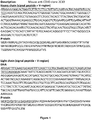
- the antibody includes the heavy chain variable region defined by amino acids 20-132 of SEQ ID NO:2, an antibody-binding portion or fragment thereof, or a humanized form thereof.
- the antibody light chain variable region of the antibody includes the sequence of 23-128 of SEQ ID NO:4, an antibody binding portion or fragment thereof, or a humanized form thereof.
- the heavy chain variable region of the antibody includes amino acids 20-132 of SEQ ID NO:2 and the light chain variable sequence of the antibody includes amino acids 23-128 of SEQ ID NO:4.
- the invention also features a polynucleotide encoding the antibody or antibody fragment of the first aspect, a vector including the polynucleotide, and a cell including the vector.
- the cell may be eukaryotic (e.g., mammalian such a human, mouse, monkey or rabbit cell) or may be prokaryotic (e.g., a bacterial cell such as an E. coli cell).
- the invention features a method of suppressing the immune system in a subject (e.g., a mammal such as human).
- the method includes administering to the subject an effective amount of an antibody, or antigen-binding fragment thereof, of the first aspect to the subject.
- the invention features a method of treating or treating prophylactically transplant rejection or increasing the duration of time before transplant rejection occurs in a subject (e.g., a mammal such as a human) in need thereof.
- the method includes administering an effective amount of an antibody, or antigen-binding fragment thereof, of the first aspect to the subject.
- the subject may have received, or may be in need of, an organ transplant (e.g., a heart, kidney, lung, liver, pancreas, intestine, and thymus, or a portion thereof) or a tissue transplant (e.g., bone, tendon, cornea, skin, heart valve, vein, or bone marrow).
- an organ transplant e.g., a heart, kidney, lung, liver, pancreas, intestine, and thymus, or a portion thereof
- a tissue transplant e.g., bone, tendon, cornea, skin, heart valve, vein, or bone marrow.
- administration may be commenced prior to the transplantation or the graft. Administration may continue for at least 1, 2, 3, 4, 5, 7 or 10 days; 2, 3, 4, 6, 8, 10, or 12 weeks; 3, 4, 5, 6, 8, 10, 12, 24, or 36 months following the transplantation or the graft.
- the invention features a method of treating or treating prophylactically graft-versus-host disease in a subject (e.g., a mammal such as a human) in need thereof.
- the method includes administering an effective amount of an antibody, or an antigen-binding fragment thereof, of the first aspect to the subject.
- the invention features a method of treating or treating prophylactically an autoimmune disorder in a subject (e.g., a mammal such as a human) in need thereof.
- the method includes administering an effective amount of an antibody, or an antigen-binding fragment thereof, of the first aspect to the subject.
- the autoimmune disorder is associated with or caused by the presence of an autoantibody (e.g., systemic lupus erythematosus (SLE), CREST syndrome (calcinosis, Raynaud's syndrome, esophageal dysmotility, sclerodactyl, and telangiectasia), opsoclonus, inflammatory myopathy (e.g., polymyositis, dermatomyositis, and inclusion-body myositis), systemic scleroderma, primary biliary cirrhosis, celiac disease (e.g., gluten sensitive enteropathy), dermatitis herpetiformis, Miller-Fisher Syndrome, acute motor axonal neuropathy (AMAN), multifocal motor neuropathy with conduction block, autoimmune hepatitis, antiphospholipid syndrome, Wegener's granulomatosis, microscopic polyangiitis, Churg-Strauss syndrome, rhe
- the disorder is selected from the group consisting of pernicious anemia, Addison's disease, psoriasis, inflammatory bowel disease, psoriatic arthritis, Sjögren's syndrome, lupus erythematosus (e.g., discoid lupus erythematosus, drug-induced lupus erythematosus, and neonatal lupus erythematosus), multiple sclerosis, and reactive arthritis.
- pernicious anemia Addison's disease, psoriasis, inflammatory bowel disease, psoriatic arthritis, Sjögren's syndrome, lupus erythematosus (e.g., discoid lupus erythematosus, drug-induced lupus erythematosus, and neonatal lupus erythematosus), multiple sclerosis, and reactive arthritis.
- the disorder is selected from the group consisting of polymyositis, dermatomyositis, multiple endocrine failure, Schmidt's syndrome, autoimmune uveitis, adrenalitis, thyroiditis, autoimmune thyroid disease, gastric atrophy, chronic hepatitis, lupoid hepatitis, atherosclerosis, presenile dementia, demyelinating diseases, subacute cutaneous lupus erythematosus, hypoparathyroidism, Dressler's syndrome, autoimmune thrombocytopenia, idiopathic thrombocytopenic purpura, hemolytic anemia, pemphigus vulgaris, pemphigus, alopecia arcata, pemphigoid, scleroderma, progressive systemic sclerosis, adult onset diabetes mellitus (e.g., type II diabetes), male and female autoimmune infertility, ankylosing spondolytis, ulcerative colitis, Crohn's syndrome,
- administration may be parenteral, intravenous, subcutaneous, oral, topical, intrathecal, local, or by any route described herein.
- the method may further include administration of second agent within six months (e.g., within 3, 2, or 1 months; within 4, 3, 2, or 1 weeks; within 6, 5, 4, 3, 2, or 1 days; or within 18, 12, 6, 3, 2, or 1 hours of antibody administration), where the second agent is an immunosuppressant.
- second agent is an immunosuppressant.
- the second agent may be selected from the group consisting of a calcineurin inhibitor (e.g., cyclosporin A or cyclosporine G), tacrolimus, an mTor inhibitor (e.g., sirolimus, temsirolimus, zotarolimus, or everolimus), fingolimod, myriocin, alemtuzumab, rituximab, an anti-CD4 monoclonal antibody, an anti-LFA1 monoclonal antibody, an anti-LFA3 monoclonal antibody, an anti-CD45 antibody (e.g., an anti-CD45RB antibody), an anti-CD 19 antibody, monabatacept, belatacept, indolyl-ASC; azathioprine, lymphocyte immune globulin and anti-thymocyte globulin [equine], mycophenolate mofetil, mycophenolate sodium, daclizumab, basiliximab, cyclopho
- the invention features a method of making an antibody.
- the method includes: (a) administering to a mammal (e.g., a mouse or a rabbit) a polypeptide that comprises a fragment (e.g., less than 50, 40, 30, 20, 10 amino acids in length, but more than 6, 8, or 10 amino acids in length) of the CD40 polypeptide that includes the epitope recognized by the 2C10 antibody, but not the full length CD40 molecule in a manner sufficient to generate an immune response to said fragment; (b) isolating spleen cells from the mammal; (c) forming a hybridoma between the spleen cells and myeloma cells; and (d) purifying the antibody produced by the hybridoma.
- the polypeptide may be a fusion protein (e.g., between the CD40 fragment and keyhole limpet hemocyanin or glutathione S-transferase).
- the invention also features an antibody produced by such a method.
- the invention features a fragment of CD40 fewer than 150 (e.g., fewer than 120, 100, 80, 70, 60, 50, 40, 30, 20, 15, 12, 11, 10, 9, 8, or 7) amino acids in length that is specifically bound by the 2C11 antibody.
- the fragment is 8-10, 8-12, 8-15, 8-20, 8-30, 8-40, 8-50, 8-60, 8-70, 8-80, or 8-100 amino acids in length.
- the fragment is 7-10, 7-12, 7-15, 7-20, 7-30, 7-40, 7-50, 7-60, 7-70, 7-80, or 7-100 in length.
- the CD40 fragment maybe from the extracellular domain of CD40 (e.g., SEQ ID NOS:5 and 6).
- the invention also features a fusion protein including a fragment described herein and a heterologous sequence.
- telomere binding protein a compound or antibody that recognizes and binds a particular epitope but does not substantially recognize and bind other molecules present in a sample (e.g., a biological sample which naturally includes other polypeptides, nucleic acids, and/or other biological molecules).
- a sample e.g., a biological sample which naturally includes other polypeptides, nucleic acids, and/or other biological molecules.
- an antibody that specifically binds the CD40 epitope recognized by the 2C10 antibody does not bind other epitopes present on CD40.
- antigen-binding fragment of an antibody is meant any fragment or portion of an antibody that has the ability to specifically bind the target antigen of the full length antibody.
- Humanized forms of non-human (e.g., murine) antibodies are chimeric antibodies that contain minimal sequence derived from non-human immunoglobulin.
- a humanized antibody is a human immunoglobulin (recipient antibody) in which residues from a hypervariable region (HVR) of the recipient are replaced by residues from a HVR of a non-human species (donor antibody) such as mouse, rat, rabbit, or nonhuman primate having the desired specificity, affinity, and/or capacity.
- donor antibody such as mouse, rat, rabbit, or nonhuman primate having the desired specificity, affinity, and/or capacity.
- framework (FR) residues i.e., residues in the variable regions other than the hypervariable regions
- humanized antibodies may comprise residues that are not found in the recipient antibody or in the donor antibody. These modifications may be made to further refine antibody performance.
- a humanized antibody can comprise substantially all of at least one, and typically two, variable domains, in which all or substantially all of the hypervariable loops correspond to those of a non-human immunoglobulin, and all or substantially all of the FRs are those of a human immunoglobulin sequence.
- the humanized antibody optionally will also comprise at least a portion of an immunoglobulin constant region (Fc), typically that of a human immunoglobulin.
- Fc immunoglobulin constant region
- a "human antibody” is one that possesses an amino acid sequence corresponding to that of an antibody produced by a human and/or has been made using any of the techniques for making human antibodies as disclosed herein. This definition of a human antibody specifically excludes a humanized antibody comprising non-human antigen-binding residues.
- Human antibodies can be produced using various techniques known in the art, including phage-display libraries ( Hoogenboom et al., J. Mol. Biol. 227:381-8, 1992 ; Marks et al., J. Mol. Biol, 222:581-97, 1991 ). Also available for the preparation of human monoclonal antibodies are methods described in Cole et al., Monoclonal Antibodies and Cancer Therapy, Alan R.
- Human antibodies can be prepared by administering the antigen to a transgenic animal that has been modified to produce such antibodies in response to antigenic challenge, but whose endogenous loci have been disabled, e.g., immunized xenomice (see, e.g., U.S. Patent Nos. 6,075,181 and 6,150,584 regarding XenoMouse® technology). See also, for example, Li et al., Proc. Natl. Acad. Sci. USA 103:3557-62, 2006 regarding human antibodies generated via a human B-cell hybridoma technology.
- treating a disease, disorder, or condition in a subject is meant reducing at least one symptom of the disease, disorder, or condition by administrating a therapeutic agent to the subject.
- treating prophylactically a disease, disorder, or condition in a subject is meant reducing the frequency of occurrence or severity of (e.g., preventing) a disease, disorder or condition by administering to the subject a therapeutic agent to the subject prior to the appearance of a disease symptom or symptoms.
- an effective amount means the dose needed to effectively treat the physiological effects of a medical condition (e.g., transplant rejection or graft-versus-host disease).
- immunosuppressant is meant a compound or composition that induces immunosuppression, i.e., it reduces (e.g., prevents) or interferes with the development of an immunologic response (e.g., cellular or humoral).
- subject is meant a human or non-human animal (e.g., a mammal).
- fusion protein is meant a polypeptide that contains (a) a protein or fragment thereof of interest; and (b) a heterologous fusion partner.
- the present invention relates to anti-CD40 antibodies and antibody fragments having the ability to bind a particular epitope on the CD40 molecule, as well as methods that involve the use of such antibodies.
- This epitopic specificity confers a particular activity profile, such that the antibodies generally block the ability of CD40 to interact with its binding partners (e.g., CD154) and do so without activating the cell expressing CD40.
- This activity profile is understood to make these antibodies particularly useful for reducing complications associated with organ or tissue transplantation.
- mice were immunized with a fusion protein consisting of the extracellular domain of rhesus macaque ( M. mulatta ) CD40 (amino acid sequence: EPPTACREKQYLINSQCCSLCQPGQKLVSDCTEFTETECLPCSESEFLDTWNRETRCHQHKYCDP NLGLRVQQKGTSETDTICTCEEGLHCMSESCESCV; SEQ ID NO:5) fused to maltose binding protein (CD40-MBP).
- CD40 amino acid sequence: EPPTACREKQYLINSQCCSLCQPGQKLVSDCTEFTETECLPCSESEFLDTWNRETRCHQHKYCDP NLGLRVQQKGTSETDTICTCEEGLHCMSESCESCV; SEQ ID NO:5
- the amino acid sequence in this region of the rhesus macaque CD40 protein differs from human CD40 protein at five amino acid positions (human amino acid sequence: EPPTACREKQYLINSQCCSLCQPGQKLVSDCTEFTETECLPCGESEFLDTWNRETHCHQHKYCDP NLGLRVQQKGTSETD TICTCEEGWHCTSEACESCV; SEQ ID NO:6).
- CD40-MBP was administered to mice multiple times with complete Freund's adjuvant and incomplete Freund's adjuvant. Splenocytes from immunized mice were fused with the mouse myeloma cell line SP2/0 and hybrids selected using standard hybridoma technology.
- Antibodies were selected for reactivity to a second fusion protein consisting of the same rhesus CD40 domain fused to glutamine synthetase (CD40-GST). Antibodies reactive to CD40-GST by ELISA were further tested for reactivity to native CD40 express on rhesus macaque blood B cells, human blood B cells and rhesus macaque B-lymphoblastoid cell lines by flow cytometry. As a final level of selection, antibodies were tested in an in vitro assay for their ability to inhibit human or rhesus macaque B cell activation after co-culture CD154-expressing Jurkat D1.1 cells. A stable subclone of anti-CD40 antibody 2C10 was obtained by limiting dilution. The antibody is a mouse IgG1-kappa.
- Variable regions of monoclonal antibodies can be cloned using any method known in the art. PCR-based methods for obtaining antibody variable region sequences for hybridoma cells are described, for example, in Larrick et al., Nat. Biotechnol. 7:934-8, 1989 and in Orlandi et al., Proc. Natl. Acad. Sci. USA 86:3833-7, 1989 . Using these techniques or similar techniques, the variable regions of monoclonal antibodies can be cloned and subject to further manipulation.
- variable sequences from the heavy and light chains of the 2C10 antibody were cloned and were sequenced.
- the DNA representing the immunoglobulin heavy and light chain variable regions from the 2C10 hybridoma were cloned using 5' RACE PCR employing the following DNA primers:
- the immunoglobulin variable region genes were cloned from the hybridomas secreting anti-CD40 antibody clone 2C10 and from anti-human CD40 clone 3A8 ( Kwekkeboom et al., Immunology 79:439-44, 1993 ) (obtained from the American Type Culture Collection, ATCC, Vienna, VA) using 5' rapid amplification of cDNA ends-polymerase chain reaction.
- the immunoglobulin heavy and light chain variable regions were subcloned into expression vectors containing rhesus IgG1 or rhesus IgG4 heavy chain and rhesus kappa light chain constant region sequences.
- Recombinant heavy and light chains were subcloned into expression vectors and packaged in retroviral vectors used to transduce Chinese hamster ovary cells using the GPExTM expression technology (Catalent Pharma Solutions, Middleton, WI).
- a pool of transduced cells was grown in serum-free medium and secreted antibody was purified by protein A affinity chromatography.
- the purified chimeric rhesus IgG1 (2C10R1, 3A8R1) and IgG4 (2C10R4) antibodies were diafiltered into phosphate buffer; endotoxin levels were confirmed to be less than 1 endotoxin unit/mg.
- 2C10 binds to CD40 and prevents binding of CD154
- CD154, rhesus and human B cells were incubated with escalating concentrations of 2C10 or an isotype control and then incubated with histidine-tagged soluble CD154 (R&D Systems, Minneapolis, MN) and analyzed for histidine expression.
- 2C10 blocked the binding of CD154 in a dose-dependent manner ( Figure 3 ), indicating that 2C10 can effectively block the interaction of T cell-bound CD154 with CD40 on B cells and antigen-presenting cells.
- 2C10 blocks B cell activation in rhesus monkey and human peripheral blood mononuclear cells
- the CD40 antibody 2C10 was characterized with respect to its ability to affect B cell activation both using rhesus monkey and human peripheral blood mononuclear cells (PBMCs).
- CD20 expression was chosen as being an indicator of B cells, and expression of CD23, CD80, and CD86 is associated with B cell activation.
- 2C10 was first assessed for its ability to bind to CD20.
- Rhesus or human PBMCs were incubated with fluorochrome-conjugated 2C10 and an anti-CD20 antibody.
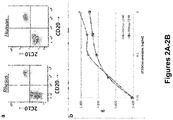
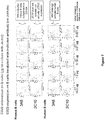
- Flow cytometric analysis was used to confirm the binding of 2C10 to human and rhesus CD20+ B cells ( Figure 2A ).
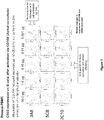
- PBMCs from either rhesus monkey or humans were cultured either in the presence or absence of CD154 + Jurkat D1.1 cells, an immortalized T lymophocyte cell line. Activation of B cells was determined by measuring expression of three markers (CD23, CD80, and CD86) in CD20 + cells present in the PBMCs. The general scheme of this assay is shown in Figure 4 . As shown in Figure 4 , culturing PBMCs in the presence of Jurkat cells resulted in increased expression of all three markers, indicating that B cells are activated by the CD154 + Jurkat cells.
- 3A8 antibody is a mouse anti-human CD40 antibody (ATCC Deposit No. HB-12024)
- 5C8 is an anti-CD154 antibody (ATCC Deposit No. CRL-10915).
- 3A8 antibody was a mouse anti-human CD40 antibody (ATCC Deposit No. HB-12024)
- 5C8 is an anti-CD154 antibody (ATCC Deposit No. CRL-10915).
- Co-cultures were conducted over a range of five orders of magnitude of antibody concentration (0.001 ⁇ g to 10 ⁇ g).
- 3A8 did not block B cell activation in rhesus PBMCs, as measured by CD23 expression, whereas both 2C10 and 5C8 were able to block activation with similar efficiency.
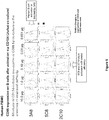
- the 2C10 and 3A8 antibodies were also tested for their ability to activate B cells in the absence of Jurkat cells using either rhesus monkey or human PBMCs.
- PBMCs were cultured either in the presence or absence of either 2C10 or 3A8.
- Expression of CD23, CD80, and CD86 was then measured in CD20 + cells.
- CD23 expression in rhesus cells was increased in the presence of the 3A8, but not the 2C10, antibody.
- neither 3A8 nor 2C10 activated human B cells.
- the differences in activity observed between the 3A8 and 2C10 antibody indicate that the 2C10 antibody binds to an epitope different from that of the 3A8 antibody.
- 2C10 binds to a unique epitope on CD40, inhibits B cell activation similarly to an anti-CD 154 antibody, and lacks agonistic properties
- Recombinant mouse-rhesus chimeric forms of 2C10 were generated using either rhesus IgG1 (2C10R1) or IgG4 (2C10R4) heavy chain and rhesus kappa light chain constant region sequences.
- a chimeric rhesus IgG1 form of 3A8 (3A8R1) was also generated for use as a control.
- Rhesus macaques were immunized once on day zero with 4-hydroxy-3-nitrophenylacetyl-conjugated keyhole limpet hemocyanin (KLH, 10 mg IM) antigen (Biosearch Technologies, Novato, CA). Prior to immunization and at one week, cohorts of three animals received an intravenous dose (50 mg/kg) of 2C10R1, 2C10R4, 3A8R1, or saline. All animals were observed for 70 days, and flow cytometry was performed weekly.
- KLH 4-hydroxy-3-nitrophenylacetyl-conjugated keyhole limpet hemocyanin
- T cell-dependent antibody responses to KLH-NP were tested by ELISA. Plates were coated with KLH (0.01 mg/ml, Sigma, St. Louis, MO) and blocked with Super Block (Thermo Scientific, Woodstock, GA). Pre- and post-treatment plasma samples were serially diluted, plated for 1 hr, and washed with phosphate-buffered saline/0.05% Tween. Anti-KLH antibodies were detected by incubating for 1 hr with monoclonal anti-rhesus IgG-horseradish peroxidase (clone 1B3, NHP Reagent Resource, Boston, MA). Plates were then incubated with Peroxidase Substrate Solution (KPL).
- KPL Peroxidase Substrate Solution
- IEQ islet equivalents
- Rhesus macaques weighing 3-5 kg were rendered diabetic using streptozotocin (1250 mg/m 2 IV; Zanosar, Teva Parenteral Medicines, Irvine, CA) four weeks prior to transplantation. Diabetes was confirmed by intravenous glucose tolerance test (IVGTT) with a 500 mg/kg bolus of dextrose and measurement of primate C-peptide. Glucose levels were monitored and C-peptide was measured at baseline and 10, 30, 60 and 90 after injection of dextrose. Diabetes was confirmed by measurement of elevated blood glucose levels in the absence of detectable serum C-peptide. Diabetic recipients underwent MHC-mismatched islet allotransplantation. A mean of 15,745 ( ⁇ 4,063) IEQ were infused via a small midline laparotomy and cannulation of a mesenteric vein.
- Blood glucose levels were measured twice daily by earstick; NPH (Novolin; Novo Nordisk, Princeton, NJ) and glargine (Lantus; Sanofi-Aventis, Bridgewater, NJ) insulin were administered to maintain fasting blood glucose (FBG) less than 300 mg/dL pre-transplant and following graft rejection.
- IVGTT was performed periodically post-transplant to monitor graft function.
- Transplant recipients underwent weekly flow cytometric analysis to monitor T cell (CD3 V450, CD4 PerCP-Cy5.5, CD8 PerCp; BD Bioscience) and B cell (CD20 PE, BD Bioscience) populations. After islet engraftment rejection was defined as FBG greater than 130 mg/dL on two consecutive days. Primary endpoint was rejection-free islet graft survival. All animals used in these experiments were treated in compliance with the Emory University IACUC and the Guide for the Care and Use of Laboratory Animals.
- Transplant recipients received either 2C10R4, basiliximab (Simulect, Novartis, Basel, Switzerland) and sirolimus, or basiliximab and sirolimus alone.
- 2C10R4 50 mg/kg was administered intravenously on post-operative day (POD) 0 and 7.
- Basiliximab 0.3 mg/kg was administered intravenously on POD 0 and 3.
- Sirolimus was administered intramuscularly daily to achieve trough levels of 5-15 ng/ml through POD 120. All three animals receiving basiliximab and sirolimus alone are historic controls ( Badell et al., J. Clin. Invest. 120:4520-312, 2010 ). Two of these historic controls (RQz6 and RIb7) underwent diabetes induction by pancreatectomy and received oral sirolimus.
- Blockade of the CD40/CD154 pathway may prove useful in conjunction with other costimulation blockade agents.
- Belatacept a high affinity version of CTLA4-Ig designed to block the CD28/B7 costimulatory pathways, has shown efficacy in nonhuman primate models of renal and islet transplantation and in phase II and III clinical trials in renal transplantation ( Larsen et al., Transplantation 90:1528-35, 2010 , Vincenti et al., Am. J. Transplant. 10:535-46, 2010 , Adams et al., J. Immunol. 174:542-50, 2005 , Adams et al., Diabetes 51:265-70, 2002 , Larsen et al., Am. J. Transplant.
- Standard techniques include peptide scanning, in which overlapping, short peptides (for example, 10-30 amino acids, e.g., 20, in length) derived from the full length protein to which the antibody binds are individually tested for their ability to bind the antibody. From such experiments, the region of the protein to which the antibody binds can then be determined.
- Site-directed mutagenesis can also be used to identify the antigenic region(s) of a particular protein.
- point mutations are systematically introduced into the target polypeptide and the ability of the antibody to bind the peptide with mutations at various positions is used to determine whether a particular region of that protein contains the epitope to which the antibody binds.
- Antibody epitopes can also be identified using high-through mutagenesis techniques, such as Shotgun Mutagenesis (Integral Molecular, Inc., Philadelphia, Pa.), which can be used to generate large numbers of mutations within the target protein. Such methodologies permit efficient identification of eptitopes within the protein.
- an in vitro competitive blockade assay was performed.
- 2C10 was conjugated to allophycocyanin (APC) using the Lightning Link antibody labeling kit (Novus Biologics, Littleton, CO).
- APC allophycocyanin
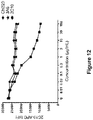
- Human PBMCs were incubated with escalating concentrations of 2C10, 3A8, or Chi220, and then stained with the APT-conjugated 2C10 to assess the ability of each antibody to cross-block 2C10.
- Binding of APC-conjugated 2C10 decreased with increasing concentrations of 2C10 but not Chi220 or 3A8 as shown in Figure 12 .
- the result indicates that 2C10 binds a unique epitope distinct from either Chi220 or 3A8.
- Additional antibodies against the CD40 epitope recognized by 2C10 can be made, e.g., using any of the numerous methods for making antibodies known in the art.
- a coding sequence for an eptiope recognized by the 2C10 antibody is expressed as a C-terminal fusion with glutathione S-transferase (GST) ( Smith et al., Gene 67:31-40, 1988 ).
- the fusion protein is purified on glutathione-Sepharose beads, eluted with glutathione, cleaved with thrombin (at an engineered cleavage site), and purified for immunization of rabbits. Primary immunizations are carried out with Freund's complete adjuvant and subsequent immunizations with Freund's incomplete adjuvant. Antibody titers are monitored by Western blot and immunoprecipitation analyses using the thrombin-cleaved protein fragment of the GST fusion protein. Immune sera are affinity purified using CNBr-Sepharose-coupled protein. Antiserum specificity can be determined using a panel of unrelated GST proteins.
- peptides corresponding to relatively unique immunogenic regions of a polypeptide of the invention can be generated and coupled to keyhole limpet hemocyanin (KLH) through an introduced C-terminal lysine.
- KLH keyhole limpet hemocyanin
- Antiserum to each of these peptides is similarly affinity purified on peptides conjugated to BSA, and specificity is tested by ELISA or Western blot analysis using peptide conjugates, or by Western blot or immunoprecipitation using the polypeptide expressed as a GST fusion protein.
- monoclonal antibodies that specifically bind the CD40 eptiope recognized the 2C10 antibody can be prepared using standard hybridoma technology (see, e.g., Kohler et al., Nature 256:495-7, 1975 ; Kohler et al., Eur. J. Immunol. 6:511-9, 1976 ; Kohler et al., Eur. J. Immunol. 6:292-5, 1976 ; Hammerling et al., Monoclonal Antibodies and T Cell Hybridomas, Elsevier, NY, 1981 ). Once produced, monoclonal antibodies can also be tested for specific recognition by Western blot or immunoprecipitation analysis. Alternatively, monoclonal antibodies can be prepared using the polypeptide of the invention described above and a phage display library ( Vaughan et al., Nat. Biotechnol. 14:309-14, 1996 ).
- Epitopic fragments can be generated by standard techniques, e.g., using PCR and cloning the fragment into a pGEX expression vector. Fusion proteins are expressed in E. coli and purified using a glutathione agarose affinity matrix. To minimize potential problems of low affinity or specificity of antisera, two or three such fusions are generated for each protein, and each fusion is injected into at least two rabbits. Antisera are raised by injections in a series, and can include, for example, at least three booster injections.
- Polyclonal antibodies can be isolated from the milk or colostrum of, e.g., immunized cows. Bovine colostrum contains 28 g of IgG per liter, while bovine milk contains 1.5 g of IgG per liter ( Ontsouka et al., J. Dairy Sci. 86:2005-11, 2003 ). Polyclonal antibodies can also be isolated from the yolk of eggs from immunized chickens ( Sarker et al., J. Pediatr. Gastroenterol. Nutr. 32:19-25, 2001 ).
- Adjuvants useful in this invention include, but are not limited to, Emulsigen®, an oil-in-water emulsified adjuvant, Emulsigen®-D, an oil-in-water emulsified adjuvant with DDA immunostimulant, Emulsigen®-P, an oil-in-water emulsified adjuvant with co-polymer immunostimulant, Emulsigen®-BCL, an oil-in-water emulsified adjuvant with block co-polymer immunostimulant, CarbigenTM, a carbomer base, and PolygenTM, a co-polymer base. All of the listed adjuvants are commercially available from MVP Laboratories in Omaha, Nebr.
- Useful antibodies can be identified in several different screening assays. First, antibodies are assayed by ELISA to determine whether they are specific for the immunizing antigen (i.e., the CD40 epitope described herein). Using standard techniques, ELISA plates are coated with immunogen, the antibody is added to the plate, washed, and the presence of bound antibody detected by using a second antibody specific for the Ig of the species in which the antibody was generated.
- the immunizing antigen i.e., the CD40 epitope described herein.
- ELISA plates are coated with immunogen, the antibody is added to the plate, washed, and the presence of bound antibody detected by using a second antibody specific for the Ig of the species in which the antibody was generated.
- a functional in vitro assay can be used to screen antibodies e.g., an neutralizing assay based on monocyte-derived dendritic cells.
- the invention encompasses humanized antibodies.
- a humanized antibody can have one or more amino acid residues introduced into it from a source which is non-human. These non-human amino acid residues are often referred to as "import" residues, which are typically taken from an "import” variable domain.
- Humanization can be essentially performed following the method of Winter and co-workers ( Jones et al., Nature 321:522-5, 1986 ; Riechmann et al., Nature 332:323-7, 1988 ; Verhoeyen et al., Science 239:1534-6, 1988 ), by substituting hypervariable region sequences for the corresponding sequences of a human antibody.
- humanized antibodies are chimeric antibodies ( U.S. Patent No. 4,816,567 ), where substantially less than an intact human variable domain has been substituted by the corresponding sequence from a non-human species.
- humanized antibodies are typically human antibodies in which at least some hypervariable region residues as well as other variable region residues are substituted by residues from analogous sites in rodent antibodies.
- variable domains both light and heavy
- the choice of human variable domains, both light and heavy, to be used in making the humanized antibodies can be important to reduce antigenicity.
- the sequence of the variable domain of a rodent antibody is screened against the entire library of known human variable-domain sequences.
- the human sequence which is closest to that of the rodent is then accepted as the human framework for the humanized antibody.
- Another method uses a particular framework derived from the consensus sequence of all human antibodies of a particular subgroup of light or heavy chains.
- the same framework may be used for several different humanized antibodies. See, e.g., Carter et al., Proc. Natl. Acad. Sci. USA 89:4285-9, 1992 ; Presta et al., J. Immunol. 151:2623-32, 1993 .
- humanized antibodies are prepared by a process of analysis of the parental sequences and various conceptual humanized products using three-dimensional models of the parental and humanized sequences.
- Three-dimensional immunoglobulin models are commonly available and are familiar to those skilled in the art.
- Computer programs are available which illustrate and display probable three-dimensional conformational structures of selected candidate immunoglobulin sequences. Inspection of these displays permits analysis of the likely role of the residues in the functioning of the candidate immunoglobulin sequence, i.e., the analysis of residues that influence the ability of the candidate immunoglobulin to bind its antigen.
- FR residues can be selected and combined from the recipient and import sequences so that the desired antibody characteristic, such as increased affinity for the target antigen(s), is achieved.
- the hypervariable region residues are directly and most substantially involved in influencing antigen binding.
- Human antibodies of the invention can be constructed by combining Fv clone variable domain sequence(s) selected from human-derived phage display libraries with known human constant domain sequences(s) ( Hoogenboom et al., J Mol. Biol. 227:381-8, 1992 ; Marks et al., J Mol. Biol. 222:581-97, 1991 ).
- human monoclonal antibodies of the invention can be made by the hybridoma method. Human myeloma and mouse-human heteromyeloma cell lines for the production of human monoclonal antibodies have been described, for example, by Kozbor, J. Immunol.
- transgenic animals e.g., mice
- transgenic animals e.g., mice
- JH antibody heavy-chain joining region
- Gene shuffling can also be used to derive human antibodies from non-human, e.g., rodent, antibodies, where the human antibody has similar affinities and specificities to the starting non-human antibody.
- this method which is also called "epitope imprinting" either the heavy or light chain variable-region of a non-human antibody fragment obtained by phage display techniques as described herein is replaced with a repertoire of human V domain genes, creating a population of non-human chain/human chain scFv or Fab chimeras.
- the invention also features antibody fragments that comprise a portion of an intact antibody, preferably comprising the antigen binding region thereof.
- antibody fragments include Fab, Fab', F(ab') 2 , and Fv fragments; diabodies; linear antibodies; single-chain antibody molecules; and multispecific antibodies formed from antibody fragments.
- Papain digestion of antibodies produces two identical antigen-binding fragments, called “Fab” fragments, each with a single antigen-binding site, and a residual "Fc” fragment, whose name reflects its ability to crystallize readily. Pepsin treatment yields an F(ab') 2 fragment that has two antigen-combining sites and is still capable of cross-linking antigen.
- Fv is the minimum antibody fragment which contains a complete antigen-binding site.
- a two-chain Fv species consists of a dimer of one heavy- and one light-chain variable domain in tight, non-covalent association.
- one heavy- and one light-chain variable domain can be covalently linked by a flexible peptide linker such that the light and heavy chains can associate in a "dimeric" structure analogous to that in a two-chain Fv species. It is in this configuration that the three hypervariable regions (HVRs) of each variable domain interact to define an antigen-binding site on the surface of the VH-VL dimer.
- HVRs hypervariable regions
- HVRs confer antigen-binding specificity to the antibody.
- a single variable domain or half of an Fv comprising only three HVRs specific for an antigen has the ability to recognize and bind antigen, although at a lower affinity than the entire binding site.
- the Fab fragment contains the heavy- and light-chain variable domains and also contains the constant domain of the light chain and the first constant domain (CH1) of the heavy chain.
- Fab' fragments differ from Fab fragments by the addition of a few residues at the carboxy terminus of the heavy chain CHI domain including one or more cysteines from the antibody hinge region.
- Fab'-SH is the designation herein for Fab' in which the cysteine residue(s) of the constant domains bear a free thiol group.
- F(ab') 2 antibody fragments originally were produced as pairs of Fab' fragments which have hinge cysteines between them. Other chemical couplings of antibody fragments are also known.
- Single-chain Fv or scFv antibody fragments comprise the V H and V L domains of antibody, where these domains are present in a single polypeptide chain.
- the scFv polypeptide further comprises a polypeptide linker between the V H and V L domains which enables the scFv to form the desired structure for antigen binding.
- Diabodies are antibody fragments with two antigen-binding sites, which fragments comprise a heavy-chain variable domain (V H ) connected to a light-chain variable domain (V L ) in the same polypeptide chain (V H -V L ). By using a linker that is too short to allow pairing between the two domains on the same chain, the domains are forced to pair with the complementary domains of another chain and create two antigen-binding sites.
- Diabodies may be bivalent or bispecific. Diabodies are described more fully in, for example, European Patent No. 404,097 ; PCT Publication WO 1993/01161 ; Hudson et al., Nat. Med. 9:129-34, 2003 ; and Hollinger et al., Proc. Natl. Acad. Sci. USA 90:6444-8, 1993 . Triabodies and tetrabodies are also described in Hudson et al., Nat. Med. 9:129-34, 2003 .
- Antibody fragments may be generated by traditional means, such as enzymatic digestion, or by recombinant techniques. In certain circumstances there are advantages of using antibody fragments, rather than whole antibodies. The smaller size of the fragments allows for rapid clearance, and may lead to improved access to solid tumors. For a review of certain antibody fragments, see Hudson et al. Nat. Med. 9:129-134,2003 .
- F(ab') 2 fragments are isolated directly from recombinant host cell culture.
- Fab and F(ab') 2 fragment with increased in vivo half-life comprising salvage receptor binding epitope residues are described in U.S. Patent No. 5,869,046 .
- Other techniques for the production of antibody fragments will be apparent to the skilled practitioner.
- compositions of the invention also can be administered in combination therapy, i.e., combined with other agents (e.g., immunosuppressants).
- pharmaceutically acceptable carrier includes any and all solvents, dispersion media, coatings, antibacterial and antifungal agents, isotonic and absorption delaying agents, and the like that are physiologically compatible.
- the carrier is suitable for intravenous, intrathecal, intramuscular, subcutaneous, parenteral, spinal or epidermal administration (e.g., by injection or infusion).
- the antibodies of the invention may be coated in a material to protect the compound from the action of acids and other natural conditions that may inactivate the compound.
- a composition of the present invention can be administered by a variety of methods known in the art. As will be appreciated by the skilled artisan, the route and/or mode of administration will vary depending upon the desired results. Administration may be parenteral, intravenous, intrathecal, subcutaneous, oral, topical, or local, for example, by direct injection into the cerebrospinal fluid. Intravenous delivery by continuous infusion is one exemplary method for administering the therapeutic antibodies of the present invention.
- the therapeutic compound may be in the form of a solution, a suspension, an emulsion, an infusion device, or a delivery device for implantation, or it may be presented as a dry powder to be reconstituted with water or another suitable vehicle before use.
- the composition can be in the form of a pill, tablet, capsule, liquid, or sustained release tablet for oral administration; or a liquid for intravenous, intrathecal, subcutaneous or parenteral administration; or a polymer or other sustained release vehicle for local administration.
- Formulations for parenteral administration may, for example, contain excipients, sterile water, saline, polyalkylene glycols such as polyethylene glycol, oils of vegetable origin, or hydrogenated napthalenes.
- excipients sterile water, saline, polyalkylene glycols such as polyethylene glycol, oils of vegetable origin, or hydrogenated napthalenes.
- Biocompatible, biodegradable lactide polymer, lactide/glycolide copolymer, or polyoxyethylene-polyoxypropylene copolymers may be used to control the release of the compounds.
- Nanoparticulate formulations may be used to control the biodistribution of the compounds.
- Other potentially useful delivery systems include ethylene-vinyl acetate copolymer particles, osmotic pumps, intrathecal pumps, implantable infusion systems, and liposomes.
- concentration of the compound in the formulation varies depending upon a number of factors, including the dosage of the drug to be administered, and the route of administration.
- the compound may be administered to a subject in an appropriate carrier, for example, liposomes, or a diluent.
- suitable diluents include saline and aqueous buffer solutions.
- Liposomes include water-in-oil-in-water CGF emulsions as well as conventional liposomes ( Strejan et al., J. Neuroimmunol. 7:27-41, 1984 ).
- Pharmaceutically acceptable carriers include sterile aqueous solutions or dispersions and sterile powders for the extemporaneous preparation of sterile injectable solutions or dispersion.
- sterile aqueous solutions or dispersions and sterile powders for the extemporaneous preparation of sterile injectable solutions or dispersion.
- the use of such media and agents for pharmaceutically active substances is known in the art and is included in the invention except where any conventional media or agent is incompatible with the active compound.
- Supplementary active compounds can also be incorporated into the compositions.
- compositions typically must be sterile and stable under the conditions of manufacture and storage.
- the composition can be formulated as a solution, microemulsion, liposome, or other ordered structure suitable to high drug concentration.
- the carrier can be a solvent or dispersion medium containing, for example, water, ethanol, polyol (for example, glycerol, propylene glycol, and liquid polyethylene glycol, and the like), and suitable mixtures thereof.
- the proper fluidity can be maintained, for example, by the use of a coating such as lecithin, by the maintenance of the required particle size in the case of dispersion and by the use of surfactants.
- isotonic agents for example, sugars, polyalcohols such as mannitol, sorbitol, or sodium chloride in the composition.
- Prolonged absorption of the injectable compositions can be brought about by including in the composition an agent that delays absorption, for example, monostearate salts and gelatin.
- Sterile injectable solutions can be prepared by incorporating the active compound in the required amount in an appropriate solvent with one or a combination of ingredients enumerated above, as required, followed by sterilization microfiltration.
- dispersions are prepared by incorporating the active compound into a sterile vehicle that contains a basic dispersion medium and the required other ingredients from those enumerated above.
- the preferred methods of preparation are vacuum drying and freeze-drying (lyophilization) that yield a powder of the active ingredient plus any additional desired ingredient from a previously sterile-filtered solution thereof. Dosage regimens are adjusted to provide the optimum desired response (e.g., a therapeutic response).
- a single bolus may be administered, several divided doses may be administered over time or the dose may be proportionally reduced or increased as indicated by the exigencies of the therapeutic situation.
- the antibodies of the invention may be administered once or twice weekly by subcutaneous injection or once or twice monthly by subcutaneous injection.
- Dosage unit form refers to physically discrete units suited as unitary dosages for the subjects to be treated; each unit contains a predetermined quantity of active compound calculated to produce the desired therapeutic effect in association with the required pharmaceutical carrier.
- the specification for the dosage unit forms of the invention are dictated by and directly dependent on (a) the unique characteristics of the active compound and the particular therapeutic effect to be achieved, and (b) the limitations inherent in the art of compounding such an active compound for the treatment of sensitivity in individuals.
- parenteral administration and “administered parenterally” as used herein mean modes of administration other than enteral and topical administration, usually by injection, and include, without limitation, intravenous, intramuscular, intraarterial, intrathecal, intracapsular, intraorbital, intracardiac, intradermal, intraperitoneal, transtracheal, subcutaneous, subcuticular, intraarticular, subcapsular, subarachnoid, intraspinal, epidural and intrastemal injection and infusion.
- aqueous and nonaqueous carriers examples include water, ethanol, polyols (such as glycerol, propylene glycol, polyethylene glycol, and the like), and suitable mixtures thereof, vegetable oils, such as olive oil, and injectable organic esters, such as ethyl oleate.
- polyols such as glycerol, propylene glycol, polyethylene glycol, and the like
- vegetable oils such as olive oil
- injectable organic esters such as ethyl oleate.
- Proper fluidity can be maintained, for example, by the use of coating materials, such as lecithin, by the maintenance of the required particle size in the case of dispersions, and by the use of surfactants.
- compositions of the invention may also contain adjuvants such as preservatives, wetting agents, emulsifying agents and dispersing agents. Prevention of presence of microorganisms may be ensured both by sterilization procedures, and by the inclusion of various antibacterial and antifungal agents, for example, paraben, chlorobutanol, phenol sorbic acid, and the like. It may also be desirable to include isotonic agents, such as sugars, sodium chloride, and the like into the compositions. In addition, prolonged absorption of the injectable pharmaceutical form may be brought about by the inclusion of agents which delay absorption such as aluminum monostearate and gelatin.
- the compounds of the present invention are administered as pharmaceuticals, to humans and animals, they can be given alone or as a pharmaceutical composition containing, for example, 0.001 to 90% (more preferably, 0.005 to 70%, such as 0.01 to 30%) of active ingredient in combination with a pharmaceutically acceptable carrier.
- the composition For intravenous or intrathecal delivery or direct injection, the composition must be sterile and fluid to the extent that the composition is deliverable by syringe.
- the carrier can be an isotonic buffered saline solution, ethanol, polyol (for example, glycerol, propylene glycol, and liquid polyetheylene glycol, and the like), and suitable mixtures thereof.
- Proper fluidity can be maintained, for example, by use of coating such as lecithin, by maintenance of required particle size in the case of dispersion and by use of surfactants.
- isotonic agents for example, sugars, polyalcohols such as mannitol or sorbitol, and sodium chloride in the composition.
- Long-term absorption of the injectable compositions can be brought about by including in the composition an agent which delays absorption, for example, aluminum monostearate or gelatin.
- the compounds of the present invention which may be used in a suitable hydrated form, and/or the pharmaceutical compositions of the present invention, are formulated into pharmaceutically acceptable dosage forms by conventional methods known to those of skill in the art.
- Actual dosage levels of the active ingredients in the pharmaceutical compositions of the present invention may be varied so as to obtain an amount of the active ingredient which is effective to achieve the desired therapeutic response for a particular patient, composition, and mode of administration, without being toxic to the patient.
- the selected dosage level will depend upon a variety of pharmacokinetic factors including the activity of the particular compositions of the present invention employed, or the ester, salt or amide thereof, the route of administration, the time of administration, the rate of excretion of the particular compound being employed, the duration of the treatment, other drugs, compounds and/or materials used in combination with the particular compositions employed, the age, sex, weight, condition, general health and prior medical history of the patient being treated, and like factors well known in the medical arts.
- a physician or veterinarian having ordinary skill in the art can readily determine and prescribe the effective amount of the pharmaceutical composition required.
- a suitable daily dose of a composition of the invention will be that amount of the compound which is the lowest dose effective to produce a therapeutic effect. Such an effective dose will generally depend upon the factors described above.
- the effective daily dose of a therapeutic composition may be administered as two, three, four, five, six or more sub-doses administered separately at appropriate intervals throughout the day, optionally, in unit dosage forms. While it is possible for a compound of the present invention to be administered alone, it is preferable to administer the compound as a pharmaceutical formulation (composition).
- compositions can be administered with medical devices known in the art. Examples of well-known implants, delivery systems, and modules useful in the present invention are known to those skilled in the art.
- the antibodies and antibody fragments described herein may be used in any situation in which immunosuppression is desired (e.g., transplant rejection or autoimmune disorders). These antibodies are particularly useful for treating transplant rejection, e.g., reducing the likelihood that a particular transplant is rejected by the host or increasing the time before rejection takes place.
- the antibodies described herein can be used in conjunction with transplantation of any organ or any tissue that is suitable for transplantation. Exemplary organs include heart, kidney, lung, liver, pancreas, intestine, and thymus; exemplary tissues include bone, tendon, cornea, skin, heart valve, vein, and bone marrow.
- the antibodies and antibody fragments can also be used to treat autoimmune disorders, particular disorders where autoantibodies are implicated in the pathogenesis of the disease.
- Autoimmune diseases that are or can be associated with autoantibody production include systemic lupus erythematosus (SLE), CREST syndrome (calcinosis, Raynaud's syndrome, esophageal dysmotility, sclerodactyl, and telangiectasia), opsoclonus, inflammatory myopathy (e.g., polymyositis, dermatomyositis, and inclusion-body myositis), systemic scleroderma, primary biliary cirrhosis, celiac disease (e.g., gluten sensitive enteropathy), dermatitis herpetiformis, Miller-Fisher Syndrome, acute motor axonal neuropathy (AMAN), multifocal motor neuropathy with conduction block, autoimmune hepatitis, antiphospholipid syndrome, Wegener's
- autoimmune disorders include pernicious anemia, Addison's disease, psoriasis, inflammatory bowel disease, psoriatic arthritis, Sjögren's syndrome, lupus erythematosus (e.g., discoid lupus erythematosus, drug-induced lupus erythematosus, and neonatal lupus erythematosus), multiple sclerosis, and reactive arthritis.
- pernicious anemia Addison's disease, psoriasis, inflammatory bowel disease, psoriatic arthritis, Sjögren's syndrome, lupus erythematosus (e.g., discoid lupus erythematosus, drug-induced lupus erythematosus, and neonatal lupus erythematosus), multiple sclerosis, and reactive arthritis.
- Additional disorders that may be treated using the methods of the present invention include, for example, polymyositis, dermatomyositis, multiple endocrine failure, Schmidt's syndrome, autoimmune uveitis, adrenalitis, thyroiditis, autoimmune thyroid disease, gastric atrophy, chronic hepatitis, lupoid hepatitis, atherosclerosis, presenile dementia, demyelinating diseases, subacute cutaneous lupus erythematosus, hypoparathyroidism, Dressler's syndrome, autoimmune thrombocytopenia, idiopathic thrombocytopenic purpura, hemolytic anemia, pemphigus vulgaris, pemphigus, alopecia arcata, pemphigoid, scleroderma, progressive systemic sclerosis, adult onset diabetes mellitus (e.g., type II diabetes), male and female autoimmune infertility, ankylosing spondolytis, ulcerative colitis
- immunosuppressants include, but are not limited to, calcineurin inhibitors (e.g., cyclosporin A (Sandimmune®), cyclosporine G tacrolimus (Prograf®, Protopic®)), mTor inhibitors (e.g., sirolimus (Rapamune®, Neoral®), temsirolimus (Torisel®), zotarolimus, and everolimus (Certican®)), fingolimod (GilenyaTM), myriocin, alemtuzumab (Campath®, MabCampath®, Campath-1H®), rituximab (Rituxan®, MabThera®), an anti-CD4 monoclonal antibody (e.g., HuMax-CD4), an anti-LFA1 monoclonal antibody (e.g., CD11a
- calcineurin inhibitors e.g., cyclosporin A (Sandimm
- Patent Publication 2006/0280738 monabatacept (Orencia®), belatacept, indolyl-ASC (32-indole ether derivatives of tacrolimus and ascomycin), azathioprine (Azasan®, lymphocyte immune globulin and anti-thymocyte globulin [equine] (Atgam®), mycophenolate mofetil (Cellcept®), mycophenolate sodium (myfortic®), daclizumab (Zenapax®), basiliximab (Simulect®), cyclophosphamide (Endoxan®, Cytoxan®, NeosarTM, ProcytoxTM, RevimmuneTM), prednisone, prednisolone, leflunomide (Arava®), FK778, FK779, 15-deoxyspergualin (DSG), busulfan (Myleran®, Busulfex®), fludarabine (Fludara®), met
- the length of the survival time of the transplanted organ in vivo with and without pharmacological intervention serves as a quantitative measure for the suppression of the immune response.
- In vitro assays may also be used, for example, a mixed lymphocyte reaction (MLR) assay (see, e.g., Fathman et al., J. Immunol. 118:1232-8, 1977 ); a CD3 assay (specific activation of immune cells via an anti-CD3 antibody (e.g., OKT3)) (see, e.g., Khanna et al., Transplantation 67:882-9, 1999 ; Khanna et al.
- MLR mixed lymphocyte reaction
- Cyclosporine A (CsA; CAS No. 59865-13-3 ; U.S. Patent No. 3,737,433 ) and its analogs may be used as an immunosuppressant.
- CsA Cyclosporine A
- CAS No. 59865-13-3 CAS No. 59865-13-3
- U.S. Patent No. 3,737,433 Cyclosporines and their formulations are described, for example, in 2004 Physicians' Desk Reference® (2003) Thomson Healthcare, 58th ed., and U.S. Patent Nos.
- Tacrolimus (FK506) is a macrolide which exerts effects largely similar to CsA, both with regard to its molecular mode of action and its clinical efficacy ( Liu, Immunol. Today 14:290-5, 1993 ; Schreiber et al., Immunol. Today, 13:136-42, 1992 ); however, these effects are exhibited at doses that are 20 to 100 times lower than CsA ( Peters et al., Drugs 46:746-94, 1993 ).
- Tacrolimus and its formulations are described, for example, in 2004 Physicians' Desk Reference® (2003) Thomson Healthcare, 58th ed., and U.S. Patent Nos. 4,894,366 ; 4,929,611 ; and 5,164,495 .
- Sirolimus is an immunosuppressive lactam macrolide produceable, for example, by Streptomyces hygroscopicus. Numerous derivatives of sirolimus and its analogs and their formulations are known and described, for example, in 2004 Physicians' Desk Reference® (2003) Thomson Healthcare, 58th ed., European Patent EP 0467606 ; PCT Publication Nos. WO 94/02136 , WO 94/09010 , WO 92/05179 , WO 93/11130 , WO 94/02385 , WO 95/14023 , and WO 94/02136 , and U.S. Patent Nos.
- the invention also features fragments of CD40 that include the epitope that is specifically bound by the 2C10 antibody.
- the 2C10 antibody was raised against the extracellular portion of the CD40 polypeptide; it is thus believed that this antibody reacts with a portion of this sequence (SEQ ID NOS:5 and 6).
- the invention therefore features CD40 fragments (e.g., fewer than 150, 120, 100, 80, 70, 60, 50, 40, 30, 20, 18, 15, 12, 11, 10, 9, 8, or 7) amino acids in length that are specifically bound by the 2C10 antibody.
- the fragment is 8-10, 8-12, 8-15, 8-20, 8-30, 8-40, 8-50, 8-60, 8-70, 8-80, or 8-100 amino acids in length.
- the fragment is 7-10, 7-12, 7-15, 7-20, 7-30, 7-40, 7-50, 7-60, 7-70, 7-80, or 7-100 in length.
- the invention also features fusion protein that includes a fragment described herein and a heterologous sequence.
- one of the fusion partners is the Fc protein (e.g., mouse Fc or human Fc).
- the fusion may also be a sequence useful for antibody production, e.g., a maltose binding protein or GST.
- the fusion protein is a purification or detection tag, for example, proteins that may be detected directly or indirectly such as green fluorescent protein, hemagglutinin, or alkaline phosphatase), DNA binding domains (for example, GAL4 or LexA), gene activation domains (for example, GAL4 or VP16), purification tags, or secretion signal peptides (e.g., preprotyrypsin signal sequence).
- the fusion partner may be a tag, such as c-myc, poly histidine, or FLAG. Each fusion partner may contain one or more domains, e.g., a preprotrypsin signal sequence and FLAG tag.
- the CD40 fragments and fusion proteins described herein may be produced by transformation of a suitable host cell with a polynucleotide molecule encoding the polypeptide fragment or fusion protein in a suitable expression vehicle.
- Exemplary expression systems include prokaryotic hosts (e.g., E. coli ) and eukaryotic hosts (e.g., S . cerevisiae, insect cells, e.g., Sf21 cells, or mammalian cells, e.g., NIH 3T3, HeLa, or preferably COS cells).
- prokaryotic hosts e.g., E. coli
- eukaryotic hosts e.g., S . cerevisiae, insect cells, e.g., Sf21 cells, or mammalian cells, e.g., NIH 3T3, HeLa, or preferably COS cells.
- Such cells are available from a wide range of sources (e.g., the American Type Culture Collection, Manassas, VA).
- the method of transformation or transfection and the choice of expression vehicle will depend on the host system selected.
- Transformation and transfection methods are described, e.g., in Kucherlapati et al. ( CRC Crit. Rev. Biochem. 16:349-379, 1982 ) and in DNA Transfer to Cultured Cells (eds., Ravid and Freshney, Wiley-Liss, 1998 ); and expression vehicles maybe chosen from those provided, e.g., in Vectors: Expression Systems: Essential Techniques (ed., Jones, Wiley & Sons Ltd., 1998 ).
- the recombinant CD40 polypeptide fragment or fusion protein can be isolated, e.g., using affinity chromatography.
- an antibody raised against the fragment or fusion protein e.g., the 2C10 antibody
- Lysis and fractionation of fragment- or fusion protein-harboring cells prior to affinity chromatography may be performed by standard methods (see, e.g., Methods in Enzymology, volume 182, eds., Abelson, Simon, and Deutscher, Elsevier, 1990 ).
- the CD40 polypeptide fragment or fusion protein can, if desired, be further purified, e.g., by high performance liquid chromatography (see e.g., Fisher, Laboratory Techniques in Biochemistry and Molecular Biology, eds., Work and Burdon, Elsevier, 1980 ; and Scopes, Protein Purification: Principles and Practice, Third Edition, ed., Cantor, Springer, 1994 ).
- the CD40 polypeptide fragments or fusion proteins can also be produced by chemical synthesis (e.g., by the methods described in Solid Phase Peptide Synthesis, 2nd ed., 1984, The Pierce Chemical Co., Rockford, IL ; and Solid-Phase Synthesis: A Practical Guide, ed., Kates and Albericio, Marcel Dekker Inc., 2000 ).
Landscapes
- Health & Medical Sciences (AREA)
- Chemical & Material Sciences (AREA)
- Life Sciences & Earth Sciences (AREA)
- Immunology (AREA)
- Medicinal Chemistry (AREA)
- General Health & Medical Sciences (AREA)
- Organic Chemistry (AREA)
- Public Health (AREA)
- Animal Behavior & Ethology (AREA)
- Veterinary Medicine (AREA)
- Pharmacology & Pharmacy (AREA)
- Engineering & Computer Science (AREA)
- Proteomics, Peptides & Aminoacids (AREA)
- Epidemiology (AREA)
- Bioinformatics & Cheminformatics (AREA)
- Biophysics (AREA)
- Genetics & Genomics (AREA)
- Biochemistry (AREA)
- Molecular Biology (AREA)
- Microbiology (AREA)
- Mycology (AREA)
- Gastroenterology & Hepatology (AREA)
- Biomedical Technology (AREA)
- Transplantation (AREA)
- Nuclear Medicine, Radiotherapy & Molecular Imaging (AREA)
- General Chemical & Material Sciences (AREA)
- Chemical Kinetics & Catalysis (AREA)
- Endocrinology (AREA)
- Cell Biology (AREA)
- Toxicology (AREA)
- Zoology (AREA)
- Peptides Or Proteins (AREA)
- Medicines Containing Antibodies Or Antigens For Use As Internal Diagnostic Agents (AREA)
- Medicines That Contain Protein Lipid Enzymes And Other Medicines (AREA)
- Preparation Of Compounds By Using Micro-Organisms (AREA)
- Micro-Organisms Or Cultivation Processes Thereof (AREA)
Priority Applications (2)
| Application Number | Priority Date | Filing Date | Title |
|---|---|---|---|
| SI201232057T SI3556774T1 (sl) | 2011-03-11 | 2012-03-12 | Protitelesa proti-CD40 in njihova uporaba |
| EP23212999.9A EP4338750A3 (de) | 2011-03-11 | 2012-03-12 | Anti-cd40-antikörper und verwendungen davon |
Applications Claiming Priority (3)
| Application Number | Priority Date | Filing Date | Title |
|---|---|---|---|
| US201161451870P | 2011-03-11 | 2011-03-11 | |
| EP12758099.1A EP2683406B1 (de) | 2011-03-11 | 2012-03-12 | Anti-cd40-antikörper und ihre verwendung |
| PCT/US2012/028782 WO2012125569A2 (en) | 2011-03-11 | 2012-03-12 | Anti-cd40 antibodies and uses thereof |
Related Parent Applications (2)
| Application Number | Title | Priority Date | Filing Date |
|---|---|---|---|
| EP12758099.1A Division-Into EP2683406B1 (de) | 2011-03-11 | 2012-03-12 | Anti-cd40-antikörper und ihre verwendung |
| EP12758099.1A Division EP2683406B1 (de) | 2011-03-11 | 2012-03-12 | Anti-cd40-antikörper und ihre verwendung |
Related Child Applications (3)
| Application Number | Title | Priority Date | Filing Date |
|---|---|---|---|
| EP23212999.9A Division EP4338750A3 (de) | 2011-03-11 | 2012-03-12 | Anti-cd40-antikörper und verwendungen davon |
| EP23212999.9A Previously-Filed-Application EP4338750A3 (de) | 2011-03-11 | 2012-03-12 | Anti-cd40-antikörper und verwendungen davon |
| EP23212999.9A Division-Into EP4338750A3 (de) | 2011-03-11 | 2012-03-12 | Anti-cd40-antikörper und verwendungen davon |
Publications (2)
| Publication Number | Publication Date |
|---|---|
| EP3556774A1 true EP3556774A1 (de) | 2019-10-23 |
| EP3556774B1 EP3556774B1 (de) | 2024-01-03 |
Family
ID=46831289
Family Applications (3)
| Application Number | Title | Priority Date | Filing Date |
|---|---|---|---|
| EP19156093.7A Active EP3556774B1 (de) | 2011-03-11 | 2012-03-12 | Anti-cd40-antikörper und verwendungen davon |
| EP23212999.9A Pending EP4338750A3 (de) | 2011-03-11 | 2012-03-12 | Anti-cd40-antikörper und verwendungen davon |
| EP12758099.1A Active EP2683406B1 (de) | 2011-03-11 | 2012-03-12 | Anti-cd40-antikörper und ihre verwendung |
Family Applications After (2)
| Application Number | Title | Priority Date | Filing Date |
|---|---|---|---|
| EP23212999.9A Pending EP4338750A3 (de) | 2011-03-11 | 2012-03-12 | Anti-cd40-antikörper und verwendungen davon |
| EP12758099.1A Active EP2683406B1 (de) | 2011-03-11 | 2012-03-12 | Anti-cd40-antikörper und ihre verwendung |
Country Status (15)
| Country | Link |
|---|---|
| US (4) | US9987356B2 (de) |
| EP (3) | EP3556774B1 (de) |
| JP (1) | JP6170840B2 (de) |
| CN (2) | CN103596593B (de) |
| AU (3) | AU2012229236B2 (de) |
| CA (2) | CA3122934C (de) |
| DK (2) | DK2683406T3 (de) |
| ES (2) | ES2733646T3 (de) |
| FI (1) | FI3556774T3 (de) |
| HU (2) | HUE065915T2 (de) |
| PL (2) | PL3556774T3 (de) |
| PT (2) | PT2683406T (de) |
| SI (2) | SI2683406T1 (de) |
| TR (1) | TR201909840T4 (de) |
| WO (1) | WO2012125569A2 (de) |
Families Citing this family (68)
| Publication number | Priority date | Publication date | Assignee | Title |
|---|---|---|---|---|
| US7919092B2 (en) | 2006-06-13 | 2011-04-05 | Oncomed Pharmaceuticals, Inc. | Antibodies to notch receptors |
| WO2008091641A2 (en) | 2007-01-24 | 2008-07-31 | Oncomed Pharmaceuticals, Inc. | Compositions and methods for diagnosing and treating cancer |
| CN102112490B (zh) | 2008-07-08 | 2014-10-22 | 昂考梅德药品有限公司 | Notch1受体结合剂和其使用方法 |
| PT3228320T (pt) | 2008-10-17 | 2020-03-26 | Sanofi Aventis Deutschland | Combinação de uma insulina e de um agonista do glp-1 |
| PH12011502708B1 (en) | 2009-07-06 | 2017-11-10 | Sanofi Aventis Deutschland | Insulin preparations containing methionine |
| SG10201500871TA (en) | 2009-11-13 | 2015-04-29 | Sanofi Aventis Deutschland | Pharmaceutical composition comprising a glp-1 agonist and methionine |
| JP5832439B2 (ja) | 2009-11-13 | 2015-12-16 | サノフィ−アベンティス・ドイチュラント・ゲゼルシャフト・ミット・ベシュレンクテル・ハフツング | Glp−1アゴニスト、インスリン及びメチオニンを含む薬学的組成物 |
| AU2011202239C1 (en) | 2010-05-19 | 2017-03-16 | Sanofi | Long-acting formulations of insulins |
| CN103179978A (zh) | 2010-08-30 | 2013-06-26 | 赛诺菲-安万特德国有限公司 | Ave0010用于制造供治疗2型糖尿病用的药物的用途 |
| HUE065915T2 (hu) | 2011-03-11 | 2024-06-28 | Beth Israel Deaconess Medical Ct Inc | Anti-CD40 antitestek és alkalmazásaik |
| US9821032B2 (en) | 2011-05-13 | 2017-11-21 | Sanofi-Aventis Deutschland Gmbh | Pharmaceutical combination for improving glycemic control as add-on therapy to basal insulin |
| JP6367115B2 (ja) | 2011-08-29 | 2018-08-01 | サノフィ−アベンティス・ドイチュラント・ゲゼルシャフト・ミット・ベシュレンクテル・ハフツング | 2型糖尿病患者の血糖コントロールに使用する組合せ医薬 |
| TWI559929B (en) | 2011-09-01 | 2016-12-01 | Sanofi Aventis Deutschland | Pharmaceutical composition for use in the treatment of a neurodegenerative disease |
| US20150283235A1 (en) * | 2012-11-05 | 2015-10-08 | Regimmune Corporation | Immune-tolerance inducer |
| EP3517122A1 (de) | 2013-04-03 | 2019-07-31 | Sanofi | Behandlung von diabetes mellitus durch langzeitwirkende formulierungen von insulinen |
| CN103467605B (zh) * | 2013-09-05 | 2015-02-04 | 武汉友芝友生物制药有限公司 | 一种cd3抗原及其制备方法和用途 |
| GB201403775D0 (en) | 2014-03-04 | 2014-04-16 | Kymab Ltd | Antibodies, uses & methods |
| WO2015153997A2 (en) * | 2014-04-04 | 2015-10-08 | Oncomed Pharmaceuticals, Inc. | Notch3 antibodies and uses thereof |
| US10317401B2 (en) | 2014-04-04 | 2019-06-11 | Minnie SARWAL | Methods and compositions for the prediction and treatment of focal segmental glomerulosclerosis |
| US20170233485A1 (en) * | 2014-08-18 | 2017-08-17 | Biogen Ma Inc. | Anti-cd40 antibodies and uses thereof |
| CN105693845B (zh) * | 2014-11-24 | 2020-10-02 | 中国科学院上海营养与健康研究所 | 一种cd40胞外区的表达纯化及其用途 |
| WO2016094679A1 (en) | 2014-12-10 | 2016-06-16 | Regents Of The University Of Minnesota | Genetically modified cells, tissues, and organs for treating disease |
| CN107206058A (zh) | 2014-12-12 | 2017-09-26 | 赛诺菲-安万特德国有限公司 | 甘精胰岛素/利西拉来固定比率配制剂 |
| US9512229B2 (en) * | 2015-03-03 | 2016-12-06 | Kymab Limited | Synergistic combinations of OX40L antibodies for the treatment of GVHD |
| US9139653B1 (en) | 2015-04-30 | 2015-09-22 | Kymab Limited | Anti-human OX40L antibodies and methods of treatment |
| TWI748945B (zh) | 2015-03-13 | 2021-12-11 | 德商賽諾菲阿凡提斯德意志有限公司 | 第2型糖尿病病患治療 |
| TW201705975A (zh) | 2015-03-18 | 2017-02-16 | 賽諾菲阿凡提斯德意志有限公司 | 第2型糖尿病病患之治療 |
| JP6518917B2 (ja) * | 2015-05-29 | 2019-05-29 | アッヴィ・インコーポレイテッド | 抗cd40抗体およびその使用 |
| KR101810778B1 (ko) | 2015-06-23 | 2017-12-20 | 서울대학교산학협력단 | Cd154 결합 폴리펩타이드 및 그 용도 |
| WO2017040932A1 (en) | 2015-09-04 | 2017-03-09 | Primatope Therapeutics Inc. | Humanized anti-cd40 antibodies and uses thereof |
| PE20181367A1 (es) | 2015-09-30 | 2018-08-27 | Janssen Biotech Inc | Anticuerpos agonistas que se unen especificamente a cd40 humana y metodos de uso |
| DK3390450T3 (da) * | 2015-12-15 | 2021-03-01 | Ose Immunotherapeutics | Anti-cd28-humaniserede antistoffer formuleret til indgivelse til mennesker |
| KR102379464B1 (ko) | 2016-06-20 | 2022-03-29 | 키맵 리미티드 | 항-pd-l1 항체 |
| WO2018083248A1 (en) | 2016-11-03 | 2018-05-11 | Kymab Limited | Antibodies, combinations comprising antibodies, biomarkers, uses & methods |
| CA3045944A1 (en) | 2016-12-07 | 2018-06-14 | Progenity, Inc. | Gastrointestinal tract detection methods, devices and systems |
| JP7195262B2 (ja) | 2017-03-02 | 2022-12-23 | ベス イスラエル デアコネス メディカル センター インコーポレイティッド | カルシトニン遺伝子関連ペプチドを指向する抗体に応答性の頭痛患者の選択方法 |
| CA3054632A1 (en) | 2017-03-30 | 2018-10-04 | Progenity, Inc. | Treatment of a disease of the gastrointestinal tract with an immune modulatory agent released using an ingestible device |
| EP3632933A4 (de) | 2017-06-01 | 2021-03-03 | Seoul National University R & DB Foundation | Neuartige anti-cd40-antikörper und verwendungen davon |
| JP2021513367A (ja) | 2018-02-12 | 2021-05-27 | ダイアベーツ−フリー, インコーポレイテッド | 改善されたアンタゴニスト的抗ヒトcd40モノクローナル抗体 |
| WO2019241730A2 (en) | 2018-06-15 | 2019-12-19 | Flagship Pioneering Innovations V, Inc. | Increasing immune activity through modulation of postcellular signaling factors |
| US20230041197A1 (en) | 2018-06-20 | 2023-02-09 | Progenity, Inc. | Treatment of a disease of the gastrointestinal tract with an immunomodulator |
| US12227565B2 (en) | 2018-06-20 | 2025-02-18 | Biora Therapeutics, Inc. | Method of formulating a pharmaceutical composition comprising administering an immune modulator to the small intestine |
| CN113348011B (zh) | 2018-11-19 | 2023-04-18 | 比奥拉治疗股份有限公司 | 用生物治疗剂治疗疾病的方法和装置 |
| CN109481666B (zh) * | 2018-12-21 | 2020-11-03 | 江苏省中医院 | 一种人体血液肿瘤pdx模型的建立方法 |
| MA55805A (fr) | 2019-05-03 | 2022-03-09 | Flagship Pioneering Innovations V Inc | Métodes de modulation de l'activité immunitaire |
| JP7137696B2 (ja) | 2019-05-14 | 2022-09-14 | プロヴェンション・バイオ・インコーポレイテッド | 1型糖尿病を予防するための方法および組成物 |
| CN121197633A (zh) | 2019-12-13 | 2025-12-26 | 比特比德科有限责任公司 | 用于将治疗剂递送至胃肠道的可摄取装置 |
| JP2023509359A (ja) | 2019-12-17 | 2023-03-08 | フラグシップ パイオニアリング イノベーションズ ブイ,インコーポレーテッド | 鉄依存性細胞分解の誘導物質との併用抗癌療法 |
| KR20230092863A (ko) | 2020-06-11 | 2023-06-26 | 프로벤션 바이오, 인코포레이티드 | 제1형 당뇨병을 예방하기 위한 방법 및 조성물 |
| CN116096906A (zh) | 2020-06-29 | 2023-05-09 | 旗舰创业创新五公司 | 工程化以促进萨诺传递的病毒及其在治疗癌症中的用途 |
| EP4313109A1 (de) | 2021-03-31 | 2024-02-07 | Flagship Pioneering Innovations V, Inc. | Apotransmission-polypeptide und deren verwendung bei der behandlung von krebs |
| MX2023013851A (es) | 2021-05-24 | 2023-12-08 | Provention Bio Inc | Metodos para el tratamiento de diabetes tipo 1. |
| EP4365200A4 (de) * | 2021-06-28 | 2025-04-09 | Jiangsu Hengrui Pharmaceuticals Co., Ltd. | Anti-cd40-antikörper, antigenbindendes fragment und medizinische verwendung davon |
| WO2023274007A1 (zh) * | 2021-06-29 | 2023-01-05 | 舒泰神(北京)生物制药股份有限公司 | 特异性识别cd40的抗体及其应用 |
| US20240316104A1 (en) | 2021-06-29 | 2024-09-26 | Flagship Pioneering Innovations V, Inc. | Immune cells engineered to promote thanotransmission and uses thereof |
| JP7833531B2 (ja) * | 2021-07-14 | 2026-03-19 | 舒泰神(北京)生物製薬股フン有限公司 | Cd40を特異的に認識する抗体およびその使用 |
| MX2024001877A (es) | 2021-08-10 | 2024-02-28 | Kymab Ltd | Tratamiento de dermatitis atopica. |
| JP2024531480A (ja) | 2021-08-26 | 2024-08-29 | デュアリティ バイオロジクス(スーチョウ)カンパニー,リミティド | ステロイド化合物及びそのコンジュゲート |
| WO2023081652A1 (en) | 2021-11-05 | 2023-05-11 | Kiniksa Pharmaceuticals, Ltd. | Pharmaceutical compositions of humanized anti-cd40 antibodies |
| US12234294B2 (en) | 2021-11-05 | 2025-02-25 | Kiniksa Pharmaceuticals, Gmbh | Pharmaceutical composition of a humanized anti-CD40 antibody |
| EP4755907A3 (de) | 2021-11-05 | 2026-08-12 | Kiniksa Pharmaceuticals, GmbH | Pharmazeutische zusammensetzungen aus humanisierten anti-cd40-antikörpern und verwendungen davon |
| US20230287132A1 (en) * | 2022-01-10 | 2023-09-14 | Kiniksa Pharmaceuticals, Ltd. | Methods of treating or reducing risk of transplant rejection |
| JP2025512025A (ja) * | 2022-04-15 | 2025-04-16 | バイオサイトジェン ファーマシューティカルズ (ベイジン) カンパニー リミテッド | 抗cd40抗体及びその使用 |
| WO2024077191A1 (en) | 2022-10-05 | 2024-04-11 | Flagship Pioneering Innovations V, Inc. | Nucleic acid molecules encoding trif and additionalpolypeptides and their use in treating cancer |
| WO2024151687A1 (en) | 2023-01-09 | 2024-07-18 | Flagship Pioneering Innovations V, Inc. | Genetic switches and their use in treating cancer |
| WO2025045766A1 (en) | 2023-08-25 | 2025-03-06 | Kiniksa Pharmaceuticals, Gmbh | Compositions comprising humanized anti-cd40 antibodies and methods for treating rheumatoid arthritis using the same |
| WO2025169146A1 (en) | 2024-02-09 | 2025-08-14 | Kiniksa Pharmaceuticals, Gmbh | Cd40 antagonist or cd154 antagonist for use in mitigating immune responses in protein and gene therapies |
| WO2025250691A1 (en) * | 2024-05-28 | 2025-12-04 | New York University | Anti-pik3ip1 antibodies and methods of use thereof |
Citations (44)
| Publication number | Priority date | Publication date | Assignee | Title |
|---|---|---|---|---|
| US3737433A (en) | 1964-09-05 | 1973-06-05 | Albert Ag Chem Werke | Certain oxoalkyldimethylxanthines |
| US4220641A (en) | 1977-05-10 | 1980-09-02 | Sandoz Ltd. | Organic compounds |
| US4384996A (en) | 1981-01-09 | 1983-05-24 | Sandoz Ltd. | Novel cyclosporins |
| US4388307A (en) | 1978-03-07 | 1983-06-14 | Sandoz Ltd. | Galenical compositions |
| US4576284A (en) | 1983-12-02 | 1986-03-18 | Warner-Lambert Company | Closing of filled capsules |
| US4639434A (en) | 1984-03-23 | 1987-01-27 | Sandoz Ltd. | Novel cyclosporins |
| US4816567A (en) | 1983-04-08 | 1989-03-28 | Genentech, Inc. | Recombinant immunoglobin preparations |
| US4822618A (en) | 1986-05-15 | 1989-04-18 | Lilly Industries Limited | Capsules |
| US4894235A (en) | 1984-10-23 | 1990-01-16 | Dr. Rentschler, Arzneimmittel Gmbh & Co. | Nifedipine-containing form of administration and method for its production |
| US4894366A (en) | 1984-12-03 | 1990-01-16 | Fujisawa Pharmaceutical Company, Ltd. | Tricyclo compounds, a process for their production and a pharmaceutical composition containing the same |
| US4970076A (en) | 1987-12-14 | 1990-11-13 | Efamol Holdings Plc | Fatty acid composition |
| EP0404097A2 (de) | 1989-06-22 | 1990-12-27 | BEHRINGWERKE Aktiengesellschaft | Bispezifische und oligospezifische, mono- und oligovalente Rezeptoren, ihre Herstellung und Verwendung |
| US4990337A (en) | 1988-01-29 | 1991-02-05 | Sankyo Company Limited | Cyclosporin formulations of mono or diglyceride fatty acid |
| US5023262A (en) | 1990-08-14 | 1991-06-11 | American Home Products Corporation | Hydrogenated rapamycin derivatives |
| US5047396A (en) | 1988-07-21 | 1991-09-10 | Biogal Gyogyszergyar | Intravenous pharmaceutical composition and process for preparing the same |
| EP0467606A1 (de) | 1990-07-16 | 1992-01-22 | American Home Products Corporation | Rapamycinderivate |
| US5100883A (en) | 1991-04-08 | 1992-03-31 | American Home Products Corporation | Fluorinated esters of rapamycin |
| WO1992005179A1 (en) | 1990-09-19 | 1992-04-02 | American Home Products Corporation | Carboxylic acid esters of rapamycin |
| US5118677A (en) | 1991-05-20 | 1992-06-02 | American Home Products Corporation | Amide esters of rapamycin |
| US5118678A (en) | 1991-04-17 | 1992-06-02 | American Home Products Corporation | Carbamates of rapamycin |
| US5120710A (en) | 1989-06-19 | 1992-06-09 | Pharmed Gmbh | Oral lipid medicinal composition |
| US5120727A (en) | 1991-05-29 | 1992-06-09 | American Home Products Corporation | Rapamycin dimers |
| US5120842A (en) | 1991-04-01 | 1992-06-09 | American Home Products Corporation | Silyl ethers of rapamycin |
| US5120725A (en) | 1991-05-29 | 1992-06-09 | American Home Products Corporation | Bicyclic rapamycins |
| US5151413A (en) | 1991-11-06 | 1992-09-29 | American Home Products Corporation | Rapamycin acetals as immunosuppressant and antifungal agents |
| US5164495A (en) | 1991-09-18 | 1992-11-17 | Abbott Laboratories | Method for preparing a dicarboxylic acid half-acid ester of FK506 |
| US5177203A (en) | 1992-03-05 | 1993-01-05 | American Home Products Corporation | Rapamycin 42-sulfonates and 42-(N-carboalkoxy) sulfamates useful as immunosuppressive agents |
| WO1993001161A1 (en) | 1991-07-11 | 1993-01-21 | Pfizer Limited | Process for preparing sertraline intermediates |
| WO1993006213A1 (en) | 1991-09-23 | 1993-04-01 | Medical Research Council | Production of chimeric antibodies - a combinatorial approach |
| WO1993011130A1 (en) | 1991-12-03 | 1993-06-10 | Smithkline Beecham Plc | Rapamycin derivative and its medicinal use |
| US5256790A (en) | 1992-08-13 | 1993-10-26 | American Home Products Corporation | 27-hydroxyrapamycin and derivatives thereof |
| US5258389A (en) | 1992-11-09 | 1993-11-02 | Merck & Co., Inc. | O-aryl, O-alkyl, O-alkenyl and O-alkynylrapamycin derivatives |
| WO1994002136A1 (en) | 1992-07-17 | 1994-02-03 | Smithkline Beecham Corporation | Rapamycin derivatives |
| WO1994002385A1 (en) | 1992-07-28 | 1994-02-03 | S.C. Johnson & Son, Inc. | Re-useable aerosol container |
| WO1994009010A1 (en) | 1992-10-09 | 1994-04-28 | Sandoz Ltd. | O-alkylated rapamycin derivatives and their use, particularly as immunosuppressants |
| WO1995014023A1 (en) | 1993-11-19 | 1995-05-26 | Abbott Laboratories | Semisynthetic analogs of rapamycin (macrolides) being immunomodulators |
| US5766629A (en) | 1995-08-25 | 1998-06-16 | Sangstat Medical Corporation | Oral cyclosporin formulations |
| US5827822A (en) | 1996-03-25 | 1998-10-27 | Sangstat Medical Corporation | Cyclosporin a formulations as nanoparticles |
| US5869046A (en) | 1995-04-14 | 1999-02-09 | Genentech, Inc. | Altered polypeptides with increased half-life |
| US6075181A (en) | 1990-01-12 | 2000-06-13 | Abgenix, Inc. | Human antibodies derived from immunized xenomice |
| US6150584A (en) | 1990-01-12 | 2000-11-21 | Abgenix, Inc. | Human antibodies derived from immunized xenomice |
| US6982321B2 (en) | 1986-03-27 | 2006-01-03 | Medical Research Council | Altered antibodies |
| US7087409B2 (en) | 1997-12-05 | 2006-08-08 | The Scripps Research Institute | Humanization of murine antibody |
| US20060280738A1 (en) | 2005-06-08 | 2006-12-14 | Tedder Thomas F | Anti-CD19 antibody therapy for transplantation |
Family Cites Families (51)
| Publication number | Priority date | Publication date | Assignee | Title |
|---|---|---|---|---|
| US5225539A (en) | 1986-03-27 | 1993-07-06 | Medical Research Council | Recombinant altered antibodies and methods of making altered antibodies |
| US5530101A (en) | 1988-12-28 | 1996-06-25 | Protein Design Labs, Inc. | Humanized immunoglobulins |
| US5859205A (en) | 1989-12-21 | 1999-01-12 | Celltech Limited | Humanised antibodies |
| WO1994004679A1 (en) | 1991-06-14 | 1994-03-03 | Genentech, Inc. | Method for making humanized antibodies |
| US5397703A (en) | 1992-07-09 | 1995-03-14 | Cetus Oncology Corporation | Method for generation of antibodies to cell surface molecules |
| US5874082A (en) | 1992-07-09 | 1999-02-23 | Chiron Corporation | Humanized anti-CD40 monoclonal antibodies and fragments capable of blocking B cell proliferation |
| FI961285L (fi) | 1993-10-01 | 1996-03-20 | Immunex Corp | CD40:n vasta-aineita |
| US20030099642A1 (en) | 1996-04-22 | 2003-05-29 | Michael J. Yellin | Therapeutic applications for the anti-t-bam (cd40l) monoclonal antibody 5c8 in the treatment of vasculitis |
| US6132978A (en) | 1995-12-19 | 2000-10-17 | National Jewish Medical And Research Center | Method to regulate CD40 signaling |
| IL137614A0 (en) | 1998-02-04 | 2001-07-24 | Gen Hospital Corp | An inhibitor of a costimulatory pathway and hematopoietic stem cells for promoting graft acceptance |
| US6051228A (en) | 1998-02-19 | 2000-04-18 | Bristol-Myers Squibb Co. | Antibodies against human CD40 |
| US6946129B1 (en) | 1999-06-08 | 2005-09-20 | Seattle Genetics, Inc. | Recombinant anti-CD40 antibody and uses thereof |
| MXPA02007473A (es) * | 2000-02-01 | 2003-09-22 | Tanox Inc | Moleculas activadoras de celulas presentadoras de antigenos (apc) que se unen a cd40. |
| CA2406961A1 (en) | 2000-04-19 | 2002-02-14 | Tanox, Inc. | Cd40 antagonists for use in treating psoriasis and other inflammatory skin conditions |
| US7063845B2 (en) | 2000-04-28 | 2006-06-20 | Gemini Science, Inc. | Human anti-CD40 antibodies |
| EP1297017B1 (de) | 2000-06-19 | 2012-06-13 | Beth Israel Deaconess Medical Center | Verwendungen und zusammensetzungen von monoklonalen oder polyklonalen antikörpern, die spezifisch für t-zell subpopulationen sind |
| WO2002028481A2 (en) | 2000-10-02 | 2002-04-11 | Chiron Corporation | Methods of therapy for b-cell malignancies using antagonist anti-cd40 antibodies |
| CA2658221C (en) | 2001-04-27 | 2012-11-27 | Kyowa Kirin Co., Ltd. | Anti-cd40 monoclonal antibody |
| AR039067A1 (es) | 2001-11-09 | 2005-02-09 | Pfizer Prod Inc | Anticuerpos para cd40 |
| AU2003217912A1 (en) * | 2002-03-01 | 2003-09-16 | Xencor | Antibody optimization |
| PT1684805E (pt) | 2003-11-04 | 2010-10-26 | Novartis Vaccines & Diagnostic | Utilização de anticorpos monoclonais antagonistas anti-cd40 para o tratamento do mieloma múltiplo |
| AU2004287879C1 (en) | 2003-11-04 | 2011-05-26 | Novartis Vaccines And Diagnostics, Inc. | Antagonist anti-CD40 monoclonal antibodies and methods for their use |
| PL1682177T3 (pl) | 2003-11-04 | 2011-03-31 | Novartis Vaccines & Diagnostics Inc | Zastosowanie antagonistycznych przeciwciał anty-CD40 do leczenia przewlekłej białaczki limfocytowej |
| US8277810B2 (en) | 2003-11-04 | 2012-10-02 | Novartis Vaccines & Diagnostics, Inc. | Antagonist anti-CD40 antibodies |
| US20070098718A1 (en) | 2003-11-04 | 2007-05-03 | Chiron | Methods of therapy for b cell-related cancers |
| EP1707627B1 (de) | 2003-12-25 | 2012-11-14 | Kyowa Hakko Kirin Co., Ltd. | Antagonistische anti-CD40 Antikörper-Mutante |
| SE0401601D0 (sv) | 2004-06-21 | 2004-06-21 | Bioarctic Neuroscience Ab | Protofibril specific antibodies and uses thereof |
| JP4958555B2 (ja) | 2004-09-22 | 2012-06-20 | 協和発酵キリン株式会社 | 安定化されたヒトIgG4抗体 |
| DK1851315T3 (en) | 2005-02-02 | 2014-03-24 | Univ Massachusetts | HUMAN ANTIBODIES AGAINST RABIES AND APPLICATIONS THEREOF |
| JP5027804B2 (ja) | 2005-05-26 | 2012-09-19 | シアトル ジェネティクス,インコーポレーテッド | ヒト化抗cd40抗体およびその使用方法 |
| EP1945260B1 (de) | 2005-11-01 | 2012-10-24 | Novartis AG | Verwendungen von anti-cd80-antikörpern |
| WO2007053661A2 (en) | 2005-11-01 | 2007-05-10 | Novartis Ag | Uses of anti-cd40 antibodies |
| MX2008007140A (es) | 2005-12-09 | 2009-03-04 | Seattle Genetics Inc | Metodos para utilizar agentes de union a cd40. |
| SMP200800064B (it) * | 2006-04-21 | 2009-11-06 | Novartis Ag | Composizioni farmaceutiche di anticorpi anti-cd40 antagonista |
| EP1854810A1 (de) | 2006-05-09 | 2007-11-14 | PanGenetics B.V. | De-immunisierter und antagonister monoclonaler Antikörper gegen CD40, der aus der ch5D12 Antikörper abgeleitet ist |
| WO2008042635A1 (en) | 2006-09-29 | 2008-04-10 | Union Carbide Chemicals & Plastics Technology Corporation | Quaternized cellulose ethers for personal care products |
| BRPI0809042B1 (pt) | 2007-03-22 | 2021-08-31 | Biogen Ma Inc. | Proteína de ligação a cd154 isolada, seu uso, e composição |
| RU2491095C2 (ru) | 2007-11-09 | 2013-08-27 | Новартис Аг | Применения анти-cd40-антител |
| AU2009206506B2 (en) | 2008-01-23 | 2013-01-10 | Xencor, Inc. | Optimized CD40 antibodies and methods of using the same |
| EP2367849B1 (de) | 2008-12-05 | 2017-11-01 | ALS Therapy Development Institute | Methode zur behandlung von neurodegenerativen erkrankungen |
| BRPI1009455A2 (pt) * | 2009-03-10 | 2016-03-01 | Baylor Res Inst | anticorpos anti-c40 e usos dos mesmos |
| EP2796467B1 (de) * | 2010-03-31 | 2018-03-28 | Boehringer Ingelheim International GmbH | Anti-CD40-Antikörper |
| AR083847A1 (es) | 2010-11-15 | 2013-03-27 | Novartis Ag | Variantes de fc (fragmento constante) silenciosas de los anticuerpos anti-cd40 |
| ES2734076T3 (es) | 2011-02-17 | 2019-12-04 | Kyowa Hakko Kirin Co Ltd | Preparación farmacéutica de anticuerpo anti-CD40 muy concentrada |
| HUE065915T2 (hu) | 2011-03-11 | 2024-06-28 | Beth Israel Deaconess Medical Ct Inc | Anti-CD40 antitestek és alkalmazásaik |
| NO2699601T3 (de) | 2011-04-21 | 2018-06-16 | ||
| EP2951209A4 (de) * | 2013-01-31 | 2016-06-22 | Univ Jefferson | Agonistenfusionsprotein für cd40-ox40 und verwendungen davon |
| GB201501613D0 (en) | 2015-01-30 | 2015-03-18 | Ucb Biopharma Sprl | Treatment of autoimmune disorders with CD154 antibodies |
| MA41459A (fr) | 2015-02-03 | 2017-12-12 | Als Therapy Development Inst | Anticorps anti-cd40l et méthodes pour traiter des maladies ou des troubles liés aux cd40l |
| PE20180315A1 (es) | 2015-06-29 | 2018-02-09 | Bristol Myers Squibb Co | Anticuerpos para cd40 |
| WO2017040932A1 (en) | 2015-09-04 | 2017-03-09 | Primatope Therapeutics Inc. | Humanized anti-cd40 antibodies and uses thereof |
-
2012
- 2012-03-12 HU HUE19156093A patent/HUE065915T2/hu unknown
- 2012-03-12 FI FIEP19156093.7T patent/FI3556774T3/fi active
- 2012-03-12 CN CN201280022277.3A patent/CN103596593B/zh active Active
- 2012-03-12 PT PT12758099T patent/PT2683406T/pt unknown
- 2012-03-12 CA CA3122934A patent/CA3122934C/en active Active
- 2012-03-12 AU AU2012229236A patent/AU2012229236B2/en active Active
- 2012-03-12 DK DK12758099.1T patent/DK2683406T3/da active
- 2012-03-12 PL PL19156093.7T patent/PL3556774T3/pl unknown
- 2012-03-12 DK DK19156093.7T patent/DK3556774T3/da active
- 2012-03-12 SI SI201231620T patent/SI2683406T1/sl unknown
- 2012-03-12 SI SI201232057T patent/SI3556774T1/sl unknown
- 2012-03-12 ES ES12758099T patent/ES2733646T3/es active Active
- 2012-03-12 EP EP19156093.7A patent/EP3556774B1/de active Active
- 2012-03-12 US US14/004,552 patent/US9987356B2/en active Active
- 2012-03-12 EP EP23212999.9A patent/EP4338750A3/de active Pending
- 2012-03-12 EP EP12758099.1A patent/EP2683406B1/de active Active
- 2012-03-12 PL PL12758099T patent/PL2683406T3/pl unknown
- 2012-03-12 TR TR2019/09840T patent/TR201909840T4/tr unknown
- 2012-03-12 WO PCT/US2012/028782 patent/WO2012125569A2/en not_active Ceased
- 2012-03-12 PT PT191560937T patent/PT3556774T/pt unknown
- 2012-03-12 HU HUE12758099 patent/HUE044591T2/hu unknown
- 2012-03-12 CA CA2852056A patent/CA2852056C/en active Active
- 2012-03-12 CN CN201610694457.6A patent/CN106279401A/zh active Pending
- 2012-03-12 ES ES19156093T patent/ES2973062T3/es active Active
- 2012-03-12 JP JP2013557941A patent/JP6170840B2/ja active Active
-
2017
- 2017-08-18 AU AU2017216556A patent/AU2017216556B2/en active Active
-
2018
- 2018-05-29 US US15/991,432 patent/US10561728B2/en active Active
-
2019
- 2019-10-09 AU AU2019246821A patent/AU2019246821B2/en active Active
- 2019-12-13 US US16/714,191 patent/US20200261574A1/en not_active Abandoned
-
2022
- 2022-01-12 US US17/573,730 patent/US20220133887A1/en not_active Abandoned
Patent Citations (48)
| Publication number | Priority date | Publication date | Assignee | Title |
|---|---|---|---|---|
| US3737433B1 (de) | 1964-09-05 | 1987-03-10 | ||
| US3737433A (en) | 1964-09-05 | 1973-06-05 | Albert Ag Chem Werke | Certain oxoalkyldimethylxanthines |
| US4220641A (en) | 1977-05-10 | 1980-09-02 | Sandoz Ltd. | Organic compounds |
| US4289851A (en) | 1977-05-10 | 1981-09-15 | Sandoz Ltd. | Process for producing cyclosporin derivatives |
| US4388307A (en) | 1978-03-07 | 1983-06-14 | Sandoz Ltd. | Galenical compositions |
| US4384996A (en) | 1981-01-09 | 1983-05-24 | Sandoz Ltd. | Novel cyclosporins |
| US4816567A (en) | 1983-04-08 | 1989-03-28 | Genentech, Inc. | Recombinant immunoglobin preparations |
| US4576284A (en) | 1983-12-02 | 1986-03-18 | Warner-Lambert Company | Closing of filled capsules |
| US4639434A (en) | 1984-03-23 | 1987-01-27 | Sandoz Ltd. | Novel cyclosporins |
| US4894235A (en) | 1984-10-23 | 1990-01-16 | Dr. Rentschler, Arzneimmittel Gmbh & Co. | Nifedipine-containing form of administration and method for its production |
| US4894366A (en) | 1984-12-03 | 1990-01-16 | Fujisawa Pharmaceutical Company, Ltd. | Tricyclo compounds, a process for their production and a pharmaceutical composition containing the same |
| US4929611A (en) | 1984-12-03 | 1990-05-29 | Fujisawa Pharmaceutical Company, Ltd. | Method for immunosuppression |
| US6982321B2 (en) | 1986-03-27 | 2006-01-03 | Medical Research Council | Altered antibodies |
| US4822618A (en) | 1986-05-15 | 1989-04-18 | Lilly Industries Limited | Capsules |
| US4970076A (en) | 1987-12-14 | 1990-11-13 | Efamol Holdings Plc | Fatty acid composition |
| US4990337A (en) | 1988-01-29 | 1991-02-05 | Sankyo Company Limited | Cyclosporin formulations of mono or diglyceride fatty acid |
| US5047396A (en) | 1988-07-21 | 1991-09-10 | Biogal Gyogyszergyar | Intravenous pharmaceutical composition and process for preparing the same |
| US5120710A (en) | 1989-06-19 | 1992-06-09 | Pharmed Gmbh | Oral lipid medicinal composition |
| EP0404097A2 (de) | 1989-06-22 | 1990-12-27 | BEHRINGWERKE Aktiengesellschaft | Bispezifische und oligospezifische, mono- und oligovalente Rezeptoren, ihre Herstellung und Verwendung |
| US6150584A (en) | 1990-01-12 | 2000-11-21 | Abgenix, Inc. | Human antibodies derived from immunized xenomice |
| US6075181A (en) | 1990-01-12 | 2000-06-13 | Abgenix, Inc. | Human antibodies derived from immunized xenomice |
| EP0467606A1 (de) | 1990-07-16 | 1992-01-22 | American Home Products Corporation | Rapamycinderivate |
| US5023262A (en) | 1990-08-14 | 1991-06-11 | American Home Products Corporation | Hydrogenated rapamycin derivatives |
| WO1992005179A1 (en) | 1990-09-19 | 1992-04-02 | American Home Products Corporation | Carboxylic acid esters of rapamycin |
| US5120842A (en) | 1991-04-01 | 1992-06-09 | American Home Products Corporation | Silyl ethers of rapamycin |
| US5120842B1 (de) | 1991-04-01 | 1993-07-06 | A Failli Amedeo | |
| US5100883A (en) | 1991-04-08 | 1992-03-31 | American Home Products Corporation | Fluorinated esters of rapamycin |
| US5118678A (en) | 1991-04-17 | 1992-06-02 | American Home Products Corporation | Carbamates of rapamycin |
| US5118677A (en) | 1991-05-20 | 1992-06-02 | American Home Products Corporation | Amide esters of rapamycin |
| US5120727A (en) | 1991-05-29 | 1992-06-09 | American Home Products Corporation | Rapamycin dimers |
| US5120725A (en) | 1991-05-29 | 1992-06-09 | American Home Products Corporation | Bicyclic rapamycins |
| WO1993001161A1 (en) | 1991-07-11 | 1993-01-21 | Pfizer Limited | Process for preparing sertraline intermediates |
| US5164495A (en) | 1991-09-18 | 1992-11-17 | Abbott Laboratories | Method for preparing a dicarboxylic acid half-acid ester of FK506 |
| WO1993006213A1 (en) | 1991-09-23 | 1993-04-01 | Medical Research Council | Production of chimeric antibodies - a combinatorial approach |
| US5151413A (en) | 1991-11-06 | 1992-09-29 | American Home Products Corporation | Rapamycin acetals as immunosuppressant and antifungal agents |
| WO1993011130A1 (en) | 1991-12-03 | 1993-06-10 | Smithkline Beecham Plc | Rapamycin derivative and its medicinal use |
| US5177203A (en) | 1992-03-05 | 1993-01-05 | American Home Products Corporation | Rapamycin 42-sulfonates and 42-(N-carboalkoxy) sulfamates useful as immunosuppressive agents |
| WO1994002136A1 (en) | 1992-07-17 | 1994-02-03 | Smithkline Beecham Corporation | Rapamycin derivatives |
| WO1994002385A1 (en) | 1992-07-28 | 1994-02-03 | S.C. Johnson & Son, Inc. | Re-useable aerosol container |
| US5256790A (en) | 1992-08-13 | 1993-10-26 | American Home Products Corporation | 27-hydroxyrapamycin and derivatives thereof |
| WO1994009010A1 (en) | 1992-10-09 | 1994-04-28 | Sandoz Ltd. | O-alkylated rapamycin derivatives and their use, particularly as immunosuppressants |
| US5258389A (en) | 1992-11-09 | 1993-11-02 | Merck & Co., Inc. | O-aryl, O-alkyl, O-alkenyl and O-alkynylrapamycin derivatives |
| WO1995014023A1 (en) | 1993-11-19 | 1995-05-26 | Abbott Laboratories | Semisynthetic analogs of rapamycin (macrolides) being immunomodulators |
| US5869046A (en) | 1995-04-14 | 1999-02-09 | Genentech, Inc. | Altered polypeptides with increased half-life |
| US5766629A (en) | 1995-08-25 | 1998-06-16 | Sangstat Medical Corporation | Oral cyclosporin formulations |
| US5827822A (en) | 1996-03-25 | 1998-10-27 | Sangstat Medical Corporation | Cyclosporin a formulations as nanoparticles |
| US7087409B2 (en) | 1997-12-05 | 2006-08-08 | The Scripps Research Institute | Humanization of murine antibody |
| US20060280738A1 (en) | 2005-06-08 | 2006-12-14 | Tedder Thomas F | Anti-CD19 antibody therapy for transplantation |
Non-Patent Citations (87)
| Title |
|---|
| "2004 Physicians' Desk Reference", 2003, THOMSON HEALTHCARE |
| "2004 Physicians' Desk Reference®", 2003, THOMSON HEALTHCARE |
| "DNA Transfer to Cultured Cells", 1998, WILEY-LISS |
| "Methods in Enzymology", vol. 182, 1990, ELSEVIER |
| "Solid Phase Peptide Synthesis", 1984, THE PIERCE CHEMICAL CO. |
| "Solid-Phase Synthesis: A Practical Guide", 2000, MARCEL DEKKER INC. |
| "Vectors: Expression Systems: Essential Techniques", 1998, WILEY & SONS LTD. |
| ADAMS ET AL., DIABETES, vol. 51, 2002, pages 265 - 70 |
| ADAMS ET AL., J. IMMUNOL., vol. 174, 2005, pages 542 - 50 |
| BADELL ET AL., AM. J. TRANSPLANT., 2011 |
| BADELL ET AL., AM. J. TRANSPLANT., vol. 10, 2010, pages 214 |
| BADELL ET AL., J. CLIN. INVEST., vol. 120, 2010, pages 4520 - 312 |
| BOEMER ET AL., J. IMMUNOL., vol. 147, 1991, pages 86 - 95 |
| BOERNER ET AL., J. IMMUNOL., vol. 147, 1991, pages 86 - 95 |
| BOON L ET AL: "Preclinical assessment of anti-CD40 Mab 5D12 in cynomolgus monkeys", TOXICOLOGY, LIMERICK, IR, vol. 174, 1 January 2002 (2002-01-01), pages 53 - 65, XP002954468, ISSN: 0300-483X, DOI: 10.1016/S0300-483X(02)00057-4 * |
| BRENNAN ET AL., SCIENCE, vol. 229, 1985, pages 81 - 3 |
| BRODEUR ET AL.: "Monoclonal Antibody Production Techniques and Applications", 1987, MARCEL DEKKER, INC., pages: 51 - 63 |
| BRUGGEMANN ET AL., YEAR IMMUNOL, vol. 7, 1993, pages 33 - 40 |
| C. R. GILSON ET AL: "Anti-CD40 Monoclonal Antibody Synergizes with CTLA4-Ig in Promoting Long-Term Graft Survival in Murine Models of Transplantation", THE JOURNAL OF IMMUNOLOGY, vol. 183, no. 3, 10 July 2009 (2009-07-10), pages 1625 - 1635, XP055135164, ISSN: 0022-1767, DOI: 10.4049/jimmunol.0900339 * |
| CARTER ET AL., BIOFFECHNOLOGY, vol. 10, 1992, pages 163 - 7 |
| CARTER ET AL., PROC. NATL. ACAD. SCI. USA, vol. 89, 1992, pages 4285 - 9 |
| CHEMICAL ABSTRACTS, Columbus, Ohio, US; abstract no. 59865-13-3 |
| CHOTHIA ET AL., J. MOL. BIOL., vol. 196, 1987, pages 901 - 17 |
| COLE ET AL.: "Monoclonal Antibodies and Cancer Therapy", 1985, ALAN R. LISS, pages: 77 |
| FARRAR ET AL., J. IMMUNOL., vol. 126, 1981, pages 1120 - 5 |
| FATHMAN ET AL., J. IMMUNOL., vol. 118, 1977, pages 1232 - 8 |
| FISHER: "Laboratory Techniques in Biochemistry and Molecular Biology", 1980, ELSEVIER |
| GERSHONI JONATHAN M ET AL: "Epitope mapping - The first step in developing epitope-based vaccines", BIODRUGS, ADIS INTERNATIONAL LTD, NZ, vol. 21, no. 3, 1 January 2007 (2007-01-01), pages 145 - 156, XP009103541, ISSN: 1173-8804, DOI: 10.2165/00063030-200721030-00002 * |
| HAANSTRA K G ET AL: "PREVENTION OF KIDNEY ALLOGRAFT REJECTION USING ANTI-CD40 AND ANTI-CD86 IN PRIMATES", TRANSPLANTATION, WILLIAMS AND WILKINS, BALTIMORE US, vol. 75, no. 5, 15 March 2003 (2003-03-15), pages 637 - 643, XP009040384, ISSN: 0041-1337, DOI: 10.1097/01.TP.0000054835.58014.C2 * |
| HAMMERLING ET AL.: "Monoclonal Antibodies and T Cell Hybridomas", 1981, ELSEVIER |
| HARRIS, BIOCHEM. SOC. TRANSACTIONS, vol. 23, 1995, pages 1035 - 8 |
| HOLLINGER ET AL., PROC. NATL. ACAD. SCI. USA, vol. 90, 1993, pages 6444 - 8 |
| HOOGENBOOM ET AL., J MOL. BIOI., vol. 227, 1992, pages 381 - 8 |
| HOOGENBOOM ET AL., J. MOL. BIOI., vol. 227, 1992, pages 381 - 8 |
| HUDSON ET AL., NAT. MED., vol. 9, 2003, pages 129 - 134 |
| HUDSON ET AL., NAT. MED., vol. 9, 2003, pages 129 - 34 |
| HURLE ET AL., CURR. OP. BIOTECH., vol. 5, 1994, pages 428 - 33 |
| I. R. BADELL ET AL: "Nondepleting Anti-CD40-Based Therapy Prolongs Allograft Survival in Nonhuman Primates", AMERICAN JOURNAL OF TRANSPLANTATION, vol. 12, no. 1, 15 September 2011 (2011-09-15), DK, pages 126 - 135, XP055227008, ISSN: 1600-6135, DOI: 10.1111/j.1600-6143.2011.03736.x * |
| JAKOBOVITS ET AL., NATURE, vol. 362, 1993, pages 255 - 8 |
| JAKOBOVITS ET AL., PROC. NATL. ACAD. SCI. USA, vol. 90, 1993, pages 2551 - 5 |
| JONES ET AL., NATURE, vol. 321, 1986, pages 522 - 25 |
| JONES ET AL., NATURE, vol. 321, 1986, pages 522 - 5 |
| KASRAN A ET AL: "Safety and tolerability of antagonist anti-human CD40 Mab ch5D12 in patients with moderate to severe Crohn's disease", ALIMENTARY PHARMACOLOGY & THERAPEUTICS, BLACKWELL SCIENTIFIC PUBLICATIONS LTD., CAMBRIDGE, GB, vol. 22, no. 2, 15 July 2005 (2005-07-15), pages 111 - 122, XP002416781, ISSN: 0269-2813, DOI: 10.1111/J.1365-2036.2005.02526.X * |
| KHANNA ET AL., TRANSPLANTATION, vol. 67, 1999, pages 882 - 9 |
| KHANNA ET AL., TRANSPLANTATION, vol. 67, 1999, pages S58 |
| KOHLER ET AL., EUR. J IMMUNOL., vol. 6, 1976, pages 292 - 5 |
| KOHLER ET AL., EUR. J. IMMUNOL., vol. 6, 1976, pages 511 - 9 |
| KOHLER ET AL., NATURE, vol. 256, 1975, pages 495 - 7 |
| KOVACS-NOLAN ET AL., IMMUNOL. METHODS, vol. 296, 2005, pages 199 - 209 |
| KOZBOR, J IMMUNOL., vol. 133, 1984, pages 3001 - 5 |
| KUCHERLAPATI ET AL., CRC CRIT. REV. BIOCHEM., vol. 16, 1982, pages 349 - 379 |
| KWEKKEBOOM ET AL., IMMUNOLOGY, vol. 79, 1993, pages 439 - 44 |
| LARRICK ET AL., NAT. BIOTECHNOL., vol. 7, 1989, pages 934 - 8 |
| LARSEN ET AL., AM. J. TRANSPLANT., vol. 5, 2005, pages 443 - 53 |
| LARSEN ET AL., NATURE, vol. 381, 1996, pages 434 - 8 |
| LARSEN ET AL., TRANSPLANTATION, vol. 90, 2010, pages 1528 - 35 |
| LARSEN, TRANSPLANTATION, vol. 90, 2010, pages 1528 - 35 |
| LI ET AL., PROC. NATL. ACAD. SCI. USA, vol. 103, 2006, pages 3557 - 62 |
| LIU, IMMUNOL. TODAY, vol. 14, 1993, pages 290 - 5 |
| M. LOWE ET AL: "A Novel Monoclonal Antibody to CD40 Prolongs Islet Allograft Survival :", AMERICAN JOURNAL OF TRANSPLANTATION, vol. 12, no. 8, 8 May 2012 (2012-05-08), DK, pages 2079 - 2087, XP055465047, ISSN: 1600-6135, DOI: 10.1111/j.1600-6143.2012.04054.x * |
| M. LUQMAN ET AL: "The antileukemia activity of a human anti-CD40 antagonist antibody, HCD122, on human chronic lymphocytic leukemia cells", BLOOD, vol. 112, no. 3, 1 August 2008 (2008-08-01), pages 711 - 720, XP055024883, ISSN: 0006-4971, DOI: 10.1182/blood-2007-04-084756 * |
| MALMBORG A-C M ET AL: "Affinity and epitope profiling of mouse anti-CD40 monoclonal antibodies", SCANDINAVIAN JOURNAL OF IMMUNOLOGY, BLACKWELL SCIENCE PUBL., OXFORD, GB, vol. 57, no. 6, 1 June 2003 (2003-06-01), pages 517 - 524, XP002326343, ISSN: 0300-9475, DOI: 10.1046/J.1365-3083.2003.01271.X * |
| MARKS ET AL., J MOL. BIOL., vol. 222, 1991, pages 581 - 97 |
| MARKS ET AL., J. MOL. BIOL, vol. 222, 1991, pages 581 - 97 |
| MORIMOTO ET AL., J. BIOCHEM. BIOPHYS. METHODS, vol. 24, 1992, pages 107 - 17 |
| ONTSOUKA ET AL., J. DAIRY SCI., vol. 86, 2003, pages 2005 - 11 |
| ORLANDI ET AL., PROC. NATL. ACAD. SCI. USA, vol. 86, 1989, pages 3833 - 7 |
| PETERS ET AL., DRUGS, vol. 46, 1993, pages 746 - 94 |
| PLUCKTHUN: "The Pharmacology of Monoclonal Antibodies", vol. 113, 1994, SPRINGER-VERLAG, pages: 269 - 315 |
| PRESTA ET AL., J. IMMUNOL., vol. 151, 1993, pages 2623 - 32 |
| PRESTA, CURR. OP. STRUCT. BIOL., vol. 2, 1992, pages 593 - 6 |
| REMINGTON: "The Science and Practice of Pharmacy", 2000, LIPPINCOTT WILLIAMS & WILKINS |
| RIECHMANN ET AL., NATURE, vol. 332, 1988, pages 323 - 29 |
| RIECHMANN ET AL., NATURE, vol. 332, 1988, pages 323 - 7 |
| SARKER ET AL., J. PEDIATR. GASTROENTEROL. NUTR., vol. 32, 2001, pages 19 - 25 |
| SCHREIBER ET AL., IMMUNOL. TODAY, vol. 13, 1992, pages 136 - 42 |
| SCOPES: "Protein Purification: Principles and Practice", 1994, SPRINGER |
| SIMS ET AL., J. IMMUNOL., vol. 151, 1993, pages 2296 - 308 |
| SMITH ET AL., GENE, vol. 67, 1988, pages 31 - 40 |
| STREJAN ET AL., J. NEUROIMMUNOL., vol. 7, 1984, pages 27 - 41 |
| VAN DIJK ET AL., CURR. OPIN. PHARMACOL., vol. 5, 2001, pages 368 - 74 |
| VASWANI ET AL., ANN. ALLERGY ASTHMA & IMMUNOL., vol. 1, 1998, pages 105 - 15 |
| VAUGHAN ET AL., NAT. BIOTECHNOL., vol. 14, 1996, pages 309 - 14 |
| VERHOEYEN ET AL., SCIENCE, vol. 239, 1988, pages 1534 - 6 |
| VINCENTI ET AL., AM. J. TRANSPLANT., vol. 10, 2010, pages 535 - 46 |
| VINCENTI ET AL., N. ENGL. J. MED., vol. 358, 2005, pages 770 - 81 |
| WARNY ET AL., GUT, vol. 44, 1999, pages 212 - 7 |
Also Published As
Similar Documents
| Publication | Publication Date | Title |
|---|---|---|
| US20220133887A1 (en) | Anti-cd40 antibodies and uses thereof | |
| US12514924B2 (en) | Humanized anti-CD40 antibodies and uses thereof | |
| JP2013508392A (ja) | 自己免疫疾患における抗cd3抗体の投薬 | |
| HK40109404A (en) | Anti-cd40 antibodies and uses thereof | |
| HK40016286A (en) | Anti-cd40 antibodies and uses thereof | |
| HK40016286B (en) | Anti-cd40 antibodies and uses thereof | |
| HK1193347B (en) | Anti-cd40 antibodies and uses thereof | |
| HK1193347A (en) | Anti-cd40 antibodies and uses thereof | |
| HK40064042A (en) | Humanized anti-cd40 antibodies and uses thereof | |
| HK1251974B (en) | Humanized anti-cd40 antibodies and uses thereof |
Legal Events
| Date | Code | Title | Description |
|---|---|---|---|
| PUAI | Public reference made under article 153(3) epc to a published international application that has entered the european phase |
Free format text: ORIGINAL CODE: 0009012 |
|
| STAA | Information on the status of an ep patent application or granted ep patent |
Free format text: STATUS: THE APPLICATION HAS BEEN PUBLISHED |
|
| AC | Divisional application: reference to earlier application |
Ref document number: 2683406 Country of ref document: EP Kind code of ref document: P |
|
| AK | Designated contracting states |
Kind code of ref document: A1 Designated state(s): AL AT BE BG CH CY CZ DE DK EE ES FI FR GB GR HR HU IE IS IT LI LT LU LV MC MK MT NL NO PL PT RO RS SE SI SK SM TR |
|
| STAA | Information on the status of an ep patent application or granted ep patent |
Free format text: STATUS: REQUEST FOR EXAMINATION WAS MADE |
|
| 17P | Request for examination filed |
Effective date: 20200423 |
|
| RBV | Designated contracting states (corrected) |
Designated state(s): AL AT BE BG CH CY CZ DE DK EE ES FI FR GB GR HR HU IE IS IT LI LT LU LV MC MK MT NL NO PL PT RO RS SE SI SK SM TR |
|
| REG | Reference to a national code |
Ref country code: HK Ref legal event code: DE Ref document number: 40016286 Country of ref document: HK |
|
| STAA | Information on the status of an ep patent application or granted ep patent |
Free format text: STATUS: EXAMINATION IS IN PROGRESS |
|
| 17Q | First examination report despatched |
Effective date: 20201002 |
|
| GRAP | Despatch of communication of intention to grant a patent |
Free format text: ORIGINAL CODE: EPIDOSNIGR1 |
|
| STAA | Information on the status of an ep patent application or granted ep patent |
Free format text: STATUS: GRANT OF PATENT IS INTENDED |
|
| INTG | Intention to grant announced |
Effective date: 20230724 |
|
| GRAS | Grant fee paid |
Free format text: ORIGINAL CODE: EPIDOSNIGR3 |
|
| GRAA | (expected) grant |
Free format text: ORIGINAL CODE: 0009210 |
|
| STAA | Information on the status of an ep patent application or granted ep patent |
Free format text: STATUS: THE PATENT HAS BEEN GRANTED |
|
| AC | Divisional application: reference to earlier application |
Ref document number: 2683406 Country of ref document: EP Kind code of ref document: P |
|
| AK | Designated contracting states |
Kind code of ref document: B1 Designated state(s): AL AT BE BG CH CY CZ DE DK EE ES FI FR GB GR HR HU IE IS IT LI LT LU LV MC MK MT NL NO PL PT RO RS SE SI SK SM TR |
|
| REG | Reference to a national code |
Ref country code: GB Ref legal event code: FG4D |
|
| REG | Reference to a national code |
Ref country code: CH Ref legal event code: EP |
|
| REG | Reference to a national code |
Ref country code: DE Ref legal event code: R096 Ref document number: 602012080473 Country of ref document: DE |
|
| P01 | Opt-out of the competence of the unified patent court (upc) registered |
Effective date: 20231222 |
|
| REG | Reference to a national code |
Ref country code: IE Ref legal event code: FG4D |
|
| REG | Reference to a national code |
Ref country code: PT Ref legal event code: SC4A Ref document number: 3556774 Country of ref document: PT Date of ref document: 20240229 Kind code of ref document: T Free format text: AVAILABILITY OF NATIONAL TRANSLATION Effective date: 20240223 |
|
| REG | Reference to a national code |
Ref country code: FI Ref legal event code: FGE |
|
| REG | Reference to a national code |
Ref country code: DK Ref legal event code: T3 Effective date: 20240319 |
|
| REG | Reference to a national code |
Ref country code: NL Ref legal event code: FP |
|
| REG | Reference to a national code |
Ref country code: SE Ref legal event code: TRGR |
|
| REG | Reference to a national code |
Ref country code: LT Ref legal event code: MG9D |
|
| REG | Reference to a national code |
Ref country code: GR Ref legal event code: EP Ref document number: 20240400667 Country of ref document: GR Effective date: 20240410 |
|
| REG | Reference to a national code |
Ref country code: SK Ref legal event code: T3 Ref document number: E 43950 Country of ref document: SK |
|
| REG | Reference to a national code |
Ref country code: ES Ref legal event code: FG2A Ref document number: 2973062 Country of ref document: ES Kind code of ref document: T3 Effective date: 20240618 |
|
| REG | Reference to a national code |
Ref country code: HU Ref legal event code: AG4A Ref document number: E065915 Country of ref document: HU |
|
| PG25 | Lapsed in a contracting state [announced via postgrant information from national office to epo] |
Ref country code: IS Free format text: LAPSE BECAUSE OF FAILURE TO SUBMIT A TRANSLATION OF THE DESCRIPTION OR TO PAY THE FEE WITHIN THE PRESCRIBED TIME-LIMIT Effective date: 20240503 |
|
| PG25 | Lapsed in a contracting state [announced via postgrant information from national office to epo] |
Ref country code: LT Free format text: LAPSE BECAUSE OF FAILURE TO SUBMIT A TRANSLATION OF THE DESCRIPTION OR TO PAY THE FEE WITHIN THE PRESCRIBED TIME-LIMIT Effective date: 20240103 |
|
| PG25 | Lapsed in a contracting state [announced via postgrant information from national office to epo] |
Ref country code: RS Free format text: LAPSE BECAUSE OF FAILURE TO SUBMIT A TRANSLATION OF THE DESCRIPTION OR TO PAY THE FEE WITHIN THE PRESCRIBED TIME-LIMIT Effective date: 20240403 Ref country code: HR Free format text: LAPSE BECAUSE OF FAILURE TO SUBMIT A TRANSLATION OF THE DESCRIPTION OR TO PAY THE FEE WITHIN THE PRESCRIBED TIME-LIMIT Effective date: 20240103 |
|
| PG25 | Lapsed in a contracting state [announced via postgrant information from national office to epo] |
Ref country code: RS Free format text: LAPSE BECAUSE OF FAILURE TO SUBMIT A TRANSLATION OF THE DESCRIPTION OR TO PAY THE FEE WITHIN THE PRESCRIBED TIME-LIMIT Effective date: 20240403 Ref country code: LT Free format text: LAPSE BECAUSE OF FAILURE TO SUBMIT A TRANSLATION OF THE DESCRIPTION OR TO PAY THE FEE WITHIN THE PRESCRIBED TIME-LIMIT Effective date: 20240103 Ref country code: IS Free format text: LAPSE BECAUSE OF FAILURE TO SUBMIT A TRANSLATION OF THE DESCRIPTION OR TO PAY THE FEE WITHIN THE PRESCRIBED TIME-LIMIT Effective date: 20240503 Ref country code: HR Free format text: LAPSE BECAUSE OF FAILURE TO SUBMIT A TRANSLATION OF THE DESCRIPTION OR TO PAY THE FEE WITHIN THE PRESCRIBED TIME-LIMIT Effective date: 20240103 |
|
| PG25 | Lapsed in a contracting state [announced via postgrant information from national office to epo] |
Ref country code: LV Free format text: LAPSE BECAUSE OF FAILURE TO SUBMIT A TRANSLATION OF THE DESCRIPTION OR TO PAY THE FEE WITHIN THE PRESCRIBED TIME-LIMIT Effective date: 20240103 |
|
| REG | Reference to a national code |
Ref country code: DE Ref legal event code: R097 Ref document number: 602012080473 Country of ref document: DE |
|
| PG25 | Lapsed in a contracting state [announced via postgrant information from national office to epo] |
Ref country code: SM Free format text: LAPSE BECAUSE OF FAILURE TO SUBMIT A TRANSLATION OF THE DESCRIPTION OR TO PAY THE FEE WITHIN THE PRESCRIBED TIME-LIMIT Effective date: 20240103 |
|
| PG25 | Lapsed in a contracting state [announced via postgrant information from national office to epo] |
Ref country code: EE Free format text: LAPSE BECAUSE OF FAILURE TO SUBMIT A TRANSLATION OF THE DESCRIPTION OR TO PAY THE FEE WITHIN THE PRESCRIBED TIME-LIMIT Effective date: 20240103 |
|
| PG25 | Lapsed in a contracting state [announced via postgrant information from national office to epo] |
Ref country code: SM Free format text: LAPSE BECAUSE OF FAILURE TO SUBMIT A TRANSLATION OF THE DESCRIPTION OR TO PAY THE FEE WITHIN THE PRESCRIBED TIME-LIMIT Effective date: 20240103 Ref country code: EE Free format text: LAPSE BECAUSE OF FAILURE TO SUBMIT A TRANSLATION OF THE DESCRIPTION OR TO PAY THE FEE WITHIN THE PRESCRIBED TIME-LIMIT Effective date: 20240103 |
|
| PLBE | No opposition filed within time limit |
Free format text: ORIGINAL CODE: 0009261 |
|
| STAA | Information on the status of an ep patent application or granted ep patent |
Free format text: STATUS: NO OPPOSITION FILED WITHIN TIME LIMIT |
|
| PG25 | Lapsed in a contracting state [announced via postgrant information from national office to epo] |
Ref country code: MC Free format text: LAPSE BECAUSE OF FAILURE TO SUBMIT A TRANSLATION OF THE DESCRIPTION OR TO PAY THE FEE WITHIN THE PRESCRIBED TIME-LIMIT Effective date: 20240103 |
|
| PG25 | Lapsed in a contracting state [announced via postgrant information from national office to epo] |
Ref country code: MC Free format text: LAPSE BECAUSE OF FAILURE TO SUBMIT A TRANSLATION OF THE DESCRIPTION OR TO PAY THE FEE WITHIN THE PRESCRIBED TIME-LIMIT Effective date: 20240103 |
|
| 26N | No opposition filed |
Effective date: 20241007 |
|
| PG25 | Lapsed in a contracting state [announced via postgrant information from national office to epo] |
Ref country code: CY Free format text: LAPSE BECAUSE OF FAILURE TO SUBMIT A TRANSLATION OF THE DESCRIPTION OR TO PAY THE FEE WITHIN THE PRESCRIBED TIME-LIMIT; INVALID AB INITIO Effective date: 20120312 |
|
| REG | Reference to a national code |
Ref country code: AT Ref legal event code: UEP Ref document number: 1646714 Country of ref document: AT Kind code of ref document: T Effective date: 20240103 |
|
| REG | Reference to a national code |
Ref country code: CH Ref legal event code: U11 Free format text: ST27 STATUS EVENT CODE: U-0-0-U10-U11 (AS PROVIDED BY THE NATIONAL OFFICE) Effective date: 20260401 |
|
| PGFP | Annual fee paid to national office [announced via postgrant information from national office to epo] |
Ref country code: SE Payment date: 20260327 Year of fee payment: 15 |
|
| PGFP | Annual fee paid to national office [announced via postgrant information from national office to epo] |
Ref country code: GB Payment date: 20260327 Year of fee payment: 15 |
|
| PGFP | Annual fee paid to national office [announced via postgrant information from national office to epo] |
Ref country code: NO Payment date: 20260327 Year of fee payment: 15 Ref country code: DK Payment date: 20260325 Year of fee payment: 15 Ref country code: DE Payment date: 20260327 Year of fee payment: 15 Ref country code: IE Payment date: 20260327 Year of fee payment: 15 |
|
| PGFP | Annual fee paid to national office [announced via postgrant information from national office to epo] |
Ref country code: AT Payment date: 20260327 Year of fee payment: 15 |
|
| PGFP | Annual fee paid to national office [announced via postgrant information from national office to epo] |
Ref country code: RO Payment date: 20260304 Year of fee payment: 15 Ref country code: LU Payment date: 20260327 Year of fee payment: 15 Ref country code: FI Payment date: 20260325 Year of fee payment: 15 Ref country code: BE Payment date: 20260327 Year of fee payment: 15 Ref country code: IT Payment date: 20260319 Year of fee payment: 15 |
|
| PGFP | Annual fee paid to national office [announced via postgrant information from national office to epo] |
Ref country code: NL Payment date: 20260326 Year of fee payment: 15 Ref country code: HU Payment date: 20260311 Year of fee payment: 15 |
|
| PGFP | Annual fee paid to national office [announced via postgrant information from national office to epo] |
Ref country code: FR Payment date: 20260325 Year of fee payment: 15 |
|
| PGFP | Annual fee paid to national office [announced via postgrant information from national office to epo] |
Ref country code: TR Payment date: 20260309 Year of fee payment: 15 |
|
| PGFP | Annual fee paid to national office [announced via postgrant information from national office to epo] |
Ref country code: PT Payment date: 20260303 Year of fee payment: 15 Ref country code: CZ Payment date: 20260303 Year of fee payment: 15 |
|
| PGFP | Annual fee paid to national office [announced via postgrant information from national office to epo] |
Ref country code: GR Payment date: 20260326 Year of fee payment: 15 Ref country code: PL Payment date: 20260304 Year of fee payment: 15 |
|
| PGFP | Annual fee paid to national office [announced via postgrant information from national office to epo] |
Ref country code: SK Payment date: 20260304 Year of fee payment: 15 |
|
| PGFP | Annual fee paid to national office [announced via postgrant information from national office to epo] |
Ref country code: SI Payment date: 20260302 Year of fee payment: 15 |
|
| PGFP | Annual fee paid to national office [announced via postgrant information from national office to epo] |
Ref country code: BG Payment date: 20260309 Year of fee payment: 15 |
|
| PGFP | Annual fee paid to national office [announced via postgrant information from national office to epo] |
Ref country code: ES Payment date: 20260401 Year of fee payment: 15 |
|
| PGFP | Annual fee paid to national office [announced via postgrant information from national office to epo] |
Ref country code: CH Payment date: 20260401 Year of fee payment: 15 |