EP3554577B1 - System zur extrakorporalen blutbehandlung und behandlungsvorrichtung - Google Patents
System zur extrakorporalen blutbehandlung und behandlungsvorrichtung Download PDFInfo
- Publication number
- EP3554577B1 EP3554577B1 EP17828682.9A EP17828682A EP3554577B1 EP 3554577 B1 EP3554577 B1 EP 3554577B1 EP 17828682 A EP17828682 A EP 17828682A EP 3554577 B1 EP3554577 B1 EP 3554577B1
- Authority
- EP
- European Patent Office
- Prior art keywords
- blood
- treatment
- treated
- bloodstream
- dialysis
- Prior art date
- Legal status (The legal status is an assumption and is not a legal conclusion. Google has not performed a legal analysis and makes no representation as to the accuracy of the status listed.)
- Active
Links
Images

Classifications
-
- A—HUMAN NECESSITIES
- A61—MEDICAL OR VETERINARY SCIENCE; HYGIENE
- A61M—DEVICES FOR INTRODUCING MEDIA INTO, OR ONTO, THE BODY; DEVICES FOR TRANSDUCING BODY MEDIA OR FOR TAKING MEDIA FROM THE BODY; DEVICES FOR PRODUCING OR ENDING SLEEP OR STUPOR
- A61M1/00—Suction or pumping devices for medical purposes; Devices for carrying-off, for treatment of, or for carrying-over, body-liquids; Drainage systems
- A61M1/34—Filtering material out of the blood by passing it through a membrane, i.e. hemofiltration or diafiltration
- A61M1/3413—Diafiltration
-
- A—HUMAN NECESSITIES
- A61—MEDICAL OR VETERINARY SCIENCE; HYGIENE
- A61M—DEVICES FOR INTRODUCING MEDIA INTO, OR ONTO, THE BODY; DEVICES FOR TRANSDUCING BODY MEDIA OR FOR TAKING MEDIA FROM THE BODY; DEVICES FOR PRODUCING OR ENDING SLEEP OR STUPOR
- A61M1/00—Suction or pumping devices for medical purposes; Devices for carrying-off, for treatment of, or for carrying-over, body-liquids; Drainage systems
- A61M1/14—Dialysis systems; Artificial kidneys; Blood oxygenators ; Reciprocating systems for treatment of body fluids, e.g. single needle systems for hemofiltration or pheresis
- A61M1/16—Dialysis systems; Artificial kidneys; Blood oxygenators ; Reciprocating systems for treatment of body fluids, e.g. single needle systems for hemofiltration or pheresis with membranes
-
- A—HUMAN NECESSITIES
- A61—MEDICAL OR VETERINARY SCIENCE; HYGIENE
- A61M—DEVICES FOR INTRODUCING MEDIA INTO, OR ONTO, THE BODY; DEVICES FOR TRANSDUCING BODY MEDIA OR FOR TAKING MEDIA FROM THE BODY; DEVICES FOR PRODUCING OR ENDING SLEEP OR STUPOR
- A61M1/00—Suction or pumping devices for medical purposes; Devices for carrying-off, for treatment of, or for carrying-over, body-liquids; Drainage systems
- A61M1/14—Dialysis systems; Artificial kidneys; Blood oxygenators ; Reciprocating systems for treatment of body fluids, e.g. single needle systems for hemofiltration or pheresis
- A61M1/16—Dialysis systems; Artificial kidneys; Blood oxygenators ; Reciprocating systems for treatment of body fluids, e.g. single needle systems for hemofiltration or pheresis with membranes
- A61M1/1698—Blood oxygenators with or without heat-exchangers
-
- A—HUMAN NECESSITIES
- A61—MEDICAL OR VETERINARY SCIENCE; HYGIENE
- A61M—DEVICES FOR INTRODUCING MEDIA INTO, OR ONTO, THE BODY; DEVICES FOR TRANSDUCING BODY MEDIA OR FOR TAKING MEDIA FROM THE BODY; DEVICES FOR PRODUCING OR ENDING SLEEP OR STUPOR
- A61M1/00—Suction or pumping devices for medical purposes; Devices for carrying-off, for treatment of, or for carrying-over, body-liquids; Drainage systems
- A61M1/14—Dialysis systems; Artificial kidneys; Blood oxygenators ; Reciprocating systems for treatment of body fluids, e.g. single needle systems for hemofiltration or pheresis
- A61M1/16—Dialysis systems; Artificial kidneys; Blood oxygenators ; Reciprocating systems for treatment of body fluids, e.g. single needle systems for hemofiltration or pheresis with membranes
- A61M1/26—Dialysis systems; Artificial kidneys; Blood oxygenators ; Reciprocating systems for treatment of body fluids, e.g. single needle systems for hemofiltration or pheresis with membranes and internal elements which are moving
- A61M1/267—Dialysis systems; Artificial kidneys; Blood oxygenators ; Reciprocating systems for treatment of body fluids, e.g. single needle systems for hemofiltration or pheresis with membranes and internal elements which are moving used for pumping
-
- A—HUMAN NECESSITIES
- A61—MEDICAL OR VETERINARY SCIENCE; HYGIENE
- A61M—DEVICES FOR INTRODUCING MEDIA INTO, OR ONTO, THE BODY; DEVICES FOR TRANSDUCING BODY MEDIA OR FOR TAKING MEDIA FROM THE BODY; DEVICES FOR PRODUCING OR ENDING SLEEP OR STUPOR
- A61M1/00—Suction or pumping devices for medical purposes; Devices for carrying-off, for treatment of, or for carrying-over, body-liquids; Drainage systems
- A61M1/34—Filtering material out of the blood by passing it through a membrane, i.e. hemofiltration or diafiltration
-
- A—HUMAN NECESSITIES
- A61—MEDICAL OR VETERINARY SCIENCE; HYGIENE
- A61M—DEVICES FOR INTRODUCING MEDIA INTO, OR ONTO, THE BODY; DEVICES FOR TRANSDUCING BODY MEDIA OR FOR TAKING MEDIA FROM THE BODY; DEVICES FOR PRODUCING OR ENDING SLEEP OR STUPOR
- A61M1/00—Suction or pumping devices for medical purposes; Devices for carrying-off, for treatment of, or for carrying-over, body-liquids; Drainage systems
- A61M1/34—Filtering material out of the blood by passing it through a membrane, i.e. hemofiltration or diafiltration
- A61M1/342—Adding solutions to the blood, e.g. substitution solutions
-
- A—HUMAN NECESSITIES
- A61—MEDICAL OR VETERINARY SCIENCE; HYGIENE
- A61M—DEVICES FOR INTRODUCING MEDIA INTO, OR ONTO, THE BODY; DEVICES FOR TRANSDUCING BODY MEDIA OR FOR TAKING MEDIA FROM THE BODY; DEVICES FOR PRODUCING OR ENDING SLEEP OR STUPOR
- A61M1/00—Suction or pumping devices for medical purposes; Devices for carrying-off, for treatment of, or for carrying-over, body-liquids; Drainage systems
- A61M1/34—Filtering material out of the blood by passing it through a membrane, i.e. hemofiltration or diafiltration
- A61M1/342—Adding solutions to the blood, e.g. substitution solutions
- A61M1/3424—Substitution fluid path
- A61M1/3431—Substitution fluid path upstream of the filter
- A61M1/3434—Substitution fluid path upstream of the filter with pre-dilution and post-dilution
-
- A—HUMAN NECESSITIES
- A61—MEDICAL OR VETERINARY SCIENCE; HYGIENE
- A61M—DEVICES FOR INTRODUCING MEDIA INTO, OR ONTO, THE BODY; DEVICES FOR TRANSDUCING BODY MEDIA OR FOR TAKING MEDIA FROM THE BODY; DEVICES FOR PRODUCING OR ENDING SLEEP OR STUPOR
- A61M1/00—Suction or pumping devices for medical purposes; Devices for carrying-off, for treatment of, or for carrying-over, body-liquids; Drainage systems
- A61M1/34—Filtering material out of the blood by passing it through a membrane, i.e. hemofiltration or diafiltration
- A61M1/342—Adding solutions to the blood, e.g. substitution solutions
- A61M1/3441—Substitution rate control as a function of the ultrafiltration rate
-
- A—HUMAN NECESSITIES
- A61—MEDICAL OR VETERINARY SCIENCE; HYGIENE
- A61M—DEVICES FOR INTRODUCING MEDIA INTO, OR ONTO, THE BODY; DEVICES FOR TRANSDUCING BODY MEDIA OR FOR TAKING MEDIA FROM THE BODY; DEVICES FOR PRODUCING OR ENDING SLEEP OR STUPOR
- A61M1/00—Suction or pumping devices for medical purposes; Devices for carrying-off, for treatment of, or for carrying-over, body-liquids; Drainage systems
- A61M1/34—Filtering material out of the blood by passing it through a membrane, i.e. hemofiltration or diafiltration
- A61M1/3496—Plasmapheresis; Leucopheresis; Lymphopheresis
-
- A—HUMAN NECESSITIES
- A61—MEDICAL OR VETERINARY SCIENCE; HYGIENE
- A61M—DEVICES FOR INTRODUCING MEDIA INTO, OR ONTO, THE BODY; DEVICES FOR TRANSDUCING BODY MEDIA OR FOR TAKING MEDIA FROM THE BODY; DEVICES FOR PRODUCING OR ENDING SLEEP OR STUPOR
- A61M1/00—Suction or pumping devices for medical purposes; Devices for carrying-off, for treatment of, or for carrying-over, body-liquids; Drainage systems
- A61M1/36—Other treatment of blood in a by-pass of the natural circulatory system, e.g. temperature adaptation, irradiation ; Extra-corporeal blood circuits
- A61M1/3601—Extra-corporeal circuits in which the blood fluid passes more than once through the treatment unit
- A61M1/3603—Extra-corporeal circuits in which the blood fluid passes more than once through the treatment unit in the same direction
-
- A—HUMAN NECESSITIES
- A61—MEDICAL OR VETERINARY SCIENCE; HYGIENE
- A61M—DEVICES FOR INTRODUCING MEDIA INTO, OR ONTO, THE BODY; DEVICES FOR TRANSDUCING BODY MEDIA OR FOR TAKING MEDIA FROM THE BODY; DEVICES FOR PRODUCING OR ENDING SLEEP OR STUPOR
- A61M1/00—Suction or pumping devices for medical purposes; Devices for carrying-off, for treatment of, or for carrying-over, body-liquids; Drainage systems
- A61M1/36—Other treatment of blood in a by-pass of the natural circulatory system, e.g. temperature adaptation, irradiation ; Extra-corporeal blood circuits
- A61M1/3621—Extra-corporeal blood circuits
-
- A—HUMAN NECESSITIES
- A61—MEDICAL OR VETERINARY SCIENCE; HYGIENE
- A61M—DEVICES FOR INTRODUCING MEDIA INTO, OR ONTO, THE BODY; DEVICES FOR TRANSDUCING BODY MEDIA OR FOR TAKING MEDIA FROM THE BODY; DEVICES FOR PRODUCING OR ENDING SLEEP OR STUPOR
- A61M1/00—Suction or pumping devices for medical purposes; Devices for carrying-off, for treatment of, or for carrying-over, body-liquids; Drainage systems
- A61M1/36—Other treatment of blood in a by-pass of the natural circulatory system, e.g. temperature adaptation, irradiation ; Extra-corporeal blood circuits
- A61M1/3621—Extra-corporeal blood circuits
- A61M1/3622—Extra-corporeal blood circuits with a cassette forming partially or totally the blood circuit
- A61M1/36225—Extra-corporeal blood circuits with a cassette forming partially or totally the blood circuit with blood pumping means or components thereof
-
- A—HUMAN NECESSITIES
- A61—MEDICAL OR VETERINARY SCIENCE; HYGIENE
- A61M—DEVICES FOR INTRODUCING MEDIA INTO, OR ONTO, THE BODY; DEVICES FOR TRANSDUCING BODY MEDIA OR FOR TAKING MEDIA FROM THE BODY; DEVICES FOR PRODUCING OR ENDING SLEEP OR STUPOR
- A61M1/00—Suction or pumping devices for medical purposes; Devices for carrying-off, for treatment of, or for carrying-over, body-liquids; Drainage systems
- A61M1/36—Other treatment of blood in a by-pass of the natural circulatory system, e.g. temperature adaptation, irradiation ; Extra-corporeal blood circuits
- A61M1/3621—Extra-corporeal blood circuits
- A61M1/3626—Gas bubble detectors
-
- A—HUMAN NECESSITIES
- A61—MEDICAL OR VETERINARY SCIENCE; HYGIENE
- A61M—DEVICES FOR INTRODUCING MEDIA INTO, OR ONTO, THE BODY; DEVICES FOR TRANSDUCING BODY MEDIA OR FOR TAKING MEDIA FROM THE BODY; DEVICES FOR PRODUCING OR ENDING SLEEP OR STUPOR
- A61M1/00—Suction or pumping devices for medical purposes; Devices for carrying-off, for treatment of, or for carrying-over, body-liquids; Drainage systems
- A61M1/36—Other treatment of blood in a by-pass of the natural circulatory system, e.g. temperature adaptation, irradiation ; Extra-corporeal blood circuits
- A61M1/3621—Extra-corporeal blood circuits
- A61M1/3639—Blood pressure control, pressure transducers specially adapted therefor
-
- A—HUMAN NECESSITIES
- A61—MEDICAL OR VETERINARY SCIENCE; HYGIENE
- A61M—DEVICES FOR INTRODUCING MEDIA INTO, OR ONTO, THE BODY; DEVICES FOR TRANSDUCING BODY MEDIA OR FOR TAKING MEDIA FROM THE BODY; DEVICES FOR PRODUCING OR ENDING SLEEP OR STUPOR
- A61M1/00—Suction or pumping devices for medical purposes; Devices for carrying-off, for treatment of, or for carrying-over, body-liquids; Drainage systems
- A61M1/36—Other treatment of blood in a by-pass of the natural circulatory system, e.g. temperature adaptation, irradiation ; Extra-corporeal blood circuits
- A61M1/3621—Extra-corporeal blood circuits
- A61M1/3653—Interfaces between patient blood circulation and extra-corporal blood circuit
-
- A—HUMAN NECESSITIES
- A61—MEDICAL OR VETERINARY SCIENCE; HYGIENE
- A61M—DEVICES FOR INTRODUCING MEDIA INTO, OR ONTO, THE BODY; DEVICES FOR TRANSDUCING BODY MEDIA OR FOR TAKING MEDIA FROM THE BODY; DEVICES FOR PRODUCING OR ENDING SLEEP OR STUPOR
- A61M1/00—Suction or pumping devices for medical purposes; Devices for carrying-off, for treatment of, or for carrying-over, body-liquids; Drainage systems
- A61M1/36—Other treatment of blood in a by-pass of the natural circulatory system, e.g. temperature adaptation, irradiation ; Extra-corporeal blood circuits
- A61M1/3621—Extra-corporeal blood circuits
- A61M1/3666—Cardiac or cardiopulmonary bypass, e.g. heart-lung machines
-
- A—HUMAN NECESSITIES
- A61—MEDICAL OR VETERINARY SCIENCE; HYGIENE
- A61M—DEVICES FOR INTRODUCING MEDIA INTO, OR ONTO, THE BODY; DEVICES FOR TRANSDUCING BODY MEDIA OR FOR TAKING MEDIA FROM THE BODY; DEVICES FOR PRODUCING OR ENDING SLEEP OR STUPOR
- A61M1/00—Suction or pumping devices for medical purposes; Devices for carrying-off, for treatment of, or for carrying-over, body-liquids; Drainage systems
- A61M1/36—Other treatment of blood in a by-pass of the natural circulatory system, e.g. temperature adaptation, irradiation ; Extra-corporeal blood circuits
- A61M1/3679—Other treatment of blood in a by-pass of the natural circulatory system, e.g. temperature adaptation, irradiation ; Extra-corporeal blood circuits by absorption
-
- A—HUMAN NECESSITIES
- A61—MEDICAL OR VETERINARY SCIENCE; HYGIENE
- A61M—DEVICES FOR INTRODUCING MEDIA INTO, OR ONTO, THE BODY; DEVICES FOR TRANSDUCING BODY MEDIA OR FOR TAKING MEDIA FROM THE BODY; DEVICES FOR PRODUCING OR ENDING SLEEP OR STUPOR
- A61M2202/00—Special media to be introduced, removed or treated
- A61M2202/20—Pathogenic agents
- A61M2202/203—Bacteria
-
- A—HUMAN NECESSITIES
- A61—MEDICAL OR VETERINARY SCIENCE; HYGIENE
- A61M—DEVICES FOR INTRODUCING MEDIA INTO, OR ONTO, THE BODY; DEVICES FOR TRANSDUCING BODY MEDIA OR FOR TAKING MEDIA FROM THE BODY; DEVICES FOR PRODUCING OR ENDING SLEEP OR STUPOR
- A61M2202/00—Special media to be introduced, removed or treated
- A61M2202/20—Pathogenic agents
- A61M2202/206—Viruses
-
- A—HUMAN NECESSITIES
- A61—MEDICAL OR VETERINARY SCIENCE; HYGIENE
- A61M—DEVICES FOR INTRODUCING MEDIA INTO, OR ONTO, THE BODY; DEVICES FOR TRANSDUCING BODY MEDIA OR FOR TAKING MEDIA FROM THE BODY; DEVICES FOR PRODUCING OR ENDING SLEEP OR STUPOR
- A61M2205/00—General characteristics of the apparatus
- A61M2205/02—General characteristics of the apparatus characterised by a particular materials
- A61M2205/0238—General characteristics of the apparatus characterised by a particular materials the material being a coating or protective layer
-
- A—HUMAN NECESSITIES
- A61—MEDICAL OR VETERINARY SCIENCE; HYGIENE
- A61M—DEVICES FOR INTRODUCING MEDIA INTO, OR ONTO, THE BODY; DEVICES FOR TRANSDUCING BODY MEDIA OR FOR TAKING MEDIA FROM THE BODY; DEVICES FOR PRODUCING OR ENDING SLEEP OR STUPOR
- A61M2205/00—General characteristics of the apparatus
- A61M2205/12—General characteristics of the apparatus with interchangeable cassettes forming partially or totally the fluid circuit
-
- A—HUMAN NECESSITIES
- A61—MEDICAL OR VETERINARY SCIENCE; HYGIENE
- A61M—DEVICES FOR INTRODUCING MEDIA INTO, OR ONTO, THE BODY; DEVICES FOR TRANSDUCING BODY MEDIA OR FOR TAKING MEDIA FROM THE BODY; DEVICES FOR PRODUCING OR ENDING SLEEP OR STUPOR
- A61M2205/00—General characteristics of the apparatus
- A61M2205/33—Controlling, regulating or measuring
- A61M2205/3331—Pressure; Flow
- A61M2205/3334—Measuring or controlling the flow rate
-
- A—HUMAN NECESSITIES
- A61—MEDICAL OR VETERINARY SCIENCE; HYGIENE
- A61M—DEVICES FOR INTRODUCING MEDIA INTO, OR ONTO, THE BODY; DEVICES FOR TRANSDUCING BODY MEDIA OR FOR TAKING MEDIA FROM THE BODY; DEVICES FOR PRODUCING OR ENDING SLEEP OR STUPOR
- A61M2205/00—General characteristics of the apparatus
- A61M2205/33—Controlling, regulating or measuring
- A61M2205/3331—Pressure; Flow
- A61M2205/3337—Controlling, regulating pressure or flow by means of a valve by-passing a pump
-
- A—HUMAN NECESSITIES
- A61—MEDICAL OR VETERINARY SCIENCE; HYGIENE
- A61M—DEVICES FOR INTRODUCING MEDIA INTO, OR ONTO, THE BODY; DEVICES FOR TRANSDUCING BODY MEDIA OR FOR TAKING MEDIA FROM THE BODY; DEVICES FOR PRODUCING OR ENDING SLEEP OR STUPOR
- A61M2205/00—General characteristics of the apparatus
- A61M2205/75—General characteristics of the apparatus with filters
- A61M2205/7509—General characteristics of the apparatus with filters for virus
-
- A—HUMAN NECESSITIES
- A61—MEDICAL OR VETERINARY SCIENCE; HYGIENE
- A61M—DEVICES FOR INTRODUCING MEDIA INTO, OR ONTO, THE BODY; DEVICES FOR TRANSDUCING BODY MEDIA OR FOR TAKING MEDIA FROM THE BODY; DEVICES FOR PRODUCING OR ENDING SLEEP OR STUPOR
- A61M2205/00—General characteristics of the apparatus
- A61M2205/75—General characteristics of the apparatus with filters
- A61M2205/7518—General characteristics of the apparatus with filters bacterial
-
- A—HUMAN NECESSITIES
- A61—MEDICAL OR VETERINARY SCIENCE; HYGIENE
- A61M—DEVICES FOR INTRODUCING MEDIA INTO, OR ONTO, THE BODY; DEVICES FOR TRANSDUCING BODY MEDIA OR FOR TAKING MEDIA FROM THE BODY; DEVICES FOR PRODUCING OR ENDING SLEEP OR STUPOR
- A61M2250/00—Specially adapted for animals
Definitions
- the present invention relates to a system for extracorporeal blood treatment, wherein the system has a first inlet for introducing a blood stream to be treated into the system, at least one blood treatment device and a first outlet for discharging a treated blood stream from the system.
- the invention further relates to a treatment device with such a system.
- a kit comprising the components of the system is also described.
- a method for operating such a system and/or a treatment device with such a system is also described.
- a method for extracorporeal blood treatment with such a system or with such a treatment device is also described.
- Systems for extracorporeal blood treatment are generally known from the state of the art. Systems are also known that allow the combination of two different blood treatments. Corresponding methods for extracorporeal blood treatment with the aforementioned systems are also known.
- US 2005/182349 A1 discloses a treatment system comprising blood flow lines and a UF unit for generating ultrafiltrate downstream or upstream of a CVVH hemofiltration unit.
- An ultrafiltration bypass line includes an oxygenator, a centrifugal pump and a bioartificial liver.
- the EP 2 735 326 A1 discloses a system for blood treatment, which has two dialyzers, each containing hollow fiber membranes, which are intended to be connected in series in an extracorporeal blood circuit for blood treatment and to be flowed through one after the other, wherein one of the two dialyzers has an adsorbing material.
- the EP 0 236 0 509 B1 also teaches the arrangement of a dialyzer and an adsorber in series in an extracorporeal blood circuit in order to combine dialysis treatment and adsorption treatment.
- the EP 2 461 847 B1 a blood treatment device with a gas exchange device which enables an adsorption treatment in addition to the gas exchange treatment, wherein the gas exchange device comprises a carrier which is coated with substances for the adsorptive removal of toxins of biological and chemical-synthetic origin, their metabolites and degradation products, which are present in the blood, blood substitutes or solutions for introduction into the human and/or animal bloodstream.
- the gas exchange device comprises a carrier which is coated with substances for the adsorptive removal of toxins of biological and chemical-synthetic origin, their metabolites and degradation products, which are present in the blood, blood substitutes or solutions for introduction into the human and/or animal bloodstream.
- an object of the invention to provide an improved system for extracorporeal blood treatment, in particular a system for extracorporeal Blood treatment with which the possibilities of extracorporeal blood treatment can be expanded and which offers additional treatment options, in particular flexible depending on the respective treatment case, without having to create another patient access or another, additional extracorporeal blood circuit. Furthermore, it is an object of the invention to provide a corresponding treatment device.
- a system according to the invention for extracorporeal blood treatment has a first inlet for introducing a blood stream to be treated into the system, at least a first blood treatment device, a second blood treatment device, a third blood treatment device and a first outlet for discharging a treated blood stream from the system.
- the first blood treatment device has an adsorber device for removing at least one exogenous and/or at least one endogenous pathogen and/or a plasma separation device for separating blood plasma from the remaining blood components or is an adsorber device and/or a plasma separation device.
- the second blood treatment device is designed as a dialysis device, in particular as a dialysis device for renal replacement therapy, preferably for continuous renal replacement therapy.
- the third blood treatment device is designed as a gas exchange device, in particular as a gas exchange device for at least partial removal of CO2 from a blood stream flowing through the gas exchange device and/or for supplying a gas or gas mixture into a blood stream flowing through the gas exchange device.
- the first, second and third blood treatment devices are sequentially connected in series between the first inlet and the first outlet of the system in relation to a blood flow direction of a blood stream to be treated and can be extracorporeally flowed through one after the other by a blood stream to be treated.
- the order in which the blood treatment devices are arranged preferably depends on the respective application.
- An extracorporeal blood treatment within the meaning of the present invention is understood to mean a blood treatment outside a human or animal body, whereby the extracorporeal blood treatment as such is basically known from the prior art.
- a blood flow in the sense of the present invention is understood to mean a mass flow of whole blood.
- a blood treatment device within the meaning of the invention is understood to be a device with which a blood mass, in particular a blood stream, can be treated, i.e. its composition can be changed.
- a blood stream to be treated namely blood to be treated, ie so-called whole blood, which contains all components normally present in blood
- a system according to the invention can be fed to a system according to the invention via the first inlet. and discharged from the system via the first outlet of the system.
- the blood stream to be treated can be supplied from a storage volume, such as from a preservation bag, i.e. from a blood bank or the like, and/or supplied to the system directly from a patient or animal to be treated.
- a storage volume such as from a preservation bag, i.e. from a blood bank or the like, and/or supplied to the system directly from a patient or animal to be treated.
- the treated blood stream can be drained into a storage volume, for example also into a corresponding preservation bag or the like, and/or fed to a separate transplant organ for supply and/or fed directly to a patient or animal to be treated.
- a system according to the invention for extracorporeal blood treatment is designed to be introduced into the human and/or animal bloodstream and in particular to be connected to the intracorporeal bloodstream of a patient or animal to be treated, thereby establishing an extracorporeal bloodstream.
- the system is designed to be connected veno-venously (VV) to the intracorporeal blood circulation of a patient or an animal or arterio-venously (AV).
- VV veno-venously
- AV arterio-venously
- the veno-venous or arterio-venous connection of a system according to the invention to the intracorporeal blood circulation of a patient or animal to be treated may be more advantageous. This depends in particular on the required blood treatment or the required blood treatments or the required combination of blood treatments.
- the system according to the invention can also be connected to the intracorporeal blood circulation of a patient or animal via one or more artificially created blood accesses, such as a fistula or a shunt.
- the first inlet and/or the first outlet of a system according to the invention are formed by hose lines, preferably each with at least one corresponding connection, or preferably each have one or more corresponding hose lines, which can in particular each be connected via a suitable access to a blood vessel of a patient or animal to be treated and/or a storage volume.
- the hose lines of a system according to the invention can form a hose set, in particular an exchangeable hose set.
- a system according to the invention for extracorporeal blood treatment has a supply line for introducing, in particular for supplying, a blood stream taken from a patient and/or an animal and/or a storage volume into the system and/or a return line for discharging, in particular for removing a treated blood stream from the system and/or for returning the treated blood stream or a part thereof into the intracorporeal blood circulation of a patient or animal to be treated and/or into a storage volume or into a separate transplant organ.
- the system has at least one shut-off valve in the return line in order to be able to block the discharge or discharge of the treated blood stream from the system, in particular in order to be able to prevent it from returning to the intracorporeal bloodstream of a patient or animal to be treated.
- the return line can have a protective device, such as a filter or a magnetic device, in order to retain undesirable particles and in particular to prevent To avoid and/or prevent the passage of these unwanted particles into the intracorporeal bloodstream.
- At least three blood treatments can be carried out simultaneously and with only one extracorporeal blood circuit, namely a dialysis treatment, an adsorption treatment and/or a plasma separation and an extracorporeal gas exchange treatment, in particular an extracorporeal ventilation instead of or in combination with mechanical ventilation, which requires intubation or a tracheotomy.
- Extracorporeal gas exchange treatment has the advantage over mechanical ventilation that the lungs can be relieved and can therefore regenerate better, since the necessary gas exchange takes place via the gas exchange device and not via the lungs as with mechanical ventilation. Therefore, especially in cases where the lungs are affected, as is often the case with sepsis, extracorporeal ventilation using a gas exchange device is more advantageous than mechanical ventilation. When combined with mechanical ventilation, the latter can be carried out less intensively, which puts less strain on the patient.
- the series connection of the adsorber device and/or plasma separation device, dialysis device and gas exchange device according to the invention means that only one extracorporeal blood circuit is required.
- patients can also be subjected to an extracorporeal blood treatment comprising an adsorption treatment and/or a plasma separation, in particular a plasma treatment, a dialysis treatment and a gas exchange treatment, whose stability is not sufficient to supply two extracorporeal blood circuits at the same time or whose condition does not allow a staggered extracorporeal blood treatment.
- fewer access points are required. This reduces the stress on a patient and the risk of infection.
- a system according to the invention enables, for example, the treatment of sepsis, dialysis treatment in the case of reduced renal function or renal failure, and extracorporeal ventilation at the same time through the sequential arrangement of an adsorber device and/or a plasma separation device, a dialysis device and a gas exchange device.
- An adsorber device in the sense of the present invention is a device that is designed to remove one or more components of the blood stream flowing through the adsorber device from the blood stream by means of adsorption.
- Adsorber devices are basically known from the prior art.
- the first blood treatment device is an adsorber device, in particular an adsorber device designed for endotoxin adsorption, cytokine adsorption and/or immunoadsorption, or has such an adsorber device.
- the adsorber device is designed to remove at least one pathogen foreign to the body, for example to remove at least one drug and/or at least one active pharmaceutical ingredient and/or at least one plant poison and/or an organic poison and/or another toxic substance and/or bacteria, viruses, fungi and/or other organisms and/or to remove at least one pathogen inherent in the body, for example to remove and/or at least one immune complex and/or at least one immunoglobulin and/or at least one substance of the body's inflammatory response (mediator) and/or antibodies and/or to remove at least one so-called pathogen-associated molecular pattern ("pathogen associated molecular patterns" - PAMPs) and/or at least one so-called alarmin ("danger or damage associated molecular patterns" - DAMPs).
- pathogen associated molecular patterns pathogen associated molecular patterns
- alarmin danger or damage associated molecular patterns
- a plasma separation device in the sense of the present invention is a device by means of which blood plasma of a quantity of blood introduced into the plasma separation device is at least partially separated from the remaining components of the quantity of blood
- a plasma separation device has in particular a plasma filter and/or a centrifuging device or is designed as a plasma filter or centrifuge.
- the dialysis device of a system according to the invention for extracorporeal blood treatment is preferably designed to carry out at least one method from a group of different methods for blood purification, preferably for continuous renal replacement therapy, i.e. for CRRT treatment, in particular for hemodialysis, hemofiltration, hemodial filtration, hemoperfusion and/or for peritoneal dialysis, wherein such dialysis devices and the associated dialysis methods are also basically known from the prior art.
- the system in particular the gas exchange device, has an oxygenator from Novalung GmbH or Medos Medizintechnik AG, in particular an oxygenator from Novalung GmbH sold under the name iLA ® or one from the so-called "hilite” product family from Medos Medizintechnik AG.
- the system in particular the gas exchange device, has a gas exchange device according to a EN 10 2005 039 446 A1 designed oxygenator or consists of such an oxygenator with an integrated blood pump to promote the blood flow to be treated through the oxygenator.
- the gas exchange device has a membrane oxygenator which is at least partially, preferably completely, as in the EN 10 2008 045 621 A1 described or in the EP 3 090 769 A1 or the EP 3 090 768 A1 described, or consists of such an oxygenator.
- a system according to the invention in particular the gas exchange device of a system according to the invention, particularly preferably has a plate-shaped membrane oxygenator with a membrane module with hollow fiber membrane mats arranged one above the other in layers, wherein preferably at least two mats arranged one above the other are offset from one another by a defined angle, in particular offset from one another by an angle of 90°, based on a mean longitudinal extent of the individual hollow fibers of the hollow fiber membrane mats.
- the individual hollow fiber membrane mats are particularly preferably potted together in such a way that the oxygenator has a rectangular, in particular square, or a round, in particular circular, flow cross-section.
- Such a plate-shaped membrane oxygenator has the advantage that a particularly advantageous flow is achieved and the resulting pressure drop can be kept particularly small, in some cases less than 5 mmHg. This can be particularly advantageous in some treatment cases, especially in treatment cases in which the combination of an extracorporeal adsorption treatment with an extracorporeal dialysis treatment and an extracorporeal dialysis treatment is indicated.
- a system according to the invention has in an advantageous embodiment at least one first pump, in particular a first pump designed as a blood pump, for conveying at least a portion of a blood flow to be treated, the first pump preferably being arranged in the blood flow direction between the first inlet and the first blood treatment device in the blood flow direction and in particular being designed to convey the entire blood flow to be treated.
- the first pump is preferably connected in series with the three blood treatment devices and in particular preferably arranged immediately after the first inlet and before the first blood treatment device in relation to the
- the first pump is arranged between the first blood treatment device and the second blood treatment device or between the second blood treatment device and the third blood treatment device or even only after the third blood treatment device, in each case with respect to the blood flow direction when the system according to the invention is used as intended.
- a system according to the invention has a plurality of pumps, in particular a plurality of pumps each designed as a blood pump for conveying the blood flow to be treated, which are preferably connected in series with the treatment devices in the direction of blood flow and in particular are arranged in the direction of blood flow in such a way that the pressure conditions required for optimal treatment are established at one or more of the blood treatment devices.
- a system according to the invention has a hose roller pump as the first pump.
- the system according to the invention has a centrifugal pump as the first pump.
- This can be a diagonal pump designed as a rotor pump, wherein the pump preferably has a blood-carrying part decoupled from a drive part and the rotor of the pump is mounted in particular via a bearing ball, preferably made of ceramic or aluminum oxide, preferably mounted on a mandrel and preferably has permanent magnets on its underside facing the drive part and can be driven by means of magnetic coupling.
- at least one pump is designed in such a way that only low shear stresses arise when the blood flows through the pump and thus the individual blood components, in particular the red blood cells, are damaged as little as possible.
- a system according to the invention has a EN 10 2010 024 650 A1
- the size of the blood pump, in particular its connection geometry, is preferably selected such that it is adapted to the respective blood flow to be pumped or to the size and/or blood volume of the patient or animal to be treated,
- a system according to the invention for extracorporeal blood treatment designed for hemofiltration or hemodiafiltration and/or a dialysis device of a system according to the invention designed for hemofiltration or hemodiafiltration has at least one blood pump for conveying at least part of the blood flow to be treated, by means of which a pressure that arises at at least one of the blood treatment devices and/or a resulting pressure gradient that arises, in particular a resulting transmembrane pressure on the dialysis membrane of the dialysis device, can be set in a defined manner by changing the blood flow.
- a system according to the invention for setting a defined transmembrane pressure has a plurality of appropriately designed and controllable pumps, in particular various, appropriately designed and controllable pumps, such as one or more blood, dialysate, filtrate and/or substituate pumps, with which the blood flow can be set in such a way that a desired, defined transmembrane pressure is obtained at the hemofilter of the dialysis device.
- appropriately designed and controllable pumps such as one or more blood, dialysate, filtrate and/or substituate pumps
- the system has a further, in particular second, inlet for adding a first composition to the blood stream, in particular to the blood stream to be treated, wherein this further inlet is preferably arranged in the blood flow direction such that the first composition can be supplied to the blood stream in the blood flow direction upstream of the first pump and/or upstream of the first of the three blood treatment devices, in particular upstream of the adsorber device.
- This further, in particular second, inlet is preferably designed for adding a liquid anticoagulant, in particular for adding an anticoagulant citrate solution.
- a system according to the invention is particularly preferably designed such that the first composition, in particular an anticoagulant, can be supplied to the bloodstream at the latest before a treatment section of the first treatment device, i.e. upstream of the first treatment device.
- the second inlet is particularly advantageously arranged such that the addition can take place upstream of the first pump, i.e. in the direction of blood flow before the first pump. This can reduce the risk of clotting within the system, in particular within an adsorber device arranged further downstream.
- Clotting is the coagulation of blood components, i.e. the clumping together of blood components.
- a treatment path is a flow path along which an actual blood treatment takes place.
- a system according to the invention has a further, in particular second, separate pump for conveying the first composition, in particular for conveying the first composition from a first storage volume in which the first composition is accommodated, out into the bloodstream to be treated.
- the storage volume in which the first composition is preferably accommodated is in particular a preservation bag or a correspondingly similarly designed container for storing the first composition, in particular a container which enables sterile storage with sufficient shelf life of the composition.
- the so-called hemofilter of the dialysis machine, but also a part of the plasma fluid passes through the hemofilter and is carried away as effluent, it is usually necessary in these cases, i.e. particularly in those cases in which the dialysis machine is designed for hemofiltration or hemodiafiltration, to supply a substitute, usually a physiological substitute fluid, in particular an electrolyte solution, to the blood stream to compensate for the resulting fluid loss.
- the substitute can generally be supplied before and/or after the dialysis treatment. In some of these applications, it is more advantageous to supply the substitute into the bloodstream only after the dialysis treatment, i.e. in particular only after the hemofilter, although in some cases it is particularly advantageous to supply it only immediately before the treated blood mass flow is returned to the intracorporeal bloodstream of a patient or animal to be treated.
- calcium can be removed from the bloodstream via the effluent, particularly when an anticoagulant citrate solution is added to the bloodstream, which also has to be compensated for, with any calcium loss resulting in this way preferably being compensated for downstream of the dialysis device, particularly only after the last blood treatment device.
- a system according to the invention therefore has a further, in particular third, inlet for adding a second composition to the blood mass flow, in particular for adding a second composition to the treated blood mass flow, wherein this further inlet is preferably arranged in the blood flow direction such that the second composition can be supplied to the blood mass flow in the blood flow direction after the dialysis device, in particular after the last blood treatment device.
- inlet is designed in particular for the addition of a second composition in the form of a substituate to compensate for a loss of fluid occurring during hemofiltration or hemodiafiltration and/or for the addition of a second composition in the form of a liquid calcium solution to compensate for a loss of calcium occurring during hemodialysis.
- a second composition can be supplied to the blood mass flow preferably after the treatment section of the dialysis device and/or after a dialysis process.
- the second composition can be supplied to the blood flow immediately before it is returned to the intracorporeal blood circuit, in particular it can be introduced directly into the return line.
- a system according to the invention for conveying the second composition has a further pump, in particular a third pump, which is designed in particular to convey the second composition from a second storage volume in which the second composition is accommodated, into the bloodstream.
- a further, in particular separate, inlet for supplying the required substitution agent to compensate for a loss of fluid or volume occurring in the dialysis device during hemofiltration or hemodiafiltration, in particular an additional inlet to the third inlet or to the inlet which is provided to compensate for a loss of calcium.
- the respective inlet for supplying the substitution agent is arranged in the direction of blood flow in such a way that the substitution agent can be supplied to the blood stream in the direction of blood flow before the gas exchange treatment, wherein the associated inlet is arranged in particular immediately before the gas exchange device, with respect to the direction of blood flow, in order to avoid any potentially existing, undesirable CO2 loading of the substitution agent can be compensated by means of the gas exchange device.
- the adsorber device and/or the plasma separation device, the dialysis device and the gas exchange device can in principle be connected sequentially in series in any order, although certain arrangements, i.e. a certain order of flow through the individual treatment devices in the direction of blood flow, are particularly advantageous.
- a particularly advantageous embodiment of a system according to the invention for extracorporeal blood treatment results when the adsorber device and/or the plasma separation device is arranged upstream of the gas exchange device in the direction of blood flow.
- a substituate usually a physiological substitution liquid, preferably an electrolyte solution, which in some cases can be charged with CO2
- the adsorber device is arranged upstream of the gas exchange device in the direction of blood flow, since in this way an undesirable charge with CO2 caused by the substitution liquid can be compensated again by means of the gas exchange device.
- an improved removal of CO2 from the blood mass flow to be treated can be achieved compared to arranging the gas exchange device upstream of the adsorber device.
- the adsorber device and/or the plasma separation device is arranged in the direction of blood flow after the gas exchange device.
- the advantage of this arrangement is that the dynamic pressure generated at the adsorber device can increase the pressure gradient in the gas exchange device. can, especially on the gas exchange membrane, which can improve gas exchange.
- a system according to the invention preferably has a further, in particular fourth, inlet to the blood mass flow, which is arranged in particular in the blood flow direction such that the substituate can be supplied to the blood mass flow in the blood flow direction after the absorption process, in particular after the treatment section in the adsorber device, wherein the fourth inlet is arranged in particular immediately after the adsorber device, based on the blood flow direction.
- the fourth inlet before the adsorber device in particular upstream of the gas exchange device, in order to be able to compensate for an undesirable charging of the blood stream with CO2 by means of the gas exchange device caused by the substitution liquid required to compensate for the loss of liquid arising during the adsorption treatment.
- the adsorber device is arranged after the gas exchange device in the direction of blood flow, i.e. downstream of the gas exchange device.
- the adsorber device and/or the plasma separation device is arranged upstream of the dialysis device in the direction of blood flow, in particular if the dialysis device is designed for hemodialysis or hemodiafiltration and in particular has a dialyzer.
- the arrangement of the adsorber device upstream of the blood flow i.e. upstream of the dialysis device in the direction of blood flow, has the advantage that no blood flow diluted by the dialysate is fed to the adsorber device, whereby a particularly high efficiency of the adsorption treatment can be achieved.
- non-specific ionic bonds or pH shifts that arise in the absorber can be compensated by the dialysis device arranged downstream.
- the dialysis device arranged downstream of the bloodstream can act as a safety system against unwanted particle entry from the adsorber device due to its construction from tiny hollow fibers.
- a system according to the invention in particular the dialysis device, preferably has a fifth inlet for supplying a dialysate, i.e. a dialysis fluid.
- a system according to the invention preferably has a second outlet.
- the adsorber device is arranged downstream of the dialysis device in the direction of blood flow, particularly if the dialysis device is designed for hemofiltration or hemodiafiltration and preferably has a hemofilter.
- This sequence can be advantageous in some applications, particularly if a particularly effective adsorption treatment is indicated, since in this case the blood stream to be treated can be concentrated by the hemofiltration in the dialysis device, whereby the effectiveness of the adsorption treatment in the adsorber device arranged downstream can be increased.
- the clotting risk of the system increases compared to the previously described embodiments of a system according to the invention.
- appropriate monitoring measures such as pressure sensor devices arranged before and after at least one blood treatment device, which can be used to determine the state of the respective blood treatment device, incipient clotting can in many cases be detected relatively reliably and promptly.
- the clotting risk can be well controlled in most cases.
- the dialysis device is arranged upstream of the gas exchange device in the direction of blood flow, in particular if the dialysis device is designed for hemodialysis or hemofiltration and requires the supply of a dialysate for dialysis treatment.
- an undesirable build-up of CO2 by a dialysate that may be loaded with CO2 in the dialysis device can be compensated for by means of the gas exchange device arranged sequentially downstream of the dialysis device in the direction of blood flow before the treated blood stream is returned to the intracorporeal bloodstream of a patient or animal to be treated, which would not be the case if the dialysis device were arranged downstream of the gas exchange device.
- the dialysis device is arranged downstream of the gas exchange device in the direction of blood flow, wherein in this case the dialysis device is preferably designed for hemofiltration and has a hemofilter and in particular is not designed for hemodialysis.
- the hemofilter downstream of the gas exchange device can increase the pressure gradient between the blood side and the gas side of the gas exchange device, thereby improving the efficiency of the gas exchange device.
- the dialysis device is designed only for hemofiltration and not for hemodialysis, and in particular not for hemodiafiltration, the disadvantage of an undesirable CO2 charge as a result of an exchange of the blood stream with a dialysate that is supplied and may be loaded with CO2, as is possible in hemodialysis or hemodiafiltration, does not occur.
- the substitution solution for volume compensation can preferably be added upstream of the gas exchanger in order to be able to at least partially, preferably completely, compensate for the possible CO2 charge by means of the gas exchange device.
- a system according to the invention in particular the gas exchange device, has a third outlet for removing carbon dioxide (CO2) removed from the treated blood stream and/or a further, in particular sixth, inlet for Supply of a gas or gas mixture for enriching the blood stream to be treated, in particular for supplying oxygen (02) and/or a medical gas mixture and/or for supplying a purge gas, such as oxygen (02), a gas mixture and/or ambient air.
- CO2 carbon dioxide
- a gas or gas mixture for enriching the blood stream to be treated, in particular for supplying oxygen (02) and/or a medical gas mixture and/or for supplying a purge gas, such as oxygen (02), a gas mixture and/or ambient air.
- the system has at least one pressure sensor device for determining a flow pressure of the blood stream at at least one defined location in the system, wherein at least one pressure sensor device is preferably arranged in the blood flow direction immediately before and/or immediately after at least one treatment section of a blood treatment device.
- pressure sensor devices are provided before and after at least one treatment section, the pressure drop across the treatment section can be detected in this way, from which the state of the associated blood treatment device can be determined.
- this makes it possible to assess the extent to which a blood treatment device is affected by clotting, with a sudden, sharply increasing pressure drop indicating that the respective blood treatment device is affected by clotting.
- a system according to the invention has a control device, wherein in the system according to the invention the control device is designed in particular to control and/or regulate all controllable and/or regulatable components of the system.
- a system according to the invention has a common control for controlling all blood treatment devices.
- the control is designed in particular to control one or more pumps, and/or to control inflow and/or outflow quantities of substances and/or compositions and/or to evaluate the sensor data recorded by at least one sensor device and/or to monitor the system according to the invention, in particular to control and/or regulate the blood flow to be treated.
- blockages can be detected using one or more pressure sensor devices or an interruption in the blood circulation can be detected and appropriate measures can be taken, such as triggering an alarm or shutting down the system, in particular a pump that promotes blood flow.
- a system according to the invention is designed in such a way that a defined transmembrane pressure required for the highest possible effectiveness of a blood treatment for at least one of the blood treatment devices, in particular for the dialysis device, is monitored in relation to a limit value.
- the flow of the blood stream can be adjusted in such a way that a desired defined transmembrane pressure is established or results, so that improved blood treatment can be achieved.
- a system according to the invention preferably has at least one gas bubble detection device for detecting a gas bubble in the blood stream.
- the system is preferably designed in such a way that when a gas bubble has been detected by means of the gas bubble detection device, a shut-off valve arranged in particular upstream of the first outlet, preferably in a return line, can be closed in order to prevent the gas bubble from being returned with the treated blood stream into the intracorporeal circuit, in particular the intracorporeal blood circuit, of a patient or animal to be treated.
- all pumps that serve to promote the blood flow can preferably also be switched off.
- a treatment section is formed at least partially, preferably completely, by an exchangeable treatment module, in particular by a cartridge-like treatment module.
- an endotoxin adsorber treatment module can easily be exchanged for a cytokine adsorber treatment module with a different functional adsorption layer, or a special immune adsorber treatment module can be used, or a hemofilter can be exchanged for a dialyzer, or the like.
- the system has at least one switchable bypass device for bypassing at least one blood treatment device.
- a system according to the invention can also be used for blood treatments that only require the use of one or two of the three blood treatment devices of the system, but do not require flow through all three blood treatment devices of a system according to the invention.
- a required blood treatment that requires only an adsorption treatment and/or only a plasma separation and a dialysis treatment can be carried out by bypassing the gas exchange device.
- Dialysis treatment with subsequent gas exchange, in particular subsequent CO2 removal is also possible without a simultaneous adsorption treatment.
- a treatment device can be removed from the system if it no longer performs its function because it is clogged or exhausted, for example, such as an adsorber that is fully loaded.
- At least one bypass device has at least one bypass valve and an associated bypass line, which is or can be connected in particular fluidically to a main line, wherein the associated bypass line can be opened or closed in particular by means of a bypass valve, so that a blood stream to be treated can be guided in a targeted manner along the associated bypass line. or can be specifically directed through the subsequent blood treatment device or the subsequent blood treatment line.
- At least one bypass valve is designed such that when the bypass valve is open, no flow occurs through the downstream treatment section, i.e. that the subsequent blood treatment device can preferably be completely closed and the entire blood flow to be treated can be guided past the associated blood treatment device via the associated bypass line, i.e. the blood treatment device can be bypassed.
- bypassing a blood treatment device is understood in particular to mean branching the main line, in particular at a branch upstream of the blood treatment device or in the blood treatment device, routing a bypass line around the blood treatment device and merging the bypass line downstream with the main line again, in particular after the blood treatment device or in the blood treatment device
- bypass line is preferably closed, in particular completely, so that the entire treated blood flow flows through the subsequent treatment section or the subsequent blood treatment device.
- a system according to the invention can have at least one, in particular in a section have an additional pump arranged between a branch and the subsequent junction in the main line and/or the bypass line.
- At least one bypass device associated with a blood treatment device is designed such that a recirculating blood flow can be effected via and/or through the associated blood treatment device.
- At least one further blood treatment device is arranged in the associated bypass line of at least one blood treatment device, in particular in such a way that a recirculating blood flow is created through the associated blood treatment device arranged in the main line and/or through the further blood treatment device arranged in the bypass line.
- the first blood treatment device is a plasma separation device, which can preferably be bypassed by means of a bypass line, wherein a further blood treatment device in the form of an adsorber device is arranged in particular in the bypass line.
- the adsorber device is preferably arranged downstream of a pump arranged in the bypass line.
- the treated blood discharged from the absorber device or the treated blood plasma discharged from the adsorber device can either be fed to the main line after the plasma separation device or be recirculated to the plasma separation device.
- separated plasma can be discharged from the plasma separation device, in particular by means of a pump. and a plasma disposal container and fresh plasma, in particular from a storage device, is supplied by means of a further inlet, in particular the main line, preferably with the aid of a further pump.
- At least one component of the system has a biocompatible and preferably functional coating on a surface that comes into contact with the blood stream to be treated, in particular an antibacterial, anticoagulant and/or anti-inflammatory coating.
- at least one lumen of the system which is designed for a blood stream to be treated and/or treated to flow through, is provided with a biocompatible and preferably functional coating, in particular with an antibacterial, anticoagulant and/or anti-inflammatory coating.
- At least one surface of the system according to the invention has a coating containing heparin and/or albumin and heparin.
- a coating containing heparin and/or albumin and heparin it can be advantageous if the system only has heparin-free coatings, because this means that the system can also be used to treat patients or animals with heparin intolerance.
- At least one coating has defined antibodies and/or one or more enzymes.
- An antibacterial coating is also conceivable.
- At least one protective layer is applied to protect the functional coating, wherein the protective layer preferably serves to enable sterilization and/or storage of individual, coated components of the system without a significant loss of the functionality of the functional coating.
- the system has at least one surface with a surface separated by means of the SPSO technology from the Leukocare AG developed a coating.
- a treatment device according to the invention for extracorporeal blood treatment has a system for extracorporeal blood treatment designed according to the present invention, wherein the first, the second and the third blood treatment device of the system are arranged in particular in a common housing and/or are received by a common base, i.e. by a common carrier device.
- the three blood treatment devices are arranged in a common housing and/or are accommodated in a common base, such as a common carrier device or the like.
- a common base such as a common carrier device or the like.
- the individual blood treatment devices are each fastened interchangeably in and/or to the common housing and/or the base, in particular each as interchangeable modules.
- a kit and/or set for extracorporeal blood treatment comprises as components at least a first blood treatment device, a second blood treatment device, a third blood treatment device and a tube set with a first inlet for introducing a blood stream to be treated and a first outlet for discharging a treated blood stream with one or more tubes and in particular an installation and/or operating manual.
- the first blood treatment device is an adsorber device for removing at least one exogenous and/or at least one endogenous pathogen and/or a plasma separation device for separating blood plasma from the remaining blood components or has a corresponding adsorber device and/or plasma separation device.
- the second blood treatment device is designed as a dialysis device, in particular as a dialysis device for renal replacement therapy
- the third blood treatment device is designed as a gas exchange device, in particular as a gas exchange device for at least partial CO2 removal from a blood stream flowing through the gas exchange device and/or for supplying a gas or gas mixture into a blood stream flowing through the gas exchange device.
- the components of the kit can be connected to form a system for extracorporeal blood treatment designed according to the present invention, in particular according to the installation and/or operating instructions.
- a system according to the invention can be provided both in the form of a common treatment device in which the three blood treatment devices of the system, i.e. the adsorber device and/or the plasma separation device, the dialysis device and the gas exchange device are part of a common device, and in the form of a kit and/or set in which at least two of the three blood treatment devices are separate devices, which, however, can be connected to a system according to the invention, in particular with the aid of a suitable hose system with one or more hose lines, and can be connected sequentially in series according to the invention in such a way that the individual blood treatment devices can each be sequentially flowed through in series.
- the system used for extracorporeal blood treatment is designed for this purpose and has at least one bypass device, in particular a switchable bypass device, the blood flows through only those blood treatment devices, as required, whose use is indicated for the respective required treatment.
- the blood mass to be treated is provided in a container, in particular in a container or a bag, wherein the treated blood is preferably discharged into a container, in particular in a container or a bag.
- the treated blood can also be supplied to a separated organ intended for transplantation or to a patient or an animal to be treated.
- the system according to the invention can be connected veno-venously or arterio-venously to the intracorporeal blood circulation of a human or animal to be treated or alternatively via at least one artificially created blood access, as required.
- a double-lumen cannula with a concentrically arranged inlet and outlet is particularly suitable for the veno-venous connection of a system according to the invention with an intracorporeal blood circulation of a human or animal to be treated.
- the cannula sold under the name "Nova-Port ® twin" by Novalung GmbH is suitable.
- the system is introduced into a blood circulation of a human or animal to be treated and the extracorporeal blood circulation is established preferably using a double-lumen cannula.
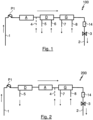
- Fig.1 shows a schematic representation of the basic structure of a first embodiment of a system 100 according to the invention for extracorporeal blood treatment, wherein the system 100 has a first inlet formed by a supply line 1 for introducing a blood stream to be treated into the system 100, three blood treatment devices A, D and G and a first outlet formed by a return line 2 for discharging a treated blood stream from the system 100.
- a first blood treatment device A is an adsorber device A designed for endotoxin adsorption.
- a second blood treatment device D is designed as a dialysis device D, in particular for hemodialysis.
- a third blood treatment device G is an oxygenator for removing carbon dioxide (CO2) from the blood stream to be treated and for enriching the blood stream to be treated with oxygen (02).
- CO2 carbon dioxide
- the system 100 according to the invention shown is designed to be introduced into a human or animal bloodstream to produce an extracorporeal bloodstream, wherein for this purpose the supply line 1 can be connected to a first blood vessel of the patient to be treated or of an animal to be treated, in particular a vein or an artery, for removing a bloodstream to be treated and the return line 2 can be connected to the first blood vessel or a second blood vessel, in particular a vein, for returning a treated bloodstream to the intracorporeal bloodstream of the patient or the animal.
- the system can preferably be connected to a double-lumen cannula which allows the creation of a veno-venous, extracorporeal blood circulation with just one vascular access. This means that the burden on the patient or animal being treated is extremely low, as two separate accesses to two separate vessels do not have to be created. Furthermore, the risk of infection is reduced.
- the three blood treatment devices A, D and G are connected in series, ie sequentially, with respect to a blood flow direction of a blood stream flowing through the system 100, which is indicated by the arrows in Fig.1
- the individual blood treatment devices A, D and G are part of a common treatment device according to the invention and are held by a common base, in particular fastened to a common carrier, the individual components of the system 100 being connected to one another by corresponding hose lines in such a way that blood can flow through them sequentially, ie one after the other.
- an adsorber device A a dialysis device D and a gas exchange device G enables combined blood treatment, in particular the combination of adsorption therapy, in the present case the combination of sepsis therapy with dialysis therapy and the removal of CO2 from the blood and/or enrichment of the blood with oxygen (02) in a single, common extracorporeal blood circuit.
- a system 100 according to the invention thus enables simultaneous blood treatment by means of adsorption, dialysis and gas exchange with the blood volume of just one extracorporeal blood circuit.
- the adsorber device A is designed in this embodiment of a system 100 according to the invention for sepsis therapy.
- Adsorber devices as such for this purpose are basically known from the prior art. Since volume fractions are removed from the blood mass flow during blood treatment by means of the adsorber device A, a further, in particular fourth, inlet 4, for supplying a substitution agent to compensate for this volume loss, whereby in particular a liquid substitution agent, in particular an electrolyte solution, can be supplied.
- the dialysis device D has a dialyzer for hemodialysis, to which a dialysate or a dialysis fluid can be fed via a fifth inlet 6 and from which an effluent produced during the dialysis treatment can be discharged via a second outlet 5.
- Dialysis devices of this type are also basically known from the prior art.
- the gas exchange device G is in the Fig.1
- the system 100 according to the invention shown is designed as an oxygenator G, wherein with the aid of the oxygenator G, carbon dioxide (CO2) is removed from the blood flowing through it with the aid of a defined gas which can be fed to the oxygenator via a further, in particular sixth, inlet 8, and which can be discharged via a third outlet 7.
- the blood flowing through the oxygenator G can also be enriched with the defined gas which can be fed to the oxygenator via the sixth inlet 8 and which in this case is oxygen (02).
- Oxygenators of this type are also basically known from the prior art.
- the oxygenator G can, for example, be an iLA ® Membrane Ventilator IL-1000-01 from Novalung GmbH.
- a first pump P1 designed as a blood pump is provided, wherein the first blood pump P1 can be controlled by means of a control device (not shown here), which is also part of the system 100 according to the invention, to control and/or regulate the blood flow.
- the first blood pump P1 can be a hose roller pump.
- the system according to the invention has a centrifugal pump as the first pump.
- This can be a diagonal pump designed as a rotor pump, preferably as in the EN 10 2010 024 650 A1 described.
- the size of the blood pump P1, in particular their connection cross-sections, are selected depending on the blood volume of the patient or the animal to be treated.
- the system has several pressure sensor devices (not shown here), wherein in this embodiment of a system 100 according to the invention a corresponding pressure sensor device is arranged immediately before and immediately after a blood treatment device A, D or G.
- a transmembrane pressure prevailing in the respective blood treatment device A, D and/or G can be determined in this way. Since the efficiency of the respective blood treatment basically depends on the respective transmembrane pressure prevailing and this should be within a certain range for optimal treatment success depending on the respective blood treatment device, the blood flow can be adjusted in this way, in particular by appropriately controlling the blood pump P1, at least for at least one of the three blood treatment devices A, D and G, in such a way that an advantageous transmembrane pressure is established in each case.
- the system 100 further comprises a gas bubble detection device 14 arranged downstream of the three blood treatment devices A, D and G in the direction of blood flow for detecting a gas bubble in the blood stream, as well as a shut-off valve 3 in the return line 2, downstream of the gas bubble detection device 14. If a gas bubble is detected in the blood stream by means of the gas bubble detection device 14, the shut-off valve 3 is closed, the first blood pump P1 is switched off and an alarm is triggered. This can prevent the gas bubble is returned with the bloodstream into the intracorporeal bloodstream of the patient or animal and leads to a life-threatening condition or even death.
- the system 100 according to the invention described here is designed for a blood flow in a range of 0.05 to 5I per minute, in particular for a blood flow in a range of 0.1 to 3I, in particular for a range of 0.2 to 1I per minute, in particular for a range of 0.2 to 0.5I per minute.
- the surfaces of the lumens of the system 100 that come into contact with the bloodstream can be provided with a biocompatible and at least partially with at least one functional coating, in particular with an antibacterial, anticoagulant and/or anti-inflammatory coating.
- the adsorber device A is arranged in the direction of blood flow upstream of the dialysis device D, whereby the dialysis device D is in turn arranged upstream of the gas exchange device G in the direction of blood flow.
- This arrangement has the advantage that an undiluted blood stream can be supplied to the adsorber device A, whereby a high effectiveness of the adsorption treatment can be ensured.
- undesirable, non-specific binding of ions or pH shifts can occur in the adsorber device A, which can be caused by a dialysis treatment carried out downstream of the blood with a Fig.1 shown sequence of the individual blood treatment devices A, D and G can be compensated by the dialysis device D.
- the dialysis device D can act downstream of the adsorber device A in the direction of blood flow as a further safety system against undesirable particle entry from the adsorber device A arranged upstream of the bloodstream.
- the arrangement of the gas exchange device G after the adsorber device A in the direction of blood flow has the advantage that an enrichment of the blood stream with carbon dioxide (CO2) by supplying the substitution product to the adsorber device A (which in the case of Fig.1 shown embodiment via the fourth inlet 4 after the adsorber device and before the dialysis device) and by a dialysis fluid possibly loaded with carbon dioxide (CO2) (which can be supplied to the system 100 in this embodiment via the fifth inlet 6) using the gas exchange device G before the treated blood stream is returned to the intracorporeal bloodstream of the patient or animal.
- CO2 carbon dioxide
- a subsituate in particular an additional amount of subsituate, can preferably also be supplied to the blood stream via the inlet 4 to compensate for the loss of fluid in the dialysis device D.
- the system can also have a further inlet in the direction of blood flow after the dialysis device D for adding the subsituate to compensate for the loss of fluid and/or volume in the adsorber device A and/or the dialysis device D.
- the individual blood treatment devices A, D and G of the system 100 according to the invention each have exchangeable treatment modules, which each comprise the complete treatment path and can be easily replaced like a spare part.
- the system 100 according to the invention can be easily and quickly adapted to the respective required treatment.
- the adsorber device A can be quickly and easily reconfigured from an adsorber device A for endotoxin adsorption to an adsorber device A for cytokine adsorption, for which specifically designed adsorber treatment modules are required depending on the application.
- the dialysis device D of the system 100 can be reconfigured from a dialysis device D designed for hemodialysis into a dialysis device D designed for hemofiltration or hemodiafiltration.
- the gas exchange device G of the system 100 according to the invention can also be adapted, whereby, depending on the required treatment, a gas exchange treatment module can be used which is designed only for the pure removal of CO2 from the blood stream or a gas exchange treatment module which additionally enables the possibility of enriching the blood stream to be treated with oxygen (02) or another gas or a gas mixture.
- the individual inlets and outlets can also be adapted and/or reconfigured, in particular with regard to their arrangement within the system, in particular with regard to their arrangement before and/or after the respective blood treatment devices.
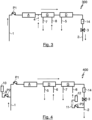
- Fig. 2 shows a second embodiment of a system 200 according to the invention for extracorporeal blood treatment, wherein components with the same functionality have the same reference numerals.
- the second embodiment of a second system 200 according to the invention for extracorporeal blood treatment which is also only shown schematically, is basically similar in structure to that shown in FIG. Fig.1 described first embodiment of a system 100 according to the invention for extracorporeal blood treatment, but differs from the system described with reference to Fig.1 described inventive system 100 that the sequence of the three blood treatment devices A, D and G in the Fig. 2 illustrated inventive system 200 is different and furthermore the dialysis device D is not designed for hemodialysis and accordingly does not have a dialyzer, but only for hemofiltration and accordingly has a hemofilter.
- the system 200 does not have a fifth inlet 6 for supplying a dialysate, since the hemofiltration does not require the supply of an additional dialysis fluid and only an effluent arising during the hemofiltration needs to be drained off, which in the Fig. 2 shown system can also be discharged via the second outlet 5.
- FIG. 2 The embodiment of a system 200 according to the invention for extracorporeal blood treatment, in which the dialysis device D is arranged in the direction of blood flow upstream of the adsorber device A and thus the dialysis device D is flowed through with the blood stream to be treated upstream of the adsorber device A, has the advantage that the blood stream is concentrated by removing the filtration quantity (effluent) in the hemofilter of the dialysis device D and thus a more concentrated blood stream can be supplied to the adsorber device A compared to the system 100 according to the invention from Fig.1 This allows a higher effectiveness of the adsorption treatment to be achieved. Consequently, the Fig. 2 An improved adsorption treatment can be achieved with the inventive system 200 shown.
- an undesirable charging or enrichment of the blood mass flow with carbon dioxide (CO2) as a result of the addition of a CO2-loaded substitute via the fourth inlet 4 can be compensated before it is returned to the intracorporeal bloodstream of the patient or the animal to be treated.
- CO2 carbon dioxide
- the supply of a more concentrated blood stream into adsorber device A may increase the risk of clotting, especially in adsorber device A.
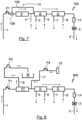
- the pressure sensor devices provided immediately before and immediately after the three blood treatment devices A, D and G can prevent Clotting can, however, be detected quickly and reliably and in particular by the additional addition of an anticoagulant to the bloodstream, for example by adding citrate via inlet 9 (see Fig.4 ), can be largely prevented.
- the respective adsorber device A or the respective blood treatment devices A, D and/or G affected by clotting or their respective treatment module forming a treatment section can be replaced.
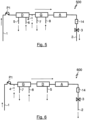
- Fig.3 shows a third embodiment of a system 300 according to the invention for extracorporeal blood treatment, wherein this system 300 is basically constructed similarly to the two previously described systems 100 and 200 according to the invention, but also differs in the order of the arrangement of the individual blood treatment devices A, G and D from the two previously described embodiments of systems 100 and 200 according to the invention for extracorporeal blood treatment.
- the adsorber device A is also the first to be flowed through by the blood mass flow to be treated.
- the gas exchange device G is then flowed through first, and only then the dialysis device D.
- the dialysis device D in the Fig.3 illustrated embodiment of a system 300 according to the invention is also designed only for hemofiltration and not for hemodialysis, the blood flow can no longer be charged after the gas exchange device G due to an exchange with a CO2-laden dialysate, since no dialysate is supplied to this dialysis device, since this is not required for hemofiltration.
- the arrangement of the gas exchange device G downstream of the adsorber device A ensures that a potentially undesirable CO2 loading of the blood mass flow can be compensated by supplying a CO2-loaded substitute via the fourth inlet 4.
- the arrangement downstream of the adsorber device A of the dialysis device D in the direction of blood flow, the dialysis device D can also act in this case as a safety-relevant filter stage against undesirable particle entry into the adsorber device A arranged upstream of the bloodstream.
- undesirable, non-specific, additional ion bonds and/or pH value shifts that may have arisen in the adsorber device A can also be compensated for by means of the dialysis device D with this arrangement or with this system 300 according to the invention.
- the hemofilter downstream of the gas exchange device G generates a dynamic pressure in the gas exchanger G, which has a beneficial effect on the function of the gas exchanger G.
- Fig.4 shows a fourth embodiment of a system 400 according to the invention for extracorporeal blood treatment, this embodiment representing a particularly preferred embodiment of a system according to the invention for extracorporeal blood treatment and also based on the Fig.1 described, first embodiment of a system 100 according to the invention.
- this system 400 has a second inlet 9 and a third inlet 11, via each of which a composition can be supplied to the bloodstream.
- a first composition which is preferably held in a bag 10, can be supplied to the blood mass flow to be treated via the second inlet 9 with the aid of a second pump P2, wherein the system 400 in this case is designed such that the first composition can be supplied to the blood flow immediately after removal from the intracorporeal blood circulation of the patient or animal to be treated, in particular in the direction of blood flow before the first blood pump P1 and in particular before the first blood treatment device through which the blood flow to be treated flows.
- system 400 is designed to supply a liquid citrate solution as an anticoagulant to the blood stream to be treated via the second inlet 9 with the aid of the second pump P2.
- a second composition in particular a calcium solution to compensate for the calcium loss caused during hemodialysis in the dialysis device D, can be supplied to the system via the third inlet 11 by means of a third pump P3.
- the second composition is supplied via the third inlet 11 immediately before the treated blood flow is returned to the patient, in particular after the shut-off valve 3. It is of course also possible to arrange the third inlet in the direction of blood flow before the shut-off valve 3.
- the system 400 according to the invention shown is particularly suitable for treatment in an extracorporeal blood circuit with a veno-venous access, ie in particular for CVVHD, in which the blood stream to be treated is taken from a vein of the patient or animal to be treated and the treated blood stream is returned to a vein.
- a veno-venous access ie in particular for CVVHD
- a substitution agent can be supplied to the blood stream preferably via an additional inlet 4 in the direction of blood flow after the adsorber device A and before the dialysis device D to compensate for the loss of fluid in the adsorber device A and/or the dialysis device D.
- the system can also have an inlet 4 in the direction of blood flow after the dialysis device D for adding the substitution agent to compensate for the loss of fluid and/or volume in the adsorber device A and/or the dialysis device D.
- Such a system is particularly suitable for post-CVVHDF.
- Fig.5 shows a fifth embodiment of a system 500 according to the invention for extracorporeal blood treatment, which is also based on the Fig.1 illustrated inventive system 100, but differs from the system 100 of Fig.1 differs in that the adsorber device A is arranged after the gas exchange device G, in particular after the gas exchange device G and after the dialysis device D.
- This arrangement has the advantage that the increased back pressure generated at the adsorber device A increases the pressure gradient in the gas exchange device G at the gas exchange membrane, whereby an improved gas exchange can be achieved.
- the substitute to compensate for the volume loss in the adsorber device A is preferably, as in Fig.5 shown, is added to the blood stream via the inlet 4 before the gas exchange device G.
- addition before the dialysis device D is also advantageously possible. In this way, an undesirable CO2 charge by the substitution agent can be compensated by means of the gas exchange device G arranged downstream.
- Fig.6 shows a sixth embodiment of a system 600 according to the invention for extracorporeal blood treatment, which is based on the Fig.5 illustrated inventive system 500, but differs from the system 500 in that Fig.5 differs in that the gas exchange device G in this case is arranged in front of the dialysis device D, which in this case is only designed for hemofiltration and not for hemodialysis.
- This arrangement has the advantage that the back pressure in front of the dialysis device D and in front of the adsorber device A each increases the pressure gradient within the gas exchange device G at the gas exchange membrane, whereby the efficiency of the gas exchange can be increased.
- the substituate is also added to the blood stream via the inlet 4 upstream of the gas exchange device G to compensate for the volume loss in the adsorber device A, so that an undesirable CO2 charge by the substituate can be compensated by means of the gas exchange device G arranged downstream.
- the dialysis device D is designed for hemofiltration, which does not require dialysate, an undesirable CO2 build-up by the dialysate can be avoided.
- Fig.7 shows a seventh embodiment of a system 700 according to the invention for extracorporeal blood treatment, which is also based on the Fig.1 shown inventive system 100, but in which a bypass device 13 is additionally present with a bypass line 13A and a bypass valve 13B, which allows the blood flow to be treated to be diverted around the adsorber device A.
- This system 700 has the advantage that blood treatment with or without adsorption treatment is possible. This significantly increases the flexibility with regard to the possible uses of a system according to the invention, since adsorption treatment is not indicated in all cases for blood treatment, or a clotted or almost completely loaded or saturated adsorber can be bypassed.
- the bypass valve 13B is preferably designed such that a blood stream to be treated is guided either completely through the adsorber device downstream of the bypass valve 13B in the direction of blood flow or completely past the adsorber device A via the bypass line 13A.
- the system has a correspondingly designed bypass device for each of the blood treatment devices A, D, G, so that with a system according to the invention, optionally an adsorption treatment, and/or a gas exchange and/or a dialysis treatment is possible.
- Fig.8 shows an eighth embodiment of a system 800 according to the invention, which is based on the system 100 of Fig.1 based, wherein in this embodiment the first blood treatment device, instead of an adsorber device A, is a plasma separation device PT in the form of a plasma filter PT, via which, with the aid of a further, in particular third, pump P3, separated blood plasma can be supplied to a blood plasma disposal container W via a line 16 which forms a fourth outlet for the removal of separated blood plasma.
- the first blood treatment device instead of an adsorber device A, is a plasma separation device PT in the form of a plasma filter PT, via which, with the aid of a further, in particular third, pump P3, separated blood plasma can be supplied to a blood plasma disposal container W via a line 16 which forms a fourth outlet for the removal of separated blood plasma.
- fresh plasma can be supplied to the blood stream as a replacement for the amount of blood plasma removed, in particular with the aid of a further, in particular fourth pump P4.
- Fig.9 shows a ninth embodiment of a system 900 according to the invention, which is based on the system 800 of Fig.8 based, wherein in this embodiment, the separated plasma is not fed to a blood plasma disposal container W, but is guided by means of a hose line, in particular by means of a bypass line, through a blood treatment device in the form of an adsorber device A, wherein the treated plasma is fed back into the remaining blood stream after the adsorption treatment, in particular into the main line.
- Fig.10 shows a tenth embodiment of a system 1000 according to the invention, which is based on the system 900 of Fig.9
- the separated plasma is not fed to the rest of the bloodstream after the adsorption treatment, but to the plasma separation device PT for recirculation in a bypass circuit. This allows improved plasma separation and/or adsorption treatment to be achieved.
Landscapes
- Health & Medical Sciences (AREA)
- Heart & Thoracic Surgery (AREA)
- Vascular Medicine (AREA)
- Life Sciences & Earth Sciences (AREA)
- General Health & Medical Sciences (AREA)
- Anesthesiology (AREA)
- Biomedical Technology (AREA)
- Hematology (AREA)
- Veterinary Medicine (AREA)
- Animal Behavior & Ethology (AREA)
- Engineering & Computer Science (AREA)
- Public Health (AREA)
- Cardiology (AREA)
- Urology & Nephrology (AREA)
- Emergency Medicine (AREA)
- Pulmonology (AREA)
- External Artificial Organs (AREA)
Description
- Die vorliegende Erfindung betrifft ein System zur extrakorporalen Blutbehandlung, wobei das System einen ersten Einlass zum Einbringen eines zu behandelnden Blutstroms in das System, wenigstens eine Blutbehandlungsvorrichtung sowie einen ersten Auslass zum Ausbringen eines behandelten Blutstroms aus dem System aufweist. Ferner betrifft die Erfindung eine Behandlungsvorrichtung mit einem solchen System. Weiter wird ein Kit, das die Komponenten des Systems umfasst, beschrieben. Des Weiteren wird ein Verfahren zum Betreiben eines solchen Systems und/oder einer Behandlungsvorrichtung mit einem solchen System beschrieben. Ferner wird ein Verfahren zur extrakorporalen Blutbehandlung mit einem solchen System oder mit einer solchen Behandlungsvorrichtung beschrieben.
- Systeme zur extrakorporalen Blutbehandlung sind aus dem Stand der Technik grundsätzlich bekannt. Dabei sind auch Systeme bekannt, mit denen die Kombination zweier verschiedener Blutbehandlungen möglich ist. Entsprechende Verfahren zur extrakorporalen Blutbehandlung mit vorgenannten Systemen sind ebenfalls bekannt.
- Aus der
WO 2015/067232 A1 ist beispielsweise ein System zur Peritoneal-Dialyse mit einem in einem extrakorporalen Kreislauf angeordneten Oxygenator bekannt. - In der
DE 196 22 184 A1 ist ein Multifunktionsgerät zur multifunktionalen, extrakorporalen Blutbehandlung beschrieben, mit welchem sowohl eine Gasaustauschbehandlung als auch eine Dialysebehandlung möglich ist. - In der
US 2005/182349 A1 wird ein Behandlungssystem offenbart aufweisend Blutführungsleitungen und eine UF-Einheit zur Erzeugung von Ultrafiltrat stromabwärts oder stromaufwärts zu einer CVVH-Hämofiltrationseinheit. Eine Ultrafiltrations-Bypass-Leitung umfasst einen Oxygenator, eine Zentrifugalpumpe und eine bioartifizielle Leber. - Ferner ist bekannt, eine extrakorporale Dialysebehandlung zur kontinuierlichen Nierenersatz-Therapie (CRRT = Continuous Renal Replacement Therapy) in einem gemeinsamen extrakorporalen Blutkreislauf mit einer extrakorporalen Adsorptionsbehandlung zur Sepsis-Therapie zu kombinieren, beispielsweise aus der
EP 2 735 326 A1 oder derEP 0 236 0 509 B1 - Die
EP 2 735 326 A1 offenbart ein System zur Blutbehandlung, welches zwei, jeweils Hohlfasermembranen enthaltende Dialysatoren aufweist, die dazu vorgesehen sind, in einem extrakorporalen Blutkreislauf zur Blutbehandlung in Reihe geschaltet zu werden und nacheinander durchströmt zu werden, wobei einer der beiden Dialysatoren ein adsorbierendes Material aufweist. - Die
EP 0 236 0 509 B1 - Ferner ist bekannt, eine extrakorporale Dialysebehandlung zur kontinuierlichen Nierenersatz-Therapie in einem gemeinsamen extrakorporalen Blutkreislauf mit einer extrakorporalen Gasaustauschbehandlung zur CO2-Entfernung aus dem Blut (ECCO2R = ExtraCorporeal CO2-Removal) oder zur extrakorporalen Beatmung mit gleichzeitiger Sauerstoff-Anreicherung (ECMO = ExtraCorporeal MembraneOxygenation) zu kombinieren.
- Darüber hinaus ist aus der
EP 2 461 847 B1 eine Blutbehandlungsvorrichtung mit einer Gasaustauschvorrichtung bekannt, die neben der Gasaustauschbehandlung eine Adsorptionsbehandlung ermöglicht, wobei die Gasaustauschvorrichtung dazu einen Träger umfasst, der mit Substanzen zur adsorptiven Entfernung von im Blut, Blutersatzmitteln oder Lösungen zum Einbringen in den menschlichen und/oder tierischen Blutkreislauf befindlichen Toxinen biologischer und chemisch-synthetischer Herkunft, deren Metaboliten und Abbauprodukten beschichtet ist. - Vor diesem Hintergrund ist es eine Aufgabe der Erfindung, ein verbessertes System zur extrakorporalen Blutbehandlung bereitzustellen, insbesondere ein System zur extrakorporalen Blutbehandlung, mit welchem die Möglichkeiten der extrakorporalen Blutbehandlung erweitert werden können und welches zusätzliche Behandlungsmöglichkeiten bietet, insbesondere jeweils flexibel in Abhängigkeit vom jeweiligen Behandlungsfall, ohne einen weiteren Patientenzugang legen zu müssen oder einen weiteren, zusätzlichen extrakorporalen Blutkreislauf herstellen zu müssen. Ferner ist es eine Aufgabe der Erfindung eine entsprechende Behandlungsvorrichtung, bereitzustellen.
- Diese Aufgaben werden erfindungsgemäß durch ein System zur extrakorporalen Blutbehandlung mit den Merkmalen von Anspruch 1 und durch eine Behandlungsvorrichtung mit den Merkmalen von Anspruch 14 gelöst. Vorteilhafte Ausführungen der Erfindung sind Gegenstand der abhängigen Ansprüche, der Beschreibung und der Figuren und werden im Folgenden näher erläutert.
- Ein erfindungsgemäßes System zur extrakorporalen Blutbehandlung weist einen ersten Einlass zum Einbringen eines zu behandelnden Blutstroms in das System, wenigstens eine erste Blutbehandlungsvorrichtung, eine zweite Blutbehandlungsvorrichtung, eine dritte Blutbehandlungsvorrichtung und einen ersten Auslass zum Ausbringen eines behandelten Blutstroms aus dem System auf.
- Die erste Blutbehandlungsvorrichtung weist eine Adsorbervorrichtung zur Entfernung wenigstens eines körperfremden und/oder wenigstens eines körpereigenen Pathogens und/oder eine Plasmatrennvorrichtung zum Trennen von Blutplasma von den übrigen Blutbestandteilen auf oder ist eine Adsorbervorrichtung und/oder eine Plasmatrennvorrichtung.
- Die zweite Blutbehandlungsvorrichtung ist als Dialysevorrichtung ausgebildet, insbesondere als Dialysevorrichtung zur Nierenersatztherapie, vorzugsweise zur kontinuierlichen Nierenersatztherapie.
- Die dritte Blutbehandlungsvorrichtung ist als Gasaustauschvorrichtung ausgebildet, insbesondere als Gasaustauschvorrichtung zur zumindest teilweisen CO2-Entfernung aus einem die Gasaustauschvorrichtung durchströmenden Blutstrom und/oder zur Zufuhr eines Gases oder Gasgemisches in einen die Gasaustauschvorrichtung durchströmenden Blutstrom.
- Dabei sind die erste, die zweite und die dritte Blutbehandlungsvorrichtung in einem funktionsgemäßen Anwendungszustand des Systems bezogen auf eine Blutflussrichtung eines zu behandelnden Blutstroms zwischen dem ersten Einlass und dem ersten Auslass des Systems sequenziell in Reihe geschaltet und nacheinander von einem zu behandelnden Blutstrom extrakorporal durchströmbar. Die Reihenfolge der Anordnung der Blutbehandlungsvorrichtungen richtet sich dabei vorzugsweise nach dem jeweiligen Anwendungsfall.
- Unter einer extrakorporalen Blutbehandlung im Sinne der vorliegenden Erfindung wird eine Blutbehandlung außerhalb eines menschlichen oder tierischen Körpers verstanden, wobei die extrakorporale Blutbehandlung als solche aus dem Stand der Technik grundsätzlich bekannt ist.
- Unter einem Blutstrom im Sinne der vorliegenden Erfindung wird ein Massenstrom von Vollblut verstanden.
- Als Blutbehandlungsvorrichtung im Sinne der Erfindung wird eine Vorrichtung verstanden, mit welcher eine Blutmasse, insbesondere ein Blutstrom, behandelt werden kann, d.h. in seiner Zusammensetzung verändert werden kann.
- Zur extrakorporalen Blutbehandlung kann einem erfindungsgemäßen System über den ersten Einlass ein zu behandelnder Blutstrom, nämlich zu behandelndes Blut, d.h. sogenanntes Vollblut, das sämtliche üblicherweise im Blut vorhandenen Bestandteile enthält, zugeführt werden sowie über den ersten Auslass des Systems aus dem System abgeführt werden.
- In einer Ausgestaltung eines erfindungsgemäßen Systems kann der zu behandelnde Blutstrom aus einem Speichervolumen zugeführt werden, wie beispielsweise aus einem Konservierungsbeutel, d.h. aus einer Blutkonserve oder dergleichen, und/oder dem System direkt von einem zu behandelnden Patienten oder zu behandelndem Tier zugeführt werden.
- Der behandelte Blutstrom kann in ein Speichervolumen abgeführt werden, beispielsweise ebenfalls in einen entsprechenden Konservierungsbeutel oder dergleichen, und/oder einem separierten Transplantationsorgan zur Versorgung zugeführt werden und/oder direkt einem zu behandelnden Patienten oder einem zu behandelnden Tier zugeführt werden.
- Besonders bevorzugt ist ein erfindungsgemäßes System zur extrakorporalen Blutbehandlung dazu ausgebildet, in den menschlichen und/oder tierischen Blutkreislauf eingebracht zu werden und insbesondere mit dem intrakorporalen Blutkreislauf eines zu behandelnden Patienten oder Tieres unter Herstellung eines extrakorporalen Blutkreislaufes verbunden zu werden.
- In einer bevorzugten Ausgestaltung eines erfindungsgemäßen Systems ist das System dazu ausgebildet, veno-venös (VV) mit dem intrakorporalen Blutkreislauf eines Patienten oder eines Tieres verbunden zu werden oder arterio-venös (AV). Je nach Anwendungsfall kann die veno-venöse oder die arterio-venöse Verbindung eines erfindungsgemäßen Systems mit dem intrakorporalen Blutkreislaufs eines zu behandelnden Patienten oder zu behandelnden Tieres vorteilhafter sein. Dies richtet sich insbesondere nach der erforderlichen Blutbehandlung bzw. den erforderlichen Blutbehandlungen bzw. der erforderlichen Kombination von Blutbehandlungen. In einer weiteren Ausgestaltung kann das erfindungsgemäße System auch über einen oder mehrere künstlich angelegte Blutzugänge, wie beispielsweise eine Fistel oder ein Shunt, mit dem intrakorporalen Blutkreislauf eines Patienten oder Tieres verbunden werden.
- Bei einem erfindungsgemäßen System zur extrakorporalen Blutbehandlung sind grundsätzlich alle Varianten bezüglich der Reihenfolge der Anordnung der einzelnen Blutbehandlungsvorrichtungen in Blutflussrichtung möglich, wobei insgesamt 3!=6 Möglichkeiten der Anordnung bestehen, wobei einige dieser Anordnungsmöglichkeiten besondere Vorteile aufweisen, welche im weiteren Verlauf dieser Anmeldung näher erläutert werden.
- Vorzugsweise sind der erste Einlass und/oder der erste Auslass eines erfindungsgemäßen Systems durch Schlauchleitungen mit vorzugsweise jeweils wenigstens einem entsprechenden Anschluss gebildet bzw. weisen vorzugsweise jeweils eine oder mehrere entsprechende Schlauchleitungen auf, welche insbesondere jeweils über einen geeigneten Zugang mit einem Blutgefäß eines zu behandelnden Patienten oder Tieres und/oder einem Speichervolumen verbunden werden können. Die Schlauchleitungen eines erfindungsgemäßen Systems können dabei ein Schlauchset bilden, insbesondere ein austauschbares Schlauchset.
- Bevorzugt weist ein erfindungsgemäßes System zur extrakorporalen Blutbehandlung eine Zuführleitung zum Einbringen, insbesondere zur Zufuhr, eines von einem Patienten und/oder eines von einem Tier und/oder einem Speichervolumen entnommenen Blutstroms in das System und/oder eine Rückführleitung zum Ausbringen, insbesondere zur Abfuhr eines behandelten Blutstroms aus dem System und/oder zur Rückführung des behandelten Blutstroms oder eines Teils davon in den intrakorporalen Blutkreislaufs eines Patienten oder zu behandelnden Tieres und/oder in ein Speichervolumen oder in ein separiertes Transplantationsorgan auf.
- In einer bevorzugten Ausgestaltung eines erfindungsgemäßen Systems weist das System in der Rückführleitung wenigstens ein Absperrventil auf, um eine Abfuhr bzw. das Ausbringen des behandelten Blutstromes aus dem System sperren zu können, insbesondere um eine Rückführung in den intrakorporalen Blutkreislauf eines zu behandelnden Patienten oder Tieres verhindern zu können. Darüber hinaus kann die Rückführleitung eine Schutzvorrichtung aufweisen, wie beispielsweise einen Filter oder eine magnetische Vorrichtung, um unerwünschte Partikel zurückzuhalten und insbesondere einen Übertritt dieser unerwünschten Partikel in den intrakorporalen Blutkreislauf zu vermeiden und/oder zu verhindern.
- Im Fall einer Sepsis ist oftmals, insbesondere bei Intensivpatienten, neben einer kontinuierlichen Nierenersatz-Therapie aufgrund von Nierenversagen häufig gleichzeitig eine Beatmung angezeigt. Mit einem erfindungsgemäßen System können gleichzeitig und mit nur einem extrakorporalen Blutkreislauf wenigstens drei Blutbehandlungen durchgeführt werden, nämlich eine Dialysebehandlung, eine Adsorptionsbehandlung und/oder eine Plasmatrennung und eine extrakorporale Gasaustauschbehandlung, insbesondere eine extrakorporale Beatmung anstelle oder in Kombination mit einer mechanischen Beatmung, die eine Intubation oder eine Tracheotomie erfordert.
- Die extrakorporale Gasaustauschbehandlung hat gegenüber der mechanischen Beatmung den Vorteil, dass die Lunge entlastet werden kann und sich dadurch besser regenerieren kann, da der erforderliche Gasaustausch über die Gasaustauschvorrichtung erfolgt und nicht wie bei der mechanischen Beatmung weiter über die Lunge. Daher ist insbesondere in Fällen, in welchen die Lunge angegriffen ist, wie es gerade bei einer Sepsis häufig vorkommt, eine extrakorporale Beatmung mittels einer Gasaustauschvorrichtung vorteilhafter als die mechanische Beatmung. Bei Kombination mit einer mechanischen Beatmung kann letztere weniger intensiv ausgeführt werden, was den Patienten weniger belastet.
- Durch die erfindungsgemäße Reihenschaltung von Adsorbervorrichtung und/oder Plasmatrennvorrichtung, Dialysevorrichtung und Gasaustauschvorrichtung ist ferner nur ein extrakorporaler Blutkreislauf erforderlich. Infolgedessen können mit einem erfindungsgemäßen System auch Patienten gleichzeitig einer extrakorporalen Blutbehandlung umfassend eine Adsorptionsbehandlung und/oder eine Plasmatrennung, insbesondere eine Plasmabehandlung, eine Dialysebehandlung und eine Gasaustauschbehandlung unterzogen werden, deren Stabilität nicht zur gleichzeitigen Versorgung zweier extrakorporaler Blutkreisläufe ausreichend ist oder deren Zustand eine zeitversetzte extrakorporale Blutbehandlung nicht zulässt. Ferner sind bei nur einem extrakorporalen Blutkreislauf weniger Zugänge erforderlich. Dadurch reduzieren sich die Belastungen für einen Patienten sowie die Infektionsgefahr.
- Ein erfindungsgemäßes System ermöglicht durch die sequenzielle Anordnung einer Adsorbervorrichtung und/oder einer Plasmatrennvorrichtung, einer Dialysevorrichtung sowie einer Gasaustauschvorrichtung gleichzeitig beispielsweise die Behandlung einer Sepsis, eine Dialysebehandlung bei eingeschränkter Nierenfunktion oder Nierenversagen sowie eine extrakorporale Beatmung.
- Eine Adsorbervorrichtung im Sinne der vorliegenden Erfindung ist eine Vorrichtung, die dazu ausgebildet ist, einen oder mehrere Bestandteile des die Adsorbervorrichtung durchströmenden Blutstroms mittels Adsorption aus dem Blutstrom zu entfernen. Adsorbervorrichtungen sind aus dem Stand der Technik grundsätzlich bekannt.
- In einer vorteilhaften Ausgestaltung eines erfindungsgemäßen Systems ist die erste Blutbehandlungsvorrichtung eine Adsorbervorrichtung, insbesondere eine zur Endotoxinadsorption, zur Zytokinadsorption und/oder zur Immunadsorption ausgebildete Adsorbervorrichtung oder weist eine derartige Adsorbervorrichtung auf. Insbesondere ist die Adsorbervorrichtung zur Entfernung wenigstens eines körperfremden Pathogens ausgebildet, beispielsweise zur Entfernung wenigstens eines Medikaments und/oder wenigstens eines Arzneimittelwirkstoffs und/oder wenigstens eines Pflanzengiftes und/oder eines organischen Giftes und/oder einer anderen toxischen Substanz und/oder von Bakterien, Viren, Pilzen und/oder anderen Organismen und/oder zur Entfernung wenigstens eines körpereigenen Pathogens, beispielsweise zur Entfernung von und/oder wenigstens eines Immunkomplexes und/oder wenigstens eines Immunglobulins und/oder wenigstens einer Substanzen der infllammatorischen Antwort des Körpers (Mediator) und/oder von Antikörpern und/oder zur Entfernung wenigstens eines sogenannten pathogen-assoziierten molekularen Musters ("pathogen associated molecular patterns" - PAMPs) und/oder wenigstens eines sogenannten Alarmins ("danger or damage associated molecular patterns" - DAMPs).
- Eine Plasmatrennvorrichtung im Sinne der vorliegenden Erfindung ist eine Vorrichtung, mittels welcher Blutplasma einer in die Plasmatrennvorrichtung eingebrachten Blutmenge zumindest teilweise von den übrigen Bestandteilen der Blutmenge getrennt werden kann. Eine Plasmatrennvorrichtung weist insbesondere einen Plasmafilter und/oder eine Zentrifugiereinrichtung auf oder ist als Plasmafilter oder Zentrifuge ausgebildet.
- Die Dialysevorrichtung eines erfindungsgemäßen Systems zur extrakorporalen Blutbehandlung ist bevorzugt zur Durchführung wenigstens eines Verfahrens aus einer Gruppe verschiedener Verfahren zur Blutreinigung ausgebildet, vorzugsweise zur kontinuierlichen Nierenersatztherapie, d.h. zur CRRT-Behandlung insbesondere zur Hämodialyse, Hämofiltration, Hämodialfiltration, Hämoperfusion und/oder zur Peritoneladialyse, wobei derartige Dialysevorrichtungen sowie die zugehörigen Dialyseverfahren aus dem Stand der Technik ebenfalls grundsätzlich bekannt sind.
- Die Gasaustauschvorrichtung eines erfindungsgemäßen Systems ist vorzugsweise zur zumindest teilweisen CO2-Entfernung und/oder zur Anreicherung eines Blutstroms mit einem Gas und/oder mit einem Gasgemisch ausgebildet, insbesondere zur Anreicherung mit Sauerstoff (02) und/oder mit einem medizinischen Gasgemisch, wobei insbesondere Gasaustauscher, die zur CO2-Entfernung und zur Anreicherung eines Blutstroms mit 02 oder einem Gasgemisch ausgebildet sind (sogenannte "Oxygenatoren"), grundsätzlich aus dem Stand der Technik bekannt sind. Häufig werden sogenannte Membranoxygenatoren eingesetzt, bei deren Verwendung die extrakorporale Gasaustauschbehandlung üblicherweise als extrakorporale Membranoxygenierung (ECMO = Extra Corporeal Membrane Oxygenation) bezeichnet wird.
- In einer bevorzugten Ausgestaltung eines erfindungsgemäßen Systems weist das System, insbesondere die Gasaustauschvorrichtung, einen Oxygenator der Firma Novalung GmbH oder der Medos Medizintechnik AG auf, insbesondere einen unter der Bezeichnung iLA® vertriebenen Oxygenator der Novalung GmbH oder einen aus der sogenannten "hilite"-Produktfamilie der Medos Medizintechnik AG.
- In einer bevorzugten Ausgestaltung eines erfindungsgemäßen Systems weist das System, insbesondere die Gasaustauschvorrichtung, einen gemäß eines in der
DE 10 2005 039 446 A1 ausgebildeten Oxygenator auf oder besteht aus einem solchen Oxygenator mit einer integrierten Blutpumpe zur Förderung des zu behandelnden Blutstroms durch den Oxygenator hindurch. - In einer vorteilhaften Ausgestaltung eines erfindungsgemäßen Systems zur extrakorporalen Blutbehandlung weist die Gasaustauschvorrichtung einen Membranoxygenator auf, der zumindest teilweise, vorzugsweise vollständig, wie in der
DE 10 2008 045 621 A1 beschrieben oder in derEP 3 090 769 A1 oder derEP 3 090 768 A1 beschrieben ausgebildet ist, oder besteht aus einem solchen Oxygenator. - Besonders bevorzugt weist ein erfindungsgemäßes System, insbesondere die Gasaustauschvorrichtung eines erfindungsgemäßen Systems, einen plattenförmigen Membranoxygenator mit einem Membranmodul mit schichtweise übereinander angeordneten Hohlfasermembranmatten auf, wobei vorzugsweise wenigstens zwei übereinanderliegende Matten um einem definierten Winkel zueinander versetzt angeordnet sind, insbesondere um einen Winkel von 90° versetzt zueinander, bezogen auf eine mittlere Längserstreckung der einzelnen Hohlfasern der Hohlfasermembranmatten. Besonders bevorzugt sind die einzelnen Hohlfasermembranmatten dabei derart miteinander verpottet, dass der Oxygenator einen rechteckigen, insbesondere quadratischen, oder einen runden, insbesondere kreisrunden, Durchströmquerschnitt aufweist.
- Ein derartiger, plattenförmiger Membranoxygenator hat den Vorteil, dass sich eine besonders vorteilhafte Durchströmung einstellt und der entstehende Druckabfall besonders klein gehalten werden kann, in einigen Fällen kleiner als 5 mmHg. Dies kann in einigen Behandlungsfällen besonders vorteilhaft sein, insbesondere in Behandlungsfällen, in denen die Kombination einer extrakorporalen Adsorptionsbehandlung mit einer extrakorporalen Dialysebehandlung und einer extrakorporalen Dialysebehandlung angezeigt ist.
- Da in den meisten Anwendungsfällen die zur Förderung des zu behandelnden Blutstroms durch das System hindurch zur Verfügung stehende Pumpleistung des Herzens oder einer implantierten Pumpe eines zu behandelnden Patienten oder eines zu behandelnden Tieres nicht ausreicht oder ein veno-venöser Zugang zur Herstellung des extrakorporalen Blutkreislaufs zur extrakorporalen Blutbehandlung mit einem erfindungsgemäßen System vorteilhafter ist, d.h. die Entnahme des zu behandelnden Blutstroms erfolgt aus einer Vene und die Rückführung des behandelten Blutstroms erfolgt ebenfalls in eine Vene, weist ein erfindungsgemäßes System in einer vorteilhaften Ausgestaltung wenigstens eine erste Pumpe, insbesondere eine als Blutpumpe ausgebildete erste Pumpe, zur Förderung wenigstens eines Anteils eines zu behandelnden Blutstroms auf, wobei die erste Pumpe vorzugweise in Blutflussrichtung zwischen dem ersten Einlass und der ersten Blutbehandlungsvorrichtung in Blutflussrichtung angeordnet ist und insbesondere zur Förderung des gesamten zu behandelnden Blutstroms ausgebildet ist. D.h. in einer vorteilhaften Ausgestaltung eines erfindungsgemäßen Systems ist die erste Pumpe vorzugsweise in Reihe mit den drei Blutbehandlungsvorrichtungen geschaltet und insbesondere bevorzugt unmittelbar nach dem ersten Einlass angeordnet und vor der ersten Blutbehandlungsvorrichtung bezogen auf die Blutflussrichtung.
- In einigen Fällen kann es vorteilhafter sein, wenn die erste Pumpe zwischen der ersten Blutbehandlungsvorrichtung und der zweiten Blutbehandlungsvorrichtung angeordnet ist oder zwischen der zweiten Blutbehandlungsvorrichtung und der dritten Blutbehandlungsvorrichtung oder sogar erst nach der dritten Blutbehandlungsvorrichtung, jeweils bezogen auf die Blutflussrichtung bei einer funktionsgemäßen Verwendung des erfindungsgemäßen Systems.
- In einer besonders bevorzugten Ausgestaltung weist ein erfindungsgemäßes System mehrere Pumpen, insbesondere mehrere jeweils als Blutpumpe ausgebildete Pumpen zur Förderung des zu behandelnden Blutstroms auf, welche vorzugsweise in Blutflussrichtung in Reihe mit den Behandlungsvorrichtungen geschaltet sind und insbesondere derart in Blutflussrichtung angeordnet sind, dass sich jeweils die für eine optimale Behandlung erforderlichen Druckverhältnisse an einer oder mehreren der Blutbehandlungsvorrichtungen einstellen.
- In einer bevorzugten Ausgestaltung weist ein erfindungsgemäßes System als erste Pumpe eine Schlauchrollenpumpe auf. In einer besonders bevorzugten Ausgestaltung weist das erfindungsgemäße System als erste Pumpe eine Zentrifugalpumpe auf. Diese kann eine als Rotorpumpe ausgebildete Diagonalpumpe sein, wobei die Pumpe vorzugsweise einen von einem Antriebsteil entkoppelten blutführenden Teil aufweist und der Rotor der Pumpe insbesondere über eine vorzugsweise auf einem Dorn gelagerte Lagerkugel insbesondere aus Keramik oder Aluminiumoxid gelagert ist und an seiner, dem Antriebsteil zugewandten Unterseite vorzugsweise Permanentmagneten aufweist und mittels magnetischer Kopplung antreibbar ist. Besonders bevorzugt ist wenigstens eine Pumpe dabei derart ausgebildet, dass beim Durchströmen der Pumpe nur geringe Scherspannungen entstehen und so die einzelnen Blutbestandteile, insbesondere die roten Blutkörperchen möglichst wenig geschädigt werden.
- In einer besonders bevorzugten Ausgestaltung weist ein erfindungsgemäßes System eine gemäß der in der
DE 10 2010 024 650 A1 beschriebenen Blutpumpe ausgebildete Pumpe auf. Vorzugsweise ist die Größe der Blutpumpe, insbesondere deren Anschlussgeometrie, dabei derart gewählt, dass sie an den jeweiligen zu fördernden Blutstrom bzw. an die Größe und/oder das Blutvolumens des zu behandelnden Patienten oder Tieres angepasst ist, - Da die Effektivität einer Hämofiltrations-Blutbehandlung von einem am Hämofilter anliegenden Druckgradienten abhängt, insbesondere von einem hydrostatischen Druckgefälle zwischen den beiden Seiten der Filtermembran, dem sogenannten Transmembrandruck (TMP), ist es für ein optimales Hämofiltration-Blutbehandlungs-Ergebnis vorteilhaft, wenn ein zur Hämofiltration oder Hämodiafiltration ausgebildetes erfindungsgemäßes System zur extrakorporalen Blutbehandlung und/oder eine zur Hämofiltration oder Hämodiafiltration ausgebildete Dialysevorrichtung eines erfindungsgemäßen Systems wenigstens eine Blutpumpe zur Förderung wenigstens eines Teils des zu behandelnden Blutstroms aufweist, mittels derer durch eine Veränderung des Blutstromflusses ein sich an wenigstens einer der Blutbehandlungsvorrichtungen einstellender Druck und/oder ein sich einstellender resultierender Druckgradient, insbesondere ein sich ergebender Transmembrandruck an der Dialysemembran der Dialysevorrichtung, definiert einstellbar ist.
- Bevorzugt weist ein erfindungsgemäßes System zur Einstellung eines definierten Transmembrandrucks mehrere entsprechend ausgebildete und ansteuerbare Pumpen auf, insbesondere verschiedene, entsprechend ausgebildete und entsprechend ansteuerbare Pumpen, wie beispielsweise eine oder mehrere Blut-, Dialysat-, Filtrat-, und/oder Substituatpumpen, mit welchen der Blutstromfluss derart eingestellt werden kann, dass sich ein gewünschter, definierter Transmembrandruck am Hämofilter der Dialysevorrichtung eergibt.
- In einer weiteren vorteilhaften Ausgestaltung eines erfindungsgemäßen Systems weist das System einen weiteren, insbesondere zweiten, Einlass zur Zugabe einer ersten Zusammensetzung in den Blutstrom auf, insbesondere in den zu behandelnden Blutstrom, wobei dieser weitere Einlass vorzugweise in Blutflussrichtung derart angeordnet ist, dass die erste Zusammensetzung dem Blutstrom in Blutflussrichtung vor der ersten Pumpe zuführbar ist und/oder vor der ersten der drei Blutbehandlungsvorrichtungen, insbesondere vor der Adsorbervorrichtung.
- Bevorzugt ist dieser weitere, insbesondere zweite, Einlass dabei zur Zugabe eines flüssigen Antikoagulants ausgebildet, insbesondere zur Zugabe einer antikoagulierend wirkenden Citrat-Lösung. Dabei ist ein erfindungsgemäßes System besonders bevorzugt derart ausgebildet, dass die erste Zusammensetzung, insbesondere ein Antikoagulant, spätestens vor einer Behandlungsstrecke der ersten Behandlungseinrichtung, d.h. stromaufwärts von der ersten Behandlungseinrichtung, dem Blutstrom zugeführt werden kann. Besonders vorteilhaft ist der zweite Einlass dabei derart angeordnet, dass die Zugabe stromaufwärts der ersten Pumpe, d.h. in Blutflussrichtung vor der ersten Pumpe, erfolgen kann. Dadurch kann das Clotting-Risiko in innerhalb des Systems, insbesondere innerhalb einer weiter stromabwärts angeordneten Adsorbervorrichtung, reduziert werden.
- Als Clotting bezeichnet man die Koagulation von Blutbestandteilen, d.h. ein Verklumpen von Blutbestandteilen.
- Als Behandlungsstrecke im Sinne der Erfindung wird ein Strömungsweg bezeichnet, entlang dem eine tatsächliche Blutbehandlung erfolgt.
- In einigen Fällen hat sich als vorteilhaft erwiesen, wenn ein erfindungsgemäßes System eine weitere, insbesondere zweite, separate Pumpe zur Förderung der ersten Zusammensetzung aufweist, insbesondere zur Förderung der ersten Zusammensetzung aus einem ersten Speichervolumen, in welchem die erste Zusammensetzung aufgenommen ist, heraus in den zu behandelnden Blutstrom. Das Speichervolumen, in dem die erste Zusammensetzung vorzugsweise aufgenommen ist, ist insbesondere ein Konservierungsbeutel oder ein entsprechend vergleichbar ausgebildetes Behältnis zur Aufbewahrung der ersten Zusammensetzung, insbesondere ein Behältnis, das eine sterile Aufbewahrung bei ausreichender Haltbarkeit der Zusammensetzung ermöglicht.
- Da bei der Hämofiltration und der Hämodiafiltration üblicherweise nicht nur Moleküle, von denen der zu behandelnde Blutstrom zu reinigen ist, durch die Filtermembran, den sogenannten Hämofilter, der Dialysevorrichtung hindurchtreten können, sondern auch ein Teil der Plasmaflüssigkeit durch den Hämofilter hindurchtritt und als Effluent mitabgeführt wird, ist es in diesen Fällen in der Regel erforderlich, d.h. insbesondere in denjenigen Fällen, in denen die Dialysevorrichtung zur Hämofiltration oder zur Hämodiafiltration ausgebildet ist, dem Blutstrom zum Ausgleich des dadurch entstehenden Flüssigkeitsverlustes ein Substituat, in der Regel eine physiologische Substitutionsflüssigkeit, insbesondere eine Elektrolytlösung, zuzuführen. Das Substituat kann dabei grundsätzlich vor und/oder nach der Dialysebehandlung zugeführt werden. In manchen dieser Anwendungsfälle ist es vorteilhafter, das Substituat erst nach der Dialysebehandlung dem Blutstrom zuzuführen, d.h. insbesondere erst nach dem Hämofilter, wobei in einigen Fällen eine Zufuhr erst unmittelbar vor der Rückführung des behandelten Blutmassenstroms in den intrakorporalen Blutkreislauf eines zu behandelnden Patienten oder Tieres besonders vorteilhaft ist.
- Bei der Hämodialyse, d.h. wenn die Dialysevorrichtung zur Hämodialyse oder zur Hämodiafiltration ausgebildet ist, kann, insbesondere bei einer Zugabe einer antikoagulierend wirkenden Citrat-Lösung in den Blutstrom, dem Blutstrom über das Effluent Kalzium entzogen werden, was ebenfalls auszugleichen ist, wobei ein auf diese Weise entstandener Kalzium-Verlust bevorzugt stromabwärts der Dialysevorrichtung ausgeglichen wird, insbesondere erst nach der letzten Blutbehandlungsvorrichtung.
- In einer weiteren vorteilhaften Ausgestaltung eines erfindungsgemäßen Systems weist ein erfindungsgemäßes System daher einen weiteren, insbesondere dritten, Einlass zur Zugabe einer zweiten Zusammensetzung in den Blutmassenstrom auf, insbesondere zur Zugabe einer zweiten Zusammensetzung in den behandelten Blutmassenstrom, wobei dieser weitere Einlass vorzugsweise in Blutflussrichtung derart angeordnet ist, dass die zweite Zusammensetzung dem Blutmassenstrom in Blutflussrichtung nach der Dialysevorrichtung zuführbar ist, insbesondere nach der letzten Blutbehandlungsvorrichtung.
- Dabei ist dieser weitere, insbesondere dritte, Einlass insbesondere zur Zugabe einer zweiten Zusammensetzung in Form eines Substituats zum Ausgleich eines bei der Hämofiltration oder Hämodiafiltration entstehenden Flüssigkeitsverlusts und/oder zur Zugabe einer zweiten Zusammensetzung in Form einer flüssigen Kalzium-Lösung zum Ausgleich eines bei einer Hämodialyse entstehenden Kalzium-Verlusts ausgebildet.
- D.h. mit anderen Worten, dass bei einer bevorzugten Ausgestaltung eines erfindungsgemäßen Systems zur extrakorporalen Blutbehandlung, vorzugsweise nach der Behandlungsstrecke der Dialysevorrichtung und oder nach einem Dialysevorgang dem Blutmassenstrom eine zweite Zusammensetzung zugeführt werden kann. Besonders bevorzugt kann die zweite Zusammensetzung dem Blutstrom dabei unmittelbar vor der Rückführung in den intrakorporalen Blutkreislauf zugeführt werden, insbesondere unmittelbar in die Rückführungsleitung eingeleitet werden.
- In einigen Fällen hat sich als vorteilhaft herausgestellt, wenn ein erfindungsgemäßes System zur Förderung der zweiten Zusammensetzung eine weitere Pumpe aufweist, insbesondere eine dritte Pumpe, welche insbesondere zur Förderung der zweiten Zusammensetzung aus einem zweiten Speichervolumen, in welchem die zweite Zusammensetzung aufgenommen ist, in den Blutstrom ausgebildet ist.
- In einigen Fällen kann es aber auch vorteilhaft sein, einen weiteren, insbesondere separaten, Einlass zur Zufuhr des erforderlichen Substituats zum Ausgleich eines in der Dialysevorrichtung bei der Hämofiltration oder Hämodiafiltration entstehenden Flüssigkeits- bzw. Volumenverlustes vorzusehen, insbesondere einen zusätzlichen Einlass zum dritten Einlass bzw. zu dem Einlass, welcher zum Ausgleich eines Kalzium-Verlustes vorgesehen ist.
- In einigen Fällen kann es vorteilhaft sein, wenn der jeweilige Einlass zur Zufuhr des Substituats dabei in Blutflussrichtung derart angeordnet ist, dass das Substituat in Blutflussrichtung vor der Gasaustauschbehandlung dem Blutstrom zuführbar ist, wobei der zugehörige Einlass insbesondere unmittelbar vor der Gasaustauschvorrichtung angeordnet ist, bezogen auf die Blutflussrichtung, um eine möglicherweise vorhandene, unerwünschte CO2-Beladung des Substituats mittels der Gasaustauschvorrichtung ausgleichen zu können.ln manchen Anwendungsfällen ist es vorteilhafter, das Substituat erst nach der Dialyse- und Adsorptionsbehandlung dem Blutstrom zuzuführen, zur Vermeidung eines Verdünnungseffektes, der die Effektivität der Adsorptionsbehandlung verringern würde (die Stärke der Adsorption ist in der Regel konzentrationsabhängig).
- Wie vorstehend bereits ausgeführt worden ist, können bei einem erfindungsgemäßen System die Adsorbervorrichtung und/oder die Plasmatrenneinrichtung, die Dialysevorrichtung und die Gasaustauschvorrichtung grundsätzlich in beliebiger Reihenfolge sequenziell in Reihe geschaltet werden, wobei jedoch bestimmte Anordnungen, d.h. eine bestimmte Reihenfolge der Durchströmung der einzelnen Behandlungsvorrichtungen in Blutflussrichtung, besonders vorteilhaft sind.
- Eine besonders vorteilhafte Ausgestaltung eines erfindungsgemäßen Systems zur extrakorporalen Blutbehandlung ergibt sich, wenn die Adsorbervorrichtung und/oder die Plasmatrennvorrichtung in Blutflussrichtung vor der Gasaustauschvorrichtung angeordnet ist. Da nach einer Adsorptionsbehandlung dem Blutmassenstrom in der Regel zum Ausgleich des bei der Adsorptionsbehandlung entzogenen Volumens ebenfalls ein Substituat, in der Regel eine physiologische Substitutionsflüssigkeit, vorzugsweise eine Elektrolytlösung, zuzuführen ist, welche in einigen Fällen mit CO2 beladen sein kann, ist es vorteilhaft, wenn die Adsorbervorrichtung in Blutflussrichtung vor der Gasaustauschvorrichtung angeordnet ist, da auf diese Weise eine durch die Substitutionsflüssigkeit bewirkte, unerwünschte Aufladung mit CO2 mittels der Gasaustauschvorrichtung wieder ausgeglichen werden kann. Damit kann im Ergebnis eine verbesserte CO2-Entfernung aus dem zu behandelnden Blutmassenstrom gegenüber einer Anordnung der Gasaustauschvorrichtung vor der Adsorbervorrichtung erreicht werden.
- In einer alternativen, in einigen Fällen ebenfalls vorteilhaften Ausgestaltung eines erfindungsgemäßen Systems ist die Adsorbervorrichtung und/oder die Plasmatrennvorrichtung in Blutflussrichtung nach der Gasaustauschvorrichtung angeordnet. Vorteilhaft an dieser Anordnung ist, dass durch den an der Adsorbervorrichtung entstehenden Staudruck eine Erhöhung des Druckgefälles in der Gasaustauschvorrichtung erreicht werden kann, insbesondere an der Gasaustauschmembran, wodurch der Gasaustausch verbessert werden kann.
- Zur Zufuhr des erforderlichen Substituts zum Ausgleich des in der Adsorbervorrichtung bei der Adsorptionsbehandlung entstandenen Volumenverlustes weist ein erfindungsgemäßes System vorzugsweise einen weiteren, insbesondere vierten, Einlass zum Blutmassenstrom auf, welcher insbesondere in Blutflussrichtung derart angeordnet ist, dass das Substituat in Blutflussrichtung nach dem Absorptionsvorgang, insbesondere nach der Behandlungsstrecke in der Adsorbervorrichtung, dem Blutmassenstrom zuführbar ist, wobei der vierte Einlass insbesondere unmittelbar nach der Adsorbervorrichtung angeordnet ist, bezogen auf die Blutflussrichtung.
- In einigen Fällen kann es aber auch vorteilhaft(er) sein, den vierten Einlass vor der Adsorbervorrichtung anzuordnen, insbesondere stromaufwärts von der Gasaustauschvorrichtung, um eine durch die zum Ausgleich des bei der Adsorptionsbehandlung entstehenden Flüssigkeitsverlustes erforderliche Substitutionsflüssigkeit bewirkte, unerwünschte Aufladung des Blutstroms mit CO2 mittels der Gasaustauschvorrichtung ausgleichen zu können. Dies ist insbesondere der Fall, wenn die Adsorbervorrichtung in Blutflussrichtung nach der Gasaustauschvorrichtung angeordnet ist, d.h. stromabwärts zur Gasaustauschvorrichtung.
- In einer weiteren vorteilhaften Ausgestaltung eines erfindungsgemäßen Systems ist die Adsorbervorrichtung und/oder die Plasmatrenneinrichtung in Blutflussrichtung vor der Dialysevorrichtung angeordnet, insbesondere, wenn die Dialysevorrichtung zur Hämodialyse oder Hämodiafiltration ausgebildet ist und insbesondere einen Dialysator aufweist. Die Anordnung der Adsorbervorrichtung blutstromaufwärts, d.h. in Blutflussrichtung vor der Dialysevorrichtung, hat den Vorteil, dass der Adsorbervorrichtung kein durch das Dialysat verdünnter Blutstrom zugeführt wird, wodurch eine besonders hohe Effizienz der Adsorptionsbehandlung erreicht werden kann.
- Ferner können im Absorber entstehende, unspezifische lonenbindungen oder pH-Verschiebungen durch die nachfolgend angeordnete Dialysevorrichtung ausgeglichen werden.
- Des Weiteren kann die blutstromabwärts angeordnete Dialysevorrichtung durch ihren Aufbau aus kleinsten Hohlfasern als Sicherheitssystem gegen einen unerwünschten Partikeleintrag aus der Adsorbervorrichtung wirken.
- Ist die Dialysevorrichtung eines erfindungsgemäßen Systems zur Hämodialyse oder Hämodiafiltration ausgebildet und weist insbesondere einen Dialysator auf, weist ein erfindungsgemäßes System, insbesondere die Dialysevorrichtung, vorzugsweise einen fünften Einlass zur Zufuhr eines Dialysats, d. h. einer Dialysierflüssigkeit, auf.
- Zur Abfuhr eines bei der Dialysebehandlung in der Dialysevorrichtung entstehenden Effluent, weist ein erfindungsgemäßes System vorzugsweise einen zweiten Auslass auf.
- In einer alternativen Ausgestaltung eines erfindungsgemäßen Systems ist die Adsorbervorrichtung in Blutflussrichtung nach der Dialysevorrichtung angeordnet, insbesondere, wenn die Dialysevorrichtung zur Hämofiltration oder Hämodiafiltration ausgebildet ist und vorzugsweise einen Hämofilter aufweist. Diese Reihenfolge kann in einigen Anwendungsfällen vorteilhaft sein, insbesondere wenn eine besonders effektive Adsorptionsbehandlung angezeigt ist, da in diesem Fall der zu behandelnde Blutstrom durch die Hämofiltration in der Dialysevorrichtung aufkonzentriert werden kann, wodurch die Effektivität der Adsorptionsbehandlung in der nachfolgend angeordneten Adsorbervorrichtung gesteigert werden kann.
- In diesem Fall steigt zwar das Clotting-Risiko des Systems, insbesondere in der Adsorbervorrichtung, gegenüber den zuvor beschriebenen Ausgestaltungen eines erfindungsgemäßen Systems. Durch entsprechende Überwachungsmaßnahmen, wie beispielsweise jeweils vor und nach wenigstens einer Blutbehandlungsvorrichtung angeordnete Drucksensoreinrichtungen, anhand derer auf den Zustand der jeweiligen Blutbehandlungsvorrichtung geschlossen werden kann, kann beginnendes Clotting in vielen Fällen relativ zuverlässig und zeitnah erkannt werden. Dadurch, insbesondere in Verbindung mit dem zusätzlichen Einsatz von Antikoangulatien, kann das Clotting-Risiko in den meisten Fällen gut beherrscht werden.
- In einer weiteren vorteilhaften Ausgestaltung eines erfindungsgemäßen Systems ist die Dialysevorrichtung in Blutflussrichtung vor der Gasaustauschvorrichtung angeordnet, insbesondere, wenn die Dialysevorrichtung zur Hämodialyse oder Hämofiltration ausgebildet ist und zur Dialysebehandlung die Zufuhr eines Dialysats erfordert. In diesem Fall kann eine unerwünschte Aufladung mit CO2 durch ein unter Umständen mit CO2 beladenes Dialysat in der Dialysevorrichtung mittels der in Blutflussrichtung sequenziell nach der Dialysevorrichtung angeordnete Gasaustauschvorrichtung vor der Rückführung des behandelten Blutstroms in den intrakorporalen Blutkreislauf eines zu behandelnden Patienten oder Tieres ausgeglichen werden, was bei einer Anordnung der Dialysevorrichtung nach der Gasaustauschvorrichtung nicht der Fall wäre.
- In einer alternativen, aber in einigen Fällen ebenfalls vorteilhaften Ausgestaltung eines erfindungsgemäßen Systems ist die Dialysevorrichtung in Blutflussrichtung nach der Gasaustauschvorrichtung angeordnet, wobei in diesem Fall die Dialysevorrichtung vorzugsweise zur Hämofiltration ausgebildet ist und einen Hämofilter aufweist und insbesondere nicht zur Hämodialyse ausgebildet ist.
- Durch den der Gasaustauschvorrichtung nachgeschalteten Hämofilter kann das Druckgefälle zwischen Blutseite und Gasseite an der Gasaustauschvorrichtung erhöht werden, wodurch die Effizienz der Gasaustauschvorrichtung verbessert werden kann.
- Ist die Dialysevorrichtung lediglich zur Hämofiltration ausgebildet und nicht zur Hämodialyse insbesondere auch nicht zur Hämodiafiltration, tritt der Nachteil einer unerwünschten CO2-Aufladung infolge eines Austausch des Blutstroms mit einem zugeführten, unter Umständen mit CO2 beladenen Dialysats wie bei der Hämodialyse oder der Hämodiafiltration möglich, nicht auf. In letzterem Fall kann die Substitutionslösung zum Volumenausgleich vorzugweise bereits stromaufwärts des Gasaustauschers zugegeben werden, um die mögliche CO2-Beladung mittels der Gasaustauschvorrichtung zumindest teilweise, vorzugsweise vollständig, ausgleichen zu können.
- Bevorzugt weist ein erfindungsgemäßes System, insbesondere die Gasaustauschvorrichtung einen dritten Auslass zur Abfuhr von aus dem behandelten Blutstrom entfernten Kohlendioxid (CO2) auf und/oder einen weiteren, insbesondere sechsten, Einlass zur Zufuhr eines Gases oder Gasgemisches zur Anreicherung des zu behandelnden Blutstroms, insbesondere zur Zufuhr von Sauerstoff (02) und/oder eines medizinischen Gasgemisches und/oder zur Zufuhr eines Spülgases, wie beispielsweise Sauerstoff (02), ein Gasgemisch und/oder Umgebungsluft.
- In einer weiteren vorteilhaften Ausgestaltung eines erfindungsgemäßen Systems weist das System wenigstens eine Drucksensoreinrichtung zur Ermittlung eines Strömungsdruckes des Blutstroms an wenigstens einer definierten Stelle im System auf, wobei vorzugsweise in Blutflussrichtung unmittelbar vor und/oder unmittelbar nach wenigstens einer Behandlungsstrecke einer Blutbehandlungsvorrichtung wenigstens eine Drucksensoreinrichtung angeordnet ist.
- Sind vor und nach wenigstens einer Behandlungsstrecke jeweils Drucksensoreinrichtungen vorgesehen, kann auf diese Weise der Druckabfall über die Behandlungsstrecke erfasst werden, von welchem auf den Zustand der zugehörigen Blutbehandlungsvorrichtung geschlossen werden kann. Insbesondere lässt sich auf diese Weise beurteilen, inwiefern eine Blutbehandlungsvorrichtung von Clotting betroffen ist, wobei ein plötzlich stark ansteigender Druckabfall einen Hinweis darauf gibt, dass die jeweilige Blutbehandlungsvorrichtung von Clotting betroffen ist.
- In einer bevorzugten Ausgestaltung weist ein erfindungsgemäßes System eine Steuerungseinrichtung auf, wobei beim erfindungsgemäßen System die Steuerungseinrichtung insbesondere zur Steuerung und/oder Regelung sämtlicher steuerbaren und/oder regelbaren Komponenten des Systems ausgebildet ist. D.h. mit anderen Worten weist ein erfindungsgemäßes System in einer bevorzugten Ausgestaltung eine gemeinsame Steuerung zur Steuerung sämtlicher Blutbehandlungsvorrichtungen auf. Die Steuerung ist dabei insbesondere zur Steuerung einer oder mehrerer Pumpen, und/oder zur Steuerung von Zufluss- und/oder Abflussmengen von Stoffen und/oder Zusammensetzungen und/oder zur Auswertung der von wenigstens einer Sensoreinrichtung erfassten Sensordaten und/oder zur Überwachung des erfindungsgemäßen Systems ausgebildet, insbesondere zur Steuerung und/oder Regelung des zu behandelnden Blutstroms.
- Bevorzugt können mithilfe einer oder mehrerer Drucksensoreinrichtungen Blockaden oder eine Unterbrechung des Blutkreislaufs erkannt werden und entsprechende Maßnahmen, wie beispielsweise die Auslösung eines Alarms oder die Abschaltung des Systems, insbesondere eine den Blutstrom fördernde Pumpe, abgeschaltet werden.
- Vorzugsweise ist ein erfindungsgemäßes System dabei derart ausgebildet, dass ein für eine möglichst hohe Effektivität einer Blutbehandlung erforderlicher, definierter Transmembrandruck für wenigstens eine der Blutbehandlungsvorrichtungen, insbesondere für die Dialysevorrichtung, bezogen auf einen Grenzwert überwacht wird. Vorzugsweise kann in Abhängigkeit wenigstens eines von einer Drucksensoreinrichtung erfassten Sensorsignals der Fluss des Blutstroms derart eingestellt werden, dass sich ein gewünschter definierter Transmembrandruck einstellt bzw. ergibt, so dass eine verbesserte Blutbehandlung erreicht werden kann.
- In einer weiteren vorteilhaften Ausgestaltung eines erfindungsgemäßen Systems weist ein erfindungsgemäßes System vorzugsweise wenigstens eine Gasblasen-Detektionseinrichtung zum Erkennen einer Gasblase im Blutstrom auf. Vorzugsweise ist das System dabei derart ausgebildet, dass, wenn mittels der Gasblasen-Detektionseinrichtung eine Gasblase erkannt worden ist, ein insbesondere vor dem ersten Auslass, vorzugsweise in einer Rückführleitung, angeordnetes Absperrventil geschlossen werden kann, um eine Rückführung der Gasblase mit dem behandelten Blutstrom in den intrakorporalen Kreislauf, insbesondere den intrakorporalen Blutkreislauf, eines zu behandelnden Patienten oder eines zu behandelnden Tieres zu verhindern. Ferner können vorzugsweise zusätzlich sämtliche Pumpen, die zur Förderung des Blutstroms dienen, abgeschaltet werden.
- In einer weiteren vorteilhaften Ausgestaltung eines erfindungsgemäßen Systems ist bei wenigstens einer Blutbehandlungsvorrichtung eine Behandlungsstrecke zumindest teilweise, vorzugweise vollständig, durch ein austauschbares Behandlungsmodul gebildet, insbesondere durch ein kartuschenartiges Behandlungsmodul. Eine derartige Ausgestaltung einer Blutbehandlungsvorrichtung ermöglicht einen flexiblen Austausch des jeweiligen Behandlungsmoduls, insbesondere eine einfache und flexible Anpassung der einzelnen Behandlungsvorrichtungen an die jeweils erforderliche Blutbehandlung.
- Beispielsweise kann auf diese Weise leicht ein Endotoxin-Adsorber-Behandlungsmodul gegen ein Zytokin-Adsorber-Behandlungsmodul mit einer anderen funktionalen Adsorptionsschicht ausgetauscht werden oder ein spezielles Immun-Adsorber-Behandlungsmodul eingesetzt werden oder ein Hämofilter gegen einen Dialysator getauscht werden oder dergleichen. Dadurch erhöht sich die Bandbreite der mit einem erfindungsgemäßen System möglichen Behandlungen erheblich, wodurch die Wirtschaftlichkeit eines erfindungsgemäßen Systems deutlich gesteigert werden kann.
- In einer weiteren vorteilhaften Ausgestaltung eines erfindungsgemäßen Systems weist das System wenigstens eine schaltbare Bypasseinrichtung zur Umgehung wenigstens einer Blutbehandlungsvorrichtung auf. Dadurch kann bei Bedarf ein erfindungsgemäßes System auch für Blutbehandlungen eingesetzt werden, die jeweils nur die Verwendung einer oder zweier der drei Blutbehandlungsvorrichtungen des Systems erfordern, jedoch nicht die Durchströmung durch sämtliche drei Blutbehandlungsvorrichtungen eines erfindungsgemäßen Systems erforderlich machen. Auf diese Weise kann beispielsweise eine erforderliche Blutbehandlung, welche nur eine Adsorptionsbehandlung und/oder nur eine Plasmatrennung und eine Dialysebehandlung erfordert unter Umgehung der Gasaustauschvorrichtung erfolgen. Ebenso ist eine Dialysebehandlung mit nachfolgendem Gasaustausch, insbesondere nachfolgender CO2-Entfernung, ohne eine gleichzeitige Adsorptionsbehandlung möglich. Dadurch kann die Bandbreite an Behandlungsmöglichkeiten eines erfindungsgemäßen Systems deutlich vergrößert werden. Ferner können die Behandlungskosten in einer Vielzahl an Behandlungsfällen deutlich reduziert werden, da der Materialverbrauch deutlich gesenkt werden kann, weil nicht jeweils drei Behandlungsmodule verbraucht werden. Darüber hinaus kann eine Behandlungsvorrichtung aus dem System entfernt werden, wenn diese ihre Funktion nicht mehr erfüllt, weil sie beispielsweise geclottet oder erschöpft ist, wie beispielsweise ein Adsorber, der vollständig beladen ist.
- Vorzugsweise weist wenigstens eine Bypasseinrichtung wenigstens ein Bypassventil sowie eine zugehörige Bypassleitung auf, die insbesondere fluidisch mit einer Hauptleitung verbunden oder verbindbar ist, wobei insbesondere mittels eines Bypassventils die zugehörige Bypassleitung geöffnet oder verschlossen werden kann, sodass ein zu behandelnder Blutstrom gezielt entlang der zugehörigen Bypassleitung geführt werden kann oder gezielt durch die nachfolgende Blutbehandlungsvorrichtung bzw. die nachfolgende Blutbehandlungsstrecke geleitet werden kann.
- Bevorzugt ist wenigstens ein Bypassventil dabei derart ausgebildet, dass bei geöffnetem Bypassventil keine Durchströmung der nachgelagerten Behandlungsstrecke erfolgt, d.h. dass die nachfolgende Blutbehandlungsvorrichtung vorzugsweise vollständig verschlossen werden kann und der gesamte zu behandelnden Blutstrom über die zugehörige Bypassleitung an der zugehörigen Blutbehandlungsvorrichtung, vorbeigeführt werden kann, d.h. die Blutbehandlungsvorrichtung umgangen werden kann.
- Unter "Umgehen einer Blutbehandlungsvorrichtung" wird im Sinne der vorliegenden Erfindung insbesondere verstanden, die Hauptleitung zu verzweigen, insbesondere an einer Verzweigung stromaufwärts der Blutbehandlungsvorrichtung oder in der Blutbehandlungsvorrichtung, eine Bypassleitung um die Blutbehandlungsvorrichtung herumzuführen und die Bypassleitung stromabwärts wieder mit der Hauptleitung zusammenzuführen, insbesondere nach der Blutbehandlungsvorrichtung oder in der Blutbehandlungsvorrichtung
- Bei geschlossenem Bypassventil hingegen ist vorzugsweise die Bypassleitung verschlossen, insbesondere vollständig, sodass der gesamte behandelnde Blutstrom durch die nachfolgende Behandlungsstrecke bzw. die nachfolgende Blutbehandlungsvorrichtung strömt.
- Auf diese Weise können gezielt nur die erforderlichen Behandlungsvorrichtungen durchströmt werden. Dadurch können die Einsatzmöglichkeiten eines erfindungsgemäßen Systems deutlich gesteigert werden. Insbesondere kann auf diese Weise die Auslastung bzw. die Nutzungszeit eines erfindungsgemäßen Systems verbessert werden, wodurch wiederum Wirtschaftlichkeit gesteigert werden kann.
- Zur Einstellung einer definierten Flussrate des Blutstroms an wenigstens einer der Blutbehandlungsvorrichtungen, insbesondere zum Erzeugen eines gewünschten, definierten Transmembrandrucks, insbesondere für wenigstens eine zugehörige Behandlungsstrecke, kann ein erfindungsgemäßes System wenigstens eine, insbesondere in einem Abschnitt zwischen einer Verzweigung und der anschließenden Zusammenführung in der Hauptleitung und/oder der Bypassleitung angeordnete weitere Pumpe aufweisen.
- Bei entsprechender Anzahl und Ausgestaltung der einzelnen Pumpen kann auf diese Art und Weise eine unabhängige Einstellung der Blutflussraten in den einzelnen Behandlungsvorrichtungen erreicht werden, wobei das System dazu insbesondere eine oder mehrere entsprechend ausgebildete Steuerungseinrichtungen aufweist.
- In einer vorteilhaften Ausgestaltung ist wenigstens eine einer Blutbehandlungsvorrichtung zugeordnete Bypasseinrichtung derart ausgebildet, dass ein rezirkulierender Blutfluss über und/oder durch die zugehörige Blutbehandlungsvorrichtung bewirkbar ist.
- In einer weiteren vorteilhaften Ausgestaltung eines erfindungsgemäßen Systems ist in der zugehörigen Bypassleitung wenigstens einer Blutbehandlungsvorrichtung wenigstens eine weitere Blutbehandlungsvorrichtung angeordnet, insbesondere derart, dass ein rezirkulierender Blutfluss durch die zugehörige, in der Hauptleitung angeordnete Blutbehandlungsvorrichtung und/oder durch die weitere, in der Bypassleitung angeordnete Blutbehandlungsvorrichtung entsteht.
- In einer alternativen, vorteilhaften Ausgestaltung eines erfindungsgemäßen Systems ist die erste Blutbehandlungsvorrichtung eine Plasmatrenneinrichtung, welche vorzugsweise mittels einer Bypassleitung umgehbar ist, wobei insbesondere in der Bypassleitung eine weitere Blutbehandlungsvorrichtung in Form einer Adsorbervorrichtung angeordnet ist. Dabei ist die Adsorbervorrichtung bevorzugt stromabwärts einer in der Bypassleitung angeordneten Pumpe angeordnet.
- Das aus der Absorbervorrichtung abgeführte behandelte Blut bzw. das aus der Adsorbervorrichtung abgeführte, behandelte Blutplasma, kann dabei entweder nach der Plasmatrenneinrichtung der Hauptleitung zugeführt werden oder rezirkulierend der Plasmatrenneinrichtung zugeführt werden.
- In einer alternativen Ausgestaltung eines erfindungsgemäßen Systems kann abgetrenntes Plasma aus der Plasmatrennvorrichtung, insbesondere mithilfe einer Pumpe, abgeführt und einem Plasma-Entsorgungsbehälter zugeführt werden und mittels eines weiteren Einlasses, insbesondere der Hauptleitung, vorzugsweise mithilfe einer weiteren Pumpe, frisches Plasma, insbesondere aus einer Speichervorrichtung, zugeführt werden.
- In einer weiteren vorteilhaften Ausgestaltung eines erfindungsgemäßen Systems weist wenigstens eine Komponente des Systems an einer mit dem zu behandelnden Blutstrom in Kontakt kommenden Oberfläche eine biokompatible und vorzugsweise funktionale Beschichtung auf, insbesondere eine antibakterielle, gerinnungshemmende und/oder anti-inflammatorische Beschichtung. Vorzugsweise ist wenigstens ein Lumen des Systems, welches zur Durchströmung mit einem zu behandelnden und/oder behandelten Blutstroms ausgebildet ist, mit einer biokompatiblen und vorzugweise funktionalen Beschichtung versehen, insbesondere mit einer antibakteriellen, gerinnungshemmenden und/oder anti-inflammatorischen Beschichtung.
- Vorzugsweise weist mindestens eine Oberfläche des erfindungsgemäßen Systems dabei eine heparinhaltige und/oder albumin- und heparinhaltige Beschichtung auf. In einigen Fällen kann es vorteilhaft sein, wenn das System hingegen lediglich heparinfreie Beschichtungen aufweist, denn dadurch kann das System auch zur Behandlung von Patienten oder Tieren mit einer Heparinunverträglichkeit eingesetzt werden.
- In einer alternativen und/oder zusätzlichen bevorzugten Ausgestaltung eines erfindungsgemäßen Systems weist wenigstens eine Beschichtung definierte Antikörper und/oder ein oder mehrere Enzyme auf. Auch eine antibakterielle Beschichtung ist denkbar.
- In einer weiteren vorteilhaften Ausgestaltung eines erfindungsgemäßen Systems ist wenigstens eine Schutzschicht zum Schutz der funktionalen Beschichtung aufgebracht, wobei die Schutzschicht vorzugsweise dazu dient, eine Sterilisation und/oder Lagerung einzelner, beschichteter Komponenten des Systems ohne einen nennenswerten Verlust der Funktionalität der funktionalen Beschichtung zu ermöglichen.
- In einer besonders bevorzugten Ausgestaltung eines erfindungsgemäßen Systems weist das System wenigstens eine Oberfläche mit einer mittels der SPSO-Technologie von der Leukocare AG ausgebildeten Beschichtung auf.
- Eine erfindungsgemäße Behandlungsvorrichtung zur extrakorporalen Blutbehandlung, weist ein gemäß der vorliegenden Erfindung ausgebildetes System zur extrakorporalen Blutbehandlung auf, wobei die erste, die zweite und die dritte Blutbehandlungsvorrichtung des Systems insbesondere in einem gemeinsamen Gehäuse angeordnet sind und/oder von einer gemeinsamen Basis, d.h. von einer gemeinsamen Trägereinrichtung, aufgenommen sind.
- Vorzugsweise sind die drei Blutbehandlungsvorrichtungen dabei in einem gemeinsamen Gehäuse angeordnet und/oder sind von einer gemeinsamen Basis, wie beispielsweise einer gemeinsamen Trägervorrichtung oder dergleichen, aufgenommen. Besonders bevorzugt sind die einzelnen Blutbehandlungsvorrichtungen dabei jeweils austauschbar in und/oder an dem gemeinsamen Gehäuse und/oder der Basis befestigt, insbesondere jeweils als austauschbare Module. Dadurch lässt sich ein besonders kompaktes, erfindungsgemäßes System bereitstellen, das gleichzeitig flexibel auf den jeweiligen Behandlungsfall gezielt abgestimmt und ausgestaltet werden kann.
- Ein Kit und/oder Set zur extrakorporalen Blutbehandlung weist als Komponenten wenigstens eine erste Blutbehandlungsvorrichtung, eine zweite Blutbehandlungsvorrichtung, eine dritte Blutbehandlungsvorrichtung und ein Schlauchset mit einem ersten Einlass zum Einbringen eines zu behandelnden Blutstroms und einem ersten Auslass zum Ausbringen eines behandelten Blutstroms mit einem oder mehreren Schläuchen auf sowie insbesondere eine Installations- und/oder Bedienungsanleitung.
- Dabei ist die erste Blutbehandlungsvorrichtung eine Adsorbervorrichtung zur Entfernung wenigstens eines körperfremden und/oder wenigstens eines körpereigenen Pathogens und/oder eine Plasmatrennvorrichtung zum Trennen von Blutplasma von den übrigen Blutbestandteilen oder weist eine entsprechende Adsorbervorrichtung und/oder Plasmatrennvorrichtung auf. Die zweite Blutbehandlungsvorrichtung ist als Dialysevorrichtung ausgebildet, insbesondere als Dialysevorrichtung zur Nierenersatztherapie, und die dritte Blutbehandlungsvorrichtung ist als Gasaustauschvorrichtung ausgebildet, insbesondere als Gasaustauschvorrichtung zur zumindest teilweisen CO2-Entfernung aus einem die Gasaustauschvorrichtung durchströmenden Blutstrom und/oder zur Zufuhr eines Gases oder Gasgemisches in einen die Gastaustauschvorrichtung durchströmenden Blutstrom. Die Komponenten des Kits können zu einem gemäß der vorliegenden Erfindung ausgebildeten System zur extrakorporalen Blutbehandlung verbunden werden, insbesondere gemäß der Installations- und/oder Bedienungsanleitung.
- Dadurch kann auf einfache Art und Weise ein besonders flexibles, erfindungsgemäßes System bereitgestellt werden, das eine gezielt auf den jeweiligen Behandlungsfall abgestimmte Kombination einer Adsorbervorrichtung und/oder einer Plasmatrenneinrichtung, einer Dialysevorrichtung und einer Gasaustauschvorrichtung ermöglicht.
- D.h., ein erfindungsgemäßes System kann sowohl in Form einer gemeinsamen Behandlungsvorrichtung bereitgestellt werden, bei welcher die drei Blutbehandlungsvorrichtungen des Systems, d.h. die Adsorbervorrichtung und/oder die Plasmatrenneinrichtung, die Dialysevorrichtung und die Gasaustauschvorrichtung Teil einer gemeinsamen Vorrichtung sind, als auch in Form eines Kits und/oder Sets, bei welchem wenigstens zwei der drei Blutbehandlungsvorrichtungen separate Vorrichtungen sind, welche jedoch insbesondere mithilfe eines geeigneten Schlauchsystems mit einer oder mehreren Schlauchleitungen zu einem erfindungsgemäßen System verbunden werden können und erfindungsgemäß sequenziell derart in Reihe geschaltet werden können, dass die einzelnen Blutbehandlungsvorrichtungen jeweils nacheinander in Reihe sequenziell durchströmt werden können.
- Ein Verfahren zum Betreiben eines erfindungsgemäßen Systems zur extrakorporalen Blutbehandlung und/oder einer erfindungsgemäßen Behandlungsvorrichtung ist gekennzeichnet durch die Schritte:
- Bereitstellen einer zu behandelnden Blutmenge,
- Einbringen eines zu behandelnden Blutstroms in das System über den ersten Einlass des Systems,
- Durchströmen wenigstens einer der Blutbehandlungsvorrichtungen und
- Ausbringen des behandelten Blutstroms über den ersten Auslass des Systems.
- Vorzugsweise werden dabei, sofern das zur extrakorporalen Blutbehandlung verwendete System dazu ausgebildet ist und wenigstens eine insbesondere schaltbare Bypasseinrichtung aufweist, je nach Bedarf nur diejenigen Blutbehandlungsvorrichtungen durchströmt, deren Nutzung zur jeweiligen, erforderlichen Behandlung angezeigt ist.
- In einer vorteilhaften Ausgestaltung eines Verfahrens zum Betreiben eines erfindungsgemäßen Systems wird die zu behandelnde Blutmasse dabei in einem Behältnis bereitgestellt, insbesondere in einem Behälter oder einem Beutel, wobei das behandelte Blut vorzugsweise in ein Behältnis, insbesondere in einen Behälter oder in einen Beutel, ausgebracht wird. Alternativ kann das behandelte Blut auch einem separierten, zur Transplantation vorgesehenen Organ zugeführt werden oder einem zu behandelnden Patienten oder einem zu behandelnden Tier.
- Ein Verfahren zur extrakorporalen Blutbehandlung mit einem erfindungsgemäßen System oder einer erfindungsgemäßen Behandlungsvorrichtung ist gekennzeichnet durch die Schritte:
- Einbringen des Systems in einen Blutkreislauf eines zu behandelnden Menschen oder Tieres und Herstellen eines extrakorporalen Blutkreislaufs durch Verbinden des ersten Einlasses des Systems mit einem ersten Blutgefäß des zu behandelnden Menschen oder Tieres und Verbinden des ersten Auslasses des Systems mit dem ersten Blutgefäß und/oder einem zweiten Blutgefäß des Menschen oder Tieres,
- Entnehmen eines zu behandelnden Blutstroms aus dem intrakorporalen Blutkreislauf des Menschen oder Tieres und Einbringen des zu behandelnden Blutstroms in das System über den ersten Einlass des Systems,
- Durchströmen wenigstens einer der Blutbehandlungsvorrichtungen,
- Ausbringen des behandelten Blutstroms über den ersten Auslass des Systems und Rückführen des behandelten Blutstroms in den intrakorporalen Blutkreislauf des Menschen oder Tieres.
- Das erfindungsgemäße System kann dazu veno-venös oder arterio-venös mit dem intrakorporalen Blutkreislauf eines zu behandelnden Menschen oder Tieres verbunden werden oder alternativ über wenigstens einen künstlich angelegten Blutzugang, je nach Bedarf.
- Zum veno-venösen Verbinden eines erfindungsgemäßen Systems mit einem intrakorporalen Blutkreislauf eines zu behandelnden Menschen oder Tieres eignet sich insbesondere eine doppellumige Kanüle mit konzentrisch zueinander angeordnetem Einlass und Auslass, bei erwachsenen Patienten beispielsweise die unter der Bezeichnung "Nova-Port® twin" von der Firma Novalung GmbH vertriebene Kanüle. D.h., bei einem erfindungsgemäßen Verfahren zur extrakorporalen Blutbehandlung erfolgt das Einbringen des Systems in einen Blutkreislauf eines zu behandelnden Menschen oder Tieres und das Herstellen des extrakorporalen Blutkreislaufs vorzugsweise unter Verwendung einer doppellumigen Kanüle.
- Diese und weitere Merkmale der Erfindung gehen außer aus den Ansprüchen und aus der Beschreibung auch aus den zugehörigen Figuren sowie der Figurenbeschreibung hervor, wobei sämtliche der genannten und/oder dargestellten Merkmale und Merkmalskombinationen nicht nur in der jeweils angegebenen Kombination, sondern auch in anderen Kombinationen oder in Alleinstellung bei einer Ausgestaltung der Erfindung verwirklicht sein können, sofern dies technisch sinnvoll ist.
- Manche der genannten und/oder dargestellten Merkmale bzw. Eigenschaften der Erfindung betreffen sowohl ein erfindungsgemäßes System und eine erfindungsgemäße Behandlungsvorrichtung, wobei einige dieser Merkmale und Eigenschaften nur einmal beschrieben sind, beispielsweise nur im Zusammenhang mit dem erfindungsgemäßen System, jedoch unabhängig davon im Rahmen technisch möglicher Ausgestaltungen sowohl für ein erfindungsgemäßes System, als auch für eine erfindungsgemäße Behandlungsvorrichtung gelten.
- Im Folgenden wird die Erfindung anhand mehrerer Ausführungsbeispiele unter Bezugnahme auf die beigefügten Figuren näher erläutert, wobei funktionsgleiche Bauteile mit gleichen Bezugszeichen bezeichnet sind, sofern keine expliziten anderslautenden Angaben gemacht sind oder sich aus dem Kontext nichts anderes ergibt. Es zeigen:
- Fig. 1
- in schematischer Darstellung den grundsätzlichen Aufbau eines ersten Ausführungsbeispiels eines erfindungsgemäßen Systems,
- Fig. 2
- in schematischer Darstellung den grundsätzlichen Aufbau eines zweiten Ausführungsbeispiels eines erfindungsgemäßen Systems,
- Fig. 3
- in schematischer Darstellung den grundsätzlichen Aufbau eines dritten Ausführungsbeispiels eines erfindungsgemäßen Systems,
- Fig. 4
- in schematischer Darstellung den grundsätzlichen Aufbau eines vierten Ausführungsbeispiels eines erfindungsgemäßen Systems,
- Fig. 5
- in schematischer Darstellung den grundsätzlichen Aufbau eines fünften Ausführungsbeispiels eines erfindungsgemäßen Systems,
- Fig. 6
- in schematischer Darstellung den grundsätzlichen Aufbau eines sechsten Ausführungsbeispiels eines erfindungsgemäßen Systems,
- Fig. 7
- in schematischer Darstellung den grundsätzlichen Aufbau eines siebten Ausführungsbeispiels eines erfindungsgemäßen Systems,
- Fig. 8
- in schematischer Darstellung den grundsätzlichen Aufbau eines achten Ausführungsbeispiels eines erfindungsgemäßen Systems,
- Fig. 9
- in schematischer Darstellung den grundsätzlichen Aufbau eines neunten Ausführungsbeispiels eines erfindungsgemäßen Systems und
- Fig. 10
- in schematischer Darstellung den grundsätzlichen Aufbau eines zehnten Ausführungsbeispiels eines erfindungsgemäßen Systems.
-
Fig. 1 zeigt in schematischer Darstellung den grundsätzlichen Aufbau eines ersten Ausführungsbeispiels eines erfindungsgemäßen Systems 100 zur extrakorporalen Blutbehandlung, wobei das System 100 einen durch eine Zuführleitung 1 gebildeten ersten Einlass zum Einbringen eines zu behandelnden Blutstroms in das System 100, drei Blutbehandlungsvorrichtungen A, D und G sowie einen durch eine Rückführleitung 2 gebildeten ersten Auslass zum Ausbringen eines behandelten Blutstroms aus dem System 100 aufweist. - Eine erste Blutbehandlungsvorrichtung A ist dabei eine zur Endotoxin-Adsorption ausgebildete Adsorbervorrichtung A. Eine zweite Blutbehandlungsvorrichtung D ist als Dialysevorrichtung D ausgebildet, insbesondere zur Hämodialyse. Eine dritte Blutbehandlungsvorrichtung G ist ein Oxygenator zur Entfernung von Kohlendioxid (CO2) aus dem zu behandelnden Blutstrom sowie zur Anreicherung des zu behandelnden Blutstroms mit Sauerstoff (02).
- Das in
Fig. 1 dargestellte erfindungsgemäße System 100 ist dabei dazu ausgebildet in einen menschlichen oder tierischen Blutkreislauf zur Herstellung eines extrakorporalen Blutkreislaufs eingebracht zu werden, wobei dazu die Zuführleitung 1 mit einem ersten Blutgefäß des zu behandelnden Patienten bzw. eines zu behandelnden Tieres, insbesondere einer Vene oder einer Arterie, verbunden werden kann zur Entnahme eines zu behandelnden Blutstroms und die Rückführleitung 2 mit dem ersten Blutgefäß oder einem zweiten Blutgefäß, insbesondere einer Vene, zur Rückführung eines behandelten Blutstroms in den intrakorporalen Blutkreislauf des Patienten bzw. des Tieres. - Zur Herstellung des extrakorporalen Blutkreislaufs, insbesondere zur Verbindung mit dem intrakorporalen Blutkreislauf des zu behandelnden Patienten bzw. des zu behandelnden Tieres kann das System vorzugsweise mit einer doppellumigen Kanüle verbunden werden, welche mit nur einem Gefäßzugang die Herstellung eines veno-venösen, extrakorporalen Blutkreislaufs ermöglicht. Dadurch ist die Belastung für den zu behandelnden Patienten bzw. das zu behandelnde Tier äußerst gering, da nicht zwei separate Zugänge zu zwei separaten Gefäßen gelegt werden müssen. Ferner reduziert sich die Infektionsgefahr.
- Erfindungsgemäß sind die drei Blutbehandlungsvorrichtung A, D und G dabei in Reihe, d.h. sequenziell geschaltet bezogen auf eine Blutflussrichtung eines das System 100 durchströmenden Blutstroms welcher durch die Pfeile in
Fig. 1 symbolisiert dargestellt ist. Die einzelnen Blutbehandlungsvorrichtungen A, D und G sind dabei Teil einer gemeinsamen, erfindungsgemäßen Behandlungsvorrichtung und von einer gemeinsamen Basis aufgenommen, insbesondere an einem gemeinsamen Träger befestigt, wobei die einzelnen Komponenten des Systems 100 durch entsprechende Schlauchleitungen derart miteinander verbunden sind, dass sie sequenziell, d.h. nacheinander durchströmt werden können. - Die erfindungsgemäße Hintereinanderschaltung einer Adsorbervorrichtung A, einer Dialysevorrichtung D sowie einer Gasaustauschvorrichtung G ermöglicht eine kombinierte Blutbehandlung, insbesondere die Kombination einer Adsorptionstherapie, im vorliegenden Fall die Kombination einer Sepsis-Therapie mit einer Dialyse-Therapie sowie der CO2-Entfernung aus dem Blut und/oder einer Anreicherung des Blutes mit Sauerstoff (02) in einem einzigen, gemeinsamen extrakorporalen Blutkreislauf. Dadurch kann vermieden werden, dass zur Blutbehandlung mehrere extrakorporale Kreisläufe hergestellt werden müssen und entsprechend mehrere Zugänge bei einem Patienten oder zu behandelnden Tier gelegt werden müssen. Somit ermöglicht ein erfindungsgemäßes System 100 die gleichzeitige Blutbehandlung mittels Adsorption, Dialyse und Gasaustausch mit dem Blutvolumen nur eines extrakorporalen Blutkreislaufs.
- Die Adsorbervorrichtung A ist bei diesem Ausführungsbeispiel eines erfindungsgemäßen Systems 100 zur Sepsis-Therapie ausgebildet. Adsorbervorrichtungen als solche zu diesem Zweck sind aus dem Stand der Technik grundsätzlich bekannt. Da dem Blutmassenstrom bei der Blutbehandlung mittels der Adsorbervorrichtung A Volumenanteile entzogen werden, ist in Blutflussrichtung nach der Adsorbervorrichtung A ein weiterer, insbesondere vierter, Einlass 4, zur Zufuhr eines Substituats nachgeschaltet, um diesen Volumenverlust auszugleichen, wobei insbesondere ein flüssiges Substituat, insbesondere eine Elektrolytlösung, zugeführt werden kann.
- Bei dem in
Fig. 1 dargestellten erfindungsgemäßen System 100 weist die Dialysevorrichtung D einen Dialysator zur Hämodialyse auf, dem über einem fünften Einlass 6 ein Dialysat bzw. eine Dialysierflüssigkeit zugeführt werden kann und von dem über einen zweiten Auslass 5 ein bei der Dialysebehandlung entstehendes Effluent abgeführt werden kann. Dialysevorrichtungen dieser Art sind aus dem Stand der Technik ebenfalls grundsätzlich bekannt. - Die Gasaustauschvorrichtung G ist bei dem in
Fig. 1 abgebildeten, erfindungsgemäßen System 100 als Oxygenator G ausgebildet, wobei mit Hilfe des Oxygenators G aus dem hindurchströmenden Blutstrom mithilfe eines definierten Gases, welches dem Oxygenator über einen weiteren, insbesondere sechsten, Einlass 8 zugeführt werden kann, Kohlendioxid (CO2) entfernt werden, welches über einen dritten Auslass 7 abgeführt werden kann. Der durch den Oxygenator G strömende Blutstrom kann dabei außerdem mit dem definierten Gas, welches dem Oxygenator über den sechsten Einlass 8 zugeführt werden kann, und welches in diesem Fall Sauerstoff (02) ist, angereichert werden. Oxygenatoren dieser Art sind aus dem Stand der Technik ebenfalls grundsätzlich bekannt. Der Oxygenator G kann beispielsweise ein iLA® Membrane Ventilator IL-1000-01 der Novalung GmbH sein. - Zur Förderung des zu behandelnden Blutstroms durch das System 100 ist eine erste, als Blutpumpe ausgebildete Pumpe P1 vorgesehen, wobei die erste Blutpumpe P1 mittels einer hier nicht dargestellten Steuerungseinrichtung, die ebenfalls Teil des erfindungsgemäßen Systems 100 ist, zur Steuerung und/oder Regelung des Blutstroms angesteuert werden kann.
- Die erste Blutpumpe P1 kann dabei eine Schlauchrollenpumpe sein. In einer besonders bevorzugten Ausgestaltung weist das erfindungsgemäße System als erste Pumpe eine Zentrifugalpumpe auf. Diese kann eine als Rotorpumpe ausgebildete Diagonalpumpe sein, vorzugsweise wie in der
DE 10 2010 024 650 A1 beschrieben. Die Größe der Blutpumpe P1, insbesondere deren Anschlussquerschnitte, wird je nach Blutvolumen des Patienten bzw. des zu behandelnden Tieres, ausgewählt. - Um für einen optimalen Behandlungserfolg an wenigstens einer der drei Blutbehandlungsvorrichtungen A, D und/oder G einen optimalen Blutstrom einstellen zu können sowie zu Überwachungszwecken weist das System mehrere, hier nicht dargestellte Drucksensoreinrichtungen auf, wobei bei diesem Ausführungsbeispiel eines erfindungsgemäßen Systems 100 jeweils unmittelbar vor und unmittelbar nach einer Blutbehandlungsvorrichtung A, D oder G eine entsprechende Drucksensoreinrichtung angeordnet ist.
- Dies ermöglicht jeweils die Bestimmung eines über die zugehörige Blutbehandlungsvorrichtung A, D bzw. G entstehenden Druckgefälles. Mit dessen Hilfe kann auf den Zustand der jeweiligen Blutbehandlungsvorrichtung A, D bzw. G geschlossen werden. Insbesondere erlaubt der ermittelte Druckgradient einen Rückschluss darauf, inwiefern die jeweilige Blutbehandlungsvorrichtung A, D oder G von Clotting betroffen ist.
- Ferner kann auf diese Weise ein in der jeweiligen Blutbehandlungsvorrichtung A, D und/oder G anliegender Transmembrandruck bestimmt werden. Da die Effizienz der jeweiligen Blutbehandlung grundsätzlich vom jeweils anliegenden Transmembrandruck abhängt und dieser für einen optimalen Behandlungserfolg in Abhängigkeit von der jeweiligen Blutbehandlungsvorrichtung innerhalb eines bestimmten Bereichs liegen sollte, lässt sich auf diese Weise, insbesondere durch eine entsprechende Ansteuerung der Blutpumpe P1, zumindest für wenigstens eine der drei Blutbehandlungsvorrichtungen A, D und G, der Blutstrom derart einstellen, dass sich jeweils ein vorteilhafter Transmembrandruck einstellt.
- Das in
Fig. 1 dargestellte erfindungsgemäße System 100 weist ferner eine den drei Blutbehandlungsvorrichtungen A, D und G in Blutflussrichtung nachgeschaltet angeordnete Gasblasen-Detektionseinrichtung 14 zum Erkennen einer Gasblase im Blutstrom auf sowie ein in der Rückführleitung 2, der Gasblasen-Detektionseinrichtung 14 nachgeschaltetes Absperrventil 3 auf. Wird eine Gasblase im Blutstrom mittels der Gasblasen-Detektionseinrichtung 14 detektiert, wird das Absperrventil 3 geschlossen, die erste Blutpumpe P1 abgeschaltet und ein Alarm ausgelöst. Dadurch kann verhindert werden, dass die Gasblase mit dem Blutstrom in den intrakorporalen Blutkreislauf des Patienten oder des Tieres zurückgeführt wird und dort zu einem lebensbedrohlichen Zustand oder sogar zum Tod führt. - Das hier beschriebene, erfindungsgemäße System 100 ist dabei für einen Blutstrom in einem Bereich von 0,05 bis 5I pro Minute, insbesondere für einen Blutstrom in einem Bereich von 0,1 bis 3I, insbesondere für einen Bereich von 0,2 bis 1I pro Minute, insbesondere für einen Bereich von 0,2 bis 0,5I pro Minute ausgelegt.
- Zur Vermeidung von Komplikationen können die mit dem Blutstrom in Kontakt kommenden Oberflächen der Lumina des Systems 100 mit biokompatiblen und zumindest teilweise mit wenigstens einer funktionalen Beschichtung versehen sein, insbesondere mit einer antibakteriellen, gerinnungshemmenden und/oder anti-inflammatorischen Beschichtung.
- Bei dem in
Fig. 1 dargestellten ersten Ausführungsbeispiel eines erfindungsgemäßen Systems 100 zur extrakorporalen Blutbehandlung ist die Adsorbervorrichtung A in Blutflussrichtung vor der Dialysevorrichtung D angeordnet, wobei die Dialysevorrichtung D wiederum vor der Gasaustauschvorrichtung G in Blutflussrichtung angeordnet ist. Diese Anordnung hat den Vorteil, dass der Adsorbervorrichtung A ein unverdünnter Blutstrom zugeführt werden kann, wodurch eine hohe Effektivität der Adsorptionsbehandlung sichergestellt werden kann. Ferner kann es in der Adsorbervorrichtung A zu einer unerwünschten, unspezifischen Bindung von Ionen oder pH-Verschiebungen kommen, welche durch eine blutstromabwärts durchgeführte Dialysebehandlung mit einer inFig. 1 dargestellten Reihenfolge der einzelnen Blutbehandlungsvorrichtung A, D und G durch die Dialysevorrichtung D ausgeglichen werden können. - Ferner kann die Dialysevorrichtung D bei dieser Anordnung in Blutflussrichtung nach der Adsorbervorrichtung A als weiteres Sicherheitssystem gegen einen unerwünschten Partikeleintrag aus der blutstromaufwärts angeordneten Adsorbervorrichtung A wirken.
- Die Anordnung des Gasaustauschvorrichtung G nach der Adsorbervorrichtung A in Blutflussrichtung hat den Vorteil, dass eine Anreicherung des Blutstroms mit Kohlendioxid (CO2) durch die Zufuhr des Substituats nach der Adsorbervorrichtung A (welche bei dem in
Fig. 1 gezeigten Ausführungsbeispiel über den vierten Einlass 4 nach der Adsorbervorrichtung und vor der Dialysevorrichtung erfolgen kann) sowie durch eine möglicherweise mit Kohlendioxid (CO2) beladene Dialysierflüssigkeit (welche dem System 100 in diesem Ausführungsbeispiel über den fünften Einlass 6 zugeführt werden kann) mithilfe der Gasaustauschvorrichtung G vor der Rückführung des behandelten Blutstroms in den intrakorporalen Blutkreislauf des Patienten bzw. des Tieres ausgeglichen werden kann. - Ist bei einem erfindungsgemäßen System zur extrakorporalen Blutbehandlung, bei welchem die Blutbehandlungsvorrichtungen wie anhand von
Fig. 1 beschrieben angeordnet sind, die Dialysevorrichtung D statt zur Hämodialyse zur Hämodiafiltration ausgebildet, kann dem Blutstrom über den Einlass 4 bevorzugt auch ein Substituat, insbesondere eine zusätzliche Menge an Substituat, zum Ausgleich des Flüssigkeitsverlustes in der Dialysevorrichtung D zugeführt werden. Alternativ oder zusätzlich kann das System auch einen weiteren Einlass in Blutflussrichtung nach der Dialysevorrichtung D zur Zugabe des Substituats zum Ausgleich des Flüssigkeits- und/oder Volumenverlustes in der Adsorbervorrichtung A und/oder der Dialysevorrichtung D aufweisen. - Um eine flexible Anpassung des erfindungsgemäßen Systems 100 an die jeweilige, erforderliche Blutbehandlung zu ermöglichen, weisen die einzelnen Blutbehandlungsvorrichtungen A, D und G des erfindungsgemäßen Systems 100 jeweils austauschbare Behandlungsmodule auf, welche jeweils die komplette Behandlungsstrecke umfassen und einfach wie ein Ersatzteil ausgewechselt werden können. Auf diese Weise lässt sich das erfindungsgemäße System 100 einfach und schnell an die jeweilige, erforderliche Behandlung anpassen. So kann beispielsweise die Adsorbervorrichtung A schnell und einfach beispielsweise von einer Adsorbervorrichtung A zur Endotoxin-Adsorption in eine Adsorbervorrichtung A zur Zytokinadsorption umkonfiguriert werden, für welche je nach Anwendungsfall spezifisch ausgebildete Adsorber-Behandlungsmodule erforderlich sind.
- Entsprechend kann durch einen Wechsel des jeweiligen Dialyse-Behandlungsmoduls die Dialysevorrichtung D des erfindungsgemäßen Systems 100 von einer zur Hämodialyse ausgebildeten Dialysevorrichtung D in eine zur Hämofiltration oder Hämodiafiltration ausgebildeten Dialysevorrichtung D umkonfiguriert werden.
- Auf die gleiche Weise kann auch die Gasaustauschvorrichtung G des erfindungsgemäßen Systems 100 angepasst werden, wobei je nach erforderlicher Behandlung ein Gasaustausch-Behandlungsmodul eingesetzt werden kann, welches lediglich zur reinen CO2-Entfernung aus dem Blutstrom ausgebildet ist oder ein Gasaustausch-Behandlungsmodul, welches zusätzlich die Möglichkeit der Anreicherung des zu behandelnden Blutstroms mit Sauerstoff (02) oder einem anderen Gas oder einem Gasgemisch ermöglicht.
- Vorzugsweise können die einzelnen Ein- und Auslässe, insbesondere hinsichtlich ihrer Anordnung innerhalb des Systems, insbesondere hinsichtlich ihrer Anordnung vor und/oder nach den jeweiligen Blutbehandlungsvorrichtungen, ebenfalls angepasst und/oder umkonfiguriert werden.
- Dadurch kann das System 100 für jede Behandlung speziell konfiguriert werden. Ferner können beim Auftreten von Clotting oder dergleichen die einzelnen Behandlungsmodule schnell und einfach ausgetauscht werden. Darüber hinaus kann auf diese Weise auf besonders einfache Art und Weise die Bereitstellung eines sterilen Systems 100 zur Blutbehandlung sichergestellt werden, da vor Beginn der Behandlung eines neuen Patienten bzw. eines neuen Tieres sämtliche, mit dem Blutstrom in Kontakt kommenden Komponenten, insbesondere die jeweiligen Blutbehandlungsmodule und deren Schlauchverbindungen auf einfache Art und Weise ausgetauscht werden können.
-
Fig. 2 zeigt ein zweites Ausführungsbeispiel eines erfindungsgemäßen Systems 200 zur extrakorporalen Blutbehandlung, wobei Komponenten mit gleicher Funktionalität gleiche Bezugszeichen aufweisen. - Das in
Fig. 2 ebenfalls lediglich schematisch dargestellte zweite Ausführungsbeispiel eines zweiten erfindungsgemäßen Systems 200 zur extrakorporalen Blutbehandlung ist vom Aufbau her grundsätzlich ähnlich zu dem anhand vonFig. 1 beschriebenen ersten Ausführungsbeispiel eines erfindungsgemäßen Systems 100 zur extrakorporalen Blutbehandlung, unterscheidet sich jedoch dahingehend von dem anhand vonFig. 1 beschriebenen erfindungsgemäßen System 100, dass die Reihenfolge der drei Blutbehandlungsvorrichtungen A, D und G bei dem inFig. 2 dargestellten erfindungsgemäßen System 200 eine andere ist und das ferner die Dialysevorrichtung D nicht zur Hämodialyse ausgebildet ist und dementsprechend keinen Dialysator aufweist, sondern nur zur Hämofiltration und dementsprechend einen Hämofilter aufweist. - Aus diesem Grund weist das System 200 keinen fünften Einlass 6 zur Zufuhr eines Dialysats auf, da die Hämofiltration ohne die Zufuhr einer zusätzlichen Dialysierflüssigkeit auskommt und lediglich ein bei der Hämofiltration entstehendes Effluent abzuführen ist, welches bei dem in
Fig. 2 dargestellten System ebenfalls über den zweiten Auslass 5 abgeführt werden kann. - Die in
Fig. 2 dargestellte Ausgestaltung eines erfindungsgemäßen Systems 200 zur extrakorporalen Blutbehandlung, bei welchem die Dialysevorrichtung D in Blutflussrichtung vor der Adsorbervorrichtung A angeordnet ist und somit die Dialysevorrichtung D vor der Adsorbervorrichtung A mit dem zu behandelnden Blutstrom durchströmt wird, hat den Vorteil, dass durch einen Entzug der Filtrationsmenge (Effluent) im Hämofilter der Dialysevorrichtung D der Blutstrom aufkonzentriert wird und somit der Adsorbervorrichtung A ein stärker konzentrierter Blutstrom zugeführt werden kann gegenüber dem erfindungsgemäßen System 100 ausFig. 1 . Dadurch kann eine höhere Effektivität der Adsorptionsbehandlung erreicht werden. Folglich kann mit dem inFig. 2 dargestellten erfindungsgemäßen System 200 eine verbesserte Adsorptionsbehandlung erreicht werden. - Durch die in Blutflussrichtung nachgeschaltete Anordnung der Gasaustauschvorrichtung G können auch bei dem in
Fig. 2 dargestellten zweiten Ausführungsbeispiel eines erfindungsgemäßen Systems eine unerwünschte Aufladung bzw. Anreicherung des Blutmassenstroms mit Kohlendioxid (CO2) infolge der Zugabe eines CO2-beladenen Substituats über den vierten Einlass 4 vor der Rückführung in den intrakorporalen Blutkreislauf des Patienten oder des zu behandelnden Tieres ausgeglichen werden. - Durch die Zufuhr eines stärker konzentrierten Blutstroms in die Adsorbervorrichtung A steigt möglicherweise das Clotting-Risiko, insbesondere in der Adsorbervorrichtung A. Durch die jeweils unmittelbar vor und unmittelbar nach den drei Blutbehandlungsvorrichtungen A, D und G jeweils vorgesehenen Drucksensoreinrichtungen kann auftretendes Clotting jedoch schnell und zuverlässig erkannt werden und insbesondere durch die zusätzliche Zugabe eines Antikoagulants in den Blutstrom, beispielsweise durch die Zugabe von Citrat über den Einlass 9 (siehe
Fig. 4 ), weitgehend verhindert werden. Ferner kann, sollte Clotting auftreten, die jeweilige Adsorbervorrichtung A bzw. können die jeweiligen, von Clotting betroffenen Blutbehandlungsvorrichtungen A, D und/oder G bzw. deren jeweiliges, eine Behandlungsstrecke bildendes Behandlungsmodul ausgetauscht werden. -
Fig. 3 zeigt ein drittes Ausführungsbeispiel eines erfindungsgemäßen Systems 300 zur extrakorporalen Blutbehandlung, wobei dieses System 300 grundsätzlich ähnlich aufgebaut ist wie die beiden zuvor beschriebenen erfindungsgemäßen Systeme 100 und 200, sich jedoch ebenfalls in der Reihenfolge der Anordnung der einzelnen Blutbehandlungsvorrichtungen A, G und D von den beiden zuvor beschriebenen Ausführungsbeispielen erfindungsgemäßer Systeme 100 und 200 zur extrakorporalen Blutbehandlung unterscheidet. - Bei dem in
Fig. 3 gezeigten dritten Ausführungsbeispiel eines erfindungsgemäßen Systems 300 zur Blutbehandlung wird, wie bei dem inFig. 1 dargestellten erfindungsgemä-ßen System 100, die Adsorbervorrichtung A ebenfalls als erstes von dem zu behandelnden Blutmassenstrom durchströmt. Anschließend jedoch wird zunächst die Gasaustauschvorrichtung G durchströmt und erst nachgelagert die Dialysevorrichtung D. - Da die Dialysevorrichtung D bei dem in
Fig. 3 dargestellten Ausführungsbeispiel eines erfindungsgemäßen Systems 300 ebenfalls lediglich zur Hämofiltration ausgebildet ist und nicht zur Hämodialyse, kann es nach der Gasaustauschvorrichtung G nicht mehr zur Aufladung des Blutstroms aufgrund eines Austauschs mit einem CO2 beladenen Dialysats kommen, da der diese Dialysevorrichtung kein Dialysat zugeführt wird, da dieses zur Hämofiltration nicht erforderlich ist. - Durch die Anordnung der Gasaustauschvorrichtung G nach der Adsorbervorrichtung A ist sichergestellt, dass eine möglicherweise unerwünschte CO2-Aufladung des Blutmassenstroms durch die Zufuhr eines CO2 beladenen Substituts über den vierten Einlass 4 ausgeglichen werden kann. Durch die der Adsorbervorrichtung A nachgeschaltete Anordnung der Dialysevorrichtung D in Blutflussrichtung kann auch in diesem Fall die Dialysevorrichtung D als sicherheitsrelevante Filterstufe gegen einen unerwünschten Partikeleintrag in der blutstromaufwärts angeordneten Adsorbervorrichtung A wirken. Ferner können möglicherweise in der Adsorbervorrichtung A entstandene, unerwünschte, unspezifische, zusätzliche lonenbindungen und/oder pH-Wert-Verschiebungen mittels der Dialysevorrichtung D auch mit dieser Anordnung bzw. mit diesem erfindungsgemäßen System 300 ausgeglichen werden. Darüber hinaus wird durch den der Gasaustauschvorrichtung G nachgelagerten Hämofilter im Gasaustauscher G ein Staudruck erzeugt, der vorteilhaft auf die Funktion des Gasaustauschers G wirkt.
-
Fig. 4 zeigt ein viertes Ausführungsbeispiel eines erfindungsgemäßen Systems 400 zur extrakorporalen Blutbehandlung, wobei dieses Ausführungsbeispiel eine besonders bevorzugte Ausgestaltung eines erfindungsgemäßen Systems zur extrakorporalen Blutbehandlung darstellt und ebenfalls auf dem anhand vonFig. 1 beschriebenen, ersten Ausführungsbeispiel eines erfindungsgemäßen Systems 100 basiert. Zusätzlich zu dem anhand vonFig. 1 beschriebenen erfindungsgemäßen System 100 weist dieses System 400 einen zweiten Einlass 9 sowie einen dritten Einlass 11 auf, über welchen jeweils eine Zusammensetzung dem Blutstrom zugeführt werden kann. - Dabei kann über den zweiten Einlass 9 mithilfe einer zweiten Pumpe P2 dem zu behandelnden Blutmassenstrom eine erste Zusammensetzung, welche vorzugsweise von einem Beutel 10 aufgenommen ist, zugeführt werden, wobei das System 400 in diesem Fall derart ausgestaltet ist, dass die erste Zusammensetzung dem Blutstrom unmittelbar nach der Entnahme aus dem intrakorporalen Blutkreislauf des zu behandelnden Patienten oder des zu behandelnden Tieres zugeführt werden kann, insbesondere in Blutflussrichtung noch vor der ersten Blutpumpe P1 und insbesondere vor der ersten Blutbehandlungsvorrichtung, die von dem zu behandelnden Blustrom durchströmt wird.
- Insbesondere ist das System 400 dabei dazu ausgebildet über den zweiten Einlass 9 dem zu behandelnden Blutstrom mithilfe der zweiten Pumpe P2 eine flüssige Citratlösung als Antikoagulant zuzuführen.
- Über den dritten Einlass 11 kann dem System eine zweite Zusammensetzung, insbesondere eine Kalziumlösung zum Ausgleich des bei der Hämodialyse in der Dialysevorrichtung D entstandenen Kalziumverlustes, mithilfe einer dritten Pumpe P3 zugeführt werden. Bei diesem, in
Fig. 4 dargestellten vierten Ausführungsbeispiel eines erfindungsgemäßen Systems 400 zur extrakorporalen Blutbehandlung erfolgt die Zufuhr der zweiten Zusammensetzung über den dritten Einlass 11 dabei unmittelbar vor der Rückführung des behandelten Blutstroms in den Patienten, insbesondere nach dem Absperrventil 3. Selbstverständlich ist es auch möglich den dritten Einlass in Blutflussrichtung vor dem Absperrventil 3 anzuordnen. - Das in
Fig. 4 dargestellte erfindungsgemäße System 400 eignet sich dabei insbesondere zur Behandlung in einem extrakorporalen Blutkreislauf mit einem veno-venösen Zugang, d.h. insbesondere zur CVVHD, bei welcher der zu behandelnde Blutstrom aus einer Vene des zu behandelnden Patienten oder Tieres entnommen wird und der behandelte Blutstrom in eine Vene zurückgeführt wird. - Ist bei einem erfindungsgemäßen System zur extrakorporalen Blutbehandlung, bei welchem die Blutbehandlungsvorrichtungen wie anhand von
Fig. 4 beschrieben angeordnet sind, die Dialysevorrichtung D statt zur Hämodialyse zur Hämodiafiltration ausgebildet, kann dem Blutstrom vorzugsweise über einen zusätzlichen Einlass 4 in Blutflussrichtung nach der Adsorbervorrichtung A und vor der Dialysevorrichtung D bevorzugt ein Substituat zum Ausgleich des Flüssigkeitsverlustes in der Adsorbervorrichtung A und/oder der Dialysevorrichtung D zugeführt werden. Alternativ oder zusätzlich kann das System auch einen Einlass 4 in Blutflussrichtung nach der Dialysevorrichtung D zur Zugabe des Substituats zum Ausgleich des Flüssigkeits- und/oder Volumenverlustes in der Adsorbervorrichtung A und/oder der Dialysevorrichtung D aufweisen. Ein solches System eignet sich insbesondere zur post-CVVHDF. -
Fig. 5 zeigt ein fünftes Ausführungsbeispiel eines erfindungsgemäßen Systems 500 zur extrakorporalen Blutbehandlung, welches ebenfalls auf dem inFig. 1 dargestellten erfindungsgemäßen System 100 basiert, sich jedoch dahingehend von dem System 100 ausFig. 1 unterscheidet, dass die Adsorbervorrichtung A nach der Gasaustauschvorrichtung G angeordnet ist, insbesondere nach der Gasaustauschvorrichtung G und nach der Dialysevorrichtung D. Diese Anordnung hat den Vorteil, dass durch den erhöhten, an der Adsorbervorrichtung A entstehenden Staudruck das Druckgefälle in der Gasaustauschvorrichtung G an der Gasaustauschmembran steigt, wodurch ein verbesserter Gasaustausch erreicht werden kann. - Das Substituat zum Ausgleich des Volumenverlustes in der Adsorbervorrichtung A wird dabei vorzugsweise, wie in
Fig. 5 abgebildet, über den Einlass 4 vor der Gasaustauschvorrichtung G dem Blutstrom zugegeben. Alternativ oder zusätzlich ist auch eine Zugabe vor der Dialysevorrichtung D in vorteilhafter Weise möglich. Dadurch kann eine unerwünschte CO2-Aufladung durch das Substituat mittels der nachfolgend angeordneten Gasaustauschvorrichtung G ausgeglichen werden. -
Fig. 6 zeigt ein sechstes Ausführungsbeispiel eines erfindungsgemäßen Systems 600 zur extrakorporalen Blutbehandlung, welches auf dem inFig. 5 dargestellten erfindungsgemäßen System 500 basiert, sich jedoch dahingehend von dem System 500 ausFig. 5 unterscheidet, dass die Gasaustauschvorrichtung G in diesem Fall vor der Dialysevorrichtung D angeordnet ist, welche in diesem Fall nur zur Hämofiltration und nicht zur Hämodialyse ausgebildet ist. - Diese Anordnung hat den Vorteil, dass der Staudruck vor der Dialysevorrichtung D und vor der Adsorbervorrichtung A jeweils erhöhend auf das Druckgefälle innerhalb der Gasaustauschvorrichtung G an der Gasaustauschmembran wirkt, wodurch die Effizienz des Gasaustausches gesteigert werden kann.
- Vorzugsweise wird das Substituat zum Ausgleich des Volumenverlustes in der Adsorbervorrichtung A ebenfalls über den Einlass 4 vor der Gasaustauschvorrichtung G dem Blutstrom zugegeben, so dass eine unerwünschte CO2-Aufladung durch das Substituat mittels der nachfolgend angeordneten Gasaustauschvorrichtung G ausgeglichen werden kann.
- Dadurch, dass die Dialysevorrichtung D zur Hämofiltration ausgebildet ist, welche ohne ein Dialysat auskommt, kann eine unerwünschte CO2-Aufladung durch das Dialysat vermieden werden.
-
Fig. 7 zeigt ein siebtes Ausführungsbeispiel eines erfindungsgemäßen Systems 700 zur extrakorporalen Blutbehandlung, welches ebenfalls auf dem inFig. 1 dargestellten erfindungsgemäßen System 100 basiert, bei welchem jedoch zusätzlich eine Bypasseinrichtung 13 vorhanden ist mit einer Bypassleitung 13A sowie einem Bypassventil 13B, welches eine Umleitung des zu behandelnden Blutstroms um die Adsorbervorrichtung A ermöglicht. Dieses System 700 hat den Vorteil, dass wahlweise eine Blutbehandlung mit oder ohne Adsorptionsbehandlung möglich ist. Dadurch wird die Flexibilität hinsichtlich der Einsatzmöglichkeiten eines erfindungsgemäßen Systems erheblich gesteigert, da nicht in allen Fällen zur Blutbehandlung jeweils eine Adsorptionsbehandlung angezeigt ist oder ein geclotteter oder ein nahezu vollständig beladener, bzw. gesättigter Adsorber umgangen werden kann. - Das Bypassventil 13B ist dabei vorzugsweise derart ausgebildet, dass ein zu behandelnder Blutstrom jeweils vollständig entweder durch die dem Bypassventil 13B in Blutflussrichtung nachgeschaltete Adsorbervorrichtung geführt wird oder vollständig über die Bypassleitung 13A an der Adsorbervorrichtung A vorbei.
- In einer besonders vorteilhaften Ausgestaltung eines erfindungsgemäßen Systems weist das System für jede der Blutbehandlungsvorrichtungen A, D, G eine entsprechend ausgebildete Bypasseinrichtung auf, so dass mit einem erfindungsgemäßen System wahlweise eine Adsorptionsbehandlung, und/oder ein Gasaustausch und/oder eine Dialysebehandlung möglich ist.
-
Fig. 8 zeigt ein achtes Ausführungsbeispiel eines erfindungsgemäßen Systems 800, welches auf dem System 100 ausFig. 1 basiert, wobei bei diesem Ausführungsbeispiel die erste Blutbehandlungsvorrichtung anstelle einer Adsorbervorrichtung A eine Plasmatrennvorrichtung PT in Form eines Plasmafilters PT ist, über welche mithilfe einer weiteren, insbesondere dritten, Pumpe P3, abgetrenntes Blutplasma über eine Leitung 16, die einen vierten Auslass zur Abfuhr von abgetrenntem Blutplasma bildet, einem Blutplasma-Entsorgungsbehälter W zugeführt werden kann. - Über eine Leitung 17, welche einen siebten Einlass 17 bildet, kann dem Blutstrom als Ersatz für die abgeführte Menge an Blutplasma frisches Plasma zugeführt werden, insbesondere mithilfe einer weiteren, insbesondere vierten Pumpe P4.
-
Fig. 9 zeigt ein neuntes Ausführungsbeispiel eines erfindungsgemäßen Systems 900, welches auf dem System 800 ausFig. 8 basiert, wobei bei diesem Ausführungsbeispiel, das abgetrennte Plasma nicht einem Blutplasma-Entsorgungsbehälter W zugeführt wird, sondern mittels einer Schlauchleitung, insbesondere mittels einer Bypassleitung, durcheine Blutbehandlungsvorrichtung in Form einer Adsorbervorrichtung A hindurch geführt wird, wobei das behandelte Plasma nach der Adsorptionsbehandlung dem übrigen Blutstrom wieder zugeführt wird, insbesondere in die Hauptleitung. -
Fig. 10 zeigt ein zehntes Ausführungsbeispiel eines erfindungsgemäßen Systems 1000, welches auf dem System 900 ausFig. 9 basiert, wobei bei diesem Ausführungsbeispiel, das abgetrennte Plasma nach der Adsorptionsbehandlung nicht dem übrigen Blutstrom zugeführt wird, sondern der Plasmatrennvorrichtung PT zur Rezirkulation in einem Bypass-Kreislauf. Dadurch kann eine verbesserte Plasmatrennung und/oder Adsorptionsbehandlung erreicht werden. -
- 100, 200, 300,
- erfindungsgemäßes System zur extrakorporalen Blutbehandlung
- 400, 500, 600, 700, 800, 900, 1000 1
- Zuführleitung (erster Einlass)
- 2
- Rückführleitung (erster Auslass)
- 3
- Absperrventil
- 4
- vierter Einlass zur Zufuhr eines Substituts in den Blutstrom
- 5
- zweiter Auslass zur Abfuhr eines Effluents aus der Dialysevorrichtung
- 6
- fünfter Einlass zur Zufuhr eines Dialysats in die Dialysevorrichtung
- 7
- dritter Auslass zur Abfuhr von CO2 aus der Gasaustauschvorrichtung
- 8
- sechster Einlass zur Zufuhr eines Gases oder Gasgemisches in die Gasaustauschvorrichtung
- 9
- zweiter Einlass zur Zufuhr einer ersten Zusammensetzung in den Blutstrom
- 10
- Beutel, gefüllt mit einer ersten Zusammensetzung
- 11
- dritter Einlass zur Zufuhr einer zweiten Zusammensetzung in den Blutstrom
- 12
- Beutel, gefüllt mit einer zweiten Zusammensetzung
- 13
- Bypasseinrichtung
- 13A
- Bypassleitung
- 13B
- Bypassventil
- 14
- Gasblasen-Detektionseinrichtung
- 15
- Beutel, gefüllt mit frischem Blutplasma
- 16
- vierter Auslass zur Abfuhr von abgetrenntem Blutplasma
- 17
- siebter Einlass zur Zufuhr von frischem Blutplasma
- A
- Adsorbervorrichtung
- D
- Dialysevorrichtung
- G
- Gasaustauschvorrichtung
- PT
- Plasmatrennvorrichtung
- P1
- erste Pumpe, Blutpumpe
- P2
- zweite Pumpe
- P3
- dritte Pumpe
- P4
- vierte Pumpe
- P5
- fünfte Pumpe
- W
- Blutplasma-Entsorgungsbehälter
Claims (14)
- System (100, 200, 300, 400, 500, 600, 700, 800, 900, 1000) zur extrakorporalen Blutbehandlung, wobei das System (100, 200, 300, 400, 500, 600, 700, 800, 900, 1000)- einen ersten Einlass (1) zum Einbringen eines zu behandelnden Blutstroms in das System (100, 200, 300, 400, 500, 600, 700, 800, 900, 1000),- wenigstens eine erste Blutbehandlungsvorrichtung (A, PT),- eine zweite Blutbehandlungsvorrichtung (D),- eine dritte Blutbehandlungsvorrichtung (G) und- einen ersten Auslass (2) zum Ausbringen eines behandelten Blutstroms aus dem System (100, 200, 300, 400, 500, 600,700, 800, 900, 1000) aufweist,wobei die erste Blutbehandlungsvorrichtung (A, PT) eine Adsorbervorrichtung (A) zur Entfernung wenigstens eines körperfremden und/oder wenigstens eines körpereigenen Pathogens und/oder eine Plasmatrennvorrichtung (PT) zum Trennen von Blutplasma von den übrigen Blutbestandteilen ist oder aufweist,wobei die zweite Blutbehandlungsvorrichtung (D) als Dialysevorrichtung (D) ausgebildet ist, insbesondere als Dialysevorrichtung (D) zur Nierenersatztherapie, undwobei die dritte Blutbehandlungsvorrichtung (G) als Gasaustauschvorrichtung (G) ausgebildet ist, insbesondere als Gasaustauschvorrichtung (G) zur zumindest teilweisen CO2-Entfernung aus einem die Gasaustauschvorrichtung (G) durchströmenden Blutstrom und/oder zur Zufuhr eines Gases oder Gasgemisches in einen die Gastaustauschvorrichtung (G) durchströmenden Blutstrom, undwobei die drei Blutbehandlungsvorrichtungen (A und/oder PT, D, G) in einem funktionsgemäßen Anwendungszustand des Systems (100, 200, 300, 400, 500, 600, 700, 800, 900, 1000) bezogen auf eine Blutflussrichtung eines zu behandelnden Blutstroms zwischen dem ersten Einlass (1) und dem ersten Auslass (2) des Systems sequenziell in Reihe geschaltet sind und nacheinander von einem zu behandelnden Blutstrom extrakorporal durchströmbar sind.
- System (100, 200, 300, 400, 500, 600, 700, 800, 900, 1000) nach Anspruch 1, dadurch gekennzeichnet, dass die erste Blutbehandlungsvorrichtung (A) eine zur Endotoxin-, Zytokin und/oder zur Immunadsorption ausgebildete Adsorbervorrichtung (A) ist oder aufweist, wobei die Adsorbervorrichtung (A) insbesondere zur Entfernung von wenigstens einem Medikament und/oder Arzneimittelwirkstoff und/oder wenigstens einem Pflanzengift und/oder wenigstens einem organischen Gift und/oder wenigstens einer anderen toxischen Substanz und/oder zur Entfernung von Bakterien, Viren, Pilzen und/oder anderen Organismen und/oder wenigstens eines Immunkomplexes und/oder wenigstens eines Immunglobulins und/oder wenigstens einer Substanz der infllammatorischen Antwort des Körpers und/oder Antikörpern und/oder wenigstens eines pathogen-assoziierten molekularen Musters und/oder wenigstens eines Alarmins ausgebildet ist.
- System (100, 200, 300, 400, 500, 600, 700, 800, 900, 1000) nach Anspruch 1 oder 2, dadurch gekennzeichnet, dass das System (100, 200, 300, 400, 500, 600, 700, 800, 900, 1000) wenigstens eine erste Pumpe (P1), insbesondere eine als Blutpumpe ausgebildete Pumpe (P1), zur Förderung wenigstens eines Anteils eines zu behandelnden Blutstroms aufweist, wobei die erste Pumpe (P1) vorzugsweise in Blutflussrichtung zwischen dem ersten Einlass (1) und der ersten der drei Blutbehandlungseinrichtungen (A, PT, D, G) in Blutflussrichtung angeordnet ist und insbesondere zur Förderung des gesamten zu behandelnden Blutstroms ausgebildet ist.
- System (400) nach einem der vorgenannten Ansprüche, dadurch gekennzeichnet, dass das System (400) einen weiteren, insbesondere zweiten, Einlass (9) zur Zugabe einer ersten Zusammensetzung in den Blutstrom aufweist, insbesondere in den zu behandelnden Blutstrom, wobei dieser weitere Einlass (9) vorzugsweise in Blutflussrichtung derart angeordnet ist, dass die Zusammensetzung dem Blutstrom in Blutflussrichtung vor der ersten Pumpe (P1) zuführbar ist und/oder vor der ersten der drei Blutbehandlungsvorrichtungen (A, PT, D, G).
- System (400) nach einem der vorgenannten Ansprüche, dadurch gekennzeichnet, dass das System (400) einen weiteren, insbesondere dritten, Einlass (11) zur Zugabe einer zweiten Zusammensetzung in den Blutstrom aufweist, insbesondere in den behandelten Blutstrom, wobei dieser weitere Einlass (11) vorzugsweise in Blutflussrichtung derart angeordnet ist, dass die Zusammensetzung dem Blutstrom in Blutflussrichtung nach der Dialysevorrichtung (D) zuführbar ist, insbesondere nach der letzten Blutbehandlungsvorrichtungen (A, PT, D, G) in Blutflussrichtung.
- System (100, 200, 300, 400, 700, 800, 900, 1000) nach einem der vorgenannten Ansprüche, dadurch gekennzeichnet, dass die Adsorbervorrichtung (A) und/oder die Plasmatrennvorrichtung (PT) in Blutflussrichtung vor der Gasaustauschvorrichtung (G) oder nach der Gasaustauschvorrichtung (G) angeordnet ist.
- System (100, 300, 400, 700, 800, 900, 1000) nach einem der vorgenannten Ansprüche, dadurch gekennzeichnet, dass die Adsorbervorrichtung (A) und/oder die Plasmatrennvorrichtung (PT) in Blutflussrichtung vor der Dialysevorrichtung (D) angeordnet ist, wobei die Dialysevorrichtung (D) vorzugsweise zur Hämodialyse ausgebildet ist und insbesondere einen Dialysator aufweist oder
dadurch gekennzeichnet, dass die Adsorbervorrichtung (A) und/oder die Plasmatrennvorrichtung (PT) in Blutflussrichtung nach der Dialysevorrichtung (D) angeordnet ist, wobei die Dialysevorrichtung (D) vorzugsweise zur Hämofiltration ausgebildet ist und insbesondere einen Hämofilter aufweist. - System (100, 200, 400, 500, 800, 900, 1000) nach einem der vorgenannten Ansprüche, dadurch gekennzeichnet, dass die Dialysevorrichtung (D) in Blutflussrichtung vor der Gasaustauschvorrichtung (G) angeordnet ist oder,
dass die Dialysevorrichtung (D) in Blutflussrichtung nach der Gasaustauschvorrichtung (G) angeordnet ist, wobei die Dialysevorrichtung (D) vorzugsweise zur Hämofiltration ausgebildet ist und einen Hämofilter aufweist. - System (100, 200, 300, 400, 500, 600, 700, 800, 900, 1000) nach einem der vorgenannten Ansprüche, dadurch gekennzeichnet, dass das System (100, 200, 300, 400, 500, 600, 700, 800, 900, 1000) wenigstens eine Drucksensoreinrichtung zur Ermittlung eines Strömungsdruckes des Blutstroms an einer definierten Stelle im System (100, 200, 300, 400, 500, 600, 700, 800, 900, 1000) aufweist, wobei vorzugsweise in Blutflussrichtung unmittelbar vor und/oder unmittelbar nach wenigstens einer Behandlungsstrecke einer Blutbehandlungsvorrichtung (A, PT, D, G) wenigstens eine Drucksensoreinrichtung angeordnet ist.
- System (100, 200, 300, 400, 500, 600, 700, 800, 900, 1000) nach einem der vorgenannten Ansprüche, dadurch gekennzeichnet, dass das System (100, 200, 300, 400, 500, 600, 700, 800, 900, 1000) wenigstens eine Gasblasen-Detektionseinrichtung (14) zum Erkennen einer Gasblase im Blutstrom aufweist.
- System (100, 200, 300, 400, 500, 600, 700, 800, 900, 1000) nach einem der vorgenannten Ansprüche, dadurch gekennzeichnet, dass bei wenigstens einer Blutbehandlungsvorrichtung (A, PT, D, G) eine Behandlungsstrecke zumindest teilweise, vorzugsweise vollständig, durch ein austauschbares Behandlungsmodul gebildet ist, insbesondere durch ein kartuschenartiges Behandlungsmodul.
- System (700) nach einem der vorgenannten Ansprüche, dadurch gekennzeichnet, dass das System (700) wenigstens eine schaltbare Bypasseinrichtung (13) zur Umgehung wenigstens einer Blutbehandlungsvorrichtung (A, D, G) aufweist.
- System (100, 200, 300, 400, 500, 600, 700, 800, 900, 1000) nach einem der vorgenannten Ansprüche, dadurch gekennzeichnet, dass wenigstens eine Komponente des Systems (100, 200, 300, 400, 500, 600, 700, 800, 900, 1000) an einer mit dem zu behandelnden Blutstrom in Kontakt kommenden Oberfläche eine biokompatible und vorzugsweise funktionale Beschichtung aufweist, insbesondere eine antibakterielle, gerinnungshemmende und/oder anti-inflammatorische Beschichtung.
- Behandlungsvorrichtung zur extrakorporalen Blutbehandlung, dadurch gekennzeichnet, dass die Behandlungsvorrichtung ein System (100, 200, 300, 400, 500, 600, 700, 800, 900, 1000) aufweist, das nach einem der Ansprüche 1 bis 13 ausgebildet ist, wobei die erste, die zweite und die dritte Blutbehandlungsvorrichtung (A, PT, D, G) des Systems (100, 200, 300, 400, 500, 600, 700, 800, 900, 1000) in einem gemeinsamen Gehäuse angeordnet sind und/oder von einer gemeinsamen Basis aufgenommen sind.
Applications Claiming Priority (3)
| Application Number | Priority Date | Filing Date | Title |
|---|---|---|---|
| DE102016014892 | 2016-12-15 | ||
| DE102017210134.2A DE102017210134A1 (de) | 2016-12-15 | 2017-06-16 | System zur extrakorporalen Blutbehandlung, Behandlungsvorrichtung, Kit und Verfahren zum Betreiben eines Systems zur extrakorporalen Blutbehandlung |
| PCT/EP2017/082781 WO2018109070A1 (de) | 2016-12-15 | 2017-12-14 | System zur extrakorporalen blutbehandlung, behandlungsvorrichtung, kit und verfahren zum betreiben eines systems zur extrakorporalen blutbehandlung |
Publications (2)
| Publication Number | Publication Date |
|---|---|
| EP3554577A1 EP3554577A1 (de) | 2019-10-23 |
| EP3554577B1 true EP3554577B1 (de) | 2024-08-07 |
Family
ID=60955006
Family Applications (2)
| Application Number | Title | Priority Date | Filing Date |
|---|---|---|---|
| EP17828682.9A Active EP3554577B1 (de) | 2016-12-15 | 2017-12-14 | System zur extrakorporalen blutbehandlung und behandlungsvorrichtung |
| EP17828684.5A Active EP3554578B1 (de) | 2016-12-15 | 2017-12-14 | Blutführungsvorrichtung zur durchführung einer extrakorporalen blutbehandlung, blutbehandlungssystem |
Family Applications After (1)
| Application Number | Title | Priority Date | Filing Date |
|---|---|---|---|
| EP17828684.5A Active EP3554578B1 (de) | 2016-12-15 | 2017-12-14 | Blutführungsvorrichtung zur durchführung einer extrakorporalen blutbehandlung, blutbehandlungssystem |
Country Status (5)
| Country | Link |
|---|---|
| US (2) | US11433173B2 (de) |
| EP (2) | EP3554577B1 (de) |
| CN (2) | CN110072568B (de) |
| DE (2) | DE102017210134A1 (de) |
| WO (2) | WO2018109071A1 (de) |
Families Citing this family (20)
| Publication number | Priority date | Publication date | Assignee | Title |
|---|---|---|---|---|
| AU2018333947A1 (en) | 2017-09-17 | 2020-03-26 | Brian Yale CHANG | Systems, devices, and methods for extracorporeal removal of carbon dioxide |
| KR20200093621A (ko) | 2017-11-30 | 2020-08-05 | 리제너론 파아마슈티컬스, 인크. | 혈관형성 눈 장애를 치료하기 위한 vegf 길항제의 용도 |
| WO2020010286A1 (en) * | 2018-07-03 | 2020-01-09 | The General Hospital Corporation | System and method for extracorporeal carbon monoxide removal with phototherapy |
| JP7112521B2 (ja) * | 2018-12-25 | 2022-08-03 | 旭化成メディカル株式会社 | 血液浄化デバイスと血液成分調整器を備えた体外血液循環システム |
| DE102019105655A1 (de) | 2019-03-06 | 2020-09-10 | B.Braun Avitum Ag | Extrakorporales Blutleitungsset und Blutbehandlungsmaschine |
| DE102019106651A1 (de) | 2019-03-15 | 2020-09-17 | Fraunhofer-Gesellschaft zur Förderung der angewandten Forschung e.V. | Behandlungsvorrichtung und -verfahren zur extrakorporalen, Immuntoleranz-steigernden Blutbehandlung |
| DE102019115162A1 (de) * | 2019-06-05 | 2020-12-10 | Rheinisch-Westfälische Technische Hochschule (Rwth) Aachen | Vorrichtung für den Stoff- und/oder Energieaustausch zwischen zwei Medien und Verfahren zu dessen Herstellung |
| EP4667029A1 (de) | 2019-07-09 | 2025-12-24 | Gambro Lundia AB | Vorrichtung zur extrakorporalen behandlung von blut und verfahren zur bestimmung von wasserverlusten in einem membrangasaustauscher einer vorrichtung zur extrakorporalen behandlung von blut |
| CN111166953A (zh) * | 2020-02-03 | 2020-05-19 | 深圳汉诺医疗科技有限公司 | 一种用于净化血液的体外循环系统及方法 |
| GB202004775D0 (en) * | 2020-03-31 | 2020-05-13 | Ucl Business Ltd | Apparatus |
| EP3900754B1 (de) * | 2020-04-20 | 2024-10-02 | Gambro Lundia AB | Vorrichtung zur extrakorporalen blutbehandlung |
| DE102020111867A1 (de) | 2020-04-30 | 2021-11-04 | Fresenius Medical Care Deutschland Gmbh | Hämodialysevorrichtung mit Gasaustauscher |
| CN111840780B (zh) * | 2020-06-24 | 2022-07-12 | 安徽通灵仿生科技有限公司 | 适用于ecmo期间血液净化装置的管路适配器 |
| CN113041425A (zh) * | 2021-04-27 | 2021-06-29 | 东劢医疗科技(苏州)有限公司 | 一种用于医疗设备的调节装置 |
| WO2023081449A1 (en) * | 2021-11-07 | 2023-05-11 | Rce Technologies, Inc. | System and method for determining infraspectral markers using transdermal infrared optics |
| US12678047B2 (en) | 2021-11-07 | 2026-07-14 | RCE Technologies, Ine | System and method for determining infraspectral markers using transdermal infrared optics |
| JP2024064862A (ja) * | 2022-10-28 | 2024-05-14 | 株式会社ジェイ・エム・エス | 血液浄化システム及び中間システム |
| JP2025535550A (ja) * | 2022-11-07 | 2025-10-24 | スタブロ メディカル,インコーポレイティド | シングルルーメン又はダブルルーメン式のシステム |
| DE102023102145A1 (de) * | 2023-01-30 | 2024-08-01 | Fresenius Medical Care Deutschland Gmbh | Blutbehandlungsvorrichtung zum Gasaustausch |
| CN118767235A (zh) * | 2024-06-24 | 2024-10-15 | 恩基(苏州)智慧医疗科技有限公司 | 一种快换式血液透析用透析机 |
Family Cites Families (40)
| Publication number | Priority date | Publication date | Assignee | Title |
|---|---|---|---|---|
| US4770774A (en) | 1985-09-19 | 1988-09-13 | Toray Industries, Inc. | Column for removing β2 -microglobulin |
| US5368555A (en) * | 1992-12-29 | 1994-11-29 | Hepatix, Inc. | Organ support system |
| DE19622184A1 (de) | 1996-06-03 | 1997-12-04 | Joern Martens | Tragbares Gerät zur Langzeit-Perfusion von menschlichen und tierischen Geweben, als Herz-Lungen-Nieren-Leber-Maschine, für die umfassende, funktionell stützende Behandlung und besonders auch für die lebenserhaltende Notfall-Perfusion, zur Notfall-Versorgung von Patienten |
| EP1693402A3 (de) | 1997-01-07 | 2009-05-27 | Kaneka Corporation | Zellulolische Partikel, vernetzte Polymerteilchen enthaltender sphärischer Gegenstand und Absorbent zum Reinigen von Körperflüssigkeiten |
| EP1171178B1 (de) * | 1999-04-23 | 2006-11-22 | RenaMed Biologics, Inc. | Extrakorporaler kreislauf |
| US6916424B2 (en) * | 2001-02-07 | 2005-07-12 | Nephros, Inc. | Method and apparatus for a hemodiafiltration delivery module |
| DE10224750A1 (de) | 2002-06-04 | 2003-12-24 | Fresenius Medical Care De Gmbh | Vorrichtung zur Behandlung einer medizinischen Flüssigkeit |
| US8029454B2 (en) * | 2003-11-05 | 2011-10-04 | Baxter International Inc. | High convection home hemodialysis/hemofiltration and sorbent system |
| WO2005074657A2 (en) * | 2004-02-02 | 2005-08-18 | The General Hospital Corporation | Modified organ support devices |
| WO2005107928A2 (en) * | 2004-04-27 | 2005-11-17 | Vital Therapies, Inc. | Metabolic detoxification system and method |
| DE102004023080B4 (de) * | 2004-05-11 | 2009-01-15 | Fresenius Medical Care Deutschland Gmbh | Verfahren und Vorrichtung zur Überwachung der Zufuhr von Substitutionsflüssigkeit während einer extrakorporalen Blutbehandlung |
| US7955504B1 (en) * | 2004-10-06 | 2011-06-07 | State Of Oregon Acting By And Through The State Board Of Higher Education On Behalf Of Oregon State University | Microfluidic devices, particularly filtration devices comprising polymeric membranes, and method for their manufacture and use |
| DE102005039446B4 (de) | 2005-08-18 | 2009-06-25 | Ilias-Medical Gmbh | Vorrichtung zur An- und Abreicherung von Stoffen in einer Flüssigkeit |
| US8206594B2 (en) * | 2007-06-06 | 2012-06-26 | Emoery University | Fluid management system for accurate continuous hemofiltration in extracorporeal membrane oxygenation (ECMO) |
| EP2246080B1 (de) | 2007-10-12 | 2016-02-10 | DEKA Products Limited Partnership | Extrakorporaler blutkreislauf |
| DE102008024835A1 (de) * | 2008-05-23 | 2009-12-10 | Maquet Cardiopulmonary Ag | Universell anwendbares optimiertes Perfusionssystem |
| DE102008045621A1 (de) | 2008-09-03 | 2010-03-04 | Novalung Gmbh | Gastransfervorrichtung und Verwendung einer strukturierten Membran |
| CN201320317Y (zh) * | 2008-12-26 | 2009-10-07 | 南京大学医学院附属鼓楼医院 | 混合型生物人工肝体外支持装置 |
| DE102009037015A1 (de) | 2009-08-07 | 2011-02-17 | Michael Hajek | Vorrichtung und Verfahren zur Eliminierung von bioschädlichen Stoffen aus Körperflüssigkeiten |
| DE102009051806A1 (de) * | 2009-11-03 | 2011-05-05 | Gambro Lundia Ab | Vorrichtung zur Unterstützung der Leberfunktion |
| DE102009060668A1 (de) * | 2009-12-28 | 2011-06-30 | Fresenius Medical Care Deutschland GmbH, 61352 | Vorrichtung und Verfahren zur Überwachung einer extrakorporalen Blutbehandlung |
| NL1038359C2 (en) * | 2010-03-31 | 2012-06-27 | Aquamarijn Res B V | Device and method for separation of circulating tumor cells. |
| DE102010024650A1 (de) | 2010-05-04 | 2011-11-10 | Medos Medizintechnik Ag | Blutpumpe mit einem Rotor |
| ITMI20110441A1 (it) | 2011-03-21 | 2012-09-22 | Gambro Lundia Ab | Apparecchiatura per il trattamento extracorporeo di sangue. |
| EP3165245B1 (de) * | 2011-08-02 | 2019-02-20 | Medtronic, Inc. | Hämodialysesystem mit einem durchflussweg mit gesteuertem nachgiebigem volumen |
| FR2980712B1 (fr) | 2011-10-03 | 2013-10-04 | Physidia | Machine de dialyse comprenant des moyens d'ultrafiltration et de retrofiltration |
| CN102500003B (zh) * | 2011-11-30 | 2015-06-10 | 虞文魁 | 多功能体外生命支持与治疗系统一体化装置 |
| CN202699682U (zh) * | 2012-02-28 | 2013-01-30 | 旭化成医疗株式会社 | 过滤器 |
| DE102012018628A1 (de) | 2012-09-21 | 2014-03-27 | Fresenius Medical Care Deutschland Gmbh | Vorrichtung und Verfahren zur Erkennung der Rezirkulation während einer extrakorporalen Blutbehandlung |
| ES2625510T3 (es) | 2012-11-26 | 2017-07-19 | Gambro Lundia Ab | Sistema de soporte hepático |
| DE102012025052A1 (de) * | 2012-12-20 | 2014-06-26 | Fresenius Medical Care Deutschland Gmbh | Hämodiafiltrationsverfahren |
| US10010663B2 (en) * | 2013-02-01 | 2018-07-03 | Medtronic, Inc. | Fluid circuit for delivery of renal replacement therapies |
| US9302041B2 (en) * | 2013-03-15 | 2016-04-05 | Haemonetics Corporation | Blood-donation system |
| CN103251996B (zh) * | 2013-04-02 | 2015-09-30 | 周春华 | 便携式多器官功能支持一体化治疗机 |
| DE102013012366B3 (de) * | 2013-07-25 | 2014-12-31 | Fresenius Medical Care Deutschland Gmbh | Extrakorporale Blutbehandlungsvorrichtung |
| DE102013018444A1 (de) | 2013-11-05 | 2015-05-07 | Novalung Gmbh | Vorrichtung mit einer Fluidpumpe, mindestens zwei Bauchdeckenzugängen und Fluidpumpe und Bauchdecke verbindenden Schläuchen |
| EP3237034A1 (de) | 2014-12-22 | 2017-11-01 | Extra Corporeal Solutions S.r.l. | Vorrichtung zur behandlung von blut |
| CN104800902B (zh) * | 2015-04-30 | 2017-02-22 | 北京迈淩医疗技术发展有限公司 | 用于救治多器官功能衰竭的体外循环生命支持设备 |
| EP3090769A1 (de) | 2015-05-07 | 2016-11-09 | Novalung GmbH | Tragbare gasaustauschvorrichtung |
| EP3090768A1 (de) | 2015-05-07 | 2016-11-09 | Novalung GmbH | Vorrichtung mit einlassabschnitt zur behandlung einer biologischen flüssigkeit |
-
2017
- 2017-06-16 DE DE102017210134.2A patent/DE102017210134A1/de not_active Ceased
- 2017-09-20 DE DE102017216689.4A patent/DE102017216689A1/de active Pending
- 2017-12-14 EP EP17828682.9A patent/EP3554577B1/de active Active
- 2017-12-14 CN CN201780077600.XA patent/CN110072568B/zh active Active
- 2017-12-14 WO PCT/EP2017/082783 patent/WO2018109071A1/de not_active Ceased
- 2017-12-14 WO PCT/EP2017/082781 patent/WO2018109070A1/de not_active Ceased
- 2017-12-14 US US16/468,299 patent/US11433173B2/en active Active
- 2017-12-14 US US16/468,297 patent/US11707560B2/en active Active
- 2017-12-14 EP EP17828684.5A patent/EP3554578B1/de active Active
- 2017-12-14 CN CN201780078055.6A patent/CN110072569B/zh active Active
Also Published As
| Publication number | Publication date |
|---|---|
| DE102017210134A1 (de) | 2018-06-21 |
| US20200069859A1 (en) | 2020-03-05 |
| CN110072568A (zh) | 2019-07-30 |
| US20200069860A1 (en) | 2020-03-05 |
| CN110072568B (zh) | 2022-02-22 |
| US11433173B2 (en) | 2022-09-06 |
| EP3554578A1 (de) | 2019-10-23 |
| EP3554578B1 (de) | 2024-08-07 |
| EP3554577A1 (de) | 2019-10-23 |
| US11707560B2 (en) | 2023-07-25 |
| WO2018109070A1 (de) | 2018-06-21 |
| WO2018109071A1 (de) | 2018-06-21 |
| CN110072569A (zh) | 2019-07-30 |
| CN110072569B (zh) | 2023-07-28 |
| DE102017216689A1 (de) | 2018-06-21 |
Similar Documents
| Publication | Publication Date | Title |
|---|---|---|
| WO2018109070A1 (de) | System zur extrakorporalen blutbehandlung, behandlungsvorrichtung, kit und verfahren zum betreiben eines systems zur extrakorporalen blutbehandlung | |
| DE60031966T2 (de) | Extrakorporaler kreislauf | |
| DE2827256C2 (de) | Hämodialyse-Vorrichtung | |
| DE69932984T2 (de) | System und Behandlung zur Unterdrückung von Sepsis | |
| DE3101159C2 (de) | Verfahren zur Reinigung von Blut und künstliche Niere zur Durchführung des Verfahrens | |
| EP0587101B1 (de) | Vorrichtung zur Entfernung von Aluminiumionen aus Blut und Lösung zur Verwendung in der Vorrichtung | |
| DE68926197T2 (de) | Vorrichtung zur Abtrennung von Plasma in vivo | |
| DE60120761T3 (de) | Hämodiafiltration/hämofiltrations-patronen | |
| US6787040B2 (en) | Method and system for colloid exchange therapy | |
| DE60127657T2 (de) | Blutreinigungssystem | |
| EP1244480A1 (de) | Hemodiafiltrationssystem | |
| DE69025053T2 (de) | Einrichtung zur Blutreinigung | |
| EP2934619B1 (de) | Vorrichtung zur entfernung proteingebundener toxine aus blutplasma | |
| EP1867354B1 (de) | Vorrichtung zur Entfernung proteingebundener Substanzen | |
| WO2009024566A1 (de) | Verfahren und vorrichtung zur einsparung von diafiltrat | |
| DE3901446A1 (de) | Hemodiafiltrationsvorrichtung | |
| DE69934248T2 (de) | Anlage zur nicht-isosmotischen diafiltration | |
| EP3727493A2 (de) | Behandlungsaspekte zur reduzierung des kohlendioxidgehalts im blut | |
| EP2440265B1 (de) | Dialysevorrichtung | |
| DE3147377A1 (de) | Verfahren und vorrichtung zur extrakorporalen entfernung von an eiweisskoerpern gebundenen toxinen | |
| DE4102693C2 (de) | ||
| EP3185926A1 (de) | System zur entfernung von proinflammatorischen mediatoren sowie von granulozyten und monozyten aus blut | |
| DE102012020497A1 (de) | Verfahren zur extrakorporalen Behandlung von Blut und Vorrichtung zur Durchführung des Verfahrens | |
| DE19540079A1 (de) | Dialysegerät | |
| DE102021109242A1 (de) | Extrakorporaler Kreislauf zur Decapneisierung von organischen Fluiden |
Legal Events
| Date | Code | Title | Description |
|---|---|---|---|
| STAA | Information on the status of an ep patent application or granted ep patent |
Free format text: STATUS: UNKNOWN |
|
| STAA | Information on the status of an ep patent application or granted ep patent |
Free format text: STATUS: THE INTERNATIONAL PUBLICATION HAS BEEN MADE |
|
| PUAI | Public reference made under article 153(3) epc to a published international application that has entered the european phase |
Free format text: ORIGINAL CODE: 0009012 |
|
| STAA | Information on the status of an ep patent application or granted ep patent |
Free format text: STATUS: REQUEST FOR EXAMINATION WAS MADE |
|
| 17P | Request for examination filed |
Effective date: 20190712 |
|
| AK | Designated contracting states |
Kind code of ref document: A1 Designated state(s): AL AT BE BG CH CY CZ DE DK EE ES FI FR GB GR HR HU IE IS IT LI LT LU LV MC MK MT NL NO PL PT RO RS SE SI SK SM TR |
|
| AX | Request for extension of the european patent |
Extension state: BA ME |
|
| DAV | Request for validation of the european patent (deleted) | ||
| DAX | Request for extension of the european patent (deleted) | ||
| STAA | Information on the status of an ep patent application or granted ep patent |
Free format text: STATUS: EXAMINATION IS IN PROGRESS |
|
| 17Q | First examination report despatched |
Effective date: 20220727 |
|
| P01 | Opt-out of the competence of the unified patent court (upc) registered |
Effective date: 20230514 |
|
| GRAP | Despatch of communication of intention to grant a patent |
Free format text: ORIGINAL CODE: EPIDOSNIGR1 |
|
| STAA | Information on the status of an ep patent application or granted ep patent |
Free format text: STATUS: GRANT OF PATENT IS INTENDED |
|
| INTG | Intention to grant announced |
Effective date: 20240318 |
|
| GRAS | Grant fee paid |
Free format text: ORIGINAL CODE: EPIDOSNIGR3 |
|
| GRAA | (expected) grant |
Free format text: ORIGINAL CODE: 0009210 |
|
| STAA | Information on the status of an ep patent application or granted ep patent |
Free format text: STATUS: THE PATENT HAS BEEN GRANTED |
|
| AK | Designated contracting states |
Kind code of ref document: B1 Designated state(s): AL AT BE BG CH CY CZ DE DK EE ES FI FR GB GR HR HU IE IS IT LI LT LU LV MC MK MT NL NO PL PT RO RS SE SI SK SM TR |
|
| REG | Reference to a national code |
Ref country code: GB Ref legal event code: FG4D Free format text: NOT ENGLISH |
|
| REG | Reference to a national code |
Ref country code: CH Ref legal event code: EP |
|
| REG | Reference to a national code |
Ref country code: DE Ref legal event code: R096 Ref document number: 502017016334 Country of ref document: DE |
|
| REG | Reference to a national code |
Ref country code: IE Ref legal event code: FG4D Free format text: LANGUAGE OF EP DOCUMENT: GERMAN |
|
| REG | Reference to a national code |
Ref country code: LT Ref legal event code: MG9D |
|
| REG | Reference to a national code |
Ref country code: NL Ref legal event code: MP Effective date: 20240807 |
|
| PG25 | Lapsed in a contracting state [announced via postgrant information from national office to epo] |
Ref country code: NO Free format text: LAPSE BECAUSE OF FAILURE TO SUBMIT A TRANSLATION OF THE DESCRIPTION OR TO PAY THE FEE WITHIN THE PRESCRIBED TIME-LIMIT Effective date: 20241107 |
|
| PG25 | Lapsed in a contracting state [announced via postgrant information from national office to epo] |
Ref country code: PT Free format text: LAPSE BECAUSE OF FAILURE TO SUBMIT A TRANSLATION OF THE DESCRIPTION OR TO PAY THE FEE WITHIN THE PRESCRIBED TIME-LIMIT Effective date: 20241209 Ref country code: FI Free format text: LAPSE BECAUSE OF FAILURE TO SUBMIT A TRANSLATION OF THE DESCRIPTION OR TO PAY THE FEE WITHIN THE PRESCRIBED TIME-LIMIT Effective date: 20240807 Ref country code: NL Free format text: LAPSE BECAUSE OF FAILURE TO SUBMIT A TRANSLATION OF THE DESCRIPTION OR TO PAY THE FEE WITHIN THE PRESCRIBED TIME-LIMIT Effective date: 20240807 Ref country code: GR Free format text: LAPSE BECAUSE OF FAILURE TO SUBMIT A TRANSLATION OF THE DESCRIPTION OR TO PAY THE FEE WITHIN THE PRESCRIBED TIME-LIMIT Effective date: 20241108 Ref country code: PL Free format text: LAPSE BECAUSE OF FAILURE TO SUBMIT A TRANSLATION OF THE DESCRIPTION OR TO PAY THE FEE WITHIN THE PRESCRIBED TIME-LIMIT Effective date: 20240807 |
|
| PG25 | Lapsed in a contracting state [announced via postgrant information from national office to epo] |
Ref country code: BG Free format text: LAPSE BECAUSE OF FAILURE TO SUBMIT A TRANSLATION OF THE DESCRIPTION OR TO PAY THE FEE WITHIN THE PRESCRIBED TIME-LIMIT Effective date: 20240807 |
|
| PG25 | Lapsed in a contracting state [announced via postgrant information from national office to epo] |
Ref country code: LV Free format text: LAPSE BECAUSE OF FAILURE TO SUBMIT A TRANSLATION OF THE DESCRIPTION OR TO PAY THE FEE WITHIN THE PRESCRIBED TIME-LIMIT Effective date: 20240807 |
|
| PG25 | Lapsed in a contracting state [announced via postgrant information from national office to epo] |
Ref country code: IS Free format text: LAPSE BECAUSE OF FAILURE TO SUBMIT A TRANSLATION OF THE DESCRIPTION OR TO PAY THE FEE WITHIN THE PRESCRIBED TIME-LIMIT Effective date: 20241207 |
|
| PG25 | Lapsed in a contracting state [announced via postgrant information from national office to epo] |
Ref country code: HR Free format text: LAPSE BECAUSE OF FAILURE TO SUBMIT A TRANSLATION OF THE DESCRIPTION OR TO PAY THE FEE WITHIN THE PRESCRIBED TIME-LIMIT Effective date: 20240807 |
|
| PG25 | Lapsed in a contracting state [announced via postgrant information from national office to epo] |
Ref country code: ES Free format text: LAPSE BECAUSE OF FAILURE TO SUBMIT A TRANSLATION OF THE DESCRIPTION OR TO PAY THE FEE WITHIN THE PRESCRIBED TIME-LIMIT Effective date: 20240807 Ref country code: RS Free format text: LAPSE BECAUSE OF FAILURE TO SUBMIT A TRANSLATION OF THE DESCRIPTION OR TO PAY THE FEE WITHIN THE PRESCRIBED TIME-LIMIT Effective date: 20241107 |
|
| PG25 | Lapsed in a contracting state [announced via postgrant information from national office to epo] |
Ref country code: RS Free format text: LAPSE BECAUSE OF FAILURE TO SUBMIT A TRANSLATION OF THE DESCRIPTION OR TO PAY THE FEE WITHIN THE PRESCRIBED TIME-LIMIT Effective date: 20241107 Ref country code: PT Free format text: LAPSE BECAUSE OF FAILURE TO SUBMIT A TRANSLATION OF THE DESCRIPTION OR TO PAY THE FEE WITHIN THE PRESCRIBED TIME-LIMIT Effective date: 20241209 Ref country code: PL Free format text: LAPSE BECAUSE OF FAILURE TO SUBMIT A TRANSLATION OF THE DESCRIPTION OR TO PAY THE FEE WITHIN THE PRESCRIBED TIME-LIMIT Effective date: 20240807 Ref country code: NO Free format text: LAPSE BECAUSE OF FAILURE TO SUBMIT A TRANSLATION OF THE DESCRIPTION OR TO PAY THE FEE WITHIN THE PRESCRIBED TIME-LIMIT Effective date: 20241107 Ref country code: NL Free format text: LAPSE BECAUSE OF FAILURE TO SUBMIT A TRANSLATION OF THE DESCRIPTION OR TO PAY THE FEE WITHIN THE PRESCRIBED TIME-LIMIT Effective date: 20240807 Ref country code: LV Free format text: LAPSE BECAUSE OF FAILURE TO SUBMIT A TRANSLATION OF THE DESCRIPTION OR TO PAY THE FEE WITHIN THE PRESCRIBED TIME-LIMIT Effective date: 20240807 Ref country code: IS Free format text: LAPSE BECAUSE OF FAILURE TO SUBMIT A TRANSLATION OF THE DESCRIPTION OR TO PAY THE FEE WITHIN THE PRESCRIBED TIME-LIMIT Effective date: 20241207 Ref country code: HR Free format text: LAPSE BECAUSE OF FAILURE TO SUBMIT A TRANSLATION OF THE DESCRIPTION OR TO PAY THE FEE WITHIN THE PRESCRIBED TIME-LIMIT Effective date: 20240807 Ref country code: GR Free format text: LAPSE BECAUSE OF FAILURE TO SUBMIT A TRANSLATION OF THE DESCRIPTION OR TO PAY THE FEE WITHIN THE PRESCRIBED TIME-LIMIT Effective date: 20241108 Ref country code: FI Free format text: LAPSE BECAUSE OF FAILURE TO SUBMIT A TRANSLATION OF THE DESCRIPTION OR TO PAY THE FEE WITHIN THE PRESCRIBED TIME-LIMIT Effective date: 20240807 Ref country code: ES Free format text: LAPSE BECAUSE OF FAILURE TO SUBMIT A TRANSLATION OF THE DESCRIPTION OR TO PAY THE FEE WITHIN THE PRESCRIBED TIME-LIMIT Effective date: 20240807 Ref country code: BG Free format text: LAPSE BECAUSE OF FAILURE TO SUBMIT A TRANSLATION OF THE DESCRIPTION OR TO PAY THE FEE WITHIN THE PRESCRIBED TIME-LIMIT Effective date: 20240807 |
|
| PG25 | Lapsed in a contracting state [announced via postgrant information from national office to epo] |
Ref country code: DK Free format text: LAPSE BECAUSE OF FAILURE TO SUBMIT A TRANSLATION OF THE DESCRIPTION OR TO PAY THE FEE WITHIN THE PRESCRIBED TIME-LIMIT Effective date: 20240807 Ref country code: RO Free format text: LAPSE BECAUSE OF FAILURE TO SUBMIT A TRANSLATION OF THE DESCRIPTION OR TO PAY THE FEE WITHIN THE PRESCRIBED TIME-LIMIT Effective date: 20240807 Ref country code: SM Free format text: LAPSE BECAUSE OF FAILURE TO SUBMIT A TRANSLATION OF THE DESCRIPTION OR TO PAY THE FEE WITHIN THE PRESCRIBED TIME-LIMIT Effective date: 20240807 |
|
| PG25 | Lapsed in a contracting state [announced via postgrant information from national office to epo] |
Ref country code: EE Free format text: LAPSE BECAUSE OF FAILURE TO SUBMIT A TRANSLATION OF THE DESCRIPTION OR TO PAY THE FEE WITHIN THE PRESCRIBED TIME-LIMIT Effective date: 20240807 |
|
| PG25 | Lapsed in a contracting state [announced via postgrant information from national office to epo] |
Ref country code: CZ Free format text: LAPSE BECAUSE OF FAILURE TO SUBMIT A TRANSLATION OF THE DESCRIPTION OR TO PAY THE FEE WITHIN THE PRESCRIBED TIME-LIMIT Effective date: 20240807 |
|
| PG25 | Lapsed in a contracting state [announced via postgrant information from national office to epo] |
Ref country code: SK Free format text: LAPSE BECAUSE OF FAILURE TO SUBMIT A TRANSLATION OF THE DESCRIPTION OR TO PAY THE FEE WITHIN THE PRESCRIBED TIME-LIMIT Effective date: 20240807 |
|
| REG | Reference to a national code |
Ref country code: DE Ref legal event code: R097 Ref document number: 502017016334 Country of ref document: DE |
|
| PLBE | No opposition filed within time limit |
Free format text: ORIGINAL CODE: 0009261 |
|
| STAA | Information on the status of an ep patent application or granted ep patent |
Free format text: STATUS: NO OPPOSITION FILED WITHIN TIME LIMIT |
|
| PG25 | Lapsed in a contracting state [announced via postgrant information from national office to epo] |
Ref country code: MC Free format text: LAPSE BECAUSE OF FAILURE TO SUBMIT A TRANSLATION OF THE DESCRIPTION OR TO PAY THE FEE WITHIN THE PRESCRIBED TIME-LIMIT Effective date: 20240807 |
|
| 26N | No opposition filed |
Effective date: 20250508 |
|
| REG | Reference to a national code |
Ref country code: CH Ref legal event code: PL |
|
| PG25 | Lapsed in a contracting state [announced via postgrant information from national office to epo] |
Ref country code: LU Free format text: LAPSE BECAUSE OF NON-PAYMENT OF DUE FEES Effective date: 20241214 |
|
| GBPC | Gb: european patent ceased through non-payment of renewal fee |
Effective date: 20241214 |
|
| PG25 | Lapsed in a contracting state [announced via postgrant information from national office to epo] |
Ref country code: SE Free format text: LAPSE BECAUSE OF FAILURE TO SUBMIT A TRANSLATION OF THE DESCRIPTION OR TO PAY THE FEE WITHIN THE PRESCRIBED TIME-LIMIT Effective date: 20240807 |
|
| REG | Reference to a national code |
Ref country code: BE Ref legal event code: MM Effective date: 20241231 |
|
| PG25 | Lapsed in a contracting state [announced via postgrant information from national office to epo] |
Ref country code: GB Free format text: LAPSE BECAUSE OF NON-PAYMENT OF DUE FEES Effective date: 20241214 Ref country code: BE Free format text: LAPSE BECAUSE OF NON-PAYMENT OF DUE FEES Effective date: 20241231 |
|
| PG25 | Lapsed in a contracting state [announced via postgrant information from national office to epo] |
Ref country code: FR Free format text: LAPSE BECAUSE OF NON-PAYMENT OF DUE FEES Effective date: 20241231 |
|
| PG25 | Lapsed in a contracting state [announced via postgrant information from national office to epo] |
Ref country code: CH Free format text: LAPSE BECAUSE OF NON-PAYMENT OF DUE FEES Effective date: 20241231 |
|
| PG25 | Lapsed in a contracting state [announced via postgrant information from national office to epo] |
Ref country code: IE Free format text: LAPSE BECAUSE OF NON-PAYMENT OF DUE FEES Effective date: 20241214 |
|
| PGFP | Annual fee paid to national office [announced via postgrant information from national office to epo] |
Ref country code: DE Payment date: 20251126 Year of fee payment: 9 |
|
| PGFP | Annual fee paid to national office [announced via postgrant information from national office to epo] |
Ref country code: IT Payment date: 20251119 Year of fee payment: 9 |
|
| REG | Reference to a national code |
Ref country code: AT Ref legal event code: MM01 Ref document number: 1710224 Country of ref document: AT Kind code of ref document: T Effective date: 20241214 |
|
| PG25 | Lapsed in a contracting state [announced via postgrant information from national office to epo] |
Ref country code: AT Free format text: LAPSE BECAUSE OF NON-PAYMENT OF DUE FEES Effective date: 20241214 |
|
| PG25 | Lapsed in a contracting state [announced via postgrant information from national office to epo] |
Ref country code: CY Free format text: LAPSE BECAUSE OF FAILURE TO SUBMIT A TRANSLATION OF THE DESCRIPTION OR TO PAY THE FEE WITHIN THE PRESCRIBED TIME-LIMIT Effective date: 20240807 |
|
| PG25 | Lapsed in a contracting state [announced via postgrant information from national office to epo] |
Ref country code: TR Free format text: LAPSE BECAUSE OF FAILURE TO SUBMIT A TRANSLATION OF THE DESCRIPTION OR TO PAY THE FEE WITHIN THE PRESCRIBED TIME-LIMIT Effective date: 20240807 |
|
| PG25 | Lapsed in a contracting state [announced via postgrant information from national office to epo] |
Ref country code: HU Free format text: LAPSE BECAUSE OF FAILURE TO SUBMIT A TRANSLATION OF THE DESCRIPTION OR TO PAY THE FEE WITHIN THE PRESCRIBED TIME-LIMIT; INVALID AB INITIO Effective date: 20171214 |
|
| PG25 | Lapsed in a contracting state [announced via postgrant information from national office to epo] |
Ref country code: SI Free format text: LAPSE BECAUSE OF FAILURE TO SUBMIT A TRANSLATION OF THE DESCRIPTION OR TO PAY THE FEE WITHIN THE PRESCRIBED TIME-LIMIT Effective date: 20240807 |
|
| PG25 | Lapsed in a contracting state [announced via postgrant information from national office to epo] |
Ref country code: LT Free format text: LAPSE BECAUSE OF FAILURE TO SUBMIT A TRANSLATION OF THE DESCRIPTION OR TO PAY THE FEE WITHIN THE PRESCRIBED TIME-LIMIT Effective date: 20240807 |