EP3553042B1 - Verfahren zur herstellung eines verbundstoffes auf keramikbasis - Google Patents
Verfahren zur herstellung eines verbundstoffes auf keramikbasis Download PDFInfo
- Publication number
- EP3553042B1 EP3553042B1 EP17878645.5A EP17878645A EP3553042B1 EP 3553042 B1 EP3553042 B1 EP 3553042B1 EP 17878645 A EP17878645 A EP 17878645A EP 3553042 B1 EP3553042 B1 EP 3553042B1
- Authority
- EP
- European Patent Office
- Prior art keywords
- green body
- steam treatment
- ceramic matrix
- matrix composite
- manufacturing
- Prior art date
- Legal status (The legal status is an assumption and is not a legal conclusion. Google has not performed a legal analysis and makes no representation as to the accuracy of the status listed.)
- Active
Links
Images



Classifications
-
- C—CHEMISTRY; METALLURGY
- C04—CEMENTS; CONCRETE; ARTIFICIAL STONE; CERAMICS; REFRACTORIES
- C04B—LIME, MAGNESIA; SLAG; CEMENTS; COMPOSITIONS THEREOF, e.g. MORTARS, CONCRETE OR LIKE BUILDING MATERIALS; ARTIFICIAL STONE; CERAMICS; REFRACTORIES; TREATMENT OF NATURAL STONE
- C04B35/00—Shaped ceramic products characterised by their composition; Ceramics compositions; Processing powders of inorganic compounds preparatory to the manufacturing of ceramic products
- C04B35/71—Ceramic products containing macroscopic reinforcing agents
- C04B35/78—Ceramic products containing macroscopic reinforcing agents containing non-metallic materials
- C04B35/80—Fibres, filaments, whiskers, platelets, or the like
-
- C—CHEMISTRY; METALLURGY
- C04—CEMENTS; CONCRETE; ARTIFICIAL STONE; CERAMICS; REFRACTORIES
- C04B—LIME, MAGNESIA; SLAG; CEMENTS; COMPOSITIONS THEREOF, e.g. MORTARS, CONCRETE OR LIKE BUILDING MATERIALS; ARTIFICIAL STONE; CERAMICS; REFRACTORIES; TREATMENT OF NATURAL STONE
- C04B35/00—Shaped ceramic products characterised by their composition; Ceramics compositions; Processing powders of inorganic compounds preparatory to the manufacturing of ceramic products
- C04B35/01—Shaped ceramic products characterised by their composition; Ceramics compositions; Processing powders of inorganic compounds preparatory to the manufacturing of ceramic products based on oxide ceramics
- C04B35/10—Shaped ceramic products characterised by their composition; Ceramics compositions; Processing powders of inorganic compounds preparatory to the manufacturing of ceramic products based on oxide ceramics based on aluminium oxide
- C04B35/111—Fine ceramics
-
- C—CHEMISTRY; METALLURGY
- C04—CEMENTS; CONCRETE; ARTIFICIAL STONE; CERAMICS; REFRACTORIES
- C04B—LIME, MAGNESIA; SLAG; CEMENTS; COMPOSITIONS THEREOF, e.g. MORTARS, CONCRETE OR LIKE BUILDING MATERIALS; ARTIFICIAL STONE; CERAMICS; REFRACTORIES; TREATMENT OF NATURAL STONE
- C04B35/00—Shaped ceramic products characterised by their composition; Ceramics compositions; Processing powders of inorganic compounds preparatory to the manufacturing of ceramic products
- C04B35/01—Shaped ceramic products characterised by their composition; Ceramics compositions; Processing powders of inorganic compounds preparatory to the manufacturing of ceramic products based on oxide ceramics
- C04B35/16—Shaped ceramic products characterised by their composition; Ceramics compositions; Processing powders of inorganic compounds preparatory to the manufacturing of ceramic products based on oxide ceramics based on silicates other than clay
- C04B35/18—Shaped ceramic products characterised by their composition; Ceramics compositions; Processing powders of inorganic compounds preparatory to the manufacturing of ceramic products based on oxide ceramics based on silicates other than clay rich in aluminium oxide
-
- D—TEXTILES; PAPER
- D06—TREATMENT OF TEXTILES OR THE LIKE; LAUNDERING; FLEXIBLE MATERIALS NOT OTHERWISE PROVIDED FOR
- D06M—TREATMENT, NOT PROVIDED FOR ELSEWHERE IN CLASS D06, OF FIBRES, THREADS, YARNS, FABRICS, FEATHERS OR FIBROUS GOODS MADE FROM SUCH MATERIALS
- D06M15/00—Treating fibres, threads, yarns, fabrics, or fibrous goods made from such materials, with macromolecular compounds; Such treatment combined with mechanical treatment
- D06M15/19—Treating fibres, threads, yarns, fabrics, or fibrous goods made from such materials, with macromolecular compounds; Such treatment combined with mechanical treatment with synthetic macromolecular compounds
- D06M15/37—Macromolecular compounds obtained otherwise than by reactions only involving carbon-to-carbon unsaturated bonds
- D06M15/39—Aldehyde resins; Ketone resins; Polyacetals
- D06M15/41—Phenol-aldehyde or phenol-ketone resins
-
- D—TEXTILES; PAPER
- D06—TREATMENT OF TEXTILES OR THE LIKE; LAUNDERING; FLEXIBLE MATERIALS NOT OTHERWISE PROVIDED FOR
- D06M—TREATMENT, NOT PROVIDED FOR ELSEWHERE IN CLASS D06, OF FIBRES, THREADS, YARNS, FABRICS, FEATHERS OR FIBROUS GOODS MADE FROM SUCH MATERIALS
- D06M15/00—Treating fibres, threads, yarns, fabrics, or fibrous goods made from such materials, with macromolecular compounds; Such treatment combined with mechanical treatment
- D06M15/19—Treating fibres, threads, yarns, fabrics, or fibrous goods made from such materials, with macromolecular compounds; Such treatment combined with mechanical treatment with synthetic macromolecular compounds
- D06M15/37—Macromolecular compounds obtained otherwise than by reactions only involving carbon-to-carbon unsaturated bonds
- D06M15/55—Epoxy resins
-
- D—TEXTILES; PAPER
- D06—TREATMENT OF TEXTILES OR THE LIKE; LAUNDERING; FLEXIBLE MATERIALS NOT OTHERWISE PROVIDED FOR
- D06M—TREATMENT, NOT PROVIDED FOR ELSEWHERE IN CLASS D06, OF FIBRES, THREADS, YARNS, FABRICS, FEATHERS OR FIBROUS GOODS MADE FROM SUCH MATERIALS
- D06M15/00—Treating fibres, threads, yarns, fabrics, or fibrous goods made from such materials, with macromolecular compounds; Such treatment combined with mechanical treatment
- D06M15/19—Treating fibres, threads, yarns, fabrics, or fibrous goods made from such materials, with macromolecular compounds; Such treatment combined with mechanical treatment with synthetic macromolecular compounds
- D06M15/37—Macromolecular compounds obtained otherwise than by reactions only involving carbon-to-carbon unsaturated bonds
- D06M15/564—Polyureas, polyurethanes or other polymers having ureide or urethane links; Precondensation products forming them
-
- D—TEXTILES; PAPER
- D06—TREATMENT OF TEXTILES OR THE LIKE; LAUNDERING; FLEXIBLE MATERIALS NOT OTHERWISE PROVIDED FOR
- D06M—TREATMENT, NOT PROVIDED FOR ELSEWHERE IN CLASS D06, OF FIBRES, THREADS, YARNS, FABRICS, FEATHERS OR FIBROUS GOODS MADE FROM SUCH MATERIALS
- D06M15/00—Treating fibres, threads, yarns, fabrics, or fibrous goods made from such materials, with macromolecular compounds; Such treatment combined with mechanical treatment
- D06M15/19—Treating fibres, threads, yarns, fabrics, or fibrous goods made from such materials, with macromolecular compounds; Such treatment combined with mechanical treatment with synthetic macromolecular compounds
- D06M15/37—Macromolecular compounds obtained otherwise than by reactions only involving carbon-to-carbon unsaturated bonds
- D06M15/59—Polyamides; Polyimides
-
- C—CHEMISTRY; METALLURGY
- C04—CEMENTS; CONCRETE; ARTIFICIAL STONE; CERAMICS; REFRACTORIES
- C04B—LIME, MAGNESIA; SLAG; CEMENTS; COMPOSITIONS THEREOF, e.g. MORTARS, CONCRETE OR LIKE BUILDING MATERIALS; ARTIFICIAL STONE; CERAMICS; REFRACTORIES; TREATMENT OF NATURAL STONE
- C04B2235/00—Aspects relating to ceramic starting mixtures or sintered ceramic products
- C04B2235/02—Composition of constituents of the starting material or of secondary phases of the final product
- C04B2235/50—Constituents or additives of the starting mixture chosen for their shape or used because of their shape or their physical appearance
- C04B2235/52—Constituents or additives characterised by their shapes
- C04B2235/5208—Fibers
- C04B2235/5216—Inorganic
- C04B2235/522—Oxidic
- C04B2235/5224—Alumina or aluminates
-
- C—CHEMISTRY; METALLURGY
- C04—CEMENTS; CONCRETE; ARTIFICIAL STONE; CERAMICS; REFRACTORIES
- C04B—LIME, MAGNESIA; SLAG; CEMENTS; COMPOSITIONS THEREOF, e.g. MORTARS, CONCRETE OR LIKE BUILDING MATERIALS; ARTIFICIAL STONE; CERAMICS; REFRACTORIES; TREATMENT OF NATURAL STONE
- C04B2235/00—Aspects relating to ceramic starting mixtures or sintered ceramic products
- C04B2235/02—Composition of constituents of the starting material or of secondary phases of the final product
- C04B2235/50—Constituents or additives of the starting mixture chosen for their shape or used because of their shape or their physical appearance
- C04B2235/52—Constituents or additives characterised by their shapes
- C04B2235/5208—Fibers
- C04B2235/5216—Inorganic
- C04B2235/522—Oxidic
- C04B2235/5228—Silica and alumina, including aluminosilicates, e.g. mullite
-
- C—CHEMISTRY; METALLURGY
- C04—CEMENTS; CONCRETE; ARTIFICIAL STONE; CERAMICS; REFRACTORIES
- C04B—LIME, MAGNESIA; SLAG; CEMENTS; COMPOSITIONS THEREOF, e.g. MORTARS, CONCRETE OR LIKE BUILDING MATERIALS; ARTIFICIAL STONE; CERAMICS; REFRACTORIES; TREATMENT OF NATURAL STONE
- C04B2235/00—Aspects relating to ceramic starting mixtures or sintered ceramic products
- C04B2235/02—Composition of constituents of the starting material or of secondary phases of the final product
- C04B2235/50—Constituents or additives of the starting mixture chosen for their shape or used because of their shape or their physical appearance
- C04B2235/52—Constituents or additives characterised by their shapes
- C04B2235/5208—Fibers
- C04B2235/5216—Inorganic
- C04B2235/524—Non-oxidic, e.g. borides, carbides, silicides or nitrides
- C04B2235/5244—Silicon carbide
-
- C—CHEMISTRY; METALLURGY
- C04—CEMENTS; CONCRETE; ARTIFICIAL STONE; CERAMICS; REFRACTORIES
- C04B—LIME, MAGNESIA; SLAG; CEMENTS; COMPOSITIONS THEREOF, e.g. MORTARS, CONCRETE OR LIKE BUILDING MATERIALS; ARTIFICIAL STONE; CERAMICS; REFRACTORIES; TREATMENT OF NATURAL STONE
- C04B2235/00—Aspects relating to ceramic starting mixtures or sintered ceramic products
- C04B2235/02—Composition of constituents of the starting material or of secondary phases of the final product
- C04B2235/50—Constituents or additives of the starting mixture chosen for their shape or used because of their shape or their physical appearance
- C04B2235/52—Constituents or additives characterised by their shapes
- C04B2235/5208—Fibers
- C04B2235/5252—Fibers having a specific pre-form
- C04B2235/5256—Two-dimensional, e.g. woven structures
-
- C—CHEMISTRY; METALLURGY
- C04—CEMENTS; CONCRETE; ARTIFICIAL STONE; CERAMICS; REFRACTORIES
- C04B—LIME, MAGNESIA; SLAG; CEMENTS; COMPOSITIONS THEREOF, e.g. MORTARS, CONCRETE OR LIKE BUILDING MATERIALS; ARTIFICIAL STONE; CERAMICS; REFRACTORIES; TREATMENT OF NATURAL STONE
- C04B2235/00—Aspects relating to ceramic starting mixtures or sintered ceramic products
- C04B2235/60—Aspects relating to the preparation, properties or mechanical treatment of green bodies or pre-forms
- C04B2235/606—Drying
-
- C—CHEMISTRY; METALLURGY
- C04—CEMENTS; CONCRETE; ARTIFICIAL STONE; CERAMICS; REFRACTORIES
- C04B—LIME, MAGNESIA; SLAG; CEMENTS; COMPOSITIONS THEREOF, e.g. MORTARS, CONCRETE OR LIKE BUILDING MATERIALS; ARTIFICIAL STONE; CERAMICS; REFRACTORIES; TREATMENT OF NATURAL STONE
- C04B2235/00—Aspects relating to ceramic starting mixtures or sintered ceramic products
- C04B2235/60—Aspects relating to the preparation, properties or mechanical treatment of green bodies or pre-forms
- C04B2235/616—Liquid infiltration of green bodies or pre-forms
-
- C—CHEMISTRY; METALLURGY
- C04—CEMENTS; CONCRETE; ARTIFICIAL STONE; CERAMICS; REFRACTORIES
- C04B—LIME, MAGNESIA; SLAG; CEMENTS; COMPOSITIONS THEREOF, e.g. MORTARS, CONCRETE OR LIKE BUILDING MATERIALS; ARTIFICIAL STONE; CERAMICS; REFRACTORIES; TREATMENT OF NATURAL STONE
- C04B2235/00—Aspects relating to ceramic starting mixtures or sintered ceramic products
- C04B2235/65—Aspects relating to heat treatments of ceramic bodies such as green ceramics or pre-sintered ceramics, e.g. burning, sintering or melting processes
- C04B2235/658—Atmosphere during thermal treatment
- C04B2235/6588—Water vapor containing atmospheres
-
- C—CHEMISTRY; METALLURGY
- C04—CEMENTS; CONCRETE; ARTIFICIAL STONE; CERAMICS; REFRACTORIES
- C04B—LIME, MAGNESIA; SLAG; CEMENTS; COMPOSITIONS THEREOF, e.g. MORTARS, CONCRETE OR LIKE BUILDING MATERIALS; ARTIFICIAL STONE; CERAMICS; REFRACTORIES; TREATMENT OF NATURAL STONE
- C04B2237/00—Aspects relating to ceramic laminates or to joining of ceramic articles with other articles by heating
- C04B2237/02—Aspects relating to interlayers, e.g. used to join ceramic articles with other articles by heating
- C04B2237/04—Ceramic interlayers
- C04B2237/08—Non-oxidic interlayers
- C04B2237/086—Carbon interlayers
Definitions
- the present invention relates to a manufacturing method for a ceramic matrix composite.
- a composite material for a fuselage or engine of an aircraft, and a high-temperature part or a part requiring light weight and high durability in an industrial gas turbine engine.
- a ceramic matrix composite CMC: Ceramic Matrix Composites
- PTL 2 discloses a method for producing a ceramic matrix composite by laying up prepregs and applying several polymer infiltration (PIP) steps.
- the ceramic matrix composite has a woven fabric that has a plurality of fiber bundles and a reinforcing material called a matrix which fills a gap between the fiber bundles.
- a technique called a PIP method Polymer Infiltration and Pyrolysis method
- the PIP method includes a step of infiltrating a woven fabric with a polymer in a solution which contains the polymer that becomes a precursor of the matrix, and a step of drying and sintering the infiltrated polymer.
- the present invention has been made to solve the above-described problems, and an object of the present invention is to provide a manufacturing method for a ceramic matrix composite which is unlikely to result in decreased strength and with which it is possible to shorten manufacturing time.
- a manufacturing method for a ceramic matrix composite having a woven fabric that has a plurality of fiber bundles and a matrix that is disposed in a gap between the fiber bundles including a green body formation step of forming a green body by infiltrating the woven fabric with a polymer as a precursor of the matrix and performing sintering, and a densification step of further infiltrating the green body with the polymer and performing sintering, in which the densification step includes a second infiltration step of further infiltrating the green body with the polymer to form an infiltrated green body, a drying step of drying the infiltrated green body to form a dried green body, a steam treatment step of leaving the dried green body under a saturation water vapor pressure to form a treated green body, and a sintering step of sintering the treated green body.
- the steam treatment step, the second infiltration step, the drying step, and the steam treatment step may be repeated, and in the sintering step, the treated green body for which the second infiltration step, the drying step, and the steam treatment step have been repeated a plurality of times may be calcined.
- the infiltration efficiency of the polymer with respect to the green body can be further increased.
- the steam treatment step may be carried out under saturation water vapor at 30°C to 200°C.
- the treatment can be carried out at a relatively low temperature, the infiltration efficiency of the polymer with respect to the green body can be increased without using a large-scale facility.
- the woven fabric may have a sizing agent that covers a periphery of the fiber bundle, and the method may further include an interface coating formation step of forming an interface coating on the fiber bundle by heating the woven fabric under a nitrogen atmosphere to modify the sizing agent, before the green body formation step.
- the interface coating by using the sizing agent which has adhered, from the beginning, on peripheries of the fiber bundle and fibers that form the fiber bundle. That is, it is possible to form the interface coating on peripheries of the fiber bundle and the fibers without carrying out a desizing step which is carried out in the related art. As a result, it is possible to decrease man-hours.
- the sizing agent may be at least one selected from the group consisting of polyurethane, epoxy resin, polybutadiene, polyalkylene glycol, polyolefin resin, vinyl ester resin, saturated polyester resin, unsaturated polyester resin, polyamide resin, polyimide resin, polyamideimide resin, acrylic resin, polypropylene resin, and pitch-based resin.
- the sizing agent at least one selected from the group consisting of polyurethane, epoxy resin, polybutadiene, polyalkylene glycol, polyolefin resin, vinyl ester resin, saturated polyester resin, unsaturated polyester resin, polyamide resin, polyimide resin, polyamideimide resin, acrylic resin, polypropylene resin, and pitch-based resin is used.
- These chemical species are changed to have a carbon-based molecular structure by being heated under a nitrogen atmosphere. Therefore, according to this method, it is possible to form the interface coating in an easy and inexpensive manner.
- the manufacturing method for a ceramic matrix composite is a manufacturing method for a ceramic matrix composite having a woven fabric that a plurality of fiber bundles and a sizing agent covering a periphery of the fiber bundle, and having a matrix that is disposed in a gap between the fiber bundles, the method including an interface coating formation step of forming an interface coating on the fiber bundle by heating the woven fabric under a nitrogen atmosphere to modify the sizing agent, a green body formation step of forming a green body by infiltrating the woven fabric, on which the interface coating has been formed, with a polymer as a precursor of the matrix, and a densification step of further infiltrating the green body with the polymer and performing sintering.
- the interface coating formation step it is possible to form the interface coating by using the sizing agent which has adhered, from the beginning, on peripheries of the fiber bundle and fibers that form the fiber bundle. That is, it is possible to form the interface coating on peripheries of the fiber bundle and the fibers without carrying out a desizing step which is carried out in the related art. As a result, it is possible to decrease man-hours and to obtain a ceramic matrix composite having higher strength.
- the present invention it is possible to provide a manufacturing method for a ceramic matrix composite which is unlikely to result in decreased strength and with which it is possible to shorten manufacturing time.
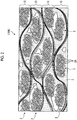
- a ceramic matrix composite 100 is formed in a thin plate shape as an example by laying-up a plurality of fiber layers 10.
- the ceramic matrix composite 100 has a plurality of fiber layers 10 disposed in an overlapped manner.
- a boundary line is indicated between the plurality of fiber layers 10 for convenience.
- a shape of the ceramic matrix composite 100 is not limited to the plate shape shown in Fig. 1 , and the ceramic matrix composite 100 can have various shapes.
- the ceramic matrix composite 100 may be abbreviated as CMC.
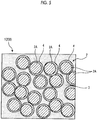
- the fiber layer 10 includes a woven fabric 1 and a matrix 3.
- Fig. 2 schematically shows a configuration of the fiber layer 10.
- the woven fabric 1 is a fabric formed by weaving a plurality of fiber bundles 2.
- the fiber bundle 2 according to the present embodiment is a bundle of several hundred to several thousands of fibers 2A that are composed mainly of oxides such as alumina and mullite.
- the woven fabric 1 can be formed by applying plain weave or satin weave to such a fiber bundle 2.
- the woven fabric 1 can also be formed as a non-woven fabric using the fiber bundle 2.
- the matrix 3 is disposed in a gap formed between a plurality of fiber bundles 2 or in a gap formed between fibers 2A.
- the matrix 3 reinforces the fiber bundle 2 by infiltrating the fiber bundle 2.
- the matrix 3 is composed mainly of oxides such as alumina and mullite.
- the manufacturing method for the ceramic matrix composite 100 includes a green body formation step S1 and a densification step S2.
- the green body formation step S1 the woven fabric 1 is infiltrated with a polymer as a precursor of the matrix 3.
- the densification step S2 a density of the matrix 3 is increased by further infiltrating the woven fabric 1 with the polymer.
- the green body formation step S1 includes a cutting step S11, a first infiltration step S12, a lay-up step S13, and a temporary sintering step S14.
- the first infiltration step S12 and the lay-up step S13 may be repeated a plurality of times.
- the cutting step S11 the woven fabric 1 is cut into a predetermined desired shape and dimension.
- the cut woven fabric 1 is infiltrated with the polymer as a precursor of the matrix 3.
- the polymer as the precursor is pyrolyzed into the matrix 3 in the temporary sintering step S14 to be described later.
- the woven fabric 1 is immersed in a slurry containing powders of the polymer, so that a part of the woven fabric 1 is infiltrated with the polymer.
- a plurality of green bodies are layed-up until a desired thickness is obtained.
- pseudo-isotropy can also be imparted to the layed-up green bodies by changing an orientation of the fibers for each layer. Specifically, in a case of laying-up n layers of green bodies, pseudo-isotropy can be realized by changing the orientation of the fibers at each layer by (360/n)°.
- the temporary sintering step S14 the layed-up green bodies are calcined. In this way, the green body formation step S1 is completed.
- the woven fabric 1 which is at a calcined state in the temporary sintering step S14 is hereinafter referred to as a "green body".
- a density of the green body obtained in the green body formation step S1 is increased by carrying out the densification step S2.
- the densification step S2 includes a second infiltration step S21 (infiltration step), a drying step S22, a steam treatment step S23, a first determination step S24, a sintering step S25, and a second determination step S26.
- the second infiltration step S21, the drying step S22, the steam treatment step S23, the first determination step S24, the sintering step S25, and the second determination step S26 are carried out in this order.
- some steps can be repeatedly carried out.
- the green body is further infiltrated with the polymer as the precursor of the matrix 3.
- the matrix 3 is disposed only in a part of a gap between the fiber bundles 2. In other words, at this stage, a density of the green body, that is, a filling rate of the matrix 3 is not sufficiently increased, and there is room for further forming the matrix 3. Therefore, by carrying out the second infiltration step S21, the layed-up green bodies are further infiltrated with the polymer as the precursor of the matrix 3. In the second infiltration step S21, an infiltrated green body is formed.
- the drying step S22 is carried out.
- the green body which has been further infiltrated with the polymer in the second infiltration step S21 contains a large amount of solvent and moisture of the slurry used for infiltration.
- the solvent is volatilized and the moisture is vaporized. As a result, a dried green body is formed. A volume of the dried green body becomes smaller than a volume of the infiltrated green body.
- the steam treatment step S23 is carried out.
- the dried green body is left under a saturation water vapor pressure.
- the dried green body is hermetically sealed in a treatment container.
- a temperature in the treatment container is desirably 30°C to 200°C. More desirably, the temperature in the treatment container is 80°C to 150°C, and most desirably 100°C to 130°C.
- a time during which the steam treatment step S23 is carried out is appropriately selected from several minutes to several hours, and a nominal value is about 1 hour.
- the steam treatment step S23 a part of the polymer (that is, the polymer as the precursor of the matrix 3) contained in the dried green body is hydrolyzed. Specifically, a chemical reaction as shown in Fig. 4 occurs in the polymer by carrying out the steam treatment step S23.
- "L" represents a predetermined leaving group.
- the steam treatment step S23 by carrying out the steam treatment step S23, the L group in the polymer is replaced with an OH group.
- a treated green body is formed.
- the first determination step S24 is carried out. In the first determination step S24, it is determined whether or not the steam treatment is sufficiently progressing in the above-mentioned treated green body. In a case where it is determined that the steam treatment is sufficiently performed in the first determination step S24, the process proceeds to the subsequent sintering step S25. On the other hand, in a case where it is determined that the steam treatment is not sufficiently performed, the second infiltration step S21, the drying step S22, and the steam treatment step S23 are carried out again. That is, the second infiltration step S21, the drying step S22, and the steam treatment step S23 are repeated until it is determined that the steam treatment is sufficiently performed in the first determination step S24.
- determination is made in the first determination step S24.
- the number of repetitions of the second infiltration step S21, the drying step S22, and the steam treatment step S23 which allows sufficient steam treatment may be determined in advance by experiments or the like, and the determined number of times may be repeated.
- the treated green body is calcined.
- a chemical reaction occurs between the woven fabric 1 and the polymer as the precursor as described above. Due to this chemical reaction, the polymer becomes the matrix 3 and becomes a state of being infiltration-chemically bonded to the fiber bundle 2 of the woven fabric 1.
- an OH group contained in the polymer becomes an oxo group (O group) by a dehydration reaction, and the polymer as a precursor becomes the matrix 3. Therefore, in the polymers after the sintering step S25, intermolecular condensation occurs between adjacent oxo groups. Furthermore, in the polymer, intramolecular condensation due to the oxo groups also occurs. As a result, three-dimensional networking of a matrix structure progresses and strength can be improved.
- the second determination step S26 is carried out.
- the second determination step S26 it is determined whether or not the above-mentioned calcined green body is sufficiently densified.
- the second determination step S26 in a case where it is determined that densification is sufficiently performed, it is determined that a CMC having desired characteristics is completed.
- the second infiltration step S21, the drying step S22, the steam treatment step S23, and the sintering step S25 are carried out again.
- the second infiltration step S21, the drying step S22, the steam treatment step S23, the first determination step S24, and the sintering step S25 are repeated until it is determined that densification is sufficiently performed in the second determination step S26.
- determination is made in the second determination step S26.
- the number of repetitions of the second infiltration step S21, the drying step S22, the steam treatment step S23, the first determination step S24, and the sintering step S25 which allows sufficient densification may be determined in advance by experiments or the like, and the determined number of times may be repeated. In this way, the entire steps of the manufacturing method for the ceramic matrix composite 100 are completed.
- the manufacturing method of the ceramic matrix composite 100 according to the present embodiment by carrying out the steam treatment step S23, it is possible to increase infiltration efficiency of the polymer with respect to the green body. That is, it is possible to obtain the ceramic matrix composite 100 having desired characteristics without carrying out the subsequent sintering step S25 many times. Therefore, it is possible to avoid decreased strength due to heat and prolonged manufacturing time, which are caused in a case where the sintering step S25 is repeated.
- the steam treatment step S23 is carried out under a saturation water vapor at 30°C to 200°C. Since treatment can be carried out at a relatively low temperature in this manner, infiltration efficiency of the polymer with respect to the green body can be increased without using a large-scale facility.
- the second infiltration step S21, the drying step S22, and the steam treatment step S23 are repeatedly carried out.
- the steps may be carried out only once.
- the second infiltration step S21, the drying step S22, the steam treatment step S23, the first determination step S24, and the sintering step S25 are repeatedly carried out.
- the steps may be carried out only once.
- the ceramic matrix composite 200 according to the present embodiment is different from the first embodiment in that an interface coating 4 is provided on peripheries of a fiber bundle 2 of the woven fabric 1, and fibers 2A.
- the interface coating 4 has a carbon-based composition such as CNO.
- the woven fabric 1 is heated under a nitrogen atmosphere. As a result, a chemical reaction occurs in a polyurethane-based polymer as a sizing agent which has adhered, from the beginning, on the fiber bundle 2 and the fibers 2A.
- the carbon-based interface coating 4 as described above is obtained.
- the interface coating 4 By causing the interface coating 4 to be formed, a reaction between the fiber bundle 2 and the fibers 2A, and a matrix 3 is suppressed, and strength characteristics (for example, strength and toughness) of a CMC which is a final product can be further increased.
- a manufacturing method for the ceramic matrix composite 200 according to the present embodiment will be described.
- the present embodiment is different from the first embodiment in that a green body formation step S1 further includes an interface coating formation step S12. Specifically, the interface coating formation step S12 is carried out after the cutting step S11 and before the first infiltration step S13.
- a cut woven fabric 1 is heated under a nitrogen atmosphere.
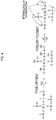
- the sizing agent can be modified to form the carbon-based interface coating 4. Specifically, as shown in Fig. 7 , in a case where polyurethane is used as the sizing agent, CNO as the interface coating 4 is generated through synthesis and pyrolysis of polyurethane.
- the sizing agent it is possible to use at least one selected from the group consisting of polyurethane, epoxy resin, polybutadiene, polyalkylene glycol, polyolefin resin, vinyl ester resin, saturated polyester resin, unsaturated polyester resin, polyamide resin, polyimide resin, polyamideimide resin, acrylic resin, polypropylene resin, and pitch-based resin.
- the interface coating 4 can be easily formed only by being heated under a nitrogen atmosphere.
- the interface coating formation step S12 by carrying out the interface coating formation step S12, it is possible to form the interface coating 4 on a periphery of the fiber bundle 2 without removing the sizing agent. As a result, it is possible to form an interface in the interface coating formation step S12 without removing a material which has adhered as the sizing agent on a periphery of the fiber bundle 2 of the woven fabric 1 so as to form the interface. As a result, it is possible to obtain a CMC having the interface coating 4 without making steps complicated and prolonged. In addition, since there is no need to separately prepare materials for forming the interface coating 4, cost reduction can be achieved.
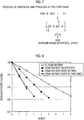
- Fig. 8 is a graph showing a relationship between presence or absence of the steam treatment step S23 described in the first embodiment and the number of repetitions of the densification step S2, and porosity of the matrix 3.
- a horizontal axis of the graph represents the number of repetitions of the sintering step S25.
- a vertical axis of the graph represents a value of porosity in a case where porosity of the initial matrix 3 is set as 1. That is, a lower value of porosity indicates that an infiltration rate of the matrix 3 is higher and densification is progressing.
- the porosity is important for decreased strength in fibers, cost reduction, and shortened working period. That is, in the present embodiment, by repeatedly carrying out the steam treatment step S23, decreased number of sintering steps S25 and low porosity can be realized.
Landscapes
- Chemical & Material Sciences (AREA)
- Engineering & Computer Science (AREA)
- Ceramic Engineering (AREA)
- Chemical Kinetics & Catalysis (AREA)
- Manufacturing & Machinery (AREA)
- Materials Engineering (AREA)
- Structural Engineering (AREA)
- Organic Chemistry (AREA)
- Textile Engineering (AREA)
- Reinforced Plastic Materials (AREA)
- Treatments For Attaching Organic Compounds To Fibrous Goods (AREA)
- Woven Fabrics (AREA)
Claims (5)
- Verfahren zur Herstellung eines keramischen Faserverbundwerkstoffes, welcher ein Gewebe mit einer Vielzahl von Faserbündeln und eine in einem Spalt zwischen den Faserbündeln angeordnete Matrix aufweist, wobei das Verfahren umfasst:einen Grünkörperbildungsschritt in Form des Ausbildens eines Grünkörpers durch Infiltrieren des Gewebes mit einem Polymer als Vorläufer der Matrix sowie Sintern; undeinen Verdichtungsschritt in Form des weiteren Infiltrierens des Grünkörpers mit dem Polymer sowie Sinterns,wobei der Verdichtungsschritt umfasst:einen Infiltrationsschritt in Form des weiteren Infiltrierens des Grünkörpers mit dem Polymer, um einen infiltrierten Grünkörper auszubilden,einen Trocknungsschritt in Form des Trocknens des infiltrierten Grünkörpers, um einen getrockneten Grünkörper auszubilden,einen Dampfbehandlungsschritt in Form des Belassens des getrockneten Grünkörpers unter gesättigtem Wasserdampfdruck, um einen behandelten Grünkörper auszubilden, undeinen Sinterschritt in Form des Sinterns des behandelten Grünkörpers.
- Verfahren zur Herstellung eines keramischen Faserverbundwerkstoffes gemäß Anspruch 1,wobei nach dem Dampfbehandlungsschritt der Infiltrationsschritt, der Trocknungsschritt und der Dampfbehandlungsschritt wiederholt werden, undwobei der behandelte Grünkörper, bei welchem der Infiltrationsschritt, der Trocknungsschritt und der Dampfbehandlungsschritt mehrfach wiederholt worden sind, im Rahmen des Sinterschritts kalziniert wird.
- Verfahren zur Herstellung eines keramischen Faserverbundwerkstoffes gemäß Anspruch 1 oder 2, wobei der Dampfbehandlungsschritt unter gesättigtem Wasserdampf bei 30°C bis 200°C durchgeführt wird.
- Verfahren zur Herstellung eines keramischen Faserverbundwerkstoffes gemäß einem der Ansprüche 1 bis 3,wobei das Gewebe ein Schlichtemittel aufweist, welches einen Randbereich des Faserbündels bedeckt, undwobei das Verfahren vor dem Grünkörperbildungsschritt weiterhin einen Grenzflächenbeschichtungsbildungsschritt in Form des Ausbildens einer Grenzflächenbeschichtung auf dem Faserbündel durch Erwärmen des Gewebes unter Stickstoffatmosphäre umfasst, um das Schlichtemittel zu modifizieren.
- Verfahren zur Herstellung eines keramischen Faserverbundwerkstoffes gemäß Anspruch 4, wobei es sich bei dem Schlichtemittel um zumindest eines ausgewählt aus der Gruppe bestehend aus Polyurethan, Epoxidharz, modifiziertem Epoxidharz, Phenolharz, Polyimidharz und Polyamidharz handelt.
Applications Claiming Priority (2)
| Application Number | Priority Date | Filing Date | Title |
|---|---|---|---|
| JP2016237869A JP6302534B1 (ja) | 2016-12-07 | 2016-12-07 | セラミックス基複合材料の製造方法 |
| PCT/JP2017/043885 WO2018105670A1 (ja) | 2016-12-07 | 2017-12-06 | セラミックス基複合材料の製造方法 |
Publications (3)
| Publication Number | Publication Date |
|---|---|
| EP3553042A1 EP3553042A1 (de) | 2019-10-16 |
| EP3553042A4 EP3553042A4 (de) | 2020-07-29 |
| EP3553042B1 true EP3553042B1 (de) | 2021-10-20 |
Family
ID=61756664
Family Applications (1)
| Application Number | Title | Priority Date | Filing Date |
|---|---|---|---|
| EP17878645.5A Active EP3553042B1 (de) | 2016-12-07 | 2017-12-06 | Verfahren zur herstellung eines verbundstoffes auf keramikbasis |
Country Status (5)
| Country | Link |
|---|---|
| US (1) | US11447424B2 (de) |
| EP (1) | EP3553042B1 (de) |
| JP (1) | JP6302534B1 (de) |
| CA (1) | CA3028962C (de) |
| WO (1) | WO2018105670A1 (de) |
Families Citing this family (5)
| Publication number | Priority date | Publication date | Assignee | Title |
|---|---|---|---|---|
| JP6774863B2 (ja) * | 2016-12-08 | 2020-10-28 | 三菱重工航空エンジン株式会社 | セラミックス基複合材料の製造方法 |
| JP7202864B2 (ja) * | 2018-11-30 | 2023-01-12 | 三菱重工航空エンジン株式会社 | セラミックス基複合材料の製造方法 |
| JP7187369B2 (ja) | 2019-03-25 | 2022-12-12 | 三菱重工航空エンジン株式会社 | セラミックス基複合材料の製造方法 |
| JP7372448B2 (ja) * | 2020-03-27 | 2023-10-31 | 東ソー株式会社 | セラミックスマトリックス複合材料及びその製造方法 |
| US20260209131A1 (en) * | 2025-01-23 | 2026-07-23 | Rtx Corporation | Reaction controlled melt-infiltrated fabrication of ceramic matrix composites |
Family Cites Families (11)
| Publication number | Priority date | Publication date | Assignee | Title |
|---|---|---|---|---|
| WO1988002741A1 (fr) * | 1986-10-14 | 1988-04-21 | Nicolas Davidovits | Materiau composite ceramique-ceramique et procede d'obtention |
| US6020063A (en) * | 1997-07-31 | 2000-02-01 | Virginia Tech Intellectual Properties, Inc. | Composites of thermosetting resins and carbon fibers having polyhydroxyether sizings |
| JP4470708B2 (ja) * | 2004-11-22 | 2010-06-02 | 宇部興産株式会社 | 複合材料およびその製造方法 |
| US8859037B2 (en) * | 2005-01-12 | 2014-10-14 | The Boeing Company | Method for manufacturing ceramic matrix composite structures |
| JP2006265080A (ja) * | 2005-03-25 | 2006-10-05 | Ishikawajima Harima Heavy Ind Co Ltd | セラミックス複合材とその製造方法 |
| US20100081556A1 (en) | 2005-05-23 | 2010-04-01 | Vann Heng | Oxide-based ceramic matrix composites |
| US7897170B2 (en) * | 2006-08-25 | 2011-03-01 | Boston Scientific Scimed, Inc. | Medical devices having improved mechanical performance |
| JP5424824B2 (ja) * | 2009-11-11 | 2014-02-26 | 三菱レイヨン株式会社 | 炭素繊維前駆体アクリル繊維及びその製造方法 |
| US20120123053A1 (en) * | 2010-11-16 | 2012-05-17 | Makoto Kibayashi | Carbon fiber |
| MX354905B (es) * | 2012-10-01 | 2018-03-22 | Univ Rutgers | Precursores y metodos de transporte para la sinterizacion hidrotermica en fase liquida. |
| JP2016188439A (ja) * | 2015-03-30 | 2016-11-04 | 宇部興産株式会社 | 結晶性炭化ケイ素系セラミックス繊維及びその製造方法 |
-
2016
- 2016-12-07 JP JP2016237869A patent/JP6302534B1/ja active Active
-
2017
- 2017-12-06 WO PCT/JP2017/043885 patent/WO2018105670A1/ja not_active Ceased
- 2017-12-06 CA CA3028962A patent/CA3028962C/en active Active
- 2017-12-06 EP EP17878645.5A patent/EP3553042B1/de active Active
- 2017-12-06 US US16/313,108 patent/US11447424B2/en active Active
Also Published As
| Publication number | Publication date |
|---|---|
| WO2018105670A1 (ja) | 2018-06-14 |
| EP3553042A1 (de) | 2019-10-16 |
| JP6302534B1 (ja) | 2018-03-28 |
| EP3553042A4 (de) | 2020-07-29 |
| US20190225551A1 (en) | 2019-07-25 |
| CA3028962C (en) | 2020-06-16 |
| CA3028962A1 (en) | 2018-06-14 |
| JP2018090467A (ja) | 2018-06-14 |
| US11447424B2 (en) | 2022-09-20 |
Similar Documents
| Publication | Publication Date | Title |
|---|---|---|
| CA3028962C (en) | Manufacturing method for ceramic matrix composite | |
| US8221836B2 (en) | Method of fabricating a thermostructural composite material part, and a part obtained thereby | |
| JP6774863B2 (ja) | セラミックス基複合材料の製造方法 | |
| CN104955643B (zh) | 制造弯曲陶瓷声衰减板的方法 | |
| CN102099313B (zh) | 由复合材料制成的喷嘴或扩张喷嘴元件的制造方法 | |
| JP5628193B2 (ja) | Cmc材料から製造した部品の表面を平滑にする方法 | |
| CA2778383C (en) | Low-thickness thermostructural composite material part, and manufacture method | |
| CN101636367B (zh) | 制造热结构复合材料部件的方法 | |
| US20170159459A1 (en) | Part coated with a surface coating and associated methods | |
| US10041196B2 (en) | Fibrous structure with grouping of floats | |
| EP3046892B1 (de) | Methode zum verdichten eines cmc-artikels | |
| CN110372390A (zh) | 基于増材制造的连续纤维增强SiC零件制备方法及产品 | |
| JP2012504091A (ja) | 耐熱構造複合材料でつくられる部品の製造方法 | |
| JP2016511733A (ja) | セラミック複合マトリックス材料を接合した集成体およびその製法 | |
| JP7202864B2 (ja) | セラミックス基複合材料の製造方法 | |
| US20150082589A1 (en) | Method of fabricating a composite material part with improved intra-yarn densification |
Legal Events
| Date | Code | Title | Description |
|---|---|---|---|
| STAA | Information on the status of an ep patent application or granted ep patent |
Free format text: STATUS: THE INTERNATIONAL PUBLICATION HAS BEEN MADE |
|
| PUAI | Public reference made under article 153(3) epc to a published international application that has entered the european phase |
Free format text: ORIGINAL CODE: 0009012 |
|
| STAA | Information on the status of an ep patent application or granted ep patent |
Free format text: STATUS: REQUEST FOR EXAMINATION WAS MADE |
|
| 17P | Request for examination filed |
Effective date: 20181221 |
|
| AK | Designated contracting states |
Kind code of ref document: A1 Designated state(s): AL AT BE BG CH CY CZ DE DK EE ES FI FR GB GR HR HU IE IS IT LI LT LU LV MC MK MT NL NO PL PT RO RS SE SI SK SM TR |
|
| AX | Request for extension of the european patent |
Extension state: BA ME |
|
| DAV | Request for validation of the european patent (deleted) | ||
| DAX | Request for extension of the european patent (deleted) | ||
| A4 | Supplementary search report drawn up and despatched |
Effective date: 20200625 |
|
| RIC1 | Information provided on ipc code assigned before grant |
Ipc: D06M 15/59 20060101ALI20200619BHEP Ipc: D06M 15/41 20060101ALI20200619BHEP Ipc: D06M 15/564 20060101ALI20200619BHEP Ipc: C04B 35/80 20060101AFI20200619BHEP Ipc: D06M 15/55 20060101ALI20200619BHEP |
|
| GRAP | Despatch of communication of intention to grant a patent |
Free format text: ORIGINAL CODE: EPIDOSNIGR1 |
|
| STAA | Information on the status of an ep patent application or granted ep patent |
Free format text: STATUS: GRANT OF PATENT IS INTENDED |
|
| INTG | Intention to grant announced |
Effective date: 20210429 |
|
| GRAS | Grant fee paid |
Free format text: ORIGINAL CODE: EPIDOSNIGR3 |
|
| GRAA | (expected) grant |
Free format text: ORIGINAL CODE: 0009210 |
|
| STAA | Information on the status of an ep patent application or granted ep patent |
Free format text: STATUS: THE PATENT HAS BEEN GRANTED |
|
| AK | Designated contracting states |
Kind code of ref document: B1 Designated state(s): AL AT BE BG CH CY CZ DE DK EE ES FI FR GB GR HR HU IE IS IT LI LT LU LV MC MK MT NL NO PL PT RO RS SE SI SK SM TR |
|
| REG | Reference to a national code |
Ref country code: GB Ref legal event code: FG4D |
|
| REG | Reference to a national code |
Ref country code: CH Ref legal event code: EP |
|
| REG | Reference to a national code |
Ref country code: DE Ref legal event code: R096 Ref document number: 602017048073 Country of ref document: DE |
|
| REG | Reference to a national code |
Ref country code: IE Ref legal event code: FG4D |
|
| REG | Reference to a national code |
Ref country code: AT Ref legal event code: REF Ref document number: 1439829 Country of ref document: AT Kind code of ref document: T Effective date: 20211115 |
|
| REG | Reference to a national code |
Ref country code: LT Ref legal event code: MG9D |
|
| REG | Reference to a national code |
Ref country code: NL Ref legal event code: MP Effective date: 20211020 |
|
| REG | Reference to a national code |
Ref country code: AT Ref legal event code: MK05 Ref document number: 1439829 Country of ref document: AT Kind code of ref document: T Effective date: 20211020 |
|
| PG25 | Lapsed in a contracting state [announced via postgrant information from national office to epo] |
Ref country code: RS Free format text: LAPSE BECAUSE OF FAILURE TO SUBMIT A TRANSLATION OF THE DESCRIPTION OR TO PAY THE FEE WITHIN THE PRESCRIBED TIME-LIMIT Effective date: 20211020 Ref country code: LT Free format text: LAPSE BECAUSE OF FAILURE TO SUBMIT A TRANSLATION OF THE DESCRIPTION OR TO PAY THE FEE WITHIN THE PRESCRIBED TIME-LIMIT Effective date: 20211020 Ref country code: FI Free format text: LAPSE BECAUSE OF FAILURE TO SUBMIT A TRANSLATION OF THE DESCRIPTION OR TO PAY THE FEE WITHIN THE PRESCRIBED TIME-LIMIT Effective date: 20211020 Ref country code: BG Free format text: LAPSE BECAUSE OF FAILURE TO SUBMIT A TRANSLATION OF THE DESCRIPTION OR TO PAY THE FEE WITHIN THE PRESCRIBED TIME-LIMIT Effective date: 20220120 Ref country code: AT Free format text: LAPSE BECAUSE OF FAILURE TO SUBMIT A TRANSLATION OF THE DESCRIPTION OR TO PAY THE FEE WITHIN THE PRESCRIBED TIME-LIMIT Effective date: 20211020 |
|
| PG25 | Lapsed in a contracting state [announced via postgrant information from national office to epo] |
Ref country code: IS Free format text: LAPSE BECAUSE OF FAILURE TO SUBMIT A TRANSLATION OF THE DESCRIPTION OR TO PAY THE FEE WITHIN THE PRESCRIBED TIME-LIMIT Effective date: 20220220 Ref country code: SE Free format text: LAPSE BECAUSE OF FAILURE TO SUBMIT A TRANSLATION OF THE DESCRIPTION OR TO PAY THE FEE WITHIN THE PRESCRIBED TIME-LIMIT Effective date: 20211020 Ref country code: PT Free format text: LAPSE BECAUSE OF FAILURE TO SUBMIT A TRANSLATION OF THE DESCRIPTION OR TO PAY THE FEE WITHIN THE PRESCRIBED TIME-LIMIT Effective date: 20220221 Ref country code: PL Free format text: LAPSE BECAUSE OF FAILURE TO SUBMIT A TRANSLATION OF THE DESCRIPTION OR TO PAY THE FEE WITHIN THE PRESCRIBED TIME-LIMIT Effective date: 20211020 Ref country code: NO Free format text: LAPSE BECAUSE OF FAILURE TO SUBMIT A TRANSLATION OF THE DESCRIPTION OR TO PAY THE FEE WITHIN THE PRESCRIBED TIME-LIMIT Effective date: 20220120 Ref country code: NL Free format text: LAPSE BECAUSE OF FAILURE TO SUBMIT A TRANSLATION OF THE DESCRIPTION OR TO PAY THE FEE WITHIN THE PRESCRIBED TIME-LIMIT Effective date: 20211020 Ref country code: LV Free format text: LAPSE BECAUSE OF FAILURE TO SUBMIT A TRANSLATION OF THE DESCRIPTION OR TO PAY THE FEE WITHIN THE PRESCRIBED TIME-LIMIT Effective date: 20211020 Ref country code: HR Free format text: LAPSE BECAUSE OF FAILURE TO SUBMIT A TRANSLATION OF THE DESCRIPTION OR TO PAY THE FEE WITHIN THE PRESCRIBED TIME-LIMIT Effective date: 20211020 Ref country code: GR Free format text: LAPSE BECAUSE OF FAILURE TO SUBMIT A TRANSLATION OF THE DESCRIPTION OR TO PAY THE FEE WITHIN THE PRESCRIBED TIME-LIMIT Effective date: 20220121 Ref country code: ES Free format text: LAPSE BECAUSE OF FAILURE TO SUBMIT A TRANSLATION OF THE DESCRIPTION OR TO PAY THE FEE WITHIN THE PRESCRIBED TIME-LIMIT Effective date: 20211020 |
|
| REG | Reference to a national code |
Ref country code: DE Ref legal event code: R097 Ref document number: 602017048073 Country of ref document: DE |
|
| PG25 | Lapsed in a contracting state [announced via postgrant information from national office to epo] |
Ref country code: SM Free format text: LAPSE BECAUSE OF FAILURE TO SUBMIT A TRANSLATION OF THE DESCRIPTION OR TO PAY THE FEE WITHIN THE PRESCRIBED TIME-LIMIT Effective date: 20211020 Ref country code: SK Free format text: LAPSE BECAUSE OF FAILURE TO SUBMIT A TRANSLATION OF THE DESCRIPTION OR TO PAY THE FEE WITHIN THE PRESCRIBED TIME-LIMIT Effective date: 20211020 Ref country code: RO Free format text: LAPSE BECAUSE OF FAILURE TO SUBMIT A TRANSLATION OF THE DESCRIPTION OR TO PAY THE FEE WITHIN THE PRESCRIBED TIME-LIMIT Effective date: 20211020 Ref country code: MC Free format text: LAPSE BECAUSE OF FAILURE TO SUBMIT A TRANSLATION OF THE DESCRIPTION OR TO PAY THE FEE WITHIN THE PRESCRIBED TIME-LIMIT Effective date: 20211020 Ref country code: EE Free format text: LAPSE BECAUSE OF FAILURE TO SUBMIT A TRANSLATION OF THE DESCRIPTION OR TO PAY THE FEE WITHIN THE PRESCRIBED TIME-LIMIT Effective date: 20211020 Ref country code: DK Free format text: LAPSE BECAUSE OF FAILURE TO SUBMIT A TRANSLATION OF THE DESCRIPTION OR TO PAY THE FEE WITHIN THE PRESCRIBED TIME-LIMIT Effective date: 20211020 Ref country code: CZ Free format text: LAPSE BECAUSE OF FAILURE TO SUBMIT A TRANSLATION OF THE DESCRIPTION OR TO PAY THE FEE WITHIN THE PRESCRIBED TIME-LIMIT Effective date: 20211020 |
|
| REG | Reference to a national code |
Ref country code: CH Ref legal event code: PL |
|
| PLBE | No opposition filed within time limit |
Free format text: ORIGINAL CODE: 0009261 |
|
| STAA | Information on the status of an ep patent application or granted ep patent |
Free format text: STATUS: NO OPPOSITION FILED WITHIN TIME LIMIT |
|
| REG | Reference to a national code |
Ref country code: BE Ref legal event code: MM Effective date: 20211231 |
|
| 26N | No opposition filed |
Effective date: 20220721 |
|
| PG25 | Lapsed in a contracting state [announced via postgrant information from national office to epo] |
Ref country code: LU Free format text: LAPSE BECAUSE OF NON-PAYMENT OF DUE FEES Effective date: 20211206 Ref country code: IE Free format text: LAPSE BECAUSE OF NON-PAYMENT OF DUE FEES Effective date: 20211206 Ref country code: AL Free format text: LAPSE BECAUSE OF FAILURE TO SUBMIT A TRANSLATION OF THE DESCRIPTION OR TO PAY THE FEE WITHIN THE PRESCRIBED TIME-LIMIT Effective date: 20211020 |
|
| PG25 | Lapsed in a contracting state [announced via postgrant information from national office to epo] |
Ref country code: SI Free format text: LAPSE BECAUSE OF FAILURE TO SUBMIT A TRANSLATION OF THE DESCRIPTION OR TO PAY THE FEE WITHIN THE PRESCRIBED TIME-LIMIT Effective date: 20211020 Ref country code: BE Free format text: LAPSE BECAUSE OF NON-PAYMENT OF DUE FEES Effective date: 20211231 |
|
| PG25 | Lapsed in a contracting state [announced via postgrant information from national office to epo] |
Ref country code: LI Free format text: LAPSE BECAUSE OF NON-PAYMENT OF DUE FEES Effective date: 20211231 Ref country code: CH Free format text: LAPSE BECAUSE OF NON-PAYMENT OF DUE FEES Effective date: 20211231 |
|
| PG25 | Lapsed in a contracting state [announced via postgrant information from national office to epo] |
Ref country code: IT Free format text: LAPSE BECAUSE OF FAILURE TO SUBMIT A TRANSLATION OF THE DESCRIPTION OR TO PAY THE FEE WITHIN THE PRESCRIBED TIME-LIMIT Effective date: 20211020 |
|
| PG25 | Lapsed in a contracting state [announced via postgrant information from national office to epo] |
Ref country code: CY Free format text: LAPSE BECAUSE OF FAILURE TO SUBMIT A TRANSLATION OF THE DESCRIPTION OR TO PAY THE FEE WITHIN THE PRESCRIBED TIME-LIMIT Effective date: 20211020 |
|
| PG25 | Lapsed in a contracting state [announced via postgrant information from national office to epo] |
Ref country code: HU Free format text: LAPSE BECAUSE OF FAILURE TO SUBMIT A TRANSLATION OF THE DESCRIPTION OR TO PAY THE FEE WITHIN THE PRESCRIBED TIME-LIMIT; INVALID AB INITIO Effective date: 20171206 |
|
| PG25 | Lapsed in a contracting state [announced via postgrant information from national office to epo] |
Ref country code: MK Free format text: LAPSE BECAUSE OF FAILURE TO SUBMIT A TRANSLATION OF THE DESCRIPTION OR TO PAY THE FEE WITHIN THE PRESCRIBED TIME-LIMIT Effective date: 20211020 |
|
| PG25 | Lapsed in a contracting state [announced via postgrant information from national office to epo] |
Ref country code: MT Free format text: LAPSE BECAUSE OF FAILURE TO SUBMIT A TRANSLATION OF THE DESCRIPTION OR TO PAY THE FEE WITHIN THE PRESCRIBED TIME-LIMIT Effective date: 20211020 |
|
| PG25 | Lapsed in a contracting state [announced via postgrant information from national office to epo] |
Ref country code: TR Free format text: LAPSE BECAUSE OF FAILURE TO SUBMIT A TRANSLATION OF THE DESCRIPTION OR TO PAY THE FEE WITHIN THE PRESCRIBED TIME-LIMIT Effective date: 20211020 |
|
| PGFP | Annual fee paid to national office [announced via postgrant information from national office to epo] |
Ref country code: DE Payment date: 20251028 Year of fee payment: 9 |
|
| PGFP | Annual fee paid to national office [announced via postgrant information from national office to epo] |
Ref country code: GB Payment date: 20251030 Year of fee payment: 9 |
|
| PGFP | Annual fee paid to national office [announced via postgrant information from national office to epo] |
Ref country code: FR Payment date: 20251110 Year of fee payment: 9 |