EP3544892B1 - Schiffssegel aus gelenkigen paneelen und schiff damit - Google Patents
Schiffssegel aus gelenkigen paneelen und schiff damit Download PDFInfo
- Publication number
- EP3544892B1 EP3544892B1 EP17797968.9A EP17797968A EP3544892B1 EP 3544892 B1 EP3544892 B1 EP 3544892B1 EP 17797968 A EP17797968 A EP 17797968A EP 3544892 B1 EP3544892 B1 EP 3544892B1
- Authority
- EP
- European Patent Office
- Prior art keywords
- panel
- sail
- dolly
- reinforcing elements
- panels
- Prior art date
- Legal status (The legal status is an assumption and is not a legal conclusion. Google has not performed a legal analysis and makes no representation as to the accuracy of the status listed.)
- Active
Links
Images




Classifications
-
- B—PERFORMING OPERATIONS; TRANSPORTING
- B63—SHIPS OR OTHER WATERBORNE VESSELS; RELATED EQUIPMENT
- B63H—MARINE PROPULSION OR STEERING
- B63H9/00—Marine propulsion provided directly by wind power
- B63H9/04—Marine propulsion provided directly by wind power using sails or like wind-catching surfaces
- B63H9/06—Types of sail; Constructional features of sails; Arrangements thereof on vessels
- B63H9/061—Rigid sails; Aerofoil sails
-
- B—PERFORMING OPERATIONS; TRANSPORTING
- B63—SHIPS OR OTHER WATERBORNE VESSELS; RELATED EQUIPMENT
- B63H—MARINE PROPULSION OR STEERING
- B63H9/00—Marine propulsion provided directly by wind power
- B63H9/04—Marine propulsion provided directly by wind power using sails or like wind-catching surfaces
- B63H9/08—Connections of sails to masts, spars, or the like
- B63H9/10—Running rigging, e.g. reefing equipment
- B63H9/1021—Reefing
-
- B—PERFORMING OPERATIONS; TRANSPORTING
- B63—SHIPS OR OTHER WATERBORNE VESSELS; RELATED EQUIPMENT
- B63H—MARINE PROPULSION OR STEERING
- B63H9/00—Marine propulsion provided directly by wind power
- B63H9/04—Marine propulsion provided directly by wind power using sails or like wind-catching surfaces
- B63H9/06—Types of sail; Constructional features of sails; Arrangements thereof on vessels
- B63H9/061—Rigid sails; Aerofoil sails
- B63H9/0621—Rigid sails comprising one or more pivotally supported panels
- B63H9/0635—Rigid sails comprising one or more pivotally supported panels the panels being pivotable about vertical axes
-
- B—PERFORMING OPERATIONS; TRANSPORTING
- B63—SHIPS OR OTHER WATERBORNE VESSELS; RELATED EQUIPMENT
- B63H—MARINE PROPULSION OR STEERING
- B63H9/00—Marine propulsion provided directly by wind power
- B63H9/04—Marine propulsion provided directly by wind power using sails or like wind-catching surfaces
- B63H9/08—Connections of sails to masts, spars, or the like
-
- B—PERFORMING OPERATIONS; TRANSPORTING
- B63—SHIPS OR OTHER WATERBORNE VESSELS; RELATED EQUIPMENT
- B63H—MARINE PROPULSION OR STEERING
- B63H9/00—Marine propulsion provided directly by wind power
- B63H9/04—Marine propulsion provided directly by wind power using sails or like wind-catching surfaces
- B63H9/08—Connections of sails to masts, spars, or the like
- B63H9/10—Running rigging, e.g. reefing equipment
- B63H9/1092—Means for stowing, or securing sails when not in use
-
- B—PERFORMING OPERATIONS; TRANSPORTING
- B63—SHIPS OR OTHER WATERBORNE VESSELS; RELATED EQUIPMENT
- B63H—MARINE PROPULSION OR STEERING
- B63H9/00—Marine propulsion provided directly by wind power
- B63H9/04—Marine propulsion provided directly by wind power using sails or like wind-catching surfaces
- B63H9/08—Connections of sails to masts, spars, or the like
- B63H2009/086—Connections of sails to masts, spars, or the like by sliders, i.e. by shoes sliding in, or guided by channels, tracks or rails; for connecting luffs, leeches, battens, or the like to masts, spars or booms
-
- B—PERFORMING OPERATIONS; TRANSPORTING
- B63—SHIPS OR OTHER WATERBORNE VESSELS; RELATED EQUIPMENT
- B63H—MARINE PROPULSION OR STEERING
- B63H9/00—Marine propulsion provided directly by wind power
- B63H9/04—Marine propulsion provided directly by wind power using sails or like wind-catching surfaces
- B63H9/06—Types of sail; Constructional features of sails; Arrangements thereof on vessels
- B63H9/061—Rigid sails; Aerofoil sails
- B63H9/0621—Rigid sails comprising one or more pivotally supported panels
- B63H9/0628—Rigid sails comprising one or more pivotally supported panels the panels being pivotable about horizontal axes
Definitions
- the present invention relates to a sail, in particular of large dimensions, as well as to a ship which is equipped with it.
- the present invention relates to the production of a sail suitable for the operation of a commercial or passenger ship, that is to say a sail capable of being used intensively (even on vessels with very high righting torque), whatever the meteorological conditions encountered, while maximizing the return on investment of the rigging and the sail.
- the first consists of the sails made of fabric in widths sewn and / or glued. This process is very expensive and finds a natural limit for making sails of large dimensions due to the own weight of the fabrics to be handled and the capacity of the sewing machines and to pierce large thicknesses of very resistant fabrics.
- Sails are also known made of fabric panels, panels mechanically assembled together by circular carbon slats (a process developed by the company Doyle Sails) and by a cable which runs along the leech of the sail (free side of the triangle formed by the edges of the sail, i.e. the side which is not intended to be attached to the mast or the boom).
- sails are known made by molding by assembling high-strength fibers using a resin or a flexible film, using a mold (3Di and 3DL processes from the company North Sails for example). This process is very expensive and essentially intended for competition and the field of "super yachts", ie luxury yachts.
- the object of the present invention is to fill this gap and to provide a sail which exhibits resistance to significant forces, the operation of which is substantially identical to current sails and which allows the positioning of the stack of panels of the sail to be more flexible on the sail. the deck of the ship.
- Another aspect of the invention relates to a ship which is equipped with a sail according to one or other of the preceding characteristics.
- each panel of the sail comprises, along its longitudinal edge closest to the luff and at least over part of the length of this longitudinal edge, a guide rail in which is arranged a sliding carriage, called panel carriage, the movement of this panel carriage being limited by the ends of said rail is characterized by the fact that said mast is provided with a sliding carriage called a "mast carriage”, which is shaped to slide along said mast, and that said panel carriage and mast carriage are articulated with respect to each other by means of a connecting and articulation part so that they are movable between a first position in which they extend substantially in the same plane when the sail is raised, and a second position in which they extend in substantially perpendicular planes when said sail is lowered.
- the idea at the base of the present invention is to separate, that is to say to decouple these two functions with a sail made up of panels linked together by a very limited number of mechanical links intended to transit, that is, that is to say to pass the forces between panels.
- Each panel is thus made of a reinforced membrane.
- the membrane can be made in particular of fabric, of a composite material or of metal.
- the reinforcements of the membrane extend essentially around the periphery of the panel and can be produced, for example, using high-resistance fibers, in composite material or in metal.
- the number and position of these reinforcements inside a panel can be adapted to the dimensions of the sail.
- connection pieces connecting the respective parallel or substantially parallel reinforcements of the luff and / or of the drop edge of two adjacent panels can be transmitted from one panel to another by means of connection pieces connecting the respective parallel or substantially parallel reinforcements of the luff and / or of the drop edge of two adjacent panels.
- This sail can be made possible by articulating the panels with respect to each other by means of the connection pieces.
- Each panel can be provided along its luff with a guide rail shaped to receive a sliding "double carriage” thus connecting said panel to a guide rail carried on the mast. Said carriage can thus move along the guide rail of the panel and the guide rail of the mast.
- the sail which is represented in the figure 1 is shown in hoisted position, in place on a mast 2 provided with a boom which equips the deck 3 of a ship 1.
- This vessel will no longer be represented in detail because it does not really constitute the heart of the invention.
- it can be an ocean liner, a freight vessel, a fishing vessel, a pleasure sailboat, a yacht, etc.
- the sail has the shape of a quadrilateral which is inscribed in a right triangle. More precisely, this sail has two longitudinal sides 40 and 41 which are respectively called in terms of the trade “luff” and “chute", a transverse side lower called “border” 42 attached to the boom, as well as an upper transverse side 43.
- the sail could be inscribed in a rectangle such as that defined by the dotted lines R, or in a right triangle such as that delimited by the mixed lines T, these lines being visible in the figure above.
- this sail consists of a set of panels 5.
- Sail 4 of the figure 1 is represented at the figure 2 in the collapsed position so that the different panels 5 which constitute it are superimposed alternately on top of each other in the lower position of the mast, in a "zigzag” or “accordion” arrangement.
- Each panel is formed from a material such as fabric, a composite material, a metal, or combinations of at least two of these materials.
- a particularly suitable material is that known under the trade name MYLAR and which consists of poly (ethylene terephthalate).
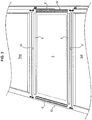
- These panels 5 comprise a plurality of reinforcing elements 6 and 6 ', each element 6 and 6' having the shape of an elongated strip.
- reinforcing elements 6 and 6 ' are preferably present on each of the two opposite faces of the panel 5, but it could however be envisaged that they are present only on one face.
- the first group consists of reinforcing elements 6 which extend parallel to and near the upper 50 and lower 51 transverse edges of the panel. These reinforcing elements are represented so schematic at the figure 3 but we must consider that these elements extend to the immediate vicinity of the longitudinal edges 52 and 53 of the panel 5.
- the second group of reinforcing elements consists of the elements 6 'which extend parallel to and near the longitudinal edges 52 and 53 of the panel 5.
- the reinforcing elements 6 'of the second group preferably extend to the immediate vicinity of the transverse edges 50 and 51 of the panel 5.
- these reinforcing elements can be integrated into the panel itself so as to constitute a one-piece assembly.
- the panel 5 has peripheral extra thicknesses materialized by the reinforcing elements 6 and 6 '.
- This type of panel is preferentially fitted to vessels subject to severe constraints such as commercial vessels, cruise ships and fishing vessels.
- reinforcing elements 6 and 6 'do not form a single unit with the panel 5 then these reinforcing elements 6 and 6' are attached to each panel 5, in particular by sewing, gluing, welding , mechanical assembly, etc.
- the reinforcing elements can be made of fabric, composite material, metal or combinations of at least two of these materials, a list to which can also be added high strength fibers such as those formed by carbon or aramid.
- reinforcing elements 6 ′ of the second group they absorb the longitudinal forces which are transmitted from top to bottom along the sail 4, as will be seen below.
- connection pieces are located in the extension of the reinforcing elements 6 'of the second group.
- the axis of transmission of the fall forces has been identified by the reference YY '.
- This axis corresponds to the longitudinal axis of the reinforcing elements 6 'which equip the panel 5 and the panel 5inf located immediately below.
- the 6 'reinforcing elements have not been materialized on the figures 4 and 5 for the sake of simplification.
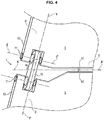
- connection piece 7 which is visible at the figure 4 comprises a link 70 which is located along the aforementioned axis Y-Y '.
- This axis forms with the transverse axis XX '(parallel to the transverse edges of the panels) of articulation of two panels, an angle ⁇ slightly greater than 90 °. The value of this angle is equal to that formed by the edge 42 of the leech 41 of the sail 4.
- the connecting rod 70 is articulated around two pivots 71 which are integrated in each of the panels 5, which pivots extend along an axis Z-Z 'perpendicular to the transmission axis Y-Y'.
- notches are made in these panels to accommodate the link 70 and its pivots 71, as shown in FIG. figure 4 .
- the angle ⁇ formed by the axis of transmission of the falling forces Y1-Y1 ' is perpendicular to the axis of articulation X-X' of the panels 5.
- notches are provided at this level to facilitate the articulation movement.
- the rod 7 is dimensioned such that even when the panels 5 and 5inf are folded over one another, it does not generate any protruding extra thickness which would interfere with the correct stacking of the other panels to be folded up.
- pairs of straps 9 and 9 ' which are arranged on the transverse edges of the panels 5 and parallel to the longitudinal edges of these same panels.
- pairs of straps 9 and 9 ' are arranged in such a way that they originate for the pair 9 on the front face of a panel 5 and extend on the opposite face of the panel immediately below 5inf. In this way, they bypass the transverse lower edge 51 of the panel 5 as well as the upper edge 50 of the panel 5inf.
- straps 9 'originate and extend on the front face of the lower panel 5inf.
- each panel 5 is provided along its longitudinal edge 52 closest to the luff 40 with a guide rail 520 in which is arranged a sliding carriage 8 'called “ panel carriage ", this carriage 8 'being configured to move freely along the rail while having a movement limited by the opposite ends of this rail 520.
- This rail extends for example only over a part of the edge 52.
- the mast 2 with which the sail 4 is associated is also provided with a carriage 8 called a "mast carriage", which is shaped to slide in a longitudinal groove formed in the mast.
- a ball joint 80 visible on the figure 5 , which is shaped so as to allow the carriage 8 'to occupy either a position parallel to the carriage 8, as shown in figure 5 , or a position perpendicular to that of the carriage 8, so that this "double carriage 8-8 '''allows longitudinal sliding of the panels 5 along the mast 2, without however hindering the deployment and folding maneuvers of the sail .
- the mast 2 is equipped with a carriage 8.
- each panel 5 is made by a connecting device 80 "which consists for example of a cord of textile or polymer material. It is firmly attached to the aforementioned carriage 8, as well as to the panel 5, at the bottom. minus a point 8 ".
- a connecting device 80 which consists for example of a cord of textile or polymer material. It is firmly attached to the aforementioned carriage 8, as well as to the panel 5, at the bottom. minus a point 8 ".
Landscapes
- Engineering & Computer Science (AREA)
- Mechanical Engineering (AREA)
- Sustainable Development (AREA)
- Sustainable Energy (AREA)
- Chemical & Material Sciences (AREA)
- Combustion & Propulsion (AREA)
- Life Sciences & Earth Sciences (AREA)
- Ocean & Marine Engineering (AREA)
- Laminated Bodies (AREA)
- Toys (AREA)
- Tents Or Canopies (AREA)
- Bridges Or Land Bridges (AREA)
- Wind Motors (AREA)
- Current-Collector Devices For Electrically Propelled Vehicles (AREA)
Claims (13)
- Segel (4) eines Schiffs (1), das mindestens drei Seiten aufweist, das heißt zwei Längsseiten, die jeweils "Vorliek" (40) und "Achterliek" (41) genannt werden, sowie eine untere Querseite, die "Unterliek" (42) genannt wird, wobei das Segel (4) eine Gruppe von Paneelen (5) umfasst, wobei diese Paneele Querkanten (50, 51) aufweisen, die wesentlich parallel zum Unterliek (42) sind, und Längskanten (52, 53) besitzen, die wesentlich parallel zum Vorliek (40) bzw. Achterliek (41) sind, wobei jedes Paneel (5) dieser Gruppe mit dem benachbarten Paneel (5sup, 5inf) um eine Achse (X-X') gelenkig angebracht ist, die parallel oder wesentlich parallel zu diesem Unterliek (42) verläuft,
wobei jedes dir Paneele (5) dieser Gruppe eine Vielzahl von Verstärkungselementen (6, 6') aufweisen, wobei diese Elemente jeweils die Form eines länglichen Bands annehmen,
wobei diese Verstärkungselemente (6, 6') mindestens auf die zwei folgenden Gruppen aufgeteilt sind:- eine erste Gruppe, bei der die Verstärkungselemente (6) parallel und in der Nähe der Querkanten (50, 51) des Paneels (5) verlaufen;- eine zweite Gruppe, bei der die Verstärkungselemente (6') parallel und in der Nähe der Längskanten (52, 53) des Paneels verlaufen;wobei die Paneele (5) paarweise durch Verbindungsstücke (7) verbunden sind, die in Verlängerung der Verstärkungselemente (6') der zweiten Gruppe angeordnet sind, sodass die Kräfte, die von den Verstärkungselementen (6') aufgenommen werden, in Längsrichtung und ohne Unterbrechung über die Verbindungsstücke (7) von einem Paneel (5) auf das andere übertragen werden,
dadurch gekennzeichnet, dass jedes Paneel, entlang der am nächsten zum Vorliek (40) liegenden Längskante (52) und mindestens über einen Teil der Länge dieser Längskante (52), eine Führungsschiene (520) aufweist, in der ein Schiebeschlitten (8') angeordnet ist, der "Paneele-Schlitten" genannt wird, wobei die Fortbewegung dieses Paneele-Schlittens durch die Enden dieser Schiene (520) begrenzt wird. - Segel nach Anspruch 1, dadurch gekennzeichnet, dass die Paneele (5) aus einem starren Material wie Metall bestehen und dass jedes Paneel (5) mit den Verstärkungselementen (6, 6') eine einstückige Anordnung bildet.
- Segel nach Anspruch 1, dadurch gekennzeichnet, dass diese Verstärkungselemente (6, 6') an jedem Paneel, insbesondere durch Nähen oder Kleben, angebracht sind.
- Segel nach Anspruch 3, dadurch gekennzeichnet, dass diese Verstärkungselemente (6, 6') aus einem Material hergestellt werden, das ausgewählt ist aus: Stoff, Verbundwerkstoff, hochresistenten Fasern, Harz, Metall und den Verbindungen aus mindestens zwei dieser Materialien.
- Segel nach einem der vorstehenden Ansprüche, dadurch gekennzeichnet, dass diese Verbindungsstücke (7) ebenfalls Gelenkstücke eines Paneels (5) zum benachbarten Paneel (5sup, 5inf) sind.
- Segel nach Anspruch 5, dadurch gekennzeichnet, dass diese Gelenkstücke (7) eine Gelenkstage (70) aufweisen, an deren gegenüberliegenden Enden zwei benachbarte Paneele (5) über Schwenkachsen (71) gelenkig angebracht sind, die senkrecht zu den Verstärkungselementen (6') der zweiten Gruppe ausgerichtet sind.
- Segel nach einem der vorstehenden Ansprüche, dadurch gekennzeichnet, dass sich diese Verstärkungselemente (6, 6') auf einer einzigen der beiden gegenüberliegenden Seiten jedes Paneels (5) befinden.
- Segel nach einem der Ansprüche 1 bis 6, dadurch gekennzeichnet, dass sich diese Verstärkungselemente (6, 6') auf beiden gegenüberliegenden Seiten jedes Paneels (5) befinden und sich paarweise gegenüberliegen.
- Schiff (1) mit einem Mast (2), der mit einem Segel (4) nach einem der vorstehenden Ansprüche ausgestattet ist.
- Schiff nach Anspruch 9, dadurch gekennzeichnet, dass jedes Paneel (5) des Segels (4) mit dem Mast (2) verbunden ist über eine Anordnung mit einem Schiebeschlitten, der "Mastschlitten" (8) genannt wird, der so konfiguriert ist, dass er entlang des Masts (2) gleitet, sowie einer Verbindungsvorrichtung (80"), die einerseits mit dem sogenannten "Mastschlitten" (8) und andererseits mit dem Paneel (5) verbunden ist, wobei diese Verbindungsvorrichtung die Fortbewegung des Paneels (5) zum "Mastschlitten" (8) in Richtung des Vorlieks ermöglicht.
- Schiff nach Anspruch 10, dadurch gekennzeichnet, dass die Verbindungsvorrichtung (80") ein flexibles Verbindungsmittel aufweist, das am Paneel (5) befestigt ist.
- Schiff nach Anspruch 10, dadurch gekennzeichnet, dass die Verbindungsvorrichtung (80") einen Paneele-Schlitten (8') aufweist, der so konfiguriert ist, dass er in einer Führungsschiene (520) gleitet, die entlang der Längskante (52) positioniert ist, die sich am nächsten zum Vorliek (40) des Paneels (5) befindet, und ein Verbindungs- und Gelenkstück (80) umfasst, das den Paneele-Schlitten (8') mit dem Mastschlitten (8) verbindet.
- Schiff nach Anspruch 9, dadurch gekennzeichnet, dass mindestens ein Teil der Paneele (5) des Segels (4), entlang der am nächsten zum Vorliek (40) liegenden Längskante (52) und mindestens über einen Teil der Länge dieser Längskante (52), eine Führungsschiene (520) aufweist, in der ein Schiebeschlitten angeordnet ist, der "Paneele-Schlitten" (8') genannt wird, wobei die Fortbewegung dieses Paneele-Schlittens (8') durch die Enden dieser Schiene (520) begrenzt wird, und dass der Paneele-Schlitten (8') und der Mastschlitten (8) mit einem Verbindungs- und Gelenkstück (80) gelenkig zueinander angebracht sind, wobei die Anordnung bestehend aus Paneele-Schlitten (8') und Verbindungs- und Gelenkstück (80) die Verbindungsvorrichtung (80") bildet, sodass diese Elemente mobil bleiben zwischen einer ersten Position, in der sie wesentlich in derselben Ebene verlaufen, wenn das Segel (4) gesetzt wird, und einer zweiten Position, in der sie wesentlich in senkrechten Ebenen verlaufen, wenn das Segel (4) gerefft wird.
Priority Applications (2)
| Application Number | Priority Date | Filing Date | Title |
|---|---|---|---|
| PL17797968T PL3544892T3 (pl) | 2016-11-25 | 2017-11-20 | Żagiel statku wykonany z brytów połączonych przegubowo i statek, który jest w niego wyposażony |
| HRP20211592TT HRP20211592T1 (hr) | 2016-11-25 | 2017-11-20 | Brodsko jedro izrađeno od zglobnih panela i brod opremljen takvim jedrom |
Applications Claiming Priority (2)
| Application Number | Priority Date | Filing Date | Title |
|---|---|---|---|
| FR1661489A FR3059295B1 (fr) | 2016-11-25 | 2016-11-25 | Voile de navire formee de panneaux articules et navire qui en est equipe |
| PCT/EP2017/079764 WO2018095860A1 (fr) | 2016-11-25 | 2017-11-20 | Voile de navire formee de panneaux articules et navire qui en est equipe |
Publications (2)
| Publication Number | Publication Date |
|---|---|
| EP3544892A1 EP3544892A1 (de) | 2019-10-02 |
| EP3544892B1 true EP3544892B1 (de) | 2021-07-28 |
Family
ID=57755361
Family Applications (1)
| Application Number | Title | Priority Date | Filing Date |
|---|---|---|---|
| EP17797968.9A Active EP3544892B1 (de) | 2016-11-25 | 2017-11-20 | Schiffssegel aus gelenkigen paneelen und schiff damit |
Country Status (9)
| Country | Link |
|---|---|
| US (1) | US10689076B2 (de) |
| EP (1) | EP3544892B1 (de) |
| CN (1) | CN109890696B (de) |
| DK (1) | DK3544892T3 (de) |
| ES (1) | ES2896126T3 (de) |
| FR (1) | FR3059295B1 (de) |
| HR (1) | HRP20211592T1 (de) |
| PL (1) | PL3544892T3 (de) |
| WO (1) | WO2018095860A1 (de) |
Families Citing this family (4)
| Publication number | Priority date | Publication date | Assignee | Title |
|---|---|---|---|---|
| FR3059295B1 (fr) * | 2016-11-25 | 2018-11-09 | Stx France S.A. | Voile de navire formee de panneaux articules et navire qui en est equipe |
| FR3102750A1 (fr) * | 2019-11-01 | 2021-05-07 | Gilles Serre | Système de mise en sécurité d'une surface rigide verticale segmentée |
| FR3128937A1 (fr) | 2021-11-09 | 2023-05-12 | Chantiers De L'atlantique | Navire a voile pourvu d'une piece de transit pour l'affalement et le hissage de ladite voile |
| WO2025262648A1 (en) * | 2024-06-21 | 2025-12-26 | Rosasco Enrico | Modular system of panels made of flexible or semi-rigid material, and vessel constructed using said system |
Family Cites Families (15)
| Publication number | Priority date | Publication date | Assignee | Title |
|---|---|---|---|---|
| JPS56116593A (en) * | 1980-02-16 | 1981-09-12 | Mitsui Eng & Shipbuild Co Ltd | Method and device for spreading and folding sail of sailboat |
| US4388888A (en) * | 1981-04-24 | 1983-06-21 | Gushurst Jr Fred W | Adjustable airfoil |
| US4685410A (en) * | 1985-04-08 | 1987-08-11 | Fuller Robert R | Wing sail |
| US4823720A (en) * | 1987-07-24 | 1989-04-25 | Foster Lewis R | Batten attachment |
| US5038699A (en) * | 1990-03-26 | 1991-08-13 | Cochran Steven M | Sail shaping arrangement for a sailing craft |
| US5775249A (en) * | 1996-04-08 | 1998-07-07 | Samuel; David B. | Adjustable camber inflatable sail |
| US6382120B1 (en) * | 2001-05-02 | 2002-05-07 | Fred Aivars Keire | Seamed sail and method of manufacture |
| CN201021350Y (zh) * | 2006-12-27 | 2008-02-13 | 上海市晋元高级中学 | 以风帆为辅助动力的远洋货轮的船侧帆 |
| NL2001758C2 (nl) * | 2008-07-04 | 2010-01-05 | Zwijnenberg Evert Hendrik Will | Hulpinrichting voor plaatsing tussen een trek- of duwkracht verschaffend eerste object en een tweede object waarop de trek- of duwkracht wordt uitgeoefend. |
| DE102008035071B4 (de) * | 2008-07-28 | 2010-08-19 | Burghardt Burandt | Segeleinrichtung insbesondere für hochseegängige Frachtschiffe, Yachten oder dergleichen |
| FR2942452A1 (fr) * | 2009-02-23 | 2010-08-27 | Stx France Cruise Sa | Dispositif mecanise de manoeuvre d'une voile. |
| US8281727B2 (en) * | 2010-07-07 | 2012-10-09 | Ilan Gonen | Wind-propelled vehicle including wing-sail |
| CN102700697B (zh) * | 2012-05-09 | 2015-10-14 | 展翔海事(大连)有限责任公司 | 船用风帆 |
| CN104890845B (zh) * | 2015-06-23 | 2017-04-05 | 江苏科技大学 | 横向可折叠自动收放翼型帆 |
| FR3059295B1 (fr) * | 2016-11-25 | 2018-11-09 | Stx France S.A. | Voile de navire formee de panneaux articules et navire qui en est equipe |
-
2016
- 2016-11-25 FR FR1661489A patent/FR3059295B1/fr not_active Expired - Fee Related
-
2017
- 2017-11-20 HR HRP20211592TT patent/HRP20211592T1/hr unknown
- 2017-11-20 PL PL17797968T patent/PL3544892T3/pl unknown
- 2017-11-20 EP EP17797968.9A patent/EP3544892B1/de active Active
- 2017-11-20 CN CN201780066173.5A patent/CN109890696B/zh active Active
- 2017-11-20 US US16/463,322 patent/US10689076B2/en active Active
- 2017-11-20 ES ES17797968T patent/ES2896126T3/es active Active
- 2017-11-20 DK DK17797968.9T patent/DK3544892T3/da active
- 2017-11-20 WO PCT/EP2017/079764 patent/WO2018095860A1/fr not_active Ceased
Non-Patent Citations (1)
| Title |
|---|
| None * |
Also Published As
| Publication number | Publication date |
|---|---|
| CN109890696B (zh) | 2020-12-29 |
| PL3544892T3 (pl) | 2021-12-20 |
| WO2018095860A1 (fr) | 2018-05-31 |
| HRP20211592T1 (hr) | 2022-01-21 |
| US20190270498A1 (en) | 2019-09-05 |
| FR3059295A1 (fr) | 2018-06-01 |
| FR3059295B1 (fr) | 2018-11-09 |
| EP3544892A1 (de) | 2019-10-02 |
| US10689076B2 (en) | 2020-06-23 |
| CN109890696A (zh) | 2019-06-14 |
| DK3544892T3 (da) | 2021-10-18 |
| ES2896126T3 (es) | 2022-02-24 |
Similar Documents
| Publication | Publication Date | Title |
|---|---|---|
| EP3544892B1 (de) | Schiffssegel aus gelenkigen paneelen und schiff damit | |
| EP3538432B1 (de) | Schiff mit segelantrieb | |
| EP2398700B1 (de) | Einrichtung zum handhaben eines segels | |
| EP0511050B1 (de) | Einrichtung mit mindestens einem aerodynamischen Formteil mit veränderlicher Geometrie, die ein Grenzschicht-Kontrollsystem beinhaltet | |
| WO2015193617A1 (fr) | Aile pour la propulsion d'un engin | |
| EP2435301B1 (de) | Verfahren zur herstellung einer verbundstrukturplatte für die austrittskante eines flugzeugelements | |
| EP2514664B1 (de) | Passagierschiff, bei dem der aufbau mit mindestens einer arche versehen ist | |
| EP0151591B1 (de) | Rigg, insbesondere für segelbrett | |
| FR2529855A1 (fr) | Bateau multicoque perfectionne | |
| FR2558135A1 (fr) | Greement de finesse elevee a manoeuvre simplifiee | |
| EP4452745A1 (de) | Windantriebseinheit und schiff mit solch einer einheit | |
| EP3194258B1 (de) | Schiff des typs proa mit hauptrumpf mit selbsttragender gegengewichtsstruktur | |
| FR2609271A1 (fr) | Greement pour engin a propulsion eolienne | |
| FR2725418A1 (fr) | Greement a profil epais pour bateau a voile | |
| EP4177148B1 (de) | Segelschiff mit einem übergangsstück zum heben und heben des segels | |
| FR2845063A1 (fr) | Greement a double voile | |
| WO2023094176A1 (fr) | Système de nageoires articulées pour bateau | |
| FR2467773A1 (fr) | Embarcation de plaisance a voile orientable au moyen d'un volant | |
| FR2623159A1 (fr) | Plan anti-derive asymetrique pivotant pour multicoques | |
| FR2612150A1 (fr) | Embarcation a voile a ailes partiellement immergees | |
| FR2570954A1 (fr) | Planche a voile | |
| WO1991018787A1 (fr) | Dispositif de propulsion velique | |
| BE530283A (de) | ||
| FR3093989A1 (fr) | Navire de type Prao, sans angles d’envahissement, portant des réserves de flottabilité étanches aux angles de gîte critiques, lui conférant une stabilité de forme, lui permettant de se redresser naturellement. | |
| EP3019395A1 (de) | Antriebssegel mit einem flugzeugflügelprofil |
Legal Events
| Date | Code | Title | Description |
|---|---|---|---|
| REG | Reference to a national code |
Ref country code: HR Ref legal event code: TUEP Ref document number: P20211592T Country of ref document: HR |
|
| STAA | Information on the status of an ep patent application or granted ep patent |
Free format text: STATUS: UNKNOWN |
|
| STAA | Information on the status of an ep patent application or granted ep patent |
Free format text: STATUS: THE INTERNATIONAL PUBLICATION HAS BEEN MADE |
|
| PUAI | Public reference made under article 153(3) epc to a published international application that has entered the european phase |
Free format text: ORIGINAL CODE: 0009012 |
|
| STAA | Information on the status of an ep patent application or granted ep patent |
Free format text: STATUS: REQUEST FOR EXAMINATION WAS MADE |
|
| 17P | Request for examination filed |
Effective date: 20190606 |
|
| AK | Designated contracting states |
Kind code of ref document: A1 Designated state(s): AL AT BE BG CH CY CZ DE DK EE ES FI FR GB GR HR HU IE IS IT LI LT LU LV MC MK MT NL NO PL PT RO RS SE SI SK SM TR |
|
| AX | Request for extension of the european patent |
Extension state: BA ME |
|
| DAV | Request for validation of the european patent (deleted) | ||
| DAX | Request for extension of the european patent (deleted) | ||
| STAA | Information on the status of an ep patent application or granted ep patent |
Free format text: STATUS: EXAMINATION IS IN PROGRESS |
|
| 17Q | First examination report despatched |
Effective date: 20200615 |
|
| GRAP | Despatch of communication of intention to grant a patent |
Free format text: ORIGINAL CODE: EPIDOSNIGR1 |
|
| STAA | Information on the status of an ep patent application or granted ep patent |
Free format text: STATUS: GRANT OF PATENT IS INTENDED |
|
| INTG | Intention to grant announced |
Effective date: 20210222 |
|
| GRAS | Grant fee paid |
Free format text: ORIGINAL CODE: EPIDOSNIGR3 |
|
| GRAA | (expected) grant |
Free format text: ORIGINAL CODE: 0009210 |
|
| STAA | Information on the status of an ep patent application or granted ep patent |
Free format text: STATUS: THE PATENT HAS BEEN GRANTED |
|
| AK | Designated contracting states |
Kind code of ref document: B1 Designated state(s): AL AT BE BG CH CY CZ DE DK EE ES FI FR GB GR HR HU IE IS IT LI LT LU LV MC MK MT NL NO PL PT RO RS SE SI SK SM TR |
|
| REG | Reference to a national code |
Ref country code: GB Ref legal event code: FG4D Free format text: NOT ENGLISH |
|
| REG | Reference to a national code |
Ref country code: CH Ref legal event code: EP |
|
| REG | Reference to a national code |
Ref country code: AT Ref legal event code: REF Ref document number: 1414535 Country of ref document: AT Kind code of ref document: T Effective date: 20210815 |
|
| REG | Reference to a national code |
Ref country code: IE Ref legal event code: FG4D Free format text: LANGUAGE OF EP DOCUMENT: FRENCH |
|
| REG | Reference to a national code |
Ref country code: DE Ref legal event code: R096 Ref document number: 602017042991 Country of ref document: DE |
|
| REG | Reference to a national code |
Ref country code: DK Ref legal event code: T3 Effective date: 20211011 |
|
| REG | Reference to a national code |
Ref country code: FI Ref legal event code: FGE |
|
| REG | Reference to a national code |
Ref country code: NL Ref legal event code: FP |
|
| REG | Reference to a national code |
Ref country code: LT Ref legal event code: MG9D |
|
| REG | Reference to a national code |
Ref country code: AT Ref legal event code: MK05 Ref document number: 1414535 Country of ref document: AT Kind code of ref document: T Effective date: 20210728 |
|
| REG | Reference to a national code |
Ref country code: HR Ref legal event code: ODRP Ref document number: P20211592T Country of ref document: HR Payment date: 20211029 Year of fee payment: 5 |
|
| REG | Reference to a national code |
Ref country code: NO Ref legal event code: T2 Effective date: 20210728 |
|
| REG | Reference to a national code |
Ref country code: HR Ref legal event code: T1PR Ref document number: P20211592 Country of ref document: HR |
|
| PG25 | Lapsed in a contracting state [announced via postgrant information from national office to epo] |
Ref country code: RS Free format text: LAPSE BECAUSE OF FAILURE TO SUBMIT A TRANSLATION OF THE DESCRIPTION OR TO PAY THE FEE WITHIN THE PRESCRIBED TIME-LIMIT Effective date: 20210728 Ref country code: SE Free format text: LAPSE BECAUSE OF FAILURE TO SUBMIT A TRANSLATION OF THE DESCRIPTION OR TO PAY THE FEE WITHIN THE PRESCRIBED TIME-LIMIT Effective date: 20210728 Ref country code: AT Free format text: LAPSE BECAUSE OF FAILURE TO SUBMIT A TRANSLATION OF THE DESCRIPTION OR TO PAY THE FEE WITHIN THE PRESCRIBED TIME-LIMIT Effective date: 20210728 Ref country code: BG Free format text: LAPSE BECAUSE OF FAILURE TO SUBMIT A TRANSLATION OF THE DESCRIPTION OR TO PAY THE FEE WITHIN THE PRESCRIBED TIME-LIMIT Effective date: 20211028 Ref country code: LT Free format text: LAPSE BECAUSE OF FAILURE TO SUBMIT A TRANSLATION OF THE DESCRIPTION OR TO PAY THE FEE WITHIN THE PRESCRIBED TIME-LIMIT Effective date: 20210728 Ref country code: PT Free format text: LAPSE BECAUSE OF FAILURE TO SUBMIT A TRANSLATION OF THE DESCRIPTION OR TO PAY THE FEE WITHIN THE PRESCRIBED TIME-LIMIT Effective date: 20211129 |
|
| REG | Reference to a national code |
Ref country code: ES Ref legal event code: FG2A Ref document number: 2896126 Country of ref document: ES Kind code of ref document: T3 Effective date: 20220224 |
|
| PG25 | Lapsed in a contracting state [announced via postgrant information from national office to epo] |
Ref country code: LV Free format text: LAPSE BECAUSE OF FAILURE TO SUBMIT A TRANSLATION OF THE DESCRIPTION OR TO PAY THE FEE WITHIN THE PRESCRIBED TIME-LIMIT Effective date: 20210728 Ref country code: GR Free format text: LAPSE BECAUSE OF FAILURE TO SUBMIT A TRANSLATION OF THE DESCRIPTION OR TO PAY THE FEE WITHIN THE PRESCRIBED TIME-LIMIT Effective date: 20211029 |
|
| REG | Reference to a national code |
Ref country code: DE Ref legal event code: R097 Ref document number: 602017042991 Country of ref document: DE |
|
| PG25 | Lapsed in a contracting state [announced via postgrant information from national office to epo] |
Ref country code: SM Free format text: LAPSE BECAUSE OF FAILURE TO SUBMIT A TRANSLATION OF THE DESCRIPTION OR TO PAY THE FEE WITHIN THE PRESCRIBED TIME-LIMIT Effective date: 20210728 Ref country code: SK Free format text: LAPSE BECAUSE OF FAILURE TO SUBMIT A TRANSLATION OF THE DESCRIPTION OR TO PAY THE FEE WITHIN THE PRESCRIBED TIME-LIMIT Effective date: 20210728 Ref country code: EE Free format text: LAPSE BECAUSE OF FAILURE TO SUBMIT A TRANSLATION OF THE DESCRIPTION OR TO PAY THE FEE WITHIN THE PRESCRIBED TIME-LIMIT Effective date: 20210728 Ref country code: CZ Free format text: LAPSE BECAUSE OF FAILURE TO SUBMIT A TRANSLATION OF THE DESCRIPTION OR TO PAY THE FEE WITHIN THE PRESCRIBED TIME-LIMIT Effective date: 20210728 Ref country code: AL Free format text: LAPSE BECAUSE OF FAILURE TO SUBMIT A TRANSLATION OF THE DESCRIPTION OR TO PAY THE FEE WITHIN THE PRESCRIBED TIME-LIMIT Effective date: 20210728 |
|
| PLBE | No opposition filed within time limit |
Free format text: ORIGINAL CODE: 0009261 |
|
| STAA | Information on the status of an ep patent application or granted ep patent |
Free format text: STATUS: NO OPPOSITION FILED WITHIN TIME LIMIT |
|
| PG25 | Lapsed in a contracting state [announced via postgrant information from national office to epo] |
Ref country code: MC Free format text: LAPSE BECAUSE OF FAILURE TO SUBMIT A TRANSLATION OF THE DESCRIPTION OR TO PAY THE FEE WITHIN THE PRESCRIBED TIME-LIMIT Effective date: 20210728 |
|
| REG | Reference to a national code |
Ref country code: CH Ref legal event code: PL |
|
| 26N | No opposition filed |
Effective date: 20220429 |
|
| PG25 | Lapsed in a contracting state [announced via postgrant information from national office to epo] |
Ref country code: LU Free format text: LAPSE BECAUSE OF NON-PAYMENT OF DUE FEES Effective date: 20211120 Ref country code: BE Free format text: LAPSE BECAUSE OF NON-PAYMENT OF DUE FEES Effective date: 20211130 |
|
| REG | Reference to a national code |
Ref country code: BE Ref legal event code: MM Effective date: 20211130 |
|
| PG25 | Lapsed in a contracting state [announced via postgrant information from national office to epo] |
Ref country code: LI Free format text: LAPSE BECAUSE OF NON-PAYMENT OF DUE FEES Effective date: 20211130 Ref country code: CH Free format text: LAPSE BECAUSE OF NON-PAYMENT OF DUE FEES Effective date: 20211130 |
|
| PG25 | Lapsed in a contracting state [announced via postgrant information from national office to epo] |
Ref country code: IE Free format text: LAPSE BECAUSE OF NON-PAYMENT OF DUE FEES Effective date: 20211120 |
|
| REG | Reference to a national code |
Ref country code: HR Ref legal event code: ODRP Ref document number: P20211592 Country of ref document: HR Payment date: 20221116 Year of fee payment: 6 |
|
| P01 | Opt-out of the competence of the unified patent court (upc) registered |
Effective date: 20230426 |
|
| PG25 | Lapsed in a contracting state [announced via postgrant information from national office to epo] |
Ref country code: CY Free format text: LAPSE BECAUSE OF FAILURE TO SUBMIT A TRANSLATION OF THE DESCRIPTION OR TO PAY THE FEE WITHIN THE PRESCRIBED TIME-LIMIT Effective date: 20210728 |
|
| PG25 | Lapsed in a contracting state [announced via postgrant information from national office to epo] |
Ref country code: HU Free format text: LAPSE BECAUSE OF FAILURE TO SUBMIT A TRANSLATION OF THE DESCRIPTION OR TO PAY THE FEE WITHIN THE PRESCRIBED TIME-LIMIT; INVALID AB INITIO Effective date: 20171120 |
|
| REG | Reference to a national code |
Ref country code: HR Ref legal event code: ODRP Ref document number: P20211592 Country of ref document: HR Payment date: 20231019 Year of fee payment: 7 |
|
| PG25 | Lapsed in a contracting state [announced via postgrant information from national office to epo] |
Ref country code: MK Free format text: LAPSE BECAUSE OF FAILURE TO SUBMIT A TRANSLATION OF THE DESCRIPTION OR TO PAY THE FEE WITHIN THE PRESCRIBED TIME-LIMIT Effective date: 20210728 |
|
| PG25 | Lapsed in a contracting state [announced via postgrant information from national office to epo] |
Ref country code: MT Free format text: LAPSE BECAUSE OF FAILURE TO SUBMIT A TRANSLATION OF THE DESCRIPTION OR TO PAY THE FEE WITHIN THE PRESCRIBED TIME-LIMIT Effective date: 20210728 |
|
| REG | Reference to a national code |
Ref country code: HR Ref legal event code: ODRP Ref document number: P20211592 Country of ref document: HR Payment date: 20241021 Year of fee payment: 8 |
|
| PGFP | Annual fee paid to national office [announced via postgrant information from national office to epo] |
Ref country code: NL Payment date: 20251028 Year of fee payment: 9 |
|
| REG | Reference to a national code |
Ref country code: HR Ref legal event code: ODRP Ref document number: P20211592 Country of ref document: HR Payment date: 20251021 Year of fee payment: 9 |
|
| PGFP | Annual fee paid to national office [announced via postgrant information from national office to epo] |
Ref country code: DE Payment date: 20251117 Year of fee payment: 9 |
|
| PGFP | Annual fee paid to national office [announced via postgrant information from national office to epo] |
Ref country code: GB Payment date: 20251126 Year of fee payment: 9 |
|
| PGFP | Annual fee paid to national office [announced via postgrant information from national office to epo] |
Ref country code: NO Payment date: 20251028 Year of fee payment: 9 |
|
| PGFP | Annual fee paid to national office [announced via postgrant information from national office to epo] |
Ref country code: FI Payment date: 20251024 Year of fee payment: 9 Ref country code: DK Payment date: 20251029 Year of fee payment: 9 Ref country code: IT Payment date: 20251110 Year of fee payment: 9 |
|
| PGFP | Annual fee paid to national office [announced via postgrant information from national office to epo] |
Ref country code: HR Payment date: 20251021 Year of fee payment: 9 Ref country code: FR Payment date: 20251127 Year of fee payment: 9 |
|
| PGFP | Annual fee paid to national office [announced via postgrant information from national office to epo] |
Ref country code: TR Payment date: 20251106 Year of fee payment: 9 |
|
| PGFP | Annual fee paid to national office [announced via postgrant information from national office to epo] |
Ref country code: PL Payment date: 20251020 Year of fee payment: 9 |
|
| PGFP | Annual fee paid to national office [announced via postgrant information from national office to epo] |
Ref country code: RO Payment date: 20251030 Year of fee payment: 9 |
|
| PGFP | Annual fee paid to national office [announced via postgrant information from national office to epo] |
Ref country code: ES Payment date: 20251210 Year of fee payment: 9 |