EP3542148B1 - Tragbare vorrichtung und verfahren zur schätzung eines parameters eines polymers - Google Patents
Tragbare vorrichtung und verfahren zur schätzung eines parameters eines polymers Download PDFInfo
- Publication number
- EP3542148B1 EP3542148B1 EP17804503.5A EP17804503A EP3542148B1 EP 3542148 B1 EP3542148 B1 EP 3542148B1 EP 17804503 A EP17804503 A EP 17804503A EP 3542148 B1 EP3542148 B1 EP 3542148B1
- Authority
- EP
- European Patent Office
- Prior art keywords
- infrared
- polymer material
- spectral lines
- sources
- infrared detector
- Prior art date
- Legal status (The legal status is an assumption and is not a legal conclusion. Google has not performed a legal analysis and makes no representation as to the accuracy of the status listed.)
- Active
Links
Images



Classifications
-
- G—PHYSICS
- G01—MEASURING; TESTING
- G01N—INVESTIGATING OR ANALYSING MATERIALS BY DETERMINING THEIR CHEMICAL OR PHYSICAL PROPERTIES
- G01N21/00—Investigating or analysing materials by the use of optical means, i.e. using sub-millimetre waves, infrared, visible or ultraviolet light
- G01N21/17—Systems in which incident light is modified in accordance with the properties of the material investigated
- G01N21/55—Specular reflectivity
-
- G—PHYSICS
- G01—MEASURING; TESTING
- G01N—INVESTIGATING OR ANALYSING MATERIALS BY DETERMINING THEIR CHEMICAL OR PHYSICAL PROPERTIES
- G01N21/00—Investigating or analysing materials by the use of optical means, i.e. using sub-millimetre waves, infrared, visible or ultraviolet light
- G01N21/17—Systems in which incident light is modified in accordance with the properties of the material investigated
- G01N21/25—Colour; Spectral properties, i.e. comparison of effect of material on the light at two or more different wavelengths or wavelength bands
- G01N21/31—Investigating relative effect of material at wavelengths characteristic of specific elements or molecules, e.g. atomic absorption spectrometry
- G01N21/35—Investigating relative effect of material at wavelengths characteristic of specific elements or molecules, e.g. atomic absorption spectrometry using infrared light
- G01N21/3563—Investigating relative effect of material at wavelengths characteristic of specific elements or molecules, e.g. atomic absorption spectrometry using infrared light for analysing solids; Preparation of samples therefor
-
- G—PHYSICS
- G01—MEASURING; TESTING
- G01N—INVESTIGATING OR ANALYSING MATERIALS BY DETERMINING THEIR CHEMICAL OR PHYSICAL PROPERTIES
- G01N21/00—Investigating or analysing materials by the use of optical means, i.e. using sub-millimetre waves, infrared, visible or ultraviolet light
- G01N21/84—Systems specially adapted for particular applications
- G01N21/8422—Investigating thin films, e.g. matrix isolation method
-
- G—PHYSICS
- G01—MEASURING; TESTING
- G01N—INVESTIGATING OR ANALYSING MATERIALS BY DETERMINING THEIR CHEMICAL OR PHYSICAL PROPERTIES
- G01N21/00—Investigating or analysing materials by the use of optical means, i.e. using sub-millimetre waves, infrared, visible or ultraviolet light
- G01N21/17—Systems in which incident light is modified in accordance with the properties of the material investigated
- G01N2021/1757—Time modulation of light being essential to the method of light modification, e.g. using single detector
-
- G—PHYSICS
- G01—MEASURING; TESTING
- G01N—INVESTIGATING OR ANALYSING MATERIALS BY DETERMINING THEIR CHEMICAL OR PHYSICAL PROPERTIES
- G01N21/00—Investigating or analysing materials by the use of optical means, i.e. using sub-millimetre waves, infrared, visible or ultraviolet light
- G01N21/17—Systems in which incident light is modified in accordance with the properties of the material investigated
- G01N21/25—Colour; Spectral properties, i.e. comparison of effect of material on the light at two or more different wavelengths or wavelength bands
- G01N21/31—Investigating relative effect of material at wavelengths characteristic of specific elements or molecules, e.g. atomic absorption spectrometry
- G01N2021/3129—Determining multicomponents by multiwavelength light
- G01N2021/3133—Determining multicomponents by multiwavelength light with selection of wavelengths before the sample
-
- G—PHYSICS
- G01—MEASURING; TESTING
- G01N—INVESTIGATING OR ANALYSING MATERIALS BY DETERMINING THEIR CHEMICAL OR PHYSICAL PROPERTIES
- G01N21/00—Investigating or analysing materials by the use of optical means, i.e. using sub-millimetre waves, infrared, visible or ultraviolet light
- G01N21/84—Systems specially adapted for particular applications
- G01N21/8422—Investigating thin films, e.g. matrix isolation method
- G01N2021/8427—Coatings
-
- G—PHYSICS
- G01—MEASURING; TESTING
- G01N—INVESTIGATING OR ANALYSING MATERIALS BY DETERMINING THEIR CHEMICAL OR PHYSICAL PROPERTIES
- G01N21/00—Investigating or analysing materials by the use of optical means, i.e. using sub-millimetre waves, infrared, visible or ultraviolet light
- G01N21/17—Systems in which incident light is modified in accordance with the properties of the material investigated
- G01N21/25—Colour; Spectral properties, i.e. comparison of effect of material on the light at two or more different wavelengths or wavelength bands
- G01N21/27—Colour; Spectral properties, i.e. comparison of effect of material on the light at two or more different wavelengths or wavelength bands using photo-electric detection ; circuits for computing concentration
- G01N21/274—Calibration, base line adjustment, drift correction
-
- G—PHYSICS
- G01—MEASURING; TESTING
- G01N—INVESTIGATING OR ANALYSING MATERIALS BY DETERMINING THEIR CHEMICAL OR PHYSICAL PROPERTIES
- G01N2201/00—Features of devices classified in G01N21/00
- G01N2201/02—Mechanical
- G01N2201/022—Casings
- G01N2201/0221—Portable; cableless; compact; hand-held
-
- Y—GENERAL TAGGING OF NEW TECHNOLOGICAL DEVELOPMENTS; GENERAL TAGGING OF CROSS-SECTIONAL TECHNOLOGIES SPANNING OVER SEVERAL SECTIONS OF THE IPC; TECHNICAL SUBJECTS COVERED BY FORMER USPC CROSS-REFERENCE ART COLLECTIONS [XRACs] AND DIGESTS
- Y02—TECHNOLOGIES OR APPLICATIONS FOR MITIGATION OR ADAPTATION AGAINST CLIMATE CHANGE
- Y02E—REDUCTION OF GREENHOUSE GAS [GHG] EMISSIONS, RELATED TO ENERGY GENERATION, TRANSMISSION OR DISTRIBUTION
- Y02E30/00—Energy generation of nuclear origin
Definitions
- the invention relates to a device for estimating a parameter of a polymer material.
- One field of application of the invention concerns polymers used for coating walls or pipes, particularly in nuclear power plants for electricity production.
- the document US 2005/0067569 A1 relates to a method for determining a degree of heat exposure of a resin-fiber composite substrate, using a multi-frequency infrared source or a broadband infrared source sending a beam towards the substrate, and an infrared detector comprising a spectrometer at infrared filter detecting infrared energy reflected by the substrate and passed through the filter, to determine an infrared energy value reflected by the composite substrate and thereby correlate the reflected infrared energy value with the degree of exposure in the heat.
- the document EP2138830 A2 relates to a method for determining the degree of ultraviolet degradation of a polymer surface, in which the surface is irradiated with a spectrum over a wavelength range of 2.5 ⁇ m to 16.7 ⁇ m and providing for collecting the reflected spectrum by a spectrometer by the surface.
- the document US 2004/0195511 A1 describes a device for determining the infrared spectrum of samples, having a broadband infrared source, formed by tungsten lamps, sunlight, a ZnSe window infrared emitter, a near infrared source, and ideally an infrared source having a flat or uniform intensity across the infrared spectrum, and a spectrometer to analyze the light received by an infrared detector.
- the document US 2016/0178528 A1 relates to a device comprising a light source which may be in the near infrared, mid infrared or visible light, and a detector for detecting the specular reflection of a test article onto which the incident radiation from the source is sent, the source may be light-emitting diodes or laser sources.
- Such paints or components are found in the industrial environment, for example nuclear electricity production sites where we encounter severe temperature and humidity conditions to which these paints and components must withstand.
- the waterproofing properties of surface coatings such as polymer paints applied to the interior walls of the concrete forming the enclosures of reactor buildings, resist severe temperature conditions. and humidity.
- AES emergency sprinkler circuit
- the challenge is therefore to anticipate such situations through the relevant assessment of a state of aging, even before the appearance of the first weakenings.
- the operator is looking for a method of measuring degradation, which anticipates maintenance needs with regard to previously defined degradation criteria and a previously fixed maintenance program.
- the state of aging of the briquette covering is not fully representative of that of the entire building.
- Another problem may be having to check that a certain polymer is indeed present.
- the product forming for example a seal is indeed made up of a polymer material specified in a specification, in reactor buildings in the environment indicated above. -above or in other environments, and more generally other buildings of an industrial nature in such varied environments.
- the present invention aims to overcome the drawbacks of the state of the art and to resolve the problem indicated above to make it possible to estimate a parameter of a polymer material by a device and a method which must be simple to implement and adapted to systematically detect an aging tracer of the polymer material.
- a first object of the invention is a portable device for estimating at least one characteristic parameter of a polymer material according to claim 1.
- the wavelength and wave number values selected are those which were determined by the inventors as corresponding to the detection of an aging tracer of the polymer material by the emission of a line whose maximum d The energy is located in one of these values.
- the invention thus makes it possible to determine a parameter of the polymer dependent on the detection of the aging tracer, using a portable device, which is simple to implement.
- the device according to the invention thus avoids irradiating the polymer material by all the wavelengths of the infrared spectrum, but irradiates it by only a line of interest localized in two or more of the wavelengths or aforementioned wave numbers, thus avoiding having to select by a spectrometer one or more wavelengths received by the infrared detector.
- each infrared source is able to emit a single spectral line, indicated above, towards the polymer material.
- the infrared radiation having been reflected by the polymer material and having been received by the infrared detector in response to the emission of the aforementioned spectral line(s) by the source(s) infrared(s) is also called second infrared radiation.
- a second object of the invention is a method for estimating at least one characteristic parameter of a polymer material according to claim 21.
- This parameter may be the presence of at least one aging tracer and/or the content of at least one aging tracer and/or the identification of the polymer material M.
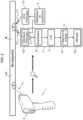
- the device 1 for estimating the parameter comprises several infrared sources 101, one or more infrared detector(s) 102 and a unit 2 for determining the parameter.
- the infrared sources 101 send towards the polymer material M a first infrared radiation 111 having several spectral emission lines of prescribed wavelengths, corresponding to the detection of at least one tracer aging of the polymer material.
- each infrared source has a narrow band of emission wavelength containing the prescribed wavelength, called the wavelength of interest or also peak of interest, corresponding to the aging tracer of the polymer material M.
- the infrared source emits only in at least one spectral emission zone (or band) containing the spectral emission line or around the spectral emission line having the prescribed wavelength of infrared radiation corresponding to the detection of the aging tracer of the polymer material M.
- the infrared source 101 is an infrared light-emitting diode.
- a diode emits in the aforementioned spectral emission zone, located around the aforementioned line.
- This spectral emission zone can for example be represented by a Gaussian centered on the spectral line corresponding to the maximum energy emitted.
- the diode can therefore be characterized by the line and the band in which the line is located.
- the infrared source 101 is a laser source.
- a laser source is substantially monochromatic.
- the source only emits at the prescribed wavelength, or in a spectral emission zone of substantially zero width around the aforementioned line.
- the device 1 may comprise a surface 1010 in which or under which the sources 101 and/or the infrared detector(s) 102 are located and which is intended to face the polymer material M to test.
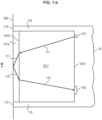
- the sources 101 and/or the infrared detector(s) 102 are covered by at least one exterior block 1011, which is transparent to the first and second infrared radiation(s) 111 and 112 and arranged so that the distal face 1013 of the outer block is as close as possible to the surface 200 of the polymer material M without being in contact with it.
- This external block 1011 makes it possible to transmit the radiation 111 from the infrared sources 101 towards the material M and from the material M towards the infrared detector(s) without alterations, other than modifications of the paths of the first and second infrared radiation ( s) 111 and 112 due to refraction according to the laws of geometric optics as shown in figure 1-b for this embodiment.
- the thin volume 1014 left vacant between the distal face 1013 and the surface 200 of the polymer material M limits the disturbances caused by the presence of air on the measurement by interacting with the infrared radiation(s) 111 and /or 112 and prevents the oxygen contained in the air from being able to attenuate the radiation by absorption at specific wavelengths.
- This block can for example be made of germanium.
- the infrared detector(s) 102 are configured to receive a second infrared radiation 112, which is reflected by the polymer material M (by the surface 200 thereof) in response to the sending of the first infrared radiation 111 from infrared sources 101.
- the device 1 comprises a unit 2 for determining the parameter of the polymer material M as a function of the emission spectral lines having the prescribed wavelengths in the second infrared radiation 112.
- the energy of the second radiation is included in the band associated with the diode which carries out the emission.
- the infrared detector 102 does not know the concept of band but only integrates the energy which comes from the source, such as the diode for example. A band is therefore created upon reception.
- unit 2 determines the parameter of the polymer material M as a function of the presence and/or amplitude of a second signal obtained from the infrared detector 102 and from the second infrared radiation 112 to the prescribed wavelengths corresponding to the spectral lines.
- the determination unit 2 can be configured to calculate the parameter of the polymer material M as a function of the calculated ratio of each of the amplitudes of the second signal obtained from the second infrared radiation 112 at the prescribed wavelengths corresponding to the respective spectral lines, divided by the amplitude of a first signal used to control the infrared sources 101 to send the first infrared radiation 111 having the spectral lines at the prescribed wavelengths.
- the at least two spectral lines R1, R2, R3, R4, R5, R6 of prescribed wavelengths are chosen in the wavelength interval ranging from 2 ⁇ m to 10 ⁇ m, that is to say in the wave number interval going from 1000 cm -1 to 5000 cm -1 .
- the width at half height of the emission spectral zones B1, B2, B3, B4, B5, B6 respectively containing the lines R1, R2, R3, R4, R5, R6 is less or equal to 1 ⁇ m.
- the width at half maximum (FWM) of the emission spectral zones B1, B2, B3, B4, B5, B6 respectively containing the lines R1, R2, R3, R4, R5, R6 is greater than or equal to 0.2 ⁇ m and less than or equal to 1 ⁇ m.
- this width at half maximum can be equal to 0.2 ⁇ m.
- the spectral lines R1, R2, R3, R4, R5, R6 are chosen in at least two of the wavelengths described below, in particular at 6 ⁇ m and/or 9.5 ⁇ m and /or at 3.5 ⁇ m and/or 7.2 ⁇ m and/or at 10 ⁇ m and/or at 2.7 ⁇ m, respectively, corresponding respectively to lines of interest R1, R2, R3, R4, R5, R6 for the determination of a parameter of polymer material M.
- this presence and/or this content are determined from the lines R1, R2, R3 R4, R5, R6 in the second infrared radiation 112, and possibly infrared emission spectral bands B1, B2, B3, B4, B5, B6 around the lines R1, R2, R3 R4, R5, R6 respectively.
- unit 2 may include, in addition, comparison means for comparing the at least two spectral bands (B1, B2, B3, B4, B5, B6) emission around the lines (R1, R2, R3, R4, R5, R6) of prescribed wavelengths in the second infrared radiation 112 to at least one pre-recorded spectral signature of at least one predetermined polymer, to identify the material polymer M relative to said predetermined polymer.
- comparison means for comparing the at least two spectral bands (B1, B2, B3, B4, B5, B6) emission around the lines (R1, R2, R3, R4, R5, R6) of prescribed wavelengths in the second infrared radiation 112 to at least one pre-recorded spectral signature of at least one predetermined polymer, to identify the material polymer M relative to said predetermined polymer.
- the values given in ⁇ m are wavelengths each included in an emission band of infrared radiation
- the values given in cm -1 are wave numbers defined as the inverse of a length of wave and more use among chemists, the first being more use among manufacturers of optical equipment and optoelectronics.
- the use of the word line expressed by an R will correspond to a spectral line of wavelength dimensioned in ⁇ m emitted in an emission band B of infrared radiation
- the use of the word peak or peak of interest expressed by a P will correspond to a spectral peak of wave number dimensioned in cm -1 characteristic of a component of interest of a polymer material M.
- the estimation device 1 can be used for all polymers (in particular paints, neoprenes, electrical cables, etc.).
- the spectral line at 6 ⁇ m corresponds to the oxidation of all polymers which is revealed via the carbonyl.
- the carbonyl manifests itself around approximately 1700 cm -1 forming a peak of interest P1 corresponding in what follows to a first line R1 of wavelength prescribed at approximately 6 ⁇ m included in its emission band B1.
- the aging of neoprenes is also due to other causes (its charge deteriorates) which appear between approximately 1000 cm -1 and approximately 1100 cm -1 and we observe it thanks to a second line R2 of prescribed wavelength at approximately 9.5 ⁇ m, or 1050 cm -1 forming a peak of interest P2.
- a third line R3 is located at a prescribed wavelength of approximately 3.5 ⁇ m, corresponding to a peak of interest P3 located at approximately 2900 cm -1 .
- other causes of aging are observed, applicable to different modes of aging of all, or of certain, polymers. For example, we have a spectral line of prescribed wavelength with its associated band by aging mode.
- carbonyl concentration is an aging tracer that can be determined using the Beer-Lambert law. This physical parameter, which will act as an aging tracer, is directly responsible for oxidative degradation.
- the functional Boxplot method is a statistical method derived from the boxplot, applicable to functions and not to a set of scalars.
- each peak of interest or line of interest corresponds to a spectral zone where the relevant information is located for the detection of the aging tracer and for the estimation of the parameter. This relevant information could be found by statistical analysis using the Functional BoxPlot method.
- the analysis concerns the reflectance spectrum after IR wave emission in the mid-infrared band; it is from this reflectance that the singularities are observed after a statistical analysis.
- the Figure 3 shows, marked with arrows, the lines R1, R2, R3, R4, R5, R6 corresponding to peaks of interest.
- the Figure 3 shows the fifth spectral line R5 at approximately a fifth peak P5 of interest at 1000 cm -1 , corresponding to a prescribed wavelength of approximately 10 ⁇ m
- the second spectral line R2 at approximately the second peak of interest P2 at approximately 1050 cm -1 corresponding to a prescribed wavelength of approximately 9.5 ⁇ m correspond to the peaks of silica and that of hydrolyzed silica respectively
- the sixth spectral line R6 at approximately a sixth peak P6 of interest at approximately 3700 cm -1 , corresponding to a prescribed wavelength of approximately 2.7 ⁇ m.
- the statistical method mentioned above made it possible to determine a distribution function for all of the reflectances in several or all of the aforementioned wavelengths or aforementioned wave numbers.
- at least two spectral lines of different wavelength or different wave number are used, coming from two distinct infrared sources. This makes it possible to overcome dispersions in the measurements, which may be due to the surface condition of the polymer material. This makes it possible to more effectively detect the degree of aging and/or the identification of the polymer material.
- an infrared source is characterized by a spectral band B where the emission occurs, this band is located around a spectral line R where, in general, the energy of the emission is maximum.
- the spectral band emitted by the infrared sources is chosen around at least two of the spectral lines R1, R2, R3, R4, R5, R6.
- said spectral lines of interest are monitored after having processed the parasitic signals caused by the temperature of the materials radiating in these spectral bands and causing very significant noise which must be erased.
- the chosen preferential domain of the projected beam and therefore the measurement of its reflectance is preferentially located in the wave number interval [1000 cm -1 ; 4000 cm -1 ] as shown in the example of Figure 3 , which corresponds to the associated wavelength interval [2.5 ⁇ m; 10 ⁇ m].
- This choice results from the fact that from 10 ⁇ m the measuring means become expensive, and that below 2.5 ⁇ m there are no relevant observations.
- infrared sources 101 emitting spectral lines around the prescribed wavelengths as there are peaks or lines of interest.
- the infrared source 101 is directive to emit the first infrared radiation in a first determined direction towards the polymer material M.
- the diode can include a lens .
- the detector 102 will be ideally placed so that the reflection of the second infrared radiation 112 measured has an angle of reflection equal to the angle of incidence of the first infrared radiation 111 sent and where all the energy emitted (or almost) is found in the second reflected infrared radiation 112; we are therefore looking for a specular reflection, from which the reflectance will come.
- the reflection of the polymer material M could also be diffuse, in the half-space delimited by the surface 200 of the polymer material, in which the device 1 is located.
- the at least one infrared detector 102 is able to receive an infrared reflectance spectrum of the polymer material M in response to the first infrared radiation(s) 111 sent by the infrared sources 101.
- the at least one infrared detector 102 is capable of receiving in the second infrared radiation 112 the spectral lines R1, R2, R3, R4, R5, R6 at the prescribed wavelengths.
- the at least one infrared detector 102 is able to receive in the second radiation infrared 112 bands B1, B2, B3, B4, B5, B6.
- the reception wavelength band of the infrared detector 102 comprises for example at least the prescribed wavelengths and/or the spectral lines R1, R2, R3, R4, R5, R6 of prescribed wavelengths and/or the wavelength bands emitted by the infrared sources 101.
- the at least one infrared detector 102 can for example be broadband in reception wavelength.
- the at least one infrared detector 102 is placed in the specular and/or diffuse reflection of the material M.
- the at least one infrared detector 102 is a photodetector which can for example be of the photodiode or photoconductor type. .
- the infrared detector 102 is capable of generating an electric photocurrent as a function of the second infrared radiation 112. Acquisition electronics makes it possible to acquire the analog signal coming from the infrared detector 102.
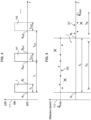
- the infrared sources 101 are capable of sending the first infrared radiation 111 to the polymer material M in the form of one or more temporal pulse(s) i, i+1, i+2, which can be for example rectangular(s), as shown in Figure 4 .
- the device 1 comprises a module 12 for controlling the sources 101 by a pulsed control signal, which may for example be rectangular and/or periodic with a prescribed repetition frequency f R , so that the sources emit the first radiation infrared 111 in the form of one or more temporal pulses, for example rectangular and/or periodic.
- the successive temporal pulses i, i+1, i+2 emitted by the infrared source 101 can for example each have a temporal width (first ON state of the infrared source 101) respective ⁇ i , ⁇ i+1 and ⁇ i+2 prescribed, and have respective starts A i , A i+1 and A i+2 of successive pulses i, i+1, i+2 which are spaced temporally by the durations T i and T i+1 respectively.
- the source 101 is in the second OFF state (for example low or off) different from the first ON state (for example high or on), this state OFF between successive pulses i and i+1 having a duration T i - ⁇ i .
- the respective temporal widths ⁇ i , ⁇ i+1 and ⁇ i+2 could be different from each other.
- the durations T i and T i+1 could be different from each other.
- This characteristic makes it possible to detect the prescribed wavelength lines in the second infrared radiation 112 received from the polymer material M, even in the presence of thermal radiation from this polymer material M.
- This thermal radiation is due to the temperature of the measured sample (polymer material M) and is continuously emitted with an energy which can be up to approximately a thousand times greater than that of the second infrared radiation 112 reflected by this polymer material M in a narrow spectral band around the spectral wavelength lines prescribed, which therefore disrupts the detection of this second radiation 112 and the measured reflectance.
- the device 1 comprises at least one manual control member 103 to trigger the sending of the first infrared radiation 111 by the infrared sources 101, for example according to a temporal pulse or a burst of temporal pulses i, i+ 1, i+2.
- the manual control member 103 can be pre-stressed by a pre-stress member (for example a spring or other) to return to a first non-actuation position not triggering the sending of the first infrared radiation 111 by the source 101, from its second manual actuation position triggering the sending of the first infrared radiation 111 by the source 101, the control member being movable between one and the other of these first and second positions. The user must thus keep the control member 103 pressed in the second manual actuation position to trigger the sending of the first infrared radiation 111 by the source 101.
- the manual control member 103 can be of the button or trigger type.
- the infrared detector(s) 102 are controlled in a synchronous manner with the sources 101, as shown in figure 4, 5 And 6 .
- the device 1 or the unit 2 may include control means for switching on the at least one infrared detector 102 in a manner synchronous with the temporal pulse(s) (i, i+1, i +2).
- control module 12 is connected both to the sources 101 and to the infrared detector(s) 102, so that the infrared detector(s) 102 is activated. in operation during the temporal pulses i, i+1, i+2 (being in the first ON state of temporal width ⁇ i ), as represented for example in Figure 5 by the points representing the measured values, and is off (second OFF state different from the first ON state) between the time pulses i, i+1, i+2.
- the control module 12 is connected both to the sources 101 and to the infrared detector(s) 102, so that the infrared detector(s) 102 is activated. in operation during the temporal pulses i, i+1, i+2 (being in the first ON state of temporal width ⁇ i ), as represented for example in Figure 5 by the points representing the measured values, and is also switched on (second OFF state different from the first ON state) between the time pulses i, i+1, i+2, as is represented by way of example in Figure 5 .
- the infrared detector 102 performs several measurements of the second infrared radiation 112 received (represented by the points at the figure 5 ) during each time pulse i, i+1, i+2.
- the device 1 comprises control means 21 for carrying out several first measurements 300 of the second infrared radiation 112 during a first prescribed temporal width ⁇ i1 included in or equal to the respective temporal width ⁇ i of the first ON state of the pulse i (we therefore have ⁇ i1 ⁇ ⁇ i ), to calculate an estimate of a first value M ⁇ i-ON representative of the first measurements 300 carried out during the prescribed temporal width ⁇ i1 , the parameter being calculated from the first value M ⁇ i_ON .
- the device 1 comprises control means 21 for carrying out several second measurements 301 of the second infrared radiation 112 during a second prescribed temporal width ⁇ i2 included in or equal to the respective temporal width T i - ⁇ i of the second OFF state between pulse i and the next pulse i+1 or between the respective temporal width T i-1 - ⁇ i-1 of the second OFF state between pulse i and the previous pulse i-1 (we have therefore ⁇ i2 ⁇ T i - ⁇ i or ⁇ i2 ⁇ T i-1 - ⁇ i-1 ), to calculate an estimate of a second value M ⁇ i-OFF representative of the second measurements 301 during the second prescribed temporal width ⁇ i2 , the parameter being calculated from the second value M ⁇ i-OFF .
- the parameter is calculated from the first value M ⁇ i-ON and the second value M ⁇ i-OFF , for example from the difference calculated between the first value M ⁇ i-ON and the second value M ⁇ i-OFF . This makes it possible to compensate for the zero offsets of the measurements 300 of the ON state compared to the OFF state.
- the first value M ⁇ i-ON is calculated from a selection of the first measurements 300 having less than a prescribed deviation from this first value M ⁇ i-ON .
- the second value M ⁇ i-OFF is calculated from a selection of the second measurements 301 having less than a prescribed deviation from this second value M ⁇ i-OFF .
- the multiple measurements of the figure 5 acquired during a pulse i, serve to reduce electronic noise, because statistical processing is applied to these measurements.
- the first value M ⁇ i-ON can for example be a median of the first measurements 300, a robust estimate of the average of the first measurements 300 or another central (non-Gaussian) estimate.
- the second value M ⁇ i-OFF can for example be a median of the second measurements 301, a robust estimate of the average of the second measurements 301 or another central (non-Gaussian) estimate.
- frequency processing is then applied to the first value M ⁇ i_ON , or to the difference calculated between the first value M ⁇ i-ON and the second value M ⁇ i-OFF (by the filter 11) to free from the thermal noise of the polymer sample M.
- the device 1 comprises extraction means for extracting from the second infrared radiation 112 received from the infrared detector(s) 102 the response of the polymer material M to the spectral lines of prescribed wavelengths sent by the infrared sources 101 and/or to the bands around the spectral lines.
- extraction means include for example one or more of the elements described below.
- the device 1 comprises at least one circuit and/or a filter 11 for removing or attenuating a DC component in a signal, having been supplied by the infrared detector 102 from the second infrared radiation 112
- the emission range is below the range of long red waves and is invisible to the human eye.
- the emissivity of an object indicates the amount of infrared energy radiated.
- the objects measured by the device 1 tend to emit this thermal radiation in the wavelength range which goes from 1 to 20 ⁇ m.
- the second infrared radiation 112 received by the infrared detector 102 will be composed of a direct component and an alternating component (the second infrared radiation 112 in response to the first infrared radiation 111 having the prescribed spectral lines.
- the circuit and/or the filter 11 is at least one circuit and/or at least one high-pass filter of the device 1 and/or at least one band-pass filter of the device 1. This makes it possible not to let only the spectrum of the useful signal pass and eliminate the thermal radiation corresponding to the continuous component of the spectrum.
- the decomposition into Fourier series of the second infrared radiation 112 present gives a spectrum consisting of a continuous component representing the average value of the signal and a series of harmonics whose amplitude varies with the frequency in sin(x)/x .
- the high pass filter can be first order.
- a first-order high-pass filter with a cutoff frequency of 1/(2T), where T is the repetition period of the temporal pulses, allows the DC component to be significantly attenuated.
- the DC component of the restored signal depends on the attenuation of the filter. This problem is unimportant in our case because the amplitude of the rectangular signal can be determined by the difference between the high pulses and the low pulses.
- An amplifier not shown, can be provided downstream of the filter 11.
- An amplifier 10 and a high-pass filter 11 can be provided, to recover from the filtered signal the rectangular signal generated by the radiation 111 from the sources.
- a test bench was set up to validate the proposed pulsed acquisition architecture.
- a source 102 formed of a light-emitting diode was controlled by a rectangular pulse control signal with a repetition frequency f R of 4 kHz and a duty cycle of 20%.
- the bench consists of the infrared detector, a light-emitting diode and a transimpedance amplifier.
- the objective was to generate, in the photo-detector (infrared detector), a rectangular signal sufficiently smaller than the signal generated by the temperature. We used an LED emitting a rectangular signal. The photocurrent from the detector is then sent to the transimpedance amplifier.
- Measuring the DC component gives a photocurrent of around 40A which would correspond to the signal created by thermal radiation.
- the signal was then filtered (high pass) and amplified in order to reconstruct the alternating component generated by the LED.
- An attenuation of 12dB, a cutoff frequency of 0.3 Hz, and a gain of 1pA/V makes it possible to reproduce a signal (rectangular pulses with a repetition frequency f R of 4 kHz and a duty cycle of 20%) more than 1000 times smaller than the continuous background. This measurement validates the pulsed architecture for the single-channel prototype.
- the device according to the invention takes into account the processing of noise caused by thermal radiation.
- the solution consists of emitting pulsed shots according to a rectangular signal of prescribed amplitude and wavelength and of prescribed repetition frequency f R , signals whose reflection measured by the detector 102 will be processed temporally by a Fourier development, which will have the effect of eliminating the noise of thermal radiation.
- the device 1 comprises a cooling module 13, for example of the Peltier type, for cooling the infrared detector(s) 102 and/or a cooling module 13', for example of the type Peltier to cool the source(s) 101.
- a cooling module 13 for example of the Peltier type, for cooling the infrared detector(s) 102 and/or a cooling module 13', for example of the type Peltier to cool the source(s) 101.
- a Peltier cooling module is small, which makes it possible to gain in compactness of the device 1.
- a Peltier type cooling module 13, 13' is composed of a stack of thermoelements.
- a thermoelement is made up of two semiconductor components. When a direct current is imposed on the terminals of the Peltier type cooling module 13, 13', heat absorption occurs. The absorbed heat is then transmitted to the hot part of the component, which has the effect of transmitting heat from one side of the module 13, 13' to the other.
- the device 1 comprises a thermostat and an electronic unit 9 for automatic temperature stabilization or temperature controller (based on a Proportional, Integrative and Differential type regulator), which is connected to the module(s). ) 13, 13 'cooling, for example of the Peltier type, to maintain the at least one infrared detector (102) and/or the at least two infrared sources (101) at a temperature prescribed by the thermostat.
- the temperature controller 9 regulates the temperatures of the LED source 101 and the detector 102 typically around a setpoint given at -30°C.
- Unit 9 can be analog or digital and be embedded in a system on chip (System On Chip SOC), for example a micro-controller, a programmable logic circuit (Field Programmable Gate Array FPGA), or a dedicated integrated circuit (Application Specifies Integrated Circuit - ASIC).
- System On Chip SOC System On Chip SOC
- a micro-controller for example a micro-controller, a programmable logic circuit (Field Programmable Gate Array FPGA), or a dedicated integrated circuit (Application Specifies Integrated Circuit - ASIC).
- the device 1 comprises an amplifier 10 downstream of the circuit and/or the filter 11 to amplify the filtered signal.
- This amplifier 10 can be a transimpedance amplifier.
- the device 1 comprises an analog-digital converter 5 downstream of the amplifier 10.
- An electronic system for command and control of the analog-digital converter 5 is provided.
- the analog-digital converter 5 makes it possible to generate the digital signal corresponding to the reflectance of the polymer material M at each prescribed wavelength.
- the device 1 comprises means 107 for processing and storing data, to determine the parameter based at least on the importance of the wavelength lines prescribed in the detection signal of the detector(s). (s) infrared(s), obtained from the second infrared radiation 112, or from the importance of the response of the infrared detector(s) in bands around the prescribed wavelength lines in the second infrared radiation 112.
- the data processing and storage means 107 determine the parameter from the digital signal(s) supplied by the analog-digital converter 5, which respectively correspond to this amplitude according to the respective lines and respective prescribed wavelengths.
- the data processing and storage means 107 may include a Fourier transform processing module, instead of or in addition to the circuit and/or filter 11.
- these processing means 107 and data storage can include the control means 21 to carry out the measurements as aforesaid and to select the measurements as aforesaid.
- the device 1 comprises means 109 for downloading computer programs, which may include software programs implementing an on-board algorithm for the aforementioned determination.
- the means 107, 109 may include an electronic loading system for this purpose such as a microcontroller, an FPGA, an ASIC, etc.
- the device 1 comprises a guard 110 for positioning the infrared sources 101 and the infrared detector 102 opposite and/or near a zone S of the polymer material M which must receive the first infrared radiation 111 and reflect the second infrared radiation 112.
- the guard 110 is arranged so that the outer block 1011 is at a distance from the surface 200 of the polymer material M, when the guard 110 is positioned against the surface 200 of the polymer material M.
- the outer block 1011 has an outer distal surface 1013, which is both oriented towards the surface 200 of the polymer material M and which is set back relative to the outer distal surface 113 of the guard 110, also facing the surface 200 of the polymer material M.
- the angle of incidence of the first infrared radiation 111 on the surface 200 of the polymer material M to be tested may be greater than or equal to 10 degrees or 20 degrees and less than or equal to 60 or 70 degrees and can be ensured by the positioning of the guard 110 and/or the exterior block 1011 against this surface 200.
- the angle of reflection of the second infrared radiation 112 on the surface 200 of the polymer material M to be tested can be greater or equal to 10 degrees or 20 degrees and less than or equal to 60 or 70 degrees and can be ensured by the positioning of the guard 110 and/or the exterior block 1011 against this surface 200.
- the distance between the infrared sources 101 and the surface 200 of the polymer material M to be tested can be greater than or equal to 1 mm and less than or equal to 10 cm and can be ensured by the positioning of the guard 110 against this surface 200.
- the distance between the infrared detector(s) 102 and the surface 200 of the polymer material M to be tested may be greater than or equal to 1 mm and less than or equal to 10 cm and can be ensured by the positioning of the guard 110 against this surface 200.
- the device 1 has the form of a gun 100 comprising a gripping handle 14 connected to a sighting module 15 comprising at a front end 16 remote from the handle 15 the source 101 and the detector 102 (and/ or the application surface 1010 and the guard 110 in front of and next to the source 101 and the detector 102).
- the control member 103 is for example near a zone 17 of the gun 100 connecting the handle 14 to the aiming module 15.
- This handle thus also makes it possible to introduce the device 1 into pipes or against an interior surface of a tube.
- the device 1 can have any other shape, such as for example the shape of a pen or others.
- the device 1 comprises a means 104 for indicating information, which may be visual and/or audible, and which may be information indicating the parameter such as for example the presence of the tracer(s). aging or information indicating the absence of the aging tracer(s), and/or information indicating the content of the aging tracer(s) and/or information indicating the identification of the polymer material M.
- the means 104 indication may be or include for example a display screen 104. Other operating characteristics of the device 1 can be indicated by the indicating means 104.
- the device 1 may include a control interface 105 which may be other than the control member 103 and which may for example be a control keyboard 105, for example on a rear surface 18 remote from the source 101 and of the detector 102, for example of zone 17.
- a control interface 105 which may be other than the control member 103 and which may for example be a control keyboard 105, for example on a rear surface 18 remote from the source 101 and of the detector 102, for example of zone 17.
- the device 1 comprises autonomous electrical supply means 106, for supplying energy to the aforementioned elements, including at least the source 101, the detector 102 and the unit 2.
- These autonomous electrical supply means 106 are for example battery or rechargeable battery or not, removable or not.
- the device 1 is portable.
- the device 1 comprises communication means 108 for transmitting to the outside information indicating the parameter, which may be information indicating the presence of the aging tracer(s) or information indicating the absence of the aging tracer(s), and/or information indicating the content of the tracer(s) aging and/or information indicating the identification of the polymer material M.
- the communication means 108 can be with uplink and/or downlink communication towards a remote unit or a remote platform, such as for example a mobile terminal (mobile telephone or other ), a server or something else.
- unit 2 of device 1 comprises one or more micro-controllers, FPGA, ASIC 19 for controlling the various aforementioned elements.
- the device 1 or gun 100 is placed on a wall of a polymer material M by applying the guard 110 to position and wedge the gun 100 against the surface 200 of the material M to be tested. Then, we press on the control member 103 or on the trigger 103 according to a fixed protocol.
- the control member 103 or on the trigger 103 according to a fixed protocol.
- An operator equipped with the device 1 can carry out measurements of the material parameter at different locations easily and in a short time. For example, it can carry out a control campaign inside a reactor building of a nuclear power plant.
- Various polymer materials M could be controlled with the same device 1.
- the result of the measurements and/or the diagnosis of aging or identification can be displayed in-situ and in real time on the device 1.
- the measuring device is dispenses with a spectral measurement of the reflectance or absorbance characteristic of the polymer material and dispenses with the use of a spectrometer, in particular an FTIR or filter type spectrometer.
- the measuring device does not require optical filters and a mechanical system to switch from one wavelength to another. This makes it possible to produce a portable device, light and easy to insert to carry out measurements, for example inside pipes.
- the measuring device does not require mechanical movement of parts and does not require isolation chambers.
Landscapes
- Physics & Mathematics (AREA)
- General Physics & Mathematics (AREA)
- Pathology (AREA)
- Life Sciences & Earth Sciences (AREA)
- Chemical & Material Sciences (AREA)
- Analytical Chemistry (AREA)
- Biochemistry (AREA)
- General Health & Medical Sciences (AREA)
- Immunology (AREA)
- Health & Medical Sciences (AREA)
- Spectroscopy & Molecular Physics (AREA)
- Mathematical Physics (AREA)
- Engineering & Computer Science (AREA)
- Theoretical Computer Science (AREA)
- Investigating Or Analysing Materials By Optical Means (AREA)
- Photometry And Measurement Of Optical Pulse Characteristics (AREA)
- Other Resins Obtained By Reactions Not Involving Carbon-To-Carbon Unsaturated Bonds (AREA)
- Investigating Or Analyzing Materials Using Thermal Means (AREA)
Claims (21)
- Tragbare Vorrichtung (1) zur Schätzung mindestens eines charakteristischen Parameters eines Polymermaterials, wobei die Vorrichtung Folgendes umfasst:mindestens eine Infrarotquelle (101), wobei die mindestens eine Infrarotquelle (101) mindestens eine Infrarot-Leuchtdiode oder mindestens eine Laserquelle ist,mindestens einen Infrarotdetektor (102),dadurch gekennzeichnet, dassals Infrarotquelle mindestens zwei Infrarotquellen (101) vorgesehen sind, die geeignet sind, jeweils mindestens zwei unterschiedliche Spektrallinien (R1, R2, R3, R4, R5, R6) hin zu dem Polymermaterial zu emittieren, die jeweils eine maximale Emissionsenergie darstellen und die aus jeweils zwei unterschiedlichen von den Wellenlängen 10 µm, 9,5 µm, 7,2 µm, 6 µm, 3,5 µm, 2,7 µm oder aus jeweils zwei unterschiedlichen von den Wellenzahlen 1000 cm-1, 1050 cm-1, 1350 cm-1, 1700 cm-1, 2900 cm-1, 3700 cm-1 ausgewählt sind,wobei der mindestens eine Infrarotdetektor (102) geeignet ist, die mindestens zwei Spektrallinien (R1, R2, R3, R4, R5, R6) zu empfangen, die durch das Polymermaterial (M) als Reaktion auf die mindestens zwei Spektrallinien (R1, R2, R3, R4, R5, R6) reflektiert werden, die durch die mindestens zwei Infrarotquellen (101) emittiert wurden,die Vorrichtung eine Einheit (2) zur Bestimmung des charakteristischen Parameters des Polymermaterials (M) in Abhängigkeit von der in den mindestens zwei Spektrallinien (R1, R2, R3, R4, R5, R6) vorhandenen Energie umfasst, die durch das Polymermaterial (M) reflektiert wurden und durch den Infrarotdetektor (102) als Reaktion auf die mindestens zwei Spektrallinien (R1, R2, R3, R4, R5, R6) empfangen wurden, die durch die mindestens zwei Infrarotquellen (101) emittiert wurden.
- Vorrichtung nach Anspruch 1, dadurch gekennzeichnet, dass jede der mindestens zwei Spektrallinien (R1, R2, R3, R4, R5, R6) ein schmales Emissionsband aufweist.
- Vorrichtung nach Anspruch 1, dadurch gekennzeichnet, dass der charakteristische Parameter des Polymermaterials (M) das Vorhandensein und/oder der Gehalt mindestens eines Alterungsindikators in dem Polymermaterial ist.
- Vorrichtung nach einem der vorhergehenden Ansprüche, dadurch gekennzeichnet, dass jede Infrarotquelle (101) geeignet ist, die Spektrallinie (R1, R2, R3, R4, R5, R6) in der Form eines oder mehrerer Zeitimpulse (i, i+1, i+2) hin zu dem Polymermaterial (M) zu emittieren.
- Vorrichtung nach Anspruch 4, dadurch gekennzeichnet, dass der oder die Zeitimpuls/e (i, i+1, i+2) rechteckig sind.
- Vorrichtung nach Anspruch 4 oder 5, dadurch gekennzeichnet, dass Steuerungsmittel zum Inbetriebsetzen des mindestens einen Infrarotdetektors (102) auf eine synchrone Weise mit dem oder den Zeitimpuls/en (i, i+1, i+2) vorgesehen ist.
- Vorrichtung nach einem der Ansprüche 4 bis 6, dadurch gekennzeichnet, dass die Vorrichtung (1) ein Steuerungsmittel (21) zum Durchführen mehrerer erster Messungen (300) der mindestens zwei Spektrallinien (R1, R2, R3, R4, R5, R6), die durch das Polymermaterial (M) als Reaktion auf die mindestens zwei Spektrallinien (R1, R2, R3, R4, R5, R6) reflektiert werden, die durch die mindestens zwei Infrarotquellen (101) emittiert wurden, während einer ersten vorgeschriebenen Zeitbreite (γ i1), die gleich einer entsprechenden Zeitbreite (τi ) mindestens eines der Impulse (i) oder darin enthalten ist, umfasst, um eine Schätzung eines ersten Werts (M̂i-ON ) zu berechnen, der für die erste Messungen (300) repräsentativ ist, wobei der Parameter ausgehend von mindestens dem ersten Wert (M̂ i-ON ) berechnet wird.
- Vorrichtung nach Anspruch 7, dadurch gekennzeichnet, dass die Vorrichtung (1) ein Steuerungsmittel (21) zum Durchführen mehrerer zweiter Messungen (301) der mindestens zwei Spektrallinien (R1, R2, R3, R4, R5, R6), die durch das Polymermaterial (M) als Reaktion auf die mindestens zwei Spektrallinien (R1, R2, R3, R4, R5, R6) reflektiert werden, welche durch die mindestens zwei Infrarotquellen (101) emittiert wurden, während einer zweiten vorgeschriebenen Zeitbreite (γ i2), die gleich einer entsprechenden Zeitbreite (Ti-τi )zwischen zwei aufeinanderfolgenden Impulsen (i, i+1) oder darin enthalten ist, umfasst, um eine Schätzung eines zweiten Werts (M̂i-OFF ) zu berechnen, der für zweite Messungen (301) repräsentativ ist, wobei der Parameter mindestens ausgehend von der Differenz zwischen dem ersten Wert (M̂i-ON ) und dem zweiten Wert (M̂i-OFF ) berechnet wird.
- Vorrichtung nach einem der vorhergehenden Ansprüche, dadurch gekennzeichnet, dass die Vorrichtung (1) ferner mindestens ein manuelles Steuerungsorgan (103) umfasst, um die Emission der mindestens zwei Spektrallinien (R1, R2, R3, R4, R5, R6) durch die mindestens zwei Infrarotquellen (101) auszulösen.
- Vorrichtung nach einem der vorhergehenden Ansprüche, dadurch gekennzeichnet, dass der mindestens eine Infrarotdetektor (102) vom Typ Photodiode oder Photoleiter und geeignet ist, einen elektrischen Photostrom in Abhängigkeit von den mindestens zwei Spektrallinien (R1, R2, R3, R4, R5, R6) zu erzeugen, die durch das Polymermaterial (M) als Reaktion auf die mindestens zwei Spektrallinien (R1, R2, R3, R4, R5, R6) reflektiert werden, die durch die mindestens zwei Infratotquellen emittiert wurden (101) und die er empfängt.
- Vorrichtung nach einem der vorhergehenden Ansprüche, dadurch gekennzeichnet, dass die Breite von jeder der mindestens zwei Spektrallinien (R1, R2, R3, R4, R5, R6) der mindestens zwei Infrarotquellen (101) auf halber Höhe kleiner oder gleich 1 µm ist.
- Vorrichtung nach einem der vorhergehenden Ansprüche, dadurch gekennzeichnet, dass die Einheit (2) zur Bestimmung des charakteristischen Parameters des Polymermaterials (M) mindestens ein Filter oder eine Filterschaltung- oder Einheit (11) für die Unterdrückung oder die Dämpfung einer kontinuierlichen Komponente in einem Signal umfasst, das durch den Infrarotdetektor (102) ausgehend von den mindestens zwei Spektrallinien (R1, R2, R3, R4, R5, R6) geliefert wurde, die durch das Polymermaterial (M) als Reaktion auf die mindestens zwei Spektrallinien (R1, R2, R3, R4, R5, R6) reflektiert werden, die von den mindestens zwei Infrarotquellen (101) emittiert wurden.
- Vorrichtung nach Anspruch 12, dadurch gekennzeichnet, dass die Einheit (2) zur Bestimmung des charakteristischen Parameters des Polymermaterials (M) einen Verstärker (10) zum Verstärken des gefilterten Signals dem Filter oder der Filterschaltung oder - einheit (11) nachgelagert, einen Analog-Digital-Wandler (5) dem Verstärker (10) nachgelagert und Datenverarbeitungs- und Speicherungsmittel (107) umfasst, um den charakteristischen Parameter des Polymermaterials ausgehend von dem oder den durch den Analog-Digital-Wandler (5) gelieferten digitalen Signal/en zu bestimmen.
- Vorrichtung nach einem der vorhergehenden Ansprüche, dadurch gekennzeichnet, dass die Bestimmungseinheit (2) dazu ausgestaltet ist, den charakteristischen Parameter des Polymermaterials (M) in Abhängigkeit von mindestens der Amplitude eines Detektionssignals zu berechnen, das ausgehend von dem Infrarotdetektor (102) und ausgehend von den mindestens zwei Spektrallinien (R1, R2, R3, R4, R5, R6) erhalten wird, die durch das Polymermaterial (M) als Reaktion auf die mindestens zwei Spektrallinien (R1, R2, R3, R4, R5, R6) reflektiert werden, die durch die mindestens zwei Infrarotquellen (101) emittiert wurden und die durch den Infrarotdetektor (102) empfangen werden.
- Vorrichtung nach einem der vorhergehenden Ansprüche, dadurch gekennzeichnet, dass die Bestimmungseinheit (2) dazu ausgestaltet ist, den charakteristischen Parameter des Polymermaterials (M) in Abhängigkeit von der Amplitude eines Detektionssignals, das ausgehend von dem Infrarotdetektor (102) und ausgehend von den mindestens zwei Spektrallinien (R1, R2, R3, R4, R5, R6) erhalten wird, die durch das Polymermaterial (M) als Reaktion auf die mindestens zwei Spektrallinien (R1, R2, R3, R4, R5, R6) reflektiert werden, die durch die mindestens zwei Infrarotquellen (101) emittiert wurden und die durch den Infrarotdetektor (102) empfangen werden, in Bezug auf die Amplitude eines Emissionssignals zu berechnen, das zum Steuern der mindestens zwei Infrarotquellen (101) zum Emittieren der mindestens zwei Spektrallinien (R1, R2, R3, R4, R5, R6) dient.
- Vorrichtung nach einem der vorhergehenden Ansprüche, dadurch gekennzeichnet, dass die Vorrichtung (1) ein Kühlmodul (13) zum Kühlen des mindestens einen Infrarotdetektors (102) und/oder ein Kühlmodul (13') zum Kühlen der mindestens zwei Infrarotquellen (101) umfasst.
- Vorrichtung nach Anspruch 16, dadurch gekennzeichnet, dass die Vorrichtung (1) ein Thermostat und eine automatische elektronische Temperaturstabilisierungseinheit (9) umfasst, die mit dem Kühlmodul (13, 13') verbunden ist, um den mindestens einen Infrarotdetektor (102) und/oder die mindestens zwei Infrarotquellen (101) auf einer durch das Thermostat vorgeschriebenen Temperatur zu halten.
- Vorrichtung nach einem der vorhergehenden Ansprüche, dadurch gekennzeichnet, dass die Vorrichtung (1) die Form einer Pistole (100) aufweist, die einen Haltegriff (14) umfasst, der mit einem Zielmodul (15) verbunden ist, das an einem vorderen Ende (16), das von dem Griff (15) entfernt ist, die mindestens zwei Infrarotquellen (101) und den mindestens einen Infrarotdetektor (102) umfasst, wobei die Pistole (100) mindestens ein manuelles Steuerungsorgan (103) zum Auslösen der Emission der mindestens zwei Spektrallinien (R1, R2, R3, R4, R5, R6) durch die mindestens zwei Infrarotquellen (101) umfasst, wobei das manuelle Steuerorgan (103) sich nahe an einer Zone (17) der Pistole (100) befindet, die den Griff (14) mit dem Zielmodul (15) verbindet.
- Vorrichtung nach einem der vorhergehenden Ansprüche, dadurch gekennzeichnet, dass die mindestens zwei Quellen (101) und/oder der mindestens eine Infrarotdetektor (102) durch mindestens einen äußeren Block (1011) bedeckt sind,
die mindestens zwei Quellen (101) geeignet sind, die mindestens zwei Spektrallinien (R1, R2, R3, R4, R5, R6) zu emittieren, und der mindestens eine Infrarotdetektor (102) geeignet ist, die mindestens zwei Spektrallinien (R1, R2, R3, R4, R5, R6), die durch das Polymermaterial (M) als Reaktion auf die mindestens zwei Spektrallinien (R1, R2, R3, R4, R5, R6) reflektiert werden, die durch die mindestens zwei Infrarotquellen (101) emittiert wurden, durch den äußeren Block (1011) zu empfangen, der ihnen gegenüber durchlässig ist und der dem Polymermaterial (M) zugewandt ist. - Vorrichtung nach Anspruch 19, dadurch gekennzeichnet, dass die Vorrichtung (1) einen Schutz (110) vor der Auflage gegen das Polymermaterial (M) umfasst,
wobei der äußere Block (1011) eine äußere distale Oberfläche (1013) aufweist, die gleichzeitig hin zu dem Polymermaterial (M) ausgerichtet ist und die in Bezug auf eine äußere distale Oberfläche (113) des Schutzes (110) vertieft ist und auch der Oberfläche (200) des Polymermaterials (M) zugewandt ist. - Verfahren zur Schätzung mindestens eines charakteristischen Parameters eines Polymermaterials (M) durch mindestens eine Infrarotquelle (101) und durch mindestens einen Infrarotdetektor (102), wobei die mindestens eine Infrarotquelle (101) mindestens eine Infrarot-Leuchtdiode oder mindestens eine Laserquelle ist,
dadurch gekennzeichnet, dassals Infrarotquelle mindestens zwei Infrarotquellen (101) vorgesehen sind,durch die mindestens zwei Infrarotquellen (101) hin zum Polymermaterial jeweils mindestens zwei unterschiedliche Spektrallinien (R1, R2, R3, R4, R5, R6) emittiert werden, die jeweils eine maximale Emissionsenergie darstellen und die aus jeweils zwei unterschiedlichen von den Wellenlängen 10 µm, 9,5 µm, 7,2 µm, 6 µm, 3,5 µm, 2,7 µm oder aus jeweils zwei unterschiedlichen von den Wellenzahlen 1000 cm-1, 1050 cm-1, 1350 cm-1, 1700 cm-1, 2900 cm-1, 3700 cm-1 ausgewählt werden,durch den mindestens einen Infrarotdetektor (102) die mindestens zwei Spektrallinien (R1, R2, R3, R4, R5, R6) empfangen werden, die durch das Polymermaterial (M) als Reaktion auf die mindestens zwei Spektrallinien (R1, R2, R3, R4, R5, R6) reflektiert werden, die durch die mindestens zwei Infrarotquellen (101) emittiert wurden,durch eine Bestimmungseinheit (2) der charakteristische Parameter des Polymermaterials (M) in Abhängigkeit von der Energie bestimmt wird, die in den mindestens zwei Spektrallinien (R1, R2, R3, R4, R5, R6) vorhanden ist, die durch das Polymermaterial (M) reflektiert wurden und durch den Infrarotdetektor (102) als Reaktion auf die mindestens zwei Spektrallinien (R1, R2, R3, R4, R5, R6) empfangen wurden, die durch die mindestens zwei Infrarotquellen (101) emittiert wurden.
Applications Claiming Priority (2)
| Application Number | Priority Date | Filing Date | Title |
|---|---|---|---|
| FR1661235A FR3059104B1 (fr) | 2016-11-18 | 2016-11-18 | Dispositif et procede d'estimation d'un parametre d'un materiau polymere |
| PCT/EP2017/079543 WO2018091631A1 (fr) | 2016-11-18 | 2017-11-17 | Dispositif portatif et procédé d'estimation d'un paramètre d'un matériau polymère |
Publications (3)
| Publication Number | Publication Date |
|---|---|
| EP3542148A1 EP3542148A1 (de) | 2019-09-25 |
| EP3542148B1 true EP3542148B1 (de) | 2023-09-13 |
| EP3542148C0 EP3542148C0 (de) | 2023-09-13 |
Family
ID=57681662
Family Applications (1)
| Application Number | Title | Priority Date | Filing Date |
|---|---|---|---|
| EP17804503.5A Active EP3542148B1 (de) | 2016-11-18 | 2017-11-17 | Tragbare vorrichtung und verfahren zur schätzung eines parameters eines polymers |
Country Status (12)
| Country | Link |
|---|---|
| US (1) | US11137352B2 (de) |
| EP (1) | EP3542148B1 (de) |
| JP (1) | JP7106533B2 (de) |
| KR (1) | KR102470823B1 (de) |
| CN (1) | CN110214267B (de) |
| CA (1) | CA3043331C (de) |
| FR (1) | FR3059104B1 (de) |
| RU (1) | RU2765694C2 (de) |
| TW (1) | TWI781965B (de) |
| UA (1) | UA126024C2 (de) |
| WO (1) | WO2018091631A1 (de) |
| ZA (1) | ZA201903754B (de) |
Families Citing this family (8)
| Publication number | Priority date | Publication date | Assignee | Title |
|---|---|---|---|---|
| WO2020128593A1 (en) * | 2018-12-20 | 2020-06-25 | Arcelormittal | Measure of the degree of crystallinity of a polymer coating on a metal substrate |
| CH717253A2 (de) * | 2020-03-23 | 2021-09-30 | 4Art Holding Ag | Gerät zur optischen Erfassung von Oberflächen. |
| CH717251A2 (de) | 2020-03-23 | 2021-09-30 | 4Art Holding Ag | Verfahren zur Beurteilung von Kontrasten von Oberflächen. |
| CH717252A2 (de) | 2020-03-23 | 2021-09-30 | 4Art Holding Ag | Verfahren zur Wiedererkennung von Oberflächen. |
| CN112326585B (zh) * | 2020-10-28 | 2021-10-22 | 南京农业大学 | 一种用于快速检测草莓白粉病的红外光谱装置及检测方法 |
| JP7598553B2 (ja) * | 2020-11-02 | 2024-12-12 | 大日本印刷株式会社 | 検査システム、検査方法、及び検査システムの製造方法 |
| JP2023157601A (ja) * | 2022-04-15 | 2023-10-26 | 日立Geニュークリア・エナジー株式会社 | 高分子材料の余寿命評価方法、余寿命評価装置 |
| WO2024192008A1 (en) * | 2023-03-14 | 2024-09-19 | Dow Global Technologies Llc | Ultraviolet and infrared quantitative image analysis for evaluating coating performance |
Family Cites Families (35)
| Publication number | Priority date | Publication date | Assignee | Title |
|---|---|---|---|---|
| IT988912B (it) * | 1972-06-08 | 1975-04-30 | Infra Systems Inc | Dispositivo di misura a radiazio ne infrarossa |
| NL8103468A (nl) * | 1981-07-22 | 1983-02-16 | Wavin Bv | Werkwijze en inrichting voor het bepalen van de verouderingstoestand van kunststof produkten. |
| NO149679C (no) * | 1982-02-22 | 1984-05-30 | Nordal Per Erik | Anordning ved infraroed straalingskilde |
| EP0143282B1 (de) * | 1983-11-28 | 1989-02-01 | Deutsches Zentrum für Luft- und Raumfahrt e.V | Verfahren zur berührungslosen, emissionsgradunabhängigen Strahlungsmessung der Temperatur eines Objektes |
| US6172743B1 (en) * | 1992-10-07 | 2001-01-09 | Chemtrix, Inc. | Technique for measuring a blood analyte by non-invasive spectrometry in living tissue |
| DE19506550A1 (de) * | 1995-02-24 | 1996-08-29 | Inst Chemo Biosensorik | Verfahren zur verzugsfreien Feststellung von und zur Warnung vor durch Glättebildung bedingte Gefahren und Vorrichtung zur Durchführung des Verfahrens |
| AU748350B2 (en) * | 1998-07-17 | 2002-06-06 | Kanstad Teknologi As | Infrared radiation source and its application for gas measurement |
| GB9908170D0 (en) * | 1999-04-09 | 1999-06-02 | Central Research Lab Ltd | System and method for analysing a material |
| JP2001242078A (ja) | 2000-03-01 | 2001-09-07 | Ngk Insulators Ltd | 劣化診断方法及び装置 |
| DE60122332T2 (de) * | 2000-06-02 | 2007-09-13 | Lattice Intellectual Property Ltd. | Nicht-dispersive infrarot messung von gasen mit einem optischen filter |
| JP2002233441A (ja) | 2001-02-13 | 2002-08-20 | Tpo Bed Kk | 枕 |
| US6943353B2 (en) * | 2001-10-01 | 2005-09-13 | Ud Technology Corporation | Simultaneous multi-beam planar array IR (pair) spectroscopy |
| JP2005504980A (ja) | 2001-10-01 | 2005-02-17 | ユーディー テクノロジー コーポレーション | 同時マルチビーム平面アレイir(pair)分光法 |
| US6784428B2 (en) * | 2001-10-01 | 2004-08-31 | Ud Technology Corporation | Apparatus and method for real time IR spectroscopy |
| JP2005504313A (ja) * | 2001-10-01 | 2005-02-10 | ユーディー テクノロジー コーポレーション | 実時間ir分光法の装置および方法 |
| CN1524178B (zh) | 2001-11-28 | 2011-11-23 | 株式会社松下回音技术中心 | 塑料的识别方法 |
| US7033542B2 (en) | 2002-02-14 | 2006-04-25 | Archibald William B | High throughput screening with parallel vibrational spectroscopy |
| JP2005043240A (ja) | 2003-07-23 | 2005-02-17 | Mitsubishi Electric Corp | 路面状態検出センサ |
| US7115869B2 (en) | 2003-09-30 | 2006-10-03 | The Boeing Company | Method for measurement of composite heat damage with infrared spectroscopy |
| JP4247491B2 (ja) | 2004-09-22 | 2009-04-02 | 富士電機システムズ株式会社 | 高分子材料の劣化検査方法および装置 |
| JP2009500614A (ja) | 2005-07-06 | 2009-01-08 | トラックン ファインド プロプライエタリー リミテッド | 1人又は複数の人の位置を特定するための装置及び方法 |
| JP2007225326A (ja) | 2006-02-21 | 2007-09-06 | Kansai Electric Power Co Inc:The | 電力ケーブル用高分子絶縁材料の劣化診断方法 |
| US20070259440A1 (en) * | 2006-04-19 | 2007-11-08 | Xin Zhou | Measuring low levels of methane in carbon dioxide |
| US20080266549A1 (en) * | 2007-04-26 | 2008-10-30 | Ese Inc. | Chemical Constituent Analyzer |
| US7919753B2 (en) * | 2008-06-28 | 2011-04-05 | The Boeing Company | Method for performing IR spectroscopy measurements to quantify a level of UV effect |
| JP5502096B2 (ja) | 2008-11-14 | 2014-05-28 | アトミック エナジー オブ カナダ リミテッド | 携帯型高分子試験装置 |
| US8044354B2 (en) * | 2008-12-04 | 2011-10-25 | The Boeing Company | Method for classifying resins types in carbon fiber reinforced plastic materials using IR spectroscopy |
| JP2012173183A (ja) | 2011-02-23 | 2012-09-10 | Hitachi Cable Ltd | ケーブル被覆材料の寿命検査方法 |
| WO2014174664A1 (ja) | 2013-04-26 | 2014-10-30 | 株式会社日立製作所 | 高分子材料の耐候性評価方法 |
| CN103743695B (zh) | 2013-09-11 | 2017-01-04 | 中国船舶重工集团公司第七二五研究所 | 一种连接漆/防污漆有机涂层界面化学键合的检测方法 |
| JP6223268B2 (ja) | 2014-04-23 | 2017-11-01 | 鹿島建設株式会社 | 塗膜劣化予測方法 |
| US20160178528A1 (en) * | 2014-12-19 | 2016-06-23 | Agiltron, Inc. | Devices for detecting contamination in coatings |
| CN205506680U (zh) | 2016-04-19 | 2016-08-24 | 大连爱瑞德纳米科技有限公司 | 太阳能隔热膜反射率及透射率测试仪 |
| US20170336264A1 (en) * | 2016-05-17 | 2017-11-23 | University Of Central Florida Research Foundation, Inc. | Optoelectronic device for multi-spectral spectroscopic identification of the polymer composition of an unknown plastic object and related methods |
| US20180059015A1 (en) * | 2016-08-30 | 2018-03-01 | Sensii, Inc. | Personal liquid analysis system |
-
2016
- 2016-11-18 FR FR1661235A patent/FR3059104B1/fr active Active
-
2017
- 2017-11-17 WO PCT/EP2017/079543 patent/WO2018091631A1/fr not_active Ceased
- 2017-11-17 JP JP2019527247A patent/JP7106533B2/ja active Active
- 2017-11-17 KR KR1020197017393A patent/KR102470823B1/ko active Active
- 2017-11-17 US US16/461,635 patent/US11137352B2/en active Active
- 2017-11-17 CA CA3043331A patent/CA3043331C/fr active Active
- 2017-11-17 CN CN201780071690.1A patent/CN110214267B/zh active Active
- 2017-11-17 RU RU2019117539A patent/RU2765694C2/ru active
- 2017-11-17 UA UAA201905014A patent/UA126024C2/uk unknown
- 2017-11-17 TW TW106139905A patent/TWI781965B/zh active
- 2017-11-17 EP EP17804503.5A patent/EP3542148B1/de active Active
-
2019
- 2019-06-11 ZA ZA2019/03754A patent/ZA201903754B/en unknown
Also Published As
| Publication number | Publication date |
|---|---|
| JP2019537014A (ja) | 2019-12-19 |
| FR3059104B1 (fr) | 2020-12-11 |
| CN110214267B (zh) | 2023-01-10 |
| TWI781965B (zh) | 2022-11-01 |
| EP3542148A1 (de) | 2019-09-25 |
| RU2019117539A3 (de) | 2021-01-29 |
| UA126024C2 (uk) | 2022-08-03 |
| CA3043331A1 (fr) | 2018-05-24 |
| KR102470823B1 (ko) | 2022-11-25 |
| JP7106533B2 (ja) | 2022-07-26 |
| WO2018091631A1 (fr) | 2018-05-24 |
| KR20190100192A (ko) | 2019-08-28 |
| RU2019117539A (ru) | 2020-12-18 |
| FR3059104A1 (fr) | 2018-05-25 |
| TW201827809A (zh) | 2018-08-01 |
| US20190353590A1 (en) | 2019-11-21 |
| ZA201903754B (en) | 2020-12-23 |
| RU2765694C2 (ru) | 2022-02-02 |
| EP3542148C0 (de) | 2023-09-13 |
| CN110214267A (zh) | 2019-09-06 |
| US11137352B2 (en) | 2021-10-05 |
| CA3043331C (fr) | 2024-10-01 |
Similar Documents
| Publication | Publication Date | Title |
|---|---|---|
| EP3542148B1 (de) | Tragbare vorrichtung und verfahren zur schätzung eines parameters eines polymers | |
| FR3066280B1 (fr) | Dispositif optoelectronique de mesure repartie par fibre optique | |
| EP2359110B1 (de) | Einrichtung zum analysieren von materialien durch plasmaspektroskopie | |
| JP6683682B2 (ja) | Ftirまたはftir−atr分光法においてバックグラウンド/参照スペクトルを取得する頻度を低減させるための方法、ならびにそれを具現化する携帯型測定デバイス | |
| CN101855527B (zh) | 偏振超光谱成像仪 | |
| WO2017077257A1 (fr) | Dispositif optoelectronique de mesure repartie par diffusion brillouin | |
| US12123830B2 (en) | Rapidly tuneable diode lidar | |
| EP3017274B1 (de) | Verfahren zur messung der dicke einer materialschicht, feuerverzinkungsverfahren und zugehörige messvorrichtung | |
| US20090219524A1 (en) | Method and apparatus for controlled raman spectrometer | |
| EP3973259B1 (de) | Infrarotlicht-ausstrahlende und -kontrollierende vorrichtung und gassensor mit einer solchen vorrichtung | |
| FR3099828A1 (fr) | Procédé d'analyse d'un gaz par un capteur optique | |
| FR3122742A1 (fr) | Procédé et dispositif d’analyse de modulation térahertz à cadence rapide, profonde et large bande | |
| WO2002097407A1 (fr) | Procede de detection optique d'especes chimiques contenues dans les milieux condenses | |
| FR3157541A1 (fr) | Procédé de quantification par spectrométrie Raman | |
| FR3157542A1 (fr) | Procédé de quantification par spectrométrie Raman |
Legal Events
| Date | Code | Title | Description |
|---|---|---|---|
| STAA | Information on the status of an ep patent application or granted ep patent |
Free format text: STATUS: UNKNOWN |
|
| STAA | Information on the status of an ep patent application or granted ep patent |
Free format text: STATUS: THE INTERNATIONAL PUBLICATION HAS BEEN MADE |
|
| PUAI | Public reference made under article 153(3) epc to a published international application that has entered the european phase |
Free format text: ORIGINAL CODE: 0009012 |
|
| STAA | Information on the status of an ep patent application or granted ep patent |
Free format text: STATUS: REQUEST FOR EXAMINATION WAS MADE |
|
| 17P | Request for examination filed |
Effective date: 20190614 |
|
| AK | Designated contracting states |
Kind code of ref document: A1 Designated state(s): AL AT BE BG CH CY CZ DE DK EE ES FI FR GB GR HR HU IE IS IT LI LT LU LV MC MK MT NL NO PL PT RO RS SE SI SK SM TR |
|
| AX | Request for extension of the european patent |
Extension state: BA ME |
|
| RAP1 | Party data changed (applicant data changed or rights of an application transferred) |
Owner name: SORBONNE UNIVERSITE Owner name: ELECTRICITE DE FRANCE |
|
| DAV | Request for validation of the european patent (deleted) | ||
| DAX | Request for extension of the european patent (deleted) | ||
| STAA | Information on the status of an ep patent application or granted ep patent |
Free format text: STATUS: EXAMINATION IS IN PROGRESS |
|
| 17Q | First examination report despatched |
Effective date: 20200407 |
|
| GRAP | Despatch of communication of intention to grant a patent |
Free format text: ORIGINAL CODE: EPIDOSNIGR1 |
|
| STAA | Information on the status of an ep patent application or granted ep patent |
Free format text: STATUS: GRANT OF PATENT IS INTENDED |
|
| INTG | Intention to grant announced |
Effective date: 20230329 |
|
| GRAS | Grant fee paid |
Free format text: ORIGINAL CODE: EPIDOSNIGR3 |
|
| GRAA | (expected) grant |
Free format text: ORIGINAL CODE: 0009210 |
|
| STAA | Information on the status of an ep patent application or granted ep patent |
Free format text: STATUS: THE PATENT HAS BEEN GRANTED |
|
| AK | Designated contracting states |
Kind code of ref document: B1 Designated state(s): AL AT BE BG CH CY CZ DE DK EE ES FI FR GB GR HR HU IE IS IT LI LT LU LV MC MK MT NL NO PL PT RO RS SE SI SK SM TR |
|
| REG | Reference to a national code |
Ref country code: GB Ref legal event code: FG4D Free format text: NOT ENGLISH |
|
| REG | Reference to a national code |
Ref country code: CH Ref legal event code: EP |
|
| REG | Reference to a national code |
Ref country code: DE Ref legal event code: R096 Ref document number: 602017074211 Country of ref document: DE |
|
| REG | Reference to a national code |
Ref country code: IE Ref legal event code: FG4D Free format text: LANGUAGE OF EP DOCUMENT: FRENCH |
|
| U01 | Request for unitary effect filed |
Effective date: 20231011 |
|
| U07 | Unitary effect registered |
Designated state(s): AT BE BG DE DK EE FI FR IT LT LU LV MT NL PT SE SI Effective date: 20231019 |
|
| U20 | Renewal fee for the european patent with unitary effect paid |
Year of fee payment: 7 Effective date: 20231114 |
|
| PG25 | Lapsed in a contracting state [announced via postgrant information from national office to epo] |
Ref country code: GR Free format text: LAPSE BECAUSE OF FAILURE TO SUBMIT A TRANSLATION OF THE DESCRIPTION OR TO PAY THE FEE WITHIN THE PRESCRIBED TIME-LIMIT Effective date: 20231214 |
|
| PG25 | Lapsed in a contracting state [announced via postgrant information from national office to epo] |
Ref country code: RS Free format text: LAPSE BECAUSE OF FAILURE TO SUBMIT A TRANSLATION OF THE DESCRIPTION OR TO PAY THE FEE WITHIN THE PRESCRIBED TIME-LIMIT Effective date: 20230913 Ref country code: NO Free format text: LAPSE BECAUSE OF FAILURE TO SUBMIT A TRANSLATION OF THE DESCRIPTION OR TO PAY THE FEE WITHIN THE PRESCRIBED TIME-LIMIT Effective date: 20231213 Ref country code: HR Free format text: LAPSE BECAUSE OF FAILURE TO SUBMIT A TRANSLATION OF THE DESCRIPTION OR TO PAY THE FEE WITHIN THE PRESCRIBED TIME-LIMIT Effective date: 20230913 Ref country code: GR Free format text: LAPSE BECAUSE OF FAILURE TO SUBMIT A TRANSLATION OF THE DESCRIPTION OR TO PAY THE FEE WITHIN THE PRESCRIBED TIME-LIMIT Effective date: 20231214 |
|
| PG25 | Lapsed in a contracting state [announced via postgrant information from national office to epo] |
Ref country code: IS Free format text: LAPSE BECAUSE OF FAILURE TO SUBMIT A TRANSLATION OF THE DESCRIPTION OR TO PAY THE FEE WITHIN THE PRESCRIBED TIME-LIMIT Effective date: 20240113 |
|
| PG25 | Lapsed in a contracting state [announced via postgrant information from national office to epo] |
Ref country code: ES Free format text: LAPSE BECAUSE OF FAILURE TO SUBMIT A TRANSLATION OF THE DESCRIPTION OR TO PAY THE FEE WITHIN THE PRESCRIBED TIME-LIMIT Effective date: 20230913 |
|
| PG25 | Lapsed in a contracting state [announced via postgrant information from national office to epo] |
Ref country code: SM Free format text: LAPSE BECAUSE OF FAILURE TO SUBMIT A TRANSLATION OF THE DESCRIPTION OR TO PAY THE FEE WITHIN THE PRESCRIBED TIME-LIMIT Effective date: 20230913 Ref country code: RO Free format text: LAPSE BECAUSE OF FAILURE TO SUBMIT A TRANSLATION OF THE DESCRIPTION OR TO PAY THE FEE WITHIN THE PRESCRIBED TIME-LIMIT Effective date: 20230913 Ref country code: IS Free format text: LAPSE BECAUSE OF FAILURE TO SUBMIT A TRANSLATION OF THE DESCRIPTION OR TO PAY THE FEE WITHIN THE PRESCRIBED TIME-LIMIT Effective date: 20240113 Ref country code: ES Free format text: LAPSE BECAUSE OF FAILURE TO SUBMIT A TRANSLATION OF THE DESCRIPTION OR TO PAY THE FEE WITHIN THE PRESCRIBED TIME-LIMIT Effective date: 20230913 Ref country code: CZ Free format text: LAPSE BECAUSE OF FAILURE TO SUBMIT A TRANSLATION OF THE DESCRIPTION OR TO PAY THE FEE WITHIN THE PRESCRIBED TIME-LIMIT Effective date: 20230913 Ref country code: SK Free format text: LAPSE BECAUSE OF FAILURE TO SUBMIT A TRANSLATION OF THE DESCRIPTION OR TO PAY THE FEE WITHIN THE PRESCRIBED TIME-LIMIT Effective date: 20230913 |
|
| PG25 | Lapsed in a contracting state [announced via postgrant information from national office to epo] |
Ref country code: PL Free format text: LAPSE BECAUSE OF FAILURE TO SUBMIT A TRANSLATION OF THE DESCRIPTION OR TO PAY THE FEE WITHIN THE PRESCRIBED TIME-LIMIT Effective date: 20230913 |
|
| REG | Reference to a national code |
Ref country code: DE Ref legal event code: R097 Ref document number: 602017074211 Country of ref document: DE |
|
| REG | Reference to a national code |
Ref country code: CH Ref legal event code: PL |
|
| PG25 | Lapsed in a contracting state [announced via postgrant information from national office to epo] |
Ref country code: MC Free format text: LAPSE BECAUSE OF FAILURE TO SUBMIT A TRANSLATION OF THE DESCRIPTION OR TO PAY THE FEE WITHIN THE PRESCRIBED TIME-LIMIT Effective date: 20230913 |
|
| PG25 | Lapsed in a contracting state [announced via postgrant information from national office to epo] |
Ref country code: CH Free format text: LAPSE BECAUSE OF NON-PAYMENT OF DUE FEES Effective date: 20231130 |
|
| PLBE | No opposition filed within time limit |
Free format text: ORIGINAL CODE: 0009261 |
|
| STAA | Information on the status of an ep patent application or granted ep patent |
Free format text: STATUS: NO OPPOSITION FILED WITHIN TIME LIMIT |
|
| PG25 | Lapsed in a contracting state [announced via postgrant information from national office to epo] |
Ref country code: MC Free format text: LAPSE BECAUSE OF FAILURE TO SUBMIT A TRANSLATION OF THE DESCRIPTION OR TO PAY THE FEE WITHIN THE PRESCRIBED TIME-LIMIT Effective date: 20230913 Ref country code: CH Free format text: LAPSE BECAUSE OF NON-PAYMENT OF DUE FEES Effective date: 20231130 |
|
| 26N | No opposition filed |
Effective date: 20240614 |
|
| REG | Reference to a national code |
Ref country code: IE Ref legal event code: MM4A |
|
| PG25 | Lapsed in a contracting state [announced via postgrant information from national office to epo] |
Ref country code: IE Free format text: LAPSE BECAUSE OF NON-PAYMENT OF DUE FEES Effective date: 20231117 |
|
| PG25 | Lapsed in a contracting state [announced via postgrant information from national office to epo] |
Ref country code: IE Free format text: LAPSE BECAUSE OF NON-PAYMENT OF DUE FEES Effective date: 20231117 |
|
| U20 | Renewal fee for the european patent with unitary effect paid |
Year of fee payment: 8 Effective date: 20241011 |
|
| PG25 | Lapsed in a contracting state [announced via postgrant information from national office to epo] |
Ref country code: CY Free format text: LAPSE BECAUSE OF FAILURE TO SUBMIT A TRANSLATION OF THE DESCRIPTION OR TO PAY THE FEE WITHIN THE PRESCRIBED TIME-LIMIT; INVALID AB INITIO Effective date: 20171117 |
|
| PG25 | Lapsed in a contracting state [announced via postgrant information from national office to epo] |
Ref country code: HU Free format text: LAPSE BECAUSE OF FAILURE TO SUBMIT A TRANSLATION OF THE DESCRIPTION OR TO PAY THE FEE WITHIN THE PRESCRIBED TIME-LIMIT; INVALID AB INITIO Effective date: 20171117 |
|
| U20 | Renewal fee for the european patent with unitary effect paid |
Year of fee payment: 9 Effective date: 20251014 |
|
| PG25 | Lapsed in a contracting state [announced via postgrant information from national office to epo] |
Ref country code: TR Free format text: LAPSE BECAUSE OF FAILURE TO SUBMIT A TRANSLATION OF THE DESCRIPTION OR TO PAY THE FEE WITHIN THE PRESCRIBED TIME-LIMIT Effective date: 20230913 |
|
| PGFP | Annual fee paid to national office [announced via postgrant information from national office to epo] |
Ref country code: GB Payment date: 20251126 Year of fee payment: 9 |