EP3539999B1 - Oligomere, zusammensetzung mit oligomer, aus der zusammensetzung hergestellter artikel, verfahren zur herstellung des artikels und anzeigevorrichtung mit dem artikel - Google Patents
Oligomere, zusammensetzung mit oligomer, aus der zusammensetzung hergestellter artikel, verfahren zur herstellung des artikels und anzeigevorrichtung mit dem artikel Download PDFInfo
- Publication number
- EP3539999B1 EP3539999B1 EP19163094.6A EP19163094A EP3539999B1 EP 3539999 B1 EP3539999 B1 EP 3539999B1 EP 19163094 A EP19163094 A EP 19163094A EP 3539999 B1 EP3539999 B1 EP 3539999B1
- Authority
- EP
- European Patent Office
- Prior art keywords
- group
- chemical formula
- substituted
- unsubstituted
- oligomer
- Prior art date
- Legal status (The legal status is an assumption and is not a legal conclusion. Google has not performed a legal analysis and makes no representation as to the accuracy of the status listed.)
- Active
Links
- 0 C[C@@]1(*)C=CCC1 Chemical compound C[C@@]1(*)C=CCC1 0.000 description 6
- QEGNUYASOUJEHD-UHFFFAOYSA-N CC1(C)CCCCC1 Chemical compound CC1(C)CCCCC1 QEGNUYASOUJEHD-UHFFFAOYSA-N 0.000 description 1
- NKTWTADURKSNKV-BGJVBUIVSA-N CCC(C)(C)[AlH]N(C([Al](COCN1[C@](C)(CC)N)C1=O)=O)C(I)=O Chemical compound CCC(C)(C)[AlH]N(C([Al](COCN1[C@](C)(CC)N)C1=O)=O)C(I)=O NKTWTADURKSNKV-BGJVBUIVSA-N 0.000 description 1
- XQIVDORAFVIPKX-UHFFFAOYSA-N CCC1(C=CCC1)N Chemical compound CCC1(C=CCC1)N XQIVDORAFVIPKX-UHFFFAOYSA-N 0.000 description 1
- GRBXAOXCDHPHKA-UHFFFAOYSA-N CN(C(C[Al]1(C(O2)=O)C2=O)=O)C1=O Chemical compound CN(C(C[Al]1(C(O2)=O)C2=O)=O)C1=O GRBXAOXCDHPHKA-UHFFFAOYSA-N 0.000 description 1
- DYACIJSXRSIBPN-UHFFFAOYSA-N C[IH]C(c1cc(OC(c(cc2)cc(C(O3)=O)c2C3=O)=O)ccc1OC(c(cc1)cc(C(O2)=O)c1C2=O)=O)=O Chemical compound C[IH]C(c1cc(OC(c(cc2)cc(C(O3)=O)c2C3=O)=O)ccc1OC(c(cc1)cc(C(O2)=O)c1C2=O)=O)=O DYACIJSXRSIBPN-UHFFFAOYSA-N 0.000 description 1
- LIPHHTUJTABPRR-UHFFFAOYSA-N OC(c(cc1C(O2)=O)ccc1C2=O)Oc(ccc(OC(c(cc1)cc(C(O2)=O)c1C2=O)=O)c1)c1C(OCc(cc1)ccc1F)=O Chemical compound OC(c(cc1C(O2)=O)ccc1C2=O)Oc(ccc(OC(c(cc1)cc(C(O2)=O)c1C2=O)=O)c1)c1C(OCc(cc1)ccc1F)=O LIPHHTUJTABPRR-UHFFFAOYSA-N 0.000 description 1
Images


Classifications
-
- C—CHEMISTRY; METALLURGY
- C08—ORGANIC MACROMOLECULAR COMPOUNDS; THEIR PREPARATION OR CHEMICAL WORKING-UP; COMPOSITIONS BASED THEREON
- C08G—MACROMOLECULAR COMPOUNDS OBTAINED OTHERWISE THAN BY REACTIONS ONLY INVOLVING UNSATURATED CARBON-TO-CARBON BONDS
- C08G73/00—Macromolecular compounds obtained by reactions forming a linkage containing nitrogen with or without oxygen or carbon in the main chain of the macromolecule, not provided for in groups C08G12/00 - C08G71/00
- C08G73/06—Polycondensates having nitrogen-containing heterocyclic rings in the main chain of the macromolecule
- C08G73/10—Polyimides; Polyester-imides; Polyamide-imides; Polyamide acids or similar polyimide precursors
- C08G73/1003—Preparatory processes
- C08G73/1007—Preparatory processes from tetracarboxylic acids or derivatives and diamines
-
- C—CHEMISTRY; METALLURGY
- C08—ORGANIC MACROMOLECULAR COMPOUNDS; THEIR PREPARATION OR CHEMICAL WORKING-UP; COMPOSITIONS BASED THEREON
- C08G—MACROMOLECULAR COMPOUNDS OBTAINED OTHERWISE THAN BY REACTIONS ONLY INVOLVING UNSATURATED CARBON-TO-CARBON BONDS
- C08G73/00—Macromolecular compounds obtained by reactions forming a linkage containing nitrogen with or without oxygen or carbon in the main chain of the macromolecule, not provided for in groups C08G12/00 - C08G71/00
- C08G73/06—Polycondensates having nitrogen-containing heterocyclic rings in the main chain of the macromolecule
- C08G73/10—Polyimides; Polyester-imides; Polyamide-imides; Polyamide acids or similar polyimide precursors
- C08G73/14—Polyamide-imides
-
- C—CHEMISTRY; METALLURGY
- C08—ORGANIC MACROMOLECULAR COMPOUNDS; THEIR PREPARATION OR CHEMICAL WORKING-UP; COMPOSITIONS BASED THEREON
- C08G—MACROMOLECULAR COMPOUNDS OBTAINED OTHERWISE THAN BY REACTIONS ONLY INVOLVING UNSATURATED CARBON-TO-CARBON BONDS
- C08G73/00—Macromolecular compounds obtained by reactions forming a linkage containing nitrogen with or without oxygen or carbon in the main chain of the macromolecule, not provided for in groups C08G12/00 - C08G71/00
- C08G73/06—Polycondensates having nitrogen-containing heterocyclic rings in the main chain of the macromolecule
- C08G73/10—Polyimides; Polyester-imides; Polyamide-imides; Polyamide acids or similar polyimide precursors
- C08G73/1003—Preparatory processes
- C08G73/1007—Preparatory processes from tetracarboxylic acids or derivatives and diamines
- C08G73/101—Preparatory processes from tetracarboxylic acids or derivatives and diamines containing chain terminating or branching agents
-
- C—CHEMISTRY; METALLURGY
- C08—ORGANIC MACROMOLECULAR COMPOUNDS; THEIR PREPARATION OR CHEMICAL WORKING-UP; COMPOSITIONS BASED THEREON
- C08G—MACROMOLECULAR COMPOUNDS OBTAINED OTHERWISE THAN BY REACTIONS ONLY INVOLVING UNSATURATED CARBON-TO-CARBON BONDS
- C08G73/00—Macromolecular compounds obtained by reactions forming a linkage containing nitrogen with or without oxygen or carbon in the main chain of the macromolecule, not provided for in groups C08G12/00 - C08G71/00
- C08G73/06—Polycondensates having nitrogen-containing heterocyclic rings in the main chain of the macromolecule
- C08G73/10—Polyimides; Polyester-imides; Polyamide-imides; Polyamide acids or similar polyimide precursors
- C08G73/1003—Preparatory processes
- C08G73/1007—Preparatory processes from tetracarboxylic acids or derivatives and diamines
- C08G73/101—Preparatory processes from tetracarboxylic acids or derivatives and diamines containing chain terminating or branching agents
- C08G73/1017—Preparatory processes from tetracarboxylic acids or derivatives and diamines containing chain terminating or branching agents in the form of (mono)amine
-
- C—CHEMISTRY; METALLURGY
- C08—ORGANIC MACROMOLECULAR COMPOUNDS; THEIR PREPARATION OR CHEMICAL WORKING-UP; COMPOSITIONS BASED THEREON
- C08G—MACROMOLECULAR COMPOUNDS OBTAINED OTHERWISE THAN BY REACTIONS ONLY INVOLVING UNSATURATED CARBON-TO-CARBON BONDS
- C08G73/00—Macromolecular compounds obtained by reactions forming a linkage containing nitrogen with or without oxygen or carbon in the main chain of the macromolecule, not provided for in groups C08G12/00 - C08G71/00
- C08G73/06—Polycondensates having nitrogen-containing heterocyclic rings in the main chain of the macromolecule
- C08G73/10—Polyimides; Polyester-imides; Polyamide-imides; Polyamide acids or similar polyimide precursors
- C08G73/1003—Preparatory processes
- C08G73/1007—Preparatory processes from tetracarboxylic acids or derivatives and diamines
- C08G73/1028—Preparatory processes from tetracarboxylic acids or derivatives and diamines characterised by the process itself, e.g. steps, continuous
-
- C—CHEMISTRY; METALLURGY
- C08—ORGANIC MACROMOLECULAR COMPOUNDS; THEIR PREPARATION OR CHEMICAL WORKING-UP; COMPOSITIONS BASED THEREON
- C08G—MACROMOLECULAR COMPOUNDS OBTAINED OTHERWISE THAN BY REACTIONS ONLY INVOLVING UNSATURATED CARBON-TO-CARBON BONDS
- C08G73/00—Macromolecular compounds obtained by reactions forming a linkage containing nitrogen with or without oxygen or carbon in the main chain of the macromolecule, not provided for in groups C08G12/00 - C08G71/00
- C08G73/06—Polycondensates having nitrogen-containing heterocyclic rings in the main chain of the macromolecule
- C08G73/10—Polyimides; Polyester-imides; Polyamide-imides; Polyamide acids or similar polyimide precursors
- C08G73/1039—Polyimides; Polyester-imides; Polyamide-imides; Polyamide acids or similar polyimide precursors comprising halogen-containing substituents
-
- C—CHEMISTRY; METALLURGY
- C08—ORGANIC MACROMOLECULAR COMPOUNDS; THEIR PREPARATION OR CHEMICAL WORKING-UP; COMPOSITIONS BASED THEREON
- C08G—MACROMOLECULAR COMPOUNDS OBTAINED OTHERWISE THAN BY REACTIONS ONLY INVOLVING UNSATURATED CARBON-TO-CARBON BONDS
- C08G73/00—Macromolecular compounds obtained by reactions forming a linkage containing nitrogen with or without oxygen or carbon in the main chain of the macromolecule, not provided for in groups C08G12/00 - C08G71/00
- C08G73/06—Polycondensates having nitrogen-containing heterocyclic rings in the main chain of the macromolecule
- C08G73/10—Polyimides; Polyester-imides; Polyamide-imides; Polyamide acids or similar polyimide precursors
- C08G73/1042—Copolyimides derived from at least two different tetracarboxylic compounds or two different diamino compounds
-
- C—CHEMISTRY; METALLURGY
- C08—ORGANIC MACROMOLECULAR COMPOUNDS; THEIR PREPARATION OR CHEMICAL WORKING-UP; COMPOSITIONS BASED THEREON
- C08G—MACROMOLECULAR COMPOUNDS OBTAINED OTHERWISE THAN BY REACTIONS ONLY INVOLVING UNSATURATED CARBON-TO-CARBON BONDS
- C08G73/00—Macromolecular compounds obtained by reactions forming a linkage containing nitrogen with or without oxygen or carbon in the main chain of the macromolecule, not provided for in groups C08G12/00 - C08G71/00
- C08G73/06—Polycondensates having nitrogen-containing heterocyclic rings in the main chain of the macromolecule
- C08G73/10—Polyimides; Polyester-imides; Polyamide-imides; Polyamide acids or similar polyimide precursors
- C08G73/1067—Wholly aromatic polyimides, i.e. having both tetracarboxylic and diamino moieties aromatically bound
-
- C—CHEMISTRY; METALLURGY
- C08—ORGANIC MACROMOLECULAR COMPOUNDS; THEIR PREPARATION OR CHEMICAL WORKING-UP; COMPOSITIONS BASED THEREON
- C08G—MACROMOLECULAR COMPOUNDS OBTAINED OTHERWISE THAN BY REACTIONS ONLY INVOLVING UNSATURATED CARBON-TO-CARBON BONDS
- C08G73/00—Macromolecular compounds obtained by reactions forming a linkage containing nitrogen with or without oxygen or carbon in the main chain of the macromolecule, not provided for in groups C08G12/00 - C08G71/00
- C08G73/06—Polycondensates having nitrogen-containing heterocyclic rings in the main chain of the macromolecule
- C08G73/10—Polyimides; Polyester-imides; Polyamide-imides; Polyamide acids or similar polyimide precursors
- C08G73/1075—Partially aromatic polyimides
- C08G73/1078—Partially aromatic polyimides wholly aromatic in the diamino moiety
-
- C—CHEMISTRY; METALLURGY
- C08—ORGANIC MACROMOLECULAR COMPOUNDS; THEIR PREPARATION OR CHEMICAL WORKING-UP; COMPOSITIONS BASED THEREON
- C08G—MACROMOLECULAR COMPOUNDS OBTAINED OTHERWISE THAN BY REACTIONS ONLY INVOLVING UNSATURATED CARBON-TO-CARBON BONDS
- C08G73/00—Macromolecular compounds obtained by reactions forming a linkage containing nitrogen with or without oxygen or carbon in the main chain of the macromolecule, not provided for in groups C08G12/00 - C08G71/00
- C08G73/06—Polycondensates having nitrogen-containing heterocyclic rings in the main chain of the macromolecule
- C08G73/10—Polyimides; Polyester-imides; Polyamide-imides; Polyamide acids or similar polyimide precursors
- C08G73/16—Polyester-imides
-
- C—CHEMISTRY; METALLURGY
- C08—ORGANIC MACROMOLECULAR COMPOUNDS; THEIR PREPARATION OR CHEMICAL WORKING-UP; COMPOSITIONS BASED THEREON
- C08J—WORKING-UP; GENERAL PROCESSES OF COMPOUNDING; AFTER-TREATMENT NOT COVERED BY SUBCLASSES C08B, C08C, C08F, C08G or C08H
- C08J5/00—Manufacture of articles or shaped materials containing macromolecular substances
- C08J5/18—Manufacture of films or sheets
-
- C—CHEMISTRY; METALLURGY
- C08—ORGANIC MACROMOLECULAR COMPOUNDS; THEIR PREPARATION OR CHEMICAL WORKING-UP; COMPOSITIONS BASED THEREON
- C08L—COMPOSITIONS OF MACROMOLECULAR COMPOUNDS
- C08L79/00—Compositions of macromolecular compounds obtained by reactions forming in the main chain of the macromolecule a linkage containing nitrogen with or without oxygen or carbon only, not provided for in groups C08L61/00 - C08L77/00
- C08L79/04—Polycondensates having nitrogen-containing heterocyclic rings in the main chain; Polyhydrazides; Polyamide acids or similar polyimide precursors
- C08L79/08—Polyimides; Polyester-imides; Polyamide-imides; Polyamide acids or similar polyimide precursors
-
- C—CHEMISTRY; METALLURGY
- C09—DYES; PAINTS; POLISHES; NATURAL RESINS; ADHESIVES; COMPOSITIONS NOT OTHERWISE PROVIDED FOR; APPLICATIONS OF MATERIALS NOT OTHERWISE PROVIDED FOR
- C09D—COATING COMPOSITIONS, e.g. PAINTS, VARNISHES OR LACQUERS; FILLING PASTES; CHEMICAL PAINT OR INK REMOVERS; INKS; CORRECTING FLUIDS; WOODSTAINS; PASTES OR SOLIDS FOR COLOURING OR PRINTING; USE OF MATERIALS THEREFOR
- C09D179/00—Coating compositions based on macromolecular compounds obtained by reactions forming in the main chain of the macromolecule a linkage containing nitrogen, with or without oxygen, or carbon only, not provided for in groups C09D161/00 - C09D177/00
- C09D179/04—Polycondensates having nitrogen-containing heterocyclic rings in the main chain; Polyhydrazides; Polyamide acids or similar polyimide precursors
- C09D179/08—Polyimides; Polyester-imides; Polyamide-imides; Polyamide acids or similar polyimide precursors
-
- C—CHEMISTRY; METALLURGY
- C08—ORGANIC MACROMOLECULAR COMPOUNDS; THEIR PREPARATION OR CHEMICAL WORKING-UP; COMPOSITIONS BASED THEREON
- C08J—WORKING-UP; GENERAL PROCESSES OF COMPOUNDING; AFTER-TREATMENT NOT COVERED BY SUBCLASSES C08B, C08C, C08F, C08G or C08H
- C08J2379/00—Characterised by the use of macromolecular compounds obtained by reactions forming in the main chain of the macromolecule a linkage containing nitrogen with or without oxygen, or carbon only, not provided for in groups C08J2361/00 - C08J2377/00
- C08J2379/04—Polycondensates having nitrogen-containing heterocyclic rings in the main chain; Polyhydrazides; Polyamide acids or similar polyimide precursors
- C08J2379/08—Polyimides; Polyester-imides; Polyamide-imides; Polyamide acids or similar polyimide precursors
-
- G—PHYSICS
- G02—OPTICS
- G02F—OPTICAL DEVICES OR ARRANGEMENTS FOR THE CONTROL OF LIGHT BY MODIFICATION OF THE OPTICAL PROPERTIES OF THE MEDIA OF THE ELEMENTS INVOLVED THEREIN; NON-LINEAR OPTICS; FREQUENCY-CHANGING OF LIGHT; OPTICAL LOGIC ELEMENTS; OPTICAL ANALOGUE/DIGITAL CONVERTERS
- G02F1/00—Devices or arrangements for the control of the intensity, colour, phase, polarisation or direction of light arriving from an independent light source, e.g. switching, gating or modulating; Non-linear optics
- G02F1/01—Devices or arrangements for the control of the intensity, colour, phase, polarisation or direction of light arriving from an independent light source, e.g. switching, gating or modulating; Non-linear optics for the control of the intensity, phase, polarisation or colour
- G02F1/13—Devices or arrangements for the control of the intensity, colour, phase, polarisation or direction of light arriving from an independent light source, e.g. switching, gating or modulating; Non-linear optics for the control of the intensity, phase, polarisation or colour based on liquid crystals, e.g. single liquid crystal display cells
- G02F1/133—Constructional arrangements; Operation of liquid crystal cells; Circuit arrangements
- G02F1/1333—Constructional arrangements; Manufacturing methods
- G02F1/1335—Structural association of cells with optical devices, e.g. polarisers or reflectors
- G02F1/13363—Birefringent elements, e.g. for optical compensation
-
- G—PHYSICS
- G02—OPTICS
- G02F—OPTICAL DEVICES OR ARRANGEMENTS FOR THE CONTROL OF LIGHT BY MODIFICATION OF THE OPTICAL PROPERTIES OF THE MEDIA OF THE ELEMENTS INVOLVED THEREIN; NON-LINEAR OPTICS; FREQUENCY-CHANGING OF LIGHT; OPTICAL LOGIC ELEMENTS; OPTICAL ANALOGUE/DIGITAL CONVERTERS
- G02F1/00—Devices or arrangements for the control of the intensity, colour, phase, polarisation or direction of light arriving from an independent light source, e.g. switching, gating or modulating; Non-linear optics
- G02F1/01—Devices or arrangements for the control of the intensity, colour, phase, polarisation or direction of light arriving from an independent light source, e.g. switching, gating or modulating; Non-linear optics for the control of the intensity, phase, polarisation or colour
- G02F1/13—Devices or arrangements for the control of the intensity, colour, phase, polarisation or direction of light arriving from an independent light source, e.g. switching, gating or modulating; Non-linear optics for the control of the intensity, phase, polarisation or colour based on liquid crystals, e.g. single liquid crystal display cells
- G02F1/133—Constructional arrangements; Operation of liquid crystal cells; Circuit arrangements
- G02F1/1333—Constructional arrangements; Manufacturing methods
- G02F1/1337—Surface-induced orientation of the liquid crystal molecules, e.g. by alignment layers
- G02F1/133711—Surface-induced orientation of the liquid crystal molecules, e.g. by alignment layers by organic films, e.g. polymeric films
- G02F1/133723—Polyimide, polyamide-imide
-
- Y—GENERAL TAGGING OF NEW TECHNOLOGICAL DEVELOPMENTS; GENERAL TAGGING OF CROSS-SECTIONAL TECHNOLOGIES SPANNING OVER SEVERAL SECTIONS OF THE IPC; TECHNICAL SUBJECTS COVERED BY FORMER USPC CROSS-REFERENCE ART COLLECTIONS [XRACs] AND DIGESTS
- Y02—TECHNOLOGIES OR APPLICATIONS FOR MITIGATION OR ADAPTATION AGAINST CLIMATE CHANGE
- Y02E—REDUCTION OF GREENHOUSE GAS [GHG] EMISSIONS, RELATED TO ENERGY GENERATION, TRANSMISSION OR DISTRIBUTION
- Y02E10/00—Energy generation through renewable energy sources
- Y02E10/50—Photovoltaic [PV] energy
- Y02E10/549—Organic PV cells
Definitions
- An oligomer, a composition including the oligomer, an article prepared from the composition, method for preparing the article, and a display device including the article are disclosed.
- An embodiment provides a novel oligomer having storage stability, improved solubility, and processability, and being capable of being easily chain-extended into a polymer.
- Another embodiment provides a composition including the oligomer.
- Another embodiment provides an article prepared from the composition.
- Another embodiment provides a method of preparing the article from the composition.
- Another embodiment provides a display device including the article.
- R 4 and R 5 are independently a substituted or unsubstituted C1 to C30 alkyl group, a substituted or unsubstituted C3 to C30 cycloalkyl group, a substituted or unsubstituted C1 to C30 alkoxy group, a substituted or unsubstituted C6 to C30 aryl group, a substituted or unsubstituted C2 to C30 acyl group, a hydroxy group, a halogen, a nitro group, -NR'R" (wherein, R' and R" are independently hydrogen, a C1 to C30 alkyl group, or a C6 to C30 aryl group), -SiR'R"R'" (wherein R', R", and R"' are independently hydrogen, a C1 to C30 alkyl group, or a C6 to C30 aryl group), or a combination thereof, L 1 is O or NR b (wherein, R b
- R 1 of Chemical Formula 1 may be a t-butoxy group, a 2-methyl-2-butoxy group, a C10 cycloalkoxy group, vinyloxy group, allyloxy group, a nitrophenyloxy group, a nitrobenzyloxy group, or a benzyloxy group.
- R 1 of Chemical Formula 1 may be a t-butoxy group or a benzyloxy group.
- Ar 2 of Chemical Formula 1 to Chemical Formula 3 may independently be a group where two aromatic rings, each of which is substituted with an electron withdrawing group, are linked by a single bond.
- L 1 of Chemical Formula 5 may be O
- a 1 may be a substituted or unsubstituted C6 to C20 aromatic organic group
- k may be
- Ar 1 of Chemical Formula 2 or Chemical Formula 3 may include a combination of the group represented by Chemical Formula 4 and the group represented by Chemical Formula 5.
- R 10 of Chemical Formula 4 may include a single bond, -C(CF 3 ) 2 -, or a combination thereof
- L 1 of Chemical Formula 5 may be O
- a 1 may be a C6 aromatic organic group
- k may be 0 or 1
- the oligomer may include a group represented by Chemical Formula 1 at one end and one of groups represented by Chemical Formula 7 to Chemical Formula 10 at the other end thereof: wherein, in Chemical Formula 7 to Chemical Formula 10,
- a weight average molecular weight (Mw) measured by Gel Permeation Chromatography of the oligomer may be about 1,000 grams per mole to about 25,000 grams per mole.
- Another embodiment provides a composition for preparing a polymer including the oligomer according to the embodiment and a solvent.
- the oligomer may include a group represented by Chemical Formula 1 at one end and one of groups represented by Chemical Formula 7 to Chemical Formula 10 at the other end: wherein, in Chemical Formula 7 to Chemical Formula 10,
- the composition may further include a second oligomer including a structural unit represented by Chemical Formula 2 or Chemical Formula 3 in the main chain, and a group represented by Chemical Formula 7 or Chemical Formula 8 at one end: wherein, in Chemical Formula 2, Chemical Formula 3, Chemical Formula 7 and Chemical Formula 8, Ar 1 and Ar 2 are the same as defined above.
- a second oligomer including a structural unit represented by Chemical Formula 2 or Chemical Formula 3 in the main chain, and a group represented by Chemical Formula 7 or Chemical Formula 8 at one end: wherein, in Chemical Formula 2, Chemical Formula 3, Chemical Formula 7 and Chemical Formula 8, Ar 1 and Ar 2 are the same as defined above.
- the second oligomer may include a group represented by Chemical Formula 9 or Chemical Formula 10 at the other end: wherein, in Chemical Formula 9 or Chemical Formula 10,
- An amount of the oligomer in the composition may be about 10 percent by weight to about 50 percent by weight, and viscosity of the composition may be less than or equal to about 500 centipoise.
- Another embodiment provides an article prepared by curing the composition according to the embodiment.
- Another embodiment provides a method for preparing an article including coating the composition according to the embodiment on a substrate, heating the same to remove a solvent at a temperature greater than or equal to which the end group represented by Chemical Formula 1 of the oligomer in the composition is converted to a group represented by Chemical Formula 16, and additionally heating the same for the oligomer to further polymerize to form a polymer: Chemical Formula 16 NH 2 -Ar 2 -*
- Another embodiment provides an display device including an article according to the embodiment or an article prepared by the method according to the embodiment.
- the oligomer according to an embodiment has an amino group at at least one end, which is capped with a protecting group to prevent an additional polymerization reaction, and thus, it may have storage stability and may maintain a predetermined molecular weight. Accordingly, the oligomer shows a relatively high solubility in a solvent and a low viscosity, and thus, excellent processability. Therefore, a composition including the oligomer and a solvent has excellent coating properties, and thus, may be formed into a thin film. In addition, the composition may be heated to deblock the protecting group at one end of the oligomer to expose an amino group, and thus, a polymer may be obtained through an additional polymerization reaction by the amino group. Accordingly, an article prepared by curing the composition includes a polymer having a larger molecular weight than the oligomer.
- the term "and/or" includes any and all combinations of one or more of the associated listed items. Expressions such as “at least one of,” when preceding a list of elements, modify the entire list of elements and do not modify the individual elements of the list.
- first, second, third etc. may be used herein to describe various elements, components, regions, layers, and/or sections, these elements, components, regions, layers, and/or sections should not be limited by these terms. These terms are only used to distinguish one element, component, region, layer, or section from another element, component, region, layer, or section. Thus, a first element, component, region, layer, or section discussed below could be termed a second element, component, region, layer, or section without departing from the teachings of the present embodiments.
- the oligomer includes a group represented by Chemical Formula 1 at one end
- the expression indicates that "the oligomer includes a group represented by Chemical Formula 1 at least one end”.
- the expression means that "the oligomer includes a group represented by Chemical Formula 1 at only one end”.
- Exemplary embodiments are described herein with reference to cross section illustrations that are schematic illustrations of idealized embodiments. As such, variations from the shapes of the illustrations as a result, for example, of manufacturing techniques and/or tolerances, are to be expected. Thus, embodiments described herein should not be construed as limited to the particular shapes of regions as illustrated herein but are to include deviations in shapes that result, for example, from manufacturing. For example, a region illustrated or described as flat may, typically, have rough and/or nonlinear features. Moreover, sharp angles that are illustrated may be rounded. Thus, the regions illustrated in the figures are schematic in nature and their shapes are not intended to illustrate the precise shape of a region and are not intended to limit the scope of the present claims.
- the term 'substituted' may refer to replacement of a hydrogen atom of a compound or a functional group by a substituent selected from a halogen atom, a hydroxy group, an alkoxy group, a nitro group, a cyano group, an amino group, an azido group, an amidino group, a hydrazino group, a hydrazono group, a carbonyl group, a carbamoyl group, a thiol group, an ester group, a carboxyl group or a salt thereof, a sulfonic acid group or a salt thereof, a phosphoric acid or a salt thereof, a C1 to C20 alkyl group, a C2 to C20 alkenyl group, a C2 to C20 alkynyl group, a C6 to C30 aryl group, a C7 to C30 arylalkyl group, a C1
- hetero' may refer to inclusion of 1 to 3 hetero atoms selected from N, O, S, Se, and P.
- alkyl group refers to a straight or branched chain saturated aliphatic hydrocarbon group having the specified number of carbon atoms and having a valence of at least one.
- Non-limiting examples of the alkyl group are methyl, ethyl, and propyl.
- cycloalkyl group may refer to a monovalent group having one or more saturated rings in which all ring members are carbon.
- alkoxy group refers to "alkyl-O-", wherein the term “alkyl” has the same meaning as described above.
- alkoxy group are methoxy, ethoxy, and propoxy.
- cycloalkyl group may refer to a monovalent group having one or more saturated rings in which all ring members are carbon.
- Non-limiting examples of the alkyl group are cyclopentyl and cyclohexyl.
- cycloalkyloxy group refers to "cycloalkyl-O-", wherein the term “cycloalkyl” has the same meaning as described above.
- Non-limiting examples of the cycloalkoxy group are cyclopentyloxy and cyclohexyloxy.
- tertiary alkoxy group refers to "tert-alkyl-O-", wherein the term “tert-alkyl” is a tertiary alkyl group.
- alkoxy group are t-butoxy and 2-methyl-2-butoxy.
- phenyloxy group refers to "C 6 H 5 -O-”.
- benzyloxy group refers to "C 6 H 5 -CH 2 -O-".
- An optically transparent heat resistant polymer is usefully applied to various optoelectronic devices, for example, an image device, a liquid crystal alignment layer, a color filter, an optical compensation film, an optic fiber, a light guide panels, optical lens, and the like.
- an image device for example, an image device, a liquid crystal alignment layer, a color filter, an optical compensation film, an optic fiber, a light guide panels, optical lens, and the like.
- a fragile inorganic glass substrate e.g ., about 300 nanometer (nm) to about 700 millimeter (mm) thick
- a plastic substrate ⁇ about 50 mm thick
- the plastic substrate has not yet been found reliable, because it is difficult to simultaneously accomplish optical transmittance, heat resistance, dimensional stability (thermal dimensional stability) at a thermal cycle during the assembly process of a device, film flexibility, and film-forming process compatibility (a solution process) in a high level.
- the plastic substrate has excellent flexibility and thin film formality, but is inferior in terms of heat resistance and thermal dimensional stability, compared with the inorganic glass substrate.
- Aromatic polyimides are well-known as high performance materials for their excellent thermal stabilities and balanced mechanical and electrical properties, and may be considered as the prospective candidates for materials in optoelectronic devices.
- Another interesting property of an aromatic polyimide film is structural anisotropy. Since aromatic polyimide molecules tend to align parallel to the surface of a film during a film casting process, an in-plane refractive index is larger than an out-of-plane refractive index. The degree of in-plane orientation and the resultant optical anisotropy may be estimated by the birefringence, which is the difference in the refractive indices along the in-plane and out-of-plane directions. This linear optical anisotropy of polyimide films makes them suitable for compensators in liquid crystal displays. In these cases, higher birefringence is desirable because thinner compensation films may be used to obtain an aimed retardation value.
- Highly concentrated polyamic acid resin with a low viscosity is greatly desired in order to prepare a PI film having a high birefringence and good mechanical and thermal properties as a thin solution-cast polyimide film.
- This may be achieved by decreasing molecular weight of a polyimide precursor without impairing the thermal and mechanical properties and birefringence of the final material.
- a solution consisting of oligomers may have a much lower solution viscosity. A solid content of such a solution may be increased. Oligomers, however, exhibit poor mechanical properties and lower birefringence compared with higher molecular weight polymers.
- Thermoset polyimide derived from reactive end-capped imide monomers or oligomers has been achieved to balance the trade-off between high temperature capability and excellent processing characteristics.
- Other oligomers that are end-capped with different end-cappers, such as a silane or ethynyl end-capper, provide highly concentrated resin of moderate viscosity.
- an ester technique has been developed to produce a short chain oligomer as a polyimide precursor.
- dianhydrides are partially esterified, and then reacted with diamine to produce "salt-like" oligomers solution ( Cano R.J. et.al. High Performance Polym. 13, 235-250, 2001 ). After heating them, high molecular weight polyimide is produced.
- Another approach is to use acetylated diamines to synthesize polyamic acid with an acetyl endgroup, and to produce a solution having a low viscosity and high solid content ( Kreuz J.A. Polymer. 36, 2089-2094, 1995 ).
- a solid chain extension polymerization reaction between Lewis acid oligomers and deblocked Lewis bases is performed, and a high molecular weight polymer is obtained ( U.S. Patent 5,382,637 ; U.S. Patent 6,017,682 ).
- Negative resist has been prepared by selectively exposing a region of the solid state film.
- the Lewis base is deblocked at the exposed region.
- the Lewis acid oligomer and the deblocked Lewis base extend a chain at an exposed area.
- Lewis acid oligomer an anhydride-terminated oligoimide is used, and as an example of blocked Lewis base a tert-butoxycarbonyl (t-BOC) protected diamine is used.
- the present inventors discovered a new oligomer having an excellent solubility in solvent, a low viscosity, and thus, having excellent processability, such as, coating and the like, and being additionally polymerizable into a polymer having a high molecular weight through curing after coating without an additional chain extender and the like.
- the new oligomer has a protected amino group at one end-, and a polyamic acid or a polyimide structural unit in the main chain.
- the oligomer has an end-capped amino group, and accordingly may be suppressed from additional reaction of the amino group during storage, and thus, maintain a predetermined molecular weight range, and as a result, have an excellent solubility in a solvent and a low viscosity.
- the composition including the oligomer and a solvent may be easily coated on a substrate and the like and formed into a thin film.
- the protecting group at one end of the oligomer is deblocked, the amino group at one end of the oligomer additionally reacts with an anhydride terminal end in the composition, and thus, the oligomer may be converted into a polymer having a larger molecular weight.
- an article prepared by coating and curing the composition includes a polymer having a large molecular weight, and thus, may have excellent mechanical properties.
- an embodiment provides an oligomer including two ends and a main chain located between the two ends, a group represented by Chemical Formula 1 at one end, and a structural unit represented by Chemical Formula 2 or Chemical Formula 3 in the main chain:
- Ar 2 is the same as defined in Chemical Formula 1, Ar 1 is a substituted or unsubstituted C6 to C30 aromatic organic group, a group represented by Chemical Formula 4, a group represented by Chemical Formula 5, or a combination thereof:
- R 4 and R 5 are independently a substituted or unsubstituted C1 to C30 alkyl group, a substituted or unsubstituted C3 to C30 cycloalkyl group, a substituted or unsubstituted C1 to C30 alkoxy group, a substituted or unsubstituted C6 to C30 aryl group, a substituted or unsubstituted C2 to C30 acyl group, a hydroxy group, a halogen, a nitro group, -NR'R" (wherein, R' and R" are independently hydrogen, a C1 to C30 alkyl group, or a C6 to C30 aryl group), -SiR'R"R'" (wherein R', R", and R"' are independently hydrogen, a C1 to C30 alkyl group, or a C6 to C30 aryl group), or a combination thereof, L 1 is O or NR b (wherein, R b
- the structural unit represented by Chemical Formula 2 may be a structural unit forming a polyamic acid
- the structural unit represented by Chemical Formula 3 is a structural unit forming polyimide
- the polyamic acid consisting of the structural unit represented by Chemical Formula 2 may be a precursor of polyimide consisting of the structural unit represented by Chemical Formula 3. That is, polyamic acid consisting of the structural unit represented by Chemical Formula 2 may be chemically imidized by using an imidizing agent or thermally imidized to prepare a polyimide consisting of the structural unit represented by Chemical Formula 3.
- the oligomer when the oligomer includes the structural unit represented by Chemical Formula 2 alone in the main chain, this may be an oligoamic acid, and when the oligomer includes the structural unit represented by Chemical Formula 3 alone in the main chain, this may be an oligoimide.
- this when the oligomer includes both of the structural unit represented by Chemical Formula 2 and the structural unit represented by Chemical Formula 3, this may be a partially imidized oligoamic acid.
- the oligomer may be an oligoamic acid, an oligoimide, a partially imidized oligoamic acid, or a combination thereof.
- R 1 of Chemical Formula 1 may be a t-butoxy group, a C10 cycloalkoxy group, an n-nitrophenyloxy group, a nitrobenzyloxy group, or a benzyloxy group, for example, R 1 of Chemical Formula 1 may be a t-butoxy group or a benzyloxy group, for example, R 1 of Chemical Formula 1 may be a t-butoxy group.
- R 1 of Chemical Formula 1 is a t-butoxy group and the composition including the oligomer is heat-treated, a t-butoxy carbonyl group linked with an amino group at one end of the oligomer may easily be removed. Accordingly, an oligomer including an exposed amino group at an end may be additionally polymerized with an anhydride at one end of another oligomer to form a polymer having an extended chain length.
- Ar 2 may be a group where substituted two aromatic rings are linked by a single bond, for example, a group where two aromatic rings which are respectively substituted with an electron withdrawing group and are linked by a single bond.
- the aromatic ring may independently be a phenylene group
- the electron withdrawing group may be selected from -CF 3 , -CCl 3 , -CBr 3 , -Cl 3 , -NO 2 , -CN, - COCH 3 , or -CO 2 C 2 H 5
- the electron withdrawing group may be -CF 3 .
- the Ar 2 may be represented by chemical formula:
- Ar 1 of Chemical Formula 2 or Chemical Formula 3 may be a substituted or unsubstituted C6 to C30 arbitrary aromatic organic group, a group where two substituted or unsubstituted benzene rings are linked by a single bond or a predetermined linking group as shown in Chemical Formula 4, or a group including an additional core benzene ring substituted or unsubstituted with a predetermined substituent and linked by two substituted or unsubstituted side benzene ring groups, each of which is linked to the core benzene ring group through an ester bond, as shown in Chemical Formula 5.
- Ar 1 may be the same or different in each structural unit, or Ar 1 may be a combination of different groups.
- Ar 1 consists of the substituted or unsubstituted C6 to C30 aromatic organic group, and/or the group represented by Chemical Formula 4 alone
- the oligomer consisting of such structural units alone may be a general oligoamic acid or oligoimide
- Ar 1 is or further includes the group represented by Chemical Formula 5
- the oligomer including such a structural unit may be a oligo(ester-imide) or oligo (ester-amic acid).
- Ar 1 may be derived from a tetracarboxylic acid dianhydride selected for preparing a polyamic acid or polyimide, and when Ar 1 is represented by Chemical Formula 5, it may be derived from a bis(tricarboxylic ester anhydride) including an additional aromatic ring linked by two benzene rings through ester bonds.
- Ar 1 when Ar 1 is a substituted or unsubstituted C6 to C30 aromatic organic group, it may be a C6 to C30 substituted or unsubstituted aromatic single ring or a substituted or unsubstituted C6 to C30 aromatic fused ring. In an exemplary embodiment, Ar 1 may be an unsubstituted C6 aromatic organic group.
- L 1 may be O (oxygen)
- a 1 may be a substituted or unsubstituted C6 to C20 aromatic organic group
- L 1 of Chemical Formula 5 may be O
- a 1 may be a substituted or unsubstituted C6 aromatic organic group
- Ar 1 of the structural unit represented by Chemical Formula 2 or the structural unit represented by Chemical Formula 3 in the oligomer may include a combination of the group represented by Chemical Formula 4 and the group represented by Chemical Formula 5.
- Chemical Formula 4 may be derived from a tetracarboxylic acid dianhydride where two aromatic rings are linked by a single bond or a predetermined linking group, and thus, may be derived from a tetracarboxylic acid dianhydride that are used during preparation of a polyimide.
- Chemical Formula 5 includes an additional substituted or unsubstituted benzene ring linked by two aromatic rings through ester bonds, and a polyimide prepared from a dianhydride including such an ester group may be referred to as a poly(ester-imide). Accordingly, when Ar 1 of the structural unit represented by Chemical Formula 2 or Chemical Formula 3 includes the group represented by Chemical Formula 5, an oligomer including the structural unit may be an oligo(ester-amic acid) or an oligo(ester-imide).
- the group represented by Chemical Formula 4 and the group represented by Chemical Formula 5 may be included in a mole ratio of about 1:99 to about 99:1.
- the group represented by Chemical Formula 4 and the group represented by Chemical Formula 5 may be included in a mole ratio of about 10:90 to about 90:10, for example, a mole ratio of about 15:85 to about 85:15, a mole ratio of about 20:80 to about 80:20, or a mole ratio of about 25:75 to about 75:25.
- the mole ratio is not limited thereto and may be adjusted according a desired use.
- R 10 of Chemical Formula 4 may include a single bond, -C(CF 3 ) 2 -, or a combination thereof
- L 1 of Chemical Formula 5 may be O
- a 1 may be a benzene ring
- the oligomer may include a group represented by Chemical Formula 1 at one end and may further include one of groups represented by Chemical Formula 7 to Chemical Formula 10 at the other end: wherein, in Chemical Formula 7 to Chemical Formula 10, Ar 1 is the same as defined in Chemical Formula 2 or Chemical Formula 3, in Chemical Formula 9 and Chemical Formula 10, R 6 is hydrogen, a halogen, a vinyl group, an ethynyl group, an isopropyl group, a sec-butyl group, a tert-butyl group, a C3 to C20 cycloalkyl group, a C6 to C20 aryl group, or a combination thereof, and s is one of integers of 1 to 30.
- the oligomer according to an embodiment has the group represented by Chemical Formula 1 at one end, and the group represented by Chemical Formula 7 or Chemical Formula 8 at the other end, if the oligomer is heated, and the group represented by Chemical Formula 1 is converted into an amino group, the amino group reacts with the group represented by Chemical Formula 8 of another oligomer to form an additional imide bond, and the group represented by Chemical Formula 7 or Chemical Formula 8 at the other end of an oligomer is converted into the group represented by Chemical Formula 8 and reacts with an amino group of another oligomer to form an additional imide bond, and thus, the chain length of the oligomer may extend.
- the oligomer has the group represented by Chemical Formula 1 at one end and the group represented by Chemical Formula 9 or Chemical Formula 10 at the other end, if the oligomer is heated, and the group represented by Chemical Formula 1 is converted into an amino group, then the amino group reacts with the group represented by Chemical Formula 8 of another oligomer to form an additional imide bond, but the group represented by Chemical Formula 9 or Chemical Formula 10 at the other end of an oligomer is converted into the group represented by Chemical Formula 10, and is maintained as it is without an additional polymerization reaction. Accordingly, the polymer prepared from the oligomer including the group represented by Chemical Formula 9 or Chemical Formula 10 at one end includes the group represented by Chemical Formula 10.
- an article prepared therefrom has an effect of a remarkably lowered glass transition temperature (T g ), as well as maintaining high heat resistance.
- T g glass transition temperature
- the oligomer according to an embodiment includes a group represented by Chemical Formula 9 or 10 at the other end, the oligomer may not only extend the chain length thereof through an additional polymerization reaction, but also has an effect of lowering a glass transition temperature of a polymer obtained therefrom or an article including the same. When the glass transition temperature of the polymer is lowered, solubility about a solvent increases, and thus, excellent processability may be obtained.
- the polymer having a lowered glass transition temperature has no negative influence on other characteristics, such as, for example, optical properties, thermal stability, an out-of-plane birefringence, and the like, and thus, may be advantageously used to prepare a compensation film, and the like.
- a weight average molecular weight (Mw) of the oligomer according to an embodiment measured by a gel chromatography (GPC) may be about 1,000 to about 25,000 grams per mole (g/mole), about 1,500 to about 20,000 g/mole, about 2,000 to about 20,000 g/mole, about 2,500 to about 18,000 g/mole, about 3,000 to about 15,000 g/mole, about 3,500 to about 15,000 g/mole, about 4,000 to about 15,000 g/mole, about 4,500 to about 15,000 g/mole, about 5,000 to about 15,000 g/mole, about 5,500 to about 15,000 g/mole, about 6,000 to about 15,000 g/mole, about 6,500 to about 15,000 g/mole, about 7,000 to about 15,000 g/mole, about 7,500 to about 15,000 g/mole, about 8,000 to about 15,000 g/mole, about 8,000 to about 14,500 g/mole, or about 8,000 to about 14,000
- the oligomer according to an embodiment has a weight average molecular weight within the above ranges, the oligomer has excellent solubility in a solvent, and also excellent processability, due to a low viscosity of a solution including the oligomer.
- the oligomer according to an embodiment may be prepared by condensing/polymerizing diamine and dianhydride in a mole ratio of about 1:1 in a polar aprotic organic solvent, as well as adding a diamine substituted with the group represented by Chemical Formula 1, whereby the oligomer may have the group represented by Chemical Formula 1 at one end.
- the diamine may be reacted with a compound represented by Chemical Formula 11.
- R 1 is the same as defined in Chemical Formula 1, and in an exemplary embodiment, R 1 may be a t-butoxy group or a benzyloxy group.
- the compound represented by Chemical Formula 11 and a diamine may be reacted in an organic solvent, as along with tetraethyl ammonium (TEA), to convert one amino group of the diamine into the group represented by Chemical Formula 1.
- TAA tetraethyl ammonium
- a tetracarboxylic acid dianhydride is added to the solution and reacted therewith to prepare an oligoamic acid having the group represented by Chemical Formula 1 at one end in the same manner as a method for preparing a polyamic acid.
- an oligomer prepared therefrom has the group represented by Chemical Formula 1 at one end, and thus, does not react with an anhydride moiety of another oligomer. Accordingly, the oligomer prepared through a reaction of a diamine and a dianhydride does not have a high molecular weight as much as a conventional polyamic acid prepared from a diamine and a dianhydride, and has a molecular weight within a predetermined range.
- a molecular weight of the oligomer may easily be adjusted by controlling an addition amount of the compound represented by Chemical Formula 11 to convert one end of a diamine into the group of Chemical Formula 1.
- the compound represented by Chemical Formula 11 may be included in a range of about 10 mole percent (mol%) to about 50 mol%, for example, about 15 mol% to about 45 mol%, or about 20 mol% to about 40 mol%, based on the total moles of the added diamine.
- the prepared oligoamic acid is treated with a chemical imidizing agent, such as, pyridine, acetic anhydride, and the like, and turned into an oligoimide having the group represented by Chemical Formula 1 at one end.
- acetic anhydride (Ac 2 O) and pyridine (Py) may be added to the oligoamic acid for imidization to prepare an oligoimide having the group of Chemical Formula 1 at one end.
- Ac 2 O acetic anhydride
- Py pyridine
- R 1 , Ar 1 , and Ar 2 are the same as defined in each Chemical Formulae 1 to 3, and the x denotes the number of a structural unit of the oligoamic acid or the oligoimide.
- a polyamic acid is prepared by using a dianhydride and a diamine in a mole ratio of about 1:1
- the oligomer according to an embodiment may be prepared by using a diamine and a dianhydride in a mole ratio of about 1:1.
- the oligomer according to an embodiment may be prepared by reacting less moles of a diamine than moles of a dianhydride, so that the group of Chemical Formula 1 of the oligomer at one terminal end may be converted into an amino end group through a subsequent heat treatment and reacts with an anhydride terminal end of another oligomer to form an additional imide bond, and in addition, some oligomer does not have the end group of Chemical Formula 1, but has anhydride groups at both ends thereof, and thus, may have a molecular weight of a desired range and be able to react with an amino end of another oligomer through an additional polymerization.
- the moles of a diamine relative to the moles of a dianhydride may be in a range of about 0.8 to about 0.99, for example, about 0.85 to about 0.99, or about 0.85 to about 0.9 but are not limited thereto.
- a mole ratio of the diamine and the dianhydride, and an amount ratio of a compound of Chemical Formula 11, based on a total amount of the diamine may be appropriately adjusted with a consideration of a molecular weight of a desired oligomer and a molecular weight of a polymer prepared therefrom through an addition reaction.
- an oligomer having a group represented by Chemical Formula 7 or 8, that is, an anhydride end, at the other end may be used, and then, an "end-capper" compound represented by Chemical Formula 12 is added thereto and reacted with them to convert the group represented by Chemical Formula 7 or Chemical Formula 8 into the group represented by Chemical Formula 9 or 10: Chemical Formula 12 R 6 -(CH 2 ) s -NH 2
- R 6 and s are the same as defined in Chemical Formula 9 and Chemical Formula 10.
- the compound represented by Chemical Formula 12 when the compound represented by Chemical Formula 12 is added to the oligomer having the group represented by Chemical Formula 1 at one end and the group represented by Chemical Formula 7 at the other end according to an embodiment, it reacts therewith,
- the anhydride end represented by Chemical Formula 7 of the oligomer reacts with the monoamine compound represented by Chemical Formula 12 to be converted into the group represented by Chemical Formula 9, and the group represented by Chemical Formula 9 may be thermally imidized or chemically imidized by adding a chemical imidizing agent thereto to be converted into a group represented by Chemical Formula 10.
- the oligoimide having the group represented by Chemical Formula 1 at one end, the group represented by Chemical Formula 10 at the other end, and the structural unit represented by Chemical Formula 3 in a main chain may be prepared.
- this oligoimide may be chain-extended into an oligomer or a polymer having a higher molecular weight through an additional polymerization reaction with an anhydride group of another oligoimide.
- the group represented by Chemical Formula 10 does not participate in the additional reaction with anhydride and remains itself at one end of the oligomer or the polymer produced through the chain extension.
- the chain-extended oligomer or polymer has almost no influence on optical or thermal characteristics of a polymer prepared from the same diamine and dianhydride, but has an effect of much lowering a glass transition temperature (T g ). This is described in detail in a prior patent application of the present inventors, Korean Patent Application No. 10-2018-0021278 .
- an amount of the added end-capper compound may be appropriately adjusted by a person having an ordinary skill in the related art with a consideration to a molecular weight of a prepared oligomer and/or a molecular weight of a finally desired polymer.
- an amount of the end-capper compound may be in a range of about 10 mol% to about 40 mol%, for example, about 15 mol% to about 35 mol%, or about 20 mol% to 30 mol% based on a total amount of diamine, but not limited thereto.
- end-capper compound represented by Chemical Formula 12 may include n-butylamine, arylamine, phenylbutylamine, octylamine, dodecylamine, hexadecylamine, and the like, but are not limited thereto.
- the end-capper compound may be used alone or in a mixture of two or more.
- a dianhydride used to prepare an oligomer according to the embodiment may include at least one of tetracarboxylic acid dianhydride including a substituted or unsubstituted C6 to C30 aromatic ring, dianhydride represented by Chemical Formula 13, and dianhydride represented by Chemical Formula 14:
- R 10 , R 12 , R 13 , n7, and n8 are the same as defined in Chemical Formula 4.
- R 4 , R 5 , R a , A 1 , L 1 , k, m, n, o, and p are the same as defined in Chemical Formula 5, respectively.
- a diamine used for preparation of the oligomer according to the embodiment may be represented by Chemical Formula 15: Chemical Formula 15 NH 2 -Ar 2 -NH 2
- Ar 2 is the same as defined in Chemical Formula 2 and Chemical Formula 3.
- the dianhydride represented by Chemical Formula 13 may include at least one of dianhydride represented by Chemical Formula 13-1 and dianhydride represented by Chemical Formula 13-2:
- R 12 , R 13 , n7, and n8 are the same as defined in Chemical Formula 4, respectively.
- both of n7 and n8 may be 0.
- the dianhydride represented by Chemical Formula 14 may include at least one of dianhydrides represented by Chemical Formula 14-1 to Chemical Formula 14-4:
- R 4 , R 5 , R a , A 1 , L 1 , m, n, o, and p are the same as defined in Chemical Formula 5, respectively.
- the dianhydride represented by Chemical Formula 14-1 or the dianhydride represented by Chemical Formula 14-2 has an overall rigid planar structure where both of the dianhydride groups are linked to the core benzene ring through ester bonds, and in addition, includes a bulky substituent at a side chain of the central benzene ring, and thus, has a higher molecule volume and an asymmetric structure to improve solubility of a polymer prepared therefrom, in addition, to suppress a stacking structure among molecules and formation of a charge transporter (CT), and thus, to improve optical characteristics.
- CT charge transporter
- both of o and p of Chemical Formulae 14-1 to 14-4 may be 0, L 1 may be O or NR b (wherein, R b is hydrogen or a C1 to C20 alkyl group), for example, O or NH, for example, O, A 1 may be a C6 to C30 aromatic organic group, for example, a C6 to C20 aromatic organic group, for example, a C6 to C12 aromatic organic group, for example, a C6 to C10 aromatic organic group, for example, a benzene ring, and R a may be hydrogen, a substituted or unsubstituted C1 to C20 alkyl group, a substituted or unsubstituted C1 to C20 alkoxy group, a substituted or unsubstituted C7 to C20 arylalkyl group, a halogen, -NR'R" (wherein, R' and R" are independently hydrogen, a C1 to C30 alkyl group, a C6 to
- a 2 and A 3 may independently be a substituted or unsubstituted C6 to C20 aromatic ring group, for example, a substituted or unsubstituted C6 to C16 aromatic ring, for example, a substituted or unsubstituted C6 to C12 aromatic ring, for example, benzene ring, a substituted or unsubstituted fluorene ring, or a substituted or unsubstituted C7 to C20 arylalkyl or arylal
- dianhydrides represented by Chemical Formulae 14-1 to 14-4 may be compounds represented by Compounds M-1 to M-11, but are not limited thereto:
- a specific method of preparing a dianhydride represented by Chemical Formula 14 is described in detail in the prior Korean Patent Application No. 10-2017-0096550 , and the dianhydride may be easily prepared according to the method described in the specification of the Korean patent application by a person having an ordinary skill in the related art by using commercially and inexpensively available starting materials. Accordingly, a method of preparing dianhydride represented by Chemical Formula 14 will not be illustrated in this disclosure.
- the diamine represented by Chemical Formula 15 may be represented by at least one of Chemical Formula 15-1 to Chemical Formula 15-3: wherein, in Chemical Formula 15-1,
- the diamine represented by Chemical Formula 15 may include the diamine represented by Chemical Formula Chemical Formula 15-2, and in Chemical Formula 15-2, R 26 and R 27 may be all -CF 3 , n3 and n4 may be all 1, and n5 and n6 may be all 0. That is, in an exemplary embodiment, the diamine may be TFDB.
- Another embodiment provides a composition for preparing a polymer including the oligomer according to the embodiment and a solvent.
- the oligomer according to the embodiment in the composition is the same as described above and thus, it description is not provided.
- the composition may further include a second oligomer including a structural unit represented by Chemical Formulae 2 and/or 3 in the main chain, and a group represented by Chemical Formula 7 or 8 at one end, in addition to the oligomer according to an embodiment.
- the second oligomer may include the group represented by Chemical Formula 7 or 8 at both ends thereof.
- the second oligomer may be general oligoamic acid or oligoimide including an anhydride group at one end or both ends thereof.
- composition further includes the second oligomer
- one end represented by Chemical Formula 1 of the oligomer according to an embodiment is converted into an amino group and may have an additional imide bond formation reaction with one end represented by Chemical Formula 8 of the second oligomer, through which the oligomer may be chain-extended.
- the group may be converted into the group represented by Chemical Formula 8 through a heat treatment, and thus, may have an imide bond reaction with an amino group of an oligomer according to the embodiment.
- the second oligomer may include a group represented by Chemical Formula 9 or 10 at the other end thereof.
- the other end of the second oligomer may be capped by an end-capper that suppresses an additional polymerization of an amino group and lowers a glass transition temperature of a polymer as a final product or an article prepared therefrom.
- the oligomer including a group capped with the end-capper may be obtained by adding an end-capper compound represented by Chemical Formula 12 to the oligomer having the group represented by Chemical Formula 7 or 8 to react as described above. Accordingly, when the oligomer according to an embodiment or the second oligomer has the group represented by Chemical Formula 7 or 8 at one end, at least either one of the oligomers may react with a monoamine represented by Chemical Formula 12 and may include the group represented by Chemical Formula 9 or 10 at one end.
- a polymer prepared from the oligomer including the group represented by Chemical Formula 9 or 10 at one end may have an effect of lowering a glass transition temperature (T g ) of an article prepared therefrom without having no influence on optical and thermal characteristics of the article.
- T g glass transition temperature
- the composition according to the embodiment may have a solid content of about 10 percent by weight (wt%) to about 50 wt%, for example, about 12 wt% to about 45 wt%, about 12 wt% to about 40 wt%, or, about 12 wt% to about 40 wt% in an organic solvent.
- wt% percent by weight
- the viscosity of a solution including the oligomer may be different depending on a kind of the organic solvent, but less than or equal to about 500 centipoise (cP), for example, less than or equal to about 450 cP, less than or equal to about 400 cP, less than or equal to about 380 cP, less than or equal to about 350 cP, less than or equal to about 300 cP, less than or equal to about 250 cP, less than or equal to about 200 cP, or less than or equal to about 150 cP, but is not limited thereto.
- cP centipoise
- the organic solvent may be any organic solvent used for preparing a polyimide, for example, a polar aprotic organic solvent, for example, DMAc (dimethylacetamide), DMEK (dimethylethylketone), NMP (N-methylpyrrolidone), or MIBK (methyl isobutyl ketone), but is not limited thereto.
- a polar aprotic organic solvent for example, DMAc (dimethylacetamide), DMEK (dimethylethylketone), NMP (N-methylpyrrolidone), or MIBK (methyl isobutyl ketone), but is not limited thereto.
- another embodiment provides an article obtained by curing the composition, and the article may be a film.
- the article obtained by curing the composition according to an embodiment may have excellent optical characteristics, thermal characteristics, mechanical properties, out-of-plane birefringence, and the like, depending on the type of a diamine and a dianhydride used for preparing the oligomer and the composition, which may be equivalent to the optical characteristics, thermal characteristics, mechanical properties, out-of-plane birefringence, and the like, of an article including a polyimide prepared by using the same dianhydride and diamine in a general polyimide preparing method, except for using the oligomer according to an embodiment.
- the composition includes the oligomer having a low molecular weight according to an embodiment with a high solid content in a solution, and thus, may be easily coated on a substrate due to a low viscosity of the solution and formed into a thin film, and in addition, have a high out-of-plane birefringence and excellent processability, and an article formed therefrom shows remarkably excellent properties.
- the optical device may be a display device.
- the display device may include a display panel and an optical film positioned on one side of the display panel.
- the display panel may be a liquid crystal panel or an organic light emitting panel but is not limited thereto.
- Still another embodiment provides a method for preparing the article.
- the method for preparing the article includes polymerizing the oligomer into a polymer by coating the composition according to an embodiment on a substrate, heating the same to remove a solvent at a temperature greater than or equal to that converts the end group of Chemical Formula 1 of the oligomer according to an embodiment in the composition into an end group of Chemical Formula 16, and further heating and curing the same: Chemical Formula 16 NH 2 -Ar 2 -*
- Ar 2 is the same as defined in Chemical Formulae 1 to 3.
- the article may be a film and the film may be an optical film, for example, a compensation film.
- the oligomer according to an embodiment has a particular protecting group at one end, and this protecting group is deblocked through a heat treatment and exposes an amino group, and the amino group may be additionally polymerized with an anhydride end of another oligomer. Accordingly, an article including the polymer obtained therefrom shows excellent mechanical properties, and all maintain excellent optical characteristics and the like of an article including a polyimide prepared in a general method for preparing a polyimide. Accordingly, the method for preparing the article from an oligomer according to an embodiment may have excellent processibility compared with a conventional method of preparing an article from a polymer.
- the resulting material is refluxed for 4 hours and filtered in a hot state to remove an insoluble material, and the filtered solution is cooled down to room temperature to obtain a white crystalline precipitate.
- Step 1 Synthesis of Intermediate 1-18 (2,5-Dihydroxybenzoic acid 4-N,N-dibutylcarbamoylbenzyl ester):
- DMAc dimethyl acetamide
- the mixture is poured into 1.5 L of water, a white sticky solid precipitated therein is filtered, washed with water, dried, and crystallized with about 400 mL of hexane/dichloromethane.
- a white crystalline material obtained therefrom is filtered, washed with hexane, and dried at 80 °C under a reduced pressure for 24 hours.
- a final product therefrom is a white crystalline solid.
- Step 2 Monomer M-18 (Bis-trimellitic acid anhydride ester of 2,5-dihydroxybenzoic acid 4-N,N-dibutylcarbamoylbenzyl ester):
- TFDB 2,2'-bis(trifluoromethyl)biphenyl-4,4'-diamine
- DMAc N,N-dimethylacetamide
- BOC 2 O di-tert-butyl dicarbonate
- TAA triethylamine
- the viscosity (centipoise, cP) of the solution and the weight average molecular weight (Mw) of the oligomer are measured as below, and the results, along with the composition of the oligomer, are indicated in Table 1.
- Solution viscosity is measured by AR 2000 rheometer using cone and plate geometry with cone diameter 40 mm and cone angle 2°, with respect to each of the oligomers in DMAc (18 wt% of solid content) and in MIBK (12 wt% of solid content).
- Weight Average Molecular weight of the oligomer is determine by Acquity APC Chromatograph (Waters) with DMF as a solvent at a flow rate 0.5 mL/min using polystyrene standard.
- the obtained oligo(ester-imide) is precipitated into distilled water, crushed with mixer, and washed with ethanol. White precipitate is filtered off and dried in vacuum oven overnight at 70°C.
- the obtained oligo(ester-imide) is dissolved in DMAc to prepare 18 wt% solution.
- the viscosity (cP) of the solution and the weight average molecular weight (Mw) of the oligomer are measured with the same method as in Example 1, and the results, along with the composition of the oligomer, are indicated in Table 1.
- a t-BOC terminated oligo(ester-imide) is synthesized in a similar way to Example 1, with exception that 3.2023 g (0.01 mol) of TFDB is used as a diamine and 0.919 mL (0.004 mol) of BOC 2 O and 0.558 mL of TEA are used for t-BOC protection of diamine.
- the viscosity (cP) of the obtained oligomer solution and the weight average molecular weight (Mw) of the oligomer are measured with the same method as in Example 1, and the results, along with the composition of the oligomer, are indicated in Table 1.
- oligoimide is precipitated into distilled water, crushed with mixer, and washed with ethanol. White precipitate was filtered off and dried in vacuum oven overnight at 70 °C.
- the obtained oligo(ester-imide) is dissolved in DMAc to prepare 18 wt% solution.
- the viscosity (cP) of the solution and the weight average molecular weight (Mw) of the oligomer are measured with the same method as in Example 1, and the results, along with the composition of the oligomer, are indicated in Table 1.
- a t-BOC terminated oligo(ester-imide) is synthesized in a similar way to Example 3 with exception that 5.9817 g (0.008 mol) of Bis-trimellitic acid anhydride ester of 2,5-dihydroxybenzoic acid 4- N , N -dibutylcarbamoylbenzyl ester (M-18), prepared in Synthesis Example 2, is used instead of M-1 prepared in Synthesis Example 1.
- the viscosity (cP) of the solution and the weight average molecular weight (Mw) of the oligomer are measured with the same method as in Example 1, and the results, along with the composition of the oligomer, are indicated in Table 1.
- oligo(ester-imide) is precipitated into distilled water, crushed with mixer, and washed with ethanol. White precipitate was filtered off and dried in vacuum oven overnight at 70 °C.
- the obtained oligo(ester-imide) is dissolved in DMAc to prepare 18 wt% solution.
- the viscosity (cP) of the solution and the weight average molecular weight (Mw) of the oligomer are measured with the same method as in Example 1, and the results, along with the composition of the oligomer, are indicated in Table 1.
- a t-BOC terminated oligo(ester-imide) is synthesized in a similar way to Example 2 with exception that 1.3327 g (0.003 mol) of 6FDA and 4.1474 g (0.007 mol) of M-1 are used as dianhydrides.
- the viscosity (cP) of the solution and the weight average molecular weight (Mw) of the oligomer are measured with the same method as in Example 1, and the results, along with the composition of the oligomer, are indicated in Table 1.
- a t-BOC terminated oligo(ester-imide) is synthesized in a similar way to Example 2 with exception that 0.8885 g (0.002 mol) of 6FDA, 2.3699 g (0.004 mol) of M-1, prepared in Synthesis Example 1, and 2.9909 g (0.004 mol) of M-18, prepared in Synthesis Example 2, are used as dianhydrides.
- the viscosity (cP) of the solution and the weight average molecular weight (Mw) of the oligomer are measured with the same method as in Example 1, and the results, along with the composition of the oligomer, are indicated in Table 1.
- oligoimide is precipitated into distilled water, crushed with mixer, and washed with ethanol. White precipitate is filtered off and dried in vacuum oven overnight at 70 °C.
- the obtained oligo(ester-imide) is dissolved in DMAc to prepare 18 wt% solution.
- the viscosity (cP) of the solution and the weight average molecular weight (Mw) of the oligomer are measured with the same method as in Example 1, and the results, along with the composition of the oligomer, are indicated in Table 1.
- the obtained oligo(ester-imide) is precipitated into distilled water, crushed with mixer, and washed with ethanol. White precipitate is filtered off and dried in vacuum oven overnight at 70 °C.
- the obtained oligo(ester-imide) is dissolved in DMAc to prepare 18 wt% solution.
- the viscosity (cP) of the solution and the weight average molecular weight (Mw) of the oligomer are measured with the same method as in Example 1, and the results, along with the composition of the oligomer, are indicated in Table 1.
- each oligomer protected with a t-BOC group at one end (oligoimide or oligo(ester-imide)) according to Examples 1 to 10 is prepared as an oligomer having a very low weight average molecular weight (Mw) of less than 20,000 g/mole, and accordingly, when respectively dissolved in a concentration of 18 wt% in DMAc or 12 wt% in IMBK, the solution shows remarkably low viscosity of less than 500 cP.
- Mw weight average molecular weight
- oligoimide or oligo(ester-imide) protected with a protecting group, such as, t-butoxy carbonyl group (t-BOC), at one end may be prepared into an oligomer having a low molecular weight, and accordingly, when a sufficient solid content thereof is dissolved in a solvent, the solution has a low viscosity, and thus, excellent processability, such as, for example, spin coating and the like.
- a protecting group such as, t-butoxy carbonyl group (t-BOC)
- a poly(ester-imide) is prepared by reacting a tetracarboxylic acid dianhydride and a diamine in a general method without protecting an amino group of diamine with a protecting group, such as, t-BOC, and a polyimide prepared therefrom has a weight average molecular weight of 27,455 g/mole, which is almost three times, twice or higher, than a weight average molecular weight of the oligo(ester-imide), which has been prepared to have the same composition and components except for the end protecting group according to Example 2.
- the poly(ester-imide) of Comparative Example 1 has a viscosity of 1,238 cP in a 18 wt% DMAc solution, which is greater than or equal to 200 times higher than the viscosity of 57 cP, in the same solution of the oligo(ester-imide) according to Example 2.
- the poly(ester-imide) of Comparative Example 1 is not dissolved in MIBK, despite an attempt to dissolve it in a concentration of 12 wt%.
- the oligomer having an end not protected with a protecting group such as t-BOC
- a protecting group such as t-BOC
- an oligomer is prepared by using a diamine, and a dianhydride that does not include an ester group, which is prepared to have a low molecular weight by using less than 1 mole of a diamine to 1 mole of a dianhydride.
- the oligomer has a weight average molecular weight of 15,870 g/mole, which is about 1.5 times higher than that of the oligomer according to Example 4, which is prepared by using the same components, 6FDA and TFDB, as in Comparative Example 2, in a mole ratio of 1:1, but is protected with t-BOC at one end
- the oligomer solution according to Comparative Example 2 has a viscosity of 43 cP in an 18 wt% DMAc solution due to a relatively low molecular weight, which is lower than 58 cP of the oligomer solution according to Example 4.
- the film formed by using the oligomer according to Comparative Example 2 is too brittle to become free-standing.
- the oligomer having an end not protected with t-BOC as in Comparative Example 2 may not be chain-extended into a polymer, even though the oligomer is heated for an additional polymerization reaction.
- the oligomer having the same composition as Comparative Example 2, but protected with t-BOC at an end, according to Example 4, may chain-extend to form a polymer having a weight average molecular weight of 245,821 g/mole, which is much higher than that of the oligomer, when being formed into a film.
- the oligomer according to Comparative Example 2 is formed into a film, the film has a weight average molecular weight of 18,249 g/mole, which is not much different from that of the oligomer, and in conclusion, the oligomer of Comparative Example 2 may not be well chain-extended into a polymer.
- Comparative Example 3 an amino group at one end of the oligomer is protected with an acetyl group, but not a group forming carbamate group as shown in Chemical Formula 1, and the oligomer has a molecular weight of 13,254 g/mole, which is somewhat larger than, but not much different from a molecular weight of the oligomer according to Example 2, prepared from the same composition but not protected with a t-BOC group at an end.
- the oligomer has a similar molecular weight to that of the oligomer according to Example 2, and thus, shows no large viscosity difference in an 18 wt% DMAc solution from that of Example 2.
- the oligomer according to Comparative Example 3 is not formed into a self-standing film as in Comparative Example 2, but the oligomer according to Example 2 is formed into a self-standing film.
- the film according to Comparative Example 3 is also brittle, which indicates that the oligomer is not chain-extended into a polymer.
- the oligomer according to Example 2 is formed into a self-standing film, which indicates that the oligomer is chain-extended sufficiently to form a film.
- the corresponding oligomer may be less additionally polymerized, and thus, has a lower molecular weight. Accordingly, a molecular weight of the oligomer may be adjusted by controlling a mol ratio of a diamine and a dianhydride, and/or a ratio of the protecting group.
- Each oligomer solution according to Examples 1 to 10 and Comparative Examples 1 to 3 is dripped on a glass substrate (5 ⁇ 5 centimeters (cm)) and spin-coated at a rotation speed of 600 to 3,000 revolutions per minute (rpm).
- the spin-coated sample is pre-dried on a heating plate at 80°C for 30 minutes to evaporate an excessive solvent, heated up to 200°C at a heating rate of 10 degrees Centigrade per minute (°C/min) under a nitrogen atmosphere, and maintained and dried there for one hour to form each film according to the Examples and Comparative Examples.
- Optical characteristics of the film that is, average transmittance (%) at the total wavelength, transmittance (%) at 450 nm, yellowness index (YI), haze (%), and an out-of-plane birefringence ( ⁇ n th ) are measured, and possibility of forming a self-standing film is examined, and the results are shown in Table 2.
- the optical characteristics and thermal properties of the film are measured in the following methods:
- the films formed form each oligomer, which is end-capped with t-BOC, according to Examples 1 to10 are self-standing, but the films according to Comparative Examples 2 and 3 are too brittle to form a self-standing film.
- the films according to the Examples have a high light transmittance, a low yellowness index and haze, and a high out-of-plane birefringence, and thus, show almost the same optical properties as those formed from a polymer prepared from the same monomer components.
- the films according to Examples 1 to 8 show at least twice or higher, about 2.5 times or higher, 3 times or higher, 5 times or higher, or 10 times or higher molecular weights than those of the oligomers forming the films.
- the film according to Comparative Example 2 does not show a large molecular weight difference from that of the oligomer forming the film, even not as much as 50 % of molecular weight increase.
- the oligomer protected with a protecting group, such as, t-BOC, at one end has storage stability and excellent processability, and, at the same time, is easily chain-extended into a polymer, as the t-BOC is easily deblocked through a heat treatment and exposes an amino group, which reacts with an anhydride group.
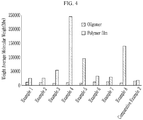
- a molecular weight increase of the polymer film is shown as a bar graph, as compared with a molecular weight of each oligomer, in FIG. 6.
- the oligomer of Example 4 shows the highest chain-extending effect into a polymer, and the oligomers according to Examples 8 and 5 show the second highest chain-extending effect into a polymer.
Landscapes
- Chemical & Material Sciences (AREA)
- Chemical Kinetics & Catalysis (AREA)
- Organic Chemistry (AREA)
- Health & Medical Sciences (AREA)
- Medicinal Chemistry (AREA)
- Polymers & Plastics (AREA)
- Engineering & Computer Science (AREA)
- Materials Engineering (AREA)
- Manufacturing & Machinery (AREA)
- Life Sciences & Earth Sciences (AREA)
- Wood Science & Technology (AREA)
- Macromolecular Compounds Obtained By Forming Nitrogen-Containing Linkages In General (AREA)
- Organic Low-Molecular-Weight Compounds And Preparation Thereof (AREA)
- Compositions Of Macromolecular Compounds (AREA)
Claims (15)
- Oligomer, umfassend:zwei Enden und eine Hauptkette zwischen den zwei Enden,eine Gruppe, die durch die chemische Formel 1 dargestellt wird, an einem Ende und eine Struktureinheit, die durch die chemische Formel 2 oder die chemische Formel 3 dargestellt wird, in der Hauptkette:
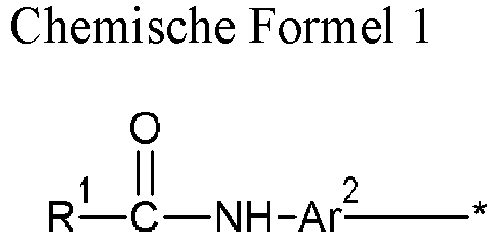 R1 eine tertiäre C4- bis C10-Alkoxygruppe, eine C3- bis C10-Cycloalkoxygruppe, eine R-CH=CH-O-Gruppe ist, wobei R Wasserstoff oder eine substituierte oder unsubstituierte C1- bis C8-Alkylgruppe, eine R-CH=CH-CH2-O-Gruppe ist, wobei R Wasserstoff oder eine substituierte oder unsubstituierte C1- bis C7-Alkylgruppe, eine substituierte Phenyloxygruppe, eine substituierte oder unsubstituierte Benzyloxygruppe oder eine 9-Fluorenylmethyloxygruppe ist, undAr2 Folgendes umfasst: eine substituierte oder unsubstituierte aromatische organische C6-bis C30-Gruppe, wobei die substituierte oder unsubstituierte aromatische organische C6- bis C30-Gruppe als ein substituierter oder unsubstituierter einzelner aromatischer Ring vorliegt; einen kondensierten Ring, umfassend zwei oder mehr substituierte oder unsubstituierte aromatische Ringe; oder ein Ringsystem, umfassend zwei oder mehr des substituierten oder unsubstituierten einzelnen aromatischen Rings und/oder des kondensierten Rings, die durch eine Einfachbindung, eine Fluorenylengruppe, eine substituierte oder unsubstituierte C1- bis C10-Cycloalkylengruppe, eine substituierte oder unsubstituierte C6- bis C15-Arylengruppe, -O-, -S-, -C(=O)-, -CH(OH)-, - S(=O)2-, -Si(CH3)2-, -(CH2)p- (wobei 1≤p≤10), -(CF2)q- (wobei 1≤q≤10), -C(CH3)2-, -C(CF3)2-, - C(=O)NH- oder eine Kombination davon verknüpft sind;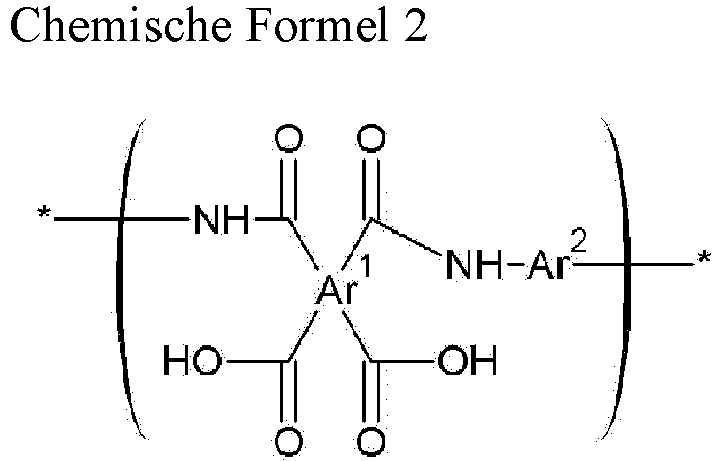

 Ar2 der Definition in der chemischen Formel 1 entspricht,Ar1 eine substituierte oder unsubstituierte aromatische organische C6-C30-Gruppe, eine Gruppe, die durch die chemische Formel 4 dargestellt wird, eine Gruppe, die durch die chemische Formel 5 dargestellt wird, oder eine Kombination davon ist:
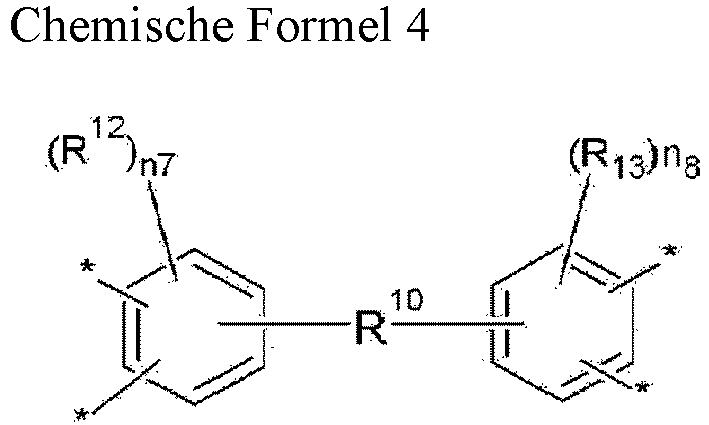 R10 eine Einfachbindung, -O-, -S-, -C(=O)-, -CH(OH)-, -C(=O)NH-, -S(=O)2-, -Si(CH3)2-, -(CH2)p- (wobei 1≤p≤10), -(CF2)q- (wobei 1≤q≤10), -C(CnH2n+1)2-, -C(CnF2n+1)2-, -(CH2)p-C(CnH2n+1)2-(CH2)q-, -(CH2)p-C(CnF2n+1)2-(CH2)q- (wobei 1≤n≤10, 1≤p≤10 und 1≤q≤10) oder eine Kombination davon ist,R12 und R13 unabhängig ein Halogen, eine Hydroxygruppe, eine substituierte oder unsubstituierte aliphatische organische C1- bis C10-Gruppe, eine substituierte oder unsubstituierte aromatische organische C6- bis C20-Gruppe, eine -OR201-Gruppe (wobei R201 eine aliphatische organische C1- bis C10-Gruppe ist) oder eine -SiR210R211R212-Gruppe sind (wobei R210, R211 und R212 unabhängig Wasserstoff oder eine aliphatische organische C1- bis C10-Gruppe sind) undn7 und n8 unabhängig eine von ganzen Zahlen von 0 bis 3 sind;
 wobei in der chemischen Formel 5R4 und R5 unabhängig eine substituierte oder unsubstituierte C1- bis C30-Alkylgruppe, eine substituierte oder unsubstituierte C3- bis C30-Cycloalkylgruppe, eine substituierte oder unsubstituierte C1- bis C30-Alkoxygruppe, eine substituierte oder unsubstituierte C6- bis C30-Arylgruppe, eine substituierte oder unsubstituierte C2- bis C30-Acylgruppe, eine Hydroxygruppe, ein Halogen, eine Nitrogruppe, -NR'R"(wobei R' und R" unabhängig Wasserstoff, eine C1- bis C30-Alkylgruppe oder eine C6- bis C30-Arylgruppe sind), -SiR'R"R'" (wobei R', R", and R'" unabhängig Wasserstoff, eine C1- bis C30-Alkylgruppe oder eine C6- bis C30-Arylgruppe sind) oder eine Kombination davon sind;L1 O oder NRb ist (wobei Rb Wasserstoff oder eine C1- bis C20-Alkylgruppe ist),A1 eine substituierte oder unsubstituierte aromatische organische C6- bis C30-Gruppe ist undRa Wasserstoff, eine substituierte oder unsubstituierte C1- bis C30-Alkylgruppe, eine substituierte oder unsubstituierte C1- bis C30-Alkoxygruppe, eine substituierte oder unsubstituierte C3- bis C30-Cycloalkylgruppe, eine substituierte oder unsubstituierte C6- bis C30-Arylgruppe, eine substituierte oder unsubstituierte C7- bis C30-Arylalkylgruppe, eine Hydroxygruppe, ein Halogen, eine Nitrogruppe, -NR'R" (wobei R' und R" unabhängig Wasserstoff, eine C1- bis C30-Alkylgruppe, eine C6- bis C30-Arylgruppe oder eine C7- bis C30-Arylalkylgruppe sind), -C(=O)-NR'R" (wobei R' und R" unabhängig Wasserstoff, eine C1- bis C30-Alkylgruppe, eine C6- bis C30-Arylgruppe oder eine C7- bis C30-Arylalkylgruppe sind), - SiR'R"R"' (wobei R', R" und R'" unabhängig Wasserstoff, eine C1- bis C30-Alkylgruppe, eine C6- bis C30-Arylgruppe oder eine C7- bis C30-Arylalkylgruppe sind) oder eine Gruppe ist, die durch die chemische Formel 6 dargestellt wird:
 L2 und L3 unabhängig O, C(=O), C(=O)O, C=C oder C(=O)NRb sind (wobei Rb Wasserstoff oder eine C1- bis C30-Alkylgruppe ist),A2 und A3 unabhängig ein substituierter oder unsubstituierter aromatischer C6- bis C30-Ring, ein substituierter oder unsubstituierter Fluorenring oder eine substituierte oder unsubstituierte C7- bis C20-Arylalkyl- oder Arylalkylengruppe sind,q und r unabhängig ganze Zahlen von 0 bis 3 sind;k eine von ganzen Zahlen von 0 bis 2 ist,m eine von ganzen Zahlen von 0 bis 3 ist,n eine von ganzen Zahlen von 0 bis 20 ist undo und p unabhängig eine von ganzen Zahlen von 0 bis 3 sind.
 - Oligomer nach Anspruch 1, wobei R1 der chemischen Formel 1 eine t-Butoxygruppe, eine 2-Methyl-2-butoxygruppe, eine ClO-Cycloalkoxygruppe, eine Vinyloxygruppe, eine Allyloxygruppe, eine Nitrophenyloxygruppe, eine Nitrobenzyloxygruppe oder eine Benzyloxygruppe ist;
wobei R1 der chemischen Formel 1 vorzugsweise eine t-Butoxygruppe oder eine Benzyloxygruppe ist. - Oligomer nach Anspruch 1 oder 2, wobei Ar2 von der chemischen Formel 1 bis zur chemischen Formel 3 eine Gruppe ist, in der zwei substituierte oder unsubstituierte aromatische Ringe durch eine Einfachbindung, eine Fluorenylengruppe, eine substituierte oder unsubstituierte C1- bis C10-Cycloalkylengruppe, eine substituierte oder unsubstituierte C6- bis C15-Arylengruppe, -O-, -S-, -C(=O)-, -CH(OH)-, -S(=O)2-, -Si(CH3)2-, -(CH2)p- (wobei 1≤p≤10), - (CF2)q- (wobei 1≤q≤10), -C(CH3)2-, -C(CF3)2-, -C(=O)NH- oder eine Kombination davon verknüpft sind.
- Oligomer nach einem der Ansprüche 1 bis 3, wobei Ar2 der chemischen Formel 1 bis zur chemischen Formel 3 eine Gruppe ist, in der zwei aromatische Ringe, von denen jeder mit einer elektronenziehenden Gruppe substituiert ist, durch eine Einfachbindung verknüpft sind; und/oder
wobei R10 der chemischen Formel 4 eine Einfachbindung, -O-, -S-, -C(=O)-, -CH(OH)-, - C(=O)NH-, -S(=O)2-, -Si(CH3)2-, -(CH2)p- (wobei 1≤p≤3), -(CF2)q- (wobei 1≤q≤3), -C(CnH2n+1)2-, -C(CnF2n+1)2-, -(CH2)p-C(CnH2n+1)2-(CH2)q-, -(CH2)p-C(CnF2n+1)2-(CH2)q- (wobei 1≤n≤10, 1≤p≤3 und 1≤q≤3) oder eine Kombination davon ist. - Oligomer nach einem der Ansprüche 1 bis 4, wobei L1 der chemischen Formel 5 O ist, A1 eine substituierte oder unsubstituierte aromatische organische C6- bis C20-Gruppe ist, Ra Wasserstoff, eine substituierte oder unsubstituierte C1- bis C30-Alkylgruppe, eine substituierte oder unsubstituierte C6- bis C30-Arylgruppe, eine substituierte oder unsubstituierte C7- bis C30-Arylalkylgruppe, ein Halogen, -NR'R" (wobei R' und R" unabhängig Wasserstoff sind, eine C1-bis C30-Alkylgruppe, eine C6- bis C30-Arylgruppe oder eine C7- bis C30-Arylalkylgruppe sind), -C(=O)-NR'R" (wobei R' und R" unabhängig Wasserstoff, eine C1- bis C30-Alkylgruppe, eine C6- bis C30-Arylgruppe oder eine C7- bis C30-Arylalkylgruppe sind) oder die durch die chemische Formel 6 dargestellte Gruppe ist, k 0 oder 1 ist, m eine von ganzen Zahlen von 0 bis 2 ist und n eine von ganzen Zahlen von 1 bis 3 ist.
- Oligomer nach einem der Ansprüche 1 - 5, wobei L2 und L3 der chemischen Formel 6 unabhängig C(=O)O, C=C oder C(=O)NRb sind (wobei Rb Wasserstoff oder eine C1- bis C20-Alkylgruppe ist), A2 und A3 unabhängig ein substituierter oder unsubstituierter aromatischer C6-bis C20-Ring, ein substituierter oder unsubstituierter Fluorenring oder eine substituierte oder unsubstituierte C7- bis C20-Arylalkyl- oder Arylalkylengruppe sind, und q und r unabhängig eine ganze Zahl im Bereich von 0 bis 2 sind, vorausgesetzt, dass 1≤q+r≤2.
- Oligomer nach einem der Ansprüche 1 bis 6, wobei Ar1 der chemischen Formel 2 oder der chemischen Formel 3 eine Kombination der durch die chemische Formel 4 dargestellten Gruppe und der durch die chemische Formel 5 dargestellten Gruppe umfasst;
wobei R10 der chemischen Formel 4 vorzugsweise eine Einfachbindung, -C(CF3)2- oder eine Kombination davon umfasst,
L1 der chemischen Formel 5 O ist, A1 eine aromatische organische C6-Gruppe ist, Ra Wasserstoff, eine C1- bis C30-Alkylgruppe, eine C6- bis C30-Arylgruppe, eine C7- bis C30-Arylalkylgruppe, -F, -Cl, -NR'R" (wobei R' und R" unabhängig Wasserstoff, eine C1- bis C30-Alkylgruppe, eine C6- bis C30-Arylgruppe oder eine C7- bis C30-Arylalkylgruppe sind), -C(=O)-NR'R" (wobei R' und R" unabhängig Wasserstoff, eine C1- bis C30-Alkylgruppe, eine C6- bis C30-Arylgruppe oder eine C7- bis C30-Arylalkylgruppe sind) oder die durch die chemische Formel 6 dargestellte Gruppe ist, k 0 oder 1 ist, m eine von ganzen Zahlen von 0 bis 2 ist, und n eine von ganzen Zahlen von 1 bis 3 ist. - Oligomer nach einem der Ansprüche 1 bis 7, wobei das Oligomer eine Gruppe, die durch die chemische Formel 1 dargestellt ist, an einem Ende und eine der Gruppen, die durch die chemische Formel 7 bis zur chemischen Formel 10 dargestellt ist, an dem anderen Ende umfasst:


Ar1 der Definition in Anspruch 1 entspricht,
in der chemischen Formel 9 und der chemischen Formel 10,
R6 Wasserstoff, ein Halogen, eine Vinylgruppe, eine Ethinylgruppe, eine Isopropylgruppe, eine sec-Butylgruppe, eine tert-Butylgruppe, eine C3- bis C20-Cycloalkylgruppe, eine C6- bis C20-Arylgruppe oder eine Kombination davon ist und
s eine von ganzen Zahlen von 1 bis 30 ist. - Oligomer nach einem der Ansprüche 1 bis 8, wobei ein durch Gelpermeationschromatographie gemessenes Gewichtsmittel des Molekulargewichts (Mw) des Oligomers 1.000 Gramm pro Mol bis 25.000 Gramm pro Mol entspricht.
- Zusammensetzung zur Herstellung eines Polymers, umfassend das Oligomer nach einem der Ansprüche 1 bis 9 und ein Lösungsmittel.
- Zusammensetzung nach Anspruch 10, wobei die Zusammensetzung ferner ein zweites Oligomer umfasst, umfassend eine Struktureinheit, die durch die chemische Formel 2 oder die chemische Formel 3 dargestellt ist, in der Hauptkette, und eine Gruppe, die durch die chemische Formel 7 oder die chemische Formel 8 dargestellt ist, an einem Ende:
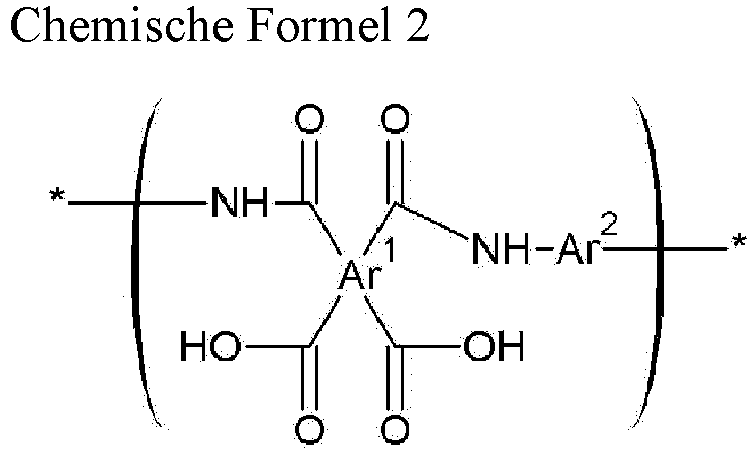

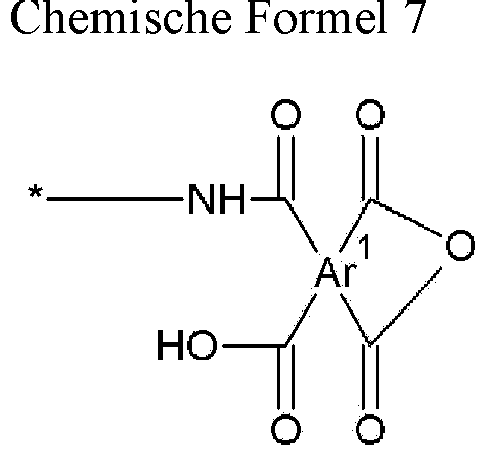

Ar1 und Ar2 der Definition in Anspruch 1 entsprechen;
wobei das zweite Oligomer vorzugsweise eine Gruppe, die durch die chemische Formel 9 oder die chemische Formel 10 dargestellt ist, am anderen Ende umfasst:

 Ar1 der Definition in Anspruch 1 entspricht,R6 Wasserstoff, ein Halogen, eine Vinylgruppe, eine Ethinylgruppe, eine Isopropylgruppe, eine sec-Butylgruppe, eine tert-Butylgruppe, eine C3- bis C20-Cycloalkylgruppe, eine C6- bis C20-Arylgruppe oder eine Kombination davon ist unds eine von ganzen Zahlen von 1 bis 30 ist.
 - Zusammensetzung nach Anspruch 10 oder 11, wobei eine Menge des Oligomers in der Zusammensetzung 10 Gewichtsprozent bis 50 Gewichtsprozent beträgt und die Viskosität der Zusammensetzung kleiner oder gleich 500 Centipoise ist.
- Artikel, der durch Härten der Zusammensetzung nach einem der Ansprüche 10 bis 12 hergestellt wurde.
- Verfahren zur Herstellung eines Artikels, umfassend
Beschichten der Zusammensetzung nach einem der Ansprüche 10-12 auf ein Substrat, Erhitzen derselben, um ein Lösungsmittel zu entfernen, bei einer Temperatur größer gleich derjenigen, bei der die Endgruppe, die durch die chemische Formel 1 des Oligomers in der Zusammensetzung dargestellt wird, zu einer Gruppe umgewandelt wird, die durch die chemische Formel 16 dargestellt wird, und
zusätzlich Erhitzen derselben, damit das Oligomer weiter polymerisiert wird, um ein Polymer zu bilden R1 eine tertiäre C4- bis C10-Alkoxygruppe, eine C3- bis C10-Cycloalkoxygruppe, eine R-CH=CH-O-Gruppe ist, wobei R Wasserstoff oder eine substituierte oder unsubstituierte C1- bis C8-Alkylgruppe, eine R-CH=CH-CH2-O-Gruppe ist, wobei R Wasserstoff oder eine substituierte oder unsubstituierte C1- bis C7-Alkylgruppe, eine substituierte Phenyloxygruppe, eine substituierte oder unsubstituierte Benzyloxygruppe oder eine 9-Fluorenylmethyloxygruppe ist, undAr2 eine substituierte oder unsubstituierte aromatische organische C6- bis C30-Gruppe umfasst, wobei die substituierte oder unsubstituierte aromatische organische C6- bis C30-Gruppe als ein substituierter oder unsubstituierter einzelner aromatischer Ring; ein kondensierter Ring, umfassend zwei oder mehr substituierte oder unsubstituierte aromatische Ringe; oder ein Ringsystem, umfassend zwei oder mehr des substituierten oder unsubstituierten einzelnen aromatischen Rings und/oder des kondensierten Rings, vorliegt, die durch eine Einfachbindung, eine Fluorenylengruppe, eine substituierte oder unsubstituierte C1- bis C10-Cycloalkylengruppe, eine substituierte oder unsubstituierte C6- bis C15-Arylengruppe, -O-, -S-, -C(=O)-, -CH(OH)-, - S(=O)2-, -Si(CH3)2-, -(CH2)p- (wobei 1≤p≤10 ist), -(CF2)q- (wobei 1≤q≤10), -C(CH3)2-, -C(CF3)2-, -C(=O)NH- oder eine Kombination davon verknüpft sind;
Chemische Formel 16 NH2-Ar2-*
wobei in der chemischen Formel 16 Ar2 der Definition in der chemischen Formel 1 entspricht. - Anzeigevorrichtung, umfassend den Artikel nach Anspruch 13.
Applications Claiming Priority (1)
| Application Number | Priority Date | Filing Date | Title |
|---|---|---|---|
| KR1020180031109A KR102591368B1 (ko) | 2018-03-16 | 2018-03-16 | 올리고머, 올리고머를 포함하는 조성물, 조성물로부터 제조되는 성형품, 성형품의 제조 방법, 및 성형품을 포함하는 표시 장치 |
Publications (2)
| Publication Number | Publication Date |
|---|---|
| EP3539999A1 EP3539999A1 (de) | 2019-09-18 |
| EP3539999B1 true EP3539999B1 (de) | 2020-11-18 |
Family
ID=66102359
Family Applications (1)
| Application Number | Title | Priority Date | Filing Date |
|---|---|---|---|
| EP19163094.6A Active EP3539999B1 (de) | 2018-03-16 | 2019-03-15 | Oligomere, zusammensetzung mit oligomer, aus der zusammensetzung hergestellter artikel, verfahren zur herstellung des artikels und anzeigevorrichtung mit dem artikel |
Country Status (5)
| Country | Link |
|---|---|
| US (1) | US11306182B2 (de) |
| EP (1) | EP3539999B1 (de) |
| JP (1) | JP7360765B2 (de) |
| KR (1) | KR102591368B1 (de) |
| CN (1) | CN110272544B (de) |
Family Cites Families (26)
| Publication number | Priority date | Publication date | Assignee | Title |
|---|---|---|---|---|
| US5114826A (en) | 1989-12-28 | 1992-05-19 | Ibm Corporation | Photosensitive polyimide compositions |
| US5382637A (en) | 1991-10-31 | 1995-01-17 | International Business Machines Corporation | Solid state chain extension polymerization between Lewis acid oligomers and deblocked Lewis bases |
| US6017682A (en) | 1995-03-14 | 2000-01-25 | Internatonal Business Machines Corporation | Solid state extension method |
| JP3942063B2 (ja) * | 1999-06-28 | 2007-07-11 | 株式会社カネカ | 新規ポリイミド組成物およびこれに使用される新規酸二無水物 |
| US7019104B1 (en) * | 1999-11-01 | 2006-03-28 | Kaneka Corporation | Diamine novel acid dianhydride and novel polyimide composition formed therefrom |
| TW565582B (en) * | 2001-04-13 | 2003-12-11 | Kaneka Corp | Diamine, acid dianhydride, and reactive group containing polyimide composition prepared therefrom and preparing them |
| JP4211440B2 (ja) | 2003-03-14 | 2009-01-21 | 日立化成デュポンマイクロシステムズ株式会社 | 感光性重合体組成物、レリーフパターンの製造方法及び電子部品 |
| TWI287028B (en) | 2002-05-17 | 2007-09-21 | Hitachi Chem Dupont Microsys | Photosensitive polymer composition, method of forming relief patterns, and electronic equipment |
| JP2004182757A (ja) | 2002-11-29 | 2004-07-02 | Kanegafuchi Chem Ind Co Ltd | ポリイミド樹脂及び該ポリイミド樹脂の製造方法 |
| KR101212135B1 (ko) | 2005-06-14 | 2012-12-14 | 엘지디스플레이 주식회사 | 액정표시소자 및 그 제조방법 |
| JP5068628B2 (ja) | 2007-10-26 | 2012-11-07 | 旭化成イーマテリアルズ株式会社 | 感光性樹脂組成物、感光性樹脂組成物フィルム、およびそれらを用いたカバーレイ |
| JP2009013422A (ja) * | 2008-09-03 | 2009-01-22 | Kaneka Corp | コーティング材 |
| TWI382041B (zh) | 2008-12-31 | 2013-01-11 | Eternal Chemical Co Ltd | 聚醯亞胺之前驅物組合物及其應用 |
| CN102317333B (zh) | 2009-02-18 | 2015-06-10 | Lg化学株式会社 | 丙烯酸类树脂组合物和包含该丙烯酸类树脂组合物的光学膜 |
| JP5515394B2 (ja) | 2009-04-30 | 2014-06-11 | 株式会社ピーアイ技術研究所 | 感光性変性ポリイミド樹脂組成物及びその用途 |
| WO2013146967A1 (ja) | 2012-03-29 | 2013-10-03 | 東レ株式会社 | ポリアミド酸およびそれを含有する樹脂組成物 |
| KR101841977B1 (ko) | 2015-03-19 | 2018-03-26 | 미쯔비시 가스 케미칼 컴파니, 인코포레이티드 | 폴리이미드 수지 |
| KR101966736B1 (ko) | 2015-09-15 | 2019-04-09 | 주식회사 엘지화학 | 변성 폴리이미드 및 이를 포함하는 경화성 수지 조성물 |
| KR101916647B1 (ko) * | 2015-12-11 | 2018-11-07 | 도레이 카부시키가이샤 | 수지 조성물, 수지의 제조 방법, 수지막의 제조 방법 및 전자 디바이스의 제조 방법 |
| KR101771515B1 (ko) | 2016-02-16 | 2017-08-25 | (주)하인스 | 연신 분리 기능을 갖는 점착제 조성물 및 이를 포함하는 폼 양면 테이프 |
| KR101989587B1 (ko) * | 2016-03-28 | 2019-06-14 | 주식회사 엘지화학 | 액정 배향제, 이를 포함하는 액정배향막 및 액정배향막의 제조 방법 |
| KR101854771B1 (ko) * | 2016-06-30 | 2018-05-04 | 주식회사 엘지화학 | 폴리이미드계 블록 공중합체 및 이를 포함하는 폴리이미드계 필름 |
| KR20180021278A (ko) | 2016-08-18 | 2018-03-02 | 주식회사 잉크테크 | 금속 전구체 및 세라믹 안료를 포함하는 세라믹 잉크의 제조방법 및 이에 의해 제조되는 세라믹 잉크 |
| TWI621642B (zh) * | 2016-11-30 | 2018-04-21 | 長興材料工業股份有限公司 | 聚醯亞胺前驅物及其應用 |
| TWI637980B (zh) | 2017-01-11 | 2018-10-11 | 長興材料工業股份有限公司 | 聚醯亞胺前驅物及其應用 |
| EP3438156B1 (de) | 2017-07-28 | 2020-04-22 | Samsung Electronics Co., Ltd. | Monomer, polymer, kompensationsfilm, optischer film und anzeigevorrichtung |
-
2018
- 2018-03-16 KR KR1020180031109A patent/KR102591368B1/ko active Active
-
2019
- 2019-03-15 CN CN201910196954.7A patent/CN110272544B/zh active Active
- 2019-03-15 US US16/354,829 patent/US11306182B2/en active Active
- 2019-03-15 EP EP19163094.6A patent/EP3539999B1/de active Active
- 2019-03-18 JP JP2019049687A patent/JP7360765B2/ja active Active
Non-Patent Citations (1)
| Title |
|---|
| None * |
Also Published As
| Publication number | Publication date |
|---|---|
| KR102591368B1 (ko) | 2023-10-19 |
| CN110272544A (zh) | 2019-09-24 |
| CN110272544B (zh) | 2023-07-04 |
| KR20190109132A (ko) | 2019-09-25 |
| US20190284342A1 (en) | 2019-09-19 |
| EP3539999A1 (de) | 2019-09-18 |
| JP2019157135A (ja) | 2019-09-19 |
| US11306182B2 (en) | 2022-04-19 |
| JP7360765B2 (ja) | 2023-10-13 |
Similar Documents
| Publication | Publication Date | Title |
|---|---|---|
| EP3375806B1 (de) | Polyimidbasiertes blockcopolymer und polyimidbasierter film damit | |
| JP6236349B2 (ja) | ポリイミドおよびその利用 | |
| WO2013121917A1 (ja) | ジアミン、ポリイミド、ならびに、ポリイミドフィルムおよびその利用 | |
| KR20120117791A (ko) | 광학 필름, 광학 필름의 제조 방법, 투명 기판, 화상 표시 장치 및 태양 전지 | |
| EP3453734B1 (de) | Poly(amid-imid)copolymer, zusammensetzung zur herstellung von poly(amid-imid)copolymer, gegenstand mit poly(amid-imid)copolymer und anzeigevorrichtung mit diesem gegenstand | |
| EP3441418B1 (de) | Poly(amid-imid)copolymer, zusammensetzung zur herstellung von poly(amid-imid)copolymer, gegenstand mit poly(amid-imid)copolymer und anzeigevorrichtung mit diesem gegenstand | |
| US8426550B2 (en) | Polyamic acid, polyimide, manufacturing method thereof, and polyimide film | |
| US20200385524A1 (en) | Poly(amide-imide) copolymer, composition for preparing same, article including same, and display device including the article | |
| TWI426064B (zh) | 用於垂直配向模式的液晶顯示裝置之配向材料及其製備方法(i) | |
| JP2003183387A (ja) | 含フッ素脂環族ジアミンおよびこれを用いた重合体 | |
| EP3530708B1 (de) | Polymer, folie mit dem polymer und anzeigevorrichtung mit der folie | |
| EP3412732A1 (de) | Polyimidbasierter blockcopolymerfilm | |
| EP1832618A1 (de) | Fluoriertes diamin und daraus hergestelltes polymer | |
| JP5325491B2 (ja) | 新規な塗布型光学補償フィルムおよびその製造方法 | |
| JP6905227B2 (ja) | ジアミンおよびポリイミド、並びにそれらの利用 | |
| JP2932052B2 (ja) | 新規なポリイミド及びその製造方法 | |
| CN112079743B (zh) | 一种二胺、聚酰亚胺及聚酰亚胺薄膜 | |
| US11306182B2 (en) | Oligomer, composition including oligomer, article prepared from the composition, method for preparing article, and display device including the article | |
| JP7054064B2 (ja) | フレキシブルデバイス基板形成用組成物 | |
| CN105940342A (zh) | 液晶取向剂和使用了其的液晶表示元件 | |
| WO2008007629A1 (en) | Polyamic acid and polyimide | |
| JP5015070B2 (ja) | 新規な塗布型光学補償フィルムおよびその製造方法 | |
| JP5252338B2 (ja) | ジアミン化合物、それを使用して製造されるポリアミック酸及びイミド化重合体 | |
| JP5011596B2 (ja) | 新規ジアミン化合物、それを使用して製造されるポリアミック酸及びイミド化重合体 | |
| JP2025183043A (ja) | ポリアミドイミド、及び、電子部品 |
Legal Events
| Date | Code | Title | Description |
|---|---|---|---|
| PUAI | Public reference made under article 153(3) epc to a published international application that has entered the european phase |
Free format text: ORIGINAL CODE: 0009012 |
|
| STAA | Information on the status of an ep patent application or granted ep patent |
Free format text: STATUS: THE APPLICATION HAS BEEN PUBLISHED |
|
| AK | Designated contracting states |
Kind code of ref document: A1 Designated state(s): AL AT BE BG CH CY CZ DE DK EE ES FI FR GB GR HR HU IE IS IT LI LT LU LV MC MK MT NL NO PL PT RO RS SE SI SK SM TR |
|
| AX | Request for extension of the european patent |
Extension state: BA ME |
|
| STAA | Information on the status of an ep patent application or granted ep patent |
Free format text: STATUS: REQUEST FOR EXAMINATION WAS MADE |
|
| 17P | Request for examination filed |
Effective date: 20200318 |
|
| RAP1 | Party data changed (applicant data changed or rights of an application transferred) |
Owner name: SAMSUNG DISPLAY CO., LTD. Owner name: SAMSUNG ELECTRONICS CO., LTD. |
|
| RBV | Designated contracting states (corrected) |
Designated state(s): AL AT BE BG CH CY CZ DE DK EE ES FI FR GB GR HR HU IE IS IT LI LT LU LV MC MK MT NL NO PL PT RO RS SE SI SK SM TR |
|
| GRAP | Despatch of communication of intention to grant a patent |
Free format text: ORIGINAL CODE: EPIDOSNIGR1 |
|
| STAA | Information on the status of an ep patent application or granted ep patent |
Free format text: STATUS: GRANT OF PATENT IS INTENDED |
|
| RIC1 | Information provided on ipc code assigned before grant |
Ipc: C08G 73/10 20060101AFI20200430BHEP |
|
| INTG | Intention to grant announced |
Effective date: 20200529 |
|
| GRAS | Grant fee paid |
Free format text: ORIGINAL CODE: EPIDOSNIGR3 |
|
| GRAA | (expected) grant |
Free format text: ORIGINAL CODE: 0009210 |
|
| STAA | Information on the status of an ep patent application or granted ep patent |
Free format text: STATUS: THE PATENT HAS BEEN GRANTED |
|
| AK | Designated contracting states |
Kind code of ref document: B1 Designated state(s): AL AT BE BG CH CY CZ DE DK EE ES FI FR GB GR HR HU IE IS IT LI LT LU LV MC MK MT NL NO PL PT RO RS SE SI SK SM TR |
|
| REG | Reference to a national code |
Ref country code: GB Ref legal event code: FG4D |
|
| REG | Reference to a national code |
Ref country code: CH Ref legal event code: EP |
|
| REG | Reference to a national code |
Ref country code: IE Ref legal event code: FG4D |
|
| REG | Reference to a national code |
Ref country code: DE Ref legal event code: R096 Ref document number: 602019001329 Country of ref document: DE |
|
| REG | Reference to a national code |
Ref country code: AT Ref legal event code: REF Ref document number: 1335693 Country of ref document: AT Kind code of ref document: T Effective date: 20201215 |
|
| REG | Reference to a national code |
Ref country code: AT Ref legal event code: MK05 Ref document number: 1335693 Country of ref document: AT Kind code of ref document: T Effective date: 20201118 |
|
| REG | Reference to a national code |
Ref country code: NL Ref legal event code: MP Effective date: 20201118 |
|
| PG25 | Lapsed in a contracting state [announced via postgrant information from national office to epo] |
Ref country code: GR Free format text: LAPSE BECAUSE OF FAILURE TO SUBMIT A TRANSLATION OF THE DESCRIPTION OR TO PAY THE FEE WITHIN THE PRESCRIBED TIME-LIMIT Effective date: 20210219 Ref country code: NO Free format text: LAPSE BECAUSE OF FAILURE TO SUBMIT A TRANSLATION OF THE DESCRIPTION OR TO PAY THE FEE WITHIN THE PRESCRIBED TIME-LIMIT Effective date: 20210218 Ref country code: PT Free format text: LAPSE BECAUSE OF FAILURE TO SUBMIT A TRANSLATION OF THE DESCRIPTION OR TO PAY THE FEE WITHIN THE PRESCRIBED TIME-LIMIT Effective date: 20210318 Ref country code: RS Free format text: LAPSE BECAUSE OF FAILURE TO SUBMIT A TRANSLATION OF THE DESCRIPTION OR TO PAY THE FEE WITHIN THE PRESCRIBED TIME-LIMIT Effective date: 20201118 Ref country code: FI Free format text: LAPSE BECAUSE OF FAILURE TO SUBMIT A TRANSLATION OF THE DESCRIPTION OR TO PAY THE FEE WITHIN THE PRESCRIBED TIME-LIMIT Effective date: 20201118 |
|
| PG25 | Lapsed in a contracting state [announced via postgrant information from national office to epo] |
Ref country code: BG Free format text: LAPSE BECAUSE OF FAILURE TO SUBMIT A TRANSLATION OF THE DESCRIPTION OR TO PAY THE FEE WITHIN THE PRESCRIBED TIME-LIMIT Effective date: 20210218 Ref country code: SE Free format text: LAPSE BECAUSE OF FAILURE TO SUBMIT A TRANSLATION OF THE DESCRIPTION OR TO PAY THE FEE WITHIN THE PRESCRIBED TIME-LIMIT Effective date: 20201118 Ref country code: PL Free format text: LAPSE BECAUSE OF FAILURE TO SUBMIT A TRANSLATION OF THE DESCRIPTION OR TO PAY THE FEE WITHIN THE PRESCRIBED TIME-LIMIT Effective date: 20201118 Ref country code: LV Free format text: LAPSE BECAUSE OF FAILURE TO SUBMIT A TRANSLATION OF THE DESCRIPTION OR TO PAY THE FEE WITHIN THE PRESCRIBED TIME-LIMIT Effective date: 20201118 Ref country code: IS Free format text: LAPSE BECAUSE OF FAILURE TO SUBMIT A TRANSLATION OF THE DESCRIPTION OR TO PAY THE FEE WITHIN THE PRESCRIBED TIME-LIMIT Effective date: 20210318 Ref country code: AT Free format text: LAPSE BECAUSE OF FAILURE TO SUBMIT A TRANSLATION OF THE DESCRIPTION OR TO PAY THE FEE WITHIN THE PRESCRIBED TIME-LIMIT Effective date: 20201118 |
|
| REG | Reference to a national code |
Ref country code: LT Ref legal event code: MG9D |
|
| PG25 | Lapsed in a contracting state [announced via postgrant information from national office to epo] |
Ref country code: HR Free format text: LAPSE BECAUSE OF FAILURE TO SUBMIT A TRANSLATION OF THE DESCRIPTION OR TO PAY THE FEE WITHIN THE PRESCRIBED TIME-LIMIT Effective date: 20201118 |
|
| PG25 | Lapsed in a contracting state [announced via postgrant information from national office to epo] |
Ref country code: CZ Free format text: LAPSE BECAUSE OF FAILURE TO SUBMIT A TRANSLATION OF THE DESCRIPTION OR TO PAY THE FEE WITHIN THE PRESCRIBED TIME-LIMIT Effective date: 20201118 Ref country code: EE Free format text: LAPSE BECAUSE OF FAILURE TO SUBMIT A TRANSLATION OF THE DESCRIPTION OR TO PAY THE FEE WITHIN THE PRESCRIBED TIME-LIMIT Effective date: 20201118 Ref country code: SK Free format text: LAPSE BECAUSE OF FAILURE TO SUBMIT A TRANSLATION OF THE DESCRIPTION OR TO PAY THE FEE WITHIN THE PRESCRIBED TIME-LIMIT Effective date: 20201118 Ref country code: SM Free format text: LAPSE BECAUSE OF FAILURE TO SUBMIT A TRANSLATION OF THE DESCRIPTION OR TO PAY THE FEE WITHIN THE PRESCRIBED TIME-LIMIT Effective date: 20201118 Ref country code: RO Free format text: LAPSE BECAUSE OF FAILURE TO SUBMIT A TRANSLATION OF THE DESCRIPTION OR TO PAY THE FEE WITHIN THE PRESCRIBED TIME-LIMIT Effective date: 20201118 Ref country code: LT Free format text: LAPSE BECAUSE OF FAILURE TO SUBMIT A TRANSLATION OF THE DESCRIPTION OR TO PAY THE FEE WITHIN THE PRESCRIBED TIME-LIMIT Effective date: 20201118 |
|
| REG | Reference to a national code |
Ref country code: DE Ref legal event code: R097 Ref document number: 602019001329 Country of ref document: DE |
|
| PG25 | Lapsed in a contracting state [announced via postgrant information from national office to epo] |
Ref country code: DK Free format text: LAPSE BECAUSE OF FAILURE TO SUBMIT A TRANSLATION OF THE DESCRIPTION OR TO PAY THE FEE WITHIN THE PRESCRIBED TIME-LIMIT Effective date: 20201118 |
|
| PLBE | No opposition filed within time limit |
Free format text: ORIGINAL CODE: 0009261 |
|
| STAA | Information on the status of an ep patent application or granted ep patent |
Free format text: STATUS: NO OPPOSITION FILED WITHIN TIME LIMIT |
|
| 26N | No opposition filed |
Effective date: 20210819 |
|
| PG25 | Lapsed in a contracting state [announced via postgrant information from national office to epo] |
Ref country code: MC Free format text: LAPSE BECAUSE OF FAILURE TO SUBMIT A TRANSLATION OF THE DESCRIPTION OR TO PAY THE FEE WITHIN THE PRESCRIBED TIME-LIMIT Effective date: 20201118 Ref country code: IT Free format text: LAPSE BECAUSE OF FAILURE TO SUBMIT A TRANSLATION OF THE DESCRIPTION OR TO PAY THE FEE WITHIN THE PRESCRIBED TIME-LIMIT Effective date: 20201118 Ref country code: NL Free format text: LAPSE BECAUSE OF FAILURE TO SUBMIT A TRANSLATION OF THE DESCRIPTION OR TO PAY THE FEE WITHIN THE PRESCRIBED TIME-LIMIT Effective date: 20201118 Ref country code: AL Free format text: LAPSE BECAUSE OF FAILURE TO SUBMIT A TRANSLATION OF THE DESCRIPTION OR TO PAY THE FEE WITHIN THE PRESCRIBED TIME-LIMIT Effective date: 20201118 |
|
| PG25 | Lapsed in a contracting state [announced via postgrant information from national office to epo] |
Ref country code: SI Free format text: LAPSE BECAUSE OF FAILURE TO SUBMIT A TRANSLATION OF THE DESCRIPTION OR TO PAY THE FEE WITHIN THE PRESCRIBED TIME-LIMIT Effective date: 20201118 |
|
| REG | Reference to a national code |
Ref country code: BE Ref legal event code: MM Effective date: 20210331 |
|
| PG25 | Lapsed in a contracting state [announced via postgrant information from national office to epo] |
Ref country code: LU Free format text: LAPSE BECAUSE OF NON-PAYMENT OF DUE FEES Effective date: 20210315 Ref country code: IE Free format text: LAPSE BECAUSE OF NON-PAYMENT OF DUE FEES Effective date: 20210315 Ref country code: ES Free format text: LAPSE BECAUSE OF FAILURE TO SUBMIT A TRANSLATION OF THE DESCRIPTION OR TO PAY THE FEE WITHIN THE PRESCRIBED TIME-LIMIT Effective date: 20201118 |
|
| PG25 | Lapsed in a contracting state [announced via postgrant information from national office to epo] |
Ref country code: IS Free format text: LAPSE BECAUSE OF FAILURE TO SUBMIT A TRANSLATION OF THE DESCRIPTION OR TO PAY THE FEE WITHIN THE PRESCRIBED TIME-LIMIT Effective date: 20210318 |
|
| PG25 | Lapsed in a contracting state [announced via postgrant information from national office to epo] |
Ref country code: BE Free format text: LAPSE BECAUSE OF NON-PAYMENT OF DUE FEES Effective date: 20210331 |
|
| REG | Reference to a national code |
Ref country code: CH Ref legal event code: PL |
|
| PG25 | Lapsed in a contracting state [announced via postgrant information from national office to epo] |
Ref country code: LI Free format text: LAPSE BECAUSE OF NON-PAYMENT OF DUE FEES Effective date: 20220331 Ref country code: CH Free format text: LAPSE BECAUSE OF NON-PAYMENT OF DUE FEES Effective date: 20220331 |
|
| PG25 | Lapsed in a contracting state [announced via postgrant information from national office to epo] |
Ref country code: CY Free format text: LAPSE BECAUSE OF FAILURE TO SUBMIT A TRANSLATION OF THE DESCRIPTION OR TO PAY THE FEE WITHIN THE PRESCRIBED TIME-LIMIT Effective date: 20201118 |
|
| PG25 | Lapsed in a contracting state [announced via postgrant information from national office to epo] |
Ref country code: HU Free format text: LAPSE BECAUSE OF FAILURE TO SUBMIT A TRANSLATION OF THE DESCRIPTION OR TO PAY THE FEE WITHIN THE PRESCRIBED TIME-LIMIT; INVALID AB INITIO Effective date: 20190315 |
|
| PG25 | Lapsed in a contracting state [announced via postgrant information from national office to epo] |
Ref country code: MK Free format text: LAPSE BECAUSE OF FAILURE TO SUBMIT A TRANSLATION OF THE DESCRIPTION OR TO PAY THE FEE WITHIN THE PRESCRIBED TIME-LIMIT Effective date: 20201118 |
|
| PG25 | Lapsed in a contracting state [announced via postgrant information from national office to epo] |
Ref country code: MT Free format text: LAPSE BECAUSE OF FAILURE TO SUBMIT A TRANSLATION OF THE DESCRIPTION OR TO PAY THE FEE WITHIN THE PRESCRIBED TIME-LIMIT Effective date: 20201118 |
|
| PG25 | Lapsed in a contracting state [announced via postgrant information from national office to epo] |
Ref country code: TR Free format text: LAPSE BECAUSE OF FAILURE TO SUBMIT A TRANSLATION OF THE DESCRIPTION OR TO PAY THE FEE WITHIN THE PRESCRIBED TIME-LIMIT Effective date: 20201118 |
|
| PGFP | Annual fee paid to national office [announced via postgrant information from national office to epo] |
Ref country code: GB Payment date: 20260216 Year of fee payment: 8 |
|
| PGFP | Annual fee paid to national office [announced via postgrant information from national office to epo] |
Ref country code: DE Payment date: 20260211 Year of fee payment: 8 |
|
| PGFP | Annual fee paid to national office [announced via postgrant information from national office to epo] |
Ref country code: FR Payment date: 20260209 Year of fee payment: 8 |