EP3537115B1 - Wägesystem und wägeverfahren - Google Patents
Wägesystem und wägeverfahren Download PDFInfo
- Publication number
- EP3537115B1 EP3537115B1 EP19161448.6A EP19161448A EP3537115B1 EP 3537115 B1 EP3537115 B1 EP 3537115B1 EP 19161448 A EP19161448 A EP 19161448A EP 3537115 B1 EP3537115 B1 EP 3537115B1
- Authority
- EP
- European Patent Office
- Prior art keywords
- transfer receptacle
- receptacle
- control system
- particulate material
- weighing
- Prior art date
- Legal status (The legal status is an assumption and is not a legal conclusion. Google has not performed a legal analysis and makes no representation as to the accuracy of the status listed.)
- Active
Links
Images






Classifications
-
- G—PHYSICS
- G01—MEASURING; TESTING
- G01G—WEIGHING
- G01G13/00—Weighing apparatus with automatic feed or discharge for weighing-out batches of material
- G01G13/02—Means for automatically loading weigh pans or other receptacles, e.g. disposable containers, under control of the weighing mechanism
-
- G—PHYSICS
- G01—MEASURING; TESTING
- G01G—WEIGHING
- G01G13/00—Weighing apparatus with automatic feed or discharge for weighing-out batches of material
- G01G13/02—Means for automatically loading weigh pans or other receptacles, e.g. disposable containers, under control of the weighing mechanism
- G01G13/022—Material feeding devices
- G01G13/024—Material feeding devices by gravity
-
- B—PERFORMING OPERATIONS; TRANSPORTING
- B01—PHYSICAL OR CHEMICAL PROCESSES OR APPARATUS IN GENERAL
- B01F—MIXING, e.g. DISSOLVING, EMULSIFYING OR DISPERSING
- B01F35/00—Accessories for mixers; Auxiliary operations or auxiliary devices; Parts or details of general application
- B01F35/71—Feed mechanisms
- B01F35/717—Feed mechanisms characterised by the means for feeding the components to the mixer
- B01F35/71785—Feed mechanisms characterised by the means for feeding the components to the mixer using slides or vibrating tables
-
- B—PERFORMING OPERATIONS; TRANSPORTING
- B65—CONVEYING; PACKING; STORING; HANDLING THIN OR FILAMENTARY MATERIAL
- B65B—MACHINES, APPARATUS OR DEVICES FOR, OR METHODS OF, PACKAGING ARTICLES OR MATERIALS; UNPACKING
- B65B1/00—Packaging fluent solid material, e.g. powders, granular or loose fibrous material, loose masses of small articles, in individual containers or receptacles, e.g. bags, sacks, boxes, cartons, cans, or jars
- B65B1/30—Devices or methods for controlling or determining the quantity or quality or the material fed or filled
- B65B1/32—Devices or methods for controlling or determining the quantity or quality or the material fed or filled by weighing
-
- B—PERFORMING OPERATIONS; TRANSPORTING
- B65—CONVEYING; PACKING; STORING; HANDLING THIN OR FILAMENTARY MATERIAL
- B65B—MACHINES, APPARATUS OR DEVICES FOR, OR METHODS OF, PACKAGING ARTICLES OR MATERIALS; UNPACKING
- B65B37/00—Supplying or feeding fluent-solid, plastic, or liquid material, or loose masses of small articles, to be packaged
- B65B37/16—Separating measured quantities from supply
- B65B37/18—Separating measured quantities from supply by weighing
-
- B—PERFORMING OPERATIONS; TRANSPORTING
- B65—CONVEYING; PACKING; STORING; HANDLING THIN OR FILAMENTARY MATERIAL
- B65D—CONTAINERS FOR STORAGE OR TRANSPORT OF ARTICLES OR MATERIALS, e.g. BAGS, BARRELS, BOTTLES, BOXES, CANS, CARTONS, CRATES, DRUMS, JARS, TANKS, HOPPERS, FORWARDING CONTAINERS; ACCESSORIES, CLOSURES, OR FITTINGS THEREFOR; PACKAGING ELEMENTS; PACKAGES
- B65D83/00—Containers or packages with special means for dispensing contents
- B65D83/06—Containers or packages with special means for dispensing contents for dispensing powdered or granular material
-
- B—PERFORMING OPERATIONS; TRANSPORTING
- B65—CONVEYING; PACKING; STORING; HANDLING THIN OR FILAMENTARY MATERIAL
- B65D—CONTAINERS FOR STORAGE OR TRANSPORT OF ARTICLES OR MATERIALS, e.g. BAGS, BARRELS, BOTTLES, BOXES, CANS, CARTONS, CRATES, DRUMS, JARS, TANKS, HOPPERS, FORWARDING CONTAINERS; ACCESSORIES, CLOSURES, OR FITTINGS THEREFOR; PACKAGING ELEMENTS; PACKAGES
- B65D85/00—Containers, packaging elements or packages, specially adapted for particular articles or materials
- B65D85/70—Containers, packaging elements or packages, specially adapted for particular articles or materials for materials not otherwise provided for
-
- B—PERFORMING OPERATIONS; TRANSPORTING
- B65—CONVEYING; PACKING; STORING; HANDLING THIN OR FILAMENTARY MATERIAL
- B65D—CONTAINERS FOR STORAGE OR TRANSPORT OF ARTICLES OR MATERIALS, e.g. BAGS, BARRELS, BOTTLES, BOXES, CANS, CARTONS, CRATES, DRUMS, JARS, TANKS, HOPPERS, FORWARDING CONTAINERS; ACCESSORIES, CLOSURES, OR FITTINGS THEREFOR; PACKAGING ELEMENTS; PACKAGES
- B65D88/00—Large containers
- B65D88/26—Hoppers, i.e. containers having funnel-shaped discharge sections
- B65D88/28—Construction or shape of discharge section
-
- B—PERFORMING OPERATIONS; TRANSPORTING
- B65—CONVEYING; PACKING; STORING; HANDLING THIN OR FILAMENTARY MATERIAL
- B65D—CONTAINERS FOR STORAGE OR TRANSPORT OF ARTICLES OR MATERIALS, e.g. BAGS, BARRELS, BOTTLES, BOXES, CANS, CARTONS, CRATES, DRUMS, JARS, TANKS, HOPPERS, FORWARDING CONTAINERS; ACCESSORIES, CLOSURES, OR FITTINGS THEREFOR; PACKAGING ELEMENTS; PACKAGES
- B65D88/00—Large containers
- B65D88/54—Large containers characterised by means facilitating filling or emptying
- B65D88/64—Large containers characterised by means facilitating filling or emptying preventing bridge formation
- B65D88/66—Large containers characterised by means facilitating filling or emptying preventing bridge formation using vibrating or knocking devices
-
- G—PHYSICS
- G01—MEASURING; TESTING
- G01G—WEIGHING
- G01G13/00—Weighing apparatus with automatic feed or discharge for weighing-out batches of material
- G01G13/16—Means for automatically discharging weigh receptacles under control of the weighing mechanism
-
- G—PHYSICS
- G01—MEASURING; TESTING
- G01G—WEIGHING
- G01G13/00—Weighing apparatus with automatic feed or discharge for weighing-out batches of material
- G01G13/16—Means for automatically discharging weigh receptacles under control of the weighing mechanism
- G01G13/22—Means for automatically discharging weigh receptacles under control of the weighing mechanism by tilting or rotating the weigh receptacle
-
- G—PHYSICS
- G01—MEASURING; TESTING
- G01G—WEIGHING
- G01G13/00—Weighing apparatus with automatic feed or discharge for weighing-out batches of material
- G01G13/24—Weighing mechanism control arrangements for automatic feed or discharge
-
- G—PHYSICS
- G01—MEASURING; TESTING
- G01G—WEIGHING
- G01G13/00—Weighing apparatus with automatic feed or discharge for weighing-out batches of material
- G01G13/24—Weighing mechanism control arrangements for automatic feed or discharge
- G01G13/242—Twin weighing apparatus; weighing apparatus using single load carrier and a plurality of weigh pans coupled alternately with the load carrier; weighing apparatus with two or more alternatively used weighing devices
- G01G13/243—Twin weighing apparatus; weighing apparatus using single load carrier and a plurality of weigh pans coupled alternately with the load carrier; weighing apparatus with two or more alternatively used weighing devices using a single load carrier
-
- G—PHYSICS
- G01—MEASURING; TESTING
- G01G—WEIGHING
- G01G17/00—Apparatus for or methods of weighing material of special form or property
-
- G—PHYSICS
- G01—MEASURING; TESTING
- G01G—WEIGHING
- G01G13/00—Weighing apparatus with automatic feed or discharge for weighing-out batches of material
- G01G13/003—Details; specially adapted accessories
-
- G—PHYSICS
- G01—MEASURING; TESTING
- G01G—WEIGHING
- G01G13/00—Weighing apparatus with automatic feed or discharge for weighing-out batches of material
- G01G13/003—Details; specially adapted accessories
- G01G13/006—Container supply or discharge mechanism
-
- G—PHYSICS
- G01—MEASURING; TESTING
- G01G—WEIGHING
- G01G13/00—Weighing apparatus with automatic feed or discharge for weighing-out batches of material
- G01G13/02—Means for automatically loading weigh pans or other receptacles, e.g. disposable containers, under control of the weighing mechanism
- G01G13/022—Material feeding devices
- G01G13/026—Material feeding devices by mechanical conveying means, e.g. belt or vibratory conveyor
-
- G—PHYSICS
- G01—MEASURING; TESTING
- G01G—WEIGHING
- G01G13/00—Weighing apparatus with automatic feed or discharge for weighing-out batches of material
- G01G13/24—Weighing mechanism control arrangements for automatic feed or discharge
- G01G13/242—Twin weighing apparatus; weighing apparatus using single load carrier and a plurality of weigh pans coupled alternately with the load carrier; weighing apparatus with two or more alternatively used weighing devices
- G01G13/243—Twin weighing apparatus; weighing apparatus using single load carrier and a plurality of weigh pans coupled alternately with the load carrier; weighing apparatus with two or more alternatively used weighing devices using a single load carrier
- G01G13/244—Twin weighing apparatus; weighing apparatus using single load carrier and a plurality of weigh pans coupled alternately with the load carrier; weighing apparatus with two or more alternatively used weighing devices using a single load carrier with a single weighing receptacle divided into two or more alternatively used sections
- G01G13/246—Twin weighing apparatus; weighing apparatus using single load carrier and a plurality of weigh pans coupled alternately with the load carrier; weighing apparatus with two or more alternatively used weighing devices using a single load carrier with a single weighing receptacle divided into two or more alternatively used sections the weighing apparatus being rotatable
-
- G—PHYSICS
- G01—MEASURING; TESTING
- G01G—WEIGHING
- G01G19/00—Weighing apparatus or methods adapted for special purposes not provided for in the preceding groups
- G01G19/22—Weighing apparatus or methods adapted for special purposes not provided for in the preceding groups for apportioning materials by weighing prior to mixing them
Definitions
- the present invention relates to a weighing system and weighing method for measuring the weight of particulate materials, and is particularly suited to weighing particulate foodstuffs.
- DE19907619 discloses a robot arm that carries an interchangeable trowel which it dips into a container to remove a quantity of granular material, usually in excess of requirements, which is then weighed at. The trowel is then tilted and vibrated to return any excess until the required weight is registered at the processor. The material is then transferred to the work site. If quantities greatly in excess of the trowel capacity are needed, the operation is carried out a number of times as the material is transferred to a larger holding container on its own scale, also connected to the processor. The operation is supervised by a camera whose picture is interpreted by the processor. A container for a specific material would be identified by a bar code that can be read by the camera.
- the trowel is automatically detached from the arm and returned to a clip on the container.
- a recipe of a number of different materials can be assembled by moving the robot between containers, each of which has its own trowel in order to prevent cross-contamination.
- the use of a bar code is particularly important in this case.
- the control system can be arranged to adjust at least one of: the vibrator unit vibration frequency and the vibrator unit vibration amplitude during a weighing operation in order to control the rate at which particulate material is dispensed from the transfer receptacle.
- the control system can be arranged to, in response to detecting the condition wherein the measured weight is equal to the first predetermined fraction of the target weight, switch the vibrator unit from a first operational condition which causes particulate material to dispense from the transfer receptacle at the first flow rate to a second operational condition which causes particulate material to dispense from the transfer receptacle at the second flow rate.
- the first predetermined fraction of the target weight can be typically within the range 90% to 98% of the target weight.
- the first operational condition has a first amplitude of vibration and the second operational condition has a second amplitude of vibration, the second amplitude of vibration can be different from the first amplitude of vibration.
- the first operational condition has a first frequency of vibration and the second operational condition has a second frequency of vibration, wherein the second frequency of vibration can be different from the first frequency of vibration.
- the second amplitude of vibration can be lower than the first amplitude of vibration.
- the second frequency of vibration can be lower than the first frequency of vibration.
- the second flow rate can be lower than the first flow rate. The inventors have determined that accurate weighing can be achieved with this arrangement. Typically the final measured weight can be accurate to within 1% of the target weight. For example, the second flow rate can be approximately 10 to 30% of the first flow rate.
- the angle of inclination is an angle subtended between a central longitudinal axis of the transfer receptacle and a vertical axis.
- the second angle of inclination is less than the first angle of inclination.
- the second angle of inclination causes the transfer receptacle to be more upright than the first angle of inclination.
- the control system can be arranged to cease vibrating the transfer receptacle when the control system determines from the output signal that the measured weight is equal to the target weight, within an acceptable measuring tolerance.
- the control system can cease vibrating the transfer receptacle by switching off the vibrator unit and/or moving the transfer receptacle out of engagement with the vibrator unit.
- the control system can be arranged to change the angle of inclination of the transfer receptacle to a non-dispensing angle of inclination when the control system determines from the output signal that the measured weight is equal to the target weight, within an acceptable measuring tolerance.
- the vibrator unit has an operational vibration frequency that can be greater than or equal to 1 Hz. In some embodiments the vibrator unit has an operational vibration frequency that can be less than or equal to 300 Hz. In some embodiments the vibration frequency can be in the range 1 Hz to 100 Hz.
- the vibrator unit has an operating vibration amplitude that can be greater than or equal to 0.1 mm. In some embodiments the vibrator unit has an operating vibration amplitude that can be less than or equal to 10 mm. This is the extent to which it moves towards and away from the transfer receptacle.
- the vibrator unit can be arranged to cause particulate material to be dispensed from the transfer receptacle via the transfer receptacle opening.
- a container is located on the weighing device and the material is dispensed into the container.
- the robotic arm can include an end effector.
- the end effector can be arranged to engage the transfer receptacle.
- the end effector can be arranged to engage a side wall of the transfer receptacle.
- the end effector can be arranged to engage a rim of the transfer receptacle.
- the rim can be located at the opening of the transfer receptacle.
- the opening can be located at an upper end of the transfer receptacle.
- the end effector can include an engagement plate.
- the engagement plate can be arranged to engage the side wall of the transfer receptacle.
- the engagement plate can be arranged to engage the rim of the transfer receptacle.
- An upper face of the engagement plate can be arranged to engage the transfer receptacle rim.
- the upper face of the engagement plate engages an underside of the rim.
- a major surface, such as a front surface, of the engagement plate can be arranged to engage the side wall of the transfer receptacle.
- the end effector can include a locking system that is arranged to clamp the transfer receptacle to the end effector.
- the locking system can be arranged to clamp a rim of the transfer receptacle to the end effector.
- the locking system can be arranged to clamp the rim of the transfer receptacle to the engagement plate.
- the locking system can include at least one linear actuator arranged to clamp the rim of the transfer receptacle to the engagement plate.
- the at least one linear actuator can include a rod and a clamping member attached to the rod.
- the control system can be arranged to control operation of the locking system.
- the control system can be arranged to control operation of the at least one linear actuator.
- the locking system includes a plurality of linear actuators.
- the locking system can include limit switches. The control system is able to determine from the limit switches when the linear actuators are in their locking and/or non-locking positions.
- the vibrator unit can be mounted on the end effector.
- the vibrator unit can be an impact unit or an oscillating unit.
- the vibrator unit can include a piston having an engagement head.
- the piston can be arranged to move along a path in a reciprocating fashion, thereby impacting the side wall of the transfer receptacle.
- the path can be a linear path.
- the system can include damping material arranged to damp vibration energy generated by the vibrator unit.
- the damping material is arranged to reduce the vibrational energy that is transmitted to the robotic arm.
- the damping material can be located between the vibrator unit and the end effector. The damping material reduces the vibration energy transferred from the vibrator unit to the end effector, and hence to the robotic arm.
- the end effector can include a vacuum system.
- the vacuum system can be arranged to apply a negative pressure to the transfer receptacle, for example adjacent to a wall of the transfer receptacle, and preferably a side wall of the transfer receptacle.
- the vacuum system can be arranged to suck the side wall towards the engagement plate, thereby improving the grip between the transfer receptacle and end effector.
- the control system can be arranged to control operation of the vacuum system.
- the control system can be arranged to actuate the vacuum system when the transfer receptacle is storing a quantity of particulate material. In this instance, the transfer receptacle is heavier than in an unloaded state.
- the vacuum system provides additional stability and support to the transfer receptacle in the loaded condition.
- the vacuum system can include at least one suction cup.
- the at least one suction cup can be arranged to engage the wall of the transfer receptacle, and preferably a side wall of the transfer receptacle.
- the vacuum system includes a plurality of suction cups distributed across the engagement plate.
- the suction cups are mounted to a face of the engagement plate that faces towards the side wall of the transfer receptacle.
- the weighing system can include a local ventilation system having a ventilation unit cowling located adjacent the weighing device.
- the ventilation unit cowling can be pivotally attached to a mounting.
- the ventilation unit cowling can be pivoted between a first, operational, position adj acent the container during a weighing operation and a second, non-operational, position. This enables the container to be removed from the weighing device.
- the control system can be arranged to control operation of the ventilation system.
- the control system can be arranged to control operation of the ventilation unit cowling to move it between the first and second positions.
- the transfer receptacle can include a base.
- the base can be solid, that is, have no perforations.
- the transfer receptacle can include at least one side wall.
- the at least one side wall can be solid, that is, have no perforations.
- the outer surface of the side wall can be curved.
- the transfer receptacle can include perforations.
- the vibrator unit can be arranged to cause particulate material to be dispensed from the transfer receptacle via the perforations.
- the base can include an area of perforations.
- the at least one side wall can include an area of perforations.
- a multiplicity of perforations can be formed in the transfer receptacle, for example in the form of a mesh.
- the perforations are sized such that no (or very little) particulate material is dispensed through the perforations when transfer receptacle is in a non-vibrated state.
- the size of the perforations depends on the size of the particles, the type of particles and environmental factors such as temperature and humidity. For example, the perforations typically have a width in the range 0.1 mm to 5 mm.
- the perforations can be distributed across substantially the entire side wall.
- the perforations can be distributed across at least one localised area of the at least one side wall.
- the perforations can be located towards a lower end of the at least one side wall.
- the perforations can be distributed across substantially the entire base. Surprisingly, the particles do not fall out of the transfer receptacle through the perforated base, unless the receptacle is excited by the vibrator unit.
- the perforations can be distributed across at least one localised area of the base. For example, the perforations can be located in a central portion of the base. The perforations can be located towards peripheral portions of the base.
- the transfer receptacle can include a lifting bracket.
- the lifting bracket can be arranged to be gripped by an end effector of the robotic arm.
- the lifting bracket can protrude outwardly from an outer surface of the at least one side wall.
- the lifting bracket can include a U-shaped formation.
- the U-shaped formation promotes vibration of the transfer receptacle.
- the lifting bracket can include a castellated tubular formation for gripping by the robotic arm end effector.
- the lifting bracket can comprise a looped band.
- the looped band has first and second ends that are fixed to the outer surface of the at least one side wall.
- the transfer receptacle can be substantially cylindrical.
- the transfer receptacle can have a tapered side wall.
- the transfer receptacle can include metal, and preferably a food grade metal such as a food grade steel, for example stainless steel.
- the transfer receptacle can include plastic, such as a food grade plastic, such as PVC.
- the robotic arm scoops particulate material into the transfer receptacle from a particulate material storage unit.
- the particulate material storage unit can include a trough. The robotic arm scoops particulate material into the transfer receptacle from the trough.
- particulate materials such as powders, granules and the like, and preferably particulate foodstuffs, according to claim 15.
- the method can include the control system, in response to detecting the condition wherein the measured weight is equal to a first predetermined fraction of the target weight, switching the vibrator unit from a first operational condition which causes particulate material to dispense from the transfer receptacle at a first flow rate to a second operational condition which causes particulate material to dispense from the transfer receptacle at a second flow rate.
- the method can include the robotic arm moving the transfer receptacle to a filling station.
- the method can include the robotic arm scooping particulate material from a particulate material storage unit using the transfer receptacle.
- the method can include using the robotic arm to collect in the transfer receptacle a quantity of foodstuff from the foodstuff storage unit.
- the method can include using the robotic arm to move the transfer receptacle adjacent the weighing device.
- the method can include vibrating the transfer receptacle by means of the vibrator unit, thereby dispensing the foodstuff located in the transfer receptacle through the perforations onto the weighing device.
- the robotic arm scoops particulate material into the transfer receptacle from a particulate material storage unit.
- the particulate material storage unit can include a trough.
- the robotic arm scoops particulate material into the transfer receptacle from the trough.
- the particulate material storage unit can include a hopper.
- the particulate material storage unit can include a downpipe.
- the downpipe connects the hopper to the trough and the downpipe provides a feed of particulate material from the hopper to the trough.
- the downpipe connects a lower end of the hopper to the proximal end of the trough.
- a lower end of the downpipe can include a bend.
- the downpipe can be attached to an end wall of the trough.
- the downpipe bend can be connected to the end wall.
- the downpipe and trough together can form a substantially J-shaped assembly.
- the trough can include a base.
- the base can slope downwards in a longitudinal direction from an end of the trough that can be proximal to the downpipe when the storage unit can be in its normal operational orientation.
- the slope helps to ensure that particulate material fed from the downpipe falls into a trough scoop zone under the action of gravity. For example, after particulate material has been scooped from the trough the cavity left by removing material from the trough can be quickly filled by particulate material falling downwards from the downpipe.
- the base can have a greatest depth in a scoop zone.
- the base can slope downwards from the distal end of the trough to the greatest depth.
- the base can slope downwards in a longitudinal direction from an end of the trough that can be distal from the downpipe.
- the base can slope downwards from the proximal end of the trough to the greatest depth. At least part, and preferably the entire, base can be arcuate in a longitudinal direction of the trough.
- the base being arcuate in the longitudinal direction can be particularly suited to feeding particulate material to the scoop zone.
- the base extends in the longitudinal direction through an arc of at least 70°, preferably at least 80° and more preferably still at least 90°.
- the base extends in the longitudinal direction through an arc less than 150°, preferably less than 140°, more preferably less than 130° and more preferably still less than 120°. This helps to ensure that the arcuate base can be accessible to the transfer receptacle.
- At least part, and preferably the entire, base can be arcuate in a transverse direction of the trough.
- the base being arcuate in the transverse direction makes the trough particularly suited to cylindrical transfer receptacles.
- the base extends through an arc in the range 90° to 180°.
- the width of the trough can substantially match the width of the transfer receptacle. This minimizes the amount of particulate material that can be forced into gaps between the outer surface of the transfer receptacle and side walls of the trough.
- the trough end wall can be inclined, and preferably can be arranged along a radial path with respect to the arcuate base.
- the storage unit can include a closure member, such as a door, for selectively closing the trough.
- the closure member can be pivotally attached to at least one of the trough and the down pipe.
- the storage unit can include a locking mechanism for locking the position of the closure member.
- the locking mechanism can be arranged to lock the closure member in an open position.
- the trough can include side walls.
- the side walls can flare outwards from the base towards an open upper portion of the trough.
- the separation of the side walls at an end of the trough that can be distal from the down pipe can be narrower than the separation of the side walls at end of the trough that can be proximal to the downpipe.
- a method for weighing particulate materials such as powders, granules and the like, and preferably particulate foodstuffs, said method including: providing a system according to any configuration described herein; inserting a quantity of particulate material into the transfer receptacle; moving the transfer receptacle adjacent the weighing device; actuating the vibrator unit to vibrate the transfer receptacle thereby dispensing the particulate material from the transfer receptacle into a container located on the weighing device; the control system: adjusting an angle of inclination of the transfer receptacle to a dispensing angle of inclination to commence dispensing of the particulate material from the transfer receptacle; monitoring an output signal from the weighing device during a weighing operation, which is indicative of a measured weight of particulate material dispensed onto the weighing device, in order to achieve a target weight of dispensed particulate material; and, in response
- the method can include the control system determining a condition wherein the measured weight can be equal to a first predetermined fraction of the target weight, and in response to detecting the condition, the control system switching the vibrator unit from a first operational condition which causes particulate material to dispense from the transfer receptacle at a first flow rate to a second operational condition which causes particulate material to dispense from the transfer receptacle at a second flow rate.
- the method can include the control system, in response to signals received from the weighing device, adjusting an angle of inclination of the transfer receptacle in order to adjust the flow rate of material dispensed from the transfer receptacle.
- the method can include the control system determining a condition has occurred wherein the measured weight can be equal to a first predetermined fraction of the target weight, and in response to detecting the condition has occurred, the control system adjusting the angle of inclination of the transfer receptacle from a first inclination angle which causes particulate material to dispense from the receptacle at a first flow rate to a second inclination angle which causes particulate material to dispense from the transfer receptacle at a second flow rate.
- the method can include the robotic arm moving the transfer receptacle to a filling station.
- the method can include the robotic arm scooping particulate material from a particulate material storage unit using the transfer receptacle.
- the method can include using the robotic arm to collect in the transfer receptacle a quantity of foodstuff from the foodstuff storage unit.
- the method can include using the robotic arm to move the transfer receptacle adjacent the weighing device.
- the method can include vibrating the transfer receptacle by means of the vibrator unit, thereby dispensing the foodstuff located in the transfer receptacle through the perforations onto the weighing device.
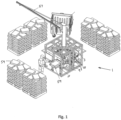
- Figures 1 to 5c show an automated weighing system 1 according to a first embodiment of the invention.
- Figures 1 and 2 show the automated weighing system 1 in the form a weighing cell.
- the automated weighing system 1 includes at least one storage unit 3 for storing an foodstuff, at least one robotic arm 5, at least one transfer receptacle 7, at least one weighing device 9, at least vibrator unit 11, and an electronic control system 13.
- the storage unit 3 is arranged for storing particulate flowable foodstuffs, for example powders such as flour and granules such as gravy granules.
- the storage unit 3 includes a loading tray 15, a hopper 17, a downpipe 19 and a trough 21.
- the hopper 17 is oriented in a generally vertical plane and has side walls that taper downwardly and inwardly.
- the hopper 17 has an upper end 23 and a lower end 25.
- the upper and lower ends 23,25 of the hopper are open.
- the loading tray 15 protrudes outwardly from the upper end 23 of the hopper in a generally horizontal orientation.
- the loading tray 15 is arranged to receive and support large packages of the foodstuff, for example 25kg packages of powder / granules.
- the downpipe 19 connects the hopper 17 to the trough 21 and is arranged to transfer the foodstuff from the hopper 17 to the trough 21.
- An upper end 27 of the downpipe is connected to the lower end 25 of the hopper.
- a lower end 29 of the downpipe is connected to an end plate 31 of the trough, which is located towards a first, proximal 30, end of the trough.
- the lower end 29 of the downpipe is curved.
- the end plate 31 is inclined, preferably in a radial direction with respect to a base 33 of the trough.
- the foodstuff flows from the hopper 17 to the trough 21, via the downpipe 19, under the action of gravity.
- the trough 21 has an opening 22 at an upper end and provides an accessible store for the foodstuff.
- the trough 21 is arranged to enable the robotic arm 5 to scoop some foodstuff out of the trough 21.
- the robotic arm 5 manipulates the transfer receptacle 7 to remove some foodstuff from the trough 21.
- the trough 21 protrudes outwardly from the downpipe 19.
- the downpipe 19 and trough 21 together provide a substantially J-shaped assembly.
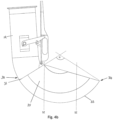
- the trough base 33 is best seen in Figures 4a and 4b .
- the base 33 is arcuate in a longitudinal direction, which is illustrated by line Z-Z in Figure 4a . This ensures that as foodstuff is removed by the transfer receptacle 7 from a scoop zone, which is indicated by lines SZ in Figure 4b , further foodstuff falls under the action of gravity into the scoop zone SZ. Thus after each scoop of foodstuff is removed from the trough 21 the foodstuff is automatically replenished, ready for the next transfer. The inventors have found that this is the case even for foodstuffs having particles that tend to clump together and therefore don't flow so easily.
- the base 33 can extend along an arc in the longitudinal direction through an angle ⁇ , which is typically in the range 70° to 150°.
- the radius of the arc is typically in the range 180mm to 300mm.
- the size and shape of the base 33 in the transverse direction is arranged to match at least part of an outer profile of the transfer receptacle 7.
- the base 33 has an arcuate profile in the transverse direction.
- the base 33 extends in the transverse direction through an angle which is typically in the range 90° to 180°.
- the radius of the arc is typically in the range 25 to 300 mm.
- the base 33 in the transverse direction is arranged to match part of the outer profile of the transfer receptacle 7, which in this case has a substantially cylindrical shape.
- the transfer receptacle 7 is able to move through the trough 21 very close to the base 33, thereby minimizing the amount of foodstuff that becomes trapped at the base 33 of the trough.
- the arcuate base 33 has a radius of around 53mm in the transverse direction and the cylindrical transfer receptacle 7 has a radius of around 50mm.
- the arrangement also helps to ensure that there are relatively small gaps between the outer profile of the transfer receptacle 7 and the side walls 35 of the trough. This helps to minimize the amount of foodstuff that sticks to side walls 35 of the trough 21 as a result of a scooping action.
- the side walls 35 can be inclined slightly to encourage this.
- the side walls can flare outwards from the base 33 towards the opening 22.
- the side walls 35 also taper from a maximum width in a central area of the trough to a minimum width adjacent a second, distal, end 34 of the trough.
- the trough 21 includes a closure member such as a door 37, which can be moved between open and closed positions.
- the door 37 is shown in the open position in Figures 4a and 4b . In the closed position, the door 37 closes off the opening 22. This helps to prevent the foodstuff from becoming contaminated when the robotic arm 5 is not in use.
- the door 37 can be opened and closed manually.
- a locking mechanism 39 such as a latch, can be used to hold the door in the open position.
- the door 37 can be open and closed automatically by means of an actuator (not shown), which is controlled by the control of the control system 13.
- the robotic arm 5 comprises a multi-axis robotic arm.
- the robotic arm 5 has at least four axes of movement, preferably at least five axes of movement and more preferably still at least six axes of movement.
- the robotic arm 5 preferably includes a fixed base 41.
- the robotic arm 5 is arranged to pivot with respect to the fixed base 41.
- the robotic arm 5 includes an end effector 43 that is arranged to releaseably grip a lifting bracket 45, which is part of the transfer receptacle 7.
- the robotic arm 5 and the weighing system 1 are arranged such that at least one storage unit 3, at least one transfer receptacle 7, and at least one weighing device 9 are within the reach of the robotic arm 5.
- the robotic arm 5 under the control of the control system 13 is arranged to: move the transfer receptacle 7 from a storage location 47 to storage unit 3; to scoop some foodstuff from the trough 21 using the transfer receptacle 7; and to dispense foodstuff from the transfer receptacle 7 onto the weighing device 9.
- the robotic arm 5 dispenses foodstuff into a container/package 55 mounted on the weighing device.
- the robotic arm 5 is arranged to return the transfer receptacle 7 to the storage location 47 when the operation is completed.
- the transfer receptacle 7 comprises a cylindrical cup and the lifting bracket 45.
- the cylindrical cup comprises a base (not shown) and a side wall 51.
- the lifting bracket 45 is attached to the side wall 51 and protrudes outwardly therefrom.
- the lifting bracket 45 has a substantially U-shaped formation 46, which provides some flexibility in the bracket 45 for promoting vibration of the receptacle 7.
- the lifting bracket 45 has a lifting formation 50, which is arranged to be gripped by the robot end effector 43.
- the lifting formation 50 comprises a castellated rectangular tubular structure.
- the lifting formation 50 is located more outwardly than the U-shaped formation 46 with respect to the side wall 51. At least a part of at least one of the base and the side wall 51 comprises a multiplicity of perforations 53.
- the perforations 53 can be, for example in the form of a mesh structure.
- the purpose of the perforations 53 is to enable foodstuff to be dispensed from transfer receptacle 7 when the receptacle 7 is vibrated by the vibrator unit 11.
- the perforations 53 comprise a section of the side wall 51.
- the base is solid and part of the side wall 51 is solid. The solid base helps to minimise the loss of foodstuff while the receptacle is moved from the trough 21 to the weighing device 9.
- the size of perforations 53 is determined at least in part according to the type of foodstuff to be dispensed, in particular according to the mean particle size of the foodstuff to be dispensed.
- the extent to which the perforations 53 extend over the receptacle at least in part determines the rate at which material is dispensed.
- a further consideration for perforation 53 size, and the position of the perforations 53, is loss of foodstuff while the receptacle is moved from the trough 21 to the weighing device 9.
- the perforations 53 are sized and/or located such that no amount, or only a small quantity, of foodstuff falls through perforations when moving from the trough 21 to the weighing device 9.
- Typical perforations have a size of around 0.1 mm to 10 mm. For example, 1 mm for flour and 5mm for gravy granules.
- the weighing device 9 comprises a weighing scales.
- the weighing device generates an electrical output signal that is indicative of the weight of the material(s) loaded onto the scales.
- the weighing device 9 is connected to the control system 13 by a wired, or wireless, connection and the control system 13 is arranged to receive the electrical output signal from the weighing device 9 and to determine the measured weight therefrom.
- the vibrator unit 11 is preferably located adjacent the weighing device 9.
- the function of the vibrator unit 11 is to vibrate the transfer receptacle 7 to dispense foodstuff through the perforations 53.
- the vibrator unit 11 is connected to the control system 13.
- the output of the vibrator unit 11 is preferably variable. For example, at least one of the amplitude of vibration and the frequency of vibration can be adjusted during a weighing operation.
- the control system 13 controls operation of the vibrator unit 11.
- the control system 13 is arranged to adjust at least one of the amplitude of vibration and the frequency of vibration in order to control the flow rate of foodstuff through the perforations 53.
- the inventors have determined through tests that varying the amplitude of vibration tends to have the largest effect on flow rate of foodstuff through the perforations 53.
- the control system 13 controls operation of the robotic arm 5.
- the control system 13 is programmed to move the robotic arm 5 through a sequence of movements, which includes: picking the transfer receptacle 7; moving the transfer receptacle 7 to the trough 21; scooping foodstuff from the trough 21; moving the transfer receptacle 7 to the weighing device 9; and vibrating the transfer receptacle 7 with the vibrator unit 11 to dispense foodstuff through the perforations 53 onto the weighing device 9.
- the control system 13 is programmed to dispense a target weight of foodstuff onto the weighing device 9.
- the control system 13 controls operation of the vibrator unit 11 such that initially there is a high flow rate of foodstuff dispensed through the perforations 53.
- the control system 13 monitors the measured weight from the output signal received from the weighing device 9 (see Figures 5b and 5c ). As the measured weight approaches the target weight the control system 13 controls operation of the vibrator unit 11 to reduce the extent to which the transfer receptacle 7 is vibrated. For example, the control system adjusts at least one of the amplitude of vibration and the frequency of vibration to reduce the flow rate of foodstuff through the perforations 53. This enables the final measured weight to accurately achieve the target weight.
- the system 13 is cable of obtaining a dispensed weight that is within 1% of the target weight. Since foodstuff is dispensed at a high flow rate initially, the target weight can be achieved relatively quickly.
- the vibration frequency used in a weighing operation is in the range 1 Hz to 100 Hz.
- the vibration amplitude used in a weighing operation is in the range 0.1 mm to 10 mm, and preferably 0.5 mm to 10 mm.
- the weighing system 1 typically includes a plurality of transfer receptacles 7; a plurality of storage units 3; a plurality of weighing devices 9 and a plurality of vibrator units 11.
- the cell shown in Figures 1 and 2 has a generally rectangular arrangement with the robotic arm 5 located in the centre of the cell.
- the cell includes six storage units 3, the troughs 21 of which protrude inwards towards the robotic arm 5.
- the storage units 3 are arranged in pairs on first, second and third sides of the rectangular cell.
- the storage units 3 can each store the same type of foodstuff, or at least one of the storage units 3 can store a different foodstuff from the other storage units 3.
- the cell includes two weighing devices 9.
- the weighing devices 9 are located on the fourth side of the rectangular cell.
- the weighting devices 9 can be located side by side or, as shown in Figure 2 , one weighing device 9 can be mounted above the other weighing device 9. Typically the number of vibrator units 11 matches the number of weighing devices 9. According to a programmed sequence, the robotic arm 5 can select any of the available transfer receptacles 7; move the selected transfer receptacle to any of the available storage units 3; scoop foodstuff from any of the available troughs 21; and dispense foodstuff onto any of the available weighing devices 9.
- the weighing system 1 can include lifting equipment 57, such as a crane, to move incoming foodstuff in bulk.
- lifting equipment 57 such as a crane
- a simple operation of the weighing system 1 will now be described, with reference to Figure 5a .
- a process worker loads a large package 59 of foodstuff onto the loading tray 15 and opens the package. The worker pours the foodstuff contents into the upper end of the hopper. The foodstuff falls under the action of gravity through the hopper 17 and downpipe 19 into the trough 21. Typically there is a sufficient quantity of foodstuff to fill at least part of the trough 21 volume and at least part of the downpipe 19 volume.
- the control system 13 moves the robotic arm 5 so that the end effector 43 is adjacent the receptacle lifting bracket 45.
- the end effector 43 grips the lifting bracket 45.
- the transfer receptacle 7 is now under the control of the robotic arm 5 and control system 13.
- the control system 13 moves A the robotic arm 5 such that the transfer receptacle 7 is located adjacent the trough 21.
- the control system 13 moves the robotic arm 5 such that the transfer receptacle 7 scoops B foodstuff from the trough 21.
- foodstuff is removed from the trough 21 further foodstuff falls under the action of gravity from the downpipe 19 into the scoop zone SZ of the trough 21, ready for the next scooping action.
- the transfer receptacle 7 is oriented upright after the scooping action to retain the foodstuff in the receptacle 7.
- the control system 13 moves C the robotic arm 5 such that the transfer receptacle 7 is located above the weighing device 9 and such that the transfer receptacle 7 engages the vibrator unit 11.
- a container/package 55 such as a plastic tub or bag, is located on the weighing device 9.
- the control system 13 activates the vibrator unit 11 in a first operational condition having a first amplitude of vibration.
- the vibrator unit 11 vibrates D the transfer receptacle 7 which causes foodstuff to dispense at a first flow rate through the perforations 53 onto the weighing device 9.
- the foodstuff collects in the container/package 55.
- the control system 13 monitors E the measured weight from the output signal received from the weighing device 9 (see Figures 5b to 5c ). When the measured weight reaches a predetermined fraction of the target weight, for example 90% of the target weight, the control system 13 switches the vibrator unit 11 to a second operational condition having a second amplitude of vibration which causes foodstuff to dispense at a second flow rate through the perforations 53 onto the weighing device 9.
- the second amplitude of vibration is less than the first amplitude of vibration and the second flow rate is less than the first flow rate.
- the second flow rate is approximately 10 to 30% of the first flow rate.
- the control system controls 13 switches the vibrator unit 11 to a third operational condition having a third amplitude of vibration which causes foodstuff to dispense at a third flow rate through the perforations 53 onto the weighing device 9.
- the third amplitude of vibration is less than the second amplitude of vibration and the third flow rate is less than the second flow rate.
- the third flow rate is approximately 5 to 10% of the first flow rate.
- the vibration frequency may be held substantially constant during the first, second and third operational conditions.
- the control system 13 controls the robotic arm 5 to move the transfer receptacle 7 out of engagement with the vibrator unit 11 which causes the foodstuff to cease flowing through the perforations 53. Additionally, or alternatively, the control system 13 can switch off the vibrator unit 11.
- the container/package 55 is removed from the scales. If the container/package 55 is not the final packaging for the weighed foodstuff, the weighed foodstuff is transferred into its final packaging.
- the scooping and dispensing steps are repeated F the required number of times.
- the weighing system 1 cell has a plurality of storage units 3, transfer receptacles 7, weighing devices 9 and vibrator units 11, foodstuff may be scooped from the storage unit troughs 21 in any desirable sequence, using any available transfer receptacle 7, and dispensed at the weighing devices 9 in any desirable sequence.
- the operational conditions of the vibrator unit 11 and the perforations size 53 are at least in part determined by the foodstuff being dispensed, and the operational conditions, for example the local temperature and humidity.
- the size and power rating of the vibrator unit 11 will also affect the operational conditions selected.
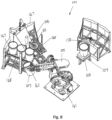
- a weighing system 101 in accordance with a second embodiment of the invention is shown in Figures 8 to 16 , 5b and 5c .
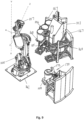
- FIGS 8 and 9 show the automated weighing system 101 in the form a weighing cell.
- the automated weighing system 101 includes at least one robotic arm 105, at least one transfer receptacle 107, at least one weighing device 109, at least vibrator unit 111, and an electronic control system 113.
- the weighing device 109 is similar to the weighing device 9 in the first embodiment.
- the weighing device generates an electrical output signal that is indicative of the weight of the material(s) loaded onto the scales.
- the weighing device 109 is connected to the control system 113 by a wired, or wireless, connection and the control system 113 is arranged to receive the electrical output signal from the weighing device 9 and to determine the measured weight therefrom.
- the transfer receptacle 107 preferably comprises an approximately cylindrical container, having a base 107a and side wall 107b, and has an open upper end 107c, for example similar to a cup, barrel or pan. Each of the base 107a and side wall 107b is solid, that is, it does not include perforations.
- the receptacle 107 can be made from any suitable material, for example a suitable plastic such as PVC, or a suitable metal such as stainless steel.
- the receptacle 107 includes a rim 107d that extends around the open upper end 107c.
- each container can be provided with a lid 110.
- a typical receptacle 107 has a volume of around 40 to 80 litres, and is preferably around 60 litres.
- the automated weighting system includes at least one filling station 103.
- the system may include 1 to 4 filling stations 103.
- Each filling station 103 may include a hopper (not shown).
- Each filling station 103 is arranged to receive and store particulate materials such as flowable foodstuffs.
- the particulate material can be for example powders such as flour and granules such as gravy granules.
- Each filling station 103 includes a receptacle receiving location 115 located beneath the hopper. A quantity of particulate material can be placed into the receptacle 107 from the hopper.
- Inserting particulate material into the receptacle 107 can be done manually, for example a process working emptying sacks of material into the hopper or an automated process can be used.
- Each filling station 103 can include a lid holding device 104. The lid holding device is arranged to hold the lid 110 of the transfer receptacle 107.
- the automated weighing system 101 includes at least one receptacle storage station 147 (see Figures 8 and 9 ).
- a typical cell may include between 1 to 8 receptacle storage stations 147.
- Each receptacle storage station 147 is arranged to store several receptacles 107 arranged in a manner that is accessible to the robotic arm 105.
- the receptacle storage station 147 can include at least one rack 148, and preferably a plurality of racks 148, wherein a plurality of receptacles 107 are lined up for removal by the robotic arm.
- each rack 148 can be arranged such that the receptacles 107 are queued in a line and the robotic arm 105 is arranged to select the front receptacle 107 from the queue.
- a plurality of racks 148 can be incorporated into a racking unit, for example a plurality of racks 148 can be stacked one on top of the other.
- the number of racks 148 in the racking unit is in part dependent upon the size of the receptacles 107 and the reach of the robotic arm 105.
- each racking unit includes 1 to 4 racks 148 of receptacles 147, and preferably 2 or 3 racks.
- a preferred arrangement is to have a racking unit, having a plurality of receptacle storage racks 148 located either side of the filling station 103.
- a typical cell includes 1 or 2 robotic arms 105.
- Each robotic arm 105 comprises a multi-axis robotic arm.
- the robotic arm 105 has at least four axes of movement, preferably at least five axes of movement and more preferably still at least six axes of movement.
- Each robotic arm 105 preferably includes a fixed base 141.
- Each robotic arm 105 is arranged to pivot with respect to the fixed base 141.
- each robotic arm 105 can be mounted on a plinth (not shown) to increase the height to with the robotic arm 105 can reach.
- Each robotic arm 105 includes an end effector 143 that is arranged to engage, lift and move the transfer receptacle 107.
- the weighing system 101 is arranged such that at least one filling station 103, at least one transfer receptacle 107, and at least one weighing device 109 are within the reach of the robotic arm 105.
- Each robotic arm 105 is under the control of the control system 113 is arranged to: move an empty transfer receptacle 107 from a storage location 147 to one of the filling stations 103, where it is filled with particulate material; to move the filled transfer receptacle 107 to a position adjacent the weighing device; and to dispense particulate material from the transfer receptacle 107 into a container 108, which is mounted on the weighing device 109.
- the container 108 can be similar to the transfer receptacle 107, or can have a different configuration therefrom.
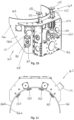
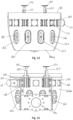
- the robotic arm end effector 143 is shown in Figures 10 to 15 .
- the end effector 143 includes an engagement plate 144 that is arranged to engage at least part of the side wall 107b.
- the engagement plate 144 is preferably shaped to match the shape of a part of the side wall 107b that it engages, so that there is a snug fit between a front face 144a and the side wall 107b of the container. In this instance, since the part of the side wall 107b that is engaged by the engagement plate is curved, consequently the engagement plate 144 comprises a curved plate.
- the engagement plate 144 has an upper face 146 that is arranged to engage the rim 107d. Typically the upper face 146 engages an underside of the rim 107d in use. The weight of the transfer receptacle 107, and the material stored therein, is largely supported by the upper face 146 of the engagement plate acting on the rim 107d.
- the end effector can include a locking system 148.
- the locking system 148 includes at least one locking member that is arranged to clamp the transfer receptacle 107 to the engagement plate 144.
- the locking member can be arranged to clamp the rim 107d to the upper face 146 of the engagement plate.
- the locking system 148 includes at least one linear actuator 150, which includes a rod 152 and a clamping member 156 located at a distal end of the rod 152.
- the rod 152, and hence the clamping member 156 attached thereto, is arranged to move along a linear path between a locking position and a non-locking position.
- the clamping member 156 In the locking position, the clamping member 156 is arranged to clamp the rim 107d to the upper face 146 of the engagement plate, thereby firmly holding the transfer receptacle 107 to the engagement plate 144. To release the transfer receptacle 107 the rod 152 and hence the clamping member 156, are moved to the non-locking position. This enables end effector 143 to disengage the transfer receptacle 107.
- the control system 113 is arranged to control operation of the locking system 148.
- the control system 113 can be arranged to control operation of the linear actuator 150. In the arrangement shown in the Figures, two linear actuators 150 are provided. The control system 113 controls operation of each of the linear actuators.
- each linear actuator 150 is a pneumatic linear actuator (sometimes referred to as a pneumatic cylinder).
- the locking system 148 can include limit switches, such as reed switches, to enable the control system 113 to determine when the clamping members 156 have reached the locking and/or non-locking positions.
- Each linear actuator 150 is arranged with respect to the engagement plate 144 such that the longitudinal axis of the rod 152 is perpendicular the upper engagement face 146.
- Each linear actuator 150 is located behind a rear face 144b of the engagement plate.
- the end effector can include a vacuum system 158.
- the vacuum system 158 is arranged to suck the transfer receptacle 107 into a tight engagement with the engagement plate 144, and in a preferred arrangement the side wall 107b of the transfer receptacle into tight engagement with the front face 144a of the engagement plate. This improves the stability of the connection between the transfer receptacle 107 and the end effector 143 and also helps to bear the load of the transfer receptacle 107 and the particulate material stored therein.
- the vacuum system 158 is controlled by the control system 113. Typically, the vacuum system 158 is only operated when the transfer receptacle 107 is carry particulate material, since it is not generally needed in an unloaded condition.
- the control system 113 is able to determine if the receptacle 107 is loaded on the basis of the location from which the transfer receptacle 107 is engaged. For example, if the end effector 143 engages the receptacle 107 at the filling station, the control system 113 assumes that the receptacle 107 is loaded with material and actuates the vacuum system 158. Likewise, if the end effector 143 engages the receptacle 107 at a receptacle storage station 147, it assumes that the receptacle 107 is empty and does not actuate the vacuum system 158. Alternatively a suitable sensor can be provided to determine if the receptacle 107 is carrying material and the control system 113 can be arranged to control operation of the vacuum system in response to signals received from that sensor.
- the vacuum system 158 includes at least one suction cup 160, and preferably a plurality of suction cups 160. Typically the vacuum system includes between 1 to 10 suction cups. Four suction cups 160 are shown in the Figures. Each suction cup 160 is arranged to engage the side wall 107b of the transfer receptacle when the transfer receptacle 107 is engaged by the end effector 143. Each suction cup 160 is either substantially flush with the front face 144a of the engagement plate or protrudes outwards a little from the front face 144a of the engagement plate.
- the engagement plate 144 can include at least one hole 162 that extends through the plate 144 from front to back that is arranged to receive the suction cup 160. A hole 162 can be provided for each suction cup 160.
- Appropriate piping or tubing (not shown) can connect each suction cup 160 to a negative pressure source (not shown). The piping or tubing is typically located on a rear side of the engagement plate 144.
- An end portion of the robotic arm 105 engages a boss 164 mounted on a rear side of the end effector.
- the end portion of the robotic arm 105 is bolted to the end effector 143 and therefore the end effector 143 moves with the robotic arm 105.
- the end effector 143 includes a vibrator unit 111.
- the function of the vibrator unit 111 is arranged to vibrate the transfer receptacle 107 when attached to the end effector 143 to dispense foodstuff through the open end 107c of the transfer receptacle.
- the vibrator unit is preferably in the form of an impact unit that includes a piston having an engagement head 112.
- the piston is arranged to move along a linear path in a reciprocating fashion such that the engagement head 112 repeatedly impacts the side wall 107b of the transfer receptacle. This causes the transfer receptacle 107 to vibrate.
- an engagement face 112a of the engagement head is shaped to match the curvature of the side wall 107b.
- the vibrator unit 111 is mounted on a rear side of the end effector 143.
- the engagement plate 144 includes a through hole 166, which enables the engagement head 112 to pass through the engagement plate 144 so that the engagement head 112 is able to contact the side wall 107b of the receptacle.
- the vibrator unit 111 is attached to the engagement plate 144 via damping members 168.
- the damping members 168 are arranged to reduce vibrational energy being transferred from the vibrator unit 111 to the robotic arm 105 during operation.
- the damping members 168 can be for example blocks of elastomeric material. This helps to prevent damage being caused to the robotic arm 105 as a result of operating the vibrator unit 111.
- the vibrator unit 111 is connected to the control system 113.
- the output of the vibrator unit 111 is preferably variable. For example, at least one of the amplitude of vibration and the frequency of vibration can be adjusted during a weighing operation.
- the control system 113 controls operation of the vibrator unit 111.
- the control system 113 is arranged to adjust at least one of the amplitude of vibration and the frequency of vibration in order to control the rate at which particulate material is dispensed from the transfer receptacle 107.
- the control system 113 is arranged to control operation of the vibrator unit 111 in response to signals received from the weighing device 109 in order to control the rate at which particulate material is dispensed from the transfer receptacle.
- control system 113 can be arranged to dispense material from the container at a first rate early in the dispensing operation and at a second rate as signals received from the weighing device 109 indicates that the material received on the scales is approaching a target weight.
- first flow rate is higher than the second flow rate. That is, the control system 113 can be arranged to reduce the dispensing flow rate as the target weight is approached.
- control system 113 can be arranged to make several adjustments to the vibration amplitude and/or vibration frequency in order to adjust the flow rate.
- the vibrator unit 111 fluidises the particulate material within the transfer receptacle 107, and the particulate material tends to behave in the manner of a non-Newtonian liquid.
- the angle of inclination ⁇ of the transfer receptacle 107 is the angle subtended by a central longitudinal axis Z-Z of the transfer receptacle 107 with the vertical V-V (see Figure 9 ).
- the control system 113 is arranged to control the robotic arm 105 to adjust the angle of inclination ⁇ of the transfer receptacle 107 during a dispensing operation in response to signals received from the weighing device 109. This is achieved by adjusting the orientation of the end effector 143, for example by rotating a wrist portion of the robotic arm 105.
- the control system 113 can be arranged to adjust the orientation of the transfer receptacle from a first angle of inclination ⁇ to a second angle of inclination ⁇ .
- the first angle of inclination ⁇ is typically used at an early stage of a dispensing operation in order to dispense material from the transfer receptacle more quickly.
- the second angle of inclination ⁇ is typically used at later stage of a dispensing operation, when the amount of material dispensed from the transfer receptacle 107 approaches a target weight, in order to dispense material from the transfer receptacle more slowly.
- the first angle of inclination ⁇ is greater than the second angle of inclination ⁇ .
- control system 113 can be arranged to actuate the robotic arm 105 to make several changes to the angle of inclination ⁇ of the transfer receptacle in response to the signals received from the weighing device 109.
- control system 113 may make several adjustments to the angle of inclination ⁇ in order to adjust the flow rate.
- the robotic arm 105 is arranged to return the transfer receptacle 107 to the storage location 147 when the operation is completed, or to a cleaning station.
- the control system 113 controls operation of the robotic arm 105.
- the control system 113 is programmed to move the robotic arm 105 through a sequence of movements, which includes: picking the transfer receptacle 107; moving the transfer receptacle 107 to the filing station 103; moving the filled transfer receptacle 107 to the weighing device 109; adjusting the orientation of the transfer receptacle so that it is inclined to the vertical V-V; and vibrating the transfer receptacle 107 with the vibrator unit 111 to dispense foodstuff through the open end 107c on to the weighing device 109.
- the control system 113 is programmed to dispense a target weight of foodstuff onto the weighing device 109.
- the control system 113 controls operation of the vibrator unit 111 and/or the angle of inclination ⁇ of the transfer receptacle 107 such that initially there is a high flow rate of foodstuff dispensed from the transfer receptacle 107. The purpose of this is for the measured weight to progress towards the target weight as quickly as possible.
- the control system 113 monitors the measured weight from the output signal received from the weighing device 109 (see Figures 5b and 5c ).
- control system 113 controls operation of the vibrator unit 111 and/or the robotic arm 105 to adjust the angle of inclination ⁇ of the transfer receptacle 107 in order to reduce the rate at which material is dispensed from the transfer receptacle 107 on to the weighing device 109.
- the control system 113 can be arranged to control the vibrator unit 111 to reduce the extent to which the transfer receptacle 107 is vibrated, by reducing the amplitude and/or frequency of vibration; and/or the control system 113 can be arranged to control the robotic arm 105 to reduce the angle of inclination ⁇ of the transfer receptacle 107.
- control system 113 This enables the control system 113 to ensure that the final measured weight substantially matches the target weight in a relatively short period of time.
- the control system 113 is cable of obtaining a dispensed weight that is within 1% of the target weight. Since foodstuff is dispensed at a high flow rate initially, the target weight can be achieved relatively quickly.
- the control system 113 can be programmed to achieve the target weight within a predetermined period of time, for example within 30 seconds. In this instance, the control system 113 adjusts the vibrator unit 111 and/or the angle of inclination ⁇ , to achieve the desired target weight within the predetermined time period.
- the vibration frequency used in a weighing operation is in the range 1 Hz to 100 Hz.
- the vibration amplitude used in a weighing operation is in the range 0.1 mm to 10 mm, and preferably 0.5 mm to 10 mm.
- the weighing system includes a local ventilation system 170.
- a ventilation unit cowling 172 is located adjacent the container 108 on the scales 109.
- the ventilation unit cowling 172 is pivotally attached to a mounting 174.
- the ventilation unit cowling 172 is pivoted downwards to a first, operational, position adjacent the container 108 during a weighing operation.
- the ventilation unit cowling 172 is arranged to pivot upwards away from the container 108 to a second, non-operational, position. This enables the container 108 to be removed from the weighing device 109.
- the control system 113 can be arranged to control operation of the ventilation system 170.
- the control system 113 can be arranged to control operation of the ventilation unit cowling 172 to move it between the first and second positions.
- the weighing system 101 typically includes a plurality of transfer receptacles 107; a plurality of filing stations 103; a plurality of receptacle storage stations 147; a plurality of transfer receptacles 107; a plurality of weighing devices 109 and at least one robotic arm 105.
- a part of a cell is shown in Figures 9 and 10 has a generally circular arrangement with the robotic arm 105 located in the centre of the cell.
- a complete cell may include, for example: two filling stations 103, four receptacle storage locations 147, two weighing devices 109 and a robotic arm 105.
- the robotic arm 105 is located in the centre of the cell.
- the filling stations 103 are located opposite to one another, with the robotic arm 105 located in between.
- the weighing stations 109 are located opposite to one another with the robotic arm 105 located in between.
- the robotic arm 105 can select any of the available transfer receptacles 107; move the selected transfer receptacle 107 to any of the available filing stations 103, where particulate foodstuff materials are inserted into the receptacle 107; move the filled transfer receptacle 107 to one of the available weighing devices 109, and to dispense the particulate material into a container 108 located on the weighting device.
- the robotic arm 105 would move a subsequent transfer receptacle 107 to one of the available filling stations 103. A subsequent particulate material is inserted into the subsequent transfer receptacle 107.
- the robotic arm 105 moves the subsequent transfer receptacle 107 to the weighing device 109 and dispenses the subsequent material into the container 108 on the weighing device 105. This step can be repeated for as many ingredients as is required. In this fashion, it is possible to dispense a plurality of different ingredients into the container 108 on the weighing device.
- the control system 113 knows the required amount of each ingredient and can accurately control the amount of each ingredient dispensed to obtain the correct mixture of ingredients.
- the control system 113 moves the robotic arm 105 so that the end effector 143 engages an empty transfer receptacle 107, located at the storage location 147.
- the end effector 143 engages the receptacle 107 so that the front face 144a of the engagement plate contacts the side wall 107b of the receptacle and the upper face 146 of the engagement place engages the rim 107d.
- the control system actuates the locking system 148 to clamp the rim 107d to the upper face 146.
- the clamping members 156 are moved from the non-locking position to the locking position.
- the transfer receptacle 107 is now under the control of the robotic arm 105 and control system 113.
- the control system 113 operates the robotic arm 105 to move ( Figure 16 : A) the transfer receptacle 107 to the filling station 103. At this stage the robotic arm 105 can remain attached to the receptacle 107 if loading is relatively quick. Alternatively the control system can instruct the robotic arm 105 to disengage the receptacle 107, by moving the clamping members 156 to the non-locking position, which enables the robotic arm to complete other tasks.
- a process worker loads a large package of foodstuff onto a filling station 103 loading tray and opens the package.
- the worker pours the foodstuff contents into the upper end of the hopper.
- the foodstuff falls ( Figure 16 : B) under the action of gravity through the hopper into the transfer receptacle 107 located below.
- this can be an automated process.
- control system 113 instructs the robotic arm to reengage the filled receptacle 107.
- control system 113 Since the control system 113 is now moving the receptacle 107 away from the filling station 103 it assumes that the receptacle 107 filled with material and therefore the control system actuates the vacuum system 158, which creates a negative pressure in the suction cups 160. The negative pressure sucks the side wall 107b into engagement with the suction cups 160 and holds the side wall 107b in close engagement with the engagement plate 144.
- the control system 113 operates the robotic arm to move ( Figure 16 : C) the transfer receptacle 107 to a position adjacent the weighting device 109.
- the receptacle is located above the container 108 mounted on the weighing device 109.
- the control system 113 activates ( Figure 16 : D) the vibrator unit 111 and adjusts the angle of inclination ⁇ of the transfer receptacle 107, such that the vibrator unit 111 has a first operational condition having a first amplitude of vibration and a first frequency of vibration, and the transfer receptacle 107 has a first angle of inclination ⁇ .
- the first angle of inclination ⁇ is sufficiently inclined to be a dispensing angle.
- the vibrator unit 111 vibrates the transfer receptacle 107 which causes foodstuff to dispense at a first flow rate through the open end 107c into the container 108 on the weighing device 109. The foodstuff collects in the container 108.
- the control system 113 monitors ( Figure 16 : E) the measured weight from the output signal received from the weighing device 109 (see Figures 5b to 5c ). When the measured weight reaches a predetermined fraction of the target weight, for example 90% of the target weight, the control system 113 switches the vibrator unit 111 to a second operational condition having a second amplitude of vibration and/or a second frequency of vibration (wherein the second amplitude of vibration is different from the first amplitude of vibration and/or the second frequency of vibration is different from the first frequency of vibration); and/or adjusts the angle of inclination ⁇ to a second angle of inclination (wherein the second angle of inclination is different from the first angle of inclination), which causes foodstuff to dispense from the transfer receptacle 107 at a second flow rate into the container 108 on the weighing device 109.
- the second flow rate is less than the first flow rate so that high accuracy can be achieved.
- the second amplitude of vibration is less than the first amplitude of vibration
- the second frequency of vibration is less than the first frequency of vibration
- the second angle of inclination ⁇ is less than the first angle of inclination ⁇ .
- the second flow rate is approximately 10 to 30% of the first flow rate.
- the control system 113 switches the vibrator unit 111 to a third operational condition having a third amplitude of vibration and/or a third frequency of vibration (wherein the third amplitude of vibration is different from the second amplitude of vibration and/or the third frequency of vibration is different from the second frequency of vibration); and/or adjusts the angle of inclination ⁇ to a third angle of inclination (wherein the third angle of inclination is different from the second angle of inclination), which causes foodstuff to dispense from the transfer receptacle 107 at a third flow rate into the container 108 on the weighing device 109.
- the third flow rate is less than the second flow rate so that high accuracy can be achieved.
- the third amplitude of vibration is less than the second amplitude of vibration
- the third frequency of vibration is less than the second frequency of vibration
- the third angle of inclination ⁇ is less than the second angle of inclination ⁇ .
- the third flow rate is approximately 5 to 10% of the first flow rate.
- the vibration frequency may be held substantially constant during the first, second and third operational conditions, since the inventors have determined that changing the amplitude of vibration has a more significant effect on the resultant flow rate.
- the control system 113 switches off the vibrator unit 111 and changes the orientation of the transfer receptacle to an inclination angle ⁇ that is sufficiently low that no further material is dispensed from the receptacle 107.
- the transfer receptacle 107 can be returned to the storage unit, moved to a cleaning unit, or moved back ( Figure 16 : F) to one of the filling stations 103 to receive additional material ( Figure 16 : G), which can be the same or different from the material just dispensed. If additional material is required, the process is repeated as frequently as necessary.
- the container 108 storing the measured ingredients can be moved to a downstream processing unit, such as a processing unit in a food production system.
- the operational conditions of the vibrator unit 111 and the angle of inclination ⁇ are at least in part determined by the foodstuff being dispensed, and the operational conditions, for example the local temperature and humidity. Since the control system receives feedback on the dispensing rate from the weighing device 109 it is able to dynamically adjust at least one of the amplitude of vibration, the frequency of vibration and the angle of inclination in order to ensure that target weight is reached within a predetermined period of time.
- the control system may pour foodstuff from the receptacle into the container/package through the open top in the conventional manner, that is, without using the vibrator unit.
- the control system can be programmed so that only the final scoop of material is dispensed through the perforations. This helps to reach the target weight more quickly.
- the control system can be programmed to dispense all scoops of foodstuff through the perforations.
- the control system 13 can control the vibrator unit 11 to adjust the vibration frequency during a dispensing operation. For example, in a first operational condition the vibrator unit can vibrate at a first frequency. In second operational condition the vibrator unit can operate at a second operational frequency. In a third operational condition the vibrator unit can operate at a third operational frequency. Preferably the second frequency is lower than the first frequency. Preferably the third frequency is lower than the second frequency.
- the control system can switch from the first operational condition to the second operational condition.
- the control system can switch from the second operational condition to the third operational condition.
- the vibration amplitude can be held substantially constant during the first, second and third operational conditions. Alternatively, the vibration amplitude may also be varied.
- FIG. 6 Alternative transfer receptacles 107,207 are shown in Figures 6 and 7 .
- the base is solid and substantially the entire side wall 107b comprises a perforated 153 structure.
- the bracket 145 is similar to the bracket 45.
- the base has a perforated structure and substantially the entire side wall 251 has a perforated 253 structure.
- the embodiment of Figure 7 has a different shaped lifting bracket 245, for use with a different end effector (not shown).
- the bracket 245 includes a single looped formation 250.
- the weighing system can include any suitable type of transfer receptacle 7,107,207, and can include more than one type of receptacle 7,107,207.
- the appropriate receptacle 7,107,207 is selected for the appropriate foodstuff and environmental conditions. Surprisingly, the inventors have determined that very little foodstuff escapes the receptacle 7,107,207 when moving between the trough 21 and weighing device 9, even when the base of the receptacle includes perforations 53.
- the control system 13 can use any suitable number of different operational conditions for the vibrator unit.
- the weighing system 1 may include at least one additional robotic arm 5, and the control system 13 is arranged to control operation of each of the robotic arms 5.
- the number of weighing devices in the weighing system cell can be different. Typically there are between 1 and 5 weighing devices in a weighing system cell.
- the number of storage units in the weighing system cell can be different. Typically there are between 1 and 10 storage units in a weighing system cell.
- the number of transfer receptacles in the weighing system cell can be different. Typically there are between 1 and 20 transfer receptacles in a weighing system cell.
- the number of vibrator units in the weighing system cell can be different. Typically there are between 1 and 5 vibrator units in a weighing system cell.
- the control system 13 can control the vibrator unit 11 to use a single vibration amplitude throughout a dispensing operation.
- the robotic arm 5 may be moveably mounted to enable translational movement within the weighing cell, for example the robotic arm can be mounted on rails instead of a fixed base.
- the vibration frequency can have a different value from the embodiments described above.
- the frequency can be in the range 1 Hz to 300 Hz.
- apparatus can be adapted for use in non-food industries where one or more particulate ingredients has to be processed.
Landscapes
- Engineering & Computer Science (AREA)
- Physics & Mathematics (AREA)
- General Physics & Mathematics (AREA)
- Mechanical Engineering (AREA)
- Quality & Reliability (AREA)
- Chemical & Material Sciences (AREA)
- Chemical Kinetics & Catalysis (AREA)
- Weight Measurement For Supplying Or Discharging Of Specified Amounts Of Material (AREA)
- Basic Packing Technique (AREA)
- Supply Of Fluid Materials To The Packaging Location (AREA)
Claims (15)
- Ein Wiegesystem zum Wiegen von partikelförmigen Materialien wie etwa Pulvern, Granulaten und dergleichen und vorzugsweise partikelförmigen Nahrungsmitteln, wobei das System Folgendes umfasst:eine Wiegevorrichtung (109);eine Rütteleinheit (111);ein Umfüllbehältnis (107) mit einer Öffnung, wobei das Umfüllbehältnis (107) dazu eingerichtet ist, eine Menge des partikelförmigen Materials durch die Öffnung aufzunehmen;einen Roboterarm (105), der dazu eingerichtet ist, das Umfüllbehältnis (107) zu verlagern, wobei die Rütteleinheit an dem Roboterarm angebracht ist;und ein Steuersystem (113), das dazu eingerichtet ist, den Roboterarm (105) und die Rütteleinheit (111) zu steuern, wobei das Steuersystem (113) dazu eingerichtet ist,den Roboterarm (105) zu betätigen, um das Umfüllbehältnis (107) benachbart zu der Wiegevorrichtung (109) zu verlagern;einen Neigungswinkel des Umfüllbehältnisses (107) zu einem Ausgabeneigungswinkel zu verstellen, um mit dem Ausgeben des partikelförmigen Materials aus dem Umfüllbehältnis (107) zu beginnen;die Rütteleinheit (111) zu betätigen, um das Umfüllbehältnis (7;107) zu rütteln, wodurch bewirkt wird, dass in dem Umfüllbehältnis (107) befindliches partikelförmiges Material aus dem Umfüllbehältnis (107) auf die Wiegevorrichtung (109) ausgegeben wird, um ein Sollgewicht des ausgegebenen partikelförmigen Materials zu erreichen;ein Ausgangssignal von der Wiegevorrichtung (109) während eines Wiegevorgangs zu überwachen, das ein gemessenes Gewicht des auf die Wiegevorrichtung (109) ausgegebenen partikelförmigen Materials angibt, um ein Sollgewicht von ausgegebenem partikelförmigem Material zu erreichen; und gekennzeichnet, um einen Zustand zu bestimmen, in dem das gemessene Gewicht gleich einem ersten vorgegebenen Bruchteil des Sollgewichts ist, undwobei als Reaktion auf das Erkennen des Zustands, in dem das gemessene Gewicht gleich dem ersten vorgegebenen Bruchteil des Sollgewichts ist, das Steuersystem (113) dazu eingerichtet ist, den Neigungswinkel des Umfüllbehältnisses (107) von einem ersten Neigungswinkel, der bewirkt, dass partikelförmiges Material mit einer ersten Fließgeschwindigkeit aus dem Behältnis (107) ausgegeben wird, zu einem zweiten Neigungswinkel, der bewirkt, dass partikelförmiges Material mit einer zweiten Fließgeschwindigkeit aus dem Umfüllbehältnis (107) ausgegeben wird, zu verstellen.
- System gemäß Anspruch 1, wobei das Steuersystem (113) dazu eingerichtet ist, mindestens eines der Folgenden zu verstellen: die Rüttelfrequenz der Rütteleinheit (111) und die Rüttelamplitude der Rütteleinheit (111) während eines Wiegevorgangs, um die Geschwindigkeit zu steuern, mit der partikelförmiges Material aus dem Umfüllbehältnis (107) ausgegeben wird.
- System gemäß Anspruch 2, wobei das Steuersystem (113) als Reaktion auf das Erkennen des Zustands, in dem das gemessene Gewicht gleich dem ersten vorgegebenen Bruchteil des Sollgewichts ist, dazu eingerichtet ist, die Rütteleinheit (111) aus einem ersten Betriebszustand, der bewirkt, dass partikelförmiges Material mit der ersten Fließgeschwindigkeit aus dem Umfüllbehältnis (107) ausgegeben wird, in einen zweiten Betriebszustand, der bewirkt, dass partikelförmiges Material mit der zweiten Fließgeschwindigkeit aus dem Umfüllbehältnis (107) ausgegeben wird, umzuschalten.
- System gemäß Anspruch 3, wobei der erste Betriebszustand eine erste Rüttelamplitude aufweist und der zweite Betriebszustand eine zweite Rüttelamplitude aufweist, die zweite Rüttelamplitude geringer als die erste Rüttelamplitude ist und die zweite Fließgeschwindigkeit geringer als die erste Fließgeschwindigkeit ist.
- System gemäß Anspruch 3 oder 4, wobei der erste Betriebszustand eine erste Rüttelfrequenz aufweist und der zweite Betriebszustand eine zweite Rüttelfrequenz aufweist, die zweite Rüttelfrequenz geringer als die erste Rüttelfrequenz ist und die zweite Fließgeschwindigkeit geringer als die erste Fließgeschwindigkeit ist.
- System gemäß einem der vorangehenden Ansprüche, wobei das Steuersystem (113) dazu eingerichtet ist, mit dem Rütteln des Umfüllbehältnisses (107) aufzuhören, wenn das Steuersystem aus dem Ausgangssignal bestimmt, dass das gemessene Gewicht gleich dem Sollgewicht ist.
- System gemäß einem der vorangehenden Ansprüche, wobei das Steuersystem (113) dazu eingerichtet ist, den Neigungswinkel des Umfüllbehältnisses (107) zu einem Nicht-Ausgabeneigungswinkel zu ändern, wenn das Steuersystem (113) aus dem Ausgangssignal bestimmt, dass das gemessene Gewicht gleich dem Sollgewicht ist.
- System gemäß einem der vorangehenden Ansprüche, wobei der Roboterarm (105) einen Endeffektor (143) umfasst, der dazu eingerichtet ist, das Umfüllbehältnis (107) in Eingriff zu nehmen.
- System gemäß Anspruch 8, wobei der Endeffektor (143) eine Eingriffsplatte (144) umfasst, die dazu eingerichtet ist, eine Seitenwand (107b) des Umfüllbehältnisses und einen Rand (107d) des Umfüllbehältnisses in Eingriff zu nehmen.
- System gemäß Anspruch 8 oder 9, wobei der Endeffektor (143) ein Verriegelungssystem (148) umfasst, das dazu eingerichtet ist, das Umfüllbehältnis (107) an den Endeffektor zu klemmen.
- System gemäß Anspruch 10, wobei das Verriegelungssystem (148) mindestens einen Linearaktor (150) umfasst, der dazu eingerichtet ist, einen Rand (107d) des Umfüllbehältnisses an den Endeffektor (143) zu klemmen.
- System gemäß einem der Ansprüche 8 bis 11, wobei die Rütteleinheit (111) an dem Endeffektor (143) angebracht ist und sich Dämpfungsmaterial (168) zwischen der Rütteleinheit (111) und dem Endeffektor (143) befindet.
- System gemäß einem der Ansprüche 8 bis 12, wobei der Endeffektor (143) ein Vakuumsystem (158) zum Anlegen eines Unterdrucks benachbart zu einer Seitenwand (107b) des Umfüllbehältnisses umfasst.
- System gemäß einem der vorangehenden Ansprüche, wobei das Umfüllbehältnis (7) Lochungen (53) umfasst und die Rütteleinheit (11) dazu eingerichtet ist, zu bewirken, dass partikelförmiges Material über die Lochungen (53) aus dem Umfüllbehältnis (7) ausgegeben wird.
- Ein Verfahren zum Wiegen von partikelförmigen Materialien wie etwa Pulvern, Granulaten und dergleichen und vorzugsweise partikelförmigen Nahrungsmitteln, wobei das Verfahren Folgendes umfasst: Bereitstellen eines Systems gemäß einem der vorangehenden Ansprüche, Einbringen einer Menge an partikelförmigem Material in das Umfüllbehältnis (107); Verlagern des Umfüllbehältnisses (107) benachbart zu der Wiegevorrichtung (109); wobei das Steuersystem (113) einen Neigungswinkel des Umfüllbehältnisses (107) zu einem Ausgabeneigungswinkel verstellt, um mit dem Ausgeben des partikelförmigen Materials aus dem Umfüllbehältnis (107) zu beginnen; das Steuersystem die Rütteleinheit (111) betätigt, um das Umfüllbehältnis (107) zu rütteln, wodurch das partikelförmige Material aus dem Umfüllbehältnis (107) in einen auf der Wiegevorrichtung (109) befindlichen Behälter ausgegeben wird; das Steuersystem ein Ausgangssignal von der Wiegevorrichtung (109) während eines Wiegevorgangs überwacht, das ein gemessenes Gewicht von auf die Wiegevorrichtung (109) ausgegebenem partikelförmigem Material angibt, um ein Sollgewicht von ausgegebenem partikelförmigem Material zu erreichen; und dadurch gekennzeichnet, dass
das Steuersystem bestimmt, dass ein Zustand eingetreten ist, in dem das gemessene Gewicht gleich einem ersten vorgegebenen Bruchteil des Sollgewichts ist, und als Reaktion auf das Erkennen, dass der Zustand, in dem das gemessene Gewicht gleich einem ersten vorgegebenen Bruchteil des Sollgewichts ist, eingetreten ist, das Steuersystem den Neigungswinkel des Umfüllbehältnisses von einem ersten Neigungswinkel, der bewirkt, dass partikelförmiges Material mit einer ersten Fließgeschwindigkeit aus dem Behältnis ausgegeben wird, zu einem zweiten Neigungswinkel, der bewirkt, dass partikelförmiges Material mit einer zweiten Fließgeschwindigkeit aus dem Umfüllbehältnis ausgegeben wird, verstellt.
Applications Claiming Priority (1)
| Application Number | Priority Date | Filing Date | Title |
|---|---|---|---|
| GB1803741.6A GB2573263B (en) | 2018-03-08 | 2018-03-08 | Weighing system |
Publications (2)
| Publication Number | Publication Date |
|---|---|
| EP3537115A1 EP3537115A1 (de) | 2019-09-11 |
| EP3537115B1 true EP3537115B1 (de) | 2023-06-21 |
Family
ID=61972886
Family Applications (1)
| Application Number | Title | Priority Date | Filing Date |
|---|---|---|---|
| EP19161448.6A Active EP3537115B1 (de) | 2018-03-08 | 2019-03-07 | Wägesystem und wägeverfahren |
Country Status (3)
| Country | Link |
|---|---|
| US (1) | US11280663B2 (de) |
| EP (1) | EP3537115B1 (de) |
| GB (2) | GB2573263B (de) |
Families Citing this family (6)
| Publication number | Priority date | Publication date | Assignee | Title |
|---|---|---|---|---|
| US20210213479A1 (en) * | 2020-01-15 | 2021-07-15 | 9958304 Canada Inc. (Ypc Technologies) | System and method for applying a vibration to a container held by an end effector |
| CN112013931B (zh) * | 2020-10-19 | 2021-02-19 | 新三和(烟台)食品有限责任公司 | 一种食品包装用称重装置 |
| CN219589804U (zh) * | 2023-05-08 | 2023-08-25 | 惠州金源精密自动化设备有限公司 | 一种电池称重装置以及自动检测称重设备 |
| CN116851338B (zh) * | 2023-09-04 | 2023-11-17 | 浩宸建设科技有限公司 | 一种公路工程施工用洗石除泥装置 |
| WO2025110935A1 (en) * | 2023-11-20 | 2025-05-30 | Eliar Elektronik Sanayi Anonim Sirketi | A weighing system with a manipulator arm |
| US20250289067A1 (en) * | 2024-03-13 | 2025-09-18 | Michael Kettner | Universal milling machine assembly tool |
Family Cites Families (19)
| Publication number | Priority date | Publication date | Assignee | Title |
|---|---|---|---|---|
| CH537305A (de) * | 1972-08-24 | 1973-05-31 | Mettler Instrumente Ag | Dosierelement für feinkörniges Material an einem Behälter |
| JPH03202720A (ja) * | 1989-12-28 | 1991-09-04 | Yokohama Rubber Co Ltd:The | 粉粒体計量装置 |
| US5363885A (en) * | 1993-06-02 | 1994-11-15 | R. J. Reynolds Tobacco Company | Robotic sample preparation system and method |
| DE19907619C2 (de) * | 1998-08-20 | 2001-11-29 | M Gut | Intelligente gravimetrische Dosiervorrichtung |
| GB0122935D0 (en) * | 2001-09-24 | 2001-11-14 | Meridica Ltd | Dispensing small quantities of particles |
| AU2003251760A1 (en) * | 2002-06-27 | 2004-01-19 | Oriel Therapeutics, Inc. | Apparatus and methods for dispensing dry powders |
| US20050133729A1 (en) * | 2003-12-23 | 2005-06-23 | Archie Woodworth | Apparatus and method for fabricating a reconstitution assembly |
| GB0414813D0 (en) * | 2004-07-01 | 2004-08-04 | Meridica Ltd | Dispensing small quantities of powder |
| GB0414811D0 (en) * | 2004-07-01 | 2004-08-04 | Meridica Ltd | Dispensing small quantities of particles |
| DE602006012120D1 (de) * | 2005-11-21 | 2010-03-25 | Mannkind Corp | Gerät und Verfahren zur Pulverausgabe und Messung |
| EP1902956B1 (de) * | 2006-09-25 | 2009-09-02 | Mettler-Toledo AG | Dosiervorrichtung für pulver- oder pastenförmiges Dosiergut |
| US8271138B2 (en) * | 2007-09-12 | 2012-09-18 | Intelligent Hospital Systems Ltd. | Gripper device |
| US9206081B2 (en) * | 2008-12-16 | 2015-12-08 | Solomon Colors, Inc. | Bulk mortar system |
| US8776840B2 (en) * | 2010-02-23 | 2014-07-15 | Oriel Therapeutics, Inc. | Tubular dry powder feeders with axially applied vibration for dry powder filling systems |
| JP5563101B2 (ja) * | 2010-12-08 | 2014-07-30 | 平田機工株式会社 | 粉体分注装置及び粉体分注方法 |
| JP6166880B2 (ja) * | 2012-08-16 | 2017-07-19 | 三光機械株式会社 | 自動包装機用粒状原料供給装置 |
| CN105307621B (zh) * | 2013-09-19 | 2020-01-10 | 株式会社汤山制作所 | 混注装置和混注方法 |
| GB201508320D0 (en) * | 2015-05-15 | 2015-06-24 | 3P Innovation Ltd | Filling assembly |
| JP7130927B2 (ja) * | 2017-08-31 | 2022-09-06 | セイコーエプソン株式会社 | 制御装置およびロボットシステム |
-
2018
- 2018-03-08 GB GB1803741.6A patent/GB2573263B/en not_active Expired - Fee Related
-
2019
- 2019-03-07 GB GB1903102.0A patent/GB2573854B/en not_active Expired - Fee Related
- 2019-03-07 EP EP19161448.6A patent/EP3537115B1/de active Active
- 2019-03-08 US US16/296,330 patent/US11280663B2/en active Active
Also Published As
| Publication number | Publication date |
|---|---|
| GB2573854A (en) | 2019-11-20 |
| US11280663B2 (en) | 2022-03-22 |
| GB201803741D0 (en) | 2018-04-25 |
| GB2573263A (en) | 2019-11-06 |
| GB201903102D0 (en) | 2019-04-24 |
| GB2573854B (en) | 2022-03-23 |
| US20200209047A1 (en) | 2020-07-02 |
| GB2573263B (en) | 2022-03-09 |
| EP3537115A1 (de) | 2019-09-11 |
Similar Documents
| Publication | Publication Date | Title |
|---|---|---|
| EP3537115B1 (de) | Wägesystem und wägeverfahren | |
| CA2389114C (en) | Apparatus and method for dispensing small quantities of particles | |
| US4944334A (en) | Vibrating hopper and auger feed assembly | |
| KR100197348B1 (ko) | 벌크물질의 정량공급방법 및 그 공급장치 | |
| US5897282A (en) | Catalytic reactor charging system and method for operation thereof | |
| US11534802B2 (en) | Automated method and system for sorting and combining varying density payloads | |
| US6805175B1 (en) | Powder transfer method and apparatus | |
| US20140305542A1 (en) | Packaging machine and method for filling bags | |
| EP0559923B1 (de) | Wiege- und Füllvorrichtung | |
| US20010041117A1 (en) | Catalytic reactor charging system and method for operation thereof | |
| EP1209452A1 (de) | Wägevorrichtung | |
| CN112318532A (zh) | 物品把持装置 | |
| CN102202976A (zh) | 散料装袋装置 | |
| JP2018119951A (ja) | 粉末状物質のための自動用量分配システム、および、システムの動作準備が整っていることを確認する方法 | |
| JP7291946B2 (ja) | 粉粒体の自動計量装置 | |
| US4999021A (en) | Device for unloading containers | |
| WO2004042335A1 (en) | Automatic combination weighing apparatus | |
| WO1998014392A1 (en) | Catalytic reactor charging system and method | |
| KR102823593B1 (ko) | 고형물 자동 계량 및 충진 장치, 및 이를 포함하는 고형물 식품 포장 설비 | |
| JPH04201831A (ja) | 開袋排出方法および装置 | |
| CN121697914A (zh) | 排出滑槽 | |
| AU2008202169B2 (en) | Apparatus and method for dispensing small quantities of particles | |
| KR20200048079A (ko) | 후처리 기능이 구비된 중량선별장치 | |
| JP2006170644A (ja) | 組合せ計量装置 | |
| JPH08313329A (ja) | 移動式フレキシブルコンテナバッグ計量払出装置 |
Legal Events
| Date | Code | Title | Description |
|---|---|---|---|
| PUAI | Public reference made under article 153(3) epc to a published international application that has entered the european phase |
Free format text: ORIGINAL CODE: 0009012 |
|
| STAA | Information on the status of an ep patent application or granted ep patent |
Free format text: STATUS: THE APPLICATION HAS BEEN PUBLISHED |
|
| AK | Designated contracting states |
Kind code of ref document: A1 Designated state(s): AL AT BE BG CH CY CZ DE DK EE ES FI FR GB GR HR HU IE IS IT LI LT LU LV MC MK MT NL NO PL PT RO RS SE SI SK SM TR |
|
| AX | Request for extension of the european patent |
Extension state: BA ME |
|
| STAA | Information on the status of an ep patent application or granted ep patent |
Free format text: STATUS: REQUEST FOR EXAMINATION WAS MADE |
|
| 17P | Request for examination filed |
Effective date: 20200310 |
|
| RBV | Designated contracting states (corrected) |
Designated state(s): AL AT BE BG CH CY CZ DE DK EE ES FI FR GB GR HR HU IE IS IT LI LT LU LV MC MK MT NL NO PL PT RO RS SE SI SK SM TR |
|
| REG | Reference to a national code |
Ref country code: DE Ref legal event code: R079 Ref document number: 602019031233 Country of ref document: DE Free format text: PREVIOUS MAIN CLASS: G01G0013240000 Ipc: G01G0013000000 |
|
| GRAP | Despatch of communication of intention to grant a patent |
Free format text: ORIGINAL CODE: EPIDOSNIGR1 |
|
| STAA | Information on the status of an ep patent application or granted ep patent |
Free format text: STATUS: GRANT OF PATENT IS INTENDED |
|
| RIC1 | Information provided on ipc code assigned before grant |
Ipc: G01G 13/00 20060101AFI20210601BHEP |
|
| INTG | Intention to grant announced |
Effective date: 20210701 |
|
| GRAJ | Information related to disapproval of communication of intention to grant by the applicant or resumption of examination proceedings by the epo deleted |
Free format text: ORIGINAL CODE: EPIDOSDIGR1 |
|
| STAA | Information on the status of an ep patent application or granted ep patent |
Free format text: STATUS: REQUEST FOR EXAMINATION WAS MADE |
|
| STAA | Information on the status of an ep patent application or granted ep patent |
Free format text: STATUS: EXAMINATION IS IN PROGRESS |
|
| INTC | Intention to grant announced (deleted) | ||
| 17Q | First examination report despatched |
Effective date: 20211203 |
|
| GRAP | Despatch of communication of intention to grant a patent |
Free format text: ORIGINAL CODE: EPIDOSNIGR1 |
|
| STAA | Information on the status of an ep patent application or granted ep patent |
Free format text: STATUS: GRANT OF PATENT IS INTENDED |
|
| INTG | Intention to grant announced |
Effective date: 20221128 |
|
| GRAS | Grant fee paid |
Free format text: ORIGINAL CODE: EPIDOSNIGR3 |
|
| GRAA | (expected) grant |
Free format text: ORIGINAL CODE: 0009210 |
|
| STAA | Information on the status of an ep patent application or granted ep patent |
Free format text: STATUS: THE PATENT HAS BEEN GRANTED |
|
| AK | Designated contracting states |
Kind code of ref document: B1 Designated state(s): AL AT BE BG CH CY CZ DE DK EE ES FI FR GB GR HR HU IE IS IT LI LT LU LV MC MK MT NL NO PL PT RO RS SE SI SK SM TR |
|
| REG | Reference to a national code |
Ref country code: CH Ref legal event code: EP |
|
| REG | Reference to a national code |
Ref country code: DE Ref legal event code: R096 Ref document number: 602019031233 Country of ref document: DE |
|
| REG | Reference to a national code |
Ref country code: AT Ref legal event code: REF Ref document number: 1581200 Country of ref document: AT Kind code of ref document: T Effective date: 20230715 |
|
| REG | Reference to a national code |
Ref country code: IE Ref legal event code: FG4D |
|
| REG | Reference to a national code |
Ref country code: LT Ref legal event code: MG9D |
|
| REG | Reference to a national code |
Ref country code: NL Ref legal event code: MP Effective date: 20230621 |
|
| PG25 | Lapsed in a contracting state [announced via postgrant information from national office to epo] |
Ref country code: SE Free format text: LAPSE BECAUSE OF FAILURE TO SUBMIT A TRANSLATION OF THE DESCRIPTION OR TO PAY THE FEE WITHIN THE PRESCRIBED TIME-LIMIT Effective date: 20230621 Ref country code: NO Free format text: LAPSE BECAUSE OF FAILURE TO SUBMIT A TRANSLATION OF THE DESCRIPTION OR TO PAY THE FEE WITHIN THE PRESCRIBED TIME-LIMIT Effective date: 20230921 |
|
| REG | Reference to a national code |
Ref country code: AT Ref legal event code: MK05 Ref document number: 1581200 Country of ref document: AT Kind code of ref document: T Effective date: 20230621 |
|
| PG25 | Lapsed in a contracting state [announced via postgrant information from national office to epo] |
Ref country code: RS Free format text: LAPSE BECAUSE OF FAILURE TO SUBMIT A TRANSLATION OF THE DESCRIPTION OR TO PAY THE FEE WITHIN THE PRESCRIBED TIME-LIMIT Effective date: 20230621 Ref country code: NL Free format text: LAPSE BECAUSE OF FAILURE TO SUBMIT A TRANSLATION OF THE DESCRIPTION OR TO PAY THE FEE WITHIN THE PRESCRIBED TIME-LIMIT Effective date: 20230621 Ref country code: LV Free format text: LAPSE BECAUSE OF FAILURE TO SUBMIT A TRANSLATION OF THE DESCRIPTION OR TO PAY THE FEE WITHIN THE PRESCRIBED TIME-LIMIT Effective date: 20230621 Ref country code: LT Free format text: LAPSE BECAUSE OF FAILURE TO SUBMIT A TRANSLATION OF THE DESCRIPTION OR TO PAY THE FEE WITHIN THE PRESCRIBED TIME-LIMIT Effective date: 20230621 Ref country code: HR Free format text: LAPSE BECAUSE OF FAILURE TO SUBMIT A TRANSLATION OF THE DESCRIPTION OR TO PAY THE FEE WITHIN THE PRESCRIBED TIME-LIMIT Effective date: 20230621 Ref country code: GR Free format text: LAPSE BECAUSE OF FAILURE TO SUBMIT A TRANSLATION OF THE DESCRIPTION OR TO PAY THE FEE WITHIN THE PRESCRIBED TIME-LIMIT Effective date: 20230922 |
|
| PG25 | Lapsed in a contracting state [announced via postgrant information from national office to epo] |
Ref country code: FI Free format text: LAPSE BECAUSE OF FAILURE TO SUBMIT A TRANSLATION OF THE DESCRIPTION OR TO PAY THE FEE WITHIN THE PRESCRIBED TIME-LIMIT Effective date: 20230621 |
|
| PG25 | Lapsed in a contracting state [announced via postgrant information from national office to epo] |
Ref country code: SK Free format text: LAPSE BECAUSE OF FAILURE TO SUBMIT A TRANSLATION OF THE DESCRIPTION OR TO PAY THE FEE WITHIN THE PRESCRIBED TIME-LIMIT Effective date: 20230621 |
|
| PG25 | Lapsed in a contracting state [announced via postgrant information from national office to epo] |
Ref country code: ES Free format text: LAPSE BECAUSE OF FAILURE TO SUBMIT A TRANSLATION OF THE DESCRIPTION OR TO PAY THE FEE WITHIN THE PRESCRIBED TIME-LIMIT Effective date: 20230621 |
|
| PG25 | Lapsed in a contracting state [announced via postgrant information from national office to epo] |
Ref country code: IS Free format text: LAPSE BECAUSE OF FAILURE TO SUBMIT A TRANSLATION OF THE DESCRIPTION OR TO PAY THE FEE WITHIN THE PRESCRIBED TIME-LIMIT Effective date: 20231021 |
|
| PG25 | Lapsed in a contracting state [announced via postgrant information from national office to epo] |
Ref country code: SM Free format text: LAPSE BECAUSE OF FAILURE TO SUBMIT A TRANSLATION OF THE DESCRIPTION OR TO PAY THE FEE WITHIN THE PRESCRIBED TIME-LIMIT Effective date: 20230621 Ref country code: SK Free format text: LAPSE BECAUSE OF FAILURE TO SUBMIT A TRANSLATION OF THE DESCRIPTION OR TO PAY THE FEE WITHIN THE PRESCRIBED TIME-LIMIT Effective date: 20230621 Ref country code: RO Free format text: LAPSE BECAUSE OF FAILURE TO SUBMIT A TRANSLATION OF THE DESCRIPTION OR TO PAY THE FEE WITHIN THE PRESCRIBED TIME-LIMIT Effective date: 20230621 Ref country code: PT Free format text: LAPSE BECAUSE OF FAILURE TO SUBMIT A TRANSLATION OF THE DESCRIPTION OR TO PAY THE FEE WITHIN THE PRESCRIBED TIME-LIMIT Effective date: 20231023 Ref country code: IS Free format text: LAPSE BECAUSE OF FAILURE TO SUBMIT A TRANSLATION OF THE DESCRIPTION OR TO PAY THE FEE WITHIN THE PRESCRIBED TIME-LIMIT Effective date: 20231021 Ref country code: ES Free format text: LAPSE BECAUSE OF FAILURE TO SUBMIT A TRANSLATION OF THE DESCRIPTION OR TO PAY THE FEE WITHIN THE PRESCRIBED TIME-LIMIT Effective date: 20230621 Ref country code: EE Free format text: LAPSE BECAUSE OF FAILURE TO SUBMIT A TRANSLATION OF THE DESCRIPTION OR TO PAY THE FEE WITHIN THE PRESCRIBED TIME-LIMIT Effective date: 20230621 Ref country code: CZ Free format text: LAPSE BECAUSE OF FAILURE TO SUBMIT A TRANSLATION OF THE DESCRIPTION OR TO PAY THE FEE WITHIN THE PRESCRIBED TIME-LIMIT Effective date: 20230621 Ref country code: AT Free format text: LAPSE BECAUSE OF FAILURE TO SUBMIT A TRANSLATION OF THE DESCRIPTION OR TO PAY THE FEE WITHIN THE PRESCRIBED TIME-LIMIT Effective date: 20230621 |
|
| PG25 | Lapsed in a contracting state [announced via postgrant information from national office to epo] |
Ref country code: PL Free format text: LAPSE BECAUSE OF FAILURE TO SUBMIT A TRANSLATION OF THE DESCRIPTION OR TO PAY THE FEE WITHIN THE PRESCRIBED TIME-LIMIT Effective date: 20230621 |
|
| REG | Reference to a national code |
Ref country code: DE Ref legal event code: R097 Ref document number: 602019031233 Country of ref document: DE |
|
| PLBE | No opposition filed within time limit |
Free format text: ORIGINAL CODE: 0009261 |
|
| STAA | Information on the status of an ep patent application or granted ep patent |
Free format text: STATUS: NO OPPOSITION FILED WITHIN TIME LIMIT |
|
| PG25 | Lapsed in a contracting state [announced via postgrant information from national office to epo] |
Ref country code: DK Free format text: LAPSE BECAUSE OF FAILURE TO SUBMIT A TRANSLATION OF THE DESCRIPTION OR TO PAY THE FEE WITHIN THE PRESCRIBED TIME-LIMIT Effective date: 20230621 |
|
| PG25 | Lapsed in a contracting state [announced via postgrant information from national office to epo] |
Ref country code: SI Free format text: LAPSE BECAUSE OF FAILURE TO SUBMIT A TRANSLATION OF THE DESCRIPTION OR TO PAY THE FEE WITHIN THE PRESCRIBED TIME-LIMIT Effective date: 20230621 |
|
| 26N | No opposition filed |
Effective date: 20240322 |
|
| PG25 | Lapsed in a contracting state [announced via postgrant information from national office to epo] |
Ref country code: SI Free format text: LAPSE BECAUSE OF FAILURE TO SUBMIT A TRANSLATION OF THE DESCRIPTION OR TO PAY THE FEE WITHIN THE PRESCRIBED TIME-LIMIT Effective date: 20230621 Ref country code: IT Free format text: LAPSE BECAUSE OF FAILURE TO SUBMIT A TRANSLATION OF THE DESCRIPTION OR TO PAY THE FEE WITHIN THE PRESCRIBED TIME-LIMIT Effective date: 20230621 |
|
| REG | Reference to a national code |
Ref country code: CH Ref legal event code: PL |
|
| PG25 | Lapsed in a contracting state [announced via postgrant information from national office to epo] |
Ref country code: BG Free format text: LAPSE BECAUSE OF FAILURE TO SUBMIT A TRANSLATION OF THE DESCRIPTION OR TO PAY THE FEE WITHIN THE PRESCRIBED TIME-LIMIT Effective date: 20230621 |
|
| PG25 | Lapsed in a contracting state [announced via postgrant information from national office to epo] |
Ref country code: MC Free format text: LAPSE BECAUSE OF FAILURE TO SUBMIT A TRANSLATION OF THE DESCRIPTION OR TO PAY THE FEE WITHIN THE PRESCRIBED TIME-LIMIT Effective date: 20230621 |
|
| PG25 | Lapsed in a contracting state [announced via postgrant information from national office to epo] |
Ref country code: MC Free format text: LAPSE BECAUSE OF FAILURE TO SUBMIT A TRANSLATION OF THE DESCRIPTION OR TO PAY THE FEE WITHIN THE PRESCRIBED TIME-LIMIT Effective date: 20230621 Ref country code: BG Free format text: LAPSE BECAUSE OF FAILURE TO SUBMIT A TRANSLATION OF THE DESCRIPTION OR TO PAY THE FEE WITHIN THE PRESCRIBED TIME-LIMIT Effective date: 20230621 |
|
| PG25 | Lapsed in a contracting state [announced via postgrant information from national office to epo] |
Ref country code: IE Free format text: LAPSE BECAUSE OF NON-PAYMENT OF DUE FEES Effective date: 20240307 |
|
| PG25 | Lapsed in a contracting state [announced via postgrant information from national office to epo] |
Ref country code: IE Free format text: LAPSE BECAUSE OF NON-PAYMENT OF DUE FEES Effective date: 20240307 Ref country code: CH Free format text: LAPSE BECAUSE OF NON-PAYMENT OF DUE FEES Effective date: 20240331 |
|
| PGFP | Annual fee paid to national office [announced via postgrant information from national office to epo] |
Ref country code: LU Payment date: 20250328 Year of fee payment: 7 |
|
| PGFP | Annual fee paid to national office [announced via postgrant information from national office to epo] |
Ref country code: BE Payment date: 20250328 Year of fee payment: 7 |
|
| PGFP | Annual fee paid to national office [announced via postgrant information from national office to epo] |
Ref country code: FR Payment date: 20250328 Year of fee payment: 7 |
|
| PGFP | Annual fee paid to national office [announced via postgrant information from national office to epo] |
Ref country code: GB Payment date: 20250331 Year of fee payment: 7 |
|
| PGFP | Annual fee paid to national office [announced via postgrant information from national office to epo] |
Ref country code: DE Payment date: 20250331 Year of fee payment: 7 |
|
| PG25 | Lapsed in a contracting state [announced via postgrant information from national office to epo] |
Ref country code: CY Free format text: LAPSE BECAUSE OF FAILURE TO SUBMIT A TRANSLATION OF THE DESCRIPTION OR TO PAY THE FEE WITHIN THE PRESCRIBED TIME-LIMIT; INVALID AB INITIO Effective date: 20190307 |
|
| PG25 | Lapsed in a contracting state [announced via postgrant information from national office to epo] |
Ref country code: HU Free format text: LAPSE BECAUSE OF FAILURE TO SUBMIT A TRANSLATION OF THE DESCRIPTION OR TO PAY THE FEE WITHIN THE PRESCRIBED TIME-LIMIT; INVALID AB INITIO Effective date: 20190307 |
|
| PG25 | Lapsed in a contracting state [announced via postgrant information from national office to epo] |
Ref country code: TR Free format text: LAPSE BECAUSE OF FAILURE TO SUBMIT A TRANSLATION OF THE DESCRIPTION OR TO PAY THE FEE WITHIN THE PRESCRIBED TIME-LIMIT Effective date: 20230621 |