EP3522366B1 - Motorsteuerungsvorrichtung und motorsteuerungsverfahren - Google Patents
Motorsteuerungsvorrichtung und motorsteuerungsverfahren Download PDFInfo
- Publication number
- EP3522366B1 EP3522366B1 EP17855395.4A EP17855395A EP3522366B1 EP 3522366 B1 EP3522366 B1 EP 3522366B1 EP 17855395 A EP17855395 A EP 17855395A EP 3522366 B1 EP3522366 B1 EP 3522366B1
- Authority
- EP
- European Patent Office
- Prior art keywords
- notch
- frequency
- change
- motor control
- control device
- Prior art date
- Legal status (The legal status is an assumption and is not a legal conclusion. Google has not performed a legal analysis and makes no representation as to the accuracy of the status listed.)
- Active
Links
Images




Classifications
-
- H—ELECTRICITY
- H02—GENERATION; CONVERSION OR DISTRIBUTION OF ELECTRIC POWER
- H02P—CONTROL OR REGULATION OF ELECTRIC MOTORS, ELECTRIC GENERATORS OR DYNAMO-ELECTRIC CONVERTERS; CONTROLLING TRANSFORMERS, REACTORS OR CHOKE COILS
- H02P29/00—Arrangements for regulating or controlling electric motors, appropriate for both AC and DC motors
- H02P29/50—Reduction of harmonics
-
- H—ELECTRICITY
- H02—GENERATION; CONVERSION OR DISTRIBUTION OF ELECTRIC POWER
- H02P—CONTROL OR REGULATION OF ELECTRIC MOTORS, ELECTRIC GENERATORS OR DYNAMO-ELECTRIC CONVERTERS; CONTROLLING TRANSFORMERS, REACTORS OR CHOKE COILS
- H02P23/00—Arrangements or methods for the control of AC motors characterised by a control method other than vector control
- H02P23/12—Observer control, e.g. using Luenberger observers or Kalman filters
-
- H—ELECTRICITY
- H02—GENERATION; CONVERSION OR DISTRIBUTION OF ELECTRIC POWER
- H02P—CONTROL OR REGULATION OF ELECTRIC MOTORS, ELECTRIC GENERATORS OR DYNAMO-ELECTRIC CONVERTERS; CONTROLLING TRANSFORMERS, REACTORS OR CHOKE COILS
- H02P23/00—Arrangements or methods for the control of AC motors characterised by a control method other than vector control
- H02P23/14—Estimation or adaptation of motor parameters, e.g. rotor time constant, flux, speed, current or voltage
-
- H—ELECTRICITY
- H02—GENERATION; CONVERSION OR DISTRIBUTION OF ELECTRIC POWER
- H02P—CONTROL OR REGULATION OF ELECTRIC MOTORS, ELECTRIC GENERATORS OR DYNAMO-ELECTRIC CONVERTERS; CONTROLLING TRANSFORMERS, REACTORS OR CHOKE COILS
- H02P29/00—Arrangements for regulating or controlling electric motors, appropriate for both AC and DC motors
-
- H—ELECTRICITY
- H02—GENERATION; CONVERSION OR DISTRIBUTION OF ELECTRIC POWER
- H02P—CONTROL OR REGULATION OF ELECTRIC MOTORS, ELECTRIC GENERATORS OR DYNAMO-ELECTRIC CONVERTERS; CONTROLLING TRANSFORMERS, REACTORS OR CHOKE COILS
- H02P29/00—Arrangements for regulating or controlling electric motors, appropriate for both AC and DC motors
- H02P29/02—Providing protection against overload without automatic interruption of supply
- H02P29/032—Preventing damage to the motor, e.g. setting individual current limits for different drive conditions
Definitions
- the present invention relates to a motor control device configured to control drive operation related to speed, a position, and the like of a motor or a mechanical load driven by the motor.
- the present invention specifically relates to a motor control device having a function of suppressing mechanical resonant vibration caused upon drive and the like.
- a system including the conventional motor control device may have abnormal operation while a user of the system fails to recognize a sign of abnormal operation occurrence due to change in mechanical resonant frequency.
- the present invention has been achieved in view of such a problem, and it is an object of the present invention to provide a motor control device and a motor control method that enable a user to recognize more easily than a conventional case, a sign of abnormal operation occurrence due to change in mechanical resonant frequency in a system including the motor control device.
- the motor control device enables a user to recognize more easily than a conventional case, a sign of abnormal operation occurrence due to change in mechanical resonant frequency in a system including the motor control device.
- FIG. 8 is a block diagram depicting an exemplary configuration of a conventional motor control device disclosed in PTL 1.
- FIG. 8 depicts conventional motor control device 700 connected to motor 100 and speed detector 200.
- Motor control device 700 receives speed command Vs indicating desired operation of a mechanical load or the motor to be driven.
- Motor 100 is coupled with mechanical load 102 to be driven via joint 101.
- Speed detector 200 detects rotational speed of motor 100 and outputs motor speed Vm to motor control device 700.
- Motor control device 700 includes feedback controller 701, notch filter 702, torque controller 703, and notch frequency estimator 710.
- Feedback controller 701 outputs torque command ⁇ M1 to zeroize difference between speed command Vs and motor speed Vm.
- Notch filter 702 is configured to change a notch frequency as a center frequency.
- Notch filter 702 outputs new torque command ⁇ M2 obtained by removing a frequency component of the notch frequency from torque command ⁇ M1.
- Torque controller 703 controls motor 100 to match torque generated by the motor with torque command ⁇ M2.
- Motor control device 700 configures an internal feedback control system to match speed command Vs with motor speed Vm in this manner.
- Notch frequency estimator 710 receives motor speed Vm.
- motor speed Vm includes a mechanical resonant vibrational component when mechanical resonant vibration occurs.
- Notch frequency estimator 710 estimates a frequency of vibration included in motor speed Vm, and changes the notch frequency of notch filter 702 to the estimated frequency of the vibration.
- This motor control device thus enables the user to recognize more easily than a conventional case, a sign of abnormal operation occurrence due to change in mechanical resonant frequency in the system including the motor control device.
- the change forecaster may calculate the forecast value by extrapolation calculation according to a linear function, from the first notch frequency at each of the plurality of past times, for example.
- This configuration enables obtaining the forecast value at certain accuracy through relatively simple calculation.
- the first notch controller may change the first notch frequency only within a preset notch frequency range, for example.
- This configuration prevents the first notch frequency from falling into an unpreferred frequency band.
- This configuration prevents oscillation caused by unstability of the feedback control system.
- This configuration achieves reduction in processing quantity of the change forecaster.
- the motor control device may further include: a second notch filter disposed inside the feedback control system and configured to change a frequency component to be removed; and a second notch controller configured to change a second notch frequency as a center frequency of the second notch filter; in which the first notch filter and the second notch filter may be connected in series, and the change forecaster may calculate the forecast value for each of the first notch controller and the second notch controller, for example.
- This motor control device thus enables the user to recognize a sign of abnormal operation occurrence due to change in mechanical resonant frequency in the system including the motor control device even in the case where there is a plurality of mechanical resonant frequencies.
- the change forecaster may output the forecast value of shortest elapsed time, and when calculating a plurality of forecast values of times, the change forecaster may output the forecast value of an earliest time, for example.
- the user of this motor control device can thus more reliably recognize the forecast value of the shortest elapsed time or the forecast value at the earliest time when there is a plurality of mechanical resonant frequencies.
- a motor control method according to the invention is defined in independent claim 7.
- a user of this motor control method obtains in this case at least one of the forecast value of the notch frequency at the specific future time, the forecast value of the elapsed time from current time until the notch frequency is to become out of the specific frequency range, and the forecast value of the time when the notch frequency is to become out of the specific frequency range.
- the user can thus recognize a sign of abnormal operation occurrence due to change in mechanical resonant frequency in accordance with the obtained forecast value in a system adopting the motor control method.
- This motor control method thus enables the user to recognize more easily than a conventional case, a sign of abnormal operation occurrence due to change in mechanical resonant frequency in the system adopting the motor control method.
- CD-ROM compact disc read-only memory
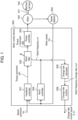
- FIG. 1 is a block diagram depicting an exemplary configuration of motor control device 300 according to a first exemplary embodiment.
- Motor control device 300 feedback-controls state quantity of a motor.
- motor control device 300 is connected to motor 100 and speed detector 200.
- Motor control device 300 receives speed command Vs indicating desired operation of a mechanical load or the motor to be driven.
- Motor 100 is coupled with mechanical load 102 to be driven via joint 101.
- Speed detector 200 detects rotational speed of motor 100 and outputs motor speed Vm to motor control device 300. Feedback-controlling the state quantity of the motor can be replaced with feedback-controlling state quantity of the mechanical load.
- Motor control device 300 includes feedback controller 301, notch filter 302 (notch filter 302 exemplifies the first notch filter), torque controller 303, notch controller 304 (notch controller 304 exemplifies the first notch controller), change rate calculator 305, and change rate monitor 306.
- Feedback controller 301 receives motor speed Vm and speed command Vs and outputs torque command ⁇ M1 to zeroize difference between these values. For example, feedback controller 301 calculates a differential value between speed command Vs and motor speed Vm, and outputs, as torque command ⁇ M1, a result obtained by proportional integral of the calculated differential value.
- Notch filter 302 is disposed inside a feedback control system and is configured to change a frequency component to be removed.
- notch filter 302 is configured to attenuate a signal component having a frequency around a specific frequency in an input signal, and output a result.
- a center frequency as an attenuation target will be called a notch frequency.
- Notch filter 302 receives torque command ⁇ M1 as an input signal.
- Notch filter 302 attenuates a signal component having a frequency around the notch frequency in torque command ⁇ M1, and outputs a result as new torque command ⁇ M2.
- Torque controller 303 controls current applied to motor 100 or the like to match torque generated by motor 100 with torque command ⁇ M2.
- Motor control device 300 configures the internal feedback control system to match speed command Vs with motor speed Vm in this manner.
- notch filter 302 is disposed inside the feedback control system of motor control device 300.
- Notch filter 302 can be of a quadratic recursive type having transfer function G n1 (s) as expressed in (formula 1).
- G n 1 s s 2 + 2 d n 1 ⁇ n 1 ⁇ n 1 s + ⁇ n 1 2 s 2 + 2 ⁇ n 1 ⁇ n 1 s + ⁇ n 1 2
- ⁇ n1 is a notch frequency coefficient of notch filter 302
- ⁇ ⁇ 1 is an attenuation coefficient indicating a frequency bandwidth as an attenuation target
- d n1 is a notch depth coefficient indicating a degree of attenuation.
- Notch depth coefficient d n1 satisfies 0 ⁇ d n1 ⁇ 1.
- notch filter 302 has a gain characteristic of 0 [dB] at notch frequency ⁇ n1 .
- notch filter 302 has a gain characteristic of - ⁇ [dB] at notch frequency ⁇ n1 .
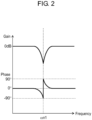
- FIG. 2 is a graph indicating an exemplary frequency characteristic of notch filter 302 included in motor control device 300 according to the first exemplary embodiment.
- notch filter 302 has a characteristic of attenuating a component of notch frequency ⁇ n1 and has the gain characteristic of - ⁇ .
- an input signal includes a vibrational component
- the input signal having an oscillation frequency disagreeing with notch frequency ⁇ n1 has unattenuated amplitude and the input signal having an oscillation frequency agreeing with notch frequency ⁇ n1 has attenuated amplitude.
- Notch filter 302 has a phase characteristic having a value from -90 degrees to 90 degrees.
- the phase characteristic has a negative value at a frequency equal to or less than the notch frequency, to effectively achieve phase delay of the input signal.
- Notch filter 302 is disposed inside the feedback control system, and a frequency equal to or less than the notch frequency leads to phase delay of the feedback control system due to such a phase delay effect of the notch filter.
- the notch filter itself can destabilize the feedback control system to cause oscillation when the notch frequency overlaps with a control band of the feedback control system. When the notch filter is used, the control band of the feedback control system has to be lower than the notch frequency to prevent the notch frequency from overlapping with the control band of the feedback control system.
- notch filter 302 receives torque command ⁇ M1 and outputs new torque command ⁇ M2 obtained by attenuating a frequency component around notch frequency ⁇ n1 .
- Notch frequency ⁇ n1 of notch filter 302 is variable and notch controller 304 changes notch frequency ⁇ n1 to achieve agreement with the oscillation frequency upon occurrence of mechanical resonant vibration.
- Notch controller 304 changes the notch frequency as the center frequency of notch filter 302 to achieve removal of a mechanical resonant vibrational component of the motor. Specifically, notch controller 304 changes the notch frequency of notch filter 302 to automatically achieve agreement with the oscillation frequency and outputs the changed notch frequency to change rate calculator 305.
- FIG. 3 is a block diagram depicting an exemplary configuration of notch controller 304 included in motor control device 300 according to the first exemplary embodiment.
- Notch controller 304 includes vibration extracting filter 3041, detection notch filter 3042, and notch frequency changer 3043.
- Notch controller 304 calculates an oscillation frequency when mechanical resonant vibration occurs.
- Notch controller 304 changes notch frequency ⁇ n1 of notch filter 302 to the calculated oscillation frequency.
- Vibration extracting filter 3041 extracts a predetermined frequency band component from an input signal and outputs the extracted component. Vibration extracting filter 3041 extracts a vibrational component of mechanical resonance or the like from motor speed Vm and outputs the extracted component as vibrational component Vb1. Vibration extracting filter 3041 has only to extract a vibrational component in this manner, and can thus be a high-pass filter configured to allow passage of a signal component having a frequency equal to or more than a predetermined frequency, or can be a bandpass filter configured to allow passage of a signal component within a predetermined frequency band.
- Vibrational component Vb1 output from vibration extracting filter 3041 is received by detection notch filter 3042 and notch frequency changer 3043.
- Detection notch filter 3042 attenuates a frequency component around the notch frequency as the center frequency in vibrational component Vb1 and outputs a result as new vibrational component Vb2. Detection notch filter 3042 allows the notch frequency to be changed by notch frequency changer 3043.
- Detection notch filter 3042 is characterized by preliminarily having a predetermined value of a frequency bandwidth as an attenuation target. Assume that the notch filter has a gain characteristic of - ⁇ [dB] at the notch frequency.
- Detection notch filter 3042 is assumed to be of a quadratic recursive type having transfer function G n2 (s) as expressed in (formula 2).
- G n 2 s s 2 + ⁇ n 2 2 s 2 + 2 ⁇ n 2 ⁇ n 2 s + ⁇ n 2 2
- Reference mark ⁇ n1 indicates a notch frequency coefficient corresponding to the notch frequency of detection notch filter 3042.
- Reference mark ⁇ n2 indicates an attenuation coefficient.
- Notch frequency changer 3043 changes both notch frequency ⁇ n1 of notch filter 302 and notch frequency ⁇ n2 of detection notch filter 3042 to a frequency of vibration included in motor speed Vm.
- Notch frequency changer 3043 receives vibrational component Vb1 and vibrational component Vb2 output from detection notch filter 3042 that allowed passage of vibrational component Vb1. Notch frequency changer 3043 generates notch frequency ⁇ n agreeing with the frequency of the vibration included in motor speed Vm. Notch frequency ⁇ n is supplied to notch filter 302 and detection notch filter 3042, and notch frequency ⁇ n1 and notch frequency ⁇ n2 are changed to ⁇ n .
- Amplitude of vibrational component Vb1 is not attenuated if the frequency of the vibrational component included in vibrational component Vb1 received by detection notch filter 3042 is largely different from notch frequency ⁇ n2 .
- the amplitude of vibrational component Vb1 is attenuated if the frequency of the vibrational component included in vibrational component Vb1 agrees with notch frequency ⁇ n2 .
- Vibrational component Vb2 thus has amplitude increased as an oscillation frequency of vibrational component Vb1 deviates from notch frequency ⁇ n2 .
- the amplitude of vibrational component Vb2 thus indicates a degree of deviation between the oscillation frequency of vibrational component Vb1 and notch frequency ⁇ n2 .
- Notch frequency changer 3043 successively changes notch frequency ⁇ n in accordance with the amplitude of vibrational component Vb1 and the amplitude of vibrational component Vb2 until the amplitude of vibrational component Vb2 becomes equal to or less than a predetermined value or reaches zero, and controls notch frequency ⁇ n2 of detection notch filter 3042.
- Such control of the notch filter is achieved through combination of detection notch filter 3042, a directional filter disclosed in PTL 1 or the like, and a notch filter coefficient corrector.
- Notch frequency ⁇ n is controlled in this manner to become equal to the frequency of the vibrational component included in vibrational component Vb1.
- Notch frequency ⁇ n2 of detection notch filter 3042 and notch frequency ⁇ n1 of notch filter 302 are both changed to achieve agreement with notch frequency ⁇ n .
- notch frequency ⁇ n1 and notch frequency ⁇ n2 are controlled to become equal to the frequency of the vibrational component included in vibrational component Vb1.
- Change rate calculator 305 successively calculates a notch frequency change rate indicating a change amount per unit time of a notch frequency. Specifically, change rate calculator 305 receives notch frequency ⁇ n controlled by notch controller 304 to achieve agreement with the frequency of the vibrational component. Change rate calculator 305 calculates a differential value as a change amount between the notch frequency at previous time and the notch frequency at current time every time predetermined unit time elapses, and outputs, to change rate monitor 306, the differential value as notch frequency change rate ⁇ n per unit time.
- the unit time for output of notch frequency change rate ⁇ n has a fixed value, and can be equal to a successive change period of notch frequency ⁇ n at notch controller 304 or can be longer than the successive change period if a mechanical resonant frequency changes moderately.
- change rate monitor 306 When the notch frequency change rate calculated by change rate calculator 305 has a value outside a predetermined range preliminarily set, change rate monitor 306 outputs a signal indicating that the notch frequency change rate has such a value outside the predetermined range. Specifically, change rate monitor 306 determines whether or not notch frequency change rate ⁇ n thus received has a value outside the predetermined range and outputs a signal indicating a determination result as change rate monitor signal S_fn. Notch controller 304 controls notch frequency ⁇ n to achieve agreement with the mechanical resonant frequency, so that the change amount per unit time of the notch frequency is equal to the change amount per unit time of the mechanical resonant frequency. Specifically, change rate monitor 306 determines whether or not the change amount per unit time of the mechanical resonant frequency has a value outside the predetermined range and outputs a determination result as change rate monitor signal S_fn.
- change rate monitor 306 can output change rate monitor signal S_fn equal to one.
- change rate monitor 306 can output change rate monitor signal S_fn equal to zero. Switching the change rate monitor signal in accordance with notch frequency change rate ⁇ n thus achieves detection of a sign of abnormal operation due to change in mechanical resonant frequency.
- a lamp configured to be lighted when change rate monitor signal S_fn changes from zero to one, a user can recognize that notch frequency change rate ⁇ n exceeds the predetermined threshold by visually checking the lighted lamp.
- motor control device 300 thus configured in accordance with the present exemplary embodiment, even when notch controller 304 and notch filter 302 suppresses mechanical resonant vibration, notch frequency change rate ⁇ n as the change amount per unit time of the mechanical resonant frequency exceeding the predetermined range can be recognized by means of change rate monitor signal S_fn.
- a system including motor control device 300 thus enables the user to recognize a sign of abnormal operation occurrence due to change in mechanical resonant frequency.
- motor control device 300 outputs a notification signal when the mechanical resonant frequency changes to have the change amount per unit time having a value outside the predetermined range, to enable the user to recognize a sign of abnormal operation occurrence due to change in mechanical resonant frequency.
- Change rate monitor 306 has the single threshold for determination of the notch frequency change rate, but may alternatively adopt a plurality of thresholds.
- change rate monitor 306 may have a first predetermined value and a second predetermined value more than the first predetermined value, as thresholds for determination of the notch frequency change rate.
- the change rate monitor signal may indicate whether the notch frequency change rate is less than the first predetermined value, is equal to or more than the first predetermined value and less than the second predetermined value, or is more than the second predetermined value.
- Such a configuration enables the user to recognize a degree of change in mechanical resonant frequency when the system including motor control device 300 according to the present exemplary embodiment has change in mechanical resonant frequency.
- the notch frequency change rate may alternatively be determined in accordance with a threshold for an increased notch frequency and a threshold for a decreased notch frequency set separately from each other. Increase and decrease in notch frequency influence operation differently from each other. Such a configuration enables the user to recognize a sign of abnormal operation occurrence in accordance with an influence of the change in notch frequency on the operation in the system including motor control device 300.
- Change rate calculator 305 has the fixed unit time (i.e., a sampling period) for calculation of the notch frequency change rate, but may alternatively have unit time changed in accordance with the notch frequency change rate.
- change rate calculator 305 may preliminarily have a first threshold equal to the threshold of change rate monitor 306 and a second threshold less than the first threshold, and the sampling period may be set longer if the notch frequency change rate is equal to or less than the second threshold and may be set shorter if the notch frequency change rate is more than the second threshold.
- the threshold of change rate monitor 306 and the first and second thresholds of change rate calculator 305 may alternatively be changed in proportion to a change rate of the sampling period.
- Such switching of the sampling period for calculation of the notch frequency change rate or the threshold for determination of the change rate monitor signal in accordance with the notch frequency change rate allows the change rate monitor to promptly output the change rate monitor signal indicating that the notch frequency change rate exceeds the predetermined threshold even in an exemplary case where the notch frequency change rate changes suddenly.
- the system including motor control device 300 thus enables the user to recognize at a shorter time interval a sign of abnormal operation occurrence due to change in mechanical resonant frequency.
- the present exemplary embodiment provides notch filter 302 disposed inside the feedback control system and having the notch frequency controlled to constantly become equal to the frequency of vibration included in motor speed.
- Possible values of the notch frequency may alternatively be limited by upper and lower limit values to prevent the notch frequency of the notch filter disposed inside the feedback control system from overlapping with the control band of the feedback system.
- Such a configuration prevents the control band of the feedback control system from overlapping with the notch frequency of the notch filter disposed inside the feedback control system. This accordingly prevents oscillation caused by unstability of the feedback control system.
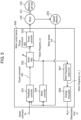
- FIG. 4 is a block diagram depicting an exemplary configuration of motor control device 400 according to a second exemplary embodiment.
- Constituent elements depicted in FIG. 4 as well as functioned and configured to operate similarly to the constituent elements in FIG. 1 according to the first exemplary embodiment will be denoted by identical reference marks and will not repeatedly be described in terms of operation.
- motor control device 400 according to the second exemplary embodiment is obtained by increasing a number from one to two, of each of the notch filter, the notch controller, and the change rate calculator included in the configuration depicted in FIG. 1 .
- Motor control device 400 is configured to reduce vibration even when there are two mechanical resonant frequencies, by including notch filter 302a (notch filter 302a exemplifies the first notch filer) for notch frequency ⁇ n1a and notch filter 302b (notch filter 302b exemplifies the second notch filer) for notch frequency ⁇ n1b .
- Notch filter 302a and notch filter 302b are connected in series and are disposed downstream of feedback controller 301.
- Notch filter 302a and notch filter 302b are configured similarly to notch filter 302 according to the first exemplary embodiment.
- Notch frequency ⁇ n1a and notch frequency ⁇ n1b are set to have values different from each other to each correspond to one of the two mechanical resonant frequencies.
- motor control device 400 includes notch controller 304a (notch controller 304a exemplifies the first notch controller) for notch filter 302a, and notch controller 304b (notch controller 304b exemplifies the second notch controller) for notch filter 302b provided separately from notch controller 304a.
- Notch controller 304a and notch controller 304b are configured similarly to notch controller 304 according to the first exemplary embodiment.
- notch controller 304a and notch controller 304b each change vibration caused by change in corresponding mechanical resonant frequency to achieve agreement with a frequency of a vibrational component generating the notch frequency of the corresponding notch filter.
- Notch controller 304a and notch controller 304b simultaneously output, to change rate calculator 305a and change rate calculator 305b, respectively, the notch frequencies thus changed.
- the notch controllers may include vibration extracting filters having passbands provided around the two different mechanical resonant frequencies and not overlapping with each other, for example.
- Notch controller 304a and notch controller 304b can thus control notch filter 302a and notch filter 302b to achieve agreement between the frequency of vibration caused by change in corresponding mechanical resonant frequency and the notch frequency of the corresponding notch filter, without being influenced by the change of the other mechanical resonant frequency.
- Change rate calculator 305a and change rate calculator 305b each output, to change rate monitor 406, the change amount per unit time of the notch frequency output from the corresponding notch controller, as notch frequency change rate ⁇ na and notch frequency change rate ⁇ nb .
- Change rate monitor 406 determines whether or not notch frequency change rate ⁇ na and notch frequency change rate ⁇ nb thus received each have an absolute value exceeding a predetermined threshold set for the corresponding notch frequency change rate ⁇ na or ⁇ nb , and outputs a determination result as change rate monitor signal S_fn.
- change rate monitor signal S_fn is one if at least one of notch frequency change rate ⁇ na and notch frequency change rate ⁇ nb has an absolute value exceeding the correspondingly set threshold
- change rate monitor signal S_fn is zero if each of notch frequency change rate ⁇ na and notch frequency change rate ⁇ nb has an absolute value not exceeding the corresponding threshold.
- a system including motor control device 400 thus configured achieves output of a notification signal when there are two mechanical resonant frequencies at least one of which changes to have a notch frequency change rate exceeding a predetermined range, to enable a user to recognize a sign of abnormal operation occurrence due to change in mechanical resonant frequency.
- motor control device 400 outputs a notification signal when there are two mechanical resonant frequencies at least one of which changes to have a change amount per unit time having a value outside the predetermined range.
- the system including motor control device 400 thus enables the user to recognize a sign of abnormal operation occurrence due to change in mechanical resonant frequency.
- the present exemplary embodiment provides the configuration including the two sets of the notch filters, the notch controllers, and the change rate calculators.
- the present invention is also applicable to a configuration including three sets of these constituent elements.
- the notch filters, the notch controllers, and the change rate monitors may operate similarly in this case.
- Such a configuration achieves output of a notification signal even when there are three or more mechanical resonant frequencies at least one of which changes to have a change amount per unit time having a value outside the predetermined range.
- the system including motor control device 400 according to the present exemplary embodiment thus enables the user to recognize a sign of abnormal operation occurrence due to change in mechanical resonant frequency.
- Constituent elements of motor control device 400 namely, feedback controller 301, notch filter 302a, notch filter 302b, torque controller 303, notch controller 304a, notch controller 304b, change rate calculator 305a, change rate calculator 305b, and change rate monitor 406 may each be achieved by an analog circuit or a digital circuit including dedicated hardware.
- the constituent elements may alternatively be achieved by execution of a program stored in a memory by a processor in a computer device including the memory and the processor.
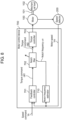
- FIG. 5 is a block diagram depicting an exemplary configuration of motor control device 500 according to the third exemplary embodiment.
- Constituent elements depicted in FIG. 5 as well as functioned and configured to operate similarly to the constituent elements in FIG. 1 according to the first exemplary embodiment will be denoted by identical reference marks and will not repeatedly be described in terms of operation.
- motor control device 500 according to the third exemplary embodiment is obtained by replacing change rate calculator 305 and change rate monitor 306 included in the configuration depicted in FIG. 1 with notch frequency output unit 507 and change forecaster 508 newly provided.
- Notch controller 304 outputs notch frequency ⁇ n that is received by notch filter 302 and notch frequency output unit 507.
- Notch frequency output unit 507 samples the notch frequency appropriately changed by notch controller 304. Specifically, notch frequency output unit 507 outputs notch frequency ⁇ n_t at a unit time period (i.e., the sampling period) longer than the successive change period of notch frequency ⁇ n that is received by notch controller 304 at the successive change period of notch frequency ⁇ n .
- Change forecaster 508 calculates to output, in accordance with notch frequencies at a plurality of past times, a forecast value of elapsed time from current time until the notch frequency is to become out of a specific frequency range, and a forecast value of elapsed time from current time to time when the notch frequency is to become out of the specific frequency range.
- Change forecaster 508 has an allowable lower limit value of the mechanical resonant frequency preset within a range not causing abnormal operation of the mechanical equipment.
- Change forecaster 508 receives notch frequency ⁇ n_t output from notch frequency output unit 507 every time the unit time elapses.
- Change forecaster 508 executes forecasting calculation of time from current time until the mechanical resonant frequency reaches the preset lower limit value, in accordance with notch frequency ⁇ n_t thus received. Change forecaster 508 outputs time forecast value ⁇ t from current time to abnormal operation occurrence.
- FIG. 6 is a graph indicating summarized forecasting calculation executed by change forecaster 508 included in motor control device 500 according to the third exemplary embodiment.
- FIG. 6 includes a transverse axis indicating time and an ordinate axis indicating a notch frequency.
- FIG. 6 indicates input of notch frequency ⁇ n_t_i at current time t_i.
- Change forecaster 508 receives notch frequency ⁇ n at every sampling period. Notch frequency ⁇ n_t_i-1 is input at previous time t_i-1, and notch frequency ⁇ n_t_i-2 is input at further previous time t_i-2.
- the notch frequency at time before the further previous time is input similarly.
- the notch frequency initially received by change forecaster 508 is denoted by ⁇ n_t_i-N .
- FIG. 6 indicates exemplary change in notch frequency, that notch frequency ⁇ n_t gradually decreases as time elapses.
- the mechanical resonant frequency has a lower limit value ⁇ n_target set to provide a range not causing abnormal operation of the mechanical equipment.
- reference mark ⁇ t indicates a time forecast value from current time until the mechanical resonant frequency reaches the allowable lower limit value of the range not causing abnormal operation.
- Time forecast value ⁇ t can be calculated in accordance with (formula 3) and (formula 4).
- ⁇ n_i-X indicates a change amount of the notch frequency per sampling period at each time and is calculated in accordance with (formula 4).
- a right side of (formula 3) includes a fractional term to be multiplied to sampling period Ts and having a denominator term indicating an average value of change amounts per sampling period of the notch frequencies having been input.
- the fractional term has a numerator term indicating difference between notch frequency ⁇ n_t_i at time t_i and preset lower limit value ⁇ n_target . Accordingly, (formula 3) indicates calculation according to linear interpolation, of time from current time t_i until the notch frequency reaches preset lower limit value ⁇ n_target with respect to the notch frequencies having been input until current time.
- the above configuration achieves highly accurate calculation prior to abnormal operation occurrence, of time until the mechanical resonant frequency reaches the allowable lower limit value of the range not causing abnormal operation, in accordance with the notch frequencies until current time in the case where mechanical resonant vibration is suppressed constantly and the mechanical resonant frequency varies. This enables notification to a user, prior to occurrence due to change in mechanical resonant frequency, of time to abnormal operation occurrence to provide an alert to change in mechanical resonant frequency or maintenance of the equipment.
- motor control device 500 forecasts to output time until the changing mechanical resonant frequency reaches the allowable lower limit value of the range not causing abnormal operation, in accordance with change in mechanical resonant frequency until current time.
- a system including motor control device 500 thus enables a user to recognize a sign of abnormal operation occurrence due to change in mechanical resonant frequency.
- Motor control device 500 is configured to calculate time until the mechanical resonant frequency reaches the allowable lower limit value of the range not causing abnormal operation, in accordance with change in notch frequency until current time.
- Motor control device 500 may alternatively be configured to preset an allowable upper limit value of the mechanical resonant frequency within the range not causing abnormality of the mechanical equipment and calculate also a time forecast value until the mechanical resonant frequency reaches the upper limit value thus set.
- Motor control device 500 may still alternatively be configured to preset allowable upper and lower limit values of the mechanical resonant frequency within the range not causing abnormality of the mechanical equipment and calculate a time forecast value until the mechanical resonant frequency reaches either one of the upper and lower limit values thus set.
- Such configurations achieve constant calculation of time until the mechanical resonant frequency reaches the allowable upper or lower limit value of the range not causing abnormal operation due to change in mechanical resonant frequency, regardless of whether the mechanical resonant frequency decreases or increases.
- the present exemplary embodiment provides the configuration for calculation of the time forecast value until abnormal operation occurrence by applying linear interpolation to all the notch frequencies input until current time, as in (formula 3).
- the notch frequency at time closer to current time may be likely to be reflected in the forecasting calculation.
- Linear interpolation may include multiplication of the change amount of the notch frequency per unit time by a weighting factor depending on time difference from current time.
- the present exemplary embodiment provides the configuration for forecasting calculation of time until abnormal operation occurrence by applying linear interpolation to the notch frequencies until current time, as in (formula 3).
- the present exemplary embodiment may adopt a measure other than linear interpolation.
- the notch frequencies may alternatively be fit to a quadratic function curve, an exponential curve, or a logarithmic curve.
- the forecasting calculation can be executed in accordance with a formula conforming to the tendency. Such a configuration achieves more accurate calculation of the time forecast value until abnormal operation occurrence.
- the present exemplary embodiment provides change forecaster 508 configured to output the time forecast value until abnormal operation occurrence.
- Change forecaster 508 may alternatively be configured to output the notch frequency after preset predetermined time.
- the notch frequency after the preset predetermined time can be calculated in accordance with a method, examples of which include linear interpolation of the notch frequencies until current time, similarly to forecast of time from current time until the mechanical resonant frequency reaches the preset lower limit value.
- change forecaster 508 may be configured to output both the time forecast value until abnormal operation occurrence and the notch frequency after the predetermined time, in accordance with the notch frequencies until current time.
- Change forecaster 508 may be configured to output a time forecast value when abnormal operation occurs, in place of the time forecast value until abnormal operation occurrence.
- the present exemplary embodiment provides notch frequency output unit 507 configured to output the notch frequency at every predetermined sampling period.
- Notch frequency output unit 507 may alternatively be configured to output the notch frequency at every sampling period only during continuous operation time.
- the time forecast value until abnormal operation occurrence to be output by change forecaster 508 may be a forecast value of the continuous operation time until abnormal operation occurrence.
- the present exemplary embodiment provides notch filter 302 disposed inside the feedback control system and having the notch frequency controlled to constantly become equal to the frequency of vibration included in motor speed.
- Possible values of the notch frequency may alternatively be limited by upper and lower limit values to prevent the notch frequency of notch filter 302 disposed inside the feedback control system from overlapping with the control band of the feedback system.
- the lower limit value of the notch frequency in this case may be set to be larger than the control band of the feedback control system.
- Such a configuration prevents the control band of the feedback control system from overlapping with the notch frequency of notch filter 302 disposed inside the feedback control system. This accordingly prevents oscillation caused by unstability of the feedback control system.
- Constituent elements of motor control device 500 namely, feedback controller 301, notch filter 302, torque controller 303, notch controller 304, notch frequency output unit 507, and change forecaster 508 can each be achieved by an analog circuit or a digital circuit including dedicated hardware.
- the constituent elements can alternatively be achieved by execution of a program stored in a memory by a processor in a computer device including the memory and the processor.
- FIG. 7 is a block diagram depicting an exemplary configuration of motor control device 600 according to a fourth exemplary embodiment.
- Constituent elements depicted in FIG. 7 as well as functioned and configured to operate similarly to the constituent elements in FIG. 5 according to the third exemplary embodiment will be denoted by identical reference marks and will not repeatedly be described in terms of operation.
- motor control device 600 according to the fourth exemplary embodiment is obtained by increasing a number from one to two, of each of the notch filter, the notch controller, and the notch frequency output unit included in the configuration depicted in FIG. 5 .
- Motor control device 600 is configured to reduce vibration even when there are two mechanical resonances, by including notch filter 302a for notch frequency ⁇ n1a and notch filter 302b for notch frequency ⁇ n1b .
- Notch filter 302a and notch filter 302b are connected in series and are disposed downstream of feedback controller 301.
- Notch frequency ⁇ n1a and notch frequency ⁇ n1b are set to have values different from each other to each correspond to one of the two mechanical resonant frequencies.
- notch controller 304a for notch filter 302a
- notch controller 304b for notch filter 302b.
- notch controller 304a and notch controller 304b each change the notch frequency of the corresponding notch filter to the changed mechanical resonant frequency in accordance with change in corresponding mechanical resonant frequency.
- Notch controller 304a and notch controller 304b simultaneously output the notch frequencies to notch frequency output unit 507a and notch frequency output unit 507b, respectively.
- the notch controllers may include vibration extracting filters having passbands provided around the two different mechanical resonant frequencies and not overlapping with each other, for example. Notch controller 304a and notch controller 304b can thus each detect change in corresponding mechanical resonant frequency, without being influenced by the change of the other mechanical resonant frequency.
- Notch frequency output unit 507a and notch frequency output unit 507b correspond to notch controller 304a and notch controller 304b, respectively.
- Notch frequency output unit 507a and notch frequency output unit 507b each output, to change forecaster 608 at every predetermined sampling period, the notch frequency output from the corresponding notch controller, as notch frequency ⁇ na_t or notch frequency ⁇ nb_t .
- Change forecaster 608 has allowable upper and lower limit values of each of the mechanical resonant frequencies corresponding to notch controller 304a and notch controller 304b and preset within a range not causing abnormal operation.
- Change forecaster 608 calculates each of time forecast values ⁇ ta and ⁇ tb until the notch frequency reaches the upper or lower limit value in accordance with the notch frequencies until current time, received at every sampling period from notch frequency output unit 507a and notch frequency output unit 507b.
- a smaller one of time forecast values ⁇ ta and ⁇ tb thus calculated is output as time forecast value ⁇ t_min from current time until the mechanical equipment has abnormal operation.
- Time forecast value ⁇ ta, ⁇ tb can separately be calculated from the corresponding notch frequencies until current time, in accordance with a method similar to the calculation method exemplified in the third exemplary embodiment.
- a system including motor control device 600 thus enables a user to recognize a sign of abnormal operation occurrence due to change in mechanical resonant frequency.
- motor control device 600 As described above, even when there are two mechanical resonant frequencies, motor control device 600 according to the present exemplary embodiment forecasts time until each of the two mechanical resonant frequencies reaches the allowable upper or lower limit value of the range not causing abnormal operation, in accordance with change of the mechanical resonant frequencies until current time, and outputs a shorter one of the forecasted time.
- the system including motor control device 600 thus enables the user to recognize a sign of abnormal operation occurrence due to change in mechanical resonant frequency.
- the present exemplary embodiment provides the configuration including the two sets of the notch filters, the notch controllers, and the notch frequency output units, assuming that there two mechanical resonant frequencies.
- the present invention is also applicable to a configuration including three or more sets of these constituent elements.
- the notch filters, the notch controllers, the notch frequency output units, and the change forecaster in this case may operate similarly to those according to the fourth exemplary embodiment.
- Such a configuration achieves, even when there are three or more mechanical resonant frequencies, forecast and output of shortest time until either one of the changing mechanical resonant frequencies reaches the allowable upper or lower limit value of the range not causing abnormal operation, in accordance with change in mechanical resonant frequency until current time.
- the system including the motor control device according to the present exemplary embodiment thus enables the user to recognize a sign of abnormal operation occurrence due to change in mechanical resonant frequency.
- Constituent elements of motor control device 600 namely, feedback controller 301, notch filter 302a, notch filter 302b, torque controller 303, notch controller 304a, notch controller 304b, notch frequency output unit 507a, notch frequency output unit 507b, and change forecaster 608 may each be achieved by an analog circuit or a digital circuit including dedicated hardware.
- the constituent elements may alternatively be achieved by execution of a program stored in a memory by a processor in a computer device including the memory and the processor.
- the motor control device includes the feedback controller configured to feedback-control to cause the motor speed to follow the speed command.
- the motor control device may include, in addition to the feedback controller, a feedforward controller configured to calculate from the speed command, a torque command causing the motor speed to agree with the speed command.
- the motor control device is configured to control the motor speed, but may alternatively be configured to control a position of the motor.
- the present invention is widely applicable to mechanical equipment having a changeable mechanical resonant frequency.
Landscapes
- Engineering & Computer Science (AREA)
- Power Engineering (AREA)
- Control Of Electric Motors In General (AREA)
Claims (7)
- Motorsteuervorrichtung (300), die dazu konfiguriert ist, eine Zustandsgröße eines Motors (100) oder einer mechanischen Last (102) durch Rückkopplung zu steuern, wobei die Vorrichtung Folgendes umfasst:ein erstes Kerbfilter (302), das innerhalb eines Rückkopplungssteuersystems angeordnet und zum Ändern einer zu entfernenden Frequenzkomponente konfiguriert ist;einen ersten Kerbfilter-Controller (304), der dazu konfiguriert ist, eine erste Kerbfrequenz als Mittenfrequenz des ersten Kerbfilters (304) sukzessive zu ändern;dadurch gekennzeichnet, dass die Motorsteuervorrichtung (300) umfasst:einen Änderungsprognostiker (508), der dazu konfiguriert ist, in Übereinstimmung mit der ersten Kerbfrequenz zu jedem aus einer Vielzahl von vergangenen Zeitpunkten mindestens einen Prognosewert der Kerbfrequenz zu einem bestimmten zukünftigen Zeitpunkt, einen Prognosewert der verstrichenen Zeit vom aktuellen Zeitpunkt bis zu dem Zeitpunkt, zu dem die Kerbfrequenz aus einem bestimmten Frequenzbereich herausfallen soll, und einen Prognosewert der Zeit, zu der die Kerbfrequenz aus dem bestimmten Frequenzbereich herausfallen soll, zu berechnen und auszugeben; undeine Kerbfrequenz-Ausgabeeinheit (507), die dazu konfiguriert ist, die durch den ersten Kerbregler (304) geänderte erste Kerbfrequenz mit einer Abtastperiode abzutasten, die länger ist als eine nachfolgende Änderungsperiode der Kerbfrequenz am ersten Kerbregler (304),wobei der Änderungsprognostiker (508) dazu konfiguriert ist, den Prognosewert aus der abgetasteten Kerbfrequenz zu berechnen.
- Motorsteuervorrichtung nach Anspruch 1, wobei der Änderungsprognostiker (508) dazu konfiguriert ist, den Prognosewert durch lineare Interpolation aus der ersten Kerbfrequenz zu jedem aus der Vielzahl von vergangenen Zeitpunkten zu berechnen.
- Motorsteuervorrichtung nach Anspruch 1, wobei der erste Kerbregler (304) dazu ausgebildet ist, die erste Kerbfrequenz nur innerhalb eines voreingestellten Kerbfrequenzbereichs zu ändern.
- Motorsteuervorrichtung nach Anspruch 3, wobei die erste Kerbfrequenz des ersten Kerbfilters (304) so eingestellt ist, dass sie sich nicht mit einem Steuerband des Rückkopplungssteuersystems überschneidet.
- Motorsteuervorrichtung nach Anspruch 1, die weiterhin umfasst:ein zweites Kerbfilter (302b), das innerhalb des Rückkopplungssteuersystems angeordnet und dazu konfiguriert ist, eine zu entfernende Frequenzkomponente zu ändern; undeinen zweiten Kerbfilter-Controller (304b), der dazu konfiguriert ist, eine zweite Kerbfrequenz als Mittenfrequenz des zweiten Kerbfilters zu ändern,wobeidas erste Kerbfilter (302a) und das zweite Kerbfilter (302b) in Reihe geschaltet sind, undder Änderungsprognostiker (608) dazu konfiguriert ist, den Prognosewert für sowohl den ersten Kerbfilter-Controller (304a) als auch den zweiten Kerbfilter-Controller (304b) zu berechnen.
- Motorsteuervorrichtung nach Anspruch 5, wobeibei der Berechnung einer Vielzahl von Prognosewerten der verstrichenen Zeit der Änderungsprognostiker (406) so konfiguriert ist, dass er den Prognosewert der kürzesten verstrichenen Zeit ausgibt, undbei der Berechnung einer Vielzahl von Prognosewerten von Zeitpunkten der Änderungsprognostiker (406) dazu konfiguriert ist, den Prognosewert eines frühesten Zeitpunkts auszugeben.
- Motorsteuerungsverfahren zur Rückkopplungssteuerung der Zustandsgröße eines Motors (100) oder einer mechanischen Last (102), wobei das Verfahren umfasst:einen Kerbfiltersteuerungsschritt zum sukzessiven Ändern einer Kerbfrequenz als Mittenfrequenz eines Kerbfilters, der innerhalb eines Rückkopplungssteuerungssystems angeordnet und zum Ändern einer zu entfernenden Frequenzkomponente konfiguriert ist;gekennzeichnet durcheinen Änderungsprognoseschritt zum Berechnen zur Ausgabe, in Übereinstimmung mit einer Kerbfrequenz zu jedem einer Vielzahl von vergangenen Zeitpunkten, von mindestens einem der folgenden Werte: ein Prognosewert der Kerbfrequenz zu einem bestimmten zukünftigen Zeitpunkt, ein Prognosewert der verstrichenen Zeit vom aktuellen Zeitpunkt bis zu dem Zeitpunkt, zu dem die Kerbfrequenz aus einem bestimmten Frequenzbereich herausfallen soll, und ein Prognosewert des Zeitpunkts, zu dem die Kerbfrequenz aus dem bestimmten Frequenzbereich herausfallen soll; undeinen Kerbfrequenz-Ausgabeschritt zum Abtasten der durch den Kerbfiltersteuerungsschritt geänderten Kerbfrequenz mit einer Abtastperiode, die länger ist als eine nachfolgende Änderungsperiode der Kerbfrequenz im Kerbfiltersteuerungsschritt,wobei im Änderungsprognoseschritt der Prognosewert aus der abgetasteten Kerbfrequenz berechnet wird.
Applications Claiming Priority (2)
| Application Number | Priority Date | Filing Date | Title |
|---|---|---|---|
| JP2016192313 | 2016-09-29 | ||
| PCT/JP2017/026952 WO2018061437A1 (ja) | 2016-09-29 | 2017-07-26 | 電動機制御装置および電動機制御方法 |
Publications (3)
| Publication Number | Publication Date |
|---|---|
| EP3522366A1 EP3522366A1 (de) | 2019-08-07 |
| EP3522366A4 EP3522366A4 (de) | 2019-08-07 |
| EP3522366B1 true EP3522366B1 (de) | 2024-12-04 |
Family
ID=61759437
Family Applications (1)
| Application Number | Title | Priority Date | Filing Date |
|---|---|---|---|
| EP17855395.4A Active EP3522366B1 (de) | 2016-09-29 | 2017-07-26 | Motorsteuerungsvorrichtung und motorsteuerungsverfahren |
Country Status (5)
| Country | Link |
|---|---|
| US (1) | US10715076B2 (de) |
| EP (1) | EP3522366B1 (de) |
| JP (1) | JP7126049B2 (de) |
| CN (1) | CN109863692B (de) |
| WO (1) | WO2018061437A1 (de) |
Families Citing this family (6)
| Publication number | Priority date | Publication date | Assignee | Title |
|---|---|---|---|---|
| CN109874404B (zh) * | 2016-09-29 | 2022-04-22 | 松下知识产权经营株式会社 | 电动机控制装置和电动机控制方法 |
| US11499537B2 (en) * | 2017-12-17 | 2022-11-15 | Microchip Technology Incorporated | Closed loop torque compensation for compressor applications |
| CN113678365A (zh) * | 2019-03-29 | 2021-11-19 | 日本电产株式会社 | 控制装置 |
| JP7178327B2 (ja) * | 2019-06-14 | 2022-11-25 | 株式会社日立産機システム | ノッチフィルタ調整装置、およびそれを備えたモータ制御装置 |
| KR102735885B1 (ko) * | 2019-12-19 | 2024-11-29 | 주식회사 디엔솔루션즈 | 공작기계의 탠덤제어 시스템 및 이의 제어방법 |
| CN111464106B (zh) * | 2020-04-08 | 2021-11-19 | 高创传动科技开发(深圳)有限公司 | 伺服系统及其谐振抑制方法 |
Family Cites Families (15)
| Publication number | Priority date | Publication date | Assignee | Title |
|---|---|---|---|---|
| US5332061A (en) * | 1993-03-12 | 1994-07-26 | General Motors Corporation | Active vibration control system for attenuating engine generated vibrations in a vehicle |
| US6107767A (en) * | 1998-03-20 | 2000-08-22 | Trw Inc. | Electric assist steering system having an improved motor current controller with notch filter |
| US6417982B1 (en) * | 1998-12-02 | 2002-07-09 | International Business Machines Corporation | System and method for identifying and filtering a head suspension assembly resonance frequency |
| JP2001336528A (ja) * | 2000-05-25 | 2001-12-07 | Ntn Corp | 磁気浮上装置 |
| JP4353717B2 (ja) * | 2002-03-29 | 2009-10-28 | パナソニック株式会社 | 電動機の位置制御装置 |
| JP4311043B2 (ja) | 2003-03-12 | 2009-08-12 | パナソニック株式会社 | 電動機の制御装置 |
| US7583468B2 (en) * | 2004-07-06 | 2009-09-01 | Samsung Electronics Co., Ltd. | Method and apparatus of dual stage servo control with dual control paths and decoupling feedback for track following in a hard disk drive |
| JP2008312339A (ja) * | 2007-06-14 | 2008-12-25 | Panasonic Corp | 電動機の制御装置 |
| JP5332321B2 (ja) * | 2008-06-04 | 2013-11-06 | パナソニック株式会社 | モータ制御装置 |
| WO2011148623A1 (ja) * | 2010-05-28 | 2011-12-01 | パナソニック株式会社 | 電動機制御装置 |
| JP5550476B2 (ja) | 2010-07-13 | 2014-07-16 | 住友重機械工業株式会社 | 適応ノッチフィルタ、及びノッチフィルタのパラメタ調整方法 |
| JP5757842B2 (ja) * | 2011-10-19 | 2015-08-05 | 住友重機械工業株式会社 | 共振抑制装置及び共振抑制方法 |
| CN104756399B (zh) * | 2013-01-16 | 2017-04-26 | 三菱电机株式会社 | 电动机控制装置 |
| JP2014183678A (ja) * | 2013-03-21 | 2014-09-29 | Panasonic Corp | モータ駆動装置 |
| JP6312548B2 (ja) * | 2014-07-31 | 2018-04-18 | ファナック株式会社 | 機械剛性の自己測定機能および自己監視機能を有するサーボモータ制御装置 |
-
2017
- 2017-07-26 EP EP17855395.4A patent/EP3522366B1/de active Active
- 2017-07-26 JP JP2018541946A patent/JP7126049B2/ja active Active
- 2017-07-26 CN CN201780058297.9A patent/CN109863692B/zh active Active
- 2017-07-26 US US16/328,708 patent/US10715076B2/en active Active
- 2017-07-26 WO PCT/JP2017/026952 patent/WO2018061437A1/ja not_active Ceased
Also Published As
| Publication number | Publication date |
|---|---|
| EP3522366A1 (de) | 2019-08-07 |
| EP3522366A4 (de) | 2019-08-07 |
| WO2018061437A1 (ja) | 2018-04-05 |
| JPWO2018061437A1 (ja) | 2019-07-18 |
| US10715076B2 (en) | 2020-07-14 |
| US20190199267A1 (en) | 2019-06-27 |
| CN109863692B (zh) | 2022-08-02 |
| CN109863692A (zh) | 2019-06-07 |
| JP7126049B2 (ja) | 2022-08-26 |
Similar Documents
| Publication | Publication Date | Title |
|---|---|---|
| US10715076B2 (en) | Motor control device and motor control method | |
| EP3522367B1 (de) | Motorsteuerungsvorrichtung und motorsteuerungsverfahren | |
| US7843159B2 (en) | Motor controller | |
| EP3641127B1 (de) | Elektromotorsteuerungsvorrichtung und elektromotorsteuerungsvorrichtungsteuerungsverfahren | |
| JP6257481B2 (ja) | 数値制御装置 | |
| US9423782B2 (en) | Motor drive device | |
| JP5757842B2 (ja) | 共振抑制装置及び共振抑制方法 | |
| EP2579453A1 (de) | Motorsteuerungsvorrichtung | |
| TWI452822B (zh) | 馬達控制裝置 | |
| EP3250967B1 (de) | Verfahren und anordnung zur automatischen abstimmung eines steuergeräts | |
| EP2356522B1 (de) | Verringerung von oszillationen in einem regelsystem | |
| KR102278353B1 (ko) | 서보 시스템의 자동 공진 검출 및 억제 장치 및 그 방법 | |
| JP5909160B2 (ja) | 船体の位置制御装置及び方法並びにプログラム | |
| JP5516682B2 (ja) | フィードバック制御系の振動検出装置及び振動検出装置を備えたモータ制御装置 | |
| JP2019153040A (ja) | 制御パラメータ調整方法及び制御パラメータ調整システム | |
| JP2020108325A (ja) | サーボアンプ及びサーボシステム | |
| JP2003189653A (ja) | 電動機制御装置およびそのゲイン設定方法 | |
| JP5504214B2 (ja) | 気体圧縮装置 | |
| JP4546437B2 (ja) | オートチューニング装置およびオートチューニング方法 | |
| JP3211957B2 (ja) | 機器の診断方法および診断装置 | |
| WO2025032687A1 (ja) | モータ制御装置 | |
| JPS6236246B2 (de) | ||
| JPH06297020A (ja) | 圧延機の自動板厚制御方法 | |
| JPH07175514A (ja) | 操作端制御装置 | |
| JP2017055628A (ja) | 予防保全システム |
Legal Events
| Date | Code | Title | Description |
|---|---|---|---|
| STAA | Information on the status of an ep patent application or granted ep patent |
Free format text: STATUS: THE INTERNATIONAL PUBLICATION HAS BEEN MADE |
|
| PUAI | Public reference made under article 153(3) epc to a published international application that has entered the european phase |
Free format text: ORIGINAL CODE: 0009012 |
|
| STAA | Information on the status of an ep patent application or granted ep patent |
Free format text: STATUS: REQUEST FOR EXAMINATION WAS MADE |
|
| 17P | Request for examination filed |
Effective date: 20190215 |
|
| A4 | Supplementary search report drawn up and despatched |
Effective date: 20190618 |
|
| AK | Designated contracting states |
Kind code of ref document: A1 Designated state(s): AL AT BE BG CH CY CZ DE DK EE ES FI FR GB GR HR HU IE IS IT LI LT LU LV MC MK MT NL NO PL PT RO RS SE SI SK SM TR |
|
| AX | Request for extension of the european patent |
Extension state: BA ME |
|
| DAV | Request for validation of the european patent (deleted) | ||
| DAX | Request for extension of the european patent (deleted) | ||
| STAA | Information on the status of an ep patent application or granted ep patent |
Free format text: STATUS: EXAMINATION IS IN PROGRESS |
|
| 17Q | First examination report despatched |
Effective date: 20210504 |
|
| GRAP | Despatch of communication of intention to grant a patent |
Free format text: ORIGINAL CODE: EPIDOSNIGR1 |
|
| STAA | Information on the status of an ep patent application or granted ep patent |
Free format text: STATUS: GRANT OF PATENT IS INTENDED |
|
| INTG | Intention to grant announced |
Effective date: 20240708 |
|
| GRAS | Grant fee paid |
Free format text: ORIGINAL CODE: EPIDOSNIGR3 |
|
| GRAA | (expected) grant |
Free format text: ORIGINAL CODE: 0009210 |
|
| STAA | Information on the status of an ep patent application or granted ep patent |
Free format text: STATUS: THE PATENT HAS BEEN GRANTED |
|
| AK | Designated contracting states |
Kind code of ref document: B1 Designated state(s): AL AT BE BG CH CY CZ DE DK EE ES FI FR GB GR HR HU IE IS IT LI LT LU LV MC MK MT NL NO PL PT RO RS SE SI SK SM TR |
|
| REG | Reference to a national code |
Ref country code: GB Ref legal event code: FG4D |
|
| REG | Reference to a national code |
Ref country code: CH Ref legal event code: EP |
|
| REG | Reference to a national code |
Ref country code: DE Ref legal event code: R096 Ref document number: 602017086595 Country of ref document: DE |
|
| REG | Reference to a national code |
Ref country code: IE Ref legal event code: FG4D |
|
| REG | Reference to a national code |
Ref country code: LT Ref legal event code: MG9D |
|
| REG | Reference to a national code |
Ref country code: NL Ref legal event code: MP Effective date: 20241204 |
|
| PG25 | Lapsed in a contracting state [announced via postgrant information from national office to epo] |
Ref country code: HR Free format text: LAPSE BECAUSE OF FAILURE TO SUBMIT A TRANSLATION OF THE DESCRIPTION OR TO PAY THE FEE WITHIN THE PRESCRIBED TIME-LIMIT Effective date: 20241204 |
|
| PG25 | Lapsed in a contracting state [announced via postgrant information from national office to epo] |
Ref country code: FI Free format text: LAPSE BECAUSE OF FAILURE TO SUBMIT A TRANSLATION OF THE DESCRIPTION OR TO PAY THE FEE WITHIN THE PRESCRIBED TIME-LIMIT Effective date: 20241204 |
|
| PG25 | Lapsed in a contracting state [announced via postgrant information from national office to epo] |
Ref country code: BG Free format text: LAPSE BECAUSE OF FAILURE TO SUBMIT A TRANSLATION OF THE DESCRIPTION OR TO PAY THE FEE WITHIN THE PRESCRIBED TIME-LIMIT Effective date: 20241204 |
|
| PG25 | Lapsed in a contracting state [announced via postgrant information from national office to epo] |
Ref country code: ES Free format text: LAPSE BECAUSE OF FAILURE TO SUBMIT A TRANSLATION OF THE DESCRIPTION OR TO PAY THE FEE WITHIN THE PRESCRIBED TIME-LIMIT Effective date: 20241204 |
|
| PG25 | Lapsed in a contracting state [announced via postgrant information from national office to epo] |
Ref country code: NO Free format text: LAPSE BECAUSE OF FAILURE TO SUBMIT A TRANSLATION OF THE DESCRIPTION OR TO PAY THE FEE WITHIN THE PRESCRIBED TIME-LIMIT Effective date: 20250304 |
|
| PG25 | Lapsed in a contracting state [announced via postgrant information from national office to epo] |
Ref country code: GR Free format text: LAPSE BECAUSE OF FAILURE TO SUBMIT A TRANSLATION OF THE DESCRIPTION OR TO PAY THE FEE WITHIN THE PRESCRIBED TIME-LIMIT Effective date: 20250305 Ref country code: LV Free format text: LAPSE BECAUSE OF FAILURE TO SUBMIT A TRANSLATION OF THE DESCRIPTION OR TO PAY THE FEE WITHIN THE PRESCRIBED TIME-LIMIT Effective date: 20241204 |
|
| PG25 | Lapsed in a contracting state [announced via postgrant information from national office to epo] |
Ref country code: RS Free format text: LAPSE BECAUSE OF FAILURE TO SUBMIT A TRANSLATION OF THE DESCRIPTION OR TO PAY THE FEE WITHIN THE PRESCRIBED TIME-LIMIT Effective date: 20250304 |
|
| PG25 | Lapsed in a contracting state [announced via postgrant information from national office to epo] |
Ref country code: NL Free format text: LAPSE BECAUSE OF FAILURE TO SUBMIT A TRANSLATION OF THE DESCRIPTION OR TO PAY THE FEE WITHIN THE PRESCRIBED TIME-LIMIT Effective date: 20241204 |
|
| REG | Reference to a national code |
Ref country code: AT Ref legal event code: MK05 Ref document number: 1749227 Country of ref document: AT Kind code of ref document: T Effective date: 20241204 |
|
| PG25 | Lapsed in a contracting state [announced via postgrant information from national office to epo] |
Ref country code: SM Free format text: LAPSE BECAUSE OF FAILURE TO SUBMIT A TRANSLATION OF THE DESCRIPTION OR TO PAY THE FEE WITHIN THE PRESCRIBED TIME-LIMIT Effective date: 20241204 |
|
| PG25 | Lapsed in a contracting state [announced via postgrant information from national office to epo] |
Ref country code: PL Free format text: LAPSE BECAUSE OF FAILURE TO SUBMIT A TRANSLATION OF THE DESCRIPTION OR TO PAY THE FEE WITHIN THE PRESCRIBED TIME-LIMIT Effective date: 20241204 |
|
| PG25 | Lapsed in a contracting state [announced via postgrant information from national office to epo] |
Ref country code: IS Free format text: LAPSE BECAUSE OF FAILURE TO SUBMIT A TRANSLATION OF THE DESCRIPTION OR TO PAY THE FEE WITHIN THE PRESCRIBED TIME-LIMIT Effective date: 20250404 |
|
| PG25 | Lapsed in a contracting state [announced via postgrant information from national office to epo] |
Ref country code: PT Free format text: LAPSE BECAUSE OF FAILURE TO SUBMIT A TRANSLATION OF THE DESCRIPTION OR TO PAY THE FEE WITHIN THE PRESCRIBED TIME-LIMIT Effective date: 20250404 |
|
| PG25 | Lapsed in a contracting state [announced via postgrant information from national office to epo] |
Ref country code: EE Free format text: LAPSE BECAUSE OF FAILURE TO SUBMIT A TRANSLATION OF THE DESCRIPTION OR TO PAY THE FEE WITHIN THE PRESCRIBED TIME-LIMIT Effective date: 20241204 |
|
| PG25 | Lapsed in a contracting state [announced via postgrant information from national office to epo] |
Ref country code: RO Free format text: LAPSE BECAUSE OF FAILURE TO SUBMIT A TRANSLATION OF THE DESCRIPTION OR TO PAY THE FEE WITHIN THE PRESCRIBED TIME-LIMIT Effective date: 20241204 Ref country code: AT Free format text: LAPSE BECAUSE OF FAILURE TO SUBMIT A TRANSLATION OF THE DESCRIPTION OR TO PAY THE FEE WITHIN THE PRESCRIBED TIME-LIMIT Effective date: 20241204 |
|
| PG25 | Lapsed in a contracting state [announced via postgrant information from national office to epo] |
Ref country code: SK Free format text: LAPSE BECAUSE OF FAILURE TO SUBMIT A TRANSLATION OF THE DESCRIPTION OR TO PAY THE FEE WITHIN THE PRESCRIBED TIME-LIMIT Effective date: 20241204 |
|
| PG25 | Lapsed in a contracting state [announced via postgrant information from national office to epo] |
Ref country code: CZ Free format text: LAPSE BECAUSE OF FAILURE TO SUBMIT A TRANSLATION OF THE DESCRIPTION OR TO PAY THE FEE WITHIN THE PRESCRIBED TIME-LIMIT Effective date: 20241204 |
|
| PG25 | Lapsed in a contracting state [announced via postgrant information from national office to epo] |
Ref country code: IT Free format text: LAPSE BECAUSE OF FAILURE TO SUBMIT A TRANSLATION OF THE DESCRIPTION OR TO PAY THE FEE WITHIN THE PRESCRIBED TIME-LIMIT Effective date: 20241204 |
|
| REG | Reference to a national code |
Ref country code: DE Ref legal event code: R097 Ref document number: 602017086595 Country of ref document: DE |
|
| PG25 | Lapsed in a contracting state [announced via postgrant information from national office to epo] |
Ref country code: SE Free format text: LAPSE BECAUSE OF FAILURE TO SUBMIT A TRANSLATION OF THE DESCRIPTION OR TO PAY THE FEE WITHIN THE PRESCRIBED TIME-LIMIT Effective date: 20241204 |
|
| PG25 | Lapsed in a contracting state [announced via postgrant information from national office to epo] |
Ref country code: DK Free format text: LAPSE BECAUSE OF FAILURE TO SUBMIT A TRANSLATION OF THE DESCRIPTION OR TO PAY THE FEE WITHIN THE PRESCRIBED TIME-LIMIT Effective date: 20241204 |
|
| PGFP | Annual fee paid to national office [announced via postgrant information from national office to epo] |
Ref country code: DE Payment date: 20250722 Year of fee payment: 9 |
|
| PLBE | No opposition filed within time limit |
Free format text: ORIGINAL CODE: 0009261 |
|
| STAA | Information on the status of an ep patent application or granted ep patent |
Free format text: STATUS: NO OPPOSITION FILED WITHIN TIME LIMIT |
|
| REG | Reference to a national code |
Ref country code: CH Ref legal event code: L10 Free format text: ST27 STATUS EVENT CODE: U-0-0-L10-L00 (AS PROVIDED BY THE NATIONAL OFFICE) Effective date: 20251015 |
|
| 26N | No opposition filed |
Effective date: 20250905 |
|
| REG | Reference to a national code |
Ref country code: CH Ref legal event code: H13 Free format text: ST27 STATUS EVENT CODE: U-0-0-H10-H13 (AS PROVIDED BY THE NATIONAL OFFICE) Effective date: 20260224 |
|
| PG25 | Lapsed in a contracting state [announced via postgrant information from national office to epo] |
Ref country code: LU Free format text: LAPSE BECAUSE OF NON-PAYMENT OF DUE FEES Effective date: 20250726 |
|
| GBPC | Gb: european patent ceased through non-payment of renewal fee |
Effective date: 20250726 |
|
| REG | Reference to a national code |
Ref country code: BE Ref legal event code: MM Effective date: 20250731 |
|
| PG25 | Lapsed in a contracting state [announced via postgrant information from national office to epo] |
Ref country code: GB Free format text: LAPSE BECAUSE OF NON-PAYMENT OF DUE FEES Effective date: 20250726 |
|
| PG25 | Lapsed in a contracting state [announced via postgrant information from national office to epo] |
Ref country code: BE Free format text: LAPSE BECAUSE OF NON-PAYMENT OF DUE FEES Effective date: 20250731 |
|
| PG25 | Lapsed in a contracting state [announced via postgrant information from national office to epo] |
Ref country code: FR Free format text: LAPSE BECAUSE OF NON-PAYMENT OF DUE FEES Effective date: 20250731 |
|
| PG25 | Lapsed in a contracting state [announced via postgrant information from national office to epo] |
Ref country code: CH Free format text: LAPSE BECAUSE OF NON-PAYMENT OF DUE FEES Effective date: 20250731 |