EP3517575B1 - Polymerzusammensetzung - Google Patents
Polymerzusammensetzung Download PDFInfo
- Publication number
- EP3517575B1 EP3517575B1 EP17858384.5A EP17858384A EP3517575B1 EP 3517575 B1 EP3517575 B1 EP 3517575B1 EP 17858384 A EP17858384 A EP 17858384A EP 3517575 B1 EP3517575 B1 EP 3517575B1
- Authority
- EP
- European Patent Office
- Prior art keywords
- group
- electron
- formula
- polymer
- optionally substituted
- Prior art date
- Legal status (The legal status is an assumption and is not a legal conclusion. Google has not performed a legal analysis and makes no representation as to the accuracy of the status listed.)
- Active
Links
- 0 CCC1*C(C*C)=**1 Chemical compound CCC1*C(C*C)=**1 0.000 description 11
- YQWYNZQEVDAWAF-PLNGDYQASA-N CC/C=C\c(cc(C)cc1)c1O Chemical compound CC/C=C\c(cc(C)cc1)c1O YQWYNZQEVDAWAF-PLNGDYQASA-N 0.000 description 1
- XPCLPRGWHXAORE-UHFFFAOYSA-N CCC(C)(C=C)N Chemical compound CCC(C)(C=C)N XPCLPRGWHXAORE-UHFFFAOYSA-N 0.000 description 1
- VQMPTVQCADWACQ-UHFFFAOYSA-N CCC(C)(CC)N Chemical compound CCC(C)(CC)N VQMPTVQCADWACQ-UHFFFAOYSA-N 0.000 description 1
- UHOVQNZJYSORNB-UHFFFAOYSA-N c1ccccc1 Chemical compound c1ccccc1 UHOVQNZJYSORNB-UHFFFAOYSA-N 0.000 description 1
Images



Classifications
-
- C—CHEMISTRY; METALLURGY
- C08—ORGANIC MACROMOLECULAR COMPOUNDS; THEIR PREPARATION OR CHEMICAL WORKING-UP; COMPOSITIONS BASED THEREON
- C08L—COMPOSITIONS OF MACROMOLECULAR COMPOUNDS
- C08L79/00—Compositions of macromolecular compounds obtained by reactions forming in the main chain of the macromolecule a linkage containing nitrogen with or without oxygen or carbon only, not provided for in groups C08L61/00 - C08L77/00
- C08L79/04—Polycondensates having nitrogen-containing heterocyclic rings in the main chain; Polyhydrazides; Polyamide acids or similar polyimide precursors
- C08L79/08—Polyimides; Polyester-imides; Polyamide-imides; Polyamide acids or similar polyimide precursors
-
- C—CHEMISTRY; METALLURGY
- C08—ORGANIC MACROMOLECULAR COMPOUNDS; THEIR PREPARATION OR CHEMICAL WORKING-UP; COMPOSITIONS BASED THEREON
- C08G—MACROMOLECULAR COMPOUNDS OBTAINED OTHERWISE THAN BY REACTIONS ONLY INVOLVING UNSATURATED CARBON-TO-CARBON BONDS
- C08G65/00—Macromolecular compounds obtained by reactions forming an ether link in the main chain of the macromolecule
- C08G65/34—Macromolecular compounds obtained by reactions forming an ether link in the main chain of the macromolecule from hydroxy compounds or their metallic derivatives
- C08G65/38—Macromolecular compounds obtained by reactions forming an ether link in the main chain of the macromolecule from hydroxy compounds or their metallic derivatives derived from phenols
- C08G65/40—Macromolecular compounds obtained by reactions forming an ether link in the main chain of the macromolecule from hydroxy compounds or their metallic derivatives derived from phenols from phenols (I) and other compounds (II), e.g. OH-Ar-OH + X-Ar-X, where X is halogen atom, i.e. leaving group
- C08G65/4012—Other compound (II) containing a ketone group, e.g. X-Ar-C(=O)-Ar-X for polyetherketones
- C08G65/4056—(I) or (II) containing sulfur
-
- C—CHEMISTRY; METALLURGY
- C08—ORGANIC MACROMOLECULAR COMPOUNDS; THEIR PREPARATION OR CHEMICAL WORKING-UP; COMPOSITIONS BASED THEREON
- C08G—MACROMOLECULAR COMPOUNDS OBTAINED OTHERWISE THAN BY REACTIONS ONLY INVOLVING UNSATURATED CARBON-TO-CARBON BONDS
- C08G73/00—Macromolecular compounds obtained by reactions forming a linkage containing nitrogen with or without oxygen or carbon in the main chain of the macromolecule, not provided for in groups C08G12/00 - C08G71/00
- C08G73/06—Polycondensates having nitrogen-containing heterocyclic rings in the main chain of the macromolecule
- C08G73/10—Polyimides; Polyester-imides; Polyamide-imides; Polyamide acids or similar polyimide precursors
- C08G73/1057—Polyimides containing other atoms than carbon, hydrogen, nitrogen or oxygen in the main chain
- C08G73/1064—Polyimides containing other atoms than carbon, hydrogen, nitrogen or oxygen in the main chain containing sulfur
-
- C—CHEMISTRY; METALLURGY
- C08—ORGANIC MACROMOLECULAR COMPOUNDS; THEIR PREPARATION OR CHEMICAL WORKING-UP; COMPOSITIONS BASED THEREON
- C08G—MACROMOLECULAR COMPOUNDS OBTAINED OTHERWISE THAN BY REACTIONS ONLY INVOLVING UNSATURATED CARBON-TO-CARBON BONDS
- C08G59/00—Polycondensates containing more than one epoxy group per molecule; Macromolecules obtained by polymerising compounds containing more than one epoxy group per molecule using curing agents or catalysts which react with the epoxy groups
- C08G59/18—Macromolecules obtained by polymerising compounds containing more than one epoxy group per molecule using curing agents or catalysts which react with the epoxy groups ; e.g. general methods of curing
- C08G59/40—Macromolecules obtained by polymerising compounds containing more than one epoxy group per molecule using curing agents or catalysts which react with the epoxy groups ; e.g. general methods of curing characterised by the curing agents used
- C08G59/62—Alcohols or phenols
-
- C—CHEMISTRY; METALLURGY
- C08—ORGANIC MACROMOLECULAR COMPOUNDS; THEIR PREPARATION OR CHEMICAL WORKING-UP; COMPOSITIONS BASED THEREON
- C08G—MACROMOLECULAR COMPOUNDS OBTAINED OTHERWISE THAN BY REACTIONS ONLY INVOLVING UNSATURATED CARBON-TO-CARBON BONDS
- C08G65/00—Macromolecular compounds obtained by reactions forming an ether link in the main chain of the macromolecule
- C08G65/02—Macromolecular compounds obtained by reactions forming an ether link in the main chain of the macromolecule from cyclic ethers by opening of the heterocyclic ring
- C08G65/04—Macromolecular compounds obtained by reactions forming an ether link in the main chain of the macromolecule from cyclic ethers by opening of the heterocyclic ring from cyclic ethers only
-
- C—CHEMISTRY; METALLURGY
- C08—ORGANIC MACROMOLECULAR COMPOUNDS; THEIR PREPARATION OR CHEMICAL WORKING-UP; COMPOSITIONS BASED THEREON
- C08G—MACROMOLECULAR COMPOUNDS OBTAINED OTHERWISE THAN BY REACTIONS ONLY INVOLVING UNSATURATED CARBON-TO-CARBON BONDS
- C08G65/00—Macromolecular compounds obtained by reactions forming an ether link in the main chain of the macromolecule
- C08G65/02—Macromolecular compounds obtained by reactions forming an ether link in the main chain of the macromolecule from cyclic ethers by opening of the heterocyclic ring
- C08G65/26—Macromolecular compounds obtained by reactions forming an ether link in the main chain of the macromolecule from cyclic ethers by opening of the heterocyclic ring from cyclic ethers and other compounds
- C08G65/2636—Macromolecular compounds obtained by reactions forming an ether link in the main chain of the macromolecule from cyclic ethers by opening of the heterocyclic ring from cyclic ethers and other compounds the other compounds containing sulfur
-
- C—CHEMISTRY; METALLURGY
- C08—ORGANIC MACROMOLECULAR COMPOUNDS; THEIR PREPARATION OR CHEMICAL WORKING-UP; COMPOSITIONS BASED THEREON
- C08G—MACROMOLECULAR COMPOUNDS OBTAINED OTHERWISE THAN BY REACTIONS ONLY INVOLVING UNSATURATED CARBON-TO-CARBON BONDS
- C08G73/00—Macromolecular compounds obtained by reactions forming a linkage containing nitrogen with or without oxygen or carbon in the main chain of the macromolecule, not provided for in groups C08G12/00 - C08G71/00
- C08G73/06—Polycondensates having nitrogen-containing heterocyclic rings in the main chain of the macromolecule
- C08G73/10—Polyimides; Polyester-imides; Polyamide-imides; Polyamide acids or similar polyimide precursors
- C08G73/1039—Polyimides; Polyester-imides; Polyamide-imides; Polyamide acids or similar polyimide precursors comprising halogen-containing substituents
-
- C—CHEMISTRY; METALLURGY
- C08—ORGANIC MACROMOLECULAR COMPOUNDS; THEIR PREPARATION OR CHEMICAL WORKING-UP; COMPOSITIONS BASED THEREON
- C08G—MACROMOLECULAR COMPOUNDS OBTAINED OTHERWISE THAN BY REACTIONS ONLY INVOLVING UNSATURATED CARBON-TO-CARBON BONDS
- C08G75/00—Macromolecular compounds obtained by reactions forming a linkage containing sulfur with or without nitrogen, oxygen, or carbon in the main chain of the macromolecule
- C08G75/20—Polysulfones
-
- C—CHEMISTRY; METALLURGY
- C08—ORGANIC MACROMOLECULAR COMPOUNDS; THEIR PREPARATION OR CHEMICAL WORKING-UP; COMPOSITIONS BASED THEREON
- C08G—MACROMOLECULAR COMPOUNDS OBTAINED OTHERWISE THAN BY REACTIONS ONLY INVOLVING UNSATURATED CARBON-TO-CARBON BONDS
- C08G75/00—Macromolecular compounds obtained by reactions forming a linkage containing sulfur with or without nitrogen, oxygen, or carbon in the main chain of the macromolecule
- C08G75/20—Polysulfones
- C08G75/23—Polyethersulfones
-
- C—CHEMISTRY; METALLURGY
- C08—ORGANIC MACROMOLECULAR COMPOUNDS; THEIR PREPARATION OR CHEMICAL WORKING-UP; COMPOSITIONS BASED THEREON
- C08L—COMPOSITIONS OF MACROMOLECULAR COMPOUNDS
- C08L63/00—Compositions of epoxy resins; Compositions of derivatives of epoxy resins
-
- C—CHEMISTRY; METALLURGY
- C08—ORGANIC MACROMOLECULAR COMPOUNDS; THEIR PREPARATION OR CHEMICAL WORKING-UP; COMPOSITIONS BASED THEREON
- C08L—COMPOSITIONS OF MACROMOLECULAR COMPOUNDS
- C08L71/00—Compositions of polyethers obtained by reactions forming an ether link in the main chain; Compositions of derivatives of such polymers
-
- C—CHEMISTRY; METALLURGY
- C08—ORGANIC MACROMOLECULAR COMPOUNDS; THEIR PREPARATION OR CHEMICAL WORKING-UP; COMPOSITIONS BASED THEREON
- C08L—COMPOSITIONS OF MACROMOLECULAR COMPOUNDS
- C08L81/00—Compositions of macromolecular compounds obtained by reactions forming in the main chain of the macromolecule a linkage containing sulfur with or without nitrogen, oxygen or carbon only; Compositions of polysulfones; Compositions of derivatives of such polymers
- C08L81/02—Polythioethers; Polythioether-ethers
-
- C—CHEMISTRY; METALLURGY
- C08—ORGANIC MACROMOLECULAR COMPOUNDS; THEIR PREPARATION OR CHEMICAL WORKING-UP; COMPOSITIONS BASED THEREON
- C08L—COMPOSITIONS OF MACROMOLECULAR COMPOUNDS
- C08L81/00—Compositions of macromolecular compounds obtained by reactions forming in the main chain of the macromolecule a linkage containing sulfur with or without nitrogen, oxygen or carbon only; Compositions of polysulfones; Compositions of derivatives of such polymers
- C08L81/06—Polysulfones; Polyethersulfones
-
- H—ELECTRICITY
- H01—ELECTRIC ELEMENTS
- H01M—PROCESSES OR MEANS, e.g. BATTERIES, FOR THE DIRECT CONVERSION OF CHEMICAL ENERGY INTO ELECTRICAL ENERGY
- H01M4/00—Electrodes
- H01M4/86—Inert electrodes with catalytic activity, e.g. for fuel cells
- H01M4/8663—Selection of inactive substances as ingredients for catalytic active masses, e.g. binders, fillers
-
- H—ELECTRICITY
- H01—ELECTRIC ELEMENTS
- H01M—PROCESSES OR MEANS, e.g. BATTERIES, FOR THE DIRECT CONVERSION OF CHEMICAL ENERGY INTO ELECTRICAL ENERGY
- H01M8/00—Fuel cells; Manufacture thereof
- H01M8/02—Details
- H01M8/0202—Collectors; Separators, e.g. bipolar separators; Interconnectors
- H01M8/0204—Non-porous and characterised by the material
- H01M8/0221—Organic resins; Organic polymers
-
- H—ELECTRICITY
- H01—ELECTRIC ELEMENTS
- H01M—PROCESSES OR MEANS, e.g. BATTERIES, FOR THE DIRECT CONVERSION OF CHEMICAL ENERGY INTO ELECTRICAL ENERGY
- H01M8/00—Fuel cells; Manufacture thereof
- H01M8/10—Fuel cells with solid electrolytes
- H01M8/1016—Fuel cells with solid electrolytes characterised by the electrolyte material
- H01M8/1018—Polymeric electrolyte materials
- H01M8/102—Polymeric electrolyte materials characterised by the chemical structure of the main chain of the ion-conducting polymer
- H01M8/1027—Polymeric electrolyte materials characterised by the chemical structure of the main chain of the ion-conducting polymer having carbon, oxygen and other atoms, e.g. sulfonated polyethersulfones [S-PES]
-
- H—ELECTRICITY
- H01—ELECTRIC ELEMENTS
- H01M—PROCESSES OR MEANS, e.g. BATTERIES, FOR THE DIRECT CONVERSION OF CHEMICAL ENERGY INTO ELECTRICAL ENERGY
- H01M8/00—Fuel cells; Manufacture thereof
- H01M8/10—Fuel cells with solid electrolytes
- H01M8/1016—Fuel cells with solid electrolytes characterised by the electrolyte material
- H01M8/1018—Polymeric electrolyte materials
- H01M8/102—Polymeric electrolyte materials characterised by the chemical structure of the main chain of the ion-conducting polymer
- H01M8/103—Polymeric electrolyte materials characterised by the chemical structure of the main chain of the ion-conducting polymer having nitrogen, e.g. sulfonated polybenzimidazoles [S-PBI], polybenzimidazoles with phosphoric acid, sulfonated polyamides [S-PA] or sulfonated polyphosphazenes [S-PPh]
-
- H—ELECTRICITY
- H01—ELECTRIC ELEMENTS
- H01M—PROCESSES OR MEANS, e.g. BATTERIES, FOR THE DIRECT CONVERSION OF CHEMICAL ENERGY INTO ELECTRICAL ENERGY
- H01M8/00—Fuel cells; Manufacture thereof
- H01M8/10—Fuel cells with solid electrolytes
- H01M8/1016—Fuel cells with solid electrolytes characterised by the electrolyte material
- H01M8/1018—Polymeric electrolyte materials
- H01M8/102—Polymeric electrolyte materials characterised by the chemical structure of the main chain of the ion-conducting polymer
- H01M8/1032—Polymeric electrolyte materials characterised by the chemical structure of the main chain of the ion-conducting polymer having sulfur, e.g. sulfonated-polyethersulfones [S-PES]
-
- H—ELECTRICITY
- H01—ELECTRIC ELEMENTS
- H01M—PROCESSES OR MEANS, e.g. BATTERIES, FOR THE DIRECT CONVERSION OF CHEMICAL ENERGY INTO ELECTRICAL ENERGY
- H01M8/00—Fuel cells; Manufacture thereof
- H01M8/10—Fuel cells with solid electrolytes
- H01M8/1016—Fuel cells with solid electrolytes characterised by the electrolyte material
- H01M8/1018—Polymeric electrolyte materials
- H01M8/1039—Polymeric electrolyte materials halogenated, e.g. sulfonated polyvinylidene fluorides
-
- H—ELECTRICITY
- H01—ELECTRIC ELEMENTS
- H01M—PROCESSES OR MEANS, e.g. BATTERIES, FOR THE DIRECT CONVERSION OF CHEMICAL ENERGY INTO ELECTRICAL ENERGY
- H01M8/00—Fuel cells; Manufacture thereof
- H01M8/10—Fuel cells with solid electrolytes
- H01M8/1016—Fuel cells with solid electrolytes characterised by the electrolyte material
- H01M8/1018—Polymeric electrolyte materials
- H01M8/1041—Polymer electrolyte composites, mixtures or blends
- H01M8/1044—Mixtures of polymers, of which at least one is ionically conductive
-
- C—CHEMISTRY; METALLURGY
- C08—ORGANIC MACROMOLECULAR COMPOUNDS; THEIR PREPARATION OR CHEMICAL WORKING-UP; COMPOSITIONS BASED THEREON
- C08G—MACROMOLECULAR COMPOUNDS OBTAINED OTHERWISE THAN BY REACTIONS ONLY INVOLVING UNSATURATED CARBON-TO-CARBON BONDS
- C08G73/00—Macromolecular compounds obtained by reactions forming a linkage containing nitrogen with or without oxygen or carbon in the main chain of the macromolecule, not provided for in groups C08G12/00 - C08G71/00
- C08G73/06—Polycondensates having nitrogen-containing heterocyclic rings in the main chain of the macromolecule
- C08G73/10—Polyimides; Polyester-imides; Polyamide-imides; Polyamide acids or similar polyimide precursors
-
- Y—GENERAL TAGGING OF NEW TECHNOLOGICAL DEVELOPMENTS; GENERAL TAGGING OF CROSS-SECTIONAL TECHNOLOGIES SPANNING OVER SEVERAL SECTIONS OF THE IPC; TECHNICAL SUBJECTS COVERED BY FORMER USPC CROSS-REFERENCE ART COLLECTIONS [XRACs] AND DIGESTS
- Y02—TECHNOLOGIES OR APPLICATIONS FOR MITIGATION OR ADAPTATION AGAINST CLIMATE CHANGE
- Y02E—REDUCTION OF GREENHOUSE GAS [GHG] EMISSIONS, RELATED TO ENERGY GENERATION, TRANSMISSION OR DISTRIBUTION
- Y02E60/00—Enabling technologies; Technologies with a potential or indirect contribution to GHG emissions mitigation
- Y02E60/30—Hydrogen technology
- Y02E60/50—Fuel cells
Definitions
- the present invention relates to a composition containing two or more different kinds of polymers.
- non-patent document 1 reports a charge-transfer complex using tetrathiafulvalene-p-chloranil and a derivative thereof.
- non-patent documents 2 and 3 report a charge-transfer complex of a polymer, polyimide, and a low-molecular-weight compound dihydroxynaphthalene.
- the materials of the charge-transfer complex of non-patent document 1 are low-molecular-weight compounds, and therefore, when the complex is utilized as a material, problems may occur in the stability.
- the charge-transfer complex of non-patent documents 2, 3 and 4 is utilized as a material, leakage of the material (low-molecular-weight compound) and stability problem may occur. Therefore, a more stable material that can be utilized as a material has been desired.
- Gregory J. Gabriel ET AL "Aromatic Oligomers that Form Hetero Duplexes in Aqueous Solution", Journal of the American Chemical Society, vol. 124, no.
- XP0055601392 discloses a blend of electron-donating oligomer and electron-withdrawing oligomer.
- the two oligomers form a hetero duplex, i.e. a charge transfer complex.
- the present invention has been made taking note of such situation and aims to provide a composition containing different two or more kinds of polymers and showing suppressed phase separation in a micrometer order.
- the present inventors have conducted intensive studies and found that a composition of an electron-donating polymer having a rigid structure and an electron-withdrawing polymer having a soft structure, and a composition of an electron-donating polymer having a soft structure and an electron-withdrawing polymer having a rigid structure can form a charge-transfer complex of the electron-donating polymer and the electron-withdrawing polymer, as a result of which can suppress phase separation in a micrometer order. Formation of a charge-transfer complex between the main chains of different two or more kinds of polymers has not been reported. The present invention based on this finding is as described below.
- phase separation of polymer is suppressed.
- a membrane and the like obtained from the composition of the present invention are expected to show improved strength.
- composition of the present invention characteristically contains electron-donating polymer (D) having a structure represented by the following formula (1), and electron-withdrawing polymer (A) having a structure represented by the following formula (2). Only one kind of the electron-donating polymer (D) may be used, or two or more kinds thereof may be used in combination. Similarly, only one kind of the electron-withdrawing polymer (A) may be used, or two or more kinds thereof may be used in combination.
- a structure represented by (1) is sometimes abbreviated as “structure (1)”. Structure, constitutional unit and group represented by other formulas are sometimes abbreviated in the same manner.
- * shows a bonding position. In other formulas, * also shows a bonding position.
- electron-donating polymer (D) only one kind or two or more kinds each of structure (1), X 1 and Y 1 may be contained.
- electron-withdrawing polymer (A) only one kind or two or more kinds each of structure (2), X 2 and Y 2 may be contained.
- electron-donating means property of a molecule or ion that can easily give electron to other molecule or ion.
- electron-donating polymer (D) having structure (1) the moiety of -O-X 1 -O- has electron-donating property.
- Y 1 preferably contains, as a part bonded to the oxygen atom in the formula (1), a divalent group represented by *-CQ 1 Q 2 -* wherein Q 1 and Q 2 are each independently a hydrogen atom, a C 1-10 alkyl group optionally substituted by a halogen atom, a C 1-10 alkoxy group optionally substituted by a halogen atom, a halogen atom, or a sulfo group, and * shows a bonding position, or a divalent group represented by the formula (1-1):
- electron-withdrawing means the property of a molecule or ion that can easily receive electron from other molecule or ion.
- the electron-withdrawing polymer (A) having structure (2) is a part where the imide structure part has electron-accepting property.
- Y 2 preferably contains, as a part bonded to the nitrogen atom in the formula (2), a divalent group represented by *-CQ 3 Q 4 -* wherein Q 3 and Q 4 are each independently a hydrogen atom, a C 1-10 alkyl group optionally substituted by a halogen atom, a C 1-10 alkoxy group optionally substituted by a halogen atom, a halogen atom, or a sulfo group, and * shows a bonding position), or a divalent group represented by the formula (2-1):
- Y 1 in the formula (1) is a divalent group containing a C 3-10 alkylene group optionally having a substituent
- electron-donating polymer (D) has a soft structure
- Y 2 in the formula (2) is a divalent group containing a benzene ring optionally having a substituent
- electron-withdrawing polymer (A) has a rigid structure.
- Y 1 in the formula (1) is a divalent group containing a benzene ring optionally having a substituent and the electron-donating polymer (D) has a rigid structure
- Y 2 in the formula (2) is a divalent group containing a C 3-10 alkylene group optionally having a substituent and the electron-withdrawing polymer (A) has a soft structure.
- the "charge-transfer complex” means an intermolecular compound formed by two kinds of neutral molecules by charge-transfer force. That the electron-donating polymer (D) and electron-withdrawing polymer (A) in the composition of the present invention form a charge-transfer complex can be confirmed from the fact that the UV-vis absorption spectrum of the composition has a peak or shoulder around 530 nm, as described in Nature, 375(6529), 303-305 (1995 ) and Polym. J. (2013), 45, 839-844 .
- Membranes produced from the composition of the present invention containing electron-withdrawing polymer (A) and electron-donating polymer (D) can improve its mechanical strength while maintaining proton conductivity. Therefore, the composition of the present invention is useful as an electrolyte material for a fuel cell. In addition, this membrane is advantageous in that the production thereof is simple and the properties can be adjusted easily. Therefore, the composition of the present invention can contribute to achieving a low cost and high durability of the fuel cell. Also, a hardly water-soluble membrane can be produced from the composition of the present invention.
- the composition of the present invention also contains two or more kinds of different polymers (i.e., electron-withdrawing polymer (A) and electron-donating polymer (D)). Therefore, the composition of the present invention, which can be produced by mixing a polymer having sufficient proton conductivity and other mechanically soft polymer, can be expected as an electrolyte material for a fuel cell with higher property.
- the electrolyte material include electrolyte materials used for catalyst layer, electrolyte membrane, and the like.
- the composition of the present invention contains, in addition to the electron-withdrawing polymer (A) having structure (2), electron-donating polymer (D) different therefrom. Therefore, the property of the film obtained from the composition of the present invention can be controlled by adjusting the kind, amount and the like of the electron-donating polymer (D) to be used. More particularly, a membrane can be prepared easily from the compositions of the present invention.
- X 1 in the formula (1) is a divalent group containing a naphthalene ring.
- X 1 is preferably a divalent group represented by the following formula (3) or the formula (4): more preferably divalent group (3).
- X 2 in the formula (2) is a tetravalent group containing a naphthalene ring.
- X 2 is preferably a tetravalent group represented by the following formula (5), the formula (6-1) or the formula (6-2): more preferably tetravalent group (5).
- Y 1 is a divalent group containing a C 3-10 alkylene group optionally having a substituent or a divalent group containing a benzene ring optionally having a substituent.
- Y 2 is a divalent group containing a benzene ring optionally having a substituent.
- Y 1 is a divalent group containing a benzene ring optionally having a substituent
- Y 2 is a divalent group containing a C 3-10 alkylene group optionally having a substituent.
- At least one of Y 1 and Y 2 has a sulfo group.
- either one of Y 1 and Y 2 is a divalent group containing a C 3-10 alkylene group optionally having a substituent.
- the C 1-2 alkylene group is a methylene group or an ethylene group.
- examples of the C 3-10 alkylene group include trimethylene group, 1-methylethylene group, tetramethylene group, 1-methyltrimethylene group, 1,1-dimethylethylene group, pentamethylene group, 1-methyltetramethylene group, 2-methyltetramethylene group, 1,1-dimethyltrimethylene group, 1,2-dimethyltrimethylene group, 2,2-dimethyltrimethylene group, 1-ethyltrimethylene group, hexamethylene group, 1-methylpentamethylene group, 2-methylpentamethylene group, 3-methylpentamethylene group, 1,1-dimethyltetramethylene group, 1,2-dimethyltetramethylene group, 2,2-dimethyltetramethylene group, 1-ethyltetramethylene group, 1,1,2-trimethyltrimethylene group, 1,2,2-trimethyltrimethylene group, 1-ethyl-1-methyltrimethylene group, and 1-ethyl-2-methyltrimethylene group.
- Either one of Y 1 and Y 2 is preferably a divalent group containing a structure represented by the formula (7):
- R 1 in the formula (7) is a hydrogen atom or a sulfo group, preferably a hydrogen atom.
- either one of Y 1 and Y 2 is a divalent group containing a benzene ring optionally having a substituent.
- Either one of Y 1 and Y 2 is preferably a divalent group represented by any of the formula (8) to the formula (11): (namely, any of divalent group (8) to divalent group (11)).
- Y 1 and Y 2 may be contained.
- n2 to n11 are each independently an integer of 0 to 4. When n2 is 0, it means that a substituent R 2 is absent. When n2 is an integer of 2 to 4, plural R 2 are optionally the same as or different from each other. The same applied to the aforementioned p1 and p2, n3 to n11, the below-mentioned n12 and the like.
- R 2 to R 11 are each independently a C 1-10 alkyl group optionally substituted by a halogen atom, a C 1-10 alkoxy group optionally substituted by a halogen atom, a hydroxy group, a halogen atom, a nitro group, a formyl group, a cyano group, a sulfo group, a phenyl group optionally substituted by W 1 , a thienyl group optionally substituted by W 1 , or a furyl group optionally substituted by W 1 .
- examples of the C 1-10 alkyl group include methyl group, ethyl group, propyl group, isopropyl group, butyl group, isobutyl group, sec-butyl group, tert-butyl group, pentyl group, isopentyl group, neopentyl group, tert-pentyl group, hexyl group, heptyl group, octyl group, nonyl group, and decyl group.
- examples of the C 1-10 alkoxy group include methoxy group, ethoxy group, propoxy group, isopropoxy group, butoxy group, isobutoxy group, sec-butoxy group, tert-butoxy group, pentyloxy group, isopentyloxy group, neopentyloxy group, tert-pentyloxy group, hexyloxy group, heptyloxy group, octyloxy group, nonyloxy group, and decyloxy group.
- examples of the halogen atom include fluorine, chlorine, bromine, and iodine.
- W 1 is a C 1-10 alkyl group optionally substituted by a halogen atom, a C 1-10 alkoxy group optionally substituted by a halogen atom, a hydroxy group, a halogen atom, a nitro group, a formyl group, a cyano group or a sulfo group.
- Z 1 to Z 6 are each independently a single bond, a C 1-2 alkylene group optionally substituted by a halogen atom, a C 3-10 alkylene group, a sulfonyl group, a carbonyl group, * -CONH- * , *-NHCO-*, *-C(R 21 )(R 22 )-*, or an oxy group.
- R 21 and R 22 are each independently a C 1-3 alkyl group optionally substituted by a halogen atom, or R 21 and R 22 are bonded to each other to form a C 3-6 hydrocarbon ring together with a carbon atom bonded thereto.
- examples of the C 1-3 alkyl group include methyl group, ethyl group, propyl group, and isopropyl group.
- examples of the C 3-6 hydrocarbon ring include cyclopropane ring, cyclobutane ring, cyclopentane ring, and cyclohexane ring.
- the divalent group (8) is preferably a divalent group represented by the following formula (8-1) (in the following formula, n2, R 2 and * are as defined above):
- Z 1 to Z 6 are preferably each independently a single bond, a C 1-2 alkylene group optionally substituted by a halogen atom, a C 3-10 alkylene group, a sulfonyl group, a carbonyl group, *-CONH-*, *-NHCO-*, or an oxy group.
- Y 1 is preferably a divalent group containing a C 3-10 alkylene group optionally having a substituent
- Y 2 is preferably a divalent group containing a benzene ring optionally having a substituent.
- Y 1 is more preferably a divalent group containing structure (7)
- Y 2 is more preferably any of divalent group (8) to divalent group (11).
- Y 1 is further preferably a divalent group containing structure (7) wherein R 1 is a hydrogen atom
- Y 2 is further preferably any of divalent group (8) to divalent group (11).
- only one kind or two or more kinds each of Y 1 and Y 2 may be contained.
- the weight-average molecular weight (Mw) of the aforementioned electron-donating polymer (D) is preferably 5,000 to 800,000, more preferably 8,000 to 500,000, further preferably 10,000 to 100,000. Mw can be measured by gel permeation chromatography (GPC) with polystyrene as the standard, as described in the below-mentioned Examples. Mw of other polymers can also be measured similarly.
- the weight-average molecular weight (Mw) of the aforementioned electron-withdrawing polymer (A) is preferably 5,000 to 1,000,000, more preferably 8,000 to 900,000, further preferably 10,000 to 150,000.
- the amount of electron-donating polymer (D) in the composition of the present invention is preferably 1 to 10,000 parts by weight, more preferably 10 to 1,500 parts by weight, further preferably 20 to 900 parts by weight, most preferably 50 to 500 parts by weight, per 100 parts by weight of electron-withdrawing polymer (A).
- the aforementioned electron-donating polymer (D) can be synthesized by a known reaction using a commercially available product as a starting material.
- Commercially available products are available from, for example, Tokyo Chemical Industry Co., Ltd., Wako Pure Chemical Industries, Ltd., and the like.
- a compound obtained by introducing a substituent into a commercially available product by a known reaction may also be used as a starting material.
- 1,5-Dihydroxynaphthalene, 2,6-dihydroxynaphthalene, and 4,4'-dihydroxydiphenyl sulfone usable as the starting materials of electron-donating polymer (D) are available from, for example, Tokyo Chemical Industry Co., Ltd., Wako Pure Chemical Industries, Ltd. and the like.
- the aforementioned electron-donating polymer (D) preferably contains electron-donating polymer (D1) having a constitutional unit represented by the formula (12) or the formula (13): and is more preferably composed of the electron-donating polymer (D1). Only one kind of electron-donating polymer (D1) may be used, or two or more kinds thereof may be used in combination. In addition, in the electron-donating polymer (D1), only one kind or two or more kinds each of the constitutional unit (12) and constitutional unit (13) may be contained.
- L 1 in the formula (12) or the formula (13) is a divalent group represented by the formula (3), the formula (4) or the formula (14): preferably divalent group (3) or divalent group (14).
- n1 and m2 are each independently an integer of 0 to 4, preferably 0.
- R 1a and R 1b in the formula (12) or the formula (13) is a hydrogen atom.
- R 1a and R 1b are each independently a hydrogen atom or a sulfo group, preferably a hydrogen atom.
- the weight-average molecular weight (Mw) of the electron-donating polymer (D1) is preferably 5,000 to 800,000, more preferably 8,000 to 500,000, further preferably 10,000 to 100,000.
- the electron-donating polymer (D1) preferably contains electron-donating polymer (D2) having a constitutional unit represented by the formula (15): and is more preferably composed of the electron-donating polymer (D2).
- the weight-average molecular weight (Mw) of the electron-donating polymer (D2) is preferably 5,000 to 800,000, more preferably 8,000 to 500,000, further preferably 10,000 to 100,000.
- the electron-donating polymer (D1) is preferably electron-donating polymer (D3) having a constitutional unit represented by the formula (16) : and is more preferably composed of the electron-donating polymer (D3).
- the electron-donating polymer (D3) only one kind or two or more kinds of the constitutional unit (16) may be contained.
- R 1a and R 1b in the formula (16) are each independently a hydrogen atom or a sulfo group, preferably a hydrogen atom.
- n1 and m2 are each independently an integer of 0 to 4, preferably 0.
- the electron-donating polymer (D3) is preferably electron-donating polymer (D3a) having a constitutional unit represented by the formula (16a): or electron-donating polymer (D3b) having a constitutional unit represented by the formula (16b): more preferably electron-donating polymer (D3a).
- the weight-average molecular weight (Mw) of the electron-donating polymer (D3) is preferably 5,000 to 800,000, more preferably 8,000 to 500,000, further preferably 10,000 to 100,000.
- the electron-donating polymer (D1) can be synthesized by a known reaction using a commercially available product as a starting material.
- Commercially available products are available from, for example, Tokyo Chemical Industry Co., Ltd., Wako Pure Chemical Industries, Ltd., and the like.
- electron-donating polymer (D1a) wherein R 1a and R 1b are hydrogen atoms can be produced by reacting a divalent compound having epoxy groups (e.g., 2,6-bis(oxiran-2-ylmethoxy)naphthalene) with a divalent compound having hydroxy groups (e.g., 2,6-dihydroxynaphthalene, 4,4'-dihydroxydiphenyl sulfone), as described in the below-mentioned Examples.
- a compound obtained by introducing a substituent into a commercially available product by a known reaction may also be used as a starting material.
- the amount of the divalent compound having epoxy groups in the aforementioned reaction is preferably 0.8 to 1.2 mol, more preferably 0.9 to 1.1 mol, per 1 mol of a divalent compound having hydroxy groups.
- the aforementioned reaction is generally performed in a solvent.
- ketone solvents can be mentioned. Examples thereof include cyclohexanone, acetone, methylethyl ketone, methyl isobutyl ketone, diisobutyl ketone and the like. Preferred is cyclohexanone or acetone.
- the amount of the solvent is preferably 0.5 to 50 L, more preferably 1 to 10 L, per 1 mol of a divalent compound having epoxy groups.
- a catalyst may be used for the aforementioned reaction.
- the catalyst include phosphines and imidazoles.
- the phosphines include triphenylphosphine, tris(2,6-dimethoxyphenyl)phosphine and the like.
- the imidazoles include 2-methylimidazole and the like. Among these, tris(2,6-dimethoxyphenyl)phosphine is preferable.
- the amount thereof is preferably 0.0001 to 0.1 mmol, more preferably 0.001 to 0.015 mmol, per 1 mol of a divalent compound having epoxy groups.
- the reaction temperature of the aforementioned reaction is preferably 50 to 200°C, more preferably 100 to 180°C. When the reaction temperature is higher than the boiling point of the solvent, the reaction may be performed in a sealed tube.
- the reaction time is preferably 20 to 200 hr, more preferably 30 to 100 hr.
- electron-donating polymer (D1a) wherein R 1a and R 1b are hydrogen atoms can be obtained by a known means such as precipitation, collection by filtration, drying and the like.
- the electron-donating polymer (D1b) wherein R 1a and R 1b are sulfo groups can be synthesized, for example, by reacting electron-donating polymer (D1a) wherein R 1a and R 1b are hydrogen atoms with a pyridine-sulfur trioxide complex according to the method described in Tetrahedron Vol. 51, No. 4, pp. 1177-1186, 1995 .
- the pyridine-sulfur trioxide complex is commercially available from, for example, Tokyo Chemical Industry Co., Ltd.
- the amount of the pyridine-sulfur trioxide complex is preferably 1 to 10 mol, more preferably 1.5 to 5 mol, per 1 mol of the hydroxy group in the electron-donating polymer (D1a).
- the aforementioned reaction is generally performed in a solvent.
- the solvent is not particularly limited as long as it does not inhibit progress of the reaction. Examples thereof include chloroform, chlorobenzene, dichlorobenzene, diethyl ether, 1,2-dimethoxyethane, N,N-dimethylformamide, tetrahydrofuran, and 1,4-dioxane.
- the reaction temperature of the aforementioned reaction is preferably -30°C to 80°C, more preferably -10°C to 50°C, and the reaction time is preferably 1 to 24 hr, more preferably 6 to 18 hr.
- electron-donating polymer (D1b) wherein R 1a and R 1b are sulfo groups can be obtained by a known means such as precipitation, collection by filtration, drying and the like.
- the aforementioned electron-withdrawing polymer (A) can be synthesized by a known reaction using a commercially available product as a starting material.
- Commercially available products are available from, for example, Tokyo Chemical Industry Co., Ltd., Wako Pure Chemical Industries, Ltd., and the like.
- Examples of the known reaction include a reaction of tetracarboxylic dianhydride with diamine as described in the below-mentioned Examples.
- a compound obtained by introducing a substituent into a commercially available product by a known reaction may also be used as a starting material.
- the aforementioned electron-withdrawing polymer (A) preferably contains electron-withdrawing polymer (A1a) having a constitutional unit represented by any of the formula (17a): and is more preferably composed of the electron-withdrawing polymer (A1a). Only one kind of electron-withdrawing polymer (A1a) may be used, or two or more kinds thereof may be used in combination. In the electron-withdrawing polymer (A1a), only one kind or two or more kinds of the constitutional unit (17a) may be contained. In the electron-withdrawing polymer (A1a), two kinds of the constitutional unit (17a) is preferably contained.
- L 2a in the formula (17) is a divalent group represented by the formula (8) to the formula (11) mentioned above (the groups and symbols in the formula (8) to the formula (11) are as defined above).
- the weight-average molecular weight (Mw) of the electron-withdrawing polymer (A1a) is preferably 5,000 to 1,000,000, more preferably 8,000 to 900,000, further preferably 10,000 to 150,000.
- the electron-withdrawing polymer (A1a) preferably contains electron-withdrawing polymer (A1b) having a constitutional unit represented by the formula (23): and a constitutional unit represented by the formula (17b): and is more preferably composed of the electron-withdrawing polymer (A1b). Only one kind of the electron-withdrawing polymer (A1b) may be used, or two or more kinds thereof may be used in combination. In addition, in the electron-withdrawing polymer (A1b), only one kind or two or more kinds each of the constitutional unit (23) and constitutional unit (17b) may be contained. In the electron-withdrawing polymer (A1b), the one kind of the constitutional unit (23) is preferably contained. In the electron-withdrawing polymer (A1b), one kind of the constitutional unit (17b) is preferably contained.
- L 2b in the formula (17b) is a divalent group represented by the formula (8b) to the formula (11b): n2b to nllb are each independently an integer of 0 to 4. when n2b to nllb are each an integer of 2 to 4, plural R 2b to R 11b are optionally the same as or different from each other.
- R 2b to R 11b are each independently a C 1-10 alkyl group optionally substituted by a halogen atom, a C 1-10 alkoxy group optionally substituted by a halogen atom, a hydroxy group, a halogen atom, a nitro group, a formyl group, a cyano group, a phenyl group optionally substituted by W 1b , a thienyl group optionally substituted by W 1b , or a furyl group optionally substituted by W 1b .
- W 1b is a C 1-10 alkyl group optionally substituted by a halogen atom, a C 1-10 alkoxy group optionally substituted by a halogen atom, a hydroxy group, a halogen atom, a nitro group, a formyl group, or a cyano group.
- Z 1b to Z 6b are each independently a single bond, a C 1-2 alkylene group optionally substituted by a halogen atom, a C 3-10 alkylene group, a sulfonyl group, a carbonyl group, *-CONH-*, *-NHCO-*, *-C (R 21b )(R 22b )-*, or an oxy group.
- R 21b and R 22b are each independently a C 1-3 alkyl group optionally substituted by a halogen atom, or R 21b and R 22b are bonded to each other to form a C 3-6 hydrocarbon ring together with a carbon atom bonded thereto.
- divalent group (8b) to divalent group (11b) are the same as the aforementioned divalent group (8) to divalent group (11) except they do not have a sulfo group is absent.
- the constitutional unit (23) is preferably a constitutional unit represented by the formula (23a):
- a ratio of the number of the constitutional unit (23) (preferably constitutional unit (23a)) and the number of the constitutional unit (17b) (number of constitutional unit (23)/number of constitutional unit (17b)) is preferably 0.1/99.9 to 99.9/0.1, more preferably 1/99 to 99/1, further preferably 30/70 to 95/5.
- the weight-average molecular weight (Mw) of the electron-withdrawing polymer (A1b) is preferably 5,000 to 1,000,000, more preferably 8,000 to 900,000, further preferably 10,000 to 150,000.
- the aforementioned electron-withdrawing polymer (A) preferably contains electron-withdrawing polymer (A1) having a constitutional unit represented by the formula (17): and is more preferably composed of the electron-withdrawing polymer (A1). Only one kind of the electron-withdrawing polymer (A1) may be used, or two or more kinds thereof may be used in combination. In the electron-withdrawing polymer (A1), only one kind or two or more kinds of the constitutional unit (17) may be contained. In the electron-withdrawing polymer (A1), two kinds of the constitutional unit (17) is preferably contained.
- L 2 in the formula (17) is a divalent group represented by any of the formula (18) to the formula (22), the formula (31) and the formula (32): In the electron-withdrawing polymer (A1), only one kind or two or more kinds of L 2 may be contained. L 2 is preferably any of divalent group (18) to divalent group (22).
- n3 and m4 in the formula (18) are each independently an integer of 0 to 3, preferably 0.
- n n m5 to m7 in the formula (19) and the formula (20) are each independently an integer of 1 to 4, preferably 4.
- n12 in the formula (21) is an integer of 1 to 4, preferably 1.
- R 12 in the formula (21) is a fluorine atom or a trifluoromethyl group, and when n12 is an integer of 2 to 4, plural R 12 are optionally the same as or different from each other.
- R 12 is preferably a fluorine atom.
- n13 to n16 in the formula (22) are each independently an integer of 0 to 4, preferably 0.
- R 13 in the formula (22) is a nitro group, a sulfo group or a trifluoromethyl group and when n13 is an integer of 2 to 4, plural R 13 are optionally the same as or different from each other.
- R 14 in the formula (22) is a chlorine atom or a sulfo group, and when n14 is an integer of 2 to 4, plural R 14 are optionally the same as or different from each other.
- R 15 in the formula (22) is a chlorine atom or a sulfo group, and when n15 is an integer of 2 to 4, plural R 15 are optionally the same as or different from each other.
- R 16 in the formula (22) is a nitro group, a sulfo group or a trifluoromethyl group, and when n16 is an integer of 2 to 4, plural R 16 are optionally the same as or different from each other.
- n23 and n24 in the formula (31) are each independently an integer of 0 to 4, preferably 0 or 1, more preferably 0.
- R 23 in the formula (31) is a C 1-3 alkyl group optionally substituted by a halogen atom, or a sulfo group, and when n23 is an integer of 2 to 4, plural R 23 are optionally the same as or different from each other.
- R 23 is preferably a C 1-3 alkyl group, more preferably a methyl group.
- R 24 in the formula (31) is a C 1-3 alkyl group optionally substituted by a halogen atom, or a sulfo group, and when n24 is an integer of 2 to 4, plural R 24 are optionally the same as or different from each other.
- R 23 is preferably a C 1-3 alkyl group, more preferably a methyl group.
- the divalent group (31) is preferably a divalent group represented by the formula (31a) or the formula (31b): wherein n23, n24, R 23 , R 24 and * are as defined above, more preferably divalent group (31a).
- n25 and n26 in the formula (32) are each independently an integer of 0 to 4, preferably 0.
- R 25 in the formula (32) is a C 1-3 alkyl group optionally substituted by a halogen atom, or a sulfo group, and when n25 is an integer of 2 to 4, plural R 25 are optionally the same as or different from each other.
- R 26 in the formula (32) is a C 1-3 alkyl group optionally substituted by a halogen atom, or a sulfo group, and when n26 is an integer of 2 to 4, plural R 26 are optionally the same as or different from each other.
- the weight-average molecular weight (Mw) of the electron-withdrawing polymer (A1) is preferably 5,000 to 1,000,000, more preferably 8,000 to 900,000, further preferably 10,000 to 150,000.
- the electron-withdrawing polymer (A1) preferably contains electron-withdrawing polymer (A2) having a constitutional unit represented by the formula (23): and a constitutional unit represented by the formula (24): and is more preferably composed of the electron-withdrawing polymer (A2).
- the electron-withdrawing polymer (A2) is preferably a random copolymer. In the electron-withdrawing polymer (A2), only one kind or two or more kinds each of the constitutional unit (23) and constitutional unit (24) may be contained.
- the constitutional unit (23) is preferably a constitutional unit represented by the formula (23a):
- n 1 n + 2 n + 2 n + 2 n + 2 n + 2 n + 2 n + 2 n + 2 n + 2 n + 2 n + 2 n + 2 n + 2 n + 2 n + 2 n + 2 n + 2 n + 2 n + 2 n + 2 n + 2 n
- a ratio of the number of the constitutional unit (23) (preferably constitutional unit (23a)) and the number of the constitutional unit (24) (preferably constitutional unit (24a)) (number of constitutional unit (23)/number of constitutional unit (24)) is preferably 0.1/99.9 to 99.9/0.1, more preferably 1/99 to 99/1, further preferably 30/70 to 95/5.
- the weight-average molecular weight (Mw) of the electron-withdrawing polymer (A2) is preferably 5,000 to 1,000,000, more preferably 8,000 to 900,000, further preferably 10,000 to 150,000.
- the electron-withdrawing polymer (A1) preferably contains electron-withdrawing polymer (A3) having the aforementioned constitutional unit (23) and a constitutional unit represented by the formula (25): and is more preferably composed of the electron-withdrawing polymer (A3).
- the electron-withdrawing polymer (A3) is preferably a random copolymer. In the electron-withdrawing polymer (A3), only one kind or two or more kinds each of the constitutional unit (23) and constitutional unit (25) may be contained.
- the constitutional unit (23) in the electron-withdrawing polymer (A3) is as described in the aforementioned electron-withdrawing polymer (A2).
- m7 is an integer of 1 to 4, preferably 4. That is, the constitutional unit (25) is preferably a constitutional unit represented by the formula (25a) :
- a ratio of the number of the constitutional unit (23) (preferably constitutional unit (23a)) and the number of the constitutional unit (25) (preferably constitutional unit (25a)) (number of constitutional unit (23)/number of constitutional unit (25)) is preferably 0.1/99.9 to 99.9/0.1, more preferably 1/99 to 99/1, further preferably 30/70 to 95/5.
- the weight-average molecular weight (Mw) of the electron-withdrawing polymer (A3) is preferably 5,000 to 1,000,000, more preferably 8,000 to 900,000, further preferably 10,000 to 150,000.
- the electron-withdrawing polymer (A1) preferably contains electron-withdrawing polymer (A4) having the aforementioned constitutional unit (23) and a constitutional unit represented by the formula (26): and is more preferably composed of the electron-withdrawing polymer (A4).
- the electron-withdrawing polymer (A4) is preferably a random copolymer. In the electron-withdrawing polymer (A4), only one kind or two or more kinds each of the constitutional unit (23) and constitutional unit (26) may be contained.
- the constitutional unit (23) in the electron-withdrawing polymer (A4) is as described in the aforementioned electron-withdrawing polymer (A2).
- the constitutional unit (26) is preferably a constitutional unit represented by the formula (26a):
- a ratio of the number of the constitutional unit (23) (preferably constitutional unit (23a)) and the number of the constitutional unit (26) (preferably constitutional unit (26a)) (number of constitutional unit (23)/number of constitutional unit (26)) is preferably 0.1/99.9 to 99.9/0.1, more preferably 1/99 to 99/1, further preferably 30/70 to 95/5.
- the weight-average molecular weight (Mw) of the electron-withdrawing polymer (A4) is preferably 5,000 to 1,000,000, more preferably 8,000 to 900,000, further preferably 10,000 to 150,000.
- the electron-withdrawing polymer (A1) preferably contains electron-withdrawing polymer (A5) having the aforementioned constitutional unit (23) and a constitutional unit represented by the formula (27): and is more preferably composed of the electron-withdrawing polymer (A5).
- the electron-withdrawing polymer (A5) is preferably a random copolymer. In the electron-withdrawing polymer (A5), only one kind or two or more kinds each of the constitutional unit (23) and constitutional unit (27) may be contained.
- the constitutional unit (23) in the electron-withdrawing polymer (A5) is as described in the aforementioned electron-withdrawing polymer (A2).
- the constitutional unit (27) is preferably a constitutional unit represented by the formula (27a) :
- a ratio of the number of the constitutional unit (23) (preferably constitutional unit (23a)) and the number of the constitutional unit (27) (preferably constitutional unit (27a)) (number of constitutional unit (23)/number of constitutional unit (27)) is preferably 0.1/99.9 to 99.9/0.1, more preferably 1/99 to 99/1, further preferably 30/70 to 95/5.
- the weight-average molecular weight (Mw) of the electron-withdrawing polymer (A5) is preferably 5,000 to 1,000,000, more preferably 8,000 to 900,000, further preferably 10,000 to 150,000.
- the electron-withdrawing polymer (A1) preferably contains electron-withdrawing polymer (A6) having the aforementioned constitutional unit (23) and a constitutional unit represented by the formula (33): and is more preferably composed of the electron-withdrawing polymer (A6).
- the electron-withdrawing polymer (A6) is preferably a random copolymer. In the electron-withdrawing polymer (A6), only one kind or two or more kinds each of the constitutional unit (23) and constitutional unit (33) may be contained.
- the constitutional unit (23) in the electron-withdrawing polymer (A6) is as described in the aforementioned electron-withdrawing polymer (A2).
- the constitutional unit (33) is preferably a constitutional unit represented by the formula (33a) or the formula (33b): more preferably constitutional unit (33a).
- the constitutional unit (33) is further preferably a constitutional unit represented by the formula (33a-1):
- a ratio of the number of the constitutional unit (23) (preferably constitutional unit (23a)) and the number of the constitutional unit (33) (preferably constitutional unit (33a) or constitutional unit (33b), more preferably constitutional unit (33a), further preferably constitutional unit (33a-1)) (number of constitutional unit (23)/number of constitutional unit (33)) is preferably 0.1/99.9 to 99.9/0.1, more preferably 1/99 to 99/1, further preferably 30/70 to 95/5.
- the weight-average molecular weight (Mw) of the electron-withdrawing polymer (A6) is preferably 5,000 to 1,000,000, more preferably 8,000 to 900,000, further preferably 10,000 to 150,000.
- the electron-withdrawing polymer (A1) preferably contains electron-withdrawing polymer (A7) having the aforementioned constitutional unit (23) and a constitutional unit represented by the formula (34): and is more preferably composed of the electron-withdrawing polymer (A7).
- the electron-withdrawing polymer (A7) is preferably a random copolymer. In the electron-withdrawing polymer (A7), only one kind or two or more kinds each of the constitutional unit (23) and constitutional unit (34) may be contained.
- the constitutional unit (23) in the electron-withdrawing polymer (A7) is as described in the aforementioned electron-withdrawing polymer (A2).
- the constitutional unit (34) is preferably a constitutional unit represented by the formula (34a) :
- a ratio of the number of the constitutional unit (23) (preferably constitutional unit (23a)) and the number of the constitutional unit (34) (preferably constitutional unit (34a)) (number of constitutional unit (23)/number of constitutional unit (34)) is preferably 0.1/99.9 to 99.9/0.1, more preferably 1/99 to 99/1, further preferably 30/70 to 95/5.
- the weight-average molecular weight (Mw) of the electron-withdrawing polymer (A7) is preferably 5,000 to 1,000,000, more preferably 8,000 to 900,000, further preferably 10,000 to 150,000.
- the electron-withdrawing polymer (A1) preferably contains electron-withdrawing polymer (A8) composed of the aforementioned constitutional unit (23), and is more preferably composed of the electron-withdrawing polymer (A8).
- the electron-withdrawing polymer (A8) only one kind or two or more kinds of the constitutional unit (23) may be contained.
- the constitutional unit (23) in the electron-withdrawing polymer (A8) is as described in the aforementioned electron-withdrawing polymer (A2).
- the weight-average molecular weight (Mw) of the electron-withdrawing polymer (A8) is preferably 5,000 to 1,000,000, more preferably 8,000 to 900,000, further preferably 10,000 to 150,000.
- the composition of the present invention contains electron-donating polymer (D1) and electron-withdrawing polymer (A1).
- the amount of the electron-donating polymer (D1) in this embodiment is preferably 1 to 10,000 parts by weight, more preferably 10 to 1,500 parts by weight, further preferably 20 to 900 parts by weight, per 100 parts by weight of the electron-withdrawing polymer (A1).
- the composition of the present invention contains at least one selected from the group consisting of electron-donating polymer (D2) and electron-donating polymer (D3), and at least one selected from the group consisting of electron-withdrawing polymer (A2) to electron-withdrawing polymer (A7).
- the total amount of at least one selected from the group consisting of electron-donating polymer (D2) and electron-donating polymer (D3) in this embodiment is preferably 1 to 10,000 parts by weight, more preferably 10 to 1,500 parts by weight, further preferably 20 to 900 parts by weight, most preferably 50 to 500 parts by weight, per 100 parts by weight of the total amount of at least one selected from the group consisting of electron-withdrawing polymer (A2) to electron-withdrawing polymer (A7).
- the composition of the present invention contains at least one selected from the group consisting of electron-donating polymer (D2) and electron-donating polymer (D3), and at least one selected from the group consisting of electron-withdrawing polymer (A2) to electron-withdrawing polymer (A5).
- the total amount of at least one selected from the group consisting of electron-donating polymer (D2) and electron-donating polymer (D3) in this embodiment is preferably 1 to 10,000 parts by weight, more preferably 10 to 1,500 parts by weight, further preferably 20 to 900 parts by weight, most preferably 50 to 500 parts by weight, per 100 parts by weight of the total amount of at least one selected from the group consisting of electron-withdrawing polymer (A2) to electron-withdrawing polymer (A5).
- the composition of the present invention contains electron-donating polymer (D2) or electron-donating polymer (D3), and any one of electron-withdrawing polymer (A2) to electron-withdrawing polymer (A7) (i.e., electron-withdrawing polymer (A2), electron-withdrawing polymer (A3), electron-withdrawing polymer (A4), electron-withdrawing polymer (A5), electron-withdrawing polymer (A6) or electron-withdrawing polymer (A7)).
- electron-donating polymer (D2) or electron-donating polymer (D3) any one of electron-withdrawing polymer (A2) to electron-withdrawing polymer (A7) (i.e., electron-withdrawing polymer (A2), electron-withdrawing polymer (A3), electron-withdrawing polymer (A4), electron-withdrawing polymer (A5), electron-withdrawing polymer (A6) or electron-withdrawing polymer (A7)).
- the amount of the electron-donating polymer (D2) or electron-donating polymer (D3) in this embodiment is preferably 1 to 10,000 parts by weight, more preferably 10 to 1,500 parts by weight, further preferably 20 to 900 parts by weight, most preferably 50 to 500 parts by weight, per 100 parts by weight of any one of electron-withdrawing polymer (A2) to electron-withdrawing polymer (A7).
- the composition of the present invention contains electron-donating polymer (D2) or electron-donating polymer (D3), and any one of electron-withdrawing polymer (A2) to electron-withdrawing polymer (A5) (i.e., electron-withdrawing polymer (A2), electron-withdrawing polymer (A3), electron-withdrawing polymer (A4) or electron-withdrawing polymer (A5)).
- electron-donating polymer (D2) or electron-donating polymer (D3) any one of electron-withdrawing polymer (A2) to electron-withdrawing polymer (A5) (i.e., electron-withdrawing polymer (A2), electron-withdrawing polymer (A3), electron-withdrawing polymer (A4) or electron-withdrawing polymer (A5)).
- the amount of the electron-donating polymer (D2) or electron-donating polymer (D3) in this embodiment is preferably 1 to 10,000 parts by weight, more preferably 10 to 1,500 parts by weight, further preferably 20 to 900 parts by weight, most preferably 50 to 500 parts by weight, per 100 parts by weight of any one of electron-withdrawing polymer (A2) to electron-withdrawing polymer (A5).
- the composition of the present invention contains at least one selected from the group consisting of electron-donating polymer (D2) and electron-donating polymer (D3), and electron-withdrawing polymer (A8).
- the total amount of at least one selected from the group consisting of electron-donating polymer (D2) and electron-donating polymer (D3) in this embodiment is preferably 1 to 10,000 parts by weight, more preferably 10 to 1,500 parts by weight, further preferably 20 to 900 parts by weight, most preferably 50 to 500 parts by weight, per 100 parts by weight of electron-withdrawing polymer (A8).
- the composition of the present invention contains electron-donating polymer (D2) or electron-donating polymer (D3), and electron-withdrawing polymer (A8).
- the amount of electron-donating polymer (D2) or electron-donating polymer (D3) in this embodiment is preferably 1 to 10,000 parts by weight, more preferably 10 to 1,500 parts by weight, further preferably 20 to 900 parts by weight, most preferably 50 to 500 parts by weight, per 100 parts by weight of electron-withdrawing polymer (A8).
- a ratio of the number of the constitutional unit of electron-withdrawing polymer (A1) and the number of the constitutional unit of electron-donating polymer (D1) is preferably 1/30 to 30/1, more preferably 1/2 to 2/1, further preferably 10/11 to 11/10, to improve the amount of the charge-transfer complex formed in the composition.
- the electron-withdrawing polymer (A1) (preferably electron-withdrawing polymer (A2) to (A5)) can be synthesized by a known reaction using a commercially available product as a starting material.
- Commercially available products are available from, for example, Tokyo Chemical Industry Co., Ltd., Wako Pure Chemical Industries, Ltd., and the like.
- electron-withdrawing polymer (A1) can be produced by reacting tetracarboxylic dianhydride (e.g., naphthalene-1,4,5,8-tetracarboxylic dianhydride) with diamine (e.g., 4,4'-diamino-2,2'-biphenyldisulfonic acid, 4,4'-diaminooctafluorobiphenyl, 2,3,5,6-tetrafluoro-1,4-phenylenediamine), as described in the below-mentioned Examples.
- diamine e.g., 4,4'-diamino-2,2'-biphenyldisulfonic acid, 4,4'-diaminooctafluorobiphenyl, 2,3,5,6-tetrafluoro-1,4-phenylenediamine
- a compound obtained by introducing a substituent into a commercially available product by a known reaction may also be used as
- the aforementioned electron-withdrawing polymer can be synthesized, for example, according to the method described in Macromolecules, 2002, 35, 9022-9028 , Macromol. Chem. Phys. 2016, 217, 654-663 , or Journal of Polymer Science: Part A: Polymer Chemistry, Vol. 41, 3901-3907 (2003 ).
- the amount of tetracarboxylic dianhydride in the aforementioned reaction is preferably 0.98 to 1.02 mol, more preferably 0.99 to 1.01 mol, per 1 mol of diamine.
- the production method of electron-withdrawing polymer (A1) includes a dissolution step, a polymerization step and, as necessary, a modification step.
- the dissolution step is a step of dissolving diamine in an organic solvent by heating a mixture of diamine (0.1 mM to 5 M), tertiary amine (0.1 mM to 20 M), and an organic solvent.
- Tertiary amine is used to dissolve diamine having an acidic group in an organic solvent. While the temperature of heating the mixture is not particularly limited, diamine can be easily dissolved uniformly in a solvent at around 20 to 160°C.
- the tertiary amine is not particularly limited, and examples thereof include trimethylamine, triethylamine, tripropylamine, N-ethyl-N-methylbutylamine, tributylamine, N,N-dimethylbenzylamine, N,N-diethylbenzylamine, tribenzylamine, diazabicycloundecene and the like. Among these, triethylamine is preferable. Only one kind of these tertiary amines may be used, or two or more kinds thereof may be used in combination.
- the organic solvent one having high boiling point and high polarity is preferable.
- examples thereof include phenol, m-cresol, m-chlorophenol, p-chlorophenol, dimethylformamide, dimethylacetamide, dimethyl sulfoxide, N-methyl-2-pyrrolidinone, N-cyclohexyl-2-pyrrolidinone and the like.
- m-cresol, dimethyl sulfoxide and N-methyl-2-pyrrolidinone are preferable. Only one kind of these organic solvents may be used, or two or more kinds thereof may be used in combination.
- the polymerization step is a step of adding tetracarboxylic dianhydride (0.1 mM to 5 M) to a solution of diamine obtained in the dissolution step, and polymerizing the obtained mixture by heating in the presence of an organic acid (0.01 mM to 20 M).
- the organic acid acts as a catalyst for polymerization and ring-closing reaction and promotes production of polyamic acid and formation of an imide ring by the ring-closing thereof.
- the organic acid a compound having a high boiling point and highly soluble in the above-mentioned organic solvent is preferable.
- examples thereof include benzoic acid, methylbenzoic acid, dimethylbenzoic acid, salicylic acid and the like. Among these, benzoic acid is preferable.
- the organic acid only needs to be present in the polymerization step, and may be added in the above-mentioned dissolution step. While the amount of the organic acid to be added is not particularly limited, when benzoic acid is used as the organic acid, the amount thereof is preferably about 1 - 6 mol per 1 mol of tetracarboxylic dianhydride.
- the temperature of heating the reaction mixture is at least not less than 40°C. By setting the temperature to preferably 100 to 190°C, more preferably 140 to 180°C, the polymerization reaction efficiently proceeds, and a high-molecular-weight electron-withdrawing polymer, polyimide, can be obtained.
- the modification step is a step of modifying structural defects in the polyimide obtained in the polymerization step.
- the structural defect refers to a defect based on the unclosing part (amic acid) in polyimide.
- the reaction mixture after the polymerization step is further heated at a temperature higher than the temperature of the polymerization step to perform a dehydration reaction, whereby the unclosing part is imidated.
- the temperature is at least preferably not less than 150°C, more preferably 190 to 220°C. The ring-closing reaction efficiently proceeds in this modification step, and polyimide free of structural defect can be obtained.
- electron-withdrawing polymer (A1) can be obtained by a known means such as precipitation, collection by filtration, dialysis, drying and the like.
- electron-donating polymer (D) and electron-withdrawing polymer (A) form a charge-transfer complex.
- electron-donating polymer (D) and electron-withdrawing polymer (A) are sufficiently mixed, and a hardly water-soluble membrane superior in the strength, chemical durability and the like can be formed from the composition of the present invention.
- the sufficient mixing preferably absence of phase separation in micrometer order
- a solution of the composition of the present invention is prepared, and the solvent is evaporated from this solution, whereby the membrane can be produced.
- a method for preparing the solution of the composition of the present invention is not particularly limited. For example, electron-donating polymer (D) and electron-withdrawing polymer (A) are successively or simultaneously added to a solvent, and the mixture is appropriately heated to prepare a solution of the composition. Alternatively, a solution of electron-donating polymer (D) and a solution of electron-withdrawing polymer (A) are separately prepared, and the obtained solutions are mixed to prepare a solution of the composition.
- Examples of the solvent for preparing a solution of the composition include water, methanol, ethanol, trifluoroethanol, 1-propanol, 2-propanol, 2-methyl-2-butanol, ethylene glycol, benzyl alcohol, cyclohexane, benzene, nitrobenzene, chloroform, carbon tetrachloride, diethyl ether, tetrahydrofuran, isoxazole, 1,4-dioxane, cyclopentyl methyl ether, acetone, acetonitrile, nitromethane, dimethyl sulfoxide, N,N-dimethylformamide, sulfolane, and 1,3-propanesultone.
- the total concentration of the electron-donating polymer (D) and electron-withdrawing polymer (A) is preferably 0.1 to 100 wt%, more preferably 0.5 to 10 wt%, based on the whole solution.
- a method for evaporating a solvent from a solution of the composition is not particularly limited, and a solvent may be evaporated by a known means (e.g., drying by heating, drying under reduced pressure etc.).
- the thickness of the membrane can be adjusted by the amounts of electron-donating polymer (D) and electron-withdrawing polymer (A) to be charged, and the area of petri dish used for evaporating the solvent.
- the thickness of the membrane produced from the composition of the present invention is preferably 0.01 to 200 ⁇ m, more preferably 0.1 to 100 ⁇ m, further preferably 0.3 to 60 ⁇ m.
- Evaporation of a solvent from a solution of the composition may be performed under air atmosphere or inert gas (e.g., nitrogen, argon) atmosphere.
- the solvent may be evaporated under normal pressure or under reduced pressure using vacuum dryer, vacuum pump and the like.
- the temperature of evaporation of a solvent from a solution of the composition is preferably -10 to 200°C, more preferably 40 to 160°C, further preferably 50 to 130°C. Evaporation of the solvent may be performed at a constant temperature, or by changing the temperature in multiple steps.
- the time of evaporation of a solvent from a solution of the composition is preferably 0.5 to 300 hr, more preferably 1 to 160 hr, further preferably 2 to 150 hr.
- the conditions for producing a membrane from the composition of the present invention e.g., kind of the aforementioned solvent, concentration of polymer in the solution, and atmosphere, pressure, temperature and time of solvent evaporation
- a membrane of the composition of the present invention obtained as mentioned above is preferably subjected to a heat treatment.
- the heat treatment can increase the amount of a charge-transfer complex formed in the membrane.
- the heat treatment is preferably performed under inert gas (e.g., nitrogen, argon) atmosphere.
- the temperature of the heat treatment is preferably 40 to 200°C, more preferably 60 to 180°C, further preferably 70 to 160°C, and the time thereof is preferably 0.01 to 200 hr, more preferably 0.5 to 160 hr, further preferably 1 to 80 hr.
- the membrane produced from the composition of the present invention can be used for various applications.
- Examples of the application of the membrane containing the composition of the present invention include electrolyte membrane of fuel cell, electrolyte coated membrane on electrode catalyst in catalyst layer, gas-permeation-suppressing membrane and the like. Among these, electrolyte membrane of fuel cell or electrolyte coated membrane on electrode catalyst in catalyst layer is preferable, and electrolyte membrane of fuel cell is more preferable.
- the thickness of the electrolyte membrane of a fuel cell containing the composition of the present invention is preferably 0.1 to 200 ⁇ m, more preferably 2 to 50 ⁇ m, further preferably 5 to 20 ⁇ m.
- the thickness of the electrolyte coated membrane on the electrode catalyst in the catalyst layer of a fuel cell containing the composition of the present invention is preferably 1 to 100nm, more preferably 2 to 50nm, further preferably 5 to 30nm.
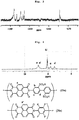
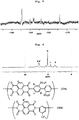
- the chemical shift value of fluorine nuclear magnetic resonance ( 19 F NMR) of polymer was measured in a deuterodimethyl sulfoxide (DMSO-d 6 ) solvent using INOVA 400 (376 MHz) manufactured by Agilent. The chemical shift was shown by the ⁇ value (ppm) when trifluoroacetic acid was the external standard (-79 ppm). As interpolation of the baseline, Akima interpolation was used.
- DMSO-d 6 means deuterodimethyl sulfoxide.
- the weight-average molecular weight (Mw) and number-average molecular weight (Mn) of polymer was measured by gel permeation chromatography (GPC) under analysis condition A, and converted using the calibration curve of standard polystyrene.
- column guard column (Tosoh TSK guard column Super AW-H), manufactured by Tosoh Corporation, column (Tosoh TSK gel super AW 3000) and column (Tosoh TSK gel super AW 5000) manufactured by Tosoh Corporation were connected in tandem in this order and used.
- UV-vis ultraviolet-visible spectroscopy
- DSC Differential scanning calorimetry
- the theoretical ion exchange capacity (IEC) was calculated as the number of moles (mmol) of sulfo group contained per 1 g of polymer.
- the molar ratio of a sulfo group-containing monomer introduced into the polymer was calculated from 1 H NMR spectrum, and the amount of sulfo group introduced per repeating unit of the polymer was calculated.
- the number of moles of sulfo group per 1 g of polymer was calculated and divided by the unit molecular weight obtained from the composition ratio to calculate IEC.
- tensile tester FGS-TV type FGP-5 manufactured by NIDEC-SHIMPO CORPORATION under the conditions of room temperature, crosshead speed 10 mm/min, and test piece size 12 mm ⁇ 2 mm
- a stress-strain curve of a membrane of polymer or polymer composition tensile breaking strength (MPa), tensile elastic modulus (Young's modulus) (GPa) and tensile breaking elongation (%) were calculated.
- SEM-EDX scanning electron microscope-energy dispersive X-ray spectroscopy
- the membrane was embedded in an epoxy resin (product name G-2) manufactured by GATAN, heated at 100°C for 1 hr to prepare a cured product, a cross section of the membrane in the obtained cured product was exposed using a cross section polisher manufactured by JEOL Ltd. to prepare a sample for observation. Then, the cross section of the aforementioned sample for observation was observed using JSM-7800F manufactured by JEOL Ltd. under the conditions of accelerating voltage 1kV, magnification 3000 times. Element mapping of fluorine and the like were performed on the image, obtained by the observation, at accelerating voltage 7kV by using EDX manufactured by Oxford Instruments.
- a membrane cut into a circle with diameter 1 cm was fixed with a polyimide film tape (manufactured by DU PONT-TORAY CO., LTD., product name "Kempton tape”) and an alumina tape to prepare a test piece.
- the permeability rate of dry hydrogen passing through the membrane was measured at room temperature.
- the pressure difference between the pressurized gas supply side and the depressurized gas permeation side was set to 200 kPa
- the volume of the recovered hydrogen gas was measured using G3700T gas chromatograph manufactured by YANACO TECHNICAL SCIENCE CO., LTD. provided with a thermal conductivity detector, and the hydrogen gas permeability of the membrane was calculated by the differential pressure method.
- MEA membrane electrode assembly
- the catalyst ink was prepared using an electrode catalyst of platinum-supporting carbon (manufactured by Tanaka Kikinzoku Kogyo K.K., platinum content: 46.2 wt%, product name "TEC10E50E”), ethanol (manufactured by Wako Pure Chemical Industries, Ltd.), deionized water, and Nafion dispersion (manufactured by Wako Pure Chemical Industries, Ltd., product name "5% Nafion Dispersion DE521 CS type").
- platinum-supporting carbon manufactured by Tanaka Kikinzoku Kogyo K.K., platinum content: 46.2 wt%, product name "TEC10E50E”
- ethanol manufactured by Wako Pure Chemical Industries, Ltd.
- deionized water deionized water
- Nafion dispersion manufactured by Wako Pure Chemical Industries, Ltd., product name "5% Nafion Dispersion DE521 CS type”
- hydrophobic carbon paper manufactured by Toray Industries, Inc., product name "EC-TP1-060T" was used.
- Ultrasonic wave was irradiated on the catalyst ink for 30 min using homogenizer UH-600 manufactured by SMT Co., Ltd., and the catalyst ink was applied to the both surfaces of the electrolyte membrane by spray coater V8H manufactured by Nordson Corporation.
- the solid contents (weight) of GDE composition (VIII) were cathode side 1.0026 mg, and anode side 1.0243 mg.
- the electrolyte membrane coated with the electrode catalyst was thermocompression bonded under the conditions of 132°C, 0.3 kN, 180 sec to prepare a catalyst coated membrane (hereinafter to be abbreviated as "CCM"), and a gas diffusion layer was successively thermocompression bonded to the both surfaces of CCM under the conditions of 132°C, 0.6 kN, 20 sec to prepare MEA.
- CCM catalyst coated membrane
- MEA gas diffusion layer
- OCV open-circuit voltage
- cell ageing at 0.6V was performed for 4 hr.
- potentio-galvanostat VersaSTAT 4 manufactured by AMETEK, Inc.
- the voltage was controlled and the current density was measured.
- cell resistance value was measured by four-terminal sensing using SI 1287 electrochemical interface impedance analyzer manufactured by Solartron.
- MEA was prepared from an electrolyte membrane, a catalyst ink and a gas diffusion layer.
- Nafion 212 manufactured by Du Pont, purchased from TOYO Corporation, membrane thickness: 50 ⁇ m was used.
- the catalyst ink was prepared using electrode catalyst of platinum-supporting carbon (manufactured by Tanaka Kikinzoku Kogyo K.K., platinum content: 46.2 wt%, product name "TEC10E50E”), dimethyl sulfoxide (manufactured by Wako Pure Chemical Industries, Ltd.), deionized water, and composition (VIII) (i.e., composition containing electron-donating polymer (D3a-1) and electron-withdrawing polymer (A4-1)) obtained in the below-mentioned Example 8.
- electrode catalyst of platinum-supporting carbon manufactured by Tanaka Kikinzoku Kogyo K.K., platinum content: 46.2 wt%, product name "TEC10E50E”
- dimethyl sulfoxide manufactured by Wako Pure Chemical Industries, Ltd.
- VIII composition i.e., composition containing electron-donating polymer (D3a-1) and electron-withdrawing polymer (A4-1) obtained in the below-mentioned Example 8.
- MPL micro porous layer
- Ultrasonic wave was irradiated on the catalyst ink for 30 min using homogenizer UH-600 manufactured by SMT Co., Ltd., and the catalyst ink was applied with a dropper to a gas diffusion layer with MPL (GDL 24 BCH) placed on a hot plate controlled to 140 to 150°C to prepare a gas diffusion electrode (hereinafter to be abbreviated as "GDE").
- GDE was successively thermocompression bonded to the both surfaces of electrolyte membrane under the conditions of 132°C, 0.6 kN, 20 sec to prepare MEA.
- the voltage and current density were measured by the method described in Power generation test 1 of fuel cell.
- a power generation test was performed by a method similar to that in Power generationtest 2 of fuel cell except that the catalyst ink and the applicator alone were changed.
- the catalyst ink was prepared using electrode catalyst of platinum-supporting carbon (manufactured by Tanaka Kikinzoku Kogyo K.K., platinum content: 46.2 wt%, product name "TEC10E50E”), dimethyl sulfoxide (manufactured by Wako Pure Chemical Industries, Ltd.), ethanol (manufactured by Wako Pure Chemical Industries, Ltd.), and composition (XI) (i.e., composition containing electron-donating polymer (D3a-1) and electron-withdrawing polymer (A4-1)) obtained in the below-mentioned Example 11.
- electrode catalyst of platinum-supporting carbon manufactured by Tanaka Kikinzoku Kogyo K.K., platinum content: 46.2 wt%, product name "TEC10E50E”
- dimethyl sulfoxide manufactured by Wako Pure Chemical Industries, Ltd
- airbrush system No. 23 spray-work HG airbrush wide trigger type 74523 manufactured by TAMIYA INC. was used as the applicator of the catalyst ink.
- the solid contents (weight) of composition (XI) of GDE were cathode side 2.4233 mg, and anode side 2.0954 mg.
- the obtained solution is hereinafter referred to as "Fenton test solution”.
- the produced membrane was cut out in 1 cm 2 sample piece, and the weight of the sample piece before immersion in Fenton test solution was measured.
- a refluxing condenser and a dropping funnel were mounted on a reaction container, and 2,6-dihydroxynaphthalene (7.36 g, 46.0 mmol), acetone (55 mL) and water (10 mL) were successively added to the reaction container. Then, the reaction mixture was heated to 65°C and epichlorohydrin (28.8 mL, 368.0 mmol) was added with stirring. Potassium hydroxide (5.16 g, 91.9 mmol) dissolved in a mixed solvent of acetone (20 mL) and water (45 mL) was added dropwise to the reaction mixture with a dropping funnel over 2 hr and the mixture was reacted by stirring for 12 hr. After completion of the reaction, a precipitate from the solvent was collected by filtration, and the precipitate was washed with water to give the object compound as a white solid (6.7 g, yield 54%).
- Mw weight-average molecular weight
- Mn number-average molecular weight
- Mw/Mn 3.4
- Fig. 1 shows a chart of 1 H NMR (400 MHz, DMSO-d 6 ) of the electron-donating polymer (D3a-1).
- reaction mixture was stirred at 140 to 145°C to dissolve a solid, and naphthalene-1,4,5,8-tetracarboxylic dianhydride (3.65 g, 13.6 mmol), and benzoic acid (3.27 g, 26.8 mol) were added.
- the reaction mixture was reacted by stirring at 170 to 175°C for 27 hr.
- the precipitate was collected by filtered and the obtained precipitate was added to dimethyl sulfoxide and dissolved by heating at 100 to 110°C to give a dimethyl sulfoxide solution.
- Dimethyl sulfoxide was added to the precipitate and the precipitate was dissolved by heating at 100 to 110°C.
- the dimethyl sulfoxide solution was added dropwise to methanol to allow for precipitation, and the precipitate was collected by filtration.
- Dimethyl sulfoxide was added to the precipitate and the precipitate was dissolved by heating at 100 to 110°C.
- the obtained dimethyl sulfoxide solution was dialyzed for 4 days against dialysis membrane with cut-off molecular weight 1,000 (Spectra/Por 6, MWCO(Daltons) 1000, manufactured by Spectrum Laboratory). After completion of the dialysis, the solution was freeze-dried to give an electron-withdrawing polymer (A2-1) which is a random copolymer having a constitutional unit represented by the formula (23a) and a constitutional unit represented by the formula (24a): as a deep brown solid (5.4 g, yield 70%).
- the number of constitutional unit (23a)/number of constitutional unit (24a) in the electron-withdrawing polymer (A2-1), which is calculated from the charged amount of the material, is 9/1.
- Fig. 2 shows a chart of 1 H NMR (400 MHz, DMSO-d 6 ) of the electron-withdrawing polymer (A2-1) and chemical formulas showing the position of protons corresponding to peaks.
- Fig. 3 shows a chart of 19 F NMR (400 MHz, DMSO-d 6 ) of the electron-withdrawing polymer (A2-1).
- Mw weight-average molecular weight
- Mn number-average molecular weight
- Mw/Mn 4.7
- an electron-withdrawing polymer (A2-2) which is a random copolymer having a constitutional unit represented by the formula (23a) and a constitutional unit represented by the formula (24a): was obtained as a dark reddish-brown solid (7.0 g, yield 92%).
- the number of constitutional unit (23a)/number of constitutional unit (24a) in the electron-withdrawing polymer (A2-2), which is calculated from the charged amount of the material, is 61.7/38.3.
- reaction mixture was stirred at 140 to 145°C to dissolve a solid, naphthalene-1,4,5,8-tetracarboxylic dianhydride (3.65 g, 13.6 mmol) and benzoic acid (3.26 g, 26.7 mol) were added, and the reaction mixture was reacted by stirring at 170 to 175°C for 22 hr.
- Dimethyl sulfoxide was added to the precipitate, and the precipitate was dissolved by heating at 100 to 110°C to give a dimethyl sulfoxide solution.
- the number of constitutional unit (23a)/number of constitutional unit (25a) in the electron-withdrawing polymer (A3-1), which is calculated from the charged amount of the material, is 9/1.
- Fig. 4 shows a chart of 1 H NMR (400 MHz, DMSO-d 6 ) of the electron-withdrawing polymer (A3-1) and chemical formulas showing the position of protons corresponding to peaks.
- Fig. 5 shows a chart of 19 F NMR (400 MHz, DMSO-d 6 ) of the electron-withdrawing polymer (A3-1).
- Mw weight-average molecular weight
- Mn number-average molecular weight
- Mw/Mn 4.7
- Dimethyl sulfoxide was added to the precipitate, and the precipitate was dissolved by heating to 100 to 110°C.
- an electron-withdrawing polymer (A4-1) which is a random copolymer having a constitutional unit represented by the formula (23a) and a constitutional unit represented by the formula (26a): as a deep brown solid (5.5 g, yield 74%).
- the number of constitutional unit (23a)/number of constitutional unit (26a) in the electron-withdrawing polymer (A4-1), which is calculated from the charged amount of the material, is 9/1.
- Fig. 6 shows a chart of 1 H NMR (400 MHz, DMSO-d 6 ) of the electron-withdrawing polymer (A4-1) and chemical formulas showing the position of protons corresponding to peaks.
- electron-withdrawing polymers (A5-1) and (A5-2) which are random copolymers having a constitutional unit represented by the formula (23a) and a constitutional unit represented by the formula (27a): were obtained (electron-withdrawing polymer (A5-1): 7.8 g, yield 91%; electron-withdrawing polymer (A5-2): 8.3 g, yield 92%).
- the number of constitutional unit (23a)/number of constitutional unit (27a) in the electron-withdrawing polymers (A5-1) and (A5-2), which is calculated from the charged amount of the material, is respectively 9/1 and 61.7/38.3.
- a Dean-Stark apparatus was set on the reaction container, the reaction mixture stirred for 3 hr with heating under reflux to remove generated water to the outside of the system of the reaction mixture by utilizing azeotropy with the solvent.
- the reaction container was heated to 170°C while evaporating the solvent (toluene) from the reaction mixture, and the reaction container was maintained at 170°C for 24 hr.
- the reaction mixture was cooled to 20 to 25°C, diluted with dimethylacetamide (15 mL), and water (300 mL) and sodium chloride (30 g) were further added to the reaction mixture to allow for precipitation, and the precipitate was collected by filtration.
- Dimethyl sulfoxide was added to the obtained precipitate, and the precipitate was dissolved to prepare a dimethyl sulfoxide solution.
- the obtained dimethyl sulfoxide solution was dialyzed against dialysis membrane with cut-off molecular weight 1,000 (Spectra/Por 6, MWCO (Daltons) 1000, manufactured by Spectrum Laboratory). In this dialysis, byproducts were removed by the dimethyl sulfoxide solvent, hydrochloric acid was added to the tube of the dialysis membrane to convert the sulfo group in a salt form in the polymer to a free acid form and dialysis was continued for 4 days until the solvent reached a neutral pH.
- an electron-donating polymer (D4-1) which is a random copolymer having a constitutional unit represented by the formula (28) and a constitutional unit represented by the formula (29): as a dark reddish-brown solid (2.7 g, yield 67%).
- the number of constitutional unit (28)/number of constitutional unit (29) in the electron-donating polymer (D4-1), which is calculated from the charged amount of the material, is 9/1.
- peak top molecular weight means “molecular weight of peak top of GPC chart”.
- electron-donating polymers (D4-2) to (D4-4) which are random copolymers having a constitutional unit represented by the formula (28) and a constitutional unit represented by the formula (29): were obtained (electron-donating polymer (D4-2): 1.8 g, yield 46%; electron-donating polymer (D4-3): 2.4 g, yield 46%; electron-donating polymer (D4-4): 2.9 g, yield 80%).
- the number of constitutional unit (28)/number of constitutional unit (29) in the electron-donating polymers (D4-2) to (D4-4), which is calculated from the charged amount of the material, is respectively 8/2, 7/3 and 6/4.
- Fig. 7 shows a chart of 1 H NMR (400 MHz, DMSO-d 6 ) of the electron-donating polymer (D4-2).
- IEC ion exchange capacity
- IEC ion exchange capacity
- the electron-donating polymer (D3a-1) (212 mg, 0.410 mmol) obtained in Synthetic Example 3, pyridine-sulfur trioxide complex (65.0 g, 0.410 mmol) and dimethylformamide (0.7 ml) were successively added to the reaction container. Then, the reaction mixture was reacted by stirring at 20 to 25°C for 12 hr. After completion of the reaction, the reaction mixture was added dropwise to chloroform, the precipitate was redissolved in water, and dialysis was performed using a dialysis membrane with cut-off molecular weight 1,000 (Spectra/Por 6, MWCO (Daltons) 1000, manufactured by Spectrum Laboratory) and water. The aqueous solution after dialysis was dried to solid under reduced pressure to give an electron-donating polymer (D3b-1) having a constitutional unit represented by the formula (16b): as a reddish-orange solid (225 mg, yield 81%).
- Fig. 8 shows a chart of 1 H NMR (400 MHz, DMSO-d 6 ) of the electron-donating polymer (D3b-1).
- naphthalene-1,4,5,8-tetracarboxylic dianhydride (1.77 g, 6.58 mmol)
- benzoic acid (1.58 g, 12.9 mol)
- the operations of the addition of dimethyl sulfoxide and dissolution of the obtained precipitate, dropwise addition of dimethyl sulfoxide solution to the aforementioned mixed solvent, and collection by filtration of the precipitated precipitate were performed again.
- Dimethyl sulfoxide was added to the obtained precipitate, the precipitate was dissolved by heating at 100 to 110°C, and the obtained dimethyl sulfoxide solution was dialyzed for 4 days using a dialysis membrane with cut-off molecular weight 3,500 (Spectra/Por 7, MWCO(Daltons) 3500, manufactured by Spectrum Laboratory). After the completion of dialysis, the solution was dried to give an electron-withdrawing polymer (A6-1) which is a random copolymer having a constitutional unit represented by the formula (23a) and a constitutional unit represented by the formula (33a-1): as a deep brown solid (2.9 g, yield 78%).
- the number of constitutional unit (23a)/number of constitutional unit (33a-1) in the electron-withdrawing polymer (A6-1), which is calculated from the charged amount of the material, is 9/1.
- naphthalene-1,4,5,8-tetracarboxylic dianhydride (1.77 g, 6.58 mmol) and benzoic acid (1.58 g, 12.9 mol)
- the reaction mixture was reacted by stirring at 170 to 175°C for 22 hr.
- methanol:concentrated hydrochloric acid 5:1 (volume ratio)
- Dimethyl sulfoxide was added to the obtained precipitate, and the precipitate was dissolved by heating at 100 to 110°C.
- the obtained dimethyl sulfoxide solution was dialyzed for 4 days using a dialysis membrane with cut-off molecular weight 3,500 (Spectra/Por 7, MWCO(Daltons) 3500, manufactured by Spectrum Laboratory). After the completion of dialysis, the solution was dried to give an electron-withdrawing polymer (A7-1) which is a random copolymer having a constitutional unit represented by the formula (23a) and a constitutional unit represented by the formula (34a): as a deep brown solid (2.8 g, yield 76%).
- the number of constitutional unit (23a)/number of constitutional unit (34a) in the electron-withdrawing polymer (A7-1), which is calculated from the charged amount of the material, is 9/1.
- naphthalene-1,4,5,8-tetracarboxylic dianhydride 8.21 g, 30.6 mmol
- benzoic acid 7.33 g, 60.0 mmol
- methanol:concentrated hydrochloric acid 5:1 (volume ratio)
- Dimethyl sulfoxide was added to the obtained precipitate, and the precipitate was dissolved by heating at 100 to 110°C.
- the obtained dimethyl sulfoxide solution was dialyzed for 4 days using a dialysis membrane with cut-off molecular weight 3,500 (Spectra/Por 7, MWCO(Daltons) 3500, manufactured by Spectrum Laboratory). After the completion of dialysis, the solution was dried to give an electron-withdrawing polymer (A8-1) which is a random copolymer composed of constitutional units represented by the formula (23a): as a deep brown solid (12.5 g, yield 70%).
- Example 1 Production of membrane of composition (I) of electron-donating polymer (D2-1) and electron-withdrawing polymer (A2-1)
- the petri dish was placed on a vacuum dryer, and dried under reduced pressure at 80°C for 10 hr to give a membrane of composition (I) of the electron-donating polymer (D2-1) and the electron-withdrawing polymer (A2-1) (brown transparent, membrane thickness: 44 ⁇ m).
- Example 2 Production of membrane of composition (II) of electron-donating polymer (D2-1) and electron-withdrawing polymer (A2-1)
- Table 1 shows the amounts of the electron-donating polymer (D2-1) and the electron-withdrawing polymer (A2-1) in the membranes of the compositions (I) and (II) obtained in Examples 1 and 2, as well as the membrane thickness thereof.
- “electron-donating polymer (D2-1)” and the like are abbreviated as “(D2-1)” and the like.
- the molar ratio is sometimes abbreviated as "molar ratio of (A2-1)/(D2-1)”.
- a solution prepared by dissolving the electron-withdrawing polymer (A2-1) (150 mg) in dimethyl sulfoxide (5 g) was filtered using a cotton plug, the obtained filtrate was added to a petri dish with diameter 4 cm, the petri dish was placed on a hot plate set to 60°C, and dimethyl sulfoxide was evaporated. Then, the petri dish was placed on a vacuum dryer, and dried under reduced pressure at 80°C for 24 hr to give a membrane of the electron-withdrawing polymer (A2-1) (light brown transparent, membrane thickness 24 ⁇ m).
- a solution prepared by dissolving the electron-withdrawing polymer (A6-1) (151 mg) in dimethyl sulfoxide (10 g) was filtered using a 5 ⁇ m syringe filter made of polytetrafluoroethylene (PTFE), the obtained filtrate (5.0 g) was added to a petri dish with diameter 4 cm, the petri dish was placed on a hot plate set to 80°C, and dimethyl sulfoxide was evaporated. Then, the petri dish was placed on a vacuum dryer, and dried under reduced pressure at 80°C for 12 hr to give a membrane of the electron-withdrawing polymer (A6-1) (brown transparent, membrane thickness 70 ⁇ m).
- PTFE polytetrafluoroethylene
- a solution prepared by dissolving the electron-withdrawing polymer (A7-1) (150 mg) in dimethyl sulfoxide (5 g) was filtered using a 5 ⁇ m syringe filter made of polytetrafluoroethylene (PTFE), the obtained filtrate (2.5 g) was added to a petri dish with diameter 4 cm, the petri dish was placed on a hot plate set to 80°C, and dimethyl sulfoxide was evaporated. Then, the petri dish was placed on a vacuum dryer, and dried under reduced pressure at 80°C for 12 hr to give a membrane of the electron-withdrawing polymer (A7-1) (brown transparent, membrane thickness 48 ⁇ m).
- PTFE polytetrafluoroethylene
- Example 3 Production of membrane of composition (III) of electron-donating polymer (D3a-1) and electron-withdrawing polymer (A2-1)
- a solution (185 mg, polymer concentration: 10 wt%) prepared by dissolving the electron-donating polymer (D3a-1) in dimethyl sulfoxide and a solution prepared by dissolving the electron-withdrawing polymer (A2-1) in dimethyl sulfoxide (2.71 g, polymer concentration: 3 wt%) were successively added to a glass container.
- the solution was stirred and filtered using a cotton plug, the obtained filtrate was added to a petri dish with diameter 4 cm, the petri dish was placed on a hot plate set to 60°C, and dimethyl sulfoxide was evaporated.
- the petri dish was placed on a vacuum dryer, and dried under reduced pressure at 60°C for 24 hr to give a membrane of composition (III) of the electron-donating polymer (D3a-1) and the electron-withdrawing polymer (A2-1) (brown transparent, membrane thickness 13 ⁇ m).
- Table 2 shows the amounts of the electron-donating polymer (D3a-1) and the electron-withdrawing polymer (A2-1) in the membranes of the compositions (III) to (VI) obtained in Examples 3 to 6, as well as the membrane thickness thereof.
- the molar ratio is sometimes abbreviated as "molar ratio of (A2-1)/(D3a-1)".
- Example 7 Production of membrane of composition (VII) of electron-donating polymer (D2-1) and electron-withdrawing polymer (A3-1)
- a solution (0.17 g, polymer concentration: 9.46 wt%) prepared by dissolving the electron-donating polymer (D2-1) in dimethyl sulfoxide and a solution (3.84 g, polymer concentration: 2.19 wt%) prepared by dissolving the electron-withdrawing polymer (A3-1) in dimethyl sulfoxide were successively added to a glass container.
- the solution was stirred and filtered through a 5 ⁇ m syringe filter made of polytetrafluoroethylene (PTFE) and the obtained filtrate was added to a petri dish with diameter 4 cm, the petri dish was placed on a hot plate set to 120°C, and dimethyl sulfoxide was evaporated.
- PTFE polytetrafluoroethylene
- the petri dish was placed on a vacuum dryer, and dried under reduced pressure at 110°C for 10 hr to give a membrane of composition (VII) of the electron-donating polymer (D2-1) and the electron-withdrawing polymer (A3-1) (brown transparent, membrane thickness: 21.1 ⁇ m).
- Example 8 Production of composition (VIII) containing electron-donating polymer (D3a-1) and electron-withdrawing polymer (A4-1)
- the electron-donating polymer (D3a-1) (12.8 mg) and the electron-withdrawing polymer (A4-1) (25.1 mg) were added to a sample bottle, and dimethyl sulfoxide (5.50 g) and water (0.49 g) were successively added to the sample bottle.
- the solution was stirred and heated at 80 to 90°C to give composition (VIII) containing the electron-donating polymer (D3a-1) and the electron-withdrawing polymer (A4-1).
- Example 9 Production of membrane of composition (IX) of electron-donating polymer (D3a-1) and electron-withdrawing polymer (A6-1)
- a solution (0.697 g, polymer concentration: 10 wt%) prepared by dissolving the electron-donating polymer (D3a-1) in dimethyl sulfoxide and a solution (5.00 g, polymer concentration: 1.5 wt%) prepared by dissolving the electron-withdrawing polymer (A6-1) in dimethyl sulfoxide were successively added to a glass container
- the solution was stirred and filtered through a 5 ⁇ m syringe filter made of polytetrafluoroethylene (PTFE) and the obtained filtrate was added to a petri dish with diameter 4 cm, the petri dish was placed on a hot plate set to 120°C, and dimethyl sulfoxide was evaporated.
- PTFE polytetrafluoroethylene
- the petri dish was placed on a vacuum dryer, and dried under reduced pressure at 100°C for 12 hr to give a membrane of composition (IX) of the electron-donating polymer (D3a-1) and the electron-withdrawing polymer (A6-1) (brown transparent, membrane thickness: 88 ⁇ m).
- Example 10 Production of membrane of composition (X) of electron-donating polymer (D3a-1) and electron-withdrawing polymer (A7-1)
- a solution (0.698 g, polymer concentration: 10 wt%) prepared by dissolving the electron-donating polymer (D3a-1) in dimethyl sulfoxide and a solution (2.46 g, polymer concentration: 3.1 wt%) prepared by dissolving the electron-withdrawing polymer (A7-1) in dimethyl sulfoxide were successively added to a glass container
- the solution was stirred and filtered through a 5 ⁇ m syringe filter made of polytetrafluoroethylene (PTFE) and the obtained filtrate was added to a petri dish with diameter 4 cm, the petri dish was placed on a hot plate set to 120°C, and dimethyl sulfoxide was evaporated.
- PTFE polytetrafluoroethylene
- the petri dish was placed on a vacuum dryer, and dried under reduced pressure at 100°C for 12 hr to give a membrane of composition (IX) of the electron-donating polymer (D3a-1) and the electron-withdrawing polymer (A7-1) (brown transparent, membrane thickness: 47 ⁇ m).
- Example 11 Production of composition (XI) containing electron-donating polymer (D3a-1) and electron-withdrawing polymer (A4-1)
- the electron-donating polymer (D3a-1) (12.8 mg) and dimethyl sulfoxide (3 mL) were successively added to a sample bottle.
- the solution was stirred and heated at 80 to 90°C to give a solution.
- the electron-withdrawing polymer (A4-1) (25.1 mg)
- ethanol (2 mL) was added to give composition (XI) containing the electron-donating polymer (D3a-1) and the electron-withdrawing polymer (A4-1).
- the membrane of the composition (IV) obtained in Example 4 was placed in a glass vacuum desiccator with a cock, and the inside of the desiccator was purged with nitrogen gas. Then, the vacuum desiccator was stood in a constant-temperature dryer set to 130°C for 2 hr to give a membrane of heat-treated composition (XII) (dark brown transparent, membrane thickness 18 ⁇ m).
- Table 3 shows the heat-treated compositions obtained in Examples 12 to 14, the starting compositions used for heat treatment, molar ratio of (A2-1)/(D3a-1), molar fraction of (A2-1) and membrane thickness.
- Example 12 In the same manner as in Example 12 except that the membrane of the electron-withdrawing polymer (A2-1) obtained Reference Example 1 was used instead of the membrane of the composition (IV) obtained in Example 4, a membrane of heat-treated electron-withdrawing polymer (A2-1) was obtained (light brown transparent, membrane thickness 24 ⁇ m).
- Example 15 Production of membrane of composition (XV) of electron-donating polymer (D2-1) and electron-withdrawing polymer (A8-1)
- the petri dish was placed on a vacuum dryer, and dried under reduced pressure at 80°C for 24 hr to give a membrane of the composition (XV) of the electron-donating polymer (D2-1) and the electron-withdrawing polymer (A8-1) (light brown transparent, membrane thickness 11 ⁇ m).
- Example 16 and 17 Production of membranes of compositions (XVI) and (XVII) of electron-donating polymer (D2-1) and electron-withdrawing polymer (A8-1)
- Table 4 shows the amounts of electron-donating polymer (D2-1) and electron-withdrawing polymer (A8-1) in the membranes of the compositions (XV) to (XVII) obtained in Examples 15 to 17, as well as the membrane thickness thereof.
- the molar ratio is sometimes abbreviated as "molar ratio of (A8-1)/(D2-1)”.
- the molar fraction is sometimes abbreviated as "molar fraction of (A8-1)".
- the membrane of the composition (XV) obtained in Example 15 was placed in a glass vacuum desiccator with a cock, and the inside of the desiccator was purged with nitrogen gas. Then, the vacuum desiccator was stood in a constant-temperature dryer set to 150°C for 50 hr to give a membrane of heat-treated composition (XVIII) (dark brown transparent, membrane thickness 11 ⁇ m).
- Example 19 and 20 Production of membranes of heat-treated compositions (XIX) and (XX)
- Table 5 shows the heat-treated compositions obtained in Examples 18 to 20, the starting compositions used for heat treatment, molar ratio of (A8-1)/(D2--1), molar fraction of (A8-1) and membrane thickness.
- a solution prepared by dissolving the electron-withdrawing polymer (A8-1) (79.3 mg) in dimethyl sulfoxide (2 mL) was filtered using a cotton plug, the obtained filtrate was added to a petri dish with diameter 4 cm, the petri dish was placed on a hot plate set to 60°C, and dimethyl sulfoxide was evaporated. Then, the petri dish was placed on a vacuum dryer, and dried under reduced pressure at 80°C for 24 hr to give a membrane of the electron-withdrawing polymer (A8-1) (light brown transparent, membrane thickness 11 ⁇ m).
- Example 21 Production of membrane of composition (XXI) of electron-donating polymer (D3a-1) and electron-withdrawing polymer (A8-1)
- a solution prepared by dissolving the electron-donating polymer (D3a-1) (35.8 mg) in dimethyl sulfoxide (1 mL) and a solution prepared by dissolving the electron-withdrawing polymer (A8-1) (78.9 mg) in dimethyl sulfoxide (1 mL) were successively added to a glass container.
- the solution was stirred and filtered using a cotton plug, the obtained filtrate was added to a petri dish with diameter 4 cm, the petri dish was placed on a hot plate set to 60°C, and dimethyl sulfoxide was evaporated.
- the petri dish was placed on a vacuum dryer, and dried under reduced pressure at 60°C for 24 hr to give a membrane of the composition (XXI) of the electron-donating polymer (D3a-1) and the electron-withdrawing polymer (A8-1) (brown transparent, membrane thickness 14 ⁇ m).
- the membrane of the composition (XXI) obtained in Example 21 was placed in a glass vacuum desiccator with a cock, and the inside of the desiccator was purged with nitrogen gas. Then, the vacuum desiccator was stood in a constant-temperature dryer set to 130°C for 2 hr to give a membrane of heat-treated composition (XXII) (dark brown transparent, membrane thickness 14 ⁇ m).
- the absorption spectrum of the membranes of the compositions (I) to (VI), (IX) and (X) obtained in Examples 1 to 6, 9 and 10 was measured by ultraviolet-visible spectroscopy (UV-vis).
- UV-vis ultraviolet-visible spectroscopy
- the absorption spectrum of the membrane of the electron-withdrawing polymer (A2-1), the membrane of the electron-withdrawing polymer (A6-1) and the membrane of the electron-withdrawing polymer (A7-1) obtained in Reference Examples 1 to 3 was measured.
- the absorption spectra of the membrane of the electron-withdrawing polymer (A2-1) and the membrane of the composition (I) are shown in Fig. 9 .
- the absorption spectra of the membrane of the electron-withdrawing polymer (A2-1) and the membrane of the composition (II) are shown in Fig. 10 .
- the absorption spectra of the membrane of the electron-withdrawing polymer (A2-1) and the membranes of the compositions (III) to (VI) are shown in Fig. 11 .
- the absorption spectra of the membrane of the electron-withdrawing polymer (A6-1) and the membrane of the composition (IX) are shown in Fig. 14 .
- the absorption spectra of the membrane of the electron-withdrawing polymer (A7-1) and the membrane of the composition (X) are shown in Fig. 15 .
- the absorption spectra of the membranes of the compositions (I) to (VI), (IX) and (X) had a shoulder at around 530 nm. This shoulder shows absorption by a charge-transfer complex (see Nature, 375(6529), 303-305 (1995 ) and Polym. J. (2013), 45, 839-844 ). Therefore, from the results, it was confirmed that the membranes of the composition (I) to (VI) formed a charge-transfer complex. Formation of a charge-transfer complex between the main chains of two or more different polymers has not been reported heretofore.
- the tensile breaking strength, tensile elastic modulus and tensile breaking elongation of the membrane of the heat-treated composition (XXII) obtained in Example 22 and the membrane of the electron-withdrawing polymer (A8-1) alone obtained in Reference Example 5 were measured as mentioned above. The results are shown in Table 8. As shown in Table 8, the membrane of the heat-treated composition (XXII) showed about 1.7-times improved tensile breaking strength as compared to the membrane of the electron-withdrawing polymer (A8-1) alone obtained in Reference Example 5.
- the hydrogen gas permeability of the membranes of compositions (IV) to (VI) (membrane thickness: 10 ⁇ m) produced in the same manner as in Examples 4 to 6 was measured as mentioned above.
- the hydrogen gas permeability of a membrane of Nafion 212 (Nafion is registered trade mark, manufactured by Du Pont, purchased from TOYO Corporation, membrane thickness: 50 ⁇ m) was measured similarly.
- Table 10 As shown in Table 10, the membranes of the compositions (IV) to (VI) showed low hydrogen gas permeability as compared to a commercially available membrane of Nafion 212.
- a power generation test 2 of fuel cell using a catalyst layer containing the composition (VIII) (i.e., composition of the electron-donating polymer (D3a-1) and the electron-withdrawing polymer (A4-1)) was performed as mentioned above.
- the results of the voltage and current density in the power generation test 2 are shown in Table 14. As shown in Table 14, it was confirmed that power can be generated using the catalyst layer containing the composition (VIII).
- a power generation test 3 of fuel cell using a catalyst layer containing the composition (XI) (i.e., composition of the electron-donating polymer (D3a-1) and the electron-withdrawing polymer (A4-1)) was performed as mentioned above.
- the results of the voltage and current density in the power generation test 3 are shown in Table 15. As shown in Table 15, it was confirmed that power can be generated using the catalyst layer containing the composition (XI).
- the absorption spectrum of the membrane of the electron-withdrawing polymer (A2-1) and the membranes of the compositions (III) to (VI), as well as the membrane of the heat-treated electron-withdrawing polymer (A2-1) and the membranes of the heat-treated compositions (XII) to (XIV) was measured by ultraviolet-visible spectroscopy (UV-vis).
- the molar fraction (%) of (A2-1) in the membrane of the electron-withdrawing polymer (A2-1) and the like used is shown in Table 16.
- the molar fraction of (A2-1) in the membrane of the electron-withdrawing polymer (A2-1) and the membrane of the heat-treated electron-withdrawing polymer (A2-1) is 100%.
- a graph showing the relationship between a molar fraction of (A2-1) in a membrane of a polymer or composition without a heat treatment and a molar fraction of (A2-1) in a membrane of a heat-treated polymer or heat-treated composition, and normalized absorbance at 530 nm of the measured absorption spectrum is shown in Fig. 16 .
- the absorbance at 530 nm derived from a charge-transfer complex was the maximum when the molar fraction of (A2-1) was 50%. From the results, it was confirmed that the formation amount of the charge-transfer complex reached maximum when the molar ratio of dioxynaphthalene part (d) of the electron-donating polymer (D3a-1) and naphthalene tetracarboxylic acid diimide part (a) of the electron-withdrawing polymer (A2-1) was 1:1.
- the absorbance of the membrane of the heat-treated composition at 530 nm was 2 to 3 times higher as compared to the absorbance of the membrane of the composition without a heat treatment. From the results, it was confirmed that, in the composition without a heat treatment, a part free from formation of the charge-transfer complex of the electron-donating polymer (D3a-1) and the electron-withdrawing polymer (A2-1) forms a charge-transfer complex by a heat treatment.
- the membrane of the electron-withdrawing polymer (A8-1) alone was melted in Fenton test solution in 15 min from the start of the chemical durability evaluation test and could not maintain the shape of the membrane. From a comparison of the membrane of the heat-treated composition (XVIII) and the membrane of the electron-withdrawing polymer (A8-1) alone, it could be confirmed that the membranes of the composition (XVIII) suppressed dissolution in Fenton test solution (i.e., aqueous solution containing iron (II) sulfate and hydrogen peroxide). [Table 17] residual rate (wt%) Nafion 212 98 membrane of heat-treated composition (XVIII) >99 membrane of electron-withdrawing polymer (A8-1) alone 0
- composition of the present invention is useful as, for example, an electrolyte material for a fuel cell (e.g., electrolyte material used for catalyst layer, electrolyte membrane etc.).
- an electrolyte material for a fuel cell e.g., electrolyte material used for catalyst layer, electrolyte membrane etc.
Landscapes
- Chemical & Material Sciences (AREA)
- Chemical Kinetics & Catalysis (AREA)
- Health & Medical Sciences (AREA)
- Medicinal Chemistry (AREA)
- Polymers & Plastics (AREA)
- Organic Chemistry (AREA)
- General Chemical & Material Sciences (AREA)
- Electrochemistry (AREA)
- Sustainable Development (AREA)
- Engineering & Computer Science (AREA)
- Sustainable Energy (AREA)
- Life Sciences & Earth Sciences (AREA)
- Manufacturing & Machinery (AREA)
- Crystallography & Structural Chemistry (AREA)
- Composite Materials (AREA)
- Compositions Of Macromolecular Compounds (AREA)
- Fuel Cell (AREA)
- Polyethers (AREA)
- Inert Electrodes (AREA)
- Adhesives Or Adhesive Processes (AREA)
- Macromolecular Compounds Obtained By Forming Nitrogen-Containing Linkages In General (AREA)
- Epoxy Resins (AREA)
- Battery Electrode And Active Subsutance (AREA)
Claims (19)
- Zusammensetzung, die ein elektronenschiebendes Polymer (D) und ein elektronenziehendes Polymer (A) umfasst, wobei
das elektronenschiebende Polymer (D) eine Struktur aufweist, die durch die Formel (1)
*-O-X1-O-Y1-* (1)
dargestellt wird, wobei X1 eine zweiwertige Gruppe ist, die einen Naphthalinring enthält,Y1 eine zweiwertige Gruppe, die eine C3-10-Alkylengruppe enthält, welche gegebenenfalls einen Substituenten aufweist, oder eine zweiwertige Gruppe, die einen Benzolring enthält, der gegebenenfalls einen Substituenten aufweist, ist und* eine Bindungsposition zeigt unddas elektronenziehende Polymer (A) eine Struktur aufweist, die durch die Formel (2) dargestellt wird, wobei X2 eine vierwertige Gruppe ist, die einen Naphthalinring enthält,wobei, wenn Y1 eine zweiwertige Gruppe ist, die eine C3-10-Alkylengruppe enthält, welche gegebenenfalls einen Substituenten aufweist, dann Y2 eine zweiwertige Gruppe ist, die einen Benzolring enthält, der gegebenenfalls einen Substituenten aufweist,wobei, wenn Y1 eine zweiwertige Gruppe ist, die einen Benzolring enthält, der gegebenenfalls einen Substituenten aufweist, dann Y2 eine zweiwertige Gruppe ist, die eine C3-10-Alkylengruppe enthält, welche gegebenenfalls einen Substituenten aufweist, und* eine Bindungsposition zeigt und wobei Y1 und/oder Y2 eine Sulfogruppe aufweist.
 - Zusammensetzung gemäß Anspruch 1, wobei Y1 eine zweiwertige Gruppe ist, die eine C3-10-Alkylengruppe enthält, welche gegebenenfalls einen Substituenten aufweist, und Y2 eine zweiwertige Gruppe ist, die einen Benzolring enthält, der gegebenenfalls einen Substituenten aufweist.
- Zusammensetzung gemäß Anspruch 1 oder 2, wobei X1 eine zweiwertige Gruppe ist, die durch die Formel (3) oder die Formel (4)

- Zusammensetzung gemäß einem der Ansprüche 1 bis 3, wobei X2 eine vierwertige Gruppe ist, die durch die Formel (5), die Formel (6-1) oder die Formel (6-2)

- Zusammensetzung gemäß einem der Ansprüche 1 bis 4, wobei Y1 oder Y2 eine zweiwertige Gruppe ist, die eine Struktur enthält, welche durch die Formel (7)

- Zusammensetzung gemäß einem der Ansprüche 1 bis 5, wobei Y1 oder Y2 eine zweiwertige Gruppe ist, die durch eine aus Formel (8) bis Formel (11)


 dargestellt wird, wobei n2 bis n11 jeweils unabhängig eine ganze Zahl von 0 bis 4 sind,R2 bis R11 jeweils unabhängig eine C1-10-Alkylgruppe, die gegebenenfalls mit einem Halogenatom substituiert ist, eine C1-10-Alkoxygruppe, die gegebenenfalls mit einem Halogenatom substituiert ist, eine Hydroxygruppe, ein Halogenatom, eine Nitrogruppe, eine Formylgruppe, eine Cyanogruppe, eine Sulfogruppe, eine Phenylgruppe, die gegebenenfalls mit W1 substituiert ist, eine Thienylgruppe, die gegebenenfalls mit W1 substituiert ist, oder eine Furylgruppe, die gegebenenfalls mit W1 substituiert ist, sind,W1 eine C1-10-Alkylgruppe, die gegebenenfalls mit einem Halogenatom substituiert ist, eine C1-10-Alkoxygruppe, die gegebenenfalls mit einem Halogenatom substituiert ist, eine Hydroxygruppe, ein Halogenatom, eine Nitrogruppe, eine Formylgruppe, eine Cyanogruppe oder eine Sulfogruppe ist,wobei, wenn n2 bis n11 eine ganze Zahl von 2 bis 4 sind, dann mehrere R2 bis R11 gegebenenfalls gleich oder verschieden sind,Z1 bis Z6 jeweils unabhängig eine Einfachbindung, eine C1-2-Alkylengruppe, die gegebenenfalls mit einem Halogenatom substituiert ist, eine C3-10-Alkylengruppe, eine Sulfonylgruppe, eine Carbonylgruppe, *-CONH-*, *-NHCO-*, *-C(R21)(R22)-* oder eine Oxygruppe sind,R21 und R22 jeweils unabhängig eine C1-3-Alkylgruppe sind, die gegebenenfalls mit einem Halogenatom substituiert ist, oder R21 und R22 zusammen mit einem Kohlenstoffatom, an das sie gebunden sind, unter Bildung eines C3-6-Kohlenwasserstoffrings miteinander verknüpft sind und* eine Bindungsposition zeigt.
 - Zusammensetzung gemäß einem der Ansprüche 1 bis 6, wobei das elektronenschiebende Polymer (D) das elektronenschiebende Polymer (D1) umfasst, das eine Baueinheit aufweist, die durch die Formel (12) oder die Formel (13)


 dargestellt wird, {wobei m1 und m2 jeweils unabhängig eine ganze Zahl von 0 bis 4 sind und * eine Bindungsposition zeigt},wobei, wenn L1 eine zweiwertige Gruppe ist, die durch die Formel (3) oder die Formel (4) dargestellt wird, dann R1a und R1b Wasserstoffatome sind,wobei, wenn L1 eine zweiwertige Gruppe ist, die durch die Formel (14) dargestellt wird, dann R1a und R1b jeweils unabhängig ein Wasserstoffatom oder eine Sulfogruppe sind und* eine Bindungsposition zeigt.
 - Zusammensetzung gemäß Anspruch 7, wobei das elektronenschiebende Polymer (D1) das elektronenschiebende Polymer (D2) umfasst, das eine Baueinheit aufweist, die durch die Formel (15)

- Zusammensetzung gemäß Anspruch 7, wobei das elektronenschiebende Polymer (D1) das elektronenschiebende Polymer (D3) umfasst, das eine Baueinheit aufweist, die durch die Formel (16)
 dargestellt wird, wobei R1a und R1b jeweils unabhängig ein Wasserstoffatom oder eine Sulfogruppe sind,m1 und m2 jeweils unabhängig eine ganze Zahl von 0 bis 4 sind und* eine Bindungsposition zeigt.
 - Zusammensetzung gemäß Anspruch 7 oder 9, wobei R1a und R1b Wasserstoffatome sind.
- Zusammensetzung gemäß Anspruch 7, 9 oder 10, wobei m1 und m2 = 0 sind.
- Zusammensetzung gemäß einem der Ansprüche 6 bis 11, wobei die zweiwertige Gruppe, die durch die Formel (8) dargestellt wird, eine zweiwertige Gruppe ist, die durch die Formel (8-1)
 dargestellt wird, wobei n2, R2 und * wie oben definiert sind undZ1 bis Z6 in Formel (9) bis Formel (11) jeweils unabhängig eine Einfachbindung, eine C1-2-Alkylengruppe, die gegebenenfalls mit einem Halogenatom substituiert ist, eine C3-10-Alkylengruppe, eine Sulfonylgruppe, eine Carbonylgruppe, *-CONH-*, *-NHCO-* oder eine Oxygruppe sind.
 - Zusammensetzung gemäß einem der Ansprüche 1 bis 12, wobei das elektronenziehende Polymer (A) das elektronenziehende Polymer (A1a) umfasst, das eine Baueinheit aufweist, die durch die Formel (17a)
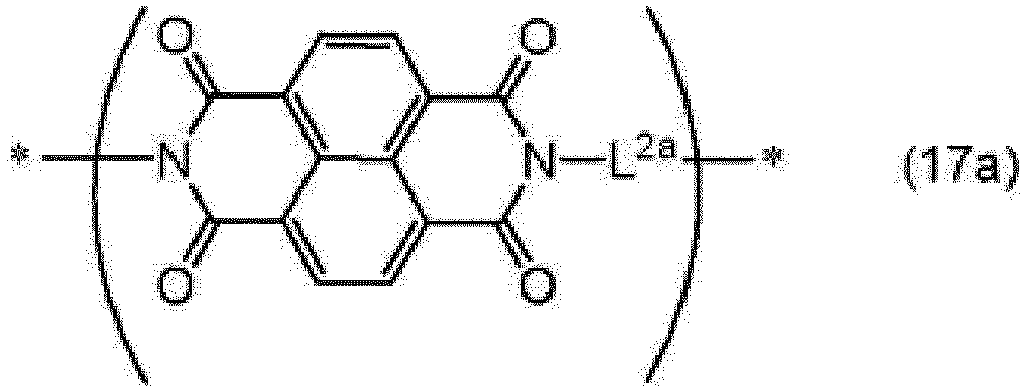


 dargestellt wird, {wobei n2 bis n11 jeweils unabhängig eine ganze Zahl von 0 bis 4 sind,R2 bis R11 jeweils unabhängig eine C1-10-Alkylgruppe, die gegebenenfalls mit einem Halogenatom substituiert ist, eine C1-10-Alkoxygruppe, die gegebenenfalls mit einem Halogenatom substituiert ist, eine Hydroxygruppe, ein Halogenatom, eine Nitrogruppe, eine Formylgruppe, eine Cyanogruppe, eine Sulfogruppe, eine Phenylgruppe, die gegebenenfalls mit W1 substituiert ist, eine Thienylgruppe, die gegebenenfalls mit W1 substituiert ist, oder eine Furylgruppe, die gegebenenfalls mit W1 substituiert ist, sind,W1 eine C1-10-Alkylgruppe, die gegebenenfalls mit einem Halogenatom substituiert ist, eine C1-10-Alkoxygruppe, die gegebenenfalls mit einem Halogenatom substituiert ist, eine Hydroxygruppe, ein Halogenatom, eine Nitrogruppe, eine Formylgruppe, eine Cyanogruppe oder eine Sulfogruppe ist,wobei, wenn n2 bis n11 eine ganze Zahl von 2 bis 4 sind, dann mehrere R2 bis R11 gegebenenfalls gleich oder verschieden sind,Z1 bis Z6 jeweils unabhängig eine Einfachbindung, eine C1-2-Alkylengruppe, die gegebenenfalls mit einem Halogenatom substituiert ist, eine C3-10-Alkylengruppe, eine Sulfonylgruppe, eine Carbonylgruppe, *-CONH-*, *-NHCO-*, *-C(R21)(R22)-* oder eine Oxygruppe sind,R21 und R22 jeweils unabhängig eine C1-3-Alkylgruppe sind, die gegebenenfalls mit einem Halogenatom substituiert ist, oder R21 und R22 zusammen mit einem Kohlenstoffatom, an das sie gebunden sind, unter Bildung eines C3-6-Kohlenwasserstoffrings miteinander verknüpft sind und* eine Bindungsposition zeigt} und* eine Bindungsposition zeigt.
 - Zusammensetzung gemäß Anspruch 13, wobei das elektronenziehende Polymer (A1a) das elektronenziehende Polymer (A1b) umfasst, das Folgendes aufweist:
eine Baueinheit, die durch die Formel (23) dargestellt wird, wobei m3 und m4 jeweils unabhängig eine ganze Zahl von 0 bis 3 sind und * eine Bindungsposition zeigt, undeine Baueinheit, die durch die Formel (17b)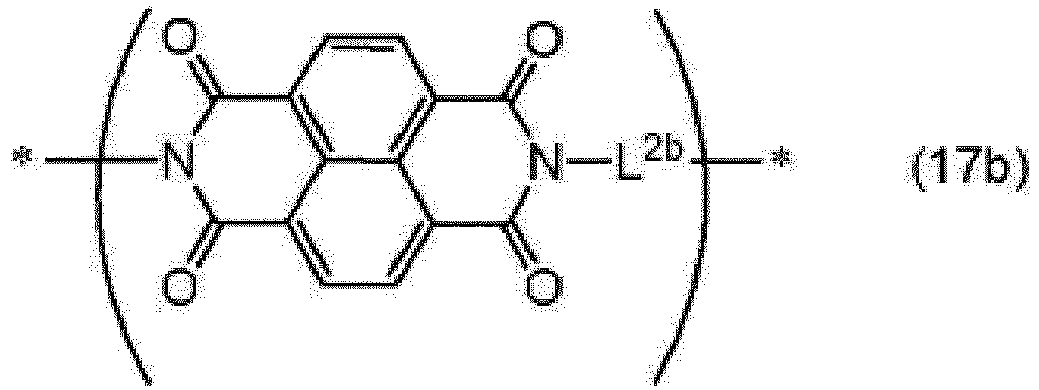


 dargestellt wird, {wobei n2b bis n11b jeweils unabhängig eine ganze Zahl von 0 bis 4 sind,R2b bis R11b jeweils unabhängig eine C1-10-Alkylgruppe, die gegebenenfalls mit einem Halogenatom substituiert ist, eine C1-10-Alkoxygruppe, die gegebenenfalls mit einem Halogenatom substituiert ist, eine Hydroxygruppe, ein Halogenatom, eine Nitrogruppe, eine Formylgruppe, eine Cyanogruppe, eine Phenylgruppe, die gegebenenfalls mit W1b substituiert ist, eine Thienylgruppe, die gegebenenfalls mit W1b substituiert ist, oder eine Furylgruppe, die gegebenenfalls mit W1b substituiert ist, sind,W1b eine C1-10-Alkylgruppe, die gegebenenfalls mit einem Halogenatom substituiert ist, eine C1-10-Alkoxygruppe, die gegebenenfalls mit einem Halogenatom substituiert ist, eine Hydroxygruppe, ein Halogenatom, eine Nitrogruppe, eine Formylgruppe oder eine Cyanogruppe ist,wobei, wenn n2b bis n11b eine ganze Zahl von 2 bis 4 sind, dann mehrere R2b bis R11b gegebenenfalls gleich oder verschieden sind,Z1b bis Z6b jeweils unabhängig eine Einfachbindung, eine C1-2-Alkylengruppe, die gegebenenfalls mit einem Halogenatom substituiert ist, eine C3-10-Alkylengruppe, eine Sulfonylgruppe, eine Carbonylgruppe, *-CONH-*, *-NHCO-*, *-C(R21)(R22)-* oder eine Oxygruppe sind,R21b und R22b jeweils unabhängig eine C1-3-Alkylgruppe sind, die gegebenenfalls mit einem Halogenatom substituiert ist, oder R21b und R22b zusammen mit einem Kohlenstoffatom, an das sie gebunden sind, unter Bildung eines C3-6-Kohlenwasserstoffrings miteinander verknüpft sind und* eine Bindungsposition zeigt} und* eine Bindungsposition zeigt.
 - Zusammensetzung gemäß einem der Ansprüche 1 bis 11, wobei das elektronenziehende Polymer (A) das elektronenziehende Polymer (A1) umfasst, das eine Baueinheit aufweist, die durch die Formel (17)

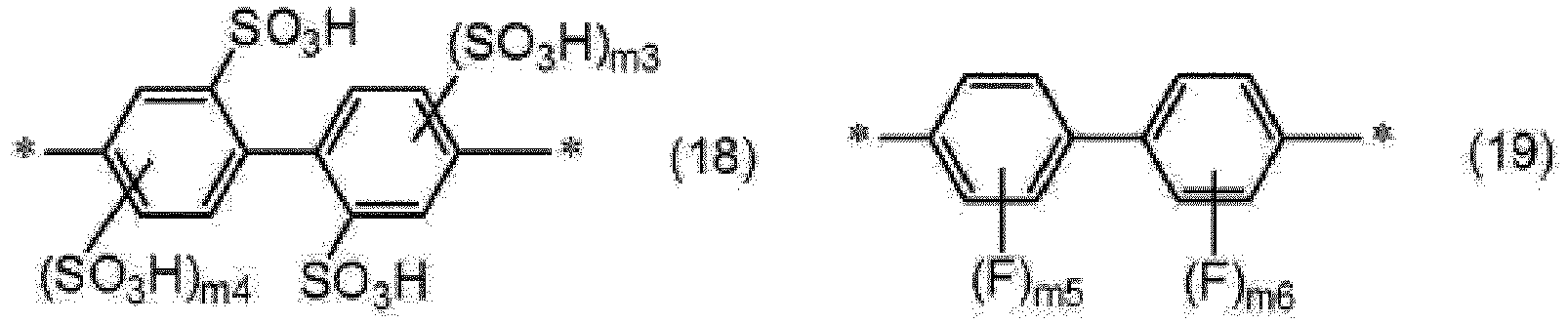


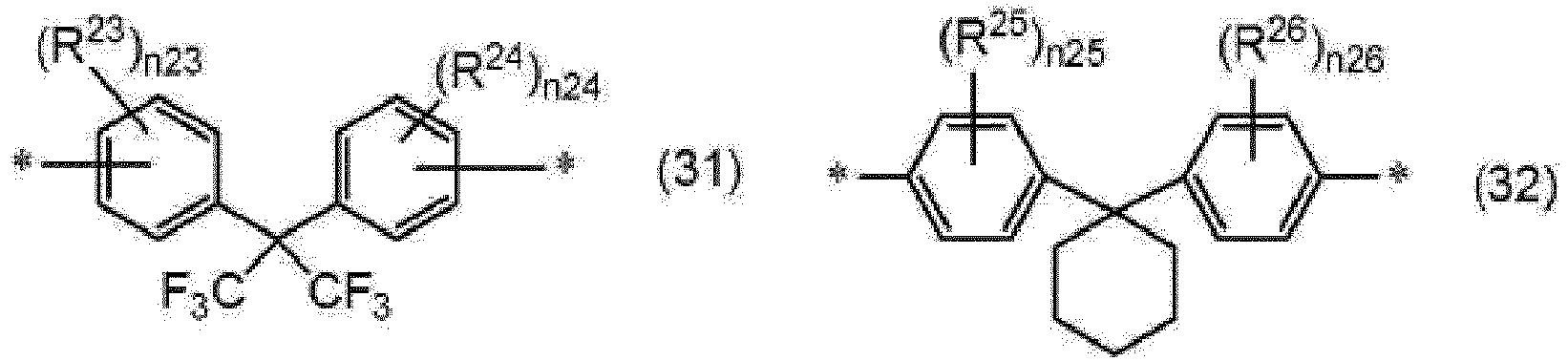 dargestellt wird, {wobei m3 und m4 jeweils unabhängig eine ganze Zahl von 0 bis 3 sind,m5 bis m7 jeweils unabhängig eine ganze Zahl von 1 bis 4 sind,n12 eine ganze Zahl von 1 bis 4 ist,R12 ein Fluoratom oder eine Trifluormethylgruppe ist, wobei, wenn n12 eine ganze Zahl von 2 bis 4 ist, dann mehrere R12 gegebenenfalls gleich oder verschieden sind,n13 bis n16 jeweils unabhängig eine ganze Zahl von 0 bis 4 sind,R13 eine Nitrogruppe, eine Sulfogruppe oder eine Trifluormethylgruppe ist, wobei, wenn n13 eine ganze Zahl von 2 bis 4 ist, dann mehrere R13 gegebenenfalls gleich oder verschieden sind,R14 ein Chloratom oder eine Sulfogruppe ist, wobei, wenn n14 eine ganze Zahl von 2 bis 4 ist, dann mehrere R14 gegebenenfalls gleich oder verschieden sind,R15 ein Chloratom oder eine Sulfogruppe ist, wobei, wenn n15 eine ganze Zahl von 2 bis 4 ist, dann mehrere R15 gegebenenfalls gleich oder verschieden sind,R16 eine Nitrogruppe, eine Sulfogruppe oder eine Trifluormethylgruppe ist, wobei, wenn n16 eine ganze Zahl von 2 bis 4 ist, dann mehrere R16 gegebenenfalls gleich oder verschieden sind,n23 und n24 jeweils unabhängig eine ganze Zahl von 0 bis 4 sind,R23 eine C1-3-Alkylgruppe, die gegebenenfalls mit einem Halogenatom substituiert ist, oder eine Sulfogruppe ist, wobei, wenn n23 eine ganze Zahl von 2 bis 4 ist, dann mehrere R23 gegebenenfalls gleich oder verschieden sind,R24 eine C1-3-Alkylgruppe, die gegebenenfalls mit einem Halogenatom substituiert ist, oder eine Sulfogruppe ist, wobei, wenn n24 eine ganze Zahl von 2 bis 4 ist, dann mehrere R24 gegebenenfalls gleich oder verschieden sind,n25 und n26 jeweils unabhängig eine ganze Zahl von 0 bis 4 sind,R25 eine C1-3-Alkylgruppe, die gegebenenfalls mit einem Halogenatom substituiert ist, oder eine Sulfogruppe ist, wobei, wenn n25 eine ganze Zahl von 2 bis 4 ist, dann mehrere R25 gegebenenfalls gleich oder verschieden sind,R26 eine C1-3-Alkylgruppe, die gegebenenfalls mit einem Halogenatom substituiert ist, oder eine Sulfogruppe ist, wobei, wenn n26 eine ganze Zahl von 2 bis 4 ist, dann mehrere R26 gegebenenfalls gleich oder verschieden sind, und * eine Bindungsposition zeigt} und* eine Bindungsposition zeigt.
 - Zusammensetzung gemäß Anspruch 15, wobei das elektronenziehende Polymer (A1) das elektronenziehende Polymer (A2) umfasst, das Folgendes aufweist:eine Baueinheit, die durch die Formel (23)
 eine Baueinheit, die durch die Formel (24)
- Zusammensetzung gemäß einem der Ansprüche 1 bis 16, wobei das elektronenschiebende Polymer (D) und das elektronenziehende Polymer (A) einen Charge-Transfer-Komplex bilden.
- Elektrolytmembran einer Brennstoffzelle, die die Zusammensetzung gemäß einem der Ansprüche 1 bis 17 umfasst.
- Katalysatorschicht einer Brennstoffzelle, die die Zusammensetzung gemäß einem der Ansprüche 1 bis 17 umfasst.
Applications Claiming Priority (4)
| Application Number | Priority Date | Filing Date | Title |
|---|---|---|---|
| JP2016196739 | 2016-10-04 | ||
| JP2017019056 | 2017-02-03 | ||
| JP2017096077 | 2017-05-12 | ||
| PCT/JP2017/035935 WO2018066546A1 (ja) | 2016-10-04 | 2017-10-03 | ポリマー組成物 |
Publications (3)
| Publication Number | Publication Date |
|---|---|
| EP3517575A1 EP3517575A1 (de) | 2019-07-31 |
| EP3517575A4 EP3517575A4 (de) | 2019-08-07 |
| EP3517575B1 true EP3517575B1 (de) | 2021-03-03 |
Family
ID=61831814
Family Applications (1)
| Application Number | Title | Priority Date | Filing Date |
|---|---|---|---|
| EP17858384.5A Active EP3517575B1 (de) | 2016-10-04 | 2017-10-03 | Polymerzusammensetzung |
Country Status (7)
| Country | Link |
|---|---|
| US (1) | US11098161B2 (de) |
| EP (1) | EP3517575B1 (de) |
| JP (1) | JP7012309B2 (de) |
| KR (1) | KR102385168B1 (de) |
| CN (1) | CN109790383B (de) |
| TW (1) | TWI744389B (de) |
| WO (1) | WO2018066546A1 (de) |
Families Citing this family (2)
| Publication number | Priority date | Publication date | Assignee | Title |
|---|---|---|---|---|
| WO2019156204A1 (ja) * | 2018-02-09 | 2019-08-15 | 日産化学株式会社 | ポリマー組成物 |
| JP7190695B2 (ja) * | 2019-01-10 | 2022-12-16 | 日産化学株式会社 | ポリマー組成物 |
Family Cites Families (8)
| Publication number | Priority date | Publication date | Assignee | Title |
|---|---|---|---|---|
| US8741442B2 (en) | 2005-04-15 | 2014-06-03 | General Electric Company | Modified electrodes using functional organic materials and electronic devices therefrom |
| WO2007108118A1 (ja) * | 2006-03-23 | 2007-09-27 | Fujitsu Limited | 電解質組成物、固体電解質膜および固体高分子型燃料電池 |
| JP2007302717A (ja) | 2006-05-08 | 2007-11-22 | Fujitsu Ltd | スルホン化芳香族ポリイミド、電解質膜及び燃料電池用固体電解質、並びに燃料電池 |
| JP5642453B2 (ja) * | 2009-08-26 | 2014-12-17 | 公立大学法人首都大学東京 | リン酸ドープ電解質膜およびその製造方法並びにそれを含む燃料電池 |
| KR101642786B1 (ko) | 2009-11-26 | 2016-07-26 | 제이에스알 가부시끼가이샤 | 유기 반도체 배향용 조성물, 유기 반도체 배향막, 유기 반도체 소자 및 그 제조 방법 |
| JP5427688B2 (ja) | 2010-04-30 | 2014-02-26 | 公立大学法人首都大学東京 | ポリイミド樹脂およびその利用 |
| EP2692796B1 (de) * | 2011-03-28 | 2019-07-10 | Sumitomo Chemical Co., Ltd | Zusammensetzung |
| US8835598B2 (en) * | 2012-03-22 | 2014-09-16 | Polyera Corporation | Conjugated polymers and their use in optoelectronic devices |
-
2017
- 2017-10-03 EP EP17858384.5A patent/EP3517575B1/de active Active
- 2017-10-03 KR KR1020197009738A patent/KR102385168B1/ko active Active
- 2017-10-03 CN CN201780058516.3A patent/CN109790383B/zh active Active
- 2017-10-03 JP JP2018543912A patent/JP7012309B2/ja active Active
- 2017-10-03 TW TW106134185A patent/TWI744389B/zh active
- 2017-10-03 US US16/339,211 patent/US11098161B2/en active Active
- 2017-10-03 WO PCT/JP2017/035935 patent/WO2018066546A1/ja not_active Ceased
Non-Patent Citations (1)
| Title |
|---|
| None * |
Also Published As
| Publication number | Publication date |
|---|---|
| US11098161B2 (en) | 2021-08-24 |
| JPWO2018066546A1 (ja) | 2019-07-25 |
| TWI744389B (zh) | 2021-11-01 |
| EP3517575A1 (de) | 2019-07-31 |
| WO2018066546A1 (ja) | 2018-04-12 |
| KR102385168B1 (ko) | 2022-04-11 |
| TW201827523A (zh) | 2018-08-01 |
| EP3517575A4 (de) | 2019-08-07 |
| CN109790383A (zh) | 2019-05-21 |
| US20200040137A1 (en) | 2020-02-06 |
| JP7012309B2 (ja) | 2022-01-28 |
| KR20190065274A (ko) | 2019-06-11 |
| CN109790383B (zh) | 2021-10-08 |
Similar Documents
| Publication | Publication Date | Title |
|---|---|---|
| Yang et al. | Fabrication of PBI/SPOSS hybrid high-temperature proton exchange membranes using SPAEK as compatibilizer | |
| Han et al. | Cross-linked sulfonated poly (ether ether ketone) membranes formed by poly (2, 5-benzimidazole)-grafted graphene oxide as a novel cross-linker for direct methanol fuel cell applications | |
| Zhai et al. | Synthesis and properties of novel sulfonated polyimide membranes for direct methanol fuel cell application | |
| Oh et al. | Synthesis of novel crosslinked sulfonated poly (ether sulfone) s using bisazide and their properties for fuel cell application | |
| Yin et al. | Sulfonated polyimides with flexible aliphatic side chains for polymer electrolyte fuel cells | |
| Li et al. | Synthesis and properties of sulfonated polyimide–polybenzimidazole copolymers as proton exchange membranes | |
| Tang et al. | Synthesis and performance study of a novel sulfonated polytriazole proton exchange membrane | |
| Chen et al. | 4, 4′-Oxydianiline (ODA) containing sulfonated polyimide/protic ionic liquid composite membranes for anhydrous proton conduction | |
| Zhou et al. | Tetra-alkylsulfonate functionalized poly (aryl ether) membranes with nanosized hydrophilic channels for efficient proton conduction | |
| Gao et al. | Novel cardo poly (arylene ether sulfone) s with pendant sulfonated aliphatic side chains for proton exchange membranes | |
| Yang et al. | Phosphoric acid doped imidazolium silane crosslinked poly (epichlorihydrin)/PTFE as high temperature proton exchange membranes | |
| Fu et al. | SPEEK/epoxy resin composite membranes in situ polymerization for direct methanol fell cell usages | |
| Lee et al. | Effect of ketone versus sulfone groups on the properties of poly (arylene ether)-based proton exchange membranes | |
| Gomes et al. | Fluorinated polyoxadiazole for high-temperature polymer electrolyte membrane fuel cells | |
| Angioni et al. | Novel aryloxy-polybenzimidazoles as proton conducting membranes for high temperature PEMFCs | |
| EP3517575B1 (de) | Polymerzusammensetzung | |
| Jiang et al. | 3D Network Structural Poly (Aryl Ether Ketone)‐Polybenzimidazole Polymer for High‐Temperature Proton Exchange Membrane Fuel Cells | |
| Ghanti et al. | Synthesis and characterization of sulfonated polytriazoles utilizing 1, 4‐bis (4‐azido‐2‐(trifluoromethyl) phenoxy) benzene for the proton exchange membrane applications | |
| Wang et al. | Synthesis and characterization of a novel poly (arylene ether sulfone) containing pendent imidazole groups for high temperature proton exchange membranes | |
| WO2007108118A1 (ja) | 電解質組成物、固体電解質膜および固体高分子型燃料電池 | |
| US11866551B2 (en) | Polymer composition | |
| JP7190695B2 (ja) | ポリマー組成物 | |
| Lin et al. | Sulfonated poly (propylene oxide) oligomers/Nafion® acid-base blend membranes for DMFC | |
| Kowsari et al. | Poly (amide-imide) bearing imidazole groups/sulfonated polyimide blends for low humidity and medium temperature proton exchange membranes | |
| Cheluri et al. | Novel sulfonated poly (oxybenzimidazole) membranes bearing sulfo-napthalimide pendant groups with improved proton conductivity and fuel cell performance |
Legal Events
| Date | Code | Title | Description |
|---|---|---|---|
| STAA | Information on the status of an ep patent application or granted ep patent |
Free format text: STATUS: THE INTERNATIONAL PUBLICATION HAS BEEN MADE |
|
| PUAI | Public reference made under article 153(3) epc to a published international application that has entered the european phase |
Free format text: ORIGINAL CODE: 0009012 |
|
| STAA | Information on the status of an ep patent application or granted ep patent |
Free format text: STATUS: REQUEST FOR EXAMINATION WAS MADE |
|
| 17P | Request for examination filed |
Effective date: 20190425 |
|
| AK | Designated contracting states |
Kind code of ref document: A1 Designated state(s): AL AT BE BG CH CY CZ DE DK EE ES FI FR GB GR HR HU IE IS IT LI LT LU LV MC MK MT NL NO PL PT RO RS SE SI SK SM TR |
|
| AX | Request for extension of the european patent |
Extension state: BA ME |
|
| A4 | Supplementary search report drawn up and despatched |
Effective date: 20190709 |
|
| RIC1 | Information provided on ipc code assigned before grant |
Ipc: C08G 59/62 20060101ALI20190703BHEP Ipc: C08G 65/26 20060101ALI20190703BHEP Ipc: H01M 8/02 20160101ALI20190703BHEP Ipc: C08G 73/10 20060101ALI20190703BHEP Ipc: C08G 65/04 20060101ALI20190703BHEP Ipc: C08L 63/00 20060101ALI20190703BHEP Ipc: H01M 8/1044 20160101ALI20190703BHEP Ipc: H01M 4/86 20060101ALI20190703BHEP Ipc: C08L 79/08 20060101AFI20190703BHEP Ipc: C08L 71/00 20060101ALI20190703BHEP |
|
| DAV | Request for validation of the european patent (deleted) | ||
| DAX | Request for extension of the european patent (deleted) | ||
| REG | Reference to a national code |
Ref country code: DE Ref legal event code: R079 Ref document number: 602017034073 Country of ref document: DE Free format text: PREVIOUS MAIN CLASS: C08L0079080000 Ipc: C08G0059620000 |
|
| GRAP | Despatch of communication of intention to grant a patent |
Free format text: ORIGINAL CODE: EPIDOSNIGR1 |
|
| STAA | Information on the status of an ep patent application or granted ep patent |
Free format text: STATUS: GRANT OF PATENT IS INTENDED |
|
| RIC1 | Information provided on ipc code assigned before grant |
Ipc: H01M 8/1027 20160101ALI20200929BHEP Ipc: C08G 75/20 20160101ALI20200929BHEP Ipc: C08L 81/06 20060101ALI20200929BHEP Ipc: C08L 79/08 20060101ALN20200929BHEP Ipc: C08G 75/23 20060101ALI20200929BHEP Ipc: H01M 8/1039 20160101ALI20200929BHEP Ipc: C08L 71/00 20060101ALI20200929BHEP Ipc: H01M 8/1032 20160101ALI20200929BHEP Ipc: C08G 59/62 20060101AFI20200929BHEP Ipc: H01M 8/103 20160101ALI20200929BHEP Ipc: C08G 65/40 20060101ALI20200929BHEP Ipc: H01M 8/1044 20160101ALI20200929BHEP Ipc: H01M 4/86 20060101ALI20200929BHEP Ipc: C08G 73/10 20060101ALN20200929BHEP Ipc: C08L 63/00 20060101ALI20200929BHEP |
|
| INTG | Intention to grant announced |
Effective date: 20201014 |
|
| GRAS | Grant fee paid |
Free format text: ORIGINAL CODE: EPIDOSNIGR3 |
|
| GRAA | (expected) grant |
Free format text: ORIGINAL CODE: 0009210 |
|
| STAA | Information on the status of an ep patent application or granted ep patent |
Free format text: STATUS: THE PATENT HAS BEEN GRANTED |
|
| AK | Designated contracting states |
Kind code of ref document: B1 Designated state(s): AL AT BE BG CH CY CZ DE DK EE ES FI FR GB GR HR HU IE IS IT LI LT LU LV MC MK MT NL NO PL PT RO RS SE SI SK SM TR |
|
| REG | Reference to a national code |
Ref country code: GB Ref legal event code: FG4D |
|
| REG | Reference to a national code |
Ref country code: AT Ref legal event code: REF Ref document number: 1367139 Country of ref document: AT Kind code of ref document: T Effective date: 20210315 Ref country code: CH Ref legal event code: EP |
|
| REG | Reference to a national code |
Ref country code: DE Ref legal event code: R096 Ref document number: 602017034073 Country of ref document: DE |
|
| REG | Reference to a national code |
Ref country code: IE Ref legal event code: FG4D |
|
| REG | Reference to a national code |
Ref country code: LT Ref legal event code: MG9D |
|
| PG25 | Lapsed in a contracting state [announced via postgrant information from national office to epo] |
Ref country code: NO Free format text: LAPSE BECAUSE OF FAILURE TO SUBMIT A TRANSLATION OF THE DESCRIPTION OR TO PAY THE FEE WITHIN THE PRESCRIBED TIME-LIMIT Effective date: 20210603 Ref country code: FI Free format text: LAPSE BECAUSE OF FAILURE TO SUBMIT A TRANSLATION OF THE DESCRIPTION OR TO PAY THE FEE WITHIN THE PRESCRIBED TIME-LIMIT Effective date: 20210303 Ref country code: HR Free format text: LAPSE BECAUSE OF FAILURE TO SUBMIT A TRANSLATION OF THE DESCRIPTION OR TO PAY THE FEE WITHIN THE PRESCRIBED TIME-LIMIT Effective date: 20210303 Ref country code: GR Free format text: LAPSE BECAUSE OF FAILURE TO SUBMIT A TRANSLATION OF THE DESCRIPTION OR TO PAY THE FEE WITHIN THE PRESCRIBED TIME-LIMIT Effective date: 20210604 Ref country code: LT Free format text: LAPSE BECAUSE OF FAILURE TO SUBMIT A TRANSLATION OF THE DESCRIPTION OR TO PAY THE FEE WITHIN THE PRESCRIBED TIME-LIMIT Effective date: 20210303 Ref country code: BG Free format text: LAPSE BECAUSE OF FAILURE TO SUBMIT A TRANSLATION OF THE DESCRIPTION OR TO PAY THE FEE WITHIN THE PRESCRIBED TIME-LIMIT Effective date: 20210603 |
|
| REG | Reference to a national code |
Ref country code: NL Ref legal event code: MP Effective date: 20210303 |
|
| REG | Reference to a national code |
Ref country code: AT Ref legal event code: MK05 Ref document number: 1367139 Country of ref document: AT Kind code of ref document: T Effective date: 20210303 |
|
| PG25 | Lapsed in a contracting state [announced via postgrant information from national office to epo] |
Ref country code: PL Free format text: LAPSE BECAUSE OF FAILURE TO SUBMIT A TRANSLATION OF THE DESCRIPTION OR TO PAY THE FEE WITHIN THE PRESCRIBED TIME-LIMIT Effective date: 20210303 Ref country code: RS Free format text: LAPSE BECAUSE OF FAILURE TO SUBMIT A TRANSLATION OF THE DESCRIPTION OR TO PAY THE FEE WITHIN THE PRESCRIBED TIME-LIMIT Effective date: 20210303 Ref country code: LV Free format text: LAPSE BECAUSE OF FAILURE TO SUBMIT A TRANSLATION OF THE DESCRIPTION OR TO PAY THE FEE WITHIN THE PRESCRIBED TIME-LIMIT Effective date: 20210303 Ref country code: SE Free format text: LAPSE BECAUSE OF FAILURE TO SUBMIT A TRANSLATION OF THE DESCRIPTION OR TO PAY THE FEE WITHIN THE PRESCRIBED TIME-LIMIT Effective date: 20210303 |
|
| PG25 | Lapsed in a contracting state [announced via postgrant information from national office to epo] |
Ref country code: NL Free format text: LAPSE BECAUSE OF FAILURE TO SUBMIT A TRANSLATION OF THE DESCRIPTION OR TO PAY THE FEE WITHIN THE PRESCRIBED TIME-LIMIT Effective date: 20210303 |
|
| PG25 | Lapsed in a contracting state [announced via postgrant information from national office to epo] |
Ref country code: AT Free format text: LAPSE BECAUSE OF FAILURE TO SUBMIT A TRANSLATION OF THE DESCRIPTION OR TO PAY THE FEE WITHIN THE PRESCRIBED TIME-LIMIT Effective date: 20210303 Ref country code: SM Free format text: LAPSE BECAUSE OF FAILURE TO SUBMIT A TRANSLATION OF THE DESCRIPTION OR TO PAY THE FEE WITHIN THE PRESCRIBED TIME-LIMIT Effective date: 20210303 Ref country code: CZ Free format text: LAPSE BECAUSE OF FAILURE TO SUBMIT A TRANSLATION OF THE DESCRIPTION OR TO PAY THE FEE WITHIN THE PRESCRIBED TIME-LIMIT Effective date: 20210303 Ref country code: EE Free format text: LAPSE BECAUSE OF FAILURE TO SUBMIT A TRANSLATION OF THE DESCRIPTION OR TO PAY THE FEE WITHIN THE PRESCRIBED TIME-LIMIT Effective date: 20210303 |
|
| PG25 | Lapsed in a contracting state [announced via postgrant information from national office to epo] |
Ref country code: PT Free format text: LAPSE BECAUSE OF FAILURE TO SUBMIT A TRANSLATION OF THE DESCRIPTION OR TO PAY THE FEE WITHIN THE PRESCRIBED TIME-LIMIT Effective date: 20210705 Ref country code: SK Free format text: LAPSE BECAUSE OF FAILURE TO SUBMIT A TRANSLATION OF THE DESCRIPTION OR TO PAY THE FEE WITHIN THE PRESCRIBED TIME-LIMIT Effective date: 20210303 Ref country code: RO Free format text: LAPSE BECAUSE OF FAILURE TO SUBMIT A TRANSLATION OF THE DESCRIPTION OR TO PAY THE FEE WITHIN THE PRESCRIBED TIME-LIMIT Effective date: 20210303 Ref country code: IS Free format text: LAPSE BECAUSE OF FAILURE TO SUBMIT A TRANSLATION OF THE DESCRIPTION OR TO PAY THE FEE WITHIN THE PRESCRIBED TIME-LIMIT Effective date: 20210703 |
|
| REG | Reference to a national code |
Ref country code: DE Ref legal event code: R097 Ref document number: 602017034073 Country of ref document: DE |
|
| PLBE | No opposition filed within time limit |
Free format text: ORIGINAL CODE: 0009261 |
|
| STAA | Information on the status of an ep patent application or granted ep patent |
Free format text: STATUS: NO OPPOSITION FILED WITHIN TIME LIMIT |
|
| PG25 | Lapsed in a contracting state [announced via postgrant information from national office to epo] |
Ref country code: ES Free format text: LAPSE BECAUSE OF FAILURE TO SUBMIT A TRANSLATION OF THE DESCRIPTION OR TO PAY THE FEE WITHIN THE PRESCRIBED TIME-LIMIT Effective date: 20210303 Ref country code: AL Free format text: LAPSE BECAUSE OF FAILURE TO SUBMIT A TRANSLATION OF THE DESCRIPTION OR TO PAY THE FEE WITHIN THE PRESCRIBED TIME-LIMIT Effective date: 20210303 Ref country code: DK Free format text: LAPSE BECAUSE OF FAILURE TO SUBMIT A TRANSLATION OF THE DESCRIPTION OR TO PAY THE FEE WITHIN THE PRESCRIBED TIME-LIMIT Effective date: 20210303 |
|
| 26N | No opposition filed |
Effective date: 20211206 |
|
| PG25 | Lapsed in a contracting state [announced via postgrant information from national office to epo] |
Ref country code: SI Free format text: LAPSE BECAUSE OF FAILURE TO SUBMIT A TRANSLATION OF THE DESCRIPTION OR TO PAY THE FEE WITHIN THE PRESCRIBED TIME-LIMIT Effective date: 20210303 |
|
| PG25 | Lapsed in a contracting state [announced via postgrant information from national office to epo] |
Ref country code: IT Free format text: LAPSE BECAUSE OF FAILURE TO SUBMIT A TRANSLATION OF THE DESCRIPTION OR TO PAY THE FEE WITHIN THE PRESCRIBED TIME-LIMIT Effective date: 20210303 |
|
| REG | Reference to a national code |
Ref country code: CH Ref legal event code: PL |
|
| PG25 | Lapsed in a contracting state [announced via postgrant information from national office to epo] |
Ref country code: IS Free format text: LAPSE BECAUSE OF FAILURE TO SUBMIT A TRANSLATION OF THE DESCRIPTION OR TO PAY THE FEE WITHIN THE PRESCRIBED TIME-LIMIT Effective date: 20210703 |
|
| REG | Reference to a national code |
Ref country code: BE Ref legal event code: MM Effective date: 20211031 |
|
| PG25 | Lapsed in a contracting state [announced via postgrant information from national office to epo] |
Ref country code: MC Free format text: LAPSE BECAUSE OF FAILURE TO SUBMIT A TRANSLATION OF THE DESCRIPTION OR TO PAY THE FEE WITHIN THE PRESCRIBED TIME-LIMIT Effective date: 20210303 |
|
| PG25 | Lapsed in a contracting state [announced via postgrant information from national office to epo] |
Ref country code: LU Free format text: LAPSE BECAUSE OF NON-PAYMENT OF DUE FEES Effective date: 20211003 Ref country code: BE Free format text: LAPSE BECAUSE OF NON-PAYMENT OF DUE FEES Effective date: 20211031 |
|
| PG25 | Lapsed in a contracting state [announced via postgrant information from national office to epo] |
Ref country code: LI Free format text: LAPSE BECAUSE OF NON-PAYMENT OF DUE FEES Effective date: 20211031 Ref country code: CH Free format text: LAPSE BECAUSE OF NON-PAYMENT OF DUE FEES Effective date: 20211031 |
|
| PG25 | Lapsed in a contracting state [announced via postgrant information from national office to epo] |
Ref country code: FR Free format text: LAPSE BECAUSE OF NON-PAYMENT OF DUE FEES Effective date: 20211031 |
|
| PG25 | Lapsed in a contracting state [announced via postgrant information from national office to epo] |
Ref country code: IE Free format text: LAPSE BECAUSE OF NON-PAYMENT OF DUE FEES Effective date: 20211003 |
|
| PG25 | Lapsed in a contracting state [announced via postgrant information from national office to epo] |
Ref country code: CY Free format text: LAPSE BECAUSE OF FAILURE TO SUBMIT A TRANSLATION OF THE DESCRIPTION OR TO PAY THE FEE WITHIN THE PRESCRIBED TIME-LIMIT Effective date: 20210303 |
|
| PG25 | Lapsed in a contracting state [announced via postgrant information from national office to epo] |
Ref country code: HU Free format text: LAPSE BECAUSE OF FAILURE TO SUBMIT A TRANSLATION OF THE DESCRIPTION OR TO PAY THE FEE WITHIN THE PRESCRIBED TIME-LIMIT; INVALID AB INITIO Effective date: 20171003 |
|
| PG25 | Lapsed in a contracting state [announced via postgrant information from national office to epo] |
Ref country code: MK Free format text: LAPSE BECAUSE OF FAILURE TO SUBMIT A TRANSLATION OF THE DESCRIPTION OR TO PAY THE FEE WITHIN THE PRESCRIBED TIME-LIMIT Effective date: 20210303 |
|
| PG25 | Lapsed in a contracting state [announced via postgrant information from national office to epo] |
Ref country code: MT Free format text: LAPSE BECAUSE OF FAILURE TO SUBMIT A TRANSLATION OF THE DESCRIPTION OR TO PAY THE FEE WITHIN THE PRESCRIBED TIME-LIMIT Effective date: 20210303 |
|
| PGFP | Annual fee paid to national office [announced via postgrant information from national office to epo] |
Ref country code: GB Payment date: 20250828 Year of fee payment: 9 |
|
| PG25 | Lapsed in a contracting state [announced via postgrant information from national office to epo] |
Ref country code: TR Free format text: LAPSE BECAUSE OF FAILURE TO SUBMIT A TRANSLATION OF THE DESCRIPTION OR TO PAY THE FEE WITHIN THE PRESCRIBED TIME-LIMIT Effective date: 20210303 |
|
| PGFP | Annual fee paid to national office [announced via postgrant information from national office to epo] |
Ref country code: DE Payment date: 20250902 Year of fee payment: 9 |