EP3511318A1 - Immunostimulating agent - Google Patents
Immunostimulating agent Download PDFInfo
- Publication number
- EP3511318A1 EP3511318A1 EP19154529.2A EP19154529A EP3511318A1 EP 3511318 A1 EP3511318 A1 EP 3511318A1 EP 19154529 A EP19154529 A EP 19154529A EP 3511318 A1 EP3511318 A1 EP 3511318A1
- Authority
- EP
- European Patent Office
- Prior art keywords
- hexadecanoyl
- methyl ester
- side chain
- docosanoyl
- group
- Prior art date
- Legal status (The legal status is an assumption and is not a legal conclusion. Google has not performed a legal analysis and makes no representation as to the accuracy of the status listed.)
- Withdrawn
Links
Images





Classifications
-
- A—HUMAN NECESSITIES
- A61—MEDICAL OR VETERINARY SCIENCE; HYGIENE
- A61K—PREPARATIONS FOR MEDICAL, DENTAL OR TOILETRY PURPOSES
- A61K47/00—Medicinal preparations characterised by the non-active ingredients used, e.g. carriers or inert additives; Targeting or modifying agents chemically bound to the active ingredient
- A61K47/06—Organic compounds, e.g. natural or synthetic hydrocarbons, polyolefins, mineral oil, petrolatum or ozokerite
- A61K47/16—Organic compounds, e.g. natural or synthetic hydrocarbons, polyolefins, mineral oil, petrolatum or ozokerite containing nitrogen, e.g. nitro-, nitroso-, azo-compounds, nitriles, cyanates
- A61K47/18—Amines; Amides; Ureas; Quaternary ammonium compounds; Amino acids; Oligopeptides having up to five amino acids
- A61K47/183—Amino acids, e.g. glycine, EDTA or aspartame
-
- A—HUMAN NECESSITIES
- A61—MEDICAL OR VETERINARY SCIENCE; HYGIENE
- A61K—PREPARATIONS FOR MEDICAL, DENTAL OR TOILETRY PURPOSES
- A61K31/00—Medicinal preparations containing organic active ingredients
- A61K31/185—Acids; Anhydrides, halides or salts thereof, e.g. sulfur acids, imidic, hydrazonic or hydroximic acids
- A61K31/19—Carboxylic acids, e.g. valproic acid
- A61K31/195—Carboxylic acids, e.g. valproic acid having an amino group
-
- A—HUMAN NECESSITIES
- A61—MEDICAL OR VETERINARY SCIENCE; HYGIENE
- A61K—PREPARATIONS FOR MEDICAL, DENTAL OR TOILETRY PURPOSES
- A61K47/00—Medicinal preparations characterised by the non-active ingredients used, e.g. carriers or inert additives; Targeting or modifying agents chemically bound to the active ingredient
- A61K47/50—Medicinal preparations characterised by the non-active ingredients used, e.g. carriers or inert additives; Targeting or modifying agents chemically bound to the active ingredient the non-active ingredient being chemically bound to the active ingredient, e.g. polymer-drug conjugates
- A61K47/51—Medicinal preparations characterised by the non-active ingredients used, e.g. carriers or inert additives; Targeting or modifying agents chemically bound to the active ingredient the non-active ingredient being chemically bound to the active ingredient, e.g. polymer-drug conjugates the non-active ingredient being a modifying agent
- A61K47/62—Medicinal preparations characterised by the non-active ingredients used, e.g. carriers or inert additives; Targeting or modifying agents chemically bound to the active ingredient the non-active ingredient being chemically bound to the active ingredient, e.g. polymer-drug conjugates the non-active ingredient being a modifying agent the modifying agent being a protein, peptide or polyamino acid
- A61K47/64—Drug-peptide, drug-protein or drug-polyamino acid conjugates, i.e. the modifying agent being a peptide, protein or polyamino acid which is covalently bonded or complexed to a therapeutically active agent
- A61K47/646—Drug-peptide, drug-protein or drug-polyamino acid conjugates, i.e. the modifying agent being a peptide, protein or polyamino acid which is covalently bonded or complexed to a therapeutically active agent the entire peptide or protein drug conjugate elicits an immune response, e.g. conjugate vaccines
-
- A—HUMAN NECESSITIES
- A61—MEDICAL OR VETERINARY SCIENCE; HYGIENE
- A61K—PREPARATIONS FOR MEDICAL, DENTAL OR TOILETRY PURPOSES
- A61K9/00—Medicinal preparations characterised by special physical form
- A61K9/0012—Galenical forms characterised by the site of application
- A61K9/0043—Nose
-
- A—HUMAN NECESSITIES
- A61—MEDICAL OR VETERINARY SCIENCE; HYGIENE
- A61P—SPECIFIC THERAPEUTIC ACTIVITY OF CHEMICAL COMPOUNDS OR MEDICINAL PREPARATIONS
- A61P31/00—Antiinfectives, i.e. antibiotics, antiseptics, chemotherapeutics
-
- A—HUMAN NECESSITIES
- A61—MEDICAL OR VETERINARY SCIENCE; HYGIENE
- A61P—SPECIFIC THERAPEUTIC ACTIVITY OF CHEMICAL COMPOUNDS OR MEDICINAL PREPARATIONS
- A61P31/00—Antiinfectives, i.e. antibiotics, antiseptics, chemotherapeutics
- A61P31/12—Antivirals
- A61P31/14—Antivirals for RNA viruses
- A61P31/16—Antivirals for RNA viruses for influenza or rhinoviruses
-
- A—HUMAN NECESSITIES
- A61—MEDICAL OR VETERINARY SCIENCE; HYGIENE
- A61P—SPECIFIC THERAPEUTIC ACTIVITY OF CHEMICAL COMPOUNDS OR MEDICINAL PREPARATIONS
- A61P37/00—Drugs for immunological or allergic disorders
- A61P37/02—Immunomodulators
- A61P37/04—Immunostimulants
-
- A—HUMAN NECESSITIES
- A61—MEDICAL OR VETERINARY SCIENCE; HYGIENE
- A61P—SPECIFIC THERAPEUTIC ACTIVITY OF CHEMICAL COMPOUNDS OR MEDICINAL PREPARATIONS
- A61P43/00—Drugs for specific purposes, not provided for in groups A61P1/00-A61P41/00
-
- C—CHEMISTRY; METALLURGY
- C07—ORGANIC CHEMISTRY
- C07C—ACYCLIC OR CARBOCYCLIC COMPOUNDS
- C07C233/00—Carboxylic acid amides
- C07C233/01—Carboxylic acid amides having carbon atoms of carboxamide groups bound to hydrogen atoms or to acyclic carbon atoms
- C07C233/45—Carboxylic acid amides having carbon atoms of carboxamide groups bound to hydrogen atoms or to acyclic carbon atoms having the nitrogen atom of at least one of the carboxamide groups bound to a carbon atom of a hydrocarbon radical substituted by carboxyl groups
- C07C233/46—Carboxylic acid amides having carbon atoms of carboxamide groups bound to hydrogen atoms or to acyclic carbon atoms having the nitrogen atom of at least one of the carboxamide groups bound to a carbon atom of a hydrocarbon radical substituted by carboxyl groups with the substituted hydrocarbon radical bound to the nitrogen atom of the carboxamide group by an acyclic carbon atom
- C07C233/47—Carboxylic acid amides having carbon atoms of carboxamide groups bound to hydrogen atoms or to acyclic carbon atoms having the nitrogen atom of at least one of the carboxamide groups bound to a carbon atom of a hydrocarbon radical substituted by carboxyl groups with the substituted hydrocarbon radical bound to the nitrogen atom of the carboxamide group by an acyclic carbon atom having the carbon atom of the carboxamide group bound to a hydrogen atom or to a carbon atom of an acyclic saturated carbon skeleton
-
- C—CHEMISTRY; METALLURGY
- C07—ORGANIC CHEMISTRY
- C07C—ACYCLIC OR CARBOCYCLIC COMPOUNDS
- C07C237/00—Carboxylic acid amides, the carbon skeleton of the acid part being further substituted by amino groups
- C07C237/02—Carboxylic acid amides, the carbon skeleton of the acid part being further substituted by amino groups having the carbon atoms of the carboxamide groups bound to acyclic carbon atoms of the carbon skeleton
- C07C237/22—Carboxylic acid amides, the carbon skeleton of the acid part being further substituted by amino groups having the carbon atoms of the carboxamide groups bound to acyclic carbon atoms of the carbon skeleton having nitrogen atoms of amino groups bound to the carbon skeleton of the acid part, further acylated
-
- C—CHEMISTRY; METALLURGY
- C07—ORGANIC CHEMISTRY
- C07C—ACYCLIC OR CARBOCYCLIC COMPOUNDS
- C07C279/00—Derivatives of guanidine, i.e. compounds containing the group, the singly-bound nitrogen atoms not being part of nitro or nitroso groups
- C07C279/04—Derivatives of guanidine, i.e. compounds containing the group, the singly-bound nitrogen atoms not being part of nitro or nitroso groups having nitrogen atoms of guanidine groups bound to acyclic carbon atoms of a carbon skeleton
- C07C279/14—Derivatives of guanidine, i.e. compounds containing the group, the singly-bound nitrogen atoms not being part of nitro or nitroso groups having nitrogen atoms of guanidine groups bound to acyclic carbon atoms of a carbon skeleton being further substituted by carboxyl groups
-
- A—HUMAN NECESSITIES
- A61—MEDICAL OR VETERINARY SCIENCE; HYGIENE
- A61K—PREPARATIONS FOR MEDICAL, DENTAL OR TOILETRY PURPOSES
- A61K9/00—Medicinal preparations characterised by special physical form
- A61K9/0012—Galenical forms characterised by the site of application
- A61K9/0019—Injectable compositions; Intramuscular, intravenous, arterial, subcutaneous administration; Compositions to be administered through the skin in an invasive manner
-
- A—HUMAN NECESSITIES
- A61—MEDICAL OR VETERINARY SCIENCE; HYGIENE
- A61K—PREPARATIONS FOR MEDICAL, DENTAL OR TOILETRY PURPOSES
- A61K9/00—Medicinal preparations characterised by special physical form
- A61K9/0012—Galenical forms characterised by the site of application
- A61K9/0031—Rectum, anus
-
- A—HUMAN NECESSITIES
- A61—MEDICAL OR VETERINARY SCIENCE; HYGIENE
- A61K—PREPARATIONS FOR MEDICAL, DENTAL OR TOILETRY PURPOSES
- A61K9/00—Medicinal preparations characterised by special physical form
- A61K9/0012—Galenical forms characterised by the site of application
- A61K9/0034—Urogenital system, e.g. vagina, uterus, cervix, penis, scrotum, urethra, bladder; Personal lubricants
Definitions
- the present invention relates to an immunostimulating agent superior in an immunostimulatory effect, particularly a compound useful as a vaccine adjuvant, a pharmaceutical composition containing the compound, a vaccine containing the compound and an antigen and the like.
- Vaccine includes live vaccine wherein pathogen is attenuated, whole particle vaccine wherein pathogen is inactivated, and split vaccine wherein pathogen is decomposed and only a particular component is extracted and purified.
- split vaccine requires addition of a compound or composition called adjuvant to enhance immunostimulatory ability thereof.
- mucosal vaccine, cancer vaccine and vaccine for a certain kind of allergy that are being increasingly researched and developed in recent years also require addition of an adjuvant for the expression of the effects thereof.
- adjuvants approved inside the country at present include aluminum salt (aluminum hydroxide gel etc.) as precipitated adjuvant, squalane as oil adjuvant, MPL that is a variant of lipopolysaccharide LPS which is a constituent component of gram negative bacteria cell wall outer membrane intrinsically having immunogenicity.
- the research and development of adjuvant at the global level are also advancing taking note of nucleic acid derived from CpG and Poly (I:C) and the like, variants of bacteria constituent components that activate Toll-like receptor (TLR), variants of cytokines that stimulate immune system and the like.
- TLR Toll-like receptor
- these existing adjuvants including those already approved inside the country and those under research and development have the following problems.
- aluminum salt which is a precipitated adjuvant
- the adjuvant effect is questioned in some vaccines such as influenza HA vaccine, foot-and-mouth disease vaccine and the like.
- aluminum salt is known to often show granulation in the inoculation site, cause hyperimmunoglobulinemia E and the like.
- oil adjuvant such as squalene and the like
- inoculation may be sometimes painful since viscosity increases by emulsifying, and inoculation site sometimes indurates since it has property to resist dispersion in the body and stay at the inoculation site.
- MPL is a variant of LPS having immunogenicity
- simultaneous inoculation with vaccine sometimes initiates strong inflammatory reaction, and sometimes accompanies pain and fever.
- adjuvants under development are also held to have safety problems such as allergy induction, strong inflammation reaction, fever initiation and the like.
- nucleic acid adjuvant new problems are surfacing such as problems in synthesizing as a pharmaceutical product, for example, difficulty in chemical synthesis up to a chain length considered to afford an effective adjuvant effect and the like.
- adjuvants are requested to simultaneously show effectiveness and safety, conventional adjuvants already approved inside the country and those under research and development fail to completely satisfy such request as the situation stands.
- patent document 1 discloses N-(tetracosenoyl)-L-lysine, N-(tetracosenoyl)-L-methionine, and N-(tetracosenoyl)-L-threonine as antiinflammatory agents and immunomodulatory agents, their immunoregulating effect (e.g., enhancement of antibody production etc.) has not been demonstrated.
- Patent documents 2 and 3 disclose N-palmitoyl-L-serine, N-lauroyl-L-serine and methyl ester form thereof, N-oleoyl-L-serine, N-palmitoleyl-L-serine, N-palmitoyl-L-cysteine, N-palmitoyl-L-glycine, N-lauroyl-L-glycine and methyl ester form thereof, N-lauroyl-4-hydroxy-L-proline as therapeutic drugs for diseases relating to the anomalousness of a peripheral receptor to cannabinoid (e.g., disease related to immune system disorder, inflammatory diseases); however, their immunoregulating effect (e.g., enhancement of antibody production etc.) has not been demonstrated.
- diseases relating to the anomalousness of a peripheral receptor to cannabinoid e.g., disease related to immune system disorder, inflammatory diseases
- their immunoregulating effect e.g., enhancement of antibody production etc.
- Patent documents 4 and 5 disclose that a mixture of leucine and ⁇ -3 and/or ⁇ -6 polyvalent unsaturated fatty acid has an enhancing effect on immunofunctions (activation of NK cell, enhancement of antibody production); however, they do not disclose such effect on a condensed compound.
- diacylcystine derivatives are known.
- Example 25 of patent document 6 discloses a diacylcystine compound wherein an acyl group is a carbonyl group which is substituted by an undecyl group (C 11 alkyl)
- Example 3 of patent document 7 discloses a diacylcystine compound wherein an acyl group is a carbonyl group which is substituted by an unsaturated hydrocarbon group (C 17 alkenyl). Both are different from the compound of the present invention, and their adjuvant activities thereof are not sufficient.
- HP- ⁇ -CD hydroxypropyl- ⁇ -cyclodextrin
- patent document 8 describes that HP- ⁇ -CD potentiates immune responses by chitin particles as adjuvant
- patent documents 9 and 10 describe that HP- ⁇ -CD has a vaccine antigen (influenza vaccine and polio virus)-stabilizing effect
- patent document 11 also describes that HP- ⁇ -CD is known as a base (Solubilizer) that increases solubility of a triazole antifungal agent
- patent document 12 also describes that HP- ⁇ -CD dissolves QS-21 known as a saponin adjuvant.
- non-patent document 1 M. Onishi et al., J. Immunol. 2015, 194, 2673-82
- An object of the present invention is to provide an immunostimulating agent superior in an immunostimulatory effect, particularly a compound useful as a vaccine adjuvant, a pharmaceutical composition containing the compound, and a vaccine containing the compound and an antigen.
- the present inventors have conducted intensive studies in an attempt to solve the aforementioned problems and found that a compound represented by the following formula (I) (hereinafter sometimes to be referred to as compound (I)) and a salt thereof, and a compound represented by the formula (II) (hereinafter sometimes to be referred to as compound (II)) and a salt thereof have a superior immunostimulatory effect that enables enhancement of antigen-specific IgG1 subclass antibody production. They have conducted further studies based on the finding and completed the present invention. Also, the present inventors have found that compound (I), compound (II) and a salt thereof can enhance production of an antigen specific IgG2a subclass antibody and can sometimes suppress induction of IgE antibody production.
- compound (II) or a salt thereof in a dispersion state can be in a dissolution state in the co-presence of hydroxypropyl- ⁇ -cyclodextrin, and can show a high immunostimulatory effect even in such a dissolution state.
- the present invention provides the following.
- compound (I), compound (II) and a salt thereof have an antigen-specific IgG1 subclass antibody production-enhancing effect (immunostimulatory effect), they are useful as immunostimulating agents. Particularly, compound (I), compound (II) and a salt thereof have an immunostimulatory effect equivalent to or not less than that of conventional aluminum gel adjuvants. In addition, compound (I), compound (II) and a salt thereof also show an IgG2a subclass antibody production-enhancing effect (immunostimulatory effect). Furthermore, since compound (I), compound (II) and a salt thereof suppress induction of IgE antibody production and sometimes suppress problematic allergy inducing activity of conventional aluminum gel adjuvants, they can be effective and safe adjuvants.
- a pharmaceutical composition containing compound (I) or a salt thereof, or compound (II) or a salt thereof, and ⁇ -cyclodextrin, which can be easily dissolved or dispersed in saline can be provided.
- a pharmaceutical composition containing compound (II) or a salt thereof, and hydroxypropyl- ⁇ -cyclodextrin, which can be easily dissolved or dispersed in saline can be provided.
- the pharmaceutical composition is superior in an antigen-specific IgG1 subclass antibody production-enhancing effect (immunostimulatory effect), and can be used as an immunostimulating agent.
- a vaccine comprising compound (I) or a salt thereof, or compound (II) or a salt thereof, and an antigen is provided.
- the immunostimulating agent of the present invention comprises at least one kind of a compound represented by the following formula (I) or a salt thereof, or at least one kind of a compound represented by the following formula (II) or a salt thereof.
- R 1 in the formula (I) is an amino acid side chain (excluding a cystine side chain).
- the "amino acid side chain" for R 1 is an R moiety of ⁇ -amino acid represented by R-CH(NH 2 )-COOH.
- examples thereof include an alanine side chain (methyl), an arginine side chain (3-guanidylpropyl), an asparagine side chain (carbamoylmethyl), an aspartic acid side chain (carboxymethyl), a cysteine side chain (sulfhydrylmethyl), a glutamine side chain (2-carbamoylethyl), a glutamic acid side chain (2-carboxyethyl), a hydrogen atom (glycine side chain), a histidine side chain (1H-imidazol-4-ylmethyl), an isoleucine side chain (sec-butyl), a leucine side chain (isobutyl), a lysine side chain (4-aminobutyl), a methionine side chain (2-(methylthio)ethyl), a
- the "amino acid side chain" for R 1 includes a proline side chain (propyl bonded to N in the formula (I) to form a 5-membered ring).
- a proline side chain propyl bonded to N in the formula (I) to form a 5-membered ring.
- an arginine side chain, a glutamine side chain, a glutamic acid side chain, a hydrogen atom, an isoleucine side chain, a leucine side chain, a lysine side chain, a phenylalanine side chain, and a valine side chain are preferable, an arginine side chain, a glutamine side chain, an isoleucine side chain, a leucine side chain, a phenylalanine side chain, and a valine side chain are more preferable; an arginine side chain, a glutamine side chain, and a leucine side chain are more preferable, an arginine side chain, and a glutamine side chain
- An arginine side chain, a glutamine side chain, a glutamic acid side chain, a histidine side chain, a leucine side chain, a serine side chain, a proline side chain are preferable.
- a histidine side chain, a serine side chain, a proline side chain are preferable.
- amino acid side chain for R 1 preferably excludedes a cystine side chain and a cysteine side chain.
- R 2 in the formula (I) is a C 1-37 alkyl group.
- the "C 1-37 alkyl group" for R 2 is a straight chain or branched chain alkyl group having 1 - 37 carbon atoms and includes, for example, methyl, ethyl, propyl, isopropyl, butyl, isobutyl, sec-butyl, tert-butyl, pentyl, isopentyl, neopentyl, 1-ethylpropyl, hexyl, isohexyl, 1,1-dimethylbutyl, 2,2-dimethylbutyl, 3,3-dimethylbutyl, 2-ethylbutyl, heptyl, octyl, nonyl, decyl, undecyl, dodecyl, tridecyl, tetradecyl, pentadecyl, hexadecyl, heptadecyl, 2-heptyldecyl, 4,6,6-trimethyl-1
- a C 12-24 alkyl group is preferable, a C 15-21 alkyl group is more preferable, a straight chain C 15-21 alkyl group is particularly preferable, and pentadecyl, heptadecyl, henicosyl are most preferable.
- R 3 in the formula (I) is a hydroxyl group, a C 1-6 alkoxy group or -NR 4 R 5 wherein R 4 and R 5 are the same or different and each is a hydrogen atom or a C 1-6 alkyl group.
- the "C 1-6 alkoxy group" for R 3 is a straight chain or branched chain alkoxy group having 1 - 6 carbon atoms and, for example, methoxy, ethoxy, propoxy, isopropyloxy, butoxy, isobutyloxy, sec-butyloxy, tert-butyloxy, pentyloxy, isopentyloxy, neopentyloxy, hexyloxy and the like can be mentioned.
- a C 1-4 alkoxy group is preferable, and methoxy is more preferable, from the aspects of easy availability and the like of amino acid alkyl ester as a starting material.
- the "C 1-6 alkyl group" for R 4 or R 5 is a straight chain or branched chain alkyl group having 1 - 6 carbon atoms, and examples thereof include methyl, ethyl, propyl, isopropyl, butyl, isobutyl, sec-butyl, tert-butyl, pentyl, isopentyl, neopentyl, 1-ethylpropyl, hexyl, isohexyl, 1,1-dimethylbutyl, 2,2-dimethylbutyl, 3,3-dimethylbutyl, 2-ethylbutyl and the like.
- a C 1-4 alkyl group is preferable, tert-butyl, ethyl, methyl is more preferable, and ethyl, methyl is particularly preferable, from the aspect of easy availability and low cost.
- R 4 and R 5 are preferably the same or different and each is a hydrogen atom or a C 1-4 alkyl group, and more preferably, they are the same or different and each is a hydrogen atom or a methyl group.
- R 4 and R 5 may be the same or different, they are preferably the same.
- R 4 and R 5 are preferably the same or different and each is a hydrogen atom or a C 1-4 alkyl group, and more preferably, they are the same or different and each is a hydrogen atom or an ethyl group.
- R 3 is preferably a hydroxyl group or a C 1-6 alkoxy group, more preferably a hydroxyl group or a C 1-4 alkoxy group, particularly preferably a hydroxyl group or methoxy, most preferably methoxy.
- R 3 is preferably a C 1-6 alkoxy group or -NR 4 R 5 wherein R 4 and R 5 are the same or different and each is a hydrogen atom or a C 1-6 alkyl group, more preferably a C 1-6 alkoxy group or -NR 4 R 5 wherein R 4 and R 5 are the same or different and each is a hydrogen atom or a C 1-4 alkyl group, particularly preferably a C 1-4 alkoxy group or -NR 4 R 5 wherein R 4 and R 5 are the same or different and each is a hydrogen atom or ethyl, most preferably methoxy, amino, diethylamino.
- R 6 in the formula (II) is an arginine side chain.
- R 7 in the formula (II) is a C 1-37 alkyl group.
- the "C 1-37 alkyl group" for R 7 is a straight chain or branched chain alkyl group having 1 - 37 carbon atoms and, for example, methyl, ethyl, propyl, isopropyl, butyl, isobutyl, sec-butyl, tert-butyl, pentyl, isopentyl, neopentyl, 1-ethylpropyl, hexyl, isohexyl, 1,1-dimethylbutyl, 2,2-dimethylbutyl, 3,3-dimethylbutyl, 2-ethylbutyl, heptyl, octyl, nonyl, decyl, undecyl, dodecyl, tridecyl, tetradecyl, pentadecyl, hexadecyl, heptadecyl, 2-heptyldecyl, 4,6,6-trimethyl-1-
- Preferable compound (I) is compound (I), wherein R 1 is an arginine side chain, a glutamine side chain, a glutamic acid side chain, a hydrogen atom, an isoleucine side chain, a leucine side chain, a lysine side chain, a phenylalanine side chain or a valine side chain, R 2 is a C 12-24 alkyl group, and R 3 is a hydroxyl group or a C 1-6 alkoxy group.
- More preferable compound (I) is compound (I), wherein R 1 is an arginine side chain, a glutamine side chain, an isoleucine side chain, a leucine side chain, a phenylalanine side chain or a valine side chain, R 2 is a C 12-24 alkyl group, and R 3 is a hydroxyl group or a C 1-6 alkoxy group.
- Particularly preferable compound (I) is compound (I), wherein R 1 is an arginine side chain, a glutamine side chain or a leucine side chain, R 2 is a C 12-24 alkyl group, and R 3 is a hydroxyl group or a C 1-6 alkoxy group.
- compound (I) is compound (I), wherein R 1 is an arginine side chain, R 2 is a C 12-24 alkyl group, and R 3 is a hydroxyl group or a C 1-6 alkoxy group.
- R 1 is an arginine side chain, a glutamine side chain, a glutamic acid side chain, a histidine side chain, a leucine side chain, a serine side chain or a proline side chain
- R 2 is a C 1-37 alkyl group
- R 3 is a hydroxyl group, a C 1-6 alkoxy group or -NR 4 R 5 wherein R 4 and R 5 are the same or different and each is a hydrogen atom or a C 1-6 alkyl group.
- compound (I) is compound (I), wherein R 1 is an arginine side chain, a glutamine side chain, a glutamic acid side chain, a histidine side chain, a leucine side chain, a serine side chain or a proline side chain, R 2 is a C 1-37 alkyl group, and R 3 is a hydroxyl group, a C 1-6 alkoxy group or -NR 4 R 5 wherein R 4 and R 5 are the same or different and each is a hydrogen atom or a C 1-4 alkyl group.
- compound (I) is compound (I), wherein R 1 is an arginine side chain, a glutamine side chain, a glutamic acid side chain, a histidine side chain, a leucine side chain, a serine side chain or a proline side chain, R 2 is a C 12-24 alkyl group, and R 3 is a hydroxyl group, a C 1-6 alkoxy group or -NR 4 R 5 wherein R 4 and R 5 are the same or different and each is a hydrogen atom or a C 1-6 alkyl group.
- compound (I) is compound (I), wherein R 1 is an arginine side chain, a glutamine side chain, a glutamic acid side chain, a histidine side chain, a leucine side chain, a serine side chain or a proline side chain, R 2 is a C 12-24 alkyl group, and R 3 is a hydroxyl group, a C 1-6 alkoxy group or -NR 4 R 5 wherein R 4 and R 5 are the same or different and each is a hydrogen atom or ethyl.
- a salt of compound (I) or compound (II) is not particularly limited as long as it is pharmacologically acceptable.
- examples thereof include metal salt, ammonium salt, salts with organic bases, salts with inorganic acids, salts with organic acids and the like.
- the metal salt include alkali metal salts such as sodium salt, potassium salt and the like; alkaline earth metal salts such as calcium salt, barium salt and the like; magnesium salt, aluminum salt and the like.
- salts with organic base include salts with trimethylamine, triethylamine, pyridine, picoline, 2,6-lutidine, ethanolamine, diethanolamine, triethanolamine, cyclohexylamine, dicyclohexylamine, N,N'-dibenzylethylenediamine or the like.
- salts with inorganic acid include salts with hydrochloric acid, hydrobromic acid, nitric acid, sulfuric acid, phosphoric acid or the like.
- the salt with organic acid include salts with formic acid, acetic acid, trifluoroacetic acid, phthalic acid, fumaric acid, oxalic acid, tartaric acid, maleic acid, citric acid, succinic acid, malic acid, methanesulfonic acid, benzenesulfonic acid, p-toluenesulfonic acid or the like.
- salt with hydrochloric acid, salt with acetic acid, and sodium salt are preferable from the aspect of practicability of pharmaceutical product.
- preferable compound (II) or a salt thereof include N-hexadecanoylagmatine, a salt thereof and the like.
- preferable compound (II) or a salt thereof include N-docosanoylagmatine, a salt (preferably, hydrochloride) thereof and the like.
- compound (I), compound (II) and a salt thereof (hereinafter sometimes to be generically referred to as the compound of the present invention) is not particularly limited, they can be produced by a known method or an appropriate combination of a method analogous thereto.
- compound (I) can be produced by reacting amino acid or amino acid alkyl ester, wherein a side chain is protected as necessary, with R 2 -COCl wherein R 2 is as defined above in the presence of a base, or reacting amino acid alkyl ester with R 2 -COOH wherein R 2 is as defined above in the presence of a condensing agent (or sometimes in the presence of a base), which is followed by deprotection of the protecting group of the side chain or esterification as necessary; and compound (II) can be produced by reacting agmatine, wherein a side chain is protected as necessary, with R 7 -COCl wherein R 7 are as defined above in the presence of a base, or with R 7 -COOH wherein R 7 are as defined above in the presence of a condensing agent (or sometimes in the presence of a base), which is followed by deprotection of the protecting group of the side chain as necessary.
- the amount of R 2 -COCl to be used is generally 1 - 5 equivalents, preferably 1 - 2 equivalents, relative to 1 equivalent of the amino acid or amino acid alkyl ester.
- the amount of R 2 -COOH to be used is generally 1 - 5 equivalents, preferably 1 - 2 equivalents, relative to 1 equivalent of the amino acid alkyl ester.
- the amount of R 7 -COCl to be used is generally 1 - 5 equivalents, preferably 1 - 2 equivalents, relative to 1 equivalent of the agmatine.
- the amount of R 7 -COOH to be used is generally 1 - 5 equivalents, preferably 1 - 2 equivalents, relative to 1 equivalent of the agmatine.
- condensing agent examples include carbodiimides such as 1,3-dicyclohexylcarbodiimide, 1-cyclohexyl-3-morpholinoethylcarbodiimide, 1-cyclohexyl-3-(4-diethylaminocyclohexyl)carbodiimide, 1,3-diethylcarbodiimide, 1,3-diisopropylcarbodiimide, 1-ethyl-3-(3-dimethylaminopropyl)carbodiimide and the like or a salt thereof and the like.
- carbodiimides such as 1,3-dicyclohexylcarbodiimide, 1-cyclohexyl-3-morpholinoethylcarbodiimide, 1-cyclohexyl-3-(4-diethylaminocyclohexyl)carbodiimide, 1,3-diethylcarbodiimide, 1,3-diisopropylcarbodiimi
- the amount of the condensing agent to be used is generally 1 - 5 equivalents, preferably 1 - 2 equivalents, relative to 1 equivalent of the amino acid alkyl ester or agmatine.
- the base examples include alkali metal hydroxides (e.g., lithium hydroxide, sodium hydroxide, potassium hydroxide etc.), alkaline earth metal hydroxides (e.g., magnesium hydroxide, calcium hydroxide etc.), alkali metal carbonates (e.g., sodium carbonate, potassium carbonate etc.), alkali metal hydrogen carbonates (e.g., sodium hydrogen carbonate, potassium hydrogen carbonate etc.), organic bases (e.g., trimethylamine, triethylamine, diisopropylethylamine, pyridine, 4-dimethylaminopyridine, picoline, N-methylpyrrolidine, N-methylmorpholine, N,N-dimethylaniline, 1,5-diazabicyclo[4.3.0]-5-nonene, 1,4-diazabicyclo[2.2.2]octane, 1,8-diazabicyclo[5.4.0]-7-undecene, tetramethylguanidine etc.), organic lithiums (
- the amount of the base to be used is generally 1 - 10 equivalents, preferably 1 - 4 equivalents, relative to 1 equivalent of the amino acid or amino acid alkyl ester or agmatine.
- reaction using R 2 -COOH or R 7 -COOH may be performed, when desired, in the presence of a condensation promoter.
- condensation promoter examples include 1-hydroxybenzotriazole (HOBt), a hydrate thereof and the like.
- the amount of the condensation promoter to be used is generally 0.01 - 10 equivalents, preferably 1 - 2 equivalents, relative to 1 equivalent of the amino acid alkyl ester or agmatine.
- a mixed acid anhydride of R 2 -COOH or a mixed acid anhydride of R 7 -COOH may also be used instead of R 2 -COCl or R 7 -COCl.
- the mixed acid anhydride can be obtained, for example, by reacting R 2 -COOH or R 7 -COOH with alkyl chlorocarbonate (e.g., methyl chlorocarbonate, ethyl chlorocarbonate, isobutyl chlorocarbonate) and the like in the presence of a base.
- the above-mentioned reaction is preferably performed in a solvent inert to the reaction.
- solvent is not particularly limited as long as the reaction proceeds, examples thereof include ethers (e.g., 1,4-dioxane, tetrahydrofuran, diethyl ether, tert-butyl methyl ether, diisopropyl ether, ethylene glycol dimethylether), esters (e.g., ethyl formate, ethyl acetate, butyl acetate), halogenated hydrocarbons (e.g., dichloromethane, chloroform, carbon tetrachloride, trichloroethylene), hydrocarbons (e.g., hexane, benzene, toluene), amides (e.g., N,N-dimethylformamide, N,N-dimethylacetamide), sulfoxides (e.g., dimethyl sulfoxide) and the like.
- Two or more kinds of these solvents may be mixed and used at an appropriate ratio.
- an alcohol solvent isopropyl alcohol and the like
- the reaction temperature is generally -80 - 150°C, preferably 10 - 100°C.
- the reaction time generally 0.5 - for 48 hr, preferably 10 - for 30 hr.
- a production method of compound (I) wherein R 3 is -NR 4 R 5 includes a method comprising hydrolyzing an ester moiety of an acylamino acid alkyl ester form wherein a side chain is protected as necessary, which is obtained by a method similar to the above-mentioned method, converting same to an amide form with NHR 4 R 5 wherein R 4 and R 5 are as defined above, and eliminating the protecting group of the side chain as necessary, and a method comprising converting an amino acid wherein a side chain is protected as necessary to an amide form with NHR 4 R 5 , acylating same by the above-mentioned method, and eliminating the protecting group of the side chain as necessary.
- a method comprising converting an amino acid wherein a side chain is protected as necessary and an amino group is protected to an amide form with NHR 4 R 5 , eliminating the amino-protecting group, acylating the form by the above-mentioned method, and eliminating the protecting group of the side chain as necessary can also be mentioned.
- the compound of the present invention produced by the above-mentioned method is a free form, it can be converted to a salt with, for example, inorganic acid, organic acid, inorganic base, organic base or the like according to a conventional method; when the compound of the present invention is a salt form, it can also be converted to a free form or other salt according to a conventional method.
- the compound of the present invention produced by a method such as the above can be isolated and purified by, for example, general separation means such as column chromatography, recrystallization, solvent washing and the like.
- the compound of the present invention contains an optical isomer, a stereoisomer, a positional isomer or a rotamer, these are also included as the compound of the present invention, and each can be obtained as a single product by a synthesis method and a separation method known per se (concentration, solvent extraction, column chromatography, recrystallization, solvent washing etc.).
- a separation method known per se concentration, solvent extraction, column chromatography, recrystallization, solvent washing etc.
- An optical isomer of the compound of the present invention can be produced by a method known per se. Specifically, an optical isomer is obtained by using an optically active synthetic intermediate, or optical resolution of the final product racemate according to a conventional method.
- the compound of the present invention may be a crystal, and is encompassed in the compound of the present invention whether the crystal form is single or a crystal mixture.
- a crystal can be produced by crystallization by applying a crystallization method known per se.
- the compound of the present invention may be any of a hydrate, a non-hydrate, a solvate and a non-solvate.
- Compound (I) and compound (II) labeled with an isotope are also encompassed in the compound of the present invention.
- an isotope e.g., 2 H, 3 H, 13 C, 14 C, 15 N, 35 S
- the immunostimulating agent of the present invention may be the compound of the present invention per se, or may be obtained by formulating the compound of the present invention by using a pharmacologically acceptable carrier and the like.
- the immunostimulating agent of the present invention may contain, various conventional organic or inorganic carrier substances are used as preparation materials, which are added as excipient, lubricant, binder or disintegrant in solid preparations; solvent, solubilizing agent, suspending agent, isotonicity agent, buffering agent or soothing agent in liquid preparations, and the like.
- preparation additives such as preservative, antioxidant, colorant, sweetening agent and the like can also be used.
- the immunostimulating agent of the present invention may further contain ⁇ -cyclodextrin in addition to the compound of the present invention.
- ⁇ -cyclodextrin refers to cyclic oligosaccharide wherein six D-glucoses form a cyclic structure with ⁇ 1 ⁇ 4 bond.
- the ⁇ -cyclodextrin used in the present invention may be in the form of a derivative. While such derivative is not particularly limited as long as it has the skeleton of ⁇ -cyclodextrin, examples thereof include derivatives wherein ⁇ -cyclodextrin is chemically modified by methylation and the like or enzymatically modified by maltosylation and the like, and the like.
- ⁇ -cyclodextrin used in the present invention can be produced by, for example, enzymatically converting starch by cyclodextrin glucanotransferase, and the like, the production method is not limited thereto and it may be produced by a method known per se. In addition, a commercially available product may be used, and it is convenient and preferable.
- weight ratio of compound (I) or a salt thereof and ⁇ -cyclodextrin (compound (I) or a salt thereof: ⁇ -cyclodextrin) in the immunostimulating agent of the present invention is not particularly limited, 1:0.0002 - 2.0000 is preferable, and 1:0.002 - 0.2 is more preferable.
- While the weight ratio of compound (II) or a salt thereof and ⁇ -cyclodextrin (compound (II) or a salt thereof: ⁇ -cyclodextrin) in the immunostimulating agent of the present invention is not particularly limited, 1:0.0002 - 2.0000 is preferable, and 1:0.002 - 0.2 is more preferable.
- the immunostimulating agent of the present invention may further contain hydroxypropyl- ⁇ -cyclodextrin in addition to the compound of the present invention (preferably, compound (II) or a salt thereof).
- hydroxypropyl- ⁇ -cyclodextrin refers to ⁇ -cyclodextrin, which is a cyclic oligosaccharide wherein 7 seven D-glucoses form a cyclic structure by ⁇ 1 ⁇ 4 bond, wherein at least one hydroxyl group is substituted by a hydroxypropyl group, and particularly, 2-hydroxypropyl- ⁇ -cyclodextrin wherein the above-mentioned hydroxypropyl group is a 2-hydroxypropyl group is preferable.
- Hydroxypropyl- ⁇ -cyclodextrin to be used in the present invention is not particularly limited as long as it has the skeleton of ⁇ -cyclodextrin, and has at least one hydroxypropyl group in the side chain, and may be subjected to, for example, chemical modification such as methylation and the like, enzyme modification such as maltosylation and the like, and the like.
- Hydroxypropyl- ⁇ -cyclodextrin to be used in the present invention can also be produced by, for example, reacting ⁇ -cyclodextrin with propylene oxide under alkali conditions and the like, though the method is not limited thereto, and can be produced by a method known per se. In addition, a commercially available product may be used, since it is convenient and preferable.
- While the weight ratio of compound (II) or a salt thereof and hydroxypropyl- ⁇ -cyclodextrin (compound (II) or a salt thereof:hydroxypropyl- ⁇ -cyclodextrin) in the immunostimulating agent of the present invention is not particularly limited as long as compound (II) or a salt thereof can be in a dissolution state, 1:0.0002 - 2.0000 is preferable, and 1:0.004 - 0.4 is more preferable.
- the immunostimulating agent of the present invention may further contain at least one kind selected from the group consisting of carboxymethyl cellulose, polysorbate (e.g., Tween 80 etc.) and polyethylene glycol (e.g., Macrogol etc.) in addition to the compound of the present invention.
- polysorbate e.g., Tween 80 etc.
- polyethylene glycol e.g., Macrogol etc.
- While the weight ratio of compound (I) or a salt thereof and carboxymethyl cellulose (compound (I) or a salt thereof: carboxymethyl cellulose) in the immunostimulating agent of the present invention is not particularly limited, 1:0.0005 - 5.0000 is preferable, and 1:0.005 - 0.5 is more preferable.
- While the weight ratio of compound (II) or a salt thereof and carboxymethyl cellulose (compound (II) or a salt thereof: carboxymethyl cellulose) in the immunostimulating agent of the present invention is not particularly limited, 1:0.0005 - 5.0000 is preferable, and 1:0.005 - 0.5 is more preferable.
- While the weight ratio of compound (I) or a salt thereof and polysorbate (compound (I) or a salt thereof: polysorbate) in the immunostimulating agent of the present invention is not particularly limited, 1:0.0005 - 5.0000 is preferable, and 1:0.005 - 0.5 is more preferable.
- While the weight ratio of compound (II) or a salt thereof and polysorbate (compound (II) or a salt thereof: polysorbate) in the immunostimulating agent of the present invention is not particularly limited, 1:0.0005 - 5.0000 is preferable, and 1:0.005 - 0.5 is more preferable.
- While the weight ratio of compound (I) or a salt thereof and polyethylene glycol (compound (I) or a salt thereof: polyethylene glycol) in the immunostimulating agent of the present invention is not particularly limited, 1:0.0005 - 5.0000 is preferable, and 1:0.005 - 0.5 is more preferable.
- While the weight ratio of compound (II) or a salt thereof and polyethylene glycol (compound (II) or a salt thereof: polyethylene glycol) in the immunostimulating agent of the present invention is not particularly limited, 1:0.0005 - 5.0000 is preferable, and 1:0.005 - 0.5 is more preferable.
- Examples of the dosage form of the immunostimulating agent of the present invention include oral preparations such as tablet (including sugar-coated tablet, film-coated tablet, sublingual tablet, orally disintegrating tablet), capsule (including soft capsule, microcapsule), granule, powder, troche, syrup, emulsion, suspension and the like; and parenteral agents such as injection (e.g., subcutaneous injection, intravenous injection, intramuscular injection, intraperitoneal injection, drip infusion), external preparation (e.g., dermal preparation, ointment), suppository (e.g., rectal suppository, vaginal suppository), pellet, drip infusion, eye drop, pulmonary preparation (inhalant) and the like.
- These preparations may be controlled-release preparations (e.g., sustained-release microcapsule) such as immediate-release preparation, sustained-release preparation and the like.
- the immunostimulating agent of the present invention is an oral preparation
- coating may be performed where necessary, aiming at masking taste, enteric property or sustainability.
- the coating base to be used for coating include various known coating bases.
- the immunostimulating agent of the present invention can be produced by a method used conventionally in the technical field of preparation formulation, for example, the method described in the Japanese Pharmacopoeia, 16th Edition and the like.
- the immunostimulating agent of the present invention can be processed into a preparation for children, in addition to that for adults.
- the subject of administration of the immunostimulating agent of the present invention is not particularly limited as long as it is an animal having an immune system.
- mammals e.g., human, mouse, rat, rabbit, dog, cat, bovine, horse, swine, monkey etc.
- birds e.g., chicken, duck, goose etc.
- the immunostimulating agent of the present invention can be safely administered orally or parenterally (e.g., topical, rectal, intravenous administration) to them.
- the immunostimulating agent of the present invention is useful as an adjuvant (particularly vaccine adjuvant).
- the "adjuvant" in the present invention is a generic term for substances that increase antibody production and enhance immune response when combined with an antigen.
- the dosage form thereof may be, for example, an aqueous or a non-aqueous (e.g., oily etc.) solution, suspension, emulsion and the like.
- a pharmacologically acceptable carrier e.g., solvent, suspending agent etc.
- a method such as manual shaking, mechanical shaking, ultrasonic dispersing, dispersing by a homomixer, self emulsification, membrane emulsification, D-phase emulsification method, vacuum emulsification method, ultra-high pressure emulsification method and the like.
- the immunostimulating agent of the present invention may be used in combination with other adjuvant.
- adjuvant include Freund's Incomplete Adjuvant, Freund's Complete Adjuvant, Montanide ISA, particulates (e.g., urate crystals, silica, aluminum hydroxide gel (e.g., Alum etc.), polystyrene, asbestos, titanium oxide, black nickel oxide, hydroxyapatite etc.), TLR (Toll-like receptor) agonist (e.g., TLR 1/TLR 2 agonist (e.g., Pam3CSK4 etc.), TLR 2/TLR 6 agonist (e.g., MALP-2 etc.), TLR 3 agonist (e.g., polyinosinic polycytidylic acid (Poly I:C) etc.), TLR 4 agonist (e.g., lipopolysaccharide (LPS), monophosphoryl lipid (MPL) etc.), TLR 5 agonist (e.g., flagelli
- AdvaxTM cholera toxin B subunit
- CTB cholera toxin B subunit
- ricin chitosan
- saponin e.g., QS-21 etc.
- squalene e.g., MF59(AddaVaxTM) etc.
- ⁇ -GalCer lipopeptide (e.g., Pam2CSK4, Macrophage-activating lipopeptide 2 etc.), long-chain peptide (e.g., NY-ESO-1 etc.)
- deoxycholic acid liposome
- phospholipid-contained liposome phospholipid-contained liposome etc.
- nanoparticle e.g., ⁇ -PGA nanoparticle, polylactic acid nanoparticle, polystyrene nanoparticle etc.
- carbomer homopolymer ISCOM
- biopolymer ⁇ -cyclodextrin, ⁇ -cyclodextrin
- surfactant e.g.,
- the immunostimulating agent of the present invention is preferably used in combination with at least one kind selected from the group consisting of aluminum hydroxide gel (e.g., Alum etc.), TLR (Toll-like receptor) agonist (e.g., TLR 1/TLR 2 agonist (e.g., Pam3CSK4 etc.), TLR 2/TLR 6 agonist (e.g., MALP-2 etc.), TLR 3 agonist (e.g., polyinosinic polycytidylic acid (Poly I:C) etc.), TLR 4 agonist (e.g., lipopolysaccharide (LPS), monophosphoryl lipid (MPL) etc.), TLR 5 agonist (e.g., flagellin etc.), TLR 7/TLR 8 agonist (e.g., Imiquimod(R-837), Resquimod(R-848) etc.), TLR 9 agonist (e.g., sizofiran-CpG complex, CpG-OD
- PolyI:C polyinosinic polycytidylic acid
- TLR Toll-like receptor
- MPL monophosphoryl lipid
- CpG-ODNs CpG-ODNs
- nucleic acid e.g., ssDNA, dsDNA, ssRNA, dsRNA etc.
- cGAS/STING agonist RIG-1 receptor agonist
- NLR-like receptor agonist NLR-like receptor agonist
- the present invention also provides a vaccine containing the compound of the present invention and an antigen.
- a vaccine containing the compound of the present invention and an antigen is one embodiment of a pharmaceutical composition containing the compound of the present invention and an antigen.
- the compound of the present invention to be contained in the vaccine of the present invention (That is, compound (I) or a salt thereof, compound (II) or a salt thereof) may be one similar to the compound of the present invention contained in the immunostimulating agent of the present invention.
- the antigen to be used in the present invention is not particularly limited as long as it is a substance capable of inducing an immune reaction, and examples thereof include allergen, pathogen antigen, self antigen in the living body, tumor antigen and the like.
- the allergen to be used in the present invention can be pollen allergen, food allergen or house dust allergen.
- the pollen allergen is not particularly limited, and examples thereof include cedar pollen allergen, Japanese cypress pollen allergen, ragweed allergen, Dactylis glomerata allergen and the like.
- the food allergen is not particularly limited, and examples thereof include casein, lactalbumin, lactoglobulin, ovomucoid, ovalbumin, conalbumin and the like.
- the house dust allergen is not particularly limited, and examples thereof include mites allergen, cat allergen and the like.
- the pathogen antigen to be used in the present invention can be pathogenic virus antigen, pathogenic microorganism antigen or pathogenic protozoan antigen.
- the pathogenic virus antigen is not particularly limited, and examples thereof include antigen of virus such as human immunodeficiency virus (HIV), hepatitis virus (e.g., type A, type B, type C, type D and type E hepatitis virus), influenza virus (e.g., type A, type B and type C, influenza virus, for example, antigen described in "Surveillance Report Influenza virus characterisation, Summary Europe, September 2015" (http://ecdc.europa.eu/en/publications/surveillance_reports/inf luenza/pages/influenza_virus_characterisation.aspx) etc.), simple herpes virus, West Nile fever virus, human papilloma virus, horse encephalitis virus, human T cell leukemia virus (e.g., HTLV-I),
- the pathogenic microorganism antigen is not particularly limited, and examples thereof include antigens expressed in pathogenic bacterium (e.g., Haemophilus influenzae type B (Hib), pneumococcus, clostridium tetani, corynebacterium diphtheriae, bordetella pertussis, cholera, salmonella, bacillus typhosus, chlamydiae, mycobacteria, legionella), pathogenic yeast (e.g., Aspergillus, Candida) or the like.
- the pathogenic protozoan antigen is not particularly limited, and examples thereof include antigens expressed in malaria, schistosome or the like.
- the self antigen in the living body which is to be used in the present invention, is not particularly limited, and examples thereof include amyloid ⁇ , prion in neurological diseases such as Alzheimer's disease, Creutzfeldt-Jakob disease and the like; ApoB100, angiotensin I, angiotensin II in circulatory diseases such as arteriosclerosis, hypertension and the like; insulin, IL-5 in autoimmune/allergic diseases such as Type I diabetes mellitus, bronchial asthma and the like; IL-6, TNF- ⁇ in rheumatoid arthritis, and the like.
- amyloid ⁇ prion in neurological diseases such as Alzheimer's disease, Creutzfeldt-Jakob disease and the like
- ApoB100 angiotensin I, angiotensin II in circulatory diseases such as arteriosclerosis, hypertension and the like
- insulin IL-5 in autoimmune/allergic diseases such as Type I diabetes mellitus, bronchial asthma and the like
- IL-6 T
- the tumor antigen to be used in the present invention can be an antigen of a solid tumor such as epithelial and non-epithelial tumors or an antigen of a tumor in hematopoietic tissue.
- the solid tumor antigen is not particularly limited, and examples thereof include MART-1/Melan-A, Mage-1, Mage-3, gp100, tyrosinase, tyrosinase-related protein 2 (trp2), CEA, PSA, CA-125, erb-2, Muc-1, Muc-2, TAG-72, AES, FBP, C-lectin, NY-ESO-1, galectin-4/NY-CO-27, Pec60, HER-2/erbB-2/neu, telomerase, G250, Hsp105, point mutated ras oncogene, point mutated p53 oncogene, carcinoembryonic antigen and the like.
- the antigen of a tumor (e.g., leukemia) in hematopoietic tissue is not particularly limited, and examples thereof include proteinase 3, WT-1, hTERT, PRAME, PML/RAR-a, DEK/CAN, cyclophilin B, TEL-MAL1, BCR-ABL, OFA-iLRP, Survivin, idiotype, Sperm protein 17, SPAN-Xb, CT-27, MUC1 and the like.
- the content of the antigen in the vaccine of the present invention may be an effective amount that functions as a vaccine, and the amount can be determined by those of ordinary skill in the art based on, for example, tests using an experiment animal and the like, without requiring undue experiments.
- the content of the antigen in the vaccine of the present invention is generally 1 - 100 ⁇ g, based on the total weight of the vaccine.
- the content of the compound of the present invention in the vaccine of the present invention is not particularly limited and may be appropriately adjusted according to, for example, the kind of antigen, subject of administration, administration form, administration route and the like, it is generally 2 ⁇ g - 20 mg, preferably 20 ⁇ g - 200 ⁇ g, based on the total weight of the vaccine, for oral, intramuscular, transdermal, interdermal, subcutaneous or intraperitoneal administration and generally 0.01 ⁇ g - 1 mg, preferably 0.1 ⁇ g - 100 ⁇ g, based on the total weight of the vaccine, for intratracheal, intranasal(transnasal), intraocular, vaginal, rectal, intravenous, intraintestinal or inhalation administration.
- the vaccine of the present invention may contain a pharmacologically acceptable carrier in addition to the compound of the present invention and antigen.
- pharmacologically acceptable carrier examples include those recited as examples of the pharmacologically acceptable carrier that the immunostimulating agent of the present invention may contain.
- the vaccine of the present invention may further contain other adjuvant.
- other adjuvant include those recited as examples of the adjuvant that can be used in combination with the immunostimulating agent of the present invention.
- the vaccine of the present invention may contain ⁇ -cyclodextrin in addition to the compound of the present invention and an antigen.
- the ⁇ -cyclodextrin that may be contained in the vaccine of the present invention may be similar to ⁇ -cyclodextrin that may be contained in the immunostimulating agent of the present invention.
- the content of ⁇ -cyclodextrin in the vaccine of the present invention is not particularly limited, and 0.005 - 20 wt% is preferable, and 0.05 - 5 wt% is more preferable.
- weight ratio of the content of compound (I) or a salt thereof and the content of ⁇ -cyclodextrin (compound (I) or a salt thereof: ⁇ -cyclodextrin) in the vaccine of the present invention is not particularly limited, 1:0.0002 - 2.0000 is preferable, and 1:0.002 - 0.2 is more preferable.
- weight ratio of the content of compound (II) or a salt thereof and the content of ⁇ -cyclodextrin (compound (II) or a salt thereof: ⁇ -cyclodextrin) in the vaccine of the present invention is not particularly limited, 1:0.0002 - 2.0000 is preferable, and 1:0.002 - 0.2 is more preferable.
- the vaccine of the present invention may contain hydroxypropyl- ⁇ -cyclodextrin in addition to the compound of the present invention (preferably, compound (II) or a salt thereof) and an antigen.
- the hydroxypropyl- ⁇ -cyclodextrin that may be contained in the vaccine of the present invention may be similar to hydroxypropyl- ⁇ -cyclodextrin that may be contained in the immunostimulating agent of the present invention.
- the content of hydroxypropyl- ⁇ -cyclodextrin in the vaccine of the present invention is not particularly limited, and 0.005 - 20 wt% is preferable, and 0.05 - 5 wt% is more preferable.
- While the weight ratio of the content of compound (II) or a salt thereof and the content of hydroxypropyl- ⁇ -cyclodextrin (compound (II) or a salt thereof: hydroxypropyl- ⁇ -cyclodextrin) in the vaccine of the present invention is not particularly limited as long as compound (II) or a salt thereof can be in a dissolution state, 1:0.005 -5.0000 is preferable, and 1:0.004 - 0.4 is more preferable.
- the vaccine of the present invention may contain at least one kind selected from the group consisting of carboxymethyl cellulose, polysorbate (e.g., Tween 80 etc.) and polyethylene glycol (e.g., Macrogol etc.) in addition to the compound of the present invention and an antigen.
- the carboxymethyl cellulose, polysorbate (e.g., Tween 80 etc.) and polyethylene glycol (e.g., Macrogol etc.) that may be contained in the vaccine of the present invention may be similar to carboxymethyl cellulose, polysorbate (e.g., Tween 80 etc.) and polyethylene glycol (e.g., Macrogol etc.) that may be contained in the immunostimulating agent of the present invention.
- the each content of carboxymethyl cellulose, polysorbate (e.g., Tween 80 etc.) or polyethylene glycol (e.g., Macrogol etc.) in the vaccine of the present invention is not particularly limited, and 0.005 - 20 wt% is preferable, and 0.05 - 5 wt% is more preferable.
- While the weight ratio of the content of compound (I) or a salt thereof and the content of carboxymethyl cellulose (compound (I) or a salt thereof: carboxymethyl cellulose) in the vaccine of the present invention is not particularly limited, 1:0.0005 - 5.0000 is preferable, and 1:0.005 - 0.5 is more preferable.
- weight ratio of the content of compound (II) or a salt thereof and the content of carboxymethyl cellulose (compound (II) or a salt thereof: carboxymethyl cellulose) in the vaccine of the present invention is not particularly limited, 1:0.0005 - 5.0000 is preferable, and 1:0.005 - 0.5 is more preferable.
- weight ratio of the content of compound (I) or a salt thereof and the content of polysorbate (compound (I) or a salt thereof: polysorbate) in the vaccine of the present invention is not particularly limited, 1:0.0005 - 5.0000 is preferable, and 1:0.005 - 0.5 is more preferable.
- weight ratio of the content of compound (II) or a salt thereof and the content of polysorbate (compound (II) or a salt thereof: polysorbate) in the vaccine of the present invention is not particularly limited, 1:0.0005 - 5.0000 is preferable, and 1:0.005 - 0.5 is more preferable.
- weight ratio of the content of compound (I) or a salt thereof and the content of polyethylene glycol (compound (I) or a salt thereof: polyethylene glycol) in the vaccine of the present invention is not particularly limited, 1:0.0005 - 5.0000 is preferable, and 1:0.005 - 0.5 is more preferable.
- weight ratio of the content of compound (II) or a salt thereof and the content of polyethylene glycol (compound (II) or a salt thereof: polyethylene glycol) in the vaccine of the present invention is not particularly limited, 1:0.0005 - 5.0000 is preferable, and 1:0.005 - 0.5 is more preferable.
- the vaccine of the present invention may contain the immunostimulating agent of the present invention and an antigen.
- Examples of the dosage form of the vaccine of the present invention include those recited as examples of the dosage form of the immunostimulating agent of the present invention.
- the vaccine of the present invention can be produced by a method used conventionally in the technical field of preparation formulation, for example, the method described in the Japanese Pharmacopoeia, 16th Edition and the like.
- it can be prepared by mixing the compound of the present invention and a desired antigen and, where necessary, emulsifying or dispersing the mixture, or adding the compound of the present invention to a vaccine containing a desired antigen and, where necessary, emulsifying or dispersing the mixture and the like.
- the subject of administration of the vaccine of the present invention is not particularly limited as long as it is an animal having an immune system, and examples thereof include those recited as examples of the administration subject of the immunostimulating agent of the present invention.
- the vaccine of the present invention may be administered by single administration or multiple successive administrations.
- the dosing period is not particularly limited and can be appropriately set according to, for example, the kind of antigen, subject of administration, administration form, administration route and the like. It is generally within the range of 1 - 90 days, preferably 1 - 30 days.
- the vaccine of the present invention is preferably administered by a route selected from oral administration, intramuscular administration, transdermal administration, intradermal administration, subcutaneous administration, intraperitoneal administration, intratracheal administration, intranasal administration (transnasal administration), intraocular administration, vaginal administration, rectal administration, intravenous administration, intraintestinal administration, and inhalation administration, and particularly preferably administered by subcutaneous administration or intranasal administration (transnasal administration).
- the vaccine of the present invention is particularly preferably administered by intradermal administration.
- the present invention also provides a pharmaceutical composition containing the compound of the present invention and ⁇ -cyclodextrin (hereinafter sometimes to be also conveniently indicated as the pharmaceutical composition A of the present invention).
- the compound of the present invention i.e., compound (I) or a salt thereof, compound (II) or a salt thereof
- the pharmaceutical composition A of the present invention may be one similar to the compound of the present invention which is contained in the immunostimulating agent of the present invention.
- ⁇ -cyclodextrin to be contained in the pharmaceutical composition A of the present invention those similar to ⁇ -cyclodextrin that may be contained in the immunostimulating agent of the present invention can be used.
- the content of the compound of the present invention in the pharmaceutical composition A of the present invention is not particularly limited, it is preferably 0.1 - 99.9 wt%, more preferably 1 - 99 wt%.
- ⁇ -cyclodextrin in the pharmaceutical composition A of the present invention is not particularly limited, it is preferably 0.005 - 20 wt%, more preferably 0.05 - 5 wt%.
- weight ratio of the content of the compound (I) or a salt thereof and that of ⁇ -cyclodextrin (the compound (I) or a salt thereof: ⁇ -cyclodextrin) in the pharmaceutical composition A of the present invention is not particularly limited, it is preferably 1:0.0002 - 2.0000, more preferably 1:0.002 - 0.2.
- weight ratio of the content of the compound (II) or a salt thereof and that of ⁇ -cyclodextrin (the compound (II) or a salt thereof: ⁇ -cyclodextrin) in the pharmaceutical composition A of the present invention is not particularly limited, it is preferably 1:0.0002 - 2.0000, more preferably 1:0.002 - 0.2.
- the pharmaceutical composition A of the present invention may contain a pharmacologically acceptable carrier in addition to the compound of the present invention and ⁇ -cyclodextrin.
- pharmacologically acceptable carrier examples include those similar to those exemplified as the pharmacologically acceptable carrier that the immunostimulating agent of the present invention may contain.
- the present invention also provides a pharmaceutical composition containing the compound of the present invention and hydroxypropyl- ⁇ -cyclodextrin (hereinafter sometimes conveniently referred to as the pharmaceutical composition B of the present invention).
- the compound of the present invention (preferably, compound (II) or a salt thereof) to be contained in the pharmaceutical composition B of the present invention may be one similar to the compound of the present invention which is contained in the immunostimulating agent of the present invention.
- the hydroxypropyl- ⁇ -cyclodextrin to be contained in the pharmaceutical composition B of the present invention may be one similar to the hydroxypropyl-p-cyclodextrin which is contained in the immunostimulating agent of the present invention.
- the content of the compound of the present invention in the pharmaceutical composition B of the present invention is not particularly limited, it is preferably 0.1 - 99.9 wt%, more preferably 1 - 99 wt%.
- hydroxypropyl-p-cyclodextrin in the pharmaceutical composition B of the present invention is not particularly limited, it is preferably 0.005 - 20 wt%, more preferably 0.05 - 5 wt%.
- While the weight ratio of the content of compound (II) or a salt thereof and the content of hydroxypropyl- ⁇ -cyclodextrin (compound (II) or a salt thereof: hydroxypropyl- ⁇ -cyclodextrin) in the pharmaceutical composition B of the present invention is not particularly limited as long as compound (II) or a salt thereof can be in a dissolution state, 1:0.0002 - 2.0000 is preferable, and 1:0.004 - 0.4 is more preferable.
- the pharmaceutical composition B of the present invention may contain a pharmacologically acceptable carrier in addition to the compound of the present invention and hydroxypropyl- ⁇ -cyclodextrin.
- pharmacologically acceptable carrier examples include those similar to those exemplified as the pharmacologically acceptable carrier that the immunostimulating agent of the present invention may contain.
- the present invention also provides a pharmaceutical composition containing the compound of the present invention and at least one kind selected from the group consisting of carboxymethyl cellulose, polysorbate (e.g., Tween 80 etc.) and polyethylene glycol (e.g., Macrogol etc.) (hereinafter sometimes to be also conveniently indicated as the pharmaceutical composition C of the present invention).
- a pharmaceutical composition containing the compound of the present invention and at least one kind selected from the group consisting of carboxymethyl cellulose, polysorbate (e.g., Tween 80 etc.) and polyethylene glycol (e.g., Macrogol etc.) (hereinafter sometimes to be also conveniently indicated as the pharmaceutical composition C of the present invention).
- the compound of the present invention i.e., compound (I) or a salt thereof, compound (II) or a salt thereof
- the pharmaceutical composition C of the present invention may be one similar to the compound of the present invention which is contained in the immunostimulating agent of the present invention.
- carboxymethyl cellulose As carboxymethyl cellulose, polysorbate (e.g., Tween 80 etc.) and polyethylene glycol (e.g., Macrogol etc.) to be contained in the pharmaceutical composition C of the present invention, those similar to carboxymethyl cellulose, polysorbate (e.g., Tween 80 etc.) and polyethylene glycol (e.g., Macrogol etc.) that may be contained in the immunostimulating agent of the present invention can be used.
- carboxymethyl cellulose As carboxymethyl cellulose, polysorbate (e.g., Tween 80 etc.) and polyethylene glycol (e.g., Macrogol etc.) to be contained in the pharmaceutical composition C of the present invention, those similar to carboxymethyl cellulose, polysorbate (e.g., Tween 80 etc.) and polyethylene glycol (e.g., Macrogol etc.) that may be contained in the immunostimulating agent of the present invention can be used.
- the content of the compound of the present invention in the pharmaceutical composition C of the present invention is not particularly limited, it is preferably 0.1 - 99.9 wt%, more preferably 1 - 99 wt%.
- each content of carboxymethyl cellulose, polysorbate (e.g., Tween 80 etc.) or polyethylene glycol (e.g., Macrogol etc.) in the pharmaceutical composition C of the present invention is not particularly limited, it is preferably 0.005 - 20 wt%, more preferably 0.05 - 5 wt%.
- the weight ratio of the content of the compound (I) or a salt thereof of the present invention and that of carboxymethyl cellulose (the compound (I) or a salt thereof of the present invention: carboxymethyl cellulose) in the pharmaceutical composition C of the present invention is not particularly limited, it is preferably 1:0.0005 - 5.0000, more preferably 1:0.005 - 0.5.
- the weight ratio of the content of the compound (II) or a salt thereof of the present invention and that of carboxymethyl cellulose (the compound (II) or a salt thereof of the present invention: carboxymethyl cellulose) in the pharmaceutical composition C of the present invention is not particularly limited, it is preferably 1:0.0005 - 5.0000, more preferably 1:0.005 - 0.5.
- weight ratio of the content of the compound (I) or a salt thereof of the present invention and that of polysorbate (the compound (I) or a salt thereof of the present invention: polysorbate) in the pharmaceutical composition C of the present invention is not particularly limited, it is preferably 1:0.0005 - 5.0000, more preferably 1:0.005 - 0.5.
- weight ratio of the content of the compound (II) or a salt thereof of the present invention and that of polysorbate (the compound (II) or a salt thereof of the present invention: polysorbate) in the pharmaceutical composition C of the present invention is not particularly limited, it is preferably 1:0.0005 - 5.0000, more preferably 1:0.005 - 0.5.
- weight ratio of the content of the compound (I) or a salt thereof of the present invention and that of polyethylene glycol (the compound (I) or a salt thereof of the present invention: polyethylene glycol) in the pharmaceutical composition C of the present invention is not particularly limited, it is preferably 1:0.0005 - 5.0000, more preferably 1:0.005 - 0.5.
- weight ratio of the content of the compound (II) or a salt thereof of the present invention and that of polyethylene glycol (the compound (II) or a salt thereof of the present invention: polyethylene glycol) in the pharmaceutical composition C of the present invention is not particularly limited, it is preferably 1:0.0005 - 5.0000, more preferably 1:0.005 - 0.5.
- the pharmaceutical composition C of the present invention may contain a pharmacologically acceptable carrier in addition to the compound of the present invention and at least one kind selected from the group consisting of carboxymethyl cellulose, polysorbate (e.g., Tween 80 etc.) and polyethylene glycol (e.g., Macrogol etc.).
- a pharmacologically acceptable carrier in addition to the compound of the present invention and at least one kind selected from the group consisting of carboxymethyl cellulose, polysorbate (e.g., Tween 80 etc.) and polyethylene glycol (e.g., Macrogol etc.).
- the pharmacologically acceptable carrier that the pharmaceutical composition C of the present invention may contain include those similar to those exemplified as the pharmacologically acceptable carrier that the immunostimulating agent of the present invention may contain.
- Examples of the dosage form of the pharmaceutical compositions A, B and C of the present invention include those similar to those exemplified as the dosage form of the immunostimulating agent of the present invention.
- compositions A, B and C of the present invention can be produced by a method used conventionally in the technical field of preparation formulation, for example, the method described in the Japanese Pharmacopoeia, 16th Edition and the like.
- Examples of the administration subject of the pharmaceutical compositions A, B and C of the present invention include those recited as examples of the administration subject of the immunostimulating agent of the present invention.
- composition A of the present invention may also be provided in the form of a kit wherein the compound of the present invention and ⁇ -cyclodextrin are separately packaged.
- composition B of the present invention may also be provided in the form of a kit wherein the compound of the present invention and hydroxypropyl-p-cyclodextrin are separately packaged.
- composition C of the present invention may also be provided in the form of a kit wherein the compound of the present invention and at least one kind selected from the group consisting of carboxymethyl cellulose, polysorbate (e.g., Tween 80 etc.) and polyethylene glycol (e.g., Macrogol etc.) are separately packaged.
- the compound of the present invention and at least one kind selected from the group consisting of carboxymethyl cellulose, polysorbate (e.g., Tween 80 etc.) and polyethylene glycol (e.g., Macrogol etc.) are separately packaged.
- compositions A, B and C of the present invention have an antigen-specific IgG1 or IgG2a subclass antibody production-enhancing effect (immunostimulatory effect), respectively, they may be used, for example, as immunostimulating agents, adjuvants (e.g., vaccine adjuvant etc.) and the like.
- N 2 -hexadecanoyl-L-arginine (300 mg, 0.73 mmol) synthesized in the same manner as in Synthetic Example 1 was dissolved in methanol, 3 drops of thionyl chloride was added with a 2 mL Komagome pipette, and the mixture was stirred at 50°C for 23 hr. After cooling to room temperature, the mixture was concentrated under reduced pressure to give N 2 -hexadecanoyl-L-arginine methyl ester hydrochloride (200 mg, 0.43 mmol, yield 79%) as a white solid.
- N 6 -(tert-butoxycarbonyl)-L-lysine methyl ester hydrochloride 300 mg, 1.0 mmol
- N,N-dimethylformamide 6.7 ml
- behenic acid 412 mg, 1.2 mmol
- the mixture was cooled in an ice bath.
- 1-ethyl-3-(3-dimethylaminopropyl)carbodiimide hydrochloride 232 mg, 1.2 mmol
- 1-hydroxybenzotriazole 164 mg, 1.2 mmol
- triethylamine 0.28 ml, 2.0 mmol
- N 2- docosanoyl-L-lysine methyl ester trifluoroacetic acid salt (78.8 mg, 0.13 mmol, yield 100%) as a white solid.
- N 6 -(tert-butoxycarbonyl)-L-lysine methyl ester hydrochloride 154 mg, 0.52 mmol
- N,N-dimethylformamide 5.2 ml
- palmitic acid 200 mg, 0.78 mmol
- 1-ethyl-3-(3-dimethylaminopropyl)carbodiimide hydrochloride 150 mg, 0.78 mmol
- 1-hydroxybenzotriazole 105 mg, 0.78 mmol
- triethylamine (0.22 ml, 1.56 mmol
- N ⁇ -nitro-L-arginine (4.0 g, 18 mmol) was dissolved in saturated hydrogen chloride/hexanol (60 mL). The mixture was heated at 100°C for 1 hour. The mixture was concentrated, and the residue was sonicated and scratched with spatula for 15 minutes in methanol (20 mL)/diethyl ether (60 mL). The white solid was afforded by filtration, washed with diethyl ether, dried by reduced pressure to provide N ⁇ -nitro-L-arginine hexyl ester (4.5 g, yield 89%) as a white solid. MS: 304.1 [M+H] + .
- N ⁇ -nitro-N 2 -hexadecanoyl-L-arginine hexyl ester 2.4 g, 4.7 mmol
- methanol 50 mL
- concentrated hydrochloric acid 240 mg
- Palladium/carbon was removed by filtration, and the filtrate was concentrated to give N 2 -Hexadecanoyl-L-arginine hexyl ester hydrochloride salt (SZ99, 2.1 g, yield 91%) as a white solid.
- N ⁇ -nitro-N 2 -hexadecanoyl-N 1 ,N 1 -diethyl-L-arginine amide (3.6 g, 6.9 mmol) in methanol (50 mL) were added concentrated hydrochloric acid (0.5 mL) and Palladium/carbon (10%, 1.0 g). The mixture was stirred at 50 °C overnight under hydrogen (50 psi). The mixture was filtered and the filtrate was concentrated to give N 2 -Hexadecanoyl-N 1 ,N 1 -diethyl-L-arginine amide hydrochloride salt (SZ110, 3.5 g, yield 100%) as a yellow solid.
- the title compound was obtained in the same manner as in Synthetic Example 4, except that L-glutamine methyl ester hydrochloride and hexadecanoic acid were used instead of L-glutamine tert-butyl ester hydrochloride and stearic acid respectively.
- OVA ovalbumin
- SZ62 N-hexadecanoylagmatine
- the secondary immunization was carried out by dorsal-subcutaneous administration of solutions similar to those of the above-mentioned (1) - (3) again.
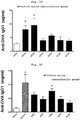
- the whole blood was extracted under anesthesia, and the obtained serum sample was measured for anti-OVA-specific IgG1 subclass antibody.
- Helper T cell which is one of the immunocompetent cells, includes several types and induces different immunofunction depending on the type thereof.
- a cell called Th1 cell is considered to be involved in the induction of cellular immunity, finds, for example, virus infected cells and the like, and induces a function of killer T cells to directly attack them and the like.
- Th2 cell is considered to be involved in the induction of humoral immunity and induces, for example, IgE production from B cells.
- Th1 cell and Th2 cell are considered to be in a relationship where an increase in one of them suppresses the other. For example, it is considered that the onset of allergy can be suppressed by setting the Th1/Th2 balance to be Th1 dominant.
- IgG antibody includes some subclasses and, in the case of mouse, IgG1 subclass antibody is considered to be involved in the immunofunction of Th2 type, and IgG2a subclass antibody is considered to be involved in the immunofunction of Th1 type. It is said that whether the induced immunity is Th1 type or Th2 type can be known to a certain extent by measuring production of these subclass antibodies.
- a method for measurement of the anti-OVA-specific IgG1 subclass antibody in Example 1, and the following Examples 5, 7 and 8 is as follows.
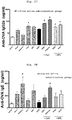
- the serum sample obtained in Example 1 was measured for anti-OVA-specific IgG2a subclass antibody.
- the serum sample obtained in Example 1 was measured for an anti-OVA-specific IgE antibody.
- the measurement method of the anti-OVA-specific IgE antibody in Example 3 and Examples 6, 9 is as follows.
- the serum sample and a standard reagent for drawing an analytical curve are diluted with a buffer and, after stirring, left standing at room temperature for 10 min.
- the sample and the standard solution are added to a plate bound with an IgE capture antibody in advance and, after stirring, the mixture is left standing at room temperature for 60 min.
- the mixture is washed three times with wash, HRP-labeled OVA is added, and the mixture is left standing at room temperature for 30 min.
- the mixture is washed three times with wash, a substrate solution is added, and the mixture is left standing in dark at room temperature for 30 min.
- influenza vaccine Influenza HA Vaccine "SEIKEN", manufactured by Denka Seiken Co.
- the secondary immunization was carried out by transnasal administration of solutions similar to those of the above-mentioned (1) - (4) again.
- nasal cavity washing was performed.
- a nasal cavity wash thorax of mouse was opened to expose trachea, the trachea was incised, an Atom venous catheter with clause was inserted and 1 mL of saline was injected.
- the liquid discharged from the nose was centrifuged at 10000 g for 3 min, and the supernatant was recovered and used as a nasal cavity wash sample.
- the nasal cavity wash sample was subjected to the measurement of anti-influenza IgA antibody. The measurement method was as follows.
- influenza vaccine Influenza HA Vaccine "SEIKEN", manufactured by Denka Seiken Co. Ltd.
- SEIKEN Denka Seiken Co. Ltd.
- PBS-T PBS+0.05% (v/v) Tween 20
- the mixture was washed three times with PBS-T (200 ⁇ l/well), a diluted serum sample (100 ⁇ l/well), nasal cavity wash sample, and the same amount of 5% FCS/PBS solution as a control was added, and the mixture was incubated at 37°C for 1 hr. Then, the mixture was washed five times with PBS-T (200 ⁇ l/well), a diluted biotinylated anti-mouse IgA antibody was added, and the mixture was incubated at 37°C for 45 min.
- anti-OVA-specific IgG1 subclass antibody production significantly increased in the Alum administration group (Alum in Figure), SZ61 administration group (SZ61 in Figure), SZ62 administration group (SZ62 in Figure), SZ63 administration group (SZ63 in Figure), SZ64 administration group (SZ64 in Figure), and SZ65 administration group (SZ65 in Figure) as compared to the OVA single administration group (Saline in Figure).
- N 2 -hexadecanoyl-L-arginine SZ61
- N 2 -hexadecanoyl-L-arginine methyl ester hydrochloride SZ63
- N 2 -octadecanoyl-L-glutamine tert-butyl ester SZ64
- N 2 -octadecanoyl-L-glutamine SZ65
- SZ62 N-hexadecanoylagmatine
- N-hexadecanoylagmatine SZ62
- N 2 -hexadecanoyl-L-arginine SZ61
- N 2 -hexadecanoyl-L-arginine methyl ester hydrochloride SZ63
- N 2 -octadecanoyl-L-glutamine tert-butyl ester SZ64
- N 2 -octadecanoyl-L-glutamine show a lower allergy inducing activity as compared to aluminum hydroxide gel adjuvant that problematically induces allergy by inoculation.
- N-docosanoyl glycine methyl ester SZ69
- N-docosanoyl-L-leucine methyl ester SZ70
- N-docosanoyl-L-phenylalanine methyl ester SZ71
- N-docosanoyl-L-glutamic acid 1-methyl ester SZ72
- N 2 -docosanoyl-L-lysine methyl ester trifluoroacetic acid salt SZ73
- N-docosanoyl-L-isoleucine methyl ester SZ76
- N-docosanoyl-L-valine methyl ester SZ77
- anti-OVA-specific IgG1 subclass antibody production significantly increased in the AddavaxTM administration group (Addavax in Figure), SZ62 administration group (SZ62 in Figure), SZ63 administration group (SZ63 in Figure), SZ64 administration group (SZ64 in Figure), SZ80 administration group (SZ80 in Figure), and SZ82 administration group (SZ82 in Figure) as compared to the OVA single administration group (saline in Figure).
- N 2 -hexadecanoyl-L-arginine methyl ester hydrochloride SZ63
- N 2 -octadecanoyl-L-glutamine tert-butyl ester SZ64
- N-hexadecanoyl glycine methyl ester SZ78
- N-hexadecanoyl-L-leucine methyl ester SZ79
- N-hexadecanoyl-L-phenylalanine methyl ester SZ80
- N 2 -hexadecanoyl-L-lysine methyl ester trifluoroacetic acid salt SZ81
- N-hexadecanoyl-L-glutamic acid 1-methyl ester SZ82
- anti-OVA-specific IgE antibody production significantly increased in the ALUM administration group (Alum in Figure) as compared to that of the OVA single administration group (saline in Figure) as previously reported.
- anti-OVA-specific IgE antibody production of the AddavaxTM administration group also significantly increased as compared to the OVA single administration group (saline in Figure).
- a significant increase in the anti-OVA-specific IgE antibody production was not observed in the SZ62 administration group (SZ62 in Figure), SZ64 administration group (SZ64 in Figure), SZ70 administration group (SZ70 in Figure), and SZ71 administration group (SZ71 in Figure).
- N-hexadecanoylagmatine SZ62
- N 2 -octadecanoyl-L-glutamine tert-butyl ester SZ64
- N-docosanoyl-L-leucine methyl ester SZ70
- N-docosanoyl-L-phenylalanine methyl ester SZ71
- OVA ovalbumin
- AddavaxTM mixed with saline at 1:1
- lymph node was collected from all mice of the above-mentioned (1) - (4), lymph node cells were isolated and cultured in 10% FBS-containing RPMI1640 medium. Thereto was added 0.1 ⁇ g, 1 ⁇ g, 10 ⁇ g, 100 ⁇ g of OVA, respectively, 40 hr later, cell supernatant was recovered, and IFN- ⁇ and IL-4 in the supernatant were measured by ELISA.
- OVA ovalbumin
- SZ62 0.256 ( ⁇ mol) dissolved or dispersed in 5% ⁇ CD-added saline
- the secondary immunization was carried out by dorsal-subcutaneous administration of solutions or dispersions similar to those of the above-mentioned (1) - (5) again.
- the blood was extracted under anesthesia, and the obtained serum samples were measured for anti-OVA-specific IgG1 subclass antibody. The results are shown in Fig. 13 .
- anti-OVA-specific IgG1 subclass antibody production significantly increased in the group administered with SZ62 dispersed in 5% aCD-added saline and the group administered with SZ62 dissolved in 10% HP- ⁇ -CD-added saline, as compared to the OVA single administration group (saline in Figure).
- the results show that SZ62 dissolved in 10% HP- ⁇ -CD-added saline also has an adjuvant activity.
- solubilization of the medicament in the liquid carrier is considered to be important.
- dissolution in 10% HP- ⁇ -CD-added saline is considered to be more preferable than dispersing in 5% ⁇ CD-added saline.
- the standard of an anti-OVA-specific IgG1 subclass antibody diluted with 2% FCS/PBS solution was added at 100 ng/ml, 50 ng/ml, 25 ng/ml, 12.5 ng/ml, 6.25 ng/ml, 3.125 ng/ml, 1.56 ng/ml, 0.781 ng/ml, 0.391 ng/ml, 0.195 ng/ml, 0.098 ng/ml, 0 ng/ml, per 1 well.
- an anti-OVA-specific IgG2a subclass antibody When an anti-OVA-specific IgG2a subclass antibody was measured, the standard of an anti-OVA-specific IgG2a subclass antibody was added at 50 ng/ml, 25 ng/ml, 12,5 ng/ml, 6.25 ng/ml, 3.125 ng/ml, 1.56 ng/ml, 0.781 ng/ml, 0.391 ng/ml, 0.195 ng/ml, 0.098 ng/ml, 0.049 ng/ml, 0 ng/ml, per 1 well.
- the mixture was washed five times with PBS-T (200 ⁇ l/well), a diluted biotinylated anti-mouse IgG1 antibody was added (100 ⁇ l/well), and the mixture was incubated at 37°C for 45 min. Thereafter, the mixture was washed five times with PBS-T (200 ⁇ l/well), a diluted anti-biotin-HRP antibody was added (100 ⁇ l/well), and the mixture was incubated at 37°C for another 30 min.
- N-acetyl-l-leucine methyl ester SZ83
- N-hexanoyl-L-leucine methyl ester SZ84
- N-(2-octadecyleicosanoyl)-L-leucine methyl ester SZ86
- N-hexadecanoyl-L-leucine tert-butyl ester SZ89
- N-hexadecanoyl-L-leucinamide SZ90
- N 2 -hexadecanoyl-N 1 ,N 1 -diethyl-L-leucinamide SZ92
- N-hexadecanoyl-L-histidine methyl ester SZ94
- N-hexadecanoyl-L-proline methyl ester SZ95
- N-hexadecanoyl-L-serine methyl ester SZ96
- Example 15 Evaluation test of adjuvant activity of N-hexadecanoyl-L-leucine hexyl ester (SZ97), N 2 -hexadecanoyl-L-arginine hexyl ester hydrochloride (SZ99), N 2 -docosanoyl-N 1 ,N 1 -diethyl-L-glutamic acid 1-amide (SZ106)
- the anti-OVA-specific IgG1 subclass antibody production in the SZ121 administration group significantly increased as compared to the OVA single administration group (Saline in Figure). While a significant difference was not observed, it was found that the production of an anti-OVA-specific IgG1 subclass antibody tended to increase in the SZ124 administration group (SZ124 in Figure) and SZ125 administration group (SZ125 in Figure).
- N 2 -docosanoyl-L-arginine hexyl ester hydrochloride SZ121
- N-docosanoyl-L-leucine hexyl ester SZ124
- N 2 -docosanoyl-N 1 ,N 1 -diethyl-L-leucinamide SZ125
- the anti-OVA-specific IgG1 subclass antibody production of the SZ128 administration group (SZ128 in Figure) and SZ129 administration group (SZ129 in Figure) significantly increased as compared to the OVA single administration group (saline in Figure). While a significant difference was not observed, it was found that the production of an anti-OVA-specific IgG1 subclass antibody tended to increase in the SZ130 administration group (SZ130 in Figure), SZ134 administration group (SZ134 in Figure), SZ135 administration group (SZ135 in Figure), SZ136 administration group (SZ136 in Figure).
- the secondary immunization was carried out by dorsal-subcutaneous administration of solutions or dispersions similar to those of the above-mentioned (1) - (7) again.
- the blood was extracted under anesthesia, and the obtained serum samples were measured for anti-OVA-specific IgG1 subclass antibody. The results are shown in Fig. 20 .
- the anti-OVA-specific IgG1 subclass antibody production of the AddavaxTM administration group (Addavax in Figure) and SZ92 administration group (SZ92 in Figure) significantly increased as compared to the OVA single administration group (Saline in Figure). While a significant difference was not observed, it was found that the production of an anti-OVA-specific IgG1 subclass antibody tended to increase in the SZ86 administration group (SZ86 in Figure), SZ90 administration group (SZ90 in Figure), SZ99 administration group (SZ99 in Figure) and SZ106 administration group (SZ106 in Figure).
- N-(2-octadecyleicosanoyl)-L-leucine methyl ester SZ86
- N-hexadecanoyl-L-leucinamide SZ90
- N 2 -hexadecanoyl-N 1 ,N 1 -diethyl-L-leucinamide SZ92
- N 2 -hexadecanoyl-L-arginine hexyl ester hydrochloride SZ99
- N 2 -docosanoyl-N 1 ,N 1 -diethyl-L-glutamic acid 1-amide SZ106
- the allergy inducing activity test was performed in the same manner as in Example 3 except that AddavaxTM, N-(2-octadecyleicosanoyl)-L-leucine methyl ester (SZ86), N-hexadecanoyl-L-leucinamide (SZ90), N 2 -hexadecanoyl-N 1 ,N 1 -diethyl-L-leucinamide (SZ92), N 2 -hexadecanoyl-L-arginine hexyl ester hydrochloride (SZ99) and N 2 -docosanoyl-N 1 ,N 1 -diethyl-L-glutamic acid 1-amide (SZ106) were used. The results are shown in Fig. 21 .
- the anti-OVA-specific IgE antibody production of the AddavaxTM administration group significantly increased as compared to the OVA single administration group (saline in Figure).
- a significant increase in the anti-OVA-specific IgE antibody production was not observed in the SZ86 administration group (SZ86 in Figure), SZ90 administration group (SZ90 in Figure), SZ92 administration group (SZ92 in Figure), SZ99 administration group (SZ99 in Figure) and SZ106 administration group (SZ106 in Figure).
- N-(2-octadecyleicosanoyl)-L-leucine methyl ester SZ86
- N-hexadecanoyl-L-leucinamide SZ90
- N 2 -hexadecanoyl-N 1 ,N 1 -diethyl-L-leucinamide SZ92
- N 2 -hexadecanoyl-L-arginine hexyl ester hydrochloride SZ99
- N 2 -docosanoyl-N 1 ,N 1 -diethyl-L-glutamic acid 1-amide SZ106
- the index for adjuvant not inducing allergy was defined as follows, and an index of each administration group in Example 19 was calculated. That is, a value obtained by dividing the mean of the anti-OVA-specific IgG1 subclass antibody concentration of each group by the mean of the anti-OVA-specific IgE antibody concentration of each group was relatively compared with a value obtained by dividing the mean of the anti-OVA-specific IgG1 subclass antibody concentration of the AddavaxTM administration group by the mean of the anti-OVA-specific IgE antibody concentration of the AddavaxTM administration group as 1. The results are shown in Fig. 22 .
- Example 20 Evaluation test of adjuvant activity and allergy inducing activity after secondary immunization with N-(2-octadecyleicosanoyl)-L-leucine methyl ester (SZ86), N 2 -hexadecanoyl-L-leucinamide (SZ90), N 2 -hexadecanoyl-N 1 ,N 1 -diethyl-L-leucinamide (SZ92), N-hexadecanoyl-L-leucine hexyl ester (SZ97), N 2 -docosanoyl-N 1 ,N 1 -diethyl-L-glutamic acid 1-amide (SZ106), N-docosanoylagmatine hydrochloride (SZ108)
- OVA ovalbumin
- SZ86 SZ86
- the secondary immunization was carried out by dorsal-subcutaneous administration of solutions or dispersions similar to those of the above-mentioned (1) - (8) again.
- the blood was extracted under anesthesia, and the obtained serum samples were measured for anti-OVA-specific IgG1 subclass antibody. The results are shown in Fig. 23 .
- the anti-OVA-specific IgG1 subclass antibody production of the AddavaxTM administration group (Addavax in Figure), SZ92 administration group (SZ92 in Figure) and SZ97 administration group (SZ97 in Figure) is significantly increased as compared to the OVA single administration group (saline in Figure). While a significant difference was not observed, it was found that the production of an anti-OVA-specific IgG1 subclass antibody tended to increase in the SZ86 administration group (SZ86 in Figure), SZ90 administration group (SZ90 in Figure), SZ106 administration group (SZ106 in Figure), SZ108 administration group (SZ108 in Figure).
- N-(2-octadecyleicosanoyl)-L-leucine methyl ester SZ86
- N 2 -hexadecanoyl-L-leucinamide SZ90
- N 2 -hexadecanoyl-N 1 ,N 1 -diethyl-L-leucinamide SZ92
- N-hexadecanoyl-L-leucine hexyl ester SZ97
- N 2 -docosanoyl-N 1 ,N 1 -diethyl-L-glutamic acid 1-amide SZ106
- N-docosanoylagmatine hydrochloride SZ108
- the allergy inducing activity test was performed in the same manner as in Example 3 except that AddavaxTM, N-(2-octadecyleicosanoyl)-L-leucine methyl ester (SZ86), N-hexadecanoyl-L-leucinamide (SZ90), N 2 -hexadecanoyl-N 1 ,N 1 -diethyl-L-leucinamide (SZ92), N-hexadecanoyl-L-leucine hexyl ester (SZ97), N 2 -docosanoyl-N 1 ,N 1 -diethyl-L-glutamic acid 1-amide (SZ106) and N-docosanoylagmatine hydrochloride (SZ108) were used. The results are shown in Fig. 24 .
- the anti-OVA-specific IgE antibody production in the AddavaxTM administration group significantly increased as compared to the OVA single administration group (saline in Figure).
- a significant increase in the anti-OVA-specific IgE antibody production was not observed in the SZ86 administration group (SZ86 in Figure), SZ90 administration group (SZ90 in Figure), SZ92 administration group (SZ92 in Figure), SZ97 administration group (SZ97 in Figure), SZ106 administration group (SZ106 in Figure), SZ108 administration group (SZ108 in Figure).
- N-(2-octadecyleicosanoyl)-L-leucine methyl ester SZ86
- N-hexadecanoyl-L-leucinamide SZ90
- N 2 -hexadecanoyl-N 1 ,N 1 -diethyl-L-leucinamide SZ92
- N 2 -docosanoyl-N 1 ,N 1 -diethyl-L-glutamic acid 1-amide SZ106
- N-docosanoylagmatine hydrochloride SZ108
- Example 19 The evaluation of an adjuvant that does not induce allergy was performed in the same manner as in Example 19 except that N-(2-octadecyleicosanoyl)-L-leucine methyl ester (SZ86), N-hexadecanoyl-L-leucinamide (SZ90), N 2 -hexadecanoyl-N 1 ,N 1 -diethyl-L-leucinamide (SZ92), N-hexadecanoyl-L-leucine hexyl ester (SZ97), N 2 -docosanoyl-N 1 ,N 1 -diethyl-L-glutamic acid 1-amide (SZ106) and N-docosanoylagmatine hydrochloride (SZ108) were used. The results are shown in Fig. 25 .
- combination adjuvants of a mixture of plural adjuvants have been developed.
- adjuvants such as aluminum hydroxide salt, oil-in-water emulsion, liposome and the like can afford stronger and effective immune responses when combined with molecules such as immunostimulating agents (e.g., monophosphoryl lipid (MPL), QS-21, vitamin E and the like), and the like.
- MPL and aluminum hydroxide salt have been introduced as an adjuvant (AS04) for a cervical cancer vaccine, and a combination of AddavaxTM and CpG is being studied as a cancer vaccine adjuvant.
- AS04 monophosphoryl lipid
- AddavaxTM and CpG is being studied as a cancer vaccine adjuvant.
- a combination of plural adjuvants does not always afford a good effect, and some combination causes a competitive failure.
- Example 21 Evaluation test of adjuvant activity and allergy inducing activity after secondary immunization when a mixture of N-hexadecanoylagmatine (SZ62: compound wherein the group corresponding to R 7 in the formula (II) is C 15 alkyl group) and MPL or CpG is administered
- OVA ovalbumin
- Alum administration group OVA 10 ⁇ g and aluminum hydroxide salt dissolved in saline
- AddavaxTM administration group OVA 10 ⁇ g and CpG 5 ⁇ g dissolved in saline
- CpG administration group OVA 10 ⁇ g and MPL 5 ⁇ g dissolved in saline
- SZ62 administration group OVA 5 ⁇ g
- SZ62 SZ62 (0.256 ⁇ mol) dissolved or dispersed in 5% ⁇ CD-added saline
- the secondary immunization was carried out by dorsal-subcutaneous administration of solutions or dispersions similar to those of the above-mentioned (1) - (10) again.
- the blood was extracted under anesthesia, and the obtained serum samples were measured for anti-OVA-specific IgG1 subclass antibody, anti-OVA-specific IgG2a subclass antibody and anti-OVA-specific IgE antibody.
- the results thereof are respectively shown in Fig. 26 , Fig. 27 and Fig. 28 .
- the measurement methods were respectively similar to Example 18 and Example 3.
- the anti-OVA-specific IgG2a subclass antibody production in the CpG administration group (CpG in Figure), SZ62+CpG administration group (SZ62+CpG in Figure), AddavaxTM+CpG administration group (Addavax+CpG in Figure), Alum+MPL administration group (Alum+MPL in Figure) significantly increased as compared to the OVA single administration group (saline in Figure).
- Example 22 Evaluation test of systemic inflammation after primary immunization when a mixture of N-hexadecanoylagmatine (SZ62: compound wherein the group corresponding to R 7 in the formula (II) is C 15 alkyl group) and MPL or CpG is administered
- OVA ovalbumin
- AddavaxTM mixed with saline at 1:1) dissolved in saline
- Alum administration group OVA (10 ⁇ g) and aluminum hydroxide salt dissolved in saline
- CpG administration group OVA (10 ⁇ g) and CpG 5 ⁇ g dissolved in saline
- OVA (10 ⁇ g) and MPL 5 ⁇ g dissolved in saline MPL administration group
- OVA OVA
- SZ62 (0.256 ⁇ mol
- the compound of the present invention has an antigen-specific IgG1 subclass antibody and/or IgG2a subclass antibody production-enhancing effect (immunostimulatory effect), it is useful as an immunostimulating agent.
- the compound of the present invention since the compound of the present invention has an immunostimulatory effect equivalent to or not less than that of conventional aluminum gel adjuvants, suppresses induction of IgE antibody production, and sometimes suppresses problematic allergy inducing activity of conventional aluminum gel adjuvants, it can be an effective and safe adjuvant.
- the compound of the present invention induces IgA antibody production on the mucosa, it can also be a mucosal vaccine adjuvant of which the research and development are ongoing at present. By combining with an existing adjuvant, the development as a combination adjuvant that enhances immune response is also expected.
Landscapes
- Health & Medical Sciences (AREA)
- Chemical & Material Sciences (AREA)
- Organic Chemistry (AREA)
- Life Sciences & Earth Sciences (AREA)
- General Health & Medical Sciences (AREA)
- Veterinary Medicine (AREA)
- Pharmacology & Pharmacy (AREA)
- Animal Behavior & Ethology (AREA)
- Medicinal Chemistry (AREA)
- Public Health (AREA)
- Engineering & Computer Science (AREA)
- Epidemiology (AREA)
- Bioinformatics & Cheminformatics (AREA)
- General Chemical & Material Sciences (AREA)
- Chemical Kinetics & Catalysis (AREA)
- Immunology (AREA)
- Virology (AREA)
- Nuclear Medicine, Radiotherapy & Molecular Imaging (AREA)
- Proteomics, Peptides & Aminoacids (AREA)
- Molecular Biology (AREA)
- Communicable Diseases (AREA)
- Oncology (AREA)
- Otolaryngology (AREA)
- Oil, Petroleum & Natural Gas (AREA)
- Pulmonology (AREA)
- Acyclic And Carbocyclic Compounds In Medicinal Compositions (AREA)
- Medicines Containing Antibodies Or Antigens For Use As Internal Diagnostic Agents (AREA)
- Medicinal Preparation (AREA)
- Pharmaceuticals Containing Other Organic And Inorganic Compounds (AREA)
Applications Claiming Priority (4)
| Application Number | Priority Date | Filing Date | Title |
|---|---|---|---|
| JP2015212222 | 2015-10-28 | ||
| JP2016091808 | 2016-04-28 | ||
| PCT/JP2016/082896 WO2017073797A1 (en) | 2015-10-28 | 2016-10-28 | Immunostimulating agent |
| EP16819376.1A EP3368508A1 (en) | 2015-10-28 | 2016-10-28 | Immunostimulating agent |
Related Parent Applications (1)
| Application Number | Title | Priority Date | Filing Date |
|---|---|---|---|
| EP16819376.1A Division EP3368508A1 (en) | 2015-10-28 | 2016-10-28 | Immunostimulating agent |
Publications (1)
| Publication Number | Publication Date |
|---|---|
| EP3511318A1 true EP3511318A1 (en) | 2019-07-17 |
Family
ID=57629607
Family Applications (2)
| Application Number | Title | Priority Date | Filing Date |
|---|---|---|---|
| EP19154529.2A Withdrawn EP3511318A1 (en) | 2015-10-28 | 2016-10-28 | Immunostimulating agent |
| EP16819376.1A Withdrawn EP3368508A1 (en) | 2015-10-28 | 2016-10-28 | Immunostimulating agent |
Family Applications After (1)
| Application Number | Title | Priority Date | Filing Date |
|---|---|---|---|
| EP16819376.1A Withdrawn EP3368508A1 (en) | 2015-10-28 | 2016-10-28 | Immunostimulating agent |
Country Status (4)
| Country | Link |
|---|---|
| US (1) | US20180243421A1 (enExample) |
| EP (2) | EP3511318A1 (enExample) |
| JP (1) | JP2018536645A (enExample) |
| WO (1) | WO2017073797A1 (enExample) |
Families Citing this family (4)
| Publication number | Priority date | Publication date | Assignee | Title |
|---|---|---|---|---|
| JP2018188434A (ja) * | 2017-04-28 | 2018-11-29 | 味の素株式会社 | 免疫賦活剤 |
| CN107814754A (zh) * | 2017-11-16 | 2018-03-20 | 中国日用化学工业研究院 | 一种月桂酰精氨酸乙酯盐酸盐的制备方法 |
| CN111888468B (zh) * | 2020-07-17 | 2021-08-03 | 广东海大畜牧兽医研究院有限公司 | 一种免疫水佐剂及其制备方法 |
| CN112341354B (zh) * | 2020-09-24 | 2022-06-10 | 湖北泓肽生物科技有限公司 | 一种pms的合成方法 |
Citations (15)
| Publication number | Priority date | Publication date | Assignee | Title |
|---|---|---|---|---|
| JPS59219262A (ja) | 1983-05-30 | 1984-12-10 | Terumo Corp | ジスルフイド誘導体およびそれを用いた免疫賦活剤 |
| JPH04230359A (ja) | 1990-06-28 | 1992-08-19 | Astra:Ab | 新規な3,3′−ジチオビス(プロピオン酸)およびそのエステル |
| WO1996018600A1 (en) | 1994-12-14 | 1996-06-20 | Lifegroup S.P.A. | Amides of mono and bicarboxylic acids with amino acids or glycosamines, selectively active on the cannabinoid peripheral receptor |
| WO1999010008A1 (en) | 1997-08-29 | 1999-03-04 | Aquila Biopharmaceuticals, Inc. | Compositions comprising the adjuvant qs-21 and polysorbate or cyclodextrin as excipient |
| WO2002094764A1 (en) | 2001-05-21 | 2002-11-28 | Croda International Plc | Anti-inflammatory and immunomodulatory amino acid derivatives, their preparation and use |
| WO2003006007A1 (en) | 2001-07-11 | 2003-01-23 | Research & Innovation Soc.Coop. A R.L. | Use of compounds as functional antagonists to the central cannabinoid receptors |
| WO2004014956A1 (en) * | 2002-08-12 | 2004-02-19 | The Council Of The Queensland Institute Of Medical Research | Novel immunogenic lipopeptides comprising t-helper and b-cell epitopes |
| WO2009142988A2 (en) | 2008-05-14 | 2009-11-26 | Florida Atlantic University | Chitin micro-particles as an adjuvant |
| WO2009157759A1 (en) | 2008-06-23 | 2009-12-30 | N.V. Nutricia | Nutritional composition for improving the mammalian immune system |
| WO2012154739A1 (en) * | 2011-05-09 | 2012-11-15 | Uwm Research Foundation, Inc. | The use of cyclodextrins in diets, water or vaccine adjuvants to boost the immune system of fish |
| WO2014191080A1 (en) | 2013-05-27 | 2014-12-04 | Pharmathen S.A. | Parenteral formulation of triazole antifungal agent and method for preparation thereof |
| WO2015034924A1 (en) | 2013-09-03 | 2015-03-12 | Georgia Tech Research Corporation | Thermally stable vaccine formulations and microneedles |
| JP2015212222A (ja) | 2009-12-17 | 2015-11-26 | ディーエスエム アイピー アセッツ ビー.ブイ. | 放射線硬化性光ファイバーコーティング組成物のled硬化 |
| WO2016012385A1 (en) | 2014-07-21 | 2016-01-28 | Sanofi Pasteur | Vaccine composition comprising ipv and cyclodextrins |
| JP2016091808A (ja) | 2014-11-05 | 2016-05-23 | セントラル硝子株式会社 | 電解質溶液の精製方法及び電解質溶液の製造方法 |
Family Cites Families (1)
| Publication number | Priority date | Publication date | Assignee | Title |
|---|---|---|---|---|
| KR100854207B1 (ko) * | 2007-04-04 | 2008-08-26 | 성공제 | 아그마틴의 망막 신경절 세포 보호 용도 |
-
2016
- 2016-10-28 EP EP19154529.2A patent/EP3511318A1/en not_active Withdrawn
- 2016-10-28 EP EP16819376.1A patent/EP3368508A1/en not_active Withdrawn
- 2016-10-28 JP JP2018521336A patent/JP2018536645A/ja not_active Abandoned
- 2016-10-28 WO PCT/JP2016/082896 patent/WO2017073797A1/en not_active Ceased
-
2018
- 2018-04-25 US US15/962,250 patent/US20180243421A1/en not_active Abandoned
Patent Citations (16)
| Publication number | Priority date | Publication date | Assignee | Title |
|---|---|---|---|---|
| JPS59219262A (ja) | 1983-05-30 | 1984-12-10 | Terumo Corp | ジスルフイド誘導体およびそれを用いた免疫賦活剤 |
| JPH04230359A (ja) | 1990-06-28 | 1992-08-19 | Astra:Ab | 新規な3,3′−ジチオビス(プロピオン酸)およびそのエステル |
| WO1996018600A1 (en) | 1994-12-14 | 1996-06-20 | Lifegroup S.P.A. | Amides of mono and bicarboxylic acids with amino acids or glycosamines, selectively active on the cannabinoid peripheral receptor |
| WO1999010008A1 (en) | 1997-08-29 | 1999-03-04 | Aquila Biopharmaceuticals, Inc. | Compositions comprising the adjuvant qs-21 and polysorbate or cyclodextrin as excipient |
| WO2002094764A1 (en) | 2001-05-21 | 2002-11-28 | Croda International Plc | Anti-inflammatory and immunomodulatory amino acid derivatives, their preparation and use |
| WO2003006007A1 (en) | 2001-07-11 | 2003-01-23 | Research & Innovation Soc.Coop. A R.L. | Use of compounds as functional antagonists to the central cannabinoid receptors |
| WO2004014956A1 (en) * | 2002-08-12 | 2004-02-19 | The Council Of The Queensland Institute Of Medical Research | Novel immunogenic lipopeptides comprising t-helper and b-cell epitopes |
| WO2009142988A2 (en) | 2008-05-14 | 2009-11-26 | Florida Atlantic University | Chitin micro-particles as an adjuvant |
| WO2009157759A1 (en) | 2008-06-23 | 2009-12-30 | N.V. Nutricia | Nutritional composition for improving the mammalian immune system |
| WO2009157767A1 (en) | 2008-06-23 | 2009-12-30 | N.V. Nutricia | Nutritional composition for improving the mammalian immune system |
| JP2015212222A (ja) | 2009-12-17 | 2015-11-26 | ディーエスエム アイピー アセッツ ビー.ブイ. | 放射線硬化性光ファイバーコーティング組成物のled硬化 |
| WO2012154739A1 (en) * | 2011-05-09 | 2012-11-15 | Uwm Research Foundation, Inc. | The use of cyclodextrins in diets, water or vaccine adjuvants to boost the immune system of fish |
| WO2014191080A1 (en) | 2013-05-27 | 2014-12-04 | Pharmathen S.A. | Parenteral formulation of triazole antifungal agent and method for preparation thereof |
| WO2015034924A1 (en) | 2013-09-03 | 2015-03-12 | Georgia Tech Research Corporation | Thermally stable vaccine formulations and microneedles |
| WO2016012385A1 (en) | 2014-07-21 | 2016-01-28 | Sanofi Pasteur | Vaccine composition comprising ipv and cyclodextrins |
| JP2016091808A (ja) | 2014-11-05 | 2016-05-23 | セントラル硝子株式会社 | 電解質溶液の精製方法及び電解質溶液の製造方法 |
Non-Patent Citations (3)
| Title |
|---|
| "Surveillance Report Influenza virus characterisation", SUMMARY EUROPE, September 2015 (2015-09-01), Retrieved from the Internet <URL:http://ecdc.europa.eu/en/publications/surveillance_reports/inf luenza/pages/influenza_virus_characterisation.aspx> |
| M. ONISHI ET AL., J. IMMUNOL., vol. 194, 2015, pages 2673 - 82 |
| MEHFUZ ZAMAN ET AL: "Immunostimulation by Synthetic Lipopeptide-Based Vaccine Candidates: Structure-Activity Relationships", FRONTIERS IN IMMUNOLOGY, vol. 4, 1 January 2013 (2013-01-01), XP055342186, DOI: 10.3389/fimmu.2013.00318 * |
Also Published As
| Publication number | Publication date |
|---|---|
| EP3368508A1 (en) | 2018-09-05 |
| JP2018536645A (ja) | 2018-12-13 |
| US20180243421A1 (en) | 2018-08-30 |
| WO2017073797A1 (en) | 2017-05-04 |
Similar Documents
| Publication | Publication Date | Title |
|---|---|---|
| US20180243421A1 (en) | Immunostimulating agent | |
| RU2759917C2 (ru) | Пиримидиновое соединение | |
| EP1242365A1 (fr) | Pseudodipeptides acyles porteurs d'un bras auxiliaire fonctionnalise | |
| HU226869B1 (en) | Immunological adjuvant compound and composition containing thereof | |
| CN101918033B (zh) | 通过抗原和/或药物连接增加免疫应答及靶向 | |
| TWI305775B (en) | Immunological adjuvant compounds, compositions, and methods of use thereof | |
| WO2024183821A1 (zh) | 可离子化脂质分子及其制备方法和应用 | |
| US20170119875A1 (en) | Amino sphingoglycolipid analogues | |
| CN114206378B (zh) | 基于tlr受体配体的疫苗佐剂 | |
| US10100008B2 (en) | Immunostimulating agent | |
| EP3395365A1 (en) | Immunostimulating agent | |
| WO2021261444A1 (ja) | Tlr4作動活性を有するアジュバント | |
| RU2825571C1 (ru) | Липидное соединение и композиция на его основе | |
| US20250367166A1 (en) | Next generation diprovocims that activate the innate and adaptive immune response | |
| US20250275942A1 (en) | Sting agonists, formulations, and uses thereof | |
| US20250281459A1 (en) | Lipids, formulations, and uses thereof | |
| EA046871B1 (ru) | Адъюванты вакцин на основе лигандов рецепторов tlr | |
| Wu | Modulators of Toll-like Receptors-4 and-2 |
Legal Events
| Date | Code | Title | Description |
|---|---|---|---|
| PUAI | Public reference made under article 153(3) epc to a published international application that has entered the european phase |
Free format text: ORIGINAL CODE: 0009012 |
|
| AC | Divisional application: reference to earlier application |
Ref document number: 3368508 Country of ref document: EP Kind code of ref document: P |
|
| AK | Designated contracting states |
Kind code of ref document: A1 Designated state(s): AL AT BE BG CH CY CZ DE DK EE ES FI FR GB GR HR HU IE IS IT LI LT LU LV MC MK MT NL NO PL PT RO RS SE SI SK SM TR |
|
| STAA | Information on the status of an ep patent application or granted ep patent |
Free format text: STATUS: THE APPLICATION IS DEEMED TO BE WITHDRAWN |
|
| 18D | Application deemed to be withdrawn |
Effective date: 20200118 |