EP3510075B1 - Alternative akzeptorstoffe auf der basis von hexabenzocoronen - Google Patents
Alternative akzeptorstoffe auf der basis von hexabenzocoronen Download PDFInfo
- Publication number
- EP3510075B1 EP3510075B1 EP17771825.1A EP17771825A EP3510075B1 EP 3510075 B1 EP3510075 B1 EP 3510075B1 EP 17771825 A EP17771825 A EP 17771825A EP 3510075 B1 EP3510075 B1 EP 3510075B1
- Authority
- EP
- European Patent Office
- Prior art keywords
- compound
- lumo
- homo
- group
- formula
- Prior art date
- Legal status (The legal status is an assumption and is not a legal conclusion. Google has not performed a legal analysis and makes no representation as to the accuracy of the status listed.)
- Active
Links
Images





Classifications
-
- C—CHEMISTRY; METALLURGY
- C08—ORGANIC MACROMOLECULAR COMPOUNDS; THEIR PREPARATION OR CHEMICAL WORKING-UP; COMPOSITIONS BASED THEREON
- C08G—MACROMOLECULAR COMPOUNDS OBTAINED OTHERWISE THAN BY REACTIONS ONLY INVOLVING UNSATURATED CARBON-TO-CARBON BONDS
- C08G61/00—Macromolecular compounds obtained by reactions forming a carbon-to-carbon link in the main chain of the macromolecule
- C08G61/12—Macromolecular compounds containing atoms other than carbon in the main chain of the macromolecule
- C08G61/122—Macromolecular compounds containing atoms other than carbon in the main chain of the macromolecule derived from five- or six-membered heterocyclic compounds, other than imides
- C08G61/123—Macromolecular compounds containing atoms other than carbon in the main chain of the macromolecule derived from five- or six-membered heterocyclic compounds, other than imides derived from five-membered heterocyclic compounds
- C08G61/126—Macromolecular compounds containing atoms other than carbon in the main chain of the macromolecule derived from five- or six-membered heterocyclic compounds, other than imides derived from five-membered heterocyclic compounds with a five-membered ring containing one sulfur atom in the ring
-
- H—ELECTRICITY
- H10—SEMICONDUCTOR DEVICES; ELECTRIC SOLID-STATE DEVICES NOT OTHERWISE PROVIDED FOR
- H10K—ORGANIC ELECTRIC SOLID-STATE DEVICES
- H10K30/00—Organic devices sensitive to infrared radiation, light, electromagnetic radiation of shorter wavelength or corpuscular radiation
- H10K30/30—Organic devices sensitive to infrared radiation, light, electromagnetic radiation of shorter wavelength or corpuscular radiation comprising bulk heterojunctions, e.g. interpenetrating networks of donor and acceptor material domains
-
- H—ELECTRICITY
- H10—SEMICONDUCTOR DEVICES; ELECTRIC SOLID-STATE DEVICES NOT OTHERWISE PROVIDED FOR
- H10K—ORGANIC ELECTRIC SOLID-STATE DEVICES
- H10K85/00—Organic materials used in the body or electrodes of devices covered by this subclass
- H10K85/10—Organic polymers or oligomers
- H10K85/111—Organic polymers or oligomers comprising aromatic, heteroaromatic, or aryl chains, e.g. polyaniline, polyphenylene or polyphenylene vinylene
- H10K85/113—Heteroaromatic compounds comprising sulfur or selene, e.g. polythiophene
-
- H—ELECTRICITY
- H10—SEMICONDUCTOR DEVICES; ELECTRIC SOLID-STATE DEVICES NOT OTHERWISE PROVIDED FOR
- H10K—ORGANIC ELECTRIC SOLID-STATE DEVICES
- H10K85/00—Organic materials used in the body or electrodes of devices covered by this subclass
- H10K85/10—Organic polymers or oligomers
- H10K85/151—Copolymers
-
- H—ELECTRICITY
- H10—SEMICONDUCTOR DEVICES; ELECTRIC SOLID-STATE DEVICES NOT OTHERWISE PROVIDED FOR
- H10K—ORGANIC ELECTRIC SOLID-STATE DEVICES
- H10K85/00—Organic materials used in the body or electrodes of devices covered by this subclass
- H10K85/60—Organic compounds having low molecular weight
- H10K85/615—Polycyclic condensed aromatic hydrocarbons, e.g. anthracene
- H10K85/624—Polycyclic condensed aromatic hydrocarbons, e.g. anthracene containing six or more rings
-
- C—CHEMISTRY; METALLURGY
- C08—ORGANIC MACROMOLECULAR COMPOUNDS; THEIR PREPARATION OR CHEMICAL WORKING-UP; COMPOSITIONS BASED THEREON
- C08G—MACROMOLECULAR COMPOUNDS OBTAINED OTHERWISE THAN BY REACTIONS ONLY INVOLVING UNSATURATED CARBON-TO-CARBON BONDS
- C08G2261/00—Macromolecular compounds obtained by reactions forming a carbon-to-carbon link in the main chain of the macromolecule
- C08G2261/10—Definition of the polymer structure
- C08G2261/12—Copolymers
- C08G2261/124—Copolymers alternating
-
- C—CHEMISTRY; METALLURGY
- C08—ORGANIC MACROMOLECULAR COMPOUNDS; THEIR PREPARATION OR CHEMICAL WORKING-UP; COMPOSITIONS BASED THEREON
- C08G—MACROMOLECULAR COMPOUNDS OBTAINED OTHERWISE THAN BY REACTIONS ONLY INVOLVING UNSATURATED CARBON-TO-CARBON BONDS
- C08G2261/00—Macromolecular compounds obtained by reactions forming a carbon-to-carbon link in the main chain of the macromolecule
- C08G2261/10—Definition of the polymer structure
- C08G2261/14—Side-groups
- C08G2261/142—Side-chains containing oxygen
- C08G2261/1424—Side-chains containing oxygen containing ether groups, including alkoxy
-
- C—CHEMISTRY; METALLURGY
- C08—ORGANIC MACROMOLECULAR COMPOUNDS; THEIR PREPARATION OR CHEMICAL WORKING-UP; COMPOSITIONS BASED THEREON
- C08G—MACROMOLECULAR COMPOUNDS OBTAINED OTHERWISE THAN BY REACTIONS ONLY INVOLVING UNSATURATED CARBON-TO-CARBON BONDS
- C08G2261/00—Macromolecular compounds obtained by reactions forming a carbon-to-carbon link in the main chain of the macromolecule
- C08G2261/10—Definition of the polymer structure
- C08G2261/18—Definition of the polymer structure conjugated
-
- C—CHEMISTRY; METALLURGY
- C08—ORGANIC MACROMOLECULAR COMPOUNDS; THEIR PREPARATION OR CHEMICAL WORKING-UP; COMPOSITIONS BASED THEREON
- C08G—MACROMOLECULAR COMPOUNDS OBTAINED OTHERWISE THAN BY REACTIONS ONLY INVOLVING UNSATURATED CARBON-TO-CARBON BONDS
- C08G2261/00—Macromolecular compounds obtained by reactions forming a carbon-to-carbon link in the main chain of the macromolecule
- C08G2261/30—Monomer units or repeat units incorporating structural elements in the main chain
- C08G2261/31—Monomer units or repeat units incorporating structural elements in the main chain incorporating aromatic structural elements in the main chain
- C08G2261/314—Condensed aromatic systems, e.g. perylene, anthracene or pyrene
-
- C—CHEMISTRY; METALLURGY
- C08—ORGANIC MACROMOLECULAR COMPOUNDS; THEIR PREPARATION OR CHEMICAL WORKING-UP; COMPOSITIONS BASED THEREON
- C08G—MACROMOLECULAR COMPOUNDS OBTAINED OTHERWISE THAN BY REACTIONS ONLY INVOLVING UNSATURATED CARBON-TO-CARBON BONDS
- C08G2261/00—Macromolecular compounds obtained by reactions forming a carbon-to-carbon link in the main chain of the macromolecule
- C08G2261/30—Monomer units or repeat units incorporating structural elements in the main chain
- C08G2261/32—Monomer units or repeat units incorporating structural elements in the main chain incorporating heteroaromatic structural elements in the main chain
- C08G2261/324—Monomer units or repeat units incorporating structural elements in the main chain incorporating heteroaromatic structural elements in the main chain condensed
- C08G2261/3243—Monomer units or repeat units incorporating structural elements in the main chain incorporating heteroaromatic structural elements in the main chain condensed containing one or more sulfur atoms as the only heteroatom, e.g. benzothiophene
-
- C—CHEMISTRY; METALLURGY
- C08—ORGANIC MACROMOLECULAR COMPOUNDS; THEIR PREPARATION OR CHEMICAL WORKING-UP; COMPOSITIONS BASED THEREON
- C08G—MACROMOLECULAR COMPOUNDS OBTAINED OTHERWISE THAN BY REACTIONS ONLY INVOLVING UNSATURATED CARBON-TO-CARBON BONDS
- C08G2261/00—Macromolecular compounds obtained by reactions forming a carbon-to-carbon link in the main chain of the macromolecule
- C08G2261/30—Monomer units or repeat units incorporating structural elements in the main chain
- C08G2261/34—Monomer units or repeat units incorporating structural elements in the main chain incorporating partially-aromatic structural elements in the main chain
- C08G2261/344—Monomer units or repeat units incorporating structural elements in the main chain incorporating partially-aromatic structural elements in the main chain containing heteroatoms
-
- C—CHEMISTRY; METALLURGY
- C08—ORGANIC MACROMOLECULAR COMPOUNDS; THEIR PREPARATION OR CHEMICAL WORKING-UP; COMPOSITIONS BASED THEREON
- C08G—MACROMOLECULAR COMPOUNDS OBTAINED OTHERWISE THAN BY REACTIONS ONLY INVOLVING UNSATURATED CARBON-TO-CARBON BONDS
- C08G2261/00—Macromolecular compounds obtained by reactions forming a carbon-to-carbon link in the main chain of the macromolecule
- C08G2261/70—Post-treatment
- C08G2261/77—Post-treatment grafting
-
- C—CHEMISTRY; METALLURGY
- C08—ORGANIC MACROMOLECULAR COMPOUNDS; THEIR PREPARATION OR CHEMICAL WORKING-UP; COMPOSITIONS BASED THEREON
- C08G—MACROMOLECULAR COMPOUNDS OBTAINED OTHERWISE THAN BY REACTIONS ONLY INVOLVING UNSATURATED CARBON-TO-CARBON BONDS
- C08G2261/00—Macromolecular compounds obtained by reactions forming a carbon-to-carbon link in the main chain of the macromolecule
- C08G2261/90—Applications
- C08G2261/91—Photovoltaic applications
-
- H—ELECTRICITY
- H10—SEMICONDUCTOR DEVICES; ELECTRIC SOLID-STATE DEVICES NOT OTHERWISE PROVIDED FOR
- H10K—ORGANIC ELECTRIC SOLID-STATE DEVICES
- H10K30/00—Organic devices sensitive to infrared radiation, light, electromagnetic radiation of shorter wavelength or corpuscular radiation
- H10K30/50—Photovoltaic [PV] devices
-
- Y—GENERAL TAGGING OF NEW TECHNOLOGICAL DEVELOPMENTS; GENERAL TAGGING OF CROSS-SECTIONAL TECHNOLOGIES SPANNING OVER SEVERAL SECTIONS OF THE IPC; TECHNICAL SUBJECTS COVERED BY FORMER USPC CROSS-REFERENCE ART COLLECTIONS [XRACs] AND DIGESTS
- Y02—TECHNOLOGIES OR APPLICATIONS FOR MITIGATION OR ADAPTATION AGAINST CLIMATE CHANGE
- Y02E—REDUCTION OF GREENHOUSE GAS [GHG] EMISSIONS, RELATED TO ENERGY GENERATION, TRANSMISSION OR DISTRIBUTION
- Y02E10/00—Energy generation through renewable energy sources
- Y02E10/50—Photovoltaic [PV] energy
- Y02E10/549—Organic PV cells
Definitions
- the invention relates to a compound based on hexabenzocoronene, a donor:acceptor layer comprising it and a device comprising such a compound or such a layer.
- the poly(3-hexylthiophene):[6]-phenyl-C 61 -methylbutyrate (P3HT:PCBM) composite couple has long been a standard.
- the weak electronic correlation between the donor (P3HT) and the acceptor (PCBM) combined with numerous morphological instabilities at the heart of the heterojunction are two of the major problems of this donor:acceptor pair.
- the search for a better correlation between the electronic properties ranges from minor changes in the chemical structure of one of the components of the pair to the complete replacement of the donor molecule or the acceptor molecule.
- graphene-based materials quickly emerged as good acceptor candidates, mainly due to their remarkable semiconducting properties.
- the efficiency depends on the product ( Voc x J SC x FF) divided by the incoming power, where FF is the fill factor and Voc is the open circuit voltage. Moreover, the donor and the acceptor are in a mixture and are not connected in a covalent way, the charge transfer is, therefore, hindered by the disorganization at the nanometer scale.
- the materials of organic photovoltaic cells must ideally be adapted and organized for maximum efficiency at each stage of the process of converting solar energy into electricity.
- n designates the number of repeating units of the polymer of formula (2).
- This compound has proved to be particularly suitable for forming the active layer (donor:acceptor) of a photovoltaic organic cell.
- this compound which combines a hexabenzocoronene substituted in positions 1, 3, 4 and 6 by a carboxylic or cyano or isocyano or cyanate group or a fluorine atom and the ZP46 polymer makes it possible to increase the resistance properties. to the photo-oxidation of the active layer of an OPV, for example.
- the substituents at R 1 , R 3 , R 4 and R 6 are carboxylic groups.
- a very particularly preferred compound of the invention is the following compound of formula I-1: wherein R 1 , R 3 , R 4 and R 6 are carboxylic groups and R 2 and R 5 have the formula -COO-ZP46.
- the invention also provides an active layer comprising a hexabenzocoronene-based compound of the invention. It also proposes a device comprising such a compound or such a layer. More particularly, such a device is a photovoltaic cell.
- the inventors have now discovered new materials based on graphene, more precisely compounds based on hexabenzocoronenes, which fulfill all of these parameters which govern the efficiency of the photovoltaic organic device both from the points of view of electronic stability and resistance to oxidation.
- the columnar structure is obtained by choosing the position and the nature of the substituents R 1 , R 3 , R 4 and R 6 in Formula I. Such a choice makes it possible to obtain a close to optimal stacking of the different layers. of the HBC of the invention.
- a carboxylic group is particularly preferred because it is easier to graft onto the HBC heart.
- positions 2 and 5 are occupied by a conductive polymer ZP46, preferably via a spacer.
- the ZP46 polymer has the following formula (2): wherein R is methyl or C6H13.
- This polymer makes it possible to confer on the compounds of the invention both morphological and photochemical stability.
- the supramolecular structure of the ZP46 polymer is determined by the non-binding OH and OS interactions in the two co-monomers of which it is made, i.e. benzo(1,2-b;3,4-b) thiophene and thieno[3,4-c]pyrrol-4,6-dione.
- This supramolecular structure can lock the chains in a planar configuration 1 which can induce a mimetic discotic liquid crystal characteristic with adjacent chains based on the same interactions.
- 1 Nicholas E. Jackson et al. Controlling conformation of conjugated polymers and molecules, the wall of non-binding interaction", Journal of the American Chemical Society, 135, 28:10475-10483, 2013
- this donor:acceptor pair For a donor:acceptor pair to be effective for an application in a photovoltaic cell, this donor:acceptor pair must first make it possible to obtain a good localization of the electrons in the base state (molecular orbital HOMO) in the donor part (in the compounds of Formula II in the ZP46 polymers) and to transfer these electrons in a localized way in the acceptor part during a light emission (molecular orbital LUMO) of the compounds of the invention, it is i.e. in the hexabenzocoronene part (in the compound of Formula I).
- This donor:acceptor molecule must then be able to form a columnar and helical stack.
- this donor:acceptor molecule must allow a good separation between the energy levels of the HOMO and LUMO orbitals.
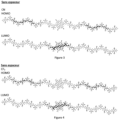
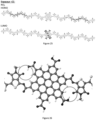
- the LUMO orbital in this compound of the invention is not localized only on the HBC core (the location of the electrons is shown by a darker part) but is relocated towards the ZP46 polymer itself, hindering the dissociation of the charges and their transfer in the direction of the stack ⁇ , but nevertheless allowing such dissociation and such transfer.
- this compound can be used in applications where perfect efficiency is not required but where resistance to photo-oxidation is important.
- the LUMO orbital in the compound of the invention is not located only on the HBC core but is relocated towards the ZP46 polymer itself, hindering the dissociation of the charges and their transfer in the direction of the ⁇ stack, but nevertheless permitting such dissociation and transfer.
- this compound can be used in applications where perfect efficiency is not necessary but where resistance to photo-oxidation is important.
- the LUMO orbital in this compound is not only localized on the HBC core but relocates to the ZP46 polymer, yet allowing such dissociation and transfer.
- this compound can be used in applications where perfect efficiency is not necessary but where resistance to photo-oxidation is important.
- the inventors believe that the fact that the LUMO orbital in these compounds is not located only on the heart HBC may be due to the properties of the ZP46 co-monomer acceptor which is directly bound to the HBC core and which may compete during the delocalization of the electron cloud from the LUMO level (poor electronic character in the ground state).
- grafting the ZP46 copolymer in the other direction, i.e. directly bonding the donor moiety first is undesirable due to the lack of non-binding interaction between the segment and the core. HBC by hydrogen bonds.
- the compound of the invention in which the ZP46 polymer is directly linked to the HBC core is of great interest as a donor:acceptor pair thanks to its remarkable resistance to photo-oxidation compared to an ideal molecule.
- R 1 , R 3 , R 4 and R 6 substituents are very important for obtaining effective charge separation during excitation by light.
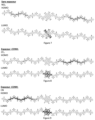
- the LUMO orbital is not located at all on the HBC core in this molecule.
- This compound therefore cannot be used as a donor:acceptor pair in an active layer.
- the LUMO orbital is not at all located on the HBC core but totally delocalized towards the ZP46 polymer.
- the electrons have to go from the donor to the acceptor by passing from the HOMO to the LUMO.
- Such a molecule cannot be used as a donor:acceptor pair in an active layer.
- the LUMO orbital is practically not located on the HBC core but concentrates on the substituents R 1 , R 3 , R 4 and R 5 , which are very electron attracting: the latter will never release the electrons to create the desired current. Indeed, there is no other chemical function that is more in search of trapping electrons. No 2 will never release the latter if he has managed to capture them.
- This compound cannot be used as a donor:acceptor pair of an active layer.
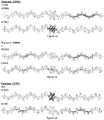
- the LUMO orbital is located on the HBC core and the HOMO orbital is located on the ZP46 polymer.
- This compound is therefore perfectly suitable for forming the donor:acceptor pair of an active layer.
- the LUMO orbital is perfectly located on the HBC core.
- This compound is therefore suitable for forming the donor:acceptor pair of an active layer.
- the LUMO orbital is perfectly located on the HBC core.
- This compound is therefore perfectly suitable for forming the donor:acceptor pair of an active layer.
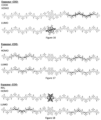
- the compound of Formula I in which the substituent R 1 , R 3 , R 4 and R 6 is a -NH 2 group, cannot constitute the donor:acceptor pair of an active layer either: the LUMO orbital is totally delocalized on ZP46 polymers.
- Example 7 Was synthesized in Example 7 a compound of Formula I wherein the substituents R 1 , R 3 , R 4 and R 6 are -CF 3 groups, in Example 8, the substituents R 1 , R 3 , R 4 and R 6 are -CN groups and in example 9, the substituents R 1 , R 3 , R 4 and R 6 are -COOH groups.
- the LUMO orbital is perfectly localized on the HBC core in these compounds.
- the compound of comparative example 15 cannot serve as a donor:acceptor pair for an active layer either: the LUMO orbital is delocalized on the substituents R 1 , R 3 , R 4 and R 6 , i.e. ie on the -NO 2 groups.
- the compounds of Formula I in which the spacer is an ester group also have another advantage: they are easy to synthesize, in particular when the R 1 , R 3 , R 4 and R 6 substituents are carboxylic groups.
- the first two conditions namely the localization of the charges and in particular of the LUMO and HOMO molecular orbitals, and the ability to create a stable columnar and helical structure are therefore fulfilled by the compounds of the invention.
- the compounds of the invention do not introduce any loss in efficiency and retain the energy separation between the HOMO and LUMO molecular orbitals.
- the hexabenzocoronene-based compound of Formula I is a compound in which the ZP46 polymer is linked to the HBC core by a spacer which is either -CONH- or -COOX- and more particularly in which the spacer is -COO-.
- An active layer comprising a compound of Formula I according to the invention therefore has characteristics of stability to photooxidation and particularly advantageous electronic properties.
- an electronic device comprising such a compound has particularly advantageous conformational stability and resistance to photooxidation.
- Such an electronic device is in particular an organic photovoltaic cell.
- mW signifies microwave heating
- DDQ signifies 2,3-dichloro-5,6-1,4-benzoquinone
- This reaction scheme shows more precisely the synthesis of the preferred compound of the invention in which the spacer is a -COO- group.
- Step f) was carried out as described in JR Martinelli, DA Watson, DMM Freckmann, TE Barder, and SL Buchwald, J. Org. Chem. 2008, 73, 7102-7107 And C. Wai Cheung and SL Buchwald, Organic Letters, 2013, 15, 3998-4001 .
- the ZP46 compound used to synthesize the compounds of the invention was synthesized according to the following reaction scheme:
- the precatalyst used in step b) was a Palladacycle precatalyst described in C. Wai Cheung and SL Buchwald, Organic Letters, 2013, 15, 3998-4001 .
Landscapes
- Chemical & Material Sciences (AREA)
- Engineering & Computer Science (AREA)
- Materials Engineering (AREA)
- Physics & Mathematics (AREA)
- Polymers & Plastics (AREA)
- Organic Chemistry (AREA)
- Health & Medical Sciences (AREA)
- Medicinal Chemistry (AREA)
- Chemical Kinetics & Catalysis (AREA)
- Electromagnetism (AREA)
- Spectroscopy & Molecular Physics (AREA)
- Organic Low-Molecular-Weight Compounds And Preparation Thereof (AREA)
- Photovoltaic Devices (AREA)
Claims (9)
- Verbindung auf Hexabenzocoronen-Basis, das die folgende Formel I aufweist:
 - R1, R3, R4 und R6 unabhängig voneinander ausgewählt sind aus einer Carboxylgruppe (-COOH), einer Cyanogruppe (-C=N), einer Isocyanogruppe (-N+≡C-), einer Cyanatgruppe (-O-C=N) und einer Gruppe (CF3), und- R2 und R5 die folgende Formel (1) aufweisen:wobei R Methyl oder C6H13 ist.
X(n1)-ZP46
Formel (1), wobei:o X eine Spacer-Gruppe ist, ausgewählt aus einer Gruppe -COO- und einer Gruppe -CONH-o n1= 0 oder 1, undo ZP46 die folgende Formel (2) aufweist:
- Verbindung auf Hexabenzocoronen-Basis nach Anspruch 1, wobei R1, R3, R4 und R6 gleich sind und Carboxylgruppen sind.
- Verbindung auf Hexabenzocoronen-Basis nach Anspruch 1 oder 2, wobei in Formel I n1 = 1 und X eine Gruppe -COO- ist.
- Verbindung nach einem der Ansprüche 1 bis 3, wobei das R Methyl ist.
- Verbindung nach einem der Ansprüche 1 bis 3, wobei das R C6H13 ist.
- Verbindung nach einem der Ansprüche 1 bis 5 der folgenden Formel I-1:


- Donor -Schicht: Akzeptor, umfassend einen Stapel von Verbindungen auf Hexabenzocoronen-Basis nach einem der Ansprüche 1 bis 6.
- Vorrichtung, umfassend mindestens eine Verbindung auf Hexabenzocoronen-Basis nach einem der Ansprüche 1 bis 6
- Vorrichtung nach Anspruch 8, die eine photovoltaische Zelle ist.
Applications Claiming Priority (2)
| Application Number | Priority Date | Filing Date | Title |
|---|---|---|---|
| FR1658459A FR3055897B1 (fr) | 2016-09-12 | 2016-09-12 | Materiaux accepteurs alternatifs a base d'hexabenzocoronene |
| PCT/FR2017/052398 WO2018046872A1 (fr) | 2016-09-12 | 2017-09-11 | Matériaux accepteurs alternatifs à base d'hexabenzocoronène |
Publications (2)
| Publication Number | Publication Date |
|---|---|
| EP3510075A1 EP3510075A1 (de) | 2019-07-17 |
| EP3510075B1 true EP3510075B1 (de) | 2023-03-01 |
Family
ID=57750081
Family Applications (1)
| Application Number | Title | Priority Date | Filing Date |
|---|---|---|---|
| EP17771825.1A Active EP3510075B1 (de) | 2016-09-12 | 2017-09-11 | Alternative akzeptorstoffe auf der basis von hexabenzocoronen |
Country Status (4)
| Country | Link |
|---|---|
| US (1) | US10886472B2 (de) |
| EP (1) | EP3510075B1 (de) |
| FR (1) | FR3055897B1 (de) |
| WO (1) | WO2018046872A1 (de) |
Families Citing this family (3)
| Publication number | Priority date | Publication date | Assignee | Title |
|---|---|---|---|---|
| KR102442768B1 (ko) * | 2017-12-27 | 2022-09-13 | 주식회사 엘지화학 | 헤테로환 화합물 및 이를 포함하는 유기 전자 소자 |
| CN114031753B (zh) * | 2020-12-31 | 2023-11-03 | 广东聚华印刷显示技术有限公司 | 有机聚合物及其应用 |
| CN115368540B (zh) * | 2021-09-30 | 2024-02-09 | 广东聚华印刷显示技术有限公司 | 聚合物、发光二极管及其制备方法 |
Family Cites Families (5)
| Publication number | Priority date | Publication date | Assignee | Title |
|---|---|---|---|---|
| JP4921400B2 (ja) * | 2008-03-03 | 2012-04-25 | 独立行政法人科学技術振興機構 | フラーレンを内外壁表面に有する超分子ナノチューブ |
| AU2009321486A1 (en) | 2008-11-28 | 2011-07-07 | The University Of Melbourne | Novel compounds, derivatives thereof and their use in heterojunction devices |
| JP2011102271A (ja) * | 2009-11-11 | 2011-05-26 | Japan Science & Technology Agency | ヘキサベンゾコロネン−ジアリールエテン連結分子からなる同軸ナノチューブによる光導電性の変調 |
| US20160204348A1 (en) * | 2014-01-31 | 2016-07-14 | The University Of Chicago | Semiconducting polymers and ternary blends thereof |
| CN104961665B (zh) * | 2015-06-05 | 2017-03-01 | 北京印刷学院 | 燕尾状侧链含硫醚的六苯并蔻化合物及其制备方法 |
-
2016
- 2016-09-12 FR FR1658459A patent/FR3055897B1/fr active Active
-
2017
- 2017-09-11 EP EP17771825.1A patent/EP3510075B1/de active Active
- 2017-09-11 US US16/332,718 patent/US10886472B2/en active Active
- 2017-09-11 WO PCT/FR2017/052398 patent/WO2018046872A1/fr not_active Ceased
Also Published As
| Publication number | Publication date |
|---|---|
| FR3055897A1 (fr) | 2018-03-16 |
| US10886472B2 (en) | 2021-01-05 |
| EP3510075A1 (de) | 2019-07-17 |
| WO2018046872A1 (fr) | 2018-03-15 |
| US20190221743A1 (en) | 2019-07-18 |
| FR3055897B1 (fr) | 2018-10-12 |
Similar Documents
| Publication | Publication Date | Title |
|---|---|---|
| Fang et al. | The functions of fullerenes in hybrid perovskite solar cells | |
| Li et al. | Efficient small bandgap polymer solar cells with high fill factors for 300 nm thick films | |
| Png et al. | High-performance polymer semiconducting heterostructure devices by nitrene-mediated photocrosslinking of alkyl side chains | |
| Zhao et al. | Solution-processable crystalline platinum-acetylide oligomers with broadband absorption for photovoltaic cells | |
| Ala'a et al. | Recent advances of non-fullerene, small molecular acceptors for solution processed bulk heterojunction solar cells | |
| JP5397379B2 (ja) | 有機光電変換素子、及びその製造方法 | |
| Kim et al. | Vertically Phase Separated Photomultiplication Organic Photodetectors with p‐n Heterojunction Type Ultrafast Dynamic Characteristics | |
| Cuesta et al. | Near-IR Absorbing D–A–D Zn-Porphyrin-Based Small-Molecule Donors for Organic Solar Cells with Low-Voltage Loss | |
| EP2348556A1 (de) | Organische dünnschichtsolarzelle | |
| JP2010529219A (ja) | 固体電子デバイスにおいて使用するためのポルフィリンおよび導電性ポリマー組成物 | |
| Hu et al. | Thiadiazoloquinoxaline-fused naphthalenediimides for N-type organic field-effect transistors (OFETs) | |
| Okamoto et al. | Synthesis and Characterization of Pentacene− and Anthradithiophene− Fluorene Conjugated Copolymers Synthesized by Suzuki Reactions | |
| WO2007048909A1 (fr) | Reseau de nanofibrilles polymerioues pour cellules photovoltaioues | |
| Alam et al. | Nanolayered heterojunctions of donor and acceptor conjugated polymers of interest in light emitting and photovoltaic devices: Photoinduced electron transfer at polythiophene/polyquinoline interfaces | |
| Wang et al. | End-capping effect of quinoxalino [2, 3-b′] porphyrin on donor–acceptor copolymer and improved performance of polymer solar cells | |
| Gong et al. | Design, synthesis, and postvapor treatment of neutral fulleropyrrolidine electron-collecting interlayers for high-efficiency inverted polymer solar cells | |
| JP2011181719A (ja) | フラーレン誘導体およびその製造方法 | |
| Raj et al. | Synthesis of conjugated perylene diimide-based copolymer with 5, 5′-bis (4-aminophenyl)-2-2′-bifuryl moiety as an active material for organic photovoltaics | |
| FR3011548A1 (fr) | Compose organique photoactif | |
| JP2007324587A (ja) | 有機光電変換素子の製造方法 | |
| EP3510075A1 (de) | Alternative akzeptorstoffe auf der basis von hexabenzocoronen | |
| Awada et al. | Bis-azide low-band gap cross-linkable molecule N3-[CPDT (FBTTh2) 2] to fully thermally stabilize organic solar cells based on P3HT: PC61BM | |
| JP5260379B2 (ja) | 有機薄膜太陽電池 | |
| Park et al. | Enhanced efficiency and stability of novel pseudo-ternary polymer solar cells enabled by a conjugated donor block copolymer | |
| JP2006344741A (ja) | 有機太陽電池とその製造方法 |
Legal Events
| Date | Code | Title | Description |
|---|---|---|---|
| STAA | Information on the status of an ep patent application or granted ep patent |
Free format text: STATUS: UNKNOWN |
|
| STAA | Information on the status of an ep patent application or granted ep patent |
Free format text: STATUS: THE INTERNATIONAL PUBLICATION HAS BEEN MADE |
|
| PUAI | Public reference made under article 153(3) epc to a published international application that has entered the european phase |
Free format text: ORIGINAL CODE: 0009012 |
|
| STAA | Information on the status of an ep patent application or granted ep patent |
Free format text: STATUS: REQUEST FOR EXAMINATION WAS MADE |
|
| 17P | Request for examination filed |
Effective date: 20190312 |
|
| AK | Designated contracting states |
Kind code of ref document: A1 Designated state(s): AL AT BE BG CH CY CZ DE DK EE ES FI FR GB GR HR HU IE IS IT LI LT LU LV MC MK MT NL NO PL PT RO RS SE SI SK SM TR |
|
| AX | Request for extension of the european patent |
Extension state: BA ME |
|
| DAV | Request for validation of the european patent (deleted) | ||
| DAX | Request for extension of the european patent (deleted) | ||
| RIN1 | Information on inventor provided before grant (corrected) |
Inventor name: BEGUE, DIDIER Inventor name: HIORNS, ROGER CLIVE Inventor name: SANTOS-SILVA, HUGO |
|
| GRAP | Despatch of communication of intention to grant a patent |
Free format text: ORIGINAL CODE: EPIDOSNIGR1 |
|
| STAA | Information on the status of an ep patent application or granted ep patent |
Free format text: STATUS: GRANT OF PATENT IS INTENDED |
|
| INTG | Intention to grant announced |
Effective date: 20220921 |
|
| GRAS | Grant fee paid |
Free format text: ORIGINAL CODE: EPIDOSNIGR3 |
|
| GRAA | (expected) grant |
Free format text: ORIGINAL CODE: 0009210 |
|
| STAA | Information on the status of an ep patent application or granted ep patent |
Free format text: STATUS: THE PATENT HAS BEEN GRANTED |
|
| AK | Designated contracting states |
Kind code of ref document: B1 Designated state(s): AL AT BE BG CH CY CZ DE DK EE ES FI FR GB GR HR HU IE IS IT LI LT LU LV MC MK MT NL NO PL PT RO RS SE SI SK SM TR |
|
| REG | Reference to a national code |
Ref country code: GB Ref legal event code: FG4D Free format text: NOT ENGLISH |
|
| REG | Reference to a national code |
Ref country code: CH Ref legal event code: EP Ref country code: AT Ref legal event code: REF Ref document number: 1550952 Country of ref document: AT Kind code of ref document: T Effective date: 20230315 |
|
| REG | Reference to a national code |
Ref country code: DE Ref legal event code: R096 Ref document number: 602017066429 Country of ref document: DE |
|
| REG | Reference to a national code |
Ref country code: IE Ref legal event code: FG4D Free format text: LANGUAGE OF EP DOCUMENT: FRENCH |
|
| REG | Reference to a national code |
Ref country code: LT Ref legal event code: MG9D |
|
| REG | Reference to a national code |
Ref country code: NL Ref legal event code: MP Effective date: 20230301 |
|
| PG25 | Lapsed in a contracting state [announced via postgrant information from national office to epo] |
Ref country code: RS Free format text: LAPSE BECAUSE OF FAILURE TO SUBMIT A TRANSLATION OF THE DESCRIPTION OR TO PAY THE FEE WITHIN THE PRESCRIBED TIME-LIMIT Effective date: 20230301 Ref country code: NO Free format text: LAPSE BECAUSE OF FAILURE TO SUBMIT A TRANSLATION OF THE DESCRIPTION OR TO PAY THE FEE WITHIN THE PRESCRIBED TIME-LIMIT Effective date: 20230601 Ref country code: LV Free format text: LAPSE BECAUSE OF FAILURE TO SUBMIT A TRANSLATION OF THE DESCRIPTION OR TO PAY THE FEE WITHIN THE PRESCRIBED TIME-LIMIT Effective date: 20230301 Ref country code: LT Free format text: LAPSE BECAUSE OF FAILURE TO SUBMIT A TRANSLATION OF THE DESCRIPTION OR TO PAY THE FEE WITHIN THE PRESCRIBED TIME-LIMIT Effective date: 20230301 Ref country code: HR Free format text: LAPSE BECAUSE OF FAILURE TO SUBMIT A TRANSLATION OF THE DESCRIPTION OR TO PAY THE FEE WITHIN THE PRESCRIBED TIME-LIMIT Effective date: 20230301 Ref country code: ES Free format text: LAPSE BECAUSE OF FAILURE TO SUBMIT A TRANSLATION OF THE DESCRIPTION OR TO PAY THE FEE WITHIN THE PRESCRIBED TIME-LIMIT Effective date: 20230301 |
|
| REG | Reference to a national code |
Ref country code: AT Ref legal event code: MK05 Ref document number: 1550952 Country of ref document: AT Kind code of ref document: T Effective date: 20230301 |
|
| PG25 | Lapsed in a contracting state [announced via postgrant information from national office to epo] |
Ref country code: SE Free format text: LAPSE BECAUSE OF FAILURE TO SUBMIT A TRANSLATION OF THE DESCRIPTION OR TO PAY THE FEE WITHIN THE PRESCRIBED TIME-LIMIT Effective date: 20230301 Ref country code: PL Free format text: LAPSE BECAUSE OF FAILURE TO SUBMIT A TRANSLATION OF THE DESCRIPTION OR TO PAY THE FEE WITHIN THE PRESCRIBED TIME-LIMIT Effective date: 20230301 Ref country code: NL Free format text: LAPSE BECAUSE OF FAILURE TO SUBMIT A TRANSLATION OF THE DESCRIPTION OR TO PAY THE FEE WITHIN THE PRESCRIBED TIME-LIMIT Effective date: 20230301 Ref country code: GR Free format text: LAPSE BECAUSE OF FAILURE TO SUBMIT A TRANSLATION OF THE DESCRIPTION OR TO PAY THE FEE WITHIN THE PRESCRIBED TIME-LIMIT Effective date: 20230602 Ref country code: FI Free format text: LAPSE BECAUSE OF FAILURE TO SUBMIT A TRANSLATION OF THE DESCRIPTION OR TO PAY THE FEE WITHIN THE PRESCRIBED TIME-LIMIT Effective date: 20230301 |
|
| PG25 | Lapsed in a contracting state [announced via postgrant information from national office to epo] |
Ref country code: SM Free format text: LAPSE BECAUSE OF FAILURE TO SUBMIT A TRANSLATION OF THE DESCRIPTION OR TO PAY THE FEE WITHIN THE PRESCRIBED TIME-LIMIT Effective date: 20230301 Ref country code: RO Free format text: LAPSE BECAUSE OF FAILURE TO SUBMIT A TRANSLATION OF THE DESCRIPTION OR TO PAY THE FEE WITHIN THE PRESCRIBED TIME-LIMIT Effective date: 20230301 Ref country code: PT Free format text: LAPSE BECAUSE OF FAILURE TO SUBMIT A TRANSLATION OF THE DESCRIPTION OR TO PAY THE FEE WITHIN THE PRESCRIBED TIME-LIMIT Effective date: 20230703 Ref country code: EE Free format text: LAPSE BECAUSE OF FAILURE TO SUBMIT A TRANSLATION OF THE DESCRIPTION OR TO PAY THE FEE WITHIN THE PRESCRIBED TIME-LIMIT Effective date: 20230301 Ref country code: CZ Free format text: LAPSE BECAUSE OF FAILURE TO SUBMIT A TRANSLATION OF THE DESCRIPTION OR TO PAY THE FEE WITHIN THE PRESCRIBED TIME-LIMIT Effective date: 20230301 Ref country code: AT Free format text: LAPSE BECAUSE OF FAILURE TO SUBMIT A TRANSLATION OF THE DESCRIPTION OR TO PAY THE FEE WITHIN THE PRESCRIBED TIME-LIMIT Effective date: 20230301 |
|
| PG25 | Lapsed in a contracting state [announced via postgrant information from national office to epo] |
Ref country code: SK Free format text: LAPSE BECAUSE OF FAILURE TO SUBMIT A TRANSLATION OF THE DESCRIPTION OR TO PAY THE FEE WITHIN THE PRESCRIBED TIME-LIMIT Effective date: 20230301 Ref country code: IS Free format text: LAPSE BECAUSE OF FAILURE TO SUBMIT A TRANSLATION OF THE DESCRIPTION OR TO PAY THE FEE WITHIN THE PRESCRIBED TIME-LIMIT Effective date: 20230701 |
|
| REG | Reference to a national code |
Ref country code: DE Ref legal event code: R097 Ref document number: 602017066429 Country of ref document: DE |
|
| PLBE | No opposition filed within time limit |
Free format text: ORIGINAL CODE: 0009261 |
|
| STAA | Information on the status of an ep patent application or granted ep patent |
Free format text: STATUS: NO OPPOSITION FILED WITHIN TIME LIMIT |
|
| PG25 | Lapsed in a contracting state [announced via postgrant information from national office to epo] |
Ref country code: SI Free format text: LAPSE BECAUSE OF FAILURE TO SUBMIT A TRANSLATION OF THE DESCRIPTION OR TO PAY THE FEE WITHIN THE PRESCRIBED TIME-LIMIT Effective date: 20230301 Ref country code: DK Free format text: LAPSE BECAUSE OF FAILURE TO SUBMIT A TRANSLATION OF THE DESCRIPTION OR TO PAY THE FEE WITHIN THE PRESCRIBED TIME-LIMIT Effective date: 20230301 |
|
| 26N | No opposition filed |
Effective date: 20231204 |
|
| REG | Reference to a national code |
Ref country code: CH Ref legal event code: PL |
|
| PG25 | Lapsed in a contracting state [announced via postgrant information from national office to epo] |
Ref country code: LU Free format text: LAPSE BECAUSE OF NON-PAYMENT OF DUE FEES Effective date: 20230911 |
|
| PG25 | Lapsed in a contracting state [announced via postgrant information from national office to epo] |
Ref country code: LU Free format text: LAPSE BECAUSE OF NON-PAYMENT OF DUE FEES Effective date: 20230911 Ref country code: IT Free format text: LAPSE BECAUSE OF FAILURE TO SUBMIT A TRANSLATION OF THE DESCRIPTION OR TO PAY THE FEE WITHIN THE PRESCRIBED TIME-LIMIT Effective date: 20230301 Ref country code: MC Free format text: LAPSE BECAUSE OF FAILURE TO SUBMIT A TRANSLATION OF THE DESCRIPTION OR TO PAY THE FEE WITHIN THE PRESCRIBED TIME-LIMIT Effective date: 20230301 |
|
| REG | Reference to a national code |
Ref country code: IE Ref legal event code: MM4A |
|
| PG25 | Lapsed in a contracting state [announced via postgrant information from national office to epo] |
Ref country code: IE Free format text: LAPSE BECAUSE OF NON-PAYMENT OF DUE FEES Effective date: 20230911 |
|
| PG25 | Lapsed in a contracting state [announced via postgrant information from national office to epo] |
Ref country code: CH Free format text: LAPSE BECAUSE OF NON-PAYMENT OF DUE FEES Effective date: 20230930 |
|
| PG25 | Lapsed in a contracting state [announced via postgrant information from national office to epo] |
Ref country code: IE Free format text: LAPSE BECAUSE OF NON-PAYMENT OF DUE FEES Effective date: 20230911 Ref country code: CH Free format text: LAPSE BECAUSE OF NON-PAYMENT OF DUE FEES Effective date: 20230930 |
|
| PG25 | Lapsed in a contracting state [announced via postgrant information from national office to epo] |
Ref country code: BG Free format text: LAPSE BECAUSE OF FAILURE TO SUBMIT A TRANSLATION OF THE DESCRIPTION OR TO PAY THE FEE WITHIN THE PRESCRIBED TIME-LIMIT Effective date: 20230301 |
|
| PG25 | Lapsed in a contracting state [announced via postgrant information from national office to epo] |
Ref country code: BG Free format text: LAPSE BECAUSE OF FAILURE TO SUBMIT A TRANSLATION OF THE DESCRIPTION OR TO PAY THE FEE WITHIN THE PRESCRIBED TIME-LIMIT Effective date: 20230301 |
|
| PG25 | Lapsed in a contracting state [announced via postgrant information from national office to epo] |
Ref country code: CY Free format text: LAPSE BECAUSE OF FAILURE TO SUBMIT A TRANSLATION OF THE DESCRIPTION OR TO PAY THE FEE WITHIN THE PRESCRIBED TIME-LIMIT; INVALID AB INITIO Effective date: 20170911 |
|
| PG25 | Lapsed in a contracting state [announced via postgrant information from national office to epo] |
Ref country code: HU Free format text: LAPSE BECAUSE OF FAILURE TO SUBMIT A TRANSLATION OF THE DESCRIPTION OR TO PAY THE FEE WITHIN THE PRESCRIBED TIME-LIMIT; INVALID AB INITIO Effective date: 20170911 |
|
| PGFP | Annual fee paid to national office [announced via postgrant information from national office to epo] |
Ref country code: BE Payment date: 20250929 Year of fee payment: 9 Ref country code: GB Payment date: 20250929 Year of fee payment: 9 |
|
| PGFP | Annual fee paid to national office [announced via postgrant information from national office to epo] |
Ref country code: FR Payment date: 20250929 Year of fee payment: 9 |
|
| PG25 | Lapsed in a contracting state [announced via postgrant information from national office to epo] |
Ref country code: TR Free format text: LAPSE BECAUSE OF FAILURE TO SUBMIT A TRANSLATION OF THE DESCRIPTION OR TO PAY THE FEE WITHIN THE PRESCRIBED TIME-LIMIT Effective date: 20230301 |
|
| PGFP | Annual fee paid to national office [announced via postgrant information from national office to epo] |
Ref country code: DE Payment date: 20251029 Year of fee payment: 9 |