EP3486285B1 - Thermisch härtbare harzzusammensetzung, damit hergestellte statorspule und dynamoelektrische maschine - Google Patents
Thermisch härtbare harzzusammensetzung, damit hergestellte statorspule und dynamoelektrische maschine Download PDFInfo
- Publication number
- EP3486285B1 EP3486285B1 EP16908808.5A EP16908808A EP3486285B1 EP 3486285 B1 EP3486285 B1 EP 3486285B1 EP 16908808 A EP16908808 A EP 16908808A EP 3486285 B1 EP3486285 B1 EP 3486285B1
- Authority
- EP
- European Patent Office
- Prior art keywords
- epoxy resin
- inorganic particles
- resin composition
- insulating tape
- stator coil
- Prior art date
- Legal status (The legal status is an assumption and is not a legal conclusion. Google has not performed a legal analysis and makes no representation as to the accuracy of the status listed.)
- Active
Links
Images

Classifications
-
- H—ELECTRICITY
- H02—GENERATION; CONVERSION OR DISTRIBUTION OF ELECTRIC POWER
- H02K—DYNAMO-ELECTRIC MACHINES
- H02K3/00—Details of windings
- H02K3/30—Windings characterised by the insulating material
-
- C—CHEMISTRY; METALLURGY
- C08—ORGANIC MACROMOLECULAR COMPOUNDS; THEIR PREPARATION OR CHEMICAL WORKING-UP; COMPOSITIONS BASED THEREON
- C08K—Use of inorganic or non-macromolecular organic substances as compounding ingredients
- C08K3/00—Use of inorganic substances as compounding ingredients
- C08K3/18—Oxygen-containing compounds, e.g. metal carbonyls
- C08K3/20—Oxides; Hydroxides
- C08K3/22—Oxides; Hydroxides of metals
-
- C—CHEMISTRY; METALLURGY
- C08—ORGANIC MACROMOLECULAR COMPOUNDS; THEIR PREPARATION OR CHEMICAL WORKING-UP; COMPOSITIONS BASED THEREON
- C08K—Use of inorganic or non-macromolecular organic substances as compounding ingredients
- C08K3/00—Use of inorganic substances as compounding ingredients
- C08K3/01—Use of inorganic substances as compounding ingredients characterized by their specific function
- C08K3/013—Fillers, pigments or reinforcing additives
-
- C—CHEMISTRY; METALLURGY
- C08—ORGANIC MACROMOLECULAR COMPOUNDS; THEIR PREPARATION OR CHEMICAL WORKING-UP; COMPOSITIONS BASED THEREON
- C08L—COMPOSITIONS OF MACROMOLECULAR COMPOUNDS
- C08L63/00—Compositions of epoxy resins; Compositions of derivatives of epoxy resins
-
- H—ELECTRICITY
- H02—GENERATION; CONVERSION OR DISTRIBUTION OF ELECTRIC POWER
- H02K—DYNAMO-ELECTRIC MACHINES
- H02K3/00—Details of windings
- H02K3/32—Windings characterised by the shape, form or construction of the insulation
- H02K3/34—Windings characterised by the shape, form or construction of the insulation between conductors or between conductor and core, e.g. slot insulation
-
- C—CHEMISTRY; METALLURGY
- C08—ORGANIC MACROMOLECULAR COMPOUNDS; THEIR PREPARATION OR CHEMICAL WORKING-UP; COMPOSITIONS BASED THEREON
- C08K—Use of inorganic or non-macromolecular organic substances as compounding ingredients
- C08K2201/00—Specific properties of additives
- C08K2201/002—Physical properties
- C08K2201/003—Additives being defined by their diameter
-
- C—CHEMISTRY; METALLURGY
- C08—ORGANIC MACROMOLECULAR COMPOUNDS; THEIR PREPARATION OR CHEMICAL WORKING-UP; COMPOSITIONS BASED THEREON
- C08K—Use of inorganic or non-macromolecular organic substances as compounding ingredients
- C08K2201/00—Specific properties of additives
- C08K2201/011—Nanostructured additives
-
- C—CHEMISTRY; METALLURGY
- C08—ORGANIC MACROMOLECULAR COMPOUNDS; THEIR PREPARATION OR CHEMICAL WORKING-UP; COMPOSITIONS BASED THEREON
- C08K—Use of inorganic or non-macromolecular organic substances as compounding ingredients
- C08K3/00—Use of inorganic substances as compounding ingredients
- C08K3/16—Halogen-containing compounds
-
- C—CHEMISTRY; METALLURGY
- C08—ORGANIC MACROMOLECULAR COMPOUNDS; THEIR PREPARATION OR CHEMICAL WORKING-UP; COMPOSITIONS BASED THEREON
- C08K—Use of inorganic or non-macromolecular organic substances as compounding ingredients
- C08K9/00—Use of pretreated ingredients
- C08K9/04—Ingredients treated with organic substances
- C08K9/06—Ingredients treated with organic substances with silicon-containing compounds
-
- C—CHEMISTRY; METALLURGY
- C08—ORGANIC MACROMOLECULAR COMPOUNDS; THEIR PREPARATION OR CHEMICAL WORKING-UP; COMPOSITIONS BASED THEREON
- C08L—COMPOSITIONS OF MACROMOLECULAR COMPOUNDS
- C08L2203/00—Applications
- C08L2203/20—Applications use in electrical or conductive gadgets
Definitions
- the present invention relates to a stator coil obtained through use of a thermosetting resin composition, and a rotating electric machine.
- a stator of a rotating electric machine includes stator coils accommodated in a plurality of slots formed on an inner peripheral side of a stator core.
- Each of the stator coils includes a coil conductor and a stator coil insulator for covering the coil conductor.
- the stator coil is manufactured by winding an insulating tape in which a fiber reinforcing material, for example, glass cloth, is bonded to a mica sheet around the coil conductor several times, impregnating the insulating tape with a liquid thermosetting resin composition (insulating varnish) having low viscosity under reduced pressure, and heating the impregnated insulating tape while subjecting the impregnated insulating tape to press molding so as to obtain a predetermined sectional shape.
- insulating varnish liquid thermosetting resin composition
- stator coils are accommodated in two upper and lower stages in each of the slots, and electromagnetic vibration generated from the stator coils during operation of the rotating electric machine is suppressed by inserting a spacer between the stator coils and inserting a wedge for fixing the stator coil into an opening end portion of the slot.
- thermosetting resin composition In general, as described above, insulating tape and the like are used in the stator coil, and in order to fix the insulating tape and the like, they are subjected to impregnation-heating treatment through use of a thermosetting resin composition. Regarding the impregnation-heating treatment, the following has been known. It is important that the thermosetting resin composition be filled into gaps of the insulating tape and the like, and with this, it has been known that mechanical characteristics and electric insulation characteristics of the insulating tape and the like can be enhanced.
- stator coil insulator is placed in an environment in which the stator coil insulator is constantly exposed to high electric stress. Still further, it has been known that in general, rotating electric machines are used for long periods of several years or longer, and voids are generated in resin of the insulator due to long-term thermal and mechanical stress, and that partial discharge occurs in the voids under high-voltage environments, and that the resin of the insulator is decomposed due to repeated discharge, with the result that machine life is influenced.
- thermosetting resin composition having mixed therein nanoparticles with which gaps in the insulating tape and the like can be impregnated, in order to improve machine life through suppression of partial discharge.
- Patent Document 1 JP 2006-057017 A
- JP 2006 057017 A relates to a partial discharge resistant insulating resin composition for high-voltage equipment such as an insulating coil conductor containing an epoxy resin, a curing agent for the epoxy resin, and at least one kind of inorganic nanoparticles selected from layer clay minerals, oxide nano-particles, nitride nano-particles and carbon black.
- the present invention has been made to solve the above-mentioned problems, and an object of the present invention is to obtain a stator coil obtained through use of a thermosetting resin composition capable of achieving improvement of machine life through suppression of partial discharge and miniaturization and high output of a machine through improvement of the dielectric-breakdown electric field properties, and a rotating electric machine.
- thermosetting resin composition including: an epoxy resin containing a curing agent; and inorganic particles having a rutile-type crystal structure and an average particle diameter of 500 nm or less.
- a stator coil obtained through use of a thermosetting resin composition excellent in partial discharge resistance and dielectric-breakdown electric field property, and a rotating electric machine can be obtained.
- FIG. 1 is a schematic sectional view for illustrating a configuration of a thermosetting resin composition according to a first embodiment suitable for the present invention.
- the basic configuration of the thermosetting resin composition according to the first embodiment is described with reference to FIG. 1 .
- the thermosetting resin composition according to the first embodiment has a feature of including an epoxy resin 1 containing a curing agent and inorganic particles 2 having an average particle diameter of 500 nm or less and having a rutile-type crystal structure.
- the epoxy resin 1 contains an epoxy group in its skeleton, and specific examples thereof include a bisphenol A-type epoxy resin, a bisphenol F-type epoxy resin, a bisphenol S-type epoxy resin, a biphenol-type epoxy resin, a phenol novolac-type epoxy resin, a cresol novolac-type epoxy resin, a bisphenol A-type novolac-type epoxy resin, a bisphenol F-type novolac-type epoxy resin, an alicyclic epoxy resin, an aliphatic chain epoxy resin, a glycidyl ester-type epoxy resin, a glycidyl amine-type epoxy resin, a hydantoin-type epoxy resin, an isocyanurate-type epoxy resin, a salicylaldehyde novolac-type epoxy resin, diglycidyl etherified products of other bifunctional phenols, and diglycidyl etherified products of bifunctional alcohols, and
- the resins may be used in combination thereof. Further, from the viewpoint of balance in cost, viscosity, and heat resistance, a reaction product of epichlorohydrin and a bisphenol A compound is preferred.
- a reaction product of epichlorohydrin and a bisphenol A compound is preferred.
- product examples thereof there are given: Epicoat (trademark) 828 and Epicoat (trademark) 825 (product names, manufactured by Japan Epoxy Resins Co., Ltd.); Epotohto (trademark) YD128 (product name, manufactured by Tohto Kasei Co., Ltd.); Epiclon (trademark) 50 (product name, manufactured by DIC Corporation); and Sumi-epoxy (trademark) ELA-128 (product name, manufactured by Sumitomo Chemical Co., Ltd.).
- an epoxy resin having three or more epoxy groups may be used alone or in combination with the above-mentioned epoxy resins.
- the epoxy resin having three or more epoxy groups include resorcinol diglycidyl ether (1,3-bis-(2,3-epoxypropoxy)benzene), diglycidyl ether of bisphenol A (2,2-bis(p-(2,3-epoxypropoxy)phenyl)propane), triglycidyl p-aminophenol (4-(2,3-epoxypropoxy)-N,N-bis(2,3-epoxypropyl)aniline), diglycidyl ether of bromobisphenol A (2,2-bis(4-(2,3-epoxypropoxy)-3-bromo-phenyl)propane), diglycidyl ether of bisphenol F (2,2-bis(p-(2,3-epoxypropoxy)pheny
- the above-mentioned resins can enhance heat resistance in accordance with an addition amount thereof, in general, those resins have high viscosity and cause an increase in viscosity of the resin composition. Therefore, a balance between the addition amount and the heat resistance is required. From this viewpoint, phenol novolac epoxy or cresol novolac epoxy is particularly preferred.
- the curing agent is not particularly limited as long as the curing agent can react with the epoxy resin to cure the epoxy resin, and there are given, for example, the following acid anhydrides, amine-based compounds, and imidazole-based compounds.
- the acid anhydrides there are given hexahydrophthalic anhydride, tetrahydrophthalic anhydride, methylhexahydrophthalic anhydride, methyltetrahydrophthalic anhydride, and methylnadic anhydride.
- the acid anhydrides may be used alone or in combination thereof. It is preferred that the acid anhydride be a liquid at normal temperature (25 °C). When the acid anhydride is a liquid at normal temperature (25 °C), the viscosity of the thermosetting resin composition can be decreased, and hence impregnability of the thermosetting resin composition can be enhanced.
- the blending amount of the acid anhydride is preferably from 10 parts by mass to 150 parts by mass, more preferably from 30 parts by mass to 120 parts by mass, still more preferably from 50 parts by mass to 100 parts by mass with respect to 100 parts by mass of a bisphenol-type epoxy resin.
- thermosetting resin composition can be appropriately cured.
- equivalent ratio of an acid anhydride group of the acid anhydride with respect to an epoxy group of the bisphenol-type epoxy resin is preferably from 0.7 to 1.3, more preferably from 0.8 to 1.2, still more preferably from 0.9 to 1.1.
- the equivalent ratio is less than 0.7, the viscosity of the thermosetting resin composition is liable to be increased. As a result, in order to ensure the impregnability of the thermosetting resin composition, it is required to increase the temperature, and the pot life of the thermosetting resin composition is shortened in some cases. Meanwhile, when the equivalent ratio is more than 1.3, for example, the heat resistance of a cured product is liable to be decreased.
- examples of the amine-based curing agent include, but not limited to, ethylenediamine, 1,3-diaminopropane, 1,4-diaminobutane, hexamethylenediamine, dipropylenediamine, polyetherdiamine, 2,5-dimethylhexamethylenediamine, trimethylhexamethylenediamine, diethylenetriamine, iminobispropylamine, bis(hexamethyl)triamine, triethylenetetramine, tetraethylenepentamine, pentaethylenehexamine, aminoethylethanolamine, tri(methylamino)hexane, dimethylaminopropylamine, diethylaminopropylamine, methyliminobispropylamine, menthenediamine, isophoronediamine, bis(4-amino-3-methyldicyclohexyl)methane, diaminodicyclohexylmethane, bis(aminomethyl)cycl
- imidazole-based curing agent examples include, but not limited to, 2-methylimidazole, 2-undecylimidazole, 1,2-dimethylimidazole, 2-ethyl-4-methylimidazole, 2-heptadecylimidazole, 2-phenylimidazole, 2-phenyl-4-methylimidazole, 1-benzyl-2-methylimidazole, and 1-benzyl-2-phenylimidazole.
- a reactive diluent is added in order to decrease the viscosity, so that the viscosity can be appropriately adjusted.
- the reactive diluent a styrene monomer, a monomer having a functional group of a hydrocarbon added to a phenyl group thereof, a methacrylic monomer, or an acrylic monomer may be used.
- the (meth)acrylic monomer there is no particular limitation on the (meth)acrylic monomer as long as the (meth)acrylic monomer can decrease the viscosity without impairing the characteristics of the epoxy resin, and a linear (meth)acrylate, a branched (meth)acrylate, a cyclic (meth)acrylate, and the like may be used.
- linear (meth)acrylate examples include 2-ethylhexyl acrylate, cyclohexyl acrylate, diethylene glycol mono-2-ethylhexyl ether acrylate, diethylene glycol monophenyl ether acrylate, tetraethylene glycol monophenyl ether acrylate, trimethylolpropane triacrylate, lauryl acrylate, lauryl methacrylate, isobornyl acrylate, isobornyl methacrylate, 2-phenoxyethyl acrylate, tetrahydrofurfuryl acrylate, 2-hydroxypropyl acrylate, benzyl acrylate, tetrahydrofurfuryl methacrylate, 2-hydroxyethyl methacrylate, benzyl methacrylate, cyclohexyl methacrylate, and 2-(
- the blending amount of the reactive diluent there is no particular limitation on the blending amount of the reactive diluent, and it is only required that the blending amount be appropriately adjusted.
- the blending amount is preferably from 50 parts by mass to 310 parts by mass, more preferably from 70 parts by mass to 250 parts by mass, still more preferably from 100 parts by mass to 200 parts by mass with respect to 100 parts by mass of the bisphenol-type epoxy resin. With such blending amount, the viscosity of the epoxy resin composition can be decreased.
- the inorganic particles 2 having a rutile-type crystal structure and an average particle diameter of 500 nm or less are described.
- the inorganic particles according to the first embodiment must have an insulating property, and the crystal structure thereof must be of a rutile type from the viewpoint of dielectric-breakdown electric field properties.
- the inorganic particles 2 with a rutile-type crystal have a hexagonal close-packed structure in which packing of anions is distorted, and half of the octahedral voids are occupied by cations. With this crystal structure, it is assumed that cations are regularly arranged at an interface between the inorganic particles 2 and the epoxy resin 1 containing a curing agent, and electron carriers flowing to the resin at the time of dielectric breakdown are trapped at an interface between the resin and the particles, with the result that the dielectric-breakdown electric field property is improved.
- the average particle diameter of the inorganic particles 2 according to the first embodiment is characterized in that D50 in a median diameter (50% diameter, D50) is 500 nm or less.
- a laser diffraction scattering method particle size distribution device for example, Microtrac (product name), Model: MT3300
- the interparticle distance is enlarged as the particle diameter is increased, and hence the probability of trapping electrons is liable to be decreased at the time of partial discharge.
- the median diameter must be 500 nm or less in order to improve partial discharge resistance.
- the inorganic particles 2 having the above-mentioned median diameter a resin excellent in partial discharge resistance can be provided.
- the particle diameter is decreased, the viscosity is liable to be increased at the time of adding the inorganic particles to the resin.
- the median diameter be 300 nm or less in consideration of impregnability in the gaps of electric wire or tape. From the above-mentioned viewpoints of the viscosity and the impregnability, it is more desirable that the particle diameter of the inorganic particles fall within a range of from 10 nm to 300 nm.
- the inorganic particles may be represented by MX2 (M: cations, X: anions), and insulating inorganic particles particularly effective for improving the dielectric-breakdown electric field property have a chemical composition represented by MO2.
- MO2 Metal atom
- M metal atom
- O oxygen atom
- MO2 divalent and has a coordination number of 3
- the ratio (ionic radius ratio) of an ionic radius of M to an ionic radius of O falls within a range of from 0.40 to 0.51 (ionic radius of M/ionic radius of O is from 0.40 to 0.51).
- metal atoms having an ionic radius ratio within this range there are given Ti, Sn, Mo, Nb, Ta, Cr, W, and Ir.
- the blending amount of the inorganic particles 2 fall within a range of from 1 vol% to 50 vol% with respect to the total amount of the epoxy resin 1 containing a curing agent defined as 100. When the blending amount is less than 1 vol%, the partial discharge resistance cannot be imparted in some cases.
- the blending amount is more than 50 vol%, the viscosity of the epoxy resin 1 is increased, and it becomes difficult for the inorganic particles 2 to be uniformly dispersed in the epoxy resin 1 in some cases. Further, an inconvenience occurs where the impregnability is decreased, and the resin does not fill into the gaps of a tape or an electric wire.
- the inorganic particles 2 are present while being dispersed in the epoxy resin 1, and carrier electrons of dielectric breakdown are trapped at the interface with respect to the epoxy resin 1. Therefore, the probability of trapping electrons is increased due to an increase in interface area. Further, in order to improve the partial discharge resistance and the dielectric-breakdown electric field property, the probability of the inorganic particles 2 being present is an important parameter, and hence it is desired that the inorganic particles 2 be singly dispersed as primary particles to increase the interface area.
- the dispersion of the inorganic particles 2 in the epoxy resin 1 is important, and in order to realize this dispersion, it is desired that organic modifying groups 3 be added to each surface of the inorganic particles 2 through use of a coupling agent, a surface treatment agent, or the like on each surface of the inorganic particles 2.
- Examples of such surface treatment agent may include: silane coupling agents, such as ⁇ -glycidoxy-propyltrimethoxysilane, ⁇ -aminopropyl-trimethoxysilane, vinyltriethoxysilane, 3-methacryloxypropyltrimethoxysilane, and 3-glycidyloxypropyl-trimethoxysilane; coupling agents, such as a titanate-based coupling agent and an aluminum-based coupling agent; and aluminum laurate, aluminum stearate, iron stearate, aluminum hydroxide, alumina, silica, zirconia, and silicone.
- silane coupling agents such as ⁇ -glycidoxy-propyltrimethoxysilane, ⁇ -aminopropyl-trimethoxysilane, vinyltriethoxysilane, 3-methacryloxypropyltrimethoxysilane, and 3-glycidyloxypropyl-trimethoxysilane
- the surface treatment agent there are surface treatment agents called inorganic compound-based surface treatment agents such as silica or alumina used in Patent Document 1 and surface treatment agents called organic compound-based surface treatment agents, in the configuration of the thermosetting resin composition according to the first embodiment, the organic compound-based surface treatment agent is desired.
- the transfer time of the electrons between the epoxy resin 1 and the inorganic particles 2 is related to a HOMO-LUMO level or a bandgap difference between a conduction band and a valence band of the inorganic particles 2 and the epoxy resin 1.
- the gap difference is liable to be decreased. Therefore, when the inorganic compound-based surface treatment agent is applied to inorganic particles, the probability of trapping electrons is decreased at the time of dielectric breakdown or partial discharge, and hence an undesirable tendency is liable to occur.
- the interface becomes a mechanical weak point, and cracks occur at the interface due to mechanical stress over time, with the result that the strength of a material is decreased in some cases.
- the cross-linking of the resin proceeds due to a curing reaction, and a three-dimensional chemical bond is formed, with the result that the epoxy resin 1 has high mechanical strength.
- the interface has no functional group that reacts with the epoxy resin 1 on particle surfaces, the interface has no chemical bond.
- an organic modifying group 3 on the surface of the inorganic particle 2 have a structure represented by -O-(Y)-(A)-phenyl(Y).
- (Y) represents Si or Ti
- (A) is absent or represents a C1 to C6 alkyl group or a structure obtained by substituting a part of hydrogen atoms thereof by NH.
- this structure has a phenyl group having high affinity with the epoxy resin, and hence the organic modifying group is entangled with the structure of a three-dimensional chemical bond of the resin at a molecular level, with the result that the strength of a material can be maintained at the interface.
- Example 1 of Table 1 bisphenol A-type epoxy and hexahydrophthalic anhydride were blended in a weight ratio of 100:90, and further, inorganic particles were blended in the mixture in accordance with Table 1.
- the resultant was mixed by a planetary centrifugal mixer.
- the blending ratio of Table 1 represents a volume content (vol%) with respect to a resin and a curing agent.
- the obtained mixture was subjected to vacuum deaeration treatment and then heated at 120 °C for 4 hours to produce a cured product of a thermosetting resin composition.
- the cured product was determined for a dielectric-breakdown electric field in accordance with JIS C 2110-1. That is, the strength ratio was determined under a condition in which the dielectric-breakdown electric field of a cured product formed of an epoxy resin and a curing agent, which did not contain inorganic particles, was defined as 1.
- a strength ratio of 1.8 or more, with which miniaturization of a rotating machine could be sufficiently realized was defined as O
- a strength ratio of from 1.4 to less than 1.8, with which the miniaturization could be realized was defined as ⁇
- a strength ratio of from 1 to less than 1.4, with which the miniaturization could not be easily realized was defined as ⁇ .
- the surface of the cured product processed into a flat plate was polished, and then the surface of the cured product was eroded through partial discharge by application of a predetermined voltage for 24 hours through use of rod electrodes.
- the surface roughness of the cured product at this time was measured with a laser microscope to determine the maximum depth of erosion.
- a depth ratio was determined under a condition in which the maximum depth of erosion of the cured product formed of the epoxy resin and the curing agent, which did not contain the inorganic particles, was defined as 10.
- a depth ratio of from 8 to 10, with which the reliability was not expected to be improved was defined as ⁇ .
- a mica tape having a thickness of 120 ⁇ m was wound around a conductor ten times in a half overlaid state to prepare a simulated coil having a length of 60 cm. Then, a mixture of a resin, a curing agent, and inorganic particles was heated to 60 °C and the simulated coil was impregnated therewith for 5 hours under a vacuum state and pressure reduced to 1 torr. The cross section of the center portion of the simulated coil was observed with a stereoscopic microscope to confirm whether or not gaps of the tape were impregnated with the resin composition.
- thermosetting resin composition is related to "depth of erosion caused by partial discharge”
- dielectric-breakdown electric field property is related to "dielectric-breakdown electric field ratio”.
- Example 2 to 12 and Comparative Examples 1 to 6 of Table 1 blending was also performed based on Table 1, and the same evaluations as those of Example 1 were made. That is, the conditions except for the use of the inorganic particles of Table 1 were set to the same. As a result, in Example 1, the maximum depth of erosion was small, and the improvement of the partial discharge resistance was observed as compared to those of Comparative Example 1.
- thermosetting resin composition according to the first embodiment is excellent in partial discharge resistance and dielectric-breakdown electric field property and hence can improve machine life and enable miniaturization and high output of the machine.
- a stator coil according to a second embodiment which is according to the present invention includes a coil conductor and an insulating layer integrated with the coil conductor by winding an insulating tape around an outer peripheral portion of the coil conductor, impregnating the insulating tape with the thermosetting resin composition of the first embodiment, and curing the impregnated insulating tape by heating and pressurizing.
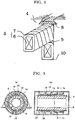
- the stator coil according to the second embodiment has a feature in the thermosetting resin composition to be used, and as the other configurations thereof, conventionally known configurations (for example, the configuration illustrated in FIG. 2 ) may be employed.
- stator coils 5 each including a coil conductor 6 and an insulating layer 7 are accommodated in two upper and lower stages in a plurality of slots 10 formed on an inner peripheral side of a stator core 4.
- a spacer 9 is inserted between the stator coils 5, and a wedge 8 for fixing the stator core 5 is inserted in an opening end portion of the slot 10.
- the stator coil 5 having the above-mentioned structure is manufactured as follows. First, an insulating tape is wound around an outer peripheral portion of the coil conductor 6 formed of a plurality of insulated and coated element wire conductors a plurality of times so that a part of the insulating tape (for example, a half portion of a width of the insulating tape) overlaps.
- a part of the insulating tape for example, a half portion of a width of the insulating tape
- the element wires forming the coil conductor 6 there is no particular limitation on the element wires forming the coil conductor 6 as long as the element wires have conductivity, and element wires made of copper, aluminum, silver, or the like may be used.
- thermosetting resin the same thermosetting resin as that exemplified in the first embodiment is used.
- an impregnation method there are given vacuum impregnation, vacuum pressurizing impregnation, normal pressure impregnation, and the like.
- condition for impregnation there is no particular limitation on the condition for impregnation, and it is only required that the condition be appropriately adjusted in accordance with the kinds of thermosetting resin composition and the like to be used.
- the insulating tape need not be provided.
- the coil conductor 6 is clamped from outside of the insulating tape so that pressure is applied to the insulating tape.
- the insulating tape is heated and pressurized to cure the thermosetting resin composition with which the insulating tape is impregnated so that an insulating layer is formed. With this, the stator coil 5 is obtained.
- the stator coil 5 according to the second embodiment manufactured as described above is excellent in partial discharge resistance and dielectric-breakdown electric field property of the resin, and hence can improve machine life and enable miniaturization and high output of the machine.
- the present invention is not directly limited to the above-mentioned embodiments and may be embodied by modifying components within a range not departing from the spirit of the present invention in an implementation stage.
- thermosetting resin composition according to the first embodiment is applied to coil insulation of a rotating electric machine, for example, a turbine generator.
- a rotating electric machine for example, a turbine generator.
- the coil described in the second embodiment is used.
- FIG. 3(a) and FIG. 3(b) are each a schematic sectional view of the power generator as one example of the rotating electric machine.
- FIG. 3(a) is a sectional view taken along the line 1a-1a of FIG. 3(b) extending straight to a rotation shaft of the power generator as one example of the rotating electric machine.
- FIG. 3(b) is a sectional view for illustrating a cross section along the rotation shaft of the power generator as one example of the rotating electric machine.
- a stator of the rotating electric machine includes a cylindrical stator core 4, a plurality of (eight in this example) core fastening members 12, a plurality of (four in this example) retaining rings 13, a cylindrical frame 14, a plurality of (five in this example) ring-shaped middle frame members 15, a plurality of (four in this example) elastic support members 16, and the like.
- the stator core 4 accommodates a rotator (not shown).
- the core fastening members 12 are provided in an outer peripheral portion of the stator core 4 at predetermined intervals in a circumferential direction of the stator core 4 and fasten the stator core 4 in an axial direction thereof.
- the retaining rings 13, which are flat in the axial direction, are provided in the outer peripheral portion of the stator core 4 at a predetermined interval in the axial direction and retain the stator core 4 by fastening the stator core 4 in a center portion direction thereof from above the core fastening members 12.
- the frame 14 surrounds the periphery of the stator core 4 at an interval.
- the middle frame members 15 are provided at predetermined intervals in the axial direction so as to protrude from an inner surface of the frame 14 in an axial center direction.
- the elastic support members 16 are formed of spring plates each being fixed to the adjacent middle frame members 15 and fixed to the retaining rings 13 at each center portion in the axial direction of the adjacent middle frame members 15.
- the stator illustrated in FIG. 3 forms, for example, an armature of the turbine generator.
- slots formed in the axial direction are arranged in a predetermined number in the circumferential direction, and the stator coils 5 are arranged in the slots as illustrated in FIG. 2 .
- the rotating electric machine for example, the turbine generator, higher output and further miniaturization are required.
- the insulating performance of a coil insulator must be improved.
- the resin composition according to the first embodiment to the stator coil of the rotating electric machine, the effect of achieving higher output and further miniaturization can be expected. Further, those coils are generally used in combination with resin, an insulating tape, and the like, and a rotating electric machine excellent in partial discharge resistance and dielectric-breakdown electric field property can be obtained by employing the configuration of the thermosetting resin composition described in the first embodiment.
Landscapes
- Chemical & Material Sciences (AREA)
- Health & Medical Sciences (AREA)
- Chemical Kinetics & Catalysis (AREA)
- Medicinal Chemistry (AREA)
- Polymers & Plastics (AREA)
- Organic Chemistry (AREA)
- Engineering & Computer Science (AREA)
- Power Engineering (AREA)
- Compositions Of Macromolecular Compounds (AREA)
- Insulation, Fastening Of Motor, Generator Windings (AREA)
Claims (7)
- Statorspule (5), die Folgendes aufweist:- einen Spulenleiter (6); und- eine Isolierschicht (7), die ein um den Spulenleiter (6) gewickeltes Isolierband ist, wobei das Isolierband mit einer wärmehärtenden Harzzusammensetzung imprägniert ist und wobei das imprägnierte Isolierband durch Erwärmen und Druckbeaufschlagen geformt ist,wobei die wärmehärtende Harzzusammensetzung Folgendes aufweist:- ein Epoxidharz (1), das ein Härtungsmittel enthält; und- anorganische Teilchen (2) mit einer Kristallstruktur vom Rutiltyp und einem durchschnittlichen Teilchendurchmesser von 500 nm oder weniger.
- Statorspule (5) nach Anspruch 1,
wobei die anorganischen Teilchen eine chemische Zusammensetzung von MO2 aufweisen, wobei M ein Metallatom darstellt und O ein Sauerstoffatom darstellt, mit einem Verhältnis von einem Ionenradius von M zu einem Ionenradius von O, das in einen Bereich von 0,40 bis 0,51 fällt. - Statorspule (5) nach Anspruch 1 oder 2,
wobei die Mischungsmenge der anorganischen Teilchen 1 Vol.-% bis 50 Vol.-%, bezogen auf eine als 100 definierte Gesamtmenge aus dem Epoxidharz und dem Härtungsmittel, beträgt. - Rotierende elektrische Maschine,
die einen Statorkern (4) mit einem Schlitz (10) aufweist, in dem eine Statorspule (5) nach einem der Ansprüche 1 bis 3 untergebracht ist. - Verfahren zum Herstellen einer Statorspule (5) ,
das die folgenden Schritte umfasst:- Bereitstellen eines Spulenleiters (6),- Bereitstellen einer Isolierschicht (7) um den Spulenleiter (6) durch Wickeln eines Isolierbandes um den Spulenleiter (6),- Imprägnieren des Isolierbandes (6) mit einer wärmehärtenden Zusammensetzung und- Härten des imprägnierten Isolierbandes (6) durch Erwärmen und Druckbeaufschlagen,wobei die wärmehärtende Zusammensetzung eine wärmehärtende Harzzusammensetzung ist, die Folgendes aufweist:- ein Epoxidharz (1), das ein Härtungsmittel enthält; und- anorganische Teilchen (2) mit einer Kristallstruktur vom Rutiltyp und einem durchschnittlichen Teilchendurchmesser von 500 nm oder weniger. - Verfahren nach Anspruch 5,
wobei die anorganischen Teilchen eine chemische Zusammensetzung von MO2 aufweisen, wobei M ein Metallatom darstellt und O ein Sauerstoffatom darstellt, mit einem Verhältnis von einem Ionenradius von M zu einem Ionenradius von O, das in einen Bereich von 0,40 bis 0,51 fällt. - Verfahren nach Anspruch 5 oder 6,
wobei die Mischungsmenge der anorganischen Teilchen von 1 Vol.-% bis 50 Vol.-%, bezogen auf eine als 100 definierte Gesamtmenge aus dem Epoxidharz und dem Härtungsmittel, beträgt.
Applications Claiming Priority (1)
| Application Number | Priority Date | Filing Date | Title |
|---|---|---|---|
| PCT/JP2016/070643 WO2018011904A1 (ja) | 2016-07-13 | 2016-07-13 | 熱硬化性樹脂組成物及びこれを用いた固定子コイル、並びに回転電機 |
Publications (3)
| Publication Number | Publication Date |
|---|---|
| EP3486285A1 EP3486285A1 (de) | 2019-05-22 |
| EP3486285A4 EP3486285A4 (de) | 2019-07-24 |
| EP3486285B1 true EP3486285B1 (de) | 2021-08-25 |
Family
ID=59272889
Family Applications (1)
| Application Number | Title | Priority Date | Filing Date |
|---|---|---|---|
| EP16908808.5A Active EP3486285B1 (de) | 2016-07-13 | 2016-07-13 | Thermisch härtbare harzzusammensetzung, damit hergestellte statorspule und dynamoelektrische maschine |
Country Status (5)
| Country | Link |
|---|---|
| US (1) | US11095179B2 (de) |
| EP (1) | EP3486285B1 (de) |
| JP (1) | JP6157761B1 (de) |
| CN (1) | CN109415554B (de) |
| WO (1) | WO2018011904A1 (de) |
Families Citing this family (5)
| Publication number | Priority date | Publication date | Assignee | Title |
|---|---|---|---|---|
| CN112803691B (zh) * | 2019-11-13 | 2025-06-03 | 通用汽车环球科技运作有限责任公司 | 带分布式绕组的轴向磁通马达 |
| CN112821702B (zh) | 2019-11-15 | 2025-02-25 | 通用汽车环球科技运作有限责任公司 | 用于轴向磁通马达的混合定子芯部件设计 |
| JP7262677B2 (ja) * | 2020-07-27 | 2023-04-21 | 三菱電機株式会社 | 熱硬化性樹脂組成物、固定子コイルおよび回転電機 |
| US20250119018A1 (en) * | 2021-09-21 | 2025-04-10 | Mitsubishi Electric Corporation | Rotary machine coil, method for manufacturing same, and rotary machine |
| WO2025041329A1 (ja) * | 2023-08-24 | 2025-02-27 | 三菱電機株式会社 | 絶縁被覆導体の製造方法、これに用いる含浸剤、及び回転電機の製造方法 |
Family Cites Families (23)
| Publication number | Priority date | Publication date | Assignee | Title |
|---|---|---|---|---|
| JPS586289B2 (ja) * | 1975-02-25 | 1983-02-03 | 新日本製鐵株式会社 | デンキテツパンノ ゼツエンヒマクケイセイホウホウ |
| US6359232B1 (en) * | 1996-12-19 | 2002-03-19 | General Electric Company | Electrical insulating material and stator bar formed therewith |
| JP2004277729A (ja) * | 2003-02-27 | 2004-10-07 | Sanyo Chem Ind Ltd | 硬化性樹脂組成物およびその硬化物 |
| US7875347B2 (en) * | 2003-12-29 | 2011-01-25 | General Electric Company | Composite coatings for groundwall insulation, method of manufacture thereof and articles derived therefrom |
| US7803457B2 (en) * | 2003-12-29 | 2010-09-28 | General Electric Company | Composite coatings for groundwall insulation, method of manufacture thereof and articles derived therefrom |
| US20080039556A1 (en) * | 2004-07-13 | 2008-02-14 | Hitachi Chemical Co., Ltd. | Encapsulated Epoxy-Resin Molding Compound, And Electronic Component Device |
| JP4653443B2 (ja) * | 2004-08-20 | 2011-03-16 | 株式会社東芝 | 高電圧機器用樹脂組成物、絶縁材料及び絶縁構造体 |
| JP4749201B2 (ja) | 2006-03-31 | 2011-08-17 | 三井化学株式会社 | 半導体発光素子封止用組成物 |
| US7547847B2 (en) * | 2006-09-19 | 2009-06-16 | Siemens Energy, Inc. | High thermal conductivity dielectric tape |
| TW200948875A (en) | 2008-02-01 | 2009-12-01 | Teijin Ltd | Inorganic nanoparticle-polymer composite and method for producing the same |
| JP5476715B2 (ja) * | 2008-12-25 | 2014-04-23 | 味の素株式会社 | 樹脂組成物ワニスの製造方法 |
| JP5488326B2 (ja) * | 2009-09-01 | 2014-05-14 | 信越化学工業株式会社 | 光半導体装置用白色熱硬化性シリコーンエポキシ混成樹脂組成物及びその製造方法並びにプレモールドパッケージ及びled装置 |
| JP2011060819A (ja) * | 2009-09-07 | 2011-03-24 | Nitto Denko Corp | 光半導体素子収納用実装パッケージ用樹脂組成物およびそれを用いて得られる光半導体発光装置 |
| JP2012171975A (ja) | 2011-02-17 | 2012-09-10 | Fuji Electric Co Ltd | ナノコンポジット樹脂とその製造方法 |
| JP2012175030A (ja) | 2011-02-24 | 2012-09-10 | Nitto Denko Corp | 光半導体素子収納用実装パッケージ用樹脂組成物およびそれを用いて得られる光半導体発光装置 |
| JP2012236881A (ja) * | 2011-05-10 | 2012-12-06 | Sekisui Chem Co Ltd | 光半導体装置用硬化性組成物、光半導体装置用成形体及び光半導体装置 |
| JP5611485B1 (ja) * | 2013-01-10 | 2014-10-22 | 三菱電機株式会社 | 絶縁テープ及びその製造方法、並びに固定子コイル |
| US9928935B2 (en) * | 2013-05-31 | 2018-03-27 | General Electric Company | Electrical insulation system |
| JP6022061B2 (ja) * | 2013-06-14 | 2016-11-09 | 三菱電機株式会社 | 熱硬化性樹脂組成物、熱伝導性シートの製造方法、及びパワーモジュール |
| CN105900183A (zh) * | 2014-09-05 | 2016-08-24 | 日立金属株式会社 | 绝缘电线及绕线 |
| JP2016089157A (ja) | 2014-10-29 | 2016-05-23 | 積水化学工業株式会社 | 光半導体装置用硬化性組成物、光半導体装置用成型体及び光半導体装置 |
| JP2016108499A (ja) * | 2014-12-09 | 2016-06-20 | 株式会社ダイセル | 硬化性エポキシ樹脂組成物及びその硬化物、光半導体素子搭載用基板、並びに光半導体装置 |
| JP6191705B2 (ja) | 2016-01-04 | 2017-09-06 | 日立化成株式会社 | 光反射用熱硬化性樹脂組成物、光半導体素子搭載用基板及びその製造方法、並びに光半導体装置 |
-
2016
- 2016-07-13 WO PCT/JP2016/070643 patent/WO2018011904A1/ja not_active Ceased
- 2016-07-13 JP JP2016567059A patent/JP6157761B1/ja not_active Expired - Fee Related
- 2016-07-13 CN CN201680086409.7A patent/CN109415554B/zh active Active
- 2016-07-13 EP EP16908808.5A patent/EP3486285B1/de active Active
- 2016-07-13 US US16/098,222 patent/US11095179B2/en not_active Expired - Fee Related
Also Published As
| Publication number | Publication date |
|---|---|
| JPWO2018011904A1 (ja) | 2018-07-12 |
| WO2018011904A1 (ja) | 2018-01-18 |
| JP6157761B1 (ja) | 2017-07-05 |
| US11095179B2 (en) | 2021-08-17 |
| CN109415554B (zh) | 2021-08-20 |
| US20190165632A1 (en) | 2019-05-30 |
| EP3486285A1 (de) | 2019-05-22 |
| EP3486285A4 (de) | 2019-07-24 |
| CN109415554A (zh) | 2019-03-01 |
Similar Documents
| Publication | Publication Date | Title |
|---|---|---|
| US11095179B2 (en) | Thermosetting resin composition, stator coil obtained using same, and rotating electric machine | |
| JP6899785B2 (ja) | 絶縁ワニス、絶縁ワニス硬化物、固定子コイル及び回転電機 | |
| JP4653443B2 (ja) | 高電圧機器用樹脂組成物、絶縁材料及び絶縁構造体 | |
| EP4262059A1 (de) | Stator, elektrische drehmaschine und verfahren zur herstellung des stators | |
| JP7740262B2 (ja) | ペースト | |
| CN111770967A (zh) | 复合物粉 | |
| JPWO2015114907A1 (ja) | 絶縁テープ及びその製造方法、固定子コイル及びその製造方法、並びに回転電機 | |
| US20240177897A1 (en) | Magnetic powder, compound, molded body, bonded magnet, and powder magnetic core | |
| EP4432525A1 (de) | Wärmehärtende harzzusammensetzung und stator | |
| JPWO2019077793A1 (ja) | 固定子コイルの絶縁被覆材およびそれを用いた回転機 | |
| US9890277B2 (en) | Liquid thermosetting resin composition for insulating stator coil of rotating electric machine | |
| JP7203285B1 (ja) | 回転機コイル、その製造方法および回転機 | |
| JP6275056B2 (ja) | 絶縁樹脂組成物、絶縁部材、回転電機及び発電機 | |
| JP6703341B1 (ja) | 絶縁ワニス組成物、回転機コイル及び回転機 | |
| EP4685187A1 (de) | Epoxidharzzusammensetzungspartikel, tablette und verfahren zur herstellung einer säulenförmigen tablette | |
| JP7292525B2 (ja) | 回転機コイルと回転電機、および回転機コイルの製造方法 | |
| JP7262677B2 (ja) | 熱硬化性樹脂組成物、固定子コイルおよび回転電機 | |
| JP6758526B1 (ja) | 回転機コイル、その製造方法及び回転機 | |
| WO2021112135A1 (ja) | コンパウンド及び成形体 | |
| JP2025085903A (ja) | ステータ、回転電機およびステータの製造方法 | |
| JP2024162685A (ja) | 熱硬化性樹脂組成物、巻線磁界式ロータおよび発電機 | |
| EP4711402A1 (de) | Tablettenförmige epoxidharzformmasse, säulenförmige tablette und verfahren zur herstellung einer säulenförmigen tablette |
Legal Events
| Date | Code | Title | Description |
|---|---|---|---|
| STAA | Information on the status of an ep patent application or granted ep patent |
Free format text: STATUS: THE INTERNATIONAL PUBLICATION HAS BEEN MADE |
|
| PUAI | Public reference made under article 153(3) epc to a published international application that has entered the european phase |
Free format text: ORIGINAL CODE: 0009012 |
|
| STAA | Information on the status of an ep patent application or granted ep patent |
Free format text: STATUS: REQUEST FOR EXAMINATION WAS MADE |
|
| 17P | Request for examination filed |
Effective date: 20190107 |
|
| AK | Designated contracting states |
Kind code of ref document: A1 Designated state(s): AL AT BE BG CH CY CZ DE DK EE ES FI FR GB GR HR HU IE IS IT LI LT LU LV MC MK MT NL NO PL PT RO RS SE SI SK SM TR |
|
| AX | Request for extension of the european patent |
Extension state: BA ME |
|
| A4 | Supplementary search report drawn up and despatched |
Effective date: 20190626 |
|
| RIC1 | Information provided on ipc code assigned before grant |
Ipc: C08K 3/16 20060101ALI20190619BHEP Ipc: C08K 3/22 20060101ALI20190619BHEP Ipc: C08K 3/00 20180101ALI20190619BHEP Ipc: C08L 63/00 20060101AFI20190619BHEP Ipc: C08J 5/24 20060101ALI20190619BHEP Ipc: C08K 9/06 20060101ALI20190619BHEP Ipc: H02K 3/30 20060101ALI20190619BHEP Ipc: C08K 3/013 20180101ALI20190619BHEP Ipc: H02K 3/34 20060101ALI20190619BHEP |
|
| DAV | Request for validation of the european patent (deleted) | ||
| DAX | Request for extension of the european patent (deleted) | ||
| STAA | Information on the status of an ep patent application or granted ep patent |
Free format text: STATUS: EXAMINATION IS IN PROGRESS |
|
| 17Q | First examination report despatched |
Effective date: 20200520 |
|
| GRAP | Despatch of communication of intention to grant a patent |
Free format text: ORIGINAL CODE: EPIDOSNIGR1 |
|
| STAA | Information on the status of an ep patent application or granted ep patent |
Free format text: STATUS: GRANT OF PATENT IS INTENDED |
|
| INTG | Intention to grant announced |
Effective date: 20210210 |
|
| GRAS | Grant fee paid |
Free format text: ORIGINAL CODE: EPIDOSNIGR3 |
|
| GRAA | (expected) grant |
Free format text: ORIGINAL CODE: 0009210 |
|
| STAA | Information on the status of an ep patent application or granted ep patent |
Free format text: STATUS: THE PATENT HAS BEEN GRANTED |
|
| AK | Designated contracting states |
Kind code of ref document: B1 Designated state(s): AL AT BE BG CH CY CZ DE DK EE ES FI FR GB GR HR HU IE IS IT LI LT LU LV MC MK MT NL NO PL PT RO RS SE SI SK SM TR |
|
| REG | Reference to a national code |
Ref country code: CH Ref legal event code: EP |
|
| REG | Reference to a national code |
Ref country code: IE Ref legal event code: FG4D Ref country code: AT Ref legal event code: REF Ref document number: 1423771 Country of ref document: AT Kind code of ref document: T Effective date: 20210915 |
|
| REG | Reference to a national code |
Ref country code: DE Ref legal event code: R096 Ref document number: 602016062913 Country of ref document: DE |
|
| REG | Reference to a national code |
Ref country code: LT Ref legal event code: MG9D |
|
| REG | Reference to a national code |
Ref country code: NL Ref legal event code: MP Effective date: 20210825 |
|
| REG | Reference to a national code |
Ref country code: AT Ref legal event code: MK05 Ref document number: 1423771 Country of ref document: AT Kind code of ref document: T Effective date: 20210825 |
|
| PG25 | Lapsed in a contracting state [announced via postgrant information from national office to epo] |
Ref country code: RS Free format text: LAPSE BECAUSE OF FAILURE TO SUBMIT A TRANSLATION OF THE DESCRIPTION OR TO PAY THE FEE WITHIN THE PRESCRIBED TIME-LIMIT Effective date: 20210825 Ref country code: SE Free format text: LAPSE BECAUSE OF FAILURE TO SUBMIT A TRANSLATION OF THE DESCRIPTION OR TO PAY THE FEE WITHIN THE PRESCRIBED TIME-LIMIT Effective date: 20210825 Ref country code: BG Free format text: LAPSE BECAUSE OF FAILURE TO SUBMIT A TRANSLATION OF THE DESCRIPTION OR TO PAY THE FEE WITHIN THE PRESCRIBED TIME-LIMIT Effective date: 20211125 Ref country code: AT Free format text: LAPSE BECAUSE OF FAILURE TO SUBMIT A TRANSLATION OF THE DESCRIPTION OR TO PAY THE FEE WITHIN THE PRESCRIBED TIME-LIMIT Effective date: 20210825 Ref country code: LT Free format text: LAPSE BECAUSE OF FAILURE TO SUBMIT A TRANSLATION OF THE DESCRIPTION OR TO PAY THE FEE WITHIN THE PRESCRIBED TIME-LIMIT Effective date: 20210825 Ref country code: PT Free format text: LAPSE BECAUSE OF FAILURE TO SUBMIT A TRANSLATION OF THE DESCRIPTION OR TO PAY THE FEE WITHIN THE PRESCRIBED TIME-LIMIT Effective date: 20211227 Ref country code: NO Free format text: LAPSE BECAUSE OF FAILURE TO SUBMIT A TRANSLATION OF THE DESCRIPTION OR TO PAY THE FEE WITHIN THE PRESCRIBED TIME-LIMIT Effective date: 20211125 Ref country code: HR Free format text: LAPSE BECAUSE OF FAILURE TO SUBMIT A TRANSLATION OF THE DESCRIPTION OR TO PAY THE FEE WITHIN THE PRESCRIBED TIME-LIMIT Effective date: 20210825 Ref country code: FI Free format text: LAPSE BECAUSE OF FAILURE TO SUBMIT A TRANSLATION OF THE DESCRIPTION OR TO PAY THE FEE WITHIN THE PRESCRIBED TIME-LIMIT Effective date: 20210825 Ref country code: ES Free format text: LAPSE BECAUSE OF FAILURE TO SUBMIT A TRANSLATION OF THE DESCRIPTION OR TO PAY THE FEE WITHIN THE PRESCRIBED TIME-LIMIT Effective date: 20210825 |
|
| PG25 | Lapsed in a contracting state [announced via postgrant information from national office to epo] |
Ref country code: PL Free format text: LAPSE BECAUSE OF FAILURE TO SUBMIT A TRANSLATION OF THE DESCRIPTION OR TO PAY THE FEE WITHIN THE PRESCRIBED TIME-LIMIT Effective date: 20210825 Ref country code: LV Free format text: LAPSE BECAUSE OF FAILURE TO SUBMIT A TRANSLATION OF THE DESCRIPTION OR TO PAY THE FEE WITHIN THE PRESCRIBED TIME-LIMIT Effective date: 20210825 Ref country code: GR Free format text: LAPSE BECAUSE OF FAILURE TO SUBMIT A TRANSLATION OF THE DESCRIPTION OR TO PAY THE FEE WITHIN THE PRESCRIBED TIME-LIMIT Effective date: 20211126 |
|
| PG25 | Lapsed in a contracting state [announced via postgrant information from national office to epo] |
Ref country code: NL Free format text: LAPSE BECAUSE OF FAILURE TO SUBMIT A TRANSLATION OF THE DESCRIPTION OR TO PAY THE FEE WITHIN THE PRESCRIBED TIME-LIMIT Effective date: 20210825 |
|
| PG25 | Lapsed in a contracting state [announced via postgrant information from national office to epo] |
Ref country code: DK Free format text: LAPSE BECAUSE OF FAILURE TO SUBMIT A TRANSLATION OF THE DESCRIPTION OR TO PAY THE FEE WITHIN THE PRESCRIBED TIME-LIMIT Effective date: 20210825 |
|
| REG | Reference to a national code |
Ref country code: DE Ref legal event code: R097 Ref document number: 602016062913 Country of ref document: DE |
|
| PG25 | Lapsed in a contracting state [announced via postgrant information from national office to epo] |
Ref country code: SM Free format text: LAPSE BECAUSE OF FAILURE TO SUBMIT A TRANSLATION OF THE DESCRIPTION OR TO PAY THE FEE WITHIN THE PRESCRIBED TIME-LIMIT Effective date: 20210825 Ref country code: SK Free format text: LAPSE BECAUSE OF FAILURE TO SUBMIT A TRANSLATION OF THE DESCRIPTION OR TO PAY THE FEE WITHIN THE PRESCRIBED TIME-LIMIT Effective date: 20210825 Ref country code: RO Free format text: LAPSE BECAUSE OF FAILURE TO SUBMIT A TRANSLATION OF THE DESCRIPTION OR TO PAY THE FEE WITHIN THE PRESCRIBED TIME-LIMIT Effective date: 20210825 Ref country code: EE Free format text: LAPSE BECAUSE OF FAILURE TO SUBMIT A TRANSLATION OF THE DESCRIPTION OR TO PAY THE FEE WITHIN THE PRESCRIBED TIME-LIMIT Effective date: 20210825 Ref country code: CZ Free format text: LAPSE BECAUSE OF FAILURE TO SUBMIT A TRANSLATION OF THE DESCRIPTION OR TO PAY THE FEE WITHIN THE PRESCRIBED TIME-LIMIT Effective date: 20210825 Ref country code: AL Free format text: LAPSE BECAUSE OF FAILURE TO SUBMIT A TRANSLATION OF THE DESCRIPTION OR TO PAY THE FEE WITHIN THE PRESCRIBED TIME-LIMIT Effective date: 20210825 |
|
| PLBE | No opposition filed within time limit |
Free format text: ORIGINAL CODE: 0009261 |
|
| STAA | Information on the status of an ep patent application or granted ep patent |
Free format text: STATUS: NO OPPOSITION FILED WITHIN TIME LIMIT |
|
| PG25 | Lapsed in a contracting state [announced via postgrant information from national office to epo] |
Ref country code: IT Free format text: LAPSE BECAUSE OF FAILURE TO SUBMIT A TRANSLATION OF THE DESCRIPTION OR TO PAY THE FEE WITHIN THE PRESCRIBED TIME-LIMIT Effective date: 20210825 |
|
| 26N | No opposition filed |
Effective date: 20220527 |
|
| PG25 | Lapsed in a contracting state [announced via postgrant information from national office to epo] |
Ref country code: SI Free format text: LAPSE BECAUSE OF FAILURE TO SUBMIT A TRANSLATION OF THE DESCRIPTION OR TO PAY THE FEE WITHIN THE PRESCRIBED TIME-LIMIT Effective date: 20210825 |
|
| PG25 | Lapsed in a contracting state [announced via postgrant information from national office to epo] |
Ref country code: MC Free format text: LAPSE BECAUSE OF FAILURE TO SUBMIT A TRANSLATION OF THE DESCRIPTION OR TO PAY THE FEE WITHIN THE PRESCRIBED TIME-LIMIT Effective date: 20210825 |
|
| GBPC | Gb: european patent ceased through non-payment of renewal fee |
Effective date: 20220713 |
|
| REG | Reference to a national code |
Ref country code: BE Ref legal event code: MM Effective date: 20220731 |
|
| PG25 | Lapsed in a contracting state [announced via postgrant information from national office to epo] |
Ref country code: LU Free format text: LAPSE BECAUSE OF NON-PAYMENT OF DUE FEES Effective date: 20220713 Ref country code: FR Free format text: LAPSE BECAUSE OF NON-PAYMENT OF DUE FEES Effective date: 20220731 |
|
| PG25 | Lapsed in a contracting state [announced via postgrant information from national office to epo] |
Ref country code: GB Free format text: LAPSE BECAUSE OF NON-PAYMENT OF DUE FEES Effective date: 20220713 Ref country code: BE Free format text: LAPSE BECAUSE OF NON-PAYMENT OF DUE FEES Effective date: 20220731 |
|
| P01 | Opt-out of the competence of the unified patent court (upc) registered |
Effective date: 20230512 |
|
| PG25 | Lapsed in a contracting state [announced via postgrant information from national office to epo] |
Ref country code: IE Free format text: LAPSE BECAUSE OF NON-PAYMENT OF DUE FEES Effective date: 20220713 |
|
| REG | Reference to a national code |
Ref country code: DE Ref legal event code: R084 Ref document number: 602016062913 Country of ref document: DE |
|
| PG25 | Lapsed in a contracting state [announced via postgrant information from national office to epo] |
Ref country code: HU Free format text: LAPSE BECAUSE OF FAILURE TO SUBMIT A TRANSLATION OF THE DESCRIPTION OR TO PAY THE FEE WITHIN THE PRESCRIBED TIME-LIMIT; INVALID AB INITIO Effective date: 20160713 |
|
| PG25 | Lapsed in a contracting state [announced via postgrant information from national office to epo] |
Ref country code: MK Free format text: LAPSE BECAUSE OF FAILURE TO SUBMIT A TRANSLATION OF THE DESCRIPTION OR TO PAY THE FEE WITHIN THE PRESCRIBED TIME-LIMIT Effective date: 20210825 Ref country code: CY Free format text: LAPSE BECAUSE OF FAILURE TO SUBMIT A TRANSLATION OF THE DESCRIPTION OR TO PAY THE FEE WITHIN THE PRESCRIBED TIME-LIMIT Effective date: 20210825 |
|
| PG25 | Lapsed in a contracting state [announced via postgrant information from national office to epo] |
Ref country code: TR Free format text: LAPSE BECAUSE OF FAILURE TO SUBMIT A TRANSLATION OF THE DESCRIPTION OR TO PAY THE FEE WITHIN THE PRESCRIBED TIME-LIMIT Effective date: 20210825 |
|
| PG25 | Lapsed in a contracting state [announced via postgrant information from national office to epo] |
Ref country code: MT Free format text: LAPSE BECAUSE OF FAILURE TO SUBMIT A TRANSLATION OF THE DESCRIPTION OR TO PAY THE FEE WITHIN THE PRESCRIBED TIME-LIMIT Effective date: 20210825 |
|
| PGFP | Annual fee paid to national office [announced via postgrant information from national office to epo] |
Ref country code: DE Payment date: 20240529 Year of fee payment: 9 |
|
| PGFP | Annual fee paid to national office [announced via postgrant information from national office to epo] |
Ref country code: CH Payment date: 20240801 Year of fee payment: 9 |
|
| REG | Reference to a national code |
Ref country code: DE Ref legal event code: R119 Ref document number: 602016062913 Country of ref document: DE |
|
| REG | Reference to a national code |
Ref country code: CH Ref legal event code: H13 Free format text: ST27 STATUS EVENT CODE: U-0-0-H10-H13 (AS PROVIDED BY THE NATIONAL OFFICE) Effective date: 20260224 |
|
| PG25 | Lapsed in a contracting state [announced via postgrant information from national office to epo] |
Ref country code: DE Free format text: LAPSE BECAUSE OF NON-PAYMENT OF DUE FEES Effective date: 20260203 |
|
| PG25 | Lapsed in a contracting state [announced via postgrant information from national office to epo] |
Ref country code: CH Free format text: LAPSE BECAUSE OF NON-PAYMENT OF DUE FEES Effective date: 20250731 |