EP3470919A1 - Haushaltsassistent mit projektor - Google Patents
Haushaltsassistent mit projektor Download PDFInfo
- Publication number
- EP3470919A1 EP3470919A1 EP18198220.8A EP18198220A EP3470919A1 EP 3470919 A1 EP3470919 A1 EP 3470919A1 EP 18198220 A EP18198220 A EP 18198220A EP 3470919 A1 EP3470919 A1 EP 3470919A1
- Authority
- EP
- European Patent Office
- Prior art keywords
- projector
- assistant
- household
- housing
- household assistant
- Prior art date
- Legal status (The legal status is an assumption and is not a legal conclusion. Google has not performed a legal analysis and makes no representation as to the accuracy of the status listed.)
- Granted
Links
Images


Classifications
-
- G—PHYSICS
- G03—PHOTOGRAPHY; CINEMATOGRAPHY; ANALOGOUS TECHNIQUES USING WAVES OTHER THAN OPTICAL WAVES; ELECTROGRAPHY; HOLOGRAPHY
- G03B—APPARATUS OR ARRANGEMENTS FOR TAKING PHOTOGRAPHS OR FOR PROJECTING OR VIEWING THEM; APPARATUS OR ARRANGEMENTS EMPLOYING ANALOGOUS TECHNIQUES USING WAVES OTHER THAN OPTICAL WAVES; ACCESSORIES THEREFOR
- G03B21/00—Projectors or projection-type viewers; Accessories therefor
- G03B21/10—Projectors with built-in or built-on screen
-
- G—PHYSICS
- G03—PHOTOGRAPHY; CINEMATOGRAPHY; ANALOGOUS TECHNIQUES USING WAVES OTHER THAN OPTICAL WAVES; ELECTROGRAPHY; HOLOGRAPHY
- G03B—APPARATUS OR ARRANGEMENTS FOR TAKING PHOTOGRAPHS OR FOR PROJECTING OR VIEWING THEM; APPARATUS OR ARRANGEMENTS EMPLOYING ANALOGOUS TECHNIQUES USING WAVES OTHER THAN OPTICAL WAVES; ACCESSORIES THEREFOR
- G03B21/00—Projectors or projection-type viewers; Accessories therefor
- G03B21/14—Details
- G03B21/28—Reflectors in projection beam
-
- G—PHYSICS
- G03—PHOTOGRAPHY; CINEMATOGRAPHY; ANALOGOUS TECHNIQUES USING WAVES OTHER THAN OPTICAL WAVES; ELECTROGRAPHY; HOLOGRAPHY
- G03B—APPARATUS OR ARRANGEMENTS FOR TAKING PHOTOGRAPHS OR FOR PROJECTING OR VIEWING THEM; APPARATUS OR ARRANGEMENTS EMPLOYING ANALOGOUS TECHNIQUES USING WAVES OTHER THAN OPTICAL WAVES; ACCESSORIES THEREFOR
- G03B21/00—Projectors or projection-type viewers; Accessories therefor
- G03B21/54—Accessories
- G03B21/56—Projection screens
-
- G—PHYSICS
- G03—PHOTOGRAPHY; CINEMATOGRAPHY; ANALOGOUS TECHNIQUES USING WAVES OTHER THAN OPTICAL WAVES; ELECTROGRAPHY; HOLOGRAPHY
- G03B—APPARATUS OR ARRANGEMENTS FOR TAKING PHOTOGRAPHS OR FOR PROJECTING OR VIEWING THEM; APPARATUS OR ARRANGEMENTS EMPLOYING ANALOGOUS TECHNIQUES USING WAVES OTHER THAN OPTICAL WAVES; ACCESSORIES THEREFOR
- G03B21/00—Projectors or projection-type viewers; Accessories therefor
- G03B21/54—Accessories
- G03B21/56—Projection screens
- G03B21/60—Projection screens characterised by the nature of the surface
- G03B21/62—Translucent screens
Definitions
- the invention relates to a household assistant.
- the invention relates to a home assistant with a projector for outputting a display on a surface.
- a home assistant is set up to assist a user with a household activity.
- the home assistant may be configured to control one or more home appliances, such as a cooker, an extractor hood, or a washing machine.
- a user may be assisted in controlling a home appliance by detecting a user request and flexibly translating it into a control signal.
- the user can be scanned for verbal and non-verbal communication elements and in dependence on verbal and non-verbal communication signals can be output, for example in the form of a face with a facial expression.
- DE 10 2015 210 879 A1 describes a device with a camera and a projector that can react interactively to a user in their environment.
- a familiar home assistant includes a display.
- a projector may be provided to enable large-format optical output, for example, by projecting an image on a room wall.
- the output devices can be costly and require a high processing power of a controller.
- An object underlying the invention is to provide an improved home assistant.
- the invention solves this problem by means of the subjects of the independent claims. Subclaims give preferred embodiments again.
- An inventive household assistant comprises a housing; a projector housed in the housing; and apparatus for controlling a beam path of the projector such that either a first surface located on the housing, or a second surface located outside the housing may be used as the projection surface.
- the display can also be a dedicated control device ("display controller") omitted. Energy consumption can be reduced.
- the home assistant can be simpler, more robust or more cost-effective.
- the housing can be made more compact, so that the household assistant can be used in a household easier in different places.
- an element for the passage of light from the projector to the second surface is provided on the housing of the household assistant, wherein a transparency of the element is controllable.
- the element may be driven to be milky to act as a rear projection surface or to be clear to allow the passage of a projected image to the second surface. This allows the projection surface to be selected without requiring a mechanically moved element.
- the household assistant can be so robustly improved.
- the element is transparent or opaque can be controlled in particular electrically.
- the element is preferably completely transparent, such as, for example, window glass. If the element is driven to be opaque, it is further preferably not dark, but reflective, in particular milky or diffusely reflective.
- This can be realized by a coating with controllable transparency on a transparent carrier material such as glass or plastic.
- the coating is preferably as thin as possible, so that an image which is projected onto the element from the rear side is sharply imaged on the front side.
- the combination of a transparent support material and a coating with variable optical properties can also be called Smart Glass.
- an electrochromic material is attached to the element.
- a material can by means of a low DC voltage (about 1-3 V) in his Opacity be controlled.
- the coating may comprise, for example, a transition metal oxide such as tungsten oxide or a conductive polymer such as polyaniline.
- a liquid crystal is attached to the element.
- the liquid crystal may for example be accommodated in the manner of a liquid crystal display between two glass panes.
- the liquid crystal may also be mixed into a polymer ("polymer dispersed liquid crystal device").
- suspended particle devices can be used to control the optical properties in a liquid.
- micro-diaphragms micro-blind device
- nanocrystal device nano-crystal device
- the projection surface used is controlled by mechanical movement of the projector.
- the projector may project on the first surface in a first position and on the second surface in a second position.
- the housing may have a portion where the projected image can pass.
- the section may comprise a recess or be filled with a transparent material such as glass or plastic.
- a reflective element which lies in the beam path from the projector to only one of the surfaces.
- the projector may project an image in a direction away from the user, or the projected image may be redirected toward the user.
- optical conditions can be better adapted to different image sizes or image widths.
- the reflective element is moved to select the projection surface. For example, in a first position of the reflective element, the first surface and in a second position, the second surface can be used as a projection surface.
- the reflective element may comprise a mirror, prism, or arrays of multiple mirrors and / or prisms.
- the first surface may in particular comprise a blackened glass, so that in a simple and elegant way, a rear projection is possible, with a view into the housing but can be prevented by the first surface.
- the projector can generally be set up to output an image to be displayed in a reversed manner depending on the projection surface used.
- the projected image is reversed when using the first surface as a projection surface and not when using the second surface.
- a reverse assignment is also possible.
- an imaging system may be provided which is adapted to control a projection ratio of the projector in dependence on a distance between the projector and the projection surface used.
- the projection ratio indicates a width of the projected image on the projection surface in relation to the distance of the projector to the projection surface.
- An image width that lies between the projector and the projection surface can be significantly smaller for the first surface than for the second surface.
- a desired image size on the first surface may also be smaller than a desired image size on the second surface.
- the projector includes a lens assembly that allows infinite adjustment of the projection ratio.
- one or more lens or reflector elements can be provided, which can be moved into the beam path between the projector and the projection surface or removed therefrom in order to influence the projection ratio.
- a lens element may comprise a wide-angle lens.
- FIG. 1 11 shows an exemplary home assistant 100 that may be configured to support communication between a user 105 and a home appliance 110, in particular. It is also possible for a number of household appliances 110 to be controlled in succession, simultaneously or together with one another by the household assistant 100.
- domestic appliances 110 include a cutting machine, a coffee machine, a dishwasher, a refrigerator and freezer, a washing machine, an oven, a stove, an extractor hood and a microwave oven, but other domestic appliances 110 can also be controlled.
- the household appliances 110 are preferably all located in the same household, in particular in the same room of the household, wherein the space may be a kitchen.
- the kitchen can be considered a room in which there is at least one stove or oven, which does not necessarily have to be controllable by means of the household assistant 100.
- the household assistant 100 is preferably set up to sample an input of the user 105, to convert the input into a signal and to provide the signal to the domestic appliance 110.
- Each controllable domestic appliance 110 therefore preferably has an interface, which is preferably designed wirelessly.
- the home assistant 100 may be configured to sample a signal from the home appliance 110, convert the signal into an output, and provide the output to the user 105.
- the household assistant 100 comprises in the illustrated exemplary embodiment a processing device 115, a preferably wireless interface 120, and preferably one or more sensors or actuators.
- a processing device 115 a preferably wireless interface 120, and preferably one or more sensors or actuators.
- an acoustic input device 125, an acoustic output device 130, a display device 135, a projector 140 or a camera 145 may be provided.
- the acoustic input device 125 may be implemented several times in order to allow locating a noise source according to the stereo principle.
- a plurality of acoustic input devices 125 may be arranged on a circumference.
- a location accuracy of about ⁇ 15 ° is achieved with a distance of the noise source of about 4 m.
- the processing device 115 may be configured to recognize an object, a person, a facial expression, or a posture of a person. There may also be several acoustic output devices 130 may be provided to allow directional output of acoustic information. In addition, other or additional sensors or actuators are possible.
- a mechanical actuator 150 may be provided to move a portion of the home assistant 100.
- a rounded head portion 155 can be pivoted relative to a base portion 160, for example, about a horizontal or vertical axis, rotated or moved relative to the axis.
- Actuators or sensors that are to be aligned specifically with the user 105 are preferably attached to the head section 155 here. Further, the position of the head 155 may be used to express emotions.
- the processing device 115 is preferably set up to sample and analyze a natural language input of the user 105 by means of the input device 125.
- the input device 125 can be provided several times, so that, according to the stereo principle, an at least coarse location of the user 105 relative to the household assistant 100 can be possible.
- the output device 130 may be further configured to convert a signal into a spoken message ("text to speech") and output by the acoustic output device 130.
- the projector 140 may be directed to a work surface or wall. By means of the projector 140 and / or the display device 135, graphical or textual outputs can be made. In particular, an eye or a pair of eyes can be represented in this way, preferably as a function of a previously determined empathic emotion.
- a haptic input device 165 is also provided which, in particular, can be designed as a touch screen integrated with the display device 135.
- the haptic input device 165 is configured to allow manual navigation through a classic user interface to control the home assistant 100. In another embodiment, the haptic input device 165 is configured to detect a tactile utterance such as a touch, a caress or stroke, a rub, a knock, a pull, a scratch, or a beating.
- a tactile utterance such as a touch, a caress or stroke, a rub, a knock, a pull, a scratch, or a beating.
- the home assistant 100 is preferably configured to present, at least somewhat, as a roommate or family member of a family living in the home Household is alive.
- the interaction with the home assistant 100 is preferably easy to learn or perform, pleases, and can be naturally integrated into the daily operations of the users 105 in the home.
- the fulfillment of these goals is particularly supported by the speech input and speech output or the representability of textual or graphic information by means of the display device 135 or the projector 140.
- a social interaction based on an emotion of the user 105 and an empathic emotion of the home assistant 100 derived therefrom be used to support the interaction.
- Expressing the empathetic emotion may involve different aspects, such as visual, auditory, or movement.
- One or more home appliances 110 may be partially automatically controlled by the home assistant. For example, a situation-dependent control can take place so that an operating state of a domestic appliance 110 can influence the operating state of another domestic appliance 110.
- the household assistant 100 can serve as a concentrator ("hub") for devices that are networkable according to the idea of the Internet of Things (loT). For this purpose, devices other than the household appliances 110 can be connected to the household assistant 100.
- the home assistant 100 may also provide specific services that may be considered helpful by the user 105, particularly in a kitchen. For example, step-by-step cooking assistance can be done by recipe.
- the household assistant 100 can be used to find a desired recipe and provide visual guidance during the cooking process. Multiple users 105 in different locations can cook with each other by connecting them to the household assistant 100 via video. Similarly, the user 105 may attend a cooking class to improve his cooking skills. He does not have to leave his own kitchen.
- the home assistant 100 may also answer general knowledge or information questions, such as current weather or news.
- the home assistant 100 can be used to play a movie or music. Should one of the domestic appliances 110 show a problem, a customer service can be contacted by means of the household assistant 100.
- FIG. 2 shows an exemplary household assistant 100 with a projector 140.
- the household assistant 100 may in particular a variant or extension of the in FIG. 1 illustrated household assistants 100 include.
- the projector 140 is disposed within a housing 205 of the home assistant 100.
- the housing 205 comprises only a portion of the household assistant 100, in particular the head portion 155. In other embodiments, other or larger portions may be enclosed by the housing 205 up to the complete household assistant 100.
- An optical path of the projector 140 is directed to a portion of the housing 205, on which an element 210 is embedded, the optical properties of which are controllable.
- This element 210 can be embodied in particular as intelligent glass.
- the element 210 is opaque, such that an image emitted by the projector 140 can be displayed on the element in the manner of a back projection.
- eyes of household assistant 100 are visible on the outside of the element as an exemplary projected representation (see also the illustration of FIG. 1 ).
- the element 210 is preferably embedded in the housing, so that a transition between the outside of the housing 205 and the outside of the element 210 runs as evenly as possible.
- the element 210 may include a substrate 215 and a coating 220, wherein the substrate 215 may ensure mechanical stability and is preferably invariably transparent.
- the coating 220 may be controllable in its optical properties and may be mounted on an inner side, an outer side or embedded in the carrier material 215.
- the coating 215 may preferably be controlled to a first state in which it is suitable as a projection surface, in particular for the illustrated rear projection, or in a second state in which it is transparent, as in FIG FIG. 2 you can see.
- the coating 220 is preferably milky, cloudy or diffuse. The opacity can be greatly reduced so that the element 210 may appear dark at unlighted locations.
- the opacity of the coating 215 is preferably electrically controllable and the control can be effected by means of the processing device 115 or another device.
- the coating 115 may in particular comprise one of an electrochromic material, a liquid crystal, micro-apertures or a nanocrystal.
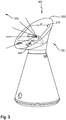
- FIG. 3 shows the household assistant 100 of FIG. 2 wherein the element 210 is controlled to a second state in which the element 210 is as completely transparent as possible.
- the element 210 may act as a passageway through the housing 205, and the projector 140 may be directed to a surface 305 external to the housing 205, which may serve as a projection surface.
- the surface 305 may include, for example, a wall or floor of a room or even a surface of a piece of furniture or appliance, such as one of the household appliance 110.
- the element 210 and the surface 305 are in the same direction from the projector 140 but are viewed from different sides.
- An image emitted by the projector 140 may be reversed (horizontally mirrored) in one of the states relative to the other state to provide corresponding representations to the user 105.
- the projector 140 may be configured to adjust a projection ratio to the state used to tailor the size of the projected representation on the element 210 or on the surface 305.
- the projector 140 may in particular have a corresponding lens system which may allow a particularly continuous adjustment of the projection ratio.
- an optical element arranged outside the projector 140 for example an adjustable lens system or one or more lenses, which can be mechanically moved into or removed from the beam path.
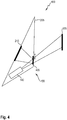
- FIG. 4 shows another exemplary home assistant 100, also on the of FIG. 1 can be based. Elements or preferences of the illustrated home assistant 100 may be compared to those of the household assistant 100 of FIG Figures 2 and 3 be combined.
- a reflective element 405 is provided, which lies here in the beam path between the projector 140 and the element 210.
- the reflecting element 405 can be removed from the beam path, so that the projector 140 projects not onto the element 210 but onto the surface 305.
- the reflective element can be moved in particular to be folded around a rotation axis.
- the projection surfaces 305 and 210 are in their arrangements with respect to the projector 140, so that the reflective element 405 may lie in the beam path to the surface 305, but not in the beam path to the element 210.
- the projector 140 may be movable to alternatively project onto or past the reflective element 405.
- the home assistant 100 may be in both states or modes between the user 105 and the surface 305, so that it may not be necessary to move the home assistant 100 to switch from one to the other mode of operation. Also, in this embodiment, it may be omitted to activate in one of the modes a reversed view by the projector 140 or the insertion of a reflective element or other mode of the projector 140.
Landscapes
- Physics & Mathematics (AREA)
- General Physics & Mathematics (AREA)
- Transforming Electric Information Into Light Information (AREA)
- Projection Apparatus (AREA)
Abstract
Description
- Die Erfindung betrifft einen Haushaltsassistenten. Insbesondere betrifft die Erfindung einen Haushaltsassistenten mit einem Projektor zur Ausgabe einer Darstellung auf einer Oberfläche.
- Ein Haushaltsassistent ist dazu eingerichtet, einen Benutzer bei einer Tätigkeit im Haushalt zu unterstützen. Der Haushaltsassistent kann beispielsweise dazu eingerichtet sein, eines oder mehrere Hausgeräte wie einen Herd, eine Dunstabzugshaube oder eine Waschmaschine zu steuern. Ein Benutzer kann bei der Steuerung eines Hausgeräts unterstützt werden, indem ein Benutzerwunsch erfasst und flexibel in ein Steuersignal umgesetzt wird. Dazu kann der Benutzer auf verbale und nonverbale Kommunikationselemente abgetastet werden und in Abhängigkeit dessen können neben verbalen auch nonverbale Kommunikationssignale ausgegeben werden, beispielsweise in Form eines Gesichts mit einer Mimik.
-
DE 10 2015 210 879 A1 beschreibt eine Vorrichtung mit einer Kamera und einem Projektor, die interaktiv auf einen Nutzer in ihrem Umfeld reagieren kann. - Zur Unterstützung einer Ausgabe an eine Person umfasst ein bekannter Haushaltsassistent ein Display. Zusätzlich kann ein Projektor vorgesehen sein, um eine großformatige optische Ausgabe zu ermöglichen, beispielsweise durch Projektion eines Bildes auf eine Zimmerwand. Die Ausgabevorrichtungen können kostenintensiv sein und eine hohe Verarbeitungsleistung einer Steuereinrichtung erfordern.
- Eine der Erfindung zu Grunde liegende Aufgabe besteht darin, einen verbesserten Haushaltsassistenten anzugeben. Die Erfindung löst diese Aufgabe mittels der Gegenstände der unabhängigen Ansprüche. Unteransprüche geben bevorzugte Ausführungsformen wieder.
- Ein erfindungsgemäßer Haushaltsassistent umfasst ein Gehäuse; einen Projektor, der im Gehäuse aufgenommen ist; und eine Vorrichtung zur Steuerung eines Strahlengangs des Projektors derart, dass entweder eine erste Oberfläche, die sich am Gehäuse befindet, oder eine zweite Oberfläche, die sich außerhalb des Gehäuses befindet, als Projektionsfläche verwendet werden kann.
- Dadurch kann ein Projektor auch die Funktionen eines Displays übernehmen, sodass ein aufwändiges und empfindliches Element eingespart werden kann. Mit dem Display kann auch eine dedizierte Ansteuereinrichtung ("display controller") entfallen. Ein Energieverbrauch kann reduziert sein. Der Haushaltsassistent kann einfacher, robuster oder kostengünstiger aufgebaut sein. Außerdem kann das Gehäuse kompakter gestaltet werden, sodass der Haushaltsassistent in einem Haushalt leichter an unterschiedlichen Stellen eingesetzt werden kann.
- In einer ersten Variante der Erfindung ist am Gehäuse des Haushaltsassistenten ein Element zum Durchtritt von Licht vom Projektor zur zweiten Oberfläche vorgesehen, wobei eine Transparenz des Elements steuerbar ist. Insbesondere kann das Element angesteuert werden, milchig zu sein, um als Rückprojektionsfläche zu wirken, oder klar zu sein, um den Durchtritt eines projizierten Bilds zur zweiten Oberfläche zu erlauben. Dadurch kann die Projektionsfläche ausgewählt werden, ohne ein mechanisch bewegtes Element zu erfordern. Der Haushaltsassistent kann so verbessert robust sein.
- Ob das Element transparent oder opak ist, kann insbesondere elektrisch gesteuert werden. Bevorzugt ist das Element bei Verwendung der ersten Projektionsfläche möglichst vollständig transparent wie beispielsweise Fensterglas. Wird das Element angesteuert, opak zu sein, ist er weiter bevorzugt nicht dunkel, sondern reflektierend, insbesondere milchig oder diffus reflektierend. Dies kann durch eine Beschichtung mit steuerbarer Transparenz auf einem durchsichtigen Trägermaterial wie Glas oder Kunststoff realisiert werden. Die Beschichtung ist bevorzugt möglichst dünn, sodass ein Bild, das von der Hinterseite auf das Element projiziert wird, auf der Vorderseite scharf abgebildet ist. Die Kombination aus einem transparenten Trägermaterial und einer Beschichtung mit veränderlichen optischen Eigenschaften kann auch Intelligentes Glas ("Smart Glass") genannt werden.
- Für die steuerbare Beschichtung können unterschiedliche Techniken verwendet werden. In einer ersten Ausführungsform ist am Element ein elektrochromes Material angebracht. Ein solches Material kann mittels einer geringen Gleichspannung (ca. 1-3 V) in seiner Opazität gesteuert werden. Die Beschichtung kann beispielsweise ein Übergangsmetalloxid wie Wolframoxid oder ein leitfähiges Polymer wie Polyanilin umfassen.
- In einer zweiten Ausführungsform ist am Element ein Flüssigkristall angebracht. Das Flüssigkristall kann beispielsweise nach Art einer Flüssigkristallanzeige zwischen zwei Glasscheiben aufgenommen sein. Alternativ kann das Flüssigkristall auch in ein Polymereingemischt sein ("polymer dispersed liquid crystal device"). Ferner können in einer Flüssigkeit suspendierte Partikel ("suspended particle device") zur Steuerung der optischen Eigenschaften eingesetzt werden. In weiteren Ausführungsformen können am Element auch Mikroblenden ("micro blind device") oder ein Nanokristall ("nano crystal device") angebracht sein.
- In einer zweiten Variante der Erfindung, die mit der ersten Variante kombiniert werden kann, wird die verwendete Projektionsfläche durch mechanische Bewegung des Projektors gesteuert. Der Projektor kann in einer ersten Stellung auf die erste Oberfläche und in einer zweiten Stellung auf die zweite Oberfläche projizieren. Zur Projektion auf die zweite Fläche kann das Gehäuse einen Abschnitt aufweisen, an welchem das projizierte Bild durchtreten kann. Der Abschnitt kann eine Aussparung umfassen oder mit einem transparenten Material wie Glas oder Kunststoff gefüllt sein.
- In einer dritten Variante, die mit der ersten und/oder zweiten Variante kombiniert werden kann, ist ein reflektierendes Element vorgesehen, das im Strahlengang vom Projektor zu nur einer der Oberflächen liegt. Der Projektor kann ein Bild in einer Richtung vom Benutzer entfernt projizieren, oder das projizierte Bild kann in Richtung des Benutzers umgelenkt werden. Dadurch können optische Verhältnisse verbessert an unterschiedliche Bildgrößen oder Bildweiten angepasst werden. In einer Ausführungsform wird das reflektierende Element bewegt, um die Projektionsfläche auszuwählen. Beispielsweise kann in einer ersten Stellung des reflektierenden Elements die erste Oberfläche und in einer zweiten Stellung die zweite Oberfläche als Projektionsfläche verwendet werden. Das reflektierende Element kann einen Spiegel, ein Prisma oder eine Anordnungen aus mehreren Spiegeln und/oder Prismen umfassen.
- Die erste Oberfläche kann insbesondere ein geschwärztes Glas umfassen, sodass auf einfache und elegante Weise eine Rückprojektion möglich ist, wobei ein Einblick ins Gehäuse durch die erste Oberfläche aber verhindert werden kann.
- Der Projektor kann allgemein dazu eingerichtet sein, ein darzustellendes Bild in Abhängigkeit der verwendeten Projektionsfläche seitenverkehrt auszugeben. Bevorzugt wird das projizierte Bild bei Verwendung der ersten Oberfläche als Projektionsfläche seitenverkehrt und bei Verwendung der zweiten Oberfläche nicht. Eine umgekehrte Zuordnung ist ebenfalls möglich.
- Außerdem kann ein abbildendes System vorgesehen sein, das dazu eingerichtet ist, ein Projektionsverhältnis des Projektors in Abhängigkeit eines Abstands zwischen dem Projektor und der verwendeten Projektionsfläche zu steuern. Dabei gibt das Projektionsverhältnis eine Breite des projizierten Bildes auf der Projektionsfläche im Verhältnis zum Abstand des Projektors zur Projektionsfläche an.
- Eine Bildweite, die zwischen dem Projektor und der Projektionsfläche liegt, kann für die erste Oberfläche deutlich kleiner als für die zweite Oberfläche sein. Eine gewünschte Bildgröße auf der ersten Oberfläche kann auch kleiner als eine gewünschte Bildgröße auf der zweiten Oberfläche sein. In einer Ausführungsform umfasst der Projektor eine Linsenanordnung, die eine stufenlose Verstellung des Projektionsverhältnisses erlaubt. In einer zweiten Ausführungsform können eines oder mehrere Linsen- oder Reflektorelemente vorgesehen sein, die in den Strahlengang zwischen dem Projektor und der Projektionsfläche verbracht oder von dort entfernt werden können, um das Projektionsverhältnis zu beeinflussen. Ein solches Linsenelement kann eine Weitwinkel-Linse umfassen.
- Die Erfindung wird nun unter Bezug auf die beiliegenden Figuren genauer beschrieben, in denen:
- Fig. 1
- eine schematische Darstellung eines beispielhaften Haushaltsassistenten, mit einem Benutzer und einem Hausgerät;
- Fig. 2
- einen exemplarischen Haushaltsassistenten mit einem Projektor in einer ersten Betriebsart;
- Fig. 3
- den Haushaltsassistenten von
Figur 2 in einer zweiten Betriebsart; und - Fig. 4
- einen weiteren exemplarischen Haushaltsassistenten darstellt.
-
Figur 1 zeigt einen beispielhaften Haushaltsassistenten 100, der insbesondere zur Unterstützung einer Kommunikation zwischen einem Benutzer 105 und einem Hausgerät 110 eingerichtet sein kann. Es können auch mehrere Hausgeräte 110 nacheinander, gleichzeitig oder miteinander vernetzt durch den Haushaltsassistenten 100 gesteuert werden. Exemplarisch sind als Hausgeräte 110 eine Schneidemaschine, eine Kaffeemaschine, ein Geschirrspüler, ein Kühl- und Gefrierschrank, eine Waschmaschine, ein Ofen, ein Herd, eine Dunstabzugshaube und ein Mikrowellenofen dargestellt, andere Hausgeräte 110 können jedoch auch gesteuert werden. Die Hausgeräte 110 befinden sich bevorzugt alle in demselben Haushalt, insbesondere im gleichen Raum des Haushalts, wobei der Raum eine Küche sein kann. Als Küche kann ein Raum angesehen werden, in dem wenigstens ein Herd oder Ofen steht, wobei dieser nicht notwendigerweise mittels des Haushaltsassistenten 100 steuerbar sein muss. - Der Haushaltsassistent 100 ist bevorzugt dazu eingerichtet, eine Eingabe des Benutzers 105 abzutasten, die Eingabe in ein Signal umzuwandeln und das Signal dem Hausgerät 110 bereitzustellen. Jedes steuerbare Hausgerät 110 verfügt daher bevorzugt über eine Schnittstelle, die bevorzugt drahtlos ausgeführt ist. Außerdem kann der Haushaltsassistent 100 dazu eingerichtet sein, ein Signal des Hausgeräts 110 abzutasten, das Signal in eine Ausgabe umzuwandeln und die Ausgabe dem Benutzer 105 bereitzustellen.
- Der Haushaltsassistent 100 umfasst in der dargestellten, exemplarischen Ausführungsform eine Verarbeitungseinrichtung 115, eine bevorzugt drahtlose Schnittstelle 120, sowie bevorzugt einen oder mehrere Sensoren oder Aktoren. Beispielsweise können eine akustische Eingabevorrichtung 125, eine akustische Ausgabevorrichtung 130, eine Anzeigevorrichtung 135, ein Projektor 140 oder eine Kamera 145 vorgesehen sein. Die akustische Eingabevorrichtung 125 kann mehrfach ausgeführt sein, um eine Ortung einer Geräuschquelle nach dem Stereo-Prinzip zu erlauben. Beispielsweise können mehrere akustische Eingabevorrichtungen 125 auf einem Umkreis angeordnet sein. Bevorzugt wird eine Ortungsgenauigkeit von ca. ±15° bei einer Entfernung der Geräuschquelle von ca. 4 m erreicht. In Verbindung mit der Kamera 145 kann die Verarbeitungsvorrichtung 115 dazu eingerichtet sein, einen Gegenstand, eine Person, einen Gesichtsausdruck oder eine Körperhaltung einer Person zu erkennen. Es können auch mehrere akustische Ausgabevorrichtungen 130 vorgesehen sein, um eine gerichtete Ausgabe von akustischen Informationen zu erlauben. Daneben sind noch andere oder weitere Sensoren oder Aktoren möglich.
- In einer weiteren Ausführungsform kann ein mechanischer Aktor 150 vorgesehen sein, um einen Teil des Haushaltsassistenten 100 zu bewegen. In der dargestellten Ausführungsform kann beispielsweise ein rundlich dargestellter Kopfabschnitt 155 gegenüber einem Basisabschnitt 160 beispielsweise um eine horizontale oder vertikale Achse verschwenkt, gedreht oder gegenüber der Achse verschoben werden. Aktoren oder Sensoren, die speziell auf den Benutzer 105 ausgerichtet werden sollen, sind hierbei bevorzugt am Kopfabschnitt 155 angebracht. Ferner kann die Position des Kopfabschnitts 155 zum Ausdrücken von Emotionen verwendet werden. Die Verarbeitungseinrichtung 115 ist bevorzugt dazu eingerichtet, eine natürlichsprachige Eingabe des Benutzers 105 mittels der Eingabevorrichtung 125 abzutasten und zu analysieren. Die Eingabevorrichtung 125 kann mehrfach vorgesehen sein, sodass nach dem Stereoprinzip eine zumindest grobe Ortung des Benutzers 105 relativ zum Haushaltsassistenten 100 möglich sein kann. Die Ausgabevorrichtung 130 kann ferner dazu eingerichtet sein, ein Signal in eine gesprochene Nachricht umzuwandeln ("Text to Speech", Text in Sprache) und mittels der akustischen Ausgabevorrichtung 130 auszugeben. Der Projektor 140 kann auf eine Arbeitsoberfläche oder eine Wand gerichtet werden. Mittels des Projektors 140 und/oder der Anzeigevorrichtung 135 können graphische oder textuelle Ausgaben erfolgen. Insbesondere können auf diesem Weg ein Auge oder ein Augenpaar dargestellt werden, bevorzugt in Abhängigkeit einer zuvor bestimmten empathischen Emotion. In einer weiteren Ausführungsform ist auch eine haptische Eingabevorrichtung 165 vorgesehen, die insbesondere mit der Anzeigevorrichtung 135 integriert als Touchscreen ausgeführt sein kann. In einer Ausführungsform ist die haptische Eingabevorrichtung 165 dazu eingerichtet, eine manuelle Navigation durch eine klassische Benutzerschnittstelle zu erlauben, um den Haushaltsassistenten 100 zu steuern. In einer weiteren Ausführungsform ist die haptische Eingabevorrichtung 165 dazu eingerichtet, eine taktile Äußerung wie eine Berührung, ein Streicheln oder Streichen, ein Reiben, ein Klopfen, ein Ziehen, ein Kratzen oder ein Schlagen zu erfassen.
- Der Haushaltsassistent 100 ist bevorzugt dazu eingerichtet, sich zumindest ansatzweise wie ein Mitbewohner oder ein Familienmitglied einer Familie darzustellen, die in dem Haushalt lebt. Die Interaktion mit dem Haushaltsassistenten 100 ist bevorzugt leicht zu erlernen oder durchzuführen, macht Freude und kann in die täglichen Abläufe der Benutzer 105 im Haushalt auf natürliche Weise eingebunden werden. Die Erfüllung dieser Ziele werden insbesondere durch die Spracheingabe und Sprachausgabe oder die Darstellbarkeit textueller oder graphischer Informationen mittels der Anzeigeeinrichtung 135 oder des Projektors 140 unterstützt. Außerdem wird angestrebt, dass eine soziale Interaktion auf der Basis einer Emotion des Benutzers 105 und einer daraus abgeleiteten empathischen Emotion des Haushaltsassistenten 100 zur Unterstützung der Interaktion eingesetzt wird. Das Ausdrücken der empathischen Emotion kann unterschiedliche Aspekte umfassen, beispielsweise optisch, akustisch oder durch eine Bewegung. Eines oder mehrere Hausgeräte 110 können durch den Haushaltsassistenten teilweise automatisch gesteuert werden. Beispielsweise kann eine situationsabhängige Steuerung erfolgen, sodass ein Betriebszustand eines Hausgeräts 110 Einfluss auf den Betriebszustand eines anderen Hausgeräts 110 haben kann. Der Haushaltsassistent 100 kann als Konzentrator ("Hub") für Geräte dienen, die nach dem Gedanken des Internet der Dinge ("Internet of Things", loT) netzwerkfähig sind. Dazu können auch andere Geräte als die Hausgeräte 110 mit dem Haushaltsassistenten 100 verbunden werden.
- Der Haushaltsassistent 100 kann auch spezifische Dienste anbieten, die insbesondere in einer Küche vom Benutzer 105 als hilfreich empfunden werden können. Beispielsweise kann eine Schritt-für-Schritt-Unterstützung beim Kochen nach Rezept erfolgen. Der Haushaltsassistent 100 kann zum Auffinden eines gewünschten Rezepts verwendet werden und eine optische Anleitung während des Kochprozesses anbieten. Mehrere Benutzer 105 an unterschiedlichen Orten können miteinander kochen, indem sie über Videofunktion dem Haushaltsassistenen 100 miteinander verbunden werden. In ähnlicher Weise kann der Benutzer 105 an einem Kochkurs teilnehmen, um seine Kochkünste zu verbessern. Die eigene Küche muss er dazu nicht verlassen. Der Haushaltsassistent 100 kann auch allgemeine Wissens- oder Informationsfragen beantworten, beispielsweise nach einem aktuellen Wetter oder einer Nachrichtenlage. Der Haushaltsassistent 100 kann zum Abspielen eines Films oder von Musik genutzt werden. Sollte eines der Hausgeräte110 ein Problem zeigen, so kann mittels des Haushaltsassistenten 100 ein Kundendienst kontaktiert werden.
-
Figur 2 zeigt einen exemplarischen Haushaltsassistenten 100 mit einem Projektor 140. Der Haushaltsassistent 100 kann insbesondere eine Variante oder Erweiterung des inFigur 1 dargestellten Haushaltsassistenten 100 umfassen. Der Projektor 140 ist innerhalb eines Gehäuses 205 des Haushaltsassistenten 100 angeordnet. In der vorliegenden Ausführungsform umfasst das Gehäuse 205 lediglich einen Abschnitt des Haushaltsassistenten 100, insbesondere den Kopfabschnitt 155. In anderen Ausführungsformen können auch andere oder größere Abschnitte bis hin zum vollständigen Haushaltsassistenten 100 vom Gehäuse 205 umschlossen sein. - Ein Strahlengang des Projektors 140 ist auf einen Abschnitt des Gehäuses 205 gerichtet, an welchem ein Element 210 eingelassen ist, dessen optische Eigenschaften steuerbar sind. Dieses Element 210 kann insbesondere als Intelligentes Glas ausgeführt sein. In der dargestellten Ausführungsform ist das Element 210 opak, sodass ein vom Projektor 140 ausgestrahltes Bild nach Art einer Rückprojektion auf dem Element dargestellt werden kann. In
Figur 2 sind als beispielhafte projizierte Darstellung Augen des Haushaltsassistenten 100 auf der Außenseite des Elements sichtbar (vgl. hierzu auch die Darstellung vonFigur 1 ). Das Element 210 ist bevorzugt in das Gehäuse eingelassen, sodass ein Übergang zwischen der Außenseite des Gehäuses 205 und der Außenseite des Elements 210 möglichst gleichmäßig verläuft. - Das Element 210 kann ein Trägermaterial 215 und eine Beschichtung 220 umfassen, wobei das Trägermaterial 215 eine mechanische Stabilität sicherstellen kann und bevorzugt unveränderlich transparent ist. Die Beschichtung 220 kann in ihren optischen Eigenschaften steuerbar sein und an einer Innenseite, einer Außenseite oder eingebettet in das Trägermaterial 215 angebracht sein. Die Beschichtung 215 kann bevorzugt in einen ersten Zustand gesteuert werden, in welchem sie sich als Projektionsfläche eignet, insbesondere für die dargestellte Rückprojektion, oder in einen zweiten Zustand, in welchem sie transparent ist, wie in
Figur 2 zu sehen ist. Im ersten Zustand ist die Beschichtung 220 bevorzugt milchig, trüb oder diffus. Die Opazität kann stark reduziert sein, sodass das Element 210 an unbeleuchteten Stellen dunkel erscheinen kann. Die Opazität der Beschichtung 215 ist bevorzugt elektrisch steuerbar und die Steuerung kann mittels der Verarbeitungseinrichtung 115 oder einer anderen Einrichtung erfolgen. Die Beschichtung 115 kann in unterschiedlichen Ausführungsformen insbesondere eines von einem elektrochromen Material, einem Flüssigkristall, Mikroblenden oder einem Nanokristall umfassen. -
Figur 3 zeigt den Haushaltsassistenten 100 vonFigur 2 , wobei das Element 210 in einen zweiten Zustand gesteuert ist, in welchem das Element 210 möglichst vollständig transparent ist. Das Element 210 kann als Durchtrittsfläche durch das Gehäuses 205 wirken und der Projektor 140 kann auf eine außerhalb des Gehäuses 205 liegende Oberfläche 305 gerichtet sein, die als Projektionsfläche dienen kann. Die Oberfläche 305 kann beispielsweise eine Wand oder ein Boden eines Zimmers oder auch eine Oberfläche eines Möbels oder Geräts wie eines der Haushaltsgeräts 110 umfassen. - In der Ausführungsform des Haushaltsassistenten 100 der
Figuren 2 und3 liegen das Element 210 und die Oberfläche 305 vom Projektor 140 aus in der gleichen Richtung, werden aber von unterschiedlichen Seiten betrachtet. Ein durch den Projektor 140 ausgestrahltes Bild kann in einem der Zustände gegenüber dem anderen Zustand seitenverkehrt (horizontal gespiegelt) werden, um für den Benutzer 105 einander entsprechende Darstellungen bereitzustellen. Ferner kann der Projektor 140 dazu eingerichtet sein, ein Projektionsverhältnis an den verwendeten Zustand anzupassen, um die Größe der projizierten Darstellung auf dem Element 210 oder auf der Oberfläche 305 passend zu gestalten. Dazu kann der Projektor 140 insbesondere über ein entsprechendes Linsensystem verfügen, das eine insbesondere stufenlose Verstellung des Projektionsverhältnisses erlauben kann. Alternativ kann auch ein außerhalb des Projektors 140 angeordnetes optisches Element verwendet werden, beispielsweise ein verstellbares Linsensystem oder eine oder mehrere Linsen, die mechanisch in den Strahlengang verbracht oder aus ihm entfernt werden können. -
Figur 4 zeigt einen weiteren exemplarischen Haushaltsassistenten 100, der ebenfalls auf dem vonFigur 1 basieren kann. Elemente oder Vorzüge des dargestellten Haushaltsassistenten 100 können mit solchen des Haushaltsassistenten 100 derFiguren 2 und3 kombinierbar sein. Hier ist ein reflektierendes Element 405 vorgesehen, das hier im Strahlengang zwischen dem Projektor 140 und dem Element 210 liegt. Das reflektierende Element 405 kann aus dem Strahlengang entfernt werden, sodass der Projektor 140 nicht auf das Element 210, sondern auf die Oberfläche 305 projiziert. Dazu kann das reflektierende Element insbesondere verschoben der um eine Drehachse geklappt werden. In einer anderen Ausführungsform sind die Projektionsflächen 305 und 210 in ihren Anordnungen bezüglich des Projektors 140 vertauscht, sodass das reflektierende Element 405 im Strahlengang zur Oberfläche 305 liegen kann, nicht aber im Strahlengang zum Element 210. - Alternativ kann auch an Stelle des reflektierenden Elements 405 der Projektor 140 beweglich sein, um alternativ auf das reflektierende Element 405 oder daran vorbei zu projizieren.
- Vorteilhaft an der in
Figur 4 dargestellten Ausführungsform ist, dass sich der Haushaltsassistent 100 in beiden Zuständen oder Betriebsarten zwischen dem Benutzer 105 und der Oberfläche 305 befinden kann, sodass es nicht erforderlich sein kann, den Haushaltsassistenten 100 zu bewegen, wenn von der einen in die andere Betriebsart gewechselt werden soll. Auch kann in dieser Ausführungsform darauf verzichtet werden, in einer der Betriebsarten eine seitenverkehrte Darstellung durch den Projektor 140 oder das Einfügen eines reflektierenden Elements oder eine andere Betriebsart des Projektors 140 zu aktivieren. -
- 100
- Haushaltsassistent
- 105
- Benutzer
- 110
- Hausgerät
- 115
- Verarbeitungseinrichtung
- 120
- Schnittstelle
- 125
- akustische Eingabevorrichtung
- 130
- akustische Ausgabevorrichtung
- 135
- Anzeigevorrichtung
- 140
- Projektor
- 145
- Kamera
- 150
- Aktor
- 155
- Kopfabschnitt
- 160
- Basisabschnitt
- 165
- haptische Eingabevorrichtung
- 205
- Gehäuse
- 210
- Element
- 215
- Trägermaterial
- 220
- Beschichtung
- 305
- Oberfläche
- 405
- reflektierendes Element
Claims (10)
- Haushaltsassistent (100), umfassend:- ein Gehäuse (205);- einen Projektor (140), der im Gehäuse (205) aufgenommen ist; und- eine Vorrichtung (210, 405) zur Steuerung eines Strahlengangs des Projektors (140) derart, dass entweder- eine erste Oberfläche (210), die sich am Gehäuse (205) befindet, oder- eine zweite Oberfläche (305), die sich außerhalb des Gehäuses (205) befindet,- als Projektionsfläche verwendet werden kann.
- Haushaltsassistent (100) nach Anspruch 1, wobei am Gehäuse (205) ein Element (210) zum Durchtritt von Licht vom Projektor zur zweiten Oberfläche (305) vorgesehen ist, und eine Transparenz des Elements (210) steuerbar ist.
- Haushaltsassistent (100) nach Anspruch 2, wobei das Element (210) angesteuert werden kann, milchig zu sein, um als Rückprojektionsfläche zu wirken, oder klar zu sein, um den Durchtritt eines projizierten Bilds zur zweiten Oberfläche zu erlauben.
- Haushaltsassistent (100) nach einem der Ansprüche 2 oder 3, wobei am Element (210) ein elektrochromes Material angebracht ist.
- Haushaltsassistent (100) nach einem der Ansprüche 2 bis 4, wobei am Element (210) ein Flüssigkristall angebracht ist.
- Haushaltsassistent (100) nach Anspruch 1, ferner wobei die verwendete Projektionsfläche (210, 305) durch mechanische Bewegung des Projektors (140) gesteuert werden kann.
- Haushaltsassistent (100) nach Anspruch 1 oder 6, ferner umfassend ein reflektierendes Element (405), wobei das reflektierende Element (405) im Strahlengang vom Projektor (140) zu nur einer der Oberflächen (210, 305) liegt.
- Haushaltsassistent (100) nach einem der vorhergehenden Ansprüche, wobei die erste Oberfläche (210) ein geschwärztes Glas umfasst.
- Haushaltsassistent (100) nach einem der vorangehenden Ansprüche, wobei der Projektor (140) dazu eingerichtet ist, ein darzustellendes Bild in Abhängigkeit der verwendeten Projektionsfläche (210, 305) seitenverkehrt auszugeben.
- Haushaltsassistent (100) nach einem der vorangehenden Ansprüche, ferner umfassend ein abbildendes System (140), das dazu eingerichtet ist, ein Projektionsverhältnis des Projektors (140) in Abhängigkeit eines Abstands zwischen dem Projektor (140) und der verwendeten Projektionsfläche (210, 305) zu steuern.
Applications Claiming Priority (1)
| Application Number | Priority Date | Filing Date | Title |
|---|---|---|---|
| DE102017218162.1A DE102017218162A1 (de) | 2017-10-11 | 2017-10-11 | Haushaltsassistent mit Projektor |
Publications (2)
| Publication Number | Publication Date |
|---|---|
| EP3470919A1 true EP3470919A1 (de) | 2019-04-17 |
| EP3470919B1 EP3470919B1 (de) | 2020-06-24 |
Family
ID=63722235
Family Applications (1)
| Application Number | Title | Priority Date | Filing Date |
|---|---|---|---|
| EP18198220.8A Active EP3470919B1 (de) | 2017-10-11 | 2018-10-02 | Haushaltsassistent mit projektor |
Country Status (2)
| Country | Link |
|---|---|
| EP (1) | EP3470919B1 (de) |
| DE (1) | DE102017218162A1 (de) |
Cited By (2)
| Publication number | Priority date | Publication date | Assignee | Title |
|---|---|---|---|---|
| JP2021055976A (ja) * | 2019-10-01 | 2021-04-08 | パナソニックIpマネジメント株式会社 | 加熱調理器 |
| WO2021121875A1 (de) * | 2019-12-20 | 2021-06-24 | OSRAM CONTINENTAL GmbH | Optische anordnung, fahrzeug und verfahren |
Families Citing this family (1)
| Publication number | Priority date | Publication date | Assignee | Title |
|---|---|---|---|---|
| DE102021209041B3 (de) | 2021-08-18 | 2022-08-11 | Volkswagen Aktiengesellschaft | Anzeigeeinrichtung eines Fahrzeugs |
Citations (3)
| Publication number | Priority date | Publication date | Assignee | Title |
|---|---|---|---|---|
| US5416617A (en) * | 1991-11-22 | 1995-05-16 | Thomson-Csf | Image projection display screen employing polymer dispersed liquid crystal layer and electrochromic layer |
| US20070121087A1 (en) * | 2005-11-29 | 2007-05-31 | Garg Sachin K | Image projection system for personal media player |
| US20120327315A1 (en) * | 2011-06-27 | 2012-12-27 | Microsoft Corporation | Video projection system for mobile device |
Family Cites Families (6)
| Publication number | Priority date | Publication date | Assignee | Title |
|---|---|---|---|---|
| GB2308486A (en) * | 1995-12-21 | 1997-06-25 | Nokia Mobile Phones Ltd | Display apparatus for hand held equipment |
| DE29814620U1 (de) * | 1997-08-16 | 1999-01-07 | Hamadou, Nadjib, 40211 Düsseldorf | Präsentationsanordnung |
| JP2007272202A (ja) * | 2006-03-08 | 2007-10-18 | Canon Inc | 画像形成装置 |
| KR20100086262A (ko) * | 2009-01-22 | 2010-07-30 | 삼성전자주식회사 | 로봇 및 그 제어방법 |
| DE102015210879A1 (de) | 2015-06-15 | 2016-12-15 | BSH Hausgeräte GmbH | Vorrichtung zur Unterstützung eines Nutzers in einem Haushalt |
| CN206066469U (zh) * | 2016-09-20 | 2017-04-05 | 华南理工大学 | 一种移动式的远程临场交互机器人 |
-
2017
- 2017-10-11 DE DE102017218162.1A patent/DE102017218162A1/de not_active Ceased
-
2018
- 2018-10-02 EP EP18198220.8A patent/EP3470919B1/de active Active
Patent Citations (3)
| Publication number | Priority date | Publication date | Assignee | Title |
|---|---|---|---|---|
| US5416617A (en) * | 1991-11-22 | 1995-05-16 | Thomson-Csf | Image projection display screen employing polymer dispersed liquid crystal layer and electrochromic layer |
| US20070121087A1 (en) * | 2005-11-29 | 2007-05-31 | Garg Sachin K | Image projection system for personal media player |
| US20120327315A1 (en) * | 2011-06-27 | 2012-12-27 | Microsoft Corporation | Video projection system for mobile device |
Cited By (5)
| Publication number | Priority date | Publication date | Assignee | Title |
|---|---|---|---|---|
| JP2021055976A (ja) * | 2019-10-01 | 2021-04-08 | パナソニックIpマネジメント株式会社 | 加熱調理器 |
| EP4040047A4 (de) * | 2019-10-01 | 2022-11-02 | Panasonic Intellectual Property Management Co., Ltd. | Thermokocher |
| JP7236644B2 (ja) | 2019-10-01 | 2023-03-10 | パナソニックIpマネジメント株式会社 | 加熱調理器 |
| JP2023053253A (ja) * | 2019-10-01 | 2023-04-12 | パナソニックIpマネジメント株式会社 | プロジェクタ及び加熱調理器 |
| WO2021121875A1 (de) * | 2019-12-20 | 2021-06-24 | OSRAM CONTINENTAL GmbH | Optische anordnung, fahrzeug und verfahren |
Also Published As
| Publication number | Publication date |
|---|---|
| DE102017218162A1 (de) | 2019-04-11 |
| EP3470919B1 (de) | 2020-06-24 |
Similar Documents
| Publication | Publication Date | Title |
|---|---|---|
| EP3470919B1 (de) | Haushaltsassistent mit projektor | |
| Stawicki et al. | Driving a Semiautonomous Mobile Robotic Car Controlled by an SSVEP‐Based BCI | |
| EP2891037A1 (de) | Bereitstellen einer eingabe für ein bedienelement | |
| DE102014010352A1 (de) | Interaktiver Spiegel | |
| DE102015117867A1 (de) | Automatisch orientierte Lautsprecherbox und Lampe mit dieser Lautsprecherbox | |
| DE102014218493A1 (de) | Anzeige- und Bedienvorrichtung, insbesondere für ein Kraftfahrzeug, Bedienelement und Kraftfahrzeug | |
| DE102011112448A1 (de) | Verfahren und Vorrichtung zum Bereitstellen einer Nutzerschnittstelle, insbesondere in einem Fahrzeug | |
| DE102004038418A1 (de) | System eines Haushaltsgeräts | |
| DE102014017281A1 (de) | Optische Detektionsvorrichtung und Verfahren zum Steuern derselben | |
| EP3507813A1 (de) | Steuerbarer drehknopf | |
| DE102018205664A1 (de) | Vorrichtung zur Assistenz eines Insassen im Innenraum eines Kraftfahrzeugs | |
| WO2018041714A1 (de) | Individuelle kommunikationsunterstützung | |
| EP3757274B1 (de) | Wäschebearbeitungsvorrichtung und korrespondierendes verfahren | |
| WO2009000686A1 (de) | Bedien- und anzeigevorrichtung | |
| WO2013093040A1 (de) | Verfahren und system zur darstellung mindestens eines bilds zumindest einer anwendung auf einer anzeigevorrichtung | |
| WO2021121875A1 (de) | Optische anordnung, fahrzeug und verfahren | |
| DE102016124339A1 (de) | Projektionssystem | |
| DE102014224599A1 (de) | Verfahren zum Betreiben einer Eingabevorrichtung, Eingabevorrichtung | |
| DE102013216126A1 (de) | Verfahren und Vorrichtung zur Aktivierung einer Funktion | |
| DE102020215501A1 (de) | Bedienvorrichtung für ein Haushaltsgerät mit einem integrierten berührsensitiven Bedienring in einer Bedienmulde, sowie Haushaltsgerät | |
| DE10316227B3 (de) | Präsentationsumgebung | |
| DE102014207638A1 (de) | Bediengerät zur Ansteuerung von Leuchten, Jalousien und/oder Klimageräten | |
| DE102017113138A1 (de) | Elektronische Vorrichtung und Verfahren zum Anzeigen eines Bildes einer virtuellen Umgebung | |
| DE102014205671A1 (de) | Vorrichtung zur Blendensteuerung | |
| DE102014207963A1 (de) | Interaktives Menü |
Legal Events
| Date | Code | Title | Description |
|---|---|---|---|
| PUAI | Public reference made under article 153(3) epc to a published international application that has entered the european phase |
Free format text: ORIGINAL CODE: 0009012 |
|
| STAA | Information on the status of an ep patent application or granted ep patent |
Free format text: STATUS: THE APPLICATION HAS BEEN PUBLISHED |
|
| AK | Designated contracting states |
Kind code of ref document: A1 Designated state(s): AL AT BE BG CH CY CZ DE DK EE ES FI FR GB GR HR HU IE IS IT LI LT LU LV MC MK MT NL NO PL PT RO RS SE SI SK SM TR |
|
| AX | Request for extension of the european patent |
Extension state: BA ME |
|
| STAA | Information on the status of an ep patent application or granted ep patent |
Free format text: STATUS: REQUEST FOR EXAMINATION WAS MADE |
|
| 17P | Request for examination filed |
Effective date: 20191017 |
|
| RBV | Designated contracting states (corrected) |
Designated state(s): AL AT BE BG CH CY CZ DE DK EE ES FI FR GB GR HR HU IE IS IT LI LT LU LV MC MK MT NL NO PL PT RO RS SE SI SK SM TR |
|
| GRAP | Despatch of communication of intention to grant a patent |
Free format text: ORIGINAL CODE: EPIDOSNIGR1 |
|
| STAA | Information on the status of an ep patent application or granted ep patent |
Free format text: STATUS: GRANT OF PATENT IS INTENDED |
|
| INTG | Intention to grant announced |
Effective date: 20200217 |
|
| GRAS | Grant fee paid |
Free format text: ORIGINAL CODE: EPIDOSNIGR3 |
|
| GRAA | (expected) grant |
Free format text: ORIGINAL CODE: 0009210 |
|
| STAA | Information on the status of an ep patent application or granted ep patent |
Free format text: STATUS: THE PATENT HAS BEEN GRANTED |
|
| AK | Designated contracting states |
Kind code of ref document: B1 Designated state(s): AL AT BE BG CH CY CZ DE DK EE ES FI FR GB GR HR HU IE IS IT LI LT LU LV MC MK MT NL NO PL PT RO RS SE SI SK SM TR |
|
| REG | Reference to a national code |
Ref country code: GB Ref legal event code: FG4D Free format text: NOT ENGLISH |
|
| REG | Reference to a national code |
Ref country code: CH Ref legal event code: EP |
|
| REG | Reference to a national code |
Ref country code: AT Ref legal event code: REF Ref document number: 1284485 Country of ref document: AT Kind code of ref document: T Effective date: 20200715 |
|
| REG | Reference to a national code |
Ref country code: DE Ref legal event code: R096 Ref document number: 502018001740 Country of ref document: DE |
|
| REG | Reference to a national code |
Ref country code: IE Ref legal event code: FG4D Free format text: LANGUAGE OF EP DOCUMENT: GERMAN |
|
| PG25 | Lapsed in a contracting state [announced via postgrant information from national office to epo] |
Ref country code: NO Free format text: LAPSE BECAUSE OF FAILURE TO SUBMIT A TRANSLATION OF THE DESCRIPTION OR TO PAY THE FEE WITHIN THE PRESCRIBED TIME-LIMIT Effective date: 20200924 Ref country code: GR Free format text: LAPSE BECAUSE OF FAILURE TO SUBMIT A TRANSLATION OF THE DESCRIPTION OR TO PAY THE FEE WITHIN THE PRESCRIBED TIME-LIMIT Effective date: 20200925 Ref country code: FI Free format text: LAPSE BECAUSE OF FAILURE TO SUBMIT A TRANSLATION OF THE DESCRIPTION OR TO PAY THE FEE WITHIN THE PRESCRIBED TIME-LIMIT Effective date: 20200624 Ref country code: SE Free format text: LAPSE BECAUSE OF FAILURE TO SUBMIT A TRANSLATION OF THE DESCRIPTION OR TO PAY THE FEE WITHIN THE PRESCRIBED TIME-LIMIT Effective date: 20200624 Ref country code: LT Free format text: LAPSE BECAUSE OF FAILURE TO SUBMIT A TRANSLATION OF THE DESCRIPTION OR TO PAY THE FEE WITHIN THE PRESCRIBED TIME-LIMIT Effective date: 20200624 |
|
| REG | Reference to a national code |
Ref country code: LT Ref legal event code: MG4D |
|
| PG25 | Lapsed in a contracting state [announced via postgrant information from national office to epo] |
Ref country code: HR Free format text: LAPSE BECAUSE OF FAILURE TO SUBMIT A TRANSLATION OF THE DESCRIPTION OR TO PAY THE FEE WITHIN THE PRESCRIBED TIME-LIMIT Effective date: 20200624 Ref country code: LV Free format text: LAPSE BECAUSE OF FAILURE TO SUBMIT A TRANSLATION OF THE DESCRIPTION OR TO PAY THE FEE WITHIN THE PRESCRIBED TIME-LIMIT Effective date: 20200624 Ref country code: BG Free format text: LAPSE BECAUSE OF FAILURE TO SUBMIT A TRANSLATION OF THE DESCRIPTION OR TO PAY THE FEE WITHIN THE PRESCRIBED TIME-LIMIT Effective date: 20200924 Ref country code: RS Free format text: LAPSE BECAUSE OF FAILURE TO SUBMIT A TRANSLATION OF THE DESCRIPTION OR TO PAY THE FEE WITHIN THE PRESCRIBED TIME-LIMIT Effective date: 20200624 |
|
| REG | Reference to a national code |
Ref country code: NL Ref legal event code: MP Effective date: 20200624 |
|
| PG25 | Lapsed in a contracting state [announced via postgrant information from national office to epo] |
Ref country code: NL Free format text: LAPSE BECAUSE OF FAILURE TO SUBMIT A TRANSLATION OF THE DESCRIPTION OR TO PAY THE FEE WITHIN THE PRESCRIBED TIME-LIMIT Effective date: 20200624 Ref country code: AL Free format text: LAPSE BECAUSE OF FAILURE TO SUBMIT A TRANSLATION OF THE DESCRIPTION OR TO PAY THE FEE WITHIN THE PRESCRIBED TIME-LIMIT Effective date: 20200624 |
|
| PG25 | Lapsed in a contracting state [announced via postgrant information from national office to epo] |
Ref country code: ES Free format text: LAPSE BECAUSE OF FAILURE TO SUBMIT A TRANSLATION OF THE DESCRIPTION OR TO PAY THE FEE WITHIN THE PRESCRIBED TIME-LIMIT Effective date: 20200624 Ref country code: PT Free format text: LAPSE BECAUSE OF FAILURE TO SUBMIT A TRANSLATION OF THE DESCRIPTION OR TO PAY THE FEE WITHIN THE PRESCRIBED TIME-LIMIT Effective date: 20201026 Ref country code: EE Free format text: LAPSE BECAUSE OF FAILURE TO SUBMIT A TRANSLATION OF THE DESCRIPTION OR TO PAY THE FEE WITHIN THE PRESCRIBED TIME-LIMIT Effective date: 20200624 Ref country code: SM Free format text: LAPSE BECAUSE OF FAILURE TO SUBMIT A TRANSLATION OF THE DESCRIPTION OR TO PAY THE FEE WITHIN THE PRESCRIBED TIME-LIMIT Effective date: 20200624 Ref country code: IT Free format text: LAPSE BECAUSE OF FAILURE TO SUBMIT A TRANSLATION OF THE DESCRIPTION OR TO PAY THE FEE WITHIN THE PRESCRIBED TIME-LIMIT Effective date: 20200624 Ref country code: RO Free format text: LAPSE BECAUSE OF FAILURE TO SUBMIT A TRANSLATION OF THE DESCRIPTION OR TO PAY THE FEE WITHIN THE PRESCRIBED TIME-LIMIT Effective date: 20200624 Ref country code: CZ Free format text: LAPSE BECAUSE OF FAILURE TO SUBMIT A TRANSLATION OF THE DESCRIPTION OR TO PAY THE FEE WITHIN THE PRESCRIBED TIME-LIMIT Effective date: 20200624 |
|
| PG25 | Lapsed in a contracting state [announced via postgrant information from national office to epo] |
Ref country code: SK Free format text: LAPSE BECAUSE OF FAILURE TO SUBMIT A TRANSLATION OF THE DESCRIPTION OR TO PAY THE FEE WITHIN THE PRESCRIBED TIME-LIMIT Effective date: 20200624 Ref country code: PL Free format text: LAPSE BECAUSE OF FAILURE TO SUBMIT A TRANSLATION OF THE DESCRIPTION OR TO PAY THE FEE WITHIN THE PRESCRIBED TIME-LIMIT Effective date: 20200624 Ref country code: IS Free format text: LAPSE BECAUSE OF FAILURE TO SUBMIT A TRANSLATION OF THE DESCRIPTION OR TO PAY THE FEE WITHIN THE PRESCRIBED TIME-LIMIT Effective date: 20201024 |
|
| REG | Reference to a national code |
Ref country code: DE Ref legal event code: R097 Ref document number: 502018001740 Country of ref document: DE |
|
| PG25 | Lapsed in a contracting state [announced via postgrant information from national office to epo] |
Ref country code: DK Free format text: LAPSE BECAUSE OF FAILURE TO SUBMIT A TRANSLATION OF THE DESCRIPTION OR TO PAY THE FEE WITHIN THE PRESCRIBED TIME-LIMIT Effective date: 20200624 |
|
| PLBE | No opposition filed within time limit |
Free format text: ORIGINAL CODE: 0009261 |
|
| STAA | Information on the status of an ep patent application or granted ep patent |
Free format text: STATUS: NO OPPOSITION FILED WITHIN TIME LIMIT |
|
| 26N | No opposition filed |
Effective date: 20210325 |
|
| PG25 | Lapsed in a contracting state [announced via postgrant information from national office to epo] |
Ref country code: MC Free format text: LAPSE BECAUSE OF FAILURE TO SUBMIT A TRANSLATION OF THE DESCRIPTION OR TO PAY THE FEE WITHIN THE PRESCRIBED TIME-LIMIT Effective date: 20200624 Ref country code: LU Free format text: LAPSE BECAUSE OF NON-PAYMENT OF DUE FEES Effective date: 20201002 |
|
| REG | Reference to a national code |
Ref country code: BE Ref legal event code: MM Effective date: 20201031 |
|
| PG25 | Lapsed in a contracting state [announced via postgrant information from national office to epo] |
Ref country code: SI Free format text: LAPSE BECAUSE OF FAILURE TO SUBMIT A TRANSLATION OF THE DESCRIPTION OR TO PAY THE FEE WITHIN THE PRESCRIBED TIME-LIMIT Effective date: 20200624 Ref country code: BE Free format text: LAPSE BECAUSE OF NON-PAYMENT OF DUE FEES Effective date: 20201031 |
|
| PG25 | Lapsed in a contracting state [announced via postgrant information from national office to epo] |
Ref country code: IE Free format text: LAPSE BECAUSE OF NON-PAYMENT OF DUE FEES Effective date: 20201002 |
|
| REG | Reference to a national code |
Ref country code: CH Ref legal event code: PL |
|
| PG25 | Lapsed in a contracting state [announced via postgrant information from national office to epo] |
Ref country code: TR Free format text: LAPSE BECAUSE OF FAILURE TO SUBMIT A TRANSLATION OF THE DESCRIPTION OR TO PAY THE FEE WITHIN THE PRESCRIBED TIME-LIMIT Effective date: 20200624 Ref country code: MT Free format text: LAPSE BECAUSE OF FAILURE TO SUBMIT A TRANSLATION OF THE DESCRIPTION OR TO PAY THE FEE WITHIN THE PRESCRIBED TIME-LIMIT Effective date: 20200624 Ref country code: CY Free format text: LAPSE BECAUSE OF FAILURE TO SUBMIT A TRANSLATION OF THE DESCRIPTION OR TO PAY THE FEE WITHIN THE PRESCRIBED TIME-LIMIT Effective date: 20200624 |
|
| PG25 | Lapsed in a contracting state [announced via postgrant information from national office to epo] |
Ref country code: MK Free format text: LAPSE BECAUSE OF FAILURE TO SUBMIT A TRANSLATION OF THE DESCRIPTION OR TO PAY THE FEE WITHIN THE PRESCRIBED TIME-LIMIT Effective date: 20200624 |
|
| PG25 | Lapsed in a contracting state [announced via postgrant information from national office to epo] |
Ref country code: LI Free format text: LAPSE BECAUSE OF NON-PAYMENT OF DUE FEES Effective date: 20211031 Ref country code: CH Free format text: LAPSE BECAUSE OF NON-PAYMENT OF DUE FEES Effective date: 20211031 |
|
| PGFP | Annual fee paid to national office [announced via postgrant information from national office to epo] |
Ref country code: GB Payment date: 20231025 Year of fee payment: 6 |
|
| PGFP | Annual fee paid to national office [announced via postgrant information from national office to epo] |
Ref country code: FR Payment date: 20231023 Year of fee payment: 6 Ref country code: DE Payment date: 20231031 Year of fee payment: 6 |
|
| REG | Reference to a national code |
Ref country code: AT Ref legal event code: MM01 Ref document number: 1284485 Country of ref document: AT Kind code of ref document: T Effective date: 20231002 |
|
| PG25 | Lapsed in a contracting state [announced via postgrant information from national office to epo] |
Ref country code: AT Free format text: LAPSE BECAUSE OF NON-PAYMENT OF DUE FEES Effective date: 20231002 |
|
| PG25 | Lapsed in a contracting state [announced via postgrant information from national office to epo] |
Ref country code: AT Free format text: LAPSE BECAUSE OF NON-PAYMENT OF DUE FEES Effective date: 20231002 |
|
| REG | Reference to a national code |
Ref country code: DE Ref legal event code: R119 Ref document number: 502018001740 Country of ref document: DE |
|
| GBPC | Gb: european patent ceased through non-payment of renewal fee |
Effective date: 20241002 |
|
| PG25 | Lapsed in a contracting state [announced via postgrant information from national office to epo] |
Ref country code: DE Free format text: LAPSE BECAUSE OF NON-PAYMENT OF DUE FEES Effective date: 20250501 |
|
| PG25 | Lapsed in a contracting state [announced via postgrant information from national office to epo] |
Ref country code: GB Free format text: LAPSE BECAUSE OF NON-PAYMENT OF DUE FEES Effective date: 20241002 |
|
| PG25 | Lapsed in a contracting state [announced via postgrant information from national office to epo] |
Ref country code: FR Free format text: LAPSE BECAUSE OF NON-PAYMENT OF DUE FEES Effective date: 20241031 |
|
| PGFP | Annual fee paid to national office [announced via postgrant information from national office to epo] |
Ref country code: AT Payment date: 20260410 Year of fee payment: 5 |