EP3459542B1 - Use of carbamate compound for preventing or treating trigeminal neuralgia - Google Patents
Use of carbamate compound for preventing or treating trigeminal neuralgia Download PDFInfo
- Publication number
- EP3459542B1 EP3459542B1 EP17799674.1A EP17799674A EP3459542B1 EP 3459542 B1 EP3459542 B1 EP 3459542B1 EP 17799674 A EP17799674 A EP 17799674A EP 3459542 B1 EP3459542 B1 EP 3459542B1
- Authority
- EP
- European Patent Office
- Prior art keywords
- compound
- trigeminal
- pharmaceutical composition
- trigeminal neuralgia
- use according
- Prior art date
- Legal status (The legal status is an assumption and is not a legal conclusion. Google has not performed a legal analysis and makes no representation as to the accuracy of the status listed.)
- Active
Links
- 0 C/C1=C\C=C\C(\[C@](C*2*=N*=*2)OC(*)=O)=C\C=C1/C Chemical compound C/C1=C\C=C\C(\[C@](C*2*=N*=*2)OC(*)=O)=C\C=C1/C 0.000 description 1
- GFHAXPJGXSQLPT-VIFPVBQESA-N NC(O[C@@H](C[n]1nncn1)c1ccccc1Cl)=O Chemical compound NC(O[C@@H](C[n]1nncn1)c1ccccc1Cl)=O GFHAXPJGXSQLPT-VIFPVBQESA-N 0.000 description 1
Images
Classifications
-
- A—HUMAN NECESSITIES
- A61—MEDICAL OR VETERINARY SCIENCE; HYGIENE
- A61K—PREPARATIONS FOR MEDICAL, DENTAL OR TOILETRY PURPOSES
- A61K31/00—Medicinal preparations containing organic active ingredients
- A61K31/33—Heterocyclic compounds
- A61K31/395—Heterocyclic compounds having nitrogen as a ring hetero atom, e.g. guanethidine or rifamycins
- A61K31/41—Heterocyclic compounds having nitrogen as a ring hetero atom, e.g. guanethidine or rifamycins having five-membered rings with two or more ring hetero atoms, at least one of which being nitrogen, e.g. tetrazole
-
- A—HUMAN NECESSITIES
- A61—MEDICAL OR VETERINARY SCIENCE; HYGIENE
- A61K—PREPARATIONS FOR MEDICAL, DENTAL OR TOILETRY PURPOSES
- A61K31/00—Medicinal preparations containing organic active ingredients
- A61K31/16—Amides, e.g. hydroxamic acids
-
- A—HUMAN NECESSITIES
- A61—MEDICAL OR VETERINARY SCIENCE; HYGIENE
- A61K—PREPARATIONS FOR MEDICAL, DENTAL OR TOILETRY PURPOSES
- A61K9/00—Medicinal preparations characterised by special physical form
-
- A—HUMAN NECESSITIES
- A61—MEDICAL OR VETERINARY SCIENCE; HYGIENE
- A61P—SPECIFIC THERAPEUTIC ACTIVITY OF CHEMICAL COMPOUNDS OR MEDICINAL PREPARATIONS
- A61P25/00—Drugs for disorders of the nervous system
- A61P25/02—Drugs for disorders of the nervous system for peripheral neuropathies
Definitions
- Formula 1 for the purpose of preventing or treating trigeminal neuralgia by administering a pharmaceutical composition comprising said carbamate compound: wherein, R 1 , R 2 , A 1 and A 2 are as defined herein.
- Pain is defined as unpleasant sensory and emotional experiences associated with actual or potential tissue injury (Pain terms: a list with definitions and notes on usage, Pain, 1979).
- Trigeminal neuralgia is associated with pain from the trigeminal nerve which travels from the brain and branches to diverse part of the face. Trigeminal neuralgia causes severe, recurrent pain in the face, usually on one side. Nearly 50% of patients have a trigger zone, and many patients try to avoid stimulation in this zone because of the severe pain occurring even by a little touch there ( Kumar S. et al., Pain in trigeminal neuralgia: neurophysiology and measurement, J Med Life. 2013 ).
- trigeminal neuralgia The annual incidence of trigeminal neuralgia is 3 to 5 persons per 100,000 of the population and is higher in women than in men and in older people than in younger people. In the case of essential trigeminal neuralgia, it usually occurs at the age of 52 to 58 years. In cases of symptomatic trigeminal neuralgia, it usually occurs at the age of 30 to 35 years. Pain almost always occurs on one side of the face, but may occur on both sides with a frequency of 3 to 5%. It is also known that pain occurs with a frequency of 59 to 66% on the right side rather than on the left side.
- Carbamazepine is the primary choice drug, and if pain continues despite the effective blood concentrations of carbamazepine, baclofen, phenytoin, etc. can be added.
- Side effects of carbamazepine include drowsiness, ataxia, nausea and anorexia in about 40% of patients, and may also include aplastic anemia, drug hypersensitivity, hepatic and renal toxicity, and antidiuretic hormone insufficient secretion. Approximately 30% of patients fail to control pain despite adequate pharmacological treatment (medication).
- the present invention is intended to provide carbamate compounds of formula (1) for use in a method for the prevention or treatment of trigeminal neuralgia.
- the present invention is also intended to provide a carbamate compound of the following Formula 1, or a pharmaceutically acceptable salt, solvate or hydrate thereof, for use in the prevention or treatment of trigeminal neuralgia: wherein, R 1 , R 2 , A 1 and A 2 are as defined herein.
- the present invention provides a medicament for the prevention or treatment of trigeminal neuralgia, comprising a therapeutically effective amount of a carbamate compound of the following Formula 1, or a pharmaceutically acceptable salt, solvate or hydrate thereof: wherein,
- the present invention provides a pharmaceutical composition for the prevention or treatment of trigeminal neuralgia, comprising a therapeutically effective amount of the carbamate compounds of the above Formula 1, or a pharmaceutically acceptable salt, solvate or hydrate thereof, and one or more of a pharmaceutically acceptable carrier.
- the present invention provides a carbamate compound of formula (1) for use in a method for preventing or treating trigeminal neuralgia in a subject, comprising administering a therapeutically effective amount of the carbamate compounds of the above Formula 1, or a pharmaceutically acceptable salt, solvate or hydrate thereof to the subject.
- the present invention provides the carbamate compounds of the above Formula 1, or a pharmaceutically acceptable salt, solvate or hydrate thereof for use in the prevention or treatment of trigeminal neuralgia.
- R 1 and R 2 are each independently selected from the group consisting of hydrogen, halogen and C 1 -C 8 alkyl.
- the halo C 1 -C 8 alkyl is perfluoroalkyl.
- the carbamate compound of the above Formula 1 is carbamic acid (R)-1-(2-chlorophenyl)-2-tetrazol-2-yl-ethyl ester of the following Formula 2:
- the compounds of the present invention can be used for the prevention or treatment of trigeminal neuralgia.
- trigeminal neuralgia is divided into two categories according to its cause and characteristics: classical trigeminal neuralgia and painful trigeminal neuropathy (International Headache Disease Classification, 3rd Edition, Beta Version, 2013 ).
- Classical trigeminal neuralgia usually occurs in the second and third branches of the trigeminal nerve and never crosses to the opposite side, but rarely occurs bilaterally. After a pain attack, there is a refractory period in which pain is not felt, and when the pain is severe, it may cause contraction of the facial muscles of the affected side. The duration of a pain attack becomes longer and worse over time. Pain can induce psychosocial dysfunction and significantly reduce quality of life, often resulting in weight loss.
- Classical trigeminal neuralgia can be further classified into the following subtypes: (i) pure spasmodic classical trigeminal neuralgia and (ii) classical trigeminal neuralgia with persistent facial pain.
- Painful trigeminal neuropathy is a condition in which pain appears in one or more areas of the trigeminal nerve branch due to other causes or nerve damage. Pain varies in appearance and strength depending on the cause.
- Painful trigeminal neuropathy is classified into the following six subtypes:
- the compounds of the present invention can be used for the prevention or treatment of classical trigeminal neuralgia and painful trigeminal neuropathy.
- the classical trigeminal neuralgia includes a pure spasmodic classical trigeminal neuralgia, a classical trigeminal neuralgia with persistent facial pain and the like.
- Painful trigeminal neuropathy includes painful trigeminal neuropathy due to acute shingles (herpes zoster), post-shingles trigeminal neuropathy, post-painful traumatic trigeminal neuropathy, painful trigeminal neuropathy due to multiple sclerosis, painful trigeminal neuropathy caused by space-occupying lesions, painful trigeminal neuropathy due to other diseases, and the like.
- Trigeminal neuralgia shows clinical features distinct from neuropathic pain and is normal in routine clinical tests, unlike neuropathic pain. This is a criterion for diagnosing trigeminal neuralgia according to the International Headache Society. In addition, no abnormality is found in the sensory nerve examination of patients with trigeminal neuralgia ( Hampf G et. al., Sensory and autonomic measurements in idiopathic trigeminal neuralgia before and after radiofrequency thermoscoagulation: differentiation from some other causes of facial pain, Pain, 1990 ).
- the efficacy of the carbamate compounds on trigeminal neuralgia can be determined by measuring the effects on the avoidance response threshold in an animal model of trigeminal neuralgia induced by trigeminal nerve root compression or in an animal model of facial pain induced by inferior alveolar nerve injury.
- the efficacy of the carbamate compounds on trigeminal neuralgia can be determined by measuring the effects on the pain behavioral responses in an animal model of facial pain induced by formalin injection.
- the dosage of the present compounds for the prophylactic treatment of the disease may typically vary depending on the severity of the disease, the body weight and the metabolic status of the subject.
- a "therapeutically effective amount" for an individual patient refers to an amount of the active compound or pharmaceutical formulation sufficient to achieve the desired pharmacological effect, i.e., the prophylactic therapeutic effect as described above.
- the therapeutically effective amount of the compounds of the present invention is 50 to 500 mg, preferably 50 to 400 mg, more preferably 50 to 300 mg, and more preferably 50 to 200 mg, based on once-daily administration to humans.
- the compounds of the present invention may be administered by a conventional method used for administration of a therapeutic agent, such as oral, parenteral, intravenous, intramuscular, subcutaneous or rectal administration.
- the medicament or pharmaceutical composition according to one embodiment of the present invention may comprise a therapeutically effective amount of a compound selected from the group consisting of the present compounds, their pharmaceutically acceptable salts, solvates, hydrates and combinations thereof.
- Examples of the pharmaceutically acceptable salts of the carbamate compounds of the above Formula 1 include independently, acetate, benzenesulfonate, benzoate, bitartrate, calcium acetate, camsylate, carbonate, citrate, edetate, edisylate, estolate, esylate, fumarate, gluceptate, gluconate, glutamate, glycoloyl arsanilate, hexylresorcinate, hydravamine, hydrobromide, hydrochloride, hydrogencarbonate, hydroxynaphtoate, iodide, isethionate, lactate, lactobionate, malate, maleate, mandelate, mesylate, methylnitrate, methylsulfate, mucate, napsylate, nitrate, pamoate (embonate), pantothenate, phosphate/diphosphate, polygalacturonate, salicylate, stearate, suba
- the medicament or pharmaceutical composition according to one embodiment of the present invention may be administered orally or parenterally.
- the parenteral administration may include intravenous injection, subcutaneous injection, intramuscular injection, intraperitoneal injection, endothelial administration, topical administration, intranasal administration, intravaginal administration, intrapulmonary administration, rectal administration and the like.
- the pharmaceutical composition according to one embodiment of the present invention can be formulated such that the active agent is coated or it is protected against degradation in the stomach.
- the composition can be administered by any device capable of transferring the active substance to a target cell.
- the route of administration may vary depending upon the general condition and age of the subject to be treated, the nature of the treatment condition and the active ingredient selected.
- a suitable dosage of the medicament or pharmaceutical composition according to one embodiment of the present invention may vary depending on factors such as the formulation method, administration method, age, body weight and gender of patients, pathological condition, diet, administration time, administration route, excretion rate and reaction sensitivity, and doctors having ordinary skills can easily determine and prescribe dosages that are effective for the desired treatment or prophylaxis.
- the medicament or pharmaceutical composition according to one embodiment may be administered in one or more doses, for example, one to four times per day.
- the pharmaceutical composition according to one embodiment may contain 50 to 500 mg, preferably 50 to 400 mg, more preferably 50 to 300 mg, and more preferably 50 to 200 mg of the compound of Formula 1.
- the medicament or pharmaceutical composition according to one embodiment of the present invention may be formulated using a pharmaceutically acceptable carrier and/or excipient according to a method that a person having ordinary skill in the art could easily carry out, thereby to be prepared in a unit dose form or to be contained in a multi-dose container.
- the above formulation may be a solution in oil or an aqueous medium, a suspension or an emulsion (emulsified solution), an extract, a powder, granules, a tablet, or a capsule, and may further include a dispersing or stabilizing agent.
- the pharmaceutical composition may be administered in the form of suppositories, sprays, ointments, creams, gels, inhalants or skin patches.
- the pharmaceutical composition may also be prepared for mammalian administration, more preferably for human administration.
- Pharmaceutically acceptable carriers may be solid or liquid, and may be one or more selected from fillers, antioxidants, buffers, bacteriostats, dispersants, adsorbents, surfactants, binders, preservatives, disintegrants, sweeteners, flavors, glidants, release-controlling agents, wetting agents, stabilizers, suspending agents, and lubricants.
- the pharmaceutically acceptable carriers may be selected from saline, sterile water, Ringer's solution, buffered saline, dextrose solution, maltodextrin solution, glycerol, ethanol and mixtures thereof.
- suitable fillers include, but are not limited to, sugar (e.g., dextrose, sucrose, maltose and lactose), starch (e.g., corn starch), sugar alcohol (e.g., mannitol, sorbitol, maltitol, erythritol and xylitol), starch hydrolysate (e.g., dextrin and maltodextrin), cellulose or cellulose derivatives (e.g., microcrystalline cellulose) or mixtures thereof.
- sugar e.g., dextrose, sucrose, maltose and lactose
- starch e.g., corn starch
- sugar alcohol e.g., mannitol, sorbitol, maltitol, erythritol and xylitol
- starch hydrolysate e.g., dextrin and maltodextrin
- cellulose or cellulose derivatives e.
- suitable binders include, but are not limited to, povidone, copovidone, methylcellulose, hydroxypropylmethylcellulose, hydroxypropylcellulose, hydroxyethylcellulose, gelatin, gum, sucrose, starch or mixtures thereof.
- suitable preservatives include, but are not limited to, benzoic acid, sodium benzoate, benzyl alcohol, butylated hydroxyanisole, butylated hydroxytoluene, chlorbutol, gallate, hydroxybenzoate, EDTA or mixtures thereof.
- suitable disintegrants include, but are not limited to, sodium starch glycolate, cross-linked polyvinylpyrrolidone, cross-linked carboxymethylcellulose, starch, microcrystalline cellulose or mixtures thereof.
- suitable sweeteners include, but are not limited to, sucralose, saccharin, sodium saccharin, potassium saccharin, calcium saccharin, acesulfame potassium or sodium cyclamate, mannitol, fructose, sucrose, maltose or mixtures thereof.
- suitable glidants include, but are not limited to, silica, colloidal silicon dioxide, talc and the like.
- suitable lubricants include, but are not limited to, long chain fatty acids and salts thereof, such as magnesium stearate and stearic acid, talc, glyceride wax or mixtures thereof.
- prevent refers to reducing or eliminating the likelihood of a disease.
- treat refers to eliminating or alleviating a disease and/or its accompanying symptoms altogether or in part.
- the term "subject” refers to an animal that is the object of prevention or treatment, preferably a mammal (e.g., primates (e.g., a human), cattle, sheep, goats, horses, dogs, cats, rabbits, rats, mice, etc.), most preferably a human.
- a mammal e.g., primates (e.g., a human), cattle, sheep, goats, horses, dogs, cats, rabbits, rats, mice, etc.
- the carbamate compounds of the present invention show significant effects on the avoidance response threshold not only in the animal models of trigeminal neuralgia but also in the animal models of facial pain induced by inferior alveolar nerve injury, and significantly reduce the pain behavioral response in the animal models of facial pain induced by formalin injection.
- the pharmaceutical composition according to the present invention can effectively prevent and treat trigeminal neuralgia.
- test compound Carbamic acid (R)-1-(2-chlorophenyl)-2-tetrazol-2-yl-ethyl ester (hereinafter referred to as "the test compound") was prepared according to the method described in Synthesis Example 50 of PCT Publication No. WO 2010/150946 .
- Mature male rats (Sprague-Dawley, 200-230 g) were used. The experimental animals were maintained under conditions of light-and-darkness cycle of 12 hours, a temperature of 22 to 25°C, a relative humidity of 40 to 60%, and free access to water and food.
- Rats were anesthetized with a mixed solution of ketamine (40 mg/kg) and xylazine (4 mg/kg), fixed on a stereotaxic instrument, and 4% agar solution was injected into the left trigeminal nerve roots using a stainless steel injection tube to compress the trigeminal nerve roots. 10 ⁇ l of 4% agar solution was slowly injected over the trigeminal nerve roots for 5 seconds, and the injection tube was removed after 5 minutes and then sutured ( Jeon HJ. et. al., A novel trigeminal neuropathic pain model: compression of the trigeminal nerve root produces prolonged nociception in rats, Prog Neuropsychopharmacol Biol Psychiatry. 2012 ).
- the animals were placed in a cage and adapted for 20 minutes in a quiet area, followed by an air-puff test to assess mechanical allodynia to air stimulation. Aggressive behaviors such as head movement to avoid air stimulation or biting in response to the air stimulation applied to the facial region which is dominated by the trigeminal nerve were used as evaluation criteria for the behavioral reflex. A total of 10 trials and 50% or more responses were considered as the threshold of stimulation. Stimulation was stopped when the response did not appear even after stimulation of 40 psi or greater.
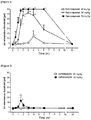
- test compound (10, 30 and 50 mg/kg) and carbamazepine (25 and 50 mg/kg) were intraperitoneally administered to the test animals in which allodynia had been induced.
- carbamazepine 25 and 50 mg/kg
- the pharmacological effects of the drugs were evaluated by observing changes in the behavioral responses.
- trigeminal nerve roots were compressed with agar to induce pain similar to trigeminal neuralgia occurring in the human body.
- the experimental animals in which trigeminal nerve roots were compressed showed a significant pain response, and this pain was maintained over about 40 days after nerve compression surgery.
- the intraperitoneal administration of the test compound at 30 and 50 mg/kg significantly inhibited the mechanical allodynia induced by trigeminal nerve root compression.
- analgesic effect could be observed from 60 minutes after administration, and this effect was confirmed to be maintained for 6 hours after administration.
- carbamazepine a dose of 25 mg/kg showed no analgesic effect, whereas a dose of 50 mg/kg showed a transient low analgesic effect ( Figure 2 ).
- test compound showed a statistically significant effect in the trigeminal neuralgia animal model and exhibited better analgesic action than carbamazepine.
- Mature male rats (Sprague-Dawley, 200-230 g) were used. The experimental animals were maintained under conditions of light-and-darkness cycle of 12 hours, a temperature of 22 to 25°C, a relative humidity of 40 to 60%, and free access to water and food.
- the rats were anesthetized with a mixed solution of ketamine (40 mg/kg) and xylazine (4 mg/kg), then the left second molar of the lower jaw was extracted, and a small dental implant was implanted abnormally to induce inferior alveolar nerve injury ( Han SR. et. al., Early dexamethasone relieves trigeminal neuropathic pain, J Dent Res. 2010 ).
- the animals were placed in a cage and adapted for 20 minutes in a quiet area, followed by an air-puff test to assess mechanical allodynia to air stimulation. Aggressive behaviors such as head movement to avoid air stimulation or biting in response to the air stimulation applied to the facial region which is dominated by the trigeminal nerve were used as evaluation criteria for the behavioral reflex. A total of 10 trials and 50% or more responses were considered as the threshold of stimulation. Stimulation was stopped when the response did not appear even after stimulation of 40 psi or greater.
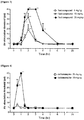
- test compound 5, 10 and 20 mg/kg
- carbamazepine 25 and 50 mg/kg
- the test compound 5, 10 and 20 mg/kg
- carbamazepine 25 and 50 mg/kg
- the test compound 5, 10 and 20 mg/kg
- carbamazepine 25 and 50 mg/kg
- the pharmacological effects of the drugs were evaluated by observing changes in the behavioral responses.
- the experimental animals with inferior alveolar nerve injury showed a significant pain response, and recovery from the pain occurred in about 40 days after nerve compression surgery.
- the intraperitoneal administration of the test compound at 5, 10 and 20 mg/kg significantly inhibited the mechanical allodynia induced by inferior alveolar nerve injury.
- the test compound was intraperitoneally administered at a dose of 20 mg/kg, a significant pain-relieving effect was observed from 90 minutes after administration, and this effect was confirmed to be maintained for 4 hours.
- the test compound was administered at doses of 5 and 10 mg/kg, it was confirmed that the effect was significant from 90 minutes to 2 hours after administration.
- test compound showed a statistically significant effect in the inferior alveolar nerve injury-induced facial pain model, and exhibited an analgesic action equivalent to or greater than carbamazepine and lasted longer than carbamazepine.
- Mature male rats (Sprague-Dawley, 200-230 g) were used. The experimental animals were maintained under conditions of light-and-darkness cycle of 12 hours, a temperature of 22 to 25°C, a relative humidity of 40 to 60%, and free access to water and food.
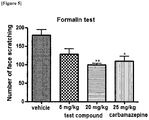
- Formalin 50 ⁇ l was injected subcutaneously into the vibrissa pad on the left facial area of the rats using an insulin syringe (31 gauge). The behavioral response of rubbing or scratching the maxillofacial area was observed from 10 minutes after injection, accumulating in a unit of 5 minutes, for a total of 35 minutes ( Park MK. et. al., Peripheral administration of NR2 antagonists attenuates orofacial formalin-induced nociceptive behavior in rats, Prog Neuropsychopharmacol Biol Psychiatry, 2011 ).
- the vehicle, the test compound (5 and 20 mg/kg) and carbamazepine (25 mg/kg) were intraperitoneally administered, and after 30 minutes 5% formalin was injected into the left facial area.
- the intraperitoneal administration of the test compound at doses of 5 and 20 mg/kg showed a statistically significant decrease in the pain behavioral response as compared with the vehicle-administered group, and a similar effect was observed in the carbamazepine 25 mg/kg administered group.
- test compound shows significant effects not only in the trigeminal neuralgia disease model but also in the facial pain caused by lower mitral nerve injury and formalin injection, and that it has an equal or greater effect than carbamazepine, which is used as a therapeutic agent for patients with trigeminal neuralgia.
Landscapes
- Health & Medical Sciences (AREA)
- Chemical & Material Sciences (AREA)
- Medicinal Chemistry (AREA)
- Pharmacology & Pharmacy (AREA)
- Life Sciences & Earth Sciences (AREA)
- Animal Behavior & Ethology (AREA)
- General Health & Medical Sciences (AREA)
- Public Health (AREA)
- Veterinary Medicine (AREA)
- Epidemiology (AREA)
- Engineering & Computer Science (AREA)
- Bioinformatics & Cheminformatics (AREA)
- Biomedical Technology (AREA)
- Neurology (AREA)
- Neurosurgery (AREA)
- Chemical Kinetics & Catalysis (AREA)
- General Chemical & Material Sciences (AREA)
- Nuclear Medicine, Radiotherapy & Molecular Imaging (AREA)
- Organic Chemistry (AREA)
- Pharmaceuticals Containing Other Organic And Inorganic Compounds (AREA)
Priority Applications (1)
| Application Number | Priority Date | Filing Date | Title |
|---|---|---|---|
| PL17799674T PL3459542T3 (pl) | 2016-05-19 | 2017-05-18 | Zastosowanie związku karbaminianu do zapobiegania lub leczenia neuralgii nerwu trójdzielnego |
Applications Claiming Priority (2)
| Application Number | Priority Date | Filing Date | Title |
|---|---|---|---|
| KR20160061386 | 2016-05-19 | ||
| PCT/KR2017/005172 WO2017200317A1 (ko) | 2016-05-19 | 2017-05-18 | 삼차신경통을 예방 또는 치료하기 위한 카바메이트 화합물의 용도 |
Publications (3)
| Publication Number | Publication Date |
|---|---|
| EP3459542A1 EP3459542A1 (en) | 2019-03-27 |
| EP3459542A4 EP3459542A4 (en) | 2020-01-08 |
| EP3459542B1 true EP3459542B1 (en) | 2021-06-30 |
Family
ID=60325324
Family Applications (1)
| Application Number | Title | Priority Date | Filing Date |
|---|---|---|---|
| EP17799674.1A Active EP3459542B1 (en) | 2016-05-19 | 2017-05-18 | Use of carbamate compound for preventing or treating trigeminal neuralgia |
Country Status (14)
| Country | Link |
|---|---|
| US (2) | US11207295B2 (enExample) |
| EP (1) | EP3459542B1 (enExample) |
| JP (1) | JP6960415B2 (enExample) |
| KR (1) | KR102421013B1 (enExample) |
| CN (1) | CN109310669B (enExample) |
| AU (1) | AU2017267160B2 (enExample) |
| CA (1) | CA3024284C (enExample) |
| DK (1) | DK3459542T3 (enExample) |
| ES (1) | ES2887338T3 (enExample) |
| MX (1) | MX389613B (enExample) |
| PL (1) | PL3459542T3 (enExample) |
| PT (1) | PT3459542T (enExample) |
| RU (1) | RU2751504C2 (enExample) |
| WO (1) | WO2017200317A1 (enExample) |
Families Citing this family (3)
| Publication number | Priority date | Publication date | Assignee | Title |
|---|---|---|---|---|
| ES3035674T3 (en) | 2016-12-14 | 2025-09-08 | Sk Biopharmaceuticals Co Ltd | Use of carbamate compound for prevention, alleviation, or treatment of demyelinating disease |
| IL281559B2 (en) * | 2018-09-21 | 2025-06-01 | Sk Biopharmaceuticals Co Ltd | (r)-1-phenyl-2-tetrazolyl ethyl carbamate derivatives and formulations comprising same for use in preventing, alleviating, or treating acute stress disorder or post-traumatic stress disorder |
| KR20210062029A (ko) | 2018-10-19 | 2021-05-28 | 에스케이바이오팜 주식회사 | 카바메이트 화합물의 당뇨병성 말초 신경병증 또는 화학요법 유발 말초 신경병증의 예방, 완화 또는 치료를 위한 용도 |
Family Cites Families (10)
| Publication number | Priority date | Publication date | Assignee | Title |
|---|---|---|---|---|
| US3415840A (en) * | 1965-10-22 | 1968-12-10 | American Home Prod | Pyrazole-1-ethanol derivatives |
| DE2628420A1 (de) * | 1976-06-24 | 1978-01-05 | Bayer Ag | 1-acyloxy-2-imidazolyl-1-phenyl- aethane, verfahren zu ihrer herstellung sowie ihre verwendung als fungizide und nematizide |
| EP0959882A4 (en) * | 1996-12-31 | 2001-12-05 | N-BONDED UREAUTIES AND CARBAMATES OF HETEROCYCLIC THIOESTERS | |
| MXPA03007721A (es) * | 2001-02-27 | 2004-11-12 | Johnson & Johnson | Compuesto de carbamato para su uso en el tratamiento del dolor. |
| US7598279B2 (en) * | 2005-04-22 | 2009-10-06 | Sk Holdings Co., Ltd. | Neurotherapeutic azole compounds |
| JP4227121B2 (ja) * | 2005-06-08 | 2009-02-18 | 独立行政法人科学技術振興機構 | 神経因性疼痛治療剤 |
| AU2009348523B2 (en) * | 2009-06-22 | 2015-02-26 | Sk Biopharmaceuticals Co., Ltd. | Method for preparation of carbamic acid (R)-1-aryl-2-tetrazolyl-ethyl ester |
| US8404461B2 (en) | 2009-10-15 | 2013-03-26 | SK Biopharmaceutical Co. Ltd. | Method for preparation of carbamic acid (R)-1-aryl-2-tetrazolyl-ethyl ester |
| KR20140009244A (ko) * | 2010-11-11 | 2014-01-22 | 애크런 몰레큘스 게엠베하 | 통증 치료용 화합물 및 방법 |
| SI3054950T1 (sl) * | 2014-05-09 | 2017-12-29 | Tecnimede-Sociedade Tecnico-Medicinal, S.A. | (r)-pirindol in njegove farmacevtsko sprejemljive soli za uporabo v medicini |
-
2017
- 2017-05-16 KR KR1020170060713A patent/KR102421013B1/ko active Active
- 2017-05-18 PL PL17799674T patent/PL3459542T3/pl unknown
- 2017-05-18 RU RU2018144784A patent/RU2751504C2/ru active
- 2017-05-18 AU AU2017267160A patent/AU2017267160B2/en active Active
- 2017-05-18 PT PT177996741T patent/PT3459542T/pt unknown
- 2017-05-18 ES ES17799674T patent/ES2887338T3/es active Active
- 2017-05-18 DK DK17799674.1T patent/DK3459542T3/da active
- 2017-05-18 US US16/302,860 patent/US11207295B2/en active Active
- 2017-05-18 WO PCT/KR2017/005172 patent/WO2017200317A1/ko not_active Ceased
- 2017-05-18 MX MX2018014081A patent/MX389613B/es unknown
- 2017-05-18 EP EP17799674.1A patent/EP3459542B1/en active Active
- 2017-05-18 CN CN201780030912.5A patent/CN109310669B/zh active Active
- 2017-05-18 JP JP2018560617A patent/JP6960415B2/ja active Active
- 2017-05-18 CA CA3024284A patent/CA3024284C/en active Active
-
2021
- 2021-12-02 US US17/457,308 patent/US12611395B2/en active Active
Non-Patent Citations (1)
| Title |
|---|
| None * |
Also Published As
| Publication number | Publication date |
|---|---|
| BR112018073556A2 (pt) | 2019-03-19 |
| MX2018014081A (es) | 2019-09-02 |
| AU2017267160A1 (en) | 2018-12-13 |
| CN109310669A (zh) | 2019-02-05 |
| EP3459542A4 (en) | 2020-01-08 |
| US12611395B2 (en) | 2026-04-28 |
| KR20170131241A (ko) | 2017-11-29 |
| CN109310669B (zh) | 2022-02-22 |
| ES2887338T3 (es) | 2021-12-22 |
| RU2018144784A (ru) | 2020-06-19 |
| CA3024284A1 (en) | 2017-11-23 |
| US20190175555A1 (en) | 2019-06-13 |
| RU2018144784A3 (enExample) | 2020-08-11 |
| JP2019516722A (ja) | 2019-06-20 |
| US11207295B2 (en) | 2021-12-28 |
| KR102421013B1 (ko) | 2022-07-14 |
| US20220087976A1 (en) | 2022-03-24 |
| DK3459542T3 (da) | 2021-09-13 |
| EP3459542A1 (en) | 2019-03-27 |
| PL3459542T3 (pl) | 2021-12-27 |
| MX389613B (es) | 2025-03-20 |
| CA3024284C (en) | 2024-01-23 |
| RU2751504C2 (ru) | 2021-07-14 |
| AU2017267160B2 (en) | 2022-11-10 |
| PT3459542T (pt) | 2021-08-24 |
| WO2017200317A1 (ko) | 2017-11-23 |
| JP6960415B2 (ja) | 2021-11-05 |
Similar Documents
| Publication | Publication Date | Title |
|---|---|---|
| US12611395B2 (en) | Use of carbamate compound for preventing or treating trigeminal neuralgia | |
| EP3459543B1 (en) | Carbamate compound for preventing or treating fibromyalgia | |
| EP3556366B1 (en) | Use of carbamate compounds for prevention, alleviation or treatment of bipolar disorder | |
| US20250127758A1 (en) | Use of carbamate compound for preventing, alleviating or treating myotonia | |
| EP3854391B1 (en) | Carbamate compound and use of formulation comprising same in preventing, alleviating, or treating acute stress disorder or post-traumatic stress disorder | |
| JO et al. | Use of carbamate compound for preventing or treating trigeminal neuralgia | |
| BR112018073556B1 (pt) | Uso de um composto de carbamato | |
| HK40003859A (en) | Use of carbamate compound for preventing or treating trigeminal neuralgia | |
| HK40003859B (en) | Use of carbamate compound for preventing or treating trigeminal neuralgia | |
| CA3024286C (en) | Use of carbamate compound for preventing or treating fibromyalgia or functional syndrome associated with fibromyalgia | |
| CA3081223C (en) | Use of carbamate compound for preventing, alleviating or treating absence seizure or epilepsy showing absence seizure | |
| HK40005640B (en) | Use of carbamate compound for preventing or treating fibromyalgia or functional syndrome associated with fibromyalgia | |
| HK40005640A (en) | Use of carbamate compound for preventing or treating fibromyalgia or functional syndrome associated with fibromyalgia |
Legal Events
| Date | Code | Title | Description |
|---|---|---|---|
| STAA | Information on the status of an ep patent application or granted ep patent |
Free format text: STATUS: THE INTERNATIONAL PUBLICATION HAS BEEN MADE |
|
| PUAI | Public reference made under article 153(3) epc to a published international application that has entered the european phase |
Free format text: ORIGINAL CODE: 0009012 |
|
| STAA | Information on the status of an ep patent application or granted ep patent |
Free format text: STATUS: REQUEST FOR EXAMINATION WAS MADE |
|
| 17P | Request for examination filed |
Effective date: 20181219 |
|
| AK | Designated contracting states |
Kind code of ref document: A1 Designated state(s): AL AT BE BG CH CY CZ DE DK EE ES FI FR GB GR HR HU IE IS IT LI LT LU LV MC MK MT NL NO PL PT RO RS SE SI SK SM TR |
|
| AX | Request for extension of the european patent |
Extension state: BA ME |
|
| RIN1 | Information on inventor provided before grant (corrected) |
Inventor name: HWANG, SUN GWAN Inventor name: JO, MIN JAE Inventor name: YI, HAN JU |
|
| DAV | Request for validation of the european patent (deleted) | ||
| DAX | Request for extension of the european patent (deleted) | ||
| A4 | Supplementary search report drawn up and despatched |
Effective date: 20191206 |
|
| RIC1 | Information provided on ipc code assigned before grant |
Ipc: A61K 31/41 20060101AFI20191202BHEP Ipc: A61K 31/16 20060101ALI20191202BHEP Ipc: A61K 9/00 20060101ALI20191202BHEP Ipc: A61P 29/00 20060101ALI20191202BHEP |
|
| GRAP | Despatch of communication of intention to grant a patent |
Free format text: ORIGINAL CODE: EPIDOSNIGR1 |
|
| STAA | Information on the status of an ep patent application or granted ep patent |
Free format text: STATUS: GRANT OF PATENT IS INTENDED |
|
| INTG | Intention to grant announced |
Effective date: 20201023 |
|
| GRAJ | Information related to disapproval of communication of intention to grant by the applicant or resumption of examination proceedings by the epo deleted |
Free format text: ORIGINAL CODE: EPIDOSDIGR1 |
|
| STAA | Information on the status of an ep patent application or granted ep patent |
Free format text: STATUS: REQUEST FOR EXAMINATION WAS MADE |
|
| GRAS | Grant fee paid |
Free format text: ORIGINAL CODE: EPIDOSNIGR3 |
|
| STAA | Information on the status of an ep patent application or granted ep patent |
Free format text: STATUS: GRANT OF PATENT IS INTENDED |
|
| GRAP | Despatch of communication of intention to grant a patent |
Free format text: ORIGINAL CODE: EPIDOSNIGR1 |
|
| INTC | Intention to grant announced (deleted) | ||
| INTG | Intention to grant announced |
Effective date: 20210330 |
|
| GRAA | (expected) grant |
Free format text: ORIGINAL CODE: 0009210 |
|
| STAA | Information on the status of an ep patent application or granted ep patent |
Free format text: STATUS: THE PATENT HAS BEEN GRANTED |
|
| AK | Designated contracting states |
Kind code of ref document: B1 Designated state(s): AL AT BE BG CH CY CZ DE DK EE ES FI FR GB GR HR HU IE IS IT LI LT LU LV MC MK MT NL NO PL PT RO RS SE SI SK SM TR |
|
| REG | Reference to a national code |
Ref country code: CH Ref legal event code: EP |
|
| REG | Reference to a national code |
Ref country code: AT Ref legal event code: REF Ref document number: 1405700 Country of ref document: AT Kind code of ref document: T Effective date: 20210715 |
|
| REG | Reference to a national code |
Ref country code: DE Ref legal event code: R096 Ref document number: 602017041325 Country of ref document: DE |
|
| REG | Reference to a national code |
Ref country code: IE Ref legal event code: FG4D Ref country code: NL Ref legal event code: FP |
|
| REG | Reference to a national code |
Ref country code: SE Ref legal event code: TRGR |
|
| REG | Reference to a national code |
Ref country code: PT Ref legal event code: SC4A Ref document number: 3459542 Country of ref document: PT Date of ref document: 20210824 Kind code of ref document: T Free format text: AVAILABILITY OF NATIONAL TRANSLATION Effective date: 20210817 |
|
| REG | Reference to a national code |
Ref country code: FI Ref legal event code: FGE |
|
| REG | Reference to a national code |
Ref country code: DK Ref legal event code: T3 Effective date: 20210908 |
|
| REG | Reference to a national code |
Ref country code: LT Ref legal event code: MG9D |
|
| PG25 | Lapsed in a contracting state [announced via postgrant information from national office to epo] |
Ref country code: HR Free format text: LAPSE BECAUSE OF FAILURE TO SUBMIT A TRANSLATION OF THE DESCRIPTION OR TO PAY THE FEE WITHIN THE PRESCRIBED TIME-LIMIT Effective date: 20210630 Ref country code: BG Free format text: LAPSE BECAUSE OF FAILURE TO SUBMIT A TRANSLATION OF THE DESCRIPTION OR TO PAY THE FEE WITHIN THE PRESCRIBED TIME-LIMIT Effective date: 20210930 |
|
| PG25 | Lapsed in a contracting state [announced via postgrant information from national office to epo] |
Ref country code: LV Free format text: LAPSE BECAUSE OF FAILURE TO SUBMIT A TRANSLATION OF THE DESCRIPTION OR TO PAY THE FEE WITHIN THE PRESCRIBED TIME-LIMIT Effective date: 20210630 Ref country code: NO Free format text: LAPSE BECAUSE OF FAILURE TO SUBMIT A TRANSLATION OF THE DESCRIPTION OR TO PAY THE FEE WITHIN THE PRESCRIBED TIME-LIMIT Effective date: 20210930 Ref country code: RS Free format text: LAPSE BECAUSE OF FAILURE TO SUBMIT A TRANSLATION OF THE DESCRIPTION OR TO PAY THE FEE WITHIN THE PRESCRIBED TIME-LIMIT Effective date: 20210630 |
|
| REG | Reference to a national code |
Ref country code: GR Ref legal event code: EP Ref document number: 20210402590 Country of ref document: GR Effective date: 20211111 |
|
| REG | Reference to a national code |
Ref country code: ES Ref legal event code: FG2A Ref document number: 2887338 Country of ref document: ES Kind code of ref document: T3 Effective date: 20211222 |
|
| PG25 | Lapsed in a contracting state [announced via postgrant information from national office to epo] |
Ref country code: SK Free format text: LAPSE BECAUSE OF FAILURE TO SUBMIT A TRANSLATION OF THE DESCRIPTION OR TO PAY THE FEE WITHIN THE PRESCRIBED TIME-LIMIT Effective date: 20210630 Ref country code: SM Free format text: LAPSE BECAUSE OF FAILURE TO SUBMIT A TRANSLATION OF THE DESCRIPTION OR TO PAY THE FEE WITHIN THE PRESCRIBED TIME-LIMIT Effective date: 20210630 Ref country code: EE Free format text: LAPSE BECAUSE OF FAILURE TO SUBMIT A TRANSLATION OF THE DESCRIPTION OR TO PAY THE FEE WITHIN THE PRESCRIBED TIME-LIMIT Effective date: 20210630 Ref country code: RO Free format text: LAPSE BECAUSE OF FAILURE TO SUBMIT A TRANSLATION OF THE DESCRIPTION OR TO PAY THE FEE WITHIN THE PRESCRIBED TIME-LIMIT Effective date: 20210630 |
|
| REG | Reference to a national code |
Ref country code: AT Ref legal event code: UEP Ref document number: 1405700 Country of ref document: AT Kind code of ref document: T Effective date: 20210630 |
|
| REG | Reference to a national code |
Ref country code: DE Ref legal event code: R097 Ref document number: 602017041325 Country of ref document: DE |
|
| PLBE | No opposition filed within time limit |
Free format text: ORIGINAL CODE: 0009261 |
|
| STAA | Information on the status of an ep patent application or granted ep patent |
Free format text: STATUS: NO OPPOSITION FILED WITHIN TIME LIMIT |
|
| PG25 | Lapsed in a contracting state [announced via postgrant information from national office to epo] |
Ref country code: AL Free format text: LAPSE BECAUSE OF FAILURE TO SUBMIT A TRANSLATION OF THE DESCRIPTION OR TO PAY THE FEE WITHIN THE PRESCRIBED TIME-LIMIT Effective date: 20210630 |
|
| 26N | No opposition filed |
Effective date: 20220331 |
|
| PG25 | Lapsed in a contracting state [announced via postgrant information from national office to epo] |
Ref country code: MC Free format text: LAPSE BECAUSE OF FAILURE TO SUBMIT A TRANSLATION OF THE DESCRIPTION OR TO PAY THE FEE WITHIN THE PRESCRIBED TIME-LIMIT Effective date: 20210630 Ref country code: LU Free format text: LAPSE BECAUSE OF NON-PAYMENT OF DUE FEES Effective date: 20220518 |
|
| PG25 | Lapsed in a contracting state [announced via postgrant information from national office to epo] |
Ref country code: LT Free format text: LAPSE BECAUSE OF FAILURE TO SUBMIT A TRANSLATION OF THE DESCRIPTION OR TO PAY THE FEE WITHIN THE PRESCRIBED TIME-LIMIT Effective date: 20210630 Ref country code: IE Free format text: LAPSE BECAUSE OF NON-PAYMENT OF DUE FEES Effective date: 20220518 |
|
| P01 | Opt-out of the competence of the unified patent court (upc) registered |
Effective date: 20230524 |
|
| PG25 | Lapsed in a contracting state [announced via postgrant information from national office to epo] |
Ref country code: HU Free format text: LAPSE BECAUSE OF FAILURE TO SUBMIT A TRANSLATION OF THE DESCRIPTION OR TO PAY THE FEE WITHIN THE PRESCRIBED TIME-LIMIT; INVALID AB INITIO Effective date: 20170518 |
|
| PG25 | Lapsed in a contracting state [announced via postgrant information from national office to epo] |
Ref country code: MK Free format text: LAPSE BECAUSE OF FAILURE TO SUBMIT A TRANSLATION OF THE DESCRIPTION OR TO PAY THE FEE WITHIN THE PRESCRIBED TIME-LIMIT Effective date: 20210630 Ref country code: CY Free format text: LAPSE BECAUSE OF FAILURE TO SUBMIT A TRANSLATION OF THE DESCRIPTION OR TO PAY THE FEE WITHIN THE PRESCRIBED TIME-LIMIT Effective date: 20210630 |
|
| PG25 | Lapsed in a contracting state [announced via postgrant information from national office to epo] |
Ref country code: MT Free format text: LAPSE BECAUSE OF FAILURE TO SUBMIT A TRANSLATION OF THE DESCRIPTION OR TO PAY THE FEE WITHIN THE PRESCRIBED TIME-LIMIT Effective date: 20210630 |
|
| PGFP | Annual fee paid to national office [announced via postgrant information from national office to epo] |
Ref country code: SE Payment date: 20260312 Year of fee payment: 10 |
|
| PGFP | Annual fee paid to national office [announced via postgrant information from national office to epo] |
Ref country code: GB Payment date: 20260310 Year of fee payment: 10 |
|
| PGFP | Annual fee paid to national office [announced via postgrant information from national office to epo] |
Ref country code: NL Payment date: 20260317 Year of fee payment: 10 |
|
| PGFP | Annual fee paid to national office [announced via postgrant information from national office to epo] |
Ref country code: FR Payment date: 20260309 Year of fee payment: 10 |
|
| PGFP | Annual fee paid to national office [announced via postgrant information from national office to epo] |
Ref country code: PL Payment date: 20260311 Year of fee payment: 10 |
|
| REG | Reference to a national code |
Ref country code: CH Ref legal event code: U11 Free format text: ST27 STATUS EVENT CODE: U-0-0-U10-U11 (AS PROVIDED BY THE NATIONAL OFFICE) Effective date: 20260601 |
|
| PGFP | Annual fee paid to national office [announced via postgrant information from national office to epo] |
Ref country code: ES Payment date: 20260610 Year of fee payment: 10 |
|
| PGFP | Annual fee paid to national office [announced via postgrant information from national office to epo] |
Ref country code: DK Payment date: 20260513 Year of fee payment: 10 |
|
| PGFP | Annual fee paid to national office [announced via postgrant information from national office to epo] |
Ref country code: IT Payment date: 20260422 Year of fee payment: 10 Ref country code: GR Payment date: 20260415 Year of fee payment: 10 |
|
| PGFP | Annual fee paid to national office [announced via postgrant information from national office to epo] |
Ref country code: DE Payment date: 20260324 Year of fee payment: 10 |
|
| PGFP | Annual fee paid to national office [announced via postgrant information from national office to epo] |
Ref country code: FI Payment date: 20260515 Year of fee payment: 10 Ref country code: AT Payment date: 20260427 Year of fee payment: 10 |
|
| PGFP | Annual fee paid to national office [announced via postgrant information from national office to epo] |
Ref country code: BE Payment date: 20260413 Year of fee payment: 10 Ref country code: CH Payment date: 20260601 Year of fee payment: 10 |
|
| PGFP | Annual fee paid to national office [announced via postgrant information from national office to epo] |
Ref country code: PT Payment date: 20260518 Year of fee payment: 10 |
|
| PGFP | Annual fee paid to national office [announced via postgrant information from national office to epo] |
Ref country code: CZ Payment date: 20260511 Year of fee payment: 10 Ref country code: TR Payment date: 20260512 Year of fee payment: 10 |