EP3455342B1 - Puce de co-culture cellulaire et son procede de fabrication - Google Patents
Puce de co-culture cellulaire et son procede de fabrication Download PDFInfo
- Publication number
- EP3455342B1 EP3455342B1 EP17727301.8A EP17727301A EP3455342B1 EP 3455342 B1 EP3455342 B1 EP 3455342B1 EP 17727301 A EP17727301 A EP 17727301A EP 3455342 B1 EP3455342 B1 EP 3455342B1
- Authority
- EP
- European Patent Office
- Prior art keywords
- support
- perforation
- value
- face
- diameter
- Prior art date
- Legal status (The legal status is an assumption and is not a legal conclusion. Google has not performed a legal analysis and makes no representation as to the accuracy of the status listed.)
- Active
Links
Images

















Classifications
-
- B—PERFORMING OPERATIONS; TRANSPORTING
- B01—PHYSICAL OR CHEMICAL PROCESSES OR APPARATUS IN GENERAL
- B01L—CHEMICAL OR PHYSICAL LABORATORY APPARATUS FOR GENERAL USE
- B01L3/00—Containers or dishes for laboratory use, e.g. laboratory glassware; Droppers
- B01L3/50—Containers for the purpose of retaining a material to be analysed, e.g. test tubes
- B01L3/502—Containers for the purpose of retaining a material to be analysed, e.g. test tubes with fluid transport, e.g. in multi-compartment structures
- B01L3/5027—Containers for the purpose of retaining a material to be analysed, e.g. test tubes with fluid transport, e.g. in multi-compartment structures by integrated microfluidic structures, i.e. dimensions of channels and chambers are such that surface tension forces are important, e.g. lab-on-a-chip
- B01L3/502707—Containers for the purpose of retaining a material to be analysed, e.g. test tubes with fluid transport, e.g. in multi-compartment structures by integrated microfluidic structures, i.e. dimensions of channels and chambers are such that surface tension forces are important, e.g. lab-on-a-chip characterised by the manufacture of the container or its components
-
- C—CHEMISTRY; METALLURGY
- C12—BIOCHEMISTRY; BEER; SPIRITS; WINE; VINEGAR; MICROBIOLOGY; ENZYMOLOGY; MUTATION OR GENETIC ENGINEERING
- C12M—APPARATUS FOR ENZYMOLOGY OR MICROBIOLOGY; APPARATUS FOR CULTURING MICROORGANISMS FOR PRODUCING BIOMASS, FOR GROWING CELLS OR FOR OBTAINING FERMENTATION OR METABOLIC PRODUCTS, i.e. BIOREACTORS OR FERMENTERS
- C12M23/00—Constructional details, e.g. recesses, hinges
- C12M23/02—Form or structure of the vessel
- C12M23/16—Microfluidic devices; Capillary tubes
-
- C—CHEMISTRY; METALLURGY
- C12—BIOCHEMISTRY; BEER; SPIRITS; WINE; VINEGAR; MICROBIOLOGY; ENZYMOLOGY; MUTATION OR GENETIC ENGINEERING
- C12M—APPARATUS FOR ENZYMOLOGY OR MICROBIOLOGY; APPARATUS FOR CULTURING MICROORGANISMS FOR PRODUCING BIOMASS, FOR GROWING CELLS OR FOR OBTAINING FERMENTATION OR METABOLIC PRODUCTS, i.e. BIOREACTORS OR FERMENTERS
- C12M21/00—Bioreactors or fermenters specially adapted for specific uses
- C12M21/08—Bioreactors or fermenters specially adapted for specific uses for producing artificial tissue or for ex-vivo cultivation of tissue
-
- C—CHEMISTRY; METALLURGY
- C12—BIOCHEMISTRY; BEER; SPIRITS; WINE; VINEGAR; MICROBIOLOGY; ENZYMOLOGY; MUTATION OR GENETIC ENGINEERING
- C12M—APPARATUS FOR ENZYMOLOGY OR MICROBIOLOGY; APPARATUS FOR CULTURING MICROORGANISMS FOR PRODUCING BIOMASS, FOR GROWING CELLS OR FOR OBTAINING FERMENTATION OR METABOLIC PRODUCTS, i.e. BIOREACTORS OR FERMENTERS
- C12M25/00—Means for supporting, enclosing or fixing the microorganisms, e.g. immunocoatings
-
- C—CHEMISTRY; METALLURGY
- C12—BIOCHEMISTRY; BEER; SPIRITS; WINE; VINEGAR; MICROBIOLOGY; ENZYMOLOGY; MUTATION OR GENETIC ENGINEERING
- C12M—APPARATUS FOR ENZYMOLOGY OR MICROBIOLOGY; APPARATUS FOR CULTURING MICROORGANISMS FOR PRODUCING BIOMASS, FOR GROWING CELLS OR FOR OBTAINING FERMENTATION OR METABOLIC PRODUCTS, i.e. BIOREACTORS OR FERMENTERS
- C12M25/00—Means for supporting, enclosing or fixing the microorganisms, e.g. immunocoatings
- C12M25/02—Membranes; Filters
- C12M25/04—Membranes; Filters in combination with well or multiwell plates, i.e. culture inserts
Definitions
- the present invention relates to a microfluidic cell culture chip comprising several parts, each designated by the term “module”, and capable of being assembled in pairs.
- the present invention also relates to a method of manufacturing said chip, as well as its uses in the field of diagnosis.
- This organomimetic device based on a microfluidic system, comprises a porous PDMS membrane, positioned at the interface of two microfluidic channels allowing the circulation of fluids along said membrane, and on which a layer of intestinal epithelial cells is cultured on at minus one of the sides. Coupling the membrane to support elements causes a stretching movement of the membrane in at least one dimension, and thus makes it possible to reproduce the movement of tissues in vivo.
- This chip based on a microfluidic system, comprises a porous PDMS membrane, positioned at the interface of two microfluidic channels allowing the circulation of fluids along said membrane, and on which Caco-2 intestinal epithelial cells are cultured which form spontaneously from the villi beyond two days of culture in the presence of a constant flow of medium of 30 ⁇ L/h.
- PDMS porous PDMS membrane
- inertia, porosity PDMS
- PDMS membranes may have intrinsic transport, mechanical and structural properties that are different from those of the tissue's natural basement membrane. By recreating this type of interface, the authors favor the reproduction of the microarchitecture of the organ.
- Biol., 5, 1130 where they carry out a comparison, between the 2D culture model Transwell ® and a culture model comprising 3D structures mimicking microvilli, of the activity of the drug-metabolizing cytochrome P450 enzyme, and show that in 2D the activity remains unchanged during the culture, while in 3D this activity increases during the formation of microvilli then stabilizes.
- the topography of the cellular environment has a significant impact on the behavior of cells, it is therefore important to reproduce the in vivo conditions of cells as precisely as possible, in order to develop reliable cell culture models.
- the inventors have developed a microfluidic cell co-culture chip, mimicking the microvilli of organs with an acinar/tubular structure and the luminal microenvironment.
- the microfluidic chip according to the invention comprises a membrane made of porous biomaterials which comprises folds thus forming hollow 3D protuberances on which adherent cells are cultured on either side of said membrane at the level of the protuberances. Coupling this membrane to a microfluidic system makes it possible to recover cellular secretions during their culture to analyze their composition.
- the chip according to the invention makes it possible to carry out these detections in the secretions of cells cultured on the protuberance, which are recovered by the micro fluidic system.
- the chip according to the invention thus makes it possible to collect secretions on living cells and consequently to collect the secretions at different times during the culture, or even over several days for carrying out kinetic studies, while maintaining viability and the functionality of cells over time.
- secretions consist of all the molecules that can be secreted into the cell culture medium such as peptides, proteins, amino acids, miRNAs, DNA, RNA.
- the analysis profile of these secretions makes it possible to obtain the secretome, that is to say the qualitative and quantitative profile of the components of the secretions.
- non-resorbable membrane means that the membrane cannot be removed either by a physical process or by a chemical process in an aqueous solvent.
- perforation which relates to the support, designates a recess passing through the support from one side to the other, that is to say an opening through the support between the lower face and the upper face, thus allowing communication between these two sides.
- This perforation of said support creates an empty space through said support, and is characterized by a section at the upper face of said support and a section at the lower face of said support.
- protuberance which relates to the 3D nanostructured porous membrane designates a prominent projection forming a relief structure, on the side of the upper face of said 3D nanostructured porous membrane.
- porous which relates to the 3D nanostructured porous membrane means that said membrane comprises continuous pores interconnected with each other, with a diameter of between 2 and 10 nm, extending from the upper face to the lower face of said membrane.
- These pores allow the exchange of gases through the membrane, as well as small molecules contained in the culture medium (growth factors, serum proteins, nutrient elements ensuring the viability of cells such as Ca 2+ , K + , Na ions). + ).
- These pores also allow pharmacological molecules such as inhibitors or anti-cancer drugs, small RNAs (for example interfering RNA), hormones (for example dihydrotestosterone) to pass through.
- 3D nanostructured which relates to the porous membrane designates the presence of at least one structure in relief, i.e. in 3 dimensions, on the upper face of said porous membrane, the scale of said structure being order of the nanometer.
- base designates the solid part in which said unit is integrated.
- the invention relates to a microfluidic cell culture chip in which said at least protuberance (8) of the nanostructured porous membrane of said microfluidic cell culture chip is in the shape of a hollow dome and has a circular base. (13).
- dome-shaped which relates to the shape of the protuberance means that said protuberance has a rounded structure in the form of a vault with a circular base, forming a convexity on the side of the upper face of said support.
- said protuberance may have a rounded, vault-shaped structure with an oval base, forming a convexity on the side of the upper face of said support.
- in the shape of a hollow dome means that the internal face of said protuberance delimits an empty volume because said protuberance corresponds to a recess of said 3D nanostructured porous membrane on the side of the lower face thereof, said recess forming thus a concavity on the side of the lower face of said membrane, and therefore an empty volume.
- circular base which relates to the hollow dome, designates the empty lower surface on which the dome-shaped protuberance rests and delimited by the internal face of said protuberance.
- the invention relates to a microfluidic cell culture chip in which said at least one perforation of the support is characterized by a circular section at the upper face of said support and a circular section at the lower face of said support.
- the invention relates to a microfluidic cell culture chip in which the diameter d2 of the circular section of said perforation at the lower face of the support is greater than or equal to the diameter d1 of the circular section of said perforation at the upper face of the support.
- the invention relates to a microfluidic cell culture chip in which the diameter d2 of the circular section of said perforation at the lower face of the support is greater than the diameter d1 of the circular section of said perforation at the upper face of the support.
- the invention relates to a microfluidic cell culture chip in which the diameter d2 of the circular section of said perforation at the lower face of the support is greater than the diameter d1 of the circular section of said perforation at the level of the upper face of the support, such that the ratio (value of d1/value of d2) is between a value of 0.3 and a value less than 1.
- the invention relates to a microfluidic cell culture chip in which the diameter d2 of the circular section of said perforation at the lower face of the support is greater than the diameter d1 of the circular section of said perforation at the level of the upper face of the support, and said perforation of said support is in the shape of a truncated cone.
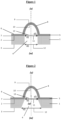
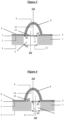
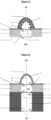
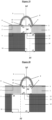
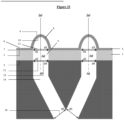
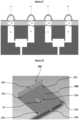
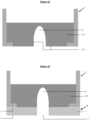
- the invention relates to a microfluidic cell culture chip in which the value of the upper diameter d1 of said at least one perforation (4) is less than the value of the lower diameter d2 of said at least one perforation ( 4), and said perforation (4) is in the shape of a truncated cone ( Figure 2 ).
- the invention relates to a microfluidic cell culture chip in which the diameter d2 of the circular section of said perforation at the level of the lower face of the support is equal to the diameter d1 of the circular section of said perforation at the upper face of the support.
- the invention relates to a microfluidic cell culture chip in which the diameter d2 of the circular section of said perforation at the level of the lower face of the support is equal to the diameter d1 of the circular section of said perforation at the upper face of the support, and said perforation of said support is cylindrical in shape.
- the perforation of said support is therefore of regular shape, that is to say that the diameters of all of its sections are of equal length, and that said sections are of circular shape.
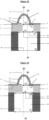
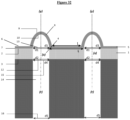
- the invention relates to a microfluidic cell culture chip in which the value of the upper diameter d1 of said at least one perforation (4) is equal to the value of the lower diameter d2 of said at least one perforation ( 4), and said perforation (4) is of cylindrical shape ( Figure 1 ).
- the invention relates to a microfluidic cell culture chip in which said protuberance (8) has a circular base (13) having a diameter d3 (diameter d3 of the circular base of the protuberance), said diameter d3 of the protuberance (8) being from a value of 10 ⁇ m to a value of 500 ⁇ m.
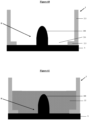
- the invention relates to a microfluidic cell culture chip in which the value of the diameter d3 of said at least one protuberance (8) is equal to the value of the upper diameter d1 of said at least one perforation (4 ) ( Figures 1 and 2 ).
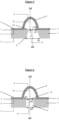
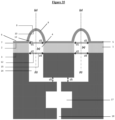
- the invention relates to a microfluidic cell culture chip in which the value of the diameter d3 of said at least one protuberance (8) is equal to the value of the upper diameter d1 of said at least one perforation and is equal to the value of the lower diameter d2 of said at least one perforation (4) ( Figures 1 And 3 ).
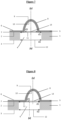
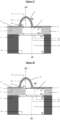
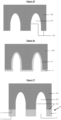
- the invention relates to a microfluidic cell culture chip in which the value of the diameter d3 of said at least one protuberance (8) is greater than the value of the upper diameter d1 of said at least one perforation (4 ) ( Figures 4 , 5 and 6 ).
- the invention relates to a microfluidic cell culture chip in which the value of the diameter d3 of said at least one protuberance (8) is less than the value of the upper diameter d1 of said at least one perforation (4 ) ( Figures 7, 8 , 9, 10 And 11 ).
- the invention relates to a microfluidic cell culture chip in which said internal face (10) of said at least one protuberance (8) is entirely or partly facing said at least one perforation (4). ) of said support (1).
- the 3D nanostructured membrane comprising at least one protuberance and the support perforated by at least one perforation are positioned relative to each other so that the internal face of said protuberance is entirely or partly facing the circular section of said perforation at the level of the upper face of the support.
- the invention relates to a microfluidic cell culture chip in which the angle ⁇ formed between the axis (y) and the axis (z) is between 0 and 45°.
- the invention relates to a microfluidic cell culture chip in which the angle ⁇ formed between the axis (y) and the axis (z) is between 0 and 60°.
- the angle ⁇ formed between the axis (y) and the axis (z) is greater than 45°, the inclination of the protuberance partially blocks the recovery of secretions.
- the theoretical maximum value that the angle ⁇ can take is 90°, but in this embodiment, the protuberance is completely folded down along the upper face of said 3D nanostructured membrane, and the recovery of secretions is blocked.
- the invention relates to a microfluidic cell culture chip in which the external face (9) of said protuberance (8) supports at least one cell adhering to said external face, and in which the internal face (10 ) of said protuberance (8) supports at least one cell adherent to said internal face (10), the at least two cells belonging to two distinct cell types.
- adherent cells designates any type of cell whose growth requires adhesion to a support and for which detachment from said support requires mechanical or enzymatic treatment (for example with trypsin).
- distinct cell types is used to designate cell types of different nature, function or originating from different tissues.
- the invention relates to a microfluidic cell culture chip in which said cell adhering to said external face is a stromal cell, and said cell adhering to said internal face is an epithelial cell.
- the invention relates to a microfluidic cell culture chip in which said at least one cell adhering to said external face (9) is a stromal cell, more particularly a fibroblast, and said at least one cell adhering to said external face (9) is a stromal cell, more particularly a fibroblast, and said at least one cell adhering to said external face (9) said internal face (10) is an epithelial cell.
- the invention relates to a microfluidic cell culture chip in which said cell adhering to said external face is an epithelial cell, and said cell adhering to said internal face is a stromal cell.
- the epithelial cells may be commercial non-tumorigenic prostate, bladder or kidney cell lines, or commercial primary cultures.
- Stromal cells may be fibroblasts (commercial primary cultures or lines), mesenchymal cells (commercial cultures or lines), or other stromal cells such as endothelial cells.
- the two types of cells cultured on the internal and external faces of said protuberance are called “neutral” or healthy, that is to say they are non-tumorigenic.
- the invention relates to a microfluidic cell culture chip in which the external face (9) of said protuberance (8) supports a first set of adherent cells at the confluence stage, and in which the internal face (10) of said protuberance (8) supports a second set of adherent cells at the confluence stage, the cells of the first and the second set of adherent cells belonging to two distinct cell types ( Figure 13 ).
- the invention relates to a microfluidic cell culture chip in which the external face (9) of said protuberance (8) supports a first set of adherent cells advantageously at the confluence stage, said first set being a set of stromal cells, more particularly fibroblasts, and in which the internal face (10) of said protuberance (8) supports a second set of adherent cells at the confluence stage, said second set being a set of epithelial cells ( Figure 52 ).
- the invention relates to a microfluidic cell culture chip in which the external face (9) of said protuberance (8) supports a first set of adherent cells, said first set being a set of stromal cells, more particularly fibroblasts, and in which the internal face (10) of said protuberance (8) supports a second set of adherent cells at the confluence stage, said second set being a set of epithelial cells.
- the invention relates to a microfluidic cell culture chip in which the external face and the internal face of the protuberances are covered with an extracellular matrix (ECM) preparation (Matrigel ® , collagen, fibronectin, acid hyaluronic), before the introduction of the cells onto these surfaces, i.e. before cell culture.
- ECM extracellular matrix
- said ECM preparation is composed of Matrigel ® or a Matrigel ® /collagen mixture.
- the invention relates to a microfluidic cell culture chip in which said 3D nanostructured porous membrane has a thickness of 2 to 300 nm, more particularly 30 nm.
- the invention relates to a cell culture microfluidic chip in which said 3D nanostructured porous membrane has a thickness of 2 to 300 nm.
- the invention relates to a cell culture microfluidic chip in which said 3D nanostructured porous membrane has a thickness of 30 nm.
- the protuberance has a section at its base of circular shape, the surface of this section can be calculated as a function of the radius.
- the invention relates to a microfluidic cell culture chip in which said hollow dome-shaped protuberance has a height of 1 to 600 ⁇ m, more particularly 1 to 300 ⁇ m, more particularly 50 to 300 ⁇ m , more particularly 50 ⁇ m and a surface delimited by the base of the dome of 78.5 ⁇ m 2 to 200,000 ⁇ m 2 , more particularly of 2,000 to 70,000 ⁇ m 2 , even more particularly of 17,500 ⁇ m 2 , and even more particularly of 7850 ⁇ m 2 .
- height designates the distance between the center of the top of the protuberance and the center of the opening of diameter d3.
- the invention relates to a microfluidic cell culture chip in which said support comprises at least two perforations of identical shape and dimensions, and said 3D nanostructured porous membrane comprises at least two protrusions of shape and dimensions identical, the number of perforations being equal to the number of protuberances.
- distance between two contiguous protuberances must be understood as being the distance between two points, located respectively on the circumference formed by the intersection of the external face of said protuberance and the upper face of said nanostructured membrane in 3D of two contiguous protuberances, and forming the shortest distance among all possible distances between the pairs of points located respectively on said circumferences of two contiguous protuberances ( Figure 32 ) .
- the invention relates to a microfluidic cell culture chip in which the distance between two contiguous protuberances is a value 1, said value 1 being 10 to 100 ⁇ m.
- the invention relates to a microfluidic cell culture chip in which the distance between two contiguous protuberances is a value 1, said value 1 being 10 to 100 ⁇ m, more particularly 50 to 100 ⁇ m.
- the invention relates to a microfluidic cell culture chip in which the distance between two contiguous protuberances is a value 1, said value 1 being 50 to 100 ⁇ m.
- the lower diameter d2 of said perforation at the lower face of the support is always greater than or equal to the upper diameter d1 of said perforation at the upper face of the support.
- the invention relates to a microfluidic cell culture chip in which said 3D nanostructured porous membrane has 1 to 100 protuberances for a surface area of the central unit of 1 cm 2 .
- the 3D nanostructured porous membrane is composed of a number of successive layers of polyelectrolytes from 1 to 150, it being understood that the successive layers apply from at least two layers.
- the number of layers makes it possible to vary the mechanical strength of the protuberance. Indeed, the higher the number of layers, the higher the mechanical resistance of the protuberance will be so that it can maintain its shape while supporting the cell culture on these external and internal faces and resisting the flow (for example of medium of culture) on either side of it.
- the invention relates to a microfluidic cell culture chip in which the number of successive layers of polyelectrolytes is from 1 to 150, in particular 15.
- polyelectrolyte to constitute the 3D nanostructured porous membrane provides a biocompatible and functional substitute to mimic the basal lamina on which adherent cells attach in the tissues.
- the 3D nanostructured porous membrane may consist of a layer of a polyelectolyte.
- the invention relates to a microfluidic cell culture chip in which the 3D nanostructured porous membrane consists of a layer of a polyelectolyte chosen from poly(sodium 4-styrenesulphonate) (PSS), poly(ethyleneimine), poly(diallyldimethylammonium chloride), poly(acrylamide-co-diallyldimethylammonium chloride), diallyldimethyllammonium chloride, poly(allylamine hydrochloride ) (PAH), polyanetholesulfonic acid, polyacrylic acid, polystyrene-alt-maleic acid, polyvinyl sulfate, polyvinylsulfonic acid, poly(2-acrylamido-2-methyl-1-propanesulfonic acid) ), poly(2-acrylamido-2-methyl-1-propanesulfonic acid -co-acrylonitrile), poly 4-styrenesulfonic acid, poly(4-styrenes), poly(ethyleneimine
- the 3D nanostructured porous membrane may consist of at least two successive layers of a polyelectolyte.
- the at least one protrusion being an integral part of said 3D nanostructured porous membrane, the composition of said 3D nanostructured porous membrane will be identical to the composition of said at least one protuberance.
- the invention relates to a microfluidic cell culture chip in which the 3D nanostructured porous membrane consists of successive layers of a polyelectrolyte chosen from poly(sodium 4-styrenesulphonate) (PSS), poly (ethyleneimine), poly(diallyldimethylammonium chloride), poly(acrylamide-co-diallyldimethylammonium chloride), diallyldimethyllammonium chloride, poly(allylamine hydrochloride) (PAH), polyanetholesulfonic acid, polyacrylic acid , polystyrene-alt-maleic acid, polyvinyl sulfate, polyvinylsulfonic acid, poly(2-acrylamido-2-methyl-1-propanesulfonic acid), poly(2-acrylamido-2-methyl-acid 1-propanesulfonic acid -co-acrylonitrile), poly 4-styrenesulfonic acid, poly(4-styrenesulfonic acid, poly(
- said layers can correspond to at least two polyelectrolytes of different nature: at least one negatively charged polyelectrolyte and at least one positively charged polyelectrolyte.
- the layer-by-layer construction of this membrane must be carried out in such a way that a layer of positively charged polyelectrolyte alternates with a layer of negatively charged polyelectrolyte.
- the membrane is thus strongly cohesive due to the electrostatic interactions between the positively charged polyelectrolyte layers and the negatively charged polyelectrolyte layers. This makes it possible to obtain a membrane having a Young's modulus of the order of one kiloPascal.
- the lower layer and the upper layer of the porous membrane can be constituted, independently of one another, of any of the polyelectrolytes.
- the charge of the polyelectrolyte constituting the last layer, and therefore constituting the upper face of said membrane has an impact on the hydrophobicity of the membrane.
- the last layer is constituted by a negatively charged polyelectrolyte
- the upper face of the membrane is relatively hydrophilic in nature compared to a membrane whose upper face is positively charged.
- the last layer consists of a positively charged polyelectrolyte
- the upper face of the membrane is relatively hydrophobic in nature compared to a membrane whose upper face is negatively charged.
- the roughness of the upper face of the membrane is governed by the groups carried on the polyelectrolyte constituting the last layer of the membrane, i.e. the layer constituting the upper face of said membrane.
- this polyelectrolyte has a pendant benzene ring attached and a sulfate group attached, which thus provide a rougher surface than a layer of PAH, an electrolyte which does not have benzene ring attached.
- the roughness of the 3D nanostructured porous membrane is of the order of a nanometer.
- the invention relates to a microfluidic cell culture chip in which the number of successive layers is from 1 to 150, in particular 15, of a positively charged polyelectrolyte and a negatively charged polyelectrolyte, said negatively charged polyelectrolyte layer and said positively charged polyelectrolyte layer being alternating with respect to each other.
- said negatively charged polyelectrolyte layer and said positively charged polyelectrolyte layer being alternating with respect to each other.
- the invention relates to a microfluidic cell culture chip in which the 3D nanostructured porous membrane is made up of successive layers of a positively charged polyelectrolyte and a negatively charged polyelectrolyte, said positively charged polyelectrolyte being the poly(sodium 4-styrenesulphonate) (PSS) and said negatively charged polyelectrolyte being poly(allylamine hydrochloride) (PAH), said negatively charged polyelectrolyte layer and said positively charged polyelectrolyte layer being alternately with respect to the other.
- PSS poly(sodium 4-styrenesulphonate)
- PAH poly(allylamine hydrochloride)
- the invention relates to a cell culture microfluidic chip in which the number of successive layers of poly(sodium 4-styrenesulphonate) (PSS) and/or poly(allylamine hydrochloride) (PAH), is from 1 to 150, in particular from 15.
- PSS poly(sodium 4-styrenesulphonate)
- PAH poly(allylamine hydrochloride)
- the invention relates to a microfluidic cell culture chip in which each polyelectrolyte layer has a thickness of 2 to 300 nm, more particularly approximately 2 nm.
- the invention relates to a cell culture microfluidic chip in which the number of successive layers is 15, of a positively charged polyelectrolyte and a negatively charged polyelectrolyte, said negatively charged polyelectrolyte layer and said layer of positively charged polyelectrolyte alternating with each other, each layer having a thickness of 2 nm.
- the invention relates to a microfluidic cell culture chip in which the value of the thickness of all of the successive layers of polyelectrolytes is included from the value of the thickness of a layer to a lower value. half the diameter d3 of said protuberance.
- the hydrophobicity of said membrane and of said protrusion can also be modified.
- the invention relates to a microfluidic cell culture chip in which said support has a thickness of 2 ⁇ m to 1000 ⁇ m, more particularly 20 ⁇ m.
- the invention relates to a microfluidic cell culture chip in which said perforation has a surface area delimited by said non-resorbable membrane of 78.5 ⁇ m 2 to 200,000 ⁇ m 2 , more particularly of 2,000 to 70,000 ⁇ m 2 , even more particularly 17,500 ⁇ m 2 , and even more particularly 7850 ⁇ m 2 .
- the support has at least one perforation.
- said support has at least two perforations, it is appropriate to define the distance between these at least two perforations.
- the “ distance between two contiguous perforations ” must be understood as being the distance between two points located respectively on the circumference of each of the upper circular sections of said contiguous perforations and forming the shortest distance, among all the possible distances between the pairs points located respectively on the circumference of each of the upper circular sections of said contiguous perforations.
- the invention relates to a microfluidic cell culture chip in which said distance between two contiguous perforations is of a value L, said value L being from 10 to 100 ⁇ m, more particularly from 50 to 100 ⁇ m ( Figure 32 ).
- the invention relates to a microfluidic cell culture chip in which said support has 1 to 100 perforations for a surface area of the central unit of 1 cm 2 .
- the invention relates to a cell culture microfluidic chip in which the support is composed of bioprinted plastic, polycarbonate, tissue culture plastic, glass or SU-8 resin.
- SU-8 resin is a negative photosensitive polymeric resin based on novolac epoxy having an average functionality in epoxy groups of approximately 8.
- SU-8 resin is well known to those skilled in the art and commonly used in the manufacture of micro-system.
- the term negative means that the parts exposed to UV become cross-linked, while the rest of the film remains soluble and can be washed off.
- Bioprinted plastics correspond to plastics known to those skilled in the art which are suitable and compatible with 3D printing equipment (extrusion, temperature constraints).
- Tissue culture plastics correspond to plastics, constituting Petri dishes, which include a background treatment (treatment carried out by electrical discharge or plasma to make the surface hydrophilic, that is to say with a net negative charge) and allow the fixation and growth of adherent eukaryotic cells (unlike untreated plastic culture dishes for bacteriology).
- a background treatment treatment carried out by electrical discharge or plasma to make the surface hydrophilic, that is to say with a net negative charge
- adherent eukaryotic cells unlike untreated plastic culture dishes for bacteriology
- the invention relates to a cell culture microfluidic chip in which the support is composed of bioprinted plastic, polycarbonate, tissue culture plastic, glass or SU-8 resin, and said support is transparent .
- the upper orifice of the at least one channel is located within the lower unit, the at least one channel extends through the lower unit then through the base of the lower module, said unit and said base forming a piece in one piece, such that the lower orifice of at least one channel opens out of said base.
- the lower orifice of at least one channel opens either itself outside said base, or opens into an intermediate means such as a reservoir, which opens outside said base.
- the invention relates to a microfluidic cell culture chip in which said lower module (107) and said central module (104) are assembled such that the upper orifice (15) of at least one channel (14 ), of said upper face of said lower unit (108), opens onto at least one of said perforations (4) of said support (1) of said central unit (105), and the lower orifice (16) of at least a channel (14), opens onto the outside of the chip, said upper face of said lower unit (108) and said lower face of said support (3) of said central unit (105) having an identical shape and surface to each other.
- outside the chip must be interpreted as “ outside the base ”, and vice versa.
- This at least one channel makes it possible to recover the secretions of the cells cultured on the internal face of the at least one protuberance.
- This at least channel also makes it possible to introduce culture medium and possibly the cells which are cultured on the internal face of said protuberance.
- the invention relates to a microfluidic cell culture chip in which said lower module (107) and said central module (104) are assembled such that the upper orifice (15) of at least one channel (14 ), of said upper face of said lower unit (108), opens onto at least one of said perforations (4) of said support (1) of said central unit (105), and the lower orifice (16) of at least a channel (14) opens onto the outside of the chip, via an intermediate means consisting of a reservoir (17) capable of recovering liquids and allowing routing outside the chip via an outlet channel (18) opening outside the base (109) of said lower module (107), said upper face of said lower unit (108) and said lower face of said support of said central unit (105) having a shape and surface identical to each other.
- the invention relates to a microfluidic cell culture chip, in which said lower orifice (16) of at least one channel (14) opens outside the chip onto a device allowing analysis of compounds in solution.
- This analysis device can be constituted by any analytical device known to those skilled in the art such as a mass spectrometer, an NMR device, a chromatography device (in liquid or gas phase), a device based on immunological interactions. (ELISA, immunoprecipitation), a PCR or RT-PCR device.
- analytical device known to those skilled in the art such as a mass spectrometer, an NMR device, a chromatography device (in liquid or gas phase), a device based on immunological interactions. (ELISA, immunoprecipitation), a PCR or RT-PCR device.
- cell secretions are composed of both proteins and peptides but also DNA and RNA.
- the chosen analysis device(s) must make it possible to analyze all of these molecules.
- the invention relates to a microfluidic cell culture chip, in which said lower orifice (16) of at least one channel (14) opens outside the chip onto a device allowing analysis of compounds in solution, said device being a mass spectrometer.
- microfluidic chip according to the invention can be coupled directly to a chip integrating a mass spectrometer in order to carry out real-time and continuous analysis of secretions.
- the invention relates to a microfluidic cell culture chip in which said lower unit (108) and said central unit (105) are assembled by fixing elements (204) located respectively on each of the bases of the module (109) and the central module (106), so as to sealingly assemble said upper face of said lower unit (108) and said lower face of said support (3) of said central unit (105).
- the invention relates to a microfluidic cell culture chip, in which the value of the diameter d4 of said upper orifice (15) of said channel (14) is greater than the value of the diameter d5 of said lower orifice (16) of said channel (14).
- the invention relates to a microfluidic cell culture chip, in which the value of the diameter d4 of said upper orifice (15) of said channel (14) is equal to the value of the diameter d5 of said lower orifice (16) of said channel (14), said at least one channel being of cylindrical shape.
- the invention relates to a microfluidic cell culture chip, in which said upper orifice (15) of said at least one channel (14) has a diameter d4 and an axis (t) passing through the center of said orifice upper (15) and perpendicular to said support (1), such that the value of the diameter d4 is greater than or equal to the value of the lower diameter d2 of said at least one perforation (4).
- the invention relates to a microfluidic cell culture chip, in which said upper orifice (15) of said at least one channel (14) opens onto a single perforation (4) of said support (1).
- the invention relates to a cell culture microfluidic chip, in which said lower module (107) comprises at least two channels (14).
- the invention relates to a microfluidic cell culture chip, in which each of the upper orifices (15) of the at least two channels (14) opens onto a perforation (4) and the at least two lower orifices ( 16) at least two channels (14) open outside the chip respectively at at least two distinct locations ( Figure 32 ).
- the invention relates to a microfluidic cell culture chip, in which each of the upper orifices (15) of the at least two channels (14) opens onto a perforation (4) and the at least two lower orifices ( 16) at least two channels (14) open respectively onto an intermediate means consisting of a reservoir (17) capable of recovering liquids and allowing routing outside the chip via an outlet channel (18) opening to the exterior of the base (109) of said lower module (107) ( Figure 31 ).
- the invention relates to a microfluidic cell culture chip, in which each of the upper orifices (15) of the at least two channels (14) opens onto a perforation (4) and the at least two lower orifices ( 16) of at least two channels (14) open respectively onto an intermediate means constituted by a reservoir (17) capable of recovering liquids and allowing routing outside the chip via an outlet channel (18) opening outside the base (109) of said lower module (107), said outlet channels of each of said reservoirs being connected together to open outside the chip at the same location ( Figure 34 ).
- the invention relates to a microfluidic cell culture chip, in which the at least two channels (14) are connected together to form a network, such that each of the upper orifices (15) of the at least two channels (14) open onto a perforation (4) and the lower orifice (16) of each of the at least two channels (14) themselves open outside the chip at the same location or via an intermediate means consisting of a reservoir (17) capable of recovering liquids and allowing routing outside the chip via an outlet channel (18) opening outside the base (109) of said lower module (107) ( Figures 33 And 35 ).
- the invention relates to a microfluidic cell culture chip, in which each of the upper orifices (15) of the at least two channels (14) opens onto a perforation (4) and the at least two lower orifices ( 16) of all at least two channels (14) lead to the same intermediate means constituted by a reservoir (17) capable of recovering liquids and allowing routing outside the chip via an outlet channel (18) opening outside the base (109) of said lower module (107) ( Figure 36 ) .
- the invention relates to a cell culture microfluidic chip in which said lower module (107) has a height of 100 ⁇ m to 2 cm.
- the invention relates to a microfluidic cell culture chip in which said base (109) of the lower module (107) has a height of 100 ⁇ m to 2 cm.
- the invention relates to a cell culture microfluidic chip in which said lower unit (108) has a height of 100 ⁇ m to 2 cm.
- the invention relates to a cell culture microfluidic chip in which the lower module (107) is composed of bioprinted plastic, polycarbonate, tissue culture plastic or SU8.
- the invention relates to a cell culture microfluidic chip in which the lower module (107) is composed of bioprinted plastic, polycarbonate, tissue culture plastic, glass or SU-8 resin, and said lower module (107) is transparent.
- the invention relates to a cell culture microfluidic chip in which the base of the lower module (109) is composed of bioprinted plastic, polycarbonate, tissue culture plastic or SU8.
- the invention relates to a cell culture microfluidic chip in which the base of the lower module (109) is composed of bioprinted plastic, polycarbonate, tissue culture plastic, glass or SU-8 resin , and said base of the lower module (109) is transparent.
- the invention relates to a cell culture microfluidic chip in which the lower unit (108) is composed of bioprinted plastic, polycarbonate, tissue culture plastic or SU8.
- the invention relates to a cell culture microfluidic chip in which the lower unit (108) is composed of bioprinted plastic, polycarbonate, tissue culture plastic, glass or SU-8 resin, and said lower unit (108) is transparent.
- the chamber (203) is integrated into the base (103) of the upper module (101), and is thus surrounded on all its surfaces by said base (103), with the exception of the surface of the open volume of said chamber ( 203).
- the invention relates to a microfluidic cell culture chip in which said upper unit (102) of said upper module (101) and said central unit (105) of said central module (104) are assembled so that said surface of the opening of said upper unit (102) is positioned above said upper face (6) of the 3D nanostructured porous membrane (5) of said central unit (105), said surface of the opening and said face upper (6) having an identical shape and surface to each other.
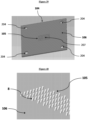
- the upper unit has an opening to the outside (window), at the level of the full surface constituting said chamber making it possible to insert a transparent glass piece compatible with observation under a microscope, preferably a microscope slide, in order to observe the cell culture on the external side of the 3D nanostructured porous membrane and the external face of the at least one protuberance.
- the opening is preferably located at a location on the full surface of said chamber, such that it allows vertical observation of the cell culture on the external face of the protuberance.
- Said transparent glass piece is positioned on said opening of the solid surface constituting said chamber, and held in a sealed manner to said upper unit to maintain a closed space between the upper unit and the central unit.
- said transparent glass piece is held in a sealed manner to said upper unit using a waterproof glue.
- the invention relates to a microfluidic cell culture chip in which said upper unit (102) of said upper module (101) and said central unit (105) of said central module (104) are assembled by elements of fixing (201,204) located on each of the bases (103,106) of the upper module (101) and the central module (104), so as to sealingly assemble said surface of the opening of said upper unit (102) and said upper face (6) of the 3D nanostructured porous membrane (5) of said central unit (105).
- the invention relates to a microfluidic cell culture chip in which said solid and hollow upper unit (102) in which said solid surface comprises a solid rectangular face and four solid faces adjacent to said solid rectangular face and adjacent between them, forming said chamber (203), the free edges of said four solid faces delimiting said surface of the opening of said chamber (206).
- the invention relates to a cell culture microfluidic chip in which the upper module (101) is composed of bioprinted plastic, polycarbonate, tissue culture plastic or SU8.
- the invention relates to a cell culture microfluidic chip in which the upper module (101) is composed of bioprinted plastic, polycarbonate, tissue culture plastic, glass or SU-8 resin, and said upper module (101) is transparent.
- the invention relates to a cell culture microfluidic chip in which the base of the upper module (103) is composed of bioprinted plastic, polycarbonate, tissue culture plastic or SU8.
- the invention relates to a microfluidic cell culture chip in which the base of the upper module (103) is composed of bioprinted plastic, polycarbonate, tissue culture plastic, glass or SU-8 resin. , and said base of the upper module (103) is transparent.
- the invention relates to a cell culture microfluidic chip in which the upper unit (102) is composed of bioprinted plastic, polycarbonate, tissue culture plastic or SU8.
- the invention relates to a cell culture microfluidic chip in which the upper unit (102) is composed of bioprinted plastic, polycarbonate, tissue culture plastic, glass or SU-8 resin, and said upper unit (102) is transparent.
- the invention relates to cell culture microfluidics in which said surface of the opening of said chamber (203) of said upper unit (102) is positioned above said upper face (6) of the 3D nanostructured porous membrane (5) of said central unit (105) to form a closed space delimited by said solid surface of said upper unit (102) and said upper face (6) of the 3D nanostructured porous membrane (5).
- the invention relates to a microfluidic cell culture chip in which said surface of the opening of said chamber (203) of said upper unit (102) is positioned above said upper face (6) of the 3D nanostructured porous membrane (5) of said central unit (105), and in which said at least one solid face of said upper unit (102) has two orifices opening respectively onto an inlet/outlet channel (202), to form a closed space delimited by said solid surface of said upper unit (102), and said upper face (6) of the 3D nanostructured porous membrane (5) of said central unit (105) capable of communicating with the outside of said microfluidic chip only through said two orifices via said input/output channels (202) which open outside the base (109) ( Figures 38 And 43 ).
- the upper unit has two orifices opening respectively onto an inlet/outlet channel.
- the two input/output channels extend through the base of the upper module, said unit and said base forming a single piece, such that said two input/output channels open out outside of said upper base.
- the assembly of the chamber on the 3D nanostructured porous membrane makes it possible to define a closed space capable of communicating with the exterior of said microfluidic chip only through said two orifices via said input/output channels .
- These channels also allow the introduction of the culture medium into the chamber, and possibly the introduction of the cells which are cultured on the upper face of said membrane or the external face of the at least one protuberance.
- These input/output channels can be coupled to sensors allowing continuous monitoring of culture conditions and parameters (CO2, O2, pressure, temperature, glucose, pH sensors). In an alternative embodiment, these sensors can be directly integrated into the chamber (203).
- the invention relates to a microfluidic cell culture chip in which said upper module (101) has a height of 50 ⁇ m to 2 cm, in particular 1 cm.
- the invention relates to a microfluidic cell culture chip in which said base (103) of said upper module (101) has a height of 50 ⁇ m to 2 cm, in particular 1 cm.
- the invention relates to a microfluidic cell culture chip in which said upper unit (102) of said upper module (101) has a height of 50 ⁇ m to 2 cm, in particular 1 cm.
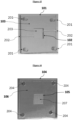
- the fixing elements located on the bases of each of the modules allow you to either lock the modules two by two, to assemble the upper module with the central module and assemble the central module with the lower module, or to lock two modules on the third module , to assemble the central module and the lower module on the upper module.
- fixing elements can be lugs or male-female elements, preferably male-female elements.
- the base of the upper module comprises studs (201) as male fixing elements, and the bases of the central and lower modules comprise perforations (204) as female fixing elements, capable of locking onto said pads of the upper module.
- the invention relates to a microfluidic cell culture chip in which said internal face (10) of said at least one protuberance (8) is entirely or partly facing said at least one perforation (4). ) of said support (1).
- the 3D nanostructured membrane comprising at least one protuberance and the support perforated by at least one perforation are positioned relative to each other so that the internal face of said protuberance is entirely or partly facing the circular section of said perforation at the level of the upper face of the support.
- the first step of manufacturing the central module is a step of extruding a resorbable polymeric solution through one or more perforations of said support made of a non-resorbable material, that is to say a material which cannot be eliminated or by a physical process nor by a chemical process in an aqueous solvent.
- the resorbable polymeric material used for the solution is initially in the form of a viscous liquid to allow extrusion through the perforations of the support.
- viscous is used here to describe a fluid which has a resistance to deformation under shear stress, which is at least the same as that of pure water and preferably substantially greater than that of pure water. .
- a viscous liquid used for extrusion flows more slowly than pure water, a property due to its greater viscosity than pure water.
- the viscosity property of the liquid used for extrusion is important, because such a viscous liquid allows better preservation of the shape of the protuberance, during the extrusion process, than a solution which has the viscosity of pure water .
- the preferred range of liquid viscosity for extrusion is from 1 (pure water) to 100 Pa.s, and preferably, the liquid viscosity is from 0.1 Pa.s to 1 Pa.s.
- extrusion is used here to define a step in which a material in the form of a viscous liquid is passed by force through a die to give a shape predetermined by said die, said viscous material.
- the matrix is constituted by the support comprising at least one perforation and said material in the state of viscous liquid is constituted by the resorbable polymer.
- the invention relates to a method of manufacturing a cell culture microfluidic chip, in which the step of extruding said resorbable polymer solution (22) through the at least one perforation (4 ) of said support (1), makes it possible to form 3D nanostructures (23) on the side of said upper face (2) of said support (1) in the shape of a dome.
- the 3D nanostructure obtained after extrusion through the perforations and polymerization of said resorbable polymeric solution has the technical effect of serving as a mold for the formation of the protuberances of the 3D nanostructured porous membrane.
- Extrusion is stopped when the resorbable polymer solution has formed a 3D nanostructure of desired length to serve as a mold for the desired protrusion.
- the resorbable polymeric solution is then left unconstrained to allow its polymerization or gelation, and thus give solid 3D nanostructures which protrude from the side of the upper face of said support through the perforations.
- the polymerization is carried out directly on the support consisting of a non-resorbable membrane and comprising at least one perforation.
- the 3D nanostructures obtained make it possible to constitute a mold for obtaining the protrusions of the 3D nanostructured porous membrane.
- the surface formed by the upper face of the support and the 3D nanostructures formed by extrusion and protruding from the side of the upper face of said support through the perforations, is then covered by a porous membrane consisting of a polyelectrolyte film.
- Polyelectrolytes have the property of being able to take the form of any type of 3D structure made of any type of material (even resorbable), and of retaining the 3D shape thus given, when removing the 3D structure having served as a mold. .
- This polyelectrolyte film is a multilayer film, produced using the layer-by-layer technique.
- the aim of this technique is to adsorb successive layers of polyelectrolytes on the surface formed by the upper face of the support and the 3D nanostructures protruding through the perforations of said support, to create a plurality of thin layers of polyelectrolytes.
- the polyelectrolytes used are PAH and PSS.
- the PAH and PSS solutions are prepared at a concentration of 1 mg/ml with 0.5 mol/l NaCl.
- the multilayer polyelectrolyte film is constructed by starting indifferently with one of the polyelectrolytes and ending indifferently with one of the polyelectrolytes, but taking into account the alternation of layers between polyelectrolytes of opposite charge.
- This process makes it possible to obtain a final multilayer polyelectrolyte film which constitutes a continuous film over the entire surface formed by the upper face of the support and the 3D nanostructures protruding through the perforations of said support.
- this final multilayer polyelectrolyte film has protuberances obtained by molding during the application of successive layers of polyelectrolytes on the 3D nanostructures resulting from extrusion through the perforations of the support.
- the mold formed by the 3D nanostructures in resorbable polymeric material is dissolved.
- a support consisting of a non-resorbable material, that is to say a material which cannot be eliminated either by a physical process or by a chemical process in an aqueous solvent, makes it possible to keep said support intact at the end of this dissolution step.
- the dissolution of the resorbable polymeric material gives a continuous multilayer film of polyelectrolytes firmly bonded to the support, and which have protrusions retaining the shape of the 3D nanostructures on which they have been molded. This continuous film thus constitutes the 3D nanostructured porous membrane.
- the final structure composed of the porous 3D nanostructured membrane fixed on the support is easily manipulated and forms the central module of said micro fluidic cell culture chip.
- This core module can be disinfected by washing three times consecutively with 70% ethanol, then washing three to four times consecutively with cell culture medium to remove any residual traces of ethanol.
- the invention relates to a method of manufacturing a cell culture microfluidic chip, in which the step of extruding said resorbable polymer solution (22) through the at least one perforation (4 ) of said support (1) is carried out using a pumping system.
- This extrusion of the resorbable polymeric solution is carried out using a pumping system which can be controlled manually or mechanically (by a motor).
- the pump system can be constituted for example by a syringe or a piston or to induce a continuous flow of said resorbable polymer solution (22) through said at least one perforation (4).
- said resorbable polymer solution (22) can be extruded through said at least one perforation (4) using two parallel flat plates which can be moved towards each other, i.e. manually or mechanically, using a motor for example.
- One of the flat plates is positioned on the external face of the upper module (204) and the other flat plate is positioned on the external face of the lower module (101), the two flat plates thus being positioned parallel to one another. compared to the other.
- the movement of said flat and parallel plates, one towards the other thus makes it possible to apply a force to said resorbable polymer solution (22).
- the force applied to the resorbable polymer solution (22) forces said resorbable polymer solution (22) to flow through said at least one perforation (4).
- Extrusion can be carried out in a liquid or in air.
- the invention relates to a method of manufacturing a cell culture microfluidic chip, in which the step of extruding said resorbable polymer solution (22) through the at least one perforation (4 ) of said support (1), is made in a liquid.
- the liquid is chosen so as not to cause resorption of the polymer used to form the protuberance.
- the magnitude of the static fluid pressure which acts against the formation in length of the 3D nanostructure is 9.8 milliPascals.
- the Young's modulus of the polyelectrolyte solution used as resorbable polymer for extrusion is generally of the order of 100 to 400 MegaPascals, there is then a negligible reduction in the length of the 3D nanostructure formed during extrusion (for example, in the worst case, for a Young's modulus of 100 MegaPascals, the reduction in length will be of the order of 10 -5 %).
- the invention relates to a method of manufacturing a cell culture microfluidic chip, in which the step of extruding said resorbable polymer solution (22) through the at least one perforation (4 ) of said support (1), is produced in the air.
- step (i) of the method described above corresponds to the assembly of the support part I with the mold H, in particular a mold H1 comprising 100 molded 3D nanostructures (208), in a reproducible and specific alignment which is guided by the flat section of the parts and the alignment pin (217) of the support part I which fits into the alignment hole (218) of the mold H1.
- the solid face (215) of said support part I is placed on the upper face (209) of the mold H, so that the molded 3D nanostructures (208) of said mold H are positioned at the level of the cutout (216) of said solid face of the support part I.
- the chamber thus formed by the connection of the mold H with the support part I is then filled with the resorbable polymer (22) according to step (ii).
- an resorbable polymer matrix (210) comprising at least one negative mold of said at least one 3D nanostructure (211) is formed in the cutout (216) on the solid face (215) of support piece I.
- the mold H is then removed from the support part I according to step (iv).
- the base of the support piece I is then formed at the level of the cutout (216) by a resorbable polymer matrix (210) comprising at least one negative mold of at least one 3D nanostructure (211).
- the support part I is then assembled with the perforated part G, in particular a perforated part G1 comprising 100 perforations (4), according to step (v), in a reproducible and specific alignment which is guided by the flat section of the parts and the alignment pin (217) of the support part I which fits into the alignment hole (218) of the perforated part G ( figure 70 ).
- the perforated part G consists of a support (1) comprising at least one perforation (4), said support (1) being inserted into a base (106).
- the choice of the perforated part (G1, G2, g1, g2) depends on the choice of the mold (H1, H2, h1, h2) in step (i), the shape and the number of 3D nanostructures of the mold (H1, H2, h1, h2) must be identical to the shape and number of perforations of the perforated part (G1, G2, g1, g2) ( Figures 67 , 68 , 72 , 73 ).
- the upper face (2) of the support (1) of the perforated part G is positioned in contact with the lower face (212) of said resorbable polymer matrix (210).
- the perforations (4) of the perforated part G are then aligned with the negative molds of the 3D nanostructures (211) of said matrix (210) thanks to the alignment pin (217) of the support part I which engages in the alignment hole (218) of the perforated part G.
- the walls of the perforations of the part G1 allow the formation of a chamber, so as to facilitate the formation of the protuberances (8) by the application of at least one continuous layer of at least one polyelectrolyte according to step (vi ), on the continuous surface formed by the lower face (3) of the support (1) and the lower face (212) of said resorbable polymer matrix (210) comprising at least one negative mold of said at least one 3D nanostructure (211 ), at the level of the perforations (4) of said support (1).
- step (vii) the resorbable polymer forming said matrix (210) of negative molds (211) is dissolved according to step (vii).
- the support part I is then removed from the perforated part G1.
- the perforated part G1 then comprises, on the side of the lower face (3) of the support (1), a 3D nanostructured porous membrane (5), and on the side of the upper face (2) of the support (1), said at least one protrusion in the extension of said at least one perforation of the support of the perforated part G1, ( figure 66 ).
- the upper face (6) of the 3D nanostructured porous membrane (5) is integral (in contact) with the lower face (3) of the support consisting of a non-resorbable membrane (1).
- This perforated part G1 then obtained comprising a support (1) with perforations (4) and the 3D nanostructured membrane (5) comprising protuberances (8), constitutes the central module of the microfluidic chip and is used for cell culture on each side of said at least one protuberance.
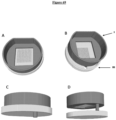
- said support part (I), said mold (H1, H2) and said perforated part (G1, G2) are of circular shape, making it possible in particular to adapt to cell culture dishes of 'a diameter of 35 mm.
- mold and perforated part depends on the number of protuberances desired for the 3D nanostructured membrane of the central unit.
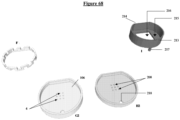
- the central module constituted by the perforated part G with the protuberances obtained at the end of the process detailed above can be placed on a cell culture chamber, such as a cell culture box of diameter 35 mm containing culture medium, via a part F, as shown in figure 71 .
- the central module obtained by the method described above is placed on a lower module as described in the present invention, comprising at least one channel for collecting the secretions of the at least one protuberance.
- the lower module is identical in shape and dimensions to said central module.
- the bottom module is assembled to the middle module in a repeatable and specific alignment that is guided by the flat section of the parts and the alignment pin of the bottom module part that fits into the alignment hole of the middle module.
- the lower module comprises a number of channels identical to the number of perforations and therefore of protrusions of the central module, so that the assembly of said central module with said lower module allows the alignment of the channels with the perforations and therefore the protuberances, to collect cell secretions via a microfluidic system.
- the lower module is replaced by part F.
- This part F used as support for the central module on the culture box as shown in figures 67 , 68 And 71 comprises square openings allowing the circulation of the culture medium to provide nutrients to the growing cells on the internal face of said at least one protuberance.
- said support part (i), said mold (h1, h2) and said perforated part (g1, g2) are square in shape.
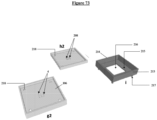
- FIG 72 presents a particular embodiment of the method in which said mold (h1) and said perforated part (g1) respectively comprise 100 molded 3D nanostructures and 100 perforations.
- FIG 73 presents a particular embodiment of the process in which said mold (h2) and said perforated part (g2) respectively comprise 9 molded 3D nanostructures and 9 perforations.
- mold and perforated part depends on the number of protuberances desired for the 3D nanostructured membrane of the central unit.
- the resorbable polymeric solution is preferably made with chitosan, agarose or alginate.
- the invention relates to a method of manufacturing a cell culture microfluidic chip, in which said resorbable polymer solution (22) is chitosan.
- the resorbable mold can be prepared by dissolving 2% chitosan in 2% acetic acid overnight, then diluting to 1.5% chitosan with ethanol. The chitosan solution is then polymerized in a hot bath of 5M NaOH:ethanol at a 1:1 ratio.
- the invention relates to a method of manufacturing a cell culture microfluidic chip, in which the step of polymerizing said resorbable polymer solution (22), said resorbable polymer solution (22) being chitosan, is carried out by incubation with a 2% solution of acetic acid.
- the dissolution is carried out by incubation overnight with a 2% acetic acid solution, according to a protocol well known to those skilled in the art.
- the invention relates to a method of manufacturing a cell culture microfluidic chip, in which said resorbable polymer solution (22) is agarose.
- the resorbable mold can be prepared by heating and dissolving 40 ⁇ g/ml agarose in PBS (phosphate buffer saline). Agarose is polymerized by placing the solution obtained at a temperature below its gelling point.
- PBS phosphate buffer saline
- the invention relates to a method of manufacturing a cell culture microfluidic chip, in which the step of polymerizing said resorbable polymer solution (22), said resorbable polymer solution (22) being agarose, is carried out by incubation at a temperature higher than the gelling temperature of the agarose.
- agarose When agarose is used as an absorbable polymeric material, dissolution is achieved by slowly heating from room temperature to a temperature of 70°C, for 120 minutes, then allowing the temperature of the agarose to return to room temperature. over one night.
- This heating can be carried out in a water bath. It is important that the temperature increases slowly to minimize thermal convection currents that could damage the 3D nanostructured porous membrane.
- Variations of this heating protocol include the addition of DMSO to the water bath water to modify the gelling properties of the agarose.
- the invention relates to a method of manufacturing a cell culture microfluidic chip, in which said resorbable polymer solution (22) is alginate.
- the invention relates to a method of manufacturing a cell culture microfluidic chip, in which the step of polymerizing said resorbable polymer solution, said resorbable polymer solution (22) being alginate, is carried out by incubation overnight with a solution devoid of Ca 2+ and supplemented with a Ca 2+ ion chelating agent, such as EDTA or EGTA.
- a Ca 2+ ion chelating agent such as EDTA or EGTA.
- the roughness, thickness and stiffness of the final multilayer film can be changed.
- the film is composed of 15 layers, 2 nm thick, of polyelectrolytes.
- the hydrophobicity of the final multilayer film can also be modified.
- a protuberance thus formed from 3D nanostructures with a translation defect or an extrusion defect can continue to exercise its technical function initially intended within the device, however, as the protuberance thus formed has a less optimal shape, the performance of this within the device is also less optimal. However, the device may continue to perform its intended function, albeit with reduced performance.
- the culture medium used for all experiments is Keratinocyte Serum Free Medium (KSFM) (Life Technologies, Carlsbad, CA, Ref. 17005-075) supplemented with 5 ng/mL of epidermal growth factor. (EGF) and 50 ⁇ g/mL of bovine pituitary extract.
- KSFM Keratinocyte Serum Free Medium
- EGF epidermal growth factor
- the prostate epithelial cell and stromal cell lines are maintained in this medium and are cultured in an atmosphere at 37°C and 5% CO 2 .
- Subculturing the cells in fresh medium is carried out every three days for epithelial cells and every two days for stromal cells.
- the cells are washed with a solution of Dulbecco's phosphate-buffered saline (D-PBS) without calcium and without magnesium (Life Technologies, Ref. 14190), then incubated with 1 mL of Trypsin-EDTA at 0.25 mg/ mL, at 37°C, (Lonza, Basel, CH, Ref. CC-5012) for approximately 7 minutes.
- the cell culture medium was supplemented every day with fresh culture medium.
- Chemical dissociation of the cells is carried out by incubation for 5 minutes at 37°C with 1 ml of trypsin-EDTA at 0.25 mg/ml (Life Technologies, Ref. 25300-054) in PBS medium without calcium and without magnesium.
- a microfluidic chip according to the invention is sterilized by circulating a 70% ethanol solution (volume/volume) through the channels, then drying the entire microfluidic system in an oven at a temperature between 35° C and 45°C for at least 30 minutes, then exposing it to UV radiation and ozone for 40 min.
- the 3D nanostructured porous membrane is made up of successive layers of polyelectrolytes alternating a layer of positively charged polyelectrolyte and a layer of negatively charged polyelectrolyte. Depending on the manufacturing process, this same membrane constitutes the protuberances.
- ECM extracellular matrix
- the Matrigel ® matrix used here is a commercial product manufactured by the Corning ® company.
- EHS Engelbreth-Holm-Swarm Sarcoma
- Corning ® Matrigel ® matrix also contains proteoglycans heparan sulfate (perlecan), transforming growth factor ⁇ (TGF- ⁇ ), epidermal growth factor, insulin-like growth factor, fibroblast growth factor, tissue plasminogen activator and other growth factors that are naturally present in tumor EHS. It also contains residual matrix metalloproteinases derived from tumor cells.
- Matrigel ® can be used alone to functionalize the porous membrane, at a concentration of 6 mg/ml, or mixed with type I collagen at a concentration between 0.75 and 2.5 mg/ml.
- the epithelial cells are introduced to form a contiguous layer of cells, that is to say a culture of cells at the confluence stage.
- the epithelial cells are introduced onto the internal faces of the protuberances of the central unit.
- the inner surface of the protrusions of the central unit is thus covered with a dense monolayer of epithelial cells, which serves as a physiological support for the growth and differentiation of human cells, isolated from the patient's urine.
- the epithelial cells are introduced at a concentration of 3.10 6 cells/mL into the central unit either directly via the perforations (1st and 2nd mode) with a syringe, or via the channels of the lower unit ( 3rd mode) using an automated fluid system controlled in pressure and flow (Fluigent) or a syringe pump.
- a syringe pump with adjustable flow rate is preferred in order to provide gentle and controlled introduction of cells.
- a stable and continuous flow is delivered by the use of pressure pumps (Fluigent, France). Pressurized containers containing culture medium are maintained in a temperature and CO 2 controlled chamber. The flow rate is adjusted to approximately 5-10 mL/h (10 mbar) and cell adhesion and proliferation is observed over time. All samples are kept in a humidified incubator at 37°C and 5% CO 2 .
- the central unit comprises protrusions with a height of 350 ⁇ m with a circular base of 150 ⁇ m in diameter.
- the area of the internal surface of the protuberance is then 329,700 ⁇ m 2 , on which approximately 50 epithelial cells are counted at the confluence stage (layer of contiguous cells), or approximately one cell per 66 ⁇ m 2 .
- the stromal cells are distributed on the porous membrane at the level of the external and internal faces of the protuberances.
- the stromal cells are introduced via the input/output channels of the upper module at a concentration of 3.10 6 cells/mL into the central unit either directly using a syringe (1st mode), either via the channels of the upper module ( 2nd mode) using an automated fluid system controlled in pressure and flow (Fluigent) or a syringe pump.
- the stromal cells adhere very quickly (less than an hour).
- stromal cells it is not necessary for the stromal cells to form a layer of confluent (or contiguous) cells; their simple adhesion on the external face in this example is sufficient.
- the ratio of epithelial cells to stromal cells is 1:2.
- the porous membrane at the external and internal faces of the protuberances is functionalized with 90 ⁇ l of a solution of Matrigel ® diluted to 6 mg /ml, then seeded to ultimately obtain 7000 epithelial cells/cm 2 and 14,000 stromal cells (fibroblasts)/cm 2 .
- the culture medium introduced via the inlet/outlet channels of the upper module and via the channels of the lower module to supply the cell cultures, is identical on both sides of the protuberances and is made up of KSFM culture medium supplemented with 5 ng/mL of epidermal growth factor (EGF) and 50 ⁇ g/mL of bovine pituitary extract.
- EGF epidermal growth factor
- epithelial cells can be commercial non-tumorigenic cell lines (prostate or bladder or kidney) or commercial primary cultures.
- the two types of cells used to form these cell monolayers are called “neutral” or “healthy”, they are non-tumorigenic and only play the role of basal layer.
- These “neutral” cells form at the confluence stage a very contiguous layer of cells on the internal and external face of the protuberances, establishing tight junctions which can be characterized by immunofluorescence and imaging (see marking of E-cadherin part 5).
- the epithelial cells are introduced on the internal face of the protuberances and the stromal cells are introduced on the external face of the protuberances.
- the co-culture can be established interchangeably, that is, the stromal cells can also be introduced on the inner side of the protrusions, and the epithelial cells on the outer side of the protrusions.
- the polyelectrolyte layer located between the two cell types makes it possible to constitute a porous barrier thanks to its mesh of positively and negatively charged polyelectrolytes.
- the central module is then washed 4 times for 15 minutes with a PBS solution. Nuclei and actin are stained as described above.
- the co-culture is observed by fluorescence microscopy or can be observed by other modes of microscopy such as phase contrast microscopy, lensless imaging, confocal microscopy, light sheet microscopy.
- cell images are recorded using a lensless sensor. SEM analyzes are also carried out.
- the fluorescence images of the central module containing the co-culture of cells are obtained using a Zeiss AxioImager Z1 microscope with a 20x objective equipped with the Apotome straight module for in-depth acquisitions of z-stack field, with image capture every 3 mm in the z axis, for a 150 mm diameter tube. Images are recorded using an AxioCam MRm digital monochrome camera mounted on the microscope.
- the cell cultures in the central unit can be followed in real time by observation under a phase contrast microscope which makes it possible to visualize unmarked and living cells, due to the transparency of the materials constituting the modules.
- the epithelial cells are introduced on the internal face of the protuberances and the stromal cells are introduced on the external face of the protuberances.
- the microfluidic chip thus provided with cells, can be used for the diagnosis of a patient.
- cells are isolated from a patient urine sample of at least 50 mL, in particular 50 to 100 mL. Isolation is carried out by centrifugation of the urine sample at a low speed, in particular 800 g for 5 min, allowing the sedimentation of the cells contained in the urine sample. This centrifugation step is well known to those skilled in the art.
- the sedimented cell pellet is then resuspended in culture medium and the cell suspension is directly introduced into the microfluidic chip according to the invention, which means that the cells do not require pre-culture before their introduction into the chip. .
- the concentration of cells obtained from the urine sample is or varies from a few hundred cells to several thousand.
- the cells isolated from the patient's urine can be introduced to the side of the face of the protrusion which supports the culture of epithelial cells, or to the side of the face of the protuberance which supports the culture of stromal cells. In other words, these cultures being interchangeable on either side of the protuberance, the cells isolated from the patient's urine can be introduced both on the internal face and on the external face of the protuberances.
- the cells isolated from the patient's urine are introduced on the side of the face of the protuberance which supports the culture of epithelial cells.
- they are introduced either via the channels of the lower unit, when the monolayer of epithelial cells is formed on the side of the internal face of the protuberances, or via the entry/exit channels of the upper module when the monolayer of epithelial cells is formed on the side of the external face of the protuberances.
- the cells isolated from the patient's urine are exfoliated uroepithelial (or urothelial) cells, including both bladder, prostate and kidney epithelial cells.
- the internal face of the protuberances is covered with a pre-formed layer of previously cultured epithelial cells
- the external face of the protuberances is covered with a pre-formed layer of fibroblasts (stromal cells)
- the isolated cells are delivered via the channels of the lower module.
- the proliferation of the isolated cells is then followed, in order to observe the progression of the proliferation of the isolated cells in the device and examine whether this proliferation results in the replacement of healthy basal cells and affects the overall secretory profile of the tissue.
- DHT Dihydrotestosterone
- this stimulation can be carried out equally on one side or the other of the protuberances.
- Epithelial cells can also be stimulated by the addition of mibolerone (unmetabolized hormone).
- mibolerone unmetabolized hormone
- the stimulation of the epithelial cells is thus carried out after the adhesion of the two cell types on either side of the protuberances, and after their growth to the confluence stage.
- the secretions can be recovered when the cells isolated from the patient adhere and insert themselves into this pre-formed layer of healthy epithelial cells on the side of the inner face of the protuberances, and which is supported by a layer of healthy fibroblasts on the side of the face external protuberances. Adhesion of cells isolated from the patient lasts approximately 3 hours and their integration lasts approximately 6 hours.
- the final recovery of secretions for secretome analysis is done after allowing at least 12 hours to pass.
- secretions are recovered after 24 to 48 hours of DHT stimulation.
- the secretome is analyzed by mass spectrometry.
- the search for specific markers by immunological methods can also be carried out in the recovered secretions.
- PSA state specific antigen
- a reference biomarker for prostate cancer For example, the detection of PSA (prostate specific antigen), a reference biomarker for prostate cancer, can be carried out.
- the volume of secretions recovered after 24 hours is approximately 2 nL.
- the detection and quantification of PSA is carried out by Elisa test.
- reaction After 15 min at 37°C, the reaction is stopped by adding 100 ⁇ L of sulfuric acid and the absorbance is detected using an ELISA plate reader at 450 nm.
- the microfluidic cell culture chip according to the invention is used for screening molecules.
- the cell culture microfluidic chip according to the invention is used to determine the effect of a treatment for urological cancer on a patient suffering from urological cancer.
- secretome analysis of cells isolated from the patient's urine, inserted into the epithelial cell culture on the protrusion is carried out before and after treatment of the patient, and/or during treatment.
- Comparison of the secretome obtained before treatment with that obtained after treatment, and/or that obtained during treatment, makes it possible to determine the effect of the treatment on the urological cancer affecting the patient.
Landscapes
- Health & Medical Sciences (AREA)
- Chemical & Material Sciences (AREA)
- Life Sciences & Earth Sciences (AREA)
- Engineering & Computer Science (AREA)
- Zoology (AREA)
- Wood Science & Technology (AREA)
- Bioinformatics & Cheminformatics (AREA)
- Organic Chemistry (AREA)
- Biomedical Technology (AREA)
- Genetics & Genomics (AREA)
- General Health & Medical Sciences (AREA)
- Sustainable Development (AREA)
- Biotechnology (AREA)
- Biochemistry (AREA)
- General Engineering & Computer Science (AREA)
- Microbiology (AREA)
- Immunology (AREA)
- Clinical Laboratory Science (AREA)
- Dispersion Chemistry (AREA)
- Molecular Biology (AREA)
- Analytical Chemistry (AREA)
- Hematology (AREA)
- Chemical Kinetics & Catalysis (AREA)
- Apparatus Associated With Microorganisms And Enzymes (AREA)
- Micro-Organisms Or Cultivation Processes Thereof (AREA)
Applications Claiming Priority (2)
| Application Number | Priority Date | Filing Date | Title |
|---|---|---|---|
| FR1654213A FR3051195B1 (fr) | 2016-05-11 | 2016-05-11 | Puce de co-culture cellulaire et son procede de fabrication |
| PCT/FR2017/051148 WO2017194894A1 (fr) | 2016-05-11 | 2017-05-11 | Puce de co-culture cellulaire et son procede de fabrication |
Publications (2)
| Publication Number | Publication Date |
|---|---|
| EP3455342A1 EP3455342A1 (fr) | 2019-03-20 |
| EP3455342B1 true EP3455342B1 (fr) | 2023-10-25 |
Family
ID=56855554
Family Applications (1)
| Application Number | Title | Priority Date | Filing Date |
|---|---|---|---|
| EP17727301.8A Active EP3455342B1 (fr) | 2016-05-11 | 2017-05-11 | Puce de co-culture cellulaire et son procede de fabrication |
Country Status (6)
| Country | Link |
|---|---|
| US (1) | US11857958B2 (enExample) |
| EP (1) | EP3455342B1 (enExample) |
| JP (1) | JP6983180B2 (enExample) |
| CN (1) | CN109699180B (enExample) |
| FR (1) | FR3051195B1 (enExample) |
| WO (1) | WO2017194894A1 (enExample) |
Families Citing this family (4)
| Publication number | Priority date | Publication date | Assignee | Title |
|---|---|---|---|---|
| EP3491122A4 (en) | 2016-07-27 | 2020-04-08 | The University of North Carolina at Chapel Hill | METHOD FOR PRODUCING POLYMER SCAFFOLDINGS WITH A GRADIENT OF CROSSLINKING DENSITY |
| JP7451427B2 (ja) | 2018-05-25 | 2024-03-18 | ザ ユニバーシティ オブ ノース カロライナ アット チャペル ヒル | 幹細胞/増殖細胞区画及び分化細胞ゾーンを有する平面腸陰窩のアレイの形成 |
| EP3880785A4 (en) | 2018-11-16 | 2022-08-24 | The University of North Carolina at Chapel Hill | In vitro cell culture mucus systems |
| CN113820189A (zh) * | 2021-09-10 | 2021-12-21 | 深圳市森盈生物科技有限公司 | 一种用于非妇科的肿瘤筛查的细胞芯片的制备方法 |
Family Cites Families (12)
| Publication number | Priority date | Publication date | Assignee | Title |
|---|---|---|---|---|
| JP2004065087A (ja) * | 2002-08-06 | 2004-03-04 | National Institute For Materials Science | 高密度培養が可能な細胞培養体とその培養モジュール |
| US7494811B2 (en) * | 2003-05-01 | 2009-02-24 | Lifenet Health | In vitro growth of tissues suitable to the formation of bone and bone forming tissue formed thereby |
| JP2005143343A (ja) * | 2003-11-12 | 2005-06-09 | Jgc Corp | 細胞培養装置および細胞培養方法 |
| ATE485101T1 (de) * | 2008-06-02 | 2010-11-15 | Boehringer Ingelheim Micropart | Mikrofluidische folienstruktur zum dosierren von flüssigkeiten |
| KR102667365B1 (ko) * | 2008-07-16 | 2024-05-21 | 칠드런'즈 메디컬 센터 코포레이션 | 마이크로채널을 갖는 기관 모방 장치 및 그 사용 및 제조 방법 |
| EP2358860A1 (en) | 2008-11-21 | 2011-08-24 | Corning Incorporated | Spaced projection substrates and devices for cell culture |
| WO2011014674A2 (en) * | 2009-07-29 | 2011-02-03 | Cornell University | Microfluidic device for pharmacokinetic-pharmacodynamic study of drugs and uses thereof |
| FR2955852B1 (fr) * | 2010-01-29 | 2015-09-18 | Corning Inc | Dispositif microfluideique en verre, ceramique ou vitroceramique, comprenant une couche intermediaire de traitement comprenant au moins une face ayant une surface structuree ouverte definissant un microcanal ferme par une couche formant feuille en verre, ceramique ou vitroceramique essentiellement plane |
| JP5700460B2 (ja) * | 2010-09-10 | 2015-04-15 | 株式会社島津製作所 | 細胞培養デバイス及び細胞培養方法 |
| EP2681306B1 (en) | 2011-02-28 | 2019-01-09 | President and Fellows of Harvard College | Cell culture system |
| WO2014008358A1 (en) * | 2012-07-05 | 2014-01-09 | Cornell University | Porous membrane apparatus, method, and applications |
| CN104830683B (zh) * | 2015-04-30 | 2017-06-30 | 大连医科大学附属第二医院 | 一种用于模拟体内肿瘤细胞及其转移微环境的仿生微流控芯片 |
-
2016
- 2016-05-11 FR FR1654213A patent/FR3051195B1/fr not_active Expired - Fee Related
-
2017
- 2017-05-11 WO PCT/FR2017/051148 patent/WO2017194894A1/fr not_active Ceased
- 2017-05-11 US US16/300,504 patent/US11857958B2/en active Active
- 2017-05-11 CN CN201780043057.1A patent/CN109699180B/zh active Active
- 2017-05-11 EP EP17727301.8A patent/EP3455342B1/fr active Active
- 2017-05-11 JP JP2018559754A patent/JP6983180B2/ja not_active Expired - Fee Related
Also Published As
| Publication number | Publication date |
|---|---|
| US20190168216A1 (en) | 2019-06-06 |
| EP3455342A1 (fr) | 2019-03-20 |
| JP6983180B2 (ja) | 2021-12-17 |
| JP2019518443A (ja) | 2019-07-04 |
| FR3051195B1 (fr) | 2018-05-18 |
| FR3051195A1 (fr) | 2017-11-17 |
| CN109699180A (zh) | 2019-04-30 |
| WO2017194894A1 (fr) | 2017-11-16 |
| US11857958B2 (en) | 2024-01-02 |
| CN109699180B (zh) | 2022-07-26 |
Similar Documents
| Publication | Publication Date | Title |
|---|---|---|
| Abdalkader et al. | Multi-corneal barrier-on-a-chip to recapitulate eye blinking shear stress forces | |
| Rahimnejad et al. | Engineered biomimetic membranes for organ-on-a-chip | |
| Frohlich et al. | Topographically-patterned porous membranes in a microfluidic device as an in vitro model of renal reabsorptive barriers | |
| KR102621919B1 (ko) | iPSC-유래 세포의 장기 등가물로의 분화를 확립하는 신규한 다중 장기 칩 | |
| US8119394B2 (en) | Cell culture devices having ultrathin porous membrane and uses thereof | |
| Puleo et al. | Integration and application of vitrified collagen in multilayered microfluidic devices for corneal microtissue culture | |
| WO2017194894A1 (fr) | Puce de co-culture cellulaire et son procede de fabrication | |
| Liu et al. | A microfluidic chip with poly (ethylene glycol) hydrogel microarray on nanoporous alumina membrane for cell patterning and drug testing | |
| US20220187276A1 (en) | Microfluidic device for measuring cell impedance and transepithelial electrical resistance | |
| WO2022112364A2 (en) | Biocompatible composite membrane, method for fabricating the membrane, bioreactor and method for investigating cells attached to the biocompatible composite membrane | |
| Huang et al. | Spherical microwell arrays for studying single cells and microtissues in 3D confinement | |
| Mancinelli et al. | Porous polymeric nanofilms for recreating the basement membrane in an endothelial barrier-on-chip | |
| CN117813186A (zh) | 一种形成微流体凝胶结构的方法和装置 | |
| Bunge et al. | PDMS-free microfluidic cell culture with integrated gas supply through a porous membrane of anodized aluminum oxide | |
| US20250283020A1 (en) | Microphysiological system and uses thereof | |
| EP3455633B1 (fr) | Methode de diagnostic de cancers urologiques | |
| Graybill et al. | Ultra-thin and ultra-porous nanofiber networks as a basement-membrane mimic | |
| KR20220003155A (ko) | 생체조직 모델 장치, 혈관벽 모델, 혈관벽 모델 장치 및 피검물질의 평가방법 | |
| Mancinelli et al. | Recreating cellular barriers in human microphysiological systems in-vitro | |
| US20240318111A1 (en) | Nanofiber networks as membrane mimics for in vitro applications | |
| Liang | Development and study of organ-on-a-chip systems for automated cell culture, differentiation and impedance monitoring | |
| Kiranmai et al. | 3D-Printed Glomerulus-on-Bioreactor (GoB) Platform for Studying Filtration Barrier Function | |
| Patient | Development of an in-vitro epithelial-myofibroblast intestinal model |
Legal Events
| Date | Code | Title | Description |
|---|---|---|---|
| STAA | Information on the status of an ep patent application or granted ep patent |
Free format text: STATUS: UNKNOWN |
|
| STAA | Information on the status of an ep patent application or granted ep patent |
Free format text: STATUS: THE INTERNATIONAL PUBLICATION HAS BEEN MADE |
|
| PUAI | Public reference made under article 153(3) epc to a published international application that has entered the european phase |
Free format text: ORIGINAL CODE: 0009012 |
|
| STAA | Information on the status of an ep patent application or granted ep patent |
Free format text: STATUS: REQUEST FOR EXAMINATION WAS MADE |
|
| 17P | Request for examination filed |
Effective date: 20181211 |
|
| AK | Designated contracting states |
Kind code of ref document: A1 Designated state(s): AL AT BE BG CH CY CZ DE DK EE ES FI FR GB GR HR HU IE IS IT LI LT LU LV MC MK MT NL NO PL PT RO RS SE SI SK SM TR |
|
| AX | Request for extension of the european patent |
Extension state: BA ME |
|
| DAV | Request for validation of the european patent (deleted) | ||
| DAX | Request for extension of the european patent (deleted) | ||
| RAP1 | Party data changed (applicant data changed or rights of an application transferred) |
Owner name: COMMISSARIAT A L'ENERGIE ATOMIQUE ET AUX ENERGIES ALTERNATIVES Owner name: UNIVERSITE GRENOBLE ALPES |
|
| RAP1 | Party data changed (applicant data changed or rights of an application transferred) |
Owner name: UNIVERSITE GRENOBLE ALPES |
|
| GRAP | Despatch of communication of intention to grant a patent |
Free format text: ORIGINAL CODE: EPIDOSNIGR1 |
|
| STAA | Information on the status of an ep patent application or granted ep patent |
Free format text: STATUS: GRANT OF PATENT IS INTENDED |
|
| INTG | Intention to grant announced |
Effective date: 20230609 |
|
| P01 | Opt-out of the competence of the unified patent court (upc) registered |
Effective date: 20230606 |
|
| GRAS | Grant fee paid |
Free format text: ORIGINAL CODE: EPIDOSNIGR3 |
|
| GRAA | (expected) grant |
Free format text: ORIGINAL CODE: 0009210 |
|
| STAA | Information on the status of an ep patent application or granted ep patent |
Free format text: STATUS: THE PATENT HAS BEEN GRANTED |
|
| AK | Designated contracting states |
Kind code of ref document: B1 Designated state(s): AL AT BE BG CH CY CZ DE DK EE ES FI FR GB GR HR HU IE IS IT LI LT LU LV MC MK MT NL NO PL PT RO RS SE SI SK SM TR |
|
| REG | Reference to a national code |
Ref country code: GB Ref legal event code: FG4D Free format text: NOT ENGLISH |
|
| REG | Reference to a national code |
Ref country code: CH Ref legal event code: EP |
|
| REG | Reference to a national code |
Ref country code: DE Ref legal event code: R096 Ref document number: 602017075653 Country of ref document: DE |
|
| REG | Reference to a national code |
Ref country code: IE Ref legal event code: FG4D Free format text: LANGUAGE OF EP DOCUMENT: FRENCH |
|
| REG | Reference to a national code |
Ref country code: LT Ref legal event code: MG9D |
|
| REG | Reference to a national code |
Ref country code: NL Ref legal event code: MP Effective date: 20231025 |
|
| REG | Reference to a national code |
Ref country code: AT Ref legal event code: MK05 Ref document number: 1624682 Country of ref document: AT Kind code of ref document: T Effective date: 20231025 |
|
| PG25 | Lapsed in a contracting state [announced via postgrant information from national office to epo] |
Ref country code: NL Free format text: LAPSE BECAUSE OF FAILURE TO SUBMIT A TRANSLATION OF THE DESCRIPTION OR TO PAY THE FEE WITHIN THE PRESCRIBED TIME-LIMIT Effective date: 20231025 |
|
| PG25 | Lapsed in a contracting state [announced via postgrant information from national office to epo] |
Ref country code: GR Free format text: LAPSE BECAUSE OF FAILURE TO SUBMIT A TRANSLATION OF THE DESCRIPTION OR TO PAY THE FEE WITHIN THE PRESCRIBED TIME-LIMIT Effective date: 20240126 |
|
| PG25 | Lapsed in a contracting state [announced via postgrant information from national office to epo] |
Ref country code: IS Free format text: LAPSE BECAUSE OF FAILURE TO SUBMIT A TRANSLATION OF THE DESCRIPTION OR TO PAY THE FEE WITHIN THE PRESCRIBED TIME-LIMIT Effective date: 20240225 |
|
| PG25 | Lapsed in a contracting state [announced via postgrant information from national office to epo] |
Ref country code: LT Free format text: LAPSE BECAUSE OF FAILURE TO SUBMIT A TRANSLATION OF THE DESCRIPTION OR TO PAY THE FEE WITHIN THE PRESCRIBED TIME-LIMIT Effective date: 20231025 |
|
| PG25 | Lapsed in a contracting state [announced via postgrant information from national office to epo] |
Ref country code: AT Free format text: LAPSE BECAUSE OF FAILURE TO SUBMIT A TRANSLATION OF THE DESCRIPTION OR TO PAY THE FEE WITHIN THE PRESCRIBED TIME-LIMIT Effective date: 20231025 |
|
| PG25 | Lapsed in a contracting state [announced via postgrant information from national office to epo] |
Ref country code: ES Free format text: LAPSE BECAUSE OF FAILURE TO SUBMIT A TRANSLATION OF THE DESCRIPTION OR TO PAY THE FEE WITHIN THE PRESCRIBED TIME-LIMIT Effective date: 20231025 |
|
| PG25 | Lapsed in a contracting state [announced via postgrant information from national office to epo] |
Ref country code: LT Free format text: LAPSE BECAUSE OF FAILURE TO SUBMIT A TRANSLATION OF THE DESCRIPTION OR TO PAY THE FEE WITHIN THE PRESCRIBED TIME-LIMIT Effective date: 20231025 Ref country code: IS Free format text: LAPSE BECAUSE OF FAILURE TO SUBMIT A TRANSLATION OF THE DESCRIPTION OR TO PAY THE FEE WITHIN THE PRESCRIBED TIME-LIMIT Effective date: 20240225 Ref country code: GR Free format text: LAPSE BECAUSE OF FAILURE TO SUBMIT A TRANSLATION OF THE DESCRIPTION OR TO PAY THE FEE WITHIN THE PRESCRIBED TIME-LIMIT Effective date: 20240126 Ref country code: ES Free format text: LAPSE BECAUSE OF FAILURE TO SUBMIT A TRANSLATION OF THE DESCRIPTION OR TO PAY THE FEE WITHIN THE PRESCRIBED TIME-LIMIT Effective date: 20231025 Ref country code: BG Free format text: LAPSE BECAUSE OF FAILURE TO SUBMIT A TRANSLATION OF THE DESCRIPTION OR TO PAY THE FEE WITHIN THE PRESCRIBED TIME-LIMIT Effective date: 20240125 Ref country code: AT Free format text: LAPSE BECAUSE OF FAILURE TO SUBMIT A TRANSLATION OF THE DESCRIPTION OR TO PAY THE FEE WITHIN THE PRESCRIBED TIME-LIMIT Effective date: 20231025 Ref country code: PT Free format text: LAPSE BECAUSE OF FAILURE TO SUBMIT A TRANSLATION OF THE DESCRIPTION OR TO PAY THE FEE WITHIN THE PRESCRIBED TIME-LIMIT Effective date: 20240226 |
|
| PG25 | Lapsed in a contracting state [announced via postgrant information from national office to epo] |
Ref country code: SE Free format text: LAPSE BECAUSE OF FAILURE TO SUBMIT A TRANSLATION OF THE DESCRIPTION OR TO PAY THE FEE WITHIN THE PRESCRIBED TIME-LIMIT Effective date: 20231025 Ref country code: RS Free format text: LAPSE BECAUSE OF FAILURE TO SUBMIT A TRANSLATION OF THE DESCRIPTION OR TO PAY THE FEE WITHIN THE PRESCRIBED TIME-LIMIT Effective date: 20231025 Ref country code: PL Free format text: LAPSE BECAUSE OF FAILURE TO SUBMIT A TRANSLATION OF THE DESCRIPTION OR TO PAY THE FEE WITHIN THE PRESCRIBED TIME-LIMIT Effective date: 20231025 Ref country code: NO Free format text: LAPSE BECAUSE OF FAILURE TO SUBMIT A TRANSLATION OF THE DESCRIPTION OR TO PAY THE FEE WITHIN THE PRESCRIBED TIME-LIMIT Effective date: 20240125 Ref country code: LV Free format text: LAPSE BECAUSE OF FAILURE TO SUBMIT A TRANSLATION OF THE DESCRIPTION OR TO PAY THE FEE WITHIN THE PRESCRIBED TIME-LIMIT Effective date: 20231025 Ref country code: HR Free format text: LAPSE BECAUSE OF FAILURE TO SUBMIT A TRANSLATION OF THE DESCRIPTION OR TO PAY THE FEE WITHIN THE PRESCRIBED TIME-LIMIT Effective date: 20231025 |
|
| PG25 | Lapsed in a contracting state [announced via postgrant information from national office to epo] |
Ref country code: DK Free format text: LAPSE BECAUSE OF FAILURE TO SUBMIT A TRANSLATION OF THE DESCRIPTION OR TO PAY THE FEE WITHIN THE PRESCRIBED TIME-LIMIT Effective date: 20231025 |
|
| PG25 | Lapsed in a contracting state [announced via postgrant information from national office to epo] |
Ref country code: CZ Free format text: LAPSE BECAUSE OF FAILURE TO SUBMIT A TRANSLATION OF THE DESCRIPTION OR TO PAY THE FEE WITHIN THE PRESCRIBED TIME-LIMIT Effective date: 20231025 |
|
| REG | Reference to a national code |
Ref country code: DE Ref legal event code: R097 Ref document number: 602017075653 Country of ref document: DE |
|
| PG25 | Lapsed in a contracting state [announced via postgrant information from national office to epo] |
Ref country code: SK Free format text: LAPSE BECAUSE OF FAILURE TO SUBMIT A TRANSLATION OF THE DESCRIPTION OR TO PAY THE FEE WITHIN THE PRESCRIBED TIME-LIMIT Effective date: 20231025 |
|
| PG25 | Lapsed in a contracting state [announced via postgrant information from national office to epo] |
Ref country code: SM Free format text: LAPSE BECAUSE OF FAILURE TO SUBMIT A TRANSLATION OF THE DESCRIPTION OR TO PAY THE FEE WITHIN THE PRESCRIBED TIME-LIMIT Effective date: 20231025 Ref country code: SK Free format text: LAPSE BECAUSE OF FAILURE TO SUBMIT A TRANSLATION OF THE DESCRIPTION OR TO PAY THE FEE WITHIN THE PRESCRIBED TIME-LIMIT Effective date: 20231025 Ref country code: RO Free format text: LAPSE BECAUSE OF FAILURE TO SUBMIT A TRANSLATION OF THE DESCRIPTION OR TO PAY THE FEE WITHIN THE PRESCRIBED TIME-LIMIT Effective date: 20231025 Ref country code: IT Free format text: LAPSE BECAUSE OF FAILURE TO SUBMIT A TRANSLATION OF THE DESCRIPTION OR TO PAY THE FEE WITHIN THE PRESCRIBED TIME-LIMIT Effective date: 20231025 Ref country code: EE Free format text: LAPSE BECAUSE OF FAILURE TO SUBMIT A TRANSLATION OF THE DESCRIPTION OR TO PAY THE FEE WITHIN THE PRESCRIBED TIME-LIMIT Effective date: 20231025 Ref country code: DK Free format text: LAPSE BECAUSE OF FAILURE TO SUBMIT A TRANSLATION OF THE DESCRIPTION OR TO PAY THE FEE WITHIN THE PRESCRIBED TIME-LIMIT Effective date: 20231025 Ref country code: CZ Free format text: LAPSE BECAUSE OF FAILURE TO SUBMIT A TRANSLATION OF THE DESCRIPTION OR TO PAY THE FEE WITHIN THE PRESCRIBED TIME-LIMIT Effective date: 20231025 |
|
| PLBE | No opposition filed within time limit |
Free format text: ORIGINAL CODE: 0009261 |
|
| STAA | Information on the status of an ep patent application or granted ep patent |
Free format text: STATUS: NO OPPOSITION FILED WITHIN TIME LIMIT |
|
| 26N | No opposition filed |
Effective date: 20240726 |
|
| PG25 | Lapsed in a contracting state [announced via postgrant information from national office to epo] |
Ref country code: SI Free format text: LAPSE BECAUSE OF FAILURE TO SUBMIT A TRANSLATION OF THE DESCRIPTION OR TO PAY THE FEE WITHIN THE PRESCRIBED TIME-LIMIT Effective date: 20231025 |
|
| PG25 | Lapsed in a contracting state [announced via postgrant information from national office to epo] |
Ref country code: SI Free format text: LAPSE BECAUSE OF FAILURE TO SUBMIT A TRANSLATION OF THE DESCRIPTION OR TO PAY THE FEE WITHIN THE PRESCRIBED TIME-LIMIT Effective date: 20231025 |
|
| REG | Reference to a national code |
Ref country code: CH Ref legal event code: PL |
|
| PG25 | Lapsed in a contracting state [announced via postgrant information from national office to epo] |
Ref country code: MC Free format text: LAPSE BECAUSE OF FAILURE TO SUBMIT A TRANSLATION OF THE DESCRIPTION OR TO PAY THE FEE WITHIN THE PRESCRIBED TIME-LIMIT Effective date: 20231025 |
|
| PG25 | Lapsed in a contracting state [announced via postgrant information from national office to epo] |
Ref country code: LU Free format text: LAPSE BECAUSE OF NON-PAYMENT OF DUE FEES Effective date: 20240511 |
|
| PG25 | Lapsed in a contracting state [announced via postgrant information from national office to epo] |
Ref country code: MC Free format text: LAPSE BECAUSE OF FAILURE TO SUBMIT A TRANSLATION OF THE DESCRIPTION OR TO PAY THE FEE WITHIN THE PRESCRIBED TIME-LIMIT Effective date: 20231025 Ref country code: LU Free format text: LAPSE BECAUSE OF NON-PAYMENT OF DUE FEES Effective date: 20240511 Ref country code: CH Free format text: LAPSE BECAUSE OF NON-PAYMENT OF DUE FEES Effective date: 20240531 |
|
| REG | Reference to a national code |
Ref country code: BE Ref legal event code: MM Effective date: 20240531 |
|
| PG25 | Lapsed in a contracting state [announced via postgrant information from national office to epo] |
Ref country code: IE Free format text: LAPSE BECAUSE OF NON-PAYMENT OF DUE FEES Effective date: 20240511 |
|
| PG25 | Lapsed in a contracting state [announced via postgrant information from national office to epo] |
Ref country code: BE Free format text: LAPSE BECAUSE OF NON-PAYMENT OF DUE FEES Effective date: 20240531 |
|
| PG25 | Lapsed in a contracting state [announced via postgrant information from national office to epo] |
Ref country code: CY Free format text: LAPSE BECAUSE OF FAILURE TO SUBMIT A TRANSLATION OF THE DESCRIPTION OR TO PAY THE FEE WITHIN THE PRESCRIBED TIME-LIMIT; INVALID AB INITIO Effective date: 20170511 |
|
| PG25 | Lapsed in a contracting state [announced via postgrant information from national office to epo] |
Ref country code: HU Free format text: LAPSE BECAUSE OF FAILURE TO SUBMIT A TRANSLATION OF THE DESCRIPTION OR TO PAY THE FEE WITHIN THE PRESCRIBED TIME-LIMIT; INVALID AB INITIO Effective date: 20170511 |
|
| PG25 | Lapsed in a contracting state [announced via postgrant information from national office to epo] |
Ref country code: FI Free format text: LAPSE BECAUSE OF FAILURE TO SUBMIT A TRANSLATION OF THE DESCRIPTION OR TO PAY THE FEE WITHIN THE PRESCRIBED TIME-LIMIT Effective date: 20231025 |
|
| PG25 | Lapsed in a contracting state [announced via postgrant information from national office to epo] |
Ref country code: TR Free format text: LAPSE BECAUSE OF FAILURE TO SUBMIT A TRANSLATION OF THE DESCRIPTION OR TO PAY THE FEE WITHIN THE PRESCRIBED TIME-LIMIT Effective date: 20231025 |
|
| PGFP | Annual fee paid to national office [announced via postgrant information from national office to epo] |
Ref country code: GB Payment date: 20260521 Year of fee payment: 10 |
|
| PGFP | Annual fee paid to national office [announced via postgrant information from national office to epo] |
Ref country code: DE Payment date: 20260513 Year of fee payment: 10 |
|
| PGFP | Annual fee paid to national office [announced via postgrant information from national office to epo] |
Ref country code: FR Payment date: 20260525 Year of fee payment: 10 |