EP3443033B1 - Polycarbonat-zusammensetzungen enthaltend isosorbiddiester - Google Patents
Polycarbonat-zusammensetzungen enthaltend isosorbiddiester Download PDFInfo
- Publication number
- EP3443033B1 EP3443033B1 EP17717696.3A EP17717696A EP3443033B1 EP 3443033 B1 EP3443033 B1 EP 3443033B1 EP 17717696 A EP17717696 A EP 17717696A EP 3443033 B1 EP3443033 B1 EP 3443033B1
- Authority
- EP
- European Patent Office
- Prior art keywords
- acid
- alkyl
- component
- formula
- composition according
- Prior art date
- Legal status (The legal status is an assumption and is not a legal conclusion. Google has not performed a legal analysis and makes no representation as to the accuracy of the status listed.)
- Active
Links
- 0 C**(CCCC1)CC1(c(cc1)cc(*)c1OC)c(cc1)cc(*)c1OC Chemical compound C**(CCCC1)CC1(c(cc1)cc(*)c1OC)c(cc1)cc(*)c1OC 0.000 description 4
Classifications
-
- C—CHEMISTRY; METALLURGY
- C08—ORGANIC MACROMOLECULAR COMPOUNDS; THEIR PREPARATION OR CHEMICAL WORKING-UP; COMPOSITIONS BASED THEREON
- C08K—Use of inorganic or non-macromolecular organic substances as compounding ingredients
- C08K5/00—Use of organic ingredients
-
- B—PERFORMING OPERATIONS; TRANSPORTING
- B29—WORKING OF PLASTICS; WORKING OF SUBSTANCES IN A PLASTIC STATE IN GENERAL
- B29C—SHAPING OR JOINING OF PLASTICS; SHAPING OF MATERIAL IN A PLASTIC STATE, NOT OTHERWISE PROVIDED FOR; AFTER-TREATMENT OF THE SHAPED PRODUCTS, e.g. REPAIRING
- B29C48/00—Extrusion moulding, i.e. expressing the moulding material through a die or nozzle which imparts the desired form; Apparatus therefor
- B29C48/022—Extrusion moulding, i.e. expressing the moulding material through a die or nozzle which imparts the desired form; Apparatus therefor characterised by the choice of material
-
- C—CHEMISTRY; METALLURGY
- C08—ORGANIC MACROMOLECULAR COMPOUNDS; THEIR PREPARATION OR CHEMICAL WORKING-UP; COMPOSITIONS BASED THEREON
- C08G—MACROMOLECULAR COMPOUNDS OBTAINED OTHERWISE THAN BY REACTIONS ONLY INVOLVING UNSATURATED CARBON-TO-CARBON BONDS
- C08G64/00—Macromolecular compounds obtained by reactions forming a carbonic ester link in the main chain of the macromolecule
- C08G64/04—Aromatic polycarbonates
- C08G64/06—Aromatic polycarbonates not containing aliphatic unsaturation
-
- C—CHEMISTRY; METALLURGY
- C08—ORGANIC MACROMOLECULAR COMPOUNDS; THEIR PREPARATION OR CHEMICAL WORKING-UP; COMPOSITIONS BASED THEREON
- C08K—Use of inorganic or non-macromolecular organic substances as compounding ingredients
- C08K5/00—Use of organic ingredients
- C08K5/0008—Organic ingredients according to more than one of the "one dot" groups of C08K5/01 - C08K5/59
- C08K5/005—Stabilisers against oxidation, heat, light, ozone
-
- C—CHEMISTRY; METALLURGY
- C08—ORGANIC MACROMOLECULAR COMPOUNDS; THEIR PREPARATION OR CHEMICAL WORKING-UP; COMPOSITIONS BASED THEREON
- C08K—Use of inorganic or non-macromolecular organic substances as compounding ingredients
- C08K5/00—Use of organic ingredients
- C08K5/04—Oxygen-containing compounds
- C08K5/10—Esters; Ether-esters
- C08K5/12—Esters; Ether-esters of cyclic polycarboxylic acids
-
- C—CHEMISTRY; METALLURGY
- C08—ORGANIC MACROMOLECULAR COMPOUNDS; THEIR PREPARATION OR CHEMICAL WORKING-UP; COMPOSITIONS BASED THEREON
- C08K—Use of inorganic or non-macromolecular organic substances as compounding ingredients
- C08K5/00—Use of organic ingredients
- C08K5/04—Oxygen-containing compounds
- C08K5/15—Heterocyclic compounds having oxygen in the ring
- C08K5/151—Heterocyclic compounds having oxygen in the ring having one oxygen atom in the ring
- C08K5/1535—Five-membered rings
-
- C—CHEMISTRY; METALLURGY
- C08—ORGANIC MACROMOLECULAR COMPOUNDS; THEIR PREPARATION OR CHEMICAL WORKING-UP; COMPOSITIONS BASED THEREON
- C08K—Use of inorganic or non-macromolecular organic substances as compounding ingredients
- C08K5/00—Use of organic ingredients
- C08K5/49—Phosphorus-containing compounds
- C08K5/50—Phosphorus bound to carbon only
-
- C—CHEMISTRY; METALLURGY
- C08—ORGANIC MACROMOLECULAR COMPOUNDS; THEIR PREPARATION OR CHEMICAL WORKING-UP; COMPOSITIONS BASED THEREON
- C08K—Use of inorganic or non-macromolecular organic substances as compounding ingredients
- C08K5/00—Use of organic ingredients
- C08K5/49—Phosphorus-containing compounds
- C08K5/51—Phosphorus bound to oxygen
- C08K5/52—Phosphorus bound to oxygen only
- C08K5/524—Esters of phosphorous acids, e.g. of H3PO3
-
- C—CHEMISTRY; METALLURGY
- C08—ORGANIC MACROMOLECULAR COMPOUNDS; THEIR PREPARATION OR CHEMICAL WORKING-UP; COMPOSITIONS BASED THEREON
- C08L—COMPOSITIONS OF MACROMOLECULAR COMPOUNDS
- C08L69/00—Compositions of polycarbonates; Compositions of derivatives of polycarbonates
-
- B—PERFORMING OPERATIONS; TRANSPORTING
- B29—WORKING OF PLASTICS; WORKING OF SUBSTANCES IN A PLASTIC STATE IN GENERAL
- B29K—INDEXING SCHEME ASSOCIATED WITH SUBCLASSES B29B, B29C OR B29D, RELATING TO MOULDING MATERIALS OR TO MATERIALS FOR MOULDS, REINFORCEMENTS, FILLERS OR PREFORMED PARTS, e.g. INSERTS
- B29K2069/00—Use of PC, i.e. polycarbonates or derivatives thereof, as moulding material
-
- C—CHEMISTRY; METALLURGY
- C08—ORGANIC MACROMOLECULAR COMPOUNDS; THEIR PREPARATION OR CHEMICAL WORKING-UP; COMPOSITIONS BASED THEREON
- C08L—COMPOSITIONS OF MACROMOLECULAR COMPOUNDS
- C08L2201/00—Properties
- C08L2201/08—Stabilised against heat, light or radiation or oxydation
-
- C—CHEMISTRY; METALLURGY
- C08—ORGANIC MACROMOLECULAR COMPOUNDS; THEIR PREPARATION OR CHEMICAL WORKING-UP; COMPOSITIONS BASED THEREON
- C08L—COMPOSITIONS OF MACROMOLECULAR COMPOUNDS
- C08L2201/00—Properties
- C08L2201/10—Transparent films; Clear coatings; Transparent materials
-
- C—CHEMISTRY; METALLURGY
- C08—ORGANIC MACROMOLECULAR COMPOUNDS; THEIR PREPARATION OR CHEMICAL WORKING-UP; COMPOSITIONS BASED THEREON
- C08L—COMPOSITIONS OF MACROMOLECULAR COMPOUNDS
- C08L2205/00—Polymer mixtures characterised by other features
- C08L2205/02—Polymer mixtures characterised by other features containing two or more polymers of the same C08L -group
- C08L2205/025—Polymer mixtures characterised by other features containing two or more polymers of the same C08L -group containing two or more polymers of the same hierarchy C08L, and differing only in parameters such as density, comonomer content, molecular weight, structure
Definitions
- the invention relates to compositions containing polycarbonate and carboxylic acid ester of isosorbide, the use of the compositions for the production of blends or molded parts and molded parts obtainable therefrom.
- the compositions have improved rheological and optical properties and improved demolding and processing behavior in injection molding.
- a low melt viscosity is required so that components with a uniform wall thickness can be realized.
- Further areas of application in which good flow properties are required are in the automotive sector (e.g. headlight covers, panels, light guide systems) and in the E / E sector (lighting components, housing parts, covers, smart meter applications).
- BDP Bisphenol A diphosphate
- DE102010002856 describes the use of isosorbite esters as plasticizers in laminated discs.
- US20120178858 discloses a plasticized starch containing isosorbitol.
- Aromatic polycarbonate in the sense of the invention means both homopolycarbonates and copolycarbonates.
- the polycarbonates can be linear or branched in a known manner. Mixtures of polycarbonates can also be used according to the invention.
- compositions according to the invention are preferably transparent.
- the optical properties can be improved by using the isosorbide diesters in transparent polycarbonate compositions.
- the transmission determined according to ISO 13468 at a thickness of 4 mm, is increased and at the same time the yellowness index YI, determined according to ASTM E 313 (observer: 10 ° / illuminant: D65, on a sample plate of 4 mm thickness), lowered.
- Transparent in the sense according to the invention means that the compositions in the range from 400 nm to 800 nm determine a transmission of at least 84% according to ISO 13468 with a thickness of 4 mm and a haze ⁇ 5% determined according to ASTM D1003 with a layer thickness of 4 mm.
- C 1 -C 4 alkyl is, for example, methyl, ethyl, n-propyl, isopropyl, n-butyl, sec-butyl, tert-butyl, C 1 -C 6 -alkyl, for example for n-pentyl, 1-methylbutyl, 2-methylbutyl, 3-methylbutyl, neo-pentyl, 1-ethylpropyl, cyclohexyl, cyclopentyl, n-hexyl, 1,1-dimethylpropyl, 1,2-dimethylpropyl, 1,2-dimethylpropyl , 1-methylpentyl, 2-methylpentyl, 3-methylpentyl, 4-methylpentyl, 1,1-dimethylbutyl, 1,2-dimethylbutyl, 1,3-dimethylbutyl, 2,2-dimethylbutyl, 2,3-dimethylbutyl, 3,3
- alkyl radicals in the corresponding hydroxyalkyl or aralkyl or alkylaryl radicals are, for example, the alkylene radicals corresponding to the preceding alkyl radicals.
- Aryl stands for a carbocyclic aromatic radical with 6 to 34 carbon atoms. The same applies to the aromatic part of an arylalkyl radical, also called aralkyl radical, and to aryl components of more complex groups, such as e.g. Arylcarbonyl.
- C 6 -C 34 -aryl examples include phenyl, o-, p-, m-tolyl, naphthyl, phenanthrenyl, anthracenyl or fluorenyl.
- Arylalkyl or aralkyl each independently means a straight-chain, cyclic, branched or unbranched alkyl radical as defined above, which can be substituted once, several times or completely by aryl radicals as defined above.
- the stated% by weight of components A, B, C and D - unless explicitly stated otherwise - each relate to the total weight of the composition.
- the composition can contain further components.
- the composition contains no further components, but components A) to D) add up to 100% by weight; i.e. the composition consists of components A, B, C and D.
- compositions according to the invention are preferably used for the production of moldings.
- the compositions preferably have a melt volume flow rate (MVR) of 2 to 120 cm 3/10 min, more preferably from 3 to 90 cm 3/10 min, determined according to ISO 1133 (test temperature 300 ° C, mass 1.2 kg), on.
- MVR melt volume flow rate
- the composition according to the invention contains, as component A, 20.0% by weight to 99.0% by weight of aromatic polycarbonate.
- the amount of the aromatic polycarbonate in the composition is preferably at least 50% by weight, particularly preferably at least 60% by weight and very particularly preferably at least 75% by weight, it being possible for a single polycarbonate or a mixture of several polycarbonates to be present.
- the polycarbonates contained in the compositions, to which diglycerol esters are added to improve the flowability, are prepared in a known manner from diphenols, carbonic acid derivatives, optionally chain terminators and branching agents.
- Aromatic polycarbonates are produced e.g. by reacting diphenols with carbonic acid halides, preferably phosgene, and / or with aromatic dicarboxylic acid dihalides, preferably benzenedicarboxylic acid dihalides, according to the phase interface method, optionally using chain terminators and optionally using trifunctional or more than trifunctional branching agents. It is also possible to use a melt polymerization process by reacting diphenols with, for example, diphenyl carbonate.
- Diphenols suitable for the preparation of the polycarbonates are, for example, hydroquinone, resorcinol, dihydroxydiphenyls, bis (hydroxyphenyl) alkanes, bis (hydroxyphenyl) cycloalkanes, bis (hydroxyphenyl) sulfides, bis (hydroxyphenyl) ethers, bis ( hydroxyphenyl) ketones, bis (hydroxyphenyl) sulfones, bis (hydroxyphenyl) sulfoxides, ⁇ - ⁇ '-bis (hydroxyphenyl) diisopropylbenzenes, phthalimidines derived from isatin or phenolphthalein derivatives and their nuclear alkylated, nuclear arylated and nuclear halogenated compounds.
- Preferred diphenols are 4,4'-dihydroxydiphenyl, 2,2-bis (4-hydroxyphenyl) propane (bisphenol A), 2,4-bis (4-hydroxyphenyl) -2-methylbutane, 1,1-bis- (4-hydroxyphenyl) -p-diisopropylbenzene, 2,2-bis (3-methyl-4-hydroxyphenyl) propane (dimethyl-bisphenol A), bis- (3,5-dimethyl-4-hydroxyphenyl) methane, 2,2-bis (3,5-dimethyl-4-hydroxyphenyl) propane, bis (3,5-dimethyl-4-hydroxyphenyl) sulfone, 2,4-bis (3,5-dimethyl-4 -hydroxyphenyl) -2-methylbutane, 1,1-bis- (3,5-dimethyl-4-hydroxyphenyl) -p-diisopropylbenzene and 1,1-bis- (4-hydroxyphenyl) -3,3,5-trimethylcyclohexane, and the bis
- Particularly preferred diphenols are 2,2-bis (4-hydroxyphenyl) propane (bisphenol A), 2,2-bis (3,5-dimethyl-4-hydroxyphenyl) propane, 1,1-bis (4 -hydroxyphenyl) -cyclohexane, 1,1-bis- (4-hydroxyphenyl) -3,3,5-trimethylcyclohexane and dimethyl-bisphenol A and the diphenols of the formulas (I), (II) and (III).
- Suitable chain terminators that can be used in the production of the polycarbonates are monophenols.
- Suitable monophenols are, for example, phenol itself, alkylphenols such as cresols, p-tert-butylphenol, cumylphenol and mixtures thereof.
- Preferred chain terminators are the phenols which are mono- or polysubstituted with C 1 -C 30 -alkyl radicals, linear or branched, preferably unsubstituted, or substituted with tert-butyl. Particularly preferred chain terminators are phenol, cumylphenol and / or p-tert-butylphenol.
- the amount of chain terminator to be used is preferably 0.1 to 5 mol%, based on moles of diphenols used in each case.
- the chain terminators can be added before, during or after the reaction with a carbonic acid derivative.
- Suitable branching agents are, for example, 1,3,5-tri- (4-hydroxyphenyl) benzene, 1,1,1-tri- (4-hydroxyphenyl) ethane, tri- (4-hydroxyphenyl) phenylmethane, 2,4- Bis (4-hydroxyphenylisopropyl) phenol, 2,6-bis (2-hydroxy-5'-methylbenzyl) -4-methylphenol, 2- (4-hydroxyphenyl) -2- (2,4-dihydroxyphenyl) propane, tetra- (4-hydroxyphenyl) methane, tetra- (4- (4-hydroxyphenylisopropyl) phenoxy) methane and 1,4-bis ((4 ', 4 "-dihydroxytriphenyl) methyl) benzene and 3,3-bis (3-methyl-4-hydroxyphenyl) -2-oxo-2,3-dihydroindole.
- the amount of branching agents which may be used is preferably 0.05 mol% to 2.00 mol%, based on moles of diphenols used in each case.
- the branching agents can either be introduced with the diphenols and the chain terminators in the aqueous alkaline phase or dissolved in an organic solvent before Phosgenation can be added. In the case of the transesterification process, the branching agents are used together with the diphenols.
- the amount of the powdery aromatic polycarbonate A2, based on the total amount of polycarbonate, is 3.0 to 12.0% by weight, preferably 4.0 to 11.0% by weight, particularly preferably 3.0 to 10.0 wt .-%, wherein said aromatic polycarbonate preferably based on bisphenol a having a preferred melt volume-flow rate MVR of 3 to 8 cm 3/10 min, more preferably having a melt volume-flow rate MVR 4-7 cm 3/10 min, and more preferably with a melt volume flow rate MVR of 6 cm 3/10 min, determined according to ISO 1133 (test temperature 300 ° C, mass 1.2 kg) is.
- 1,1-Bis- (4-hydroxyphenyl) -3,3,5-trimethylcyclohexane (bisphenol TMC) with the formula (1a) is particularly preferred:
- the diphenols of the general formulas (3a) can be used either alone or in a mixture with one another.
- the diphenols are known from the literature or can be prepared by processes known from the literature (see, for example HJ Buysch et al., Ullmann's Encyclopedia of Industrial Chemistry, VCH, New York 1991, 5th Ed., Vol. 19, p. 348 ).
- the total proportion of the monomer units of the formula (1) in the copolycarbonate is preferably 0.1-88 mol%, particularly preferably 1-86 mol%, very particularly preferably 5-84 mol% and in particular 10-82 mol% (sum Moles of the diphenols of the formula (1 ') based on the sum of the moles of all diphenols used).
- Copolycarbonates can exist as block and statistical copolycarbonates. Statistical copolycarbonates are particularly preferred. The ratio of the frequency of the diphenolate monomer units in the copolycarbonate results from the molar ratio of the diphenols used.
- Bisphenol A is very particularly preferred here.
- one or more monomer units of the formula (3) may be present in the homo- or copolycarbonate which may also be present.
- the composition according to the invention has, as component A, a blend of the copolycarbonate containing the monomer units of the formula (1) and a bisphenol A-based homopolycarbonate.
- the total proportion of the monomer units of the formula (1) in component A is preferably 0.1-88 mol%, particularly preferably 1-86 mol%, very particularly preferably 5 to 84 mol% and in particular 10 to 82 mol%, based on the sum of the moles of all monomer units of the formulas (1) and (3) in the one or more polycarbonates of component A.
- the composition according to the invention is characterized in that the amount of copolycarbonate containing the monomer units of the formula (1) in the composition is at least 20% by weight.
- compositions according to the invention contain at least one isosorbide diester as component B.
- Different isomers of diglycerol can also form the basis for the esters. Esters based on various carboxylic acids are suitable. Mixtures can also be used instead of pure compounds.
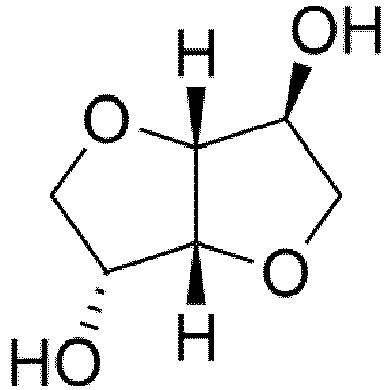
- isosorbide which forms the basis for the isosorbide diesters used according to the invention, is as follows:
- the isosorbide diesters used according to the invention are particularly preferably based on D-isosorbitol, which has the following formula:
- the isosorbide diesters contained in the composition according to the invention are preferably derived from saturated or mono- or polyunsaturated monocarboxylic acids with a chain length of 4 to 30 carbon atoms.
- Suitable monocarboxylic acids are, for example, caprylic acid (C 7 H 15 COOH, octanoic acid), capric acid (C 9 H 19 COOH, decanoic acid), lauric acid (C 11 H 23 COOH, dodecanoic acid), myristic acid (C 13 H 27 COOH, tetradecanoic acid), palmitic acid ( C 15 H 31 COOH, hexadecanoic acid), margaric acid (C 16 H 33 COOH, heptadecanoic acid), stearic acid (C 17 H 35 COOH, octadecanoic acid), arachic acid (C 19 H 39 COOH, eicosanoic acid), behenic acid (C 21 H 43 COOH, Docosanoic acid), lignoceric acid (C 23 H 47 COOH, tetracosanoic acid), palmitoleic acid (C 15 H 29 COOH, (9Z) -hexadeca-9-eno
- Saturated aliphatic monocarboxylic acids with a chain length of 4 to 18 carbon atoms, particularly preferably with 6 to 16 carbon atoms and very particularly preferably with 8 to 14 carbon atoms, are particularly preferred.
- the isosorbide diester can be derived from a monocarboxylic acid or from two different monocarboxylic acids.
- the isosorbide diesters can be present individually or in a mixture.
- the isosorbide diesters contained in the composition according to the invention preferably have the general formula (IV) and are derived from isosorbide, preferably D-isosorbide, and saturated or mono- or polyunsaturated monocarboxylic acids of the formulas R 1 -COOH and R 2 -COOH, where R 1 and R 2 can be the same or different.
- R 1 and R 2 each preferably represent a saturated, branched or unbranched aliphatic radical of the formula C n H 2n + 1 or a mono- or polyunsaturated, branched or unbranched aliphatic radical of the formula C n H 2n-m , where n stands for a number from 3 to 29 and m stands for 1, 3, 5, 7, 9 or 11.
- N is particularly preferably a number from 3 to 17, very particularly preferably 5 to 15, and in particular 7 to 13.
- Unbranched alkyl radicals of the formula C n H 2n + 1 are, for example, n-propyl, n-butyl, n-pentyl, n-hexyl, n-heptyl, n-octyl, n-nonyl, n-decyl, n-dodecyl, n- Tridecyl, n-tetradecyl, n-hexadecyl or n-octadecyl.
- Suitable isosorbide diesters are, for example, those which can be obtained by esterifying isosorbide with caprylic acid or decanoic acid or a mixture thereof, and also mixtures thereof. These are e.g. B. commercially available from Roquette under the trade names Polysorb ID37 or Polysorb ID46.
- the polycarbonate compositions preferably contain 0.05 to 15.0% by weight, particularly preferably 0.1 to 10% by weight, of the isosorbide diesters.
- the compositions according to the invention contain 0.05 to 8.0% by weight, preferably 0.1 to 6.0% by weight, isosorbide diester.
- Suitable thermal stabilizers are preferably triphenylphosphine, tris (2,4-di-tert-butylphenyl) phosphite (Irgafos® 168), tetrakis (2,4-di-tert-butylphenyl) - [1,1-biphenyl] -4 , 4'-diylbisphosphonit, Octadecyl-3- (3,5-di-tert-butyl-4-hydroxyphenyl) propionate (Irganox® 1076), bis (2,4-dicumylphenyl) pentaerythritol diphosphite (Doverphos® S-9228 PC), bis ( 2,6-di-tert-butyl-4-methylphenyl) pentaerythritol diphosphite (ADK STAB PEP-36).
- triphenylphosphine tris (2,4-di-tert-but
- Irganox® B900 mixture of Irgafos® 168 and Irganox® 1076 in a ratio of 1: 3
- Doverphos® S-9228 PC with Irganox® B900 or Irganox® 1076.
- the thermal stabilizers are preferably used in amounts of 0.003 to 0.2% by weight.
- additives up to 2.0% by weight, preferably 0.01 to 2.0% by weight, of other customary additives (“further additives”) are optionally present.
- the group of further additives does not include thermal stabilizers, since these have already been described as component C.
- Such additives are in particular those in EP-A 0 839 623 .
- EP-A 0 500 496 or " Plastics Additives Handbook" Hans Doubt, 5th Edition 2000 , Hanser Verlag, Kunststoff described antioxidants, mold release agents, flame retardants, UV absorbers, IR absorbers, antistatic agents, optical brighteners, light scattering agents, colorants such as organic pigments, and / or additives for laser marking in the amounts customary for polycarbonate.
- These additives can be added individually or in a mixture.
- Preferred additives are special UV stabilizers which have the lowest possible transmission below 400 nm and the highest possible transmission above 400 nm.
- Ultraviolet absorbers which are particularly suitable for use in the composition according to the invention are benzotriazoles, triazines, benzophenones and / or arylated cyanoacrylates.
- Particularly suitable ultraviolet absorbers are hydroxybenzotriazoles, such as 2- (3 ', 5'-bis (1,1-dimethylbenzyl) -2'-hydroxyphenyl) benzotriazole (Tinuvin® 234, BASF, Ludwigshafen), 2 - (2'-Hydroxy-5 '- (tert-octyl) phenyl) benzotriazole (Tinuvin® 329, BASF, Ludwigshafen),), bis (3- (2H-benzotriazolyl) -2-hydroxy-5- tert.-octyl) methane (Tinuvin® 360, BASF, Ludwigshafen), 2- (4,6-diphenyl-1,3,5-triazin-2-yl) -5- (hexyloxy) phenol (Tinuvin® 1577, BASF, Ludwigshafen), and benzophenones such as 2,4-dihydroxybenzophenone (Chimasorb® 22, BASF, Ludwigshafen) and 2-hydroxy-4- (
- Particularly preferred special UV stabilizers are Tinuvin® 360, Tinuvin® 329 and / or Tinuvin® 312, Tinuvin® 329 and Tinuvin® 360 are very particularly preferred.
- the composition preferably contains ultraviolet absorbers in an amount of up to 0.8% by weight, preferably 0.05% by weight to 0.5% by weight, more preferably 0.1% by weight to 0.4% by weight .-%, based on the total composition.
- compositions according to the invention can also contain phosphates or sulfonic acid esters as transesterification stabilizers.
- Triisooctyl phosphate is preferably contained as a transesterification stabilizer.
- the composition can be free of mold release agents, e.g. Be GMS.
- the isosorbide diesters themselves act as mold release agents.
- At least one thermal stabilizer component C
- component D a transesterification stabilizer, in particular triisooctyl phosphate (TOF), or a UV absorber.
- TOF triisooctyl phosphate
- compositions according to the invention comprising components A to D, are prepared using conventional incorporation processes by combining, mixing and homogenizing the individual constituents, in particular the homogenization preferably taking place in the melt under the action of shear forces. If necessary, the merging and mixing takes place before the melt homogenization using powder premixes.
- Premixes of granules or granules and powders with components B to D can also be used.
- premixes which have been prepared from solutions of the mixture components in suitable solvents, where appropriate homogenizing in solution and then removing the solvent.
- components B to D of the composition according to the invention can be introduced into the polycarbonate by known processes or as a masterbatch.
- masterbatches are preferred for introducing components B to D, individually or in a mixture.
- composition according to the invention can be combined, mixed, homogenized and then extruded in conventional devices such as screw extruders (for example twin-screw extruders, ZSK), kneaders, Brabender or Banbury mills. After the extrusion, the extrudate can be cooled and crushed. Individual components can also be premixed and then the remaining starting materials can be added individually and / or also mixed.
- a premix in the melt can also be combined and mixed in the plasticizing unit of an injection molding machine.
- the melt is transferred directly to a shaped body.
- compositions according to the invention can be processed in the customary manner on customary machines, for example on extruders or injection molding machines, to form any desired shaped articles, such as, for example, films, plates or bottles.
- the molded parts are preferably produced by injection molding, extrusion or from solution in a casting process.
- compositions according to the invention are suitable for the production of multilayer systems.
- the polycarbonate composition is applied in one or more layers to a molded article made of a plastic.
- the application can take place at the same time as or immediately after the shaping of the shaped body, for example by back-injection of a film, coextrusion or multi-component injection molding.
- the application can also be done on the finished molded body, e.g. by lamination with a film, extrusion coating of an existing molded body or by coating from a solution.
- compositions according to the invention are suitable for the production of components in the automotive sector, for example for panels, headlight covers or frames, lenses and collimators or light guides, and for the production of frame components in the EE (electrical / electronics) and IT sectors, in particular for applications that place high demands on fluidity (thin-film applications).
- Such applications are, for example, screens or housings, for example for ultrabooks or frames for LED display technologies, for example OLED displays or LCD displays or also for e-ink devices.
- Further fields of application are housing parts of mobile communication terminals, such as smartphones, tablets, ultrabooks, notebooks or laptops, but also navigation devices, smartwatches or heart rate monitors, as well as electrical applications in thin-walled versions, e.g. B. Home and industrial networking units and smart meter housing components.
- compositions according to the invention and moldings, extrudates and multilayer systems containing the compositions according to the invention are also the subject of this application.
- compositions according to the invention are distinguished in particular by the fact that, owing to their isosorbitol diester content, they have excellent rheological and optical properties and reduced sliding and static friction coefficients.
- Another advantage of the compositions according to the invention is that an additional mold release agent, for example PETS (pentaerythritol tetrastearate), can be dispensed with. These additives often reduce the thermal properties.
- the composition according to the invention therefore preferably does not comprise pentaerythritol tetrastearate.
- Another object of the present invention is therefore the use of one or more of the above-described isosorbide diesters to improve the optical transmission and / or to reduce the sliding and static friction coefficients of compositions comprising aromatic polycarbonate (component A ), optionally thermal stabilizer (component C) and optionally further additives (component D).
- the Charpy impact strength was measured in accordance with ISO 7391 / 180A on test bars of 80 x 10 x 3 mm molded on one side at room temperature.
- the Vicat softening temperature VST / B50 as a measure of the heat resistance was determined according to ISO 306 on test specimens measuring 80 x 10 x 4 mm with a stamp load of 50 N and a heating rate of 50 ° C / h or 120 ° C / h the Coesfeld Eco 2920 from Coesfeld Materialtest.
- the melt volume flow rate was determined in accordance with ISO 1133 (at a test temperature of 300 ° C., mass 1.2 kg or 2.16 kg) using the Zwick 4106 device from Zwick Roell. In addition, the MVR was measured after a preheating time of 20 minutes. This is a measure of melt stability under increased thermal stress.
- the Yellowness Index (Y.I.) was determined according to ASTM E 313 (observer: 10 ° / illuminant: D65) on sample plates with a layer thickness of 4 mm.
- the transmission in the VIS region of the spectrum (400 nm to 800 nm) was determined according to ISO 13468 on sample plates with a layer thickness of 4 mm or 12 mm.
- the haze was determined according to ASTM D1003 on sample plates with a layer thickness of 4 mm or 12 mm.
- the sample plates were each produced by injection molding at the melt temperatures given in the tables below.
- the solution viscosity eta rel was determined according to ISO1628 using an Ubbelohde viscometer.
- the shear viscosity (melt viscosity) was determined in accordance with ISO 11443 using the Visco-Robo 45.00 from Göttfert.
- Table 1 recipe: 1 (see) 2 3 4 5 6 A-1 1) Wt .-% 93 93 93 93 93 A-3 Wt .-% 7 6.9 6.8 6.6 6.4 6.2 B-1 Wt .-% - 0.1 0.2 0.4 0.6 0.8 exams MVR 7 '/ 300 ° C / 1.2 Kg ml / 10min 11.7 11.9 12.3 12.8 13.3 13.4 MVR 20 '/ 300 ° C / 1.2 Kg ml / 10min 11.7 12 12.5 12.9 13.5 13.8 Vicat VSTB 50 ° C 145.5 144.8 143.9 142.9 141.14 140.5 Schmelzevisk.
- Table 1 shows that Examples 2 to 6 according to the invention have higher MVR values, lower melt viscosities and at the same time improved optical properties than Comparative Example 1.
- Table 2 ⁇ /b> recipe: 7 (See) 8th 9 10 11 A-1 1) Wt .-% 93 93 93 93 A-3 Wt .-% 6.99 6.79 6.59 6.39 6.19 B-1 Wt .-% - 0.2 0.4 0.6 0.8 D-1 Wt .-% 0.01 0.01 0.01 0.01 0.01 0.01 exams eta rel granules 1,278 1.279 1,278 1,278 1,277 MVR 7 '/ 300 ° C / 1.2 Kg ml / 10min 11.7 12.1 12.5 12.6 12.7 Vicat VSTB 50 ° C 145.1 143.9 143.3 142.6 142.1 melt viscosity Schmelzevisk.
- Table 2 shows that Examples 8 to 11 according to the invention have higher MVR values, lower melt viscosities and at the same time improved optical properties than Comparative Example 7.
- Table 3 ⁇ /b> recipe: 12 (See) 13 14 15 16 17 A-2 1) Wt .-% 93 93 93 93 93 A-3 Wt .-% 7 6.9 6.8 6.6 6.4 6.2 B-1 Wt .-% - 0.1 0.2 0.4 0.6 0.8 exams eta rel granules 1,290 1,289 1,289 1.288 1.287 1.287 MVR 7 '/ 300 ° C / 1.2 Kg ml / 10min 8.7 9.0 9.2 9.6 10.0 10.1 Vicat VSTB 50 ° C 145.3 144.4 143.9 142.6 139.7 140.6 Schmelzevisk.
- Table 3 shows that Examples 13 to 17 according to the invention have higher MVR values, lower melt viscosities and at the same time improved optical properties than that Comparative Example 12. At the same time, Examples 13 to 17 have reduced static and sliding friction coefficients than Comparative Example 12.
- Table 4 ⁇ /b> recipe: 18 (see) 19 20 21 22 A-2 1) Wt .-% 93 93 93 93 A-3 Wt .-% 6.99 6.79 6.59 6.39 6.19 B-1 Wt .-% - 0.2 0.4 0.6 0.8 D-1 Wt .-% 0.01 0.01 0.01 0.01 0.01 0.01 exams eta rel granules 1,289 1,289 1.288 1.287 1,286 MVR 7 '/ 300 ° C / 1.2 Kg ml / 10min 9.2 9.3 9.5 9.9 10.3 Vicat VSTB 50 ° C 145.4 143.4 142.6 140.7 139.6 Schmelzevisk.
- Table 4 shows that Examples 19 to 22 according to the invention have higher MVR values, lower melt viscosities and at the same time improved optical properties than Comparative Example 18. At the same time, Examples 19 to 22 have reduced static and sliding friction coefficients than Comparative Example 18.
- Table 5 ⁇ /b> recipe 23 (See) 24 25 26 A-4 1) Wt .-% 93,00 93,00 93,00 A-5 Wt .-% 7.00 6.79 6.59 6.39 B-2 Wt .-% - 0.20 0.40 0.60 D-1 Wt .-% - 0.01 0.01 0.01 Exams: eta rel granules 1,231 1,231 1,229 1,230 MVR 300 ° C / 1.2kg ml / 10min 31.2 32.9 33.3 35.0 Vicat VSTB50 ° C 143.9 142.3 140.6 139.1 Schmelzevisk.
- the flowability is significantly improved in comparison to comparative example 34. This applies to different temperatures and low shear rates, which is particularly important for extrusion.
Landscapes
- Chemical & Material Sciences (AREA)
- Health & Medical Sciences (AREA)
- Chemical Kinetics & Catalysis (AREA)
- Medicinal Chemistry (AREA)
- Polymers & Plastics (AREA)
- Organic Chemistry (AREA)
- Engineering & Computer Science (AREA)
- Mechanical Engineering (AREA)
- Compositions Of Macromolecular Compounds (AREA)
Description
- Die Erfindung betrifft Zusammensetzungen enthaltend Polycarbonat und Carbonsäureester des Isosorbids, die Verwendung der Zusammensetzungen zur Herstellung von Blends oder Formteilen sowie daraus erhältliche Formteile. Die Zusammensetzungen weisen verbesserte rheologische und optische Eigenschaften sowie ein verbessertes Entformungs- und Verarbeitungsverhalten im Spritzguß auf.
- Insbesondere für dünnwandige (Gehäuse-)Teile, etwa in Ultrabooks, Smartphones oder Smartbooks, ist eine niedrige Schmelzeviskosität erforderlich, damit Bauteile mit gleichmäßiger Wandstärke realisiert werden können. Weitere Anwendungsbereiche, in denen gute Fließfähigkeiten gefordert werden, sind im Automobilbereich (z. B. Scheinwerferabdeckungen, Blenden, Lichtleitsysteme), im E/E-Bereich (Beleuchtungskomponenten, Gehäuseteile, Abdeckungen, smart meter Anwendungen).
- Herkömmlich wird zur Fließverbesserung Bisphenol A-Diphosphat (BDP) verwendet, und zwar in Mengen von bis zu mehr als 10 Gew.-%, um den gewünschten Effekt zu erzielen. Dadurch wird aber die Wärmeformbeständigkeit stark herabgesetzt. Dieser Effekt ist beispielsweise in
JP201178889 WO 2015135958 beschrieben. -
DE102010002856 beschreibt die Verwendung von Isosorbitestern als Weichmacher in laminierten Scheiben. -
US20120178858 offenbart eine Isosorbit enthaltende plastifizierte Stärke. - Es findet sich jedoch kein Hinweis auf den Einfluss von geringen Mengen Isosorbiddiestern auf die rheologischen und optischen Eigenschaften von Polycarbonaten.
- Im Stand der Technik findet der Fachmann keinen Hinweis darauf, wie er bei annähernd gleicher Wärmeformbeständigkeit die Fließfähigkeit und gleichzeitig die optischen Eigenschaften von Polycarbonatzusammensetzungen verbessern kann.
- Es bestand daher die Aufgabe, Zusammensetzungen enthaltend aromatische Polycarbonatzusammensetzungen zu finden, die bei nahezu gleich bleibender Wärmeformbeständigkeit verbesserte optische Eigenschaften und gleichzeitig eine verbesserte Fließfähigkeit aufweisen.
- Überraschenderweise wurde gefunden, dass Polycarbonatzusammensetzungen immer dann eine verbesserte Fließfähigkeit und bessere optische Eigenschaften aufweisen, wenn bestimmte Mengen von Isosorbiddiestern enthalten sind. Dabei bleibt die Wärmeformbeständigkeit (Vicat Temperatur) nahezu unverändert erhalten. Gleichzeitig werden der Gleit- und Haftreibungskoeffizient reduziert, was ein besseres Entformungs- und Verarbeitungsverhalten im Spritzguss bedeutet.
- Die Polycarbonatzusammensetzungen, welchen die Isosorbiddiester zugesetzt wurden, zeigen gute Schmelzestabilitäten mit verbesserten rheologischen Eigenschaften, und zwar eine höhere Schmelzevolumenfließrate (MVR), bestimmt nach DIN EN ISO 1133 (bei einer Prüftemperatur von 300 °C, Masse 1,2 kg), eine verbesserte Schmelzeviskosität, bestimmt nach ISO 11443, und verbesserte optische Eigenschaften, messbar an einem niedrigeren Yellowness Index (YI) und/oder eine höhere optische Transmission, bestimmt nach ASTM E 313, im Vergleich zu entsprechenden Zusammensetzungen, die ansonsten dieselben Komponenten außer den Isosorbiddiestern enthalten. Dabei zeichnen sich die Zusammensetzungen weiterhin durch gute mechanische Eigenschaften aus, messbar anhand der Kerbschlagzähigkeit, welche nach ISO 7391/180A bestimmt wird.
- Gegenstand der vorliegenden Erfindung sind daher Zusammensetzungen enthaltend A) 20,0 Gew.-% bis 99,95 Gew.-% aromatisches Polycarbonat und B) 0,05 Gew.-% bis 20,0 Gew.-% Isosorbiddiester mit der Maßgabe, dass, wenn es sich bei dem aromatischen Polycarbonat der Komponente A) um ein oder mehrere Copolycarbonate enthaltend mindestens die Monomereinheiten der Formel (1),

- R1 für Wasserstoff oder C1-C4-Alkyl steht,
- R2 für C1-C4-Alkyl steht, und
- n für 0, 1, 2 oder 3 steht,
- A) 20,0 Gew.-% bis 99,95 Gew.-% aromatisches Polycarbonat,
- B) 0,05 Gew.-% bis 20,0 Gew.-% Isosorbiddiester,
- C) 0,0 Gew.-% bis 1,0 Gew.-% Thermostabilisator und
- D) 0,0 Gew.-% bis 3,0 Gew.-% weitere Additive auf
- R1 für Wasserstoff oder C1-C4-Alkyl steht,
- R2 für C1-C4-Alkyl steht, und
- n für 0, 1, 2 oder 3 steht,
- Besonders bevorzugt bestehen solche Zusammensetzungen aus
- A) 82,0 Gew.-% bis 99,95 Gew.-% aromatischem Polycarbonat,
- B) 0,05 Gew.-% bis 15,0 Gew.-% Isosorbiddiester,
- C) 0,0 Gew.% bis 1,0 Gew.-% Thermostabilisator und
- D) 0,0 Gew.% bis 2,0 Gew.-% eines oder mehrerer weiterer Additive aus der Gruppe der Antioxidantien, Entformungsmittel, Flammschutzmittel, UV-Absorber, IR-Absorber, Antistatika, optischen Aufheller, Farbmittel aus der Gruppe der löslichen organischen Pigmente und Additive zur Lasermarkierung
- R1 für Wasserstoff oder C1-C4-Alkyl steht,
- R2 für C1-C4-Alkyl steht, und
- n für 0, 1, 2 oder 3 steht,
- Unter "aromatischem Polycarbonat" im erfindungsgemäßen Sinne werden sowohl Homopolycarbonate als auch Copolycarbonate verstanden. Dabei können die Polycarbonate in bekannter Weise linear oder verzweigt sein. Erfindungsgemäß können auch Mischungen von Polycarbonaten verwendet werden.
- Vorzugsweise sind die erfindungsgemäßen Zusammensetzungen transparent.
- Durch die Verwendung der Isosorbiddiester in transparenten Polycarbonatzusammensetzungen lassen sich die optischen Eigenschaften verbessern. Durch Zusatz der Isosorbiddiester werden die Transmission, bestimmt nach ISO 13468 bei 4 mm Dicke, erhöht und gleichzeitig der Yellowness-Index Y.I., bestimmt nach ASTM E 313 (Beobachter: 10° / Lichtart: D65, an einer Musterplatte von 4 mm Dicke), gesenkt.
- "Transparent" im erfindungsgemäßen Sinn bedeutet, dass die Zusammensetzungen im Bereich von 400 nm bis 800 nm eine Transmission von mindestens 84% bestimmt nach ISO 13468 bei einer Dicke von 4 mm und eine Trübung < 5% bestimmt nach ASTM D1003 bei einer Schichtdicke von 4 mm, aufweisen.
- C1-C4-Alkyl steht im Rahmen der Erfindung beispielsweise für Methyl, Ethyl, n-Propyl, iso-Propyl, n-Butyl, sec.-Butyl, tert.-Butyl, C1-C6-Alkyl darüber hinaus beispielsweise für n-Pentyl, 1-Methylbutyl, 2-Methylbutyl, 3-Methylbutyl, neo-Pentyl, 1-Ethylpropyl, Cyclohexyl, Cyclopentyl, n-Hexyl, 1,1-Dimethylpropyl, 1,2-Dimethylpropyl, 1,2-Dimethylpropyl, 1-Methylpentyl, 2-Methylpentyl, 3-Methylpentyl, 4-Methylpentyl, 1,1-Dimethylbutyl, 1,2-Dimethylbutyl, 1,3-Dimethylbutyl, 2,2-Dimethylbutyl, 2,3-Dimethylbutyl, 3,3-Dimethylbutyl, 1-Ethylbutyl, 2-Ethylbutyl, 1,1,2-Trimethylpropyl, 1,2,2-Trimethylpropyl, 1-Ethyl-1-methylpropyl, 1-Ethyl-2-methylpropyl oder 1-Ethyl-2-methylpropyl, C1-C10-Alkyl darüber hinaus beispielsweise für n-Heptyl und n-Octyl, Pinakyl, Adamantyl, die isomeren Menthyle, n-Nonyl, n-Decyl, C1-C34-Alkyl darüber hinaus beispielsweise für n-Dodecyl, n-Tridecyl, n-Tetradecyl, n-Hexadecyl oder n-Octadecyl. Gleiches gilt für den entsprechenden Alkylrest beispielsweise in Aralkyl- bzw. Alkylaryl-, Alkylphenyl- oder Alkylcarbonylresten. Alkylenreste in den entsprechenden Hydroxyalkyl- oder Aralkyl- bzw. Alkylarylresten stehen beispielsweise für die den vorangehenden Alkylresten entsprechenden Alkylenreste.
- Aryl steht für einen carbocyclischen aromatischen Rest mit 6 bis 34 Gerüstkohlenstoffatomen. Gleiches gilt für den aromatischen Teil eines Arylalkylrestes, auch Aralkylrest genannt, sowie für Arylbestandteile komplexerer Gruppen, wie z.B. Arylcarbonylresten.
- Beispiele für C6-C34-Aryl sind Phenyl, o-, p-, m-Tolyl, Naphthyl, Phenanthrenyl, Anthracenyl oder Fluorenyl.
- Arylalkyl bzw. Aralkyl bedeutet jeweils unabhängig einen geradkettigen, cyclischen, verzweigten oder unverzweigten Alkyl-Rest nach vorstehender Definition, der einfach, mehrfach oder vollständig durch Aryl-Reste gemäß vorstehender Definition substituiert sein kann.
- Im Rahmen der vorliegenden Erfindung beziehen sich die angegebenen Gew.-% der Komponenten A, B, C und D - soweit nicht explizit anders angegeben - jeweils auf das Gesamtgewicht der Zusammensetzung. Die Zusammensetzung kann neben den Komponenten A, B, C und D weitere Komponenten enthalten. In einer bevorzugten Ausführungsform enthält die Zusammensetzung keine weiteren Komponenten, sondern die Komponenten A) bis D) ergänzen sich zu 100 Gew.-%; d.h. die Zusammensetzung besteht aus den Komponenten A, B, C und D.
- Die erfindungsgemäßen Zusammensetzungen werden vorzugsweise zur Herstellung von Formteilen verwendet. Die Zusammensetzungen weisen bevorzugt eine Schmelze-Volumenfließrate (MVR) von 2 bis 120 cm3/10 min, weiter bevorzugt von 3 bis 90 cm3/10 min, bestimmt nach ISO 1133 (Prüftemperatur 300°C, Masse 1,2 kg), auf.
- Die einzelnen Bestandteile der erfindungsgemäßen Zusammensetzungen sind im Folgenden noch näher erläutert:
- Die erfindungsgemäße Zusammensetzung enthält als Komponente A 20,0 Gew.-% bis 99,0 Gew.-% aromatisches Polycarbonat. Vorzugsweise beträgt die Menge des aromatischen Polycarbonats in der Zusammensetzung wenigstens 50 Gew.-%, besonders bevorzugt wenigstens 60 Gew.-% und ganz besonders bevorzugt wenigstens 75 Gew.-%, wobei ein einzelnes Polycarbonat oder eine Mischung mehrerer Polycarbonate vorliegen kann.
- Die Herstellung der Polycarbonate, die in den Zusammensetzungen enthalten sind, welchen Diglycerolester zur Verbesserung der Fließfähigkeit zugesetzt wird, erfolgt in bekannter Weise aus Diphenolen, Kohlensäurederivaten, gegebenenfalls Kettenabbrechern und Verzweigern.
- Einzelheiten der Herstellung von Polycarbonaten sind in vielen Patentschriften seit etwa 40 Jahren niedergelegt. Beispielhaft sei hier auf Schnell, "Chemistry and Physics of Polycarbonates", Polymer Reviews, Volume 9, Interscience Publishers, New York, London, Sydney 1964, auf D. Freitag, U. Grigo, P.R. Müller, H. Nouvertne, BAYER AG, "Polycarbonates" in Encyclopedia of Polymer Science and Engineering, Volume 11, Second Edition, 1988, Seiten 648-718 und schließlich auf U. Grigo, K. Kirchner und P.R. Müller "Polycarbonate" in Becker/Braun, Kunststoff-Handbuch, Band 3/1, Polycarbonate, Polyacetale, Polyester, Celluloseester, Carl Hanser Verlag München, Wien 1992, Seiten 117 299 verwiesen.
- Die Herstellung aromatischer Polycarbonate erfolgt z.B. durch Umsetzung von Diphenolen mit Kohlensäurehalogeniden, vorzugsweise Phosgen, und/oder mit aromatischen Dicarbonsäuredihalogeniden, vorzugsweise Benzoldicarbonsäuredihalogeniden, nach dem Phasengrenzflächenverfahren, gegebenenfalls unter Verwendung von Kettenabbrechern und gegebenenfalls unter Verwendung von trifunktionellen oder mehr als trifunktionellen Verzweigern. Ebenso ist eine Herstellung über ein Schmelzepolymerisationsverfahren durch Umsetzung von Diphenolen mit beispielsweise Diphenylcarbonat möglich.
- Für die Herstellung der Polycarbonate geeignete Diphenole sind beispielsweise Hydrochinon, Resorcin, Dihydroxydiphenyle, Bis-(hydroxyphenyl)-alkane, Bis-(hydroxyphenyl)-cycloalkane, Bis-(hydroxyphenyl)-sulfide, Bis-(hydroxyphenyl)-ether, Bis-(hydroxyphenyl)-ketone, Bis-(hydroxyphenyl)-sulfone, Bis-(hydroxyphenyl)-sulfoxide, α-α'-Bis-(hydroxyphenyl)-diisopropylbenzole, Phthalimidine abgeleitet von Isatin- oder Phenolphthaleinderivaten sowie deren kernalkylierte, kernarylierte und kernhalogenierte Verbindungen.
- Bevorzugte Diphenole sind 4,4'-Dihydroxydiphenyl, 2,2-Bis-(4-hydroxyphenyl)-propan (Bisphenol A), 2,4-Bis-(4-hydroxyphenyl)-2-methylbutan, 1,1-Bis-(4-hydroxyphenyl)-p-diisopropylbenzol, 2,2-Bis-(3-methyl-4-hydroxyphenyl)-propan (Dimethyl-Bisphenol A), Bis-(3,5-dimethyl-4-hydroxyphenyl)-methan, 2,2-Bis-(3,5-dimethyl-4-hydroxyphenyl)-propan, Bis-(3,5-dimethyl-4-hydroxyphenyl)-sulfon, 2,4-Bis-(3,5-dimethyl-4-hydroxyphenyl)-2-methylbutan, 1,1-Bis-(3,5-dimethyl-4-hydroxyphenyl)-p-diisopropylbenzol und 1,1-Bis-(4-hydroxyphenyl)-3,3,5-trimethylcyclohexan, sowie die Bisphenole (I) bis (III)

- Besonders bevorzugte Diphenole sind 2,2-Bis-(4-hydroxyphenyl)-propan (Bisphenol A), 2,2-Bis-(3,5-dimethyl-4-hydroxyphenyl)-propan, 1,1-Bis-(4-hydroxyphenyl)-cyclohexan, 1,1-Bis-(4-hydroxyphenyl)-3,3,5-trimethylcyclohexan und Dimethyl-Bisphenol A sowie die Diphenole der Formeln (I), (II) und (III).
- Diese und weitere geeignete Diphenole sind z.B. in
US-A 3 028 635 ,US-A 2 999 825 ,US-A 3 148 172 ,US-A 2 991 273 ,US-A 3 271 367 ,US-A 4 982 014 undUS-A 2 999 846 , inDE-A 1 570 703 ,DE-A 2063 050 ,DE-A 2 036 052 ,DE-A 2 211 956 undDE-A 3 832 396 , inFR-A 1 561 518 JP-A 62039/1986 JP-A 62040/1986 JP-A 105550/1986 - Im Fall der Homopolycarbonate wird nur ein Diphenol eingesetzt, im Fall der Copolycarbonate werden mehrere Diphenole eingesetzt.
- Geeignete Kohlensäurederivate sind beispielsweise Phosgen oder Diphenylcarbonat.
- Geeignete Kettenabbrecher, die bei der Herstellung der Polycarbonate eingesetzt werden können, sind Monophenole. Geeignete Monophenole sind beispielsweise Phenol selbst, Alkylphenole wie Kresole, p-tert.-Butylphenol, Cumylphenol sowie deren Mischungen.
- Bevorzugte Kettenabbrecher sind die Phenole, welche ein- oder mehrfach mit C1- bis C30-Alkylresten, linear oder verzweigt, bevorzugt unsubstituiert, oder mit tert-Butyl substituiert sind. Besonders bevorzugte Kettenabbrecher sind Phenol, Cumylphenol und/oder p-tert-Butylphenol.
- Die Menge an einzusetzendem Kettenabbrecher beträgt bevorzugt 0,1 bis 5 Mol-%, bezogen auf Mole an jeweils eingesetzten Diphenolen. Die Zugabe der Kettenabbrecher kann vor, während oder nach der Umsetzung mit einem Kohlensäurederivat erfolgen.
- Geeignete Verzweiger sind die in der Polycarbonatchemie bekannten tri- oder mehr als trifunktionellen Verbindungen, insbesondere solche mit drei oder mehr als drei phenolischen OH-Gruppen.
- Geeignete Verzweiger sind beispielsweise 1,3,5-Tri-(4-hydroxyphenyl)-benzol, 1,1,1-Tri-(4-hydroxyphenyl)-ethan, Tri-(4-hydroxyphenyl)-phenylmethan, 2,4-Bis-(4-hydroxyphenylisopropyl)-phenol, 2,6-Bis-(2-hydroxy-5'-methyl-benzyl)-4-methylphenol, 2-(4-Hydroxyphenyl)-2-(2,4-dihydroxyphenyl)-propan, Tetra-(4-hydroxyphenyl)-methan, Tetra-(4-(4-hydroxyphenylisopropyl)-phenoxy)-methan und 1,4-Bis-((4',4"-dihydroxytriphenyl)-methyl)-benzol und 3,3-Bis-(3-methyl-4-hydroxyphenyl)-2-oxo-2,3-dihydroindol.
- Die Menge der gegebenenfalls einzusetzenden Verzweiger beträgt bevorzugt 0,05 Mol-% bis 2,00 Mol-%, bezogen auf Mole an jeweils eingesetzten Diphenolen.
- Die Verzweiger können entweder mit den Diphenolen und den Kettenabbrechern in der wässrig alkalischen Phase vorgelegt werden oder in einem organischen Lösungsmittel gelöst vor der Phosgenierung zugegeben werden. Im Fall des Umesterungsverfahrens werden die Verzweiger zusammen mit den Diphenolen eingesetzt.
- Besonders bevorzugte Polycarbonate sind das Homopolycarbonat auf Basis von Bisphenol A, das Homopolycarbonat auf Basis von 1,1-Bis-(4-hydroxyphenyl)-3,3,5-trimethylcyclohexan und die Copolycarbonate auf Basis der beiden Monomere Bisphenol A und 1,1-Bis-(4-hydroxyphenyl)-3,3,5-trimethylcyclohexan, sowie von den Diphenolen der Formeln (I), (II) und (III)

abgeleitete Homo- oder Copolycarbonate, vorzugsweise mit Bisphenol A als Comonomer. - Zur Einarbeitung von Additiven wird die Komponente A bevorzugt in Form von Pulvern, Granulaten oder aus Gemischen aus Pulvern und Granulaten eingesetzt.
- Als Polycarbonat kann auch eine Mischung aus verschiedenen Polycarbonaten eingesetzt werden, z.B. aus den Polycarbonaten A1 und A2:
Die Menge des aromatischen Polycarbonats A1 beträgt, bezogen auf die Gesamtmenge an Polycarbonat, 25,0 bis 85,0 Gew.-%, bevorzugt 28,0 bis 84,0 Gew.-%, besonders bevorzugt 30,0 bis 83,0 Gew.-%, wobei dieses aromatische Polycarbonat auf Basis von Bisphenol A mit einer bevorzugten Schmelze-Volumenfließrate MVR von 7 bis 15 cm3/10 min, weiter bevorzugt mit einer Schmelze-Volumenfließrate MVR von 8 bis 12 cm3/10 min und besonders bevorzugt mit einer Schmelze-Volumenfließrate MVR von 8 bis 11 cm3/10 min, bestimmt gemäß ISO 1133 (Prüftemperatur 300°C, Masse 1,2 kg), ist. - Die Menge des pulverförmigen aromatischen Polycarbonats A2 beträgt, bezogen auf die Gesamtmenge an Polycarbonat, 3,0 bis 12,0 Gew.-%, bevorzugt 4,0 bis 11,0 Gew.-%, besonders bevorzugt 3,0 bis 10,0 Gew.-%, wobei dieses aromatische Polycarbonat bevorzugt auf Basis von Bisphenol A mit einer bevorzugten Schmelze-Volumenfließrate MVR von 3 bis 8 cm3/10 min, weiter bevorzugt mit einer Schmelze-Volumenfließrate MVR von 4 bis 7 cm3/10 min, und besonders bevorzugt mit einer Schmelze-Volumenfließrate MVR von 6 cm3/10 min, bestimmt gemäß ISO 1133 (Prüftemperatur 300°C, Masse 1,2 kg), ist.
- In einer bevorzugten Ausführungsform enthält die Zusammensetzung als Komponente A ein Copolycarbonat umfassend eine oder mehrere Monomereinheiten der Formel (1),
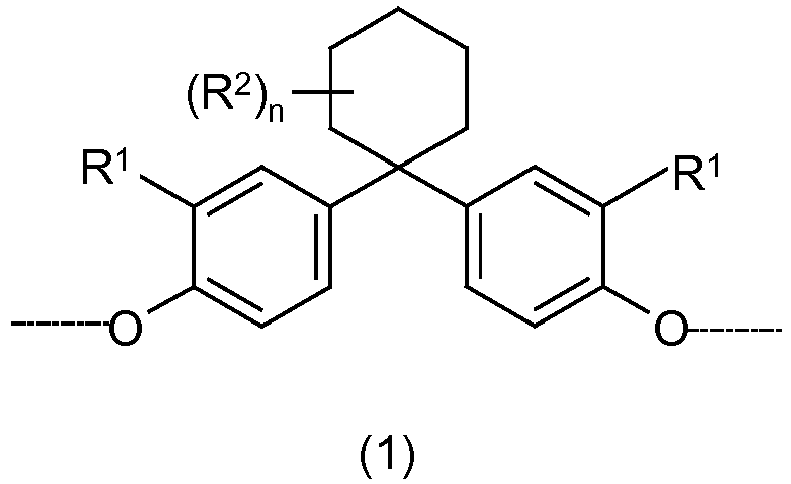
- R1 für Wasserstoff oder C1-C4-Alkyl, bevorzugt für Wasserstoff steht,
- R2 für C1-C4-Alkyl, bevorzugt Methyl steht,
- n für 0, 1, 2 oder 3, bevorzugt 3 steht, und
- optional in Kombination mit einem weiteren aromatischen Homo- oder Copolycarbonat, enthaltend eine oder mehrere Monomereinheiten der allgemeinen Formel (2),

- R4 für H, lineare oder verzweigte C1-C10 Alkyl, bevorzugt lineare oder verzweigte C1-C6 Alkyl, besonders bevorzugt für lineare oder verzweigte C1-C4 Alkyl, ganz besonders bevorzugt für H oder C1-Alkyl (Methyl) steht, und
- R5 für lineare oder verzweigte C1-C10 Alkyl, bevorzugt lineare oder verzweigte C1-C6 Alkyl, besonders bevorzugt für lineare oder verzweigte C1-C4 Alkyl, ganz besonders bevorzugt für C1-Alkyl (Methyl) steht;
- Die Monomereinheit(en) der allgemeinen Formel (1) führt man über ein oder mehrere entsprechenden Diphenole der allgemeinen Formel (1') ein:

- R1 für Wasserstoff oder C1-C4-Alkyl, bevorzugt Wasserstoff,
- R2 für C1-C4-Alkyl, bevorzugt Methyl, und
- n für 0, 1, 2 oder 3, bevorzugt 3 stehen.
- Die Diphenole der Formeln (1') und ihr Einsatz in Homopolycarbonaten sind beispielsweise aus
DE 3918406 bekannt. - Besonders bevorzugt ist 1,1-Bis-(4-hydroxyphenyl)-3,3,5-trimethylcyclohexan (Bisphenol TMC) mit der Formel (1a):

- Neben ein oder mehreren Monomereinheiten der Formel (1) können in dem Copolycarbonat ein oder mehrere Monomereinheit(en) der Formel (3) enthalten sein:
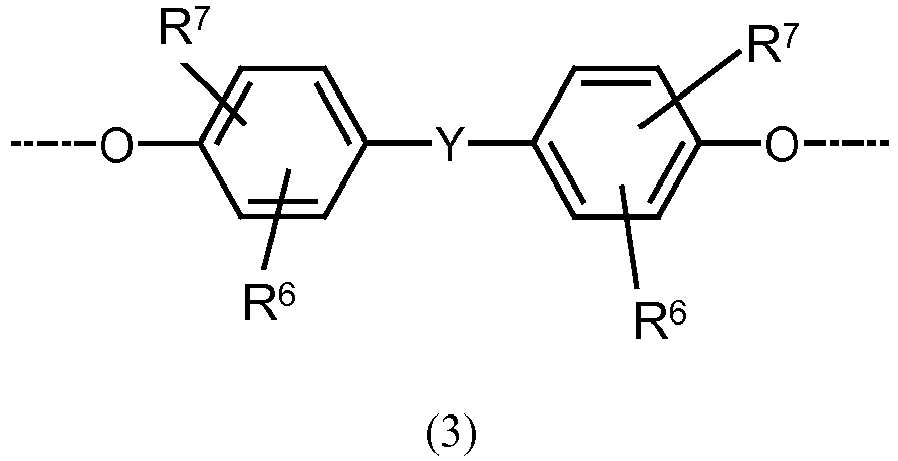
- R6 und R7 unabhängig voneinander für H, C1-C18-Alkyl-, C1-C18-Alkoxy, Halogen wie Cl oder Br oder für jeweils gegebenenfalls substituiertes Aryl oder Aralkyl, bevorzugt für H oder C1-C12-Alkyl, besonders bevorzugt für H oder C1-C8-Alkyl und ganz besonders bevorzugt für H oder Methyl stehen, und
- Y für eine Einfachbindung, -SO2-, -CO-, -O-, -S-, C1-C6-Alkylen oder C2-C5-Alkyliden, ferner für C6-C12-Arylen, welches gegebenenfalls mit weiteren Heteroatome enthaltenden aromatischen Ringen kondensiert sein kann, steht.
- Die Monomereinheit(en) der allgemeinen Formel (3) führt man über ein oder mehrere entsprechenden Diphenole der allgemeinen Formel (3a) ein:

- Ganz besonders bevorzugte Diphenole der Formel (3a) sind Diphenole der allgemeinen Formel (3b),
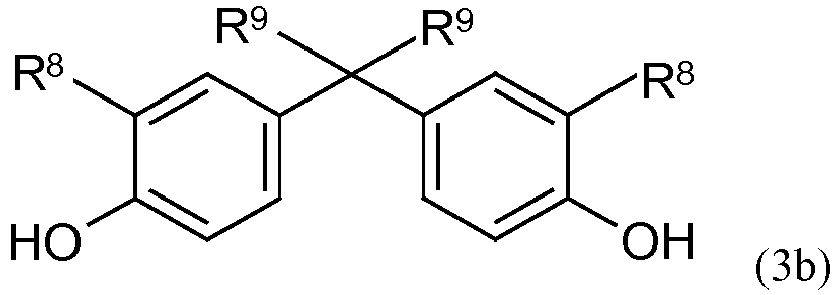
- in der R8 für H, lineare oder verzweigte C1-C10 -Alkyl, bevorzugt lineare oder verzweigte C1-C6-Alkyl, besonders bevorzugt für lineare oder verzweigte C1-C4-Alkyl, ganz besonders bevorzugt für H oder C1-Alkyl (Methyl) steht, und
- in der R9 für lineare oder verzweigte C1-C10-Alkyl, bevorzugt lineare oder verzweigte C1-C6-Alkyl, besonders bevorzugt für lineare oder verzweigte C1-C4-Alkyl, ganz besonders bevorzugt für C1-Alkyl (Methyl) steht.
- Hierbei ist insbesondere das Diphenol (3c) ganz besonders bevorzugt.

- Die Diphenole der allgemeinen Formeln (3a) können sowohl allein als auch im Gemisch miteinander verwendet werden. Die Diphenole sind literaturbekannt oder nach literaturbekannten Verfahren herstellbar (siehe z.B. H. J. Buysch et al., Ullmann's Encyclopedia of Industrial Chemistry, VCH, New York 1991, 5. Ed., Vol. 19, p. 348).
- Der Gesamtanteil der Monomereinheiten der Formel (1) im Copolycarbonat beträgt vorzugsweise 0,1 - 88 mol-%, besonders bevorzugt 1 - 86 mol-%, ganz besonders bevorzugt 5 - 84 mol-% und insbesondere 10 - 82 mol-% (Summe Mole der Diphenole der Formel (1') bezogen auf die Summe der Mole aller eingesetzten Diphenole).
- Copolycarbonate können als block- und statistische Copolycarbonate vorliegen. Besonders bevorzugt sind statistische Copolycarbonate. Dabei ergibt sich das Verhältnis der Häufigkeit der Diphenolat-Monomereinheiten im Copolycarbonat aus dem Molverhältnis der eingesetzten Diphenole.
- Monomereinheiten der allgemeinen Formel (2) führt man über ein Diphenol der allgemeinen Formel (2a) ein:

- in der R4 für H, lineare oder verzweigte C1-C10-Alkyl, bevorzugt lineare oder verzweigte C1-C6 -Alkyl, besonders bevorzugt für lineare oder verzweigte C1-C4-Alkyl, ganz besonders bevorzugt für H oder C1-Alkyl (Methyl) steht und
- in der R5 für lineare oder verzweigte C1-C10-Alkyl, bevorzugt lineare oder verzweigte C1-C6-Alkyl, besonders bevorzugt für lineare oder verzweigte C1-C4-Alkyl, ganz besonders bevorzugt für C1-Alkyl (Methyl) steht.
- Hierbei ist Bisphenol A ganz besonders bevorzugt.
- Neben ein oder mehreren Monomereinheiten der allgemeinen Formeln (2) können in dem gegebenenfalls ferner vorhandenen Homo-oder Copolycarbonat ein oder mehrere Monomereinheiten der Formel (3) enthalten sein, wie sie bereits für das Copolycarbonat beschrieben sind.
- Soweit die erfindungsgemäße Zusammensetzung Copolycarbonat enthaltend Monomereinheiten der Formel (1) aufweist, so beträgt die Gesamtmenge an Copolycarbonat enthaltend Monomereinheiten der Formel (1) in der Zusammensetzung vorzugsweise mindestens 3,0 Gew.-%, besonders bevorzugt mindestens 5,0 Gew.-%.
- In einer bevorzugten Ausführungsform weist die erfindungsgemäße Zusammensetzung als Komponente A einen Blend aus dem Copolycarbonat enthaltend die Monomereinheiten der Formel (1) und einem Bisphenol A basierten Homopolycarbonat auf.
- Soweit die erfindungsgemäße Zusammensetzung Copolycarbonat enthaltend Monomereinheiten der Formel (1) aufweist, beträgt der Gesamtanteil der Monomereinheiten der Formel (1) in der Komponente A vorzugsweise 0,1 - 88 mol-%, besonders bevorzugt 1 - 86 mol-%, ganz besonders bevorzugt 5 - 84 mol-% und insbesondere 10 - 82 mol-%, bezogen auf die Summe der Mole aller Monomereinheiten der Formeln (1) und (3) in den ein oder mehreren Polycarbonaten der Komponente A.
- In einer weiteren bevorzugten Ausführungsform ist die erfindungsgemäße Zusammensetzung dadurch gekennzeichnet, dass die Menge an Copolycarbonat enthaltend die Monomereinheiten der Formel (1) in der Zusammensetzung mindestens 20 Gew.-% beträgt.
- Die erfindungsgemäßen Zusammensetzungen enthalten als Komponente B wenigstens einen Isosorbiddiester. Auch können unterschiedliche Isomere von Diglycerol Basis für die Ester bilden. Dabei sind Ester auf Basis verschiedener Carbonsäuren geeignet. Anstelle von Reinverbindungen können auch Gemische verwendet werden.
- Die allgemeine Formel von Isosorbid, welches die Basis für die erfindungsgemäß eingesetzten Isosorbiddiester bildet, ist die folgende:
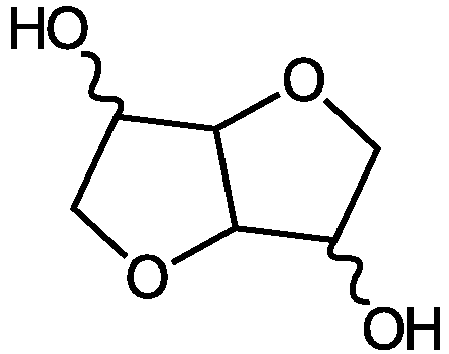
- Besonders bevorzugt basieren die erfindungsgemäß eingesetzten Isosorbiddiester auf D-Isosorbit, welches die folgende Formel aufweist:
- Die erfindungsgemäß in der Zusammensetzung enthaltenen Isosorbiddiester leiten sich vorzugsweise von gesättigten oder ein- oder mehrfach ungesättigten Monocarbonsäuren mit einer Kettenlänge von 4 bis 30 C-Atomen ab.
- Geeignete Monocarbonsäuren sind beispielsweise Caprylsäure (C7H15COOH, Octansäure), Caprinsäure (C9H19COOH, Decansäure), Laurinsäure (C11H23COOH, Dodecansäure), Myristinsäure (C13H27COOH, Tetradecansäure), Palmitinsäure (C15H31COOH, Hexadecansäure), Margarinsäure (C16H33COOH, Heptadecansäure), Stearinsäure (C17H35COOH, Octadecansäure), Arachinsäure (C19H39COOH, Eicosansäure), Behensäure (C21H43COOH, Docosansäure), Lignocerinsäure (C23H47COOH, Tetracosansäure), Palmitoleinsäure (C15H29COOH, (9Z)-Hexadeca-9-ensäure), Petroselinsäure (C17H33COOH, (6Z)-Octadeca-6-ensäure), (9Z)-Octadeca-9-ensäure), Elaidinsäure (C17H33COOH, (9E)-Octadeca-9-ensäure), Linolsäure (C17H31COOH, (9Z,12Z)-Octadeca-9,12-diensäure), alpha- und gamma-Linolensäure (C17H29COOH, (9Z,12Z,15Z)-Octadeca-9,12,15-triensäure und (6Z,9Z,12Z)-Octadeca-6,9,12-triensäure), Arachidonsäure (C19H31COOH, (5Z,8Z,11Z,14Z)-Eicosa-5,8,11,14-tetraensäure), Timnodonsäure (C19H29COOH, (5Z,8Z,11Z,14Z,17Z)-Eicosa-5,8,11,14,17-pentaensäure) und Cervonsäure (C21H31COOH, (4Z,7Z,10Z,13Z,16Z,19Z)-Docosa-4,7,10,13,16,19-hexaensäure).
- Besonders bevorzugt sind gesättigte aliphatische Monocarbonsäuren mit einer Kettenlänge von 4 bis 18 C-Atomen, besonders bevorzugt mit 6 bis 16 C-Atomen und ganz besonders bevorzugt mit 8 bis 14 C-Atomen.
- Die Isosorbiddiester kann sich von einer Monocarbonsäure oder von zwei verschiedenen Monocarbonsäuren ableiten. Die Isosorbiddiester können einzeln oder im Gemisch vorliegen.
- Die erfindungsgemäß in der Zusammensetzung enthaltenen Isosorbiddiester weisen vorzugsweise die allgemeine Formel (IV)

- R1 und R2 stehen jeweils bevorzugt für einen gesättigten, verzweigten oder unverzweigten aliphatischen Rest der Formel CnH2n+1 oder für einen ein- oder mehrfach ungesättigten, verzweigten oder unverzweigten, aliphatischen Rest der Formel CnH2n-m, wobei n für eine Zahl von 3 bis 29 steht und m für 1, 3, 5, 7, 9 oder 11 steht. Aliphatische Reste der Formel CnH2n-m können einfach (m = 1), zweifach (m = 3), dreifach (m = 5), vierfach (m =7), fünffach (m = 9) oder sechsfach (m = 11) ungesättigt sein.
- Besonders bevorzugt ist n eine Zahl von 3 bis 17, ganz besonders bevorzugt 5 bis 15, und insbesondere 7 bis 13.
- Unverzweigte Alkylreste der Formel CnH2n+1 sind beispielsweise n-Propyl, n-Butyl, n-Pentyl, n-Hexyl, n-Heptyl, n-Octyl, n-Nonyl, n-Decyl, n-Dodecyl, n-Tridecyl, n-Tetradecyl, n-Hexadecyl oder n-Octadecyl.
- Geeignete Isosorbiddiester sind beispielsweise solche, die durch Veresterung von Isosorbid mit Caprylsäure oder Decansäure oder deren Gemisch erhältlich sind, sowie deren Mischungen. Diese sind z. B. von Roquette unter dem Handelsnamen Polysorb ID37 oder Polysorb ID46 kommerziell erhältlich.
- Die Polycarbonatzusammensetzungen enthalten bevorzugt 0,05 bis 15,0 Gew.-%, besonders bevorzugt 0,1 bis 10 Gew.-% der Isosorbiddiester. In einer Ausführungsform der Erfindung enthalten die erfindungsgemäßen Zusammensetzungen 0,05 bis 8,0 Gew. %, vorzugsweise 0,1 bis 6,0 Gew.% Isosorbiddiester.
- Als Thermostabilisatoren eignen sich bevorzugt Triphenylphosphin, Tris-(2,4-di-tert-butylphenyl)phosphit (Irgafos® 168), Tetrakis-(2,4-di-tert-butylphenyl)-[1,1-biphenyl]-4,4'-diylbisphosphonit, Octadecyl-3-(3,5-di-tert-butyl-4-hydroxyphenyl)-propionat (Irganox® 1076), Bis-(2,4-dicumylphenyl)-pentaerythritoldiphosphit (Doverphos® S-9228 PC), Bis-(2,6-di-tert-butyl-4-methylphenyl)-pentaerythritoldiphosphit (ADK STAB PEP-36). Sie werden allein oder im Gemisch (z. B. Irganox® B900 (Gemisch aus Irgafos® 168 und Irganox® 1076 im Verhältnis 1:3) oder Doverphos® S-9228 PC mit Irganox® B900 bzw. Irganox® 1076) eingesetzt. Die Thermostabilisatoren werden bevorzugt in Mengen von 0,003 bis 0,2 Gew.-% eingesetzt.
- Zusätzlich sind optional bis zu 2,0 Gew.-%, bevorzugt 0,01 bis 2,0 Gew.-% sonstige übliche Additive ("weitere Additive") enthalten. Die Gruppe der weiteren Additive umfasst keine Thermostabilisatoren, da diese bereits als Komponente C beschrieben sind.
- Solche Additive, wie sie üblicherweise bei Polycarbonaten zugesetzt werden, sind insbesondere die in
EP-A 0 839 623 ,WO-A 96/15102 EP-A 0 500 496 oder "Plastics Additives Handbook", Hans Zweifel, 5th Edition 2000, Hanser Verlag, München beschriebenen Antioxidantien, Entformungsmittel, Flammschutzmittel, UV-Absorber, IR-Absorber, Antistatika, optischen Aufheller, Lichtstreumittel, Farbmittel wie organische Pigmente, und/oder Additive zur Lasermarkierung in den für Polycarbonat üblichen Mengen. Diese Additive können einzeln oder auch im Gemisch zugesetzt werden. - Bevorzugte Additive sind spezielle UV-Stabilisatoren, die eine möglichst geringe Transmission unterhalb 400 nm und eine möglichst hohe Transmission oberhalb von 400 nm besitzen. Für den Einsatz in der erfindungsgemäßen Zusammensetzung besonders geeignete Ultraviolett-Absorber sind Benzotriazole, Triazine, Benzophenone und/oder arylierte Cyanoacrylate.
- Besonders geeignete Ultraviolett-Absorber sind Hydroxy-Benzotriazole, wie 2-(3',5'-Bis-(1,1-dimethylbenzyl)-2'-hydroxy-phenyl)-benzotriazol (Tinuvin® 234, BASF, Ludwigshafen), 2-(2'-Hydroxy-5'-(tert.-octyl)-phenyl)-benzotriazol (Tinuvin® 329, BASF, Ludwigshafen),), Bis-(3-(2H-benztriazolyl)-2-hydroxy-5-tert.-octyl)methan (Tinuvin® 360, BASF, Ludwigshafen), 2-(4,6-Diphenyl-1,3,5-triazin-2-yl)-5-(hexyloxy)-phenol (Tinuvin® 1577, BASF, Ludwigshafen), sowie Benzophenone wie 2,4-Dihydroxybenzophenon (Chimasorb® 22 , BASF, Ludwigshafen) und 2-Hydroxy-4-(octyloxy)-benzophenon (Chimassorb® 81, BASF, Ludwigshafen), 2,2-Bis[[(2-cyano-1-oxo-3,3-diphenyl-2-propenyl)oxy]-methyl]-1,3-propandiylester (9CI) (Uvinul® 3030, BASF AG Ludwigshafen), 2-[2-Hydroxy-4-(2-ethylhexyl)oxy]phenyl-4,6-di(4-phenyl)phenyl-1,3,5-triazine (Tinuvin® 1600, BASF, Ludwigshafen), Tetraethyl-2,2'-(1,4-phenylen-dimethyliden)-bismalonat (Hostavin® B-Cap, Clariant AG) oder N-(2-Ethoxyphenyl)-N'-(2-ethylphenyl)-ethandiamid (Tinuvin® 312, CAS-Nr. 23949-66-8, BASF, Ludwigshafen).
- Besonders bevorzugte spezielle UV-Stabilisatoren sind Tinuvin® 360, Tinuvin® 329 und/oder Tinuvin® 312, ganz besonders bevorzugt sind Tinuvin® 329 und Tinuvin® 360.
- Es können auch Mischungen dieser Ultraviolett-Absorber eingesetzt werden.
- Bevorzugt enthält die Zusammensetzung Ultraviolett-Absorber in einer Menge bis 0,8 Gew.-%, bevorzugt 0,05 Gew.-% bis 0,5 Gew.-% , weiter bevorzugt 0,1 Gew.-% bis 0,4 Gew.-%, bezogen auf die Gesamtzusammensetzung.
- Die erfindungsgemäßen Zusammensetzungen können auch Phosphate oder Sulfonsäureester als Umesterungsstabilisatoren enthalten. Bevorzugt ist Triisooctylphosphat als Umesterungsstabilisator enthalten.
- Die Zusammensetzung kann frei von Entformungsmitteln, z.B. GMS sein. Die Isosorbiddiester selbst wirken als Entformungsmittel.
- Besonders bevorzugt ist mindestens ein Thermostabilisator (Komponente C) und gegebenenfalls als weiteres Additiv (Komponente D) ein Umesterungsstabilisator, insbesondere Triisooctylphosphat (TOF), oder ein UV-Absorber enthalten.
- Die Herstellung der erfindungsgemäßen Zusammensetzungen, enthaltend die Komponenten A bis D, erfolgt mit gängigen Einarbeitungsverfahren durch Zusammenführung, Vermischen und Homogenisieren der einzelnen Bestandteile, wobei insbesondere die Homogenisierung bevorzugt in der Schmelze unter Einwirkung von Scherkräften stattfindet. Gegebenenfalls erfolgt das Zusammenführen und Vermischen vor der Schmelzehomogenisierung unter Verwendung von Pulvervormischungen.
- Es können auch Vormischungen aus Granulaten oder Granulaten und Pulvern mit den Komponenten B bis D verwendet werden.
- Es können auch Vormischungen verwendet werden, die aus Lösungen der Mischungskomponenten in geeigneten Lösungsmitteln hergestellt worden sind, wobei gegebenenfalls in Lösung homogenisiert wird und das Lösungsmittel anschließend entfernt wird.
- Insbesondere können hierbei die Komponenten B bis D der erfindungsgemäßen Zusammensetzung durch bekannte Verfahren oder als Masterbatch in das Polycarbonat eingebracht werden.
- Die Verwendung von Masterbatchen ist zum Einbringen der Komponenten B bis D, einzeln oder in Mischung, bevorzugt.
- In diesem Zusammenhang kann die erfindungsgemäße Zusammensetzung in üblichen Vorrichtungen wie Schneckenextrudern (zum Beispiel Zweischneckenextruder, ZSK), Knetern, Brabender- oder Banbury-Mühlen zusammengeführt, vermischt, homogenisiert und anschließend extrudiert werden. Nach der Extrusion kann das Extrudat abgekühlt und zerkleinert werden. Es können auch einzelne Komponenten vorgemischt werden und dann können die restlichen Ausgangsstoffe einzeln und/oder ebenfalls gemischt hinzugegeben werden.
- Die Zusammenführung und Durchmischung einer Vormischung in der Schmelze kann auch in der Plastifiziereinheit einer Spritzgussmaschine erfolgen. Hierbei wird die Schmelze im anschließenden Schritt direkt in einen Formkörper überführt.
- Die erfindungsgemäßen Zusammensetzungen können auf üblichen Maschinen, beispielsweise auf Extrudern oder Spritzgussmaschinen, zu beliebigen Formkörpern, wie beispielsweise Folien, Platten oder Flaschen, in üblicher Weise verarbeitet werden.
- Die Herstellung der Formteile erfolgt vorzugsweise durch Spritzguss, Extrusion oder aus Lösung in einem Gießprozess.
- Die erfindungsgemäßen Zusammensetzungen sind zur Herstellung von Mehrschichtsystemen geeignet. Hierbei wird die Polycarbonatzusammensetzung in einer oder mehreren Schicht(en) auf einen geformten Gegenstand aus einem Kunststoff aufgebracht. Das Aufbringen kann zugleich mit oder unmittelbar nach der Formgebung des Formkörpers geschehen, zum Beispiel durch Hinterspritzen einer Folie, Coextrusion oder Mehrkomponentenspritzguss. Das Aufbringen kann aber auch auf den fertig geformten Grundkörper geschehen, z.B. durch Lamination mit einem Film, Umspritzen eines vorhandenen Formkörpers oder durch Beschichtung aus einer Lösung.
- Die erfindungsgemäßen Zusammensetzungen, sind zur Herstellung von Bauteilen im Automotive-Bereich, etwa für Blenden, Scheinwerferabdeckungen oder -rahmen, Linsen und Kollimatoren oder Lichtleiter sowie zur Herstellung von Rahmenbauteilen im EE (Elektro/Elektronik)- und IT-Bereich geeignet, insbesondere für Anwendungen, die hohe Anforderungen an die Fließfähigkeit stellen (Dünnschichtanwendungen). Solche Anwendungen sind beispielsweise Bildschirme oder Gehäuse, etwa für Ultrabooks oder Rahmen für LED-Display-Technologien, z.B. OLED-Displays oder LCD-Displays oder auch für E-Ink-Geräte. Weitere Anwendungsfelder sind Gehäuseteile von mobilen Kommunikationsendgeräten, wie Smartphones, Tablets, Ultrabooks, Notebooks oder Laptops, aber auch Navigationsgeräte, Smartwatches oder Herzfrequenzmesser, sowie Elektroanwendungen in Dünnwand-Ausfertigungen, z. B. Haus- und Industrie-Vernetzungseinheiten und Smart Meter Gehäusebauteile.
- Die Formkörper und Extrudate aus den erfindungsgemäßen Zusammensetzungen sowie Formteile, Extrudate und Mehrschichtsysteme enthaltend die erfindungsgemäßen Zusammensetzungen sind ebenfalls Gegenstand dieser Anmeldung.
- Die erfindungsgemäßen Zusammensetzungen zeichnen sich insbesondere dadurch aus, dass sie aufgrund ihres Gehalt an Isosorbitdiester über ausgezeichnete rheologische und optische Eigenschaften sowie reduzierte Gleit- und Haftreibungskoeffizienten verfügen. Ein weiterer Vorteil der erfindungsgemäßen Zusammensetzungen liegt darin, dass auf ein zusätzliches Entformungsmittel, beispielsweise PETS (Pentaerythrittetrastearat), verzichtet werden kann. Diese Additive setzen häufig die thermischen Eigenschaften herab. Daher umfasst die erfindungsgemäße Zusammensetzung bevorzugt kein Pentaerythrittetrastearat.Ein weiterer Gegenstand der vorliegenden Erfindung ist daher auch die Verwendung eines oder mehrerer der vorgehend beschriebenen Isosorbiddiester zur Verbesserung der optischen Transmission und/oder zur Senkung der Gleit- und Haftreibungskoeffizienten von Zusammensetzungen umfassend aromatisches Polycarbonat (Komponente A), gegebenenfalls Thermostabilisator (Komponente C) und gegebenenfalls weitere Additive (Komponente D).
- Die für die erfindungsgemäßen Zusammensetzung vorstehend beschriebenen Ausführungsformen gelten - soweit anwendbar - auch für die erfindungsgemäße Verwendung.
- Die nachfolgenden Beispiele sollen die Erfindung illustrieren, ohne sie jedoch einzuschränken.
- Die in den folgenden Beispielen beschriebenen Polycarbonatzusammensetzungen wurden auf einem Extruder ZE 25 der Fa. Berstorff mit einem Durchsatz von 10 kg/Std. durch Compoundierung hergestellt. Die Schmelzetemperatur betrug 275 °C.
- Komponente A-1: Lineares Polycarbonat auf Basis von Bisphenol A mit einer Schmelze-Volumenfließrate MVR von 12,5 cm3/10 min (gemäß ISO 1133, bei einer Prüftemperatur 300°C und 1,2 kg Belastung), enthaltend Triphenylphosphin als Komponente C (Thermostabilisator), hergestellt durch Zugabe über einen Seitenextruder.
- Komponente A-2: Lineares Polycarbonat auf Basis von Bisphenol A mit einer Schmelze-Volumenfließrate MVR von 9,5 cm3/10 min (gemäß ISO 1133, bei einer Prüftemperatur 300°C und 1,2 kg Belastung), enthaltend Triphenylphosphin als Komponente C (Thermostabilisator), hergestellt durch Zugabe über einen Seitenextruder.
- Komponente A-3: Lineares Polycarbonat in Pulverform auf Basis von Bisphenol A mit einer Schmelze-Volumenfließrate MVR von 6 cm3/10 min (gemäß ISO 1133, bei einer Prüftemperatur von 300°C und 1,2 kg Belastung).
- Komponente A-4: Lineares Polycarbonat auf Basis von Bisphenol A mit einer Schmelze-Volumenfließrate MVR von 32 cm3/10 min (gemäß ISO 1133, bei einer Prüftemperatur von 300°C und 1,2 kg Belastung), enthaltend Triphenylphosphin als Komponente C (Thermostabilisator), Tinuvin 329 als Komponente D-2 (UV-Stabilisator) und Glycerinmonostearat als Komponente D-3 (Entformungsmittel), hergestellt durch Zugabe über einen Seitenextruder.
- Komponente A-5: Lineares Polycarbonat in Pulverform auf Basis von Bisphenol A mit einer Schmelze-Volumenfließrate MVR von 19 cm3/10 min (gemäß ISO 1133, bei einer Prüftemperatur von 300°C und 1,2 kg Belastung).
- Komponente A-6: Copolycarbonat auf Basis von Bisphenol A und Bisphenol TMC mit einem MVR von 18 cm3/10 min (330°C/2,16 kg) und einer Erweichungstemperatur (VST/B 120) von 182°C von Covestro AG, enthaltend Triphenylphosphin als Komponente C (Thermostabilisator).
- Komponente A-7: Verzweigtes Polycarbonat auf Basis von Bisphenol A mit einer Schmelze-Volumenfließrate MVR von 2 cm3/10 min (gemäß ISO 1133, bei einer Prüftemperatur 300°C und 1,2 kg Belastung),
- Komponente B-1 Isosorbiddiester Polysorb ID37 der Firma Roquette Freres.
- Komponente B-2 Isosorbiddiester Polysorb ID46 der Firma Roquette Freres.
- Komponente C: Triphenylphosphin der Firma BASF
- Komponente D-1: Triisooctylphosphat (TOF) der Firma Lanxess AG
- Komponente D-2: Tinuvin 329 der Firma BASF
- Komponente D-3: Glycerinmonostearat der Emery Oleochemicals, Loxstedt
- Die Kerbschlagzähigkeit nach Charpy wurde nach ISO 7391/180A an einseitig angespritzten Prüfstäben der Dimension 80 x 10 x 3 mm bei Raumtemperatur gemessen.
- Die Vicat-Erweichungstemperatur VST/B50 als Maß für die Wärmeformbeständigkeit wurde gemäß ISO 306 an Prüfkörpern der Abmessung 80 x 10 x 4 mm mit einer Stempellast von 50 N und einer Aufheizgeschwindigkeit von 50°C/h bzw. von 120 °C/h mit dem Gerät Coesfeld Eco 2920 der Firma Coesfeld Materialtest bestimmt.
- Die Bestimmung des Schmelze-Volumenfließrate (MVR) erfolgte nach ISO 1133 (bei einer Prüftemperatur von 300 °C, Masse 1,2 kg bzw. 2,16 kg) mit dem Gerät Zwick 4106 der Firma Zwick Roell. Zusätzlich wurde der MVR nach 20 Minuten Vorwärmzeit gemessen. Dies ist ein Maß für die Schmelzestabilität unter erhöhtem thermischem Stress.
- Der Yellowness Index (Y.I.) wurde gemäß ASTM E 313 (Beobachter: 10° / Lichtart: D65) an Musterplatten mit einer Schichtdicke von 4 mm bestimmt.
- Die Transmission im VIS-Bereich des Spektrum (400 nm bis 800 nm) wurde nach ISO 13468 an Musterplatten mit einer Schichtdicke von 4 mm bzw. 12 mm bestimmt.
- Die Trübung wurde bestimmt nach ASTM D1003 an Musterplatten mit einer Schichtdicke von 4 mm bzw. 12 mm.
- Die Musterplatten wurden jeweils durch Spritzguß bei den in den nachfolgenden Tabellen angegebenen Massetemperaturen hergestellt.
- Die Bestimmung der Lösungsviskosität eta rel erfolgte nach ISO1628 mit einem Ubbelohde-Viskosimeter.
- Die Bestimmung der Scherviskosität (Schmelzeviskosität) erfolgte in Anlehnung an ISO 11443 mit dem Gerät Visco-Robo 45.00 der Fa. Göttfert.
-
Tabelle1: Rezeptur: 1 (Vgl.) 2 3 4 5 6 A-11) Gew.-% 93 93 93 93 93 93 A-3 Gew.-% 7 6,9 6,8 6,6 6,4 6,2 B-1 Gew.-% - 0,1 0,2 0,4 0,6 0,8 Prüfungen MVR 7'/300 °C/1,2 Kg ml/10min 11,7 11,9 12,3 12,8 13,3 13,4 MVR 20'/300 °C/1,2 Kg ml/10min 11,7 12 12,5 12,9 13,5 13,8 Vicat VSTB 50 °C 145,5 144,8 143,9 142,9 141,14 140,5 Schmelzevisk. bei 280°C eta 50 Pa·s 751 764 729 728 697 691 eta 100 Pa·s 746 728 717 705 686 660 eta 200 Pa·s 683 667 659 646 636 609 eta 500 Pa·s 548 535 532 521 521 495 eta 1000 Pa·s 415 407 404 397 397 380 eta 1500 Pa·s 336 331 328 322 321 310 eta 5000 Pa·s 153 151 150 148 147 144 Schmelzevisk. bei 300°C eta 50 Pa·s 412 416 406 382 384 361 eta 100 Pa·s 403 407 397 373 375 357 eta 200 Pa·s 381 384 377 356 356 338 eta 500 Pa·s 327 329 324 306 306 293 eta 1000 Pa·s 270 271 267 248 253 246 eta 1500 Pa·s 230 232 228 213 218 212 eta 5000 Pa·s 119 118 117 113 115 113 Schmelzevisk. bei 320°C eta 100 Pa·s 221 222 212 199 193 202 eta 200 Pa·s 216 211 206 195 188 194 eta 500 Pa·s 197 196 189 177 173 180 eta 1000 Pa·s 173 173 167 156 152 159 eta 1500 Pa·s 155 151 149 140 137 142 eta 5000 Pa·s 93 85 83 85 84 85 Kerbschlagzähigkeit ISO 7391/180A (3mm) 23°C kJ/m2 64z 64z 65z 64z 64z 66z 0°C kJ/m2 - - - - 60z 62z -10°C kJ/m2 57z 58z 59z 57z 5x59z 5x18s 3x61z 7x16s -20°C kJ/m2 3x57z 7x20s 7x55z 3x24s 4x58z 6x19s 2x61z 8x19s 16s 14s -30°C kJ/m2 16s 16s 15s 16s - - Schlagzähigkeit ISO180/1C 4mm, 23°C kJ/m2 n.g. n.g. n.g. n.g. n.g. n.g. Optik 4mm 290°C2) Transmission % 88,88 88,97 89,18 89,18 89,22 89,19 Trübung % 0,33 0,30 0,28 0,27 0,37 0,40 Y.I. 2,30 2,46 2,35 2,40 2,24 2,38 300°C2) Transmission % 88,91 88,98 89,18 89,11 89,23 89,22 Trübung % 0,33 0,36 0,23 0,25 0,28 0,31 Y.I. 2,28 2,44 2,32 2,41 2,23 2,34 1): enthält Triphenylphosphin als Komponente C; 2): Massetemperatur im Spritzgussprozess bei der Herstellung der Prüfkörper; n.g.: nicht gebrochen (kein Wert, da kein Bruch). - Tabelle 1 zeigt, dass die erfindungsgemäßen Beispiele 2 bis 6 höhere MVR-Werte, niedrigere Schmelzviskositäten und gleichzeitig verbesserte optische Eigenschaften aufweisen als das Vergleichsbeispiel 1.
Tabelle 2: Rezeptur: 7 (Vgl.) 8 9 10 11 A-11) Gew.-% 93 93 93 93 93 A-3 Gew.-% 6,99 6,79 6,59 6,39 6,19 B-1 Gew.-% - 0,2 0,4 0,6 0,8 D-1 Gew.-% 0,01 0,01 0,01 0,01 0,01 Prüfungen eta rel Granulat 1,278 1,279 1,278 1,278 1,277 MVR 7'/300 °C/1,2 Kg ml/10min 11,7 12,1 12,5 12,6 12,7 Vicat VSTB 50 °C 145,1 143,9 143,3 142,6 142,1 Schmelzeviskosität Schmelzevisk. bei 280°C eta 50 Pa·s 598 747 719 711 741 eta 100 Pa·s 588 712 687 677 717 eta 200 Pa·s 546 658 637 621 659 eta 500 Pa·s 471 528 516 502 531 eta 1000 Pa·s 396 406 397 384 404 eta 1500 Pa·s 328 330 325 312 328 eta 5000 Pa·s 151 152 150 145 151 Schmelzevisk. bei 300°C eta 50 Pa·s 447 387 372 380 359 eta 100 Pa·s 438 377 361 375 351 eta 200 Pa·s 414 365 349 357 337 eta 500 Pa·s 353 316 299 308 293 eta 1000 Pa·s 289 262 246 256 246 eta 1500 Pa·s 246 226 213 221 213 eta 5000 Pa·s 125 118 112 116 114 Schmelzevisk. bei 320°C eta 50 Pa·s 209 197 207 199 192 eta 100 Pa·s 207 194 204 196 190 eta 200 Pa·s 205 191 199 189 186 eta 500 Pa·s 186 177 181 174 172 eta 1000 Pa·s 163 157 159 153 152 eta 1500 Pa·s 148 143 143 139 137 eta 5000 Pa·s 90 88 87 85 85 Kerbschlagzähigkeit ISO 7391/180A (3mm) 23°C kJ/m2 65z 65z 66z 66z 65z -10°C kJ/m2 57z 58z 60z 59z 60z -20°C kJ/m2 3x58z 7x19s 2x56z 8x19s 2x59z 8x19s 2x36z 8x16s 2x36z 8x18s Schlagzähigkeit ISO180/1C, 4mm, 23°C kJ/m2 n.g. n.g. n.g. n.g. n.g. Optik 4mm 290°C2) Transmission % 88,97 89,13 89,24 89,17 89,18 Trübung % 0,57 0,32 0,22 0,28 0,26 Y.I. 2,55 2,43 2,29 2,36 2,48 300°C2) Transmission % 89,12 89,17 89,28 89,18 89,19 Trübung % 0,36 0,26 0,24 0,24 0,27 Y.I. 2,38 2,39 2,22 2,36 2,49 300°C2) 5x VWZ3) Transmission % 89,13 89,17 89,23 89,15 89,23 Trübung % 0,45 0,33 0,32 0,30 0,33 Y.I. 2,50 2,47 2,40 2,56 2,53 320°C2) Transmission % 89,12 89,25 89,18 88,96 89,31 Trübung % 0,35 0,29 0,27 0,32 0,25 Y.I. 2,54 2,25 2,47 2,71 2,30 320°C2) 5x VWZ3) Transmission % 89,08 89,17 89,20 89,12 89,27 Trübung % 0,42 0,34 0,34 0,35 0,40 Y.I. 2,50 2,44 2,63 2,80 2,58 1): enthält Triphenylphosphin als Komponente C; 2): Massetemperatur im Spritzgussprozess bei der Herstellung der Prüfkörper, 3): 5 x VWZ: 5-fache Verweilzeit der Schmelze in der Spritzgussmaschine bevor der Prüfkörper gespritzt wird; einfache Verweilzeit: 45 Sekunden; n.g.: nicht gebrochen (kein Wert, da kein Bruch). - Tabelle 2 zeigt, dass die erfindungsgemäßen Beispiele 8 bis 11 höhere MVR-Werte, niedrigere Schmelzviskositäten und gleichzeitig verbesserte optische Eigenschaften aufweisen als das Vergleichsbeispiel 7.
Tabelle 3: Rezeptur: 12 (Vgl.) 13 14 15 16 17 A-21) Gew.-% 93 93 93 93 93 93 A-3 Gew.-% 7 6,9 6,8 6,6 6,4 6,2 B-1 Gew.-% - 0,1 0,2 0,4 0,6 0,8 Prüfungen eta rel Granulat 1,290 1,289 1,289 1,288 1,287 1,287 MVR 7'/300 °C/1,2 Kg ml/10min 8,7 9,0 9,2 9,6 10,0 10,1 Vicat VSTB 50 °C 145,3 144,4 143,9 142,6 139,7 140,6 Schmelzevisk. bei 280°C eta 50 Pa·s 999 1010 969 965 910 870 eta 100 Pa·s 921 935 888 890 840 805 eta 200 Pa·s 816 832 790 784 742 714 eta 500 Pa·s 630 636 610 601 574 552 eta 1000 Pa·s 461 464 448 441 425 411 eta 1500 Pa·s 367 368 357 352 340 332 eta 5000 Pa·s 164 164 159 158 154 151 Schmelzevisk. bei 300°C eta 50 Pa·s 500 487 472 474 440 449 eta 100 Pa·s 488 476 462 462 449 430 eta 200 Pa·s 449 443 427 431 416 395 eta 500 Pa·s 372 371 356 352 347 331 eta 1000 Pa·s 299 298 287 285 280 269 eta 1500 Pa·s 252 251 243 242 237 229 eta 5000 Pa·s 125 126 123 122 120 110 Schmelzevisk. bei 320°C eta 50 Pa·s 250 255 275 271 232 241 eta 100 Pa·s 245 251 266 264 232 233 eta 200 Pa·s 242 241 257 256 221 221 eta 500 Pa·s 210 211 225 223 195 197 eta 1000 Pa·s 179 179 192 190 168 170 eta 1500 Pa·s 150 148 169 168 150 152 eta 5000 Pa·s 85 84 97 96 88 88 Kerbschlagzähigkeit ISO 7391/180A (3mm) 23°C kJ/m2 66z 66z 66z 66z 67z 67z 0°C kJ/m2 - - - - - 63z -10°C kJ/m2 - - - - - 5x60z 5x17s -20°C kJ/m2 61z 62z 60z 63z 38z 15s -30°C kJ/m2 1x54z 9x16s 15s 15s 15s 14s - Reibungskoeffizient Haftreibung 0,60 0,49 0,45 0,40 0,34 0,36 Gleitreibung 0,56 0,49 0,45 0,41 0,36 0,37 Schlagzähigkeit ISO180/1C 4mm, 23°C kJ/m2 n.g. n.g. n.g. n.g. n.g. n.g. Optik 4mm 280°C2) Transmission % 88,82 89,07 89,34 89,31 89,39 89,34 Trübung % 0,29 0,31 0,50 0,34 0,28 0,32 Y.I. 2,30 2,14 1,99 2,04 1,96 2,02 300°C2) Transmission % 88,81 89,05 89,28 89,29 89,42 89,40 Trübung % 0,30 0,27 0,49 0,22 0,29 0,29 Y.I. 2,43 2,17 2,11 2,07 2,04 1,96 300°C2) 5x VWZ3) Transmission % 88,69 88,99 89,09 89,28 89,37 89,33 Trübung % 0,33 0,32 0,45 0,34 0,36 0,37 Y.I. 2,47 2,35 2,21 2,23 2,28 2,27 320°C2) Transmission % 88,76 89,08 89,36 89,23 89,38 89,38 Trübung % 0,29 0,30 0,29 0,65 0,28 0,29 Y.I. 2,39 2,18 2,04 2,42 2,23 2,15 320°C2) 5x VWZ3) Transmission % 88,67 89,04 89,32 88,89 89,39 89,38 Trübung % 0,53 0,29 0,37 0,31 0,35 0,41 Y.I. 2,45 2,40 2,18 2,61 2,51 2,46 1): enthält Triphenylphosphin als Komponente C; 2): Massetemperatur im Spritzgussprozess bei der Herstellung der Prüfkörper; 3): 5 x VWZ: 5-fache Verweilzeit der Schmelze in der Spritzgussmaschine bevor der Prüfkörper gespritzt wird; einfache Verweilzeit: 45 Sekunden; n.g.: nicht gebrochen (kein Wert, da kein Bruch). - Tabelle 3 zeigt, dass die erfindungsgemäßen Beispiele 13 bis 17 höhere MVR-Werte, niedrigere Schmelzviskositäten und gleichzeitig verbesserte optische Eigenschaften aufweisen als das Vergleichsbeispiel 12. Gleichzeitig weisen die Beispiele 13 bis 17 reduzierte Haft- und Gleitreibungskoeffizienten als das Vergleichsbeispiel 12 auf.
Tabelle 4: Rezeptur: 18 (Vgl.) 19 20 21 22 A-21) Gew.-% 93 93 93 93 93 A-3 Gew.-% 6,99 6,79 6,59 6,39 6,19 B-1 Gew.-% - 0,2 0,4 0,6 0,8 D-1 Gew.-% 0,01 0,01 0,01 0,01 0,01 Prüfungen eta rel Granulat 1,289 1,289 1,288 1,287 1,286 MVR 7'/300 °C/1,2 Kg ml/10min 9,2 9,3 9,5 9,9 10,3 Vicat VSTB 50 °C 145,4 143,4 142,6 140,7 139,6 Schmelzevisk. bei 280°C eta 50 Pa·s 888 874 718 757 721 eta 100 Pa·s 832 826 676 713 685 eta 200 Pa·s 748 731 641 647 631 eta 500 Pa·s 594 567 570 518 510 eta 1000 Pa·s 447 404 421 397 394 eta 1500 Pa·s 360 294 369 324 322 eta 5000 Pa·s 163 145 159 150 149 Schmelzevisk. bei 300°C eta 50 Pa·s 441 405 413 395 381 eta 100 Pa·s 429 393 397 378 369 eta 200 Pa·s 402 373 378 355 345 eta 500 Pa·s 344 321 325 306 298 eta 1000 Pa·s 283 267 270 255 250 eta 1500 Pa·s 242 230 232 220 217 eta 5000 Pa·s 120 110 120 116 116 Schmelzevisk. bei 320°C eta 50 Pa·s 230 236 235 214 222 eta 100 Pa·s 228 231 230 207 220 eta 200 Pa·s 227 227 223 205 213 eta 500 Pa·s 203 204 200 187 192 eta 1000 Pa·s 175 177 173 163 168 eta 1500 Pa·s 157 159 156 147 150 eta 5000 Pa·s 92 94 93 85 90 Kerbschlagzähigkeit ISO 7391/180A (3mm) 23°C kJ/m2 65z 67z 67z 66z 67z 0°C kJ/m2 - - 64z 62z 61z -10°C kJ/m2 62z 60z 7x58z 3x21s 6x60z 4x17s 2x60z 8x17s -20°C kJ/m2 6x59z 4x19s 2x54z 8x18s 17s 15s 14s -30°C kJ/m2 16s 15s - - - Schlagzähigkeit ISO180/1C kJ/m2 n.g. n.g. n.g. n.g. n.g. Reibungsverhalten Haftreibung 0,52 0,39 0,35 0,33 0,32 Gleitreibung 0,5 0,4 0,36 0,34 0,33 Optik 4mm 280°C2) Transmission % 89,38 89,42 89,44 89,40 89,49 Trübung % 0,30 0,28 0,27 0,37 0,34 Y.I. 2,12 1,93 1,93 1,96 1,93 300°C2) Transmission % 89,18 89,39 89,37 89,54 89,44 Trübung % 0,38 0,32 0,34 0,30 0,39 Y.I. 2,56 2,10 1,96 1,91 2,05 300°C2) 5x VWZ3) Transmission % 89,32 89,30 89,42 89,41 89,30 Trübung % 0,35 0,38 0,29 0,30 0,35 Y.I. 2,19 2,17 2,16 2,25 2,37 320°C2) Transmission % 89,25 89,36 89,42 89,41 89,52 Trübung % 0,45 0,29 0,34 0,36 0,44 Y.I. 2,29 2,13 1,84 2,34 1,95 320°C2) 5x VWZ3) Transmission % 88,74 89,37 89,39 89,38 89,35 Trübung % 1,51 0,40 0,37 0,38 0,40 Y.I. 2,14 2,26 2,15 2,27 2,61 1): enthält Triphenylphosphin als Komponente C; 2): Massetemperatur im Spritzgussprozess bei der Herstellung der Prüfkörper; 3): 5 x VWZ: 5-fache Verweilzeit der Schmelze in der Spritzgussmaschine bevor der Prüfkörper gespritzt wird; einfache Verweilzeit: 45 Sekunden; n.g.: nicht gebrochen (kein Wert, da kein Bruch). - Tabelle 4 zeigt, dass die erfindungsgemäßen Beispiele 19 bis 22 höhere MVR-Werte, niedrigere Schmelzviskositäten und gleichzeitig verbesserte optische Eigenschaften aufweisen als das Vergleichsbeispiel 18. Gleichzeitig weisen die Beispiele 19 bis 22 reduzierte Haft- und Gleitreibungskoeffizienten als das Vergleichsbeispiel 18 auf.
Tabelle 5: Rezeptur 23 (Vgl.) 24 25 26 A-41) Gew.-% 93,00 93,00 93,00 93,00 A-5 Gew.-% 7,00 6,79 6,59 6,39 B-2 Gew.-% - 0,20 0,40 0,60 D-1 Gew.-% - 0,01 0,01 0,01 Prüfungen: eta rel Granulat 1,231 1,231 1,229 1,230 MVR 300°C/1,2kg ml/10min 31,2 32,9 33,3 35,0 Vicat VSTB50 °C 143,9 142,3 140,6 139,1 Schmelzevisk. bei 260°C eta 50 Pa·s 612 570 565 533 eta 100 Pa·s 593 564 556 525 eta 200 Pa·s 573 551 539 515 eta 500 Pa·s 491 475 466 442 eta 1000 Pa·s 387 378 370 355 eta 1500 Pa·s 317 310 304 295 eta 5000 Pa·s 147 144 142 139 Schmelzevisk. bei 280°C eta 50 Pa·s 240 223 251 241 eta 100 Pa·s 236 217 249 240 eta 200 Pa·s 228 205 247 239 eta 500 Pa·s 222 191 234 230 eta 1000 Pa·s 180 166 207 202 eta 1500 Pa·s 162 148 184 179 eta 5000 Pa·s 100 93 104 101 Schmelzevisk. bei 300°C eta 50 Pa·s 144 132 135 130 eta 100 Pa·s 142 129 132 128 eta 200 Pa·s 139 124 129 125 eta 500 Pa·s 133 120 126 122 eta 1000 Pa·s 117 113 115 116 eta 1500 Pa·s 106 97 105 103 eta 5000 Pa·s 74 71 66 71 Optische Daten 4mm 280°C2) Transmission % 87,61 88,34 88,78 88,81 Trübung % 1,79 0,84 0,51 0,41 Y.I. 1,06 0,73 0,60 0,62 Optische Daten 12mm 280°C2) Transmission % 82,49 85,34 86,08 86,19 Trübung % 6,53 2,85 1,85 1,74 Y.I. 2,40 1,30 1,03 1,00 1): enthält Triphenylphosphin als Komponente C sowie Tinuvin 329 als Komponente D-2 und Glycerinmonostearat als Komponente D-3; 2): Massetemperatur im Spritzgussprozess bei der Herstellung der Prüfkörper. - Tabelle 5 zeigt, dass die erfindungsgemäßen Beispiele 24 bis 26 höhere MVR-Werte, niedrigere Schmelzviskositäten und gleichzeitig verbesserte optische Eigenschaften aufweisen als das Vergleichsbeispiel 23.
Tabelle 6: Rezeptur 27 (Vgl.) 28 29 30 A-61) Gew.-% 93,00 93,00 93,00 93,00 A-3 Gew.-% 7,00 6,79 6,59 6,39 B-2 Gew.-% - 0,20 0,40 0,60 D-1 Gew.-% - 0,01 0,01 0,01 Prüfungen: eta rel Granulat 1,292 1,290 1,289 1,288 MVR 330°C/2,16kg ml/10min 9,6 10,3 10,8 11,0 IMVR20' 330°C/2,16kg ml/10min 9,8 10,8 12,0 11,6 Delta MVR/IMVR20' 0,2 0,5 1,2 0,6 Schmelzevisk. bei 300°C eta 50 Pa·s 2161 1953 1908 1792 eta 100 Pa·s 1948 1778 1736 1643 eta 200 Pa·s 1653 1516 1478 1408 eta 500 Pa·s 1104 1025 1001 963 eta 1000 Pas 746 696 675 652 eta 1500 Pa·s 572 536 523 505 eta 5000 Pas 250 234 234 225 Schmelzevisk. bei 320°C eta 50 Pa·s 1140 972 934 890 eta 100 Pa·s 1068 911 878 849 eta 200 Pa·s 960 818 787 768 eta 500 Pa·s 712 632 608 601 eta 1000 Pas 501 459 441 439 eta 1500 Pa·s 392 364 350 349 eta 5000 Pa·s 172 164 159 157 Schmelzevisk. bei 330°C eta 50 Pa·s 813 646 646 603 eta 100 Pa·s 741 624 610 559 eta 200 Pa·s 687 582 563 523 eta 500 Pa·s 552 477 461 433 eta 1000 Pa·s 411 366 356 338 eta 1500 Pa·s 330 299 291 278 eta 5000 Pa·s 152 141 138 133 Schmelzevisk. bei 340°C eta 50 Pa·s 589 433 416 403 eta 100 Pa·s 560 425 407 398 eta 200 Pa·s 530 406 391 380 eta 500 Pa·s 444 350 337 333 eta 1000 Pa·s 347 284 274 273 eta 1500 Pa·s 285 240 232 232 eta 5000 Pa·s 135 119 117 117 Schmelzevisk. bei 360°C eta 50 Pa·s 286 214 196 196 eta 100 Pa·s 285 219 204 201 eta 200 Pa·s 283 219 202 199 eta 500 Pa·s 258 204 188 186 eta 1000 Pa·s 220 179 166 165 eta 1500 Pa·s 192 160 149 150 eta 5000 Pa·s 103 91 87 87 Vicat VSTB 120 °C 181,8 180,1 178,9 176,1 Optische Daten 330°C2) Transmission % 88,38 88,87 88,59 88,74 Y.I. 5,16 4,43 5,50 4,87 Haze % 0,64 0,56 0,56 0,51 360°C2) Transmission % 88,49 88,77 88,69 88,80 Y.I. 4,67 4,60 4,96 4,87 Haze % 0,56 0,58 0,55 0,53 1): enthält Triphenylphosphin als Komponente C; 2): Massetemperatur im Spritzgussprozess bei der Herstellung der Prüfkörper. - Die Ergebnisse zeigen, dass die erfindungsgemäßen Copolycarbonat-Zusammensetzungen der Beispiele 28-30 über eine sehr gute Schmelzestabilität verfügen (MVR bzw. IMVR).
- Durch Zugabe des Isosorbiddiesters wird die Fließfähigkeit im Vergleich zum Vergleichsbeispiel 27 deutlich verbessert. Dies gilt für verschiedene Temperaturen und für den gesamten Scherbereich (Schmelzeviskositäten).
- Gleichzeitig werden die optischen Eigenschaften verbessert, was sich in einer höheren optischen Transmission im Vergleich zu Vergleichsbeispiel 27 zeigt.
Tabelle 7: 31 (Vgl.) 32 33 (Vgl.) A-61) Gew.% 100 95 90 Polysorb ID 46 Gew.% 5 10 Ergebnisse eta rel Granulat 1,253 1,239 1,225 eta rel Probekörper 1,251 1,238 1,224 MVR 330°C/2,16kg cm3/10min 15,4 40,3 107,3 Vicat VSTB 50 °C 182,5 143,3 116,9 Vicat VSTB 120 °C 183,7 145,1 119,3 optische Eigenschaften 4mm, 330°C2) Transmission 88,69 89,10 87,74 1): enthält Triphenylphosphin als Komponente C; 2): Massetemperatur im Spritzgussprozess bei der Herstellung der Prüfkörper. - Die Ergebnisse in Tabelle 7 zeigen, dass sich mit 5 Gew.-% Isosorbiddiester die optische Transmission erhöhen lässt, höhere Mengen haben jedoch einen negativen Einfluss auf die Transmission. Man erkennt ferner, dass bei hohen Mengen an Isosorbiddiester die Wärmeformbeständigkeit nimmt stark abnimmt.
Tabelle 8 Rezeptur 34 (Vergl.) 35 36 37 A-7 % 93,00 93,00 93,00 93,00 A-3 % 6,99 6,79 6,59 6,39 B-1 % - 0,20 0,40 0,60 D-1 % 0,01 0,01 0,01 0,01 Prüfungen: -1 -2 -3 -4 MVR 300°C/1,2kg ml/10min 2,5 2,5 2,5 2,6 IMVR20' 300°C/1,2kg ml/10min 2,6 2,5 2,6 2,6 Delta MVR/IMVR20' 0,1 0,0 0,1 0,0 Vicat VSTB50 °C 149,2 147,4 146,5 145,6 Schmelzevisk. @ 300°C eta 50 Pas 2656 2556 2566 2598 eta 100 Pas 1230 1177 1186 1105 eta 200 Pas 976 989 1003 932 eta 500 Pas 574 577 584 545 eta 1000 Pas 421 421 426 399 eta 1500 Pas 340 340 345 323 eta 5000 Pas 159 180 161 151 Schmelzevisk. @ 320°C eta 50 Pas 1184 1175 897 865 eta 100 Pas 794 794 708 692 eta 200 Pas 645 681 649 640 eta 500 Pas 403 411 401 397 eta 1000 Pas 309 315 304 303 eta 1500 Pas 257 263 251 252 eta 5000 Pas 128 131 126 126 Optische Daten 12mm Transmission % 75,85 77,34 77,06 77,03 YI 12,05 9,76 10,93 11,96 Haze % 3,11 1,79 2,43 1,92 - Die Ergebnisse der Tabelle 8 zeigen, dass die erfindungsgemäßen Polycarbonat-Zusammensetzungen der Beispiele 35-37 über eine sehr gute Schmelzestabilität verfügen (MVR bzw. IMVR).
- Die optischen Eigenschaften werden deutlich verbessert, was sich in einer höheren optischen Transmission und einem niedrigeren Yellowness Index YI im Vergleich zu Vergleichsbeispiel 34 zeigt.
- Durch Zugabe des Isosorbiddiesters wird die Fließfähigkeit im Vergleich zum Vergleichsbeispiel 34 deutlich verbessert. Dies gilt für verschiedene Temperaturen und für geringe Scherraten, was für die Extrusion besonders wichtig ist.


Claims (15)
- Zusammensetzung enthaltendA) 20,0 Gew.-% bis 99,95 Gew.-% aromatisches Polycarbonat undB) 0,05 Gew.-% bis 20,0 Gew.-% Isosorbiddiestermit der Maßgabe, dass, wenn es sich bei dem aromatischen Polycarbonat der Komponente A) um ein oder mehrere Copolycarbonate enthaltend mindestens die Monomereinheiten der Formel (1),
 R1 für Wasserstoff oder C1-C4-Alkyl steht,R2 für C1-C4-Alkyl steht, undn für 0, 1, 2 oder 3 steht,handelt, die Zusammensetzung 0,05 bis 7,5 Gew.-% der Komponente B) umfasst.
 - Zusammensetzung nach Anspruch 1, dadurch gekennzeichnet, dass die Zusammensetzung als Komponente B) einen oder mehrere Isosorbiddiester aufweist, die sich von einer oder mehreren, gesättigten oder ungesättigten Monocarbonsäuren mit einer Kettenlänge von 4 bis 30 C-Atomen ableiten.
- Zusammensetzung nach Anspruch 1 oder 2, dadurch gekennzeichnet, dass die Zusammensetzung als Komponente B) einen oder mehrere Isosorbiddiester der allgemeinen Formel (I) aufweist,
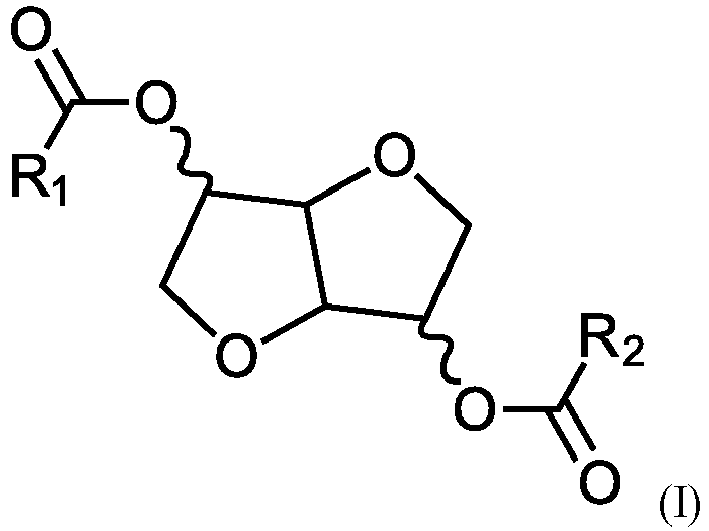
- Zusammensetzung nach einem der vorhergehenden Ansprüche, dadurch gekennzeichnet, dass sich der Isosorbiddiester von mindestens einer Carbonsäure ausgewählt aus der Gruppe bestehend aus Caprylsäure, Caprinsäure, Laurinsäure, Myristinsäure, Palmitinsäure, Margarinsäure, Stearinsäure, Arachinsäure, Behensäure, Lignocerinsäure, Palmitoleinsäure, Petroselinsäure, Ölsäure, Elaidinsäure, Linolsäure, Linolensäure, Arachidonsäure, Timnodonsäure und Cervonsäure ableitet.
- Zusammensetzung nach einem der vorhergehenden Ansprüche, dadurch gekennzeichnet, dass die Menge an Isosorbiddiester 0,05 bis 15,00 Gew.-% beträgt mit der Maßgabe, dass, wenn es sich bei dem aromatischen Polycarbonat der Komponente A) um ein oder mehrere Copolycarbonate enthaltend mindestens die Monomereinheiten der Formel (1),
 R1 für Wasserstoff oder C1-C4-Alkyl steht,R2 für C1-C4-Alkyl steht, undn für 0, 1, 2 oder 3 steht,handelt, die Zusammensetzung 0,05 bis 7,5 Gew.-% der Komponente B) umfasst.
 - Zusammensetzung nach einem der vorhergehenden Ansprüche, dadurch gekennzeichnet, dass die Menge an aromatischem Polycarbonat mindestens 50 Gew.-% beträgt.
- Zusammensetzung nach einem der vorhergehenden Ansprüche, bestehend aus den folgenden Komponenten:A) 82,0 Gew.-% bis 99,95 Gew.-% aromatischem Polycarbonat,B) 0,05 Gew.-% bis 15,0 Gew.-% Isosorbiddiester,C) 0,0 Gew.% bis 1,0 Gew.-% Thermostabilisator undD) 0,0 Gew.% bis 2,0 Gew.-% eines oder mehrerer weiterer Additive aus der Gruppe der Antioxidantien, Entformungsmittel, Flammschutzmittel, UV-Absorber, IR-Absorber, Antistatika, optischen Aufheller, Farbmittel aus der Gruppe der löslichen organischen Pigmente und Additive zur Lasermarkierungmit der Maßgabe, dass, wenn es sich bei dem aromatischen Polycarbonat der Komponente A) um ein oder mehrere Copolycarbonate enthaltend mindestens die Monomereinheiten der Formel (1),
 R1 für Wasserstoff oder C1-C4-Alkyl steht,R2 für C1-C4-Alkyl steht, undn für 0, 1, 2 oder 3 steht,handelt, die Zusammensetzung 0,05 bis 7,5 Gew.-% der Komponente B) umfasst.
 - Zusammensetzung gemäß einem der vorhergehenden Ansprüche, dadurch gekennzeichnet, dass die Zusammensetzung ferner einen Thermostabilisator enthält.
- Zusammensetzung nach einem der vorhergehenden Ansprüche, dadurch gekennzeichnet, dass sie im Bereich von 400 nm bis 800 nm eine Transmission von mindestens 84%, bestimmt nach ISO 13468 bei einer Dicke von 4 mm, und eine Trübung < 5%, bestimmt nach ASTM D1003 bei einer Schichtdicke von 4 mm, aufweist.
- Zusammensetzung gemäß einem der vorhergehenden Ansprüche, dadurch gekennzeichnet, dass die Zusammensetzung als Komponente A ein oder mehrere Copolycarbonate enthaltend die Monomereinheiten der Formel (1),
 R1 für Wasserstoff oder C1-C4-Alkyl steht,R2 für C1-C4-Alkyl steht, undn für 0, 1, 2 oder 3 steht,optional in Kombination mit einem weiteren aromatischen Homo- oder Copolycarbonat, enthaltend eine oder mehrere Monomereinheiten der allgemeinen Formel (2),
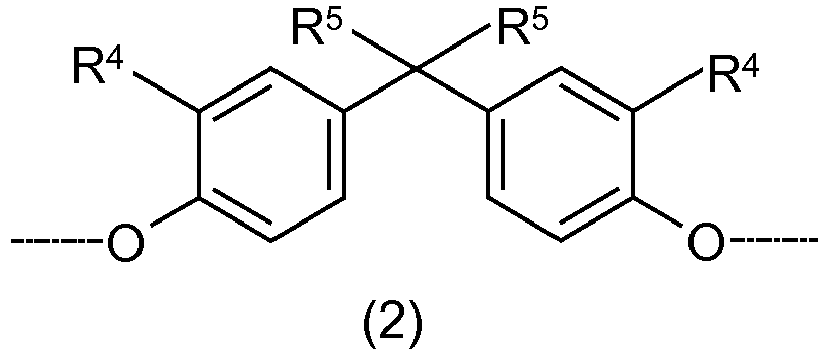 R4 für H oder lineares oder verzweigtes C1-C10Alkyl steht, undR5 für lineares oder verzweigtes C1-C10Alkyl steht;enthält, wobei das gegebenenfalls zusätzlich vorhandene weitere Homo- oder Copolycarbonat keine Monomereinheiten der Formel (1) aufweist.
 - Zusammensetzung gemäß Anspruch 10, dadurch gekennzeichnet, dass der Anteil der Monomereinheiten der Formel (1a) im Copolycarbonat 0,1 - 88 mol-% (bezogen auf die Summe der im Copolycarbonat enthaltenen Diphenol-Monomereinheiten) beträgt.
- Zusammensetzung gemäß Anspruch 10 oder 11, dadurch gekennzeichnet, dass das Copolycarbonat enthaltend die Monomereinheiten der Formel (1) zusätzlich Monomereinheiten der Formel (3) enthält
 R6 und R7 unabhängig voneinander für H, C1-C18-Alkyl-, C1-C18-Alkoxy, Halogen oder für jeweils gegebenenfalls substituiertes Aryl oder Aralkyl stehen, undY für eine Einfachbindung, -SO2-, -CO-, -O-, -S-, C1-C6-Alkylen oder C2-C5-Alkyliden, ferner für C6-C12-Arylen, welches gegebenenfalls mit weiteren Heteroatome enthaltenden aromatischen Ringen kondensiert sein kann, steht.
 - Zusammensetzung gemäß einem der Ansprüche 9 bis 11, dadurch gekennzeichnet, dass die Zusammensetzung als Komponente A einen Blend aus dem Copolycarbonat enthaltend die Monomereinheiten der Formel (1) und Bisphenol A Homopolycarbonat enthält.
- Formteile, Extrudate und Mehrschichtsysteme enthaltend eine Zusammensetzung nach einem der Ansprüche 1 bis 13.
- Verwendung mindestens eines Isosorbiddiesters zur Verbesserung der optischen Transmission und/oder zur Senkung der Gleit- und Haftreibungskoeffizienten von Zusammensetzungen umfassend aromatisches Polycarbonat, gegebenenfalls Thermostabilisator und gegebenenfalls weitere Additive.
Applications Claiming Priority (2)
| Application Number | Priority Date | Filing Date | Title |
|---|---|---|---|
| EP16165413 | 2016-04-14 | ||
| PCT/EP2017/058920 WO2017178583A1 (de) | 2016-04-14 | 2017-04-13 | Polycarbonat-zusammensetzungen enthaltend isosorbiddiester. |
Publications (2)
| Publication Number | Publication Date |
|---|---|
| EP3443033A1 EP3443033A1 (de) | 2019-02-20 |
| EP3443033B1 true EP3443033B1 (de) | 2020-02-12 |
Family
ID=55808385
Family Applications (1)
| Application Number | Title | Priority Date | Filing Date |
|---|---|---|---|
| EP17717696.3A Active EP3443033B1 (de) | 2016-04-14 | 2017-04-13 | Polycarbonat-zusammensetzungen enthaltend isosorbiddiester |
Country Status (6)
| Country | Link |
|---|---|
| US (1) | US10676613B2 (de) |
| EP (1) | EP3443033B1 (de) |
| JP (1) | JP7237592B2 (de) |
| KR (1) | KR102234098B1 (de) |
| CN (1) | CN108884268B (de) |
| WO (1) | WO2017178583A1 (de) |
Cited By (1)
| Publication number | Priority date | Publication date | Assignee | Title |
|---|---|---|---|---|
| WO2023213434A1 (fr) | 2022-05-03 | 2023-11-09 | Roquette Freres | Procede de preparation d'une composition de diester de 1,4:3,6-dianydrohexitol |
Families Citing this family (11)
| Publication number | Priority date | Publication date | Assignee | Title |
|---|---|---|---|---|
| WO2020109007A1 (de) * | 2018-11-29 | 2020-06-04 | Covestro Deutschland Ag | Lidar-sensorsystem mit verbesserter oberflächengüte |
| KR102125262B1 (ko) * | 2019-01-11 | 2020-06-22 | 주식회사 엘지화학 | 내열성과 전자파 차폐능이 우수한 열가소성 수지 조성물, 이의 제조방법 및 이로부터 제조된 사출성형품 |
| KR102617881B1 (ko) * | 2019-09-04 | 2023-12-22 | 주식회사 엘지화학 | 폴리카보네이트 |
| CN111548620B (zh) * | 2020-05-06 | 2022-08-16 | 宁波浙铁大风化工有限公司 | 一种环境友好型光学级聚碳酸酯及其制备方法 |
| EP3916055A1 (de) | 2020-05-26 | 2021-12-01 | Covestro Deutschland AG | Polycarbonat-zusammensetzungen enthaltend polyethercarbonatpolyole |
| KR102742897B1 (ko) | 2021-07-15 | 2024-12-17 | 주식회사 삼양사 | 광학 특성이 우수한 폴리카보네이트 수지 조성물 및 이를 포함하는 성형품 |
| KR102681741B1 (ko) * | 2021-10-08 | 2024-07-04 | 한국생산기술연구원 | 상용화제를 포함함으로써 상용성이 개선된 카보네이트 공중합체 조성물, 그를 포함하는 성형체 및 그의 제조방법 |
| DE102021127425A1 (de) * | 2021-10-21 | 2023-04-27 | Fm Marketing Gmbh | Bruchstabiles elektrisches Handgerät, insbesondere Fernbedienung |
| KR102798802B1 (ko) | 2021-12-27 | 2025-04-24 | 주식회사 삼양사 | 기계적 특성이 우수하고 광학 특성이 향상된 폴리카보네이트 수지 조성물 및 이를 포함하는 성형품 |
| KR20240141906A (ko) * | 2023-03-20 | 2024-09-30 | 주식회사 삼양사 | 내 전리방사선 특성이 우수한 폴리카보네이트 수지 조성물 및 이를 포함하는 성형품 |
| EP4495176A1 (de) * | 2023-07-21 | 2025-01-22 | Roquette Freres | Isosorbiddiester und ihre verwendung als verarbeitungshilfsmittel und weichmacher in abs-zusammensetzungen |
Family Cites Families (43)
| Publication number | Priority date | Publication date | Assignee | Title |
|---|---|---|---|---|
| BE532543A (de) | 1953-10-16 | |||
| DE1007996B (de) | 1955-03-26 | 1957-05-09 | Bayer Ag | Verfahren zur Herstellung thermoplastischer Kunststoffe |
| US2991273A (en) | 1956-07-07 | 1961-07-04 | Bayer Ag | Process for manufacture of vacuum moulded parts of high molecular weight thermoplastic polycarbonates |
| US3148172A (en) | 1956-07-19 | 1964-09-08 | Gen Electric | Polycarbonates of dihydroxyaryl ethers |
| US2999846A (en) | 1956-11-30 | 1961-09-12 | Schnell Hermann | High molecular weight thermoplastic aromatic sulfoxy polycarbonates |
| BE585496A (de) | 1958-12-12 | |||
| US3028635A (en) | 1959-04-17 | 1962-04-10 | Schlumberger Cie N | Advancing screw for gill box |
| GB1122003A (en) | 1964-10-07 | 1968-07-31 | Gen Electric | Improvements in aromatic polycarbonates |
| NL152889B (nl) | 1967-03-10 | 1977-04-15 | Gen Electric | Werkwijze ter bereiding van een lineair polycarbonaatcopolymeer, alsmede orienteerbare textielvezel van dit copolymeer. |
| DE2036052A1 (en) | 1970-07-21 | 1972-01-27 | Milchwirtschafthche Forschungs und Untersuchungs Gesellschaft mbH, 2100 Hamburg | Working up of additives in fat and protein - contng foodstuffs |
| DE2063050C3 (de) | 1970-12-22 | 1983-12-15 | Bayer Ag, 5090 Leverkusen | Verseifungsbeständige Polycarbonate, Verfahren zu deren Herstellung und deren Verwendung |
| US3879348A (en) | 1970-12-22 | 1975-04-22 | Bayer Ag | Saponification-resistant polycarbonates |
| DE2211956A1 (de) | 1972-03-11 | 1973-10-25 | Bayer Ag | Verfahren zur herstellung verseifungsstabiler blockcopolycarbonate |
| JPS6162040A (ja) | 1984-09-04 | 1986-03-29 | Fuji Xerox Co Ltd | 電子写真用感光体 |
| JPS6162039A (ja) | 1984-09-04 | 1986-03-29 | Fuji Xerox Co Ltd | 電子写真用感光体 |
| JPS61105550A (ja) | 1984-10-29 | 1986-05-23 | Fuji Xerox Co Ltd | 電子写真用感光体 |
| NO170326C (no) | 1988-08-12 | 1992-10-07 | Bayer Ag | Dihydroksydifenylcykloalkaner |
| DE3832396A1 (de) | 1988-08-12 | 1990-02-15 | Bayer Ag | Dihydroxydiphenylcycloalkane, ihre herstellung und ihre verwendung zur herstellung von hochmolekularen polycarbonaten |
| US5227458A (en) * | 1988-08-12 | 1993-07-13 | Bayer Aktiengesellschaft | Polycarbonate from dihydroxydiphenyl cycloalkane |
| DE3918406A1 (de) | 1989-06-06 | 1990-12-13 | Bayer Ag | Verwendung von polycarbonatmischungen in der optik |
| TW222292B (de) | 1991-02-21 | 1994-04-11 | Ciba Geigy Ag | |
| FI971991A7 (fi) | 1994-11-10 | 1997-05-09 | Basf Ag | 2-syaaniakryylihappoesterit |
| DE59702969D1 (de) | 1996-10-30 | 2001-03-08 | Ciba Sc Holding Ag | Stabilisatorkombination für das Rotomolding-Verfahren |
| US20060074202A1 (en) * | 2004-09-29 | 2006-04-06 | General Electric Company | Stabilized polycarbonate polyester composition |
| DE102007006442A1 (de) | 2007-02-05 | 2008-08-07 | Evonik Oxeno Gmbh | Gemisch von Diestern von Dianhydrohexitolderivaten mit Carbonsäuren der Summenformel C8H17COOH, Verfahren zur Herstellung dieser Diester und Verwendung dieser Gemische |
| US7718755B2 (en) * | 2007-10-18 | 2010-05-18 | Sabic Innovative Plastics Ip B.V. | Aliphatic diol-based polycarbonates, method of making, and articles formed therefrom |
| US7666972B2 (en) * | 2007-10-18 | 2010-02-23 | SABIC Innovative Plastics IP B., V. | Isosorbide-based polycarbonates, method of making, and articles formed therefrom |
| FR2937040B1 (fr) * | 2008-10-13 | 2012-07-27 | Roquette Freres | Compositions thermoplastiques ou elastomeriques a base d'esters d'une matiere amylacee et procede de preparation de telles compositions |
| JP2011078889A (ja) | 2009-10-06 | 2011-04-21 | Miura Co Ltd | 濾過部材洗浄システム |
| EP2336245A1 (de) * | 2009-12-12 | 2011-06-22 | Bayer MaterialScience AG | Polycarbonatzusammensetzungen mit verbesserter Oberflächenhärte |
| JP5251857B2 (ja) * | 2009-12-16 | 2013-07-31 | コニカミノルタアドバンストレイヤー株式会社 | 光学フィルム |
| US8389662B2 (en) * | 2009-12-30 | 2013-03-05 | Sabic Innovative Plastics Ip B.V. | Isosorbide-based polycarbonates, method of making, and articles formed therefrom |
| DE102010002856A1 (de) * | 2010-03-15 | 2011-09-15 | Kuraray Europe Gmbh | Verwendung von Isosorbiddiestern als Weichmacher für Zwischenschichtfolien aus Polyvinylacetal |
| US8372943B2 (en) * | 2010-12-10 | 2013-02-12 | Sabic Innovative Plastics Ip B.V. | Isosorbide—containing polycarbonates and their preparation |
| US20120178858A1 (en) | 2011-01-10 | 2012-07-12 | Andrew Julian Wnuk | Isosorbide-Plasticized Starch And Uses Thereof |
| FR2973801B1 (fr) * | 2011-04-05 | 2015-03-20 | Roquette Freres | Procede de fabrication de polycarbonate a partir de derives de dianhydrohexitols portant deux fonctions carbonate d'alkyle |
| EP2822532B1 (de) * | 2012-03-09 | 2018-09-19 | Covestro Deutschland AG | Wässrige polyurethan-dispersion für die behandlung von akne |
| JP2014043540A (ja) * | 2012-08-03 | 2014-03-13 | Unitika Ltd | ポリ乳酸系樹脂組成物及びそれからなる成形体 |
| KR101512307B1 (ko) * | 2012-09-21 | 2015-04-15 | 신일화학공업(주) | 낮은 복굴절을 갖는 열가소성 성형 조성물 |
| KR20150140367A (ko) * | 2013-04-12 | 2015-12-15 | 바스프 에스이 | 테트라히드로푸란 유도체 및 가소제로서의 그의 용도 |
| CN104212135A (zh) * | 2013-06-03 | 2014-12-17 | 东丽先端材料研究开发(中国)有限公司 | 一种生物降解聚乳酸树脂组合物和制品 |
| KR101611705B1 (ko) * | 2013-07-01 | 2016-04-12 | 주식회사 엘지화학 | 친환경 폴리카보네이트 수지 |
| KR102331011B1 (ko) | 2014-03-14 | 2021-11-25 | 코베스트로 도이칠란트 아게 | 균형 잡힌 가공성을 특징으로 하는 열 전도성 열가소성 조성물 |
-
2017
- 2017-04-13 JP JP2018554018A patent/JP7237592B2/ja active Active
- 2017-04-13 EP EP17717696.3A patent/EP3443033B1/de active Active
- 2017-04-13 US US16/092,981 patent/US10676613B2/en active Active
- 2017-04-13 WO PCT/EP2017/058920 patent/WO2017178583A1/de not_active Ceased
- 2017-04-13 CN CN201780023305.6A patent/CN108884268B/zh active Active
- 2017-04-13 KR KR1020187029141A patent/KR102234098B1/ko active Active
Non-Patent Citations (1)
| Title |
|---|
| None * |
Cited By (2)
| Publication number | Priority date | Publication date | Assignee | Title |
|---|---|---|---|---|
| WO2023213434A1 (fr) | 2022-05-03 | 2023-11-09 | Roquette Freres | Procede de preparation d'une composition de diester de 1,4:3,6-dianydrohexitol |
| FR3135270A1 (fr) | 2022-05-03 | 2023-11-10 | Roquette Freres | Procede de preparation d’une composition de diester de 1,4:3,6-dianydrohexitol |
Also Published As
| Publication number | Publication date |
|---|---|
| CN108884268A (zh) | 2018-11-23 |
| KR20180135896A (ko) | 2018-12-21 |
| KR102234098B1 (ko) | 2021-04-01 |
| US10676613B2 (en) | 2020-06-09 |
| JP2019511623A (ja) | 2019-04-25 |
| EP3443033A1 (de) | 2019-02-20 |
| JP7237592B2 (ja) | 2023-03-13 |
| US20190136047A1 (en) | 2019-05-09 |
| CN108884268B (zh) | 2020-10-30 |
| WO2017178583A1 (de) | 2017-10-19 |
Similar Documents
| Publication | Publication Date | Title |
|---|---|---|
| EP3443033B1 (de) | Polycarbonat-zusammensetzungen enthaltend isosorbiddiester | |
| EP3464440B1 (de) | Polycarbonat-zusammensetzungen enthaltend füllstoffe, eine carbonsäure und deren glycerol- oder diglycerolester | |
| EP3115408B1 (de) | Verbesserung der fliessfähigkeit von thermisch leitfähigen polycarbonatzusammensetzungen | |
| EP3227373B1 (de) | Verbesserung der fliessfähigkeit von polycarbonatzusammensetzungen | |
| EP3227386B1 (de) | Polyethylenwachs-haltige polycarbonat-zusammensetzungen | |
| EP3227371B1 (de) | Gefüllte polycarbonatzusammensetzungen mit verbesserter fliessfähigkeit und hoher steifigkeit | |
| EP3458510B1 (de) | Polycarbonat-zusammensetzungen enthaltend eine carbonsäure und deren glycerol- oder diglycerolester | |
| EP3320045B1 (de) | Schlagzähmodifizierte polycarbonatzusammensetzungen mit verbesserter fliessfähigkeit und hoher wärmeformbeständigkeit | |
| EP3571245B1 (de) | Graphit-haltige polycarbonat-zusammensetzungen enthaltend ein neuartiges fliesshilfsmittel | |
| EP3387056B1 (de) | Polyglycidylether-haltige polycarbonatzusammensetzungen | |
| EP2981577B1 (de) | Hochtemperaturbeständige phthalimid-haltige (co)polycarbonate mit verbesserten rheologischen eigenschaften | |
| DE102009043511A1 (de) | UV-stabile Polycarbonat-Zusammensetzung mit verbesserten Eigenschaften |
Legal Events
| Date | Code | Title | Description |
|---|---|---|---|
| STAA | Information on the status of an ep patent application or granted ep patent |
Free format text: STATUS: UNKNOWN |
|
| STAA | Information on the status of an ep patent application or granted ep patent |
Free format text: STATUS: THE INTERNATIONAL PUBLICATION HAS BEEN MADE |
|
| PUAI | Public reference made under article 153(3) epc to a published international application that has entered the european phase |
Free format text: ORIGINAL CODE: 0009012 |
|
| STAA | Information on the status of an ep patent application or granted ep patent |
Free format text: STATUS: REQUEST FOR EXAMINATION WAS MADE |
|
| 17P | Request for examination filed |
Effective date: 20181114 |
|
| AK | Designated contracting states |
Kind code of ref document: A1 Designated state(s): AL AT BE BG CH CY CZ DE DK EE ES FI FR GB GR HR HU IE IS IT LI LT LU LV MC MK MT NL NO PL PT RO RS SE SI SK SM TR |
|
| AX | Request for extension of the european patent |
Extension state: BA ME |
|
| DAV | Request for validation of the european patent (deleted) | ||
| DAX | Request for extension of the european patent (deleted) | ||
| GRAP | Despatch of communication of intention to grant a patent |
Free format text: ORIGINAL CODE: EPIDOSNIGR1 |
|
| STAA | Information on the status of an ep patent application or granted ep patent |
Free format text: STATUS: GRANT OF PATENT IS INTENDED |
|
| INTG | Intention to grant announced |
Effective date: 20191107 |
|
| RIN1 | Information on inventor provided before grant (corrected) |
Inventor name: WEHRMANN, ROLF Inventor name: BOUMANS, ANKE Inventor name: HEUER, HELMUT, WERNER |
|
| GRAS | Grant fee paid |
Free format text: ORIGINAL CODE: EPIDOSNIGR3 |
|
| GRAA | (expected) grant |
Free format text: ORIGINAL CODE: 0009210 |
|
| STAA | Information on the status of an ep patent application or granted ep patent |
Free format text: STATUS: THE PATENT HAS BEEN GRANTED |
|
| AK | Designated contracting states |
Kind code of ref document: B1 Designated state(s): AL AT BE BG CH CY CZ DE DK EE ES FI FR GB GR HR HU IE IS IT LI LT LU LV MC MK MT NL NO PL PT RO RS SE SI SK SM TR |
|
| REG | Reference to a national code |
Ref country code: GB Ref legal event code: FG4D Free format text: NOT ENGLISH |
|
| REG | Reference to a national code |
Ref country code: CH Ref legal event code: EP |
|
| REG | Reference to a national code |
Ref country code: AT Ref legal event code: REF Ref document number: 1232066 Country of ref document: AT Kind code of ref document: T Effective date: 20200215 |
|
| REG | Reference to a national code |
Ref country code: DE Ref legal event code: R096 Ref document number: 502017003791 Country of ref document: DE |
|
| REG | Reference to a national code |
Ref country code: IE Ref legal event code: FG4D Free format text: LANGUAGE OF EP DOCUMENT: GERMAN |
|
| PG25 | Lapsed in a contracting state [announced via postgrant information from national office to epo] |
Ref country code: RS Free format text: LAPSE BECAUSE OF FAILURE TO SUBMIT A TRANSLATION OF THE DESCRIPTION OR TO PAY THE FEE WITHIN THE PRESCRIBED TIME-LIMIT Effective date: 20200212 Ref country code: FI Free format text: LAPSE BECAUSE OF FAILURE TO SUBMIT A TRANSLATION OF THE DESCRIPTION OR TO PAY THE FEE WITHIN THE PRESCRIBED TIME-LIMIT Effective date: 20200212 Ref country code: NO Free format text: LAPSE BECAUSE OF FAILURE TO SUBMIT A TRANSLATION OF THE DESCRIPTION OR TO PAY THE FEE WITHIN THE PRESCRIBED TIME-LIMIT Effective date: 20200512 |
|
| REG | Reference to a national code |
Ref country code: LT Ref legal event code: MG4D |
|
| REG | Reference to a national code |
Ref country code: NL Ref legal event code: MP Effective date: 20200212 |
|
| PG25 | Lapsed in a contracting state [announced via postgrant information from national office to epo] |
Ref country code: IS Free format text: LAPSE BECAUSE OF FAILURE TO SUBMIT A TRANSLATION OF THE DESCRIPTION OR TO PAY THE FEE WITHIN THE PRESCRIBED TIME-LIMIT Effective date: 20200612 Ref country code: LV Free format text: LAPSE BECAUSE OF FAILURE TO SUBMIT A TRANSLATION OF THE DESCRIPTION OR TO PAY THE FEE WITHIN THE PRESCRIBED TIME-LIMIT Effective date: 20200212 Ref country code: SE Free format text: LAPSE BECAUSE OF FAILURE TO SUBMIT A TRANSLATION OF THE DESCRIPTION OR TO PAY THE FEE WITHIN THE PRESCRIBED TIME-LIMIT Effective date: 20200212 Ref country code: GR Free format text: LAPSE BECAUSE OF FAILURE TO SUBMIT A TRANSLATION OF THE DESCRIPTION OR TO PAY THE FEE WITHIN THE PRESCRIBED TIME-LIMIT Effective date: 20200513 Ref country code: BG Free format text: LAPSE BECAUSE OF FAILURE TO SUBMIT A TRANSLATION OF THE DESCRIPTION OR TO PAY THE FEE WITHIN THE PRESCRIBED TIME-LIMIT Effective date: 20200512 Ref country code: HR Free format text: LAPSE BECAUSE OF FAILURE TO SUBMIT A TRANSLATION OF THE DESCRIPTION OR TO PAY THE FEE WITHIN THE PRESCRIBED TIME-LIMIT Effective date: 20200212 |
|
| PG25 | Lapsed in a contracting state [announced via postgrant information from national office to epo] |
Ref country code: NL Free format text: LAPSE BECAUSE OF FAILURE TO SUBMIT A TRANSLATION OF THE DESCRIPTION OR TO PAY THE FEE WITHIN THE PRESCRIBED TIME-LIMIT Effective date: 20200212 |
|
| PG25 | Lapsed in a contracting state [announced via postgrant information from national office to epo] |
Ref country code: SM Free format text: LAPSE BECAUSE OF FAILURE TO SUBMIT A TRANSLATION OF THE DESCRIPTION OR TO PAY THE FEE WITHIN THE PRESCRIBED TIME-LIMIT Effective date: 20200212 Ref country code: LT Free format text: LAPSE BECAUSE OF FAILURE TO SUBMIT A TRANSLATION OF THE DESCRIPTION OR TO PAY THE FEE WITHIN THE PRESCRIBED TIME-LIMIT Effective date: 20200212 Ref country code: PT Free format text: LAPSE BECAUSE OF FAILURE TO SUBMIT A TRANSLATION OF THE DESCRIPTION OR TO PAY THE FEE WITHIN THE PRESCRIBED TIME-LIMIT Effective date: 20200705 Ref country code: SK Free format text: LAPSE BECAUSE OF FAILURE TO SUBMIT A TRANSLATION OF THE DESCRIPTION OR TO PAY THE FEE WITHIN THE PRESCRIBED TIME-LIMIT Effective date: 20200212 Ref country code: CZ Free format text: LAPSE BECAUSE OF FAILURE TO SUBMIT A TRANSLATION OF THE DESCRIPTION OR TO PAY THE FEE WITHIN THE PRESCRIBED TIME-LIMIT Effective date: 20200212 Ref country code: ES Free format text: LAPSE BECAUSE OF FAILURE TO SUBMIT A TRANSLATION OF THE DESCRIPTION OR TO PAY THE FEE WITHIN THE PRESCRIBED TIME-LIMIT Effective date: 20200212 Ref country code: RO Free format text: LAPSE BECAUSE OF FAILURE TO SUBMIT A TRANSLATION OF THE DESCRIPTION OR TO PAY THE FEE WITHIN THE PRESCRIBED TIME-LIMIT Effective date: 20200212 Ref country code: DK Free format text: LAPSE BECAUSE OF FAILURE TO SUBMIT A TRANSLATION OF THE DESCRIPTION OR TO PAY THE FEE WITHIN THE PRESCRIBED TIME-LIMIT Effective date: 20200212 Ref country code: EE Free format text: LAPSE BECAUSE OF FAILURE TO SUBMIT A TRANSLATION OF THE DESCRIPTION OR TO PAY THE FEE WITHIN THE PRESCRIBED TIME-LIMIT Effective date: 20200212 |
|
| REG | Reference to a national code |
Ref country code: DE Ref legal event code: R097 Ref document number: 502017003791 Country of ref document: DE |
|
| PG25 | Lapsed in a contracting state [announced via postgrant information from national office to epo] |
Ref country code: MC Free format text: LAPSE BECAUSE OF FAILURE TO SUBMIT A TRANSLATION OF THE DESCRIPTION OR TO PAY THE FEE WITHIN THE PRESCRIBED TIME-LIMIT Effective date: 20200212 |
|
| REG | Reference to a national code |
Ref country code: CH Ref legal event code: PL |
|
| PLBE | No opposition filed within time limit |
Free format text: ORIGINAL CODE: 0009261 |
|
| STAA | Information on the status of an ep patent application or granted ep patent |
Free format text: STATUS: NO OPPOSITION FILED WITHIN TIME LIMIT |
|
| 26N | No opposition filed |
Effective date: 20201113 |
|
| PG25 | Lapsed in a contracting state [announced via postgrant information from national office to epo] |
Ref country code: FR Free format text: LAPSE BECAUSE OF NON-PAYMENT OF DUE FEES Effective date: 20200430 Ref country code: LI Free format text: LAPSE BECAUSE OF NON-PAYMENT OF DUE FEES Effective date: 20200430 Ref country code: LU Free format text: LAPSE BECAUSE OF NON-PAYMENT OF DUE FEES Effective date: 20200413 Ref country code: CH Free format text: LAPSE BECAUSE OF NON-PAYMENT OF DUE FEES Effective date: 20200430 |
|
| REG | Reference to a national code |
Ref country code: BE Ref legal event code: MM Effective date: 20200430 |
|
| PG25 | Lapsed in a contracting state [announced via postgrant information from national office to epo] |
Ref country code: SI Free format text: LAPSE BECAUSE OF FAILURE TO SUBMIT A TRANSLATION OF THE DESCRIPTION OR TO PAY THE FEE WITHIN THE PRESCRIBED TIME-LIMIT Effective date: 20200212 Ref country code: PL Free format text: LAPSE BECAUSE OF FAILURE TO SUBMIT A TRANSLATION OF THE DESCRIPTION OR TO PAY THE FEE WITHIN THE PRESCRIBED TIME-LIMIT Effective date: 20200212 Ref country code: BE Free format text: LAPSE BECAUSE OF NON-PAYMENT OF DUE FEES Effective date: 20200430 |
|
| PG25 | Lapsed in a contracting state [announced via postgrant information from national office to epo] |
Ref country code: IE Free format text: LAPSE BECAUSE OF NON-PAYMENT OF DUE FEES Effective date: 20200413 |
|
| PG25 | Lapsed in a contracting state [announced via postgrant information from national office to epo] |
Ref country code: TR Free format text: LAPSE BECAUSE OF FAILURE TO SUBMIT A TRANSLATION OF THE DESCRIPTION OR TO PAY THE FEE WITHIN THE PRESCRIBED TIME-LIMIT Effective date: 20200212 Ref country code: MT Free format text: LAPSE BECAUSE OF FAILURE TO SUBMIT A TRANSLATION OF THE DESCRIPTION OR TO PAY THE FEE WITHIN THE PRESCRIBED TIME-LIMIT Effective date: 20200212 Ref country code: CY Free format text: LAPSE BECAUSE OF FAILURE TO SUBMIT A TRANSLATION OF THE DESCRIPTION OR TO PAY THE FEE WITHIN THE PRESCRIBED TIME-LIMIT Effective date: 20200212 |
|
| PG25 | Lapsed in a contracting state [announced via postgrant information from national office to epo] |
Ref country code: MK Free format text: LAPSE BECAUSE OF FAILURE TO SUBMIT A TRANSLATION OF THE DESCRIPTION OR TO PAY THE FEE WITHIN THE PRESCRIBED TIME-LIMIT Effective date: 20200212 Ref country code: AL Free format text: LAPSE BECAUSE OF FAILURE TO SUBMIT A TRANSLATION OF THE DESCRIPTION OR TO PAY THE FEE WITHIN THE PRESCRIBED TIME-LIMIT Effective date: 20200212 |
|
| REG | Reference to a national code |
Ref country code: AT Ref legal event code: MM01 Ref document number: 1232066 Country of ref document: AT Kind code of ref document: T Effective date: 20220413 |
|
| PG25 | Lapsed in a contracting state [announced via postgrant information from national office to epo] |
Ref country code: AT Free format text: LAPSE BECAUSE OF NON-PAYMENT OF DUE FEES Effective date: 20220413 |
|
| PGFP | Annual fee paid to national office [announced via postgrant information from national office to epo] |
Ref country code: GB Payment date: 20250320 Year of fee payment: 9 |
|
| PGFP | Annual fee paid to national office [announced via postgrant information from national office to epo] |
Ref country code: DE Payment date: 20250319 Year of fee payment: 9 |
|
| PGFP | Annual fee paid to national office [announced via postgrant information from national office to epo] |
Ref country code: IT Payment date: 20250326 Year of fee payment: 9 |