EP3441293A1 - Pedalverbindungsmechanismus und elektrisches hoverboard damit - Google Patents
Pedalverbindungsmechanismus und elektrisches hoverboard damit Download PDFInfo
- Publication number
- EP3441293A1 EP3441293A1 EP16889002.8A EP16889002A EP3441293A1 EP 3441293 A1 EP3441293 A1 EP 3441293A1 EP 16889002 A EP16889002 A EP 16889002A EP 3441293 A1 EP3441293 A1 EP 3441293A1
- Authority
- EP
- European Patent Office
- Prior art keywords
- pedal
- signal
- output end
- signal processor
- connecting mechanism
- Prior art date
- Legal status (The legal status is an assumption and is not a legal conclusion. Google has not performed a legal analysis and makes no representation as to the accuracy of the status listed.)
- Pending
Links
Images
Classifications
-
- B—PERFORMING OPERATIONS; TRANSPORTING
- B62—LAND VEHICLES FOR TRAVELLING OTHERWISE THAN ON RAILS
- B62K—CYCLES; CYCLE FRAMES; CYCLE STEERING DEVICES; RIDER-OPERATED TERMINAL CONTROLS SPECIALLY ADAPTED FOR CYCLES; CYCLE AXLE SUSPENSIONS; CYCLE SIDECARS, FORECARS, OR THE LIKE
- B62K23/00—Rider-operated controls specially adapted for cycles, i.e. means for initiating control operations, e.g. levers, grips
- B62K23/08—Rider-operated controls specially adapted for cycles, i.e. means for initiating control operations, e.g. levers, grips foot actuated
-
- B—PERFORMING OPERATIONS; TRANSPORTING
- B60—VEHICLES IN GENERAL
- B60K—ARRANGEMENT OR MOUNTING OF PROPULSION UNITS OR OF TRANSMISSIONS IN VEHICLES; ARRANGEMENT OR MOUNTING OF PLURAL DIVERSE PRIME-MOVERS IN VEHICLES; AUXILIARY DRIVES FOR VEHICLES; INSTRUMENTATION OR DASHBOARDS FOR VEHICLES; ARRANGEMENTS IN CONNECTION WITH COOLING, AIR INTAKE, GAS EXHAUST OR FUEL SUPPLY OF PROPULSION UNITS IN VEHICLES
- B60K1/00—Arrangement or mounting of electrical propulsion units
- B60K1/02—Arrangement or mounting of electrical propulsion units comprising more than one electric motor
-
- B—PERFORMING OPERATIONS; TRANSPORTING
- B62—LAND VEHICLES FOR TRAVELLING OTHERWISE THAN ON RAILS
- B62J—CYCLE SADDLES OR SEATS; AUXILIARY DEVICES OR ACCESSORIES SPECIALLY ADAPTED TO CYCLES AND NOT OTHERWISE PROVIDED FOR, e.g. ARTICLE CARRIERS OR CYCLE PROTECTORS
- B62J25/00—Foot-rests; Knee grips; Passenger hand-grips
- B62J25/04—Floor-type foot rests
-
- B—PERFORMING OPERATIONS; TRANSPORTING
- B62—LAND VEHICLES FOR TRAVELLING OTHERWISE THAN ON RAILS
- B62K—CYCLES; CYCLE FRAMES; CYCLE STEERING DEVICES; RIDER-OPERATED TERMINAL CONTROLS SPECIALLY ADAPTED FOR CYCLES; CYCLE AXLE SUSPENSIONS; CYCLE SIDECARS, FORECARS, OR THE LIKE
- B62K11/00—Motorcycles, engine-assisted cycles or motor scooters with one or two wheels
-
- B—PERFORMING OPERATIONS; TRANSPORTING
- B62—LAND VEHICLES FOR TRAVELLING OTHERWISE THAN ON RAILS
- B62K—CYCLES; CYCLE FRAMES; CYCLE STEERING DEVICES; RIDER-OPERATED TERMINAL CONTROLS SPECIALLY ADAPTED FOR CYCLES; CYCLE AXLE SUSPENSIONS; CYCLE SIDECARS, FORECARS, OR THE LIKE
- B62K11/00—Motorcycles, engine-assisted cycles or motor scooters with one or two wheels
- B62K11/007—Automatic balancing machines with single main ground engaging wheel or coaxial wheels supporting a rider
-
- B—PERFORMING OPERATIONS; TRANSPORTING
- B62—LAND VEHICLES FOR TRAVELLING OTHERWISE THAN ON RAILS
- B62J—CYCLE SADDLES OR SEATS; AUXILIARY DEVICES OR ACCESSORIES SPECIALLY ADAPTED TO CYCLES AND NOT OTHERWISE PROVIDED FOR, e.g. ARTICLE CARRIERS OR CYCLE PROTECTORS
- B62J43/00—Arrangements of batteries
- B62J43/10—Arrangements of batteries for propulsion
- B62J43/16—Arrangements of batteries for propulsion on motorcycles or the like
-
- B—PERFORMING OPERATIONS; TRANSPORTING
- B62—LAND VEHICLES FOR TRAVELLING OTHERWISE THAN ON RAILS
- B62J—CYCLE SADDLES OR SEATS; AUXILIARY DEVICES OR ACCESSORIES SPECIALLY ADAPTED TO CYCLES AND NOT OTHERWISE PROVIDED FOR, e.g. ARTICLE CARRIERS OR CYCLE PROTECTORS
- B62J43/00—Arrangements of batteries
- B62J43/30—Arrangements of batteries for providing power to equipment other than for propulsion
-
- B—PERFORMING OPERATIONS; TRANSPORTING
- B62—LAND VEHICLES FOR TRAVELLING OTHERWISE THAN ON RAILS
- B62J—CYCLE SADDLES OR SEATS; AUXILIARY DEVICES OR ACCESSORIES SPECIALLY ADAPTED TO CYCLES AND NOT OTHERWISE PROVIDED FOR, e.g. ARTICLE CARRIERS OR CYCLE PROTECTORS
- B62J45/00—Electrical equipment arrangements specially adapted for use as accessories on cycles, not otherwise provided for
- B62J45/40—Sensor arrangements; Mounting thereof
- B62J45/41—Sensor arrangements; Mounting thereof characterised by the type of sensor
- B62J45/414—Acceleration sensors
-
- B—PERFORMING OPERATIONS; TRANSPORTING
- B62—LAND VEHICLES FOR TRAVELLING OTHERWISE THAN ON RAILS
- B62K—CYCLES; CYCLE FRAMES; CYCLE STEERING DEVICES; RIDER-OPERATED TERMINAL CONTROLS SPECIALLY ADAPTED FOR CYCLES; CYCLE AXLE SUSPENSIONS; CYCLE SIDECARS, FORECARS, OR THE LIKE
- B62K2202/00—Motorised scooters
-
- B—PERFORMING OPERATIONS; TRANSPORTING
- B62—LAND VEHICLES FOR TRAVELLING OTHERWISE THAN ON RAILS
- B62K—CYCLES; CYCLE FRAMES; CYCLE STEERING DEVICES; RIDER-OPERATED TERMINAL CONTROLS SPECIALLY ADAPTED FOR CYCLES; CYCLE AXLE SUSPENSIONS; CYCLE SIDECARS, FORECARS, OR THE LIKE
- B62K2204/00—Adaptations for driving cycles by electric motor
Definitions
- the present invention relates to the technical field of scooters, in particular to a pedal connecting mechanism and an electric balancing scooter employing the same.
- Electric balancing scooter also known as a motion-sensing scooter, Segway, etc.
- An electric balancing scooter is based on the principle of "dynamic stabilization", where the gyroscopes and acceleration sensors inside the scooter body are used to judge the posture state of the scooter body, and a precise and high-speed central microprocessor is used to calculate the appropriate commands, and the motors are driven to perform corresponding adjustments so as to maintain the balance of the system.
- the existing balancing scooters are in various and diverse forms.
- balancing scooters in the market which are equipped with a directional lever; during use, a user controls the direction of movement of the balancing scooter by adjusting the directional lever; the operation is complex, and the user may take great effort to adjust the directional lever. Moreover, the user needs to hold the directional lever by hand, and cannot do stretching and other actions at will, thereby reducing the fun of playing with the scooter.
- Chinese patent application number 201520567850 .X discloses a two-wheeled balancing scooter which can adjust the state of motion of the scooter without using a directional lever.
- the left and right pedals of the balancing scooter is connected via an intermediate shaft; during use, all the gravity of the human body is borne by the intermediate shaft; the twisting of the balancing scooter body would easily damage the intermediate shaft, or even cause the intermediate shaft to be broken; therefore such a structure for the balancing scooter is prone to failure, and has relatively low stability, reliability and safety.
- the balancing scooter designed with an intermediate shaft has a large reaction error.
- the present invention provides a pedal connecting mechanism, which is provided with a transverse connecting member at the bottoms of the left pedal and the right pedal, wherein the left pedal and the right pedal are not connected via an intermediate shaft, instead, they are two independent bodies, and their states of motion are independently controlled by the left foot and right foot, respectively; the transverse connecting member is used to distribute the gravity of human body and is uniformly stressed.
- This design is novel and reasonable, and is conducive to prolonging the service life.
- a further object of the present invention is to provide an electric balancing scooter employing the pedal connecting mechanism, which is provided with a transverse connecting member at the bottoms of the pedals.
- the transverse connecting member bears the gravity of the human body and is uniformly stressed, and damage to the structure of the balancing scooter is reduced, so that the balancing scooter has a good stability and is reliable and safe.
- a pedal connecting mechanism comprises a left pedal, a right pedal and a transverse connecting member, wherein a first cylindrical shaft is provided along the bottom of the left pedal; a first supporting member is provided on the left side of a top wall of the transverse connecting member, and a first groove matching the first cylindrical shaft is provided on the first supporting member; the first cylindrical shaft is provided inside the first groove so that the left pedal is rotatably connected to the first supporting member; a second cylindrical shaft is provided along the bottom of the right pedal; a second supporting member is provided on the right side of the top wall of the transverse connecting member, and a second groove matching the second cylindrical shaft is provided on the second supporting member; and the second cylindrical shaft is provided inside the second groove so that the right pedal is rotatably connected to the second supporting member.
- the first cylindrical shaft is composed of two transversely arranged first cylinders, which are symmetrically provided on two sides of the bottom of the left pedal; two first supporting members are correspondingly provided on the left side of the top wall of the transverse connecting member, and a first groove matching the first cylinder is provided on each of the first supporting members; the left pedal is rotatably connected to the first supporting members; the second cylindrical shaft is composed of two transversely arranged second cylinders, which are symmetrically provided on two sides of the bottom of the right pedal; two second supporting members are correspondingly provided on the right side of the top wall of the transverse connecting member, and a second groove matching the second cylinder is provided on each of the second supporting members; and the right pedal is rotatably connected to the second supporting members.
- the pedal connecting mechanism further comprises a first elastic member and a second elastic member, wherein one end of the first elastic member is connected to the bottom of the left pedal, and the other end thereof is correspondingly connected to the left side of the top wall of the transverse connecting member; and one end of the second elastic member is connected to the bottom of the right pedal, and the other end thereof is connected to the right side of the top wall of the transverse connecting member.
- the first elastic member and the second elastic member are both springs.
- the number of the first elastic members is four, and one end of each of the four first elastic members is respectively connected to each of the four corners of the bottom of the left pedal and the other end thereof is respectively connected to the left side of the top wall of the transverse connecting member; and the number of the second elastic members is four, and one end of each of the four second elastic members is respectively connected to each of the four corners of the bottom of the right pedal and the other end thereof is respectively connected to the right side of the top wall of the transverse connecting member.
- the transverse connecting member is a flat plate, two sides being symmetrically inwardly recessed at a middle part in a longitudinal direction of the flat plate.
- the number of the signal processors is one;
- the first sensing element comprises a first gyroscope and a first acceleration sensor; a signal output end of the first gyroscope is connected to a first signal input end of the signal processor; a signal output end of the first acceleration sensor is connected to a second signal input end of the signal processor;
- the second sensing element comprises a second gyroscope and a second acceleration sensor; a signal output end of the second gyroscope is connected to a third input end of the signal processor; and a signal output end of the second acceleration sensor is connected to a fourth input end of the signal processor.
- the number of the signal processors is two, which are denoted as a first signal processor and a second signal processor, respectively;
- the first sensing element comprises a first gyroscope and a first acceleration sensor; a signal output end of the first gyroscope is connected to a first signal input end of the first signal processor; a signal output end of the first acceleration sensor is connected to a second signal input end of the first signal processor;
- the second sensing element comprises a second gyroscope and a second acceleration sensor; a signal output end of the second gyroscope is connected to a first input end of the second signal processor; and a signal output end of the second acceleration sensor is connected to a second input end of the second signal processor.
- the number of the first touch sensing switches is two, and the number of the second touch sensing switches is two.
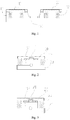
- a pedal connecting mechanism comprises left pedal 10, right pedal 20 and transverse connecting member 30, wherein a first cylindrical shaft 11 is centrally and transversely provided along the bottom of the left pedal 10; a first supporting member 31 is provided on the left side of a top wall of the transverse connecting member 30, and a first groove matching the first cylindrical shaft 11 is provided on the first supporting member 31; the first cylindrical shaft 11 is provided inside the first groove so that the left pedal 10 is rotatably connected to the first supporting member 31; a second cylindrical shaft 21 is centrally and transversely provided along the bottom of the right pedal 20; a second supporting member 32 is provided on the right side of the top wall of the transverse connecting member 30, and a second groove matching the second cylindrical shaft 21 is provided on the second supporting member 32; and the second cylindrical shaft 21 is provided inside the second groove so that the right pedal 20 is rotatably connected to the second supporting member 32.
- the first cylindrical shaft 11 is composed of two transversely arranged first cylinders, which are symmetrically provided on two sides of the bottom of the left pedal 10; two first supporting members 31 are correspondingly provided on the left side of the top wall of the transverse connecting member 30, and a first groove matching the first cylinder is provided on each of the first supporting members 31; the left pedal 10 is rotatably connected to the first supporting members 31; the second cylindrical shaft 21 is composed of two transversely provided second cylinders, which are symmetrically provided on two sides of the bottom of the right pedal 20; two second supporting members 32 are correspondingly provided on the right side of the top wall of the transverse connecting member 30, and a second groove matching the second cylinder is provided on each of the second supporting members 32; and the right pedal 20 is rotatably connected to the second supporting members 32.
- the pedal connecting mechanism further comprises a first elastic member 12 and a second elastic member 22, wherein one end of the first elastic member 12 is connected to the bottom of the left pedal 10, and the other end thereof is correspondingly connected to the left side of the top wall of the transverse connecting member 30; and one end of the second elastic member 22 is connected to the bottom of the right pedal 20, and the other end thereof is connected to the right side of the top wall of the transverse connecting member 30.
- the first elastic member 12 and the second elastic member 22 may be both provided as, but not limited to, springs, and may be provided as other suitable elastic members.
- the elastic members allow the user to feel cushioned to a certain extent after stepping on the pedals, thereby increasing the comfort.
- the number of first elastic members 12 is four, and one end of each of the four first elastic members 12 is respectively connected to each of the four corners of the bottom of the left pedal 10 and the other end thereof is respectively connected to the left side of the top wall of the transverse connecting member 30; and the number of second elastic members 22 is four, and one end of each of the four second elastic members 22 is respectively connected to each of the four corners of the bottom of the right pedal 20 and the other end thereof is respectively connected to the right side of the top wall of the transverse connecting member 30.
- the transverse connecting member 30 may be provided as a flat plate, two sides being symmetrically inwardly recessed at a middle part in a longitudinal direction of the flat plate.
- the transverse connecting member 30 is provided at the bottoms of the left pedal 10 and the right pedal 20, the left pedal 10 and the right pedal 20 are respectively rotatably connected to the transverse connecting member 30, and the left pedal 10 and the right pedal 20 are independent of each other; when the balancing scooter is in use, the gravity applied by the human body to the pedals is transmitted to the transverse connecting member 30, the transverse connecting member 30 bears the gravity of the human body and is uniformly stressed, avoiding the drawback that an intermediate shaft, which is used to connect the left pedal with the right pedal of the balancing scooter of the prior art and bears the gravity of the human body, is easily worn or even broken.
- the balancing scooter made by using this pedal connecting mechanism is reliable, safe and durable. Furthermore, the pedal connecting mechanism can be applied not only to a double-wheeled balancing scooter, but also to a three-wheeled balancing scooter, a four-wheeled balancing scooter, a six-wheeled balancing scooter or other suitable types of scooters, and has a wide range of applications, strong practicality, and great business prospects.
- the number of signal processors is one; the first sensing element comprises a first gyroscope and a first acceleration sensor; a signal output end of the first gyroscope is connected to a first signal input end of the signal processor; a signal output end of the first acceleration sensor is connected to a second signal input end of the signal processor; the second sensing element comprises a second gyroscope and a second acceleration sensor; a signal output end of the second gyroscope is connected to a third input end of the signal processor; and a signal output end of the second acceleration sensor is connected to a fourth input end of the signal processor.
- the number of signal processors is two, which are denoted as a first signal processor and a second signal processor, respectively;
- the first sensing element comprises a first gyroscope and a first acceleration sensor; a signal output end of the first gyroscope is connected to a first signal input end of the first signal processor; a signal output end of the first acceleration sensor is connected to a second signal input end of the first signal processor;
- the second sensing element comprises a second gyroscope and a second acceleration sensor; a signal output end of the second gyroscope is connected to a first input end of the second signal processor; and a signal output end of the second acceleration sensor is connected to a second input end of the second signal processor.
- the number of first touch sensing switches may be two; the number of second touch sensing switches may be two; one of the first sensing switches and one of the second touch sensing switches are standby switches; therefore, standby switches are provided, which is convenient and practical, avoiding the drawback that if only one switch is provided, the balancing scooter cannot start when the switch is broken.
- the operating principle of the electric balancing scooter provided in the present invention is as follows:
- the first touch sensing switch when the user's left foot steps on the left pedal 10, the first touch sensing switch is turned on, and when the right foot steps on the right pedal 20, the second touch sensing switch is turned on.
- the user's left foot stepping on the left pedal 10 tilts the left pedal 10 forward or backward, and at the same time, the first sensing system, which is connected to the bottom of the left pedal 10 in parallel, is tilted forward or backward along with the left pedal 10; in this case, the first sensing element detects the state of motion of the left pedal 10 at any time and transmits the signal to the signal processor which feeds the signal back to the first electric motor, and the state of motion of the left wheel is adjusted according to the power output from the first electric motor; and on the other hand, the user's right foot stepping on the right pedal 20 tilts the right pedal 20 forward or backward, and at the same time, the second sensing system, which is connected to the bottom of the right pedal 20 in parallel, is tilted forward or backward along with the right
- the balancing scooter turns when the user's pressing actions cause the state of motions of the left pedal 10 and the right pedal 20 to be different.
- the first sensing element and the second sensing element feed back the amplitude of swing of the user's body, causing the first electric motor and the second electric motor to obtain different power outputs, thereby adjusting the speed of the balancing scooter.
Landscapes
- Engineering & Computer Science (AREA)
- Mechanical Engineering (AREA)
- Chemical & Material Sciences (AREA)
- Combustion & Propulsion (AREA)
- Transportation (AREA)
- Motorcycle And Bicycle Frame (AREA)
- Handcart (AREA)
Applications Claiming Priority (2)
| Application Number | Priority Date | Filing Date | Title |
|---|---|---|---|
| CN201610077468.XA CN105730574B (zh) | 2016-02-03 | 2016-02-03 | 踏板连接机构及采用该踏板连接机构的电动平衡车 |
| PCT/CN2016/089394 WO2017133184A1 (zh) | 2016-02-03 | 2016-07-08 | 踏板连接机构及采用该踏板连接机构的电动平衡车 |
Publications (2)
| Publication Number | Publication Date |
|---|---|
| EP3441293A1 true EP3441293A1 (de) | 2019-02-13 |
| EP3441293A4 EP3441293A4 (de) | 2020-01-22 |
Family
ID=56244926
Family Applications (1)
| Application Number | Title | Priority Date | Filing Date |
|---|---|---|---|
| EP16889002.8A Pending EP3441293A4 (de) | 2016-02-03 | 2016-07-08 | Pedalverbindungsmechanismus und elektrisches hoverboard damit |
Country Status (4)
| Country | Link |
|---|---|
| US (2) | US20170217532A1 (de) |
| EP (1) | EP3441293A4 (de) |
| CN (1) | CN105730574B (de) |
| WO (1) | WO2017133184A1 (de) |
Cited By (1)
| Publication number | Priority date | Publication date | Assignee | Title |
|---|---|---|---|---|
| EP3441293A4 (de) * | 2016-02-03 | 2020-01-22 | Zhejiang Raymond Way Electronic Technology Co., Ltd | Pedalverbindungsmechanismus und elektrisches hoverboard damit |
Families Citing this family (14)
| Publication number | Priority date | Publication date | Assignee | Title |
|---|---|---|---|---|
| CN106275170B (zh) * | 2016-08-29 | 2018-11-13 | 深圳市动平衡科技有限公司 | 姿态车 |
| CN206125273U (zh) * | 2016-09-08 | 2017-04-26 | 深圳乐行天下科技有限公司 | 一种平衡车 |
| CN106892039B (zh) * | 2017-03-09 | 2022-08-16 | 深圳市亮点智控科技有限公司 | 自平衡装置及电动车辆 |
| EP3592636B1 (de) * | 2017-03-09 | 2022-04-06 | Shane Chen | Selbstbalancierendes fahrzeug mit unabhängiger radsteuerung |
| CN106904232A (zh) * | 2017-03-22 | 2017-06-30 | 深圳市高斯拓普科技有限公司 | 一种平衡车的调节机构及平衡车 |
| CN106890446B (zh) * | 2017-03-22 | 2023-04-07 | 深圳市高斯拓普科技有限公司 | 一种滑板车 |
| CN107097881A (zh) * | 2017-04-28 | 2017-08-29 | 深圳市亮点智控科技有限公司 | 一种姿态车以及姿态车的控制方法 |
| CN108045473B (zh) * | 2017-11-30 | 2019-07-09 | 重庆徐丁科技有限公司 | 一种减振型摩托车搁脚 |
| CN109094702B (zh) * | 2018-08-26 | 2020-10-23 | 深圳市领航致远科技有限公司 | 一种平衡车的踏板组件和平衡车 |
| CN212709804U (zh) * | 2020-06-19 | 2021-03-16 | 浙江阿尔郎科技有限公司 | 一种上壳体组件及其平衡车 |
| CN112960053B (zh) * | 2021-04-12 | 2024-12-13 | 浙江普瑞圣工贸有限公司 | 一种具有摆动踏板的平衡车 |
| CN114954767A (zh) * | 2021-07-20 | 2022-08-30 | 苏州昊维工业产品设计有限公司 | 一种儿童车无极控制用脚踏板、控制方法及应用 |
| CN114750869A (zh) * | 2021-07-20 | 2022-07-15 | 苏州昊维工业产品设计有限公司 | 车辆脚踏组件及电动车 |
| CN113753164A (zh) * | 2021-09-07 | 2021-12-07 | 深圳市亮点智控科技有限公司 | 一种体感车运行的控制系统及方法 |
Family Cites Families (34)
| Publication number | Priority date | Publication date | Assignee | Title |
|---|---|---|---|---|
| JPS4855953U (de) * | 1971-10-25 | 1973-07-18 | ||
| US6572514B1 (en) * | 1998-12-09 | 2003-06-03 | Kathleen E. Calafato | Exerciser with counter-reciprocating pedals |
| US6761666B2 (en) * | 2002-09-06 | 2004-07-13 | Energy Star Co., Ltd. | Reciprocal device having sensing feature |
| US6899657B2 (en) * | 2002-11-19 | 2005-05-31 | Jin Chen Chuang | Exerciser for stepping and swinging exercises |
| US6921353B2 (en) * | 2003-01-17 | 2005-07-26 | Jin Chen Chuang | Stepping exerciser having rotatable foot pedals |
| DE202005021402U1 (de) * | 2005-02-25 | 2007-11-29 | Kahlert, Ulrich | Zweirädriges batteriegetriebenes Fahrzeug für eine Person |
| JP4650327B2 (ja) * | 2005-04-14 | 2011-03-16 | トヨタ自動車株式会社 | 同軸二輪車 |
| US7497811B2 (en) * | 2006-05-31 | 2009-03-03 | Barua Arun Kumar | Pedal exercising device |
| JP4240114B2 (ja) * | 2006-11-15 | 2009-03-18 | トヨタ自動車株式会社 | 走行装置 |
| TWM367013U (en) * | 2009-03-26 | 2009-10-21 | Luo wei ci | Twisting and jumping type sports apparatus |
| US7771327B1 (en) * | 2009-04-02 | 2010-08-10 | Terry Reams | Exercise device with footboards having tubular support |
| JP2012126224A (ja) * | 2010-12-15 | 2012-07-05 | Bosch Corp | 倒立振子型移動体 |
| WO2012136798A1 (en) * | 2011-04-05 | 2012-10-11 | Ulrich Kahlert | Two-wheel battery-powered vehicle |
| US8738278B2 (en) * | 2012-02-12 | 2014-05-27 | Shane Chen | Two-wheel, self-balancing vehicle with independently movable foot placement sections |
| US9039583B2 (en) * | 2013-03-18 | 2015-05-26 | Chin-Chen Huang | Foot exercise machine |
| CN103600799B (zh) * | 2013-10-17 | 2015-12-23 | 上海交通大学 | 基于压力传感器的转向控制系统及其自平衡两轮车 |
| CN105216933B (zh) * | 2014-06-10 | 2019-04-16 | 扬顶(天津)商贸有限公司 | 一种两轮自平衡电动车的车架总成 |
| CN104014123A (zh) * | 2014-06-13 | 2014-09-03 | 杭州骑客智能科技有限公司 | 纵向双轮车体 |
| TWI542383B (zh) * | 2014-08-27 | 2016-07-21 | 岱宇國際股份有限公司 | 扭腰運動裝置 |
| CN204223088U (zh) * | 2014-09-26 | 2015-03-25 | 杭州云造科技有限公司 | 一种自平衡代步车 |
| CN204323596U (zh) * | 2014-11-24 | 2015-05-13 | 深圳市凯旸电机有限公司 | 一种平衡车脚踏平台的连接机构 |
| CN104608871B (zh) * | 2015-02-05 | 2018-06-26 | 深圳市凯旸电机有限公司 | 一种平衡车脚踏控制机构及其平衡车 |
| CN204956786U (zh) * | 2015-07-31 | 2016-01-13 | 青岛行者智能科技有限公司 | 一种双轮平衡车 |
| CN105270526B (zh) * | 2015-09-30 | 2018-01-16 | 江西迪安新能源动力有限公司 | 一种两轮电动平衡车 |
| CN106564546B (zh) * | 2015-10-10 | 2020-08-14 | 杭州骑客智能科技有限公司 | 全姿态电动平衡扭扭车 |
| CN106627895B (zh) * | 2016-11-25 | 2020-01-07 | 杭州骑客智能科技有限公司 | 一种人机互动体感车及其控制方法与装置 |
| CN105416467A (zh) * | 2015-12-14 | 2016-03-23 | 卢南方 | 一种自平衡双轮电动滑板车 |
| US9403573B1 (en) * | 2015-12-29 | 2016-08-02 | Angelo L. Mazzei | Hover board tricycle |
| CN105416469A (zh) * | 2016-01-07 | 2016-03-23 | 浙江同硕科技有限公司 | 电动滑板车 |
| CN205345191U (zh) * | 2016-02-03 | 2016-06-29 | 深圳市高斯拓普科技有限公司 | 踏板连接机构及采用该踏板连接机构的电动平衡车 |
| CN105730574B (zh) * | 2016-02-03 | 2018-08-17 | 浙江瑞萌威电子科技有限公司 | 踏板连接机构及采用该踏板连接机构的电动平衡车 |
| EP3299267B1 (de) * | 2016-08-08 | 2021-08-25 | Hangzhou Chic Intelligent Technology Co., Ltd | Interaktive mensch-maschine-bewegungsvorrichtung |
| US10144477B2 (en) * | 2016-11-09 | 2018-12-04 | Zake Ip Holdings, Llc | Gear drive two-wheel scooter |
| KR101724327B1 (ko) * | 2017-01-05 | 2017-04-07 | 이상곤 | 탈부착식 구조를 갖는 리포머 포스쳐용 kem 보드 |
-
2016
- 2016-02-03 CN CN201610077468.XA patent/CN105730574B/zh not_active Expired - Fee Related
- 2016-07-08 WO PCT/CN2016/089394 patent/WO2017133184A1/zh not_active Ceased
- 2016-07-08 EP EP16889002.8A patent/EP3441293A4/de active Pending
- 2016-12-13 US US15/376,683 patent/US20170217532A1/en not_active Abandoned
-
2017
- 2017-01-25 US US15/414,663 patent/US10286974B2/en not_active Expired - Fee Related
Cited By (1)
| Publication number | Priority date | Publication date | Assignee | Title |
|---|---|---|---|---|
| EP3441293A4 (de) * | 2016-02-03 | 2020-01-22 | Zhejiang Raymond Way Electronic Technology Co., Ltd | Pedalverbindungsmechanismus und elektrisches hoverboard damit |
Also Published As
| Publication number | Publication date |
|---|---|
| US20170217530A1 (en) | 2017-08-03 |
| US20170217532A1 (en) | 2017-08-03 |
| US10286974B2 (en) | 2019-05-14 |
| WO2017133184A1 (zh) | 2017-08-10 |
| CN105730574B (zh) | 2018-08-17 |
| CN105730574A (zh) | 2016-07-06 |
| EP3441293A4 (de) | 2020-01-22 |
Similar Documents
| Publication | Publication Date | Title |
|---|---|---|
| US10286974B2 (en) | Pedal connecting mechanism and electric balance scooter employing same | |
| US20170217524A1 (en) | Pedal connection mechanism and electric balancing vehicle using the same | |
| US20180148120A1 (en) | Balancing vehicle | |
| CN206187204U (zh) | 人机互动体感车 | |
| KR101800679B1 (ko) | 족동형 트위스트 조향식 핸즈프리 밸런싱 스쿠터 | |
| EP2872383B1 (de) | Mit den füssen angetriebene hobby- und/oder sportvorrichtung | |
| CN104494750B (zh) | 一种自平衡双轮车 | |
| JP6663847B2 (ja) | 地表面上を任意方向に転動するボールを備える操縦者の移動のための車両 | |
| JP2010030568A (ja) | 車体構造及び同軸二輪車 | |
| CN105346651B (zh) | 电动平衡车 | |
| JP2016533255A (ja) | 分離型電動スケートボード | |
| CN106394760A (zh) | 脚控平衡车 | |
| CN105416485B (zh) | 电动平衡车 | |
| CN105501357A (zh) | 自平衡电动滑板车 | |
| CN108657343B (zh) | 自平衡电动漂移鞋 | |
| KR102344052B1 (ko) | 전동킥보드 겸용 전동휠로 이용 가능한 이동장치 | |
| CN205554476U (zh) | 一种带扶手的压力感知电动平衡车 | |
| CN215679302U (zh) | Vr运动控制装置 | |
| CN203469429U (zh) | 分体式电动滑板 | |
| KR200471943Y1 (ko) | 자전거용 안장 | |
| CN205469529U (zh) | 自平衡电动滑板车 | |
| US20200354007A1 (en) | Novel electric double-wheel balance car | |
| CN109987184B (zh) | 滑板车 | |
| US20200079468A1 (en) | Small vehicle control user interface | |
| CN209060505U (zh) | 一种电动自平衡的轮滑鞋 |
Legal Events
| Date | Code | Title | Description |
|---|---|---|---|
| STAA | Information on the status of an ep patent application or granted ep patent |
Free format text: STATUS: THE INTERNATIONAL PUBLICATION HAS BEEN MADE |
|
| PUAI | Public reference made under article 153(3) epc to a published international application that has entered the european phase |
Free format text: ORIGINAL CODE: 0009012 |
|
| STAA | Information on the status of an ep patent application or granted ep patent |
Free format text: STATUS: REQUEST FOR EXAMINATION WAS MADE |
|
| 17P | Request for examination filed |
Effective date: 20181207 |
|
| AK | Designated contracting states |
Kind code of ref document: A1 Designated state(s): AL AT BE BG CH CY CZ DE DK EE ES FI FR GB GR HR HU IE IS IT LI LT LU LV MC MK MT NL NO PL PT RO RS SE SI SK SM TR |
|
| AX | Request for extension of the european patent |
Extension state: BA ME |
|
| DAV | Request for validation of the european patent (deleted) | ||
| DAX | Request for extension of the european patent (deleted) | ||
| A4 | Supplementary search report drawn up and despatched |
Effective date: 20200102 |
|
| RIC1 | Information provided on ipc code assigned before grant |
Ipc: B62J 25/00 20060101ALI20191217BHEP Ipc: B62K 23/08 20060101ALI20191217BHEP Ipc: B62K 11/00 20060101AFI20191217BHEP |
|
| STAA | Information on the status of an ep patent application or granted ep patent |
Free format text: STATUS: EXAMINATION IS IN PROGRESS |
|
| RIC1 | Information provided on ipc code assigned before grant |
Ipc: B62K 23/08 20060101ALI20211220BHEP Ipc: B62J 25/00 20200101ALI20211220BHEP Ipc: B62K 11/00 20060101AFI20211220BHEP |
|
| 17Q | First examination report despatched |
Effective date: 20220125 |