EP3403626B1 - Saugfähiger artikel mit kanälen und herstellungsverfahren dafür - Google Patents
Saugfähiger artikel mit kanälen und herstellungsverfahren dafür Download PDFInfo
- Publication number
- EP3403626B1 EP3403626B1 EP17171110.4A EP17171110A EP3403626B1 EP 3403626 B1 EP3403626 B1 EP 3403626B1 EP 17171110 A EP17171110 A EP 17171110A EP 3403626 B1 EP3403626 B1 EP 3403626B1
- Authority
- EP
- European Patent Office
- Prior art keywords
- absorbent
- attachment zone
- attachment
- core
- wrap sheet
- Prior art date
- Legal status (The legal status is an assumption and is not a legal conclusion. Google has not performed a legal analysis and makes no representation as to the accuracy of the status listed.)
- Active
Links
Images




Classifications
-
- A—HUMAN NECESSITIES
- A61—MEDICAL OR VETERINARY SCIENCE; HYGIENE
- A61F—FILTERS IMPLANTABLE INTO BLOOD VESSELS; PROSTHESES; DEVICES PROVIDING PATENCY TO, OR PREVENTING COLLAPSING OF, TUBULAR STRUCTURES OF THE BODY, e.g. STENTS; ORTHOPAEDIC, NURSING OR CONTRACEPTIVE DEVICES; FOMENTATION; TREATMENT OR PROTECTION OF EYES OR EARS; BANDAGES, DRESSINGS OR ABSORBENT PADS; FIRST-AID KITS
- A61F13/00—Bandages or dressings; Absorbent pads
- A61F13/15—Absorbent pads, e.g. sanitary towels, swabs or tampons for external or internal application to the body; Supporting or fastening means therefor; Tampon applicators
- A61F13/45—Absorbent pads, e.g. sanitary towels, swabs or tampons for external or internal application to the body; Supporting or fastening means therefor; Tampon applicators characterised by the shape
- A61F13/49—Absorbent pads, e.g. sanitary towels, swabs or tampons for external or internal application to the body; Supporting or fastening means therefor; Tampon applicators characterised by the shape specially adapted to be worn around the waist, e.g. diapers, nappies
- A61F13/49001—Absorbent pads, e.g. sanitary towels, swabs or tampons for external or internal application to the body; Supporting or fastening means therefor; Tampon applicators characterised by the shape specially adapted to be worn around the waist, e.g. diapers, nappies having preferential bending zones, e.g. fold lines or grooves
-
- A—HUMAN NECESSITIES
- A61—MEDICAL OR VETERINARY SCIENCE; HYGIENE
- A61F—FILTERS IMPLANTABLE INTO BLOOD VESSELS; PROSTHESES; DEVICES PROVIDING PATENCY TO, OR PREVENTING COLLAPSING OF, TUBULAR STRUCTURES OF THE BODY, e.g. STENTS; ORTHOPAEDIC, NURSING OR CONTRACEPTIVE DEVICES; FOMENTATION; TREATMENT OR PROTECTION OF EYES OR EARS; BANDAGES, DRESSINGS OR ABSORBENT PADS; FIRST-AID KITS
- A61F13/00—Bandages or dressings; Absorbent pads
- A61F13/15—Absorbent pads, e.g. sanitary towels, swabs or tampons for external or internal application to the body; Supporting or fastening means therefor; Tampon applicators
- A61F13/53—Absorbent pads, e.g. sanitary towels, swabs or tampons for external or internal application to the body; Supporting or fastening means therefor; Tampon applicators characterised by the absorbing medium
- A61F13/531—Absorbent pads, e.g. sanitary towels, swabs or tampons for external or internal application to the body; Supporting or fastening means therefor; Tampon applicators characterised by the absorbing medium having a homogeneous composition through the thickness of the pad
- A61F13/532—Absorbent pads, e.g. sanitary towels, swabs or tampons for external or internal application to the body; Supporting or fastening means therefor; Tampon applicators characterised by the absorbing medium having a homogeneous composition through the thickness of the pad inhomogeneous in the plane of the pad
-
- A—HUMAN NECESSITIES
- A61—MEDICAL OR VETERINARY SCIENCE; HYGIENE
- A61F—FILTERS IMPLANTABLE INTO BLOOD VESSELS; PROSTHESES; DEVICES PROVIDING PATENCY TO, OR PREVENTING COLLAPSING OF, TUBULAR STRUCTURES OF THE BODY, e.g. STENTS; ORTHOPAEDIC, NURSING OR CONTRACEPTIVE DEVICES; FOMENTATION; TREATMENT OR PROTECTION OF EYES OR EARS; BANDAGES, DRESSINGS OR ABSORBENT PADS; FIRST-AID KITS
- A61F13/00—Bandages or dressings; Absorbent pads
- A61F13/15—Absorbent pads, e.g. sanitary towels, swabs or tampons for external or internal application to the body; Supporting or fastening means therefor; Tampon applicators
- A61F13/53—Absorbent pads, e.g. sanitary towels, swabs or tampons for external or internal application to the body; Supporting or fastening means therefor; Tampon applicators characterised by the absorbing medium
- A61F13/531—Absorbent pads, e.g. sanitary towels, swabs or tampons for external or internal application to the body; Supporting or fastening means therefor; Tampon applicators characterised by the absorbing medium having a homogeneous composition through the thickness of the pad
- A61F13/532—Absorbent pads, e.g. sanitary towels, swabs or tampons for external or internal application to the body; Supporting or fastening means therefor; Tampon applicators characterised by the absorbing medium having a homogeneous composition through the thickness of the pad inhomogeneous in the plane of the pad
- A61F13/533—Absorbent pads, e.g. sanitary towels, swabs or tampons for external or internal application to the body; Supporting or fastening means therefor; Tampon applicators characterised by the absorbing medium having a homogeneous composition through the thickness of the pad inhomogeneous in the plane of the pad having discontinuous areas of compression
-
- A—HUMAN NECESSITIES
- A61—MEDICAL OR VETERINARY SCIENCE; HYGIENE
- A61F—FILTERS IMPLANTABLE INTO BLOOD VESSELS; PROSTHESES; DEVICES PROVIDING PATENCY TO, OR PREVENTING COLLAPSING OF, TUBULAR STRUCTURES OF THE BODY, e.g. STENTS; ORTHOPAEDIC, NURSING OR CONTRACEPTIVE DEVICES; FOMENTATION; TREATMENT OR PROTECTION OF EYES OR EARS; BANDAGES, DRESSINGS OR ABSORBENT PADS; FIRST-AID KITS
- A61F13/00—Bandages or dressings; Absorbent pads
- A61F13/15—Absorbent pads, e.g. sanitary towels, swabs or tampons for external or internal application to the body; Supporting or fastening means therefor; Tampon applicators
- A61F13/53—Absorbent pads, e.g. sanitary towels, swabs or tampons for external or internal application to the body; Supporting or fastening means therefor; Tampon applicators characterised by the absorbing medium
- A61F13/539—Absorbent pads, e.g. sanitary towels, swabs or tampons for external or internal application to the body; Supporting or fastening means therefor; Tampon applicators characterised by the absorbing medium characterised by the connection of the absorbent layers with each other or with the outer layers
-
- A—HUMAN NECESSITIES
- A61—MEDICAL OR VETERINARY SCIENCE; HYGIENE
- A61F—FILTERS IMPLANTABLE INTO BLOOD VESSELS; PROSTHESES; DEVICES PROVIDING PATENCY TO, OR PREVENTING COLLAPSING OF, TUBULAR STRUCTURES OF THE BODY, e.g. STENTS; ORTHOPAEDIC, NURSING OR CONTRACEPTIVE DEVICES; FOMENTATION; TREATMENT OR PROTECTION OF EYES OR EARS; BANDAGES, DRESSINGS OR ABSORBENT PADS; FIRST-AID KITS
- A61F13/00—Bandages or dressings; Absorbent pads
- A61F13/15—Absorbent pads, e.g. sanitary towels, swabs or tampons for external or internal application to the body; Supporting or fastening means therefor; Tampon applicators
- A61F13/53—Absorbent pads, e.g. sanitary towels, swabs or tampons for external or internal application to the body; Supporting or fastening means therefor; Tampon applicators characterised by the absorbing medium
- A61F13/531—Absorbent pads, e.g. sanitary towels, swabs or tampons for external or internal application to the body; Supporting or fastening means therefor; Tampon applicators characterised by the absorbing medium having a homogeneous composition through the thickness of the pad
- A61F2013/5315—Absorbent pads, e.g. sanitary towels, swabs or tampons for external or internal application to the body; Supporting or fastening means therefor; Tampon applicators characterised by the absorbing medium having a homogeneous composition through the thickness of the pad with a tissue-wrapped core
Definitions
- the present invention pertains to the technical field of absorbent articles, more preferably disposable personal care articles such as diapers, baby pants, adult incontinent garments, and the like, and to absorbent structures for use in such absorbent articles. More specifically the present invention relates to an absorbent structure comprising an absorbent core between a topsheet and a backsheet. The present invention also relates to a method for manufacturing such an absorbent article.
- Absorbent articles such as diapers, baby pants, adult incontinent garments and the like, typically comprise an absorbent core, positioned in between a liquid permeable or pervious, hydrophilic or semi hydrophilic topsheet and a liquid impermeable or impervious backsheet.
- the absorbent core comprises absorbent material that is able to absorb fluid and liquid bodily excretions of the user of the absorbent article.
- the absorbent material of the absorbent core may be an absorbent particulate polymer material which is dispersed in a matrix of cellulose fibers or fluff pulp in order to prevent the particulate material from aggregating, as well as to prevent gel blocking.
- Gel blocking can occur when the absorbent particulate polymer material absorbs liquid, as they tend to typically swell and form a gel structure. This gel structure often blocks the further transfer of liquid into the remaining absorbent core. As a result, the liquid may be unable to reach the remaining absorbent particulate polymer material and the efficiency of the overall absorbent article decreases significantly.
- Existing fluff pulp materials are not suited to cope with rapid, subsequent insults of fluid since they possess limited distribution capacities.
- existing fluff pulp materials exhibit a limited capacity of overall liquid intake.
- existing absorbent cores containing fluff pulp have a limited wet integrity, which leads to the shape and fit of the absorbent article being deformed when e.g. an absorbent article is being worn by a baby which moves around.
- the substantially heterogeneously distributed absorbent cores having non-continuous compartments and/or clusters of absorbent polymer material have in general proven to be better in coping with the above mentioned problems, nevertheless they also proved to remain unsatisfactory within most of the available absorbent articles.
- the substantially homogenously distributed absorbent structures having continuous layers of absorbent polymer particulate material given they exhibit a substantially homogenous swollen absorbent polymer material area for second, third and next liquid insults wherein the dry and/or wetted absorbent polymer material layer may actually act as a liquid barrier.
- These problems and complications are especially prevalent within very flexible, thin, lightweight absorbent structures wherein high amounts of absorbent polymer material are distributed within the absorbent core of the absorbent article. Adding even more, thicker and larger overlying acquisition and dispersing layers did not at all resolve the above cited absorption, distribution and retention problems and moreover made the absorbent articles commercially unviable, environmentally unsustainable and more difficult to manufacture, store and transport.
- Absorbent cores generally have a high absorbent capacity and the absorbent core may expand several times its weight and volume. These increases may cause the absorbent article to deform and/or to sag in the crotch region as they become saturated with liquid. This may cause leaks to occur via a longitudinal and/or transversal edge of the absorbent article.
- US 2014/0163503 discloses an absorbent article having an absorbent core comprising a core wrap enclosing an absorbent material, which comprises at least 80% of superabsorbent polymers by weight.
- the absorbent core further comprises at least one channel and an acquisition-distribution system (ADS) between the topsheet and the absorbent core, the ADS comprising one, two or more layers wherein the ADS does not comprise a layer comprising at least 50% by weight of synthetic fibers and having a basis weight above 150 gsm.
- ADS acquisition-distribution system
- the object of embodiments of the invention is to provide an absorbent article of the type stated in the preamble, with improved liquid distribution and absorption capacities.
- an absorbent article according to claim 1.
- any one of the in claim 1 described conditions leads to the creation of a first and second channel at the first and second attachment zone, respectively.
- Embodiments are based inter alia on the inventive insight that, by providing a plurality of attachment zone in the absorbent core, a corresponding plurality of channels is created in the absorbent core upon wetting such that liquid can be distributed and absorbed in an improved manner. Indeed, liquid can flow in the plurality of attachment zones and can be absorbed by the absorbent core through the side walls of the plurality of attachment zones, in addition to liquid being absorbed through the top surface of the absorbent core. Because the first and second attachment zones extend in the direction of the first and/or second transverse edge as do the created first and second channel, liquid can be distributed adequately.
- the presence of the plurality of attachment zones and/or the creation of the corresponding plurality of channels leads to a more rapid and efficient distribution of liquid in both the transverse direction of the absorbent core and in the depth direction of the absorbent core.
- overall liquid intake by the absorbent core is faster as a result.
- the first and second attachment zones allow the absorbent core to swell in the shape of a tub while the first and second channels are formed. Indeed, a portion of the absorbent core between the first longitudinal edge and the first attachment zone will be allowed to rotate inward and upward and a portion of the absorbent core between the second longitudinal edge and the second attachment zone will be allowed to rotate inward and upward, which is made possible thanks to the sufficiently wide first and second attachment zone.
- the attachment between the top core wrap sheet and the back core wrap sheet in the first and the second attachment zone is a permanent attachment
- the absorbent core is configured such that, in a wetted state of the absorbent material, the absorbent material extends over the first and second attachment zone. In that matter, the absorbent material bulges over the first and second attachment zone, thereby causing a tension in the absorbent core which causes the absorbent core, which is in a substantially flat state when dry, to curl up to form a tub shaped and/or cup shaped absorbent core including the first and second channel.
- the plurality of attachment zones cover together at least 30 %, preferably at least 40%, preferably at least 50%, more preferably at least 60%, more preferably at least 70%, more preferably 80% and more preferably at least 90% of a total length of the absorbent core.
- the covered length may be realized with the first and second attachment zone alone, or with a combination of a first and second attachment zone and one or more additional attachment zones.
- first and second adjacent longitudinal attachment zones together with third and fourth adjacent longitudinal attachment zones may extend over at least 30 %, preferably at least 40%, preferably at least 50%, more preferably at least 60%, more preferably at least 70%, more preferably 80% and more preferably at least 90%of a total length of the absorbent core. This will allow a good distribution over the entire absorbent core as well as a good formation of the channels and the tub-shape upon swelling of the absorbent core.
- the absorbent core has a maximum thickness; wherein the first and second attachment zone extend through at least 90 % of the maximum thickness of the absorbent core, more preferably through 100% of the thickness of the absorbent core such that in the first and second attachment zone substantially no absorbent material is present between the top core wrap sheet and the back core wrap sheet.
- first attachment zone and the second attachment zone are arranged symmetrically with respect to a longitudinal center line of the absorbent core extending between the first and second transverse edge.
- the attachment between the top core wrap sheet and the back core wrap sheet is any one of the following or a combination thereof: pressure bonding, thermal bonding, sonic bonding, chemical bonding, adhesive.
- the plurality of attachment zones further comprises a third and a fourth attachment zone located at a distance of each other, the third and fourth attachment zone each extending in the direction of the first and/or second transverse edge.
- the distance between the first and the second attachment zone is different from the distance between the third and the fourth attachment zone.
- the absorbent core has a front portion extending at one side of a transverse crotch line and a rear portion extending at the other side of the transverse crotch line.
- the first and second attachment zone extend at least in the front portion of the absorbent core; and the third and fourth attachment zone extend at least in the rear portion of the absorbent core.
- the distance between the first and the second attachment zone is smaller than the distance between the third and the fourth attachment zone.
- first attachment zone is connected to the third attachment zone through a first transverse attachment zone
- second attachment zone is connected to the fourth attachment zone through a second transverse attachment zone
- the first and the second attachment zone extend in a longitudinal direction of the absorbent core over a length which is longer than the length of the third and fourth attachment zone, and the first and the second attachment zone are located between the third and fourth attachment zone.
- the third attachment zone and the fourth attachment zone are arranged symmetrically with respect to a longitudinal center line of the absorbent core extending between the first and second transverse edge.
- the distance between the first and the second attachment zone is between 10 mm and 50 mm, preferably between 15 mm and 30 mm.
- the length of the first and the second attachment zone is larger than 60 mm, preferably larger than 70 mm.
- the absorbent material comprises cellulosic fluff pulp.
- the absorbent material is substantially fluffless.
- substantially no absorbent material is present in the first and second attachment zone.
- the first and second attachment zone each have a bottom and a top, wherein the top core wrap sheet is attached to the back core wrap sheet at said bottom, at said top, or between said bottom and said top.
- the attaching is done by applying pressure and heat on the top core wrap sheet material and/or the back core wrap sheet material in the areas where substantially no absorbent material is present.
- the attaching is done by a rotating member which is provided with at least a first and a second seal rib dimensioned for applying pressure and heat on the top core wrap sheet material and/or the back core wrap sheet material in the areas where substantially no absorbent material is present in order to create the first and second attachment zone, respectively.
- an edge barrier refers to one or more than one edge barrier.
- Absorbent article refers to devices that absorb and contain bodily exudates, and more specifically, refers to devices that are placed against or in proximity to the body of the wearer to absorb and contain the various liquids discharged from the body.
- Absorbent articles include but are not limited to feminine hygiene garments, baby diapers and pants, adult incontinence garments, various diaper and pants holders, liners, towels, absorbent inserts and the like.
- Absorbent core refers to a three-dimensional part of the absorbent structure, comprising liquid-absorbing material, useful to permanently absorb and/or retain bodily exudates.
- Absorbent component refers to a structural constituent of an absorbent article, e.g., a piece of an absorbent core, such as one of multiple pieces in a multi-piece absorbent core.
- Absorbent element refers to a part of a functional constituent of an absorbent structure, e.g., a acquisition layer, a dispersion layer, core layer or a release structure formed of a material or materials having particular liquid handling characteristics suitable for the specific function.
- Absorbent fibrous polymer material refers to an absorbent polymer material which is in threadlike from such as fibers, filaments, and the like so as to be less flowable in the dry state than particulates.
- Absorbent insert refers to a device adapted for insertion into an "Absorbent layer” as used herein refers to a term referring to a discrete, identifiable sheet-like or web-like element of an absorbent article which may remain detached and relatively movable with respect to another such element or may be attached or joined so as to remain permanently associated with another such element.
- Each absorbent layer may itself include a laminate or combination of several layers, sheets and/or webs of similar or diverse compositions.
- ABSAP Ultrasorbent polymer material
- AGM absorbent gelling material
- AGM absorbent gelling material
- SAP super absorbent polymer
- any suitable particulate e.g., flaked, particulate, granular, or powdered
- fibrous cross linked polymeric materials that can absorb at least 5 times and preferably at least about 10 times or more its weight of an aqueous 0.9% saline solution as measured using the Centrifuge Retention Capacity test (EDANA 441.2-01).
- Absorbent polymer material area refers to the area of the absorbent structure wherein adjacent layers are separated by a multiplicity of absorbent polymer material. Incidental contact areas between these adjacent layers within the absorbent particulate polymer material area may be intentional (e.g bond area's) or unintentional (e.g. manufacturing artifacts).
- Absorbent particulate polymer material refers to an absorbent polymer material which is in particulate form such as powders, granules, flakes and the like so as to be flowable in the dry state.
- Absorption rate refers to the rate of absorption of liquid, i.e. the amount of liquid which is absorbed per unit of time, typically by an absorbent component, element and/or absorbent layer of the absorbent article, structure and/or core.
- Acquisition layer refers to the layer overlying the absorbent core having a faster liquid uptake and/or distribution capability.
- Absorbency is the ability of a material to take up fluids by various means including capillary, osmotic, solvent, chemical and/or other action.
- “Adult incontinence garment” as used herein refers to absorbent articles intended to be worn by incontinent adults, for absorbing and containing bodily exudates.
- Adhesion refers to the force that holds different materials together at their interface.
- Adhesive refers to a material, which may or may not be flowable in solution or when heated, that is used to bond materials together.
- Adsorption refers to the process by which a liquid is taken up by the surface of a material.
- Airlaying refers to forming a web by dispersing fibers or particles in an air stream and condensing them from the air stream onto a moving screen by means of a pressure and/or vacuum; a web of fibers produced by airlaying is herein referred to an "airlaid”; an airlaid web bonded by one or more techniques to provide fabric integrity is herein referred to an "airlaid nonwoven”.
- Apparent density refers to the basis weight of the sample divided by the caliper with appropriate unit conversions incorporated therein. Apparent density used herein has the unit g/cm 3 .
- Body diaper refers to absorbent articles intended to be worn by children, for absorbing and containing bodily exudates which the user draws up between the legs and fastens about the waist of the wearer.
- Body pants refers to absorbent articles marketed for use in transitioning children from diapers to underwear intended to cover the lower torso of children, so as to absorb and contain body exudates which article is generally configured like a panty garment and manufactured with a completed waist encircling portion, thereby eliminating the need for the user to fasten the article about the waist of the wearer.
- Back region refers to the portion of an absorbent article or part thereof that is intended to be positioned proximate the back of a wearer.
- Backing refers to a web or other material that supports and reinforces the back of a product.
- Basis weight is the weight per unit area of a sample reported in grams per square meter, g/m 2 or gsm.
- Bodily exudates "body exudates”, “bodily fluids”, “body fluids”, “bodily discharges”, “body discharges”, “fluid(s)”, “ liquid(s)”, “fluid(s) and liquid(s) and the like as used herein are used interchangeably and refer to, but are not limited to urine, blood, vaginal discharges, breast milk, sweats and fecal matter.
- Binder "adhesive”, “glue”, “resins”, “plastics” and the like as used herein are used interchangeably and refer to substances, generally in a solid form (e.g. powder, film, fiber) or as a foam, or in a liquid form (e .g. emulsion, dispersion, solution) used for example by way of impregnation, spraying, printing, foam application and the like used for attaching or bonding functional and/or structural components, elements and materials, for example including heat and/or pressure sensitive adhesives, hot-melts, heat activated adhesives, thermoplastic materials, chemical activated adhesives/solvents, curable materials and the like.
- Bond strength refers to the amount of adhesion between bonded surfaces. It is a measure of the stress required to separate a layer of material from the base to which it is bonded.
- Chassis refers to a foundational constituent of an absorbent article upon which the remainder of the structure of the article is built up or overlaid, e.g., in a diaper, the structural elements that give the diaper the form of briefs or pants when configured for wearing, such as a backsheet, a topsheet, or a combination of a topsheet and a backsheet.
- Cellulose fibers refers to naturally occurring fibers based on cellulose, such as, for example cotton, linen, etc; wood pulp fibers are one example of cellulose fibers; man-made fibers derived from cellulose, such as regenerated cellulose (rayon), or partially or fully acetylated cellulose derivatives (e.g. cellulose acetate or triacetate) are also considered as cellulose fibers.
- Cluster or the like as used herein refers to an agglomeration of particles and/or fibers.
- “Chemically stiffened fibers”, chemically modified fibers”, “chemically cross-linked fibers”, “curly fibers” and the like as used herein are used interchangeably and refer to any fibers which have been stiffened by chemical means to increase stiffness of the fibers under both dry and aqueous conditions, for example by way of addition of chemical stiffening agents (e.g. by coating, impregnating, etc), altering the chemical structure of the fibers themselves (e.g. by cross-linking polymer chains, etc) and the like.
- Cohesion refers to the resistance of similar materials to be separated from each other.
- Computer refers to chambers, cavities, pockets and the like.
- Crossstock refers to a lightweight non-woven material used to contain and conceal an underlying absorbent core material; examples are the facing layer or materials that cover the absorbent cores of feminine hygiene garment s, baby diapers and pants and adult incontinence garments.
- Rotch region of an absorbent article refers to about 50% of the absorbent article's total length (i.e., in the y-dimension), where the crotch point is located in the longitudinal center of the crotch region. That is, the crotch region is determined by first locating the crotch point of the absorbent article, and then measuring forward and backward a distance of 25% of the absorbent article's total length.
- Cross direction (CD) Cross direction
- lateral lateral
- transverse and the like as used herein are used interchangeably and refer to a direction which is orthogonal to the longitudinal direction and includes directions within ⁇ 45° of the transversal direction.
- “Curing” as used herein refers to a process by which resins, binders or plastics are set into or onto fabrics, usually by heating, to cause them to stay in place; the setting may occur by removing solvent or by cross-linking so as to make them in soluble.
- Diaper "Diaper”, "conventional diaper”, “diaper-like”, “diaper-like garment” and the like as used herein are used interchangeably and refer to disposable absorbent articles, which typically include a front waist portion and a back waist portion which may be releasable connected about the hips of the wearer during use by conventional fasteners such as adhesive tape fasteners or hook and loop type fasteners.
- conventional fasteners such as adhesive tape fasteners or hook and loop type fasteners.
- the article is positioned between the legs of the wearer and the fasteners are releasable attached to secure the back waist portion to the front waist portion of the diaper, thereby securing the diaper about the waist of the wearer.
- the front waist portion and a back waist portion are connected by relatively non-stretchable or stretchable members (the term “stretchable” as used herein refers to materials that are extensible when forces are applied to the material, and offer some resistance to extension). Hence, such articles are generally not configured to be pulled up or down over the hips of the wearer when the fasteners are attached.
- Dispossion layer refers to the layer overlying the absorbent core having a faster liquid uptake and dispersion capability.
- Disposable is used herein to describe articles that are generally not intended to be laundered or otherwise restored or reused (i.e., they are intended to be discarded after a single use and, preferably, to be recycled, composted or otherwise disposed of in an environmentally compatible manner).
- “Drylaying” as used herein refers to a process for making a nonwoven web from dry fiber; these terms apply to the formation of carded webs, as well as to the air laying formation of random webs; a web of fibers produced by drylaying is herein referred to as a "drylaid”; a drylaid web bonded by one or more techniques to provide fabric integrity is herein referred to a “drylaid nonwoven”.
- “Dry strength” as used herein refers to the strength of ajoint determined in dry state conditions, immediately after drying under specified conditions or after a period of conditioning in the standard laboratory atmosphere.
- Essentially cellulose free or “little to no cellulose fibers” as used herein refers to an absorbent article, structure, core component and/or element containing less than 20% by weight cellulosic fibers, less than 10% cellulosic fibers, less than 5% cellulosic fibers, no cellulosic fibers, or no more than an immaterial amount of cellulosic fibers which do not materially affect the thinness, flexibility or absorbency thereof.
- Essentially fluffless or “little to no fluff pulp” as used herein refers to an absorbent article, structure, core, component and/or element containing less than 20% by weight fluff pulp, less than 10% fluff pulp, less than 5% fluff pulp, no fluff pulp, or no more than an immaterial amount of fluff pulp which do not materially affect the thinness, flexibility or absorbency thereof.
- Fabric refers to a sheet structure made from fibers, filaments and/or yarns.
- “Feminine hygiene garments” as used herein refer to absorbent hygiene articles intended to be worn by woman, for absorbing and containing body exudates.
- Fiber refers to the basic threadlike structure from which nonwovens, yarns and textiles are made. It differs from a particle by having a length at least 4 times its width; "Natural fibers” are either of animal (wool, silk), vegetable (cotton, flax, jute) or mineral (asbestos) origin, while “Man-made fibers” may be either polymers synthesized from chemical compounds (polyester, polypropylene, nylon, acrylic etc.) or modified natural polymers (rayon, acetate) or mineral (glass). "Fiber” and “filament” are used interchangeably.
- Fiber pulp or "Pulp fluff” as used herein refers to wood pulp specially prepared to be drylaid.
- the fibers can be either natural or synthetic or a combination thereof.
- Front region refers to the portion of an absorbent article or part thereof that is intended to be positioned proximate the front of a wearer.
- Garment facing layer refers to elements of the chassis that form the outer surface of the absorbent article, such as the backsheet, the side panels, the waist fasteners, and the like, when such elements are present.
- Heat activated adhesive refers to a dry adhesive that is rendered tacky or fluid by application of heat or heat and pressure to the assembly.
- Heat sealing adhesive refers to a thermoplastic adhesive which is melted between the adherent surfaces by heat application to one or both of the adjacent adherent surfaces.
- High loft refers to general term of low density, thick or bulky fabrics.
- Hot-melt adhesive refers to a solid material that melts quickly upon heating, then sets to a firm bond upon cooling; used for almost instantaneous bonding.
- Hydrophilic refers to having an affinity for being wetted by water or for absorbing water.
- Hydrophilic refers to lacking the affinity for being wetted by water or for absorbing water.
- Immobilization layer refers to a layer able to be applied to the absorbent polymer material or absorbent polymer material area with the intent to gather, bond and/or immobilize absorbent material and/or absorbent layer.
- Join, “joined” and “joining” as used herein refers to encompassing configurations wherein an element is directly secured to another element by affixing the element directly to the other element, as well as configurations wherein the element is indirectly secured to the other element by affixing the element to an intermediate member or members which in turn is or are affixed to the other element.
- Knitting refers to the technique for interlocking loops of fibers with needles or similar devices.
- Layer refers to identifiable components of the absorbent article, and any part referred to as a “layer” may actually comprise a laminate or combination of several sheets or webs of the requisite type of materials.
- layer includes the terms “layers” and “layered.” “Upper” refers to the layer of the absorbent article which is nearest to and/ or faces the wearer facing layer; conversely, the term “lower” refers to the layer of the absorbent article which is nearest to and/or faces the garment facing layer.
- Machine direction (MD) "longitudinal” and the like as used herein are used interchangeably and refer to a direction running parallel to the maximum linear dimension of the structure and includes directions within ⁇ 45° of the longitudinal direction.
- Mechanism bonding refers to a method of bonding fibers by entangling them. This can be achieved by needling, stitching with fibers or by the use of high-pressure air or water jets and the like.
- Nonwoven refers to manufactured sheet, web or batt of directionally or randomly orientated fibers, bonded by friction, and/or cohesion and/or adhesion, excluding paper and products which are woven, knitted, tufted, stitch-bonded incorporating binding yarns or filaments, or felted by wet-milling, whether or not additionally needled.
- the fibers may be of natural or man-made origin and may be staple or continuous filaments or be formed in situ.
- Nonwoven fabrics can be formed by many processes such as melt blowing, spun bonding, solvent spinning, electrospinning, and carding. The basis weight of nonwoven fabrics is usually expressed in grams per square meter (gsm).
- Pant "training pant”, “closed diapers”, “prefastened diapers”, “pull-on diapers” and “diaper-pants” and the like as used herein are used interchangeably and refer to absorbent articles which are typically applied to the wearer by first leading the feet into the respective leg openings and subsequently pulling the pants from the feet to waist area over the hips and buttocks of the wearer and which are capable of being pulled up or down over the hips of the wearer.
- Such articles may include a front waist portion and a back waist portion which may be connected about the hips of the wearer by integral or releasable members.
- a pant may be preformed by any suitable technique including, but not limited to, joining together portions of the article using refastenable and/or nonrefastenable bonds (e.g., seam, weld, adhesive, cohesive bond, fastener, etc.).
- a pant may be preformed anywhere along the circumference of the article (e.g., side fastened, front waist fastened).
- Rear refers to the portion of an absorbent article or part thereof that is intended to be positioned proximate the back of the wearer.
- Release structure As used herein are used interchangeably and refer to a structure in fluid communication with the absorbent core having a larger relative liquid absorption capacity and/or rate allowing it to quickly take up, temporarily hold and releasing liquids.
- Resin refers to a solid or semisolid polymeric material.
- Thermobonding refers to a method of bonding fibers by the use of heat and/or high-pressure.
- Thermoplastic refers to polymeric materials that have a melting temperature and can flow or be formed into desired shapes on the application of heat at or below the melting point.
- Ultrasonic refers to the use of high frequency sound to generate localized heat through vibration thereby causing thermoplastic fibers to bond to one another.
- Water-absorbing “liquid-absorbing”, “absorbent”, “absorbing” and the like as used herein are used interchangeably and refer to compounds, materials, products that absorb at least water, but typically also other aqueous fluids and typically other parts of bodily exudates such as at least urine or blood.
- Weight facing layer refers to elements of the chassis that form the inner surface of the absorbent article, such as the topsheet, the leg cuffs, and the side panels, etc., when such elements are present.
- Weighting refers to the process of interlacing two or more sets of yarns at right angles to form a fabric; a web of fibers produced by weaving is herein referred to as a "woven".
- Web material refers to an essentially endless material in one direction, i.e. the longitudinal extension or the length, or the x- direction in Cartesian coordinates relative to the web material. Included in this term is an essentially unlimited sequence of pieces cut or otherwise separated from an essentially endless material.
- the web materials will have a thickness dimension (i.e. the z-direction) which is significantly smaller than the longitudinal extension (i.e. in x-direction).
- the width of web materials (they-direction) will be significantly larger than the thickness, but less than the length.
- the thickness and the width of such materials is essentially constant along the length of the web.
- such web materials may be cellulosic fiber materials, tissues, woven or nonwoven materials and the like.
- web materials are supplied in roll form, or on spools, or in a folded state in boxes. The individual deliveries may then be spliced together to form the essentially endless structure.
- a web material may be composed of several web materials, such as multilayer non-woven, coated tissues, nonwoven/film laminates. Web materials may comprise other materials, such as added binding material, particles, hydrophilizing agents and the like.
- Weight burst strength is a measure of a layer's ability to absorb energy, when wet and subjected to deformation normal to the plane of the web.
- Weight strength refers to the strength of a joint determined immediately after removal from a liquid in which it has been immersed under specified conditions of time, temperature and pressure. The term is commonly used in the art to designate strength after immersion in water.
- Weighting refers to the forming a web from an aqueous dispersion of fibers by applying modified paper making techniques; a web of fibers produced by wetlaying is herein referred to as a "wetlaid”.
- Wood pulp refers to cellulosic fibers used to make viscose rayon, paper and the absorbent cores of products such as feminine hygiene garments, baby diapers and pants and adult incontinence garments.
- X-y dimension refers to the plane orthogonal to the thickness of the article, structure or element.
- the x- and y-dimensions correspond generally to the width and length, respectively, of the article, structure or element.
- Z-dimension refers to the dimension orthogonal to the length and width of the article, structure or element.
- the z-dimension corresponds generally to the thickness of the article, structure or element.
- FIG 1A, 1B , 1C and 1D illustrate an exemplary embodiment of an absorbent article, here a diaper.
- Figure 1B shows the absorbent article in its flat out, un-contracted state with the wearer side facing the viewer.
- the absorbent article may also be a pant or an adult incontinence garment or the like.
- the absorbent article 100 comprises a liquid pervious topsheet, a liquid impervious backsheet, and an absorbent core 130 positioned in between the topsheet and the backsheet.
- the absorbent core 130 comprises absorbent material 105 between a top core wrap sheet 110 and a back core wrap sheet 120.
- Absorbent core 130 has a first and second longitudinal edge 131, 132 and a first and second transverse edge 133, 134.
- the absorbent core 130 is provided with a plurality of attachment zones 145, 155, 165, 175 comprising at least a first attachment zone 145 and a second attachment zone 155.
- the first and second attachment zones extend next to each other from the crotch region CR in the direction of the first and/or second transverse edge 133, 134.
- first and second attachment zone 145, 155 the top core wrap sheet 110 is attached to the back core wrap sheet 120
- Absorbent article 100 is provided at said top core wrap sheet with at least a first and a second attachment zone 145, 155 located a distance d12 of each other.
- a first and second channel 140, 150 formed upon wetting, each extend from a crotch region CR in the direction of the first transverse edge 133.
- the distance d12 is between 10 mm and 50 mm, more preferably between 15 and 30 mm.
- the length of the first and second channel is substantially the same, more preferably the length 11 of the first channel and the length 12 of the second channel is between 60 mm and 140 mm, more preferably between 75 mm and 125 mm.
- the distance between the first attachment zone 145 and the first longitudinal side 131 is between 20 and 30 mm, and the distance between the second attachment zone 155 and the second longitudinal side 132 is between 20 and 30 mm.
- the distance between the first/second attachment zone 145, 155 and the transverse edge 133 is between 50 and 125 mm, more preferably between 75 and 115 mm.
- First channel 140 and second channel 150 are substantially parallel and run in the longitudinal direction of absorbent core 130. However, it is also possible for first and second channel 140, 150 to extend under a small angle with respect to the longitudinal direction of absorbent core 130, e.g. an angle between 5 and 10°.
- first and second attachment zone 145, 155 may be diverging slightly outwardly in the direction of first transverse edge 133.
- first channel 140 and second channel 150 are arranged symmetrically with respect to a longitudinal center line CL of absorbent core 130.
- Absorbent article 100 is further provided with a third and a fourth channel 160, 170 located at a distance d34 of each other.
- Third and fourth channel 160, 170 each extend from crotch region CR in the direction of second transverse edge 134.
- the distance d12 between first and second channel 140, 150 is different from the distance d34 between third and fourth channel 160, 170.
- the distance d34 is between 25 mm and 80 mm, more preferably between 35 mm and 55 mm.
- the length of the third and fourth channel 160, 170 is substantially the same, more preferably the length 13 of the third channel and the length l4 of the fourth channel is between 30 mm and 130 mm, more preferably between 30 mm and 70 mm.
- the distance between the third attachment zone 165/third channel 160 and the first longitudinal side 131 is between 20 and 30 mm, and the distance between the fourth attachment zone 175 and the second longitudinal side 132 is between 20 and 30 mm.
- the distance between the third/fourth attachment zone 165, 175 and the transverse edge 134 is between 30 mm and 100 mm, more preferably between 40 mm and 75 mm.
- Third channel 160 and fourth channel 170 are substantially parallel and run in the longitudinal direction of absorbent core 130. However, it is also possible for third and fourth channel 160, 170 to extend under a small angle with respect to the longitudinal direction of absorbent core 130, e.g. an angle between 5 and 10°. For example, third and fourth channel 160, 170 may be diverging slightly outwardly in the direction of second transverse edge 134. Preferably third channel 160 and fourth channel 170 are arranged symmetrically with respect to a longitudinal center line CL of absorbent core 130.
- the distance between an end point 141 of first channel 140 and an end point 161 of third channel 160 is smaller than 25 mm, more preferably smaller than 20 mm.
- the distance between an end point 151 of second channel 150 and an end point 171 of fourth channel 170 is smaller than 25 mm, more preferably smaller than 20 mm.
- endpoints 141, 151, 161 and 171 are located on substantially the same transverse line L functioning as a fold line along which the diaper can be folded in two.
- First, second, third and fourth channel 140, 150, 160, 170 each have a bottom which forms the attachment zone 145, 155, 165, 175, see figurer 1C and figure 1D .
- top core wrap sheet 110 is attached to back core wrap sheet 120.
- the width w of the bottom, seen in a transverse direction of absorbent core 130, is preferably larger than 2 mm, more preferably larger than 3 mm and even more preferable larger than 4 mm.
- top core wrap sheet 110 and the back core wrap sheet 120 may be an attachment extending over a transverse distance which is at least 2 mm, preferably at least 3 mm, more preferably at least 4 mm; and/or the attachment may be a discontinuous attachment in a plurality of locations at a distance of each other, seen in a transverse direction of absorbent core 130.
- the attachment at the bottom between the top core wrap sheet and the back core wrap sheet is realized by any one of the following or a combination thereof: pressure bonding, thermobonding, sonic bonding, chemical bonding, adhesive, mechanical bonding.
- absorbent core 130 has a maximum thickness t.
- each channel 140, 150, 160, 170 extends through at least 90 % of the maximum thickness of absorbent core 130, more preferably through 100% of the thickness of absorbent core 130, such that, in the channel 140, 150, 160, 170, substantially no absorbent material is present that between top core wrap sheet 110 and back core wrap sheet 120.
- the channel 140, 150, 160, 170 may be located below and/or above the attachment zones 145, 155, 165, 175, as will be explained in more detail below with reference to figure 14.
- the attachment 145, 155, 165, 175 between top core wrap sheet 110 and back core wrap sheet 120, here at a bottom of each channel 140, 150, 160, 170, is a semi-permanent attachment configured to release after having been in contact with urine for a predetermined period of time, wherein said predetermined period of time is preferably smaller than 30s.
- the attachment 145, 155, 165, 175 between top core wrap sheet 110 and back core wrap sheet 120, here at the bottom of each channel 140, 150, 160, 170 is a permanent attachment; and absorbent core 130 is configured such that, in a wetted state of absorbent core 130, the absorbent material extends over bottom 145, 155, 165, 175 of channel 140, 150, 160, 170.
- first and second channels 140, 150 Channels 140, 150, 160, 170 guide urine U or any other aqueous liquid through the side walls of channels 140, 150, 160, 170 into absorbent core 130.
- attachment zones may be provided by means of continuous attachments in the transversal direction of the absorbent core and/or continuous attachments in the longitudinal direction of the absorbent core and/or discontinuous attachments in the transversal direction of the absorbent core and/or discontinuous attachments in the longitudinal direction of the absorbent core.
- the plurality of channels 140, 150, 160, 170 together cover at least 60%, preferably at least 70% of the length la of absorbent core 130; indeed, in the embodiment of figure 1A-1D the channels cover a length equal to l1+l3 which is more than 60% of the length la of absorbent core 130.
- the plurality of channels 140, 150, 160, 170 may be indicated with a color and/or with a pattern which is different from the color and/or pattern of topsheet. More in particular the area of the channels may comprise a print allowing a user to visually distinguish the channels.
- This print may be arranged on the topsheet, on the top core wrap sheet, on the back core wrap sheet, on the backsheet, or on any sheet in between the topsheet and the backsheet, as long as it is visible for a user.
- the sheets may be partially transparent, the print may be arranged on a sheet in between the topsheet and the backsheet, as long as it is visible through the topsheet and/or the backsheet. Preferably the print is visible when looking at the topsheet of the diaper.
- a topsheet area above first and second channels 140, 150 may be printed with an ink of a first color and a topsheet area above third and fourth channels 160, 170 may be printed with the same color or with a different color.
- a user will be able to easily recognize the front and rear portion of a diaper, and will recognize more easily how to put on the diaper.
- the chassis of the diaper 100 in figures 1A-1D comprises a liquid pervious topsheet (not shown in figures 1C and 1D , but the topsheet is a layer above top core wrap sheet 110) and liquid impervious backsheet (not shown in figures 1C and 1D , but the backsheet is a layer below back core wrap sheet 110).
- the topsheet may be attached to the top core wrap sheet 110, e.g. in the attachment zones 140, 150, 160, 170.
- the backsheet may be attached to the back core wrap sheet 120, e.g. in the attachment zones 140, 150, 160, 170.
- the chassis further includes side panels or ears 210, elasticized leg cuffs 230 and elastic waist elements (not shown).
- a front end portion of diaper 100 is configured as a front waist region 100a.
- the opposite rear end portion is configured as a back waist region 100b of diaper 100.
- An intermediate portion of diaper 100 is configured as crotch region CR, which extends longitudinally between first and second waist regions 100a and 100b.
- Waist regions 100a and 100b may include elastic waist elements such that they gather about the waist of the wearer to provide improved fit and containment.
- Crotch region CR is that portion of diaper 100 which, when the diaper 100 is worn, is generally positioned between the wearer's legs.
- the periphery of diaper 100 is defined by the outer edges of the diaper 100 in which longitudinal edges 101, 102 run generally parallel to a longitudinal axis of diaper 100 and transverse end edges 103, 104 run between the longitudinal edges 101, 102 generally parallel to a transverse axis of diaper 100.
- the chassis also comprises a fastening system, which may include at least one fastening or securing member 212 and at least one landing zone 220.
- the various components within diaper 100 may be bound, joined or secured by any method known in the art, for example by adhesives in uniform continuous layers, patterned layers or arrays of separate lines, spirals or spots.
- Top core wrap sheet, topsheet, back core wrap sheet, backsheet, absorbent material and other components may be assembled in a variety of well-known configurations and are well known in the art.
- Backsheet covers absorbent core 130 and preferably extends beyond the absorbent core 130 toward longitudinal edges 101, 102 and end edges 103, 104 of diaper 100 and may be joined with top sheet.
- Backsheet prevents bodily exudates absorbed by the absorbent core 130 and contained within diaper 100 from soiling other external articles that may contact the wearer, such as bed sheets and undergarments.
- backsheet is substantially impervious to bodily exudates and comprises a laminate of a nonwoven and a thin plastic film such as a thermoplastic film.
- Backsheet may comprise breathable materials that permit vapor to escape from diaper 100 while still preventing bodily exudates from passing through backsheet. It may be semi-rigid, non-elastic and can be made fully or partially elasticized and include backing.
- top sheet which is located above the top core wrap sheet 110, is preferably soft, exhibits good strikethroughs and has a reduced tendency to rewet from the liquid absorbent material.
- Top sheet may be semi-rigid and non-elastic, or may be fully or partially elasticized.
- Topsheet is intended to be placed in close proximity to the skin of the wearer when diaper 100 is worn. Topsheet permits bodily exudates to rapidly penetrate it so as to flow more quickly toward absorbent core 130 via a top surface thereof and via the plurality of channels 140, 150, 160, 170, preferably not allowing such bodily exudates to flow back through topsheet.
- Topsheet may be constructed from any one of a wide range of liquid and vapor permeable, preferably hydrophilic, materials.
- topsheet may be treated differently.
- Topsheet may include e.g. a surfactant on the upper surface so as to facilitate liquid transfer there through, especially at a central zone or area of topsheet located over absorbent core 130, and/or a hydrophobic agent on the lower surface to minimize the liquid contained within absorbent core 130 from contact wetting topsheet thereby reducing rewet values.
- Topsheet may be coated with a substance having rash preventing or rash reducing properties.
- topsheet covers substantially the entire wearer facing area of diaper 100, including substantially all of front waist region 100a, back waist region 100b, and crotch region CR.
- side panels 210, 210' and/or waist feature layers of the inner region may be formed from the same single topsheet material.
- topsheet may be formed from multiple different materials which vary across of topsheet. Such a multiple piece design allows for creation of preferred properties and different zones of the topsheet.
- Absorbent core 130 may comprise any absorbent material that is generally compressible, conformable, non-irritating to the wearer's skin, and capable of absorbing and retaining bodily exudates.
- Absorbent core 130 may comprise a wide variety of liquid absorbent materials commonly used in absorbent articles.
- absorbent core 130 comprises fluff material, typically cellulosic fluff pulp.
- absorbent core 130 may be substantially fluffless and comprise superabsorbent polymers.
- absorbent core 130 may comprise a combination of cellulosic fluff pulp and superabsorbent polymers.
- Absorbent core 130 may be configured to extend substantially the full length and/or width of diaper 100.
- absorbent structure 130 is not coextensive with the entire diaper 100 and is limited to certain regions of diaper 100 including crotch region CR.
- the absorbent core 300 extends to the edges of diaper 100 but the absorbent material is concentrated in the crotch region CR or another target zone of the diaper 100.
- absorbent core 130 is shown as having a substantially rectangular configuration, however, absorbent core 130 may be shaped differently, such as, elliptical, dogbane shaped, T-shaped or I-shaped. More in particular the width of the front portion 130a may be smaller than the width of the rear portion 130b of the absorbent core.
- absorbent core 130 examples of commonly occurring absorbent materials used for absorbent core 130 are cellulosic fluff pulp, tissue layers, highly absorbent polymers (so called superabsorbents), absorbent foam materials, absorbent nonwoven materials or the like. It is common to combine cellulosic fluff pulp with superabsorbent polymers in an absorbent core.
- Superabsorbent polymers are water-swellable, water-insoluble organic or inorganic materials capable of absorbing at least about 20 times its weight and in an aqueous solution containing 0.9 weight percent of sodium chloride.
- Diaper 100 may also utilize a pair of containment walls or cuffs 230.
- Each cuff 230 is a longitudinally extending wall structure preferably positioned on each side of absorbent core 130 and spaced laterally from the center line CL.
- cuffs 230 are attached, for example, by adhesive or sonic bonding to the lower structure.
- cuffs 230 are equipped with elastic members. When released or otherwise allowed relaxing, the elastic members retract inwardly. When diaper 100 is worn, the elastic members function to contract cuffs 230 about the buttocks and the thighs of the wearer in a manner, which forms a seal between diaper 100, the buttocks and the thighs.
- the waist regions 100a and 100b each comprise a central region and a pair of side panels or ears 210, 210' which typically comprise the outer lateral portions of the waist regions.
- These side panels 210, 210' may be unitary with the chassis or may be attached or joined thereto by any means know in the art.
- the side panels 210 positioned in the back waist region 100b are flexible, extensible and/or elastic in at least the lateral direction.
- the side panels 210 are non-elastic, semi-rigid, rigid and/or stiff.
- at least a portion of the back waist region 100b is attached by fastening or securing members 212 to at least a portion of the front waist region 100a.
- the fastening or securing members 212 may be e.g. adhesive, mechanical fasteners, hook and loop features, conceivable strings and/or combinations thereof.
- the fastening or securing members 212 may also be co-adhesive such that they adhere to each other but not other materials.
- the materials making up the fastening or securing members 212 are flexible, extensible and/or elastic, allowing them to better conform to the shape and movements of the body and thus, to reduce the likelihood that the fastening system will irritate or injure the wearer's skin.
- the absorbent article may be pants and the like. In this configuration, the absorbent article may or may not have fastening members.
- Diaper 100 may also employ additional layers, such as an acquisition layer and/or dispersion layer situated between topsheet and absorbent core 130, and/or coverstock layers, and/or other layers situated between absorbent core 130 and backsheet.
- An acquisition layer and/or dispersion layer serves to slow down the flow so that the liquid has adequate time to be absorbed by absorbent core 130.
- Figure 3A and 3B show an acquisition layer 190 above top core wrap layer 110.
- Diaper 100 may also include such other features, components and elements as are known in the art including waistbands, waist cap features, elastics and the like to provide better fit, containment and aesthetic characteristics. These features may be assembled in a variety of well-known configurations and are well known in the art.
- Figure 2 illustrates another more basic exemplary embodiment of a diaper 100.
- Diaper 100 comprises a liquid pervious topsheet, a liquid impervious backsheet, and an absorbent core 130 positioned in between topsheet and backsheet.
- Absorbent core 130 has a first and second longitudinal edge 131, 132 and a first and second transverse edge 133, 134.
- Absorbent article 100 is provided with a first and a second attachment zone for creating a first and a second channel 140, 150 located a distance d12 of each other, upon wetting of the diaper 100.
- First and second channel 140, 150 each extend from a crotch region CR in the direction of the first transverse edge 133 and the second transverse edge 134.
- first and second channel extend over more than 80% of the length of absorbent core 130.
- the distance d12 is between 10 mm and 90 mm, more preferably between 20 mm and 80 mm, even more preferably between 30 mm and 50 mm.
- the length of the first and second channel is substantially the same, more preferably the length 11 of the first channel and the length l2 of the second channel is between 100 mm and 350 mm, more preferably between 150 mm and 300 mm.
- the distance between the first channel 140 and the first longitudinal side 131 is between 10 mm and 30 mm
- the distance between the second channel 150 and the second longitudinal side 132 is between 10 mm and 30 mm.
- the distance between the first/second channel 140, 150 and the transverse edges 133, 134 is between 20 mm and 100 mm, more preferably between 30 mm and 75 mm.
- First channel 140 and second channel 150 are substantially parallel and run in the longitudinal direction of absorbent core 130. However, it is also possible for first and second channel 140, 150 to extend under a small angle with respect to the longitudinal direction of absorbent core 130, e.g. an angle between 5 and 10°.
- first and second channel 140, 150 may be diverging slightly outwardly in the direction of first transverse edge 133 and may be diverging slightly outwardly in the direction of second transverse edge 134.
- first channel 140 and second channel 150 are arranged symmetrically with respect to a longitudinal center line CL of absorbent core 130.
- First and second channel 140, 150 may each have a bottom 145, 155, similar to the bottom illustrated in figurer 1C for the first embodiment of figures 1A-1D . However, it is noted that the channels 140, 150, 160, 170 may be located below and/or above the attachment zones 145, 155, 165, 175, as will be explained in more detail below with reference to figure 8 .
- top core wrap sheet 110 is attached to back core wrap sheet 120 as described previously.
- absorbent core 130 has a maximum thickness t.
- each channel 140, 150, 160, 170 extends through at least 90 % of the maximum thickness of absorbent core 130, more preferably through 100% of the thickness of absorbent core 130, such that, in the channel 140, 150, 160, 170, substantially no absorbent material is present between top core wrap sheet 110 and back core wrap sheet 120.
- the areas of the channels 140 and/or 150 and/or 160 and/or 170 may be indicated in a color and/or with a pattern which is different from the color and/or pattern of topsheet. More in particular the area of the channels may comprise a print allowing a user to visually distinguish the channels. This print may be arranged on the topsheet, on the top core wrap sheet, on the back core wrap sheet, on the backsheet, or on any sheet in between the topsheet and the backsheet, as long as it is visible for a user. Preferably the print is visible when looking at the topsheet of the diaper.
- a front portion of the channel 140 and/or 150 and/or 160 and/or 170 may be indicated with an ink of a first color and a rear portion the channels 140 and/or 150 and/or 160 and/or 170 may be indicated with a different color.
- Topsheet, backsheet and absorbent core 130 may have the same features as described above in connection with figures 1A-1D .
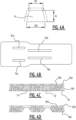
- Figure 4 illustrates an embodiment of a method for manufacturing an absorbent article.
- the method comprises in a first step guiding a first sheet material 110 along an optional guide roller 5, and further along a rotating member 10, wherein a surface 15 of said rotating member 10 is provided with apattern with suction zones 13, 13' and non-suction zones 11, 12; 11', 12'.
- the illustrated configuration of non-suction zones 11, 12; 11', 12' does not fall within the scope of the claims.
- the first sheet material 110 is shown in a transparent manner to reveal the suction and non-suction zones of the rotating member 10.
- the suction zones 13, 13' may be provided with holes, and the non-suction zones 11, 12; 11', 12' are formed of closed material.
- the non-suction zones 11, 12; 11', 12' may be provided with inserts as shown in figure 4A .
- the inserts 11, 12; 11', 12' may have a trapezoidal cross section.
- Figure 4B shows an insert pattern with four non-suction zones 11a, 11b, 12a, 12b per absorbent core.
- the illustrated configuration of non-suction zones 11a, 11b, 12a, 12b does not fall within the scope of the claims.
- the inserts may be fixed e.g. with screws on the rotating member 10. At an inner area of the rotating member 10 a vacuum is applied, see VACUUM 1.
- the non-suction zones 11, 12; 11', 12' comprise at least a first elongate zone 11, 11' and a second elongate zone 12, 12' extending in a circumferential direction of the rotating member 10.
- an absorbent material F is applied via a hopper 40 on said first sheet material 110 on the rotating member 10 such that the suction zones 13, 13' are covered with absorbent material and substantially no absorbent material is present on the non-suction zones 11, 12; 11', 12'.
- a second sheet material 120 is applied on top of the absorbent material on the first sheet material 110, e.g. using a further rotating member 20.
- FIG 4C shows a cross section through the absorbent core is shown during the application of the second sheet material 120.
- Figure 4D shows the cross section of the absorbent core downstream of rotating member 10.
- One of said first and second sheet material is a top core wrap sheet material, and the other one is a back core wrap sheet material.
- the first sheet material 110 is the top core wrap sheet material.
- the first sheet material 110 is attached to the second sheet material 120 at least in the areas where substantially no absorbent material is present, and such that at least a first and a second channel 140, 150 are formed in said top core wrap sheet material 110.
- the attaching may be done by applying pressure and heat on the top core wrap sheet material 110 and/or on the back core wrap sheet material 120 in the areas where substantially no absorbent material is present, e.g. by a rotating member 30 and/or opposite rotating member 30' which is provided with at least a first and a second seal rib 31, 32 dimensioned for applying pressure and heat on the top core wrap sheet material 110 in the areas where substantially no absorbent material is present in order to create the first and second channel 140, 150, respectively.
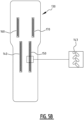
- Figure 5A illustrates an exemplary embodiment of an absorbent core 130 with four attachment zones creating channels 140, 150, 160, 170.
- the illustrated configuration of channels 140, 150, 160, 170 does not fall within the scope of the claims.
- the attachment zones are formed by welding the top core wrap sheet 110 to the back core wrap sheet 112. This welding may be done according to a predetermined sealing pattern.
- the pattern consists of a plurality of discrete shapes 143, here a plurality of squares.
- the discrete shapes 143 have dimensions smaller than 2 mm.
- the distance between adjacent discrete shapes is between 0.5 and 3 mm.
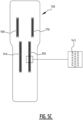
- Figure 5B illustrates another exemplary embodiment of a sealing pattern that may be used in an embodiment of the invention.
- the pattern consists of a plurality of discrete shapes in the form of rounded elements 143.
- the rounded elements may have a length dimension between 0.5 mm and 5 mm, and a width dimension between 0.5 mm and 5 mm.
- the discrete shapes are equally distributed in the attachment zones.
- the illustrated configuration of channels 140, 150, 160, 170 does not fall within the scope of the claims.
- Figure 5C illustrates yet another embodiment where the sealing pattern consists of discrete shapes which are rounded.
- the sealing pattern consists of discrete shapes which are rounded.
- three columns of rounded discrete elements 143 are used for each attachment zone 140, 150, 160, 170.
- the illustrated configuration of channels 140, 150, 160, 170 does not fall within the scope of the claims.
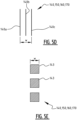
- Figure 5D illustrates another exemplary embodiment of an attachment zone for creating a channel 140, 150, 160, 170.
- the attachment zone is formed by a plurality of continuous line-shaped attachments 140a, 140b, 140c.
- the number of lines used may vary, and may be e.g. two lines or more than three adjacent lines.
- the distance w between a first line 140a and a last line 140c is at least 1 mm, more preferably at least 2 mm, even more preferably more than 4 mm.
- the attachment zones creating channels 140, 150, 160, 170 may be formed of a plurality of discrete elements 143, wherein each discrete element has a width w which covers the entire width w of the attachment zone.
- Figure 7A illustrates an exemplary embodiment of a traditional absorbent core.
- a traditional absorbent core absorbs liquid
- the core becomes bulky such that the diaper is no longer well adapted to the body.
- the liquid does not spread evenly but remains in the center of the absorbent core.
- Figure 7B illustrates an exemplary embodiment of an absorbent core of the invention. Thanks to the attachment zones and associated channels 140, 150, 160, 170, the liquid is evenly spread, resulting in the formation of tubes 301, 302, 303 which provide a tub shape to the absorbent core 130. Such a tub shape adapts perfectly to the body. Further, compared to prior art solutions, the liquid is kept in an improved manner absorbed in the absorbent core 130, and the risk on leakage is reduced.
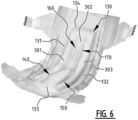
- Figure 6 shows a perspective view of a diaper in the wetted state.
- Figure 6 clearly illustrates the formation of three tubes 301, 302, 303 giving the diaper a tub shape which is well adapted to the body.
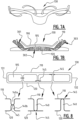
- Figure 8 illustrates an absorbent core 130 comprising an absorbent material 105 between a top core wrap sheet 110 and a back core wrap sheet 120.
- the absorbent core has a first and second longitudinal edge 131, 132.
- the absorbent core 130 is provided with a plurality of attachment zones 145.
- Figure 8 illustrates that the attachment zones 145 may be positioned at different locations. As illustrated on the left in figure 8 , the attachment zone may be positioned more or less centrally such that an upper channel portion 140a and a lower channel portion 140b is formed. In an alternative embodiment, the attachment zone 145 may be positioned at the bottom such that an upper channel 140 is created, see the example in the middle of figure 8 .
- the attachment zone 145 may be located at the top, such that the channel 140 is formed below top core wrap sheet 110.
- the attachment zones allow the formation of channels upon wetting of the absorbent core 130.
- the method is illustrated for two channels, the skilled person understands that the method can be adapted for forming three, four or more channels, and in particular for manufacturing any one of the absorbent articles disclosed in the present application.
- FIGS 9 -14 illustrate multiple advantageous positions for the attachment zones in an absorbent core according to the invention.
- the plurality of attachment zones comprises a first attachment zone 140 and a second attachment zone 150.
- the first and second attachment zones 140 are substantially parallel in the crotch region and diverge in the direction of a front transverse edge of absorbent core.
- the plurality of attachment zones comprises a first longitudinal attachment zone 140 and a second longitudinal attachment zone 150, wherein front end portions 140', 150' thereof diverge in the direction of the front transverse edge of the absorbent core.
- the plurality of attachment zones comprises a first attachment zone 140 and a second attachment zone 150.
- the first and second attachment zones 140 are substantially parallel in a rear part of the crotch region, whilst the transverse distance between the first and second attachment zones gradually increases in the direction of a front transverse edge of absorbent core.
- Figure 12 illustrates one or more longitudinal sections 140, 150, 160, 170 and/or one or more inclined sections.
Landscapes
- Health & Medical Sciences (AREA)
- Epidemiology (AREA)
- Engineering & Computer Science (AREA)
- Biomedical Technology (AREA)
- Heart & Thoracic Surgery (AREA)
- Vascular Medicine (AREA)
- Life Sciences & Earth Sciences (AREA)
- Animal Behavior & Ethology (AREA)
- General Health & Medical Sciences (AREA)
- Public Health (AREA)
- Veterinary Medicine (AREA)
- Absorbent Articles And Supports Therefor (AREA)
Claims (21)
- Absorptionsartikel (100), umfassend eine flüssigkeitsdurchlässige Oberschicht, eine flüssigkeitsundurchlässige Unterschicht und einen Absorptionskern (130), der ein Absorptionsmaterial zwischen einer oberen Kernhüllschicht und einer unteren Kernhüllschicht umfasst, wobei der Absorptionskern (130) zwischen der Oberschicht und der Unterschicht positioniert ist, wobei der Absorptionskern (130) eine erste und eine zweite Längskante und eine erste und eine zweite Querkante aufweist; wobei der Absorptionskern (130) mit einer Vielzahl von Befestigungszonen versehen ist, die mindestens eine erste und eine zweite Befestigungszone (145, 155) umfasst, die sich in einem Abstand voneinander befinden, wobei sich die erste und zweite Befestigungszone (145, 155) nebeneinander von einer Schrittregion in Richtung der ersten und/oder zweiten Querkante erstrecken; wobei in der ersten und zweiten Befestigungszone:die obere Kernhüllschicht an der unteren Kernhüllschicht entlang einer Befestigung befestigt ist, die sich in Querrichtung des Absorptionskerns (130) über einen Querabstand erstreckt, der mindestens 1 mm, vorzugsweise mindestens 2 mm, mehr bevorzugt mindestens 3 mm, am meisten bevorzugt mindestens 4 mm beträgt; und/oderdie obere Kernhüllschicht an der unteren Kernhüllschicht entlang einer diskontinuierlichen Befestigung an einer Vielzahl von Stellen befestigt ist, die sich in Querrichtung des Absorptionskerns (130) gesehen in einem Abstand voneinander befinden;sodass beim Benetzen des Absorptionsmaterials ein erster und zweiter Kanal (140, 150), jeweils an der ersten und zweiten Befestigungszone (145, 155), erzeugt werden,wobei die erste und zweite Befestigungszone (145, 155) in einem hinteren Teil der Schrittregion parallel sind, während der Querabstand zwischen der ersten und zweiten Befestigungszone (145, 155) in Richtung der ersten Querkante des Absorptionskerns (130) allmählich zunimmt, wobei die erste Querkante eine vordere Querkante des Absorptionskerns (130) ist.
- Absorptionsartikel (100) nach Anspruch 1, wobei sich die erste Befestigungszone (145) und die zweite Befestigungszone (155) in einer Längsrichtung des Absorptionskerns (130) erstrecken.
- Absorptionsartikel (100) nach einem der vorstehenden Ansprüche, wobei die Befestigung zwischen der oberen Kernhüllschicht und der unteren Kernhüllschicht in der ersten und der zweiten Befestigungszone (145, 155) eine permanente Befestigung ist, sodass sich das Absorptionsmaterial in einem benetzten Zustand des Absorptionsmaterials über die erste und zweite Befestigungszone (145, 155) erstreckt.
- Absorptionsartikel (100) nach einem der vorstehenden Ansprüche, wobei die Vielzahl von Befestigungszonen zusammen mindestens 30 %, vorzugsweise mindestens 40 %, vorzugsweise mindestens 50 %, mehr bevorzugt mindestens 60 %, mehr bevorzugt mindestens 70 %, mehr bevorzugt 80 % und mehr bevorzugt mindestens 90 % einer Länge des Absorptionskerns (130) bedecken.
- Absorptionsartikel (100) nach einem der vorstehenden Ansprüche, wobei der Absorptionskern (130) außerhalb der Vielzahl von Befestigungszonen eine maximale Dicke aufweist; wobei sich die erste und zweite Befestigungszone (145, 155) durch mindestens 90 % der maximalen Dicke des Absorptionskerns (130), mehr bevorzugt durch 100 % der Dicke des Absorptionskerns (130) hindurch erstrecken, sodass in der ersten und zweiten Befestigungszone (145, 155) im Wesentlichen kein Absorptionsmaterial zwischen der oberen Kernhüllschicht und der unteren Kernhüllschicht vorhanden ist.
- Absorptionsartikel (100) nach einem der vorstehenden Ansprüche, wobei die erste Befestigungszone (145) und die zweite Befestigungszone (145) in Bezug auf eine Längsmittellinie des Absorptionskerns (130), der sich zwischen der ersten und der zweiten Querkante erstreckt, symmetrisch angeordnet sind.
- Absorptionsartikel (100) nach einem der vorstehenden Ansprüche, wobei die Befestigung zwischen der oberen Kernhüllschicht und der unteren Kernhüllschicht eine beliebige der Folgenden oder eine Kombination davon ist: Druckbindung, Wärmebindung, Schallbindung, chemische Bindung, Klebstoff.
- Absorptionsartikel (100) nach einem der vorstehenden Ansprüche, wobei die Vielzahl von Befestigungszonen ferner eine dritte und eine vierte Befestigungszone (160, 170) umfasst, die sich in einem Abstand voneinander befinden, wobei sich die dritte und vierte Befestigungszone jeweils in Richtung der ersten und/oder zweiten Querkante erstrecken.
- Absorptionsartikel (100) nach Anspruch 8, wobei der Absorptionskern (130) einen vorderen Abschnitt, der sich auf einer Seite einer querverlaufenden Schrittlinie erstreckt, und einen hinteren Abschnitt aufweist, der sich auf der anderen Seite der querverlaufenden Schrittlinie erstreckt; wobei sich die erste und zweite Befestigungszone mindestens in dem vorderen Abschnitt des Absorptionskerns (130) erstrecken; und wobei sich die dritte und vierte Befestigungszone mindestens in dem hinteren Abschnitt des Absorptionskerns (130) erstrecken.
- Absorptionsartikel (100) nach einem der Ansprüche 8 bis 9, wobei die erste Befestigungszone durch eine erste querverlaufende Befestigungszone mit der dritten Befestigungszone verbunden ist und wobei die zweite Befestigungszone durch eine zweite querverlaufende Befestigungszone mit der vierten Befestigungszone verbunden ist.
- Absorptionsartikel (100) nach Anspruch 8, wobei sich die erste und die zweite Befestigungszone in einer Längsrichtung des Absorptionskerns (130) über eine Länge erstrecken, die länger ist als die Länge der dritten und vierten Befestigungszone, wobei sich die erste und die zweite Befestigungszone zwischen der dritten und vierten Befestigungszone befinden.
- Absorptionsartikel (100) nach einem der Ansprüche 8 bis 11, wobei die dritte Befestigungszone und die vierte Befestigungszone in Bezug auf eine Längsmittellinie des Absorptionskerns (130), der sich zwischen der ersten und der zweiten Querkante erstreckt, symmetrisch angeordnet sind.
- Absorptionsartikel (100) nach einem der vorstehenden Ansprüche, wobei der Abstand zwischen der ersten und der zweiten Befestigungszone zwischen 10 mm und 50 mm, vorzugsweise zwischen 15 mm und 30 mm, beträgt.
- Absorptionsartikel (100) nach einem der vorstehenden Ansprüche, wobei die Länge der ersten und der zweiten Befestigungszone größer als 60 mm, vorzugsweise größer als 70 mm ist.
- Absorptionsartikel (100) nach einem der vorstehenden Ansprüche, wobei das Absorptionsmaterial cellulosischen Flockenzellstoff umfasst.
- Absorptionsartikel (100) nach einem der vorstehenden Ansprüche, wobei das Absorptionsmaterial weniger als 20 Gewichts-% Flockenzellstoff enthält.
- Absorptionsartikel (100) nach einem der vorstehenden Ansprüche, wobei im Wesentlichen kein Absorptionsmaterial in der ersten und zweiten Befestigungszone vorhanden ist.
- Absorptionsartikel (100) nach einem der vorstehenden Ansprüche, wobei die erste und zweite Befestigungszone jeweils eine Unterseite und eine Oberseite aufweisen, wobei die obere Kernhüllschicht an der Unterseite, an der Oberseite oder zwischen der Unterseite und der Oberseite an der unteren Kernhüllschicht befestigt ist.
- Verfahren zum Herstellen eines Absorptionsartikels wie in Ansprüchen 1 bis 18 definiert, wobei das Verfahren umfasst:a. Führen eines ersten Schichtmaterials (110) entlang eines rotierenden Elements (10), wobei eine Oberfläche (15) des rotierenden Elements mit einem Muster mit Saugzonen (13, 13') und Nicht-Saugzonen (11, 12; 11', 12') versehen ist; wobei die Nicht-Saugzonen mindestens eine erste und eine zweite längliche Zone umfassen, die sich in einer Umfangsrichtung des rotierenden Elements erstrecken;b. Aufbringen eines Absorptionsmaterials auf das erste Schichtmaterial auf dem rotierenden Element, sodass die Saugzonen mit Absorptionsmaterial bedeckt sind und in den Nicht-Saugzonen im Wesentlichen kein Absorptionsmaterial vorhanden ist;c. Aufbringen eines zweiten Schichtmaterials (120) auf das Absorptionsmaterial auf dem ersten Schichtmaterial; wobei eines von dem ersten und zweiten Schichtmaterial ein oberes Kernhüllschichtmaterial ist und das andere ein unteres Kernhüllschichtmaterial ist;d. Aufbringen des ersten Schichtmaterials (110) auf das zweite Schichtmaterial (120) mindestens in den Bereichen, in denen im Wesentlichen kein Absorptionsmaterial vorhanden ist, und so, dass mindestens eine erste und eine zweite Befestigungszone (140, 150) gebildet werden, die sich in einem Abstand voneinander befinden,wobei die erste und zweite Befestigungszone in einem hinteren Teil der Schrittregion parallel sind, während der Querabstand zwischen der ersten und zweiten Befestigungszone in Richtung der ersten Querkante des Absorptionskerns (130) allmählich zunimmt, wobei die erste Querkante eine vordere Querkante des Absorptionskerns (130) ist.
- Verfahren nach Anspruch 19, wobei das Befestigen durch Aufbringen von Druck und Wärme auf das obere Kernhüllschichtmaterial (110) und/oder das untere Kernhüllschichtmaterial in den Bereichen erfolgt, in denen im Wesentlichen kein Absorptionsmaterial vorhanden ist.
- Verfahren nach Anspruch 20, wobei das Befestigen durch ein rotierendes Element (30) erfolgt, das mit mindestens einer ersten und einer zweiten Dichtungsrippe (31, 32) versehen ist, die bemessen sind, um Druck und Wärme auf das obere Kernhüllschichtmaterial (110) und/oder das untere Kernhüllschichtmaterial in den Bereichen aufzubringen, in denen im Wesentlichen kein Absorptionsmaterial vorhanden ist, um jeweils die erste und zweite Befestigungszone (140, 150) zu erzeugen.
Priority Applications (123)
| Application Number | Priority Date | Filing Date | Title |
|---|---|---|---|
| PL17171110.4T PL3403626T3 (pl) | 2017-05-15 | 2017-05-15 | Wyrób chłonny z kanałami i sposób jego wytwarzania |
| EP17171110.4A EP3403626B1 (de) | 2017-05-15 | 2017-05-15 | Saugfähiger artikel mit kanälen und herstellungsverfahren dafür |
| ES17171110T ES2991623T3 (es) | 2017-05-15 | 2017-05-15 | Artículo absorbente con canales y método para su fabricación |
| ES17196434T ES2743100T3 (es) | 2017-05-15 | 2017-10-13 | Artículo absorbente con canales y método de fabricación |
| PT17196434T PT3403627T (pt) | 2017-05-15 | 2017-10-13 | Artigo absorvente com canais e método para fabrico do mesmo |
| EP17196434.9A EP3403627B1 (de) | 2017-05-15 | 2017-10-13 | Saugfähiger artikel mit kanälen und verfahren zur herstellung davon |
| PL17196434T PL3403627T3 (pl) | 2017-05-15 | 2017-10-13 | Wyrób chłonny z kanałami i sposób jego wytwarzania |
| ES17198368T ES2922539T3 (es) | 2017-05-15 | 2017-10-25 | Artículo absorbente con canales |
| EP17198349.7A EP3403628B1 (de) | 2017-05-15 | 2017-10-25 | Saugfähiger artikel mit kanälen und verfahren zur herstellung davon |
| PL17198349T PL3403628T3 (pl) | 2017-05-15 | 2017-10-25 | Wyrób chłonny z kanałami i sposób jego wytwarzania |
| PL17198368.7T PL3403629T3 (pl) | 2017-05-15 | 2017-10-25 | Wyrób chłonny z kanałami |
| ES17198349T ES2744103T3 (es) | 2017-05-15 | 2017-10-25 | Artículo absorbente con canales y su método de fabricación |
| EP17198368.7A EP3403629B1 (de) | 2017-05-15 | 2017-10-25 | Saugfähiger artikel mit kanälen |
| PT17198652T PT3403630T (pt) | 2017-05-15 | 2017-10-26 | Artigo absorvente com canais e método para fabrico do mesmo |
| EP17198652.4A EP3403630B1 (de) | 2017-05-15 | 2017-10-26 | Saugfähiger artikel mit kanälen und verfahren zur herstellung davon |
| SI201730105T SI3403630T1 (sl) | 2017-05-15 | 2017-10-26 | Vpojni izdelek z žlebiči in postopek za proizvodnjo le-tega |
| ES17198652T ES2760563T3 (es) | 2017-05-15 | 2017-10-26 | Artículo absorbente con canales y su método de fabricación |
| HUE17198652A HUE046467T2 (hu) | 2017-05-15 | 2017-10-26 | Csatornákkal rendelkezõ nedvszívó termék és eljárás annak az elõállítására |
| DK17198652T DK3403630T3 (da) | 2017-05-15 | 2017-10-26 | Absorberende artikel med kanaler og fremgangsmåde til fremstilling deraf |
| PL17198652T PL3403630T3 (pl) | 2017-05-15 | 2017-10-26 | Wyrób chłonny z kanałami i sposób jego wytwarzania |
| DE202017007022.7U DE202017007022U1 (de) | 2017-05-15 | 2017-11-09 | Absorptionsartikel mit verbundenen Kanälen |
| PL17200847T PL3403631T3 (pl) | 2017-05-15 | 2017-11-09 | Wyrób chłonny z kanałami i sposób jego wytwarzania |
| ES17200847T ES2841501T3 (es) | 2017-05-15 | 2017-11-09 | Artículo absorbente con canales y su método de fabricación |
| DE202017007119.3U DE202017007119U1 (de) | 2017-05-15 | 2017-11-09 | Absorptionsartikel mit Kanälen |
| PT172008476T PT3403631T (pt) | 2017-05-15 | 2017-11-09 | Artigo absorvente com canais e método para fabrico do mesmo |
| EP17200847.6A EP3403631B1 (de) | 2017-05-15 | 2017-11-09 | Saugfähiger artikel mit kanälen und verfahren zur herstellung davon |
| DE202017007118.5U DE202017007118U1 (de) | 2017-05-15 | 2017-11-09 | Absorptionsartikel mit Kanälen |
| DE202017007127.4U DE202017007127U1 (de) | 2017-05-15 | 2017-11-09 | Absorptionsartikel mit Kanälen |
| EP17202006.7A EP3403632B1 (de) | 2017-05-15 | 2017-11-16 | Saugfähiger artikel mit kanälen und verfahren zur herstellung davon |
| ES17202006T ES2755964T3 (es) | 2017-05-15 | 2017-11-16 | Artículo absorbente con canales y su método de fabricación |
| PL17202006T PL3403632T3 (pl) | 2017-05-15 | 2017-11-16 | Wyrób chłonny z kanałami i sposób jego wytwarzania |
| NL2020902A NL2020902B1 (en) | 2017-05-15 | 2018-05-09 | Absorbent article with four channels |
| BE2018/5299A BE1025887B1 (nl) | 2017-05-15 | 2018-05-09 | Absorberend voorwerp met vier kanalen |
| BE2018/5300A BE1025430B1 (nl) | 2017-05-15 | 2018-05-09 | Absorberend voorwerp met verbonden kanalen |
| NL2020903A NL2020903B1 (en) | 2017-05-15 | 2018-05-09 | Absorbent article with connected channels |
| CZ2018-35763U CZ32729U1 (cs) | 2017-05-15 | 2018-05-10 | Absorpční výrobek se spojenými kanálky |
| CZ2018-34941U CZ32539U1 (cs) | 2017-05-15 | 2018-05-10 | Absorpční výrobek se čtyřmi kanálky |
| CZ2018-34942U CZ32580U1 (cs) | 2017-05-15 | 2018-05-10 | Absorpční výrobek se spojenými kanálky |
| ES201830681U ES1214601Y (es) | 2017-05-15 | 2018-05-11 | Artículo absorbente con canales conectados |
| ES201830679U ES1214600Y (es) | 2017-05-15 | 2018-05-11 | Artículo absorbente con cuatro canales. |
| EP25196779.0A EP4628058A3 (de) | 2017-05-15 | 2018-05-14 | Saugfähiger artikel mit kanälen und verfahren zur herstellung davon |
| BR112019023931-6A BR112019023931B1 (pt) | 2017-05-15 | 2018-05-14 | Artigo absorvente |
| US16/613,574 US20200078232A1 (en) | 2017-05-15 | 2018-05-14 | Absorbent article with channels and method for manufacturing thereof |
| RU2019115382U RU192618U1 (ru) | 2017-05-15 | 2018-05-14 | Впитывающее изделие с соединенными каналами |
| EP23204256.4A EP4285883A3 (de) | 2017-05-15 | 2018-05-14 | Saugfähiger artikel mit kanälen und verfahren zur herstellung davon |
| US16/613,555 US11331228B2 (en) | 2017-05-15 | 2018-05-14 | Absorbent article with channels and method for manufacturing thereof |
| BR112019023927-8A BR112019023927B1 (pt) | 2017-05-15 | 2018-05-14 | Artigo absorvente |
| EP18722596.6A EP3634346A1 (de) | 2017-05-15 | 2018-05-14 | Saugfähiger artikel mit kanälen und verfahren zur herstellung davon |
| RU2019141120A RU2764431C2 (ru) | 2017-05-15 | 2018-05-14 | Впитывающее изделие с каналами и способ его изготовления |
| CA3063244A CA3063244A1 (en) | 2017-05-15 | 2018-05-14 | Absorbent article with channels and method for manufacturing thereof |
| RU2019141127A RU2770457C2 (ru) | 2017-05-15 | 2018-05-14 | Впитывающее изделие с каналами и способ его изготовления |
| MX2019013579A MX2019013579A (es) | 2017-05-15 | 2018-05-14 | Articulo absorbente con canales y metodo para fabricar el mismo. |
| BR112019023921-9A BR112019023921B1 (pt) | 2017-05-15 | 2018-05-14 | Artigo absorvente |
| DE202018002372.8U DE202018002372U1 (de) | 2017-05-15 | 2018-05-14 | Absorptionsartikel mit verbundenen Kanälen |
| PCT/EP2018/062395 WO2018210758A1 (en) | 2017-05-15 | 2018-05-14 | Absorbent article with channels and method for manufacturing thereof |
| AU2018269298A AU2018269298A1 (en) | 2017-05-15 | 2018-05-14 | Absorbent article with channels and method for manufacturing thereof |
| MX2019013582A MX2019013582A (es) | 2017-05-15 | 2018-05-14 | Articulo absorbente con canales y metodo para fabricar el mismo. |
| EP18722593.3A EP3634345A1 (de) | 2017-05-15 | 2018-05-14 | Saugfähiger artikel mit kanälen und verfahren zur herstellung davon |
| PCT/EP2018/062385 WO2018210752A1 (en) | 2017-05-15 | 2018-05-14 | Absorbent article with channels and method for manufacturing thereof |
| CA3063248A CA3063248A1 (en) | 2017-05-15 | 2018-05-14 | Absorbent article with channels and method for manufacturing thereof |
| ES18722597T ES2972292T3 (es) | 2017-05-15 | 2018-05-14 | Artículo absorbente con canales y método para fabricar el mismo |
| PCT/EP2018/062392 WO2018210757A1 (en) | 2017-05-15 | 2018-05-14 | Absorbent article with channels and method for manufacturing thereof |
| BR112019023933-2A BR112019023933B1 (pt) | 2017-05-15 | 2018-05-14 | Artigo absorvente |
| EP18722592.5A EP3634344A1 (de) | 2017-05-15 | 2018-05-14 | Saugfähiger artikel mit kanälen und verfahren zur herstellung davon |
| RU2019141139A RU2769161C2 (ru) | 2017-05-15 | 2018-05-14 | Впитывающее изделие с каналами и способ его изготовления |
| PCT/EP2018/062388 WO2018210754A1 (en) | 2017-05-15 | 2018-05-14 | Absorbent article with channels and method for manufacturing thereof |
| PCT/EP2018/062386 WO2018210753A1 (en) | 2017-05-15 | 2018-05-14 | Absorbent article with channels and method for manufacturing thereof |
| CN201880047310.5A CN111031981A (zh) | 2017-05-15 | 2018-05-14 | 具有通道的吸收性物品及其制造方法 |
| MX2019013580A MX2019013580A (es) | 2017-05-15 | 2018-05-14 | Articulo absorbente con canales y metodo para fabricar el mismo. |
| BR112019020712-0A BR112019020712B1 (pt) | 2017-05-15 | 2018-05-14 | Artigo absorvente |
| AU2018269302A AU2018269302B2 (en) | 2017-05-15 | 2018-05-14 | Absorbent article with channels and method for manufacturing thereof |
| RU2019123617U RU194772U1 (ru) | 2017-05-15 | 2018-05-14 | Впитывающее изделие с соединенными каналами |
| EP18722597.4A EP3634347B1 (de) | 2017-05-15 | 2018-05-14 | Saugfähiger artikel mit kanälen und verfahren zur herstellung davon |
| US16/613,508 US20200085640A1 (en) | 2017-05-15 | 2018-05-14 | Absorbent article with channels and method for manufacturing thereof |
| EP18722598.2A EP3634348A1 (de) | 2017-05-15 | 2018-05-14 | Saugfähiger artikel mit kanälen und verfahren zur herstellung davon |
| BR112019020730-9A BR112019020730B1 (pt) | 2017-05-15 | 2018-05-14 | Método para fabricação de um artigo absorvente, e aparelho para fabricação de um artigo absorvente |
| RU2019141112A RU2769155C2 (ru) | 2017-05-15 | 2018-05-14 | Впитывающее изделие с каналами и способ его изготовления |
| RU2019141173A RU2790310C2 (ru) | 2017-05-15 | 2018-05-14 | Впитывающее изделие с каналами и способ его изготовления |
| PL425519A PL245934B1 (pl) | 2017-05-15 | 2018-05-14 | Wyrób chłonny |
| PCT/EP2018/062383 WO2018210751A1 (en) | 2017-05-15 | 2018-05-14 | Absorbent article with channels and method for manufacturing thereof |
| AU2018269299A AU2018269299A1 (en) | 2017-05-15 | 2018-05-14 | Absorbent article with channels and method for manufacturing thereof |
| CA3063255A CA3063255A1 (en) | 2017-05-15 | 2018-05-14 | Absorbent article with channels and method for manufacturing thereof |
| RU2019141106A RU2764432C2 (ru) | 2017-05-15 | 2018-05-14 | Впитывающее изделие с каналами и способ его изготовления |
| EP25200315.7A EP4635461A3 (de) | 2017-05-15 | 2018-05-14 | Saugfähiger artikel mit kanälen und verfahren zur herstellung davon |
| US16/613,588 US20210290449A1 (en) | 2017-05-15 | 2018-05-14 | Absorbent article with channels and method for manufacturing thereof |
| AU2018269303A AU2018269303A1 (en) | 2017-05-15 | 2018-05-14 | Absorbent article with channels and method for manufacturing thereof |
| CN201880047327.0A CN110996869A (zh) | 2017-05-15 | 2018-05-14 | 具有通道的吸收性物品及其制造方法 |
| RU2019127551A RU2710804C1 (ru) | 2017-05-15 | 2018-05-14 | Впитывающее изделие с каналами и способ его изготовления |
| PCT/EP2018/062391 WO2018210756A1 (en) | 2017-05-15 | 2018-05-14 | Absorbent article with channels and method for manufacturing thereof |
| BR112019023936-7A BR112019023936B1 (pt) | 2017-05-15 | 2018-05-14 | Artigo absorvente, método e aparelho para fabricação de um artigo absorvente |
| CN201880047329.XA CN111031982A (zh) | 2017-05-15 | 2018-05-14 | 具有通道的吸收性物品及其制造方法 |
| DE202018002370.1U DE202018002370U1 (de) | 2017-05-15 | 2018-05-14 | Absorptionsartikel mit vier Kanälen |
| US16/613,562 US20200138640A1 (en) | 2017-05-15 | 2018-05-14 | Absorbent article with channels and method for manufacturing thereof |
| US16/613,544 US20200078229A1 (en) | 2017-05-15 | 2018-05-14 | Absorbent article with channels and method for manufacturing thereof |
| AU2018269301A AU2018269301A1 (en) | 2017-05-15 | 2018-05-14 | Absorbent article with channels and method for manufacturing thereof |
| CA3063241A CA3063241A1 (en) | 2017-05-15 | 2018-05-14 | Absorbent article with channels and method for manufacturing thereof |
| RU2018145890U RU188209U1 (ru) | 2017-05-15 | 2018-05-14 | Впитывающее изделие с соединенными каналами |
| PL425517A PL425517A1 (pl) | 2017-05-15 | 2018-05-14 | Wyrób chłonny z połączonymi kanałami |
| RU2018117663U RU191377U1 (ru) | 2017-05-15 | 2018-05-14 | Впитывающее изделие с соединенными каналами |
| CA3063309A CA3063309A1 (en) | 2017-05-15 | 2018-05-14 | Absorbent article with channels and method for manufacturing thereof |
| US16/613,602 US20200197238A1 (en) | 2017-05-15 | 2018-05-14 | Absorbent article with channels and method for manufacturing thereof |
| NL2020925A NL2020925B1 (en) | 2017-05-15 | 2018-05-15 | Absorbent article with channels |
| ES201830698U ES1223224Y (es) | 2017-05-15 | 2018-05-15 | Artículo absorbente con canales |
| FR1854032A FR3066106B1 (fr) | 2017-05-15 | 2018-05-15 | Article absorbant comprenant quatre canneaux |
| PL425534A PL245954B1 (pl) | 2017-05-15 | 2018-05-15 | Wyrób chłonny |
| DE202018002381.7U DE202018002381U1 (de) | 2017-05-15 | 2018-05-15 | Absorptionsartikel mit Kanälen |
| NL2022344A NL2022344B1 (nl) | 2017-05-15 | 2019-01-04 | Absorberend voorwerp met verbonden kanalen |
| BE20195004A BE1025526B1 (nl) | 2017-05-15 | 2019-01-04 | Absorberend voorwerp met verbonden kanalen |
| FR1900341A FR3076707B1 (fr) | 2017-05-15 | 2019-01-15 | Article absorbant à canaux reliés |
| RU2019129374U RU194288U1 (ru) | 2017-05-15 | 2019-09-18 | Впитывающее изделие с соединенными каналами |
| BE20195733A BE1026791B1 (nl) | 2017-05-15 | 2019-10-22 | Absorberend voorwerp met verbonden kanalen |
| CL2019003291A CL2019003291A1 (es) | 2017-05-15 | 2019-11-15 | Artículo absorbente con canales y método para su fabricación. |
| CL2019003289A CL2019003289A1 (es) | 2017-05-15 | 2019-11-15 | Artículo absorbente con canales y método para su fabricación. |
| CL2019003290A CL2019003290A1 (es) | 2017-05-15 | 2019-11-15 | Artículo absorbente con canales y método para su fabricación. |
| ZA2019/07829A ZA201907829B (en) | 2017-05-15 | 2019-11-26 | Absorbent article with channels and method for manufacturing thereof |
| ZA2019/07828A ZA201907828B (en) | 2017-05-15 | 2019-11-26 | Absorbent article with channels and method for manufacturing thereof |
| CONC2019/0013516A CO2019013516A2 (es) | 2017-05-15 | 2019-11-29 | Artículo absorbente con canales y método para fabricar el mismo |
| CONC2019/0013511A CO2019013511A2 (es) | 2017-05-15 | 2019-11-29 | Artículo absorbente con canales y método para fabricar el mismo |
| CONC2019/0013513A CO2019013513A2 (es) | 2017-05-15 | 2019-11-29 | Artículo absorbente con canales y método para fabricar el mismo |
| RU2019141333U RU200284U1 (ru) | 2017-05-15 | 2019-12-13 | Впитывающее изделие с соединенными каналами |
| RU2019143740A RU2807570C2 (ru) | 2017-05-15 | 2019-12-25 | Впитывающее изделие с каналами и способ его изготовления |
| RU2020132038U RU202964U1 (ru) | 2017-05-15 | 2020-09-29 | Впитывающее изделие с соединенными каналами |
| US17/658,989 US11806220B2 (en) | 2017-05-15 | 2022-04-12 | Apparatus for manufacturing an absorbent article with channels |
Applications Claiming Priority (1)
| Application Number | Priority Date | Filing Date | Title |
|---|---|---|---|
| EP17171110.4A EP3403626B1 (de) | 2017-05-15 | 2017-05-15 | Saugfähiger artikel mit kanälen und herstellungsverfahren dafür |
Publications (3)
| Publication Number | Publication Date |
|---|---|
| EP3403626A1 EP3403626A1 (de) | 2018-11-21 |
| EP3403626B1 true EP3403626B1 (de) | 2024-10-09 |
| EP3403626C0 EP3403626C0 (de) | 2024-10-09 |
Family
ID=58709386
Family Applications (1)
| Application Number | Title | Priority Date | Filing Date |
|---|---|---|---|
| EP17171110.4A Active EP3403626B1 (de) | 2017-05-15 | 2017-05-15 | Saugfähiger artikel mit kanälen und herstellungsverfahren dafür |
Country Status (6)
| Country | Link |
|---|---|
| EP (1) | EP3403626B1 (de) |
| DE (1) | DE202018002381U1 (de) |
| ES (2) | ES2991623T3 (de) |
| FR (1) | FR3066106B1 (de) |
| NL (1) | NL2020925B1 (de) |
| PL (2) | PL3403626T3 (de) |
Families Citing this family (19)
| Publication number | Priority date | Publication date | Assignee | Title |
|---|---|---|---|---|
| EP3473223B1 (de) * | 2017-10-23 | 2021-08-11 | The Procter & Gamble Company | Absorbierende artikel mit verschiedenartigen kanälen |
| EP3473224B1 (de) * | 2017-10-23 | 2020-12-30 | The Procter & Gamble Company | Absorbierende artikel mit verschiedenartigen kanälen |
| EP3473222B1 (de) * | 2017-10-23 | 2021-08-04 | The Procter & Gamble Company | Absorbierende artikel mit verschiedenartigen kanälen |
| EP3727262B1 (de) | 2017-12-21 | 2023-11-15 | Essity Hygiene and Health Aktiebolag | Saugfähiger artikel mit festen kanaldichtverbindungen |
| WO2019125232A1 (en) | 2017-12-21 | 2019-06-27 | Essity Hygiene And Health Aktiebolag | Absorbent article with channel sealings and method for manufacturing the absorbent article |
| WO2019125230A1 (en) | 2017-12-21 | 2019-06-27 | Essity Hygiene And Health Aktiebolag | Absorbent article comprising a wetness indicator and method for manufacturing the absorbent article |
| JP7101248B2 (ja) | 2017-12-21 | 2022-07-14 | エシティ・ハイジーン・アンド・ヘルス・アクチエボラグ | 幅が一定である密封アレンジメントを備える吸収性物品及びその製造方法 |
| BR112020007555A2 (pt) | 2017-12-21 | 2020-09-24 | Essity Hygiene And Health Aktiebolag | artigo absorvente e método para fabricar um artigo absorvente |
| ES2973311T3 (es) * | 2017-12-21 | 2024-06-19 | Essity Hygiene & Health Ab | Artículo absorbente con una disposición de sello que comprende puntos de soldadura y método para fabricar el artículo absorbente |
| US11147721B2 (en) | 2017-12-21 | 2021-10-19 | Essity Hygiene And Health Aktiebolag | Absorbent article and method for manufacturing an absorbent article |
| WO2019125231A1 (en) | 2017-12-21 | 2019-06-27 | Essity Hygiene And Health Aktiebolag | Absorbent article with reduced sagging and method for manufacturing the absorbent article |
| US12336896B2 (en) | 2020-04-20 | 2025-06-24 | Essity Hygiene And Health Aktiebolag | Absorbent article |
| DE102021108110A1 (de) | 2021-03-30 | 2022-10-06 | LK Mahnke GmbH & Co. KG | Absorbierender Kern für einen Hygieneartikel |
| DE102021108108A1 (de) | 2021-03-30 | 2022-10-06 | LK Mahnke GmbH & Co. KG | Absorbierender Kern für einen Hygieneartikel |
| JP7778997B2 (ja) * | 2021-10-28 | 2025-12-03 | 大王製紙株式会社 | 吸収性物品 |
| JP2023065958A (ja) * | 2021-10-28 | 2023-05-15 | 大王製紙株式会社 | 吸収性物品 |
| DE102021133725A1 (de) | 2021-12-17 | 2023-06-22 | Paul Hartmann Ag | Inkontinenzartikel mit Kanal |
| JP7714848B2 (ja) * | 2022-01-27 | 2025-07-30 | 大王製紙株式会社 | 吸収性物品 |
| WO2025124695A1 (en) * | 2023-12-12 | 2025-06-19 | Essity Hygiene And Health Aktiebolag | Absorbent article with shaping element and printed topsheet |
Citations (8)
| Publication number | Priority date | Publication date | Assignee | Title |
|---|---|---|---|---|
| WO2012170798A1 (en) | 2011-06-10 | 2012-12-13 | The Procter & Gamble Company | Method and apparatus for making absorbent structures with absorbent material |
| JP2013052161A (ja) | 2011-09-06 | 2013-03-21 | Oji Nepia Co Ltd | 吸収性物品 |
| US20140163503A1 (en) | 2012-12-10 | 2014-06-12 | The Procter & Gamble Company | Absorbent article with high absorbent material content |
| US20140371701A1 (en) | 2013-06-14 | 2014-12-18 | The Procter & Gamble Company | Absorbent article and absorbent core forming channels when wet |
| WO2015031225A1 (en) | 2013-08-27 | 2015-03-05 | The Procter & Gamble Company | Absorbent articles with channels |
| US20150080837A1 (en) | 2012-11-13 | 2015-03-19 | The Procter & Gamble Company | Absorbent Articles With Channels And Signals |
| EP2949302A1 (de) | 2014-05-27 | 2015-12-02 | The Procter and Gamble Company | Saugfähiger Kern mit gebogenen, kanalbildenden Bereichen |
| EP3342386A1 (de) | 2016-12-27 | 2018-07-04 | Ontex BVBA | Saugfähiger kern, artikel mit besagtem kern und verfahren zur herstellung |
Family Cites Families (6)
| Publication number | Priority date | Publication date | Assignee | Title |
|---|---|---|---|---|
| JP3811000B2 (ja) * | 2000-11-30 | 2006-08-16 | ユニ・チャーム株式会社 | 使い捨ておむつ |
| JP5443106B2 (ja) * | 2009-09-18 | 2014-03-19 | ユニ・チャーム株式会社 | 吸収性物品 |
| TW201201775A (en) * | 2010-04-06 | 2012-01-16 | Uni Charm Corp | Absorbent article and method of manufacturing absorbent article |
| DE102012216346A1 (de) | 2012-09-13 | 2014-03-13 | Fraunhofer-Gesellschaft zur Förderung der angewandten Forschung e.V. | Verfahren zum Markieren oder Immobilisieren einer Zielstruktur |
| US9522213B2 (en) | 2013-06-18 | 2016-12-20 | H.B. Fuller Company | Pressure-sensitive hot melt adhesive composition including propylene thermoplastic elastomer and articles including the same |
| JP6156805B2 (ja) * | 2015-09-15 | 2017-07-05 | 大王製紙株式会社 | 吸収性物品 |
-
2017
- 2017-05-15 PL PL17171110.4T patent/PL3403626T3/pl unknown
- 2017-05-15 EP EP17171110.4A patent/EP3403626B1/de active Active
- 2017-05-15 ES ES17171110T patent/ES2991623T3/es active Active
-
2018
- 2018-05-15 PL PL425534A patent/PL245954B1/pl unknown
- 2018-05-15 FR FR1854032A patent/FR3066106B1/fr active Active
- 2018-05-15 NL NL2020925A patent/NL2020925B1/en active
- 2018-05-15 DE DE202018002381.7U patent/DE202018002381U1/de active Active
- 2018-05-15 ES ES201830698U patent/ES1223224Y/es active Active
Patent Citations (9)
| Publication number | Priority date | Publication date | Assignee | Title |
|---|---|---|---|---|
| WO2012170798A1 (en) | 2011-06-10 | 2012-12-13 | The Procter & Gamble Company | Method and apparatus for making absorbent structures with absorbent material |
| JP2013052161A (ja) | 2011-09-06 | 2013-03-21 | Oji Nepia Co Ltd | 吸収性物品 |
| US20150080837A1 (en) | 2012-11-13 | 2015-03-19 | The Procter & Gamble Company | Absorbent Articles With Channels And Signals |
| US20140163503A1 (en) | 2012-12-10 | 2014-06-12 | The Procter & Gamble Company | Absorbent article with high absorbent material content |
| US20140371701A1 (en) | 2013-06-14 | 2014-12-18 | The Procter & Gamble Company | Absorbent article and absorbent core forming channels when wet |
| WO2015031225A1 (en) | 2013-08-27 | 2015-03-05 | The Procter & Gamble Company | Absorbent articles with channels |
| EP2949302A1 (de) | 2014-05-27 | 2015-12-02 | The Procter and Gamble Company | Saugfähiger Kern mit gebogenen, kanalbildenden Bereichen |
| EP3342386A1 (de) | 2016-12-27 | 2018-07-04 | Ontex BVBA | Saugfähiger kern, artikel mit besagtem kern und verfahren zur herstellung |
| EP3342386B1 (de) * | 2016-12-27 | 2019-04-17 | Ontex BVBA | Saugfähiger kern, artikel mit besagtem kern und verfahren zur herstellung |
Also Published As
| Publication number | Publication date |
|---|---|
| ES1223224U (es) | 2019-01-17 |
| DE202018002381U1 (de) | 2018-08-21 |
| PL3403626T3 (pl) | 2024-12-16 |
| FR3066106B1 (fr) | 2023-11-17 |
| ES2991623T3 (es) | 2024-12-04 |
| EP3403626A1 (de) | 2018-11-21 |
| ES1223224Y (es) | 2019-04-08 |
| PL425534A1 (pl) | 2018-11-19 |
| FR3066106A1 (fr) | 2018-11-16 |
| NL2020925A (en) | 2018-11-20 |
| PL245954B1 (pl) | 2024-11-04 |
| EP3403626C0 (de) | 2024-10-09 |
| NL2020925B1 (en) | 2019-07-18 |
Similar Documents
| Publication | Publication Date | Title |
|---|---|---|
| EP3403626B1 (de) | Saugfähiger artikel mit kanälen und herstellungsverfahren dafür | |
| EP3453368B1 (de) | Saugfähiger artikel mit kanälen und verfahren zur herstellung davon | |
| EP3403628B1 (de) | Saugfähiger artikel mit kanälen und verfahren zur herstellung davon | |
| US12396897B2 (en) | Absorbent article with channels and method for manufacturing thereof | |
| EP3403632B1 (de) | Saugfähiger artikel mit kanälen und verfahren zur herstellung davon | |
| EP3403630B1 (de) | Saugfähiger artikel mit kanälen und verfahren zur herstellung davon | |
| EP3761934B1 (de) | Saugfähiger artikel mit kanälen | |
| EP3403629B1 (de) | Saugfähiger artikel mit kanälen | |
| US12357515B2 (en) | Absorbent article with spacer element | |
| US20210015686A1 (en) | Absorbent article with reduced absorbent core | |
| US20250248865A1 (en) | Absorbent insert | |
| EP2992864A1 (de) | Absorbierende Struktur mit Kantenbarriere | |
| EP2444043A1 (de) | Verbesserte absorbierende Struktur | |
| EP3824855B1 (de) | Schwimmwindel |
Legal Events
| Date | Code | Title | Description |
|---|---|---|---|
| PUAI | Public reference made under article 153(3) epc to a published international application that has entered the european phase |
Free format text: ORIGINAL CODE: 0009012 |
|
| STAA | Information on the status of an ep patent application or granted ep patent |
Free format text: STATUS: THE APPLICATION HAS BEEN PUBLISHED |
|
| AK | Designated contracting states |
Kind code of ref document: A1 Designated state(s): AL AT BE BG CH CY CZ DE DK EE ES FI FR GB GR HR HU IE IS IT LI LT LU LV MC MK MT NL NO PL PT RO RS SE SI SK SM TR |
|
| AX | Request for extension of the european patent |
Extension state: BA ME |
|
| STAA | Information on the status of an ep patent application or granted ep patent |
Free format text: STATUS: REQUEST FOR EXAMINATION WAS MADE |
|
| 17P | Request for examination filed |
Effective date: 20190520 |
|
| RBV | Designated contracting states (corrected) |
Designated state(s): AL AT BE BG CH CY CZ DE DK EE ES FI FR GB GR HR HU IE IS IT LI LT LU LV MC MK MT NL NO PL PT RO RS SE SI SK SM TR |
|
| STAA | Information on the status of an ep patent application or granted ep patent |
Free format text: STATUS: EXAMINATION IS IN PROGRESS |
|
| 17Q | First examination report despatched |
Effective date: 20200421 |
|
| TPAC | Observations filed by third parties |
Free format text: ORIGINAL CODE: EPIDOSNTIPA |
|
| TPAC | Observations filed by third parties |
Free format text: ORIGINAL CODE: EPIDOSNTIPA |
|
| TPAC | Observations filed by third parties |
Free format text: ORIGINAL CODE: EPIDOSNTIPA |
|
| TPAC | Observations filed by third parties |
Free format text: ORIGINAL CODE: EPIDOSNTIPA |
|
| GRAP | Despatch of communication of intention to grant a patent |
Free format text: ORIGINAL CODE: EPIDOSNIGR1 |
|
| STAA | Information on the status of an ep patent application or granted ep patent |
Free format text: STATUS: GRANT OF PATENT IS INTENDED |
|
| INTG | Intention to grant announced |
Effective date: 20240503 |
|
| TPAC | Observations filed by third parties |
Free format text: ORIGINAL CODE: EPIDOSNTIPA |
|
| GRAJ | Information related to disapproval of communication of intention to grant by the applicant or resumption of examination proceedings by the epo deleted |
Free format text: ORIGINAL CODE: EPIDOSDIGR1 |
|
| TPAC | Observations filed by third parties |
Free format text: ORIGINAL CODE: EPIDOSNTIPA |
|
| INTG | Intention to grant announced |
Effective date: 20240503 |
|
| GRAS | Grant fee paid |
Free format text: ORIGINAL CODE: EPIDOSNIGR3 |
|
| GRAA | (expected) grant |
Free format text: ORIGINAL CODE: 0009210 |
|
| STAA | Information on the status of an ep patent application or granted ep patent |
Free format text: STATUS: THE PATENT HAS BEEN GRANTED |
|
| AK | Designated contracting states |
Kind code of ref document: B1 Designated state(s): AL AT BE BG CH CY CZ DE DK EE ES FI FR GB GR HR HU IE IS IT LI LT LU LV MC MK MT NL NO PL PT RO RS SE SI SK SM TR |
|
| REG | Reference to a national code |
Ref country code: CH Ref legal event code: EP |
|
| REG | Reference to a national code |
Ref country code: DE Ref legal event code: R096 Ref document number: 602017085315 Country of ref document: DE |
|
| REG | Reference to a national code |
Ref country code: IE Ref legal event code: FG4D |
|
| U01 | Request for unitary effect filed |
Effective date: 20241009 |
|
| U07 | Unitary effect registered |
Designated state(s): AT BE BG DE DK EE FI FR IT LT LU LV MT NL PT RO SE SI Effective date: 20241017 |
|
| REG | Reference to a national code |
Ref country code: ES Ref legal event code: FG2A Ref document number: 2991623 Country of ref document: ES Kind code of ref document: T3 Effective date: 20241204 |
|
| PGFP | Annual fee paid to national office [announced via postgrant information from national office to epo] |
Ref country code: PL Payment date: 20241010 Year of fee payment: 9 |
|
| PG25 | Lapsed in a contracting state [announced via postgrant information from national office to epo] |
Ref country code: HR Free format text: LAPSE BECAUSE OF FAILURE TO SUBMIT A TRANSLATION OF THE DESCRIPTION OR TO PAY THE FEE WITHIN THE PRESCRIBED TIME-LIMIT Effective date: 20241009 Ref country code: IS Free format text: LAPSE BECAUSE OF FAILURE TO SUBMIT A TRANSLATION OF THE DESCRIPTION OR TO PAY THE FEE WITHIN THE PRESCRIBED TIME-LIMIT Effective date: 20250209 |
|
| PG25 | Lapsed in a contracting state [announced via postgrant information from national office to epo] |
Ref country code: NO Free format text: LAPSE BECAUSE OF FAILURE TO SUBMIT A TRANSLATION OF THE DESCRIPTION OR TO PAY THE FEE WITHIN THE PRESCRIBED TIME-LIMIT Effective date: 20250109 |
|
| PG25 | Lapsed in a contracting state [announced via postgrant information from national office to epo] |
Ref country code: GR Free format text: LAPSE BECAUSE OF FAILURE TO SUBMIT A TRANSLATION OF THE DESCRIPTION OR TO PAY THE FEE WITHIN THE PRESCRIBED TIME-LIMIT Effective date: 20250110 |
|
| PG25 | Lapsed in a contracting state [announced via postgrant information from national office to epo] |
Ref country code: RS Free format text: LAPSE BECAUSE OF FAILURE TO SUBMIT A TRANSLATION OF THE DESCRIPTION OR TO PAY THE FEE WITHIN THE PRESCRIBED TIME-LIMIT Effective date: 20250109 |
|
| U20 | Renewal fee for the european patent with unitary effect paid |
Year of fee payment: 9 Effective date: 20250527 |
|
| PG25 | Lapsed in a contracting state [announced via postgrant information from national office to epo] |
Ref country code: SM Free format text: LAPSE BECAUSE OF FAILURE TO SUBMIT A TRANSLATION OF THE DESCRIPTION OR TO PAY THE FEE WITHIN THE PRESCRIBED TIME-LIMIT Effective date: 20241009 |
|
| PLBI | Opposition filed |
Free format text: ORIGINAL CODE: 0009260 |
|
| PGFP | Annual fee paid to national office [announced via postgrant information from national office to epo] |
Ref country code: GB Payment date: 20250527 Year of fee payment: 9 Ref country code: ES Payment date: 20250602 Year of fee payment: 9 |
|
| PLAB | Opposition data, opponent's data or that of the opponent's representative modified |
Free format text: ORIGINAL CODE: 0009299OPPO |
|
| PLAX | Notice of opposition and request to file observation + time limit sent |
Free format text: ORIGINAL CODE: EPIDOSNOBS2 |
|
| PGFP | Annual fee paid to national office [announced via postgrant information from national office to epo] |
Ref country code: CH Payment date: 20250601 Year of fee payment: 9 |
|
| PG25 | Lapsed in a contracting state [announced via postgrant information from national office to epo] |
Ref country code: SK Free format text: LAPSE BECAUSE OF FAILURE TO SUBMIT A TRANSLATION OF THE DESCRIPTION OR TO PAY THE FEE WITHIN THE PRESCRIBED TIME-LIMIT Effective date: 20241009 |
|
| PGFP | Annual fee paid to national office [announced via postgrant information from national office to epo] |
Ref country code: TR Payment date: 20250428 Year of fee payment: 9 |
|
| PGFP | Annual fee paid to national office [announced via postgrant information from national office to epo] |
Ref country code: CZ Payment date: 20250425 Year of fee payment: 9 |
|
| PGFP | Annual fee paid to national office [announced via postgrant information from national office to epo] |
Ref country code: IE Payment date: 20250527 Year of fee payment: 9 |
|
| 26 | Opposition filed |
Opponent name: ONTEX BV Effective date: 20250703 |
|
| R26 | Opposition filed (corrected) |
Opponent name: ONTEX BV Effective date: 20250703 |
|
| PLBB | Reply of patent proprietor to notice(s) of opposition received |
Free format text: ORIGINAL CODE: EPIDOSNOBS3 |