EP3390036B1 - Thermoplastic composite laminate and articles manufactured therefrom - Google Patents
Thermoplastic composite laminate and articles manufactured therefrom Download PDFInfo
- Publication number
- EP3390036B1 EP3390036B1 EP16822560.5A EP16822560A EP3390036B1 EP 3390036 B1 EP3390036 B1 EP 3390036B1 EP 16822560 A EP16822560 A EP 16822560A EP 3390036 B1 EP3390036 B1 EP 3390036B1
- Authority
- EP
- European Patent Office
- Prior art keywords
- fabric
- thermoplastic composite
- composite laminate
- weight
- layer
- Prior art date
- Legal status (The legal status is an assumption and is not a legal conclusion. Google has not performed a legal analysis and makes no representation as to the accuracy of the status listed.)
- Active
Links
- 239000002131 composite material Substances 0.000 title claims description 58
- 229920001169 thermoplastic Polymers 0.000 title claims description 48
- 239000004416 thermosoftening plastic Substances 0.000 title claims description 48
- 239000004744 fabric Substances 0.000 claims description 174
- 239000004417 polycarbonate Substances 0.000 claims description 80
- 229920000515 polycarbonate Polymers 0.000 claims description 72
- 239000000835 fiber Substances 0.000 claims description 63
- -1 poly(p-phenylene terephthalamide) Polymers 0.000 claims description 54
- YMWUJEATGCHHMB-UHFFFAOYSA-N Dichloromethane Chemical compound ClCCl YMWUJEATGCHHMB-UHFFFAOYSA-N 0.000 claims description 39
- 239000008199 coating composition Substances 0.000 claims description 39
- 238000000034 method Methods 0.000 claims description 37
- OKKJLVBELUTLKV-UHFFFAOYSA-N Methanol Chemical group OC OKKJLVBELUTLKV-UHFFFAOYSA-N 0.000 claims description 26
- 239000004760 aramid Substances 0.000 claims description 25
- 229920003235 aromatic polyamide Polymers 0.000 claims description 25
- 229920001519 homopolymer Polymers 0.000 claims description 19
- 229920000642 polymer Polymers 0.000 claims description 19
- 239000000203 mixture Substances 0.000 claims description 18
- 229920001577 copolymer Polymers 0.000 claims description 16
- 239000002904 solvent Substances 0.000 claims description 14
- 238000007731 hot pressing Methods 0.000 claims description 13
- 229920003366 poly(p-phenylene terephthalamide) Polymers 0.000 claims description 13
- IISBACLAFKSPIT-UHFFFAOYSA-N bisphenol A Chemical compound C=1C=C(O)C=CC=1C(C)(C)C1=CC=C(O)C=C1 IISBACLAFKSPIT-UHFFFAOYSA-N 0.000 claims description 12
- 230000000052 comparative effect Effects 0.000 claims description 11
- 229920000889 poly(m-phenylene isophthalamide) Polymers 0.000 claims description 11
- LFQSCWFLJHTTHZ-UHFFFAOYSA-N Ethanol Chemical compound CCO LFQSCWFLJHTTHZ-UHFFFAOYSA-N 0.000 claims description 9
- KFZMGEQAYNKOFK-UHFFFAOYSA-N Isopropanol Chemical compound CC(C)O KFZMGEQAYNKOFK-UHFFFAOYSA-N 0.000 claims description 9
- WYURNTSHIVDZCO-UHFFFAOYSA-N Tetrahydrofuran Chemical compound C1CCOC1 WYURNTSHIVDZCO-UHFFFAOYSA-N 0.000 claims description 8
- 238000001035 drying Methods 0.000 claims description 8
- HEDRZPFGACZZDS-UHFFFAOYSA-N Chloroform Chemical compound ClC(Cl)Cl HEDRZPFGACZZDS-UHFFFAOYSA-N 0.000 claims description 6
- 230000001681 protective effect Effects 0.000 claims description 5
- 238000002791 soaking Methods 0.000 claims description 5
- YLQBMQCUIZJEEH-UHFFFAOYSA-N tetrahydrofuran Natural products C=1C=COC=1 YLQBMQCUIZJEEH-UHFFFAOYSA-N 0.000 claims description 4
- 238000005507 spraying Methods 0.000 claims description 3
- 238000000748 compression moulding Methods 0.000 claims description 2
- 238000007598 dipping method Methods 0.000 claims description 2
- 239000012943 hotmelt Substances 0.000 claims description 2
- 238000000465 moulding Methods 0.000 claims description 2
- 238000003825 pressing Methods 0.000 claims description 2
- 239000010410 layer Substances 0.000 description 128
- HEMHJVSKTPXQMS-UHFFFAOYSA-M Sodium hydroxide Chemical compound [OH-].[Na+] HEMHJVSKTPXQMS-UHFFFAOYSA-M 0.000 description 22
- 239000002759 woven fabric Substances 0.000 description 15
- 239000004431 polycarbonate resin Substances 0.000 description 10
- 229920005668 polycarbonate resin Polymers 0.000 description 10
- 150000004985 diamines Chemical class 0.000 description 9
- 230000008569 process Effects 0.000 description 9
- LXEJRKJRKIFVNY-UHFFFAOYSA-N terephthaloyl chloride Chemical compound ClC(=O)C1=CC=C(C(Cl)=O)C=C1 LXEJRKJRKIFVNY-UHFFFAOYSA-N 0.000 description 9
- 238000012360 testing method Methods 0.000 description 9
- 150000001805 chlorine compounds Chemical class 0.000 description 7
- 238000005227 gel permeation chromatography Methods 0.000 description 7
- 230000006872 improvement Effects 0.000 description 7
- 239000000463 material Substances 0.000 description 7
- 238000006116 polymerization reaction Methods 0.000 description 7
- 239000000243 solution Substances 0.000 description 7
- XLYOFNOQVPJJNP-UHFFFAOYSA-N water Substances O XLYOFNOQVPJJNP-UHFFFAOYSA-N 0.000 description 7
- CBCKQZAAMUWICA-UHFFFAOYSA-N 1,4-phenylenediamine Chemical compound NC1=CC=C(N)C=C1 CBCKQZAAMUWICA-UHFFFAOYSA-N 0.000 description 6
- FDQSRULYDNDXQB-UHFFFAOYSA-N benzene-1,3-dicarbonyl chloride Chemical compound ClC(=O)C1=CC=CC(C(Cl)=O)=C1 FDQSRULYDNDXQB-UHFFFAOYSA-N 0.000 description 6
- 230000015556 catabolic process Effects 0.000 description 6
- 238000006731 degradation reaction Methods 0.000 description 6
- 239000004745 nonwoven fabric Substances 0.000 description 6
- WZCQRUWWHSTZEM-UHFFFAOYSA-N 1,3-phenylenediamine Chemical compound NC1=CC=CC(N)=C1 WZCQRUWWHSTZEM-UHFFFAOYSA-N 0.000 description 5
- 229940018564 m-phenylenediamine Drugs 0.000 description 5
- 238000004519 manufacturing process Methods 0.000 description 5
- 238000005259 measurement Methods 0.000 description 5
- 239000008188 pellet Substances 0.000 description 5
- VEXZGXHMUGYJMC-UHFFFAOYSA-M Chloride anion Chemical compound [Cl-] VEXZGXHMUGYJMC-UHFFFAOYSA-M 0.000 description 4
- JOYRKODLDBILNP-UHFFFAOYSA-N Ethyl urethane Chemical compound CCOC(N)=O JOYRKODLDBILNP-UHFFFAOYSA-N 0.000 description 4
- 238000010276 construction Methods 0.000 description 4
- 239000002356 single layer Substances 0.000 description 4
- 238000009987 spinning Methods 0.000 description 4
- 238000009941 weaving Methods 0.000 description 4
- XKZQKPRCPNGNFR-UHFFFAOYSA-N 2-(3-hydroxyphenyl)phenol Chemical compound OC1=CC=CC(C=2C(=CC=CC=2)O)=C1 XKZQKPRCPNGNFR-UHFFFAOYSA-N 0.000 description 3
- 229920004142 LEXAN™ Polymers 0.000 description 3
- YGYAWVDWMABLBF-UHFFFAOYSA-N Phosgene Chemical compound ClC(Cl)=O YGYAWVDWMABLBF-UHFFFAOYSA-N 0.000 description 3
- 229910000831 Steel Inorganic materials 0.000 description 3
- 125000003118 aryl group Chemical group 0.000 description 3
- 239000002585 base Substances 0.000 description 3
- 239000003637 basic solution Substances 0.000 description 3
- 239000003153 chemical reaction reagent Substances 0.000 description 3
- 239000003795 chemical substances by application Substances 0.000 description 3
- 239000011248 coating agent Substances 0.000 description 3
- 238000000576 coating method Methods 0.000 description 3
- ROORDVPLFPIABK-UHFFFAOYSA-N diphenyl carbonate Chemical compound C=1C=CC=CC=1OC(=O)OC1=CC=CC=C1 ROORDVPLFPIABK-UHFFFAOYSA-N 0.000 description 3
- 239000003822 epoxy resin Substances 0.000 description 3
- 238000012986 modification Methods 0.000 description 3
- 230000004048 modification Effects 0.000 description 3
- 229920000647 polyepoxide Polymers 0.000 description 3
- 239000002243 precursor Substances 0.000 description 3
- 238000002360 preparation method Methods 0.000 description 3
- 230000003014 reinforcing effect Effects 0.000 description 3
- 239000010959 steel Substances 0.000 description 3
- 238000002166 wet spinning Methods 0.000 description 3
- ZZPLGBZOTXYEQS-UHFFFAOYSA-N 2,3-dichlorobenzene-1,4-dicarbonyl chloride Chemical compound ClC(=O)C1=CC=C(C(Cl)=O)C(Cl)=C1Cl ZZPLGBZOTXYEQS-UHFFFAOYSA-N 0.000 description 2
- MSWAXXJAPIGEGZ-UHFFFAOYSA-N 2-chlorobenzene-1,4-dicarbonyl chloride Chemical compound ClC(=O)C1=CC=C(C(Cl)=O)C(Cl)=C1 MSWAXXJAPIGEGZ-UHFFFAOYSA-N 0.000 description 2
- ZBMISJGHVWNWTE-UHFFFAOYSA-N 3-(4-aminophenoxy)aniline Chemical compound C1=CC(N)=CC=C1OC1=CC=CC(N)=C1 ZBMISJGHVWNWTE-UHFFFAOYSA-N 0.000 description 2
- NZGQHKSLKRFZFL-UHFFFAOYSA-N 4-(4-hydroxyphenoxy)phenol Chemical compound C1=CC(O)=CC=C1OC1=CC=C(O)C=C1 NZGQHKSLKRFZFL-UHFFFAOYSA-N 0.000 description 2
- CSCPPACGZOOCGX-UHFFFAOYSA-N Acetone Chemical compound CC(C)=O CSCPPACGZOOCGX-UHFFFAOYSA-N 0.000 description 2
- PAYRUJLWNCNPSJ-UHFFFAOYSA-N Aniline Chemical compound NC1=CC=CC=C1 PAYRUJLWNCNPSJ-UHFFFAOYSA-N 0.000 description 2
- ZTQSAGDEMFDKMZ-UHFFFAOYSA-N Butyraldehyde Chemical compound CCCC=O ZTQSAGDEMFDKMZ-UHFFFAOYSA-N 0.000 description 2
- BVKZGUZCCUSVTD-UHFFFAOYSA-L Carbonate Chemical compound [O-]C([O-])=O BVKZGUZCCUSVTD-UHFFFAOYSA-L 0.000 description 2
- IAZDPXIOMUYVGZ-UHFFFAOYSA-N Dimethylsulphoxide Chemical compound CS(C)=O IAZDPXIOMUYVGZ-UHFFFAOYSA-N 0.000 description 2
- QIGBRXMKCJKVMJ-UHFFFAOYSA-N Hydroquinone Chemical compound OC1=CC=C(O)C=C1 QIGBRXMKCJKVMJ-UHFFFAOYSA-N 0.000 description 2
- 229920000784 Nomex Polymers 0.000 description 2
- 230000004913 activation Effects 0.000 description 2
- PXKLMJQFEQBVLD-UHFFFAOYSA-N bisphenol F Chemical compound C1=CC(O)=CC=C1CC1=CC=C(O)C=C1 PXKLMJQFEQBVLD-UHFFFAOYSA-N 0.000 description 2
- 238000004364 calculation method Methods 0.000 description 2
- YCIMNLLNPGFGHC-UHFFFAOYSA-N catechol Chemical compound OC1=CC=CC=C1O YCIMNLLNPGFGHC-UHFFFAOYSA-N 0.000 description 2
- 238000006243 chemical reaction Methods 0.000 description 2
- 239000003086 colorant Substances 0.000 description 2
- 239000008367 deionised water Substances 0.000 description 2
- 229910021641 deionized water Inorganic materials 0.000 description 2
- 230000032798 delamination Effects 0.000 description 2
- 238000001125 extrusion Methods 0.000 description 2
- 238000010348 incorporation Methods 0.000 description 2
- 239000003999 initiator Substances 0.000 description 2
- 238000002844 melting Methods 0.000 description 2
- 230000008018 melting Effects 0.000 description 2
- 239000004763 nomex Substances 0.000 description 2
- 238000000643 oven drying Methods 0.000 description 2
- 239000000047 product Substances 0.000 description 2
- 238000004080 punching Methods 0.000 description 2
- GHMLBKRAJCXXBS-UHFFFAOYSA-N resorcinol Chemical compound OC1=CC=CC(O)=C1 GHMLBKRAJCXXBS-UHFFFAOYSA-N 0.000 description 2
- 239000007787 solid Substances 0.000 description 2
- 229920001187 thermosetting polymer Polymers 0.000 description 2
- 239000003643 water by type Substances 0.000 description 2
- HCNHNBLSNVSJTJ-UHFFFAOYSA-N 1,1-Bis(4-hydroxyphenyl)ethane Chemical compound C=1C=C(O)C=CC=1C(C)C1=CC=C(O)C=C1 HCNHNBLSNVSJTJ-UHFFFAOYSA-N 0.000 description 1
- CYIGRWUIQAVBFG-UHFFFAOYSA-N 1,2-bis(2-ethenoxyethoxy)ethane Chemical compound C=COCCOCCOCCOC=C CYIGRWUIQAVBFG-UHFFFAOYSA-N 0.000 description 1
- LJGHYPLBDBRCRZ-UHFFFAOYSA-N 3-(3-aminophenyl)sulfonylaniline Chemical compound NC1=CC=CC(S(=O)(=O)C=2C=C(N)C=CC=2)=C1 LJGHYPLBDBRCRZ-UHFFFAOYSA-N 0.000 description 1
- RXNYJUSEXLAVNQ-UHFFFAOYSA-N 4,4'-Dihydroxybenzophenone Chemical compound C1=CC(O)=CC=C1C(=O)C1=CC=C(O)C=C1 RXNYJUSEXLAVNQ-UHFFFAOYSA-N 0.000 description 1
- VPWNQTHUCYMVMZ-UHFFFAOYSA-N 4,4'-sulfonyldiphenol Chemical compound C1=CC(O)=CC=C1S(=O)(=O)C1=CC=C(O)C=C1 VPWNQTHUCYMVMZ-UHFFFAOYSA-N 0.000 description 1
- VWGKEVWFBOUAND-UHFFFAOYSA-N 4,4'-thiodiphenol Chemical compound C1=CC(O)=CC=C1SC1=CC=C(O)C=C1 VWGKEVWFBOUAND-UHFFFAOYSA-N 0.000 description 1
- RQCACQIALULDSK-UHFFFAOYSA-N 4-(4-hydroxyphenyl)sulfinylphenol Chemical compound C1=CC(O)=CC=C1S(=O)C1=CC=C(O)C=C1 RQCACQIALULDSK-UHFFFAOYSA-N 0.000 description 1
- WRDNCFQZLUCIRH-UHFFFAOYSA-N 4-(7-azabicyclo[2.2.1]hepta-1,3,5-triene-7-carbonyl)benzamide Chemical compound C1=CC(C(=O)N)=CC=C1C(=O)N1C2=CC=C1C=C2 WRDNCFQZLUCIRH-UHFFFAOYSA-N 0.000 description 1
- ODJUOZPKKHIEOZ-UHFFFAOYSA-N 4-[2-(4-hydroxy-3,5-dimethylphenyl)propan-2-yl]-2,6-dimethylphenol Chemical compound CC1=C(O)C(C)=CC(C(C)(C)C=2C=C(C)C(O)=C(C)C=2)=C1 ODJUOZPKKHIEOZ-UHFFFAOYSA-N 0.000 description 1
- MQJKPEGWNLWLTK-UHFFFAOYSA-N Dapsone Chemical compound C1=CC(N)=CC=C1S(=O)(=O)C1=CC=C(N)C=C1 MQJKPEGWNLWLTK-UHFFFAOYSA-N 0.000 description 1
- OIFBSDVPJOWBCH-UHFFFAOYSA-N Diethyl carbonate Chemical compound CCOC(=O)OCC OIFBSDVPJOWBCH-UHFFFAOYSA-N 0.000 description 1
- 239000004420 Iupilon Substances 0.000 description 1
- 229920000271 Kevlar® Polymers 0.000 description 1
- ZMXDDKWLCZADIW-UHFFFAOYSA-N N,N-Dimethylformamide Chemical compound CN(C)C=O ZMXDDKWLCZADIW-UHFFFAOYSA-N 0.000 description 1
- 239000004419 Panlite Substances 0.000 description 1
- 239000004793 Polystyrene Substances 0.000 description 1
- 229920001494 Technora Polymers 0.000 description 1
- 229920000561 Twaron Polymers 0.000 description 1
- 230000006750 UV protection Effects 0.000 description 1
- 239000002253 acid Substances 0.000 description 1
- 239000002156 adsorbate Substances 0.000 description 1
- 230000002411 adverse Effects 0.000 description 1
- PNEYBMLMFCGWSK-UHFFFAOYSA-N aluminium oxide Inorganic materials [O-2].[O-2].[O-2].[Al+3].[Al+3] PNEYBMLMFCGWSK-UHFFFAOYSA-N 0.000 description 1
- 238000004458 analytical method Methods 0.000 description 1
- 238000013459 approach Methods 0.000 description 1
- 229920006231 aramid fiber Polymers 0.000 description 1
- VCCBEIPGXKNHFW-UHFFFAOYSA-N biphenyl-4,4'-diol Chemical group C1=CC(O)=CC=C1C1=CC=C(O)C=C1 VCCBEIPGXKNHFW-UHFFFAOYSA-N 0.000 description 1
- 238000007664 blowing Methods 0.000 description 1
- 125000002915 carbonyl group Chemical group [*:2]C([*:1])=O 0.000 description 1
- 238000009960 carding Methods 0.000 description 1
- 238000005266 casting Methods 0.000 description 1
- 230000001413 cellular effect Effects 0.000 description 1
- 239000007795 chemical reaction product Substances 0.000 description 1
- 150000001875 compounds Chemical class 0.000 description 1
- 238000007796 conventional method Methods 0.000 description 1
- 238000007334 copolymerization reaction Methods 0.000 description 1
- 150000001924 cycloalkanes Chemical class 0.000 description 1
- 230000001419 dependent effect Effects 0.000 description 1
- IEJIGPNLZYLLBP-UHFFFAOYSA-N dimethyl carbonate Chemical compound COC(=O)OC IEJIGPNLZYLLBP-UHFFFAOYSA-N 0.000 description 1
- 238000000578 dry spinning Methods 0.000 description 1
- 230000000694 effects Effects 0.000 description 1
- 239000003480 eluent Substances 0.000 description 1
- 238000005516 engineering process Methods 0.000 description 1
- 239000003623 enhancer Substances 0.000 description 1
- 150000002148 esters Chemical group 0.000 description 1
- 238000001704 evaporation Methods 0.000 description 1
- 230000008020 evaporation Effects 0.000 description 1
- 230000006870 function Effects 0.000 description 1
- 239000011521 glass Substances 0.000 description 1
- 230000005484 gravity Effects 0.000 description 1
- 238000010438 heat treatment Methods 0.000 description 1
- 239000012535 impurity Substances 0.000 description 1
- 239000004615 ingredient Substances 0.000 description 1
- 238000001746 injection moulding Methods 0.000 description 1
- 238000009884 interesterification Methods 0.000 description 1
- 239000011229 interlayer Substances 0.000 description 1
- 238000010030 laminating Methods 0.000 description 1
- 238000003698 laser cutting Methods 0.000 description 1
- 239000007788 liquid Substances 0.000 description 1
- 239000000155 melt Substances 0.000 description 1
- 239000011259 mixed solution Substances 0.000 description 1
- 239000000178 monomer Substances 0.000 description 1
- 239000012074 organic phase Substances 0.000 description 1
- 239000003960 organic solvent Substances 0.000 description 1
- 229920002223 polystyrene Polymers 0.000 description 1
- 239000002994 raw material Substances 0.000 description 1
- 229920005989 resin Polymers 0.000 description 1
- 239000011347 resin Substances 0.000 description 1
- 238000010008 shearing Methods 0.000 description 1
- 238000000935 solvent evaporation Methods 0.000 description 1
- 238000001179 sorption measurement Methods 0.000 description 1
- 229910001220 stainless steel Inorganic materials 0.000 description 1
- 239000010935 stainless steel Substances 0.000 description 1
- 238000006467 substitution reaction Methods 0.000 description 1
- 125000000472 sulfonyl group Chemical group *S(*)(=O)=O 0.000 description 1
- 239000004094 surface-active agent Substances 0.000 description 1
- 239000004950 technora Substances 0.000 description 1
- 229920001897 terpolymer Polymers 0.000 description 1
- 238000010998 test method Methods 0.000 description 1
- 239000004634 thermosetting polymer Substances 0.000 description 1
- 238000005809 transesterification reaction Methods 0.000 description 1
- HGBOYTHUEUWSSQ-UHFFFAOYSA-N valeric aldehyde Natural products CCCCC=O HGBOYTHUEUWSSQ-UHFFFAOYSA-N 0.000 description 1
Images
Classifications
-
- B—PERFORMING OPERATIONS; TRANSPORTING
- B32—LAYERED PRODUCTS
- B32B—LAYERED PRODUCTS, i.e. PRODUCTS BUILT-UP OF STRATA OF FLAT OR NON-FLAT, e.g. CELLULAR OR HONEYCOMB, FORM
- B32B27/00—Layered products comprising a layer of synthetic resin
- B32B27/12—Layered products comprising a layer of synthetic resin next to a fibrous or filamentary layer
-
- B—PERFORMING OPERATIONS; TRANSPORTING
- B32—LAYERED PRODUCTS
- B32B—LAYERED PRODUCTS, i.e. PRODUCTS BUILT-UP OF STRATA OF FLAT OR NON-FLAT, e.g. CELLULAR OR HONEYCOMB, FORM
- B32B27/00—Layered products comprising a layer of synthetic resin
- B32B27/02—Layered products comprising a layer of synthetic resin in the form of fibres or filaments
-
- B—PERFORMING OPERATIONS; TRANSPORTING
- B32—LAYERED PRODUCTS
- B32B—LAYERED PRODUCTS, i.e. PRODUCTS BUILT-UP OF STRATA OF FLAT OR NON-FLAT, e.g. CELLULAR OR HONEYCOMB, FORM
- B32B27/00—Layered products comprising a layer of synthetic resin
- B32B27/34—Layered products comprising a layer of synthetic resin comprising polyamides
-
- B—PERFORMING OPERATIONS; TRANSPORTING
- B32—LAYERED PRODUCTS
- B32B—LAYERED PRODUCTS, i.e. PRODUCTS BUILT-UP OF STRATA OF FLAT OR NON-FLAT, e.g. CELLULAR OR HONEYCOMB, FORM
- B32B27/00—Layered products comprising a layer of synthetic resin
- B32B27/36—Layered products comprising a layer of synthetic resin comprising polyesters
- B32B27/365—Layered products comprising a layer of synthetic resin comprising polyesters comprising polycarbonates
-
- B—PERFORMING OPERATIONS; TRANSPORTING
- B32—LAYERED PRODUCTS
- B32B—LAYERED PRODUCTS, i.e. PRODUCTS BUILT-UP OF STRATA OF FLAT OR NON-FLAT, e.g. CELLULAR OR HONEYCOMB, FORM
- B32B5/00—Layered products characterised by the non- homogeneity or physical structure, i.e. comprising a fibrous, filamentary, particulate or foam layer; Layered products characterised by having a layer differing constitutionally or physically in different parts
- B32B5/02—Layered products characterised by the non- homogeneity or physical structure, i.e. comprising a fibrous, filamentary, particulate or foam layer; Layered products characterised by having a layer differing constitutionally or physically in different parts characterised by structural features of a fibrous or filamentary layer
-
- B—PERFORMING OPERATIONS; TRANSPORTING
- B32—LAYERED PRODUCTS
- B32B—LAYERED PRODUCTS, i.e. PRODUCTS BUILT-UP OF STRATA OF FLAT OR NON-FLAT, e.g. CELLULAR OR HONEYCOMB, FORM
- B32B7/00—Layered products characterised by the relation between layers; Layered products characterised by the relative orientation of features between layers, or by the relative values of a measurable parameter between layers, i.e. products comprising layers having different physical, chemical or physicochemical properties; Layered products characterised by the interconnection of layers
- B32B7/02—Physical, chemical or physicochemical properties
- B32B7/022—Mechanical properties
-
- B—PERFORMING OPERATIONS; TRANSPORTING
- B32—LAYERED PRODUCTS
- B32B—LAYERED PRODUCTS, i.e. PRODUCTS BUILT-UP OF STRATA OF FLAT OR NON-FLAT, e.g. CELLULAR OR HONEYCOMB, FORM
- B32B7/00—Layered products characterised by the relation between layers; Layered products characterised by the relative orientation of features between layers, or by the relative values of a measurable parameter between layers, i.e. products comprising layers having different physical, chemical or physicochemical properties; Layered products characterised by the interconnection of layers
- B32B7/04—Interconnection of layers
- B32B7/12—Interconnection of layers using interposed adhesives or interposed materials with bonding properties
-
- B—PERFORMING OPERATIONS; TRANSPORTING
- B32—LAYERED PRODUCTS
- B32B—LAYERED PRODUCTS, i.e. PRODUCTS BUILT-UP OF STRATA OF FLAT OR NON-FLAT, e.g. CELLULAR OR HONEYCOMB, FORM
- B32B2250/00—Layers arrangement
- B32B2250/40—Symmetrical or sandwich layers, e.g. ABA, ABCBA, ABCCBA
-
- B—PERFORMING OPERATIONS; TRANSPORTING
- B32—LAYERED PRODUCTS
- B32B—LAYERED PRODUCTS, i.e. PRODUCTS BUILT-UP OF STRATA OF FLAT OR NON-FLAT, e.g. CELLULAR OR HONEYCOMB, FORM
- B32B2260/00—Layered product comprising an impregnated, embedded, or bonded layer wherein the layer comprises an impregnation, embedding, or binder material
- B32B2260/02—Composition of the impregnated, bonded or embedded layer
- B32B2260/021—Fibrous or filamentary layer
-
- B—PERFORMING OPERATIONS; TRANSPORTING
- B32—LAYERED PRODUCTS
- B32B—LAYERED PRODUCTS, i.e. PRODUCTS BUILT-UP OF STRATA OF FLAT OR NON-FLAT, e.g. CELLULAR OR HONEYCOMB, FORM
- B32B2260/00—Layered product comprising an impregnated, embedded, or bonded layer wherein the layer comprises an impregnation, embedding, or binder material
- B32B2260/04—Impregnation, embedding, or binder material
- B32B2260/046—Synthetic resin
-
- B—PERFORMING OPERATIONS; TRANSPORTING
- B32—LAYERED PRODUCTS
- B32B—LAYERED PRODUCTS, i.e. PRODUCTS BUILT-UP OF STRATA OF FLAT OR NON-FLAT, e.g. CELLULAR OR HONEYCOMB, FORM
- B32B2262/00—Composition or structural features of fibres which form a fibrous or filamentary layer or are present as additives
- B32B2262/02—Synthetic macromolecular fibres
- B32B2262/0261—Polyamide fibres
- B32B2262/0269—Aromatic polyamide fibres
-
- B—PERFORMING OPERATIONS; TRANSPORTING
- B32—LAYERED PRODUCTS
- B32B—LAYERED PRODUCTS, i.e. PRODUCTS BUILT-UP OF STRATA OF FLAT OR NON-FLAT, e.g. CELLULAR OR HONEYCOMB, FORM
- B32B2307/00—Properties of the layers or laminate
- B32B2307/50—Properties of the layers or laminate having particular mechanical properties
- B32B2307/542—Shear strength
-
- B—PERFORMING OPERATIONS; TRANSPORTING
- B32—LAYERED PRODUCTS
- B32B—LAYERED PRODUCTS, i.e. PRODUCTS BUILT-UP OF STRATA OF FLAT OR NON-FLAT, e.g. CELLULAR OR HONEYCOMB, FORM
- B32B2307/00—Properties of the layers or laminate
- B32B2307/70—Other properties
- B32B2307/72—Density
-
- B—PERFORMING OPERATIONS; TRANSPORTING
- B32—LAYERED PRODUCTS
- B32B—LAYERED PRODUCTS, i.e. PRODUCTS BUILT-UP OF STRATA OF FLAT OR NON-FLAT, e.g. CELLULAR OR HONEYCOMB, FORM
- B32B2307/00—Properties of the layers or laminate
- B32B2307/70—Other properties
- B32B2307/732—Dimensional properties
-
- B—PERFORMING OPERATIONS; TRANSPORTING
- B32—LAYERED PRODUCTS
- B32B—LAYERED PRODUCTS, i.e. PRODUCTS BUILT-UP OF STRATA OF FLAT OR NON-FLAT, e.g. CELLULAR OR HONEYCOMB, FORM
- B32B2451/00—Decorative or ornamental articles
-
- B—PERFORMING OPERATIONS; TRANSPORTING
- B32—LAYERED PRODUCTS
- B32B—LAYERED PRODUCTS, i.e. PRODUCTS BUILT-UP OF STRATA OF FLAT OR NON-FLAT, e.g. CELLULAR OR HONEYCOMB, FORM
- B32B2457/00—Electrical equipment
-
- B—PERFORMING OPERATIONS; TRANSPORTING
- B32—LAYERED PRODUCTS
- B32B—LAYERED PRODUCTS, i.e. PRODUCTS BUILT-UP OF STRATA OF FLAT OR NON-FLAT, e.g. CELLULAR OR HONEYCOMB, FORM
- B32B2571/00—Protective equipment
-
- B—PERFORMING OPERATIONS; TRANSPORTING
- B32—LAYERED PRODUCTS
- B32B—LAYERED PRODUCTS, i.e. PRODUCTS BUILT-UP OF STRATA OF FLAT OR NON-FLAT, e.g. CELLULAR OR HONEYCOMB, FORM
- B32B2605/00—Vehicles
- B32B2605/003—Interior finishings
-
- Y—GENERAL TAGGING OF NEW TECHNOLOGICAL DEVELOPMENTS; GENERAL TAGGING OF CROSS-SECTIONAL TECHNOLOGIES SPANNING OVER SEVERAL SECTIONS OF THE IPC; TECHNICAL SUBJECTS COVERED BY FORMER USPC CROSS-REFERENCE ART COLLECTIONS [XRACs] AND DIGESTS
- Y10—TECHNICAL SUBJECTS COVERED BY FORMER USPC
- Y10T—TECHNICAL SUBJECTS COVERED BY FORMER US CLASSIFICATION
- Y10T428/00—Stock material or miscellaneous articles
- Y10T428/24—Structurally defined web or sheet [e.g., overall dimension, etc.]
- Y10T428/24942—Structurally defined web or sheet [e.g., overall dimension, etc.] including components having same physical characteristic in differing degree
-
- Y—GENERAL TAGGING OF NEW TECHNOLOGICAL DEVELOPMENTS; GENERAL TAGGING OF CROSS-SECTIONAL TECHNOLOGIES SPANNING OVER SEVERAL SECTIONS OF THE IPC; TECHNICAL SUBJECTS COVERED BY FORMER USPC CROSS-REFERENCE ART COLLECTIONS [XRACs] AND DIGESTS
- Y10—TECHNICAL SUBJECTS COVERED BY FORMER USPC
- Y10T—TECHNICAL SUBJECTS COVERED BY FORMER US CLASSIFICATION
- Y10T428/00—Stock material or miscellaneous articles
- Y10T428/24—Structurally defined web or sheet [e.g., overall dimension, etc.]
- Y10T428/24942—Structurally defined web or sheet [e.g., overall dimension, etc.] including components having same physical characteristic in differing degree
- Y10T428/2495—Thickness [relative or absolute]
Definitions
- This invention relates to thermoplastic composite laminates having improved bonding strength, and articles made therefrom, having utility for housing or protective covers for mobile electronic devices.
- composite laminates contain a polycarbonate sheet as outer shell and a layer of reinforcing fabric composed of aromatic polyamide fibers seems to be a good solution. Because composite materials composed of thermoset resin and reinforcing fabric layers made of aromatic polyamide fibers are well known to boost the impact resistance of these composite materials.
- the aromatic polyamide fibers are surface inert, especially to polycarbonate resin.
- the thermoplastic composite laminate as compared to the thermoset composite laminate may exhibit inferior mechanical properties and delamination problem.
- thermoplastic composite laminates comprising in order of: (a) a top layer composed of at least one thermoplastic film; (b) a first tie layer; (c) a fabric layer composed of a fabric comprising aromatic polyamide fibers and a surface activation agent; (d) a second tie layer; and (e) a bottom layer composed of at least one thermoplastic film.
- thermoplastic composite laminate comprising in order of:
- thermoplastic composite laminates of the present invention are housings or protective covers for mobile electronic devices, shells for luggage, decorative parts for auto control panels, or face sheets for snowboards.
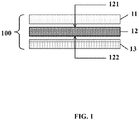
- FIG.1 shows an expanded side view of one embodiment of the present composite laminate 100, which has a layer construction of: (a) a top layer 11, (b) a fabric layer 12, and (c) a bottom layer 13, wherein the fabric layer (b) has a first surface 121 and a second surface 122, the top layer (a) is bound to the first surface of the fabric layer (b), and the bottom layer (c) is bound to the second surface of the fabric layer (b).
- the term “produced from” is synonymous to “comprising”.
- the terms “comprises,” “comprising,” “includes,” “including,” “has,” “having,” “contains” or “containing,” or any other variation thereof are intended to cover a non-exclusive inclusion.
- a composition, process, method, article, or apparatus that comprises a list of elements is not necessarily limited to only those elements but may include other elements not expressly listed or inherent to such composition, process, method, article, or apparatus.
- transitional phrase “consisting essentially of' is used to define a composition, method or apparatus that includes materials, steps, features, components, or elements, in addition to those literally discussed, provided that these additional materials, steps features, components, or elements do not materially affect the basic and novel characteristic(s) of the claimed invention.
- Mol% or “mole%” refers to mole percent.
- homopolymer refers to a polymer derived from polymerization of one species of repeating unit.
- poly (p-phenylene terephthalamide) homopolymer refers to a polymer consisting essentially one species of repeat unit of p-phenylene terephthalamide.
- copolymer refers to polymers comprising copolymerized units resulting from copolymerization of two or more comonomers.
- "Dipolymer” refers to polymers consisting essentially of two comonomer-derived units and "terpolymer” means a copolymer consisting essentially of three comonomer-derived units.
- the term "fiber” is defined as a relatively flexible, elongate body having a high ratio of length to the width of the cross-sectional area perpendicular to that length.
- the fiber cross section can be any shape such as circular, flat or oblong but is typically circular.
- the fiber cross section can be solid or hollow, preferably, solid.
- filament or “continuous filament” is used interchangeably with the term “fiber.”
- a single fiber may be formed from just one filament or from multiple filaments.
- a fiber formed from just one filament is referred to herein as either a “single-filament” fiber or a “monofilament” fiber, and a fiber formed from a plurality of filaments is referred to herein as a “multifilament” fiber.
- the term “yarn” is defined as a single strand consisting of multiple fibers.
- the diameter of fibers is usually characterized as a linear density termed “denier” or “dtex”; “denier” is the weight in grams of 9000 meters of fiber, and “dtex” is the weight in grams of 10,000 meters of fiber.
- a "layer” describes a generally planar arrangement of polycarbonate sheets and the fabric.
- Embodiments of the present invention as described in the Summary of the Invention include any other embodiments described herein, can be combined in any manner, and the descriptions of variables in the embodiments pertain not only to the composite laminate of the present invention, but also to the articles made therefrom.
- polycarbonate sheet suitable for use as the top layer (a) or the bottom layer (c) comprises, consists essentially of, consists of, or is produced from polycarbonate resins, preferably aromatic polycarbonate resins.
- the aromatic polycarbonate resins used herein are derived from diphenols and carbonate precursors in a solution method or in a melt method, such as those as produced through reaction of a diphenol and phosgene or through inter-esterification of a diphenol and a diphenyl carbonate.
- Usable diphenols includes, for example, 2,2-bis(4-hydroxyphenyl)propane (i.e.
- bisphenol A bis(4-hydroxyphenyl)methane, 1,1-bis(4-hydroxyphenyl)ethane, 2,2-bis(4-hydroxy-3,5-dimethylphenyl)propane, 4,4'-dihydroxy-diphenyl, bis(4-hydroxyphenyl)cycloalkanes, bis(4-hydroxyphenyl)oxide, bis(4-hydroxy-phenyl)sulfide, bis(4-hydroxyphenyl)sulfone, bis(4-hydroxyphenyl) sulfoxide, bis(4-hydroxyphenyl)ether, bis(4-hydroxyphenyl)ketone, etc.
- diphenols such as hydroquinone, resorcinol, catechol and the like are also usable in the invention.
- the diphenols mentioned herein may be used either singly or combined.
- the carbonate precursors for use in the invention include, for example, carbonyl halides, carbonyl esters, haloformates, phosgene, diphenol dihaloformates, diphenyl carbonate, dimethyl carbonate, diethyl carbonate, etc.
- the polycarbonate sheet suitable for use as the top layer (a) or the bottom layer (c) comprises, consists essentially of, consists of, or is produced from bisphenol A type polycarbonate resins of general formula of 1: where n is an integer of from 50 to 200.
- BPA-PC bisphenol A type polycarbonate resins
- M w weight average molecular weight
- Suitable polycarbonate resins can be purchased from commercial sources such as MAKROLONTM from Bayer, LEXAN® from SABIC, PANLITE® from Teijin, XANTAR® from DSM, IUPILON® from Mitsubishi, and CALIBER® from Dow.
- Polycarbonate resins described above can be melted and processed into a sheet by blowing, casting, or extrusion molding. Because the manufacturing processes for polycarbonate sheets are well known to one skilled in the art, the disclosure of which is omitted herein for the interest of brevity.
- a sheet is used herein to refer to a continuous thin flat structure with a uniform thickness.
- a sheet may have a thickness greater than about 0.05 mm.
- the polycarbonate sheets suitable for use as the top layer (a) or the bottom layer (c) may each independently have a thickness of from about 0.05 mm to about 5 mm, or from about 0.1 mm to about 3 mm, or from about 0.15 mm to about 1 mm. While such thicknesses are preferred, it is to be understood that other thicknesses may be produced to satisfy a particular need and yet fall within the scope of the present invention.
- the top layer (a) and the bottom layer (c) each independently have a thickness of from 0.05 mm to 5 mm, or from 0.1 mm to 3 mm, or from 0.15 mm to 1 mm.
- polycarbonate sheets for the top layer (a) and the bottom layer (c) of the present thermoplastic composite laminates are the same.
- the fabric for use as the fabric layer (b) prior to treating with an adhesion aid is referred as the "untreated fabric.”
- the untreated fabric comprises aromatic polyamide fibers produced from poly( p -phenylene terephthalamide) homopolymer, poly( p -phenylene terephthalamide) copolymer, poly( m -phenylene isophthalamide) homopolymer, poly( m -phenylene isophthalamide) copolymer, polysulfonamide homopolymer, polysulfonamide copolymer, and mixture thereof.
- Poly( p -phenylene terephthalamide) homopolymer is resulting from mole-for-mole polymerization of p -phenylene diamine (PPD) and terephthaloyl chloride (TCI). Also, poly( p -phenylene terephthalamide) copolymers are resulting from incorporation of as much as 10 mol% of other diamines with the p -phenylene diamine and of as much as 10 mol% of other diacyl chlorides with the terephthaloyl chloride, provided that the other diamines and diacyl chlorides have no reactive groups which interfere with the polymerization reaction.
- diamines other than p-phenylene diamine include but not limited to m -phenylene diamine, or 3,4'-diaminodiphenylether (3,4-ODA).
- diacyl chlorides other than terephthaloyl chloride include but not limited to isophthaloyl chloride, 2,6-naphthaloyl chloride, chloroterephthaloyl chloride, or dichloroterephthaloyl chloride.
- p -aramid refers to poly( p -phenylene terephthalamide) homopolymer and copolymers.
- Poly( m -phenylene isophthalamide) homopolymer is resulting from mole-for-mole polymerization of m-phenylene diamine and isophthaloyl chloride.
- poly( m -phenylene isophthalamide) copolymers are resulting from incorporation of as much as 10 mol% of other diamines with the m-phenylene diamine and of as much as 10 mol% of other diacyl chlorides with the isophthaloyl chloride, provided only that the other diamines and diacyl chlorides have no reactive groups which interfere with the polymerization reaction.
- diamines other than m-phenylene diamine include but not limited to p -phenylene diamine or 3,4'-diaminodiphenylether.
- diacyl chlorides other than isophthaloyl chloride include but not limited to terephthaloyl chloride, 2,6-naphthaloyl chloride, chloroterephthaloyl chloride, or dichloroterephthaloyl chloride.
- m -aramid refers to poly( m -phenylene isophthalamide) homopolymer and copolymers.
- Polysulfonamide homopolymers may be resulting from mole-for-mole polymerization of a sulfonyl group containing diamine such as 4,4'-diaminodiphenylsulfone ( p -DDS) or 3,3'-diaminodiphenylsulfone ( m -DDS), and a diacyl chloride such as terephthaloyl chloride or isophthaloyl chloride.
- a sulfonyl group containing diamine such as 4,4'-diaminodiphenylsulfone ( p -DDS) or 3,3'-diaminodiphenylsulfone ( m -DDS)
- a diacyl chloride such as terephthaloyl chloride or isophthaloyl chloride.
- Polysulfonamide copolymers include, for example, copolymers resulting from a dimanie such as p -DDS and a mixture of terephthaloyl chloride and other diacyl chlorides (e.g., isophthaloyl chloride); and copolymers resulting from a diacyl chloride such as terephthaloyl chloride and a mixture of diamines such as p -DDS, m -DDS, and as much as 10 mol% of other diamine (e.g., p -phenylene diamine, or m -phenylene diamine).
- a dimanie such as p -DDS and a mixture of terephthaloyl chloride and other diacyl chlorides
- copolymers resulting from a diacyl chloride such as terephthaloyl chloride and a mixture of diamines such as p -DDS, m -DDS, and as much as 10 mol
- polysulfonamide copolymers are derived from p -DDS, m -DDS and terephthaloyl chloride in a mole ratio of 3:1:4.
- PSA polysulfonamide homopolymers and copolymers.
- the polymers or copolymers of aromatic polyamide described above can be spun into fibers via solution spinning, using a solution of the polymer or copolymer in either the polymerization solvent or another solvent for the polymer or copolymer.
- Fiber spinning can be accomplished through a multi-hole spinneret by dry spinning, wet spinning, or dry-jet wet spinning (also known as air-gap spinning) to create a multi-filament fiber as is known in the art.
- the multi-filament fibers after spinning can then be treated to neutralize, wash, dry, or heat treat the fibers as needed using conventional technique to make stable and useful fibers.
- Exemplary dry, wet and dry-jet wet spinning processes are disclosed U.S. Pat. Nos. 3,063,966 ; 3,227,793 ; 3,287,324 ; 3,414,645 ; 3,869,430 ; 3,869,429 ; 3,767,756 ; and 5,667,743 .
- Aromatic polyamide fibers are also commercially available, for example, CONEX®, TECHNORA®, and TWARON® from Teijin (Japan), APIAIRE® from Unitika, NOMEX® and KEVLAR® from DuPont, HERACRON® from Kolon Industries, Inc. (Korea), SVMTM and RUSARTM from Kamensk Volokno JSC of Russia, ARMOSTM from JSC Chim Volokno of Russia, and the like.
- PSA fiber is commercially available as TANLONTM from Shanghai Tanlon Fiber Co., Ltd. (China).
- each yarn which include a plurality of fibers, have a preferred linear density of from 145 dtex to 6320 dtex, or from 440 dtex to 2640 dtex, or from 1100 dtex to 2200 dtex.
- the fabric for use as the fabric layer (b) is a woven fabric, a plurality of plies of unidirectional fabric, or a nonwoven fabric.
- nonwoven fabric refers to any other fabric structure that has been formed from a plurality of randomly oriented chopped or staple fibers, including felts, mats and other structures.
- Nonwoven fabrics Methods for the production of nonwoven fabrics are well known in the art. For example, carding aromatic polyamide staple fibers to form a web, needle-punching the same, and water-punching at a certain pressure so as to adhering the staple fibers to each other.
- the aromatic polyamide staple fibers having an average length of from 5 mm to 150 mm and an average fineness of the single filament is from 0.5 dtex to 10 dtex .
- Unidirectional fabric is a fiber web comprising a plurality of fibers aligned in a substantially parallel, unidirectional array.
- a plurality of stacked, overlapping unitapes are formed wherein the parallel fibers of each single ply (unitape) are positioned orthogonally to the parallel fibers of each adjacent single ply relative to the longitudinal fiber direction of each single ply.
- the stack of overlapping fiber plies can be consolidated under heat and pressure to form a single-layer, monolithic element which has also been referred to in the art as a single-layer, consolidated network.
- Unidirectional fabric typically include from 1 to 6 plies, but may include as many as 10 plies to 20 plies as may be desired for various applications. The greater the number of plies translates into greater impact resistance, but also greater weight.
- Woven fabrics generally have a plurality of warp yarns running lengthwise in the machine direction, and a plurality of fill yarns running substantially perpendicularly to the warp yarns (i.e., in the cross-machine direction).
- Any weave construction or pattern may be used, for example, such as plain weave, twill weave, satin weave, basket weave, and the like.
- the coarseness or fineness of the woven fabric is measured by counting the number of yarns contained in one square inch or square centimeter including both the length (warp) and width (weft) yarns.
- woven fabrics suitable for the invention have no specific requirement for tightness of weave, a tight weave is preferred except to avoid extremely tight weaves to avoid damage of yarn fibers resulting from the rigors of weaving.
- Commercially available woven fabrics include 17 x 17 counts, 20 x 20 counts, 34 x 34 counts per square inch.
- the fabric for use as the fabric layer (b) is a woven fabric, an unidirectional fabric, or a nonwoven fabric.
- the fabric for use as the fabric layer (b) is a woven fabric.
- the woven fabric is composed of warp fibers and weft fibers of different colors.
- the woven fabric when the polycarbonate sheet of the top layer (a) is transparent, the woven fabric not only can enhance the dimensional instability, but also impart additional aesthetically effect with the see-through weaving pattern and/or colors of the fabric used as the fabric layer (b).
- the thickness of the fabric layer (b) of the invention varies depending upon the ultimate use of the composite laminate or article.
- a total of 3 plies to 10 individual plies may be required, wherein the plies may be an unidirectional fabric (with parallel oriented fibers or other arrangements) formed from the aromatic polyamide fibers described herein.
- the thickness of the fabric for use as the fabric layer (b) will correspond to the thickness of the individual fibers, the weave pattern, and the number of fiber plies incorporated into a unidirectional fabric.
- a woven fabric preferably has a thickness of from 0.03 mm to 2 mm, or from 0.1 mm to 1 mm, or from 0.15 mm to 0.5 mm.
- An unidirectional fabric i.e. a single-layer, consolidated network, preferably has a preferred thickness of from 0.01 mm to 1 mm, or from 0.05 mm to 0.5 mm, or from 0.075 mm to 0.3 mm.
- a single-layer, consolidated network typically includes at least two consolidated plies (i.e. two unitapes).
- a nonwoven fabric preferably has a thickness of from 0.025 mm to 5 mm, or from 0.05 mm to 2 mm, or from 0.075 mm to 1 mm.
- the thickness of the fabric layer (b) of the present thermoplastic composite laminate is from 0.01 mm to 5 mm, or 0.05 mm to 2 mm, or 0.1 mm to 1 mm.
- the areal density of the untreated fabric ranges from 20 to 660 g/m 2 , or from 60 to 360 g/m 2 , or from 100 to 260 g/m 2 .
- the fabric for use as the fabric layer (b) also comprises an adhesion aid to improve the bonding strength between the fabric and the polycarbonate sheets for the top layer (a) or the bottom layer (c).
- an adhesion aid to improve the bonding strength between the fabric and the polycarbonate sheets for the top layer (a) or the bottom layer (c).
- Suitable polycarbonate oligomers can be obtained by melt transesterification from bisphenol A and diphenyl carbonate, or degradation of polycarbonate polymer in an acid or base catalyzed condition.
- polycarbonate polymer may be treated with a solution comprising a base such as NaOH or KOH, and the like, and a suitable solvent at ambient temperature or higher.
- Suitable solvents for use in the degradation of polycarbonate polymer are commonly known organic solvents such as methanol, ethanol, 2-propanol, dichloromethane, chloroform, tetrahydrofuran, dimethyl sulfoxide, N,N-dimethylforamide, and mixtures thereof. So long as the polycarbonate polymer at ambient temperature has a solubility of in the solvent(s) of choice being at least 1 gram in 15 mL, or 10 mL, or 5 mL or less. Additionally, the solvent preferably can also be removed by heating at a temperature no more than 200°C, and the resulting polycarbonate oligomers may be obtained after solvent evaporation.
- the adhesion aid used herein comprises a mixture of polycarbonate oligomers represented by the general formula of 2 where m is an integer of from 2 to 25.
- the polycarbonate oligomers preferably are obtained from degradation of polycarbonate polymer, said polycarbonate oligomers have a M w of from 500 to 6500, or from 750 to 5100, or from 1000 to 4000.
- the mixture of polycarbonate oligomers is represented by general formula 2, wherein m is an integer of from 2 to 25, or from 3 to 20, or from 4 to 15.
- the adhesion aid containing polycarbonate oligomers is preferably mixed with a solvent capable of dissolving or dispersing the polycarbonate oligomers to form a coating composition.
- Suitable solvent may include methanol, ethanol, 2-propanol, dichloromethane, chloroform, tetrahydrofuran, or mixtures thereof, so long as the solvent does not adversely affect the properties of fabric at the temperature of application.
- the amount of the adhesion aid in the coating composition is from 1 to 20 weight%, or from 5 to 15 weight%, based on the total weight of the coating composition.
- the term “coated” is not intended to limit the method by which it is applied onto the fabric.
- the coating composition may be applied to a woven fabric to form a coated woven fabric, or as another arrangement such unidirectional fabric or nonwoven fabric, to thereby impregnate the fiber layers with the adhesion aid.
- the term “impregnated with” is synonymous with "embedded in” as well as “coated with” or otherwise applied with the coating composition where the polycarbonate oligomers diffuse into the fabric and is not simply on the surfaces of the fabric.
- the coating composition may be applied onto to the untreated fabric by spraying, roll coating, direct gravure, Meyer rod and air knife systems, which are well known in the art; followed by drying.
- the fabric can be transported through the coating composition to substantially coat the fabric, and then dried.
- the fabric may be dipped, soaked, or immersed into a bath of the coating composition, and then dried through evaporation or volatilization of the solvent.
- the application procedure described above may be repeated several times as required to apply a suitable amount of adhesion aid onto the fabric. If the amount of adhesion aid applied onto the fabric exceed as desired, the treated fabric may be rinsed with water and then dried again. The rinsing and drying steps described above may be repeated several times to obtain a treated fabric containing suitable amount of adhesion aid c for use as the fabric layer (b).
- the individual fibers of the woven fabric may be treated with the coating composition prior to or after weaving.
- weaving of fabrics is performed prior to coating fibers with the adhesion aid, where the woven fabrics are thereby impregnated with the adhesion aid.
- the invention is not intended to be limited by the stage at which the adhesion aid is applied to the fibers, nor by the means used to apply the adhesion aid.
- the fabric to be applied with the coating composition may be pretreated with agents such as surfactants that can at least partial removal of the fabric surface finish, or adsorption enhancers that can enhances of a subsequently applied adsorbate, i.e. the adhesion aid, on the fiber surfaces.
- agents such as surfactants that can at least partial removal of the fabric surface finish, or adsorption enhancers that can enhances of a subsequently applied adsorbate, i.e. the adhesion aid, on the fiber surfaces.
- the fabric for use as the fabric layer (b) is prepared by a method comprising: i) applying a coating composition comprising an adhesion aid onto an untreated fabric to obtain a wet fabric; ii) drying the wet fabric at a temperature ranging from ambient temperature to about 150°C for from about 5 minute to about 180 minutes; iii) optionally, applying the coating composition onto the dried fabric of step ii) or rinsing the dried fabric of step ii), and drying by repeating step ii), wherein step iii) is optionally repeated several times to obtain a treated fabric containing suitable amount of the adhesion aid.
- the coating composition is applied onto the untreated fabric by dipping, soaking, immersing, or spraying.
- the fabric for the fabric layer (b) is prepared by the method comprising: immersing an untreated fabric in the coating composition containing an adhesion aid composed of polycarbonate oligomers and a solvent; drying at ambient temperature to evaporate most of the solvent; and optionally further drying in an oven at an elevated temperature.
- an adhesion aid composed of polycarbonate oligomers and a solvent
- drying at ambient temperature to evaporate most of the solvent
- optionally further drying in an oven at an elevated temperature There is no special restriction on the soaking/immersing time, as long as the untreated fabric is thoroughly wetted in the coating composition. In one embodiment, the soaking/immersing time is from about 0.05 hours to about 2 hours.
- the soaking/immersing temperature is from about 10°C to about 40°C, preferably at ambient temperature.
- the oven-drying temperature is from about 80°C to about 150°C, and the oven-drying time is from about 5 minutes to about 180 minutes.
- the fabric for use as the fabric layer (b) contains an adhesion aid in an amount of at least 5, or 6, or 7 or 8 or 9 weight%, based on the total weight of the fabric.
- the fabric for use as the fabric layer (b) contains an adhesion aid in an amount of no more than 70, or 60, or 50, or 40, or 30 weight%, based on the total weight of the fabric.
- the fabric for use as the fabric layer (b) contains an adhesion aid in an amount of 5 to 70 weight%, or 6 to 50 weight%, or 7 to 40 weight%, or 8 to 30 weight%, based on the total weight of the fabric.
- the thermoplastic composite laminate 100 of the present invention comprises in order of: (a) a top layer 11, (b) a fabric layer 12, and (c) a bottom layer 13, wherein the fabric layer (b) has a first surface 121 and a second surface 122.
- the top layer (a) is bound to the first surface of the fabric layer (b)
- the bottom layer (c) is bound to the second surface of the fabric layer (b) as shown in FIG. 1 .
- thermoplastic composite laminate As used herein to describe the structure of a composite laminate, the "/" is used to separate each distinctive layer with the adjacent layer(s) therein. Therefore, the structure of the present thermoplastic composite laminate may be represented as (a)/(b)/(c).
- thermoplastic composite laminates there is no special restriction on methods for preparing the thermoplastic composite laminates in the present invention, and it can be any conventional known method in this field. Suitable methods for preparing the present thermoplastic composite laminate include hot pressing, thermal compression molding, autoclave molding, and double-belt hot melt pressing. Process parameters such as temperatures, pressures, and times for preparing the present thermoplastic composite laminate are generally dependent on the material properties of the polycarbonate sheets and the fabric as well as the preparation method. One skilled in the art can decide suitable process parameters accordingly.
- the present thermoplastic composite laminate is prepared by hot pressing.
- Hot pressing may typically be done at a temperature that is at least higher than the melting point of the adhesion aid containing in the a fabric layer (b), and is no more than 50°C above the melting point of the polycarbonate for the top layer (a) and the bottom layer (c).
- the hot pressing is performed at a temperature ranging from about 100°C to about 300°C, or from about 150°C to about 250°C; at a pressures ranging from about 0.2 MPa to about 17.4 MPa, or from about 0.5 MPa to about 5 MPa; and for from about 0.5 minutes to about 40 minutes, or from about 1 minute to about 20 minutes.
- the present thermoplastic composite laminate after hot pressing generally has a total thickness of from 0.1 to 10 mm, or from 0.3 to 5 mm, or from 0.5 to 3 mm.
- the total thickness of the present thermoplastic composite laminate can be adjusted easily by using polycarbonate sheets for use as the top layer (a) and/or bottom layer (c), and fabric for use as the fabric layer (b) of various thicknesses.
- the bonding strength of the present thermoplastic composite laminate is evaluated by the shear strength between the fabric layer (b) and the top layer (a), or between the fabric layer (b) and the bottom layer (c). If a greater shear strength which means that the bonding strength between these layers is higher.
- shear strength refers to the tensile strength measured according to GB7124 by shearing off the top layer (a) or the bottom layer (c) from the fabric layer (b).
- the polycarbonate sheets for the top layer (a) and bottom layer (c) prefer to be the same. Therefore, the shear strength testing of the thermoplastic composite laminate can be performed on only one side of the fabric layer (b).
- thermoplastic composite laminate of the present invention exhibits an increase of 30% or more in shear strength as compared to that of a comparative laminate having the same fabric without the adhesion aid for use as the fabric layer (b).
- the thermoplastic composite laminate of the present invention preferably exhibits an increase of 30%, or 60%, or 90% or 120% or more in shear strength as compared to that of a comparative laminate.
- the thermoplastic composite laminate of the present invention preferably have shear strength of more than 3.6 MPa, or 4.5 MPa or more
- Additional layer(s) may optionally be applied to the present thermoplastic composite laminate, for example, a layer of ultraviolet protection material may be applied above the top layer (a).
- Articles comprise, consist essentially of, consist of, or are produced from the inventive thermoplastic composite laminates have high structural integrity due to their excellent interlayer bonding strength. Furthermore, the inventive thermoplastic composite laminates not only improves the process efficiency through shortened cycle time (i.e. cost saving), but also offers the chance to reprocess as needed for later applications as compared to the thermoset composite laminates.
- Articles of the present invention are useful as housings or protective covers for mobile electronic devices, shells for luggage, decorative parts for auto control panels, or face sheets for snowboards.
- Examples of mobile electronic devices include handheld computers, tablet computers, mobile phones, e-readers, portable game devices, portable media players, or digital cameras.
- Examples of mobile phones include but not limited to flip phones, slider phones, radio telephones, cellular phones, smart phones, etc.
- Polycarbonate sheet (P1) a polycarbonate sheet purchased from SABIC under trade name LEXAN®8B35; the sheet has a width of 100 cm, a thickness of about 0.175 mm, and a vicar softening temperature of 160°C.
- Polycarbonate polymer (P2) Polycarbonate pellet purchased from SABIC under trade name LEXAN® HF1130-111, has a specific gravity of 1.2, a M w of about 24706 (measured by GPC) and a solubility at ambient temperature of about 1 g per 2 mL of dichloromethane.
- Untreated fabric (U1) a plain weave fabric produced from poly(p-phenylene terephthalamide) yarns of 1500 denier (1670 dtex) (KELVAR®, available from DuPont) as warp and weft yarns, size: 7 x 7 ends/cm 2 , an areal density of 200 g/m 2 , purchased from Jiangsu Tianniao High Tech. Co.
- Untreated fabric (U2) a twill weave fabric produced from poly( m -phenylene terephthalamide) yarns of 1200 denier (1334 dtex) (NOMEX® white, available from DuPont) for warp and weft yarns, size: 9 x 9 ends/cm 2 , an areal density of 245 g/m 2 , purchased from Chomarat Co.
- Comparative Adhesion aid (AA1) acrylated urethane having a density of 1.08 g/mL and a viscosity of 25,000 cP (20 rpm), purchased from DYMAX Corporation under the trade name of Multi-Cure® CN3106-E.
- Initiator for AA1 a reaction product mixture of about 60 weight% triethyleneglycol divinyl ether, about 25 weight% epoxy resin, and about 15 weight% butyraldehyde/aniline, 501E, purchased from DYMAX Corporation.
- Dichloromethane CH 2 Cl 2 , CAS No.:75-09-2 , purchased from Sinopharm Chemical Reagent Co, Ltd.
- Methyl alcohol CH 3 OH, CAS No.: 67-56-1 , purchased from Sinopharm Chemical Reagent Co, Ltd.
- Sodium hydroxide NaOH, CAS No.: 1310-73-2 , purchased from Sinopharm Chemical Reagent Co, Ltd.
- Coating composition 1 (CC1): containing dichloromethane without any adhesion aid.
- Coating Composition 2 15 g of adhesion aid (AA1) was added to 35 g of acetone and stirred to obtain a coating composition (CC2).
- Coating Composition 3 (CC3) : In a 3-neck round bottom flask fitted with a condenser, 1 g of sodium hydroxide was added to 50 mL of methanol and 100 mL of dichloromethane and stirred for about 2-5 minutes until dissolving. The basic solution was heated to 40°C, then 12 g of polycarbonate polymer pellets (P2) were added into the mixed solution and stirred for 10 minutes. The resulting clear solution was cooled to room temperature and poured into a separatory funnel and washed with water (about 150 mL each time, for 3 times) to remove the residual sodium hydroxide and methanol.
- the organic phase containing polycarbonate oligomers was stored in a 250 mL glass bottle with a lid, that was used directly as coating composition 3 (CC3).
- CC3 coating composition 3
- One sample of CC3 (1 mL) was taken for GPC measurement to determine the M w and polydispersity.
- P2 polycarbonate polymer pellets dissolved in dichloromethane was also submitted for GPC analysis. The data are listed in Table 1.
- Coating composition 4 (CC4) was prepared in a similar procedure as described for CC3. A basic solution containing 1 g of sodium hydroxide, 50 mL of methanol and 100 mL of dichloromethane was kept at 23°C (ambient temperature); polycarbonate polymer pellets (P2) were then added and stirred for 10 minutes. The resulting mixture was washed with deionized water (about 150 mL each time, for 3 times), isolated, stored and to be used directly as coating composition 4 (CC4). One sample of CC4 (1 mL) was taken for GPC measurement to determine the M w and polydispersity. The data are listed in Table 1.
- Coating composition 5 (CC5): CC5 was prepared in a similar procedure as described for CC3. A basic solution containing 1 g of sodium hydroxide, 50 mL of methyl alcohol and 100 mL of dichloromethane was cooled to 0°C using an ice bath; polycarbonate polymer pellets (P2) were then added and stirred for 10 minutes. The resulting mixture was washed with deionized water (about 150 mL each time, for 3 times), isolated, stored as coating composition 5 (CC5). One sample of CC5 (1 mL) was taken for GPC measurement to determine the M w and polydispersity. The data are listed in Table 1.
- a piece of the untreated fabric (15 cm x 15 cm) was dried in oven at about 120°C for 2 hours, and then was put on a balance for measuring its untreated weight (W 0 ).
- the untreated fabric was fully immersed in an alumina tray containing the specified coating composition (about 20 mL) at ambient temperature for about 10 minutes, and then removed from the coating composition bath.
- the wet fabric was hung vertically until no liquid dripping for about 30 seconds, then put into an oven and dried at about 120°C for 2 hours. The dried fabric was cooled to room temperature and weighed.
- the treated fabric was immersed in a water bath (about 20 mL) for about 5 minutes; whereas if the weight increase of the treated fabric was less than desired, the treated fabric was immersed in the same coating composition bath at ambient temperature for about 5 minutes. Afterwards, the treated fabric was removed from either the water bath or the coating composition bath, oven-dried at about 120°C for another 2 hours and weighted.
- the application procedure described above might be repeated several times until the fabric for use as fabric layer (b) contains the desired amount of adhesion aid, which would be calculated by the weight increase of the fabric.
- the laminates of the working examples and comparative examples were prepared by hot pressing using a hot pressing machine (manufactured by PHI) equipped with a mold (composed of two 35 cm x 35 cm x 1.5 cm stainless steel plates).
- Polycarbonate sheets for the top layer (a) and the bottom layer (c) were cut into a square of 15 cm x 15 cm, and the treated fabrics obtained from Step A for use as the fabric layer (b) and two pieces of release paper (35 cm x 35 cm) were stacked as described below.
- the mold was pre-heated in the hot pressing machine to 190°C. After taking out the mold from the hot pressing machine, the mold was opened and set aside the top plate was set aside. A first piece of release paper was placed onto the base plate, followed by placing the polycarbonate sheet for use as the top layer (a) in the center of the mold. Afterwards, the fabric for use as the fabric layer (b), and the polycarbonate sheet for use as the upper layer (c) were laid in sequence according to the distinct layers of each laminate samples as specified in Tables 3-4. After these layers were laid in place to obtain a preform, the second release paper (35 cm x 35 cm) was placed over the preform, and the top plate of the mold was put back in place to close the mold. The closed mold was put back into the hot pressing machine.
- thermoplastic composite laminate was removed from the mold, separated from the first release paper, and cooled to ambient temperature.
- each surface of the top layer (a) and the bottom layer (c) that would contact the fabric layer (b) was applied with a brush for about 0.75 g of the initiator for AA1 right before preform assembling.
- Mw of the coating compositions CC1 and CC3-CC5 were measured by Gel Permeation Chromatography (GPC), on a Waters eAlliance 2695/2414 with RI detector and a Stryragel® HR 1 column (sold by Waters, 5 ⁇ m, 7.8 mm x 300 mm) using tetrahydrofuran as the eluent (30°C, flow rate was 1 mL/min) and polystyrene as the standards.
- GPC Gel Permeation Chromatography
- Thickness measurement the thickness of the laminate sample was determined by a digital micrometer. Each specimen was measured 6-10 times at different spots and the results were averaged and reported in Tables 3-4.
- each laminate sample was cut to obtain 5 test specimens (i.e. a rectangle of 15 mm x 25.4 mm) by a laser cutting machine (purchased from Han's Laser Technology Industry Group Co. Ltd., model: P060). Each test specimen was fixed on two steel plates with a size of 100 mm (L) x 25.4 mm (W). The top layer (a) and bottom layer (c) of the test specimen were bonded to the two steel plates separately with epoxy resin, and the epoxy resin was cured for at least 24 hours.
- the shear strength data of E1-E5 also demonstrated that by varying the amount of polycarbonate oligomers present in the fabric for use as the fabric layer (b), the resulting shear strength increase found in the present thermoplastic composite laminates also varied (41%-182%), though not proportionally.
- the thermoplastic composite laminate of E7, E6 and E2 each has a fabric containing about 10 weight % of an adhesion aid (CC5, CC4, or CC3 respectively) for use as the fabric layer (b), all demonstrated significant increase in the shear strength (37%-182%) as compared to that of the laminates of CE1. Therefore, the Mw of the polycarbonate oligomers also plays an important role in improving the bonding strength between the polycarbonate sheets (a) and (c) and fabric composed of p -aramid fibers used as the fabric layer (b).
- an adhesion aid CC5, CC4, or CC3 respectively
- thermoplastic composite laminate comprises in order of:
- thermoplastic composite laminate comprises in order of:
Landscapes
- Engineering & Computer Science (AREA)
- Mechanical Engineering (AREA)
- Laminated Bodies (AREA)
Applications Claiming Priority (2)
| Application Number | Priority Date | Filing Date | Title |
|---|---|---|---|
| CN201510924982.8A CN106863969B (zh) | 2015-12-14 | 2015-12-14 | 热塑性复合层合体和由其制备的制品 |
| PCT/US2016/065555 WO2017105995A1 (en) | 2015-12-14 | 2016-12-08 | Thermoplastic composite laminate and articles manufactured therefrom |
Publications (2)
| Publication Number | Publication Date |
|---|---|
| EP3390036A1 EP3390036A1 (en) | 2018-10-24 |
| EP3390036B1 true EP3390036B1 (en) | 2019-11-06 |
Family
ID=57737970
Family Applications (1)
| Application Number | Title | Priority Date | Filing Date |
|---|---|---|---|
| EP16822560.5A Active EP3390036B1 (en) | 2015-12-14 | 2016-12-08 | Thermoplastic composite laminate and articles manufactured therefrom |
Country Status (7)
| Country | Link |
|---|---|
| US (1) | US10946631B2 (enExample) |
| EP (1) | EP3390036B1 (enExample) |
| JP (1) | JP6818029B2 (enExample) |
| KR (1) | KR102626083B1 (enExample) |
| CN (1) | CN106863969B (enExample) |
| TW (1) | TWI819996B (enExample) |
| WO (1) | WO2017105995A1 (enExample) |
Families Citing this family (4)
| Publication number | Priority date | Publication date | Assignee | Title |
|---|---|---|---|---|
| CN106863969B (zh) * | 2015-12-14 | 2018-10-12 | 杜邦公司 | 热塑性复合层合体和由其制备的制品 |
| CN109421352A (zh) * | 2017-08-21 | 2019-03-05 | 杜邦公司 | 热塑性复合层合体和由其制备的制品 |
| KR102537486B1 (ko) * | 2021-07-14 | 2023-05-30 | (주)세경하이테크 | 패브릭 원단을 포함하는 데코레이션 필름의 제조방법 |
| KR102540869B1 (ko) * | 2021-07-22 | 2023-06-08 | (주)세경하이테크 | 패브릭 원단을 포함하는 데코레이션 복합시트의 제조방법 |
Family Cites Families (35)
| Publication number | Priority date | Publication date | Assignee | Title |
|---|---|---|---|---|
| US3063966A (en) | 1958-02-05 | 1962-11-13 | Du Pont | Process of making wholly aromatic polyamides |
| US3094511A (en) | 1958-11-17 | 1963-06-18 | Du Pont | Wholly aromatic polyamides |
| US3227793A (en) | 1961-01-23 | 1966-01-04 | Celanese Corp | Spinning of a poly(polymethylene) terephthalamide |
| US3414645A (en) | 1964-06-19 | 1968-12-03 | Monsanto Co | Process for spinning wholly aromatic polyamide fibers |
| US3287324A (en) | 1965-05-07 | 1966-11-22 | Du Pont | Poly-meta-phenylene isophthalamides |
| US3354127A (en) | 1966-04-18 | 1967-11-21 | Du Pont | Aromatic copolyamides |
| US3819587A (en) | 1969-05-23 | 1974-06-25 | Du Pont | Wholly aromatic carbocyclic polycarbonamide fiber having orientation angle of less than about 45{20 |
| US3673143A (en) | 1970-06-24 | 1972-06-27 | Du Pont | Optically anisotropic spinning dopes of polycarbonamides |
| US3869429A (en) | 1971-08-17 | 1975-03-04 | Du Pont | High strength polyamide fibers and films |
| US3869430A (en) | 1971-08-17 | 1975-03-04 | Du Pont | High modulus, high tenacity poly(p-phenylene terephthalamide) fiber |
| US3767756A (en) | 1972-06-30 | 1973-10-23 | Du Pont | Dry jet wet spinning process |
| JPS53294A (en) | 1976-06-23 | 1978-01-05 | Teijin Ltd | Preparation of aromatic polyamide with high degree of polymerization |
| JP3109197B2 (ja) * | 1991-11-26 | 2000-11-13 | 三井化学株式会社 | 積層体による自動車部品成形体 |
| JPH0778464A (ja) * | 1993-09-07 | 1995-03-20 | Mitsubishi Electric Corp | 半導体記憶装置 |
| EP0753402A3 (en) * | 1995-07-13 | 1998-09-02 | Bridgestone Corporation | Laminate form |
| US5667743A (en) | 1996-05-21 | 1997-09-16 | E. I. Du Pont De Nemours And Company | Wet spinning process for aramid polymer containing salts |
| JPH11277687A (ja) * | 1998-03-27 | 1999-10-12 | Tsutsunaka Plast Ind Co Ltd | 織布繊維強化熱可塑性樹脂成形体及びその製造方法 |
| CN1176256C (zh) | 2002-07-16 | 2004-11-17 | 上海纺织控股(集团)公司 | 芳香族聚砜酰胺纤维的制造方法 |
| US7892651B2 (en) * | 2004-09-14 | 2011-02-22 | Mitsubishi Gas Chemical Company, Inc. | Resin composite metal foil, laminate and process for the production of printed wiring board using the laminate |
| US7399571B2 (en) * | 2005-05-06 | 2008-07-15 | General Electric Company | Multilayered articles and method of manufacture thereof |
| US20100015406A1 (en) * | 2005-05-16 | 2010-01-21 | Ashok Bhatnagar | Laminated felt articles |
| US8673198B2 (en) * | 2006-02-18 | 2014-03-18 | Honeywell International Inc | Method of making improved ballistic products |
| WO2010006226A1 (en) * | 2008-07-10 | 2010-01-14 | Sabic Innovative Plastics Ip B.V. | Tie layer compositions |
| JP2010158831A (ja) * | 2009-01-08 | 2010-07-22 | Tokyo R & D Co Ltd | 織物加飾樹脂製品の製造方法及び同方法により製造した織物加飾樹脂製品 |
| CN103042777B (zh) * | 2011-10-14 | 2016-09-14 | 杜邦公司 | 具有改进的抗冲击强度的复合层合物及其制备方法和用途 |
| CN103252891A (zh) * | 2012-02-21 | 2013-08-21 | 深圳富泰宏精密工业有限公司 | 具有编织纹路壳体的制造方法及制得的壳体 |
| WO2013176720A2 (en) * | 2012-02-29 | 2013-11-28 | E. I. Du Pont De Nemours And Company | Ballistic composite containing a thermoplastic overlay |
| US9273418B2 (en) * | 2012-05-17 | 2016-03-01 | Honeywell International Inc. | Hybrid fiber unidirectional tape and composite laminates |
| JP2014050981A (ja) * | 2012-09-05 | 2014-03-20 | Teijin Ltd | 繊維強化プラスチック成形用基材および繊維強化プラスチック |
| JP6161893B2 (ja) * | 2012-12-11 | 2017-07-12 | 株式会社トクヤマ | 積層シートの製造方法 |
| CN104943289B (zh) * | 2014-03-28 | 2018-04-24 | 杜邦公司 | 纤维增强的复合层合体和由其制成的制品 |
| CN204172454U (zh) * | 2014-05-30 | 2015-02-25 | 杜邦公司 | 热塑性复合层合体和由其制造的制品 |
| CN105799285B (zh) * | 2014-05-30 | 2018-10-12 | 杜邦公司 | 热塑性复合层合体和由其制造的制品 |
| WO2015184240A1 (en) * | 2014-05-30 | 2015-12-03 | E. I. Du Pont De Nemours And Company | Thermoplastic composite laminate and articles manufactured therefrom |
| CN106863969B (zh) * | 2015-12-14 | 2018-10-12 | 杜邦公司 | 热塑性复合层合体和由其制备的制品 |
-
2015
- 2015-12-14 CN CN201510924982.8A patent/CN106863969B/zh active Active
-
2016
- 2016-12-08 JP JP2018531179A patent/JP6818029B2/ja active Active
- 2016-12-08 KR KR1020187017790A patent/KR102626083B1/ko active Active
- 2016-12-08 EP EP16822560.5A patent/EP3390036B1/en active Active
- 2016-12-08 US US16/061,549 patent/US10946631B2/en active Active
- 2016-12-08 WO PCT/US2016/065555 patent/WO2017105995A1/en not_active Ceased
- 2016-12-13 TW TW105141191A patent/TWI819996B/zh active
Non-Patent Citations (1)
| Title |
|---|
| None * |
Also Published As
| Publication number | Publication date |
|---|---|
| CN106863969B (zh) | 2018-10-12 |
| KR20180093953A (ko) | 2018-08-22 |
| JP2019500241A (ja) | 2019-01-10 |
| TW201731692A (zh) | 2017-09-16 |
| WO2017105995A1 (en) | 2017-06-22 |
| KR102626083B1 (ko) | 2024-01-18 |
| CN106863969A (zh) | 2017-06-20 |
| US20200262187A1 (en) | 2020-08-20 |
| US10946631B2 (en) | 2021-03-16 |
| JP6818029B2 (ja) | 2021-01-20 |
| TWI819996B (zh) | 2023-11-01 |
| EP3390036A1 (en) | 2018-10-24 |
Similar Documents
| Publication | Publication Date | Title |
|---|---|---|
| EP3390036B1 (en) | Thermoplastic composite laminate and articles manufactured therefrom | |
| TWI417507B (zh) | 供硬質裝甲應用之複合防彈纖維結構 | |
| US20080119099A1 (en) | Fragment and stab resistant flexible material with reduced trauma effect | |
| CN102762949B (zh) | 防弹制品 | |
| US20170182751A1 (en) | Thermoplastic composite laminate and articles manufactured therefrom | |
| EP2274155B1 (en) | Method to produce stab and ballistic resistant composite structures | |
| CN107548420B (zh) | 新型uhmwpe纤维及生产方法 | |
| KR101155765B1 (ko) | 아라미드 복합재료 및 그 제조방법 | |
| EP3122551B1 (en) | Fiber-reinforced composite laminate and articles made therefrom | |
| EP3071922B1 (en) | Composites and ballistic resistant armor articles containing the composites | |
| JP2007063710A5 (enExample) | ||
| WO2015184240A1 (en) | Thermoplastic composite laminate and articles manufactured therefrom | |
| KR101927694B1 (ko) | 방탄 시트 및 그것을 포함한 방탄 헬멧 | |
| EP3148791B1 (en) | Thermoplastic composite laminate and articles manufactured therefrom | |
| CN207617255U (zh) | 热塑性复合层合体和由其制备的制品 | |
| CN204172454U (zh) | 热塑性复合层合体和由其制造的制品 | |
| CN109421352A (zh) | 热塑性复合层合体和由其制备的制品 | |
| HK40005195A (en) | Thermoplatic composite laminate and articles manufactured therefrom | |
| KR102143541B1 (ko) | 고강도 섬유 복합재, 그 제조방법 및 이를 이용한 헬멧 |
Legal Events
| Date | Code | Title | Description |
|---|---|---|---|
| STAA | Information on the status of an ep patent application or granted ep patent |
Free format text: STATUS: UNKNOWN |
|
| STAA | Information on the status of an ep patent application or granted ep patent |
Free format text: STATUS: THE INTERNATIONAL PUBLICATION HAS BEEN MADE |
|
| PUAI | Public reference made under article 153(3) epc to a published international application that has entered the european phase |
Free format text: ORIGINAL CODE: 0009012 |
|
| STAA | Information on the status of an ep patent application or granted ep patent |
Free format text: STATUS: REQUEST FOR EXAMINATION WAS MADE |
|
| 17P | Request for examination filed |
Effective date: 20180601 |
|
| AK | Designated contracting states |
Kind code of ref document: A1 Designated state(s): AL AT BE BG CH CY CZ DE DK EE ES FI FR GB GR HR HU IE IS IT LI LT LU LV MC MK MT NL NO PL PT RO RS SE SI SK SM TR |
|
| AX | Request for extension of the european patent |
Extension state: BA ME |
|
| DAV | Request for validation of the european patent (deleted) | ||
| DAX | Request for extension of the european patent (deleted) | ||
| GRAP | Despatch of communication of intention to grant a patent |
Free format text: ORIGINAL CODE: EPIDOSNIGR1 |
|
| STAA | Information on the status of an ep patent application or granted ep patent |
Free format text: STATUS: GRANT OF PATENT IS INTENDED |
|
| INTG | Intention to grant announced |
Effective date: 20190625 |
|
| GRAS | Grant fee paid |
Free format text: ORIGINAL CODE: EPIDOSNIGR3 |
|
| GRAA | (expected) grant |
Free format text: ORIGINAL CODE: 0009210 |
|
| STAA | Information on the status of an ep patent application or granted ep patent |
Free format text: STATUS: THE PATENT HAS BEEN GRANTED |
|
| AK | Designated contracting states |
Kind code of ref document: B1 Designated state(s): AL AT BE BG CH CY CZ DE DK EE ES FI FR GB GR HR HU IE IS IT LI LT LU LV MC MK MT NL NO PL PT RO RS SE SI SK SM TR |
|
| REG | Reference to a national code |
Ref country code: GB Ref legal event code: FG4D |
|
| REG | Reference to a national code |
Ref country code: CH Ref legal event code: EP Ref country code: AT Ref legal event code: REF Ref document number: 1198183 Country of ref document: AT Kind code of ref document: T Effective date: 20191115 |
|
| REG | Reference to a national code |
Ref country code: IE Ref legal event code: FG4D |
|
| REG | Reference to a national code |
Ref country code: DE Ref legal event code: R096 Ref document number: 602016024002 Country of ref document: DE |
|
| REG | Reference to a national code |
Ref country code: NL Ref legal event code: MP Effective date: 20191106 |
|
| REG | Reference to a national code |
Ref country code: LT Ref legal event code: MG4D |
|
| PG25 | Lapsed in a contracting state [announced via postgrant information from national office to epo] |
Ref country code: NO Free format text: LAPSE BECAUSE OF FAILURE TO SUBMIT A TRANSLATION OF THE DESCRIPTION OR TO PAY THE FEE WITHIN THE PRESCRIBED TIME-LIMIT Effective date: 20200206 Ref country code: GR Free format text: LAPSE BECAUSE OF FAILURE TO SUBMIT A TRANSLATION OF THE DESCRIPTION OR TO PAY THE FEE WITHIN THE PRESCRIBED TIME-LIMIT Effective date: 20200207 Ref country code: BG Free format text: LAPSE BECAUSE OF FAILURE TO SUBMIT A TRANSLATION OF THE DESCRIPTION OR TO PAY THE FEE WITHIN THE PRESCRIBED TIME-LIMIT Effective date: 20200206 Ref country code: PL Free format text: LAPSE BECAUSE OF FAILURE TO SUBMIT A TRANSLATION OF THE DESCRIPTION OR TO PAY THE FEE WITHIN THE PRESCRIBED TIME-LIMIT Effective date: 20191106 Ref country code: LT Free format text: LAPSE BECAUSE OF FAILURE TO SUBMIT A TRANSLATION OF THE DESCRIPTION OR TO PAY THE FEE WITHIN THE PRESCRIBED TIME-LIMIT Effective date: 20191106 Ref country code: FI Free format text: LAPSE BECAUSE OF FAILURE TO SUBMIT A TRANSLATION OF THE DESCRIPTION OR TO PAY THE FEE WITHIN THE PRESCRIBED TIME-LIMIT Effective date: 20191106 Ref country code: NL Free format text: LAPSE BECAUSE OF FAILURE TO SUBMIT A TRANSLATION OF THE DESCRIPTION OR TO PAY THE FEE WITHIN THE PRESCRIBED TIME-LIMIT Effective date: 20191106 Ref country code: PT Free format text: LAPSE BECAUSE OF FAILURE TO SUBMIT A TRANSLATION OF THE DESCRIPTION OR TO PAY THE FEE WITHIN THE PRESCRIBED TIME-LIMIT Effective date: 20200306 Ref country code: LV Free format text: LAPSE BECAUSE OF FAILURE TO SUBMIT A TRANSLATION OF THE DESCRIPTION OR TO PAY THE FEE WITHIN THE PRESCRIBED TIME-LIMIT Effective date: 20191106 Ref country code: SE Free format text: LAPSE BECAUSE OF FAILURE TO SUBMIT A TRANSLATION OF THE DESCRIPTION OR TO PAY THE FEE WITHIN THE PRESCRIBED TIME-LIMIT Effective date: 20191106 |
|
| PG25 | Lapsed in a contracting state [announced via postgrant information from national office to epo] |
Ref country code: IS Free format text: LAPSE BECAUSE OF FAILURE TO SUBMIT A TRANSLATION OF THE DESCRIPTION OR TO PAY THE FEE WITHIN THE PRESCRIBED TIME-LIMIT Effective date: 20200306 Ref country code: RS Free format text: LAPSE BECAUSE OF FAILURE TO SUBMIT A TRANSLATION OF THE DESCRIPTION OR TO PAY THE FEE WITHIN THE PRESCRIBED TIME-LIMIT Effective date: 20191106 Ref country code: HR Free format text: LAPSE BECAUSE OF FAILURE TO SUBMIT A TRANSLATION OF THE DESCRIPTION OR TO PAY THE FEE WITHIN THE PRESCRIBED TIME-LIMIT Effective date: 20191106 |
|
| PG25 | Lapsed in a contracting state [announced via postgrant information from national office to epo] |
Ref country code: AL Free format text: LAPSE BECAUSE OF FAILURE TO SUBMIT A TRANSLATION OF THE DESCRIPTION OR TO PAY THE FEE WITHIN THE PRESCRIBED TIME-LIMIT Effective date: 20191106 |
|
| PG25 | Lapsed in a contracting state [announced via postgrant information from national office to epo] |
Ref country code: ES Free format text: LAPSE BECAUSE OF FAILURE TO SUBMIT A TRANSLATION OF THE DESCRIPTION OR TO PAY THE FEE WITHIN THE PRESCRIBED TIME-LIMIT Effective date: 20191106 Ref country code: RO Free format text: LAPSE BECAUSE OF FAILURE TO SUBMIT A TRANSLATION OF THE DESCRIPTION OR TO PAY THE FEE WITHIN THE PRESCRIBED TIME-LIMIT Effective date: 20191106 Ref country code: CZ Free format text: LAPSE BECAUSE OF FAILURE TO SUBMIT A TRANSLATION OF THE DESCRIPTION OR TO PAY THE FEE WITHIN THE PRESCRIBED TIME-LIMIT Effective date: 20191106 Ref country code: DK Free format text: LAPSE BECAUSE OF FAILURE TO SUBMIT A TRANSLATION OF THE DESCRIPTION OR TO PAY THE FEE WITHIN THE PRESCRIBED TIME-LIMIT Effective date: 20191106 Ref country code: EE Free format text: LAPSE BECAUSE OF FAILURE TO SUBMIT A TRANSLATION OF THE DESCRIPTION OR TO PAY THE FEE WITHIN THE PRESCRIBED TIME-LIMIT Effective date: 20191106 |
|
| REG | Reference to a national code |
Ref country code: CH Ref legal event code: PL |
|
| REG | Reference to a national code |
Ref country code: DE Ref legal event code: R097 Ref document number: 602016024002 Country of ref document: DE |
|
| REG | Reference to a national code |
Ref country code: AT Ref legal event code: MK05 Ref document number: 1198183 Country of ref document: AT Kind code of ref document: T Effective date: 20191106 |
|
| REG | Reference to a national code |
Ref country code: BE Ref legal event code: MM Effective date: 20191231 |
|
| PG25 | Lapsed in a contracting state [announced via postgrant information from national office to epo] |
Ref country code: MC Free format text: LAPSE BECAUSE OF FAILURE TO SUBMIT A TRANSLATION OF THE DESCRIPTION OR TO PAY THE FEE WITHIN THE PRESCRIBED TIME-LIMIT Effective date: 20191106 Ref country code: SK Free format text: LAPSE BECAUSE OF FAILURE TO SUBMIT A TRANSLATION OF THE DESCRIPTION OR TO PAY THE FEE WITHIN THE PRESCRIBED TIME-LIMIT Effective date: 20191106 Ref country code: SM Free format text: LAPSE BECAUSE OF FAILURE TO SUBMIT A TRANSLATION OF THE DESCRIPTION OR TO PAY THE FEE WITHIN THE PRESCRIBED TIME-LIMIT Effective date: 20191106 |
|
| PLBE | No opposition filed within time limit |
Free format text: ORIGINAL CODE: 0009261 |
|
| STAA | Information on the status of an ep patent application or granted ep patent |
Free format text: STATUS: NO OPPOSITION FILED WITHIN TIME LIMIT |
|
| 26N | No opposition filed |
Effective date: 20200807 |
|
| PG25 | Lapsed in a contracting state [announced via postgrant information from national office to epo] |
Ref country code: IE Free format text: LAPSE BECAUSE OF NON-PAYMENT OF DUE FEES Effective date: 20191208 Ref country code: LU Free format text: LAPSE BECAUSE OF NON-PAYMENT OF DUE FEES Effective date: 20191208 |
|
| PG25 | Lapsed in a contracting state [announced via postgrant information from national office to epo] |
Ref country code: CH Free format text: LAPSE BECAUSE OF NON-PAYMENT OF DUE FEES Effective date: 20191231 Ref country code: AT Free format text: LAPSE BECAUSE OF FAILURE TO SUBMIT A TRANSLATION OF THE DESCRIPTION OR TO PAY THE FEE WITHIN THE PRESCRIBED TIME-LIMIT Effective date: 20191106 Ref country code: BE Free format text: LAPSE BECAUSE OF NON-PAYMENT OF DUE FEES Effective date: 20191231 Ref country code: SI Free format text: LAPSE BECAUSE OF FAILURE TO SUBMIT A TRANSLATION OF THE DESCRIPTION OR TO PAY THE FEE WITHIN THE PRESCRIBED TIME-LIMIT Effective date: 20191106 Ref country code: LI Free format text: LAPSE BECAUSE OF NON-PAYMENT OF DUE FEES Effective date: 20191231 |
|
| PG25 | Lapsed in a contracting state [announced via postgrant information from national office to epo] |
Ref country code: IT Free format text: LAPSE BECAUSE OF FAILURE TO SUBMIT A TRANSLATION OF THE DESCRIPTION OR TO PAY THE FEE WITHIN THE PRESCRIBED TIME-LIMIT Effective date: 20191106 |
|
| PG25 | Lapsed in a contracting state [announced via postgrant information from national office to epo] |
Ref country code: CY Free format text: LAPSE BECAUSE OF FAILURE TO SUBMIT A TRANSLATION OF THE DESCRIPTION OR TO PAY THE FEE WITHIN THE PRESCRIBED TIME-LIMIT Effective date: 20191106 |
|
| PG25 | Lapsed in a contracting state [announced via postgrant information from national office to epo] |
Ref country code: MT Free format text: LAPSE BECAUSE OF FAILURE TO SUBMIT A TRANSLATION OF THE DESCRIPTION OR TO PAY THE FEE WITHIN THE PRESCRIBED TIME-LIMIT Effective date: 20191106 Ref country code: HU Free format text: LAPSE BECAUSE OF FAILURE TO SUBMIT A TRANSLATION OF THE DESCRIPTION OR TO PAY THE FEE WITHIN THE PRESCRIBED TIME-LIMIT; INVALID AB INITIO Effective date: 20161208 |
|
| PG25 | Lapsed in a contracting state [announced via postgrant information from national office to epo] |
Ref country code: TR Free format text: LAPSE BECAUSE OF FAILURE TO SUBMIT A TRANSLATION OF THE DESCRIPTION OR TO PAY THE FEE WITHIN THE PRESCRIBED TIME-LIMIT Effective date: 20191106 |
|
| PG25 | Lapsed in a contracting state [announced via postgrant information from national office to epo] |
Ref country code: MK Free format text: LAPSE BECAUSE OF FAILURE TO SUBMIT A TRANSLATION OF THE DESCRIPTION OR TO PAY THE FEE WITHIN THE PRESCRIBED TIME-LIMIT Effective date: 20191106 |
|
| REG | Reference to a national code |
Ref country code: DE Ref legal event code: R081 Ref document number: 602016024002 Country of ref document: DE Owner name: DUPONT SAFETY & CONSTRUCTION, INC., WILMINGTON, US Free format text: FORMER OWNER: E.I. DU PONT DE NEMOURS AND COMPANY, WILMINGTON, DEL., US |
|
| REG | Reference to a national code |
Ref country code: GB Ref legal event code: 732E Free format text: REGISTERED BETWEEN 20221027 AND 20221102 |
|
| P01 | Opt-out of the competence of the unified patent court (upc) registered |
Effective date: 20230528 |
|
| PGFP | Annual fee paid to national office [announced via postgrant information from national office to epo] |
Ref country code: DE Payment date: 20241029 Year of fee payment: 9 |
|
| PGFP | Annual fee paid to national office [announced via postgrant information from national office to epo] |
Ref country code: GB Payment date: 20241031 Year of fee payment: 9 |
|
| PGFP | Annual fee paid to national office [announced via postgrant information from national office to epo] |
Ref country code: FR Payment date: 20241111 Year of fee payment: 9 |