EP3386948B1 - Verfahren zur behandlung von pulpefasern - Google Patents
Verfahren zur behandlung von pulpefasern Download PDFInfo
- Publication number
- EP3386948B1 EP3386948B1 EP16873753.4A EP16873753A EP3386948B1 EP 3386948 B1 EP3386948 B1 EP 3386948B1 EP 16873753 A EP16873753 A EP 16873753A EP 3386948 B1 EP3386948 B1 EP 3386948B1
- Authority
- EP
- European Patent Office
- Prior art keywords
- pulp
- peracetate
- oxidant
- water
- bleaching
- Prior art date
- Legal status (The legal status is an assumption and is not a legal conclusion. Google has not performed a legal analysis and makes no representation as to the accuracy of the status listed.)
- Active
Links
Images




Classifications
-
- C—CHEMISTRY; METALLURGY
- C02—TREATMENT OF WATER, WASTE WATER, SEWAGE, OR SLUDGE
- C02F—TREATMENT OF WATER, WASTE WATER, SEWAGE, OR SLUDGE
- C02F1/00—Treatment of water, waste water, or sewage
- C02F1/72—Treatment of water, waste water, or sewage by oxidation
- C02F1/722—Oxidation by peroxides
-
- C—CHEMISTRY; METALLURGY
- C02—TREATMENT OF WATER, WASTE WATER, SEWAGE, OR SLUDGE
- C02F—TREATMENT OF WATER, WASTE WATER, SEWAGE, OR SLUDGE
- C02F9/00—Multistage treatment of water, waste water or sewage
-
- C—CHEMISTRY; METALLURGY
- C12—BIOCHEMISTRY; BEER; SPIRITS; WINE; VINEGAR; MICROBIOLOGY; ENZYMOLOGY; MUTATION OR GENETIC ENGINEERING
- C12P—FERMENTATION OR ENZYME-USING PROCESSES TO SYNTHESISE A DESIRED CHEMICAL COMPOUND OR COMPOSITION OR TO SEPARATE OPTICAL ISOMERS FROM A RACEMIC MIXTURE
- C12P3/00—Preparation of elements or inorganic compounds except carbon dioxide
-
- D—TEXTILES; PAPER
- D21—PAPER-MAKING; PRODUCTION OF CELLULOSE
- D21C—PRODUCTION OF CELLULOSE BY REMOVING NON-CELLULOSE SUBSTANCES FROM CELLULOSE-CONTAINING MATERIALS; REGENERATION OF PULPING LIQUORS; APPARATUS THEREFOR
- D21C9/00—After-treatment of cellulose pulp, e.g. of wood pulp, or cotton linters ; Treatment of dilute or dewatered pulp or process improvement taking place after obtaining the raw cellulosic material and not provided for elsewhere
- D21C9/10—Bleaching ; Apparatus therefor
- D21C9/1063—Bleaching ; Apparatus therefor with compounds not otherwise provided for, e.g. activated gases
-
- D—TEXTILES; PAPER
- D21—PAPER-MAKING; PRODUCTION OF CELLULOSE
- D21C—PRODUCTION OF CELLULOSE BY REMOVING NON-CELLULOSE SUBSTANCES FROM CELLULOSE-CONTAINING MATERIALS; REGENERATION OF PULPING LIQUORS; APPARATUS THEREFOR
- D21C9/00—After-treatment of cellulose pulp, e.g. of wood pulp, or cotton linters ; Treatment of dilute or dewatered pulp or process improvement taking place after obtaining the raw cellulosic material and not provided for elsewhere
- D21C9/10—Bleaching ; Apparatus therefor
- D21C9/147—Bleaching ; Apparatus therefor with oxygen or its allotropic modifications
-
- D—TEXTILES; PAPER
- D21—PAPER-MAKING; PRODUCTION OF CELLULOSE
- D21C—PRODUCTION OF CELLULOSE BY REMOVING NON-CELLULOSE SUBSTANCES FROM CELLULOSE-CONTAINING MATERIALS; REGENERATION OF PULPING LIQUORS; APPARATUS THEREFOR
- D21C9/00—After-treatment of cellulose pulp, e.g. of wood pulp, or cotton linters ; Treatment of dilute or dewatered pulp or process improvement taking place after obtaining the raw cellulosic material and not provided for elsewhere
- D21C9/10—Bleaching ; Apparatus therefor
- D21C9/16—Bleaching ; Apparatus therefor with per compounds
- D21C9/166—Bleaching ; Apparatus therefor with per compounds with peracids
-
- C—CHEMISTRY; METALLURGY
- C02—TREATMENT OF WATER, WASTE WATER, SEWAGE, OR SLUDGE
- C02F—TREATMENT OF WATER, WASTE WATER, SEWAGE, OR SLUDGE
- C02F1/00—Treatment of water, waste water, or sewage
- C02F1/008—Control or steering systems not provided for elsewhere in subclass C02F
-
- C—CHEMISTRY; METALLURGY
- C02—TREATMENT OF WATER, WASTE WATER, SEWAGE, OR SLUDGE
- C02F—TREATMENT OF WATER, WASTE WATER, SEWAGE, OR SLUDGE
- C02F1/00—Treatment of water, waste water, or sewage
- C02F1/02—Treatment of water, waste water, or sewage by heating
-
- C—CHEMISTRY; METALLURGY
- C02—TREATMENT OF WATER, WASTE WATER, SEWAGE, OR SLUDGE
- C02F—TREATMENT OF WATER, WASTE WATER, SEWAGE, OR SLUDGE
- C02F1/00—Treatment of water, waste water, or sewage
- C02F1/50—Treatment of water, waste water, or sewage by addition or application of a germicide or by oligodynamic treatment
-
- C—CHEMISTRY; METALLURGY
- C02—TREATMENT OF WATER, WASTE WATER, SEWAGE, OR SLUDGE
- C02F—TREATMENT OF WATER, WASTE WATER, SEWAGE, OR SLUDGE
- C02F1/00—Treatment of water, waste water, or sewage
- C02F1/72—Treatment of water, waste water, or sewage by oxidation
- C02F1/76—Treatment of water, waste water, or sewage by oxidation with halogens or compounds of halogens
-
- C—CHEMISTRY; METALLURGY
- C02—TREATMENT OF WATER, WASTE WATER, SEWAGE, OR SLUDGE
- C02F—TREATMENT OF WATER, WASTE WATER, SEWAGE, OR SLUDGE
- C02F1/00—Treatment of water, waste water, or sewage
- C02F1/72—Treatment of water, waste water, or sewage by oxidation
- C02F1/76—Treatment of water, waste water, or sewage by oxidation with halogens or compounds of halogens
- C02F1/766—Treatment of water, waste water, or sewage by oxidation with halogens or compounds of halogens by means of halogens other than chlorine or of halogenated compounds containing halogen other than chlorine
-
- C—CHEMISTRY; METALLURGY
- C02—TREATMENT OF WATER, WASTE WATER, SEWAGE, OR SLUDGE
- C02F—TREATMENT OF WATER, WASTE WATER, SEWAGE, OR SLUDGE
- C02F2101/00—Nature of the contaminant
- C02F2101/30—Organic compounds
- C02F2101/34—Organic compounds containing oxygen
- C02F2101/345—Phenols
-
- C—CHEMISTRY; METALLURGY
- C02—TREATMENT OF WATER, WASTE WATER, SEWAGE, OR SLUDGE
- C02F—TREATMENT OF WATER, WASTE WATER, SEWAGE, OR SLUDGE
- C02F2103/00—Nature of the water, waste water, sewage or sludge to be treated
- C02F2103/007—Contaminated open waterways, rivers, lakes or ponds
-
- C—CHEMISTRY; METALLURGY
- C02—TREATMENT OF WATER, WASTE WATER, SEWAGE, OR SLUDGE
- C02F—TREATMENT OF WATER, WASTE WATER, SEWAGE, OR SLUDGE
- C02F2103/00—Nature of the water, waste water, sewage or sludge to be treated
- C02F2103/02—Non-contaminated water, e.g. for industrial water supply
- C02F2103/023—Water in cooling circuits
-
- C—CHEMISTRY; METALLURGY
- C02—TREATMENT OF WATER, WASTE WATER, SEWAGE, OR SLUDGE
- C02F—TREATMENT OF WATER, WASTE WATER, SEWAGE, OR SLUDGE
- C02F2103/00—Nature of the water, waste water, sewage or sludge to be treated
- C02F2103/26—Nature of the water, waste water, sewage or sludge to be treated from the processing of plants or parts thereof
- C02F2103/28—Nature of the water, waste water, sewage or sludge to be treated from the processing of plants or parts thereof from the paper or cellulose industry
-
- C—CHEMISTRY; METALLURGY
- C02—TREATMENT OF WATER, WASTE WATER, SEWAGE, OR SLUDGE
- C02F—TREATMENT OF WATER, WASTE WATER, SEWAGE, OR SLUDGE
- C02F2103/00—Nature of the water, waste water, sewage or sludge to be treated
- C02F2103/32—Nature of the water, waste water, sewage or sludge to be treated from the food or foodstuff industry, e.g. brewery waste waters
-
- C—CHEMISTRY; METALLURGY
- C02—TREATMENT OF WATER, WASTE WATER, SEWAGE, OR SLUDGE
- C02F—TREATMENT OF WATER, WASTE WATER, SEWAGE, OR SLUDGE
- C02F2209/00—Controlling or monitoring parameters in water treatment
- C02F2209/04—Oxidation reduction potential [ORP]
-
- C—CHEMISTRY; METALLURGY
- C02—TREATMENT OF WATER, WASTE WATER, SEWAGE, OR SLUDGE
- C02F—TREATMENT OF WATER, WASTE WATER, SEWAGE, OR SLUDGE
- C02F2209/00—Controlling or monitoring parameters in water treatment
- C02F2209/36—Biological material, e.g. enzymes or ATP
-
- C—CHEMISTRY; METALLURGY
- C02—TREATMENT OF WATER, WASTE WATER, SEWAGE, OR SLUDGE
- C02F—TREATMENT OF WATER, WASTE WATER, SEWAGE, OR SLUDGE
- C02F2303/00—Specific treatment goals
- C02F2303/02—Odour removal or prevention of malodour
-
- C—CHEMISTRY; METALLURGY
- C02—TREATMENT OF WATER, WASTE WATER, SEWAGE, OR SLUDGE
- C02F—TREATMENT OF WATER, WASTE WATER, SEWAGE, OR SLUDGE
- C02F2303/00—Specific treatment goals
- C02F2303/04—Disinfection
-
- C—CHEMISTRY; METALLURGY
- C02—TREATMENT OF WATER, WASTE WATER, SEWAGE, OR SLUDGE
- C02F—TREATMENT OF WATER, WASTE WATER, SEWAGE, OR SLUDGE
- C02F2303/00—Specific treatment goals
- C02F2303/08—Corrosion inhibition
-
- C—CHEMISTRY; METALLURGY
- C02—TREATMENT OF WATER, WASTE WATER, SEWAGE, OR SLUDGE
- C02F—TREATMENT OF WATER, WASTE WATER, SEWAGE, OR SLUDGE
- C02F2303/00—Specific treatment goals
- C02F2303/20—Prevention of biofouling
Definitions
- the present disclosure generally relates to pulp fiber treatment using peracetate oxidant solutions.
- the disclosure more particularly relates to methods of delignifying pulp fibers involving the use of peracetate oxidant solutions.
- delignification methods include reductive methods (e.g., extended or enhanced sulfide digestion), oxidative methods (e.g., oxygen delignification, alkaline hydrogen peroxide extraction and combinations), and enzymatic methods (e.g., zylanase).
- ECF elemental chlorine free
- TCF totally chlorine free
- the ECF processes are currently more economic and common than TCF in large pulp and paper mills for reaching white fiber grades of greater than about 80% ISO brightness.
- ECF bleaching commonly involves several chlorine dioxide stages with washing and extraction stages in between.
- TCF processes may incorporate extended delignification stages and alternative bleaching chemicals including multiple alkaline hydrogen peroxide stages, ozone and peracetic acid to achieve brighter fiber grades.
- Singlet oxygen is well suited for oxidation of phenols, chlorinated phenols and similar electron-rich phenolic materials including lignin.
- Lignin generally consists of crosslinked polyphenolic materials created by enzyme-mediated polymerization of coniferyl, sinapyl and p-coumaryl alcohols.
- Singlet oxygen (which is not a radical) is relatively selective towards phenol oxidation and has little direct impact on cellulose fibers.
- ozone and radicals including elemental chlorine, hydroxyl radical, hydroperoxyl radical, superoxide and even triplet oxygen are more reactive towards cellulose in conventional delignification and bleaching processes.
- the selectivity of singlet oxygen towards the oxidation and break down of lignin and non-cellulose materials avoids non-selective reactions that break down cellulose by radical-based or radical-forming oxidants including gaseous chlorine, chlorine dioxide and ozone.
- Reactive oxygen radical species such as superoxide and peroxyl radicals are known to form during higher pressure and temperature oxygen delignification processes and can cause damage to cellulose fibers. It is generally known in the art that cellulose fibers are susceptible to damage by radical species, which reduces fiber yield and fiber strength.
- alkali to oxygen delignification and hydrogen peroxide extraction is common practice to increase the oxidation and extraction rates of lignin from cellulose fiber. However, excessive alkali concentrations or exposure times will also cause damage to cellulose fiber.
- the rate of delignification also impacts the preservation of pulp fiber yield, strength and quality. Shorter exposure time of fiber to oxidizing and alkaline conditions may reduce the amount of non-selective breakdown of cellulose fiber. For example, an oxygen delignification process for wood pulp is typically 30 to 60 minutes retention time to achieve about 20-60% kappa reduction depending on the oxygen stage design, operating conditions and wood species. In comparison, the use of the peracetate oxidant formulation may achieve the same kappa reduction performance in 1 to 20 minutes contact time or retention time depending on the wood species, process design and operating conditions. Shorter retention times may also increase pulp throughput or decrease the size and cost of equipment for a delignification process.
- Polychlorinated phenols are one of the major absorbable organic halogens (AOX) that may be discharged in pulp bleaching effluents.
- AOX organic halogens
- Dioxins, furans and other halogenated organic materials are also formed during chlorine and chlorine dioxide bleaching and are included in the AOX category.
- AOX formation is highly dependent on the lignin content (proportional to kappa number) of the pulp prior to bleaching. The more reduction in kappa number prior to bleaching the less AOX formation potential.
- the ROS-generating peracetate formulation has the ability to reduce kappa number (lignin content) significantly.
- Oxygen delignification has very high capital costs and significant operating and maintenance costs.
- Digesters for reductive, hydrolytic and enzymatic methods have moderate capital costs but may occupy a large footprint and have long retention times.
- Options for delignification that are lower cost and simpler to implement or retro-fit into a pulp treatment process will be beneficial to smaller and existing fiber lines.
- Fiber products including fiber board and molded fiber products, produced from pulps of various types used in food packaging and compostables are generally unbleached if gaseous chlorine, chlorine bleach and chlorine dioxide are excluded from the processing. Producing these products with brightened (e.g., 65% ISO brightness or greater) or near-white grades of fiber without the use of traditional bleaching lines is desirable.
- Using the peracetate oxidant technology can readily provide a rapid brightening stage over a wide range of production capacity and can be implemented rapidly with minimal capital outlay and space requirements.
- the peracetate oxidant technology is a relatively simple, safe and low-cost retrofit or drop-in replacement.
- the byproducts of the peracetate oxidant formulation do not contain chlorides and are compatible with the recovery boiler in a closed- cycle mill process.
- Peracetate oxidant solutions are composed of sodium peracetate salt, which is a water soluble solid in its native form. Salts in general have significantly lower vapor pressures than liquids and gases at room temperature. A small fraction of the sodium peracetate can be present as peracetic acid, however, peracetic acid is consumed by reactions with sodium peracetate and does not reach significant concentrations in solution. Exposure to sodium peracetate solution is limited to inhalation of an aerosol or mist and exposure to liquid concentrates.
- a 5% peracetic acid solution has a reported vapor pressure of 22 mm Hg (0.029 atm).
- Peracetic acid is a liquid in its native form with a boiling point of 25° C.
- the 8 hour time weighted average acute exposure guidelines (TWA-AEGL) in air are currently 0.52 mg/m 3 (level 1), 1.6 mg/m 3 (level 2) and 4.1 mg/m 3 (level 3).
- Chlorine dioxide is a gas with a vapor pressure of greater than 1 atm and limited water solubility. Chlorine dioxide's solubility limit in water is 0.8% wt/vol at 20° C, but rapidly off-gasses above 0.3%.
- the 8 h TWA permissible exposure limit (PEL) in air is currently 0.3 mg/m 3 .
- the immediately dangerous to life or health (IDLH) concentration is 13.8 mg/m 3 and exposure to greater than 1187 mg/m 3 (430 ppm) can cause death within 30 minutes.
- Microbial control in water is imperative to a wide variety of processing and manufacturing systems. These systems can include water recycling loops, pulp and paper mills, feedstock slurry, water loops, feedstock processing systems, and non-potable water systems. Treatment of water for microbial control in water recycle loops is critical for maintaining efficient processes, protecting equipment from biofouling and biocorrosion, preventing contamination of products, reducing downtime and protecting the health of people exposed to such processes and products. Furthermore, microbial control in water recycle loops also provides odor control by minimizing fermentation, hydrogen sulfide production and algal decomposition.
- Microbial control in pulp and paper mills serves to protect the integrity of pulp slurries, coating ingredients, whitewater loop, process equipment, and paper quality. Controlling sessile bacteria helps to prevent the accumulation of biofilm deposits which cause microbiologically influenced corrosion (i.e., biocorrosion). Slime deposits are often a combination of bacteria and fungi. Importantly, when biofilms and their detritus detach from surfaces in the wet end papermaking process, they can cause holes and other defects in finished paper products. Therefore, preventing biofilm growth helps to avoid such defects.
- Microbial control may also occur on surfaces serving to bleach, sanitize and/or disinfect the surfaces of a processing or manufacturing system.
- Microbial control targets include aerobic and anaerobic bacteria (slime formers, acid producers, metal depositors, nitrobacteria, sulfate reducers, nitrate reducers), fungi, algae, molds, spores and yeast.
- Some bacteria are pathogenic, for example, Legionella pneumophila, which poses health risks.
- Some algae such as cyanobacteria, produce algal toxins that pose potential health hazards.
- Compounds used for microbial control need to be effective and efficient at neutral and alkaline pH. They also need to be effective at elevated levels of suspended solids (including silt, pulp, fillers, pigments, suspended metals, oils, polymers) and dissolved solids (including salt, scaling minerals, carbonate, dissolved metals, scale inhibitors and other additives that may be encountered in various processes).
- suspended solids including silt, pulp, fillers, pigments, suspended metals, oils, polymers
- dissolved solids including salt, scaling minerals, carbonate, dissolved metals, scale inhibitors and other additives that may be encountered in various processes.
- Oxidizing biocides e.g., chlorine gas, chlorine bleach, iodine, hypobromous acid, chlorine dioxide, chloramines, bromamines, fluorine, peroxyacetic acid, hydrogen peroxide, ozone
- non-oxidizing biocides e.g., glutaraldehyde, dodecylguanidine, bromohydroxyacetophenone, bronopol, hydantoins, isothiazolins
- oxidizing biocides are effective in the treatment of water with relatively low levels of contaminants, however significant issues arise when higher concentrations of organic materials and salinity are present. Microbial resistance to chlorine and bromine-based oxidizing biocides is a growing issue in municipal and industrial water systems.
- Peroxyacetic acid which is a stabilized mixture of PAA, hydrogen peroxide, acetic acid and water, is an effective biocide, but not as efficient as chlorine dioxide in that higher doses are necessary to achieve similar performance.
- PAA performance declines as pH becomes more alkaline and promotes non-beneficial decomposition reactions between PAA, hydrogen peroxide and metal contaminants.
- Hydrogen peroxide by itself has significantly lower antimicrobial efficacy than PAA and halogen-based biocides while microbes can rapidly develop tolerance to it in water recycle loops.
- PAA and hydrogen peroxide rapidly degrade in the environment and form significantly fewer disinfection byproducts than halogenated biocides.
- Oxidizing biocides can also directly oxidize odor-causing materials such as phenols, sulfides and mercaptans.
- Oxidizing biocides used in processes where elevated temperatures and turbulence are present in the liquid phase should ideally have low vapor pressures to minimize vapor phase corrosion of surrounding equipment and structures.
- Biocide materials that are gases in their native form are the most volatile and present the greatest corrosion and occupational exposure hazards, including chlorine, chlorine dioxide and ozone.
- the oxidation-reduction potential (ORP) of a solution can be correlated with a level of biocidal control at a given pH and often with the concentration of active biocide present (and corresponding corrosivity).
- ORP oxidation-reduction potential
- Various forms of chlorine, bromine, chlorine dioxide and sometimes ozone can provide a strong ORP response when used at low concentrations at neutral to moderately alkaline pH.
- the ORP of chlorine bleach or chlorine dioxide at a 1-2 ppm concentration in relatively clean fresh water at pH 7 can exceed 700 mV vs standard hydrogen electrode (ORP greater than 650 mV typically provides effective bacteria control).
- PAA hydrogen peroxide and non-oxidizing biocides do not provide a meaningful ORP response above a dissolved oxygen background in fresh water, which is about 420-520 mV at pH 7.
- ROS reactive oxygen species
- EP 0 480 469 A2 discloses a batch and continuous process with countercurrent recycle of bleaching filtrates for the delignification and bleaching of pulp. Bleaching of delignified pulp may be achieved with peroxy compounds.
- US 2014/072653 A1 discloses a system and method for generation of reactive oxygen species formulations useful in various oxidation applications.
- ROS reactive oxygen species
- peracetate formulation of the present invention may be used for decreasing the use of halogen-containing oxidants and thus TOX and AOX formation.
- Use of the peracetate formulation in pulp processing may reduce pollution, reduce waste water effluent and enhance processes for extracting lignin from cellulosic fiber for the recovery of lignin from the black liquor or spent oxidant liquor.
- the present invention provides a method of treating pulp to reduce use of halogen-containing oxidants as defined in Claim 1.
- the method includes a delignification process to delignify the pulp and an ROS-generating peracetate formulation for delignification and extraction of materials from pulp fibers.
- materials can include but are not limited to: lignin, hexenuronic acid, dihydroconiferyl alcohol, secoiso-lariciresinol, mannans, xylans, hemicellulose, chemical linkages between lignin and carbohydrates (e.g., benzyl ether linkages) and other oxidizable "non-lignin" structures that contribute to kappa number. It may also be used for extracting lignin from cellulosic fibers for the recovery of lignin from the black liquor or spent oxidant liquor.
- ROS generated by the peracetate formulation are the primary chemical species doing the delignification of fibers.
- the direct reaction of peracetate with pulp is minimal, which contrasts with the use of peracetic acid in combination with hydrogen peroxide as the primary oxidants, which have much lower performance efficiency (and therefore, higher cost) for delignification, brightening and bleaching.
- the peracetate oxidant formulation of this invention produces singlet oxygen as the primary reactive oxidant species and therefore avoids damage of cellulose fibers relative to other chemical methods for delignification and bleaching.
- the peracetate oxidant formulation also performs well at its natural pH without the use of additional alkali, which also reduces to damage to cellulose fibers.
- Using the peracetate oxidant formulation to reduce or eliminate the amount of oxygen delignification and optionally to eliminate at least a portion of pulp bleaching with chlorine, chlorine dioxide or ozone can improve pulp yield, fiber strength, fiber quality and fiber product strength.
- the peracetate oxidant formulation provides the first known bulk source of singlet oxygen for pulp delignification and bleaching.
- pH can have a significant impact on the reactivity between singlet oxygen and lignin. Raising the pH close to or above the pKa of the phenolic compound (typically greater than pH 9 and preferably greater than pH 10) significantly accelerates oxidation.
- pKa of the phenolic compound
- the oxidation of phenol by singlet oxygen in aqueous alkaline conditions was determined to proceed through a benzoquinone intermediate, which was further oxidized by singlet and triplet oxygen forming byproducts including carbon dioxide, maleic acid and fumaric acid.
- the peracetate oxidant solution formulated to generate singlet oxygen as a reactive oxygen species comprises, as added to the pulp, a pH in the range of from pH 10 to pH 12.
- the method further comprises heating the pulp to a temperature from between 50°C to 95°C, accelerating the formation of the ROS (singlet oxygen). Thermal activation that accelerates ROS production rate is useful for pulp treatment in heated environments and hot chemical sanitizing processes.
- ROS gas oxygen
- the rate of delignification also impacts the preservation of pulp fiber yield, strength and quality. Shorter exposure of fiber to oxidizing and alkaline conditions may reduce the amount of non-selective breakdown of cellulose fiber.
- an oxygen delignification process for wood pulp is typically 30 to 60 minutes retention time to achieve about 20-60% kappa reduction depending on the oxygen stage design, operating conditions and wood species.
- the use of the peracetate oxidant formulation may achieve the same kappa reduction performance in 1 to 20 minutes contact time or retention time depending on the wood species, process design and operating conditions. Shorter retention times may also increase pulp throughput or decrease the size and cost of equipment for a delignification process.
- the method further comprises, after the delignification process, bleaching the pulp with a bleaching sequence in which the pulp is bleached with chlorine dioxide, the bleaching sequence comprising D(EOP)DD, except not including at least one said D; and wherein each said D is a treatment stage with chlorine dioxide and the EOP is a treatment stage of oxidative extraction with alkaline hydrogen peroxide. Hydrogen peroxide is used in the sequence to reduce chlorine dioxide use.
- At least one of the chlorine dioxide stages is eliminated in the above embodiment. This approach reduces the number of stages needed in a bleach plant, reduces the amount of AOX produced, reduces the amount of chlorinated waste water for disposal and reduces the amount of bleaching chemicals needed. Eliminating one chlorine dioxide stage may increase fiber strength and pulp yield.
- Types of fiber treated in this invention include wood pulp and other fibers used in paper, packaging and molded fiber products including bamboo, eucalyptus, wheat straw, rice, bagasse, palm, flax and other plant-based sources.
- the lignocellulosic pulp employed in the present invention can be prepared from any lignocellulose-containing material derived from natural sources such as, but not limited to, hardwood, softwood, gum, straw, bagasse and/or bamboo by various chemical, semichemical, thermal, mechanical or combination pulping processes. Chemical and semichemical pulping processes include, but not limited to kraft, modified kraft, kraft with addition of sulfur and/or anthraquinone, and sulfite.
- Mechanical pulping processes include, but not limited to stone groundwood, pressurized groundwood, refiner mechanical, thermo-refiner mechanical, pressure refined mechanical, thermo-mechanical, pressure/pressure thermo-mechanical, chemi-refiner-mechanical, chemi-thermo-mechanical, thermo-chemi-mechanical, thermo-mechanical-chemi, and long fiber chemi-mechanical pulp.
- peracetate oxidant formulation is significantly safer than chlorine and chlorine dioxide.
- Peracetate oxidant solutions are composed of sodium peracetate salt, which is a water soluble solid in its native form. Salts in general have significantly lower vapor pressures than liquids and gases at room temperature. A small fraction of the sodium peracetate can be present as peracetic acid, however, peracetic acid is consumed by reactions with sodium peracetate and does not reach significant concentrations in solution. Exposure to sodium peracetate solution is limited to inhalation of an aerosol or mist and exposure to liquid concentrates.
- a 5% peracetic acid solution has a reported vapor pressure of 22 mm Hg (0.029 atm).
- Peracetic acid is a liquid in its native form with a boiling point of 25° C.
- the 8 hour time weighted average acute exposure guidelines (TWA-AEGL) in air are currently 0.52 mg/m 3 (level 1), 1.6 mg/m 3 (level 2) and 4.1 mg/m 3 (level 3).
- Chlorine dioxide is a gas with a vapor pressure of greater than 1 atm and limited water solubility. Chlorine dioxide solubility limit in water is 0.8% wt/vol at 20° C, but rapidly off- gasses above 0.3%.
- the 8 h TWA permissible exposure limit (PEL) in air is currently 0.3 mg/m 3 .
- the immediately dangerous to life or health (IDLH) concentration is 13.8 mg/m 3 and exposure to greater than 1187 mg/m 3 (430 ppm) can cause death within 30 minutes.
- Various components may be described as “configured to” perform a task or tasks.
- “configured to” is a broad recitation generally meaning “having structure that” performs the task or tasks during operation. As such, the component can be configured to perform the task even when the component is not currently performing that task.
- “configured to” may be a broad recitation of structure generally meaning “having a feature that” performs the task or tasks during operation. As such, the component can be configured to perform the task even when the component is not currently on.
- microbes as used herein generally refers to aerobic and anaerobic bacteria (slime formers, acid producers, metal depositors, nitrobacteria, sulfate reducers, nitrate reducers), fungi, algae, molds, and yeast.
- pulp generally refers to a suspension of cellulose fibers in water consisting of any lignocellulose-containing material derived from natural sources such as, but not limited to, hardwood, softwood, bamboo, eucalyptus, wheat straw, rice and other plant- based sources, straw, bagasse and/or bamboo and such pulp produced by various chemical, semichemical, thermalor, mechanical pulping processes or a combination pulping processes.
- natural sources such as, but not limited to, hardwood, softwood, bamboo, eucalyptus, wheat straw, rice and other plant- based sources, straw, bagasse and/or bamboo and such pulp produced by various chemical, semichemical, thermalor, mechanical pulping processes or a combination pulping processes.
- bleaching generally refers to a chemical process used to whiten and purify pulp and the processing of wood to decrease the color of the pulp and to make it whiter.
- pulp treatment process generally refers at least one of pulping, delignification and bleaching.
- the ROS-generating peracetate formulation of the present invention may be used for delignification and extraction of materials from pulp fibers for brightening and bleaching purposes. It may also be used for extracting lignin from cellulosic fibers for the recovery of lignin from the black liquor or spent oxidant liquor.
- the ROS generated by the peracetate formulation are the primary chemical species doing the delignification, brightening and bleaching of fibers.
- the direct reaction of peracetate with pulp is minimal, which contrasts with the use of peracetic acid in combination with hydrogen peroxide as the primary oxidants, which have much lower performance efficiency (and therefore, higher cost) for delignification, brightening and bleaching.
- the peracetate oxidant formulation of this invention produces singlet oxygen as the primary reactive oxidant species and therefore avoids damage of cellulose fibers relative to other chemical methods for delignification and bleaching.
- the peracetate oxidant formulation also performs well at its natural pH without the use of additional alkali, which also reduces to damage to cellulose fibers.
- Using the peracetate oxidant formulation to reduce or eliminate the amount of oxygen delignification and/or eliminate at least a portion of pulp bleaching with chlorine, chlorine dioxide or ozone can improve pulp yield, fiber strength, fiber quality and fiber product strength.
- the peracetate oxidant formulation provides the first known bulk source of singlet oxygen for pulp delignification and bleaching.
- Singlet oxygen is well suited for oxidation of phenols, chlorinated phenols and similar electron-rich phenolic materials including lignin.
- Lignin generally consists of crosslinked polyphenolic materials created by enzyme-mediated polymerization of coniferyl, sinapyl and p-coumaryl alcohols.
- Singlet oxygen (which is not a radical) is relatively selective towards phenol oxidation and has little direct impact on cellulose fibers.
- ozone and radicals including elemental chlorine, hydroxyl radical, hydroperoxyl radical, superoxide and even triplet oxygen are more reactive towards cellulose in conventional delignification and bleaching processes.
- pH has a significant impact on the reactivity between singlet oxygen and lignin. Raising the pH close to or above the pKa of the phenolic compound (typically greater than pH 9 and preferably greater than pH 10) significantly accelerates oxidation.
- pKa of the phenolic compound
- the oxidation of phenol by singlet oxygen in aqueous alkaline conditions was determined to proceed through a benzoquinone intermediate, which was further oxidized by singlet and triplet oxygen forming byproducts including carbon dioxide, maleic acid and fumaric acid.
- Polychlorinated phenols are one of the major absorbable organic halogens (AOX) that may be discharged in pulp bleaching effluents. Also in the AOX category are dioxins, furans and other halogenated organic materials. AOX formation is highly dependent on the lignin content (proportional to kappa number) of the pulp prior to bleaching. The more reduction in kappa number prior to bleaching the less AOX formation potential. The ROS- generating peracetate oxidant formulation can reduce kappa number (lignin content) significantly.
- the peracetate oxidant formulation can reduce hardwood kappa numbers of 14-20 down to 5-12 in a single stage and can reduce softwood kappa numbers of 30-35 down to 15-25 in a single stage.
- North American soft wood (pine) pulp fiber (kappa no. 35.42) and hard wood pulp fiber (kappa no. 16.00) were treated with the peracetate oxidant formulation at 5% pulp consistency and 65° C and the natural pH of the pulp.
- the pulp slurries, or mixtures, were prepared and a 2.0% wt/vol peracetate solution was added in the appropriate amount to make the initial concentrations of 0.20% and 0.40%.
- the samples were contained ion 1 L glass beakers heated in a water bath.
- the pH of pulp mixtures was measured with a high sodium pH electrode put directly into the pulp slurry.
- a thermocouple for temperature compensation of the pH reading was placed in the pulp during measurement.
- Delignification performance of the ROS-generating peracetate oxidant formulation may be high, even at pH 9 or less. Applying the peracetate oxidant in high doses in a single step process is effective, but this approach can be costlier.
- the capital cost for the peracetate oxidant technology is almost negligible compared to traditional processes including oxygen delignification and chlorine dioxide bleaching lines. Minimal capital cost may offset the total cost of ownership to use the peracetate oxidant technology in facilities having little to no existing infrastructure for brightening or bleaching fiber.
- ROS-generating peracetate oxidant formulation More efficiently were developed to reduce operating costs of feedstocks so that it can directly compete with chlorine dioxide on a cost basis when considering reducing chlorine chemicals, reducing chlorine bleaching steps, reducing AOX formation and emissions, reducing bleaching effluent for treatment, and reducing capital costs relative conventional mill infrastructure. Additional financial benefits may be realized in lower corrosion-caused maintenance costs, higher pulp yields, greater fiber product strength and increased throughput of an existing pulp line.
- the ability to conduct delignification at medium pulp consistency (10-20% oven dried fiber by weight) has a significant impact on economics compared to low consistency processing.
- the mixing efficiency and rate of pulp fibers with the peracetate oxidant solution is a critical parameter for maximizing the rate and extent of delignification.
- Vigorous mixing of the softwood pulp for 10 minutes with 1800 ppm initial oxidant dose produced a 36.7% kappa reduction. Limiting the mixing to just the first minute decreased the kappa reduction to 31.0%.
- Conducting the test with a first oxidant dose of 900 ppm and mixing for 5 minutes then adding another 900 ppm oxidant dose and mixing for another 5 minutes produced a 27.1% kappa reduction.
- Vigorous mixing of the hardwood pulp for 10 minutes with 1800 ppm initial oxidant dose produced a 28.9% kappa reduction. Reducing the mixing to just the first minute decreased the kappa reduction to 20.6%.
- Conducting the test with a first oxidant dose of 900 ppm and mixing for 5 minutes then adding another 900 ppm oxidant dose and mixing for another 5 minutes produced a 31.9% kappa reduction.
- Delignification of pulps with low to medium kappa benefits significantly from two-step oxidation processes. Delignification of pulps with medium kappa (i.e., initial kappa numbers of 20-40) is expected to benefit from a two-step delignification process, but removal of the black liquor (oxidant liquor) after the first step may be required. This oxidant liquor may still contain active oxidant and can be used in an initial wash step of brownstock.
- Methods of using the ROS-generating peracetate oxidant formulation may be influenced by the ROS generation behavior of the peracetate oxidant formulation. Thermal acceleration of the reaction(s) that produce ROS, especially singlet oxygen, from the "parent" peracetate formulation is particularly important to performance. Several process variables are important for pulp delignification, brightening and bleaching and these variables may be incorporated into preferred methods for efficient use of the peracetate oxidant formulation.
- the method of treating pulp further comprises heating the pulp to a temperature from between 50°C to 95°C, preferably 65°C to 75°C, accelerating the formation of the reactive oxygen species. Thermal activation that accelerates ROS production rate is useful for treating the pulp.
- Peracetate oxidant solution can be thermally activated to enhance its production of ROS and biocidal activity. Thermal activation is useful throughout the treatment process. For example, pulp bleaching is very slow at room temperature (takes more than 1 hour to achieve modest bleaching) but is very rapid at 70°C.
- a method of reducing the microbial load in a slurry may include: providing a slurry containing a population of microbes and providing a peracid composition.
- the peracid composition may include a mixture of an alkali concentrate, a hydrogen peroxide and an acyl donor having a pH value ranging from about pH 10 to about pH 12.
- the peracid composition may include a first molar ratio of peracid anion to peracid acid ranging from about 60:1 to 6000:1.
- the peracid composition may include a second molar ratio of peracetate to hydrogen peroxide of 16:1 or more.
- the method may include contacting the peracid composition with the slurry.
- the method may include mixing, after the contacting of the peracid composition and the slurry.
- the slurry for reducing the microbial load may be selected from slurries of wood pulp and wood products, silica, polymers, polysaccharide gels, biomass feedstocks for fermentation, recycled paper and textiles and materials processed as slurries.
- the rate of ROS generation by the peracetate formulation may be directly proportional to the rate of peracetate concentration decline.
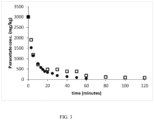
- the rate of ROS generation is thermally activated to accelerate delignification. Measurement of peracetate concentration over time was conducted in clean tap water and in 5% consistency hardwood pulp at 70° C, which is a common temperature for pulp delignification and bleaching processes in a paper mill.
- a 250 mL solution of tap water containing an initial peracetate concentration of 3000 mg/L at 70° C was made by mixing 37.5 mL of a 2.0% wt/vol solution of the peracetate formulation concentrate (made at room temperature) into 212.5 mL of tap water already heated to 70° C in a 1L glass beaker in a hot water bath. Samples were removed for analysis at regular time intervals and the results presented in FIG. 3 , open squares represent the tap water samples.
- the initial pH was 9.0 and the final pH was 5.8.
- the initial ORP was 540 mV vs SHE, which increased to a maximum of 785 mV in 30 minutes.
- a 250 mL slurry of a north American hard wood pulp fiber (16.0 kappa number) at 5% consistency and 70° C containing an initial peracetate concentration of 3000 mg/L was made by mixing 37.5 mL of a 2.0% wt/vol solution of the peracetate formulation concentrate (made at room temperature) into 200 mL of tap water with 12.5 g (oven dry weight) of pulp fiber already heated to 70° C in a 1L glass beaker in a hot water bath.
- the slurry was thoroughly mixed and samples of the oxidant liquor were removed and filtered for analysis at regular time intervals.
- the results are presented in FIG. 3 solid circles represent the pulp slurry samples.
- the initial pH was 8.8 and the final pH was 6.4.
- the initial ORP was 675 mV vs SHE, which increased to a maximum of 850 mV in 25 minutes.
- FIG. 4 A longer-lived, high ORP combination of singlet oxygen, superoxide and other radical fragments caused by thermal or catalytic disproportionation of the parent oxidant has been described in FIG. 4 here.
- a one electron reduction of singlet oxygen can form superoxide in-situ.
- a buildup of these species in clean water during the initial rapid generation of ROS, where they are not consumed by reactive substrates or impurities, may disrupt the second-order bimolecular reaction. Once these longer lived ROS species are dissipated or consumed the second-order reaction can dominate the observed peracetate decline rates again.
- the amount of oxidant used in each test was enough to partially bleach the amount of lignin present so that the oxidant was the limiting reagent.
- peracetate oxidant was combined with Kraft pulp the evolution of some gas was observed accompanied by rapid bleaching that was clearly visible within the first few minutes.
- Chlorine dioxide also bleached the pulp rapidly, but to a lesser extent because it was applied at a lower concentration due to its limited solubility and high volatility.
- Peracetic acid produced a large amount of gas, but was least effective at bleaching. After 2 hours at 50° C the pulp slurries were vacuum filtered through a Buchner funnel over a medium porosity filter paper. There was no residual oxidant present in the filtrates. The four filtrate solutions recovered were put into amber glass bottles and preserved with sulfuric acid for total organic halide analyses, which were conducted by a third party laboratory.
- Peracetate oxidant formed the least amount of TOX under the bleaching conditions. Normalizing the TOX formation to the concentration of oxidant used, the peracetate oxidant formed about 2.7 times less TOX than peracetic acid and about 10.4 times less TOX than chlorine dioxide.
- the peracetate oxidant solution provides strong bleaching performance and greatly reduced organic halide oxidation byproduct formation potential compared to conventional bleaching agents. The peracetate oxidant can significantly reduce pollution caused by the formation of halogenated oxidation byproducts. Table 5.
- the water clarification test program consisted of a 1.25 minute rapid mix at 290 rpm impeller speed, and a slow mix at 25 rpm until 60 minutes had passed.
- the peracetate oxidant solution was added to 800 mL of water as a slug dose of 1.6% (wt/vol) solution at the beginning of the rapid mix.
- the additional water clarification chemicals were added during the rapid mix period.
- Each jar test water sample was analyzed for bromide and bromate using EPA method 300.1. After treatment and contact time with the oxidant water samples were put into sealed containers and refrigerated until analysis (250 mL poly bottles for bromide samples and 250 mL amber glass bottles with 2 mL of ethylenediamine preservative for bromate samples). Analyses were conducted by a third party laboratory.
- Solution pH was measured using a high sodium pH electrode (Oakton TM ) with three point calibration.
- ORP was measured using a platinum electrode ORP probe (Oakton TM ) calibrated with a ORP standard (420 ⁇ 3 mV vs SHE, Orion TM 967901, Thermo Fisher).
- a HACH ® DR 900 colorimeter and corresponding procedures with the appropriate HACH ® reagent kits were used to measure various water parameters (iron, calcium, magnesium) after diluting samples with an appropriate amount with distilled water. Iron analysis by HACH ® method 10249 was modified to avoid interferences from the produced water matrix (color indicator development time was increased).
- the peracetate oxidant concentration was measured using the HACH ® iodometric titration method for hydrogen peroxide.
- Table 6 shows a summary of test results for this study.
- Treatment tests were modeled after that used in a recent study of disinfection byproducts formed in sea water when using commercial peracetic acid products. Treatment tests were conducted by adding 25 or 100 mg/L peracetate oxidant to 800 mL water samples and monitoring the pH and ORP during the first 60 minutes of contact time with the oxidant. The pH, maximum ORP (ORP max ), bromide and bromate concentrations are reported.
- the ORP increased to a maximum value in about 45-55 minutes and remained at an elevated level for at least 18 hours. Seawater samples were allowed to stand at room temperature for about 18 hours to provide an extended contact time with the oxidant residual before preserving for analysis. For produced water samples, the maximum ORP was reached in about 2 minutes and decreased more rapidly afterwards due to contaminants reacting with the oxidant. The produced water sample treated with 25 mg/L peracetate oxidant solution fully consumed the oxidant within an hour.
- bromate formation was detected in the treatment of the simulated seawater composition and production water from the oilfield under conditions that are favorable for bromate formation.
- bromate formation as an oxidation byproduct is a well-known issue for oxidants such as ozone and peracetic acid. Table 6.
- a 250 mL solution of tap water containing an initial peracetate concentration of 3000 mg/L at 70° C was made by mixing 37.5 mL of a 2.0% wt/vol solution of the peracetate formulation concentrate (made at room temperature) into 212.5 mL of tap water already heated to 70° C in a 1L glass beaker in a hot water bath. Samples were removed for analysis at regular time intervals and the results presented in FIG. 3 .
- the initial pH was 9.0 and the final pH was 5.8.
- the initial ORP was 540 mV vs SHE, which increased to a maximum of 785 mV in 30 minutes.
- a 250 mL slurry of a north American hard wood pulp fiber (16.0 kappa number) at 5% consistency and 70° C containing an initial peracetate concentration of 3000 mg/L was made by mixing 37.5 mL of a 2.0% wt/vol solution of the peracetate formulation concentrate (made at room temperature) into 200 mL of tap water with 12.5 g (oven dry weight) of pulp fiber already heated to 70° C in a 1L glass beaker in a hot water bath. The slurry was thoroughly mixed and samples of the oxidant liquor were removed and filtered for analysis at regular time intervals. The results are presented in FIG. 3 .
- the initial pH was 8.8 and the final pH was 6.4.
- the initial ORP was 675 mV vs SHE, which increased to a maximum of 850 mV in 25 minutes.
- FIG. 4 A longer-lived, high ORP combination of singlet oxygen, superoxide and other radical fragments caused by thermal or catalytic disproportionation of the parent oxidant has been described in FIG. 4 here.
- a one electron reduction of singlet oxygen can form superoxide in-situ.
- a buildup of these species in clean water during the initial rapid generation of ROS, where they are not consumed by reactive substrates or impurities, may disrupt the second-order bimolecular reaction. Once these longer lived ROS species are dissipated or consumed the second-order reaction can dominate the observed peracetate decline rates again.
- the initial and final pH in the wood pulp mixture are similar to those in tap water.
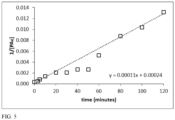
- Plotting 1/[peracetate] in FIG. 6 shows an initial linear region up to about 20 minutes, which is consistent with second order reaction behavior dominating the initial kinetics of peracetate concentration decline.
- the linear slope (rate constant) in the 1/[peracetate] plots over the first 20-25 minutes is about 15% greater for pulp over clean tap water indicating that additional reactions of peracetate in the pulp environment are increasing the observed rate.
- the rate of peracetate decline follows a pseudo-first order behavior as shown by a linear relationship in the ln[peracetate] plot in FIG. 7 . This behavior is dramatically different than that observed in clean tap water.
- ROS which are dominated by singlet oxygen generated by the peracetate formulation, are doing the majority of the delignification, brightening and bleaching reactions in pulp. Furthermore, the best ROS generation rate and concentration is within the first 10-15 minutes of applying the peracetate solution for pulp delignification under these test conditions and initial peracetate oxidant concentration.
- Example 8 Kappa number reduction vs time and peracetate concentration.
- Example 7 Further evidence supporting the conclusion in Example 7 is found in delignification experiments where the majority of kappa number reduction occurs in the first 5 minutes of reaction time.
- North American soft wood (pine) pulp fiber (kappa no. 35.42) and hard wood pulp fiber (kappa no. 16.00) were treated with the peracetate oxidant formulation at 5% pulp consistency and 65° C and the natural pH of the pulp.
- the pulp slurries, or mixtures, were prepared by the same procedure as above and a 2.0% wt/vol peracetate solution was added in the appropriate amount to make the initial concentrations of 0.20% and 0.40%.
- the samples were contained ion 1 L glass beakers heated in a water bath.
- Kappa numbers were measured in duplicate or triplicate using a micro-Kappa procedure that used 0.5 g of oven dried pulp fiber mass (1/4-scale of the standard TAPPI T 236 om-99 method). Kappa number measurements were conducted on pulp samples stored damp after determining the percent solids of each sample.
- Example 9 Improving delignification performance with and mixing efficiency and peracetate oxidant dose .
- Vigorous mixing of the softwood pulp for 10 minutes with 1800 ppm initial oxidant dose produced a 36.7% kappa reduction. Limiting the mixing to just the first minute decreased the kappa reduction to 31.0%.
- Conducting the test with a first oxidant dose of 900 ppm and mixing for 5 minutes then adding another 900 ppm oxidant dose and mixing for another 5 minutes produced a 27.1% kappa reduction.
- Vigorous mixing of the hardwood pulp for 10 minutes with 1800 ppm initial oxidant dose produced a 28.9% kappa reduction. Reducing the mixing to just the first minute decreased the kappa reduction to 20.6%.
- Conducting the test with a first oxidant dose of 900 ppm and mixing for 5 minutes then adding another 900 ppm oxidant dose and mixing for another 5 minutes produced a 31.9% kappa reduction.
- Delignification of pulps with low to medium kappa benefits significantly from two-step oxidation processes. Delignification of pulps with medium kappa (i.e., initial kappa numbers of 20-40) is expected to benefit from a two-step delignification process, but removal of the black liquor (oxidant liquor) after the first step may be required. This oxidant liquor still contains active oxidant and can be used in an initial wash step of brownstock.
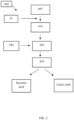
- a counter-flow delignification process was designed to reduce consumption of the peracetate oxidant formulation
- the counter-flow use of the peracetate oxidant is described for FIG. 8 for processing 1000 tons (short tons) per day of oven dry (o.d.) hardwood pulp with an initial kappa number of 14.2 and a target final kappa number of 7.5 or less.
- the 15% consistency brownstock was passing through the process at a rate of 9253 lbs/min.
- a 5.0% peracetate solution (accounted for as peracetate ion) was added to the pulp stream at injection point A at a rate of 45.2 gpm (389 lb/min of 5% solution or 28 lb peracetate per o.d. ton).
- the initial peracetate concentration in the pulp was 2020 ppm and the pulp was diluted to 14.4% consistency.
- the residence time or oxidation time in the second pulp chest was 7 minutes.
- the concentration of peracetate decreased to about 1000 ppm.
- the pulp was washed with 100 gpm of clean water added at injection point B.
- the wash liquor was collected in the third black liquor tank at a rate of 145 gpm and contained about 310 ppm peracetate residual.
- the wash liquor was transferred to the first wash stage at a rate of 145 gpm where it was added at injection point C.
- a wash liquor transfer line to the second wash stage was not used during this operation.
- the wash liquor diluted the pulp from the first wash stage to 13.3% consistency and contained an initial oxidant concentration of 36 ppm (about 0.7 lb peracetate per ton o.d. pulp).
- the oxidant was fully consumed within the 3-minute residence time in the first fiber chest.
- a second peracetate solution addition could be made at injection point C with the wash liquor to increase the peracetate concentration to several hundred ppm for increased oxidation in the first fiber chest and oxidant carry-over to the second wash stage.
- the pulp was dewatered to remove the black liquor in the second wash stage, before addition of fresh peracetate solution.
- the black liquor was collected in the second black liquor tank at a rate of 145 gpm.
- the black liquor in the second black liquor tank was transferred to the outlet of the first black liquor tank D at a rate of 145 gpm. From this point the black liquor was directed to injection point E at the dilution mixer or directed to the black liquor removal point F.
- the diluted brownstock was dewatered at the first wash stage and the black liquor is collected in the first black liquor tank.
- the black liquor was cycled back into the dilution mixer or directed to the black liquor removal point F.
- the black liquor at this point may contain 15% dissolved and suspended solids and is sent to a recovery boiler or is collected for further processing (i.e., sell the black liquor or produce lignin and reuse the water).
- Delignification tests were conducted on north American hardwood pulp (after sulfide digestion with initial Kappa number 16.0) at 12% and 15% pulp consistency at 70° C with the peracetate oxidant formulation. Delignification is often conducted in a pulp mill at medium pulp consistency, typically between about 10% to 18% oven dried (o.d.) fiber by weight.
- a mixing apparatus was constructed to efficiently mix high consistency pulp.
- the mixing apparatus consisted of a jacketed stainless steel beaker, at least 2 L volume, fastened to a variable speed rotating table.
- a variable speed overhead mixer was positioned over the jacketed beaker to turn a stainless steel shaft outfitted with multiple stainless steel impeller blades having a diameter of at least half the inside diameter of the beaker.
- the impeller was positioned off center from the beaker's rotational axis to allow its blades to sweep within 1/8 inch (0.32 cm) of the side of the beaker and to within 1/4 inch (0.64 cm) of the bottom of the beaker.
- the beaker and impeller were rotated in opposite directions relative to one another to provide thorough mixing of high consistency pulp mixtures.
- Pulp mixtures were diluted to their target consistency with tap water minus the volume or mass of oxidant to be added.
- the diluted pulp was heated to 70-75° C in a Pyrex beaker with a microwave oven.
- the jacket of the stainless steel beaker of the mixer was filled with hot water, greater than 70° C.
- the heated pulp was transferred to the hot, jacketed beaker of the mixer.
- the mixing apparatus was operated continuously during the delignification test period. The temperature of the pulp was maintained at 65-72° C for the duration of the mixing process.
- a 4.55% peracetate oxidant solution (measured as peracetate ion) was produced by a peracetate oxidant generation system similar to that described in U.S. Patent Application 14/020828 .
- Freshly made oxidant solution was added in a slug dose to the mixing pulp to provide specified initial oxidant concentrations as ppm on a mass of oxidant to total mass pulp slurry basis.
- After a specific period of mixing time with oxidant the pulp was removed from the mixer, partially drained of black liquor using a vacuum filter (Buchner funnel with medium filter paper) and washed with tap water.
- the oxidant residual in the first black liquor drained was measured by iodometric titration.
- Results of the tests are summarized in Table 10.
- Each test sample consisted of 103 g of o.d. pulp diluted in liquid (by weight) to the treatment consistency.
- the liquid consisted of the black liquor carryover in the original wet pulp sample (25.8% consistency), the oxidant solution mass and tap water making up the balance.
- the first two tests were conducted with a single oxidation step at a nominal temperature of 70° C for 5 minutes followed by washing with 1.5 L of tap water (after a sample of black liquor was collected for analysis).
- the black liquor filtrate was a light amber, yellow- tan color.
- the reduction in kappa number was greatest for the two-step treatment with peracetate oxidant.
- a very rapid removal of the most reactive fraction of lignin and other materials occurred in the first oxidation step, 3a, using a lower oxidant dose.
- the first oxidation step allowed the more reactive and oxidant-consuming materials to be removed in the black liquor before the second oxidation step, 3b, which provided more efficient oxidant use as shown by the largest kappa reduction and highest oxidant residual in the recovered liquor prior to washing.
- a two-step delignification process provides a method to increase delignification efficiency at medium pulp consistency when using the peracetate oxidant formulation.
- the amount of peracetate oxidant used may be reduced with a two-step delignification process.
- the amount of oxidant carryover may be increased with a two-step delignification process thereby providing longer oxidation times in a forward-flow or counter-flow process to achieve greater delignification, greater kappa number reduction and increased brightening.
Landscapes
- Engineering & Computer Science (AREA)
- Life Sciences & Earth Sciences (AREA)
- Chemical & Material Sciences (AREA)
- Organic Chemistry (AREA)
- Wood Science & Technology (AREA)
- Water Supply & Treatment (AREA)
- Environmental & Geological Engineering (AREA)
- Hydrology & Water Resources (AREA)
- Zoology (AREA)
- Health & Medical Sciences (AREA)
- Microbiology (AREA)
- Biochemistry (AREA)
- Bioinformatics & Cheminformatics (AREA)
- General Engineering & Computer Science (AREA)
- General Health & Medical Sciences (AREA)
- Genetics & Genomics (AREA)
- General Chemical & Material Sciences (AREA)
- Chemical Kinetics & Catalysis (AREA)
- Biotechnology (AREA)
- Paper (AREA)
- Treatment Of Water By Oxidation Or Reduction (AREA)
- Agricultural Chemicals And Associated Chemicals (AREA)
Claims (5)
- Verfahren zur Behandlung von Zellstoff, um die Verwendung halogenhaltiger Oxidationsmittel zu verringern, wobei das Verfahren ein Delignifizierungsverfahren zum Delignifizieren des Zellstoffs einschließt, wobei das Delignifizierungsverfahren umfasst:Zugeben einer Peracetat-Oxidationsmittellösung zu einem Zellstoff an einem primären Zugabepunkt und Inkontaktbringen des Zellstoffs mit der Peracetat-Oxidationsmittellösung; undMischen des Zellstoffs mit der Peracetat-Oxidationsmittellösung;gekennzeichnet durch:
Formulierung der Peracetat-Oxidationsmittellösung, Singulett-Sauerstoff als eine reaktive Sauerstoffspezies in dem erhaltenen Gemisch zu erzeugen, wobei die Peracetat-Oxidationsmittellösung, wie zu dem Zellstoff zugegeben, umfasst:einen pH-Wert in einem Bereich von pH 10 bis pH 12; Peracetat-Anionen und eine Persäure in einem Molverhältnis von Peracetat-Anionen zu Persäure von 60:1 bis 6000:1; undentweder kein Wasserstoffperoxid oder Wasserstoffperoxid, wobei ein Molverhältnis von Peracetat-Anion zu Wasserstoffperoxid größer als 16:1 ist; undnach einer Zeitspanne nach der Zugabe Abtrennen einer Oxidationsmittellauge, die restliches aktives Oxidationsmittel aus der Peracetat-Oxidationsmittellösung enthält, von dem Zellstoff und Zuführen der Oxidationsmittellauge zu einem sekundären Zugabepunkt stromaufwärts bezogen auf den primären Zugabepunkt, an dem der Zellstoff und die Oxidationsmittellauge in Kontakt gebracht und gemischt werden. - Verfahren nach Anspruch 1, ferner umfassend Erhitzen des Zellstoffs auf eine Temperatur von zwischen 50 °C und 95 °C, um die Entstehung der reaktiven Sauerstoffspezies zu beschleunigen.
- Verfahren nach Anspruch 1, umfassend Zuführen einer Quelle des Zellstoffs (510) in einer Vorwärtsflussrichtung zu dem Delignifizierungsverfahren bei einer Temperatur in einem Bereich von 65 °C bis 75 °C, und wobei das Delignifizierungsverfahren umfasst:Leiten des Zellstoffs durch einen Verdünnungsmischer (520);nach dem Verdünnungsmischer (520) Entwässern des Zellstoffs in einer ersten Waschstufe (530) auf eine Stoffdichte von etwa 15 %, einschließend Abtrennen von Schwarzlauge von dem Zellstoff und Sammeln von abgetrennter Schwarzlauge der ersten Waschstufe (530) in einem ersten Schwarzlaugetank (540);nach der ersten Waschstufe (530) Leiten des Zellstoffs durch einen ersten Zellstoffmischer oder Zellstofffluffer (560) und in einen ersten Faserkasten (570);nach einer Verweilzeit in dem ersten Faserkasten (570) Pumpen des Zellstoffs von dem ersten Faserkasten zu einer zweiten Waschstufe (580), in der der Zellstoff auf eine Stoffdichte von etwa 15 % entwässert wird, und einschließend Abtrennen von Schwarzlauge von dem Zellstoff und Sammeln von abgetrennter Schwarzlauge der zweiten Waschstufe (580) in einem zweiten Schwarzlaugetank (590);nach der zweiten Waschstufe (580) Leiten des Zellstoffs durch einen zweiten Zellstoffmischer oder Zellstofffluffer (610) und in einen zweiten Faserkasten (620), undnach einer Verweilzeit in dem zweiten Faserkasten (620) Pumpen des Zellstoffs von dem zweiten Faserkasten (620) zu einer dritten Waschstufe (640), in der der Zellstoff mit sauberem Wasser (630) gewaschen und auf eine Stoffdichte von etwa 15 % entwässert wird, und einschließend Abtrennen von Schwarzlauge von dem Zellstoff und Sammeln von abgetrennter Schwarzlauge der dritten Waschstufe (640) in einem dritten Schwarzlaugetank (660);und wobei:der primäre Zugabepunkt (A) in der zweiten Waschstufe (580) angeordnet ist; unddie Oxidationsmittellauge Schwarzlauge aus dem dritten Schwarzlaugetank (660) umfasst und der sekundäre Zugabepunkt (C) in der ersten Waschstufe (530) angeordnet ist; unddie Peracetat-Oxidationsmittellösung etwas an rückgeführter Schwarzlauge aus dem dritten Schwarzlaugetank (660), einschließlich restlichem Oxidationsmittel, umfasst.
- Verfahren nach Anspruch 1, ferner umfassend nach dem Delignifizierungsverfahren Bleichen des Zellstoffs mit einer Bleichsequenz, bei der der Zellstoff mit Chlordioxid gebleicht wird, wobei die Bleichsequenz D(EOP)DD umfasst, mit der Ausnahme, dass wenigstens eines der D nicht enthalten ist; und
wobei jedes D eine Behandlungsstufe mit Chlordioxid ist und das EOP eine Behandlungsstufe von oxidativer Extraktion mit alkalischem Wasserstoffperoxid ist. - Verfahren nach Anspruch 1, wobei der Zellstoff eine Zellstoffdichte von 0,1 bis 20 % Zellstofffaser umfasst.
Applications Claiming Priority (2)
| Application Number | Priority Date | Filing Date | Title |
|---|---|---|---|
| US201562263900P | 2015-12-07 | 2015-12-07 | |
| PCT/US2016/065345 WO2017100299A1 (en) | 2015-12-07 | 2016-12-07 | Methods of pulp fiber treatment |
Publications (3)
| Publication Number | Publication Date |
|---|---|
| EP3386948A1 EP3386948A1 (de) | 2018-10-17 |
| EP3386948A4 EP3386948A4 (de) | 2019-06-12 |
| EP3386948B1 true EP3386948B1 (de) | 2025-03-05 |
Family
ID=58799514
Family Applications (3)
| Application Number | Title | Priority Date | Filing Date |
|---|---|---|---|
| EP16873739.3A Active EP3386925B1 (de) | 2015-12-07 | 2016-12-07 | Verfahren zur mikrobiellen kontrolle |
| EP16873753.4A Active EP3386948B1 (de) | 2015-12-07 | 2016-12-07 | Verfahren zur behandlung von pulpefasern |
| EP17877485.7A Active EP3551798B1 (de) | 2015-12-07 | 2017-05-22 | Verfahren zur behandlung von pulpefasern |
Family Applications Before (1)
| Application Number | Title | Priority Date | Filing Date |
|---|---|---|---|
| EP16873739.3A Active EP3386925B1 (de) | 2015-12-07 | 2016-12-07 | Verfahren zur mikrobiellen kontrolle |
Family Applications After (1)
| Application Number | Title | Priority Date | Filing Date |
|---|---|---|---|
| EP17877485.7A Active EP3551798B1 (de) | 2015-12-07 | 2017-05-22 | Verfahren zur behandlung von pulpefasern |
Country Status (6)
| Country | Link |
|---|---|
| US (6) | US10611656B2 (de) |
| EP (3) | EP3386925B1 (de) |
| BR (1) | BR112018011477A2 (de) |
| CA (3) | CA3007780C (de) |
| FI (1) | FI3386948T3 (de) |
| WO (3) | WO2017100299A1 (de) |
Families Citing this family (37)
| Publication number | Priority date | Publication date | Assignee | Title |
|---|---|---|---|---|
| US8317975B2 (en) * | 2004-04-20 | 2012-11-27 | The Research Foundation Of The State University Of New York | Product and processes from an integrated forest biorefinery |
| BRPI0811530B1 (pt) | 2007-05-14 | 2019-01-02 | Research Foundation Of State Univ Of New York | composição compreendendo indutor(es) de resposta fisiológica à dispersão ácido decanóico, superfície, solução, método ex vivo de tratamento ou inibição da formação de um biofilme sobre uma superfície |
| WO2012166997A2 (en) | 2011-05-31 | 2012-12-06 | Clean Chemistry, Llc | Electrochemical reactor and process |
| CA2900460C (en) | 2012-09-07 | 2021-08-31 | Clean Chemistry, Llc | Systems and methods for generation of reactive oxygen species and applications thereof |
| WO2015067446A1 (de) * | 2013-11-06 | 2015-05-14 | Evonik Industries Ag | Verfahren zur delignifizierung und bleiche von zellstoff |
| EP3189016B1 (de) | 2014-09-04 | 2020-06-03 | Clean Chemistry, Inc. | Wasserbehandlungsverfahren unter verwendung einer oxidativen peracetatlösung |
| GB2530987B (en) * | 2014-10-03 | 2017-06-21 | Nafici Env Res (Ner) Ltd | A method for processing straw |
| CA2981034C (en) | 2015-03-26 | 2024-06-25 | Clean Chemistry, Inc. | Systems and methods of reducing a bacteria population in high hydrogen sulfide water |
| US10883224B2 (en) | 2015-12-07 | 2021-01-05 | Clean Chemistry, Inc. | Methods of pulp fiber treatment |
| US10611656B2 (en) | 2015-12-07 | 2020-04-07 | Clean Chemistry, Inc. | Methods of microbial control |
| US11136714B2 (en) | 2016-07-25 | 2021-10-05 | Clean Chemistry, Inc. | Methods of optical brightening agent removal |
| BR112019026778B1 (pt) | 2017-06-15 | 2023-09-26 | Evonik Operations Gmbh | Método para reduzir a contaminação microbiana de produtos alimentícios e carcaças de animais, método para aprimorar as propriedades organolépticas de carne ou aves de criação e composição |
| FI128324B (en) * | 2017-06-21 | 2020-03-31 | Kemira Oyj | Process for making fiber web |
| US11231360B2 (en) * | 2017-06-29 | 2022-01-25 | Hydrite Chemical Co. | Automatic titration device |
| US11311012B1 (en) | 2017-09-07 | 2022-04-26 | Clean Chemistry, Inc. | Bacterial control in fermentation systems |
| US11001864B1 (en) | 2017-09-07 | 2021-05-11 | Clean Chemistry, Inc. | Bacterial control in fermentation systems |
| EP4602915A3 (de) * | 2017-09-25 | 2025-10-08 | Ecolab USA Inc. | Verwendung von mittelkettigen persäuren zur biofilmhemmung in industriellen rezirkulierenden wassersystemen |
| WO2019099434A1 (en) * | 2017-11-14 | 2019-05-23 | Biosafe Systems, Llc | Chiller water sampling device |
| WO2019099623A1 (en) * | 2017-11-16 | 2019-05-23 | Peroxychem Llc | Disinfection method for water and wastewater |
| BR112020010000B1 (pt) * | 2017-12-29 | 2024-02-06 | Valmet Technologies Oy | Método para ajustar o equilíbrio de s/na de uma fábrica de celulose, usos de um biorreator, e, sistemas arranjados para ajustar o equilíbrio de s/na de uma fábrica de celulose |
| CA3091870A1 (en) * | 2018-03-01 | 2019-09-06 | Spi Technology Ltd. | Water energy matrix control |
| AU2019277675A1 (en) * | 2018-05-31 | 2021-01-21 | Evonik Operations Gmbh | Sporicidal methods and compositions |
| CN109970264B (zh) * | 2019-03-08 | 2021-09-17 | 中核通辽铀业有限责任公司 | 一种地浸采铀矿山蒸发池恶臭污染物控制方法 |
| US20200338377A1 (en) | 2019-04-23 | 2020-10-29 | University Of Rhode Island Board Of Trustees | Polymer immobilization matrix for containment of hazardous materials and methods of using the same |
| DE102020002812A1 (de) * | 2019-05-16 | 2020-11-19 | Sms Group Gmbh | Verfahren zum Abbau von organischen Anteilen in Kühlkreisläufen von industriellen Anlagen und Kühlkreislauf für eine industrielle Anlage |
| US11602896B2 (en) * | 2019-08-14 | 2023-03-14 | Mighty Buildings, Inc. | 3D printing of a composite material via sequential dual-curing polymerization |
| WO2021055941A1 (en) | 2019-09-20 | 2021-03-25 | Chemtreat, Inc. | Sanitary food washing stage in food production |
| EP3797592A1 (de) | 2019-09-25 | 2021-03-31 | Sani-Marc Inc. | Peressigzusammensetzungen, verfahren und kits zur entfernung von biofilmen von einer umschlossenen oberfläche |
| CN112211028A (zh) * | 2020-09-18 | 2021-01-12 | 滁州兴邦聚合彩纤有限公司 | 一种化纤浆的制备方法 |
| CN114689722A (zh) * | 2020-12-31 | 2022-07-01 | 深圳市海普瑞药业集团股份有限公司 | 一种用于检测样品中糖胺聚糖羧酸化衍生物含量的方法及其应用 |
| CA3110390A1 (en) * | 2021-02-25 | 2022-08-25 | Sixring Inc. | Modified sulfuric acid and uses thereof |
| US20220396514A1 (en) * | 2021-06-15 | 2022-12-15 | Natural Systems Utilities, Llc | Online biological monitoring in decentralized non-potable water system |
| US11649398B1 (en) | 2021-12-09 | 2023-05-16 | Saudi Arabian Oil Company | Composition and method of using date palm fibers in hydraulic fracturing |
| TWI799284B (zh) * | 2022-06-06 | 2023-04-11 | 友達光電股份有限公司 | 水質預測及殺菌控制系統及水質預測及殺菌控制方法 |
| US20240003861A1 (en) * | 2022-06-30 | 2024-01-04 | Saudi Arabian Oil Company | Automated method and system to measure residual biocide in seawater |
| SE546053C2 (en) * | 2022-09-27 | 2024-04-30 | Stora Enso Oyj | A method for reducing the load of microbial contaminants in a pulp stock comprising a recycled fiber fraction |
| CN115787332A (zh) * | 2022-11-11 | 2023-03-14 | 玖龙纸业(东莞)有限公司 | 一种控制纸张异味的方法 |
Citations (1)
| Publication number | Priority date | Publication date | Assignee | Title |
|---|---|---|---|---|
| US20140072653A1 (en) * | 2012-09-07 | 2014-03-13 | Clean Chemistry, Llc | System and method for generation of point of use reactive oxygen species |
Family Cites Families (96)
| Publication number | Priority date | Publication date | Assignee | Title |
|---|---|---|---|---|
| US3719552A (en) * | 1971-06-18 | 1973-03-06 | American Cyanamid Co | Bleaching of lignocellulosic materials with oxygen in the presence of a peroxide |
| AT326611B (de) | 1972-07-31 | 1975-12-29 | Henkel & Cie Gmbh | Als bestandteil von pulverförmigen wasch- und bleichmitteln geeignetes bleichhilfsmittel |
| US4055505A (en) | 1974-07-12 | 1977-10-25 | Colgate-Palmolive Company | Activated percompound bleaching compositions |
| US4076621A (en) | 1976-03-15 | 1978-02-28 | Air Resources, Inc. | Chelate oxidation of hydrogen sulfide in sour water |
| SE415580C (sv) | 1977-05-11 | 1984-10-15 | Mo Och Domsjoe Ab | Forfarande for reglering av tillforseln av reaktionskemikalier vid delignifiering av cellulosamaterial |
| US4393037A (en) | 1981-12-16 | 1983-07-12 | Union Oil Company Of California | Method for reconditioning bacteria-contaminated hydrogen sulfide removing systems |
| FR2552125B1 (fr) * | 1983-09-16 | 1986-03-21 | Interox | Procede pour le taitement des matieres cellulosiques par des agents oxydants |
| US4722773A (en) | 1984-10-17 | 1988-02-02 | The Dow Chemical Company | Electrochemical cell having gas pressurized contact between laminar, gas diffusion electrode and current collector |
| US4673473A (en) | 1985-06-06 | 1987-06-16 | Peter G. Pa Ang | Means and method for reducing carbon dioxide to a product |
| SE455822B (sv) | 1985-12-03 | 1988-08-08 | Mo Och Domsjoe Ab | Forfarande for att meta kemikaliehalten i blekvetska inom cellulosamassaindustrin samt apparatur for genomforande av forfarandet |
| US4872953A (en) | 1986-12-18 | 1989-10-10 | Eze Products, Inc. | Apparatus for improving the quality of paper manufactured from recycled paper with a hydrokinetic amplifier |
| DK71987D0 (da) | 1987-02-13 | 1987-02-13 | Nordiske Kabel Traad | Fremgangsmaade til rensning af olie- og kemikalieforurenet jord |
| DE3816989A1 (de) | 1987-08-05 | 1989-02-16 | Peroxid Chemie Gmbh | Entseuchung von klaerschlamm |
| US5246543A (en) * | 1989-08-18 | 1993-09-21 | Degussa Corporation | Process for bleaching and delignification of lignocellulosic materials |
| CA2053035C (en) | 1990-10-12 | 1997-09-30 | Repap Enterprises Inc. | Chlorine-free wood pulps and process of making |
| ATE132926T1 (de) | 1992-07-06 | 1996-01-15 | Solvay Interox | Verfahren zur delignifizierung von chemischen zellstoffen |
| WO1994002423A1 (en) | 1992-07-23 | 1994-02-03 | Diversey Corporation | Method and apparatus for controlling microorganisms |
| JP2864167B2 (ja) | 1992-11-27 | 1999-03-03 | エカ ノーベル アクチェボラーグ | リグノセルロース含有パルプの脱リグニン化法 |
| US6007678A (en) | 1992-11-27 | 1999-12-28 | Eka Nobel Ab | Process for delignification of lignocellulose-containing pulp with an organic peracid or salts thereof |
| US5387317A (en) | 1993-01-28 | 1995-02-07 | The Mead Corporation | Oxygen/ozone/peracetic aicd delignification and bleaching of cellulosic pulps |
| US5683724A (en) | 1993-03-17 | 1997-11-04 | Ecolab Inc. | Automated process for inhibition of microbial growth in aqueous food transport or process streams |
| US6183623B1 (en) | 1993-07-13 | 2001-02-06 | Lynntech, Inc. | Electrochemical conversion of anhydrous hydrogen halide to halogen gas using an ionically conducting membrane |
| CA2129489C (en) | 1993-08-05 | 2000-10-10 | Judy G. Lazonby | Method and composition for inhibiting growth of microorganisms including peracetic acid and a non-oxidizing biocide |
| US5472619A (en) | 1993-09-03 | 1995-12-05 | Birko Corporation | Waste water treatment with peracetic acid compositions |
| SE502172C2 (sv) | 1993-12-15 | 1995-09-04 | Mo Och Domsjoe Ab | Förfarande för framställning av blekt cellulosamassa med en klorfri bleksekvens i närvaro av karbonat |
| US5565073A (en) | 1994-07-15 | 1996-10-15 | Fraser; Mark E. | Electrochemical peroxide generator |
| US5624575A (en) * | 1995-04-28 | 1997-04-29 | Nalco Chemical Company | Method for preventing microbial deposits in the papermaking process with ethylene oxide/propylene oxide copolymers |
| CN1055737C (zh) | 1996-01-15 | 2000-08-23 | 南京林业大学 | 纸浆多段漂白碱处理段单线态氧强化漂白配方和工艺 |
| IT1282367B1 (it) | 1996-01-19 | 1998-03-20 | De Nora Spa | Migliorato metodo per l'elettrolisi di soluzioni acquose di acido cloridrico |
| DE19614587A1 (de) | 1996-04-13 | 1997-10-16 | Jaschinski Thomas Dipl Holzw | Verfahren und Bleichlösung zum Bleichen von cellulosischen Faserstoffen |
| US5817240A (en) | 1996-11-12 | 1998-10-06 | The University Of Akron | Catalytic fixed bed reactor systems for the destruction of contaminants in water by hydrogen peroxide |
| FI112958B (fi) | 1997-12-19 | 2004-02-13 | Kemira Oyj | Menetelmä kemiallisen massan valkaisemiseksi sekä valkaisuliuoksen käyttö |
| US6015536A (en) | 1998-01-14 | 2000-01-18 | Ecolab Inc. | Peroxyacid compound use in odor reduction |
| FR2776312B1 (fr) | 1998-03-18 | 2000-05-05 | Air Liquide | Procede de destruction des agents fluorescents contenus dans les vieux papiers par l'acide peracetique |
| WO1999054544A1 (en) | 1998-04-17 | 1999-10-28 | Alberta Research Council Inc. | Method of producing lignocellulosic pulp from non-woody species |
| US7335246B2 (en) | 1998-05-14 | 2008-02-26 | United States Of America Enviromental Protection Agency | Contaminant adsorption and oxidation via the fenton reaction |
| US6569286B1 (en) | 1998-09-30 | 2003-05-27 | Warwick International Group Limited | Method for the alkaline bleaching of pulp with a peroxyacid based oxygen bleaching species using an agglomerated bleach activator |
| WO2000069778A1 (en) * | 1999-05-17 | 2000-11-23 | Buckman Laboratories International, Inc. | Methods of using percarboxylic acid or anions thereof and methods of making the same |
| US6294047B1 (en) | 1999-07-30 | 2001-09-25 | Institute Of Paper | Methods for reducing fluorescence in paper-containing samples |
| CA2378601A1 (en) | 1999-08-05 | 2001-02-15 | Steris Inc. | Electrolytic synthesis of peracetic acid |
| US6562225B2 (en) | 1999-08-30 | 2003-05-13 | The Boeing Company | Chemical oxygen-iodine laser with electrochemical regeneration of basic hydrogen peroxide and chlorine |
| US20010050234A1 (en) | 1999-12-22 | 2001-12-13 | Shiepe Jason K. | Electrochemical cell system |
| JP2002317287A (ja) | 2001-04-18 | 2002-10-31 | Permelec Electrode Ltd | 過酸化水素製造用電解槽及び過酸化水素製造方法 |
| CA2445531A1 (en) | 2001-06-29 | 2003-01-09 | The Procter & Gamble Company | Stability enhanced peracid bleaching systems for textile applications |
| US6712949B2 (en) | 2001-07-22 | 2004-03-30 | The Electrosynthesis Company, Inc. | Electrochemical synthesis of hydrogen peroxide |
| US7008545B2 (en) * | 2002-08-22 | 2006-03-07 | Hercules Incorporated | Synergistic biocidal mixtures |
| US20040112555A1 (en) | 2002-12-03 | 2004-06-17 | Jeffrey Tolan | Bleaching stage using xylanase with hydrogen peroxide, peracids, or a combination thereof |
| US20040200588A1 (en) | 2003-04-10 | 2004-10-14 | Walker Jayne M.A. | Method of controlling microorganisms in hydrogen peroxide pulp bleaching processes |
| GB0328124D0 (en) | 2003-12-04 | 2004-01-07 | Daly James | Membrane electrolyser with a two part end design |
| US7614439B2 (en) * | 2004-10-05 | 2009-11-10 | Stephen Lukos | Roller tube having external slot for mounting sheet material |
| CN101163578A (zh) | 2005-03-11 | 2008-04-16 | 路易斯安那州州立大学及农业机械学院管理委员会 | 用于纤维素分离的化学氧化 |
| US8562222B2 (en) | 2005-06-24 | 2013-10-22 | Seagate Technology Llc | Hub and spindle assembly |
| US20090152123A1 (en) | 2005-07-07 | 2009-06-18 | Applied Intellectual Capital | Methods and Apparatus for Generating Oxidizing Agents |
| JP3996629B2 (ja) | 2005-08-25 | 2007-10-24 | 松下電器産業株式会社 | 酸素還元用電極 |
| US20100320156A1 (en) | 2006-01-25 | 2010-12-23 | Olaiya Charles O | Oxidative Treatment Method |
| JP2007242433A (ja) | 2006-03-09 | 2007-09-20 | Permelec Electrode Ltd | 電気化学反応用電極触媒、その製造方法及び前記電極触媒を有する電気化学用電極 |
| US9056784B2 (en) | 2006-09-19 | 2015-06-16 | Ken V. Pandya | High efficiency water-softening process |
| US7754064B2 (en) * | 2006-09-29 | 2010-07-13 | Eltron Research & Development | Methods and apparatus for the on-site production of hydrogen peroxide |
| FI119800B (fi) * | 2006-11-09 | 2009-03-31 | Kemira Oyj | Menetelmä mikro-organismien kasvun estämiseksi ja mikro-organismien kasvua estävä yhdistelmä |
| US8999173B2 (en) | 2007-06-04 | 2015-04-07 | Global Water Holdings, Llc | Aqueous treatment apparatus utilizing precursor materials and ultrasonics to generate customized oxidation-reduction-reactant chemistry environments in electrochemical cells and/or similar devices |
| US7763768B2 (en) | 2007-07-05 | 2010-07-27 | King Saud University | Method for the preparation of reactive hydrogen peroxide in deep eutectic solvents |
| US20090090478A1 (en) | 2007-10-05 | 2009-04-09 | Hollomon Martha G | Selectivity improvement in oxygen delignification and bleaching of lignocellulose pulp using singlet oxygen |
| WO2010005607A2 (en) | 2008-03-19 | 2010-01-14 | Eltron Research & Development, Inc. | Production of peroxycarboxylic acids |
| JP5230242B2 (ja) * | 2008-04-09 | 2013-07-10 | 三菱重工環境・化学エンジニアリング株式会社 | 食品廃棄物のメタン発酵処理方法及び該システム |
| US8491709B2 (en) | 2008-04-14 | 2013-07-23 | Mitsubishi Electric Corporation | Active oxygen generating device, humidifier, and air purification system with humidifier |
| US7655213B2 (en) | 2008-05-13 | 2010-02-02 | General Electric Company | Direct oxidation of sulfur with carbon dioxide recycle |
| FR2932952A1 (fr) | 2008-06-26 | 2010-01-01 | Orbeco Inc | Composition aqueuse, notamment desinfectante, a base de h202 procede de fabrication et utilisation. |
| US20100078331A1 (en) | 2008-10-01 | 2010-04-01 | Scherson Daniel A | ELECTROLYTIC DEVICE FOR GENERATION OF pH-CONTROLLED HYPOHALOUS ACID AQUEOUS SOLUTIONS FOR DISINFECTANT APPLICATIONS |
| US20100179368A1 (en) | 2008-11-07 | 2010-07-15 | Aries Associates, Inc. | Novel Chemistries, Solutions, and Dispersal Systems for Decontamination of Chemical and Biological Systems |
| EP2358643A4 (de) | 2008-11-20 | 2012-10-10 | Michael J Conrad | Neue chemikalien, lösungen und dispersionssysteme zur dekontamination chemischer und biologischer systeme |
| US20100176066A1 (en) | 2008-12-09 | 2010-07-15 | Peragen Systems Inc. | Method of Improving Efficiency of UV Photolysis of Peracetic Acid for Disinfection and Organic Destruction |
| CN102256484B (zh) | 2008-12-18 | 2014-12-17 | Fmc有限公司 | 过乙酸油田生物杀灭剂和方法 |
| IT1396051B1 (it) | 2009-09-28 | 2012-11-09 | Montemurro | Procedimento di minimizzazione in sito dei fanghi di depurazione dei reflui e di altri rifiuti. |
| WO2011119423A2 (en) | 2010-03-23 | 2011-09-29 | International Paper Company | Improved bctmp filtrate recycling system and method |
| US8845860B2 (en) | 2010-09-16 | 2014-09-30 | Georgia-Pacific Consumer Products Lp | High brightness pulps from lignin rich waste papers |
| US20120322873A1 (en) | 2010-12-28 | 2012-12-20 | Nalco Company | Use of a buffer with a biocide precursor |
| US8454838B2 (en) | 2011-03-30 | 2013-06-04 | Crystal Lagoons (Curacao) B.V. | Method and system for the sustainable cooling of industrial processes |
| CA2833601A1 (en) | 2011-04-20 | 2012-10-26 | Soane Energy, Llc | Treatment of wastewater |
| WO2012166997A2 (en) | 2011-05-31 | 2012-12-06 | Clean Chemistry, Llc | Electrochemical reactor and process |
| AR087707A1 (es) | 2011-08-30 | 2014-04-09 | Cargill Inc | Articulos manufacturados a partir de una composicion de pulpa |
| CA2849750C (en) | 2011-09-30 | 2018-04-03 | Nippon Paper Industries Co., Ltd. | Method for producing cellulose nanofibers |
| CA2850895C (en) | 2011-10-25 | 2016-07-05 | Basf Se | Concentration of suspensions |
| WO2013064484A1 (en) | 2011-11-01 | 2013-05-10 | Kemira Oyj | Method of treating oily waters |
| US9926214B2 (en) | 2012-03-30 | 2018-03-27 | Ecolab Usa Inc. | Use of peracetic acid/hydrogen peroxide and peroxide-reducing agents for treatment of drilling fluids, frac fluids, flowback water and disposal water |
| US9719179B2 (en) | 2012-05-23 | 2017-08-01 | High Sierra Energy, LP | System and method for treatment of produced waters |
| US10281383B2 (en) | 2012-11-15 | 2019-05-07 | Solenis Technologies, L.P. | System and methods of determining liquid phase turbidity of multiphase wastewater |
| EP2935654B1 (de) | 2012-12-21 | 2018-02-28 | Avantium Knowledge Centre B.V. | Verfahren zur herstellung von oxalsäure und oxalsäurereduktionsprodukten |
| EP2754644A1 (de) * | 2013-01-15 | 2014-07-16 | Voltea B.V. | Dampfrezirkulations-Kühlwassersystem, Verfahren zum Betrieb eines Dampfrezirkulations-Kühlwassersystems und Verfahren zum Betrieb eines Wasserentionisierungssystems |
| US9670080B2 (en) | 2013-06-24 | 2017-06-06 | Baker Hughes Incorporated | Composition and method for treating oilfield water |
| EP3189016B1 (de) | 2014-09-04 | 2020-06-03 | Clean Chemistry, Inc. | Wasserbehandlungsverfahren unter verwendung einer oxidativen peracetatlösung |
| CA2981034C (en) | 2015-03-26 | 2024-06-25 | Clean Chemistry, Inc. | Systems and methods of reducing a bacteria population in high hydrogen sulfide water |
| US10883224B2 (en) | 2015-12-07 | 2021-01-05 | Clean Chemistry, Inc. | Methods of pulp fiber treatment |
| US10611656B2 (en) | 2015-12-07 | 2020-04-07 | Clean Chemistry, Inc. | Methods of microbial control |
| US11136714B2 (en) | 2016-07-25 | 2021-10-05 | Clean Chemistry, Inc. | Methods of optical brightening agent removal |
| US11311012B1 (en) | 2017-09-07 | 2022-04-26 | Clean Chemistry, Inc. | Bacterial control in fermentation systems |
| US11001864B1 (en) | 2017-09-07 | 2021-05-11 | Clean Chemistry, Inc. | Bacterial control in fermentation systems |
-
2016
- 2016-12-07 US US15/371,567 patent/US10611656B2/en active Active
- 2016-12-07 CA CA3007780A patent/CA3007780C/en active Active
- 2016-12-07 US US15/371,872 patent/US20170159237A1/en not_active Abandoned
- 2016-12-07 WO PCT/US2016/065345 patent/WO2017100299A1/en not_active Ceased
- 2016-12-07 CA CA3007778A patent/CA3007778C/en active Active
- 2016-12-07 FI FIEP16873753.4T patent/FI3386948T3/fi active
- 2016-12-07 EP EP16873739.3A patent/EP3386925B1/de active Active
- 2016-12-07 EP EP16873753.4A patent/EP3386948B1/de active Active
- 2016-12-07 BR BR112018011477-4A patent/BR112018011477A2/pt not_active Application Discontinuation
- 2016-12-07 WO PCT/US2016/065326 patent/WO2017100284A1/en not_active Ceased
-
2017
- 2017-05-22 EP EP17877485.7A patent/EP3551798B1/de active Active
- 2017-05-22 CA CA3046063A patent/CA3046063A1/en active Pending
- 2017-05-22 WO PCT/US2017/033824 patent/WO2018106285A1/en not_active Ceased
-
2018
- 2018-10-01 US US16/148,222 patent/US11111629B2/en active Active
-
2020
- 2020-03-02 US US16/806,148 patent/US11225755B2/en active Active
-
2021
- 2021-08-30 US US17/461,389 patent/US11795615B2/en active Active
- 2021-11-24 US US17/535,268 patent/US12215460B2/en active Active
Patent Citations (1)
| Publication number | Priority date | Publication date | Assignee | Title |
|---|---|---|---|---|
| US20140072653A1 (en) * | 2012-09-07 | 2014-03-13 | Clean Chemistry, Llc | System and method for generation of point of use reactive oxygen species |
Also Published As
| Publication number | Publication date |
|---|---|
| US20170158537A1 (en) | 2017-06-08 |
| EP3386925B1 (de) | 2025-03-05 |
| FI3386948T3 (fi) | 2025-05-15 |
| CA3007780A1 (en) | 2017-06-15 |
| BR112018011477A2 (pt) | 2018-12-04 |
| US20200199000A1 (en) | 2020-06-25 |
| WO2017100284A1 (en) | 2017-06-15 |
| EP3551798B1 (de) | 2025-11-12 |
| US11225755B2 (en) | 2022-01-18 |
| CA3007778C (en) | 2023-09-26 |
| US11111629B2 (en) | 2021-09-07 |
| CA3046063A1 (en) | 2018-06-14 |
| EP3386948A1 (de) | 2018-10-17 |
| EP3386948A4 (de) | 2019-06-12 |
| US20210388561A1 (en) | 2021-12-16 |
| EP3551798A4 (de) | 2020-04-29 |
| EP3386925A1 (de) | 2018-10-17 |
| CA3007780C (en) | 2023-12-19 |
| US12215460B2 (en) | 2025-02-04 |
| WO2017100299A1 (en) | 2017-06-15 |
| WO2018106285A1 (en) | 2018-06-14 |
| CA3007778A1 (en) | 2017-06-15 |
| US20170159237A1 (en) | 2017-06-08 |
| US10611656B2 (en) | 2020-04-07 |
| US20190031545A1 (en) | 2019-01-31 |
| US11795615B2 (en) | 2023-10-24 |
| US20220259803A1 (en) | 2022-08-18 |
| EP3551798A1 (de) | 2019-10-16 |
| EP3551798C0 (de) | 2025-11-12 |
| EP3386925A4 (de) | 2019-06-12 |
Similar Documents
| Publication | Publication Date | Title |
|---|---|---|
| US11795615B2 (en) | Methods of pulp fiber treatment | |
| Sharma et al. | Environmental issues of pulp bleaching and prospects of peracetic acid pulp bleaching: A review | |
| US10422079B2 (en) | Method for preserving recycled fiber by using biocides in paper manufacturing and method for manufacturing paper using recycled fibers | |
| Bajpai | The control of microbiological problems | |
| EP0686216A1 (de) | Inhibierung von wasserstoffperoxid-abbauenden enzymen, z.b. catalase und peroxidase, beim bleichen von cellulosischen fasern | |
| US20180023250A1 (en) | Methods of optical brightening agent removal | |
| US11001864B1 (en) | Bacterial control in fermentation systems | |
| EP2390408B1 (de) | Steuerung von Enzymen bei der Herstellung von Pulpe | |
| WO2021123504A1 (en) | Process for manufacturing a fibre web | |
| US11311012B1 (en) | Bacterial control in fermentation systems | |
| US20250261660A1 (en) | Formulations and methods for use in oxidation treatment applications | |
| WO2024108086A1 (en) | Improved formulations and methods for use in oxidation treatment applications | |
| Kiuru | Interactions of chemical variations and biocide performance at paper machines | |
| Kiuru et al. | Electrochemically generated biocides for controlling contamination in papermaking | |
| Wang | Exploring TiO2/UV Photocatalytic Pre-treatment to Enhance the Anaerobic Treatment of Pulp and Paper Wastewaters | |
| EP1874993A1 (de) | Verfahren zur verringerung von korrosion in verbindung mit chlordioxid | |
| Cellkem | THE APPLICATION OF DIALDEHYDE CHEMISTRY FOR CONTROL OF CATALASE IN THE DEINKING PROCESSES | |
| ZA200400701B (en) | Control of development of biofilms in industrial process water. |
Legal Events
| Date | Code | Title | Description |
|---|---|---|---|
| STAA | Information on the status of an ep patent application or granted ep patent |
Free format text: STATUS: THE INTERNATIONAL PUBLICATION HAS BEEN MADE |
|
| PUAI | Public reference made under article 153(3) epc to a published international application that has entered the european phase |
Free format text: ORIGINAL CODE: 0009012 |
|
| STAA | Information on the status of an ep patent application or granted ep patent |
Free format text: STATUS: REQUEST FOR EXAMINATION WAS MADE |
|
| 17P | Request for examination filed |
Effective date: 20180707 |
|
| AK | Designated contracting states |
Kind code of ref document: A1 Designated state(s): AL AT BE BG CH CY CZ DE DK EE ES FI FR GB GR HR HU IE IS IT LI LT LU LV MC MK MT NL NO PL PT RO RS SE SI SK SM TR |
|
| AX | Request for extension of the european patent |
Extension state: BA ME |
|
| DAV | Request for validation of the european patent (deleted) | ||
| DAX | Request for extension of the european patent (deleted) | ||
| A4 | Supplementary search report drawn up and despatched |
Effective date: 20190510 |
|
| RIC1 | Information provided on ipc code assigned before grant |
Ipc: D21C 9/147 20060101ALI20190506BHEP Ipc: D21C 3/04 20060101ALI20190506BHEP Ipc: D21C 9/10 20060101ALI20190506BHEP Ipc: C07C 409/26 20060101AFI20190506BHEP Ipc: D21C 9/16 20060101ALI20190506BHEP |
|
| STAA | Information on the status of an ep patent application or granted ep patent |
Free format text: STATUS: EXAMINATION IS IN PROGRESS |
|
| 17Q | First examination report despatched |
Effective date: 20200722 |
|
| P01 | Opt-out of the competence of the unified patent court (upc) registered |
Effective date: 20230517 |
|
| GRAP | Despatch of communication of intention to grant a patent |
Free format text: ORIGINAL CODE: EPIDOSNIGR1 |
|
| STAA | Information on the status of an ep patent application or granted ep patent |
Free format text: STATUS: GRANT OF PATENT IS INTENDED |
|
| INTG | Intention to grant announced |
Effective date: 20241009 |
|
| GRAS | Grant fee paid |
Free format text: ORIGINAL CODE: EPIDOSNIGR3 |
|
| GRAA | (expected) grant |
Free format text: ORIGINAL CODE: 0009210 |
|
| STAA | Information on the status of an ep patent application or granted ep patent |
Free format text: STATUS: THE PATENT HAS BEEN GRANTED |
|
| RAP3 | Party data changed (applicant data changed or rights of an application transferred) |
Owner name: CLEAN CHEMISTRY, INC. |
|
| AK | Designated contracting states |
Kind code of ref document: B1 Designated state(s): AL AT BE BG CH CY CZ DE DK EE ES FI FR GB GR HR HU IE IS IT LI LT LU LV MC MK MT NL NO PL PT RO RS SE SI SK SM TR |
|
| REG | Reference to a national code |
Ref country code: GB Ref legal event code: FG4D |
|
| REG | Reference to a national code |
Ref country code: CH Ref legal event code: EP |
|
| REG | Reference to a national code |
Ref country code: IE Ref legal event code: FG4D |
|
| REG | Reference to a national code |
Ref country code: DE Ref legal event code: R096 Ref document number: 602016091475 Country of ref document: DE |
|
| REG | Reference to a national code |
Ref country code: FI Ref legal event code: FGE |
|
| REG | Reference to a national code |
Ref country code: SE Ref legal event code: TRGR |
|
| PG25 | Lapsed in a contracting state [announced via postgrant information from national office to epo] |
Ref country code: RS Free format text: LAPSE BECAUSE OF FAILURE TO SUBMIT A TRANSLATION OF THE DESCRIPTION OR TO PAY THE FEE WITHIN THE PRESCRIBED TIME-LIMIT Effective date: 20250605 |
|
| REG | Reference to a national code |
Ref country code: NL Ref legal event code: MP Effective date: 20250305 |
|
| PG25 | Lapsed in a contracting state [announced via postgrant information from national office to epo] |
Ref country code: ES Free format text: LAPSE BECAUSE OF FAILURE TO SUBMIT A TRANSLATION OF THE DESCRIPTION OR TO PAY THE FEE WITHIN THE PRESCRIBED TIME-LIMIT Effective date: 20250305 |
|
| REG | Reference to a national code |
Ref country code: LT Ref legal event code: MG9D |
|
| PG25 | Lapsed in a contracting state [announced via postgrant information from national office to epo] |
Ref country code: NO Free format text: LAPSE BECAUSE OF FAILURE TO SUBMIT A TRANSLATION OF THE DESCRIPTION OR TO PAY THE FEE WITHIN THE PRESCRIBED TIME-LIMIT Effective date: 20250605 |
|
| PG25 | Lapsed in a contracting state [announced via postgrant information from national office to epo] |
Ref country code: HR Free format text: LAPSE BECAUSE OF FAILURE TO SUBMIT A TRANSLATION OF THE DESCRIPTION OR TO PAY THE FEE WITHIN THE PRESCRIBED TIME-LIMIT Effective date: 20250305 |
|
| PG25 | Lapsed in a contracting state [announced via postgrant information from national office to epo] |
Ref country code: LV Free format text: LAPSE BECAUSE OF FAILURE TO SUBMIT A TRANSLATION OF THE DESCRIPTION OR TO PAY THE FEE WITHIN THE PRESCRIBED TIME-LIMIT Effective date: 20250305 |
|
| PG25 | Lapsed in a contracting state [announced via postgrant information from national office to epo] |
Ref country code: GR Free format text: LAPSE BECAUSE OF FAILURE TO SUBMIT A TRANSLATION OF THE DESCRIPTION OR TO PAY THE FEE WITHIN THE PRESCRIBED TIME-LIMIT Effective date: 20250606 Ref country code: BG Free format text: LAPSE BECAUSE OF FAILURE TO SUBMIT A TRANSLATION OF THE DESCRIPTION OR TO PAY THE FEE WITHIN THE PRESCRIBED TIME-LIMIT Effective date: 20250305 |
|
| REG | Reference to a national code |
Ref country code: AT Ref legal event code: MK05 Ref document number: 1772867 Country of ref document: AT Kind code of ref document: T Effective date: 20250305 |
|
| PG25 | Lapsed in a contracting state [announced via postgrant information from national office to epo] |
Ref country code: NL Free format text: LAPSE BECAUSE OF FAILURE TO SUBMIT A TRANSLATION OF THE DESCRIPTION OR TO PAY THE FEE WITHIN THE PRESCRIBED TIME-LIMIT Effective date: 20250305 |
|
| PG25 | Lapsed in a contracting state [announced via postgrant information from national office to epo] |
Ref country code: SM Free format text: LAPSE BECAUSE OF FAILURE TO SUBMIT A TRANSLATION OF THE DESCRIPTION OR TO PAY THE FEE WITHIN THE PRESCRIBED TIME-LIMIT Effective date: 20250305 |
|
| PG25 | Lapsed in a contracting state [announced via postgrant information from national office to epo] |
Ref country code: PT Free format text: LAPSE BECAUSE OF FAILURE TO SUBMIT A TRANSLATION OF THE DESCRIPTION OR TO PAY THE FEE WITHIN THE PRESCRIBED TIME-LIMIT Effective date: 20250707 |
|
| PG25 | Lapsed in a contracting state [announced via postgrant information from national office to epo] |
Ref country code: PL Free format text: LAPSE BECAUSE OF FAILURE TO SUBMIT A TRANSLATION OF THE DESCRIPTION OR TO PAY THE FEE WITHIN THE PRESCRIBED TIME-LIMIT Effective date: 20250305 Ref country code: IT Free format text: LAPSE BECAUSE OF FAILURE TO SUBMIT A TRANSLATION OF THE DESCRIPTION OR TO PAY THE FEE WITHIN THE PRESCRIBED TIME-LIMIT Effective date: 20250305 |
|
| PG25 | Lapsed in a contracting state [announced via postgrant information from national office to epo] |
Ref country code: AT Free format text: LAPSE BECAUSE OF FAILURE TO SUBMIT A TRANSLATION OF THE DESCRIPTION OR TO PAY THE FEE WITHIN THE PRESCRIBED TIME-LIMIT Effective date: 20250305 |
|
| PG25 | Lapsed in a contracting state [announced via postgrant information from national office to epo] |
Ref country code: EE Free format text: LAPSE BECAUSE OF FAILURE TO SUBMIT A TRANSLATION OF THE DESCRIPTION OR TO PAY THE FEE WITHIN THE PRESCRIBED TIME-LIMIT Effective date: 20250305 Ref country code: CZ Free format text: LAPSE BECAUSE OF FAILURE TO SUBMIT A TRANSLATION OF THE DESCRIPTION OR TO PAY THE FEE WITHIN THE PRESCRIBED TIME-LIMIT Effective date: 20250305 |
|
| PG25 | Lapsed in a contracting state [announced via postgrant information from national office to epo] |
Ref country code: RO Free format text: LAPSE BECAUSE OF FAILURE TO SUBMIT A TRANSLATION OF THE DESCRIPTION OR TO PAY THE FEE WITHIN THE PRESCRIBED TIME-LIMIT Effective date: 20250305 |
|
| PG25 | Lapsed in a contracting state [announced via postgrant information from national office to epo] |
Ref country code: SK Free format text: LAPSE BECAUSE OF FAILURE TO SUBMIT A TRANSLATION OF THE DESCRIPTION OR TO PAY THE FEE WITHIN THE PRESCRIBED TIME-LIMIT Effective date: 20250305 |
|
| PG25 | Lapsed in a contracting state [announced via postgrant information from national office to epo] |
Ref country code: IS Free format text: LAPSE BECAUSE OF FAILURE TO SUBMIT A TRANSLATION OF THE DESCRIPTION OR TO PAY THE FEE WITHIN THE PRESCRIBED TIME-LIMIT Effective date: 20250705 |