EP3385965B1 - Tête de bobinage pour une machine de bobinage toroïdal, machine de bobinage toroïdal comprenant une telle tête de bobinage et procédé - Google Patents
Tête de bobinage pour une machine de bobinage toroïdal, machine de bobinage toroïdal comprenant une telle tête de bobinage et procédé Download PDFInfo
- Publication number
- EP3385965B1 EP3385965B1 EP18165815.4A EP18165815A EP3385965B1 EP 3385965 B1 EP3385965 B1 EP 3385965B1 EP 18165815 A EP18165815 A EP 18165815A EP 3385965 B1 EP3385965 B1 EP 3385965B1
- Authority
- EP
- European Patent Office
- Prior art keywords
- winding
- torus
- magazine
- rotation
- guide
- Prior art date
- Legal status (The legal status is an assumption and is not a legal conclusion. Google has not performed a legal analysis and makes no representation as to the accuracy of the status listed.)
- Active
Links
Images






Classifications
-
- H—ELECTRICITY
- H01—ELECTRIC ELEMENTS
- H01F—MAGNETS; INDUCTANCES; TRANSFORMERS; SELECTION OF MATERIALS FOR THEIR MAGNETIC PROPERTIES
- H01F41/00—Apparatus or processes specially adapted for manufacturing or assembling magnets, inductances or transformers; Apparatus or processes specially adapted for manufacturing materials characterised by their magnetic properties
- H01F41/02—Apparatus or processes specially adapted for manufacturing or assembling magnets, inductances or transformers; Apparatus or processes specially adapted for manufacturing materials characterised by their magnetic properties for manufacturing cores, coils, or magnets
- H01F41/04—Apparatus or processes specially adapted for manufacturing or assembling magnets, inductances or transformers; Apparatus or processes specially adapted for manufacturing materials characterised by their magnetic properties for manufacturing cores, coils, or magnets for manufacturing coils
- H01F41/06—Coil winding
- H01F41/08—Winding conductors onto closed formers or cores, e.g. threading conductors through toroidal cores
-
- B—PERFORMING OPERATIONS; TRANSPORTING
- B65—CONVEYING; PACKING; STORING; HANDLING THIN OR FILAMENTARY MATERIAL
- B65H—HANDLING THIN OR FILAMENTARY MATERIAL, e.g. SHEETS, WEBS, CABLES
- B65H54/00—Winding, coiling, or depositing filamentary material
- B65H54/02—Winding and traversing material on to reels, bobbins, tubes, or like package cores or formers
- B65H54/04—Winding and traversing material on to reels, bobbins, tubes, or like package cores or formers for making packages with closely-wound convolutions
-
- H—ELECTRICITY
- H01—ELECTRIC ELEMENTS
- H01F—MAGNETS; INDUCTANCES; TRANSFORMERS; SELECTION OF MATERIALS FOR THEIR MAGNETIC PROPERTIES
- H01F41/00—Apparatus or processes specially adapted for manufacturing or assembling magnets, inductances or transformers; Apparatus or processes specially adapted for manufacturing materials characterised by their magnetic properties
- H01F41/02—Apparatus or processes specially adapted for manufacturing or assembling magnets, inductances or transformers; Apparatus or processes specially adapted for manufacturing materials characterised by their magnetic properties for manufacturing cores, coils, or magnets
-
- B—PERFORMING OPERATIONS; TRANSPORTING
- B65—CONVEYING; PACKING; STORING; HANDLING THIN OR FILAMENTARY MATERIAL
- B65H—HANDLING THIN OR FILAMENTARY MATERIAL, e.g. SHEETS, WEBS, CABLES
- B65H54/00—Winding, coiling, or depositing filamentary material
- B65H54/02—Winding and traversing material on to reels, bobbins, tubes, or like package cores or formers
- B65H54/22—Automatic winding machines, i.e. machines with servicing units for automatically performing end-finding, interconnecting of successive lengths of material, controlling and fault-detecting of the running material and replacing or removing of full or empty cores
-
- G—PHYSICS
- G01—MEASURING; TESTING
- G01R—MEASURING ELECTRIC VARIABLES; MEASURING MAGNETIC VARIABLES
- G01R15/00—Details of measuring arrangements of the types provided for in groups G01R17/00 - G01R29/00, G01R33/00 - G01R33/26 or G01R35/00
- G01R15/14—Adaptations providing voltage or current isolation, e.g. for high-voltage or high-current networks
- G01R15/18—Adaptations providing voltage or current isolation, e.g. for high-voltage or high-current networks using inductive devices, e.g. transformers
- G01R15/181—Adaptations providing voltage or current isolation, e.g. for high-voltage or high-current networks using inductive devices, e.g. transformers using coils without a magnetic core, e.g. Rogowski coils
-
- G—PHYSICS
- G01—MEASURING; TESTING
- G01R—MEASURING ELECTRIC VARIABLES; MEASURING MAGNETIC VARIABLES
- G01R3/00—Apparatus or processes specially adapted for the manufacture or maintenance of measuring instruments, e.g. of probe tips
-
- H—ELECTRICITY
- H01—ELECTRIC ELEMENTS
- H01F—MAGNETS; INDUCTANCES; TRANSFORMERS; SELECTION OF MATERIALS FOR THEIR MAGNETIC PROPERTIES
- H01F41/00—Apparatus or processes specially adapted for manufacturing or assembling magnets, inductances or transformers; Apparatus or processes specially adapted for manufacturing materials characterised by their magnetic properties
- H01F41/02—Apparatus or processes specially adapted for manufacturing or assembling magnets, inductances or transformers; Apparatus or processes specially adapted for manufacturing materials characterised by their magnetic properties for manufacturing cores, coils, or magnets
- H01F41/04—Apparatus or processes specially adapted for manufacturing or assembling magnets, inductances or transformers; Apparatus or processes specially adapted for manufacturing materials characterised by their magnetic properties for manufacturing cores, coils, or magnets for manufacturing coils
- H01F41/06—Coil winding
- H01F41/082—Devices for guiding or positioning the winding material on the former
-
- H—ELECTRICITY
- H01—ELECTRIC ELEMENTS
- H01F—MAGNETS; INDUCTANCES; TRANSFORMERS; SELECTION OF MATERIALS FOR THEIR MAGNETIC PROPERTIES
- H01F41/00—Apparatus or processes specially adapted for manufacturing or assembling magnets, inductances or transformers; Apparatus or processes specially adapted for manufacturing materials characterised by their magnetic properties
- H01F41/02—Apparatus or processes specially adapted for manufacturing or assembling magnets, inductances or transformers; Apparatus or processes specially adapted for manufacturing materials characterised by their magnetic properties for manufacturing cores, coils, or magnets
- H01F41/04—Apparatus or processes specially adapted for manufacturing or assembling magnets, inductances or transformers; Apparatus or processes specially adapted for manufacturing materials characterised by their magnetic properties for manufacturing cores, coils, or magnets for manufacturing coils
- H01F41/06—Coil winding
- H01F41/082—Devices for guiding or positioning the winding material on the former
- H01F41/088—Devices for guiding or positioning the winding material on the former using revolving flyers
-
- H—ELECTRICITY
- H01—ELECTRIC ELEMENTS
- H01F—MAGNETS; INDUCTANCES; TRANSFORMERS; SELECTION OF MATERIALS FOR THEIR MAGNETIC PROPERTIES
- H01F41/00—Apparatus or processes specially adapted for manufacturing or assembling magnets, inductances or transformers; Apparatus or processes specially adapted for manufacturing materials characterised by their magnetic properties
- H01F41/02—Apparatus or processes specially adapted for manufacturing or assembling magnets, inductances or transformers; Apparatus or processes specially adapted for manufacturing materials characterised by their magnetic properties for manufacturing cores, coils, or magnets
- H01F41/04—Apparatus or processes specially adapted for manufacturing or assembling magnets, inductances or transformers; Apparatus or processes specially adapted for manufacturing materials characterised by their magnetic properties for manufacturing cores, coils, or magnets for manufacturing coils
- H01F41/06—Coil winding
- H01F41/096—Dispensing or feeding devices
-
- H—ELECTRICITY
- H01—ELECTRIC ELEMENTS
- H01F—MAGNETS; INDUCTANCES; TRANSFORMERS; SELECTION OF MATERIALS FOR THEIR MAGNETIC PROPERTIES
- H01F41/00—Apparatus or processes specially adapted for manufacturing or assembling magnets, inductances or transformers; Apparatus or processes specially adapted for manufacturing materials characterised by their magnetic properties
- H01F41/02—Apparatus or processes specially adapted for manufacturing or assembling magnets, inductances or transformers; Apparatus or processes specially adapted for manufacturing materials characterised by their magnetic properties for manufacturing cores, coils, or magnets
- H01F41/04—Apparatus or processes specially adapted for manufacturing or assembling magnets, inductances or transformers; Apparatus or processes specially adapted for manufacturing materials characterised by their magnetic properties for manufacturing cores, coils, or magnets for manufacturing coils
- H01F41/06—Coil winding
- H01F41/098—Mandrels; Formers
Definitions
- the present invention relates to a winding head for a toroidal winding machine.
- a winding head for a toroidal winding machine allows in particular the production of wound toroids for obtaining current sensors with a high level of precision.
- a toroidal winding machine comprises a winding table and a winding head.
- the winding table supports the toroid to be wound. It comprises means for driving the torus in rotation around its axis.
- the winding head is the part of the machine which makes it possible to wind the torus, that is to say to wind a copper wire around the entire circumference of the torus.
- the winding head of this machine includes what is called a magazine, which is an annular part used to store the amount of wire needed to wind the toroid.
- the wire is wound inside a peripheral groove of the store.
- the store includes a removable section to allow passage of the torus.
- the winding head also includes what is called a slider, which is an insert on a side of the magazine and which has two functions.
- the first function of the cursor is to guide the winding wire, leaving the magazine, around the toroid to be wound.
- the cursor has a groove for the passage of the winding wire.
- the other function of the slider is to tension the winding wire.
- the magazine and the slider are linked to each other by a dovetail connection: the slider includes a trapezoidal tenon, which is engaged inside a corresponding peripheral groove formed on a side of the magazine.
- the slider also comprises a string, of the piano wire type, which generates by friction inside the groove a permanent drag torque.
- this machine is as follows. First, the removable section of the magazine is removed so as to be able to position the section of the toroid to be wound generally in the center of the magazine. Then, the section is put back in place. Then, one end of the wire is attached to the magazine and the magazine is rotated, so as to wind the amount of winding wire needed to wind the torus. We are talking about a loading phase of the store. Once this loading operation is done, the wire is cut. The free end of the wire is passed around an element of the torus, such as a spindle or a segment of the torus by performing a few dead turns, then is immobilized thanks to a suspension system. Winding can then begin.
- an element of the torus such as a spindle or a segment of the torus by performing a few dead turns
- the magazine is rotated, which has the effect of energizing the wire.
- the tension of the wire causes the movement of the cursor along the magazine, and therefore around the section of the toroid to be wound.
- the torus is driven in synchronized rotation, so as to obtain a winding over the entire circumference.
- the wire is kept in tension throughout the winding operation thanks to the friction of the piano wire which slows down the movement of the cursor.
- This machine has several drawbacks.
- the thread tension during the winding operation cannot be controlled. Indeed, the tension value is imposed by the characteristics of the assembly between the store and the slider, and in particular by the friction forces between the slider and the store. It is therefore not possible to adjust the tension value according to the diameter of the wire to be wound, for example.
- the sliders are manually formed parts, their dimensions and shape vary from part to part. This leads to dispersions in the tension value of the winding wire, and therefore poor repeatability. The quality of the winding, that is to say the regularity of the laying of the turns (the pitch), is also variable.
- US 802,359 discloses a winding head for a toroidal winding machine, comprising an annular magazine and a pulley-shaped slider.
- the cursor is part of a ring.
- the magazine and the ring are mounted side by side, so that they can rotate independently of each other.
- US 302 627 discloses a winding head for a toroidal winding machine.
- the winding head comprises an annular magazine and a slider, formed by pulleys. These pulleys are respectively mounted around pins fixed to a ring mounted inside a flange, and driven in rotation by means of a pinion.
- the store is also attached to the ring. There are no independent drive means for the cursor and the magazine, and the cursor is not fixed to a side of a wheel mounted coaxially inside the magazine.
- the invention more particularly intends to remedy by proposing a winding machine making it possible to control the tension value of the winding wire and with a lower maintenance cost.
- the invention relates to a toroidal winding machine as defined in claim 1.
- the tension value of the winding wire can be controlled by adjusting the speed of the slider relative to that of the magazine.
- the same voltage value can then be used for each toroid of a series (repeatable character), so that all the wound toroids have the same regularity with regard to the positioning of the turns and therefore the same quality of winding.
- the slider and the magazine are mechanically independent of each other and no longer rub against each other during the winding operation.
- the magazine and the slider do not wear out, or hardly ever, and it is not necessary to replace them periodically.
- the winding voltage can be changed during the cycle. This is particularly beneficial when the torus has several layers of wire. Indeed, developments have shown that the tension of the yarn of the second layer should preferably be lower than that of the first layer, so as to limit the impact of the deposition of the second layer on the first layer, and therefore of the 'nesting of turns.
- such a machine can incorporate one or more of the characteristics, taken in any technically permissible combination, defined in claims 2 to 7.
- the invention finally relates to a method for winding a torus by means of a machine as defined above, the method comprising steps as defined in claim 8.
- the figure 1 represents a toroidal winding machine M, allowing the production of wound toroids intended for the production of current measurement sensors.
- a wound toroid comprises a toroidal support and a winding of conductive wire, in particular of copper wire, which is wound around the support.
- the support For the production of such a wound toroid, the support must be driven in rotation about its axis so as to wind the winding wire around its entire circumference.
- the machine M comprises a winding table 100 for supporting and rotating a toroidal support T around its axis and a winding head 200 for performing the winding operation strictly speaking.
- the winding table 100 includes an inclined support 102.
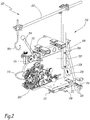
- the winding head 200 comprises a support plate 206, below which are fixed four linear guides 210, of which only two are shown in figure 2 .
- the linear guides 210 make it possible to position the winding head 200 relative to the winding table 100.
- the linear guides 210 are recirculating ball pads giving a high load capacity.
- a brake 208 is interposed between two of the pads 210.
- the brake 208 has an actuating lever.
- An arm 212 extending in the same plane as the support plate 206, carries two sleeves 214 each delimiting an oblong hole through which a pin 216 passes.
- the pin 216 makes it possible to immobilize the winding head 200 in translation with respect to to the winding table 100.
- the winding head 200 also comprises a vertical plate 202, which is perpendicular to the support plate 206 and on which are fixed all the components necessary for the winding of the toroid.
- the vertical plate 202 supports a magazine 220, the function of which is to store the quantity of wire necessary for the winding of a toroid.
- the toroidal winding machine M comprises a system 300 for feeding winding wire from a mother reel (not shown) located behind the machine M to the magazine 220.
- the mother reel is installed on a sliding tray.
- the system 300 comprises several guide components, and in particular a plate 306 delimiting an orifice 308 for passing the wire and two guide members 310 arranged between the plate 306 and a wire cutting system 312, which can be operated manually by means of a lever 314. Finally, the system 300 comprises, at the end of the chain, a roller 316 with a V-shaped groove for guiding the winding wire towards the magazine 220.
- a bracket 302 is also attached to the vertical plate 202.
- the bracket 302 is provided at its end with a hook 304 enabling one end of the winding wire to be attached when the toroid winding sequence is started.
- a counterweight system (not shown) makes it possible to maintain a certain tension at the end of the winding wire. Thanks to this system, the tension value at the end of the wire when starting the winding is repeatable over several sequences, as long as the same counterweight is used. This was not the case in the prior art, where the end of the wire had to be held in the hand by the operator during the winding operation. This repeatability makes it possible to obtain low dispersions with regard to the quality of the winding. Also, the operator's safety is preserved and the risk of accident is reduced.
- the store 220 is annular in shape, centered on an axis X220.
- the magazine 220 does not extend all the way around the axis X220, since there is a permanent opening O220 between the two ends of the magazine 220.
- the store 220 delimits a peripheral groove 222 with a U-shaped section, forming a storage volume for the winding wire.
- the magazine comprises, on one of its sides, a slot 228 in the form of a whistle and / or a hole 229, for attaching one end of the winding wire.
- a slot 228 in the form of a whistle and / or a hole 229, for attaching one end of the winding wire.
- the operator may use the slot 228 or the hole 229 to tie the wire.
- the magazine 220 defines a peripheral rim 226 intended to receive a toothed ring (not shown) and a guide profile in rotation.
- the rotational guide profile is formed by a rib 224, which extends over the entire periphery of the store 220. This is referred to as guidance from the outside.
- the section of the rib 224 is in the shape of a half-moon.
- the winding head 200 comprises a mechanism for driving the magazine 220 in rotation around the axis X220.
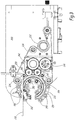
- This mechanism is represented at figure 3 especially. It comprises two drive pinions 240, intended to cooperate with the teeth of the crown of the store.
- the two pinions 240 are driven by a drive wheel 242, having complementary teeth.
- This driving wheel is connected to a first electric motor (not visible in the figures) arranged on the other side of the vertical plate 202.
- a second motor is provided. This second motor drives a toothed wheel 244 which is in mesh with the wheel 242.
- the first and the second motor are controlled in intensity.
- the second motor selectively acts as a brake.
- the first motor is said to be "master”, while the second motor is said to be “slave”.
- This arrangement allows finer regulation of the mechanical tension of the wire during winding. Indeed, it is known that electric motors exhibit at low speed, that is to say at low intensity, an operation which is not optimal. This is due in particular to phenomena of non-linearity.
- the "slave” motor therefore makes it possible to use the optimum operating range of the "master” motor in all circumstances, and in particular even when the required voltage level requires a low motor torque.
- the motorization unit of the store 220 therefore comprises two motors working in differential torque.
- the mechanical principle is based on the 80/20 rule governing the operation of engines.
- a motor has linear torque when used over 80% of its range. Between 0 to 10% and 90 to 100%, the motors present linearity problems. Therefore to have a motor as stable as possible and therefore linear, it must be used at 50% of its capacity. In our case, we want to regulate a voltage between 0 and 300 grams. This is why two engines are planned: one master and the other slave, working in differential torque to generate the tension of the wire by a delta of torque with the motorization of the cursor.
- the master motor (slider) delivers a voltage of 400 grams, the voltage being defined as the product of the slider radius, the engine torque and the motor / slider reduction ratio.
- the slave motor (magazine) will have to generate a counter-force of 220 grams or 41.5% of its scale.
- the two motors work within their comfort range, guaranteeing the most linear result possible.
- the means for guiding the magazine in rotation 220 comprise a series of rotating rollers 250, distributed over the periphery of the magazine 220.
- the rollers 250 define a groove of section complementary to that of the rib 224.
- they are each fitted around a mandrel belonging to a support ring 251, which is split.
- the winding head 200 comprises a cursor 260 for guiding the winding wire, leaving the magazine 220, around the toroid to be wound.
- the cursor 260 is provided to perform a circular path around the section of the toroid to be wound.
- the section of the toroid to be wound it is obviously the section of the torus in a half-plane of which the central axis of the torus can be considered as a generator. In other words, each point of the central axis of the torus is included in this half-plane.
- This section can be circular, oval, rectangular, etc.
- the slider 260 and the magazine 220 are made by 3D printing, in particular in titanium because the titanium has a relatively low density and a very low coefficient of ductility.
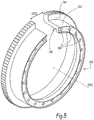
- the cursor 260 is fixed on a load wheel 262, visible in particular at the figure 5 .
- the means for fixing the slider 260 on the wheel 262 include an intermediate fixing part (not shown) and screws.
- this fixing part is optional, in the sense that the cursor 260 could be fixed directly on the wheel 262.
- the wheel 262 is centered on an axis X262 and extends over an angular sector strictly less than 360 °.
- the wheel 262 effectively delimits a permanent opening O262 between its two ends. It comprises a part 264 with teeth and a cylinder 263, intended to be engaged coaxially inside the magazine 220.
- On the side of the cylindrical part 263 are provided orifices 268 for receiving screws (not shown) for fixing the cursor 260.
- the orifices are distributed over the entire curvilinear length of the wheel 262, so as to be able to fix the cursor 260 anywhere.
- the wheel 262 and the magazine 220 each delimit a permanent opening for the passage of the torus is particularly advantageous, and this in particular when the wire breaks during winding.
- the magazine had to be unwound manually and entirely in order to be able to access the removable section and open the magazine. It was very time consuming.
- the permanent openings O220 and O262 respectively of the magazine and of the wheel, when the wire breaks, it is simply necessary, to take out the toroid, to put the openings O220 and O262 at the same level and to cut the amount of wire extending between the two ends of the store.
- the torus can then be extracted quickly by opening the concentric 3-finger forceps (described below) which carries the torus.
- the wheel 262 is guided in rotation by a series of rollers 252 arranged inside the latter.
- the rollers 252 each comprise a groove cooperating with a peripheral rib 266 formed on the internal radial surface of the cylindrical part 263.
- the rib 266 has a section in the form of a half-moon.
- the mechanism for driving the slider 260 in rotation is visible in particular at the figure 3 .
- This mechanism comprises a toothed belt 230 cooperating with the toothed part 264 of the wheel 262.
- the belt 230 is driven by a driving pulley 232.
- Return pulleys 234 are provided to guide the belt 230 as far as the toothed part 264. of the wheel 262.
- the rotating slider 260 driving mechanism is separate from the rotating magazine 220 driving mechanism, so that the magazine 220 and the slider 260 can be rotated independently of each other. This allows, among other things, to precisely adjust the voltage value during winding by modifying the speed differential between the store 220 and the slider 260, the voltage value being all the greater as the speed differential is high.
- FIG. 6 a winding head is shown according to a second embodiment of the invention.
- the elements identical or comparable to those of the first embodiment retain their numerical references, while the other elements bear other numerical references. Also, only the differences from the first embodiment are mentioned for the sake of brevity.
- the store 220 is guided in rotation from the inside and driven in rotation from the outside. It includes a guide / drive part 223, which is cylindrical centered on the X220 axis.
- This cylindrical part 223 comprises, on its internal radial surface, a peripheral rib 224, with a sectional profile which is in the example in the shape of a half-moon.
- the store 220 does not include an attached toothed wheel, in the sense that everything is in one piece (in one piece): the cylindrical part 223 has, on its outer radial surface, teeth 221 for driving in rotation.
- Wheel 262 includes a receiving strip 266 for rolling elements (not shown), such as balls or rollers.
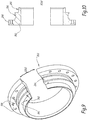
- the wheel 262 extends over an angular sector strictly less than 360 °. It delimits an opening O262 for the loading and unloading of the toroid in the center of the store 220.
- the wheel 262 defines at least one orifice 265 for screwing a toothed wheel (not visible in the figures) intended to cooperate with a toothed belt comparable to that of the first embodiment.
- the toothed wheel is intended to be mounted on a cylindrical rim 261 of the wheel 262.
- This third embodiment relates to the components used for guiding the magazine 220 and the carrying wheel 262 of the slider 260, the objective being to provide optimum means of guiding in rotation, despite the presence of the zones of 'permanent opening provided in the store 220 and in the carrier wheel 262.
- the idea is to ensure guiding of the parts both from the inside and from the outside.
- This principle has a name: it is feedback guidance.
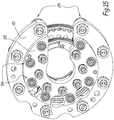
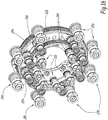
- the means for guiding the magazine in rotation include so-called “outer” rollers 250, which are advantageously eight in number and which are distributed over the periphery around the magazine, and so-called “inner” rollers 254, which are also provided in number of eight and which are distributed on the interior perimeter of the store.
- rollers 254 also form part of the means for guiding in rotation the wheel 262 carrying the slider 260.
- These means also include rollers 256, called “internal” rollers, which are advantageously 8 in number and which are distributed over the perimeter. inside of load wheel 262.
- rollers 254 and 256 are supported by the same flange 255, also having a permanent opening, comparable to the openings O220 and O262.
- each roller is mounted on an eccentric. This means that each roller can be moved radially over a certain stroke and therefore that the guide diameter of the rollers is adjustable.
- winding table 100 is also clearly distinguished from the state of the art.
- the winding table comprises a system of polyurethane rollers, which have both a rotary drive function and a guide function.
- Each roller is mounted on a vertical cylinder, which is fixed to one end of an articulated connecting rod.
- each roller defines a peripheral C-shaped groove to receive the torus.
- the position of the rollers is adjustable in height. Only two of the three rollers are mounted on motorized cylinders, that is to say rotating.
- the third roller which therefore has a guiding function only, has an additional degree of freedom, which is a displacement in translation.
- This third roller acts as a pressure roller. It is moved during the stages of loading the bare toroid and unloading the wound toroid.
- a major drawback of this winding table lies in the difficulty in maintaining the concentricity (or coaxiality) during a change in toroid diameter.
- this operation is carried out manually by moving the rollers one by one and can take up to several hours, for a result often approximate.
- the centering dispersions of the toroids lead to disparities in the quality of the winding, that is to say the toroids with a variable winding pitch from one toroid to another.
- the winding table 100 belonging to the toroidal winding machine M, comprises means 110 for supporting and guiding the toroid T in rotation and means 120, 120 'for driving the toroid T in rotation which are distinct from the means guide 110.
- the support and guide means 110 are formed by a concentric gripping clamp. This clamp is supported by feet 104 extending from the support 102.
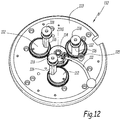
- the concentric gripper 110 comprises three rollers 118 arranged so that each roller 118 remains permanently equidistant from the other two rollers and from a central axis Z110. It is commonly referred to as a "concentric three finger clamp”.
- each roller 118 is mounted on a cylinder 116 fixed eccentrically on a rotary pinion 112.
- Each roller 118 comprises a hollow part substantially V-shaped to receive the torus T. This hollow part, which extends, at the bottom.
- This symmetrical groove profile makes it possible to automatically center the torus T inside the concentric clamp 110, and therefore to prevent the torus from positioning itself crosswise between the three rollers 118.
- all the rotary pinions 112 are meshed with a central pinion 114, movable around the axis Z110.
- the Z110 axis coincides with the central axis of the toroid when the toroid is positioned inside the clamp.
- the rotation of the central pinion 114 causes the rotation of each pinion 112, and therefore the movement of the rollers 118 relative to each other.
- the construction of this clamp 110 is such that the rollers 118 automatically remain equidistant from each other when the central pinion 114 is turned.
- a lever 111 allows the central pinion 114 to be pivoted to more or less open the clamp. .
- the three rollers 118 are movable between a minimum open position and a maximum open position and are returned to the open position. minimum thanks to a counterweight system (not shown) acting on the central pinion 114.
- a closing stopper 115 is provided to limit the closing of the clamp 110. Otherwise, the stopper 115 defines a minimum opening (or maximum closing) configuration, in which the rollers 118 are placed as close as possible to central axis Z110.
- the counterweight system comprises a cable (not shown), preferably made of steel, which is wound around the central pinion 114 and which is guided around one or more return pulleys (not shown) so as to be attached to a pig (not shown) serving as a counterweight.
- This counterweight has the advantage of generating equivalent radial forces at the level of the three rollers 118 throughout the winding cycle.
- the pig is formed by a threaded rod comprising a hook for attaching to the cable and by at least one weight screwed around the rod.
- the mass of the pig is advantageously adjusted during the winding cycle so as to open the clamp 110 and compensate for the increase in the cross section of the torus (due to the winding of the winding wire).
- the weight is adjusted by adding steel plates calibrated at 50g unit or 1kg unit.
- the means for driving the torus T in rotation comprise at least two clamps 120 and 120 ', the two clamps 120 and 120' being movable in rotation in a respective angular sector defined between two rollers 118, so as to be able to grip and moving in turn the torus to be wound T over a stroke proportional to the angular spacing between two rollers.
- the clamps 120 and 120 ' can be qualified as "perimeter clamps”.
- Each of the grippers 120 and 120 ' is driven in rotation around an axis Z120 by an independent pulley-belt system, part of which is visible at the figure 11 .
- the axis of rotation Z120 of the clamps 120 and 120 ' coincides with the central axis Z110 of the three-finger clamp, and with the axis of the torus when the latter is positioned inside the clamp 110.
- the axis of rotation of the torus T coincides with the Z110 and Z120 axes.
- the gripper drive system 120 includes an electric motor 140, a pulley 141, and a toothed belt 142.
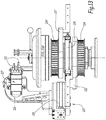
- the motor 140 drives the pulley 141 and the pulley 142, which is driving, transmits a mechanical torque to a driven pulley 124 (visible at figure 13 ) via the toothed belt 142.
- the gripper 120 ′ has its own drive system, which is substantially identical to that of the gripper 120. It comprises an electric motor 140 ′, a driving pulley 141 'and a toothed belt 142'. Motor 140 'transmits torque to pulley 141', which is transmitted to a driven pulley 124 'via belt 142'. The axis of rotation of the pulleys 124 and 124 'coincides with the axis Z120.
- An epicyclic reduction gear and a roller bearing are arranged at the output of each motor 140 and 140 'so as to absorb the radial forces (centrifugal forces).
- the gripper 120 comprises what is called a racket 122, which is integral in rotation with the pulley 124.
- the racket 122 supports a linear actuator 128, of the electric jack type, comprising a fixed part and a movable part.
- the movable part of the jack can be moved in a radial direction with respect to the axis Z120.
- a gooseneck-shaped part 126 is mounted on the movable part of the linear actuator 128.
- This gooseneck part 126 carries an electric gripper with parallel jaws equipped with two jaws 121 adapted to the geometry of the torus to be wound T
- the jaws 121 are parallel and are movable towards each other, so as to be able to grip tori of different sizes.
- a micrometric table 127 serving as a mechanical interface between the gooseneck-shaped part 126 and the jaws 121, makes it possible to adjust the height position of the jaws 121.
- the winding table includes a system for controlling the angular position of the toroid during the winding operation.
- This system comprises in the example a measuring means in the form of an incremental rotary encoder 125, which is advantageously mounted directly around the central shaft (not shown) integral with the rackets 122 and 122 '.
- the encoder is interposed between the rackets 122 and 122 ′ to guarantee the highest level of precision.
- the movement of the grippers 120 and 120 ′ is controlled by a dedicated processor, capable of managing the angular displacement of the grippers (starting position, end-of-stroke position, angular speed, etc.) and the opening and closing sequences of the grippers. bites 121.
- the section of the toroid to be wound is advantageously positioned in the center of the magazine 220.
- the winding table 200 therefore comprises two rails 130, which are profiled rails with recirculating balls and high load capacity. These rails 130 are configured for guiding the pads 210 of the winding head 200.
- the depth adjustment means 130 are configured to move the winding head 100 in a plane radial to the axis Z120 or Z110 of rotation of the torus T. This has the advantage that the wire is deposited in this same radial plane, and therefore that the turns are well parallel to each other.
- the fact of being able to move back the winding head 200 relative to the winding table 100 also makes it possible to intervene more easily on the components of the head 200 during maintenance operations and also when certain adjustments have to be made. mechanical.
- the machine M is designed for winding three toroids of different diameters. Alternatively, this could be designed for a larger diameter number.
- the winding table 100 includes an indexing device 132, visible only at the figure 11 , and making it possible to ensure precise positioning of the winding head 200 in three positions. This indexing device 132 delimits three housing for positioning the pin 216. Locking the pin 216 in one of the three housings determines the axial position of the winding head 200 along the rails 130.
- the indexing device 132 is provided with pin detection sensors. There is a detection sensor for each housing. These sensors provide feedback on the position of the winding head 200 with respect to the table 100 which has been selected.
- the winding of a toroid is performed as follows.
- Magazine 220 is advanced until the center of magazine 220 is positioned precisely around a section of the torus.
- a torus (bare) to be wound is positioned inside the concentric clamp 110, and in particular between the three rollers 118 of the clamp. For this, the operator can move the winding head along the rails 130, until reaching the position corresponding to the diameter of the selected torus.
- the store 220 is then loaded with the quantity of wire necessary for winding the toroid.
- the winding wire is pulled using the system 300 from a mother coil, in particular a coil of copper wire.
- One end of the winding wire is then attached to the magazine, eg, hole 229 or whistle-shaped slot 228, and the magazine is rotated.
- the number of turns made by the store can advantageously be programmed as a function of the diameter of the toroid to be wound. It can also be calculated with respect to the number of turns to be wound.
- the winding wire is stored in the U-shaped groove 222. As soon as the quantity of wire necessary for winding has been loaded, the rotation of the magazine 220 is interrupted and the operator cuts the wire, in particular thanks to the wire cutting system 312. The loading phase is finished.
- the operator passes the wire through the guide channel of the cursor, then he performs a few dead turns around an element of the toroid to be wound, this element possibly being a spindle (not shown) or a section of the toroid.
- the wire is introduced inside the wire guide system 218 and the end of the wire is hooked to the hook 304 of the hanger system 302.
- a ballast (not shown) is assembled on the system 302 so as to put the weight. winding wire under tension. In the absence of a spindle, the starting wire is kept taut towards the rear of the machine. Winding starts and after about ten turns, the operator can bring the wire back to the hanger hook and attach the counterweight to it.
- the winding process can then begin.
- the operator programs the characteristics related to the winding sequence, such as the desired voltage level, the winding pitch, etc.
- the slider is rotated around the section of the toroid to be wound and pulls the wire stored inside the magazine.
- the magazine is then also driven in rotation by the consumption of yarn produced, but at a slower speed.
- the rotation of the cursor gradually causes the winding of the copper wire around the section of the toroid to be wound.
- the torus In parallel, the torus is moved in rotation around its axis, in a manner synchronized with the rotation of the cursor.
- the clamps 120 and 120 ′ take turns to grasp the torus to move it in rotation over an angular sector corresponding substantially to the angle between two rollers 118, ie 120 °.
- the stroke of the grippers 120 and 120 ' is all the greater as the diameter of the torus is high.
- One or more layers of wires can be applied around the torus.
- the torus can make a complete revolution.
- a programmed segment can correspond to a layer or a part of the layer (it may be necessary to break down a layer into several segments when, for example, we want to generate a different winding density on the beginning or the end of the layer, that is, that is, very locally).
- Each segment is defined by the direction of rotation of the torus, the winding pitch used, the number of turns, speed, acceleration (and deceleration), winding voltage and a stop (machine stop), for example at the end of the segment.
- the parameters of each segment can therefore be modified as desired, which offers a certain programming flexibility.
- the toothed belt 230 is replaced by one or more drive pinions.
- the slider driving mechanism 260 could include two small pinions, each interposed between two rollers 254. A removable engine block could then be used to drive the pinions.
- the number of rollers of the concentric clamp 110 may be greater than 3.
Landscapes
- Engineering & Computer Science (AREA)
- Power Engineering (AREA)
- Manufacturing & Machinery (AREA)
- Physics & Mathematics (AREA)
- General Physics & Mathematics (AREA)
- Storage Of Web-Like Or Filamentary Materials (AREA)
- Manufacturing Cores, Coils, And Magnets (AREA)
- Winding Filamentary Materials (AREA)
Description
- La présente invention concerne une tête de bobinage pour une machine de bobinage toroïdal. Une telle machine permet notamment la réalisation de tores bobinés pour l'obtention de capteurs de courant à haut niveau de précision.
- De manière connue, une machine de bobinage toroïdal comprend une table de bobinage et une tête de bobinage. La table de bobinage supporte le tore à bobiner. Elle comprend des moyens pour entrainer le tore en rotation autour de son axe. La tête de bobinage est l'organe de la machine permettant de bobiner le tore, c'est-à-dire d'enrouler un fil de cuivre sur toute la circonférence du tore.
- Dans ce domaine, la société RUFF GmbH exploite notamment une machine de dénomination « RWE Evolution ». La tête de bobinage de cette machine comprend ce qu'on appelle un magasin, qui est une pièce annulaire utilisée pour stocker la quantité de fil nécessaire au bobinage du tore. Notamment, le fil est enroulé à l'intérieur d'une gorge périphérique du magasin. Dans cet exemple, le magasin comprend un tronçon amovible pour permettre le passage du tore.
- La tête de bobinage comprend également ce qu'on appelle un curseur, qui est une pièce rapportée sur un flanc du magasin et qui possède deux fonctions. La première fonction du curseur est de guider le fil de bobinage, en sortie du magasin, autour du tore à bobiner. A cet effet, Le curseur comporte une rainure pour le passage du fil de bobinage. L'autre fonction du curseur est de mettre le fil de bobinage en tension. Dans cet exemple, le magasin et le curseur sont liés l'un à l'autre par une liaison en queue d'aronde : le curseur comprend un tenon en forme de trapèze, qui est engagé à l'intérieur d'une rainure périphérique correspondante formée sur un flanc du magasin. Le curseur comprend par ailleurs une corde, du type corde à piano, qui génère par frottement à l'intérieur de la rainure un couple de trainée permanent.
- Le fonctionnement de cette machine est le suivant. D'abord, le tronçon amovible du magasin est retiré de façon à pouvoir positionner la section du tore à bobiner globalement au centre du magasin. Puis, le tronçon est remis en place. Ensuite, une extrémité du fil est attachée au magasin et le magasin est mis en rotation, de façon à enrouler la quantité de fil de bobinage nécessaire au bobinage du tore. On parle d'une phase de chargement du magasin. Une fois cette opération de chargement effectuée, le fil est coupé. L'extrémité libre du fil est passée autour d'un élément du tore, tel qu'une broche ou un segment du tore en exécutant quelques tours morts puis est immobilisée grâce à un système de suspente. Le bobinage peut alors commencer. Pour cela, le magasin est mis en rotation, ce qui a pour effet de mettre le fil sous tension. La tension du fil entraine le déplacement du curseur le long du magasin, et donc autour de la section du tore à bobiner. Le tore est entrainé en rotation de façon synchronisée, de manière à obtenir un bobinage sur toute la circonférence. Le fil est maintenu en tension pendant toute l'opération de bobinage grâce aux frottements de la corde à piano qui freine le déplacement du curseur.
- Cette machine présente plusieurs inconvénients. Premièrement, le magasin et le curseur s'usent rapidement du fait des frottements occasionnés par la liaison en queue d'aronde et doivent donc être remplacés fréquemment. Cela nécessite également un rodage du nouveau couple magasin/curseur (générant ainsi un appairage forcé) puis la reprise des programmes de bobinage pour s'adapter aux nouvelles conditions mécaniques de la machine. En outre, le déplacement du curseur le long du magasin génère de la poussière. Ainsi, l'entretien de la machine (nettoyage et remplacement des pièces d'usure) est relativement couteux.
- Deuxièmement, la tension du fil pendant l'opération de bobinage ne peut pas être contrôlée. Effectivement, la valeur de tension est imposée par les caractéristiques de l'assemblage entre le magasin et le curseur, et notamment par les efforts de frottement entre le curseur et le magasin. Il n'est donc pas possible d'ajuster la valeur de tension en fonction du diamètre du fil à bobiner par exemple. Troisièmement, les curseurs étant des pièces façonnées manuellement, leurs dimensions et leur forme sont variables d'une pièce à l'autre. Cela entraine des dispersions au niveau de la valeur de tension du fil de bobinage, et donc une mauvaise répétabilité. La qualité de bobinage, c'est-à-dire la régularité de la dépose des spires (le pas), est, elle aussi, variable.
-
US 802 359 divulgue une tête de bobinage pour une machine de bobinage toroïdal, comprenant un magasin annulaire et un curseur en forme de poulie. Le curseur fait partie d'un anneau. Le magasin et l'anneau sont montés côte à côte, de façon à pouvoir tourner indépendamment l'un de l'autre. -
US 302 627 divulgue une tête de bobinage pour une machine de bobinage toroïdal. La tête de bobinage comprend un magasin annulaire et un curseur, formé par des poulies. Ces poulies sont montées respectivement autour d'axes fixés à un anneau monté à l'intérieur d'un flasque, et entrainé en rotation grâce à un pignon. Le magasin est également solidaire de l'anneau. Il n'y a pas de moyens d'entrainement indépendants pour le curseur et le magasin, et le curseur n'est pas fixé sur un flanc d'une roue montée coaxialement à l'intérieur du magasin. - C'est à ces inconvénients qu'entend plus particulièrement remédier l'invention en proposant une machine de bobinage permettant de contrôler la valeur de tension du fil de bobinage et avec un coût d'entretien moindre.
- L'invention concerne une machine de bobinage toroïdal telle que définie dans la revendication 1.
- Grâce à l'invention, la valeur de tension du fil de bobinage peut être contrôlée en ajustant la vitesse du curseur par rapport à celle du magasin. La même valeur de tension peut alors être utilisée pour chaque tore d'une série (caractère répétable), si bien que tous les tores bobinés présentent la même régularité en ce qui concerne le positionnement des spires et donc la même qualité de bobinage.
- De plus, le curseur et le magasin sont indépendant mécaniquement l'un de l'autre et ne frottent plus l'un contre l'autre pendant l'opération de bobinage. Ainsi, le magasin et le curseur ne s'usent pas, ou quasiment pas et il n'est pas nécessaire de les remplacer périodiquement.
- Egalement, la tension de bobinage peut être changée pendant le cycle. Cela est notamment bénéfique lorsque le tore comporte plusieurs couches de fil. Effectivement, des développements ont montré que la tension du fil de la deuxième couche doit de préférence être plus faible que celle de la première couche, de façon à limiter l'impact du dépôt de la deuxième couche sur la première couche, et donc de l'imbrication des spires.
- Selon des aspects avantageux, mais non obligatoires de l'invention, une telle machine peut incorporer une ou plusieurs des caractéristiques, prises dans toute combinaison techniquement admissible, définies dans les revendications 2 à 7.
- L'invention concerne enfin un procédé de bobinage d'un tore au moyen d'une machine telle que définie précédemment, le procédé comprenant des étapes telles que définies à la revendication 8.
- L'invention et d'autres avantages de celle-ci apparaitront plus clairement à la lumière de la description qui va suivre de trois modes de réalisation d'une tête de bobinage conforme à son principe, donnée uniquement à titre d'exemple et faite en référence aux dessins annexés dans lesquels :
- la
figure 1 est une vue en perspective d'une machine de bobinage toroïdal, comprenant une tête de bobinage conforme à l'invention, - la
figure 2 est une vue en perspective de la tête de bobinage représentée seule, - la
figure 3 est une vue partielle et de côté de la tête de bobinage de lafigure 2 , - la
figure 4 est une vue en perspective d'un magasin appartenant à la tête de bobinage desfigures 2 et3 , - la
figure 5 est une vue en perspective d'une roue de fixation d'un curseur appartenant à la tête de bobinage desfigures 2 et3 , - la
figure 6 est une vue en perspective d'un second mode de réalisation d'une tête de bobinage conforme à l'invention, - la
figure 7 est une vue en coupe d'un magasin appartenant à la tête de bobinage de lafigure 6 , - la
figure 8 est une vue à plus grande échelle de l'encerclé VIII de lafigure 7 , - la
figure 9 est une vue en perspective d'une roue pour la fixation du curseur appartenant à la tête de bobinage de lafigure 6 , - la
figure 10 est une vue en coupe de la roue de lafigure 9 , - la
figure 11 est une vue en perspective de la table de bobinage de la machine de bobinage toroïdale de lafigure 1 , - la
figure 12 est une vue en perspective d'une pince concentrique appartenant à la table de bobinage de lafigure 11 , - la
figure 13 est une vue de côté montrant notamment une pince de préhension d'un tore à bobiner, - la
figure 14 est une vue en perspective d'une tête de bobinage conforme à un troisième mode de réalisation de l'invention, et - les
figures 15 et16 sont des vues de côté d'un ensemble magasin-curseur appartenant à la tête de bobinage de lafigure 14 . - La
figure 1 représente une machine de bobinage toroïdal M, permettant la réalisation de tores bobinés destinés à la confection de capteurs de mesure de courant. Un tore bobiné comprend un support de forme torique et un bobinage en fil conducteur, notamment en fil de cuivre, qui est enroulé autour du support. Pour la réalisation d'un tel tore bobiné, le support doit être entrainé en rotation autour de son axe de façon à enrouler du fil de bobinage sur toute sa circonférence. - La machine M comprend une table de bobinage 100 pour supporter et mettre en rotation un support torique T autour de son axe et une tête de bobinage 200 pour effectuer l'opération de bobinage à strictement parler. La table de bobinage 100 comprend un support incliné 102.
- Comme visible à la
figure 2 , la tête de bobinage 200 comprend une plaque support 206, en dessous de laquelle sont fixés quatre guides linéaires 210, dont seulement deux sont représentés à lafigure 2 . Les guides linéaires 210 permettent de positionner la tête de bobinage 200 par rapport à la table de bobinage 100. Dans l'exemple, les guides linéaires 210 sont des patins à recirculation de billes conférant une forte capacité de charge. - Un frein 208 est interposé entre deux des patins 210. Le frein 208 dispose d'un levier d'actionnement.
- Un bras 212, s'étendant dans le même plan que la plaque support 206, porte deux manchons 214 délimitant chacun un trou oblong de passage d'une goupille 216. La goupille 216 permet d'immobiliser en translation la tête de bobinage 200 par rapport à la table de bobinage 100.
- La tête de bobinage 200 comprend également une plaque verticale 202, qui est perpendiculaire à la plaque support 206 et sur laquelle sont fixés tous les composants nécessaires au bobinage du tore. Notamment, la plaque verticale 202 supporte un magasin 220, dont la fonction est de stocker la quantité de fil nécessaire au bobinage d'un tore.
- La machine de bobinage toroïdal M comprend un système 300 pour amener du fil de bobinage à partir d'une bobine mère (non représentée) située derrière la machine M jusqu'au magasin 220. Dans l'exemple, la bobine mère est installée sur un plateau coulissant.
- Le système 300 comprend plusieurs composants de guidage, et notamment une plaque 306 délimitant un orifice 308 de passage du fil et deux organes de guidage 310 disposés entre la plaque 306 et un système coupe-fil 312, lequel pouvant être actionné manuellement au moyen d'un levier 314. Enfin, le système 300 comprend, à la fin de la chaîne, une roulette 316 avec une gorge en V pour le guidage du fil de bobinage vers le magasin 220.
- Une potence 302 est également fixée à la plaque verticale 202. La potence 302 est munie à son extrémité d'un crochet 304 permettant d'attacher une extrémité du fil de bobinage lors du démarrage de la séquence de bobinage du tore. Un système de contrepoids (non représenté) permet de conserver une certaine tension à l'extrémité du fil de bobinage. Grâce à ce système, la valeur de tension à l'extrémité du fil lors du démarrage du bobinage est répétable sur plusieurs séquences, dans la mesure où le même contrepoids est utilisé. Ce n'était pas le cas dans l'art antérieur, où l'extrémité du fil devait être tenue à la main par l'opérateur pendant l'opération de bobinage. Cette répétabilité permet d'obtenir de faibles dispersions en ce qui concerne la qualité de bobinage. Egalement, la sécurité de l'opérateur est préservée et le risque d'accident est réduit.
- Comme visible à la
figure 4 , le magasin 220 est de forme annulaire, centrée sur un axe X220. Le magasin 220 ne s'étend pas sur toute la périphérie autour de l'axe X220, puisqu'il y a une ouverture permanente O220 entre les deux extrémités du magasin 220. - Le magasin 220 délimite une gorge périphérique 222 à section en U, formant un volume de stockage du fil de bobinage.
- Le magasin comprend, sur l'un de ses flancs, une fente 228 en forme de sifflet et/ou un trou 229, pour attacher une extrémité du fil de bobinage. En fonction de la section du fil de bobinage utilisée et de la dextérité de l'opérateur, celui-ci pourra utiliser la fente 228 ou le trou 229 pour attacher le fil.
- Le magasin 220 délimite un rebord périphérique 226 destiné à recevoir une couronne dentée (non représentée) et un profil de guidage en rotation. Le profil de guidage en rotation est formé par une nervure 224, qui s'étend sur tout le pourtour du magasin 220. On parle d'un guidage par l'extérieur. Avantageusement, la section de la nervure 224 est en forme de demi-lune.
- La tête de bobinage 200 comprend un mécanisme pour entrainer le magasin 220 en rotation autour de l'axe X220. Ce mécanisme est représenté à la
figure 3 notamment. Il comprend deux pignons d'entraînement 240, destinés à coopérer avec les dentures de la couronne du magasin. Les deux pignons 240 sont entrainés par une roue motrice 242, disposant d'une denture complémentaire. Cette roue motrice est reliée à un premier moteur électrique (non visible sur les figures) disposé de l'autre côté de la plaque verticale 202. Un second moteur est prévu. Ce second moteur entraîne une roue dentée 244 qui est en engrenage avec la roue 242. Le premier et le second moteur sont pilotés en intensité. - Le second moteur agit sélectivement comme un frein. On parle d'un système maitre-esclave. Le premier moteur est dit « maitre », alors que le second moteur est dit « esclave ». Cet agencement permet une régulation plus fine de la tension mécanique du fil pendant le bobinage. Effectivement, il est connu que les moteurs électriques présentent à bas régime, c'est à dire à basse intensité, un fonctionnement qui n'est pas optimal. Ceci est dû notamment à des phénomènes de non-linéarité. Le moteur « esclave » permet donc de pouvoir utiliser la plage de fonctionnement optimale du moteur « maitre » en toutes circonstances, et notamment même lorsque le niveau de tension requis nécessite un faible couple moteur. Le bloc motorisation du magasin 220 comprend donc deux moteurs travaillant en couple différentiel. Le principe mécanique s'appuie sur la règle des 80/20 régissant le fonctionnement des moteurs. Un moteur a un couple linéaire quand on l'utilise sur 80% de sa plage. Entre 0 à 10% et 90 à 100%, les moteurs présentent des problématiques de linéarité. Par conséquent pour avoir un moteur le plus stable possible et donc linéaire, il faut l'utiliser à 50% de ses capacités. Dans notre cas, on souhaite réguler une tension entre 0 et 300 grammes. C'est pourquoi deux moteurs sont prévus : l'un maître et l'autre esclave, travaillant en couple différentiel pour générer la tension du fil par un delta de couple avec la motorisation du curseur.
- Par exemple, à 75% de son échelle de fonctionnement, le moteur maître (curseur) délivre une tension de 400 grammes, la tension étant définie comme le produit du rayon du curseur, du couple moteur et du rapport de réduction moteur/curseur. Supposons que la tension souhaitée pendant le bobinage est de 180 grammes, alors le moteur esclave (magasin) devra générer un contre-effort de 220 grammes soit 41,5% de son échelle. De ce fait, les deux moteurs travaillent dans leur plage de confort garantissant un résultat le plus linéaire possible.
- Comme visible à la
figure 3 , les moyens de guidage en rotation du magasin 220 comprennent une série de galets rotatifs 250, répartis sur la périphérie du magasin 220. Avantageusement, les galets 250 délimitent une gorge de section complémentaire à celle de la nervure 224. Dans l'exemple, ils sont emmanchés chacun autour d'un mandrin appartenant à une bague de support 251, qui est fendue. - Comme visible à la
figure 3 , la tête de bobinage 200 comprend un curseur 260 pour guider le fil de bobinage, en sortie du magasin 220, autour du tore à bobiner. Le curseur 260 est prévu pour effectuer une trajectoire circulaire autour de la section du tore à bobiner. Dans le présent document, lorsque l'on évoque la section du tore à bobiner, il s'agit évidemment de la section du tore dans un demi-plan dont l'axe central du tore peut être considéré comme une génératrice. En d'autres termes, chaque point de l'axe central du tore est inclus dans ce demi-plan. Cette section peut être circulaire, ovale, rectangulaire, etc. - De préférence, le curseur 260 et le magasin 220 sont fabriqués en impression 3D, notamment en titane car le titane présente une masse volumique relativement faible et un coefficient de ductilité très bas.
- Le curseur 260 est fixé sur une roue porteuse 262, visible en particulier à la
figure 5 . Dans l'exemple, les moyens de fixation du curseur 260 sur la roue 262 incluent une pièce de fixation intermédiaire (non représentée) et des vis. Toutefois, cette pièce de fixation est optionnelle, dans le sens où le curseur 260 pourrait être fixé directement sur la roue 262. - Comme visible à la
figure 5 , la roue 262 est centrée sur un axe X262 et s'étend sur un secteur angulaire strictement inférieur à 360°. La roue 262 délimite effectivement une ouverture permanente O262 entre ses deux extrémités. Elle comprend une partie 264 à dentures et un cylindre 263, destiné à être engagé coaxialement à l'intérieur du magasin 220. Sur le flanc de la partie cylindrique 263 sont prévus des orifices 268 de réception de vis (non représentées) pour la fixation du curseur 260. Les orifices sont répartis sur toute la longueur curviligne de la roue 262, de façon à pouvoir fixer le curseur 260 n'importe où. - Le fait que la roue 262 et le magasin 220 délimitent chacun une ouverture permanente pour le passage du tore est particulièrement avantageux, et ce notamment lorsque le fil casse pendant le bobinage. Effectivement, avec les machines de l'art antérieur, et notamment avec la machine RWE Evolution de RUFF GmbH, en cas de casse de fil, il fallait débobiner manuellement et entièrement le magasin pour pouvoir accéder au tronçon amovible et ouvrir le magasin. Cela était très chronophage. Grâce aux ouvertures permanentes O220 et O262, respectivement du magasin et de la roue, lorsque le fil casse, il convient simplement, pour sortir le tore, de mettre les ouvertures O220 et O262 au même niveau et de couper la quantité de fil s'étendant entre les deux extrémités du magasin. Le tore peut alors être extrait rapidement en ouvrant la pince 3 doigts concentrique (décrite ci-après) qui porte le tore.
- Egalement, à cause du jeu mécanique dans la liaison, le tronçon amovible de la machine RWE Evolution provoquait des vibrations lors du passage du curseur. De plus, le tronçon du magasin était parfois mal fermé par l'opérateur, ce qui pouvait entrainer des ouvertures intempestives pendant le cycle de bobinage. Enfin, le fonctionnement de la machine sans ce tronçon amovible était impossible du fait de l'entrainement en rotation du curseur au contact direct du magasin (le curseur était monté sur le magasin). Tous ces problèmes ont été résolus dans l'invention, qui n'utilise pas un tel tronçon de magasin amovible.
- Comme visible à la
figure 3 , la roue 262 est guidée en rotation par une série de galets 252 disposés à l'intérieur de celle-ci. On parle d'un guidage par l'intérieur. Les galets 252 comprennent chacun une gorge coopérant avec une nervure périphérique 266 ménagée sur la surface radiale interne de la partie cylindrique 263. Avantageusement, la nervure 266 présente une section en forme de demi-lune. - Le mécanisme d'entrainement du curseur 260 en rotation est visible notamment à la
figure 3 . Ce mécanisme comprend une courroie crantée 230 coopérant avec la partie à dentures 264 de la roue 262. La courroie 230 est entrainée par une poulie motrice 232. Des poulies de renvoi 234 sont prévues pour guider la courroie 230 jusqu'à la partie à dentures 264 de la roue 262. - Le mécanisme d'entrainement du curseur 260 en rotation est distinct du mécanisme d'entrainement du magasin 220 en rotation, de façon que le magasin 220 et le curseur 260 peuvent être entrainés en rotation indépendamment l'un de l'autre. Cela permet, entre autres, d'ajuster précisément la valeur de tension pendant le bobinage en modifiant le différentiel de vitesse entre le magasin 220 et le curseur 260, la valeur de tension étant d'autant plus grande que le différentiel de vitesse est élevée.
- Sur la
figure 6 est représentée une tête de bobinage selon un second mode de réalisation de l'invention. Dans ce qui suit, les éléments identiques ou comparables à ceux du premier mode de réalisation conservent leurs références numériques, alors que les autres éléments portent d'autres références numériques. Egalement, seules les différences par rapport au premier mode de réalisation sont mentionnées par souci de concision. - Dans le second mode de réalisation, et comme visible aux
figures 7 et 8 , le magasin 220 est guidé en rotation par l'intérieur et entrainé en rotation par l'extérieur. Il comprend une partie de guidage/d'entrainement 223, qui est cylindrique centrée sur l'axe X220. Cette partie cylindrique 223 comporte, sur sa surface radiale interne, une nervure périphérique 224, avec un profil en section qui est dans l'exemple en forme de demi-lune. Le magasin 220 ne comprend pas de roue dentée rapportée, dans le sens où tout est d'un seul tenant (monobloc) : la partie cylindrique 223 comporte, sur sa surface radiale externe, des dentures 221 pour l'entrainement en rotation. - Dans ce mode de réalisation, le guidage en rotation est effectué par l'extérieur, au moyen d'un roulement (non représenté). La roue 262 comprend une bande 266 de réception pour des éléments roulants (non représentés), tels que des billes ou des rouleaux. La roue 262 s'étend sur un secteur angulaire strictement inférieur à 360°. Elle délimite une ouverture O262 pour le chargement et déchargement du tore au centre du magasin 220.
- Sur le flanc, la roue 262 délimite au moins un orifice 265 pour le vissage d'une roue crantée (non visible sur les figures) destinée à coopérer avec une courroie crantée comparable à celle du premier mode de réalisation. Notamment, la roue crantée est destinée à être montée sur un rebord cylindrique 261 de la roue 262.
- Sur les
figures 14 à 16 est représenté un troisième et dernier mode de réalisation d'une tête de bobinage 200. Dans ce qui suit, seules les différences par rapport aux modes de réalisation précédents sont mentionnées. Les éléments comparables ou identiques conservent les mêmes références numériques, de nouvelles références numériques étant utilisées pour les autres. - La spécificité de ce troisième mode de réalisation concerne les composants utilisés pour le guidage du magasin 220 et de la roue porteuse 262 du curseur 260, l'objectif étant de proposer des moyens de guidage en rotation optimaux, et ce malgré la présence des zones d'ouverture permanente ménagées dans le magasin 220 et dans la roue porteuse 262.
- En particulier, l'idée est d'assurer un guidage des pièces à la fois par l'intérieur et par l'extérieur. Ce principe porte un nom : il s'agit du guidage par contre-réaction.
- Comme visible à la
figure 16 , les moyens de guidage en rotation du magasin incluent des galets 250 dit « extérieurs », qui sont avantageusement au nombre de huit et qui sont répartis sur la périphérie autour du magasin, et des galets 254 dits « intérieurs », qui sont également prévus au nombre de huit et qui sont répartis sur le périmètre intérieur du magasin. - Ici, les galets 254 font également partie des moyens de guidage en rotation de la roue 262 porteuse du curseur 260. Ces moyens incluent également des galets 256, dits « intérieurs », qui sont avantageusement au nombre de 8 et qui sont répartis sur le périmètre intérieur de la roue porteuse 262.
- De préférence, les galets 254 et 256 sont supportés par un même flasque 255, présentant également une ouverture permanente, comparable aux ouvertures O220 et O262.
- Avantageusement, chaque galet est monté sur excentrique. Cela signifie que chaque galet peut être déplacé radialement sur une certaine course et donc que le diamètre de guidage des galets est réglable.
- Indépendamment de ce qui précède, la table de bobinage 100 se distingue également clairement de l'état de l'art.
- Dans l'art antérieur, et notamment dans la machine RWE Evolution de RUFF GmbH, la table de bobinage comprend un système de galets en polyuréthane, qui ont à la fois une fonction d'entrainement en rotation et une fonction de guidage. Dans cet exemple, les galets sont au nombre de trois. Chaque galet est monté sur un cylindre vertical, lequel est fixé à une extrémité d'une bielle articulée. De plus, chaque galet délimite une gorge périphérique en forme de C pour recevoir le tore. La position des galets est réglable en hauteur. Deux galets seulement sur les trois sont montés sur des cylindres motorisés, c'est-à-dire rotatifs. Le troisième galet, qui a donc une fonction de guidage uniquement, possède un degré de liberté supplémentaire, qui est un déplacement en translation. Ce troisième galet fait office de galet presseur. Il est déplacé lors des étapes de chargement du tore nu et de déchargement du tore bobiné.
- Un inconvénient majeur de cette table de bobinage réside dans la difficulté à conserver la concentricité (ou coaxialité) lors d'un changement de diamètre de tore. En d'autres termes, il est difficile, lorsque l'on souhaite charger un tore plus grand ou plus petit que le tore précédent, de centrer le nouveau tore sur le même point que le tore précédent. Effectivement, cette opération est effectuée manuellement en déplaçant un à un les galets et peut prendre jusqu'à plusieurs heures, pour un résultat souvent approximatif. En outre, les dispersions de centrage des tores entrainent des disparités au niveau de la qualité de bobinage, c'est-à-dire des tores avec un pas de bobinage variable d'un tore à l'autre.
- De tels problèmes ne se retrouvent pas dans la table de bobinage 100 de la machine de bobinage toroïdal M selon l'invention. Cette dernière permet de positionner le tore T plus facilement, notamment en cas de changement de diamètre et assure que chaque tore bobiné par la machine est centré à l'identique. Cette régularité en termes de centrage permet d'obtenir une qualité de bobinage équivalente pour plusieurs diamètres de tore, c'est-à-dire une bonne répétabilité de bobinage.
- Effectivement, comme visible à la
figure 11 , la table de bobinage 100, appartenant à la machine de bobinage toroïdal M, comprend des moyens 110 de support et de guidage en rotation du tore T et des moyens 120, 120' d'entrainement du tore T en rotation qui sont distincts des moyens de guidage 110. Les moyens de support et de guidage 110 sont formés par une pince de préhension concentrique. Cette pince est supportée par des pieds 104 s'étendant à partir du support 102. - De préférence, et comme visible à la
figure 12 , la pince de préhension concentrique 110 comprend trois galets 118 disposés de sorte que chaque galet 118 reste en permanence équidistant des deux autres galets et d'un axe central Z110. On parle couramment d'une « pince trois doigts concentrique ». - Avantageusement, chaque galet 118 est monté sur un cylindre 116 fixé de manière excentrée sur un pignon rotatif 112. Chaque galet 118 comprend une partie creuse sensiblement en forme de V pour recevoir le tore T. Cette partie creuse, qui s'étend, à la manière d'une gorge, sur toute la périphérie du galet, présente un plan de symétrie perpendiculaire à un axe du galet. Ce profil de gorge symétrique permet de centrer automatiquement le tore T à l'intérieur de la pince concentrique 110, et donc d'éviter que le tore se positionne de travers entre les trois galets 118.
- Dans l'exemple, tous les pignons rotatifs 112 sont en engrenage avec un pignon central 114, mobile autour de l'axe Z110. L'axe Z110 est confondu avec l'axe central du tore lorsque le tore est positionné à l'intérieur de la pince. La rotation du pignon central 114 entraine la rotation de chaque pignon 112, et par conséquent, le déplacement des galets 118 les uns par rapport aux autres. La construction de cette pince 110 est telle que les galets 118 restent automatiquement équidistants les uns des autres lorsqu'on tourne le pignon central 114. Dans l'exemple, un levier 111 permet de pivoter le pignon central 114 pour ouvrir plus ou moins la pince.
- Avantageusement, les trois galets 118 sont mobiles entre une position d'ouverture minimale et une position d'ouverture maximale et sont rappelés en position d'ouverture minimale grâce à un système de contrepoids (non représenté) agissant sur le pignon central 114. Ainsi, lorsque le tore T est positionné à l'intérieur de la pince 110, celle-ci se referme automatiquement autour du tore. De préférence, une butée de fermeture 115 est prévue pour limiter la fermeture de la pince 110. Autrement formulé, la butée 115 définit une configuration d'ouverture minimale (ou de fermeture maximale), dans laquelle les galets 118 sont disposés au plus proche de l'axe central Z110.
- Dans l'exemple, le système de contrepoids comprend un câble (non représenté), de préférence en acier, qui est enroulé autour du pignon central 114 et qui est guidé autour d'une ou plusieurs poulies de renvoi (non représentées) de façon à être attaché à une gueuse (non représentée) servant de contrepoids. Ce contrepoids présente l'avantage de générer des efforts radiaux équivalents au niveau des trois galets 118 pendant tout le cycle de bobinage.
- La gueuse est formée par une tige filetée comprenant un crochet d'attache au câble et par au moins un poids vissé autour de la tige. La masse de la gueuse est avantageusement ajustée pendant le cycle de bobinage de façon à ouvrir la pince 110 et compenser l'augmentation de section du tore (du fait de l'enroulement du fil de bobinage). Le réglage de la masse est effectué par l'ajout de plaques d'acier tarées à 50g unitaire ou 1kg unitaire.
- Astucieusement, les moyens d'entrainement du tore T en rotation comprennent au moins deux pinces 120 et 120', les deux pinces 120 et 120' étant mobiles en rotation dans un secteur angulaire respectif défini entre deux galets 118, de façon à pouvoir saisir et déplacer à tour de rôle le tore à bobiner T sur une course proportionnelle à l'espacement angulaire entre deux galets. Les pinces 120 et 120' peuvent être qualifiées de « pinces périmétriques ».
- Chacune des pinces 120 et 120' est entrainée en rotation autour d'un axe Z120 par un système de poulie-courroie indépendant, dont une partie est visible à la
figure 11 . L'axe de rotation Z120 des pinces 120 et 120' est confondu avec l'axe central Z110 de la pince trois doigts, et avec l'axe du tore lorsque celui-ci est positionné à l'intérieur de la pince 110. Egalement, l'axe de rotation du tore T est confondu avec les axes Z110 et Z120. Les pinces 120 et 120' sont entrainées en rotation chacune grâce à un système d'entrainement indépendant. Le système d'entrainement de la pince 120 comprend un moteur électrique 140, une poulie 141, et une courroie dentée 142. Le moteur 140 entraine la poulie 141 et la poulie 142, qui est menante, transmet un couple mécanique à une poulie menée 124 (visible à lafigure 13 ) par l'intermédiaire de la courroie dentée 142. - La pince 120' dispose de son propre système d'entrainement, lequel est sensiblement identique à celui de la pince 120. Il comprend un moteur électrique 140', une poulie menante 141' et une courroie dentée 142'. Le moteur 140' transmet un couple à la poulie 141', lequel est transmis à une poulie menée 124' via la courroie 142'. L'axe de rotation des poulies 124 et 124' est confondu avec l'axe Z120.
- Un réducteur épicycloïdal et un roulement à rouleaux sont disposés en sortie de chaque moteur 140 et 140' de façon à encaisser les efforts radiaux (efforts centrifuges).
- Dans ce qui suit, seule la pince 120 est décrite, la pince 120' étant identique. La pince 120 comprend ce qu'on appelle une raquette 122, qui est solidaire en rotation de la poulie 124. Une raquette 122' correspondante est prévue pour la pince 120'. La raquette 122' est solidaire en rotation de la poulie 124'. Les raquettes 122 et 122' sont prévues en métal.
- Comme visible à la
figure 13 , la raquette 122 supporte un actionneur linéaire 128, du type vérin électrique, comprenant une partie fixe et une partie mobile. La partie mobile du vérin est déplaçable selon une direction radiale par rapport à l'axe Z120. Une partie en forme de col de cygne 126 est montée sur la partie mobile de l'actionneur linéaire 128. Cette partie en col de cygne 126 porte une pince électrique à mords parallèles équipée de deux mords 121 adaptés à la géométrie du tore à bobiner T. Les mords 121 sont parallèles et sont mobiles l'un en direction de l'autre, de façon à pouvoir saisir des tores de différents gabarits. A cet effet, une table micrométrique 127, servant d'interface mécanique entre la partie en forme de col de cygne 126 et les mords 121, permet d'ajuster la position en hauteur des mords 121. - La table de bobinage comprend un système pour asservir la position angulaire du tore pendant l'opération de bobinage. Ce système comprend dans l'exemple un moyen de mesure sous la forme d'un codeur rotatif incrémental 125, qui est avantageusement monté directement autour de l'arbre central (non représenté) solidaire des raquettes 122 et 122'. Notamment, le codeur est interposé entre les raquettes 122 et 122' pour garantir le niveau de précision le plus élevé.
- Le déplacement des pinces 120 et 120' est commandé par un processeur dédié, capable de gérer le déplacement angulaire des pinces (position de départ, position de fin de course, vitesse angulaire, etc.) et les séquences d'ouverture et de fermeture des mords 121.
- Pour assurer un bobinage qualitatif et répétable, la section du tore à bobiner est avantageusement positionnée au centre du magasin 220. Ainsi, lors d'un changement de diamètre, il est nécessaire de repositionner la tête de bobinage 200 par rapport à la table 100. Comme visible à la
figure 11 , la table de bobinage 200 comprend donc deux rails 130, qui sont des rails profilés à recirculation de billes et à forte capacité de charge. Ces rails 130 sont configurés pour le guidage des patins 210 de la tête de bobinage 200. On parle d'un réglage en profondeur de la tête de bobinage 200 par rapport à la table de bobinage 100. Dans l'exemple, les moyens de réglage en profondeur 130 sont configurés pour déplacer la tête de bobinage 100 dans un plan radial à l'axe Z120 ou Z110 de rotation du tore T. Cela présente l'avantage que le fil est déposé dans ce même plan radial, et donc que les spires sont bien parallèles les unes aux autres. - Avantageusement, le fait de pouvoir reculer la tête de bobinage 200 par rapport à la table de bobinage 100 permet également d'intervenir plus facilement sur les composants de la tête 200 lors des opérations de maintenance et également lorsqu'il convient de procéder à certains réglages mécaniques.
- Dans l'exemple, la machine M est conçue pour le bobinage de trois tores de diamètres différents. En variante, celle-ci pourrait être conçue pour un nombre de diamètre supérieur. La table de bobinage 100 comprend un dispositif d'indexation 132, visible uniquement à la
figure 11 , et permettant d'assurer un positionnement précis de la tête de bobinage 200 dans trois positions. Ce dispositif d'indexation 132 délimite trois logements de positionnement de la goupille 216. Le verrouillage de la goupille 216 dans l'un des trois logements détermine la position axiale de la tête de bobinage 200 le long des rails 130. - Avantageusement, le dispositif d'indexation 132 est pourvu de capteurs de détection de la goupille. Il y a un capteur de détection pour chaque logement. Ces capteurs permettent d'obtenir un retour d'information sur la position de la tête de bobinage 200 par rapport à la table 100 qui a été sélectionnée.
- Dans chaque mode de réalisation, le bobinage d'un tore est effectué de la manière suivante.
- Le magasin 220 est avancé jusqu'à ce que le centre du magasin 220 soit positionné précisément autour d'une section du tore. Un tore (nu) à bobiner est positionné à l'intérieur de la pince concentrique 110, et notamment entre les trois galets 118 de la pince. Pour cela, l'opérateur peut déplacer la tête de bobinage le long des rails 130, jusqu'à atteindre la position correspondant au diamètre du tore sélectionné.
- Le magasin 220 est ensuite chargé avec la quantité de fil nécessaire au bobinage du tore. Pour ce faire, le fil de bobinage est tiré grâce au système 300 à partir d'une bobine mère, notamment une bobine de fil de cuivre. Une extrémité du fil de bobinage est ensuite attachée au magasin, par exemple au trou 229 ou à la fente en forme de sifflet 228 et le magasin est entrainé en rotation.
- Le nombre de tours effectués par le magasin peut avantageusement être programmé en fonction du diamètre du tore à bobiner. Il peut également être calculé par rapport au nombre de spires à bobiner.
- Le fil de bobinage est emmagasiné dans la gorge en U 222. Dès que la quantité de fil nécessaire au bobinage a été chargée, la rotation du magasin 220 est interrompue et l'opérateur coupe le fil, notamment grâce au système coupe-fil 312. La phase de chargement est terminée.
- Ensuite, l'opérateur passe le fil à travers le canal de guidage du curseur, puis il effectue quelques tours morts autour d'un élément du tore à bobiner, cet élément pouvant être une broche (non représentée) ou une section du tore. Enfin, le fil est introduit à l'intérieur du système de guide fil 218 et l'extrémité du fil est accrochée au crochet 304 du système de suspente 302. Un lest (non représenté) est assemblé sur le système 302 de façon à mettre le fil de bobinage sous tension. En l'absence de broche, le fil de départ est maintenu tendu vers l'arrière de la machine. Le bobinage démarre et au bout d'une dizaine de spires, l'opérateur peut ramener le fil sur le crochet de la suspente et y attacher le contrepoids.
- Le processus de bobinage peut alors commencer. L'opérateur programme les caractéristiques liées à la séquence de bobinage, comme le niveau de tension souhaité, le pas de bobinage, etc.
- Le curseur est déplacé en rotation autour de la section du tore à bobiner et tire le fil stocké à l'intérieur du magasin. Le magasin est alors également entrainé en rotation par la consommation de fil réalisée, mais avec une vitesse moindre. La rotation du curseur entraine progressivement l'enroulement du fil de cuivre autour de la section du tore à bobiner.
- En parallèle, le tore est déplacé en rotation autour de son axe, de manière synchronisée avec la rotation du curseur. En particulier, les pinces 120 et 120' viennent à tour de rôle saisir le tore pour le déplacer en rotation sur un secteur angulaire correspondant sensiblement à l'angle entre deux galets 118, soit 120°. La course des pinces 120 et 120' est d'autant plus importante que le diamètre du tore est élevé.
- Une ou plusieurs couches de fils peuvent être appliquées autour du tore. Pour chaque couche, le tore peut effectuer un tour complet. Un segment programmé peut correspondre à une couche ou une partie de la couche (on peut être amené à décomposer une couche en plusieurs segments quand, par exemple, on veut générer une densité de bobinage différente sur le début ou la fin de couche, c'est-à-dire très localement). Chaque segment est défini par le sens de rotation du tore, le pas de bobinage utilisé, le nombre de spires, la vitesse, l'accélération (et décélération), la tension de bobinage et un stop (arrêt de la machine), par exemple en fin de segment. Les paramètres de chaque segment peuvent donc être modifiés à souhait, ce qui offre une certaine souplesse de programmation.
- En variante non représentée, la courroie crantée 230 est remplacée par un ou plusieurs pignons d'entrainement. Notamment, le mécanisme d'entrainement du curseur 260 pourrait inclure deux petits pignons, interposés chacun entre deux galets 254. Un bloc moteur amovible pourra alors être utilisé pour entrainer les pignons.
- Selon une autre variante non représentée, le nombre de galets de la pince concentrique 110 peut être supérieur à 3.
- Les caractéristiques des variantes et modes de réalisation envisagés ci-dessus peuvent être combinées entre elles pour générer de nouveaux modes de réalisation de l'invention.
Claims (8)
- Machine de bobinage toroïdal, comprenant une tête de bobinage (200) et une table de bobinage (100), conçue pour supporter et mettre en rotation un tore (T) pendant une séquence de bobinage, la tête de bobinage comprenant :- un magasin annulaire (220) pour stocker la quantité de fil nécessaire au bobinage d'un tore,- un premier mécanisme (240, 242, 244) pour entrainer le magasin en rotation, et- un curseur (260) pour guider le fil, en sortie du magasin, autour du tore, la tête de bobinage comprenant un second mécanisme (230, 232, 234), distinct du premier mécanisme, pour entrainer le curseur en rotation, de façon que le magasin et le curseur peuvent être entrainés en rotation indépendamment l'un de l'autre et caractérisé en ce que le curseur (260) est fixé sur un flanc d'une roue (262) montée coaxialement à l'intérieur du magasin.
- Machine selon la revendication 1, caractérisée en ce que la table de bobinage comprend des premiers moyens (110) de support et de guidage en rotation du tore (T) et des seconds moyens (120, 120') d'entrainement du tore (T) en rotation distincts des premiers moyens et en ce que les premiers moyens (110) sont formés par une pince de préhension concentrique.
- Machine selon la revendication 2, caractérisée en ce qu'un axe de rotation du tore (T) est confondu avec un axe central (Z110) de la pince de préhension concentrique (110).
- Machine selon l'une des revendications précédentes, caractérisée en ce que la table de bobinage (100) comprend des moyens (130) de réglage en profondeur de la tête de bobinage (200).
- Machine selon la revendication 4, caractérisée en ce que les moyens de réglage en profondeur (130) sont configurés pour déplacer la tête de bobinage (100) dans un plan radial à un axe (Z120, Z110) de rotation du tore (T).
- Machine selon l'une des revendications précédentes, caractérisée en ce que le magasin (220) et la roue (262) sont centrés sur un même axe et s'étendent sur un secteur angulaire inférieur à 360° et définissent ainsi une ouverture permanente (O220, O262) pour le passage du tore.
- Machine selon l'une des revendications précédentes, caractérisée en ce qu'elle comprend des premiers moyens de guidage (250 ; 250, 254), pour guider le magasin en rotation et des seconds moyens de guidage (252 ; 254, 256), distincts des premiers moyens de guidage, pour guider la rotation du curseur.
- Procédé de bobinage d'un tore (T) au moyen d'une machine selon la revendication 2, le procédé comprenant des étapes consistant àa) positionner le tore (T) à l'intérieur de la pince de préhension concentrique,b) déplacer la tête de bobinage (200) jusqu'à atteindre une position où une section du tore à bobiner est sensiblement au centre d'un cercle décrit par le curseur (260),c) utiliser les seconds moyens d'entrainement du tore (T) pour faire tourner le tore, etd) déplacer le magasin (220) et le curseur (260) en rotation autour de la section du tore, de façon à débobiner du fil stocké dans le magasin autour de la section du tore.
Applications Claiming Priority (1)
| Application Number | Priority Date | Filing Date | Title |
|---|---|---|---|
| FR1752997A FR3064991B1 (fr) | 2017-04-06 | 2017-04-06 | Tete de bobinage pour une machine de bobinage toroidal, machine de bobinage toroidal comprenant une telle tete de bobinage et procede |
Publications (2)
| Publication Number | Publication Date |
|---|---|
| EP3385965A1 EP3385965A1 (fr) | 2018-10-10 |
| EP3385965B1 true EP3385965B1 (fr) | 2020-08-05 |
Family
ID=58993098
Family Applications (1)
| Application Number | Title | Priority Date | Filing Date |
|---|---|---|---|
| EP18165815.4A Active EP3385965B1 (fr) | 2017-04-06 | 2018-04-05 | Tête de bobinage pour une machine de bobinage toroïdal, machine de bobinage toroïdal comprenant une telle tête de bobinage et procédé |
Country Status (4)
| Country | Link |
|---|---|
| US (1) | US10882714B2 (fr) |
| EP (1) | EP3385965B1 (fr) |
| CN (1) | CN108695057B (fr) |
| FR (1) | FR3064991B1 (fr) |
Families Citing this family (10)
| Publication number | Priority date | Publication date | Assignee | Title |
|---|---|---|---|---|
| CN111640573B (zh) * | 2020-05-09 | 2021-10-15 | 北京华强诚信电器有限公司 | 一种互感器缠绕装置 |
| CN111710524A (zh) * | 2020-07-28 | 2020-09-25 | 珠海市恒诺科技有限公司 | 一种排线组件及绕线机 |
| CN112338449B (zh) * | 2020-10-23 | 2022-05-06 | 漳州市永良针纺机械有限公司 | 一种高精密中心组节能智能制造方法 |
| CN112276493B (zh) * | 2020-10-23 | 2022-05-06 | 漳州市永良针纺机械有限公司 | 一种圆纬机配件环保铸造加工工艺 |
| CN112404893B (zh) * | 2020-10-23 | 2022-04-01 | 漳州市永良针纺机械有限公司 | 一种环保节能圆纬机配件铸造工艺 |
| CN112338450B (zh) * | 2020-10-23 | 2022-05-06 | 漳州市永良针纺机械有限公司 | 一种高精密中心组智能化成型工艺 |
| CN114137456A (zh) * | 2021-11-30 | 2022-03-04 | 西部超导材料科技股份有限公司 | 一种超导线材临界电流测试用样品骨架的绕制装置及绕制方法 |
| CN117267460B (zh) * | 2023-11-17 | 2024-02-02 | 山西美锦氢能开发有限公司 | 一种低温管件密封保护结构辅助安装装置 |
| CN118942889B (zh) * | 2024-09-29 | 2025-09-05 | 北京电科能创技术有限公司 | 一种干式空心电抗器辅助生产装置 |
| CN118969504B (zh) * | 2024-10-16 | 2025-04-04 | 河南汇众机电设备有限公司 | 一种互感器自动绕线装置 |
Family Cites Families (22)
| Publication number | Priority date | Publication date | Assignee | Title |
|---|---|---|---|---|
| US263780A (en) * | 1882-09-05 | haase | ||
| US302627A (en) * | 1884-07-29 | espeut | ||
| US700713A (en) * | 1901-01-08 | 1902-05-20 | Wright And Colton Wire Cloth Company | Machine for covering coils of wire. |
| US802359A (en) * | 1904-04-27 | 1905-10-17 | Western Electric Co | Winding-machine. |
| US2331674A (en) * | 1940-05-29 | 1943-10-12 | Fox Paul Xavier | Coil winding machine |
| US2437309A (en) * | 1944-05-22 | 1948-03-09 | Chicago Telephone Supply Co | Toroidal winding machine |
| GB820798A (en) * | 1955-03-08 | 1959-09-23 | Micafil Ltd | Improvements in or relating to devices for winding annular bodies with wire |
| US3383059A (en) * | 1965-03-22 | 1968-05-14 | Universal Mfg Co | Toroidal coil winding machine |
| US3412948A (en) * | 1965-08-31 | 1968-11-26 | Universal Mfg Company Inc | Toroidal coil winding machine wire guide |
| US3559899A (en) * | 1969-02-24 | 1971-02-02 | Universal Mfg Co | Toroidal coil-winding machine for deflection yoke coils for television picture tubes and the like |
| JPS55500129A (fr) * | 1978-03-15 | 1980-03-06 | ||
| CA1192281A (fr) * | 1982-01-06 | 1985-08-20 | John L. Fisher | Transformateur electrique toroidal et methode de fabrication |
| US4637563A (en) * | 1984-02-14 | 1987-01-20 | Daihen Corporation | Toroidal winding apparatus |
| US4917318A (en) * | 1985-02-06 | 1990-04-17 | Kuhlman Corporation | Apparatus for fabricating a low voltage winding for a toroidal transformer |
| US4884758A (en) * | 1985-02-06 | 1989-12-05 | Kuhlman Corporation | Self-loading wire winding assembly and method |
| US4771957A (en) * | 1985-02-06 | 1988-09-20 | Kuhlman Corporation | Apparatus and method for fabricating a low voltage winding for a toroidal transformer |
| MX161871A (es) * | 1985-02-06 | 1991-02-07 | Kuhlman Corp | Mejoras a maquina electromecanica para fabricar el embobinado de bajo voltaje para un transformador toroidal |
| US20010015393A1 (en) * | 1998-02-24 | 2001-08-23 | Hiroshi Miyazaki | Winding apparatus |
| CN100385580C (zh) * | 2002-08-28 | 2008-04-30 | 田中精机株式会社 | 绕线装置 |
| US20050279265A1 (en) * | 2004-03-09 | 2005-12-22 | Chih-I Chien | Wire-guiding structure of a shuttle of a sewing machine |
| KR101118857B1 (ko) * | 2006-05-26 | 2012-03-19 | 닛또꾸 엔지니어링 가부시키가이샤 | 권선 장치, 텐션 장치 및 권선 방법 |
| EP2953149B1 (fr) * | 2014-06-06 | 2017-04-19 | RUFF GmbH | Dispositif et procédé d'enroulement de tores sans magasin |
-
2017
- 2017-04-06 FR FR1752997A patent/FR3064991B1/fr not_active Expired - Fee Related
-
2018
- 2018-02-13 US US15/895,347 patent/US10882714B2/en active Active
- 2018-04-04 CN CN201810301465.9A patent/CN108695057B/zh active Active
- 2018-04-05 EP EP18165815.4A patent/EP3385965B1/fr active Active
Non-Patent Citations (1)
| Title |
|---|
| None * |
Also Published As
| Publication number | Publication date |
|---|---|
| EP3385965A1 (fr) | 2018-10-10 |
| CN108695057A (zh) | 2018-10-23 |
| US20180290857A1 (en) | 2018-10-11 |
| FR3064991B1 (fr) | 2019-08-16 |
| CN108695057B (zh) | 2021-09-17 |
| FR3064991A1 (fr) | 2018-10-12 |
| US10882714B2 (en) | 2021-01-05 |
Similar Documents
| Publication | Publication Date | Title |
|---|---|---|
| FR3064991B1 (fr) | Tete de bobinage pour une machine de bobinage toroidal, machine de bobinage toroidal comprenant une telle tete de bobinage et procede | |
| EP0248301B1 (fr) | Procédé et machine de fabrication d'un renforcement pour pneumatique | |
| FR2503115A1 (fr) | Procede et dispositif pour amener un fil d'une bobine de stockage, notamment un fil de machine d'electroerosion | |
| FR2694519A1 (fr) | Procédé de fabrication d'un pneumatique et machine de fabrication d'un renfort de sommet pour pneumatique. | |
| EP0281511B1 (fr) | Dispositif pour sectionner un fil métallique | |
| FR2533544A1 (fr) | Procede et machine pour la production de l'enroulement d'une bobine croisee | |
| CH371373A (fr) | Machine pour enrouler un élément filiforme sur une bobine | |
| BE1011429A3 (fr) | Metier a tricoter circulaire. | |
| CH618660A5 (fr) | ||
| EP0211387B1 (fr) | Dispositif et procédé pour assembler des fils ; assemblages de fils obtenus avec ce dispositif et ce procédé | |
| CH684336A5 (fr) | Bobineuse. | |
| CA1054588A (fr) | Procede et machine d'enroulement de bandes sur un corps cylindrique | |
| WO1982004421A1 (fr) | Procede et dispositif pour enfiler des rayons sur un moyeu de roue a rayons | |
| WO2007012476A1 (fr) | Enfuteur pour fil metallique | |
| WO2018167021A1 (fr) | Laminoir multimandrin, méthode de réglage de la position des mandrins d'un tel laminoir et procédé de laminage en continu au moyen d'un tel laminoir | |
| FR2865722A1 (fr) | Dispositif d'enroulement a deux rouleaux d'entrainement pour machine a enrouler en continu et procede d'enroulement avec regulation de l'effort d'application des rouleaux d'entrainement | |
| EP3275581A1 (fr) | Couteau rotatif pour machine de production d'emballages et procede utilisant ledit couteau | |
| FR2659879A1 (fr) | Dispositif de dressage d'un fil metallique. | |
| EP4045953A1 (fr) | Faisceau de fibres optiques | |
| CH337104A (fr) | Machine pour câbler des fils | |
| CH714626A2 (fr) | Porte-outils et machine de tournage inversé comportant un tel porte-outils. | |
| FR2499054A1 (fr) | Mecanisme d'entrainement lineaire d'un cable | |
| BE464627A (fr) | ||
| BE554224A (fr) | ||
| BE515313A (fr) |
Legal Events
| Date | Code | Title | Description |
|---|---|---|---|
| PUAI | Public reference made under article 153(3) epc to a published international application that has entered the european phase |
Free format text: ORIGINAL CODE: 0009012 |
|
| STAA | Information on the status of an ep patent application or granted ep patent |
Free format text: STATUS: THE APPLICATION HAS BEEN PUBLISHED |
|
| AK | Designated contracting states |
Kind code of ref document: A1 Designated state(s): AL AT BE BG CH CY CZ DE DK EE ES FI FR GB GR HR HU IE IS IT LI LT LU LV MC MK MT NL NO PL PT RO RS SE SI SK SM TR |
|
| AX | Request for extension of the european patent |
Extension state: BA ME |
|
| STAA | Information on the status of an ep patent application or granted ep patent |
Free format text: STATUS: REQUEST FOR EXAMINATION WAS MADE |
|
| 17P | Request for examination filed |
Effective date: 20190319 |
|
| RBV | Designated contracting states (corrected) |
Designated state(s): AL AT BE BG CH CY CZ DE DK EE ES FI FR GB GR HR HU IE IS IT LI LT LU LV MC MK MT NL NO PL PT RO RS SE SI SK SM TR |
|
| GRAP | Despatch of communication of intention to grant a patent |
Free format text: ORIGINAL CODE: EPIDOSNIGR1 |
|
| STAA | Information on the status of an ep patent application or granted ep patent |
Free format text: STATUS: GRANT OF PATENT IS INTENDED |
|
| INTG | Intention to grant announced |
Effective date: 20200303 |
|
| GRAS | Grant fee paid |
Free format text: ORIGINAL CODE: EPIDOSNIGR3 |
|
| GRAA | (expected) grant |
Free format text: ORIGINAL CODE: 0009210 |
|
| STAA | Information on the status of an ep patent application or granted ep patent |
Free format text: STATUS: THE PATENT HAS BEEN GRANTED |
|
| AK | Designated contracting states |
Kind code of ref document: B1 Designated state(s): AL AT BE BG CH CY CZ DE DK EE ES FI FR GB GR HR HU IE IS IT LI LT LU LV MC MK MT NL NO PL PT RO RS SE SI SK SM TR |
|
| REG | Reference to a national code |
Ref country code: GB Ref legal event code: FG4D Free format text: NOT ENGLISH |
|
| REG | Reference to a national code |
Ref country code: CH Ref legal event code: EP |
|
| REG | Reference to a national code |
Ref country code: AT Ref legal event code: REF Ref document number: 1299866 Country of ref document: AT Kind code of ref document: T Effective date: 20200815 |
|
| REG | Reference to a national code |
Ref country code: DE Ref legal event code: R096 Ref document number: 602018006551 Country of ref document: DE |
|
| REG | Reference to a national code |
Ref country code: IE Ref legal event code: FG4D Free format text: LANGUAGE OF EP DOCUMENT: FRENCH |
|
| REG | Reference to a national code |
Ref country code: LT Ref legal event code: MG4D |
|
| REG | Reference to a national code |
Ref country code: NL Ref legal event code: MP Effective date: 20200805 |
|
| REG | Reference to a national code |
Ref country code: AT Ref legal event code: MK05 Ref document number: 1299866 Country of ref document: AT Kind code of ref document: T Effective date: 20200805 |
|
| PG25 | Lapsed in a contracting state [announced via postgrant information from national office to epo] |
Ref country code: SE Free format text: LAPSE BECAUSE OF FAILURE TO SUBMIT A TRANSLATION OF THE DESCRIPTION OR TO PAY THE FEE WITHIN THE PRESCRIBED TIME-LIMIT Effective date: 20200805 Ref country code: BG Free format text: LAPSE BECAUSE OF FAILURE TO SUBMIT A TRANSLATION OF THE DESCRIPTION OR TO PAY THE FEE WITHIN THE PRESCRIBED TIME-LIMIT Effective date: 20201105 Ref country code: AT Free format text: LAPSE BECAUSE OF FAILURE TO SUBMIT A TRANSLATION OF THE DESCRIPTION OR TO PAY THE FEE WITHIN THE PRESCRIBED TIME-LIMIT Effective date: 20200805 Ref country code: NO Free format text: LAPSE BECAUSE OF FAILURE TO SUBMIT A TRANSLATION OF THE DESCRIPTION OR TO PAY THE FEE WITHIN THE PRESCRIBED TIME-LIMIT Effective date: 20201105 Ref country code: HR Free format text: LAPSE BECAUSE OF FAILURE TO SUBMIT A TRANSLATION OF THE DESCRIPTION OR TO PAY THE FEE WITHIN THE PRESCRIBED TIME-LIMIT Effective date: 20200805 Ref country code: FI Free format text: LAPSE BECAUSE OF FAILURE TO SUBMIT A TRANSLATION OF THE DESCRIPTION OR TO PAY THE FEE WITHIN THE PRESCRIBED TIME-LIMIT Effective date: 20200805 Ref country code: GR Free format text: LAPSE BECAUSE OF FAILURE TO SUBMIT A TRANSLATION OF THE DESCRIPTION OR TO PAY THE FEE WITHIN THE PRESCRIBED TIME-LIMIT Effective date: 20201106 Ref country code: PT Free format text: LAPSE BECAUSE OF FAILURE TO SUBMIT A TRANSLATION OF THE DESCRIPTION OR TO PAY THE FEE WITHIN THE PRESCRIBED TIME-LIMIT Effective date: 20201207 Ref country code: ES Free format text: LAPSE BECAUSE OF FAILURE TO SUBMIT A TRANSLATION OF THE DESCRIPTION OR TO PAY THE FEE WITHIN THE PRESCRIBED TIME-LIMIT Effective date: 20200805 Ref country code: LT Free format text: LAPSE BECAUSE OF FAILURE TO SUBMIT A TRANSLATION OF THE DESCRIPTION OR TO PAY THE FEE WITHIN THE PRESCRIBED TIME-LIMIT Effective date: 20200805 |
|
| PG25 | Lapsed in a contracting state [announced via postgrant information from national office to epo] |
Ref country code: NL Free format text: LAPSE BECAUSE OF FAILURE TO SUBMIT A TRANSLATION OF THE DESCRIPTION OR TO PAY THE FEE WITHIN THE PRESCRIBED TIME-LIMIT Effective date: 20200805 Ref country code: LV Free format text: LAPSE BECAUSE OF FAILURE TO SUBMIT A TRANSLATION OF THE DESCRIPTION OR TO PAY THE FEE WITHIN THE PRESCRIBED TIME-LIMIT Effective date: 20200805 Ref country code: PL Free format text: LAPSE BECAUSE OF FAILURE TO SUBMIT A TRANSLATION OF THE DESCRIPTION OR TO PAY THE FEE WITHIN THE PRESCRIBED TIME-LIMIT Effective date: 20200805 Ref country code: RS Free format text: LAPSE BECAUSE OF FAILURE TO SUBMIT A TRANSLATION OF THE DESCRIPTION OR TO PAY THE FEE WITHIN THE PRESCRIBED TIME-LIMIT Effective date: 20200805 Ref country code: IS Free format text: LAPSE BECAUSE OF FAILURE TO SUBMIT A TRANSLATION OF THE DESCRIPTION OR TO PAY THE FEE WITHIN THE PRESCRIBED TIME-LIMIT Effective date: 20201205 |
|
| PG25 | Lapsed in a contracting state [announced via postgrant information from national office to epo] |
Ref country code: RO Free format text: LAPSE BECAUSE OF FAILURE TO SUBMIT A TRANSLATION OF THE DESCRIPTION OR TO PAY THE FEE WITHIN THE PRESCRIBED TIME-LIMIT Effective date: 20200805 Ref country code: DK Free format text: LAPSE BECAUSE OF FAILURE TO SUBMIT A TRANSLATION OF THE DESCRIPTION OR TO PAY THE FEE WITHIN THE PRESCRIBED TIME-LIMIT Effective date: 20200805 Ref country code: EE Free format text: LAPSE BECAUSE OF FAILURE TO SUBMIT A TRANSLATION OF THE DESCRIPTION OR TO PAY THE FEE WITHIN THE PRESCRIBED TIME-LIMIT Effective date: 20200805 Ref country code: SM Free format text: LAPSE BECAUSE OF FAILURE TO SUBMIT A TRANSLATION OF THE DESCRIPTION OR TO PAY THE FEE WITHIN THE PRESCRIBED TIME-LIMIT Effective date: 20200805 |
|
| REG | Reference to a national code |
Ref country code: DE Ref legal event code: R097 Ref document number: 602018006551 Country of ref document: DE |
|
| PG25 | Lapsed in a contracting state [announced via postgrant information from national office to epo] |
Ref country code: AL Free format text: LAPSE BECAUSE OF FAILURE TO SUBMIT A TRANSLATION OF THE DESCRIPTION OR TO PAY THE FEE WITHIN THE PRESCRIBED TIME-LIMIT Effective date: 20200805 |
|
| PLBE | No opposition filed within time limit |
Free format text: ORIGINAL CODE: 0009261 |
|
| STAA | Information on the status of an ep patent application or granted ep patent |
Free format text: STATUS: NO OPPOSITION FILED WITHIN TIME LIMIT |
|
| PG25 | Lapsed in a contracting state [announced via postgrant information from national office to epo] |
Ref country code: SK Free format text: LAPSE BECAUSE OF FAILURE TO SUBMIT A TRANSLATION OF THE DESCRIPTION OR TO PAY THE FEE WITHIN THE PRESCRIBED TIME-LIMIT Effective date: 20200805 |
|
| 26N | No opposition filed |
Effective date: 20210507 |
|
| PG25 | Lapsed in a contracting state [announced via postgrant information from national office to epo] |
Ref country code: SI Free format text: LAPSE BECAUSE OF FAILURE TO SUBMIT A TRANSLATION OF THE DESCRIPTION OR TO PAY THE FEE WITHIN THE PRESCRIBED TIME-LIMIT Effective date: 20200805 |
|
| PG25 | Lapsed in a contracting state [announced via postgrant information from national office to epo] |
Ref country code: MC Free format text: LAPSE BECAUSE OF FAILURE TO SUBMIT A TRANSLATION OF THE DESCRIPTION OR TO PAY THE FEE WITHIN THE PRESCRIBED TIME-LIMIT Effective date: 20200805 |
|
| PG25 | Lapsed in a contracting state [announced via postgrant information from national office to epo] |
Ref country code: LU Free format text: LAPSE BECAUSE OF NON-PAYMENT OF DUE FEES Effective date: 20210405 |
|
| REG | Reference to a national code |
Ref country code: BE Ref legal event code: MM Effective date: 20210430 |
|
| PG25 | Lapsed in a contracting state [announced via postgrant information from national office to epo] |
Ref country code: LI Free format text: LAPSE BECAUSE OF NON-PAYMENT OF DUE FEES Effective date: 20210430 Ref country code: CH Free format text: LAPSE BECAUSE OF NON-PAYMENT OF DUE FEES Effective date: 20210430 |
|
| PG25 | Lapsed in a contracting state [announced via postgrant information from national office to epo] |
Ref country code: IE Free format text: LAPSE BECAUSE OF NON-PAYMENT OF DUE FEES Effective date: 20210405 |
|
| PG25 | Lapsed in a contracting state [announced via postgrant information from national office to epo] |
Ref country code: IS Free format text: LAPSE BECAUSE OF FAILURE TO SUBMIT A TRANSLATION OF THE DESCRIPTION OR TO PAY THE FEE WITHIN THE PRESCRIBED TIME-LIMIT Effective date: 20201205 |
|
| PG25 | Lapsed in a contracting state [announced via postgrant information from national office to epo] |
Ref country code: BE Free format text: LAPSE BECAUSE OF NON-PAYMENT OF DUE FEES Effective date: 20210430 |
|
| PG25 | Lapsed in a contracting state [announced via postgrant information from national office to epo] |
Ref country code: CY Free format text: LAPSE BECAUSE OF FAILURE TO SUBMIT A TRANSLATION OF THE DESCRIPTION OR TO PAY THE FEE WITHIN THE PRESCRIBED TIME-LIMIT Effective date: 20200805 |
|
| PG25 | Lapsed in a contracting state [announced via postgrant information from national office to epo] |
Ref country code: HU Free format text: LAPSE BECAUSE OF FAILURE TO SUBMIT A TRANSLATION OF THE DESCRIPTION OR TO PAY THE FEE WITHIN THE PRESCRIBED TIME-LIMIT; INVALID AB INITIO Effective date: 20180405 |
|
| PG25 | Lapsed in a contracting state [announced via postgrant information from national office to epo] |
Ref country code: MK Free format text: LAPSE BECAUSE OF FAILURE TO SUBMIT A TRANSLATION OF THE DESCRIPTION OR TO PAY THE FEE WITHIN THE PRESCRIBED TIME-LIMIT Effective date: 20200805 |
|
| PG25 | Lapsed in a contracting state [announced via postgrant information from national office to epo] |
Ref country code: TR Free format text: LAPSE BECAUSE OF FAILURE TO SUBMIT A TRANSLATION OF THE DESCRIPTION OR TO PAY THE FEE WITHIN THE PRESCRIBED TIME-LIMIT Effective date: 20200805 |
|
| PG25 | Lapsed in a contracting state [announced via postgrant information from national office to epo] |
Ref country code: MT Free format text: LAPSE BECAUSE OF FAILURE TO SUBMIT A TRANSLATION OF THE DESCRIPTION OR TO PAY THE FEE WITHIN THE PRESCRIBED TIME-LIMIT Effective date: 20200805 |
|
| PGFP | Annual fee paid to national office [announced via postgrant information from national office to epo] |
Ref country code: IT Payment date: 20250422 Year of fee payment: 8 |
|
| PGFP | Annual fee paid to national office [announced via postgrant information from national office to epo] |
Ref country code: GB Payment date: 20260421 Year of fee payment: 9 |
|
| PGFP | Annual fee paid to national office [announced via postgrant information from national office to epo] |
Ref country code: DE Payment date: 20260421 Year of fee payment: 9 |
|
| PGFP | Annual fee paid to national office [announced via postgrant information from national office to epo] |
Ref country code: CZ Payment date: 20260331 Year of fee payment: 9 |
|
| PGFP | Annual fee paid to national office [announced via postgrant information from national office to epo] |
Ref country code: FR Payment date: 20260423 Year of fee payment: 9 |