EP3375774B1 - Phenalen-1-on-haltige photosensibilisatorzusammensetzung, phenalen-1-on-verbindungen sowie deren verwendung - Google Patents
Phenalen-1-on-haltige photosensibilisatorzusammensetzung, phenalen-1-on-verbindungen sowie deren verwendung Download PDFInfo
- Publication number
- EP3375774B1 EP3375774B1 EP17161718.6A EP17161718A EP3375774B1 EP 3375774 B1 EP3375774 B1 EP 3375774B1 EP 17161718 A EP17161718 A EP 17161718A EP 3375774 B1 EP3375774 B1 EP 3375774B1
- Authority
- EP
- European Patent Office
- Prior art keywords
- carbon atoms
- radical
- independently
- radicals
- branched
- Prior art date
- Legal status (The legal status is an assumption and is not a legal conclusion. Google has not performed a legal analysis and makes no representation as to the accuracy of the status listed.)
- Active
Links
Images

Classifications
-
- C—CHEMISTRY; METALLURGY
- C07—ORGANIC CHEMISTRY
- C07D—HETEROCYCLIC COMPOUNDS
- C07D213/00—Heterocyclic compounds containing six-membered rings, not condensed with other rings, with one nitrogen atom as the only ring hetero atom and three or more double bonds between ring members or between ring members and non-ring members
- C07D213/02—Heterocyclic compounds containing six-membered rings, not condensed with other rings, with one nitrogen atom as the only ring hetero atom and three or more double bonds between ring members or between ring members and non-ring members having three double bonds between ring members or between ring members and non-ring members
- C07D213/04—Heterocyclic compounds containing six-membered rings, not condensed with other rings, with one nitrogen atom as the only ring hetero atom and three or more double bonds between ring members or between ring members and non-ring members having three double bonds between ring members or between ring members and non-ring members having no bond between the ring nitrogen atom and a non-ring member or having only hydrogen or carbon atoms directly attached to the ring nitrogen atom
- C07D213/24—Heterocyclic compounds containing six-membered rings, not condensed with other rings, with one nitrogen atom as the only ring hetero atom and three or more double bonds between ring members or between ring members and non-ring members having three double bonds between ring members or between ring members and non-ring members having no bond between the ring nitrogen atom and a non-ring member or having only hydrogen or carbon atoms directly attached to the ring nitrogen atom with substituted hydrocarbon radicals attached to ring carbon atoms
- C07D213/28—Radicals substituted by singly-bound oxygen or sulphur atoms
- C07D213/30—Oxygen atoms
-
- C—CHEMISTRY; METALLURGY
- C08—ORGANIC MACROMOLECULAR COMPOUNDS; THEIR PREPARATION OR CHEMICAL WORKING-UP; COMPOSITIONS BASED THEREON
- C08K—Use of inorganic or non-macromolecular organic substances as compounding ingredients
- C08K5/00—Use of organic ingredients
- C08K5/0008—Organic ingredients according to more than one of the "one dot" groups of C08K5/01 - C08K5/59
- C08K5/0041—Optical brightening agents, organic pigments
-
- C—CHEMISTRY; METALLURGY
- C07—ORGANIC CHEMISTRY
- C07C—ACYCLIC OR CARBOCYCLIC COMPOUNDS
- C07C211/00—Compounds containing amino groups bound to a carbon skeleton
- C07C211/62—Quaternary ammonium compounds
-
- C—CHEMISTRY; METALLURGY
- C07—ORGANIC CHEMISTRY
- C07C—ACYCLIC OR CARBOCYCLIC COMPOUNDS
- C07C217/00—Compounds containing amino and etherified hydroxy groups bound to the same carbon skeleton
- C07C217/02—Compounds containing amino and etherified hydroxy groups bound to the same carbon skeleton having etherified hydroxy groups and amino groups bound to acyclic carbon atoms of the same carbon skeleton
- C07C217/04—Compounds containing amino and etherified hydroxy groups bound to the same carbon skeleton having etherified hydroxy groups and amino groups bound to acyclic carbon atoms of the same carbon skeleton the carbon skeleton being acyclic and saturated
- C07C217/06—Compounds containing amino and etherified hydroxy groups bound to the same carbon skeleton having etherified hydroxy groups and amino groups bound to acyclic carbon atoms of the same carbon skeleton the carbon skeleton being acyclic and saturated having only one etherified hydroxy group and one amino group bound to the carbon skeleton, which is not further substituted
- C07C217/08—Compounds containing amino and etherified hydroxy groups bound to the same carbon skeleton having etherified hydroxy groups and amino groups bound to acyclic carbon atoms of the same carbon skeleton the carbon skeleton being acyclic and saturated having only one etherified hydroxy group and one amino group bound to the carbon skeleton, which is not further substituted the oxygen atom of the etherified hydroxy group being further bound to an acyclic carbon atom
-
- C—CHEMISTRY; METALLURGY
- C07—ORGANIC CHEMISTRY
- C07C—ACYCLIC OR CARBOCYCLIC COMPOUNDS
- C07C217/00—Compounds containing amino and etherified hydroxy groups bound to the same carbon skeleton
- C07C217/02—Compounds containing amino and etherified hydroxy groups bound to the same carbon skeleton having etherified hydroxy groups and amino groups bound to acyclic carbon atoms of the same carbon skeleton
- C07C217/04—Compounds containing amino and etherified hydroxy groups bound to the same carbon skeleton having etherified hydroxy groups and amino groups bound to acyclic carbon atoms of the same carbon skeleton the carbon skeleton being acyclic and saturated
- C07C217/06—Compounds containing amino and etherified hydroxy groups bound to the same carbon skeleton having etherified hydroxy groups and amino groups bound to acyclic carbon atoms of the same carbon skeleton the carbon skeleton being acyclic and saturated having only one etherified hydroxy group and one amino group bound to the carbon skeleton, which is not further substituted
- C07C217/08—Compounds containing amino and etherified hydroxy groups bound to the same carbon skeleton having etherified hydroxy groups and amino groups bound to acyclic carbon atoms of the same carbon skeleton the carbon skeleton being acyclic and saturated having only one etherified hydroxy group and one amino group bound to the carbon skeleton, which is not further substituted the oxygen atom of the etherified hydroxy group being further bound to an acyclic carbon atom
- C07C217/10—Compounds containing amino and etherified hydroxy groups bound to the same carbon skeleton having etherified hydroxy groups and amino groups bound to acyclic carbon atoms of the same carbon skeleton the carbon skeleton being acyclic and saturated having only one etherified hydroxy group and one amino group bound to the carbon skeleton, which is not further substituted the oxygen atom of the etherified hydroxy group being further bound to an acyclic carbon atom to an acyclic carbon atom of a hydrocarbon radical containing six-membered aromatic rings
-
- C—CHEMISTRY; METALLURGY
- C07—ORGANIC CHEMISTRY
- C07C—ACYCLIC OR CARBOCYCLIC COMPOUNDS
- C07C217/00—Compounds containing amino and etherified hydroxy groups bound to the same carbon skeleton
- C07C217/02—Compounds containing amino and etherified hydroxy groups bound to the same carbon skeleton having etherified hydroxy groups and amino groups bound to acyclic carbon atoms of the same carbon skeleton
- C07C217/04—Compounds containing amino and etherified hydroxy groups bound to the same carbon skeleton having etherified hydroxy groups and amino groups bound to acyclic carbon atoms of the same carbon skeleton the carbon skeleton being acyclic and saturated
- C07C217/06—Compounds containing amino and etherified hydroxy groups bound to the same carbon skeleton having etherified hydroxy groups and amino groups bound to acyclic carbon atoms of the same carbon skeleton the carbon skeleton being acyclic and saturated having only one etherified hydroxy group and one amino group bound to the carbon skeleton, which is not further substituted
- C07C217/12—Compounds containing amino and etherified hydroxy groups bound to the same carbon skeleton having etherified hydroxy groups and amino groups bound to acyclic carbon atoms of the same carbon skeleton the carbon skeleton being acyclic and saturated having only one etherified hydroxy group and one amino group bound to the carbon skeleton, which is not further substituted the oxygen atom of the etherified hydroxy group being further bound to a carbon atom of a ring other than a six-membered aromatic ring
-
- C—CHEMISTRY; METALLURGY
- C07—ORGANIC CHEMISTRY
- C07C—ACYCLIC OR CARBOCYCLIC COMPOUNDS
- C07C225/00—Compounds containing amino groups and doubly—bound oxygen atoms bound to the same carbon skeleton, at least one of the doubly—bound oxygen atoms not being part of a —CHO group, e.g. amino ketones
- C07C225/02—Compounds containing amino groups and doubly—bound oxygen atoms bound to the same carbon skeleton, at least one of the doubly—bound oxygen atoms not being part of a —CHO group, e.g. amino ketones having amino groups bound to acyclic carbon atoms of the carbon skeleton
- C07C225/14—Compounds containing amino groups and doubly—bound oxygen atoms bound to the same carbon skeleton, at least one of the doubly—bound oxygen atoms not being part of a —CHO group, e.g. amino ketones having amino groups bound to acyclic carbon atoms of the carbon skeleton the carbon skeleton being unsaturated
-
- C—CHEMISTRY; METALLURGY
- C07—ORGANIC CHEMISTRY
- C07C—ACYCLIC OR CARBOCYCLIC COMPOUNDS
- C07C225/00—Compounds containing amino groups and doubly—bound oxygen atoms bound to the same carbon skeleton, at least one of the doubly—bound oxygen atoms not being part of a —CHO group, e.g. amino ketones
- C07C225/02—Compounds containing amino groups and doubly—bound oxygen atoms bound to the same carbon skeleton, at least one of the doubly—bound oxygen atoms not being part of a —CHO group, e.g. amino ketones having amino groups bound to acyclic carbon atoms of the carbon skeleton
- C07C225/14—Compounds containing amino groups and doubly—bound oxygen atoms bound to the same carbon skeleton, at least one of the doubly—bound oxygen atoms not being part of a —CHO group, e.g. amino ketones having amino groups bound to acyclic carbon atoms of the carbon skeleton the carbon skeleton being unsaturated
- C07C225/16—Compounds containing amino groups and doubly—bound oxygen atoms bound to the same carbon skeleton, at least one of the doubly—bound oxygen atoms not being part of a —CHO group, e.g. amino ketones having amino groups bound to acyclic carbon atoms of the carbon skeleton the carbon skeleton being unsaturated and containing six-membered aromatic rings
- C07C225/18—Compounds containing amino groups and doubly—bound oxygen atoms bound to the same carbon skeleton, at least one of the doubly—bound oxygen atoms not being part of a —CHO group, e.g. amino ketones having amino groups bound to acyclic carbon atoms of the carbon skeleton the carbon skeleton being unsaturated and containing six-membered aromatic rings the carbon skeleton containing also rings other than six-membered aromatic rings
-
- C—CHEMISTRY; METALLURGY
- C07—ORGANIC CHEMISTRY
- C07C—ACYCLIC OR CARBOCYCLIC COMPOUNDS
- C07C233/00—Carboxylic acid amides
- C07C233/01—Carboxylic acid amides having carbon atoms of carboxamide groups bound to hydrogen atoms or to acyclic carbon atoms
- C07C233/16—Carboxylic acid amides having carbon atoms of carboxamide groups bound to hydrogen atoms or to acyclic carbon atoms having the nitrogen atom of at least one of the carboxamide groups bound to a carbon atom of a hydrocarbon radical substituted by singly-bound oxygen atoms
- C07C233/17—Carboxylic acid amides having carbon atoms of carboxamide groups bound to hydrogen atoms or to acyclic carbon atoms having the nitrogen atom of at least one of the carboxamide groups bound to a carbon atom of a hydrocarbon radical substituted by singly-bound oxygen atoms with the substituted hydrocarbon radical bound to the nitrogen atom of the carboxamide group by an acyclic carbon atom
- C07C233/18—Carboxylic acid amides having carbon atoms of carboxamide groups bound to hydrogen atoms or to acyclic carbon atoms having the nitrogen atom of at least one of the carboxamide groups bound to a carbon atom of a hydrocarbon radical substituted by singly-bound oxygen atoms with the substituted hydrocarbon radical bound to the nitrogen atom of the carboxamide group by an acyclic carbon atom having the carbon atom of the carboxamide group bound to a hydrogen atom or to a carbon atom of an acyclic saturated carbon skeleton
-
- C—CHEMISTRY; METALLURGY
- C07—ORGANIC CHEMISTRY
- C07C—ACYCLIC OR CARBOCYCLIC COMPOUNDS
- C07C233/00—Carboxylic acid amides
- C07C233/01—Carboxylic acid amides having carbon atoms of carboxamide groups bound to hydrogen atoms or to acyclic carbon atoms
- C07C233/16—Carboxylic acid amides having carbon atoms of carboxamide groups bound to hydrogen atoms or to acyclic carbon atoms having the nitrogen atom of at least one of the carboxamide groups bound to a carbon atom of a hydrocarbon radical substituted by singly-bound oxygen atoms
- C07C233/17—Carboxylic acid amides having carbon atoms of carboxamide groups bound to hydrogen atoms or to acyclic carbon atoms having the nitrogen atom of at least one of the carboxamide groups bound to a carbon atom of a hydrocarbon radical substituted by singly-bound oxygen atoms with the substituted hydrocarbon radical bound to the nitrogen atom of the carboxamide group by an acyclic carbon atom
- C07C233/20—Carboxylic acid amides having carbon atoms of carboxamide groups bound to hydrogen atoms or to acyclic carbon atoms having the nitrogen atom of at least one of the carboxamide groups bound to a carbon atom of a hydrocarbon radical substituted by singly-bound oxygen atoms with the substituted hydrocarbon radical bound to the nitrogen atom of the carboxamide group by an acyclic carbon atom having the carbon atom of the carboxamide group bound to a carbon atom of an acyclic unsaturated carbon skeleton
-
- C—CHEMISTRY; METALLURGY
- C07—ORGANIC CHEMISTRY
- C07C—ACYCLIC OR CARBOCYCLIC COMPOUNDS
- C07C233/00—Carboxylic acid amides
- C07C233/01—Carboxylic acid amides having carbon atoms of carboxamide groups bound to hydrogen atoms or to acyclic carbon atoms
- C07C233/30—Carboxylic acid amides having carbon atoms of carboxamide groups bound to hydrogen atoms or to acyclic carbon atoms having the nitrogen atom of at least one of the carboxamide groups bound to a carbon atom of a hydrocarbon radical substituted by doubly-bound oxygen atoms
- C07C233/31—Carboxylic acid amides having carbon atoms of carboxamide groups bound to hydrogen atoms or to acyclic carbon atoms having the nitrogen atom of at least one of the carboxamide groups bound to a carbon atom of a hydrocarbon radical substituted by doubly-bound oxygen atoms with the substituted hydrocarbon radical bound to the nitrogen atom of the carboxamide group by an acyclic carbon atom
-
- C—CHEMISTRY; METALLURGY
- C07—ORGANIC CHEMISTRY
- C07C—ACYCLIC OR CARBOCYCLIC COMPOUNDS
- C07C233/00—Carboxylic acid amides
- C07C233/01—Carboxylic acid amides having carbon atoms of carboxamide groups bound to hydrogen atoms or to acyclic carbon atoms
- C07C233/34—Carboxylic acid amides having carbon atoms of carboxamide groups bound to hydrogen atoms or to acyclic carbon atoms having the nitrogen atom of at least one of the carboxamide groups bound to a carbon atom of a hydrocarbon radical substituted by amino groups
- C07C233/35—Carboxylic acid amides having carbon atoms of carboxamide groups bound to hydrogen atoms or to acyclic carbon atoms having the nitrogen atom of at least one of the carboxamide groups bound to a carbon atom of a hydrocarbon radical substituted by amino groups with the substituted hydrocarbon radical bound to the nitrogen atom of the carboxamide group by an acyclic carbon atom
- C07C233/38—Carboxylic acid amides having carbon atoms of carboxamide groups bound to hydrogen atoms or to acyclic carbon atoms having the nitrogen atom of at least one of the carboxamide groups bound to a carbon atom of a hydrocarbon radical substituted by amino groups with the substituted hydrocarbon radical bound to the nitrogen atom of the carboxamide group by an acyclic carbon atom having the carbon atom of the carboxamide group bound to a carbon atom of an acyclic unsaturated carbon skeleton
-
- C—CHEMISTRY; METALLURGY
- C07—ORGANIC CHEMISTRY
- C07C—ACYCLIC OR CARBOCYCLIC COMPOUNDS
- C07C271/00—Derivatives of carbamic acids, i.e. compounds containing any of the groups, the nitrogen atom not being part of nitro or nitroso groups
- C07C271/06—Esters of carbamic acids
- C07C271/08—Esters of carbamic acids having oxygen atoms of carbamate groups bound to acyclic carbon atoms
- C07C271/10—Esters of carbamic acids having oxygen atoms of carbamate groups bound to acyclic carbon atoms with the nitrogen atoms of the carbamate groups bound to hydrogen atoms or to acyclic carbon atoms
- C07C271/16—Esters of carbamic acids having oxygen atoms of carbamate groups bound to acyclic carbon atoms with the nitrogen atoms of the carbamate groups bound to hydrogen atoms or to acyclic carbon atoms to carbon atoms of hydrocarbon radicals substituted by singly-bound oxygen atoms
-
- C—CHEMISTRY; METALLURGY
- C07—ORGANIC CHEMISTRY
- C07C—ACYCLIC OR CARBOCYCLIC COMPOUNDS
- C07C271/00—Derivatives of carbamic acids, i.e. compounds containing any of the groups, the nitrogen atom not being part of nitro or nitroso groups
- C07C271/06—Esters of carbamic acids
- C07C271/08—Esters of carbamic acids having oxygen atoms of carbamate groups bound to acyclic carbon atoms
- C07C271/10—Esters of carbamic acids having oxygen atoms of carbamate groups bound to acyclic carbon atoms with the nitrogen atoms of the carbamate groups bound to hydrogen atoms or to acyclic carbon atoms
- C07C271/20—Esters of carbamic acids having oxygen atoms of carbamate groups bound to acyclic carbon atoms with the nitrogen atoms of the carbamate groups bound to hydrogen atoms or to acyclic carbon atoms to carbon atoms of hydrocarbon radicals substituted by nitrogen atoms not being part of nitro or nitroso groups
-
- C—CHEMISTRY; METALLURGY
- C07—ORGANIC CHEMISTRY
- C07C—ACYCLIC OR CARBOCYCLIC COMPOUNDS
- C07C317/00—Sulfones; Sulfoxides
- C07C317/16—Sulfones; Sulfoxides having sulfone or sulfoxide groups and singly-bound oxygen atoms bound to the same carbon skeleton
- C07C317/22—Sulfones; Sulfoxides having sulfone or sulfoxide groups and singly-bound oxygen atoms bound to the same carbon skeleton with sulfone or sulfoxide groups bound to carbon atoms of six-membered aromatic rings of the carbon skeleton
-
- C—CHEMISTRY; METALLURGY
- C07—ORGANIC CHEMISTRY
- C07C—ACYCLIC OR CARBOCYCLIC COMPOUNDS
- C07C317/00—Sulfones; Sulfoxides
- C07C317/24—Sulfones; Sulfoxides having sulfone or sulfoxide groups and doubly-bound oxygen atoms bound to the same carbon skeleton
-
- C—CHEMISTRY; METALLURGY
- C07—ORGANIC CHEMISTRY
- C07C—ACYCLIC OR CARBOCYCLIC COMPOUNDS
- C07C49/00—Ketones; Ketenes; Dimeric ketenes; Ketonic chelates
- C07C49/587—Unsaturated compounds containing a keto groups being part of a ring
- C07C49/703—Unsaturated compounds containing a keto groups being part of a ring containing hydroxy groups
- C07C49/723—Unsaturated compounds containing a keto groups being part of a ring containing hydroxy groups polycyclic
- C07C49/727—Unsaturated compounds containing a keto groups being part of a ring containing hydroxy groups polycyclic a keto group being part of a condensed ring system
- C07C49/737—Unsaturated compounds containing a keto groups being part of a ring containing hydroxy groups polycyclic a keto group being part of a condensed ring system having three rings
-
- C—CHEMISTRY; METALLURGY
- C07—ORGANIC CHEMISTRY
- C07C—ACYCLIC OR CARBOCYCLIC COMPOUNDS
- C07C49/00—Ketones; Ketenes; Dimeric ketenes; Ketonic chelates
- C07C49/587—Unsaturated compounds containing a keto groups being part of a ring
- C07C49/753—Unsaturated compounds containing a keto groups being part of a ring containing ether groups, groups, groups, or groups
- C07C49/755—Unsaturated compounds containing a keto groups being part of a ring containing ether groups, groups, groups, or groups a keto group being part of a condensed ring system with two or three rings, at least one ring being a six-membered aromatic ring
-
- C—CHEMISTRY; METALLURGY
- C07—ORGANIC CHEMISTRY
- C07C—ACYCLIC OR CARBOCYCLIC COMPOUNDS
- C07C69/00—Esters of carboxylic acids; Esters of carbonic or haloformic acids
- C07C69/52—Esters of acyclic unsaturated carboxylic acids having the esterified carboxyl group bound to an acyclic carbon atom
- C07C69/533—Monocarboxylic acid esters having only one carbon-to-carbon double bond
- C07C69/54—Acrylic acid esters; Methacrylic acid esters
-
- C—CHEMISTRY; METALLURGY
- C07—ORGANIC CHEMISTRY
- C07C—ACYCLIC OR CARBOCYCLIC COMPOUNDS
- C07C69/00—Esters of carboxylic acids; Esters of carbonic or haloformic acids
- C07C69/52—Esters of acyclic unsaturated carboxylic acids having the esterified carboxyl group bound to an acyclic carbon atom
- C07C69/533—Monocarboxylic acid esters having only one carbon-to-carbon double bond
- C07C69/56—Crotonic acid esters; Vinyl acetic acid esters
-
- C—CHEMISTRY; METALLURGY
- C07—ORGANIC CHEMISTRY
- C07C—ACYCLIC OR CARBOCYCLIC COMPOUNDS
- C07C69/00—Esters of carboxylic acids; Esters of carbonic or haloformic acids
- C07C69/76—Esters of carboxylic acids having a carboxyl group bound to a carbon atom of a six-membered aromatic ring
-
- C—CHEMISTRY; METALLURGY
- C07—ORGANIC CHEMISTRY
- C07C—ACYCLIC OR CARBOCYCLIC COMPOUNDS
- C07C69/00—Esters of carboxylic acids; Esters of carbonic or haloformic acids
- C07C69/76—Esters of carboxylic acids having a carboxyl group bound to a carbon atom of a six-membered aromatic ring
- C07C69/94—Esters of carboxylic acids having a carboxyl group bound to a carbon atom of a six-membered aromatic ring of polycyclic hydroxy carboxylic acids, the hydroxy groups and the carboxyl groups of which are bound to carbon atoms of six-membered aromatic rings
-
- C—CHEMISTRY; METALLURGY
- C07—ORGANIC CHEMISTRY
- C07D—HETEROCYCLIC COMPOUNDS
- C07D303/00—Compounds containing three-membered rings having one oxygen atom as the only ring hetero atom
- C07D303/02—Compounds containing oxirane rings
- C07D303/12—Compounds containing oxirane rings with hydrocarbon radicals, substituted by singly or doubly bound oxygen atoms
-
- C—CHEMISTRY; METALLURGY
- C07—ORGANIC CHEMISTRY
- C07D—HETEROCYCLIC COMPOUNDS
- C07D303/00—Compounds containing three-membered rings having one oxygen atom as the only ring hetero atom
- C07D303/02—Compounds containing oxirane rings
- C07D303/12—Compounds containing oxirane rings with hydrocarbon radicals, substituted by singly or doubly bound oxygen atoms
- C07D303/18—Compounds containing oxirane rings with hydrocarbon radicals, substituted by singly or doubly bound oxygen atoms by etherified hydroxyl radicals
-
- C—CHEMISTRY; METALLURGY
- C07—ORGANIC CHEMISTRY
- C07D—HETEROCYCLIC COMPOUNDS
- C07D303/00—Compounds containing three-membered rings having one oxygen atom as the only ring hetero atom
- C07D303/02—Compounds containing oxirane rings
- C07D303/12—Compounds containing oxirane rings with hydrocarbon radicals, substituted by singly or doubly bound oxygen atoms
- C07D303/18—Compounds containing oxirane rings with hydrocarbon radicals, substituted by singly or doubly bound oxygen atoms by etherified hydroxyl radicals
- C07D303/20—Ethers with hydroxy compounds containing no oxirane rings
- C07D303/22—Ethers with hydroxy compounds containing no oxirane rings with monohydroxy compounds
-
- C—CHEMISTRY; METALLURGY
- C07—ORGANIC CHEMISTRY
- C07D—HETEROCYCLIC COMPOUNDS
- C07D309/00—Heterocyclic compounds containing six-membered rings having one oxygen atom as the only ring hetero atom, not condensed with other rings
- C07D309/02—Heterocyclic compounds containing six-membered rings having one oxygen atom as the only ring hetero atom, not condensed with other rings having no double bonds between ring members or between ring members and non-ring members
- C07D309/08—Heterocyclic compounds containing six-membered rings having one oxygen atom as the only ring hetero atom, not condensed with other rings having no double bonds between ring members or between ring members and non-ring members with hetero atoms or with carbon atoms having three bonds to hetero atoms with at the most one bond to halogen, e.g. ester or nitrile radicals, directly attached to ring carbon atoms
- C07D309/14—Nitrogen atoms not forming part of a nitro radical
-
- C—CHEMISTRY; METALLURGY
- C07—ORGANIC CHEMISTRY
- C07F—ACYCLIC, CARBOCYCLIC OR HETEROCYCLIC COMPOUNDS CONTAINING ELEMENTS OTHER THAN CARBON, HYDROGEN, HALOGEN, OXYGEN, NITROGEN, SULFUR, SELENIUM OR TELLURIUM
- C07F7/00—Compounds containing elements of Groups 4 or 14 of the Periodic Table
- C07F7/02—Silicon compounds
- C07F7/025—Silicon compounds without C-silicon linkages
-
- C—CHEMISTRY; METALLURGY
- C07—ORGANIC CHEMISTRY
- C07F—ACYCLIC, CARBOCYCLIC OR HETEROCYCLIC COMPOUNDS CONTAINING ELEMENTS OTHER THAN CARBON, HYDROGEN, HALOGEN, OXYGEN, NITROGEN, SULFUR, SELENIUM OR TELLURIUM
- C07F7/00—Compounds containing elements of Groups 4 or 14 of the Periodic Table
- C07F7/02—Silicon compounds
- C07F7/04—Esters of silicic acids
-
- C07F7/045—
-
- C—CHEMISTRY; METALLURGY
- C07—ORGANIC CHEMISTRY
- C07F—ACYCLIC, CARBOCYCLIC OR HETEROCYCLIC COMPOUNDS CONTAINING ELEMENTS OTHER THAN CARBON, HYDROGEN, HALOGEN, OXYGEN, NITROGEN, SULFUR, SELENIUM OR TELLURIUM
- C07F7/00—Compounds containing elements of Groups 4 or 14 of the Periodic Table
- C07F7/02—Silicon compounds
- C07F7/08—Compounds having one or more C—Si linkages
- C07F7/0834—Compounds having one or more O-Si linkage
-
- C—CHEMISTRY; METALLURGY
- C07—ORGANIC CHEMISTRY
- C07F—ACYCLIC, CARBOCYCLIC OR HETEROCYCLIC COMPOUNDS CONTAINING ELEMENTS OTHER THAN CARBON, HYDROGEN, HALOGEN, OXYGEN, NITROGEN, SULFUR, SELENIUM OR TELLURIUM
- C07F7/00—Compounds containing elements of Groups 4 or 14 of the Periodic Table
- C07F7/02—Silicon compounds
- C07F7/08—Compounds having one or more C—Si linkages
- C07F7/18—Compounds having one or more C—Si linkages as well as one or more C—O—Si linkages
- C07F7/1804—Compounds having Si-O-C linkages
-
- C—CHEMISTRY; METALLURGY
- C08—ORGANIC MACROMOLECULAR COMPOUNDS; THEIR PREPARATION OR CHEMICAL WORKING-UP; COMPOSITIONS BASED THEREON
- C08K—Use of inorganic or non-macromolecular organic substances as compounding ingredients
- C08K5/00—Use of organic ingredients
- C08K5/16—Nitrogen-containing compounds
- C08K5/34—Heterocyclic compounds having nitrogen in the ring
- C08K5/3412—Heterocyclic compounds having nitrogen in the ring having one nitrogen atom in the ring
- C08K5/3432—Six-membered rings
-
- C—CHEMISTRY; METALLURGY
- C08—ORGANIC MACROMOLECULAR COMPOUNDS; THEIR PREPARATION OR CHEMICAL WORKING-UP; COMPOSITIONS BASED THEREON
- C08K—Use of inorganic or non-macromolecular organic substances as compounding ingredients
- C08K5/00—Use of organic ingredients
- C08K5/36—Sulfur-, selenium-, or tellurium-containing compounds
- C08K5/37—Thiols
-
- C—CHEMISTRY; METALLURGY
- C07—ORGANIC CHEMISTRY
- C07C—ACYCLIC OR CARBOCYCLIC COMPOUNDS
- C07C2601/00—Systems containing only non-condensed rings
- C07C2601/12—Systems containing only non-condensed rings with a six-membered ring
- C07C2601/14—The ring being saturated
-
- C—CHEMISTRY; METALLURGY
- C07—ORGANIC CHEMISTRY
- C07C—ACYCLIC OR CARBOCYCLIC COMPOUNDS
- C07C2603/00—Systems containing at least three condensed rings
- C07C2603/02—Ortho- or ortho- and peri-condensed systems
- C07C2603/04—Ortho- or ortho- and peri-condensed systems containing three rings
- C07C2603/22—Ortho- or ortho- and peri-condensed systems containing three rings containing only six-membered rings
- C07C2603/28—Phenalenes; Hydrogenated phenalenes
Definitions
- the present invention relates to a photosensitizer composition, a phenalen-1-one compound, an article and their non-medical use.
- the active or passive penetration, adhesion and proliferation of pathogens in a host is referred to as an infection.
- Sources of infectious particles occur everywhere.
- the human body is populated by a large number of microorganisms, which are usually kept under control by normal metabolism and an intact immune system.
- the immune system is weakened, for example, the pathogens can proliferate rapidly and, depending on the type of pathogen, different symptoms can occur.
- Medicine has specific antidotes for many pathogen-related diseases, for example antibiotics against bacteria or antimycotics against fungi or antivirals against viruses.
- the use of these antidotes is increasingly leading to the emergence of resistant pathogens, some of which are resistant to several antidotes at the same time.
- the emergence of these resistant or multi-resistant pathogens has made the treatment of infectious diseases increasingly difficult.
- the clinical consequence of resistance is treatment failure, especially in immunosuppressed patients.
- New approaches to combating resistant or multi-resistant pathogens are therefore, on the one hand, the search for new antidotes, such as antibiotics or antimycotics, and, on the other hand, the search for alternative inactivation options.
- Photodynamic inactivation of microorganisms has proven to be an effective alternative method.
- Two different photooxidative processes play a crucial role in the photodynamic inactivation of microorganisms.
- the prerequisite for photooxidative inactivation is, on the one hand, the presence of a sufficient amount of oxygen and, on the other hand, the localization of a so-called photosensitizer, which is excited by light of a corresponding wavelength.
- the excited photosensitizer can cause the formation of reactive oxygen species (ROS), whereby radicals, for example superoxide anions, hydrogen peroxide or hydroxyl radicals, and/or excited molecular oxygen, for example singlet oxygen, can be formed.
- ROS reactive oxygen species
- ROS reactive oxygen species
- ROS reactive oxygen species
- photosensitizers are known from the state of the art, which originate, for example, from the group of porphyrins and their derivatives or phthalocyanines and their derivatives or fullerenes and their derivatives or derivatives of the phenothiazininium structure, such as methylene blue or toluidine blue, or representatives of the phenoxazinium series, such as Nile blue.
- the WO 00/78854 A1 relates to a method of providing an antimicrobial surface, the method comprising combining one or more polymers with one or more photosensitizers to form a surface comprising a cured polymer composition comprising one or more polymers and one or more non-covalently and non-ionically bound photosensitizers, at least one of which is a xanthene photosensitizer.
- the disadvantage is that the photosensitizer leaks out of the polymer matrix and thus the antimicrobial effectiveness decreases during longer storage.
- the US 5,830,526 A discloses a substrate having a light-activatable dye bound thereto alone or in combination with additional conventional antimicrobial and/or antiviral agents.
- the substrate is impregnated with a light-activatable dye having antimicrobial and/or antiviral properties, with a cationic or anionic water-soluble polymer binding the dye to the substrate.
- the disadvantage is that the photosensitizer can be released from the substrate, for example by mechanical stress, thus reducing the antimicrobial effectiveness.
- the WO 2012/113860 A2 is directed to the provision of phenalen-1-one derivatives, processes for preparing and using the same.
- the object of the present invention is to provide a photosensitizer-containing coating which ensures easy application to preferably different types of surfaces and, in particular, at the same time shows good antimicrobial effectiveness after exposure to electromagnetic radiation of suitable wavelength and intensity.
- the photosensitizer-containing coating should preferably ensure improved adhesion of the photosensitizer after application to a surface, so that bleeding of the photosensitizer is preferably avoided.
- the effectiveness of the photosensitizer should preferably be improved, especially during prolonged irradiation with electromagnetic radiation of suitable wavelength and intensity.
- the coating containing the photosensitizer should essentially not hinder the excitation of the photosensitizer molecules contained in the coating by light of a certain wavelength.
- the object of the present invention is achieved by providing a photosensitizer composition according to claim 1.
- the object of the present invention is also achieved by providing a phenalen-1-one compound according to claim 4.
- Preferred embodiments of the phenalen-1-one compound according to the invention are specified in claim 5.
- the object of the present invention is further achieved by providing an article according to claim 12.
- the object of the present invention is also achieved by providing a non-medical use according to claim 15, wherein a photosensitizer composition according to any one of claims 1 to 3 or 6 to 11 and/or a phenalen-1-one compound according to any one of claims 4 to 5 and/or an article according to any one of claims 12 to 14 is used for the, preferably photodynamic, inactivation of microorganisms, which are preferably selected from the group consisting of viruses, archaea, bacteria, bacterial spores, fungi, fungal spores, protozoa, algae and blood-borne parasites, and/or a biofilm thereof.
- microorganisms which are preferably selected from the group consisting of viruses, archaea, bacteria, bacterial spores, fungi, fungal spores, protozoa, algae and blood-borne parasites, and/or a biofilm thereof.
- biofilm is preferably understood to mean a matrix of extracellular polymeric substances (EPS), which are preferably formed by microorganisms and released by them into their immediate environment adjacent to the cell, in which microorganisms, preferably bacteria, algae, fungi, protozoa or combinations thereof, are at least partially arranged or embedded.
- EPS extracellular polymeric substances
- curing or “hardening” preferably refers to the transition from a liquid or plastically deformable state to a solid state of a substance or mixture of substances under standard conditions (temperature: 25°C, pressure: 1013 mbar).
- the process of curing or hardening can preferably be carried out by cooling, i.e. by reducing the temperature below the freezing point and/or glass transition temperature of a substance or mixture of substances, physical drying, i.e. by removing at least one liquid component, for example solvent, and/or by chemical reaction, for example by chain polymerization, polyaddition and/or polycondensation.
- polymeric component and/or precursor thereof is preferably understood to mean a substance or mixture of substances which comprises at least one, preferably organic, polymer and/or at least one precursor thereof.
- polymer is preferably understood to mean a substance which is made up of preferably at least 10 structural units, so-called constitutional repeating units, which can be the same or different from one another and which form at least one organic polymer by chemical reaction, preferably chain polymerization, polyaddition and/or polycondensation.
- a constitutional repeating unit (CRU) is preferably the smallest repeating group of atoms within a polymer.
- a polymer within the meaning of the invention can be unbranched or branched.
- precursor of a polymeric component preferably refers to monomers or monomer mixtures as well as oligomers and mixtures thereof, which can each combine to form the corresponding unbranched or branched polymer, preferably by chemical reaction, more preferably chain polymerization, polyaddition and/or polycondensation.
- reactive functional group is preferably understood to mean a functional group which can participate in the formation of the corresponding unbranched or branched polymer by chemical reaction, more preferably chain polymerization, polyaddition and/or polycondensation.
- Monomers or monomer mixtures in the sense of the invention are preferably low molecular weight, reactive molecules or mixtures of reactive molecules, which can each combine to form the corresponding unbranched or branched polymer by chemical reaction, more preferably chain polymerization, polyaddition and/or polycondensation, and thereby form a constitutional repeating unit of the polymer.
- a reactive molecule for example monomer, oligomer and optionally polymer, preferably has at least one reactive functional group.
- oligomer is preferably understood to mean a substance which is composed of preferably 2 to 9 constitutional repeating units which are the same or may be different and may preferably combine by chemical reaction, more preferably chain polymerization, polyaddition and/or polycondensation, to form an unbranched or branched polymer.
- cured polymeric component preferably refers to a polymeric substance or a mixture of polymeric substances which has a solid state under standard conditions (temperature: 25°C, pressure: 1013 mbar) and is preferably not plastically deformable.
- a photosensitizer composition according to the invention forms, after curing, a cured polymer composition which contains at least one compound of the formula (1) used according to the invention and/or at least one compound of the formula (1a) according to the invention.
- the at least one compound of the formula (1) used in accordance with the invention and/or the at least one compound of the formula (1a) according to the invention is covalently and/or electrostatically, preferably covalently, bound in the cured polymer composition. More preferably, when a photosensitizer composition according to the invention is cured, the at least one compound of the formula (1) used in accordance with the invention and/or the at least one compound of the formula (1a) according to the invention is covalently and/or electrostatically, preferably covalently, bound to the at least one cured polymer component.
- the compound of formula (1) used according to the invention and the compound of formula (1a) according to the invention are each a 1H-phenalen-1-one derivative, which is also referred to as such hereinafter.
- a compound of formula (1) used according to the invention and a compound of formula (1a) according to the invention each have no neutral, protonatable nitrogen atom, for example as an amino radical, methylamino radical or dimethylamino radical, and no positively charged, preferably quaternary, nitrogen atom, for example as a pyridin-1-ium-1-yl radical or trimethylammonio radical, and no positively charged, preferably quaternary, phosphorus atom which is directly bonded to the phenalene ring.
- the inventors have found that a direct arrangement of the nitrogen atom and/or phosphorus atom on the phenalene ring leads to a significant reduction in the singlet oxygen quantum yield.
- the highest possible singlet oxygen quantum yield is required for antimicrobial effectiveness in photodynamic therapy or in photodynamic cleaning or photodynamic disinfection of surfaces. If the nitrogen atom and/or phosphorus atom are arranged directly on the phenalene ring, the absorbed energy is released predominantly through fluorescence effects, which leads to a significant reduction in the singlet oxygen quantum yield.
- a compound of formula (1) used according to the invention and a compound of formula (1a) according to the invention each have no OH group and/or no deprotonated OH group, each of which is directly bonded to the phenalene ring.
- the inventors have found that a direct arrangement of an OH group and/or deprotonated OH group on the phenalene ring leads to a significant deterioration in the photostability of the photosensitizer.
- a deterioration in photostability leads to faster bleaching and thus to faster inactivation of the photosensitizer when irradiated with electromagnetic radiation of a suitable wavelength.
- photosensitizer preferably refers to compounds that absorb electromagnetic radiation, preferably visible light, UV light and/or infrared light, and then generate reactive oxygen species (ROS), preferably free radicals and/or singlet oxygen, from triplet oxygen.
- ROS reactive oxygen species
- a photosensitizer according to the invention preferably has the general formula (1) and/or the general formula (1a).
- photodynamic disinfection preferably refers to the light-induced inactivation of cells or microorganisms and/or a biofilm thereof on the surfaces of objects.
- photodynamic cleaning preferably refers to the light-induced reduction of the number of cells or microorganisms and/or a biofilm thereof on the surfaces of objects.
- the term "inactivation” means the reduction of the viability or the destruction of a microorganism, preferably its destruction.
- Light-induced inactivation can be achieved, for example, by reducing the number of microorganisms after irradiation of a defined initial amount of these microorganisms in the presence of at least one compound according to the invention with the formula (1a) and/or at least one compound of formula (1) used in the invention.
- reducing the viability or destroying microorganisms of a biofilm can reduce or prevent the release of extracellular polymeric substances that form the matrix of a biofilm. This preferably slows down or suppresses the formation of a biofilm.
- a reduction in viability is understood to mean that the number of microorganisms, for example in a biofilm, is reduced by at least 90.0%, preferably at least 95.0%, preferably at least 99.9%, more preferably by at least 99.99%, more preferably by at least 99.999%, even more preferably by at least 99.9999%. Most preferably, the number of microorganisms is reduced by more than 99.9 to 100%, preferably by more than 99.99 to 100%.
- the reduction of the number of microorganisms is carried out according to Boyce, JM and Pittet, D. ("Guidelines for hand hygiene in healthcare settings. Recommendations of the Healthcare Infection Control Practices Advisory Committee and the HIPAC/SHEA/APIC/IDSA Hand Hygiene Task Force", Am.J.Infect.Control 30 (8), 2002, pages 1 - 46 ) as a log10 reduction factor.
- the term "log 10 reduction factor" is understood to mean the difference between the decimal logarithm of the number of microorganisms before and the decimal logarithm of the number of microorganisms after irradiation of these microorganisms with electromagnetic radiation in the presence of at least one compound according to the invention with the formula (1a) and/or at least one compound used according to the invention with the formula (1).
- the microorganisms can be contained in a biofilm.
- Suitable methods for determining the log 10 reduction factor are, for example, in DIN EN 14885:2007-01 "Chemical disinfectants and antiseptics - Application of European standards for chemical disinfectants and antiseptics” or in Rabenau, HF and Schwebke, I. ("Guideline of the German Association for the Control of Viral Diseases (DW) e. V. and the Robert Koch Institute (RKI) for testing chemical disinfectants for effectiveness against viruses in human medicine" Federal Health Gazette, Health Research, Health Protection 51(8), (2008), pages 937 - 945 ) described.
- the log 10 reduction factor after irradiation of microorganisms and/or a biofilm thereof with electromagnetic radiation in the presence of at least one compound according to the invention having the formula (1a) and/or at least one compound used according to the invention having the formula (1) is at least 1 log 10 , preferably at least 2 log 10 , preferably at least 3 log 10 , more preferably at least 4 log 10 , more preferably at least 4.5 log 10 , more preferably at least 5 log 10 , more preferably at least 6 log 10 , even more preferably at least 7 log 10 .
- a reduction in the number of microorganisms after irradiation of these microorganisms and/or a biofilm thereof with electromagnetic radiation in the presence of at least one compound according to the invention having the formula (1a) and/or at least one compound used according to the invention having the formula (1) by 2 orders of magnitude, based on the initial amount of these microorganisms, means a log 10 reduction factor of 2 log 10 .
- the number of microorganisms after irradiation of these microorganisms and/or a biofilm thereof with electromagnetic radiation in the presence of at least one compound according to the invention with the formula (1a) and/or at least one compound used according to the invention with the formula (1) is reduced by at least 1 power of ten, further preferably by at least 2 powers of ten, preferably by at least 4 powers of ten, further preferably by at least 5 powers of ten, further preferably by at least 6 powers of ten, even more preferably by at least 7 powers of ten, in each case based on the initial amount of these microorganisms.
- microorganisms refers in particular to viruses, archaea, prokaryotic microorganisms such as fungi, protozoa, fungal spores, and unicellular algae.
- the microorganisms can be unicellular or multicellular, for example as fungal mycelium.
- a halogen is understood to mean, independently of one another, fluorine, chlorine, bromine or iodine.
- a halide is understood to mean, independently of one another, fluoride, chloride, bromide or iodide.
- Chiral centers can, unless otherwise stated, be in the R or S configuration.
- the invention relates both to the optically pure compounds and to stereoisomer mixtures, such as enantiomer mixtures and diasteromer mixtures, in any ratio.
- the invention preferably also relates to mesomeres and/or tautomers of the compound of formula (1) and/or formula (1a), both the pure compounds and the isomer mixtures in any ratio.
- At least one of the radicals R1 to R7, more preferably at least one of the radicals R1, R2, R5 or R6, more preferably at least one of the radicals R1 or R2, more preferably one of the radicals R1 or R2, of the at least one phenalen-1-one compound to be used according to the invention with the general formula (1) is each independently an organic radical W1, where the at least one organic radical W1 is each independently a radical of the general formula (40) to (67), or (72) to (98e), preferably a radical of the general formula (40) to (67) or (72) or (97): wherein Y - is an anion which each independently represents fluoride, chloride, bromide, iodide, sulfate, hydrogen sulfate, phosphate, hydrogen phosphate, dihydrogen phosphate, at least one carboxylate anion of a carboxylic acid having 1 to 15 carbon atoms, at least one sulfonate anion of a s
- the at least one phenalen-1-one compound to be used according to the invention with the general formula (1) is selected independently from the group consisting of compounds of the formula (100) to (127), (132) to (166) and combinations thereof, preferably from compounds of formula (100) to (127), (132) to (161) and combinations thereof: selected.
- a phenalen-1-one compound according to the invention having the general formula (1a) from the group consisting of compounds of the formula (101) to (127), (162) to (166) and combinations thereof, preferably of compounds of the formula (101) to (127) and combinations thereof: selected.
- a phenalen-1-one compound having the general formula (1) is present as a salt, wherein Y - is an anion which is each independently fluoride, chloride, bromide, iodide, sulfate, hydrogen sulfate, phosphate, hydrogen phosphate, dihydrogen phosphate, at least one carboxylate anion of a carboxylic acid having 1 to 15 carbon atoms, at least one sulfonate anion of a sulfonic acid having 1 to 12 C atoms or a mixture thereof,
- a suitable carboxylate anion of a carboxylic acid with 1 to 15 carbon atoms is, for example, acetate, oxalate, succinate, tartrate or a mixture thereof.
- a suitable sulfonate anion of a sulfonic acid with 1 to 12 C atoms is, for example, tosylate, mesylate or a mixture thereof.
- a preferably curable photosensitizer composition according to the invention for electromagnetic radiation which has a wavelength from a range of 280 to 1000 nm, more preferably from 320 to 900 nm, even more preferably from 360 to 800 nm, even more preferably from 380 to 700 nm, is at least partially, preferably completely, transparent after curing of the composition.
- the at least one active substance to be used according to the invention contained in the composition is activated by electromagnetic radiation having a wavelength in the range from 280 to 1000 nm, more preferably from 320 to 900 nm, even more preferably from 360 to 800 nm, even more preferably from 380 to 700 nm.
- electromagnetic radiation having a wavelength in the range from 280 to 1000 nm, more preferably from 320 to 900 nm, even more preferably from 360 to 800 nm, even more preferably from 380 to 700 nm.
- the excited at least one phenalen-1-one compound to be used according to the invention with the general formula (1), preferably the formula (1a), can cause the formation of reactive oxygen species (ROS), whereby on the one hand radicals, for example superoxide anions, hydrogen peroxide or hydroxyl radicals, and/or on the other hand excited molecular oxygen, for example singlet oxygen, can be formed.
- ROS reactive oxygen species
- a photosensitizer composition according to the invention is at least partially, preferably completely, transparent after curing for electromagnetic radiation which has the wavelength necessary for exciting a phenalen-1-one compound to be used according to the invention with the general formula (1) and/or a phenalen-1-one compound according to the invention with the general formula (1a), the irradiated electromagnetic radiation is only partially, preferably not, attenuated, which leads to a significant reduction in the singlet oxygen quantum yield.
- a singlet oxygen quantum yield as high as possible is required for antimicrobial efficacy in the photodynamic inactivation of microorganisms on surfaces.
- a photosensitizer composition according to the invention is at least partially permeable to oxygen after curing.
- the photosensitizer composition according to the invention is at least partially permeable both to molecular oxygen (O 2 ), which diffuses into the cured photosensitizer composition, and to singlet oxygen, which is preferably formed after irradiation of the at least one phenalen-1-one compound with the general formula (1), more preferably at least one phenalen-1-one compound with the general formula (1a), contained in the composition with electromagnetic radiation of suitable wavelength and radiation density.
- O 2 molecular oxygen
- singlet oxygen which is preferably formed after irradiation of the at least one phenalen-1-one compound with the general formula (1), more preferably at least one phenalen-1-one compound with the general formula (1a), contained in the composition with electromagnetic radiation of suitable wavelength and radiation density.
- the inventors have found that by using at least one phenalen-1-one compound of the general formula (1), more preferably at least one phenalen-1-one compound with the general formula (1a), in a photosensitizer composition according to the invention, it is possible to provide a surface after curing of the photosensitizer composition which, after irradiation with electromagnetic radiation of suitable wavelength and energy density, preferably in the presence of oxygen and/or an oxygen-releasing compound, reliably inactivates microorganisms adhering to the surface.
- the inventors have further found that when using at least one phenalen-1-one compound of the general formula (1), preferably at least one phenalen-1-one compound of the general formula (1a), in a photosensitizer composition according to the invention, it is possible, after curing of the photosensitizer composition to provide a surface which, even upon prolonged irradiation with electromagnetic radiation of suitable wavelength and energy density, shows essentially no, preferably no, decrease in the photodynamic activity of the surface and which reliably inactivates microorganisms adhering to the surface.
- a photosensitizer composition according to the invention comprises at least one polymeric component and/or precursor thereof, wherein the at least one polymeric component and/or precursor thereof is selected from the group consisting of polymers and/or copolymers of acrylic acid and its esters, methacrylic acid and its esters, cyanoacrylic acid and its esters, acrylamide, methacrylamide, styrene, siloxanes and their esters, melamine, acrylonitrile, 1,3-butadiene, epichlorohydrin, polyols, polyisoprenes, polyethers, polyetherimides, polyvinyl acetates, polycarbonates, polyethersulfones, carboxymethylcellulose, alginate, and combinations thereof.
- the aforementioned at least one polymeric component and/or precursor thereof is a prepolymer and/or monomer, more preferably a resin.
- the aforementioned at least one polymeric component and/or precursor thereof is a polyurethane resin, an epoxy resin, a silicone or silicone resin, a polyacrylic resin, polymethacrylic resin, a melamine-formaldehyde resin, phenol-formaldehyde resin, an ABS (acrylonitrile, 1,3-butadiene, styrene) resin, an alkyd resin, a polyester resin, an alkyd resin, a polyamide resin, a fluororubber resin, a vinyl ester resin or a combination thereof.
- the aforementioned at least one polymeric component and/or precursor thereof can be present as a 1-component (1K) resin or a 2-component (2K) resin.
- a photosensitizer composition according to the invention comprises at least one polymeric component and/or precursor thereof and at least one phenalen-1-one compound of the general formula (1), preferably at least one phenalen-1-one compound of the general formula (1a), wherein preferably the radical X of the at least one phenalen-1-one compound of the general formula (1), preferably at least one phenalen-1-one compound of the general formula (1a), can be matched to the at least one polymeric component and/or precursor thereof.
- Preferred combinations of at least one polymeric component and/or precursor thereof and at least one radical X of the at least one phenalen-1-one compound of the general formula (1) are, for example: at least one polymeric component and/or precursor thereof: Rest X: polyurethane resin -OH, -N(R (VI) )(R (VII) ), epoxy resin -OH, -N(R (VI) )(R (VII) ), a radical with the general formula (20), (22) or (24), silicone resin, -Si(R (VIII) )(R (IX) )-[O-Si(R (X) )(R (XI) )] p -Z, a radical with the general formula (20) or (22), polyacrylic resin a residue with the general formula (20) to (23), polymethacrylic resin, a residue with the general formula (20) to (23), polyacrylamide resin a residue with the general formula (20) to (23), melamine-formaldehy
- Preferred combinations of at least one polymeric component and/or precursor thereof and at least one radical X a of the at least one phenalen-1-one compound of the general formula (1a) are, for example: at least one polymeric component and/or precursor thereof: Rest X a : polyurethane resin -OH, epoxy resin -OH, a radical with the general formula (20), (22) or (24), silicone resin, -Si(R (VIII) )(R (IX) )-[O-Si(R (X) )(R (XI) )] p -Z, a radical with the general formula (20) or (22), polyacrylic resin a residue with the general formula (20) to (23), polymethacrylic resin, a residue with the general formula (20) to (23), polyacrylamide resin a residue with the general formula (20) to (23), melamine-formaldehyde resin, -OH, a radical with the general formula (20) or (22), phenol-formaldehyde
- a photosensitizer composition according to the invention makes it possible, after curing of the photosensitizer composition, to provide a surface which, even upon prolonged irradiation with electromagnetic radiation of suitable wavelength and energy density, shows essentially no, preferably no, decrease in the photodynamic activity of the surface and microorganisms adhering to the surface are reliably inactivated.
- a composition according to the invention comprises at least one crosslinking agent, for example at least one polyisocyanate, a blocked isocyanate, at least one alkyl diisocyanate or cycloalkyl diisocyanate or aryl diisocyanate, at least one compound of the general formula SiZ 4 , (R XII )SiZ 3 , (R XII ) 2 SiZ 2 , a compound having at least two epoxide radicals, a compound having at least two acrylamide radicals, a compound having at least two acrylate radicals, a compound having at least two aldehyde radicals, a compound having at least two alcohol groups, a compound having at least two amine radicals, a divinyl sulfone, and combinations thereof, wherein the radical R XII each independently denotes alkyl, which may be straight-chain or branched, having 1 to 5 carbon atoms, phenyl or benzyl, preferably methyl,
- Suitable compounds with at least two alcohol groups are, for example, bisphenols, for example the commercially available bisphenols bisphenol A, bisphenol AF, bisphenol AP, bisphenol B, bisphenol BP, bisphenol C, bisphenol E, bisphenol F, bisphenol FL, bisphenol G, bisphenol M, bisphenol P, bisphenol PH, bisphenol S, bisphenol TMC, Bisphenol Z and mixtures thereof, preferably bisphenol A (CAS 80-05-7), bisphenol C (CAS 79-97-0), bisphenol F (CAS 620-92-8), bisphenol S (CAS 80-09-1), bisphenol Z (CAS 843-55-0) and mixtures thereof.
- bisphenols for example the commercially available bisphenols bisphenol A, bisphenol AF, bisphenol AP, bisphenol B, bisphenol BP, bisphenol C, bisphenol E, bisphenol F, bisphenol FL, bisphenol G, bisphenol M, bisphenol P, bisphenol PH, bisphenol S, bisphenol TMC, Bisphenol Z and mixtures thereof, preferably bisphenol A (CAS 8
- a photosensitizer composition according to the invention comprises the at least one phenalen-1-one compound having the general formula (1), preferably having the formula 1 a), covalently and/or electrostatically, preferably covalently, bound to the at least one polymeric component and/or precursor thereof.
- a photosensitizer composition according to the invention is a varnish, a glaze, an emulsion paint, a latex paint, a silicate paint, or a lime paint.
- a photosensitizer composition according to the invention is a granulate.
- a photosensitizer composition according to the invention is in the form of a coating, a self-supporting film, a fabric or a shaped article.
- an article according to the invention can be obtained by coating, for example by spraying, painting, brushing and/or dipping, the article with a photosensitizer composition according to the invention, which is preferably spreadable, sprayable, or flowable at the temperature of application, preferably liquid, and subsequent drying and/or curing.
- a photosensitizer composition according to the invention which is preferably spreadable, sprayable, or flowable at the temperature of application, preferably liquid, and subsequent drying and/or curing.
- an article according to the invention can be obtained by laminating, covering or gluing a photosensitizer composition according to the invention which is in the form of a fabric or a self-supporting film.
- an article according to the invention can be formed by injection molding, melt blowing, extrusion, or other known methods for shaping a photosensitizer composition according to the invention, which is preferably spreadable, sprayable, or flowable at the temperature of manufacture, preferably liquid, and subsequent drying and/or curing.
- the object of the present invention is further achieved by providing a non-medical use of a photosensitizer composition according to one of claims 1 to 3 or 6 to 11 and/or a phenalen-1-one compound according to one of claims 4 to 5 and/or an article according to one of claims 12 to 14 for the, preferably photodynamic, inactivation of microorganisms, which are preferably selected from the group consisting of viruses, archaea, bacteria, bacterial spores, fungi, fungal spores, protozoa, algae and blood-borne parasites, and/or a biofilm thereof.
- a photosensitizer composition according to the invention or a phenalen-1-one compound according to the invention is used for photodynamic surface cleaning and/or surface coating of an object or room.
- a photosensitizer composition according to the invention or a phenalen-1-one compound according to the invention is used for the surface coating of articles, preferably medical products, food packaging, textiles, building materials, electronic devices, furniture or hygiene articles.
- Other applications include, for example, pacifiers, teats, tubes and cables, window panes, glass surfaces and/or tiles in wet rooms and/or wet cells, touch screen elements, personal computers (PCs) and peripheral devices, rags, wipes, workstation pads, treatment and preparation areas in clinics and nursing homes, sanitary facilities, sanitary equipment, sausage casings, beverage containers, dishes or waste containers.
- PCs personal computers
- peripheral devices rags, wipes
- workstation pads treatment and preparation areas in clinics and nursing homes, sanitary facilities, sanitary equipment, sausage casings, beverage containers, dishes or waste containers.
- transparent, clear or translucent articles such as pacifiers, dummies, tubes, or the like, can be produced using a photosensitizer composition according to the invention and cleaned and/or disinfected using the method according to the invention.
- the aforementioned alkyl radicals having 1 to 12 C atoms, more preferably 2 to 9 C atoms are each independently selected from the group consisting of methyl, ethyl, prop-1-yl, prop-2-yl, but-1-yl, but-2-yl, 2-methylprop-1-yl, 2-methylprop-2-yl, pent-1-yl, pent-2-yl, pent-3-yl, 2-methylbut-1-yl, 2-methylbut-2-yl, 2-methylbut-3-yl, 2-methylbut-4-yl, 2,2-dimethylprop-1-yl, hex-1-yl, hex-2-yl, hex-3-yl, hept-1-yl, oct-1-yl, 2-methylpent-1-yl, 2-methylpent-2-yl, 2-methylpent-3-yl, 2-methylpent-4-yl, 2-methylpent-5-yl, 3-methylpent-1-yl, 3-methyl
- the aforementioned *-O-alkyl radicals having 1 to 12 C atoms, preferably 2 to 9 C atoms are each independently selected from the group consisting of methoxy, ethoxy, n-propoxy, iso-propoxy, n-butoxy, tert-butoxy and combinations thereof.
- the aforementioned aryl radicals having 5 to 20 C atoms, more preferably 6 to 9 C atoms, are each independently selected from the group consisting of phenyl, naphthyl, anthracenyl, phenanthrenyl and pyrenyl.
- the aforementioned *-O-aryl radicals having 5 to 20 C atoms, more preferably 6 to 9 C atoms are each independently selected from the group consisting of *-O-phenyl, *-O-naphthyl, *-O-anthracenyl, and combinations thereof.
- the aforementioned alkylaryl radicals having 5 to 20 C atoms, more preferably 6 to 9 C atoms, are each independently selected from the group consisting of benzyl, 2-phenyl-eth-1-yl, 3-phenyl-eth-1-yl, and combinations thereof.
- the aforementioned *-O-alkylaryl radicals having 5 to 20 C atoms, more preferably 6 to 9 C atoms are each independently selected from the group consisting of 1-methoxyphenyl, 1-ethoxy-2-phenyl, 1-propoxy-3-phenyl and combinations thereof.
- the aforementioned ether radicals each independently have 2 to 12 C atoms, more preferably 3 to 9 C atoms, more preferably 4 to 7 C atoms.
- the aforementioned ether radicals are each independently selected from the group consisting of methoxymethyl, methoxyethyl, methoxy-n-propyl, ethoxymethyl, n-propoxymethyl, 2-ethoxyethoxymethyl, 2-(2-ethoxyethoxy)ethyl, i-propoxymethyl, tert-butyloxymethyl, dioxa-3,6-heptyl and benzyloxymethyl.
- the aforementioned ether radicals can be simple ether radicals, oligoether radicals, polyether radicals or mixtures thereof.
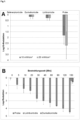
- Fig. 1A shows the results of the log reduction of S. aureus numbers achieved in Example 3.1.
- Fig. 1B shows the results of the log reduction of S. aureus numbers achieved in Example 3.2.
- Fig. 2 shows the results of the log reduction of S. aureus numbers achieved in Example 3.3.
- Fig. 3 shows the log reduction of S. aureus on the silicone surface (A - means 10 Shore without dye, A + means 10 Shore plus dye, B - means 45 Shore without dye, B + means 45 Shore plus dye).
- NMR spectra were measured on a Bruker Avance 300 spectrometer (300 MHz [1H-NMR]) (Bruker Corporation, Billerica, US).
- ES-MS were measured with a ThermoQuest Finnigan TSQ 7000 spectrometer, all HR-MS were determined on a ThermoQuest Finnigan MAT 95 (each Thermo Fisher Scientific Inc, Waltham, US) spectrometer, argon served as ionization gas for FAB.
- UV/Vis spectra were recorded with a Varian Cary 50 Bio UV/VIS spectrometer and fluorescence spectra with a Varian Cary Eclipse spectrometer (each Agilent Technologies, Santa Clara, US).
- Solvents for absorption and emission measurements were purchased in special spectroscopic purity from Acros or Baker or Uvasol from Merck. Millipore water (18 M ⁇ , Milli QPlus) was used for all measurements.
- the suspension was divided into two polypropylene tubes with a conical bottom (nominal volume 15 ml, Greiner Bio-One GmbH, Frickenhausen, DE) and precipitated to 15 mL per tube by adding diethyl ether.
- the product was centrifuged (60 mins, 4400 rpm, 0°C) and the supernatant discarded.
- the precipitate was suspended in diethyl ether. After the product had settled, the supernatant was discarded.
- the purification step was repeated once again and the product was then dried.
- the suspension was divided into two polypropylene tubes with a conical bottom (nominal volume 15 ml, Greiner Bio-One GmbH) and precipitated to 15 mL per tube by adding diethyl ether.
- the product was centrifuged (60 mins, 4400 rpm, 0°C) and the supernatant was discarded.
- the precipitate was suspended in diethyl ether. After the product had settled, the supernatant was discarded.
- the purification step was repeated once again and the product was then dried.
- step g product MW [g/mol] sample weight [mg] formula Designation 8.1 acrylic acid 72.06 53 ⁇ PN-AMO-12a [compound (109))
- 4-vinylbenzoic acid 148.16 88 ⁇ PN-AMO-12c [compound (106)]
- R g 4-vinylphen-1-yl
- the product was purified by column chromatography with dichloromethane/ethanol 20:1 to give 261 mg of yellow syrup. This material was dissolved in methanol (2 mL). Aqueous sodium hydroxide solution (1 M, 0.5 mL) was added and the mixture was stirred overnight at room temperature. The alcohol was evaporated and the remaining solution was diluted with water (10 mL). The product was extracted with dichloromethane (2x 10 mL). The organic layers were dried over magnesium sulfate, filtered and concentrated under reduced pressure. The product was a yellowish, greasy solid (215 mg, 69%, 0.69 mmol).
- the photosensitizers prepared in Example 1 were subsequently tested in various paint systems.
- the respective photosensitizer (0.06 mmol) was dissolved in 100 mL of clear base coat (polyisocyanate-crosslinkable, hydroxyl group-containing acrylic resin, 20% in xylene/n-butyl acetate).
- the crosslinker hexamethylene diisocyanate (HDI)-containing polymer, 20% in xylene/n-butyl acetate, "Desmodur ® N75" from Covestro AG, Leverkusen, DE
- the viscous, pale yellow solution was applied to various degreased surfaces using a spray gun. Tested surfaces were PMMA, PVC, glass, aluminum, stainless steel and wood. After drying for 4 hours at room temperature, complete curing was achieved by heating to 60°C for 30 minutes.
- the respective photosensitizer (0.05 mmol) was dissolved in the water-based paint (100 mL, acrylic polyurethane dispersion, fatty acid modified, 20% in water). The mixture was stirred vigorously for 30 min at room temperature. The paint was evenly applied to i) an untreated wooden board, ii) PMMA plates or iii) PVC plates using a brush. Alternatively, the paint was evenly applied using a spray gun from a distance of approx. 30 cm. The coating was allowed to dry in the air and cured overnight at room temperature.
- composition of the base resin (typical technical products):
- Formulation I Bisphenol-A-epichlorohydrin resin with average molecular weight ⁇ 700 g/mol (25-50%) C12-C14 Aliphatic glycidyl ether (25-50%) Alkyl glycidyl ethers (5-25%)
- Formulation II bisphenol-A-epichlorohydrin resin with average molecular weight ⁇ 700 g/mol (60-80%) 1,4-bis(2,3-epoxypropox)butane (20-40%)
- Formulation III (resin with reactive thinner): Bisphenol-A-epichlorohydrin resin with average molecular weight ⁇ 700 g/mol (75-90%) Hexanediol diglycidyl ether (10-25%)
- Formulation IV (resin with reactive thinner): Bisphenol-A-epichlorohydrin resin with average molecular weight ⁇ 700 g/mol (50-90%) Bisphenol F epoxy resin (25 - 50%
- composition of the hardener (typical technical products):
- the respective photosensitizer (0.05 mmol) was dissolved in 25 mL of the clear hardener (formulation I or II). 75 mL of the base resin (formulation II, III or IV) was mixed with the hardener. The viscous, pale yellow solution was applied to degreased surfaces made of i) PMMA or ii) PVC using a spray gun.
- the mixture was applied evenly with a brush to untreated wood in several repetitions to obtain an antimicrobial seal. After curing for 12 hours at room temperature, post-curing was carried out by heating to 40°C for 6 hours.
- the respective photosensitizer (0.05 mmol) was dissolved in 30 mL of the clear hardener (formulation II or III). 70 mL of the base resin (formulation I) was mixed with the hardener. A flat stainless steel tray was evenly coated with release wax. In it, i) a glass fiber mat, ii) a piece of CFRP fabric or iii) a piece of aramid fabric (each 20x20 cm 2 ) was evenly soaked with the resin mixture using a brush so that the fabric could completely absorb the mixture. After curing for 24 hours at room temperature, post-curing was carried out by slowly heating to 60°C and holding for 30 minutes.
- the respective photosensitizer (0.05 mmol) was dissolved in 70 mL of the base resin (formulation II, III or IV). 30 mL of the hardener (formulation III) were added. The viscous, pale yellow solution was applied using a spray gun to a degreased surface made of i) PMMA or ii) roughened glass.
- the mixture was applied evenly with a brush to untreated wood in several repetitions to obtain an antimicrobial seal. After curing for 6 hours at room temperature, post-curing was carried out by heating to 40°C for 3 hours. The following representatives were processed using this method:
- the respective photosensitizer (0.02 mmol) was dissolved in dried ethyl acetate (100 mL). Clear sanitary silicone (1K, room temperature curing, acetic acid curing, 8.0 g) was added and the solution was stirred until it was homogeneous. The slightly cloudy, A pale yellow solution was evenly applied to i) a clay plate, ii) a ceramic tile, iii) a degreased PE plate or iii) an aluminum plate using a spray gun. After about 20 minutes at room temperature, the coating had dried, and a further 10 minutes later the first skin formed. After 6 hours at room temperature, the approximately 0.1 mm thick layer was completely cured.
- the finely powdered photosensitizer (0.012 mmol) was stirred into clear sanitary silicone (1K, room temperature cross-linking, acetic acid cross-linking, 5.0 g) in a SpeedMixer TM DAC 600 mixer (Hauschild Engineering, Germany) at room temperature until a macroscopically homogeneous paste was obtained.
- the pale yellow, viscous mass was evenly applied using a disposable syringe into i) a tile joint or ii) used to bond two glass plates standing perpendicular to each other. After about 30 minutes at room temperature, the silicone had dried, and a further 20 minutes later, the first skin had formed. After 6 hours at room temperature, the layer was completely cured.
- composition of the silicone (technical product from Wacker): Component A) vinyl-containing oligomeric silane / vinylsilane and component B) polydimethylsiloxane mixed with silicon dioxide (filler) and auxiliary materials and platinum catalyst
- the base polymer (A) was mixed with the crosslinker (B) 9:1.
- the finely powdered photosensitizer (0.05 mmol) was stirred into 90 g of the base polymer (A) at room temperature until a macroscopically homogeneous paste was obtained.
- the pale yellow, viscous mass was mixed with the crosslinker (B) in a ratio of 9:1 and evenly applied (50 mL per m 2 ) using a flat spatula onto i) a polyester film, ii) a ceramic tile, a degreased glass plate, iv) a degreased PE plate or v) an aluminum plate.
- the finely powdered photosensitizer (0.05 mmol) was dissolved in 100 mL ethyl methacrylate (dry conditions).
- Camphorquinone (1.7 mg, 0.01 mmol) and methyl 4-dimethylaminobenzoate (0.9 mg, 0.005 mmol, amine accelerator) were added and the mixture was stirred for 15 min in the dark. The solution was stable for weeks when refrigerated in the dark.
- the solution was applied to i) wood with a brush or ii) a filter paper was soaked or iii) evenly sprayed onto a degreased PMMA plate.
- the respective photosensitizer (0.05 mmol) was dissolved in 100 mL methyl methacrylate (methyl methacrylate, MMA, Sigma Aldrich) (solution A).
- tert-Butyl peroxybenzoate (Peroxan PB, 0.5 g) was dissolved in THF (2 mL) (solution B).
- Solution B was added to solution A and the mixture was heated for 15 min at 90°C in a water bath.
- the slightly viscous solution was sprayed onto i) a degreased PMMA plate or ii) a degreased glass plate or iii) applied to pine wood and evenly distributed with a brush (50 mL per m 2 ).
- the substrate was stored in a drying cabinet at 60 °C for 24 hours. A pale yellow, clear plastic coating or polymeric seal on the wood is obtained.
- the respective photosensitizer (0.05 mmol) was dissolved in 100 mL methyl methacrylate (methyl methacrylate, MMA, Sigma Aldrich) (solution A).
- Benzoyl peroxide (0.5 g) was dissolved in THF (2 mL) (solution B).
- Solution B was added to solution A and the mixture was heated in a water bath at 80°C for 20 min.
- the mixture was evenly soaked with a brush onto i) approximately 6 mm thick cotton fleece or ii) approximately 6 mm thick felt mat or iii) a piece of aramid fabric (each 20x20 cm 2 ) so that the fabric could completely absorb the mixture.
- the material was covered with cling film. After 30 minutes of polymerization at room temperature, the gel was solid and the film was carefully peeled off. A gel-like yellowish coating was obtained.
- the respective photosensitizer (0.01 mmol) was dissolved in 100 mL dichloromethane (dried over calcium chloride).
- 0.2 g of commercially available cyanoacrylate (Loctite, Henkel AG & Co. KGaA, Düsseldorf, DE) was added to 1 g of the solution (dry conditions).
- the mixture was sprayed evenly onto a) a degreased glass plate or b) onto dry spruce wood. At room temperature and an ambient humidity of between 20 and 70%, the layer cured completely within 20 minutes.
- the respective photosensitizer (0.01 mmol) was dissolved in 100 mL of dried methyl ethyl ketone.
- Commercially available cyanoacrylate (Loctite.) was mixed with 10 g of the solution in a ratio of 1:5 (w/w).
- the solution was evenly applied to a substrate cleaned with isopropanol, e.g. i) glass or ii) PE or iii) melamine board. After the solvent had evaporated, the coating was cured by air humidity (approx. 15 min, air humidity between 20 and 70%).
- the respective photosensitizer (0.01 mmol) was dissolved in 20 mL of freshly distilled polystyrene (Sigma Aldrich) (solution A). Benzoyl peroxide (0.5 g) was dissolved in THF (2 mL) (solution B). Solution B was added to solution A and the mixture was heated in a water bath at 80°C for 20 min. 5 to 6 mL of the mixture was evenly coated with a brush onto i) a clean, untreated chipboard or ii) a degreased PMMA plate or iii) a degreased glass plate (each 20x20 cm 2 ). The carrier was allowed to dry for 12 hours at 60°C to cure completely. A yellowish solid plate was obtained. The following photosensitizers were processed:
- the respective photosensitizer (0.05 mmol) was dissolved in 100 ml of water together with finely ground carboxymethylcellulose (4.0 g, Akzo Nobel). 5 to 6 mL of the clear, somewhat viscous solution were evenly coated with a brush onto i) a clean, untreated chipboard or ii) a degreased PMMA plate (each 20x20 cm 2 ).
- a cotton fleece (20x20 cm 2 ) was evenly saturated with a brush so that the fabric could completely absorb the mixture.
- the carrier was left to dry for 3 hours at room temperature to cure.
- the following photosensitizers were used:
- the photosensitizer was dissolved in the respective paint system and applied to various rectangular sample carriers (width: 4 cm, length: 4 cm, thickness: 3 mm) made of PVC or PMMA and dried. After the coating had dried, a defined amount of bacteria of the species Staphylococcus aureus ATCC 25923 was applied to the surface.
- the resuspended bacteria were diluted with Milli-Q water to a cell count of 10 5 bacteria/mL. 100 ⁇ L of the dilution were dropped onto the sample carrier using a pipette (size of the drop approximately 1 cm 2 ).
- sample carrier there were about 10,000 bacteria per cm 2 on the surface of each sample carrier.
- the sample carrier was then dried in air under a sterile workbench in the dark for about 2 hours until no more water was visible on the surface.
- the respective sample carriers were irradiated with monochrome light of a wavelength of 405 nm using an LED module (test field 5 ⁇ 5 cm homogeneously illuminated; high power LEDs) or with room light (Osram Lumilux Cool White, color temperature 4000 K) at the intensities and irradiation times given below.
- the bacteria were wiped from the surface of the respective sample carrier using a sterile swab and resuspended in 1 mL Mueller-Hinton broth.
- the sample was then serially diluted (1:10 dilution steps: 180 + 20 ⁇ L; up to dilution level 10 -5 ).
- the log 10 kill rate was then calculated from the CFU/mL value.
- Coated material PVC, 3 mm thickness, 4 x 4 cm Drying time approx. 2 hours drying temperature 15 - 30 °C Relative humidity for the drying time 30 - 70 %
- Application with a spray gun Uses Phosensitizer concentration: 200 ⁇ m (61.55 mg/l)
- Fig. 1A shows the mean values of the reduction of S. aureus on the 2K paint surface from three independent tests.
- the irradiation was carried out with 10 or 20 mW/cm 2 and 2 minutes (corresponds to an energy density of 1.2 or 2.4 J/cm 2 ).
- Fig. 1A shows that the 2K paint system achieves a log 10 reduction of 1.8 (average of 3 independent experiments) after just 2 minutes of irradiation at a light intensity of 10 mW/cm 2 . Increasing the light intensity to 20 mW/cm 2 results in a more effective killing of 2.7 log 10 levels.
- Fig. 1B shows the mean values of the reduction of S. aureus on the 2K paint surface (colorless solvent-based 2K paint on transparent PMMA sample carrier) from two independent tests.
- the irradiation was carried out with 0.7 mW/cm 2 for up to 150 minutes (corresponding to an energy density of up to 6.3 J/cm 2 ).
- the mean value of the reference control (no light, no catalyst) is 3.2 x 10 4 bacteria per mL. The light and dark control was only carried out for 150 minutes.
- the decrease in colony forming units relative to a non-irradiated sample (0 min) was measured at intervals, according to the Fig. 1b 2 coated sample carriers were removed from the irradiation at the indicated times (5 min., 10 min., 20 min., 30 min., 40 min., 60 min., 90 min., 120 min. and 150 min.).
- the results from two independent experiments are shown in Fig. 1B shown.
- the mean value of the reference control (no light, no catalyst) was 3.2 ⁇ 10 4 bacteria per mL. The light and dark control was only performed at 150 minutes.
- Figure 1B shows that after just 20 minutes the 2K paint system achieves a kill of S. aureus by 1.9 log10 levels.
- the 2K paint system showed biological efficacy against S. aureus when irradiated with an artificial light source, both at high intensities and low irradiation times ( Fig. 1A ), as well as at low intensities and longer irradiation times ( Fig. 1B ).
- a first test with a high intensity (10 mW/cm 2 ) and a long irradiation time (10 minutes) showed the effectiveness of the 1K paint system.
- Fig. 2 shows the mean values of the reduction of S. aureus on the 1K paint surface from three independent tests. The irradiation was carried out with 10 mW/cm 2 and 10 minutes (corresponds to an energy density of 6 J/cm 2 ).
- the light control in the experiments showed an average reduction of 1.2 log 10 steps, which is probably due to the dark sample carrier.
- Fig. 3 shows the log reduction of S. aureus on the silicone surface (A - means 10 Shore without dye, A + means 10 Shore plus dye, B - means 45 Shore without dye, B + means 45 Shore plus dye).
- the concentration of 200 ⁇ M (61.55 mg/L) used in both coating systems was not visible on colored surfaces.
- the 2K paint system was irradiated with room light.
- the photoactive surfaces produced in Example 2.1 with the photosensitizer SAPN-19c and SAPN-19 were additionally exposed to the open air in rooms with normal Office lighting (standard fluorescent lamps, Osram Cool White, 840) and the phototoxic effect on S. aureus was analyzed after defined times with the same number of bacteria as in Example 3.
- the photoactive layers were approximately 40 cm away from the light source.
- test surfaces were pre-irradiated for different times (5, 25, 50, 75 h) at a power of 5 mW cm -2 to determine whether the respective photosensitizer in PUR is influenced in such a way that the phototoxic activity of the surface decreases: Applied energy [J cm -2 5 mW cm -2 0.7 mW cm -2 "irradiation days" 90 5 hours 35.70 hours 7 days (d) 450 25 hours 178.5 hours 36 d 900 50 hours 357.0 hours 71 d 1350 75 hours 535.5 hours 107 d
- the TPP sensitizer WBII/2 was developed according to the Felgenif A., Maisch T., boss A., Schröder JA, Bäumler W., "Singlet oxygen generation in porphyrin-doped polymeric surface coating enables antimicrobial effects on Staphylococcus aureus.”, (Phys Chem Chem Phys. 2014 Oct 14;16(38):20598-607. doi: 10.1039/c4cp02439g .) described process.
Landscapes
- Chemical & Material Sciences (AREA)
- Organic Chemistry (AREA)
- Health & Medical Sciences (AREA)
- Chemical Kinetics & Catalysis (AREA)
- Medicinal Chemistry (AREA)
- Polymers & Plastics (AREA)
- Organic Low-Molecular-Weight Compounds And Preparation Thereof (AREA)
- Compositions Of Macromolecular Compounds (AREA)
- Paints Or Removers (AREA)
- Polymerisation Methods In General (AREA)
- Epoxy Compounds (AREA)
- Agricultural Chemicals And Associated Chemicals (AREA)
- Catalysts (AREA)
- Acyclic And Carbocyclic Compounds In Medicinal Compositions (AREA)
- Pharmaceuticals Containing Other Organic And Inorganic Compounds (AREA)
- Detergent Compositions (AREA)
- Dental Preparations (AREA)
Description
- Die vorliegende Erfindung betrifft eine Photosensibilisatorzusammensetzung, eine Phenalen-1-on-Verbindung, einen Gegenstand sowie deren nicht-medizinische Verwendung.
- Das aktive oder passive Eindringen, Anhaften und Vermehren von Krankheitserregern in einen Wirt wird als Infektion bezeichnet. Quellen für infektiöse Partikel treten überall auf. So wird beispielsweise der menschliche Körper von einer großen Anzahl von Mikroorganismen besiedelt, die im Regelfall durch den normalen Metabolismus und ein intaktes Immunsystem unter Kontrolle gehalten werden. Allerdings kann es, beispielsweise bei einer Schwächung des Immunsystems, zu einer starken Vermehrung der Krankheiterreger kommen und je nach Art des Erregers zu unterschiedlichen Krankheitssymptomen. Die Medizin hält für viele Erreger-bedingte Krankheiten spezifische Gegenmittel bereit, beispielsweise Antibiotika gegen Bakterien oder Antimikotika gegen Pilze oder Virustatika gegen Viren. Allerdings ist bei der Verwendung dieser Gegenmittel vermehrt das Auftreten von resistenten Krankheitserregern zu beobachten, die teilweise gleichzeitig gegen mehrere Gegenmittel Resistenzen aufweisen. Durch das Auftreten dieser resistenten oder multiresistenten Krankheitserreger hat sich die Therapie von Infektionserkrankungen zunehmend erschwert. Die klinische Konsequenz der Resistenz zeigt sich durch ein Versagen der Behandlung, vor allem bei immunsupprimierten Patienten.
- Neue Ansatzpunkt zur Bekämpfung von resistenten bzw. multiresistenten Krankheitskeimen sind daher einerseits die Suche nach neuen Gegenmitteln, beispielsweise Antibiotika oder Antimikotika, und andererseits die Suche nach alternativen Inaktivierungsmöglichkeiten.
- Als alternatives Verfahren hat sich die photodynamische Inaktivierung von Mikroorganismen bewährt. Bei der photodynamischen Inaktivierung von Mikroorganismen spielen zwei verschiedene photooxidative Prozesse eine entscheidende Rolle. Voraussetzung für den Ablauf einer photooxidativen Inaktivierung ist einerseits das Vorhandensein einer ausreichenden Menge Sauerstoff und andererseits die Lokalisierung eines so genannten Photosensibilisators, welcher durch Licht einer entsprechenden Wellenlänge angeregt wird. Der angeregte Photosensibilisator kann die Bildung von reaktiven Sauerstoffspezies (ROS) bewirken, wobei einerseits Radikale, beispielsweise Superoxidanionen, Wasserstoffperoxid oder Hydroxylradikale, und/oder andererseits angeregter molekularer Sauerstoff, beispielsweise Singulett-Sauerstoff, gebildet werden können.
- Bei beiden Reaktionen steht die Photooxidation von spezifischen Biomolekülen, die sich in direkter Nachbarschaft zu den reaktiven Sauerstoffspezies (ROS) befindet, im Vordergrund. Dabei findet insbesondere eine Oxidation von Lipiden und Proteinen statt, die beispielsweise als Bestandteile der Zellmembran von Mikroorganismen vorkommen. Durch die Zerstörung der Zellmembran wiederum kommt es zur Inaktivierung der betreffenden Mikroorganismen. Für Viren und Pilze wird ein ähnlicher Eliminationsprozess angenommen.
- Beispielsweise werden durch Singulett-Sauerstoff alle Moleküle angegriffen. Besonders anfällig für eine Schädigung sind allerdings ungesättigte Fettsäuren in den Membranen von Bakterien. Gesunde, körpereigene Zellen verfügen über eine zelluläre Abwehr gegen Angriffe von freien Radikalen, die so genannten Katalasen oder Superoxiddismutasen.
- Daher können gesunde, körpereigene Zellen eine Schädigung durch reaktive Sauerstoffspezies (ROS), beispielsweise Radikale oder Singulett-Sauerstoff, entgegen wirken.
- Aus dem Stand der Technik sind zahlreiche Photosensibilisatoren bekannt, die beispielsweise aus der Gruppe der Porphyrine und deren Derivate oder Phthalocyanine und deren Derivate oder Fullerene und deren Derivate oder Derivate der Phenothiazininium-Struktur, wie beispielsweise Methylenblau oder Toluidinblau, oder Vertreter der Phenoxazinium-Reihe, wie beispielsweise Nile blue, stammen.
- Die
WO 00/78854 A1 - Nachteilig dabei ist, dass der Photosensibilisator aus der Polymermatrix ausläuft und somit die antimikrobielle Wirksamkeit bei längerer Lagerung abnimmt.
- Die
US 5,830,526 A offenbart ein Substrat, an das ein lichtaktivierbarer Farbstoff allein oder in Kombination mit zusätzlichen herkömmlichen antimikrobiellen und/oder antiviralen Mitteln gebunden ist. Das Substrat wird mit einem lichtaktivierbaren Farbstoff mit antimikrobiellen und/oder antiviralen Eigenschaften imprägniert, wobei ein kationisches oder anionisches wasserlösliches Polymer den Farbstoff an das Substrat bindet. - Nachteilig dabei ist, dass der Photosensibilisator beispielsweise durch mechanische Beanspruchung von dem Substrat gelöst werden kann und somit die antimikrobielle Wirksamkeit reduziert wird.
- Die
WO 2012/113860 A2 ist auf die Bereitstellung von Phenalen-1-on-Derivaten, Verfahren zur Herstellung und Verwendung derselben gerichtet. - Aufgabe der vorliegenden Erfindung ist es, eine Photosensibilisator-haltige Beschichtung bereitzustellen, die eine einfache Auftragbarkeit auf vorzugsweise verschiedene Arten von Oberflächen gewährleistet und insbesondere zugleich eine gute antimikrobielle Wirksamkeit nach Belichtung mit elektromagnetischer Strahlung geeigneter Wellenlänge und Intensität zeigt.
- Weiterhin soll die Photosensibilisator-haltige Beschichtung nach dem Auftragen auf eine Oberfläche, vorzugsweise eine verbesserte Adhäsion des Photosensibilisators gewährleisten, so dass ein Ausbluten des Photosensibilisators vorzugsweise vermieden wird.
- Weiterhin soll vorzugsweise die Wirksamkeit des Photosensibilisators, insbesondere bei längerer Bestrahlung mit elektromagnetischer Strahlung geeigneter Wellenlänge und Intensität, verbessert werden.
- Dabei soll die Photosensibilisator-haltige Beschichtung im Wesentlichen nicht die Anregung der in der Beschichtung enthaltenen Photosensibilisator-Moleküle durch Licht einer bestimmten Wellenlänge behindern.
- Die Aufgabe der vorliegenden Erfindung wird gelöst durch die Bereitstellung Photosensibilisatorzusammensetzung nach Anspruch 1.
- Bevorzugte Ausführungsformen der erfindungsgemäßen Photosensibilisator-zusammensetzung sind in den Ansprüchen 2 bis 3 und 6 bis 11 angegeben.
- Die Aufgabe der vorliegenden Erfindung wird ebenfalls gelöst durch Bereitstellung einer Phenalen-1-on-Verbindung nach Anspruch 4.
- Bevorzugte Ausführungsformen der erfindungsgemäßen Phenalen-1-on-Verbindung sind in Anspruch 5 angegeben.
- Die Aufgabe der vorliegenden Erfindung wird weiterhin gelöst durch Bereitstellung eines Gegenstands nach Anspruch 12.
- Bevorzugte Ausführungsformen des erfindungsgemäßen Gegenstands sind in den Ansprüchen 13 bis 14 angegeben.
- Die Aufgabe der vorliegenden Erfindung wird ebenfalls gelöst durch Bereitstellung einer nicht-medizinischen Verwendung gemäß Anspruch 15, wobei eine Photosensibilisatorzusammensetzung nach einem der Ansprüche 1 bis 3 oder 6 bis 11 und/oder eine Phenalen-1-on-Verbindung nach einem der Ansprüche 4 bis 5 und/oder ein Gegenstand nach einem der Ansprüche 12 bis 14 zur, vorzugsweise photodynamischen, Inaktivierung von Mikroorganismen, die vorzugsweise aus der Gruppe, die aus Viren, Archäeen, Bakterien, Bakteriensporen, Pilzen, Pilzsporen, Protozoen, Algen und blutübertragbaren Parasiten besteht, ausgewählt werden, und/oder einem Biofilm davon verwendet wird.
- Bevorzugte Ausführungsformen der erfindungsgemäßen nicht-medizinischen Verwendung sind in den Ansprüchen 16 bis 17 angegeben.
- Unter dem Begriff "Biofilm" wird vorzugsweise eine Matrix aus extrazellulärer polymerer Substanzen (EPS), die vorzugsweise von Mikroorganismen gebildet und von ihnen in ihre unmittelbare, der Zelle angrenzenden, Umgebung abgegeben werden, verstanden, in der Mikroorganismen, vorzugsweise Bakterien, Algen, Pilze, Protozoen oder Kombinationen davon, zumindest teilweise angeordnet oder eingebettet sind.
- Die Aufgabe der vorliegenden Erfindung wird ebenfalls gelöst durch Bereitstellung eines nicht-medizinischen Verfahrens zur, vorzugsweise photodynamischen, Inaktivierung von Mikroorganismen, die vorzugsweise Viren, Archäeen, Bakterien, Bakteriensporen, Pilzen, Pilzsporen, Protozoen, Algen, blutübertragbaren Parasiten oder Kombinationen davon umfassen und/oder einem Biofilm davon, nach Anspruch 18, wobei das Verfahren folgende Schritte umfasst:
- (A) in Kontakt bringen der Mikroorganismen und/oder einem Biofilm davon mit wenigstens einer Beschichtung, die durch Aushärten einer Photosensibilisatorzusammensetzung nach einem der Ansprüche 1 bis 3 oder 6 bis 11 hergestellt wurde und/oder wenigstens eine Phenalen-1-on-Verbindung nach einem der Ansprüche 4 bis 5 enthält, und/oder wenigstens eines Gegenstandes nach einem der Ansprüche 12 bis 14, und
- (B) Bestrahlen der Mikroorganismen und/oder einem Biofilm davon und der, in der Beschichtung und/oder dem Gegenstand enthaltenen wenigstens einen Phenalen-1-on-Verbindung mit elektromagnetischer Strahlung geeigneter Wellenlänge und Energiedichte.
- Unter dem Begriff "Aushärten" bzw. "Härten" wird vorzugsweise der Übergang von einem flüssigen oder plastisch verformbaren Zustand in einen bei Standardbedingungen (Temperatur: 25°C, Druck: 1013 mbar) festen Zustand eines Stoffes oder Stoffgemisches verstanden.
- Der Prozess des Aushärtens bzw. Härtens kann vorzugsweise durch Abkühlen, d.h. durch Reduzieren der Temperatur unter den Gefrierpunkt und/oder Glasübergangstemperatur eines Stoffes oder Stoffgemisches, physikalische Trocknung, d.h. durch Entfernung wenigstens eines flüssigen Bestandteils, beispielsweise Lösungsmittels, und/oder durch chemische Reaktion, beispielsweise durch Kettenpolymerisation, Polyaddition und/oder Polykondensation, erfolgen.
- Unter dem Begriff "polymere Komponente und/oder Vorläufer davon" wird vorzugsweise ein Stoff oder Stoffgemisch verstanden, welches wenigstens ein, vorzugsweise organisches, Polymer und/oder wenigstens ein Vorläufer davon aufweist.
- Unter dem Begriff "Polymer" wird vorzugsweise ein Stoff verstanden, der aus vorzugsweise wenigstens 10 Struktureinheiten, sogenannten konstitutionellen Repetiereinheiten, aufgebaut ist, die gleich oder voneinander verschieden sein können und durch chemische Reaktion, vorzugsweise Kettenpolymerisation, Polyaddition und/oder Polykondensation, das wenigstens eine organische Polymer bilden. Vorzugsweise ist eine konstitutionelle Repetiereinheit (KRE) die kleinste sich wiederholende Gruppe von Atomen innerhalb eines Polymers.
- Ein Polymer im Sinne der Erfindung kann unverzweigt oder verzweigt sein.
- Unter dem Begriff "Vorläufer einer polymeren Komponente" werden vorzugsweise Monomere oder Monomergemische sowie Oligomere und Mischungen davon verstanden, die sich jeweils zu dem entsprechenden unverzweigten oder verzweigten Polymer zusammenschließen können, vorzugsweise durch chemische Reaktion, weiter bevorzugt Kettenpolymerisation, Polyaddition und/oder Polykondensation.
- Unter dem Begriff "reaktive funktionelle Gruppe" wird vorzugsweise eine funktionelle Gruppe verstanden, die sich durch chemische Reaktion, weiter bevorzugt Kettenpolymerisation, Polyaddition und/oder Polykondensation, an der Bildung des entsprechenden unverzweigten oder verzweigten Polymers beteiligen kann.
- Monomere oder Monomergemische im Sinne der Erfindung sind vorzugsweise niedermolekulare, reaktionsfähige Moleküle oder Gemische von reaktionsfähigen Molekülen, die sich jeweils zu dem entsprechenden unverzweigten oder verzweigten Polymer durch chemische Reaktion, weiter bevorzugt Kettenpolymerisation, Polyaddition und/oder Polykondensation, zusammenschließen können und dadurch konstitutionelle Repetiereinheit des Polymers bilden. Vorzugsweise weist ein reaktionsfähiges Molekül, beispielsweise Monomer, Oligomer und optional Polymer wenigstens eine reaktive funktionelle Gruppe auf.
- Unter dem Begriff "Oligomer" wird vorzugsweise ein Stoff verstanden, der aus vorzugsweise 2 bis 9 konstitutionellen Repetiereinheit aufgebaut ist, die gleich oder voneinander verschieden sein können und sich vorzugsweise durch chemische Reaktion, weiter bevorzugt Kettenpolymerisation, Polyaddition und/oder Polykondensation, zu einem unverzweigten oder verzweigten Polymer zusammenschließen können.
- Unter dem Begriff "ausgehärtete polymere Komponente" wird vorzugsweise ein polymerer Stoff oder ein Gemisch polymerer Stoffe verstanden, der bzw. das bei Standardbedingungen (Temperatur: 25°C, Druck: 1013 mbar) einen festen Zustand aufweist und vorzugsweise nicht plastisch verformbar ist.
- Hinsichtlich der Definition der vorgenannten Begriffe wird weiterhin auf Jenkins, A. D. et al.: "Glossary of basic terms in polymer science (IUPAC Recommendations 1996)" (Pure Appl. Chem. 68 (12), 1996, Seiten 2287 bis 2311, doi:10.1351/pac199668122287) verwiesen.
- Vorzugsweise bildet eine erfindungsgemäße Photosensibilisatorzusammensetzung nach dem Aushärten eine ausgehärtete Polymerzusammensetzung, die wenigstens eine erfindungsgemäß verwendete Verbindung mit der Formel (1) und/oder wenigstens eine erfindungsgemäße Verbindung mit der Formel (1a) enthält.
- Bei einer bevorzugten Ausführungsform wird beim Aushärten einer erfindungsgemäßen Photosensibilisatorzusammensetzung die wenigstens eine erfindungsgemäß verwendete Verbindung mit der Formel (1) und/oder die wenigstens eine erfindungsgemäße Verbindung mit der Formel (1a) kovalent und/oder elektrostatisch, vorzugsweise kovalent, in der ausgehärteten Polymerzusammensetzung gebunden. Weiter bevorzugt wird beim Aushärten einer erfindungsgemäßen Photosensibilisatorzusammensetzung die wenigstens eine erfindungsgemäß verwendete Verbindung mit der Formel (1) und/oder die wenigstens eine erfindungsgemäße Verbindung mit der Formel (1a) kovalent und/oder elektrostatisch, vorzugsweise kovalent, an die wenigstens eine ausgehärtete polymere Komponente gebunden.
- Dadurch wird vorzugsweise ein Austreten der wenigstens einen erfindungsgemäß verwendeten Verbindung mit der Formel (1) und/oder der wenigstens einen erfindungsgemäßen Verbindung mit der Formel (1a) aus der ausgehärteten Photosensibilisatorzusammensetzung zumindest teilweise, vorzugsweise vollständig, verhindert.
- Bei der erfindungsgemäß verwendeten Verbindung mit der Formel (1) und der erfindungsgemäßen Verbindung mit der Formel (1a) handelt es sich jeweils um ein 1H-Phenalen-1-on-Derivat, das im Folgenden auch so bezeichnet wird.
- Vorzugsweise weist eine erfindungsgemäß verwendete Verbindung mit der Formel (1) und eine erfindungsgemäße Verbindung mit der Formel (1a) jeweils kein neutrales, protonierbares Stickstoffatom, beispielsweise als Aminorest, Methylaminorest oder Dimethylaminorest, und kein positiv geladenes, vorzugsweise quartäres, Stickstoffatom, beispielsweise als Pyridin-1-ium-1-yl-Rest oder Trimethylammonio-Rest, sowie kein positiv geladenes, vorzugsweise quartäres, Phosphoratom, das direkt an den Phenalen-Ring gebunden ist, auf.
- Unter "direkt" wird dabei verstanden, dass das Stickstoffatom und/oder das Phosphoratom unmittelbar an den Phenalen-Ring gebunden ist.
- Die Erfinder haben festgestellt, dass bei einer direkten Anordnung des Stickstoffatoms und/oder Phosphoratoms an den Phenalen-Ring es zu einer signifikanten Absenkung der Singulett-Sauerstoff-Quantenausbeute kommt.
- Eine möglichst hohe Singulett-Sauerstoff-Quantenausbeute ist für eine antimikrobielle Wirksamkeit bei der photodynamischen Therapie oder bei der photodynamischen Reinigung bzw. photodynamische Entkeimung von Oberflächen erforderlich. Bei einer direkten Anordnung des Stickstoffatoms und/oder Phosphoratoms am Phenalen-Ring wird die aufgenommene Energie überwiegend durch Fluoreszenzeffekte abgegeben, was zu einer signifikanten Verringerung der Singulett-Sauerstoff-Quantenausbeute führt.
- Vorzugsweise weist eine erfindungsgemäß verwendete Verbindung mit der Formel (1) und eine erfindungsgemäße Verbindung mit der Formel (1a) jeweils keine OH-Gruppe und/oder keine deprotonierte OH-Gruppe, die jeweils direkt an den Phenalen-Ring gebunden ist, auf.
- Unter "direkt" wird dabei verstanden, dass die OH-Gruppe und/oder deprotonierte OH-Gruppe unmittelbar an den Phenalen-Ring gebunden ist.
- Die Erfinder haben festgestellt, dass bei einer direkten Anordnung einer OH-Gruppe und/oder deprotonierte OH-Gruppe an den Phenalen-Ring zu einer signifikanten Verschlechterung der Photostabilität des Photosensibilisators kommt. Eine Verschlechterung der Photostabilität führt zu einem schnelleren Ausbleichen und somit zu einer schnelleren Inaktivierung des Photosensibilisators bei Bestrahlung mit elektromagnetischer Strahlung geeigneter Wellenlänge.
- Als "Photosensibilisator" werden vorzugsweise Verbindungen verstanden, die elektromagnetische Strahlung, vorzugsweise sichtbares Licht, UV-Licht und/oder Infrarotlicht, absorbieren und sodann reaktive Sauerstoffspezies (ROS), vorzugsweise freie Radikale und/oder Singulett-Sauerstoff, aus Triplett-Sauerstoff erzeugen.
- Ein Photosensibilisator im Sinne der Erfindung weist vorzugsweise die allgemeine Formel (1) und/oder die allgemeine Formel (1a) auf.
- Unter dem Begriff "photodynamische Entkeimung" wird vorzugsweise die lichtinduzierte Inaktivierung von Zellen oder Mikroorganismen und/oder einem Biofilm davon auf Oberflächen von Gegenständen verstanden.
- Unter dem Begriff "photodynamische Reinigung" wird vorzugsweise die lichtinduzierte Reduzierung der Anzahl von Zellen oder Mikroorganismen und/oder einem Biofilm davon auf Oberflächen von Gegenständen verstanden.
- Unter dem Begriff "Inaktivierung" wird erfindungsgemäß die Reduzierung der Lebensfähigkeit oder die Zerstörung eines Mikroorganismus, vorzugsweise dessen Zerstörung, verstanden. Eine lichtinduzierte Inaktivierung kann beispielsweise durch Verringerung der Anzahl von Mikroorganismen nach Bestrahlung einer definierten Ausgangsmenge dieser Mikroorganismen in Gegenwart wenigstens einer erfindungsgemäßen Verbindung mit der Formel (1a) und/oder wenigstens einer erfindungsgemäß verwendeten Verbindung mit der Formel (1) bestimmt werden.
- Vorzugsweise kann eine Reduzierung der Lebensfähigkeit oder die Zerstörung von Mikroorganismen eines Biofilms, vorzugsweise dessen Zerstörung, eine Abgabe von extrazellulären polymeren Substanzen, die die Matrix eines Biofilms bilden, verringern bzw. verhindern. Dadurch wird vorzugsweise die Bildung eines Biofilms verlangsamt oder unterdrückt.
- Erfindungsgemäß wird unter einer Reduzierung der Lebensfähigkeit verstanden, dass die Anzahl der Mikroorganismen, beispielsweise in einem Biofilm, um wenigstens 90,0 %, vorzugsweise wenigstens 95,0 %, vorzugsweise wenigstens 99,9 %, weiter bevorzugt um wenigstens 99,99 %, weiter bevorzugt um wenigstens 99,999 %, noch weiter bevorzugt um wenigstens 99,9999 %, verringert wird. Äußerst bevorzugt wird die Anzahl der Mikroorganismen um mehr als 99,9 bis 100 %, vorzugsweise um mehr als 99,99 bis 100 % verringert wird.
- Vorzugsweise wird die Reduzierung der Anzahl der Mikroorganismen gemäß Boyce, J. M. und Pittet, D. ("Guidelines for hand hygiene in healthcare settings. Recommendations of the Healthcare Infection Control Practices Advisory Committee and the HIPAC/SHEA/APIC/IDSA Hand Hygiene Task Force", Am.J.Infect.Control 30 (8), 2002, Seite 1 - 46) als log10-Reduktionsfaktor angegeben.
- Erfindungsgemäß wird unter dem Begriff "log10-Reduktionsfaktor" die Differenz zwischen dem dekadischen Logarithmus der Anzahl der Mikroorganismen vor und dem dekadischen Logarithmus der Anzahl der Mikroorganismen nach einer Bestrahlung dieser Mikroorganismen mit elektromagnetischer Strahlung in Gegenwart wenigstens einer erfindungsgemäßen Verbindung mit der Formel (1a) und/oder wenigstens einer erfindungsgemäß verwendeten Verbindung mit der Formel (1) verstanden. Beispielsweise können die Mikroorganismen in einem Biofilm enthalten sein.
- Geeignete Methoden zur Bestimmung des log10-Reduktionsfaktors sind beispielsweise in der DIN EN 14885:2007-01 "Chemische Desinfektionsmittel und Antiseptika -Anwendung Europäischer Normen für chemische Desinfektionsmittel und Antiseptika" oder in Rabenau, H. F. und Schwebke, I. ("Leitlinie der Deutschen Vereinigung zur Bekämpfung der Viruskrankheiten (DW) e. V. und der Robert Koch-Instituts (RKI) zur Prüfung von chemischen Desinfektionsmitteln auf Wirksamkeit gegen Viren in der Humanmedizin" Bundesgesundheitsblatt, Gesundheitsforschung, Gesundheitsschutz 51(8), (2008), Seiten 937 - 945) beschrieben.
- Vorzugsweise beträgt der log10-Reduktionsfaktor nach einer Bestrahlung von Mikroorganismen und/oder eines Biofilms davon mit elektromagnetischer Strahlung in Gegenwart wenigstens einer erfindungsgemäßen Verbindung mit der Formel (1a) und/oder wenigstens einer erfindungsgemäß verwendeten Verbindung mit der Formel (1) mindestens 1 log10, vorzugsweise mindestens 2 log10, vorzugsweise mindestens 3 log10, weiter bevorzugt mindestens 4 log10, weiter bevorzugt mindestens 4,5 log10, weiter bevorzugt mindestens 5 log10, weiter bevorzugt mindestens 6 log10, noch weiter bevorzugt mindestens 7 log10. Beispielsweise bedeutet eine Reduktion der Anzahl der Mikroorganismen nach einer Bestrahlung dieser Mikroorganismen und/oder eines Biofilms davon mit elektromagnetischer Strahlung in Gegenwart wenigstens einer erfindungsgemäßen Verbindung mit der Formel (1a) und/oder wenigstens einer erfindungsgemäß verwendeten Verbindung mit der Formel (1) um 2 Zehnerpotenzen, bezogen auf die Ausgangsmenge dieser Mikroorganismen, einen log10-Reduktionsfaktor von 2 log10.
- Weiter bevorzugt wird die Anzahl der Mikroorganismen nach einer Bestrahlung dieser Mikroorganismen und/oder eines Biofilms davon mit elektromagnetischer Strahlung in Gegenwart wenigstens einer erfindungsgemäßen Verbindung mit der Formel (1a) und/oder wenigstens einer erfindungsgemäß verwendeten Verbindung mit der Formel (1) um mindestens 1 Zehnerpotenz, weiter bevorzugt um mindestens 2 Zehnerpotenzen, vorzugsweise um mindestens 4 Zehnerpotenzen, weiter bevorzugt um mindestens 5 Zehnerpotenzen, weiter bevorzugt um mindestens 6 Zehnerpotenzen, noch weiter bevorzugt um mindestens 7 Zehnerpotenzen, jeweils bezogen auf die Ausgangsmenge dieser Mikroorganismen, verringert.
- Unter dem Begriff "Mikroorganismen" werden im Sinne der Erfindung insbesondere Viren, Archäeen, prokaryote Mikroorganismen, wie Pilze, Protozoen, Pilzsporen, einzellige Algen, verstanden. Die Mikroorganismen können dabei einzellig oder mehrzellig, beispielsweise als Pilzmycel, auftreten.
- Erfindungsgemäß wird unter einem Halogen jeweils unabhängig voneinander Fluor, Chlor, Brom oder lod verstanden. Erfindungsgemäß wird unter einem Halogenid jeweils unabhängig voneinander Fluorid, Chlorid, Bromid oder lodid verstanden.
- Chiralitätszentren können, wenn nicht anders angegeben, in der R- oder in der S-Konfiguration vorliegen. Die Erfindung betrifft sowohl die optisch reinen Verbindungen als auch Stereoisomerengemische, wie Enantiomerengemische und Diasteromerengemische, in jedem Verhältnis.
- Die Erfindung betrifft vorzugsweise auch Mesomere und/oder Tautomere der Verbindung mit der Formel (1) und/oder der Formel (1a), sowohl die reinen Verbindungen als auch die Isomerengemische in jedem Verhältnis.
- Falls nichts anderes angegeben, bezeichnet ein * in einer Formel einen Verknüpfungspunkt zwischen zwei Resten.
- Eine erfindungsgemäße, vorzugsweise härtbare, Photosensibilisatorzusammensetzung umfasst:
- (a) wenigstens eine erfindungsgemäß zu verwendende Phenalen-1-on-Verbindung mit der allgemeinen Formel (1):

- (b) wenigstens eine polymere Komponente und/oder Vorläufer davon.
- Eine erfindungsgemäß zu verwendende Phenalen-1-on-Verbindung weist die allgemeine Formel (1) auf, wobei die Reste R1 bis R8, die jeweils unabhängig voneinander gleich oder voneinander verschieden sein können, jeweils Wasserstoff, Halogen, Alkyl mit 1 bis 12 C-Atomen, vorzugsweise 2 bis 9 C-Atomen, Alkylaryl mit 5 bis 20 C-Atomen, vorzugsweise 6 bis 9 C-Atomen, Aryl mit 5 bis 20 C-Atomen, vorzugsweise 6 bis 9 C-Atomen, *-O-Alkyl mit 1 bis 12 C-Atomen, vorzugsweise 2 bis 9 C-Atomen, *-O-Alkylaryl mit 5 bis 20 C-Atomen, vorzugsweise 6 bis 9 C-Atomen, *-O-Aryl mit 5 bis 20 C-Atomen, vorzugsweise 6 bis 9 C-Atomen, Ether mit 2 bis 12 C-Atomen, ein Rest der Formel *-O-C(=O)-R(Ia), ein Rest der Formel *-C(=O)-R(Ib), oder ein organischer Rest W1, der wenigstens eine reaktive funktionelle Gruppe enthält, bedeuten, mit der Maßgabe, dass wenigstens einer der Reste Rest R1 bis R7, vorzugsweise wenigstens einer der Reste R1, R2, R5 oder R6, weiter bevorzugt wenigstens einer der Reste R1 oder R2, vorzugsweise einer der Reste R1 oder R2, ein organischer Rest W1 ist, wobei der organische Rest W1 jeweils unabhängig voneinander ein Rest mit der allgemeinen Formel (2) bis (6):
*-[(C(D)(E))d-B)a-(C(D)(E))m-X (2)
*-A-[(C(D)(E))d-B]c-(C(D)(E))m-X (3)
*-(C(D)(E))d-Ar-(C(D)(E))n-X (4)
*-[(C(D)(E))d-B]b-(C(D)(E))g-Ar-(C(D)(E))n-X (5)
*-A-[(C(D)(E))d-B]f-(C(D)(E))g-Ar-(C(D)(E))n-X (6)
bedeutet, - wobei der Rest A jeweils unabhängig voneinander Sauerstoff, Schwefel oder ein Rest mit der allgemeinen Formel (10a) bis (11a), vorzugsweise Sauerstoff oder ein Rest mit der allgemeinen Formel (10a) bis (11a), weiter bevorzugt Sauerstoff oder ein Rest mit der allgemeinen Formel (10a), weiter bevorzugt Sauerstoff, bedeutet:

- wobei *ph jeweils einen Anknüpfungspunkt des Restes mit der allgemeinen Formel (10a) bis (11a) an ein C-Atom des Phenalen-Rings und *c jeweils einen Anknüpfungspunkt des Restes mit der allgemeinen Formel (10a) bis (11a) an ein C-Atom des Restes (C(D)(E)) bezeichnet,
- wobei der Rest B jeweils unabhängig voneinander Sauerstoff, Schwefel oder ein Rest mit der allgemeinen Formel (10) bis (14), vorzugsweise Sauerstoff oder ein Rest mit der allgemeinen Formel (10) bis (14), weiter bevorzugt Sauerstoff oder ein Rest mit der allgemeinen Formel (10), bedeutet:

- wobei die Reste R(Ia), R(Ib), R(11a), R(12a), R(13a), R(14a) und R(14b), jeweils unabhängig voneinander Wasserstoff, Methyl, Ethyl, n-Propyl, iso-Propyl, n-Butyl, sec-Butyl, iso-Butyl, n-Pentyl, Phenyl oder Benzyl bedeuten, und wobei Phenyl und Benzyl jeweils unabhängig voneinander unsubstituiert oder mit einem oder mehrerer Reste, die aus der Gruppe, die aus Halogen, Amino, Hydroxyl, Alkyl, das gradkettig oder verzweigt sein kann, mit 1 bis 3 Kohlenstoffatomen, Hydroxyalkyl, das gradkettig oder verzweigt sein kann, mit 1 bis 3 Kohlenstoffatomen und 1 bis 3 OH-Gruppen, Halogenalkyl, das gradkettig oder verzweigt sein kann, mit 1 bis 3 Kohlenstoffatomen und 1 bis 3 Halogen-Gruppen, und Kombinationen davon, vorzugsweise Chlor, Brom, Fluor, Methyl, Ethyl, n-Propyl, iso-Propyl, Methoxy, Ethoxy, und Kombinationen davon, besteht, ausgewählt werden, substituiert sein können, wobei Y- ein Anion ist, das jeweils unabhängig voneinander Fluorid, Chlorid, Bromid, lodid, Sulfat, Hydrogensulfat, Phosphat, Hydrogenphosphat, Dihydrogenphosphat, wenigstens ein Carboxylat-Anion einer Carbonsäure mit 1 bis 15 Kohlenstoffatomen, wenigstens ein Sulfonat-Anion einer Sulfonsäure mit 1 bis 12 C-Atomen oder eine Kombination davon bedeutet, und
- wobei die Reste D und E jeweils unabhängig voneinander Wasserstoff, Halogen, Hydroxyl, Alkyl, das gradkettig oder verzweigt sein kann, mit 1 bis 5 Kohlenstoffatomen, Hydroxyalkyl, das gradkettig oder verzweigt sein kann, mit 1 bis 5 Kohlenstoffatomen und 1 bis 5 OH-Gruppen, Phenyl, Benzyl, ein Rest der Formel *-L-R(II), ein Rest der Formel *-L-C(=L)-R(III), ein Rest der Formel *-(CH2)q-X, ein Rest der Formel *-L- (CH2)q-X, oder ein Rest der Formel *-(CH2)s-L-(CH2)t-X bedeuten, wobei der Rest L jeweils unabhängig voneinander Sauerstoff oder Schwefel, vorzugsweise Sauerstoff, bedeutet, wobei die Reste R(II) und R(III) jeweils unabhängig voneinander Wasserstoff, Methyl, Ethyl, n-Propyl, iso-Propyl, n-Butyl, sec-Butyl, iso-Butyl, n-Pentyl, Phenyl oder Benzyl bedeuten, und wobei Phenyl und Benzyl jeweils unabhängig voneinander unsubstituiert oder mit einem oder mehrerer Reste, die aus der Gruppe, die aus Chlor, Brom, Fluor, Methyl, Ethyl, n-Propyl, iso-Propyl, Methoxy, Ethoxy, und Kombinationen davon, besteht, ausgewählt werden, substituiert sein können, die Indices q, s und t jeweils unabhängig voneinander eine ganze Zahl von 1 bis 5 bedeuten,
- wobei die Indices a, c, f, g und n jeweils unabhängig voneinander eine ganze Zahl von 0 bis 5, vorzugsweise von 1 bis 4, bedeuten,
- und wobei die Indices b, d und m jeweils unabhängig voneinander eine ganze Zahl von 1 bis 5, vorzugsweise von 2 bis bis 4, bedeuten,
- wobei der Rest Ar jeweils unabhängig voneinander ein Rest der allgemeinen Formel (25a) bis (31) bedeutet, und
- wobei der Rest X jeweils unabhängig voneinander eine reaktive funktionelle Gruppe ist, die *-N(R(VI))(R(VII)), *-OH, *-SH, *-NCO, *-NCS, *-Si(R(VIII))(R(IX))-[O-Si(R(X))(R(XI))]p-Z oder ein Rest mit der allgemeinen Formel (20) bis (24) bedeutet:


- wobei die Reste R(20a), R(20b), R(20c), R(21a), R(22a), R(22b), R(22c), R(23a), R(24a), R(24b), und R(24c) jeweils unabhängig voneinander Wasserstoff, Methyl, Ethyl, n-Propyl, iso-Propyl, n-Butyl, sec-Butyl, iso-Butyl, oder n-Pentyl, vorzugsweise Wasserstoff, Methyl oder Ethyl, bedeuten, und wobei die Indices I und k jeweils unabhängig voneinander eine ganze Zahl von 0 bis 4 bedeuten, wobei die Reste R(VI), R(VII), R(VIII), R(IX), R(X) und R(XI) jeweils unabhängig voneinander Wasserstoff, Alkyl, das gradkettig oder verzweigt sein kann, mit 1 bis 5 Kohlenstoffatomen, *-O-Alkyl, das gradkettig oder verzweigt sein kann, mit 1 bis 5 Kohlenstoffatomen, Phenyl oder Benzyl bedeuten, wobei Phenyl und Benzyl jeweils unabhängig voneinander unsubstituiert oder mit einem oder mehrerer Reste, die aus der Gruppe, die aus Chlor, Brom, Fluor, Methyl, Ethyl, n-Propyl, iso-Propyl, Methoxy, Ethoxy, und Kombinationen davon, besteht, ausgewählt werden, substituiert sein können, wobei der Rest Z jeweils unabhängig voneinander Halogen, Hydroxyl, Alkoxyl mit 1 bis 4 Kohlenstoffatomen oder Alkylcarboxyl mit 1 bis 4 Kohlenstoffatomen bedeutet, und wobei der Index p jeweils unabhängig voneinander eine ganze Zahl von 0 bis 4 bedeutet.
- Erfindungsgemäß bedeutet wenigstens einer der Reste R1 bis R7, weiter bevorzugt wenigstens einer der Reste R1, R2, R5 oder R6, weiter bevorzugt wenigstens einer der Reste R1 oder R2, vorzugsweise einer der Reste R1 oder R2, der wenigstens einen erfindungsgemäß zu verwendenden Phenalen-1-on-Verbindung mit der allgemeinen Formel (1) jeweils unabhängig voneinander ein organischer Rest W1, wobei der wenigstens eine organische Rest W1 jeweils unabhängig voneinander ein Rest mit der allgemeinen Formel (2) bis (6) bedeutet und wobei der Rest Ar jeweils unabhängig voneinander ein Rest der allgemeinen Formel (25a) bis (31), weiter bevorzugt ein Rest der allgemeinen Formel (25a) bis (28b), bedeutet:


- wobei die Reste R25, R26, R27, R28, R29, R26a, R26b, R27a, R27b, R28a, R28b, R29a, R29b, R30a und R30b jeweils unabhängig voneinander Wasserstoff, Hydroxy, Amino, Alkyl, das gradkettig oder verzweigt sein kann, mit 1 bis 5 Kohlenstoffatomen, *-O-Alkyl, das gradkettig oder verzweigt sein kann, mit 1 bis 5 Kohlenstoffatomen, Phenyl oder Benzyl bedeuten, wobei Phenyl und Benzyl jeweils unabhängig voneinander unsubstituiert oder mit einem oder mehrerer Reste, die aus der Gruppe, die aus Chlor, Brom, Fluor, Methyl, Ethyl, n-Propyl, iso-Propyl, Methoxy, Ethoxy, und Kombinationen davon, besteht, ausgewählt werden, substituiert sein können, und wobei der Rest R30 jeweils unabhängig voneinander Wasserstoff oder Alkyl, das gradkettig oder verzweigt sein kann, mit 1 bis 5 Kohlenstoffatomen bedeutet, und wobei die Reste R33a und R33b jeweils unabhängig voneinander Wasserstoff, Hydroxy, Amino, Alkyl, das gradkettig oder verzweigt sein kann, mit 1 bis 5 Kohlenstoffatomen, Perfluoralkyl, das gradkettig oder verzweigt sein kann, mit 1 bis 5 Kohlenstoffatomen, *-O-Alkyl, das gradkettig oder verzweigt sein kann, mit 1 bis 5 Kohlenstoffatomen, Phenyl, Benzyl oder wenn zusammen genommen ein Cycloalkyl, das gradkettig oder verzweigt sein kann, mit 4 bis 9 Kohlenstoffatomen, oder ein 9H-Fluoren-9-ylidenrest bedeuten, und
- wobei Y- ein Anion ist, das jeweils unabhängig voneinander Fluorid, Chlorid, Bromid, lodid, Sulfat, Hydrogensulfat, Phosphat, Hydrogenphosphat, Dihydrogenphosphat, wenigstens ein Carboxylat-Anion einer Carbonsäure mit 1 bis 15 Kohlenstoffatomen, wenigstens ein Sufonat-Anion einer Sulfonsäure mit 1 bis 12 C-Atomen oder eine Kombination davon bedeutet.
- Vorzugsweise ist wenigstens einer der Reste Rest R1 bis R7, weiter bevorzugt wenigstens einer der Reste R1, R2, R5 oder R6, weiter bevorzugt wenigstens einer der Reste R1 oder R2, weiter bevorzugt einer der Reste R1 oder R2, der wenigstens einen erfindungsgemäß zu verwendenden Phenalen-1-on-Verbindung mit der allgemeinen Formel (1) jeweils unabhängig ein organischer Rest W1, wobei der wenigstens eine organische Rest W1 jeweils unabhängig voneinander ein Rest der allgemeinen Formel (40) bis (67), oder (72) bis (98e), vorzugsweise ein Rest der allgemeinen Formel (40) bis (67) oder (72) oder (97), bedeutet:


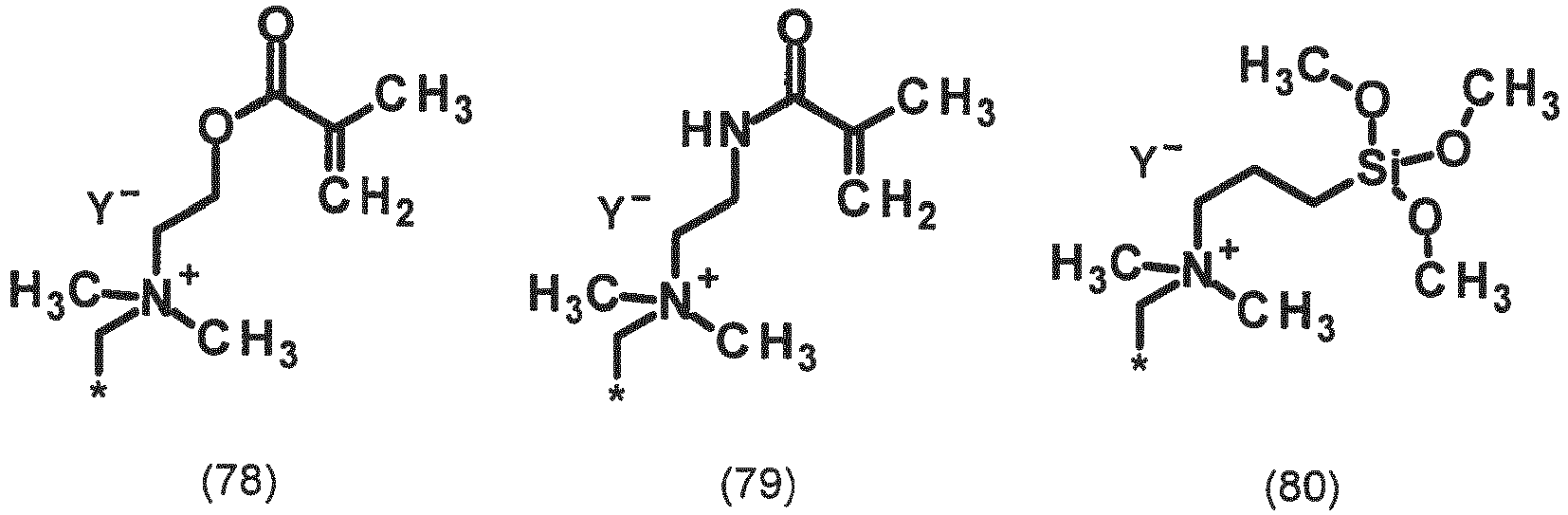


- Weiter bevorzugt wird die wenigstens eine erfindungsgemäß zu verwendende Phenalen-1-on-Verbindung mit der allgemeinen Formel (1) jeweils unabhängig voneinander aus der Gruppe, die aus Verbindung der Formel (100) bis (127), (132) bis (166) und Kombinationen davon, vorzugsweise aus Verbindungen der Formel (100) bis (127), (132) bis (161) und Kombinationen davon, besteht:


- Weiter bevorzugt umfasst eine erfindungsgemäße Photosensibilisatorzusammensetzung
- (a) wenigstens ein erfindungsgemäß Phenalen-1-on-Verbindung mit der allgemeinen Formel (1a) und
- (b) wenigstens eine polymere Komponente und/oder Vorläufer davon.
- Eine erfindungsgemäße Phenalen-1-on-Verbindung weist die allgemeine Formel (1a) auf:
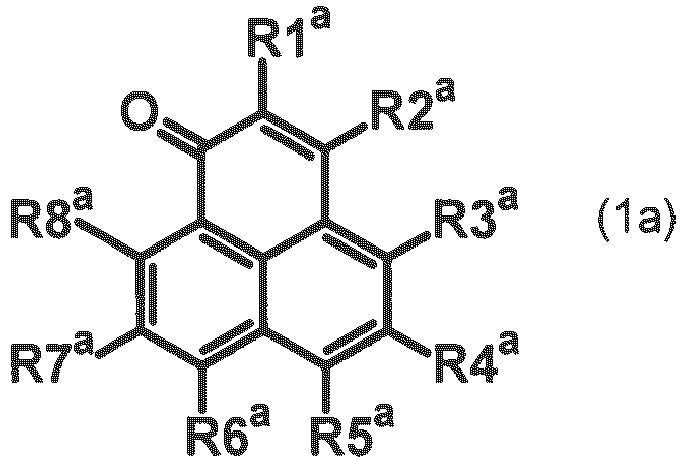


- Weiter bevorzugt wird eine erfindungsgemäße Phenalen-1-on-Verbindung mit der allgemeinen Formel (1a) aus der Gruppe, die aus Verbindung der Formel (101) bis (127), (162) bis (166) und Kombinationen davon, vorzugsweise aus Verbindung der Formel (101) bis (127) und Kombinationen davon, besteht:


- Bei einer bevorzugt Ausführunsform liegt eine Phenalen-1-on-Verbindung mit der allgemeinen Formel (1) als Salz vor, wobei Y- ein Anion ist, das jeweils unabhängig voneinander Fluorid, Chlorid, Bromid, lodid, Sulfat, Hydrogensulfat, Phosphat, Hydrogenphosphat, Dihydrogenphosphat, wenigstens ein Carboxylat-Anion einer Carbonsäure mit 1 bis 15 Kohlenstoffatomen, wenigstens ein Sulfonat-Anion einer Sulfonsäure mit 1 bis 12 C-Atomen oder eine Mischung davon bedeutet,
- Ein geeignetes Carboxylat-Anion einer Carbonsäure mit 1 bis 15 Kohlenstoffatomen ist beispielsweise Acetat, Oxalat, Succinat, Tartrat oder eine Mischung davon.
- Ein geeignetes Sulfonat-Anion einer Sulfonsäure mit 1 bis 12 C-Atomen ist beispielsweise Tosylat, Mesylat oder eine Mischung davon.
- Bei einer bevorzugten Ausführungsform umfasst eine Photosensibilisatorzusammensetzung nach einem der Ansprüche 1 bis 3:
- (a) wenigstens eine Phenalen-1-on-Verbindung mit der allgemeinen Formel (1), die eine Phenalen-1-on-Verbindung nach einem der Ansprüche 4 bis 5 ist, und
- (b) wenigstens eine polymere Komponente und/oder Vorläufer davon.
- Bei einer bevorzugten Ausführungsform ist eine erfindungsgemäße, vorzugsweise härtbare, Photosensibilisatorzusammensetzung für elektromagnetische Strahlung, die eine Wellenlänge aus einem Bereich von 280 bis 1000 nm, weiter bevorzugt von 320 bis 900 nm, noch weiter bevorzugt von 360 bis 800 nm, noch weiter bevorzugt von 380 bis 700 nm, aufweist, nach dem Aushärten der Zusammensetzung zumindest teilweise, vorzugsweise vollständig, transparent.
- Vorzugsweise wird durch elektromagnetische Strahlung, die eine Wellenlänge aus einem Bereich von 280 bis 1000 nm, weiter bevorzugt von 320 bis 900 nm, noch weiter bevorzugt von 360 bis 800 nm, noch weiter bevorzugt von 380 bis 700 nm, aufweist, die in der Zusammensetzung enthaltene wenigstens eine erfindungsgemäß zu verwendende Phenalen-1-on-Verbindung mit der allgemeinen Formel (1) und/oder eine erfindungsgemäße Phenalen-1-on-Verbindung mit der allgemeinen Formel (1a) angeregt.
- Die angeregte wenigstens eine erfindungsgemäß zu verwendende Phenalen-1-on-Verbindung mit der allgemeinen Formel (1), vorzugsweise der Formel (1a), kann die Bildung von reaktiven Sauerstoffspezies (ROS) bewirken, wobei einerseits Radikale, beispielsweise Superoxidanionen, Wasserstoffperoxid oder Hydroxylradikale, und/oder andererseits angeregter molekularer Sauerstoff, beispielsweise Singulett-Sauerstoff, gebildet werden können.
- Da eine erfindungsgemäße Photosensibilisatorzusammensetzung für elektromagnetische Strahlung, die für eine Anregung einer erfindungsgemäß zu verwendenden Phenalen-1-on-Verbindung mit der allgemeinen Formel (1) und/oder eine erfindungsgemäße Phenalen-1-on-Verbindung mit der allgemeinen Formel (1a) notwendige Wellenlänge aufweist, nach dem Aushärten zumindest teilweise, vorzugsweise vollständig, transparent ist, wird die eingestrahlte elektromagnetische Strahlung nur teilweise, vorzugsweise nicht, abgeschwächt, was zu einer signifikanten Verringerung der Singulett-Sauerstoff-Quantenausbeute führt.
- Eine möglichst hohe Singulett-Sauerstoff-Quantenausbeute ist für eine antimikrobielle Wirksamkeit bei der photodynamischen Inaktivierung von Mikroorganismen auf Oberflächen erforderlich.
- Weiter bevorzugt ist eine erfindungsgemäße Photosensibilisatorzusammensetzung nach dem Aushärten für Sauerstoff zumindest teilweise durchlässig.
- Vorzugsweise ist erfindungsgemäße Photosensibilisatorzusammensetzung nach dem Aushärten sowohl für molekularen Sauerstoff (O2), der in die ausgehärtete Photosensibilisatorzusammensetzung diffundiert, als auch für Singulett-Sauerstoff, der vorzugsweise nach Bestrahlen des in der Zusammensetzung enthaltenen wenigstens eine Phenalen-1-on-Verbindung mit der allgemeinen Formel (1), weiter bevorzug wenigstens eine Phenalen-1-on-Verbindung mit der allgemeinen Formel (1a), mit elektromagnetischer Strahlung geeigneter Wellenlänge und Strahlungsdichte gebildet wird, zumindest teilweise durchlässig.
- Die Erfinder haben festgestellt, dass es durch Verwendung wenigstens einer Phenalen-1-on-Verbindung der allgemeinen Formel (1), weiter bevorzug wenigstens einer Phenalen-1-on-Verbindung mit der allgemeinen Formel (1a), in einer erfindungsgemäßen Photosensibilisator-Zusammensetzung möglich ist, nach Aushärten der Photosensibilisator-Zusammensetzung eine Oberfläche bereitzustellen, die nach Bestrahlung mit elektromagnetischer Strahlung geeigneter Wellenlänge und Energiedichte, vorzugsweise in Gegenwart von Sauerstoff und/oder einer sauerstoffabgebenden Verbindung, auf der Oberfläche anhaftende Mikroorganismen zuverlässig inaktiviert.
- Die Erfinder haben weiterhin festgestellt, dass es bei Verwendung wenigstens einer Phenalen-1-on-Verbindung der allgemeinen Formel (1), vorzugsweise wenigstens einer Phenalen-1-on-Verbindung der allgemeinen Formel (1a), in einer erfindungsgemäßen Photosensibilisator-Zusammensetzung möglich ist, nach Aushärten der Photosensibilisator-Zusammensetzung eine Oberfläche bereitzustellen, die auch bei längerer Bestrahlung mit elektromagnetischer Strahlung geeigneter Wellenlänge und Energiedichte im wesentlichen keine, vorzugsweise keine, Abnahme der photodynamischen Aktivität der Oberfläche zeigt und auf der Oberfläche anhaftende Mikroorganismen zuverlässig inaktiviert werden.
- Eine erfindungsgemäße Photosensibilisatorzusammensetzung weist wenigstens eine polymere Komponente und/oder Vorläufer davon auf, wobei die wenigstens eine polymere Komponente und/oder Vorläufer davon aus der Gruppe, die aus Polymerisaten und/oder Copolymerisaten von Acrylsäure und deren Ester, Methacrylsäure und deren Ester, Cyanacrylsäure und deren Ester, Acrylamid, Methacrylamid, Styrol, Siloxanen und deren Ester, Melamin, Acrylnitril, 1,3-Butadien, Epichlorhydrin, Polyolen, Polyisoprenen, Polyethern, Polyetherimiden, Polyvinylacetaten, Polycarbonaten, Polyethersulfonen, Carboxymethylcellulose, Alginat, und Kombinationen davon besteht, ausgewählt wird.
- Vorzugsweise ist vorgenannte wenigstens eine polymere Komponente und/oder Vorläufer davon ein Präpolymer und/oder Monomer, weiter bevorzugt ein Harz. Vorzugsweise ist vorgenannte wenigstens eine polymere Komponente und/oder Vorläufer davon ein Polyurethanharz, ein Epoxidharz, ein Silikon oder Silikonharz, ein Polyacrylharz, Polymethacrylharz, ein Melamin-Formaldehyd-Harz, Phenol-Formaldehyd-Harz, ein ABS (Acrylnitril, 1,3-Butadien, Styrol) -Harz, ein Alkydharz, ein Polyesterharz, ein Alkydharz, ein Polyamidharz, ein Fluorkautschuk-Harz, ein Vinylesterharz oder eine Kombination davon. Vorzugsweise kann vorgenannte wenigstens eine polymere Komponente und/oder Vorläufer davon als 1 Komponenten (1K) Harz oder 2 Komponenten (2K) Harz vorliegen.
- Weiter bevorzugt weist eine erfindungsgemäße Photosensibilisatorzusammensetzung wenigstens eine polymere Komponente und/oder Vorläufer davon und wenigstens eine Phenalen-1-on-Verbindung der allgemeinen Formel (1), vorzugsweise wenigstens eine Phenalen-1-on-Verbindung der allgemeinen Formel (1a), auf, wobei vorzugsweise der Rest X der wenigstens eine Phenalen-1-on-Verbindung der allgemeinen Formel (1), vorzugsweise wenigstens eine Phenalen-1-on-Verbindung der allgemeinen Formel (1a), auf die wenigstens eine polymere Komponente und/oder Vorläufer davon abgestimmt werden kann.
- Bevorzugte Kombinationen aus wenigstens eine polymere Komponente und/oder Vorläufer davon und wenigstens einem Rest X der wenigstens eine Phenalen-1-on-Verbindung der allgemeinen Formel (1) sind beispielsweise:
wenigstens eine polymere Komponente und/oder Vorläufer davon: Rest X: Polyurethanharz -OH, -N(R(VI))(R(VII)), Epoxidharz -OH, -N(R(VI))(R(VII)), ein Rest mit der allgemeinen Formel (20), (22) oder (24), Silikonharz, -Si(R(VIII))(R(IX))-[O-Si(R(X))(R(XI))]p-Z, ein Rest mit der allgemeinen Formel (20) oder (22), Polyacrylharz ein Rest mit der allgemeinen Formel (20) bis (23), Polymethacrylharz, ein Rest mit der allgemeinen Formel (20) bis (23), Polyacrylamidharz ein Rest mit der allgemeinen Formel (20) bis (23), Melamin-Formaldehyd-Harz, -OH, -N(R(VI))(R(VII)), ein Rest mit der allgemeinen Formel (20) oder (22), Phenol-Formaldehyd-Harz, -OH, -N(R(VI))(R(VII)), ein Rest mit der allgemeinen Formel (20) oder (22), ABS (Acrylnitril, 1,3-Butadien, Styrol) -Harz, -OH, -N(R(VI))(R(VII)), ein Rest mit der allgemeinen Formel (20) bis (23), Alkydharz, -OH, -N(R(VI))(R(VII)), ein Rest mit der allgemeinen Formel (20) bis (23), Polyesterharz, -OH, -N(R(VI))(R(VII)), ein Rest mit der allgemeinen Formel (20) bis (23), Polyamidharz, -OH, -N(R(VI))(R(VII)), ein Rest mit der allgemeinen Formel (20) bis (23), Fluorkautschuk-Harz, -OH, -N(R(VI))(R(VII)), ein Rest mit der allgemeinen Formel (20) oder (22), Vinylesterharz ein Rest mit der allgemeinen Formel (20) bis (23) - Bevorzugte Kombinationen aus wenigstens eine polymere Komponente und/oder Vorläufer davon und wenigstens einem Rest Xa der wenigstens eine Phenalen-1-on-Verbindung der allgemeinen Formel (1a) sind beispielsweise:
wenigstens eine polymere Komponente und/oder Vorläufer davon: Rest Xa: Polyurethanharz -OH, Epoxidharz -OH, ein Rest mit der allgemeinen Formel (20), (22) oder (24), Silikonharz, -Si(R(VIII))(R(IX))-[O-Si(R(X))(R(XI))]p-Z, ein Rest mit der allgemeinen Formel (20) oder (22), Polyacrylharz ein Rest mit der allgemeinen Formel (20) bis (23), Polymethacrylharz, ein Rest mit der allgemeinen Formel (20) bis (23), Polyacrylamidharz ein Rest mit der allgemeinen Formel (20) bis (23), Melamin-Formaldehyd-Harz, -OH, ein Rest mit der allgemeinen Formel (20) oder (22), Phenol-Formaldehyd-Harz, -OH, ein Rest mit der allgemeinen Formel (20) oder (22), ABS (Acrylnitril, 1,3-Butadien, Styrol) -Harz, -OH,ein Rest mit der allgemeinen Formel (20) bis (23), Polyesterharz, -OH, ein Rest mit der allgemeinen Formel (20) bis (23), Alkydharz, -OH, -N(R(VI))(R(VII)), ein Rest mit der allgemeinen Formel (20) bis (23), Polyamidharz, -OH, ein Rest mit der allgemeinen Formel (20) bis (23), Fluorkautschuk-Harz, -OH, ein Rest mit der allgemeinen Formel (20) oder (22), Vinylesterharz ein Rest mit der allgemeinen Formel (20) bis (23) - Eine erfindungsgemäße Photosensibilisator-Zusammensetzung ermöglicht nach Aushärten der Photosensibilisator-Zusammensetzung eine Oberfläche bereitzustellen, die auch bei längerer Bestrahlung mit elektromagnetischer Strahlung geeigneter Wellenlänge und Energiedichte im wesentlichen keine, vorzugsweise keine, Abnahme der photodynamischen Aktivität der Oberfläche zeigt und auf der Oberfläche anhaftende Mikroorganismen zuverlässig inaktiviert werden.
- Eine erfindungsgemäße Zusammensetzung weist wenigstens ein Vernetzungsmittel, beispielsweise wenigstens ein Polyisocyanat, ein blockiertes Isocyanat, wenigstens ein Alkyldiisocyanat oder Cycloalkyldiisocyanat oder Aryldiisocyanat, wenigstens eine Verbindung der allgemeinen Formel SiZ4, (RXII)SiZ3, (RXII)2SiZ2, eine Verbindung mit mindestens zwei Epoxidresten, eine Verbindung mit mindestens zwei Acrylamidresten, eine Verbindung mit mindestens zwei Acrylatresten, eine Verbindung mit mindestens zwei Aldehydresten, eine Verbindung mit mindestens zwei Alkoholgruppen, eine Verbindung mit mindestens zwei Aminresten, ein Divinylsulfon, und Kombinationen davon enthält, wobei der Rest RXII jeweils unabhängig voneinander Alkyl, das gradkettig oder verzweigt sein kann, mit 1 bis 5 Kohlenstoffatomen, Phenyl oder Benzyl, vorzugsweise Methyl, Ethyl, n-Propyl, iso-Propyl, Phenyl oder Benzyl, bedeutet und wobei der Rest Z jeweils unabhängig voneinander Halogen, Hydroxyl, Alkoxyl mit 1 bis 4 Kohlenstoffatomen oder Alkylcarboxyl mit 1 bis 4 Kohlenstoffatomen, vorzugsweise Halogen oder Hydroxyl, bedeutet.
- Geeignete Verbindung mit mindestens zwei Alkoholgruppen sind beipielsweise Bisphenole, beispielsweise die kommerziell erhältlichen Bisphenole Bisphenol A, Bisphenol AF, Bisphenol AP, Bisphenol B, Bisphenol BP, Bisphenol C, Bisphenol E, Bisphenol F, Bisphenol FL, Bisphenol G, Bisphenol M, Bisphenol P, Bisphenol PH, Bisphenol S, Bisphenol TMC, Bisphenol Z und Mischungen davon, vorzugsweise Bisphenol A (CAS 80-05-7), Bisphenol C (CAS 79-97-0), Bisphenol F (CAS 620-92-8), Bisphenol S (CAS 80-09-1), Bisphenol Z (CAS 843-55-0) und Mischungen davon.
- Weiter bevorzugt weist eine erfindungsgemäße Photosensibilisatorzusammensetzung die wenigstens eine Phenalen-1-on-Verbindung mit der allgemeinen Formel (1), vorzugsweise mit der Formel 1 a), kovalent und/oder elektrostatisch, vorzugsweise kovalent, an die wenigstens eine polymere Komponente und/oder Vorläufer davon gebunden auf.
- Vorzugsweise ist eine erfindungsgemäße Photosensibilisatorzusammensetzung ein Lack, eine Lasur, eine Dispersionsfarbe, eine Latexfarbe, eine Silikatfarbe, oder eine Kalkfarbe.
- Weiter bevorzugt ist eine erfindungsgemäße Photosensibilisatorzusammensetzung ein Granulat.
- Weiter bevorzugt liegt eine erfindungsgemäße Photosensibilisatorzusammensetzung in Form einer Beschichtung, eines selbsttragenden Films, eines Gewebes oder eines Formgegenstandes vor.
- Ein erfindungsgemäßer Gegenstand, umfassend wenigstens eine ausgehärtete Polymerzusammensetzung, wobei die ausgehärtete Polymerzusammensetzung
- (a) wenigstens eine der vorgenannten Phenalen-1-on-Verbindung mit der allgemeinen Formel (1), wenigstens eine Phenalen-1-on-Verbindung nach einem der Ansprüche 4 bis 5, oder eine Kombination davon, weiter bevorzugt wenigstens eine der vorgenannten Phenalen-1-on-Verbindung mit der allgemeinen Formel (1a), und
- (b) wenigstens eine der vorgenannten ausgehärteten polymeren Komponente umfasst, wobei die wenigstens eine Phenalen-1-on-Verbindung mit der allgemeinen Formel (1), die wenigstens eine Phenalen-1-on-Verbindung nach einem der Ansprüche 4 bis 5, oder eine Kombination davon, weiter bevorzugt die wenigstens eine der vorgenannten Phenalen-1-on-Verbindung mit der allgemeinen Formel (1a), kovalent und/oder elektrostatisch, vorzugsweise kovalent, an die wenigstens eine ausgehärtete polymere Komponente gebunden ist.
- Vorzugsweise kann ein erfindungsgemäßer Gegenstand durch Beschichten, beispielsweises durch Besprühen, Lackieren, Streichen und/oder Tauchen, des Gegenstandes mit einer erfindungsgemäßen Photosensibilisatorzusammensetzung, die vorzugsweise streichfähig, sprühfähig, oder fließfähig bei der Temperatur des Auftrags, vorzugsweise flüssig, ist und anschließendem Trocknen und/oder Aushärten erhalten werden.
- Beispielsweise kann ein erfindungsgemäßer Gegenstand durch Laminieren, Kaschieren, Bekleben, mit einer erfindungsgemäßen Photosensibilisatorzusammensetzung, die in Form eines Gewebes oder eines selbsttragenden Films vorliegt, erhalten werden.
- Beispielsweise kann ein erfindungsgemäßer Gegenstand durch Spritzen, Schmelzblasen, Extrudieren, oder anderen bekannten Verfahren zur Formgebung einer erfindungsgemäßen Photosensibilisatorzusammensetzung, die vorzugsweise streichfähig, sprühfähig, oder fließfähig bei der Temperatur der Herstellung, vorzugsweise flüssig, ist und anschließendem Trocknen und/oder Aushärten erhalten werden.
- Weiter bevorzugt umfasst oder besteht ein erfindungsgemäßer Gegenstand aus einer gehärtete Polymerzusammensetzung, die
- (a) wenigstens eine Phenalen-1-on-Verbindung nach einem der Ansprüche 4 bis 5, und
- (b) wenigstens eine ausgehärtete polymere Komponente umfasst, die weiter bevorzugt in Form einer Beschichtung, eines selbsttragenden Films, eines Gewebes oder eines Formgegenstandes vorliegt, wobei die wenigstens eine Phenalen-1-on-Verbindung mit nach einem der Ansprüche 4 bis 5 kovalent und/oder elektrostatisch, vorzugsweise kovalent, an die wenigstens eine ausgehärtete polymere Komponente gebunden ist.
- Die Aufgabe der vorliegenden Erfindung wird weiterhin gelöst durch die Bereitstellung einer nicht-medizinischen Verwendung einer Photosensibilisatorzusammensetzung nach einem der Ansprüche 1 bis 3 oder 6 bis 11 und/oder einer Phenalen-1-on-Verbindung nach einem der Ansprüche 4 bis 5 und/oder eines Gegenstandes nach einem der Ansprüche 12 bis 14 zur, vorzugsweise photodynamischen, Inaktivierung von Mikroorganismen, die vorzugsweise aus der Gruppe, die aus Viren, Archäeen, Bakterien, Bakteriensporen, Pilzen, Pilzsporen, Protozoen, Algen und blutübertragbaren Parasiten besteht, und/oder einem Biofilm davon ausgewählt werden.
- Vorzugsweise wird eine erfindungsgemäße Photosensibilisatorzusammensetzung oder eine erfindungsgemäße Phenalen-1-on-Verbindung zur photodynamischen Oberflächenreinigung und/oder Oberflächenbeschichtung eines Gegenstandes oder Raumes verwendet.
- Vorzugsweise wird eine erfindungsgemäße Photosensibilisatorzusammensetzung oder eine erfindungsgemäße Phenalen-1-on-Verbindung zur Oberflächenbeschichtung von Gegenständen, vorzugsweise Medizinprodukten, Lebensmittelverpackungen, Textilien, Baustoffen, elektronischen Geräten, Möbeln oder Hygieneartikeln verwendet.
- Weitere Anwendungen sind beispielsweise Schnuller, Nuckel, Schläuche und Leitungen, Fensterscheiben, Glasflächen und/oder Fliesen von Nassräume und/oder Nasszellen, Touchscreenelemente, Personalcomputer (PC) und Peripheriegeräte, Lappen, Wischtücher, Arbeitsplatzauflagen, Behandlungs- und Vorbereitungsflächen in Kliniken und Altenheimen, Sanitäreinrichtung, Sanitägeräte, Wurstdärme, Getränkebehälter, Geschirr oder Abfallbehälter.
- Ein erfindungsgemäßes nicht-medizinisches Verfahren zur, vorzugsweise photodynamischen, Inaktivierung von Mikroorganismen, die vorzugsweise Viren, Archäeen, Bakterien, Bakteriensporen, Pilzen, Pilzsporen, Protozoen, Algen, blutübertragbaren Parasiten oder Kombinationen davon umfassen, und/oder einem Biofilm davon umfasst folgende Schritte:
- (A) in Kontakt bringen der Mikroorganismen und/oder einem Biofilm davon mit wenigstens einer Beschichtung, die durch Aushärten einer Photosensibilisatorzusammensetzung nach einem der Ansprüche 1 bis 3 oder 6 bis 11 hergestellt wurde und/oder wenigstens eine Phenalen-1-on-Verbindung nach einem der Ansprüche 4 bis 5 enthält, und/oder wenigstens eines Gegenstandes nach einem der Ansprüche 12 bis 14, und
- (B) Bestrahlen der Mikroorganismen und/oder einem Biofilm davon und der, in der Beschichtung und/oder dem Gegenstand enthaltenen wenigstens einen Phenalen-1-on-Verbindung mit elektromagnetischer Strahlung geeigneter Wellenlänge und Energiedichte.
- Beispielsweise können transparente, durchsichtige oder transluzente Gegenstände, wie beispielsweise Nuckel, Schnuller, Schläuche, oder ähnliches, unter Verwendung einer erfindungsgemäße Photosensibilisatorzusammensetzung hergestellt werden und mit Hilfe des erfindungsgemäßen Verfahrens gereinigt und/oder entkeimt werden.
- Weiter bevorzugt werden Gegenstände behandelt, die eine thermisch begrenzte Haltbarkeit aufweisen, beispielsweise Gegenstände aus thermoplastischen Kunststoffen, oder von Desinfektionsmitteln angegriffen werden.
- Gegenstände, die eine thermisch begrenzte Haltbarkeit aufweisen, können beispielsweise nur unzureichend sterilisiert werden, da sie bei höheren Temperaturen ihre Form verlieren oder spröde werden.
- Darüber hinaus kann es bei einer unsachgemäßen und/oder übermäßigen Anwendung von Desinfektionsmitteln zu Resistenzbildung durch Selektion robuster Mikroorganismen kommen, wenn beispielsweise die Wirkstoffkonzentration und Einwirkzeit und damit die keimreduzierende Wirkung zu gering ist.
- Bei einer bevorzugten Ausführungsform werden die vorgenannten Alkylreste mit 1 bis 12 C-Atomen, weiter bevorzugt 2 bis 9 C-Atomen, jeweils unabhängig voneinander aus der Gruppe, die aus Methyl, Ethyl, Prop-1-yl, Prop-2-yl, But-1-yl, But-2-yl, 2-Methylprop-1-yl, 2-Methyl-prop-2-yl, Pent-1-yl, Pent-2-yl, Pent-3-yl, 2-Methylbut-1-yl, 2-Methylbut-2-yl, 2-Methylbut-3-yl, 2-Methylbut-4-yl, 2,2-Dimethylprop-1-yl, Hex-1-yl, Hex-2-yl, Hex-3-yl, Hept-1-yl, Oct-1-yl, 2-Methylpent-1-yl, 2-Methylpent-2-yl, 2-Methylpent-3-yl, 2-Methylpent-4-yl, 2-Methylpent-5-yl, 3-Methylpent-1-yl, 3-Methylpent-2-yl, 3-Methylpent-3-yl, 2,2-Dimethylbut-1-yl, 2,2-dimethylbut-3-yl, 2,2-Dimethylbut-4-yl, 2,3-Dimethylbut-1-yl und 2,3-Dimethylbut-2-yl, n-Pentyl, n-Hexyl, n-Heptyl und n-Octyl und Kombinationen davon, weiter bevorzugt aus Methyl, Ethyl, n-Propyl, n-Butyl, n-Pentyl, n-Hexyl, n-Heptyl und n-Octyl und Kombinationen davon, besteht, ausgewählt.
- Bei einer bevorzugten Ausführungsform werden die vorgenannten *-O-Alkylreste mit 1 bis 12 C-Atomen, vorzugsweise 2 bis 9 C-Atomen, jeweils unabhängig voneinander aus der Gruppe, die aus Methoxy, Ethoxy, n-Propoxy, iso-Propoxy, n-Butoxy, tert-Butoxy und Kombinationen davon besteht, ausgewählt.
- Bei einer bevorzugten Ausführungsform werden die vorgenannten Arylreste mit 5 bis 20 C-Atomen, weiter bevorzugt 6 bis 9 C-Atomen, jeweils unabhängig voneinander aus der Gruppe, die aus Phenyl, Naphthyl, Anthracenyl, Phenanthrenyl und Pyrenyl besteht, ausgewählt.
- Bei einer bevorzugten Ausführungsform werden die vorgenannten *-O-Arylreste mit 5 bis 20 C-Atomen, weiter bevorzugt 6 bis 9 C-Atomen, jeweils unabhängig voneinander aus der Gruppe, die aus *-O-Phenyl, *-O-Naphthyl, *-O-Anthracenyl, und Kombinationen davon besteht, ausgewählt.
- Bei einer bevorzugten Ausführungsform werden die vorgenannten Alkylarylreste mit 5 bis 20 C-Atomen, weiter bevorzugt 6 bis 9 C-Atomen, jeweils unabhängig voneinander aus der Gruppe, die aus Benzyl, 2-Phenyl-eth-1-yl, 3-Phenyl-eth-1-yl, und Kombinationen davon, ausgewählt.
- Bei einer bevorzugten Ausführungsform werden die vorgenannten *-O-Alkylarylreste mit 5 bis 20 C-Atomen, weiter bevorzugt 6 bis 9 C-Atomen, jeweils unabhängig voneinander aus der Gruppe, die aus 1-Methoxy-Phenyl, 1-Ethoxy-2-Phenyl, 1-Propoxy-3-Phenyl und Kombinationen davon, ausgewählt.
- Bei einer weiteren bevorzugten Ausführungsform weisen die vorgenannten Etherreste jeweils unabhängig voneinander 2 bis 12 C-Atome, weiter bevorzugt 3 bis 9 C-Atome, weiter bevorzugt 4 bis 7 C-Atome, auf. Bei einer weiter bevorzugten Ausführungsform werden die vorgenannten Etherreste jeweils unabhängig voneinander aus der Gruppe, die aus Methoxymethyl, Methoxyethyl, Methoxy-n-propyl, Ethoxymethyl, n-Propoxymethyl, 2-Ethoxyethoxymethyl, 2-(2-Ethoxyethoxy)ethyl, i-Propoxymethyl, tert.-Butyloxymethyl, Dioxa-3,6-heptyl und Benzyloxymethyl besteht, ausgewählt. Bei einer weiter bevorzugten Ausführungsform können die vorgenannten Etherreste einfache Etherreste, Oligoetherreste, Polyetherreste oder Mischungen davon sein.
- Die Erfindung wird nachfolgend durch Figuren und Beispiele erläutert, ohne hierauf beschränkt zu sein.
-
Fig. 1A zeigt die Ergebnisse der in Beispiel 3.1 erreichten Log-Reduktion der S. aureus Zahl. -
Fig. 1B zeigt die Ergebnisse der in Beispiel 3.2 erreichten Log-Reduktion der S. aureus Zahl. -
Fig. 2 zeigt die Ergebnisse der in Beispiel 3.3 erreichten Log-Reduktion der S. aureus Zahl. -
Fig. 3 zeigt die Log-Reduktion von S. aureus auf der Silikonoberfläche (A - bedeutet 10 Shore ohne Farbstoff, A + bedeutet 10 Shore plus Farbstoff, B - bedeutet 45 Shore ohne Farbstoff, B + bedeutet 45 Shore plus Farbstoff). - Alle verwendeten Chemikalien wurden von gängigen Anbietern käuflich erworben (Thermo Fisher Scientific, Polysciences Europe GmbH, Sigma Aldrich, TCI, ABCR, Acros, Merck und Fluka) und ohne weitere Reinigung eingesetzt. Lösemittel wurden vor Gebrauch destilliert und bei Bedarf auf übliche Art und Weise getrocknet. Trockenes DMF wurde bei Fluka (Taufkirchen, DE) käuflich erworben.
- Dünnschichtchromatographien wurden auf Dünnschicht-Aluminiumfolien, beschichtet mit Kieselgel 60 F254, der Firma Merck (Darmstadt, DE) durchgeführt. Präparative Dünnschichtchromatographien wurden auf kommerziell erhältlichen, mit Kieselgel 60 beschichteten Glasplatten (20cm x 20 cm, Carl Roth GmbH & Co. KG, Karlsruhe, DE)) durchgeführt. Die Verbindungen wurden durch UV-Licht (λ = 254 nm, 333 nm) und teilweise mit bloßem Auge detektiert oder mit Ninhydrin angefärbt. Chromatographien wurden mit Kieselgel (0.060 - 0.200) der Firma Acros (Waltham, US) durchgeführt.
- NMR-Spektren wurden auf einem Bruker-Spektrometer Avance 300 (300 MHz [1H-NMR]) (Bruker Corporation, Billerica, US) gemessen.
- Alle chemischen Verschiebungen sind in δ [ppm] relativ zum externen Standard (Tetramethylsilan, TMS) angegeben. Die Kopplungskonstanten sind jeweils in Hz angegeben; Charakterisierung der Signale: s = Singulett, d = Dublett, t = Triplett, m = Multiplett, dd = Dublett vom Dublett, br = breit. Die Integration bestimmt die relative Anzahl an Atomen. Die eindeutige Bestimmung der Signale in den Kohlenstoffspektren erfolgte mittels der DEPT-Methode (Pulswinkel: 135°). Fehlergrenzen: 0.01 ppm für 1H-NMR und 0.1 Hz für Kopplungskonstanten. Das verwendete Lösemittel ist jeweils für jedes Spektrum aufgeführt.
- Die IR-Spektren wurden an einem Biorad Spektrometer Excalibur FTS 3000 (Bio-Rad Laboratories GmbH, München, DE) aufgenommen.
- ES-MS wurden mit einem ThermoQuest Finnigan TSQ 7000 Spektrometer gemessen, sämtliche HR-MS auf einem ThermoQuest Finnigan MAT 95 (jeweils Thermo Fisher Scientific Inc, Waltham, US) Spektrometer ermittelt, Argon diente als lonisierungsgas für FAB.
- Schmelzpunkte wurden mit Hilfe des Schmelzpunktmessgerätes Büchi SMP-20 (Büchi Labortechnik GmbH, Essen, DE) unter Verwendung einer Glaskapillare bestimmt.
- Sämtliche UV/Vis-Spektren wurden mit einem Varian Cary 50 Bio UV/VIS Spektrometer, Fluoreszenzspektren mit einem Varian Cary Eclipse Spektrometer (jeweils Agilent Technologies, Santa Clara, US) aufgenommen.
- Die Lösungsmittel für Absorptions- und Emissionsmessungen wurden in spezieller spektroskopischer Reinheit von Acros oder Baker bzw. Uvasol von Merck gekauft. Milliporewasser (18 MΩ, Milli QPlus) wurde für alle Messungen verwendet.
-

- Bedingungen: a) Substituiertes Pyridin, MeCN, 50°C, 6h; b) Substituiertes Dimethylamin, MeCN, RT, 24h; c) 4N NaOH, Wasser, Toluen, Tetrabutylammoniumhydrogensulfat, RT, 6h; d) Variante 1: Carbonsäure als Natriumsalz, Adogen® 464, Toluen, reflux, 4h; Variante 2: Carbonsäure, DMAP, DCC, THF, 0°C → RT, 4h; e) Substituierter Alkohol, Toluen, 4N NaOH, Tetrabutylammoniumhydrogensulfat, RT, 6h oder substituiertes Phenol, THF, PPh3, DEAD, 0°C → RT, 6h; f) Substituiertes Silylchlorid, DCM oder THF, Triethylamin oder Imidazol, 0°C → RT;

- Bedingungen: g) Carbonsäure, THF, PPh3, DCC, 0°C → RT, 4h oder Carbonsäurechlorid, DCM, Triethylamin, 0°C → RT, 3h; h) substituierter Alkohol, DCM, PPh3, DEAD, 0°C → RT, 6h;

- Bedingungen: k) Sekundäres Amin in Methanol, 0°C → RT, 6h; l) Carbonsäurechlorid, DCM oder THF, Triethylamin, 0°C → RT;
- 2-Chloromethyl-1H-phenalen-1-on wurde gemäß der in
US 2014/039184 A1 , Beispiel 1 beschriebenen Methode hergestellt. Das NMR-Spektrum entsprach den inUS 2014/039184 A1 offenbarten Werten. -
Substituiertes Pyridin in Übersicht 1, Schritt a) Produkt MW [g/mol] Einwaage [mg] Formel Bezeichnung 2.1 4-Pyridinmethanol (Sigma-Aldrich) Re = *-CH2OH 109,13 270 → 
SAPN-19a [Verbindung (132)] 2.2 4-Pyridinethanol (Sigma-Aldrich) Ra = *-CH2CH2OH 123,16 310 → 
SAPN-19b [Verbindung (134)] 2.3 4-Pyridinpropan-2-ol (Sigma-Aldrich) Ra = *-C(CH3)2OH 137,18 340 → 
SAPN-19c [Verbindung (133)] - 2-Chloromethyl-1H-phenalen-1-on (115 mg, 0,5 mmol) wurde in Acetonitril (6 mL) vorgelegt. Das oben angegebene substituierte Pyridin (2,5 mmol) wurde jeweils langsam in kleinen Portionen zugegeben. Die Suspension wurde 3 Tage bei Raumtemperatur im Dunklen gerührt.
- Zur Reinigung wurde die Suspension auf zwei Polypropylen Röhrchen mit konischem Boden (Nennvolumen 15ml, Greiner Bio-One GmbH, Frickenhausen, DE) aufgeteilt und durch Zugabe von Diethylether auf 15 mL pro Röhrchen gefällt. Das Produkt wurde abzentrifugiert (60 mins, 4400 rpm, 0°C) und der Überstand verworfen. Das Präzipitat wurde in Diethylether suspendiert. Nach dem Absetzen des Produktes wurde jeweils der Überstand verworfen. Der Reinigungsschritt wurde noch einmal wiederholt und das Produkt anschließend getrocknet.
-
Substituiertes Dimethylamin in Übersicht 1, Schritt b) Produkt MW [g/mol] Einwaage [mg] Formel Bezeichnung 3.1 N,N-Dimethylallylamin (Sigma-Aldrich) Rb1 = 2-Propen-1-yl Rb2, Rb3 = Methyl 85,16 170 → 
SAPN-35a [Verbindung (135)] 3.2 1-N,N-Dimethylamino-2-propin (Sigma-Aldrich) Rb1 = 2-Propin-1-yl Rb2, Rb3 = Methyl 83,13 166 → 
SAPN-35a [Verbindung (136)] 3.3 N-(4-Vinylbenzyl)-N,N-dimethylamin (Thermo Fisher Scientific) Rb1 = 4-Vinylphen-1-yl Rb2, Rb3 = Methyl 161,24 322 → 
SAPN-36 [Verbindung (137)] 3.4 2-(N,N-Dimethylamino)-ethylmethacrylat (Sigma-Aldrich) Rb1 = Eth-1-ylmethacrylat Rb2, Rb3 = Methyl 157,21 314 → 
SAPN-37a [Verbindung (138)] 3.5 N-[2-(N,N-Dimethylamino)-ethyl]-methacrylamid (Polysciences Europe GmbH) Rb1 = Eth-1-ylmethacrylamid Rb2, Rb3 = Methyl 156,22 312 → 
SAPN-37b [Verbindung (139)] 3.6 (N,N-Dimethyl-3-aminopropyl)-trimethoxysilan (Sigma-Aldrich) Rb1 = 3-(Trimethoxysilyl)-prop-1-yl Rb2, Rb3 = Methyl 207,34 414 → 
SA-PN-38 [Verbindung (140)] 3.7I 1-N-Bocethylendiamin (Sigma-Aldrich) Rb1 = 2-N-Boc-ethylenamin-1-yl Rb2, Rb3 = H 160,2 320 → 
SA-PN-25c-boc 3.8 2-N-Boc-aminoethyl-1-N,N-dimethylamin Rb1 = 2-N-Boc-ethylenamin-1-yl Rb2, Rb3 = Methyl 198,2 396 → 
SA-PN-25a-boc 3.9 1,1-N,N-(2-N-Boc-aminoethyl)-N-methylamin Rb1, Rb2 = 2-N-Boc-ethylenamin-1-yl Rb3 = Methyl 327,2 654 → 
SA-PN-34a-boc 3.10 Rb1 = *-(CH2)2O(CH2)2OH Rb2, Rb3 = CH3 133,19 400 → 
SA-PN-11 [Verbindung (142)] 3.11 Rb1 = *-(CH2)2O[(CH2)2O]2H Rb2, Rb3 = CH3 177,25 530 → 
SA-PN-12 [Verbindung (143)] 3.12 N,N-Dimethylaminoethanol Rb1 = *-(CH2)2OH Rb2, Rb3 = CH3 89,14 270 → 
SA-PN-09 [Verbindung (141)] - 2-Chloromethyl-1H-phenalen-1-on (115 mg, 0,5 mmol) wurde in Acetonitril (6 mL) vorgelegt. Das oben angegebene substituierte Dimethylamin (2 mmol) wurde jeweils langsam in kleinen Portionen zugegeben. Die Suspension wurde 48 h bei Raumtemperatur im Dunklen gerührt.
- Zur Reinigung wurde die Suspension auf zwei Polypropylen Röhrchen mit konischem Boden (Nennvolumen 15ml, Greiner Bio-One GmbH) aufgeteilt und durch Zugabe von Diethylether auf 15 mL pro Röhrchen gefällt. Das Produkt wurde abzentrifugiert (60 mins, 4400 rpm, 0°C) und der Überstand verworfen. Das Präzipitat wurde in Diethylether suspendiert. Nach dem Absetzen des Produktes wurde jeweils der Überstand verworfen. Der Reinigungsschritt wurde noch einmal wiederholt und das Produkt anschließend getrocknet.
-

- 2-Chloromethyl-1 H-phenalen-1-on (230 mg, 1 mmol) wurde in 20 mL Toluen gelöst. Wässriges Natriumhydroxid (4N, 5 mL) und der Phasentransferkatalysator Tetrabutylammoniumhydrogensulfat (100 mg) wurden zugegeben. Das Reaktionsgemisch wurde 6 h bei Raumtemperatur lebhaft gerührt. Es bildete sich ein gelbbrauner Niederschlag. Der Niederschlag wurde abfiltriert, mit Wasser (4 mal, 20 ml), Toluen und Petrolether (jeweils 1 mal, 20 ml) gewaschen. Das Produkt wurde an der Luft bis zur Gewichtskonstanz getrocknet.
-
Carbonsäure in Übersicht 1, Schritt d) Produkt MW [g/mol] Einwaage [mg] Formel Bezeichnung 5.1 Acrylsäure (Sigma-Aldrich) Rd = *-CH=CH2 72,06 72 → 
PN-AMO-07a [Verbindung (110)] 5.2 Methacrylsäure (Sigma-Aldrich) Rd = *-C(CH3)=CH2 87,09 87 → 
PN-AMO-07b [Verbindung (112)] 5.3 4-Vinylbenzoesäure (Sigma-Aldrich) Rd = 4-Vinylphen-1-yl 148,16 148 → 
PN-AMO-08 [Verbindung (107)] - Die oben angegebenen Carbonsäuren (1 mmol) wurde jeweils mit einer äquimolaren Menge Natriumhydroxid neutralisiert und das erhaltene Natriumsalz der Carbonsäure durch Gefriertrocknung isoliert.
- 2-Chloromethyl-1H-phenalen-1-on (115 mg, 0,5 mmol) wurde in Toluen gelöst (3 mL). Das Natriumsalz der oben angegebenen Carbonsäure, Hydrochinon (11 mg, 0.1 mmol) und Adogen® 464 (200 mg) wurden zugegeben und das Reaktionsgemisch unter kräftigem Rühren 4 h refluxiert. Nach Abkühlen auf Raumtemperatur wurde mit Toluen verdünnt (20 mL) und mit Wasser ausgeschüttelt (30 mL). Die wässrige Phase wurde zweimal mit Essigsäureethylester (20 mL) extrahiert. Die organischen Phasen wurden vereinigt, mit Wasser (50 mL) gewaschen, abgetrennt und über Magnesiumsulfat getrocknet.
- Nach Filtration und Einengen unter vermindertem Druck wurde das Rohprodukt durch Flashchromatographie gereinigt (DCM/PE 2:1).
- Verbindung (100) (65 mg, 0,3 mmol) wurde in trockenem THF gelöst (1 mL). Die oben angegebene Carbonsäure, Hydrochinon (11 mg, 0.1 mmol), DMAP (61 mg, 0,5 mmol) und DCC (103 mg, 0,5 mmol) wurden bei 2-5°C zugegeben. Das Reaktionsgemisch wurde kräftig für 4 h bei RT gerührt. Es wurde mit Essigsäureethylester verdünnt (20 mL) und mit Wasser ausgeschüttelt (30 mL). Die wässrige Phase wurde zweimal mit Essigsäureethylester (20 mL) extrahiert. Die organischen Phasen wurden vereinigt, mit Wasser (50 mL) gewaschen, abgetrennt und über Magnesiumsulfat getrocknet.
- Nach Filtration und Einengen unter vermindertem Druck wurde das Rohprodukt durch Flashchromatographie gereinigt (DCM/PE 2:1).
-
Substituierter Alkohol in Übersicht 1, Schritt e) Produkt MW [g/mol] Einwaage [mg] Formel Bezeichnung 6.1 Allylalkohol (Sigma-Aldrich) Re = 2-Propen-1-yl 58,08 58 → 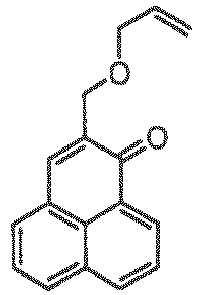
PN-AMO-04a [Verbindung (114)] 6.2 Propargylalkohol (Sigma-Aldrich) Re = 2-Propin-1-yl 56,06 56 → 
PN-AMO-04b [Verbindung (118)] 6.3 4-Vinylphenol (Sigma-Aldrich) Ra = 4-Vinylphen-1-yl 120,15 120 → 
PN-AMO-06 [Verbindung (108)] 6.4 2-Allyloxyethanol (Sigma-Aldrich) Ra = 2-Allyloxyeth-1-yl 102,13 102 → 
PN-AMO-05 [Verbindung (119)] 6.5 Glycerin (Sigma-Aldrich) Re = 2,3-Dihydroxyprop-1-yl 92,09 92 → 
PN-AMO-10 [Verbindung (103)] 6.6 4-Hydroxybenzylalkohol (Sigma-Aldrich) Re = 4-(Hydroxymethyl)phen-1-yl 124,14 124 → 
PN-AMO-02b [Verbindung (105)] 6.7 4-Hydroxy-3-methoxy-benzylalkohol (Sigma-Aldrich) Re = 4-(Hydroxymethyl)-2-methoxy-phen-1-yl 154,17 154 → 
PN-AMO-04a [Verbindung (104)] - 2-Chloromethyl-1H-phenalen-1-on (115 mg, 0,5 mmol) wurde in Toluen (4 mL) vorgelegt. Der oben angegebene substituierte Alkohol (1 mmol), Hydrochinon (11 mg, 0.1 mmol) und Tetrabutylammoniumhydrogensulfat (100 mg) wurden zugegeben. Zur lebhaft rührenden Lösung wurden bei 2-5°C 2 mL 4N wässrige Natronlauge zugegeben. Das Eisbad wurde entfernt und das Reaktionsgemisch weitere 6 h kräftig gerührt. Es wurde mit 30 mL DCM verdünnt und mehrmals mit Wasser (4 mal, je 20 mL) ausgeschüttelt.
- Die organische Phase wurde abgetrennt und über Magnesiumsulfat getrocknet. Nach Filtration und Einengen unter vermindertem Druck wurde das Rohprodukt durch Flashchromatographie gereinigt (DCM/PE 2:1).
-
Substituiertes Silylchlorid in Übersicht 1, Schritt f) Produkt MW [g/mol] Einwaage [mg] Formel Bezeichnung 7.1 Triethoxychlorosilan (Sigma-Aldrich) 198,72 76 → 
PN-AMO-14a [Verbindung (123)] Rf1, Rf2, Rf3 = Ethoxy 7.2 Allyldimethylchlorosilan (Sigma-Aldrich) 134,68 54 → 
PN-AMO-14b [Verbindung (124)] Rf1 = 2-Propen-1-yl Rf2, Rf3 = Methyl - 2-Hydroxymethyl-1H-phenalen-1-on (70 mg, 0,3 mmol) wurde zusammen mit Imidazol (30 mg, 0,4 mmol) in trockenem DCM (3 mL) in einem 10 mL Rundkolben mit Septum unter Stickstoff vorgelegt. Das oben angegebene substituierte Silylchlorid (0,4 mmol) in 2 mL trockenem DCM wurde langsam mittels einer Spritze über das Septum bei ca. 0°C zugetropft. Das Eisbad wurde entfernt und das Reaktionsgemisch über Nacht bei Raumtemperatur gerührt. Es wurde mit 30 mL DCM verdünnt und mehrmals mit Wasser (4 mal, je 20 mL) ausgeschüttelt. Die organische Phase wurde abgetrennt und über Magnesiumsulfat getrocknet. Nach Filtration und Einengen unter vermindertem Druck wurde das Rohprodukt durch Flashchromatographie gereinigt (DCM/PE 2:1).
-
Carbonsäure in Übersicht 1, Schritt g) Produkt MW [g/mol] Einwaage [mg] Formel Bezeichnung 8.1 Acrylsäure 72,06 53 → 
PN-AMO-12a [Verbindung (109)) Rg = *-CH=CH2 8.2 Methacrylsäure 87,09 62 → PN-AMO-12b [Verbindung (111)] Rg = *-C(CH3)=CH2 
8.3 4-Vinylbenzoesäure 148,16 88 → 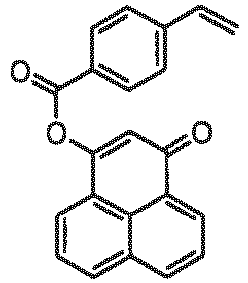
PN-AMO-12c [Verbindung (106)] Rg = 4-Vinylphen-1-yl - 3-Hydroxy-phenalen-1-on (Sigma-Aldrich) (100 mg, 0,5 mmol) wurde zusammen mit Triphenylphosphin (50 mg, 1 mmol) und der oben angegebenen Carbonsäure (0,6 mmol) in trockenem THF (5 mL) in einem 10 mL Rundkolben mit Septum unter Stickstoff vorgelegt. DCC (103 mg, 0,5 mmol) in trockenem THF (1 mL) wurde langsam mittels einer Spritze über das Septum bei ca.0°C zugetropft. Nach 2 h Rühren im Eisbad wurde eine weitere Portion DCC (103 mg, 0,5 mmol) in trockenem THF (1 mL) zugetropft. Das Reaktionsgemisch wurde im auftauenden Eisbad, dann bei Raumtemperatur für 6 h gerührt. Das THF wurde abgezogen, der Rückstand in 30 mL DCM aufgenommen und mehrmals mit Wasser (4 mal, 20 mL) ausgeschüttelt.
- Die organische Phase wurde abgetrennt und über Magnesiumsulfat getrocknet. Nach Filtration und Einengen unter vermindertem Druck wurde das Rohprodukt durch Flashchromatographie gereinigt (DCM/PE 2:1).
-
substituierter Alkohol in Übersicht 1, Schritt h) Produkt MW [g/mol] Einwaage [mg] Formel Bezeichnung 9.1 Allylalkohol 58,08 23 → 
PN-AMO-11a [Verbindung (113)] Rh = 2-Propen-1-yl 9.2 Propargylalkohol 56,06 22 → 
PN-AMO-11b [Verbindung (117)] Rh = 2-Propin-1-yl 9.3 Glycidol (Sigma-Aldrich) 74,08 30 → 
PN-AMO-13 [Verbindung (115)] Rh = 2,3-Epoxy-prop-1-yl 9.4 Bis(2-hydroxyethyl)ether (Thermo Fisher Scientific) 106,12 42 → 
PN-AMO-03a [Verbindung (102)] Rh = *-(CH2)2O(CH2)2OH 9.5 1,3-Propandiol (Sigma-Aldrich) 76,10 31 → 
PN-AMO-03b [Verbindung (101)] Rh = *-(CH2)2OH 9.6l 3-Boc-aminopropan-1-ol (Sigma-Aldrich) 175,2 70 → 
SAPN-32-boc Rh = *-(CH2)2NHBoc - 3-Hydroxy-phenalen-1-on (60 mg, 0,3 mmol) wurde zusammen mit Triphenylphosphin (30 mg, 0,6 mmol) in DCM (3 mL) und dem oben angegebenen substituierten Alkohol (0,4 mmol) in einem 10 mL Rundkolben mit Septum unter Stickstoff vorgelegt. DEAD in Toluen (40%, 0,2 mL, 0,4 mmol) wurde langsam mittels einer Spritze über das Septum bei ca.0°C zugetropft. Das Reaktionsgemisch wurde im auftauenden Eisbad, dann bei Raumtemperatur für 6 h gerührt. Es wurde mit 30 mL DCM verdünnt und mehrmals mit Wasser (4 mal, 20 mL) ausgeschüttelt. Die organische Phase wurde abgetrennt und über Magnesiumsulfat getrocknet. Nach Filtration und Einengen unter vermindertem Druck wurde das Rohprodukt durch Flashchromatographie gereinigt (DCM/PE 2:1).
-

- 2-Chloromethyl-1H-phenalen-1-on (113 mg, 0.5 mmol) in Methanol (10 mL) wurde zu einer eiskalten Lösung des Amins in Methanol (10 mL, 5 M) über 2h zugetropft. Nach 1 h lebhaftem Rühren bei Raumtemperatur wurde das Lösungsmittel zusammen mit dem überschüssigen Amin im Stickstoffstrom abgetrieben. Der Rückstand wurde in möglichst wenig DCM/Ethanol 4:1 gelöst und durch Zugabe von Diethylether gefällt. Das Produkt wurde abzentrifugiert (60 mins, 4400 rpm, 0°C) und der Überstand verworfen. Das Präzipitat wurde in Diethylether suspendiert und erneut zentrifugiert. Der Reinigungsschritt wurde noch einmal wiederholt und das Produkt anschließend getrocknet.
-
Carbonsäurechlorid in Übersicht 1, Schritt I) Produkt MW [g/mol] Einwaage [mg] Formel Bezeichnung 11.1 Acrylsäurechlorid (Merck-Millipore) 90,5 36 → 
PN-AMO-07a [Verbindung (126)] Rk = Methyl Rl = 2-Ethen-1-yl 11.2 Methacrylsäurechlorid 104,53 41 → 
PN-AMO-07b [Verbindung (126)] Rk = Methyl Rl = 1-Methyl-2-ethen-1-yl - 2-(N-Methylamino)methyl-1H-phenalen-1-on hydrochlorid (80 mg, 0,3 mmol) wurde mit Triethylamin (100 mg, 1 mmol) in DCM (3 mL) gelöst und im Eisbad unter Feuchtigkeitsausschluss gerührt. Das entsprechende Carbonsäuresäurechlorid (0,4 mmol) in DCM (0,5 mL) wurde zugetropft. Das Reaktionsgemisch wurde im auftauenden Eisbad, dann bei Raumtemperatur für 4 h gerührt. Es wurde mit 30 mL DCM verdünnt und mehrmals mit Wasser (4 mal, 20 mL) ausgeschüttelt. Die organische Phase wurde abgetrennt und über Magnesiumsulfat getrocknet. Nach Filtration und Einengen unter vermindertem Druck wurde das Rohprodukt durch Flashchromatographie gereinigt.
-

- 2-Chlormethyl-1H-phenalen-1-on (230 mg, 1,0 mmol) in Acetonitril (20 mL) wurde zu einer Lösung von 3-Aminopropanol (1,5 mL, 20 mmol) in Acetonitril (50 mL) über 30 mins. zugetropft. Nach Rühren bei Raumtemperatur über Nacht, wurde Triethylamin (2,02 g, 2,66 mL, 20 mmol) zugegeben und die Lösung im Eisbad gerührt. Essigsäureanhydrid (3,06 g, 2,83 mL, 30 mmol) wurde bei ca. 0°C zugetropft. Das Reaktionsgemisch wurde 2h bei Raumtemperatur gerührt, dann für 1 h auf 50°C erwärmt. Alle flüchtigen Bestandteile wurden unter vermindertem Druck abgezogen.
- Das Produkt wurde durch Säulenchromatographie mit Dichloromethan / Ethanol 20:1 gereinigt. Man erhält 261 mg gelben Sirup. Dieses Material wurde in Methanol (2 mL) gelöst. Wässrige Natronlauge (1 M, 0,5 mL) wurde zugegeben und die Mischung über Nacht bei Raumtemperatur gerührt. Der Alkohol wurde abgezogen und die restliche Lösung mit Wasser (10 mL) verdünnt. Das Produkt wurde mit Dichloromethan (2x 10 mL) extrahiert. Die organischen Phasen wurden über Magnesiumsulfat getrocknet, gefiltert und bei vermindertem Druck eingeengt. Das Produkt war ein gelblicher, schmieriger Feststoff (215 mg, 69 %, 0,69 mmol).
-
Produkt geschütztes Phenalenonderivat Formel Bezeichnung 13.1 
→ 
SA-PN-25c [Verbindung (150)] 13.2 
→ 
SA-PN-25b [Verbindung (159)] 13.3 
→ 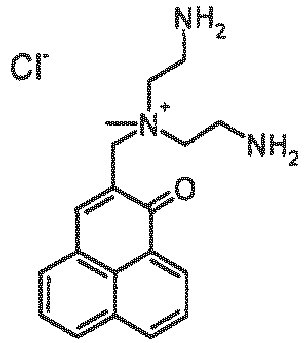
SA-P N-34 b [Verbindung (160)] 13.4 
→ 
SAPN-32 [Verbindung (161)] - Das entsprechende tert-Butyloxycarbonyl (Boc -geschützte Phenalenonderivat wurde in Dichlormethan (3 mL pro 100 mg) vorgelegt. Eine gesättigte Lösung von Chlorwasserstoff in Diethylether (0,5 mL pro mmol Boc-Gruppe) wurde zugetropft. Der Ansatz wurde 3h unter Feuchtigkeits-ausschluss gerührt. Das Produkt wurde durch Zugabe von 30 mL Diethylether gefällt. Der Niederschlag wurde abzentrifugiert und mit Diethylether gründlich gewaschen. Das Produkt wurde bei vermindertem Druck getrocknet.
- Nachfolgend sind für die hergestellten Verbindungen jeweils die berechnete Molekülmasse (MW) und Summenformel (MF) sowie die Daten der gemessenen Massenspektren (MS) und 1H-NMR Spektren angegeben.
Substanz Nr. Struktur Molekülmasse (MW) / Summenformel (MF) Massenspektrum (MS) NMR 2.1 SAPN-19a 
MW: 302,3 + 35,45 = 337,75 g/mol MS (ESI-MS, CH2Cl2/MeOH + 10 mmol NH4OAc): m/z = 302.1 (100%, M+) 1H-NMR (300 MHz, DMSO-d6): δ [ppm] = 9,18 (d, J = 6,8 Hz, 2H), 8,54 - 8,45 (m, 2H), 8,42 (s, 1H), 8,35 (d, J = 7,8 Hz, 1H), 8,15 (d, J = 6,4 Hz, 1H), 8,04 (d, J = 6,7 Hz, 2H), 7,91 (t, J = 7,7 Hz, 1H), 7,80 (dd, J = 8,2 & 7,2 Hz, 1H), 6,17 (t, J = 5,4 Hz, 1H), 5,79 (s, 2H), 4,80 (d, J = 4,5 Hz, 2H). MF: C20H16NO2Cl 2.2 SAPN-19c 
MW: 330,4 + 35,45 = 365,85 g/mol MS (ESI-MS, CH2Cl2/MeOH + 10 mmol NH4OAc): m/z = 330.1 (100%, M+) 1H-NMR (300 MHz, DMSO-d6): δ [ppm] = 9,18 (d, J = 6,8 Hz, 2H), 8,52 (dd, J = 8,9, 7,7 Hz, 2H), 8,45 (s, 1H), 8,36 (d, J = 8,1 Hz, 1H), 8,22 - 8,13 (m, 3H), 7,93 (t, J = 7,7 Hz, 1H), 7,82 (dd, J = 8,1 & 7,3 Hz, 1H), 5,91 (s, 1H), 5,78 (s, 2H), 1,49 (s, 6H). MF: C22H20NO2Cl 2.3 SAPN-19b 
MW: 316,4 + 35,45 = 351,85 g/mol MS (ESI-MS, CH2Cl2/MeOH + 10 mmol NH4OAc): m/z = 316.1 (100%, M+) 1H-NMR (300 MHz, DMSO-d6): δ [ppm] = 9,11 (d, J = 6,6 Hz, 2H), 8,60 - 8,45 (m, 2H), 8,46 - 8,31 (m, 2H), 8,17 (d, J = 6,9 Hz, 1H), 8,02 (d, J = 6,6 Hz, 2H), 7,93 (t, J = 7,7 Hz, 1H), 7,87 - 7,72 (m, 1H), 5,75 (s, 2H), 4,95 (s, 1H), 3,75 (t, J = 5,9 Hz, 2H), 3,01 (t, J = 6,0 Hz, 2H). MF: C21H18NO2Cl 3.1 SAPN-35a 
MW: 278,38 + 35,45 = 313,83 g/mol MS (ESI-MS, CH2Cl2/MeOH + 10 mmol NH4OAc): m/z = 278.2 (100%, M+) 1H-NMR (300 MHz, MeOD): δ [ppm] = 8,66 (dd, J = 7,4 & 1,1 Hz, 1H), 8,49 - 8,37 (m, 2H), 8,36 - 8,24 (m, 1H), 8,18 - 8,06 (m, 1H), 7,91 (t, J = 7,8 Hz, 1H), 7,77 (dd, J = 8,2 & 7,2 Hz, 1H), 5,87 - 5,69 (m, 2H), 4,56 (s, 2H), 4,10 (d, J = 7,3 Hz, 2H), 3,11 (s, 6H). MF: C19H20NOCl 3.2 SAPN-35b 
MW: 276,36 + 35,45 = 311,81 g/mol MS (ESI-MS, CH2Cl2/MeOH + 10 mmol NH4OAc): m/z = 276.1 (100%, M+) 1H-NMR (300 MHz, MeOD): δ [ppm] = 8,66 (dd, J = 7,4 & 1,1 Hz, 1H), 8,51 - 8,37 (m, 2H), 8,30 (d, J = 8,3 Hz, 1H), 8,12 (d, J = 6,5 Hz, 1H), 7,91 (t, J = 7,8 Hz, 1H), 7,77 (dd, J = 8,2 & 7,2 Hz, 1H), 4,67 (s, 2H), 4,47 (s, 2H), 3,64 (m, 1H), 3,25 (s, 6H). MF: C19H18NOCl 3.3 SAPN-36 
MW: 354,48 + 35,45 = 389,93 g/mol MS (ESI-MS, CH2Cl2/MeOH + 10 mmol NH4OAc): m/z = 354.2 (100%, M+) 1H-NMR (300 MHz, CDCl3): δ [ppm] = 8,92 (s, 1H), 8,57 (dd, J = 7,4 & 0,9 Hz, 1H), 8,25 (d, J = 7,3 Hz, 1H), 8,12 (d, J = 7,7 Hz, 2H), 7,79 (t, J = 7,7 Hz, 1H), 7,66 (m, 3H), 7,57 (m, 2H), 7,43 (d, J = 8,1 Hz, 2H), 7,57 (m, 2H), 6,68 (m, 1H), 5,80 (d, J = 16,8 Hz, 1H), 5,33 (d, J = 10,9 Hz, 1H), 5,15 (s, 2H), 5,03 (s, 2H), 3,19 (s, 6H). MF: C25H24NOCl 3.4 SAPN-37a 
MW: 350,44 + 35,45 = 385,89 g/mol MS (ESI-MS, CH2Cl2/MeOH + 10 mmol NH4OAc): m/z = 350.2 (100%, M+) 1H-NMR (300 MHz, MeOD): δ [ppm] = 8,58 (dd, J = 7,4, 1,1 Hz, 1H), 8,52 - 8,32 (m, 2H), 8,25 (dd, J = 8,3 & 0,7 Hz, 1H), 8,18 - 8,03 (m, 1H), 7,93 - 7,78 (m, 1H), 7,76 - 7,63 (m, 1H), 6,19 (m, 1H), 5,72 (m, 1H), 4,89 (m, 2H), 4,67 (m, 2H), 3,98 - 3,76 (m, 2H), 3,26 (s, 6H), 1,97 (s, 3H). MF: C22H24NO3Cl 3.5 SAPN-37b 
MW: 349,46 + 35,45 = 384,91 g/mol MS (ESI-MS, CH2Cl2/MeOH + 10 mmol NH4OAc): m/z = 349.2 (100%, M+) Nicht gemessen MF: C22H25N2O2Cl 3.6 SA-PN-38 
MW: 400,57 + 35,45 = 436,02 g/mol MS (ESI-MS, CH2Cl2/MeOH + 10 mmol NH4OAc): m/z = 358.1 (100%, (M-3Me)+) 1H-NMR (300 MHz, DMSO-d6): δ [ppm] = 8,81 - 7,29 (m, 7H), 5,67 (m, 1H), 4,55 (s, 2H), 3,64 (m, 2H), 3,45 - 2,98 (m, 15H), 2,03 (m, 2H), 0,77 (m, 2H). MF: C22H30NO4SiCl 3.7 SA-PN-25c-boc 
MW: 352,44 g/mol MS (ESI-MS, CH2Cl2/MeOH + 10 mmol NH4OAc): m/z = 353.1 (100%, MH+) 1H-NMR (300 MHz, CDCl3): δ [ppm] = 8,64 (dd, J = 7,4 & 1,0 Hz, 1H), 8,21 (d, J = 8,2 Hz, 1H), 8,03 (d, J = 8,2 Hz, 1H), 7,92 (s, 1H), 7,79 (dd, J = 16,7 & 7,4 Hz, 2H), 7,65 - 7,57 (m, 1H), 5,40 (s, 1H), 3,98 (s, 2H), 3,41 (d, J = 5,3 Hz, 2H), 3,03 - 2,95 (m, 2H), 1,42 (s, 9H). MF: C21H24N2O3 3.8 SA-PN-25a 
MW: 381,50 + 35,45 = 416,95 g/mol MS (ESI-MS, CH2Cl2/MeOH + 10 mmol NH4OAc): m/z = 381.0 (100%, M+) 1H-NMR (300 MHz, DMSO-d6): δ [ppm] = 8,66 - 8,47 (m, 2H), 8,39 (d, J = 8,1 Hz, 1H), 8,18 (d, J = 6,8 Hz, 1H), 7,96 (t, J = 7,7 Hz, 1H), 7,83 (dd, J = 8,1 & 7,3 Hz, 1H), 7,27 (t, J = 5,1 Hz, 1H), 4,57 (s, 2H), 3,55 - 3,40 (m, 4H), 3,13 (s, 6H), 1,39 (s, 9H). MF: C23H29N2O3Cl 3.9 SA-PN- 34a 
MW: 510,66 + 35,45 = 546,12 g/mol MS (ESI-MS, CH2Cl2/MeOH + 10 mmol NH4OAc): m/z = 510.3 (100%, M+) 1H-NMR (300 MHz, CDCl3): δ [ppm] = 8,89 (s, 1H), 8,58 (d, J = 7,3 Hz, 1H), 8,31 - 8,02 (m, 3H), 7,78 (t, J = 7,7 Hz, 1H), 7,66 (t, J = 7,7 Hz, 1H), 6,53 (s, 2H), 4,82 (s, 2H), 3,98 - 3,58 (m, 8H), 3,22 (s, 3H), 1,39 (s, 18H). MF: C29H40N3O5Cl 3.10 SA-PN- 11 
MW: 326,4 + 35,45 = 361,85 g/mol MS (ESI-MS, CH2Cl2/MeOH + 10 mmol NH4OAc): e/z (%) = 326.2 (100, M+); 1H-NMR (300 MHz, CDCl3): δ [ppm] = 8,69 (s, 1H), 8,48 - 8,34 (m, 1H), 8,17 - 7,91 (m, 3H), 7,65 (t, J = 7,6 Hz, 1H), 7,56 (t, J = 7,7 Hz, 1H), 5,03 - 4,78 (bs, 1H), 4,81 (s, 2H), 4,06 (m, 2H), 3,84 (m, 2H), 3,69 (m, 2H), 3,63 (m, 2H), 3,30 (s, 6H). MF: C20H24NO3Cl 3.11 SA-PN- 12 
MW: 370,5 + 35,45 = 405,95 g/mol MS (ESI-MS, CH2Cl2/MeOH + 10 mmol NH4OAc): e/z (%) = 370.2 (100, M+); 1H-NMR (300 MHz, DMSO): δ [ppm] = 8,65 - 8,45 (m, 3H), 8,39 (d, J = 8,0 Hz, 1H), 8,17 (d, J = 6,5 Hz, 1H), 7,96 (t, J = 7,7 Hz, 1H), 7,83 (dd, J = 8,2 & 7,2 Hz, 1H), 4,60 (s, 2H), 3,97 (s, 2H), 3,75 - 3,41 (m, 13H), 3,14 (s, 6H). MF: C22H28NO4Cl 3.12 SA-PN- 09 
MW: 282,4 + 35,45 = 317,85 g/mol MS (ESI-MS, CH2Cl2/MeOH + 10 mmol NH4OAc): e/z (%) = 282.1 (100, M+); 1H-NMR (300 MHz, DMSO-d6): δ[ppm] = 8,58 - 8,54 (dd, J = 1,0 & 7,3 Hz, 1H), 8,55 - 8,50 (dd, J = 1,2 & 7,4 Hz, 1H), 8,52 (s, 1H), 8,37 (dd, J = 1,0 & 7,8 Hz, 1H), 8,18 (dd, J = 0,9 Hz, J = 7,1 Hz, 1H), 7,95 (t, J = 7,7 Hz, 1H), 7,84 - 7,78 (m, 1H), 5,62 (t, J = 5,1 Hz, 1H), 4,61 (s, 2H), 3,99 - 3,88 (m, 2H), 3,59 - 3,51 (m, 2H), 3,15 (s,6H). MF: C18H20NO2Cl 4 PNOH 
MW: 210,33 g/mol MS (ESI-MS, CH2Cl2/MeOH + 10 mmol NH4OAc): m/z = 211.1 (100%, MH+), 193.1 (64%, MH+ - H2O) 1H-NMR (300 MHz, CDCl3): δ [ppm] = 8,66 (dd, J = 7,4 & 1,2 Hz, 1H), 8,22 (dd, J = 8,1, 1,1 Hz, 1H), 8,01 (m, 2H), 7,89 - 7,74 (m, 2H), 7,62 (dd, J = 8,2 & 7,1 Hz, 1H), 4,82 (d, J = 1,4 Hz, 2H). MF: C14H10NO2 5.1 PN-AMO-07a 
MW: 264,28 g/mol MS (ESI-MS, CH2Cl2/MeOH + 10 mmol NH4OAc): m/z = 265.1 (100%, MH+) 1H-NMR (300 MHz, CDCl3): δ [ppm] = 8,67 (d, J = 7,4 Hz, 1H), 8,23 (d, J = 8,0 Hz, 1H), 8,03 (d, J = 8,4 Hz, 2H), 7,87 - 7,76 (m, 2H), 7,65 - 7,59 (m, 1H), 6,64 (d, J = 16,6 Hz, 1H), 6.35 (dd, J = 16,6, 10,1 Hz, 1H), 6,18 (d, J = 10,1 Hz, 1H), 4,83 (s, 2H). MF: C17H12O3 5.2 PN-AMO-07b 
MW: 278,31 g/mol MS (ESI-MS, CH2Cl2/MeOH + 10 mmol NH4OAc): m/z = 279.1 (100%, MH+) Nicht gemessen MF: C18H14O3 5.3 PN-AMO-08 
MW: 340,38 g/mol MS (ESI-MS, CH2Cl2/MeOH + 10 mmol NH4OAc): m/z = 341.1 (100%, MH+) 1H-NMR (300 MHz, CDCl3): δ [ppm] = 8,69 (d, J = 7,4 Hz, 1H), 8,25 (d, J = 8,1 Hz, 1H), 8,22 (d, J = 8,4 Hz, 2H), 8,05 (d, J = 8,4 Hz, 2H), 7,89 - 7,74 (m, 2H), 7,67 - 7,62 (m, 1H), 7,58 (d, J = 8,3 Hz, 2H), 6,90 - 6,73 (m, 2H), 5,94 (d, J = 17,5 Hz, 1H), 5,48 (d, J = 10,8 Hz, 1H), 4,85 (s, 1H). MF: C23H16O3 6.1 PN-AMO-04a 
MW: 250,30 g/mol MS (ESI-MS, CH2Cl2/MeOH + 10 mmol NH4OAc): m/z = 193.1 (52%, MH+ -C3H6O), 251.1 (100%, MH+), 273.1 (13%, MNa+) 1H-NMR (300 MHz, CDCl3): δ [ppm] = 8,63 (d, J = 7,4 Hz, 1H), 8,19 (d, J = 8,1 Hz, 1H), 7,99 (d, J = 8,3 Hz, 1H), 7,85 (m, 1H), 7,75 (m, 2H), 7,58 (t, J = 7,7 Hz, 1H), 6,06 (m, 1H), 5,40 (dd, J = 17,2 & 1,6 Hz, 1H), 5,26 (dd, J = 10,4 & 1,1 Hz, 1H), 4,61 (s, 2H), 4,20 (d, J = 5,6 Hz, 2H). MF: C17H14O2 6.2 PN-AMO-04b 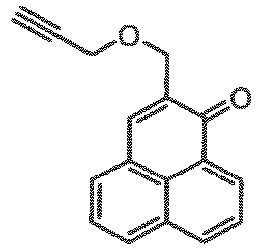
MW: 248,28 g/mol MS (ESI-MS, CH2Cl2/MeOH + 10 mmol NH4OAc): m/z = 249.1 (100%, MH+) 1H-NMR (300 MHz, CDCl3): δ [ppm] = 8,66 (dd, J = 7,4, 1,1 Hz, 1H), 8,22 (dd, J = 8,0, 0,9 Hz, 1H), 8,02 (d, J = 8,1 Hz, 1H), 7,87 (t, J = 1,4 Hz, 1H), 7,79 (t, J = 7,7 Hz, 2H), 7,61 (dd, J = 8,2, 7,2 Hz, 1H), 4,71 (d, J = 1,5 Hz, 2H), 4,37 (d, J = 2,4 Hz, 2H), 2,51 (t, J = 2,4 Hz, 1H). MF: C17H12O2 6.3 PN-AMO-06 
MW: 312,37 g/mol MS (ESI-MS, CH2Cl2/MeOH + 10 mmol NH4OAc): m/z = 313.1 (100%, MH+) 1H-NMR (300 MHz, CDCl3): δ [ppm] = 8,70 (d, J = 6,4 Hz, 1H), 8,25 (d, J = 8,1 Hz, 1H), 8,04 (d, J = 8,1 Hz, 1H), 7,95 (s, 1H), 7,86 - 7,78 (m, 2H), 7,66 - 7,58 (m, 1H), 7,38 (d, J = 8,7 Hz, 2H), 7,03 (d, J = 8,7 Hz, 2H), 6,67 (dd, J = 17,6, 10,9 Hz, 1H), 5,63 (d, J = 17,6 Hz, 1H), 5,20 (d, J = 1,5 Hz, 2H), 5,14 (d, J = 11,0 Hz, 1H). MF: C22H16O2 6.4 PN-AMO-05 
MW: 294,35 g/mol MS (ESI-MS, CH2Cl2/MeOH + 10 mmol NH4OAc): m/z = 193.1 (27%, MH+ -C5H10O2), 295.1 (100%, MH+), 317.1 (10%, MNa+) 1H-NMR (300 MHz, CDCl3): δ [ppm] = 8,63 (dd, J = 7,4 & 1,1 Hz, 1H), 8,19 (dd, J = 8,1 & 0,9 Hz, 1H), 7,99 (d, J = 8,1 Hz, 1H), 7,89 (t, J = 1,5 Hz, 1H), 7,76 (t, J = 7,6 Hz, (ddd, J = 17,2 J = & 1H), 5,94 (m, 1H), 5,32 2H), 7,58 (dd, & 3,2 & 1,6 Hz, 1H), 5,26 - 5,16 (m, 1H), 4,66 (d, J = 1,5 Hz, 2H), 4,09 (dt, J = 5,6 & 1,3 Hz, 2H), 3,83 (m, 2H), 3,72 (m, 2H). MF: C19H18O3 6.5 PN-AMO-10 
MW: 284,31 g/mol MS (ESI-MS, CH2Cl2/MeOH + 10 mmol NH4OAc): m/z = 285.1 (100%, MH+), 263.1 (29%, MH+ - H2O) 1H-NMR (300 MHz, CDCl3): δ [ppm] = 8,62 (d, J = 7,6 Hz, 1H), 8,20 (d, J = 8,1 Hz, 1H), 7,97 (d, J = 8,2 Hz, 1H), 7,87 (s, 1H), 7,76 (t, J = 7,5 Hz, 2H), 7,56 (t, J = 7,6 Hz, 1H), 4,61 (s, 2H), 4,12 - 3,56 (m, 7H). MF: C17H16O4 6.6 PN-AMO-02b 
MW: 316,36 g/mol MS (ESI-MS, CH2Cl2/MeOH + 10 mmol NH4OAc): m/z = 317.1 (100%, MH+) 1H-NMR (300 MHz, CDCl3): δ [ppm] = 8,69 (d, J = 7,4 Hz, 1H), 8,23 (d, J = 8,1 Hz, 1H), 7,98 (d, J = 8,1 Hz, 1H), 7,93 (s, 1H), 7,78 - 7,73 (m, 2H), 7,62 - 7,51 (m, 1H), 7,01 (d, J = 7,8 Hz, 2H), 6,78 (d, J = 7,8 Hz, 2H), 5,26 (m, 2H), 4,46 (s, 2H). MF: C21H16O3 6.7 PN-AMO-02a 
MW: 346,39 g/mol MS (ESI-MS, CH2Cl2/MeOH + 10 mmol NH4OAc): m/z = 347.1 (100%, MH+), 369.1 (9%, MNa+) 1H-NMR (300 MHz, CDCl3): δ [ppm] = 8,67 (dd, J = 7,3 & 0,9 Hz, 1H), 8,21 (d, J = 8,0 Hz, 1H), 8,01 (d, J = 8,2 Hz, 1H), 7,94 (s, 1H), 7,78 (dd, J = 10,8 & 4,4 Hz, 2H), 7,65 - 7,52 (m, 1H), 6,97 - 6,89 (m, 2H), 6,84 (dd, J = 8,2 & 1,7 Hz, 1H), 5,24 (d, J = 1,3 Hz, 2H), 4,63 (s, 2H), 3,95 (s, 3H). MF: C22H18O4 7.1 PN-AMO-14a 
MW: 372,50 g/mol MS (ESI-MS, CH2Cl2/MeOH + 10 mmol NH4OAc): m/z = 373.1 (13%, MH+), 286.1 (100%, (M -3 C2H5)+) 1H-NMR (300 MHz, CDCl3): δ [ppm] = 8,67 (d, J = 7,4 Hz, 1H), 8,22 (d, J = 7,5 Hz, 1H), 8,03 (d, J = 8,6 Hz, 2H), 7,90 - 7,74 (m, 2H), 7,67 - 7,57 (m, 1H), 4,82 (s, 2H), 3,76 - 3,69 (m, 6H), 1,26 (d, J = 7,0 Hz, 9H). MF: C20H24O5Si 7.2 PN-AMO- 14b 
MW: 308,46 g/mol MS (ESI-MS, CH2Cl2/MeOH + 10 mmol NH4OAc): m/z = 309.1 (26%, MH+), 193.1 (100%, (M -H2O - C5H11Si)+) 1H-NMR (300 MHz, CDCl3): δ [ppm] = 8,67 (d, J = 7,4 Hz, 1H), 8,22 (d, J = 8,2 Hz, 1H), 8,03 (d, J = 8,4 Hz, 2H), 7,90 - 7,74 (m, 2H), 7,68 - 7,57 (m, 1H), 4,98 (dd, J = 28,1, 14,7 Hz, 1H), 4,83 (s, 2H), 1,72 (dt, J = 6,4, 1,6 Hz, 1H), 0,51 (d, J = 5,2 Hz, 1 H), 0,23 - 0,07 (m, 6H). MF: C19H20O2Si 8.1 PN-AMO-12a 
MW: 250,26 g/mol MS (ESI-MS, CH2Cl2/MeOH + 10 mmol NH4OAc): m/z = 251.1 (100%, MH+) 1H-NMR (300 MHz, CDCl3): δ [ppm] = 8,70 (d, J = 7,3 Hz, 1H), 8,57 (d, J = 6,6 Hz, 1H), 8,27 (d, J = 8,0 Hz, 1H), 8,19 (d, J = 7,8 Hz, 1H), 8,11 (s, 1H), 7,79 (dt, J = 21,7, 7,8 Hz, 2H), 6,70 (dd, J = 17,3, 1,1 Hz, 1H), 6,41 (dd, J = 17,3 & 10,4 Hz, 1H), 6,11 (dd, J = 10,4 & 1,1 Hz, 1H). MF: C16H10O3 8.2 PN-AMO-12b 
MW: 264,28 g/mol MS (ESI-MS, CH2Cl2/MeOH + 10 mmol NH4OAc): m/z = 265.1 (100%, MH+) Nicht gemessen MF: C17H12O3 8.3 PN-AMO-12c 
MW: 326,36 g/mol MS (ESI-MS, CH2Cl2/MeOH + 10 mmol NH4OAc): m/z = 327.1 (100%, MH+) 1H-NMR (300 MHz, CDCl3): δ [ppm] = 8,55 (d, J = 7,3 Hz, 1H), 8,19 (d, J = 8,3 Hz, 2H), 8,12 (d, J = 8,0 Hz, 1H), 8,00 (d, J = 8,2 Hz, 1H), 7,91 (d, J = 7,2 Hz, 1H), 7,69 (t, J = 7,7 Hz, 1H), 7,61 - 7,48 (m, 3H), 6,91 - 6,60 (m, 2H), 5,92 (d, J = 17,6 Hz, 1H), 5,45 (d, J = 10,9 Hz, 1H). MF: C22H14O3 9.1 PN-AMO-11a 
MW: 236,27 g/mol MS (ESI-MS, CH2Cl2/MeOH + 10 mmol NH4OAc): m/z = 237.1 (100%, MH+) 1H-NMR (300 MHz, CDCl3): δ [ppm] = 8,59 (dd, J = 7,3, 1,1 Hz, 1H), 8,31 (dd, J = 7,3, 0,9 Hz, 1H), 8,22 - 8,14 (m, 1H), 8,08 (d, J = 7,5 Hz, 1H), 7,78 - 7,57 (m, 2H), 6,23 - 6,08 (m, 2H), 5,55 (dd, J = 17,3, 1,4 Hz, 1H), 5,42 (dd, J = 10,5, 1,2 Hz, 1H), 4,73 (d, J = 5,4 Hz, 2H). MF: C16H12O2 9.2 PN-AMO-11b 
MW: 234,26 g/mol MS (ESI-MS, CH2Cl2/MeOH + 10 mmol NH4OAc): m/z = 235.1 (100%, MH+) 1H-NMR (300 MHz, CDCl3): δ [ppm] = 8,56 (d, J = 7,2 Hz, 1H), 8,47 (d, J = 7,3 Hz, 1H), 8,20 (d, J = 8,0 Hz, 1H), 8,10 (d, J = 8,1 Hz, 1H), 7,81 - 7,63 (m, 2H), 7,57 (s, 1H), 4,35 - 4,10 (m, 2H), 2,63 (s, 1H). MF: C16H10O2 9.3 PN-AMO-13 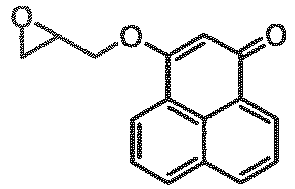
MW: 252,27 g/mol MS (ESI-MS, CH2Cl2/MeOH + 10 mmol NH4OAc): m/z = 253.1 (100%, MH+) 1H-NMR (300 MHz, CDCl3): δ [ppm] = 8,59 (dd, J = 7,1 & 0,9 Hz, 1H), 8,29 (m, 2H), 8,17 (d, J = 7,6 Hz, 1H), 7,47 (t, J = 7,8 Hz, 1H), 7,31 (t, J = 7,8 Hz, 1H), 7,16 (m, 1H), 4,18 (dd, J = 11,4 & 4,6 Hz, 1H), 3,93 (dd, J = 11,2 & 5,8 Hz, 1H), 3,31 (m, 1H), 2,88 (m, 1H), 2,69 (m, 1H). MF: C16H12O3 9.4 PN-AMO-03a 
MW: 284,31 g/mol MS (ESI-MS, CH2Cl2/MeOH + 10 mmol NH4OAc): m/z = 285.1 (100%, MH+) 1H-NMR (300 MHz, CDCl3): δ [ppm] = 8,26 (dd, J = 7,2 & 0,8 Hz, 1H), 7,94 - 7,74 (m, 2H), 7,66 (d, J = 7,9 Hz, 1H), 7,43 (t, J = 7,7 Hz, 1H), 7,23 (t, J = 7,8 Hz, 1H), 5,79 (s, 1H), 4,13 - 3,97 (m, 2H), 3,88 - 3,79 (m, 2H), 3,77 - 3,69 (m, 2H), 3,68 - 3,51 (m, 3H). MF: C17H16O4 9.5 PN-AMO-03b 
MW: 254,29 g/mol MS (ESI-MS, CH2Cl2/MeOH + 10 mmol NH4OAc): m/z = 255.1 (100%, MH+) H-NMR (300 MHz, MeOD): δ [ppm] = 8,66 - 8,58 (m, 1H), 8,45 (m, 2H), 8,27 (m, 1H), 7,96 - 7,72 (m, 3H), 3,22 (t, J = 7,1 Hz, 2H), 2,47 (m, 2H), 1,81 (m, 2H). MF: C16H14O3 9.6 SAPN-32boc 
MW: 353,42 g/mol MS (ESI-MS, CH2Cl2/MeOH + 10 mmol NH4OAc): m/z = 354.2 (100%, MH+) 1H-NMR (300 MHz, CDCl3): δ [ppm] = 8,56 (dd, J = 7,3 & 1,0 Hz, 1H), 8,22 (d, J = 7,2 Hz, 1H), 8,19 - 8,11 (m, 1H), 8,05 (d, J = 7,9 Hz, 1H), 7,72 (t, J = 7,7 Hz, 1H), 7,67 - 7,55 (m, 1H), 6,13 (s, 1H), 4,81 (s, 1H), 4,22 (t, J = 5,9 Hz, 2H), 3,43 (s, 2H), 2,14 (p, J = 6,3 Hz, 2H), 1,45 (s, 9H). MF: C21H23NO4 10 SAPN-02c 
MW: 223,28 g/mol MS (ESI-MS, CH2Cl2/MeOH + 10 mmol NH4OAc): m/z = 223.1 (100%, M+) H-NMR (300 MHz, MeOD): δ [ppm] = 8,68 (dd, J = 7,4 & 1,0 Hz, 1H), 8,51 - 8,38 (m, 1H), 8,27 (d, J = 7,9 Hz, 1H), 8,20 (s, 1H), 8,07 (d, J = 7,0 Hz, 1H), 7,91 (t, J = 7,8 Hz, 1H), 7,76 (dd, J = 8,2 & 7,2 Hz, 1H), 4,21 (s, 2H), 2,79 (s, 3H). MF: C15H13NO 11.1 PN-AMO-09a 
MW: 291,35 g/mol MS (ESI-MS, CH2Cl2/MeOH + 10 mmol NH4OAc): m/z = 292.1 (100%, MH+) 1H-NMR (300 MHz, CDCI3): δ [ppm] = 8,72 - 8,59 (m, 1H), 8,30 - 8,16 (m, 1H), 8,02 (dd, J = 14,3 & 8,2 Hz, 1H), 7,85 - 7,72 (m, 2H), 7,60 (m, 1H), 7,47 (s, 1H), 6,62 (m, 1H), 6,41 (m, 1H), 5,70 (m, 1H), 4,72 - 4,60 (m, 2H), 3,20 (d, J = 27,8 Hz, 3H). MF: C19H17NO2 11.2 PN-AMO-09b 
MW: 277,33 g/mol MS (ESI-MS, CH2Cl2/MeOH + 10 mmol NH4OAc): m/z = 278.1 (100%, MH+) Nicht gemessen MF: C18H15NO3 12 PN-AMO-01 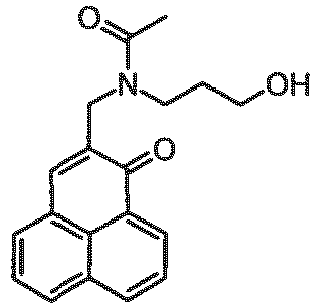
MW: 309,37 g/mol MS (ESI-MS, CH2Cl2/MeOH + 10 mmol NH4OAc): m/z = 310.1 (100%, MH+) 1H-NMR (300 MHz, CDCl3): δ [ppm] = 8,69 (dd, J = 1,2 & 7,4 Hz, 1H), 8,26 (dd, J = 1,0 & 8,1 Hz, 1H), 8,08 (dd, J = 0,6 & 8,2 Hz, 1H), 7,78 - 7,90 (m, 2H), 7,62 (dd, J = 7,0 & 1,2 Hz, 1H), 7,51 (s, 1H), 4,65 (s, 2H), 3,83 (bs, 1H), 3,66 (t, J = 5,6 Hz, 2H), 3,59 (t, J = 5,6 Hz, 2H), 2,16 (s, 3H), 1,78 (m, 2H). MF: C19H19NO3 13.1 SA-PN-25c 
MW: 252,32 g/mol MS (ESI-MS, CH2Cl2/MeOH + 10 mmol NH4OAc): m/z = 253.1 (100%, MH+) H-NMR (300 MHz, MeOD): δ [ppm] = 8,71 (dd, J = 7,4 & 1,0 Hz, 1H), 8,46 (d, J = 8,1 Hz, 1H), 8,29 (t, J = 3,9 Hz, 2H), 8,10 (d, J = 7,1 Hz, 1H), 7,92 (t, J = 7,8 Hz, 1H), 7,77 (dd, J = 8,2 & 7,2 Hz, 1H), 4,33 (s, 2H), 3,46 (m, 4H). MF: C16H16N2O 13.2 SA-PN-25b 
MW: 281,38 + 35,45 = 316,83 g/mol MS (ESI-MS, CH2Cl2/MeOH + 10 mmol NH4OAc): m/z = 281.1 (100%, M+) 1H-NMR (300 MHz, DMSO-d6): δ [ppm] = 8,68 (s, 3H), 8,57 (dd, J = 10,0 & 6,5 Hz, 3H), 8,40 (d, J = 8,3 Hz, 1H), 8,22 (d, J = 7,0 Hz, 1H), 7,97 (t, J = 7,7 Hz, 1H), 7,91 - 7,76 (m, 1H), 4,62 (s, 2H), 3,77 - 3,65 (m, 2H), 3,43 (m, 2H), 3,20 (s, 6H). MF: C18H21N2OCl 13.3 SA-PN-34b 
MW: 310,42 + 35,45 = 345, 87 g/mol MS (ESI-MS, CH2Cl2/MeOH + 10 mmol NH4OAc): m/z = 310.1 (100%, M+) H-NMR (300 MHz, MeOD): δ [ppm] = 8,74 (dd, J = 7,5 & 0,9 Hz, 1H), 8,47 (d, J = 8,0 Hz, 1H), 8,31 (t, J = 3,8 Hz, 2H), 8,12 (d, J = 7,2 Hz, 1H), 7,93 (t, J = 7,6 Hz, 1H), 7,79 (dd, J = 8,2 & 7,4 Hz, 1H), 4,35 (s, 2H), 3,58 - 3,35 (m, 8H). MF: C19H24N3O 13.4 SAPN-32 
MW: 253,30 g/mol MS (ESI-MS, CH2Cl2/MeOH + 10 mmol NH4OAc): m/z = 254.1 (100%, MH+) H-NMR (300 MHz, MeOD): δ [ppm] = 8,62 - 8,50 (m, 1H), 8,42 (m, 2H), 8,26 (m, 1H), 7,98 - 7,70 (m, 3H), 3,05 (t, J = 7,0 Hz, 2H), 2,88 - 2,78 (m, 2H), 1,86 (dd, J = 9,5 & 3,6 Hz, 2H). MF: C16H15NO2 - Die in Beispiel 1 hergestellten Photosensibilisatoren wurden nachfolgend in verschiedenen Lacksystemen getestet.
- Der jeweilige Photosensibilisator (0,06 mmol) wurde in 100 mL klarem Grundlack (polyisocyanatvernetzbares, hydroxylgruppenhaltiges Acrylharz, 20% in Xylol/n-Butylacetat) gelöst. Der Vernetzer (Hexamethylendiisocyanat (HDI) - haltiges Polymer, 20% in Xylol/n-Butylacetat, "Desmodur® N75" von Covestro AG, Leverkusen, DE) wurde im Verhältnis 5:1 (V/V) mit dem Grundlack gemischt. Die viskose, blassgelbe Lösung wurde mittels Spritzpistole auf verschiedene entfettete Oberfläche aufgetragen. Getestet Oberflächen waren PMMA, PVC, Glas, Aluminium, Edelstahl und Holz. Nach Trocknen für 4h bei Raumtemperatur wurde die vollständige Aushärtung durch Erwärmen auf 60°C für 30 min erreicht.
- Folgende Photosensibilisatoren wurden durch diese Methode verarbeitet:

- Ergebnis: Transparente, blassgelbe, homogene Beschichtung; Schichtstärke zwischen 20 und 40 µm
- Der jeweilige Photosensibilisator (0,05 mmol) wurde dem wasserbasierten Lack (100 mL, Acryl-Polyurethan-Dispersion, fettsäuremodifiziert, 20% in Wasser) zugelöst. Die Mischung wurde 30 min bei Raumtemperatur lebhaft gerührt. Der Lack wurde auf i) ein unbehandeltes Holzbrett, ii) auf PMMA-Platten oder iii) PVC-Platten mit einem Pinsel gleichmäßig aufgebracht. Alternativ wurde der Lack mit einer Sprühpistole aus ca. 30cm Abstand gleichmäßig appliziert. Man ließ die Beschichtung an der Luft antrocknen und über Nacht bei Raumtemperatur aushärten.
- Folgende Photosensibilisatoren wurden durch diese Methode verarbeitet:

- Ergebnis: Transparente, matte, blassgelbe, homogene Beschichtung; Schichtstärke ca. 50 µm.
-
Rezeptur I (Harz mit Reaktivverdünner): Bisphenol-A-Epichlorhydrin-Harz mit durchschnittlichem Molekulargewicht < 700 g/mol (25-50%) C12-C14 Aliphatischer Glycidylether (25-50%) Alkylglycidylether (5-25%) Rezeptur II (Harz mit Reaktivverdünner): Bisphenol-A-Epichlorhydrin-Harz mit durchschnittlichem Molekulargewicht < 700 g/mol (60-80%) 1,4-Bis(2,3-epoxypropox)butan (20-40%) Rezeptur III (Harz mit Reaktivverdünner): Bisphenol-A-Epichlorhydrin-Harz mit durchschnittlichem Molekulargewicht < 700 g/mol (75-90%) Hexandioldiglycidylether (10-25%) Rezeptur IV (Harz mit Reaktivverdünner): Bisphenol-A-Epichlorhydrin-Harz mit durchschnittlichem Molekulargewicht < 700 g/mol (50-90%) Bisphenol F Epoxidharz (25 - 50%) C12-C14 Aliphatischer Glycidylether (10-20%) 1,4-Bis(2,3-epoxypropoxy)butan (10-20%) -
Rezeptur I (Normalhärter): Isophorondiamin (Aminomethyl-3,5,5-trimethyl-cyclohexylamin) (10-25%) Benzylalkohol (25-50%) 2,2,4-Trimethylhexan-1,6-diamin (3-10%) Rezeptur II (Normalhärter): Isophorondiamin (Aminomethyl-3,5,5-trimethyl-cyclohexylamin) (44%) Xylidendiamin (10%) Trimethylhexamethylendiamin (5%) Salicylsäure (1%) Polyethylenamin (10%) Benzylalkohol (30%) Rezeptur III (Schnellhärter): Diaminocyclohexan (18%) Pentamethylendiamin (25%) Salicylsäure (2%) Polyethylenamin (20%) Benzylalkohol (35%) Optional mit Beschleuniger/Katalysator: N-Benzyldimethylamin (BDMA) und/oder N,N,N,N-Tetramethyl-1.3 Butandiamin (TMBDA) und/oder 2-Methyl Imidazol (2MI) - Der jeweilige Photosensibilisator (0,05 mmol) wurde in 25 mL des klaren Härters (Rezeptur I oder II) gelöst. Vom Grundharz (Rezeptur II, III oder IV) wurden 75 mL mit dem Härter gemischt. Die viskose, blassgelbe Lösung wurde mittels Spritzpistole auf entfettete Oberfläche aus i) PMMA oder ii) PVC aufgetragen.
- Alternativ wurde die Mischung mit einem Pinsel auf unbehandeltes Holz gleichmäßig in mehreren Wiederholungen aufgetragen, um eine antimikrobielle Versiegelung zu erhalten. Nach Aushärten für 12h bei Raumtemperatur wurde durch Erwärmen auf 40°C für 6h eine Nachhärtung durchgeführt.
- Folgende Photosensibilisatoren wurden durch diese Methode verarbeitet:

- Ergebnis: Transparente, blassgelbe, homogene Beschichtung; Schichtstärke zwischen 20 und 40 µm
- Der jeweilige Photosensibilisator (0,05 mmol) wurde in 30 mL des klaren Härters (Rezeptur II oder III) gelöst. Vom Grundharz (Rezeptur I) wurden 70mL mit dem Härter gemischt. Eine flache Edelstahlwanne wurde mit Trennwachs gleichmäßig bestrichen. Darin wurde i) eine Glasfasermatte, ii) eine Stück CFK-Gewebe oder iii) ein Stück Aramidgewebe (je 20x20 cm2) mit einem Pinsel gleichmäßig mit der Harzmischung durchtränkt, so dass das Gewebe die Mischung vollständig aufnehmen konnte. Nach Aushärten für 24h bei Raumtemperatur wurde durch langsames Erwärmen auf 60°C und halten für 30 min eine Nachhärtung durchgeführt.
- Folgende Photosensibilisatoren wurden durch diese Methode verarbeitet:
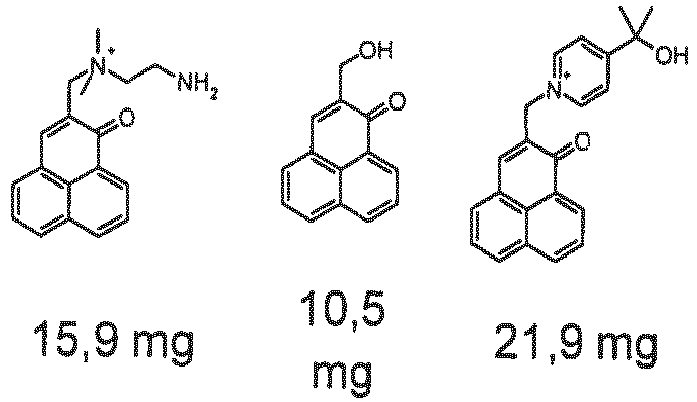
- Ergebnis: Zähe, begrenzt flexible Fasermatte; Eigenfarbe des Farbstoffes ist nicht zu erkennen
- Der jeweilige Photosensibilisator (0,05 mmol) wurde in 70 mL des Grundharzes (Rezeptur II, III oder IV) gelöst. Vom Härter (Rezeptur III) wurden 30mL zugemischt. Die viskose, blassgelbe Lösung wurde mittels Spritzpistole auf entfettete Oberfläche aus i) PMMA oder ii) aufgerautem Glas aufgetragen.
- Alternativ wurde die Mischung mit einem Pinsel auf unbehandeltes Holz gleichmäßig in mehreren Wiederholungen aufgetragen, um eine antimikrobielle Versiegelung zu erhalten. Nach Aushärten für 6h bei Raumtemperatur wurde durch Erwärmen auf 40°C für 3h eine Nachhärtung durchgeführt. Folgende Vertreter wurden durch diese Methode verarbeitet:

- Ergebnis: Transparente, blassgelbe, homogene Beschichtung; Schichtstärke zwischen 20 und 40 µm, bei Verwendung eines Pinsels > 50 µm
- Typische Zusammensetzung des Silikons (technisches Produkt von Wacker) Polydimethylsiloxandiol und Polydimethylsiloxan im Gemisch mit Siliciumdioxid (Füllstoff) und Triacetoxymethylsilan (Vernetzer, <5 %)
- Klares Sanitärsilikon (1K, Raumtemperatur-vernetzend, essigvernetzend, 5,0 g) wurde in Hexan (10 mL) gelöst. Eine Lösung des jeweiligen Photosensibilisators (0,012 mmol) in getrocknetem Dichlormethan (20 mL) wurde zugemischt. Die leicht trübe, blassgelbe, viskose Lösung wurde gleichmäßig auf i) eine entfettete Glasplatte, ii) eine entfettete PMMA-Platte, iii) eine Keramikplatte oder iv) eine Polyesterfolie aufgetragen. Nach ca. 15 min bei Raumtemperatur ist die Beschichtung angetrocknet, weitere ca. 10 min später fand eine erste Hautbildung statt. Nach 6h bei Raumtemperatur ist die ca. 0,1 mm starke Schicht vollständig durchgehärtet.
- Ergebnis: Transparente, matte, blassgelbe, homogene, gummiartige Beschichtung
- Der jeweilige Photosensibilisator (0,02 mmol) wurde in getrocknetem Ethylacetat (100 mL) gelöst. Klares Sanitärsilikon (1K, Raumtemperatur-vernetzend, essigvernetzend, 8,0 g) wurde zugegeben und die Lösung wurde gerührt bis diese homogen war. Die leicht trübe, blassgelbe Lösung wurde gleichmäßig auf i) eine Tonplatte, ii) eine Keramikfliese, iii) eine entfettete PE-Platte oder iii) eine Aluminiumplatte mit einer Spritzpistole aufgetragen. Nach ca. 20 min bei Raumtemperatur war die Beschichtung angetrocknet, weitere ca. 10 min später fand eine erste Hautbildung statt. Nach 6 h bei Raumtemperatur war die ca. 0,1 mm starke Schicht vollständig durchgehärtet.
- Ergebnis: Transparente, matte, blassgelbe, homogene, gummiartige Beschichtung
- Der feingepulverte Photosensibilisator (0,012 mmol) wurde in klares Sanitärsilikon (1K, Raumtemperatur-vernetzend, essigvernetzend, 5,0 g) in einem Mischgerät SpeedMixer™ DAC 600 (Hauschild Engineering, Deutschland) bei Raumtemperatur eingerührt, bis eine makroskopisch homogene Paste erhalten wurde. Die blassgelbe, viskose Masse wurde mit einer Einwegspritze gleichmäßig in i) eine Fließenfuge eingetragen oder ii) zum Verkleben zweier aufeinander senkrecht stehenden Glasplatten benutzt. Nach ca. 30 min bei Raumtemperatur war das Silikon angetrocknet, weitere ca. 20 min später fand eine erste Hautbildung statt. Nach 6h bei Raumtemperatur war die Schicht vollständig durchgehärtet.
- Folgende Photosensibilisatoren wurden nach den drei Varianten zu blassgelben, gummiartigen Silikonfugen verarbeitet:

- Ergebnis: Transparente, matte, blassgelbe, homogene, gummiartige Fugenfüllung
- Typische Zusammensetzung des Silikons (technisches Produkt von Wacker): Komponente A) Vinyl-gruppenhaltiges oligomeres Silan / Vinylsilan und Komponente B) Polydimethylsiloxan im Gemisch mit Siliciumdioxid (Füllstoff) und Hilfsstoffen und Platinkatalysator
- Das Basispolymer (A) wurde mit dem Vernetzter (B) 9:1 gemischt.
- Der feingepulverte Photosensibilisator (0,05 mmol) wurde in 90 g des Basispolymers (A) bei Raumtemperatur eingerührt, bis eine makroskopisch homogene Paste erhalten wurde. Die blassgelbe, viskose Masse wurde mit dem Vernetzter (B) im Verhältnis 9:1 gemischt und mit Hilfe einer flachen Spachtel gleichmäßig auf i) eine Polyesterfolie, ii) eine Keramikfliese, eine entfettete Glasplatte, iv) eine entfettete PE-Platte oder v) eine Aluminiumplatte aufgetragen (50 mL pro m2).
- Nach ca. 30 min bei Raumtemperatur fand eine erste Hautbildung statt. Nach 8 h bei Raumtemperatur war die Schicht vollständig durchgehärtet.
- Folgende Photosensibilisatoren wurden zu Silikonbeschichtungen verarbeitet:

- Ergebnis: Transparente, matte, blassgelbe, homogene, gummiartige Beschichtung
- Der feingepulverte Photosensibilisator (0,05 mmol) wurde in 100 mL Methacrylsäureethylester (trockene Bedingungen) gelöst. Campherchinon (1,7 mg, 0,01 mmol) und 4-Dimethylaminobenzoesäuremethylester (0,9mg, 0,005 mmol, Aminbeschleuniger) wurden zugegeben und die Mischung 15 min im Dunklen gerührt. Die Lösung war gekühlt im Dunklen über Wochen haltbar.
- Die Lösung wurde auf i) Holz mit einem Pinsel aufgetragen oder ii) ein Filterpapier getränkt oder iii) auf eine entfettete PMMA-Platte gleichmäßig aufgesprüht.
- Im 2.Schritt wurde mit einer Polymerisationslampe (LED Bluephase; Fa. ivociarVivadent AG bei 650 mW/cm2) für 30 Sekunden belichtet. Die Prüfkörper wurden nach der Herstellung in einem Trockenschrank bei 37 °C für 24 h gelagert um die Polymerisation zu vervollständigen. Folgende Photosensibilisatoren wurden in den Versuchen verwendet:
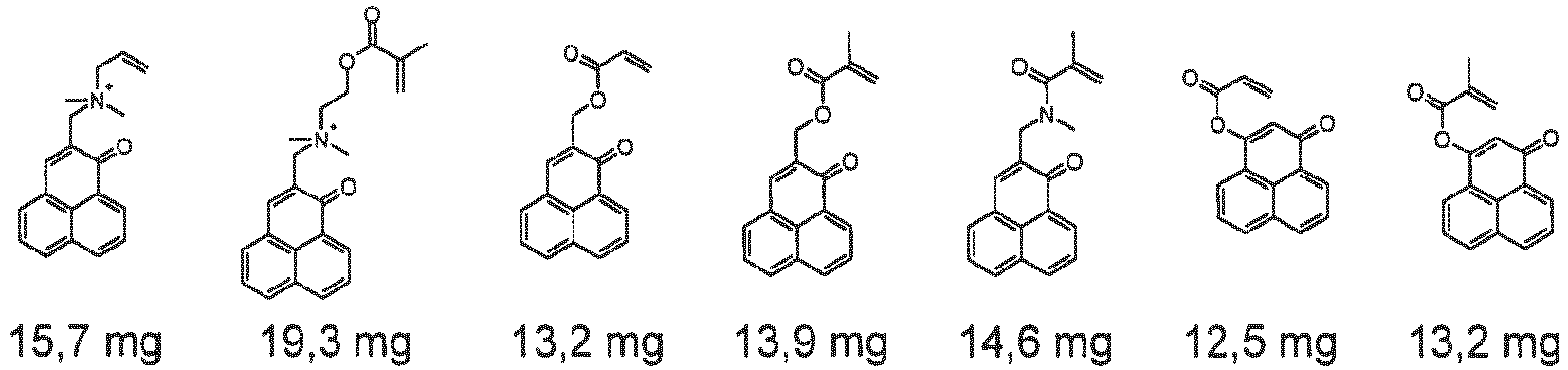
- Ergebnis: Man erhält eine i) transparente, polymere Versiegelung, ii) ein teilflexibles, blassgelbes Plättchen oder iii) transparente, blassgelbe, lackartige Beschichtung.
- Der jeweilige Photosensibilisator (0,05 mmol) wurde in 100 mL Methacrylsäuremethylester (Methylmethacrylat, MMA, Sigma Aldrich) gelöst (Lösung A). tert-Butylperoxybenzoat (Peroxan PB, 0,5 g) wurde in THF (2 mL) gelöst (Lösung B). Lösung B wurde zu Lösung A gegeben und das Gemisch wurde für 15 min bei 90°C im Wasserbad erwärmt. Die leicht viskose Lösung wurde auf i) eine entfettete PMMA-Platte oder ii) eine entfettete Glasplatte aufgesprüht oder iii) auf Kiefernholz aufgetragen und mit einem Pinsel gleichmäßig verteilt (50 mL pro m2). Zum vollständigen Aushärten der Acrylglasbeschichtung wurde der Träger 24 Stunden bei 60 °C im Trockenschrank gelagert. Man erhält eine blassgelbe, klare Kunststoffbeschichtung bzw. polymere Versiegelung des Holzes
- Ergebnis: Transparente, homogene, lackartige Beschichtung; bei i) und ii) war die gelbe Eigenfarbe der Schicht schwach zu erkennen, bei iii) war die Eigenfarbe nicht vom Untergrund zu unterscheiden
- Der jeweilige Photosensibilisator (0,05 mmol) wurde in 100 mL Methacrylsäuremethylester (Methylmethacrylat, MMA, Sigma Aldrich) gelöst (Lösung A). Benzoylperoxid (0,5 g) wurde in THF (2 mL) gelöst (Lösung B). Lösung B wurde zu Lösung A gegeben und das Gemisch für 20 min bei 80°C im Wasserbad erwärmt. Mit der Mischung wurde i) ca. 6 mm starkes Baumwollflies oder ii) eine ca. 6 mm starke Filzmatte oder iii) ein Stück Aramidgewebe (je 20x20 cm2) mit einem Pinsel gleichmäßig mit der Mischung durchtränkt, so dass das Gewebe die Mischung vollständig aufnehmen konnte.
- Zum vollständigen Aushärten des Acrylglases wurden die Fasermatten 12 Stunden bei 60°C getrocknet. Man erhielt eine gelbliche feste Platte. Folgende Photosensibilisatoren wurden verarbeitet:

- Ergebnis: Zähe, begrenzt flexible Fasermatte; Eigenfarbe des Farbstoffes ist nur bei i) schwach zu erkennen
- Eine 40 %ige Lösung von Acrylamide/bis-acrylamide (37,5 : 1) in Wasser (2,5 mL) wurde mit Tris-Puffer (3,75 mL, 1M, pH 8,8) und Propylenglykol (0,6 mL) gemischt. Der jeweilige Photosensibilisator (0,005 mmol) in destilliertem Wasser (3,0 mL) wurde zugegeben. Die Lösung wurde mit einer Vakuumpumpe 5 Minuten entgast (5-10 mbar) und anschließend mit TEMED versetzt (10 µl). Zuletzt wurde der Lösung 0,05 ml Ammoniumpersulfat (10 % in Wasser) unter Rühren zugesetzt.
- Es wurde i) eine 3 mm dünne Kassette (Platten vorher mit 70 %igem Alkohol gesäubert) mit der Mischung gefüllt und vorsichtig mit Isopropanol überschichtet. Nach 30 min Polymerisation bei Raumtemperatur war das Gel fest und der Überstand konnte abgegossen wurden. Nach Abnehmen der Kammerplatten erhielt man eine flexible, dicke blassgelbe Folie. Alternativ wurde ii) die Mischung auf ein Flies gleichmäßig aufgebracht..
- Während der Polymerisation wurde das Material mit Frischhaltefolie abgedeckt. Nach 30 min Polymerisation bei Raumtemperatur war das Gel fest und die Folie wurde vorsichtig abgezogen. Man erhielt eine gelartige gelbliche Beschichtung.
- Folgende Photosensibilisatoren wurden auf diese Art und Weise einpolymerisiert:

- Ergebnis: i) Gummiartige, leicht trübe, blassgelbe Matte; ii) transparente, matte, blassgelbe, homogene, gummiartige Beschichtung
- Der jeweilige Photosensibilisator (0,01 mmol) wurde in 100 mL Dichlormethan (getrocknet über Calciumchlorid) gelöst. Zu 1 g der Lösung wurden 0,2 g käufliches Cyanacrylat (Loctite, Henkel AG & Co. KGaA, Düsseldorf, DE) zugemischt (trockene Bedingungen). Die Mischung wurde auf a) eine entfettete Glasplatte oder b) auf trockenes Fichtenholz gleichmäßig aufgesprüht. Bei Raumtemperatur und eine Umgebungsfeuchtigkeit zwischen 20 und 70 % härtete die Schicht binnen 20 min vollständig aus.
- Der jeweilige Photosensibilisator (0,01 mmol) wurde in 100 mL getrocknetem Methylethylketon gelöst. Käufliches Cyanacrylat (Loctite.) wurde mit 10 g der Lösung im Verhältnis 1:5 (w/w) gemischt. Die Lösung wurde gleichmäßig auf einen mit Isopropanol gereinigten Untergrund, z.B. i) Glas oder ii) PE oder iii) Melaminplatte aufgetragen. Nach Verdampfen des Lösungsmittels härtete die Beschichtung durch Luftfeuchtigkeit aus (ca. 15 min, Luftfeuchtigkeit zwischen 20 und 70 %).
- Folgende Photosensibilisatoren wurden nach der jeweiligen Variante verarbeitet:

- Ergebnis: Transparente, leicht trübe, blassgelbe, homogene Beschichtung; Schichtstärke zwischen 20 und 40 µm
- Der jeweilige Photosensibilisator (0,01 mmol) wurde in 20 mL frisch destilliertem Polystyrol (Sigma Aldrich) gelöst (Lösung A). Benzoylperoxid (0,5 g) wurde in THF (2 mL) gelöst (Lösung B). Lösung B wurde zu Lösung A gegeben und das Gemisch für 20 min bei 80°C im Wasserbad erwärmt. Mit 5 bis 6 mL der Mischung wurde i) eine saubere, unbehandelte Spanholzplatte oder ii) eine entfette PMMA-Platte oder iii) eine entfettete Glasplatte (je 20x20 cm2) mit einem Pinsel gleichmäßig bestrichen. Zum vollständigen Aushärten ließ man den Träger 12 Stunden bei 60°C trocknen. Man erhält eine gelbliche feste Platte. Folgende Photosensibilisatoren wurden verarbeitet:

- Der jeweilige Photosensibilisator (0,05 mmol) wurde zusammen mit fein gemörserter Carboxymethylcellulose (4,0 g, Akzo Nobel) in 100 ml Wasser gelöst. Mit 5 bis 6 mL der klaren, etwas zähflüssigen Lösung wurde i) eine saubere, unbehandelte Spanholzplatte oder ii) eine entfette PMMA-Platte (je 20x20 cm2) mit einem Pinsel gleichmäßig bestrichen.
- Alternativ wurde iii) ein Baumwollflies (20x20 cm2) mit einem Pinsel gleichmäßig durchtränkt, so dass das Gewebe die Mischung vollständig aufnehmen konnte. Zum Aushärten ließ man den Träger 3 Stunden bei Raumtemperatur trocknen. Folgende Photosensibilisatoren wurden verarbeitet:

- Ergebnis: i) transparente, polymere Versiegelung ohne erkennbare Eigenfarbe; ii) transparente, leicht trübe, blassgelbe, homogene Beschichtung; iii) zähe, begrenzt flexible Fasermatte; Eigenfarbe des Photosensibilisators war kaum zu erkennen
- Natriumhydroxid (850 mg, 21,25 mmol) wurden in 95 mL destilliertem Wasser gelöst. Zu der warmen Lösung (ca. 35°C) wurden 5g Alginsäure (Sigma Aldrich) zugegeben und für 3 h gerührt. Es entstand eine leicht viskose, klare Lösung. Eine Stammlösung des jeweiligen Photosensibilisators (5 mL, 12 mmol/L) wurde unter Rühren zugetropft. Mit der gelben, leicht viskosen Lösung wurde i) ein Stück Papier oder ii) ein Stück Baumwollflies oder iii) ein Zellstofflappen/kompresse (je 20x20 cm2) getränkt. Man ließ die überschüssige Lösung abtropfen. Der feuchte Träger wurde zügig in eine 1%ige Calciumchloridlösung getaucht. Man ließ das Material gut abtropfen, tupft es anschließend vorsichtig ab und trocknet es bei Raumtemperatur an der Luft für 3 Stunden.
- Folgende Photosensibilisatoren wurden verarbeitet:

- Ergebnis: zähe, begrenzt flexible Fasermatte bzw. Papierstück; die Eigenfarbe des Photosensibilisators war kaum zu erkennen
- Für die nachfolgenden Versuche wurde folgender Photosensibilisator verwendet

- Absorptionsmaximum 360 - 420 nm
- Molarer Extinktionskoeffizient 9800 L mol-1 cm-1
- Der Photosensibilisator wurde in dem jeweiligen Lacksystem gelöst und auf verschiedene rechteckige Probenträger (Breite: 4cm, Länge: 4cm, Dicke: 3 mm) aus PVC bzw. PMMA aufgebracht und getrocknet. Nach dem Trocknen der Beschichtung wurde eine definierte Menge an Bakterien der Spezies Staphylococcus aureus ATCC 25923 auf die Oberfläche aufgebracht.
- Dazu wurde zunächst wurde eine über Nacht (üN) Kultur von S. aureus in 5 mL Mueller Hinton Boullion (Carl Roth GmbH + Co. KG, Karlsruhe, DE) mit einer Einzelkolonie von einer Agarplatte angeimpft und bei 37 °C und 180 rpm auf einem Schüttler für 18-20 Std. inkubiert. Am Versuchstag wurde jeweils 1 mL üN Kultur zentrifugiert (Hettich Zentrifuge Universal 320 R (Andreas Hettich GmbH & Co.KG, Tuttlingen, DE); Ausschwingrotor 1494; 10 Min, 3000 rpm, RT). Der Überstand wurde verworfen und das Pellet in 1 mL Milli-Q-Wasser, das von der Firma Merck (KGaA, Darmstadt, DE) kommerziell bezogen wurde (Bezeichnung "Milli-Q Integral Reinstwasser (Typ 1)"), resuspendiert.
- Nach Bestimmung der optischen Dichte bei 600 nm (Spektrometer "Specord 50 plus", Analytik Jena) erfolgte eine Verdünnung der resuspendierten Bakterien mit Milli-Q-Wasser auf eine Zellzahl von 105 Bakterien/mL. Von der Verdünnung wurden jeweils 100 µL auf den Probenträger mit einer Pipette aufgetropft (Größe des Tropfens etwa 1 cm2).
- Somit befanden sich etwa 10.000 Bakterien pro cm2 auf der Oberfläche des jeweiligen Probenträgers. Der Probenträger wurde anschließend an Luft unter einer Sterilwerkbank im Dunklen ca. 2 Stunden getrocknet, bis kein Wasser mehr auf der Oberfläche zu sehen war.
- Die jeweiligen Probenträger wurden mit monochromen Licht einer Wellenlänge von 405 nm mit Hilfe eines LED Moduls (Versuchsfeld 5 × 5 cm homogen ausgeleuchtet; high power LEDs) beziehungsweise mit Raumlicht (Osram Lumilux Cool White, Farbtemperatur 4000 K) in den unten angegeben Intensitäten und Bestrahlungszeiten bestrahlt. Direkt nach der Bestrahlung wurden die Bakterien mittels eines sterilen Tupfers von der Oberfläche des jeweiligen Probenträger gewischt und in 1 mL Mueller-Hinton-Boullion resuspendiert.
- Danach wurde die Probe seriell verdünnt (1:10 Verdünnungsstufen: 180 + 20 µL; bis Verdünnungsstufe 10-5).
- Aus jeder Verdünnungsstufe (100 bis 10-5) wurde 3 × jeweils 20 µL Boullion auf eine Mueller-Hinton-Agarplatte (Carl Roth GmbH + Co. KG) mit einer Pipette aufgetropft und verteilt. Die Agarplatten wurden anschließend bei 37°C üN bebrütet.
- Am nächsten Tag wurden die zählbaren Kolonien aller Verdünnungsstufen eines Experimentes ausgezählt und die KBE/mL errechnet.
- Verdünnungsstufen, die einen Bakterienrasen oder gar keine Kolonien aufwiesen, wurden mit "∞" bzw. "0" bezeichnet und gingen in die Berechnung der KBE/mL nicht mit ein.
- Aus dem Wert der KBE/mL wurde im Anschluss die log10 Abtötungsrate berechnet. Als Bezugspunkt diente in jedem Experiment die Referenzkontrolle (= 100% Anzahl der eingesetzten Bakterien).
- Ein Versuch war wie folgt zusammengesetzt:
- beschichteter Probenträger: ohne Photosensibilisator, nicht bestrahlt ("Referenzkontrolle")
- beschichteter Probenträger: mit Photosensibilisator, nicht bestrahlt ("Dunkelkontrolle")
- beschichteter Probenträger: ohne Photosensibilisator und bestrahlt ("Lichtkontrolle")
- beschichteter Probenträger: mit Photosensibilisator und bestrahlt ("Probe")
-
- Beschichtetes Material: PMMA, 3 mm Dicke, 4 x 4 cm
- Trocknungszeit ca. 1 Std.
- Trocknungstemperatur 15 - 30 °C
- Applikation mit einer Spritzpistole
- Verwendet Konzentration des Phosensibilisators: 200 µm (61,55 mg/l)
-
Versuchs-Nr. Bestrahlungsquelle Bestrahlungsintensität Bestrahlungsdauer 3.1.1 LED Modul (405 nm) 10 mW/cm2 2 min 3.1.2 LED Modul (405 nm) 20 mW/cm2 2 min 3.1.3 LED-Modul (405 nm) 0,7 mW/cm2 0 bis 150 min -
- Beschichtetes Material: PVC, 3 mm Dicke, 4 x 4 cm
- Trocknungszeit ca. 2 Std.
- Trocknungstemperatur 15 - 30 °C
- Relative Luftfeuchte für die Trocknungszeit 30 - 70 %
- Applikation mit einer Spritzpistole
- Verwendet Konzentration des Phosensibilisators: 200 µm (61,55 mg/l)
-
Versuchs-Nr. Bestrahlungsquelle Bestrahlungsintensität Bestrahlungsdauer 3.2.1 LED Modul (405 nm) 10 mW/cm2 10 min -
Beschichtetes Material: PVC, 3 mm Dicke, 4 x 4 cm
Trocknungszeit ca. 2 Std.
Trocknungstemperatur 15 - 30 °C
Relative Luftfeuchte für die Trocknungszeit 30 - 70 %
Applikation mit einer Spritzpistole
Verwendet Konzentration des Phosensibilisators: 200 µm (61,55 mg/l)
Zwei Silikonhärtegrade (sog. "Shores"): A = 10 Shore; B = 45 Shore
Bestrahlungsbedingungen:Versuchs-Nr. Bestrahlungsquelle Bestrahlungsintensität Bestrahlungsdauer 3.3.1 LED Modul (405 nm) 10 mW/cm2 5 min 3.3.2 LED Modul (405 nm) 10 mW/cm2 10 min - In einer ersten Studie mit dem 2K Lacksystem wurden zunächst hohe Intensitäten von 10 und 20 mW/cm2 eingesetzt, um die Wirksamkeit des verwendeten Photosensibilisators SAPN-19c gegen S. aureus zu testen. Die Ergebnisse sind in
Fig. 1A gezeigt. -
Fig. 1A zeigt jeweils die Mittelwerte der Reduktion von S. aureus auf der 2K-Lackoberfläche aus drei unabhängigen Versuchen. Die Bestrahlung erfolgte mit 10 bzw. 20 mW/cm2 und 2 Minuten (entspricht einer Energiedichte von 1,2 bzw. 2,4 J/cm2). -
Fig. 1A zeigt, dass das 2K Lacksystem bereits nach 2 Minuten Bestrahlungszeit bei einer Lichtintensität von 10 mW/cm2 eine Log10-Reduktion von 1,8 (Mittelwert aus 3 unabhängigen Experimenten). Eine Erhöhung der Lichtintensität auf 20 mW/cm2 führt zu einer effektiveren Abtötung von 2,7 log10 Stufen. - Anschließend wurde die Effektivität bei niedrigen Intensitäten von 0,7 mW/cm2 bestimmt. Die Ergebnisse sind in
Fig. 1B gezeigt. -
Fig. 1B zeigt jeweils die Mittelwerte der Reduktion von S. aureus auf der 2K-Lackoberfläche (farbloser lösungsmittelbasierter 2K Lack auf durchsichtigen PMMA Probenträger) aus zwei unabhängigen Versuchen. - Die Bestrahlung erfolgte mit 0,7 mW/cm2 bis zu 150 Minuten (entspricht einer Energiedichte von bis zu 6,3 J/cm2). Der Mittelwert der Referenzkontrolle (kein Licht, kein Katalysator) beträgt 3,2 x 10⁴ Bakterien pro mL. Die Licht- und Dunkelkontrolle erfolgte nur bei 150 Minuten.
- Die Abnahme der Koloniebildenden Einheiten bezogen auf eine nicht-bestrahlte Probe (0 min) wurde in Intervallen gemessen, wobei nach den in
Fig. 1b angegeben Zeitpunkten (5 min., 10 min.,20 min., 30 min., 40 min., 60 min.,90 min., 120 min. und 150 min.) jeweils 2 beschichtete Probenträger aus der Bestrahlung entfernt wurden. Die Ergebnisse aus zwei unabhängigen Versuchen sind inFig. 1B dargestellt. - Der Mittelwert der Referenzkontrolle (kein Licht, kein Katalysator) betrug 3,2 × 10⁴ Bakterien pro mL. Die Licht- und Dunkelkontrolle erfolgte nur bei 150 Minuten.
-
Abbildung 1B zeigt, das bereits nach 20 Minuten das 2K Lacksystem eine Abtötung von S. aureus um 1,9 log10 Stufen erreicht. - Das 2K Lacksystem zeigte bei Bestrahlung mit einer künstlichen Lichtquelle eine biologische Wirksamkeit gegen S. aureus, sowohl bei hohen Intensitäten und niedrigen Bestrahlungszeiten (
Fig. 1A ), als auch bei niedrigen Intensitäten und längeren Bestrahlungszeiten (Fig. 1B ). - Ein erster Versuch mit einer hohen Intensität (10 mW/cm2) und einer langen Bestrahlungszeit (10 Minuten) zeigte die Wirksamkeit des 1K Lacksystems.
- Die Ergebnisse sind in
Fig. 2 gezeigt. -
Fig. 2 zeigt die Mittelwerte der Reduktion von S. aureus auf der 1K-Lackoberfläche aus drei unabhängigen Versuchen. Die Bestrahlung erfolgte mit 10 mW/cm2 und 10 Minuten (entspricht einer Energiedichte von 6 J/cm2). - Die Experimente mit dem 1K Lacksystem zeigen eindeutig, dass erst beim Zusammenspiel von Licht und dem photodynamischen Katalysator eine effektive Abtötung von S. aureus auf der beschichteten Oberfläche stattfindet. Drei unabhängige Versuche zeigen im Mittel eine Abtötung von 3.0 Log10 Stufen bei einer Energiedichte von 6 J/cm2.
- Die Lichtkontrolle zeigte in den Experimenten im Mittel eine Reduktion um 1.2 Log10 Stufen, was vermutlich auf den dunklen Probenträger zurückzuführen ist.
- Ein erster Versuch mit einer hohen Intensität (10 mW/cm2) und einer Bestrahlungszeit von 5 Minuten bzw. 10 Minuten zeigte die Wirksamkeit des RTV-2 Silikonsystems.
- Die Ergebnisse sind in
Fig. 3 dargestellt, wobei jeweils der Mittelwert aus 3 Versuchen gezeigt ist
Fig. 3 zeigt die Log-Reduktion von S. aureus auf der Silikonoberfläche (A - bedeutet 10 Shore ohne Farbstoff, A + bedeutet 10 Shore plus Farbstoff, B - bedeutet 45 Shore ohne Farbstoff, B + bedeutet 45 Shore plus Farbstoff). - In den getesteten Lacksystemen (2K PUR Lacksystem; 1K PUR Lacksystem, RTV-2 Silikon) zeigte der verwendete Photosensibilisator SAPN-19c gegen S. aureus eine biologische Wirksamkeit auf der lackierten Oberflächenbeschichtung.
- Höhere Lichtintensitäten und/oder längere Bestrahlungszeiten erzeugen mehr Singulett Sauerstoff, was zu einer schnelleren und effektiveren Abtötung von Mikroorganismen auf der Oberfläche führt.
- Die in beiden Lacksysteme verwendete Konzentration von 200 µM (61,55 mg/L) war auf gefärbten Oberflächen nicht sichtbar. Darüber hinaus erreichte die Beschichtung bei einer Lichtintensität von 6 J/cm2 eine Reduktion um 3 log10 Stufen (= 99,9%) der eingesetzten Bakterien.
- In einem anschließenden Test wurde das 2K Lacksystem mit Raumlicht bestrahlt. Dazu wurden die in Beispiel 2.1 mit dem Photosensibilisator SAPN-19c und SAPN-19 hergestellten photoaktiven Oberflächen zusätzlich offen in Räumen mit normaler Bürobeleuchtung (Standard Leuchtstofflampen, Osram Cool White, 840) gelagert und die phototoxische Wirkung auf S. aureus mit den gleichen Keimzahlen wie in Beispiel 3 nach definierten Zeiten analysiert. Dabei waren die photoaktiven Schichten ca. 40 cm von der Lichtquelle entfernt.
- Es gezeigte sich, dass für den Photosensibilisator SAPN-19c nach einer Lagerung von 24 h unter Standard-Bürobeleuchtungszeiten mit eine Beleuchtungsdauer von 12 h eine vollständige Abtötung aller Keime auf der Oberfläche stattgefunden hatte (ca. 5,5 log10 - Stufen, entspricht > 99,999 % Reduktion).
- Um die Stabilität der hergestellten Lacke zu testen wurde ein Langzeitversuch durchgeführt.
- Die Test-Oberflächen wurden für verschiedene Zeiten (5, 25, 50, 75 h) bei Leistung von 5 mW cm-2 vorbestrahlt, um festzustellen, ob der jeweilige Photosensibilisator in PUR dahingehend beeinflusst wird, dass die phototoxische Aktivität der Oberfläche abnimmt:
Applizierte Energie [J cm -2 5 mW cm -2 0,7 mW cm-2 "Bestrahlungstage" 90 5 h 35,70 h 7 Tage (d) 450 25 h 178,5 h 36 d 900 50 h 357,0 h 71 d 1350 75 h 535,5 h 107 d - Im Anschluss an die Vorbestrahlung wurden die Oberflächen wie oben beschrieben mit S. aureus verkeimt, danach 2 h bestrahlt (entsprechend bei 5 mW cm-2) und die phototoxische Effektivität gemessen.


TPP-Sensitizer WBII/2 SAPN-19c Eingesetzte Menge: 5 10-4 mol/L Eingesetzte Menge: 5 10-4 mol/L - Der TPP-Sensitizer WBII/2 wurde gemäß dem in Felgenträger A., Maisch T., Späth A., Schröder J.A., Bäumler W., "Singlet oxygen generation in porphyrin-doped polymeric surface coating enables antimicrobial effects on Staphylococcus aureus.", (Phys Chem Chem Phys. 2014 Oct 14;16(38):20598-607. doi: 10.1039/c4cp02439g.) beschriebenen Verfahren hergestellt.
- Für die untersuchten Porphyrin-dotierten Oberflächen (TPP-Sensitizer WBII/2) ergab sich ein auffallende Verminderung der phototoxischen Effektivität. Dabei zeigten sich nach einem Monat bereits deutlich Verfärbungen der Testoberflächen und diese verloren an phototoxischer Wirksamkeit.
- Dies kann damit begründet werden, dass der Ring des Farbstoffs unter Einfluss des aktiven Sauerstoffs aufbricht, wobei Billirubin-analoga gebildet werden:

- Für den SAPN-19c wurde kein Unterschied hinsichtlich phototoxischer Effektivität bis hin zu einer Vorbestrahlung von 75 h mit 5 mW cm -2.
- Dies entspricht extrapolierten 312 Bestrahlungstagen (d) mit der Annahme, dass Büro-Leuchtstoffröhren bei einer Leistung von 100 µW cm -2 (auf Büro-Arbeitsplatz) für 12 Stunden Belichtung pro Tag durchgehend eingesetzt werden.
Claims (18)
- Photosensibilisatorzusammensetzung umfassend(a) wenigstens eine Phenalen-1-on-Verbindung mit der allgemeinen Formel (1):
 wobei die Reste R1 bis R8, die jeweils unabhängig voneinander gleich oder voneinander verschieden sein können, jeweils Wasserstoff, Halogen, Alkyl mit 1 bis 12 C-Atomen, Alkylaryl mit 5 bis 20 C-Atomen, Aryl mit 5 bis 20 C-Atomen, *-O-Alkyl mit 1 bis 12 C-Atomen, *-O-Alkylaryl mit 5 bis 20 C-Atomen, *-O-Aryl mit 5 bis 20 C-Atomen, Ether mit 2 bis 12 C-Atomen, ein Rest der Formel *-O-C(=O)-R(Ia), ein Rest der Formel *-C(=O)-R(Ib), oder ein organischer Rest W1, der wenigstens eine reaktive funktionelle Gruppe enthält, bedeuten, mit der Maßgabe, dass wenigstens einer der Reste R1 bis R7 ein organischer Rest W1 ist, wobei der organische Rest W1 jeweils unabhängig voneinander ein Rest mit der allgemeinen Formel (2) bis (6) bedeutet:
* - [(C(D)(E))d - B]a - (C(D)(E))m - X (2)
* - A - [(C(D)(E))d - B]c - (C(D)(E))m - X (3)
* - (C(D)(E))d - Ar - (C(D)(E))n - X (4)
* - [(C(D)(E))d - B]b - (C(D)(E))g - Ar - (C(D)(E))n - X (5)
* - A - [(C(D)(E))d - B]f - (C(D)(E))g - Ar - (C(D)(E))n - X (6)
wobei A jeweils unabhängig voneinander Sauerstoff, Schwefel, oder ein Rest mit der allgemeinen Formel (10a) bis (11a) bedeutet: wobei *ph jeweils einen Anknüpfungspunkt des Restes mit der allgemeinen Formel (10a) bis (11a) an ein C-Atom des Phenalen-Rings und *c jeweils einen Anknüpfungspunkt des Restes mit der allgemeinen Formel (10a) bis (11a) an ein C-Atom des Restes (C(D)(E)) bezeichnet, undwobei der Rest B jeweils unabhängig voneinander Sauerstoff, Schwefel oder ein Rest mit der allgemeinen Formel (10) bis (14) bedeutet:
 wobei die Reste R(Ia), R(Ib), R(11a), R(12a), R(13a), R(14a) und R(14b), jeweils unabhängig voneinander Wasserstoff, Methyl, Ethyl, n-Propyl, iso-Propyl, n-Butyl, sec-Butyl, iso-Butyl, n-Pentyl, Phenyl oder Benzyl bedeuten, und wobei Phenyl und Benzyl jeweils unabhängig voneinander unsubstituiert oder mit einem oder mehrerer Reste, die aus der Gruppe, die aus Halogen, Amino, Hydroxyl, *- O-Alkyl, das gradkettig oder verzweigt sein kann, mit 1 bis 3 Kohlenstoffatomen, Alkyl, das gradkettig oder verzweigt sein kann, mit 1 bis 3 Kohlenstoffatomen, Hydroxyalkyl, das gradkettig oder verzweigt sein kann, mit 1 bis 3 Kohlenstoffatomen und 1 bis 3 OH-Gruppen, Halogenalkyl, das gradkettig oder verzweigt sein kann, mit 1 bis 3 Kohlenstoffatomen und 1 bis 3 Halogen-Gruppen, und Kombinationen davon, vorzugsweise Chlor, Brom, Fluor, Methyl, Ethyl, n-Propyl, iso-Propyl, Methoxy, Ethoxy und Kombinationen davon, besteht, ausgewählt werden, substituiert sein können, wobei Y- ein Anion ist, das jeweils unabhängig voneinander Fluorid, Chlorid, Bromid, lodid, Sulfat, Hydrogensulfat, Phosphat, Hydrogenphosphat, Dihydrogenphosphat, wenigstens ein Carboxylat-Anion einer Carbonsäure mit 1 bis 15 Kohlenstoffatomen, wenigstens ein Sulfonat-Anion einer Sulfonsäure mit 1 bis 12 C-Atomen oder eine Kombination davon bedeutet, undwobei die Reste D und E jeweils unabhängig voneinander Wasserstoff, Halogen, Hydroxyl, Alkyl, das gradkettig oder verzweigt sein kann, mit 1 bis 5 Kohlenstoffatomen, Hydroxyalkyl, das gradkettig oder verzweigt sein kann, mit 1 bis 5 Kohlenstoffatomen und 1 bis 5 OH-Gruppen, Phenyl, Benzyl, ein Rest der Formel *-L-R(II), ein Rest der Formel *-L-C(=L)-R(III), ein Rest der Formel *-(CH2)q-X, ein Rest der Formel *-L- (CH2)q-X, oder ein Rest der Formel *-(CH2)s-L-(CH2)t-X bedeuten, wobei der Rest L jeweils unabhängig voneinander Sauerstoff oder Schwefel, vorzugsweise Sauerstoff, bedeutet, wobei die Reste R(II) und R(III) jeweils unabhängig voneinander Wasserstoff, Methyl, Ethyl, n-Propyl, iso-Propyl, n-Butyl, sec-Butyl, iso-Butyl, n-Pentyl, Phenyl oder Benzyl bedeuten, und wobei Phenyl und Benzyl jeweils unabhängig voneinander unsubstituiert oder mit einem oder mehrerer Reste, die aus der Gruppe, die aus Chlor, Brom, Fluor, Methyl, Ethyl, n-Propyl, iso-Propyl, Methoxy, Ethoxy, und Kombinationen davon, besteht, ausgewählt werden, substituiert sein können, die Indices q, s und t jeweils unabhängig voneinander eine ganze Zahl von 1 bis 5 bedeuten,wobei die Indices a, c, f, g und n jeweils unabhängig voneinander eine ganze Zahl von 0 bis 5 bedeuten,und wobei die Indices b, d und m jeweils unabhängig voneinander eine ganze Zahl von 1 bis 5 bedeuten,wobei der Rest Ar jeweils unabhängig voneinander einen Rest der allgemeinen Formel (25a) bis (31) bedeutet:


 wobei die Reste R25, R26, R27, R28, R29, R26a, R26b, R27a, R27b, R28a, R28b, R29a, R29b, R30a und R30b jeweils unabhängig voneinander Wasserstoff, Hydroxy, Amino, Alkyl, das gradkettig oder verzweigt sein kann, mit 1 bis 5 Kohlenstoffatomen, *-O-Alkyl, das gradkettig oder verzweigt sein kann, mit 1 bis 5 Kohlenstoffatomen, Phenyl oder Benzyl bedeuten, wobei Phenyl und Benzyl jeweils unabhängig voneinander unsubstituiert oder mit einem oder mehrerer Reste, die aus der Gruppe, die aus Chlor, Brom, Fluor, Methyl, Ethyl, n-Propyl, iso-Propyl, Methoxy, Ethoxy, und Kombinationen davon, besteht, ausgewählt werden, substituiert sein können, und wobei der Rest R30 jeweils unabhängig voneinander Wasserstoff oder Alkyl, das gradkettig oder verzweigt sein kann, mit 1 bis 5 Kohlenstoffatomen bedeutet, und wobei die Reste R33a und R33b jeweils unabhängig voneinander Wasserstoff, Hydroxy, Amino, Alkyl, das gradkettig oder verzweigt sein kann, mit 1 bis 5 Kohlenstoffatomen, Perfluoralkyl, das gradkettig oder verzweigt sein kann, mit 1 bis 5 Kohlenstoffatomen, *-O-Alkyl, das gradkettig oder verzweigt sein kann, mit 1 bis 5 Kohlenstoffatomen, Phenyl, Benzyl oder wenn zusammen genommen ein Cycloalkyl, das gradkettig oder verzweigt sein kann, mit 4 bis 9 Kohlenstoffatomen, oder ein 9H-Fluoren-9-ylidenrest bedeuten, undwobei Y- ein Anion ist, das jeweils unabhängig voneinander Fluorid, Chlorid, Bromid, lodid, Sulfat, Hydrogensulfat, Phosphat, Hydrogenphosphat, Dihydrogenphosphat, wenigstens ein Carboxylat-Anion einer Carbonsäure mit 1 bis 15 Kohlenstoffatomen, wenigstens ein Sufonat-Anion einer Sulfonsäure mit 1 bis 12 C-Atomen oder eine Kombination davon bedeutet, undwobei der Rest X jeweils unabhängig voneinander eine reaktive funktionelle Gruppe ist, die *-N(R(VI))(R(VII)), *-OH, *-SH, *-NCO, *-NCS, *-Si(R(VIII))(R(IX))-[O-Si(R(X))(R(XI))]p-Z oder ein Rest mit der allgemeinen Formel (20) bis (24) bedeutet:
 wobei die Reste R(20a), R(20b), R(20c), R(21a), R(22a), R(22b), R(22c), R(23a), R(24a), R(24b), und R(24c) jeweils unabhängig voneinander Wasserstoff, Methyl, Ethyl, n-Propyl, iso-Propyl, n-Butyl, sec-Butyl, iso-Butyl, oder n-Pentyl bedeuten, und wobei die Indices l und k jeweils unabhängig voneinander eine ganze Zahl von 0 bis 4 bedeuten,wobei die Reste R(VI) und R(VII) jeweils unabhängig voneinander Wasserstoff, Alkyl, das gradkettig oder verzweigt sein kann, mit 1 bis 5 Kohlenstoffatomen, Phenyl oder Benzyl bedeuten, wobei Phenyl und Benzyl jeweils unabhängig voneinander unsubstituiert oder mit einem oder mehrerer Reste, die aus der Gruppe, die aus Chlor, Brom, Fluor, Methyl, Ethyl, n-Propyl, iso-Propyl, Methoxy, Ethoxy, und Kombinationen davon, besteht, ausgewählt werden, substituiert sein können,wobei die Reste R(VIII), R(IX), R(X) und R(XI) jeweils unabhängig voneinander Wasserstoff, Alkyl, das gradkettig oder verzweigt sein kann, mit 1 bis 5 Kohlenstoffatomen, *-O-Alkyl, das gradkettig oder verzweigt sein kann, mit 1 bis 5 Kohlenstoffatomen, Phenyl oder Benzyl bedeuten, wobei Phenyl und Benzyl jeweils unabhängig voneinander unsubstituiert oder mit einem oder mehrerer Reste, die aus der Gruppe, die aus Chlor, Brom, Fluor, Methyl, Ethyl, n-Propyl, iso-Propyl, Methoxy, Ethoxy, und Kombinationen davon, besteht, ausgewählt werden, substituiert sein können, wobei der Rest Z jeweils unabhängig voneinander Halogen, Hydroxyl, Alkoxyl mit 1 bis 4 Kohlenstoffatomen oder Alkylcarboxyl mit 1 bis 4 Kohlenstoffatomen, vorzugsweise Halogen oder Hydroxyl, bedeutet, und wobei der Index p jeweils unabhängig voneinander eine ganze Zahl von 0 bis 4 bedeutet, und(b) wenigstens eine polymere Komponente und/oder Vorläufer davon.
 - Photosensibilisatorzusammensetzung nach Anspruch 1,
wobei der wenigstens eine organische Rest W1 jeweils unabhängig voneinander ein Rest der allgemeinen Formel (40) bis (67) oder (72) bis (98e) bedeutet:


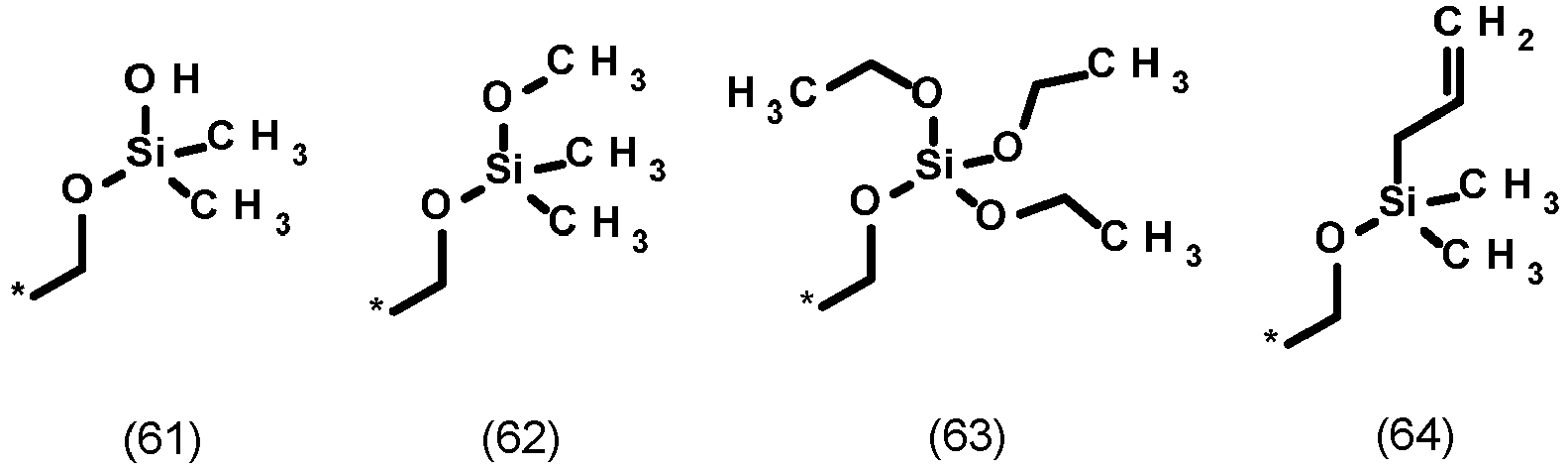


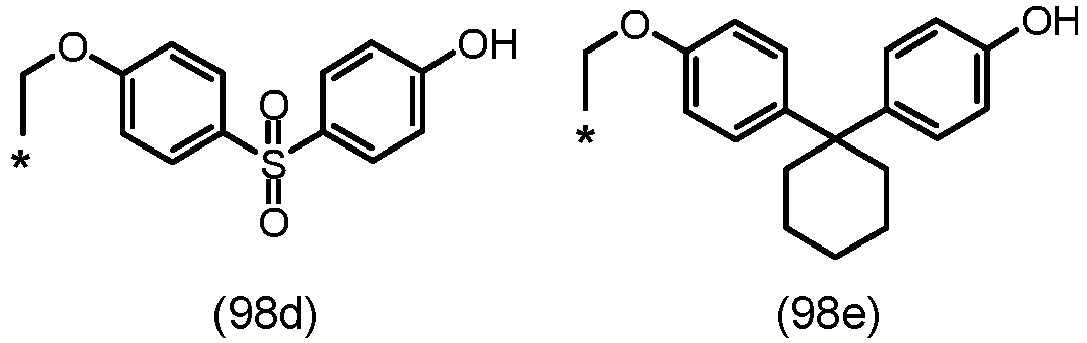
- Photosensibilisatorzusammensetzung nach einem der Ansprüche 1 oder 2, umfassend:(a) wenigstens eine Phenalen-1-on-Verbindung mit der allgemeinen Formel (1), die aus der Gruppe, die aus Verbindung der Formel (100) bis (127), (132) bis (166):


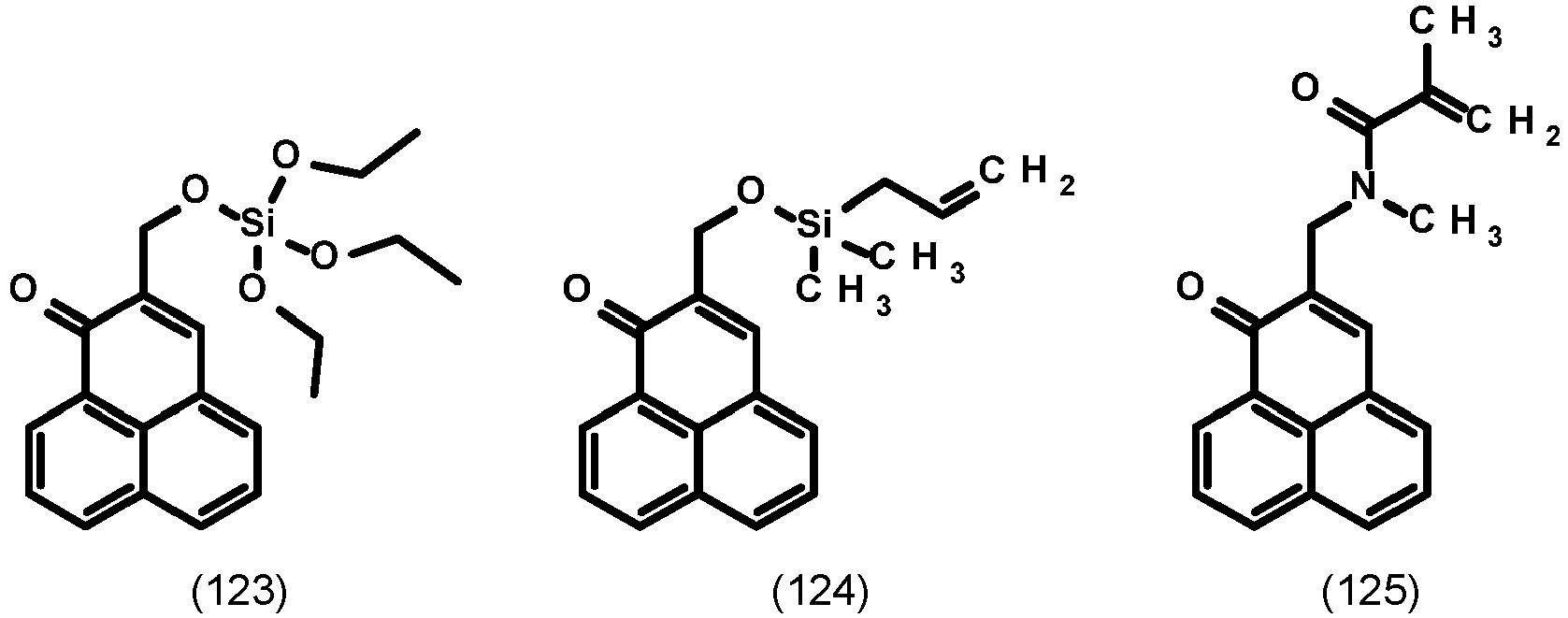


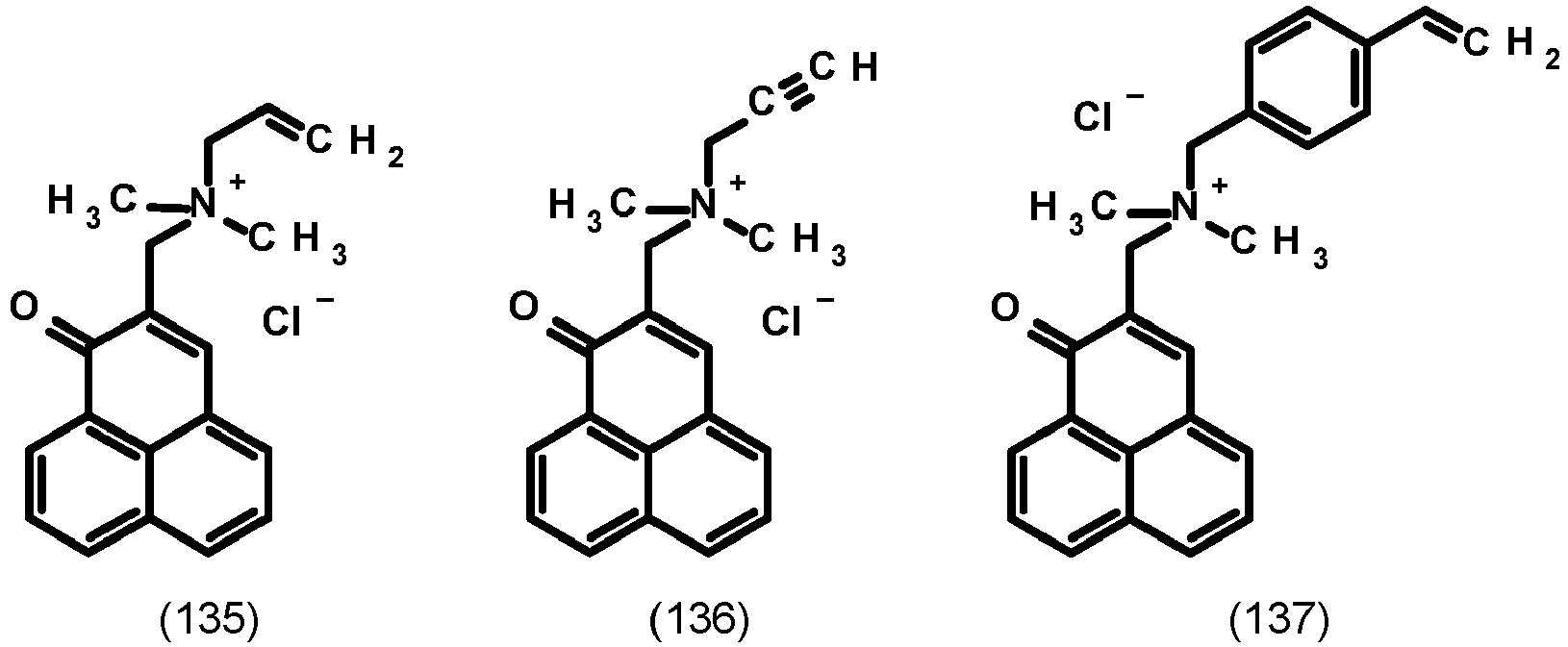
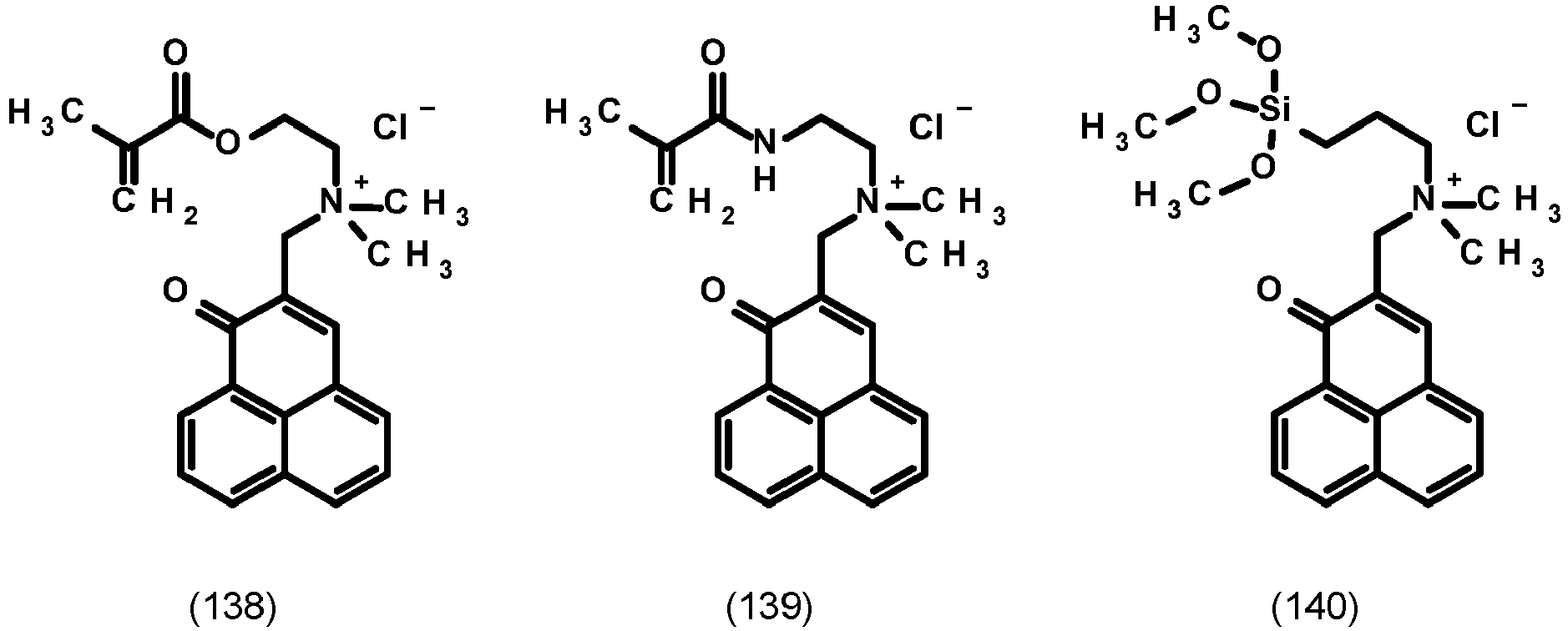

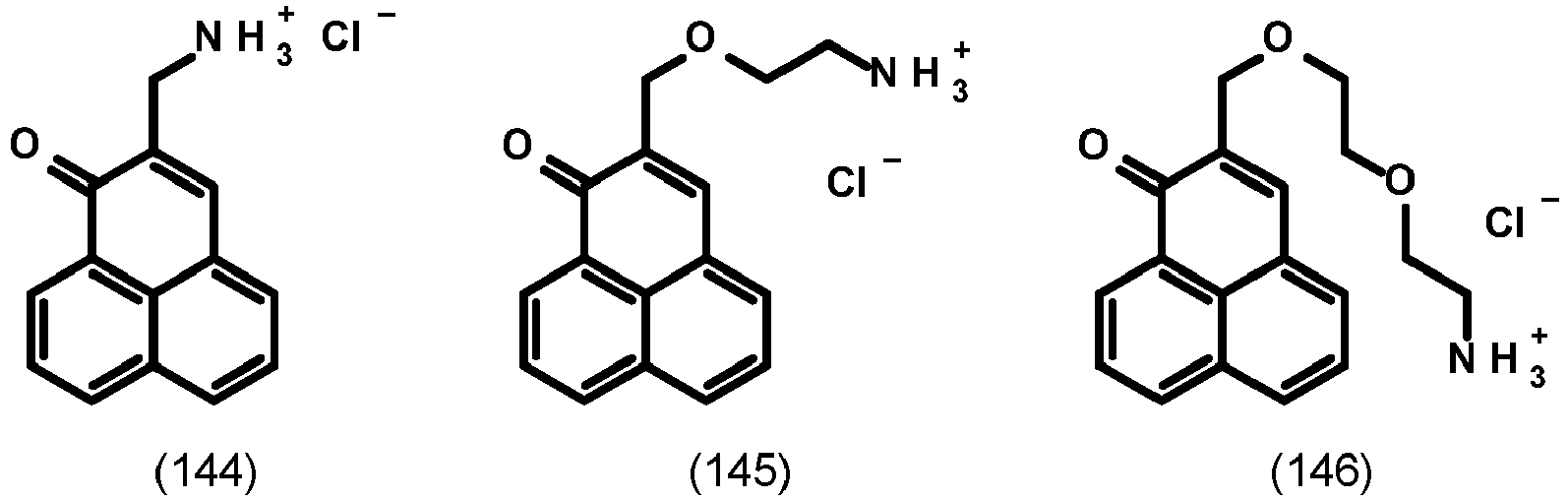


 (b) wenigstens eine polymere Komponente und/oder Vorläufer davon.
 - Phenalen-1-on-Verbindung mit der allgemeinen Formel (1a):


- Phenalen-1-on-Verbindung nach Anspruch 4,
wobei die wenigstens eine Phenalen-1-on-Verbindung mit der allgemeinen Formel (1a) aus der Gruppe, die aus Verbindung der Formel (101) bis (127), (162) bis (166) und Kombinationen davon besteht:


- Photosensibilisatorzusammensetzung nach einem der Ansprüche 1 bis 3 umfassend:(a) wenigstens eine Phenalen-1-on-Verbindung mit der allgemeinen Formel (1), die eine Phenalen-1-on-Verbindung nach einem der Ansprüche 4 bis 5 ist, und(b) wenigstens eine polymere Komponente und/oder Vorläufer davon.
- Photosensibilisatorzusammensetzung nach einem der Ansprüche 1 bis 3 oder 6, wobei die wenigstens eine polymere Komponente und/oder Vorläufer davon aus der Gruppe, die aus Polymerisaten und/oder Copolymerisaten von Acrylsäure und deren Ester, Methacrylsäure und deren Ester, Cyanacrylsäure und deren Ester, Acrylamid, Methacrylamid, Styrol, Siloxanen und deren Ester, Melamin, Acrylnitril, 1,3-Butadien, Epichlorhydrin, Polyolen, Polyisoprenen, Polyethern, Polyetherimiden, Polyvinylacetaten, Polycarbonaten, Polyethersulfonen, Carboxymethylcellulose, Alginat, und Kombinationen davon besteht, ausgewählt wird.
- Photosensibilisatorzusammensetzung nach einem der Ansprüche 1 bis 3 oder 6 bis 7, wobei die Zusammensetzung weiterhin wenigstens ein Vernetzungsmittel, das ein Polyisocyanat, ein blockiertes Isocyanat, ein Alkyldiisocyanat oder Cycloalkyldiisocyanat oder Aryldiisocyanat, eine Verbindung der allgemeinen Formel SiZ4, (RXII)SiZ3, (RXII)2SiZ2, eine Verbindung mit mindestens zwei Epoxidresten, eine Verbindung mit mindestens zwei Acrylamidresten, eine Verbindung mit mindestens zwei Acrylatresten, eine Verbindung mit mindestens zwei Aldehydresten, eine Verbindung mit mindestens zwei Alkoholgruppen, eine Verbindung mit mindestens zwei Aminresten, ein Divinylsulfon, oder ein Kombinationen davon enthält, wobei der Rest RXII jeweils unabhängig voneinander Alkyl, das gradkettig oder verzweigt sein kann, mit 1 bis 5 Kohlenstoffatomen, Phenyl oder Benzyl, vorzugsweise Methyl, Ethyl, n-Propyl, iso-Propyl, Phenyl oder Benzyl, bedeutet und wobei der Rest Z jeweils unabhängig voneinander Halogen, Hydroxyl, Alkoxyl mit 1 bis 4 Kohlenstoffatomen oder Alkylcarboxyl mit 1 bis 4 Kohlenstoffatomen, vorzugsweise Halogen oder Hydroxyl, bedeutet.
- Photosensibilisatorzusammensetzung nach einem der Ansprüche 1 bis 3 oder 6 bis 8, wobei die wenigstens eine Phenalen-1-on-Verbindung mit der allgemeinen Formel (1) kovalent und/oder elektrostatisch, vorzugsweise kovalent, an die wenigstens eine polymere Komponente und/oder Vorläufer davon gebunden ist.
- Photosensibilisatorzusammensetzung nach einem der Ansprüche 1 bis 3 oder 6 bis 9, wobei es sich bei der Photosensibilisatorzusammensetzung um einen Lack, eine Lasur, eine Dispersionsfarbe, eine Latexfarbe, eine Silikatfarbe, oder eine Kalkfarbe handelt.
- Photosensibilisatorzusammensetzung nach einem der Ansprüche 1 bis 3 oder 6 bis 10, wobei es sich bei der Photosensibilisatorzusammensetzung um ein Granulat handelt.
- Gegenstand, umfassend wenigstens eine ausgehärtete Polymerzusammensetzung, wobei die ausgehärtete Polymerzusammensetzung(a) wenigstens eine Phenalen-1-on-Verbindung mit der allgemeinen Formel (1):
 wobei die Reste R1 bis R8, die jeweils unabhängig voneinander gleich oder voneinander verschieden sein können, jeweils Wasserstoff, Halogen, Alkyl mit 1 bis 12 C-Atomen, Alkylaryl mit 1 bis 18 C-Atomen, Aryl mit 5 bis 20 C-Atomen, *-O-Alkyl mit 1 bis 12 C-Atomen, *-O-Alkylaryl mit 1 bis 18 C-Atomen, *-O-Aryl mit 5 bis 20 C-Atomen, Ether mit 2 bis 12 C-Atomen, ein Rest der Formel *-O-C(=O)-R(Ia), ein Rest der Formel *-C(=O)-R(Ib), oder ein organischer Rest W1, der wenigstens eine reaktive funktionelle Gruppe enthält, bedeuten, mit der Maßgabe, dass wenigstens einer der Reste R1 bis R7 ein organischer Rest W1 ist, wobei der organische Rest W1 jeweils unabhängig voneinander ein Rest mit der allgemeinen Formel (2) bis (6) bedeutet:
* - [(C(D)(E))d - B]a - (C(D)(E))m - X (2)
* - A - [(C(D)(E))d - B]c - (C(D)(E))m - X (3)
* - (C(D)(E))d - Ar - (C(D)(E))n - X (4)
* - [(C(D)(E))d - B]b - (C(D)(E))g - Ar - (C(D)(E))n - X (5)
* - A - [(C(D)(E))d - B]f - (C(D)(E))g - Ar - (C(D)(E))n - X (6)
wobei der Rest A jeweils unabhängig voneinander Sauerstoff, Schwefel, oder ein Rest mit der allgemeinen Formel (10a) bis (11a) bedeutet: wobei *ph jeweils einen Anknüpfungspunkt des Restes mit der allgemeinen Formel (10a) bis (11a) an ein C-Atom des Phenalen-Rings und *c jeweils einen Anknüpfungspunkt des Restes mit der allgemeinen Formel (10a) bis (11a) an ein C-Atom des Restes (C(D)(E)) bezeichnet, undwobei der Rest B jeweils unabhängig voneinander Sauerstoff, Schwefel oder ein Rest mit der allgemeinen Formel (10) bis (14) bedeutet:
 wobei die Reste R(Ia), R(Ib), R(11a), R(12a), R(13a), R(14a) und R(14b), jeweils unabhängig voneinander Wasserstoff, Methyl, Ethyl, n-Propyl, iso-Propyl, n-Butyl, sec-Butyl, iso-Butyl, n-Pentyl, Phenyl oder Benzyl bedeuten, und wobei Phenyl und Benzyl jeweils unabhängig voneinander unsubstituiert oder mit einem oder mehrerer Reste, die aus der Gruppe, die aus Halogen, Amino, Hydroxyl, *- O-Alkyl, das gradkettig oder verzweigt sein kann, mit 1 bis 3 Kohlenstoffatomen, Alkyl, das gradkettig oder verzweigt sein kann, mit 1 bis 3 Kohlenstoffatomen, Hydroxyalkyl, das gradkettig oder verzweigt sein kann, mit 1 bis 3 Kohlenstoffatomen und 1 bis 3 OH-Gruppen, Halogenalkyl, das gradkettig oder verzweigt sein kann, mit 1 bis 3 Kohlenstoffatomen und 1 bis 3 Halogen-Gruppen, und Kombinationen davon, vorzugsweise Chlor, Brom, Fluor, Methyl, Ethyl, n-Propyl, iso-Propyl, Methoxy, Ethoxy und Kombinationen davon, besteht, ausgewählt werden, substituiert sein können, wobei Y- ein Anion ist, das jeweils unabhängig voneinander Fluorid, Chlorid, Bromid, lodid, Sulfat, Hydrogensulfat, Phosphat, Hydrogenphosphat, Dihydrogenphosphat, wenigstens ein Carboxylat-Anion einer Carbonsäure mit 1 bis 15 Kohlenstoffatomen, wenigstens ein Sulfonat-Anion einer Sulfonsäure mit 1 bis 12 C-Atomen oder eine Kombination davon bedeutet, undwobei die Reste D und E jeweils unabhängig voneinander Wasserstoff, Halogen, Hydroxyl, Alkyl, das gradkettig oder verzweigt sein kann, mit 1 bis 5 Kohlenstoffatomen, Hydroxyalkyl, das gradkettig oder verzweigt sein kann, mit 1 bis 5 Kohlenstoffatomen und 1 bis 5 OH-Gruppen, Phenyl, Benzyl, ein Rest der Formel *-L-R(II), ein Rest der Formel *-L-C(=L)-R(III), ein Rest der Formel *-(CH2)q-X, ein Rest der Formel *-L- (CH2)q-X, oder ein Rest der Formel *-(CH2)s-L-(CH2)t-X bedeuten, wobei der Rest L jeweils unabhängig voneinander Sauerstoff oder Schwefel, vorzugsweise Sauerstoff, bedeutet, wobei die Reste R(II) und R(III) jeweils unabhängig voneinander Wasserstoff, Methyl, Ethyl, n-Propyl, iso-Propyl, n-Butyl, sec-Butyl, iso-Butyl, n-Pentyl, Phenyl oder Benzyl bedeuten, und wobei Phenyl und Benzyl jeweils unabhängig voneinander unsubstituiert oder mit einem oder mehrerer Reste, die aus der Gruppe, die aus Chlor, Brom, Fluor, Methyl, Ethyl, n-Propyl, iso-Propyl, Methoxy, Ethoxy, und Kombinationen davon, besteht, ausgewählt werden, substituiert sein können, die Indices q, s und t jeweils unabhängig voneinander eine ganze Zahl von 1 bis 5 bedeuten,wobei die Indices a, c, f, g und n jeweils unabhängig voneinander eine ganze Zahl von 0 bis 5 bedeuten,und wobei die Indices b, d und m jeweils unabhängig voneinander eine ganze Zahl von 1 bis 5 bedeuten,wobei der Rest Ar jeweils unabhängig voneinander einen Rest der allgemeinen Formel (25a) bis (31) bedeutet:


 wobei die Reste R25, R26, R27, R28, R29, R26a, R26b, R27a, R27b, R28a, R28b, R29a, R29b, R30a und R30b jeweils unabhängig voneinander Wasserstoff, Hydroxy, Amino, Alkyl, das gradkettig oder verzweigt sein kann, mit 1 bis 5 Kohlenstoffatomen, *-O-Alkyl, das gradkettig oder verzweigt sein kann, mit 1 bis 5 Kohlenstoffatomen, Phenyl oder Benzyl bedeuten, wobei Phenyl und Benzyl jeweils unabhängig voneinander unsubstituiert oder mit einem oder mehrerer Reste, die aus der Gruppe, die aus Chlor, Brom, Fluor, Methyl, Ethyl, n-Propyl, iso-Propyl, Methoxy, Ethoxy, und Kombinationen davon, besteht, ausgewählt werden, substituiert sein können, und wobei der Rest R30 jeweils unabhängig voneinander Wasserstoff oder Alkyl, das gradkettig oder verzweigt sein kann, mit 1 bis 5 Kohlenstoffatomen bedeutet, und wobei die Reste R33a und R33b jeweils unabhängig voneinander Wasserstoff, Hydroxy, Amino, Alkyl, das gradkettig oder verzweigt sein kann, mit 1 bis 5 Kohlenstoffatomen, Perfluoralkyl, das gradkettig oder verzweigt sein kann, mit 1 bis 5 Kohlenstoffatomen, *-O-Alkyl, das gradkettig oder verzweigt sein kann, mit 1 bis 5 Kohlenstoffatomen, Phenyl, Benzyl oder wenn zusammen genommen ein Cycloalkyl, das gradkettig oder verzweigt sein kann, mit 4 bis 9 Kohlenstoffatomen, oder ein 9H-Fluoren-9-ylidenrest bedeuten, undwobei Y- ein Anion ist, das jeweils unabhängig voneinander Fluorid, Chlorid, Bromid, lodid, Sulfat, Hydrogensulfat, Phosphat, Hydrogenphosphat, Dihydrogenphosphat, wenigstens ein Carboxylat-Anion einer Carbonsäure mit 1 bis 15 Kohlenstoffatomen, wenigstens ein Sufonat-Anion einer Sulfonsäure mit 1 bis 12 C-Atomen oder eine Kombination davon bedeutet, undwobei der Rest X jeweils unabhängig voneinander eine reaktive funktionelle Gruppe ist, die *-N(R(VI))(R(VII)), *-OH, *-SH, *-NCO, *-NCS, *-Si(R(VIII))(R(IX))-[O-Si(R(X))(R(XI))]p-Z oder ein Rest mit der allgemeinen Formel (20) bis (24) bedeutet:
 wobei die Reste R(20a), R(20b), R(20c), R(21a), R(22a), R(22b), R(22c), R(23a), R(24a), R(24b), und R(24c) jeweils unabhängig voneinander Wasserstoff, Methyl, Ethyl, n-Propyl, iso-Propyl, n-Butyl, sec-Butyl, iso-Butyl, oder n-Pentyl bedeuten, und wobei die Indices l und k jeweils unabhängig voneinander eine ganze Zahl von 0 bis 4 bedeuten,wobei die Reste R(VI) und R(VII) jeweils unabhängig voneinander Wasserstoff, Alkyl, das gradkettig oder verzweigt sein kann, mit 1 bis 5 Kohlenstoffatomen, Phenyl oder Benzyl bedeuten, wobei Phenyl und Benzyl jeweils unabhängig voneinander unsubstituiert oder mit einem oder mehrerer Reste, die aus der Gruppe, die aus Chlor, Brom, Fluor, Methyl, Ethyl, n-Propyl, iso-Propyl, Methoxy, Ethoxy, und Kombinationen davon, besteht, ausgewählt werden, substituiert sein können,wobei die Reste R(VIII), R(IX), R(X) und R(XI) jeweils unabhängig voneinander Wasserstoff, Alkyl, das gradkettig oder verzweigt sein kann, mit 1 bis 5 Kohlenstoffatomen, *-O-Alkyl, das gradkettig oder verzweigt sein kann, mit 1 bis 5 Kohlenstoffatomen, Phenyl oder Benzyl bedeuten, wobei Phenyl und Benzyl jeweils unabhängig voneinander unsubstituiert oder mit einem oder mehrerer Reste, die aus der Gruppe, die aus Chlor, Brom, Fluor, Methyl, Ethyl, n-Propyl, iso-Propyl, Methoxy, Ethoxy, und Kombinationen davon, besteht, ausgewählt werden, substituiert sein können, wobei der Rest Z jeweils unabhängig voneinander Halogen, Hydroxyl, Alkoxyl mit 1 bis 4 Kohlenstoffatomen oder Alkylcarboxyl mit 1 bis 4 Kohlenstoffatomen, vorzugsweise Halogen oder Hydroxyl, bedeutet, und wobei der Index p jeweils unabhängig voneinander eine ganze Zahl von 0 bis 4 bedeutet, und(b) wenigstens eine ausgehärtete polymere Komponente umfasst,wobei die wenigstens eine Phenalen-1-on-Verbindung mit der allgemeinen Formel (1) kovalent und/oder elektrostatisch, vorzugsweise kovalent, an die wenigstens eine ausgehärtete polymere Komponente gebunden ist.
 - Gegenstand nach Anspruch 12, wobei die gehärtete Polymerzusammensetzung(a) wenigstens eine Phenalen-1-on-Verbindung mit der Formel (1), wenigstens eine Phenalen-1-on-Verbindung nach einem der Ansprüche 4 bis 5 oder eine Kombination davon, und(b) wenigstens eine ausgehärtete polymere Komponente umfasst,wobei die wenigstens eine Phenalen-1-on-Verbindung mit der Formel (1), die wenigstens eine Phenalen-1-on-Verbindung nach einem der Ansprüche 5 bis 6 oder eine Kombination davon kovalent und/oder elektrostatisch, vorzugsweise kovalent, an die wenigstens eine ausgehärtete polymere Komponente gebunden ist.
- Gegenstand nach einem der Ansprüche 12 oder 13, wobei die ausgehärtete Polymerzusammensetzung in Form einer Beschichtung, eines selbsttragenden Films, eines Gewebes oder eines Formgegenstandes vorliegt.
- Nicht-medizinische Verwendung einer Photosensibilisatorzusammensetzung nach einem der Ansprüche 1 bis 3 oder 6 bis 11 und/oder einer Phenalen-1-on-Verbindung nach einem der Ansprüche 4 bis 5 und/oder eines Gegenstandes nach einem der Ansprüche 12 bis 14 zur, vorzugsweise photodynamischen, Inaktivierung von Mikroorganismen, die vorzugsweise aus der Gruppe, die aus Viren, Archäeen, Bakterien, Bakteriensporen, Biofilme von Bakterien, Pilzen, Pilzsporen, Protozoen, Algen und blutübertragbaren Parasiten besteht, und/oder einem Biofilm davon ausgewählt werden.
- Nicht-medizinische Verwendung einer Photosensibilisatorzusammensetzung nach einem der Ansprüche 1 bis 3 oder 6 bis 11 und/oder einer Phenalen-1-on-Verbindung nach einem der Ansprüche 4 bis 5 zur photodynamischen Oberflächenreinigung und/oder Oberflächenbeschichtung eines Gegenstandes oder Raumes.
- Nicht-medizinische Verwendung nach einem der Ansprüche 15 oder 16 zur Oberflächenbeschichtung von Gegenständen, vorzugsweise Medizinprodukten, Lebensmittelverpackungen, Verpackungsfolien, Textilien, Baustoffen, Spielzeugen, elektronischen Geräten, Möbeln oder Hygieneartikeln.
- Nicht-medizinisches Verfahren zur, vorzugsweise photodynamischen, Inaktivierung von Mikroorganismen, die vorzugsweise Viren, Archäeen, Bakterien, Bakteriensporen, Biofilme von Bakterien, Pilzen, Pilzsporen, Protozoen, Algen, blutübertragbaren Parasiten oder Kombinationen davon umfassen, und/oder einem Biofilm davon, wobei das Verfahren folgende Schritte umfasst:(A) in Kontakt bringen der Mikroorganismen und/oder einem Biofilm davon mit wenigstens einer Beschichtung, die durch Aushärten einer Photosensibilisatorzusammensetzung nach einem der Ansprüche 1 bis 3 oder 6 bis 11 hergestellt wurde und/oder wenigstens eine Phenalen-1-on-Verbindung nach einem der Ansprüche 4 bis 5 enthält, und/oder wenigstens eines Gegenstandes nach einem der Ansprüche 12 bis 14, und(B) Bestrahlen der Mikroorganismen und/oder einem Biofilm davon und der, in der Beschichtung und/oder dem Gegenstand enthaltenen wenigstens einen Phenalen-1-on-Verbindung mit elektromagnetischer Strahlung geeigneter Wellenlänge und Energiedichte.
Priority Applications (13)
| Application Number | Priority Date | Filing Date | Title |
|---|---|---|---|
| EP17161718.6A EP3375774B1 (de) | 2017-03-17 | 2017-03-17 | Phenalen-1-on-haltige photosensibilisatorzusammensetzung, phenalen-1-on-verbindungen sowie deren verwendung |
| RU2019132844A RU2019132844A (ru) | 2017-03-17 | 2018-03-16 | Фенален-1-он-содержащая композиция фотосенсибилизатора, фенален-1-оновое соединение и их применение |
| BR112019019324-3A BR112019019324B1 (pt) | 2017-03-17 | 2018-03-16 | Composição fotossensibilizante, composto de fenalen-1-ona, artigo compreendendo uma composição de polímero endurecido, uso de uma composição fotossensibilizante e método para inativação |
| US16/494,836 US11186545B2 (en) | 2017-03-17 | 2018-03-16 | Phenalene-1-one-containing photosensitizer composition, phenalene-1-one compound and the use thereof |
| CA3056486A CA3056486A1 (en) | 2017-03-17 | 2018-03-16 | Phenalene-1-one-containing photosensitizer composition, phenalene-1-one compound and well as its use |
| PCT/EP2018/056653 WO2018167264A1 (de) | 2017-03-17 | 2018-03-16 | Phenalen-1-on-haltige photosensibilisatorzusammensetzung, phenalen-1-on-verbindung sowie deren verwendung |
| KR1020197030420A KR102685794B1 (ko) | 2017-03-17 | 2018-03-16 | 페날렌-1-온 화합물을 포함하는 감광제 조성물, 상기 페날렌-1-온 화합물 및 이의 용도 |
| CN201880018342.2A CN110494421A (zh) | 2017-03-17 | 2018-03-16 | 含有萘嵌苯-1-酮的光敏剂组合物、萘嵌苯-1-酮化合物及其用途 |
| MX2019010950A MX2019010950A (es) | 2017-03-17 | 2018-03-16 | Composicion de fotosensibilizador que contiene fenalen-1-ona, compuesto de fenalen-1-ona, asi como su uso. |
| AU2018234998A AU2018234998B2 (en) | 2017-03-17 | 2018-03-16 | Phenalene-1-one-containing photosensitizer composition, phenalene-1-one compound and the use thereof |
| JP2019571787A JP7277930B2 (ja) | 2017-03-17 | 2018-03-16 | フェナレン-1-オン含有光増感剤組成物、フェナレン-1-オン化合物およびその使用 |
| SG11201908281V SG11201908281VA (en) | 2017-03-17 | 2018-03-16 | Phenalene-1-one-containing photosensitizer composition, phenalene-1-one compound and the use thereof |
| US17/500,593 US11987557B2 (en) | 2017-03-17 | 2021-10-13 | Phenalene-1-one-containing photosensitizer composition, phenalene-1-one compound and the use thereof |
Applications Claiming Priority (1)
| Application Number | Priority Date | Filing Date | Title |
|---|---|---|---|
| EP17161718.6A EP3375774B1 (de) | 2017-03-17 | 2017-03-17 | Phenalen-1-on-haltige photosensibilisatorzusammensetzung, phenalen-1-on-verbindungen sowie deren verwendung |
Publications (2)
| Publication Number | Publication Date |
|---|---|
| EP3375774A1 EP3375774A1 (de) | 2018-09-19 |
| EP3375774B1 true EP3375774B1 (de) | 2024-11-13 |
Family
ID=58360928
Family Applications (1)
| Application Number | Title | Priority Date | Filing Date |
|---|---|---|---|
| EP17161718.6A Active EP3375774B1 (de) | 2017-03-17 | 2017-03-17 | Phenalen-1-on-haltige photosensibilisatorzusammensetzung, phenalen-1-on-verbindungen sowie deren verwendung |
Country Status (12)
| Country | Link |
|---|---|
| US (2) | US11186545B2 (de) |
| EP (1) | EP3375774B1 (de) |
| JP (1) | JP7277930B2 (de) |
| KR (1) | KR102685794B1 (de) |
| CN (1) | CN110494421A (de) |
| AU (1) | AU2018234998B2 (de) |
| BR (1) | BR112019019324B1 (de) |
| CA (1) | CA3056486A1 (de) |
| MX (1) | MX2019010950A (de) |
| RU (1) | RU2019132844A (de) |
| SG (1) | SG11201908281VA (de) |
| WO (1) | WO2018167264A1 (de) |
Families Citing this family (9)
| Publication number | Priority date | Publication date | Assignee | Title |
|---|---|---|---|---|
| CN109497058A (zh) * | 2018-12-04 | 2019-03-22 | 四川赛华睿科技有限责任公司 | 一种增效减量的草甘膦增效剂 |
| EP4126558A1 (de) | 2020-04-03 | 2023-02-08 | Giesecke+Devrient Currency Technology GmbH | Wertdokumentsubstrat und verfahren zum desinfizieren |
| DE102020110710A1 (de) | 2020-04-20 | 2021-10-21 | Airbus Operations Gmbh | Tischvorrichtung sowie Passagiersitz und Fahrzeugkabine mit einer Tischvorrichtung |
| JP7703929B2 (ja) * | 2021-07-09 | 2025-07-08 | コニカミノルタ株式会社 | 静電荷像現像用トナー及びその製造方法、並びにそれを用いた画像形成方法、画像形成システム及び出力物 |
| EP4299131A1 (de) | 2022-06-29 | 2024-01-03 | Centre national de la recherche scientifique | Hydrophile phenalenone und ihre verwendung in der antimikrobiellen photodynamischen therapie |
| EP4626807A1 (de) * | 2022-11-28 | 2025-10-08 | JT International SA | Verpackung für rauch- oder aerosolerzeugungsartikel |
| EP4458916A1 (de) * | 2023-05-04 | 2024-11-06 | TriOptoTec GmbH | Photokatalytisch-aktive beschichtungs-zusammensetzung, ein verfahren zu deren herstellung sowie deren verwendung |
| EP4458804A1 (de) * | 2023-05-04 | 2024-11-06 | TriOptoTec GmbH | Verfahren zur herstellung eines gegenstandes, phenalen-1-on-verbindung sowie deren verwendung |
| CN121620352A (zh) * | 2023-06-02 | 2026-03-06 | 威娜德国有限责任公司 | 含有光敏剂的漂白介质 |
Family Cites Families (8)
| Publication number | Priority date | Publication date | Assignee | Title |
|---|---|---|---|---|
| NL7302561A (de) | 1972-03-01 | 1973-09-04 | ||
| JPS5590506A (en) * | 1978-12-28 | 1980-07-09 | Fuji Photo Film Co Ltd | Photopolymerizable composition |
| DE3126264A1 (de) * | 1981-07-03 | 1983-01-20 | Basf Ag, 6700 Ludwigshafen | Polymere mit mindestens zwei stabilen und reversibel umwandelbaren oxidationsstufen und ihre anwendung als redoxsysteme und in der elektrotechnik sowie zur antistatischen ausruestung von kunststoffen |
| DE3232483A1 (de) * | 1982-09-01 | 1984-03-01 | Basf Ag, 6700 Ludwigshafen | Reversibel oxidierbare bzw. reduzierbare polymere mit polyen-einheiten, verfahren zu ihrer herstellung und ihre verwendung |
| JPS606757A (ja) * | 1983-06-24 | 1985-01-14 | Sumitomo Electric Ind Ltd | 塗膜の形成方法 |
| US5830526A (en) | 1994-12-28 | 1998-11-03 | Fibermark, Inc. | Light-activated antimicrobial and antiviral materials |
| US6420455B1 (en) | 1999-06-18 | 2002-07-16 | 3M Innovative Properties Company | Antimicrobial composition containing photosensitizers articles, and methods of use |
| DE102011012343A1 (de) | 2011-02-24 | 2012-08-30 | TriOpto Tec GmbH | Phenalen-1-on-Derivate, Verfahren zur Herstellung und Verwendung derselben |
-
2017
- 2017-03-17 EP EP17161718.6A patent/EP3375774B1/de active Active
-
2018
- 2018-03-16 WO PCT/EP2018/056653 patent/WO2018167264A1/de not_active Ceased
- 2018-03-16 KR KR1020197030420A patent/KR102685794B1/ko active Active
- 2018-03-16 BR BR112019019324-3A patent/BR112019019324B1/pt not_active IP Right Cessation
- 2018-03-16 US US16/494,836 patent/US11186545B2/en not_active Expired - Fee Related
- 2018-03-16 MX MX2019010950A patent/MX2019010950A/es unknown
- 2018-03-16 RU RU2019132844A patent/RU2019132844A/ru unknown
- 2018-03-16 CA CA3056486A patent/CA3056486A1/en active Pending
- 2018-03-16 SG SG11201908281V patent/SG11201908281VA/en unknown
- 2018-03-16 JP JP2019571787A patent/JP7277930B2/ja active Active
- 2018-03-16 CN CN201880018342.2A patent/CN110494421A/zh active Pending
- 2018-03-16 AU AU2018234998A patent/AU2018234998B2/en not_active Ceased
-
2021
- 2021-10-13 US US17/500,593 patent/US11987557B2/en active Active
Also Published As
| Publication number | Publication date |
|---|---|
| AU2018234998B2 (en) | 2022-09-01 |
| US20220064114A1 (en) | 2022-03-03 |
| CN110494421A (zh) | 2019-11-22 |
| SG11201908281VA (en) | 2019-10-30 |
| CA3056486A1 (en) | 2018-09-20 |
| KR102685794B1 (ko) | 2024-07-18 |
| RU2019132844A (ru) | 2021-04-19 |
| EP3375774A1 (de) | 2018-09-19 |
| RU2019132844A3 (de) | 2021-07-16 |
| KR20190139873A (ko) | 2019-12-18 |
| JP7277930B2 (ja) | 2023-05-19 |
| BR112019019324B1 (pt) | 2023-04-25 |
| AU2018234998A1 (en) | 2019-11-07 |
| BR112019019324A2 (pt) | 2020-04-14 |
| JP2020514523A (ja) | 2020-05-21 |
| WO2018167264A1 (de) | 2018-09-20 |
| US11186545B2 (en) | 2021-11-30 |
| US20200087259A1 (en) | 2020-03-19 |
| US11987557B2 (en) | 2024-05-21 |
| MX2019010950A (es) | 2020-01-21 |
Similar Documents
| Publication | Publication Date | Title |
|---|---|---|
| EP3375774A1 (de) | Phenalen-1-on-haltige photosensibilisatorzusammensetzung, phenalen-1-on-verbindungen sowie deren verwendung | |
| US7851653B2 (en) | Method of creating a solvent-free polymeric silicon-containing quaternary ammonium antimicrobial agent having superior sustained antimicrobial properties | |
| EP3225112B2 (de) | Photosensibilisator-dispersion und verwendung derselben | |
| EP2868722A1 (de) | UV-härtbare Beschichtungszusammensetzung zur antimikrobiellen Beschichtung | |
| CN104968198B (zh) | 自消毒表面 | |
| DE19921904A1 (de) | Verfahren zur Herstellung inhärent mikrobizider Polymeroberflächen | |
| WO2001072859A1 (de) | Antimikrobielle beschichtungen, enthaltend polymere von acrylsubstituierten alkylsulfonsäuren | |
| EP1183282A1 (de) | Verfahren zur herstellung inharent mikrobizider polymeroberflächen | |
| WO2001087998A2 (de) | Antimikrobielle polymere und polymerblends aus polymeren alkylacrylamiden | |
| DE19921900A1 (de) | Verfahren zur Herstellung inhärent mikrobizider Polymeroberflächen | |
| DE19921903A1 (de) | Mikrobizide Copolymere | |
| DE10008177A1 (de) | Copolymere von Allyltriphenylphosphoniumsalzen | |
| DE19921899A1 (de) | Mikrobizide Copolymere | |
| EP4458916A1 (de) | Photokatalytisch-aktive beschichtungs-zusammensetzung, ein verfahren zu deren herstellung sowie deren verwendung | |
| EP1183288A1 (de) | Mikrobizide copolymere | |
| HK40017823A (en) | Phenalene-1-one-containing photosensitizer composition, phenalene-1-one compound and the use thereof | |
| EP4458804A1 (de) | Verfahren zur herstellung eines gegenstandes, phenalen-1-on-verbindung sowie deren verwendung | |
| HK1244629B (en) | Photosensitiser dispersion and use of the same | |
| DE19955992A1 (de) | Copolymere von Acryloyloxyalkylbenzophenonammoniumsalzen | |
| HK1168730A (en) | Method for imparting antibiotic activity to the surface of a solid substrate | |
| MX2007005284A (es) | Revestimiento de superficie autodescontaminante multifuncional. | |
| DE2033974B2 (de) | Verfahren zur Modifizierung von Polyolefinen, Polyamiden, Polyethylenterephthalat, Polyvinylchlorid, Holz und Erzeugnissen aus den sogenannten polymeren Materialien und Holz |
Legal Events
| Date | Code | Title | Description |
|---|---|---|---|
| PUAI | Public reference made under article 153(3) epc to a published international application that has entered the european phase |
Free format text: ORIGINAL CODE: 0009012 |
|
| STAA | Information on the status of an ep patent application or granted ep patent |
Free format text: STATUS: THE APPLICATION HAS BEEN PUBLISHED |
|
| AK | Designated contracting states |
Kind code of ref document: A1 Designated state(s): AL AT BE BG CH CY CZ DE DK EE ES FI FR GB GR HR HU IE IS IT LI LT LU LV MC MK MT NL NO PL PT RO RS SE SI SK SM TR |
|
| AX | Request for extension of the european patent |
Extension state: BA ME |
|
| STAA | Information on the status of an ep patent application or granted ep patent |
Free format text: STATUS: REQUEST FOR EXAMINATION WAS MADE |
|
| 17P | Request for examination filed |
Effective date: 20190613 |
|
| RBV | Designated contracting states (corrected) |
Designated state(s): AL AT BE BG CH CY CZ DE DK EE ES FI FR GB GR HR HU IE IS IT LI LT LU LV MC MK MT NL NO PL PT RO RS SE SI SK SM TR |
|
| STAA | Information on the status of an ep patent application or granted ep patent |
Free format text: STATUS: EXAMINATION IS IN PROGRESS |
|
| 17Q | First examination report despatched |
Effective date: 20200218 |
|
| P01 | Opt-out of the competence of the unified patent court (upc) registered |
Effective date: 20230519 |
|
| GRAP | Despatch of communication of intention to grant a patent |
Free format text: ORIGINAL CODE: EPIDOSNIGR1 |
|
| STAA | Information on the status of an ep patent application or granted ep patent |
Free format text: STATUS: GRANT OF PATENT IS INTENDED |
|
| INTG | Intention to grant announced |
Effective date: 20230920 |
|
| GRAJ | Information related to disapproval of communication of intention to grant by the applicant or resumption of examination proceedings by the epo deleted |
Free format text: ORIGINAL CODE: EPIDOSDIGR1 |
|
| STAA | Information on the status of an ep patent application or granted ep patent |
Free format text: STATUS: EXAMINATION IS IN PROGRESS |
|
| GRAP | Despatch of communication of intention to grant a patent |
Free format text: ORIGINAL CODE: EPIDOSNIGR1 |
|
| STAA | Information on the status of an ep patent application or granted ep patent |
Free format text: STATUS: GRANT OF PATENT IS INTENDED |
|
| INTC | Intention to grant announced (deleted) | ||
| RAP1 | Party data changed (applicant data changed or rights of an application transferred) |
Owner name: JUFICO GMBH |
|
| INTG | Intention to grant announced |
Effective date: 20240605 |
|
| GRAS | Grant fee paid |
Free format text: ORIGINAL CODE: EPIDOSNIGR3 |
|
| GRAA | (expected) grant |
Free format text: ORIGINAL CODE: 0009210 |
|
| STAA | Information on the status of an ep patent application or granted ep patent |
Free format text: STATUS: THE PATENT HAS BEEN GRANTED |
|
| AK | Designated contracting states |
Kind code of ref document: B1 Designated state(s): AL AT BE BG CH CY CZ DE DK EE ES FI FR GB GR HR HU IE IS IT LI LT LU LV MC MK MT NL NO PL PT RO RS SE SI SK SM TR |
|
| REG | Reference to a national code |
Ref country code: GB Ref legal event code: FG4D Free format text: NOT ENGLISH |
|
| RIN1 | Information on inventor provided before grant (corrected) |
Inventor name: EICHNER, ANJA Inventor name: SPAETH, ANDREAS |
|
| REG | Reference to a national code |
Ref country code: CH Ref legal event code: EP |
|
| REG | Reference to a national code |
Ref country code: IE Ref legal event code: FG4D Free format text: LANGUAGE OF EP DOCUMENT: GERMAN |
|
| REG | Reference to a national code |
Ref country code: DE Ref legal event code: R096 Ref document number: 502017016554 Country of ref document: DE |
|
| REG | Reference to a national code |
Ref country code: LT Ref legal event code: MG9D |
|
| REG | Reference to a national code |
Ref country code: NL Ref legal event code: MP Effective date: 20241113 |
|
| PG25 | Lapsed in a contracting state [announced via postgrant information from national office to epo] |
Ref country code: HR Free format text: LAPSE BECAUSE OF FAILURE TO SUBMIT A TRANSLATION OF THE DESCRIPTION OR TO PAY THE FEE WITHIN THE PRESCRIBED TIME-LIMIT Effective date: 20241113 Ref country code: PT Free format text: LAPSE BECAUSE OF FAILURE TO SUBMIT A TRANSLATION OF THE DESCRIPTION OR TO PAY THE FEE WITHIN THE PRESCRIBED TIME-LIMIT Effective date: 20250313 Ref country code: IS Free format text: LAPSE BECAUSE OF FAILURE TO SUBMIT A TRANSLATION OF THE DESCRIPTION OR TO PAY THE FEE WITHIN THE PRESCRIBED TIME-LIMIT Effective date: 20250313 |
|
| PGFP | Annual fee paid to national office [announced via postgrant information from national office to epo] |
Ref country code: DE Payment date: 20250313 Year of fee payment: 9 |
|
| PG25 | Lapsed in a contracting state [announced via postgrant information from national office to epo] |
Ref country code: FI Free format text: LAPSE BECAUSE OF FAILURE TO SUBMIT A TRANSLATION OF THE DESCRIPTION OR TO PAY THE FEE WITHIN THE PRESCRIBED TIME-LIMIT Effective date: 20241113 Ref country code: NL Free format text: LAPSE BECAUSE OF FAILURE TO SUBMIT A TRANSLATION OF THE DESCRIPTION OR TO PAY THE FEE WITHIN THE PRESCRIBED TIME-LIMIT Effective date: 20241113 |
|
| PG25 | Lapsed in a contracting state [announced via postgrant information from national office to epo] |
Ref country code: BG Free format text: LAPSE BECAUSE OF FAILURE TO SUBMIT A TRANSLATION OF THE DESCRIPTION OR TO PAY THE FEE WITHIN THE PRESCRIBED TIME-LIMIT Effective date: 20241113 |
|
| PG25 | Lapsed in a contracting state [announced via postgrant information from national office to epo] |
Ref country code: ES Free format text: LAPSE BECAUSE OF FAILURE TO SUBMIT A TRANSLATION OF THE DESCRIPTION OR TO PAY THE FEE WITHIN THE PRESCRIBED TIME-LIMIT Effective date: 20241113 |
|
| PGFP | Annual fee paid to national office [announced via postgrant information from national office to epo] |
Ref country code: IE Payment date: 20250320 Year of fee payment: 9 |
|
| PG25 | Lapsed in a contracting state [announced via postgrant information from national office to epo] |
Ref country code: NO Free format text: LAPSE BECAUSE OF FAILURE TO SUBMIT A TRANSLATION OF THE DESCRIPTION OR TO PAY THE FEE WITHIN THE PRESCRIBED TIME-LIMIT Effective date: 20250213 |
|
| PG25 | Lapsed in a contracting state [announced via postgrant information from national office to epo] |
Ref country code: LV Free format text: LAPSE BECAUSE OF FAILURE TO SUBMIT A TRANSLATION OF THE DESCRIPTION OR TO PAY THE FEE WITHIN THE PRESCRIBED TIME-LIMIT Effective date: 20241113 Ref country code: GR Free format text: LAPSE BECAUSE OF FAILURE TO SUBMIT A TRANSLATION OF THE DESCRIPTION OR TO PAY THE FEE WITHIN THE PRESCRIBED TIME-LIMIT Effective date: 20250214 |
|
| PGFP | Annual fee paid to national office [announced via postgrant information from national office to epo] |
Ref country code: AT Payment date: 20250319 Year of fee payment: 9 |
|
| PG25 | Lapsed in a contracting state [announced via postgrant information from national office to epo] |
Ref country code: PL Free format text: LAPSE BECAUSE OF FAILURE TO SUBMIT A TRANSLATION OF THE DESCRIPTION OR TO PAY THE FEE WITHIN THE PRESCRIBED TIME-LIMIT Effective date: 20241113 |
|
| PGFP | Annual fee paid to national office [announced via postgrant information from national office to epo] |
Ref country code: FR Payment date: 20250324 Year of fee payment: 9 |
|
| PGFP | Annual fee paid to national office [announced via postgrant information from national office to epo] |
Ref country code: GB Payment date: 20250324 Year of fee payment: 9 |
|
| PG25 | Lapsed in a contracting state [announced via postgrant information from national office to epo] |
Ref country code: RS Free format text: LAPSE BECAUSE OF FAILURE TO SUBMIT A TRANSLATION OF THE DESCRIPTION OR TO PAY THE FEE WITHIN THE PRESCRIBED TIME-LIMIT Effective date: 20250213 |
|
| PG25 | Lapsed in a contracting state [announced via postgrant information from national office to epo] |
Ref country code: SM Free format text: LAPSE BECAUSE OF FAILURE TO SUBMIT A TRANSLATION OF THE DESCRIPTION OR TO PAY THE FEE WITHIN THE PRESCRIBED TIME-LIMIT Effective date: 20241113 |
|
| PG25 | Lapsed in a contracting state [announced via postgrant information from national office to epo] |
Ref country code: DK Free format text: LAPSE BECAUSE OF FAILURE TO SUBMIT A TRANSLATION OF THE DESCRIPTION OR TO PAY THE FEE WITHIN THE PRESCRIBED TIME-LIMIT Effective date: 20241113 |
|
| PG25 | Lapsed in a contracting state [announced via postgrant information from national office to epo] |
Ref country code: EE Free format text: LAPSE BECAUSE OF FAILURE TO SUBMIT A TRANSLATION OF THE DESCRIPTION OR TO PAY THE FEE WITHIN THE PRESCRIBED TIME-LIMIT Effective date: 20241113 |
|
| PGFP | Annual fee paid to national office [announced via postgrant information from national office to epo] |
Ref country code: CH Payment date: 20250401 Year of fee payment: 9 |
|
| PG25 | Lapsed in a contracting state [announced via postgrant information from national office to epo] |
Ref country code: RO Free format text: LAPSE BECAUSE OF FAILURE TO SUBMIT A TRANSLATION OF THE DESCRIPTION OR TO PAY THE FEE WITHIN THE PRESCRIBED TIME-LIMIT Effective date: 20241113 |
|
| PG25 | Lapsed in a contracting state [announced via postgrant information from national office to epo] |
Ref country code: SK Free format text: LAPSE BECAUSE OF FAILURE TO SUBMIT A TRANSLATION OF THE DESCRIPTION OR TO PAY THE FEE WITHIN THE PRESCRIBED TIME-LIMIT Effective date: 20241113 |
|
| PG25 | Lapsed in a contracting state [announced via postgrant information from national office to epo] |
Ref country code: CZ Free format text: LAPSE BECAUSE OF FAILURE TO SUBMIT A TRANSLATION OF THE DESCRIPTION OR TO PAY THE FEE WITHIN THE PRESCRIBED TIME-LIMIT Effective date: 20241113 |
|
| PG25 | Lapsed in a contracting state [announced via postgrant information from national office to epo] |
Ref country code: IT Free format text: LAPSE BECAUSE OF FAILURE TO SUBMIT A TRANSLATION OF THE DESCRIPTION OR TO PAY THE FEE WITHIN THE PRESCRIBED TIME-LIMIT Effective date: 20241113 |
|
| REG | Reference to a national code |
Ref country code: DE Ref legal event code: R097 Ref document number: 502017016554 Country of ref document: DE |
|
| PG25 | Lapsed in a contracting state [announced via postgrant information from national office to epo] |
Ref country code: SE Free format text: LAPSE BECAUSE OF FAILURE TO SUBMIT A TRANSLATION OF THE DESCRIPTION OR TO PAY THE FEE WITHIN THE PRESCRIBED TIME-LIMIT Effective date: 20241113 |
|
| PLBE | No opposition filed within time limit |
Free format text: ORIGINAL CODE: 0009261 |
|
| STAA | Information on the status of an ep patent application or granted ep patent |
Free format text: STATUS: NO OPPOSITION FILED WITHIN TIME LIMIT |
|
| PG25 | Lapsed in a contracting state [announced via postgrant information from national office to epo] |
Ref country code: MC Free format text: LAPSE BECAUSE OF FAILURE TO SUBMIT A TRANSLATION OF THE DESCRIPTION OR TO PAY THE FEE WITHIN THE PRESCRIBED TIME-LIMIT Effective date: 20241113 |
|
| 26N | No opposition filed |
Effective date: 20250814 |
|
| PG25 | Lapsed in a contracting state [announced via postgrant information from national office to epo] |
Ref country code: LU Free format text: LAPSE BECAUSE OF NON-PAYMENT OF DUE FEES Effective date: 20250317 |
|
| REG | Reference to a national code |
Ref country code: BE Ref legal event code: MM Effective date: 20250331 |
|
| PG25 | Lapsed in a contracting state [announced via postgrant information from national office to epo] |
Ref country code: BE Free format text: LAPSE BECAUSE OF NON-PAYMENT OF DUE FEES Effective date: 20250331 |