EP3344953B1 - Verfahren und vorrichtung zur druckbasierten durchflussmessung unter unkritischen strömungsbedingungen - Google Patents
Verfahren und vorrichtung zur druckbasierten durchflussmessung unter unkritischen strömungsbedingungen Download PDFInfo
- Publication number
- EP3344953B1 EP3344953B1 EP16842597.3A EP16842597A EP3344953B1 EP 3344953 B1 EP3344953 B1 EP 3344953B1 EP 16842597 A EP16842597 A EP 16842597A EP 3344953 B1 EP3344953 B1 EP 3344953B1
- Authority
- EP
- European Patent Office
- Prior art keywords
- flow
- pressure
- mfc
- critical
- pressure value
- Prior art date
- Legal status (The legal status is an assumption and is not a legal conclusion. Google has not performed a legal analysis and makes no representation as to the accuracy of the status listed.)
- Active
Links
Images




Classifications
-
- G—PHYSICS
- G05—CONTROLLING; REGULATING
- G05D—SYSTEMS FOR CONTROLLING OR REGULATING NON-ELECTRIC VARIABLES
- G05D7/00—Control of flow
- G05D7/06—Control of flow characterised by the use of electric means
- G05D7/0617—Control of flow characterised by the use of electric means specially adapted for fluid materials
- G05D7/0629—Control of flow characterised by the use of electric means specially adapted for fluid materials characterised by the type of regulator means
- G05D7/0635—Control of flow characterised by the use of electric means specially adapted for fluid materials characterised by the type of regulator means by action on throttling means
-
- G—PHYSICS
- G01—MEASURING; TESTING
- G01F—MEASURING VOLUME, VOLUME FLOW, MASS FLOW OR LIQUID LEVEL; METERING BY VOLUME
- G01F1/00—Measuring the volume flow or mass flow of fluid or fluent solid material wherein the fluid passes through a meter in a continuous flow
- G01F1/05—Measuring the volume flow or mass flow of fluid or fluent solid material wherein the fluid passes through a meter in a continuous flow by using mechanical effects
- G01F1/34—Measuring the volume flow or mass flow of fluid or fluent solid material wherein the fluid passes through a meter in a continuous flow by using mechanical effects by measuring pressure or differential pressure
-
- G—PHYSICS
- G01—MEASURING; TESTING
- G01F—MEASURING VOLUME, VOLUME FLOW, MASS FLOW OR LIQUID LEVEL; METERING BY VOLUME
- G01F1/00—Measuring the volume flow or mass flow of fluid or fluent solid material wherein the fluid passes through a meter in a continuous flow
- G01F1/05—Measuring the volume flow or mass flow of fluid or fluent solid material wherein the fluid passes through a meter in a continuous flow by using mechanical effects
- G01F1/34—Measuring the volume flow or mass flow of fluid or fluent solid material wherein the fluid passes through a meter in a continuous flow by using mechanical effects by measuring pressure or differential pressure
- G01F1/36—Measuring the volume flow or mass flow of fluid or fluent solid material wherein the fluid passes through a meter in a continuous flow by using mechanical effects by measuring pressure or differential pressure the pressure or differential pressure being created by the use of flow constriction
- G01F1/363—Measuring the volume flow or mass flow of fluid or fluent solid material wherein the fluid passes through a meter in a continuous flow by using mechanical effects by measuring pressure or differential pressure the pressure or differential pressure being created by the use of flow constriction with electrical or electro-mechanical indication
-
- G—PHYSICS
- G01—MEASURING; TESTING
- G01F—MEASURING VOLUME, VOLUME FLOW, MASS FLOW OR LIQUID LEVEL; METERING BY VOLUME
- G01F1/00—Measuring the volume flow or mass flow of fluid or fluent solid material wherein the fluid passes through a meter in a continuous flow
- G01F1/05—Measuring the volume flow or mass flow of fluid or fluent solid material wherein the fluid passes through a meter in a continuous flow by using mechanical effects
- G01F1/34—Measuring the volume flow or mass flow of fluid or fluent solid material wherein the fluid passes through a meter in a continuous flow by using mechanical effects by measuring pressure or differential pressure
- G01F1/50—Correcting or compensating means
-
- G—PHYSICS
- G01—MEASURING; TESTING
- G01F—MEASURING VOLUME, VOLUME FLOW, MASS FLOW OR LIQUID LEVEL; METERING BY VOLUME
- G01F15/00—Details of, or accessories for, apparatus of groups G01F1/00 - G01F13/00 insofar as such details or appliances are not adapted to particular types of such apparatus
- G01F15/005—Valves
-
- G—PHYSICS
- G05—CONTROLLING; REGULATING
- G05D—SYSTEMS FOR CONTROLLING OR REGULATING NON-ELECTRIC VARIABLES
- G05D7/00—Control of flow
- G05D7/06—Control of flow characterised by the use of electric means
- G05D7/0617—Control of flow characterised by the use of electric means specially adapted for fluid materials
- G05D7/0629—Control of flow characterised by the use of electric means specially adapted for fluid materials characterised by the type of regulator means
Definitions
- Prior art document US 2002/082783 A1 relates to a pressure based mass flow controller that can be used, for example, in semiconductor manufacturing for precisely delivering a process vapor to a process chamber.
- the controller can be used with a low vapor pressure source, and has a simplified, novel design, that allows the controller to be easily and inexpensively incorporated in a system including a plurality of such controllers and a plurality of vapor sources.
- the controller includes a flow path for connection to a vapor source, a flow restrictor dividing the flow path into an upstream reservoir and a downstream reservoir, an upstream pressure measurement device connected to the upstream reservoir, and a flow valve connected to the flow path.
- the controller also includes a control device programmed to receive a desired flow rate, an indication of upstream pressure from the upstream pressure measurement device, an indication of downstream pressure from a remote downstream pressure measurement device connected to the downstream reservoir.
- the control device determines an actual mass flow rate during choked flow conditions in accordance with a linear function of the upstream pressure, and during non-choked flow conditions in accordance with a nonlinear function of the upstream pressure and the downstream pressure.
- the control device is also programmed to instruct the flow valve to increase flow if the actual flow rate is less than the desired flow rate, and to decrease flow if the actual flow rate is greater than the desired flow rate.
- Prior art document US 2013/092257 A1 relates to a flow rate control device with a thermal-based flow sensor.
- a diagnostic device is provided with: a fluid resistor provided on the flow channel; a pressure sensor provided in any one of an upstream side or a downstream side of the fluid resistor; a pressure calculating part configured to calculate a pressure in a side with respect to the fluid resistor where the pressure sensor is not provided; a flow rate calculating part configured to calculate a flow rate based on the measurement pressure value and a calculation pressure value calculated by the pressure calculating part; and an abnormality diagnosing part configured to diagnose an abnormality of the measurement flow rate value based on the measurement flow rate value and a calculation flow rate value.
- the subject technology generally relates to flow measurement in non-critical flow conditions.
- Mass flow controller (MFC) and mass flow verifier (MFV) technology is generally available.
- a MFC or MFV may include two pressure meters (also referred to as sensors) - an upstream pressure meter and a downstream pressure meter - and may compute the flow rate based on the upstream pressure measured by the upstream pressure meter and the downstream pressure measured by the downstream pressure meter.
- One drawback of this scheme is that it requires two pressure meters, which may increase the cost of manufacturing the MFC or MFV. As the foregoing illustrates, new approaches to pressure-based flow measurement may be desirable.
- FIG. 1 illustrates a first example of a pressure-based MFC 100.
- the MFC 100 includes a proportional control valve 105, a temperature sensor 110, an inlet pressure 115, an outlet pressure (P2) 120, an orifice 125, a controlled pressure (P1)130, a capacitance manometer 135 operative as a single pressure sensor for the device, and proportional integral derivative (PID) control electronics 140.
- PID proportional integral derivative
- the MFC 100 operates by controlling the mass flow of gas through the orifice 125.
- the amount of mass flow of gas the MFC 100 provides, as well as the gases which the MFC is designed to pass through the orifice 125 are set by the manufacturer of the MFC 100 or the user of the MFC 100.
- the proportional control valve 105 adjusts the volume of gas flowing through the orifice 125.
- the proportional control valve 105 may include a proportional solenoid. Application of a voltage to the proportional solenoid may change the speed at which a spool shifts or a distance which the spool travels, thereby adjusting a volume of flowing gas responsive to the position of the spool.
- any other suitable control valve may be used in place of the proportional control valve 105 described above.
- the temperature sensor 110 senses a temperature of the gas.
- the temperature sensor 110 may include a thermocouple (and/or any other suitable temperature sensor).
- the inlet pressure 115 is measured by a pressure sensor at the inlet of the orifice 125.
- the outlet pressure 120 is measured by a pressure sensor at the outlet of the orifice 125.
- the pressure of the gas passing through the orifice 125 may be controlled (e.g., by electronic circuitry/logic in the MFC 100 or a computer coupled with the MFC 100), as shown by controlled pressure 130.
- the pressure may be measured using the capacitance manometer 135, which may include a metal diaphragm, based on a change in capacitance between the metal diaphragm and an adjacent, fixed electrode structure.
- the MFC 100 also includes PID control electronics 140.
- the PID control electronics implement a control loop feedback mechanism that measures a value (e.g., flow rate Q of gas flowing through the orifice 125), calculates an error between the measured value and a desired value, and attempts to manipulate one or more controlled variables to reduce the error. Using this control loop feedback mechanism, the PID control electronics 140 may control the flow rate Q of gas flowing through the orifice 125.
- the PID control electronics 140 may control the operation of the inlet valve (where the inlet pressure 115 is measured) and the outlet valve (where the outlet pressure 120 is measured) of the MFC 100.
- the PID control electronics 140 may implement a "rate-of-rise” (ROR) technique flow control technique to perform mass flow control.
- ROR rate-of-rise
- the flow rate of the gas is determined by causing the gas to flow into a known volume, such as the orifice 125, and measuring the pressure rise that occurs at the outlet pressure 120 during a given interval of time.
- One challenge associated with the MFC 100 is measuring non-critical flow, is that both an upstream pressure and a downstream pressure are required to measure the non-critical flow. (See Equation 4 below.) For the situation, where only an upstream pressure sensor is present (as shown), the MFC may produce erroneous or unreliable flow measurements.
- Including two pressure sensors i.e., an upstream sensor and a downstream sensor can provide the needed downstream pressure measurement for non-critical flow measurement.
- FIG. 2 illustrates a second example pressure-based MFC 200, which has two pressure sensors.
- some components of the MFC 200 may correspond to some components of the Criterion D500® manufactured by Horiba, Ltd., of Kyoto, Japan.
- the MFC 200 includes a gas inlet 205, a gas outlet 210, an upstream pressure sensor 215, a downstream pressure sensor 220, a flow restrictor 225, and a temperature sensor 230.
- gas enters through the gas inlet 205 and exits through the gas outlet.
- the upstream pressure sensor 215 measures the upstream pressure P u of the gas and the downstream pressure sensor 220 measures the downstream pressure P d of the gas.
- the temperature sensor 230 measures the temperature of the gas.
- the flow restrictor 225 restricts flow of the gas.
- the flow rate Q may be computed based on P u and P d , as set forth below, and may be controlled, in the MFC 200, using the flow restrictor 225.
- MFC 200 includes two pressure sensors 215 and 220.
- the second pressure sensor 220 contributes heavily to the cost and may make the MFC 200 around 30-40% more expensive or $500 more expensive than the MFC 200 would have been had the MFC 200 lacked the downstream pressure sensor 220 and included only a single upstream pressure sensor 215.
- two pressure sensors 215 and 220 are needed in the MFC 200 because the flow rate Q is calculated based on the two measured pressures P u and P d .
- a flow through a nozzle (e.g., orifice 125 or gas outlet 210) of a MFC may be critical or non-critical.
- Critical flow is also known as choked flow, and non-critical flow is also known as non-choked flow.
- gas may travel at the speed of sound. Under critical flow, the condition of Equation 1 is satisfied.
- the flow rate Q is independent of the downstream pressure P d .
- the flow rate Q or Qcf may be calculated using Equation 2.
- Equation 2 C' is the discharge coefficients
- A is the throat area of the nozzle (e.g., orifice 125)
- Pu is the upstream pressure
- R is the universal gas constant, which is approximately equal to 8.314 J/(mol*K)
- T is the gas temperature
- M is the gas molecular weight
- ⁇ is the ratio of specific heats of the gas.
- Equation 2 does not require the downstream pressure Pd in its calculation of Q.
- Equation 1 Under non-critical flow, the condition of Equation 1 is not satisfied and, therefore, the condition of Equation 3 is satisfied.
- the flow rate Q or Q ncf may be calculated according to Equation 4.
- both the upstream pressure P u and the downstream pressure P d may be used to calculate the non-critical flow rate Q or Q ncf .
- the downstream pressure sensor 220 is used in the MFC 200, increasing the manufacturing cost of the MFC 200.
- the system can include one or more processors coupled with a pressure-based mass flow controller and a memory.
- the memory stores instructions which are executable by the one or more processors.
- the instructions include code to receive, from the pressure-based mass flow controller (MFC), an upstream pressure value P u .
- the instructions include code to compute, for the pressure-based mass flow controller (MFC), a downstream pressure value P d based on the received upstream pressure value P u .
- the instructions include code to compute, for the pressure-based mass flow controller (MFC), a flow rate Q based on the received upstream pressure value P u and the computed downstream pressure value P d .
- the instructions include code to control a flow through the pressure-based mass flow controller based on the computed flow rate Q.
- the instructions include code to receive an initial downstream pressure value P d0 for the pressure-based mass flow controller.
- the instructions include code to set a stored downstream pressure value P d to the received initial downstream pressure value P d0 .
- the instructions include code to calculate (or compute) the flow rate Q according to critical or non-critical flow conditions.
- the instructions include code to repeat the flow rate calculations, until the values of a computed flow rate Q and P d converge to within a pre-defined error threshold: receiving, from the pressure-based mass flow controller, an upstream pressure value P u ; determining, based on P d and P u , whether a flow condition in the pressure-based mass flow controller is critical or non-critical; computing Q based on whether the flow condition is critical or non-critical; and updating P d based on the computed value of Q.
- the instructions include code to, after the computed flow rate Q and the stored downstream pressure value P d converge, control a flow through the pressure-based mass flow controller based on the computed flow rate Q .
- Additional aspects of the subject technology relate to a non-transitory machine-readable medium storing instructions for pressure-based flow measurement in non-critical (un-choked) flow conditions.
- the instructions include code to receive, from the pressure-based mass flow controller, an upstream pressure value P u .
- the instructions include code to compute, for the pressure-based mass flow controller, a downstream pressure value P d based on the received upstream pressure value P u .
- the instructions include code to compute, for the pressure-based mass flow controller, a flow rate Q based on the received upstream pressure value P u and the computed downstream pressure value Pd.
- the instructions include code to control a flow through the pressure-based mass flow controller based on the computed flow rate Q.
- the instructions include code to receive an initial downstream pressure value P d0 for the pressure-based mass flow controller.
- the instructions include code to set a stored downstream pressure value Pd to the received initial downstream pressure value P d0 .
- the instructions include code to repeat, until the values of a computed flow rate Q and P d converge to within a pre-defined error threshold: receiving, from the pressure-based mass flow controller, an upstream pressure value P u ; determining, based on P d and P u , whether a flow condition in the pressure-based mass flow controller is critical or non-critical; computing Q based on whether the flow condition is critical or non-critical; and updating P d based on the computed value of Q.
- the instructions include code to, after the computed flow rate Q and the stored downstream pressure value P d converge, control a flow through the pressure-based mass flow controller based on the computed flow rate Q.
- the method includes receiving, from a pressure-based mass flow controller (MFC), an upstream pressure value P u .
- MFC pressure-based mass flow controller
- the method includes computing, for the pressure-based MFC, a downstream pressure value P d based on the received upstream pressure value P u .
- the method includes computing, for the pressure-based MFC, a flow rate Q based on the received upstream pressure value P u and the computed downstream pressure value P d .
- the method includes controlling a flow through the pressure-based MFC based on the computed flow rate Q.
- the method includes receiving an initial downstream pressure value P d0 for a pressure-based mass flow controller (MFC).
- the method incudes setting a stored downstream pressure value P d to the received initial downstream pressure value P d0 .
- the method includes repeating - until the values of the downstream pressure P d and the computed flow rate Q converge - receiving, from the pressure-based MFC an upstream pressure value P u ; determining, based on P d and P u , whether a flow condition in the pressure-based MFC is critical or non-critical; computing Q based on whether the flow condition is critical or non-critical; and updating P d based on the computed value of Q.
- the method includes, after the values of P d and Q have converged, controlling a flow through the pressure-based MFC based on the computed flow rate Q.
- the subject technology relates to pressure-based flow measurement in a pressure-based mass flow controller (MFC) or mass flow verifier (MFV).
- MFC pressure-based mass flow controller
- MMV mass flow verifier
- one or more processors and a memory can be coupled with a pressure-based MFC or included in the MFC.
- the one or more processors can receive, from the MFC, an upstream pressure value P u measured by a sensor in the MFC.
- the one or more processors are operative to compute, for the MFC, a downstream pressure value P d based on the received upstream pressure value P u .
- the one or more processors can compute, for the MFC, a flow rate Q based on the received upstream pressure value P u and the computed downstream pressure value P d .
- the one or more processors can control a flow through the MFC based on the computed flow rate Q.
- the one or more processors may be linked to or included within a computer.
- MFC or MFV is a device used to measure, control or verify the flow of liquids and gases, for example, through an orifice.
- a MFC or MFV may be designed and calibrated to control a specific type of liquid or gas at a particular range of flow rates or temperatures.
- the terms MFC and MFV may be used interchangeably.
- the subject technology provides for internal downstream pressure P d estimation using a single upstream pressure sensor to obtain the upstream pressure P u .
- a valve of a pressure-based MFC e.g., MFC 100 or MFC 200
- the flow Q may be zero and the internal upstream pressure P u may be stabilized.
- a computer e.g., a computer within the MFC or coupled with the MFC
- the downstream pressure P d may be estimated using Equation 5.
- P d P d 0 + f Q P u ⁇ M
- f(Q, Pu, ⁇ , M) is a function of the flow rate through the nozzle Q, the upstream pressure Pu, and properties of the gas ⁇ and M .
- Different functions f(.) may be used in conjunction with the subject technology.
- f(.) may be a linear function of all variables, a quadratic function of all variables, an exponential function of all variables, a logarithmic function of all variables, or a function of different degrees and types for different variables, such as, for a non-limiting example, an exponential function of ⁇ , a linear function of Q, a cubic function of P u , and a quadratic function of M.
- Equation 6 (below) provides an example of the function f(.) , where f(.) is a linear function of each of the four input variables.
- f Q P u ⁇ M k 1 ⁇ Q + k 2 ⁇ P u + k 3 ⁇ ⁇ + k 4 ⁇ M
- Equation 6 the coefficients k1, k2, k3, and k4 are constants. Equation 6 provides one example of the function f(.) in which the noted variables have linear weights. However, the subject technology may be used with the function given in Equation 6 or with other versions of the function f(.) .
- the flow rate Q in a pressure-based MFC (e.g., MFC 200) having an upstream pressure sensor (e.g., upstream pressure sensor 215) but lacking a downstream pressure sensor (e.g., downstream pressure sensor 220) may be calculated using the following process, which is also described in conjunction with FIG. 8 :
- the value of P d0 may be updated if the flow setpoint (SP) is zero.
- the process described above may be completed without ever having to measure P d and, thus, without requiring a downstream pressure sensor (e.g., downstream pressure sensor 220).
- a value that is calculated iteratively is said to have converged if successive calculations of the value are within a threshold percentage of previous calculations.
- the threshold percentage may be 0.05%, 0.1%, 0.5%, 1%, etc.
- different threshold percentages may be used for different convergences.
- the value of Q may be said to have converged when successive calculations are within 0.1% of one another
- the value of P d may be said to have converged when successive calculations are within 0.05% of one another.
- FIG. 3 illustrates a graph 300 of flow calculation error using aspects of the subject technology.
- the flow of a pressure-based MFC is provided taking into account the measured upstream pressure P u , without measuring the downstream pressure P d .
- Curve 305 is based on using critical flow calculation alone, whereas curve 310 uses the internal downstream pressure estimation technique described above in conjunction with equations (1)-(6). As illustrated in FIG. 3 , the curve 310 converges much faster than the curve 305, but both curves eventually converge at the same result.
- a weighting function may be used for flow calculation.
- An example of a weighing function is provided in Equation 7.
- Q w ⁇ Q cf + 1 ⁇ w ⁇ Q ncf
- Equation 7 w is the weighting factor, Q cf is defined by Equation 2, and Q ncf is defined by Equation 4.
- the weighting factor w is a function of the flow rate, the upstream pressure, the downstream pressure, the ratio of specific heats of the gas, and the gas molecular weight, as set forth in Equation 8.
- the weighing function f w (.) represents linear weighting, as defined in Equation 9.
- the weighting function f w (.) represents cubic weighting, as defined in Equation 10.
- the weighting function fw(.) represents Nth degree weighting, as defined in Equation 11.
- N can have any practical or suitable value.
- Pr min and Pr max are variables in the range of [0, 1]. Pr min and Pr max are dependent on the ratio of specific heats of the gas ⁇ , the flow rate Q, and the nozzle orifice size. N is a positive coefficient which may either be a fixed constant or may depend on the ratio of specific heats of the gas ⁇ , the flow rate Q, and the nozzle orifice size.
- FIG. 4 illustrates a graph 400 of flow calculation error using aspects of the subject technology.
- the flow of a pressure-based MFC is provided taking into account the measured upstream pressure P u , without measuring the downstream pressure P d .
- Curve 405 is based on Equations (1)-(6) but does not implement weighting as described in conjunction with Equations (7)-(11).
- Curve 410 implements the Equations (1)-(6), as well as the Weighting Equations (7)-(11). As illustrated in FIG. 4 , the curve 410 converges much faster than the curve 405, but both curves eventually converge at the same result.
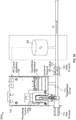
- FIG. 5A illustrates an example system 500A including the MFC 100 coupled with an external downstream pressure sensor 505.
- the MFC 100 includes the proportional control valve 105, the temperature sensor 110, the inlet pressure 115, the outlet pressure 120, the orifice 125, the controlled pressure 130, the capacitance manometer 135, and the PID control electronics 140.
- any capacitance manometer may be used in conjunction with the subject technology as the capacitance manometer 135 (or the MFC 100 may lack a capacitance manometer)
- the capacitance manometer 135 is a Baratron® capacitance manometer manufactured by MKS Instruments, Inc., of Andover, Massachusetts.
- the external downstream pressure sensor 505 measures the outlet pressure 120 of the gas exiting the orifice 135 and provides the measured downstream pressure P d to the PID control electronics 140 without requiring the downstream pressure sensor to be included within the MFC 100.
- the PID control electronics 140 may then determine the flow rate Q based on the measured (by as sensor in the MFC 100) upstream pressure P u and the measured (by the external downstream pressure sensor 505) downstream pressure P d .
- the PID control electronics 140 may determine Q using Equations (1)-(4), and does not need to rely on the techniques for estimating Pd provided by Equations (5)-(11) because a measured value of P d is provided by the downstream pressure sensor 505.
- the downstream pressure sensor 505 is, e.g., an upstream pressure sensor of a different pressure-based MFC adjacent to or part of the MFC 100.
- a digital communication interface may be provided for adjacent pressure-based MFCs to communicate with one another.
- the digital communication interface may include DNET, EtherCat or ProfiBus or any other suitable bus or network.
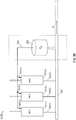
- the downstream pressure sensor 505 may be connected to a single MFC 100. However, as further illustrated in FIG. 5B , the downstream pressure sensor 505 may be one that is used by or connected to multiple MFCs and/or MFVs 501(1)-(3), which may have similar or identical structure as MFC 100.
- the MFCs 501(1)-(3) may be connected by a common manifold 503, e.g., respective outputs 502(1)-(3) of the MFCs 501(1)-(3) can be fed into the manifold 503.
- An output 507 that includes a signal, indicative of the sensed pressure downstream in the manifold 503, can be provided over one or more connections or communication links (e.g., buses or other conductive paths, wireless RF or optical transmissions, or the like) as inputs 507(1)-(3) to the MFCs 501(1)-(3), respectively.
- An advantage afforded by such a configuration as shown in FIG. 5B is that a single downstream pressure sensor may provide downstream pressure measurement signals to multiple upstream devices (e.g., MFCs) via repurposed inputs to those devices. This can result in the MFCs being able to adequately measure flow for un-choked conditions (flow regimes) without them being required to each have their own integrated (and costly) second pressure sensor.
- Such a downstream pressure sensor 505 may also or instead be used for flow verification of the multiple upstream devices 505(1)-505(3), e.g., by use of one or more MFVs.
- one or more of the multiple MFCs (and/or MFVs) 501(1)-(3) shown in FIG. 5B may be operative to provide downstream pressure estimation, though this is not required.
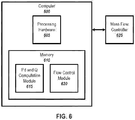
- FIG. 6 illustrates an example computer 600 (or, processing system) coupled with a MFC 625.
- the computer 600 may be coupled with the MFC 625 using a suitable connection or connections (e.g., one or more communication wires, buses, or conductive paths and/or wireless communication links) and/or implementing one or more communication interfaces.
- the MFC 625 may correspond to the MFC 100 or the MFC 200 or other suitable MFCs.
- the computer 600 can be external to the MFC 625.
- the computer 600 is a component of the MFC 625.
- the computer 600 may correspond to the PID control electronics 140 in the MFC 100 of FIG. 1 .
- the computer 600 may be any device that includes a processor and a memory (or that is linked to a memory), such as the PID control electronics 140.
- the computer 600 may be a standalone device, such as a laptop computer, a desktop computer, a mobile phone, a tablet computer, a dedicated control machine, etc., coupled with the MFC 625.
- the computer 600 includes processing hardware 605 and a memory 610.
- the processing hardware 605 may include a single processor or multiple processors. In a multiple processor implementation, the multiple processors may be arranged into processing units, such as a central processing unit, a graphics processing unit, etc.
- the memory 610 stores data accessible to the processing hardware 605 and machine-readable instructions which may be implemented by the processing hardware 605.
- the memory 610 may be a non-transitory machine-readable medium.
- the memory 610 may include a cache unit, a storage unit, a long-term memory, a short-term memory, etc.
- the memory includes a P d and Q computation module 615 and a flow control module 620.
- the P d and Q computation module 615 when executed by the processing hardware 605, causes the processing hardware 605 to compute the downstream pressure P d and the flow rate Q for the MFC 625 based on an input upstream pressure P u from the MFC 625.
- the Pd and Q computation module 615 may use any process described herein for its computation, for example, the processes described above in conjunction with Equations (1)-(11) or the processes described below in conjunction with FIGS. 7-8 . Instructions for implementing the processes described below in conjunction with FIGS. 7-8 may be stored in the memory 610 of the computer 600.
- the flow control module 620 when executed by the processing hardware 605, causes the processing hardware 605 to control a flow through the MFC 625 based on the flow rate Q computed by the Pd and Q computation module 615. For example, the flow control module 620 may adjust operation of the proportional control valve 105 (in the MFC 100 of FIG. 1 ) to control the flow.
- FIG. 7 illustrates a first example process 700 for computing (e.g., calculating or determining) a downstream pressure value P d and a flow rate Q for a MFC (e.g., MFC 100, 200, or 625).
- a MFC e.g., MFC 100, 200, or 625
- the process 700 may be implemented at a computer (e.g., computer 600) or other suitable processing system. However, the process 700 may also be implemented within the MFC, for example, at the PID control electronics 140.
- the process 700 begins at step 705, where the computer receives, from a pressure-based MFC, an upstream pressure value P u .
- the upstream pressure value P u may be measured, at the MFC, using a pressure sensor in the MFC.
- the MFC may have an upstream pressure sensor but no downstream pressure sensor.
- the computer computes, for the pressure-based MFC, a downstream pressure value P d based on the received upstream pressure value P u .
- the computer may compute P d based on any combination of the equations (1)-(11) provided herein.
- the computation of the downstream pressure value P d may be an iterative process.
- the computer computes, for the pressure-based MFC, a flow rate Q based on the received upstream pressure value P u and the computed downstream pressure value P d .
- the computer may compute Q based on any combination of the equations (1)-(11) provided herein. In some cases, the computation of the flow rate Q may be an iterative process.
- the computer controls a flow through the pressure-based MFC based on the computed flow rate Q.
- the computer may increase or decrease the flow rate based on the computed flow rate and a desired flow rate.
- FIG. 8 illustrates a second example process 800 for computing a downstream pressure value P d and a flow rate Q for a (e.g., MFC 100, 200, or 625).
- a process 800 may be implemented at a computer (e.g., computer 600) or other suitable processing system.
- the process 800 may also be implemented within the MFC, for example, at the PID control electronics 140.
- the process 800 begins at step 805, where the computer receives an initial downstream pressure value P d0 for a pressure-based MFC.
- the initial downstream pressure value P d0 may correspond to a pressure measured at the upstream pressure sensor of the MFC when the valve is closed and the pressure is constant throughout the chamber of the MFC.
- the MFC may have an upstream pressure sensor for measuring upstream pressure and may lack a downstream pressure sensor for measuring downstream pressure.
- the computer sets, in its memory, a stored downstream pressure value P d to the received initial downstream pressure value P d0 .
- P d0 may accurately reflect the initial value of P d before opening the valve and beginning operation of the MFC.
- the computer receives, from the pressure-based MFC, a new measured upstream pressure value P u .
- the upstream pressure may change during operation of the MFC. Updated measurements of the upstream pressure may be provided from the MFC to the computer.
- the computer determines, based on P d and P u , whether a flow condition in the pressure-based MFC is critical or non-critical. For example, the computer may use Equations (1) or (3) to determine whether the flow condition is critical or non-critical.
- the Equations (1)-(11) provided herein may be stored at the computer.
- the computer computes the flow rate Q based on whether the flow condition is critical or non-critical, as determined at step 820. For example, if the flow condition is critical, the computer may use Equation (2) to compute Q. If the flow condition is non-critical, the computer may use Equation (4) alone or in combination with the weighting equations (7)-(11) to compute Q.
- the computer may update the stored downstream pressure value P d based on the computed value of the flow rate Q.
- the computer may use Equation (5) alone or in combination with Equation (6) in order to update the stored P d value.
- the computer may compare the current value of Q with a previously computed value of Q and the current value of P d with a previously computed value of P d to determine whether the computed values of Q and P d have converged.
- step 835 the computed determines whether the computed values of P d and Q have converged. If both values have converged, the process 800 continues to step 840. If at least one value has not converged, the process 800 returns to step 815, and the steps 815-830 are iteratively repeated until the valued of P d and Q converge.
- the computer controls a flow through the pressure-based mass flow controller based on the computed flow rate Q. For example, the computer may increase or decrease the flow rate based on the computed flow rate and a desired flow rate.
- the process 800 ends.
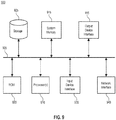
- FIG. 9 conceptually illustrates an electronic system 900 with which some implementations of the subject technology are implemented.
- the computer 600 or the PID control electronics 140 may be implemented using the arrangement of the electronic system 900.
- the electronic system 900 can be a computer (e.g., a mobile phone, PDA), or any other sort of electronic device.
- Such an electronic system can include various types of computer readable media and interfaces for various other types of computer readable media.
- Electronic system 900 includes a bus 905, processor(s) 910, a system memory 915, a read-only memory 920, a permanent storage device 925, an input device interface 930, an output device interface 935, and a network interface 940.
- the bus 905 collectively represents all system, peripheral, and chipset buses that communicatively connect the numerous internal devices of the electronic system 900. For instance, the bus 905 communicatively connects the processor(s) 910 with the read-only memory 920, the system memory 915, and the permanent storage device 925.
- the processor(s) 910 retrieves instructions to execute and data to process in order to execute the processes of the subject technology.
- the processor(s) can include a single processor or a multi-core processor in different implementations.
- the read-only-memory (ROM) 920 stores static data and instructions that are needed by the processor(s) 910 and other modules of the electronic system.
- the permanent storage device 925 is a read-and-write memory device. This device is a non-volatile memory unit that stores instructions and data even when the electronic system 900 is off. Some implementations of the subject technology use a mass-storage device (for example a magnetic or optical disk and its corresponding disk drive) as the permanent storage device 925.
- the system memory 915 is a read-and-write memory device. However, unlike storage device 925, the system memory 915 is a volatile read-and-write memory, such a random access memory.
- the system memory 915 stores some of the instructions and data that the processor needs at runtime.
- the processes of the subject technology are stored in the system memory 915, the permanent storage device 925, or the read-only memory 920.
- the various memory units include instructions for pressure-based flow measurement in accordance with some implementations. From these various memory units, the processor(s) 910 retrieves instructions to execute and data to process in order to execute the processes of some implementations.
- the bus 905 also connects to the input and output device interfaces 930 and 935.
- the input device interface 930 enables the user to communicate information and select commands to the electronic system.
- Input devices used with input device interface 930 include, for example, alphanumeric keyboards and pointing devices (also called “cursor control devices").
- Output device interfaces 935 enables, for example, the display of images generated by the electronic system 900.
- Output devices used with output device interface 935 include, for example, printers and display devices, for example cathode ray tubes (CRT) or liquid crystal displays (LCD). Some implementations include devices for example a touch screen that functions as both input and output devices.
- CTR cathode ray tubes
- LCD liquid crystal displays
- bus 905 also couples electronic system 900 to a network (not shown) through a network interface 940.
- the electronic system 900 can be a part of a network of computers (for example a local area network (LAN), a wide area network (WAN), or an Intranet, or a network of networks, for example the Internet.
- LAN local area network
- WAN wide area network
- Intranet a network of networks
- the Internet any or all components of electronic system 900 can be used in conjunction with the subject technology.
- some or all of the components of the electronic system 900 may be coupled with a MFC (e.g., MFC 100, 200 or 625) or a part of a MFC.
- the above-described features and applications can be implemented as software processes that are specified as a set of instructions recorded on a computer readable storage medium (also referred to as computer readable medium).
- processor(s) which may include, for example, one or more processors, cores of processors, or other processing units
- processor(s) which may include, for example, one or more processors, cores of processors, or other processing units
- Examples of computer readable media include, but are not limited to, CD-ROMs, flash drives, RAM chips, hard drives, EPROMs, etc.
- the computer readable media does not include carrier waves and electronic signals passing wirelessly or over wired connections.
- the term "software” is meant to include firmware residing in read-only memory or applications stored in magnetic storage or flash storage, for example, a solid-state drive, which can be read into memory for processing by a processor.
- multiple software technologies can be implemented as sub-parts of a larger program while remaining distinct software technologies.
- multiple software technologies can also be implemented as separate programs.
- any combination of separate programs that together implement a software technology described here is within the scope of the subject technology.
- the software programs when installed to operate on one or more electronic systems, define one or more specific machine implementations that execute and perform the operations of the software programs.
- a computer program (also known as a program, software, software application, script, or code) can be written in any form of programming language, including compiled or interpreted languages, declarative or procedural languages, and it can be deployed in any form, including as a stand-alone program or as a module, component, subroutine, object, or other unit suitable for use in a computing environment.
- a computer program may, but need not, correspond to a file in a file system.
- a program can be stored in a portion of a file that holds other programs or data (e.g., one or more scripts stored in a markup language document), in a single file dedicated to the program in question, or in multiple coordinated files (e.g., files that store one or more modules, sub programs, or portions of code).
- a computer program can be deployed to be executed on one computer or on multiple computers that are located at one site or distributed across multiple sites and interconnected by a communication network.
- Some implementations include electronic components, for example microprocessors, storage and memory that store computer program instructions in a machine-readable or computer-readable medium (alternatively referred to as computer-readable storage media, machine-readable media, or machine-readable storage media).
- computer-readable media include RAM, ROM, read-only compact discs (CD-ROM), recordable compact discs (CD-R), rewritable compact discs (CD-RW), read-only digital versatile discs (e.g., DVD-ROM, dual-layer DVD-ROM), a variety of recordable/rewritable DVDs (e.g., DVD-RAM, DVD-RW, DVD+RW, etc.), flash memory (e.g., SD cards, mini-SD cards, micro-SD cards, etc.), magnetic or solid state hard drives, read-only and recordable Blu-Ray® discs, ultra density optical discs, any other optical or magnetic media, and floppy disks.
- CD-ROM compact discs
- CD-R recordable compact discs
- the computer-readable media can store a computer program that is executable by at least one processor and includes sets of instructions for performing various operations.
- Examples of computer programs or computer code include machine code, for example is produced by a compiler, and files including higher-level code that are executed by a computer, an electronic component, or a microprocessor using an interpreter.
- ASICs application specific integrated circuits
- FPGAs field programmable gate arrays
- integrated circuits execute instructions that are stored on the circuit itself.
- the terms "computer”, “server”, “processor”, and “memory” all refer to electronic or other technological devices. These terms exclude people or groups of people.
- display or displaying means displaying on an electronic device.
- computer readable medium and “computer readable media” are entirely restricted to tangible, physical objects that store information in a form that is readable by a computer. These terms exclude any wireless signals, wired download signals, and any other ephemeral signals.
- implementations of the subject matter described in this specification can be implemented on a computer having a display device, e.g., a cathode ray tube (CRT) or liquid crystal display (LCD) monitor, for displaying information to the user and a keyboard and a pointing device, e.g., a mouse or a trackball, by which the user can provide input to the computer.
- a display device e.g., a cathode ray tube (CRT) or liquid crystal display (LCD) monitor
- keyboard and a pointing device e.g., a mouse or a trackball
- Other kinds of devices can be used to provide for interaction with a user as well; for example, feedback provided to the user can be any form of sensory feedback, e.g., visual feedback, auditory feedback, or tactile feedback; and input from the user can be received in any form, including acoustic, speech, or tactile input.
- a computer can interact with a user by sending documents to and receiving documents from a device that
- the subject matter described in this specification can be implemented in a computing system that includes a back end component, e.g., as a data server, or that includes a middleware component, e.g., an application server, or that includes a front end component, e.g., a client computer having a graphical user interface or a Web browser through which a user can interact with an implementation of the subject matter described in this specification, or any combination of one or more such back end, middleware, or front end components.
- the components of the system can be interconnected by any form or medium of digital data communication, e.g., a communication network. Examples of communication networks include a local area network (LAN) and a wide area network (WAN), an inter-network (e.g., the Internet), and peer-to-peer networks (e.g., ad hoc peer-to-peer networks).
- LAN local area network
- WAN wide area network
- Internet inter-network
- peer-to-peer networks e.g.,
- the computing system can include clients and servers.
- a client and server are generally remote from each other and typically interact through a communication network. The relationship of client and server arises by virtue of computer programs running on the respective computers and having a client-server relationship to each other.
- a server transmits data (e.g., an HTML page) to a client device (e.g., for purposes of displaying data to and receiving user input from a user interacting with the client device).
- client device e.g., for purposes of displaying data to and receiving user input from a user interacting with the client device.
- Data generated at the client device e.g., a result of the user interaction
- any specific order or hierarchy of steps in the processes disclosed is an illustration of example approaches. Based upon design preferences, it is understood that the specific order or hierarchy of steps in the processes may be rearranged, or that all illustrated steps be performed. Some of the steps may be performed simultaneously. For example, in certain circumstances, multitasking and parallel processing may be advantageous. Moreover, the separation of various system components illustrated above should not be understood as requiring such separation, and it should be understood that the described program components and systems can generally be integrated together in a single software product or packaged into multiple software products.
- Relational terms such as “first” and “second” and the like may be used solely to distinguish one entity or action from another, without necessarily requiring or implying any actual relationship or order between them.
- the terms “comprises,” “comprising,” and any other variation thereof when used in connection with a list of elements in the specification or claims are intended to indicate that the list is not exclusive and that other elements may be included.
- an element proceeded by an “a” or an “an” does not, without further constraints, preclude the existence of additional elements of the identical type.
Landscapes
- Physics & Mathematics (AREA)
- General Physics & Mathematics (AREA)
- Fluid Mechanics (AREA)
- Engineering & Computer Science (AREA)
- Automation & Control Theory (AREA)
- Flow Control (AREA)
- Measuring Volume Flow (AREA)
Claims (12)
- System zur druckbasierten Durchflussmessung eines Fluidstroms, wobei das System umfasst:einen druckbasierten Massendurchflussregler, MFC, (100), der ein Durchflussregelventil (105), einen Durchflussbegrenzer (125) und einen Drucksensor (135) stromaufwärts des Durchflussbegrenzers einschließt, wobei das Durchflussregelventil, der Durchflussbegrenzer und der Drucksensor entlang eines Durchflussstroms angeordnet sind;einen oder mehrere Prozessoren (140, 600), die mit dem druckbasierten Massendurchflussregler, MFC, gekoppelt sind; undSpeicher (610), der mit dem einen oder den mehreren Prozessoren gekoppelt ist, wobei der Speicher Befehle einschließt, die, wenn sie von dem einen oder den mehreren Prozessoren ausgeführt werden, den einen oder die mehreren Prozessoren dazu veranlassen, um:(i) von dem druckbasierten Massendurchflussregler, MFC, einen stromaufwärts gelegenen Druckwert Pu zu empfangen (705, 815), der von dem Drucksensor (135) gemessen wird;(ii) für den druckbasierten Massendurchflussregler, MFC, einen stromabwärts gelegenen Druckwert Pd basierend auf dem empfangenen stromaufwärts gelegenen Druckwert Pu zu berechnen (710);(iii) für den druckbasierten Massendurchflussregler, MFC, eine Durchflussrate Q basierend auf dem empfangenen stromaufwärts gelegenen Druckwert Pu und dem berechneten stromabwärts gelegenen Druckwert Pd zu berechnen (715); und(iv) einen Durchfluss durch den druckbasierten Massendurchflussregler, MFC, basierend auf der berechneten Durchflussrate Q zu regeln (720, 840);wobei die Anweisungen zum Berechnen des stromabwärts gelegenen Drucks Pd und die Anweisungen zum Berechnen der Durchflussrate Q einschließen:Anweisungen zum Einstellen von Pd auf einen Anfangswert Pdo (810); undAnweisungen zum rekursiven Berechnen der Durchflussrate Q und Pd, bis die Werte von Q und Pd innerhalb einer vordefinierten Fehlerschwelle konvergieren, einschließlich Anweisungen umvon dem druckbasierten Massendurchflussregler, MFC, einen aktualisierten stromaufwärts gelegenen Druckwert Pu zu empfangen (815); undbasierend auf Pd und Pu zu bestimmen, ob eine Strömungsbedingung in dem druckbasierten Massendurchflussregler, MFC, ein kritischer oder nicht-kritischer Durchfluss ist (820); undbasierend darauf, ob die Strömungsbedingung kritischer oder nicht-kritischer Durchfluss ist Q zu berechnen (825); undPd basierend auf dem berechneten Wert von Q zu aktualisieren (830).
- System nach Anspruch 1, wobei der Durchflussbegrenzer eine Durchflussdüse oder -Öffnung umfasst.
- System nach Anspruch 1, wobei die Anweisungen um Pd basierend auf dem berechneten Wert von Q zu aktualisieren Anweisungen den stromabwärts gelegenen Druckwert Pd gemäß einer Gleichung Pd = Pdo + f(Q, Pu, γ, M) zu berechnen einschließen, wobei Pdo ein anfänglicher stromabwärts gelegener Druck ist, y ein Verhältnis spezifischer Wärme eines strömenden Gases ist, M ein Molekulargewicht des strömenden Gases ist und f( ) eine Funktion von Q, Pu, γ, M ist.
- System nach Anspruch 3, wobei f eine lineare Funktion von Q, eine lineare Funktion von Pu, eine lineare Funktion von y und eine lineare Funktion von M ist.
- System nach Anspruch 1, wobei die Anweisungen um zu bestimmen, ob die Strömungsbedingung kritisch oder nicht-kritisch ist, Anweisungen einschließen um zu bestimmen, dass eine Strömungsbedingung kritisch ist, wenn Pd / Pu kleiner als [2/(γ +1)]^[γ/(γ-1)] ist; und um zu bestimmen, dass eine Strömungsbedingung nicht-kritisch ist, wenn Pd / Pu größer als oder gleich [2/(γ +1)]^ [γ/(γ-1)] ist, wobei y ein Verhältnis spezifischer Wärme eines strömenden Gases ist.
- System nach Anspruch 1, wobei die Anweisungen um Q zu berechnen Anweisungen einschließen, um Q unter Verwendung einer kritischen Strömungsgleichung zu berechnen, wenn die Strömungsbedingung kritisch ist, und um Q unter Verwendung einer nicht-kritischen Strömungsgleichung zu berechnen, wenn die Strömungsbedingung nicht-kritisch ist.
- System nach Anspruch 1, wobei die Anweisungen um Q zu berechnen Anweisungen einschließen, um beim Bestimmen, dass die Strömungsbedingung nicht-kritisch ist, eine kritische Durchflussrate Qcf unter Verwendung einer kritischen Strömungsgleichung zu berechnen; eine nicht-kritische Durchflussrate Qncf unter Verwendung einer nicht-kritischen Strömungsgleichung zu berechnen; und Q basierend auf einem Gewichtungsfaktors w, der kritischen Durchflussrate Qcf und der nicht-kritischen Durchflussrate Qncf zu berechnen, wobei gilt Q = w ∗ Qcf + (1-w)∗ Qncf .
- System nach Anspruch 7, wobei der Gewichtungsfaktor w gemäß w = fw (Q, Pu, Pd, γ, M) berechnet wird, wobei y ein Verhältnis spezifischer Wärme eines strömenden Gases ist, M ein Molekulargewicht des strömenden Gases ist und fw ( ) eine Funktion von Q, Pu, Pd, γ, M ist.
- System nach Anspruch 1, wobei der anfängliche stromabwärts gelegene Druckwert Pdo einem gemessenen stromaufwärts gelegenen Druckwert entspricht, wenn die Durchflussregelung vollständig geschlossen ist und der Durchfluss durch den MFC null ist.
- Ein nicht-flüchtiges maschinenlesbares Medium umfassend Anweisungen, die, wenn sie von einer Maschine ausgeführt werden, die Maschine veranlassen, um:von einem druckbasierten Massendurchflussregler, MFC, einen stromaufwärts gelegenen Druckwert Pu zu empfangen (705, 815);für den druckbasierten Massendurchflussregler, MFC, einen stromabwärts gelegenen Druckwert Pd basierend auf dem empfangenen stromaufwärts gelegenen Druckwert Pu zu berechnen (710);für den druckbasierten Massendurchflussregler, MFC, eine Durchflussrate Q basierend auf dem empfangenen stromaufwärts gelegenen Druckwert Pu und dem berechneten stromabwärts gelegenen Druckwert Pd zu berechnen (715); undeinen Durchfluss durch den druckbasierten Massendurchflussregler, MFC, basierend auf der berechneten Durchflussrate Q zu regeln (720, 840);wobei die maschinenlesbaren Anweisungen zum Berechnen eines stromabwärts gelegenen Druckwerts Pd und einer Durchflussrate Q Anweisungen umfassen, um:die Maschine zu veranlassen, einen anfänglichen stromabwärts gelegenen Druckwert Pdo für den druckbasierten Massendurchflussregler, MFC, zu empfangen (805);einen gespeicherten stromabwärts gelegenen Druckwert Pd auf den empfangenen anfänglichen stromabwärts gelegenen Druckwert Pdo einzustellen (810); unddie Maschine zu veranlassen, die Bestimmung der berechneten Durchflussrate Q und Pd zu wiederholen, bis die Werte einer berechneten Durchflussrate Q und Pd zu jeweiligen Werten innerhalb einer vordefinierten Fehlerschwelle konvergieren, indem Anweisungen ausgeführt werden, umvon dem druckbasierten Massendurchflussregler, MFC, einen aktualisierten stromaufwärts gelegenen Druckwert Pu zu empfangen (815);basierend auf Pd und Pu zu bestimmen, ob eine Strömungsbedingung in dem druckbasierten Massendurchflussregler, MFC, kritisch oder nicht-kritisch ist (820);basierend darauf, ob die Strömungsbedingung kritisch oder nicht-kritisch ist Q zu berechnen (825); undPd basierend auf dem berechneten Wert von Q zu aktualisieren (830); undwobei der MFC ein Durchflussregelventil (105), einen stromaufwärts gelegenen Drucksensor (135), der in einem Durchflussweg stromaufwärts des Durchflussregelventils konfiguriert ist, und eine durchflussbeschränkende Öffnung (125), die stromabwärts in dem Durchflussweg konfiguriert ist, einschließt.
- Verfahren zur druckbasierten Durchflussregelung durch einen druckbasierten Massendurchflussregler, MFC, das Verfahren umfassend:Empfangen eines anfänglichen stromabwärts gelegenen Druckwerts Pdo für einen druckbasierten Massendurchflussregler, MFC, (805); undEinstellen eines gespeicherten stromabwärts gelegenen Druckwertes Pd auf den empfangenen anfänglichen stromabwärts gelegenen Druckwert Pdo (810);rekursives Berechnen von Durchflussrate Q und Pd, bis die Werte von Q und Pd innerhalb einer vordefinierten Fehlerschwelle konvergieren, durch:Empfangen eines stromaufwärts gelegenen Druckwerts Pu von dem druckbasierten Massendurchflussregler, MFC, (815);Bestimmen, basierend auf Pd und Pu, ob eine Strömungsbedingung in dem druckbasierten Massendurchflussregler, MFC, kritisch oder nicht-kritisch ist (820);Berechnen von Q, basierend darauf, ob die Strömungsbedingung kritisch oder nicht-kritisch ist; und Aktualisieren von Pd, basierend auf dem berechneten Wert von Q (825); undnachdem die berechnete Durchflussrate Q und der gespeicherte stromabwärts gelegene Druckwert Pd zu jeweiligen Werten innerhalb einer vordefinierten Fehlerschwelle konvergieren (835), Regeln eines Durchflusses durch den druckbasierten Massendurchflussregler, MFC, basierend auf der berechneten Durchflussrate Q (840);wobei der druckbasierte Massendurchflussregler (100), MFC, ein Durchflussregelventil (105), einen Durchflussbegrenzer (125) und einen Drucksensor (135) stromaufwärts des Durchflussbegrenzers einschließt, und wobei das Durchflussregelventil, der Durchflussbegrenzer und der Drucksensor entlang eines Durchflussstroms angeordnet sind.
- Verfahren nach Anspruch 11, wobei der Durchflussbegrenzer eine Durchflussdüse oder -Öffnung umfasst.
Applications Claiming Priority (2)
| Application Number | Priority Date | Filing Date | Title |
|---|---|---|---|
| US201562212212P | 2015-08-31 | 2015-08-31 | |
| PCT/US2016/048126 WO2017040100A1 (en) | 2015-08-31 | 2016-08-23 | Method and apparatus for pressure-based flow measurement in non-critical flow conditions |
Publications (3)
| Publication Number | Publication Date |
|---|---|
| EP3344953A1 EP3344953A1 (de) | 2018-07-11 |
| EP3344953A4 EP3344953A4 (de) | 2019-05-08 |
| EP3344953B1 true EP3344953B1 (de) | 2021-07-28 |
Family
ID=58098062
Family Applications (1)
| Application Number | Title | Priority Date | Filing Date |
|---|---|---|---|
| EP16842597.3A Active EP3344953B1 (de) | 2015-08-31 | 2016-08-23 | Verfahren und vorrichtung zur druckbasierten durchflussmessung unter unkritischen strömungsbedingungen |
Country Status (7)
| Country | Link |
|---|---|
| US (1) | US10514712B2 (de) |
| EP (1) | EP3344953B1 (de) |
| JP (1) | JP6781758B2 (de) |
| KR (1) | KR102579543B1 (de) |
| CN (1) | CN108351240B (de) |
| TW (1) | TWI693494B (de) |
| WO (1) | WO2017040100A1 (de) |
Families Citing this family (14)
| Publication number | Priority date | Publication date | Assignee | Title |
|---|---|---|---|---|
| KR102371907B1 (ko) * | 2015-07-10 | 2022-03-08 | 피포탈 시스템즈 코포레이션 | 가스 흐름 제어 방법 및 장치 |
| US10684159B2 (en) * | 2016-06-27 | 2020-06-16 | Applied Materials, Inc. | Methods, systems, and apparatus for mass flow verification based on choked flow |
| US10823598B2 (en) | 2017-03-23 | 2020-11-03 | Honeywell International Inc. | Apparatus and method for creating inferential process flow measurements using other process measurements |
| US11105664B2 (en) * | 2017-03-23 | 2021-08-31 | Honeywell International Inc. | Apparatus and method for creating inferential process flow measurements using flow restrictor and upstream and downstream pressure measurements |
| KR102250967B1 (ko) * | 2017-03-28 | 2021-05-12 | 가부시키가이샤 후지킨 | 압력식 유량 제어 장치 및 유량 제어 방법 |
| US10698426B2 (en) * | 2018-05-07 | 2020-06-30 | Mks Instruments, Inc. | Methods and apparatus for multiple channel mass flow and ratio control systems |
| JP2020021176A (ja) * | 2018-07-30 | 2020-02-06 | 株式会社堀場エステック | 流量制御装置 |
| US10725484B2 (en) | 2018-09-07 | 2020-07-28 | Mks Instruments, Inc. | Method and apparatus for pulse gas delivery using an external pressure trigger |
| US10890474B2 (en) | 2018-09-18 | 2021-01-12 | Swagelok Company | Fluid monitoring module arrangements |
| WO2020061127A1 (en) | 2018-09-19 | 2020-03-26 | Swagelok Company | Flow restricting fluid component |
| US11669111B2 (en) | 2019-09-13 | 2023-06-06 | Illinois Tool Works Inc. | Valve assembly and system used to control flow rate of a fluid |
| US12000723B2 (en) * | 2022-02-18 | 2024-06-04 | Mks Instruments, Inc. | Method and apparatus for pressure based mass flow control |
| USD1043392S1 (en) | 2022-11-30 | 2024-09-24 | Swagelok Company | Flow monitoring device |
| CN118603214B (zh) * | 2024-06-11 | 2025-04-25 | 深圳蓝动精密有限公司 | 一种气体的质量流量测量方法、装置及质量流量控制器 |
Family Cites Families (31)
| Publication number | Priority date | Publication date | Assignee | Title |
|---|---|---|---|---|
| SU1265479A1 (ru) * | 1984-06-25 | 1986-10-23 | Волгоградский Ордена Трудового Красного Знамени Политехнический Институт | Способ определени критического расхода газа в капилл рах |
| JP2567309B2 (ja) * | 1991-06-28 | 1996-12-25 | 日本電信電話株式会社 | 有機金属気相成長装置 |
| JPH05263715A (ja) * | 1992-03-19 | 1993-10-12 | Hitachi Ltd | 内燃機関の排気ガス還流制御装置 |
| JP3439908B2 (ja) * | 1996-04-09 | 2003-08-25 | 三菱電機株式会社 | 圧力制御系および流量制御系の調整装置および制御検証装置,ならびに流量制御装置 |
| ATE314580T1 (de) * | 1997-08-15 | 2006-01-15 | Fujikin Kk | Düse eines durchflussreglers mit einer druckregelung und deren herstellungsverfahren |
| JPH11259140A (ja) * | 1998-03-13 | 1999-09-24 | Kokusai Electric Co Ltd | 流量制御装置 |
| US6389364B1 (en) * | 1999-07-10 | 2002-05-14 | Mykrolis Corporation | System and method for a digital mass flow controller |
| US6631334B2 (en) * | 2000-12-26 | 2003-10-07 | Mks Instruments, Inc. | Pressure-based mass flow controller system |
| CN1514960A (zh) * | 2001-04-24 | 2004-07-21 | �����ػ��������豸����˾ | 调整和配置质量流量控制器的系统和方法 |
| JP4082901B2 (ja) * | 2001-12-28 | 2008-04-30 | 忠弘 大見 | 圧力センサ、圧力制御装置及び圧力式流量制御装置の温度ドリフト補正装置 |
| JP4102564B2 (ja) * | 2001-12-28 | 2008-06-18 | 忠弘 大見 | 改良型圧力式流量制御装置 |
| AU2003253991A1 (en) * | 2002-07-19 | 2004-02-09 | Celerity Group, Inc. | Methods and apparatus for pressure compensation in a mass flow controller |
| US7216019B2 (en) | 2004-07-08 | 2007-05-08 | Celerity, Inc. | Method and system for a mass flow controller with reduced pressure sensitivity |
| JP2008510147A (ja) * | 2004-08-13 | 2008-04-03 | エンテグリス インコーポレイテッド | 流通装置の較正のためのシステムおよび方法 |
| US7150201B2 (en) * | 2004-12-15 | 2006-12-19 | Celerity, Inc. | System and method for measuring flow |
| US7474968B2 (en) * | 2005-03-25 | 2009-01-06 | Mks Instruments, Inc. | Critical flow based mass flow verifier |
| US7757554B2 (en) * | 2005-03-25 | 2010-07-20 | Mks Instruments, Inc. | High accuracy mass flow verifier with multiple inlets |
| JP4856905B2 (ja) | 2005-06-27 | 2012-01-18 | 国立大学法人東北大学 | 流量レンジ可変型流量制御装置 |
| JP4820698B2 (ja) * | 2006-07-03 | 2011-11-24 | 株式会社フジキン | 圧力式流量制御装置の絞り機構下流側バルブの作動異常検出方法 |
| JP2008166397A (ja) * | 2006-12-27 | 2008-07-17 | Sony Corp | 気相成長装置および気相成長方法 |
| US7706925B2 (en) * | 2007-01-10 | 2010-04-27 | Mks Instruments, Inc. | Integrated pressure and flow ratio control system |
| JP4870633B2 (ja) * | 2007-08-29 | 2012-02-08 | シーケーディ株式会社 | 流量検定システム及び流量検定方法 |
| JP4598044B2 (ja) * | 2007-10-29 | 2010-12-15 | シーケーディ株式会社 | 流量検定故障診断装置、流量検定故障診断方法及び流量検定故障診断プログラム |
| US7826986B2 (en) | 2008-09-26 | 2010-11-02 | Advanced Energy Industries, Inc. | Method and system for operating a mass flow controller |
| WO2011078242A1 (ja) * | 2009-12-25 | 2011-06-30 | 株式会社堀場エステック | マスフローコントローラシステム |
| JP5075229B2 (ja) * | 2010-06-18 | 2012-11-21 | 本田技研工業株式会社 | 内燃機関のegr制御装置 |
| JP5809012B2 (ja) * | 2011-10-14 | 2015-11-10 | 株式会社堀場エステック | 流量制御装置、流量測定機構、又は、当該流量測定機構を備えた流量制御装置に用いられる診断装置及び診断用プログラム |
| US9846074B2 (en) * | 2012-01-20 | 2017-12-19 | Mks Instruments, Inc. | System for and method of monitoring flow through mass flow controllers in real time |
| JP6563656B2 (ja) | 2012-03-07 | 2019-08-21 | イリノイ トゥール ワークス インコーポレイティド | 質量流量制御器の制御を改善するためのモデルを用いるためのシステムおよび方法 |
| US10031005B2 (en) * | 2012-09-25 | 2018-07-24 | Mks Instruments, Inc. | Method and apparatus for self verification of pressure-based mass flow controllers |
| WO2014152755A2 (en) * | 2013-03-14 | 2014-09-25 | Christopher Max Horwitz | Pressure-based gas flow controller with dynamic self-calibration |
-
2016
- 2016-08-23 EP EP16842597.3A patent/EP3344953B1/de active Active
- 2016-08-23 KR KR1020187008249A patent/KR102579543B1/ko active Active
- 2016-08-23 WO PCT/US2016/048126 patent/WO2017040100A1/en not_active Ceased
- 2016-08-23 US US15/244,264 patent/US10514712B2/en active Active
- 2016-08-23 TW TW105126942A patent/TWI693494B/zh active
- 2016-08-23 JP JP2018529497A patent/JP6781758B2/ja active Active
- 2016-08-23 CN CN201680061708.5A patent/CN108351240B/zh not_active Expired - Fee Related
Non-Patent Citations (1)
| Title |
|---|
| None * |
Also Published As
| Publication number | Publication date |
|---|---|
| WO2017040100A1 (en) | 2017-03-09 |
| JP2018526757A (ja) | 2018-09-13 |
| EP3344953A1 (de) | 2018-07-11 |
| CN108351240A (zh) | 2018-07-31 |
| US10514712B2 (en) | 2019-12-24 |
| CN108351240B (zh) | 2020-10-20 |
| TW201723713A (zh) | 2017-07-01 |
| EP3344953A4 (de) | 2019-05-08 |
| KR102579543B1 (ko) | 2023-09-18 |
| TWI693494B (zh) | 2020-05-11 |
| KR20180037282A (ko) | 2018-04-11 |
| US20170060143A1 (en) | 2017-03-02 |
| JP6781758B2 (ja) | 2020-11-04 |
Similar Documents
| Publication | Publication Date | Title |
|---|---|---|
| EP3344953B1 (de) | Verfahren und vorrichtung zur druckbasierten durchflussmessung unter unkritischen strömungsbedingungen | |
| KR102483417B1 (ko) | 유량 제어 장치, 유량 제어 방법, 및, 프로그램 기록 매체 | |
| JP6093019B2 (ja) | 質量流量制御システム | |
| KR102303943B1 (ko) | 질량 유량 컨트롤러를 통해 유동을 모니터링하는 시스템 및 방법 | |
| US20080221822A1 (en) | System and Method for Calibration of a Flow Device | |
| CN102483344B (zh) | 上游体积质量流量检验系统和方法 | |
| US9846073B2 (en) | On-tool mass flow controller diagnostic systems and methods | |
| US20140260513A1 (en) | On-tool mass flow controller diagnostic systems and methods | |
| KR102237868B1 (ko) | 압력 둔감형 자기 검증 질량 유량 컨트롤러를 제공하는 시스템 및 방법 | |
| TW201506567A (zh) | 質流控制器及對各流體類型具有改進效能之方法 | |
| US10698426B2 (en) | Methods and apparatus for multiple channel mass flow and ratio control systems | |
| JP5219519B2 (ja) | コリオリ流量計の使用を指導するための方法及び装置 | |
| US20210173388A1 (en) | Flow control device, diagnostic method, and program for flow control device | |
| US11860018B2 (en) | Rate-of-change flow measurement device | |
| CN119309635A (zh) | 流量计算装置和流量计算方法 | |
| JP2021093182A (ja) | 流量制御装置、流量制御方法、及び、流量制御装置用プログラム |
Legal Events
| Date | Code | Title | Description |
|---|---|---|---|
| STAA | Information on the status of an ep patent application or granted ep patent |
Free format text: STATUS: THE INTERNATIONAL PUBLICATION HAS BEEN MADE |
|
| PUAI | Public reference made under article 153(3) epc to a published international application that has entered the european phase |
Free format text: ORIGINAL CODE: 0009012 |
|
| STAA | Information on the status of an ep patent application or granted ep patent |
Free format text: STATUS: REQUEST FOR EXAMINATION WAS MADE |
|
| 17P | Request for examination filed |
Effective date: 20180328 |
|
| AK | Designated contracting states |
Kind code of ref document: A1 Designated state(s): AL AT BE BG CH CY CZ DE DK EE ES FI FR GB GR HR HU IE IS IT LI LT LU LV MC MK MT NL NO PL PT RO RS SE SI SK SM TR |
|
| AX | Request for extension of the european patent |
Extension state: BA ME |
|
| DAV | Request for validation of the european patent (deleted) | ||
| DAX | Request for extension of the european patent (deleted) | ||
| REG | Reference to a national code |
Ref country code: DE Ref legal event code: R079 Ref document number: 602016061363 Country of ref document: DE Free format text: PREVIOUS MAIN CLASS: G01F0001340000 Ipc: G01F0001360000 |
|
| A4 | Supplementary search report drawn up and despatched |
Effective date: 20190404 |
|
| RIC1 | Information provided on ipc code assigned before grant |
Ipc: G01F 1/50 20060101ALI20190329BHEP Ipc: G05D 7/06 20060101ALI20190329BHEP Ipc: G01F 1/36 20060101AFI20190329BHEP Ipc: G01F 15/00 20060101ALI20190329BHEP |
|
| STAA | Information on the status of an ep patent application or granted ep patent |
Free format text: STATUS: EXAMINATION IS IN PROGRESS |
|
| 17Q | First examination report despatched |
Effective date: 20200619 |
|
| GRAP | Despatch of communication of intention to grant a patent |
Free format text: ORIGINAL CODE: EPIDOSNIGR1 |
|
| STAA | Information on the status of an ep patent application or granted ep patent |
Free format text: STATUS: GRANT OF PATENT IS INTENDED |
|
| INTG | Intention to grant announced |
Effective date: 20210218 |
|
| GRAS | Grant fee paid |
Free format text: ORIGINAL CODE: EPIDOSNIGR3 |
|
| GRAA | (expected) grant |
Free format text: ORIGINAL CODE: 0009210 |
|
| STAA | Information on the status of an ep patent application or granted ep patent |
Free format text: STATUS: THE PATENT HAS BEEN GRANTED |
|
| AK | Designated contracting states |
Kind code of ref document: B1 Designated state(s): AL AT BE BG CH CY CZ DE DK EE ES FI FR GB GR HR HU IE IS IT LI LT LU LV MC MK MT NL NO PL PT RO RS SE SI SK SM TR |
|
| REG | Reference to a national code |
Ref country code: GB Ref legal event code: FG4D |
|
| REG | Reference to a national code |
Ref country code: CH Ref legal event code: EP |
|
| REG | Reference to a national code |
Ref country code: AT Ref legal event code: REF Ref document number: 1415094 Country of ref document: AT Kind code of ref document: T Effective date: 20210815 |
|
| REG | Reference to a national code |
Ref country code: IE Ref legal event code: FG4D |
|
| REG | Reference to a national code |
Ref country code: DE Ref legal event code: R096 Ref document number: 602016061363 Country of ref document: DE |
|
| REG | Reference to a national code |
Ref country code: LT Ref legal event code: MG9D |
|
| REG | Reference to a national code |
Ref country code: NL Ref legal event code: MP Effective date: 20210728 |
|
| REG | Reference to a national code |
Ref country code: AT Ref legal event code: MK05 Ref document number: 1415094 Country of ref document: AT Kind code of ref document: T Effective date: 20210728 |
|
| PG25 | Lapsed in a contracting state [announced via postgrant information from national office to epo] |
Ref country code: PT Free format text: LAPSE BECAUSE OF FAILURE TO SUBMIT A TRANSLATION OF THE DESCRIPTION OR TO PAY THE FEE WITHIN THE PRESCRIBED TIME-LIMIT Effective date: 20211129 Ref country code: NO Free format text: LAPSE BECAUSE OF FAILURE TO SUBMIT A TRANSLATION OF THE DESCRIPTION OR TO PAY THE FEE WITHIN THE PRESCRIBED TIME-LIMIT Effective date: 20211028 Ref country code: NL Free format text: LAPSE BECAUSE OF FAILURE TO SUBMIT A TRANSLATION OF THE DESCRIPTION OR TO PAY THE FEE WITHIN THE PRESCRIBED TIME-LIMIT Effective date: 20210728 Ref country code: HR Free format text: LAPSE BECAUSE OF FAILURE TO SUBMIT A TRANSLATION OF THE DESCRIPTION OR TO PAY THE FEE WITHIN THE PRESCRIBED TIME-LIMIT Effective date: 20210728 Ref country code: ES Free format text: LAPSE BECAUSE OF FAILURE TO SUBMIT A TRANSLATION OF THE DESCRIPTION OR TO PAY THE FEE WITHIN THE PRESCRIBED TIME-LIMIT Effective date: 20210728 Ref country code: FI Free format text: LAPSE BECAUSE OF FAILURE TO SUBMIT A TRANSLATION OF THE DESCRIPTION OR TO PAY THE FEE WITHIN THE PRESCRIBED TIME-LIMIT Effective date: 20210728 Ref country code: LT Free format text: LAPSE BECAUSE OF FAILURE TO SUBMIT A TRANSLATION OF THE DESCRIPTION OR TO PAY THE FEE WITHIN THE PRESCRIBED TIME-LIMIT Effective date: 20210728 Ref country code: AT Free format text: LAPSE BECAUSE OF FAILURE TO SUBMIT A TRANSLATION OF THE DESCRIPTION OR TO PAY THE FEE WITHIN THE PRESCRIBED TIME-LIMIT Effective date: 20210728 Ref country code: BG Free format text: LAPSE BECAUSE OF FAILURE TO SUBMIT A TRANSLATION OF THE DESCRIPTION OR TO PAY THE FEE WITHIN THE PRESCRIBED TIME-LIMIT Effective date: 20211028 Ref country code: SE Free format text: LAPSE BECAUSE OF FAILURE TO SUBMIT A TRANSLATION OF THE DESCRIPTION OR TO PAY THE FEE WITHIN THE PRESCRIBED TIME-LIMIT Effective date: 20210728 Ref country code: RS Free format text: LAPSE BECAUSE OF FAILURE TO SUBMIT A TRANSLATION OF THE DESCRIPTION OR TO PAY THE FEE WITHIN THE PRESCRIBED TIME-LIMIT Effective date: 20210728 |
|
| PG25 | Lapsed in a contracting state [announced via postgrant information from national office to epo] |
Ref country code: PL Free format text: LAPSE BECAUSE OF FAILURE TO SUBMIT A TRANSLATION OF THE DESCRIPTION OR TO PAY THE FEE WITHIN THE PRESCRIBED TIME-LIMIT Effective date: 20210728 Ref country code: LV Free format text: LAPSE BECAUSE OF FAILURE TO SUBMIT A TRANSLATION OF THE DESCRIPTION OR TO PAY THE FEE WITHIN THE PRESCRIBED TIME-LIMIT Effective date: 20210728 Ref country code: GR Free format text: LAPSE BECAUSE OF FAILURE TO SUBMIT A TRANSLATION OF THE DESCRIPTION OR TO PAY THE FEE WITHIN THE PRESCRIBED TIME-LIMIT Effective date: 20211029 |
|
| REG | Reference to a national code |
Ref country code: CH Ref legal event code: PL |
|
| REG | Reference to a national code |
Ref country code: BE Ref legal event code: MM Effective date: 20210831 |
|
| PG25 | Lapsed in a contracting state [announced via postgrant information from national office to epo] |
Ref country code: LI Free format text: LAPSE BECAUSE OF NON-PAYMENT OF DUE FEES Effective date: 20210831 Ref country code: DK Free format text: LAPSE BECAUSE OF FAILURE TO SUBMIT A TRANSLATION OF THE DESCRIPTION OR TO PAY THE FEE WITHIN THE PRESCRIBED TIME-LIMIT Effective date: 20210728 Ref country code: CH Free format text: LAPSE BECAUSE OF NON-PAYMENT OF DUE FEES Effective date: 20210831 |
|
| REG | Reference to a national code |
Ref country code: DE Ref legal event code: R097 Ref document number: 602016061363 Country of ref document: DE |
|
| PG25 | Lapsed in a contracting state [announced via postgrant information from national office to epo] |
Ref country code: SM Free format text: LAPSE BECAUSE OF FAILURE TO SUBMIT A TRANSLATION OF THE DESCRIPTION OR TO PAY THE FEE WITHIN THE PRESCRIBED TIME-LIMIT Effective date: 20210728 Ref country code: SK Free format text: LAPSE BECAUSE OF FAILURE TO SUBMIT A TRANSLATION OF THE DESCRIPTION OR TO PAY THE FEE WITHIN THE PRESCRIBED TIME-LIMIT Effective date: 20210728 Ref country code: RO Free format text: LAPSE BECAUSE OF FAILURE TO SUBMIT A TRANSLATION OF THE DESCRIPTION OR TO PAY THE FEE WITHIN THE PRESCRIBED TIME-LIMIT Effective date: 20210728 Ref country code: MC Free format text: LAPSE BECAUSE OF FAILURE TO SUBMIT A TRANSLATION OF THE DESCRIPTION OR TO PAY THE FEE WITHIN THE PRESCRIBED TIME-LIMIT Effective date: 20210728 Ref country code: LU Free format text: LAPSE BECAUSE OF NON-PAYMENT OF DUE FEES Effective date: 20210823 Ref country code: EE Free format text: LAPSE BECAUSE OF FAILURE TO SUBMIT A TRANSLATION OF THE DESCRIPTION OR TO PAY THE FEE WITHIN THE PRESCRIBED TIME-LIMIT Effective date: 20210728 Ref country code: CZ Free format text: LAPSE BECAUSE OF FAILURE TO SUBMIT A TRANSLATION OF THE DESCRIPTION OR TO PAY THE FEE WITHIN THE PRESCRIBED TIME-LIMIT Effective date: 20210728 Ref country code: AL Free format text: LAPSE BECAUSE OF FAILURE TO SUBMIT A TRANSLATION OF THE DESCRIPTION OR TO PAY THE FEE WITHIN THE PRESCRIBED TIME-LIMIT Effective date: 20210728 |
|
| PLBE | No opposition filed within time limit |
Free format text: ORIGINAL CODE: 0009261 |
|
| STAA | Information on the status of an ep patent application or granted ep patent |
Free format text: STATUS: NO OPPOSITION FILED WITHIN TIME LIMIT |
|
| 26N | No opposition filed |
Effective date: 20220429 |
|
| PG25 | Lapsed in a contracting state [announced via postgrant information from national office to epo] |
Ref country code: IT Free format text: LAPSE BECAUSE OF FAILURE TO SUBMIT A TRANSLATION OF THE DESCRIPTION OR TO PAY THE FEE WITHIN THE PRESCRIBED TIME-LIMIT Effective date: 20210728 Ref country code: IE Free format text: LAPSE BECAUSE OF NON-PAYMENT OF DUE FEES Effective date: 20210823 Ref country code: FR Free format text: LAPSE BECAUSE OF NON-PAYMENT OF DUE FEES Effective date: 20210928 Ref country code: BE Free format text: LAPSE BECAUSE OF NON-PAYMENT OF DUE FEES Effective date: 20210831 |
|
| PG25 | Lapsed in a contracting state [announced via postgrant information from national office to epo] |
Ref country code: HU Free format text: LAPSE BECAUSE OF FAILURE TO SUBMIT A TRANSLATION OF THE DESCRIPTION OR TO PAY THE FEE WITHIN THE PRESCRIBED TIME-LIMIT; INVALID AB INITIO Effective date: 20160823 |
|
| PG25 | Lapsed in a contracting state [announced via postgrant information from national office to epo] |
Ref country code: CY Free format text: LAPSE BECAUSE OF FAILURE TO SUBMIT A TRANSLATION OF THE DESCRIPTION OR TO PAY THE FEE WITHIN THE PRESCRIBED TIME-LIMIT Effective date: 20210728 |
|
| PG25 | Lapsed in a contracting state [announced via postgrant information from national office to epo] |
Ref country code: MK Free format text: LAPSE BECAUSE OF FAILURE TO SUBMIT A TRANSLATION OF THE DESCRIPTION OR TO PAY THE FEE WITHIN THE PRESCRIBED TIME-LIMIT Effective date: 20210728 |
|
| PG25 | Lapsed in a contracting state [announced via postgrant information from national office to epo] |
Ref country code: TR Free format text: LAPSE BECAUSE OF FAILURE TO SUBMIT A TRANSLATION OF THE DESCRIPTION OR TO PAY THE FEE WITHIN THE PRESCRIBED TIME-LIMIT Effective date: 20210728 |
|
| PG25 | Lapsed in a contracting state [announced via postgrant information from national office to epo] |
Ref country code: MT Free format text: LAPSE BECAUSE OF FAILURE TO SUBMIT A TRANSLATION OF THE DESCRIPTION OR TO PAY THE FEE WITHIN THE PRESCRIBED TIME-LIMIT Effective date: 20210728 |
|
| PGFP | Annual fee paid to national office [announced via postgrant information from national office to epo] |
Ref country code: DE Payment date: 20250827 Year of fee payment: 10 |
|
| PGFP | Annual fee paid to national office [announced via postgrant information from national office to epo] |
Ref country code: GB Payment date: 20250826 Year of fee payment: 10 |