EP3317247B1 - Procédé de préparation de polyols - Google Patents
Procédé de préparation de polyols Download PDFInfo
- Publication number
- EP3317247B1 EP3317247B1 EP16732992.9A EP16732992A EP3317247B1 EP 3317247 B1 EP3317247 B1 EP 3317247B1 EP 16732992 A EP16732992 A EP 16732992A EP 3317247 B1 EP3317247 B1 EP 3317247B1
- Authority
- EP
- European Patent Office
- Prior art keywords
- independently
- formula
- advantageously
- integer
- unit
- Prior art date
- Legal status (The legal status is an assumption and is not a legal conclusion. Google has not performed a legal analysis and makes no representation as to the accuracy of the status listed.)
- Not-in-force
Links
- 229920005862 polyol Polymers 0.000 title claims description 21
- 150000003077 polyols Chemical class 0.000 title claims description 21
- 238000004519 manufacturing process Methods 0.000 title claims description 7
- 150000001875 compounds Chemical class 0.000 claims description 42
- 238000000034 method Methods 0.000 claims description 38
- 229910052739 hydrogen Inorganic materials 0.000 claims description 31
- 150000003512 tertiary amines Chemical class 0.000 claims description 23
- 239000001257 hydrogen Substances 0.000 claims description 21
- 239000003446 ligand Substances 0.000 claims description 21
- UFHFLCQGNIYNRP-UHFFFAOYSA-N Hydrogen Chemical compound [H][H] UFHFLCQGNIYNRP-UHFFFAOYSA-N 0.000 claims description 20
- 239000000203 mixture Substances 0.000 claims description 17
- UGFAIRIUMAVXCW-UHFFFAOYSA-N Carbon monoxide Chemical compound [O+]#[C-] UGFAIRIUMAVXCW-UHFFFAOYSA-N 0.000 claims description 14
- 229910002091 carbon monoxide Inorganic materials 0.000 claims description 14
- RWRDLPDLKQPQOW-UHFFFAOYSA-N Pyrrolidine Chemical compound C1CCNC1 RWRDLPDLKQPQOW-UHFFFAOYSA-N 0.000 claims description 13
- 229910052757 nitrogen Inorganic materials 0.000 claims description 13
- 125000004433 nitrogen atom Chemical group N* 0.000 claims description 13
- 239000012041 precatalyst Substances 0.000 claims description 13
- 150000001412 amines Chemical class 0.000 claims description 12
- 125000000753 cycloalkyl group Chemical group 0.000 claims description 11
- 239000010948 rhodium Substances 0.000 claims description 11
- 235000015112 vegetable and seed oil Nutrition 0.000 claims description 10
- 239000008158 vegetable oil Substances 0.000 claims description 10
- 229910052723 transition metal Inorganic materials 0.000 claims description 9
- 150000003624 transition metals Chemical class 0.000 claims description 9
- 125000000623 heterocyclic group Chemical group 0.000 claims description 6
- 239000012298 atmosphere Substances 0.000 claims description 5
- 238000003756 stirring Methods 0.000 claims description 5
- WRYCSMQKUKOKBP-UHFFFAOYSA-N Imidazolidine Chemical compound C1CNCN1 WRYCSMQKUKOKBP-UHFFFAOYSA-N 0.000 claims description 4
- 230000000737 periodic effect Effects 0.000 claims description 4
- 229910052703 rhodium Inorganic materials 0.000 claims description 4
- MHOVAHRLVXNVSD-UHFFFAOYSA-N rhodium atom Chemical compound [Rh] MHOVAHRLVXNVSD-UHFFFAOYSA-N 0.000 claims description 4
- 150000003242 quaternary ammonium salts Chemical class 0.000 claims description 3
- RRKODOZNUZCUBN-CCAGOZQPSA-N (1z,3z)-cycloocta-1,3-diene Chemical compound C1CC\C=C/C=C\C1 RRKODOZNUZCUBN-CCAGOZQPSA-N 0.000 claims description 2
- POILWHVDKZOXJZ-ARJAWSKDSA-M (z)-4-oxopent-2-en-2-olate Chemical compound C\C([O-])=C\C(C)=O POILWHVDKZOXJZ-ARJAWSKDSA-M 0.000 claims description 2
- QTBSBXVTEAMEQO-UHFFFAOYSA-M Acetate Chemical compound CC([O-])=O QTBSBXVTEAMEQO-UHFFFAOYSA-M 0.000 claims description 2
- HONIICLYMWZJFZ-UHFFFAOYSA-N azetidine Chemical compound C1CNC1 HONIICLYMWZJFZ-UHFFFAOYSA-N 0.000 claims description 2
- YRTMEEURRDTMST-UHFFFAOYSA-N diazetidine Chemical compound C1CNN1 YRTMEEURRDTMST-UHFFFAOYSA-N 0.000 claims description 2
- JFNLZVQOOSMTJK-KNVOCYPGSA-N norbornene Chemical compound C1[C@@H]2CC[C@H]1C=C2 JFNLZVQOOSMTJK-KNVOCYPGSA-N 0.000 claims description 2
- 125000000008 (C1-C10) alkyl group Chemical group 0.000 claims 6
- 238000006243 chemical reaction Methods 0.000 description 32
- YXFVVABEGXRONW-UHFFFAOYSA-N Toluene Chemical compound CC1=CC=CC=C1 YXFVVABEGXRONW-UHFFFAOYSA-N 0.000 description 21
- 125000000217 alkyl group Chemical group 0.000 description 17
- 125000003118 aryl group Chemical group 0.000 description 17
- 229910052698 phosphorus Inorganic materials 0.000 description 16
- 229910052799 carbon Inorganic materials 0.000 description 13
- 238000005984 hydrogenation reaction Methods 0.000 description 13
- OAICVXFJPJFONN-UHFFFAOYSA-N Phosphorus Chemical compound [P] OAICVXFJPJFONN-UHFFFAOYSA-N 0.000 description 12
- 239000011574 phosphorus Substances 0.000 description 12
- LFQSCWFLJHTTHZ-UHFFFAOYSA-N Ethanol Chemical compound CCO LFQSCWFLJHTTHZ-UHFFFAOYSA-N 0.000 description 11
- BAECOWNUKCLBPZ-HIUWNOOHSA-N Triolein Natural products O([C@H](OCC(=O)CCCCCCC/C=C\CCCCCCCC)COC(=O)CCCCCCC/C=C\CCCCCCCC)C(=O)CCCCCCC/C=C\CCCCCCCC BAECOWNUKCLBPZ-HIUWNOOHSA-N 0.000 description 11
- PHYFQTYBJUILEZ-UHFFFAOYSA-N Trioleoylglycerol Natural products CCCCCCCCC=CCCCCCCCC(=O)OCC(OC(=O)CCCCCCCC=CCCCCCCCC)COC(=O)CCCCCCCC=CCCCCCCCC PHYFQTYBJUILEZ-UHFFFAOYSA-N 0.000 description 11
- 230000015572 biosynthetic process Effects 0.000 description 11
- PHYFQTYBJUILEZ-IUPFWZBJSA-N triolein Chemical compound CCCCCCCC\C=C/CCCCCCCC(=O)OCC(OC(=O)CCCCCCC\C=C/CCCCCCCC)COC(=O)CCCCCCC\C=C/CCCCCCCC PHYFQTYBJUILEZ-IUPFWZBJSA-N 0.000 description 11
- 229940117972 triolein Drugs 0.000 description 11
- PEDCQBHIVMGVHV-UHFFFAOYSA-N Glycerine Chemical compound OCC(O)CO PEDCQBHIVMGVHV-UHFFFAOYSA-N 0.000 description 10
- 150000001299 aldehydes Chemical class 0.000 description 10
- 229920000858 Cyclodextrin Polymers 0.000 description 9
- HFHDHCJBZVLPGP-UHFFFAOYSA-N schardinger α-dextrin Chemical compound O1C(C(C2O)O)C(CO)OC2OC(C(C2O)O)C(CO)OC2OC(C(C2O)O)C(CO)OC2OC(C(O)C2O)C(CO)OC2OC(C(C2O)O)C(CO)OC2OC2C(O)C(O)C1OC2CO HFHDHCJBZVLPGP-UHFFFAOYSA-N 0.000 description 9
- 239000011203 carbon fibre reinforced carbon Substances 0.000 description 8
- 230000010354 integration Effects 0.000 description 8
- 238000010606 normalization Methods 0.000 description 8
- CUJRVFIICFDLGR-UHFFFAOYSA-N acetylacetonate Chemical compound CC(=O)[CH-]C(C)=O CUJRVFIICFDLGR-UHFFFAOYSA-N 0.000 description 7
- 125000004432 carbon atom Chemical group C* 0.000 description 7
- 125000001424 substituent group Chemical group 0.000 description 7
- 238000003786 synthesis reaction Methods 0.000 description 7
- SECXISVLQFMRJM-UHFFFAOYSA-N N-Methylpyrrolidone Chemical compound CN1CCCC1=O SECXISVLQFMRJM-UHFFFAOYSA-N 0.000 description 6
- ZMANZCXQSJIPKH-UHFFFAOYSA-N Triethylamine Chemical compound CCN(CC)CC ZMANZCXQSJIPKH-UHFFFAOYSA-N 0.000 description 6
- 230000003197 catalytic effect Effects 0.000 description 6
- 238000007037 hydroformylation reaction Methods 0.000 description 6
- 238000002360 preparation method Methods 0.000 description 6
- 238000006467 substitution reaction Methods 0.000 description 6
- IJGRMHOSHXDMSA-UHFFFAOYSA-N Atomic nitrogen Chemical compound N#N IJGRMHOSHXDMSA-UHFFFAOYSA-N 0.000 description 5
- -1 anthracyl Chemical group 0.000 description 5
- 150000004945 aromatic hydrocarbons Chemical group 0.000 description 5
- 125000001797 benzyl group Chemical group [H]C1=C([H])C([H])=C(C([H])=C1[H])C([H])([H])* 0.000 description 5
- 229910052736 halogen Inorganic materials 0.000 description 5
- 150000002367 halogens Chemical class 0.000 description 5
- 150000003626 triacylglycerols Chemical class 0.000 description 5
- XLYOFNOQVPJJNP-UHFFFAOYSA-N water Substances O XLYOFNOQVPJJNP-UHFFFAOYSA-N 0.000 description 5
- KWYHDKDOAIKMQN-UHFFFAOYSA-N N,N,N',N'-tetramethylethylenediamine Chemical compound CN(C)CCN(C)C KWYHDKDOAIKMQN-UHFFFAOYSA-N 0.000 description 4
- NQRYJNQNLNOLGT-UHFFFAOYSA-N Piperidine Chemical compound C1CCNCC1 NQRYJNQNLNOLGT-UHFFFAOYSA-N 0.000 description 4
- JUJWROOIHBZHMG-UHFFFAOYSA-N Pyridine Chemical compound C1=CC=NC=C1 JUJWROOIHBZHMG-UHFFFAOYSA-N 0.000 description 4
- KAESVJOAVNADME-UHFFFAOYSA-N Pyrrole Chemical compound C=1C=CNC=1 KAESVJOAVNADME-UHFFFAOYSA-N 0.000 description 4
- 150000001336 alkenes Chemical class 0.000 description 4
- 125000004437 phosphorous atom Chemical group 0.000 description 4
- 238000000425 proton nuclear magnetic resonance spectrum Methods 0.000 description 4
- 125000006850 spacer group Chemical group 0.000 description 4
- IMFACGCPASFAPR-UHFFFAOYSA-N tributylamine Chemical compound CCCCN(CCCC)CCCC IMFACGCPASFAPR-UHFFFAOYSA-N 0.000 description 4
- UHOVQNZJYSORNB-UHFFFAOYSA-N Benzene Chemical compound C1=CC=CC=C1 UHOVQNZJYSORNB-UHFFFAOYSA-N 0.000 description 3
- 150000001298 alcohols Chemical class 0.000 description 3
- 125000003545 alkoxy group Chemical group 0.000 description 3
- 230000002051 biphasic effect Effects 0.000 description 3
- 150000001721 carbon Chemical group 0.000 description 3
- 125000000113 cyclohexyl group Chemical group [H]C1([H])C([H])([H])C([H])([H])C([H])(*)C([H])([H])C1([H])[H] 0.000 description 3
- 125000002950 monocyclic group Chemical group 0.000 description 3
- VLKZOEOYAKHREP-UHFFFAOYSA-N n-Hexane Chemical compound CCCCCC VLKZOEOYAKHREP-UHFFFAOYSA-N 0.000 description 3
- 239000003921 oil Substances 0.000 description 3
- 235000019198 oils Nutrition 0.000 description 3
- 239000012074 organic phase Substances 0.000 description 3
- 125000001997 phenyl group Chemical group [H]C1=C([H])C([H])=C(*)C([H])=C1[H] 0.000 description 3
- 125000003367 polycyclic group Chemical group 0.000 description 3
- 238000004064 recycling Methods 0.000 description 3
- 239000011347 resin Substances 0.000 description 3
- 229920005989 resin Polymers 0.000 description 3
- 125000000027 (C1-C10) alkoxy group Chemical group 0.000 description 2
- 125000005913 (C3-C6) cycloalkyl group Chemical group 0.000 description 2
- LIKMAJRDDDTEIG-UHFFFAOYSA-N 1-hexene Chemical compound CCCCC=C LIKMAJRDDDTEIG-UHFFFAOYSA-N 0.000 description 2
- 125000004070 6 membered heterocyclic group Chemical group 0.000 description 2
- QGZKDVFQNNGYKY-UHFFFAOYSA-O Ammonium Chemical compound [NH4+] QGZKDVFQNNGYKY-UHFFFAOYSA-O 0.000 description 2
- IMNFDUFMRHMDMM-UHFFFAOYSA-N N-Heptane Chemical compound CCCCCCC IMNFDUFMRHMDMM-UHFFFAOYSA-N 0.000 description 2
- XYFCBTPGUUZFHI-UHFFFAOYSA-N Phosphine Chemical compound P XYFCBTPGUUZFHI-UHFFFAOYSA-N 0.000 description 2
- GLUUGHFHXGJENI-UHFFFAOYSA-N Piperazine Chemical compound C1CNCCN1 GLUUGHFHXGJENI-UHFFFAOYSA-N 0.000 description 2
- PPBRXRYQALVLMV-UHFFFAOYSA-N Styrene Chemical compound C=CC1=CC=CC=C1 PPBRXRYQALVLMV-UHFFFAOYSA-N 0.000 description 2
- 238000013019 agitation Methods 0.000 description 2
- 125000004429 atom Chemical group 0.000 description 2
- 229910052794 bromium Inorganic materials 0.000 description 2
- 125000002915 carbonyl group Chemical group [*:2]C([*:1])=O 0.000 description 2
- 125000003178 carboxy group Chemical group [H]OC(*)=O 0.000 description 2
- 239000003054 catalyst Substances 0.000 description 2
- 229910052801 chlorine Inorganic materials 0.000 description 2
- 230000000694 effects Effects 0.000 description 2
- 239000000839 emulsion Substances 0.000 description 2
- 125000000524 functional group Chemical group 0.000 description 2
- 239000007789 gas Substances 0.000 description 2
- 125000004435 hydrogen atom Chemical group [H]* 0.000 description 2
- 125000002887 hydroxy group Chemical group [H]O* 0.000 description 2
- 125000004029 hydroxymethyl group Chemical group [H]OC([H])([H])* 0.000 description 2
- 125000000250 methylamino group Chemical group [H]N(*)C([H])([H])[H] 0.000 description 2
- USPWKWBDZOARPV-UHFFFAOYSA-N pyrazolidine Chemical compound C1CNNC1 USPWKWBDZOARPV-UHFFFAOYSA-N 0.000 description 2
- UMJSCPRVCHMLSP-UHFFFAOYSA-N pyridine Natural products COC1=CC=CN=C1 UMJSCPRVCHMLSP-UHFFFAOYSA-N 0.000 description 2
- 230000035484 reaction time Effects 0.000 description 2
- 230000002829 reductive effect Effects 0.000 description 2
- 239000000758 substrate Substances 0.000 description 2
- MYAJTCUQMQREFZ-UHFFFAOYSA-K tppts Chemical compound [Na+].[Na+].[Na+].[O-]S(=O)(=O)C1=CC=CC(P(C=2C=C(C=CC=2)S([O-])(=O)=O)C=2C=C(C=CC=2)S([O-])(=O)=O)=C1 MYAJTCUQMQREFZ-UHFFFAOYSA-K 0.000 description 2
- 230000007704 transition Effects 0.000 description 2
- 229910018072 Al 2 O 3 Inorganic materials 0.000 description 1
- 240000007817 Olea europaea Species 0.000 description 1
- 229910004298 SiO 2 Inorganic materials 0.000 description 1
- NINIDFKCEFEMDL-UHFFFAOYSA-N Sulfur Chemical compound [S] NINIDFKCEFEMDL-UHFFFAOYSA-N 0.000 description 1
- 229910010413 TiO 2 Inorganic materials 0.000 description 1
- HEDRZPFGACZZDS-MICDWDOJSA-N Trichloro(2H)methane Chemical class [2H]C(Cl)(Cl)Cl HEDRZPFGACZZDS-MICDWDOJSA-N 0.000 description 1
- DGEZNRSVGBDHLK-UHFFFAOYSA-N [1,10]phenanthroline Chemical compound C1=CN=C2C3=NC=CC=C3C=CC2=C1 DGEZNRSVGBDHLK-UHFFFAOYSA-N 0.000 description 1
- 239000008186 active pharmaceutical agent Substances 0.000 description 1
- 239000000654 additive Substances 0.000 description 1
- 239000000853 adhesive Substances 0.000 description 1
- 230000001070 adhesive effect Effects 0.000 description 1
- 125000003158 alcohol group Chemical group 0.000 description 1
- 150000001338 aliphatic hydrocarbons Chemical class 0.000 description 1
- 150000001408 amides Chemical class 0.000 description 1
- 239000008346 aqueous phase Substances 0.000 description 1
- QVGXLLKOCUKJST-UHFFFAOYSA-N atomic oxygen Chemical compound [O] QVGXLLKOCUKJST-UHFFFAOYSA-N 0.000 description 1
- FYGDTMLNYKFZSV-UHFFFAOYSA-N beta-D-Galactopyranosyl-(1->4)-beta-D-galactopyranosyl-(1->4)-D-galactose Chemical compound OC1C(O)C(O)C(CO)OC1OC1C(CO)OC(OC2C(OC(O)C(O)C2O)CO)C(O)C1O FYGDTMLNYKFZSV-UHFFFAOYSA-N 0.000 description 1
- 239000006229 carbon black Substances 0.000 description 1
- 238000000576 coating method Methods 0.000 description 1
- 229910017052 cobalt Inorganic materials 0.000 description 1
- 239000010941 cobalt Substances 0.000 description 1
- GUTLYIVDDKVIGB-UHFFFAOYSA-N cobalt atom Chemical compound [Co] GUTLYIVDDKVIGB-UHFFFAOYSA-N 0.000 description 1
- 238000004320 controlled atmosphere Methods 0.000 description 1
- 239000002537 cosmetic Substances 0.000 description 1
- 125000004122 cyclic group Chemical group 0.000 description 1
- 125000001995 cyclobutyl group Chemical group [H]C1([H])C([H])([H])C([H])(*)C1([H])[H] 0.000 description 1
- 125000000582 cycloheptyl group Chemical group [H]C1([H])C([H])([H])C([H])([H])C([H])([H])C([H])(*)C([H])([H])C1([H])[H] 0.000 description 1
- 125000000640 cyclooctyl group Chemical group [H]C1([H])C([H])([H])C([H])([H])C([H])([H])C([H])(*)C([H])([H])C([H])([H])C1([H])[H] 0.000 description 1
- 125000001511 cyclopentyl group Chemical group [H]C1([H])C([H])([H])C([H])([H])C([H])(*)C1([H])[H] 0.000 description 1
- 125000001559 cyclopropyl group Chemical group [H]C1([H])C([H])([H])C1([H])* 0.000 description 1
- 238000010908 decantation Methods 0.000 description 1
- 230000007423 decrease Effects 0.000 description 1
- 238000007872 degassing Methods 0.000 description 1
- 238000010586 diagram Methods 0.000 description 1
- 150000004985 diamines Chemical group 0.000 description 1
- 230000009977 dual effect Effects 0.000 description 1
- 239000000806 elastomer Substances 0.000 description 1
- 229920001971 elastomer Polymers 0.000 description 1
- 238000006735 epoxidation reaction Methods 0.000 description 1
- 125000001495 ethyl group Chemical group [H]C([H])([H])C([H])([H])* 0.000 description 1
- 150000004665 fatty acids Chemical group 0.000 description 1
- 239000006260 foam Substances 0.000 description 1
- 150000002430 hydrocarbons Chemical group 0.000 description 1
- 150000002431 hydrogen Chemical class 0.000 description 1
- 229910052740 iodine Inorganic materials 0.000 description 1
- 238000006317 isomerization reaction Methods 0.000 description 1
- CPLXHLVBOLITMK-UHFFFAOYSA-N magnesium oxide Inorganic materials [Mg]=O CPLXHLVBOLITMK-UHFFFAOYSA-N 0.000 description 1
- 125000002496 methyl group Chemical group [H]C([H])([H])* 0.000 description 1
- 125000001624 naphthyl group Chemical group 0.000 description 1
- 238000005580 one pot reaction Methods 0.000 description 1
- 239000003960 organic solvent Substances 0.000 description 1
- 229910052760 oxygen Inorganic materials 0.000 description 1
- 239000001301 oxygen Substances 0.000 description 1
- 239000003208 petroleum Substances 0.000 description 1
- 125000005561 phenanthryl group Chemical group 0.000 description 1
- WJIBZZVTNMAURL-UHFFFAOYSA-N phosphane;rhodium Chemical compound P.[Rh] WJIBZZVTNMAURL-UHFFFAOYSA-N 0.000 description 1
- AQSJGOWTSHOLKH-UHFFFAOYSA-N phosphite(3-) Chemical class [O-]P([O-])[O-] AQSJGOWTSHOLKH-UHFFFAOYSA-N 0.000 description 1
- 229910000073 phosphorus hydride Inorganic materials 0.000 description 1
- 239000004033 plastic Substances 0.000 description 1
- 229920003023 plastic Polymers 0.000 description 1
- 239000011541 reaction mixture Substances 0.000 description 1
- 239000007787 solid Substances 0.000 description 1
- 239000002904 solvent Substances 0.000 description 1
- 229910052717 sulfur Inorganic materials 0.000 description 1
- 239000011593 sulfur Substances 0.000 description 1
- 239000004094 surface-active agent Substances 0.000 description 1
- 230000009897 systematic effect Effects 0.000 description 1
- 239000004753 textile Substances 0.000 description 1
- UFTFJSFQGQCHQW-UHFFFAOYSA-N triformin Chemical compound O=COCC(OC=O)COC=O UFTFJSFQGQCHQW-UHFFFAOYSA-N 0.000 description 1
- GBXQPDCOMJJCMJ-UHFFFAOYSA-M trimethyl-[6-(trimethylazaniumyl)hexyl]azanium;bromide Chemical compound [Br-].C[N+](C)(C)CCCCCC[N+](C)(C)C GBXQPDCOMJJCMJ-UHFFFAOYSA-M 0.000 description 1
- RIOQSEWOXXDEQQ-UHFFFAOYSA-N triphenylphosphine Chemical class C1=CC=CC=C1P(C=1C=CC=CC=1)C1=CC=CC=C1 RIOQSEWOXXDEQQ-UHFFFAOYSA-N 0.000 description 1
- HRXKRNGNAMMEHJ-UHFFFAOYSA-K trisodium citrate Chemical compound [Na+].[Na+].[Na+].[O-]C(=O)CC(O)(CC([O-])=O)C([O-])=O HRXKRNGNAMMEHJ-UHFFFAOYSA-K 0.000 description 1
- 150000004670 unsaturated fatty acids Chemical class 0.000 description 1
- 235000021122 unsaturated fatty acids Nutrition 0.000 description 1
- XLOMVQKBTHCTTD-UHFFFAOYSA-N zinc oxide Inorganic materials [Zn]=O XLOMVQKBTHCTTD-UHFFFAOYSA-N 0.000 description 1
Images


Classifications
-
- C—CHEMISTRY; METALLURGY
- C07—ORGANIC CHEMISTRY
- C07C—ACYCLIC OR CARBOCYCLIC COMPOUNDS
- C07C67/00—Preparation of carboxylic acid esters
- C07C67/30—Preparation of carboxylic acid esters by modifying the acid moiety of the ester, such modification not being an introduction of an ester group
- C07C67/333—Preparation of carboxylic acid esters by modifying the acid moiety of the ester, such modification not being an introduction of an ester group by isomerisation; by change of size of the carbon skeleton
- C07C67/343—Preparation of carboxylic acid esters by modifying the acid moiety of the ester, such modification not being an introduction of an ester group by isomerisation; by change of size of the carbon skeleton by increase in the number of carbon atoms
- C07C67/347—Preparation of carboxylic acid esters by modifying the acid moiety of the ester, such modification not being an introduction of an ester group by isomerisation; by change of size of the carbon skeleton by increase in the number of carbon atoms by addition to unsaturated carbon-to-carbon bonds
-
- C—CHEMISTRY; METALLURGY
- C07—ORGANIC CHEMISTRY
- C07C—ACYCLIC OR CARBOCYCLIC COMPOUNDS
- C07C31/00—Saturated compounds having hydroxy or O-metal groups bound to acyclic carbon atoms
- C07C31/18—Polyhydroxylic acyclic alcohols
- C07C31/22—Trihydroxylic alcohols, e.g. glycerol
- C07C31/225—Glycerol
-
- C—CHEMISTRY; METALLURGY
- C07—ORGANIC CHEMISTRY
- C07C—ACYCLIC OR CARBOCYCLIC COMPOUNDS
- C07C69/00—Esters of carboxylic acids; Esters of carbonic or haloformic acids
- C07C69/66—Esters of carboxylic acids having esterified carboxylic groups bound to acyclic carbon atoms and having any of the groups OH, O—metal, —CHO, keto, ether, acyloxy, groups, groups, or in the acid moiety
- C07C69/67—Esters of carboxylic acids having esterified carboxylic groups bound to acyclic carbon atoms and having any of the groups OH, O—metal, —CHO, keto, ether, acyloxy, groups, groups, or in the acid moiety of saturated acids
- C07C69/675—Esters of carboxylic acids having esterified carboxylic groups bound to acyclic carbon atoms and having any of the groups OH, O—metal, —CHO, keto, ether, acyloxy, groups, groups, or in the acid moiety of saturated acids of saturated hydroxy-carboxylic acids
-
- C—CHEMISTRY; METALLURGY
- C11—ANIMAL OR VEGETABLE OILS, FATS, FATTY SUBSTANCES OR WAXES; FATTY ACIDS THEREFROM; DETERGENTS; CANDLES
- C11C—FATTY ACIDS FROM FATS, OILS OR WAXES; CANDLES; FATS, OILS OR FATTY ACIDS BY CHEMICAL MODIFICATION OF FATS, OILS, OR FATTY ACIDS OBTAINED THEREFROM
- C11C3/00—Fats, oils, or fatty acids by chemical modification of fats, oils, or fatty acids obtained therefrom
- C11C3/02—Fats, oils, or fatty acids by chemical modification of fats, oils, or fatty acids obtained therefrom by esterification of fatty acids with glycerol
Definitions
- the invention relates to a process for preparing polyols, preferably from triglycerides.
- the invention relates to a process for the preparation of polyols in a single step by reaction of hydrohydroxymethylation or of reductive hydroformylation.
- Polyols are usually produced from petroleum. Polyols are used in many fields of application such as textiles, plastics, chemistry, manufacturing industry or cosmetics industry. The polyols are especially used in the preparation of coatings, adhesives, elastomers, resins or foams.
- the polyols are generally prepared via a hydroformylation reaction of alkenes.
- ligands difficult to handle in air such as trialkylphosphines or phosphites that degrade in water.
- amines as ligands.
- the use of tertiary amines has been described in the literature for converting terminal alkenes to alcohols via a reductive hydroformylation reaction ( Morales Torres et al., Catal. Sci. Technol., 2015, 5, 34-54 ).
- the synthesis of polyols is preferably carried out by an epoxidation reaction as described by WO2006 / 0112344 .
- WO03093215 discloses the synthesis of polyols from an unsaturated fatty acid in the presence of a rhodium-phosphine catalyst.
- the present invention allows the preparation of polyols from biosourced compounds, for example from a vegetable oil.
- the process is particularly advantageous for the selective preparation of polyols from triglycerides with high yield and selectivity.
- the present process allows the formation of one or more compounds derived from said one or more compounds of formula (I) wherein, for all or part of the carbon-carbon double bonds, a carbon atom of the carbon-carbon double bonds of the Formula (I) has been substituted with one -CH 2 OH group, the other carbon atom of the same carbon double bond being substituted with hydrogen.
- substituted means that one or more hydrogen atoms of the group to which the term “substituted” refers is replaced by one of the named substituents provided that the normal valence of the atom on which the substitution is considered is not exceeded and that the substitution results in a stable chemical compound, i.e. a compound sufficiently robust to be isolated from a reaction mixture.
- alkyl refers to linear or branched hydrocarbon chains containing the specified number of carbon atoms.
- C 1 -C 6 alkyl means a linear or branched alkyl group containing at least 1, and at most 6 carbon atoms.
- the alkyl group may be substituted with unsubstituted aryl, halogen, NO 2 , CN, SO 3 H, OH, C 1 -C 10 alkoxy, carbonyl or carboxyl.
- aryl refers to an aromatic hydrocarbon ring containing the specified number of carbon atoms substituted or unsubstituted by a unsubstituted C 1 -C 10 alkyl, halogen, NO 2 , CN, SO 3 H, carbonyl, carboxyl, OH, C 1 -C 10 alkoxy.
- aryl may be phenyl, naphthyl, anthracyl or phenanthryl.
- cycloalkyl refers to a monocyclic or condensed polycyclic non-aromatic hydrocarbon ring having the specified number of carbon atoms.
- cycloalkyl includes cyclopropyl, cyclobutyl, cyclopentyl, cyclohexyl, cycloheptyl or cyclooctyl.
- heterocycle refers to a fused monocyclic or fused polycyclic non-aromatic hydrocarbon ring having the specified number of members, wherein at least one of the carbon atoms is replaced by a phosphorus, sulfur, nitrogen, or nitrogen atom. oxygen.
- heterocycle as used in the present invention refers to a monocyclic or condensed polycyclic non-aromatic hydrocarbon ring having the specified number of members and wherein at least one of the carbon atoms is replaced by a nitrogen atom. .
- the carbon-carbon double bonds contained in the compound (s) of formula (I), (Ia) or (II) as described in the present invention may be cis or trans configuration.
- the term dual carbon-carbon bond (s) encompasses both configurations.
- the figure 1 illustrates the process according to a particular embodiment of the present invention involving a hydrohydroxymethylation reaction.
- the compound (I) is represented by triolein comprising three carbon-carbon double bonds.
- the process according to the present invention thus allows the preparation of a polyol in which the three carbon-carbon double bonds are hydrohydroxymethylated.
- the -CH 2 OH group may be carried for each of the carbon-carbon double bonds by any one of the carbon atoms C1 or C2, C'1 or C'2, C "1 or C" 2.
- said composition A may comprise at least 20% by weight of said one or more compounds of formula (I) on the basis of the total weight of composition A, advantageously at least 30% by weight, preferably at least 40% by weight, more preferably at least 50% by weight, in particular at least 60% by weight, more particularly at least 70% by weight, preferably at least 80% by weight.
- n may be an integer between 1 and 7, advantageously between 1 and 5, preferably between 1 and 4, in particular between 1 and 3, and more particularly n is 1.
- p may be an integer between 1 and 5, advantageously between 1 and 4, preferably between 1 and 3.
- p is 1, 2 or 3, more particularly, p is 1 or 2.
- r may be an integer between 1 and 5, advantageously between 1 and 4, preferably between 1 and 3.
- r is 1, 2 or 3, more particularly, r is 1 or 2.
- At least one of the substituents R 1 , R 2 , R 3 , R 4 , R 5 , R 6 and R 7 is a group of formula (Ia).
- at least two of the substituents R 1 , R 2 , R 3 , R 4 , R 5 , R 6 and R 7 are a group of formula (Ia).
- n can be an integer between 1 and 7, advantageously between 1 and 5, preferably between 1 and 4, in particular between 1 and 3, and more particularly n is 1. .
- p may be an integer between 1 and 5, advantageously between 1 and 4, preferably between 1 and 3.
- p is 1, 2 or 3, more particularly p is 1 or 2.
- r may be an integer between 1 and 5, advantageously between 1 and 4, preferably between 1 and 3.
- r is 1, 2 or 3, more particularly r is 1 or 2.
- the substituents R 1 , R 2 , R 3 , R 4 and R 5 may be independently of each other, and for R 3 independently for each of the units n, chosen from the group consisting of H, -OR 15 , a group of formula (la) as described above, C 1 -C 10 alkyl substituted or not with one or more -OR 15 groups, in which R 15 represents H or alkyl C 1 -C 10 substituted or not with one or more -OH groups.
- the substituents R 1 , R 2 , R 3 , R 4 and R 5 may be independently of each other, and for R 3 independently for each of the units n, selected from the group consisting of H, C 1 -C 10 alkyl substituted or not with one or more -OR 15 groups, in which R 15 represents H.
- the substituents R 1 , R 2 , R 3 , R 4 and R 5 are hydrogen.
- said composition A may consist of one or more compounds of formula (I) or (II).
- the tertiary amine may be of formula NR 8 R 9 R 10 in which R 8 , R 9 and R 10 represent, independently of one another, a C 1 -C 10 alkyl, or R 8 and R 9 together with the nitrogen atom to which they are attached form a four, five or six membered heterocyclic ring.
- the tertiary amine may be of formula NR 8 R 9 R 10 in which R 8 , R 9 and R 10 represent, independently of one another, a C 1 -C 10 alkyl, or R 8 and R 9 together with the nitrogen atom to which they are attached a heterocycle selected from the group consisting of azetidine, diazetidine, pyrrolidine, imidazolidine, pyrazolidine, piperidine and piperazine.
- the imidazolidine and pyrazolidine heterocycles comprise two nitrogen atoms. In the context of the present invention, the two nitrogen atoms of these heterocycles imidazolidine and pyrazolidine are tertiary.
- the tertiary amine may be of the formula NR 8 R 9 R 10 in which R 8 , R 9 and R 10 represent, independently of one another, C 1 -C 10 alkyl, or R 8 and R 9 together with the nitrogen atom to which they are attached pyrrolidine or piperidine.
- the tertiary amine may be of formula NR 8 R 9 R 10 in which R 8 , R 9 and R 10 independently of one another represent a C 1 -C 6 alkyl.
- Tertiary amine can be supported on a resin.
- the substituent R 10 may be a spacer group between the nitrogen atom of the tertiary amine and the resin.
- R 10 can be C 1 -C 10 alkyl, benzyl, C 6 -C 18 aryl or C 3 -C 10 cycloalkyl.
- said tertiary amine has a pKa greater than 6, advantageously greater than 7, preferably greater than 8, in particular greater than 9.
- said tertiary amine has a pKa of less than 15, advantageously less than 14, preferably less than 12, in particular less than 11.
- Said tertiary amine may thus have a pKa of between 6 and 14, advantageously between 8 and 12, preferably between 9 and 11.
- the present process is carried out under the pressure of an atmosphere of hydrogen and carbon monoxide.
- Pressure refers to the sum of the partial pressures of carbon monoxide and hydrogen.
- the pressure may be between 50 bars and 200 bars, advantageously between 65 bars and 150 bars, preferably between 70 bars and 130 bars, in particular between 75 bars and 120 bars.
- the molar ratio between carbon monoxide and hydrogen may be between 2: 1 and 1: 10, advantageously the molar ratio between carbon monoxide and hydrogen is between 1: 1 and 1: 5 preferably, the molar ratio is between 1: 1 and 1: 3, in particular the molar ratio between carbon monoxide and hydrogen is between 1: 1 and 1: 2.
- step a) of the present process may be carried out at a temperature between 60 ° C and 200 ° C, preferably between 70 ° C and 180 ° C, preferably between 80 ° C and 150 ° C.
- Step a) of the present process may be carried out in the presence of an organic solvent such as aromatic or aliphatic hydrocarbons.
- the solvent may be toluene, benzene, hexane or heptane.
- the process according to the present invention is carried out in the presence of at least one precatalyst.
- Said precatalyst is a complex comprising a transition metal chosen from column 9 of the periodic table of the elements.
- said precatalyst is a complex comprising a transition metal chosen from cobalt or rhodium.
- the precatalyst is a complex comprising rhodium as a transition metal and one or more ligands.
- at least one of said one or more ligands is selected from CO, acetylacetonate, cyclooctadiene, norbornene, acetate.
- the precatalyst may be supported on a solid support.
- the support may be carbon black, SiO 2 , Al 2 O 3 , TiO 2 , MgO, ZnO, CaCO 3 , CaSO 4 or MgSO 4 or a combination thereof.
- the ratio by weight between the support and the precatalyst may be between 1 and 100.
- the molar ratio between the tertiary amine of formula NR 8 R 9 R 10 as described above and the transition metal of the complex used as precatalyst in step a) of the present process is greater than 20, advantageously greater than 50, preferably greater than 100, in particular greater than 200.
- Said one or more ligands may also comprise at least one monodentate or bidentate phosphorus ligand comprising at least one C 6 -C 18 aryl substituent substituted in the ortho position with respect to the phosphorus atom or comprising at least one C 6 aryloxy substituent. -C 18 .
- said phosphorus ligand may be of formula P (Ar) 3 or (Ar) 2 -PLP (Ar) 2 , in which Ar is a C 6 -C 18 aryl group substituted at least in the ortho position with respect to the atom phosphorus by a group selected from the group consisting of C 1 -C 6 alkyl, phenyl, benzyl, C 3 -C 6 cycloalkyl, halogen, alkoxy C 1 -C 6 alkyl, aryloxy C 6; and L is a spacer arm selected from the group consisting of C 1 -C 6 alkyl, C 6 -C 12 aryl, C 3 -C 10 cycloalkyl.
- ortho-position substituted with respect to the phosphorus atom means that in the aryl ring, at least one of the two ortho positions with respect to the carbon atom bonded to the phosphorus atom is substituted by one of the groups mentioned.
- said phosphorus ligand may be of formula P (Ar) 3 in which Ar is a C 6 -C 18 aryl group substituted in the ortho position with respect to the phosphorus atom by a group selected from the group consisting of methyl ethyl, methoxy, phenyl, benzyl, -F, cyclohexyl.
- said phosphorus ligand may be of formula P (O-Ar) 3 or (Ar-O) 2 -PLP (O-Ar) 2 in which Ar is a C 6 -C 18 aryl group substituted or not by selected grouping from the group consisting of C 1 -C 6 alkyl, C 3 -C 6 alkyl, halogen, alkoxyl C 1 -C 6 alkyl, aryloxy C 6; and L is a spacer arm selected from the group consisting of C 1 -C 6 alkyl, C 6 -C 12 aryl, C 3 -C 10 cycloalkyl.
- said phosphorus ligand can be of formula P (O-Ar) 3 in which Ar is a C 6 aryl substituted or not a methyl, ethyl, methoxy, phenyl, benzyl or cyclohexyl group.
- said phosphorus ligand may be P (OPh) 3 , P (C 6 F 5 ) 3 , P (o-MePh) 3 , P (o-OMePh) 3 .
- said one or more ligands also comprise at least one water-soluble monodentate or bidentate phosphorus ligand comprising at least one functional group SO 3 - X + , NR 3 + A - , CO 2 - X + , X representing Li, Na or K; and A representing Cl, Br or I.
- said phosphorus ligand can be of formula P (Ar) 3 or (Ar) 2 -PLP (Ar) 2 in which L is a spacer arm selected from the group consisting of C-alkyl C 1 -C 6 , C 6 -C 12 aryl, C 3 -C 10 cycloalkyl; and Ar is a C 6 -C 18 aryl substituted with at least one functional group SO 3 - X + , NR 3 + A - , CO 2 - X + , X representing Li, Na or K, and A representing Cl, Br Yes ; and optionally substituted by a group selected from the group consisting of C 1 -C 6 alkyl, phenyl, benzyl, C 3 -C 6 cycloalkyl, halogen, alkoxy C 1 -C 6 alkyl, aryloxy C 6.
- step a) also brings into contact a cyclodextrin - ⁇ , - ⁇ , ⁇ -methylated having an average degree of substitution of between 0.5 and 2.0 or a cyclodextrin - ⁇ , - ⁇ , - ⁇ hydroxylated having an average degree of substitution of between 0.5 and 0.9.
- Said cyclodextrin - ⁇ , - ⁇ , - ⁇ methylated may have an average degree of substitution of between 1.6 and 2.0, or between 0.9 and 1.6 or between 0.5 and 0.9.
- step a) water is also added at this same step a) to create a biphasic medium comprising an organic phase and an aqueous phase .
- the organic phase consists in particular of the compound of formula (I) or (II) according to the present invention and of the tertiary amine.
- the tertiary amine has the formula NR 8 R 9 R 10 in which R 8 , R 9 and R 10 represent, independently of one another, a C 4 -C 10 alkyl.
- the precatalyst comprising at least one phosphorus monodentate or water-soluble bidentate ligand as defined above.
- the process is then carried out under operating conditions allowing the establishment of an emulsion during stirring and decantation of the products of the reaction after Stopping the stirring, preferably decanting at least a portion of the compound according to the present invention.
- the proportion of cyclodextrin is between 15 and 40% by weight based on the total weight of water, cyclodextrin and said one or more compounds of formula (I), preferably of formula (II) as described above. above, brought together in step a).
- the method according to the present invention may also comprise a recycling step when the process is carried out in biphasic medium.
- the recycling step comprises degassing the reactor in which the process according to the present invention is carried out, withdrawing the organic phase under a controlled atmosphere, and adding to the reactor composition A comprising one or more compounds of formula ( I) or of formula (II) as described above, tertiary amine NR 8 R 9 R 10 and optionally one or more ligands as described above.
- the temperature can remain constant, that is, remain at the temperature at which the hydrohydroxymethylation reaction has been carried out, or be at a temperature above or below the temperature at which the reaction occurs. hydrohydroxymethylation was performed.
- said composition A comprising one or more compounds of formula (I), preferably comprising one or more compounds of formula (II), is a vegetable oil having an average number of unsaturations included between 0.5 and 20, advantageously between 0.5 and 15, preferably between 0.5 and 10.
- said composition A comprising one or more compounds of formula (I), preferably of formula (II), is a vegetable oil having an average number of unsaturations of less than 3.5, advantageously less than 3.4, of preferably less than 3.3, more preferably less than 3.2, in particular less than 3.1, more preferably less than 3.0.
- said vegetable oil has an average number of unsaturations greater than 0.5, advantageously greater than 1, preferably greater than 1.5, more preferably greater than 2.0, in particular greater than 2.5.
- Said vegetable oil may thus have an average number of unsaturations of between 2.0 and 3.2, advantageously between 2.4 and 3.1, preferably between 2.5 and 3.0, in particular between 2.6 and 2.8.
- composition A comprising one or more compounds of formula (I), preferably of formula (II), is a vegetable oil having an average number of unsaturations of between 4 and 10.
- the average number of unsaturations is determined by 1 H NMR in deuterated chloroform (CDCl 3 ). NMR analyzes are performed on a BRUKER 300 MHz device. The average number of unsaturations of a compound is calculated from the integration value of the 1 H NMR signal of the olefinic protons located on the fatty acid unit (s) of the compound. The 1 H NMR signal of the olefinic protons is 5.3 ppm. If the signal of the olefinic protons is covered by one or more other protons, a normalization factor is applied to deduce the contribution of this last proton (s) in the integration value and thus obtain a value of integration corresponding only to olefinic protons.
- the figure 2 represents the 1 H NMR spectrum of triolein.
- the signal B representative of the signal corresponding to the protons of the two CH 2 groups of the glycerol unit has a value of 4 and the normalization factor is therefore 1.
- the proton CH of the glycerol covers the signal of the olefinic protons.
- DBi AT - FN / 2
- A corresponds to the integration value of the signal corresponding to the proton CH of glycerol and olefinic protons (as indicated in FIG. figure 2 )
- FN is the normalization factor described above.
- test compound is not a triglyceride
- one skilled in the art will adapt the calculation of the normalization factor FN on the basis of another proton or another proton group, for example the protons located in position C or D on the figure 2 .
- the signals A correspond to the 1 H NMR signals of the olefinic protons as explained above. If the signal of the olefinic protons is covered by one or more other protons not corresponding to the olefinic protons, a normalization factor FN is applied and calculated as explained above.
- the figure 3 represents a 1 H NMR spectrum of the product resulting from the implementation of the process according to the invention from triolein.
- the signal of the protons CH 2 of the hydroxymethyl group (denoted C at the figure 3 ) is 3.54 ppm.
- the alcohol selectivity of the reaction is given by the formula: Selec .
- HHM % C / 2 * FN / DBi - DBF * 100 where C represents the integration value of the signal corresponding to the CH 2 protons of the hydroxymethyl group, FN represents the normalization factor, DB 1 and DB f represent the number of initial and final double bonds.
- triolein 1 mmol
- 5 mL of toluene 5 mL
- Rh (CO) 2 acac
- 3 mmol of amine 3 mmol
- the reaction is carried out under a pressure of 80 bar of carbon monoxide and hydrogen (molar ratio 1: 1) for 18 hours at 80 ° C.
- Table 1 shows the results obtained with different tertiary amines. ⁇ i> Table 1 - Catalytic Performance Versus Tertiary Amine ⁇ / i> NOT amine Conversion (%) Selec. Aldehyde (%) Selec. Alcohol (%) Selec.
- Example 1 demonstrate that the use of tertiary amine allows the synthesis of one pot polyols without the use of cocatalyst or other additives under relatively mild catalytic conditions.
- the use of nitrogen heteroaryls (pyridine and pyrrole) or amides leads to a hydroformylation reaction without a hydrogenation step thus giving predominantly aldehydes.
- Example 1 was repeated using tributylamine as tertiary amine and varying the pressure to carbon monoxide and hydrogen.
- the reaction time is 6 hours.
- Table 2 shows the results obtained. ⁇ i> Table 2 - Catalytic performances as a function of the pressure in synthesis gas ⁇ / i> NOT Pressure Conversion (%) Selec. Aldehyde (%) Selec. Alcohol (%) Selec.
- Example 1 was repeated in the presence of tributylamine for 6 hours by varying the reaction temperature.
- Table 3 shows the results obtained.
- Example 4 The purpose of Example 4 is to determine the influence of the molar ratio CO / H 2 on the hydrohydroxymethylation reaction.
- Example 1 was reproduced with triethylamine as tertiary amine.
- the reaction time was set at 6 hours.
- the results are shown in Table 4 below.
- the increase of the hydrogen partial pressure has a surprising effect on the formation of alcohol.
- the use of a 1: 2 molar ratio of CO / H2 makes it possible to reach stoichiometric proportions of reaction (a molecule of CO used for two molecules of hydrogen) and makes the catalytic system more hydrogenating to reach rapidly the expected polyols. .
- Example 1 was reproduced in the presence of a self-emulsifying system.
- cyclodextrin and in particular of CRYSMEB® (CDs methylated in position 2 and having a degree of substitution per glucosidic unit (DS) of 0.8) makes it possible to form a surfactant complex at the oil / water interface.
- This complex stabilizes the interface makes it possible to put the biphasic system in emulsion and to increase the interface between the two media.
- the process is carried out in the presence of a precatalyst also comprising a water-soluble phosphine ligand, such as the trisodium salt of the meta-sulphonated tripenylphosphine triphonate (TPPTS).
- a precatalyst also comprising a water-soluble phosphine ligand, such as the trisodium salt of the meta-sulphonated tripenylphosphine triphonate (TPPTS).
- TPPTS
Landscapes
- Chemical & Material Sciences (AREA)
- Organic Chemistry (AREA)
- General Chemical & Material Sciences (AREA)
- Life Sciences & Earth Sciences (AREA)
- Engineering & Computer Science (AREA)
- Chemical Kinetics & Catalysis (AREA)
- Oil, Petroleum & Natural Gas (AREA)
- Wood Science & Technology (AREA)
- Organic Low-Molecular-Weight Compounds And Preparation Thereof (AREA)
- Low-Molecular Organic Synthesis Reactions Using Catalysts (AREA)
Description
- L'invention concerne un procédé de préparation de polyols, de préférence à partir de triglycérides. En particulier, l'invention se rapporte à un procédé de préparation de polyols en une seule étape par réaction d'hydrohydroxyméthylation ou d'hydroformylation réductrice.
- Les polyols sont généralement produits à partir du pétrole. Les polyols sont utilisés dans de nombreux domaines d'applications tels que les textiles, les plastiques, la chimie, l'industrie manufacturière ou l'industrie cosmétique. Les polyols sont notamment utilisés dans la préparation de revêtements, d'adhésifs, d'élastomères, de résines ou de mousses.
- Les polyols sont généralement préparés via une réaction d'hydroformylation d'alcènes. Toutefois, la majeure partie des procédés décrits dans l'art antérieur sur ce type d'approche utilisent des ligands difficiles à manipuler à l'air tels que des trialkylphosphines ou des phosphites qui se dégradent dans l'eau. Une alternative plus simple consiste à utiliser des amines comme ligands. L'utilisation d'amines tertiaires a été décrite dans la littérature pour convertir des alcènes terminaux en alcools par l'intermédiaire d'une réaction d'hydroformylation réductrice (Morales Torres et al., Catal. Sci. Technol., 2015, 5, 34-54). Diverses études systématiques ont montré l'influence d'amine, en termes de structure, de basicité et de quantité, sur la réaction d'hydroformylation au rhodium (Hunter et al., Appl. Catal., 1985, 19, 275-285). L'utilisation la plus récente de ce type de système catalytique remonte à 2012 par Alper et al., (Adv. Synth. Catal., 2012, 354, 2019-2022) sur la synthèse d'alcools terminaux à partir du styrène en présence de diamines tertiaires comme ligand. La production d'alcool par ce procédé utilisant les systèmes catalytiques rhodium-amine a également été décrite dans
EP 0014225 etUS 4,197,414 mais uniquement à partir d'oléfines légères de type 1-hexène. - Pour des oléfines plus lourdes, la synthèse de polyols s'effectue préférentiellement par une réaction d'époxydation comme décrit par
WO2006/0112344 - Par ailleurs,
WO03093215 - La présente invention permet la préparation de polyols à partir de composés biosourcés, par exemple à partir d'une huile végétale. Le procédé est particulièrement intéressant pour la préparation sélective de polyols à partir de triglycérides avec un rendement et une sélectivité élevés.
- La présente invention concerne un procédé de préparation de polyols à partir d'une composition A comprenant un ou plusieurs composés de formule (I)

- R1, R2, R3, R4, R5, R6 et R7 sont indépendamment les uns des autres, et pour R3 et R7 indépendamment pour chacune des unités n, choisis parmi le groupe consistant en H, -OR15, alkyle en C1-C10 substitué ou non par un ou plusieurs groupes -OR15, aryle en C6-C12 substitué ou non par un ou plusieurs groupes - OR15, ou cycloalkyle en C3-C10 substitué ou non par un ou plusieurs groupes - OR15, ou un groupement de formule (Ia)

- R15 représente H ou alkyle en C1-C10 substitué ou non par un ou plusieurs groupes -OH
- a, b, x et y sont indépendamment les uns des autres, indépendamment pour chaque groupement de formule (Ia), indépendamment pour chaque unité [(CH2)a-C=C-(CH2)b]r et indépendamment pour chaque unité [(CH2)x-C=C-(CH2)y]p, un nombre entier compris entre 0 et 20, avantageusement entre 0 et 15, de préférence entre 0 et 12 ;
- r est un nombre entier compris entre 1 et 10, avantageusement entre 1 et 5 ;
- p est un nombre entier compris entre 1 et 10, avantageusement entre 1 et 5 ;
- n est un nombre entier entre 1 et 7 ;
- ledit procédé comprenant une étape a) de mise en présence sous agitation et sous une atmosphère d'hydrogène et de monoxyde de carbone :
- d'au moins un précatalyseur étant un complexe comprenant un métal de transition choisi parmi la colonne 9 du tableau périodique des éléments,
- d'une amine tertiaire, ou un sel d'ammonium non quaternaire de celle-ci, de formule NR8R9R10 dans laquelle R8, R9 et R10 représentent indépendamment les uns des autres un alkyle en C1-C10, aryle en C6-C12, cycloalkyle en C3-C10 ou R8 et R9 forment ensemble avec l'atome d'azote auquel ils sont attachés un hétérocycle à quatre, cinq ou six chaînons, et
- de ladite composition A comprenant un ou plusieurs composés de formule (I).
- Le présent procédé permet la formation d'un ou plusieurs composés issus desdits un ou plusieurs composés de formule (I) dans lequel, pour tout ou partie des doubles liaisons carbone-carbone, un atome de carbone des doubles liaisons carbone-carbone du composé de formule (I) a été substitué par un groupement -CH2OH, l'autre atome de carbone de cette même double liaison carbone étant substitué par un hydrogène.
-
- La
fig. 1 représente un schéma de la synthèse de polyols selon un mode de réalisation particulier de l'invention. - La
fig. 2 représente un spectre 1H RMN de la trioléine. - La
fig. 3 représente un spectre 1H RMN du produit obtenu par le procédé selon un mode de réalisation particulier à partir de la trioléine. - Le terme « substitué » tel qu'utilisé dans la présente invention signifie que un ou plusieurs atomes d'hydrogène du groupement auquel le terme « substitué » fait référence est remplacé par un des substituants nommés à condition que la valence normale de l'atome sur lequel la substitution est considérée n'est pas dépassée et que la substitution résulte en un composé chimique stable, c'est-à-dire un composé suffisamment robuste pour être isolé d'un mélange réactionnel.
- Le terme « alkyl » se réfère à des chaînes hydrocarbonées linéaires ou branchées contenant le nombre spécifié d'atomes de carbone. Par exemple, alkyle en C1-C6 signifie un groupe alkyle linéaire ou branché contenant au moins 1, et au plus, 6 atomes de carbone. Le groupement alkyle peut être substitué par un groupement aryle non substitué, halogène, NO2, CN, SO3H, OH, alkoxy en C1-C10, un groupement carbonyle ou carboxyle. Le terme « aryle » se réfère à un cycle hydrocarboné aromatique contenant le nombre spécifié d'atomes de carbone substitué ou non par un alkyle C1-C10 non substitué, halogène, NO2, CN, SO3H, un groupement carbonyle, carboxyle, OH, alkoxy en C1-C10. Par exemple, aryle peut être un phényle, naphtyle, anthracyle ou phénanthryle. Le terme « cycloalkyle » se réfère à un cycle hydrocarboné non aromatique monocyclique ou polycyclique condensé comportant le nombre spécifié d'atomes de carbone. Par exemple, cycloalkyle comprend le cyclopropyle, cyclobutyle, cyclopentyle, cyclohexyle, cycloheptyle ou cyclooctyle. Le terme « hétérocycle » se réfère à un cycle hydrocarboné non aromatique monocyclique ou polycyclique condensé comportant le nombre de chaînons spécifié, dans lequel au moins un des atomes de carbone est remplacé par un atome de phosphore, de soufre, d'azote ou d'oxygène. En particulier, le terme hétérocycle tel qu'utilisé dans la présente invention se réfère à un cycle hydrocarboné non aromatique monocyclique ou polycyclique condensé comportant le nombre de chaînons spécifié et dans lequel au moins un des atomes de carbone est remplacé par un atome d'azote.
- Selon la présente invention, un procédé de préparation de polyols est fourni. Le présent procédé de préparation de polyols est effectué à partir d'une composition A comprenant un ou plusieurs composés de formule (I)

- R1, R2, R3, R4, R5, R6 et R7 sont indépendamment les uns des autres, et pour R3 et R7 indépendamment pour chacune des unités [CR3R7]n, choisis parmi le groupe consistant en H, -OR15, alkyle en C1-C10 substitué ou non par un ou plusieurs groupes -OR15, aryle en C6-C12 substitué ou non par un ou plusieurs groupes -OR15, ou cycloalkyle en C3-C10 substitué ou non par un ou plusieurs groupes -OR15, ou un groupement de formule (Ia)

- R15 représente H ou alkyle en C1-C10 substitué ou non par un ou plusieurs groupes -OH ;
- a, b, x et y sont indépendamment les uns des autres, indépendamment pour chaque groupement de formule (Ia), indépendamment pour chaque unité [(CH2)a-C=C-(CH2)b]r et indépendamment pour chaque unité [(CH2)x-C=C-(CH2)y]p, un nombre entier compris entre 0 et 20, avantageusement entre 0 et 15, de préférence entre 0 et 12 ;
- r est un nombre entier compris entre 1 et 10, avantageusement entre 1 et 5 ;
- p est un nombre entier compris entre 1 et 10, avantageusement entre 1 et 5 ;
- n est un nombre entier entre 1 et 7 ;
- ledit procédé comprenant une étape a) de mise en présence sous agitation et sous une atmosphère d'hydrogène et de monoxyde de carbone :
- d'au moins un précatalyseur étant un complexe comprenant un métal de transition choisi parmi la colonne 9 du tableau périodique des éléments,
- d'une amine tertiaire, ou un sel d'ammonium non quaternaire de celle-ci, de formule NR8R9R10 dans laquelle R8, R9 et R10 représentent indépendamment les uns des autres un alkyle en C1-C10, aryle en C6-C12, cycloalkyle en C3-C10 ou R8 et R9 forment ensemble avec l'atome d'azote auquel ils sont attachés un hétérocycle à quatre, cinq ou six chaînons,
- de ladite composition A comprenant un ou plusieurs composés de formule (I).
- Les doubles liaisons carbone-carbone contenues dans le(s) composé(s) de formule (I), (Ia) ou (II) telles que décrites dans la présente invention peuvent être de configuration cis ou trans. Le terme double(s) liaison(s) carbone-carbone englobe les deux configurations.
- La
figure 1 illustre le procédé selon un mode de réalisation particulier de la présente invention faisant intervenir une réaction d'hydrohydroxyméthylation. Le composé (I) est représenté par la trioléine comprenant trois doubles liaisons carbone-carbone. Le procédé selon la présente invention permet ainsi la préparation d'un polyol dans lequel les trois doubles liaisons carbone-carbone sont hydrohydroxyméthylées. Le groupement -CH2OH peut être porté pour chacune des doubles liaisons carbone-carbone par l'un quelconque des atomes de carbone C1 ou C2, C'1 ou C'2, C"1 ou C"2. - Selon un mode de réalisation préféré, ladite composition A peut comprendre au moins 20% en poids desdits un ou plusieurs composés de formule (I) sur base du poids total de la composition A, avantageusement au moins 30% en poids, de préférence au moins 40% en poids, plus préférentiellement au moins 50% en poids, en particulier au moins 60% en poids, plus particulièrement au moins 70% en poids, de manière privilégiée au moins 80% en poids.
- De préférence, a et x peuvent être indépendamment l'un de l'autre, indépendamment pour chaque groupement de formule (Ia), indépendamment pour chaque unité [(CH2)a-C=C-(CH2)b]r et indépendamment pour chaque unité [(CH2)x-C=C-(CH2)y]p un nombre entier compris entre 1 et 12, avantageusement entre 2 et 10, de préférence entre 3 et 9, en particulier entre 3 et 8 et plus particulièrement entre 4 et 8.
- De préférence, b et y peuvent être indépendamment l'un de l'autre, indépendamment pour chaque groupement de formule (Ia), indépendamment pour chaque unité [(CH2)a-C=C-(CH2)b]r et indépendamment pour chaque unité [(CH2)x-C=C-(CH2)y]p un nombre entier compris entre 0 et 12, avantageusement entre 0 et 10, de préférence entre 0 et 9, en particulier entre 2 et 9, et plus particulièrement entre 3 et 8.
- De préférence, n peut être un nombre entier compris entre 1 et 7, avantageusement entre 1 et 5, de préférence entre 1 et 4, en particulier entre 1 et 3, et plus particulièrement n est 1.
- De préférence, p peut être un nombre entier compris entre 1 et 5, avantageusement entre 1 et 4, de préférence entre 1 et 3. En particulier, p est 1, 2 ou 3, plus particulièrement, p est 1 ou 2.
- De préférence, r peut être un nombre entier compris entre 1 et 5, avantageusement entre 1 et 4, de préférence entre 1 et 3. En particulier, r est 1, 2 ou 3, plus particulièrement, r est 1 ou 2.
- Avantageusement, dans lesdits un ou plusieurs composés de formule (I), au moins un des substituants R1, R2, R3, R4, R5, R6 et R7 est un groupement de formule (Ia). De préférence, dans lesdits un ou plusieurs composés de formule (I), au moins deux des substituants R1, R2, R3, R4, R5, R6 et R7 est un groupement de formule (la).
- Selon un mode de réalisation préféré, lesdits un ou plusieurs composés de formule (I) sont de formule (II)

- a, b, x et y sont indépendamment les uns des autres, indépendamment pour chaque groupement de formule (Ia), indépendamment pour chaque unité [(CH2)a-C=C-(CH2)b]r et indépendamment pour chaque unité [(CH2)x-C=C-(CH2)y]p, un nombre entier compris entre 0 et 20, avantageusement entre 0 et 15, de préférence entre 0 et 12 ;
- r est un nombre entier compris entre 1 et 10, avantageusement entre 1 et 5 ;
- p est un nombre entier compris entre 1 et 10, avantageusement entre 1 et 5 ;
- n est un nombre entier entre 1 et 7, de préférence entre 1 et 4 ;
- R1, R2, R3, R4 et R5 sont indépendamment les uns des autres, et pour R3 indépendamment pour chacune des unités n, choisis parmi le groupe consistant en H, -OR15, un groupement de formule (Ia) tel que décrit ci-dessus, alkyle en C1-C10 substitué ou non par un ou plusieurs groupes -OR15, aryle en C6-C12 substitué ou non par un ou plusieurs groupes -OR15, ou cycloalkyle en C3-C10 substitué ou non par un ou plusieurs groupes -OR15, dans lequel R15 représente H ou alkyle en C1-C10 substitué ou non par un ou plusieurs groupes -OH.
- Dans lesdits un ou plusieurs composés de formule (II), a et x peuvent être indépendamment l'un de l'autre, indépendamment pour chaque unité [(CH2)x-C=C-(CH2)y]p et indépendamment pour chaque unité [(CH2)a-C=C-(CH2)b]r, un nombre entier compris entre 1 et 12, avantageusement entre 2 et 10, de préférence entre 3 et 9, en particulier entre 3 et 8 et plus particulièrement entre 4 et 8.
- Dans lesdits un ou plusieurs composés de formule (II), b et y peuvent être indépendamment l'un de l'autre, indépendamment pour chaque unité [(CH2)x-C=C-(CH2)y]p et indépendamment pour chaque unité [(CH2)a-C=C-(CH2)b]r, un nombre entier compris entre 0 et 12, avantageusement entre 0 et 10, de préférence entre 0 et 9, en particulier entre 2 et 9, et plus particulièrement entre 3 et 8.
- Dans lesdits un ou plusieurs composés de formule (II), n peut être un nombre entier compris entre 1 et 7, avantageusement entre 1 et 5, de préférence entre 1 et 4, en particulier entre 1 et 3, et plus particulièrement n est 1.
- Dans lesdits un ou plusieurs composés de formule (II), p peut être un nombre entier compris entre 1 et 5, avantageusement entre 1 et 4, de préférence entre 1 et 3. En particulier p est 1, 2 ou 3, plus particulièrement, p est 1 ou 2.
- Dans lesdits un ou plusieurs composés de formule (II), r peut être un nombre entier compris entre 1 et 5, avantageusement entre 1 et 4, de préférence entre 1 et 3. En particulier r est 1, 2 ou 3, plus particulièrement, r est 1 ou 2.
- De préférence, dans lesdits un ou plusieurs composés de formule (II), les substituants R1, R2, R3, R4 et R5 peuvent être indépendamment les uns des autres, et pour R3 indépendamment pour chacune des unités n, choisis parmi le groupe consistant en H, -OR15, un groupement de formule (la) tel que décrit ci-dessus, alkyle en C1-C10 substitué ou non par un ou plusieurs groupes -OR15, dans lequel R15 représente H ou alkyle en C1-C10 substitué ou non par un ou plusieurs groupes -OH.
- En particulier, dans lesdits un ou plusieurs composés de formule (II), les substituants R1, R2, R3, R4 et R5 peuvent être indépendamment les uns des autres, et pour R3 indépendamment pour chacune des unités n, choisis parmi le groupe consistant en H, alkyle en C1-C10 substitué ou non par un ou plusieurs groupes -OR15, dans lequel R15 représente H.
- Plus particulièrement, dans lesdits un ou plusieurs composés de formule (II), les substituants R1, R2, R3, R4 et R5 sont un hydrogène.
- Ainsi, selon un mode de réalisation préféré, lesdits un ou plusieurs composés sont de formule (II) dans laquelle
- a et x peuvent être indépendamment l'un de l'autre, indépendamment pour chaque unité [(CH2)x-C=C-(CH2)y]p et indépendamment pour chaque unité [(CH2)a-C=C-(CH2)b]r, un nombre entier compris entre 1 et 12, avantageusement entre 2 et 10, de préférence entre 3 et 9, en particulier entre 3 et 8 et plus particulièrement entre 4 et 8 ;
- b et y peuvent être indépendamment l'un de l'autre, indépendamment pour chaque unité [(CH2)x-C=C-(CH2)y]p et indépendamment pour chaque unité [(CH2)a-C=C-(CH2)b]r, un nombre entier compris entre 0 et 12, avantageusement entre 0 et 10, de préférence entre 0 et 9, en particulier entre 2 et 9, et plus particulièrement entre 3 et 8;
- R1, R2, R3, R4 et R5 sont un hydrogène ;
- p est 1, 2 ou 3 indépendamment pour chaque unité [(CH2)x-C=C-(CH2)y]p;
- r est 1, 2 ou 3 indépendamment pour chaque unité [(CH2)a-C=C-(CH2)b]r;
- n est 1.
- Selon un mode de réalisation particulier de la présente invention, ladite composition A peut consister en un ou plusieurs composés de formule (I) ou (II).
- Dans le procédé selon la présente invention, l'amine tertiaire peut être de formule NR8R9R10 dans laquelle R8, R9 et R10 représentent indépendamment les uns des autres un alkyle en C1-C10, ou R8 et R9 forment ensemble avec l'atome d'azote auquel ils sont attachés un hétérocycle à quatre, cinq ou six chaînons. Avantageusement, l'amine tertiaire peut être de formule NR8R9R10 dans laquelle R8, R9 et R10 représentent indépendamment les uns des autres un alkyle en C1-C10, ou R8 et R9 forment ensemble avec l'atome d'azote auquel ils sont attachés un hétérocycle choisi parmi le groupe consistant en azetidine, diazetidine, pyrrolidine, imidazolidine, pyrazolidine, piperidine et piperazine. Les hétérocycles imidazolidine et pyrazolidine comprennent deux atomes d'azote. Dans le cadre de la présente invention, les deux atomes d'azote de ces hétérocycles imidazolidine et pyrazolidine sont tertiaires. De préférence, l'amine tertiaire peut être de formule NR8R9R10 dans laquelle R8, R9 et R10 représentent indépendamment les uns des autres alkyle en C1-C10, ou R8 et R9 forment ensemble avec l'atome d'azote auquel ils sont attachés une pyrrolidine ou une pipéridine. En particulier, l'amine tertiaire peut être de formule NR8R9R10 dans laquelle R8, R9 et R10 représentent indépendamment les uns des autres un alkyle en C1-C6.
- L'amine tertiaire peut être supportée sur une résine. Ainsi, le substituant R10 peut être un groupement espaceur entre l'atome d'azote de l'amine tertiaire et la résine. R10 peut être un alkyle en C1-C10, un benzyle, un aryle en C6-C18 ou un cycloalkyle en C3-C10.
- De préférence, ladite amine tertiaire présente un pKa supérieur à 6, avantageusement supérieur à 7, de préférence supérieur à 8, en particulier supérieur à 9. De préférence, ladite amine tertiaire présente un pKa inférieur à 15, avantageusement inférieur à 14, de préférence inférieur à 12, en particulier inférieur à 11. Ladite amine tertiaire peut ainsi présenter un pKa compris entre 6 et 14, avantageusement compris entre 8 et 12, de préférence entre 9 et 11.
- Le présent procédé est effectué sous pression d'une atmosphère d'hydrogène et de monoxyde de carbone. La pression se rapporte à la somme des pressions partielles de monoxyde de carbone et d'hydrogène. La pression peut être comprise entre 50 bars et 200 bars, avantageusement entre 65 bars et 150 bars, de préférence entre 70 bars et 130 bars, en particulier entre 75 bars et 120 bars.
- De préférence, le rapport molaire entre le monoxyde de carbone et l'hydrogène peut être compris entre 2 : 1 et 1 : 10, avantageusement le rapport molaire entre le monoxyde de carbone et l'hydrogène est compris entre 1 : 1 et 1 : 5, de préférence le rapport molaire est compris entre 1 : 1 et 1 : 3, en particulier le rapport molaire entre le monoxyde de carbone et l'hydrogène est compris entre 1 : 1 et 1 : 2.
- De préférence, l'étape a) du présent procédé peut être réalisée à une température comprise entre 60°C et 200°C, avantageusement entre 70°C et 180°C, de préférence entre 80°C et 150°C.
- L'étape a) du présent procédé peut être effectuée en présence d'un solvant organique tel que des hydrocarbures aromatiques ou aliphatiques. Par exemple, le solvant peut être le toluène, le benzène, l'hexane ou l'heptane.
- Comme mentionné ci-dessus, le procédé selon la présente invention s'effectue en présence d'au moins un précatalyseur. Ledit précatalyseur est un complexe comprenant un métal de transition choisi parmi la colonne 9 du tableau périodique des éléments. Avantageusement, ledit précatalyseur est un complexe comprenant un métal de transition choisi parmi le cobalt ou le rhodium. Avantageusement, le précatalyseur est un complexe comprenant du rhodium comme métal de transition et un ou plusieurs ligands. De préférence, au moins un desdits un ou plusieurs ligands est choisi parmi CO, acetylacetonate, cyclooctadiene, norbornène, acétate. Le précatalyseur peut être supporté sur un support solide. Le support peut être le noir de carbone, SiO2, Al2O3, TiO2, MgO, ZnO, CaCO3, CaSO4 ou MgSO4 ou une combinaison de ceux-ci. Le rapport en poids entre le support et le précatalyseur peut être compris entre 1 et 100.
- De préférence, le rapport molaire entre l'amine tertiaire de formule NR8R9R10 telle que décrite ci-dessus et le métal de transition du complexe utilisé comme précatalyseur à l'étape a) du présent procédé est supérieur à 20, avantageusement supérieur à 50, de préférence supérieur à 100, en particulier supérieur à 200.
- Lesdits un ou plusieurs ligands peuvent également comprendre au moins un ligand phosphoré monodentate ou bidentate comprenant au moins un substituant aryle en C6-C18 substitué en position ortho par rapport à l'atome de phosphore ou comprenant au moins un substituant aryloxy en C6-C18. Avantageusement, ledit ligand phosphoré peut être de formule P(Ar)3 ou (Ar)2-P-L-P(Ar)2 dont laquelle Ar est un groupement aryle en C6-C18 substitué au moins en position ortho par rapport à l'atome de phosphore par un groupement sélectionné parmi le groupe consistant en C1-C6 alkyle, phényle, benzyle, C3-C6 cycloalkyle, halogène, alcoxyle en C1-C6, aryloxy en C6; et L est un bras espaceur sélectionné parmi le groupe consistant en alkyle en C1-C6, aryle en C6-C12, cycloalkyle en C3-C10. L'expression « substitué en position ortho par rapport à l'atome de phosphore » signifie que, dans le cycle aryle, au moins une des deux positions ortho par rapport à l'atome de carbone lié à l'atome de phosphore est substituée par l'un de groupements mentionnés. De préférence, ledit ligand phosphoré peut être de formule P(Ar)3 dans laquelle Ar est un groupement aryle en C6-C18 substitué en position ortho par rapport à l'atome de phosphore par un groupement sélectionné parmi le groupe consistant en méthyle, éthyle, méthoxy, phényle, benzyle, -F, cyclohexyle.
- Alternativement, ledit ligand phosphoré peut être de formule P(O-Ar)3 ou (Ar-O)2-P-L-P(O-Ar)2 dans laquelle Ar est un groupement aryle en C6-C18 substitué ou non par groupement sélectionné parmi le groupe consistant en C1-C6 alkyle, C3-C6 alkyle, halogène, alcoxyle en C1-C6, aryloxy en C6 ; et L est un bras espaceur sélectionné parmi le groupe consistant en alkyle en C1-C6, aryle en C6-C12, cycloalkyle en C3-C10. De préférence, ledit ligand phosphoré peut être de formule P(O-Ar)3 dans laquelle Ar est un aryle en C6 substitué ou non un groupement méthyle, éthyle, méthoxy, phényle, benzyle, cyclohexyle.
- En particulier, ledit ligand phosphoré peut être P(OPh)3, P(C6F5)3, P(o-MePh)3, P(o-OMePh)3.
- Alternativement, lesdits un ou plusieurs ligands comprennent également au moins un ligand phosphoré monodentate ou bidentate hydrosoluble comprenant au moins un groupement fonctionnel SO3 -X+, NR3 +A-, CO2 -X+, X représentant Li, Na ou K ; et A représentant Cl, Br ou I. Avantageusement, ledit ligand phosphoré peut être de formule P(Ar)3 ou (Ar)2-P-L-P(Ar)2 dans laquelle L est un bras espaceur sélectionné parmi le groupe consistant en alkyle en C1-C6, aryle en C6-C12, cycloalkyle en C3-C10 ; et Ar est un aryle en C6-C18 substitué par au moins un groupement fonctionnel SO3 -X+, NR3 +A-, CO2 -X+, X représentant Li, Na ou K, et A représentant Cl, Br ou I ; et optionnellement substitué par un groupement sélectionné parmi le groupe consistant en C1-C6 alkyle, phényle, benzyle, C3-C6 cycloalkyle, halogène, alcoxyle en C1-C6, aryloxy en C6.
- Selon un mode de réalisation particulier, l'étape a) met également en présence une cyclodextrine -α, -β, γ- méthylée présentant un degré de substitution moyen compris entre 0,5 et 2,0 ou une cyclodextrine -α, -β, -γ hydroxylée présentant un degré de substitution moyen compris entre 0,5 et 0,9. Ladite cyclodextrine -α, -β, -γ méthylée peut présenter un degré de substitution moyen compris entre 1,6 et 2,0, ou compris entre 0,9 et 1,6 ou compris entre 0,5 et 0,9. Lorsqu'une cyclodextrine et un ligand phosphoré hydrosoluble tel que mentionnée ci-dessus sont utilisés à l'étape a), de l'eau est également ajouté à cette même étape a) pour créer un milieu biphasique comprenant une phase organique et une phase aqueuse. Avant la mise en oeuvre de la réaction, la phase organique est notamment constituée du composé de formule (I) ou (II) selon la présente invention et de l'amine tertiaire. Dans ce mode de réalisation, l'amine tertiaire est de formule NR8R9R10 dans laquelle R8, R9 et R10 représentent indépendamment l'un de l'autre un alkyle en C4-C10. Lorsque le procédé est réalisé en présence d'une cyclodextrine, le précatalyseur comprenant au moins un ligand phosphoré monodentate ou bidentate hydrosoluble telle que défini ci-dessus. En outre, le procédé est alors réalisé dans des conditions opératoires permettant l'établissement d'une émulsion lors de l'agitation et une décantation des produits de la réaction après arrêt de l'agitation, de préférence la décantation d'au moins une partie du composé selon la présente invention. Avantageusement, la proportion de cyclodextrine est comprise entre 15 et 40% en poids sur base du poids total d'eau, de cyclodextrine et desdits un ou plusieurs composés de formule (I), de préférence de formule (II) telle que décrite ci-dessus, mis en présence à l'étape a).
- Le procédé selon la présente invention peut également comprendre une étape de recyclage lorsque le procédé est effectué en milieu biphasique. L'étape de recyclage comprend le dégazage du réacteur dans lequel le procédé selon la présente invention est effectué, le prélèvement de la phase organique sous atmosphère contrôlée, et l'ajout dans le réacteur de la composition A comprenant un ou plusieurs composés de formule (I) ou de formule (II) telles que décrites ci-dessus, de l'amine tertiaire NR8R9R10 et optionnellement d'un ou plusieurs ligands tels que décrits ci-dessus. Lors de cette étape de recyclage, la température peut rester constante, c'est-à-dire rester à la température à laquelle la réaction d'hydrohydroxyméthylation a été effectuée, ou être à une température supérieure ou inférieure à la température à laquelle la réaction d'hydrohydroxyméthylation a été effectuée.
- Selon un mode de réalisation particulier de la présente invention, ladite composition A comprenant un ou plusieurs composés de formule (I), de préférence comprenant un ou plusieurs composés de formule (II), est une huile végétale ayant un nombre moyen d'insaturations compris entre 0,5 et 20, avantageusement entre 0,5 et 15, de préférence entre 0,5 et 10.
- De préférence, ladite composition A comprenant un ou plusieurs composés de formule (I), de préférence de formule (II), est une huile végétale ayant un nombre moyen d'insaturations inférieur à 3,5, avantageusement inférieur à 3,4, de préférence inférieur à 3,3, plus préférentiellement inférieur à 3,2, en particulier inférieur à 3,1, plus particulièrement inférieur à 3,0. De préférence, ladite huile végétale a un nombre moyen d'insaturations supérieur à 0,5, avantageusement supérieur à 1, de préférence supérieur à 1,5, plus préférentiellement supérieur à 2,0, en particulier supérieur à 2,5. Ladite huile végétale peut ainsi avoir un nombre moyen d'insaturations compris entre 2,0 et 3,2, avantageusement entre 2,4 et 3,1, de préférence entre 2,5 et 3,0, en particulier entre 2,6 et 2,8.
- Alternativement, ladite composition A comprenant un ou plusieurs composés de formule (I), de préférence de formule (II), est une huile végétale ayant un nombre moyen d'insaturations compris entre 4 et 10.
- Le nombre moyen d'insaturations est déterminé par 1H RMN dans le chloroforme deutéré (CDCl3). Les analyses RMN sont effectuées sur un appareil BRUKER 300 MHz. Le nombre moyen d'insaturations d'un composé est calculé à partir de la valeur d'intégration du signal 1H RMN des protons oléfiniques situés sur le ou les motifs acides gras du composé. Le signal en 1H RMN des protons oléfiniques se situe à 5.3 ppm. Si le signal des protons oléfiniques est recouvert par un ou plusieurs autres protons, un facteur de normalisation est appliqué pour déduire la contribution de ce(s) dernier(s) proton(s) dans la valeur d'intégration et ainsi obtenir une valeur d'intégration correspondant uniquement aux protons oléfiniques.
- Dans le cas des composés de formule (II) où R3 est un hydrogène dans l'une quelconque des unités n, le signal de cet atome d'hydrogène en 1H RMN recouvre le signal des protons oléfiniques. Un facteur de normalisation, noté FN, est ainsi calculé selon l'équation :

- Par exemple, pour le cas des triglycérides, le facteur de normalisation est calculé à partir de la valeur d'intégration du signal 1H RMN correspondant aux protons des deux groupements CH2 du glycérol selon l'équation FN = B/4. La
figure 2 représente le spectre 1H RMN de la trioléine. Le signal B représentatif du signal correspondant aux protons des deux groupements CH2 du motif glycérol a pour valeur 4 et le facteur de normalisation est donc de 1. Le proton CH du glycérol recouvre le signal des protons oléfiniques. Le nombre moyen d'insaturations est donc déduit de l'équation suivante :
figure 2 ), et FN est le facteur de normalisation décrit ci-dessus. - Lorsque le composé analysé n'est pas un triglycéride, l'homme du métier adaptera le calcul du facteur de normalisation FN sur base d'un autre proton ou d'un autre groupe de proton, par exemple les protons situés en position C ou D sur la
figure 2 . - La conversion de la réaction est donnée par la formule suivante :

- Les sélectivités en aldéhydes, alcools et C=C hydrogénées supportées par les produits issus de la réaction sont déterminées par intégration des signaux 1H RMN. La
figure 3 représente un spectre 1H RMN du produit issu de la mise en oeuvre du procédé selon l'invention à partir de la trioléine. Le signal des protons CH2 du groupement hydroxyméthylé (noté C à lafigure 3 ) se situe à 3,54 ppm. La sélectivité en alcool de la réaction est donnée par la formule :
- Dans un réacteur, 1 mL de trioléine (1 mmol), 5 mL de toluène, 3,9 mg de Rh(CO)2(acac) (0,015 mmol), 3 mmol d'amine sont mélangés. La réaction est effectuée sous une pression de 80 bars de monoxyde de carbone et d'hydrogène (rapport molaire 1:1) pendant 18 heures à 80°C.
- Le tableau 1 ci-dessous reporte les résultats obtenus avec différentes amines tertiaires.
Tableau 1 - Performances catalytiques en fonction de l'amine tertiaire N° amine Conversion (%) Selec. Aldéhyde (%) Selec. Alcool (%) Selec. Hydrogénation (%) 1 N(Et)3 100 0 93 7 2 N(Bu)3 100 0 96 4 3 N(Hex)3 100 0 95 5 4 N-Me pyrolidine 100 0 95 5 5 TMEDA 100 8 82 9 6 NMP 100 85 0 15 7 N-Me Pyrrole 100 75 0 25 8 Pyridine 100 78 0 22 9 1,10-phen 100 76 0 24 Conditions de réaction : trioléine : 1 mmol (1 mL, 3 mmol de C=C) ; Rh(CO)2acac : 0.015 mmol (3.9 mg) ; toluène : 5ml ; aminé : 3 mmol (TMEDA et 1, 10-phen : 1.5 mmol) ; pression CO/H2 (1 :1) : 80 bar; température : 80 °C ; 18 heures TMEDA :N, N, N', N'-tetramethylethylenediamine ; NMP : N-methyl-2-pyrrolidone; 1,10-phen : 1,10-phenanthroline - Les résultats de l'exemple 1 démontre que l'utilisation d'amine tertiaire permet la synthèse de polyols « one pot » sans utilisation de co-catalyseur ou autres additifs dans des conditions catalytiques relativement douces. L'utilisation d'amines tertiaires aliphatiques, cycliques ou non, permet la formation majoritaire des polyols souhaités avec une excellente conversion et sélectivité. Cependant, l'utilisation d'hétéroaryles azotés (pyridine et pyrrole) ou d'amides mène à une réaction d'hydroformylation sans étape d'hydrogénation donnant donc en majorité des aldéhydes.
- L'exemple 1 a été reproduit en utilisant comme amine tertiaire la tributylamine et en faisant varier la pression en monoxyde de carbone et en hydrogène. La durée de la réaction est de 6 heures. Le tableau 2 reprend les résultats obtenus.
Tableau 2 - Performances catalytiques en fonction de la pression en gaz de synthèse N° Pression Conversion (%) Selec. Aldéhyde (%) Selec. Alcool (%) Selec. Hydrogénation (%) 10 80 91 39 53 8 11 100 100 20 75 5 Conditions de réaction : trioléine : 1 mmol (1mL, 3 mmol de C=C) ; Rh(CO)2acac : 0.015 mmol (3.9mg) ; toluène : 5ml ; tributylamine: 3 mmol ; CO/H2 (1 :1) ; température : 80°C ; 6 heures - La pression totale en gaz de synthèse CO/H2 a une influence sur les conversions d'hydrohydroxyméthylation ainsi que sur les sélectivités en produits finaux. Lorsque la pression totale augmente, la conversion et la sélectivité en alcool augmentent également. Il est également à noter que plus la pression augmente, plus la sélectivité en hydrogénation des C=C diminue. Cependant en augmentant sensiblement la pression, la première étape d'hydroformylation est favorisée, suivie de l'étape d'hydrogénation des aldéhydes nouvellement formés, l'hydrogénation du substrat devant alors être plus lente.
- L'exemple 1 a été reproduit en présence de tributylamine pendant 6 heures en faisant varier la température de réaction. Le tableau 3 reprend les résultats obtenus.
Tableau 3 - Performances catalytiques en fonction de la température N° Température (°C) Conversion (%) Selec. Aldéhyde (%) Selec. Alcool (%) Selec. Hydrogénation (%) 12 80 91 39 53 8 13 110 99 2 89 9 14 140 100 0 93 7 Conditions de réaction : trioléine : 1 mmol (1mL, 3 mmol de C=C) ; Rh(CO)2acac : 0.015 mmol (3.9mg) ; toluène : 5ml ; tributylamine: 3 mmol ; pression CO/H2 (1 :1) : 80 bar ; 6 heures - Au-dessus de 80°C, la conversion des triglycérides augmente, s'accompagnant d'une forte activité en hydrogénation des aldéhydes produits et limitant de façon surprenant l'hydrogénation des doubles liaisons carbone-carbone du substrat.
- L'exemple 4 vise à déterminer l'influence du rapport molaire CO/H2 sur la réaction d'hydrohydroxyméthylation. L'exemple 1 a été reproduit avec la triéthylamine comme amine tertiaire. La durée de la réaction était établie à 6 heures. Les résultats sont repris dans le tableau 4 ci-dessous.
Tableau 4. Influence du rapport CO/H2 N° Rapport CO/H2 Amine Conversion (%) Selec. Aldéhyde (%) Selec. Alcool (%) Selec. Hydrogénation (%) 15 1 : 1 N(Et)3 94 12 81 7 16 1 : 2 N(Et)3 95 1 93 6 Conditions de réaction : trioléine : 1 mmol (1mL, 3 mmol de C=C) ; Rh(CO)2acac : 0.015 mmol (3.9 mg) ; toluène : 5ml ; aminé : 3 mmol ; pression totale CO/H2: 80 bar ; Température : 80°C ; 6 heures - L'augmentation de la pression partielle d'hydrogène a un effet surprenant sur la formation d'alcool. L'utilisation d'un rapport molaire 1 : 2 en CO/H2 permet d'atteindre des proportions stoechiométriques de réaction (une molécule de CO utilisée pour deux molécules d'hydrogène) et rend le système catalytique plus hydrogénant pour parvenir rapidement aux polyols attendus.
- Le présent procédé de préparation de polyols a été appliqué à partir d'une huile végétale naturelle. Le tableau 5 reprend les résultats obtenus.
Tableau 5. Application aux huiles végétales N° Huiles Conv. (%) Nombre moyen d'insaturations Selec. Aldéhyde (%) Selec. Alcool (%) Selec. Hydrogénation (%) Selec. isomérisation (%) 17 Olive 94 2.78 2 90 8 0 Conditions de réaction : huile : 1 mmol (1 mL) ; Rh(CO)2acac : 0.015 mmol (3.9 mg) ; toluène : 5 ml ; triéthylamine: 3 mmol ; pression CO/H2 (1 :1) : 80 bar ; Température : 80 °C - Il ressort de ces résultats que le procédé selon l'invention s'applique aux huiles végétales c'est-à-dire à des compositions comprenant des triglycérides de structure différentes.
- L'exemple 1 a été reproduit en présence d'un système auto-émulsifiant. L'addition de cyclodextrine, et notamment de CRYSMEB® (CDs méthylées en position 2 et possédant un dégrée de substitution par unité glucosidique (DS) de 0.8) permet de former un complexe tensioactif à l'interface huile/eau. Ce complexe stabilisant l'interface permet de mettre le système biphasique en émulsion et d'augmenter l'interface entre les deux milieux. Le procédé est réalisé en présence d'un précatalyseur comprenant également un ligand de type phosphine hydrosoluble telle que le sel trisodique de la tripénylphosphine tri sulfonée en position meta (TPPTS). Les résultats sont repris dans le tableau 6 ci-dessous.
Tableau 6 - Procédé en milieu auto-émulsifiant N° amine Conversion (%) Selec. Aldéhyde (%) Selec. Alcool (%) Selec. Hydrogénation (%) 18 N(Bu)3 92 3 92 4 19 N(Oct)3 94 3 91 5 Conditions de réaction : trioléine : 1 mmol (1 mL, 3 mmol de C=C) ; Rh(CO)2acac : 0.015 mmol (3.9 mg) ; TPPTS : 0.075 mmol (42 mg), ; eau : 8 ml ; CRYSMEB : 2mmol (2.3 g) ; aminé : 3 mmol ; pression CO/H 2 (1 :1) : 80 bar ; Température : 80 °C ; 18 heures. - L'utilisation de cyclodextrine dans un milieu auto-émulsifiant permet de convertir de façon efficace les insaturations C=C initiales en fonction alcool et ce avec de très bonne sélectivité et en limitant la formation de produit d'hydrogénation.
Claims (10)
- Procédé de préparation de polyols à partir d'une composition A comprenant un ou plusieurs composés de formule (I)
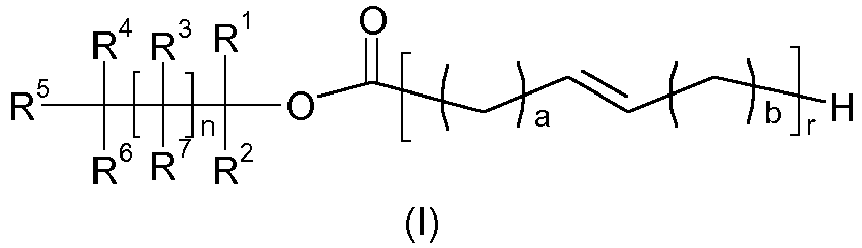 R1, R2, R3, R4, R5, R6 et R7 sont indépendamment les uns des autres, et pour R3 et R7 indépendamment pour chacune des unités n, choisis parmi le groupe consistant en H, -OR15, alkyle en C1-C10 substitué ou non par un ou plusieurs groupes -OR15, aryle en C6-C12 substitué ou non par un ou plusieurs groupes -OR15, ou cycloalkyle en C3-C10 substitué ou non par un ou plusieurs groupes -OR15, ou un groupement de formule (Ia)
 R15 représente H ou alkyle en C1-C10 substitué ou non par un ou plusieurs groupes -OH a, b, x et y sont indépendamment les uns des autres, indépendamment pour chaque groupement de formule (Ia), indépendamment pour chaque unité [(CH2)a-C=C-(CH2)b]r et indépendamment pour chaque unité [(CH2)x-C=C-(CH2)y]p, un nombre entier compris entre 0 et 20, avantageusement entre 0 et 15, de préférence entre 0 et 12 ;r est un nombre entier compris entre 1 et 10, avantageusement entre 1 et 5 ;p est un nombre entier compris entre 1 et 10, avantageusement entre 1 et 5 ;n est un nombre entier entre 1 et 7 ;ledit procédé comprenant une étape a) de mise en présence sous agitation et sous une atmosphère d'hydrogène et de monoxyde de carbone :• d'au moins un précatalyseur étant un complexe comprenant un métal de transition choisi parmi la colonne 9 du tableau périodique,• d'une amine tertiaire, ou un sel d'ammonium non quaternaire de celle-ci, de formule NR8R9R10 dans laquelle R8, R9 et R10 représentent indépendamment les uns des autres un alkyle en C1-C10, aryle en C6-C12, cycloalkyle en C3-C10 ou R8 et R9 forment ensemble avec l'atome d'azote auquel ils sont attachés un hétérocycle à quatre, cinq ou six chaînons,• de ladite composition A comprenant ledit composé de formule (I).
 - Procédé selon l'une quelconque des revendications précédentes caractérisé en ce que l'étape a) est réalisée à une température comprise entre 70°C et 180°C, de préférence entre 80°C et 150°C.
- Procédé selon l'une quelconque des revendications précédentes caractérisé en ce que ledit au moins un composé de formule (I) est de formule (II)
 a, b, x et y sont indépendamment les uns des autres, indépendamment pour chaque groupement de formule (la), indépendamment pour chaque unité [(CH2)a-C=C-(CH2)b]r et indépendamment pour chaque unité [(CH2)x-C=C-(CH2)y]p, un nombre entier compris entre 0 et 20, avantageusement entre 0 et 15, de préférence entre 0 et 12 ;p est indépendamment pour chaque unité [(CH2)x-C=C-(CH2)y]p un nombre entier compris entre 1 et 5 ;r est indépendamment pour chaque unité [(CH2)a-C=C-(CH2)b]r un nombre entier compris entre 1 et 5 ;R1, R2, R3, R4 et R5 sont indépendamment les uns des autres, et pour R3 indépendamment pour chacune des unités n, choisis parmi le groupe consistant en H, -OR15, alkyle en C1-C10 substitué ou non par un ou plusieurs groupes -OR15, ou un groupement de formule (la) tel que décrit ci-dessus,R15 représente H ou alkyle en C1-C10 substitué ou non par un ou plusieurs groupes -OH ;n est un nombre entier entre 1 et 4.
 - Procédé selon la revendication précédente caractérisé en ce que ledit au moins un composé de formule (I) est de formule (II) dans laquellea et x peuvent être indépendamment l'un de l'autre, indépendamment pour chaque unité [(CH2)x-C=C-(CH2)y]p et indépendamment pour chaque unité [(CH2)a-C=C-(CH2)b]r, un nombre entier compris entre 1 et 12, avantageusement entre 2 et 10, de préférence entre 3 et 9, en particulier entre 3 et 8 et plus particulièrement entre 4 et 8 ;b et y peuvent être indépendamment l'un de l'autre, indépendamment pour chaque unité [(CH2)x-C=C-(CH2)y]p et indépendamment pour chaque unité [(CH2)a-C=C-(CH2)b]r, un nombre entier compris entre 0 et 12, avantageusement entre 0 et 10, de préférence entre 0 et 9, en particulier entre 2 et 9, et plus particulièrement entre 3 et 8;R1, R2, R3, R4 et R5 sont un hydrogène ;p est 1, 2 ou 3 indépendamment pour chaque unité [(CH2)x-C=C-(CH2)y]p;r est 1, 2 ou 3 indépendamment pour chaque unité [(CH2)a-C=C-(CH2)b]r;n est 1.
- Procédé selon l'une quelconque des revendications précédentes caractérisé en ce que l'amine tertiaire est de formule NR8R9R10 dans laquelle R8, R9 et R10 représentent indépendamment les uns des autres un alkyle en C1-C10, ou R8 et R9 forment ensemble avec l'atome d'azote auquel ils sont attachés un hétérocycle azetidine, diazetidine, pyrrolidine, imidazolidine ou pyrazolidine ; de préférence R8 et R9 forment ensemble avec l'atome d'azote auquel ils sont attachés une pyrrolidine.
- Procédé selon l'une quelconque des revendications précédentes, caractérisé en ce que le précatalyseur est un complexe comprenant du rhodium comme métal de transition et un ou plusieurs ligands ; de préférence au moins un desdits un ou plusieurs ligands est choisi parmi CO, acetylacetonate, cyclooctadiene, norbornène et acétate.
- Procédé selon l'une quelconque des revendications précédentes caractérisé en ce qu'il est effectué sous pression d'une atmosphère d'hydrogène et de monoxyde de carbone, ladite pression étant comprise entre 50 bars et 200 bars, avantageusement entre 65 bars et 150 bars, de préférence entre 70 bars et 130 bars, en particulier entre 75 bars et 120 bars.
- Procédé selon l'une quelconque des revendications précédentes caractérisé en ce que le rapport molaire entre le monoxyde de carbone et l'hydrogène est compris entre 2 : 1 et 1 : 10, avantageusement le rapport molaire entre le monoxyde de carbone et l'hydrogène est compris entre 1 : 1 et 1 : 5, de préférence le rapport molaire est compris entre 1 : 1 et 1 : 3, en particulier le rapport molaire entre le monoxyde de carbone et l'hydrogène est compris entre 1 : 1 et 1 : 2.
- Procédé selon l'une quelconque des revendications précédentes caractérisé en ce que le rapport molaire entre l'amine et le métal de transition est supérieur à 20, avantageusement supérieur à 50, de préférence supérieur à 100, en particulier supérieur à 200.
- Procédé selon l'une quelconque des revendications précédentes caractérisé en ce que ladite composition A comprenant un ou plusieurs composés de formule (I) est une huile végétale ayant un nombre moyen d'insaturations inférieur à 3,5, avantageusement inférieur à 3,4, de préférence inférieur à 3,3, plus préférentiellement inférieur à 3,2, en particulier inférieur à 3,1, plus particulièrement inférieur à 3,0.
Applications Claiming Priority (2)
| Application Number | Priority Date | Filing Date | Title |
|---|---|---|---|
| FR1501373A FR3038312B1 (fr) | 2015-06-30 | 2015-06-30 | Procede de preparation de polyols |
| PCT/EP2016/063718 WO2017001194A1 (fr) | 2015-06-30 | 2016-06-15 | Procédé de préparation de polyols |
Publications (2)
| Publication Number | Publication Date |
|---|---|
| EP3317247A1 EP3317247A1 (fr) | 2018-05-09 |
| EP3317247B1 true EP3317247B1 (fr) | 2019-05-08 |
Family
ID=55177983
Family Applications (1)
| Application Number | Title | Priority Date | Filing Date |
|---|---|---|---|
| EP16732992.9A Not-in-force EP3317247B1 (fr) | 2015-06-30 | 2016-06-15 | Procédé de préparation de polyols |
Country Status (7)
| Country | Link |
|---|---|
| US (1) | US10138200B2 (fr) |
| EP (1) | EP3317247B1 (fr) |
| JP (1) | JP2018522865A (fr) |
| CA (1) | CA2987682A1 (fr) |
| ES (1) | ES2734263T3 (fr) |
| FR (1) | FR3038312B1 (fr) |
| WO (1) | WO2017001194A1 (fr) |
Families Citing this family (8)
| Publication number | Priority date | Publication date | Assignee | Title |
|---|---|---|---|---|
| EP3844293A4 (fr) | 2018-08-30 | 2022-06-08 | Checkerspot, Inc. | Triglycérides hydroformylés et leurs utilisations |
| TWI665185B (zh) * | 2018-11-13 | 2019-07-11 | 台灣中油股份有限公司 | 一種使用環氧脂肪酸烷基酯類製備生質多元醇之方法 |
| BR112021015352A2 (pt) | 2019-02-11 | 2021-10-05 | Checkerspot, Inc. | Composições de óleo de triglicerídeo |
| CN113906007A (zh) * | 2019-03-26 | 2022-01-07 | 银杏生物制品公司 | 10-亚甲基脂质的衍生物,该类衍生物的制备方法及其用途 |
| CN118124217A (zh) | 2019-12-18 | 2024-06-04 | 格纹蛱蝶公司 | 微生物衍生材料在聚合物应用中的用途 |
| WO2023043945A2 (fr) | 2021-09-17 | 2023-03-23 | Checkerspot, Inc. | Compositions à forte teneur en huile oléique et leurs utilisations |
| WO2023091669A1 (fr) | 2021-11-19 | 2023-05-25 | Checkerspot, Inc. | Formulations de polyuréthane recyclées |
| WO2023102069A1 (fr) | 2021-12-01 | 2023-06-08 | Checkerspot, Inc. | Dispersions de polyols et de polyuréthane et leurs utilisations |
Family Cites Families (6)
| Publication number | Priority date | Publication date | Assignee | Title |
|---|---|---|---|---|
| US4197414A (en) | 1977-06-06 | 1980-04-08 | The Dow Chemical Company | Amine-resin supported rhodium-cobalt bimetallic clusters as novel hydroformylation catalysts |
| EP0014225A1 (fr) | 1979-02-13 | 1980-08-20 | The Dow Chemical Company | Agrégat bimétallique de rhodium-cobalt sur support de résines polyamines comme catalyseur pour l'hydroformylation, préparation de ce catalyseur et procédé oxo utilisant celui-ci |
| DE2914189A1 (de) * | 1979-04-07 | 1980-10-23 | Henkel Kgaa | Verfahren zur herstellung von nonadecandiolen |
| CN100379716C (zh) * | 2002-04-29 | 2008-04-09 | 陶氏环球技术公司 | 关于种子油工业应用的综合化学方法 |
| US8293808B2 (en) * | 2003-09-30 | 2012-10-23 | Cargill, Incorporated | Flexible polyurethane foams prepared using modified vegetable oil-based polyols |
| MX2007000022A (es) | 2004-06-25 | 2007-05-23 | Pittsburg State University | Polioles basados en aceite vegetal modificado. |
-
2015
- 2015-06-30 FR FR1501373A patent/FR3038312B1/fr not_active Expired - Fee Related
-
2016
- 2016-06-15 ES ES16732992T patent/ES2734263T3/es active Active
- 2016-06-15 US US15/569,880 patent/US10138200B2/en not_active Expired - Fee Related
- 2016-06-15 CA CA2987682A patent/CA2987682A1/fr not_active Abandoned
- 2016-06-15 WO PCT/EP2016/063718 patent/WO2017001194A1/fr not_active Ceased
- 2016-06-15 JP JP2017566860A patent/JP2018522865A/ja active Pending
- 2016-06-15 EP EP16732992.9A patent/EP3317247B1/fr not_active Not-in-force
Non-Patent Citations (1)
| Title |
|---|
| None * |
Also Published As
| Publication number | Publication date |
|---|---|
| US10138200B2 (en) | 2018-11-27 |
| ES2734263T3 (es) | 2019-12-05 |
| WO2017001194A1 (fr) | 2017-01-05 |
| FR3038312A1 (fr) | 2017-01-06 |
| CA2987682A1 (fr) | 2017-01-05 |
| FR3038312B1 (fr) | 2017-06-23 |
| EP3317247A1 (fr) | 2018-05-09 |
| US20180127350A1 (en) | 2018-05-10 |
| JP2018522865A (ja) | 2018-08-16 |
Similar Documents
| Publication | Publication Date | Title |
|---|---|---|
| WO2017001194A1 (fr) | Procédé de préparation de polyols | |
| KR101587302B1 (ko) | C4-함유 탄화수소 스트림으로부터 히드로포르밀화반응에 의해 1-부텐을 분리하는 방법 | |
| KR100964098B1 (ko) | 포스파이트 리간드를 포함하는 촉매 조성물 및 이를 이용한히드로포르밀화 방법 | |
| FR2510552A1 (fr) | Procede de production catalytique selective d'ethanol a partir de methanol | |
| FR2590892A1 (fr) | Procede pour l'hydroformylation d'olefines pour la preparation d'aldehydes | |
| EP3466540B1 (fr) | Composition de catalyseur pour une réaction d'hydroformylation, et procédé de préparation d'aldéhyde l'utilisant | |
| EP3213817A1 (fr) | Composition catalytique contenant un ligand à base de phosphore et procédé d'hydroformylation l'utilisant | |
| JP6869441B2 (ja) | グリセリン製アリルアルコールのヒドロホルミル化によるbdoの製造 | |
| EP0912467B1 (fr) | Procede d'hydrogenation asymetrique d'un compose cetonique et derive | |
| WO2014016491A1 (fr) | Synthese de methyl propane diol a partir d'alcool allylique | |
| EP3357574B1 (fr) | Procédé d'hydroformylation | |
| EP0049674B1 (fr) | Procédé de préparation d'esters par carbonylation de composés monooléfiniques | |
| EP1519787B1 (fr) | Procede d hydrogenation selective de composes polyinsatures en composes monoinsatures utilisant un catalyseur homogene | |
| EP0095431B1 (fr) | Procédé de préparation d'esters par carbonylation de composés monooléfiniques | |
| EP0319407A1 (fr) | Procédé de préparation de la vitamine A | |
| FR2763938A1 (fr) | Procede pour l'hydroformylation d'olefines | |
| CA1313196C (fr) | Procede de preparation d'alcools insatures | |
| FR3032708B1 (fr) | Aminoalcools gras et procede de preparation de ceux-ci | |
| WO2012156591A1 (fr) | Composition catalytique a base de ruthenium comprenant un compose de type silane ou siloxane et procede de métathèse des olefines utilisant ladite composition | |
| KR102131788B1 (ko) | 히드로포밀화 반응용 촉매 조성물 및 이를 이용한 알데히드 제조방법 | |
| FR2953828A1 (fr) | Procede de fabrication d'additifs pour base carburant en une etape par hydroformylation d'une charge contenant au moins une olefine en presence d'au moins un alcool | |
| EP0009429B1 (fr) | Nouveaux composés undécadiènes fonctionnalisés comportant un substituant du type méthylène et leur procédé de fabrication | |
| EP0892776B1 (fr) | Procede de preparation d'acide acetique et/ou d'acetate de methyle par isomerisation de formiate de methyle | |
| KR20210115271A (ko) | 하이드로포밀화 반응용 헤테로 리간드 배위결합 촉매 조성물 및 이의 용도 | |
| CN118239981A (zh) | 一种亚膦酰胺配体、催化剂及其在氢甲酰化反应中的应用 |
Legal Events
| Date | Code | Title | Description |
|---|---|---|---|
| STAA | Information on the status of an ep patent application or granted ep patent |
Free format text: STATUS: THE INTERNATIONAL PUBLICATION HAS BEEN MADE |
|
| PUAI | Public reference made under article 153(3) epc to a published international application that has entered the european phase |
Free format text: ORIGINAL CODE: 0009012 |
|
| STAA | Information on the status of an ep patent application or granted ep patent |
Free format text: STATUS: REQUEST FOR EXAMINATION WAS MADE |
|
| 17P | Request for examination filed |
Effective date: 20171211 |
|
| AK | Designated contracting states |
Kind code of ref document: A1 Designated state(s): AL AT BE BG CH CY CZ DE DK EE ES FI FR GB GR HR HU IE IS IT LI LT LU LV MC MK MT NL NO PL PT RO RS SE SI SK SM TR |
|
| AX | Request for extension of the european patent |
Extension state: BA ME |
|
| RIN1 | Information on inventor provided before grant (corrected) |
Inventor name: VANBESIEN, THEODORE Inventor name: HAPIOT, FREDERIC Inventor name: MONFLIER, ERIC |
|
| DAV | Request for validation of the european patent (deleted) | ||
| DAX | Request for extension of the european patent (deleted) | ||
| GRAP | Despatch of communication of intention to grant a patent |
Free format text: ORIGINAL CODE: EPIDOSNIGR1 |
|
| STAA | Information on the status of an ep patent application or granted ep patent |
Free format text: STATUS: GRANT OF PATENT IS INTENDED |
|
| INTG | Intention to grant announced |
Effective date: 20181107 |
|
| RAP1 | Party data changed (applicant data changed or rights of an application transferred) |
Owner name: PIVERT S.A.S. Owner name: CENTRE NATIONAL DE LA RECHERCHE SCIENTIFIQUE CNRS Owner name: UNIVERSITE D'ARTOIS |
|
| GRAJ | Information related to disapproval of communication of intention to grant by the applicant or resumption of examination proceedings by the epo deleted |
Free format text: ORIGINAL CODE: EPIDOSDIGR1 |
|
| STAA | Information on the status of an ep patent application or granted ep patent |
Free format text: STATUS: REQUEST FOR EXAMINATION WAS MADE |
|
| GRAR | Information related to intention to grant a patent recorded |
Free format text: ORIGINAL CODE: EPIDOSNIGR71 |
|
| GRAS | Grant fee paid |
Free format text: ORIGINAL CODE: EPIDOSNIGR3 |
|
| STAA | Information on the status of an ep patent application or granted ep patent |
Free format text: STATUS: GRANT OF PATENT IS INTENDED |
|
| INTC | Intention to grant announced (deleted) | ||
| GRAJ | Information related to disapproval of communication of intention to grant by the applicant or resumption of examination proceedings by the epo deleted |
Free format text: ORIGINAL CODE: EPIDOSDIGR1 |
|
| GRAR | Information related to intention to grant a patent recorded |
Free format text: ORIGINAL CODE: EPIDOSNIGR71 |
|
| GRAS | Grant fee paid |
Free format text: ORIGINAL CODE: EPIDOSNIGR3 |
|
| GRAA | (expected) grant |
Free format text: ORIGINAL CODE: 0009210 |
|
| STAA | Information on the status of an ep patent application or granted ep patent |
Free format text: STATUS: THE PATENT HAS BEEN GRANTED |
|
| INTG | Intention to grant announced |
Effective date: 20190327 |
|
| AK | Designated contracting states |
Kind code of ref document: B1 Designated state(s): AL AT BE BG CH CY CZ DE DK EE ES FI FR GB GR HR HU IE IS IT LI LT LU LV MC MK MT NL NO PL PT RO RS SE SI SK SM TR |
|
| REG | Reference to a national code |
Ref country code: GB Ref legal event code: FG4D Free format text: NOT ENGLISH |
|
| REG | Reference to a national code |
Ref country code: CH Ref legal event code: EP Ref country code: AT Ref legal event code: REF Ref document number: 1129928 Country of ref document: AT Kind code of ref document: T Effective date: 20190515 |
|
| REG | Reference to a national code |
Ref country code: DE Ref legal event code: R096 Ref document number: 602016013712 Country of ref document: DE Ref country code: IE Ref legal event code: FG4D Free format text: LANGUAGE OF EP DOCUMENT: FRENCH |
|
| REG | Reference to a national code |
Ref country code: NL Ref legal event code: MP Effective date: 20190508 |
|
| REG | Reference to a national code |
Ref country code: LT Ref legal event code: MG4D |
|
| PG25 | Lapsed in a contracting state [announced via postgrant information from national office to epo] |
Ref country code: AL Free format text: LAPSE BECAUSE OF FAILURE TO SUBMIT A TRANSLATION OF THE DESCRIPTION OR TO PAY THE FEE WITHIN THE PRESCRIBED TIME-LIMIT Effective date: 20190508 Ref country code: SE Free format text: LAPSE BECAUSE OF FAILURE TO SUBMIT A TRANSLATION OF THE DESCRIPTION OR TO PAY THE FEE WITHIN THE PRESCRIBED TIME-LIMIT Effective date: 20190508 Ref country code: HR Free format text: LAPSE BECAUSE OF FAILURE TO SUBMIT A TRANSLATION OF THE DESCRIPTION OR TO PAY THE FEE WITHIN THE PRESCRIBED TIME-LIMIT Effective date: 20190508 Ref country code: PT Free format text: LAPSE BECAUSE OF FAILURE TO SUBMIT A TRANSLATION OF THE DESCRIPTION OR TO PAY THE FEE WITHIN THE PRESCRIBED TIME-LIMIT Effective date: 20190908 Ref country code: NO Free format text: LAPSE BECAUSE OF FAILURE TO SUBMIT A TRANSLATION OF THE DESCRIPTION OR TO PAY THE FEE WITHIN THE PRESCRIBED TIME-LIMIT Effective date: 20190808 Ref country code: LT Free format text: LAPSE BECAUSE OF FAILURE TO SUBMIT A TRANSLATION OF THE DESCRIPTION OR TO PAY THE FEE WITHIN THE PRESCRIBED TIME-LIMIT Effective date: 20190508 Ref country code: FI Free format text: LAPSE BECAUSE OF FAILURE TO SUBMIT A TRANSLATION OF THE DESCRIPTION OR TO PAY THE FEE WITHIN THE PRESCRIBED TIME-LIMIT Effective date: 20190508 Ref country code: NL Free format text: LAPSE BECAUSE OF FAILURE TO SUBMIT A TRANSLATION OF THE DESCRIPTION OR TO PAY THE FEE WITHIN THE PRESCRIBED TIME-LIMIT Effective date: 20190508 |
|
| PG25 | Lapsed in a contracting state [announced via postgrant information from national office to epo] |
Ref country code: LV Free format text: LAPSE BECAUSE OF FAILURE TO SUBMIT A TRANSLATION OF THE DESCRIPTION OR TO PAY THE FEE WITHIN THE PRESCRIBED TIME-LIMIT Effective date: 20190508 Ref country code: RS Free format text: LAPSE BECAUSE OF FAILURE TO SUBMIT A TRANSLATION OF THE DESCRIPTION OR TO PAY THE FEE WITHIN THE PRESCRIBED TIME-LIMIT Effective date: 20190508 Ref country code: BG Free format text: LAPSE BECAUSE OF FAILURE TO SUBMIT A TRANSLATION OF THE DESCRIPTION OR TO PAY THE FEE WITHIN THE PRESCRIBED TIME-LIMIT Effective date: 20190808 Ref country code: GR Free format text: LAPSE BECAUSE OF FAILURE TO SUBMIT A TRANSLATION OF THE DESCRIPTION OR TO PAY THE FEE WITHIN THE PRESCRIBED TIME-LIMIT Effective date: 20190809 |
|
| REG | Reference to a national code |
Ref country code: ES Ref legal event code: FG2A Ref document number: 2734263 Country of ref document: ES Kind code of ref document: T3 Effective date: 20191205 |
|
| REG | Reference to a national code |
Ref country code: AT Ref legal event code: MK05 Ref document number: 1129928 Country of ref document: AT Kind code of ref document: T Effective date: 20190508 |
|
| PG25 | Lapsed in a contracting state [announced via postgrant information from national office to epo] |
Ref country code: AT Free format text: LAPSE BECAUSE OF FAILURE TO SUBMIT A TRANSLATION OF THE DESCRIPTION OR TO PAY THE FEE WITHIN THE PRESCRIBED TIME-LIMIT Effective date: 20190508 Ref country code: DK Free format text: LAPSE BECAUSE OF FAILURE TO SUBMIT A TRANSLATION OF THE DESCRIPTION OR TO PAY THE FEE WITHIN THE PRESCRIBED TIME-LIMIT Effective date: 20190508 Ref country code: SK Free format text: LAPSE BECAUSE OF FAILURE TO SUBMIT A TRANSLATION OF THE DESCRIPTION OR TO PAY THE FEE WITHIN THE PRESCRIBED TIME-LIMIT Effective date: 20190508 Ref country code: EE Free format text: LAPSE BECAUSE OF FAILURE TO SUBMIT A TRANSLATION OF THE DESCRIPTION OR TO PAY THE FEE WITHIN THE PRESCRIBED TIME-LIMIT Effective date: 20190508 Ref country code: CZ Free format text: LAPSE BECAUSE OF FAILURE TO SUBMIT A TRANSLATION OF THE DESCRIPTION OR TO PAY THE FEE WITHIN THE PRESCRIBED TIME-LIMIT Effective date: 20190508 Ref country code: RO Free format text: LAPSE BECAUSE OF FAILURE TO SUBMIT A TRANSLATION OF THE DESCRIPTION OR TO PAY THE FEE WITHIN THE PRESCRIBED TIME-LIMIT Effective date: 20190508 |
|
| REG | Reference to a national code |
Ref country code: CH Ref legal event code: PL |
|
| REG | Reference to a national code |
Ref country code: DE Ref legal event code: R097 Ref document number: 602016013712 Country of ref document: DE |
|
| PG25 | Lapsed in a contracting state [announced via postgrant information from national office to epo] |
Ref country code: MC Free format text: LAPSE BECAUSE OF FAILURE TO SUBMIT A TRANSLATION OF THE DESCRIPTION OR TO PAY THE FEE WITHIN THE PRESCRIBED TIME-LIMIT Effective date: 20190508 Ref country code: SM Free format text: LAPSE BECAUSE OF FAILURE TO SUBMIT A TRANSLATION OF THE DESCRIPTION OR TO PAY THE FEE WITHIN THE PRESCRIBED TIME-LIMIT Effective date: 20190508 |
|
| PLBE | No opposition filed within time limit |
Free format text: ORIGINAL CODE: 0009261 |
|
| STAA | Information on the status of an ep patent application or granted ep patent |
Free format text: STATUS: NO OPPOSITION FILED WITHIN TIME LIMIT |
|
| PG25 | Lapsed in a contracting state [announced via postgrant information from national office to epo] |
Ref country code: TR Free format text: LAPSE BECAUSE OF FAILURE TO SUBMIT A TRANSLATION OF THE DESCRIPTION OR TO PAY THE FEE WITHIN THE PRESCRIBED TIME-LIMIT Effective date: 20190508 |
|
| 26N | No opposition filed |
Effective date: 20200211 |
|
| PG25 | Lapsed in a contracting state [announced via postgrant information from national office to epo] |
Ref country code: PL Free format text: LAPSE BECAUSE OF FAILURE TO SUBMIT A TRANSLATION OF THE DESCRIPTION OR TO PAY THE FEE WITHIN THE PRESCRIBED TIME-LIMIT Effective date: 20190508 Ref country code: IE Free format text: LAPSE BECAUSE OF NON-PAYMENT OF DUE FEES Effective date: 20190615 |
|
| PG25 | Lapsed in a contracting state [announced via postgrant information from national office to epo] |
Ref country code: LU Free format text: LAPSE BECAUSE OF NON-PAYMENT OF DUE FEES Effective date: 20190615 Ref country code: SI Free format text: LAPSE BECAUSE OF FAILURE TO SUBMIT A TRANSLATION OF THE DESCRIPTION OR TO PAY THE FEE WITHIN THE PRESCRIBED TIME-LIMIT Effective date: 20190508 Ref country code: CH Free format text: LAPSE BECAUSE OF NON-PAYMENT OF DUE FEES Effective date: 20190630 Ref country code: LI Free format text: LAPSE BECAUSE OF NON-PAYMENT OF DUE FEES Effective date: 20190630 |
|
| PGFP | Annual fee paid to national office [announced via postgrant information from national office to epo] |
Ref country code: DE Payment date: 20200721 Year of fee payment: 5 Ref country code: ES Payment date: 20200825 Year of fee payment: 5 Ref country code: FR Payment date: 20200721 Year of fee payment: 5 |
|
| PGFP | Annual fee paid to national office [announced via postgrant information from national office to epo] |
Ref country code: BE Payment date: 20200630 Year of fee payment: 5 Ref country code: IT Payment date: 20200724 Year of fee payment: 5 |
|
| GBPC | Gb: european patent ceased through non-payment of renewal fee |
Effective date: 20200615 |
|
| PG25 | Lapsed in a contracting state [announced via postgrant information from national office to epo] |
Ref country code: GB Free format text: LAPSE BECAUSE OF NON-PAYMENT OF DUE FEES Effective date: 20200615 |
|
| PG25 | Lapsed in a contracting state [announced via postgrant information from national office to epo] |
Ref country code: CY Free format text: LAPSE BECAUSE OF FAILURE TO SUBMIT A TRANSLATION OF THE DESCRIPTION OR TO PAY THE FEE WITHIN THE PRESCRIBED TIME-LIMIT Effective date: 20190508 |
|
| PG25 | Lapsed in a contracting state [announced via postgrant information from national office to epo] |
Ref country code: IS Free format text: LAPSE BECAUSE OF FAILURE TO SUBMIT A TRANSLATION OF THE DESCRIPTION OR TO PAY THE FEE WITHIN THE PRESCRIBED TIME-LIMIT Effective date: 20190908 |
|
| PG25 | Lapsed in a contracting state [announced via postgrant information from national office to epo] |
Ref country code: HU Free format text: LAPSE BECAUSE OF FAILURE TO SUBMIT A TRANSLATION OF THE DESCRIPTION OR TO PAY THE FEE WITHIN THE PRESCRIBED TIME-LIMIT; INVALID AB INITIO Effective date: 20160615 Ref country code: MT Free format text: LAPSE BECAUSE OF FAILURE TO SUBMIT A TRANSLATION OF THE DESCRIPTION OR TO PAY THE FEE WITHIN THE PRESCRIBED TIME-LIMIT Effective date: 20190508 |
|
| REG | Reference to a national code |
Ref country code: DE Ref legal event code: R119 Ref document number: 602016013712 Country of ref document: DE |
|
| REG | Reference to a national code |
Ref country code: BE Ref legal event code: MM Effective date: 20210630 |
|
| PG25 | Lapsed in a contracting state [announced via postgrant information from national office to epo] |
Ref country code: DE Free format text: LAPSE BECAUSE OF NON-PAYMENT OF DUE FEES Effective date: 20220101 |
|
| PG25 | Lapsed in a contracting state [announced via postgrant information from national office to epo] |
Ref country code: FR Free format text: LAPSE BECAUSE OF NON-PAYMENT OF DUE FEES Effective date: 20210630 |
|
| PG25 | Lapsed in a contracting state [announced via postgrant information from national office to epo] |
Ref country code: MK Free format text: LAPSE BECAUSE OF FAILURE TO SUBMIT A TRANSLATION OF THE DESCRIPTION OR TO PAY THE FEE WITHIN THE PRESCRIBED TIME-LIMIT Effective date: 20190508 |
|
| PG25 | Lapsed in a contracting state [announced via postgrant information from national office to epo] |
Ref country code: IT Free format text: LAPSE BECAUSE OF NON-PAYMENT OF DUE FEES Effective date: 20210615 Ref country code: BE Free format text: LAPSE BECAUSE OF NON-PAYMENT OF DUE FEES Effective date: 20210630 |
|
| REG | Reference to a national code |
Ref country code: ES Ref legal event code: FD2A Effective date: 20220805 |
|
| PG25 | Lapsed in a contracting state [announced via postgrant information from national office to epo] |
Ref country code: ES Free format text: LAPSE BECAUSE OF NON-PAYMENT OF DUE FEES Effective date: 20210616 |