EP3313903B1 - Ethylene-based polymers with low hexane extractables - Google Patents
Ethylene-based polymers with low hexane extractables Download PDFInfo
- Publication number
- EP3313903B1 EP3313903B1 EP16738267.0A EP16738267A EP3313903B1 EP 3313903 B1 EP3313903 B1 EP 3313903B1 EP 16738267 A EP16738267 A EP 16738267A EP 3313903 B1 EP3313903 B1 EP 3313903B1
- Authority
- EP
- European Patent Office
- Prior art keywords
- ethylene
- reaction zone
- cta
- reactor
- reaction
- Prior art date
- Legal status (The legal status is an assumption and is not a legal conclusion. Google has not performed a legal analysis and makes no representation as to the accuracy of the status listed.)
- Active
Links
Images


Classifications
-
- C—CHEMISTRY; METALLURGY
- C08—ORGANIC MACROMOLECULAR COMPOUNDS; THEIR PREPARATION OR CHEMICAL WORKING-UP; COMPOSITIONS BASED THEREON
- C08F—MACROMOLECULAR COMPOUNDS OBTAINED BY REACTIONS ONLY INVOLVING CARBON-TO-CARBON UNSATURATED BONDS
- C08F110/00—Homopolymers of unsaturated aliphatic hydrocarbons having only one carbon-to-carbon double bond
- C08F110/02—Ethene
-
- B—PERFORMING OPERATIONS; TRANSPORTING
- B01—PHYSICAL OR CHEMICAL PROCESSES OR APPARATUS IN GENERAL
- B01J—CHEMICAL OR PHYSICAL PROCESSES, e.g. CATALYSIS OR COLLOID CHEMISTRY; THEIR RELEVANT APPARATUS
- B01J19/00—Chemical, physical or physico-chemical processes in general; Their relevant apparatus
- B01J19/24—Stationary reactors without moving elements inside
- B01J19/2415—Tubular reactors
-
- C—CHEMISTRY; METALLURGY
- C08—ORGANIC MACROMOLECULAR COMPOUNDS; THEIR PREPARATION OR CHEMICAL WORKING-UP; COMPOSITIONS BASED THEREON
- C08F—MACROMOLECULAR COMPOUNDS OBTAINED BY REACTIONS ONLY INVOLVING CARBON-TO-CARBON UNSATURATED BONDS
- C08F2/00—Processes of polymerisation
- C08F2/001—Multistage polymerisation processes characterised by a change in reactor conditions without deactivating the intermediate polymer
-
- C—CHEMISTRY; METALLURGY
- C08—ORGANIC MACROMOLECULAR COMPOUNDS; THEIR PREPARATION OR CHEMICAL WORKING-UP; COMPOSITIONS BASED THEREON
- C08F—MACROMOLECULAR COMPOUNDS OBTAINED BY REACTIONS ONLY INVOLVING CARBON-TO-CARBON UNSATURATED BONDS
- C08F2/00—Processes of polymerisation
- C08F2/01—Processes of polymerisation characterised by special features of the polymerisation apparatus used
-
- C—CHEMISTRY; METALLURGY
- C08—ORGANIC MACROMOLECULAR COMPOUNDS; THEIR PREPARATION OR CHEMICAL WORKING-UP; COMPOSITIONS BASED THEREON
- C08F—MACROMOLECULAR COMPOUNDS OBTAINED BY REACTIONS ONLY INVOLVING CARBON-TO-CARBON UNSATURATED BONDS
- C08F2/00—Processes of polymerisation
- C08F2/38—Polymerisation using regulators, e.g. chain terminating agents, e.g. telomerisation
-
- C—CHEMISTRY; METALLURGY
- C08—ORGANIC MACROMOLECULAR COMPOUNDS; THEIR PREPARATION OR CHEMICAL WORKING-UP; COMPOSITIONS BASED THEREON
- C08F—MACROMOLECULAR COMPOUNDS OBTAINED BY REACTIONS ONLY INVOLVING CARBON-TO-CARBON UNSATURATED BONDS
- C08F4/00—Polymerisation catalysts
- C08F4/28—Oxygen or compounds releasing free oxygen
- C08F4/32—Organic compounds
- C08F4/38—Mixtures of peroxy-compounds
-
- C—CHEMISTRY; METALLURGY
- C08—ORGANIC MACROMOLECULAR COMPOUNDS; THEIR PREPARATION OR CHEMICAL WORKING-UP; COMPOSITIONS BASED THEREON
- C08L—COMPOSITIONS OF MACROMOLECULAR COMPOUNDS
- C08L23/00—Compositions of homopolymers or copolymers of unsaturated aliphatic hydrocarbons having only one carbon-to-carbon double bond; Compositions of derivatives of such polymers
- C08L23/02—Compositions of homopolymers or copolymers of unsaturated aliphatic hydrocarbons having only one carbon-to-carbon double bond; Compositions of derivatives of such polymers not modified by chemical after-treatment
- C08L23/04—Homopolymers or copolymers of ethene
- C08L23/06—Polyethene
-
- C—CHEMISTRY; METALLURGY
- C08—ORGANIC MACROMOLECULAR COMPOUNDS; THEIR PREPARATION OR CHEMICAL WORKING-UP; COMPOSITIONS BASED THEREON
- C08F—MACROMOLECULAR COMPOUNDS OBTAINED BY REACTIONS ONLY INVOLVING CARBON-TO-CARBON UNSATURATED BONDS
- C08F2400/00—Characteristics for processes of polymerization
- C08F2400/02—Control or adjustment of polymerization parameters
-
- C—CHEMISTRY; METALLURGY
- C08—ORGANIC MACROMOLECULAR COMPOUNDS; THEIR PREPARATION OR CHEMICAL WORKING-UP; COMPOSITIONS BASED THEREON
- C08F—MACROMOLECULAR COMPOUNDS OBTAINED BY REACTIONS ONLY INVOLVING CARBON-TO-CARBON UNSATURATED BONDS
- C08F2500/00—Characteristics or properties of obtained polyolefins; Use thereof
- C08F2500/08—Low density, i.e. < 0.91 g/cm3
-
- C—CHEMISTRY; METALLURGY
- C08—ORGANIC MACROMOLECULAR COMPOUNDS; THEIR PREPARATION OR CHEMICAL WORKING-UP; COMPOSITIONS BASED THEREON
- C08F—MACROMOLECULAR COMPOUNDS OBTAINED BY REACTIONS ONLY INVOLVING CARBON-TO-CARBON UNSATURATED BONDS
- C08F2500/00—Characteristics or properties of obtained polyolefins; Use thereof
- C08F2500/12—Melt flow index or melt flow ratio
-
- C—CHEMISTRY; METALLURGY
- C08—ORGANIC MACROMOLECULAR COMPOUNDS; THEIR PREPARATION OR CHEMICAL WORKING-UP; COMPOSITIONS BASED THEREON
- C08F—MACROMOLECULAR COMPOUNDS OBTAINED BY REACTIONS ONLY INVOLVING CARBON-TO-CARBON UNSATURATED BONDS
- C08F2500/00—Characteristics or properties of obtained polyolefins; Use thereof
- C08F2500/17—Viscosity
-
- C—CHEMISTRY; METALLURGY
- C08—ORGANIC MACROMOLECULAR COMPOUNDS; THEIR PREPARATION OR CHEMICAL WORKING-UP; COMPOSITIONS BASED THEREON
- C08L—COMPOSITIONS OF MACROMOLECULAR COMPOUNDS
- C08L2207/00—Properties characterising the ingredient of the composition
- C08L2207/06—Properties of polyethylene
- C08L2207/066—LDPE (radical process)
-
- Y—GENERAL TAGGING OF NEW TECHNOLOGICAL DEVELOPMENTS; GENERAL TAGGING OF CROSS-SECTIONAL TECHNOLOGIES SPANNING OVER SEVERAL SECTIONS OF THE IPC; TECHNICAL SUBJECTS COVERED BY FORMER USPC CROSS-REFERENCE ART COLLECTIONS [XRACs] AND DIGESTS
- Y02—TECHNOLOGIES OR APPLICATIONS FOR MITIGATION OR ADAPTATION AGAINST CLIMATE CHANGE
- Y02P—CLIMATE CHANGE MITIGATION TECHNOLOGIES IN THE PRODUCTION OR PROCESSING OF GOODS
- Y02P20/00—Technologies relating to chemical industry
- Y02P20/50—Improvements relating to the production of bulk chemicals
- Y02P20/582—Recycling of unreacted starting or intermediate materials
Definitions
- Resins for extrusion coating on paper, board, aluminum, etc. are designed with broad molecular weight distribution and low extractables.
- the polymer In extrusion coating applications, the polymer is processed at high temperature conditions, typically above 280°C and below 350°C.
- Broad molecular weight distribution (MWD) resins with a very high molecular weight fraction are used for good processability during coating (neck-in and drawdown balance).
- Low extractables are needed to reduce undesirable taste and odor, and to reduce smoke formation during the processing of the resin, especially when the resin is subjected to the high coating temperatures.
- LDPE low density polyethylene
- broad MWD resins can be made by promoting long chain branching, and through the inherent residence time distribution, by which molecules will undergo shorter (low molecular weight) or longer (high molecular weight) growth paths.
- Broad MWD autoclave resins for LDPE extrusion coatings are focused in two product density regimes, namely from 0.915 to 0.919 g/cc and from 0.919 to 0.924 g/cc.
- the invention in this document describes improved broad MWD tubular reactor products designed for the higher density regime from 0.919 to 0.924 g/cc.
- the autoclave and tubular reactor systems differ in residence time distribution, which is more uniform for tubular reactors and dispersed for autoclave reactor zones.
- the uniform residence time leads to narrower MWD, and very broad MWD can only be achieved in tubular reactors by applying extremely differentiated polymerization conditions, for example, as described in WO 2013/078018 , and/or application of a branching/cross-linking agent, for example, as described in USP 7,820,776 .
- the use of extreme process conditions and/or branching/cross-linking agents can lead to high melt strength tubular low density polyethylene suitable for extrusion coating applications; however with elevated extractables. Undesirable gels in the polymer can result from the use of branching or cross-linking agents.
- the conversion level ranges typically from less than ( ⁇ ) 20% (autoclave) to more than (>) 30% (tubular). This large difference in conversion level has a major impact on investment and operation costs as well on polymer output and power consumption (to compress ethylene) per unit of polymer.
- U.S. Publication No. 2008/0242809 discloses a process for preparing an ethylene copolymer, where the polymerization takes place in a tubular reactor at a peak temperature between 290°C and 350°C.
- the comonomer is a di- or higher functional (meth)acrylate.
- WO 2012/057975 describes polymers comprising monomeric chain transfer agents (mCTAs).
- mCTAs monomeric chain transfer agents
- WO 2012/084787 describes simulated tubular reactions in which bi- and/or higher functional comonomers.
- EP 2 681 250 B1 describes a process of preparing an ethylene polymer using a free radical initiator and at least one chain transfer agent, wherein the concentration of the CTA in the first reaction zone is less than 70% of the concentration of the CTA in the reaction zone with the highest concentration of CTA.
- Other polymers and processes are disclosed in WO 2007/110127 ; WO 2014/003837 ; WO 2013/078018 ; WO 2013/078224 ; WO 2013/178241 ; WO 2013/178242 ; WO 2013/149698 ; WO 2013/132011 and WO 2013/083285 .
- a multi- and/or bifunctional component to impact polymer rheology, it is important that (1) at least two functional groups of the component molecule react, and (2) effective branches are formed in the polymer.
- CTA functionality will either start the formation of a new polymer molecule, or initiate, after incorporation of the monomeric group, the formation of a LCB or T-branch.
- the functional groups consist of monomeric groups, H-branches can be formed.
- polyethylenes made at density from 0.9190 g/cc with broad MWD, high G' value and at reduced extractable levels in a tubular reactor at high ethylene conversion levels.
- the invention is a process for producing an ethylene-based polymer, the process comprising contacting in a reaction configuration, comprising a first tubular reaction zone 1 and a last tubular reaction zone i, in which i is greater than or equal to ( ⁇ ) 3, under high pressure polymerization conditions, and in which the first reaction zone 1 has a peak polymerization temperature greater than the peak temperature of the ith reaction zone, the difference in these two peak temperatures is ⁇ 30°C, wherein one or more polyenes are added as a branching agent to at least one reaction zone; and the ethylene-based polymer comprises the following properties:
- Monomeric chain transfer agents are compounds which contain both a free radical polymerizable olefinic moiety and a moiety capable of chain transfer, connected by some form of linking group. These structures could contain multiple olefin or chain transfer moieties on a single compound. Some compounds can be described by the general formulas i) through vi):
- the olefinic moiety is typically more reactive than ethylene in free radical polymerization and is preferably chosen from methacrylates, acrylates or allyl ethers.
- the chain transfer moiety is preferably defined as a group with a Cs value > 0.01 (Table 1) and is preferably an aldehyde, ketone, mercaptan, phosphine, amine, or cyanoacetate.
- the functional groups of the bi- or multifunctional comonomer are usually separated by a spacer group, for example composed of units -CH2- -Si(CH3)2- -CH2-O- and/or -Si(CH3)2-O- and comprise a chain of from 1 to 32, preferably from 1 to 22 and most preferably from 1 to 12 atoms.
- the bi- or multifunctional comonomers (mCTAs) comprise one unsaturated group, which can be incorporated into the growing polymer chain, and another functional group, which can act as chain transfer agent in radical ethylene polymerization.
- R 1 is methyl or hydrogen
- X 1 is -O- or -NH-, preferably -O-
- R 2 can be identical or different and is -CH2-, -Si(CH3)2- -CH2-O- or -Si(CH3)2-O-, and preferably all R2 are -CH2-
- n is from 1 to 32, further from 1 to 22, and further from 1 to 12
- X 2 is -C(O)-, -CHOH- or -CHSH-, preferably -C(O)-
- a chain transfer agent is used in high pressure polymerization to regulate the molecular weight, by donating a hydrogen radical, by which an active radical at a growing polymer chain is terminated and a new active radical is formed at the remaining chain transfer agent molecule, which can build in monomer units.
- the desired functionality of the chain transfer agent group is to initiate the formation of a T- or a Long Chain Branch (LCB) at an existing polymer molecule.
- LCB Long Chain Branch
- the ethylene-based polymer comprises at least one product structure (A and/or B):
- the ethylene-based polymer is a modified low density polyethylene, comprising, in polymerized form, ethylene, and bonded chemical groups derived from a polyene.
- the modified LDPE comprises ⁇ 2.0 wt%, further ⁇ 1.0 wt%, of other comonomer(s), based on the weight of the modified LDPE.
- the ethylene-based polymer comprises at least one structure as follows:
- the ethylene-based polymer comprises, in reacted form, ⁇ 0.1, or ⁇ 0.2, or ⁇ 0.3, or ⁇ 0.4 moles of "T-branches derived from the use of a mCTA" per 1000 moles of carbon atoms incorporated into the polymer, or per 500 moles of ethylene units incorporated into the polymer.
- the ethylene-based polymer comprises, in reacted form, ⁇ 3.0 moles, or ⁇ 2.0 moles, or ⁇ 1.5 moles, or ⁇ 1.0 mole of "T-branches, derived from the use of a mCTA" per 1000 moles of carbon atoms incorporated into the polymer, or per 500 moles of ethylene units incorporated into the polymer.
- the ethylene-based polymer comprises, in reacted form, ⁇ 0.010, or ⁇ 0.015, or ⁇ 0.020, or ⁇ 0.030, or ⁇ 0.040, or ⁇ 0.050 moles of "overall H-branches,” derived from the use of polyenes, per 1000 moles of carbon atoms incorporated into the polymer, or per 500 moles of ethylene units incorporated into the polymer.
- the ethylene-based polymer comprises, in reacted form, ⁇ 3.0 moles, or ⁇ 2.0 moles, or ⁇ 1.5 moles, or ⁇ 1.2 moles of "overall H-branches" per 1000 moles of carbon atoms incorporated, or per 500 moles of ethylene units incorporated into the polymer.
- the ethylene-based polymer comprises, in reacted form, > 0.1, or > 0.2, or > 0.3 moles of T-branches, derived from the use of a mCTA, per 1000 moles of carbon atoms incorporated, or per 500 moles of ethylene units incorporated into the polymer.
- the ethylene-based polymer has a melt index (I 2 ) from 1.0 to 20 g/10 minutes (min), or from 1.5 to 15 g/10 min, or from 2 to 12 g/10 min.
- the ethylene-based polymer has a density from 0.9190 to 0.9240 g/cc, or from 0.9195 to 0.9235, or from 0.9200 to 0.9230, g/cc.
- compositions comprising the ethylene-based polymer as described herein can be provided.
- the composition further comprises an ethylene/ ⁇ -olefin interpolymer.
- the composition further comprises another ethylene-based polymer that differs from the inventive ethylene-based polymer in one or more properties, for example, density, melt index (I 2 ), weight average molecular weight (Mw(conv)), number average molecular weight (Mn(conv)), and/or Mw(conv)/Mn(conv).
- the article is a film or a coating, for example, an extrusion coating.
- the article is a film.
- the article is a coating.
- the article is a coating for a cable or wire.
- the article is a coated sheet, and in a further embodiment the sheet is selected from a metal, a paper, or another polymer substrate or combinations thereof.
- the coated sheet is used in a wire or cable configuration.
- the coated sheet is used in a packaging application.
- the coated sheet is used in a food packaging application, and further the coated sheet is used in a cook-in food packaging application.
- the ethylene-based polymer described herein may comprise a combination of two or more embodiments as described herein.
- the composition described herein may comprise a combination of two or more embodiments as described herein.
- the article described herein may comprise a combination of two or more embodiments as described herein.
- reactor configuration in which the reactor(s) is (are) only tubular reactor(s), i.e., the reactor configuration does not include any autoclave reactors.
- the reactor configuration comprises at least four reaction zones, and these zones can be located in one tubular reactor or spread over two or more tubular reactors. Typically, each tubular reactor comprises multiple reaction zones.
- a CTA system comprises one or more CTAs.
- CTAs typically comprise at least one of the following groups: alkane, aldehyde, ketone, alcohol, ether, ester, mercaptan or phosphine, and further an alkane, a ketone, an aldehyde, an alcohol or an ether.
- CTAs include, but are not limited to, isobutane, n-butane, methyl ethyl ketone, acetone, ethyl acetate, propionaldehyde, ISOPARTM-C, -E, and -H (ExxonMobil Chemical Co.), and isopropanol; and further propionaldehyde, butane and isobutane.
- the CTA is preferably not propylene or another alkene.
- the amount of CTA used is from 0.01 to 10 weight percent based on the weight of the total reaction mixture.
- the overall Cs value of the applied CTA systems is is ⁇ 0.020 (e.g., propylene, acetone,), or ⁇ 0.010 (i.e., cyclohexane), or ⁇ 0.008 (e.g., isobutane, ethanol), or ⁇ 0.006 (e.g., n-butane, ethylacetate), as measured by Mortimer et al., at 130°C and 1360 atmospheres (137.8 Mpa).
- ⁇ 0.020 e.g., propylene, acetone,
- ⁇ 0.010 i.e., cyclohexane
- ⁇ 0.008 e.g., isobutane, ethanol
- ⁇ 0.006 e.g., n-butane, ethylacetate
- the Z1/Zi ratio, wherein i ⁇ 3 and i is the last reaction zone is ⁇ 1.3, or ⁇ 1.2, or ⁇ 1.1. In one embodiment the Z1/Zi ratio, wherein i ⁇ 3 and i is the last reaction zone, is ⁇ 0.1, or ⁇ 0.2, or less than or equal to 0.3. In one embodiment Z1/Zi is ⁇ (0.8-0.2 ⁇ log (Cs)), wherein Cs is in the range of 0.0001 and 10. In one embodiment Z1/Zi is ⁇ (0.75-0.2 ⁇ log (Cs)), wherein Cs is in the range of 0.0001 and 10. In one embodiment Z1/Zi is ⁇ (0.7-0.2 ⁇ log (Cs)), wherein Cs is in the range of 0.0001 and 10. In one embodiment the CTA system does not comprise a mCTA.
- the process includes a high pressure and low pressure recycle loop to improve ethylene efficiency, since ethylene is only partially converted or consumed per reactor pass. Typically, the conversion level per reactor pass is from 20% to 40%.
- the polymerization may take place in a tubular reactor as described WO2013/059042 , which discloses a multi-zone reactor and alternate locations of feeding ethylene to control the ethylene to CTA ratio and therefore polymer properties. Ethylene may be simultaneously added in multiple locations to achieve the desired ethylene to CTA ratio. In a similar way, addition of CTA addition points may be carefully selected to control polymer properties as described WO2013/078018 . CTA may be simultaneously added in multiple locations to achieve the desired CTA to ethylene ratio.
- chain transfer agent is added to the first or second or first and second reaction zones.
- additional polyene branching agent
- the addition points and the amount of the polyene (branching agent), as described in this application may be controlled to control gel formation while maximizing the desired property of increased G' and performance in targeted applications.
- polyene may be simultaneously added in multiple locations to achieve the desired polyene to ethylene ratio (for example, a molar ratio).
- more polyene, by mass is added to reaction zone i as compared to the amount of polyene, by mass, added to reaction zone 1.
- the amount of polyene is determined based on the polyene added to a reaction zone in a feed (i.e., not carry-over polyene) to the reactor.
- more polyene, by mass is added to reaction zone 1 as compared to the amount of polyene, by mass, added to reaction zone i.
- the amount of polyene is determined based on the polyene added to a reaction zone in a feed to the reactor.
- a greater concentration of polyene is added to reaction zone i as compared to the concentration of polyene added to reaction zone 1. In one embodiment by use of a polyene in combination with a chain transfer agent, a greater concentration of polyene is added to reaction zone 1 as compared to the concentration of polyene added to reaction zone i. In one embodiment by use of a polyene in combination with a chain transfer agent, polyene is added to both reaction zone 1 and reaction zone i.
- ⁇ 20 wt%, or 5 wt%, or 1 wt%, or none, of the total amount of branching agent is fed to reaction zone 1.
- ⁇ 5 wt%, or 1 wt%, or 0.5 wt%, or none, of the total amount of polyene is fed to reaction zone 1.
- ⁇ 20 wt%, or 1 wt%, or 0.5 wt%, or none, of the total amount of make-up CTA is fed to reaction zone 1.
- more mCTA, by mass is added to reaction zone 1 as compared to the amount of mCTA, by mass, added to reaction zone i.
- the amount of polyene is determined based on the polyene fed to a reaction zone.
- no mCTA, by mass is added to the last reaction zone.
- no mCTA, by mass is added to the last two reaction zones.
- all mCTA, by mass is added to the first two reaction zones.
- all mCTA, by mass is added to the first reaction zone.
- all mCTA, by mass is added to the second and third reaction zones.
- more mCTA, by mass is added to reaction zone 1, as compared to the amount of mCTA, by mass, added to reaction zone i.
- no mCTA, by mass is added to the last reaction zones.
- no mCTA, by mass is added to the last two reaction zones.
- all mCTA, by mass is added to the first two reaction zones. In one embodiment by use of a mCTA in combination with a chain transfer agent and polyene, all mCTA, by mass, is added to the first reaction zone. In one embodiment by use of a mCTA in combination with a chain transfer agent and polyene, all mCTA, by mass, is added to the 2nd and 3rd reaction zones.
- the branching agent(s) prior to being fed into a reaction zone, are fed through a compression stage of a secondary compressor.
- the choice of feed point into the reaction and/or a reaction zone depends on several factors, including, but not limited to, the solubility of the branching agents in pressurized ethylene and/or solvent, the condensation of the branching agent(s) in pressurized ethylene, and/or the pre-heater fouling by premature polymerization of the branching(s).
- the concentration of polyene in the total ethylene feed to the reactor is ⁇ 0.2, or ⁇ 0.1, or ⁇ 0.05, or ⁇ 0.03 mole percent, based on the total moles of ethylene fed to the reactor.
- the molar ratio of CTA versus polyene in the total ethylene feed to the reactor is preferably ⁇ 1, or ⁇ 2 or ⁇ 4. In an embodiment, the molar ratio of CTA versus polyene in the total ethylene feed to the reactor is ⁇ 2, or ⁇ 4 or ⁇ 6.
- the ethylene fed to the first reaction zone is at least 10 wt% of the total ethylene fed to the polymerization. In one embodiment, the ethylene fed to the first reaction zone is from 10 to 100, or from 20 to 80, or from 25 to 75, or from 30 to 70, or from 40 to 60 wt% of the total ethylene fed to the polymerization.
- the ethylene-based polymer comprises ethylene and one or more comonomers, and preferably one comonomer.
- Comonomers include ⁇ -olefins, acrylates, methacrylates and anhydrides, each typically having ⁇ 20 carbon atoms.
- the ethylene-based polymer comprises > 90 wt%, further > 92 wt%, further > 93 wt%, further > 95 wt%, further > 98 wt%, further > 99 wt% of polymerized ethylene, based on the weight of the polymer.
- the ethylene-based polymer is an ethylene homopolymer.
- branching agent(s) are added prior to, or simultaneously with, the addition of free-radical initiator at the inlet of the reaction zone.
- the BA(s) are added prior to the initiator addition to allow for a good dispersion of the BA(s).
- a free radical initiator refers to a free radical generated by chemical and/or radiation means.
- exemplary free radical initiators include organic peroxides, including cyclic peroxides, diacyl peroxides, dialkyl peroxides, hydroperoxides, peroxycarbonates, peroxydicarbonates, peroxyesters, and peroxyketals.
- Preferred initiators are t-butyl peroxy pivalate, di-t-butyl peroxide, t-butyl peroxy acetate and t-butyl peroxy-2-hexan-oate, or mixtures thereof.
- these organic peroxide initiators are used in an amount from 0.001 to 0.2 wt%, based upon the weight of polymerizable monomers.
- an initiator is added to at least one reaction zone, and the initiator has a half-life temperature, at one second, > 255°C, or > 260°C.
- such initiators are used at a peak polymerization temperature from 320°C to 350°C.
- the initiator comprises at least one peroxide group incorporated in a ring structure.
- TRIGONOXTM 301 (3,6,9-triethyl-3,6,9-trimethyl-1,4,7-triperoxonaan) and TRIGONOXTM 311 (3,3,5,7,7-pentamethyl-1,2,4-trioxepane), both available from Akzo Nobel, and HMCH-4-AL (3,3,6,6,9,9-hexamethyl-1,2,4,5-tetroxonane) from United Initiators. See also WO 02/14379 and WO 01/68723 .
- the maximum (or peak) temperature (max. temp.) for each reaction zone is from 150°C to 360°C, or from 170°C to 350°C, or from 200°C to 340°C.
- the maximum temperature for each reaction zone, which is fed polyene is from 260°C to 330°C, or from 270°C to 320°C, or from 280°C to 310°C.
- the max. temp. in the first reaction zone is greater than (>) the max. temp. in each subsequent or consecutive reaction zone. In one embodiment, the max. temp. in the first reaction zone is ⁇ 300°C, or ⁇ 310°C, or ⁇ 320°C. In one embodiment, the max. temp. in the first reaction zone is at least 10°C, or 20°C, or 30°C greater than the max. temp. of each consecutive reaction zone. In one embodiment, the temperature of the first reaction zone is ⁇ 320°C, or ⁇ 330°C, or ⁇ 340°C. In one embodiment, the temperature of the last reaction zone is ⁇ 290°C, or ⁇ 280°C, or ⁇ 270°C.
- the polymerization temperature difference between the first and last reaction zone is ⁇ 30°C, or ⁇ 40°C, or ⁇ 50°C.
- the difference in polymerization temperature between any two successive reaction zones e.g., the difference between the first and second reaction zones, or the second and third reaction zones, etc., over the length of the reaction configuration is ⁇ 10°C, or ⁇ 20°C, or ⁇ 30°C.
- the polymerization temperature difference between each successive reaction zone, e.g., the difference between the first and second reaction zones, and the second and third reaction zones, etc., over the length of the reaction configuration is ⁇ 10°C, or ⁇ 20°C, or ⁇ 30°C.
- the ratio of the polymerization temperature of the first reaction zone (e.g., 320°C) to the last, or n th , reaction zone (e.g., 290°C) is ⁇ 1.1, or ⁇ 1.2, or ⁇ 1.3.
- the max. temp. of the last reaction zone is less than ( ⁇ ) the max. temp. of each prior reaction zone.
- the polymerization pressure as measured at the first inlet of the reactor is from 1000 bar to 3600 bar, or from 1200 bar to 3500 bar, or from 1500 to 3400 bar, or from 2000 to 3200 bar.
- the polyene is subject to an "oxygen removal step" prior to being fed to a reaction zone.
- the polyene is stored in a feed vessel, and wherein the feed vessel has a "head-space gas" comprising ⁇ 5.0 volume percent oxygen.
- a process for forming an ethylene-based polymer may comprise a combination of two or more embodiments as described herein.
- the composition described herein may comprise one or more additives, such as stabilizers (e.g., antioxidants), plasticizers, antistatic agents, pigments, dyes, nucleating agents, fillers, slip agents, fire retardants, processing aids, smoke inhibitors, viscosity control agents and anti-blocking agents.
- additives such as stabilizers (e.g., antioxidants), plasticizers, antistatic agents, pigments, dyes, nucleating agents, fillers, slip agents, fire retardants, processing aids, smoke inhibitors, viscosity control agents and anti-blocking agents.
- the polymer composition may, for example, comprise less than 10 wt% of the combined weight of one or more additives, based on the weight of the composition.
- the composition described herein may further comprise at least one other polymer, in addition to an inventive ethylene-based polymer.
- composition includes a mixture of materials, which comprise the composition, as well as reaction products and decomposition products formed from the materials of the composition.
- blend or “polymer blend,” as used, refers to a mixture of two or more polymers. A blend may or may not be miscible (not phase separated at molecular level). A blend may or may not be phase separated.
- polymer refers to a compound prepared by polymerizing monomers, whether of the same or a different type.
- the generic term polymer thus embraces the term homopolymer, and the term “interpolymer” as defined below. Trace amounts of impurities may be incorporated into and/or within the polymer.
- interpolymer refers to polymers prepared by the polymerization of at least two different types of monomers.
- the generic term interpolymer includes copolymers (which refers to polymers prepared from two different monomers), and polymers prepared from more than two different types of monomers.
- ethylene-based polymer refers to a polymer that comprises a majority amount of polymerized ethylene, based on the weight of the polymer, and, optionally, at least one comonomer.
- ethylene-based interpolymer refers to an interpolymer that comprises a majority amount of polymerized ethylene, based on the weight of the interpolymer, and at least one comonomer.
- ethylene-based copolymer refers to a copolymer that comprises a majority amount of polymerized ethylene, based on the weight of the interpolymer, and a comonomer as the only monomer types.
- polyene refers to a poly-unsaturated compound having two or more carbon-carbon double bonds.
- monomeric CTA refers to a poly-functional compound having one or more carbon-carbon double bonds and having one or more functional groups with elevated chain transfer activity (Cs value measured by Mortimer at 130°C and 1360 atmospheres (137.8 MPa) is equal to ,or greater than, 0.10. For example, such monomeric CTAs exclude C3-C20 unsaturated hydrocarbons).
- rheology modifier or “rheology modifying agent,” as used herein, refer to the polyenes and/or mCTAs, as described herein, which are able to change the rheology of the polymer, for example, increase G' and melt strength, when incorporated into the polymer.
- branching agent abbreviated as "BA”, as used herein, refers to components able to form H- or T-branches in polymer, by which rheology of the polymer is modified, for example, increase of G'.
- Typical branching agents include symmetrical polyenes, asymmetrical polyenes and mCTAs.
- alkyl refers to a saturated linear, cyclic, or branched hydrocarbon group.
- suitable alkyl groups include, for example, methyl, ethyl, n-propyl, i-propyl, n-butyl, t-butyl, i-butyl (or 2-methylpropyl), etc.
- the alkyls have 1 to 20 carbon atoms.
- high pressure polymerization process refers to a free radical polymerization process carried out at an elevated pressure of at least 1000 bar (100 MPa).
- feed or "feed stream,” as used herein, refer to make-up and/or recycled component(s) added to a reaction zone at an inlet.
- a feed may consist of branching agent(s) or ethylene, comprise branching agent(s) or ethylene, or comprise branching agent(s) and ethylene.
- side stream or “side feed stream,” as used herein, refer to the ethylene-rich feed stream to sequential reaction zones.
- make-up when used herein in reference to a component (i.e., "make-up ethylene,” “make-up CTA,” “make-up mCTA,” “make-up polyene,” etc.), refers to the feed stream of the reactant needed to compensate for the converted and/or lost component in the polymerization process.
- reaction zone refers to a reactor zone where the polymerization reaction is initiated or reinitiated by the addition of free radicals and/or components which dissociate into and/or generate free radicals.
- reaction medium is heated and/or cooled by a heat transfer medium flowing through the jacket around the reactor.
- a reaction zone may also start with the addition of an ethylene feed and/or free radicals or components which dissociate into and/or generate free radicals.
- first reaction zone refers to the first reactor zone where the polymerization is initiated by the addition of radicals or components which dissociate into and/or generate radicals.
- the first reaction zone ends at the point where there is a new feed of make-up and/or recycled ethylene, radicals, and/or components which dissociate into and/or generate radicals.
- the subsequent reaction zone ends at the point where there is a new feed of make-up and/or recycled ethylene, radicals, and/or components which dissociate into and/or generate radicals; however, the nth reaction zone ends at the position of a pressure control device of the reactor system.
- the number of subsequent (or sequential) reaction zones is (n-1), where n is the total number of reaction zones.
- chain transfer constant and “chain transfer coefficient (Cs value)” as used herein, refer to the ratio between the “rate of chain transfer” to the “rate of ethylene propagation.” See Mortimer references provided in Experimental section.
- chain transfer activity refers to the sum of molar concentration of each applied CTA component multiplied with its chain transfer constant (Cs).
- the chain transfer constant (Cs) is the ratio of reaction rates Ks/Kp, at a reference pressure (1360 atm, 137,8 MPa) and a reference temperature (130°C).
- reactor configuration refers to the components (devices) used to polymerize and isolate a polymer.
- Such components/devices include, but are not limited to, one or more reactors, a secondary compressor, a primary compressor, and a booster compressor.
- the booster compressor is a device that compresses the following: a) the low pressure recycle coming from the LPS (Low Pressure Separator), and b) optionally, the recycled compressor packing leaks, each to the pressure level required at the inlet side of the primary compressor.
- a Booster can consist of single or multiple compressor frames, and can be potentially combined with primary compressor frame(s).
- the primary compressor is a device that compresses the following: a) the incoming ethylene, and/or b) the low pressure recycle coming from the Booster, and/or c) the recycled compressor packing leaks, each to the pressure level required to feed the inlet side of the hyper compressor.
- the Primary can consist of single or multiple compressor frames, and can be potentially combined with Booster compressor frame(s).
- Hyper compressor or secondary compressor, is a device that compresses the following: a) the ethylene coming from the HPR (High Pressure Recycle), and/or b) the Primary, each to a pressure level required to feed the reactor at its inlet pressure set point.
- the Hyper comprises a plunger reciprocating compressor, and can consist of single or multiple compressor frame(s). For these devices, each compression can be combined with intermediate cooling.
- compositions claimed through use of the term “comprising” may include any additional additive, adjuvant, or compound, whether polymeric or otherwise, unless stated to the contrary.
- the term, “consisting essentially of” excludes from the scope of any succeeding recitation any other component, step, or procedure, excepting those that are not essential to operability.
- the term “consisting of” excludes any component, step, or procedure not specifically delineated or listed.
- Density - Samples for density measurement are prepared according to ASTM D 1928. Samples are pressed at 190°C and 30,000 psi (206.8 MPa) for 3 minutes (min), and then at (21°C) and 207 MPa for one minute. Measurements are made within 1 hour of sample pressing using ASTM D792, Method B.
- the films are extracted for two hours, in a hexane vessel, containing about 1000 ml of hexane, at 49.5 ⁇ 0.5°C, in a heated water bath.
- the hexane used is an isomeric "hexanes" mixture (for example, Hexanes (Optima), Fisher Chemical, high purity mobile phase for HPLC and/or extraction solvent for GC applications).
- the films are removed, rinsed in clean hexane, and dried in a vacuum oven (80 ⁇ 5°C) at full vacuum (ISOTEMPTM Vacuum Oven, Model 281A, at approximately 30 inches Hg) for 2 hours.
- the films are then place in desiccators, and allowed to cool to room temperature for a minimum of one hour.
- Rheological G' The sample is prepared from a compression molding plaque. A piece of aluminum foil is placed on a back plate, and a template or mold is placed on top of the back plate. Approx. 12 grams of resin is placed in the mold, and a second piece of aluminum foil is placed over the resin and mold. A second back plate is then placed on top of the aluminum foil. The total ensemble is put into a compression molding press, run at the following conditions: 3 min at 150°C and 10 bar, followed by 1 min at 150°C and 150 bar, followed by a 1.5 min quench cooling to room temperature at 150 bar. A 25 millimeter (mm) disk is stamped out of the compression-molded plaque. The thickness of the disk is approximately 2.0 mm.
- the rheology measurement to determine G' is done in a N 2 environment, at 170°C and a strain of 10%.
- the stamped-out disk is placed between the two 25 mm parallel plates located in an ARES-1 (Rheometrics SC) rheometer oven, which is preheated for at least 30 minutes at 170°C, and the gap of the 25 mm parallel plates is slowly reduced to 1.65 mm.
- the sample is allowed to remain for exactly 5 min at these conditions.
- the oven is then opened, the excess sample is carefully trimmed around the edge of the plates, and the oven is closed.
- the storage modulus (G') and loss modulus (G") are measured via a small amplitude, oscillatory shear according to a decreasing frequency sweep form 100 to 0.1 rad/s (when able to obtain a G" value lower than 500 Pa at 0.1 rad/s), or from 100 to 0.01 rad/s.
- For each frequency sweep 1-points (logarithmically spaced) per frequency decade are used.
- the data are plotted (G' (Y-axis) versus G" (X-axis)) on a log-log scale.
- the Y-axis scale covers the range from 10 to 1000 Pascals (Pa), while the X-axis scale covers the range from 100 to 1000 Pa.
- the Orchestrator software is used to select the data in the region where G" is between 200 and 800 Pa (or using at least 4 data points).
- G' at G" equal to 500 Pa, is determined by interpolation.
- G' at G" 500 Pa is reported.
- n CTA,j is the "amount of moles of the jth CTA injected to the ith reactor zone," and n eth , is the “amount of moles of ethylene injected to the ith reactor zone.”
- the "transfer activity of a CTA (system) in a reactor zone i" is defined as the "sum of the reactor zone molar concentration of each CTA in the reactor zone” multiplied with its chain transfer activity constant (Cs).
- the chain transfer activity constant (Cs) the ratio of reaction rates Ks/Kp, at a reference pressure (1360 atm, 137.8 MPa)) and a reference temperature (130°C).
- the Cs value is for a CTA system containing only the noted CTA.
- Equations B and C simplify to Equations D and E, respectively.
- Z i CTA i ⁇ C s
- an averaged Cs-value can be calculated with the following equation:
- a polymerization simulation model with applied reaction scheme and kinetics is described by Goto et al., see references below.
- Other reactor and product modeling frameworks are available through Aspen Plus of Aspen Technology, Inc., Burlington, Massachusetts, USA; and PREDICT of Dr. Wulkow Computing in Technology GmbH (CiT), Rastede, Germany.
- Process and product responses predicted by these model frameworks are determined by the reactor parameters and the applied reaction scheme and kinetic parameters.
- the applied reaction scheme and kinetic parameters are described below. For each well-stirred autoclave reaction zone one calculation cell can be used.
- the kinetic data for selected CTAs are given in Table 3.
- the kinetic constants have been calculated with the help of the kinetic constants on the Cs-value (ks/kp), as determined by Mortimer and the ethylene propagation kinetics as given by Goto et al. (see Table 1).
- the kinetic data for the selected mCTA is given in Table 3.
- the kinetics on "Chain transfer to Modifier” describes the CTA functionality, while the monomeric functionality is described by the "Reactivity Ratios.”
- the polyenes have been described, and modeled, through assigning kinetic r 1 and r 2 reactivity ratios (see Tables 2 and 3).
- the kinetic r 1 and r 2 reactivity ratios are, by definition, linked to the ethylene propagation kinetics for their temperature (Ea) and pressure ( ⁇ V) dependencies.
- Ea temperature
- ⁇ V pressure
- the polyenes do not exhibit additional chain transfer activity.
- T- and/or H-branch (inter- and intramolecular) formation it has been assumed that, after incorporation of one functional group, the reactivity of the other functional group is not affected.
- the reactivity of the second functional group will be decreased after incorporation of the branching agent through its primary functional group in a polymer molecule.
- this assumption will not affect the second part of the study in Tables 6 and 7 (see IE1 to IE8).
- the first part of the study (CE12 to CE16), comprising actual polymerization results and simulations of these, focuses on the incorporation of the rheology modifier in the polymer, and the conversion to H-branches, in order to increase melt strength and G' values.
- SCBs the backbiting mechanism generates mostly ethyl and butyl branches, while methyl branches are formed through copolymerization when propylene is used as a CTA to lower product density.
- the extractability of polymer molecules in nonpolar solvents is influenced by polymer density (or in other words, by polymer melting point or SCB frequency), and molecular weight.
- a higher SCB level and lower molecular weight will promote extraction.
- the polymer formed in the last reaction zone, at peak temp. will greatly contribute to and determine the final extractable level, since it typically has the highest level of SCB combined with a low chain length, due to lower degree of polymerization (DP, the propagation rate divided by the sum of all chain termination steps excluding LCB) and the higher degree of LCB.
- DP the propagation rate divided by the sum of all chain termination steps excluding LCB
- the probability of further growth of formed small molecules by the LCB mechanism is minimal by size of the molecules and low amount of remaining polymerization.
- the minimum chain segment length listed in Table 9 shows the number of carbon atoms of the linear backbone.
- the length of an average SCB is assumed to be 3 carbon atoms, being the average of an ethyl and butyl branch.
- Methyl branches deriving from propylene as a CTA are treated after application of the 0.75 correction factor in a similar manner.
- the polymerization is initiated with the help of free radical initiation systems, injected and/or activated at the inlet of each reaction zone.
- the maximum temperature in each reaction zone is controlled at a set point by regulating the concentration and/or feed amount of initiation system at the start of each reaction zone.
- the reaction mixture is depressurized and/or cooled in (10), and separated in the high pressure separator (HPS).
- HPS high pressure separator
- the HPS separates the reaction mixture into an ethylene rich stream (15), containing minor amounts of waxes and/or entrained polymer, and a polymer rich stream (11) which is sent for further separation to the low pressure separator (LPS).
- LPS low pressure separator
- Ethylene stream (15) is cooled and liquids and/or solids are removed in stream (17).
- Stream (16) is a purge stream to remove impurities and/or inerts.
- the polymer separated in the LPS is further processed in (12).
- the ethylene removed (13) in the LPS is fed to the Booster, where, during the compression, condensables such as solvent, lubrication oil and others are collected and removed through stream (14).
- the outlet of the Booster is combined with make-up ethylene stream (1), and further compressed by the Primary compressors.
- pressurized water was used for cooling and/or heating the reaction medium, by circulating this water through the jacket of the reactor.
- the non-converted ethylene, and other gaseous components in the reactor outlet were recycled through the high pressure recycle and low pressure recycle, and were compressed and distributed through the booster, primary and hyper (secondary) compressor systems.
- Figure 8 shows the flow scheme of the polymerization process with a tubular reactor, used to produce Comp. Exs. 3, 4, 5, 8 and 9.
- Stream (1) ethylene make-up, is compressed together with the outlet of the Booster by Primary compressor B and A, resulting in stream (3) and (2).
- Stream (3) is fed together with additional ethylene from the high pressure recycle stream (19) through line (5) to the Hyper compressor part feeding the front (9) of the Reactor.
- Stream (2) is combined with the high pressure recycle stream (17) resulting in stream (18).
- the Hyper compressor part feeding the side stream (8) receives ethylene feed through line (18) and (4).
- the ethylene supplied by line (8) is distributed through line (20) and (21) to the side of the reactor.
- CTA is fed through Line (6) and Line (7). After finishing the reaction, and having applied multiple cooling steps, the reaction mixture is depressurized and/or cooled in (10), and separated as discussed above.
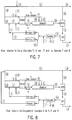
- Figure 6 shows the flow scheme of the high pressure polymerization process with a tubular reactor used to produce Comp. Exs. 6, 10 to 13, and 16.
- Stream (1) ethylene make-up, is compressed together with the outlet of the Booster by two parallel Primary compressors A+B, both have similar capacity, resulting in flow (2) and flow (3).
- CTA is added through (22) to the feed of Primary compressor A.
- Stream (2) is combined with high pressure recycle stream (18), and distributed over flow (4) and flow (19).
- the Hyper compressor part feeding the front (9) of the reactor receives from line (18) ethylene feed through line (19) and line (5).
- the Hyper compressor part feeding the side stream (8) receives ethylene feed through line (4).
- the ethylene supplied by line (8) is distributed through line (20) and (21) to the side of the reactor.
- Line (4) receives ethylene feed from line (3) and additional ethylene from line (18).
- Stream (6) and/or stream (7) depict the polyene feed.
- the reaction mixture is depressurized and/or cooled in (10), and separated as discussed above.
- Figure 7 shows the flow scheme of the high pressure polymerization with a tubular reactor, used to produce Comparative Examples 7, 14 and 17 (Actual) and Inventive Examples 7 and 8 (Simulated).
- Stream (1) ethylene make-up, is compressed together with the outlet of the Booster by Primary compressor system resulting in flow (3).
- Stream (3) is combined with high pressure recycle stream (19) and fed through line 5 to the Hyper compressor part feeding the front (9) of the Reactor.
- the Hyper compressor part feeding the side stream (8) receives ethylene feed through line (4).
- the ethylene supplied by line (8) is distributed through line (20) and (21) to the side of the reactor.
- Line (4) receives ethylene feed from line (18).
- the CTA is fed through line (22) and/or (23).
- the reaction mixture is depressurized and/or cooled in (10), and separated as discussed above.
- Figure 5 shows the flow scheme of the high pressure polymerization process (tubular) reactor, used to produce Comparative Example 15.
- Stream (1) ethylene make-up, is compressed together with the outlet of the Booster by Primary compressor system resulting in flow (3) and (2).
- Stream (3) is fed together with additional ethylene from the high pressure recycle stream (18) through line (4) to the Hyper compressor part feeding the side (8) of the Reactor.
- the ethylene supplied by line (8) is distributed through line (20) and (21) to the side of the reactor.
- the Hyper compressor part feeding the front stream (9) receives ethylene feed through line (19) and (5) from the high pressure recycle stream (18).
- Line (6) and Line (7) depict lines for feeding separately CTA and branching agent to respectively line (4) and line (5).
- the reaction mixture is depressurized and/or cooled in (10), and separated as discussed above.
- Comparative Examples 3-17 (Actual) : The reaction zones in all comparative example polymerizations were initiated with peroxide systems described in Table 5, if not mentioned differently. The amount of peroxide system to each reaction zone was adjusted to reach peak control temperatures. Table 5: Initiators Initiator Abbreviation Used in Rx-zone 1/2/3 tert-Butyl peroxy-2-ethyl hexanoate TBPO yes/yes/no Di-tert-butyl peroxide DTBP yes/yes/yes/yes
- each polymerization was carried out in tubular reactor with three reaction zones.
- pressurized water was used for cooling and/or heating the reaction medium, by circulating this water through the jacket of the reactor.
- Organic peroxides (see Table 5) were fed into each reaction zone.
- pressurized water was used for cooling and/or heating the reaction medium, by circulating this water through the jacket of the reactor.
- Each reaction zone had one inlet and one outlet. Each inlet stream consisted of the outlet stream from the previous reaction zone and/or an added ethylene-rich feed stream. After reaching the first peak temperature in reaction zone 1, the reaction medium was cooled down with pressurized water.
- the reaction medium was further cooled by injecting a cold ethylene-rich feed stream (#20), and the reaction was initiated again, by feeding an organic peroxide system into the reaction zone. This process was repeated at the end of the second reaction zone, to enable further polymerization in the third reaction zone.
- the non-converted ethylene, and other gaseous components in the reactor outlet were recycled through a high pressure recycle and a low pressure recycle, and were compressed and distributed through the booster, primary and hyper (secondary) compressor systems.
- the polymer was extruded and pelletized (about 30 pellets per gram), using a single screw extruder.
- Comparative Examples 3-5 and 8- 9 (Actual): The polymerization was carried out in tubular reactor with three reaction zones, according to the flow scheme shown in Figure 9. The inlet-pressure was 2100 bar, and the pressure drop over the whole tubular reactor system was about 260 bars. Organic peroxides (Table 5) and were fed into each reaction zone. TRIGONOXTM 301 was added in reaction zone 1 and 2. Acetone was used as a chain transfer agent (CTA), and it was present in each reaction zone inlet, originating from the low pressure and high pressure recycle flows (#13 and #15), as well as from injected CTA make-up stream #6 and #7. The make-up ethylene is fed through stream #1.
- CTA chain transfer agent
- the polymer was extruded and pelletized (about 30 pellets per gram), using a single screw extruder system, at a melt temperature around 230-250°C.
- the weight ratio of the ethylene-rich feed streams to the three reaction zones was 1.00:0.76:0.24.
- the internal process velocity was approximately 12.5, 9 and 11 m/sec for respectively the 1 st , 2 nd and 3 rd reaction zones. Additional information can be found in Tables 6 and 7.
- propylene was used as the CTA.
- the propylene was added to the suction of Primary A and not via stream 6 and 7.
- no TRIGONOXTM 301 was used, and propionaldehyde was the CTA. See also Tables 6-9.
- Comparative Examples 6, 10-13 and 16 (Actual): The polymerization was carried out in tubular reactor with three reaction zones, according flow scheme shown in Figure 7 .
- the inlet-pressure was 2155 bar, and the pressure drop over the whole tubular reactor system was about 275 bars.
- Organic peroxides (see Table 5) were fed into each reaction zone.
- Propylene was used as a chain transfer agent (CTA), and it was present in each reaction zone inlet, originating from the low pressure and high pressure recycle flows (#13 and #15), as well as from injected CTA make-up stream #22.
- the make-up ethylene is fed through stream #1.
- the polymer was extruded and pelletized (about 30 pellets per gram), using a single screw extruder, at a melt temp.
- the weight ratio of the ethylene-rich feed streams to the three reaction zones was 1.00:0.80:0.20.
- the internal process velocity was approximately 12.5, 9 and 11 m/sec for respectively the 1 st , 2 nd and 3 rd reaction zones.
- propionaldehyde was the CTA and added via stream #7.
- isobutane was the CTA.
- the rheology modifier PPG-AEMA was added via streams 6 and 7.
- the rheology modifier PPG-AEMA was added via stream 6.
- the rheology modifier PPG-AEMA was added via streams 6 and 7.
- Comparative Example 7(Actual) The polymerization was carried out in tubular reactor with three reaction zones. See Figure 8 . This configuration leads to the lowest ratios of CTA concentration in the front ethylene-based feed versus the concentrations of CTA in sequential ethylene-based feed streams. In each reaction zone, the polymerization was initiated with organic peroxides as described in Table 5. The weight ratio of the ethylene-rich feed streams to the three reaction zones was 1.00:0.60:0.40. Propionaldehyde (PA) was used as CTA, and it was present in each reactor inlet, originating from the low and high pressure recycle flows (#13 and #15), as well as from injected CTA make-up stream #23. The make-up ethylene is fed through stream #1. See also Tables 8 to 11.
- PA Propionaldehyde
- Comparative Example 15 (Actual): The polymerization was carried out in tubular reactor with three reaction zones. See Figure 6 . This configuration leads to the highest ratios of CTA concentration in the front ethylene-based feed versus the concentrations of CTA in sequential ethylene-based feed streams.
- the polymerization was initiated with organic peroxides as described in Comp. Ex. 3.
- the reaction medium was cooled down with pressurized water.
- the reaction medium was further cooled by injecting a cold ethylene-rich feed stream, and the reaction was initiated again, by feeding an organic peroxide system into the reaction zone. This process was repeated at the end of the second reaction zone, to enable further polymerization in the third reaction zone.
- the weight ratio of the ethylene-rich feed streams to the three reaction zones was 1.00:0.60:0.40.
- PA chain transfer agent
- PPG-AEMA rheology modifier agent
- Comparative Examples 3-17 show the following.
- Replacing iso-butane by propylene resulted in lower densities, higher extractable levels and less effective use of the rheology modifier, as shown by a higher consumption rate of the rheology modifier.
- the comparative examples made at high G' and polymer densities be-tween 0.9190 and 0.9240 g/cc, show lower hexane-extractable-levels than similar examples at densities below 0.9190 g/cc.
- the inventive examples have even lower hexane-extractable levels.
- Empirical models are derived, valid for polymers of the type defined here, based on key outputs from the process simulations and based on measured polymer properties.
- the models are derived with linear regression using commercial software JMP®PRO version 11.1.1.
- the density calculated by Eqn. G is representative of the actual measured density in the respective polymer sample.
- this model has a correlation coefficient R 2 of 0.959.
- the predicted density is given in Table 8 for all samples, including those samples where measured density is available.
- the G' value calculated by Eqn H is representative of the actual measured G' value in the respective polymer sample. Based on the samples CE3-CE17, this model (in the log G' form) has a correlation coefficient R 2 of 0.963.
- the polyene feed can optionally be freely distributed over the main compression streams fed to and/or distributed over the side streams (20) and/or (21) and/or front stream (9).
- Polyene streams (6) can be fed in the inlet(s), interstage(s), outlet(s) of the Hyper and/or directly into the reaction zones.
- the polyene can be optionally dosed at the inlet, outlet or interstages of the Primary and/or Booster compressors systems.
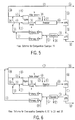
- Figure 1 shows the flow scheme of the high pressure polymerization process with a tubular reactor, used to produce Inv. Exs. 1 and 2.
- Stream (1) ethylene make-up, is compressed together with the outlet of the Booster by Primary compressor system resulting in flow (2).
- Stream (2) is fed, together with the ethylene, from the high pressure recycle stream (18) through lines (19), (5) and (4), to the Hyper compressor parts compressing respectively the front stream (9), and the sides streams (20) and (21) of the Reactor.
- Stream (6) depicts the polyene feed.
- the CTA is fed through line (7) to the Booster.
- the CTA can be fed to the inlet, interstages or outlet of the Primary or in line (18).
- Information about the Reactor system can be found Table 6. After finishing the reaction, and having applied multiple cooling steps, the reaction mixture is depressurized and/or cooled in (10), and separated as discussed above.
- Figure 2 shows the flow scheme of the high pressure polymerization process with a tubular reactor, used to produce Inventive Examples 3 and 4.
- Stream (1) ethylene make-up
- Stream (2) is fed together with additional ethylene from the high pressure recycle stream (18) through line (5) and line (19) to the Hyper compressor parts feeding respectively the side stream (20) and the stream (9) of the Reactor.
- the Hyper compressor part feeding the side stream (21) receives ethylene feed through line (4) from the high pressure recycle stream (18).
- the make-up CTA system can be fed through Line (7a) and Line (7b).
- Stream (6) depicts the polyene feed. After finishing the reaction, and having applied multiple cooling steps, the reaction mixture is depressurized and/or cooled in (10), and separated as discussed above.
- Figure 3 shows the flow scheme of the high pressure polymerization process with a tubular reactor, used to produce Inventive Example 5.
- Stream (1) ethylene make-up
- Stream (2) and (3) are combined with the high pressure recycle stream (18) and fed through line (19) and (5) to the Hyper compressor part feeding the front (9) of the Reactor.
- the Hyper compressor part feeding the side stream (8) receives ethylene feed through line (4).
- the ethylene supplied by line (8) is distributed through line (20) to the side of the reactor.
- Line (4) receives ethylene feed from line (18).
- the polyene is fed in stream (4).
- the reaction mixture is depressurized and/or cooled in (10), and separated as discussed above.
- Figure 4 shows the flow scheme of a simulated high pressure polymerization plant configuration containing a tubular reactor with an ethylene feed distribution of 100/0/0/0.
- Stream (1) is the ethylene make-up, which is compressed together with the outlet of the Booster by the Primary to stream (2).
- Stream (2) is combined with the high pressure recycle stream (18) and fed to the inlet of the "Hyper” via stream (3).
- the Hyper pressurizes the front ethylene feed stream (9) to a level sufficient to feed the high pressure tubular reactor (Reactor).
- Stream (4) depicts the CTA system make-up feed.
- CTA make-up streams (4) can be fed in the inlet(s), interstage(s), outlet(s) of the Hyper and/or inlet(s) of the reaction zones. Furthermore the CTA can be optionally dosed at the inlet, outlet or interstages of the Primary and/or Booster compressors systems.
- the CTA system can consist of single and/or multiple components and includes varying compositions.
- Stream (6) depicts the polyene feed.
- the discharge temperature of the Hyper is typically in the range of 60 to 100°C.
- the ethylene feed to the first reaction zone is typically preheated to a temp. in the range of 130 to 180°C, while the ethylene of the side feed is fed to the reactor at the Hyper discharge temperature or cooled prior to feeding to the reactor.
- the dimensions and configuration of the reactor are in Table 6. After finishing the reaction, and having applied multiple cooling steps, the reaction mixture is depressurized and/or cooled in (10), and separated as discussed above.
- Table 6 shows the reactor configuration (i.e., dimensions, lay-out, applied ethylene feed distribution) used for the simulated comparative and inventive polymerizations.
- the type and distribution of polyenes are shown in Table 8.
- the feed distributions show the percent of total ethylene or polyene feed stream fed to each reaction zone.
- the notation "100/0/0/0" means that all the total ethylene or polyene feed is fed to the first reaction zone, while no feed streams are fed to the second, third and fourth reaction zones.
- the ethylene or polyene received in the second, third and fourth reaction zones are carry-over from the previous reaction zones.
- the notation "50/38/12" means that 50% of the total ethylene or polyene feed is fed to the first reaction zones, 38% of the total ethylene or polyene feed is fed to the second reaction zone and 12% of the total ethylene or polyene feed is fed to the third reaction zone.
- Further Table 6 give information on pressure level and initiation temperatures of all reaction zones, the ethylene feed temperature when a side ethylene feed stream is applied, and the maximum or peak temperatures in each reaction zone (Rx).
- the ethylene feed temperature can be optionally lowered and/or controlled with a cooler.
- the temperature of the cooling media is typically in the range of 0 to 220°C, while the temperature for preheating services is typically in the range of 100 to 250°C.
- the cooling/heating is applied through jackets around the high pressure tubes by co-current or counter-current flow. In the simulations the cooling/preheating was applied by counter-current and with one cooling section per reaction zone.
- Comparative Examples 1 and 2 The polymerization simulations for Comp. Exs. 1 and 2 are based on Comp. Ex. A and Inv. Ex. 2 of the patent application EP 2 681 250 B1 .
- CTA propionaldehyde was used.
- the reactor inlet pressure was 2800 bar.
- Comp. Ex. A is made in a tubular reactor with 4 reaction zones, and all reactants, except initiators, are fed to the front, resulting in an even CTA distribution, resulting in a product with high density and low hexane extractables and low G'-value.
- Inv. Ex. 2 is made with Z1/Zi ratio of 0, which gives a much higher G'-value. The Z1/Zi ratio of 0 is achieved by dividing the 1 st reaction of Comp.
- Ex. A in two.
- the first part is receiving only make-up ethylene containing no CTA.
- the second part is receiving the ethylene from the high-pressure and low pressure recycle also containing recycled CTA and the make-up flow of CTA. This results in a 5 reaction zone configuration that is able to produce polymer with high densities, high G' values and low extractables (see Tables 8 and 9).
- Comp. Ex. 1 shows a high density and low hexane extractable, but also a very low G' value.
- Comp. Ex. 2 has a good G'-value and hexane extractable level, but too high a density.
- a high G'-value is achieved using a rheology modifier of a polyene, a monomeric CTA or a mixture of both.
- the low hexane extractable-level is achieved, by applying low peak-temperatures in the last reaction zone(s). The desired densities are achieved by applying the correct combination of CTA-system, peak temperatures and reactor pressure.
- 3 to 17 are actual polymerizations, and are used to derive the correlations for density, G' and hexane extractables as described above.
- Table 10 lists tubular products together and some autoclave extrusion products.
- Autoclave resins have low hexane extractables due to the lower max. polymerization temps. These resins are very suitable for food contact and cook-in applications requiring a hexane extractable level requirement ⁇ 2.6 wt% and a high melt strength.
- the ethylene conversion rate is ⁇ 20%, which is significantly lower than that in a tubular reactor (typically > 25%).
- tubular products with high G' value show extraction levels ranging from 3.4 to 4.1 wt%.
- Standard tubular products can be made at higher densities and low hexane extractable levels, but with low G'-values.
- tubular products with low hexane extractable levels and high G'-values can be made in the density range of 0.9190 to 0.9240 g/cc. More surprisingly, it has been found that these products with high G'-values can be made at hexane extractable levels ⁇ autoclave products designed for the same high G' and product density.
- Table 6 Reactor Configs, Feed Modes, Process and CTA Conds. for Comp. and Inv. Polyms. Ethylene feed distribution % # of Rx-zones Inlet Press. Bar Press. drop ( ⁇ P) bar MI dg/min CTA Cs at 1360 atm and 130°C CTA distr. Z1/Zi CE3 to 17:tube i.d.
- Rx-zone length 1500 m (300/400/400/400 m) and Thru-put 60000 kg/hr IE5 65/35/0/0 4 2400 317 4
- PA 0.33 1 IE6 tube i.d. 54 mm
- Rx-zone length 1500 m (450/350/400/300 m) and Thru-put 60000 kg/hr IE6 100/0/0/0 4 2500 499 4
- PA 0.33 1 IE 7 and 8 tube i.d.
- CE3-CE17 are actual comparative polymerizations.
- CE1-CE2 and IE1-IE8 are simulated comparative and inventive polymerizations, respectively.
- Table 7 Reactor Temps., Actual Conversions and Simulated Conversions and Polymer Branching Levels Peak temps°C (Re)initiation temps °C Side stream(s) temp °C Ethylene conv measured % Ethylene conv simulated % Simul. LCB #/1000C Simul.
Landscapes
- Chemical & Material Sciences (AREA)
- Organic Chemistry (AREA)
- Chemical Kinetics & Catalysis (AREA)
- Health & Medical Sciences (AREA)
- Medicinal Chemistry (AREA)
- Polymers & Plastics (AREA)
- Engineering & Computer Science (AREA)
- Materials Engineering (AREA)
- Addition Polymer Or Copolymer, Post-Treatments, Or Chemical Modifications (AREA)
- Polymerisation Methods In General (AREA)
Applications Claiming Priority (2)
| Application Number | Priority Date | Filing Date | Title |
|---|---|---|---|
| US201562184344P | 2015-06-25 | 2015-06-25 | |
| PCT/US2016/038933 WO2016210075A1 (en) | 2015-06-25 | 2016-06-23 | Ethylene-based polymers with low hexane extractables |
Publications (2)
| Publication Number | Publication Date |
|---|---|
| EP3313903A1 EP3313903A1 (en) | 2018-05-02 |
| EP3313903B1 true EP3313903B1 (en) | 2020-01-01 |
Family
ID=56409164
Family Applications (2)
| Application Number | Title | Priority Date | Filing Date |
|---|---|---|---|
| EP16742074.4A Active EP3313904B1 (en) | 2015-06-25 | 2016-06-23 | Ethylene-based polymers with low hexane extractables |
| EP16738267.0A Active EP3313903B1 (en) | 2015-06-25 | 2016-06-23 | Ethylene-based polymers with low hexane extractables |
Family Applications Before (1)
| Application Number | Title | Priority Date | Filing Date |
|---|---|---|---|
| EP16742074.4A Active EP3313904B1 (en) | 2015-06-25 | 2016-06-23 | Ethylene-based polymers with low hexane extractables |
Country Status (8)
| Country | Link |
|---|---|
| US (2) | US10358512B2 (enExample) |
| EP (2) | EP3313904B1 (enExample) |
| JP (5) | JP7510740B2 (enExample) |
| KR (2) | KR102612773B1 (enExample) |
| CN (2) | CN107810208B (enExample) |
| BR (2) | BR112017027564B1 (enExample) |
| ES (2) | ES2869983T3 (enExample) |
| WO (2) | WO2016210055A1 (enExample) |
Families Citing this family (11)
| Publication number | Priority date | Publication date | Assignee | Title |
|---|---|---|---|---|
| EP3087112B1 (en) | 2013-12-26 | 2019-01-30 | Dow Global Technologies LLC | Processes to improve reactor stability for the preparation of ethylene-based polymers using asymmetrical polyenes |
| EP3626752B1 (en) | 2013-12-26 | 2021-04-21 | Dow Global Technologies LLC | Ethylene-based polymers formed using asymmetrical polyenes |
| WO2016210055A1 (en) * | 2015-06-25 | 2016-12-29 | Dow Global Technologies Llc | Ethylene-based polymers with low hexane extractables |
| US10730973B2 (en) * | 2015-06-25 | 2020-08-04 | Dow Global Technologies Llc | Ethylene-based polymers with low hexane extractables and low densities |
| EP3168238A1 (en) | 2015-11-10 | 2017-05-17 | Dow Global Technologies LLC | Ethylene-based polymers formed by high pressure free radical polymerizations |
| JP6946331B2 (ja) * | 2016-04-22 | 2021-10-06 | ダウ グローバル テクノロジーズ エルエルシー | 清浄な押出コーティング処理のための低揮発性管状低密度エチレン系ポリマーを製造する方法 |
| EP3260473A1 (en) | 2016-06-24 | 2017-12-27 | Dow Global Technologies LLC | High pressure, free radical polymerizations to produce ethylene-based polymers |
| EP3260472A1 (en) * | 2016-06-24 | 2017-12-27 | Dow Global Technologies LLC | Ethylene-based polymers formed by high pressure free radical polymerizations |
| WO2018223045A1 (en) | 2017-06-02 | 2018-12-06 | Dow Global Technologies Llc | Ethylene-based polymers and processes for the same |
| CN110240654A (zh) | 2018-03-07 | 2019-09-17 | 复旦大学 | 结合cd73的抗体-药物偶联物 |
| WO2025064134A1 (en) * | 2023-09-20 | 2025-03-27 | Dow Global Technologies Llc | Ethylene-based polymer and process for producing the same |
Family Cites Families (48)
| Publication number | Priority date | Publication date | Assignee | Title |
|---|---|---|---|---|
| BE607527A (enExample) | 1960-08-29 | 1900-01-01 | ||
| US3917577A (en) | 1968-09-20 | 1975-11-04 | Basf Ag | Continuous production of ethylene homopolymers |
| DE1807493C3 (de) | 1968-11-07 | 1980-05-22 | Basf Ag, 6700 Ludwigshafen | Verfahren zum kontinuierlichen Herstellen von Äthylenhomopolymerisaten |
| EP0292215B2 (en) | 1987-05-19 | 1997-10-08 | Hitachi Chemical Co., Ltd. | Method for production of methacrylate ester |
| DD276598A3 (de) | 1988-04-12 | 1990-03-07 | Leuna Werke Veb | Verfahren zur einstellung und regelung der einsatzgasstroeme fuer mehrzonenrohrreaktoren |
| US5102955A (en) * | 1989-12-29 | 1992-04-07 | Mobil Oil Corporation | Broad distribution, high molecular weight low density polyethylene and method of making thereof |
| US5126391A (en) * | 1990-04-27 | 1992-06-30 | Mitsubishi Petrochemical Co., Ltd. | Filler-containing stretched film |
| SE9103077D0 (sv) | 1991-10-22 | 1991-10-22 | Neste Oy | Omaettad etensampolymer och saett foer framstaellning daerav |
| SE507045C2 (sv) | 1996-05-31 | 1998-03-23 | Borealis As | Etensampolymer med förhöjd omättnadsgrad och sätt för framställning därav |
| DE69826103T3 (de) * | 1998-01-12 | 2012-07-12 | Dow Global Technologies Inc. | Äthylenpolymere mittlerer Dichte, Verfahren zur Herstellung dieser Polymere und Verwendung von Carbonyl-haltigen Kettenübertragungsmitteln in diesem Verfahren |
| JP3678907B2 (ja) * | 1998-03-10 | 2005-08-03 | 三菱製紙株式会社 | 感光材料用支持体 |
| DE19829399A1 (de) | 1998-07-01 | 2000-02-03 | Buna Sow Leuna Olefinverb Gmbh | Verfahren zur Herstellung von Ethylenhomo- und Ethylencopolymerisaten niederer Dichte |
| CN1186358C (zh) | 2000-03-16 | 2005-01-26 | 巴塞尔聚烯烃股份有限公司 | 聚乙烯的制备方法 |
| BR0113218B1 (pt) | 2000-08-15 | 2010-12-28 | uso de trioxepanos em processos para a fabricação de resinas acrìlicas, estirênicas e do tipo ldpe, de alto teor de sólidos. | |
| KR100833763B1 (ko) | 2000-08-15 | 2008-05-29 | 아크조 노벨 엔.브이. | 하이솔리드 아크릴, 스티렌 및 ldpe-형 수지를 제조하는데 사용되는 트리옥세판의 용도 |
| US6596241B2 (en) | 2001-12-19 | 2003-07-22 | Exxonmobil Chemical Patents Inc | Tubular polymerization reactors and polymers made therein |
| WO2004090206A1 (en) * | 2003-04-03 | 2004-10-21 | E.I. Dupont De Nemours And Company | Rotary process for forming uniform material |
| PL1861434T3 (pl) | 2005-03-09 | 2013-09-30 | Saudi Basic Ind Corp | Sposób otrzymywania kopolimeru etylenu w reaktorze rurowym |
| US7078467B1 (en) * | 2005-06-14 | 2006-07-18 | Univation Technologies, Llc | Single catalyst low, medium and high density polyethylenes |
| PL1999170T3 (pl) | 2006-03-24 | 2011-12-30 | Saudi Basic Ind Corp | Kompozycja do powlekania przez wytłaczanie |
| US7449287B1 (en) * | 2008-01-30 | 2008-11-11 | Eastman Kodak Company | Pearlescent textured imaging supports |
| CN101970005A (zh) | 2008-02-08 | 2011-02-09 | 斯克利普斯研究院 | 用遗传编码的非天然氨基酸打破免疫耐受 |
| EA019226B9 (ru) * | 2008-07-10 | 2014-05-30 | Бореалис Аг | Способ получения полиолефина, применение смеси по меньшей мере двух агентов переноса цепи для получения полиолефина, полиэтилен низкой плотности, способ получения кабеля и кабель |
| JP2010068637A (ja) | 2008-09-11 | 2010-03-25 | Mitsumi Electric Co Ltd | 充電制御用半導体集積回路 |
| US8535377B2 (en) | 2009-03-31 | 2013-09-17 | Imds Corporation | Double bundle ACL repair system |
| KR101668146B1 (ko) * | 2010-02-22 | 2016-10-20 | 다우 글로벌 테크놀로지스 엘엘씨 | 도장된 폴리올레핀 물품 |
| KR101911673B1 (ko) * | 2010-09-30 | 2018-10-24 | 다우 글로벌 테크놀로지스 엘엘씨 | 저밀도 폴리에틸렌을 제조하는 중합 방법 |
| CN103282391B (zh) * | 2010-10-29 | 2016-12-07 | 陶氏环球技术有限责任公司 | 基于乙烯的聚合物及其制备方法 |
| EP2655444B2 (en) | 2010-12-22 | 2018-11-21 | Basell Polyolefine GmbH | Process for the preparation of ethylene copolymers in the presence of free-radical polymerization initiator by copolymerizing ethylene, a bi- or multifunctional comonomer and optionally further comonomers |
| CN103403040B (zh) | 2011-03-03 | 2015-11-25 | 巴塞尔聚烯烃股份有限公司 | 在具有至少两个具有不同链转移剂浓度的反应区的管式反应器中制备乙烯均聚物或共聚物的方法 |
| EP2751146B1 (en) | 2011-10-19 | 2016-01-20 | Dow Global Technologies LLC | Polymerization processes with fresh ethylene distributions for preparation of low density ethylene-based polymers |
| IN2014CN03782A (enExample) * | 2011-11-23 | 2015-09-25 | Dow Global Technologies Llc | |
| KR101945575B1 (ko) | 2011-11-23 | 2019-02-07 | 다우 글로벌 테크놀로지스 엘엘씨 | 더 낮은 분자량의 추출물을 갖는 저밀도 에틸렌-계 중합체 |
| BR112014009337A2 (pt) | 2011-12-09 | 2017-04-18 | Borealis Ag | polietileno de baixa densidade, composição, processo para produção de polietileno de baixa densidade, método de polimerização contínua, método para um processo de revestimento por extrusão, artigo e uso |
| KR101989335B1 (ko) | 2011-12-22 | 2019-06-17 | 다우 글로벌 테크놀로지스 엘엘씨 | 개선된 용융 강도를 가진 에틸렌-기재 중합체 및 그의 제조 방법 |
| EP2636691A1 (en) | 2012-03-07 | 2013-09-11 | Borealis AG | Process and plant for manufacturing polyethylene-diene-copolymers |
| MX374238B (es) | 2012-04-02 | 2025-03-05 | Borealis Ag | Proceso de polimerizacion de etileno usando un inhibidor. |
| EP2647650B1 (en) | 2012-04-02 | 2015-06-17 | Borealis AG | High-pressure radical ethylene co-polymerization process with a reduced temperature of the reaction mixture prior to introduction into the reaction zone |
| EP2834279B1 (en) | 2012-04-02 | 2018-02-21 | Borealis AG | High-pressure radical ethylene polymerization process in which ethylene is polymerized with a specific polyunsaturated olefin grade |
| JP6007319B2 (ja) | 2012-05-31 | 2016-10-12 | ボレアリス・アクチェンゲゼルシャフトBorealis Ag | 押出コーティング用の低密度ポリエチレン |
| EP2855537B2 (en) | 2012-05-31 | 2024-01-10 | Borealis AG | Ethylene polymers for extrusion coating |
| US10442878B2 (en) | 2012-06-27 | 2019-10-15 | Dow Global Technologies Llc | Ethylene-based polymers and processes for the same |
| BR112015010787B1 (pt) * | 2012-11-20 | 2022-01-18 | Dow Global Technologies Llc | Composição a base de etileno de baixa densidade, artigo e método de polimerização para formar uma composição a base de etileno de baixa densidade |
| CN105189638B (zh) | 2013-05-22 | 2018-02-06 | 陶氏环球技术有限责任公司 | 在高熔体强度和中‑高密度控制下的基于低密度乙烯的聚合物组合物 |
| ES2975010T3 (es) * | 2013-05-22 | 2024-07-02 | Dow Global Technologies Llc | Composiciones que contienen polímeros a base de etileno de baja densidad con alta resistencia en estado fundido y películas formadas a partir de las mismas |
| WO2015166297A1 (en) | 2014-04-30 | 2015-11-05 | Exxonmobil Chemical Patents Inc. | Process for manufacturing ethylene polymers and copolymers |
| CN106715486B (zh) | 2014-07-24 | 2020-07-31 | Sabic环球技术有限责任公司 | 用于制备乙烯共聚物的方法 |
| WO2016210055A1 (en) * | 2015-06-25 | 2016-12-29 | Dow Global Technologies Llc | Ethylene-based polymers with low hexane extractables |
-
2016
- 2016-06-23 WO PCT/US2016/038900 patent/WO2016210055A1/en not_active Ceased
- 2016-06-23 US US15/574,291 patent/US10358512B2/en active Active
- 2016-06-23 US US15/737,448 patent/US10494460B2/en active Active
- 2016-06-23 WO PCT/US2016/038933 patent/WO2016210075A1/en not_active Ceased
- 2016-06-23 JP JP2017565051A patent/JP7510740B2/ja active Active
- 2016-06-23 EP EP16742074.4A patent/EP3313904B1/en active Active
- 2016-06-23 JP JP2017565050A patent/JP7436135B2/ja active Active
- 2016-06-23 CN CN201680036314.4A patent/CN107810208B/zh active Active
- 2016-06-23 KR KR1020187000962A patent/KR102612773B1/ko active Active
- 2016-06-23 BR BR112017027564-3A patent/BR112017027564B1/pt active IP Right Grant
- 2016-06-23 ES ES16742074T patent/ES2869983T3/es active Active
- 2016-06-23 EP EP16738267.0A patent/EP3313903B1/en active Active
- 2016-06-23 ES ES16738267T patent/ES2775506T3/es active Active
- 2016-06-23 KR KR1020187000805A patent/KR102577959B1/ko active Active
- 2016-06-23 CN CN201680036366.1A patent/CN107787334B/zh active Active
- 2016-06-23 BR BR112017027866-9A patent/BR112017027866B1/pt active IP Right Grant
-
2021
- 2021-09-27 JP JP2021157048A patent/JP2022008573A/ja active Pending
-
2023
- 2023-12-13 JP JP2023209890A patent/JP2024037861A/ja not_active Withdrawn
-
2024
- 2024-01-24 JP JP2024008716A patent/JP2024056727A/ja not_active Withdrawn
Non-Patent Citations (1)
| Title |
|---|
| None * |
Also Published As
| Publication number | Publication date |
|---|---|
| KR20180021070A (ko) | 2018-02-28 |
| WO2016210055A1 (en) | 2016-12-29 |
| CN107810208B (zh) | 2020-07-24 |
| CN107810208A (zh) | 2018-03-16 |
| EP3313903A1 (en) | 2018-05-02 |
| US20180127523A1 (en) | 2018-05-10 |
| WO2016210075A1 (en) | 2016-12-29 |
| EP3313904A1 (en) | 2018-05-02 |
| JP2018522972A (ja) | 2018-08-16 |
| KR102612773B1 (ko) | 2023-12-12 |
| JP7510740B2 (ja) | 2024-07-04 |
| JP2018518577A (ja) | 2018-07-12 |
| KR102577959B1 (ko) | 2023-09-14 |
| ES2869983T3 (es) | 2021-10-26 |
| BR112017027866A2 (pt) | 2018-08-28 |
| CN107787334B (zh) | 2020-07-24 |
| JP2024037861A (ja) | 2024-03-19 |
| US20180112017A1 (en) | 2018-04-26 |
| BR112017027564A2 (pt) | 2018-09-04 |
| JP2022008573A (ja) | 2022-01-13 |
| BR112017027866B1 (pt) | 2022-05-24 |
| US10494460B2 (en) | 2019-12-03 |
| CN107787334A (zh) | 2018-03-09 |
| JP2024056727A (ja) | 2024-04-23 |
| JP7436135B2 (ja) | 2024-02-21 |
| KR20180021067A (ko) | 2018-02-28 |
| US10358512B2 (en) | 2019-07-23 |
| ES2775506T3 (es) | 2020-07-27 |
| BR112017027564B1 (pt) | 2022-02-01 |
| EP3313904B1 (en) | 2021-04-21 |
Similar Documents
| Publication | Publication Date | Title |
|---|---|---|
| EP3313903B1 (en) | Ethylene-based polymers with low hexane extractables | |
| EP3317306B1 (en) | Process for forming ethylene based polymers | |
| KR20180022790A (ko) | 높은 용융 강도를 갖는 관형 에틸렌계 폴리머의 개선된 제조 방법 | |
| EP3313902B1 (en) | A process for producing an ethylene-based polymer | |
| EP3313894B1 (en) | Improved process to make tubular ethylene based polymers with high g' and broad mwd | |
| WO2019005812A1 (en) | HIGH PRESSURE FREE RADICAL POLYMERIZATIONS FOR PRODUCING ETHYLENE POLYMERS |
Legal Events
| Date | Code | Title | Description |
|---|---|---|---|
| STAA | Information on the status of an ep patent application or granted ep patent |
Free format text: STATUS: THE INTERNATIONAL PUBLICATION HAS BEEN MADE |
|
| PUAI | Public reference made under article 153(3) epc to a published international application that has entered the european phase |
Free format text: ORIGINAL CODE: 0009012 |
|
| STAA | Information on the status of an ep patent application or granted ep patent |
Free format text: STATUS: REQUEST FOR EXAMINATION WAS MADE |
|
| 17P | Request for examination filed |
Effective date: 20180116 |
|
| AK | Designated contracting states |
Kind code of ref document: A1 Designated state(s): AL AT BE BG CH CY CZ DE DK EE ES FI FR GB GR HR HU IE IS IT LI LT LU LV MC MK MT NL NO PL PT RO RS SE SI SK SM TR |
|
| AX | Request for extension of the european patent |
Extension state: BA ME |
|
| DAV | Request for validation of the european patent (deleted) | ||
| DAX | Request for extension of the european patent (deleted) | ||
| STAA | Information on the status of an ep patent application or granted ep patent |
Free format text: STATUS: EXAMINATION IS IN PROGRESS |
|
| 17Q | First examination report despatched |
Effective date: 20181114 |
|
| GRAP | Despatch of communication of intention to grant a patent |
Free format text: ORIGINAL CODE: EPIDOSNIGR1 |
|
| STAA | Information on the status of an ep patent application or granted ep patent |
Free format text: STATUS: GRANT OF PATENT IS INTENDED |
|
| INTG | Intention to grant announced |
Effective date: 20190201 |
|
| GRAJ | Information related to disapproval of communication of intention to grant by the applicant or resumption of examination proceedings by the epo deleted |
Free format text: ORIGINAL CODE: EPIDOSDIGR1 |
|
| STAA | Information on the status of an ep patent application or granted ep patent |
Free format text: STATUS: EXAMINATION IS IN PROGRESS |
|
| INTC | Intention to grant announced (deleted) | ||
| GRAP | Despatch of communication of intention to grant a patent |
Free format text: ORIGINAL CODE: EPIDOSNIGR1 |
|
| STAA | Information on the status of an ep patent application or granted ep patent |
Free format text: STATUS: GRANT OF PATENT IS INTENDED |
|
| INTG | Intention to grant announced |
Effective date: 20190716 |
|
| GRAS | Grant fee paid |
Free format text: ORIGINAL CODE: EPIDOSNIGR3 |
|
| GRAA | (expected) grant |
Free format text: ORIGINAL CODE: 0009210 |
|
| STAA | Information on the status of an ep patent application or granted ep patent |
Free format text: STATUS: THE PATENT HAS BEEN GRANTED |
|
| AK | Designated contracting states |
Kind code of ref document: B1 Designated state(s): AL AT BE BG CH CY CZ DE DK EE ES FI FR GB GR HR HU IE IS IT LI LT LU LV MC MK MT NL NO PL PT RO RS SE SI SK SM TR |
|
| REG | Reference to a national code |
Ref country code: GB Ref legal event code: FG4D |
|
| REG | Reference to a national code |
Ref country code: CH Ref legal event code: EP Ref country code: AT Ref legal event code: REF Ref document number: 1219702 Country of ref document: AT Kind code of ref document: T Effective date: 20200115 |
|
| REG | Reference to a national code |
Ref country code: IE Ref legal event code: FG4D |
|
| REG | Reference to a national code |
Ref country code: DE Ref legal event code: R096 Ref document number: 602016027318 Country of ref document: DE |
|
| REG | Reference to a national code |
Ref country code: NL Ref legal event code: FP |
|
| REG | Reference to a national code |
Ref country code: LT Ref legal event code: MG4D |
|
| REG | Reference to a national code |
Ref country code: ES Ref legal event code: FG2A Ref document number: 2775506 Country of ref document: ES Kind code of ref document: T3 Effective date: 20200727 |
|
| PG25 | Lapsed in a contracting state [announced via postgrant information from national office to epo] |
Ref country code: CZ Free format text: LAPSE BECAUSE OF FAILURE TO SUBMIT A TRANSLATION OF THE DESCRIPTION OR TO PAY THE FEE WITHIN THE PRESCRIBED TIME-LIMIT Effective date: 20200101 Ref country code: PT Free format text: LAPSE BECAUSE OF FAILURE TO SUBMIT A TRANSLATION OF THE DESCRIPTION OR TO PAY THE FEE WITHIN THE PRESCRIBED TIME-LIMIT Effective date: 20200527 Ref country code: RS Free format text: LAPSE BECAUSE OF FAILURE TO SUBMIT A TRANSLATION OF THE DESCRIPTION OR TO PAY THE FEE WITHIN THE PRESCRIBED TIME-LIMIT Effective date: 20200101 Ref country code: LT Free format text: LAPSE BECAUSE OF FAILURE TO SUBMIT A TRANSLATION OF THE DESCRIPTION OR TO PAY THE FEE WITHIN THE PRESCRIBED TIME-LIMIT Effective date: 20200101 Ref country code: NO Free format text: LAPSE BECAUSE OF FAILURE TO SUBMIT A TRANSLATION OF THE DESCRIPTION OR TO PAY THE FEE WITHIN THE PRESCRIBED TIME-LIMIT Effective date: 20200401 Ref country code: FI Free format text: LAPSE BECAUSE OF FAILURE TO SUBMIT A TRANSLATION OF THE DESCRIPTION OR TO PAY THE FEE WITHIN THE PRESCRIBED TIME-LIMIT Effective date: 20200101 |
|
| PG25 | Lapsed in a contracting state [announced via postgrant information from national office to epo] |
Ref country code: IS Free format text: LAPSE BECAUSE OF FAILURE TO SUBMIT A TRANSLATION OF THE DESCRIPTION OR TO PAY THE FEE WITHIN THE PRESCRIBED TIME-LIMIT Effective date: 20200501 Ref country code: GR Free format text: LAPSE BECAUSE OF FAILURE TO SUBMIT A TRANSLATION OF THE DESCRIPTION OR TO PAY THE FEE WITHIN THE PRESCRIBED TIME-LIMIT Effective date: 20200402 Ref country code: HR Free format text: LAPSE BECAUSE OF FAILURE TO SUBMIT A TRANSLATION OF THE DESCRIPTION OR TO PAY THE FEE WITHIN THE PRESCRIBED TIME-LIMIT Effective date: 20200101 Ref country code: LV Free format text: LAPSE BECAUSE OF FAILURE TO SUBMIT A TRANSLATION OF THE DESCRIPTION OR TO PAY THE FEE WITHIN THE PRESCRIBED TIME-LIMIT Effective date: 20200101 Ref country code: SE Free format text: LAPSE BECAUSE OF FAILURE TO SUBMIT A TRANSLATION OF THE DESCRIPTION OR TO PAY THE FEE WITHIN THE PRESCRIBED TIME-LIMIT Effective date: 20200101 Ref country code: BG Free format text: LAPSE BECAUSE OF FAILURE TO SUBMIT A TRANSLATION OF THE DESCRIPTION OR TO PAY THE FEE WITHIN THE PRESCRIBED TIME-LIMIT Effective date: 20200401 |
|
| REG | Reference to a national code |
Ref country code: DE Ref legal event code: R097 Ref document number: 602016027318 Country of ref document: DE |
|
| PG25 | Lapsed in a contracting state [announced via postgrant information from national office to epo] |
Ref country code: DK Free format text: LAPSE BECAUSE OF FAILURE TO SUBMIT A TRANSLATION OF THE DESCRIPTION OR TO PAY THE FEE WITHIN THE PRESCRIBED TIME-LIMIT Effective date: 20200101 Ref country code: SM Free format text: LAPSE BECAUSE OF FAILURE TO SUBMIT A TRANSLATION OF THE DESCRIPTION OR TO PAY THE FEE WITHIN THE PRESCRIBED TIME-LIMIT Effective date: 20200101 Ref country code: EE Free format text: LAPSE BECAUSE OF FAILURE TO SUBMIT A TRANSLATION OF THE DESCRIPTION OR TO PAY THE FEE WITHIN THE PRESCRIBED TIME-LIMIT Effective date: 20200101 Ref country code: RO Free format text: LAPSE BECAUSE OF FAILURE TO SUBMIT A TRANSLATION OF THE DESCRIPTION OR TO PAY THE FEE WITHIN THE PRESCRIBED TIME-LIMIT Effective date: 20200101 Ref country code: SK Free format text: LAPSE BECAUSE OF FAILURE TO SUBMIT A TRANSLATION OF THE DESCRIPTION OR TO PAY THE FEE WITHIN THE PRESCRIBED TIME-LIMIT Effective date: 20200101 |
|
| PLBE | No opposition filed within time limit |
Free format text: ORIGINAL CODE: 0009261 |
|
| STAA | Information on the status of an ep patent application or granted ep patent |
Free format text: STATUS: NO OPPOSITION FILED WITHIN TIME LIMIT |
|
| REG | Reference to a national code |
Ref country code: AT Ref legal event code: MK05 Ref document number: 1219702 Country of ref document: AT Kind code of ref document: T Effective date: 20200101 |
|
| 26N | No opposition filed |
Effective date: 20201002 |
|
| PG25 | Lapsed in a contracting state [announced via postgrant information from national office to epo] |
Ref country code: IT Free format text: LAPSE BECAUSE OF FAILURE TO SUBMIT A TRANSLATION OF THE DESCRIPTION OR TO PAY THE FEE WITHIN THE PRESCRIBED TIME-LIMIT Effective date: 20200101 Ref country code: MC Free format text: LAPSE BECAUSE OF FAILURE TO SUBMIT A TRANSLATION OF THE DESCRIPTION OR TO PAY THE FEE WITHIN THE PRESCRIBED TIME-LIMIT Effective date: 20200101 Ref country code: AT Free format text: LAPSE BECAUSE OF FAILURE TO SUBMIT A TRANSLATION OF THE DESCRIPTION OR TO PAY THE FEE WITHIN THE PRESCRIBED TIME-LIMIT Effective date: 20200101 |
|
| REG | Reference to a national code |
Ref country code: CH Ref legal event code: PL |
|
| PG25 | Lapsed in a contracting state [announced via postgrant information from national office to epo] |
Ref country code: SI Free format text: LAPSE BECAUSE OF FAILURE TO SUBMIT A TRANSLATION OF THE DESCRIPTION OR TO PAY THE FEE WITHIN THE PRESCRIBED TIME-LIMIT Effective date: 20200101 Ref country code: PL Free format text: LAPSE BECAUSE OF FAILURE TO SUBMIT A TRANSLATION OF THE DESCRIPTION OR TO PAY THE FEE WITHIN THE PRESCRIBED TIME-LIMIT Effective date: 20200101 |
|
| GBPC | Gb: european patent ceased through non-payment of renewal fee |
Effective date: 20200623 |
|
| PG25 | Lapsed in a contracting state [announced via postgrant information from national office to epo] |
Ref country code: LU Free format text: LAPSE BECAUSE OF NON-PAYMENT OF DUE FEES Effective date: 20200623 |
|
| REG | Reference to a national code |
Ref country code: BE Ref legal event code: MM Effective date: 20200630 |
|
| PG25 | Lapsed in a contracting state [announced via postgrant information from national office to epo] |
Ref country code: GB Free format text: LAPSE BECAUSE OF NON-PAYMENT OF DUE FEES Effective date: 20200623 Ref country code: IE Free format text: LAPSE BECAUSE OF NON-PAYMENT OF DUE FEES Effective date: 20200623 Ref country code: LI Free format text: LAPSE BECAUSE OF NON-PAYMENT OF DUE FEES Effective date: 20200630 Ref country code: CH Free format text: LAPSE BECAUSE OF NON-PAYMENT OF DUE FEES Effective date: 20200630 |
|
| PG25 | Lapsed in a contracting state [announced via postgrant information from national office to epo] |
Ref country code: BE Free format text: LAPSE BECAUSE OF NON-PAYMENT OF DUE FEES Effective date: 20200630 |
|
| PG25 | Lapsed in a contracting state [announced via postgrant information from national office to epo] |
Ref country code: TR Free format text: LAPSE BECAUSE OF FAILURE TO SUBMIT A TRANSLATION OF THE DESCRIPTION OR TO PAY THE FEE WITHIN THE PRESCRIBED TIME-LIMIT Effective date: 20200101 Ref country code: MT Free format text: LAPSE BECAUSE OF FAILURE TO SUBMIT A TRANSLATION OF THE DESCRIPTION OR TO PAY THE FEE WITHIN THE PRESCRIBED TIME-LIMIT Effective date: 20200101 Ref country code: CY Free format text: LAPSE BECAUSE OF FAILURE TO SUBMIT A TRANSLATION OF THE DESCRIPTION OR TO PAY THE FEE WITHIN THE PRESCRIBED TIME-LIMIT Effective date: 20200101 |
|
| PG25 | Lapsed in a contracting state [announced via postgrant information from national office to epo] |
Ref country code: MK Free format text: LAPSE BECAUSE OF FAILURE TO SUBMIT A TRANSLATION OF THE DESCRIPTION OR TO PAY THE FEE WITHIN THE PRESCRIBED TIME-LIMIT Effective date: 20200101 Ref country code: AL Free format text: LAPSE BECAUSE OF FAILURE TO SUBMIT A TRANSLATION OF THE DESCRIPTION OR TO PAY THE FEE WITHIN THE PRESCRIBED TIME-LIMIT Effective date: 20200101 |
|
| P01 | Opt-out of the competence of the unified patent court (upc) registered |
Effective date: 20230526 |
|
| PGFP | Annual fee paid to national office [announced via postgrant information from national office to epo] |
Ref country code: NL Payment date: 20250409 Year of fee payment: 10 |
|
| PGFP | Annual fee paid to national office [announced via postgrant information from national office to epo] |
Ref country code: DE Payment date: 20250402 Year of fee payment: 10 |
|
| PGFP | Annual fee paid to national office [announced via postgrant information from national office to epo] |
Ref country code: FR Payment date: 20250508 Year of fee payment: 10 |
|
| PGFP | Annual fee paid to national office [announced via postgrant information from national office to epo] |
Ref country code: ES Payment date: 20250704 Year of fee payment: 10 |