EP3290554A1 - Procédé de fabrication de gant de sécurité polyvalent et gant de sécurité polyvalent ainsi fabriqué - Google Patents
Procédé de fabrication de gant de sécurité polyvalent et gant de sécurité polyvalent ainsi fabriqué Download PDFInfo
- Publication number
- EP3290554A1 EP3290554A1 EP17187987.7A EP17187987A EP3290554A1 EP 3290554 A1 EP3290554 A1 EP 3290554A1 EP 17187987 A EP17187987 A EP 17187987A EP 3290554 A1 EP3290554 A1 EP 3290554A1
- Authority
- EP
- European Patent Office
- Prior art keywords
- water
- yarn
- soluble polymer
- glove
- breakaway
- Prior art date
- Legal status (The legal status is an assumption and is not a legal conclusion. Google has not performed a legal analysis and makes no representation as to the accuracy of the status listed.)
- Granted
Links
Images
Classifications
-
- A—HUMAN NECESSITIES
- A41—WEARING APPAREL
- A41D—OUTERWEAR; PROTECTIVE GARMENTS; ACCESSORIES
- A41D19/00—Gloves
- A41D19/015—Protective gloves
- A41D19/01576—Protective gloves made of a patchwork of different materials
-
- A—HUMAN NECESSITIES
- A41—WEARING APPAREL
- A41D—OUTERWEAR; PROTECTIVE GARMENTS; ACCESSORIES
- A41D19/00—Gloves
- A41D19/015—Protective gloves
-
- A—HUMAN NECESSITIES
- A41—WEARING APPAREL
- A41D—OUTERWEAR; PROTECTIVE GARMENTS; ACCESSORIES
- A41D19/00—Gloves
- A41D19/015—Protective gloves
- A41D19/01505—Protective gloves resistant to mechanical aggressions, e.g. cutting. piercing
-
- D—TEXTILES; PAPER
- D03—WEAVING
- D03D—WOVEN FABRICS; METHODS OF WEAVING; LOOMS
- D03D15/00—Woven fabrics characterised by the material, structure or properties of the fibres, filaments, yarns, threads or other warp or weft elements used
- D03D15/60—Woven fabrics characterised by the material, structure or properties of the fibres, filaments, yarns, threads or other warp or weft elements used characterised by the warp or weft elements other than yarns or threads
- D03D15/68—Scaffolding threads, i.e. threads removed after weaving
-
- D—TEXTILES; PAPER
- D04—BRAIDING; LACE-MAKING; KNITTING; TRIMMINGS; NON-WOVEN FABRICS
- D04B—KNITTING
- D04B1/00—Weft knitting processes for the production of fabrics or articles not dependent on the use of particular machines; Fabrics or articles defined by such processes
- D04B1/22—Weft knitting processes for the production of fabrics or articles not dependent on the use of particular machines; Fabrics or articles defined by such processes specially adapted for knitting goods of particular configuration
- D04B1/24—Weft knitting processes for the production of fabrics or articles not dependent on the use of particular machines; Fabrics or articles defined by such processes specially adapted for knitting goods of particular configuration wearing apparel
- D04B1/28—Weft knitting processes for the production of fabrics or articles not dependent on the use of particular machines; Fabrics or articles defined by such processes specially adapted for knitting goods of particular configuration wearing apparel gloves
-
- D—TEXTILES; PAPER
- D06—TREATMENT OF TEXTILES OR THE LIKE; LAUNDERING; FLEXIBLE MATERIALS NOT OTHERWISE PROVIDED FOR
- D06M—TREATMENT, NOT PROVIDED FOR ELSEWHERE IN CLASS D06, OF FIBRES, THREADS, YARNS, FABRICS, FEATHERS OR FIBROUS GOODS MADE FROM SUCH MATERIALS
- D06M11/00—Treating fibres, threads, yarns, fabrics or fibrous goods made from such materials, with inorganic substances or complexes thereof; Such treatment combined with mechanical treatment, e.g. mercerising
- D06M11/01—Treating fibres, threads, yarns, fabrics or fibrous goods made from such materials, with inorganic substances or complexes thereof; Such treatment combined with mechanical treatment, e.g. mercerising with hydrogen, water or heavy water; with hydrides of metals or complexes thereof; with boranes, diboranes, silanes, disilanes, phosphines, diphosphines, stibines, distibines, arsines, or diarsines or complexes thereof
- D06M11/05—Treating fibres, threads, yarns, fabrics or fibrous goods made from such materials, with inorganic substances or complexes thereof; Such treatment combined with mechanical treatment, e.g. mercerising with hydrogen, water or heavy water; with hydrides of metals or complexes thereof; with boranes, diboranes, silanes, disilanes, phosphines, diphosphines, stibines, distibines, arsines, or diarsines or complexes thereof with water, e.g. steam; with heavy water
-
- A—HUMAN NECESSITIES
- A41—WEARING APPAREL
- A41D—OUTERWEAR; PROTECTIVE GARMENTS; ACCESSORIES
- A41D2300/00—Details of garments
- A41D2300/50—Seams
-
- A—HUMAN NECESSITIES
- A41—WEARING APPAREL
- A41D—OUTERWEAR; PROTECTIVE GARMENTS; ACCESSORIES
- A41D2400/00—Functions or special features of garments
- A41D2400/70—Removability
-
- A—HUMAN NECESSITIES
- A41—WEARING APPAREL
- A41D—OUTERWEAR; PROTECTIVE GARMENTS; ACCESSORIES
- A41D2500/00—Materials for garments
- A41D2500/10—Knitted
-
- A—HUMAN NECESSITIES
- A41—WEARING APPAREL
- A41D—OUTERWEAR; PROTECTIVE GARMENTS; ACCESSORIES
- A41D2500/00—Materials for garments
- A41D2500/20—Woven
-
- A—HUMAN NECESSITIES
- A41—WEARING APPAREL
- A41D—OUTERWEAR; PROTECTIVE GARMENTS; ACCESSORIES
- A41D2600/00—Uses of garments specially adapted for specific purposes
- A41D2600/20—Uses of garments specially adapted for specific purposes for working activities
-
- D—TEXTILES; PAPER
- D10—INDEXING SCHEME ASSOCIATED WITH SUBLASSES OF SECTION D, RELATING TO TEXTILES
- D10B—INDEXING SCHEME ASSOCIATED WITH SUBLASSES OF SECTION D, RELATING TO TEXTILES
- D10B2501/00—Wearing apparel
- D10B2501/04—Outerwear; Protective garments
- D10B2501/041—Gloves
Definitions
- the present disclosure relates to a method of manufacturing a multipurpose safety glove and a multipurpose safety glove manufactured thereby, and, more particularly, the present disclosure relates to a method of manufacturing a multipurpose safety glove and a multipurpose safety glove manufactured thereby in which a breakaway portion is not easily broken when general work is performed, so that a worker may be able to easily perform work tasks while wearing the safety glove.
- safety requirements for the glove to be easily broken away from the hand in the case of danger are met, whereby a worker's body can be protected while maintaining working efficiency.
- the present disclosure relates to a method of manufacturing a multipurpose safety glove and a multipurpose safety glove manufactured by the method that can be manufactured of various materials using various kinds of yarns, rather than a limited number of types of yarns, so that manufacturing costs can be decreased, and the method of manufacturing a multipurpose safety glove and the multipurpose safety glove manufactured by the method can be widely applied to various fields, because there is no limitation in the manufacturing method and the incidence of defects in the manufacturing process is remarkably low, resulting in excellent productivity.
- Safety gloves for industrial work are mainly classified as welding gloves, heat-resistant gloves, cut-resistant gloves, and chemical-resistant gloves.
- Heat-resistant gloves are gloves that protect workers' hands from heat at high temperatures
- cut-resistant gloves are gloves that protect workers' hands from sharp objects in work sites
- chemical-resistant gloves are gloves that protect workers' hands from chemicals.
- Such conventional work gloves are stipulated not to be worn when dealing with machinery in which fingers may be caught, such as a pressing device for pressing a workpiece with a strong pressure or a device for processing a workpiece by rotating and the like. This is because there is a concern that worker's hands may be caught in mechanical devices due to worker carelessness or malfunctioning of mechanical devices when dealing with the above machinery.
- Korean Patent Registration No. 10-0811863 discloses a glove having a breakaway portion formed by being thinly knitted at a certain location in each finger portion, the finger portion breaking at the moment the finger portion gets entangled in the machine, so that it is possible to prevent workplace accidents in which worker's fingers may be entangled in machinery.
- An object of the present disclosure is to provide a method of manufacturing a multipurpose safety glove and a multipurpose safety glove manufactured by the method in which a breakaway portion is not easily broken when general work is performed, so that a worker may be able to easily perform work tasks while wearing the safety glove, while, at the same time, requirements for ease of breaking and safety by breaking easily in the case of danger.
- another object of the present disclosure is to provide a method of manufacturing a multipurpose safety glove and a multipurpose safety glove manufactured by the method that can be manufactured using various kinds of yarns rather than being limited in terms of types of yarns, so can be versatile, and can be widely applied to a field of work where oil may be generated in large amounts, to a field requiring heat resistance, or to a field of perforation resistance, etc., and, in addition, the incidence of defects in the manufacturing process may be remarkably low, resulting in excellent productivity.
- the present disclosure provides a method of manufacturing a multipurpose safety glove including a body portion, a finger portion, and a breakaway portion that connects the body portion to the finger portion and can be separated by force pulling from the outside.
- the method may manufacture the breakaway portion by: twisting and weaving a first yarn insoluble in water and a second yarn containing a water-soluble polymer; and eluting a portion or all of the water-soluble polymer by treating the twisted water-soluble polymer with water.
- an average fineness (A) of a fiber forming the body portion and the finger portion, and a average fineness (B) of the first yarn satisfy the following Formula 1. 30 ⁇ / B A ⁇ 70
- the water-soluble polymer comprises one selected from among polyvinyl alcohol (PVA), water-soluble acrylic polymer, polyethyleneimine (PEI), and water-soluble polyester.
- PVA polyvinyl alcohol
- PEI polyethyleneimine
- the water soluble polymer has a melting point of 40 to 100°C in water and the treatment with water in the eluting of the water-soluble polymer is performed at a water temperature of 40 to 100°C.
- the first yarn comprises at least one selected from among nylon, spandex, polyamide, ultra-high molecular weight polyethylene (UHMWPE), polyolefin fiber, and polyester.
- nylon spandex
- polyamide polyamide
- UHMWPE ultra-high molecular weight polyethylene
- polyolefin fiber polyolefin fiber
- polyester polyester
- the first yarn and the water-soluble polymer are mixed in a weight ratio of 1: 2 to 4.
- the present disclosure provides a multipurpose safety glove including: a body portion; a finger portion; and a breakaway portion that connects the body portion with the finger portion and can be separated by a force pulled from the outside, wherein a tensile strength of the breakaway portion is 20 to 40 N when measured according to KS K 0520 standard.
- the breakaway portion includes the water-soluble polymer 10 weight% (wt%) or less.
- an average fineness (A) of a fiber forming the body portion and the finger portion, and an average fineness (B) of the first yarn satisfy a following Formula: 30 ⁇ / B A ⁇ 70
- a breakaway portion is not easily broken when general work is performed, so that the worker may be able to easily perform work tasks while wearing the multipurpose safety glove, and, at the same time, ease of breaking and safety by breaking easily in case of danger, thereby the worker's body can be protected while maintaining the working efficiency.
- the multipurpose safety glove can be manufactured of various materials using various kinds of yarns, rather than a limited number of types of yarns, so that manufacturing costs can be decreased, and the method of manufacturing a multipurpose safety glove and the multipurpose safety glove manufactured by the method can be widely applied to various fieldsof work in which oil may be generated in large amounts, a field requiring heat resistance, or to a field of perforation resistance, or the like, whereby the multipurpose safety glove can be usefully used to prevent industrial accidents in various industrial fields. Moreover, since the incidence of defects is remarkably low in the manufacturing process, productivity is excellent.
- a conventional glove having a breakaway portion is formed by thinly knitting the breakaway portion, the breakaway portion is easily broken not only at the time of danger but also during the general work, there are problems that ease of operations and ease of breaking, in which the glove can be easily broken in a hazardous moment are decreased and it is difficult to satisfy both ease of operations and ease of breaking.
- the breakaway portion in the case of forming the breakaway portion as in the prior art, there may be a problem in which the breakaway portion is already broken in the manufacturing process, so that the incidence ratio of the defective article is remarkably high and productivity is low. Moreover, the incidence ratio of the defective article may be remarkably high and productivity may be low.
- the problem is that the application field is narrow due to limitations in the manufacturing method, and there is a problem in that the application field is narrow due to limitations in which the manufacturing method and yarn which can be used are limited.
- the present disclosure provides a method of manufacturing a multipurpose safety glove comprising a body portion, a finger portion, and a breakaway portion connecting the body portion with the finger portion and which can be separated by force pulling from the outside, where manufacturing the breakaway portion comprises: (1) twisting and weaving a first yarn insoluble in water and a second yarn containing a water-soluble polymer; and (2) eluting a part or all of the water-soluble polymer by treating the twisted water-soluble polymer with water, thereby solving the above-mentioned problems. Accordingly, a worker can easily perform work while wearing the glove, and the breakaway portion can be broken in the event of danger, thereby preventing breaking and raising of the body portion such as a finger or the like, and exposure to harmful substances can be prevented.
- the breakaway portion of the present disclosure not only the first yarn, but also the second yarn including a water-soluble polymer which is eluted all or a part, can be woven with a thicker fiber due to twisting, and therefore, it is possible to prevent a phenomenon such as a machine jam or a machine dropout that may occur when the breakaway portion is manufactured using only thin fibers. As a result, the incidence ratio of defective articles can be significantly decreased, which can increase productivity.
- a multipurpose safety glove can be manufactured from various materials using a variety of yarns, so that manufacturing costs can be easily lowered, the multipurpose safety glove can be widely applied to a field of work in which oil may be generated in large amounts, a field requiring heat resistance, or to a field of perforation resistance, by performing the elution step to overcome the limitations of the manufacturing method.
- various yarns can be produced using various types of knitting machines, although knitting machines of various gauges (G) can be used without limitation, as long as they can manufacture a work glove, more preferably, a middle gauge (7 to 10G) or a high gauge (12 to 18G) knitting machine can be used. That is, it is possible to manufacture a safety glove of various materials by using various yarns and various types of knitting machines, thereby increasing productivity in the manufacturing of a multipurpose safety glove and the multipurpose safety glove can be widely applied in various fields of work.
- G gauges
- a middle gauge (7 to 10G) or a high gauge (12 to 18G) knitting machine can be used. That is, it is possible to manufacture a safety glove of various materials by using various yarns and various types of knitting machines, thereby increasing productivity in the manufacturing of a multipurpose safety glove and the multipurpose safety glove can be widely applied in various fields of work.
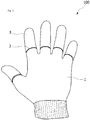
- FIG. 1 schematically illustrates a multipurpose safety glove according to an exemplary embodiment of the present disclosure.
- the multipurpose safety glove 100 of the present disclosure includes a body portion 1, finger portions 3 communicating with the body portion 1, and breakaway portions 2 formed between the body portion 1 and the finger portions 3, respectively.
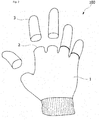
- Fig. 2 is a perspective view of the multipurpose safety glove in which specific finger portions of the finger portions 3 are separated from the body portion 1, in response to the breakaway portions 2 corresponding thereto being broken by force pulling from the outside, according to an exemplary embodiment of the present disclosure.
- the multipurpose safety glove 100 according to the present disclosure is constructed in such a manner that when the breakaway portions 2 connecting the body portion 1 and the finger portions 3 are broken, the finger portions 3 are separated from the body portion 1.
- the body portion (1) means the part of the glove which can protect the back of the hand, palm and a portion of the wrist.
- a fiber-forming component such as cotton or water-insoluble polystyrene, which can be used for safety glove, work glove, and the like, can be used without limitation when such a fiber-forming component can be contained in composite fiber.
- one or more yarns selected from among nylon, spandex, polyamide, ultra-high molecular weight polyethylene (UHMWPE), polyolefin-based fibers and polyester may be used.
- the polyamide-based synthetic resin may be nylon 6, nylon 6 ⁇ 6, nylon 6 ⁇ 10 or the like, and a polyamide-based synthetic resin having added functionality may also be used.
- the fiber-forming component may be modified to realize a fiber having desired physical properties, and is not limited to a specific example.
- the finger portions 3 are portions of the glove that accommodate the finger to protect the finger.
- the same fiber forming component as used for the body 1, as described above, can be used.
- breakaway portions 2 connecting the body portion 1 and the finger portions 3 will be described.
- the breakaway portions 2 may be located at portions where the body portion 1 and the finger portions 3 are connected, and may located in any portion of fingers without limitations in positions.
- the breakaway portions 2 may respectively be located between the first joint (or knuckle) of the finger where the finger and palm abut and the second joint of the finger.
- the work glove of the present disclosure having the breakaway portions 2 as described above is designed to facilitate working by protecting the hand of a worker, and is characterized by being able to be worn without fear of causing workplace accidents even in the work of dealing with a machine in which the wearing of the glove is restricted. That is, the breakaway portions 2 can be broken by force pulling from the outside, and the breakaway portions 2 corresponding to specific portions of fingers can be completely separated from the body portion 1 of the glove. It is possible to prevent a workplace accident in which the entire part of the hand is brought into a machine and is squeezed or cut off, due to the finger portion 3 of the glove being entangled in the rotating machine or the like.
- a fiber-forming component such as cotton or water-insoluble polystyrene which can be used for safety glove, work glove, and the like, can be used without limitation when the fiber-forming component can be contained in the composite fiber.
- one or more yarns selected from among nylon, spandex, polyamide, ultra-high molecular weight polyethylene (UHMWPE), polyolefin-based fibers and polyester can be used.
- the polyamide-based synthetic resin may be nylon 6, nylon 6 ⁇ 6, nylon 6 ⁇ 10 or the like, and a polyamide-based synthetic resin having added functionality may also be used.
- the fiber-forming component may be modified to realize a fiber having desired physical properties, and is not limited to a specific example.
- the first yarn which is insoluble in water, can remain in the woven state without being eluted during the step of eluting the water-soluble polymer of the breakaway portions 2.
- elastic fiber yarns such as nylon, spandex, polyolefin-based fibers or polyester have high elongation and excellent elastic recovery, so, when the glove is woven with such fibers, the perforation resistance is enhanced to the outside of the glove, and there is an advantage of having both of perforation resistance and elasticity to the inside or the glove.
- ultra-high molecular weight polyethylene (UHMWPE) and polyamide-based fibers can be used, and thus it is possible to manufacture work glove having safety.
- Tables 1 and 3 show examples of the present disclosure and the effects of ease of operation, ease of breaking, fraction defective and the like.
- nylon, spandex, polyamide, ultra-high molecular weight polyethylene (UHMWPE), polyolefin-based fibers or polyester is used as the first yarn.
- UHMWPE ultra-high molecular weight polyethylene
- polyolefin-based fibers or polyester is used as the first yarn.
- an average fineness (A) of the fiber forming the body portion 1 and the finger portion 3, and an average fineness (B) of the first yarn can satisfy following Formula 1.
- the A/B may be in the range of 30 to 70 as described above, the A/B may preferably be in the range of 35 to 65, and more preferably in the range of 40 to 60.
- the body part 1 and the finger part 3 can be provided with ease of operation so that the worker wears the glove at the work site and can easily carry out the work, and it is possible to provide safety so as to protect the worker's body from harmful substances, machines, devices, and the like.
- the breakaway portion 2 corresponding to a certain portion of the finger can be completely separated from the body portion 1 of the glove by the force pulling from the outside.
- the breakaway portion 2 can be easily broken, and the breakaway portion 2 can be firmly formed by being joined together with the water-soluble polymer during the glove manufacturing process, therefore the incidence of defects in which the breakaway portion 2 is broken in the production process can be reduced.
- A/B in Formula 1 exceeds 70, since the difference in the fineness of the two fibers becomes too large and the thickness of the fibers forming the body portion 1 and the finger portion 3 becomes too thick, it becomes difficult to carry out the work while wearing the glove. There is a problem in that the ease of operation is decreased.
- the water-soluble polymer may be any one selected from among polyvinyl alcohol (PVA), water-soluble acrylic (Acryl) polymer, polyethyleneimine (PEI) and water-soluble polyester, more preferably polyvinyl alcohol (PVA).
- PVA polyvinyl alcohol
- Acryl water-soluble acrylic
- PEI polyethyleneimine
- PVA polyvinyl alcohol
- the polyester component may be at least one selected from the group consisting of polyethylene terephthalate, polytrimethylene terephthalate, polybutylene terephthalate, polyhexylene terephthalate, polyethylene naphthalate, polybutylene naphthalate, polyethylene-1,2-bis (phenoxy) ethane-4,4'-dicarboxylate, polyethylene isophthalate/nephthalate copolymer, polybutylene terephthalate/isophthalate copolymer, and polybutylene terephthalate/decanedicarboxylate copolymer.
- the acrylic component may be polyacrylonitrile, in addition to the acrylonitrile monomers, as non-limiting examples, it may be a modified acrylic component that further includes monomers, such as fluoroalkyl methacrylate or fluoroalkyl acrylate, vinyl chloride, and vinylidene chloride.
- the water-soluble polymer is twisted together with the first yarn in the manufacturing process of the breakaway portion 2 to form thicker composite fibers, there arises no problem such as machine jamming or machine dropout that may occur when manufacturing the breakaway portion 2 with thin threads. Accordingly, in the manufacturing of the multipurpose safety glove of the present disclosure including the breakaway portions 2, the incidence ratio of defective articles is significantly decreased, and the productivity can be greatly increased. In addition, since a portion or all of the water-soluble polymer dissolves in water at a certain temperature range, when the accident, such as the insertion of glove into a rotating machine, occurs at a work site, the breakaway portion 2 corresponding to a certain portion of the finger can be broken, so that the corresponding finger portion 1 is completely separated from the body portion 1 of the glove.
- the safety glove of the present disclosure is manufactured using the above water-soluble polymer, a glove having excellent ease of breaking can be produced. As a result, it is possible to prevent a workplace accident in which the entire part of the hand part is brought into contact with the mechanical device and is squeezed or cut off, due to the finger portion of the glove is getting entangled in the rotating machine or the like.
- Tables 1 and 3 show the examples of the present disclosure and the effects such as ease of operation, ease of breaking, and fraction defective.
- Tables 1 and 3 It can be seen that an excellent glove satisfying both ease of operation and ease of breaking can be produced by weaving the breakaway portion 2 by twisting the first yarn and the second yarn, with any one of polyvinyl alcohol (PVA), water-soluble acrylic (Acryl) polymer, polyethyleneimine (PEI) being selected as a water-soluble polymer.
- PVA polyvinyl alcohol
- Acryl water-soluble acrylic
- PEI polyethyleneimine
- the water-soluble polymer may have a melting point of 40 to 100°C, preferably 40 to 80°C, and more preferably 40 to 60°C. In this temperature range, the water-soluble polymer can be easily eluted into water, so that the water treatment is not performed at an excessively high temperature, and thus the process can be performed more easily.
- the water-soluble polymer dissolves at a temperature lower than 40°C, it can also dissolve in water at room temperature, so that the process conditions may be more restrictive, and when it is dissolved in the range of more than 100°C, it may be difficult to carry out the water treatment step with higher temperature water.
- a yarn (twisted yarn) in the step (1) may be used without restriction as long as it can be used for weaving conventional safety glove, but it may be a covering yarn produced by covering and twisting two or more yarns.
- the first yarn may be a primary yarn
- the second yarn may be twisted as a covering composite yarn by covering the water-soluble polymer with the covering yarn, It is possible to obtain a glove satisfying both perforation resistance and elasticity when a multipurpose safety glove is woven using the above-mentioned twisted yarn.
- the glove of the present disclosure is woven using a composite yarn without using the twisted yarn, or woven with separating using two or more yarns, once the water-soluble polymer is eluted into the water in the elution step, the remaining fiber-forming component is too small, so that a breakaway portion 2 having excessively low in tensile strength is produced. Then, the breakaway portion 2 may be broken during the glove manufacturing process, thereby increasing the incidence ratio of the defective article and lowering the productivity. Therefore, the glove may be easily cut off even when performing a general work and the ease of operation may be decreased.
- the second yarn as the twisted yarn may be produced by twisting 2 to 5 strands of cover yarn of water-soluble polymer per each strand of the first yarn which is a primary yarn, more preferably, by twisting 3 to 4 strands of cover yarn of water-soluble polymer per each strand of the first yarn.
- the breakaway portion can be easily separated not only at the time of a danger but also at the time of performing a general operation, and the ease of operation can be decreased.
- more water-soluble polymer strands than the above-mentioned number are twisted, there is a problem that the breakaway portion is not broken at the time of danger in the work site and the worker cannot be sufficiently protected.
- the first yarn and the water-soluble polymer may be mixed in a weight ratio of 1:2 to 4, more preferably 1:2.5 to 3.5.
- the second yarn used in the step of manufacturing the breakaway portion 2 of the safety glove of the present disclosure contains more water-soluble polymer than the first yarn.
- the manufacturing step of the breakaway portion 2 can be performed with a fiber having a higher fineness than the process step of manufacturing the breakaway portion 2 using only a single yarn having a low fineness, it is possible to carry out the manufacturing step of the breakaway portion 2 with a fiber having a higher fineness than the manufacturing step of the breakaway portion 2 using only a single yarn having a lower fineness.
- the water treatment in step (2) may be carried out at a water temperature of 40 to 70°C, more preferably, at 40 to 60°C.
- the water-soluble polymer may have a melting point of 40 to 70°C, more preferably 40 to 60°C. Accordingly, when the water treatment is carried out in the above-mentioned temperature range, it is possible to elute all or a portion of the water-soluble polymer more easily.
- the water-soluble polymer may not dissolve in water at all.
- the process may become more complicated.
- step (3) of coating a portion or all of the breakaway portion 2 can be further performed.
- Step (3) may be performed simultaneously with or after step (2), the water-soluble polymer may be coated to allow the multipurpose safety glove to be used at the work site, either simultaneously with that a portion or all of the breakaway portion 2 is eluted, or later.
- the coating of step (3) may be carried out by any typical method of coating the glove without limitation so that it can be used at the work site, but it can be preferably carried out by a wet process.
- the coating by the wet process can be carried out preferably at a temperature of 40 to 120°C, more preferably at a temperature of 60°C to 120°C, and more preferably at a temperature of 80°C to 120°C.
- the solvent of the coating solution used in the coating step can be typically used without limitation as long as the coating component can be dissolved.
- an aprotic solvent may be used, and more preferably DMF(Dimethylformamide), MMF(Monomethylformamide), and the like may be used.
- the coating component may preferably be at least one selected from among acrylonitrile butadiene rubber (NBR), polyurethane, latex, and silicone.
- acrylonitrile butadiene rubber when performed an operation, such as a lathe or milling, which is in contact with a large amount of oil, acrylonitrile butadiene rubber (NBR) may be used as a coating component.
- NBR acrylonitrile butadiene rubber
- latex When performing rough work, such as carpentry, latex may be used as a coating component.
- polyurethane PU
- silicon may be used as a coating component.
- the coating solution may contain 40 wt% of the coating component, and the remaining amount may be the same as the solvent.
- the coating component is contained in the coating solution in an amount of less than 40 wt% or more than 40 wt%, the concentration of the desired coating component and the viscosity of the coating solution cannot be maintained, and the degree of coating becomes insignificant or excessive, it may be inconvenient to work while wearing gloves, and there is a problem that the ease of operation is inferior due to the lack of functions corresponding to the characteristics of each work site.
- the multipurpose safety glove which can be embodied according to the present disclosure includes a body portion 1, a finger portion 3, and a breakaway portion 2 which connect the body portion 1 and the finger portions 3.
- the breakaway portions 2 can be broken by force pulling from the outside, with a tensile strength thereof being 20 to 40 N when measured according to the standard of KS K 0520.
- the tensile strength may be preferably 20 N to 35 N, and more preferably 25 N to 35 N.
- the tensile strength may be a tensile strength at a gripping distance of 30 mm to 70 mm and a tensile speed of 10 mm/min to 100 mm/min.
- the finger portion 3 can be separated from the body portion 1 when the force pulling from the outside is 20 N or more, with reference to the above tensile strength range. When the force pulling from the outside is 40 N or more, the finger portion 3 can be completely separated from the body portion 1. Accordingly, when an accident such as the insertion of a glove into a rotating machine occurs at a work site, the breakaway portion 2 corresponding to a certain portion of the finger can be broken from the body portion 1, thereby preventing a workplace accident before the entire part of the hand of a worker is brought into the rotating machine and is squeezed or cut, due to the finger portion 3 being entangled in the machine or the like.
- the breakaway portion 2 of the glove can be broken not only at the time of a danger but also in a normal work process, there may be a problem in that the ease of operation is decreased.
- the tensile strength of the breakaway portion 2 exceeds 40 N, the external force pulling the finger portion 3 needs to be larger.
- the breakaway portion 2 may not be broken in an accident in a work site, such as the insertion of the glove being brought into the rotating machine, there may be a problem that the ease of cutting and safety are decreased.
- the breakaway portion 2 of the safety glove may contain up to 10 wt% of a water-soluble polymer, preferably 5 wt% or less, more preferably 3 wt% or less, and most preferably, a water-soluble polymer may not be present.
- a water-soluble polymer may not be present.
- the water-soluble polymer present in the glove may be eluted when the water treatment is performed in the work site or when the work is performed under the condition in which water is present, there may be a problem that the ease of operation is decreased.
- the following Examples, Comparative Examples and Experimental Examples will be described in detail.
- a body portion 1 and finger portions 3 were manufactured using a yarn satisfying a fiber type and a fineness represented in Table 1 below, and breakaway portions 2 were produced by twisting a first yarn of the Table 1 below and a second yarn satisfying the fiber type, fineness and weight ratio of water-soluble polymer.
- the nylon yarn contained in the body portion 1 was inserted into the yarn introduction apparatus, and the body portion of the glove was knitted with the yarn using the knitting machine. Then, a nylon yarn or the first yarn, acting as a primary yarn, was twisted with a second yarn, as a covering yarn, by covering the nylon yarn polyvinyl alcohol, water-soluble polymer. The covering yarn was twisted by twisting three strands of the polyvinyl alcohol, the water-soluble polymer, per each strain of the nylon yarn, the primary yarn. After knitting the breakaway portions 2 with the twisted second yarn, the finger portions 3 of the glove were knitted with the nylon yarn, such as the body portion 1, by continuous knitting, thereby manufacturing the glove.
- a multipurpose safety glove was prepared by knitting the body portion 1, the finger portions 3 and the breakaway portions 2 with the nylon yarn having the same fineness, in the same manner as in Example 1, except that no water-soluble polymer was used, thus a covering yarn was not used, and the breakaway portions 2 were knitted thinner.
- a multipurpose safety glove was prepared by knitting the body portion 1, the finger portions 3 and the breakaway portions 2 with the nylon yarn having the fineness represented in Table 2 below, in the same manner as in Example 1, except that no water-soluble polymer was used, thus a covering yarn was not used, and the breakaway portions 2 were knitted thinner.
- a multipurpose safety glove was prepared in the same manner as in Example 1, except that an alkali-soluble polyester was used instead of the water-soluble polymer.
- Examples 1 to 13 are superior to Comparative Examples 1 to 3 in ease of operation and ease of cutting and have a remarkably lower fraction defective compared to Comparative Examples 1 to 3.
- Example 1 exhibits excellent ease of operation as well as ease of breaking as compared with Comparative Example 1.
- the fraction defective of Example 1 is significantly lower than the fraction defective of Comparative Example 1, and thus it can be appreciated that Example 1 has excellent productivity.
- Example 1 is superior to Comparative Examples 2 in ease of operation and ease of cutting and has a fraction defective remarkably lower than Comparative Examples 2.
- Example 1 when the multipurpose safety gloves of Example 1 is compared with the multipurpose safety glove of Comparative Example 3 in which The breakaway portion 2 of the present disclosure was woven by twisting a first yarn with an alkali-soluble polyester in place of the water-soluble polymer, it can be appreciated that Example 1 exhibits excellent ease of operation as well as ease of cutting as compared with Comparative Example 3. In addition, it can be appreciated that the fraction defective of Example 1 is remarkably low.
Landscapes
- Engineering & Computer Science (AREA)
- Textile Engineering (AREA)
- Chemical & Material Sciences (AREA)
- Materials Engineering (AREA)
- Gloves (AREA)
- Professional, Industrial, Or Sporting Protective Garments (AREA)
Applications Claiming Priority (1)
| Application Number | Priority Date | Filing Date | Title |
|---|---|---|---|
| KR1020160110139A KR101682182B1 (ko) | 2016-08-29 | 2016-08-29 | 다용도 안전장갑의 제조방법 |
Publications (2)
| Publication Number | Publication Date |
|---|---|
| EP3290554A1 true EP3290554A1 (fr) | 2018-03-07 |
| EP3290554B1 EP3290554B1 (fr) | 2019-05-22 |
Family
ID=57571630
Family Applications (1)
| Application Number | Title | Priority Date | Filing Date |
|---|---|---|---|
| EP17187987.7A Active EP3290554B1 (fr) | 2016-08-29 | 2017-08-25 | Procédé de fabrication de gant de sécurité polyvalent et gant de sécurité polyvalent ainsi fabriqué |
Country Status (5)
| Country | Link |
|---|---|
| US (1) | US10709183B2 (fr) |
| EP (1) | EP3290554B1 (fr) |
| JP (1) | JP6383071B2 (fr) |
| KR (1) | KR101682182B1 (fr) |
| CN (1) | CN107788597A (fr) |
Cited By (1)
| Publication number | Priority date | Publication date | Assignee | Title |
|---|---|---|---|---|
| FR3101013A1 (fr) * | 2019-09-24 | 2021-03-26 | Spontex | Procédé de fabrication d’un gant de protection pourvu d’une jonction déchirable |
Families Citing this family (2)
| Publication number | Priority date | Publication date | Assignee | Title |
|---|---|---|---|---|
| CN109561743B (zh) * | 2016-06-29 | 2021-04-09 | 安塞尔有限公司 | 具有撕裂特征的安全手套 |
| KR101901736B1 (ko) | 2017-08-28 | 2018-10-01 | 주식회사 형제인터내셔널 | 찢김기능을 갖는 보호용 안전 장갑의 제조방법 |
Citations (3)
| Publication number | Priority date | Publication date | Assignee | Title |
|---|---|---|---|---|
| JP3162651U (ja) * | 2010-06-30 | 2010-09-09 | 一郎 達本 | 袋編みした袋編み製品 |
| US20130139295A1 (en) * | 2010-08-13 | 2013-06-06 | Profas Gmbh & Co. | Protective glove |
| US20150173438A1 (en) * | 2013-12-23 | 2015-06-25 | Innovate Squared, LLC | Safety glove |
Family Cites Families (31)
| Publication number | Priority date | Publication date | Assignee | Title |
|---|---|---|---|---|
| US474929A (en) * | 1892-05-17 | Levi l | ||
| US747730A (en) * | 1903-08-10 | 1903-12-22 | Ruedolf Kommer | Glove. |
| US1265124A (en) * | 1917-04-21 | 1918-05-07 | Grover Marcus Shumaker | Finger-cot. |
| US1358824A (en) * | 1920-04-01 | 1920-11-16 | Burden Everett | Glove |
| US1620434A (en) * | 1924-02-26 | 1927-03-08 | Burden Everett | Glove |
| GB1252680A (fr) * | 1969-07-17 | 1971-11-10 | ||
| US4045824A (en) * | 1976-06-11 | 1977-09-06 | Weppler Millie T | Glove for ring display |
| US4131952A (en) * | 1977-09-14 | 1979-01-02 | Brenning Jr Frederick K | Safety glove |
| US4507807A (en) * | 1983-04-18 | 1985-04-02 | Karkanen Kip M | Work glove finger structure |
| US4651350A (en) * | 1985-09-19 | 1987-03-24 | Zwicker Knitting Mills | Work glove |
| US4781178A (en) * | 1987-02-06 | 1988-11-01 | Gordon Kevin M | Orthopedic glove |
| JPH0261915U (fr) * | 1988-10-26 | 1990-05-09 | ||
| US5228142A (en) * | 1990-08-16 | 1993-07-20 | Yoswein Mcgreen Rebecca | Overwrap for fingers and hands and method for using it |
| JP3789489B2 (ja) * | 1992-04-04 | 2006-06-21 | 三菱瓦斯化学株式会社 | 耐衝撃性ポリアセタール組成物の製造方法 |
| KR0185297B1 (ko) | 1997-02-20 | 1999-04-01 | 김지수 | 로프견인식 오니제거대차 및 로프견인식 오니제거시스템 |
| KR19980068520U (ko) * | 1997-05-31 | 1998-12-05 | 이영모 | 부분적으로 찢어져서 탈리되는 작업용 안전면장갑 |
| JP3050830U (ja) * | 1998-01-23 | 1998-08-07 | 幸雄 丸山 | 指先カット可能手袋 |
| US6687911B2 (en) * | 1999-12-28 | 2004-02-10 | Martina Fitz | Handling aid for a tampon for feminine hygiene |
| JP2002088542A (ja) * | 2000-09-19 | 2002-03-27 | Sumitomo Rubber Ind Ltd | 作業用手袋およびその製造方法 |
| US8298464B2 (en) * | 2004-03-26 | 2012-10-30 | Toray Industries, Inc. | Fabric for clothing and a production method thereof |
| US7908891B2 (en) * | 2004-07-16 | 2011-03-22 | Ansell Healthcare Products Llc | Knitted glove |
| KR200377833Y1 (ko) * | 2004-12-07 | 2005-03-11 | 이우근 | 손가락 캡을 가진 방한 장갑 |
| KR100811863B1 (ko) | 2006-12-15 | 2008-03-10 | 전경수 | 절취부를 구비한 작업용 장갑 |
| US8458817B1 (en) * | 2010-10-22 | 2013-06-11 | Jonathan J. Babb | Glove having detachable segments with a ring attachment |
| EP2572598A1 (fr) * | 2011-09-21 | 2013-03-27 | Midas Co., Ltd. | Gants de travail avec sections de découpe |
| EP2866752B1 (fr) * | 2012-06-29 | 2018-04-25 | Ansell Limited | Articles de soins de plaie |
| US20140237701A1 (en) * | 2013-02-25 | 2014-08-28 | Ansell Limited | Multi-functional metal fabrication glove |
| US10231497B2 (en) * | 2013-06-10 | 2019-03-19 | Voesh Corporation | Skin care mask glove and mask sock |
| US9554603B2 (en) * | 2013-11-15 | 2017-01-31 | 5.11, Inc. | Glove with removable fingertips |
| CN105764368A (zh) * | 2013-11-29 | 2016-07-13 | 林成珪 | 具有撕裂预定线的功能性运动服 |
| US20170258155A1 (en) * | 2016-03-08 | 2017-09-14 | David M. Grigg | Smartphone gloves |
-
2016
- 2016-08-29 KR KR1020160110139A patent/KR101682182B1/ko active Active
-
2017
- 2017-08-23 CN CN201710727228.4A patent/CN107788597A/zh active Pending
- 2017-08-25 EP EP17187987.7A patent/EP3290554B1/fr active Active
- 2017-08-28 US US15/688,563 patent/US10709183B2/en active Active
- 2017-08-29 JP JP2017164735A patent/JP6383071B2/ja active Active
Patent Citations (3)
| Publication number | Priority date | Publication date | Assignee | Title |
|---|---|---|---|---|
| JP3162651U (ja) * | 2010-06-30 | 2010-09-09 | 一郎 達本 | 袋編みした袋編み製品 |
| US20130139295A1 (en) * | 2010-08-13 | 2013-06-06 | Profas Gmbh & Co. | Protective glove |
| US20150173438A1 (en) * | 2013-12-23 | 2015-06-25 | Innovate Squared, LLC | Safety glove |
Cited By (3)
| Publication number | Priority date | Publication date | Assignee | Title |
|---|---|---|---|---|
| FR3101013A1 (fr) * | 2019-09-24 | 2021-03-26 | Spontex | Procédé de fabrication d’un gant de protection pourvu d’une jonction déchirable |
| WO2021058486A1 (fr) * | 2019-09-24 | 2021-04-01 | Spontex | Procédé de fabrication d'un gant de protection pourvu d'une jonction déchirable |
| US12364295B2 (en) | 2019-09-24 | 2025-07-22 | Spontex | Method for manufacturing a protective glove provided with a tearable joint |
Also Published As
| Publication number | Publication date |
|---|---|
| EP3290554B1 (fr) | 2019-05-22 |
| CN107788597A (zh) | 2018-03-13 |
| JP6383071B2 (ja) | 2018-08-29 |
| KR101682182B1 (ko) | 2016-12-02 |
| JP2018035493A (ja) | 2018-03-08 |
| US10709183B2 (en) | 2020-07-14 |
| US20180055114A1 (en) | 2018-03-01 |
Similar Documents
| Publication | Publication Date | Title |
|---|---|---|
| EP3290554B1 (fr) | Procédé de fabrication de gant de sécurité polyvalent et gant de sécurité polyvalent ainsi fabriqué | |
| EP2633771B1 (fr) | Gants et procédé de production associé | |
| KR101890566B1 (ko) | 텅스텐사를 이용한 장갑 제조방법 및 장갑 | |
| EP2501847B1 (fr) | Gant de protection | |
| EP3998889B1 (fr) | Gant élastomère et son procédé de fabrication | |
| KR102387838B1 (ko) | 금속복합사를 이용한 안전장갑 및 그 제조방법 | |
| KR102212326B1 (ko) | 절단방지용 장갑 및 제조방법 | |
| EP2614733A2 (fr) | Gant | |
| WO2012033680A2 (fr) | Procédé de production de gants en film mince utilisant le procédé de découpage et de scellage et gants produits par ledit procédé | |
| WO2008102130A1 (fr) | Fil composite résistant aux coupures et vêtements produits à partir de ce fil | |
| EP3311687B1 (fr) | Élément femelle pour fermeture de contact | |
| KR101903149B1 (ko) | 다용도 안전장갑 | |
| KR101206337B1 (ko) | 유리사의 가공방법 및 이로부터 제조된 절단방지용 장갑 | |
| JPH09157981A (ja) | 柔軟で耐切創性に優れた紡績糸、繊維構造物および防護材 | |
| EP2308330B1 (fr) | Utilisation de gants à respiration active pour l'emballage et le tri de silicium à pureté élevée | |
| KR101433934B1 (ko) | 안전 장갑 및 그 제조 방법 | |
| WO2013156790A1 (fr) | Gant tricoté | |
| JP2016223054A (ja) | 耐切創性を備えた糸、編織物及び手袋 | |
| KR20170104259A (ko) | 방검복을 위한 복합 원사 및 이의 제조방법 | |
| CN222565178U (zh) | 一种带有涂层的易穿脱的安全手套 | |
| JP4256039B2 (ja) | 複合糸、繊維構造物およびその製造方法 | |
| JP3019835U (ja) | 作業用軍手の製法改良 | |
| CN222565177U (zh) | 一种提高安全性能的易穿脱手套 | |
| US12364295B2 (en) | Method for manufacturing a protective glove provided with a tearable joint | |
| DE202016101530U1 (de) | Schutzkleidung |
Legal Events
| Date | Code | Title | Description |
|---|---|---|---|
| PUAI | Public reference made under article 153(3) epc to a published international application that has entered the european phase |
Free format text: ORIGINAL CODE: 0009012 |
|
| STAA | Information on the status of an ep patent application or granted ep patent |
Free format text: STATUS: REQUEST FOR EXAMINATION WAS MADE |
|
| 17P | Request for examination filed |
Effective date: 20170825 |
|
| AK | Designated contracting states |
Kind code of ref document: A1 Designated state(s): AL AT BE BG CH CY CZ DE DK EE ES FI FR GB GR HR HU IE IS IT LI LT LU LV MC MK MT NL NO PL PT RO RS SE SI SK SM TR |
|
| AX | Request for extension of the european patent |
Extension state: BA ME |
|
| RBV | Designated contracting states (corrected) |
Designated state(s): AL AT BE BG CH CY CZ DE DK EE ES FI FR GB GR HR HU IE IS IT LI LT LU LV MC MK MT NL NO PL PT RO RS SE SI SK SM TR |
|
| RIC1 | Information provided on ipc code assigned before grant |
Ipc: A41D 19/015 20060101ALI20181004BHEP Ipc: D04B 1/28 20060101AFI20181004BHEP |
|
| GRAP | Despatch of communication of intention to grant a patent |
Free format text: ORIGINAL CODE: EPIDOSNIGR1 |
|
| STAA | Information on the status of an ep patent application or granted ep patent |
Free format text: STATUS: GRANT OF PATENT IS INTENDED |
|
| INTG | Intention to grant announced |
Effective date: 20181206 |
|
| GRAS | Grant fee paid |
Free format text: ORIGINAL CODE: EPIDOSNIGR3 |
|
| GRAA | (expected) grant |
Free format text: ORIGINAL CODE: 0009210 |
|
| STAA | Information on the status of an ep patent application or granted ep patent |
Free format text: STATUS: THE PATENT HAS BEEN GRANTED |
|
| AK | Designated contracting states |
Kind code of ref document: B1 Designated state(s): AL AT BE BG CH CY CZ DE DK EE ES FI FR GB GR HR HU IE IS IT LI LT LU LV MC MK MT NL NO PL PT RO RS SE SI SK SM TR |
|
| REG | Reference to a national code |
Ref country code: GB Ref legal event code: FG4D |
|
| REG | Reference to a national code |
Ref country code: CH Ref legal event code: EP |
|
| REG | Reference to a national code |
Ref country code: IE Ref legal event code: FG4D |
|
| REG | Reference to a national code |
Ref country code: DE Ref legal event code: R096 Ref document number: 602017004098 Country of ref document: DE |
|
| REG | Reference to a national code |
Ref country code: AT Ref legal event code: REF Ref document number: 1136232 Country of ref document: AT Kind code of ref document: T Effective date: 20190615 |
|
| REG | Reference to a national code |
Ref country code: NL Ref legal event code: MP Effective date: 20190522 |
|
| REG | Reference to a national code |
Ref country code: LT Ref legal event code: MG4D |
|
| PG25 | Lapsed in a contracting state [announced via postgrant information from national office to epo] |
Ref country code: NO Free format text: LAPSE BECAUSE OF FAILURE TO SUBMIT A TRANSLATION OF THE DESCRIPTION OR TO PAY THE FEE WITHIN THE PRESCRIBED TIME-LIMIT Effective date: 20190822 Ref country code: HR Free format text: LAPSE BECAUSE OF FAILURE TO SUBMIT A TRANSLATION OF THE DESCRIPTION OR TO PAY THE FEE WITHIN THE PRESCRIBED TIME-LIMIT Effective date: 20190522 Ref country code: LT Free format text: LAPSE BECAUSE OF FAILURE TO SUBMIT A TRANSLATION OF THE DESCRIPTION OR TO PAY THE FEE WITHIN THE PRESCRIBED TIME-LIMIT Effective date: 20190522 Ref country code: ES Free format text: LAPSE BECAUSE OF FAILURE TO SUBMIT A TRANSLATION OF THE DESCRIPTION OR TO PAY THE FEE WITHIN THE PRESCRIBED TIME-LIMIT Effective date: 20190522 Ref country code: SE Free format text: LAPSE BECAUSE OF FAILURE TO SUBMIT A TRANSLATION OF THE DESCRIPTION OR TO PAY THE FEE WITHIN THE PRESCRIBED TIME-LIMIT Effective date: 20190522 Ref country code: NL Free format text: LAPSE BECAUSE OF FAILURE TO SUBMIT A TRANSLATION OF THE DESCRIPTION OR TO PAY THE FEE WITHIN THE PRESCRIBED TIME-LIMIT Effective date: 20190522 Ref country code: PT Free format text: LAPSE BECAUSE OF FAILURE TO SUBMIT A TRANSLATION OF THE DESCRIPTION OR TO PAY THE FEE WITHIN THE PRESCRIBED TIME-LIMIT Effective date: 20190922 Ref country code: AL Free format text: LAPSE BECAUSE OF FAILURE TO SUBMIT A TRANSLATION OF THE DESCRIPTION OR TO PAY THE FEE WITHIN THE PRESCRIBED TIME-LIMIT Effective date: 20190522 Ref country code: FI Free format text: LAPSE BECAUSE OF FAILURE TO SUBMIT A TRANSLATION OF THE DESCRIPTION OR TO PAY THE FEE WITHIN THE PRESCRIBED TIME-LIMIT Effective date: 20190522 |
|
| PG25 | Lapsed in a contracting state [announced via postgrant information from national office to epo] |
Ref country code: RS Free format text: LAPSE BECAUSE OF FAILURE TO SUBMIT A TRANSLATION OF THE DESCRIPTION OR TO PAY THE FEE WITHIN THE PRESCRIBED TIME-LIMIT Effective date: 20190522 Ref country code: LV Free format text: LAPSE BECAUSE OF FAILURE TO SUBMIT A TRANSLATION OF THE DESCRIPTION OR TO PAY THE FEE WITHIN THE PRESCRIBED TIME-LIMIT Effective date: 20190522 Ref country code: GR Free format text: LAPSE BECAUSE OF FAILURE TO SUBMIT A TRANSLATION OF THE DESCRIPTION OR TO PAY THE FEE WITHIN THE PRESCRIBED TIME-LIMIT Effective date: 20190823 Ref country code: BG Free format text: LAPSE BECAUSE OF FAILURE TO SUBMIT A TRANSLATION OF THE DESCRIPTION OR TO PAY THE FEE WITHIN THE PRESCRIBED TIME-LIMIT Effective date: 20190822 |
|
| REG | Reference to a national code |
Ref country code: AT Ref legal event code: MK05 Ref document number: 1136232 Country of ref document: AT Kind code of ref document: T Effective date: 20190522 |
|
| PG25 | Lapsed in a contracting state [announced via postgrant information from national office to epo] |
Ref country code: CZ Free format text: LAPSE BECAUSE OF FAILURE TO SUBMIT A TRANSLATION OF THE DESCRIPTION OR TO PAY THE FEE WITHIN THE PRESCRIBED TIME-LIMIT Effective date: 20190522 Ref country code: RO Free format text: LAPSE BECAUSE OF FAILURE TO SUBMIT A TRANSLATION OF THE DESCRIPTION OR TO PAY THE FEE WITHIN THE PRESCRIBED TIME-LIMIT Effective date: 20190522 Ref country code: SK Free format text: LAPSE BECAUSE OF FAILURE TO SUBMIT A TRANSLATION OF THE DESCRIPTION OR TO PAY THE FEE WITHIN THE PRESCRIBED TIME-LIMIT Effective date: 20190522 Ref country code: AT Free format text: LAPSE BECAUSE OF FAILURE TO SUBMIT A TRANSLATION OF THE DESCRIPTION OR TO PAY THE FEE WITHIN THE PRESCRIBED TIME-LIMIT Effective date: 20190522 Ref country code: DK Free format text: LAPSE BECAUSE OF FAILURE TO SUBMIT A TRANSLATION OF THE DESCRIPTION OR TO PAY THE FEE WITHIN THE PRESCRIBED TIME-LIMIT Effective date: 20190522 Ref country code: EE Free format text: LAPSE BECAUSE OF FAILURE TO SUBMIT A TRANSLATION OF THE DESCRIPTION OR TO PAY THE FEE WITHIN THE PRESCRIBED TIME-LIMIT Effective date: 20190522 |
|
| REG | Reference to a national code |
Ref country code: DE Ref legal event code: R097 Ref document number: 602017004098 Country of ref document: DE |
|
| PG25 | Lapsed in a contracting state [announced via postgrant information from national office to epo] |
Ref country code: IT Free format text: LAPSE BECAUSE OF FAILURE TO SUBMIT A TRANSLATION OF THE DESCRIPTION OR TO PAY THE FEE WITHIN THE PRESCRIBED TIME-LIMIT Effective date: 20190522 Ref country code: SM Free format text: LAPSE BECAUSE OF FAILURE TO SUBMIT A TRANSLATION OF THE DESCRIPTION OR TO PAY THE FEE WITHIN THE PRESCRIBED TIME-LIMIT Effective date: 20190522 |
|
| PLBE | No opposition filed within time limit |
Free format text: ORIGINAL CODE: 0009261 |
|
| STAA | Information on the status of an ep patent application or granted ep patent |
Free format text: STATUS: NO OPPOSITION FILED WITHIN TIME LIMIT |
|
| PG25 | Lapsed in a contracting state [announced via postgrant information from national office to epo] |
Ref country code: TR Free format text: LAPSE BECAUSE OF FAILURE TO SUBMIT A TRANSLATION OF THE DESCRIPTION OR TO PAY THE FEE WITHIN THE PRESCRIBED TIME-LIMIT Effective date: 20190522 |
|
| 26N | No opposition filed |
Effective date: 20200225 |
|
| PG25 | Lapsed in a contracting state [announced via postgrant information from national office to epo] |
Ref country code: PL Free format text: LAPSE BECAUSE OF FAILURE TO SUBMIT A TRANSLATION OF THE DESCRIPTION OR TO PAY THE FEE WITHIN THE PRESCRIBED TIME-LIMIT Effective date: 20190522 |
|
| PG25 | Lapsed in a contracting state [announced via postgrant information from national office to epo] |
Ref country code: SI Free format text: LAPSE BECAUSE OF FAILURE TO SUBMIT A TRANSLATION OF THE DESCRIPTION OR TO PAY THE FEE WITHIN THE PRESCRIBED TIME-LIMIT Effective date: 20190522 Ref country code: LU Free format text: LAPSE BECAUSE OF NON-PAYMENT OF DUE FEES Effective date: 20190825 Ref country code: MC Free format text: LAPSE BECAUSE OF FAILURE TO SUBMIT A TRANSLATION OF THE DESCRIPTION OR TO PAY THE FEE WITHIN THE PRESCRIBED TIME-LIMIT Effective date: 20190522 |
|
| REG | Reference to a national code |
Ref country code: BE Ref legal event code: MM Effective date: 20190831 |
|
| PG25 | Lapsed in a contracting state [announced via postgrant information from national office to epo] |
Ref country code: FR Free format text: LAPSE BECAUSE OF NON-PAYMENT OF DUE FEES Effective date: 20190831 Ref country code: IE Free format text: LAPSE BECAUSE OF NON-PAYMENT OF DUE FEES Effective date: 20190825 |
|
| PG25 | Lapsed in a contracting state [announced via postgrant information from national office to epo] |
Ref country code: BE Free format text: LAPSE BECAUSE OF NON-PAYMENT OF DUE FEES Effective date: 20190831 |
|
| REG | Reference to a national code |
Ref country code: CH Ref legal event code: PL |
|
| PG25 | Lapsed in a contracting state [announced via postgrant information from national office to epo] |
Ref country code: CH Free format text: LAPSE BECAUSE OF NON-PAYMENT OF DUE FEES Effective date: 20200831 Ref country code: LI Free format text: LAPSE BECAUSE OF NON-PAYMENT OF DUE FEES Effective date: 20200831 |
|
| PG25 | Lapsed in a contracting state [announced via postgrant information from national office to epo] |
Ref country code: CY Free format text: LAPSE BECAUSE OF FAILURE TO SUBMIT A TRANSLATION OF THE DESCRIPTION OR TO PAY THE FEE WITHIN THE PRESCRIBED TIME-LIMIT Effective date: 20190522 |
|
| PG25 | Lapsed in a contracting state [announced via postgrant information from national office to epo] |
Ref country code: IS Free format text: LAPSE BECAUSE OF FAILURE TO SUBMIT A TRANSLATION OF THE DESCRIPTION OR TO PAY THE FEE WITHIN THE PRESCRIBED TIME-LIMIT Effective date: 20190922 |
|
| PG25 | Lapsed in a contracting state [announced via postgrant information from national office to epo] |
Ref country code: MT Free format text: LAPSE BECAUSE OF FAILURE TO SUBMIT A TRANSLATION OF THE DESCRIPTION OR TO PAY THE FEE WITHIN THE PRESCRIBED TIME-LIMIT Effective date: 20190522 Ref country code: HU Free format text: LAPSE BECAUSE OF FAILURE TO SUBMIT A TRANSLATION OF THE DESCRIPTION OR TO PAY THE FEE WITHIN THE PRESCRIBED TIME-LIMIT; INVALID AB INITIO Effective date: 20170825 |
|
| GBPC | Gb: european patent ceased through non-payment of renewal fee |
Effective date: 20210825 |
|
| PG25 | Lapsed in a contracting state [announced via postgrant information from national office to epo] |
Ref country code: MK Free format text: LAPSE BECAUSE OF FAILURE TO SUBMIT A TRANSLATION OF THE DESCRIPTION OR TO PAY THE FEE WITHIN THE PRESCRIBED TIME-LIMIT Effective date: 20190522 |
|
| PG25 | Lapsed in a contracting state [announced via postgrant information from national office to epo] |
Ref country code: GB Free format text: LAPSE BECAUSE OF NON-PAYMENT OF DUE FEES Effective date: 20210825 |
|
| PGFP | Annual fee paid to national office [announced via postgrant information from national office to epo] |
Ref country code: DE Payment date: 20250708 Year of fee payment: 9 |