EP3281969A1 - Corps formé à la presse et matériau composite - Google Patents
Corps formé à la presse et matériau composite Download PDFInfo
- Publication number
- EP3281969A1 EP3281969A1 EP16850870.3A EP16850870A EP3281969A1 EP 3281969 A1 EP3281969 A1 EP 3281969A1 EP 16850870 A EP16850870 A EP 16850870A EP 3281969 A1 EP3281969 A1 EP 3281969A1
- Authority
- EP
- European Patent Office
- Prior art keywords
- based resin
- composite material
- resin
- mass
- molded product
- Prior art date
- Legal status (The legal status is an assumption and is not a legal conclusion. Google has not performed a legal analysis and makes no representation as to the accuracy of the status listed.)
- Granted
Links
- 239000002131 composite material Substances 0.000 title claims abstract description 224
- 229920005989 resin Polymers 0.000 claims abstract description 419
- 239000011347 resin Substances 0.000 claims abstract description 419
- 229920000049 Carbon (fiber) Polymers 0.000 claims abstract description 225
- 239000004917 carbon fiber Substances 0.000 claims abstract description 225
- RTZKZFJDLAIYFH-UHFFFAOYSA-N Diethyl ether Chemical compound CCOCC RTZKZFJDLAIYFH-UHFFFAOYSA-N 0.000 claims abstract description 218
- 229920002647 polyamide Polymers 0.000 claims abstract description 137
- 239000000835 fiber Substances 0.000 claims abstract description 134
- 229920000412 polyarylene Polymers 0.000 claims abstract description 110
- VNWKTOKETHGBQD-UHFFFAOYSA-N methane Chemical compound C VNWKTOKETHGBQD-UHFFFAOYSA-N 0.000 claims abstract description 107
- 239000002245 particle Substances 0.000 claims abstract description 56
- 229920005992 thermoplastic resin Polymers 0.000 claims description 94
- 239000004793 Polystyrene Substances 0.000 claims description 34
- 230000007423 decrease Effects 0.000 claims description 22
- 230000014509 gene expression Effects 0.000 claims description 18
- 238000005259 measurement Methods 0.000 claims description 17
- 229920002223 polystyrene Polymers 0.000 claims description 16
- 230000003247 decreasing effect Effects 0.000 claims description 4
- 238000004519 manufacturing process Methods 0.000 description 71
- 229920001955 polyphenylene ether Polymers 0.000 description 69
- 229920000642 polymer Polymers 0.000 description 60
- 239000000956 alloy Substances 0.000 description 59
- 229910045601 alloy Inorganic materials 0.000 description 59
- 239000004721 Polyphenylene oxide Substances 0.000 description 53
- 229920002292 Nylon 6 Polymers 0.000 description 50
- 229920013636 polyphenyl ether polymer Polymers 0.000 description 47
- KRKNYBCHXYNGOX-UHFFFAOYSA-N citric acid Chemical compound OC(=O)CC(O)(C(O)=O)CC(O)=O KRKNYBCHXYNGOX-UHFFFAOYSA-N 0.000 description 42
- 238000000465 moulding Methods 0.000 description 34
- 238000000034 method Methods 0.000 description 19
- -1 poly(2,6-dimethyl-1,4-phenylene ether) Polymers 0.000 description 19
- 238000003825 pressing Methods 0.000 description 19
- 239000010410 layer Substances 0.000 description 17
- 239000002243 precursor Substances 0.000 description 16
- 239000004952 Polyamide Substances 0.000 description 15
- XEEYBQQBJWHFJM-UHFFFAOYSA-N Iron Chemical compound [Fe] XEEYBQQBJWHFJM-UHFFFAOYSA-N 0.000 description 14
- 238000011156 evaluation Methods 0.000 description 14
- 238000005452 bending Methods 0.000 description 13
- 238000001746 injection moulding Methods 0.000 description 13
- FFBHFFJDDLITSX-UHFFFAOYSA-N benzyl N-[2-hydroxy-4-(3-oxomorpholin-4-yl)phenyl]carbamate Chemical compound OC1=C(NC(=O)OCC2=CC=CC=C2)C=CC(=C1)N1CCOCC1=O FFBHFFJDDLITSX-UHFFFAOYSA-N 0.000 description 12
- 238000012360 testing method Methods 0.000 description 12
- 230000000052 comparative effect Effects 0.000 description 11
- 229920001577 copolymer Polymers 0.000 description 10
- 238000004898 kneading Methods 0.000 description 10
- 239000000126 substance Substances 0.000 description 10
- 239000003795 chemical substances by application Substances 0.000 description 9
- 229920002302 Nylon 6,6 Polymers 0.000 description 8
- 239000000463 material Substances 0.000 description 8
- 239000011159 matrix material Substances 0.000 description 8
- 238000004513 sizing Methods 0.000 description 8
- 229910052742 iron Inorganic materials 0.000 description 7
- 239000000203 mixture Substances 0.000 description 7
- QQOMQLYQAXGHSU-UHFFFAOYSA-N 2,3,6-Trimethylphenol Chemical compound CC1=CC=C(C)C(O)=C1C QQOMQLYQAXGHSU-UHFFFAOYSA-N 0.000 description 6
- NXXYKOUNUYWIHA-UHFFFAOYSA-N 2,6-Dimethylphenol Chemical compound CC1=CC=CC(C)=C1O NXXYKOUNUYWIHA-UHFFFAOYSA-N 0.000 description 6
- PPBRXRYQALVLMV-UHFFFAOYSA-N Styrene Chemical compound C=CC1=CC=CC=C1 PPBRXRYQALVLMV-UHFFFAOYSA-N 0.000 description 6
- 238000007731 hot pressing Methods 0.000 description 6
- 238000002347 injection Methods 0.000 description 6
- 239000007924 injection Substances 0.000 description 6
- 239000000155 melt Substances 0.000 description 6
- 238000002844 melting Methods 0.000 description 6
- 230000008018 melting Effects 0.000 description 6
- 229920002239 polyacrylonitrile Polymers 0.000 description 6
- 239000000654 additive Substances 0.000 description 5
- 238000010438 heat treatment Methods 0.000 description 5
- 238000009863 impact test Methods 0.000 description 5
- XLYOFNOQVPJJNP-UHFFFAOYSA-N water Substances O XLYOFNOQVPJJNP-UHFFFAOYSA-N 0.000 description 5
- GVLZQVREHWQBJN-UHFFFAOYSA-N 3,5-dimethyl-7-oxabicyclo[2.2.1]hepta-1,3,5-triene Chemical compound CC1=C(O2)C(C)=CC2=C1 GVLZQVREHWQBJN-UHFFFAOYSA-N 0.000 description 4
- 229920006127 amorphous resin Polymers 0.000 description 4
- 238000004458 analytical method Methods 0.000 description 4
- 238000000354 decomposition reaction Methods 0.000 description 4
- 230000000694 effects Effects 0.000 description 4
- 229910052736 halogen Inorganic materials 0.000 description 4
- 150000002367 halogens Chemical class 0.000 description 4
- 230000001788 irregular Effects 0.000 description 4
- QWVGKYWNOKOFNN-UHFFFAOYSA-N o-cresol Chemical compound CC1=CC=CC=C1O QWVGKYWNOKOFNN-UHFFFAOYSA-N 0.000 description 4
- 229920000299 Nylon 12 Polymers 0.000 description 3
- OFOBLEOULBTSOW-UHFFFAOYSA-N Propanedioic acid Natural products OC(=O)CC(O)=O OFOBLEOULBTSOW-UHFFFAOYSA-N 0.000 description 3
- 150000008064 anhydrides Chemical class 0.000 description 3
- 229920006038 crystalline resin Polymers 0.000 description 3
- 125000001033 ether group Chemical group 0.000 description 3
- 239000002778 food additive Substances 0.000 description 3
- 235000013373 food additive Nutrition 0.000 description 3
- 229920001519 homopolymer Polymers 0.000 description 3
- 230000001771 impaired effect Effects 0.000 description 3
- VZCYOOQTPOCHFL-UPHRSURJSA-N maleic acid Chemical compound OC(=O)\C=C/C(O)=O VZCYOOQTPOCHFL-UPHRSURJSA-N 0.000 description 3
- 239000011976 maleic acid Substances 0.000 description 3
- FPYJFEHAWHCUMM-UHFFFAOYSA-N maleic anhydride Chemical compound O=C1OC(=O)C=C1 FPYJFEHAWHCUMM-UHFFFAOYSA-N 0.000 description 3
- 229920006122 polyamide resin Polymers 0.000 description 3
- 229920002857 polybutadiene Polymers 0.000 description 3
- 239000011342 resin composition Substances 0.000 description 3
- 238000007493 shaping process Methods 0.000 description 3
- 239000000243 solution Substances 0.000 description 3
- VZCYOOQTPOCHFL-UHFFFAOYSA-N trans-butenedioic acid Natural products OC(=O)C=CC(O)=O VZCYOOQTPOCHFL-UHFFFAOYSA-N 0.000 description 3
- OMIHGPLIXGGMJB-UHFFFAOYSA-N 7-oxabicyclo[4.1.0]hepta-1,3,5-triene Chemical group C1=CC=C2OC2=C1 OMIHGPLIXGGMJB-UHFFFAOYSA-N 0.000 description 2
- 229920002943 EPDM rubber Polymers 0.000 description 2
- JHWNWJKBPDFINM-UHFFFAOYSA-N Laurolactam Chemical compound O=C1CCCCCCCCCCCN1 JHWNWJKBPDFINM-UHFFFAOYSA-N 0.000 description 2
- 239000004677 Nylon Substances 0.000 description 2
- 229920000305 Nylon 6,10 Polymers 0.000 description 2
- 239000005062 Polybutadiene Substances 0.000 description 2
- 230000008901 benefit Effects 0.000 description 2
- 125000004432 carbon atom Chemical group C* 0.000 description 2
- 150000001732 carboxylic acid derivatives Chemical class 0.000 description 2
- 239000001913 cellulose Substances 0.000 description 2
- 229920002678 cellulose Polymers 0.000 description 2
- 230000008859 change Effects 0.000 description 2
- 238000006243 chemical reaction Methods 0.000 description 2
- 238000000748 compression moulding Methods 0.000 description 2
- 125000000524 functional group Chemical group 0.000 description 2
- 230000009477 glass transition Effects 0.000 description 2
- 125000001183 hydrocarbyl group Chemical group 0.000 description 2
- 230000003993 interaction Effects 0.000 description 2
- QQVIHTHCMHWDBS-UHFFFAOYSA-N isophthalic acid Chemical compound OC(=O)C1=CC=CC(C(O)=O)=C1 QQVIHTHCMHWDBS-UHFFFAOYSA-N 0.000 description 2
- 229920001778 nylon Polymers 0.000 description 2
- 125000004430 oxygen atom Chemical group O* 0.000 description 2
- 239000008188 pellet Substances 0.000 description 2
- IYDGMDWEHDFVQI-UHFFFAOYSA-N phosphoric acid;trioxotungsten Chemical compound O=[W](=O)=O.O=[W](=O)=O.O=[W](=O)=O.O=[W](=O)=O.O=[W](=O)=O.O=[W](=O)=O.O=[W](=O)=O.O=[W](=O)=O.O=[W](=O)=O.O=[W](=O)=O.O=[W](=O)=O.O=[W](=O)=O.OP(O)(O)=O IYDGMDWEHDFVQI-UHFFFAOYSA-N 0.000 description 2
- 229920006111 poly(hexamethylene terephthalamide) Polymers 0.000 description 2
- 229920002285 poly(styrene-co-acrylonitrile) Polymers 0.000 description 2
- 229920002492 poly(sulfone) Polymers 0.000 description 2
- 229920006324 polyoxymethylene Polymers 0.000 description 2
- 230000008569 process Effects 0.000 description 2
- 239000002994 raw material Substances 0.000 description 2
- 238000000926 separation method Methods 0.000 description 2
- 239000002356 single layer Substances 0.000 description 2
- 229920001897 terpolymer Polymers 0.000 description 2
- 238000005979 thermal decomposition reaction Methods 0.000 description 2
- RNFJDJUURJAICM-UHFFFAOYSA-N 2,2,4,4,6,6-hexaphenoxy-1,3,5-triaza-2$l^{5},4$l^{5},6$l^{5}-triphosphacyclohexa-1,3,5-triene Chemical compound N=1P(OC=2C=CC=CC=2)(OC=2C=CC=CC=2)=NP(OC=2C=CC=CC=2)(OC=2C=CC=CC=2)=NP=1(OC=1C=CC=CC=1)OC1=CC=CC=C1 RNFJDJUURJAICM-UHFFFAOYSA-N 0.000 description 1
- JAHNSTQSQJOJLO-UHFFFAOYSA-N 2-(3-fluorophenyl)-1h-imidazole Chemical compound FC1=CC=CC(C=2NC=CN=2)=C1 JAHNSTQSQJOJLO-UHFFFAOYSA-N 0.000 description 1
- OEPOKWHJYJXUGD-UHFFFAOYSA-N 2-(3-phenylmethoxyphenyl)-1,3-thiazole-4-carbaldehyde Chemical compound O=CC1=CSC(C=2C=C(OCC=3C=CC=CC=3)C=CC=2)=N1 OEPOKWHJYJXUGD-UHFFFAOYSA-N 0.000 description 1
- FOPMDZJEFHUNBD-UHFFFAOYSA-N 2-oxidanylpropane-1,2,3-tricarboxylic acid Chemical compound OC(=O)CC(O)(C(O)=O)CC(O)=O.OC(=O)CC(O)(C(O)=O)CC(O)=O.OC(=O)CC(O)(C(O)=O)CC(O)=O FOPMDZJEFHUNBD-UHFFFAOYSA-N 0.000 description 1
- PYSRRFNXTXNWCD-UHFFFAOYSA-N 3-(2-phenylethenyl)furan-2,5-dione Chemical compound O=C1OC(=O)C(C=CC=2C=CC=CC=2)=C1 PYSRRFNXTXNWCD-UHFFFAOYSA-N 0.000 description 1
- IGSBHTZEJMPDSZ-UHFFFAOYSA-N 4-[(4-amino-3-methylcyclohexyl)methyl]-2-methylcyclohexan-1-amine Chemical compound C1CC(N)C(C)CC1CC1CC(C)C(N)CC1 IGSBHTZEJMPDSZ-UHFFFAOYSA-N 0.000 description 1
- 229920000178 Acrylic resin Polymers 0.000 description 1
- 239000004925 Acrylic resin Substances 0.000 description 1
- ATRRKUHOCOJYRX-UHFFFAOYSA-N Ammonium bicarbonate Chemical compound [NH4+].OC([O-])=O ATRRKUHOCOJYRX-UHFFFAOYSA-N 0.000 description 1
- 238000012935 Averaging Methods 0.000 description 1
- OKTJSMMVPCPJKN-UHFFFAOYSA-N Carbon Chemical compound [C] OKTJSMMVPCPJKN-UHFFFAOYSA-N 0.000 description 1
- BRLQWZUYTZBJKN-UHFFFAOYSA-N Epichlorohydrin Chemical compound ClCC1CO1 BRLQWZUYTZBJKN-UHFFFAOYSA-N 0.000 description 1
- YCKRFDGAMUMZLT-UHFFFAOYSA-N Fluorine atom Chemical compound [F] YCKRFDGAMUMZLT-UHFFFAOYSA-N 0.000 description 1
- 244000043261 Hevea brasiliensis Species 0.000 description 1
- 239000004609 Impact Modifier Substances 0.000 description 1
- 229920000571 Nylon 11 Polymers 0.000 description 1
- 229920003189 Nylon 4,6 Polymers 0.000 description 1
- 229920000572 Nylon 6/12 Polymers 0.000 description 1
- 229920000577 Nylon 6/66 Polymers 0.000 description 1
- 229920006152 PA1010 Polymers 0.000 description 1
- 229920006153 PA4T Polymers 0.000 description 1
- 229930040373 Paraformaldehyde Natural products 0.000 description 1
- ISWSIDIOOBJBQZ-UHFFFAOYSA-N Phenol Chemical compound OC1=CC=CC=C1 ISWSIDIOOBJBQZ-UHFFFAOYSA-N 0.000 description 1
- 239000004696 Poly ether ether ketone Substances 0.000 description 1
- 229930182556 Polyacetal Natural products 0.000 description 1
- 239000004962 Polyamide-imide Substances 0.000 description 1
- 239000004693 Polybenzimidazole Substances 0.000 description 1
- 239000004695 Polyether sulfone Substances 0.000 description 1
- 239000004697 Polyetherimide Substances 0.000 description 1
- 239000004734 Polyphenylene sulfide Substances 0.000 description 1
- 239000004743 Polypropylene Substances 0.000 description 1
- 239000004372 Polyvinyl alcohol Substances 0.000 description 1
- 229920006121 Polyxylylene adipamide Polymers 0.000 description 1
- 229920000297 Rayon Polymers 0.000 description 1
- 229910000831 Steel Inorganic materials 0.000 description 1
- 229920000147 Styrene maleic anhydride Polymers 0.000 description 1
- XTXRWKRVRITETP-UHFFFAOYSA-N Vinyl acetate Chemical compound CC(=O)OC=C XTXRWKRVRITETP-UHFFFAOYSA-N 0.000 description 1
- BZHJMEDXRYGGRV-UHFFFAOYSA-N Vinyl chloride Chemical compound ClC=C BZHJMEDXRYGGRV-UHFFFAOYSA-N 0.000 description 1
- 150000008065 acid anhydrides Chemical class 0.000 description 1
- 125000002252 acyl group Chemical group 0.000 description 1
- 150000001408 amides Chemical class 0.000 description 1
- 150000001412 amines Chemical class 0.000 description 1
- 239000003963 antioxidant agent Substances 0.000 description 1
- 230000003078 antioxidant effect Effects 0.000 description 1
- 239000007864 aqueous solution Substances 0.000 description 1
- TZYHIGCKINZLPD-UHFFFAOYSA-N azepan-2-one;hexane-1,6-diamine;hexanedioic acid Chemical compound NCCCCCCN.O=C1CCCCCN1.OC(=O)CCCCC(O)=O TZYHIGCKINZLPD-UHFFFAOYSA-N 0.000 description 1
- MAYCNCJAIFGQIH-UHFFFAOYSA-N buta-1,3-diene 5-phenylpenta-2,4-dienenitrile Chemical compound C=CC=C.N#CC=CC=CC1=CC=CC=C1 MAYCNCJAIFGQIH-UHFFFAOYSA-N 0.000 description 1
- 229920005549 butyl rubber Polymers 0.000 description 1
- 239000002134 carbon nanofiber Substances 0.000 description 1
- 239000002041 carbon nanotube Substances 0.000 description 1
- 229910021393 carbon nanotube Inorganic materials 0.000 description 1
- 239000011300 coal pitch Substances 0.000 description 1
- 150000001875 compounds Chemical class 0.000 description 1
- 239000000470 constituent Substances 0.000 description 1
- 238000001816 cooling Methods 0.000 description 1
- 238000005520 cutting process Methods 0.000 description 1
- 238000001035 drying Methods 0.000 description 1
- 229920001971 elastomer Polymers 0.000 description 1
- 239000013536 elastomeric material Substances 0.000 description 1
- 239000000839 emulsion Substances 0.000 description 1
- 229920006351 engineering plastic Polymers 0.000 description 1
- 230000001747 exhibiting effect Effects 0.000 description 1
- 238000000605 extraction Methods 0.000 description 1
- 239000000945 filler Substances 0.000 description 1
- 239000003063 flame retardant Substances 0.000 description 1
- 229910052731 fluorine Inorganic materials 0.000 description 1
- 239000011737 fluorine Substances 0.000 description 1
- 238000007306 functionalization reaction Methods 0.000 description 1
- 230000005484 gravity Effects 0.000 description 1
- 229910052739 hydrogen Inorganic materials 0.000 description 1
- 239000001257 hydrogen Substances 0.000 description 1
- 125000004435 hydrogen atom Chemical class [H]* 0.000 description 1
- 150000003949 imides Chemical class 0.000 description 1
- 239000012784 inorganic fiber Substances 0.000 description 1
- 239000011256 inorganic filler Substances 0.000 description 1
- 229910003475 inorganic filler Inorganic materials 0.000 description 1
- 239000004611 light stabiliser Substances 0.000 description 1
- 229920005610 lignin Polymers 0.000 description 1
- 239000004973 liquid crystal related substance Substances 0.000 description 1
- LVHBHZANLOWSRM-UHFFFAOYSA-N methylenebutanedioic acid Natural products OC(=O)CC(=C)C(O)=O LVHBHZANLOWSRM-UHFFFAOYSA-N 0.000 description 1
- 238000002156 mixing Methods 0.000 description 1
- 238000012986 modification Methods 0.000 description 1
- 230000004048 modification Effects 0.000 description 1
- 239000006082 mold release agent Substances 0.000 description 1
- 239000012778 molding material Substances 0.000 description 1
- 239000002121 nanofiber Substances 0.000 description 1
- 229920003052 natural elastomer Polymers 0.000 description 1
- 229920001194 natural rubber Polymers 0.000 description 1
- 150000002825 nitriles Chemical class 0.000 description 1
- 150000002905 orthoesters Chemical class 0.000 description 1
- 239000011301 petroleum pitch Substances 0.000 description 1
- 229920006287 phenoxy resin Polymers 0.000 description 1
- 239000013034 phenoxy resin Substances 0.000 description 1
- 230000000704 physical effect Effects 0.000 description 1
- 239000000049 pigment Substances 0.000 description 1
- 239000004014 plasticizer Substances 0.000 description 1
- 229920001643 poly(ether ketone) Polymers 0.000 description 1
- 229920001652 poly(etherketoneketone) Polymers 0.000 description 1
- 229920003207 poly(ethylene-2,6-naphthalate) Polymers 0.000 description 1
- 229920006110 poly(m-benzoyl4,4'-methylenebis(cyclohexylamine)) Polymers 0.000 description 1
- 229920003229 poly(methyl methacrylate) Polymers 0.000 description 1
- 229920006128 poly(nonamethylene terephthalamide) Polymers 0.000 description 1
- 229920001633 poly(α-methyl styrene) Polymers 0.000 description 1
- 229920006394 polyamide 410 Polymers 0.000 description 1
- 229920002312 polyamide-imide Polymers 0.000 description 1
- 229920001230 polyarylate Polymers 0.000 description 1
- 229920002480 polybenzimidazole Polymers 0.000 description 1
- 229920001707 polybutylene terephthalate Polymers 0.000 description 1
- 229920005668 polycarbonate resin Polymers 0.000 description 1
- 239000004431 polycarbonate resin Substances 0.000 description 1
- 229920000728 polyester Polymers 0.000 description 1
- 229920001225 polyester resin Polymers 0.000 description 1
- 239000004645 polyester resin Substances 0.000 description 1
- 229920000570 polyether Polymers 0.000 description 1
- 229920006393 polyether sulfone Polymers 0.000 description 1
- 229920002530 polyetherether ketone Polymers 0.000 description 1
- 229920001601 polyetherimide Polymers 0.000 description 1
- 239000011112 polyethylene naphthalate Substances 0.000 description 1
- 229920013716 polyethylene resin Polymers 0.000 description 1
- 229920000139 polyethylene terephthalate Polymers 0.000 description 1
- 239000005020 polyethylene terephthalate Substances 0.000 description 1
- 239000009719 polyimide resin Substances 0.000 description 1
- 229920001195 polyisoprene Polymers 0.000 description 1
- 229920001470 polyketone Polymers 0.000 description 1
- 230000000379 polymerizing effect Effects 0.000 description 1
- 239000004926 polymethyl methacrylate Substances 0.000 description 1
- 229920000306 polymethylpentene Polymers 0.000 description 1
- 239000011116 polymethylpentene Substances 0.000 description 1
- 229920005672 polyolefin resin Polymers 0.000 description 1
- 229920000069 polyphenylene sulfide Polymers 0.000 description 1
- 229920001155 polypropylene Polymers 0.000 description 1
- 229920005990 polystyrene resin Polymers 0.000 description 1
- 239000005077 polysulfide Substances 0.000 description 1
- 229920001021 polysulfide Polymers 0.000 description 1
- 150000008117 polysulfides Polymers 0.000 description 1
- 229920001343 polytetrafluoroethylene Polymers 0.000 description 1
- 239000004810 polytetrafluoroethylene Substances 0.000 description 1
- 229920002215 polytrimethylene terephthalate Polymers 0.000 description 1
- 229920003225 polyurethane elastomer Polymers 0.000 description 1
- 229920002451 polyvinyl alcohol Polymers 0.000 description 1
- 239000000843 powder Substances 0.000 description 1
- 239000002964 rayon Substances 0.000 description 1
- 230000009257 reactivity Effects 0.000 description 1
- 230000009467 reduction Effects 0.000 description 1
- 239000012783 reinforcing fiber Substances 0.000 description 1
- 239000005060 rubber Substances 0.000 description 1
- 229920006395 saturated elastomer Polymers 0.000 description 1
- 238000010008 shearing Methods 0.000 description 1
- 238000007711 solidification Methods 0.000 description 1
- 230000008023 solidification Effects 0.000 description 1
- 239000002904 solvent Substances 0.000 description 1
- 239000010959 steel Substances 0.000 description 1
- 229920003048 styrene butadiene rubber Polymers 0.000 description 1
- 239000004094 surface-active agent Substances 0.000 description 1
- 229920006027 ternary co-polymer Polymers 0.000 description 1
- 239000003017 thermal stabilizer Substances 0.000 description 1
- 238000002411 thermogravimetry Methods 0.000 description 1
- 229920006259 thermoplastic polyimide Polymers 0.000 description 1
- 229920002803 thermoplastic polyurethane Polymers 0.000 description 1
- 229920001187 thermosetting polymer Polymers 0.000 description 1
- 238000011179 visual inspection Methods 0.000 description 1
- 238000005303 weighing Methods 0.000 description 1
- 230000037303 wrinkles Effects 0.000 description 1
Images
Classifications
-
- C—CHEMISTRY; METALLURGY
- C08—ORGANIC MACROMOLECULAR COMPOUNDS; THEIR PREPARATION OR CHEMICAL WORKING-UP; COMPOSITIONS BASED THEREON
- C08J—WORKING-UP; GENERAL PROCESSES OF COMPOUNDING; AFTER-TREATMENT NOT COVERED BY SUBCLASSES C08B, C08C, C08F, C08G or C08H
- C08J5/00—Manufacture of articles or shaped materials containing macromolecular substances
- C08J5/04—Reinforcing macromolecular compounds with loose or coherent fibrous material
- C08J5/0405—Reinforcing macromolecular compounds with loose or coherent fibrous material with inorganic fibres
- C08J5/042—Reinforcing macromolecular compounds with loose or coherent fibrous material with inorganic fibres with carbon fibres
-
- C—CHEMISTRY; METALLURGY
- C08—ORGANIC MACROMOLECULAR COMPOUNDS; THEIR PREPARATION OR CHEMICAL WORKING-UP; COMPOSITIONS BASED THEREON
- C08J—WORKING-UP; GENERAL PROCESSES OF COMPOUNDING; AFTER-TREATMENT NOT COVERED BY SUBCLASSES C08B, C08C, C08F, C08G or C08H
- C08J5/00—Manufacture of articles or shaped materials containing macromolecular substances
- C08J5/04—Reinforcing macromolecular compounds with loose or coherent fibrous material
-
- C—CHEMISTRY; METALLURGY
- C08—ORGANIC MACROMOLECULAR COMPOUNDS; THEIR PREPARATION OR CHEMICAL WORKING-UP; COMPOSITIONS BASED THEREON
- C08J—WORKING-UP; GENERAL PROCESSES OF COMPOUNDING; AFTER-TREATMENT NOT COVERED BY SUBCLASSES C08B, C08C, C08F, C08G or C08H
- C08J5/00—Manufacture of articles or shaped materials containing macromolecular substances
- C08J5/04—Reinforcing macromolecular compounds with loose or coherent fibrous material
- C08J5/06—Reinforcing macromolecular compounds with loose or coherent fibrous material using pretreated fibrous materials
-
- C—CHEMISTRY; METALLURGY
- C08—ORGANIC MACROMOLECULAR COMPOUNDS; THEIR PREPARATION OR CHEMICAL WORKING-UP; COMPOSITIONS BASED THEREON
- C08K—Use of inorganic or non-macromolecular organic substances as compounding ingredients
- C08K7/00—Use of ingredients characterised by shape
- C08K7/02—Fibres or whiskers
-
- C—CHEMISTRY; METALLURGY
- C08—ORGANIC MACROMOLECULAR COMPOUNDS; THEIR PREPARATION OR CHEMICAL WORKING-UP; COMPOSITIONS BASED THEREON
- C08K—Use of inorganic or non-macromolecular organic substances as compounding ingredients
- C08K7/00—Use of ingredients characterised by shape
- C08K7/02—Fibres or whiskers
- C08K7/04—Fibres or whiskers inorganic
- C08K7/06—Elements
-
- C—CHEMISTRY; METALLURGY
- C08—ORGANIC MACROMOLECULAR COMPOUNDS; THEIR PREPARATION OR CHEMICAL WORKING-UP; COMPOSITIONS BASED THEREON
- C08L—COMPOSITIONS OF MACROMOLECULAR COMPOUNDS
- C08L71/00—Compositions of polyethers obtained by reactions forming an ether link in the main chain; Compositions of derivatives of such polymers
- C08L71/08—Polyethers derived from hydroxy compounds or from their metallic derivatives
- C08L71/10—Polyethers derived from hydroxy compounds or from their metallic derivatives from phenols
- C08L71/12—Polyphenylene oxides
-
- C—CHEMISTRY; METALLURGY
- C08—ORGANIC MACROMOLECULAR COMPOUNDS; THEIR PREPARATION OR CHEMICAL WORKING-UP; COMPOSITIONS BASED THEREON
- C08L—COMPOSITIONS OF MACROMOLECULAR COMPOUNDS
- C08L77/00—Compositions of polyamides obtained by reactions forming a carboxylic amide link in the main chain; Compositions of derivatives of such polymers
-
- C—CHEMISTRY; METALLURGY
- C08—ORGANIC MACROMOLECULAR COMPOUNDS; THEIR PREPARATION OR CHEMICAL WORKING-UP; COMPOSITIONS BASED THEREON
- C08J—WORKING-UP; GENERAL PROCESSES OF COMPOUNDING; AFTER-TREATMENT NOT COVERED BY SUBCLASSES C08B, C08C, C08F, C08G or C08H
- C08J2371/00—Characterised by the use of polyethers obtained by reactions forming an ether link in the main chain; Derivatives of such polymers
- C08J2371/08—Polyethers derived from hydroxy compounds or from their metallic derivatives
- C08J2371/10—Polyethers derived from hydroxy compounds or from their metallic derivatives from phenols
-
- C—CHEMISTRY; METALLURGY
- C08—ORGANIC MACROMOLECULAR COMPOUNDS; THEIR PREPARATION OR CHEMICAL WORKING-UP; COMPOSITIONS BASED THEREON
- C08J—WORKING-UP; GENERAL PROCESSES OF COMPOUNDING; AFTER-TREATMENT NOT COVERED BY SUBCLASSES C08B, C08C, C08F, C08G or C08H
- C08J2371/00—Characterised by the use of polyethers obtained by reactions forming an ether link in the main chain; Derivatives of such polymers
- C08J2371/08—Polyethers derived from hydroxy compounds or from their metallic derivatives
- C08J2371/10—Polyethers derived from hydroxy compounds or from their metallic derivatives from phenols
- C08J2371/12—Polyphenylene oxides
-
- C—CHEMISTRY; METALLURGY
- C08—ORGANIC MACROMOLECULAR COMPOUNDS; THEIR PREPARATION OR CHEMICAL WORKING-UP; COMPOSITIONS BASED THEREON
- C08J—WORKING-UP; GENERAL PROCESSES OF COMPOUNDING; AFTER-TREATMENT NOT COVERED BY SUBCLASSES C08B, C08C, C08F, C08G or C08H
- C08J2377/00—Characterised by the use of polyamides obtained by reactions forming a carboxylic amide link in the main chain; Derivatives of such polymers
- C08J2377/02—Polyamides derived from omega-amino carboxylic acids or from lactams thereof
-
- C—CHEMISTRY; METALLURGY
- C08—ORGANIC MACROMOLECULAR COMPOUNDS; THEIR PREPARATION OR CHEMICAL WORKING-UP; COMPOSITIONS BASED THEREON
- C08J—WORKING-UP; GENERAL PROCESSES OF COMPOUNDING; AFTER-TREATMENT NOT COVERED BY SUBCLASSES C08B, C08C, C08F, C08G or C08H
- C08J2377/00—Characterised by the use of polyamides obtained by reactions forming a carboxylic amide link in the main chain; Derivatives of such polymers
- C08J2377/06—Polyamides derived from polyamines and polycarboxylic acids
-
- C—CHEMISTRY; METALLURGY
- C08—ORGANIC MACROMOLECULAR COMPOUNDS; THEIR PREPARATION OR CHEMICAL WORKING-UP; COMPOSITIONS BASED THEREON
- C08J—WORKING-UP; GENERAL PROCESSES OF COMPOUNDING; AFTER-TREATMENT NOT COVERED BY SUBCLASSES C08B, C08C, C08F, C08G or C08H
- C08J2425/00—Characterised by the use of homopolymers or copolymers of compounds having one or more unsaturated aliphatic radicals, each having only one carbon-to-carbon double bond, and at least one being terminated by an aromatic carbocyclic ring; Derivatives of such polymers
- C08J2425/02—Homopolymers or copolymers of hydrocarbons
- C08J2425/04—Homopolymers or copolymers of styrene
- C08J2425/06—Polystyrene
-
- C—CHEMISTRY; METALLURGY
- C08—ORGANIC MACROMOLECULAR COMPOUNDS; THEIR PREPARATION OR CHEMICAL WORKING-UP; COMPOSITIONS BASED THEREON
- C08J—WORKING-UP; GENERAL PROCESSES OF COMPOUNDING; AFTER-TREATMENT NOT COVERED BY SUBCLASSES C08B, C08C, C08F, C08G or C08H
- C08J2471/00—Characterised by the use of polyethers obtained by reactions forming an ether link in the main chain; Derivatives of such polymers
- C08J2471/08—Polyethers derived from hydroxy compounds or from their metallic derivatives
- C08J2471/10—Polyethers derived from hydroxy compounds or from their metallic derivatives from phenols
-
- C—CHEMISTRY; METALLURGY
- C08—ORGANIC MACROMOLECULAR COMPOUNDS; THEIR PREPARATION OR CHEMICAL WORKING-UP; COMPOSITIONS BASED THEREON
- C08J—WORKING-UP; GENERAL PROCESSES OF COMPOUNDING; AFTER-TREATMENT NOT COVERED BY SUBCLASSES C08B, C08C, C08F, C08G or C08H
- C08J2471/00—Characterised by the use of polyethers obtained by reactions forming an ether link in the main chain; Derivatives of such polymers
- C08J2471/08—Polyethers derived from hydroxy compounds or from their metallic derivatives
- C08J2471/10—Polyethers derived from hydroxy compounds or from their metallic derivatives from phenols
- C08J2471/12—Polyphenylene oxides
-
- C—CHEMISTRY; METALLURGY
- C08—ORGANIC MACROMOLECULAR COMPOUNDS; THEIR PREPARATION OR CHEMICAL WORKING-UP; COMPOSITIONS BASED THEREON
- C08J—WORKING-UP; GENERAL PROCESSES OF COMPOUNDING; AFTER-TREATMENT NOT COVERED BY SUBCLASSES C08B, C08C, C08F, C08G or C08H
- C08J2477/00—Characterised by the use of polyamides obtained by reactions forming a carboxylic amide link in the main chain; Derivatives of such polymers
- C08J2477/02—Polyamides derived from omega-amino carboxylic acids or from lactams thereof
-
- C—CHEMISTRY; METALLURGY
- C08—ORGANIC MACROMOLECULAR COMPOUNDS; THEIR PREPARATION OR CHEMICAL WORKING-UP; COMPOSITIONS BASED THEREON
- C08J—WORKING-UP; GENERAL PROCESSES OF COMPOUNDING; AFTER-TREATMENT NOT COVERED BY SUBCLASSES C08B, C08C, C08F, C08G or C08H
- C08J2477/00—Characterised by the use of polyamides obtained by reactions forming a carboxylic amide link in the main chain; Derivatives of such polymers
- C08J2477/06—Polyamides derived from polyamines and polycarboxylic acids
Definitions
- the present invention relates to a press-molded product having excellent dimensional stability and mechanical strength, and a composite material.
- Patent Document 1 discloses a fiber-reinforced resin molded product using a thermoplastic resin, and discloses a method of manufacturing a press-molded product by cold-pressing a thermoplastic resin containing a polyamide 6 resin and carbon fibers.
- thermoplastic resin contained in the fiber-reinforced resin molded product a technique that uses a polymer alloy component, for example, a polymer alloy component of a polyamide-based resin and a polyarylene ether-based resin is known.
- a polyamide resin is a thermoplastic resin having features such as excellent mechanical strength, solvent resistance, and processability.
- a polyarylene ether-based resin is a thermoplastic resin which is excellent in various properties such as mechanical properties, heat resistance, cold resistance, and dimensional stability.
- Patent Document 2 proposes a technique for improving rigidity by adding an inorganic filler to an alloy of polyamide and polyphenylene ether for an exterior material.
- Patent Document 3 proposes a thermoplastic resin which consists of a polyphenylene ether resin, a polyamide resin, and inorganic fibers and is excellent in fluidity, rigidity, and strength.
- Patent Document 1 Although the press-molded product described in Patent Document 1 is excellent in mechanical properties at room temperature and room humidity, the physical properties thereof in high temperature and high humidity environments are not yet sufficient, and there is a demand for a press-molded product that can be used in more severe environments depending on the application. Furthermore, a molding material in the related art, which uses a polyamide-based resin, has excellent fluidity but is still insufficient from the viewpoint of formability. Therefore, it is necessary to achieve both the mechanical properties of a press-molded product and the formability of a composite material in high temperature and high humidity environments.
- the press-molded product described in Patent Document 1 uses the composite material using polyamide 6 (nylon 6) as the thermoplastic resin. Therefore, when the composite material is cold-pressed and cooled using the polyamide 6, volume shrinkage occurs and the shape of the carbon fibers contained in the composite material is exposed to the surface, which is a problem in outer appearance.
- polyamide 6 nylon 6
- thermoplastic resins described in Patent Documents 2 and 3 the resin compositions are examined so as to withstand use in high temperature and high humidity environments.
- the examination of the resin compositions is limited only to the injection molding applications, and in a case where the resin compositions are molded into injection-molded products, the weight average fiber length of the carbon fibers is too short to ensure mechanical properties.
- the shear force in a kneading step when a polyamide-based resin single component and two thermoplastic resin components (the polyamide-based resin and the polyarylene ether-based resin) are compared to each other, higher shear force is required in the case where the two thermoplastic resin components (the polyamide-based resin and the polyarylene ether-based resin) are used.
- the typical two thermoplastic resin components (the polyamide-based resin and the polyarylene ether-based resin) are used, an excessive molding pressure is required for injection molding.
- the molded product based on the polymer alloy using the polyamide-based resin and the polyarylene ether-based resin has lower impact resistance than that of a molded product using the polyamide-based resin single component.
- an object of the present invention is to provide a press-molded product containing carbon fibers, which satisfies all of (i) high mechanical properties of a press-molded product in high temperature and high humidity environments, (ii) good formability of a composite material, (iii) excellent surface appearance of a press-molded product, and (iv) impact strength at the same degree as that of a press-molded product using only a polyamide-based resin as a matrix, and a composite material used therein.
- the present invention provides the following means.
- Df is an average fiber diameter ( ⁇ m) of the carbon fibers.
- the press-molded product in the present invention has (i) high mechanical properties of a press-molded product in high temperature and high humidity environments, (ii) good formability of a composite material, (iii) excellent surface appearance of a press-molded product, and (iv) impact strength at the same degree as that of a press-molded product using only a polyamide-based resin as a matrix.
- carbon fibers used in the present invention in general, polyacrylonitrile (PAN)-based carbon fibers, petroleum and coal pitch-based carbon fibers, rayon-based carbon fibers, cellulose-based carbon fibers, lignin-based carbon fibers, phenol-based carbon fibers, vapor grown carbon fibers, and the like are known, and any of these carbon fibers may be suitably used in the present invention.
- PAN polyacrylonitrile
- polyacrylonitrile (PAN)-based carbon fibers are preferably used in the present invention from the viewpoint of excellent tensile strength.
- the tensile modulus thereof is preferably in a range of 100 GPa to 600 GPa, more preferably in a range of 200 GPa to 500 GPa, and even more preferably in a range of 230 GPa to 450 GPa.
- the tensile strength thereof is preferably in a range of 2000 MPa to 10000 MPa, and more preferably in a range of 3000 MPa to 8000 MPa.
- the carbon fibers used in the present invention may have a sizing agent adhered to the surface.
- the kind of the sizing agent may be appropriately selected according to the kinds of the carbon fibers and a thermoplastic resin, and is not particularly limited.
- ternary copolymer polyamide particles described in International Publication No. 2013/133421 are preferably used.
- nylon 6/nylon 66/nylon 12 weight ratio: 45/15/40 wt%, which is a sizing agent described in Example 1 of the publication, is used
- a sea-island structure in which one of a polyamide-based resin (X) and a polyarylene ether-based resin (Y) forms a sea phase and the other forms an island phase can be easily formed up to the inside of a bundle of the carbon fibers.
- the weight average fiber length of the carbon fibers used in the present invention is 1 mm or more, and preferably 1 mm or more and 100 mm or less.
- the weight average fiber length of the carbon fibers is more preferably 3 mm or more and 80 mm or less, and even more preferably 5 mm or more and 60 mm or less.
- the weight average fiber length is 100 mm or less, the fluidity of the composite material does not decrease, and a molded product can easily obtain a desired shape during press molding. On the other hand, in a case where the weight average fiber length is 1 mm or more, the mechanical strength of the molded product does not decrease.
- the weight average fiber length of carbon fibers is less than 1 mm.
- carbon fibers having different fiber lengths may be used in combination.
- the weight average fiber length of the carbon fibers used in the present invention may have a single peak or may have a plurality of peaks.
- the average fiber length of the carbon fibers can be obtained on the basis of Expression (a) by measuring the fiber lengths of 100 fibers randomly extracted from the molded product up to 1 mm unit using a caliper or the like.
- the number average fiber length and the weight average fiber length have the same value.
- Extraction of the carbon fibers from the molded product can be achieved, for example, by performing a heating treatment on the molded product at about 500°C for about 1 hour and removing the resin in a furnace.
- the fiber diameter of the carbon fibers used in the present invention may be appropriately determined depending on the kind of the carbon fibers, and is not particularly limited.
- the average fiber diameter is typically preferably in a range of 3 ⁇ m to 50 ⁇ m, more preferably in a range of 4 ⁇ m to 12 ⁇ m, and even more preferably in a range of 5 ⁇ m to 8 ⁇ m.
- the average fiber diameter refers to the diameter of a single fiber of the carbon fibers. Therefore, in a case where the carbon fibers are in the form of a fiber bundle, the average fiber length refers not to the diameter of the fiber bundle but to the diameter of the carbon fiber (single fiber) constituting the fiber bundle.
- the average fiber diameter of the carbon fibers can be measured, for example, by the method described in JIS R-7607:2000 .
- the volume fraction of the carbon fibers (carbon fiber volume fraction", hereinafter, simply referred to as "Vf') in the molded product, which is defined by Expression (c), is preferably 3 vol% or more and 60 vol% or less. More preferably, the carbon fiber volume fraction is 10 vol% or more and 60 vol% or less, more preferably 10 vol% or more and 50 vol% or less, even more preferably 20 vol% or more and 50 vol% or less, and most preferably 25 vol% or more and 45 vol% or less.
- Carbon fibers volume fraction Vf 100 ⁇ carbon fiber volume / carbon fiber volume + thermoplastic resin volume
- the fiber areal weight of the carbon fibers in the molded product is not particularly limited, and is typically set to 25 g/m 2 or more to 10000 g/m 2 or less.
- the carbon fibers included in the press-molded product includes carbon fiber bundles.
- the carbon fibers used in the present invention may include fiber bundles, and may have a mixture of both single fibers and fiber bundles.
- the number of single fibers constituting each fiber bundle may be substantially uniform for the individual fiber bundles and may be different.
- the number of single fibers constituting each fiber bundle used in the present invention is not particularly limited, and is typically set to be in a range of several to 100,000.
- the carbon fibers as a raw material are in the form of a fiber bundle which is a collection of thousands to tens of thousands of filaments.
- the entanglement of the fiber bundles becomes locally thick, and there may be a case where it is difficult to obtain a thin-walled molded product. Therefore, in the case of using the carbon fibers, the fiber bundles are typically extended for use.
- the carbon fibers in the present invention preferably include carbon fiber bundles consisting of a specific number or more of carbon fibers by controlling the degree of opening of the fiber bundles, and more preferably include less than a specific number of carbon fibers (single fibers) or carbon fiber bundles.
- the carbon fiber bundle is a bundle including 10 or more single carbon fibers
- a carbon fiber bundle (A) consisting of a critical number or more of single fibers defined by Expression (1) is more preferable.
- Critical number of single fibers 600 / Df
- Df is the average fiber diameter ( ⁇ m) of the carbon fibers.
- Df uses the value in a case where the unit is ⁇ m.
- the carbon fibers in the present invention include the carbon fiber bundles (A) consisting of the critical number of single fibers defined in Expression (1) and the other carbon fibers extended, that is, carbon fibers in the form of single fibers or fiber bundles consisting less than the critical number of single fibers.
- the proportion of the carbon fiber bundles (A) with respect to the total amount of the carbon fibers in the molded product is preferably more than 0 vol% and less than 99 vol%, more preferably 20 vol% or more and less than 99 vol%, even more preferably 30 vol% or more and less than 95 vol%, and most preferably 50 vol% or more and less than 90 vol%.
- Vf the fiber volume fraction
- the average number (N) of fibers in the carbon fiber bundles (A) can be appropriately determined in a range in which the object of the present invention is not impaired, and is not particularly limited.
- N is typically set to be in a range of 1 ⁇ N ⁇ 12000, but more preferably satisfies Expression (2). 6 ⁇ 10 3 / Df 2 ⁇ N ⁇ 6 ⁇ 10 5 / Df 2
- Df is the average fiber diameter ( ⁇ m) of the carbon fibers.
- Df in expression (2) uses the value in a case where the unit is ⁇ m.
- the major axis directions of the fibers are randomly dispersed in two-dimensions in the in-plane directions of the molded product.
- being dispersed at two-dimensional random means that carbon fibers are oriented not in a specific direction such as one direction in the in-plane directions of the molded product but disorderedly and thus are arranged in a sheet plane without exhibiting specific directivity as a whole.
- the molded product obtained by using discontinuous fibers dispersed at two-dimensional random is a substantially isotropic molded product having no in-plane anisotropy.
- the carbon fibers contained in the composite material are also dispersed at two-dimensional random in the in-plane directions of the molded product.
- the in-plane directions of the molded product are directions orthogonal to the plate thickness direction of the molded product, which mean arbitrary directions in the same plane (one of parallel planes which are orthogonal to the plate thickness direction) while each of the longitudinal direction or the width direction indicates a fixed direction.
- the degree of two-dimensional random orientation is evaluated by obtaining the ratio between tensile moduli in two orthogonal directions.
- the (E ⁇ ) ratio obtained by dividing a larger one of the values of the tensile moduli respectively measured in an arbitrary direction of the molded product and the direction orthogonal to the arbitrary direction by a smaller one of the values is 2 or less, and more preferably 1.3 or less, it can be evaluated that the carbon fibers are randomly dispersed in two-dimensions.
- the polyamide-based resin (X) in the present invention is not particularly limited, and for example, polyamide-based resins such as polyamide 6, polyamide 11, polyamide 12, polyamide 46, polyamide 56, polyamide 410, polyamide 510, polyamide 66, polyamide 610, polyamide 612, polyamide 1010, polyamide 4T, polyamide 5T, polyamide 5I, polyamide 6T, polyamide 6I, a polyamide 4,6 copolymer, polyamide 6.12, polyamide 9T, polyamide MXD6, a homopolymer such as a polyamide (polyamide PACMI) formed by polymerizing isophthalic acid and bis(3-methyl-4-aminocyclohexyl)methane, and a copolymer or mixture thereof may be used.
- polyamide-based resins such as polyamide 6, polyamide 11, polyamide 12, polyamide 46, polyamide 56, polyamide 410, polyamide 510, polyamide 66, polyamide 610, polyamide 612, polyamide 1010, polyamide
- polyamide 6, polyamide 66, polyamide 610, and polyamide 6T are preferably used, and polyamide 6 or polyamide 66 is more preferably used.
- the polyamide-based resin may be of only one kind or two or more kinds.
- two or more kinds of polyamide-based resins are used in combination, for example, an embodiment in which polyamide-based resins having different softening points or melting points are used in combination, an embodiment in which polyamide-based resins having different average molecular weights are used in combination, and the like may be employed.
- the embodiment is not limited thereto.
- a polyamide derivative in which a functional group reactive with a carboxylic acid is introduced into a terminal group or a side chain of a polyamide resin may also be used.
- the polyamide-based resin may be referred to as a PA resin in some cases.
- a method of manufacturing the polyarylene ether-based resin (Y) in the present invention is well known in the related art, and a large number of polyarylene ether-based resins can be commercially acquired.
- the polyarylene ether resin has repeating units having the following formula: (in the formula, Z 1 's each independently represent a halogen, a unsubstituted or substituted C1 to C12 hydrocarbyl (here, the hydrocarbyl group is not a tert-hydrocarbyl), a C1 to C12 hydrocarbylthio, a C1 to C12 hydrocarbyloxy, or a C2 to C12 halohydrocarbyloxy, where the halogen and oxygen atoms are separated by at least two carbon atoms; and Z 2 's each independently represent hydrogen, a halogen, a unsubstituted or substituted C1 to C12 hydrocarbyl (here, the hydrocarbyl group is not a tert-hydrocarbyl), a C1 to C12 hydrocarbylthio, a C1 to C12 hydrocarbyloxy, or a C2 to C12 halohydrocarbyloxy, where the
- the polyarylene ether-based resin is not particularly limited, but may be a polyarylene ether resin or a modified polyarylene ether resin.
- a polyphenylene ether resin or a modified polyphenylene ether resin is particularly preferable.
- polyphenylene ether resin examples thereof include poly(2,6-dimethyl-1,4-phenylene ether), poly(2-methyl-6-ethyl-1,4-phenylene ether), poly(2-methyl-6-phenyl-1,4-phenylene ether), and poly(2,6-dichloro-1,4-phenylene ether) although there is no particular limitation.
- a copolymer of the polyphenylene ether resin is not particularly limited, examples thereof include those having a polyphenylene ether structure as a main component, such as a copolymer of 2,6-dimethylphenol and 2,3,6-trimethylphenol, a copolymer of 2,6-dimethylphenol and o-Cresol, and a copolymer of 2,3,6-trimethylphenol and o-Cresol. From the viewpoint of mechanical strength, poly(2,6-dimethyl-1,4-phenylene ether), a copolymer of 2,6-dimethylphenol and 2,3,6-trimethylphenol, and a mixture thereof are preferable.
- the polyphenylene ether resin one kind may be singly used, or two or more kinds may be used in combination.
- the polyphenylene ether resin may include other various phenylene ether units as partial structures without departing from the desired effects of the present invention.
- the phenylene ether units are not limited to the following, examples thereof include 2-(dialkylaminomethyl)-6-methylphenylene ether units and 2-(N-alkyl-N-phenylaminomethyl)-6-methylphenylene ether units.
- a modified polyphenylene ether resin obtained by reacting (modifying) a portion or the entirety of the polyphenylene ether with a functionalizing agent including an acyl functional group and one or more kinds selected from the group consisting of carboxylic acid, acid anhydride, acid amide, imide, amine, orthoester, and an hydroxyl carboxylic acid ammonium salt may be used.
- the polyarylene ether-based resin may be of only one kind or two or more kinds.
- polyarylene ether-based resin As an embodiment in which two or more kinds of polyarylene ether-based resin are used in combination, for example, an embodiment in which polyarylene ether-based resin having different softening points or melting points are used in combination, an embodiment in which polyarylene ether-based resin having different average molecular weights are used in combination, and the like may be employed. However, the embodiment is not limited thereto.
- the polyphenylene ether may be referred to as a PPE resin in some cases.
- the mass ratio of the polyarylene ether-based resin (Y) to 100 parts by mass of the polyamide-based resin (X) is preferably 20 parts by mass or more and 300 parts by mass or less. In this range, the rate of decrease in bending strength in a high temperature and high humidity range can be preferably suppressed.
- the lower limit of the mass ratio of the polyarylene ether-based resin (Y) to 100 parts by mass of the polyamide-based resin is preferably 20 parts by mass or more, more preferably 30 parts by mass or more, even more preferably 50 parts by mass or more, and most preferably 70 parts by mass or more.
- the upper limit of the mass ratio of the polyarylene ether-based resin (Y) to 100 parts by mass of the polyamide-based resin is preferably 300 parts by mass or less, more preferably 240 parts by mass or less, even more preferably 200 parts by mass or less, and most preferably 150 parts by mass or less.
- the press-molded product and the composite material in the present invention further contain a thermoplastic resin (Z) in addition to the polyamide-based resin (X) and the polyarylene ether-based resin (Y).
- the thermoplastic resin (Z) used may be of only one kind or two or more kinds.
- thermoplastic resin (Z) is not limited, but is preferably a polystyrene-based resin.
- polystyrene-based resin examples include styrene polymers modified by mixing or interaction of a homopolymer of styrene or a derivative thereof, and a natural or synthetic elastomeric material such as polybutadiene, polyisoprene, butyl rubber, EPDM rubber, an ethylene-propylene copolymer, natural rubber, polysulfide rubber, polyurethane rubber, and epichlorohydrin, and styrene-containing copolymers such as a styrene-acrylonitrile copolymer (SAN), a styrene-butadiene copolymer, a styrene-acrylonitrile-butadiene terpolymer (ABS), a styrene-maleic anhydride copolymer, poly( ⁇ -methyl-styrene), and an ethylvinylbenzene-divinylbenzene copolymer.
- a preferable resin for the present invention is a rubber-modified polystyrene mixed with or grafted to 3 to 30 wt%, preferably 4 to 12 wt% of a polystyrene homopolymer, polybutadiene rubber, or EPDM rubber.
- the polystyrene-based resin may be of only one kind or two or more kinds.
- two or more kinds of polystyrene-based resins are used in combination, for example, an embodiment in which polystyrene-based resins having different softening points or melting points are used in combination, an embodiment in which polystyrene-based resins having different average molecular weights are used in combination, and the like may be employed.
- the embodiment is not limited thereto.
- the polystyrene may be referred to as a PS resin in some cases.
- the lower limit of the mass ratio of the thermoplastic resin (Z) to 100 parts by mass of the polyamide-based resin (X) is preferably 0.5 parts by mass or more, more preferably 1 part by mass or more, even more preferably 5 parts by mass or more, even more preferably 10 parts by mass or more, even more preferably 20 parts by mass or more, particularly preferably 30 parts by mass or more, and most preferably 30 parts by mass or more.
- the upper limit of the mass ratio of the thermoplastic resin (Z) to 100 parts by mass of the polyamide-based resin (X) is preferably 300 parts by mass or less, more preferably 200 parts by mass or less, even more preferably 150 parts by mass or less, even more preferably 120 parts by mass or less, particularly preferably 100 parts by mass or less, and most preferably 80 parts by mass or less.
- thermoplastic resin (Z) in addition to the polyamide-based resin (X) and the polyarylene ether-based resin (Y) in the press-molded product and the composite material in the present invention, it is preferable that the viscosity at 230°C in dynamic viscoelasticity measurement at a rate of temperature decrease of 5 °C/min, decreasing from 270°C to 200°C, and 10 rad/sec is 10,000 to 60,000 Pa ⁇ sec.
- a polymer alloy consisting of the polyamide-based resin (X), the polyarylene ether resin (Y), and the thermoplastic resin (Z) has a higher viscosity than the polyamide-based resin (X) single component, and as a result, the injection pressure is approximately doubled in a case of injection molding.
- the press-molded product and the composite material in the present invention compared to a case where only the polyamide-based resin (X) is used as a matrix resin, there is no significant difference in viscosity ⁇ during dynamic viscoelasticity measurement, and the viscosity is in a range which is substantially the same as that of the press-molded product manufactured with the polyamide-based resin (X).
- the above-mentioned viscosity ⁇ is preferably 0.6 ⁇ x or more and 1.4 ⁇ x or less.
- ⁇ x represents the viscosity value of the press-molded product generated by replacing the polyarylene ether-based resin (Y) and the thermoplastic resin (Z) with the polyamide-based resin (X) in the present invention.
- the lower limit thereof is more preferably 0.7 ⁇ x or more, and even more preferably 0.8 ⁇ x or more.
- the upper limit thereof is more preferably 1.3 ⁇ x or more, and even more preferably 1.2 ⁇ x or more.
- the unit of ⁇ and ⁇ x is Pa ⁇ sec.
- a cold-press-molded product capable of maintaining high mechanical properties even in high temperature and high humidity environments while maintaining excellent spreadability, formability, and fluidity can be produced.
- one of the composite material and the press-molded product may be selected and measured.
- the composite material and the press-molded product of the present invention contain a compatibilizer.
- the compatibilizer is not particularly limited as long as the compatibilizer is a compatibilizer for the polyamide-based resin (X) and the polyarylene ether-based resin (Y).
- the content of the compatibilizer with respect to 100 parts by mass of the polyarylene ether-based resin (Y) is preferably 0.05 parts by mass or more, more preferably 0.1 parts by mass or more, even more preferably 0.2 parts by mass or more, and even more preferably 0.3 parts by mass or more.
- the upper limit thereof is preferably 10 parts by mass or less, more preferably 8 parts by mass or less, and even more preferably 6 parts by mass or less.
- the compatibilizer means a polyfunctional compound which interacts with the polyamide-based resin, the PPE resin, or both. This interaction may be chemical (for example, grafting) or physical (for example, affecting the surface properties of a dispersed phase).
- the kind of the compatibilizer is not particularly limited, and a well-known compatibilizer as described in, for example, JP-A-11-241017 may be used.
- At least one selected from citric acid, maleic acid, itaconic acid, and anhydrides thereof can be used.
- Citric acid, maleic acid, or an anhydride thereof is preferable.
- Maleic acid or an anhydride thereof can compatibilize polyamide and polyphenylene ether in a relatively small amount and is thus preferable.
- Citric acid is the most preferable material because sufficient reactivity is achieved in the two reactions including the functionalization reaction of the PPE resin and the reaction between the functionalized PPE resin and the polyamide-based resin and the decomposition reaction of nylon by the unreacted compatibilizer is not accelerated.
- thermoplastic resin may be separately used in combination as a resin other than the polyamide-based resin (X) and the polyarylene ether-based resin (Y) (in the case of using the thermoplastic resin (Z), as a resin other than the polyamide-based resin (X), the polyarylene ether-based resin (Y), and the thermoplastic resin (Z)).
- polyolefin-based resins such as a polyethylene resin, a polypropylene resin, a polybutadiene resin, a polymethylpentene resin, a vinyl chloride resin, a vinylidene chloride resin, a vinyl acetate resin, and a polyvinyl alcohol resin
- polyester resins such as a polyethylene terephthalate resin, a polyethylene naphthalate resin, a polybutylene terephthalate resin, a polytrimethylene terephthalate resin, and a liquid-crystal polyester, a polyacetal resin, a polycarbonate resin, a polyoxymethylene resin, a (meth)acrylic resin such as polymethyl methacrylate, a polyarylate resin, a thermoplastic polyimide resin, a polyamideimide resin, a polyetherimide resin, a polyether nitrile resin, a phenoxy resin, a polyphenylene sulfide resin, a polysulfone resin,
- thermoplastic resin separately used in combination may be of only one kind or two or more kinds.
- two or more kinds of thermoplastic resins for example, an embodiment in which thermoplastic resins having different softening points or melting points are used in combination, an embodiment in which thermoplastic resins having different average molecular weights are used in combination, and the like may be employed.
- the embodiment is not limited thereto.
- the press-molded product and the composite material of the present invention may include various additives including additives such as a flame retardant, a UV resistant agent, a light stabilizer, an antioxidant, a thermal stabilizer, a pigment, a mold release agent, a softener, a plasticizer, and a surfactant, a thermosetting resin, a filler, a reinforcing fiber other than carbon fibers, and nano-additives such as carbon nanotubes and cellulose nanofibers.
- additives such as a flame retardant, a UV resistant agent, a light stabilizer, an antioxidant, a thermal stabilizer, a pigment, a mold release agent, a softener, a plasticizer, and a surfactant, a thermosetting resin, a filler, a reinforcing fiber other than carbon fibers, and nano-additives such as carbon nanotubes and cellulose nanofibers.
- the carbon fibers include carbon fiber bundles, and inside and outside the carbon fiber bundles, a sea-island structure in which one of the polyamide-based resin (X) and the polyarylene ether-based resin (Y) forms a sea phase and the other forms an island phase is formed.
- the polyamide-based resin (X) forms the sea phase
- the polyarylene ether-based resin (Y) forms the island phase.
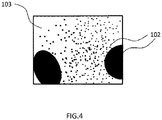
- the sea-island structure refers to a dispersed structure in which a matrix (sea phase) having one resin component as a main component of the matrix is dotted with particles (island phase) having the other resin component as a main component of the particles, and the dispersed shape of the island phase in the sea phase is a spherical shape (circular), elliptical shape, or irregular shape.
- the inside of the carbon fiber bundle is a region inside the carbon fiber bundle contained in the press-molded product or the composite material, and more specifically, is a part between single fibers of the carbon fibers contained in the carbon fiber bundle in the press-molded product and the composite material.
- the outside of the carbon fiber bundle is a region outside the carbon fiber bundle contained in the press-molded product and the composite material, more specifically, is a part other than the carbon fibers in the press-molded product and the composite material.
- one of the polyamide-based resin (X) and the polyarylene ether-based resin (Y) has a sea phase and the other has an island phase.
- the thermoplastic resin (Z) it is preferable to mix the thermoplastic resin (Z) with the polyarylene ether-based resin (Y) to form a mixed phase. That is, it is preferable that the polyarylene ether-based resin (Y) and the thermoplastic resin (Z) are compatible with each other. Contrary to this, it is preferable that the phase of the polyamide-based resin (X) is not mixed with the phase of the polyarylene ether-based resin (Y) and the thermoplastic resin (Z).
- the island phase may be the polyamide-based resin (X) and the sea phase may be the mixed phase of the polyarylene ether-based resin (Y) and the thermoplastic resin (Z).
- the sea phase is the polyamide-based resin (X) and the island phase is the mixed phase of the polyarylene ether-based resin (Y) and the thermoplastic resin (Z).
- thermoplastic resin components for example, a polyamide-based resin and a polyarylene ether-based resin
- thermal history applied during molding is smaller than that during press molding, thermal decomposition of the resins contained in the material or various additives is suppressed.
- the press-molded product of the present invention the sea-island structure is not significantly changed in the processes of ⁇ Composite Material Manufacturing Process 1. Manufacturing of Polymer Alloy Component>, ⁇ Composite Material Manufacturing Process 2. Manufacturing of Composite Material Precursor>, and ⁇ Composite Material Manufacturing Process 3. Manufacturing of Composite Material>. Accordingly, the press-molded product and the composite material of the present invention can exhibit excellent moldability, spreadability, and formability.
- the particle diameter Dr of the island phase of the sea-island structure in the present invention is 0.05 ⁇ m or more and less than 50 um.
- the particle diameter converted from the area of the island phase is defined as the particle diameter Dr of the island phase. That is, assuming that the area S of the island phase is S, the particle diameter Dr is expressed as (4S/ ⁇ ) 1/2 .
- a preferable particle diameter of the island phase is 0.1 ⁇ m or more and less than 20 ⁇ m, more preferably 0.3 ⁇ m or more and less than 15 ⁇ m, even more preferably 0.3 ⁇ m or more and less than 10 ⁇ m, and even more preferably 0.5 ⁇ m or more and less than 10 ⁇ m.
- the press-molded product and the composite material in the present invention are observed in a cross-section, it is preferable that a distance L between carbon fiber single fibers which is shorter than the particle diameter Dr of the island phase is present inside the carbon fiber bundle.
- a distance L between carbon fiber single fibers which is shorter than the particle diameter Dr of the island phase is present inside the carbon fiber bundle.
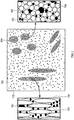
- Fig. 1 shows a schematic view of the sea-island structure when an example of the press-molded product of the present invention is observed in a cross-section (a cross-section in the film thickness direction).
- a sea-island structure in which one of the polyamide-based resin (X) and the polyarylene ether-based resin (Y) forms sea phases 103 and the other forms island phases 102 is formed inside and outside a carbon fiber bundle 101.
- the shape of the carbon fiber bundle 101 and single fibers 104 of carbon fibers observed in an orientation direction is circular or elliptical.
- the island phases 102 may be arranged and dispersed in the form of straddling the carbon fiber single fibers 104 adjacent to each other. Accordingly, during cold pressing in a low shear region, even a carbon fiber bundle which is difficult to change in shape easily deforms like a matrix resin and, surprisingly, the spreadability and formability are improved.
- At least one island phase is in contact with the carbon fibers.
- the material for manufacturing the press-molded product of the present invention is a composite material (the "composite material” described in this specification refers to a material before the press-molded product is manufactured).
- the form of the fiber in the composite material is maintained in the press-molded product, and thus the fiber form of one of the composite material and the press-molded product may be evaluated.
- the composite material can be generally manufactured by a well-known method, and for example, can be manufactured by the following processes.
- resins are kneaded in advance to form the sea-island structure, and there is no kneading step in the subsequent steps.
- a method of preparing the polymer alloy component of the polyamide-based resin (X) and the polyarylene ether-based resin (Y) is not particularly limited, and an existing method can be used.
- the polyamide-based resin (X) and the polyarylene ether-based resin (Y) are kneaded in a range of approximately 240°C to 300°C using a twin-shaft kneader to obtain a polymer alloy, and the polymer alloy may be produced in the form of pellets or a film.
- the melt viscosity of the polyamide-based resin (X) at a temperature of 280°C and a shear rate of 550 sec -1 , measured by a capillary rheometer is 500 to 10,000 Pay ⁇ s
- the melt viscosity of the polyarylene ether-based resin (Y) is 5,000 to 250,000 Pa ⁇ s
- the melt viscosity of the polyamide-based resin (X) is 1,000 to 5,000 Pa ⁇ s
- the melt viscosity of the polyarylene ether-based resin (Y) is 20,000 to 75,000 Pa ⁇ s.
- the melt viscosity of the polyarylene ether-based resin (Y) is more preferably lower than 25 times the melt viscosity of the polyamide-based resin (X), and even more preferably lower than 20 times.
- a carbon fiber bundle may be unwound from a creel and cut, and while the cut carbon fiber bundle is spreaded, the polymer alloy of the polyamide-based resin (X) and the polyarylene ether-based resin (Y) (preferably the polymer alloy to which the thermoplastic resin (Z) is added) in the form of pellets, fibers, or powder may be sprayed on an air-permeable support body, thereby producing a composite material precursor.
- the polymer alloy of the polyamide-based resin (X) and the polyarylene ether-based resin (Y) (preferably the polymer alloy to which the thermoplastic resin (Z) is added) in the form of a film may be interposed therebetween, thereby producing a composite material precursor.
- the carbon fiber bundle sprayed on the composite material precursor is impregnated with a thermoplastic resin by being heated (preferably pressurized) to the softening temperature of the thermoplastic resin.
- softening temperature refers to a temperature at which the rigidity of a molded product made of only the matrix resin (the polyamide-based resin (X) and the polyarylene ether-based resin (Y), or the polyamide-based resin (X), the polyarylene ether-based resin (Y), and the thermoplastic resin (Z)) is not maintained and the molded product easily deforms.
- a two-dimensional random array mat which is a composite material precursor and a manufacturing method thereof, and a manufacturing method of a composite material (Composite Material Manufacturing Processes 2 and 3 described above) are described in detail in US Patent No. 8946342 and JP-A-2013-49208 .
- the thickness of the composite material of the present invention is not particularly limited, and is typically preferably in a range of 0.01 mm to 100 mm, preferably in a range of 0.01 mm to 10 mm, and more preferably in a range of 0.1 to 3.0 mm.
- the thickness refers not to the thickness of each layer but to the total thickness of the composite material which is the sum of the layers.
- the press-molded product in the present invention is obtained by press-molding the composite material.
- the composite material for manufacturing the press-molded product includes the carbon fibers having a weight average fiber length of 1 mm or more, the polyamide-based resin (X), and the polyarylene ether-based resin (Y), in which the carbon fibers include carbon fiber bundles, a sea-island structure in which one of the polyamide-based resin (X) and the polyarylene ether-based resin (Y) forms a sea phase and the other forms an island phase is formed inside and outside the carbon fiber bundles, and the particle diameter of the island phase of the sea-island structure is 0.05 ⁇ m or more and less than 50 ⁇ m.
- the cold pressing method for example, a composite material heated to a first predetermined temperature is put into a mold set to a second predetermined temperature, and thereafter pressurization and cooling are performed thereon. That is, the cold pressing method include at least Steps A-1) to A-3) as follows.
- Step A-1) A step of heating the composite material to a temperature equal to or higher than the softening temperature of the thermoplastic resin contained in the composite material.
- Step A-2) A step of arranging the heated composite material obtained in Step A-1) described above in a mold which is adjusted to a temperature lower than the softening temperature of the thermoplastic resin.
- Step A-3 A step of pressurizing and molding the composite material arranged in the mold in Step A-2).
- the hot pressing method includes at least Steps B-1) to B-3) as follows.
- Step B-1) A step of arranging the composite material in a mold.
- Step B-2) A step of raising the temperature of the mold to a temperature equal to or higher than the softening temperature of the thermoplastic resin and pressurizing the mold.
- Step B-3 A step of adjusting the temperature of the mold to less than the softening point of the thermoplastic resin and performing molding.
- the composite material is used singly (in one sheet) or in a plurality of sheets, depending on the plate thickness of a target molded product when put into the mold.
- the plurality of sheets may be preliminarily stacked and heated, the heated composite material may be stacked and thereafter put into the mold, or the heated composite material may be sequentially stacked in the mold.
- the temperature difference between the composite material at the lowest layer and the composite material at the highest layer in the stacked case may be small. From this viewpoint, it is preferable to stack the composite material before being put into the mold.
- the above steps need to be performed in the above order, but other steps may be included between the steps.
- Examples of the other steps include a preliminary shaping step of preliminarily performing shaping into the shape of the cavity of the mold using a shaping apparatus different from the mold used in Step A-3) or B-2) before Step A-3) or B-2).
- Steps A-3) and B-2) are steps to obtain a molded product having a desired shape by applying a pressure to the composite material, and the molding pressure at this time is not particularly limited, and is preferably less than 30 MPa, more preferably 20 MPa or less, and even more preferably 10 MPa or less.
- the corner portion of the molded product is likely to be insufficient in spreadability and is likely to be formed with thickness unevenness due to generated wrinkles.
- the thickness unevenness occurs, it becomes difficult to close the mold, and molding is not completed.
- the press-molded product with the corner portion manufactured requires not only excellent spreadability but also mechanical properties of a press-molded product in high temperature and high humidity environments.
- the polymer alloy consisting of a polyamide-based resin and a polyarylene ether-based resin is selected to withstand use in high temperature and high humidity environments and is subjected to injection molding, in the related art, the injection pressure is high. Therefore, the polymer alloy is a material that is not easily molded.
- the composite material in the present invention when used, the composite material not only can withstand the use in high temperature and high humidity environments but also has excellent spreadability.
- the inventors thought that this is because the sea-island structure in which one of the polyamide-based resin (X) and the polyarylene ether-based resin (Y) forms the sea phase and the other forms the island phase inside and outside the carbon fiber bundles is formed and this is maintained even in the press-molded product.
- the formability of the composite material is also required to the extent that the composite material can be processed into a complex shape, like the spreadability.
- the shape of the molded product is flexibly changed according to the shape, and thus the molded product can be shaped into a thickness with high uniformity.
- the fluidity and the formability are different concepts, and good fluidity does not necessarily mean excellent formability.
- the composite material arranged in a lower mold of the mold is pressed by an upper mold of the mold such that the composite material flows. That is, the flow of the composite material after the start of the pressing until the completion of the molding is referred to as flow.
- flow the flow of the composite material after the start of the pressing until the completion of the molding.
- the composite material of the present invention which includes the thermoplastic resin (Z) in addition to the polyamide-based resin (X) and the polyarylene ether-based resin (Y) and in which the viscosity ⁇ at 230°C in dynamic viscoelasticity measurement at a rate of temperature decrease of 5 °C/min, 270°C to 200°C, and 10 rad/sec is 10,000 to 60,000 Pa ⁇ sec
- the fluidity does not significantly decrease compared to a polyamide-based resin single component. This is quite different from the flow characteristics (in a case of a polymer alloy, the injection pressure needs to be high) of a polymer alloy during injection molding as the general knowledge of injection molding used in the related art, and a different effect is exhibited.
- the thickness of the press-molded product of the present invention is not particularly limited, and is typically preferably in a range of 0.01 mm to 100 mm, preferably in a range of 0.01 mm to 10 mm, and more preferably in a range of 0.1 to 3.0 mm.
- the thickness refers not to the thickness of each layer but to the total thickness of the molded product which is the sum of the layers.
- the molded product used in the present invention may have a single layer structure consisting of a single layer or may also have a stacked structure in which a plurality of layers are stacked.
- the press-molded product has the stacked structure
- an embodiment in which a plurality of layers having the same composition are stacked, or an embodiment in which a plurality of layers having different compositions are stacked may be employed.
- the surface smoothness thereof tends to decrease.
- the polyamide-based resin is a crystalline resin and thus a high degree of volume shrinkage occurs during molding and solidification.
- the two-dimensional direction of the press-molded product is reinforced by the carbon fibers. Therefore, as the degree of volume shrinkage of the polyamide-based resin in the two-dimensional direction decreases, the degree of volume shrinkage of the press-molded product in the plate thickness direction increases. The inventors thought that the carbon fibers are consequently exposed to the surface of the press-molded product and thus the surface smoothness decreases (the outer appearance is deteriorated).
- the press-molded product or the composite material of the present invention uses the polyarylene ether-based resin, which is an amorphous resin, in addition to the polyamide-based resin, and molding shrinkage can be suppressed to some extent, thereby improving the outer appearance.
- the thermoplastic resin (Z) is preferably an amorphous resin and more preferably a polystyrene-based resin.
- Lw ⁇ Li 2 / ⁇ Li
- the weight average fiber length of carbon fibers contained in the composite material can also be measured in the same manner as described above.
- the prepared composite material was interposed between parallel plates having a diameter of 20 mm using RDA III manufactured by TA Instruments, and by performing dynamic viscoelasticity measurement with a normal load of 200 g, a frequency of 1.6 Hz (10 rad/sec), a strain of 0.02%, a temperature decreasing range of 270°C to 200°C, and a rate of temperature decrease of 5 °C/min, the viscosity at 230°C was read.
- a test piece was cut from the press-molded product using a water jet, and the bending strength was measured using a universal testing machine manufactured by Instron with reference to JIS K 7074-1988.
- a bending strength (F1) in a state in which the polyamide-based resin (X) was absolutely dry (a state in which no water was absorbed) at 23°C, and a bending strength (F2) in a state in which, after the polyamide-based resin (X) entered a saturated state by absorbing water from the state in which the polyamide-based resin (X) was absolutely dry (a state in which no water was absorbed) at 23°C, the temperature was increased therefrom to 80°C, The rate of decrease in bending strength was measured. The rate of decrease in bending strength was calculated by the following expression. Rate of decrease in bending strength % 100 ⁇ F 1 ⁇ F 2 / F 1
- a specimen was produced by cutting an ultra thin section from the composite material (or the cold-press-molded product) using an ultramicrotome, and was collected in a Cu grit, and the polyamide-based resin was stained with an aqueous solution of 5% PTA (phosphotungstic acid) for 3 hours. Thereafter, the specimen was washed with water, wind-dried, and then observed with SEM (Quanta 250 FEG manufactured by FEI).
- PTA phosphotungstic acid
- the observation condition was set to an accelerating voltage of 5 kV in STEM mode.
- the particle diameter is calculated assuming that the island phase is a circle and the diameter converted from the area of the island phase is calculated as the particle diameter Dr of the island phase (assuming that the area of the island component is S, the particle diameter Dr is (4S/ ⁇ ) 1/2 ), even in a case where the inter-fiber distance is 1 to 10 ⁇ m, there may be cases where the particle diameter Dr becomes larger than the inter-fiber distance.
- cold pressing In order to evaluate spreadability during cold pressing, fluidity, formability, and the outer appearance of a press-molded product obtained by cold pressing, cold pressing was performed.
- the conditions of the cold pressing are as follows.
- the composite material was dried for 4 hours by a 120°C hot air dryer and was thereafter heated to a temperature of 290°C by an infrared heater.
- a mirror-finished mold was set at 150°C, and the composite material increased in temperature was introduced into the mold and then pressurized at a pressure of 20 MPa for 1 minute, thereby obtaining a press-molded product.
- a composite material produced to have a target thickness of 1.3 mm (an actual measurement value is shown in the following tables) was cut into a width of 10 cm and a length of 4 cm and was cold-pressed using a mold having a width of 10 cm and a length direction (open shape).
- a wire was drawn in advance at the end of the composite material before heating, and the distance between the end portion of the press-molded product after molding and the line was measured. In order to more accurately measure the fluidity, the measured distance was divided by the thickness of the composite material, whether the fluidity is good or bad was determined by the divided value (a composite material with a higher calculated value flows).
- the composite material produced to have a target thickness of 1.3 mm was cut into two pieces having a width of 9.0 cm and a length of 12.5 cm, the cut pieces of the composite material were overlapped by 5 cm in the length direction as illustrated in Fig. 2 and were arranged in, as a flat plate-shaped mold, a mold in which open cavities are formed in two side directions (the direction Z4 in Fig. 2 (a direction parallel to the length direction of a composite material 302) and the direction Z2 (a direction parallel to the width direction of the composite material 302)) and closed cavities are formed in the remaining two side directions (the direction Z3 in Fig. 2 (a direction parallel to the length direction of the composite material 302) and the direction Z1 (a direction parallel to the width direction of the composite material 302)), and cold pressing was performed thereon.
- the direction Z4 in Fig. 2 a direction parallel to the length direction of a composite material 302
- Z2 a direction parallel to the width direction of the composite material 302
- the thicknesses of 10 points of the part molded while being overlapped were measured and averaged, and a value was calculated by dividing the average by the thickness of a single piece of the composite material (before molding). As this value is closer to 1, better spreadability is achieved.
- a composite material was produced to have a target thickness of 2.6 mm and was cut into 10 cm x 10 cm.
- An iron ball having a weight of 175 g previously heated to 270°C was placed on the composite material placed on a cylindrical object as illustrated in Fig. 3 and then heated in a muffle furnace at 270°C for 20 minutes.
- the obtained sample was cooled to 23°C and observed.
- the formability was evaluated according to the following criteria. In the following criteria, a higher number means better formability.
- the outer appearance was evaluated according to the following criteria. In the following criteria, a higher number means better outer appearance.
- the amount of absorbed energy was measured by conducting a multiaxial impact test using a VHS high-speed impact testing machine manufactured by Instron.
- the size of the test piece was set to 65 x 65 mm, the striker diameter was set to 20 mm, the opening diameter of the presser jig was set to 40 mm, and the test speed was set to 2.2 m/sec.
- the area of the displacement-load curve obtained in this test was used as the amount of absorbed energy.
- thermoplastic resin As a thermoplastic resin, a polyamide 6 resin (nylon 6 resin) A1030 manufactured by UNITIKA Ltd. and a PPO 630 resin (2,6-dimethyl-1,4-phenylene ether, PPE resin) manufactured by SABIC were prepared, 100 parts by mass of the PPE resin with respect to 100 parts by mass of the polyamide 6 and 1 part by mass of citric acid manufactured by Wako Pure Chemical Industries, Ltd.
- a sizing solution of nylon 6/66/12 terpolymer polyamide was produced on the basis of the description of Example of Pamphlet of WO2013/133421 .
- unsized carbon fiber strands (registered trademark "TENAX STS40-24KS” manufactured by Toho Tenax Co., Ltd.) were continuously immersed so as to cause the filaments to be impregnated with the emulsion. This was caused to pass through a drying furnace at 120°C to 150°C for about 120 seconds to be dried, thereby obtaining a carbon fiber bundle having a width of 10 mm and a thickness of 0.162 mm.
- the carbon fiber volume fraction was calculated to be 35 vol% on the basis of the method described in US Patent No. 8946342 , and the carbon fibers and the resin of the polymer alloy component were adjusted, thereby producing a composite material precursor in which the carbon fibers were oriented at two-dimensional random.
- Two types of the composite material precursor were prepared, with one having a composite material target thickness of 1.3 mm and the other having a target thickness of 2.6 mm.
- the obtained composite material precursor was heated at 0.5 MPa for 3 minutes in a press machine heated to 260°C, thereby obtaining a composite material having a target thickness of 1.3 mm and a target thickness of 2.6 mm.
- the critical number of single fibers defined in Expression (1) was 86, the average number (N) of single fibers in the carbon fiber bundle (A) having the critical number of single fibers or more was 820, and the proportion of the carbon fiber bundle (A) having the critical number of single fibers or more was 80 vol% of the total carbon fiber amount.
- the carbon fiber volume fraction (Vf) was 35 vol%, the fiber length of the carbon fibers was a constant length, and the weight average fiber length was 20 mm.
- the thickness of the composite material having a target thickness of 1.3 mm was actually measured as 1.16 mm.
- the obtained composite material was hot-pressed at 4.0 MPa for 20 minutes in a press machine heated to 300°C, thereby obtaining a molded product.
- the inter-fiber distance inside the carbon fiber bundle was measured in the above-described method, and the inter-fiber distances of all of the measured 50 carbon fiber single fibers were 0 to 10 mm.
- a press-molded product was produced in the same manner as in Example 1 except that maleic anhydride (Wako Special grade) manufactured by Wako Pure Chemical Industries, Ltd. was used as the kind of a compatibilizer.
- maleic anhydride Wako Pure Chemical Industries, Ltd. was used as the kind of a compatibilizer.
- a composite material and a press-molded product were manufactured in the same manner as in Example 1 except that the polyamide 6 resin A1030 manufactured by UNITIKA Ltd. and the PPO 630 resin (2,6-dimethyl-1,4-phenylene ether) manufactured by SABIC were mixed so that the ratio of the PPE resin to 100 parts by mass of the polyamide 6 was 33.3 parts by mass.
- a press-molded product was manufactured in the same manner as in Example 1 except that the amount of the compatibilizer added to 100 parts by mass of the polyphenylene ether-based resin was 2 parts by mass.
- a press-molded product was manufactured in the same manner as in Example 1 except that the amount of the compatibilizer added to 100 parts by mass of the polyphenylene ether-based resin was 4 parts by mass.
- a press-molded product was manufactured in the same manner as in Example 2 except that the amount of the compatibilizer added to 100 parts by mass of the polyphenylene ether-based resin was 2 parts by mass.
- thermoplastic resin As a thermoplastic resin, a polyamide 6 resin A1030 manufactured by UNITIKA Ltd., a PPO 630 resin (2,6-dimethyl-1,4-phenylene ether, PPE resin) manufactured by SABIC, and a polystyrene resin SGP10 (described as PS resin in some cases) manufactured by PS Japan Corporation were prepared, 99.5 parts by mass of the PPE resin, 0.5 parts by mass of the PS resin, and 1 part by mass of citric acid (food additive) manufactured by Wako Pure Chemical Industries, Ltd.
- the mixture was put into a kneading machine (TEM-26SS manufactured by Toshiba Machine Co., Ltd.) and was kneaded at a setting temperature of 280°C, a feed rate of 20 kg/h, and a screw rotation speed of 200 rpm, thereby preparing a polymer alloy component.
- a sea-island structure having the polyamide 6 resin as a sea phase and a mixed phase of the PPE resin and the PS resin as an island phase was formed and uniformly dispersed, and the weight average particle diameter Dr of the island phase was 1 ⁇ m.
- a composite material precursor was produced in the same manner as in Example 1.
- a composite material was produced in the same manner as in Example 1.
- the critical number of single fibers defined in Expression (1) was 86, the average number (N) of single fibers in the carbon fiber bundle (A) having the critical number of single fibers or more was 820, and the proportion of the carbon fiber bundle (A) having the critical number of single fibers or more was 80 vol% of the total carbon fiber amount.
- the carbon fiber volume fraction (Vf) was 35 vol%, the fiber length of the carbon fibers was a constant length, and the weight average fiber length was 20 mm.
- a press-molded product was produced through hot pressing in the same manner as in Example 1.
- a press-molded product was produced through cold pressing in the same manner as in Example 1.
- Example 8 is the same as Example 7 except that a composite material was prepared so that 90 parts by mass of the PPE resin and 10 parts by mass of the PS resin with respect to 100 parts by mass of the PA 6 resin were included and a press-molded product was manufactured.
- Example 9 is the same as Example 7 except that a composite material was prepared so that 70 parts by mass of the PPE resin and 30 parts by mass of the PS resin with respect to 100 parts by mass of the PA 6 resin were included and a press-molded product was manufactured.
- Example 10 is the same as Example 7 except that a composite material was prepared so that 50 parts by mass of the PPE resin and 50 parts by mass of the PS resin with respect to 100 parts by mass of the PA 6 resin were included and the amount of citric acid added to 100 parts by mass of the polyphenylene ether-based resin was 2 parts by mass, and a press-molded product was manufactured.
- Example 11 is the same as Example 10 except that a composite material was prepared so that the amount of citric acid added to 100 parts by mass of the polyphenylene ether-based resin was 3 parts by mass, and a press-molded product was manufactured.
- a composite material and a press-molded product were manufactured in the same manner as in Example 2 except that the polyamide 6 resin A1030 manufactured by UNITIKA Ltd. and the PPO 630 resin (2,6-dimethyl-1,4-phenylene ether, PPE resin) manufactured by SABIC were mixed so that the ratio of the PPE resin to 100 parts by mass of the polyamide 6 was 150 parts by mass.
- the polyamide 6 resin A1030 manufactured by UNITIKA Ltd. and the PPO 630 resin (2,6-dimethyl-1,4-phenylene ether, PPE resin) manufactured by SABIC were mixed so that the ratio of the PPE resin to 100 parts by mass of the polyamide 6 was 150 parts by mass.
- the polyamide 6 resin was the island phase and the PPE resin was the sea phase in the sea-island structure.
- a composite material and a press-molded product were manufactured in the same manner as in Example 10 except that a polyamide 66 resin manufactured by DSM Engineering Plastics (3010SR) as a polyamide-based resin was used and citric acid manufactured by Wako Pure Chemical Industries, Ltd. as a compatibilizer was prepared to occupy 3 parts by mass with respect to 100 parts by mass of the PPE resin.
- a composite material and a press-molded product were manufactured in the same manner as in Example 1 except that the polyarylene ether-based resin was not used and the composite material was produced only by the polyamide 6.
- a polymer alloy component was prepared in the same manner as in ⁇ Composite Material Manufacturing Process 1. Manufacturing of Polymer Alloy Component> of Example 1 except that the compatibilizer was not used.
- a carbon fiber bundle was prepared in the same manner as in Example 1, using the produced polymer alloy component and the carbon fiber bundle, the carbon fiber volume fraction was calculated to be 35 vol% on the basis of the method described in US Patent No. 8946342 , and the carbon fibers and the resin of the polymer alloy component were adjusted, thereby producing a composite material precursor in which the carbon fibers were oriented at two-dimensional random.
- Two types of the composite material precursor were prepared, with one having a composite material target thickness of 1.3 mm and the other having a target thickness of 2.6 mm.
- the obtained composite material precursor was heated at 0.5 MPa for 3 minutes in a press machine heated to 260°C, thereby obtaining a composite material having a target thickness of 1.3 mm and a target thickness of 2.6 mm.
- the sea-island structure in the composite material was observed, the sea-island structure was evaluated as Bad, and the particle diameter of the island phase was 50 ⁇ m. That is, when the composite material was manufactured, since the islands once separated agglomerated again due to re-heating, the particle diameter becomes greater than that of the island phase produced in ⁇ Composite Material Manufacturing Process 1. Manufacturing of Polymer Alloy Component>, and thus the sea-island structure was deteriorated.
- a press-molded product was produced through hot pressing in the same manner as in Example 1.
- a press-molded product was produced through cold pressing in the same manner as in Example 1.
- a polymer alloy was prepared in the same manner as in Example 5 except that maleic anhydride (Wako Special grade) manufactured by Wako Pure Chemical Industries, Ltd. was used as the compatibilizer. However, a sea-island structure could not be formed (evaluation: Bad). Therefore, the production of a composite material using the polymer alloy was stopped.
- a polymer alloy was prepared in the same manner as in Example 10 except that the amount of the compatibilizer (citric acid manufactured by Wako Pure Chemical Industries, Ltd.) added to 100 parts by mass of the polyphenylene ether-based resin was 1 part by mass.
- the amount of the compatibilizer citric acid manufactured by Wako Pure Chemical Industries, Ltd.
- Dr weighted average particle diameter
- C1 to C4 are cavities and N is a nozzle
- a test piece (molded product) was obtained by performing injection molding in the same manner as in Reference Example 1 by using the polymer alloy component produced in Example 1 (the polyamide 6 resin A1030 manufactured by UNITIKA Ltd., the PPO 630 resin manufactured by SABIC, and the citric acid (food additive) manufactured by Wako Pure Chemical Industries, Ltd.) as the compatibilizer.
- the polymer alloy component produced in Example 1 the polyamide 6 resin A1030 manufactured by UNITIKA Ltd., the PPO 630 resin manufactured by SABIC, and the citric acid (food additive) manufactured by Wako Pure Chemical Industries, Ltd.
- a test piece (molded product) was obtained by performing injection molding in the same manner as in Reference Example 1 by using the polymer alloy component produced in Example 11 (50 parts by mass of the PPE resin and 50 parts by mass of the PS resin with respect to 100 parts by mass of the PA 6 resin were included and the amount of citric acid added to 100 parts by mass of the PPE resin was 3 parts by mass).
- the content of the polyarylene ether-based resin (Y) in Tables 1 to 3 and 6 is in parts by mass with respect to 100 parts by mass of the polyamide-based resin (X), the content of the thermoplastic resin (Z) is in parts by mass with respect to 100 parts by mass of the polyamide-based resin (X), and the content of the compatibilizer is in parts by mass with respect to 100 parts by mass of the polyarylene ether-based resin (Y).
- Example 1 Example 2 Example 3 Example 4 Example 5 Example 6 Example 7 Example 8 Kind of polyamide-based resin (X) PA 6 resin PA 6 resin PA 6 resin PA 6 resin PA 6 resin PA 6 resin PA 6 resin PA 6 resin PA 6 resin PA 6 resin PA 6 resin PA 6 resin PA 6 resin PA 6 resin Content (parts by mass) of polyamide-based resin (X) 100 100 100 100 100 100 100 100 100 100 100 100 Kind of polyarylene ether-based resin (Y) PPE resin PPE resin PPE resin PPE resin PPE resin PPE resin PPE resin PPE resin PPE resin PPE resin PPE resin PPE resin PPE resin Content of polyarylene ether-based resin (Y) (parts by mass with respect to 100 parts by mass of polyamide-based resin (X)) 100 100 33.3 100 100 100 99.5 90 Kind of thermoplastic resin (Z) - - - - - - PS resin PS resin Content of thermoplastic resin (Z) (parts by mass with respect to 100 parts by mass of polyamide-based resin (X)) 0 0 0
- Citric acid Maleic anhydride Citric acid Citric acid Citric acid Citric acid Citric acid Citric acid Citric acid Citric acid Citric acid Citric acid Content of compatibilizer (parts by mass with respect to 100 parts by mass of polyarylene ether-based resin (Y)) 1 1 1 2 4 2 1 1
- Form of polymer alloy Sea-island structure Excellent Excellent Excellent Excellent Excellent Great Excellent Excellent Particle diameter of island phase ⁇ m 1 1 0.5 1 1 3 1 3
- Composite material Observation of sea-island structure in composite material Sea-island structure inside fiber bundle Excellent Excellent Excellent Excellent Excellent Great Excellent Excellent Sea-island structure outside fiber bundle Excellent Excellent Excellent Excellent Excellent Excellent Excellent Excellent Excellent Excellent Excellent Excellent Excellent Excellent Particle diameter Dr of island phase ( ⁇ m) 1 1 0.5 1 1 3 1 3
- Thickness of composite material target value
- mm Thickness of composite material (target value) (mm) 1.3 1.3 1.3 1.3 1.3 1.3 1.3 1.3 1.3 1.3 1.3 1.3 1.3 Thickness of composite material (actual measurement value
- the molded product of the present invention can be used for various constituent members such as inner plates, outer plates, and structural members of automobiles, various electric products, frames and housings of machines, and the like.
- the molded product can be preferably used as an automobile component.
Landscapes
- Chemical & Material Sciences (AREA)
- Health & Medical Sciences (AREA)
- Chemical Kinetics & Catalysis (AREA)
- Medicinal Chemistry (AREA)
- Polymers & Plastics (AREA)
- Organic Chemistry (AREA)
- Engineering & Computer Science (AREA)
- Materials Engineering (AREA)
- Manufacturing & Machinery (AREA)
- Inorganic Chemistry (AREA)
- Reinforced Plastic Materials (AREA)
- Compositions Of Macromolecular Compounds (AREA)
Applications Claiming Priority (2)
| Application Number | Priority Date | Filing Date | Title |
|---|---|---|---|
| JP2015193694 | 2015-09-30 | ||
| PCT/JP2016/072697 WO2017056693A1 (fr) | 2015-09-30 | 2016-08-02 | Corps formé à la presse et matériau composite |
Publications (3)
| Publication Number | Publication Date |
|---|---|
| EP3281969A1 true EP3281969A1 (fr) | 2018-02-14 |
| EP3281969A4 EP3281969A4 (fr) | 2018-09-12 |
| EP3281969B1 EP3281969B1 (fr) | 2020-03-18 |
Family
ID=58423516
Family Applications (1)
| Application Number | Title | Priority Date | Filing Date |
|---|---|---|---|
| EP16850870.3A Active EP3281969B1 (fr) | 2015-09-30 | 2016-08-02 | Produit moulé par pressage |
Country Status (5)
| Country | Link |
|---|---|
| US (1) | US10407552B2 (fr) |
| EP (1) | EP3281969B1 (fr) |
| JP (1) | JP6190986B1 (fr) |
| CN (1) | CN107531914B (fr) |
| WO (1) | WO2017056693A1 (fr) |
Cited By (1)
| Publication number | Priority date | Publication date | Assignee | Title |
|---|---|---|---|---|
| RU2717054C1 (ru) * | 2018-06-05 | 2020-03-17 | Тойота Дзидося Кабусики Кайся | Армированная волокном композиция смолы и способ изготовления такой композиции |
Families Citing this family (7)
| Publication number | Priority date | Publication date | Assignee | Title |
|---|---|---|---|---|
| WO2018143283A1 (fr) * | 2017-02-03 | 2018-08-09 | 帝人株式会社 | Matériau composite comprenant des fibres de carbone et une résine thermoplastique, procédé de production de corps moulé l'utilisant, et corps moulé |
| CN113474418B (zh) * | 2019-02-28 | 2023-10-24 | 出光兴产株式会社 | 树脂组合物及其成形体 |
| US20220195134A1 (en) * | 2019-04-19 | 2022-06-23 | Teijin Limited | Thermoplastic resin prepreg, production method thereof, and fiber-reinforced composite material |
| JP7370200B2 (ja) * | 2019-09-19 | 2023-10-27 | 旭化成株式会社 | 繊維強化樹脂複合体及び繊維強化樹脂複合体の製造方法 |
| EP4143261A1 (fr) | 2020-04-30 | 2023-03-08 | SHPP Global Technologies B.V. | Composition, son procédé de fabrication, article formé à partir de celle-ci, et composite thermoplastique renforcé comprenant la composition |
| CN115916906B (zh) * | 2020-08-27 | 2024-09-13 | 出光兴产株式会社 | 热塑性树脂组合物 |
| US20240376300A1 (en) * | 2021-05-28 | 2024-11-14 | Idemitsu Kosan Co., Ltd. | Resin composition, molded object, multilayered object, method for producing poly(arylene ether), and poly(arylene ether) |
Family Cites Families (23)
| Publication number | Priority date | Publication date | Assignee | Title |
|---|---|---|---|---|
| JPH0737563B2 (ja) * | 1986-05-20 | 1995-04-26 | 東レ株式会社 | 多相構造体 |
| CA2088859A1 (fr) | 1992-03-06 | 1993-09-07 | Kenji Nagaoka | Composition de resine thermoplastique |
| JP2002088259A (ja) | 2000-09-18 | 2002-03-27 | Toray Ind Inc | 成形材料その製造方法およびその成形品 |
| JP2002179924A (ja) * | 2000-12-11 | 2002-06-26 | Toray Ind Inc | 成形用材料の製造方法および成形品の製造方法 |
| US7132063B2 (en) | 2003-08-16 | 2006-11-07 | General Electric Company | Poly(arylene ether)/polyamide composition |
| US7166243B2 (en) | 2003-08-16 | 2007-01-23 | General Electric Company | Reinforced poly(arylene ether)/polyamide composition |
| US20060205872A1 (en) | 2003-08-16 | 2006-09-14 | General Electric Company | Reinforced Poly(Arylene Ether)/Polyamide Composition and Articles Thereof |
| US7182886B2 (en) * | 2003-08-16 | 2007-02-27 | General Electric Company | Poly (arylene ether)/polyamide composition |
| US7118691B2 (en) | 2003-08-16 | 2006-10-10 | General Electric Company | Poly(arylene ether)/polyamide composition |
| US20060280938A1 (en) | 2005-06-10 | 2006-12-14 | Atkinson Paul M | Thermoplastic long fiber composites, methods of manufacture thereof and articles derived thererom |
| TWI414543B (zh) * | 2006-02-24 | 2013-11-11 | Toray Industries | 纖維強化熱可塑性樹脂成形體、成形材料及其製法 |
| US20070238832A1 (en) * | 2006-04-05 | 2007-10-11 | General Electric Company | Method of making a poly(arylene ether)/polyamide composition |
| JP5339577B2 (ja) * | 2007-03-29 | 2013-11-13 | 旭化成ケミカルズ株式会社 | 長繊維強化樹脂ペレット |
| US20090004460A1 (en) * | 2007-06-28 | 2009-01-01 | U.S.A. As Represented By The Administrator Of The National Aeronautics And Space Administration | Nanoparticle-Containing Thermoplastic Composites and Methods of Preparing Same |
| JP5629477B2 (ja) | 2009-02-27 | 2014-11-19 | 旭化成ケミカルズ株式会社 | 外装材用樹脂組成物 |
| JP5505304B2 (ja) * | 2009-03-16 | 2014-05-28 | 東レ株式会社 | 繊維強化樹脂組成物、成形材料および繊維強化樹脂組成物の製造方法 |
| JP2011012206A (ja) * | 2009-07-03 | 2011-01-20 | Asahi Kasei Chemicals Corp | 樹脂組成物、そのペレット混合物及び製造方法 |
| KR101437255B1 (ko) * | 2010-07-12 | 2014-09-02 | 미쓰비시 엔지니어링-플라스틱스 코포레이션 | 폴리페닐렌에테르계 수지 성형물의 제조 방법 |
| CN103347933A (zh) * | 2011-02-07 | 2013-10-09 | 帝人株式会社 | 具有厚度梯度的成型体及其制造方法 |
| EP2682418B1 (fr) * | 2011-02-28 | 2017-06-14 | Teijin Limited | Corps moulé comprenant un matériau composite de renforcement en fibres |
| WO2012165418A1 (fr) * | 2011-05-31 | 2012-12-06 | 帝人株式会社 | Procédé de fabrication d'un moulage possédant une isotropie conservée |
| CN103732375B (zh) * | 2011-08-03 | 2015-07-22 | 帝人株式会社 | 利用低压模制制造成形制品的方法 |
| WO2014054178A1 (fr) | 2012-10-05 | 2014-04-10 | 三菱電機株式会社 | Dispositif de pompe à chaleur |
-
2016
- 2016-08-02 CN CN201680026043.4A patent/CN107531914B/zh not_active Expired - Fee Related
- 2016-08-02 US US15/571,429 patent/US10407552B2/en not_active Expired - Fee Related
- 2016-08-02 WO PCT/JP2016/072697 patent/WO2017056693A1/fr not_active Ceased
- 2016-08-02 EP EP16850870.3A patent/EP3281969B1/fr active Active
- 2016-08-02 JP JP2017521179A patent/JP6190986B1/ja not_active Expired - Fee Related
Cited By (1)
| Publication number | Priority date | Publication date | Assignee | Title |
|---|---|---|---|---|
| RU2717054C1 (ru) * | 2018-06-05 | 2020-03-17 | Тойота Дзидося Кабусики Кайся | Армированная волокном композиция смолы и способ изготовления такой композиции |
Also Published As
| Publication number | Publication date |
|---|---|
| US20180134856A1 (en) | 2018-05-17 |
| US10407552B2 (en) | 2019-09-10 |
| WO2017056693A1 (fr) | 2017-04-06 |
| JPWO2017056693A1 (ja) | 2017-10-05 |
| EP3281969A4 (fr) | 2018-09-12 |
| EP3281969B1 (fr) | 2020-03-18 |
| JP6190986B1 (ja) | 2017-08-30 |
| CN107531914A (zh) | 2018-01-02 |
| CN107531914B (zh) | 2019-07-26 |
Similar Documents
| Publication | Publication Date | Title |
|---|---|---|
| EP3281969B1 (fr) | Produit moulé par pressage | |
| TWI795516B (zh) | 纖維強化熱塑性樹脂成形品及纖維強化熱塑性樹脂成形材料 | |
| Graupner et al. | Fibre/matrix adhesion of cellulose fibres in PLA, PP and MAPP: A critical review of pull-out test, microbond test and single fibre fragmentation test results | |
| US9000085B2 (en) | Carbon fiber composite resin material and method of producing the same | |
| EP3578330B1 (fr) | Matériau composite comprenant des fibres de carbone et une résine thermoplastique, procédé de production de corps moulé l'utilisant, et corps moulé | |
| CN104204342A (zh) | 碳纤维束及其制造方法 | |
| US20130234361A1 (en) | Fiber-reinforced thermoplastic resin composition, reinforcing fiber bundle, and process for production of fiber-reinforced thermoplastic resin composition | |
| JPWO2006101269A1 (ja) | 熱可塑性樹脂強化用炭素繊維ストランド及びその製造方法 | |
| KR20140009139A (ko) | 중합체-cnt 복합체의 제조 방법 | |
| CN105431475B (zh) | 纤维增强复合材料和其制造方法 | |
| JP2002088259A (ja) | 成形材料その製造方法およびその成形品 | |
| WO2021199497A1 (fr) | Stratifil direct en verre et pastilles de résine thermoplastique renforcée par des filaments de verre | |
| TW202225331A (zh) | 玻璃纖維強化樹脂成型品 | |
| WO2023136139A1 (fr) | Tissu non-tissé contenant des fibres de polyphénylène éther et des fibres de renforcement, corps moulé contenant un polyphénylène éther et des fibres de renforcement, et procédés de fabrication de ceux-ci | |
| Chang et al. | The mechanical properties of plasma‐treated carbon fiber reinforced PA6 composites with CNT | |
| CN121358911A (zh) | 碳纤维短切纤维 | |
| Shi et al. | Preliminary study of the stiffness enhancement of wood–plastic composites using carbon nanofibers | |
| JP2009197197A (ja) | 炭素繊維複合材料及び炭素繊維複合材料の製造方法 | |
| JP2012067322A (ja) | 炭素繊維複合材料の製造方法 | |
| Graupner et al. | Improvement of fibre/matrix adhesion of regenerated cellulose fibre reinforced PP-, MAPP-and PLA-composites by the use of lignin | |
| JP2023034420A (ja) | ポリアリールエーテルケトン樹脂組成物、および成形品 | |
| TW202608965A (zh) | 上漿劑組成物、附著上漿劑之碳纖維及其製造方法 | |
| EP4223810A1 (fr) | Latex et composition de résine, et leurs procédés de production | |
| CN112409690A (zh) | 一种高熔体强度原位增刚聚丙烯复合材料及其制备方法 | |
| Kumar et al. | Investigation of Mechanical, Morphological and Water Absorption Properties of Wood Flour Filled Polypropylene Composite |
Legal Events
| Date | Code | Title | Description |
|---|---|---|---|
| STAA | Information on the status of an ep patent application or granted ep patent |
Free format text: STATUS: THE INTERNATIONAL PUBLICATION HAS BEEN MADE |
|
| PUAI | Public reference made under article 153(3) epc to a published international application that has entered the european phase |
Free format text: ORIGINAL CODE: 0009012 |
|
| STAA | Information on the status of an ep patent application or granted ep patent |
Free format text: STATUS: REQUEST FOR EXAMINATION WAS MADE |
|
| 17P | Request for examination filed |
Effective date: 20171110 |
|
| AK | Designated contracting states |
Kind code of ref document: A1 Designated state(s): AL AT BE BG CH CY CZ DE DK EE ES FI FR GB GR HR HU IE IS IT LI LT LU LV MC MK MT NL NO PL PT RO RS SE SI SK SM TR |
|
| AX | Request for extension of the european patent |
Extension state: BA ME |
|
| STAA | Information on the status of an ep patent application or granted ep patent |
Free format text: STATUS: EXAMINATION IS IN PROGRESS |
|
| A4 | Supplementary search report drawn up and despatched |
Effective date: 20180816 |
|
| RIC1 | Information provided on ipc code assigned before grant |
Ipc: C08L 77/00 20060101ALI20180809BHEP Ipc: C08K 7/06 20060101ALI20180809BHEP Ipc: C08J 5/04 20060101AFI20180809BHEP Ipc: C08J 5/06 20060101ALI20180809BHEP Ipc: C08L 71/12 20060101ALI20180809BHEP |
|
| 17Q | First examination report despatched |
Effective date: 20180831 |
|
| DAV | Request for validation of the european patent (deleted) | ||
| DAX | Request for extension of the european patent (deleted) | ||
| GRAP | Despatch of communication of intention to grant a patent |
Free format text: ORIGINAL CODE: EPIDOSNIGR1 |
|
| STAA | Information on the status of an ep patent application or granted ep patent |
Free format text: STATUS: GRANT OF PATENT IS INTENDED |
|
| INTG | Intention to grant announced |
Effective date: 20191129 |
|
| RIN1 | Information on inventor provided before grant (corrected) |
Inventor name: HUA, GUOFEI Inventor name: YUASA, KATSUAKI Inventor name: NOMURA, AKIHISA |
|
| GRAS | Grant fee paid |
Free format text: ORIGINAL CODE: EPIDOSNIGR3 |
|
| GRAA | (expected) grant |
Free format text: ORIGINAL CODE: 0009210 |
|
| STAA | Information on the status of an ep patent application or granted ep patent |
Free format text: STATUS: THE PATENT HAS BEEN GRANTED |
|
| AK | Designated contracting states |
Kind code of ref document: B1 Designated state(s): AL AT BE BG CH CY CZ DE DK EE ES FI FR GB GR HR HU IE IS IT LI LT LU LV MC MK MT NL NO PL PT RO RS SE SI SK SM TR |
|
| REG | Reference to a national code |
Ref country code: GB Ref legal event code: FG4D |
|
| REG | Reference to a national code |
Ref country code: DE Ref legal event code: R096 Ref document number: 602016032284 Country of ref document: DE |
|
| REG | Reference to a national code |
Ref country code: AT Ref legal event code: REF Ref document number: 1245849 Country of ref document: AT Kind code of ref document: T Effective date: 20200415 Ref country code: IE Ref legal event code: FG4D |
|
| PG25 | Lapsed in a contracting state [announced via postgrant information from national office to epo] |
Ref country code: FI Free format text: LAPSE BECAUSE OF FAILURE TO SUBMIT A TRANSLATION OF THE DESCRIPTION OR TO PAY THE FEE WITHIN THE PRESCRIBED TIME-LIMIT Effective date: 20200318 Ref country code: NO Free format text: LAPSE BECAUSE OF FAILURE TO SUBMIT A TRANSLATION OF THE DESCRIPTION OR TO PAY THE FEE WITHIN THE PRESCRIBED TIME-LIMIT Effective date: 20200618 Ref country code: RS Free format text: LAPSE BECAUSE OF FAILURE TO SUBMIT A TRANSLATION OF THE DESCRIPTION OR TO PAY THE FEE WITHIN THE PRESCRIBED TIME-LIMIT Effective date: 20200318 |
|
| REG | Reference to a national code |
Ref country code: NL Ref legal event code: MP Effective date: 20200318 |
|
| PG25 | Lapsed in a contracting state [announced via postgrant information from national office to epo] |
Ref country code: BG Free format text: LAPSE BECAUSE OF FAILURE TO SUBMIT A TRANSLATION OF THE DESCRIPTION OR TO PAY THE FEE WITHIN THE PRESCRIBED TIME-LIMIT Effective date: 20200618 Ref country code: GR Free format text: LAPSE BECAUSE OF FAILURE TO SUBMIT A TRANSLATION OF THE DESCRIPTION OR TO PAY THE FEE WITHIN THE PRESCRIBED TIME-LIMIT Effective date: 20200619 Ref country code: SE Free format text: LAPSE BECAUSE OF FAILURE TO SUBMIT A TRANSLATION OF THE DESCRIPTION OR TO PAY THE FEE WITHIN THE PRESCRIBED TIME-LIMIT Effective date: 20200318 Ref country code: LV Free format text: LAPSE BECAUSE OF FAILURE TO SUBMIT A TRANSLATION OF THE DESCRIPTION OR TO PAY THE FEE WITHIN THE PRESCRIBED TIME-LIMIT Effective date: 20200318 Ref country code: HR Free format text: LAPSE BECAUSE OF FAILURE TO SUBMIT A TRANSLATION OF THE DESCRIPTION OR TO PAY THE FEE WITHIN THE PRESCRIBED TIME-LIMIT Effective date: 20200318 |
|
| REG | Reference to a national code |
Ref country code: LT Ref legal event code: MG4D |
|
| PG25 | Lapsed in a contracting state [announced via postgrant information from national office to epo] |
Ref country code: NL Free format text: LAPSE BECAUSE OF FAILURE TO SUBMIT A TRANSLATION OF THE DESCRIPTION OR TO PAY THE FEE WITHIN THE PRESCRIBED TIME-LIMIT Effective date: 20200318 |
|
| PG25 | Lapsed in a contracting state [announced via postgrant information from national office to epo] |
Ref country code: PT Free format text: LAPSE BECAUSE OF FAILURE TO SUBMIT A TRANSLATION OF THE DESCRIPTION OR TO PAY THE FEE WITHIN THE PRESCRIBED TIME-LIMIT Effective date: 20200812 Ref country code: LT Free format text: LAPSE BECAUSE OF FAILURE TO SUBMIT A TRANSLATION OF THE DESCRIPTION OR TO PAY THE FEE WITHIN THE PRESCRIBED TIME-LIMIT Effective date: 20200318 Ref country code: CZ Free format text: LAPSE BECAUSE OF FAILURE TO SUBMIT A TRANSLATION OF THE DESCRIPTION OR TO PAY THE FEE WITHIN THE PRESCRIBED TIME-LIMIT Effective date: 20200318 Ref country code: IS Free format text: LAPSE BECAUSE OF FAILURE TO SUBMIT A TRANSLATION OF THE DESCRIPTION OR TO PAY THE FEE WITHIN THE PRESCRIBED TIME-LIMIT Effective date: 20200718 Ref country code: SK Free format text: LAPSE BECAUSE OF FAILURE TO SUBMIT A TRANSLATION OF THE DESCRIPTION OR TO PAY THE FEE WITHIN THE PRESCRIBED TIME-LIMIT Effective date: 20200318 Ref country code: RO Free format text: LAPSE BECAUSE OF FAILURE TO SUBMIT A TRANSLATION OF THE DESCRIPTION OR TO PAY THE FEE WITHIN THE PRESCRIBED TIME-LIMIT Effective date: 20200318 Ref country code: EE Free format text: LAPSE BECAUSE OF FAILURE TO SUBMIT A TRANSLATION OF THE DESCRIPTION OR TO PAY THE FEE WITHIN THE PRESCRIBED TIME-LIMIT Effective date: 20200318 Ref country code: SM Free format text: LAPSE BECAUSE OF FAILURE TO SUBMIT A TRANSLATION OF THE DESCRIPTION OR TO PAY THE FEE WITHIN THE PRESCRIBED TIME-LIMIT Effective date: 20200318 |
|
| REG | Reference to a national code |
Ref country code: AT Ref legal event code: MK05 Ref document number: 1245849 Country of ref document: AT Kind code of ref document: T Effective date: 20200318 |
|
| REG | Reference to a national code |
Ref country code: DE Ref legal event code: R097 Ref document number: 602016032284 Country of ref document: DE |
|
| PLBE | No opposition filed within time limit |
Free format text: ORIGINAL CODE: 0009261 |
|
| STAA | Information on the status of an ep patent application or granted ep patent |
Free format text: STATUS: NO OPPOSITION FILED WITHIN TIME LIMIT |
|
| PG25 | Lapsed in a contracting state [announced via postgrant information from national office to epo] |
Ref country code: IT Free format text: LAPSE BECAUSE OF FAILURE TO SUBMIT A TRANSLATION OF THE DESCRIPTION OR TO PAY THE FEE WITHIN THE PRESCRIBED TIME-LIMIT Effective date: 20200318 Ref country code: DK Free format text: LAPSE BECAUSE OF FAILURE TO SUBMIT A TRANSLATION OF THE DESCRIPTION OR TO PAY THE FEE WITHIN THE PRESCRIBED TIME-LIMIT Effective date: 20200318 Ref country code: ES Free format text: LAPSE BECAUSE OF FAILURE TO SUBMIT A TRANSLATION OF THE DESCRIPTION OR TO PAY THE FEE WITHIN THE PRESCRIBED TIME-LIMIT Effective date: 20200318 Ref country code: AT Free format text: LAPSE BECAUSE OF FAILURE TO SUBMIT A TRANSLATION OF THE DESCRIPTION OR TO PAY THE FEE WITHIN THE PRESCRIBED TIME-LIMIT Effective date: 20200318 |
|
| 26N | No opposition filed |
Effective date: 20201221 |
|
| PG25 | Lapsed in a contracting state [announced via postgrant information from national office to epo] |
Ref country code: PL Free format text: LAPSE BECAUSE OF FAILURE TO SUBMIT A TRANSLATION OF THE DESCRIPTION OR TO PAY THE FEE WITHIN THE PRESCRIBED TIME-LIMIT Effective date: 20200318 |
|
| PG25 | Lapsed in a contracting state [announced via postgrant information from national office to epo] |
Ref country code: MC Free format text: LAPSE BECAUSE OF FAILURE TO SUBMIT A TRANSLATION OF THE DESCRIPTION OR TO PAY THE FEE WITHIN THE PRESCRIBED TIME-LIMIT Effective date: 20200318 |
|
| REG | Reference to a national code |
Ref country code: CH Ref legal event code: PL |
|
| PG25 | Lapsed in a contracting state [announced via postgrant information from national office to epo] |
Ref country code: LU Free format text: LAPSE BECAUSE OF NON-PAYMENT OF DUE FEES Effective date: 20200802 Ref country code: LI Free format text: LAPSE BECAUSE OF NON-PAYMENT OF DUE FEES Effective date: 20200831 Ref country code: CH Free format text: LAPSE BECAUSE OF NON-PAYMENT OF DUE FEES Effective date: 20200831 |
|
| REG | Reference to a national code |
Ref country code: BE Ref legal event code: MM Effective date: 20200831 |
|
| PG25 | Lapsed in a contracting state [announced via postgrant information from national office to epo] |
Ref country code: SI Free format text: LAPSE BECAUSE OF FAILURE TO SUBMIT A TRANSLATION OF THE DESCRIPTION OR TO PAY THE FEE WITHIN THE PRESCRIBED TIME-LIMIT Effective date: 20200318 |
|
| PG25 | Lapsed in a contracting state [announced via postgrant information from national office to epo] |
Ref country code: IE Free format text: LAPSE BECAUSE OF NON-PAYMENT OF DUE FEES Effective date: 20200802 Ref country code: BE Free format text: LAPSE BECAUSE OF NON-PAYMENT OF DUE FEES Effective date: 20200831 |
|
| PGFP | Annual fee paid to national office [announced via postgrant information from national office to epo] |
Ref country code: FR Payment date: 20210819 Year of fee payment: 6 |
|
| PGFP | Annual fee paid to national office [announced via postgrant information from national office to epo] |
Ref country code: GB Payment date: 20210824 Year of fee payment: 6 |
|
| PG25 | Lapsed in a contracting state [announced via postgrant information from national office to epo] |
Ref country code: TR Free format text: LAPSE BECAUSE OF FAILURE TO SUBMIT A TRANSLATION OF THE DESCRIPTION OR TO PAY THE FEE WITHIN THE PRESCRIBED TIME-LIMIT Effective date: 20200318 Ref country code: MT Free format text: LAPSE BECAUSE OF FAILURE TO SUBMIT A TRANSLATION OF THE DESCRIPTION OR TO PAY THE FEE WITHIN THE PRESCRIBED TIME-LIMIT Effective date: 20200318 Ref country code: CY Free format text: LAPSE BECAUSE OF FAILURE TO SUBMIT A TRANSLATION OF THE DESCRIPTION OR TO PAY THE FEE WITHIN THE PRESCRIBED TIME-LIMIT Effective date: 20200318 |
|
| PG25 | Lapsed in a contracting state [announced via postgrant information from national office to epo] |
Ref country code: MK Free format text: LAPSE BECAUSE OF FAILURE TO SUBMIT A TRANSLATION OF THE DESCRIPTION OR TO PAY THE FEE WITHIN THE PRESCRIBED TIME-LIMIT Effective date: 20200318 Ref country code: AL Free format text: LAPSE BECAUSE OF FAILURE TO SUBMIT A TRANSLATION OF THE DESCRIPTION OR TO PAY THE FEE WITHIN THE PRESCRIBED TIME-LIMIT Effective date: 20200318 |
|
| PGFP | Annual fee paid to national office [announced via postgrant information from national office to epo] |
Ref country code: DE Payment date: 20220620 Year of fee payment: 7 |
|
| GBPC | Gb: european patent ceased through non-payment of renewal fee |
Effective date: 20220802 |
|
| PG25 | Lapsed in a contracting state [announced via postgrant information from national office to epo] |
Ref country code: FR Free format text: LAPSE BECAUSE OF NON-PAYMENT OF DUE FEES Effective date: 20220831 |
|
| PG25 | Lapsed in a contracting state [announced via postgrant information from national office to epo] |
Ref country code: GB Free format text: LAPSE BECAUSE OF NON-PAYMENT OF DUE FEES Effective date: 20220802 |
|
| REG | Reference to a national code |
Ref country code: DE Ref legal event code: R119 Ref document number: 602016032284 Country of ref document: DE |
|
| PG25 | Lapsed in a contracting state [announced via postgrant information from national office to epo] |
Ref country code: DE Free format text: LAPSE BECAUSE OF NON-PAYMENT OF DUE FEES Effective date: 20240301 |