EP3279008B1 - Schallgedämpftes schienenfahrzeugrad - Google Patents
Schallgedämpftes schienenfahrzeugrad Download PDFInfo
- Publication number
- EP3279008B1 EP3279008B1 EP17173947.7A EP17173947A EP3279008B1 EP 3279008 B1 EP3279008 B1 EP 3279008B1 EP 17173947 A EP17173947 A EP 17173947A EP 3279008 B1 EP3279008 B1 EP 3279008B1
- Authority
- EP
- European Patent Office
- Prior art keywords
- wheel
- silicone material
- vehicle wheel
- rail vehicle
- noise
- Prior art date
- Legal status (The legal status is an assumption and is not a legal conclusion. Google has not performed a legal analysis and makes no representation as to the accuracy of the status listed.)
- Active
Links
Images
Classifications
-
- B—PERFORMING OPERATIONS; TRANSPORTING
- B60—VEHICLES IN GENERAL
- B60B—VEHICLE WHEELS; CASTORS; AXLES FOR WHEELS OR CASTORS; INCREASING WHEEL ADHESION
- B60B17/00—Wheels characterised by rail-engaging elements
- B60B17/0006—Construction of wheel bodies, e.g. disc wheels
- B60B17/0024—Construction of wheel bodies, e.g. disc wheels with noise reducing means
-
- B—PERFORMING OPERATIONS; TRANSPORTING
- B60—VEHICLES IN GENERAL
- B60B—VEHICLE WHEELS; CASTORS; AXLES FOR WHEELS OR CASTORS; INCREASING WHEEL ADHESION
- B60B2900/00—Purpose of invention
- B60B2900/10—Reduction of
- B60B2900/133—Noise
Definitions
- the invention relates to a rail vehicle wheel, having at least one wheel disc and a wheel rim or wheel tire, in which at least the wheel disc is provided with a support made of a sound-absorbing or vibration-damping material.
- Pads made of vibration-damping materials for rail vehicle wheels have been known for a long time. So the reveals DE 19 26 312 B2 a noise-damping disc wheel for rail vehicles, consisting of wheel disc and tire, in which a further metal disc is arranged or glued to the wheel disc with the interposition of a plastic layer.
- the metal disc has a natural frequency that is different from that of the wheel disc and, together with the wheel disc, forms a noise damping system in which the wheel disc and metal disc oscillate in opposite phases, thereby producing interference damping. These vibrations are additionally dampened by the plastic layer.
- the DE 814 167 B discloses a wheel for rail vehicles, in which the outer surfaces are completely or partially covered with a coating of sound-absorbing material.
- the soundproofing material is designed as foam rubber or sponge rubber, the structure of which allows a change in its volume. This prevents the surface of the coating which is in contact with the air from vibrating. This can be reinforced by additional layers on the surface.
- the DE 827 076 B also discloses a wheel for rail vehicles with a cover made of sound-absorbing material, but in which the cover has a multi-layer design and contains a layer of rubber lying on the wheel disc, which has a further layer made of a sound-absorbing material on its outer surface, such as sponge rubber .
- the DE 833 362 B discloses a damped railroad wheel, in which an additional ring body is provided which is movable relative to the wheel body and which can perform relative movements with respect to the wheel under the influence of the wheel vibrations. Surface friction then takes place between the wheel body and the ring body and has a damping effect.
- the EP 2 332 802 discloses an absorption coating on vibrating surfaces of rail vehicles, the surface having a closed-cell elastomer foam on at least a portion that is integrally bonded to the surface of the component. As a result, the formation of structure-borne noise and the airborne sound generated from it is contained.
- the EP 2 397 314 A1 discloses a method with which a noise-absorbing foam can be introduced inside a motor vehicle tire, here on the inside below its tread. Such a method is unsuitable for rail wheels which are exposed to a relatively high temperature load.
- the object of the invention was therefore to provide a noise-dampened rail vehicle wheel which requires only a few additional components, is as weight-neutral and simple to manufacture as possible and also enables an indication of impermissible overheating.
- an at least one-sided coating made of microporous silicone material is used as the noise-damping pad of the wheel disc
- the specific Weight of the silicone material is between 0.4 g / cm 3 and 1.2 g / cm 3 , preferably between 0.75 g / cm 3 and 0.85 g / cm 3 .
- the special training as a microporous laminate with such a specific weight has surprisingly resulted in exceptionally good noise damping.
- the use of a silicone material itself already shows quite good temperature resistance.
- Fillers in particular metal oxides, are distributed within the silicone material. Internal vibrations of the metal oxides in the silicone material create an internal friction / dissipation that effectively dampens the sound radiation. This advantage is also very pronounced if kaolin, chalk or barium sulfate are finely distributed in the silicone material.
- oxides such as aluminum oxide Al2O3 or special iron oxide Fe3O4 can also be contained as fillers.
- the silicone material is designed so that it shows a permanent color change at temperatures above 250 ° C. This gives a good indicator of temperature overruns and can be checked regularly to determine whether the layer material is damaged and can no longer adequately meet its damping and sound absorption capacity. For example, this could be done by mixing or providing the silicone material with an indicator color.
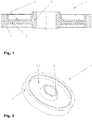
- Fig. 1 shows a rail vehicle wheel 1 according to the invention in section, which essentially consists of the hub 2, the wheel disc 3 and the wheel rim or wheel tire 4.
- Fig. 2 shows the same rail vehicle wheel 1 in a perspective view.
- Hub 2 wheel disc 3 and wheel tire 4 are formed in one piece from metal here, but can equally well be formed as individual parts and connected to one another.
- the wheel disc 3 and in this case also the inner flanks of the hub 2 and the wheel tire 4 are provided on one side with a support made of sound-absorbing or vibration-damping material, namely with a single-sided coating 5 made of microporous silicone material.
- the specific weight of the silicone material here is 0.8 g / cm 3 .
Landscapes
- Engineering & Computer Science (AREA)
- Mechanical Engineering (AREA)
- Braking Arrangements (AREA)
- Tires In General (AREA)
Description
- Die Erfindung betrifft ein Schienenfahrzeugrad, aufweisend mindestens eine Radscheibe und einen Radkranz bzw. Radreifen, bei dem mindestens die Radscheibe mit einer Auflage aus schalldämmend wirkendem bzw. schwingungsdämpfendem Werkstoff versehen ist.
- Der Schienenfahrzeugverkehr und insbesondere der Güterwagenverkehr verursachen erheblichen Lärm. Der Gesetzgeber ist daher gezwungen, hier zu handeln und entsprechende Vorgaben zur Geräuschreduzierung zu machen. Um Güterwagenräder, bei denen die Bremsbacken am Außenumfang angreifen, leiser zu machen, besteht eine bekannte Lösung darin, neuartige Bremsbeläge einzusetzen, die die Radreifen nicht so stark aufrauhen, wie die bisherigen Bremsbeläge.
- Da ein Rad ein schwingungsfähiges Gebilde darstellt, gibt es auch schon seit vielen Jahren Ansätze, diese Schwingungen zu bedämpfen. Dazu gehören neben Schwingungsabsorbern auch unterschiedliche Beschichtungen der Radscheibe mit einem viskoelastischen Material.
- Beläge aus schwingungsdämpfenden Werkstoffen für Schienenfahrzeugräder sind seit langem bekannt. So offenbart die
DE 19 26 312 B2 ein geräuschdämpfendes Scheibenrad für Schienenfahrzeuge, bestehend aus Radscheibe und Radreifen, bei dem auf der Radscheibe eine weitere Metallscheibe unter Zwischenlage einer Kunststoffschicht angeordnet bzw. aufgeklebt ist. Die Metallscheibe besitzt eine zur Radscheibe unterschiedliche Eigenfrequenz und bildet mit der Radscheibe ein Geräuschdämpfungssystem, bei dem Radscheibe und Metallscheibe gegenphasig schwingen und hierdurch eine Interferenzdämpfung erzeugen. Diese Schwingungen werden durch die Kunststoffschicht zusätzlich bedämpft. - Die
DE 814 167 B offenbart ein Rad für Schienenfahrzeuge, bei dem die Außenflächen ganz oder teilweise mit einem Überzug aus schalldämmender Werkstoff verkleidet sind. Der schalldämmende Werkstoff ist als Moosgummi bzw. Schwammgummi ausgebildet, dessen Struktur eine Veränderung seines Volumens zulässt. Dadurch wird ein Mitschwingen der mit der Luft in Verbindung stehenden Oberfläche des Überzuges vermieden. Dies kann durch zusätzliche Schichten auf der Oberfläche verstärkt werden. - Die
DE 827 076 B offenbart ebenfalls ein Rad für Schienenfahrzeuge mit einem Überzug aus schalldämmender Werkstoff, bei dem der Überzug jedoch mehrschichtig ausgebildet ist und eine auf der Radscheibe aufliegende Schicht aus Gummi beinhaltet, die auf ihrer Außenfläche eine weitere Schicht aus einem schalldämmender wirkenden Werkstoff aufweist, wie zum Beispiel Schwammgummi. - Die
DE 833 362 B offenbart ein gedämpftes Eisenbahnrad, bei dem ein zusätzlicher gegenüber dem Radkörper beweglicher Ringkörper vorgesehen ist, der unter Einfluss der Radschwingungen Relativbewegungen gegenüber dem Rad ausführen kann. Zwischen Radkörper und Ringkörper findet dann eine Flächenreibung statt, die dämpfend wirkt. - Die
EP 2 332 802 offenbart eine Absorptionsbeschichtung auf schwingenden Oberflächen von Schienenfahrzeugen, wobei die Oberfläche einen geschlossenzelligen Elastomerschaum auf zu mindestens einem Teilbereich aufweist, der mit der Oberfläche des Bauteils stoffschlüssig verbunden ist. Dadurch wird die Entstehung von Körperschall und von daraus erzeugtem Luftschall eingedämmt. - Die Veröffentlichung Material Letters 121 (2014) 126-128, 2014 Elsevier B.V.,"Preparation of silicone rubber foam using supercritical carbon dioxide", Lixan Song et al., offenbart ein Verfahren zum Aufschäumen von Silikonmischungen, geht jedoch nicht weiter ein auf deren Anwendung zur Dämmung von Schall.
- Die
EP 2 397 314 A1 offenbart ein Verfahren, mit dem ein geräuschdämpfender Schaum innerhalb eines Kraftfahrzeugreifens eingebracht werden kann, hier auf der Innenseite unterhalb seiner Lauffläche. Ein solches Verfahren ist für Schienenräder, die einer relativ hohen Temperaturbelastung ausgesetzt sind, ungeeignet. - All diese bisher im Stand der Technik bekannten Lösungen erfordern jedoch entweder mehrere zusätzliche Bauteile für das Rad oder aber Schichtauflagen, die relativ schwer sind und das Radgewicht unnötig erhöhen. Schwingungsabsorber sind aufwendig am Rad zu befestigen und schwächen die Struktur des Rades. Beschichtungen konnten sich aufgrund mangelnder Wirksamkeit nicht recht durchsetzen. Da die Beschichtungsdicke konventioneller Beschichtungen klein ist gegenüber der Materialdicke des Schienenrades, kann sie der Radschwingung nicht recht entgegenwirken. Da sich bei der oben beschriebenen Bremsung mittels Bremsklötzen/ Bremsbacken auf den Laufflächen (= Standard bei Güterwaggons) auch die Radscheiben stark erhitzen können, können übliche Antidröhnmaterialen z.B. auf Bitumenbasis, nicht zum Einsatz kommen.
- Darüber hinaus besteht bei Schienenfahrzeugrädern die Gefahr, dass bei einer kurzfristigen Überhitzung, etwa bei starken und häufigen Bremsvorgängen, die Beschichtung zersetzt werden kann und dann ihre schalldämpfende Wirkung verliert. Die Radscheiben von Güterwagenrädem werden daher mit einer Temperatur-Indikatorfarbe beschichtet, die eine unzulässige Überhitzung von über 280°C durch dauerhafte Veränderung von Farbe und Struktur anzeigt.
- Für die Erfindung bestand also die Aufgabe, ein geräuschgedämpftes Schienenfahrzeugrad bereitzustellen, welches nur wenige zusätzliche Bauteile erfordert, möglichst gewichtsneutral und einfach herzustellen ist und zudem eine Indikation einer unzulässigen Überhitzung ermöglicht.
- Gelöst wird diese Aufgabe durch die Merkmale des Hauptanspruchs. Weitere vorteilhafte Ausbildungen sind in den Unteransprüchen offenbart.
- Dabei wird als geräuschdämpfende Auflage der Radscheibe eine mindestens einseitige Beschichtung aus microporösem Silikonwerkstoff verwendet, wobei das spezifische Gewicht des Silikonwerkstoffs zwischen 0,4 g/cm3 und 1,2 g/cm3 liegt, vorzugsweise zwischen 0,75 g/cm3 und 0,85 g/cm3. Durch die besondere Ausbildung als mikroporöser Schichtstoff mit einem solchen spezifischen Gewicht hat sich überraschenderweise eine außergewöhnlich gute Geräuschdämpfung ergeben. Zusätzlich zeigt die Verwendung eines Silikonwerkstoffs an sich schon eine bereits recht gute Temperaturbeständigkeit.
- Innerhalb des der Silikonwerkstoffs sind dabei Füllstoffe, insbesondere Metalloxide verteilt. Durch innere Schwingungen der Metalloxide im Silikonwerkstoff entsteht eine innere Reibung / Dissipation, die die Schallabstrahlung wirksam bedämpft. Ebenfalls sehr gut ausgeprägt ist dieser Vorteil, wenn als Füllstoff Kaolin, Kreide oder Bariumsulfat im Silikonwerkstoff feinverteilt verteilt sind. Als Füllstoffe können aber auch Oxide wie etwa Aluminiumoxid Al2O3 oder spezielles Eisenoxid Fe3O4 enthalten sein.
- Eine weitere vorteilhafte Ausbildung besteht darin, dass der Silikonwerkstoff so ausgebildet ist, dass er bei Temperaturen oberhalb von 250° C einen dauerhaften Farbumschlag zeigt. Dadurch erhält man einen guten Indikator für Temperaturüberschreitungen und kann durch regelmäßige Kontrollen feststellen, ob der Schichtwerkstoff geschädigt ist und seine Dämpfungs- und Schallabsorptionsfähigkeit nicht mehr ausreichend erfüllen kann. Beispielsweise könnte das dadurch erfolgen, dass der Silikonwerkstoff mit einer Indikatorfarbe vermischt bzw. versehen wird.
- Anhand eines Ausführungsbeispiels soll die Erfindung näher erläutert werden. Es zeigen
- Fig. 1
- ein erfindungsgemäßes Schienenfahrzeugrad im Schnitt
- Fig. 2
- das erfindungsgemäße Schienenfahrzeugrad nach
Fig.1 in einer perspektivischen Darstellung. - Die
Fig. 1 zeigt ein erfindungsgemäßes Schienenfahrzeugrad 1 im Schnitt, welches im Wesentlichen aus der Nabe 2, der Radscheibe 3 und dem Radkranz bzw. Radreifen 4 besteht.Fig. 2 zeigt dasselbe Schienenfahrzeugrad 1 in einer perspektivischen Darstellung. - Nabe 2, Radscheibe 3 und Radreifen 4 sind hier einstückig aus Metall ausgebildet, können aber ebenso gut als Einzelteile ausgebildet und miteinander verbunden sein.
- Die Radscheibe 3 sowie in diesem Fall auch die inneren Flanken von Nabe 2 und Radreifen 4 sind einseitig mit einer Auflage aus schalldämmend wirkendem bzw. schwingungsdämpfendem Werkstoff versehen, nämlich mit einer einseitigen Beschichtung 5 aus microporösem Silikonwerkstoff.
- Das spezifische Gewicht des Silikonwerkstoffs beträgt hier 0,8 g/cm3. Innerhalb des Silikonwerkstoffs ist erfindungsgemäß Bariumsulfat (Schwerspat = BaSO4) als Füllstoff feinverteilt.
-
- 1
- Schienenfahrzeugrad
- 2
- Nabe
- 3
- Radscheibe
- 4
- Radkranz / Radreifen
- 5
- Beschichtung aus microporösem Silikon
Claims (4)
- Schienenfahrzeugrad (1), aufweisend mindestens eine Radscheibe (3) und einen Radkranz bzw. Radreifen (4), bei dem mindestens die Radscheibe (3) mit einer Auflage aus schalldämmend wirkendem bzw. schwingungsdämpfendem Werkstoff versehen ist, dadurch gekennzeichnet, dass die Auflage als eine mindestens einseitige Beschichtung (5) der Radscheibe aus microporösem Silikonwerkstoff ausgebildet ist, wobei das spezifische Gewicht des Silikonwerkstoffs zwischen 0,4 g/cm3 und 1,2 g/cm3 liegt, vorzugsweise zwischen 0,75 g/cm3 und 0,85 g/cm3 und wobei innerhalb des Silikonwerkstoffs Füllstoffe verteilt sind, die durch Schwingungen im Silikonwerkstoff eine innere Reibung erzeugen.
- Schienenfahrzeugrad nach Anspruch 1, bei dem Metalloxide als Füllstoffe innerhalb des Silikonwerkstoffs verteilt sind.
- Schienenfahrzeugrad nach Anspruch 2, bei dem Kaolin, Kreide oder Bariumsulfat als Füllstoffe innerhalb des Silikonwerkstoffs verteilt sind.
- Schienenfahrzeugrad nach einem der Ansprüche 1 bis 3, bei dem der Silikonwerkstoff bei Temperaturen oberhalb von 250° C einen dauerhaften Farbumschlag zeigt.
Applications Claiming Priority (1)
| Application Number | Priority Date | Filing Date | Title |
|---|---|---|---|
| DE102016214522.3A DE102016214522A1 (de) | 2016-08-05 | 2016-08-05 | Schallgedämpftes Schienenfahrzeugrad |
Publications (2)
| Publication Number | Publication Date |
|---|---|
| EP3279008A1 EP3279008A1 (de) | 2018-02-07 |
| EP3279008B1 true EP3279008B1 (de) | 2020-08-05 |
Family
ID=59030780
Family Applications (1)
| Application Number | Title | Priority Date | Filing Date |
|---|---|---|---|
| EP17173947.7A Active EP3279008B1 (de) | 2016-08-05 | 2017-06-01 | Schallgedämpftes schienenfahrzeugrad |
Country Status (2)
| Country | Link |
|---|---|
| EP (1) | EP3279008B1 (de) |
| DE (1) | DE102016214522A1 (de) |
Families Citing this family (1)
| Publication number | Priority date | Publication date | Assignee | Title |
|---|---|---|---|---|
| DE102020205098A1 (de) | 2020-04-22 | 2021-10-28 | Contitech Elastomer-Beschichtungen Gmbh | Schienendämpfung |
Family Cites Families (9)
| Publication number | Priority date | Publication date | Assignee | Title |
|---|---|---|---|---|
| DE814167C (de) | 1949-10-11 | 1951-09-20 | Bochumer Ver Fuer Gussstahlfab | Rad fuer Schienenfahrzeuge |
| DE827076C (de) | 1950-02-07 | 1952-01-07 | Bochumer Ver Fuer Gussstahlfab | Anordnung zur Geraeuschverhinderung bei Fahrzeugraedern, insbesondere Schienenraedern |
| DE833362C (de) | 1950-03-09 | 1952-03-06 | Bochumer Ver Fuer Gussstahlfab | Einrichtung zur Geraeuschdaempfung an Fahrzeug-, insbesondere Eisenbahnraedern |
| DE1926312C3 (de) | 1969-05-23 | 1978-06-08 | Kloeckner-Werke Ag, 4100 Duisburg | Geräuschgedämpftes Scheibenrad für Schienenfahrzeuge |
| US3993356A (en) * | 1975-10-14 | 1976-11-23 | Caterpillar Tractor Co. | Track carrying wheels for crawler type vehicles having improved panel assemblies |
| CN100413712C (zh) * | 2003-09-30 | 2008-08-27 | 尹学军 | 车轮 |
| DE102009037936A1 (de) * | 2009-08-19 | 2011-02-24 | Poroson Gmbh | Rad für ein Schienenfahrzeug |
| EP2332802A1 (de) * | 2009-12-10 | 2011-06-15 | Jochen Zingelmann | Absorptionsvorrichtung auf schwingenden Oberflächen, insbesondere bei Schienenfahrzeugen und Schienenstrecken |
| US20110308706A1 (en) * | 2010-06-21 | 2011-12-22 | The Goodyear Tire & Rubber Company | Method for making pneumatic tire with foam noise damper |
-
2016
- 2016-08-05 DE DE102016214522.3A patent/DE102016214522A1/de not_active Withdrawn
-
2017
- 2017-06-01 EP EP17173947.7A patent/EP3279008B1/de active Active
Non-Patent Citations (1)
| Title |
|---|
| None * |
Also Published As
| Publication number | Publication date |
|---|---|
| EP3279008A1 (de) | 2018-02-07 |
| DE102016214522A1 (de) | 2018-02-08 |
Similar Documents
| Publication | Publication Date | Title |
|---|---|---|
| EP1077835B1 (de) | Akustisch wirksames fahrzeugbauteil | |
| DE2652874C3 (de) | Einrichtung zur Schalldämpfung an einem Schienenrad | |
| AT406098B (de) | Schwingungs- und schalldämpfer | |
| DE102015112118A1 (de) | Feuerfeste Feder für Primärfederungen von Drehgestellen bei Eisenbahnen | |
| DE102009037936A1 (de) | Rad für ein Schienenfahrzeug | |
| DE102016213466A1 (de) | Verfahren zur Herstellung einer Wärmeisolationsschicht auf einer Reifenfelge und Reifenfelge mit einer Wärmeisolationsschicht | |
| DE2558676B2 (de) | Lärmschutz an Schienenfahrzeugen | |
| DE19617684A1 (de) | Schallgedämpftes Schienenrad | |
| DE19820590A1 (de) | Kraftfahrzeugrad | |
| EP3279008A1 (de) | Schallgedämpftes schienenfahrzeugrad | |
| DE19715071A1 (de) | Kraftfahrzeugrad | |
| DE1605832A1 (de) | Geraeuschgedaempfte Scheibenraeder fuer Schienenfahrzeuge | |
| AT508041A1 (de) | Schienenfahrzeug mit radschallabsorber | |
| EP3272556A1 (de) | Fahrzeugluftreifen mit polyurethanschaum als wärmeisolationsschicht und verfahren zur herstellung zumindest einer aus polyurethanschaum bestehenden wärmeisolationsschicht | |
| DE4120878A1 (de) | Fahrzeugreifen mit geraeuschmindernder konstruktion | |
| DE102012023875A1 (de) | Radlauf, insbesondere eines Kraftfahrzeugs | |
| DE102019205360A1 (de) | Schalldämpfungselement für ein Rad für ein Kraftfahrzeug | |
| DE1926312A1 (de) | Geraeuschgedaempftes Scheibenrad fuer Schienenfahrzeuge | |
| EP2332802A1 (de) | Absorptionsvorrichtung auf schwingenden Oberflächen, insbesondere bei Schienenfahrzeugen und Schienenstrecken | |
| DE102015205863B4 (de) | Radfelge mit einem Tiefbett | |
| DE102017219194A1 (de) | Schienenfahrwerk | |
| DE102013010183A1 (de) | Bauteil für ein Schienenfahrzeugrad | |
| DE2418621C3 (de) | Klotzgebremster Radsatz | |
| AT411588B (de) | Schallgedämpftes schienenrad | |
| DE1605832C3 (de) | Geräuschgedämpftes Scheibenrad für Schienenfahrzeuge |
Legal Events
| Date | Code | Title | Description |
|---|---|---|---|
| PUAI | Public reference made under article 153(3) epc to a published international application that has entered the european phase |
Free format text: ORIGINAL CODE: 0009012 |
|
| STAA | Information on the status of an ep patent application or granted ep patent |
Free format text: STATUS: THE APPLICATION HAS BEEN PUBLISHED |
|
| AK | Designated contracting states |
Kind code of ref document: A1 Designated state(s): AL AT BE BG CH CY CZ DE DK EE ES FI FR GB GR HR HU IE IS IT LI LT LU LV MC MK MT NL NO PL PT RO RS SE SI SK SM TR |
|
| AX | Request for extension of the european patent |
Extension state: BA ME |
|
| STAA | Information on the status of an ep patent application or granted ep patent |
Free format text: STATUS: REQUEST FOR EXAMINATION WAS MADE |
|
| 17P | Request for examination filed |
Effective date: 20180807 |
|
| RBV | Designated contracting states (corrected) |
Designated state(s): AL AT BE BG CH CY CZ DE DK EE ES FI FR GB GR HR HU IE IS IT LI LT LU LV MC MK MT NL NO PL PT RO RS SE SI SK SM TR |
|
| GRAP | Despatch of communication of intention to grant a patent |
Free format text: ORIGINAL CODE: EPIDOSNIGR1 |
|
| STAA | Information on the status of an ep patent application or granted ep patent |
Free format text: STATUS: GRANT OF PATENT IS INTENDED |
|
| INTG | Intention to grant announced |
Effective date: 20200225 |
|
| GRAS | Grant fee paid |
Free format text: ORIGINAL CODE: EPIDOSNIGR3 |
|
| GRAA | (expected) grant |
Free format text: ORIGINAL CODE: 0009210 |
|
| STAA | Information on the status of an ep patent application or granted ep patent |
Free format text: STATUS: THE PATENT HAS BEEN GRANTED |
|
| AK | Designated contracting states |
Kind code of ref document: B1 Designated state(s): AL AT BE BG CH CY CZ DE DK EE ES FI FR GB GR HR HU IE IS IT LI LT LU LV MC MK MT NL NO PL PT RO RS SE SI SK SM TR |
|
| REG | Reference to a national code |
Ref country code: GB Ref legal event code: FG4D Free format text: NOT ENGLISH |
|
| REG | Reference to a national code |
Ref country code: CH Ref legal event code: EP Ref country code: CH Ref legal event code: NV Representative=s name: CONTINENTAL SUISSE SA, CH |
|
| REG | Reference to a national code |
Ref country code: AT Ref legal event code: REF Ref document number: 1298197 Country of ref document: AT Kind code of ref document: T Effective date: 20200815 |
|
| REG | Reference to a national code |
Ref country code: DE Ref legal event code: R096 Ref document number: 502017006505 Country of ref document: DE |
|
| REG | Reference to a national code |
Ref country code: IE Ref legal event code: FG4D Free format text: LANGUAGE OF EP DOCUMENT: GERMAN |
|
| RAP2 | Party data changed (patent owner data changed or rights of a patent transferred) |
Owner name: CONTITECH LUFTFEDERSYSTEME GMBH |
|
| REG | Reference to a national code |
Ref country code: LT Ref legal event code: MG4D |
|
| REG | Reference to a national code |
Ref country code: NL Ref legal event code: MP Effective date: 20200805 |
|
| PG25 | Lapsed in a contracting state [announced via postgrant information from national office to epo] |
Ref country code: PT Free format text: LAPSE BECAUSE OF FAILURE TO SUBMIT A TRANSLATION OF THE DESCRIPTION OR TO PAY THE FEE WITHIN THE PRESCRIBED TIME-LIMIT Effective date: 20201207 Ref country code: ES Free format text: LAPSE BECAUSE OF FAILURE TO SUBMIT A TRANSLATION OF THE DESCRIPTION OR TO PAY THE FEE WITHIN THE PRESCRIBED TIME-LIMIT Effective date: 20200805 Ref country code: GR Free format text: LAPSE BECAUSE OF FAILURE TO SUBMIT A TRANSLATION OF THE DESCRIPTION OR TO PAY THE FEE WITHIN THE PRESCRIBED TIME-LIMIT Effective date: 20201106 Ref country code: SE Free format text: LAPSE BECAUSE OF FAILURE TO SUBMIT A TRANSLATION OF THE DESCRIPTION OR TO PAY THE FEE WITHIN THE PRESCRIBED TIME-LIMIT Effective date: 20200805 Ref country code: HR Free format text: LAPSE BECAUSE OF FAILURE TO SUBMIT A TRANSLATION OF THE DESCRIPTION OR TO PAY THE FEE WITHIN THE PRESCRIBED TIME-LIMIT Effective date: 20200805 Ref country code: FI Free format text: LAPSE BECAUSE OF FAILURE TO SUBMIT A TRANSLATION OF THE DESCRIPTION OR TO PAY THE FEE WITHIN THE PRESCRIBED TIME-LIMIT Effective date: 20200805 Ref country code: LT Free format text: LAPSE BECAUSE OF FAILURE TO SUBMIT A TRANSLATION OF THE DESCRIPTION OR TO PAY THE FEE WITHIN THE PRESCRIBED TIME-LIMIT Effective date: 20200805 Ref country code: BG Free format text: LAPSE BECAUSE OF FAILURE TO SUBMIT A TRANSLATION OF THE DESCRIPTION OR TO PAY THE FEE WITHIN THE PRESCRIBED TIME-LIMIT Effective date: 20201105 Ref country code: NO Free format text: LAPSE BECAUSE OF FAILURE TO SUBMIT A TRANSLATION OF THE DESCRIPTION OR TO PAY THE FEE WITHIN THE PRESCRIBED TIME-LIMIT Effective date: 20201105 |
|
| PG25 | Lapsed in a contracting state [announced via postgrant information from national office to epo] |
Ref country code: NL Free format text: LAPSE BECAUSE OF FAILURE TO SUBMIT A TRANSLATION OF THE DESCRIPTION OR TO PAY THE FEE WITHIN THE PRESCRIBED TIME-LIMIT Effective date: 20200805 Ref country code: PL Free format text: LAPSE BECAUSE OF FAILURE TO SUBMIT A TRANSLATION OF THE DESCRIPTION OR TO PAY THE FEE WITHIN THE PRESCRIBED TIME-LIMIT Effective date: 20200805 Ref country code: RS Free format text: LAPSE BECAUSE OF FAILURE TO SUBMIT A TRANSLATION OF THE DESCRIPTION OR TO PAY THE FEE WITHIN THE PRESCRIBED TIME-LIMIT Effective date: 20200805 Ref country code: LV Free format text: LAPSE BECAUSE OF FAILURE TO SUBMIT A TRANSLATION OF THE DESCRIPTION OR TO PAY THE FEE WITHIN THE PRESCRIBED TIME-LIMIT Effective date: 20200805 Ref country code: IS Free format text: LAPSE BECAUSE OF FAILURE TO SUBMIT A TRANSLATION OF THE DESCRIPTION OR TO PAY THE FEE WITHIN THE PRESCRIBED TIME-LIMIT Effective date: 20201205 |
|
| PG25 | Lapsed in a contracting state [announced via postgrant information from national office to epo] |
Ref country code: SM Free format text: LAPSE BECAUSE OF FAILURE TO SUBMIT A TRANSLATION OF THE DESCRIPTION OR TO PAY THE FEE WITHIN THE PRESCRIBED TIME-LIMIT Effective date: 20200805 Ref country code: EE Free format text: LAPSE BECAUSE OF FAILURE TO SUBMIT A TRANSLATION OF THE DESCRIPTION OR TO PAY THE FEE WITHIN THE PRESCRIBED TIME-LIMIT Effective date: 20200805 Ref country code: RO Free format text: LAPSE BECAUSE OF FAILURE TO SUBMIT A TRANSLATION OF THE DESCRIPTION OR TO PAY THE FEE WITHIN THE PRESCRIBED TIME-LIMIT Effective date: 20200805 Ref country code: DK Free format text: LAPSE BECAUSE OF FAILURE TO SUBMIT A TRANSLATION OF THE DESCRIPTION OR TO PAY THE FEE WITHIN THE PRESCRIBED TIME-LIMIT Effective date: 20200805 Ref country code: CZ Free format text: LAPSE BECAUSE OF FAILURE TO SUBMIT A TRANSLATION OF THE DESCRIPTION OR TO PAY THE FEE WITHIN THE PRESCRIBED TIME-LIMIT Effective date: 20200805 |
|
| REG | Reference to a national code |
Ref country code: DE Ref legal event code: R097 Ref document number: 502017006505 Country of ref document: DE |
|
| PG25 | Lapsed in a contracting state [announced via postgrant information from national office to epo] |
Ref country code: AL Free format text: LAPSE BECAUSE OF FAILURE TO SUBMIT A TRANSLATION OF THE DESCRIPTION OR TO PAY THE FEE WITHIN THE PRESCRIBED TIME-LIMIT Effective date: 20200805 |
|
| PLBE | No opposition filed within time limit |
Free format text: ORIGINAL CODE: 0009261 |
|
| STAA | Information on the status of an ep patent application or granted ep patent |
Free format text: STATUS: NO OPPOSITION FILED WITHIN TIME LIMIT |
|
| PG25 | Lapsed in a contracting state [announced via postgrant information from national office to epo] |
Ref country code: SK Free format text: LAPSE BECAUSE OF FAILURE TO SUBMIT A TRANSLATION OF THE DESCRIPTION OR TO PAY THE FEE WITHIN THE PRESCRIBED TIME-LIMIT Effective date: 20200805 |
|
| 26N | No opposition filed |
Effective date: 20210507 |
|
| PG25 | Lapsed in a contracting state [announced via postgrant information from national office to epo] |
Ref country code: IT Free format text: LAPSE BECAUSE OF FAILURE TO SUBMIT A TRANSLATION OF THE DESCRIPTION OR TO PAY THE FEE WITHIN THE PRESCRIBED TIME-LIMIT Effective date: 20200805 |
|
| PG25 | Lapsed in a contracting state [announced via postgrant information from national office to epo] |
Ref country code: SI Free format text: LAPSE BECAUSE OF FAILURE TO SUBMIT A TRANSLATION OF THE DESCRIPTION OR TO PAY THE FEE WITHIN THE PRESCRIBED TIME-LIMIT Effective date: 20200805 |
|
| PG25 | Lapsed in a contracting state [announced via postgrant information from national office to epo] |
Ref country code: MC Free format text: LAPSE BECAUSE OF FAILURE TO SUBMIT A TRANSLATION OF THE DESCRIPTION OR TO PAY THE FEE WITHIN THE PRESCRIBED TIME-LIMIT Effective date: 20200805 |
|
| REG | Reference to a national code |
Ref country code: BE Ref legal event code: MM Effective date: 20210630 |
|
| PG25 | Lapsed in a contracting state [announced via postgrant information from national office to epo] |
Ref country code: LU Free format text: LAPSE BECAUSE OF NON-PAYMENT OF DUE FEES Effective date: 20210601 |
|
| PG25 | Lapsed in a contracting state [announced via postgrant information from national office to epo] |
Ref country code: IE Free format text: LAPSE BECAUSE OF NON-PAYMENT OF DUE FEES Effective date: 20210601 |
|
| PG25 | Lapsed in a contracting state [announced via postgrant information from national office to epo] |
Ref country code: BE Free format text: LAPSE BECAUSE OF NON-PAYMENT OF DUE FEES Effective date: 20210630 |
|
| PG25 | Lapsed in a contracting state [announced via postgrant information from national office to epo] |
Ref country code: HU Free format text: LAPSE BECAUSE OF FAILURE TO SUBMIT A TRANSLATION OF THE DESCRIPTION OR TO PAY THE FEE WITHIN THE PRESCRIBED TIME-LIMIT; INVALID AB INITIO Effective date: 20170601 |
|
| PG25 | Lapsed in a contracting state [announced via postgrant information from national office to epo] |
Ref country code: CY Free format text: LAPSE BECAUSE OF FAILURE TO SUBMIT A TRANSLATION OF THE DESCRIPTION OR TO PAY THE FEE WITHIN THE PRESCRIBED TIME-LIMIT Effective date: 20200805 |
|
| PG25 | Lapsed in a contracting state [announced via postgrant information from national office to epo] |
Ref country code: MK Free format text: LAPSE BECAUSE OF FAILURE TO SUBMIT A TRANSLATION OF THE DESCRIPTION OR TO PAY THE FEE WITHIN THE PRESCRIBED TIME-LIMIT Effective date: 20200805 |
|
| PG25 | Lapsed in a contracting state [announced via postgrant information from national office to epo] |
Ref country code: MT Free format text: LAPSE BECAUSE OF FAILURE TO SUBMIT A TRANSLATION OF THE DESCRIPTION OR TO PAY THE FEE WITHIN THE PRESCRIBED TIME-LIMIT Effective date: 20200805 |
|
| PGFP | Annual fee paid to national office [announced via postgrant information from national office to epo] |
Ref country code: DE Payment date: 20250630 Year of fee payment: 9 |
|
| PGFP | Annual fee paid to national office [announced via postgrant information from national office to epo] |
Ref country code: GB Payment date: 20250618 Year of fee payment: 9 |
|
| PGFP | Annual fee paid to national office [announced via postgrant information from national office to epo] |
Ref country code: FR Payment date: 20250625 Year of fee payment: 9 |
|
| PGFP | Annual fee paid to national office [announced via postgrant information from national office to epo] |
Ref country code: AT Payment date: 20250620 Year of fee payment: 9 |
|
| PGFP | Annual fee paid to national office [announced via postgrant information from national office to epo] |
Ref country code: CH Payment date: 20250701 Year of fee payment: 9 |
|
| PG25 | Lapsed in a contracting state [announced via postgrant information from national office to epo] |
Ref country code: TR Free format text: LAPSE BECAUSE OF FAILURE TO SUBMIT A TRANSLATION OF THE DESCRIPTION OR TO PAY THE FEE WITHIN THE PRESCRIBED TIME-LIMIT Effective date: 20200805 |