EP3277787B1 - Verbesserte persauerstoffstabilität mit einem anionischen tensid in einem bleichaktivator-haltigen persauerstofffeststoff und verfahren zur reiningung damit - Google Patents
Verbesserte persauerstoffstabilität mit einem anionischen tensid in einem bleichaktivator-haltigen persauerstofffeststoff und verfahren zur reiningung damit Download PDFInfo
- Publication number
- EP3277787B1 EP3277787B1 EP16774292.3A EP16774292A EP3277787B1 EP 3277787 B1 EP3277787 B1 EP 3277787B1 EP 16774292 A EP16774292 A EP 16774292A EP 3277787 B1 EP3277787 B1 EP 3277787B1
- Authority
- EP
- European Patent Office
- Prior art keywords
- compositions
- solid
- composition
- bleach
- active oxygen
- Prior art date
- Legal status (The legal status is an assumption and is not a legal conclusion. Google has not performed a legal analysis and makes no representation as to the accuracy of the status listed.)
- Active
Links
Images


Classifications
-
- C—CHEMISTRY; METALLURGY
- C11—ANIMAL OR VEGETABLE OILS, FATS, FATTY SUBSTANCES OR WAXES; FATTY ACIDS THEREFROM; DETERGENTS; CANDLES
- C11D—DETERGENT COMPOSITIONS; USE OF SINGLE SUBSTANCES AS DETERGENTS; SOAP OR SOAP-MAKING; RESIN SOAPS; RECOVERY OF GLYCEROL
- C11D3/00—Other compounding ingredients of detergent compositions covered in group C11D1/00
- C11D3/395—Bleaching agents
- C11D3/3951—Bleaching agents combined with specific additives
-
- C—CHEMISTRY; METALLURGY
- C01—INORGANIC CHEMISTRY
- C01B—NON-METALLIC ELEMENTS; COMPOUNDS THEREOF; METALLOIDS OR COMPOUNDS THEREOF NOT COVERED BY SUBCLASS C01C
- C01B15/00—Peroxides; Peroxyhydrates; Peroxyacids or salts thereof; Superoxides; Ozonides
- C01B15/01—Hydrogen peroxide
- C01B15/037—Stabilisation by additives
-
- C—CHEMISTRY; METALLURGY
- C11—ANIMAL OR VEGETABLE OILS, FATS, FATTY SUBSTANCES OR WAXES; FATTY ACIDS THEREFROM; DETERGENTS; CANDLES
- C11D—DETERGENT COMPOSITIONS; USE OF SINGLE SUBSTANCES AS DETERGENTS; SOAP OR SOAP-MAKING; RESIN SOAPS; RECOVERY OF GLYCEROL
- C11D1/00—Detergent compositions based essentially on surface-active compounds; Use of these compounds as a detergent
- C11D1/02—Anionic compounds
- C11D1/12—Sulfonic acids or sulfuric acid esters; Salts thereof
- C11D1/22—Sulfonic acids or sulfuric acid esters; Salts thereof derived from aromatic compounds
-
- C—CHEMISTRY; METALLURGY
- C11—ANIMAL OR VEGETABLE OILS, FATS, FATTY SUBSTANCES OR WAXES; FATTY ACIDS THEREFROM; DETERGENTS; CANDLES
- C11D—DETERGENT COMPOSITIONS; USE OF SINGLE SUBSTANCES AS DETERGENTS; SOAP OR SOAP-MAKING; RESIN SOAPS; RECOVERY OF GLYCEROL
- C11D17/00—Detergent materials or soaps characterised by their shape or physical properties
- C11D17/0034—Fixed on a solid conventional detergent ingredient
-
- C—CHEMISTRY; METALLURGY
- C11—ANIMAL OR VEGETABLE OILS, FATS, FATTY SUBSTANCES OR WAXES; FATTY ACIDS THEREFROM; DETERGENTS; CANDLES
- C11D—DETERGENT COMPOSITIONS; USE OF SINGLE SUBSTANCES AS DETERGENTS; SOAP OR SOAP-MAKING; RESIN SOAPS; RECOVERY OF GLYCEROL
- C11D3/00—Other compounding ingredients of detergent compositions covered in group C11D1/00
- C11D3/02—Inorganic compounds ; Elemental compounds
- C11D3/04—Water-soluble compounds
- C11D3/10—Carbonates ; Bicarbonates
-
- C—CHEMISTRY; METALLURGY
- C11—ANIMAL OR VEGETABLE OILS, FATS, FATTY SUBSTANCES OR WAXES; FATTY ACIDS THEREFROM; DETERGENTS; CANDLES
- C11D—DETERGENT COMPOSITIONS; USE OF SINGLE SUBSTANCES AS DETERGENTS; SOAP OR SOAP-MAKING; RESIN SOAPS; RECOVERY OF GLYCEROL
- C11D3/00—Other compounding ingredients of detergent compositions covered in group C11D1/00
- C11D3/16—Organic compounds
- C11D3/20—Organic compounds containing oxygen
- C11D3/22—Carbohydrates or derivatives thereof
- C11D3/222—Natural or synthetic polysaccharides, e.g. cellulose, starch, gum, alginic acid or cyclodextrin
- C11D3/225—Natural or synthetic polysaccharides, e.g. cellulose, starch, gum, alginic acid or cyclodextrin etherified, e.g. CMC
-
- C—CHEMISTRY; METALLURGY
- C11—ANIMAL OR VEGETABLE OILS, FATS, FATTY SUBSTANCES OR WAXES; FATTY ACIDS THEREFROM; DETERGENTS; CANDLES
- C11D—DETERGENT COMPOSITIONS; USE OF SINGLE SUBSTANCES AS DETERGENTS; SOAP OR SOAP-MAKING; RESIN SOAPS; RECOVERY OF GLYCEROL
- C11D3/00—Other compounding ingredients of detergent compositions covered in group C11D1/00
- C11D3/16—Organic compounds
- C11D3/26—Organic compounds containing nitrogen
- C11D3/32—Amides; Substituted amides
-
- C—CHEMISTRY; METALLURGY
- C11—ANIMAL OR VEGETABLE OILS, FATS, FATTY SUBSTANCES OR WAXES; FATTY ACIDS THEREFROM; DETERGENTS; CANDLES
- C11D—DETERGENT COMPOSITIONS; USE OF SINGLE SUBSTANCES AS DETERGENTS; SOAP OR SOAP-MAKING; RESIN SOAPS; RECOVERY OF GLYCEROL
- C11D3/00—Other compounding ingredients of detergent compositions covered in group C11D1/00
- C11D3/39—Organic or inorganic per-compounds
- C11D3/3902—Organic or inorganic per-compounds combined with specific additives
- C11D3/3905—Bleach activators or bleach catalysts
- C11D3/3907—Organic compounds
-
- C—CHEMISTRY; METALLURGY
- C11—ANIMAL OR VEGETABLE OILS, FATS, FATTY SUBSTANCES OR WAXES; FATTY ACIDS THEREFROM; DETERGENTS; CANDLES
- C11D—DETERGENT COMPOSITIONS; USE OF SINGLE SUBSTANCES AS DETERGENTS; SOAP OR SOAP-MAKING; RESIN SOAPS; RECOVERY OF GLYCEROL
- C11D3/00—Other compounding ingredients of detergent compositions covered in group C11D1/00
- C11D3/39—Organic or inorganic per-compounds
- C11D3/3902—Organic or inorganic per-compounds combined with specific additives
- C11D3/3905—Bleach activators or bleach catalysts
- C11D3/3907—Organic compounds
- C11D3/3917—Nitrogen-containing compounds
-
- C—CHEMISTRY; METALLURGY
- C11—ANIMAL OR VEGETABLE OILS, FATS, FATTY SUBSTANCES OR WAXES; FATTY ACIDS THEREFROM; DETERGENTS; CANDLES
- C11D—DETERGENT COMPOSITIONS; USE OF SINGLE SUBSTANCES AS DETERGENTS; SOAP OR SOAP-MAKING; RESIN SOAPS; RECOVERY OF GLYCEROL
- C11D3/00—Other compounding ingredients of detergent compositions covered in group C11D1/00
- C11D3/39—Organic or inorganic per-compounds
- C11D3/3902—Organic or inorganic per-compounds combined with specific additives
- C11D3/3937—Stabilising agents
- C11D3/394—Organic compounds
-
- C—CHEMISTRY; METALLURGY
- C11—ANIMAL OR VEGETABLE OILS, FATS, FATTY SUBSTANCES OR WAXES; FATTY ACIDS THEREFROM; DETERGENTS; CANDLES
- C11D—DETERGENT COMPOSITIONS; USE OF SINGLE SUBSTANCES AS DETERGENTS; SOAP OR SOAP-MAKING; RESIN SOAPS; RECOVERY OF GLYCEROL
- C11D7/00—Compositions of detergents based essentially on non-surface-active compounds
- C11D7/02—Inorganic compounds
- C11D7/04—Water-soluble compounds
- C11D7/10—Salts
- C11D7/12—Carbonates bicarbonates
Definitions
- the invention relates to solid, stabilized peroxygen bleach compositions, namely multi-use compositions.
- the solid compositions employ a binding system for improving shelf stability of an activated bleach composition containing a peroxygen source and a bleach activating agent.
- the stabilized compositions allow solid formulation and delivery for oxygen bleaches, in addition to the liquid, powder and solid blocks which are currently offered for chlorine sanitizers.
- Stabilized compositions employ a binding system containing an anionic surfactant.
- the bleach activating agent is combined with a binding system providing shelf stability of the activated bleach composition to prevent premature reaction of reactive components during storage and/or transportation, thereby allowing both reactive components to be formulated into a single solid composition.
- active oxygen sources e.g. peroxide
- bleach activating agents with oxygen sources e.g. percarbonates
- the delivery of these reactive components - active oxygen sources and activator materials - in a single bleaching formulation suffers from numerous stability challenges. In particular, the components react when mixed together.
- certain bleach activating agents when combined with active oxygen sources have poor available oxygen stability over time, especially at elevated storage temperatures.
- Improvements to stability, as well as separating the active components to prevent premature generation of bleaching compositions have been disclosed for various bleach activating technologies.
- the use of coatings or encapsulation of particulate materials, including the bleach activator TAED have been employed ( U.S. Patent No. 4,853,143 ).
- the improvement in stability of bleach compositions has also included, for example, development of agglomerated forms or granules and encapsulating the same ( EP 1735422 ), use of water soluble ligands or complexing agents (e.g.
- a solid, essentially anhydrous peroxygen bleaching and sanitizing composition which includes a peroxygen bleaching agent, an activator capable of forming a per-acid in the presence of oxygen, and an essentially anhydrous, non-reactive binding agent.
- the binding agent is essentially anhydrous and non-reactive with oxygen.
- optional functional ingredients can be utilized as necessary for specific cleaning purposes.
- US 6,440,926 relates to dry effervescent granules comprising an acid, carbonate source and optionally a binder, wherein said acid, carbonate source and optionally binder are in close physical proximity. Also disclosed are granular compositions, containing effervescence material comprising an acid and a carbonate source, which has an effervescence index (EI) of at least 50.
- the granular compositions may be obtainable by incorporating said pre-formed dry effervescent granules into said granular compositions, especially detergent compositions.
- US 2006/293204 relates to a bleach composition containing (a) a peroxide generating hydrogen peroxide by being dissolved in water, (b) a water-insoluble or poorly water-soluble textile powder selected from powder cellulose, silk powder, wool powder, nylon powder and polyurethane powder, and (c) (c-1) a bleaching activating catalyst and/or (c-2) a bleaching activator.
- a bleaching detergent composition containing (a) a peroxide generating hydrogen peroxide by being dissolved in water, (b) a water-insoluble or poorly water-soluble textile powder selected from powder cellulose, silk powder, wool powder, nylon powder and polyurethane powder, and (c) (c-1) a bleaching activating catalyst or (c-1) a bleaching activating catalyst and (c-2) a bleaching activator, and (d) a surfactant.
- the use of bleach activating agents or catalysts with unstable oxygen sources results in limited shipment and/or storage shelf life or stability despite the various advances by those skilled in the art.
- the shelf life is commonly regarded as the period of time over which the product may be stored while retaining its required performance efficacy.
- a satisfactory shelf life is in many instances a crucial factor for the success of a commercial product.
- a product with a short shelf life generally dictates that the product is made in small batches and is rapidly sold to the consumer.
- products with a longer shelf life may be made in larger batches, maintained in storage for a longer period of time and/or maintained by a consumer for a longer period of time before use.
- solid compositions having increased shelf life and stability when employing reactive components, such as a peroxygen source (e.g. sodium percarbonate) and a bleach activator (e.g. TAED) without requiring any encapsulation, layering of components or the like to provide physical separation of the reactive components in a solid formulation.
- reactive components such as a peroxygen source (e.g. sodium percarbonate) and a bleach activator (e.g. TAED)
- reactive components such as coatings and/or binding systems to minimize the interaction between the reactive components, such as a peroxygen source (e.g. sodium percarbonate) and a bleach activator (e.g. TAED).
- a further object of the invention is to incorporate an active oxygen source and a bleach activating agent into a single solid detergent block, while beneficially overcoming the poor available oxygen stability as experienced in the prior art, including at elevated storage temperatures.
- a further object of the invention is to provide methods of protection and/or formulating a bleach activator and oxygen source in a single, stabilized solid detergent block with an anionic surfactant binding agent to prevent reaction of the bleach activating agent an active oxygen source (e.g. peroxygen source).
- an active oxygen source e.g. peroxygen source
- An advantage of the invention is an improved shelf stability of activated bleach compositions containing a peroxygen source and a bleach activator which will react during use to form a peroxycarboxylic acid. It is a benefit of the present invention that a bleach activator is prevented from reacting with the peroxygen source due to the presence of a binding system including an anionic surfactant to prevent premature reaction between the peroxygen source and bleach activator in a solid formulation. Beneficially, the storage and/or transportation stability of the compositions are significantly increased by the presence of the binding system including an anionic surfactant, allowing both reactive components to be formulated into a single solid composition.
- the present invention provides a stabilized solid activated bleach composition according to the claims comprising: at least one alkalinity solidification source matrix including alkali metal carbonates and/or alkali metal silicates; an active oxygen source, wherein the active oxygen source is selected from the group consisting of peroxygen compounds, hydrogen peroxide, hydrogen peroxide liberating or generating compounds, inorganic or organic peroxyacids, peroxycarboxylic acids, percarbonates and combinations thereof; a bleach activating agent; and from 1-15 wt-% of a binding system comprising an anionic surfactant and a cellulose source, wherein no more than 0.5 wt-% of nonionic surfactant is included in the binding system and wherein the solid composition has less than 0.5 wt-% water.
- the solid composition has less than 1 wt-% water.
- the solid composition has shelf stability at room temperature for at least one year.
- the present invention provides a stabilized solid activated bleach composition
- a stabilized solid activated bleach composition comprising: from about 10-80 wt-% of at least one alkaline solidification matrix; from about 10-75 wt-% of an active oxygen source; from about 0.1-50 wt-% of a bleach activating agent; and, not according to the invention, from about 0.1-25 wt-% of a binding system comprising an anionic surfactant and a cellulose source.
- the solid composition has less than 1 wt-% water in the solid composition.
- the solid composition has shelf stability at room temperature for at least one year.
- the present invention provides methods of cleaning, sanitizing and/or bleaching according to the claims comprising: providing the stabilized solid activated bleach composition; generating a use solution of the composition; and contacting a surface or object in need of cleaning, sanitizing and/or bleaching with the use solution of the composition.
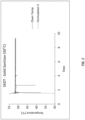
- FIGS. 1-3 show the self-accelerating decomposition temperature (SADT) of evaluated solid bleaching compositions according to embodiments of the invention as set forth in the Examples.
- SADT self-accelerating decomposition temperature
- the embodiments of this invention are not limited to particular activated bleach compositions employing the anionic surfactant-containing binding system for stabilizing a solid composition containing both a peroxygen source and catalyst activator, which can vary and are understood by skilled artisans. It is further to be understood that all terminology used herein is for the purpose of describing particular embodiments only, and is not intended to be limiting in any manner or scope. For example, as used in this specification and the appended claims, the singular forms "a,” “an” and “the” can include plural referents unless the content clearly indicates otherwise. Further, all units, prefixes, and symbols may be denoted in its SI accepted form.
- actives or “percent actives” or “percent by weight actives” or “actives concentration” are used interchangeably herein and refers to the concentration of those ingredients involved in cleaning expressed as a percentage minus inert ingredients such as water or salts.
- the term “cleaning” refers to a method used to facilitate or aid in soil removal, bleaching, microbial population reduction, and any combination thereof.
- the term “microorganism” refers to any noncellular or unicellular (including colonial) organism. Microorganisms include all prokaryotes. Microorganisms include bacteria (including cyanobacteria), spores, lichens, fungi, protozoa, virinos, viroids, viruses, phages, and some algae.
- the term “microbe” is synonymous with microorganism. For the purpose of this patent application, successful microbial reduction is achieved when the microbial populations are reduced by at least about 50%, or by significantly more than is achieved by a wash with water. Larger reductions in microbial population provide greater levels of protection.
- Antimicrobial compositions can affect two kinds of microbial cell damage. The first is a lethal, irreversible action resulting in complete microbial cell destruction or incapacitation. The second type of cell damage is reversible, such that if the organism is rendered free of the agent, it can again multiply.
- the former is termed microbiocidal and the later, microbistatic.
- a sanitizer and a disinfectant are, by definition, agents which provide antimicrobial or microbiocidal activity.
- a preservative is generally described as an inhibitor or microbistatic composition
- weight percent refers to the concentration of a substance as the weight of that substance divided by the total weight of the composition and multiplied by 100. It is understood that, as used here, “percent,” “%,” and the like are intended to be synonymous with “weight percent,” “wt-%,” etc.
- compositions of the present invention may comprise, consist essentially of, or consist of the components and ingredients of the present invention as well as other ingredients described herein.
- consisting essentially of means that the methods and compositions may include additional steps, components or ingredients, but only if the additional steps, components or ingredients do not materially alter the basic and novel characteristics of the claimed methods and compositions.
- Stabilized solid activated bleach compositions are provided according to the invention as an alternative to chlorine-based bleaching compositions and sanitizers.
- oxygen sanitizers e.g. peracetic acid and other active oxygen sources
- a stable solid composition containing the active oxygen e.g. peracetic acid
- a solid formulation of a composition with the necessary reactive components to form an active oxygen e.g. peracetic acid or other peroxycarboxylic acid
- an active oxygen e.g. peracetic acid or other peroxycarboxylic acid
- TAED tetraacetylethylenediamine
- Exemplary ranges of the stabilized solid activated bleach compositions are shown in Table 1 in weight percentage of the solid compositions.
- the solid compositions may comprise, consist of or consist essentially of the materials set from in Table 1. Without being limited according to the invention, all ranges for the ratios recited are inclusive of the numbers defining the range and include each integer within the defined range of ratios. According to the invention, from 1-15 wt.% of the binding system is present in the stabilized solid activated bleach compositions.
- Binding System 0.1-25 1-20 1-15 1-10 Alkaline Solidification Matrix (e.g. alkali metal carbonate) 10-80 10-70 15-60 20-40 Additional Functional Ingredients (e.g. chelants, sequestrants) 0-30 0.1-25 1-20 5-15
- the stabilized solid activated bleach compositions preferably are water-free or substantially water-free to maintain stability of the binding system, bleach activating agent and active oxygen source.
- the solid compositions have a water content of less than about 0.5% by weight, less than about 0.1% by weight, less than about 0.05% by weight, and most preferably free of water (i.e. dried).
- the stabilized solid activated bleach compositions are formulated to minimize and preferably remove water, such as by formulation containing anhydrous components .
- the solid compositions have such water contents upon formulation of the solid composition, and one skilled in the art will ascertain that despite anhydrous components for various aspects of the formulation of the compositions conditions, such as for example humidity and temperature, may cause changes in the water content of the solid due to the hydroscopic nature thereof.
- the stabilized solid activated bleach compositions are preferably provided as concentrate compositions which may be diluted to form use compositions.
- a concentrate refers to a composition that is intended to be diluted with water to provide a use solution that contacts an object to provide the desired sanitizing, bleaching, or the like.
- the stabilized solid activated bleach composition that contacts the articles to be washed can be referred to as a concentrate or a use composition (or use solution) dependent upon the formulation employed in methods according to the invention. It should be understood that the concentration of the bleach activating agent, active oxidant, binding system, alkalinity agents for solidification and other additional functional ingredients in the stabilized solid activated bleach compositions will vary depending on the concentrated nature of the formulation and the desired use solution thereof.
- the stabilized solid activated bleach compositions maintain shelf stability for at least about 6 months, or at least about 1 year at room temperature.
- the stabilized solid activated bleach compositions maintain shelf stability at elevated storage temperatures, including for example at temperatures up to at least 40°C for 12 weeks or up to a at least 50°C for 8 weeks.
- the stabilized solid activated bleach compositions according to the invention include a bleach activating agent (also referred to as an activating agent) to further increase the activity of the active oxygen source (e.g. percarbonate).
- a bleach activating agent also referred to as an activating agent
- Bleach activating agents can be used alone or in combination with catalysts.
- bleach activating agents have the following formula: R--(C--O)-L wherein R is an alkyl group, optionally branched, having, when the bleach activator is hydrophobic, from 6 to 14 carbon atoms, or from 8 to 12 carbon atoms and, when the bleach activator is hydrophilic, less than 6 carbon atoms or even less than 4 carbon atoms; and L is leaving group.
- R is an alkyl group, optionally branched, having, when the bleach activator is hydrophobic, from 6 to 14 carbon atoms, or from 8 to 12 carbon atoms and, when the bleach activator is hydrophilic, less than 6 carbon atoms or even less than 4 carbon atoms; and L is leaving group.
- suitable leaving groups are benzoic acid and derivatives thereof--especially benzene sulphonate.
- Suitable bleach activators include dodecanoyl oxybenzene sulphonate, decanoyl oxybenzene sulphonate, decanoyl oxybenzoic acid or salts thereof, 3,5,5-trimethyl hexanoyloxybenzene sulphonate, tetraacetyl ethylene diamine (TAED) and nonanoyloxybenzene sulphonate (NOBS).
- TAED tetraacetyl ethylene diamine
- NOBS nonanoyloxybenzene sulphonate
- Suitable bleach activators are also disclosed in WO 98/17767 .
- preferred activating agents include N,N,N',N'-tetraacetyl ethylene diamine (TAED); sodium-4-benzoyloxy benzene sulphonate (SBOBS); sodium-1-methyl-2-benzoyloxy benzene-4-sulphonate; sodium-4-methyl-3-benzoyloxy benzoate; SPCC trimethyl ammonium toluyloxy benzene sulphonate; sodium nonanoyloxybenzene sulphonate, sodium 3,5,5,-trimethyl hexanoyloxybenzene sulphonate; penta acetyl glucose (PAG); octanoyl tetra acetyl glucose and benzoyl tetracetyl glucose.
- TAED N,N,N',N'-tetraacetyl ethylene diamine
- SBOBS sodium-4-benzoyloxy benzene sulphonate
- SPCC trimethyl ammoni
- bleach activating agents are set forth, for example, in U.S. Patent Nos. 4,853,143 , 7,709,437 and 8,431,519 , and EP 2021454 .
- the activating agent has a concentration in the stabilized solid activated bleach compositions from about 0.1 wt-% to about 50 wt-%, from about 1 wt-% to about 50 wt-%, from about 5 wt-% to about 40 wt-%, or from about 10 wt-% to about 25 wt-%.
- the ratio of the activating agent to peroxygen source in the solid composition is in a ratio of from about 1:1 to about 1:10, from about 1:1 to about 1:5, from about 1:1 to about 1:2, and most preferably a ratio of about 1:2. It is to be understood that all values and ranges between these values and ranges are encompassed by the invention.
- the stabilized solid activated bleach compositions according to the invention include at least one active oxygen compound, wherein the active oxygen source is selected from the group consisting of peroxygen compounds, hydrogen peroxide, hydrogen peroxide liberating or generating compounds, inorganic or organic peroxyacids, peroxycarboxylic acids, percarbonates and combinations thereof.
- the active oxygen sources suitable for use according to the invention can be inorganic or organic, and can be a mixture thereof.
- active oxygen compound examples include peroxygen compounds, hydrogen peroxide, hydrogen peroxide liberating or generating compounds, and inorganic and organic peroxyacids.
- Many active oxygen compounds are peroxygen compounds, including for example hydrogen peroxide, group 1 (IA) active oxygen compounds (e.g., sodium peroxide), group 2 (IIA) active oxygen compounds (e.g., magnesium peroxide), group 12 (IIB) active oxygen compounds (e.g., zinc peroxide), group 13 (IIIA) active oxygen compounds (e.g., perborates), group 14 (IVA) active oxygen compounds (e.g., persilicates and peroxycarbonates), group 15 (VA) active oxygen compounds (e.g., perphosphates), group 16 (VIA) active oxygen compounds (e.g., peroxy sulfuric acids and their salts), group 17 (VIIA) active oxygen compounds (e.g., sodium periodate), and transition metal peroxides. Any of a variety of hydrogen peroxide and/or hydrogen peroxide
- Sodium percarbonate (2Na 2 CO 3- 3H 2 O 2 ) is a preferred active oxygen compound for the stabilized solid activated bleach compositions.
- Percarbonate is an alternative to solid peroxide for use in solid detergent formulations.
- Sodium percarbonate is commercially-available in the form of coated granulates to provide enhanced stability.
- Active oxygen compounds including organic active oxygen compounds may also include peroxycarboxylic acids, such as a mono- or di- peroxycarboxylic acid, an alkali metal salt including these types of compounds, or an adduct of such a compound.
- peroxycarboxylic acids such as a mono- or di- peroxycarboxylic acid, an alkali metal salt including these types of compounds, or an adduct of such a compound.
- sulfoperoxycarboxylic acid, sulfonated peracid, or sulfonated peroxycarboxylic acid each refer synonymously to the peroxycarboxylic acid form of a sulfonated carboxylic acid and may be employed as active oxygen compounds.
- Peracid, peroxyacid, percarboxylic acid and peroxycarboxylic acid each refer synonymously to acids having the general formula R(CO 3 H) n .
- R group can be saturated or unsaturated as well as substituted or unsubstituted.
- R is an alkyl, arylalkyl, cycloalkyl, aromatic, heterocyclic, or ester group, such as an alkyl ester group.
- N is one, two, or three, and named by prefixing the parent acid with peroxy.
- Ester groups are defined as R groups including organic moieties (such as those listed above for R) and ester moieties.
- Exemplary ester groups include aliphatic ester groups, such as R 1 OC(O) 2 , where each of R 1 and R 2 can be aliphatic, preferably alkyl, groups described above for R.
- R 1 and R 2 are each independently small alkyl groups, such as alkyl groups with 1 to 5 carbon atoms.
- alkyl refers to saturated hydrocarbons having one or more carbon atoms, including straight-chain alkyl groups (e.g., methyl, ethyl, propyl, butyl, pentyl, hexyl, heptyl, octyl, nonyl, decyl, etc.), cyclic alkyl groups (or "cycloalkyl” or “alicyclic” or “carbocyclic” groups) (e.g., cyclopropyl, cyclopentyl, cyclohexyl, cycloheptyl, cyclooctyl, etc.), branched-chain alkyl groups (e.g., isopropyl, tert-butyl, sec-butyl, isobutyl, etc.), and alkyl-substituted alkyl groups (e.g., alkyl-substituted
- alkyl includes both "unsubstituted alkyls” and “substituted alkyls.”
- substituted alkyls refers to alkyl groups having substituents replacing one or more hydrogens on one or more carbons of the hydrocarbon backbone.
- substituents may include, for example, alkenyl, alkynyl, halogeno, hydroxyl, alkylcarbonyloxy, arylcarbonyloxy, alkoxycarbonyloxy, aryloxy, aryloxycarbonyloxy, carboxylate, alkylcarbonyl, arylcarbonyl, alkoxycarbonyl, aminocarbonyl, alkylaminocarbonyl, dialkylaminocarbonyl, alkylthiocarbonyl, alkoxyl, phosphate, phosphonato, phosphinato, cyano, amino (including alkyl amino, dialkylamino, arylamino, diarylamino, and alkylarylamino), acylamino (including alkylcarbonylamino, arylcarbonylamino, carbamoyl and ureido), imino, sulfhydryl, alkylthio, arylthio, thiocarboxylate,
- substituted alkyls can include a heterocyclic group.
- heterocyclic group includes closed ring structures analogous to carbocyclic groups in which one or more of the carbon atoms in the ring is an element other than carbon, for example, nitrogen, sulfur or oxygen. Heterocyclic groups may be saturated or unsaturated.
- heterocyclic groups include, but are not limited to, aziridine, ethylene oxide (epoxides, oxiranes), thiirane (episulfides), dioxirane, azetidine, oxetane, thietane, dioxetane, dithietane, dithiete, azolidine, pyrrolidine, pyrroline, oxolane, dihydrofuran, and furan.
- aziridine ethylene oxide (epoxides, oxiranes), thiirane (episulfides), dioxirane, azetidine, oxetane, thietane, dioxetane, dithietane, dithiete, azolidine, pyrrolidine, pyrroline, oxolane, dihydrofuran, and furan.
- Exemplary peroxycarboxylic acids for use with the present invention include, but are not limited to, peracetic acid, peroctanoic acid, a persulphate, a perborate, or a percarbonate.
- the active oxygen use solution includes hydrogen peroxide, percarbonate and/or peracetic acid.
- the active oxygen source includes more than one active oxygen source.
- combinations of active oxygen sources for use with the methods of the present invention can include, but are not limited to, peroxide/peracid combinations, percarbonate/peroxide, percarbonate/peracid, or peracid/peracid combinations, and combinations thereof.
- the amount of active oxygen source in the active oxygen use solution is dependent on a variety of factors including, for example, the type of surface to be cleaned, and the amount and type of soil present on the surface.
- the active oxygen source has a concentration in the stabilized solid activated bleach compositions from about 1 wt-% to about 75 wt-%, 10 wt-% to about 75 wt-%, from about 10 wt-% to about 50 wt-%, from about 20 wt-% to about 50 wt-%, or from about 25 wt-% to about 50 wt-%.
- the stabilized solid activated bleach compositions according to the invention include a binding system providing shelf stability and other benefits.
- the binding system comprises, consists of and/or consists essentially of an anionic surfactant and a cellulose component.
- the binding system prevents the bleach activating agent from reacting with the active oxygen source in the compositions which results in a maintained oxygen stability within the solid formulations.
- the binding system maintains the oxygen stability through use of anhydrous binding agents, including for example spray dried surfactants and/or cellulose components.
- the binding system has a concentration in the stabilized solid activated bleach compositions from about 1 wt-% to about 15 wt-%, or from about 1 wt-% to about 10 wt-%.
- the binding system of the stabilized solid activated bleach compositions according to the invention includes at least one anionic surfactant.
- anionic surfactants are surface active substances having a negative charge on the hydrophobe or have a hydrophobic section that carries no charge unless the pH is elevated to neutrality or above (e.g. carboxylic acids).
- Carboxylate, sulfonate, sulfate, and phosphate are the polar (hydrophilic) solubilizing groups found in anionic surfactants.
- sodium, lithium, and potassium impart water solubility; ammonium and substituted ammonium ions provide both water and oil solubility; and, calcium, barium, and magnesium promote oil solubility.
- the anionic surfactant(s) are either not combined with any nonionic surfactants or combined with amounts of nonionic surfactant(s) which do not interfere with the stability of the solid compositions.
- nonionic surfactant(s) comprise no more than 0.5 wt-%.
- the nonionic surfactants having free alcohol groups interfere with the binding system maintaining oxygen stability in the solid compositions.
- anionic surfactants are employed and beneficially provide sulfonate / sulfate capping which provides sufficient binding to maintain oxygen stability in the solid compositions according to the invention.
- anionic surfactants can be subdivided into five major chemical classes and additional sub-groups known to those of skill in the art and described in " Surfactant Encyclopedia,” Cosmetics & Toiletries, Vol. 104 (2) 71-86 (1989 ). Further examples of suitable anionic surfactants are given in "Surface Active Agents and Detergents” (Vol. I and II by Schwartz, Perry and Berch). A variety of such surfactants are also generally disclosed in, for example, U.S. Pat. No. 3,929,678 .
- Anionic surfactants suitable for use in the present compositions include organic sulfonates, organic sulfates, organic phosphates, and organic carboxylates.
- organic sulfonates organic sulfates, organic phosphates, and organic carboxylates.
- linear alkyl aryl sulfonates, alkylarylcarboxylates and akylarylphosphates are suitable anionic surfactants.
- Exemplary anionic sulfate surfactants include alkyl ether sulfates, alkyl sulfates, the linear and branched primary and secondary alkyl sulfates, alkyl ethoxysulfates, fatty oleyl glycerol sulfates, alkyl phenol ethylene oxide ether sulfates, the C 5 -C 17 acyl-N-(C 1 -C 4 alkyl) and -N-(C 1 -C 2 hydroxyalkyl) glucamine sulfates, and sulfates of alkylpolysaccharides such as the sulfates of alkylpolyglucoside, and the like.
- alkyl sulfates alkyl poly(ethyleneoxy) ether sulfates and aromatic poly(ethyleneoxy) sulfates such as the sulfates or condensation products of ethylene oxide and nonyl phenol (usually having 1 to 6 oxyethylene groups per molecule).
- Anionic sulfonate surfactants suitable for use in the present compositions also include alkyl sulfonates, the linear and branched primary and secondary alkyl sulfonates, and the aromatic sulfonates with or without substituents.
- Anionic carboxylate surfactants suitable for use in the present compositions include carboxylic acids (and salts), such as alkanoic acids (and alkanoates), ester carboxylic acids (e.g. alkyl succinates), ether carboxylic acids, sulfonated fatty acids, such as sulfonated oleic acid, and the like.
- carboxylates include alkyl ethoxy carboxylates, alkyl aryl ethoxy carboxylates, alkyl polyethoxy polycarboxylate surfactants and soaps ( e.g. alkyl carboxyls).
- Secondary carboxylates useful in the present compositions include those which contain a carboxyl unit connected to a secondary carbon.
- the secondary carbon can be in a ring structure, e.g. as in p-octyl benzoic acid, or as in alkyl-substituted cyclohexyl carboxylates.
- the secondary carboxylate surfactants typically contain no ether linkages, no ester linkages and no hydroxyl groups. Further, they typically lack nitrogen atoms in the head-group (amphiphilic portion).
- Suitable secondary soap surfactants typically contain 11-13 total carbon atoms, although more carbons atoms ( e.g., up to 16) can be present.
- Suitable carboxylates also include acylamino acids (and salts), such as acylgluamates, acyl peptides, sarcosinates (e.g. N-acyl sarcosinates), taurates (e.g. N-acyl taurates and fatty acid amides of methyl tauride), and the like.
- Suitable anionic surfactants include alkyl or alkyl aryl ethoxy carboxylates of the following formula: R-O-(CH 2 CH 2 O) n (CH 2 ) m -CO 2 X (3) in which R is a C 8 to C 22 alkyl group or in which R 1 is a C 4 -C 16 alkyl group; n is an integer of 1-20; m is an integer of 1-3; and X is a counter ion, such as hydrogen, sodium, potassium, lithium, ammonium, or an amine salt such as monoethanolamine, diethanolamine or triethanolamine.
- n is an integer of 4 to 10 and m is 1.
- R is a C 8 -C 16 alkyl group.
- R is a C 12 -C 14 alkyl group, n is 4, and m is 1.
- R is and R 1 is a C 6 -C 12 alkyl group. In still yet other embodiments, R 1 is a C 9 alkyl group, n is 10 and m is 1.
- the anionic surfactant selected is a linear alkyl benzene sulfonate, an alcohol sulfate and derivatives and mixtures thereof.
- a dodecylbenzene sulfonic acid (DDBSA) or linear alkylbenzene sulfonate (LAS) are selected for use with the compositions and methods of the present invention.
- the linear alkyl benzene sulfonates are preferably employed in the acid form to provide a viscous binding agent for the binding system. In the event a salt form of an anionic surfactant is employed the concentration required may be increased in comparison to the acid formulation.
- the anionic surfactant of the binding system has a concentration in the stabilized solid activated bleach compositions 0.1 wt-% to about 15 wt-%, 1 wt-% to about 10 wt-%, and preferably from about 2 wt-% to about 7.5 wt-%, or from about 2 wt-% to about 5 wt-%.
- the ratio of the anionic surfactant to cellulose component in the binding system is in a ratio of from about 5:1 to about 1:5, from about 2:1 to about 1:2, or preferably about 1:1. It is to be understood that all values and ranges between these values and ranges are encompassed by the invention.
- the binding system of the stabilized solid activated bleach compositions according to the invention include at least one cellulosic species or component, or a polymeric component (referred to herein as cellulose components). In some embodiments more than one cellulose component may be employed in the binding system.
- the cellulose components beneficially provides binding and dispensing aid to the solid compositions and further provides hydration.
- Cellulose components may include substantially soluble cellulose thickeners and/or polymeric thickeners which increase viscosity.
- polymeric thickeners for the aqueous compositions of the invention include, but are not limited to: carboxylated vinyl polymers such as polyacrylic acids and sodium salts thereof, ethoxylated cellulose, polyacrylamide thickeners, cross-linked, xanthan compositions, sodium alginate and algin products, hydroxypropyl cellulose, hydroxyethyl cellulose, and other similar aqueous thickeners that have some substantial proportion of water solubility.
- the cellulose for the binding system is sodium carboxymethycellulose.
- Carboxymethyl cellulose is a carboxymethyl derivative of cellulose formed by the reaction of cellulose with alkali and chloroacetic acid. As a result of the reaction, carboxymethyl groups are bound to some of the hydroxyl groups of the glucopyranose units that make up the backbone of cellulose. The degree of substitution of carboxymethyl varies from about 0.6 to 0.95 per glucopyranose unit. Carboxymethyl cellulose is available in various molecular weights. Low molecular weight carboxymethyl cellulose has a Mw of about 90,000 and a 2% solution thereof will have a viscosity of about 1.1 mPAs (cP) at 25.degree. C. Medium weight carboxymethyl cellulose has a Mw of about 250,000.
- High molecular weight carboxymethyl cellulose has a Mw of about 700,000 and a 2% solution will have a viscosity of about 12 mPAs (cP) at 25°C.
- any molecular weight CMC may be used, even mixtures of different weights.
- any degree of substitution may be.
- the cellulose component of the binding system has a concentration in the stabilized solid activated bleach compositions 0.1 wt-% to about 15 wt-%, 1 wt-% to about 10 wt-%, from about 1 wt-% to about 7.5 wt-%, or from about 1 wt-% to about 5 wt-%.
- the stabilized solid activated bleach compositions of the present invention include at least one alkaline solidification matrix including alkali metal carbonates and/or alkali metal silicates.
- the alkaline solidification matrix function as a hydratable salt to form the solid compositions.
- the hydratable salt can be referred to as substantially anhydrous or anhydrous.
- the stabilized solid activated bleach compositions are water-free systems, including having water in the solid composition in an amount less than about 0.5% by weight, less than about 0.1% by weight, less than about 0.05% by weight, and most preferably free of water (i.e. dried).
- the alkaline solidification matrix includes alkali metal carbonates and/or alkali metal silicates.
- suitable alkaline solidification matrix include but are not limited to: sodium carbonate, potassium carbonate, sodium silicate, potassium silicate, a mixture of alkali metal carbonates, a mixture of alkali metal silicates, and any mixtures of the same.
- the alkaline solidification matrix may include alkali metal metasilicates, bicarbonates, sesquicarbonates, and mixtures thereof.
- the alkaline solidification matrix does not include any alkali metal hydroxides.
- alkali metal carbonates are particularly well suited for use in the stabilized solid activated bleach compositions.
- exemplary alkali metal carbonate compounds include but are not limited to synthetic light ash, natural light ash, dense ash and mono ash.
- the alkaline solidification matrix largely controls the pH of the resulting solution when water is added to the detergent composition to form a use solution.
- the alkaline solidification matrix provide a high alkaline detergent.
- the pH of the use solution is between approximately 8.5 and approximately 11.5.
- the pH of the use solution is between about 9 and about 11.
- the alkaline solidification matrix e.g. sodium carbonate
- the stabilized solid activated bleach compositions can be formulated into alkaline and/or highly alkaline compositions while still protecting the reactive materials.
- the alkaline solidification matrix are included in the stabilized solid activated bleach compositions at a concentration of from about 10 wt-% to about 80 wt-%, from about 10 wt-% to about 70 wt-%, from about 15 wt-% to about 60 wt-%, or and from about 20 wt-% to about 40 wt-%. It is to be understood that all values and ranges between these values and ranges are encompassed by the invention.
- the stabilized solid activated bleach compositions can further be combined with various functional components.
- the stabilized solid activated bleach compositions include the bleach activating agent, peroxygen source, alkaline solidification matrix, and binding system which make up a large amount, or even substantially all of the total weight of the stabilized solid activated bleach compositions. For example, in some embodiments few or no additional functional ingredients are disposed therein.
- additional functional ingredients may be included in the compositions.
- the functional ingredients provide desired properties and functionalities to the compositions.
- the term "functional ingredient” includes a material that when dispersed or dissolved in a use and/or concentrate solution, such as an aqueous solution, provides a beneficial property in a particular use.
- the compositions may include additional acidic components, surfactants, solvents, catalysts, defoaming agents, anti-redeposition agents, additional bleaching agents, additional surfactants for detergency, water conditioning polymers, solubility modifiers, dispersants, rinse aids, metal protecting agents, stabilizing agents, corrosion inhibitors, surface modification polymers, such as soil release polymers, additional bleach activators, whitening additives, such as optical brighteners or hueing agents, additional sequestrants, hardening agents, builders and/or chelating agents, enzymes, fragrances and/or dyes, rheology modifiers or thickeners, hydrotropes or couplers, buffers, solvents and the like.
- additional acidic components surfactants, solvents, catalysts, defoaming agents, anti-redeposition agents, additional bleaching agents, additional surfactants for detergency, water conditioning polymers, solubility modifiers, dispersants, rinse aids, metal protecting agents, stabilizing agents, corrosion inhibitors, surface modification polymers,
- the compositions further include an additional acid.
- Any acid suitable for use in stabilizing the composition and/or treating a surface for a particular application of use can be used.
- the compositions can further include organic acids (e.g., citric acid, lactic acid, acetic acid, hydroxyacetic acid, glutamic acid, glutaric acid, methane sulfonic acid, acid phosphonates (e.g., HEDP), and gluconic acid) and/or mineral acids (e.g., phosphoric acid, nitric acid, sulfuric acid).
- the ideal additional acidic component provides good chelation, as well as improved shelf-life for the solid compositions.
- the stabilized solid activated bleach compositions can include additional acidic components in amounts from about 0.01 to 50 % by weight, preferably 0.1 to 25 % by weight, preferably 0.5 to 10 % by weight, and more preferably 1 to 5 % by weight.
- the compositions include a chelant/sequestering agent.
- Suitable chelating/sequestering agents are, for example, citrate or citric acid, aminocarboxylic acid, aminocarboxylates and their derivatives, pyrophosphates, polyphosphates, ethylenediamene and ethylenetriamene derivatives, hydroxyacids, and mono-, di-, and tri-carboxylates and their corresponding acids, condensed phosphate, phosphonate, phosphonic acid and polyacrylates, aluminosilicates, nitroloacetates and their derivatives, and mixtures thereof.
- a chelating agent is a molecule capable of coordinating (i.e., binding) the metal ions commonly found in natural water to prevent the metal ions from interfering with the action of the other detersive ingredients of a cleaning composition.
- chelating/sequestering agents can generally be referred to as a type of builder.
- the chelating/sequestering agent may also function as a threshold agent when included in an effective amount.
- Phosphonates including phosphonic acid
- Phosphonates are preferred for use as sequestrants in the stabilized solid activated bleach compositions as they beneficially provide stability for the solid block compositions having a wet interface during dispensing, including multi-dispensing formulations.
- the stabilized solid activated bleach compositions are not formulated as phosphate-free compositions.
- the stabilized solid activated bleach compositions do not include a sequestrants, or do not include a phosphonate sequestrants, and are therefore phosphate-free compositions.
- organic chelating agent includes both polymeric and small molecule chelating agents.
- Organic small molecule chelating agents are typically organocarboxylate compounds or organophosphate chelating agents.
- Polymeric chelating agents commonly include polyanionic compositions such as polyacrylic acid compounds.
- Suitable aminocarboxylic acids include, for example, methylglycinediacetic acid (MGDA), N-hydroxyethyliminodiacetic acid, nitrilotriacetic acid (NTA), ethylenediaminetetraacetic acid (EDTA), N-hydroxyethyl-ethylenediaminetriacetic acid (HEDTA), diethylenetriaminepentaacetic acid (DTPA), ethylenediaminetetraproprionic acid triethylenetetraaminehexaacetic acid (TTHA), and the respective alkali metal, ammonium and substituted ammonium salts thereof.
- condensed phosphates include sodium and potassium orthophosphate, sodium and potassium pyrophosphate, sodium tripolyphosphate, sodium hexametaphosphate, and the like.
- the chelating/sequestering agent may also be a water conditioning polymer that can be used as a form of builder.
- suitable sequestrants include water soluble polycarboxylate polymers.
- homopolymeric and copolymeric chelating agents include polymeric compositions with pendant (-CO 2 H) carboxylic acid groups and include polyacrylic acid, polymethacrylic acid, polymaleic acid, acrylic acid-methacrylic acid copolymers, acrylic-maleic copolymers, hydrolyzed polyacrylamide, hydrolyzed methacrylamide, hydrolyzed acrylamide-methacrylamide copolymers, hydrolyzed polyacrylonitrile, hydrolyzed polymethacrylonitrile, hydrolyzed acrylonitrile methacrylonitrile copolymers, or mixtures thereof.
- Water soluble salts or partial salts of these polymers or copolymers such as their respective alkali metal (for example, sodium or potassium) or ammonium salts can also be used.
- the weight average molecular weight of the polymers is from about 4000 to about 12,000.
- Preferred polymers include polyacrylic acid, the partial sodium salts of polyacrylic acid or sodium polyacrylate having an average molecular weight within the range of 4000 to 8000.
- Exemplary water conditioning polymers include polycarboxylates.
- Exemplary polycarboxylates that can be used as water conditioning polymers include polyacrylic acid, maleic/olefin copolymer, acrylic/maleic copolymer, polymethacrylic acid, acrylic acid-methacrylic acid copolymers, hydrolyzed polyacrylamide, hydrolyzed polymethacrylamide, hydrolyzed polyamide-methacrylamide copolymers, hydrolyzed polyacrylonitrile, hydrolyzed polymethacrylonitrile, and hydrolyzed acrylonitrile-methacrylonitrile copolymers.
- the stabilized solid activated bleach compositions can include chelating/sequestering agent in amounts from about 0.01 to 50 % by weight, preferably 0.1 to 25 % by weight, preferably 0.1 to 5 % by weight, and more preferably 0.5 to 5 % by weight.
- the stabilized solid activated bleach compositions according to the invention may include at least one catalyst in addition to the bleach activating agent.
- catalyst refers to an agent, such as transition metals, used to activate a source of oxygen, such as a percarbonate, providing improved bleaching activity and/or bubbling of a use solution to provide enhanced cleaning efficacy.
- catalysts are suitable for converting or decomposing active oxygen sources (i.e. oxidation) to generate catalytically enhanced bleaching species.
- the catalyst is readily degraded and therefore is in need of the coating using the polymeric matrix according to the invention.
- Mn (II) or Mn (III) are readily oxidated to form Mn (IV) species (turning to MnO 2 ), in particular when combined with oxidants and/or in an alkaline environment.
- the catalyst agent is metallic.
- the catalyst agent can include various forms of metallic agents, including transition metals, including for example manganese.
- the catalyst agent includes at least once source of manganese.
- the manganese source is derived from manganese metal, manganese oxides, colloidal manganese, inorganic or organic complexes of manganese, including manganese sulfate, manganese carbonate, manganese acetate, manganese lactate, manganese nitrate, manganese gluconate, or manganese chloride, or any of the salts of salt forming species with manganese.
- manganese-gluconate complexes are described in EP0237111 ; manganese-bi-pyridylamine complexes are described in EP0392593 ; and manganese-polyol complexes are described in EP0443651 , as peroxygen bleach catalysts.
- Manganese catalysts are sold under the tradename Dragon (also known as Dragon's Blood or Dragon A350) (bis(octahydro-1,4,7-trimethyl-1H-1,4,7-triazonine-kN 1 , kN 4 , kN 7 )-tri- ⁇ -oxo-Di[manganese(1+)] sulfate tetrahydrate) or tradename Pegasus (Di[manganese(1+)], 1,2-bis(octahydro-4,7-dimethyl-1H-1,4,7-triazonine-1-yl-kN 1 , kN 4 , kN 7 )-ethane-di- ⁇ -oxo- ⁇ -(ethanoato-kO, kO')-, di[chloride (1-)]), available from Catexel Ltd.
- Dragon also known as Dragon's Blood or Dragon A350
- Pegasus Di[manganese(1+)]
- the catalyst agent is a manganese-based complex that is a mononuclear or dinuclear complex of a Mn(III) or Mn(IV) transition metal.
- the catalyst agent contains at least one organic ligand containing at least three nitrogen atoms that coordinate with the manganese.
- An exemplary structure is 1,4,7-triazacyclononane (TACN), 1,4,7-trimethyl-1,4,7-triazacyclononane (Me-TACN), 1,5,9-triazacyclododecane, 1,5,9-trimethyl-1,5,9-triazacyclododecane (Me-TACD), 2-methyl-1,4,7-triazacyclononane (Me/TACN), 2-methyl-1,4,7-trimethyl-1,4,7-triazacyclononane (Me/Me-TACN), N,N',N"-(2-hyroxyethyl)1,4,7-triazacyclononane.
- the ratio of the manganese atoms to the nitrogen atoms is 1:3.
- Catalysts can also contain from 0 to 6 coordinating or bridging groups per manganese atom.
- coordinating groups are for example selected from -OMe, -O-CH 2 -CH 3 , or -O-CH 2 -CH 2 -CH 3 .
- bridging groups may be selected, among others, from -O-, -O-O-, or -O-CH(Me)-O-.
- the catalyst can also contain one or more monovalent or multivalent counter ions leading to a charge neutrality.
- the number of such monovalent or multivalent counter ions will depend on the charge of the manganese complex which can be 0 or positive.
- the type of the counter ions needed for the charge neutrality of the complex is not critical and the counter ions may be selected for example from halides such as chlorides, bromides and iodides, pseudohalides, sulphates, nitrates, methyl sulfates, phosphates, acetates, perchlorates, hexafluorophosphates, or tetrafluoro-borates.
- the catalysts suitable for use acccording to the invention may be defined according the following formula: [(L p Mn q ) n X r ]Y s , wherein each L independently is an organic ligand containing at least three nitrogen atoms and/or at least two carboxyl groups that coordinate with the Mn metal; each X independently is a coordinating or bridging group selected from the group consisting of H 2 O, OH - , SH - , HO 2 - , O 2- , O 2 2- , S 2- , F - , Cl - , Br - , I - , NO 3 - , NO 2 - , SO 4 2- , SO 3 2- , PO 4 3- , N 3 - , CN - , NR 3 , NCS - , RCN, RS - , RCO 2 - , RO - , and with R being hydrogen or a C 1 to C 6 alkyl group; p is an integer from
- the catalysts suitable for use acccording to the invention may also be defined according the following formula for a dinuclear manganese complex: wherein M is a Mn metal; L 1 and L 2 can either be separate ligands or where L 1 and L 2 can combine to be a single molecule.
- M is a Mn metal
- L 1 and L 2 can either be separate ligands or where L 1 and L 2 can combine to be a single molecule.
- the coordinating or bridging groups the groups O 2- , O 2 2- , CH 3 O-, CH 3 CO 2- , or Cl- are particularly preferred.
- the ligands are selected from the group consisting triazacyclononane, triazacyclononane derivatives, Schiff-base containing ligands, polypyridineamine ligands, pentadentate nitrogen-donor ligands, bispidon-type ligands, and macrocyclic tetraamidate ligands. Examples for those classes of ligands are described by R. Hage and A Lienke ( Hage, Ronald; Lienke, Achim. Applications of Transition-Metal Catalysts to Textile and Wood-Pulp Bleaching. Angewandte Chemie International Edition, 2005, 45. Jg., Nr. 2, pp. 206-222 ). Another group of preferred ligands are dicarboxylates, in particular oxalate.
- a catalyst may be included in the stabilized solid activated bleach compositions in amounts ranging from about 0 wt-% to about 10 wt-%, from about 0.001 wt-% to about 5 wt-%, or from about 0.01 wt-% to about 1 wt-%.
- the stabilized solid activated bleach compositions include a solvent to combine the bleaching activating agent, peroxygen source and/or binding system into a mixture before drying and/or solidifying.
- the solvent is substantially-free of water or preferably water-free.
- the solvent is a polar or non-polar solvent.
- the solvents must be suitable for the drying or evaporation according to the methods of making the stabilized solid activated bleach compositions.
- Representative polar solvents include for example, alcohols (including straight chain or branched aliphatic alcohols, such as methanol), glycols and derivatives, and the like.
- Representative non-polar solvents include for example, aliphatics, aromatics, and the like.
- the stabilized solid activated bleach compositions can include 0 to 50 % by weight, preferably 0.001 to 25 % by weight, more preferably 0.01 to 5 % by weight of a solvent.
- the stabilized solid activated bleach compositions of the present invention include a surfactant or surfactant system in addition to the anionic surfactant(s) of the binding system.
- a surfactant or surfactant system in addition to the anionic surfactant(s) of the binding system.
- a variety of surfactants can be used in sanitizing and/or bleaching applications, including, but not limited to: anionic, cationic, amphoteric, zwitterionic and nonionic surfactants.
- Exemplary surfactants that can be used are commercially available from a number of sources. For a discussion of surfactants, see for example, Kirk-Othmer, Encyclopedia of Chemical Technology, Third Edition, volume 8, pages 900-912 , " Surface Active Agents and Detergents," Vol. I and II by Schwartz, Perry and Berch .
- Additional surfactants may be selected based on particular applications of use. For example, warewash applications may employ additional anionic surfactants or other low-foaming surfactants. Higher foaming applications may employ foaming surfactants, such as linear alkyl benzene sulfonates.
- anionic surfactants useful in the stabilized solid activated bleach compositions include, but are not limited to: carboxylates such as alkylcarboxylates and polyalkoxycarboxylates, alcohol ethoxylate carboxylates, nonylphenol ethoxylate carboxylates; sulfonates such as alkylsulfonates, alkylbenzenesulfonates, alkylarylsulfonates, sulfonated fatty acid esters; sulfates such as sulfated alcohols, sulfated alcohol ethoxylates, sulfated alkylphenols, alkylsulfates, sulfosuccinates, and alkylether sulfates.
- Exemplary anionic surfactants include, but are not limited to: sodium alkylarylsulfonate, alpha-olefinsulfonate, and fatty alcohol sulfates.
- Non-limiting examples of cationic surfactants that can be used in the stabilized solid activated bleach compositions include, but are not limited to: amines such as primary, secondary and tertiary monoamines with C18 alkyl or alkenyl chains, ethoxylated alkylamines, alkoxylates of ethylenediamine, imidazoles such as a 1-(2-hydroxyethyl)-2-imidazoline, a 2-alkyl-1-(2-hydroxyethyl)-2-imidazoline, and the like; and quaternary ammonium salts, as for example, alkyl quaternary ammonium chloride surfactants such as n-alkyl(C12-C18)dimethylbenzyl ammonium chloride, n-tetradecyldimethylbenzylammonium chloride monohydrate, and a naphthylene-substituted quaternary ammonium chloride such as dimethyl-1-naphthyl
- Non-limiting examples of nonionic surfactants useful in the detergent composition include, but are not limited to, those having a polyalkylene oxide polymer as a portion of the surfactant molecule.
- Such nonionic surfactants include, but are not limited to: chlorine-, benzyl-, methyl-, ethyl-, propyl-, butyl- and other like alkyl-capped polyethylene glycol ethers of fatty alcohols; polyalkylene oxide free nonionics such as alkyl polyglycosides; sorbitan and sucrose esters and their ethoxylates; alkoxylated amines such as alkoxylated ethylene diamine; alcohol alkoxylates such as alcohol ethoxylate propoxylates, alcohol propoxylates, alcohol propoxylate ethoxylate propoxylates, alcohol ethoxylate butoxylates; nonylphenol ethoxylate, polyoxyethylene glycol ether; carboxylic acid esters such as glyce
- Non-limiting examples of amphoteric surfactants useful in the stabilized solid activated bleach compositions include, but are not limited to: derivatives of aliphatic secondary and tertiary amines, in which the aliphatic radical may be straight chain or branched and wherein one of the aliphatic substituents contains from about 8 to 18 carbon atoms and one contains an anionic water solubilizing group, e.g., carboxy, sulfo, sulfato, phosphate, or phosphono.
- amphoteric surfactants are subdivided into two major classes: acyl/dialkyl ethylenediamine derivatives (e.g. 2-alkyl hydroxyethyl imidazoline derivatives) and their salts; and N-alkylamino acids and their salts.
- Non-limiting examples of zwitterionic surfactants that can be used in the stabilized solid activated bleach compositions include, but are not limited to: betaines, imidazolines, and propionates.
- the stabilized solid activated bleach compositions include an additional surfactant or surfactant system for sanitizing and/or bleaching or other cleaning benefits, they may be included in an amount effective to provide a desired level of cleaning, sanitizing and/or bleaching.
- the compositions of the present invention include about 0.01 wt-% to about 50 wt-% of an additional surfactant or surfactant system. In other embodiments the compositions of the present invention include about 1 wt-% to about 50 wt-% of an additional surfactant or surfactant system.
- compositions of the present invention include about 5 wt- % to about 40 wt-% of an additional surfactant or surfactant system, or from about 5 wt-% to about 25 wt-% of an additional surfactant or surfactant system.
- the stabilized solid activated bleach compositions are made suitable to provide stability such that reactive components in the compositions do not react with each other until a point of dilution and/or use.
- the order of introducing the components to form the solid are non-limiting as there is minimal and/or no water introduced into the solid compositions.
- the stabilized solid activated bleach compositions are made by first combining the binding system according to the invention, the peroxygen source and then the bleach activator in the weight ratios disclosed according to the embodiments of the invention to minimize any damage to the coated granules which may be employed.
- the binding system and peroxygen source are mixed to ensure homogenous distribution prior to adding the bleach activator. Regardless of the order of addition of components, the compositions are unable to be formed by a traditional ash-based hydration due to any water in the composition causing a reduction in available oxygen stability.
- the solidification mechanism to make the stabilized solid activated bleach compositions generates a solid and prevents the reaction of the active oxygen source and bleach activating agent due to the binding system employed therein.
- the solid composition remains unreacted until a point of use, e.g. dilution.
- a flowable solid such as granular solids or other particle solids including binding agents are combined under pressure.
- flowable solids of the compositions are placed into a form (e.g., a mold or container).
- the method can include gently pressing the flowable solid in the form to produce the solid cleaning composition. Pressure may be applied by a block machine or a turntable press, or the like.
- the method can further include a curing step to produce the solid cleaning composition.
- a curing step to produce the solid cleaning composition.
- an uncured composition including the flowable solid is compressed to provide sufficient surface contact between particles making up the flowable solid that the uncured composition will solidify into a stable solid cleaning composition.
- a sufficient quantity of particles (e.g. granules) in contact with one another provides binding of particles to one another effective for making a stable solid composition.
- Inclusion of a curing step may include allowing the pressed solid to solidify for a period of time, such as a few hours, or about 1 day (or longer).
- the methods could include vibrating the flowable solid in the form or mold, such as the methods disclosed in U.S. Patent No. 8,889,048 .
- Pressed solids overcome such various limitations of other solid formulations for which there is a need for making solid cleaning compositions. Moreover, pressed solid compositions retain its shape under conditions in which the composition may be stored or handled.
- the methods of making reduce or eliminate water from the system prior to solidification.
- the compositions are formed using components in an anhydrous form.
- compositions have a water content of less than about 1% by weight, less than about 0.5% by weight, less than about 0.1% by weight, less than about 0.05% by weight, and most preferably free of water (i.e. dried).
- the dried composition may be in the form of granules. Therefore, pressed solid formulations are preferred due to the removal of water from the compositions and ash hydration is not employed as a solidification mechanism.
- the particulate product of the invention can be in the form of granules and/or flakes, but is preferably presented in the form of regular small granules. Thereafter, the granules are used to form solids. In a preferred aspect a pressed solid is formed.
- the solidification process may last from a few seconds to several hours, depending on factors including, but not limited to: the size of the formed or cast composition, the ingredients of the composition, and the temperature of the composition.
- the solid detergent compositions may be formed using a batch or continuous mixing system.
- a single- or twin-screw extruder is used to combine and mix one or more cleaning agents at high shear to form a homogeneous mixture.
- the processing temperature is at or below the melting temperature of the components.
- the processed mixture may be dispensed from the mixer by forming, casting or other suitable means, whereupon the detergent composition hardens to a solid form.
- the structure of the matrix may be characterized according to its hardness, melting point, material distribution, and other like properties according to known methods in the art.
- a solid detergent composition processed according to the method of the invention is substantially homogeneous with regard to the distribution of ingredients throughout its mass and is dimensionally stable.
- solid By the term “solid,” it is meant that the hardened composition will not flow and will substantially retain its shape under moderate stress or pressure or mere gravity.
- the degree of hardness of the solid cast composition may range from that of a fused solid product which is relatively dense and hard, for example, like concrete, to a consistency characterized as being a hardened paste.
- solid refers to the state of the detergent composition under the expected conditions of storage and use of the solid detergent composition. In general, it is expected that the detergent composition will remain in solid form when exposed to temperatures of up to approximately 37 °C (100°F) and particularly up to approximately 48 °C (120°F).
- the resulting solid detergent composition may take forms including, but not limited to: a pressed solid; a cast solid product; an extruded, molded or formed solid pellet, block, tablet, powder, granule, flake or the like.
- the solid detergent composition is provided in the form of a unit dose.
- a unit dose refers to a solid detergent composition unit sized so that the entire unit is used during a single washing cycle.
- the solid detergent composition is typically provided as a cast solid, an extruded pellet, or a tablet having a size of between approximately 1 gram and approximately 50 grams.
- the solid detergent composition is provided in the form of a multiple-use solid, such as a block or a plurality of pellets, and can be repeatedly used to generate aqueous detergent compositions for multiple washing cycles.
- the solid detergent composition is provided as a cast solid, an extruded block, or a tablet having a mass of between approximately 5 grams and approximately 15 kilograms.
- the stabilized formulations according to the invention providing for multiple dispensing of the bleaching compositions allow dispensing of the composition for a period of time ranging from at least a few hours to about 2 weeks, from about 12 hours to about 2 weeks, from about 1 day to about 14 days, while maintaining the stability and efficacy of the bleaching compositions.
- the stabilized solid activated bleach compositions are suitable for use in various applications that requires shelf stability or protection of a bleach activator in a solid composition containing an active oxygen source. Such uses may be referred to generally as those requiring an activated bleaching system. Without being limited according to the applications of use of the invention, the stabilized solid activated bleach compositions are particularly suitable for the protection of a peroxygen species in the presence of oxidation catalysts or bleach activators in bleaching systems, such as for laundry and warewashing.
- the bleaching systems may include warewash detergents, coffee and/or tea destainers, clean-in-place (CIP) applications employing peroxygen activation catalysts for peroxide or peracid cleaners, hard surfacing cleaning, surgical instrument cleaning and the like, laundry applications, and the like.
- CIP clean-in-place
- the stabilized solid activated bleach compositions are suitable for protection of bleaching activators in wastewater treatment, epoxidation reactions, and many other applications.
- microbes e.g. wastewater treatment
- detergent compositions containing a strong oxidant are employed to convert these compounds efficiently to their odor free derivatives e.g. the sulfates, phosphates and amine oxides.
- the stabilized solid activated bleach compositions are suitable for protection of peroxygen species in the presence of bleaching activators in pulp and paper bleaching.
- pulp and paper bleaching may be employed in the "papermaking process," referring to methods of making paper products from pulp generally comprising forming an aqueous cellulosic papermaking furnish, draining the furnish to form a sheet and drying, the sheet. The steps of forming the papermaking furnish, draining, and drying may be carried out in any conventional manner generally known to those skilled in the art.
- the pulp may be any either or both of virgin pulp and recycled pulp.
- the stabilized solid activated bleach compositions are preferably for use in an automatic washing detergent formulation e.g. such as a dishwasher detergent or a laundry detergent.
- the stabilized solid activated bleach compositions are contacted by a diluent, such as water to generate a concentrate and/or use solution for the various applications of use.
- a diluent such as water to generate a concentrate and/or use solution for the various applications of use.
- the solid compositions will react upon dilution (e.g. sodium percarbonate and TAED) to form a bleaching agent (e.g. peracetic acid).
- the stabilized solid activated bleach compositions can include concentrate compositions or can be diluted to form use compositions.
- a concentrate refers to a composition that is intended to be diluted with water to provide a use solution that contacts an object to provide the desired cleaning, rinsing, or the like, including for example bleaching, antimicrobial and/or sanitizing effects.
- the detergent composition that contacts the articles to be washed can be referred to as the use composition.
- the use solution can include additional functional ingredients at a level suitable for cleaning, bleaching, or the like
- a use solution may be prepared from the concentrate by diluting the concentrate with water at a dilution ratio that provides a use solution having desired detersive properties.
- the water that is used to dilute the concentrate to form the use composition can be referred to as water of dilution or a diluent, and can vary from one location to another.
- the typical dilution factor is between approximately 1 and approximately 10,000 but will depend on factors including water hardness, the amount of soil to be removed and the like.
- the concentrate is diluted at a ratio of between about 1:10 and about 1:10000 concentrate to water. Particularly, the concentrate is diluted at a ratio of between about 1:100 and about 1:5000 concentrate to water.
- the concentrate compositions according to the invention are provided in the dilution range of about 0.01 g/L to about 10 g/L, from about 0.1 g/L to 10 g/L, from about 0.1 g/L to 5 g/L (e.g. sanitizing for equipment, such as a laundry machine), from about 0.2 g/L to 5 g/L, from about 0.5 g/L to 5 g/L (e.g. laundry applications), from about 0.5 g/L to 4 g/L, which will depend upon the dosing required for a particular application of use (e.g. warewash detergent, laundry detergent, or the like).
- a particular application of use e.g. warewash detergent, laundry detergent, or the like.
- the present invention provides methods for removing soils from a surface, e.g., a hard surface, and/or bleaching a surface.
- the method comprises applying a use solution of the detergent composition (e.g. contacting) to the surface, and removing the composition from the surface after an amount of time sufficient to facilitate soil removal and/or bleaching.
- the contacting step can last for any suitable time. In some embodiments, the contacting step lasts for at least 10 seconds, 20 seconds, 30 seconds, 40 seconds, 50 seconds, 1 minute, 10 minutes, 30 minutes, 1 hour, 2 hours, 4 hours, 8 hours, 16 hours, 1 day, 3 days, 1 week, or longer.
- the detergent composition can be applied to the surface (or target for soil removal and/or bleaching) in any suitable manner. In some embodiments, the detergent composition is applied by means of a spray, a foam, or the like.
- the methods can be used to achieve any suitable removal of soil (e.g. cleaning), sanitizing, disinfecting, bleaching and/or reduction of the microbial population in and/or on the surface or target.
- the methods can be used to reduce the microbial population by at least one log10.
- the present methods can be used to reduce the microbial population in and/or on the target or the treated target composition by at least two log10.
- the present methods can be used to reduce the microbial population in and/or on the target or the treated target composition by at least three log10.
- the method further comprises rinsing the surface. In some embodiments, the method further comprises generating a bubbling effect of the detergent compositions containing the active oxygen source and catalyst (and/or an active oxygen source combined with the detergent composition containing the catalyst). In some embodiments, the method further comprises a mechanical application of force, agitation and/or pressure to assist in removing the soils and/or bleaching the surface.
- the methods of the present invention can be used to remove a variety of soils from a variety of surfaces and/or bleaching a variety of surfaces.
- surfaces suitable for cleaning using the methods of the present invention include, but are not limited to, walls, floors, ware, dishes, flatware, pots and pans, heat exchange coils, ovens, fryers, smoke houses, sewer drain lines, and the like.
- the methods of the present invention are followed by only a rinse step. In other embodiments, the methods of the present invention are followed by a conventional CIP method suitable for the surface to be cleaned. In still yet other embodiments, the methods of the present invention are followed by a CIP method such as those described in U.S. Patent Nos. 8,398,781 and 8,114,222 entitled “Methods for Cleaning Industrial Equipment with Pre-treatment,”.
- the methods protect peroxygen (or other active oxygen sources) from the bleach activators formulated within the stabilized solid activated bleach compositions prior to a point of use.
- the methods protect the bleach activators formulated within the stabilized solid activated bleach compositions from high alkalinity from the solid compositions prior to a point of use.
- Active Oxygen Source Sodium Percarbonate (Sodium carbonate peroxyhydrate).
- Alkaline Solidification Matrix Dense soda ash (sodium carbonate).
- Binding Systems alkylbenzene sulfonic acid, linear alkylbenzene sulfonate (LAS), linear alcohol (C12-16) 7 mole EO, sodium carboxymethycellulose, PEG 400 (did not provide suitable results for a binding system), sodium lauryl sulfate.
- Various formulations of a stabilized solid activated bleach composition containing both an active oxygen source and a bleach activating agent were evaluated to determine the efficacy of various binding agents/systems for maintaining solid stability.
- the formulations were made into about 1.4 kg (3 lb) multidispense blocks of pressed solids containing sodium percarbonate and TAED in addition to binding systems.
- the amount of available oxygen was evaluated as it is indicative of the shelf stability of the solid compositions to ensure the bleach activating agent and active oxygen source are not prematurely reacting and/or degrading in the solid formulations.
- the available oxygen values are used to demonstrate stability of the blocks during storage at elevated temperatures.
- the binding agents in the solid compositions set forth in the formulations of Table 2 were evaluated for ability to provide shelf stability improvements.
- the formulations shown in Table 2 were used to produce pressed solid compositions ⁇ employing percarbonate formulations with commercially-available tetraacetylethylenediamine as the bleach activating agent.
- the available oxygen of the sodium percarbonate formulations was measured through an iodometric titration.
- the available oxygen values were used to evaluate the stability of formulations containing both sodium percarbonate and bleach activating agent (TAED).
- Table 3 shows the percentage available oxygen (of theoretical value of percarbonate available oxygen remaining in the solid) at each time measurement during the experiment.
- the measurements of both 40°C and 50°C provide accelerated proof of formulation stability, wherein a percentage of remaining available oxygen of approximately 90% or greater is indicative of shelf stability at room temperature for at least one year.
- TABLE 3 Formulation Initial - RT 4 weeks - 40°C 4 weeks - 50°C 8 weeks - 40°C 1 104.40 86.20 63.44 73.07 2 101.74 92.97 91.37 89.81 3 101.93 89.60 78.88 83.62 4 103.44 100.38 94.51 97.62
- Formulations 2 and 4 yielded available oxygen level of about at least 90% demonstrating a commercially-significant shelf stability of the formulations containing the binding systems according to the invention.
- the remaining available oxygen levels in the solid formulations are indicative of sufficient stability to retain cleaning, sanitizing and/or bleaching efficacy of the active oxygen compositions according to the invention, as retained active oxygen concentration is required to provide the cleaning, sanitizing and/or bleaching desired for various applications of use.
- SADT self-accelerating decomposition temperature
- a 1/8" drill bit was employed to drill a hole into the center of each pressed block wrapped in a polyethylene film shrink wrap, which was then placed in an oven at the desired temperature.
- a temperature probe (thermocouple) was placed into the hole in the block and an additional temperature probe was placed in the oven to monitor the oven temperature. Data was collected with temperature monitoring software. A sample was removed from the oven if any temperature measurement exceeded the oven temperature by more than 6 degrees, which is indicative of the formulation said to be at or above its SADT temperature within 7 days of storage at that temperature.
- Table 4 depicts the maximum block temperature measurements observed 10 hours after placement in the 50°C oven. TABLE 4 Formulations Max temp (°C) Temp Increase (°C) Oven 50.4 --- 1 52.8 2.4 2 50.8 0.4 3 51.9 1.5 4 50.4 0
- the temperature increases of the pressed 3 lb. blocks were measured during storage at 50°C and depicted for 5 days as no further change in temperature occurred past this point.
- Formulations 2 and 4 did not result in any significant peak or increase in temperature above the oven temperature that was measured (50°C) indicating the transport stability of the solid compositions employing the binding agents according to the invention.
- the stabilized solid compositions represented as Formulations 2 and 4 did not exceed the oven temperature by more than 1°C over the measured course of five days, which indicates that the SADT temperature is well above 50°C.
- FIG. 2 Shows that the Formulation 5 did not exceed SADT requirements and the block temperature stayed at or very near to the oven temperature with very little deviation.
- Daily temperature readings for oven and block temperature during storage at 50°C are further shown in Table 6 depicting the stability of the evaluated Formulation 5.
- TABLE 6 Time (days) Oven Temp (°C) Block Temp (°C) 0 51.5 51.3 1 51.4 52 2 51.5 51.8 3 51.5 51.8 4 51.5 51.8 5 51.5 51.8 6 51.5 51.8 7 51.5 51.8
- the additional 60°C testing of stabilized solid activated bleach compositions according to the invention with the addition of water (0.5 wt-% contamination) demonstrates the criticality of removing water contamination during processing of the stabilized solid activated bleach compositions.
- Table 9 shows the percentage available oxygen (of theoretical value of percarbonate available oxygen remaining in the solid) at each time measurement during the experiment.
- the measurements of both 40°C and 50°C provide accelerated proof of formulation stability, wherein a percentage of remaining available oxygen of approximately 90% or greater is indicative of shelf stability at room temperature for at least one year.
- TABLE 9 Formulation Initial - RT 4 weeks - 40°C 4 weeks - 50°C 8 weeks - RT 8 weeks - 40°C 8 weeks - 40°C 6 99.21 100.99 102.04 100.17 99.86 96.53 7 97.67 96.31 85.21 98.41 96.69 85.01 8 98.97 91.91 80.51 97.27 93.56 74.64
Landscapes
- Chemical & Material Sciences (AREA)
- Organic Chemistry (AREA)
- Life Sciences & Earth Sciences (AREA)
- Engineering & Computer Science (AREA)
- Chemical Kinetics & Catalysis (AREA)
- Oil, Petroleum & Natural Gas (AREA)
- Wood Science & Technology (AREA)
- Inorganic Chemistry (AREA)
- Health & Medical Sciences (AREA)
- Molecular Biology (AREA)
- Emergency Medicine (AREA)
- Detergent Compositions (AREA)
Claims (8)
- Stabilisierte feste aktivierte Bleichmittelzusammensetzung, umfassend:mindestens eine alkalische Verfestigungsmatrix umfassend Alkalimetallcarbonate und/oder Alkalimetallsilikate;eine Aktivsauerstoffquelle, wobei die Aktivsauerstoffquelle ausgewählt ist aus der Gruppe bestehend aus Persauerstoffverbindungen, Wasserstoffperoxid, Wasserstoffperoxid freisetzenden oder erzeugenden Verbindungen, anorganischen oder organischen Peroxysäuren, Peroxycarbonsäuren, Percarbonaten und Kombinationen davon;ein Bleichaktivierungsmittel; undvon 1-15 Gew.-% ein Bindemittelsystem, umfassend ein anionisches Tensid und eine Cellulosekomponente; wobei nicht mehr als 0,5 Gew.-% nichtionisches Tensid in dem Bindemittelsystem eingeschlossen sind;wobei die feste Zusammensetzung zu weniger als 0,5 Gew.-% Wasser aufweist.
- Zusammensetzung nach Anspruch 1, wobei die alkalische Verfestigungsmatrix ferner ein Alkalimetallbicarbonat, ein Alkalimetallsesquicarbonat oder eine Mischung davon umfasst.
- Zusammensetzung nach Anspruch 1, wobei die aktive Sauerstoffquelle ein Alkalimetallpercarbonat ist, und das Bleichaktivierungsmittel Tetraacetylethylendiamin ist.
- Zusammensetzung nach einem der Ansprüche 1 bis 3, wobei das Bindungssystem ein anionisches Sulfattensid umfasst und die Cellulosekomponente eine Carboxymethylcellulose ist.
- Zusammensetzung nach Anspruch 4, wobei die Carboxymethylcellulose Natriumcarboxymethylcellulose ist.
- Zusammensetzung nach Anspruch 1, umfassend von zu 10-80 Gew.-% die alkalische Verfestigungsmatrix, von 0,1-50 Gew.-% das Bleichaktivierungsmittel und von 10-75 Gew.-% eine Aktivsauerstoffquelle, wobei das anionische Tensid von 0,1-5 Gew.-% das Bindungssystem umfasst, und die Cellulosequelle von 1-10 Gew.-% das Bindungssystem umfasst.
- Verfahren zum Reinigen, Desinfizieren und/oder Bleichen, umfassend:Bereitstellen der stabilisierten festen aktivierten Bleichmittelzusammensetzung nach einem der Ansprüche 1 bis 6;Erzeugen einer Gebrauchslösung der Zusammensetzung; undInkontaktbringen einer Oberfläche oder eines Gegenstands, die der Reinigung, Desinfektion und/oder Bleiche bedürfen, mit der Gebrauchslösung der Zusammensetzung.
- Verfahren nach Anspruch 7, wobei die Gebrauchslösung der Zusammensetzung in einer Wasch-, Geschirrspül-, Zellstoff- und/oder Papierbleich-, Abwasserbehandlungs- und/oder Epoxidationsreaktionsanwendung verwendet wird.
Priority Applications (1)
| Application Number | Priority Date | Filing Date | Title |
|---|---|---|---|
| EP24196360.2A EP4446400A3 (de) | 2015-04-03 | 2016-04-01 | Verbesserte persauerstoffstabilität unter verwendung eines anionischen tensids in einem taed-haltigen persauerstofffeststoff |
Applications Claiming Priority (2)
| Application Number | Priority Date | Filing Date | Title |
|---|---|---|---|
| US14/678,081 US9783766B2 (en) | 2015-04-03 | 2015-04-03 | Enhanced peroxygen stability using anionic surfactant in TAED-containing peroxygen solid |
| PCT/US2016/025501 WO2016161253A1 (en) | 2015-04-03 | 2016-04-01 | Enhanced peroxygen stability using anionic surfactant in taed-containing peroxygen solid |
Related Child Applications (1)
| Application Number | Title | Priority Date | Filing Date |
|---|---|---|---|
| EP24196360.2A Division EP4446400A3 (de) | 2015-04-03 | 2016-04-01 | Verbesserte persauerstoffstabilität unter verwendung eines anionischen tensids in einem taed-haltigen persauerstofffeststoff |
Publications (4)
| Publication Number | Publication Date |
|---|---|
| EP3277787A1 EP3277787A1 (de) | 2018-02-07 |
| EP3277787A4 EP3277787A4 (de) | 2018-12-05 |
| EP3277787C0 EP3277787C0 (de) | 2024-08-28 |
| EP3277787B1 true EP3277787B1 (de) | 2024-08-28 |
Family
ID=57005346
Family Applications (2)
| Application Number | Title | Priority Date | Filing Date |
|---|---|---|---|
| EP16774292.3A Active EP3277787B1 (de) | 2015-04-03 | 2016-04-01 | Verbesserte persauerstoffstabilität mit einem anionischen tensid in einem bleichaktivator-haltigen persauerstofffeststoff und verfahren zur reiningung damit |
| EP24196360.2A Pending EP4446400A3 (de) | 2015-04-03 | 2016-04-01 | Verbesserte persauerstoffstabilität unter verwendung eines anionischen tensids in einem taed-haltigen persauerstofffeststoff |
Family Applications After (1)
| Application Number | Title | Priority Date | Filing Date |
|---|---|---|---|
| EP24196360.2A Pending EP4446400A3 (de) | 2015-04-03 | 2016-04-01 | Verbesserte persauerstoffstabilität unter verwendung eines anionischen tensids in einem taed-haltigen persauerstofffeststoff |
Country Status (7)
| Country | Link |
|---|---|
| US (2) | US9783766B2 (de) |
| EP (2) | EP3277787B1 (de) |
| AU (1) | AU2016242955B2 (de) |
| CA (1) | CA2981279C (de) |
| ES (1) | ES2987924T3 (de) |
| PL (1) | PL3277787T3 (de) |
| WO (1) | WO2016161253A1 (de) |
Families Citing this family (9)
| Publication number | Priority date | Publication date | Assignee | Title |
|---|---|---|---|---|
| US9783766B2 (en) * | 2015-04-03 | 2017-10-10 | Ecolab Usa Inc. | Enhanced peroxygen stability using anionic surfactant in TAED-containing peroxygen solid |
| US10280386B2 (en) * | 2015-04-03 | 2019-05-07 | Ecolab Usa Inc. | Enhanced peroxygen stability in multi-dispense TAED-containing peroxygen solid |
| CA3060312C (en) * | 2017-04-27 | 2022-07-12 | Ecolab Usa Inc. | Solid controlled release carbonate detergent compositions |
| CN111225970A (zh) | 2017-11-14 | 2020-06-02 | 埃科莱布美国股份有限公司 | 固体控释苛性碱洗涤剂组合物 |
| WO2019217950A1 (en) * | 2018-05-11 | 2019-11-14 | Diversey, Inc. | Formulations, method and system for reducing energy and water usage in an institutional laundry |
| EP4349951A3 (de) | 2018-06-15 | 2024-06-19 | Ecolab USA Inc. | Verbesserte persauerstoffstabilität unter verwendung von fettsäure in einem persauerstofffeststoff enthaltenden bleichaktivator |
| US11518961B2 (en) | 2019-09-27 | 2022-12-06 | Ecolab Usa Inc. | Concentrated 2 in 1 dishmachine detergent and rinse aid |
| AU2022249170A1 (en) | 2021-04-01 | 2023-10-12 | Sterilex, Llc | Quat-free powdered disinfectant/sanitizer |
| EP4123005B1 (de) * | 2021-07-19 | 2024-03-06 | The Procter & Gamble Company | Reinigungszusammensetzung mit bakteriensporen |
Citations (7)
| Publication number | Priority date | Publication date | Assignee | Title |
|---|---|---|---|---|
| DE2048331A1 (de) | 1970-10-01 | 1972-04-06 | Henkel & Cie GmbH, 4000 Dusseldorf | Feste, pulverförmige bis kornige Mittel zur Herstellung von kaltwirksamen Bleich flotten, insbesondere von kaltwirksamen blei chenden Waschlaugen, und Verfahren zur Her stellung dieser Mittel |
| WO1995013344A1 (en) | 1993-11-11 | 1995-05-18 | The Procter & Gamble Company | Granular detergent composition comprising a low bulk density component |
| EP1023891A1 (de) | 1999-01-29 | 2000-08-02 | L'oreal | Wasserfreie Zusammensetzung zur Haarentfärbung, enthaltend anionische und/oder nicht-ionische Polymere mit mindestens einer Fettkette und kationische oder amphoterische Polymere |
| WO2011160864A2 (de) | 2010-06-22 | 2011-12-29 | Henkel Ag & Co. Kgaa | Ammoniumsalz-haltige blondierpulver |
| WO2012159929A2 (en) | 2011-05-20 | 2012-11-29 | L'oreal | Process for bleaching keratin fibres comprising the application of a composition in compressed form |
| DE102014218951A1 (de) | 2014-09-19 | 2016-03-24 | Henkel Ag & Co. Kgaa | Festförmige Zusammensetzung für die Textilbehandlung |
| WO2016159929A1 (en) | 2015-03-27 | 2016-10-06 | Hewlett Packard Enterprise Development Lp | Optical fiber distribution |
Family Cites Families (121)
| Publication number | Priority date | Publication date | Assignee | Title |
|---|---|---|---|---|
| DE2437090A1 (de) | 1974-08-01 | 1976-02-19 | Hoechst Ag | Reinigungsmittel |
| CH642678A5 (de) * | 1979-04-06 | 1984-04-30 | Unilever Nv | Bleich- und reinigungsmittel. |
| GR76237B (de) | 1981-08-08 | 1984-08-04 | Procter & Gamble | |
| GR79230B (de) | 1982-06-30 | 1984-10-22 | Procter & Gamble | |
| EP0105690B1 (de) | 1982-09-30 | 1988-07-13 | The Procter & Gamble Company | Bleichmittelzusammensetzungen |
| US4478733A (en) | 1982-12-17 | 1984-10-23 | Lever Brothers Company | Detergent compositions |
| GB8316761D0 (en) | 1983-06-20 | 1983-07-20 | Unilever Plc | Detergent bleach compositions |
| CA1264327A (en) | 1984-06-21 | 1990-01-09 | Frederick E. Hardy | Bleach activator compounds and use thereof in cleaning compositions |
| GB8422158D0 (en) | 1984-09-01 | 1984-10-03 | Procter & Gamble Ltd | Bleach compositions |
| US5407685A (en) | 1986-02-06 | 1995-04-18 | Steris Corporation | Controlled oxygen/anti-microbial release films |
| US4728455A (en) | 1986-03-07 | 1988-03-01 | Lever Brothers Company | Detergent bleach compositions, bleaching agents and bleach activators |
| CA1302835C (en) | 1987-03-17 | 1992-06-09 | Frederick Edward Hardy | Bleaching compositions |
| ES2013172A6 (es) | 1989-04-12 | 1990-04-16 | Iberditan Sa | Sistema de correccion automatica de la densidad de prensado, en la fabricacion de azulejos. |
| GB9003741D0 (en) | 1990-02-19 | 1990-04-18 | Unilever Plc | Bleach activation |
| DE69125309T2 (de) | 1990-05-21 | 1997-07-03 | Unilever Nv | Bleichmittelaktivierung |
| GB9015504D0 (en) * | 1990-07-13 | 1990-08-29 | Unilever Plc | Detergents composition |
| GB9108136D0 (en) | 1991-04-17 | 1991-06-05 | Unilever Plc | Concentrated detergent powder compositions |
| GB9118242D0 (en) | 1991-08-23 | 1991-10-09 | Unilever Plc | Machine dishwashing composition |
| GB9120644D0 (en) | 1991-09-27 | 1991-11-06 | Warwick Int Group | Bleaching compositions |
| GB9124581D0 (en) | 1991-11-20 | 1992-01-08 | Unilever Plc | Bleach catalyst composition,manufacture and use thereof in detergent and/or bleach compositions |
| US5194416A (en) | 1991-11-26 | 1993-03-16 | Lever Brothers Company, Division Of Conopco, Inc. | Manganese catalyst for activating hydrogen peroxide bleaching |
| CA2083661A1 (en) | 1991-11-26 | 1993-05-27 | Rudolf J. Martens | Detergent bleach compositions |
| CA2085642A1 (en) | 1991-12-20 | 1993-06-21 | Ronald Hage | Bleach activation |
| GB9127060D0 (en) | 1991-12-20 | 1992-02-19 | Unilever Plc | Bleach activation |
| GB9209366D0 (en) | 1992-04-30 | 1992-06-17 | Unilever Plc | Builder and bleach system |
| GB9214890D0 (en) | 1992-07-14 | 1992-08-26 | Procter & Gamble | Washing process |
| GB9302441D0 (en) | 1993-02-08 | 1993-03-24 | Warwick Int Group | Oxidising agents |
| US5792738A (en) * | 1993-07-14 | 1998-08-11 | The Procter & Gamble Company | Granular laundry detergent compositions containing stabilised percarbonate bleach particles |
| ATE187767T1 (de) | 1993-08-17 | 2000-01-15 | Procter & Gamble | Percarbonat-bleichmittel enthaltende waschmittelzusammensetzungen |
| US5705466A (en) * | 1993-08-17 | 1998-01-06 | The Procter & Gamble Company | High bulk density granular detergents containing a percarbonate bleach and a powdered silicate |
| US5468410A (en) | 1993-10-14 | 1995-11-21 | Angevaare; Petrus A. | Purine class compounds in detergent compositions |
| US5679630A (en) | 1993-10-14 | 1997-10-21 | The Procter & Gamble Company | Protease-containing cleaning compositions |
| GB9414625D0 (en) | 1994-02-07 | 1994-09-07 | Warwick Int Group | Oxidising compositions |
| GB9407535D0 (en) | 1994-04-13 | 1994-06-08 | Procter & Gamble | Detergent compositions |
| GB9407532D0 (en) | 1994-04-13 | 1994-06-08 | Procter & Gamble | Detergent compositions |
| US5965505A (en) | 1994-04-13 | 1999-10-12 | The Procter & Gamble Company | Detergents containing a heavy metal sequestrant and a delayed release peroxyacid bleach system |
| DE69533149T2 (de) | 1994-07-21 | 2005-08-25 | Ciba Specialty Chemicals Holding Inc. | Bleichmittelzusammensetzung für Gewebe |
| JP2813167B2 (ja) | 1995-04-11 | 1998-10-22 | 花王株式会社 | 硬質表面用漂白剤組成物 |
| ES2201162T3 (es) | 1995-04-12 | 2004-03-16 | Cleantabs A/S | Comprimido de agentes blanqueantes. |
| DE59606257D1 (de) | 1995-07-13 | 2001-02-01 | Benckiser Nv | Geschirrwaschmaschinenspülmittel in form einer tablette |
| DE19535082A1 (de) | 1995-09-21 | 1997-03-27 | Henkel Ecolab Gmbh & Co Ohg | Pastenförmiges Wasch- und Reinigungsmittel |
| AU2892897A (en) | 1996-06-19 | 1998-01-07 | Unilever Plc | Bleach activation |
| US5858949A (en) | 1996-08-23 | 1999-01-12 | Lever Brothers Company, Division Of Conopco, Inc. | N-acylimines as bleach catalysts |
| DE19634421A1 (de) | 1996-08-26 | 1998-03-05 | Henkel Kgaa | Verfahren zur Hydrophobierung |
| DE69726747T2 (de) | 1996-10-18 | 2004-10-14 | The Procter & Gamble Company, Cincinnati | Waschmittelzusammensetzungen |
| DE19651415A1 (de) | 1996-12-11 | 1998-06-18 | Henkel Ecolab Gmbh & Co Ohg | Verfahren zur Instrumentendesinfektion |
| US6177392B1 (en) | 1997-01-13 | 2001-01-23 | Ecolab Inc. | Stable solid block detergent composition |
| HU226087B1 (en) | 1997-03-07 | 2008-04-28 | Procter & Gamble | Laundry and cleaning compositions containing bleach catalyst |
| DE69816981T2 (de) | 1997-03-07 | 2004-06-03 | The Procter & Gamble Company, Cincinnati | Bleichmittelzusammensetzungen enthaltend metalbleichmittelkatalysatoren,sowie bleichmittelaktivatoren und/oder organischepercarbonsäure |
| DE19713852A1 (de) | 1997-04-04 | 1998-10-08 | Henkel Kgaa | Aktivatoren für Persauerstoffverbindungen in Wasch- und Reinigungsmitteln |
| DE19713851B4 (de) | 1997-04-04 | 2006-07-20 | Henkel Kgaa | Verwendung von Komplexen des Molybdäns, Vanadiums oder Wolframs zur Verstärkung der Bleichwirkung |
| EP0872544A1 (de) * | 1997-04-14 | 1998-10-21 | The Procter & Gamble Company | Trockene Brausegranulate und dessen Verwendung in granulierten Zusammensetzungen |
| ITVR980033A1 (it) | 1998-04-30 | 1999-10-30 | Farmec Di Tabasso Renato & C S | Procedimento per l'ottenimento estemporaneo di un disinfettante a base di acido peracetico. |
| AU4545899A (en) | 1998-06-03 | 1999-12-20 | Robert O. Wolf | System for whitening teeth surfaces |
| US5981463A (en) * | 1998-06-08 | 1999-11-09 | Noramtech Corporation | Anhydrous detergent/bleach composition and method of preparing same |
| US6551975B1 (en) | 1998-09-15 | 2003-04-22 | The Procter & Gamble Company | Sanitizing compositions and methods |
| US6551983B1 (en) * | 1998-11-07 | 2003-04-22 | The Procter & Gamble Company | Bleach-containing detergent composition |
| EP1034803A1 (de) | 1999-03-05 | 2000-09-13 | The Procter & Gamble Company | Ein Oxidationsmittel enthaltende dampfdurchlässige und absorbierende Artikel mit einem Geruchskontrollsystem |
| DE19914812A1 (de) | 1999-03-31 | 2000-10-05 | Henkel Kgaa | Ein- oder mehrphasige Wasch- und Reinigungsmittelformkörper mit speziellen Bleichaktivatoren |
| US6689739B1 (en) * | 1999-04-01 | 2004-02-10 | The Procter & Gamble Company | Detergent compositions |
| TR200102921T2 (tr) | 1999-04-12 | 2002-03-21 | Unilever N.V. | ok bileçenli aĞartìcì bileçimler. |
| CA2375501A1 (en) * | 1999-06-21 | 2000-12-28 | The Procter & Gamble Company | Detergent composition |
| EP1228190B1 (de) | 1999-11-11 | 2006-03-01 | The Procter & Gamble Company | Bleichmittelhaltige waschmitteltabletten |
| US7271137B2 (en) | 2000-06-29 | 2007-09-18 | Sandia Corporation | Decontamination formulations for disinfection and sterilization |
| DE10060096A1 (de) | 2000-12-02 | 2002-07-04 | Henkel Kgaa | Mehrphasiges Wasch- und Reinigungsmittel mit Bleiche |
| US20030109403A1 (en) * | 2001-06-05 | 2003-06-12 | Ecolab, Inc. | Solid cleaning composition including stabilized active oxygen component |
| DE10226521A1 (de) | 2002-06-14 | 2003-12-24 | Degussa | Verwendung von Bleichkatalysatorkombinationen und sie enthaltende Bleichmittelzusammensetzungen |
| US7967220B2 (en) | 2002-09-13 | 2011-06-28 | Bissell Homecare, Inc. | Manual sprayer with dual bag-on-valve assembly |
| MXPA05011846A (es) * | 2003-05-07 | 2006-08-01 | Ciba Holding Inc | Composicion blanqueante y composicion detergente blanqueante. |
| EP1689859B1 (de) | 2003-12-03 | 2011-03-02 | Genencor International, Inc. | Perhydrolase |
| DE102004018790B4 (de) | 2004-04-15 | 2010-05-06 | Henkel Ag & Co. Kgaa | Wasserlöslich umhüllte Bleichmittelteilchen |
| US7442679B2 (en) | 2004-04-15 | 2008-10-28 | Ecolab Inc. | Binding agent for solidification matrix comprising MGDA |
| GB0411304D0 (en) | 2004-05-21 | 2004-06-23 | Fellows Adrian N | An antimicrobial composition |
| US7470655B2 (en) | 2004-08-06 | 2008-12-30 | Ecolab Inc. | Method of inactivating prions |
| US8398781B2 (en) | 2004-08-27 | 2013-03-19 | Ecolab Usa Inc. | Methods for cleaning industrial equipment with pre-treatment |
| US8114222B2 (en) | 2004-08-27 | 2012-02-14 | Ecolab Usa Inc. | Method for cleaning industrial equipment with pre-treatment |
| US7939485B2 (en) | 2004-11-01 | 2011-05-10 | The Procter & Gamble Company | Benefit agent delivery system comprising ionic liquid |
| US7786065B2 (en) | 2005-02-18 | 2010-08-31 | The Procter & Gamble Company | Ionic liquids derived from peracid anions |
| EP1726636B2 (de) | 2005-03-03 | 2016-11-23 | The Procter & Gamble Company | Waschmittelzusammensetzungen |
| US7563758B2 (en) | 2005-10-06 | 2009-07-21 | E. I. Du Pont De Nemours And Company | Enzymatic production of peracids using Lactobacilli having perhydrolysis activity |
| US20070082832A1 (en) | 2005-10-06 | 2007-04-12 | Dicosimo Robert | Enzymatic production of peracids from carboxylic acid ester substrates using non-heme haloperoxidases |
| US8518675B2 (en) | 2005-12-13 | 2013-08-27 | E. I. Du Pont De Nemours And Company | Production of peracids using an enzyme having perhydrolysis activity |
| CN101326288B (zh) | 2005-12-13 | 2012-05-02 | 纳幕尔杜邦公司 | 使用具有过氧化水解活性的酶生产过酸 |
| US20080029130A1 (en) | 2006-03-02 | 2008-02-07 | Concar Edward M | Surface active bleach and dynamic pH |
| US7709437B2 (en) | 2006-04-27 | 2010-05-04 | Oci Chemical Corp. | Co-granulates of bleach activator-peroxide compounds |
| US20080025960A1 (en) | 2006-07-06 | 2008-01-31 | Manoj Kumar | Detergents with stabilized enzyme systems |
| US9724550B2 (en) | 2006-08-15 | 2017-08-08 | American Sterilizer Company | One part, solids containing decontamination blend composition |
| CA2569025C (en) | 2006-12-01 | 2013-01-22 | Fadi Dagher | Powdered composition for the generation of peracetic acid and use thereof to sanitize surfaces |
| US7654321B2 (en) | 2006-12-27 | 2010-02-02 | Schlumberger Technology Corporation | Formation fluid sampling apparatus and methods |
| US7763576B2 (en) | 2008-01-04 | 2010-07-27 | Ecolab Inc. | Solidification matrix using a polycarboxylic acid polymer |
| US8338352B2 (en) | 2007-05-07 | 2012-12-25 | Ecolab Usa Inc. | Solidification matrix |
| MX2010003825A (es) | 2007-10-18 | 2010-04-27 | Ecolab Inc | Composiciones de limpieza solidas, auto-solidificables, comprimidas, y metodos para hacerlas. |
| EP2085070A1 (de) | 2008-01-11 | 2009-08-05 | Procter & Gamble International Operations SA. | Reinigungs- und/oder Behandlungszusammensetzungen |
| US20090258042A1 (en) | 2008-04-14 | 2009-10-15 | Theodore James Anastasiou | Encapsulated Active Materials Containing Adjunct Crosslinkers |
| US8414793B2 (en) | 2008-05-13 | 2013-04-09 | Arkema Inc. | Metallocarbene complex peroxide activators |
| DE202008009873U1 (de) | 2008-07-22 | 2008-10-02 | Kettenbach Gmbh & Co. Kg | Dentale Bleichmittelzusammensetzung und Dentallack |
| US20100075883A1 (en) | 2008-09-24 | 2010-03-25 | Ecolab Inc. | Granular cleaning and disinfecting composition |
| WO2010039953A1 (en) | 2008-10-03 | 2010-04-08 | E.I. Dupont De Nemours And Company | Multi-component peracid generation system |
| DE102008064481A1 (de) | 2008-12-18 | 2010-08-12 | Bode Chemie Gmbh | Kombinierte Desinfektions- und Dekontaminationsmittel mit erhöhter Wirksamkeit |
| US20110177145A1 (en) | 2009-07-27 | 2011-07-21 | E.I. Du Pont De Nemours And Company | In situ preparation of peracid-based removable antimicrobial coating compositions and methods of use |
| GB0915572D0 (en) | 2009-09-07 | 2009-10-07 | Reckitt Benckiser Nv | Detergent composition |
| US8222012B2 (en) | 2009-10-01 | 2012-07-17 | E. I. Du Pont De Nemours And Company | Perhydrolase for enzymatic peracid production |
| EP2314616A1 (de) | 2009-10-23 | 2011-04-27 | Ferring B.V. | GLP-2-Peptid-Agonisten |
| US7960528B1 (en) | 2009-12-07 | 2011-06-14 | E. I. Du Pont De Nemours And Company | Perhydrolase providing improved peracid stability |
| CA2792930A1 (en) | 2010-03-26 | 2011-09-29 | E. I. Du Pont De Nemours And Company | Polyarylene sulfide-containing polymer melt |
| WO2011127011A1 (en) | 2010-04-06 | 2011-10-13 | The Procter & Gamble Company | Encapsulates |
| CN102811699A (zh) | 2010-04-06 | 2012-12-05 | 宝洁公司 | 包封物 |
| DE102010028008A1 (de) | 2010-04-21 | 2011-10-27 | Henkel Ag & Co. Kgaa | Verfahren zur Veränderung der Substratspezifität von Polyoloxidasen |
| CN103038328A (zh) | 2010-05-20 | 2013-04-10 | 阿科玛股份有限公司 | 活化的过氧化物清洁组合物 |
| IT1400837B1 (it) | 2010-07-08 | 2013-07-02 | Chimec Spa | Metodo per la preparazione e uso di biocidi arricchiti in radicali attivi prima dell'uso. |
| WO2012012494A1 (en) | 2010-07-20 | 2012-01-26 | The Procter & Gamble Company | Particles with a plurality of coatings |
| US20120083437A1 (en) | 2010-09-30 | 2012-04-05 | Ecolab Usa Inc. | Solid cleaning composition |
| US20120231990A1 (en) * | 2011-03-10 | 2012-09-13 | Ecolab Usa Inc. | Solidification matrix using a carboxymethyl carbohydrate polymer binding agent |
| EP2697352A1 (de) | 2011-04-12 | 2014-02-19 | The Procter and Gamble Company | Metallbleichkatalysatoren |
| WO2012175401A2 (en) | 2011-06-20 | 2012-12-27 | Novozymes A/S | Particulate composition |
| EP2537918A1 (de) | 2011-06-20 | 2012-12-26 | The Procter & Gamble Company | Verbraucherprodukte mit lipasenhaltigen beschichteten Partikeln |
| WO2014139577A1 (en) | 2013-03-14 | 2014-09-18 | Ecolab Usa Inc. | Laundry detergent composition for low temperature washing |
| ES2627545T3 (es) | 2013-04-08 | 2017-07-28 | Ecolab Usa Inc. | Composición detergente para ropa para lavado a baja temperatura |
| US8877240B1 (en) | 2014-01-09 | 2014-11-04 | Chemlink Laboratories, Llc | Tablet binding compositions |
| US9624119B2 (en) | 2014-06-13 | 2017-04-18 | Ecolab Usa Inc. | Enhanced catalyst stability in activated peroxygen and/or alkaline detergent formulations |
| US9783766B2 (en) * | 2015-04-03 | 2017-10-10 | Ecolab Usa Inc. | Enhanced peroxygen stability using anionic surfactant in TAED-containing peroxygen solid |
-
2015
- 2015-04-03 US US14/678,081 patent/US9783766B2/en active Active
-
2016
- 2016-04-01 ES ES16774292T patent/ES2987924T3/es active Active
- 2016-04-01 PL PL16774292.3T patent/PL3277787T3/pl unknown
- 2016-04-01 EP EP16774292.3A patent/EP3277787B1/de active Active
- 2016-04-01 EP EP24196360.2A patent/EP4446400A3/de active Pending
- 2016-04-01 WO PCT/US2016/025501 patent/WO2016161253A1/en not_active Ceased
- 2016-04-01 AU AU2016242955A patent/AU2016242955B2/en active Active
- 2016-04-01 CA CA2981279A patent/CA2981279C/en active Active
-
2017
- 2017-09-06 US US15/696,338 patent/US10557106B2/en active Active
Patent Citations (7)
| Publication number | Priority date | Publication date | Assignee | Title |
|---|---|---|---|---|
| DE2048331A1 (de) | 1970-10-01 | 1972-04-06 | Henkel & Cie GmbH, 4000 Dusseldorf | Feste, pulverförmige bis kornige Mittel zur Herstellung von kaltwirksamen Bleich flotten, insbesondere von kaltwirksamen blei chenden Waschlaugen, und Verfahren zur Her stellung dieser Mittel |
| WO1995013344A1 (en) | 1993-11-11 | 1995-05-18 | The Procter & Gamble Company | Granular detergent composition comprising a low bulk density component |
| EP1023891A1 (de) | 1999-01-29 | 2000-08-02 | L'oreal | Wasserfreie Zusammensetzung zur Haarentfärbung, enthaltend anionische und/oder nicht-ionische Polymere mit mindestens einer Fettkette und kationische oder amphoterische Polymere |
| WO2011160864A2 (de) | 2010-06-22 | 2011-12-29 | Henkel Ag & Co. Kgaa | Ammoniumsalz-haltige blondierpulver |
| WO2012159929A2 (en) | 2011-05-20 | 2012-11-29 | L'oreal | Process for bleaching keratin fibres comprising the application of a composition in compressed form |
| DE102014218951A1 (de) | 2014-09-19 | 2016-03-24 | Henkel Ag & Co. Kgaa | Festförmige Zusammensetzung für die Textilbehandlung |
| WO2016159929A1 (en) | 2015-03-27 | 2016-10-06 | Hewlett Packard Enterprise Development Lp | Optical fiber distribution |
Non-Patent Citations (1)
| Title |
|---|
| ANONYMOUS: "Cekol® 50000 - Sicherheitsdatenblätter (VERSION NUMMER: 1.1)", CPKELCO, 15 November 2011 (2011-11-15), XP093282000 |
Also Published As
| Publication number | Publication date |
|---|---|
| US20170362548A1 (en) | 2017-12-21 |
| EP4446400A2 (de) | 2024-10-16 |
| US20160289605A1 (en) | 2016-10-06 |
| EP3277787A4 (de) | 2018-12-05 |
| US10557106B2 (en) | 2020-02-11 |
| EP3277787A1 (de) | 2018-02-07 |
| AU2016242955A1 (en) | 2017-10-12 |
| WO2016161253A1 (en) | 2016-10-06 |
| EP4446400A3 (de) | 2025-01-08 |
| EP3277787C0 (de) | 2024-08-28 |
| CA2981279C (en) | 2020-07-07 |
| ES2987924T3 (es) | 2024-11-18 |
| PL3277787T3 (pl) | 2024-11-04 |
| CA2981279A1 (en) | 2016-10-06 |
| US9783766B2 (en) | 2017-10-10 |
| AU2016242955B2 (en) | 2018-07-26 |
Similar Documents
| Publication | Publication Date | Title |
|---|---|---|
| EP3277787B1 (de) | Verbesserte persauerstoffstabilität mit einem anionischen tensid in einem bleichaktivator-haltigen persauerstofffeststoff und verfahren zur reiningung damit | |
| US11731889B2 (en) | Enhanced peroxygen stability in multi-dispense TAED-containing peroxygen solid | |
| EP3155082B1 (de) | Erhöhte katalysatorstabilität bei aktivierten persauerstoff- und alkiwaschmittelformulierungen in festblöcken | |
| WO2015191865A1 (en) | Enhanced catalyst stability for alkaline detergent formulations | |
| US11193093B2 (en) | Enhanced peroxygen stability using fatty acid in bleach activating agent containing peroxygen solid |
Legal Events
| Date | Code | Title | Description |
|---|---|---|---|
| STAA | Information on the status of an ep patent application or granted ep patent |
Free format text: STATUS: THE INTERNATIONAL PUBLICATION HAS BEEN MADE |
|
| PUAI | Public reference made under article 153(3) epc to a published international application that has entered the european phase |
Free format text: ORIGINAL CODE: 0009012 |
|
| STAA | Information on the status of an ep patent application or granted ep patent |
Free format text: STATUS: REQUEST FOR EXAMINATION WAS MADE |
|
| 17P | Request for examination filed |
Effective date: 20171019 |
|
| AK | Designated contracting states |
Kind code of ref document: A1 Designated state(s): AL AT BE BG CH CY CZ DE DK EE ES FI FR GB GR HR HU IE IS IT LI LT LU LV MC MK MT NL NO PL PT RO RS SE SI SK SM TR |
|
| AX | Request for extension of the european patent |
Extension state: BA ME |
|
| DAV | Request for validation of the european patent (deleted) | ||
| DAX | Request for extension of the european patent (deleted) | ||
| A4 | Supplementary search report drawn up and despatched |
Effective date: 20181107 |
|
| RIC1 | Information provided on ipc code assigned before grant |
Ipc: C11D 3/16 20060101ALI20181031BHEP Ipc: C11D 3/39 20060101AFI20181031BHEP Ipc: C11D 3/20 20060101ALI20181031BHEP |
|
| STAA | Information on the status of an ep patent application or granted ep patent |
Free format text: STATUS: EXAMINATION IS IN PROGRESS |
|
| 17Q | First examination report despatched |
Effective date: 20200423 |
|
| GRAP | Despatch of communication of intention to grant a patent |
Free format text: ORIGINAL CODE: EPIDOSNIGR1 |
|
| STAA | Information on the status of an ep patent application or granted ep patent |
Free format text: STATUS: GRANT OF PATENT IS INTENDED |
|
| INTG | Intention to grant announced |
Effective date: 20240409 |
|
| GRAS | Grant fee paid |
Free format text: ORIGINAL CODE: EPIDOSNIGR3 |
|
| GRAA | (expected) grant |
Free format text: ORIGINAL CODE: 0009210 |
|
| STAA | Information on the status of an ep patent application or granted ep patent |
Free format text: STATUS: THE PATENT HAS BEEN GRANTED |
|
| AK | Designated contracting states |
Kind code of ref document: B1 Designated state(s): AL AT BE BG CH CY CZ DE DK EE ES FI FR GB GR HR HU IE IS IT LI LT LU LV MC MK MT NL NO PL PT RO RS SE SI SK SM TR |
|
| REG | Reference to a national code |
Ref country code: GB Ref legal event code: FG4D |
|
| REG | Reference to a national code |
Ref country code: CH Ref legal event code: EP |
|
| REG | Reference to a national code |
Ref country code: DE Ref legal event code: R096 Ref document number: 602016089126 Country of ref document: DE |
|
| REG | Reference to a national code |
Ref country code: IE Ref legal event code: FG4D |
|
| U01 | Request for unitary effect filed |
Effective date: 20240924 |
|
| REG | Reference to a national code |
Ref country code: ES Ref legal event code: FG2A Ref document number: 2987924 Country of ref document: ES Kind code of ref document: T3 Effective date: 20241118 |
|
| U07 | Unitary effect registered |
Designated state(s): AT BE BG DE DK EE FI FR IT LT LU LV MT NL PT RO SE SI Effective date: 20241016 |
|
| PG25 | Lapsed in a contracting state [announced via postgrant information from national office to epo] |
Ref country code: NO Free format text: LAPSE BECAUSE OF FAILURE TO SUBMIT A TRANSLATION OF THE DESCRIPTION OR TO PAY THE FEE WITHIN THE PRESCRIBED TIME-LIMIT Effective date: 20241128 |
|
| PG25 | Lapsed in a contracting state [announced via postgrant information from national office to epo] |
Ref country code: GR Free format text: LAPSE BECAUSE OF FAILURE TO SUBMIT A TRANSLATION OF THE DESCRIPTION OR TO PAY THE FEE WITHIN THE PRESCRIBED TIME-LIMIT Effective date: 20241129 |
|
| PG25 | Lapsed in a contracting state [announced via postgrant information from national office to epo] |
Ref country code: IS Free format text: LAPSE BECAUSE OF FAILURE TO SUBMIT A TRANSLATION OF THE DESCRIPTION OR TO PAY THE FEE WITHIN THE PRESCRIBED TIME-LIMIT Effective date: 20241228 |
|
| PG25 | Lapsed in a contracting state [announced via postgrant information from national office to epo] |
Ref country code: HR Free format text: LAPSE BECAUSE OF FAILURE TO SUBMIT A TRANSLATION OF THE DESCRIPTION OR TO PAY THE FEE WITHIN THE PRESCRIBED TIME-LIMIT Effective date: 20240828 |
|
| PG25 | Lapsed in a contracting state [announced via postgrant information from national office to epo] |
Ref country code: RS Free format text: LAPSE BECAUSE OF FAILURE TO SUBMIT A TRANSLATION OF THE DESCRIPTION OR TO PAY THE FEE WITHIN THE PRESCRIBED TIME-LIMIT Effective date: 20241128 |
|
| PG25 | Lapsed in a contracting state [announced via postgrant information from national office to epo] |
Ref country code: RS Free format text: LAPSE BECAUSE OF FAILURE TO SUBMIT A TRANSLATION OF THE DESCRIPTION OR TO PAY THE FEE WITHIN THE PRESCRIBED TIME-LIMIT Effective date: 20241128 Ref country code: NO Free format text: LAPSE BECAUSE OF FAILURE TO SUBMIT A TRANSLATION OF THE DESCRIPTION OR TO PAY THE FEE WITHIN THE PRESCRIBED TIME-LIMIT Effective date: 20241128 Ref country code: IS Free format text: LAPSE BECAUSE OF FAILURE TO SUBMIT A TRANSLATION OF THE DESCRIPTION OR TO PAY THE FEE WITHIN THE PRESCRIBED TIME-LIMIT Effective date: 20241228 Ref country code: HR Free format text: LAPSE BECAUSE OF FAILURE TO SUBMIT A TRANSLATION OF THE DESCRIPTION OR TO PAY THE FEE WITHIN THE PRESCRIBED TIME-LIMIT Effective date: 20240828 Ref country code: GR Free format text: LAPSE BECAUSE OF FAILURE TO SUBMIT A TRANSLATION OF THE DESCRIPTION OR TO PAY THE FEE WITHIN THE PRESCRIBED TIME-LIMIT Effective date: 20241129 |
|
| PG25 | Lapsed in a contracting state [announced via postgrant information from national office to epo] |
Ref country code: SM Free format text: LAPSE BECAUSE OF FAILURE TO SUBMIT A TRANSLATION OF THE DESCRIPTION OR TO PAY THE FEE WITHIN THE PRESCRIBED TIME-LIMIT Effective date: 20240828 |
|
| U20 | Renewal fee for the european patent with unitary effect paid |
Year of fee payment: 10 Effective date: 20250310 |
|
| PG25 | Lapsed in a contracting state [announced via postgrant information from national office to epo] |
Ref country code: CZ Free format text: LAPSE BECAUSE OF FAILURE TO SUBMIT A TRANSLATION OF THE DESCRIPTION OR TO PAY THE FEE WITHIN THE PRESCRIBED TIME-LIMIT Effective date: 20240828 |
|
| PGFP | Annual fee paid to national office [announced via postgrant information from national office to epo] |
Ref country code: PL Payment date: 20250131 Year of fee payment: 10 |
|
| PG25 | Lapsed in a contracting state [announced via postgrant information from national office to epo] |
Ref country code: SK Free format text: LAPSE BECAUSE OF FAILURE TO SUBMIT A TRANSLATION OF THE DESCRIPTION OR TO PAY THE FEE WITHIN THE PRESCRIBED TIME-LIMIT Effective date: 20240828 |
|
| PGFP | Annual fee paid to national office [announced via postgrant information from national office to epo] |
Ref country code: GB Payment date: 20250206 Year of fee payment: 10 |
|
| PLBI | Opposition filed |
Free format text: ORIGINAL CODE: 0009260 |
|
| PLAB | Opposition data, opponent's data or that of the opponent's representative modified |
Free format text: ORIGINAL CODE: 0009299OPPO |
|
| PLAX | Notice of opposition and request to file observation + time limit sent |
Free format text: ORIGINAL CODE: EPIDOSNOBS2 |
|
| 26 | Opposition filed |
Opponent name: HENKEL AG & CO. KGAA Effective date: 20250527 |
|
| R26 | Opposition filed (corrected) |
Opponent name: HENKEL AG & CO. KGAA Effective date: 20250527 |
|
| PGFP | Annual fee paid to national office [announced via postgrant information from national office to epo] |
Ref country code: ES Payment date: 20250507 Year of fee payment: 10 |
|
| PLBB | Reply of patent proprietor to notice(s) of opposition received |
Free format text: ORIGINAL CODE: EPIDOSNOBS3 |
|
| REG | Reference to a national code |
Ref country code: CH Ref legal event code: H13 Free format text: ST27 STATUS EVENT CODE: U-0-0-H10-H13 (AS PROVIDED BY THE NATIONAL OFFICE) Effective date: 20251125 |
|
| PG25 | Lapsed in a contracting state [announced via postgrant information from national office to epo] |
Ref country code: MC Free format text: LAPSE BECAUSE OF FAILURE TO SUBMIT A TRANSLATION OF THE DESCRIPTION OR TO PAY THE FEE WITHIN THE PRESCRIBED TIME-LIMIT Effective date: 20240828 |