EP3274071B1 - Protecting an optical particle sensor from particulate deposits by thermophoresis - Google Patents
Protecting an optical particle sensor from particulate deposits by thermophoresis Download PDFInfo
- Publication number
- EP3274071B1 EP3274071B1 EP16713753.8A EP16713753A EP3274071B1 EP 3274071 B1 EP3274071 B1 EP 3274071B1 EP 16713753 A EP16713753 A EP 16713753A EP 3274071 B1 EP3274071 B1 EP 3274071B1
- Authority
- EP
- European Patent Office
- Prior art keywords
- region
- sensor
- particle
- channel
- flow channel
- Prior art date
- Legal status (The legal status is an assumption and is not a legal conclusion. Google has not performed a legal analysis and makes no representation as to the accuracy of the status listed.)
- Active
Links
Images
Classifications
-
- B—PERFORMING OPERATIONS; TRANSPORTING
- B01—PHYSICAL OR CHEMICAL PROCESSES OR APPARATUS IN GENERAL
- B01D—SEPARATION
- B01D49/00—Separating dispersed particles from gases, air or vapours by other methods
- B01D49/02—Separating dispersed particles from gases, air or vapours by other methods by thermal repulsion
-
- B—PERFORMING OPERATIONS; TRANSPORTING
- B01—PHYSICAL OR CHEMICAL PROCESSES OR APPARATUS IN GENERAL
- B01D—SEPARATION
- B01D51/00—Auxiliary pretreatment of gases or vapours to be cleaned
- B01D51/02—Amassing the particles, e.g. by flocculation
-
- G—PHYSICS
- G01—MEASURING; TESTING
- G01N—INVESTIGATING OR ANALYSING MATERIALS BY DETERMINING THEIR CHEMICAL OR PHYSICAL PROPERTIES
- G01N1/00—Sampling; Preparing specimens for investigation
- G01N1/02—Devices for withdrawing samples
- G01N1/22—Devices for withdrawing samples in the gaseous state
- G01N1/2247—Sampling from a flowing stream of gas
-
- G—PHYSICS
- G01—MEASURING; TESTING
- G01N—INVESTIGATING OR ANALYSING MATERIALS BY DETERMINING THEIR CHEMICAL OR PHYSICAL PROPERTIES
- G01N15/00—Investigating characteristics of particles; Investigating permeability, pore-volume or surface-area of porous materials
- G01N15/02—Investigating particle size or size distribution
-
- G—PHYSICS
- G01—MEASURING; TESTING
- G01N—INVESTIGATING OR ANALYSING MATERIALS BY DETERMINING THEIR CHEMICAL OR PHYSICAL PROPERTIES
- G01N15/00—Investigating characteristics of particles; Investigating permeability, pore-volume or surface-area of porous materials
- G01N15/06—Investigating concentration of particle suspensions
-
- G—PHYSICS
- G01—MEASURING; TESTING
- G01N—INVESTIGATING OR ANALYSING MATERIALS BY DETERMINING THEIR CHEMICAL OR PHYSICAL PROPERTIES
- G01N21/00—Investigating or analysing materials by the use of optical means, i.e. using sub-millimetre waves, infrared, visible or ultraviolet light
- G01N21/01—Arrangements or apparatus for facilitating the optical investigation
- G01N21/15—Preventing contamination of the components of the optical system or obstruction of the light path
-
- G—PHYSICS
- G01—MEASURING; TESTING
- G01N—INVESTIGATING OR ANALYSING MATERIALS BY DETERMINING THEIR CHEMICAL OR PHYSICAL PROPERTIES
- G01N21/00—Investigating or analysing materials by the use of optical means, i.e. using sub-millimetre waves, infrared, visible or ultraviolet light
- G01N21/17—Systems in which incident light is modified in accordance with the properties of the material investigated
- G01N21/47—Scattering, i.e. diffuse reflection
- G01N21/49—Scattering, i.e. diffuse reflection within a body or fluid
- G01N21/53—Scattering, i.e. diffuse reflection within a body or fluid within a flowing fluid, e.g. smoke
-
- G—PHYSICS
- G01—MEASURING; TESTING
- G01N—INVESTIGATING OR ANALYSING MATERIALS BY DETERMINING THEIR CHEMICAL OR PHYSICAL PROPERTIES
- G01N15/00—Investigating characteristics of particles; Investigating permeability, pore-volume or surface-area of porous materials
- G01N15/06—Investigating concentration of particle suspensions
- G01N15/075—Investigating concentration of particle suspensions by optical means
-
- G—PHYSICS
- G01—MEASURING; TESTING
- G01N—INVESTIGATING OR ANALYSING MATERIALS BY DETERMINING THEIR CHEMICAL OR PHYSICAL PROPERTIES
- G01N15/00—Investigating characteristics of particles; Investigating permeability, pore-volume or surface-area of porous materials
- G01N2015/0019—Means for transferring or separating particles prior to analysis, e.g. hoppers or particle conveyors
-
- G—PHYSICS
- G01—MEASURING; TESTING
- G01N—INVESTIGATING OR ANALYSING MATERIALS BY DETERMINING THEIR CHEMICAL OR PHYSICAL PROPERTIES
- G01N15/00—Investigating characteristics of particles; Investigating permeability, pore-volume or surface-area of porous materials
- G01N2015/0042—Investigating dispersion of solids
- G01N2015/0046—Investigating dispersion of solids in gas, e.g. smoke
-
- G—PHYSICS
- G01—MEASURING; TESTING
- G01N—INVESTIGATING OR ANALYSING MATERIALS BY DETERMINING THEIR CHEMICAL OR PHYSICAL PROPERTIES
- G01N21/00—Investigating or analysing materials by the use of optical means, i.e. using sub-millimetre waves, infrared, visible or ultraviolet light
- G01N21/01—Arrangements or apparatus for facilitating the optical investigation
- G01N21/15—Preventing contamination of the components of the optical system or obstruction of the light path
- G01N2021/155—Monitoring cleanness of window, lens, or other parts
Definitions
- This invention relates to a sensor device and method for detecting targets within a gas flow, such as particulate matter.
- DE102008041809 discloses a method for operating a particle sensor.
- a heater is set to a temperature to avoid particle deposition at electrodes used for particle measurement. Avoiding particle deposition can, for example, be based on thermophoresis.
- Airborne particle pollution especially particle matter size less than 2.5 ⁇ m diameter range (named "PM2.5"), is a big concern for countries like China, where the speed of industrialization stretches the boundaries of regulatory requirements.
- Standard reference measurement methods are based on measuring the mass of deposited or captured particles per air sampling volume for example using a quartz crystal microbalance, a tapered resonator, an impactor, or weighing filters and sieves. There is also a desire to detect specific chemicals within the air, in addition to (or instead of) measuring particle concentrations.
- the operation principles result in a response to other compounds than the target compound, leading to incorrect readings when a target compound and an interfering compound are present simultaneously.
- a known solution is to put a physical filter in front of the sensor to block suspended solids and liquids, however, over time this filter will get blocked and reduce the air flow through the sensor.
- GB2319191A discloses a particulate matter concentrator for separating particles from a fluid comprising a surface on which the particles are deposited, and an element for heating the surface after deposition has taken place in order to evaporate the deposited particles.
- a sensor performs sensing of evaporated particles.
- US2009019918A1 discloses a procedure for operating a collecting particle sensor, which is provided with measuring phases, during which particles that are contained in an off-gas stream accumulate on a measuring route, and a device for implementing this procedure are submitted. Protection phases are provided, during which at least one measure for diminishing the accumulation of particles on the measuring route is adopted.
- DE102008041809A1 discloses a resistive particle sensor for detecting conductive particles in a gas stream, a method for its operation and a method for its production.
- the disclosure describes an electrode arrangement for sensing particles.
- US2006066834A1 discloses an apparatus for and method of handling a reticle in a lithography system, such as an extreme ultraviolet lithography system.
- a thermophoretic system for protecting such a reticle is disclosed.
- This pre-filtering function may also be used to selectively protect key components of the sensors.
- the invention is defined by the independent claims 1 and 12.
- the dependent claims define advantageous embodiments.
- a particle sensor comprising:
- This arrangement uses thermophoretic induced movement of entrained matter, in particular particles, to steer matter away from a particle sensor component. In this way it can be controlled which particles are sensed by the particle sensor component.
- the heating arrangement may comprise a Peltier heater. This provides an efficient and low cost implementation.
- the heating arrangement may comprise a thermal coupling between an existing heat-generating component of the system which is provided to perform a non-heating function.
- a light source generates heat in addition to its main function of generating light. This heat can be coupled to the component to be protected to drive particulate matter away.
- an active heat source may be provided on or adjacent the component. This may for example be a Joule heating wire grid.
- the device may further comprise a cooling arrangement which combines with the heating arrangement to induce the thermophoretic particle movement. This enables more active thermophoretic behavior.
- the cooling arrangement may also comprise a Peltier device, functioning as a cooler.
- the sensor may comprise an optical sensor, and the sensor component comprises a lens or lens cover.
- the sensor does not need to be in direct contact with the entrained matter since the optical detection can be remote.
- the heating arrangement may for example be integrated with the lens.
- a sensor component of the optical sensor comprises a lens cover
- the lens cover may be optically transparent and electrically conductive.
- the lens cover may be fabricated from a material that is optically transparent and electrically conductive.
- the device or the optical sensor may further comprise a means for applying a voltage to the lens cover such that the lens cover heats up during operation.
- a voltage supply unit adapted for delivering a applying a suitable voltage.
- the first region of the input flow channel couples to a first output flow region and the second region of the input flow channel couples to a second output flow region.
- the sensor component may then be located in the first output flow region.
- Coupled for example in the expression “A couples to B”, is used to mean that the B is positioned downstream of A when following the prevailing general flow direction. Thus, it does not imply any particular physical channels, but may be achieved only with suitable relative positioning of components.
- the sensor component is further downstream at a corresponding warmer part of the output flow region.
- the entrained matter is moved from the relatively warmer region to the relatively cooler region by the thermophoresis, and the sensor component is thus located at a region which has a lower concentration of the entrained matter.
- the input flow channel may then be divided into input sub-channels, each sub-channel having a respective heating arrangement thereby to generate respective first (warmer) and second (cooler) regions of the input sub-channel.
- the sub-channel first regions may then together couple to the first output flow region and the sub-channel second regions may then together couple to the second output flow region.
- a space is provided in between the first region and the sensor.
- the space is provided between the first region of the input flow channel, after the thermophoretic arrangement, and the first output flow region at which the sensor or sensor component is located. This space enables diffusion to take place before sensing. This diffusion is dependent on particle size, so particle filtering takes place before sensing.
- a means for changing a length of the space between the first region of the input flow channel and the sensor is present.
- the thermophoretic arrangement comprises a segmented heating arrangement for inducing the thermophoretic particle movement.
- the means for changing a length of the space is configured to activate one or more segments of the segmented heating arrangement thereby changing the length of the space. For example, by applying a voltage to one or more segments, the length of the space between the first region of the input flow channel and the sensor changes depending on how many segments are supplied with a voltage.
- the means for changing a length of the space may comprise de-multiplexing logic to activate appropriate segments.
- the de-multiplexing logic may be driven by a processor that can be programmed by the user.
- the senor and the thermophoretic arrangement are moveable relative to each other.
- the means for changing a length of the space allows increasing or decreasing the space by moving the thermophoretic arrangement and the sensor relative to each other.
- a mechanical structure may be provided which features the sensor and the thermophoretic arrangement and which allows the distance between the two elements to be changed.
- the device may for example be used for sensing a target in air, and the sensor may for example include a volatile organic compound (VOC) sensor in addition to a particle sensor.
- VOC volatile organic compound
- the "entrained matter” may be gaseous or particulate.
- a sensing method comprising:
- the sensing is based on the matter present downstream of the first region.
- the sensing may be based on matter present in or downstream of the second region, but there is nevertheless a sensor component in or downstream of the first region.
- the method may comprise cooling the gas flow in the input flow channel at a different location to the heating, wherein the heating and cooling combine to induce the thermophoretic particle movement.
- the method may be used for sensing VOCs in addition to a particulate matter in air.
- the invention provides a system comprising a particle sensing component, and a heating arrangement to induce thermophoretic particle movement away from the component.
- This mechanism may be used in a sensor device which comprises an input flow channel for receiving a gas flow with entrained matter to be sensed.
- the heating arrangement is used to induce thermophoretic particle movement from a first, warmer, region of the input flow channel to a second, cooler, region of the input flow channel.
- a sensor comprises the particle sensor component) downstream of the first region of the input flow channel. This way, filtering can be perfomed without the need for a physical filter.
- thermophoresis is used to move particles from the air path of sensors or key components of such sensors. In doing so, the sensor or specific components thereof can be protected without the need for a physical filter to block particles.
- thermophoresis The force which is induced during thermophoresis depends on the temperature gradient in the gas around the particles and also the temperature gradient within the particles themselves (which depends on the thermal conductivity of the particle).
- thermophoresis is a force that affects particles in air and is proportional to the thermal gradient in the air.
- the gas molecules on the hot side exert a force on the particles, pushing them to the cold side.
- thermophoretic force a heater can be used. Particles entrained within a gas flow will then be pushed away from the heated surface.
- a cooling element and/or a cold surface with a large thermal mass e.g. a heat sink
- Both heating and cooling can be implemented using thermally active components (e.g. Peltier elements).
- An alternative is to use an existing hot component of the sensor system.
- a pre-concentrator may generate heat which may be used, and the column section of a micro gas chromatography unit also generates usable heat.
- the hot components can also be used for facilitating a continuous convection air stream to the sensor compartment.
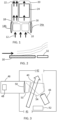
- Fig. 1 shows a schematic illustration of the approach of the invention for a sensor.
- It shows a sensor device comprising an input flow channel 10 for receiving a gas flow 12 with entrained matter to be sensed.
- the gas flow is for example an air flow.
- thermophoretic arrangement is used to induce thermophoretic particle movement from a first, warmer, region 16 of the input flow channel to a second, cooler, region 18 of the input flow channel 10.
- the thermophoretic arrangement comprises a heater 14a and a cooler 14b on opposite sides of the input flow channel 10.
- the first region 16 of the input flow channel couples to a first output flow region 20 and the second region of the input flow channel couples to a second output flow region 22.
- a sensor 24 has a particle sensor component in the first output flow region 20, namely downstream of the first region 16 of the input flow channel.
- Fig. 1 shows the whole sensor in the first output flow region 20, but parts of the sensor may be remote as will be clear from examples below.
- thermophoretic force acts only on a limited distance that depends on the thermal gradient.
- the distance between heater-cooler and the sensor entrance will be known for a particular implementation and impacts the gas density, which will change due to the temperature change. This can and needs to be corrected for in the processing of the sensor signals, as a changed density will lead to the indication of different sensor values.
- the air flow to the sensor entrance can be divided into a number of small sub-channels of the appropriate dimensions. Within each sub-channel the air flow can then be divided into two parts: one with particles that exit through a channel outside the sensor entrance and one with particles removed that enters the sensor. Within the sub-channels, thermophoresis can be used to push the particles to the exhaust channel. An example is given below.
- the inflow of particles into the device housing can be controlled by placing a heated grid at the air inlet.
- the mesh size of the grid may for example be of the order of 0.5 mm.
- Thermophoresis at the heated grid will then block a proportion of the particles from entering the housing or compartment, while allowing gas molecules to pass. This may for example be desired for gas sensors, where it is desired to prevent particles from entering the gas sensor at all.
- such grids might be used to control the portion of particles entering the sensor. For example, decreasing the temperature of the grid will allow a larger portion of particles to enter. Increasing the mesh size will have a similar result.
- the accuracy of certain particle sensors can be maintained through a wider range of particle concentrations, provided that changes in the resulting gas densities are known accurately.
- the heating element can be positioned close to the sensing element of the sensor and used to push the particles away to avoid direct contact with the sensing surface. There is no need to push the particles far from the surface, just enough to avoid direct contact.
- Fig. 2 shows a heater 30 having a heating surface which lies in the same plane as the sensing surface of a sensor 32.
- the sensor is downstream of the heater. The effect of the heating is to lift the gas flow away from the sensor surface, to reduce contamination of the sensor surface.
- Fig. 3 shows an example in which there is a gas flow 40 from an inlet 41 to an outlet 42 of the overall sensor device.
- An infrared LED 44 is used to illuminate the gas flow to enable optical detection of entrained particles based on optical measurements of scattering or reflection.
- the optical sensor 46 comprises a photodiode sensor 48 and a focusing lens 50.
- a heating element By placing a heating element before the lens 50 (in the direction of air flow) or by directly heating the lens, the particles can be prevented from directly touching the lens.
- the lens may be formed as a transparent material with high thermal conductivity such as sapphire and it may then be in direct contact with a heating element (e.g. a resistive heating element).
- a heating element e.g. a resistive heating element
- garnet lenses or lenses produced of other inorganic materials with cubic crystal structure may be used (these being minerals classes that can also be man-made). Such materials are used in view of their large refractive index, and they may also possess high thermal conductivity. These lenses can be made using a ceramic process, and it is possible to incorporate thin heating wires within such lens designs.
- the lens 50 of the optical sensor 46 is covered by a lens cover.
- the lens cover may be optically transparent and electrically conductive. By heating the lens cover, e.g. by applying a voltage to it, the temperature of the lens increases thereby reducing or preventing particle precipitation on the lens.
- the lens cover is fabricated from an optical transparent material that is electrically conductive.
- the lens cover may comprise fine conductive particles that do not disturb optical signals propagating through the lens cover.
- the material of the lens cover may comprise InO2, (In,Sn)O2; ZnO:Ga or ZnO:Ga, graphene or other materials like PEDOT.
- the material of the lens cover is adapted to absorb less than 50% of light originating from illuminated particles of interest.
- the material of the lens cover is adapted to absorb less than 30% of light originating from illuminated particles of interest. More preferably, the material of the lens cover is adapted to absorb less than 20% of light originating from illuminated particles of interest.
- the input flow channel 40 has a first, warmer, region 53 and a second, cooler, region 54.
- the sensor component in this example is the lens 50 which is located in the warmer region 53 of the input flow channel, rather than further downstream.
- the heating has an effect at least a short distance before the input flow channel reaches the sensor component, so that the thermophoretic effect can function.
- the sensor component is downstream of the part of the input flow channel at which heating is first effective, even if the heater is integrated into the sensor component itself. In particular, there will be a thermal gradient away from the heater which will be met by the incoming entrained matter before it reaches the component itself.
- Fig. 3 also shows a separate heater 52 for inducing convective flow through the sensor device.
- a resistive heater may be used to directly heat the lens material or a lens cover as mentioned above, but alternatives include near infra-red heating and ultrasonic heating.
- the heating method of course should not interfere with the operation of the sensor.
- Peltier elements can be electrically switched between heating and cooling, for example allowing the direction of particle movement to be reversed. They also enable simple implementation of heating and cooling on opposite sides of the input flow channel.
- Controlled switching between heating and cooling enables dynamic operation of the system, giving additional accuracy by mass estimation of the particles. This is discussed further below. Similar arguments hold for controlled heating steps.
- thermophoresis force is proportional to the temperature gradient and the inverse of the mean air temperature.
- the heat supplied must be sufficient to generate the force necessary to move the particles.
- Increased air temperature requires a larger temperature gradient to achieve the same effect, therefore the heat applied may be varied based on the ambient temperature.
- a fixed heating level may be selected to ensure the desired result within an expected or operating temperature range. The heating level will for example depend on the area and length of the heating element, which thus depend on the expected particle density and required distance to displace the particles.
- thermophoretic force (with a realistic temperature gradient) may not be able to displace the particles sufficiently far to remove them from the path of the sensor component to be protected.
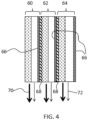
- Fig. 4 shows a grid of three separate sub-channels 60, 62, 64.
- Each sub-channel comprises its own heater 66, and there is thermal insulation 68 between the channels.
- the input flow channel is divided into input sub-channels, each sub-channel having a respective heating arrangement thereby to generate respective first and second regions of the input sub-channel.
- Fig. 4 shows a cross section in plain view, i.e. and the lengths of the sub-channels shown are in the general direction of the overall air flow.
- An end view, i.e. the front face as seen by the air flow, may then comprise a two dimensional or three dimensional array of grid openings, each one corresponding to one of the sub-channels.
- each input sub-channel causes a flow (shown by bold arrows 70) where there is a relatively high concentration of particles and a flow (shown by faint arrows 72) where there is a relatively low concentration of particles.
- the flow 70 will lead to an exhaust port, completely bypassing the sensor in the case of a gas sensor, or else it will lead to the particle detection area in the case of a particle sensor, but away from components of the sensor which are to be protected from contamination. These components are in the path of the flow 72.
- the sub-channel first regions together couple to the first output flow region and the sub-channel second regions together couple to the second output flow region.
- the required channel coupling arrangement is not shown in Fig. 4 .
- Sufficient insulating material 68 is used to separate the channels to avoid both sides of the surrounded channels (i.e. the middle channel and right in this example) becoming heated. If the sensor is used continuously, then over time the internal components will nevertheless reach thermal equilibrium. This can be prevented by using a pulsed or sequential operation, which is practical for a consumer solution, or by active cooling of the cold surface.
- a variation is to use a single narrow channel that is wide at the separation region of the input flow channel but narrow (or funnel like) at the entrance to the sensor.
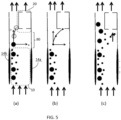
- Fig. 5 shows how the arrangement may be used to enable particle size selection.
- a space 80 is provided between the first region 16 of the input flow channel 10, after the heating / cooling arrangement 14a, 14b, and the first output flow region 20 where the sensor 24 is located. This space is used in this example to allow diffusion of particles.
- thermophoresis driven by the heating arrangement 14a, 14b. All particles are accelerated to a certain forward velocity by the air flow.
- thermophoretic force is no longer acting, but they keep their velocity in the forward (y axis) direction due to the air flow.
- concentration gradient then forces the particles in the transverse (x axis).
- D k ⁇ T ⁇ C c 3 ⁇ ⁇ ⁇ ⁇ ⁇ d p m 2 / s
- Fig. 5(a) shows the movement of larger particles in the inlaid graph
- Fig. 5(b) shows the movement of smaller particles in the inlaid graph.
- the space 80 can in this way be used as a low-pass filter, since it only allows particles below a certain size to enter the sensor.
- the threshold of this filter can be tuned, for example by changing the length of the space 80 or by controlling the air velocity.
- Fig. 5(c) shows the resulting particle distribution and shows how the larger particles are diverted away from the sensor.
- thermophoresis to create the desired particle movement has been assessed using modeling.
- clay particles are modeled in air through a 10 mm wide and 0.5 mm high channel (in cross section) and with 10 mm length. A gas flow of 10 ml/minute is used.
- thermophoretic effect is modeled with heating temperatures of 40 degrees, 60 degrees and 100 degrees on the heated side and 21 degrees at the opposite side.
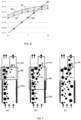
- Fig. 6 shows the results, as a plot of the force acting on the particles (y-axis) as a function of the particle size (x-axis).
- Plot 90 is for the 100 degree heating
- plot 92 is for the 60 degree heating
- plot 94 is for the 40 degree heating.
- Plot 96 shows the gravity force.
- the gravity force becomes dominant.
- the larger the temperature gradient the larger the particle sizes that can be moved using the thermophoretic effect.
- the gravity force overtakes the thermophoretic force at particle sizes of 3.0, 4.0 and 5.4 ⁇ m for the three temperature gradients.
- Figs. 5 and 6 show how the level of heating (or more particularly the thermal gradient) influences the way particles of different size (or mass) behave.
- the level of heating can thus be used as a control parameter.
- a series of sensor measurements can be processed to derive particle concentration information as a function of particle size.
- This particle size (or mass) dependent movement may be controlled by controlling a heating element, or by controlling cooperating heating and cooling elements. If a heating element is switchable between heating and cooling, as is the case for a Peltier heating element, the particle direction may be reversed. For example all particles may be progressively drawn from one side to the other, and in a different sequence they may all be progressively drawn from the other side to the one side. This provides further sensor information which may be used to increase the accuracy of particle sensing as a function of particle size.
- Fig. 7 is a variation of Fig. 5 and illustrates an embodiment where the thermophoretic arrangement 14a, 14b combined with the space 80 forms a prefilter for the sensor 24.
- the prefilter can be tuned by varying the length of the space 80 by partially switching on or off segments of the heater 14a.
- Fig. 7(a) the entire heater 14a is switched on, and only small particles reach the sensor 24.
- Fig. 7(b) only a lower part of the heater 14a is switched on, and as a result the space 80 becomes larger and also medium size particles reach the sensor 24.
- Fig. 7(c) no segment of the heater 14a is switched on, as a result the space 80 becomes even larger and also large particles reach the sensor 24.
- the entire heater 14a may be placed at a larger distance from the sensor 24 by moving the sensor 24 and/or the heater 14a, thereby increasing the length of the space 80.
- the pre-filter gives a user control over which particle sizes can reach the sensor. It is an advantage of the invention that the pre-filter does not get blocked. This extends the life-time of the particle filter.
- the heater 30 may be implemented by any intentional design features which increase the surface temperature.
- the optical component may be at the surface of the packaging of a system. If the system includes a component which gives out a significant amount of heat (such as light source or a high power semiconductor component), the device packaging may be designed to provide thermal coupling between the heat-generating component and the package surface. This also helps with thermal stabilization of the heat generating component (e.g. the light source) and also provides a heated surface for performing a thermophoresis function. The heat-generating component then has a main function (e.g. giving out light) which is a non-heating function.
- a main function e.g. giving out light
- an active heat source may be used for example a wire grid for Joule heating.
- a Peltier heating element is also possible, although this may increase the complexity more than is desired.
- the approach may for example be used in a TO-5 package to heat an optical output window forming a cap at the package surface.
- TO-5 is a designation for a standardized metal semiconductor package used for transistors and some integrated circuits.
- TO stands for "transistor outline" and refers to a series of technical drawings produced by JEDEC. Building a thermal link between the back end of the active component (inside the package) and the cap will help keep the optical window clean. In a similar fashion, active heating may be used.
- the invention can be applied to air purifiers with sensors or to standalone air sensors.
- the heating is to drive particles away from a component, and that component is thus on the heated side.
- this may be only one mode of operation of the device.
- the heating direction may be alternated.
- the device may have one mode where the component is on the hot side and one mode where the component in on the cold side.
- there may be a mode of operation in which the component is protected, and another mode of operation for a particular sensing function or sensing sequence.
Landscapes
- Chemical & Material Sciences (AREA)
- Physics & Mathematics (AREA)
- Health & Medical Sciences (AREA)
- Life Sciences & Earth Sciences (AREA)
- Analytical Chemistry (AREA)
- Biochemistry (AREA)
- General Health & Medical Sciences (AREA)
- General Physics & Mathematics (AREA)
- Immunology (AREA)
- Pathology (AREA)
- Dispersion Chemistry (AREA)
- Chemical Kinetics & Catalysis (AREA)
- Thermal Sciences (AREA)
- Molecular Biology (AREA)
- Biomedical Technology (AREA)
- Engineering & Computer Science (AREA)
- Investigating Or Analyzing Materials Using Thermal Means (AREA)
- Investigating Or Analysing Materials By Optical Means (AREA)
- Investigating Or Analyzing Materials By The Use Of Fluid Adsorption Or Reactions (AREA)
- Sampling And Sample Adjustment (AREA)
Applications Claiming Priority (3)
| Application Number | Priority Date | Filing Date | Title |
|---|---|---|---|
| CN2015075276 | 2015-03-27 | ||
| EP15166494 | 2015-05-06 | ||
| PCT/EP2016/055615 WO2016156035A1 (en) | 2015-03-27 | 2016-03-16 | Protecting an optical particle sensor from particulate deposits by thermophoresis |
Publications (2)
| Publication Number | Publication Date |
|---|---|
| EP3274071A1 EP3274071A1 (en) | 2018-01-31 |
| EP3274071B1 true EP3274071B1 (en) | 2023-05-24 |
Family
ID=55650387
Family Applications (1)
| Application Number | Title | Priority Date | Filing Date |
|---|---|---|---|
| EP16713753.8A Active EP3274071B1 (en) | 2015-03-27 | 2016-03-16 | Protecting an optical particle sensor from particulate deposits by thermophoresis |
Country Status (5)
| Country | Link |
|---|---|
| US (1) | US10363514B2 (enExample) |
| EP (1) | EP3274071B1 (enExample) |
| JP (1) | JP2018512563A (enExample) |
| CN (1) | CN107532996B (enExample) |
| WO (1) | WO2016156035A1 (enExample) |
Families Citing this family (18)
| Publication number | Priority date | Publication date | Assignee | Title |
|---|---|---|---|---|
| CN107478576B (zh) * | 2016-06-07 | 2024-02-20 | 宁波方太厨具有限公司 | 一种油烟传感器的防护结构 |
| US10215699B2 (en) * | 2017-01-03 | 2019-02-26 | Honeywell International Inc. | Utilizing updraft flow in a fan-less dust sensor |
| EP3444587A1 (en) * | 2017-08-14 | 2019-02-20 | Koninklijke Philips N.V. | Particle sensor and particle sensing method |
| US10816445B2 (en) | 2017-06-21 | 2020-10-27 | Koninklijke Philips N.V. | Particle sensor and particle sensing method |
| GB201715014D0 (en) * | 2017-09-18 | 2017-11-01 | Cambridge Entpr Ltd | Particulate matter detection |
| US11047777B2 (en) * | 2017-11-14 | 2021-06-29 | Aerodyne Microsystems Inc. | Thermophoretic particle concentrator |
| DE102018219891A1 (de) * | 2018-11-20 | 2020-05-20 | Robert Bosch Gmbh | Verfahren zum Betreiben eines Partikelsensors |
| US11760170B2 (en) | 2020-08-20 | 2023-09-19 | Denso International America, Inc. | Olfaction sensor preservation systems and methods |
| US12251991B2 (en) | 2020-08-20 | 2025-03-18 | Denso International America, Inc. | Humidity control for olfaction sensors |
| US12377711B2 (en) | 2020-08-20 | 2025-08-05 | Denso International America, Inc. | Vehicle feature control systems and methods based on smoking |
| US11881093B2 (en) | 2020-08-20 | 2024-01-23 | Denso International America, Inc. | Systems and methods for identifying smoking in vehicles |
| US11828210B2 (en) | 2020-08-20 | 2023-11-28 | Denso International America, Inc. | Diagnostic systems and methods of vehicles using olfaction |
| US11813926B2 (en) | 2020-08-20 | 2023-11-14 | Denso International America, Inc. | Binding agent and olfaction sensor |
| US11636870B2 (en) | 2020-08-20 | 2023-04-25 | Denso International America, Inc. | Smoking cessation systems and methods |
| US11932080B2 (en) | 2020-08-20 | 2024-03-19 | Denso International America, Inc. | Diagnostic and recirculation control systems and methods |
| US12017506B2 (en) | 2020-08-20 | 2024-06-25 | Denso International America, Inc. | Passenger cabin air control systems and methods |
| US12269315B2 (en) | 2020-08-20 | 2025-04-08 | Denso International America, Inc. | Systems and methods for measuring and managing odor brought into rental vehicles |
| US11760169B2 (en) | 2020-08-20 | 2023-09-19 | Denso International America, Inc. | Particulate control systems and methods for olfaction sensors |
Citations (2)
| Publication number | Priority date | Publication date | Assignee | Title |
|---|---|---|---|---|
| JPS57131036A (en) * | 1981-02-06 | 1982-08-13 | Rion Co Ltd | Light scattering type floating particle counting |
| US20130036793A1 (en) * | 2011-08-08 | 2013-02-14 | University Of California | Microfabricated particulate matter monitor |
Family Cites Families (29)
| Publication number | Priority date | Publication date | Assignee | Title |
|---|---|---|---|---|
| US4675031A (en) * | 1985-08-19 | 1987-06-23 | Sinnar Abbas M | Phoretic enhanced-gravity particulate removal system |
| US4896047A (en) * | 1988-04-11 | 1990-01-23 | Westinghouse Electric Corp. | Method and apparatus of periodically obtaining accurate opacity monitor readings of an exhaust gas stream |
| GB8818463D0 (en) * | 1988-08-03 | 1988-09-07 | Loughborough Consult Ltd | Apparatus & method for removing particulate matter from exhaust gases of i c engine |
| US5083865A (en) * | 1990-05-11 | 1992-01-28 | Applied Materials, Inc. | Particle monitor system and method |
| JPH0527654U (ja) * | 1991-09-19 | 1993-04-09 | 神栄株式会社 | 空気汚れ検出装置 |
| JPH0676333A (ja) * | 1992-08-25 | 1994-03-18 | Mitsubishi Electric Corp | 光デイスクの対物レンズ防塵装置 |
| JP3052639B2 (ja) * | 1993-02-22 | 2000-06-19 | 株式会社島津製作所 | 粒度分布測定装置 |
| US5463460A (en) * | 1993-07-08 | 1995-10-31 | Applied Materials, Inc. | Particle monitoring sensor |
| GB2319191B (en) * | 1996-11-15 | 2000-09-27 | Boris Zachar Gorbunov | A particulate matter concentrator |
| GB2339398B (en) * | 1998-07-10 | 2002-05-01 | Notetry Ltd | Apparatus and method for concentrating gasborne particles in a portion of a gas stream |
| US20020159215A1 (en) | 1999-12-06 | 2002-10-31 | Siess Harold Edward | Protecting transmissive surfaces |
| EP1781481B1 (en) * | 2004-08-11 | 2009-04-15 | Koninklijke Philips Electronics N.V. | Air pollution sensor system |
| US7477358B2 (en) | 2004-09-28 | 2009-01-13 | Nikon Corporation | EUV reticle handling system and method |
| US8177142B2 (en) | 2005-08-26 | 2012-05-15 | Ricciardi Jonathan J | Method and apparatus for an improved aerosol generator and associated uses and equipment |
| JP4849626B2 (ja) * | 2007-01-16 | 2012-01-11 | 東京エレクトロン株式会社 | パーティクルモニタシステム及び基板処理装置 |
| DE102007014761B4 (de) | 2007-03-28 | 2022-05-12 | Robert Bosch Gmbh | Verfahren zum Betreiben eines sammelnden Partikelsensors und Vorrichtung zur Durchführung des Verfahrens |
| EP2255178A1 (en) * | 2008-02-27 | 2010-12-01 | Volvo Technology Corporation | Method and arrangement for detecting particles |
| DE102008041809A1 (de) | 2008-09-04 | 2010-03-11 | Robert Bosch Gmbh | Partikelsensor, Verfahren zu dessen Betrieb und Herstellung |
| DE102009000820A1 (de) | 2009-02-12 | 2010-08-19 | Robert Bosch Gmbh | Sensorelement eines Gassensors und Verfahren zum Betrieb desselben |
| US8966956B2 (en) * | 2010-04-30 | 2015-03-03 | Toyota Jidosha Kabushiki Kaisha | Particulate matter amount detecting apparatus |
| JP2011256796A (ja) * | 2010-06-09 | 2011-12-22 | Toyota Motor Corp | Pm量検出システム |
| JP2012220263A (ja) * | 2011-04-05 | 2012-11-12 | Shimadzu Corp | 粒子径測定装置 |
| US8973447B2 (en) * | 2011-05-24 | 2015-03-10 | Colorado State University Research Foundation | Thermophoretic sampler |
| US20130235357A1 (en) | 2012-03-12 | 2013-09-12 | Kla-Tencor Corporation | System and Method for Particle Control Near A Reticle |
| CN102692368A (zh) * | 2012-05-23 | 2012-09-26 | 华北电力大学 | 一种可视化窄矩形通道气溶胶运动沉积系统 |
| KR20130134243A (ko) | 2012-05-30 | 2013-12-10 | 연세대학교 산학협력단 | 미세오염물질 샘플링 셀 및 이를 포함하는 광 계측장치 |
| US9389180B2 (en) | 2013-02-15 | 2016-07-12 | Kla-Tencor Corporation | Methods and apparatus for use with extreme ultraviolet light having contamination protection |
| CN103349879B (zh) | 2013-07-04 | 2015-05-20 | 清华大学 | 一种热泳空气净化装置及方法 |
| GB201715014D0 (en) * | 2017-09-18 | 2017-11-01 | Cambridge Entpr Ltd | Particulate matter detection |
-
2016
- 2016-03-16 EP EP16713753.8A patent/EP3274071B1/en active Active
- 2016-03-16 US US15/557,492 patent/US10363514B2/en active Active
- 2016-03-16 WO PCT/EP2016/055615 patent/WO2016156035A1/en not_active Ceased
- 2016-03-16 CN CN201680018709.1A patent/CN107532996B/zh active Active
- 2016-03-16 JP JP2017538640A patent/JP2018512563A/ja active Pending
Patent Citations (2)
| Publication number | Priority date | Publication date | Assignee | Title |
|---|---|---|---|---|
| JPS57131036A (en) * | 1981-02-06 | 1982-08-13 | Rion Co Ltd | Light scattering type floating particle counting |
| US20130036793A1 (en) * | 2011-08-08 | 2013-02-14 | University Of California | Microfabricated particulate matter monitor |
Also Published As
| Publication number | Publication date |
|---|---|
| CN107532996A (zh) | 2018-01-02 |
| US10363514B2 (en) | 2019-07-30 |
| US20180056228A1 (en) | 2018-03-01 |
| JP2018512563A (ja) | 2018-05-17 |
| CN107532996B (zh) | 2020-09-01 |
| WO2016156035A1 (en) | 2016-10-06 |
| EP3274071A1 (en) | 2018-01-31 |
Similar Documents
| Publication | Publication Date | Title |
|---|---|---|
| EP3274071B1 (en) | Protecting an optical particle sensor from particulate deposits by thermophoresis | |
| EP3642587B1 (en) | Particle sensor and particle sensing method | |
| US9541488B2 (en) | Particle sampling and measurement in the ambient air | |
| US20110011158A1 (en) | Systems and methods for chemical sampling in particulate laden gaseous environments | |
| JP2008020456A (ja) | エアロゾルの測定システム及びその方法 | |
| Niedermeier et al. | Can we define an asymptotic value for the ice active surface site density for heterogeneous ice nucleation? | |
| Salam et al. | Ice nucleation studies of mineral dust particles with a new continuous flow diffusion chamber | |
| US10520413B2 (en) | Particle sensor and particle sensing method having a series of sensor elements | |
| CA2944111A1 (en) | Detector inlet and sampling method | |
| KR101654178B1 (ko) | 대기오염 측정 분석을 위한 전처리 장치 및 방법 | |
| WO2004027380A2 (en) | Stream-wise thermal gradient cloud condensation nuclei chamber | |
| Moore et al. | Design methodology for multiple inlet cyclones | |
| EP3685140A1 (en) | Particulate matter detection | |
| EP3444587A1 (en) | Particle sensor and particle sensing method | |
| Forney et al. | Experimental and theoretical study of a two-dimensional virtual impactor | |
| D'Aleo et al. | Miniaturized liquid film sensor (MLFS) for two phase flow measurements in square microchannels with high spatial resolution | |
| CN104412105A (zh) | 在水性环境中的烃的检测 | |
| Chen et al. | Design and evaluation of a low flow personal cascade impactor | |
| Middelburg et al. | Maintaining transparency of a heated MEMS membrane for enabling long-term optical measurements on soot-containing exhaust gas | |
| Kim et al. | The spatial resolution of dual-tracer fluorescence thermometry in volumetrically illuminated channels | |
| Das et al. | Development and Performance Analysis of a Portable NO x Gas Sensor for Environmental Monitoring Applications | |
| Clement | Washing the air: enhanced condensation of water on aerosols to enable their removal | |
| Al-Kadhim et al. | Study on the design and application of the three-electrode ionization particle sensor | |
| Petersen | Experimental Study of Turbulent Flow Inlet System Performance | |
| Cook et al. | Influence of scaling effects on designing for power efficiency of a micropreconcentrator |
Legal Events
| Date | Code | Title | Description |
|---|---|---|---|
| STAA | Information on the status of an ep patent application or granted ep patent |
Free format text: STATUS: THE INTERNATIONAL PUBLICATION HAS BEEN MADE |
|
| PUAI | Public reference made under article 153(3) epc to a published international application that has entered the european phase |
Free format text: ORIGINAL CODE: 0009012 |
|
| STAA | Information on the status of an ep patent application or granted ep patent |
Free format text: STATUS: REQUEST FOR EXAMINATION WAS MADE |
|
| 17P | Request for examination filed |
Effective date: 20171027 |
|
| AK | Designated contracting states |
Kind code of ref document: A1 Designated state(s): AL AT BE BG CH CY CZ DE DK EE ES FI FR GB GR HR HU IE IS IT LI LT LU LV MC MK MT NL NO PL PT RO RS SE SI SK SM TR |
|
| AX | Request for extension of the european patent |
Extension state: BA ME |
|
| DAV | Request for validation of the european patent (deleted) | ||
| DAX | Request for extension of the european patent (deleted) | ||
| STAA | Information on the status of an ep patent application or granted ep patent |
Free format text: STATUS: EXAMINATION IS IN PROGRESS |
|
| 17Q | First examination report despatched |
Effective date: 20190125 |
|
| RAP1 | Party data changed (applicant data changed or rights of an application transferred) |
Owner name: KONINKLIJKE PHILIPS N.V. |
|
| GRAP | Despatch of communication of intention to grant a patent |
Free format text: ORIGINAL CODE: EPIDOSNIGR1 |
|
| STAA | Information on the status of an ep patent application or granted ep patent |
Free format text: STATUS: GRANT OF PATENT IS INTENDED |
|
| INTG | Intention to grant announced |
Effective date: 20221221 |
|
| GRAS | Grant fee paid |
Free format text: ORIGINAL CODE: EPIDOSNIGR3 |
|
| GRAA | (expected) grant |
Free format text: ORIGINAL CODE: 0009210 |
|
| STAA | Information on the status of an ep patent application or granted ep patent |
Free format text: STATUS: THE PATENT HAS BEEN GRANTED |
|
| AK | Designated contracting states |
Kind code of ref document: B1 Designated state(s): AL AT BE BG CH CY CZ DE DK EE ES FI FR GB GR HR HU IE IS IT LI LT LU LV MC MK MT NL NO PL PT RO RS SE SI SK SM TR |
|
| REG | Reference to a national code |
Ref country code: GB Ref legal event code: FG4D |
|
| REG | Reference to a national code |
Ref country code: CH Ref legal event code: EP |
|
| REG | Reference to a national code |
Ref country code: DE Ref legal event code: R096 Ref document number: 602016079562 Country of ref document: DE |
|
| REG | Reference to a national code |
Ref country code: AT Ref legal event code: REF Ref document number: 1569177 Country of ref document: AT Kind code of ref document: T Effective date: 20230615 |
|
| REG | Reference to a national code |
Ref country code: IE Ref legal event code: FG4D |
|
| REG | Reference to a national code |
Ref country code: LT Ref legal event code: MG9D |
|
| REG | Reference to a national code |
Ref country code: NL Ref legal event code: MP Effective date: 20230524 |
|
| REG | Reference to a national code |
Ref country code: AT Ref legal event code: MK05 Ref document number: 1569177 Country of ref document: AT Kind code of ref document: T Effective date: 20230524 |
|
| PG25 | Lapsed in a contracting state [announced via postgrant information from national office to epo] |
Ref country code: SE Free format text: LAPSE BECAUSE OF FAILURE TO SUBMIT A TRANSLATION OF THE DESCRIPTION OR TO PAY THE FEE WITHIN THE PRESCRIBED TIME-LIMIT Effective date: 20230524 Ref country code: PT Free format text: LAPSE BECAUSE OF FAILURE TO SUBMIT A TRANSLATION OF THE DESCRIPTION OR TO PAY THE FEE WITHIN THE PRESCRIBED TIME-LIMIT Effective date: 20230925 Ref country code: NO Free format text: LAPSE BECAUSE OF FAILURE TO SUBMIT A TRANSLATION OF THE DESCRIPTION OR TO PAY THE FEE WITHIN THE PRESCRIBED TIME-LIMIT Effective date: 20230824 Ref country code: NL Free format text: LAPSE BECAUSE OF FAILURE TO SUBMIT A TRANSLATION OF THE DESCRIPTION OR TO PAY THE FEE WITHIN THE PRESCRIBED TIME-LIMIT Effective date: 20230524 Ref country code: ES Free format text: LAPSE BECAUSE OF FAILURE TO SUBMIT A TRANSLATION OF THE DESCRIPTION OR TO PAY THE FEE WITHIN THE PRESCRIBED TIME-LIMIT Effective date: 20230524 Ref country code: AT Free format text: LAPSE BECAUSE OF FAILURE TO SUBMIT A TRANSLATION OF THE DESCRIPTION OR TO PAY THE FEE WITHIN THE PRESCRIBED TIME-LIMIT Effective date: 20230524 |
|
| PG25 | Lapsed in a contracting state [announced via postgrant information from national office to epo] |
Ref country code: RS Free format text: LAPSE BECAUSE OF FAILURE TO SUBMIT A TRANSLATION OF THE DESCRIPTION OR TO PAY THE FEE WITHIN THE PRESCRIBED TIME-LIMIT Effective date: 20230524 Ref country code: PL Free format text: LAPSE BECAUSE OF FAILURE TO SUBMIT A TRANSLATION OF THE DESCRIPTION OR TO PAY THE FEE WITHIN THE PRESCRIBED TIME-LIMIT Effective date: 20230524 Ref country code: LV Free format text: LAPSE BECAUSE OF FAILURE TO SUBMIT A TRANSLATION OF THE DESCRIPTION OR TO PAY THE FEE WITHIN THE PRESCRIBED TIME-LIMIT Effective date: 20230524 Ref country code: LT Free format text: LAPSE BECAUSE OF FAILURE TO SUBMIT A TRANSLATION OF THE DESCRIPTION OR TO PAY THE FEE WITHIN THE PRESCRIBED TIME-LIMIT Effective date: 20230524 Ref country code: IS Free format text: LAPSE BECAUSE OF FAILURE TO SUBMIT A TRANSLATION OF THE DESCRIPTION OR TO PAY THE FEE WITHIN THE PRESCRIBED TIME-LIMIT Effective date: 20230924 Ref country code: HR Free format text: LAPSE BECAUSE OF FAILURE TO SUBMIT A TRANSLATION OF THE DESCRIPTION OR TO PAY THE FEE WITHIN THE PRESCRIBED TIME-LIMIT Effective date: 20230524 Ref country code: GR Free format text: LAPSE BECAUSE OF FAILURE TO SUBMIT A TRANSLATION OF THE DESCRIPTION OR TO PAY THE FEE WITHIN THE PRESCRIBED TIME-LIMIT Effective date: 20230825 |
|
| PG25 | Lapsed in a contracting state [announced via postgrant information from national office to epo] |
Ref country code: FI Free format text: LAPSE BECAUSE OF FAILURE TO SUBMIT A TRANSLATION OF THE DESCRIPTION OR TO PAY THE FEE WITHIN THE PRESCRIBED TIME-LIMIT Effective date: 20230524 |
|
| PG25 | Lapsed in a contracting state [announced via postgrant information from national office to epo] |
Ref country code: SK Free format text: LAPSE BECAUSE OF FAILURE TO SUBMIT A TRANSLATION OF THE DESCRIPTION OR TO PAY THE FEE WITHIN THE PRESCRIBED TIME-LIMIT Effective date: 20230524 |
|
| PG25 | Lapsed in a contracting state [announced via postgrant information from national office to epo] |
Ref country code: SM Free format text: LAPSE BECAUSE OF FAILURE TO SUBMIT A TRANSLATION OF THE DESCRIPTION OR TO PAY THE FEE WITHIN THE PRESCRIBED TIME-LIMIT Effective date: 20230524 Ref country code: SK Free format text: LAPSE BECAUSE OF FAILURE TO SUBMIT A TRANSLATION OF THE DESCRIPTION OR TO PAY THE FEE WITHIN THE PRESCRIBED TIME-LIMIT Effective date: 20230524 Ref country code: RO Free format text: LAPSE BECAUSE OF FAILURE TO SUBMIT A TRANSLATION OF THE DESCRIPTION OR TO PAY THE FEE WITHIN THE PRESCRIBED TIME-LIMIT Effective date: 20230524 Ref country code: EE Free format text: LAPSE BECAUSE OF FAILURE TO SUBMIT A TRANSLATION OF THE DESCRIPTION OR TO PAY THE FEE WITHIN THE PRESCRIBED TIME-LIMIT Effective date: 20230524 Ref country code: DK Free format text: LAPSE BECAUSE OF FAILURE TO SUBMIT A TRANSLATION OF THE DESCRIPTION OR TO PAY THE FEE WITHIN THE PRESCRIBED TIME-LIMIT Effective date: 20230524 Ref country code: CZ Free format text: LAPSE BECAUSE OF FAILURE TO SUBMIT A TRANSLATION OF THE DESCRIPTION OR TO PAY THE FEE WITHIN THE PRESCRIBED TIME-LIMIT Effective date: 20230524 |
|
| REG | Reference to a national code |
Ref country code: DE Ref legal event code: R097 Ref document number: 602016079562 Country of ref document: DE |
|
| PLBE | No opposition filed within time limit |
Free format text: ORIGINAL CODE: 0009261 |
|
| STAA | Information on the status of an ep patent application or granted ep patent |
Free format text: STATUS: NO OPPOSITION FILED WITHIN TIME LIMIT |
|
| 26N | No opposition filed |
Effective date: 20240227 |
|
| PG25 | Lapsed in a contracting state [announced via postgrant information from national office to epo] |
Ref country code: SI Free format text: LAPSE BECAUSE OF FAILURE TO SUBMIT A TRANSLATION OF THE DESCRIPTION OR TO PAY THE FEE WITHIN THE PRESCRIBED TIME-LIMIT Effective date: 20230524 |
|
| PG25 | Lapsed in a contracting state [announced via postgrant information from national office to epo] |
Ref country code: SI Free format text: LAPSE BECAUSE OF FAILURE TO SUBMIT A TRANSLATION OF THE DESCRIPTION OR TO PAY THE FEE WITHIN THE PRESCRIBED TIME-LIMIT Effective date: 20230524 Ref country code: IT Free format text: LAPSE BECAUSE OF FAILURE TO SUBMIT A TRANSLATION OF THE DESCRIPTION OR TO PAY THE FEE WITHIN THE PRESCRIBED TIME-LIMIT Effective date: 20230524 |
|
| REG | Reference to a national code |
Ref country code: CH Ref legal event code: PL |
|
| PG25 | Lapsed in a contracting state [announced via postgrant information from national office to epo] |
Ref country code: BG Free format text: LAPSE BECAUSE OF FAILURE TO SUBMIT A TRANSLATION OF THE DESCRIPTION OR TO PAY THE FEE WITHIN THE PRESCRIBED TIME-LIMIT Effective date: 20230524 |
|
| PG25 | Lapsed in a contracting state [announced via postgrant information from national office to epo] |
Ref country code: LU Free format text: LAPSE BECAUSE OF NON-PAYMENT OF DUE FEES Effective date: 20240316 |
|
| PG25 | Lapsed in a contracting state [announced via postgrant information from national office to epo] |
Ref country code: MC Free format text: LAPSE BECAUSE OF FAILURE TO SUBMIT A TRANSLATION OF THE DESCRIPTION OR TO PAY THE FEE WITHIN THE PRESCRIBED TIME-LIMIT Effective date: 20230524 |
|
| PG25 | Lapsed in a contracting state [announced via postgrant information from national office to epo] |
Ref country code: MC Free format text: LAPSE BECAUSE OF FAILURE TO SUBMIT A TRANSLATION OF THE DESCRIPTION OR TO PAY THE FEE WITHIN THE PRESCRIBED TIME-LIMIT Effective date: 20230524 Ref country code: LU Free format text: LAPSE BECAUSE OF NON-PAYMENT OF DUE FEES Effective date: 20240316 Ref country code: BG Free format text: LAPSE BECAUSE OF FAILURE TO SUBMIT A TRANSLATION OF THE DESCRIPTION OR TO PAY THE FEE WITHIN THE PRESCRIBED TIME-LIMIT Effective date: 20230524 |
|
| REG | Reference to a national code |
Ref country code: BE Ref legal event code: MM Effective date: 20240331 |
|
| PG25 | Lapsed in a contracting state [announced via postgrant information from national office to epo] |
Ref country code: BE Free format text: LAPSE BECAUSE OF NON-PAYMENT OF DUE FEES Effective date: 20240331 |
|
| PG25 | Lapsed in a contracting state [announced via postgrant information from national office to epo] |
Ref country code: IE Free format text: LAPSE BECAUSE OF NON-PAYMENT OF DUE FEES Effective date: 20240316 |
|
| PG25 | Lapsed in a contracting state [announced via postgrant information from national office to epo] |
Ref country code: IE Free format text: LAPSE BECAUSE OF NON-PAYMENT OF DUE FEES Effective date: 20240316 Ref country code: BE Free format text: LAPSE BECAUSE OF NON-PAYMENT OF DUE FEES Effective date: 20240331 Ref country code: CH Free format text: LAPSE BECAUSE OF NON-PAYMENT OF DUE FEES Effective date: 20240331 |
|
| PGFP | Annual fee paid to national office [announced via postgrant information from national office to epo] |
Ref country code: DE Payment date: 20250327 Year of fee payment: 10 |
|
| PGFP | Annual fee paid to national office [announced via postgrant information from national office to epo] |
Ref country code: FR Payment date: 20250324 Year of fee payment: 10 |
|
| PGFP | Annual fee paid to national office [announced via postgrant information from national office to epo] |
Ref country code: GB Payment date: 20250325 Year of fee payment: 10 |
|
| PG25 | Lapsed in a contracting state [announced via postgrant information from national office to epo] |
Ref country code: CY Free format text: LAPSE BECAUSE OF FAILURE TO SUBMIT A TRANSLATION OF THE DESCRIPTION OR TO PAY THE FEE WITHIN THE PRESCRIBED TIME-LIMIT; INVALID AB INITIO Effective date: 20160316 |
|
| PG25 | Lapsed in a contracting state [announced via postgrant information from national office to epo] |
Ref country code: HU Free format text: LAPSE BECAUSE OF FAILURE TO SUBMIT A TRANSLATION OF THE DESCRIPTION OR TO PAY THE FEE WITHIN THE PRESCRIBED TIME-LIMIT; INVALID AB INITIO Effective date: 20160316 |