EP3267014A1 - Steuerungsvorrichtung und steuerungsverfahren für einen fahrzeugantriebsmechanismus - Google Patents
Steuerungsvorrichtung und steuerungsverfahren für einen fahrzeugantriebsmechanismus Download PDFInfo
- Publication number
- EP3267014A1 EP3267014A1 EP16759037.1A EP16759037A EP3267014A1 EP 3267014 A1 EP3267014 A1 EP 3267014A1 EP 16759037 A EP16759037 A EP 16759037A EP 3267014 A1 EP3267014 A1 EP 3267014A1
- Authority
- EP
- European Patent Office
- Prior art keywords
- stopper
- contact state
- learning
- output
- rigidity
- Prior art date
- Legal status (The legal status is an assumption and is not a legal conclusion. Google has not performed a legal analysis and makes no representation as to the accuracy of the status listed.)
- Granted
Links
Images





Classifications
-
- F—MECHANICAL ENGINEERING; LIGHTING; HEATING; WEAPONS; BLASTING
- F02—COMBUSTION ENGINES; HOT-GAS OR COMBUSTION-PRODUCT ENGINE PLANTS
- F02B—INTERNAL-COMBUSTION PISTON ENGINES; COMBUSTION ENGINES IN GENERAL
- F02B75/00—Other engines
- F02B75/04—Engines with variable distances between pistons at top dead-centre positions and cylinder heads
- F02B75/048—Engines with variable distances between pistons at top dead-centre positions and cylinder heads by means of a variable crank stroke length
-
- F—MECHANICAL ENGINEERING; LIGHTING; HEATING; WEAPONS; BLASTING
- F02—COMBUSTION ENGINES; HOT-GAS OR COMBUSTION-PRODUCT ENGINE PLANTS
- F02B—INTERNAL-COMBUSTION PISTON ENGINES; COMBUSTION ENGINES IN GENERAL
- F02B75/00—Other engines
- F02B75/04—Engines with variable distances between pistons at top dead-centre positions and cylinder heads
- F02B75/045—Engines with variable distances between pistons at top dead-centre positions and cylinder heads by means of a variable connecting rod length
-
- F—MECHANICAL ENGINEERING; LIGHTING; HEATING; WEAPONS; BLASTING
- F01—MACHINES OR ENGINES IN GENERAL; ENGINE PLANTS IN GENERAL; STEAM ENGINES
- F01L—CYCLICALLY OPERATING VALVES FOR MACHINES OR ENGINES
- F01L13/00—Modifications of valve-gear to facilitate reversing, braking, starting, changing compression ratio, or other specific operations
-
- F—MECHANICAL ENGINEERING; LIGHTING; HEATING; WEAPONS; BLASTING
- F02—COMBUSTION ENGINES; HOT-GAS OR COMBUSTION-PRODUCT ENGINE PLANTS
- F02B—INTERNAL-COMBUSTION PISTON ENGINES; COMBUSTION ENGINES IN GENERAL
- F02B75/00—Other engines
- F02B75/32—Engines characterised by connections between pistons and main shafts and not specific to preceding main groups
-
- F—MECHANICAL ENGINEERING; LIGHTING; HEATING; WEAPONS; BLASTING
- F02—COMBUSTION ENGINES; HOT-GAS OR COMBUSTION-PRODUCT ENGINE PLANTS
- F02D—CONTROLLING COMBUSTION ENGINES
- F02D13/00—Controlling the engine output power by varying inlet or exhaust valve operating characteristics, e.g. timing
- F02D13/02—Controlling the engine output power by varying inlet or exhaust valve operating characteristics, e.g. timing during engine operation
-
- F—MECHANICAL ENGINEERING; LIGHTING; HEATING; WEAPONS; BLASTING
- F02—COMBUSTION ENGINES; HOT-GAS OR COMBUSTION-PRODUCT ENGINE PLANTS
- F02D—CONTROLLING COMBUSTION ENGINES
- F02D15/00—Varying compression ratio
- F02D15/02—Varying compression ratio by alteration or displacement of piston stroke
-
- F—MECHANICAL ENGINEERING; LIGHTING; HEATING; WEAPONS; BLASTING
- F02—COMBUSTION ENGINES; HOT-GAS OR COMBUSTION-PRODUCT ENGINE PLANTS
- F02D—CONTROLLING COMBUSTION ENGINES
- F02D41/00—Electrical control of supply of combustible mixture or its constituents
- F02D41/24—Electrical control of supply of combustible mixture or its constituents characterised by the use of digital means
- F02D41/2406—Electrical control of supply of combustible mixture or its constituents characterised by the use of digital means using essentially read only memories
- F02D41/2425—Particular ways of programming the data
- F02D41/2429—Methods of calibrating or learning
- F02D41/2451—Methods of calibrating or learning characterised by what is learned or calibrated
- F02D41/2474—Characteristics of sensors
-
- F—MECHANICAL ENGINEERING; LIGHTING; HEATING; WEAPONS; BLASTING
- F02—COMBUSTION ENGINES; HOT-GAS OR COMBUSTION-PRODUCT ENGINE PLANTS
- F02D—CONTROLLING COMBUSTION ENGINES
- F02D45/00—Electrical control not provided for in groups F02D41/00 - F02D43/00
-
- G—PHYSICS
- G05—CONTROLLING; REGULATING
- G05B—CONTROL OR REGULATING SYSTEMS IN GENERAL; FUNCTIONAL ELEMENTS OF SUCH SYSTEMS; MONITORING OR TESTING ARRANGEMENTS FOR SUCH SYSTEMS OR ELEMENTS
- G05B13/00—Adaptive control systems, i.e. systems automatically adjusting themselves to have a performance which is optimum according to some preassigned criterion
- G05B13/02—Adaptive control systems, i.e. systems automatically adjusting themselves to have a performance which is optimum according to some preassigned criterion electric
- G05B13/0265—Adaptive control systems, i.e. systems automatically adjusting themselves to have a performance which is optimum according to some preassigned criterion electric the criterion being a learning criterion
-
- F—MECHANICAL ENGINEERING; LIGHTING; HEATING; WEAPONS; BLASTING
- F01—MACHINES OR ENGINES IN GENERAL; ENGINE PLANTS IN GENERAL; STEAM ENGINES
- F01L—CYCLICALLY OPERATING VALVES FOR MACHINES OR ENGINES
- F01L2800/00—Methods of operation using a variable valve timing mechanism
- F01L2800/09—Calibrating
-
- F—MECHANICAL ENGINEERING; LIGHTING; HEATING; WEAPONS; BLASTING
- F02—COMBUSTION ENGINES; HOT-GAS OR COMBUSTION-PRODUCT ENGINE PLANTS
- F02D—CONTROLLING COMBUSTION ENGINES
- F02D2250/00—Engine control related to specific problems or objectives
- F02D2250/16—End position calibration, i.e. calculation or measurement of actuator end positions, e.g. for throttle or its driving actuator
-
- F—MECHANICAL ENGINEERING; LIGHTING; HEATING; WEAPONS; BLASTING
- F02—COMBUSTION ENGINES; HOT-GAS OR COMBUSTION-PRODUCT ENGINE PLANTS
- F02D—CONTROLLING COMBUSTION ENGINES
- F02D2700/00—Mechanical control of speed or power of a single cylinder piston engine
- F02D2700/03—Controlling by changing the compression ratio
Definitions
- the present invention relates to a control device and control method for a vehicle drive mechanism, and in particular, relates to a technique for identifying a position of a moving body having a movability range with two ends, each end defined by a stopper.
- Patent Document 1 discloses a variable compression ratio mechanism capable of changing an engine compression ratio by causing an actuator to change a rotation position of a control shaft so as to change at least one of the top dead center position and the bottom dead center position of pistons in an internal combustion engine.
- Patent Document 2 discloses a control device for an electric power steering apparatus, including a rack end determination unit for determining whether a steering wheel comes close to a rack end, or a steering limit determination unit for determining whether the steering wheel has reached a steering limit.
- the control device limits an electric current command value when the steering wheel has come close to the rack end or has reached the steering limit, and applies an electromagnetic brake to a motor at a timing when the electric current command value thus limited becomes zero.
- a signal output from a sensor for sensing the angle of the control shaft is learned at a position where the control shaft is in contact with the stopper, and the angle of the control shaft is controlled based on the learned output of the sensor.
- the stopper when the stopper has a low rigidity, the following problems can occur. Bringing the control shaft into contact with the stopper at an increased rotation speed in order to shorten the learning time may possibly cause damage to the stopper. On the other hand, lowering the rotation speed in order to prevent such damage to the stopper will increase the learning time.
- controlling the control shaft so as to rotate the control shaft fast until immediately before coming into contact with the stopper, and then bring the control shaft into contact with the stopper at a reduced motor torque makes it possible to shorten the learning time while mitigating the impact force of the contact.
- the position where the control shaft comes into contact with the stopper may greatly vary due to poor installation or the like.
- the present invention has been made in consideration of these problems, and an object thereof is to provide a control device and control method for a vehicle drive mechanism, which are capable of learning an output of a sensor at a stopper position in as short a time as possible while limiting the impact force of contact to be within a permissible range, even in the first round of learning.
- a control device for a vehicle drive mechanism including a moving body which is movably supported, two stoppers, each of which defines an end of a movability range of the moving body, an actuator which drives the moving body in a moving direction, and a sensor which senses a position of the moving body.
- the control device comprises a learning unit that learns an output of the sensor corresponding to a contact state of each of the two stoppers.
- the learning unit executes the learning for a high-rigidity stopper of the two stoppers prior to the learning for a low-rigidity stopper of the two stoppers.
- a control method for a vehicle drive mechanism including a moving body which is movably supported, two stoppers, each of which defines an end of a movability range of the moving body, an actuator which drives the moving body in a moving direction, and a sensor which senses a position of the moving body.
- the control method includes: moving the moving body toward a high-rigidity stopper of the two stoppers; learning an output of the sensor corresponding to a contact state of the high-rigidity stopper; moving the moving body toward a low-rigidity stopper of the two stoppers from the contact state of the high-rigidity stopper; limiting, to a lower level, an operation variable of the actuator for moving the moving body toward the low-rigidity stopper from the contact state of the high-rigidity stopper along with an increase in an amount of change in the output of the sensor from the contact state of the high-rigidity stopper; learning the output of the sensor corresponding to the contact state of the low-rigidity stopper; and controlling the actuator based on a learned value of the output of the sensor.
- the present invention it is possible to move the moving body toward the stopper contact position at a higher speed during the learning for the high-rigidity stopper than during the learning for the low-rigidity stopper.
- the actuator it is possible to control the actuator so as to bring the low-rigidity stopper into the contact state in as short a time as possible while limiting a contact impact force within a permissible range.
- the present invention makes it possible to learn the output of the sensor corresponding to the contact state of the stopper in as short a time as possible while limiting a contact impact force within the permissible range, even in the first round of learning.
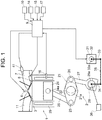
- FIG. 1 illustrates a system configuration of a vehicle internal combustion engine 1 including a variable compression ratio mechanism that is an example of a vehicle drive mechanism to which a control device and control method of the present invention are applied.
- Internal combustion engine 1 in FIG. 1 is a four-cycle spark ignition engine including a variable compression ratio mechanism 2 which utilizes a multi-link piston-crank mechanism.
- each combustion chamber 3 of internal combustion engine 1 On the ceiling surface of each combustion chamber 3 of internal combustion engine 1, a pair of intake valves 4 and a pair of exhaust valves 5 are disposed. Each spark plug 6 is disposed at a central portion surrounded by intake valves 4 and exhaust valves 5.
- Intake valves 4 open and close an intake port 7, and exhaust valves 5 open and close an exhaust port 11.
- each intake port 7 a fuel injection valve 8 for cylinder injection is disposed so as to directly inject fuel into the corresponding combustion chamber 3.
- a fuel injection valve 41 for port injection is disposed so as to inject fuel into intake port 7.
- Both fuel injection valve 8 for cylinder injection and fuel injection valve 41 for port injection are electromagnetic injection valves or piezoelectric injection valves which are opened when a drive pulse signal is applied. Fuel injection valves 8 and 41 inject fuel as much as the quantity that is substantially proportional to the pulse width of the drive pulse signal.
- Internal combustion engine 1 may include either fuel injection valve 41 for port injection or fuel injection valve 8 for cylinder injection.
- An engine control unit 9 including a microcomputer receives sensing signals from various sensors such as an airflow sensor 10 sensing the intake air flow rate in internal combustion engine 1, an air-fuel ratio sensor 14 sensing the air-fuel ratio of an air-fuel mixture based on the oxygen concentration in exhaust from internal combustion engine 1, a crank angle sensor 15 sensing the rotation angle of a crankshaft 21, a water temperature sensor 16 sensing the temperature of a coolant in internal combustion engine 1, and an accelerator opening sensor 17 sensing how far an accelerator pedal is pressed by a driver.
- various sensors such as an airflow sensor 10 sensing the intake air flow rate in internal combustion engine 1, an air-fuel ratio sensor 14 sensing the air-fuel ratio of an air-fuel mixture based on the oxygen concentration in exhaust from internal combustion engine 1, a crank angle sensor 15 sensing the rotation angle of a crankshaft 21, a water temperature sensor 16 sensing the temperature of a coolant in internal combustion engine 1, and an accelerator opening sensor 17 sensing how far an accelerator pedal is pressed by a driver.
- engine control unit 9 controls the fuel injection amount and the injection timings of fuel injection valves 8 and 41, and the ignition timings of spark plugs 6.
- Variable compression ratio mechanism 2 which is an example of the vehicle drive mechanism, uses a known multi-link piston-crank mechanism.
- Variable compression ratio mechanism 2 mainly includes lower links 22, upper links 25, control links 27, and a control shaft (first control shaft, first moving body) 28.
- Lower links 22 are rotatably supported by crankpins 21 a of crankshaft 21.
- Each upper link 25 interlinks an upper pin 23 at one end part of the corresponding lower link 22 with a piston pin 24a of the corresponding piston 24.
- One end of each control link 27 is interlinked with a control pin 26 at the other end part of the corresponding lower link 22.
- Control shaft 28 swingably supports the other ends of control links 27.
- Crankshaft 21 and control shaft 28 are rotatably supported by a bearing structure (not illustrated in the drawings) inside a crankcase below a cylinder block 29.
- Control shaft 28 has eccentric shaft parts 28a, and the positions of eccentric shaft parts 28a change as control shaft 28 rotates.
- the end part of each control link 27 is rotatably fitted to the corresponding eccentric shaft part 28a.
- variable compression ratio mechanism 2 having the above structure, as control shaft 28 rotates, the position of the top dead center of pistons 24 is vertically displaced so that the mechanical compression ratio of internal combustion engine 1 changes.
- an electric motor (actuator) 31 having a rotational center axis parallel to crankshaft 21 is disposed below cylinder block 29.
- a decelerator 32 is connected to electric motor 31 so that they are arranged in series in the axial direction.
- An output shaft (second control shaft, second moving body) 32a of decelerator 32 is positioned coaxially with an output shaft (not illustrated in the drawings) of electric motor 31.
- output shaft 32a and control shaft 28 are positioned so as to be parallel to each other.
- a first arm 33 fixed to output shaft 32a and a second arm 34 fixed to control shaft 28 are interlinked with each other via an intermediate link 35.
- first arm 33 and second arm 34 both extend in the same direction.
- control shaft 28 also rotates clockwise.
- a link mechanism may have a configuration in which output shaft 32a and control shaft 28 rotate in opposite directions.
- Engine control unit 9 computes a target compression ratio of variable compression ratio mechanism 2 based on engine operation conditions (for example, engine load and engine rotation speed), and controls driving of electric motor 31 based on the target compression ratio and an actual compression ratio.
- control unit which is separate from engine control unit 9 and is configured to be able to communicate with engine control unit 9 via CAN or the like, controls driving of electric motor 31 of variable compression ratio mechanism 2.
- engine control unit 9 computes a target angular position of control shaft 28 (or output shaft 32a).
- Engine control unit 9 computes an operation variable of electric motor 31 so as to shift, toward the target angular position, an actual angular position obtained based on an output signal from an angle sensor 36 for sensing the angular position of control shaft 28 (or output shaft 32a).
- Engine control unit 9 controls power supply to electric motor 31 based on the computed operation variable.
- control shaft 28 (and output shaft 32a) is mechanically limited by stoppers so as to ensure that control shaft 28 does not rotate out of a predetermined angular range corresponding to the adjustable range of the compression ratio.
- variable compression ratio mechanism 2 includes two stoppers 37a and 37b, each of which defines an end of the angular range within which control shaft 28 (and output shaft 32a) is rotatable.
- the compression ratio becomes the maximum when control shaft 28 (and output shaft 32a) reaches an angular position corresponding to a contact state of one of stoppers 37a and 37b.
- the compression ratio becomes the minimum when control shaft 28 (and output shaft 32a) reaches an angular position corresponding to a contact state of the other one of stoppers 37a and 37b.
- stopper 37a has a projection part (movable part) 38a and an engagement part (fixed part) 39a
- stopper 37b has a projection part (movable part) 38b and an engagement part (fixed part) 39b.
- Projection parts 38a and 38b protrude from the outer circumference of control shaft 28 and/or output shaft 32a.
- Engagement parts 39a and 39b are provided in cylinder block 29 or the like so as to be located respectively in movement spaces of projection parts 38a and 38b. As projection parts 38a and 38b turn around the shafts, projection parts 38a and 38b move toward or away from engagement parts 39a and 39b.
- the contact of projection part 38a with engagement part 39a as well as the contact of projection part 38b with engagement part 39b limit rotation (movement) of control shaft 28 (and output shaft 32a).
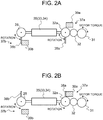
- FIGS. 2A and 2B illustrate an example of a structure of stoppers 37a and 37b.
- one stopper 37a is provided to output shaft 32a, and the other stopper 37b is provided to control shaft 28.
- projection part 38a of stopper 37a is provided integrally with output shaft 32a, and engagement part 39a is disposed in the vicinity of output shaft 32a such that, when projection part 38a turns clockwise, projection part 38a eventually comes into contact with engagement part 39a near the twelve o'clock position in FIGS. 2A and 2B .
- projection part 38b of stopper 37b is provided integrally with control shaft 28, and engagement part 39b is disposed in the vicinity of control shaft 28 such that when projection part 38b turns counterclockwise, projection part 38b eventually comes into contact with engagement part 39b near the six o'clock position in FIGS. 2A and 2B .
- FIG. 2A illustrates a state in which projection part 38b of stopper 37b is in contact with engagement part 39b. From this state, control shaft 28 and output shaft 32a are not allowed to further rotate counterclockwise while being allowed to rotate clockwise.
- FIG. 2B illustrates the state in which control shaft 28 and output shaft 32a rotate clockwise from the state of FIG. 2A until their rotation angle reaches approximately 180 degrees.
- projection part 38a of stopper 37a is in contact with engagement part 39a, ensuring that control shaft 28 and output shaft 32a do not further rotate clockwise.
- an angular position corresponding to the contact state of stopper 37a functions as a clockwise rotation limit position for control shaft 28 and output shaft 32a
- an angular position corresponding to the contact state of stopper 37b functions as a counterclockwise rotation limit position for control shaft 28 and output shaft 32a.
- an angular range of approximately 180 degrees between the angular position corresponding to the contact state of stopper 37a and the angular position corresponding to the contact state of stopper 37b is an angular range within which control shaft 28 and output shaft 32a are rotatable.
- the maximum compression ratio and the minimum compression ratio are defined by the angular position corresponding to the contact state of stopper 37a and the angular position corresponding to the contact state of stopper 37b.
- the compression ratio is variable within the compression ratio range between the compression ratio at the angular position corresponding to the contact state of stopper 37a and the compression ratio at the angular position corresponding to the contact state of stopper 37b.
- the angular range of movability of control shaft 28 is set to approximately 180 degrees. However, it is apparent that the angular range of movability is not limited to 180 degrees.
- angle sensor 36 variation in installation location of angle sensor 36, variation in output characteristics of angle sensor 36, and/or the like reduce the accuracy of sensing where the angular position of control shaft 28 and output shaft 32a lies within the angular range of movability, thus deteriorating the control accuracy of the compression ratio.
- engine control unit 9 executes stopper position learning.
- stopper position learning an output of angle sensor 36 when control shaft 28 and output shaft 32a are at the angular position corresponding to the contact state of stopper 37a and an output of angle sensor 36 when control shaft 28 and output shaft 32a are at the angular position corresponding to the contact state of stopper 37b are sensed and individually stored as reference output values. That is, engine control unit 9 has a software-based function to serve as a learning unit for executing the stopper position learning.
- Engine control unit 9 identifies the angle of control shaft 28 (output shaft 32a) based on the output of angle sensor 36 and the reference output values. Based on the identified angle value, engine control unit 9 then computes and outputs the operation variable of electric motor 31 of variable compression ratio mechanism 2.
- the flow chart in FIG. 3 illustrates a flow of the stopper position learning processing executed by engine control unit 9.
- step S101 engine control unit 9 determines whether or not the operation state and the like of internal combustion engine 1 satisfy a learning execution condition.
- the operation proceeds to step S102.
- a state in which internal combustion engine 1 normally operates within a predetermined operation range after completion of warming up internal combustion engine 1 may be used as the learning execution condition.
- step S102 engine control unit 9 determines whether or not the current round of the stopper position learning is the first round.
- the first round of stopper position learning means stopper position learning with no execution history of the stopper position learning for both stoppers 37a and 37b after the installation of angle sensor 36 and with no reference output value thereof determined.
- Examples of such first round of stopper position learning include stopper position learning executed during an inspection and adjustment process at a vehicle assembly factory, and stopper position learning executed immediately after the replacement of angle sensor 36 at a maintenance shop.
- step S102 the flow is not limited to one in which the operation proceeds to step S103 and the subsequent steps in the first round of learning.
- the determination processing in step S102 may be omitted.
- step S103 engine control unit 9 controls electric motor 31 such that control shaft 28 and output shaft 32a rotate in the rotational direction that brings, into the contact state, one of stoppers 37a and 37b that is stored as a first target stopper for learning.
- engine control unit 9 may set, as the target angular position, an angular position that is further than the angular position where the rotation of control shaft 28 and output shaft 32a is stopped by the learning target stopper.
- Engine control unit 9 drives electric motor 31 in the rotational direction that brings the learning target stopper into the contact state by, for example, controlling electric motor 31 based on the output of angle sensor 36 and this target angular position and by controlling the rotation speed of electric motor 31 so as to achieve a target rotation speed for learning.
- a stopper having higher rigidity has been selected in advance as the first target stopper for learning.
- the rigidity of stopper 37b is determined as being lower than the rigidity of stopper 37a since stopper 37b is located further away from electric motor 31 than stopper 37a, and there are more components between electric motor 31 and stopper 37b than between electric motor 31 and stopper 37a.
- relatively high-rigidity stopper 37a is selected as the first target stopper for learning.
- High-rigidity stopper 37a has a higher impact resistance than low-rigidity stopper 37b, and is thus allowed to be brought into the contact state at a higher speed. Accordingly, stopper 37a allows rotating control shaft 28 from an initial position (angular position of control shaft 28 at the start of learning) to the stopper contact position in a shorter time, thus shortening the learning time.
- step S103 engine control unit 9 controls electric motor 31 such that control shaft 28 rotates at the highest possible speed that generates an impact force within a range tolerable by relatively high-rigidity stopper 37a.
- stopper position learning is executed for relatively low-rigidity stopper 37b
- This increases the time required to rotate control shaft 28 and output shaft 32a to the stopper contact position, thus increasing the learning time.
- stopper position learning in the absence of any previous stopper position learning for either of stoppers 37a and 37b permits wide range of variation in the stopper contact position, thus making it difficult to perform precise control for mitigating a shock, such as reducing the motor torque immediately before the stopper contact position.
- stopper position learning for stopper 37b having lower rigidity in a short time while sufficiently limiting the contact impact force is difficult to execute stopper position learning for stopper 37b having lower rigidity in a short time while sufficiently limiting the contact impact force.
- engine control unit 9 executes learning for stopper 37a having a higher rigidity and higher impact resistance, that is, stopper 37a which is allowed to be brought into the contact state at a higher rotation speed (higher torque), thus allowing shortening of the time required for being brought into the contact state, among stoppers 37a and 37b.
- control shaft 28 When control shaft 28 is driven to rotate in the rotational direction that brings stopper 37a into the contact state until projection part 38a comes into contact with engagement part 39a, the rotation of control shaft 28 stops at that position, and the output of angle sensor 36 is maintained substantially constant.
- step S104 engine control unit 9 determines whether or not the output of angle sensor 36 is maintained substantially constant, thereby detecting whether or not stopper 37a is settled in the contact state.
- engine control unit 9 determines that the output of angle sensor 36 is in a settled state.
- step S103 engine control unit 9 continues to control driving for bringing stopper 37a to the contact state. After that, when it is determined that the output of angle sensor 36 is maintained substantially constant, the operation proceeds to step S105.
- step S105 engine control unit 9 stores the output value of angle sensor 36 at that time as an output of the sensor related to the position corresponding to the contact state of stopper 37a (related to the upper limit value or the lower limit value of the compression ratio).
- step S106 in which engine control unit 9 inverts the rotation drive direction of control shaft 28, and controls electric motor 31 such that control shaft 28 rotates from the position corresponding to the contact state of stopper 37a toward the position corresponding to the contact state of stopper 37b.
- stopper 37b since stopper 37b has a lower rigidity than stopper 37a, bringing stopper 37b into the contact state at a torque equivalent to the torque at which stopper 37a is brought into the contact state may possibly cause deflection, deformation, or the like of the components of stopper 37b due to a contact impact force.
- engine control unit 9 executes buffer control for reducing the contact impact force applied to stopper 37b, compared to when stopper 37a is brought into the contact state.
- engine control unit 9 starts to limit the operation variable of electric motor 31 to a lower level at a timing during the course of angular change sensed based on the change of the rotation angle from the position corresponding to the contact state of stopper 37a (based on the change of the output value of angle sensor 36). In this way, engine control unit 9 executes buffer control for reducing the contact impact force applied to stopper 37b while responsively moving stopper 37b to the position corresponding to the contact state of stopper 37b.
- stopper 37b since stopper 37b is not expected to reach the contact state within a predetermined angular range immediately after control shaft 28 starts to move from the position corresponding to the contact state of stopper 37a, engine control unit 9 rotates control shaft 28 at a torque higher than a maximum permissible torque at which stopper 37b comes into the contact state (at a speed higher than a maximum permissible speed) so as to shorten the learning time (move time).
- engine control unit 9 detects that the rotation angle of control shaft 28 enters an angular range within which stopper 37b can possibly reach the contact state. Upon such detection, engine control unit 9 starts to limit and reduce the operation variable of electric motor 31 such that the motor torque becomes equal to or less than the maximum permissible torque at which stopper 37b comes into the contact state (such that the rotation speed becomes equal to or less than the maximum permissible speed).
- Engine control unit 9 executes this buffer control so as to prevent stopper 37b from being deflected and deformed by a contact impact force while shortening the time required to rotate control shaft 28 from the position corresponding to the contact state of stopper 37a to the position corresponding to the contact state of stopper 37b (shortening the learning time for stopper 37b).
- step S107 similarly to step S104, engine control unit 9 determines whether or not the output of angle sensor 36 is maintained substantially constant, thereby detecting whether or not stopper 37b is settled in the contact state.
- engine control unit 9 Until determining that the output of angle sensor 36 is maintained substantially constant, engine control unit 9 returns to step S106 and continues to control driving of electric motor 31 for bringing stopper 37b to the contact state.
- step S108 engine control unit 9 stores the thus maintained output value of angle sensor 36 as an output of the sensor related to the position corresponding to the contact state of stopper 37b.
- engine control unit 9 first learns an output value of the sensor related to the position corresponding to the contact state of stopper 37a, and then learns an output value of the sensor related to the position corresponding to the contact state of stopper 37b. Based on the learned values, engine control unit 9 corrects the correlation between the output of angle sensor 36 and the angular position of control shaft 28 (actual compression ratio), and controls electric motor 31 based on the output of angle sensor 36.
- step S106 The buffer control in step S106 will be described in more detail below.
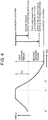
- the time chart of FIG. 4 is a chart for describing an example of buffer control of changing a limit value (upper limit value) CL for an electric current command value for electric motor 31.
- Engine control unit 9 ensures that the electric current command value for electric motor 31 does not exceed the electric current limit value CL by setting the electric current command value to the electric current limit value CL when otherwise the electric current command value will exceed the electric current limit value CL.
- a first learning period (early period of movement) engine control unit 9 uses the electric current limit value CL having characteristics illustrated in FIG. 5A .
- the first learning period starts at time t0, at which learning starts, and ends at time t2, at which the rotation angle of control shaft 28 with respect to the position corresponding to the contact state of stopper 37a reaches a predetermined angle ⁇ .
- stopper 37a is settled in the contact state.
- engine control unit 9 uses the electric current limit value CL having characteristics illustrated in FIG. 5B .
- the second learning period starts at time t2, at which a rotation angle (angle change amount) ⁇ of control shaft 28 with respect to the position corresponding to the contact state of stopper 37a reaches the predetermined angle ⁇ , and ends upon completion of the stopper position learning for stopper 37b.
- Engine control unit 9 identifies the rotation angle ⁇ based on the amount of change in the output of angle sensor 36 measured relative to the output value of the sensor that is related to the position corresponding to the contact state of stopper 37a.
- engine control unit 9 based on the amount of change in the output of angle sensor 36 measured relative to the output value of the sensor (the learned value) that is related to the position corresponding to the contact state of stopper 37a, engine control unit 9 identifies at which timing to change the electric current limit value CL. At the identified change timing, engine control unit 9 changes the electric current limit value CL.
- the electric current limit value CL illustrated in FIG. 5B is smaller than the electric current limit value CL illustrated in FIG. 5A . Accordingly, the motor torque during the second learning period is limited to a lower level than during the first learning period.
- a relatively high motor torque is generated so as to responsively move control shaft 28, from the initial position to the position corresponding to the contact state of relatively high-rigidity stopper 37a, and from the position corresponding to the contact state of stopper 37a to the position where the rotation angle reaches the predetermined angle ⁇ relative to this stopper contact position.
- the motor torque is limited to a lower level than at the beginning of the movement, from the position where the rotation angle reaches the predetermined angle ⁇ relative to the position corresponding to the contact state of stopper 37a to the position corresponding to the contact state of stopper 37b.
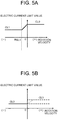
- the electric current limit value CL of FIG. 5A used in the first learning period has the following characteristics:
- the limit value in the negative rotation velocity is set lower than the limit value in the positive rotation velocity.
- the limit value is maintained at a constant value CL0 over the entire range of positive rotation velocity.
- the limit value which is set to the same value as the limit value CL0 when the rotation velocity is zero, decreases as the absolute value of the rotation velocity increases, and is maintained at a constant value CL1 when the absolute value of the rotation velocity is equal to or greater than that of a predetermined velocity RSL1.
- the buffer control may be configured such that no electric current limitation is performed during the first learning period.
- the electric current limit value in the negative rotation velocity in FIG. 5A is used when rotating control shaft 28 from the position corresponding to the contact state of stopper 37a toward the position corresponding to the contact state of stopper 37b. Accordingly, the limit value in the negative rotation velocity has the following characteristics: At the start of movement from the position corresponding to the contact state of stopper 37a, the limit value CL greater than the limit value CL1 is used in order to secure a significant starting current. Then, by the time immediately before reaching the position corresponding to the contact state of stopper 37b, the limit value is reduced to the electric current limit value CL1 that ensures maintaining an expected rotation speed.
- the limit value may be constantly set to the limit value CL1 over the entire range of negative rotation velocity, so that the limit value CL1 is used even at the start of movement from the position corresponding to the contact state of stopper 37a.
- the electric current limit value CL0 in the positive rotation velocity in FIG. 5A is used when bringing stopper 37a into the contact state. Accordingly, the limit value CL0 in the positive rotation velocity is set higher than the electric current limit value CL1 to allow control shaft 28 to be driven at a higher torque at that time, since stopper 37a, which has a relatively high rigidity, has a higher impact resistance.
- the electric current limit value in FIG. 5B is used during the second learning period, that is, used when bringing stopper 37b into the contact state. Accordingly, the electric current limit value in FIG. 5B is set lower than the limit value CL1 in FIG. 5A in both the positive and negative rotation velocity ranges.
- a limit value CL2 in the negative rotation velocity in FIG. 5B is used when bringing low-rigidity stopper 37b into the contact state. Accordingly, the limit value CL2 is set to a value that is smaller than the limit value CL1 and that ensures that the torque is controlled equal to or less than the maximum permissible torque at which stopper 37b comes into the contact state.
- the electric current limit value CL is controlled as follows: At the beginning (during the first learning period), the electric current limit value CL is set to the limit value CL1, thereby generating a motor torque that ensures the highly responsive rotation of control shaft 28 toward the position corresponding to the contact state of stopper 37b.
- the electric current limit value CL is changed from the limit value CL1 to the smaller limit value CL2 so that the motor torque is reduced to ensure that a contact impact force applied to stopper 37b falls within the permissible range.
- a limit value CL3 in the positive rotation velocity in FIG. 5B is used when rebound (change in rotation to move away from the position corresponding to the contact state of stopper 37b toward the position corresponding to the contact state of stopper 37a) occurs due to a contact impact applied to stopper 37b. Accordingly, the electric current limit value CL3 is set to an intermediate value between the limit value CL1 and the limit value CL2 so as to generate a motor torque for recovering the rebound (CL2 ⁇ CL3 ⁇ CL1). As indicated by dotted line in FIG. 5B , the limit value CL has the characteristics of gradually increasing from CL2 to CL3 as the rotation velocity increases from zero in the positive direction, and then being maintained at the limit value CL3 after reaching the limit value CL3.
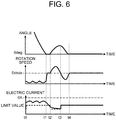
- the time chart of FIG. 6 illustrates an example of changes in the angle of control shaft 28, the rotation speed of control shaft 28 (revolutions per minute, rpm), the motor current, and the electric current limit value CL for the motor, when the electric current limit value CL of FIG. 5B is used during the second learning period.
- the electric current command value is limited by the electric current limit value CL2.
- the electric current limit value CL2 allows limiting the motor torque to a value that ensures that a contact impact force falls within the permissible range. Thus, a contact impact force applied to stopper 37b is sufficiently mitigated.
- the electric current limit value CL is set back to the electric current limit value CL2 so as to limit the contact impact force applied to stopper 37b.
- the electric current limit value CL may be set to the limit value CL2 during the entire second learning period when control shaft 28 rotates in the negative direction.
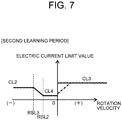
- the limit value in the low rotation velocity range in the negative direction may be set still lower as illustrated in FIG. 7 .
- the electric current limit value CL illustrated in FIG. 7 to be used during the second learning period has the following characteristics in the negative rotational direction toward stopper 37b:
- the electric current limit value CL is set to an electric current limit value CL4 (CL4 ⁇ CL2 ⁇ CL3 ⁇ CL1), which is still lower than the electric current limit value CL2.
- the electric current limit value CL is gradually increased from the electric current limit value CL4 to the electric current limit value CL2 along with an increase in the rotation speed.
- the electric current limit value CL is maintained at the electric current limit value CL2.
- the electric current limit value CL4 used in the low rotation range in the negative rotational direction is adapted based on the permissible torque at which stopper 37b comes into the contact state, thus allowing further reduction of the contact impact applied to stopper 37b.
- the electric current limit value CL3 (CL2 ⁇ CL3 ⁇ CL1) is used in the positive rotation velocity range.
- engine control unit 9 When engine control unit 9 rotates control shaft 28 from the position corresponding to the contact state of stopper 37a toward the position corresponding to the contact state of stopper 37b, engine control unit 9 may change the electric current limit value (correspondence table between rotation speed and electric current limit value) twice or more in accordance with an increase in the angle change amount (amount of movement) from the position corresponding to the contact state of stopper 37a.
- FIG. 8 and FIGS. 9A to 9C illustrate the buffer control for changing the electric current limit value twice.
- the first round of changing the electric current limit value (changing the correspondence table between rotation speed and electric current limit value) is executed at the time point when the angle change amount ⁇ relative to the position corresponding to the contact state of stopper 37a reaches a first angle ⁇ 1.
- the second round of changing the electric current limit value (changing the correspondence table between rotation speed and electric current limit value) is executed at the time point when the angle change amount ⁇ reaches a second angle ⁇ 2 ( ⁇ 1 ⁇ ⁇ 2).
- the electric current limit value CL having the characteristics as illustrated in FIG. 9A is used.
- an electric current limit value CL11 used in the negative rotation velocity is set to a value that allows securing a sufficient electric current for starting to rotate the motor in the negative direction from the position corresponding to the contact state of stopper 37a.
- an electric current limit value CL10 used in the positive rotation velocity is set to be greater than the electric current limit value CL11.
- the limitation according to the electric current limit value CL is not necessarily performed in the positive rotation velocity range during the first learning period.
- the electric current limit value CL having the characteristics illustrated in FIG. 9B is used.
- the second angle ⁇ 2 is set such that the second learning period corresponds to the angular range within which stopper 37b is not expected to reach the contact state in consideration of variation in the angular interval between the position of stopper 37a and the position of stopper 37b.
- control shaft 28 is quickly rotated toward stopper 37b, and thus, the learning time is shortened.
- an electric current limit value CL12 (CL12 ⁇ CL11) in the negative direction during the second learning period is set to a value that ensures maintaining the expected rotation velocity, that is, set to a value equivalent to the electric current limit value CL1 illustrated in FIG. 5A .
- an electric current limit value CL13 in the positive direction during the second learning period is adapted so as to limit reacceleration toward stopper 37b upon rebound from the contact state of the stopper 37b, thus set to satisfy CL12 ⁇ CL13 ⁇ CL10.
- the second learning period corresponds to the angular range within which stopper 37b is not expected to reach the contact state even though there is positional variation in stoppers 37a and 37b. Accordingly, the electric current limit value CL12 may be used in both the negative rotational direction and the positive rotational direction.
- the electric current limit value CL having the characteristics illustrated in FIG. 9C is used.
- an electric current limit value CL14 (CL14 ⁇ CL12) equivalent to the electric current limit value CL4 illustrated in FIG. 7 is used in the negative rotation velocity range, and an electric current limit value equivalent to the electric current limit value CL13 in the positive direction during the second learning period is used in the positive rotation velocity range.
- the electric current control value CL may be changed in accordance with the rotational direction and the angle change amount ⁇ instead of allocating different electric current limit values CL depending on the rotation velocity of control shaft 28.
- the electric current control value CL is changed to a smaller value along with an increase in the angle change amount ⁇ instead of allocating different electric current control values CL depending on the rotation speed and the rotational direction.
- the angle change amount ⁇ is the rotation angle of control shaft 28 relative to the position corresponding to the contact state of stopper 37a.
- the electric current limit value CL may be corrected in accordance with the deviation between the target rotation velocity and the actual rotation velocity. This makes it possible to improve the control accuracy of the rotation velocity of control shaft 28 when rotating control shaft 28 toward the position corresponding to the contact state of stopper 37b.
- the initial value of the electric current control value CL may be set according to the increase in the angle change amount ⁇ , and, after that, the electric current control value CL may be set to a smaller value every time the angle change amount ⁇ increases by a unit angle (or every lapse of a predetermined unit time).
- control for preventing a command value for motor current from exceeding the electric current limit value CL might permit the electric current value actually flowing through electric motor 31 when either stopper reaches the contact state to exceed the electric current limit value CL due to an induced voltage change or the like. Accordingly, such control has a risk of allowing generation of an excessive motor torque when the stopper reaches the contact state.
- engine control unit 9 may execute voltage limiting processing for limiting the motor's applied voltage to an upper limit value or less, in addition to the electric current limiting processing.
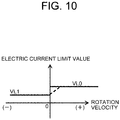
- FIG. 10 illustrates an example of the characteristics of a limit voltage value (upper limit voltage value) VL used for limiting the motor's applied voltage during the third learning period of FIG. 8 .
- the characteristics of limit voltage value (upper limit voltage value) VL of FIG. 10 may also be used during the second learning period of FIG. 4 .
- a limit voltage value (upper limit value for applied voltage) VL0 is set to a voltage corresponding to the electric current limit value CL3 or CL13.
- a limit voltage value VL1 (VL1 ⁇ VL0) is set to a voltage corresponding to the maximum permissible current value (maximum permissible torque) for the stopper contact state.
- limiting the motor's applied voltage below the limit voltage value VL having the above-described characteristics makes it possible to prevent the motor current from exceeding the electric current limit value corresponding to the maximum permissible torque when either stopper reaches the contact state, even though such voltage limitation reduces the responsiveness of the angular change while control shaft 28 rotates toward the stopper contact position.
- the motor's applied voltage may be limited to a lower level (the limit voltage value VL may be changed to a smaller value) at the timing when the angle change amount becomes a predetermined value, instead of changing the limit value for the motor current.
- the arrangement of the two stoppers having different rigidity is not limited to the foregoing in which the stoppers are provided respectively to two different rotational bodies (control shaft 28, and output shaft 32a of decelerator 32).
- the present invention may also be applied to a drive mechanism in which two stoppers having different rigidity are provided to a single rotational body.
- one stopper 37a includes projection part 38a and a first engagement part 40a.
- Projection part 38a protrudes from the outer circumference of output shaft 32a of decelerator 32.
- projection part 38a eventually comes into contact with first engagement part 40a near the twelve o'clock position in FIGS. 12A and 12B .
- the other stopper 37b which shares projection part 38a with stopper 37a, includes a second engagement part 40b.
- projection part 38a eventually comes into contact with second engagement part 40b near the six o'clock position in FIGS. 12A and 12B .
- the angular range of movability of output shaft 32a is also set to an angular range between the angular position corresponding to the contact state of stopper 37a and the angular position corresponding to the contact state of stopper 37b.
- a thickness w1 of first engagement part 40a in the rotational direction of projection part 38a is greater than a thickness w2 of second engagement part 40b in the rotational direction of projection part 38a.
- stopper 37a including first engagement part 40a and projection part 38a has a higher rigidity than stopper 37b including second engagement part 40b and projection part 38a.
- stopper 37a is more rigid than stopper 37b
- the stopper position learning is executed as follows: First, engine control unit 9 brings stopper 37a (first engagement part 40a and projection part 38a) into the contact state and learns the output of angle sensor 36 related to the position corresponding to the contact state of stopper 37a.
- engine control unit 9 rotates control shaft 28 toward the position corresponding to the contact state of stopper 37b, while changing the limit value for the operation variable (electric current and/or voltage) of the motor so as to limit and reduce the operation variable in accordance with the angular change relative to the position corresponding to the contact state of stopper 37a.
- This makes it possible to responsively rotate control shaft 28 toward the position corresponding to the contact state of stopper 37b while limiting a contact impact force applied to stopper 37b within a permissible range.
- two stoppers 37a and 37b are provided to output shaft 32a.
- two stoppers 37a and 37b may be provided to control shaft 28, instead.
- the drive mechanism is not limited to variable compression ratio mechanism 2. It is apparent that, for example, the present invention may also be applied to a variable valve mechanism for changing the lift characteristics of the intake valves or the exhaust valves of the internal combustion engine depending on the angle of the control shaft.
- the moving body included in the drive mechanism is not limited to a shaft rotating around its center axis.
- the present invention may also be applied to a drive mechanism having a structure for using stoppers to limit the back-and-forth linear movement of a rack, which serves as the moving body, of a rack-and-pinion.
- a control device for a vehicle drive mechanism including a moving body which is movably supported, two stoppers, each of which defines an end of a movability range of the moving body, an actuator which drives the moving body in a moving direction, and a sensor which senses a position of the moving body.
- the control device comprises a learning unit that learns an output of the sensor corresponding to a contact state of each of the two stoppers.
- the learning unit executes the learning for a high-rigidity stopper of the two stoppers prior to the learning for a low-rigidity stopper of the two stoppers.
- the learning unit limits an operation variable of the actuator to a lower level along with an increase in an amount of change in the output of the sensor from the contact state of the high-rigidity stopper.
- the learning unit limits the operation variable for moving the moving body toward the low-rigidity stopper to a lower level than the operation variable for moving the moving body toward the high-rigidity stopper.
- the learning unit when the low-rigidity stopper is brought into contact, changes an upper limit value of the operation variable to a smaller value in accordance with an increase in the amount of change in the output of the sensor from the contact state of the high-rigidity stopper.
- the actuator is a motor
- the learning unit limits at least one of a current and an applied voltage of the motor.
- the high-rigidity stopper is a stopper, closer to the actuator, of the two stoppers.
- a control method for a vehicle drive mechanism including a moving body which is movably supported, two stoppers, each of which defines an end of a movability range of the moving body, an actuator which drives the moving body in a moving direction, and a sensor which senses a position of the moving body.
- the control method comprises: moving the moving body toward a high-rigidity stopper of the two stoppers; learning an output of the sensor corresponding to a contact state of the high-rigidity stopper; moving the moving body toward a low-rigidity stopper of the two stoppers from the contact state of the high-rigidity stopper; limiting, to a lower level, an operation variable of the actuator for moving the moving body toward the low-rigidity stopper from the contact state of the high-rigidity stopper along with an increase in an amount of change in the output of the sensor from the contact state of the high-rigidity stopper; learning the output of the sensor corresponding to the contact state of the low-rigidity stopper; and controlling the actuator based on a learned value of the output of the sensor.
Landscapes
- Engineering & Computer Science (AREA)
- Chemical & Material Sciences (AREA)
- Mechanical Engineering (AREA)
- General Engineering & Computer Science (AREA)
- Combustion & Propulsion (AREA)
- Analytical Chemistry (AREA)
- Artificial Intelligence (AREA)
- Medical Informatics (AREA)
- Automation & Control Theory (AREA)
- Evolutionary Computation (AREA)
- Health & Medical Sciences (AREA)
- Software Systems (AREA)
- Physics & Mathematics (AREA)
- General Physics & Mathematics (AREA)
- Computer Vision & Pattern Recognition (AREA)
- Output Control And Ontrol Of Special Type Engine (AREA)
- Control Of Electric Motors In General (AREA)
- Steering Control In Accordance With Driving Conditions (AREA)
- Power Steering Mechanism (AREA)
- Valve Device For Special Equipments (AREA)
- Combined Controls Of Internal Combustion Engines (AREA)
Applications Claiming Priority (2)
| Application Number | Priority Date | Filing Date | Title |
|---|---|---|---|
| JP2015043516A JP6258887B2 (ja) | 2015-03-05 | 2015-03-05 | 車両用駆動機構の制御装置及び制御方法 |
| PCT/JP2016/056809 WO2016140345A1 (ja) | 2015-03-05 | 2016-03-04 | 車両用駆動機構の制御装置及び制御方法 |
Publications (3)
| Publication Number | Publication Date |
|---|---|
| EP3267014A1 true EP3267014A1 (de) | 2018-01-10 |
| EP3267014A4 EP3267014A4 (de) | 2018-08-22 |
| EP3267014B1 EP3267014B1 (de) | 2020-12-16 |
Family
ID=56847489
Family Applications (1)
| Application Number | Title | Priority Date | Filing Date |
|---|---|---|---|
| EP16759037.1A Active EP3267014B1 (de) | 2015-03-05 | 2016-03-04 | Steuerungsvorrichtung und steuerungsverfahren für einen fahrzeugantriebsmechanismus |
Country Status (5)
| Country | Link |
|---|---|
| US (4) | US10138806B2 (de) |
| EP (1) | EP3267014B1 (de) |
| JP (1) | JP6258887B2 (de) |
| CN (2) | CN110043383B (de) |
| WO (1) | WO2016140345A1 (de) |
Families Citing this family (9)
| Publication number | Priority date | Publication date | Assignee | Title |
|---|---|---|---|---|
| BR112017026447B1 (pt) * | 2015-06-25 | 2022-02-15 | Nissan Motor Co., Ltd | Motor de combustão interna com taxa de compressão variável e método de aprendizagem |
| CN107849987B (zh) * | 2015-07-15 | 2019-03-12 | 日产自动车株式会社 | 可变压缩比内燃机 |
| DE102016203133B3 (de) * | 2016-02-26 | 2017-01-26 | Continental Automotive Gmbh | Betriebsverfahren und Brennkraftmaschine |
| JP6492153B2 (ja) * | 2017-12-07 | 2019-03-27 | 日立オートモティブシステムズ株式会社 | 車両用駆動機構の制御装置及び制御方法 |
| JP6979930B2 (ja) * | 2018-06-26 | 2021-12-15 | 日立Astemo株式会社 | 可変圧縮比機構の制御装置 |
| CN110361965B (zh) * | 2019-05-20 | 2022-01-11 | 北京理工大学 | 线性Luenberger观测器的构建方法 |
| EP3748145B1 (de) * | 2019-06-07 | 2023-12-06 | Winterthur Gas & Diesel Ltd. | Motor mit variablem verdichtungsverhältnis (vcr) |
| CN113818970B (zh) * | 2021-08-10 | 2022-12-23 | 浙江吉利控股集团有限公司 | 一种发动机气缸盖、发动机、车辆及沉积物处理方法 |
| CN120729114B (zh) * | 2025-08-19 | 2025-12-23 | 旋智电子科技(上海)有限公司 | 用于预测电机电流的方法、设备、存储介质和程序产品 |
Family Cites Families (18)
| Publication number | Priority date | Publication date | Assignee | Title |
|---|---|---|---|---|
| US5844394A (en) * | 1996-09-20 | 1998-12-01 | Matsushita Electric Industrial Co., Ltd. | Stepping motor controller |
| JP3873663B2 (ja) * | 2001-05-31 | 2007-01-24 | 日産自動車株式会社 | 可変バルブタイミング装置の制御装置 |
| JP3579398B2 (ja) | 2002-01-25 | 2004-10-20 | 三菱電機株式会社 | 位置決め制御装置 |
| JP5003723B2 (ja) * | 2002-12-16 | 2012-08-15 | 株式会社デンソー | 電動アクチュエータシステム |
| US7900797B1 (en) | 2004-01-12 | 2011-03-08 | Daryl Dean Witcraft | Lid separator and dispensing device |
| JP5050421B2 (ja) * | 2005-07-12 | 2012-10-17 | 日本精工株式会社 | 電動パワーステアリング装置の制御装置 |
| JP5035866B2 (ja) * | 2005-10-04 | 2012-09-26 | ヤンマー株式会社 | 作業車両における動力伝達装置 |
| JP4888160B2 (ja) * | 2007-03-06 | 2012-02-29 | トヨタ自動車株式会社 | 内燃機関の可変動弁装置 |
| US7546820B2 (en) * | 2007-10-31 | 2009-06-16 | Ford Global Technologies, Llc | Variable compression ratio engine with lost motion coupling |
| JP2009177965A (ja) * | 2008-01-25 | 2009-08-06 | Denso Corp | モータ制御装置 |
| EP2274521B1 (de) * | 2008-04-22 | 2020-06-17 | Borgwarner Inc. | Verfahren zur steuerung eines stellglieds |
| JP5625491B2 (ja) * | 2010-05-17 | 2014-11-19 | いすゞ自動車株式会社 | 流量制御弁の制御装置 |
| JP2012011578A (ja) * | 2010-06-29 | 2012-01-19 | Brother Industries Ltd | カバー開閉機構及び画像処理装置 |
| JP5721256B2 (ja) * | 2011-01-24 | 2015-05-20 | 本田技研工業株式会社 | 電動車両の制御装置 |
| JP5906589B2 (ja) * | 2011-06-01 | 2016-04-20 | 日産自動車株式会社 | 内燃機関の故障診断装置 |
| US9243553B2 (en) * | 2013-05-16 | 2016-01-26 | Ford Global Technologies, Llc | Electric waste gate control system sensor calibration with end-stop detection |
| DE102014210930A1 (de) * | 2014-06-06 | 2015-12-17 | Robert Bosch Gmbh | Verfahren und Vorrichtung zum Verstellen eines Stellglieds eines Stellgebersystems mit einem elektronisch kommutierten Stellantrieb |
| CN107849987B (zh) * | 2015-07-15 | 2019-03-12 | 日产自动车株式会社 | 可变压缩比内燃机 |
-
2015
- 2015-03-05 JP JP2015043516A patent/JP6258887B2/ja active Active
-
2016
- 2016-03-04 EP EP16759037.1A patent/EP3267014B1/de active Active
- 2016-03-04 WO PCT/JP2016/056809 patent/WO2016140345A1/ja not_active Ceased
- 2016-03-04 CN CN201910392587.8A patent/CN110043383B/zh active Active
- 2016-03-04 US US15/555,707 patent/US10138806B2/en active Active
- 2016-03-04 CN CN201680012895.8A patent/CN107429616B/zh active Active
-
2018
- 2018-10-16 US US16/161,635 patent/US10364742B2/en active Active
-
2019
- 2019-06-06 US US16/433,730 patent/US10738691B2/en active Active
-
2020
- 2020-07-07 US US16/922,486 patent/US11193417B2/en active Active
Also Published As
| Publication number | Publication date |
|---|---|
| CN110043383A (zh) | 2019-07-23 |
| US20190284994A1 (en) | 2019-09-19 |
| CN110043383B (zh) | 2021-09-03 |
| CN107429616B (zh) | 2019-06-07 |
| EP3267014B1 (de) | 2020-12-16 |
| US11193417B2 (en) | 2021-12-07 |
| US20180058314A1 (en) | 2018-03-01 |
| US10364742B2 (en) | 2019-07-30 |
| JP6258887B2 (ja) | 2018-01-10 |
| EP3267014A4 (de) | 2018-08-22 |
| US20190085762A1 (en) | 2019-03-21 |
| US10738691B2 (en) | 2020-08-11 |
| US20200340395A1 (en) | 2020-10-29 |
| JP2016163519A (ja) | 2016-09-05 |
| WO2016140345A1 (ja) | 2016-09-09 |
| US10138806B2 (en) | 2018-11-27 |
| CN107429616A (zh) | 2017-12-01 |
Similar Documents
| Publication | Publication Date | Title |
|---|---|---|
| US11193417B2 (en) | Control device and control method for vehicle drive mechanism | |
| CN107076020B (zh) | 内燃机的控制装置及其控制方法 | |
| EP2947298A1 (de) | Verbrennungsmotorsteuerungsvorrichtung und -steuerungsverfahren | |
| JP2012132345A (ja) | 内燃機関の制御装置 | |
| US7600418B2 (en) | Sensor adjusting method and system for variable valve mechanism | |
| JP5316086B2 (ja) | 内燃機関の制御装置及び制御方法 | |
| EP3171001B1 (de) | Verbrennungsmotor mit variabler verdichtung | |
| US20070113806A1 (en) | Valve gear of internal combustion engine | |
| RU2670634C9 (ru) | Двигатель внутреннего сгорания с переменной степенью сжатия и способ обучения для него | |
| JP5900701B2 (ja) | 内燃機関の制御装置および制御方法 | |
| EP3163055A1 (de) | Steuerungsvorrichtung für einen verbrennungsmotor mit variablem verdichtungsverhältnis | |
| JP2010043544A (ja) | 可変圧縮比内燃機関 | |
| US7322323B2 (en) | Valve actuation control apparatus for internal combustion engine | |
| JP6659884B2 (ja) | 車両用駆動機構の制御装置及び制御方法 | |
| JP6854048B2 (ja) | 車両用駆動機構の制御装置及び制御方法 | |
| JP6492153B2 (ja) | 車両用駆動機構の制御装置及び制御方法 | |
| JP2011226331A (ja) | 内燃機関の可変動弁装置 | |
| JPH07229409A (ja) | バルブタイミング制御装置 | |
| JP2018003699A (ja) | 内燃機関の制御装置及びその制御方法 | |
| JP2006242090A (ja) | 内燃機関の可変動弁装置 | |
| JP2008215239A (ja) | 内燃機関の可変動弁装置 | |
| JP2006250042A (ja) | 内燃機関の制御装置 |
Legal Events
| Date | Code | Title | Description |
|---|---|---|---|
| STAA | Information on the status of an ep patent application or granted ep patent |
Free format text: STATUS: THE INTERNATIONAL PUBLICATION HAS BEEN MADE |
|
| PUAI | Public reference made under article 153(3) epc to a published international application that has entered the european phase |
Free format text: ORIGINAL CODE: 0009012 |
|
| STAA | Information on the status of an ep patent application or granted ep patent |
Free format text: STATUS: REQUEST FOR EXAMINATION WAS MADE |
|
| 17P | Request for examination filed |
Effective date: 20170906 |
|
| AK | Designated contracting states |
Kind code of ref document: A1 Designated state(s): AL AT BE BG CH CY CZ DE DK EE ES FI FR GB GR HR HU IE IS IT LI LT LU LV MC MK MT NL NO PL PT RO RS SE SI SK SM TR |
|
| AX | Request for extension of the european patent |
Extension state: BA ME |
|
| DAV | Request for validation of the european patent (deleted) | ||
| DAX | Request for extension of the european patent (deleted) | ||
| A4 | Supplementary search report drawn up and despatched |
Effective date: 20180719 |
|
| RIC1 | Information provided on ipc code assigned before grant |
Ipc: F02D 41/24 20060101ALI20180713BHEP Ipc: F02D 15/02 20060101AFI20180713BHEP |
|
| STAA | Information on the status of an ep patent application or granted ep patent |
Free format text: STATUS: EXAMINATION IS IN PROGRESS |
|
| 17Q | First examination report despatched |
Effective date: 20190528 |
|
| GRAP | Despatch of communication of intention to grant a patent |
Free format text: ORIGINAL CODE: EPIDOSNIGR1 |
|
| STAA | Information on the status of an ep patent application or granted ep patent |
Free format text: STATUS: GRANT OF PATENT IS INTENDED |
|
| INTG | Intention to grant announced |
Effective date: 20200724 |
|
| GRAS | Grant fee paid |
Free format text: ORIGINAL CODE: EPIDOSNIGR3 |
|
| GRAA | (expected) grant |
Free format text: ORIGINAL CODE: 0009210 |
|
| STAA | Information on the status of an ep patent application or granted ep patent |
Free format text: STATUS: THE PATENT HAS BEEN GRANTED |
|
| AK | Designated contracting states |
Kind code of ref document: B1 Designated state(s): AL AT BE BG CH CY CZ DE DK EE ES FI FR GB GR HR HU IE IS IT LI LT LU LV MC MK MT NL NO PL PT RO RS SE SI SK SM TR |
|
| REG | Reference to a national code |
Ref country code: GB Ref legal event code: FG4D |
|
| REG | Reference to a national code |
Ref country code: DE Ref legal event code: R096 Ref document number: 602016049895 Country of ref document: DE |
|
| REG | Reference to a national code |
Ref country code: IE Ref legal event code: FG4D |
|
| REG | Reference to a national code |
Ref country code: AT Ref legal event code: REF Ref document number: 1345810 Country of ref document: AT Kind code of ref document: T Effective date: 20210115 |
|
| PG25 | Lapsed in a contracting state [announced via postgrant information from national office to epo] |
Ref country code: NO Free format text: LAPSE BECAUSE OF FAILURE TO SUBMIT A TRANSLATION OF THE DESCRIPTION OR TO PAY THE FEE WITHIN THE PRESCRIBED TIME-LIMIT Effective date: 20210316 Ref country code: RS Free format text: LAPSE BECAUSE OF FAILURE TO SUBMIT A TRANSLATION OF THE DESCRIPTION OR TO PAY THE FEE WITHIN THE PRESCRIBED TIME-LIMIT Effective date: 20201216 Ref country code: FI Free format text: LAPSE BECAUSE OF FAILURE TO SUBMIT A TRANSLATION OF THE DESCRIPTION OR TO PAY THE FEE WITHIN THE PRESCRIBED TIME-LIMIT Effective date: 20201216 Ref country code: GR Free format text: LAPSE BECAUSE OF FAILURE TO SUBMIT A TRANSLATION OF THE DESCRIPTION OR TO PAY THE FEE WITHIN THE PRESCRIBED TIME-LIMIT Effective date: 20210317 |
|
| REG | Reference to a national code |
Ref country code: AT Ref legal event code: MK05 Ref document number: 1345810 Country of ref document: AT Kind code of ref document: T Effective date: 20201216 |
|
| REG | Reference to a national code |
Ref country code: NL Ref legal event code: MP Effective date: 20201216 |
|
| PG25 | Lapsed in a contracting state [announced via postgrant information from national office to epo] |
Ref country code: BG Free format text: LAPSE BECAUSE OF FAILURE TO SUBMIT A TRANSLATION OF THE DESCRIPTION OR TO PAY THE FEE WITHIN THE PRESCRIBED TIME-LIMIT Effective date: 20210316 Ref country code: LV Free format text: LAPSE BECAUSE OF FAILURE TO SUBMIT A TRANSLATION OF THE DESCRIPTION OR TO PAY THE FEE WITHIN THE PRESCRIBED TIME-LIMIT Effective date: 20201216 Ref country code: SE Free format text: LAPSE BECAUSE OF FAILURE TO SUBMIT A TRANSLATION OF THE DESCRIPTION OR TO PAY THE FEE WITHIN THE PRESCRIBED TIME-LIMIT Effective date: 20201216 |
|
| PG25 | Lapsed in a contracting state [announced via postgrant information from national office to epo] |
Ref country code: NL Free format text: LAPSE BECAUSE OF FAILURE TO SUBMIT A TRANSLATION OF THE DESCRIPTION OR TO PAY THE FEE WITHIN THE PRESCRIBED TIME-LIMIT Effective date: 20201216 Ref country code: HR Free format text: LAPSE BECAUSE OF FAILURE TO SUBMIT A TRANSLATION OF THE DESCRIPTION OR TO PAY THE FEE WITHIN THE PRESCRIBED TIME-LIMIT Effective date: 20201216 |
|
| REG | Reference to a national code |
Ref country code: LT Ref legal event code: MG9D |
|
| PG25 | Lapsed in a contracting state [announced via postgrant information from national office to epo] |
Ref country code: RO Free format text: LAPSE BECAUSE OF FAILURE TO SUBMIT A TRANSLATION OF THE DESCRIPTION OR TO PAY THE FEE WITHIN THE PRESCRIBED TIME-LIMIT Effective date: 20201216 Ref country code: SK Free format text: LAPSE BECAUSE OF FAILURE TO SUBMIT A TRANSLATION OF THE DESCRIPTION OR TO PAY THE FEE WITHIN THE PRESCRIBED TIME-LIMIT Effective date: 20201216 Ref country code: PT Free format text: LAPSE BECAUSE OF FAILURE TO SUBMIT A TRANSLATION OF THE DESCRIPTION OR TO PAY THE FEE WITHIN THE PRESCRIBED TIME-LIMIT Effective date: 20210416 Ref country code: CZ Free format text: LAPSE BECAUSE OF FAILURE TO SUBMIT A TRANSLATION OF THE DESCRIPTION OR TO PAY THE FEE WITHIN THE PRESCRIBED TIME-LIMIT Effective date: 20201216 Ref country code: EE Free format text: LAPSE BECAUSE OF FAILURE TO SUBMIT A TRANSLATION OF THE DESCRIPTION OR TO PAY THE FEE WITHIN THE PRESCRIBED TIME-LIMIT Effective date: 20201216 Ref country code: SM Free format text: LAPSE BECAUSE OF FAILURE TO SUBMIT A TRANSLATION OF THE DESCRIPTION OR TO PAY THE FEE WITHIN THE PRESCRIBED TIME-LIMIT Effective date: 20201216 Ref country code: LT Free format text: LAPSE BECAUSE OF FAILURE TO SUBMIT A TRANSLATION OF THE DESCRIPTION OR TO PAY THE FEE WITHIN THE PRESCRIBED TIME-LIMIT Effective date: 20201216 |
|
| PG25 | Lapsed in a contracting state [announced via postgrant information from national office to epo] |
Ref country code: AT Free format text: LAPSE BECAUSE OF FAILURE TO SUBMIT A TRANSLATION OF THE DESCRIPTION OR TO PAY THE FEE WITHIN THE PRESCRIBED TIME-LIMIT Effective date: 20201216 Ref country code: PL Free format text: LAPSE BECAUSE OF FAILURE TO SUBMIT A TRANSLATION OF THE DESCRIPTION OR TO PAY THE FEE WITHIN THE PRESCRIBED TIME-LIMIT Effective date: 20201216 |
|
| REG | Reference to a national code |
Ref country code: DE Ref legal event code: R097 Ref document number: 602016049895 Country of ref document: DE |
|
| PG25 | Lapsed in a contracting state [announced via postgrant information from national office to epo] |
Ref country code: IS Free format text: LAPSE BECAUSE OF FAILURE TO SUBMIT A TRANSLATION OF THE DESCRIPTION OR TO PAY THE FEE WITHIN THE PRESCRIBED TIME-LIMIT Effective date: 20210416 |
|
| PLBE | No opposition filed within time limit |
Free format text: ORIGINAL CODE: 0009261 |
|
| STAA | Information on the status of an ep patent application or granted ep patent |
Free format text: STATUS: NO OPPOSITION FILED WITHIN TIME LIMIT |
|
| PG25 | Lapsed in a contracting state [announced via postgrant information from national office to epo] |
Ref country code: IT Free format text: LAPSE BECAUSE OF FAILURE TO SUBMIT A TRANSLATION OF THE DESCRIPTION OR TO PAY THE FEE WITHIN THE PRESCRIBED TIME-LIMIT Effective date: 20201216 Ref country code: AL Free format text: LAPSE BECAUSE OF FAILURE TO SUBMIT A TRANSLATION OF THE DESCRIPTION OR TO PAY THE FEE WITHIN THE PRESCRIBED TIME-LIMIT Effective date: 20201216 Ref country code: MC Free format text: LAPSE BECAUSE OF FAILURE TO SUBMIT A TRANSLATION OF THE DESCRIPTION OR TO PAY THE FEE WITHIN THE PRESCRIBED TIME-LIMIT Effective date: 20201216 |
|
| REG | Reference to a national code |
Ref country code: CH Ref legal event code: PL |
|
| 26N | No opposition filed |
Effective date: 20210917 |
|
| GBPC | Gb: european patent ceased through non-payment of renewal fee |
Effective date: 20210316 |
|
| PG25 | Lapsed in a contracting state [announced via postgrant information from national office to epo] |
Ref country code: DK Free format text: LAPSE BECAUSE OF FAILURE TO SUBMIT A TRANSLATION OF THE DESCRIPTION OR TO PAY THE FEE WITHIN THE PRESCRIBED TIME-LIMIT Effective date: 20201216 |
|
| REG | Reference to a national code |
Ref country code: BE Ref legal event code: MM Effective date: 20210331 |
|
| REG | Reference to a national code |
Ref country code: DE Ref legal event code: R081 Ref document number: 602016049895 Country of ref document: DE Owner name: HITACHI ASTEMO, LTD., HITACHINAKA-SHI, JP Free format text: FORMER OWNER: HITACHI AUTOMOTIVE SYSTEMS, LTD., HITACHINAKA-SHI, IBARAKI, JP |
|
| PG25 | Lapsed in a contracting state [announced via postgrant information from national office to epo] |
Ref country code: LU Free format text: LAPSE BECAUSE OF NON-PAYMENT OF DUE FEES Effective date: 20210304 Ref country code: LI Free format text: LAPSE BECAUSE OF NON-PAYMENT OF DUE FEES Effective date: 20210331 Ref country code: CH Free format text: LAPSE BECAUSE OF NON-PAYMENT OF DUE FEES Effective date: 20210331 Ref country code: ES Free format text: LAPSE BECAUSE OF FAILURE TO SUBMIT A TRANSLATION OF THE DESCRIPTION OR TO PAY THE FEE WITHIN THE PRESCRIBED TIME-LIMIT Effective date: 20201216 Ref country code: GB Free format text: LAPSE BECAUSE OF NON-PAYMENT OF DUE FEES Effective date: 20210316 Ref country code: IE Free format text: LAPSE BECAUSE OF NON-PAYMENT OF DUE FEES Effective date: 20210304 |
|
| PG25 | Lapsed in a contracting state [announced via postgrant information from national office to epo] |
Ref country code: SI Free format text: LAPSE BECAUSE OF FAILURE TO SUBMIT A TRANSLATION OF THE DESCRIPTION OR TO PAY THE FEE WITHIN THE PRESCRIBED TIME-LIMIT Effective date: 20201216 |
|
| PG25 | Lapsed in a contracting state [announced via postgrant information from national office to epo] |
Ref country code: IS Free format text: LAPSE BECAUSE OF FAILURE TO SUBMIT A TRANSLATION OF THE DESCRIPTION OR TO PAY THE FEE WITHIN THE PRESCRIBED TIME-LIMIT Effective date: 20210416 |
|
| PG25 | Lapsed in a contracting state [announced via postgrant information from national office to epo] |
Ref country code: BE Free format text: LAPSE BECAUSE OF NON-PAYMENT OF DUE FEES Effective date: 20210331 |
|
| PG25 | Lapsed in a contracting state [announced via postgrant information from national office to epo] |
Ref country code: CY Free format text: LAPSE BECAUSE OF FAILURE TO SUBMIT A TRANSLATION OF THE DESCRIPTION OR TO PAY THE FEE WITHIN THE PRESCRIBED TIME-LIMIT Effective date: 20201216 |
|
| PG25 | Lapsed in a contracting state [announced via postgrant information from national office to epo] |
Ref country code: HU Free format text: LAPSE BECAUSE OF FAILURE TO SUBMIT A TRANSLATION OF THE DESCRIPTION OR TO PAY THE FEE WITHIN THE PRESCRIBED TIME-LIMIT; INVALID AB INITIO Effective date: 20160304 |
|
| PG25 | Lapsed in a contracting state [announced via postgrant information from national office to epo] |
Ref country code: MK Free format text: LAPSE BECAUSE OF FAILURE TO SUBMIT A TRANSLATION OF THE DESCRIPTION OR TO PAY THE FEE WITHIN THE PRESCRIBED TIME-LIMIT Effective date: 20201216 |
|
| PG25 | Lapsed in a contracting state [announced via postgrant information from national office to epo] |
Ref country code: TR Free format text: LAPSE BECAUSE OF FAILURE TO SUBMIT A TRANSLATION OF THE DESCRIPTION OR TO PAY THE FEE WITHIN THE PRESCRIBED TIME-LIMIT Effective date: 20201216 |
|
| PG25 | Lapsed in a contracting state [announced via postgrant information from national office to epo] |
Ref country code: MT Free format text: LAPSE BECAUSE OF FAILURE TO SUBMIT A TRANSLATION OF THE DESCRIPTION OR TO PAY THE FEE WITHIN THE PRESCRIBED TIME-LIMIT Effective date: 20201216 |
|
| PGFP | Annual fee paid to national office [announced via postgrant information from national office to epo] |
Ref country code: DE Payment date: 20250128 Year of fee payment: 10 |
|
| PGFP | Annual fee paid to national office [announced via postgrant information from national office to epo] |
Ref country code: FR Payment date: 20250210 Year of fee payment: 10 |