EP3258787B1 - Herstellungsverfahren für weichen keks - Google Patents
Herstellungsverfahren für weichen keks Download PDFInfo
- Publication number
- EP3258787B1 EP3258787B1 EP16705164.8A EP16705164A EP3258787B1 EP 3258787 B1 EP3258787 B1 EP 3258787B1 EP 16705164 A EP16705164 A EP 16705164A EP 3258787 B1 EP3258787 B1 EP 3258787B1
- Authority
- EP
- European Patent Office
- Prior art keywords
- molded
- pan
- cake
- soft
- soft cake
- Prior art date
- Legal status (The legal status is an assumption and is not a legal conclusion. Google has not performed a legal analysis and makes no representation as to the accuracy of the status listed.)
- Active
Links
- 238000000034 method Methods 0.000 title claims description 38
- 238000004519 manufacturing process Methods 0.000 title claims description 10
- 238000000465 moulding Methods 0.000 claims description 14
- 239000004033 plastic Substances 0.000 claims description 14
- XLYOFNOQVPJJNP-UHFFFAOYSA-N water Substances O XLYOFNOQVPJJNP-UHFFFAOYSA-N 0.000 claims description 14
- 230000000694 effects Effects 0.000 claims description 13
- 229920001296 polysiloxane Polymers 0.000 claims description 12
- 230000000295 complement effect Effects 0.000 claims description 6
- 239000000047 product Substances 0.000 description 41
- 235000013312 flour Nutrition 0.000 description 39
- 239000003925 fat Substances 0.000 description 27
- 235000019197 fats Nutrition 0.000 description 27
- 235000020985 whole grains Nutrition 0.000 description 27
- 238000012360 testing method Methods 0.000 description 25
- 235000014121 butter Nutrition 0.000 description 15
- 102000002322 Egg Proteins Human genes 0.000 description 12
- 108010000912 Egg Proteins Proteins 0.000 description 12
- 235000013339 cereals Nutrition 0.000 description 12
- QCVGEOXPDFCNHA-UHFFFAOYSA-N 5,5-dimethyl-2,4-dioxo-1,3-oxazolidine-3-carboxamide Chemical compound CC1(C)OC(=O)N(C(N)=O)C1=O QCVGEOXPDFCNHA-UHFFFAOYSA-N 0.000 description 11
- 235000014103 egg white Nutrition 0.000 description 11
- 239000000843 powder Substances 0.000 description 11
- 239000003795 chemical substances by application Substances 0.000 description 10
- 210000000969 egg white Anatomy 0.000 description 10
- 235000015173 baked goods and baking mixes Nutrition 0.000 description 9
- 235000015895 biscuits Nutrition 0.000 description 9
- XUIMIQQOPSSXEZ-UHFFFAOYSA-N Silicon Chemical compound [Si] XUIMIQQOPSSXEZ-UHFFFAOYSA-N 0.000 description 8
- 235000013601 eggs Nutrition 0.000 description 8
- 235000020121 low-fat milk Nutrition 0.000 description 8
- 229910052710 silicon Inorganic materials 0.000 description 8
- 239000010703 silicon Substances 0.000 description 8
- 235000019484 Rapeseed oil Nutrition 0.000 description 7
- 239000004615 ingredient Substances 0.000 description 7
- 239000000203 mixture Substances 0.000 description 7
- 238000005034 decoration Methods 0.000 description 6
- 239000000416 hydrocolloid Substances 0.000 description 6
- 235000000346 sugar Nutrition 0.000 description 6
- 108010068370 Glutens Proteins 0.000 description 5
- 235000008429 bread Nutrition 0.000 description 5
- 235000021312 gluten Nutrition 0.000 description 5
- 239000003921 oil Substances 0.000 description 5
- 235000019198 oils Nutrition 0.000 description 5
- 238000005457 optimization Methods 0.000 description 5
- 229920002472 Starch Polymers 0.000 description 4
- 235000020247 cow milk Nutrition 0.000 description 4
- 239000003995 emulsifying agent Substances 0.000 description 4
- 235000010855 food raising agent Nutrition 0.000 description 4
- 229910052751 metal Inorganic materials 0.000 description 4
- 239000002184 metal Substances 0.000 description 4
- 239000001788 mono and diglycerides of fatty acids Substances 0.000 description 4
- 235000010935 mono and diglycerides of fatty acids Nutrition 0.000 description 4
- 235000021122 unsaturated fatty acids Nutrition 0.000 description 4
- 150000004670 unsaturated fatty acids Chemical class 0.000 description 4
- PEDCQBHIVMGVHV-UHFFFAOYSA-N Glycerine Chemical compound OCC(O)CO PEDCQBHIVMGVHV-UHFFFAOYSA-N 0.000 description 3
- KRKNYBCHXYNGOX-UHFFFAOYSA-N citric acid Chemical compound OC(=O)CC(O)(C(O)=O)CC(O)=O KRKNYBCHXYNGOX-UHFFFAOYSA-N 0.000 description 3
- 238000013461 design Methods 0.000 description 3
- 108010050792 glutenin Proteins 0.000 description 3
- 239000004519 grease Substances 0.000 description 3
- 238000002347 injection Methods 0.000 description 3
- 239000007924 injection Substances 0.000 description 3
- 239000007788 liquid Substances 0.000 description 3
- 235000013336 milk Nutrition 0.000 description 3
- 239000008267 milk Substances 0.000 description 3
- 210000004080 milk Anatomy 0.000 description 3
- 235000019698 starch Nutrition 0.000 description 3
- 239000008107 starch Substances 0.000 description 3
- 108010061711 Gliadin Proteins 0.000 description 2
- 239000004944 Liquid Silicone Rubber Substances 0.000 description 2
- 208000002193 Pain Diseases 0.000 description 2
- DNIAPMSPPWPWGF-UHFFFAOYSA-N Propylene glycol Chemical class CC(O)CO DNIAPMSPPWPWGF-UHFFFAOYSA-N 0.000 description 2
- 244000062793 Sorghum vulgare Species 0.000 description 2
- 229910000831 Steel Inorganic materials 0.000 description 2
- 241000209140 Triticum Species 0.000 description 2
- 235000021307 Triticum Nutrition 0.000 description 2
- 238000005273 aeration Methods 0.000 description 2
- 238000010411 cooking Methods 0.000 description 2
- 230000000875 corresponding effect Effects 0.000 description 2
- 239000006071 cream Substances 0.000 description 2
- 230000003247 decreasing effect Effects 0.000 description 2
- 235000014113 dietary fatty acids Nutrition 0.000 description 2
- 238000001035 drying Methods 0.000 description 2
- 235000013399 edible fruits Nutrition 0.000 description 2
- 239000000194 fatty acid Substances 0.000 description 2
- 229930195729 fatty acid Natural products 0.000 description 2
- 150000004665 fatty acids Chemical class 0.000 description 2
- JVTAAEKCZFNVCJ-UHFFFAOYSA-N lactic acid Chemical class CC(O)C(O)=O JVTAAEKCZFNVCJ-UHFFFAOYSA-N 0.000 description 2
- 239000011159 matrix material Substances 0.000 description 2
- 238000012856 packing Methods 0.000 description 2
- 230000036407 pain Effects 0.000 description 2
- 238000000926 separation method Methods 0.000 description 2
- 229920002379 silicone rubber Polymers 0.000 description 2
- ODFAPIRLUPAQCQ-UHFFFAOYSA-M sodium stearoyl lactylate Chemical compound [Na+].CCCCCCCCCCCCCCCCCC(=O)OC(C)C(=O)OC(C)C([O-])=O ODFAPIRLUPAQCQ-UHFFFAOYSA-M 0.000 description 2
- 239000003724 sodium stearoyl-2-lactylate Substances 0.000 description 2
- 235000010956 sodium stearoyl-2-lactylate Nutrition 0.000 description 2
- 239000000243 solution Substances 0.000 description 2
- 239000010959 steel Substances 0.000 description 2
- 235000015112 vegetable and seed oil Nutrition 0.000 description 2
- 239000008158 vegetable oil Substances 0.000 description 2
- CHHHXKFHOYLYRE-UHFFFAOYSA-M 2,4-Hexadienoic acid, potassium salt (1:1), (2E,4E)- Chemical compound [K+].CC=CC=CC([O-])=O CHHHXKFHOYLYRE-UHFFFAOYSA-M 0.000 description 1
- 240000001592 Amaranthus caudatus Species 0.000 description 1
- 235000009328 Amaranthus caudatus Nutrition 0.000 description 1
- 240000006162 Chenopodium quinoa Species 0.000 description 1
- 241000207199 Citrus Species 0.000 description 1
- 235000005979 Citrus limon Nutrition 0.000 description 1
- 244000131522 Citrus pyriformis Species 0.000 description 1
- 229920002261 Corn starch Polymers 0.000 description 1
- 241001137251 Corvidae Species 0.000 description 1
- FBPFZTCFMRRESA-FSIIMWSLSA-N D-Glucitol Natural products OC[C@H](O)[C@H](O)[C@@H](O)[C@H](O)CO FBPFZTCFMRRESA-FSIIMWSLSA-N 0.000 description 1
- FBPFZTCFMRRESA-JGWLITMVSA-N D-glucitol Chemical compound OC[C@H](O)[C@@H](O)[C@H](O)[C@H](O)CO FBPFZTCFMRRESA-JGWLITMVSA-N 0.000 description 1
- PHOQVHQSTUBQQK-SQOUGZDYSA-N D-glucono-1,5-lactone Chemical compound OC[C@H]1OC(=O)[C@H](O)[C@@H](O)[C@@H]1O PHOQVHQSTUBQQK-SQOUGZDYSA-N 0.000 description 1
- 239000004150 EU approved colour Substances 0.000 description 1
- 241000196324 Embryophyta Species 0.000 description 1
- 240000008620 Fagopyrum esculentum Species 0.000 description 1
- 235000009419 Fagopyrum esculentum Nutrition 0.000 description 1
- 229920002907 Guar gum Polymers 0.000 description 1
- 240000005979 Hordeum vulgare Species 0.000 description 1
- 235000007340 Hordeum vulgare Nutrition 0.000 description 1
- 240000003183 Manihot esculenta Species 0.000 description 1
- 235000016735 Manihot esculenta subsp esculenta Nutrition 0.000 description 1
- 241001465754 Metazoa Species 0.000 description 1
- 240000007594 Oryza sativa Species 0.000 description 1
- 235000007164 Oryza sativa Nutrition 0.000 description 1
- 235000019482 Palm oil Nutrition 0.000 description 1
- 235000019483 Peanut oil Nutrition 0.000 description 1
- 235000019774 Rice Bran oil Nutrition 0.000 description 1
- 240000004808 Saccharomyces cerevisiae Species 0.000 description 1
- 235000019485 Safflower oil Nutrition 0.000 description 1
- UIIMBOGNXHQVGW-DEQYMQKBSA-M Sodium bicarbonate-14C Chemical compound [Na+].O[14C]([O-])=O UIIMBOGNXHQVGW-DEQYMQKBSA-M 0.000 description 1
- 235000011684 Sorghum saccharatum Nutrition 0.000 description 1
- 235000019486 Sunflower oil Nutrition 0.000 description 1
- 244000269722 Thea sinensis Species 0.000 description 1
- 244000299461 Theobroma cacao Species 0.000 description 1
- 235000009470 Theobroma cacao Nutrition 0.000 description 1
- 235000019714 Triticale Nutrition 0.000 description 1
- 235000007264 Triticum durum Nutrition 0.000 description 1
- 235000004240 Triticum spelta Nutrition 0.000 description 1
- 240000002805 Triticum turgidum Species 0.000 description 1
- 235000009499 Vanilla fragrans Nutrition 0.000 description 1
- 244000263375 Vanilla tahitensis Species 0.000 description 1
- 235000012036 Vanilla tahitensis Nutrition 0.000 description 1
- 240000008042 Zea mays Species 0.000 description 1
- 235000016383 Zea mays subsp huehuetenangensis Nutrition 0.000 description 1
- 235000002017 Zea mays subsp mays Nutrition 0.000 description 1
- 239000002253 acid Substances 0.000 description 1
- 239000004178 amaranth Substances 0.000 description 1
- 235000012735 amaranth Nutrition 0.000 description 1
- 239000010478 argan oil Substances 0.000 description 1
- 125000003118 aryl group Chemical group 0.000 description 1
- 238000000071 blow moulding Methods 0.000 description 1
- 238000009835 boiling Methods 0.000 description 1
- 235000015155 buttermilk Nutrition 0.000 description 1
- 235000012970 cakes Nutrition 0.000 description 1
- 239000000828 canola oil Substances 0.000 description 1
- 235000019519 canola oil Nutrition 0.000 description 1
- 235000013351 cheese Nutrition 0.000 description 1
- 210000000991 chicken egg Anatomy 0.000 description 1
- 235000020971 citrus fruits Nutrition 0.000 description 1
- 239000002131 composite material Substances 0.000 description 1
- 235000009508 confectionery Nutrition 0.000 description 1
- 239000008162 cooking oil Substances 0.000 description 1
- 235000014510 cooky Nutrition 0.000 description 1
- 235000005687 corn oil Nutrition 0.000 description 1
- 239000002285 corn oil Substances 0.000 description 1
- 239000008120 corn starch Substances 0.000 description 1
- 230000002596 correlated effect Effects 0.000 description 1
- 235000011950 custard Nutrition 0.000 description 1
- 235000013365 dairy product Nutrition 0.000 description 1
- 238000004925 denaturation Methods 0.000 description 1
- 230000036425 denaturation Effects 0.000 description 1
- 230000001627 detrimental effect Effects 0.000 description 1
- 230000004069 differentiation Effects 0.000 description 1
- 238000009826 distribution Methods 0.000 description 1
- 235000013345 egg yolk Nutrition 0.000 description 1
- 210000002969 egg yolk Anatomy 0.000 description 1
- 238000011156 evaluation Methods 0.000 description 1
- 230000000763 evoking effect Effects 0.000 description 1
- 239000012467 final product Substances 0.000 description 1
- 239000000796 flavoring agent Substances 0.000 description 1
- 239000012530 fluid Substances 0.000 description 1
- 235000013305 food Nutrition 0.000 description 1
- 235000013355 food flavoring agent Nutrition 0.000 description 1
- 239000008369 fruit flavor Substances 0.000 description 1
- 235000012209 glucono delta-lactone Nutrition 0.000 description 1
- 239000000182 glucono-delta-lactone Substances 0.000 description 1
- 229960003681 gluconolactone Drugs 0.000 description 1
- 239000008169 grapeseed oil Substances 0.000 description 1
- 239000000665 guar gum Substances 0.000 description 1
- 229960002154 guar gum Drugs 0.000 description 1
- 235000010417 guar gum Nutrition 0.000 description 1
- 235000015110 jellies Nutrition 0.000 description 1
- 230000001050 lubricating effect Effects 0.000 description 1
- 235000009973 maize Nutrition 0.000 description 1
- 235000013310 margarine Nutrition 0.000 description 1
- 239000003264 margarine Substances 0.000 description 1
- 239000000463 material Substances 0.000 description 1
- 235000013372 meat Nutrition 0.000 description 1
- 235000019713 millet Nutrition 0.000 description 1
- 235000012459 muffins Nutrition 0.000 description 1
- NJPPVKZQTLUDBO-UHFFFAOYSA-N novaluron Chemical compound C1=C(Cl)C(OC(F)(F)C(OC(F)(F)F)F)=CC=C1NC(=O)NC(=O)C1=C(F)C=CC=C1F NJPPVKZQTLUDBO-UHFFFAOYSA-N 0.000 description 1
- 239000004006 olive oil Substances 0.000 description 1
- 235000008390 olive oil Nutrition 0.000 description 1
- 229940006093 opthalmologic coloring agent diagnostic Drugs 0.000 description 1
- 238000004806 packaging method and process Methods 0.000 description 1
- 239000002540 palm oil Substances 0.000 description 1
- 238000000059 patterning Methods 0.000 description 1
- 239000000312 peanut oil Substances 0.000 description 1
- 235000015108 pies Nutrition 0.000 description 1
- 239000010773 plant oil Substances 0.000 description 1
- 229920005862 polyol Polymers 0.000 description 1
- 150000003077 polyols Chemical class 0.000 description 1
- 235000010241 potassium sorbate Nutrition 0.000 description 1
- 239000004302 potassium sorbate Substances 0.000 description 1
- 229940069338 potassium sorbate Drugs 0.000 description 1
- 229920001592 potato starch Polymers 0.000 description 1
- 230000008569 process Effects 0.000 description 1
- 238000012545 processing Methods 0.000 description 1
- 235000011962 puddings Nutrition 0.000 description 1
- 239000008171 pumpkin seed oil Substances 0.000 description 1
- 230000009467 reduction Effects 0.000 description 1
- 239000011347 resin Substances 0.000 description 1
- 229920005989 resin Polymers 0.000 description 1
- 230000000717 retained effect Effects 0.000 description 1
- 235000009566 rice Nutrition 0.000 description 1
- 239000008165 rice bran oil Substances 0.000 description 1
- 235000005713 safflower oil Nutrition 0.000 description 1
- 239000003813 safflower oil Substances 0.000 description 1
- 150000003839 salts Chemical class 0.000 description 1
- 230000001953 sensory effect Effects 0.000 description 1
- 239000008159 sesame oil Substances 0.000 description 1
- 235000011803 sesame oil Nutrition 0.000 description 1
- 238000004904 shortening Methods 0.000 description 1
- -1 shortening) Substances 0.000 description 1
- 235000020374 simple syrup Nutrition 0.000 description 1
- FQENQNTWSFEDLI-UHFFFAOYSA-J sodium diphosphate Chemical compound [Na+].[Na+].[Na+].[Na+].[O-]P([O-])(=O)OP([O-])([O-])=O FQENQNTWSFEDLI-UHFFFAOYSA-J 0.000 description 1
- 229940048086 sodium pyrophosphate Drugs 0.000 description 1
- 239000000600 sorbitol Substances 0.000 description 1
- 235000012424 soybean oil Nutrition 0.000 description 1
- 239000003549 soybean oil Substances 0.000 description 1
- 238000003892 spreading Methods 0.000 description 1
- 230000007480 spreading Effects 0.000 description 1
- 239000000126 substance Substances 0.000 description 1
- 150000008163 sugars Chemical class 0.000 description 1
- 239000002600 sunflower oil Substances 0.000 description 1
- 235000019818 tetrasodium diphosphate Nutrition 0.000 description 1
- 239000001577 tetrasodium phosphonato phosphate Substances 0.000 description 1
- 229940100445 wheat starch Drugs 0.000 description 1
- 239000008256 whipped cream Substances 0.000 description 1
- 241000228158 x Triticosecale Species 0.000 description 1
Images



Classifications
-
- A—HUMAN NECESSITIES
- A21—BAKING; EDIBLE DOUGHS
- A21D—TREATMENT OF FLOUR OR DOUGH FOR BAKING, e.g. BY ADDITION OF MATERIALS; BAKING; BAKERY PRODUCTS
- A21D13/00—Finished or partly finished bakery products
- A21D13/80—Pastry not otherwise provided for elsewhere, e.g. cakes, biscuits or cookies
-
- A—HUMAN NECESSITIES
- A21—BAKING; EDIBLE DOUGHS
- A21B—BAKERS' OVENS; MACHINES OR EQUIPMENT FOR BAKING
- A21B3/00—Parts or accessories of ovens
- A21B3/13—Baking-tins; Baking forms
- A21B3/132—Assemblies of several baking-tins or forms
-
- A—HUMAN NECESSITIES
- A21—BAKING; EDIBLE DOUGHS
- A21D—TREATMENT OF FLOUR OR DOUGH FOR BAKING, e.g. BY ADDITION OF MATERIALS; BAKING; BAKERY PRODUCTS
- A21D13/00—Finished or partly finished bakery products
- A21D13/40—Products characterised by the type, form or use
- A21D13/47—Decorated or decorative products
-
- A—HUMAN NECESSITIES
- A21—BAKING; EDIBLE DOUGHS
- A21B—BAKERS' OVENS; MACHINES OR EQUIPMENT FOR BAKING
- A21B3/00—Parts or accessories of ovens
- A21B3/13—Baking-tins; Baking forms
- A21B3/135—Accessories, e.g. covers, handles
-
- A—HUMAN NECESSITIES
- A21—BAKING; EDIBLE DOUGHS
- A21B—BAKERS' OVENS; MACHINES OR EQUIPMENT FOR BAKING
- A21B3/00—Parts or accessories of ovens
- A21B3/13—Baking-tins; Baking forms
- A21B3/138—Baking-tins; Baking forms flexible forms, e.g. made from silicone
-
- A—HUMAN NECESSITIES
- A21—BAKING; EDIBLE DOUGHS
- A21B—BAKERS' OVENS; MACHINES OR EQUIPMENT FOR BAKING
- A21B3/00—Parts or accessories of ovens
- A21B3/18—Discharging baked goods from tins
-
- A—HUMAN NECESSITIES
- A21—BAKING; EDIBLE DOUGHS
- A21D—TREATMENT OF FLOUR OR DOUGH FOR BAKING, e.g. BY ADDITION OF MATERIALS; BAKING; BAKERY PRODUCTS
- A21D10/00—Batters, dough or mixtures before baking
- A21D10/04—Batters
Definitions
- the present application relates to the field of soft cakes.
- the present application relates to a method for producing soft cakes baked in a molding pan with at least one molded three dimensional pattern and/or shape.
- Soft cakes result from compositions and processes which are numerous and stem from centuries of baker's practice and regional inputs.
- the typical ingredients used for preparing a soft cake are cereal material (usually wheat flour), egg, fat (usually butter or oil), sugar and leavening agent.
- Soft cakes can, for instance, be baked in a pan and or on a plane surface.
- a soft cake baked in a pan is prepared by mixing a batter composed of the typical ingredients mentioned above, then pouring the batter into a pan and baking it.
- the soft cake so obtained has roughly the same shape as the pan.
- soft cake batter develops during baking thanks to the leavening agents, it forms baked soft cakes having a highly aerated structure, and this type of structure is difficult to mold into refined shapes with fine details.
- soft cakes molding pans are generally made from embossed steel sheets, the definition of their finest details is limited to dimensions of more than 4 mm, which does not enable fine forms and details.
- Lu produce a bakery product known as "Le Veritable Petit Beurre" with fine surface markings provided within a biscuit.
- a biscuit product is not a soft cake and so the difficulties associated with forming sharp fine features do not arise.
- Lu also produce a bakery product called Lulu L'Ourson Gateau Moelleux Fourres which is a soft cake product in the shape of a bear. Although the surface of the bear has changes of angle, it does not have any ridges or grooves as described herein.
- JP2009172847 discloses a method for the blow-moulding of a plastic article.
- EP1535953 discloses an embossed metal sheet coated with a surface-roughened resin film.
- US20030031770 discloses a production method for Chinese fried meat dumplings.
- WO2014177391 discloses a method for making a soft cake batter.
- a soft cake having a water activity of from 0.5 to 0.95, and having at least a molded face and at least a non-molded face, the molded face having at least one molded three-dimensional pattern,
- a soft cake having at least a molded face and at least a non-molded face, the molded face having at least one molded three-dimensional pattern
- soft cake means a soft sweet or savoury food made from a mixture of flour, water, and other ingredients such as sugar, eggs and fat.
- the soft cake is baked and sometimes iced or decorated.
- a soft cake presents a crumb texture.
- no yeast is used in soft cakes for soft cake expansion; instead, if needed only chemical leavening agents are used.
- Examples of "soft cakes” include angel cakes, shortened cakes, butter cakes, sponge cakes, yellow layer cakes, white layer cakes, cupcakes, pound cakes (including quatre-quarts), chiffon cakes, roulades, genoises, madeleines, muffins, Christmas cakes, etc.
- Soft bakery products are characterised by a soft or tender texture. That is, soft bakery products are not crispy or crunchy. Soft bakery products often have an intermediate or high level of water activity (Aw), as discussed below. Conventional biscuits, which typically contain little moisture, have a crispy texture contrasting with that of a soft bakery product.
- the shelf-life of a "soft cake” is generally longer than about 4 months, preferably longer than about 6 months, more preferably from about 6 to about 12 months at ambient temperature.
- soft cake with at least a molded face and at least a non-molded face it is meant herein a soft cake cooked in an "open pan”.
- open pan it is meant herein a pan having at least one face which is open, i.e. that when a batter is present in the pan, its upper face is not covered by the pan. In other words, an open pan does not comprise any lid on its upper face or side.
- molded face it is meant herein a part of the cake surface that is in contact with the inner surface of the pan during baking.
- the molded face takes the complementary shape of the inner surface of the pan.
- the molded face presents” or “the molded face presenting” means “the molded face has at least on a part thereof” or “the molded face having at least on a part thereof”.
- molded three dimensional pattern it is meant herein any type of shape and/or pattern which is in recess or which protrudes from a molded face.
- atter means a semi-liquid to liquid mixture of flour, water, and other ingredients that can be poured.
- the disclosure provides a method for the production of a soft cake.
- the soft cake which is produced has a three-dimensional pattern molded on the molded face.
- the pattern has a molded groove which is in recess relative to said molded face and/or a molded ridge which protrudes relative to said molded face, said molded groove and/or molded ridge having a minimum width of less than 4 mm measured across the groove or ridge at the maximum depth or height respectively.
- minimum width it is meant that the width of at least a portion of the groove or ridge satisfies the requirement.
- the width of the molded groove or ridge represents the level of high definition patterning which can be achieved with the method and pan described herein.
- the molded ridge or molded groove has a minimum width of less than 3 mm, more preferably less than 2 mm, yet more preferably less than 1mm, and even more preferably about 0.5 mm.
- the finest level of detail that can be achieved is a minimum width of at least 0.4mm.
- the minimum width may be from 3mm to 1mm.
- said molded groove and/or molded ridge has a depth or height respectively of from 1 to 5mm, more preferably from 2 to 4mm.
- the typical soft cake product has a thickness of from 2 to 5cm, such that a groove of this dimension does not compromise the products integrity.
- said molded groove and/or molded ridge has a length of at least 0.4mm, more preferably at least 0.5, and most preferably at least 2mm.
- a groove or ridge that can be provided on a surface, except that defined by the limitations of the surface size.
- said molded groove and/or molded ridge has a substantially constant depth and preferably extends over a length of at least 5mm.
- the molded groove and/or molded ridge will form a pit or pedestal, such that the length substantially matches the width. Such features are useful for the decoration of soft cake products as shown in figure 3 .
- the molded face of the soft cake includes a substantially planar region within which the molded ridge and/or molded groove are provided.
- the groove may be in the form of a channel formed in a flat surface of the soft sake product.
- the channel preferably has a flat base portion running along within the channel which is in a plane parallel to a plane of the surface of the biscuit.
- the walls of the channel are preferably of substantially constant separation or may taper towards the flat base portion.
- the minimum width is preferably a constant width measured across the flat base portion.
- the soft cake is made from a conventional soft-cake batter, such as is well known in the art.
- said method comprises a step of preparing the soft cake batter before step a).
- the viscosity of the soft cake batter is important because it has to be sufficiently liquid to fill completely into the pan, such that it fills entirely around ridges and into grooves in the pan.
- the cake batter has a viscosity of between 500 and 1 Pa.s. Viscosity is measured at the filling temperature which will be from 20 to 30°C, preferably from 25 to 28°C. Viscosity for such a soft cake batter is effectively measured using a Brookfield RVDV-II+ viscometer, using a spindle no. 6 at a speed of 25 RPM.
- the soft cake batter has a viscosity of preferably between 250 and 1 Pa.s., more preferably between 150 and 1 Pa.s.
- the soft cake batter can have a viscosity comprised between about 500 Pa.s and about 10 Pa.s, preferably between about 250 Pa.s and about 20 Pa.s, more preferably between 150 Pa.s and 30 Pa.s.
- the cake batter may be aerated before filling into the mold to provide a lighter final product.
- the cake batter has a density of from 0.6 to 1.2g/cm 3 , more preferably from 0.8 to 1 g/cm 3 .
- the soft cake batter is poured into a pan in step a).
- the pan is provided with a molded inner surface for receiving the cake batter. That is, the pan forms a container for holding an amount of cake batter, such as with retaining sides.
- the molded inner surface of the pan provides a three dimensional molding pattern to shape the soft cake batter before baking to form the soft cake.
- the three-dimensional molding pattern will be complementary to the pattern on the final cake. That is, the mold and the molded cake surface will match and can be exactly interlocked. As a consequence, the discussion herein of dimensions for the ridge or groove in the mold apply equally to a groove or ridge in the molded soft cake surface respectively.
- the molded inner surface of the pan has an arithmetical mean degree of roughness (Ra) of from 0.12 ⁇ m to 0.22 ⁇ m.
- the pan has an arithmetical mean degree of roughness of between 0.14 ⁇ m and 0.20 ⁇ m.
- the inner surface of the pan has an arithmetical mean degree of roughness (Ra) of from 0.16 ⁇ m to 0.18 ⁇ m. Such roughness may for instance be obtained with a sanded matrix or a sanded punch.
- the pan is an open pan, i.e. the upper part of the pan is not covered with a lid.
- the volume of dough baking in an open pan is not constricted.
- the inner surface of the pan is formed of plastic or silicone, preferably silicone.
- the pan has a wall-thickness of less than 1mm, preferably about 0.5mm.
- the pan is made of plastic or silicone, preferably heat-resistant plastic or heat-resistant silicone.
- heat-resistant plastic it is meant herein plastic that is not transformed when stored at between 100 and 300°C for 4 hours.
- heat-resistant silicone it is meant herein silicone that is not transformed when stored at between 100 and 300°C for 4 hours.
- pans are greased before being filled with batter, in order to ease the removing of the cake from the pan after baking.
- the combination of the soft cake butter and of the pan of the invention facilitates the removing of the cake from the pan.
- the method does not involve a step of pre-greasing the inner surface of the pan before the cake batter is poured into the pan. That is, there is no separate step of applying grease or fat to the pan ("greasing agents").
- greying agents The inventors have found that, by providing a surface texture on the pan, an amount of grease from the preceding cake batter can be retained which has a lubricating effect for the next batch. Therefore, the term "greasing agents" is not intended to cover the ingredients of the soft cake batter when it is loaded into the pan.
- the cake batter comprises at least 10 wt.% of fat, preferably at least 15 wt.% of fat, and more preferably at least 20 wt.% of fat. Ingredients for the cake batter are discussed in more detail below.
- step b) does not require an investment in special equipment, and is performed using any type of baking goods, that is to say any type of oven.
- Conventional ovens are generally ovens that can be used to bake a multitude of products (i.e. bread, cakes, pies, cookies, etc.). These ovens are of different configurations for commercial or home use, but they all have an enclosed baking chamber wherein appropriate temperatures can be reached.
- the oven according to the invention is a convective, conductive, radiative or combined oven.
- Usual baking conditions i.e. time and temperatures, generally appropriate for baking soft cakes and well known from the person in the art can be used to bake the soft cakes of the invention.
- the soft cake of the invention may be baked from 5 to 60 minutes, and for instance at 100 to 300°C.
- the baked cake is then removed from the pan.
- Removing of the cake from the pan can be achieved by any routine technic known from the person in the art, such as for instance removing the cake using a needle (“needle removal”), removing the cake using an aspiration sucker (“aspiration sucker removal”), removing the cake by flipping and hitting the tray, removing the cake by flipping the tray and pushing products from the bottom of the pan.
- needle removal removing the cake using a needle
- aspiration sucker aspiration sucker
- pan Once the pan is empty the pan can be reused.
- the method can comprise a further step of packing the soft cake obtained after the step of baking.
- the method can include a further step of packing the soft cake in an appropriate packaging after the step of the removing of the cake from the pan.
- a preferred embodiment includes a method for the production of a soft cake with at least a molded face and at least a non-molded face, the molded face having at least one molded three dimensional pattern, said three dimensional pattern comprising at least a molded groove or a molded ridge which is in recess or which protrudes relatively to said molded face, said molded groove or molded ridge having a width of less than 4 mm, preferably less than 3 mm, preferably less than 2 mm, more preferably less than 1mm, and even more preferably about 0.5 mm, said width being measured perpendicularly to the direction in which the molded groove or the molded ridge is in recess or protrudes relatively to the molded face, comprising the steps of:
- a preferred embodiment includes a method for the production of a soft cake having at least a molded face and at least a non-molded face, the molded face having at least one molded three-dimensional pattern,
- the groove or ridge preferably has a depth measured from the substantially planar molded face to the flat portion of from 1 to 5mm, more preferably 2 to 4mm.
- the groove or ridge has sides extending between the substantially planar molded face to the flat portion having a substantially constant separation such that the groove forms a channel or the ridge forms a wall.
- the walls may taper to the flat portion; preferably the taper when measured at the molded surface starts from less than twice the width of the flat portion.
- a preferred embodiment includes a method for the production of a soft cake having at least a molded face and at least a non-molded face, the molded face having at least one molded three-dimensional pattern,
- the molded groove or the molded ridge has a substantially constant width matching twice the radius of curvature.
- the molded groove or the molded ridge tapers from less than four times the radius of curvature at the molded surface of the soft cake.
- the molded groove or the molded ridge in any of the foregoing embodiments is in the form of letters or numerals (or any ASCII characters) and therefore includes angles and junctions between straight and/or curved lengths of groove or ridge.
- a soft cake having at least a molded face and at least a non-molded face, the molded face having at least one molded three-dimensional pattern, said three dimensional pattern comprising at least a molded groove which is in recess relative to said molded face and/or a molded ridge which protrudes relative to said molded face, said molded groove and/or molded ridge having a minimum width of less than 4 mm measured across the groove or ridge at the maximum depth or height respectively.
- This soft cake can be produced according to the method described herein.
- the soft cake obtained in the inventive method has a water activity of from 0.50 to 0.95. More preferably the Aw is from 0.60 to 0.85, more preferably from 0.65 to 0.80, and even more preferably from 0.71 to 0.73 (see Example 5 below). Aw values can for example be measured at 25 ⁇ 0.2°C with an Aqualab 4TE, or a Novasina. Soft cakes can be characterised by having a relatively high water activity in the above ranges, compared to products such as biscuits which have comparatively low water activities.
- the cake has a density of from 1.3 to 2.0g/cm 3 , more preferably from 1.5 to 1.8g/cm 3 .
- the soft cake is prepared and baked so as to present aerating cavities which provide softness and volume, and therefore good taste and texture, to the cake.
- the soft cake has an aerated structure presenting cavities, wherein at least 60% of the cavities have their biggest diameter smaller than the smallest width of the molded groove or the molded ridge.
- at least 70%, more preferably at least 80%, yet more preferably at least 90%, and even more preferably at least 95% of the cavities have their biggest diameter smaller than the smallest width of the molded groove or the molded ridge. That is, the aerated structure does not interfere with the definition of the groove or ridge.
- the cavity size of the aerated structure can be determined by performing a manual count from a cross-section of the finished product.
- the soft cake batter can comprise ingredients conventionally used in soft cake production, preferably chosen in the group consisting of : flours, eggs, egg fractions (e.g.: egg yolk, egg white, egg powder), sugars, salt, water, leavening powder (such as sodium bicarbonate, sodium pyrophosphate acid, citric acid, glucono-delta-lactone and mixtures thereof), flavouring agents (e.g.: natural or artificial fruit flavours, vanilla extract, fruit, cocoa powder, coffee extract, tea extract), colouring agents, fat (e.g.: butter, margarine, vegetable oils, shortening), milk, milk fractions, starch (e.g.: modified or unmodified potato starch, modified or unmodified wheat starch, corn starch, manioc starch), hydrocolloids, emulsifiers (e.g.: mono and diglycerides of fatty acids, propylene glycol esters of fatty acids, lactic acids esters of mono and diglycerides of fatty acids, sodium stea
- the soft bakery product may comprise cereals. These may be in an amount of at least 30 wt%, more preferably at least 35 wt%, still more preferably at least 40 wt%, and preferably at most 80%.
- the cereals may be provided by flour and/or inclusions.
- Suitable flour may include refined flour and/or whole grain flour.
- suitable flour may include thermally treated flour.
- Wholegrain flour is understood to mean flour produced directly or indirectly from cereal whole grains comprising endosperm, bran and germ.
- Wholegrain flour may also be reconstituted from separate flours made from endosperm, bran and germ respectively in ratios that give the reconstituted wholegrain flour the same composition as wholegrain flour directly produced from grains that still retain bran and germ.
- Refined flour is understood to mean flour produced from cereal endosperm only.
- the soft bakery product comprises at least 5 wt% wholegrain cereals, more preferably at least 10wt%, and most preferably at least 15 wt%.
- the soft bakery product comprises at most 25 wt% wholegrain cereals. At least a portion of the wholegrain cereals may be provided by wholegrain cereal flour.
- Suitable types of wholegrain flours may include but are not limited to wholegrain wheat flour, wholegrain barley flour, wholegrain rye flour, wholegrain spelt flour, wholegrain buckwheat flour, wholegrain oat flour, wholegrain rice flour, wholegrain maize flour, wholegrain millet flour, wholegrain kamut flour, wholegrain sorghum flour, wholegrain teff flour, wholegrain triticale flour, and pseudocereal flour such as amaranth flour and quinoa flour, and mixtures thereof.
- Other sources of wholegrain cereals include wholegrain semolina and wholegrain cereal inclusions.
- the soft cake batter of the invention comprises at least 10 wt.% of fat, preferably more than 15 wt.% of fat, more preferably more than 20 wt.% of fat.
- the soft cake batter can comprise between 10 wt.% and 50 wt.% of fat, preferably between 15 wt.% and 40 wt.% of fat, more preferably between 20 wt.% of fat and 30 wt.% of fat.
- the fat of the soft cake batter can comprise at least one fat selected in the group consisting of oil and butter.
- the fat of the soft cake batter consists in oil, butter or a mixture thereof.
- the fat of the soft cake batter comprises plant oil, and yet more preferably vegetable oil, advantageously chosen from the group consisting of olive oil, palm oil, soybean oil, rapeseed oil (canola oil), pumpkin seed oil, corn oil, sunflower oil, safflower oil, peanut oil, grape seed oil, sesame oil, argan oil, rice bran oil.
- the oil of the soft cake batter of the invention comprises rapeseed oil.
- the fat of the soft cake batter of the invention consists of rapeseed oil.
- the soft cake batter can in particular comprise between 10 and 30 wt.% of rapeseed oil, preferably between 12 and 20 wt.% of rapeseed oil, and more preferably between 14 and 16 wt.% of rapeseed oil.
- butter it is herein referred to a dairy product made by churning fresh or fermented cream or milk, to separate the butterfat from the buttermilk.
- the butter is made from cow's milk.
- the fat of the soft cake batter of the invention comprises butter made from cow's milk.
- the fat of the soft cake batter of the invention consists in butter made from cow's milk.
- the soft cake batter can comprise between 0 and 20 wt.% of butter, preferably between 3 and 10 wt.% of butter, and more preferably between 4 and 6 wt.% of butter.
- the soft cake batter can comprise about 15 wt.% of rapeseed oil and 5 wt.% of butter, preferably butter made from cow's milk.
- the soft cake batter can comprise egg white.
- egg white it is herein referred to chicken egg white.
- the soft cake batter of the invention comprises between 0.5 and 3 wt.% of egg white, preferably between 0.8 and 2.5 wt.% of egg white, and more preferably between 1 and 2 wt.% of egg white.
- the soft cake batter can comprise low fat milk powder.
- the soft cake batter of the invention comprises between 0.5 and 3 wt.% of low fat milk powder, preferably between 0.8 and 2.5 wt.% of low fat milk powder, and more preferably between 1 and 2 wt.% of low fat milk powder.
- the soft cake batter comprises egg white and low fat milk powder.
- the soft cake batter of the invention comprises between 1 and 2 wt.% of egg white and between 0.5 and 3 wt.% of low fat milk powder, and preferably about 1.5 wt.% of egg white and about 0.5 wt.% of low fat milk powder.
- the soft cake batter can comprise hydrocolloids.
- said hydrocolloid is guar gum.
- the soft cake batter of the invention can comprise between 0.01 and 0,30 wt.% of hydrocolloid, preferably between 0.01 and 0.20 wt.% of hydrocolloids and more preferably between 0.05 and 0.10 wt.% of hydrocolloid.
- the soft cake batter can also comprise at least one emulsifier, advantageously chosen in the group consisting of: mono and diglycerides of fatty acids, propylene glycol esters of fatty acids, lactic acids esters of mono and diglycerides of fatty acids, sodium stearoyl-2-lactylate and unsaturated fatty acids. More advantageously, said emulsifier comprises at least unsaturated fatty acids.
- a batter for soft cake advantageously does not present any gluten network.
- Gluten is a composite of gliadin and glutenin.
- a gluten network is formed when glutenin molecules cross-link, the cross-linked glutenin is attached to gliadin molecules.
- the gluten network helps trapping air bubbles, it helps the dough rise high and, in the case of bread-like baked product such as panettone it helps with supporting the fruit pieces.
- the batter is baked, the gluten network undergoes denaturation, a phenomenon which contributes to modifying the shape of a product such as bread with time.
- a soft cake on the other hand presents a texture of crumb being much less elastic than bread or bread-like products.
- Soft cakes have a long shelf-life in comparison to bread, brioche, panettone, pains au lait, pandori, etc., since their structure does not denature as fast as these other products.
- the method of the invention is for preparing soft cakes which contained a specific filling.
- the filling of the soft cake can be incorporated therein before baking, for example by successively pouring a first portion of soft cake batter, a portion of filling and a second portion of soft cake batter. This will create a single portion of filling inside the soft cake. More than one portion of filling can be provided into the soft cake by multiplying the steps of successive pouring portions of soft cake batter and portions of filling. In this particular case, more than one type of filling can be used.
- the filling can also be provided after baking by injection or spreading.
- the filling can be injected into the baked soft cake.
- Another example is to slice the baked soft cake at least into two parts and to spread the filling between the parts. It is also possible to use more than one filling.
- the filling can just be spread on top of the soft cake.
- the filling may be chosen in the group consisting of water-based fillings and fat-based fillings, such as for instance buttercream, citrus (lemon) curd, cream cheese, custard, puddings, ganache, jams and jellies, marzipan, sugar syrups, whipped cream.
- water-based fillings and fat-based fillings such as for instance buttercream, citrus (lemon) curd, cream cheese, custard, puddings, ganache, jams and jellies, marzipan, sugar syrups, whipped cream.
- the soft cake 1 shown in Figure 1 has the same general rectangular shape of the well-known "Petit-Lu" dry biscuit and has higher thickness (thickness of around 25-30 mm in its medium part).
- the soft cake 1 is provided with a molded face MS on which is printed as a groove the following three dimensional pattern 2:
- Said pattern 2 is printed in the form of hollow grooves forming the letters of the pattern.
- the recesses forming said letters have a width, measured across their deepest point (i.e. at their bottom) which can be as small as 0.4 mm and which are, for example, equal to 1 or 2 mm. This dimension is measured perpendicularly to the molded groove or the molded ridge.
- the molded face MS also comprises pin grooves 3 forming decoration holes with a small diameter at their bottom, e.g. a diameter at their bottom equal to 0.5 mm (i.e. a width and a length of 0.5mm).
- the sides 4 of the soft cake 1 are also molded. They comprise a succession of molded grooves 4a and molded ridges 4b.
- the width at the bottom of each molded groove 4a can be as small as 0.5 mm, and are for example equal to 0.4-0.5 mm.
- edges 5 of the soft cake are also molded with a rounded shape, evoking the well-known edge shape of the "Petit Lu" biscuits.
- the soft cakes are baked in a molding pan 6 as represented on Figure 2 .
- Said molding pan is an open pan in the form of a cavity having an internal face bearing molded three dimensional pattern which are the counterform corresponding to the patterns and shapes of soft cake 1.
- this molding pan 6 has a general rectangular form with a bottom surface 7 having a three dimensional ridge pattern 8 which is the counterpart of pattern 2 on the soft cake.
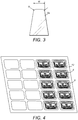
- the ridges 8a which form pattern 8 present sections as represented on Figure 3 with a generally trapezoidal form having a small base of a width W of 1 or 2 mm.
- the radius R between said small base and the edge faces of the trapezoidal form is for example of 1 mm.
- Frustoconical pins 9 are also provided to provide the counterprint of holes 3 in the soft cake. Said pins 9 have a diameter of 0.5 mm at their top
- the pan On its sides 10, the pan comprises a three dimensional counterform decoration with grooves 10a and ridges 10b, the ridges 10b having a section similar to that represented on Figure 3 and corresponding to the grooves 4b of the soft cake 1, whereas the grooves 10a correspond to the ridges 4a of said soft cake 1.
- Rounded-edge shapes 11 are also provided at the edges of the pan which correspond to the rounded edges 5 of the soft cake.
- the pan 6 can be made out of Liquid Silicone Rubber (LSR) which complies with the food-processing industry requirements. It can also be made of metal or plastic. In particular, said pan 6 can be made of metal in its outer surface and of silicone in its inner surface (see Example 1 below).
- LSR Liquid Silicone Rubber
- Said pan 6 can be made by injection.
- the injection method allows any design for the pan. It preferably has a thickness of less than 1 mm, preferably of less than 0.8 mm, more preferably of less than 0.7 mm and even more preferably of equal to or less than 0.5 mm (see Example 2 below). Reducing the thickness of the pan appears to permit improved heat exchange during the cooking.
- Pan 6 further presents at least one rough inner surface. For example, it presents a roughness on the whole inner surface thereof.
- the rough inner surface may be obtained with a sanded matrix or a sanded punch.
- the degree of roughness of the inner surface of pan 6 can be comprised between VDI 2 and VDI 7, preferably between VDI 3 and VDI 6, more preferably between VDI 4 and VDI 5.
- VDI can be measured by Tesatool - Rugotest Configuration 81.112344 (http://tesatool.com/pdf_files/catalog_surface.pdf).
- the roughness in VDI corresponds to 20*lg(10*Ra) and the table I below shows the equivalence between VDI and Ra.
- a degree roughness of comprised between VDI 3 and VDI 6 corresponds to Ra comprised between 0.14 and 0.20 ⁇ m.
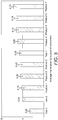
- a plurality of silicone pans 6 can be put in place in parallel on a supporting metal cooktop plate 12 for simultaneous baking of a plurality of soft cakes 1.
- the use of individual pans on a metallic support permits to overcome the problem of deformation which was observed when a too big plastic cooktop is used. For example, a deformation is observed when a cooktop of 20x30 cm is used.
- This Example relates to the optimization of the type of pan and of the use of greasing agent.
- pans were tested to obtain a soft cake with molded three dimensional pattern.
- Plastic and silicon pans were tested with and without greasing agents.
- TEST 1 The recipe referenced as TEST 1 was used. It comprises 20% Flour, 20% Eggs, 20%Sugar, 20% Fat, 20% other products.
- the inventors have observed that, when the silicon pan with a rough inner surface is used, the products of the cycle n leave a film of greasing agent at the surface of the pan after the removing of the cake from the pan, which allows the products of cycle n+1 to not stick to the pan.
- FIG. 2 An exemplary pan with a three dimensional pattern is shown in Figure 2 .
- This example relates to the optimization of the thickness of the pan.
- the inventors have tested the importance of the thickness of the silicone pans. Silicone pans having a thickness 1 and 2mm were tested.
- TEST 1 (20% Flour, 20% Eggs, 20% Sugar, 20% Fat, 20% others) was used.
- pans having a thickness of 1 or 2 mm provide less good results, the inventors have managed to obtain a pan with a thickness of 0.5 mm. It is thus possible to obtain soft cakes as baked as soft cakes baked in a metallic pan.
- This example relates to the size of the pan.
- This example relates to a comparison of three cakes obtained with tested recipes with cakes on the market.
- This example relates to the Water activity (Aw) and humidity of the products, which are found not to be determinant factors.
- tests 1 and 2 were compared with some of the cake products already on the market (Products 5, 6 and 7 of example 4) and which are appreciated by the consumers.
- the water activity (Aw) was measured with a Novasina AW SPRINT at 25°C and the humidity was measured with a Chopin oven at 102° during 4 hours.
- This example relates to optimization of the recipe.
- Test 1.1 The best performing recipe, Test 1.1, has been optimized.
Landscapes
- Life Sciences & Earth Sciences (AREA)
- Engineering & Computer Science (AREA)
- Food Science & Technology (AREA)
- Bakery Products And Manufacturing Methods Therefor (AREA)
Claims (9)
- Verfahren zur Herstellung eines Biskuitkuchens mit einer Wasseraktivität von 0,5 bis 0,95 und mit wenigstens einer geformten Fläche und mindestens einer nicht geformten Fläche, wobei die geformte Fläche mindestens ein geformtes dreidimensionales Muster aufweist,
wobei das Verfahren die folgenden Schritte umfasst:a) das Gießen eines Kuchenteigs, der zur Bildung eines Biskuitkuchens geeignet ist, in eine Schale, wobei der Kuchenteig eine Viskosität zwischen 500 und 1 Pa.s aufweist, gemessen bei der Fülltemperatur unter Verwendung eines Brookfield RVDV-II+-Viskosimeters, unter Verwendung von Spindel Nr. 6 bei einer Drehzahl von 25 U/min;b) das Backen des Biskuitkuchenteigs in der Schale, um einen Biskuitkuchen zu bilden; undc) das Entfernen des Biskuitkuchens aus der Schale,wobei die Schale eine geformte innere Oberfläche zum Aufnehmen des Kuchenteigs aufweist, die das dreidimensionale Formungsmuster des Biskuitkuchens bereitstellt, und wobei die geformte innere Oberfläche der Schale einen arithmetischen Rauigkeitsmittelwert (Ra) von 0,12 µm bis 0,22 µm aufweist,
wobei das geformte dreidimensionale Muster des Biskuitkuchens komplementär zu der geformten inneren Oberfläche der Schale ist und eine geformte Rille, die in Bezug zu der geformten Oberfläche vertieft ist, und/oder eine geformte Rippe aufweist, die in Bezug zu der geformten Oberfläche herausragt,
wobei die geformte Rille und/oder geformte Rippe eine minimale Breite von weniger als 4 mm aufweist, gemessen über die Rille oder Rippe jeweils bei maximaler Tiefe oder Höhe. - Verfahren nach Anspruch 1, wobei der Kuchenteig eine Viskosität von 150 bis 30 Pa.s aufweist.
- Verfahren nach Anspruch 1 oder Anspruch 2, wobei der Kuchenteig eine Dichte von 0,6 bis 1,2 g/cm3 aufweist.
- Verfahren nach einem der vorstehenden Ansprüche, wobei der Kuchenteig zu mindestens 10 Gew.-% Fett, vorzugsweise zu mindestens 15 Gew.-% Fett und mehr bevorzugt zu mindestens 20 Gew.-% Fett umfasst.
- Verfahren nach einem der vorstehenden Ansprüche, wobei die Innenfläche der Schale einen arithmetischen Mittelwert der Rauigkeit (Ra) von 0,16 µm bis 0,18 µm aufweist.
- Verfahren nach einem der vorstehenden Ansprüche, wobei das Verfahren keinen Schritt des Vorfettens der inneren Oberfläche der Schale umfasst, bevor der Kuchenteig in die Schale gegossen wird.
- Verfahren nach einem der vorstehenden Ansprüche, wobei zumindest die innere Oberfläche der Schale aus Kunststoff oder Silikon, vorzugsweise aus Silikon, gebildet ist.
- Verfahren nach einem der vorstehenden Ansprüche, wobei die Schale eine Wanddicke von weniger als 1 mm, vorzugsweise etwa 0,5 mm, aufweist.
- Verfahren nach einem der Ansprüche 1 bis 8, wobei:(i) die geformte Rille oder Rippe eine minimale Breite von weniger als 2 mm aufweist, mehr bevorzugt weniger als 1 mm, und noch mehr bevorzugt etwa 0,5 mm beträgt; und/oder(ii) die geformte Rille und/oder geformte Rippe eine Tiefe bzw. Höhe von 1 bis 5 mm aufweist; und/oder(iii) die geformte Rille und/oder geformte Rippe eine im Wesentlichen konstante Tiefe aufweist und sich vorzugsweise über eine Länge von mindestens 5 mm erstreckt.
Priority Applications (1)
| Application Number | Priority Date | Filing Date | Title |
|---|---|---|---|
| EP19151922.2A EP3491924B1 (de) | 2015-02-18 | 2016-02-18 | Weicher keks und herstellungsverfahren dafür |
Applications Claiming Priority (2)
| Application Number | Priority Date | Filing Date | Title |
|---|---|---|---|
| EP15305244 | 2015-02-18 | ||
| PCT/EP2016/053422 WO2016131902A1 (en) | 2015-02-18 | 2016-02-18 | Soft cake and method of manufacture thereof |
Related Child Applications (2)
| Application Number | Title | Priority Date | Filing Date |
|---|---|---|---|
| EP19151922.2A Division EP3491924B1 (de) | 2015-02-18 | 2016-02-18 | Weicher keks und herstellungsverfahren dafür |
| EP19151922.2A Division-Into EP3491924B1 (de) | 2015-02-18 | 2016-02-18 | Weicher keks und herstellungsverfahren dafür |
Publications (2)
| Publication Number | Publication Date |
|---|---|
| EP3258787A1 EP3258787A1 (de) | 2017-12-27 |
| EP3258787B1 true EP3258787B1 (de) | 2019-04-24 |
Family
ID=52596909
Family Applications (2)
| Application Number | Title | Priority Date | Filing Date |
|---|---|---|---|
| EP19151922.2A Active EP3491924B1 (de) | 2015-02-18 | 2016-02-18 | Weicher keks und herstellungsverfahren dafür |
| EP16705164.8A Active EP3258787B1 (de) | 2015-02-18 | 2016-02-18 | Herstellungsverfahren für weichen keks |
Family Applications Before (1)
| Application Number | Title | Priority Date | Filing Date |
|---|---|---|---|
| EP19151922.2A Active EP3491924B1 (de) | 2015-02-18 | 2016-02-18 | Weicher keks und herstellungsverfahren dafür |
Country Status (6)
| Country | Link |
|---|---|
| US (1) | US10881112B2 (de) |
| EP (2) | EP3491924B1 (de) |
| CN (1) | CN107249339B (de) |
| ES (2) | ES2892475T3 (de) |
| RU (1) | RU2678121C1 (de) |
| WO (1) | WO2016131902A1 (de) |
Families Citing this family (2)
| Publication number | Priority date | Publication date | Assignee | Title |
|---|---|---|---|---|
| CA3224333A1 (en) * | 2021-06-17 | 2022-12-22 | Ocean Spray Cranberries, Inc. | Rare sugars in food and beverage products |
| EP4437852A1 (de) * | 2023-03-30 | 2024-10-02 | Generale Biscuit | Weiche kuchenbackware und teig zur formung davon |
Family Cites Families (37)
| Publication number | Priority date | Publication date | Assignee | Title |
|---|---|---|---|---|
| US5215774A (en) * | 1987-10-20 | 1993-06-01 | The Pillsbury Company | Self-topping cake |
| US5131320A (en) * | 1990-08-26 | 1992-07-21 | Little Factories, Inc. | Image-forming griddle |
| CN1108960A (zh) | 1994-12-08 | 1995-09-27 | 宋显渭(苍汶) | 汽油在储运用过程的自动防火 |
| ATE241913T1 (de) * | 1995-03-22 | 2003-06-15 | Nestle Sa | Verfahren und einrichtung zur herstellung von gegenständen aus gefrorenen süsswaren |
| US5776534A (en) * | 1996-04-03 | 1998-07-07 | General Mills, Inc. | Food apparatus for forming multiple colored extrudates and method of preparation |
| CN2296113Y (zh) * | 1997-01-30 | 1998-11-04 | 苗本生 | 食品加工模具 |
| US6632493B1 (en) * | 1997-03-31 | 2003-10-14 | The Procter & Gamble Company | Multi-layered plastic container providing good product drainage |
| US6667084B2 (en) * | 2000-06-07 | 2003-12-23 | Leifheit Ag | Waste containers |
| US6627239B1 (en) * | 2000-09-11 | 2003-09-30 | Nestec S.A. | Sweet dough tray |
| CA2448736C (en) * | 2001-06-05 | 2010-08-10 | Mikro Systems, Inc. | Methods for manufacturing three-dimensional devices and devices created thereby |
| JP4161550B2 (ja) | 2001-07-11 | 2008-10-08 | 味の素株式会社 | 焼き餃子の製造方法 |
| US20030126996A1 (en) * | 2002-01-10 | 2003-07-10 | Cheng Stanley K. | Cookware with undulating cooking surface |
| EP1535935B1 (de) * | 2002-06-17 | 2011-09-14 | Daikin Industries, Limited | Fluorpolymerdispersion und verfahren zur herstellung einer fluorpolymerdispersion |
| AU2003281685A1 (en) * | 2002-07-30 | 2004-02-16 | Toyo Kohan Co., Ltd. | Surface-roughened resin film, metal sheet coated with surface-roughened resin film, process for producing metal sheet coated with surface-roughened resin film, and metal can having surface coated with surface-roughened resin film and process for producing the same |
| US6942885B2 (en) * | 2002-11-01 | 2005-09-13 | Nestec S.A. | Scored savory dough with toppings or fillings |
| US7100498B2 (en) * | 2002-11-25 | 2006-09-05 | Fletcher Morgan | Concentric bund cake pan |
| FR2852491B1 (fr) * | 2003-03-19 | 2005-12-30 | Buyer De | Moule souple a circulation d'air |
| US20050247212A1 (en) * | 2003-06-06 | 2005-11-10 | Steve Meeks | Flexible bakeware having an improved carrier system with tabs and attachment apertures |
| US20050095334A1 (en) * | 2003-09-17 | 2005-05-05 | Salvatore Messina | Bakery method and mold therefor |
| US20050211101A1 (en) * | 2004-03-23 | 2005-09-29 | Finnie Richard B Ii | Single serving silicone receptacle |
| US7201358B2 (en) * | 2004-09-24 | 2007-04-10 | Alcoa Inc. | Stand-alone self-supporting disposable baking containers and methods of manufacture |
| US20070284505A1 (en) * | 2006-06-09 | 2007-12-13 | Progressive International Corporation | Silicone baking pan |
| WO2008112552A1 (en) * | 2007-03-09 | 2008-09-18 | Bradshaw International, Inc. | Bakeware having a flexible member and method of manufacturing same |
| US20080274243A1 (en) * | 2007-05-03 | 2008-11-06 | Lifetime Brands, Inc. | Baking pan |
| WO2008135970A2 (en) * | 2007-05-07 | 2008-11-13 | Rachel Greenberg | A mould and method for preparing a decorative cake coating |
| CN201146773Y (zh) * | 2007-10-18 | 2008-11-12 | 林绍球 | 多功能陶瓷蛋糕模 |
| US20090114796A1 (en) * | 2007-11-01 | 2009-05-07 | Shao-Chiu Lin | Multipurpose ceramic cake mold |
| JP4945466B2 (ja) | 2008-01-24 | 2012-06-06 | 日本ポリエチレン株式会社 | 多層ブロー成形品及びその製造方法 |
| FR2931035B1 (fr) * | 2008-05-14 | 2010-07-30 | Demarle Guy Ets | Membrane souple, autoportante, anti-adherente et alveolee formant moule ou plaque a empreintes de preparation de produits alimentaires |
| US20100276432A1 (en) * | 2009-01-12 | 2010-11-04 | Zhongxin Huo | Non-stick cookware |
| US8518501B2 (en) * | 2010-03-10 | 2013-08-27 | Restaurant Technology, Inc. | Food holding device, method of making, and method of storing cooked food |
| CN108477416A (zh) * | 2011-12-16 | 2018-09-04 | 雀巢产品技术援助有限公司 | 将微粒应用到模塑产品表面的方法和装置 |
| US10212947B2 (en) * | 2012-08-15 | 2019-02-26 | Cake Effects, Llc | Cake molding process and apparatus |
| EP2935053B1 (de) * | 2012-12-21 | 2018-08-08 | Chafra | Verfahren und vorrichtung zur herstellung von nahrungsmittelprodukten |
| KR20150132871A (ko) | 2013-04-29 | 2015-11-26 | 제네랄 비스켓 | 소프트 케이크 반죽의 제조 방법 |
| US20160050941A1 (en) * | 2013-04-29 | 2016-02-25 | Generale Biscuit | A Method For Making A Soft Cake Batter |
| US20150056337A1 (en) * | 2013-08-23 | 2015-02-26 | Elwha Llc | System and method for producing bread products |
-
2016
- 2016-02-18 EP EP19151922.2A patent/EP3491924B1/de active Active
- 2016-02-18 WO PCT/EP2016/053422 patent/WO2016131902A1/en not_active Ceased
- 2016-02-18 EP EP16705164.8A patent/EP3258787B1/de active Active
- 2016-02-18 RU RU2017125959A patent/RU2678121C1/ru active
- 2016-02-18 US US15/550,739 patent/US10881112B2/en active Active
- 2016-02-18 ES ES19151922T patent/ES2892475T3/es active Active
- 2016-02-18 CN CN201680006452.8A patent/CN107249339B/zh active Active
- 2016-02-18 ES ES16705164T patent/ES2733227T3/es active Active
Non-Patent Citations (1)
| Title |
|---|
| None * |
Also Published As
| Publication number | Publication date |
|---|---|
| EP3491924A1 (de) | 2019-06-05 |
| WO2016131902A1 (en) | 2016-08-25 |
| ES2892475T3 (es) | 2022-02-04 |
| US20180027822A1 (en) | 2018-02-01 |
| CN107249339A (zh) | 2017-10-13 |
| RU2678121C1 (ru) | 2019-01-23 |
| ES2733227T3 (es) | 2019-11-28 |
| US10881112B2 (en) | 2021-01-05 |
| CN107249339B (zh) | 2020-12-11 |
| EP3491924B1 (de) | 2021-08-18 |
| EP3258787A1 (de) | 2017-12-27 |
Similar Documents
| Publication | Publication Date | Title |
|---|---|---|
| EP3636076B1 (de) | Weiche geformte halbsteife tortillas | |
| JP6324748B2 (ja) | 焼菓子及びその製造方法 | |
| US12089602B2 (en) | Rotary molded food product and methods of making | |
| EP3258787B1 (de) | Herstellungsverfahren für weichen keks | |
| JP2020534027A (ja) | ポテトドウ | |
| US20180000097A1 (en) | Process for the production of a shelf-stable filled sponge-type bakery product | |
| JP6572531B2 (ja) | ベーカリー製品用チョコレート類及びベーカリー製品の製造法 | |
| JP2018061480A (ja) | グルテン無添加パン及びその製造方法 | |
| JP6330305B2 (ja) | パン類の製造方法 | |
| JP2020191855A (ja) | ベーカリ製品の製造方法及び小麦含有生地成形機 | |
| KR102798519B1 (ko) | 생지를 이용한 호두과자의 제조방법 | |
| JP7714281B2 (ja) | ベーカリー食品用生地及びベーカリー食品 | |
| JP4416699B2 (ja) | 複合積層状ベーカリー生地、層状ベーカリー食品及び複合積層状ベーカリー生地の製造方法。 | |
| Dohogne | Breadmaking in the home | |
| JP4697202B2 (ja) | 凹型組合せベーカリー製品及びその製造法 | |
| KR20240176321A (ko) | 시나몬 잼을 이용한 약과 타르트 및 이의 제조방법 | |
| JP2016029900A (ja) | 容器用ベーカリー食品 | |
| JP2014187964A (ja) | タルト台の製造方法 | |
| JP2002306057A (ja) | パン類の製造方法及び該製造方法で製造されたパン類 | |
| JP2007274975A (ja) | 型焼きベーカリー食品の製造方法 | |
| JP2017121209A (ja) | 外観に特徴を有するドーナツの製造法 | |
| CN110012923A (zh) | 椰子顶饰组合物、烘焙食品及烘焙食品的制造方法 | |
| CZ11129U1 (cs) | Oplatky a zařízení kjejich výrobě |
Legal Events
| Date | Code | Title | Description |
|---|---|---|---|
| STAA | Information on the status of an ep patent application or granted ep patent |
Free format text: STATUS: THE INTERNATIONAL PUBLICATION HAS BEEN MADE |
|
| PUAI | Public reference made under article 153(3) epc to a published international application that has entered the european phase |
Free format text: ORIGINAL CODE: 0009012 |
|
| STAA | Information on the status of an ep patent application or granted ep patent |
Free format text: STATUS: REQUEST FOR EXAMINATION WAS MADE |
|
| 17P | Request for examination filed |
Effective date: 20170808 |
|
| AK | Designated contracting states |
Kind code of ref document: A1 Designated state(s): AL AT BE BG CH CY CZ DE DK EE ES FI FR GB GR HR HU IE IS IT LI LT LU LV MC MK MT NL NO PL PT RO RS SE SI SK SM TR |
|
| AX | Request for extension of the european patent |
Extension state: BA ME |
|
| DAV | Request for validation of the european patent (deleted) | ||
| DAX | Request for extension of the european patent (deleted) | ||
| STAA | Information on the status of an ep patent application or granted ep patent |
Free format text: STATUS: EXAMINATION IS IN PROGRESS |
|
| 17Q | First examination report despatched |
Effective date: 20180601 |
|
| GRAP | Despatch of communication of intention to grant a patent |
Free format text: ORIGINAL CODE: EPIDOSNIGR1 |
|
| STAA | Information on the status of an ep patent application or granted ep patent |
Free format text: STATUS: GRANT OF PATENT IS INTENDED |
|
| RIC1 | Information provided on ipc code assigned before grant |
Ipc: A21D 13/47 20170101ALI20181012BHEP Ipc: A21B 3/13 20060101AFI20181012BHEP Ipc: A21D 13/00 20170101ALI20181012BHEP |
|
| INTG | Intention to grant announced |
Effective date: 20181120 |
|
| GRAS | Grant fee paid |
Free format text: ORIGINAL CODE: EPIDOSNIGR3 |
|
| GRAA | (expected) grant |
Free format text: ORIGINAL CODE: 0009210 |
|
| STAA | Information on the status of an ep patent application or granted ep patent |
Free format text: STATUS: THE PATENT HAS BEEN GRANTED |
|
| AK | Designated contracting states |
Kind code of ref document: B1 Designated state(s): AL AT BE BG CH CY CZ DE DK EE ES FI FR GB GR HR HU IE IS IT LI LT LU LV MC MK MT NL NO PL PT RO RS SE SI SK SM TR |
|
| REG | Reference to a national code |
Ref country code: GB Ref legal event code: FG4D |
|
| REG | Reference to a national code |
Ref country code: CH Ref legal event code: EP |
|
| REG | Reference to a national code |
Ref country code: AT Ref legal event code: REF Ref document number: 1123021 Country of ref document: AT Kind code of ref document: T Effective date: 20190515 Ref country code: IE Ref legal event code: FG4D |
|
| REG | Reference to a national code |
Ref country code: DE Ref legal event code: R096 Ref document number: 602016012828 Country of ref document: DE |
|
| REG | Reference to a national code |
Ref country code: NL Ref legal event code: MP Effective date: 20190424 |
|
| REG | Reference to a national code |
Ref country code: LT Ref legal event code: MG4D |
|
| PG25 | Lapsed in a contracting state [announced via postgrant information from national office to epo] |
Ref country code: NL Free format text: LAPSE BECAUSE OF FAILURE TO SUBMIT A TRANSLATION OF THE DESCRIPTION OR TO PAY THE FEE WITHIN THE PRESCRIBED TIME-LIMIT Effective date: 20190424 |
|
| PG25 | Lapsed in a contracting state [announced via postgrant information from national office to epo] |
Ref country code: AL Free format text: LAPSE BECAUSE OF FAILURE TO SUBMIT A TRANSLATION OF THE DESCRIPTION OR TO PAY THE FEE WITHIN THE PRESCRIBED TIME-LIMIT Effective date: 20190424 Ref country code: PT Free format text: LAPSE BECAUSE OF FAILURE TO SUBMIT A TRANSLATION OF THE DESCRIPTION OR TO PAY THE FEE WITHIN THE PRESCRIBED TIME-LIMIT Effective date: 20190824 Ref country code: NO Free format text: LAPSE BECAUSE OF FAILURE TO SUBMIT A TRANSLATION OF THE DESCRIPTION OR TO PAY THE FEE WITHIN THE PRESCRIBED TIME-LIMIT Effective date: 20190724 Ref country code: LT Free format text: LAPSE BECAUSE OF FAILURE TO SUBMIT A TRANSLATION OF THE DESCRIPTION OR TO PAY THE FEE WITHIN THE PRESCRIBED TIME-LIMIT Effective date: 20190424 Ref country code: FI Free format text: LAPSE BECAUSE OF FAILURE TO SUBMIT A TRANSLATION OF THE DESCRIPTION OR TO PAY THE FEE WITHIN THE PRESCRIBED TIME-LIMIT Effective date: 20190424 Ref country code: SE Free format text: LAPSE BECAUSE OF FAILURE TO SUBMIT A TRANSLATION OF THE DESCRIPTION OR TO PAY THE FEE WITHIN THE PRESCRIBED TIME-LIMIT Effective date: 20190424 Ref country code: HR Free format text: LAPSE BECAUSE OF FAILURE TO SUBMIT A TRANSLATION OF THE DESCRIPTION OR TO PAY THE FEE WITHIN THE PRESCRIBED TIME-LIMIT Effective date: 20190424 |
|
| REG | Reference to a national code |
Ref country code: ES Ref legal event code: FG2A Ref document number: 2733227 Country of ref document: ES Kind code of ref document: T3 Effective date: 20191128 |
|
| PG25 | Lapsed in a contracting state [announced via postgrant information from national office to epo] |
Ref country code: RS Free format text: LAPSE BECAUSE OF FAILURE TO SUBMIT A TRANSLATION OF THE DESCRIPTION OR TO PAY THE FEE WITHIN THE PRESCRIBED TIME-LIMIT Effective date: 20190424 Ref country code: LV Free format text: LAPSE BECAUSE OF FAILURE TO SUBMIT A TRANSLATION OF THE DESCRIPTION OR TO PAY THE FEE WITHIN THE PRESCRIBED TIME-LIMIT Effective date: 20190424 Ref country code: PL Free format text: LAPSE BECAUSE OF FAILURE TO SUBMIT A TRANSLATION OF THE DESCRIPTION OR TO PAY THE FEE WITHIN THE PRESCRIBED TIME-LIMIT Effective date: 20190424 Ref country code: GR Free format text: LAPSE BECAUSE OF FAILURE TO SUBMIT A TRANSLATION OF THE DESCRIPTION OR TO PAY THE FEE WITHIN THE PRESCRIBED TIME-LIMIT Effective date: 20190725 Ref country code: BG Free format text: LAPSE BECAUSE OF FAILURE TO SUBMIT A TRANSLATION OF THE DESCRIPTION OR TO PAY THE FEE WITHIN THE PRESCRIBED TIME-LIMIT Effective date: 20190724 |
|
| REG | Reference to a national code |
Ref country code: AT Ref legal event code: MK05 Ref document number: 1123021 Country of ref document: AT Kind code of ref document: T Effective date: 20190424 |
|
| PG25 | Lapsed in a contracting state [announced via postgrant information from national office to epo] |
Ref country code: IS Free format text: LAPSE BECAUSE OF FAILURE TO SUBMIT A TRANSLATION OF THE DESCRIPTION OR TO PAY THE FEE WITHIN THE PRESCRIBED TIME-LIMIT Effective date: 20190824 |
|
| REG | Reference to a national code |
Ref country code: DE Ref legal event code: R097 Ref document number: 602016012828 Country of ref document: DE |
|
| PG25 | Lapsed in a contracting state [announced via postgrant information from national office to epo] |
Ref country code: DK Free format text: LAPSE BECAUSE OF FAILURE TO SUBMIT A TRANSLATION OF THE DESCRIPTION OR TO PAY THE FEE WITHIN THE PRESCRIBED TIME-LIMIT Effective date: 20190424 Ref country code: CZ Free format text: LAPSE BECAUSE OF FAILURE TO SUBMIT A TRANSLATION OF THE DESCRIPTION OR TO PAY THE FEE WITHIN THE PRESCRIBED TIME-LIMIT Effective date: 20190424 Ref country code: AT Free format text: LAPSE BECAUSE OF FAILURE TO SUBMIT A TRANSLATION OF THE DESCRIPTION OR TO PAY THE FEE WITHIN THE PRESCRIBED TIME-LIMIT Effective date: 20190424 Ref country code: EE Free format text: LAPSE BECAUSE OF FAILURE TO SUBMIT A TRANSLATION OF THE DESCRIPTION OR TO PAY THE FEE WITHIN THE PRESCRIBED TIME-LIMIT Effective date: 20190424 Ref country code: RO Free format text: LAPSE BECAUSE OF FAILURE TO SUBMIT A TRANSLATION OF THE DESCRIPTION OR TO PAY THE FEE WITHIN THE PRESCRIBED TIME-LIMIT Effective date: 20190424 Ref country code: SK Free format text: LAPSE BECAUSE OF FAILURE TO SUBMIT A TRANSLATION OF THE DESCRIPTION OR TO PAY THE FEE WITHIN THE PRESCRIBED TIME-LIMIT Effective date: 20190424 |
|
| PG25 | Lapsed in a contracting state [announced via postgrant information from national office to epo] |
Ref country code: SM Free format text: LAPSE BECAUSE OF FAILURE TO SUBMIT A TRANSLATION OF THE DESCRIPTION OR TO PAY THE FEE WITHIN THE PRESCRIBED TIME-LIMIT Effective date: 20190424 |
|
| PLBE | No opposition filed within time limit |
Free format text: ORIGINAL CODE: 0009261 |
|
| STAA | Information on the status of an ep patent application or granted ep patent |
Free format text: STATUS: NO OPPOSITION FILED WITHIN TIME LIMIT |
|
| PG25 | Lapsed in a contracting state [announced via postgrant information from national office to epo] |
Ref country code: TR Free format text: LAPSE BECAUSE OF FAILURE TO SUBMIT A TRANSLATION OF THE DESCRIPTION OR TO PAY THE FEE WITHIN THE PRESCRIBED TIME-LIMIT Effective date: 20190424 |
|
| 26N | No opposition filed |
Effective date: 20200127 |
|
| PG25 | Lapsed in a contracting state [announced via postgrant information from national office to epo] |
Ref country code: SI Free format text: LAPSE BECAUSE OF FAILURE TO SUBMIT A TRANSLATION OF THE DESCRIPTION OR TO PAY THE FEE WITHIN THE PRESCRIBED TIME-LIMIT Effective date: 20190424 |
|
| REG | Reference to a national code |
Ref country code: CH Ref legal event code: PL |
|
| REG | Reference to a national code |
Ref country code: BE Ref legal event code: MM Effective date: 20200229 |
|
| PG25 | Lapsed in a contracting state [announced via postgrant information from national office to epo] |
Ref country code: MC Free format text: LAPSE BECAUSE OF FAILURE TO SUBMIT A TRANSLATION OF THE DESCRIPTION OR TO PAY THE FEE WITHIN THE PRESCRIBED TIME-LIMIT Effective date: 20190424 Ref country code: LU Free format text: LAPSE BECAUSE OF NON-PAYMENT OF DUE FEES Effective date: 20200218 |
|
| PG25 | Lapsed in a contracting state [announced via postgrant information from national office to epo] |
Ref country code: CH Free format text: LAPSE BECAUSE OF NON-PAYMENT OF DUE FEES Effective date: 20200229 Ref country code: LI Free format text: LAPSE BECAUSE OF NON-PAYMENT OF DUE FEES Effective date: 20200229 |
|
| PG25 | Lapsed in a contracting state [announced via postgrant information from national office to epo] |
Ref country code: IE Free format text: LAPSE BECAUSE OF NON-PAYMENT OF DUE FEES Effective date: 20200218 |
|
| PG25 | Lapsed in a contracting state [announced via postgrant information from national office to epo] |
Ref country code: BE Free format text: LAPSE BECAUSE OF NON-PAYMENT OF DUE FEES Effective date: 20200229 |
|
| PG25 | Lapsed in a contracting state [announced via postgrant information from national office to epo] |
Ref country code: MT Free format text: LAPSE BECAUSE OF FAILURE TO SUBMIT A TRANSLATION OF THE DESCRIPTION OR TO PAY THE FEE WITHIN THE PRESCRIBED TIME-LIMIT Effective date: 20190424 Ref country code: CY Free format text: LAPSE BECAUSE OF FAILURE TO SUBMIT A TRANSLATION OF THE DESCRIPTION OR TO PAY THE FEE WITHIN THE PRESCRIBED TIME-LIMIT Effective date: 20190424 |
|
| PG25 | Lapsed in a contracting state [announced via postgrant information from national office to epo] |
Ref country code: MK Free format text: LAPSE BECAUSE OF FAILURE TO SUBMIT A TRANSLATION OF THE DESCRIPTION OR TO PAY THE FEE WITHIN THE PRESCRIBED TIME-LIMIT Effective date: 20190424 |
|
| P01 | Opt-out of the competence of the unified patent court (upc) registered |
Effective date: 20230323 |
|
| PGFP | Annual fee paid to national office [announced via postgrant information from national office to epo] |
Ref country code: DE Payment date: 20250227 Year of fee payment: 10 |
|
| PGFP | Annual fee paid to national office [announced via postgrant information from national office to epo] |
Ref country code: ES Payment date: 20250303 Year of fee payment: 10 |
|
| PGFP | Annual fee paid to national office [announced via postgrant information from national office to epo] |
Ref country code: FR Payment date: 20250225 Year of fee payment: 10 |
|
| PGFP | Annual fee paid to national office [announced via postgrant information from national office to epo] |
Ref country code: IT Payment date: 20250220 Year of fee payment: 10 Ref country code: GB Payment date: 20250227 Year of fee payment: 10 |