EP3237490B1 - Neue metallsulfonatenthaltendes polymere, verfahren zu deren herstellung und deren verwendung als antimikrobielle, fungizide, antibakterielle mitteln - Google Patents
Neue metallsulfonatenthaltendes polymere, verfahren zu deren herstellung und deren verwendung als antimikrobielle, fungizide, antibakterielle mitteln Download PDFInfo
- Publication number
- EP3237490B1 EP3237490B1 EP15828653.4A EP15828653A EP3237490B1 EP 3237490 B1 EP3237490 B1 EP 3237490B1 EP 15828653 A EP15828653 A EP 15828653A EP 3237490 B1 EP3237490 B1 EP 3237490B1
- Authority
- EP
- European Patent Office
- Prior art keywords
- varies
- polymeric units
- polymer
- polymers
- percentage
- Prior art date
- Legal status (The legal status is an assumption and is not a legal conclusion. Google has not performed a legal analysis and makes no representation as to the accuracy of the status listed.)
- Active
Links
- 0 C*(C(C)(C)OC)c(cc1)ccc1C(c1ccc(C)cc1)=O Chemical compound C*(C(C)(C)OC)c(cc1)ccc1C(c1ccc(C)cc1)=O 0.000 description 7
- WOATWVQJISUBJT-UHFFFAOYSA-N C/C=S(\c(cc1)ccc1Oc(cc1)ccc1S(c(cc1)ccc1OC)(=O)=O)/C(CC(S(O)(=O)=O)=C1)=CC=C1OC Chemical compound C/C=S(\c(cc1)ccc1Oc(cc1)ccc1S(c(cc1)ccc1OC)(=O)=O)/C(CC(S(O)(=O)=O)=C1)=CC=C1OC WOATWVQJISUBJT-UHFFFAOYSA-N 0.000 description 1
- MFUNRLGPCWNDTL-UHFFFAOYSA-N CCC(C)c(cc1)ccc1C(c(cc1)ccc1OC(CC=C1OC(C)C)C=C1S(O)(=O)=O)=O Chemical compound CCC(C)c(cc1)ccc1C(c(cc1)ccc1OC(CC=C1OC(C)C)C=C1S(O)(=O)=O)=O MFUNRLGPCWNDTL-UHFFFAOYSA-N 0.000 description 1
Images
Classifications
-
- C—CHEMISTRY; METALLURGY
- C08—ORGANIC MACROMOLECULAR COMPOUNDS; THEIR PREPARATION OR CHEMICAL WORKING-UP; COMPOSITIONS BASED THEREON
- C08G—MACROMOLECULAR COMPOUNDS OBTAINED OTHERWISE THAN BY REACTIONS ONLY INVOLVING UNSATURATED CARBON-TO-CARBON BONDS
- C08G65/00—Macromolecular compounds obtained by reactions forming an ether link in the main chain of the macromolecule
- C08G65/34—Macromolecular compounds obtained by reactions forming an ether link in the main chain of the macromolecule from hydroxy compounds or their metallic derivatives
- C08G65/38—Macromolecular compounds obtained by reactions forming an ether link in the main chain of the macromolecule from hydroxy compounds or their metallic derivatives derived from phenols
- C08G65/40—Macromolecular compounds obtained by reactions forming an ether link in the main chain of the macromolecule from hydroxy compounds or their metallic derivatives derived from phenols from phenols (I) and other compounds (II), e.g. OH-Ar-OH + X-Ar-X, where X is halogen atom, i.e. leaving group
- C08G65/4012—Other compound (II) containing a ketone group, e.g. X-Ar-C(=O)-Ar-X for polyetherketones
-
- A—HUMAN NECESSITIES
- A61—MEDICAL OR VETERINARY SCIENCE; HYGIENE
- A61P—SPECIFIC THERAPEUTIC ACTIVITY OF CHEMICAL COMPOUNDS OR MEDICINAL PREPARATIONS
- A61P31/00—Antiinfectives, i.e. antibiotics, antiseptics, chemotherapeutics
- A61P31/04—Antibacterial agents
-
- A—HUMAN NECESSITIES
- A61—MEDICAL OR VETERINARY SCIENCE; HYGIENE
- A61P—SPECIFIC THERAPEUTIC ACTIVITY OF CHEMICAL COMPOUNDS OR MEDICINAL PREPARATIONS
- A61P31/00—Antiinfectives, i.e. antibiotics, antiseptics, chemotherapeutics
- A61P31/10—Antimycotics
-
- C—CHEMISTRY; METALLURGY
- C08—ORGANIC MACROMOLECULAR COMPOUNDS; THEIR PREPARATION OR CHEMICAL WORKING-UP; COMPOSITIONS BASED THEREON
- C08G—MACROMOLECULAR COMPOUNDS OBTAINED OTHERWISE THAN BY REACTIONS ONLY INVOLVING UNSATURATED CARBON-TO-CARBON BONDS
- C08G65/00—Macromolecular compounds obtained by reactions forming an ether link in the main chain of the macromolecule
- C08G65/34—Macromolecular compounds obtained by reactions forming an ether link in the main chain of the macromolecule from hydroxy compounds or their metallic derivatives
- C08G65/38—Macromolecular compounds obtained by reactions forming an ether link in the main chain of the macromolecule from hydroxy compounds or their metallic derivatives derived from phenols
- C08G65/40—Macromolecular compounds obtained by reactions forming an ether link in the main chain of the macromolecule from hydroxy compounds or their metallic derivatives derived from phenols from phenols (I) and other compounds (II), e.g. OH-Ar-OH + X-Ar-X, where X is halogen atom, i.e. leaving group
- C08G65/4012—Other compound (II) containing a ketone group, e.g. X-Ar-C(=O)-Ar-X for polyetherketones
- C08G65/4056—(I) or (II) containing sulfur
-
- C—CHEMISTRY; METALLURGY
- C08—ORGANIC MACROMOLECULAR COMPOUNDS; THEIR PREPARATION OR CHEMICAL WORKING-UP; COMPOSITIONS BASED THEREON
- C08G—MACROMOLECULAR COMPOUNDS OBTAINED OTHERWISE THAN BY REACTIONS ONLY INVOLVING UNSATURATED CARBON-TO-CARBON BONDS
- C08G2650/00—Macromolecular compounds obtained by reactions forming an ether link in the main chain of the macromolecule
- C08G2650/28—Macromolecular compounds obtained by reactions forming an ether link in the main chain of the macromolecule characterised by the polymer type
- C08G2650/38—Macromolecular compounds obtained by reactions forming an ether link in the main chain of the macromolecule characterised by the polymer type containing oxygen in addition to the ether group
- C08G2650/40—Macromolecular compounds obtained by reactions forming an ether link in the main chain of the macromolecule characterised by the polymer type containing oxygen in addition to the ether group containing ketone groups, e.g. polyarylethylketones, PEEK or PEK
Definitions
- the present invention relates to novel polymers of formulas I, II, III, IV, V, VI, VII, VIII, IX, X, XI, XII, XIII, XIV and XV containing metal sulfonate functions of the elements of columns (Ib) , (IIb), (IIIa), (IIIb), (IVa), (IVb), (Va), (Vb), (VIb), (VIIb), (VIIIb), their methods of preparation and their use as antimicrobials , antibacterial and antifungal.
- Another bactericidal agent is widely used in many formulations such as, for example, cosmetics, dental hygiene products, gels; it is triclosan. Again, toxic effects have been observed by B. Gaume, N. Bourgougnon, S. Auzoux-Bordenave, B. Roig, B. Le Bot, G. Bedoux * (Comparative Biochemistry and Physiology, Part C, (2012), 156, 87-94 ).
- EP2690122 describes polymers of the poly (aryl ether ketone) family containing sulphonic or metal sulphonate functional groups.
- EP1290068 teaches the treatment of PEEK with chlorosulfonic acid and dimethylacetamide to prepare poly (aryl ether ketones) containing sulfonic functions.
- M is chosen from titanium, zirconium, vanadium, chromium, molybdenum, tungsten, manganese, iron, ruthenium, osmium, cobalt, nickel and palladium cations.
- M is selected from titanium, copper, silver, zinc and gold cations.
- the starting polymers XVI, XV, XVI, XVII, XVIII, XIX, XX, XXII, XXIII are commercial products.
- the polymer of formula XVI is known commercially under the name of polyether ether ketone or polyetherether ketone or PEEK
- the polymer XVII is known commercially under the name of polyetherketone ketone or polyetherketone ketone or PEKK
- polymer XVIII is known commercially as polyether ether sulfone or PEES
- XIX is known commercially as poly (ether sulfone) or PES
- the polymer XX belongs to the family of poly (arene ether ketone) and is known commercially under the name of poly (bisphenol A PAEK)
- XXI polymer is part of the poly (arene ether sulfone) family and is known commercially as poly (bisphenol A PAES)
- polymers are not limiting since there are a large number of other commercially available polymers in the poly (aryl ether ketone), poly (aryl ether sulfone) families.
- the preferred polymers because of their high availability are PEEK, PEK, PES, PEKK and PEKEKK.
- the chlorosulphonation is carried out at a temperature between 0 ° and 80 ° C by introducing, relative to the oxoaryl or dioxoaryl units, 0.1 to 10 equivalents of chlorosulfonic acid, 0.1 to 30 equivalents of thionyl chloride, 0.1 to 10 equivalents of an amide, preferably dimethylformamide, with or without a solvent.
- the preferred solvents according to the invention are THF, methylTHF, dichloromethane, dichloroethane.
- the chlorosulfonation is carried out at a temperature between 0 and 80 ° C with a mixture of 0.1 to 5 equivalents of chlorosulfonic acid, 0.1 to 15 equivalents of thionyl chloride in the presence of 0.1 to 5 equivalents of an amide relative to the oxoaryl or dioxoaryl units to chlorosulfoner to obtain chlorosulfonation levels between 0.1 and 50%.
- the solvents used for the hydrolysis reaction by water with the chlorosulfonated polymers of formulas XXIV, XXV, XXVI, XVII, XXVIII, XIX, XXX, XXXI, XXXIII, XXXIV, XXXV, XXXVI, XXXVII and XXXVIII are aprotic polar solvents.
- the preferred solvents are water or mixtures of water with THF, methylTHF, dioxane, dichloromethane, N, N-dimethylformamide, N-methylpyrrolidone, dimethylsulfoxide, ethanol, isopropanol.
- weak acid salts whose pKa is greater than 0 such as carbonates, acetates, propionates, benzoates, alcoholates, acetylacetates, acetylacetonates.
- the polymers of formulas XIL, XL, XLI, XLII, XLIII, XLIV, XLV, XLVI, XLVII, XLVIII, XLIX, L, LI, LII, LIII are reacted with a metal at degree 0 in the presence of ultrasound according to the technique described in the patent FR 2963003 .
- the preferred metals for this second variant are bismuth, indium, iron, copper, gadolinium, samarium.
- the salt formation reaction is preferably carried out in a solvent where the polymer is soluble or partially soluble.
- Preferred solvents are water, THF, methylTHF, dioxane, dichloromethane, N, N- dimethylformamide, N- methylpyrrolidone, dimethylsulfoxide, ethanol, isopropanol, nitromethane.
- water is used as a solvent.
- the polymers of formulas I, II, III, IV, V, VI, VII, VIII, IX, X, XI, XII, XIII, XIV and XV in which M is a metal, are bactericidal, fungicidal and antimicrobial compounds.
- the polymers of formulas I, II, III, IV, V, VI, VII, VIII, IX, X, XI, XII, XIII, XIV and XV in which M z + corresponds to the silver and / or copper cations have very strong activities. antibacterial, antifungal and antimicrobial.
- the polymers of formulas XIL, XL, XLI, XLII, XLIII, XLIV, XLV, XLVI, XLVII, XLVIII, XLIX, L, LI, LII, LIII are also fungicidal, antimicrobial and antibacterial.
- a strong activity has been observed vis-à-vis Staphilococcus Aureus and Pseudomonas aeruginosa.
- polymers of formulas I, II, III, IV, V, VI, VII, VIII, IX, X, XI, XII, XIII, XIV and XV may be easily incorporated into the non-functionalized polymers of formula XVI, XVII, XVIII, XIX , XX, XXI, XXII, XXIII to obtain bactericidal or fungicidal materials. This is all the more important as polymers of formulas XVI, XVII, XVIII, XIX, XX, XXI, XXII, XXIII are often used in the medical field or analysis to make implants, tubings.
- the chlorosulphonic acid (3.24 g, 8 equivalents relative to the number of polymer units of PEEK (XVI)) is introduced using a syringe (1.85 mL), taking care to handle under a flow of 'nitrogen.
- the reaction mixture is stirred at 20 ° C for 5 h. At the end of the reaction, the formation of an orange viscous compound is observed. The supernatant is removed by taking care to handle under a stream of nitrogen.
- Thionyl chloride (12.29 g, 30 equivalents relative to the number of polymer units of PEEK (XVI)) is then introduced with the aid of a syringe (7.50 ml), taking care to handle under flow. nitrogen.
- N, N- dimethylformamide (0.76 g, 3 equivalents relative to the number of polymer units of PEEK (XVI)) is then added using a syringe (0.81 ml), taking care to handle under nitrogen flow.
- the reaction mixture was again stirred at 20 ° C for 5 h, then 40 mL of distilled THF was added. At the end of the reaction, an orange solution is observed.
- the weight yield of polymer XXIV is 98% relative to the PEEK (XVI) engaged.
- the chlorosulfonic acid (2.88 g, 8 equivalents relative to the number of polymer units of the PEES (XVIII)) is introduced using a syringe (1.64 ml) taking care of handling under a flow of 'nitrogen.
- the reaction mixture is stirred at 0 ° C for 5 h. At the end of the reaction, the formation of a brown viscous compound is observed. The supernatant is removed by taking care to handle under a stream of nitrogen.
- the brown solution is precipitated in propan-2-ol (250 mL), a white precipitate is formed.
- the solid is filtered, then washed with twice 50 ml of propan-2-ol and twice 50 ml of acetonitrile, and then dried overnight under vacuum (1.10 -2 mbar).
- the weight yield of XXVI polymer is 93% relative to the polymer XVIII engaged.
- Chlorosulphonic acid (0.527 g, 2.1 equivalents relative to the number of polymeric units of the PES (XIX)) is introduced using a syringe (0.30 ml), taking care to manipulate under a flow of 'nitrogen.
- the reaction mixture is stirred at 42 ° C for 18 h.
- the formation of a viscous yellow compound is observed.
- the supernatant is removed by taking care to handle under a stream of nitrogen.
- the yellow solution is precipitated in propan-2-ol (80 mL), a white precipitate is formed.
- the solid is filtered, then washed with 2 times 20 ml of propan-2-ol and 3 times 20 ml of acetonitrile, and then dried overnight under vacuum (1.10 -2 mbar).
- the reaction mixture is stirred at 100 ° C for 18 h. At the end of the reaction, the solubilization of the polymer is observed.
- the water is evaporated using a rotary evaporator. The solid obtained is dried overnight under vacuum (1.10 -2 mbar). After evaporation of the solvent, a golden solid is obtained.
- the weight yield of XIL polymer is 99% relative to the XXIV engaged polymer.
- the reaction mixture is stirred at 100 ° C for 5 h. At the end of the reaction, the solubilization of the polymer is observed.
- the water is evaporated using a rotary evaporator. The solid obtained is dried overnight under vacuum (1.10 -2 mbar). After evaporation of the solvent, a golden solid is obtained.
- the XLI polymer weight yield is 99% relative to the engaged XXVI polymer.
- the reaction mixture is stirred at 100 ° C for 5 h. At the end of the reaction, the solubilization of the polymer is observed.
- the water is evaporated using a rotary evaporator. The solid obtained is dried overnight under vacuum (1.10 -2 mbar). After evaporation of the solvent, a golden solid is obtained.
- the weight yield of XLII polymer is 99% relative to the polymer XXVII engaged.
- Indium (0.100 g) is introduced in order to have stoichiometric quantities polymer-metal, that is to say in this case 3 equivalents of polymer per indium atom.
- the reaction mixture is placed in an ultrasonic tank at a frequency of 35 KHz and a power of 70 W at room temperature for 12 hours. At the end of the reaction, a gray-metal precipitate is observed and all the indium is consumed. The solution is filtered and the solid obtained is dried overnight under vacuum (1.10 -2 mbar).
- Copper (0.075 g) is introduced in order to have stoichiometric quantities of polymer-metal, that is to say in this case 2 equivalents of polymer per atom of copper.
- the reaction mixture is placed in an ultrasonic tank at a frequency of 35 KHz and at a power of 70 W at room temperature for 16 hours. At the end of the reaction we observe a green precipitate and all the copper is consumed.
- the solution is filtered and the solid obtained is dried overnight under vacuum (1.10 -2 mbar).
- Copper carbonate (0.91 g) is introduced in order to have stoichiometric quantities of polymer-metal, that is to say in this case 2 equivalent of polymer per atom of copper.
- the reaction mixture is stirred for 1 h at room temperature. At the end of the reaction, a light green precipitate is observed. The solution is evaporated and the solid obtained is dried overnight under vacuum (1.10 -2 mbar).
- Indium acetate (0.118 g) is introduced in order to have stoichiometric amounts of polymer-metal, that is to say in this case 3 equivalents of polymer per indium atom.
- the reaction mixture is stirred for 1 h at room temperature. At the end of the reaction, a light gray precipitate is observed. The solution is evaporated and the solid obtained is dried overnight under vacuum (1.10 -2 mbar).
- the weight gain in I (M Z + with In 3+ ) is 97% compared to the XIL engaged.
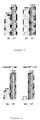
- the rate of reduction of the number of Pseudomonas aeruginosa is represented in the figure 1 from page 1/2.
- the rate of reduction in the number of Staphylococcus aureus is represented in the figure 2 from page 2/2.
Landscapes
- Health & Medical Sciences (AREA)
- Chemical & Material Sciences (AREA)
- Organic Chemistry (AREA)
- Medicinal Chemistry (AREA)
- Chemical Kinetics & Catalysis (AREA)
- Pharmacology & Pharmacy (AREA)
- General Chemical & Material Sciences (AREA)
- Nuclear Medicine, Radiotherapy & Molecular Imaging (AREA)
- Communicable Diseases (AREA)
- Oncology (AREA)
- Life Sciences & Earth Sciences (AREA)
- Animal Behavior & Ethology (AREA)
- General Health & Medical Sciences (AREA)
- Public Health (AREA)
- Veterinary Medicine (AREA)
- Polymers & Plastics (AREA)
- Addition Polymer Or Copolymer, Post-Treatments, Or Chemical Modifications (AREA)
Claims (19)
- Neue Polymere der Familie der Poly(aryletherketon)e oder Poly(arylethersulfon)e, die Sulfonsäure- oder Metallsulfonat-Funktionen der Formeln I, II, III, IV, V, VI, VII, VIII, IX, X, XI, XII, XIII, XIV und XV enthalten

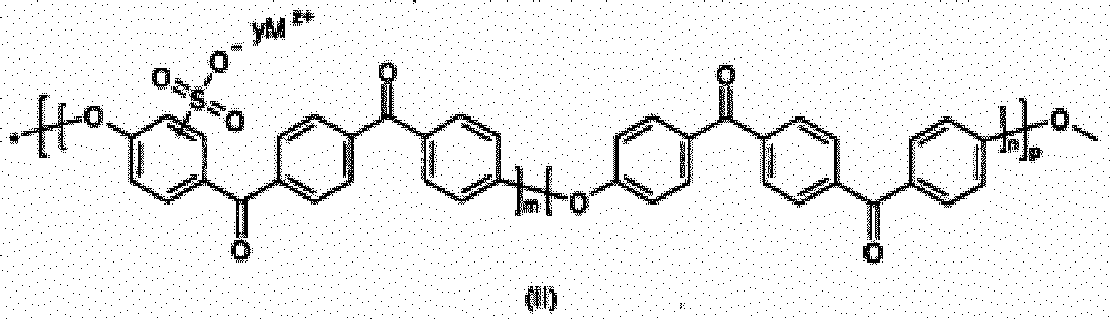
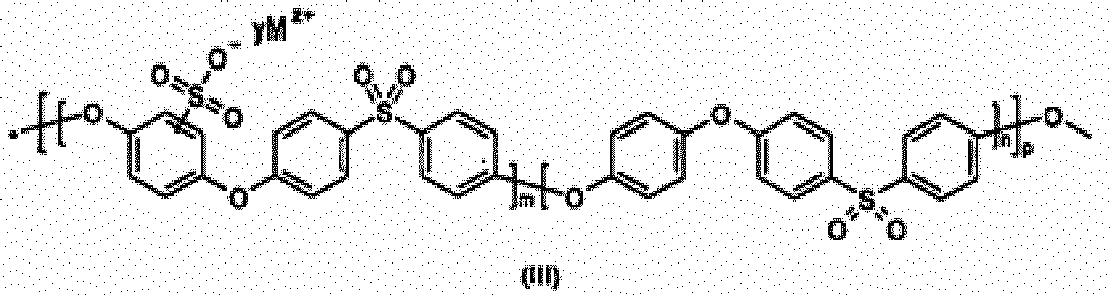


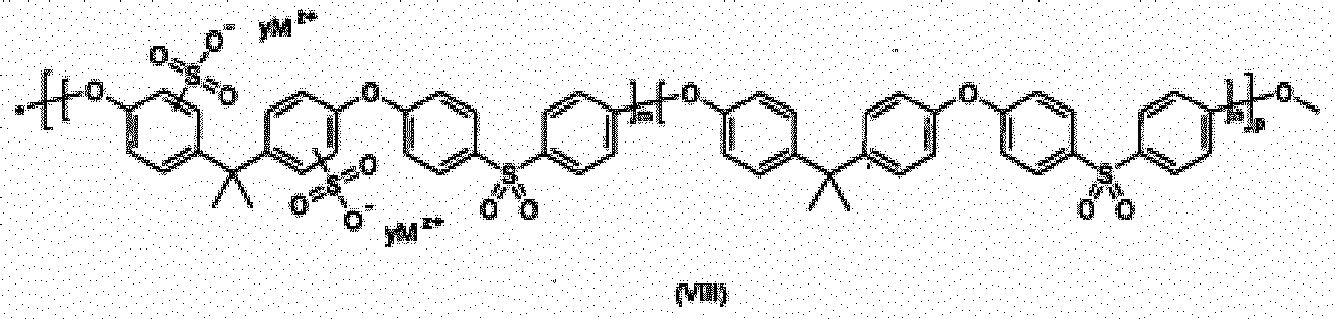


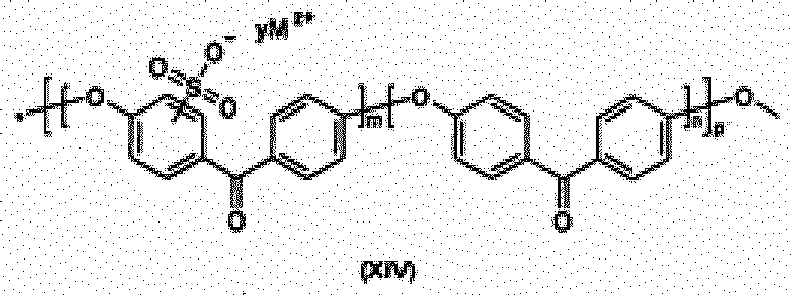
 - MZ+ für ein Kation steht, das einer oxidierten Form der Elemente der Spalten I B, II B, III A, III B, IV A, IV B, V A, V B, VI B, VII B, VIII B entspricht,- z für eine ganze Zahl von 1 bis 6 steht, die dem Oxidationsgrad des Metalls entspricht,- y für eine ganze oder Bruchzahl von gleich 1/z steht, sodass die Neutralität zwischen den negativen und positiven Ladungen sichergestellt wird,- m für den Prozentanteil an Polymereinheiten steht, die ein Oxoaryl- oder Dioxoarylmuster aufweisen, welches eine Sulfonatfunktion besitzt. Dieser Prozentanteil variiert zwischen 0,1 und 100 %,- n für den Prozentanteil an Polymereinheiten steht, die kein durch ein Sulfonatmuster funktionalisiertes Oxoaryl- oder Dioxoarylmuster aufweisen, n zwischen 0 und 99,9 % variiert,- p für die Anzahl an Polymereinheiten des Polymers steht; p von 40 bis 300 variiert.
 - Neue Polymere nach Anspruch 1 der Formeln I, II, III, IV, V, VI, VII, VIII, IX, X, XI, XII, XIII, XIV und XV, wobei:- Mz+ für ein Kation steht, das einer oxidierten Form von Titan, Zirkonium, Vanadium, Chrom, Molybdän, Wolfram, Mangan, Eisen, Kupfer, Silber, Gold, Zink, Aluminium, Gallium, Indium, Zinn, Bismut entspricht,- z für eine ganze Zahl von 1 bis 6 steht, die dem Oxidationsgrad des Metalls entspricht,- y für eine ganze oder Bruchzahl von gleich 1/z steht, sodass die Neutralität zwischen den negativen und positiven Ladungen sichergestellt wird,- m für den Prozentanteil an Polymereinheiten steht, die ein Oxoaryl- oder Dioxoarylmuster aufweisen, welches eine Sulfonatfunktion besitzt, m zwischen 0,1 und 100 % variiert,- n für den Prozentanteil an Polymereinheiten steht, die kein durch ein Sulfonatmuster funktionalisiertes Oxoaryl- oder Dioxoarylmuster aufweisen, n zwischen 0 und 99,9 % variiert,- p für die Anzahl an Polymereinheiten des Polymers steht, p von 40 bis 300 variiert.
- Neue Polymere nach Anspruch 1 der Formeln I, II, III, IV, V, VI, VII, VIII, IX, X, XI, XII, XIII, XIV und XV, wobei:- MZ+ für ein Kation steht, das einer oxidierten Form von Kupfer, Silber, Gold, Zink, Eisen entspricht,- z für eine ganze Zahl von 1 bis 6 steht, die dem Oxidationsgrad des Metalls entspricht,- y für eine ganze oder Bruchzahl von gleich 1/z steht, sodass die Neutralität zwischen den negativen und positiven Ladungen sichergestellt wird,- m für den Prozentanteil an Polymereinheiten steht, die ein Oxoaryl- oder Dioxoarylmuster aufweisen, welches eine Sulfonatfunktion besitzt, m zwischen 0,1 und 100 % variiert,- n für den Prozentanteil an Polymereinheiten steht, die kein durch ein Sulfonatmuster funktionalisiertes Oxoaryl- oder Dioxoarylmuster aufweisen, n zwischen 0 und 99,9 % variiert,- p für die Anzahl an Polymereinheiten des Polymers steht, p von 40 bis 300 variiert.
- Neue Polymere nach Anspruch 1 der Formeln I, II, III, IV, V, VI, VII, VIII, IX, X, XI, XII, XIII, XIV und XV, wobei:- MZ+ für ein Kation steht, das einer oxidierten Form von Kupfer, Silber, Gold, Zink, Eisen entspricht,- z für eine ganze Zahl von 1 bis 6 steht, die dem Oxidationsgrad des Metalls entspricht,- y für eine ganze oder Bruchzahl von gleich 1/z steht, sodass die Neutralität zwischen den negativen und positiven Ladungen sichergestellt wird,- m für den Prozentanteil an Polymereinheiten steht, die ein Oxoaryl- oder Dioxoarylmuster aufweisen, welches eine Sulfonatfunktion besitzt, m zwischen 1 und 100 % variiert,- n für den Prozentanteil an Polymereinheiten steht, die kein durch ein Sulfonatmuster funktionalisiertes Oxoaryl- oder Dioxoarylmuster aufweisen, n zwischen 0 und 99 % variiert,- p für die Anzahl an Polymereinheiten des Polymers steht, p von 60 und 200 variiert.
- Verfahren zur Synthese der Polymere nach den Ansprüchen 1 bis 4, dadurch gekennzeichnet, dass ausgeführt wird1) die Chlorsulfonierung eines Polymers der Formel XVI, XVII, XVIII, XIX, XX, XXI, XXII, XXIII durch eine Mischung aus Chlorsulfonsäure, Thionylchlorid und einem Amid nach einer optimierten Vorgehensweise,


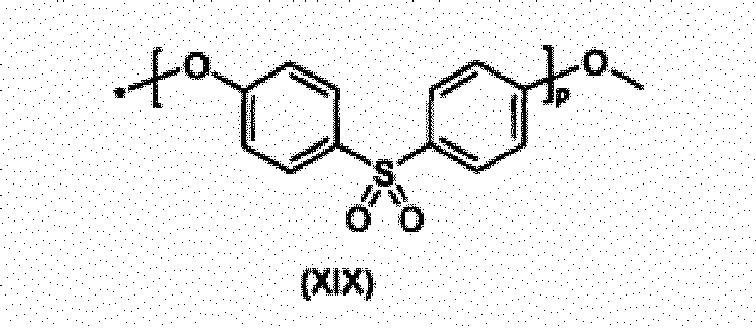
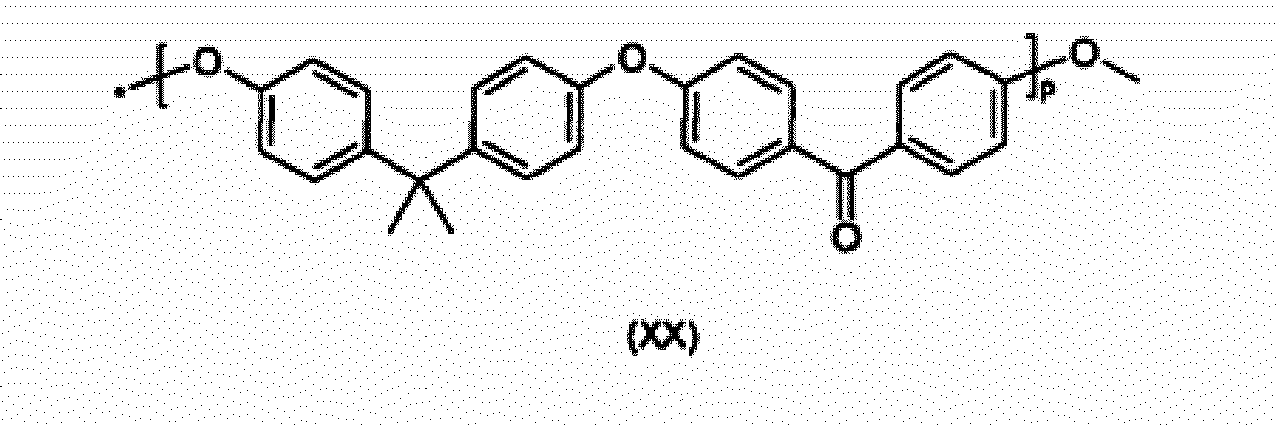


p für die Anzahl an Polymereinheiten des Polymers steht, pp von 40 bis 300 variiert,
um die Polymere der Formel XXIV, XXV, XXVI, XVII, XXVIII, XIX, XXX, XXXI, XXXII, XXXIII, XXXIV, XXXV, XXXVI, XXXVII und XXXVIII zu erhalten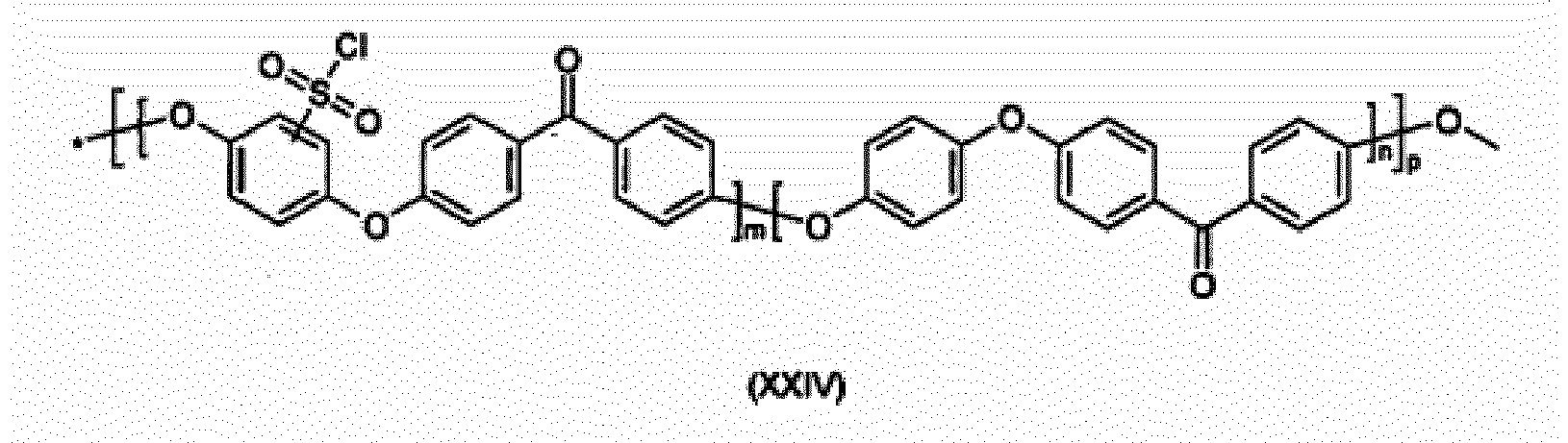


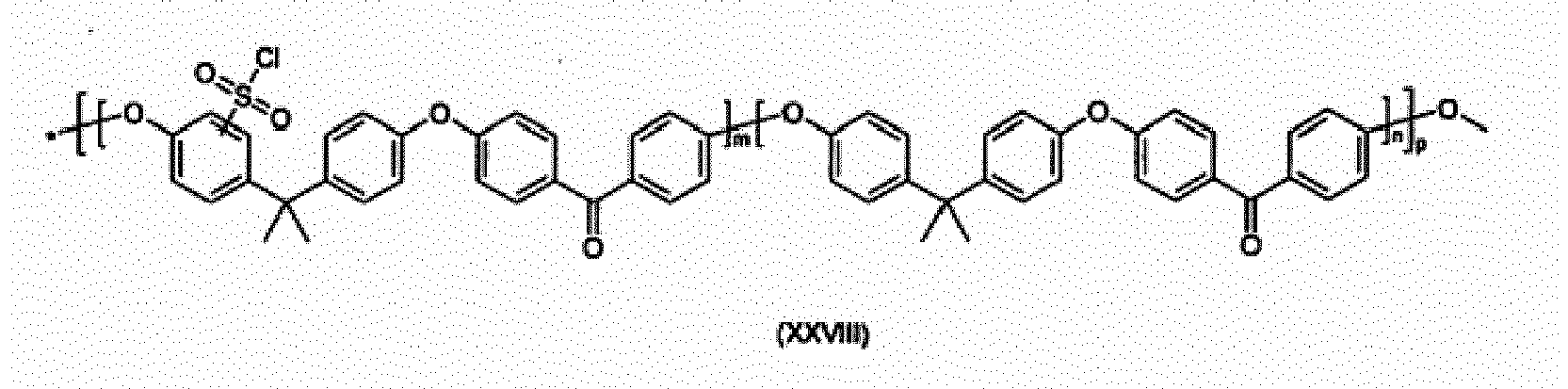


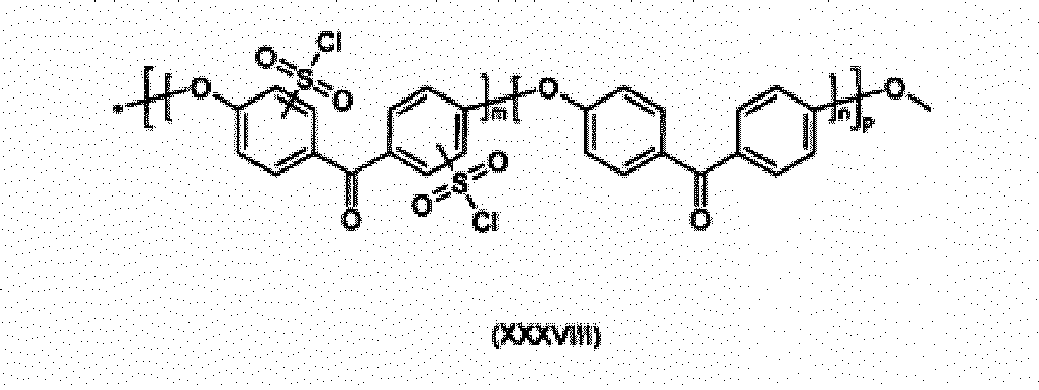 - m für den Prozentanteil an Polymereinheiten steht, die ein Oxoaryl- oder Dioxoarylmuster aufweisen, welches durch eine Sulfonylchloridgruppe funktionalisiert ist, m zwischen 0,1 und 100 % variiert,- n für den Prozentanteil an Polymereinheiten steht, die ein Dioxoarylmuster aufweisen, welches nicht durch eine Sulfonylchloridgruppe funktionalisiert ist, n zwischen 0 und 99,9 % variiert,- p für die Anzahl an Polymereinheiten des Polymers steht, p von 40 bis 300 variiert,2) anschließend bei einer Temperatur im Bereich zwischen 60 und 140 °C Wasser an den Polymeren der Formel XXIV, XXV, XXVI, XVII, XXVIII, XIX, XXX, XXXI, XXXII, XXXIII, XXXIV, XXXV, XXXVI, XXXVII und XXXVIII reagiert wird, um die Polymere der Formel XIL, XL, XLI, XLII, XLIII, XLIV, XLV, XLVI, XLVII, XLVIII, XLIX, L, LI, LII, LIII zu erhalten,





 - m für den Prozentanteil an Polymereinheiten steht, die ein funktionalisiertes Oxoaryl- oder Dioxoarylmuster aufweisen, welches eine Sulfonsäurefunktion besitzt, m zwischen 0,1 und 100 % variiert,- n für den Prozentanteil an Polymereinheiten steht, die ein nicht durch eine Sulfonsäurefunktion funktionalisiertes Oxoaryl- oder Dioxoarylmuster aufweisen, n zwischen 0 und 99,9 % variiert,- p für die Anzahl an Polymereinheiten des Polymers steht, p von 40 bis 300 variiert,3) und anschließend die Polymere der Formel XIL, XL, XLI, XLII, XLIII, XLIV, XLV, XLVI, XLVII, XLVIII, XLIX, L, LI, LII und LIII mit dem Metallsalz des Metalls M oder direkt dem Metall M auf dem Oxidationsgrad 0 in Gegenwart von Ultraschall reagiert werden.
 - Syntheseverfahren nach Anspruch 5, dadurch gekennzeichnet, dass1) erstens die Chlorsulfonierung eines Polymers der Formel XVI, XVII, XVIII, XIX, XX, XXI, XXII, XXIII durch eine Mischung aus Chlorsulfonsäure, Thionylchlorid und einem Amid nach einer optimierten Vorgehensweise, wobei
p für die Anzahl an Polymereinheiten des Polymers steht, p von 60 und 200 variiert,
um die Polymere der Formeln XXIV, XXV, XXVI, XVII, XXVIII, XIX, XXX, XXXI, XXXII, XXXIII, XXXIV, XXXV, XXXVI, XXXVII und XXXVIII zu erhalten, wobei:- m für den Prozentanteil an Polymereinheiten steht, die ein durch eine chlorsulfonierte Gruppe funktionalisiertes Oxoaryl- oder Dioxoarylmuster aufweisen, m zwischen 1 und 100 % variiert,- n für den Prozentanteil an Polymereinheiten steht, die ein nicht durch eine chlorsulfonierte Gruppe funktionalisiertes Oxoaryl- oder Dioxoarylmuster aufweisen, n zwischen 0 und und 99 % variiert;- p für die Anzahl an Polymereinheiten des Polymers steht, p von 60 bis 200 variiert,2) zweitens bei einer Temperatur im Bereich zwischen 90 und 120 °C Wasser an den Polymeren der Formel XXIV, XXV, XXVI, XVII, XXVIII, XIX, XXX, XXXI, XXXII, XXXIII, XXXIV, XXXV, XXXVI, XXXVII und XXXVIII reagiert wird, um die Polymere der Formeln XIL, XL, XLI, XLII, XLIII, XLIV, XLV, XLVI, XLVII, XLVIII, XLIX, L, LI, LII, LIII zu erhalten, wobei:- m für den Prozentanteil an Polymereinheiten steht, die ein funktionalisiertes Oxoaryl- oder Dioxoarylmuster aufweisen, welches eine Sulfonsäurefunktion besitzt. Dieser Prozentanteil variiert zwischen 1 und 100 %,- n für den Prozentanteil an Polymereinheiten steht, die ein nicht durch eine Sulfonsäurefunktion funktionalisiertes Oxoaryl- oder Dioxoarylmuster aufweisen. Dieser Prozentanteil variiert zwischen 0 und 99 %,- p für die Anzahl an Polymereinheiten des Polymers steht; p von 60 und 200 variiert,3) und schließlich bei einer ersten Variante die Polymere der Formel XIL, XL, XLI, XLII, XLIII, XLIV, XLV, XLVI, XLVII, XLVIII, XLIX, L, LI, LII und LIII mit dem Metallsalz des Metalls M oder direkt dem Metall M auf dem auf dem Oxidationsgrad 0 in Gegenwart von Ultraschall reagiert werden. - Verfahren nach den Ansprüchen 5 und 6, dadurch gekennzeichnet, dass die Chlorsulfonierung bei einer Temperatur im Bereich zwischen 0 und 80 °C durch eine Mischung aus 0,1 bis 5 Äquivalenten Chlorsulfonsäure, 0,1 bis 15 Äquivalenten Thionylchlorid in Gegenwart von 0,1 bis 5 Äquivalenten eines Amids bezogen auf die Oxoaryl- oder Dioxoarylmuster, die chlorsulfoniert werden sollen, ausgeführt wird, um Chlorsulfonierungsraten im Bereich zwischen 0,1 und 50 % zu erhalten.
- Verfahren nach Anspruch 5 und 6, dadurch gekennzeichnet, dass die Metallsalze, die für die Reaktion mit den Polymeren der Formeln XIL, XL, XLI, XLII, XLIII, XLIV, XLV, XLVI, XLVII, XLVIII, XLIX, L, LI, LII und LIII verwendet werden, Chloride, Bromide, Carbonate, Alkylcarboxylate, Acetate, Propionate, Arylcarboxylate, Benzoate, Acetylacetate, Acetylacetonate, Alkoholate sind.
- Verfahren nach Anspruch 5 und 6, dadurch gekennzeichnet, dass die bevorzugten Metallsalze Salze von Säuren mit schwacher pKS sind, deren pKS größer als 0 ist, wie Carbonate, Acetate, Benzoate, Alkoholate, Acetylacetate, Acetylacetonate.
- Verfahren nach Anspruch 5 und 6, dadurch gekennzeichnet, dass mit den Polymeren der Formel XIL, XL, XLI, XLII, XLIII, XLIV, XLV, XLVI, XLVII, XLVIII, XLIX, L, LI, LII und LIII mit einem Metall auf dem Oxidationsgrad 0, wie zum Beispiel Indium, Eisen, Kupfer, unter Ultraschall reagiert wird.
- Polymere nach den Ansprüchen 1 bis 4 der Formeln I, II, III, IV, V, VI, VII, VIII, IX, X, XI, XII, XIII, XIV, XV, die eine Aktivität gegen Bakterien, Pilze, Mikroben aufweisen.
- Polymere nach den Ansprüchen 1 bis 4 der Formeln I, II, III, IV, V, VI, VII, VIII, IX, X, XI, XII, XIII, XIV, XV, die eine Aktivität gegen Bakterien aufweisen.
- Polymere nach den Ansprüchen 1 bis 4 der Formeln I, II, III, IV, V, VI, VII, VIII, IX, X, XI, XII, XIII, XIV, XV, die eine Aktivität gegen Bakterien wie Staphylococcus Aureus und Pseudomonas aeruginosa aufweisen.
- Polymere nach den Ansprüchen 1 bis 4 der Formeln I, II, III, IV, V, VI, VII, VIII, IX, X, XI, XII, XIII, XIV, XV, die eine Aktivität gegen Pilze aufweisen.
- Polymere nach den Ansprüchen 1 bis 4 der Formeln I, II, III, IV, V, VI, VII, VIII, IX, X, XI, XII, XIII, XIV, XV, die eine Aktivität gegen Mikroben aufweisen.
- Polymere nach Anspruch 5 der Formel XIL, XL, XLI, XLII, XLIII, XLIV, XLV, XLVI, XLVII, XLVIII, XLIX, L, LI, LII, LIII, die eine Aktivität gegen Mikroben, Pilze und Bakterien aufweisen.
- Polymere nach Anspruch 5 der Formel XIL, XL, XLI, XLII, XLIII, XLIV, XLV, XLVI, XLVII, XLVIII, XLIX, L, LI, LII, LIII, die eine Aktivität gegen Pilze aufweisen.
- Polymere nach Anspruch 5 der Formel XIL, XL, XLI, XLII, XLIII, XLIV, XLV, XLVI, XLVII, XLVIII, XLIX, L, LI, LII, LIII, die eine Aktivität gegen Mikroben aufweisen.
- Polymere nach Anspruch 5 der Formel XIL, XL, XLI, XLII, XLIII, XLIV, XLV, XLVI, XLVII, XLVIII, XLIX, L, LI, LII, LIII, die eine Aktivität gegen Bakterien aufweisen.
Applications Claiming Priority (2)
| Application Number | Priority Date | Filing Date | Title |
|---|---|---|---|
| FR1402990A FR3030533B1 (fr) | 2014-12-22 | 2014-12-22 | Nouveaux polymeres contenant des fonctions sulfonates metalliques, leurs procedes de preparation et leurs utilisations comme antibacteriens, fongicides et antimicrobiens |
| PCT/FR2015/000239 WO2016102786A1 (fr) | 2014-12-22 | 2015-12-22 | Nouveaux polymeres contenant des fonctions sulfonates metalliques, leurs procedes de preparation et leurs utilisations comme antibacteriens, fongicides, antimicrobiens |
Publications (2)
| Publication Number | Publication Date |
|---|---|
| EP3237490A1 EP3237490A1 (de) | 2017-11-01 |
| EP3237490B1 true EP3237490B1 (de) | 2018-10-24 |
Family
ID=53298411
Family Applications (1)
| Application Number | Title | Priority Date | Filing Date |
|---|---|---|---|
| EP15828653.4A Active EP3237490B1 (de) | 2014-12-22 | 2015-12-22 | Neue metallsulfonatenthaltendes polymere, verfahren zu deren herstellung und deren verwendung als antimikrobielle, fungizide, antibakterielle mitteln |
Country Status (3)
| Country | Link |
|---|---|
| EP (1) | EP3237490B1 (de) |
| FR (1) | FR3030533B1 (de) |
| WO (1) | WO2016102786A1 (de) |
Families Citing this family (1)
| Publication number | Priority date | Publication date | Assignee | Title |
|---|---|---|---|---|
| FR3113676B1 (fr) | 2020-09-03 | 2023-06-16 | Cdp Innovation | Polymeres contenant des unites de repetition avec plusieurs motifs sulfonates metalliques ou organiques, leurs procedes de preparation et leurs utilisations |
Family Cites Families (5)
| Publication number | Priority date | Publication date | Assignee | Title |
|---|---|---|---|---|
| CN1439032A (zh) * | 2000-06-02 | 2003-08-27 | Sri国际公司 | 聚合物组合物 |
| JP2010100705A (ja) * | 2008-10-22 | 2010-05-06 | Toyota Motor Corp | 高分子電解質合成方法、高分子電解質膜、及び固体高分子型燃料電池 |
| MX2012012710A (es) * | 2010-05-07 | 2013-02-26 | Difusion Technologies Inc | Implantes medicos con hidrofilicidad incrementada. |
| FR2963003A1 (fr) | 2010-07-22 | 2012-01-27 | Cdp Innovation | Preparation de sels metalliques de l'acide triflique et de l'acide triflimidique sous ultrasons |
| WO2013002274A1 (ja) * | 2011-06-28 | 2013-01-03 | 東レ株式会社 | 芳香族スルホン酸誘導体、スルホン酸基含有ポリマー、ブロック共重合体、高分子電解質材料、高分子電解質成型体および固体高分子型燃料電池 |
-
2014
- 2014-12-22 FR FR1402990A patent/FR3030533B1/fr active Active
-
2015
- 2015-12-22 EP EP15828653.4A patent/EP3237490B1/de active Active
- 2015-12-22 WO PCT/FR2015/000239 patent/WO2016102786A1/fr not_active Ceased
Non-Patent Citations (1)
| Title |
|---|
| None * |
Also Published As
| Publication number | Publication date |
|---|---|
| FR3030533B1 (fr) | 2017-05-12 |
| FR3030533A1 (fr) | 2016-06-24 |
| EP3237490A1 (de) | 2017-11-01 |
| WO2016102786A1 (fr) | 2016-06-30 |
Similar Documents
| Publication | Publication Date | Title |
|---|---|---|
| EP3337451B1 (de) | Verbesserte lactamlöslichkeit | |
| EP0469983B1 (de) | Persäure-Clathrate, ihre Herstellung und ihre Verwendungen | |
| FR2483406A1 (fr) | Composes 3-isoxazolidinones, leur procede de preparation et compositions herbicides les contenant | |
| KR101015932B1 (ko) | 항생물 조성물 및 그 제조 방법 | |
| DE2504114A1 (de) | Imidazoliumsalze | |
| US20030162755A1 (en) | Halo active aromatic sulfonamide organic compounds and uses therefor | |
| WO2016102786A1 (fr) | Nouveaux polymeres contenant des fonctions sulfonates metalliques, leurs procedes de preparation et leurs utilisations comme antibacteriens, fongicides, antimicrobiens | |
| EP3337450B1 (de) | Verbesserte lactamlöslichkeit | |
| EP0120238B1 (de) | Mikrobizides Mittel zum Schutz technischer Materialien | |
| CN112714778A (zh) | 用于抗微生物应用的酸敏感性可降解咪唑鎓聚合物 | |
| CN101638373B (zh) | 一种对双胍基苯甲酸盐酸盐的制备方法 | |
| JP5390384B2 (ja) | イソチアゾロン化合物の亜鉛塩、イソチアゾロン化合物の低刺激化方法、イソチアゾロン化合物の亜鉛塩を用いる抗菌・防カビ方法、および抗菌・防カビ組成物 | |
| EP0200607B1 (de) | Grenzflächenaktive Chlorhexidinsalze und diese enthaltende Mittel | |
| CN113845524A (zh) | 一种螺吡咯吲哚酮类化合物及其制备方法和应用 | |
| WO2022049236A1 (fr) | Polymeres contenant des unites de repetition avec plusieurs motifs sulfonates metalliques ou organiques, leurs procedes de preparation et leurs utilisations | |
| EP0439130A1 (de) | Bakterizide, virizide und fungizide Mischung | |
| JP2008143881A (ja) | 抗菌剤 | |
| JPS63284186A (ja) | 4−トリアルキルシリルベンジルアミン誘導体、その製造法及び用途 | |
| FR2640116A1 (fr) | Composition biocide stable pour l'application industrielle | |
| EP0016391A1 (de) | 3-Sulfonyl-benzo-1,2,4-triazine und -benzo-1,2,4-triazin-1-oxide, Verfahren zu ihrer Herstellung und diese enthaltende Arzneimittel sowie antimikrobielle Mittel für den Materialschutz | |
| EP0195238B1 (de) | Fluorhaltige N-sulfenylierte Indazole, Verfahren zu ihrer Herstellung sowie ihre Verwendung | |
| JP4341220B2 (ja) | ピリジンチオールスルホナート類及びその製造方法 | |
| BE475167A (de) | ||
| JP5806848B2 (ja) | 3,3’−オキシビス(1,3−ジヒドロイソベンゾフラン−1−オール)、それを含有する消毒薬及び殺生物剤、並びにオルトフタルアルデヒドの製造方法 | |
| WO2020007882A1 (fr) | Derives du m-gaiacol, leur preparation et leurs utilisations |
Legal Events
| Date | Code | Title | Description |
|---|---|---|---|
| PUAI | Public reference made under article 153(3) epc to a published international application that has entered the european phase |
Free format text: ORIGINAL CODE: 0009012 |
|
| 17P | Request for examination filed |
Effective date: 20170710 |
|
| AK | Designated contracting states |
Kind code of ref document: A1 Designated state(s): AL AT BE BG CH CY CZ DE DK EE ES FI FR GB GR HR HU IE IS IT LI LT LU LV MC MK MT NL NO PL PT RO RS SE SI SK SM TR |
|
| AX | Request for extension of the european patent |
Extension state: BA ME |
|
| DAV | Request for validation of the european patent (deleted) | ||
| DAX | Request for extension of the european patent (deleted) | ||
| GRAP | Despatch of communication of intention to grant a patent |
Free format text: ORIGINAL CODE: EPIDOSNIGR1 |
|
| INTG | Intention to grant announced |
Effective date: 20180720 |
|
| GRAS | Grant fee paid |
Free format text: ORIGINAL CODE: EPIDOSNIGR3 |
|
| GRAA | (expected) grant |
Free format text: ORIGINAL CODE: 0009210 |
|
| AK | Designated contracting states |
Kind code of ref document: B1 Designated state(s): AL AT BE BG CH CY CZ DE DK EE ES FI FR GB GR HR HU IE IS IT LI LT LU LV MC MK MT NL NO PL PT RO RS SE SI SK SM TR |
|
| REG | Reference to a national code |
Ref country code: CH Ref legal event code: EP |
|
| REG | Reference to a national code |
Ref country code: IE Ref legal event code: FG4D Free format text: LANGUAGE OF EP DOCUMENT: FRENCH |
|
| REG | Reference to a national code |
Ref country code: AT Ref legal event code: REF Ref document number: 1056581 Country of ref document: AT Kind code of ref document: T Effective date: 20181115 |
|
| REG | Reference to a national code |
Ref country code: DE Ref legal event code: R096 Ref document number: 602015018876 Country of ref document: DE |
|
| REG | Reference to a national code |
Ref country code: CH Ref legal event code: NV Representative=s name: DR. LUSUARDI AG, CH |
|
| REG | Reference to a national code |
Ref country code: NL Ref legal event code: MP Effective date: 20181024 |
|
| REG | Reference to a national code |
Ref country code: LT Ref legal event code: MG4D |
|
| REG | Reference to a national code |
Ref country code: AT Ref legal event code: MK05 Ref document number: 1056581 Country of ref document: AT Kind code of ref document: T Effective date: 20181024 |
|
| PG25 | Lapsed in a contracting state [announced via postgrant information from national office to epo] |
Ref country code: NL Free format text: LAPSE BECAUSE OF FAILURE TO SUBMIT A TRANSLATION OF THE DESCRIPTION OR TO PAY THE FEE WITHIN THE PRESCRIBED TIME-LIMIT Effective date: 20181024 |
|
| PG25 | Lapsed in a contracting state [announced via postgrant information from national office to epo] |
Ref country code: AT Free format text: LAPSE BECAUSE OF FAILURE TO SUBMIT A TRANSLATION OF THE DESCRIPTION OR TO PAY THE FEE WITHIN THE PRESCRIBED TIME-LIMIT Effective date: 20181024 Ref country code: LT Free format text: LAPSE BECAUSE OF FAILURE TO SUBMIT A TRANSLATION OF THE DESCRIPTION OR TO PAY THE FEE WITHIN THE PRESCRIBED TIME-LIMIT Effective date: 20181024 Ref country code: HR Free format text: LAPSE BECAUSE OF FAILURE TO SUBMIT A TRANSLATION OF THE DESCRIPTION OR TO PAY THE FEE WITHIN THE PRESCRIBED TIME-LIMIT Effective date: 20181024 Ref country code: BG Free format text: LAPSE BECAUSE OF FAILURE TO SUBMIT A TRANSLATION OF THE DESCRIPTION OR TO PAY THE FEE WITHIN THE PRESCRIBED TIME-LIMIT Effective date: 20190124 Ref country code: PL Free format text: LAPSE BECAUSE OF FAILURE TO SUBMIT A TRANSLATION OF THE DESCRIPTION OR TO PAY THE FEE WITHIN THE PRESCRIBED TIME-LIMIT Effective date: 20181024 Ref country code: ES Free format text: LAPSE BECAUSE OF FAILURE TO SUBMIT A TRANSLATION OF THE DESCRIPTION OR TO PAY THE FEE WITHIN THE PRESCRIBED TIME-LIMIT Effective date: 20181024 Ref country code: NO Free format text: LAPSE BECAUSE OF FAILURE TO SUBMIT A TRANSLATION OF THE DESCRIPTION OR TO PAY THE FEE WITHIN THE PRESCRIBED TIME-LIMIT Effective date: 20190124 Ref country code: IS Free format text: LAPSE BECAUSE OF FAILURE TO SUBMIT A TRANSLATION OF THE DESCRIPTION OR TO PAY THE FEE WITHIN THE PRESCRIBED TIME-LIMIT Effective date: 20190224 Ref country code: FI Free format text: LAPSE BECAUSE OF FAILURE TO SUBMIT A TRANSLATION OF THE DESCRIPTION OR TO PAY THE FEE WITHIN THE PRESCRIBED TIME-LIMIT Effective date: 20181024 Ref country code: LV Free format text: LAPSE BECAUSE OF FAILURE TO SUBMIT A TRANSLATION OF THE DESCRIPTION OR TO PAY THE FEE WITHIN THE PRESCRIBED TIME-LIMIT Effective date: 20181024 |
|
| PG25 | Lapsed in a contracting state [announced via postgrant information from national office to epo] |
Ref country code: RS Free format text: LAPSE BECAUSE OF FAILURE TO SUBMIT A TRANSLATION OF THE DESCRIPTION OR TO PAY THE FEE WITHIN THE PRESCRIBED TIME-LIMIT Effective date: 20181024 Ref country code: SE Free format text: LAPSE BECAUSE OF FAILURE TO SUBMIT A TRANSLATION OF THE DESCRIPTION OR TO PAY THE FEE WITHIN THE PRESCRIBED TIME-LIMIT Effective date: 20181024 Ref country code: AL Free format text: LAPSE BECAUSE OF FAILURE TO SUBMIT A TRANSLATION OF THE DESCRIPTION OR TO PAY THE FEE WITHIN THE PRESCRIBED TIME-LIMIT Effective date: 20181024 Ref country code: GR Free format text: LAPSE BECAUSE OF FAILURE TO SUBMIT A TRANSLATION OF THE DESCRIPTION OR TO PAY THE FEE WITHIN THE PRESCRIBED TIME-LIMIT Effective date: 20190125 Ref country code: PT Free format text: LAPSE BECAUSE OF FAILURE TO SUBMIT A TRANSLATION OF THE DESCRIPTION OR TO PAY THE FEE WITHIN THE PRESCRIBED TIME-LIMIT Effective date: 20190224 |
|
| REG | Reference to a national code |
Ref country code: DE Ref legal event code: R097 Ref document number: 602015018876 Country of ref document: DE |
|
| PG25 | Lapsed in a contracting state [announced via postgrant information from national office to epo] |
Ref country code: DK Free format text: LAPSE BECAUSE OF FAILURE TO SUBMIT A TRANSLATION OF THE DESCRIPTION OR TO PAY THE FEE WITHIN THE PRESCRIBED TIME-LIMIT Effective date: 20181024 Ref country code: CZ Free format text: LAPSE BECAUSE OF FAILURE TO SUBMIT A TRANSLATION OF THE DESCRIPTION OR TO PAY THE FEE WITHIN THE PRESCRIBED TIME-LIMIT Effective date: 20181024 Ref country code: IT Free format text: LAPSE BECAUSE OF FAILURE TO SUBMIT A TRANSLATION OF THE DESCRIPTION OR TO PAY THE FEE WITHIN THE PRESCRIBED TIME-LIMIT Effective date: 20181024 |
|
| PG25 | Lapsed in a contracting state [announced via postgrant information from national office to epo] |
Ref country code: LU Free format text: LAPSE BECAUSE OF NON-PAYMENT OF DUE FEES Effective date: 20181222 Ref country code: RO Free format text: LAPSE BECAUSE OF FAILURE TO SUBMIT A TRANSLATION OF THE DESCRIPTION OR TO PAY THE FEE WITHIN THE PRESCRIBED TIME-LIMIT Effective date: 20181024 Ref country code: EE Free format text: LAPSE BECAUSE OF FAILURE TO SUBMIT A TRANSLATION OF THE DESCRIPTION OR TO PAY THE FEE WITHIN THE PRESCRIBED TIME-LIMIT Effective date: 20181024 Ref country code: SM Free format text: LAPSE BECAUSE OF FAILURE TO SUBMIT A TRANSLATION OF THE DESCRIPTION OR TO PAY THE FEE WITHIN THE PRESCRIBED TIME-LIMIT Effective date: 20181024 Ref country code: SK Free format text: LAPSE BECAUSE OF FAILURE TO SUBMIT A TRANSLATION OF THE DESCRIPTION OR TO PAY THE FEE WITHIN THE PRESCRIBED TIME-LIMIT Effective date: 20181024 Ref country code: MC Free format text: LAPSE BECAUSE OF FAILURE TO SUBMIT A TRANSLATION OF THE DESCRIPTION OR TO PAY THE FEE WITHIN THE PRESCRIBED TIME-LIMIT Effective date: 20181024 |
|
| PLBE | No opposition filed within time limit |
Free format text: ORIGINAL CODE: 0009261 |
|
| STAA | Information on the status of an ep patent application or granted ep patent |
Free format text: STATUS: NO OPPOSITION FILED WITHIN TIME LIMIT |
|
| REG | Reference to a national code |
Ref country code: IE Ref legal event code: MM4A |
|
| 26N | No opposition filed |
Effective date: 20190725 |
|
| PG25 | Lapsed in a contracting state [announced via postgrant information from national office to epo] |
Ref country code: IE Free format text: LAPSE BECAUSE OF NON-PAYMENT OF DUE FEES Effective date: 20181222 Ref country code: SI Free format text: LAPSE BECAUSE OF FAILURE TO SUBMIT A TRANSLATION OF THE DESCRIPTION OR TO PAY THE FEE WITHIN THE PRESCRIBED TIME-LIMIT Effective date: 20181024 |
|
| PG25 | Lapsed in a contracting state [announced via postgrant information from national office to epo] |
Ref country code: MT Free format text: LAPSE BECAUSE OF FAILURE TO SUBMIT A TRANSLATION OF THE DESCRIPTION OR TO PAY THE FEE WITHIN THE PRESCRIBED TIME-LIMIT Effective date: 20181024 |
|
| PG25 | Lapsed in a contracting state [announced via postgrant information from national office to epo] |
Ref country code: TR Free format text: LAPSE BECAUSE OF FAILURE TO SUBMIT A TRANSLATION OF THE DESCRIPTION OR TO PAY THE FEE WITHIN THE PRESCRIBED TIME-LIMIT Effective date: 20181024 |
|
| PG25 | Lapsed in a contracting state [announced via postgrant information from national office to epo] |
Ref country code: MK Free format text: LAPSE BECAUSE OF NON-PAYMENT OF DUE FEES Effective date: 20181024 Ref country code: CY Free format text: LAPSE BECAUSE OF FAILURE TO SUBMIT A TRANSLATION OF THE DESCRIPTION OR TO PAY THE FEE WITHIN THE PRESCRIBED TIME-LIMIT Effective date: 20181024 Ref country code: HU Free format text: LAPSE BECAUSE OF FAILURE TO SUBMIT A TRANSLATION OF THE DESCRIPTION OR TO PAY THE FEE WITHIN THE PRESCRIBED TIME-LIMIT; INVALID AB INITIO Effective date: 20151222 |
|
| PGFP | Annual fee paid to national office [announced via postgrant information from national office to epo] |
Ref country code: BE Payment date: 20251231 Year of fee payment: 11 |
|
| REG | Reference to a national code |
Ref country code: CH Ref legal event code: U11 Free format text: ST27 STATUS EVENT CODE: U-0-0-U10-U11 (AS PROVIDED BY THE NATIONAL OFFICE) Effective date: 20260122 |
|
| PGFP | Annual fee paid to national office [announced via postgrant information from national office to epo] |
Ref country code: GB Payment date: 20260127 Year of fee payment: 11 |
|
| PGFP | Annual fee paid to national office [announced via postgrant information from national office to epo] |
Ref country code: DE Payment date: 20260114 Year of fee payment: 11 |
|
| PGFP | Annual fee paid to national office [announced via postgrant information from national office to epo] |
Ref country code: FR Payment date: 20260220 Year of fee payment: 11 |
|
| PGFP | Annual fee paid to national office [announced via postgrant information from national office to epo] |
Ref country code: CH Payment date: 20260122 Year of fee payment: 11 |