EP3232103A1 - Anschlussarmatur für ein mineralölfahrzeug - Google Patents
Anschlussarmatur für ein mineralölfahrzeug Download PDFInfo
- Publication number
- EP3232103A1 EP3232103A1 EP17163232.6A EP17163232A EP3232103A1 EP 3232103 A1 EP3232103 A1 EP 3232103A1 EP 17163232 A EP17163232 A EP 17163232A EP 3232103 A1 EP3232103 A1 EP 3232103A1
- Authority
- EP
- European Patent Office
- Prior art keywords
- valve
- axis
- housing
- connection fitting
- rotation
- Prior art date
- Legal status (The legal status is an assumption and is not a legal conclusion. Google has not performed a legal analysis and makes no representation as to the accuracy of the status listed.)
- Granted
Links
Images



Classifications
-
- B—PERFORMING OPERATIONS; TRANSPORTING
- B60—VEHICLES IN GENERAL
- B60P—VEHICLES ADAPTED FOR LOAD TRANSPORTATION OR TO TRANSPORT, TO CARRY, OR TO COMPRISE SPECIAL LOADS OR OBJECTS
- B60P3/00—Vehicles adapted to transport, to carry or to comprise special loads or objects
- B60P3/22—Tank vehicles
- B60P3/224—Tank vehicles comprising auxiliary devices, e.g. for unloading or level indicating
- B60P3/225—Adaptations for pumps or valves
-
- F—MECHANICAL ENGINEERING; LIGHTING; HEATING; WEAPONS; BLASTING
- F16—ENGINEERING ELEMENTS AND UNITS; GENERAL MEASURES FOR PRODUCING AND MAINTAINING EFFECTIVE FUNCTIONING OF MACHINES OR INSTALLATIONS; THERMAL INSULATION IN GENERAL
- F16K—VALVES; TAPS; COCKS; ACTUATING-FLOATS; DEVICES FOR VENTING OR AERATING
- F16K1/00—Lift valves or globe valves, i.e. cut-off apparatus with closure members having at least a component of their opening and closing motion perpendicular to the closing faces
- F16K1/16—Lift valves or globe valves, i.e. cut-off apparatus with closure members having at least a component of their opening and closing motion perpendicular to the closing faces with pivoted closure-members
- F16K1/18—Lift valves or globe valves, i.e. cut-off apparatus with closure members having at least a component of their opening and closing motion perpendicular to the closing faces with pivoted closure-members with pivoted discs or flaps
- F16K1/22—Lift valves or globe valves, i.e. cut-off apparatus with closure members having at least a component of their opening and closing motion perpendicular to the closing faces with pivoted closure-members with pivoted discs or flaps with axis of rotation crossing the valve member, e.g. butterfly valves
- F16K1/221—Lift valves or globe valves, i.e. cut-off apparatus with closure members having at least a component of their opening and closing motion perpendicular to the closing faces with pivoted closure-members with pivoted discs or flaps with axis of rotation crossing the valve member, e.g. butterfly valves specially adapted operating means therefor
-
- F—MECHANICAL ENGINEERING; LIGHTING; HEATING; WEAPONS; BLASTING
- F16—ENGINEERING ELEMENTS AND UNITS; GENERAL MEASURES FOR PRODUCING AND MAINTAINING EFFECTIVE FUNCTIONING OF MACHINES OR INSTALLATIONS; THERMAL INSULATION IN GENERAL
- F16K—VALVES; TAPS; COCKS; ACTUATING-FLOATS; DEVICES FOR VENTING OR AERATING
- F16K1/00—Lift valves or globe valves, i.e. cut-off apparatus with closure members having at least a component of their opening and closing motion perpendicular to the closing faces
- F16K1/24—Lift valves or globe valves, i.e. cut-off apparatus with closure members having at least a component of their opening and closing motion perpendicular to the closing faces with valve members that, on opening of the valve, are initially lifted from the seat and next are turned around an axis parallel to the seat
-
- F—MECHANICAL ENGINEERING; LIGHTING; HEATING; WEAPONS; BLASTING
- F16—ENGINEERING ELEMENTS AND UNITS; GENERAL MEASURES FOR PRODUCING AND MAINTAINING EFFECTIVE FUNCTIONING OF MACHINES OR INSTALLATIONS; THERMAL INSULATION IN GENERAL
- F16K—VALVES; TAPS; COCKS; ACTUATING-FLOATS; DEVICES FOR VENTING OR AERATING
- F16K31/00—Actuating devices; Operating means; Releasing devices
- F16K31/44—Mechanical actuating means
- F16K31/52—Mechanical actuating means with crank, eccentric, or cam
- F16K31/521—Mechanical actuating means with crank, eccentric, or cam comprising a pivoted disc or flap
-
- F—MECHANICAL ENGINEERING; LIGHTING; HEATING; WEAPONS; BLASTING
- F16—ENGINEERING ELEMENTS AND UNITS; GENERAL MEASURES FOR PRODUCING AND MAINTAINING EFFECTIVE FUNCTIONING OF MACHINES OR INSTALLATIONS; THERMAL INSULATION IN GENERAL
- F16K—VALVES; TAPS; COCKS; ACTUATING-FLOATS; DEVICES FOR VENTING OR AERATING
- F16K31/00—Actuating devices; Operating means; Releasing devices
- F16K31/44—Mechanical actuating means
- F16K31/56—Mechanical actuating means without stable intermediate position, e.g. with snap action
- F16K31/563—Mechanical actuating means without stable intermediate position, e.g. with snap action for rotating or pivoting valves
Definitions
- the invention relates to a connection fitting for a mineral oil vehicle comprising a housing comprising a housing wall and a support projecting inwardly from the housing wall, wherein a first flow opening for a liquid and a second flow opening for the liquid is provided on the housing, with one of the housing wall in any case partially encompassed and held on the support of the housing valve module comprising a slidably held in an axial valve stem and a valve stem at least indirectly held valve carrier, wherein in a closed position of the valve module, the valve rod is provided in a first axial position and the valve disc closes the first flow opening, wherein in a filling position of the valve module, the valve rod is provided in a second axial position and the valve disc is provided at a distance from the first flow opening for releasing the the same and wherein the axial direction in the closed position and in the filling position is arranged oriented perpendicular to an extension plane of the valve disk, and with an actuating module, which is in operative connection with the valve module and is adapted
- connection fitting is usually provided today on mineral oil tankers.
- the valve plate bears against a valve seat of the housing and closes the first flow opening of the connection fitting in such a way that stored liquid in a tank of the mineral oil tanker vehicle can not escape.
- the connection fitting is externally contacted and axially displaced via an external actuator of the valve plate of the connection fitting with the valve rod held thereon so that forms an axial annular gap for the liquid and in the region of the first flow opening between the valve seat and the valve disk axial annular gap of the tank of the mineral oil tanker can be filled.
- the connection fitting is also located in the filling position for removing the liquid from the tank.
- the filling position is not adjusted by an external pressurization of the valve disk, but by an actuation of the actuating module.
- a mineral oil hose has first been attached to the connection fitting, so that after the first throughflow opening has been released, the liquid stored in the mineral oil tanker can escape.
- connection fitting has basically proven in practice and is widely used, there is a desire to reduce the flow resistance in particular when removing the liquid from the tank of the mineral oil tanker vehicle and thus to accelerate the removal process. This can make it possible to shorten the service life of the mineral oil tanker when removing the liquid and ultimately carry out more removal operations in the same time.
- the invention in conjunction with the preamble of claim 1, characterized in that the valve disc is held about a rotational axis pivotally with respect to the valve rod.
- the particular advantage of the invention is that a flow cross section for the liquid can be increased by the pivotable or foldable arrangement of the valve disk. It is in particular so that the liquid is not as usual today by the between the valve plate and the valve seat flows formed annular gap. Rather, the valve disk can be tilted in the direction of the flow and thereby the flow cross section can be increased. Due to the larger flow cross section, the flow resistance is reduced and more liquid per unit time can flow through the connection fitting. This is particularly relevant when removing the liquid at a gas station, since this removal process is carried out regularly without pump support and insofar as the flow or flow resistance directly affects the service life of the mineral oil tanker.
- Core idea of the invention is insofar as to define a removal position in addition to the closed position and the filling position, in which the valve disk is arranged aerodynamically and a flow resistance for the liquid is reduced.
- the valve disk In the removal position newly created by the connection fitting according to the invention, the valve disk is arranged in the direction of flow pivoted with the result that between the valve seat and the valve disc as usual today, an annular gap is formed and the liquid must be deflected to flow through the annular gap. Rather, the flow cross-section increases due to the tilted arrangement of the valve disk.
- the first flow opening can be flowed substantially straight.
- connection fitting for closing the tank and filling the tank.
- the valve disk In the closed position, the valve disk is as usual ajar against the valve seat of the housing of the connection fitting.
- the axial actuating direction (axial direction) of the valve module In the filling position, in which, as usual, the axial actuating direction (axial direction) of the valve module is oriented perpendicular to the plane of extension of the valve disk, the liquid passes via the first flow opening into the connection fitting and flows over the annular gap formed between the valve disk and the valve seat in the direction of second flow opening.
- the actuation of the valve module takes place here in the usual way from the outside so that a force is impressed on the valve disk and the valve rod is pressed with the valve disk held thereon from the valve seat and axially displaced.
- a modification of external connection components for the mineral oil tanker is not required in this respect. The reuse of these external connection components is guaranteed.
- the valve disk is held eccentrically on the valve rod such that the rotational axis is provided spaced from a center axis of the valve rod oriented in the axial direction. Due to the eccentric mounting of the valve disk in relation to the valve rod, the pivoting movement of the valve disk about the axis of rotation during removal in the case of liquid can advantageously be realized in a passive manner.
- the liquid flowing against the valve disk pivots the valve disk independently about the axis of rotation, since due to the eccentric orientation of the axis of rotation on the valve disk, the partial surfaces acted upon by the liquid are of different sizes on both sides of the axis of rotation and consequently a pivoting movement is initiated automatically. Actuatorial components or mechanical actuation means for pivoting the valve disk are not required.
- the inventive connection fitting can be manufactured inexpensively and is due to the purely mechanical design of the pivot mechanism robust.
- the valve disk in the removal position based on the orientation of the same in the closed position or in the filling position by 90 ° +/- 10 ° pivoted.
- the axial direction is oriented in the plane of extent of the valve disk.
- this orientation of the valve disk in the removal position allows a particularly low flow resistance and consequently a short service life for the mineral oil tanker vehicle in the discharge of the liquid.
- a guide element and a supporting element which is in operative connection with the guide element in any case in the closed position or in the filling position or in the removal position are provided for realizing the pivoting movement of the valve disk into the removal position.
- either the support element or the guide element is arranged stationarily relative to the housing.
- the other element is provided relatively movable to the stationary element.
- the guide element is provided together with the valve plate and / or the valve rod displaceable in the axial direction or pivotable about the axis of rotation of the valve disk.
- the support member is held relatively movable to the stationary guide member.
- the guide element and the support element results in a positive guidance or locking of the valve disk in any case in one and preferably a plurality of positions (closed position, filling position, removal position). This results in a high level of operational safety and incorrect operation or positioning of the valve disk is reliably prevented.
- the support element is designed in the manner of a pin, which is held in the housing or in relation to the same stationary.
- the pin is for example fixed directly to the housing or indirectly held on a pin carrier on the housing.
- the guide element is designed in the manner of a control link and held displaceably relative to the stationary support element.
- the guide element is for example fixed against rotation on the valve disk of the valve module.
- the valve module provides an eccentric lever.
- the eccentric lever is on the one hand in a hinge point rotatably and at the same time held longitudinally displaceable on the support of the housing or a bearing on the support of the housing bearing element.
- the eccentric lever is preferably held at the end about a pivot axis rotatably and spaced from the axis of rotation of the valve disk at this same.
- the eccentric lever may be associated with an actuating spring, which is in operative connection with the eccentric lever itself and the carrier of the housing or the bearing element such that when the valve module is moved from the removal position into the closed position, the valve disk is automatically pivoted until the plane of extent of the valve disk is vertical oriented to the axial direction.
- the actuating spring as an elastic element at the same time causes a freewheeling function, which allows to provide the valve plate in the second axial position of the valve rod relative to the plane of extension of the valve disk in the filling position perpendicular to the axial direction and to arrange pivoted in the removal position.
- the actuating spring In the removal position, the actuating spring is biased in this respect to pressure, while it is provided in the closed position and in the filling position unloaded or with play between the eccentric lever and the carrier or the bearing element.
- the pivot axis of the eccentric lever and the axis of rotation of the valve disk can be arranged oriented parallel to each other.
- it can be provided that to provide the pivot axis and the rotation axis on opposite sides of the central axis of the valve rod.
- the pivot axis and the axis of rotation can be provided in any position of the valve module oriented perpendicular to the central axis of the valve rod.
- the actuation module is designed in the manner of a handle.
- the handle includes a pivotal, hand-operated operating lever, a shaft rotatably connected to the operating lever, which is guided by the housing wall and sealed against the housing, and a standing with the shaft operatively connected toggle mechanism.
- the toggle mechanism comprises, for example, two articulated levers which are fixed to the shaft on the one hand and the valve rod or an element of the valve module displaceable with the valve rod on the other hand.
- the actuation module can provide a pneumatic actuating means, in particular a pneumatic cylinder, for actuating the valve module.
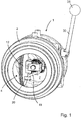
- An inventive connection fitting for a non-illustrated mineral oil tanker after Fig. 1 to 7 comprises as essential components a housing 1, a valve module 10 and an actuation module 29.
- the housing 1 provides a substantially cylindrical or coat-side closed housing wall 2 and a protruding from the housing 2 inwardly support 3 before.
- the housing 1 defines in the region of two opposite end faces a first flow opening 4 for a liquid and a second flow opening 7 for the liquid.
- the housing 1 is preferably made of a metallic material and provides one of the first flow opening 4 associated, the first flow opening 4 annularly surrounding first flange 5 and a second flow opening 7 associated with the second flange 8.
- On the second flange 8, a plurality of mutually spaced mounting holes 9 are provided, which serve to fix the connection fitting in particular to the mineral oil tanker vehicle.
- the valve module 10 is encompassed by the housing wall 2 of the housing 1 shell side in any case in sections.
- the valve module 10 provides a valve rod 11 held on the carrier 3 of the housing and a valve disk 12 held on the valve rod 11.
- the valve rod 11 is formed substantially cylindrical. It is held longitudinally displaceable in an axial direction 13.
- the valve rod 11 is in this case associated with a return spring 18, which surrounds the valve rod 11 and is provided between the carrier 3 and the valve plate 12.
- a hinge is provided with a first hinge element 15 fixed to the valve rod 11 and a second hinge element 16 fixed to the valve disk 12. In relation to a hinge axis defined by the hinge 17, this results in a pivotable arrangement of the valve disk 12 with respect to the valve rod 11.
- the axis of rotation 17 is oriented perpendicular to the axial direction 13 and spaced from a central axis 14 of the valve rod 11 extending in the axial direction 13. Due to the spacing of the rotation axis 17 from the central axis 14, an eccentric fixing of the valve disk 12 to the valve rod 11 is formed.
- valve module 10 provides an eccentric lever 19, which is rotatably and longitudinally displaceably held at a hinge point connected to the support 3 of the housing 1 bearing member 20 on the one hand and about a pivot axis 24 on the valve disc 12 on the other hand.
- the pivot axis 24 of the eccentric lever 19 is in this case oriented parallel to the axis of rotation 17 of the valve disk 12.
- the axis of rotation 17 and the pivot axis 24 are each oriented perpendicular to the axial direction 13 and to the central axis 14 of the valve rod eleventh
- the disk-shaped valve disk 12 which is flat in an extension plane 35, is placed against a valve seat 6 formed on the housing 1 in the region of the first flow opening 4.
- the installation of the valve disk 12 on the valve seat 6 is realized in such a way that the first flow opening 4 is closed.
- the valve rod 11 of the valve module 10 is in a first axial position and the plane of extent 35 of the valve disk 12 is oriented perpendicular to the axial direction 13.
- the pivot axis 24 and the rotation axis 17 are located on opposite sides of the central axis 14 of the valve rod 11. A minimum distance 27, 28 of the rotation axis 17 and the pivot axis 24 to the central axis 14 of the valve rod 11 is formed substantially equal.
- the valve module In order to fill a tank of the mineral oil tanker having the connection fitting according to the invention with the liquid, the valve module is brought into the filling position.
- the valve rod 11 is axially displaced with the valve disc 12 fixed thereto in a second axial position.
- an annular gap for the liquid In this respect, the liquid can flow into the connection fitting via the first flow opening 4 and passes via the annular gap to the second flow opening 7 and from there further in the direction of the tank of the mineral oil tank vehicle.
- the return spring 18 In the filling position, the return spring 18 is biased to pressure.
- valve rod 11 The axial displacement of the valve rod 11 with the valve plate 12 applied thereto is introduced when filling the tank via an external force, which acts on the valve plate 12.
- the valve disk 12 is mechanically contacted on a flat side opposite the valve rod 11 and axially displaced against the return spring 18.
- the return spring 18 is supported against the first hinge element 15 on the one hand and a bearing element 20 in the carrier 3 of the housing 1 on the other hand.
- the valve module In a removal position of the connection fitting according to the invention, the valve module is provided in the second axial position. However, the valve disk 12 is in this case arranged pivoted at least approximately 90 ° relative to the closed position or the filling position.
- the axial direction 13 of the valve rod 11 is oriented in the plane of extension 35 of the valve disk 12.
- To remove the liquid from the tank it first flows through the second flow opening 7 and the valve module 10 and exits via the first flow opening 4 from the connection fitting according to the invention. Due to the pivoted arrangement of the valve disk 12, no annular gap is formed between the valve disk 12 and the valve seat 6. In this respect, the liquid flows along the valve disk 12, which is rotated in a flow direction, in a substantially straight line through the connection fitting according to the invention.
- connection fitting To spend the connection fitting in the removal position, there is no need for any external force applied to the valve disk. Rather, the valve module is adjusted via the actuating module and initially consumed by a linear displacement of the valve rod in the second axial position. In order then to reach the removal position, there is no need for active actuation of the connection fitting according to the invention. Rather, the pivoting movement of the valve disk about the axis of rotation 17 is automatically effected solely on the basis of flowing through the connection fitting Liquid.
- valve rod 11 of the Ventilmoduls10 facing rear of the valve disk 12 is flown in the original orientation (filling) of the liquid and the liquid itself due to the eccentric position of the axis of rotation 17 on the valve disk 12th the pivoting movement about the axis of rotation 17 initiates.
- Mechanical actuating means or actuators for moving the valve module 10 into the removal position are therefore not required.
- valve rod 11 In order to spend the valve module 10 after the removal of the liquid from the tank of the mineral oil tank vehicle in the closed position, the valve rod 11 is longitudinally displaced from the second axial position in the direction of the first axial position. As a result of the displacement, approximately one third of the axial travel reaches an actuating spring 21 engaging the eccentric lever 19 in operative connection with the bearing element 20. As a result of the operative connection between the actuating spring 21 and the bearing element 20, a tensile load is imposed on the eccentric lever 19, which results in the valve disk 12 pivots back about the axis of rotation 17.
- the eccentric lever 19 is L-shaped so that the eccentric lever 19 engages with a free end of the valve disk 12 in a retaining element 25 eccentrically fixed to the valve disk 12.
- the eccentric lever 19 is rotatably fixed.
- a determination of the eccentric lever 19 on the holding element 25 via a split pin 26.
- a further spline 23 is provided on the eccentric lever 19 on a valve plate 12 facing away from the free end thereof.
- the actuating spring 21 is applied, which surrounds the eccentric lever 19 on a side facing away from the valve plate 12 of the bearing member 20.
- the actuating spring 21 is subjected to pressure between the bearing element 20 on the one hand and the washer 22 held by the split pin 23 on the other hand.
- the actuating spring 21 between the disc 22 and the bearing member 20 can be biased to pressure.
- a tensile load of the actuating spring 21 is not provided in contrast.
- a free displacement of the actuating spring 21 is provided on the eccentric lever 19 in the event that the valve rod 11 is provided in the second axial position. Due to the free arrangement of the actuating spring 21 in the second axial position the eccentric lever 19 in ebendon unloaded both in the filling position and in the removal position.
- the pivot position of the valve disk 12 is then defined solely by the flow direction of the liquid in the connection fitting according to the invention.
- connection fitting When the liquid flows through the connection fitting from the first flow opening towards the second flow opening, the axial direction is oriented perpendicular to the direction of extension of the valve disk 12 and the liquid is conveyed into the tank of the mineral oil tanker.
- the liquid When the liquid is withdrawn from the tank, the liquid flows through the connection fitting according to the invention from the second flow opening 7 in the direction of the first flow opening 4.
- forces of the valve disk 12 are applied to the rear side of the valve disk 12 as a result of the liquid flowing through.
- the provision of the valve disk when closing the removal fitting then takes place via the eccentric lever 19 and the special connection kinematics of the same.
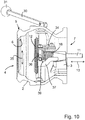
- a second embodiment of the connection fitting according to the invention according to the 8 to 11 basically has the same shape-defining components, namely the housing 1, the valve module 10 and the actuation module 29. Varying are the kinematics for moving the valve disk 12 and in particular the pivoting of the valve disk 12 about the axis of rotation 17. It is so far according to the second embodiment of the invention to the eccentric lever 19 and the add-on elements 20, 21, 22, 23 omitted. Rather, according to the second embodiment of the invention for influencing the pivotal movement of the valve disk 12 about the axis of rotation 17, a pin 36 is provided as a support member and a control link 37 as a guide element for the valve disk 12.
- the control link 37 is rotatably connected to the valve plate 12 and fixed to the valve plate 12 that together with the valve plate 12, the control link 37 is displaced both in the axial direction 13 and pivoted about the axis of rotation 17.
- the pin 36 is fixed in the housing 2 of the housing 1. On the housing wall 2 to a bore, not shown, in particular a blind hole is provided with a thread. Likewise, the pin 36 end has a thread, so that the pin 36 is screwed to the housing 2. Alternatively, any other way of fixing the pin 36 to the housing wall 2 may be provided.
- the pin 36 can be glued to the housing wall 2 and / or be connected to the housing wall 2 in a material-locking manner, for example via a weld and / or be cast on the housing 2.
- the pin shape is not mandatory for the support element.
- the pin 36 is assigned to the control link 37 so that the control link 37 in the closed position of the connection fitting after Fig. 9 is blocked with respect to a rotational movement about the rotation axis 17.
- the pin 36 passes into the effective range of a formed on the control cam 37 trough 39, so basically the pivotal movement of the valve disk 12 is released with the control cam 37 fixed thereto.
- valve disk 12 If the connection fitting is flowed through by the mineral oil from the first flow opening 4 in the direction of the second flow opening 7, the valve disk 12 is acted upon on the flat side opposite the control guide 37 and a pivoting movement of the valve disk 12 is not initiated due to the eccentric arrangement of the rotation axis 17.
- the valve disk 12 has a vertical orientation with respect to the axial direction 13 relative to its plane of extent 35.
- connection fitting flows through the second flow opening 7 in the direction of the first flow opening 4, due to the flow direction and the different size of the partial surfaces formed relative to the rotation axis 17 of the valve disk 12, a pivoting of the valve disk 12 about the rotation axis 17 results in that the plane of extent 35 is oriented substantially in the direction of the axial direction 13 and the connection fitting or the valve module 10 reaches the removal position.
- the pin 36 engages in this case in the formed on the control cam 37 trough 39 a.
- a pivoting movement of the valve disk 12 may be realized, for example, by a contact between the pin 36 and the control cam 37 in the region of the trough 39.
- connection fitting provides as described above, the set on the valve plate 12 control cam 37 and a pin 36, which with the control link 37 in the Closed position and / or in the filling position and / or in the removal position in an operative connection.
- the control link 37 is, as usual, displaceable together with the valve disk 12 in the axial direction 13 and pivotable about the axis of rotation 17.
- the pin 36 is not fixed directly to the housing 1. Rather, the pin 36 is fixed on the carrier 3 of the housing 1 via a pin carrier 38.
- the pin carrier 38 is designed, for example, in the manner of a sheet-metal forming part, and the pin 36 is detachably connected to the pin carrier 38 in a material-locking manner or via a screw connection (not shown).
- the trough 39 is formed on the control cam 37, so that in the removal position the pin 36 fixed to the pin carrier 38 is received in the region of the trough 39 and supported against the control cam 37.
- the geometry of the trough 39 is defined in the second and in the third embodiment of the connection fitting according to the invention so that when returning the valve module 10 from the removal position due to the longitudinal displacement in the axial direction 13, the control link 37 guided along the stationary pin 36 and the remindverschwenkung the valve disk 12 is introduced about the axis of rotation 17.
Landscapes
- Engineering & Computer Science (AREA)
- General Engineering & Computer Science (AREA)
- Mechanical Engineering (AREA)
- Health & Medical Sciences (AREA)
- Public Health (AREA)
- Transportation (AREA)
- Mechanically-Actuated Valves (AREA)
Abstract
Description
- Die Erfindung betrifft eine Anschlussarmatur für ein Mineralölfahrzeug mit einem Gehäuse umfassend eine Gehäusewandung und einen von der Gehäusewandung nach innen abragenden Träger, wobei an dem Gehäuse eine erste Durchflussöffnung für eine Flüssigkeit und eine zweite Durchflussöffnung für die Flüssigkeit vorgesehen ist, mit einem von der Gehäusewandung jedenfalls abschnittsweise umgriffenen und an dem Träger des Gehäuses gehaltenen Ventilmodul umfassend eine in einer Axialrichtung verschiebbar gehaltene Ventilstange und einen an der Ventilstange jedenfalls mittelbar gehaltenen Ventilträger, wobei in einer Schließstellung des Ventilmoduls die Ventilstange in einer ersten Axialposition vorgesehen ist und der Ventilteller die erste Durchflussöffnung verschließt, wobei in einer Befüllstellung des Ventilmoduls die Ventilstange in einer zweiten Axialposition vorgesehen ist und der Ventilteller beabstandet zur der ersten Durchflussöffnung vorgesehen ist zur Freigabe derselben und wobei die Axialrichtung in der Schließstellung und in der Befüllstellung senkrecht zu einer Erstreckungsebene des Ventiltellers orientiert angeordnet ist, und mit einem Betätigungsmodul, welches mit dem Ventilmodul in einer Wirkverbindung steht und ausgebildet ist zum Verbringen des Ventilmoduls in die Schließstellung und/oder in die Befüllstellung.
- Eine gattungsgemäße Anschlussarmatur wird heute üblicherweise an Mineralöltankfahrzeugen vorgesehen. In der Schließstellung des Ventilmoduls liegt der Ventilteller an einem Ventilsitz des Gehäuses an und verschließt die erste Durchflussöffnung der Anschlussarmatur in der Weise, dass in einem Tank des Mineralöltankfahrzeugs bevorratete Flüssigkeit nicht austreten kann. Zum Befüllen des Tanks wird die Anschlussarmatur extern kontaktiert und über ein externes Betätigungselement der Ventilteller der Anschlussarmatur mit der daran gehaltenen Ventilstange axial so verschoben, dass sich im Bereich der ersten Durchflussöffnung zwischen dem Ventilsitz und dem Ventilteller ein axialer Ringspalt für die Flüssigkeit bildet und über den axialen Ringspalt der Tank des Mineralöltankfahrzeugs befüllt werden kann. Die Anschlussarmatur befindet sich zum Entnehmen der Flüssigkeit aus dem Tank ebenfalls in der Befüllstellung. Die Befüllstellung wird hierbei jedoch nicht durch eine externe Druckbeaufschlagung des Ventiltellers, sondern durch eine Betätigung des Betätigungsmoduls eingestellt. Es wird hierbei zunächst ein Mineralölschlauch an die Anschlussarmatur angesetzt worden, sodass nach dem Freigeben der ersten Durchflussöffnung die im Mineralöltankfahrzeug bevorratet Flüssigkeit austreten kann.
- Obwohl sich die gattungsgemäße Anschlussarmatur in der Praxis grundsätzlich bewährt hat und weite Verbreitung findet, steht das Bestreben, den Strömungswiderstand insbesondere beim Entnehmen der Flüssigkeit aus dem Tank des Mineralöltankfahrzeugs zu reduzieren und so den Entnahmevorgang zu beschleunigen. Hierdurch kann es gelingen, die Standzeiten des Mineralöltankfahrzeugs bei der Entnahme der Flüssigkeit zu verkürzen und letztlich mehr Entnahmevorgänge in gleicher Zeit durchzuführen.
- Zur Lösung der Aufgabe ist die Erfindung in Verbindung mit dem Oberbegriff des Patentanspruchs 1 dadurch gekennzeichnet, dass der Ventilteller um eine Drehachse schwenkbar in Bezug zu der Ventilstange gehalten ist.
- Der besondere Vorteil der Erfindung besteht darin, dass durch die schwenkbare beziehungsweise klappbare Anordnung des Ventiltellers ein Strömungsquerschnitt für die Flüssigkeit vergrößert werden kann. Es ist insbesondere so, dass die Flüssigkeit nicht wie heute üblich durch den zwischen dem Ventilteller und dem Ventilsitz gebildeten Ringspalt fließt. Vielmehr kann der Ventilteller in Richtung der Strömung gekippt und hierdurch der Strömungsquerschnitt vergrößert werden. Durch den größeren Strömungsquerschnitt reduziert sich der Strömungswiderstand und es kann mehr Flüssigkeit pro Zeiteinheit durch die Anschlussarmatur durchströmen. Besonders relevant ist dies bei der Entnahme der Flüssigkeit an einer Tankstelle, da dieser Entnahmevorgang regelmäßig ohne Pumpenunterstützung erfolgt und insofern der Fließ- beziehungsweise Strömungswiderstand unmittelbar die Standzeit des Mineralöltankfahrzeugs beeinflusst.
- Kernidee der Erfindung ist es insofern, zusätzlich zu der Schließstellung und der Befüllstellung eine Entnahmestellung zu definieren, in der der Ventilteller strömungsgünstig angeordnet ist und ein Strömungswiderstand für die Flüssigkeit sich reduziert. In der durch die erfindungsgemäße Anschlussarmatur neu geschaffene Entnahmestellung ist der Ventilteller in Strömungsrichtung geschwenkt angeordnet mit der Folge, dass zwischen dem Ventilsitz und dem Ventilteller nicht wie heute üblich ein Ringspalt gebildet ist und die Flüssigkeit zum Durchströmen des Ringspalts umgelenkt werden muss. Vielmehr vergrößert sich der Durchflussquerschnitt durch die geschwenkte Anordnung des Ventiltellers. Zudem kann die erste Durchflussöffnung im Wesentlichen gerade angeströmt werden.
- Erhalten bleibt hierbei die gewohnte Funktion der Anschlussarmatur zum Schließen des Tanks und beim Befüllen des Tanks. In der Schließstellung ist der Ventilteller wie gewohnt dichtend an dem Ventilsitz des Gehäuses der Anschlussarmatur angelehnt. In der Befüllstellung, in der wie gehabt die axiale Betätigungsrichtung (Axialrichtung) des Ventilmoduls senkrecht zu der Erstreckungsebene des Ventiltellers orientiert ist, tritt die Flüssigkeit über die erste Durchflussöffnung in die Anschlussarmatur und strömt über den zwischen dem Ventilteller und dem Ventilsitz gebildeten Ringspalt in Richtung der zweiten Durchflussöffnung. Die Betätigung des Ventilmoduls erfolgt hierbei in gewohnter Weise von extern so, dass auf dem Ventilteller eine Kraft aufgeprägt wird und die Ventilstange mit dem daran gehaltenen Ventilteller aus dem Ventilsitz gedrückt und axial verschoben wird. Eine Modifikation externer Anschlusskomponenten für das Mineralöltankfahrzeug ist insofern nicht erforderlich. Die Weiterverwendung dieser externen Anschlusskomponenten ist gewährleistet.
- Nach einer bevorzugten Ausführungsform der Erfindung ist der Ventilteller exzentrisch an der Ventilstange derart gehalten, dass die Drehachse beabstandet zu einer in die Axialrichtung orientierten Mittelachse der Ventilstange vorgesehen ist. Durch die exzentrische Halterung des Ventiltellers in Bezug zu der Ventilstange kann die Verschwenkbewegung des Ventiltellers um die Drehachse beim Entnehmen bei Flüssigkeit in vorteilhafterweise passiv realisiert werden. Die gegen den Ventilteller strömende Flüssigkeit schwenkt den Ventilteller selbstständig um die Drehachse, da in Folge der exzentrischen Orientierung der Drehachse an dem Ventilteller die von der Flüssigkeit beaufschlagten Teilflächen beidseits der Drehachse unterschiedlich groß sind und folglich eine Schwenkbewegung selbstständig eingeleitet wird. Aktorische Komponenten beziehungsweise mechanische Betätigungsmittel zum Verschwenken des Ventiltellers sind nicht erforderlich. Die erfinderische Anschlussarmatur kann insofern kostengünstig hergestellt werden und ist aufgrund der rein mechanischen Ausbildung des Schwenkmechanismus robust.
- Nach einer Weiterbildung der Erfindung ist der Ventilteller in der Entnahmestellung bezogen auf die Orientierung desselben in der Schließstellung beziehungsweise in der Befüllstellung um 90° +/- 10° geschwenkt angeordnet. Dabei ist bei einer Verschwenkung des Ventiltellers um 90° die Axialrichtung in der Erstreckungsebene des Ventiltellers orientiert. Vorteilhaft erlaubt diese Orientierung des Ventiltellers in der Entnahmestellung einen besonders geringen Strömungswiderstand und infolgedessen eine geringe Standzeit für das Mineralöltankfahrzeug bei der Abgabe der Flüssigkeit.
- Nach einer Weiterbildung der Erfindung sind zur Realisierung der Schwenkbewegung des Ventiltellers in die Entnahmestellung ein Führungselement und ein mit dem Führungselement jedenfalls in der Schließstellung beziehungsweise in der Befüllstellung beziehungsweise in der Entnahmestellung in Wirkverbindung stehendes Stützelement vorgesehen. Hierbei ist entweder das Stützelement oder das Führungselement ortsfest bezogen auf das Gehäuse angeordnet. Das jeweils andere Element ist relativbeweglich zu dem ortsfesten Element vorgesehen. Sofern also das Stützelement ortsfest bezogen auf das Gehäuse vorgesehen ist, ist das Führungselement relativbeweglich zu dem Stützelement gehalten. Bevorzugt ist das Führungselement gemeinsam mit dem Ventilteller und/oder der Ventilstange verschiebbar in die Axialrichtung vorgesehen beziehungsweise um die Drehachse des Ventiltellers verschwenkbar. Sofern das Führungselement ortsfest bezogen auf das Gehäuse vorgesehen ist, ist das Stützelement relativbeweglich zu dem ortsfesten Führungselement gehalten. Beispielsweise kann als Führungselement eine an dem Gehäuse beziehungsweise der Gehäusewandung vorgesehen sein, in die das Stützelement eingreift. Vorteilhaft ergibt sich durch das Vorsehen des Führungselements und des Stützelements eine formschlüssige Führung beziehungsweise Arretierung des Ventiltellers jedenfalls in einer und bevorzugt einer Mehrzahl von Stellungen (Schließstellung, Befüllstellung, Entnahmestellung). Es ergibt sich hierdurch eine hohe Betriebssicherung und einer Fehlbedienung beziehungsweise -positionierung des Ventiltellers wird zuverlässig vorgebeugt.
- Nach einer Weiterbildung der Erfindung ist das Stützelement nach Art eines Stifts ausgebildet, welcher in dem Gehäuse beziehungsweise bezogen auf ebendieses ortsfest gehalten ist. Der Stift ist beispielsweise unmittelbar an der Gehäusewandung festgelegt oder mittelbar über einen Stiftträger an dem Gehäuse gehalten. Beispielsweise ist das Führungselement nach Art einer Steuerkulisse ausgebildet und bezogen auf das ortsfeste Stützelement verschiebbar gehalten. Das Führungselement ist beispielsweise drehfest an dem Ventilteller des Ventilmoduls festgelegt. Es ergibt sich durch die Gestaltung des Stützelements als Stift und das Vorsehen der Steuerkulisse eine konstruktiv einfache und im Betrieb äußerst robuste Ausführung der erfindungsgemäßen Anschlussarmatur, welche überdies kostengünstig herzustellen ist und eine lange Lebensdauer aufweist.
- Nach einer Weiterbildung der Erfindung sieht das Ventilmodul einen Exzenterhebel vor. Der Exzenterhebel ist zum einen in einem Gelenkpunkt drehbar und zugleich längsverschiebbar an dem Träger des Gehäuses beziehungsweise einem an dem Träger des Gehäuses angelegten Lagerelement gehalten. Zum anderen ist der Exzenterhebel bevorzugt endseitig um eine Schwenkachse drehbar und beabstandet zu der Drehachse des Ventiltellers an ebendiesem gehalten. Insbesondere kann dem Exzenterhebel eine Betätigungsfeder zugeordnet sein, welche in einer Wirkverbindung mit dem Exzenterhebel selbst und dem Träger des Gehäuses beziehungsweise dem Lagerelement steht derart, dass beim Verbringen des Ventilmoduls aus der Entnahmestellung in die Schließstellung der Ventilteller selbsttätig verschwenkt, bis die Erstreckungsebene des Ventiltellers senkrecht orientiert angeordnet ist zu der Axialrichtung. Es ergibt sich insofern durch das Vorsehen des Exzenterhebels eine kinematische Zwangsführung für den Ventilteller beim Schließen des Ventilmoduls. Die Zwangsführung stellt sicher, dass der Ventilteller beim Schließen nicht in der geschwenkten Orientierung an dem Ventilsitz angelehnt wird und eine Dichtung beschädigt oder zerstört wird.
- Das Vorsehen der Betätigungsfeder als elastisches Element bewirkt zugleich eine Freilauffunktion, welche es erlaubt, den Ventilteller in der zweiten Axialposition der Ventilstange bezogen auf die Erstreckungsebene des Ventiltellers in der Befüllstellung senkrecht zu der Axialrichtung vorzusehen und in der Entnahmestellung verschwenkt anzuordnen. In der Entnahmestellung ist die Betätigungsfeder insofern auf Druck vorgespannt, während sie in der Schließstellung und in der Befüllstellung unbelastet beziehungsweise spielbehaftet zwischen dem Exzenterhebel und dem Träger beziehungsweise dem Lagerelement vorgesehen ist.
- Zur Realisierung einer kinematisch vorteilhaften Gestaltung der erfindungsgemäßen Anschlussarmatur können die Schwenkachse des Exzenterhebels und die Drehachse des Ventiltellers zueinander parallel orientiert angeordnet sein. Insbesondere kann vorgesehen sein, dass die Schwenkachse und die Drehachse auf gegenüberliegenden Seiten der Mittelachse der Ventilstange vorzusehen. Jeweils können die Schwenkachse und die Drehachse in einer beliebigen Stellung des Ventilmoduls senkrecht orientiert zu der Mittelachse der Ventilstange vorgesehen sein.
- Nach einer Weiterbildung der Erfindung ist das Betätigungsmodul nach Art einer Handhabe ausgebildet. Die Handhabe umfasst ein schwenkbaren, handbetätigten Bedienhebel, eine mit dem Bedienhebel drehfest verbundene Welle, welche durch die Gehäusewandung geführt und gegen das Gehäuse gedichtet ist, sowie einen mit der Welle in Wirkverbindung stehenden Gelenkhebelmechanismus. Der Gelenkhebelmechanismus umfasst beispielsweise zwei gelenkig miteinander verbundene Hebel, welche an der Welle einerseits sowie der Ventilstange oder einem mit der Ventilstange verschiebbaren Element des Ventilmoduls andererseits festgelegt sind. Alternativ kann das Betätigungsmodul ein pneumatisches Betätigungsmittel, insbesondere eine Pneumatikzylinder vorsehen zum Betätigen des Ventilmoduls.
- Aus den weiteren Unteransprüchen und der nachfolgenden Beschreibung sind weitere Vorteile, Merkmale und Einzelheiten der Erfindung zu entnehmen. Dort erwähnte Merkmale können jeweils einzeln für sich oder auch in beliebiger Kombination erfindungswesentlich sein. Die Zeichnungen dienen lediglich beispielhaft der Klarstellung der Erfindung und haben keinen einschränkenden Charakter. Es zeigen:
- Fig. 1
- eine perspektivische Vorderseitenansicht einer ersten Ausführungsform der erfindungsgemäßen Anschlussarmatur in einer Entnahmestellung,
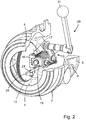
- Fig. 2
- einen Teilschnitt durch die Anschlussarmatur nach
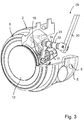
Fig. 1 , - Fig. 3
- die Anschlussarmatur nach
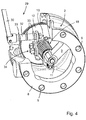
Fig. 2 in einer Schließstellung, - Fig. 4
- eine perspektivische Rückseitenansicht der Anschlussarmatur in der Schließstellung nach
Fig. 3 , - Fig. 5
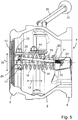
- einen Längsschnitt durch die Anschlussarmatur nach
Fig. 1 in der Schließstellung, - Fig. 6
- den Längsschnitt nach
Fig. 5 mit der Anschlussarmatur in der Entnahmestellung, - Fig. 7
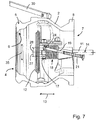
- den Längsschnitt nach den
Fig. 5 und6 mit der Anschlussarmatur in einer Befüllstellung, - Fig. 8
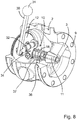
- eine perspektivische Rückseitenansicht der erfindungsgemäßen Anschlussarmatur nach einer zweiten Ausführungsform in einem Teilschnitt,
- Fig. 9
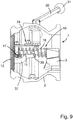
- einen Längsschnitt durch die Anschlussarmatur nach
Fig. 8 in der Schließstellung, - Fig. 10
- den Längsschnitt nach
Fig. 9 mit der Anschlussarmatur in der Befüllstellung, - Fig. 11
- eine perspektivische Vorderseitenansicht der Anschlussarmatur nach den
Fig. 8 bis 10 , wobei die Anschlussarmatur in der Entnahmestellung vorgesehen ist, - Fig. 12
- eine perspektivische Rückseitenansicht der erfindungsgemäßen Anschlussarmatur in einer dritten Ausführungsform,
- Fig. 13
- einen Längsschnitt durch die Anschlussarmatur nach
Fig. 12 in der Schließstellung, - Fig. 14
- den Längsschnitt nach
Fig. 13 mit der Anschlussarmatur in der Befüllstellung und - Fig. 15
- den Längsschnitt nach den
Fig. 13 und14 mit der Anschlussarmatur in der Entnahmestellung. - Eine erfindungsgemäße Anschlussarmatur für ein nicht dargestelltes Mineralöltankfahrzeug nach den
Fig. 1 bis 7 umfasst als wesentliche Komponenten ein Gehäuse 1, ein Ventilmodul 10 und ein Betätigungsmodul 29. - Das Gehäuse 1 sieht eine im Wesentlichen zylindrische beziehungsweise mantelseitig geschlossene Gehäusewandung 2 und einen von der Gehäusewandung 2 nach innen abragenden Träger 3 vor. Das Gehäuse 1 definiert im Bereich zweier sich gegenüberliegenden Stirnseiten eine erste Durchflussöffnung 4 für eine Flüssigkeit und eine zweite Durchflussöffnung 7 für die Flüssigkeit. Das Gehäuse 1 ist bevorzugt aus einem metallischen Werkstoff hergestellt und sieht einen der ersten Durchflussöffnung 4 zugeordneten, die erste Durchflussöffnung 4 ringförmig umgebenden ersten Flansch 5 sowie ein der zweiten Durchflussöffnung 7 zugeordneten zweiten Flansch 8 vor. An dem zweiten Flansch 8 ist eine Mehrzahl von zueinander beabstandeten Befestigungsbohrungen 9 vorgesehen, welche dazu dienen, die Anschlussarmatur insbesondere an dem Mineralöltankfahrzeug festzulegen.
- Das Ventilmodul 10 ist von der Gehäusewandung 2 des Gehäuses 1 mantelseitig jedenfalls abschnittsweise umgriffen. Das Ventilmodul 10 sieht eine an dem Träger 3 des Gehäuses gehaltene Ventilstange 11 und einen an der Ventilstange 11 gehaltenen Ventilteller 12 vor. Die Ventilstange 11 ist im Wesentlichen zylindrisch ausgebildet. Sie ist in eine Axialrichtung 13 längsverschiebbar gehalten. Der Ventilstange 11 ist hierbei eine Rückstellfeder 18 zugeordnet, welche die Ventilstange 11 umgreift und zwischen dem Träger 3 und dem Ventilteller 12 vorgesehen ist.
- Zur Befestigung des Ventiltellers 12 an der Ventilstange 11 ist ein Scharnier mit einem ersten, an der Ventilstange 11 festgelegten Scharnierelement 15 und einem an dem Ventilteller 12 festgelegten zweiten Scharnierelement 16 vorgesehen. In Bezug auf eine durch das Scharnier definiert Drehachse 17 ergibt sich so eine schwenkbare Anordnung des Ventiltellers 12 in Bezug zur Ventilstange 11. Die Drehachse 17 ist senkrecht zu der Axialrichtung 13 orientiert und beabstandet zu einer in die Axialrichtung 13 erstreckten Mittelachse 14 der Ventilstange 11. Durch die Beabstandung der Drehachse 17 von der Mittelachse 14 ist eine exzentrische Festlegung des Ventiltellers 12 an der Ventilstange 11 gebildet.
- Zusätzlich sieht das Ventilmodul 10 einen Exzenterhebel 19 vor, welcher in einem Gelenkpunkt drehbar und längsverschiebbar an einem mit dem Träger 3 des Gehäuses 1 verbundenen Lagerelement 20 einerseits und um eine Schwenkachse 24 drehbar an dem Ventilteller 12 andererseits gehalten ist. Die Schwenkachse 24 des Exzenterhebels 19 ist hierbei parallel zur Drehachse 17 des Ventiltellers 12 orientiert. Die Drehachse 17 und die Schwenkachse 24 sind jeweils senkrecht orientiert zur Axialrichtung 13 beziehungsweise zur Mittelachse 14 der Ventilstange 11.
- In einer Schließstellung der erfindungsgemäßen Anschlussarmatur ist der scheibenförmige Ventilteller 12, welcher in einer Erstreckungsebene 35 flach ausgebildet ist, gegen einen im Bereich der ersten Durchflussöffnung 4 an dem Gehäuse 1 gebildeten Ventilsitz 6 angelegt. Die Anlage des Ventiltellers 12 an dem Ventilsitz 6 ist in der Art realisiert, dass die erste Durchflussöffnung 4 geschlossen ist. Zur Herstellung der Anlage befindet sich die Ventilstange 11 des Ventilmoduls 10 in einer ersten Axialposition und die Erstreckungsebene 35 des Ventiltellers 12 ist senkrecht zur Axialrichtung 13 orientiert. Die Schwenkachse 24 und die Drehachse 17 befinden sich auf gegenüberliegenden Seiten der Mittelachse 14 der Ventilstange 11. Ein minimaler Abstand 27, 28 der Drehachse 17 und der Schwenkachse 24 zu der Mittelachse 14 der Ventilstange 11 ist im Wesentlichen gleich gebildet.
- Um einen Tank des die erfindungsgemäße Anschlussarmatur aufweisenden Mineralöltankfahrzeugs mit der Flüssigkeit zu befüllen, wird das Ventilmodul in die Befüllstellung verbracht. Hierzu wird die Ventilstange 11 mit dem daran festgelegten Ventilteller 12 axial verschoben in eine zweite Axialstellung. In der Befüllstellung ist zwischen dem Ventilsitz 6 und dem Ventilteller 12 ein Ringspalt für die Flüssigkeit gebildet. Die Flüssigkeit kann insofern über die erste Durchflussöffnung 4 in die Anschlussarmatur einströmen und gelangt über den Ringspalt zu der zweiten Durchflussöffnung 7 und von dort weiter in Richtung des Tanks des Mineralöltankfahrzeugs. In der Befüllstellung ist die Rückstellfeder 18 auf Druck vorgespannt.
- Die axiale Verschiebung der Ventilstange 11 mit dem daran angelegt Ventilteller 12 wird beim Befüllen des Tanks über eine externe Kraft eingeleitet, welche auf den Ventilteller 12 wirkt. Insbesondere wird der Ventilteller 12 auf einer der Ventilstange 11 gegenüberliegenden Flachseite mechanisch kontaktiert und gegen die Rückstellfeder 18 axial verschoben. Die Rückstellfeder 18 stützt sich dabei gegen das erste Scharnierelement 15 einerseits und eine in dem Träger 3 des Gehäuses 1 angelegtes Lagerelement 20 andererseits.
- In einer Entnahmestellung der erfindungsgemäßen Anschlussarmatur ist das Ventilmodul in der zweiten Axialposition vorgesehen. Der Ventilteller 12 ist hierbei jedoch um zumindest näherungsweise 90° bezogen auf die Schließstellung beziehungsweise die Befüllstellung geschwenkt angeordnet. Die Axialrichtung 13 der Ventilstange 11 ist in der Erstreckungsebene 35 des Ventiltellers 12 orientiert. Zum Entnehmen der Flüssigkeit aus dem Tank durchströmt diese zunächst die zweite Durchflussöffnung 7 und das Ventilmodul 10 und tritt über die erste Durchflussöffnung 4 aus der erfindungsgemäßen Anschlussarmatur aus. Aufgrund der geschwenkten Anordnung des Ventiltellers12 ist hierbei kein Ringspalt zwischen dem Ventilteller 12 und dem Ventilsitz 6 gebildet. Insofern strömt die Flüssigkeit entlang des in eine Strömungsrichtung gedrehten Ventiltellers 12 im Wesentlichen gradlinig durch die erfindungsgemäße Anschlussarmatur.
- Zum Verbringen der Anschlussarmatur in die Entnahmestellung bedarf es keiner externen, auf den Ventilteller aufgeprägten Kraft. Vielmehr wird das Ventilmodul über das Betätigungsmodul verstellt und zunächst durch eine Linearverschiebung die Ventilstange in die zweite Axialposition verbraucht. Um dann in die Entnahmestellung zu gelangen, bedarf es keiner aktiven Betätigung der erfindungsgemäßen Anschlussarmatur. Vielmehr erfolgt die Schwenkbewegung des Ventiltellers um die Drehachse 17 selbsttätig allein aufgrund der durch die Anschlussarmatur strömenden Flüssigkeit. Es ist so, dass aufgrund der exzentrischen Festlegung des Ventiltellers 12 eine der Ventilstange 11 des Ventilmoduls10 zugewandte Rückseite des Ventiltellers 12 in der ursprünglichen Orientierung (Befüllstellung) von der Flüssigkeit angeströmt wird und die Flüssigkeit selbst aufgrund der außermittigen Lage der Drehachse 17 an dem Ventilteller 12 die Schwenkbewegung um die Drehachse 17 einleitet. Mechanische Betätigungsmittel beziehungsweise Aktoren zum Verbringen des Ventilmoduls 10 in die Entnahmestellung sind daher nicht erforderlich.
- Um das Ventilmodul 10 nach der Entnahme der Flüssigkeit aus dem Tank des Mineralöltankfahrzeugs in die Schließstellung zu verbringen, wird die Ventilstange 11 von der zweiten Axialposition in Richtung der ersten Axialposition längsverschoben. Im Zuge der Verschiebung gelangt nach zirka einem Drittel des axialen Stellwegs eine den Exzenterhebels 19 umgreifend Betätigungsfeder 21 in Wirkverbindung mit dem Lagerelement 20. Infolge der Wirkverbindung zwischen der Betätigungsfeder 21 und dem Lagerelement 20 wird auf den Exzenterhebel 19 eine Zugbelastung aufgeprägt, welche dazu führt, dass der Ventilteller 12 um die Drehachse 17 zurückschwenkt. Zur Festlegung des Exzenterhebels 19 an dem Ventilteller 12 ist insofern der Exzenterhebel 19 L-förmig ausgebildet, wobei der Exzenterhebel 19 mit einem dem Ventilteller 12 zugewandten freien Ende desselben in ein an dem Ventilteller 12 außermittig festgelegtes Halteelement 25 eingreift. In Bezug auf das Halteelement 25 ist der Exzenterhebel 19 drehbar festgelegt. Eine Festlegung des Exzenterhebels 19 an dem Halteelement 25 erfolgt über einen Splint 26. Ebenfalls ist an dem Exzenterhebel 19 an einem dem Ventilteller 12 abgewandten freien Ende desselben ein weiterer Splint 23 vorgesehen. Gegen den Splint 23 ist eine Scheibe 22 und gegen die Scheibe 22 die Betätigungsfeder 21 angelegt, welche den Exzenterhebel 19 auf einer dem Ventilteller 12 abgewandten Seite des Lagerelements 20 umgreift. Die Betätigungsfeder 21 wird insofern zwischen dem Lagerelement 20 einerseits und der durch den Splint 23 gehaltenen Scheibe 22 andererseits auf Druck belastet.
- Aufgrund der speziellen Einbaulage kann die Betätigungsfeder 21 zwischen der Scheibe 22 und dem Lagerelement 20 auf Druck vorgespannt werden. Eine Zugbelastung der Betätigungsfeder 21 ist demgegenüber nicht vorgesehen. Insofern ist eine freie Verschiebung der Betätigungsfeder 21 an dem Exzenterhebel 19 vorgesehen für den Fall, dass die Ventilstange 11 in der zweiten Axialposition vorgesehen ist. Aufgrund der freien Anordnung der Betätigungsfeder 21 in der zweiten Axialposition ist der Exzenterhebel 19 in ebendieser sowohl in der Befüllstellung als auch in der Entnahmestellung unbelastet. Die Schwenkposition des Ventiltellers 12 ist dann alleine von der Strömungsrichtung der Flüssigkeit in der erfindungsgemäßen Anschlussarmatur definiert. Durchströmt die Flüssigkeit die Anschlussarmatur von der ersten Durchflussöffnung in Richtung der zweiten Durchflussöffnung, ist die Axialrichtung senkrecht zur Erstreckungsrichtung des Ventiltellers 12 orientiert und die Flüssigkeit wird in den Tank des Mineralöltankfahrzeugs gefördert. Bei der Entnahme der Flüssigkeit aus dem Tank durchströmt die Flüssigkeit die erfindungsgemäße Anschlussarmatur von der zweiten Durchflussöffnung 7 in Richtung der ersten Durchflussöffnung 4. Hierbei wird infolge der durchströmenden Flüssigkeit auf die Rückseite des Ventiltellers 12 aufgeprägten Kräfte der Ventilteller 12 verschwenkt. Die Rückstellung des Ventiltellers beim Schließen der Entnahmearmatur erfolgt dann über den Exzenterhebel 19 und die spezielle Anschlusskinematik desselben.
- Eine zweite Ausführungsform der erfindungsgemäßen Anschlussarmatur nach den
Fig. 8 bis 11 weist grundsätzlich die gleichen formbestimmenden Komponenten, nämlich das Gehäuse 1, das Ventilmodul 10 sowie das Betätigungsmodul 29 auf. Variiert sind die Kinematik zur Bewegung des Ventiltellers 12 und insbesondere die Verschwenkung des Ventiltellers 12 um die Drehachse 17. Es wird insofern nach der zweiten Ausführungsform der Erfindung auf den Exzenterhebel 19 sowie die Anbauelemente 20, 21, 22, 23 verzichtet. Vielmehr ist nach der zweiten Ausführungsform der Erfindung zur Beeinflussung der Schwenkbewegung des Ventiltellers 12 um die Drehachse 17 ein Stift 36 als Stützelement und eine Steuerkulisse 37 als Führungselement für den Ventilteller 12 vorgesehen. Die Steuerkulisse 37 ist drehfest mit dem Ventilteller 12 verbunden und so an dem Ventilteller 12 festgelegt, dass zusammen mit dem Ventilteller 12 die Steuerkulisse 37 sowohl in die Axialrichtung 13 verschoben als auch um die Drehachse 17 verschwenkt wird. Der Stift 36 ist in der Gehäusewandung 2 des Gehäuses 1 festgelegt. An der Gehäusewandung 2 ist dazu eine nicht dargestellte Bohrung, insbesondere eine Sacklochbohrung mit einem Gewinde vorgesehen. Ebenso verfügt der Stift 36 endseitig über ein Gewinde, sodass der Stift 36 mit der Gehäusewandung 2 verschraubt ist. Alternativ kann eine beliebige andere Art zur Festlegung des Stifts 36 an der Gehäusewandung 2 vorgesehen sein. Beispielsweise kann der Stift 36 mit der Gehäusewandung 2 verklebt und/oder stoffschlüssig mit der Gehäusewandung 2 verbunden sein, beispielsweise über eine Schweißung und/oder an der Gehäusewandung 2 angegossen sein. Die Stiftform ist hierbei für das Stützelement nicht zwingend. - Der Stift 36 ist der Steuerkulisse 37 so zugeordnet, dass die Steuerkulisse 37 in der Schließstellung der Anschlussarmatur nach
Fig. 9 in Bezug auf eine Drehbewegung um die Drehachse 17 blockiert ist. Wird nun das Ventilmodul 10 durch Verschieben der Ventilstange 11 mit dem daran festgelegten Ventilteller 12 in die Axialrichtung 13 aus der Schließstellung in die Entnahmestellung nachFig. 11 verbracht, gelangt der Stift 36 in den Wirkbereich einer an der Steuerkulisse 37 ausgebildeten Mulde 39, sodass grundsätzlich die Schwenkbewegung des Ventiltellers 12 mit der daran festgelegten Steuerkulisse 37 freigegeben ist. - Sofern die Anschlussarmatur von der ersten Durchflussöffnung 4 in Richtung der zweiten Durchflussöffnung 7 von dem Mineralöl durchflossen wird, wird der Ventilteller 12 auf der der Steuerkulisse 37 gegenüberliegenden Flachseite beaufschlagt und infolge der exzentrischen Anordnung der Drehachse 17 eine Schwenkbewegung des Ventiltellers 12 nicht eingeleitet. Der Ventilteller 12 hat insofern bezogen auf seine Erstreckungsebene 35 eine senkrechte Orientierung zur Axialrichtung 13.
- Wird demgegenüber die Anschlussarmatur von der zweiten Durchflussöffnung 7 in Richtung der ersten Durchflussöffnung 4 durchströmt, resultiert aufgrund der Strömungsrichtung und der unterschiedlichen Größe der bezogen auf die Drehachse 17 des Ventiltellers 12 an ebendiesem gebildeten Teilflächen eine Verschwenkung des Ventiltellers 12 um die Drehachse 17 mit der Folge, dass die Erstreckungsebene 35 sich im Wesentlichen in Richtung der Axialrichtung 13 orientiert und die Anschlussarmatur beziehungsweise das Ventilmodul 10 in die Entnahmestellung gelangt. Der Stift 36 greift hierbei in die an der Steuerkulisse 37 gebildete Mulde 39 ein. Eine Schwenkbewegung des Ventiltellers 12 kann beispielsweise durch eine Berührung zwischen dem Stift 36 und der Steuerkulisse 37 im Bereich der Mulde 39 realisiert sein.
- Die
Fig. 12 bis 15 zeigen eine dritte Ausführungsform der erfindungsgemäßen Anschlussarmatur. Nach der dritten Ausführungsform der Erfindung sieht die Anschlussarmatur wie vorstehend beschrieben die an dem Ventilteller 12 festgelegte Steuerkulisse 37 und einen Stift 36 vor, welcher mit der Steuerkulisse 37 in der Schließstellung und/oder in der Befüllstellung und/oder in der Entnahmestellung in einer Wirkverbindung steht. Die Steuerkulisse 37 ist wie gehabt zusammen mit dem Ventilteller 12 in die Axialrichtung 13 verschiebbar und um die Drehachse 17 verschwenkbar. Der Stift 36 ist jedoch nicht unmittelbar an dem Gehäuse 1 festgelegt. Vielmehr ist der Stift 36 über einen Stiftträger 38 an dem Träger 3 des Gehäuses 1 festgelegt. Der Stiftträger 38 ist beispielsweise nach Art eines Blechumformteils gestaltet und der Stift 36 mit dem Stiftträger 38 stoffschlüssig beziehungsweise über eine nicht dargestellte Verschraubung lösbar verbunden. An der Steuerkulisse 37 ist wie vorstehend beschrieben die Mulde 39 ausgebildet, sodass in der Entnahmestellung der an dem Stiftträger 38 festgelegte Stift 36 im Bereich der Mulde 39 aufgenommen und gegen die Steuerkulisse 37 abgestützt ist. - Die Geometrie der Mulde 39 ist in der zweiten und in der dritten Ausführungsform der erfindungsgemäßen Anschlussarmatur dabei so festgelegt, dass bei der Rückverbringung des Ventilmoduls 10 aus der Entnahmestellung infolge der Längsverschiebung in die Axialrichtung 13 die Steuerkulisse 37 an dem ortsfesten Stift 36 entlanggeführt und die Rückverschwenkung des Ventiltellers 12 um die Drehachse 17 eingeleitet wird.
- Gleiche Bauteile und Bauteilfunktionen sind durch gleiche Bezugszeichen gekennzeichnet.
Claims (15)
- Anschlussarmatur für ein Mineralöltankfahrzeug mit einem Gehäuse (1) umfassend eine Gehäusewandung (2) und einen von der Gehäusewandung (2) nach innen abragenden Träger (3), wobei an dem Gehäuse (1) eine erste Durchflussöffnung (4) für eine Flüssigkeit und eine zweite Durchflussöffnung (7) für die Flüssigkeit vorgesehen ist, mit einem von der Gehäusewandung (2) jedenfalls abschnittsweise umgriffenen und an dem Träger (3) des Gehäuses (2) gehaltenen Ventilmodul (10) umfassend eine in einer Axialrichtung (13) verschiebbar gehaltene Ventilstange (11) und einen an der Ventilstange (11) jedenfalls mittelbar gehaltenen Ventilträger, wobei in einer Schließstellung des Ventilmoduls (10) die Ventilstange (11) in einer ersten Axialposition vorgesehen ist und der Ventilteller (12) die erste Durchflussöffnung (4) verschließt, wobei in einer Befüllstellung des Ventilmoduls (10) die Ventilstange (11) in einer zweiten Axialposition vorgesehen ist und der Ventilteller (12) beabstandet zur der ersten Durchflussöffnung (4) vorgesehen ist zur Freigabe derselben und wobei die Axialrichtung (13) in der Schließstellung und in der Befüllstellung senkrecht zu einer Erstreckungsebene (35) des Ventiltellers (12) orientiert angeordnet ist, und mit einem Betätigungsmodul, welches mit dem Ventilmodul (10) in einer Wirkverbindung steht und ausgebildet ist zum Verbringen des Ventilmoduls (10) in die Schließstellung und/oder in die Befüllstellung, dadurch gekennzeichnet, dass der Ventilteller (12) um eine Drehachse (17) schwenkbar in Bezug zu der Ventilstange (11) gehalten ist.
- Anschlussarmatur nach Anspruch 1, dadurch gekennzeichnet, dass die Drehachse (17) des Ventiltellers (12) senkrecht zu der Axialrichtung (13) orientiert ist, in die die Ventilstange (11) längsverschiebbar gehalten ist.
- Anschlussarmatur nach Anspruch 1 oder 2, dadurch gekennzeichnet, dass der Ventilteller (12) exzentrisch an der Ventilstange (11) gehalten ist derart, dass die Drehachse (17) beabstandet zu einer in die Axialrichtung (13) orientierten Mittelachse der Ventilstange (11) vorgesehen ist.
- Anschlussarmatur nach einem der Ansprüche 1 bis 3, dadurch gekennzeichnet, dass der Ventilteller (12) in einer Entnahmestellung des Ventilmoduls (10) beabstandet zu der ersten Durchflussöffnung (4) vorgesehen ist und diese freigibt, wobei in der Entnahmestellung die Ventilstange (11) in der zweiten Axialposition angeordnet ist und zwischen der Axialrichtung (13) und der Erstreckungsebene (35) des Ventiltellers (12) in der Entnahmestellung einen Winkel von weniger als 90° und bevorzugt ein Winkel von 10° oder weniger ausgebildet ist, und/oder dass die Axialrichtung (13) in der Befüllstellung des Ventilmoduls (10) in der Erstreckungsebene (35) des Ventiltellers (12) orientiert ist.
- Anschlussarmatur nach einem der Ansprüche 1 bis 4, dadurch gekennzeichnet, dass in der Entnahmestellung die Drehachse (17) des Ventiltellers (12) der Erstreckungsebene (35) derart zugeordnet ist, dass an einer der Ventilstange (11) gewandten Rückseite des Ventiltellers (12) beidseits der Drehachse (17) zwei unterschiedlich große Teilflächen gebildet sind derart, dass bei einer Durchströmung der Anschlussarmatur von der zweiten Durchflussöffnung (7) in Richtung der ersten Durchflussöffnung (4) aufgrund der Strömungsrichtung und der unterschiedlichen Größe der Teilflächen eine Verschwenkung des Ventiltellers (12) um die Drehachse (17) eingeleitet wird.
- Anschlussarmatur nach einem der Ansprüche 1 bis 5, dadurch gekennzeichnet, dass zur Beeinflussung der Schwenkbewegung des Ventiltellers (12) um die Drehachse (17) ein Führungselement und ein mit dem Führungselement in der Schließstellung und/oder in der Befüllstellung und/oder in der Entnahmestellung in Wirkverbindung stehendes Stützelement vorgesehen sind, wobei entweder das Stützelement oder das Führungselement ortsfest bezogen auf das Gehäuse (1) vorgesehen ist und wobei das jeweils andere Element relativbeweglich zu dem ortsfesten Element gehalten ist.
- Anschlussarmatur nach Anspruch 6, dadurch gekennzeichnet, dass als Stützelement ein Stift (36) vorgesehen ist, welcher ortsfest unmittelbar an der Gehäusewandung (2) oder jedenfalls mittelbar an dem Träger (3) des Gehäuses (1) gehalten ist.
- Anschlussarmatur nach Anspruch 6 oder 7, dadurch gekennzeichnet, dass das Führungselement drehfest an dem Ventilteller (12) festgelegt ist und/oder dass das Führungselement nach Art einer Steuerkulisse (37) ausgebildet ist.
- Anschlussarmatur nach einem der Ansprüche 1 bis 5, dadurch gekennzeichnet, dass das Ventilmodul (10) einen Exzenterhebel (19) vorsieht, wobei der Exzenterhebel (19) in einem Gelenkpunkt drehbar und längsverschiebbar an dem Träger (3) des Gehäuses (1) und/oder ein mit dem Träger (3) des Gehäuses (1) verbundenes Lagerelement (20) gehalten ist und wobei der Exzenterhebel (19) zudem um eine Schwenkachse (24) drehbar und beabstandet zu der Drehachse (17) des Ventiltellers (12) an ebendiesem gehalten ist.
- Anschlussarmatur nach Anspruch 9, dadurch gekennzeichnet, dass dem Exzenterhebel (19) eine Betätigungsfeder (21) zugeordnet ist derart, dass beim Verbringen des Ventilmoduls (10) aus der Entnahmestellung in die Schließstellung der Ventilteller (12) selbsttätig verschwenkt bis die Erstreckungsebene (35) des Ventiltellers senkrecht orientiert angeordnet ist zu der Axialrichtung (13).
- Anschlussarmatur nach Anspruch 9 oder 10 dadurch gekennzeichnet, dass die Schwenkachse (24) des Exzenterhebels (19) parallel orientiert ist zur Drehachse (17) des Ventiltellers (12) und/oder dass die Schwenkachse (24) des Exzenterhebels (19) senkrecht orientiert ist zu der Mittelachse (14) der Ventilstange (11).
- Anschlussarmatur nach einem der Ansprüche 9 bis 11, dadurch gekennzeichnet, dass ein minimaler Abstand (28) der Schwenkachse (24) von der Mittelachse (14) der Ventilstange (11) einem minimalen Abstand (27) der Drehachse (17) des Ventiltellers (12) von der Mittelachse (14) entspricht und/oder dass der minimaler Abstand (28) der Schwenkachse (24) von der Mittelachse (14) größer ist als der minimale Abstand (27) der Drehachse (17) von der Mittelachse (14).
- Anschlussarmatur nach einem der Ansprüche 9 bis 12, dadurch gekennzeichnet, dass die Drehachse (17) des Ventiltellers (12) und die Schwenkachse (24) des Exzenterhebels (19) in der Schließstellung und in der Befüllstellung auf gegenüberliegenden Seiten der Mittelachse (14) der Ventilstange (11) vorgesehen sind.
- Anschlussarmatur nach einem der Ansprüche 9 bis 13, dadurch gekennzeichnet, dass die Drehachse (17) und die Schwenkachse (24) in der Erstreckungsstellung (35) des Ventiltellers (12) orientiert sind.
- Anschlussarmatur nach einem der Ansprüche 1 bis 14, dadurch gekennzeichnet, dass das Betätigungsmodul nach Art einer Handhabe ausgebildet ist mit einem schwenkbaren Bedienhebel (30), einer mit dem Bedienhebel drehfest verbundenen Welle (32), welche durch die Gehäusewandung (2) geführt und gedichtet ist, und mit einem mit der Welle (32) in Wirkverbindung stehenden Gelenkhebelmechanismus (34), welcher ausgebildet ist zum Umsetzen der Drehbewegung der Welle in eine lineare Stellbewegung der Ventilstange (11) in die Axialrichtung (13).
Applications Claiming Priority (1)
| Application Number | Priority Date | Filing Date | Title |
|---|---|---|---|
| DE202016101873.0U DE202016101873U1 (de) | 2016-04-08 | 2016-04-08 | Anschlussarmatur für ein Mineralölfahrzeug |
Publications (2)
| Publication Number | Publication Date |
|---|---|
| EP3232103A1 true EP3232103A1 (de) | 2017-10-18 |
| EP3232103B1 EP3232103B1 (de) | 2020-02-19 |
Family
ID=56552156
Family Applications (1)
| Application Number | Title | Priority Date | Filing Date |
|---|---|---|---|
| EP17163232.6A Active EP3232103B1 (de) | 2016-04-08 | 2017-03-28 | Anschlussarmatur für ein mineralölfahrzeug |
Country Status (3)
| Country | Link |
|---|---|
| EP (1) | EP3232103B1 (de) |
| DE (1) | DE202016101873U1 (de) |
| ES (1) | ES2778440T3 (de) |
Families Citing this family (1)
| Publication number | Priority date | Publication date | Assignee | Title |
|---|---|---|---|---|
| FR3080149B1 (fr) * | 2018-04-13 | 2020-09-04 | Safran Aircraft Engines | Dispositif de prelevement d'air pour un moteur d'aeronef |
Citations (4)
| Publication number | Priority date | Publication date | Assignee | Title |
|---|---|---|---|---|
| FR1199122A (fr) * | 1958-12-15 | 1959-12-11 | Vanne étanche à opercule oscillant | |
| EP2058566A1 (de) * | 2006-08-11 | 2009-05-13 | Nippon Valqua Industries, Ltd. | Ventilvorrichtung |
| EP2264342A2 (de) * | 2009-06-11 | 2010-12-22 | Hsr Ag | Plattenventil |
| WO2012111910A1 (ko) * | 2011-02-18 | 2012-08-23 | (주)덕원기전 | 다중 시트를 이용한 양압 밀폐용 삼차 편심 버터플라이 밸브 |
Family Cites Families (1)
| Publication number | Priority date | Publication date | Assignee | Title |
|---|---|---|---|---|
| JP3201573U (ja) * | 2015-10-05 | 2015-12-17 | イハラサイエンス株式会社 | バルブ |
-
2016
- 2016-04-08 DE DE202016101873.0U patent/DE202016101873U1/de not_active Expired - Lifetime
-
2017
- 2017-03-28 EP EP17163232.6A patent/EP3232103B1/de active Active
- 2017-03-28 ES ES17163232T patent/ES2778440T3/es active Active
Patent Citations (4)
| Publication number | Priority date | Publication date | Assignee | Title |
|---|---|---|---|---|
| FR1199122A (fr) * | 1958-12-15 | 1959-12-11 | Vanne étanche à opercule oscillant | |
| EP2058566A1 (de) * | 2006-08-11 | 2009-05-13 | Nippon Valqua Industries, Ltd. | Ventilvorrichtung |
| EP2264342A2 (de) * | 2009-06-11 | 2010-12-22 | Hsr Ag | Plattenventil |
| WO2012111910A1 (ko) * | 2011-02-18 | 2012-08-23 | (주)덕원기전 | 다중 시트를 이용한 양압 밀폐용 삼차 편심 버터플라이 밸브 |
Also Published As
| Publication number | Publication date |
|---|---|
| ES2778440T3 (es) | 2020-08-10 |
| DE202016101873U1 (de) | 2016-07-12 |
| EP3232103B1 (de) | 2020-02-19 |
Similar Documents
| Publication | Publication Date | Title |
|---|---|---|
| DE112015001153B4 (de) | Schnellkopplungsvorrichtung | |
| DE1803417C3 (de) | Zug- und Stoßvorrichtung für Eisenbahnwagen | |
| DE2810446C2 (de) | Kugelhahn | |
| EP2640600B1 (de) | Verstellvorrichtung eines fahrzeugsitzes mit einer selbstverstellbremse | |
| DE2505358A1 (de) | Arbeits- und verstrebungszylinder | |
| DE3411054C2 (de) | ||
| DE102014111344A1 (de) | Spannvorrichtung | |
| DE102006061017B4 (de) | Stellgerät und Verfahren zum Einstellen eines maximalen Verlagerungswegs einer Antriebsstange eines Stellantriebs des Stellgeräts | |
| DE2402542A1 (de) | Bremsvorrichtung fuer fahrzeuge, insbesondere lastkraftwagen und busse | |
| DE102008051679A1 (de) | Pneumatischer Bremszylinder | |
| DE1912086B2 (de) | GestängenachsteUeinrichtung für das Bremsgestänge eines Eisenbahnwagens | |
| EP3807012B1 (de) | Zentrifuge | |
| EP1905545B1 (de) | Federspanner für Schraubenfedern | |
| EP3232103B1 (de) | Anschlussarmatur für ein mineralölfahrzeug | |
| DE102019121860A1 (de) | Spannvorrichtung | |
| DE10147981A1 (de) | Verbindungselement zur Verbindung eines Kolbens mit einem Rückstellelement | |
| EP1613865B1 (de) | Dreh- oder schwenkvorrichtung und anschlussmodul für eine dreh- oder schwenkvorrichtung | |
| EP3623267B9 (de) | Vorrichtung zum verstellen eines ersten bauteils und eines zweiten bauteils eines personen- und/oder gütertransportmittels relativ zueinander, sowie personen- und/oder gütertransportmittel mit einer derartigen vorrichtung | |
| EP3429901B1 (de) | Kupplungssystem mit pneumatischer auslenkung | |
| DE3232322A1 (de) | Hydraulische kettenspannvorrichtung | |
| DE10058275A1 (de) | Kraftfahrzeugservolenkung | |
| DE2730135A1 (de) | Kraftverstaerktes zahnstangen-lenkgetriebe | |
| DE3233412C2 (de) | Federkraftantrieb für einen elektrischen Hochspannungsschalter | |
| DE102014004844A1 (de) | Kulissenscheibe für einen modular aufgebauten Sicherheitsfahrschalter | |
| DE2400470C3 (de) | Selbsttätige Nachstellvorrichtung für eine Teilbelagscheibenbremse |
Legal Events
| Date | Code | Title | Description |
|---|---|---|---|
| PUAI | Public reference made under article 153(3) epc to a published international application that has entered the european phase |
Free format text: ORIGINAL CODE: 0009012 |
|
| STAA | Information on the status of an ep patent application or granted ep patent |
Free format text: STATUS: THE APPLICATION HAS BEEN PUBLISHED |
|
| AK | Designated contracting states |
Kind code of ref document: A1 Designated state(s): AL AT BE BG CH CY CZ DE DK EE ES FI FR GB GR HR HU IE IS IT LI LT LU LV MC MK MT NL NO PL PT RO RS SE SI SK SM TR |
|
| AX | Request for extension of the european patent |
Extension state: BA ME |
|
| STAA | Information on the status of an ep patent application or granted ep patent |
Free format text: STATUS: REQUEST FOR EXAMINATION WAS MADE |
|
| 17P | Request for examination filed |
Effective date: 20171129 |
|
| RBV | Designated contracting states (corrected) |
Designated state(s): AL AT BE BG CH CY CZ DE DK EE ES FI FR GB GR HR HU IE IS IT LI LT LU LV MC MK MT NL NO PL PT RO RS SE SI SK SM TR |
|
| GRAP | Despatch of communication of intention to grant a patent |
Free format text: ORIGINAL CODE: EPIDOSNIGR1 |
|
| STAA | Information on the status of an ep patent application or granted ep patent |
Free format text: STATUS: GRANT OF PATENT IS INTENDED |
|
| INTG | Intention to grant announced |
Effective date: 20191025 |
|
| GRAS | Grant fee paid |
Free format text: ORIGINAL CODE: EPIDOSNIGR3 |
|
| GRAA | (expected) grant |
Free format text: ORIGINAL CODE: 0009210 |
|
| STAA | Information on the status of an ep patent application or granted ep patent |
Free format text: STATUS: THE PATENT HAS BEEN GRANTED |
|
| AK | Designated contracting states |
Kind code of ref document: B1 Designated state(s): AL AT BE BG CH CY CZ DE DK EE ES FI FR GB GR HR HU IE IS IT LI LT LU LV MC MK MT NL NO PL PT RO RS SE SI SK SM TR |
|
| REG | Reference to a national code |
Ref country code: CH Ref legal event code: EP |
|
| REG | Reference to a national code |
Ref country code: DE Ref legal event code: R096 Ref document number: 502017003825 Country of ref document: DE |
|
| REG | Reference to a national code |
Ref country code: AT Ref legal event code: REF Ref document number: 1235359 Country of ref document: AT Kind code of ref document: T Effective date: 20200315 |
|
| REG | Reference to a national code |
Ref country code: IE Ref legal event code: FG4D Free format text: LANGUAGE OF EP DOCUMENT: GERMAN |
|
| REG | Reference to a national code |
Ref country code: SE Ref legal event code: TRGR |
|
| REG | Reference to a national code |
Ref country code: GR Ref legal event code: EP Ref document number: 20200401291 Country of ref document: GR Effective date: 20200716 |
|
| REG | Reference to a national code |
Ref country code: NL Ref legal event code: MP Effective date: 20200219 |
|
| PG25 | Lapsed in a contracting state [announced via postgrant information from national office to epo] |
Ref country code: NO Free format text: LAPSE BECAUSE OF FAILURE TO SUBMIT A TRANSLATION OF THE DESCRIPTION OR TO PAY THE FEE WITHIN THE PRESCRIBED TIME-LIMIT Effective date: 20200519 Ref country code: FI Free format text: LAPSE BECAUSE OF FAILURE TO SUBMIT A TRANSLATION OF THE DESCRIPTION OR TO PAY THE FEE WITHIN THE PRESCRIBED TIME-LIMIT Effective date: 20200219 Ref country code: RS Free format text: LAPSE BECAUSE OF FAILURE TO SUBMIT A TRANSLATION OF THE DESCRIPTION OR TO PAY THE FEE WITHIN THE PRESCRIBED TIME-LIMIT Effective date: 20200219 |
|
| REG | Reference to a national code |
Ref country code: ES Ref legal event code: FG2A Ref document number: 2778440 Country of ref document: ES Kind code of ref document: T3 Effective date: 20200810 |
|
| REG | Reference to a national code |
Ref country code: LT Ref legal event code: MG4D |
|
| PG25 | Lapsed in a contracting state [announced via postgrant information from national office to epo] |
Ref country code: IS Free format text: LAPSE BECAUSE OF FAILURE TO SUBMIT A TRANSLATION OF THE DESCRIPTION OR TO PAY THE FEE WITHIN THE PRESCRIBED TIME-LIMIT Effective date: 20200619 Ref country code: LV Free format text: LAPSE BECAUSE OF FAILURE TO SUBMIT A TRANSLATION OF THE DESCRIPTION OR TO PAY THE FEE WITHIN THE PRESCRIBED TIME-LIMIT Effective date: 20200219 Ref country code: HR Free format text: LAPSE BECAUSE OF FAILURE TO SUBMIT A TRANSLATION OF THE DESCRIPTION OR TO PAY THE FEE WITHIN THE PRESCRIBED TIME-LIMIT Effective date: 20200219 Ref country code: BG Free format text: LAPSE BECAUSE OF FAILURE TO SUBMIT A TRANSLATION OF THE DESCRIPTION OR TO PAY THE FEE WITHIN THE PRESCRIBED TIME-LIMIT Effective date: 20200519 |
|
| PG25 | Lapsed in a contracting state [announced via postgrant information from national office to epo] |
Ref country code: NL Free format text: LAPSE BECAUSE OF FAILURE TO SUBMIT A TRANSLATION OF THE DESCRIPTION OR TO PAY THE FEE WITHIN THE PRESCRIBED TIME-LIMIT Effective date: 20200219 |
|
| PG25 | Lapsed in a contracting state [announced via postgrant information from national office to epo] |
Ref country code: SM Free format text: LAPSE BECAUSE OF FAILURE TO SUBMIT A TRANSLATION OF THE DESCRIPTION OR TO PAY THE FEE WITHIN THE PRESCRIBED TIME-LIMIT Effective date: 20200219 Ref country code: EE Free format text: LAPSE BECAUSE OF FAILURE TO SUBMIT A TRANSLATION OF THE DESCRIPTION OR TO PAY THE FEE WITHIN THE PRESCRIBED TIME-LIMIT Effective date: 20200219 Ref country code: SK Free format text: LAPSE BECAUSE OF FAILURE TO SUBMIT A TRANSLATION OF THE DESCRIPTION OR TO PAY THE FEE WITHIN THE PRESCRIBED TIME-LIMIT Effective date: 20200219 Ref country code: RO Free format text: LAPSE BECAUSE OF FAILURE TO SUBMIT A TRANSLATION OF THE DESCRIPTION OR TO PAY THE FEE WITHIN THE PRESCRIBED TIME-LIMIT Effective date: 20200219 Ref country code: LT Free format text: LAPSE BECAUSE OF FAILURE TO SUBMIT A TRANSLATION OF THE DESCRIPTION OR TO PAY THE FEE WITHIN THE PRESCRIBED TIME-LIMIT Effective date: 20200219 Ref country code: DK Free format text: LAPSE BECAUSE OF FAILURE TO SUBMIT A TRANSLATION OF THE DESCRIPTION OR TO PAY THE FEE WITHIN THE PRESCRIBED TIME-LIMIT Effective date: 20200219 Ref country code: PT Free format text: LAPSE BECAUSE OF FAILURE TO SUBMIT A TRANSLATION OF THE DESCRIPTION OR TO PAY THE FEE WITHIN THE PRESCRIBED TIME-LIMIT Effective date: 20200712 |
|
| REG | Reference to a national code |
Ref country code: CH Ref legal event code: PL |
|
| REG | Reference to a national code |
Ref country code: DE Ref legal event code: R097 Ref document number: 502017003825 Country of ref document: DE |
|
| PG25 | Lapsed in a contracting state [announced via postgrant information from national office to epo] |
Ref country code: MC Free format text: LAPSE BECAUSE OF FAILURE TO SUBMIT A TRANSLATION OF THE DESCRIPTION OR TO PAY THE FEE WITHIN THE PRESCRIBED TIME-LIMIT Effective date: 20200219 |
|
| REG | Reference to a national code |
Ref country code: BE Ref legal event code: MM Effective date: 20200331 |
|
| PLBE | No opposition filed within time limit |
Free format text: ORIGINAL CODE: 0009261 |
|
| STAA | Information on the status of an ep patent application or granted ep patent |
Free format text: STATUS: NO OPPOSITION FILED WITHIN TIME LIMIT |
|
| PG25 | Lapsed in a contracting state [announced via postgrant information from national office to epo] |
Ref country code: LU Free format text: LAPSE BECAUSE OF NON-PAYMENT OF DUE FEES Effective date: 20200328 |
|
| 26N | No opposition filed |
Effective date: 20201120 |
|
| PG25 | Lapsed in a contracting state [announced via postgrant information from national office to epo] |
Ref country code: CH Free format text: LAPSE BECAUSE OF NON-PAYMENT OF DUE FEES Effective date: 20200331 Ref country code: IE Free format text: LAPSE BECAUSE OF NON-PAYMENT OF DUE FEES Effective date: 20200328 Ref country code: LI Free format text: LAPSE BECAUSE OF NON-PAYMENT OF DUE FEES Effective date: 20200331 |
|
| PG25 | Lapsed in a contracting state [announced via postgrant information from national office to epo] |
Ref country code: SI Free format text: LAPSE BECAUSE OF FAILURE TO SUBMIT A TRANSLATION OF THE DESCRIPTION OR TO PAY THE FEE WITHIN THE PRESCRIBED TIME-LIMIT Effective date: 20200219 Ref country code: BE Free format text: LAPSE BECAUSE OF NON-PAYMENT OF DUE FEES Effective date: 20200331 Ref country code: PL Free format text: LAPSE BECAUSE OF FAILURE TO SUBMIT A TRANSLATION OF THE DESCRIPTION OR TO PAY THE FEE WITHIN THE PRESCRIBED TIME-LIMIT Effective date: 20200219 |
|
| PG25 | Lapsed in a contracting state [announced via postgrant information from national office to epo] |
Ref country code: MT Free format text: LAPSE BECAUSE OF FAILURE TO SUBMIT A TRANSLATION OF THE DESCRIPTION OR TO PAY THE FEE WITHIN THE PRESCRIBED TIME-LIMIT Effective date: 20200219 Ref country code: CY Free format text: LAPSE BECAUSE OF FAILURE TO SUBMIT A TRANSLATION OF THE DESCRIPTION OR TO PAY THE FEE WITHIN THE PRESCRIBED TIME-LIMIT Effective date: 20200219 |
|
| PGFP | Annual fee paid to national office [announced via postgrant information from national office to epo] |
Ref country code: SE Payment date: 20220324 Year of fee payment: 6 Ref country code: CZ Payment date: 20220324 Year of fee payment: 6 |
|
| PG25 | Lapsed in a contracting state [announced via postgrant information from national office to epo] |
Ref country code: MK Free format text: LAPSE BECAUSE OF FAILURE TO SUBMIT A TRANSLATION OF THE DESCRIPTION OR TO PAY THE FEE WITHIN THE PRESCRIBED TIME-LIMIT Effective date: 20200219 Ref country code: AL Free format text: LAPSE BECAUSE OF FAILURE TO SUBMIT A TRANSLATION OF THE DESCRIPTION OR TO PAY THE FEE WITHIN THE PRESCRIBED TIME-LIMIT Effective date: 20200219 |
|
| REG | Reference to a national code |
Ref country code: AT Ref legal event code: MM01 Ref document number: 1235359 Country of ref document: AT Kind code of ref document: T Effective date: 20220328 |
|
| PG25 | Lapsed in a contracting state [announced via postgrant information from national office to epo] |
Ref country code: AT Free format text: LAPSE BECAUSE OF NON-PAYMENT OF DUE FEES Effective date: 20220328 |
|
| PG25 | Lapsed in a contracting state [announced via postgrant information from national office to epo] |
Ref country code: CZ Free format text: LAPSE BECAUSE OF NON-PAYMENT OF DUE FEES Effective date: 20230328 |
|
| REG | Reference to a national code |
Ref country code: SE Ref legal event code: EUG |
|
| PG25 | Lapsed in a contracting state [announced via postgrant information from national office to epo] |
Ref country code: SE Free format text: LAPSE BECAUSE OF NON-PAYMENT OF DUE FEES Effective date: 20230329 |
|
| REG | Reference to a national code |
Ref country code: DE Ref legal event code: R082 Ref document number: 502017003825 Country of ref document: DE Representative=s name: WICKORD BUSER PATENTANWAELTE PARTG MBB, DE |
|
| PGFP | Annual fee paid to national office [announced via postgrant information from national office to epo] |
Ref country code: GR Payment date: 20240319 Year of fee payment: 8 |
|
| PGFP | Annual fee paid to national office [announced via postgrant information from national office to epo] |
Ref country code: DE Payment date: 20240327 Year of fee payment: 8 Ref country code: GB Payment date: 20240322 Year of fee payment: 8 |
|
| PGFP | Annual fee paid to national office [announced via postgrant information from national office to epo] |
Ref country code: TR Payment date: 20240318 Year of fee payment: 8 Ref country code: IT Payment date: 20240329 Year of fee payment: 8 Ref country code: FR Payment date: 20240320 Year of fee payment: 8 |
|
| PGFP | Annual fee paid to national office [announced via postgrant information from national office to epo] |
Ref country code: ES Payment date: 20240417 Year of fee payment: 8 |
|
| REG | Reference to a national code |
Ref country code: DE Ref legal event code: R119 Ref document number: 502017003825 Country of ref document: DE |
|
| GBPC | Gb: european patent ceased through non-payment of renewal fee |
Effective date: 20250328 |
|
| PG25 | Lapsed in a contracting state [announced via postgrant information from national office to epo] |
Ref country code: DE Free format text: LAPSE BECAUSE OF NON-PAYMENT OF DUE FEES Effective date: 20251001 |
|
| PG25 | Lapsed in a contracting state [announced via postgrant information from national office to epo] |
Ref country code: GB Free format text: LAPSE BECAUSE OF NON-PAYMENT OF DUE FEES Effective date: 20250328 |
|
| PG25 | Lapsed in a contracting state [announced via postgrant information from national office to epo] |
Ref country code: FR Free format text: LAPSE BECAUSE OF NON-PAYMENT OF DUE FEES Effective date: 20250331 Ref country code: IT Free format text: LAPSE BECAUSE OF NON-PAYMENT OF DUE FEES Effective date: 20250328 |
|
| PG25 | Lapsed in a contracting state [announced via postgrant information from national office to epo] |
Ref country code: GR Free format text: LAPSE BECAUSE OF NON-PAYMENT OF DUE FEES Effective date: 20251003 |
|
| REG | Reference to a national code |
Ref country code: ES Ref legal event code: FD2A Effective date: 20260506 |