EP3230505B1 - Câblé textile à au moins triple torsion - Google Patents
Câblé textile à au moins triple torsion Download PDFInfo
- Publication number
- EP3230505B1 EP3230505B1 EP15807849.3A EP15807849A EP3230505B1 EP 3230505 B1 EP3230505 B1 EP 3230505B1 EP 15807849 A EP15807849 A EP 15807849A EP 3230505 B1 EP3230505 B1 EP 3230505B1
- Authority
- EP
- European Patent Office
- Prior art keywords
- twist
- expressed
- cord
- strand
- tex
- Prior art date
- Legal status (The legal status is an assumption and is not a legal conclusion. Google has not performed a legal analysis and makes no representation as to the accuracy of the status listed.)
- Active
Links
Images


Classifications
-
- D—TEXTILES; PAPER
- D02—YARNS; MECHANICAL FINISHING OF YARNS OR ROPES; WARPING OR BEAMING
- D02G—CRIMPING OR CURLING FIBRES, FILAMENTS, THREADS, OR YARNS; YARNS OR THREADS
- D02G3/00—Yarns or threads, e.g. fancy yarns; Processes or apparatus for the production thereof, not otherwise provided for
- D02G3/44—Yarns or threads characterised by the purpose for which they are designed
- D02G3/48—Tyre cords
-
- D—TEXTILES; PAPER
- D07—ROPES; CABLES OTHER THAN ELECTRIC
- D07B—ROPES OR CABLES IN GENERAL
- D07B1/00—Constructional features of ropes or cables
- D07B1/02—Ropes built-up from fibrous or filamentary material, e.g. of vegetable origin, of animal origin, regenerated cellulose, plastics
-
- D—TEXTILES; PAPER
- D07—ROPES; CABLES OTHER THAN ELECTRIC
- D07B—ROPES OR CABLES IN GENERAL
- D07B1/00—Constructional features of ropes or cables
- D07B1/02—Ropes built-up from fibrous or filamentary material, e.g. of vegetable origin, of animal origin, regenerated cellulose, plastics
- D07B1/025—Ropes built-up from fibrous or filamentary material, e.g. of vegetable origin, of animal origin, regenerated cellulose, plastics comprising high modulus, or high tenacity, polymer filaments or fibres, e.g. liquid-crystal polymers
-
- D—TEXTILES; PAPER
- D07—ROPES; CABLES OTHER THAN ELECTRIC
- D07B—ROPES OR CABLES IN GENERAL
- D07B2201/00—Ropes or cables
- D07B2201/10—Rope or cable structures
- D07B2201/104—Rope or cable structures twisted
- D07B2201/1044—Rope or cable structures twisted characterised by a value or range of the pitch parameter given
-
- D—TEXTILES; PAPER
- D07—ROPES; CABLES OTHER THAN ELECTRIC
- D07B—ROPES OR CABLES IN GENERAL
- D07B2201/00—Ropes or cables
- D07B2201/10—Rope or cable structures
- D07B2201/104—Rope or cable structures twisted
- D07B2201/1064—Rope or cable structures twisted characterised by lay direction of the strand compared to the lay direction of the wires in the strand
-
- D—TEXTILES; PAPER
- D07—ROPES; CABLES OTHER THAN ELECTRIC
- D07B—ROPES OR CABLES IN GENERAL
- D07B2201/00—Ropes or cables
- D07B2201/20—Rope or cable components
- D07B2201/2015—Strands
- D07B2201/2024—Strands twisted
- D07B2201/2025—Strands twisted characterised by a value or range of the pitch parameter given
-
- D—TEXTILES; PAPER
- D07—ROPES; CABLES OTHER THAN ELECTRIC
- D07B—ROPES OR CABLES IN GENERAL
- D07B2401/00—Aspects related to the problem to be solved or advantage
- D07B2401/20—Aspects related to the problem to be solved or advantage related to ropes or cables
- D07B2401/2005—Elongation or elasticity
-
- D—TEXTILES; PAPER
- D07—ROPES; CABLES OTHER THAN ELECTRIC
- D07B—ROPES OR CABLES IN GENERAL
- D07B2501/00—Application field
- D07B2501/20—Application field related to ropes or cables
- D07B2501/2046—Tyre cords
Definitions
- the present invention relates to textile reinforcing elements or "reinforcements" that can be used for reinforcing plastic articles or rubber articles such as tires for vehicles.
- the textile is used as reinforcement since the origins of the tire.
- Textile cords made from continuous textile fibers such as polyester, nylon, cellulose or aramid fibers, play an important role in tires, including high-performance tires approved for use at very high speeds. To meet the requirements of the tires, they must have a high tensile strength, a high extension modulus, good fatigue endurance and finally good adhesion to rubber matrices or other polymers they are likely to strengthen.
- the role of the twisting is to adapt the properties of the material in order to create the transverse cohesion of the reinforcement, to increase its resistance to fatigue and also to improve the adhesion with the reinforced matrix.
- Triple twist cables are described in the documents US3607499 , US1708668 , US2116937 and US1632201 .
- the present invention relates to a textile cord with at least three twist (Tl, T2, T3), comprising at least N strands, N being greater than 1, twisted together in a twist T3 and a direction D2, each strand consisting of M pre-strands, M being greater than 1, themselves twisted together in a twisting T2 and a direction D1 opposite to D2, each pre-strand itself consisting of a yarn which has been previously twisted on itself according to a torsion T1 and the direction D1, in which at least the half of the N times M spun has an initial modulus in extension noted Mi which is greater than 800 cN / tex, and wherein the sum T1 + T2 is between 0.8 and 1.2 times T3.
- the invention also relates to the use of such a textile cord as a reinforcement element for articles or semi-finished products made of plastic or rubber such as pipes, belts, conveyor belts, tires for vehicles and that these articles, semi-finished rubber products and tires themselves, both in the raw state (that is to say before cooking or vulcanization) and in the cooked state (after cooking).
- a textile cord as a reinforcement element for articles or semi-finished products made of plastic or rubber such as pipes, belts, conveyor belts, tires for vehicles and that these articles, semi-finished rubber products and tires themselves, both in the raw state (that is to say before cooking or vulcanization) and in the cooked state (after cooking).
- the tires of the invention may be intended for motor vehicles of the tourism, 4x4, SUV ( Sport Utility Vehicles ) type, but also for two-wheeled vehicles such as motorcycles, or for industrial vehicles. selected from vans, "heavy goods vehicles” - ie, metros, buses, road transport vehicles (trucks, tractors, trailers), off-the-road vehicles -, agricultural or civil engineering machinery, airplanes, other transport vehicles or Handling.
- the textile cord of the invention is particularly intended to be used in crown reinforcement (or belts) or in tire carcass reinforcement for the vehicles described above.
- any range of values designated by the expression "between a and b" represents the range of values from more than a to less than b (i.e., terminals a and b excluded) while any range of values designated by the expression “from a to b” means the range from a to b (i.e., including the strict limits a and b).
- cord having at least one triple twist i.e. three or more twists
- at least three consecutive untwisting (or twisting) operations are therefore necessary for deconstruct the cable of the invention and "go back" to the initial yarns constituting it, that is to say, find the yarns (multifilamentary fibers) starting in their initial state that is to say devoid of torsion.
- Another essential characteristic is that at least half of the yarns constituting the cord must have an initial modulus in extension Mi greater than 800 cN / tex (which excludes in particular nylon fibers), otherwise the gain in force-rupture and tenacity is not observed.
- FIG. 1 schematically, in cross-section, a conventional multifilament textile fiber (5), also called “yarn” (in English “yarn” ), in the initial state that is to say devoid of torsion; in a well known manner, such a yarn is formed of a plurality of elementary filaments (50), typically several tens to several hundred, very thin in diameter generally less than 25 microns.
- pre-strand 10
- the elementary filaments are thus imposed a helical deformation around the fiber axis (or axis of the pre-strand).
- M pre-strands for example here three in number; 10a, 10b, 10c
- T2 second twist
- N strands (for example here three in number; 20a, 20b, 20c) are then themselves twisted together, in the direction D2 opposite to D1, according to a final twist T3 (third twist) for forming the final textile cord ( 30) according to the invention.
- the final textile cord (30) thus obtained comprising N times M (here, for example new) pre-strand, is therefore characterized by (at least) a triple twist (Tl, T2, T3).
- the invention naturally applies to cases where more than three successive twists, for example four (Tl, T2, T3, T4) or five (Tl, T2, T3, T4, T5), would be applied to the yarns. (5) departure.
- the invention is preferably implemented with only three successive operations of torsion (T1, T2, T3), in particular for reasons of cost.
- the figure 4 compared to the figure 3 , illustrates a conventional mode of preparation of double twist textile cords.
- M pre-strands for example here three in number, 10a, 10b, 10c
- a double twist textile cord 40
- T1, T2 a double twist textile cord
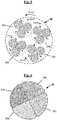
- the figure 5 schematizes, in cross section, the assembly of 4 strands (20a, 20b, 20c, 20d) (previously twisted according to T2a, T2b, T2c, T2d in the same direction D1) which are assembled by a third T3 torsion operation in the direction D2 opposed to the direction D1, for forming another example of final cable (50) triple twist (T1, T2, T3) according to the invention.
- Each strand is characterized by a second specific T2 twist (here, T2a, T2b, T2c, T2d) which may be equal to or different from one strand to another.
- figure 6 represents, still in cross-section, another representation of the preceding cord (50), less schematic than the previous one, recalling the well-known fact that the section of a textile cord, whether or not it conforms to the The invention, once formed and under minimal tension, is closer in fact to a cylindrical structure with a substantially circular contour section, because of the high radial, lateral plasticity of the strands (20a, 20b, 20c, 20d). and pre-strands (10a, 10b, 10c), provided by the multifilament nature of the fibers (spun) starting.
- a polymer spinning process such as, for example, melt spinning, solution spinning or gel spinning.
- non-polymeric material for example mineral material such as glass or nonpolymeric organic material such as carbon
- the invention is preferably implemented with materials of the invention.
- polymeric both thermoplastic type and non-thermoplastic type.
- polymeric materials of the thermoplastic or non-thermoplastic type
- celluloses in particular rayon, polyvinyl alcohols (abbreviated as "PVA”), polyketones, aramids (aromatic polyamides), aromatic polyesters.
- PBO polybenzazoles
- polyimides polyesters, especially those chosen from PET (polyethylene terephthalate), PEN (polyethylene naphthalate), PBT (polybutylene terephthalate), PBN (polybutylene naphthalate), PPT (polypropylene terephthalate) , PPN (polypropylene naphthalate).
- the invention applies to cases where the textile cord of the invention is formed of several yarns of different materials to form a hybrid or composite cord, for example based on yarns of at least polyester and nylon, or polyester and cellulose, or polyester and polyketone, or polyketone and nylon, or cellulose and nylon, or cellulose and polyketone, or cellulose and aramid, or aramid and nylon, or aramid and polyester (eg PET or PEN), or aramid and polyketone, to mention just a few examples, at least half of the N times M spun with of course a Mi module greater than 800 cN / tex.
- N preferably varies in a range from 2 to 6, more preferably from 2 to 4.
- M varies in a range from 2 to 6, more preferably from 2 to 6. 4.
- the total number of yarns (equal to N times M) is in a range from 4 to 25, more preferably from 4 to 16.
- twists can be measured and expressed in two different ways, either simply and in a number of revolutions per meter (t / m), and this is more rigorous when would like to compare materials of different natures (densities) and / or titles, at helix angle of the filaments or what is equivalent in the form of a torsion factor K.
- the twist T1 expressed in revolutions per meter (t / m) is between 10 and 350, more preferably between 20 and 200.
- each pre-strand presents a torsion coefficient K1 which is between 2 and 80, more preferably between 6 and 70.
- the torsion T2 expressed in revolutions per meter is preferably between 25 and 470, more preferably between 35 and 400.
- each strand has a torsion coefficient K2 which is between 10 and 150, more preferably between 20 and 130.
- the torsion T3 expressed in revolutions per meter is preferably between 30 and 600, more preferably between 80 and 500.
- the cord of the invention has a coefficient of K3 twist which is between 50 and 500, more preferably between 80 and 230.
- T2 is greater than T1 (T1 and T2 being in particular expressed in t / m).
- T2 is lower than T3 (T2 and T3 being in particular expressed in t / m), T2 being more preferably between 0.2 and 0.95 times T3, in particular between 0 , 4 and 0.8 times T3.
- the sum T1 + T2 is between 0.8 and 1.2 times T3, more preferably between 0.9 and 1.1 times T3 (T1, T2 and T3 being in particular expressed in t / m) , T1 + T2 being in particular equal to T3.
- the majority (in number), more preferably all of the N times M spun (in the initial state, that is to say without the T1 twist) has a module Mi which is greater than 800 cN / tex, in particular 1000 cN / tex.
- the initial module in extension Mi, or Young's modulus is of course the modulus in longitudinal extension, that is to say along the axis of the yarn.
- At least half, in particular the majority (in number), of the N times spun has a modulus Mi greater than 1200 cN / tex, more particularly greater than 1400 cN / tex. Even more preferentially, it is the totality of the N times M spun which has a modulus Mi greater than 1000 cN / tex, especially greater than 1200 cN / tex, more particularly greater than 1400 cN / tex.
- the titre (or linear density) of the pre-strands, strands or cords is determined on at least three samples, each corresponding to a length of at least 5 m per weighing of this length; the title is given in tex (weight in grams of 1000 m of product - recall: 0, 111 tex equal to 1 denier).
- the mechanical properties in extension are measured in a known manner by means of an "INSTRON" traction machine equipped with "4D” type clamping tongs (for breaking strength less than 100 daN) or “4E” (for breaking strength at least equal to 100 daN), unless otherwise specified in ASTM D885 (2010).
- the tested samples are pulled over an initial length of 400 mm for 4D pliers and 800 mm for 4E pliers, at a nominal speed of 200 mm / min, under a standard pretension of 0.5 cN / tex. All results given are an average of 10 measurements.
- a very low preliminary torsion called "protection twist”, corresponding to a helix angle of about 6 degrees, before positioning and pulling in the clamps.
- the tenacity (force-fracture divided by the title) and the initial modulus in extension (or Young's modulus) are indicated in cN / tex or centinewton by tex (for recall, 1 cN / tex equal to 0.111 g / den (gram by denier)).
- the initial modulus is represented by the tangent at the origin of the Force-Elongation curve, defined as the slope of the linear part of the Force-Elongation curve that occurs just after a standard pretension of 0.5 cN / tex.
- the elongation at break is indicated in percentage.
- the textile cord of the invention is advantageously usable for the reinforcement of tires of all types of vehicles, in particular motorcycles, passenger vehicles or industrial vehicles such as heavy vehicles, civil engineering, airplanes, other vehicles for transport or handling.
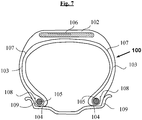
- the figure 7 shows very schematically (without respecting a specific scale), a radial section of a tire according to the invention for example for tourism type vehicle.
- This tire 100 has a top 102 reinforced by a crown reinforcement or belt 106, two sidewalls 103 and two beads 104, each of these beads being reinforced with a rod 105.
- the top 102 is surmounted by a tread not shown on this schematic figure.
- a carcass reinforcement 107 is wrapped around the two rods in each bead, the upturn 108 of this armature 107 being for example disposed towards the outside of the tire 100 which is shown here mounted on its rim 109.
- the carcass reinforcement 107 is in known manner constituted by at least one rubber ply reinforced by so-called "radial" textile cords, that is to say that these cords are arranged substantially parallel to one another and extend from one bead to the other so as to form an angle of between 80 ° and 90 ° with the median circumferential plane (plane perpendicular to the axis of rotation of the tire which is situated halfway between the two beads 104 and goes through the middle of the vertex frame 106).
- the belt 106 is for example constituted, in a manner known per se, by at least two layers of rubber called "working plies” or “triangulation plies”, superimposed and crossed, reinforced with metal cables arranged substantially parallel to each other with respect to others and inclined relative to the median circumferential plane, these working plies may or may not be associated with other plies and / or fabrics of rubber. These working plies have the primary function of giving the tire a high rigidity of drift.
- the belt 106 further comprises in this example a rubber sheet called “shrink web” reinforced by so-called “circumferential” reinforcing son, that is to say that these reinforcing son are arranged substantially parallel to each other and extend substantially circumferentially around the tire so as to form an angle preferably within a range of 0 to 10 ° with the medial circumferential plane.
- These circumferential reinforcing son have the primary function, it is recalled, to resist the centrifugation of the top at high speed.
- this tire 100 of the invention has the essential feature that at least the shrinking web of its belt (106) and / or its carcass reinforcement (107) comprises a textile cord according to the invention.
- the rods (105) which could consist, in whole or in part, of a textile cord according to the invention.
- the rubber compositions used for these plies are conventional compositions for calendering textile reinforcements, typically based on natural rubber or other diene elastomer, a reinforcing filler such as carbon black, a vulcanization system and additives. conventional.
- a reinforcing filler such as carbon black
- a vulcanization system and additives.
- the adhesion between the composite textile cord of the invention and the rubber layer which coats it is ensured for example by a usual adhesive composition, for example an adhesive of the RFL type or equivalent adhesive.
- the textile cord of the invention Due to its specific construction, the textile cord of the invention has significantly improved tensile properties, as demonstrated by the following embodiments.
- the starting yarns are of course commercially available, for example for nylon sold by Kordsa under the name “T728", or by the company PHP under the names “Enka 140HRT or” Enka 444HRST ", for rayon by the company Cordenka under the name “C610-F Super2”, for the aramid by the company Teijin under the name "Twaron 1000".
- toughness is the breaking force reported in the title, it is expressed in cN / tex. It is also indicated the apparent toughness (in daN / mm 2 ), in this case the breaking force is referred to the apparent diameter noted ⁇ which is measured according to the following method.
- An apparatus which, using a receiver composed of a collecting optical system, a photodiode and an amplifier, makes it possible to measure the shadow of a wire illuminated by a parallel light LASER beam. with an accuracy of 0.1 micrometer.
- a device is marketed for example by the company Z-Mike, under the reference "1210".
- the method consists in fixing on a motorized moving table, under a standard pretension of 0.5 cN / tex, a sample of the wire to be measured, having been pre-conditioned. Solidary of the moving table, the wire is moved perpendicularly to the shadow measurement system at a speed of 25 mm / s and orthogonally cuts the beam LASER. At least 200 measurements drop shadows are made over a length of 420 mm of wire; the average of these drop shadow measurements represents the apparent diameter ⁇ .
- breaking strength, toughness and apparent toughness were also indicated in relative values, the base 100 being used for the control cord of each test.
- control cords (denoted “T” in Table 1) are all characterized by a conventional construction with double twist T1, T2; the other cabled (comparative or in accordance with the invention) are all characterized by an unconventional construction with triple torsion T1, T2, T3.
- the cords according to the invention combine the triple twist characteristic and an initial yarn modulus greater than 800 cN / Tex.
- N47 / - / 3/4" of the control wire C1 means that this cord is a double-twisted cord (T1, T2) which is obtained simply from a twisting operation (T2, D2 or S) of 4 different strands which were each prepared beforehand by a reverse twisting operation (T1, D1 or Z) of 3 nylon spun yarns (N) title 47 tex.
- the textile cord concerned is a triple-twisted cord (T1, T2, T3) which is derived from a final twisting operation (T3, D2 or S) of 4 different strands which were each prepared beforehand by an intermediate twisting operation (T2) in the opposite direction (D1 or Z) of 3 pre-strands, each of the pre-strands consisting of 1 single nylon spun yarn ( N) of title 47 tex which has been previously twisted on itself during a first twisting operation T1 in the same direction D1 (Z).
- control cords (denoted "T") C1, C3, C5, C7, C9 and C12 are all characterized by a double twist construction; they were manufactured by assembling 2, 3 or 4 strands according to a (second) final twist (denoted T2) of 150 to 300 t / m, corresponding to a torsion coefficient K2 ranging from 175 to 215, and a direction D2 ( sense S). Conventionally, each of these strands was previously manufactured by a (initial) initial twist (denoted T1) of 150 to 300 t / m depending on the case of a yarn on itself in the opposite direction D1 (Z direction) .
- T1 initial twist
- cords according to the invention (denoted “I” and in bold in table 1)
- C8, C10, C11 and C13 are all characterized by a triple torsion construction T1, T2, T3 (in these example, Z / Z / S); they were manufactured by assembling 3 or 4 strands in a final twist (denoted T3) of 150 to 300 t / m, corresponding to a torsion coefficient K3 ranging from 180 to 215, and a direction D2 (direction S).
- each of these strands had previously been manufactured by assembling 3 pre-strands according to a T2 twist (110 to 240 t / m as the case may be) and in an opposite direction D1 (Z direction), each of these pre-strands having been prepared beforehand by a T1 twist (40 to 120 t / m depending on the case) of a yarn on itself in the direction D1 (Z direction).
- a T2 twist 110 to 240 t / m as the case may be
- D1 Z direction
- test 7 of Table 1 The above tests were completed by an additional test (test 7 of Table 1) carried out on two other different textile cords C14 (control) and C15 (invention), this time based on polyester (P), of the PEN type ( "A701" from Honeywell, 110 tex title yarn having an initial module in extension of about 1700 cN / tex).
- the construction denoted "P110 / - / 3/2" of the control cable C14 means that this cord is a double-twisted cord (T1, T2) which is simply the result of a twisting operation ( T2 of 260 t / m, D2 or S) of 2 strands different which were each prepared beforehand by a reverse twist operation (T1 of 260 t / m, D1 or Z) individual 3 polyester yarns (P) of title 110 tex.
- the textile cord concerned is a cord with triple torsion (T1, T2, T3) which is derived from a torsion operation final (T3 260 t / m, D2 or S) of 2 different strands which were each prepared beforehand by an intermediate torsion operation (T2 of 155 t / m) in the opposite direction (D1 or Z) of 3 pre-strands , each of the pre-strands consisting of 1 single polyester yarn (P) of title 110 tex which was previously twisted on itself during a first T1 twist operation (105 t / m) in the same direction D1 (Z).
- T1, T2, T3 which is derived from a torsion operation final (T3 260 t / m, D2 or S) of 2 different strands which were each prepared beforehand by an intermediate torsion operation (T2 of 155 t / m) in the opposite direction (D1 or Z) of 3 pre-strands
- each of the pre-strands consisting of 1 single polyester yarn (
Landscapes
- Engineering & Computer Science (AREA)
- Mechanical Engineering (AREA)
- Textile Engineering (AREA)
- Chemical & Material Sciences (AREA)
- Crystallography & Structural Chemistry (AREA)
- Yarns And Mechanical Finishing Of Yarns Or Ropes (AREA)
- Tires In General (AREA)
- Ropes Or Cables (AREA)
Applications Claiming Priority (2)
| Application Number | Priority Date | Filing Date | Title |
|---|---|---|---|
| FR1462101A FR3029539B1 (fr) | 2014-12-09 | 2014-12-09 | Cable textile a au moins triple torsion |
| PCT/EP2015/078833 WO2016091809A1 (fr) | 2014-12-09 | 2015-12-07 | Câblé textile à au moins triple torsion |
Publications (2)
| Publication Number | Publication Date |
|---|---|
| EP3230505A1 EP3230505A1 (fr) | 2017-10-18 |
| EP3230505B1 true EP3230505B1 (fr) | 2019-07-17 |
Family
ID=52692796
Family Applications (1)
| Application Number | Title | Priority Date | Filing Date |
|---|---|---|---|
| EP15807849.3A Active EP3230505B1 (fr) | 2014-12-09 | 2015-12-07 | Câblé textile à au moins triple torsion |
Country Status (7)
| Country | Link |
|---|---|
| US (1) | US20170327976A1 (enExample) |
| EP (1) | EP3230505B1 (enExample) |
| JP (1) | JP6778191B2 (enExample) |
| KR (1) | KR102408760B1 (enExample) |
| CN (1) | CN107002354B (enExample) |
| FR (1) | FR3029539B1 (enExample) |
| WO (1) | WO2016091809A1 (enExample) |
Families Citing this family (8)
| Publication number | Priority date | Publication date | Assignee | Title |
|---|---|---|---|---|
| FR3029542B1 (fr) | 2014-12-09 | 2017-07-28 | Michelin & Cie | Cable textile haut module a au moins triple torsion |
| FR3034435B1 (fr) | 2015-03-31 | 2018-03-02 | Compagnie Generale Des Etablissements Michelin | Element de renfort hybride a torsions differenciees |
| US20210155045A1 (en) * | 2018-03-20 | 2021-05-27 | Compagnie Generale Des Etablissements Michelin | Pneumatic tire comprising an improved aramid textile cord with an at least triple twist |
| US20210025084A1 (en) | 2018-03-20 | 2021-01-28 | Compagnie Generale Des Etablissements Michelin | Improved aramid textile cord with an at least triple twist |
| FR3102089A1 (fr) | 2019-10-16 | 2021-04-23 | Compagnie Generale Des Etablissements Michelin | Pneumatique presentant une uniformite amelioree et son procede de fabrication |
| FR3102097A1 (fr) | 2019-10-16 | 2021-04-23 | Compagnie Generale Des Etablissements Michelin | Pneumatique a emission de bruit reduit et son procede de fabrication |
| KR102422987B1 (ko) * | 2019-11-21 | 2022-07-19 | 더 굿이어 타이어 앤드 러버 캄파니 | 타이어 텍스타일 코드 |
| FR3153564A1 (fr) | 2024-12-12 | 2025-04-04 | Compagnie Generale Des Etablissements Michelin | Pneumatique |
Family Cites Families (18)
| Publication number | Priority date | Publication date | Assignee | Title |
|---|---|---|---|---|
| US1632201A (en) * | 1925-10-15 | 1927-06-14 | Goodyear Tire & Rubber | Pneumatic tire |
| US1708668A (en) * | 1928-01-17 | 1929-04-09 | Goodyear Tire & Rubber | Tire-fabric construction |
| US2116937A (en) * | 1935-12-11 | 1938-05-10 | Gen Tire & Rubber Co | Tire cord |
| US3607499A (en) * | 1969-02-24 | 1971-09-21 | Owens Corning Fiberglass Corp | Method of making power transmission belts |
| NL7904496A (nl) * | 1979-06-08 | 1980-12-10 | Akzo Nv | Vezel,dradenbundel en koord uit poly-p-fenyleenteref- taalamide. |
| JPH07144731A (ja) * | 1993-11-22 | 1995-06-06 | Yokohama Rubber Co Ltd:The | コンベヤベルト |
| JPH08324737A (ja) * | 1995-05-26 | 1996-12-10 | Yokohama Rubber Co Ltd:The | コンベヤベルト |
| JP3982870B2 (ja) * | 1997-04-22 | 2007-09-26 | 横浜ゴム株式会社 | コンベヤベルト |
| JP2000320616A (ja) * | 1999-05-14 | 2000-11-24 | Mitsuboshi Belting Ltd | 伝動ベルト用心線及びこれを用いた伝動ベルト |
| JP4495893B2 (ja) * | 1999-12-07 | 2010-07-07 | ソシエテ ド テクノロジー ミシュラン | 耐久性に優れた空気タイヤ |
| DE60105769T2 (de) * | 2000-02-16 | 2005-10-06 | Teijin Twaron Gmbh | Treibriemen mit einem strang, zusammengesetzt aus mindenstens zwei zusammengeschmolzenen fäden |
| FR2833277A1 (fr) * | 2001-12-07 | 2003-06-13 | Michelin Soc Tech | Cable metallique utilisable pour renforcer une armature de carcasse d'un pneumatique et un tel pneumatique |
| JP2005522367A (ja) * | 2002-04-08 | 2005-07-28 | ミシュラン ルシェルシェ エ テクニク ソシエテ アノニム | 空気タイヤのクラウン補強材 |
| JP2008223200A (ja) * | 2007-03-15 | 2008-09-25 | Teijin Fibers Ltd | 補強コード及び空気入りラジアルタイヤ |
| JP4538032B2 (ja) | 2007-09-05 | 2010-09-08 | 住友ゴム工業株式会社 | 不整地走行用の自動二輪車用タイヤ |
| CN201132908Y (zh) * | 2007-11-27 | 2008-10-15 | 中国水产科学研究院东海水产研究所 | 深水网箱用小规格高强三股聚乙烯捻绳 |
| FR2974583B1 (fr) * | 2011-04-28 | 2013-06-14 | Michelin Soc Tech | Cable textile composite aramide-polycetone |
| JP2013072024A (ja) * | 2011-09-28 | 2013-04-22 | Teijin Ltd | ゴム複合体 |
-
2014
- 2014-12-09 FR FR1462101A patent/FR3029539B1/fr not_active Expired - Fee Related
-
2015
- 2015-12-07 CN CN201580067302.3A patent/CN107002354B/zh active Active
- 2015-12-07 EP EP15807849.3A patent/EP3230505B1/fr active Active
- 2015-12-07 WO PCT/EP2015/078833 patent/WO2016091809A1/fr not_active Ceased
- 2015-12-07 JP JP2017530113A patent/JP6778191B2/ja active Active
- 2015-12-07 KR KR1020177015330A patent/KR102408760B1/ko active Active
- 2015-12-07 US US15/532,757 patent/US20170327976A1/en not_active Abandoned
Non-Patent Citations (1)
| Title |
|---|
| None * |
Also Published As
| Publication number | Publication date |
|---|---|
| CN107002354B (zh) | 2019-11-01 |
| KR20170093824A (ko) | 2017-08-16 |
| US20170327976A1 (en) | 2017-11-16 |
| FR3029539B1 (fr) | 2017-05-19 |
| EP3230505A1 (fr) | 2017-10-18 |
| JP2017538049A (ja) | 2017-12-21 |
| FR3029539A1 (fr) | 2016-06-10 |
| WO2016091809A1 (fr) | 2016-06-16 |
| CN107002354A (zh) | 2017-08-01 |
| KR102408760B1 (ko) | 2022-06-15 |
| JP6778191B2 (ja) | 2020-10-28 |
Similar Documents
| Publication | Publication Date | Title |
|---|---|---|
| EP3230503B1 (fr) | Câblé textile aramide à au moins triple torsion | |
| EP3230504B1 (fr) | Câblé textile haut module à au moins triple torsion | |
| WO2016091809A1 (fr) | Câblé textile à au moins triple torsion | |
| EP2702194B1 (fr) | Cable textile composite aramide-polycetone | |
| EP3768883B1 (fr) | Pneumatique comprenant un câblé textile aramide perfectionné à au moins triple torsion | |
| EP3448695B1 (fr) | Pneu avion ayant une armature de carcasse à endurance améliorée | |
| EP3768882B1 (fr) | Câblé textile aramide perfectionne à au moins triple torsion | |
| EP3277869B1 (fr) | Élément de renfort hybride à torsions différenciées | |
| EP3230502A1 (fr) | Câblé textile cellulosique à au moins triple torsion | |
| EP3727888B1 (fr) | Pneumatique comprenant des éléments de renfort sous forme de bandelettes stratifiées | |
| EP3880492B1 (fr) | Pneumatique pour véhicule à deux roues comprenant un renfort de frettage hybride | |
| WO2024017580A1 (fr) | Tissu pour pneumatique comprenant des éléments de renfort comprenant un assemblage constitué de deux brins multifilamentaires de polyamide 5,6 |
Legal Events
| Date | Code | Title | Description |
|---|---|---|---|
| STAA | Information on the status of an ep patent application or granted ep patent |
Free format text: STATUS: THE INTERNATIONAL PUBLICATION HAS BEEN MADE |
|
| PUAI | Public reference made under article 153(3) epc to a published international application that has entered the european phase |
Free format text: ORIGINAL CODE: 0009012 |
|
| STAA | Information on the status of an ep patent application or granted ep patent |
Free format text: STATUS: REQUEST FOR EXAMINATION WAS MADE |
|
| 17P | Request for examination filed |
Effective date: 20170710 |
|
| AK | Designated contracting states |
Kind code of ref document: A1 Designated state(s): AL AT BE BG CH CY CZ DE DK EE ES FI FR GB GR HR HU IE IS IT LI LT LU LV MC MK MT NL NO PL PT RO RS SE SI SK SM TR |
|
| AX | Request for extension of the european patent |
Extension state: BA ME |
|
| DAV | Request for validation of the european patent (deleted) | ||
| DAX | Request for extension of the european patent (deleted) | ||
| RAP1 | Party data changed (applicant data changed or rights of an application transferred) |
Owner name: COMPAGNIE GENERALE DES ETABLISSEMENTS MICHELIN |
|
| GRAP | Despatch of communication of intention to grant a patent |
Free format text: ORIGINAL CODE: EPIDOSNIGR1 |
|
| STAA | Information on the status of an ep patent application or granted ep patent |
Free format text: STATUS: GRANT OF PATENT IS INTENDED |
|
| INTG | Intention to grant announced |
Effective date: 20190125 |
|
| GRAJ | Information related to disapproval of communication of intention to grant by the applicant or resumption of examination proceedings by the epo deleted |
Free format text: ORIGINAL CODE: EPIDOSDIGR1 |
|
| STAA | Information on the status of an ep patent application or granted ep patent |
Free format text: STATUS: REQUEST FOR EXAMINATION WAS MADE |
|
| GRAP | Despatch of communication of intention to grant a patent |
Free format text: ORIGINAL CODE: EPIDOSNIGR1 |
|
| STAA | Information on the status of an ep patent application or granted ep patent |
Free format text: STATUS: GRANT OF PATENT IS INTENDED |
|
| INTC | Intention to grant announced (deleted) | ||
| INTG | Intention to grant announced |
Effective date: 20190411 |
|
| GRAS | Grant fee paid |
Free format text: ORIGINAL CODE: EPIDOSNIGR3 |
|
| GRAA | (expected) grant |
Free format text: ORIGINAL CODE: 0009210 |
|
| STAA | Information on the status of an ep patent application or granted ep patent |
Free format text: STATUS: THE PATENT HAS BEEN GRANTED |
|
| AK | Designated contracting states |
Kind code of ref document: B1 Designated state(s): AL AT BE BG CH CY CZ DE DK EE ES FI FR GB GR HR HU IE IS IT LI LT LU LV MC MK MT NL NO PL PT RO RS SE SI SK SM TR |
|
| REG | Reference to a national code |
Ref country code: GB Ref legal event code: FG4D Free format text: NOT ENGLISH |
|
| REG | Reference to a national code |
Ref country code: CH Ref legal event code: EP |
|
| REG | Reference to a national code |
Ref country code: IE Ref legal event code: FG4D Free format text: LANGUAGE OF EP DOCUMENT: FRENCH |
|
| REG | Reference to a national code |
Ref country code: DE Ref legal event code: R096 Ref document number: 602015034012 Country of ref document: DE |
|
| REG | Reference to a national code |
Ref country code: AT Ref legal event code: REF Ref document number: 1155921 Country of ref document: AT Kind code of ref document: T Effective date: 20190815 |
|
| REG | Reference to a national code |
Ref country code: NL Ref legal event code: MP Effective date: 20190717 |
|
| REG | Reference to a national code |
Ref country code: LT Ref legal event code: MG4D |
|
| REG | Reference to a national code |
Ref country code: AT Ref legal event code: MK05 Ref document number: 1155921 Country of ref document: AT Kind code of ref document: T Effective date: 20190717 |
|
| PG25 | Lapsed in a contracting state [announced via postgrant information from national office to epo] |
Ref country code: NL Free format text: LAPSE BECAUSE OF FAILURE TO SUBMIT A TRANSLATION OF THE DESCRIPTION OR TO PAY THE FEE WITHIN THE PRESCRIBED TIME-LIMIT Effective date: 20190717 Ref country code: PT Free format text: LAPSE BECAUSE OF FAILURE TO SUBMIT A TRANSLATION OF THE DESCRIPTION OR TO PAY THE FEE WITHIN THE PRESCRIBED TIME-LIMIT Effective date: 20191118 Ref country code: AT Free format text: LAPSE BECAUSE OF FAILURE TO SUBMIT A TRANSLATION OF THE DESCRIPTION OR TO PAY THE FEE WITHIN THE PRESCRIBED TIME-LIMIT Effective date: 20190717 Ref country code: LT Free format text: LAPSE BECAUSE OF FAILURE TO SUBMIT A TRANSLATION OF THE DESCRIPTION OR TO PAY THE FEE WITHIN THE PRESCRIBED TIME-LIMIT Effective date: 20190717 Ref country code: HR Free format text: LAPSE BECAUSE OF FAILURE TO SUBMIT A TRANSLATION OF THE DESCRIPTION OR TO PAY THE FEE WITHIN THE PRESCRIBED TIME-LIMIT Effective date: 20190717 Ref country code: NO Free format text: LAPSE BECAUSE OF FAILURE TO SUBMIT A TRANSLATION OF THE DESCRIPTION OR TO PAY THE FEE WITHIN THE PRESCRIBED TIME-LIMIT Effective date: 20191017 Ref country code: BG Free format text: LAPSE BECAUSE OF FAILURE TO SUBMIT A TRANSLATION OF THE DESCRIPTION OR TO PAY THE FEE WITHIN THE PRESCRIBED TIME-LIMIT Effective date: 20191017 Ref country code: FI Free format text: LAPSE BECAUSE OF FAILURE TO SUBMIT A TRANSLATION OF THE DESCRIPTION OR TO PAY THE FEE WITHIN THE PRESCRIBED TIME-LIMIT Effective date: 20190717 Ref country code: SE Free format text: LAPSE BECAUSE OF FAILURE TO SUBMIT A TRANSLATION OF THE DESCRIPTION OR TO PAY THE FEE WITHIN THE PRESCRIBED TIME-LIMIT Effective date: 20190717 |
|
| PG25 | Lapsed in a contracting state [announced via postgrant information from national office to epo] |
Ref country code: LV Free format text: LAPSE BECAUSE OF FAILURE TO SUBMIT A TRANSLATION OF THE DESCRIPTION OR TO PAY THE FEE WITHIN THE PRESCRIBED TIME-LIMIT Effective date: 20190717 Ref country code: RS Free format text: LAPSE BECAUSE OF FAILURE TO SUBMIT A TRANSLATION OF THE DESCRIPTION OR TO PAY THE FEE WITHIN THE PRESCRIBED TIME-LIMIT Effective date: 20190717 Ref country code: GR Free format text: LAPSE BECAUSE OF FAILURE TO SUBMIT A TRANSLATION OF THE DESCRIPTION OR TO PAY THE FEE WITHIN THE PRESCRIBED TIME-LIMIT Effective date: 20191018 Ref country code: IS Free format text: LAPSE BECAUSE OF FAILURE TO SUBMIT A TRANSLATION OF THE DESCRIPTION OR TO PAY THE FEE WITHIN THE PRESCRIBED TIME-LIMIT Effective date: 20191117 Ref country code: AL Free format text: LAPSE BECAUSE OF FAILURE TO SUBMIT A TRANSLATION OF THE DESCRIPTION OR TO PAY THE FEE WITHIN THE PRESCRIBED TIME-LIMIT Effective date: 20190717 Ref country code: ES Free format text: LAPSE BECAUSE OF FAILURE TO SUBMIT A TRANSLATION OF THE DESCRIPTION OR TO PAY THE FEE WITHIN THE PRESCRIBED TIME-LIMIT Effective date: 20190717 |
|
| PG25 | Lapsed in a contracting state [announced via postgrant information from national office to epo] |
Ref country code: TR Free format text: LAPSE BECAUSE OF FAILURE TO SUBMIT A TRANSLATION OF THE DESCRIPTION OR TO PAY THE FEE WITHIN THE PRESCRIBED TIME-LIMIT Effective date: 20190717 |
|
| PG25 | Lapsed in a contracting state [announced via postgrant information from national office to epo] |
Ref country code: EE Free format text: LAPSE BECAUSE OF FAILURE TO SUBMIT A TRANSLATION OF THE DESCRIPTION OR TO PAY THE FEE WITHIN THE PRESCRIBED TIME-LIMIT Effective date: 20190717 Ref country code: DK Free format text: LAPSE BECAUSE OF FAILURE TO SUBMIT A TRANSLATION OF THE DESCRIPTION OR TO PAY THE FEE WITHIN THE PRESCRIBED TIME-LIMIT Effective date: 20190717 Ref country code: IT Free format text: LAPSE BECAUSE OF FAILURE TO SUBMIT A TRANSLATION OF THE DESCRIPTION OR TO PAY THE FEE WITHIN THE PRESCRIBED TIME-LIMIT Effective date: 20190717 Ref country code: RO Free format text: LAPSE BECAUSE OF FAILURE TO SUBMIT A TRANSLATION OF THE DESCRIPTION OR TO PAY THE FEE WITHIN THE PRESCRIBED TIME-LIMIT Effective date: 20190717 Ref country code: PL Free format text: LAPSE BECAUSE OF FAILURE TO SUBMIT A TRANSLATION OF THE DESCRIPTION OR TO PAY THE FEE WITHIN THE PRESCRIBED TIME-LIMIT Effective date: 20190717 |
|
| PG25 | Lapsed in a contracting state [announced via postgrant information from national office to epo] |
Ref country code: SK Free format text: LAPSE BECAUSE OF FAILURE TO SUBMIT A TRANSLATION OF THE DESCRIPTION OR TO PAY THE FEE WITHIN THE PRESCRIBED TIME-LIMIT Effective date: 20190717 Ref country code: CZ Free format text: LAPSE BECAUSE OF FAILURE TO SUBMIT A TRANSLATION OF THE DESCRIPTION OR TO PAY THE FEE WITHIN THE PRESCRIBED TIME-LIMIT Effective date: 20190717 Ref country code: IS Free format text: LAPSE BECAUSE OF FAILURE TO SUBMIT A TRANSLATION OF THE DESCRIPTION OR TO PAY THE FEE WITHIN THE PRESCRIBED TIME-LIMIT Effective date: 20200224 Ref country code: SM Free format text: LAPSE BECAUSE OF FAILURE TO SUBMIT A TRANSLATION OF THE DESCRIPTION OR TO PAY THE FEE WITHIN THE PRESCRIBED TIME-LIMIT Effective date: 20190717 |
|
| REG | Reference to a national code |
Ref country code: DE Ref legal event code: R097 Ref document number: 602015034012 Country of ref document: DE |
|
| PLBE | No opposition filed within time limit |
Free format text: ORIGINAL CODE: 0009261 |
|
| STAA | Information on the status of an ep patent application or granted ep patent |
Free format text: STATUS: NO OPPOSITION FILED WITHIN TIME LIMIT |
|
| PG2D | Information on lapse in contracting state deleted |
Ref country code: IS |
|
| REG | Reference to a national code |
Ref country code: CH Ref legal event code: PL |
|
| 26N | No opposition filed |
Effective date: 20200603 |
|
| REG | Reference to a national code |
Ref country code: BE Ref legal event code: MM Effective date: 20191231 |
|
| PG25 | Lapsed in a contracting state [announced via postgrant information from national office to epo] |
Ref country code: SI Free format text: LAPSE BECAUSE OF FAILURE TO SUBMIT A TRANSLATION OF THE DESCRIPTION OR TO PAY THE FEE WITHIN THE PRESCRIBED TIME-LIMIT Effective date: 20190717 Ref country code: MC Free format text: LAPSE BECAUSE OF FAILURE TO SUBMIT A TRANSLATION OF THE DESCRIPTION OR TO PAY THE FEE WITHIN THE PRESCRIBED TIME-LIMIT Effective date: 20190717 |
|
| GBPC | Gb: european patent ceased through non-payment of renewal fee |
Effective date: 20191207 |
|
| PG25 | Lapsed in a contracting state [announced via postgrant information from national office to epo] |
Ref country code: GB Free format text: LAPSE BECAUSE OF NON-PAYMENT OF DUE FEES Effective date: 20191207 Ref country code: LU Free format text: LAPSE BECAUSE OF NON-PAYMENT OF DUE FEES Effective date: 20191207 Ref country code: IE Free format text: LAPSE BECAUSE OF NON-PAYMENT OF DUE FEES Effective date: 20191207 |
|
| PG25 | Lapsed in a contracting state [announced via postgrant information from national office to epo] |
Ref country code: LI Free format text: LAPSE BECAUSE OF NON-PAYMENT OF DUE FEES Effective date: 20191231 Ref country code: CH Free format text: LAPSE BECAUSE OF NON-PAYMENT OF DUE FEES Effective date: 20191231 Ref country code: BE Free format text: LAPSE BECAUSE OF NON-PAYMENT OF DUE FEES Effective date: 20191231 |
|
| PG25 | Lapsed in a contracting state [announced via postgrant information from national office to epo] |
Ref country code: CY Free format text: LAPSE BECAUSE OF FAILURE TO SUBMIT A TRANSLATION OF THE DESCRIPTION OR TO PAY THE FEE WITHIN THE PRESCRIBED TIME-LIMIT Effective date: 20190717 |
|
| PG25 | Lapsed in a contracting state [announced via postgrant information from national office to epo] |
Ref country code: HU Free format text: LAPSE BECAUSE OF FAILURE TO SUBMIT A TRANSLATION OF THE DESCRIPTION OR TO PAY THE FEE WITHIN THE PRESCRIBED TIME-LIMIT; INVALID AB INITIO Effective date: 20151207 Ref country code: MT Free format text: LAPSE BECAUSE OF FAILURE TO SUBMIT A TRANSLATION OF THE DESCRIPTION OR TO PAY THE FEE WITHIN THE PRESCRIBED TIME-LIMIT Effective date: 20190717 |
|
| PG25 | Lapsed in a contracting state [announced via postgrant information from national office to epo] |
Ref country code: MK Free format text: LAPSE BECAUSE OF FAILURE TO SUBMIT A TRANSLATION OF THE DESCRIPTION OR TO PAY THE FEE WITHIN THE PRESCRIBED TIME-LIMIT Effective date: 20190717 |
|
| PGFP | Annual fee paid to national office [announced via postgrant information from national office to epo] |
Ref country code: DE Payment date: 20251211 Year of fee payment: 11 |
|
| PGFP | Annual fee paid to national office [announced via postgrant information from national office to epo] |
Ref country code: FR Payment date: 20251223 Year of fee payment: 11 |