EP3228497A2 - Wohnmobil - Google Patents
Wohnmobil Download PDFInfo
- Publication number
- EP3228497A2 EP3228497A2 EP17157554.1A EP17157554A EP3228497A2 EP 3228497 A2 EP3228497 A2 EP 3228497A2 EP 17157554 A EP17157554 A EP 17157554A EP 3228497 A2 EP3228497 A2 EP 3228497A2
- Authority
- EP
- European Patent Office
- Prior art keywords
- box
- motorhome
- dog
- interior
- outside
- Prior art date
- Legal status (The legal status is an assumption and is not a legal conclusion. Google has not performed a legal analysis and makes no representation as to the accuracy of the status listed.)
- Withdrawn
Links
- 238000005192 partition Methods 0.000 claims description 5
- 241000282472 Canis lupus familiaris Species 0.000 description 42
- 241000238631 Hexapoda Species 0.000 description 2
- 238000011109 contamination Methods 0.000 description 2
- 230000004297 night vision Effects 0.000 description 2
- XLYOFNOQVPJJNP-UHFFFAOYSA-N water Substances O XLYOFNOQVPJJNP-UHFFFAOYSA-N 0.000 description 2
- 241000255925 Diptera Species 0.000 description 1
- 235000021168 barbecue Nutrition 0.000 description 1
- 230000001419 dependent effect Effects 0.000 description 1
- 230000000694 effects Effects 0.000 description 1
- 235000013305 food Nutrition 0.000 description 1
- 230000035515 penetration Effects 0.000 description 1
Images

Classifications
-
- B—PERFORMING OPERATIONS; TRANSPORTING
- B60—VEHICLES IN GENERAL
- B60P—VEHICLES ADAPTED FOR LOAD TRANSPORTATION OR TO TRANSPORT, TO CARRY, OR TO COMPRISE SPECIAL LOADS OR OBJECTS
- B60P3/00—Vehicles adapted to transport, to carry or to comprise special loads or objects
- B60P3/32—Vehicles adapted to transport, to carry or to comprise special loads or objects comprising living accommodation for people, e.g. caravans, camping, or like vehicles
- B60P3/36—Auxiliary arrangements; Arrangements of living accommodation; Details
-
- B—PERFORMING OPERATIONS; TRANSPORTING
- B60—VEHICLES IN GENERAL
- B60P—VEHICLES ADAPTED FOR LOAD TRANSPORTATION OR TO TRANSPORT, TO CARRY, OR TO COMPRISE SPECIAL LOADS OR OBJECTS
- B60P3/00—Vehicles adapted to transport, to carry or to comprise special loads or objects
- B60P3/04—Vehicles adapted to transport, to carry or to comprise special loads or objects for transporting animals
Definitions
- the invention relates to a motor home referred to in the preamble of claim 1.
- Art. Motorhomes enjoy great popularity, especially for holiday trips, excursions and the like. However, it is disadvantageous if the persons traveling with the motorhome also want to take one or more dogs with them. The dog must be secured while driving and depending on the size of the dog this can be difficult. Even if the motorhome has reached a parking space where it should remain overnight or for a longer period, it is questionable how the dog can be comfortably accommodated.
- campers that have on their outside one or more stop rings, where you can attach the leash of a dog to secure it in the area of the camper. Nevertheless, there is still no comprehensive way to travel safely and comfortably with a dog in a mobile home.
- the object of the invention is therefore to improve a motor home to the effect that is also taken care of the safety and housing of one or more dogs in the motor home and travel comfort for the people and dogs is not affected.
- This object is solved by the characterizing features of claim 1, which has the following special significance.
- the motorhome has a so-called garage, in which usually objects such as luggage, folding chairs, chairs, a folding table and the like can be accommodated.
- a box for the housing of dogs is separated by walls, in particular by wooden walls according to the invention.
- the box has two doors, namely a first door securing the box to the interior of the motorhome and a second door securing the box to the outside. So can at will the corresponding door can be opened to give the dog the opportunity either to get into the interior of the motorhome or to leave the box and the motorhome completely.
- the box is then accessible according to the invention both from the interior of the motorhome and from the outside.
- the doors consist of bars, so that the dog or dogs can be viewed through the door.
- On the outside of a ramp is then placed, which bridges the distance between the box and the floor and over which the dog can comfortably go in and out of the box. It is particularly advantageous if the second door, which secures towards the outside, is lockable.
- one or more dogs can be safely housed in the box. If a dog from the box to be spent in the interior of the motorhome, this is done in a simple manner, since the box is accessible from the interior. If the motorhome is parked, the box can also be opened from the outside. Due to the ramp, it is possible for the dog in a simple, ergonomic and comfortable way to leave the box or to go back into the box. This is convenient for dogs of any size.
- the ramp can be stored in an area below the box when not in use, for example while driving. So the ramp is not in the way and takes up no additional space.
- the bottom of the box is mounted a little raised, which reduces the difference in height between the bottom of the box and the bottom of the interior of the motorhome. So the dog can also easily get out of the box in the interior of the motorhome, as soon as you allow it.
- the ramp can be pushed by means of a rail system in the area below the box and pulled out from there again. This is particularly convenient for an operator.
- the two doors of the box are also assigned corresponding flaps on the motorhome.
- the first flap which covers the garage and the box to the interior. This may be useful, for example, if one or more dogs are in the box sleeping and could possibly feel disturbed by light or noise from the interior of the motorhome.
- a second flap covers the garage and the box to the outside. This flap is also closed while driving, so that both the box and any other stored in the garage items are secured to the outside and the motorhome is sealed to the outside.
- the box occupies only a portion of the garage, while another area remains free as storage space.
- This storage space can then continue to be used as usual, for example, to accommodate garden tables and chairs or other items.
- a partition wall is provided, which separates both areas from each other.
- a window can be provided in the area of the box on the outer wall of the motorhome to the outside. This allows in the open state the entry of light and air in the area of the box. This makes it particularly comfortable for the dog, as he may be able to look out of the window and have a direct supply of fresh air.
- the open window can be secured with mosquito nets against the entry of insects.
- a camera may be provided which receives the inside of the box and on a monitor or the like inside the motorhome reproduces or the images over the Internet to a device connected to the Internet, such as a smartphone or a tablet PC . a notebook or similar displays.
- the camera can also be designed as a night-vision camera. It is thus possible to observe the inside of the box and dogs in it, for example while driving or in the parked vehicle. When using a night-vision camera, this can also happen if the area of the box is unlit. So it can be checked if the dog in the box is sleeping, if he is well, etc.
- the box can also be designed with a dog mat, which is particularly comfortable for the dogs located there. Furthermore, a cup may be provided in the box. As a result, the dog can also take food or water while driving or while in the box. Particularly preferred here is a so-called anti-Schlabber-cup, which has a security against spilling and squirting in the upper part and with its bottom at the bottom of the box, for example via a Velcro connection or the like, can be attached. As a result, the risk of splashing and contamination by spilled or 29labbertes water or feed is avoided.
- the motorhome on the outside still have a dog shower, by means of which the dog can be showered before entering the motorhome or the box. This is particularly useful if the dog after a walk or trip dirty or muddy paws. As a result, the interior of the box and the motorhome is spared accordingly and contamination is avoided.
- the motorhome may also have one or more stop rings in the outer area to secure the dog by means of a leash on the motorhome. So the dog can not move away from the camper when the camper is parked and the operators, for example, are outside, for example, to take a sunbath, to barbecue, to play sports or the like. The dog can then be a bit in the area of Moving motorhomes on the outside, but not completely removed from the motorhome.
- one or more additional buckles may be provided to secure the dog while driving by means of a safety protection harness to these buckles. So the dog is close to the operators in the interior of the motorhome and is still properly secured.
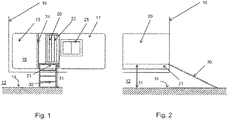
- the Fig. 1 and 2 show a part of a mobile home 10 according to the invention in a schematic representation of the outside 12 ago. It can be seen in the garage 13, a box 20 and a storage space 15. The box 20 and the storage space 15 are separated by a partition 24 from each other, which also represents a side wall of the box 20 simultaneously.
- the box 20 has a second door 23 which can be closed by a second flap 17. Is the opened second door 23, a dog can leave the box 20 on the ramp 30 or enter.
- the ramp 30 overcomes the distance 31 between the box 20 and the bottom 14. This makes it very comfortable for the dog to leave the box 20 and re-enter. If the ramp 30 is not needed, it can be stowed in the area 21 below the box 20. So she is not in the way and the bottom of the box 20 we raised a bit. Therefore, this has a smaller height difference to the bottom of the interior 11 of the motor home 10, which makes the leaving of the box 20 in the direction of the interior 11 comfortable for a dog.
- window 25 This can be opened or closed to provide in the box 20 for good air and light from the outside and.
- a fly screen may still be provided to prevent vermin and insects from entering the box 20 or the motor home 10.
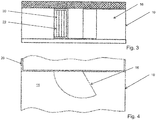
- the 3 and 4 show a section of the interior 11 of the motorhome 10.
- a flap 16 is provided, which separates the box 20 from the interior 11 of the motor home 10.
- the box 20 here has a first door 22, which can be opened so that a dog can enter the interior 11 of the motor home 10. If the dog in the box 20 to rest, for example, to sleep, both the first door 22 and the first flap 16 can be closed. This reduces the penetration of light and noise from the interior 11 into the box 20.
- Fig. 5 now shows a schematic representation of the motor home 10 according to the invention from above. It can be seen in the interior 11 is a schematic representation of furniture and furnishings. You can also see the garage 13, in which both the box 20 and the storage space 15 are located. Both areas are defined by the partition wall 24 from each other.
- first door 22 and the first flap 16 which secure the box 20 in the direction of the interior 11 of the motor home 10.
- second door 23 and the second flap 17 are arranged, which secure the box 20 to the outside 12 out.
- the ramp 30 is not shown here. In this illustration, the garage 13 is below the bed.
- the embodiments shown here are only exemplary realizations of the invention. This is not limited to this.
- the garage can also be located elsewhere and not just below the bed provided in the motor home.
- camper is also to be understood as any type of caravan, camping bus, converted van and alcove car. The term is deliberately broad.
Landscapes
- Engineering & Computer Science (AREA)
- Health & Medical Sciences (AREA)
- Public Health (AREA)
- Transportation (AREA)
- Mechanical Engineering (AREA)
- Power-Operated Mechanisms For Wings (AREA)
- Housing For Livestock And Birds (AREA)
- Residential Or Office Buildings (AREA)
Abstract
Description
- Die Erfindung betrifft ein Wohnmobil der im Oberbegriff von Anspruch 1 genannten Art. Derartige Wohnmobile erfreuen sich großer Beliebtheit, insbesondere bei Urlaubsreisen, Ausflügen und Ähnlichem. Nachteilig ist es jedoch, wenn die mit dem Wohnmobil verreisenden Personen auch einen oder mehrere Hunde mitnehmen wollen. Der Hund muss während der Fahrt gesichert werden und je nach Größe des Hundes kann dies schwierig werden. Auch wenn das Wohnmobil an einem Stellplatz angelangt ist, wo es über Nacht oder für einen längeren Zeitraum stehen bleiben soll, ist es fraglich, wie der Hund komfortabel untergebracht werden kann.
- Es gibt bereits Wohnmobile, die an ihrer Außenseite ein oder mehrere Anschlagringe aufweisen, an denen man die Leine eines Hundes befestigen kann, um diesen im Bereich des Wohnmobils zu sichern. Trotzdem gibt es noch keine umfassende Möglichkeit, mit einem Hund in einem Wohnmobil sicher und komfortabel zu verreisen.
- Aufgabe der Erfindung ist es daher, ein Wohnmobil dahingehend zu verbessern, dass auch für die Sicherheit und Unterbringung eines oder mehrerer Hunde im Wohnmobil gesorgt ist und der Reisekomfort für die Personen und Hunde nicht beeinträchtigt wird. Diese Aufgabe wird durch die kennzeichnenden Merkmale des Anspruchs 1 gelöst, denen folgende besondere Bedeutung zukommt.
- Das Wohnmobil verfügt über eine sogenannte Garage, in welcher üblicherweise Gegenstände, wie Gepäck, Klappstühle, Liegen, ein Klapptisch und Ähnliches untergebracht werden können. In dieser Garage wird erfindungsgemäß eine Box für die Unterbringung von Hunden durch Wände, insbesondere durch Holzwände abgetrennt. Die Box weist zwei Türen auf, nämlich eine erste Tür, die die Box zum Innenraum des Wohnmobils hin sichert und eine zweite Tür, die die Box zur Außenseite hin sichert. So kann je nach Belieben die entsprechende Tür geöffnet werden, um dem Hund die Möglichkeit zu geben, entweder in den Innenraum des Wohnmobils zu gelangen oder die Box und das Wohnmobil komplett zu verlassen. Die Box ist dann gemäß der Erfindung sowohl vom Innenraum des Wohnmobils als auch von der Außenseite her zugänglich. Die Türen bestehen dabei aus Gittern, so dass der oder die Hunde auch durch die jeweilige Tür betrachtet werden können. An der Außenseite wird dann noch eine Rampe angeordnet, die den Abstand zwischen der Box und dem Boden überbrückt und über die der Hund bequem in die Box hinein und aus der Box herausgehen kann. Besonders vorteilhaft ist es, wenn die zweite, zur Außenseite hin sichernde Tür, abschließbar ausgestaltet ist.
- Während der Fahrt können so ein oder mehrere Hunde sicher in der Box untergebracht werden. Soll ein Hund aus der Box in den Innenraum des Wohnmobils verbracht werden, geschieht dies auf einfache Weise, da die Box vom Innenraum her zugänglich ist. Ist das Wohnmobil geparkt, kann die Box auch von der Außenseite her geöffnet werden. Durch die Rampe ist es für den Hund auf einfache, ergonomische und bequeme Art und Weise möglich, die Box zu verlassen bzw. auch wieder in die Box hineinzugehen. Dies ist für Hunde jeglicher Größe komfortabel durchführbar.
- Vorteilhafterweise kann die Rampe in einem Bereich unterhalb der Box verstaut werden, wenn sie nicht in Benutzung ist, beispielsweise während der Fahrt. So ist die Rampe nicht im Weg und nimmt keinen zusätzlichen Raum ein. Darüber hinaus ist der Boden der Box ein wenig erhöht angebracht, was den Höhenunterschied zwischen dem Boden der Box und dem Boden des Innenraums des Wohnmobils verringert. So kann der Hund auch bequem aus der Box in den Innenraum des Wohnmobils gelangen, sobald man es ihm gestattet.
- Besonders vorteilhaft kann die Rampe mittels eines Schienensystems in den Bereich unterhalb der Box hineingeschoben und von dort wieder herausgezogen werden. Dies ist für eine Bedienperson besonders komfortabel.
- So kann kein Unbefugter die Tür einfach von außen öffnen und Zugriff auf den Hund haben, sondern dies kann nur durch eine befugte Person mit Schlüssel geschehen.
- Empfehlenswerterweise sind den beiden Türen der Box auch korrespondierende Klappen am Wohnmobil zugeordnet. Hierbei existiert erste Klappe, die die Garage und die Box zum Innenraum hin abdeckt. Dies kann beispielsweise dann sinnvoll sein, wenn sich ein oder mehrere Hunde in der Box befinden die schlafen und sich eventuell durch Licht oder Geräusche aus dem Innenraum des Wohnmobils gestört fühlen könnten. Eine zweite Klappe deckt die Garage und die Box zur Außenseite hin ab. Diese Klappe ist auch während der Fahrt geschlossen, damit sowohl die Box als auch eventuelle weitere in der Garage gelagerte Gegenstände nach außen hin abgesichert sind und das Wohnmobil zur Außenseite hin abgedichtet ist.
- Vorteilhafterweise nimmt die Box nur einen Teil der Garage ein, während ein anderer Bereich als Stauraum freibleibt. Dieser Stauraum kann dann auch weiterhin wie üblich genutzt werden, um beispielsweise Gartentische und - stühle oder andere Gegenstände unterzubringen. Zwischen dem Stauraum und der Box ist dann eine Trennwand vorgesehen, die beide Bereiche voneinander abtrennt.
- Im Bereich der Box an der Außenwand des Wohnmobils zur Außenseite hin kann ein Fenster vorgesehen sein. Dies ermöglicht im geöffneten Zustand den Eintritt von Licht und Luft in den Bereich der Box. Dies macht es für den Hund besonders komfortabel, da er ggf. aus dem Fenster hinaus sehen kann und eine direkte Frischluftzufuhr hat. Das geöffnete Fenster kann mit Fliegengitter gegen den Eintritt von Insekten abgesichert werden.
- Weiterhin kann im Wohnmobil noch eine Kamera vorgesehen sein, die das Innere der Box aufnimmt und auf einem Monitor oder Ähnlichem im Inneren des Wohnmobils wiedergibt oder auch die Bilder über das Internet an ein mit dem Internet verbundenes Gerät, wie einem Smartphone oder einem Tablet-PC, einem Notebook oder Ähnlichem anzeigt. Die Kamera kann auch als Nachtsichtkamera ausgestaltet sein. So ist es möglich, das Innere der Box und darin befindliche Hunde, beispielsweise während der Fahrt oder auch im geparkten Fahrzeug zu beobachten. Bei der Verwendung einer Nachtsicherkamera kann dies auch geschehen, wenn der Bereich der Box unbeleuchtet ist. So kann überprüft werden, ob der in der Box befindliche Hund schläft, ob es ihm gut geht, usw.
- Die Box kann auch mit einer Hundematte ausgelegt sein, was für die dort befindlichen Hunde besonders komfortabel ist. Weiterhin kann auch ein Napf in der Box vorgesehen sein. Hierdurch kann der Hund auch während der Fahrt bzw. während er sich in der Box befindet, Futter oder Wasser zu sich nehmen. Besonders bevorzugt ist hier ein sogenannter Anti-Schlabber-Napf, welcher im oberen Bereich eine Sicherung gegen Verschütten und Verspritzen aufweist und mit seinem Boden am Boden der Box, beispielsweise über eine Klettverbindung oder Ähnliches, befestigt werden kann. Hierdurch wird das Risiko von Spritzern und Verschmutzungen durch verschüttetes oder verschlabbertes Wasser bzw. Futter vermieden.
- Weiterhin kann das Wohnmobil an der Außenseite noch eine Hundedusche aufweisen, mittels der der Hund vor dem Betreten des Wohnmobils bzw. der Box abgeduscht werden kann. Dies ist insbesondere dann sinnvoll, wenn der Hund nach einem Spaziergang oder Ausflug dreckige oder schlammige Pfoten hat. Hierdurch wird das Innere der Box und des Wohnmobils entsprechend geschont und Verschmutzungen werden vermieden.
- Das Wohnmobil kann weiterhin im Außenbereich ein oder mehrere Anschlagringe aufweisen, um den Hund mittels einer Leine am Wohnmobil zu sichern. So kann sich der Hund nicht vom Wohnmobil entfernen, wenn das Wohnmobil abgestellt ist und die Bedienpersonen sich z.B. draußen aufhalten, um beispielsweise ein Sonnenbad zu nehmen, zu grillen, Sport zu treiben oder Ähnliches. Der Hund kann sich dann zwar ein bisschen im Bereich des Wohnmobils außen bewegen, sich jedoch nicht vollständig vom Wohnmobil entfernen.
- Schließlich können im Innenraum des Wohnmobils im Bodenbereich ein oder mehrere zusätzlich Gurtschlösser vorgesehen sein, um den Hund während der Fahrt mittels eines Sicherheits-Schutz-Geschirrs an diesen Gurtschlössern zu sichern. So befindet sich der Hund nahe der Bedienpersonen im Innenraum des Wohnmobils und ist trotzdem vorschriftsmäßig gesichert.
- Weitere Vorteile und Ausführungsbeispiele ergeben sich aus der nachfolgenden Beschreibung, den Unteransprüchen und den Zeichnungen. In den Zeichnungen ist das erfindungsgemäße Wohnmobil schematisch in einer Ausführungsform dargestellt. Es zeigen:
- Fig. 1:
- einen Teil des Wohnmobils im Bereich der Garage von der Außenseite her in Seitenansicht,
- Fig. 2:
- der Bereich aus
Fig. 1 in Rückansicht, - Fig. 3:
- ein Bereich des Wohnmobils mit Box vom Innenraum her in Vorderansicht,
- Fig. 4:
- der Bereich aus
Fig. 3 in Draufsicht. - Fig. 5:
- eine Innenansicht eines Wohnmobils in Draufsicht, schematisch
- Die
Fig. 1 und 2 zeigen einen Teil eines erfindungsgemäßen Wohnmobils 10 in schematischer Darstellung von der Außenseite 12 her. Man erkennt in der Garage 13, eine Box 20 sowie einen Stauraum 15. Die Box 20 und der Stauraum 15 werden durch eine Trennwand 24 voneinander abgetrennt, die auch gleichzeitig eine Seitenwand der Box 20 darstellt. Die Box 20 weist eine zweite Tür 23 auf, die von einer zweiten Klappe 17 verschlossen werden kann. Ist die zweite Tür 23 geöffnet, kann über die Rampe 30 ein Hund die Box 20 verlassen bzw. betreten. Die Rampe 30 überwindet dabei den Abstand 31 zwischen der Box 20 und dem Boden 14. Dies macht es dem Hund sehr bequem, die Box 20 zu verlassen und wieder zu betreten. Wird die Rampe 30 nicht benötigt, kann diese in dem Bereich 21 unterhalb der Box 20 verstaut werden. So ist sie nicht im Weg und der Boden der Box 20 wir etwas erhöht. Daher weist dieser eine geringere Höhendifferenz zum Boden des Innenraums 11 des Wohnmobils 10 auf, was das Verlassen der Box 20 in Richtung des Innenraums 11 für einen Hund komfortabel macht. - Schließlich erkennt man noch das Fenster 25. Dieses kann geöffnet oder geschlossen werden, um im Bereich der Box 20 für eine gute Luft- und Lichtzufuhr von außen und sorgen. Bei geöffnetem Fenster 25 kann trotzdem noch ein Fliegengitter vorgesehen sein, um zu vermeiden, dass Ungeziefer und Insekten in die Box 20 bzw. das Wohnmobil 10 gelangen.
- Die
Fig. 3 und 4 zeigen einen Ausschnitt aus dem Innenraum 11 des Wohnmobils 10. Auch hier ist eine Klappe 16 vorgesehen, welche die Box 20 vom Innenraum 11 des Wohnmobils 10 trennt. Die Box 20 weist hier eine erste Tür 22 auf, die geöffnet werden kann, damit ein Hund den Innenraum 11 des Wohnmobils 10 betreten kann. Soll der Hund in der Box 20 seine Ruhe haben, beispielsweise um zu schlafen, so können sowohl die erste Tür 22 als auch die erste Klappe 16 verschlossen werden. Dadurch wird das Eindringen von Licht und Geräuschen aus dem Innenraum 11 in die Box 20 verringert. -
Fig. 5 zeigt nunmehr eine schematische Darstellung des erfindungsgemäßen Wohnmobils 10 von oben. Man erkennt im Innenraum 11 eine schematische Darstellung von Möbelstücken und Einrichtungsgegenständen. Außerdem erkennt man die Garage 13, in der sich sowohl die Box 20 als auch der Stauraum 15 befinden. Beide Bereiche sind durch die Trennwand 24 voneinander abgegrenzt. - Des Weiteren sieht man die erste Tür 22 und die erste Klappe 16, die die Box 20 in Richtung des Innenraums 11 des Wohnmobils 10 sichern. Ungefähr im rechten Winkel dazu sind die zweite Tür 23 und die zweite Klappe 17 angeordnet, die die Box 20 zur Außenseite 12 hin absichern. Die Rampe 30 ist hier nicht dargestellt. In dieser Darstellung befindet sich die Garage 13 unterhalb des Bettes.
- Abschließend sei noch darauf hingewiesen, dass die hier dargestellten Ausführungsformen nur beispielhafte Verwirklichungen der Erfindung sind. Diese ist nicht darauf beschränkt. So kann beispielsweise die Garage auch andernorts und nicht nur unterhalb des im Wohnmobil vorgesehenen Bettes angeordnet sein. Wenn hier von einem Hund gesprochen wird, so ist es selbstverständlich auch möglich, mehrere Hunde mit sich zu führen und in der Box unterzubringen. Auch zusätzliche Einrichtungen für Hunde sind im Zusammenhang mit diesem Wohnmobil denkbar. Unter dem Begriff Wohnmobil sind auch jegliche Arten von Karavans, Campingbussen, umgebauten Kastenwagen und Alkovenwagen zu verstehen. Der Begriff ist bewusst breit auszulegen.
-
- 10
- Wohnmobil
- 11
- Innenraum vom 10
- 12
- Außenseite von 10
- 13
- Garage
- 14
- Boden
- 15
- Stauraum
- 16
- Erste Klappe
- 17
- Zweite Klappe
- 20
- Box
- 21
- Bereich unterhalb von 20
- 22
- Erste Tür
- 23
- Zweite Tür
- 24
- Trennwand
- 25
- Fenster
- 30
- Rampe
- 31
- Abstand zwischen 20 und 14
Claims (13)
- Wohnmobil (10) mit einer zum Wohnen geeigneten Inneneinrichtung,
welches über einen Kofferraum, im Weiteren Garage (13) genannt, verfügt,
welches weiterhin über eine Einrichtung zur Unterbringung wenigstens eines Hundes verfügt,
dadurch gekennzeichnet,
dass als Einrichtung eine Box (20) dient, die aus mehreren Wänden, insbesondere Holzwänden besteht und welche in der Garage (13) angeordnet ist,
das die Box (13) sowohl vom Innenraum (11) des Wohnmobils (10) als auch von dessen Außenseite (12) her über zwei Türen (22, 23), bevorzugt zwei Gittertüren zugänglich ist, nämlich über eine erste Tür (22), die die Box (20) zum Innenraum (11) des Wohnmobils (10) sichert und über eine zweite Tür (23), die die Box (20) zur Außenseite (12) hin sichert
und dass eine Rampe (30) vorgesehen ist, die von der Außenseite (12) des Wohnmobils (10) her im Benutzungsfall den Abstand (31) zwischen der Box (20) und dem Boden (14) überbrücken kann. - Wohnmobil (10) nach Anspruch 1, dadurch gekennzeichnet, dass die Rampe (30) in einem Bereich (21) unterhalb der Box (20) verstaubar ist, wenn sie nicht in Benutzung ist.
- Wohnmobil (10) nach Anspruch 2, dadurch gekennzeichnet, dass die Rampe (30) mittels eines Schienensystems in den Bereich (21) unterhalb der Box (20) schiebbar und dort wieder herausziehbar ist.
- Wohnmobil (10) nach Anspruch 1 bis 3, dadurch gekennzeichnet, dass zumindest die zweite Tür (23) abschließbar ausgestaltet ist.
- Wohnmobil (10) nach einem der Ansprüche 1 bis 4, dadurch gekennzeichnet, dass zu den beiden Türen (22, 23) der Box (20) auch noch korrespondierende Klappen am Wohnmobil (10) vorgesehen sind, nämlich eine erste Klappe (16), die die Garage (13) und die Box (20) zum Innenraum (11) hin abdeckt und eine zweite Klappe (17), die die Garage (13) und die Box (20) zur Außenseite (12) hin abdeckt.
- Wohnmobil (10) nach einem der Ansprüche 1 bis 5, dadurch gekennzeichnet, dass die Box (20) nur einen Teil der Garage (13) einnimmt, während der andere Bereich als Stauraum (15) frei bleibt und dass eine Trennwand (24) zwischen der Box (20) und dem Stauraum (15) vorgesehen ist, die beide Bereiche voneinander trennt und gleichzeitig eine Seitenwand der Box (20) bildet.
- Wohnmobil (10) nach einem der Ansprüche 1 bis 6, dadurch gekennzeichnet, dass im Bereich der Box (20) zur Außenseite (12) hin ein Fenster (25) vorgesehen ist, um den Eintritt von Licht und Luft in den Bereich der Box (20) zu ermöglichen.
- Wohnmobil nach einem der vorhergehenden Ansprüche, dadurch gekennzeichnet, dass eine Kamera vorgesehen ist, die das Innere der Box aufnimmt und auf einem Monitor o.ä. im Inneren des Wohnmobils oder über ein mit dem Internet verbundenen Gerät, wie einem Smartphone, einem Tablet-PC, einem Notebook o.ä. wider gibt.
- Wohnmobil (10) nach einem der vorhergehenden Ansprüche, dadurch gekennzeichnet, dass die Box (20) mit einer Hundematte auslegbar ist.
- Wohnmobil (10) nach einem der vorhergehenden Ansprüche, dadurch gekennzeichnet, dass ein Napf, insbesondere ein Anti-Schlabber-Napf in der Box (20) vorgesehen ist.
- Wohnmobil (10) nach einem der vorhergehenden Ansprüche, dadurch gekennzeichnet, dass an der Außenseite (12) eine Hundedusche vorgesehen ist, mittels der der Hund abgeduscht werden kann bevor er das Wohnmobil (10) und/oder die Box (20) betritt.
- Wohnmobil (10) nach einem der vorhergehenden Ansprüche, dadurch gekennzeichnet, dass im Außenbereich (12) des Wohnmobils (10) ein oder mehrere Anschlagringe vorgesehen sind, um den Hund unter Zwischenschaltung einer Leine an dem Wohnmobil (10) zu sichern.
- Wohnmobil (10) nach einem der vorhergehenden Ansprüche, dadurch gekennzeichnet, dass im Innenraum (11) im Bodenbereich ein oder mehrere zusätzliche Gurtschlösser angeordnet sind, um den Hund während der Fahrt mittels eines Sicherheits-Schutzgeschirrs zu sichern.
Applications Claiming Priority (1)
| Application Number | Priority Date | Filing Date | Title |
|---|---|---|---|
| DE202016101758.0U DE202016101758U1 (de) | 2016-04-04 | 2016-04-04 | Wohnmobil |
Publications (2)
| Publication Number | Publication Date |
|---|---|
| EP3228497A2 true EP3228497A2 (de) | 2017-10-11 |
| EP3228497A3 EP3228497A3 (de) | 2017-10-18 |
Family
ID=56233682
Family Applications (1)
| Application Number | Title | Priority Date | Filing Date |
|---|---|---|---|
| EP17157554.1A Withdrawn EP3228497A3 (de) | 2016-04-04 | 2017-02-23 | Wohnmobil |
Country Status (2)
| Country | Link |
|---|---|
| EP (1) | EP3228497A3 (de) |
| DE (1) | DE202016101758U1 (de) |
Family Cites Families (5)
| Publication number | Priority date | Publication date | Assignee | Title |
|---|---|---|---|---|
| FR2510958A1 (fr) * | 1981-08-05 | 1983-02-11 | Dufour Jean | Vehicule tel que caravane ou camping-car comportant simultanement une installation sejour et un logement pour animal, tel qu'un cheval |
| US4854631A (en) * | 1987-11-03 | 1989-08-08 | Darlene Laursen | Combination recreational transport and camper vehicle |
| GB2261355B (en) * | 1988-09-01 | 1993-08-04 | Athag Ltd | Cages and dividers |
| DE9418953U1 (de) * | 1994-11-28 | 1995-10-05 | Sachsenring Automobiltechnik GmbH, 08058 Zwickau | Kraftfahrzeug für den Transport von Tieren, insbesondere von Hunden, bevorzugt von Polizeihunden |
| US6899375B2 (en) * | 2003-09-15 | 2005-05-31 | Rsv Invention Enterprises | Recreational vehicle with integrated pickup bed |
-
2016
- 2016-04-04 DE DE202016101758.0U patent/DE202016101758U1/de not_active Ceased
-
2017
- 2017-02-23 EP EP17157554.1A patent/EP3228497A3/de not_active Withdrawn
Non-Patent Citations (1)
| Title |
|---|
| None |
Also Published As
| Publication number | Publication date |
|---|---|
| EP3228497A3 (de) | 2017-10-18 |
| DE202016101758U1 (de) | 2016-06-07 |
Similar Documents
| Publication | Publication Date | Title |
|---|---|---|
| EP3597484A1 (de) | Personenbeförderungsfahrzeug | |
| DE102017114531B4 (de) | Ladungsmanagementsystem für ein Fahrzeug | |
| DE102015116804A1 (de) | Raumeffizientes Kabinensegment für ein Fahrzeug sowie eine Passagierkabine mit einer Mehrzahl von Sitzen und einem solchen Kabinensegment | |
| DE102023100113A1 (de) | Fahrzeug mit bildgebungsvorrichtung zur haustierdetektion und steuerung | |
| DE102010018337A1 (de) | Abdeckungseinrichtung für einen Laderaum, Rückbankanordnung, Laderaum und Kraftfahrzeug, sowie Verwendung einer Abdeckungseinrichtung | |
| DE102016005891A1 (de) | Klappbare Trittstufe mit Abdeckklappe/Abdeckung für ein Fahrerhaus | |
| DE202006006151U1 (de) | Fahrzeug mit flexiblem Innenraum | |
| DE102014103549A1 (de) | Mehrzweckfahrzeug und Verwendung eines derartigen Mehrzweckfahrzeugs | |
| EP3228497A2 (de) | Wohnmobil | |
| DE3001950A1 (de) | Zeltaufbau, auf fahrzeugdaecher aufbringbar | |
| DE102017114777A1 (de) | Wohnmobil | |
| DE8101731U1 (de) | Wohnmobil | |
| DE10014317B4 (de) | Caravan, insbesondere Motorcaravan | |
| DE102004025248A1 (de) | Fahrerkabine für ein Kraftfahrzeug | |
| DE19730802C1 (de) | Sicherheitsnetzanordnung mit versenkbaren Karosseriehaltern | |
| DE954482C (de) | Zu Wohnzwecken benutzbares Kraftfahrzeug | |
| DE1195617B (de) | Wohnwagen-Anhaenger | |
| DE2827876A1 (de) | Fahrerhaus fuer einen lkw | |
| DE698153C (de) | ||
| DE19747171A1 (de) | Kraftfahrzeug | |
| DE102023114552A1 (de) | Freizeitfahrzeug und Einrichtung für ein Freizeitfahrzeug | |
| DE102022003580A1 (de) | Temporäres an der Front eines LKW aufbaubares Schutzzelt | |
| DE29901220U1 (de) | Fahrzeuganhänger, insbesondere Pkw-Anhänger | |
| DE202006014333U1 (de) | Tiertransportanhänger | |
| DE202004012073U1 (de) | Wohnmobil |
Legal Events
| Date | Code | Title | Description |
|---|---|---|---|
| PUAI | Public reference made under article 153(3) epc to a published international application that has entered the european phase |
Free format text: ORIGINAL CODE: 0009012 |
|
| PUAL | Search report despatched |
Free format text: ORIGINAL CODE: 0009013 |
|
| AK | Designated contracting states |
Kind code of ref document: A2 Designated state(s): AL AT BE BG CH CY CZ DE DK EE ES FI FR GB GR HR HU IE IS IT LI LT LU LV MC MK MT NL NO PL PT RO RS SE SI SK SM TR |
|
| AX | Request for extension of the european patent |
Extension state: BA ME |
|
| AK | Designated contracting states |
Kind code of ref document: A3 Designated state(s): AL AT BE BG CH CY CZ DE DK EE ES FI FR GB GR HR HU IE IS IT LI LT LU LV MC MK MT NL NO PL PT RO RS SE SI SK SM TR |
|
| AX | Request for extension of the european patent |
Extension state: BA ME |
|
| RIC1 | Information provided on ipc code assigned before grant |
Ipc: B60P 3/32 20060101ALI20170912BHEP Ipc: B60P 3/04 20060101ALI20170912BHEP Ipc: B60P 3/36 20060101AFI20170912BHEP |
|
| STAA | Information on the status of an ep patent application or granted ep patent |
Free format text: STATUS: THE APPLICATION IS DEEMED TO BE WITHDRAWN |
|
| 18D | Application deemed to be withdrawn |
Effective date: 20180419 |