EP3228366A1 - Mikrokapseln, verfahren zur herstellung davon und darauf basierende flammhemmende mittel, materialien, beschichtungen und produkte - Google Patents
Mikrokapseln, verfahren zur herstellung davon und darauf basierende flammhemmende mittel, materialien, beschichtungen und produkte Download PDFInfo
- Publication number
- EP3228366A1 EP3228366A1 EP14907229.0A EP14907229A EP3228366A1 EP 3228366 A1 EP3228366 A1 EP 3228366A1 EP 14907229 A EP14907229 A EP 14907229A EP 3228366 A1 EP3228366 A1 EP 3228366A1
- Authority
- EP
- European Patent Office
- Prior art keywords
- fire
- extinguishing
- liquid
- microcapsule
- microcapsules
- Prior art date
- Legal status (The legal status is an assumption and is not a legal conclusion. Google has not performed a legal analysis and makes no representation as to the accuracy of the status listed.)
- Withdrawn
Links
Images

Classifications
-
- A—HUMAN NECESSITIES
- A62—LIFE-SAVING; FIRE-FIGHTING
- A62D—CHEMICAL MEANS FOR EXTINGUISHING FIRES OR FOR COMBATING OR PROTECTING AGAINST HARMFUL CHEMICAL AGENTS; CHEMICAL MATERIALS FOR USE IN BREATHING APPARATUS
- A62D1/00—Fire-extinguishing compositions; Use of chemical substances in extinguishing fires
- A62D1/0007—Solid extinguishing substances
- A62D1/0021—Microcapsules
-
- A—HUMAN NECESSITIES
- A62—LIFE-SAVING; FIRE-FIGHTING
- A62D—CHEMICAL MEANS FOR EXTINGUISHING FIRES OR FOR COMBATING OR PROTECTING AGAINST HARMFUL CHEMICAL AGENTS; CHEMICAL MATERIALS FOR USE IN BREATHING APPARATUS
- A62D1/00—Fire-extinguishing compositions; Use of chemical substances in extinguishing fires
- A62D1/06—Fire-extinguishing compositions; Use of chemical substances in extinguishing fires containing gas-producing, chemically-reactive components
-
- B—PERFORMING OPERATIONS; TRANSPORTING
- B01—PHYSICAL OR CHEMICAL PROCESSES OR APPARATUS IN GENERAL
- B01J—CHEMICAL OR PHYSICAL PROCESSES, e.g. CATALYSIS OR COLLOID CHEMISTRY; THEIR RELEVANT APPARATUS
- B01J13/00—Colloid chemistry, e.g. the production of colloidal materials or their solutions, not otherwise provided for; Making microcapsules or microballoons
- B01J13/02—Making microcapsules or microballoons
-
- C—CHEMISTRY; METALLURGY
- C08—ORGANIC MACROMOLECULAR COMPOUNDS; THEIR PREPARATION OR CHEMICAL WORKING-UP; COMPOSITIONS BASED THEREON
- C08K—Use of inorganic or non-macromolecular organic substances as compounding ingredients
- C08K5/00—Use of organic ingredients
- C08K5/02—Halogenated hydrocarbons
-
- C—CHEMISTRY; METALLURGY
- C08—ORGANIC MACROMOLECULAR COMPOUNDS; THEIR PREPARATION OR CHEMICAL WORKING-UP; COMPOSITIONS BASED THEREON
- C08K—Use of inorganic or non-macromolecular organic substances as compounding ingredients
- C08K5/00—Use of organic ingredients
- C08K5/04—Oxygen-containing compounds
- C08K5/07—Aldehydes; Ketones
-
- C—CHEMISTRY; METALLURGY
- C08—ORGANIC MACROMOLECULAR COMPOUNDS; THEIR PREPARATION OR CHEMICAL WORKING-UP; COMPOSITIONS BASED THEREON
- C08L—COMPOSITIONS OF MACROMOLECULAR COMPOUNDS
- C08L89/00—Compositions of proteins; Compositions of derivatives thereof
- C08L89/04—Products derived from waste materials, e.g. horn, hoof or hair
- C08L89/06—Products derived from waste materials, e.g. horn, hoof or hair derived from leather or skin, e.g. gelatin
-
- C—CHEMISTRY; METALLURGY
- C09—DYES; PAINTS; POLISHES; NATURAL RESINS; ADHESIVES; COMPOSITIONS NOT OTHERWISE PROVIDED FOR; APPLICATIONS OF MATERIALS NOT OTHERWISE PROVIDED FOR
- C09K—MATERIALS FOR MISCELLANEOUS APPLICATIONS, NOT PROVIDED FOR ELSEWHERE
- C09K21/00—Fireproofing materials
- C09K21/14—Macromolecular materials
-
- C—CHEMISTRY; METALLURGY
- C08—ORGANIC MACROMOLECULAR COMPOUNDS; THEIR PREPARATION OR CHEMICAL WORKING-UP; COMPOSITIONS BASED THEREON
- C08K—Use of inorganic or non-macromolecular organic substances as compounding ingredients
- C08K2201/00—Specific properties of additives
- C08K2201/002—Physical properties
- C08K2201/005—Additives being defined by their particle size in general
Definitions
- the present invention is related to the field of microencapsulation of liquids; in particular, to the preparation methods of a microcapsule, wherein the liquid core is a low-boiling liquid, immiscible with water, wherein said core is enclosed within a spherical shell that breaks up at a certain temperature; and to the field of fire extinguishing, more specifically, to the preparation methods of fire-extinguishing agents as powders of microcapsules, said microcapsules comprising a core prepared from a fire-extinguishing liquid evaporable at certain elevated temperatures; said core enclosed within a shell having certain barrier functions; and to the composite fire-extinguishing materials, coatings, and fire-extinguishing articles comprising said fire-extinguishing agents.
- the first step in this universal process is to prepare emulsions of lyophilic liquids to be microencapsulated and aqueous solutions of the polymers of future shells followed by separation of the phases with forced pH changes of the reaction mixture, with the release of the so-called coacervation drops enriched with the polymer, wherein said drops accumulate on the surface of the capsulated liquid as a "necklace” and then coalesce (merge) into an unbroken liquid shell, which is then cured by linking agents and dried, yielding a microcapsule.
- microcapsules prepared by such methods are known in the art.
- microcapsule used in manufacturing of disinfecting and repelling compositions and air fresheners comprising essential oils inside a spherical core, wherein the shell encapsulating said essential oil droplets is a thin outer polymeric polyurea or polyurethane membrane film that regulates the release of the essential oils and shields them from oxidation and evaporation as well as ensures the release of the effective dose of the oils at a constant fixed speed over an extended time period ( RU, 2347608, C2 ).
- RU, 2347608, C2 extended time period
- microcapsule used in vulcanization of natural and synthetic rubbers (RU, 2376058, C2 ), comprising a core containing at least one additive for the rubber in the polymeric capsule wall formed by melamine formaldehyde resin and polyurea resin and by polyelectrolyte.
- the microcapsule is thermally and mechanically stable at up to 120-140 °C.
- the speed and temperature of the breakup of the microcapsule shells is not the same for all microcapsules, which can affect the vulcanization process of rubbers.
- microencapsulated fire extinguishing agent which is approved for use in the ozone layer and which is dispersed in a thermosetting polymer binder ( RU, 2161520, C1 ), wherein the microcapsule is a microsphere 100-400 mcm in diameter having a spherical shell of cured gelatin and a fire-extinguishing agent encapsulated within said shell, said fire-extinguishing agents are substances belonging to the halogen-substituted class and some perfluoro amines.
- the microcapsules break up in the 130-149 °C and 166-190 °C temperature ranges. The attained stability of the microcapsules, however, turned out to be insufficient for practical application of the fire-extinguishing agent.
- Fire-extinguishing composite materials which are polymer matrices filled with microcapsules comprising evaporable fire-extinguishing liquids, have technical and commercial applications.
- Such composite materials manufactured in very different forms (plates, film, formed parts, paints, coated fabrics, etc.), autonomously and pre-ventively protect various objects from catching fire.
- the actual potential candidates for use turned out to be fluoro- and bromo- hydrocarbons and ketones, such as perfluoroethyl perfluoroisopropyl ketone and dibromomethane.
- microcapsules containing said environmentally safe evaporable fire-extinguishing liquids were reduced in weight during their storage and application due to the loss of the fire-extinguishing liquid through the shells of the microcapsules during long storage, which compromised their efficiency during firefighting.
- the objective of the present invention is to develop a method for the preparation of microcapsules highly stable during storage and application, wherein the main indicator of stability is maintaining the initial weight of the microcapsule of the fire-extinguishing liquid inserted into the core, i.e. maintaining the weight of the microcapsule as a whole.
- the inventors discovered that instability of the microcapsules, both with the perfluoroketone and dibromomethane cores, prepared by the known methods, which was expressed in the loss of the low-boiling liquid due to its evaporation through the shell, is caused by the specific structure and physical and chemical properties of the molecules of such low-boiling substances, which negatively affect the structure and properties of the shell prepared by the known microencapsulation methods in aqueous media.
- a hydrolytic effect can be assumed to be characteristic of lyophilic liquids that can combine with water in small amounts.
- the highly volatile liquid dibromomethane and perfluoroketone can dissolve 1.2 and 1.0 wt. % of water respectively; said water then triggers their hydrolysis yielding acid products directly in the coalescence zone of the coacervates.
- the inventors concluded that prior to their microencapsulation in aqueous media, the lyophilic liquids have to be stabilized to prevent their hydrolysis.
- the technical goal of the present invention was set to stabilize the properties of the target lyophilic low-boiling water-immiscible liquid to be encapsulated in the core of the microcapsule, which has a tendency to hydrolyze yielding acid products, and by doing so, improve the barrier properties of the shells in order to protect the core from evaporation, while improving the shell structure of microcapsules by increasing its density resulting from the formation of monolith shells due to the modification of its structure, and in particular, the degree of its porosity.
- the expected technical result was increased stability of the microcapsules during their storage and application.
- Said objective was achieved by creating a microcapsule containing a core comprising the target lyophilic low-boiling water-immiscible liquid with the characteristic ability to hydrolyze and yield acid products, said core located inside a spherical shell made from a cured cross-linked polymeric material, said shell promotes the release of said target liquid under certain external impact conditions that cause breakup of said shell, wherein said core additionally contains a stabilizer, which suppresses the creation of an acidic environment in the area of shell formation.
- the microcapsules can explosively break up in the temperature range between 90 °C and 230 °C.
- the shell can be made from cross-linked gelatin.
- the core of the microcapsule can contain a fire-extinguishing liquid selected from the group comprising: fire-extinguishing liquids having boiling points in the 45 °C -100 °C range.
- said fire-extinguishing liquid can be selected from the group comprising fluoro-, bromo-, and bromofluoro- hydrocarbons.
- the stabilizer in the core of the microcapsule was pyrogenic silicon dioxide modified with methylsilane, with the 300-380 m 2 /g, specific surface area, for example, in the amount of 1-5 wt.% from the target liquid weight.
- the core of the microcapsule can contain perfluoroethyl perfluoroisopropyl ketone as the target fire-extinguishing liquid and hexafluoropropylene oxide dimer as the stabilizer, for example, in the amount of 1-3 wt.% from the weight of perfluoroethyl perfluoroisopropyl ketone.
- the core of the microcapsule can contain perfluoroethyl perfluoroisopropyl ketone as the target fire-extinguishing liquid and a combination of pyrogenic silicon dioxide modified with methylsilane and hexafluoropropylene oxide dimer, for example, pyrogenic silicon dioxide modified with methylsilane in the amount of 1-5% from the weight of perfluoroethyl perfluoroisopropyl ketone and hexafluoropropylene oxide dimer in the amount of 1-3% of the weight of perfluoroethyl perfluoroisopropyl ketone, respectively.
- the microcapsule can have the outer diameter in the 50-400 mcm range.
- the microcapsule can contain a fire-extinguishing liquid in the amount of 75-95% of the weight of the microcapsule.
- the set objective was additionally achieved by developing a method for the preparation of a microcapsule containing a core, comprising the target lyophilic low-boiling liquid immiscible with water with the characteristic ability to hydrolyze and yield acid products and a stabilizing component suppressing the creation of the acidic environment in the area of shell formation, said core located in a spherical shell made from a cured cross-linked polymeric material, said shell promoting the release of said target liquid under certain external impact conditions that cause a breakup of said shell, wherein:
- the method can be adapted to obtain microcapsules, which can explosively destruct in the 90-230 °C temperature range.
- the method can be adapted to obtain microcapsules with shells prepared from cross-linked gelatin, wherein:
- the dispersion of pyrogenic silicon dioxide in the target liquid obtained in step a) can be optionally pretreated with ultrasound at 20-35 kHz for up to 0.5 hr., until the reaction mass clears while maintaining a slight opalescence.
- Such treatment yields a stable dispersion of said silicon dioxide in the target liquid having particle size of no less than 1 mcm, which ensures the formation of its functional surface.
- the method can be adapted to obtain a microcapsule with the core comprising a fire-extinguishing liquid, and in step a) the target fire-extinguishing liquid is selected from the group comprising fire-extinguishing liquids with boiling points in the 45-100 °C range.
- the target liquid can be any fire-extinguishing liquid selected from the group containing fluoro-, bromo-, and bromofluoro- hydrocarbons.
- the fire-extinguishing liquid can be any fire-extinguishing liquid selected from the group containing perfluoroethyl perfluoroisopropyl ketone, dibromomethane, and tetrafluorodibromoethane.
- pyrogenic silicon dioxide which has been modified with methylsilane, with the specific surface area of 300-380 m 2 /g, for example, in the amount of 1-5 wt.% from the target liquid weight, can be used as the stabilizer.
- the method can be adapted to obtain microcapsules with cores containing perfluoroethyl perfluoroisopropyl ketone, wherein in step a) the target fire-extinguishing liquid can be liquid perfluoroethyl perfluoroisopropyl ketone and the stabilizer can be liquid hexafluoropropylene oxide dimer.
- the hexafluoropropylene oxide dimer can be used in the amount of 1-3 wt.% from the weight of perfluoroethyl perfluoroisopropyl ketone.
- the method can be adapted to obtain microcapsules with cores containing perfluoroethyl perfluoroisopropyl ketone, wherein in step a) the target fire-extinguishing liquid is liquid perfluoroethyl perfluoroisopropyl ketone and the stabilizer can be a combination of pyrogenic silicon dioxide modified with methylsilane dispersed in the target liquid and liquid hexafluoropropylene oxide dimer.
- a combination of pyrogenic silicon dioxide modified with methylsilane in the amount of 1-5 wt.% from the weight of perfluoroethyl perfluoroisopropyl ketone and hexafluoropropylene oxide dimer in the amount of 1-3 wt.% from the weight of perfluoroethyl perfluoroisopropyl ketone can be used.
- the method can be adapted to obtain microcapsules having outer diameters in the 50-400 mcm range.
- the method provides microcapsules with cores containing fire-extinguishing liquids in the amount of 75-95% from the weight of the microcapsules.
- the invention also provides a microencapsulated fire-extinguishing agent, which is a powder of microcapsules of the invention described supra.
- the invention also provides a fire-extinguishing composite material containing a microencapsulated fire-extinguishing agent according to the present invention dispersed in cured resin or cured rubber.
- the fire-extinguishing composite material can be foam, or cured paste, or structural elements, or film, or fire-extinguishing fabrics impregnated or coated with curable paste containing resin or rubber with the microencapsulated fire-extinguishing agent of the invention dispersed therein.
- the invention also provides a fire-extinguishing article for the preventive protection of objects from fire, equipped with a fire-extinguishing element fixed on the surface of a bearing component and containing a reactive microencapsulated fire-extinguishing agent of the invention set in a polymer matrix; wherein said article has such spatial configuration as to have the largest surface area of said fire-extinguishing element to be arranged in the zone to be protected or adjacent thereto, when placed in the object to be protected.
- the polymer matrix of the fire-extinguishing element can be made from materials selected from the group comprising: cold-cured silicon rubber, styrene-butadiene rubber, polyvinyl acetate, polyvinyl alcohol, cold-cured rubber-reinforced epoxy resins, polyester resins, alkyd pentaphthalic enamel, and alkyd glyptal enamel.
- the fire-extinguishing article can be detachable.
- the bearing component can be made from materials selected from the group comprising: heat-resistant glass, metals, ceramics, elastic polymers, flexible polymers, magnetic rubber, polymers containing magnetic powder, fiberglass, woven and nonwoven fabrics, and carbon fabrics.
- the fire-extinguishing article can be made as a one-sided adhesive or a double-sided adhesive.
- the lyophilic low-boiling water-immiscible fire-extinguishing liquid tetrafluorodibromoethane which is used herein as a reference, effectively doesn't absorb any water (water content 0.003 wt.%) and doesn't react with water, which is evidenced by the long-term stability of the microcapsule prepared by the method known in the art ( RU, 2469761, C1 ), with the core made of tetrafluorodibromomethane inside the shell made from cross-linked gelatin comprising nanoparticles of a mineral filler.
- Said pyrogenic silicon dioxide in the drops of the target liquid was shown to retain a small amount of exposed active centers, which were sufficient for absorbing small amounts of water incoming into the drops of liquid at the emulsification and coacervation stages of the formation of shells around the capsules in aqueous reaction media and retained by the lyophilic liquid.
- the mechanism of the observed stabilization reaction of perfluoroketones in the presence of hexafluoropropylene oxide dimer has not yet been properly studied.
- the oxide possibly binds the trace amounts of water and causes cleavage along the -C-O-C- bond.
- pyrogenic silicon dioxide modified with methylsilane with the specific surface area of 300-380 m 2 /g' or hexafluoropropylene oxide dimer, or a mixture thereof can efficiently inhibit the formation of acid products of hydrolysis of said lyophilic liquids in the formed drops and prevent the uncontrolled influx of the formed acid products into the zone wherein the shells are formed from the coacervates.
- This in turn, will contribute to the formation of unbroken liquid shells, inhibit the formation of pores in the cured shell, and, hence, improve the stability of microcapsules during prolonged storage and use.
- microcapsule of the present invention containing a core, comprising a target lyophilic low-boiling liquid immiscible with water with characteristic affinity to hydrolysis, which produces acid products, and a stabilizer suppressing the creation of an acidic environment, said microcapsule located in a spherical shell made from a cured cross-linked polymeric material, which promotes the release of said target liquid under certain external impact conditions that cause breakup of said shell, was conducted according to the invention, wherein:
- the method can be adapted to obtain microcapsules, which can explosively destruct in the 90-230 °C temperature range and have shells prepared from cross-linked gelatin, wherein in the method of the invention:
- the silicon dioxide suspension obtained in step a) was additionally treated with ultrasound at 20-35 kHz for 0.5 hr., until the reaction mass cleared while retaining a slight opalescence.
- the target lyophilic low-boiling water-immiscible liquids with characteristic affinity to hydrolysis that produces acid products were selected as follows: in step a) of the microcapsule-producing method of the invention, the selected fire-extinguishing liquids had boiling points in the 45-100 °C range and were selected from the group comprising the fluoro-, bromo-, and bromofluoro- hydrocarbons approved for use, and in particular:
- step a) the stabilizer inhibiting the formation of the acidic environment was
- microcapsules with shells prepared from cross-linked gelatin comprising cores containing various target fire-extinguishing liquids with no added stabilizers (Examples 1, 2, 3) and microcapsules with shells prepared from cross-linked gelatin, said shells comprising cores containing various target fire-extinguishing liquids with said stabilizers of the invention added to the reaction mixture (Examples 1, 2, 3, 4, 5) were prepared by the method for the preparation of microcapsules for comparative studies.
- Example 1 Preparation of microcapsules with shells of cross-linked gelatin comprising perfluoroketone cores with no stabilizers added (Variant 1.1) and with pyrogenic silicon dioxide modified with methylsilane added as a stabilizer (Variants 1.2, 1.3).
- microcapsules with no stabilizer added which serve as the control for the study of the liquid lost from the core of microcapsules, were prepared by a method known in the art.
- the resulting aqueous gelatin solution was then mixed with 14 ml of perfluoroketone and stirred at 25 °C until an emulsion was formed.
- microcapsules were washed with water by decantation, isolated by filtration, and dried.
- the prepared microcapsules were 50-400 mcm in diameter; the perfluoroketone content was 89% from the weight of the microcapsules; the yield of the microcapsules was 92%; the explosive breakup temperature was 90 °C.
- the explosive breakup temperature was considered to be the temperature, at which a sharp bend on the weight loss curve was observed in gravimetric analysis (TGA) of the microcapsules.
- microcapsule containing a stabilizer was prepared by the method of the present invention, wherein:
- the reaction mass was cooled to +8 - +10 °C and combined with 2 ml of 25 wt.% aqueous solution of glutaric aldehyde, held at said temperature for at least one hour, after which the temperature was raised to 20-25 °C, the pH was lowered to 1.0-2.0 by adding 10 wt.% sulfuric acid, 5.2 ml of said 15 wt.% aqueous resorcinol solution, and 8.0 ml of aqueous 37 wt.% formaldehyde solution, and the reaction mixture was kept at 30-35 °C for one hour.
- microcapsules were washed with water by decantation, isolated by filtration, and dried.
- the prepared microcapsules were 50-400 mcm in diameter, the perfluoroketone content was 89% from the weight of the microcapsule, the yield of the microcapsules was 92%, the explosive breakup temperature of the microcapsules was 90 °C.
- microcapsule with an added stabilizer was prepared by the method described un Variant 1.2, wherein the content of the stabilizer, pyrogenic silicon dioxide modified with methylsilane with the specific surface area of 300-380 m 2 /g was 5.0 wt.% from the weight of perfluoroketone.
- the prepared microcapsules were 50-400 mcm in diameter, the perfluoroketone content was 92% from the weight of the microcapsule, the yield of the microcapsules was 93%, the explosive breakup temperature of the microcapsules was 90 °C.
- Example 2 Preparation of microcapsules with shells of cross-linked gelatin, comprising dibromomethane cores with no stabilizers added (Variant 2.1) and with pyrogenic silicon dioxide modified with methylsilane added as a stabilizer (Variants 2.2, 2.3).
- microcapsules with no stabilizers added were prepared by the method similar to that described in Variant 1.1.
- Example 1 with no stabilizer added but using dibromomethane as the target liquid and curing the shells of the microcapsules as follows: upon addition of the glutaric aldehyde solution to the reaction mixture at +8 - +10 °C and keeping it for one hour, 5.2 ml of 15 wt.% aqueous resorcinol was added and the mixture was stirred for 15 min.; 10 wt.% sulfuric acid was then added to bring the pH down to 1.3-1.4, 8.0 ml of 37 wt.% aqueous solution of formaldehyde were added, and the mixture was kept at 30-35 °C for 1.5 hr.
- the prepared microcapsules were 50-400 mcm in diameter, the perfluoroketone content was 93% from the weight of the microcapsule, the yield of the microcapsules was 90%, and the explosive breakup temperature of the microcapsules was 220 °C.
- microcapsules containing stabilizers were prepared by the method of the present invention, wherein:
- the prepared microcapsules were 50-400 mcm in diameter, the dibromomethane content was 93% from the weight of the microcapsules, the yield of the microcapsules was 90%, and the explosive breakup temperature of the microcapsules was 220 °C.
- Example 3 Preparation of microcapsule with shells of cross-linked gelatin comprising perfluoroketone cores with hexafluoropropylene oxide dimer added as a stabilizer (variants 3.1, 3.2).
- microcapsules with added stabilizers were prepared by the method of the present invention, wherein:
- the prepared microcapsules were 50-400 mcm in diameter, the perfluoroketone content was 95% from the weight of the microcapsules, the yield of the microcapsules was 89%, and the explosive breakup temperature of the microcapsules was 90-92 °C.
- Example 4 Preparation of microcapsules with shells of cross-linked gelatin comprising perfluoroketone cores with a combination of pyrogenic silicon dioxide modified with methylsilane and hexafluoropropylene oxide dimer used as stabilizers (Variants 4.1,4.2).
- microcapsules with stabilizers added were prepared by the method of the present invention, wherein:
- the prepared microcapsules were 50-400 mcm in diameter, the perfluoroketone content was 93% from the weight of the microcapsules, the yield of the microcapsules was 89%, and the explosive breakup temperature of the microcapsules was 90-92 °C.
- Example 5 Preparation of microcapsules with shells of cross-linked gelatin comprising tetrafluorodibromoethane cores without a stabilizer (Variant 5.1) and with pyrogenic silicon dioxide modified with methylsilane as a stabilizer (Variant 5.2).
- microcapsules without a stabilizer were prepared by the method similar to that described in Variant 1.1 Example 1, but using tetrafluorodibromoethane as the target liquid.
- the prepared microcapsules were 50-400 mcm in diameter, the tetrafluorodibromoethane content was 92% from the weight of the microcapsules and the explosive breakup temperature of the microcapsules was 130 °C.
- microcapsules with a stabilizer were prepared by the method of the present invention, wherein:
- the prepared microcapsules were 50-400 mcm in diameter, the tetrafluorodibromoethane content was 92% from the weight of the microcapsules, and the explosive breakup temperature of the microcapsules was 130 °C.
- this example of the method according to the present invention for the preparation of the microcapsule of the invention shows that introducing a stabilizer into the core of the microcapsule doesn't affect the preparation process and the properties of the obtained microcapsule.
- Example 6 Study of stability of the microcapsule of the invention during open storage.
- Said powder was spread in balk in a thin layer, 1-2 mm thick, on a flat substrate, indoors, at 25 °C.
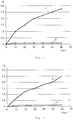
- Fig. 1, 2 and 3 show the loss of perfluoroketone and dibromomethane from the microencapsulated fire-extinguishing agents of the invention comprising a powder of microcapsules of the invention, said microcapsules having shells of cross-linking gelatin and cores, said cores comprising:
- microcapsule of the invention having a core comprising perfluoroketone and a stabilizer, which is a dispersion of pyrogenic silicon dioxide modified with methylsilane and hexafluoropropylene oxide dimer prepared as described in Example 4, will also exhibit high stability.
- Examples 1-6 demonstrate that the method of the invention for the preparation of microcapsules of the invention and implemented as shown in Examples 1-5 provides microcapsules with outer diameters of 50-400 mem, cores containing the target lyophilic low-boiling water-immiscible liquid characterized by its affinity to hydrolysis yielding acid products, which was demonstrated on perfluoroketone and dibromomethane as examples, wherein said cores are enclosed within spherical shells made from a cross-linked polymeric material, which was demonstrated using cross-linked gelatin as an example, which under certain external impact conditions that cause a breakup of said shells, triggers a release of said target liquid, which was demonstrated in the example of the explosive breakup of the obtained microcapsules when heated in the 90-230 °C temperature range, wherein said microcapsules contain the target liquid in the amount of 75-95% from the weight of the microcapsules and additionally, their cores contain stabilizers inhibiting the formation of the acidic environment that leads to
- introducing a stabilizer into the reaction mixture can efficiently prevent the formation of acid products of the hydrolysis of lyophilic liquids during the formation of the shell in the formed drop, and additionally, if the acid products do form in the drop, it prevents an uncontrolled influx of the formed acid products into the shell-forming zone. That, in turn, leads to the creation of an intact liquid shell, impedes the formation of pores in the cured shell, and respectively, contributes to the stability of the microcapsules during prolonged storage and use.
- Introducing hexafluoropropylene oxide dimer or a mixture of pyrogenic silicon dioxide modified with methylsilane and hexafluoropropylene oxide dimer into the reaction mixture containing perfluoroketone as the target lyophilic low-boiling water-immiscible liquid also efficiently prevents the formation of acid products of the perfluoroketone hydrolysis in the formed drop, and additionally, if the acid products do form in the drop, it prevents an uncontrolled influx of formed acid products into the shell-forming zone promoting the creation of intact liquid shells, impeding the formation of pores in the cured shells, and hence, improving the stability of the microcapsules during their prolonged storage and use.
- the microencapsulated powdered fire-extinguishing agent was gradually introduced into the box with a hand spray gun through an opening in the cover until the fire has been extinguished.
- the quantity of the microencapsulated fire-extinguishing agent used to extinguish the fire and the time required to extinguish the fire were hence determined.
- the amount of the used microencapsulated fire-extinguishing agent comprising microcapsules with perfluoroketone cores was smaller and the time to extinguish the fire was shorter than those when using the microcapsules containing dibromomethane. That was attributed to the lower thermal breakup temperature of the microcapsules containing perfluoroketone (90-100 °C) as compared to the thermal breakup temperature of the microcapsules containing dibromomethane (220-230 °C) and to the faster impact of the microcapsules with perfluoroketone on the fire. Incidentally, there was no impact noticed of the stabilizers on the thermal breakup temperature and on the fire-extinguishing process.
- the two microencapsulated fire-extinguishing agents both with perfluoroketone and dibromomethane, were effective.
- the agent expels the evaporable fire-extinguishing liquid as a gas into the environment where said microcapsules break into "heavy" free radicals, which disrupt the kinetic chains of the fire and thus, put out the fire.
- heavy gases block the access of oxygen to the fire source and the heat is spent on evaporation.
- the thermal break temperature of microcapsules can vary by more than 100 °C, such microencapsulated fire-extinguishing agents can be used in various fire-extinguishing systems.
- the microencapsulated fire-extinguishing agent can be used as a filler in manufacturing fire-extinguishing construction materials containing microencapsulated fire-extinguishing agents of the invention dispersed in cured resin or cured rubber, wherein said materials acquire the fire-extinguishing ability owing to the explosive breakup capacity of the microcapsules contained within said material when the temperature rises to a certain degree of the breakup temperature.
- the fire-extinguishing composite material can be made in the form of foam, or curable paste, or as a constructive element, or film, or a fire-extinguishing fabric impregnated or coated with curable paste containing resin or rubber with the microencapsulated fire-extinguishing agent of the invention dispersed therein.
- the invention also provides a fire-extinguishing article for the preventive protection of objects from fire, equipped with a fire-extinguishing element fixed on the surface of a bearing component and containing the reactive microencapsulated fire-extinguishing agent of the invention set in a polymer matrix; wherein said article has such spatial configuration that when said article is arranged in the object to be protected, the largest surface area of the fire-extinguishing element is situated in the zone to be protected or adjacent thereto.
- the fire-extinguishing article according to the present invention can be placed in the zones most likely to catch fire: in electrical facilities, cable lines, power bays of different means of transport, as well as in homes as covers for putting out fires.
- the polymer matrix of the fire-extinguishing element in the fire-extinguishing article can be made from materials selected from the group comprising: cold-cured silicon rubber, styrene-butadiene rubber, polyvinyl acetate, polyvinyl alcohol, cold-cured rubber-reinforced epoxy resins, polyester resins, alkyd pentaphthalic enamel, and alkyd glyptal enamel.
- the fire-extinguishing article can be detachable.
- the bearing component can be made from materials selected from the group comprising: heat-resistant glass, metals, ceramics, elastic polymers, flexible polymers, magnetic rubber, polymers containing magnetic powders, fiberglass, woven and nonwoven fabrics, and carbon fabrics.
- the fire-extinguishing product can be made as one-sided adhesive or double-sided adhesive, for example, as a film or a plate.
- Example 8 Preparation of fire-extinguishing construction materials and fire-extinguishing articles according to the invention.
- the fire-extinguishing construction materials of the invention were prepared by the technology common for the preparation of all types of fire-extinguishing construction materials including:
- the "matrix : microcapsules” parts by weight ratio was from 40:60 to 30:70, and for paints, lacquer, polymer solutions or emulsions, the “matrix: microcapsules” parts by weight ratio was (85:90) : (15:10) (calculated for the dry residue of the polymer component), and the average of the target liquid content in the microcapsules was about 90 wt.%
- the fire-extinguishing articles of the invention were prepared by the technology common for the preparation of all types of fire-extinguishing articles, including
- matrix : microcapsules parts by weight ratio was from 40:60 to 10:90, and the average of the target fire-extinguishing liquid content in the microcapsules was about 90 wt.%.
- the paste was used prior to curing.
- the fire-extinguishing coating of the invention was prepared as follows: before it was cured, the paste prepared in Variant 8.1 was applied to the inner wall of an experimental box (200 mm x 200 mm x 200 mm) topped with a lid having openings for igniting the fuel (10.0 g) contained in a flat Petri dish on the bottom of the box, and kept at 20-25 °C for 48 hrs. until the coating cured.
- the obtained coating was up to 1 mm thick.
- the fire-extinguishing paint of the invention 100 g of water-based paint (based on polyvinyl acetate) or pentaphthalic enamel with a hydrocarbon solvent, with the polymer content of 20 wt.% were combined with 170 g of the microencapsulated fire-extinguishing agent of the invention prepared as described in Variant 3.2, Example 3.
- the paint was applied to a cardboard sheet 150 x 150 x 200 cm and dried. The thickness of the layer was 0.8-1.0 mm.
- Variant 8.4. Fire-extinguishing screen 100 g of water-based paint (based on polyvinyl acetate) or pentaphthalic enamel with a hydrocarbon solvent, with the polymer content of 20 wt.% were combined with 170 g of the microencapsulated fire-extinguishing agent of the invention prepared as described in Variant 3.2, Example 3.
- the paint was applied to a cardboard sheet 150 x 150 x 200 cm and dried. The thickness of the layer was 0.8-1.0
- the paste obtained in Variant 8.1 was placed in an aluminum tray 200 mm x 200 mm x 30 mm, with an anti-adhesive coating, and kept at 20-25 °C for 48 hrs. for curing until a plate was formed.
- Variant 8.5 Fire-extinguishing fabric.
- the fire-extinguishing fabric was prepared by impregnating fiberglass with an uncured mixture of silicon rubber containing a curing agent (organotin catalyst) and the microencapsulated fire-extinguishing agent of the invention prepared as described in Variant 1.3, Example 1, with further curing.
- a curing agent organotin catalyst
- the fire-extinguishing cover material was prepared as follows: 20 g of poly(butyl alkyl acrylate) latex (content of poly(butyl alkyl acrylate) - 40 wt.%) were combined with 8.0 g of the microencapsulated fire-extinguishing agent of the invention comprising microcapsules of the invention prepared as described in Variant 1.2, Example 1. The mass was applied to the box wall for fire testing and dried.
- the fire-extinguishing foam (hard foam) of the invention was prepared as follows: 24 g of polyester Laprol 805, 56 g of polyester Laprol 1002, and 21 g of diethylene glycol were mixed together and combined with vigorous stirring with 0.75 g of DABCO catalyst diluted in 30 ml of 50 wt.% aqueous solution of potassium acetate, 150 g polyisocyanate, and 50 g of the microencapsulated fire-extinguishing agent comprising microcapsules of the invention prepared as described above in Variant 3.2, Example 3.
- the foaming mass was placed in an aluminum tray 200 mm x 200 mm x 30 mm with an anti-adhesive coating, and the foam was kept with no heat applied until cured.
- a 200 x 200 x 30 mm sample of foam was cut out for fire testing.
- Variant 8.8 Detachable fire-extinguishing article for installation on the metal element of the structure of the object to be protected.
- a fire-extinguishing article was prepared with a bearing component made of magnetic rubber and carrying a fire-extinguishing element in the form of a fire-extinguishing layer with a polymer matrix comprising the microencapsulated fire-extinguishing agent of the invention prepared as described above (Variant 1.3, Example 1), wherein the uncured silicon-rubber-based layer (as in Variant 8.1.4 for fabric) was applied with a spatula on a sheet of magnetic rubber 0.4 mm thick, and cured at 40 °C. Three 200 x 200 mm plates were cut out to be placed in contact with the lid and the walls of the box in fire testing.
- Variant 8.9. Fire-extinguishing article for installation on the surface of the object to be protected in the area adjacent to the putative fire outbreak zone.
- a fire-extinguishing article comprising a bearing component prepared from double-sided adhesive tape, wherein both sides of the tape were coated with an adhesive comprising non-adhesive protective elements, said bearing component comprising a fire-extinguishing element in the form of a fire-extinguishing layer having a polymer matrix comprising the microencapsulated fire-extinguishing agent of the invention prepared as described above (Variant 1.3, Example 1), wherein one side of said tape, cleared from its protective element, was coated with the following uncured composition: 40% solution of styrene-butadiene rubber in the solvent comprising the microencapsulated fire-extinguishing agent of the invention prepared as described above (Variant 1.3, Example 1) in the 66 g of microcapsules per 40 g of rubber ratio. The mixture was dried at 40 °C. For fire testing, the second side of the tape was cleared from its protective element, and the article was fixed to contact the inner walls of the box.
- Example 9 Testing the fire-extinguishing properties of the fire-extinguishing construction materials and fire-extinguishing articles of the invention.
- the temperature of the flame triggered a release of gaseous products from the destructed microcapsules due to the thermal breakdown of the fire-extinguishing liquid, while the fire-extinguishing materials and fire-extinguishing articles retained their initial shape.
- the surface facing the fuel showed "craters" the size of microcapsules, formed after the microcapsules broke up in the fire-extinguishing surface layer. Incidentally, only an insignificant part of the microcapsules was destroyed, and the surface of the fire-extinguishing layer on the samples was hardly damaged, so the sample could be reused.
- the method of the invention can be used to prepare the microcapsule of the invention containing a core comprising the target lyophilic low-boiling water-immiscible liquid with characteristic affinity to hydrolysis that yields acid products, said microcapsules containing stabilizers preventing hydrolysis of the target liquid in the core and thus, ensuring the stability of the properties of the microcapsules and the liquids contained therein over a long time period.
- the target liquid is prevented from flowing into the zone wherein the shells of the acidic hydrolysates of the target liquid, which interfere with the formation of intact shells, are formed.
- the method for the preparation of microcapsules of the invention doesn't require any special technological stages for the preparation of stabilizers and/or any special modifications of their surfaces, as the required products are commercially available.
- the method for the preparation of microcapsules of the invention can be applied in various industrial areas to create microcapsules with different target liquids and long shelf lives.
- microcapsules of the invention can be applied to provide microencapsulated fire extinguishing agents capable of expelling target liquid products into the environment at certain temperatures, for example, by selecting certain fire extinguishing liquids and shells; and to ensure long-term stability of the microcapsules by introducing stabilizers into the reaction medium of the invention.
- the explosive breakup temperature of the microcapsules was provided to be in the 90-230 °C range, depending on the nature of a given fire-extinguishing liquid, because when the environmental temperatures go up, the fire-extinguishing liquid inside the shell overheats to the temperature significantly exceeding the boiling point thereof under normal conditions: for example, for perfluoroketone - in 45-50 °C, for dibromomethane - in 120-130 °C.
- microencapsulated fire-extinguishing agents of the invention comprising a powder of microcapsules of the invention, wherein said microcapsules comprise cores of the target fire-extinguishing liquid containing stabilizers, which prevent hydrolysis of the target fire-extinguishing liquid in the cores, wherein said agents exhibit characteristic stability of the fire-extinguishing properties of fire-extinguishing liquids over a long time period and reliable efficiency of expelling the thermal breakdown products of fire-extinguishing liquids at the temperatures, at which the microcapsules break down, which are in the 90-230 °C range.
- TGA gravimetric analysis
- Said microencapsulated fire-extinguishing agents can be used in different industries and different fire-fighting systems for the efficient timely automatic prevention of fires both as powders of the microencapsulated fire-extinguishing agents of the invention, and as part of a composition of fire-extinguishing materials or fire-extinguishing articles for the preventive protection of objects from fire, which remain highly effective and maintain their fire-extinguishing ability for a long time period.
- microcapsules of the invention prepared by the method of the invention can be made from known materials by known manufacturing methods, and thus, can be used in different industries, such as chemical, food, and cosmetic industries.
- the microencapsulated fire-extinguishing agents, fire-extinguishing, articles and fire-extinguishing materials are free from environmental and health hazards and remain stable for a long time during their storage and use, which makes said objects useful in the creation and application of novel and highly stable fire-extinguishing materials and articles based thereupon, in industrial, private, and public buildings used by the populace.
Landscapes
- Chemical & Material Sciences (AREA)
- Chemical Kinetics & Catalysis (AREA)
- Organic Chemistry (AREA)
- Health & Medical Sciences (AREA)
- General Chemical & Material Sciences (AREA)
- Business, Economics & Management (AREA)
- Emergency Management (AREA)
- Medicinal Chemistry (AREA)
- Polymers & Plastics (AREA)
- Engineering & Computer Science (AREA)
- Materials Engineering (AREA)
- Dispersion Chemistry (AREA)
- Dermatology (AREA)
- Manufacturing Of Micro-Capsules (AREA)
- Fire-Extinguishing Compositions (AREA)
Applications Claiming Priority (1)
| Application Number | Priority Date | Filing Date | Title |
|---|---|---|---|
| PCT/RU2014/000907 WO2016089240A1 (ru) | 2014-12-04 | 2014-12-04 | Микрокапсулы, способ их получения и огнегасящие агенты, материалы, покрытия и изделия на их основе |
Publications (2)
| Publication Number | Publication Date |
|---|---|
| EP3228366A1 true EP3228366A1 (de) | 2017-10-11 |
| EP3228366A4 EP3228366A4 (de) | 2018-03-07 |
Family
ID=56092069
Family Applications (1)
| Application Number | Title | Priority Date | Filing Date |
|---|---|---|---|
| EP14907229.0A Withdrawn EP3228366A4 (de) | 2014-12-04 | 2014-12-04 | Mikrokapseln, verfahren zur herstellung davon und darauf basierende flammhemmende mittel, materialien, beschichtungen und produkte |
Country Status (3)
| Country | Link |
|---|---|
| US (1) | US20190076687A1 (de) |
| EP (1) | EP3228366A4 (de) |
| WO (1) | WO2016089240A1 (de) |
Cited By (12)
| Publication number | Priority date | Publication date | Assignee | Title |
|---|---|---|---|---|
| WO2019177191A1 (ko) * | 2018-03-13 | 2019-09-19 | 김민구 | 마이크로 캡슐화된 소화용 조성물을 함유하는 보드패널용 전사인쇄필름 |
| CN111068233A (zh) * | 2019-11-26 | 2020-04-28 | 南京师范大学 | 一种以乳清分离蛋白/阴离子多糖为壁材的微胶囊灭火剂的制备方法 |
| KR102113862B1 (ko) * | 2018-11-16 | 2020-05-21 | (주)수 | 초기화재진압용 락카 조성물 |
| KR102113863B1 (ko) * | 2018-11-16 | 2020-05-21 | (주)수 | 초기화재진압용 에어로졸형 락카 조성물 |
| KR102123659B1 (ko) * | 2019-05-08 | 2020-06-16 | 한국소방산업기술원 | 소화용 마이크로 캡슐을 포함하는 소화용 시트 |
| KR102123571B1 (ko) * | 2019-05-08 | 2020-06-16 | 주식회사 지에프아이 | 소화용 마이크로 캡슐을 포함하는 소화용 조성물 |
| KR102123554B1 (ko) * | 2019-03-19 | 2020-06-16 | 주식회사 지에프아이 | 소화용 마이크로 캡슐, 이의 제조 방법 및 이를 포함하는 소화 장치 |
| KR20210000946A (ko) * | 2019-06-26 | 2021-01-06 | (주)수 | 캡슐형 소화약제를 이용한 2액형 초기화재진압용 에폭시계 도료 조성물 및 에어로졸형 에폭시계 도료 조성물 |
| CN112494879A (zh) * | 2020-11-25 | 2021-03-16 | 河南科技大学 | 一种高效水成膜泡沫灭火剂 |
| WO2021246756A1 (ko) * | 2020-06-05 | 2021-12-09 | 주식회사 지에프아이 | 이차전지용 소화 장치 및 이를 포함하는 배터리팩 |
| CN115428245A (zh) * | 2020-03-25 | 2022-12-02 | Gfi有限公司 | 具备包含灭火用微包囊的灭火膜的电池组 |
| KR102595797B1 (ko) * | 2023-08-24 | 2023-11-01 | 주식회사 가온테크놀러지 | 소화용 마이크로캡슐을 포함하는 자기소화 복합 시트 및 이의 제조 방법 |
Families Citing this family (11)
| Publication number | Priority date | Publication date | Assignee | Title |
|---|---|---|---|---|
| RU2740681C1 (ru) * | 2020-02-14 | 2021-01-19 | Владимир Витальевич Полиенко | Способ доставки огнетушащего элемента в очаг возгорания |
| CN111420336B (zh) * | 2020-03-03 | 2021-10-08 | 北京理工大学 | 锂离子电池热失控燃爆安全防控方法及装置 |
| RU2763063C1 (ru) * | 2020-08-12 | 2021-12-27 | Общество с ограниченной ответственностью "ТЕХНОХИМ" | Функциональный наполнитель для огнетушащего порошкового состава |
| KR102674827B1 (ko) | 2021-09-16 | 2024-06-13 | 건국대학교 산학협력단 | 이중벽 구조를 가지는 유무기 하이브리드 소화용 마이크로캡슐, 이의 제조방법 및 이를 포함하는 소화용 조성물 |
| CN114558268B (zh) * | 2022-03-03 | 2022-11-01 | 北京理工大学 | 一种全氟己酮微胶囊抑燃介质及其制备方法、产品和应用 |
| CN114917521B (zh) * | 2022-05-18 | 2023-03-21 | 南京师范大学 | 一种温度响应型双壳层微胶囊灭火剂及其制备方法 |
| JP7650413B2 (ja) * | 2022-06-15 | 2025-03-25 | 浙江銘諾新材料科技有限公司 | ペルフルオロヘキサノンマイクロカプセル消火材料及びその製造方法 |
| CN115382146B (zh) * | 2022-06-15 | 2023-05-30 | 浙江虹达特种橡胶制品有限公司杭州分公司 | 灭火片 |
| KR102814296B1 (ko) * | 2022-11-25 | 2025-06-02 | (주)이유씨엔씨 | 공동구 국소 설비 초기 화재 진화용 소화 도료 조성물 |
| CN116271675B (zh) * | 2023-03-22 | 2024-08-20 | 湖北丰邦安防科技有限公司 | 全氟己酮微胶囊灭火介质及其制备方法 |
| CN117797441B (zh) * | 2023-12-20 | 2026-03-31 | 重庆渝捷消防设备有限责任公司 | 一种微胶囊灭火剂及其制备方法与应用 |
Family Cites Families (10)
| Publication number | Priority date | Publication date | Assignee | Title |
|---|---|---|---|---|
| AT392078B (de) * | 1988-04-07 | 1991-01-25 | Chemie Linz Gmbh | Latexgebundene brandschutzmasse |
| JPH0584873A (ja) * | 1991-09-27 | 1993-04-06 | Toppan Printing Co Ltd | 自己消火性シート |
| RU2149665C1 (ru) * | 1999-02-04 | 2000-05-27 | Гречман Анатолий Оттович | Огнетушащий порошковый состав |
| RU2190649C2 (ru) * | 2000-10-04 | 2002-10-10 | Государственное предприятие "Всероссийский научно-исследовательский институт авиационных материалов" | Вспенивающаяся композиция для огнезащитного покрытия |
| RU2329898C2 (ru) * | 2003-06-06 | 2008-07-27 | Гудрич Корпорейшн | Многослойная барьерная система (варианты) |
| RU2389525C2 (ru) * | 2006-07-14 | 2010-05-20 | Общество С Ограниченной Ответственностью "Делси" | Микрокапсулированный огнегасящий агент и способ его получения, огнегасящий композиционный материал, огнегасящее покрытие из краски и огнегасящая ткань, содержащие такой агент |
| JP2009167311A (ja) * | 2008-01-17 | 2009-07-30 | Soken Chem & Eng Co Ltd | 消火性粘着剤層およびこれを利用する消火性粘着シート |
| KR101184790B1 (ko) * | 2011-02-10 | 2012-09-20 | 제이에스씨 파이로 치미카 | 자립형 소화장치 |
| RU2469761C1 (ru) * | 2011-06-23 | 2012-12-20 | Общество С Ограниченной Ответственностью "Делси" | Микрокапсулированный огнегасящий агент, способ его получения, огнегасящий композиционный материал и огнегасящее покрытие |
| CN103649272B (zh) * | 2011-08-30 | 2015-09-09 | 英派尔科技开发有限公司 | 二茂铁/二氧化碳释放系统 |
-
2014
- 2014-12-04 US US15/533,021 patent/US20190076687A1/en not_active Abandoned
- 2014-12-04 WO PCT/RU2014/000907 patent/WO2016089240A1/ru not_active Ceased
- 2014-12-04 EP EP14907229.0A patent/EP3228366A4/de not_active Withdrawn
Cited By (20)
| Publication number | Priority date | Publication date | Assignee | Title |
|---|---|---|---|---|
| CN110272694A (zh) * | 2018-03-13 | 2019-09-24 | 金玟九 | 包含微胶囊化灭火用组合物的镶板用转印膜 |
| WO2019177191A1 (ko) * | 2018-03-13 | 2019-09-19 | 김민구 | 마이크로 캡슐화된 소화용 조성물을 함유하는 보드패널용 전사인쇄필름 |
| WO2021054556A1 (ko) * | 2018-11-16 | 2021-03-25 | (주)수 | 초기화재진압용 락카 조성물 |
| KR102113862B1 (ko) * | 2018-11-16 | 2020-05-21 | (주)수 | 초기화재진압용 락카 조성물 |
| KR102113863B1 (ko) * | 2018-11-16 | 2020-05-21 | (주)수 | 초기화재진압용 에어로졸형 락카 조성물 |
| JP2022522213A (ja) * | 2019-03-19 | 2022-04-14 | ジーエフアイ カンパニー リミテッド | 消火用マイクロカプセル、これの製造方法及びこれを含む消火装置 |
| KR102123554B1 (ko) * | 2019-03-19 | 2020-06-16 | 주식회사 지에프아이 | 소화용 마이크로 캡슐, 이의 제조 방법 및 이를 포함하는 소화 장치 |
| WO2020189900A1 (ko) * | 2019-03-19 | 2020-09-24 | 주식회사 지에프아이 | 소화용 마이크로 캡슐, 이의 제조 방법 및 이를 포함하는 소화 장치 |
| CN113573786A (zh) * | 2019-03-19 | 2021-10-29 | Gfi有限公司 | 灭火用微包囊,其制备方法及包括其的灭火装置 |
| KR102123659B1 (ko) * | 2019-05-08 | 2020-06-16 | 한국소방산업기술원 | 소화용 마이크로 캡슐을 포함하는 소화용 시트 |
| KR102123571B1 (ko) * | 2019-05-08 | 2020-06-16 | 주식회사 지에프아이 | 소화용 마이크로 캡슐을 포함하는 소화용 조성물 |
| WO2020262807A3 (ko) * | 2019-06-26 | 2021-02-18 | (주)수 | 캡슐형 소화약제를 이용한 2액형 초기화재진압용 에폭시계 도료 조성물 및 에어로졸형 에폭시계 도료 조성물 |
| KR20210000946A (ko) * | 2019-06-26 | 2021-01-06 | (주)수 | 캡슐형 소화약제를 이용한 2액형 초기화재진압용 에폭시계 도료 조성물 및 에어로졸형 에폭시계 도료 조성물 |
| CN111068233B (zh) * | 2019-11-26 | 2021-06-01 | 南京师范大学 | 一种以乳清分离蛋白/阴离子多糖为壁材的微胶囊灭火剂的制备方法 |
| CN111068233A (zh) * | 2019-11-26 | 2020-04-28 | 南京师范大学 | 一种以乳清分离蛋白/阴离子多糖为壁材的微胶囊灭火剂的制备方法 |
| CN115428245A (zh) * | 2020-03-25 | 2022-12-02 | Gfi有限公司 | 具备包含灭火用微包囊的灭火膜的电池组 |
| CN115428245B (zh) * | 2020-03-25 | 2025-06-17 | Gfi有限公司 | 具备包含灭火用微包囊的灭火膜的电池组 |
| WO2021246756A1 (ko) * | 2020-06-05 | 2021-12-09 | 주식회사 지에프아이 | 이차전지용 소화 장치 및 이를 포함하는 배터리팩 |
| CN112494879A (zh) * | 2020-11-25 | 2021-03-16 | 河南科技大学 | 一种高效水成膜泡沫灭火剂 |
| KR102595797B1 (ko) * | 2023-08-24 | 2023-11-01 | 주식회사 가온테크놀러지 | 소화용 마이크로캡슐을 포함하는 자기소화 복합 시트 및 이의 제조 방법 |
Also Published As
| Publication number | Publication date |
|---|---|
| EP3228366A4 (de) | 2018-03-07 |
| US20190076687A1 (en) | 2019-03-14 |
| WO2016089240A1 (ru) | 2016-06-09 |
Similar Documents
| Publication | Publication Date | Title |
|---|---|---|
| US20190076687A1 (en) | Microcapsules, Method for Preparing Microcapsules, Fire-Extinguishing Agents, Materials, Coatings, and Articles Based Thereupon | |
| RU2469761C1 (ru) | Микрокапсулированный огнегасящий агент, способ его получения, огнегасящий композиционный материал и огнегасящее покрытие | |
| CN115491069B (zh) | 涂装物品 | |
| JP4698641B2 (ja) | マイクロカプセル化消火剤及びその製造方法、並びに消火性複合材料 | |
| DK2674198T3 (en) | Autonomous firefighting agent | |
| JP7650413B2 (ja) | ペルフルオロヘキサノンマイクロカプセル消火材料及びその製造方法 | |
| RU2389525C2 (ru) | Микрокапсулированный огнегасящий агент и способ его получения, огнегасящий композиционный материал, огнегасящее покрытие из краски и огнегасящая ткань, содержащие такой агент | |
| CN115581884A (zh) | 防火灭火布 | |
| JP2009160387A (ja) | マイクロカプセル化消火剤及びその製造方法、並びに消火性複合材料 | |
| RU2420350C2 (ru) | Микрокапсулы, содержащие воду или водный раствор, (варианты) и способы их получения (варианты) | |
| JP4632948B2 (ja) | ジブロモメタンを芯材とするマイクロカプセル化消火剤と該消火剤を含有した消火材料 | |
| RU2580132C2 (ru) | Способ получения огнезащитного покрытия на поверхности горючих и негорючих материалов, микрокапсулированный агент для создания огнезащитного покрытия на поверхности горючих и негорючих материалов, способ его получения и способ создания огнезащитного вспучивающегося покрытия | |
| US20230143503A1 (en) | Preparation of eco-friendly fire extinguisher microcapsules and applications thereof | |
| RU2555887C2 (ru) | Способ порошкового пожаротушения и микрокапсулированный огнегасящий агент | |
| JP2024526502A (ja) | 環境配慮型防火塗料及びその製造方法 | |
| Song et al. | Antibacterial self‐healing anticorrosion coatings from single capsule system | |
| WO2018217132A1 (ru) | Гибкая пластина, содержащая огнегасящий композиционный материал, и способ ее изготовления (варианты) | |
| Li et al. | Fabrication of thermally activated fire-extinguishing microcapsules and silicone rubber composite | |
| WO2009090747A1 (ja) | マイクロカプセル化消火剤及びその製造方法、並びに消火性複合材料 | |
| WO2012009270A1 (en) | Biodegradable fire suppressing composition with hydrocarbon dispersent | |
| JP2021031510A (ja) | 消火薬剤を噴出する塗料又はシーラント | |
| RU2751397C1 (ru) | Огнегасящая пластина на основе микрокапсулированных огнетушащих веществ | |
| KR102670535B1 (ko) | 소화물질이 내장된 소방용 마이크로캡슐 및 이의 제조 방법 | |
| KR102814296B1 (ko) | 공동구 국소 설비 초기 화재 진화용 소화 도료 조성물 | |
| WO2019135711A1 (en) | A fire extinguishing formulation for dry powder fire-extinguishers and method of producing the formulation |
Legal Events
| Date | Code | Title | Description |
|---|---|---|---|
| PUAI | Public reference made under article 153(3) epc to a published international application that has entered the european phase |
Free format text: ORIGINAL CODE: 0009012 |
|
| 17P | Request for examination filed |
Effective date: 20170704 |
|
| AK | Designated contracting states |
Kind code of ref document: A1 Designated state(s): AL AT BE BG CH CY CZ DE DK EE ES FI FR GB GR HR HU IE IS IT LI LT LU LV MC MK MT NL NO PL PT RO RS SE SI SK SM TR |
|
| AX | Request for extension of the european patent |
Extension state: BA ME |
|
| RIC1 | Information provided on ipc code assigned before grant |
Ipc: A62D 1/00 20060101ALI20180124BHEP Ipc: C09K 21/14 20060101ALI20180124BHEP Ipc: A62D 1/06 20060101AFI20180124BHEP Ipc: B01J 13/02 20060101ALI20180124BHEP |
|
| A4 | Supplementary search report drawn up and despatched |
Effective date: 20180201 |
|
| DAX | Request for extension of the european patent (deleted) | ||
| STAA | Information on the status of an ep patent application or granted ep patent |
Free format text: STATUS: THE APPLICATION IS DEEMED TO BE WITHDRAWN |
|
| 18D | Application deemed to be withdrawn |
Effective date: 20190702 |