EP3200260A1 - Polymerelektrolyt für eine lithiumsekundärbatterie und lithiumsekundärbatterie damit - Google Patents
Polymerelektrolyt für eine lithiumsekundärbatterie und lithiumsekundärbatterie damit Download PDFInfo
- Publication number
- EP3200260A1 EP3200260A1 EP17153314.4A EP17153314A EP3200260A1 EP 3200260 A1 EP3200260 A1 EP 3200260A1 EP 17153314 A EP17153314 A EP 17153314A EP 3200260 A1 EP3200260 A1 EP 3200260A1
- Authority
- EP
- European Patent Office
- Prior art keywords
- polymer electrolyte
- lithium
- secondary battery
- polymer
- lithium secondary
- Prior art date
- Legal status (The legal status is an assumption and is not a legal conclusion. Google has not performed a legal analysis and makes no representation as to the accuracy of the status listed.)
- Granted
Links
Images



Classifications
-
- H—ELECTRICITY
- H01—ELECTRIC ELEMENTS
- H01M—PROCESSES OR MEANS, e.g. BATTERIES, FOR THE DIRECT CONVERSION OF CHEMICAL ENERGY INTO ELECTRICAL ENERGY
- H01M10/00—Secondary cells; Manufacture thereof
- H01M10/05—Accumulators with non-aqueous electrolyte
- H01M10/056—Accumulators with non-aqueous electrolyte characterised by the materials used as electrolytes, e.g. mixed inorganic/organic electrolytes
- H01M10/0564—Accumulators with non-aqueous electrolyte characterised by the materials used as electrolytes, e.g. mixed inorganic/organic electrolytes the electrolyte being constituted of organic materials only
- H01M10/0565—Polymeric materials, e.g. gel-type or solid-type
-
- H—ELECTRICITY
- H01—ELECTRIC ELEMENTS
- H01M—PROCESSES OR MEANS, e.g. BATTERIES, FOR THE DIRECT CONVERSION OF CHEMICAL ENERGY INTO ELECTRICAL ENERGY
- H01M10/00—Secondary cells; Manufacture thereof
- H01M10/05—Accumulators with non-aqueous electrolyte
- H01M10/056—Accumulators with non-aqueous electrolyte characterised by the materials used as electrolytes, e.g. mixed inorganic/organic electrolytes
- H01M10/0564—Accumulators with non-aqueous electrolyte characterised by the materials used as electrolytes, e.g. mixed inorganic/organic electrolytes the electrolyte being constituted of organic materials only
- H01M10/0566—Liquid materials
- H01M10/0567—Liquid materials characterised by the additives
-
- H—ELECTRICITY
- H01—ELECTRIC ELEMENTS
- H01M—PROCESSES OR MEANS, e.g. BATTERIES, FOR THE DIRECT CONVERSION OF CHEMICAL ENERGY INTO ELECTRICAL ENERGY
- H01M10/00—Secondary cells; Manufacture thereof
- H01M10/05—Accumulators with non-aqueous electrolyte
- H01M10/052—Li-accumulators
-
- H—ELECTRICITY
- H01—ELECTRIC ELEMENTS
- H01M—PROCESSES OR MEANS, e.g. BATTERIES, FOR THE DIRECT CONVERSION OF CHEMICAL ENERGY INTO ELECTRICAL ENERGY
- H01M10/00—Secondary cells; Manufacture thereof
- H01M10/05—Accumulators with non-aqueous electrolyte
- H01M10/052—Li-accumulators
- H01M10/0525—Rocking-chair batteries, i.e. batteries with lithium insertion or intercalation in both electrodes; Lithium-ion batteries
-
- H—ELECTRICITY
- H01—ELECTRIC ELEMENTS
- H01M—PROCESSES OR MEANS, e.g. BATTERIES, FOR THE DIRECT CONVERSION OF CHEMICAL ENERGY INTO ELECTRICAL ENERGY
- H01M10/00—Secondary cells; Manufacture thereof
- H01M10/05—Accumulators with non-aqueous electrolyte
- H01M10/056—Accumulators with non-aqueous electrolyte characterised by the materials used as electrolytes, e.g. mixed inorganic/organic electrolytes
- H01M10/0564—Accumulators with non-aqueous electrolyte characterised by the materials used as electrolytes, e.g. mixed inorganic/organic electrolytes the electrolyte being constituted of organic materials only
- H01M10/0566—Liquid materials
- H01M10/0568—Liquid materials characterised by the solutes
-
- H—ELECTRICITY
- H01—ELECTRIC ELEMENTS
- H01M—PROCESSES OR MEANS, e.g. BATTERIES, FOR THE DIRECT CONVERSION OF CHEMICAL ENERGY INTO ELECTRICAL ENERGY
- H01M50/00—Constructional details or processes of manufacture of the non-active parts of electrochemical cells other than fuel cells, e.g. hybrid cells
- H01M50/40—Separators; Membranes; Diaphragms; Spacing elements inside cells
- H01M50/409—Separators, membranes or diaphragms characterised by the material
- H01M50/446—Composite material consisting of a mixture of organic and inorganic materials
-
- H—ELECTRICITY
- H01—ELECTRIC ELEMENTS
- H01M—PROCESSES OR MEANS, e.g. BATTERIES, FOR THE DIRECT CONVERSION OF CHEMICAL ENERGY INTO ELECTRICAL ENERGY
- H01M2220/00—Batteries for particular applications
- H01M2220/20—Batteries in motive systems, e.g. vehicle, ship, plane
-
- H—ELECTRICITY
- H01—ELECTRIC ELEMENTS
- H01M—PROCESSES OR MEANS, e.g. BATTERIES, FOR THE DIRECT CONVERSION OF CHEMICAL ENERGY INTO ELECTRICAL ENERGY
- H01M2300/00—Electrolytes
- H01M2300/0017—Non-aqueous electrolytes
- H01M2300/0025—Organic electrolyte
-
- H—ELECTRICITY
- H01—ELECTRIC ELEMENTS
- H01M—PROCESSES OR MEANS, e.g. BATTERIES, FOR THE DIRECT CONVERSION OF CHEMICAL ENERGY INTO ELECTRICAL ENERGY
- H01M2300/00—Electrolytes
- H01M2300/0017—Non-aqueous electrolytes
- H01M2300/0065—Solid electrolytes
- H01M2300/0082—Organic polymers
-
- H—ELECTRICITY
- H01—ELECTRIC ELEMENTS
- H01M—PROCESSES OR MEANS, e.g. BATTERIES, FOR THE DIRECT CONVERSION OF CHEMICAL ENERGY INTO ELECTRICAL ENERGY
- H01M2300/00—Electrolytes
- H01M2300/0085—Immobilising or gelification of electrolyte
-
- H—ELECTRICITY
- H01—ELECTRIC ELEMENTS
- H01M—PROCESSES OR MEANS, e.g. BATTERIES, FOR THE DIRECT CONVERSION OF CHEMICAL ENERGY INTO ELECTRICAL ENERGY
- H01M2300/00—Electrolytes
- H01M2300/0088—Composites
- H01M2300/0091—Composites in the form of mixtures
-
- Y—GENERAL TAGGING OF NEW TECHNOLOGICAL DEVELOPMENTS; GENERAL TAGGING OF CROSS-SECTIONAL TECHNOLOGIES SPANNING OVER SEVERAL SECTIONS OF THE IPC; TECHNICAL SUBJECTS COVERED BY FORMER USPC CROSS-REFERENCE ART COLLECTIONS [XRACs] AND DIGESTS
- Y02—TECHNOLOGIES OR APPLICATIONS FOR MITIGATION OR ADAPTATION AGAINST CLIMATE CHANGE
- Y02E—REDUCTION OF GREENHOUSE GAS [GHG] EMISSIONS, RELATED TO ENERGY GENERATION, TRANSMISSION OR DISTRIBUTION
- Y02E60/00—Enabling technologies; Technologies with a potential or indirect contribution to GHG emissions mitigation
- Y02E60/10—Energy storage using batteries
-
- Y—GENERAL TAGGING OF NEW TECHNOLOGICAL DEVELOPMENTS; GENERAL TAGGING OF CROSS-SECTIONAL TECHNOLOGIES SPANNING OVER SEVERAL SECTIONS OF THE IPC; TECHNICAL SUBJECTS COVERED BY FORMER USPC CROSS-REFERENCE ART COLLECTIONS [XRACs] AND DIGESTS
- Y02—TECHNOLOGIES OR APPLICATIONS FOR MITIGATION OR ADAPTATION AGAINST CLIMATE CHANGE
- Y02T—CLIMATE CHANGE MITIGATION TECHNOLOGIES RELATED TO TRANSPORTATION
- Y02T10/00—Road transport of goods or passengers
- Y02T10/60—Other road transportation technologies with climate change mitigation effect
- Y02T10/70—Energy storage systems for electromobility, e.g. batteries
Definitions
- Embodiments relate to a polymer electrolyte for a lithium secondary battery and a lithium secondary battery comprising the same.
- Lithium secondary batteries which are high performance secondary batteries with the highest energy density among commercially available secondary batteries, may be used in various fields such as electric vehicles.
- the present invention provides a polymer electrolyte for a lithium secondary battery comprising a polymer represented by Formula 1 below: w herein a and b are each independently an integer from 1 to 5, and n is an integer from 1 to 1,000.
- a weight average molecular weight of the polymer may be 2,000 g/mol or greater.
- the polymer represented by Formula 1 may be a polymer represented by Formula 2 below: wherein n is an integer from 1 to 1,000.
- An amount of the polymer represented by Formula 1 may be in the range of about 20 to about 99 parts by weight based on 100 parts by weight of the polymer electrolyte.
- the polymer electrolyte may comprise a lithium salt.
- the lithium salt may be selected from LiPF 6 , LiBF 4 , LiSbF 6 , LiAsF 6 , LiN(SO 2 C 2 F 5 ) 2 , Li(CF 3 SO 2 ) 2 N, LiC 4 F 9 SO 3 , LiClO 4 , LiAlO 2 , LiAlCl 4 , LiN(C x F 2x+1 SO 2 )(C y F 2y+1 SO 2 ) (where x and y are natural numbers), LiF, LiBr, LiCl, LiOH, LiI, LiB(C 2 O 4 ) 2 (lithium bis(oxalato) borate (LiBOB)), Li(FSO 2 ) 2 N, Li(CF 3 SO 2 ) 2 N, Li(C 2 F 5 SO 2 ) 2 N, LiN(C p F 2p+1 SO 2 )(C q F 2q+1 SO 2 ) (where p and q are different and each independently an integer from 1 to 20), LiN((
- the polymer electrolyte further may comprise non-ion-conductive inorganic particles or ion-conductive inorganic particles.
- the non-ion-conductive inorganic particles may comprise SiO 2 , TiO 2 , ZnO, Al 2 O 3 , BaTiO 3 , Pb(Zr,Ti)O 3 (PZT), Pb 1-x La x Zr 1-y Ti y O 3 (PLZT, where 0 ⁇ x ⁇ 1, and 0 ⁇ y ⁇ 1), PB(Mg 3 Nb 2/3 )O 3 -PbTiO 3 (PMN-PT), HfO 2 , SrTiO 3 , SnO 2 , CeO 2 , Na 2 O, MgO, NiO, CaO, BaO, ZrO 2 , Y 2 O 3 , SiC, lithium phosphate (Li 3 PO 4 ), BaTiO 3 or any combination thereof.
- An amount of the non-ion-conductive inorganic particles or ion-conductive inorganic particles may be in the range of about 1 to about 40 parts by weight based on 100 parts by weight of the polymer electrolyte.
- the ion-conductive inorganic particles may comprise a glassy active metal ion conductor, an amorphous active metal ion conductor, a ceramic active metal ion conductor, a glass-ceramic active metal ion conductor, or any combination thereof.
- the ion-conductive inorganic particles may comprise Li 1+x+y Al x Ti 2-x Si y P 3-y O 12 (where 0 ⁇ x ⁇ 2 and 0 ⁇ y ⁇ 3), lithium titanium phosphate (Li x Ti y (PO 4 ) 3 , where 0 ⁇ x ⁇ 2, and 0 ⁇ y ⁇ 3), lithium aluminum titanium phosphate (Li x Al y Ti z (PO 4 ) 3, where o ⁇ x ⁇ 2, 0 ⁇ y ⁇ 1, and 0 ⁇ z ⁇ 3), Li 1+x+y (Al, Ga) x (Ti, Ge) 2-x Si y P 3-y O 12 (where 0 ⁇ x ⁇ 1 and 0 ⁇ y ⁇ 1), lithium lanthanum titanate (Li x La y TiO 3 , where o ⁇ x ⁇ 2, and 0 ⁇ y ⁇ 3), lithium germanium thiophosphate (Li x Ge y P z S w , where 0 ⁇ x ⁇ 4, 0 ⁇ y ⁇ 1, 0 ⁇ z ⁇ 1, and
- Embodiments are also directed to a lithium secondary battery comprising a polymer electrolyte for a lithium secondary battery comprising a polymer represented by Formula 1 below: w herein a and b are each independently an integer from 1 to 5, and n is an integer from 1 to 1,000.
- a weight average molecular weight of the polymer may be 2,000 g/mol or greater.
- the polymer represented by Formula 1 may be a polymer represented by Formula 2 below: wherein n is an integer from 1 to 1,000.
- An amount of the polymer represented by Formula 1 may be in the range of about 20 to about 99 parts by weight based on 100 parts by weight of the polymer electrolyte.
- the polymer electrolyte may comprise a lithium salt.
- the lithium salt may be selected from LiPF 6 , LiBF 4 , LiSbF 6 , LiAsF 6 , LiN(SO 2 C 2 F 5 ) 2 , Li(CF 3 SO 2 ) 2 N, LiC 4 F 9 SO 3 , LiClO 4 , LiAlO 2 , LiAlCl 4 , LiN(C x F 2x+1 SO 2 )(C y F 2y+1 SO 2 ) (where x and y are natural numbers), LiF, LiBr, LiCl, LiOH, LiI, LiB(C 2 O 4 ) 2 (lithium bis(oxalato) borate (LiBOB)), Li(FSO 2 ) 2 N, Li(CF 3 SO 2 ) 2 N, Li(C 2 F 5 SO 2 ) 2 N, LiN(C p F 2p+1 SO 2 )(C q F 2q+1 SO 2 ) (where p and q are different and each independently an integer from 1 to 20), LiN((
- the polymer electrolyte may further comprise non-ion-conductive inorganic particles or ion-conductive inorganic particles.
- An amount of the non-ion-conductive inorganic particles or ion-conductive inorganic particles may be in the range of about 1 to about 40 parts by weight based on 100 parts by weight of the polymer electrolyte.
- the non-ion-conductive inorganic particles may comprise SiO 2 , TiO 2 , ZnO, Al 2 O 3 , BaTiO 3 , Pb(Zr,Ti)O 3 (PZT), Pb 1-x La x Zr 1-y Ti y O 3 (PLZT, where 0 ⁇ x ⁇ 1, and 0 ⁇ y ⁇ 1), PB(Mg 3 Nb 2/3 )O 3 -PbTiO 3 (PMN-PT), HfO 2 , SrTiO 3 , SnO 2 , CeO 2 , Na 2 O, MgO, NiO, CaO, BaO, ZrO 2 , Y 2 O 3 , SiC, lithium phosphate (Li 3 PO 4 ), BaTiO 3 , or any combination thereof.
- the ion-conductive inorganic particles may comprise at least one selected from a glassy active metal ion conductor, an amorphous active metal ion conductor, a ceramic active metal ion conductor, a glass-ceramic active metal ion conductor, and any combination thereof.
- the ion-conductive inorganic particles may comprise Li 1+x+y Al x Ti 2-x Si y P 3-y O 12 (where o ⁇ x ⁇ 2 and 0 ⁇ y ⁇ 3), lithium titanium phosphate (Li x Ti y (PO 4 ) 3 , where o ⁇ x ⁇ 2, and 0 ⁇ y ⁇ 3), lithium aluminum titanium phosphate (Li x Al y Ti z (PO 4 ) 3, where o ⁇ x ⁇ 2, 0 ⁇ y ⁇ 1, and 0 ⁇ z ⁇ 3), Li 1+x+y (Al, Ga) x (Ti, Ge) 2-x Si y P 3-y O 12 (where 0 ⁇ x ⁇ 1 and 0 ⁇ y ⁇ 1), lithium lanthanum titanate (Li x La y TiO 3 , where o ⁇ x ⁇ 2, and 0 ⁇ y ⁇ 3), lithium germanium thiophosphate (Li x Ge y P z S w , where 0 ⁇ x ⁇ 4, 0 ⁇ y ⁇ 1, 0 ⁇ z ⁇ 1, and
- a polymer electrolyte for a lithium secondary battery comprising a polymer represented by Formula 1 below is provided.
- a and b are each independently an integer from 1 to 5
- n is an integer from 1 to 1,000, or, for example, an integer from 1 to 600. It is to be understood that Formula 1 represents only the repeating unit of the polymer and that the polymer may be terminated on each end by a suitable terminal group
- a and b are each an integer from 1 to 3.
- a weight average molecular weight of the polymer may be 2,000 g/mol or greater, or, for example, in the range of about 2,000 to about 130,000 g/mol.
- a polymer electrolyte forming composition may have an appropriate viscosity to prepare the polymer electrolyte and may have a high ability to dissolve a lithium salt to increase an ionic conductivity of the polymer electrolyte.
- a lithium secondary battery having enhanced oxidation stability may be manufactured by using the polymer electrolyte.
- the polymer represented by Formula 1 may be a polymer represented by Formula 2 below.
- n is an integer from 1 to 1,000.
- An amount of the polymer represented by Formula 1 may be in the range of about 20 to about 99 parts by weight, or, for example, in the range of about 30 to about 90 parts by weight, based on 100 parts by weight of the polymer electrolyte. When the amount of the polymer represented by Formula 1 is within this range in the polymer electrolyte, a lithium secondary battery having excellent mechanical properties and enhanced oxidation stability may be manufactured.
- the polymer electrolyte according to an embodiment may comprise a lithium salt.
- the lithium salt may be selected from LiPF 6 , LiBF 4 , LiSbF 6 , LiAsF 6 , LiN(SO 2 C 2 F 5 ) 2 , Li(CF 3 SO 2 ) 2 N (LiTFSI), LiC 4 F 9 SO 3 , LiClO 4 , LiAlO 2 , LiAlCl 4 , LiN(C x F 2x+1 SO 2 )(C y F 2y+1 SO 2 ) (where x and y are natural numbers), LiF, LiBr, LiCl, LiOH, LiI, LiB(C 2 O 4 ) 2 (lithium bis(oxalato) borate (LiBOB)), Li(FSO 2 ) 2 N, Li(CF 3 SO 2 ) 2 N, Li(C 2 F 5 SO 2 ) 2 N, LiN(C p F 2p+1 SO 2 )(C q F 2q+1 SO 2 ) (where p and q are different and each independently an integer from 1 to
- An amount of the lithium salt may be in the range of 0.1 to 2 mol per 1 mol of a repeating unit monomer of the polymer represented by Formula 1. When the amount of the lithium salt is within this range, the polymer electrolyte may have excellent ionic conductivity.
- the polymer electrolyte may have excellent ionic conductivity even when an organic solvent is not contained therein.
- the polymer electrolyte may be used in a lithium secondary battery.
- the lithium secondary battery may be a lithium metal battery using a lithium metal as an anode.
- the polymer electrolyte may comprise an organic solvent.
- the organic solvent may be a carbonate-based compound, a glyme-based compound, a dioxolane-based compound, or the like.
- the carbonate-based compound may be ethylene carbonate, propylene carbonate, dimethyl carbonate, fluoroethylene carbonate, diethyl carbonate, or ethylmethyl carbonate.
- the glyme-based compound may be selected from poly(ethylene glycol) dimethyl ether, tetra(ethylene glycol) dimethyl ether, tri(ethylene glycol) dimethyl ether, poly(ethylene glycol) dilaurate, poly(ethylene glycol) monoacrylate, poly(ethylene glycol) diacrylate, and combinations thereof.
- the dioxolane-based compound may be selected from 3-dioxolane, 4,5-diethyl-dioxolane, 4,5-dimethyl-dioxolane, 4-methyl-1,3-dioxolane, and 4-ethyl-1,3-dioxolane.
- the organic solvent may include 2,2-dimethoxy-2-phenylacetophenone, 1,2-dimethoxyethane (DME), 1,2-diethoxyethane, tetrahydrofuran, ⁇ -butyrolactone, 1,1,2,2-tetrafluoroethyl 2,2,3,3-tetrafluoropropyl ether, and combinations thereof.
- the organic solvent may be selected from ethylene carbonate, dimethyl carbonate, diethyl carbonate, ethylmethyl carbonate, fluoroethylene carbonate, 1,2-dimethoxy ethane, 1,2-diethoxy ethane, dimethylene glycol dimethyl ether, trimethylene glycol dimethyl ether, tetraethylene glycol dimethyl ether, polyethylene glycol dimethyl ether, succinonitrile, sulfolane, dimethyl sulfone, ethylmethyl sulfone, diethyl sulfone, adiponitrile, 1,1,2,2,-tetrafluoroethyl 2,2,3,3-tetrafluoropropyl ether, and combinations thereof.
- the polymer electrolyte may further comprise non-ion-conductive inorganic particles or ion-conductive inorganic particles.
- the non-ion-conductive inorganic particles may comprise SiO 2 , TiO 2 , ZnO, Al 2 O 3 , BaTiO 3 , Pb(Zr,Ti)O 3 (PZT), Pb 1-x La x Zr 1-y Ti y O 3 (PLZT, where 0 ⁇ x ⁇ 1, and 0 ⁇ y ⁇ 1), PB(Mg 3 Nb 2/3 )O 3 -PbTiO 3 (PMN-PT), HfO 2 , SrTiO 3 , SnO 2 , CeO 2 , Na 2 O, MgO, NiO, CaO, BaO, ZrO 2 , Y 2 O 3 , SiC, lithium phosphate (Li 3 PO 4 ), BaTiO 3 , or any combination thereof.
- the ion-conductive inorganic particles may comprise a glassy active metal ion conductor, an amorphous active metal ion conductor, a ceramic active metal ion conductor, a glass-ceramic active metal ion conductor, or any combination thereof.
- the ion-conductive inorganic particles may comprise Li 1+x+y Al x Ti 2-x Si y P 3-y O 12 (where o ⁇ x ⁇ 2 and 0 ⁇ y ⁇ 3), lithium titanium phosphate (Li x Ti y (PO 4 ) 3 , where 0 ⁇ x ⁇ 2, and 0 ⁇ y ⁇ 3), lithium aluminum titanium phosphate (Li x Al y Ti z (PO 4 ) 3, where 0 ⁇ x ⁇ 2, 0 ⁇ y ⁇ 1, and 0 ⁇ z ⁇ 3), Li 1+x+y (Al, Ga) x (Ti, Ge) 2-x Si y P 3-y O 12 (where 0 ⁇ x ⁇ 1 and 0 ⁇ y ⁇ 1), lithium lanthanum titanate (Li x La y TiO 3 , where 0 ⁇ x ⁇ 2, and 0 ⁇ y ⁇ 3), lithium germanium thiophosphate (Li x Ge y P z S w , where 0 ⁇ x ⁇ 4, 0 ⁇ y ⁇ 1, 0 ⁇ z ⁇ 1, and
- the polymer electrolyte may have improved mechanical properties.
- An average particle diameter of the non-ion-conductive inorganic particles or ion-conductive inorganic particles may be 1 ⁇ m or less, or, for example, 500 nm or less, or, for example, 100 nm or less.
- the average particle diameter of the non-ion-conductive inorganic particles or ion-conductive inorganic particles may be in the range of about 1 nm to about 100 nm, or, for example, in the range of about 10 nm to about 100 nm, or, for example, in the range of about 30 nm to about 70 nm.
- the polymer electrolyte may have high film forming ability and excellent mechanical properties with no reduction in ionic conductivity.
- the diameters of the non-ion-conductive inorganic particles and ion-conductive inorganic particles can be analysed by techniques known in the art, for example techniques based on the volume of the particles (e.g. sieve analysis) and/or techniques based on the area of the particles (e.g. optical granulometry).
- the results of the particle size analysis can be used to calculate the average particle diameter according to known techniques, e.g. ISO 9276.
- an amount of the non-ion-conductive inorganic particles or ion-conductive inorganic particles may be in the range of about 1 to about 40 parts by weight, or, for example, in the range of about 5 to about 20 parts by weight, based on 100 parts by weight of the polymer electrolyte.
- the polymer electrolyte may have excellent mechanical properties and high ionic conductivity.
- the polymer electrolyte may have an ionic conductivity of 1 ⁇ 10 -4 S/cm or greater, or, for example, 5 ⁇ 10 -4 S/cm or greater, or, for example, 1 ⁇ 10 -3 S/cm or greater, at a temperature of about 25°C.
- the lithium secondary battery according to an embodiment may have a structure in which the solid electrolyte according to an embodiment is disposed between a lithium metal anode and a cathode.
- the lithium secondary battery according to an embodiment may further comprise a separator.
- the separator may comprise polyethylene, polypropylene, or polyvinylidene fluoride, or may have a multi-layered structure comprising two or more layers thereof.
- a mixed multi-layered structure such as a polyethylene/polypropylene double-layered separator, a polyethylene/polypropylene/polyethylene triple-layered separator, or a polypropylene/polyethylene/polypropylene triple-layered separator may be used.
- An electrolyte comprising a lithium salt and an organic solvent may further be added to the separator.
- the lithium secondary battery according to an embodiment may further comprise a non-woven fabric or polymer mesh.
- the non-woven fabric may comprise, for example, polyacrylonitrile, polytetrafluoroethylene-hexafluoropropylene, or polyvinylidene fluoride.
- the polymer mesh may comprise, for example, polyethylene terephthalate or polyarylate.
- An electrolyte comprising a lithium salt and an organic solvent may further be added to the non-woven fabric or polymer mesh.
- the lithium secondary battery may be, for example, a lithium metal battery comprising a lithium metal anode.
- a lithium secondary battery having high safety and long lifespan may be manufactured.
- the cathode may be a porous cathode.
- the porous cathode may comprise pores or may be a cathode into which a liquid electrolyte is infiltrated by capillary action.
- the porous cathode may comprise a cathode obtained by coating a cathode active material composition comprising a cathode active material, a conductive agent, a binder, and a solvent and drying the coating.
- the obtained cathode may have pores formed between particles of the cathode active material.
- a liquid electrolyte may be impregnated in the porous cathode.
- the cathode may further comprise a liquid electrolyte, a gel electrolyte, or a solid electrolyte.
- a liquid electrolyte, gel electrolyte, or solid electrolytes that does not react with and deteriorate a cathode active material during charging and discharging may be used.
- FIG. 1 schematically illustrates a structure of a lithium secondary battery according to an embodiment.
- the lithium secondary battery may comprise a cathode 2, an anode 3, and a polymer electrolyte 4 disposed between the cathode 2 and the anode 3.
- the lithium secondary battery comprising the polymer electrolyte may have a suitable shape, such as, for example, a rectangular, cylindrical, or pouch shape.
- a suitable shape such as, for example, a rectangular, cylindrical, or pouch shape.
- FIG. 1 a rectangular type lithium ion battery 1 comprising a case 5 covering the cathode 2, the anode 3, and the electrolyte 4 is illustrated.
- the polymer represented by Formula 1 below, an organic solvent, and a lithium salt may be mixed to prepare a polymer electrolyte forming composition.
- a and b are each independently an integer from 1 to 5, and n is an integer from 1 to 1,000.
- the organic solvent may be omitted in the preparation of the polymer electrolyte forming composition depending on the type of the polymer of Formula 1.
- the polymer electrolyte forming composition may be coated onto the anode and dried to form a polymer electrolyte on the anode.
- the drying may be performed at a temperature of about 25 to about 60°C.
- the polymer electrolyte may be prepared by forming a film by coating the polymer electrolyte forming composition onto a separate support substrate and drying the composition, and separating the dried film.
- the separate support substrate may be a Mylar film, a glass substrate, polyethylene terephthalate, polytetrafluoroethylene, or the like.
- the polymer electrolyte may have a thickness of about 10 to about 100 ⁇ m. When the thickness of the polymer electrolyte is within this range, the polymer electrolyte may have excellent mechanical properties.
- a suitable organic solvent useful in the art in the preparation of an polymer electrolyte forming composition may be used.
- tetrahydrofuran, N-methylpyrrolidone, acetonitrile, benzonitrile, 2-methyltetrahydrofuran, ⁇ -butyrolactone, dioxolane, 4-methyldioxolane, N, N-dimethylformamide, N,N-dimethylacetamide, dimethylsulfoxide, dioxane, 1,2-dimethoxyethane, 1,2-diethoxyethane, sulfolane, dichloroethane, chlorobenzene, nitrobenzene, diethylene glycol, dimethyl ether, or mixtures thereof may be used.
- An amount of the organic solvent may be in the range of about 100 to about 4,000 parts by weight based on 100 parts by weight of the polymer of Formula 1.
- the polymer electrolyte forming composition may further comprise non-ion-conductive inorganic particles or ion-conductive inorganic particles.
- the polymer electrolyte forming composition may be coated by using a suitable method useful in the art in the formation of the polymer electrolyte. For example, spin coating, roll coating, curtain coating, extruding, casting, screen printing, inkjet printing, doctor blading, or the like, may be used.
- the polymer electrolyte prepared according to the aforementioned process may be electrochemically stable to lithium in a voltage range of about 0 V to about 6.0 V, or for example, about 4.0 V to about 4.5 V.
- the polymer electrolyte according to an embodiment has a wide electrochemically stable potential window, the polymer electrolyte may be applied to electrochemical devices operating in a high voltage.
- the lithium secondary battery may further comprise a gel electrolyte and a solid electrolyte.
- a suitable gel electrolyte having a gel shape may be used.
- the gel electrolyte may comprise a polymer and a polymer ionic liquid.
- the polymer may be a solid graft (block) copolymer electrolyte.
- the solid electrolyte may be an organic solid electrolyte or an inorganic solid electrolyte.
- organic solid electrolyte may include a polyethylene derivative, a polyethylene oxide derivative, a polypropylene oxide derivative, a phosphoric acid ester polymer, poly agitation lysine, polyester sulfide, polyvinyl alcohol, polyvinylidene fluoride, and a polymer containing an ionic dissociation group.
- Examples of the inorganic solid electrolyte may include Li 3 N, LiI, Li 5 NI 2 , Li 3 N-LiI-LiOH, Li 2 SiS 3 , Li 4 SiO 4 , Li 4 SiO 4 -LiI-LiOH, Li 3 PO 4 -Li 2 S-SiS 2 , Cu 3 N, LiPON, Li 2 S.GeS 2 .Ga 2 S 3 , Li 2 O.11Al 2 O 3 , (Na,Li) 1+x Ti 2-x Al x (PO 4 ) 3 (0.1 ⁇ x ⁇ 0.9), Li 1+x Hf 2-x Al x (PO 4 ) 3 (0.1 ⁇ x ⁇ 0.9), Na 3 Zr 2 Si 2 PO 12 , Li 3 Zr 2 Si 2 PO 12 , Na 5 ZrP 3 O 12 , Na 5 TiP 3 O 12 , Na 3 Fe 2 P 3 O 12 , Na 4 NbP 3 O 12 , Na-Silicates, Li 0.3 La 0.5 TiO 3 ,
- the lithium metal anode may be a lithium metal thin film electrode or a lithium metal alloy electrode.
- a lithium alloy may comprise lithium and a metal/metalloid alloyable with lithium.
- the metal/metalloid alloyable with lithium may be Si, Sn, Al, Ge, Pb, Bi, Sb, Si-Y' alloy (Y' is an alkali metal, an alkali earth metal, a Groups XIII element, a Group XIV element, a transition metal, a rare earth element, or a combination thereof (except for Si)), Sn-Y" alloy (Y" is an alkali metal, an alkali earth metal, a Groups XIII element, a Group XIV element, a transition metal, a rare earth element, or a combination thereof (except for Sn)), and the like.
- Y or Y may be Mg, Ca, Sr, Ba, Ra, Sc, Y, Ti, Zr, Hf, Rf, V, Nb, Ta, Db, Cr, Mo, W, Sg, Tc, Re, Bh, Fe, Pb, Ru, Os, Hs, Rh, Ir, Pd, Pt, Cu, Ag, Au, Zn, Cd, B, Al, Ga, Sn, In, Ti, Ge, P, As, Sb, Bi, S, Se, Te, Po, or a combination thereof.
- the cathode active material to prepare the cathode may be a suitable cathode active material useful in the art.
- the cathode active material may comprise, for example, at least one selected from lithium cobalt oxide, lithium nickel cobalt manganese oxide, lithium nickel cobalt aluminum oxide, lithium iron phosphate, and lithium manganese oxide.
- a compound represented by Li a A 1-b B' b D' 2 (where 0.90 ⁇ a ⁇ 1.8 and 0 ⁇ b ⁇ 0.5); Li a E 1-b B' b O 2-c D' c (where 0.90 ⁇ a ⁇ 1.8, 0 ⁇ b ⁇ 0.5, and 0 ⁇ c ⁇ 0.05); LiE 2-b B' b O 4-c D' c (where 0 ⁇ b ⁇ 0.5 and 0 ⁇ c ⁇ 0.05); Li a Ni 1-b-c Co b B' c D' ⁇ (where 0.90 ⁇ a ⁇ 1.8, 0 ⁇ b ⁇ 0.5, 0 ⁇ c ⁇ 0.05, and 0 ⁇ 2); Li a Ni 1-b-c Co b B' c O 2- ⁇ F' ⁇ (where 0.90 ⁇ a ⁇ 1.8, 0 ⁇ b ⁇ 0.5, 0 ⁇ c ⁇ 0.05, and 0 ⁇ 2); Li a Ni 1-b-c Mn b B' c D' ⁇ (where 0.90 ⁇ a ⁇ 1.8, 0 ⁇ b ⁇ 0.5, 0 ⁇ c ⁇ 0.05, and 0 ⁇ 2);
- A is nickel (Ni), cobalt (Co), manganese (Mn), or a combination thereof
- B' is aluminum (Al), nickel (Ni), cobalt (Co), manganese (Mn), chromium (Cr), iron (Fe), magnesium (Mg), strontium (Sr), vanadium (V), a rare earth element, or a combination thereof
- D' is oxygen (O), fluorine (F), sulfur (S), phosphorus (P), or a combination thereof
- E is cobalt (Co), manganese (Mn), or a combination thereof
- F' is fluorine (F), sulfur (S), phosphorus (P), or a combination thereof
- G is aluminum (Al), chromium (Cr), manganese (Mn), iron (Fe), magnesium (Mg), lanthanum (La), cerium (Ce), strontium (Sr), vanadium (V), or a combination thereof
- Q is titanium (Ti), molybdenum (M
- the cathode active material may be a compound represented by Formula 3 below, a compound represented by Formula 4 below, or a compound represented by Formula 5 below.
- Formula 3 Li a Ni b Co c M d O 2
- M is Mn, Fe, Co, or Ni.
- a cathode may be prepared according to the following method.
- a cathode active material, a binder, and a solvent may be mixed to prepare a cathode active material composition.
- the cathode active material composition may further comprise a conductive agent.
- the cathode active material composition may be directly coated onto a metal current collector and dried to prepare a cathode plate.
- the cathode active material composition may be cast onto a separate support, and then a film separated from the support may be laminated on the current collector to prepare a cathode plate.
- the binder may facilitate binding of the cathode active material to the conductive agent and binding to the current collector.
- An amount of the binder may be in the range of about 1 to about 50 parts by weight based on 100 parts by weight of a total weight of the cathode active material.
- binder examples include polyvinylidene fluoride, polyvinyl alcohol, carboxymethyl cellulose (CMC), starch, hydroxypropyl cellulose, regenerated cellulose, polyvinyl pyrrolidone, tetrafluoro ethylene, polyethylene, polypropylene, ethylene-propylene-diene terpolymer (EPDM), sulfonated EPDM, styrene butadiene rubber, fluoride rubber, or various copolymers, as examples.
- An amount of the binder may be in the range of about 2 to about 5 parts by weight based on 100 parts by weight of the total weight of the cathode active material. When the amount of the binder is within this range, the active material layer may have strong binding force to the current collector.
- the conductive agent may be a suitable current collector having high conductivity without causing a chemical change.
- graphite such as natural graphite and artificial graphite
- a carbonaceous material such as acetylene black, Ketjen black, channel black, furnace black, lamp black, and thermal black
- a conductive fiber such as carbon fiber and metal fiber
- a metal powder such as carbon fluoride powder, aluminum powder, and nickel powder
- a conductive whisker such as zinc oxide and potassium titanate
- a conductive metal oxide such as titanium oxide
- conductive materials such as polyphenylene derivatives
- An amount of the conductive agent may be in the range of about 1 to about 10 parts by weight, or, for example, about 2 to about 5 parts by weight based on 100 parts by weight of the total weight of the cathode active material. When the amount of the conductive agent is within this range, the cathode may have high conductivity.
- the solvent may be, for example, N-methylpyrrolidone (NMP).
- NMP N-methylpyrrolidone
- An amount of the solvent may be in the range of about 100 to about 2,000 parts by weight based on 100 parts by weight of the cathode active material. When the amount of the solvent is within this range, a process of forming the active material layer is facilitated.
- the lithium secondary battery according to an embodiment may have a long lifespan and high safety.
- the lithium secondary battery may be used not only in a battery cell used as a power source of small-sized devices, but also as a unit battery of middle or large-sized battery packs or battery modules comprising a plurality of battery cells used as power sources of middle or large-sized devices.
- the lithium metal battery according to an embodiment may be used in mobile phones, notebook computers, storage batteries for power generation facilities such as wind turbines and photovoltaic devices, electric vehicles, uninterruptible power supplies, and storage batteries for home use, due to high voltage, capacity, and energy density.
- Examples of the middle or large-sized devices include electric vehicles (EVs), hybrid electric vehicles (HEVs), plug-in hybrid electric vehicles (PHEVs), electric motorcycles such as E-bikes and E-scooters, electric tools, or energy storage systems.
- EVs electric vehicles
- HEVs hybrid electric vehicles
- PHEVs plug-in hybrid electric vehicles
- electric motorcycles such as E-bikes and E-scooters
- electric tools or energy storage systems.
- a synthesis process of preparing a polymer represented by Formula 2 below was performed in an inert (Ar) atmosphere.
- n is about 120.
- reaction mixture was filtered using a glass frit funnel to remove an unreacted catalyst, or the like, and a filtrate was dissolved in chloroform. An excess of methanol was added to the resultant and a methanol layer was collected. This process was repeated about 5 times. Methanol was removed from the collected methanol layer to obtain a polymer of Formula 2.
- a structure of the polymer of Formula 2 was identified in Evaluation Examples 1 to 3 below.
- the polymer represented by Formula 2 below (polyethylene ether carbonate (PEEC)) was added to acetonitrile and mixed to obtain a 5 wt% polymer mixture.
- a weight average molecular weight of the polymer of Formula 2 was about 16,000 g/mol.
- n is about 120.
- LiClO 4 as a lithium salt, was added to the polymer mixture to prepare a polymer electrolyte forming composition.
- An amount of LiClO 4 was 2 mol per 1 mol of a polymer monomer.
- the polymer electrolyte forming composition was cast onto a glass support substrate and dried at about 60°C. A film-shaped polymer electrolyte was delaminated from the glass substrate to obtain a desired polymer electrolyte (thickness: 100 ⁇ m).
- Polymer electrolytes were prepared in the same manner as in Example 1, except that 1 mol, 0.5 mol, 0.25 mol of LiClO 4 based on 1 mol of the polymer monomer were used, respectively.
- a polymer electrolyte was prepared in the same manner as in Example 1, except that Li(CF 3 SO 2 ) 2 N (LiTFSI) was used instead of LiClO 4 .
- Polymer electrolytes were prepared in the same manner as in Example 5, except that 1 mol, 0.5 mol, 0.25 mol of LiTFSI based on 1 mol of the polymer monomer were used, respectively.
- a polymer electrolyte was prepared by mixing polyethylene oxide and LiClO 4 as a lithium salt. An amount of the lithium salt was about 0.056 mol based on 1 mol of the polymer monomer.
- the polymer of Formula 2 prepared according to Preparation Example 1 was analyzed by using nuclear magnetic resonance ( 1 H-NMR and 1 H- 1 H 2D NMR).
- a VNMRS 600MHz manufactured by VARIAN, Inc. was used as an NMR spectrometer.
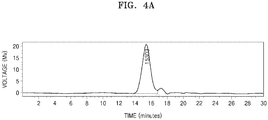
- the polymer of Formula 2 prepared according to Preparation Example 1 was analyzed by using gel permeation chromatography (GPC).
- GPC gel permeation chromatography
- a HPLC2690 manufactured by Waters Corporation was used as a GPC analyzer.
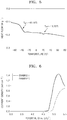
- the polymer represented by Formula 2 prepared according to Preparation Example 1 was analyzed by using a differential scanning calorimeter (DSC).
- the DSC analysis was performed using a SDT Q600 manufactured by TA instruments.
- Results of the DSC analysis are shown in FIG. 5 .
- the polymer of Formula 2 has a glass transition temperature of about -40-16°C. Thus, flexibility and high ionic conductivity may be obtained at room temperature.
- Conductivity of the polymer electrolytes prepared according to Examples 1 to 8 and Comparative Example 1 was measured by using the following method.
- Ionic conductivity of the polymer electrolytes was evaluated by measuring resistance while scanning temperature after applying a voltage bias of 10 mV thereto in a frequency of about 1 Hz to about 1 MHz.
- LSV Linear Sweep Voltammetry
- Conditions for the LSV analysis include a voltage of about 3V to about 5.5 V (V vs Li/Li + ), a scan rate of about 1 mV/s, and a temperature of about 55°C.
- the polymer electrolyte according to an embodiment has excellent ionic conductivity.
- a lithium secondary battery having long lifespan and enhanced safety may be manufactured.
- a lithium secondary battery may comprise a lithium metal thin film as an anode.
- a lithium metal thin film is used as the anode in a lithium secondary battery that comprises a liquid electrolyte
- the anode may be highly reactive to the liquid electrolyte during charging and discharging due to the high reactivity of lithium.
- a solid electrolyte may be used instead of a liquid electrolyte to improve the safety of the lithium battery.
- Polyethylene oxide polymer electrolytes have low oxidation stability. Accordingly, the operation of batteries comprising a polyethylene oxide polymer electrolyte may be difficult at a voltage of about 4.0 V or greater and such electrolytes may have low solubility to lithium salts, which limits amounts of lithium salts to be dissociated.
- embodiments provide a polymer electrolyte having stable oxidation potentials at a voltage of 4.5 V or greater and improved ability to dissolve lithium salts compared to polyethylene oxide polymer electrolytes.
- the polymer electrolyte may have excellent ionic conductivity due to improved ability to dissolve lithium salts.
- the polymer electrolyte may be used as a solid electrolyte without using a liquid electrolyte. Thus, a reduction reaction of a solvent may be inhibited in lithium metal batteries by using the polymer electrolyte, thereby increasing lifespan and improving stability in the batteries.
- Embodiments further provide a lithium secondary battery having a long lifespan and enhanced safety by employing the polymer electrolyte.
Landscapes
- Chemical & Material Sciences (AREA)
- Engineering & Computer Science (AREA)
- Chemical Kinetics & Catalysis (AREA)
- Electrochemistry (AREA)
- General Chemical & Material Sciences (AREA)
- Manufacturing & Machinery (AREA)
- Inorganic Chemistry (AREA)
- General Physics & Mathematics (AREA)
- Condensed Matter Physics & Semiconductors (AREA)
- Physics & Mathematics (AREA)
- Materials Engineering (AREA)
- Dispersion Chemistry (AREA)
- Composite Materials (AREA)
- Secondary Cells (AREA)
- Conductive Materials (AREA)
Applications Claiming Priority (1)
| Application Number | Priority Date | Filing Date | Title |
|---|---|---|---|
| KR1020160011830A KR102562680B1 (ko) | 2016-01-29 | 2016-01-29 | 리튬이차전지용 고분자 전해질 및 이를 포함한 리튬이차전지 |
Publications (2)
| Publication Number | Publication Date |
|---|---|
| EP3200260A1 true EP3200260A1 (de) | 2017-08-02 |
| EP3200260B1 EP3200260B1 (de) | 2018-12-19 |
Family
ID=57906556
Family Applications (1)
| Application Number | Title | Priority Date | Filing Date |
|---|---|---|---|
| EP17153314.4A Active EP3200260B1 (de) | 2016-01-29 | 2017-01-26 | Polymerelektrolyt für eine lithiumsekundärbatterie und lithiumsekundärbatterie damit |
Country Status (4)
| Country | Link |
|---|---|
| US (1) | US10637098B2 (de) |
| EP (1) | EP3200260B1 (de) |
| KR (1) | KR102562680B1 (de) |
| CN (1) | CN107026285B (de) |
Families Citing this family (10)
| Publication number | Priority date | Publication date | Assignee | Title |
|---|---|---|---|---|
| KR102059978B1 (ko) * | 2015-11-30 | 2019-12-30 | 주식회사 엘지화학 | 이차전지용 양극활물질 및 이를 포함하는 이차전지 |
| EP3479430B1 (de) * | 2016-06-30 | 2021-01-27 | Robert Bosch GmbH | Elektrolyt |
| CN111247663B (zh) * | 2017-08-31 | 2024-01-12 | 罗伯特·博世有限公司 | 用于电化学电池的混合复合固态电解质 |
| CN109980274A (zh) * | 2017-12-28 | 2019-07-05 | 财团法人工业技术研究院 | 电解质、电解质用组合物及包含其的锂电池 |
| CN108199080A (zh) * | 2017-12-29 | 2018-06-22 | 清华大学深圳研究生院 | 锂离子电池的电解质及其制备方法、锂离子电池 |
| CN108199083A (zh) * | 2018-01-09 | 2018-06-22 | 清华大学深圳研究生院 | 钠离子电池的电解质及其制备方法、钠离子电池 |
| US10903498B2 (en) | 2018-08-30 | 2021-01-26 | Ford Global Technologies, Llc | Hybrid electrolyte design for lithium titanate based lithium ion battery |
| CN110400964B (zh) * | 2019-07-31 | 2022-08-30 | 苏州顺创新能源科技有限公司 | 一种锂离子电池用固态电解质膜 |
| WO2021075597A1 (ko) * | 2019-10-17 | 2021-04-22 | 주식회사 그리너지 | 유무기 복합 고체 고분자 전해질, 이를 포함하는 일체형 전극 구조체 및 전기화학소자, 그리고 상기 유무기 복합 고체 고분자 전해질의 제조방법 |
| KR20210098246A (ko) * | 2020-01-31 | 2021-08-10 | 삼성에스디아이 주식회사 | 전고체이차전지 및 그 제조방법 |
Citations (1)
| Publication number | Priority date | Publication date | Assignee | Title |
|---|---|---|---|---|
| US20150079485A1 (en) * | 2013-09-13 | 2015-03-19 | Samsung Electronics Co., Ltd. | Composite membrane, preparation method thereof, and lithium-air battery including the composite membrane |
Family Cites Families (12)
| Publication number | Priority date | Publication date | Assignee | Title |
|---|---|---|---|---|
| DE2932761A1 (de) | 1979-08-13 | 1981-02-26 | Akzo Gmbh | Polycarbonat-polyaether-copolymermembran |
| EP0896340A4 (de) * | 1996-12-03 | 2001-03-07 | Mitsui Chemicals Inc | Gelierter festpolymerelektrolyt |
| JP4017091B2 (ja) | 1998-08-19 | 2007-12-05 | 昭和電工株式会社 | 重合性化合物、それを用いた高分子固体電解質及びその用途 |
| WO2000074158A1 (en) * | 1999-05-28 | 2000-12-07 | Showa Denko K.K. | Polymerizable compound, solid polymer electrolyte using the same and use thereof |
| US6878492B2 (en) | 2000-07-10 | 2005-04-12 | Showa Denko Kabushiki Kaisha | Polymerizable composition and use thereof |
| JP2002025335A (ja) | 2000-07-10 | 2002-01-25 | Showa Denko Kk | 重合性化合物及びその用途 |
| AU2001283972B2 (en) | 2000-08-04 | 2005-03-10 | Shell Internationale Research Maatschappij B.V. | Polymer electrolyte composition |
| US9601804B2 (en) * | 2008-11-10 | 2017-03-21 | Samsung Electronics Co., Ltd. | Gel polymer electrolyte, lithium battery including gel polymer electrolyte, and method of preparing gel polymer electrolyte |
| CN103270637A (zh) * | 2010-12-03 | 2013-08-28 | 埃纳德尔公司 | 用于非水和固态电池的耐热层及其制造方法 |
| KR101987008B1 (ko) * | 2012-06-15 | 2019-06-12 | 한국전자통신연구원 | 고체 고분자 전해질, 그 제조방법, 및 이를 포함하는 리튬전지 |
| US20140011095A1 (en) * | 2012-07-03 | 2014-01-09 | Electronics And Telecommunications Research Institute | Organic/inorganic hybrid electrolyte, methods for preparing the same, and lithium battery including the same |
| CN103904329B (zh) * | 2012-12-27 | 2016-12-28 | 清华大学 | 锂离子电池 |
-
2016
- 2016-01-29 KR KR1020160011830A patent/KR102562680B1/ko active Active
-
2017
- 2017-01-26 US US15/416,614 patent/US10637098B2/en active Active
- 2017-01-26 CN CN201710061569.2A patent/CN107026285B/zh active Active
- 2017-01-26 EP EP17153314.4A patent/EP3200260B1/de active Active
Patent Citations (1)
| Publication number | Priority date | Publication date | Assignee | Title |
|---|---|---|---|---|
| US20150079485A1 (en) * | 2013-09-13 | 2015-03-19 | Samsung Electronics Co., Ltd. | Composite membrane, preparation method thereof, and lithium-air battery including the composite membrane |
Non-Patent Citations (2)
| Title |
|---|
| ANETTE MUNCH ELMÉR ET AL: "Polymer electrolyte membranes byin situ polymerization of poly(ethylene carbonate-co-ethylene oxide) macromonomers in blends with poly(vinylidene fluoride-co-hexafluoropropylene)", JOURNAL OF POLYMER SCIENCE PART B: POLYMER PHYSICS, vol. 45, no. 1, 1 January 2007 (2007-01-01), US, pages 79 - 90, XP055354227, ISSN: 0887-6266, DOI: 10.1002/polb.20980 * |
| ANETTE MUNCH ELMÉR ET AL: "Synthesis and characterization of poly(ethylene oxide-co-ethylene carbonate) macromonomers and their use in the preparation of crosslinked polymer electrolytes", JOURNAL OF POLYMER SCIENCE, PART A: POLYMER CHEMISTRY, vol. 44, no. 7, 1 April 2006 (2006-04-01), pages 2195 - 2205, XP055354242, ISSN: 0887-624X, DOI: 10.1002/pola.21324 * |
Also Published As
| Publication number | Publication date |
|---|---|
| CN107026285B (zh) | 2021-11-02 |
| US20170222262A1 (en) | 2017-08-03 |
| US10637098B2 (en) | 2020-04-28 |
| KR20170090887A (ko) | 2017-08-08 |
| KR102562680B1 (ko) | 2023-08-03 |
| CN107026285A (zh) | 2017-08-08 |
| EP3200260B1 (de) | 2018-12-19 |
Similar Documents
| Publication | Publication Date | Title |
|---|---|---|
| EP3200260B1 (de) | Polymerelektrolyt für eine lithiumsekundärbatterie und lithiumsekundärbatterie damit | |
| EP3093906B1 (de) | Lithium-metall-batterie | |
| KR101747864B1 (ko) | 복합전해질 및 이를 포함하는 리튬전지 | |
| EP3531491B1 (de) | Elektrolyt für lithiumsekundärbatterie und lithiumsekundärbatterie denselben umfassend | |
| EP2518819B1 (de) | Negative Elektrode für eine Lithiumsekundärbatterie, Herstellungsverfahren dafür und Lithiumsekundärbatterie damit | |
| KR102386841B1 (ko) | 복합전해질 및 이를 포함하는 리튬전지 | |
| EP3648229B1 (de) | Polymerelektrolyt für eine sekundärbatterie und sekundärbatterie damit | |
| KR101607024B1 (ko) | 리튬 이차전지 | |
| KR102592147B1 (ko) | 복합분리막, 그 제조방법 및 이를 포함하는 리튬이차전지 | |
| EP3712999B1 (de) | Elektrolyt für lithiumsekundärbatterie sowie lithiumsekundärbatterie damit | |
| EP3723169A1 (de) | Negativelektrode für lithium-metall-batterie und lithium-metall-batterie damit | |
| KR20170140987A (ko) | 리튬금속전지용 복합 전해질, 그 제조방법 및 이를 포함한 리튬금속전지 | |
| KR102812062B1 (ko) | 층상 칼륨 금속 옥사이드를 포함하는 전극 물질, 전극 물질을 포함하는 전극 및 전기화학에서의 전극 물질의 용도 | |
| US11949095B2 (en) | Composite solid electrolyte, electrochemical cell including the same, and method of preparing the composite solid electrolyte | |
| KR20170083387A (ko) | 리튬이차전지용 전해질 및 이를 포함하는 리튬이차전지 | |
| EP3382785B1 (de) | Polymerelektrolyt für eine sekundärbatterie und sekundärbatterie damit | |
| KR20140026841A (ko) | 복합양극활물질, 이를 채용한 양극 및 리튬 전지 | |
| KR102256487B1 (ko) | 이차전지용 고분자 전해질 및 이를 포함하는 리튬 이차전지 | |
| KR20190021099A (ko) | 유기 전해액, 및 이를 포함하는 리튬 전지 | |
| KR20220112600A (ko) | 고체 전해질 제조용 조성물, 이를 이용하는 고체 전해질 및 리튬 이차 전지 | |
| US20220199992A1 (en) | Cathode material, cathode including the same, and lithium-air battery including the cathode | |
| KR20230022055A (ko) | 리튬이차전지용 전극 바인더 및 이를 포함하는 전극과 리튬이차전지 |
Legal Events
| Date | Code | Title | Description |
|---|---|---|---|
| PUAI | Public reference made under article 153(3) epc to a published international application that has entered the european phase |
Free format text: ORIGINAL CODE: 0009012 |
|
| STAA | Information on the status of an ep patent application or granted ep patent |
Free format text: STATUS: THE APPLICATION HAS BEEN PUBLISHED |
|
| AK | Designated contracting states |
Kind code of ref document: A1 Designated state(s): AL AT BE BG CH CY CZ DE DK EE ES FI FR GB GR HR HU IE IS IT LI LT LU LV MC MK MT NL NO PL PT RO RS SE SI SK SM TR |
|
| AX | Request for extension of the european patent |
Extension state: BA ME |
|
| STAA | Information on the status of an ep patent application or granted ep patent |
Free format text: STATUS: REQUEST FOR EXAMINATION WAS MADE |
|
| 17P | Request for examination filed |
Effective date: 20170915 |
|
| RBV | Designated contracting states (corrected) |
Designated state(s): AL AT BE BG CH CY CZ DE DK EE ES FI FR GB GR HR HU IE IS IT LI LT LU LV MC MK MT NL NO PL PT RO RS SE SI SK SM TR |
|
| STAA | Information on the status of an ep patent application or granted ep patent |
Free format text: STATUS: EXAMINATION IS IN PROGRESS |
|
| 17Q | First examination report despatched |
Effective date: 20180212 |
|
| GRAP | Despatch of communication of intention to grant a patent |
Free format text: ORIGINAL CODE: EPIDOSNIGR1 |
|
| STAA | Information on the status of an ep patent application or granted ep patent |
Free format text: STATUS: GRANT OF PATENT IS INTENDED |
|
| INTG | Intention to grant announced |
Effective date: 20180802 |
|
| GRAS | Grant fee paid |
Free format text: ORIGINAL CODE: EPIDOSNIGR3 |
|
| GRAA | (expected) grant |
Free format text: ORIGINAL CODE: 0009210 |
|
| STAA | Information on the status of an ep patent application or granted ep patent |
Free format text: STATUS: THE PATENT HAS BEEN GRANTED |
|
| AK | Designated contracting states |
Kind code of ref document: B1 Designated state(s): AL AT BE BG CH CY CZ DE DK EE ES FI FR GB GR HR HU IE IS IT LI LT LU LV MC MK MT NL NO PL PT RO RS SE SI SK SM TR |
|
| REG | Reference to a national code |
Ref country code: GB Ref legal event code: FG4D |
|
| REG | Reference to a national code |
Ref country code: CH Ref legal event code: EP |
|
| REG | Reference to a national code |
Ref country code: IE Ref legal event code: FG4D |
|
| REG | Reference to a national code |
Ref country code: DE Ref legal event code: R096 Ref document number: 602017001394 Country of ref document: DE |
|
| REG | Reference to a national code |
Ref country code: AT Ref legal event code: REF Ref document number: 1079628 Country of ref document: AT Kind code of ref document: T Effective date: 20190115 |
|
| REG | Reference to a national code |
Ref country code: NL Ref legal event code: MP Effective date: 20181219 |
|
| PG25 | Lapsed in a contracting state [announced via postgrant information from national office to epo] |
Ref country code: LV Free format text: LAPSE BECAUSE OF FAILURE TO SUBMIT A TRANSLATION OF THE DESCRIPTION OR TO PAY THE FEE WITHIN THE PRESCRIBED TIME-LIMIT Effective date: 20181219 Ref country code: HR Free format text: LAPSE BECAUSE OF FAILURE TO SUBMIT A TRANSLATION OF THE DESCRIPTION OR TO PAY THE FEE WITHIN THE PRESCRIBED TIME-LIMIT Effective date: 20181219 Ref country code: FI Free format text: LAPSE BECAUSE OF FAILURE TO SUBMIT A TRANSLATION OF THE DESCRIPTION OR TO PAY THE FEE WITHIN THE PRESCRIBED TIME-LIMIT Effective date: 20181219 Ref country code: NO Free format text: LAPSE BECAUSE OF FAILURE TO SUBMIT A TRANSLATION OF THE DESCRIPTION OR TO PAY THE FEE WITHIN THE PRESCRIBED TIME-LIMIT Effective date: 20190319 Ref country code: BG Free format text: LAPSE BECAUSE OF FAILURE TO SUBMIT A TRANSLATION OF THE DESCRIPTION OR TO PAY THE FEE WITHIN THE PRESCRIBED TIME-LIMIT Effective date: 20190319 Ref country code: LT Free format text: LAPSE BECAUSE OF FAILURE TO SUBMIT A TRANSLATION OF THE DESCRIPTION OR TO PAY THE FEE WITHIN THE PRESCRIBED TIME-LIMIT Effective date: 20181219 |
|
| REG | Reference to a national code |
Ref country code: LT Ref legal event code: MG4D |
|
| REG | Reference to a national code |
Ref country code: AT Ref legal event code: MK05 Ref document number: 1079628 Country of ref document: AT Kind code of ref document: T Effective date: 20181219 |
|
| PG25 | Lapsed in a contracting state [announced via postgrant information from national office to epo] |
Ref country code: GR Free format text: LAPSE BECAUSE OF FAILURE TO SUBMIT A TRANSLATION OF THE DESCRIPTION OR TO PAY THE FEE WITHIN THE PRESCRIBED TIME-LIMIT Effective date: 20190320 Ref country code: SE Free format text: LAPSE BECAUSE OF FAILURE TO SUBMIT A TRANSLATION OF THE DESCRIPTION OR TO PAY THE FEE WITHIN THE PRESCRIBED TIME-LIMIT Effective date: 20181219 Ref country code: AL Free format text: LAPSE BECAUSE OF FAILURE TO SUBMIT A TRANSLATION OF THE DESCRIPTION OR TO PAY THE FEE WITHIN THE PRESCRIBED TIME-LIMIT Effective date: 20181219 Ref country code: RS Free format text: LAPSE BECAUSE OF FAILURE TO SUBMIT A TRANSLATION OF THE DESCRIPTION OR TO PAY THE FEE WITHIN THE PRESCRIBED TIME-LIMIT Effective date: 20181219 |
|
| PG25 | Lapsed in a contracting state [announced via postgrant information from national office to epo] |
Ref country code: NL Free format text: LAPSE BECAUSE OF FAILURE TO SUBMIT A TRANSLATION OF THE DESCRIPTION OR TO PAY THE FEE WITHIN THE PRESCRIBED TIME-LIMIT Effective date: 20181219 |
|
| PG25 | Lapsed in a contracting state [announced via postgrant information from national office to epo] |
Ref country code: PL Free format text: LAPSE BECAUSE OF FAILURE TO SUBMIT A TRANSLATION OF THE DESCRIPTION OR TO PAY THE FEE WITHIN THE PRESCRIBED TIME-LIMIT Effective date: 20181219 Ref country code: PT Free format text: LAPSE BECAUSE OF FAILURE TO SUBMIT A TRANSLATION OF THE DESCRIPTION OR TO PAY THE FEE WITHIN THE PRESCRIBED TIME-LIMIT Effective date: 20190419 Ref country code: ES Free format text: LAPSE BECAUSE OF FAILURE TO SUBMIT A TRANSLATION OF THE DESCRIPTION OR TO PAY THE FEE WITHIN THE PRESCRIBED TIME-LIMIT Effective date: 20181219 Ref country code: CZ Free format text: LAPSE BECAUSE OF FAILURE TO SUBMIT A TRANSLATION OF THE DESCRIPTION OR TO PAY THE FEE WITHIN THE PRESCRIBED TIME-LIMIT Effective date: 20181219 Ref country code: IT Free format text: LAPSE BECAUSE OF FAILURE TO SUBMIT A TRANSLATION OF THE DESCRIPTION OR TO PAY THE FEE WITHIN THE PRESCRIBED TIME-LIMIT Effective date: 20181219 |
|
| PG25 | Lapsed in a contracting state [announced via postgrant information from national office to epo] |
Ref country code: RO Free format text: LAPSE BECAUSE OF FAILURE TO SUBMIT A TRANSLATION OF THE DESCRIPTION OR TO PAY THE FEE WITHIN THE PRESCRIBED TIME-LIMIT Effective date: 20181219 Ref country code: SK Free format text: LAPSE BECAUSE OF FAILURE TO SUBMIT A TRANSLATION OF THE DESCRIPTION OR TO PAY THE FEE WITHIN THE PRESCRIBED TIME-LIMIT Effective date: 20181219 Ref country code: SM Free format text: LAPSE BECAUSE OF FAILURE TO SUBMIT A TRANSLATION OF THE DESCRIPTION OR TO PAY THE FEE WITHIN THE PRESCRIBED TIME-LIMIT Effective date: 20181219 Ref country code: EE Free format text: LAPSE BECAUSE OF FAILURE TO SUBMIT A TRANSLATION OF THE DESCRIPTION OR TO PAY THE FEE WITHIN THE PRESCRIBED TIME-LIMIT Effective date: 20181219 Ref country code: IS Free format text: LAPSE BECAUSE OF FAILURE TO SUBMIT A TRANSLATION OF THE DESCRIPTION OR TO PAY THE FEE WITHIN THE PRESCRIBED TIME-LIMIT Effective date: 20190419 |
|
| REG | Reference to a national code |
Ref country code: DE Ref legal event code: R097 Ref document number: 602017001394 Country of ref document: DE |
|
| PG25 | Lapsed in a contracting state [announced via postgrant information from national office to epo] |
Ref country code: LU Free format text: LAPSE BECAUSE OF NON-PAYMENT OF DUE FEES Effective date: 20190126 |
|
| REG | Reference to a national code |
Ref country code: BE Ref legal event code: MM Effective date: 20190131 |
|
| PLBE | No opposition filed within time limit |
Free format text: ORIGINAL CODE: 0009261 |
|
| STAA | Information on the status of an ep patent application or granted ep patent |
Free format text: STATUS: NO OPPOSITION FILED WITHIN TIME LIMIT |
|
| REG | Reference to a national code |
Ref country code: IE Ref legal event code: MM4A |
|
| PG25 | Lapsed in a contracting state [announced via postgrant information from national office to epo] |
Ref country code: MC Free format text: LAPSE BECAUSE OF FAILURE TO SUBMIT A TRANSLATION OF THE DESCRIPTION OR TO PAY THE FEE WITHIN THE PRESCRIBED TIME-LIMIT Effective date: 20181219 Ref country code: DK Free format text: LAPSE BECAUSE OF FAILURE TO SUBMIT A TRANSLATION OF THE DESCRIPTION OR TO PAY THE FEE WITHIN THE PRESCRIBED TIME-LIMIT Effective date: 20181219 Ref country code: AT Free format text: LAPSE BECAUSE OF FAILURE TO SUBMIT A TRANSLATION OF THE DESCRIPTION OR TO PAY THE FEE WITHIN THE PRESCRIBED TIME-LIMIT Effective date: 20181219 |
|
| 26N | No opposition filed |
Effective date: 20190920 |
|
| PG25 | Lapsed in a contracting state [announced via postgrant information from national office to epo] |
Ref country code: BE Free format text: LAPSE BECAUSE OF NON-PAYMENT OF DUE FEES Effective date: 20190131 |
|
| PG25 | Lapsed in a contracting state [announced via postgrant information from national office to epo] |
Ref country code: IE Free format text: LAPSE BECAUSE OF NON-PAYMENT OF DUE FEES Effective date: 20190126 |
|
| PG25 | Lapsed in a contracting state [announced via postgrant information from national office to epo] |
Ref country code: SI Free format text: LAPSE BECAUSE OF FAILURE TO SUBMIT A TRANSLATION OF THE DESCRIPTION OR TO PAY THE FEE WITHIN THE PRESCRIBED TIME-LIMIT Effective date: 20181219 |
|
| PG25 | Lapsed in a contracting state [announced via postgrant information from national office to epo] |
Ref country code: TR Free format text: LAPSE BECAUSE OF FAILURE TO SUBMIT A TRANSLATION OF THE DESCRIPTION OR TO PAY THE FEE WITHIN THE PRESCRIBED TIME-LIMIT Effective date: 20181219 |
|
| PG25 | Lapsed in a contracting state [announced via postgrant information from national office to epo] |
Ref country code: MT Free format text: LAPSE BECAUSE OF NON-PAYMENT OF DUE FEES Effective date: 20190126 |
|
| REG | Reference to a national code |
Ref country code: CH Ref legal event code: PL |
|
| REG | Reference to a national code |
Ref country code: DE Ref legal event code: R079 Ref document number: 602017001394 Country of ref document: DE Free format text: PREVIOUS MAIN CLASS: H01M0002160000 Ipc: H01M0050409000 |
|
| PG25 | Lapsed in a contracting state [announced via postgrant information from national office to epo] |
Ref country code: LI Free format text: LAPSE BECAUSE OF NON-PAYMENT OF DUE FEES Effective date: 20200131 Ref country code: CH Free format text: LAPSE BECAUSE OF NON-PAYMENT OF DUE FEES Effective date: 20200131 |
|
| PG25 | Lapsed in a contracting state [announced via postgrant information from national office to epo] |
Ref country code: CY Free format text: LAPSE BECAUSE OF FAILURE TO SUBMIT A TRANSLATION OF THE DESCRIPTION OR TO PAY THE FEE WITHIN THE PRESCRIBED TIME-LIMIT Effective date: 20181219 |
|
| PG25 | Lapsed in a contracting state [announced via postgrant information from national office to epo] |
Ref country code: HU Free format text: LAPSE BECAUSE OF FAILURE TO SUBMIT A TRANSLATION OF THE DESCRIPTION OR TO PAY THE FEE WITHIN THE PRESCRIBED TIME-LIMIT; INVALID AB INITIO Effective date: 20170126 |
|
| PG25 | Lapsed in a contracting state [announced via postgrant information from national office to epo] |
Ref country code: MK Free format text: LAPSE BECAUSE OF FAILURE TO SUBMIT A TRANSLATION OF THE DESCRIPTION OR TO PAY THE FEE WITHIN THE PRESCRIBED TIME-LIMIT Effective date: 20181219 |
|
| P01 | Opt-out of the competence of the unified patent court (upc) registered |
Effective date: 20230530 |
|
| PGFP | Annual fee paid to national office [announced via postgrant information from national office to epo] |
Ref country code: DE Payment date: 20241231 Year of fee payment: 9 |
|
| PGFP | Annual fee paid to national office [announced via postgrant information from national office to epo] |
Ref country code: GB Payment date: 20250102 Year of fee payment: 9 |
|
| PGFP | Annual fee paid to national office [announced via postgrant information from national office to epo] |
Ref country code: FR Payment date: 20251231 Year of fee payment: 10 |