EP3182033B1 - Solar receiver with metamaterials-enhanced solar light absorbing structure - Google Patents
Solar receiver with metamaterials-enhanced solar light absorbing structure Download PDFInfo
- Publication number
- EP3182033B1 EP3182033B1 EP16202547.2A EP16202547A EP3182033B1 EP 3182033 B1 EP3182033 B1 EP 3182033B1 EP 16202547 A EP16202547 A EP 16202547A EP 3182033 B1 EP3182033 B1 EP 3182033B1
- Authority
- EP
- European Patent Office
- Prior art keywords
- solar
- solar receiver
- receiver
- range
- csp
- Prior art date
- Legal status (The legal status is an assumption and is not a legal conclusion. Google has not performed a legal analysis and makes no representation as to the accuracy of the status listed.)
- Not-in-force
Links
Images


Classifications
-
- F—MECHANICAL ENGINEERING; LIGHTING; HEATING; WEAPONS; BLASTING
- F24—HEATING; RANGES; VENTILATING
- F24S—SOLAR HEAT COLLECTORS; SOLAR HEAT SYSTEMS
- F24S70/00—Details of absorbing elements
- F24S70/20—Details of absorbing elements characterised by absorbing coatings; characterised by surface treatment for increasing absorption
- F24S70/225—Details of absorbing elements characterised by absorbing coatings; characterised by surface treatment for increasing absorption for spectrally selective absorption
-
- F—MECHANICAL ENGINEERING; LIGHTING; HEATING; WEAPONS; BLASTING
- F24—HEATING; RANGES; VENTILATING
- F24S—SOLAR HEAT COLLECTORS; SOLAR HEAT SYSTEMS
- F24S20/00—Solar heat collectors specially adapted for particular uses or environments
- F24S20/20—Solar heat collectors for receiving concentrated solar energy, e.g. receivers for solar power plants
-
- F—MECHANICAL ENGINEERING; LIGHTING; HEATING; WEAPONS; BLASTING
- F24—HEATING; RANGES; VENTILATING
- F24S—SOLAR HEAT COLLECTORS; SOLAR HEAT SYSTEMS
- F24S70/00—Details of absorbing elements
- F24S70/10—Details of absorbing elements characterised by the absorbing material
-
- F—MECHANICAL ENGINEERING; LIGHTING; HEATING; WEAPONS; BLASTING
- F24—HEATING; RANGES; VENTILATING
- F24S—SOLAR HEAT COLLECTORS; SOLAR HEAT SYSTEMS
- F24S70/00—Details of absorbing elements
- F24S70/10—Details of absorbing elements characterised by the absorbing material
- F24S70/16—Details of absorbing elements characterised by the absorbing material made of ceramic; made of concrete; made of natural stone
-
- F—MECHANICAL ENGINEERING; LIGHTING; HEATING; WEAPONS; BLASTING
- F24—HEATING; RANGES; VENTILATING
- F24S—SOLAR HEAT COLLECTORS; SOLAR HEAT SYSTEMS
- F24S70/00—Details of absorbing elements
- F24S70/60—Details of absorbing elements characterised by the structure or construction
-
- H—ELECTRICITY
- H02—GENERATION; CONVERSION OR DISTRIBUTION OF ELECTRIC POWER
- H02S—GENERATION OF ELECTRIC POWER BY CONVERSION OF INFRARED RADIATION, VISIBLE LIGHT OR ULTRAVIOLET LIGHT, e.g. USING PHOTOVOLTAIC [PV] MODULES
- H02S40/00—Components or accessories in combination with PV modules, not provided for in groups H02S10/00 - H02S30/00
- H02S40/20—Optical components
-
- Y—GENERAL TAGGING OF NEW TECHNOLOGICAL DEVELOPMENTS; GENERAL TAGGING OF CROSS-SECTIONAL TECHNOLOGIES SPANNING OVER SEVERAL SECTIONS OF THE IPC; TECHNICAL SUBJECTS COVERED BY FORMER USPC CROSS-REFERENCE ART COLLECTIONS [XRACs] AND DIGESTS
- Y02—TECHNOLOGIES OR APPLICATIONS FOR MITIGATION OR ADAPTATION AGAINST CLIMATE CHANGE
- Y02E—REDUCTION OF GREENHOUSE GAS [GHG] EMISSIONS, RELATED TO ENERGY GENERATION, TRANSMISSION OR DISTRIBUTION
- Y02E10/00—Energy generation through renewable energy sources
- Y02E10/40—Solar thermal energy, e.g. solar towers
-
- Y—GENERAL TAGGING OF NEW TECHNOLOGICAL DEVELOPMENTS; GENERAL TAGGING OF CROSS-SECTIONAL TECHNOLOGIES SPANNING OVER SEVERAL SECTIONS OF THE IPC; TECHNICAL SUBJECTS COVERED BY FORMER USPC CROSS-REFERENCE ART COLLECTIONS [XRACs] AND DIGESTS
- Y02—TECHNOLOGIES OR APPLICATIONS FOR MITIGATION OR ADAPTATION AGAINST CLIMATE CHANGE
- Y02E—REDUCTION OF GREENHOUSE GAS [GHG] EMISSIONS, RELATED TO ENERGY GENERATION, TRANSMISSION OR DISTRIBUTION
- Y02E10/00—Energy generation through renewable energy sources
- Y02E10/40—Solar thermal energy, e.g. solar towers
- Y02E10/44—Heat exchange systems
-
- Y—GENERAL TAGGING OF NEW TECHNOLOGICAL DEVELOPMENTS; GENERAL TAGGING OF CROSS-SECTIONAL TECHNOLOGIES SPANNING OVER SEVERAL SECTIONS OF THE IPC; TECHNICAL SUBJECTS COVERED BY FORMER USPC CROSS-REFERENCE ART COLLECTIONS [XRACs] AND DIGESTS
- Y02—TECHNOLOGIES OR APPLICATIONS FOR MITIGATION OR ADAPTATION AGAINST CLIMATE CHANGE
- Y02E—REDUCTION OF GREENHOUSE GAS [GHG] EMISSIONS, RELATED TO ENERGY GENERATION, TRANSMISSION OR DISTRIBUTION
- Y02E10/00—Energy generation through renewable energy sources
- Y02E10/40—Solar thermal energy, e.g. solar towers
- Y02E10/46—Conversion of thermal power into mechanical power, e.g. Rankine, Stirling or solar thermal engines
-
- Y—GENERAL TAGGING OF NEW TECHNOLOGICAL DEVELOPMENTS; GENERAL TAGGING OF CROSS-SECTIONAL TECHNOLOGIES SPANNING OVER SEVERAL SECTIONS OF THE IPC; TECHNICAL SUBJECTS COVERED BY FORMER USPC CROSS-REFERENCE ART COLLECTIONS [XRACs] AND DIGESTS
- Y02—TECHNOLOGIES OR APPLICATIONS FOR MITIGATION OR ADAPTATION AGAINST CLIMATE CHANGE
- Y02E—REDUCTION OF GREENHOUSE GAS [GHG] EMISSIONS, RELATED TO ENERGY GENERATION, TRANSMISSION OR DISTRIBUTION
- Y02E10/00—Energy generation through renewable energy sources
- Y02E10/50—Photovoltaic [PV] energy
Definitions
- This invention relates to solar thermal power plants, and more particularly to sunlight energy (solar) receivers utilized in solar thermal power plant.
- Concentrating Solar Power is a renewable energy technology that utilizes solar thermal power generation to convert solar thermal energy to electricity.
- the solar thermal power generation process generally involves converting the solar energy into thermal energy, then converting the thermal energy into mechanical energy, and then converting the mechanical energy into electricity.
- CSP power plants achieve high-efficiency solar thermal power generation by way of utilizing a solar concentrator (e.g., a parabolic trough, a solar dish, or an array of mirrors) to direct concentrated sunlight onto a solar receiver (i.e., a structure comprising a sunlight absorbing material), thereby converting the solar energy into thermal energy by way of heating the solar receiver to a high operating temperature.
- a solar concentrator e.g., a parabolic trough, a solar dish, or an array of mirrors
- a solar receiver i.e., a structure comprising a sunlight absorbing material
- the thermal energy is then converted into mechanical energy by way of generating high temperature steam (e.g., by forming the light absorbing material of the solar receiver into a pipe-like structure, and passing water/steam through the pipe's conduit).
- the high temperature steam is then directed to a turbine, whereby the mechanical energy is converted to electricity by a conventional generator driven by the turbine.
- Excess thermal energy is often collected in molten salts and stored in large insulated tanks, allowing operation of the steam turbine during the night or on cloudy days.
- CSP power plants are therefore similar to most conventional power plants that utilize heat from a fuel source to drive a stream turbine, but instead of generating heat, e.g., from the combustion of fossil fuels or another non-renewable fuel source, solar thermal power plants produce steam using sunlight.
- parabolic trough CSP plants achieve relatively low maximum operating temperatures (i.e., approximately 400 to 550°C).
- Solar dish CSP plants utilize a dish (bowl) shaped reflector that concentrates incident sunlight on a point-type solar receiver located at a focal point of the dish, thereby achieving higher concentration ratios than can be achieved using a parabolic trough reflector, whereby solar dish CSP plants achieving relatively high maximum operating temperatures (i.e., 600-750°C).
- Central receiver CSP plants utilize an array of heliostats disposed on the ground next to a tower supporting a solar receiver, where each heliostat includes a mirror and an associated positioning mechanism that repositions the mirror throughout the day to reflect incident sunlight onto the solar receiver. Similar to solar dish CSP plants, the peak power generation capacity of central receiver CSP plants is determined by the amount of sunlight reflected onto the tower-based receiver, which in both cases corresponds to the total reflective area of the mirrors.
- the total reflective area of a central receiver CSP system is expandable by installing additional heliostats next to the receiver tower; that is, because each heliostat is disposed on the ground and includes its own mirror positioning mechanism, expanding the reflective area of a central receiver CSP plant merely requires installing an aligning additional heliostats.
- Existing central receiver CSP plants collect concentrated sunlight reflected from hundreds or thousands of heliostats to achieve concentration ratios as high as 1,500 times the sun's normal intensity, and maximum operating temperatures well above 750°C.
- Central receiver CSP plants are therefore capable of achieving substantially higher solar receiver operating temperatures than parabolic trough and solar dish CSP plants, and hence are currently the preferred CSP plant technology for large volume electricity generation.
- a solar receiver is a structure consisting of a sunlight absorbing material that is configured to transfer absorbed heat to a heat transfer fluid (e.g., molten salt or water/steam).
- a heat transfer fluid e.g., molten salt or water/steam
- a solar receiver's efficiency is defined by the amount of received solar energy that is absorbed/transferred to the heat transfer fluid versus the amount of received solar energy that is lost due to convective heat losses (e.g., due to wind and buoyancy effects) and radiative heat losses (i.e., as materials get hot, heat energy is radiated away at infrared wavelengths to the surrounding environment).
- convective heat losses e.g., due to wind and buoyancy effects
- radiative heat losses i.e., as materials get hot, heat energy is radiated away at infrared wavelengths to the surrounding environment.
- the primary cause of heat loss from CSP plant's solar receiver is thermal radiation losses, and the rate of radiative heat loss increases as operating temperatures increase above 600°C. Therefore, although central receiver CSP plants are capable of achieving operating temperatures well above 600°C, radiative heat loss from solar receivers at higher operating temperatures limits the overall efficiency of a central receiver CSP plant operating at higher temperatures.
- Pyromark® Series 2500 also exhibits a thermal emittance of 0.87 and suffers from large thermal losses during high temperature operation, and also exhibited significant degradation at higher temperatures (>700°C) when operated in air, causing a decline in performance and potentially added operating costs for CSP plants.
- the coating-based approach suffers from inherent delamination issues due to the unavoidable differences between the coating material and the underlying sunlight absorbing "core" material forming the solar receiver, and the coating material re-emits in the IR, which lowers thermal efficiency.
- JP 2003 332607 A discloses a wavelength selective solar light absorbing material with the features of the preamble of claim 1.
- the present invention is directed to a solar receiver including a metamaterials-enhanced sunlight receiving surface structure (metamaterial structure) consisting essentially of a high melting point sunlight absorbing material having an upward-facing (sunlight receiving) surface that is photo-lithographically processed or otherwise fabricated (engineered) to define substantially cube-shaped microcavities surrounded by associated parallel interlaced walls that are arranged in a periodic waffle-like array having a grating period in the range of 0.5 to 2 microns, wherein two or more of the interlaced walls have different thicknesses.
- a metamaterials-enhanced sunlight receiving surface structure consisting essentially of a high melting point sunlight absorbing material having an upward-facing (sunlight receiving) surface that is photo-lithographically processed or otherwise fabricated (engineered) to define substantially cube-shaped microcavities surrounded by associated parallel interlaced walls that are arranged in a periodic waffle-like array having a grating period in the range of 0.5 to 2 microns, wherein
- the microcavities and interlaced walls have feature sizes that enhance the generation of surface plasmons primarily resonating at visible light frequencies, whereby the metamaterial structure achieves high absorptance efficiency (i.e., >95%) of sunlight in the visible light spectrum and low thermal emittance (i.e., ⁇ 10%) in the infrared (IR) spectrum.
- the metamaterial structure By forming the metamaterial structure on a solar energy absorbing material having suitable high melting point and low coefficient of thermal expansion at high temperatures (i.e., above 600°C), the metamaterial structure reliably maintains the surface features of the waffle-like array at the high solar receiver operating temperatures achieved in a CSP plant. Moreover, because the metamaterial structure consists entirely of the waffle-like array fabricated directly into the upward-facing surface of the high melting point solar energy absorbing material (i.e., no coating is applied to the upward-facing surface), the present invention avoids the delamination issue associated with prior art coatings-based solar receiver approaches, thereby providing solar receivers that are optimized for use in CSP plants.
- the high melting point sunlight absorbing material utilized to produce the metamaterials-enhanced surface structure consists essentially of one or more refractory metals (e.g., tantalum or molybdenum) or silicon carbide (SiC).
- refractory metals e.g., tantalum or molybdenum
- SiC silicon carbide
- These high melting point solar energy absorbing materials are presently preferred in that they exhibit excellent thermal properties (e.g., low coefficient of thermal expansion and high thermal conductivity) and supports surface plasmon generation at temperatures above 600°C, whereby the metamaterial structure of the present invention facilitates the fabrication of solar receivers for CSP plants that avoid the degradation problems associated with conventional coatings-based approaches.
- the metamaterials-enhanced solution of the present invention is applicable to yet undiscovered melting point solar energy absorbing materials capable of maintaining optimal optical characteristics at even higher temperatures, whereby the present invention is theoretically applicable to any achievable CSP plant operating temperature.
- each of the interlaced walls has a thickness in the range of 0.2 to 1.0 microns, and each microcavity of the plurality of microcavities has a width in the range of 0.1 to 1 micron and a depth in the range of 0.1 to 3 microns, which facilitates the generation of surface plasmonic waves resonating at visible light frequencies.
- two or more of the interlaced walls have different thicknesses to further enhance the adsorption of sunlight in the visible light spectrum.
- metamaterials-enhanced solar receivers of the present invention are constructed either as a single-piece (integral) unit or multiple-part assembly.
- the entirety of the solar receiver includes an integral block of high melting point sunlight absorbing base material upon which the metamaterial structure is formed (i.e., with the waffle-like array is formed on an upward-facing surface of the block), and heat-exchange fluid conduits are machined into the block below the upward-facing surface.
- the solar receiver includes a thin (e.g., wafer- or foil-like) sheet of high melting point sunlight absorbing base material upon which the metamaterial structure is formed, and then the wafer-like sheet is operably secured to a block-type base section.
- a thin (e.g., wafer- or foil-like) sheet of high melting point sunlight absorbing base material upon which the metamaterial structure is formed and then the wafer-like sheet is operably secured to a block-type base section.
- Another advantage of the two-piece approach is that it facilitates the efficient formation of curved (e.g., pipe-like) solar receiver structures by way of forming the metamaterial structure on a flexible foil-like sheet, and then press-forming the foil-like sheet such that it contours to a curved surface formed on the base section.
- curved e.g., pipe-like
- a CSP plant includes a solar concentrator configured to concentrate incident solar energy onto a solar receiver for conversion into thermal energy passed to a heat transfer fluid with high efficiency, wherein the solar receiver includes a metamaterials-enhanced surface structure configured in accordance with any of the embodiments described above.
- the solar receiver is disposed on a tower, and the solar concentrator includes multiple ground-based heliostats having flat mirrors that respectively reflect sunlight onto the metamaterials-enhanced surface structure.
- the solar concentrator is implemented by a solar dish or a parabolic trough.
- the present invention relates to improved solar receivers for CSP plants.
- the following description is presented to enable one of ordinary skill in the art to make and use the invention as provided in the context of a particular application and its requirements.
- directional terms such as “upper”, “upward-facing”, “lower”, “horizontal” and “downward” are intended to provide relative positions for purposes of description, and are not intended to designate an absolute frame of reference.
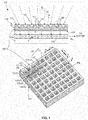
- Fig. 1 shows a generalized and greatly simplified concentrating solar power (CSP) plant 100 including a solar receiver 110 produced in accordance with an embodiment of the present invention.
- CSP plant 100 utilizes a solar concentrator (not shown) to converge sunlight beams such that concentrated solar energy E S solar energy is directed onto solar receiver 110.
- solar receiver 110 is configured to convert incident concentrated solar energy E S into thermal energy E T that is then converted into mechanical energy E M by way of heating a heat-transfer fluid 130 (e.g., water/steam or molten salt) passing through a conduit structure 114 that is part of solar receiver 110.
- the heat-transfer fluid 130 is then converted (if needed) into high temperature steam that is used to generate electricity by way of driving a steam turbine (not shown).
- At least a portion of solar receiver 110 comprises a metamaterials-enhanced sunlight-receiving surface structure 120, referred to herein as metamaterial structure 120, comprising a base material 121 having a first upward-facing surface 122 that is metamaterials-enhanced (engineered) to include substantially cube-shaped microcavities 125 and associated interlaced walls 127 forming a periodic (waffle-like) array 124 having a grating period ⁇ in the range of 0.5 to 2 microns.
- metamaterials or “metamaterial structure” generally refer to an array of structural elements (sometimes referred to as “meta-atoms”) that are arranged in repeating patterns on a base material at scales that are smaller than the wavelengths of the phenomena they are intended to influence.
- metamaterial structure 120 is implemented by integrally forming waffle-like array 124 on/into upward-facing surface 122 of base material 121, where each microcavity 125 and the associated segments of interlaced walls 127 that surround each microcavity 125 form the meta-atoms (constituent units) of metamaterial structure 120.
- metamaterials derive their optical properties not from the properties of the base materials, but from the meta-atom structures, whose precise shape, geometry, size, orientation and arrangement gives the base material the ability to manipulate electromagnetic waves to achieve benefits that cannot be achieved by the base material without the metamaterial enhancement.
- the present inventors have determined that forming waffle-like array 124 with grating period ⁇ in the range of 0.5 to 2 microns facilitates adsorption of incident solar radiation E S in the visible light spectrum with high efficiency (i.e., above 95%), and also facilitates low emission of electromagnetic radiation E R having wavelengths in the infrared spectrum, thereby minimizing radiative heat loss.
- the phrase "metamaterials-enhanced” denotes a material surface that has been subject to a photo-lithographic fabrication process or other proactive engineering process to include the surface features described herein, as opposed to surface patterns that form naturally.
- waffle-like array 124 is formed by way of removing spaced-apart sections from a substantially planar upward-facing (i.e., sunlight receiving, first) surface 122 of a sheet/block of sunlight absorbing material 121, whereby substantially cube-shaped microcavities 125 are defined through (i.e., formed by voids extending into) surface 122.
- microcavities 125 are formed in substantially planar upward-facing surface 122 by way of photo-lithographic processing (e.g., forming a mask that covers the interlaced wall sections and exposes the microcavity sections for etching).
- Interlaced walls 127 extend in parallel horizontal (X- and Y-axis) directions across upward-facing surface 122, and micro-openings 125 extend into (i.e., in the negative Z-axis direction) upward-facing surface 122, but do not pass through to lower surface 123 of surface structure 120.
- each cube-shaped microcavity 125 and its associated surrounding segments of interlaced walls 127 form one meta-atom of metamaterial structure 120.
- microcavity 125-22 and its associated surrounding wall segments form a meta-atom 124-22, which is disposed between meta-atoms 124-21 and 124-23 respectively including microcavities 125-21 and 125-23 and their respective wall segments.
- the dimensions of the microcavity opening and wall segment thickness of each meta-atom are set by grating period ⁇ (i.e., the sum of these dimensions is in the range of 0.5 to 2 microns).
- waffle-like array 124 with this grating period ⁇ has been found to greatly enhance adsorption of peak sunlight energy (i.e., sunlight having wavelengths in the visible light spectrum), and also has proven to minimize radiative thermal losses by way of suppressing the emission of electromagnetic radiation E R in the IR spectrum.
- peak sunlight energy i.e., sunlight having wavelengths in the visible light spectrum
- base material 121 consists essentially of a high melting point sunlight absorbing material.
- solar receiver 110 must be able to withstand the expected elevated temperatures (e.g., 600°C and higher).
- base material 121 is implemented using a high melting point metal (e.g., a refractory metals such as tantalum and molybdenum, which are notable for their high melting points).
- base material 121 is implemented using molybdenum because, unlike some refractory metals that are known to form relatively thick oxide layers when exposed to air, molybdenum forms a relatively thin oxide layer (i.e., having a thickness of a few nanometers) that does not adversely influence the designed optical functionality (i.e., does not skew the metamaterial dimensions), and also serves to prevent further oxidation.
- base material 121 is implemented using a non-metal material such as silicon carbide (SiC), which is known to have excellent thermal properties (e.g. low coefficient of thermal expansion, high thermal conductivity) at high temperatures.
- SiC silicon carbide
- SiC is a semiconductor, and therefore a surface structure consisting essentially of SiC may require a slightly different metamaterial geometry (i.e., different feature dimensions, discussed below) to achieve optical properties similar to those of metal-based surface structures.
- the ability to dope SiC provides a further degree freedom that may be utilized to tune the plasmonic and optical properties of the metamaterial structure.
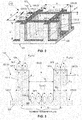
- Fig. 2 is a cut-away perspective view showing meta-atom 124-22 in additional detail. Note that Fig. 2 shows the portion of metamaterial structure 120 indicated by the dashed-line box labeled "2-2" in Fig. 1 .
- Meta-atom 124-22 generally includes wall segments 127-1 and 127-2 that extend in the Y-axis direction, wall segments 127-3 and 127-4 that extend in the X-axis direction, and horizontal bottom wall 128-22, which collectively surround and define the void region referenced as microcavity 125-22.
- the dimensions of the various features forming metamaterial structure 120 of solar receiver 110 generally coincide with wavelengths of electromagnetic radiation in the visible light spectrum.
- the exact dimensions of the metamaterial structural features determines the desired optical characteristics (e.g., absorption and emission spectra).
- solar receiver 110 By forming solar receiver 110 with metamaterial structure 120 made up of meta-atoms having feature sizes equal to or slightly outside the range of wavelengths corresponding to visible light (i.e., approximately 0.4 to approximately 1 micron), solar receiver 110 exhibits high absorptance of sunlight in the visible light spectrum, and minimizes the emission of electromagnetic radiation in the IR spectrum, thus minimizing radiative thermal loss.
- each interlaced wall 127 has a lateral (horizontal) thickness T in the range of 0.2 to 1 microns
- each microcavity 125 e.g., microcavity 125-22
- a lateral width W in the range of 0.1 to 1 micron
- a transverse (vertical) depth D in the range of 0.1 to 3 microns.
- grating period ⁇ is set at the high end of the peak resonant wavelength of incident solar energy E S (i.e., approximately 1 micron), and the exact dimensions of the structural features forming each meta-atom, which provide solar receiver 110 with the desired optical characteristics, are then numerically determined through a parametric search using finite difference time domain (FDTD), finite element method (FEM), and rigorous coupled-wave analysis (RCWA) methods. Using these methods, a corresponding reflectance can be simulated for a given metamaterial structure, from which the absorptance and emittance curves can be indirectly calculated.
- FDTD finite difference time domain
- FEM finite element method
- RCWA rigorous coupled-wave analysis
- Fig. 3 is a cross-sectional view showing meta-atom 124-22 taken along section line 3-3 of Fig. 2 , and depicts sunlight adsorption to illustrate the beneficial optical properties of metamaterial structure 120.
- the waffle-like pattern of metamaterial structure 120 forms a square-wave-type surface pattern, with upper wall surface portions 122-1 and 122-2 of wall sections 127-1 and 127-2 forming the upper level "steps" of the square-wave-type surface pattern, and microcavity bottom surfaces 128-21, 128-22 and 128-23 of microcavities 125-1, 125-2 and 125-3, respectively, forming the lower levels of the square-wave-type pattern.
- the exact dimensions of these surface features e.g., thicknesses T1 and T2 of wall sections 127-1 and 127-2, respectively, and width W of microcavity 125-22 determine the optical characteristics of metamaterial structure 120.
- metamaterial structure 120 is oriented such that incident solar radiation is directed onto waffle-like pattern 124.
- incident solar radiation portions E S1 and E S2 are respectively directed onto surface portions 122-1 and 122-2 of wall segments 127-1 and 127-2, respectively, and solar radiation portion E S3 is directed onto bottom surface 128-22 of microcavity 125-22.
- highly localized surface waves are induced by incident electromagnetic radiation and generated at interfaces between air and surface portions 122-1, 122-2 and 128-22 material, and the resonant coherent oscillations of these conduction-band electrons at these interfaces are called "surface plasmons".
- surface plasmons As indicated in Fig.
- solar radiation portions E S1 and E S2 couple to surface plasmons SP1 and SP2 at the air/surface interface defined by upper surface portions 122-1 and 122-2 of wall segments 127-1 and 127-2, respectively, and solar radiation portion E S3 couple to surface plasmon SP3 at lower surface portions 128-22. While surface plasmons SP1 to SPR3 do not respectively couple to incident radiation portions E S1 to E S3 , coupling is achieved via interlace wall segments 127-1 and 127-2 and bottom wall 128-22 that define (surround) microcavity 125-22.
- the exact feature size (dimensions) of the interlaced wall architecture and microcavity openings determine the resonant frequencies of the surface plasmonic waves generated by metamaterial structure 120. That is, unlike conventional materials, for which the permittivity and permeability are derived from the constituent atoms, the effective complex permittivity and permeability of a metamaterial is derived from each constituent unit, such as meta-atom 124-22. In other words, only incident electromagnetic radiation having intrinsic frequencies equal to these resonant frequencies of the surface plasmons will couple strongly to surface plasmonic waves SP1 to SP3. At resonance, a strong enhancement of the localized electromagnetic field is established, and electromagnetic energy is efficiently confined in metamaterial structure 120.
- the horizontal (lateral) thickness T1 of wall segment 127-1 determines the frequency of surface plasmon resonance SP1, which in turn determines the resonant frequency of solar radiation portion E S1 to which surface plasmon resonance SP1 couples, whereby solar radiation portion E S1 is converted to thermal energy (heat) E T1 that is transmitted down wall segment 127-1.
- the thickness T2 of wall segment 127-2 determines the resonant frequency of surface plasmon SP2, which in turn determines the frequency of solar radiation portion E S2 to which surface plasmon SP2 couples, whereby solar radiation portion E S2 is converted to thermal energy (heat) E T2 .
- microcavity 125-22 determines the resonant frequency of surface plasmon SP3, which in turn determines the frequency of solar radiation portion E S3 to which surface plasmon resonance SP3 couples, whereby solar radiation portion E S3 is converted to thermal energy (heat) E T3 .
- microcavity 125-22 acts as a sink for incident solar radiation ES1 to ES3, with the surface waves dissipating in the form of thermal energy E T1 to E T3 . Referring to Fig. 2 , this conversion also occurs in wall segments 127-3 and 127-4 of meta-atom 124-22.
- Fig. 4 is a graph showing an example of a modeled absorption spectrum for a metamaterial structure fabricated in the above-described waffle-like array with specification including a grating period ⁇ of 1 ⁇ m, a microcavity width W of 800 nm, and microcavity depth D of 1.6 ⁇ m, and using tantalum as the surface material.
- the terrestrial solar spectrum is also shown in Fig. 4 for comparison.
- Spectrally selective surfaces are generally characterized by exhibiting high absorptance at wavelengths below some cut-off wavelength and low absorptance above that cut-off wavelength.
- the absorptance of a surface material indicates the effectiveness in absorbing radiant energy, and is indicated as the fraction of incident electromagnetic power that is absorbed at an interface.
- the cut-off wavelength is dependent on the operating temperature and expected concentrating ratio at the receiving surface. For example, a concentrating solar photovoltaics parabolic trough receiver operating at 500°C would have a cut-off wavelength of approximately 2.5 ⁇ m.
- the peak wavelength of the black-body thermal radiation shifts to shorter wavelengths, therefore the cut-off wavelength similarly will need to be reduced.
- the absorptance for an idealized selective surface would have a cut-off wavelength of 2.5 ⁇ m.
- interlaced walls 127 have the same thickness T (as indicated in Fig. 2 ), thus generating resonances at the same frequency.
- the interlaced walls 127 are formed with different thicknesses (e.g., thicknesses T1 and T2 in Fig. 3 , where T2 > T1), thus causing the different walls to absorb solar energy at slightly different frequencies.
- solar receivers produced in accordance with the present invention either comprise integral structures or multiple-part structures.
- Fig. 5 shows a first exemplary embodiment in which metamaterial structure 120A forms an entirety of solar receiver 110A, and comprises an integrally-formed block 121A of high melting point sunlight absorbing base material (e.g., a refractory metal).
- base material e.g., a refractory metal
- heat-exchange fluid conduits 129A are bored or otherwise cut through block 121A either before or after waffle-like array 124B is formed on upward-facing surface 122A.
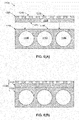
- Figs. 6(A) and 6(B) show a second exemplary embodiment in which solar receiver 110B includes a film-like structure 120B that is disposed on a block-like base section 115B.
- metamaterial structure 120B comprises a thin (foil or wafer) substrate 121B consisting essentially of a high melting point sunlight absorbing base material having upward-facing surface 122B upon which is formed a waffle-like array 124B having the features described above.
- a lower surface 123B of substrate 121B is secured to an upper surface 116B of base section 115B, which has been separately processed (e.g., machined) to include heat-exchange fluid conduits 119B.
- An advantage of the two-piece approach is that this approach simplifies processing of metamaterial structure 120B, and facilitates forming curved (e.g., pipe-like) solar receiver structures by way of bending surface structure 120B onto a curved surface of base section 115B.
- Fig. 7 shows a central receiver CSP plant 100C including a tower 105C supporting a solar receiver 110C, heliostats 141C-1 and 141C-2 form a concentrator 140C configured to concentrate incident solar energy E S onto solar receiver 110C, where solar solar receiver 110C includes a metamaterials-enhanced surface structure 120C according to any of the embodiments mentioned above, and is further configured to transfer heat energy to a heat-exchange fluid 130C that is transmitted by way of a heat-exchange fluid circulation system 150C to a turbine (not shown).
- Fig. 7 shows a central receiver CSP plant 100C including a tower 105C supporting a solar receiver 110C, heliostats 141C-1 and 141C-2 form a concentrator 140C configured to concentrate incident solar energy E S onto solar receiver 110C, where solar solar receiver 110C includes a metamaterials-enhanced surface structure 120C according to any of the embodiments mentioned above, and is further configured to transfer heat energy to a heat-exchange fluid 130C that
- FIG. 8 shows a solar dish CSP plant 100D including a solar dish concentrator 140D disposed on a support 144D and configured to focus solar energy E S onto a solar receiver 110D maintained by way of a central post 146D at a focal point FP, where solar receiver 110D includes a metamaterials-enhanced surface structure 120D according to any of the embodiments mentioned above, and is further configured to transfer heat energy to a heat-exchange fluid 130D.
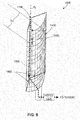
- FIG. 9 shows a parabolic trough CSP plant 100E according to another embodiment including a trough-type concentrator 140E configured to focus solar energy E S onto a pipe-like solar receiver 110E maintained by way of a support arms 146E along a focal line FL, where solar receiver 110E includes a metamaterials-enhanced surface structure 120E according to any of the embodiments mentioned above, and is further configured to transfer heat energy to a heat-exchange fluid 130E.
- a trough-type concentrator 140E configured to focus solar energy E S onto a pipe-like solar receiver 110E maintained by way of a support arms 146E along a focal line FL
- solar receiver 110E includes a metamaterials-enhanced surface structure 120E according to any of the embodiments mentioned above, and is further configured to transfer heat energy to a heat-exchange fluid 130E.
Landscapes
- Engineering & Computer Science (AREA)
- Physics & Mathematics (AREA)
- Thermal Sciences (AREA)
- Life Sciences & Earth Sciences (AREA)
- Sustainable Development (AREA)
- Sustainable Energy (AREA)
- Chemical & Material Sciences (AREA)
- Combustion & Propulsion (AREA)
- Mechanical Engineering (AREA)
- General Engineering & Computer Science (AREA)
- Ceramic Engineering (AREA)
- Spectroscopy & Molecular Physics (AREA)
- Photovoltaic Devices (AREA)
Applications Claiming Priority (1)
| Application Number | Priority Date | Filing Date | Title |
|---|---|---|---|
| US14/969,139 US10288323B2 (en) | 2015-12-15 | 2015-12-15 | Solar receiver with metamaterials-enhanced solar light absorbing structure |
Publications (2)
| Publication Number | Publication Date |
|---|---|
| EP3182033A1 EP3182033A1 (en) | 2017-06-21 |
| EP3182033B1 true EP3182033B1 (en) | 2019-08-07 |
Family
ID=57544232
Family Applications (1)
| Application Number | Title | Priority Date | Filing Date |
|---|---|---|---|
| EP16202547.2A Not-in-force EP3182033B1 (en) | 2015-12-15 | 2016-12-06 | Solar receiver with metamaterials-enhanced solar light absorbing structure |
Country Status (3)
| Country | Link |
|---|---|
| US (1) | US10288323B2 (enExample) |
| EP (1) | EP3182033B1 (enExample) |
| JP (1) | JP6712541B2 (enExample) |
Families Citing this family (11)
| Publication number | Priority date | Publication date | Assignee | Title |
|---|---|---|---|---|
| AU2017418693B2 (en) * | 2017-06-12 | 2023-07-13 | Solight Ltd. | Radiation collector and method of manufacture thereof |
| JP7019170B2 (ja) * | 2017-10-26 | 2022-02-15 | 国立大学法人大阪大学 | プラズモニック構造体 |
| CN109524790B (zh) * | 2018-11-06 | 2020-05-05 | 北京大学 | 一种基于f-p腔加载的人工表面等离激元辐射器及控制方法 |
| FR3097305B1 (fr) * | 2019-06-13 | 2022-07-29 | News | Dispositif thermodynamique haut rendement hybride solaire et couple hydrogène-oxygène produisant une pluralité d’énergies |
| WO2020263954A1 (en) * | 2019-06-26 | 2020-12-30 | University Of Houston System | Systems and methods for full spectrum solar thermal energy harvesting and storage by molecular and phase change material hybrids |
| CN110687065B (zh) * | 2019-09-17 | 2021-08-27 | 中国科学院上海微系统与信息技术研究所 | 一种红外光源的制备方法及一种红外气体传感器 |
| CN110763654B (zh) * | 2019-11-29 | 2023-03-17 | 江西师范大学 | 一种倾斜型高品质光学传感器及其制备方法 |
| JP7197754B2 (ja) * | 2021-03-24 | 2022-12-28 | 防衛装備庁長官 | 電波吸収体 |
| CN113307322B (zh) * | 2021-06-15 | 2022-07-29 | 桂林电子科技大学 | 一种基于等离激元效应的太阳能蒸发器 |
| CN113394571B (zh) * | 2021-07-20 | 2022-06-10 | 合肥工业大学 | 一种交指状阶梯谐振结构及低频率电磁波的吸波体 |
| CN116470826B (zh) * | 2023-03-13 | 2026-05-01 | 浙江大学 | 一种匹配高禁带电池的聚光太阳能光谱重整发电系统 |
Citations (2)
| Publication number | Priority date | Publication date | Assignee | Title |
|---|---|---|---|---|
| US4065592A (en) * | 1976-04-14 | 1977-12-27 | Hercules Incorporated | Solar energy absorber |
| EP1688684A1 (de) * | 2005-01-12 | 2006-08-09 | Sgl Carbon Ag | Absorberbauteil für solarthermischer Flachkollektor |
Family Cites Families (76)
| Publication number | Priority date | Publication date | Assignee | Title |
|---|---|---|---|---|
| US1111239A (en) | 1914-04-16 | 1914-09-22 | Henry D Smelser | Device for concentrating the rays of the sun. |
| US2712772A (en) | 1952-07-24 | 1955-07-12 | Ceutre Nat De La Rech Scient | Self-regulating automatic heliostat reflecting mirror device |
| US3905352A (en) | 1973-08-31 | 1975-09-16 | Arnold Jahn | System for collecting and transferring usable solar heat |
| US3892433A (en) | 1973-09-21 | 1975-07-01 | Martin Marietta Corp | Direct solar hydro-electric integrated system and concentrating heliostat for same |
| US3923381A (en) | 1973-12-28 | 1975-12-02 | Univ Chicago | Radiant energy collection |
| US3861379A (en) | 1974-03-05 | 1975-01-21 | Jr Henry Anderson | Low profile solar ray concentrator |
| US3924604A (en) | 1974-05-31 | 1975-12-09 | Schjeldahl Co G T | Solar energy conversion system |
| US4218114A (en) | 1975-12-19 | 1980-08-19 | Bunch Jesse C | Heliostat apparatus |
| US4110009A (en) | 1975-12-19 | 1978-08-29 | Bunch Jesse C | Heliostat apparatus |
| US4068653A (en) | 1976-03-01 | 1978-01-17 | Leo Bourdon | Solar heating unit |
| US4114596A (en) | 1976-03-16 | 1978-09-19 | Chang Wei Yi | Method and apparatus for tracking the sun for use in a solar collector with linear focusing means |
| CH612541A5 (enExample) | 1976-05-06 | 1979-07-31 | Fraunhofer Ges Forschung | |
| US4117682A (en) | 1976-11-01 | 1978-10-03 | Smith Otto J M | Solar collector system |
| US4109638A (en) | 1977-04-04 | 1978-08-29 | Matlock William C | Solar energy converter carousel |
| US4110010A (en) | 1977-07-07 | 1978-08-29 | Hilton Richard D | Ganged heliostat |
| US4149902A (en) | 1977-07-27 | 1979-04-17 | Eastman Kodak Company | Fluorescent solar energy concentrator |
| US4148301A (en) | 1977-09-26 | 1979-04-10 | Cluff C Brent | Water-borne rotating solar collecting and storage systems |
| US4130109A (en) | 1977-11-25 | 1978-12-19 | Brueck Chris M | Solar energy concentrator |
| US4153813A (en) | 1978-06-19 | 1979-05-08 | Atlantic Richfield Company | Luminescent solar collector |
| US4193819A (en) | 1978-06-23 | 1980-03-18 | Atlantic Richfield Company | Luminescent photovoltaic solar collector |
| US4234352A (en) | 1978-07-26 | 1980-11-18 | Electric Power Research Institute, Inc. | Thermophotovoltaic converter and cell for use therein |
| US4261335A (en) | 1978-10-16 | 1981-04-14 | Balhorn Alan C | Solar energy apparatus |
| US4190465A (en) | 1978-11-13 | 1980-02-26 | Owens-Illinois, Inc. | Luminescent solar collector structure |
| US4266530A (en) | 1979-09-27 | 1981-05-12 | Steadman Robert W | Sun ray tracker |
| DE3205439A1 (de) | 1981-03-02 | 1983-08-25 | Imchemie Kunststoff Gmbh, 5632 Wermelskirchen | Solarkonzentrator mit hohlspiegeln |
| DE3107888A1 (de) | 1981-03-02 | 1982-09-16 | Imchemie Kunststoff Gmbh, 5632 Wermelskirchen | Solarkonzentrator |
| US4771764A (en) | 1984-04-06 | 1988-09-20 | Cluff C Brent | Water-borne azimuth-altitude tracking solar concentrators |
| DE3633172A1 (de) | 1986-09-30 | 1988-04-07 | Man Technologie Gmbh | Verfahren zur nutzung von sonnenenergie und vorrichtung zur durchfuehrung des verfahrens |
| GB8629283D0 (en) | 1986-12-08 | 1987-01-14 | Gen Electric Co Plc | Radiation meters |
| US5180441A (en) | 1991-06-14 | 1993-01-19 | General Dynamics Corporation/Space Systems Division | Solar concentrator array |
| US5274497A (en) | 1991-11-29 | 1993-12-28 | Casey Paul A | Concentrating collector lens assembly |
| US5288337A (en) | 1992-06-25 | 1994-02-22 | Siemens Solar Industries, L.P. | Photovoltaic module with specular reflector |
| US5816238A (en) | 1994-11-28 | 1998-10-06 | Minnesota Mining And Manufacturing Company | Durable fluorescent solar collectors |
| US6239353B1 (en) | 1998-10-14 | 2001-05-29 | Christopher M. Hall | Solar tracker |
| EP1266255B1 (en) | 2000-03-16 | 2008-11-12 | Lee Products, Inc. | Method of designing and manufacturing high efficiency non-imaging optics |
| DE10025212A1 (de) | 2000-05-22 | 2001-11-29 | Andreas Noehrig | Konzentrierendes Solarenergiesystem |
| AU2002224019A1 (en) | 2000-11-10 | 2002-05-21 | Mikio Kinoshita | Solar radiation concentrator and method of concentrating solar radiation |
| US6498290B1 (en) | 2001-05-29 | 2002-12-24 | The Sun Trust, L.L.C. | Conversion of solar energy |
| JP3472838B2 (ja) | 2002-05-07 | 2003-12-02 | 東北大学長 | 波長選択性太陽光吸収材料及びその製造方法 |
| US7192146B2 (en) | 2003-07-28 | 2007-03-20 | Energy Innovations, Inc. | Solar concentrator array with grouped adjustable elements |
| US7677241B2 (en) | 2004-09-22 | 2010-03-16 | Energy Innovations, Inc. | Apparatus for redirecting parallel rays using rigid translation |
| US8283554B2 (en) | 2005-12-19 | 2012-10-09 | Corning Incorporated | Method and apparatus for concentrating light |
| US20070137691A1 (en) | 2005-12-19 | 2007-06-21 | Cobb Joshua M | Light collector and concentrator |
| WO2007109901A1 (en) | 2006-03-28 | 2007-10-04 | Menova Energy Inc. | Support structure kor a solar collector system |
| US7706030B2 (en) | 2006-04-21 | 2010-04-27 | Xerox Corporation | Document illuminator with parabolic optical element |
| US20090205701A1 (en) | 2006-12-22 | 2009-08-20 | General Electric Company | Luminescent solar collector having customizable viewing color |
| JP2010524012A (ja) | 2007-03-22 | 2010-07-15 | ユニベルシテ・ドウ・ストラスブール | 電磁エネルギーを選別して集めるデバイス、及び、そのようなデバイスを少なくとも1つ備える装置 |
| US20080308154A1 (en) | 2007-06-06 | 2008-12-18 | Green Volts, Inc. | Reflective secondary optic for concentrated photovoltaic systems |
| US8365719B2 (en) | 2007-08-07 | 2013-02-05 | Angeles Technologies, Inc. | Multi-receiver heliostat system architecture |
| US8324497B2 (en) | 2007-11-20 | 2012-12-04 | Sabic Innovative Plastics Ip B.V. | Luminescent solar concentrators |
| US20090235974A1 (en) | 2008-01-14 | 2009-09-24 | Massachusetts Institute Of Technology | Solar concentrator and devices and methods using them |
| CN101227158A (zh) | 2008-01-21 | 2008-07-23 | 北京格物创道科技发明有限公司 | 自动追踪式太阳能发电机 |
| US20100051016A1 (en) | 2008-08-27 | 2010-03-04 | Ammar Danny F | Modular fresnel solar energy collection system |
| MX2011002993A (es) | 2008-09-19 | 2011-05-30 | Univ California | Sistema y metodo para captura de energia solar y metodo relacionado de fabricacion. |
| WO2010065071A2 (en) | 2008-11-25 | 2010-06-10 | Regents Of The University Of Minnesota | Replication of patterned thin-film structures for use in plasmonics and metamaterials |
| US20110000543A1 (en) | 2009-07-02 | 2011-01-06 | Errico Joseph P | Solar energy collection and conversion system |
| JP5619160B2 (ja) | 2009-07-31 | 2014-11-05 | ペールプリュス ベスローテン フェノーツハップPeer+ B.V. | 発光光学素子および当該発光光学素子を備える太陽電池システム |
| JP5465952B2 (ja) * | 2009-08-26 | 2014-04-09 | スタンレー電気株式会社 | 太陽熱集熱板、その製造方法及び太陽熱発電システム |
| US20110079267A1 (en) | 2009-10-02 | 2011-04-07 | Genie Lens Technologies, Llc | Lens system with directional ray splitter for concentrating solar energy |
| WO2011146843A2 (en) | 2010-05-21 | 2011-11-24 | Massachusetts Institute Of Technology | Thermophotovoltaic energy generation |
| BR112012029613A2 (pt) | 2010-05-25 | 2017-12-05 | Koninklijke Philps Electronics N V | ''sistema concentrador solar luminescente e método de coleta e concentração da luz externa, particularmente luz solar'' |
| US8674281B2 (en) | 2010-08-09 | 2014-03-18 | Palo Alto Research Center Incorporated | Solar energy harvesting system using luminescent solar concentrator with distributed outcoupling structures and microoptical elements |
| US8354628B2 (en) | 2010-08-09 | 2013-01-15 | Palo Alto Research Center Incorporated | Luminescent solar concentrator with distributed outcoupling structures and microoptical elements |
| US20120192917A1 (en) | 2011-01-27 | 2012-08-02 | Whitted William H | Solar tracker mechanism |
| US20120325314A1 (en) | 2011-06-22 | 2012-12-27 | Palo Alto Research Center Incorporated | Solar Power Collection Using High-Focus-Accuracy Mirror Array |
| US20120325313A1 (en) | 2011-06-22 | 2012-12-27 | Palo Alto Research Center Incorporated | Solar-Tower System With High-Focus-Accuracy Mirror Array |
| US8887711B2 (en) | 2011-08-22 | 2014-11-18 | Palo Alto Research Center Incorporated | Solar tower system with carousel heliostats |
| US8844515B2 (en) | 2011-08-22 | 2014-09-30 | Palo Alto Research Center Incorporated | Carousel heliostat having louvered horizontal mirrors for solar tower systems |
| EP2834574B1 (en) * | 2012-01-05 | 2020-08-26 | Norwich Technologies, Inc. | Linear Solar Receiver for Concentrating Solar Power Systems |
| KR101818778B1 (ko) * | 2012-03-23 | 2018-01-16 | 한국전자통신연구원 | 실감 파노라마 영상 생성을 위한 3d 데이터 포맷 생성/소비 장치 및 방법 |
| US20130276777A1 (en) * | 2012-04-20 | 2013-10-24 | Bradley E. Reis | Solar Absorber |
| WO2013165014A1 (ja) | 2012-05-01 | 2013-11-07 | デクセリアルズ株式会社 | 熱吸収材及びその製造方法 |
| EP3044814A4 (en) | 2013-09-11 | 2016-09-21 | Purdue Research Foundation | FIRE-RESISTANT ABSORBER FOR A PLASMONIC METAMATERIAL AND TRANSMITTER FOR ENERGY EFFICIENCY |
| JP2015082531A (ja) * | 2013-10-21 | 2015-04-27 | 株式会社デンソー | 熱光起電力発電用エミッタ |
| US9656861B2 (en) | 2014-02-13 | 2017-05-23 | Palo Alto Research Center Incorporated | Solar power harvesting system with metamaterial enhanced solar thermophotovoltaic converter (MESTC) |
| JP6519103B2 (ja) * | 2014-06-05 | 2019-05-29 | 日本電気株式会社 | 光放射構造体及びそれを用いた熱光起電力発電システム、可視光照明装置、ガス検知装置 |
-
2015
- 2015-12-15 US US14/969,139 patent/US10288323B2/en active Active
-
2016
- 2016-11-28 JP JP2016230267A patent/JP6712541B2/ja not_active Expired - Fee Related
- 2016-12-06 EP EP16202547.2A patent/EP3182033B1/en not_active Not-in-force
Patent Citations (2)
| Publication number | Priority date | Publication date | Assignee | Title |
|---|---|---|---|---|
| US4065592A (en) * | 1976-04-14 | 1977-12-27 | Hercules Incorporated | Solar energy absorber |
| EP1688684A1 (de) * | 2005-01-12 | 2006-08-09 | Sgl Carbon Ag | Absorberbauteil für solarthermischer Flachkollektor |
Also Published As
| Publication number | Publication date |
|---|---|
| US10288323B2 (en) | 2019-05-14 |
| US20170167755A1 (en) | 2017-06-15 |
| EP3182033A1 (en) | 2017-06-21 |
| JP2017110901A (ja) | 2017-06-22 |
| JP6712541B2 (ja) | 2020-06-24 |
Similar Documents
| Publication | Publication Date | Title |
|---|---|---|
| US10288323B2 (en) | Solar receiver with metamaterials-enhanced solar light absorbing structure | |
| AU2003259804B2 (en) | Concentrating solar energy receiver | |
| CN103348495B (zh) | 对经济高效的太阳能汇聚和利用系统的改进 | |
| CN102782421B (zh) | 抛物线太阳能接收器的阵列模块 | |
| EP2457032B1 (en) | Solar concentrator with improved manufacturabillty and efficiency | |
| EP3252415B1 (en) | Passive radiative dry cooling system using metamaterials | |
| US20080308154A1 (en) | Reflective secondary optic for concentrated photovoltaic systems | |
| US9656861B2 (en) | Solar power harvesting system with metamaterial enhanced solar thermophotovoltaic converter (MESTC) | |
| US20110120539A1 (en) | On-window solar-cell heat-spreader | |
| EP2908431A1 (en) | Metamaterial enhanced thermophotovoltaic converter | |
| US20140326293A1 (en) | Methods and apparatus for solar energy concentration and conversion | |
| US20080264469A1 (en) | Solar power unit with integrated primary structure | |
| US20080276982A1 (en) | System and methods for optimal light collection array | |
| WO1996024954A1 (en) | Non-tracking solar concentrator heat sink and housing system | |
| EP3004639B1 (en) | High efficiency solar power generator for offshore applications | |
| JP5117839B2 (ja) | 集光型太陽光発電装置 | |
| CN111213245B (zh) | 用于光伏电池和热应用的集成微透镜 | |
| CN116710734A (zh) | 基于剪纸的多轴跟踪设备和系统 |
Legal Events
| Date | Code | Title | Description |
|---|---|---|---|
| PUAI | Public reference made under article 153(3) epc to a published international application that has entered the european phase |
Free format text: ORIGINAL CODE: 0009012 |
|
| STAA | Information on the status of an ep patent application or granted ep patent |
Free format text: STATUS: THE APPLICATION HAS BEEN PUBLISHED |
|
| AK | Designated contracting states |
Kind code of ref document: A1 Designated state(s): AL AT BE BG CH CY CZ DE DK EE ES FI FR GB GR HR HU IE IS IT LI LT LU LV MC MK MT NL NO PL PT RO RS SE SI SK SM TR |
|
| AX | Request for extension of the european patent |
Extension state: BA ME |
|
| STAA | Information on the status of an ep patent application or granted ep patent |
Free format text: STATUS: REQUEST FOR EXAMINATION WAS MADE |
|
| 17P | Request for examination filed |
Effective date: 20171221 |
|
| RBV | Designated contracting states (corrected) |
Designated state(s): AL AT BE BG CH CY CZ DE DK EE ES FI FR GB GR HR HU IE IS IT LI LT LU LV MC MK MT NL NO PL PT RO RS SE SI SK SM TR |
|
| STAA | Information on the status of an ep patent application or granted ep patent |
Free format text: STATUS: EXAMINATION IS IN PROGRESS |
|
| 17Q | First examination report despatched |
Effective date: 20180504 |
|
| REG | Reference to a national code |
Ref country code: DE Ref legal event code: R079 Ref document number: 602016018034 Country of ref document: DE Free format text: PREVIOUS MAIN CLASS: F24J0002480000 Ipc: F24S0070600000 |
|
| GRAP | Despatch of communication of intention to grant a patent |
Free format text: ORIGINAL CODE: EPIDOSNIGR1 |
|
| STAA | Information on the status of an ep patent application or granted ep patent |
Free format text: STATUS: GRANT OF PATENT IS INTENDED |
|
| RIC1 | Information provided on ipc code assigned before grant |
Ipc: F24S 70/16 20180101ALI20190213BHEP Ipc: H02S 40/20 20140101ALI20190213BHEP Ipc: F24S 20/20 20180101ALI20190213BHEP Ipc: F24S 70/10 20180101ALI20190213BHEP Ipc: F24S 70/60 20180101AFI20190213BHEP |
|
| INTG | Intention to grant announced |
Effective date: 20190227 |
|
| GRAS | Grant fee paid |
Free format text: ORIGINAL CODE: EPIDOSNIGR3 |
|
| GRAA | (expected) grant |
Free format text: ORIGINAL CODE: 0009210 |
|
| STAA | Information on the status of an ep patent application or granted ep patent |
Free format text: STATUS: THE PATENT HAS BEEN GRANTED |
|
| AK | Designated contracting states |
Kind code of ref document: B1 Designated state(s): AL AT BE BG CH CY CZ DE DK EE ES FI FR GB GR HR HU IE IS IT LI LT LU LV MC MK MT NL NO PL PT RO RS SE SI SK SM TR |
|
| REG | Reference to a national code |
Ref country code: GB Ref legal event code: FG4D |
|
| REG | Reference to a national code |
Ref country code: CH Ref legal event code: EP Ref country code: AT Ref legal event code: REF Ref document number: 1164486 Country of ref document: AT Kind code of ref document: T Effective date: 20190815 |
|
| REG | Reference to a national code |
Ref country code: DE Ref legal event code: R096 Ref document number: 602016018034 Country of ref document: DE |
|
| REG | Reference to a national code |
Ref country code: IE Ref legal event code: FG4D |
|
| REG | Reference to a national code |
Ref country code: NL Ref legal event code: MP Effective date: 20190807 |
|
| REG | Reference to a national code |
Ref country code: LT Ref legal event code: MG4D |
|
| PG25 | Lapsed in a contracting state [announced via postgrant information from national office to epo] |
Ref country code: PT Free format text: LAPSE BECAUSE OF FAILURE TO SUBMIT A TRANSLATION OF THE DESCRIPTION OR TO PAY THE FEE WITHIN THE PRESCRIBED TIME-LIMIT Effective date: 20191209 Ref country code: HR Free format text: LAPSE BECAUSE OF FAILURE TO SUBMIT A TRANSLATION OF THE DESCRIPTION OR TO PAY THE FEE WITHIN THE PRESCRIBED TIME-LIMIT Effective date: 20190807 Ref country code: LT Free format text: LAPSE BECAUSE OF FAILURE TO SUBMIT A TRANSLATION OF THE DESCRIPTION OR TO PAY THE FEE WITHIN THE PRESCRIBED TIME-LIMIT Effective date: 20190807 Ref country code: SE Free format text: LAPSE BECAUSE OF FAILURE TO SUBMIT A TRANSLATION OF THE DESCRIPTION OR TO PAY THE FEE WITHIN THE PRESCRIBED TIME-LIMIT Effective date: 20190807 Ref country code: BG Free format text: LAPSE BECAUSE OF FAILURE TO SUBMIT A TRANSLATION OF THE DESCRIPTION OR TO PAY THE FEE WITHIN THE PRESCRIBED TIME-LIMIT Effective date: 20191107 Ref country code: NL Free format text: LAPSE BECAUSE OF FAILURE TO SUBMIT A TRANSLATION OF THE DESCRIPTION OR TO PAY THE FEE WITHIN THE PRESCRIBED TIME-LIMIT Effective date: 20190807 Ref country code: FI Free format text: LAPSE BECAUSE OF FAILURE TO SUBMIT A TRANSLATION OF THE DESCRIPTION OR TO PAY THE FEE WITHIN THE PRESCRIBED TIME-LIMIT Effective date: 20190807 Ref country code: NO Free format text: LAPSE BECAUSE OF FAILURE TO SUBMIT A TRANSLATION OF THE DESCRIPTION OR TO PAY THE FEE WITHIN THE PRESCRIBED TIME-LIMIT Effective date: 20191107 |
|
| REG | Reference to a national code |
Ref country code: AT Ref legal event code: MK05 Ref document number: 1164486 Country of ref document: AT Kind code of ref document: T Effective date: 20190807 |
|
| PG25 | Lapsed in a contracting state [announced via postgrant information from national office to epo] |
Ref country code: ES Free format text: LAPSE BECAUSE OF FAILURE TO SUBMIT A TRANSLATION OF THE DESCRIPTION OR TO PAY THE FEE WITHIN THE PRESCRIBED TIME-LIMIT Effective date: 20190807 Ref country code: RS Free format text: LAPSE BECAUSE OF FAILURE TO SUBMIT A TRANSLATION OF THE DESCRIPTION OR TO PAY THE FEE WITHIN THE PRESCRIBED TIME-LIMIT Effective date: 20190807 Ref country code: LV Free format text: LAPSE BECAUSE OF FAILURE TO SUBMIT A TRANSLATION OF THE DESCRIPTION OR TO PAY THE FEE WITHIN THE PRESCRIBED TIME-LIMIT Effective date: 20190807 Ref country code: IS Free format text: LAPSE BECAUSE OF FAILURE TO SUBMIT A TRANSLATION OF THE DESCRIPTION OR TO PAY THE FEE WITHIN THE PRESCRIBED TIME-LIMIT Effective date: 20191207 Ref country code: AL Free format text: LAPSE BECAUSE OF FAILURE TO SUBMIT A TRANSLATION OF THE DESCRIPTION OR TO PAY THE FEE WITHIN THE PRESCRIBED TIME-LIMIT Effective date: 20190807 Ref country code: GR Free format text: LAPSE BECAUSE OF FAILURE TO SUBMIT A TRANSLATION OF THE DESCRIPTION OR TO PAY THE FEE WITHIN THE PRESCRIBED TIME-LIMIT Effective date: 20191108 |
|
| PG25 | Lapsed in a contracting state [announced via postgrant information from national office to epo] |
Ref country code: TR Free format text: LAPSE BECAUSE OF FAILURE TO SUBMIT A TRANSLATION OF THE DESCRIPTION OR TO PAY THE FEE WITHIN THE PRESCRIBED TIME-LIMIT Effective date: 20190807 |
|
| PG25 | Lapsed in a contracting state [announced via postgrant information from national office to epo] |
Ref country code: IT Free format text: LAPSE BECAUSE OF FAILURE TO SUBMIT A TRANSLATION OF THE DESCRIPTION OR TO PAY THE FEE WITHIN THE PRESCRIBED TIME-LIMIT Effective date: 20190807 Ref country code: RO Free format text: LAPSE BECAUSE OF FAILURE TO SUBMIT A TRANSLATION OF THE DESCRIPTION OR TO PAY THE FEE WITHIN THE PRESCRIBED TIME-LIMIT Effective date: 20190807 Ref country code: EE Free format text: LAPSE BECAUSE OF FAILURE TO SUBMIT A TRANSLATION OF THE DESCRIPTION OR TO PAY THE FEE WITHIN THE PRESCRIBED TIME-LIMIT Effective date: 20190807 Ref country code: AT Free format text: LAPSE BECAUSE OF FAILURE TO SUBMIT A TRANSLATION OF THE DESCRIPTION OR TO PAY THE FEE WITHIN THE PRESCRIBED TIME-LIMIT Effective date: 20190807 Ref country code: DK Free format text: LAPSE BECAUSE OF FAILURE TO SUBMIT A TRANSLATION OF THE DESCRIPTION OR TO PAY THE FEE WITHIN THE PRESCRIBED TIME-LIMIT Effective date: 20190807 Ref country code: PL Free format text: LAPSE BECAUSE OF FAILURE TO SUBMIT A TRANSLATION OF THE DESCRIPTION OR TO PAY THE FEE WITHIN THE PRESCRIBED TIME-LIMIT Effective date: 20190807 |
|
| PG25 | Lapsed in a contracting state [announced via postgrant information from national office to epo] |
Ref country code: SK Free format text: LAPSE BECAUSE OF FAILURE TO SUBMIT A TRANSLATION OF THE DESCRIPTION OR TO PAY THE FEE WITHIN THE PRESCRIBED TIME-LIMIT Effective date: 20190807 Ref country code: SM Free format text: LAPSE BECAUSE OF FAILURE TO SUBMIT A TRANSLATION OF THE DESCRIPTION OR TO PAY THE FEE WITHIN THE PRESCRIBED TIME-LIMIT Effective date: 20190807 Ref country code: IS Free format text: LAPSE BECAUSE OF FAILURE TO SUBMIT A TRANSLATION OF THE DESCRIPTION OR TO PAY THE FEE WITHIN THE PRESCRIBED TIME-LIMIT Effective date: 20200224 Ref country code: CZ Free format text: LAPSE BECAUSE OF FAILURE TO SUBMIT A TRANSLATION OF THE DESCRIPTION OR TO PAY THE FEE WITHIN THE PRESCRIBED TIME-LIMIT Effective date: 20190807 |
|
| REG | Reference to a national code |
Ref country code: DE Ref legal event code: R097 Ref document number: 602016018034 Country of ref document: DE |
|
| PLBE | No opposition filed within time limit |
Free format text: ORIGINAL CODE: 0009261 |
|
| STAA | Information on the status of an ep patent application or granted ep patent |
Free format text: STATUS: NO OPPOSITION FILED WITHIN TIME LIMIT |
|
| PG2D | Information on lapse in contracting state deleted |
Ref country code: IS |
|
| REG | Reference to a national code |
Ref country code: CH Ref legal event code: PL |
|
| 26N | No opposition filed |
Effective date: 20200603 |
|
| REG | Reference to a national code |
Ref country code: BE Ref legal event code: MM Effective date: 20191231 |
|
| PG25 | Lapsed in a contracting state [announced via postgrant information from national office to epo] |
Ref country code: MC Free format text: LAPSE BECAUSE OF FAILURE TO SUBMIT A TRANSLATION OF THE DESCRIPTION OR TO PAY THE FEE WITHIN THE PRESCRIBED TIME-LIMIT Effective date: 20190807 Ref country code: SI Free format text: LAPSE BECAUSE OF FAILURE TO SUBMIT A TRANSLATION OF THE DESCRIPTION OR TO PAY THE FEE WITHIN THE PRESCRIBED TIME-LIMIT Effective date: 20190807 |
|
| PG25 | Lapsed in a contracting state [announced via postgrant information from national office to epo] |
Ref country code: LU Free format text: LAPSE BECAUSE OF NON-PAYMENT OF DUE FEES Effective date: 20191206 Ref country code: IE Free format text: LAPSE BECAUSE OF NON-PAYMENT OF DUE FEES Effective date: 20191206 |
|
| PG25 | Lapsed in a contracting state [announced via postgrant information from national office to epo] |
Ref country code: CH Free format text: LAPSE BECAUSE OF NON-PAYMENT OF DUE FEES Effective date: 20191231 Ref country code: LI Free format text: LAPSE BECAUSE OF NON-PAYMENT OF DUE FEES Effective date: 20191231 Ref country code: BE Free format text: LAPSE BECAUSE OF NON-PAYMENT OF DUE FEES Effective date: 20191231 |
|
| PG25 | Lapsed in a contracting state [announced via postgrant information from national office to epo] |
Ref country code: CY Free format text: LAPSE BECAUSE OF FAILURE TO SUBMIT A TRANSLATION OF THE DESCRIPTION OR TO PAY THE FEE WITHIN THE PRESCRIBED TIME-LIMIT Effective date: 20190807 |
|
| PG25 | Lapsed in a contracting state [announced via postgrant information from national office to epo] |
Ref country code: MT Free format text: LAPSE BECAUSE OF FAILURE TO SUBMIT A TRANSLATION OF THE DESCRIPTION OR TO PAY THE FEE WITHIN THE PRESCRIBED TIME-LIMIT Effective date: 20190807 Ref country code: HU Free format text: LAPSE BECAUSE OF FAILURE TO SUBMIT A TRANSLATION OF THE DESCRIPTION OR TO PAY THE FEE WITHIN THE PRESCRIBED TIME-LIMIT; INVALID AB INITIO Effective date: 20161206 |
|
| GBPC | Gb: european patent ceased through non-payment of renewal fee |
Effective date: 20201206 |
|
| PG25 | Lapsed in a contracting state [announced via postgrant information from national office to epo] |
Ref country code: GB Free format text: LAPSE BECAUSE OF NON-PAYMENT OF DUE FEES Effective date: 20201206 |
|
| PG25 | Lapsed in a contracting state [announced via postgrant information from national office to epo] |
Ref country code: MK Free format text: LAPSE BECAUSE OF FAILURE TO SUBMIT A TRANSLATION OF THE DESCRIPTION OR TO PAY THE FEE WITHIN THE PRESCRIBED TIME-LIMIT Effective date: 20190807 |
|
| PGFP | Annual fee paid to national office [announced via postgrant information from national office to epo] |
Ref country code: FR Payment date: 20231122 Year of fee payment: 8 Ref country code: DE Payment date: 20231121 Year of fee payment: 8 |
|
| REG | Reference to a national code |
Ref country code: DE Ref legal event code: R119 Ref document number: 602016018034 Country of ref document: DE |
|
| PG25 | Lapsed in a contracting state [announced via postgrant information from national office to epo] |
Ref country code: DE Free format text: LAPSE BECAUSE OF NON-PAYMENT OF DUE FEES Effective date: 20250701 |
|
| PG25 | Lapsed in a contracting state [announced via postgrant information from national office to epo] |
Ref country code: FR Free format text: LAPSE BECAUSE OF NON-PAYMENT OF DUE FEES Effective date: 20241231 |