EP3177720B1 - Virus like particle comprising modified envelope protein e3 - Google Patents
Virus like particle comprising modified envelope protein e3 Download PDFInfo
- Publication number
- EP3177720B1 EP3177720B1 EP15829311.8A EP15829311A EP3177720B1 EP 3177720 B1 EP3177720 B1 EP 3177720B1 EP 15829311 A EP15829311 A EP 15829311A EP 3177720 B1 EP3177720 B1 EP 3177720B1
- Authority
- EP
- European Patent Office
- Prior art keywords
- antigen
- virus
- seq
- protein
- particle
- Prior art date
- Legal status (The legal status is an assumption and is not a legal conclusion. Google has not performed a legal analysis and makes no representation as to the accuracy of the status listed.)
- Active
Links
Images



Classifications
-
- C—CHEMISTRY; METALLURGY
- C12—BIOCHEMISTRY; BEER; SPIRITS; WINE; VINEGAR; MICROBIOLOGY; ENZYMOLOGY; MUTATION OR GENETIC ENGINEERING
- C12N—MICROORGANISMS OR ENZYMES; COMPOSITIONS THEREOF; PROPAGATING, PRESERVING, OR MAINTAINING MICROORGANISMS; MUTATION OR GENETIC ENGINEERING; CULTURE MEDIA
- C12N7/00—Viruses; Bacteriophages; Compositions thereof; Preparation or purification thereof
-
- A—HUMAN NECESSITIES
- A61—MEDICAL OR VETERINARY SCIENCE; HYGIENE
- A61K—PREPARATIONS FOR MEDICAL, DENTAL OR TOILETRY PURPOSES
- A61K39/00—Medicinal preparations containing antigens or antibodies
- A61K39/0005—Vertebrate antigens
-
- A—HUMAN NECESSITIES
- A61—MEDICAL OR VETERINARY SCIENCE; HYGIENE
- A61K—PREPARATIONS FOR MEDICAL, DENTAL OR TOILETRY PURPOSES
- A61K39/00—Medicinal preparations containing antigens or antibodies
- A61K39/0005—Vertebrate antigens
- A61K39/0011—Cancer antigens
-
- A—HUMAN NECESSITIES
- A61—MEDICAL OR VETERINARY SCIENCE; HYGIENE
- A61K—PREPARATIONS FOR MEDICAL, DENTAL OR TOILETRY PURPOSES
- A61K39/00—Medicinal preparations containing antigens or antibodies
- A61K39/0005—Vertebrate antigens
- A61K39/0011—Cancer antigens
- A61K39/001102—Receptors, cell surface antigens or cell surface determinants
- A61K39/001103—Receptors for growth factors
- A61K39/001106—Her-2/neu/ErbB2, Her-3/ErbB3 or Her 4/ErbB4
-
- A—HUMAN NECESSITIES
- A61—MEDICAL OR VETERINARY SCIENCE; HYGIENE
- A61K—PREPARATIONS FOR MEDICAL, DENTAL OR TOILETRY PURPOSES
- A61K39/00—Medicinal preparations containing antigens or antibodies
- A61K39/0005—Vertebrate antigens
- A61K39/0011—Cancer antigens
- A61K39/001136—Cytokines
- A61K39/00114—Interleukins [IL]
-
- A—HUMAN NECESSITIES
- A61—MEDICAL OR VETERINARY SCIENCE; HYGIENE
- A61K—PREPARATIONS FOR MEDICAL, DENTAL OR TOILETRY PURPOSES
- A61K39/00—Medicinal preparations containing antigens or antibodies
- A61K39/002—Protozoa antigens
- A61K39/015—Hemosporidia antigens, e.g. Plasmodium antigens
-
- A—HUMAN NECESSITIES
- A61—MEDICAL OR VETERINARY SCIENCE; HYGIENE
- A61K—PREPARATIONS FOR MEDICAL, DENTAL OR TOILETRY PURPOSES
- A61K39/00—Medicinal preparations containing antigens or antibodies
- A61K39/12—Viral antigens
-
- A—HUMAN NECESSITIES
- A61—MEDICAL OR VETERINARY SCIENCE; HYGIENE
- A61P—SPECIFIC THERAPEUTIC ACTIVITY OF CHEMICAL COMPOUNDS OR MEDICINAL PREPARATIONS
- A61P25/00—Drugs for disorders of the nervous system
-
- A—HUMAN NECESSITIES
- A61—MEDICAL OR VETERINARY SCIENCE; HYGIENE
- A61P—SPECIFIC THERAPEUTIC ACTIVITY OF CHEMICAL COMPOUNDS OR MEDICINAL PREPARATIONS
- A61P31/00—Antiinfectives, i.e. antibiotics, antiseptics, chemotherapeutics
-
- A—HUMAN NECESSITIES
- A61—MEDICAL OR VETERINARY SCIENCE; HYGIENE
- A61P—SPECIFIC THERAPEUTIC ACTIVITY OF CHEMICAL COMPOUNDS OR MEDICINAL PREPARATIONS
- A61P33/00—Antiparasitic agents
- A61P33/02—Antiprotozoals, e.g. for leishmaniasis, trichomoniasis, toxoplasmosis
- A61P33/06—Antimalarials
-
- A—HUMAN NECESSITIES
- A61—MEDICAL OR VETERINARY SCIENCE; HYGIENE
- A61P—SPECIFIC THERAPEUTIC ACTIVITY OF CHEMICAL COMPOUNDS OR MEDICINAL PREPARATIONS
- A61P35/00—Antineoplastic agents
-
- A—HUMAN NECESSITIES
- A61—MEDICAL OR VETERINARY SCIENCE; HYGIENE
- A61P—SPECIFIC THERAPEUTIC ACTIVITY OF CHEMICAL COMPOUNDS OR MEDICINAL PREPARATIONS
- A61P37/00—Drugs for immunological or allergic disorders
- A61P37/02—Immunomodulators
-
- A—HUMAN NECESSITIES
- A61—MEDICAL OR VETERINARY SCIENCE; HYGIENE
- A61P—SPECIFIC THERAPEUTIC ACTIVITY OF CHEMICAL COMPOUNDS OR MEDICINAL PREPARATIONS
- A61P37/00—Drugs for immunological or allergic disorders
- A61P37/02—Immunomodulators
- A61P37/04—Immunostimulants
-
- C—CHEMISTRY; METALLURGY
- C07—ORGANIC CHEMISTRY
- C07K—PEPTIDES
- C07K14/00—Peptides having more than 20 amino acids; Gastrins; Somatostatins; Melanotropins; Derivatives thereof
- C07K14/005—Peptides having more than 20 amino acids; Gastrins; Somatostatins; Melanotropins; Derivatives thereof from viruses
-
- A—HUMAN NECESSITIES
- A61—MEDICAL OR VETERINARY SCIENCE; HYGIENE
- A61K—PREPARATIONS FOR MEDICAL, DENTAL OR TOILETRY PURPOSES
- A61K39/00—Medicinal preparations containing antigens or antibodies
- A61K2039/51—Medicinal preparations containing antigens or antibodies comprising whole cells, viruses or DNA/RNA
- A61K2039/525—Virus
- A61K2039/5258—Virus-like particles
-
- A—HUMAN NECESSITIES
- A61—MEDICAL OR VETERINARY SCIENCE; HYGIENE
- A61K—PREPARATIONS FOR MEDICAL, DENTAL OR TOILETRY PURPOSES
- A61K39/00—Medicinal preparations containing antigens or antibodies
- A61K2039/58—Medicinal preparations containing antigens or antibodies raising an immune response against a target which is not the antigen used for immunisation
-
- A—HUMAN NECESSITIES
- A61—MEDICAL OR VETERINARY SCIENCE; HYGIENE
- A61K—PREPARATIONS FOR MEDICAL, DENTAL OR TOILETRY PURPOSES
- A61K39/00—Medicinal preparations containing antigens or antibodies
- A61K2039/58—Medicinal preparations containing antigens or antibodies raising an immune response against a target which is not the antigen used for immunisation
- A61K2039/585—Medicinal preparations containing antigens or antibodies raising an immune response against a target which is not the antigen used for immunisation wherein the target is cancer
-
- C—CHEMISTRY; METALLURGY
- C07—ORGANIC CHEMISTRY
- C07K—PEPTIDES
- C07K2319/00—Fusion polypeptide
-
- C—CHEMISTRY; METALLURGY
- C07—ORGANIC CHEMISTRY
- C07K—PEPTIDES
- C07K2319/00—Fusion polypeptide
- C07K2319/40—Fusion polypeptide containing a tag for immunodetection, or an epitope for immunisation
-
- C—CHEMISTRY; METALLURGY
- C12—BIOCHEMISTRY; BEER; SPIRITS; WINE; VINEGAR; MICROBIOLOGY; ENZYMOLOGY; MUTATION OR GENETIC ENGINEERING
- C12N—MICROORGANISMS OR ENZYMES; COMPOSITIONS THEREOF; PROPAGATING, PRESERVING, OR MAINTAINING MICROORGANISMS; MUTATION OR GENETIC ENGINEERING; CULTURE MEDIA
- C12N2770/00—MICROORGANISMS OR ENZYMES; COMPOSITIONS THEREOF; PROPAGATING, PRESERVING, OR MAINTAINING MICROORGANISMS; MUTATION OR GENETIC ENGINEERING; CULTURE MEDIA ssRNA viruses positive-sense
- C12N2770/00011—Details
- C12N2770/36011—Togaviridae
- C12N2770/36111—Alphavirus, e.g. Sindbis virus, VEE, EEE, WEE, Semliki
- C12N2770/36123—Virus like particles [VLP]
-
- C—CHEMISTRY; METALLURGY
- C12—BIOCHEMISTRY; BEER; SPIRITS; WINE; VINEGAR; MICROBIOLOGY; ENZYMOLOGY; MUTATION OR GENETIC ENGINEERING
- C12N—MICROORGANISMS OR ENZYMES; COMPOSITIONS THEREOF; PROPAGATING, PRESERVING, OR MAINTAINING MICROORGANISMS; MUTATION OR GENETIC ENGINEERING; CULTURE MEDIA
- C12N2770/00—MICROORGANISMS OR ENZYMES; COMPOSITIONS THEREOF; PROPAGATING, PRESERVING, OR MAINTAINING MICROORGANISMS; MUTATION OR GENETIC ENGINEERING; CULTURE MEDIA ssRNA viruses positive-sense
- C12N2770/00011—Details
- C12N2770/36011—Togaviridae
- C12N2770/36111—Alphavirus, e.g. Sindbis virus, VEE, EEE, WEE, Semliki
- C12N2770/36134—Use of virus or viral component as vaccine, e.g. live-attenuated or inactivated virus, VLP, viral protein
Definitions
- the present application relates to a virus like particle comprising a modified envelope protein E3, and use thereof.
- VLPs Virus-like particles
- GlaxoSmithKline's Engerix R hepatitis B virus
- Cervarix R human papillomavirus
- Merck and Co., Inc.'s Recombivax HB R hepatitis B virus
- Gardasil R human papillomavirus
- Other VLP-based vaccine candidates are in clinical trials or undergoing preclinical evaluation, such as, influenza virus, parvovirus, Norwalk and various chimeric VLPs.
- VLP-based vaccine blockbusters are briefly presented concomitantly with the latest results from clinical trials and the recent developments in chimeric VLP-based technology for either therapeutic or prophylactic vaccination.
- VLP-based vaccines have been produced for more than 30 different viruses that infect human and other animals.
- the examples include AAV (Adeno-associated virus), H5N3 (Avian influenza), BFDV (Budgerigar fledgling disease virus), BTV (Bluetongue virus), Ebola, Enterovirus 71, GHPV (Goose hemorrhagic polyoma virus), HBV (Hepatitis B virus), HCV (Hepatitis C virus), HDV (Hepatitis ⁇ virus), HEV (Hepatitis E virus), HIV, HPV (Human papillomavirus), IBDV (Infectious bursal disease virus), Influenza A, Influenza A H1N1, Influenza A H3N2, JC polymavirus, Marburg, MS2, IPCV (Indian peanut clump virus), NDV (Newcastle disease virus), No (Norovirus) Nv (Norwalk virus), PhMV (Physalis mottle virus), Polyomavirus,
- VLP virus-like particle
- Chikungunya virus has infected millions of people in Africa, Europe and Asia since this alphavirus reemerged from Kenya in 2004. The severity of the disease and the spread of this epidemic virus present a serious public health threat in the absence of vaccines or antiviral therapies. It is reported that a VLP vaccine for epidemic Chikungunya virus protects non-human primates against infection ( Nat Med. 2010 March; 16(3): 334-338 ). US patent publication No. 2012/0003266 discloses a virus-like particle (VLP) comprising one or more Chikungunya viral structural proteins which is useful for formulating a vaccine or antigenic composition for Chikungunya that induces immunity to an infection or at least one symptom thereof.
- VLP virus-like particle
- WO2012/106356 discloses modified alphavirus or flavivirus virus-like particles (VLPs) and methods for enhancing production of modified VLPs for use in the prevention or treatment of alphavirus and flavivirus-mediated diseases.
- WO 2013/122262 discloses a particle which is capable of being self-assembled, comprising a polypeptide and at least one antigen, wherein the polypeptide comprises at least one first attachment site and said at least one antigen comprises at least one second attachment site, and wherein said polypeptide and said antigen are linked through said at least one first and said at least one second attachment site, and wherein spatial distance between the N-terminal residue and C-terminal residue of the antigen is 30 Angstrom or less when the distance is determined in a crystal of the antigen or a naturally occurring protein containing the antigen or modified protein therefrom.
- WO 2015/005500 discloses a virus-like-particle comprising a virus structural protein and an antigen derived from PD-1 or a ligand of DP-1, and a composition or kit comprising thereof, as well as tis use in immune response.
- the present application provides a virus like particle comprising a viral structural protein which comprises modified envelope protein E3, wherein the virus structural protein is derived from alphavirus and wherein one or more amino acid residues are replaced, added and/or deleted in amino acid sequence at the furin site in the envelope protein E3, and at least one antigen is inserted into the envelope protein E3 between residues corresponding to 321 and 326 of SEQ ID NO: 1, residues 321 and 326 of SEQ ID NO: 2 or residues 330 and 335 of SEQ ID NO: 3.
- a viral structural protein which comprises modified envelope protein E3, wherein the virus structural protein is derived from alphavirus and wherein one or more amino acid residues are replaced, added and/or deleted in amino acid sequence at the furin site in the envelope protein E3, and at least one antigen is inserted into the envelope protein E3 between residues corresponding to 321 and 326 of SEQ ID NO: 1, residues 321 and 326 of SEQ ID NO: 2 or residues 330 and 335 of SEQ ID NO: 3.
- the present application provides an isolated nucleic acid molecule comprising a nucleotide sequence encoding the virus like particle according to the invention.
- the present application provides a pharmaceutical composition or vaccine composition
- a pharmaceutical composition or vaccine composition comprising (a) a virus like particle according to the invention; and (b) a pharmaceutically acceptable carrier.
- the present application provides a pharmaceutical composition or vaccine composition according to the invention for treating or preventing cancer, neurological disease, infectious disease or malaria; producing an antibody against at least one antigen in a mammal; modulating an immune response; immunostimulation; inhibiting function of at least one antigen; or presenting an antigen on macrophage.
- the envelope protein E3 may be modified to comprise at least one antigen or an alternation/mutation to the amino acid sequence at the furin site.
- the present application provides a cell line that expresses a viral structural protein derived from alphavirus which comprises an alternation/mutation to the amino acid sequence at the furin site in the envelope protein E3, wherein at least one antigen is inserted into the envelope protein E3 between residues corresponding to 321 and 326 of SEQ ID NO: 1, residues 321 and 326 of SEQ ID NO: 2 or residues 330 and 335 of SEQ ID NO: 3.
- Virus like particle comprising a modified envelope protein E3
- the present application provides a virus like particle comprising a viral structural protein comprising a modified envelope protein E3.
- the envelope protein E3 may be modified to comprise at least one antigen or an alternation/mutation to the amino acid sequence at the furin site (Arg-X-X-Arg).
- Arg-X-X-Arg indicates the minimal cleavage site of furin and "X-X” includes any two amino acids.
- a virus like particle is composed of one or more viral structural proteins that spontaneously assemble into a particulate structure.
- a viral structural protein used for the present application may be any viral structural protein as long as it expresses a furin site.
- the present description discloses a cell line, especially stable cell line expressing a virus like particle, wherein the virus like particle comprises an alternation/mutation to the amino acid sequence at the furin site (Arg-X-X-Arg), and a method for producing thereof.
- Example of the alternation to the amino acid sequence at furin site includes the alternation to Ile-Glu/Asp-Gly-Arg or Asp-Asp-Asp-Asp-Lys.
- the cell line generated by this method could be a stable cell line.
- the stable cell line obtained by this embodiment may maintain the ability to express and generate the VLP for relatively long time, such as more than three months.
- the present description additionally discloses a method for producing a mature virus like particle, which comprises the steps of:
- the E3 in the immature virus like particle is removed by digestion of the protease recognition site. In one embodiment, the E3 in the immature virus like particle is removed by a protease.
- proteases include, but not limited to, Arg-C proteinase, Asp-N endopeptidase, Asp-N endopeptidase + N-terminal Glu, BNPS-Skatole , Caspase1 to Caspase10, Chymotrypsin, Clostripain (Clostridiopeptidase B), CNBr, Enterokinase, Factor Xa, Formic acid, Glutamyl endopeptidase, GranzymeB, Hydroxylamine, Iodosobenzoic acid, LysC, LysN, NTCB (2-nitro-5-thiocyanobenzoic acid), Neutrophil elastase, Pepsin, Proline-endopeptidase , Pre
- protease examples include Factor Xa, Enterokinase and PreScission Protease (PSP), expecially, Factor Xa and Enterokinase (e.g. Enterokinase (enteropeptidase), light chain).
- PSP PreScission Protease
- Enterokinase e.g. Enterokinase (enteropeptidase), light chain
- the present application provides a virus like particle comprising an envelope protein E3, wherein the envelope protein E3 is modified to comprise at least one antigen.
- the at least one antigen may be a peptide that is not derived from the virus from which the viral structural protein is derived or a peptide that is derived from the same virus that provides the viral structural protein.
- a derivative of the above-described virus like particle which can be prepared by modifying the above-described particle is also provided by the present application.
- Examples of the modification include, but are not limited to, addition, deletion or replacement of one or more amino acid residues.
- the particle provided by the present application may be a particle which consists of or comprises i) at least one viral structural protein and ii) at least one antigen, wherein the at least one antigen is inserted into the envelope protein E3 of the viral structural protein.
- the at least one viral structural protein may consist of one or more kinds of protein or peptide and spontaneously assembles to form a particle.
- the particle provided by the present application has a diameter of at least 10nm, for example, at least 20nm, preferably at least 50nm.
- molecular weight of the particle is from 100 kDa to 100,000 kDa, preferably from 400kDa to 30,000kDa.
- One or more amino acid residues can be replaced, added and/or deleted in amino acid sequence of the viral structural protein to allow expression of a virus like particle comprising an envelope protein E3 where at least one antigen is inserted.
- the virus like particle provided by the present application comprising at least one antigen in an envelope protein E3 can be expressed more efficiently in a eukaryotic cell (e.g. 293F cells) than a virus like particle comprising said at least one antigen in an envelope protein E2.
- a viral structural protein used for the present application has a viral structural protein derived from Alphavirus.
- the particle provided by the present application may be a virus like particle including a virus like particle derived from Alphavirus.
- Alphavirus and Flavivirus include, but not limited to, Aura virus, Babanki virus, Barmah Forest virus (BFV), Bebaru virus, Cabassou virus, Chikungunya virus (CHIKV), Eastern equine encephalitis virus (EEEV), Eilat virus, Everglades virus, Fort Morgan virus, Getah virus, Highlands J virus, Kyzylagach virus, Mayaro virus, Me Tri virus, Middelburg virus, Mosso das Pedras virus, Mucambo virus, Ndumu virus, O'nyong-nyong virus, Pixuna virus, Rio Negro virus, Ross River virus (RRV), Salmon pancreas disease virus, Semliki Forest virus, Sindbis virus, Southern elephant seal virus, Tonate virus, Trocara virus, Una virus, Venezuelan equine encephalitis virus (VEEV), Western equine encephalitis virus (WEEV),Whataroa virus, West Nile virus, dengue virus, tick-borne encephalitis virus and
- the particle provided by the present application may be a virus like particle derived from Chikungunya virus or Venezuelan equine encephalitis virus.
- Chikungunya virus may be Chikungunya virus 37997 strain or OPY-1 strain.
- Venezuelan equine encephalitis virus may be Venezuelan equine encephalitis virus TC-83 strain.
- Viral structural protein may be a capsid protein, an envelope protein, a fragment thereof or a complex thereof.
- viral structural protein used for the present application may consist of or comprise a capsid protein and/or an envelope protein and/or a fragment or derivative thereof.
- the virus like particle provided by the present application consists of or comprises capsid, E3, E2 and E1 proteins, and an antigen is inserted into E3.
- the virus like particle provided by the present application may be formed by assembling 240 capsids, 240 E1 proteins, 240 E2 proteins and 240 E3 proteins where an antigen is inserted into the envelope protein E3 between residues corresponding to 321 and 326 of SEQ ID NO: 1, residues 321 and 326 of SEQ ID NO: 2 or residues 330 and 335 of SEQ ID NO: 3.
- E3 can be dissociated from E2 after furin cleavage.
- the furin cleavage site located in E3 may be mutated to prevent furin site from cleaving.
- an antigen can be inserted into the furin cleavage site to introduce a mutation in the furin cleavage site.
- the virus like particle provided may consist of or comprises capsid, E3, E2 and E1 proteins, where E3 is bound to E2 to form a single protein and an antigen is inserted into E3 region.
- the virus like particle provided by the present application may be formed by assembling 240 capsids, 240 E1 proteins, 240 proteins in each of which E2 is bound to E3 and an antigen is inserted into the envelope protein E3 between residues corresponding to 321 and 326 of SEQ ID NO: 1, residues 321 and 326 of SEQ ID NO: 2 or residues 330 and 335 of SEQ ID NO: 3.
- Antigen may be a molecule capable of being bound by an antibody or a T cell receptor (TCR) if it is presented with MHC molecules. Antigen can encompass B-cell epitopes and T-cell epitopes. Antigen disclosed in U.S. patent publication No.: US 2013/0251744 filed February 15, 2013 , may be used for the present application. Examples of antigen used for the present application include, but are not limited to, allergens, self-antigens, haptens, cancer antigens, infectious disease antigens and small organic molecules, and fragments and derivatives thereof.
- Antigen may be a naturally occurring and/or modified protein, a fragment thereof or derivative of the naturally occurring protein or its fragment.
- a fragment of a naturally occurring and/or modified protein for use as an antigen contained in the particle provided by the present application may be selected based on the amino acid sequence of the naturally occurring and/or modified protein and/or tertiary structure thereof.
- a fragment for use as an antigen may consist of or comprise a fragment located in the surface of a naturally occurring protein.
- an antibody against an antigen contained in the particle provided by the present application may inhibit function of the antigen.
- An antigen e.g. a fragment of a naturally occurring protein
- a derivative of a naturally occurring protein or its fragment may be prepared by addition, deletion or replacement of one or several amino acid residues in the naturally occurring protein or its fragment.
- a derivative of a naturally occurring protein or its fragment has at least 70%, 75%, 80%, 85%, 90%, 95% or 98% amino acid sequence identity to the corresponding naturally occurring protein or its fragment.
- a derivative of a naturally occurring protein or its fragment is a mutant where at most 10% of the amino acids are deleted, substituted, and/or added based on the corresponding naturally occurring protein or its fragment.
- an antigen or epitope may be selected so that spatial distance between the N-terminal residue and C-terminal residue of the antigen is 30 angstroms or less when the distance is determined in a crystal of the antigen or a naturally occurring protein containing the antigen or modified peptide therefrom.
- an antigen used for the particle provided by the present application can be designed using a free software including PyMOL (e.g. PyMOL v0. 99: http:/www.pymol.org).
- a spatial distance between N-terminal residue and C-terminal residue of the antigen is 30 angstroms or less, 20 angstroms or less, or 10 angstroms or less (e.g. from 5 angstroms to 15 angstroms, from 5 angstroms to 12 angstroms, from 5 angstroms to 11 angstroms, from 5 angstroms to 10 angstroms, from 5 angstroms to 8 angstroms, from 8 angstroms to 15 angstroms, from 8 angstroms to 13 angstroms, from 8 angstroms to 12 angstroms, from 8 angstroms to 11 angstroms, from 9 angstroms to 12 angstroms, from 9 angstroms to 11 angstroms, from 9 angstroms to 10 angstroms or from 10 angstroms to 11 angstroms).
- an antigen or epitope which may be used for the present application may be malaria antigen, PD-1 antigen, PD-1 ligand antigen, CTLA-4 antigen, IL-2 antigen DISC1 antigen, HER2 antigen, BTLA antigen, HVEM antigen, PCSK9 antigen or DPP-4 antigen.
- malaria antigen refers to an antigen or epitope derived from Plasmodium parasite.
- the plasmodium parasite may be selected from any of the known Plasmodium (P.) species, for example, P. falciparum, P. malariae, P. ovale, P. vivax, P. knowlesi, P. berghei, P. chabaudi and P. yoelii.
- malaria antigen is a Plasmodium falciparum circumsporozoite protein B cell epitope (hereinafter, referred as CSP protein, Malaria CSP protein, or CSP).
- CSP protein Plasmodium falciparum circumsporozoite protein B cell epitope
- Example of Plasmodium falciparum circumsporozoite protein B cell epitope may be a repeat sequence of NPNA, including (NPNA)4-30 (i.e.
- 4xNPNA 5xNPNA, 6xNPNA, 7xNPNA, 8xNPNA, 9xNPNA, 10xNPNA, 11xNPNA, 12xNPNA, 13xNPNA 14xNPNA, 15xNPNA, 16xNPNA, 17xNPNA, 18xNPNA, 19xNPNA, 20xNPNA, 21xNPNA, 22xNPNA, 23xNPNA, 24xNPNA, 25xNPNA, 26xNPNA, 27xNPNA, 28xNPNA, 29xNPNA or 30xNPNA).
- malaria antigen is a Plasmodium yoelii circumsporozoite protein B cell epitope including (QGPGAP)3-12.
- malaria antigen is a Plasmodium vivax circumsporozoite protein B cell epitope including (ANGAGNQPG) 1-12.
- malaria antigen is a Plasmodium malariae circumsporozoite protein B cell epitope including (NAAG)4-30.
- malaria antigen is a Plasmodium falciparum circumsporozoite protein T cell epitope.
- Example of Plasmodium falciparum circumsporozoite protein T cell epitope may be EYLNKIQNSLSTEWSPCSVT (SEQ ID NO: 4).
- EYLNKIQNSLSTEWSPCSVT)1-6 may be also used as a malaria antigen.
- malaria antigen is a Plasmodium yoelii circumsporozoite protein T cell epitope which is YNRNIVNRLLGDALNGPEEK (SEQ ID NO: 5).
- YNRNIVNRLLGDALNGPEEK 1-6 may be also used as a malaria antigen.
- PD-1 antigen refers to an antigen or epitope derived from PD-1.
- PD-1 is a human PD-1.
- An antigen derived from PD-1 may be a fragment of PD-1 or a derivative of a fragment of PD-1.
- PD-1 ligand antigen refers to .an antigen or epitope derived from a ligand of PD-1.
- a ligand of PD-1 include, but are not limited to, PD-L1 and PD-L2.
- a ligand of PD-1 is human PD-L1 or human PD-L2.
- An antigen derived from PD-L1 may be a fragment of PD-L1 or PD-L2; or a derivative of a fragment of PD-L1 or PD-L2.
- PD-1 antigen for use as an antigen examples include, but are not limited to, lnwyrmspsnqtdklaaf (SEQ ID NO: 6), mlnwyrmspsnqtdklaafs (SEQ ID NO: 7), vlnwyrmspsnqtdklaafp (SEQ ID NO: 8), gaislhpkakiees (SEQ ID NO: 9), cgaislhpkakieec (SEQ ID NO: 10), VLNWYRMSPSNQTDKLAAF (SEQ ID NO: 11), GAISLAPKAQIKES (SEQ ID NO: 12), RNDSGTYLCGAISLAPKAQIKESLRAELRVT (SEQ ID NO: 13) and RNDSGIYLCGAISLHPKAKIEESPGAELVVT (SEQ ID NO: 14).
- PD-1 ligand antigen for use as an antigen include, but are not limited to, ciisyggadyc (SEQ ID NO: 15), CMISYGGADYC (SEQ ID NO: 16), LQDAGVYRCMISYGGADYKRITVKVN (SEQ ID NO: 17), LQDAGVYRAMISYGGADYKRITVKVN (SEQ ID NO: 18), DLAALIVYWEMEDKNIIQFVH (SEQ ID NO: 19), DLAALIVYWEMEDKNIIQFVHGG (SEQ ID NO: 20), FTVTVPKDLYVVEYGSNMTIECKFPVE (SEQ ID NO: 21), Lqdagvycciisyggadykritlkvn (SEQ ID NO: 22), lqdagvyaaiisyggadykritlkvn (SEQ ID NO: 23), dllalvvywekedeqviqfva (SEQ ID NO: 24
- CTLA-4 antigen refers to an antigen or epitope derived from CTLA-4 (cytotoxic T-lymphocyte-associated antigen 4).
- CTLA-4 is a human CTLA-4.
- An antigen derived from CTLA-4 may be a fragment of CTLA-4 or a derivative of a fragment of CTLA-4.
- Examples of CTLA-4 antigen for use as an antigen include, but are not limited to, ggkvelmypppyfvgmgg (SEQ ID NO: 27), cattftekntvgfldypfc (SEQ ID NO: 28) and attftekntvgfldypf (SEQ ID NO: 29).
- DISC1 antigen refers to an antigen or epitope derived from DISC1.
- DISC1 antigen for use as an antigen include, but are not limited to, SGGLLIQSLQLQEARGELSVEDERQMDDLEGGS (DISC1_451)(SEQ ID NO: 105), SGGEARGELSVEDERQMDDLEGGS (DISC1_452)(SEQ ID NO: 106) and SGGEARGELSVEGGS (DISC1_454) (SEQ ID NO: 107).
- HER2 antigen refers to an antigen or epitope derived from HER2.
- examples of HER2 antigen for use as an antigen include, but are not limited to, SGGVTYNTDTFESMPGGS (SEQ ID NO: 108), SGGEYVNARHCLPGGS(SEQ ID NO: 109), SGGYVNARHCLGGS(SEQ ID NO: 110), SGGYVNARHGLGGS(SEQ ID NO: 111), SGGKFPDEEGACQPCPIGGS(SEQ ID NO: 112), SGGKFPDEEGACQPGGS(SEQ ID NO: 113), SGGKDPPFCVGGS(SEQ ID NO:114), SGGYKDPPFCVAGGS(SEQ ID NO: 115), and SGGYKDPPFCVGGS(SEQ ID NO: 116).
- BTLA antigen refers to an antigen or epitope derived from BTLA.
- examples of BTLA antigen for use as an antigen include, are not limited to, SGGCKLNGTTCGGS (SEQ ID NO: 132).
- HVEM antigen refers to an antigen or epitope derived from HVEM.
- HVEM antigen for use as an antigen include, are not limited to, SGGCVKEASGELTGTVCGGS (SEQ ID NO: 133), SGGCYRVKEASGELTGTVSEPCGGS (SEQ ID NO: 134), SGGCSRNSSRTENAVCGGS (SEQ ID NO: 135), and SGGCQMSDPAMGLRSRNCGGS (SEQ ID NO: 136).
- a viral structural protein and an antigen may be linked through at least one first attachment site which is present in the viral structural protein and at least one second attachment site which is present in the antigen.
- each of "a first attachment site” and “a second attachment site” refers to a site where more than one substance is linked each other.
- a viral structural protein and an antigen may be directly or indirectly fused.
- one or two linkers may intervene between N-terminal residue of an antigen and a viral structural protein and/or between C-terminal residue of an antigen and a viral structural protein.
- an antigen or a viral structural protein can be truncated and replaced by short linkers.
- an antigen or a viral structural protein include one or more peptide linkers.
- a linker consists of from 2 to 25 amino acids (e.g. 2, 3, 4, 5 or 6 amino acids). Usually, it is from 2 to 15 amino acids in length, although in certain circumstances, it can be only one, such as a single glycine residue.
- a nucleic acid molecule in which polynucleotide encoding the viral structural protein is genetically fused with polynucleotide encoding the antigen, is expressed in a host cell (e.g. mammalian cells (e.g. 293F cells)) so that the first attachment site and the second attachment site are linked through a peptide bond.
- a host cell e.g. mammalian cells (e.g. 293F cells)
- the first attachment site and/or the second attachment site may be genetically modified from the original protein or antigen.
- the first attachment site is modified from the viral structural protein so that through a linker peptide including SG, GS, SGG, GGS and SGSG, the protein is conjugated with the antigen.
- the first attachment site and the second attachment site may be linked through a chemical cross-linker which is a chemical compound.
- the cross-linker include, but are not limited to, SMPH, Sulfo-MBS, Sulfo-EMCS, Sulfo-GMBS, Sulfo-SIAB, Sulfo-SMPB, Sulfo-SMCC, SVSB, SIA and other cross-linkers available from the Pierce Chemical Company.
- an antigen may be linked to the Chikungunya viral structural protein or Venezuelan equine encephalitis viral structural protein as a fusion protein produced by way of genetic engineering.
- a Chikungunya viral structural protein or Venezuelan equine encephalitis viral structural protein used in the present application may be a Chikungunya or Venezuelan equine encephalitis virus envelope protein or a capsid or a complex of one or more envelope proteins and/or a capsid protein.
- Chikungunya virus examples include, but are not limited to, strains 37997 and strain LR2006 OPY-1.
- Examples of Venezuelan equine encephalitis virus include, but are not limited to, strain TC-83.
- Chikungunya viral structural protein or Venezuelan equine encephalitis viral structural protein used in the present application may be a naturally occurring viral structural protein or modified protein thereof.
- the modified protein may be a fragment of the naturally occurring viral structural protein.
- the modified protein has at least 70%, 75%, 80%, 85%, 90%, 95% or 98% amino acid sequence identity to a naturally occurring viral capsid and/or envelope protein.
- the modified protein is a mutant where at most 10% of the amino acids are deleted, substituted, and/or added based on a naturally occurring viral capsid and/or envelope protein.
- K64A or K64N mutation may be introduced into a capsid of Venezuelan equine encephalitis viral structural protein used in the present application.
- Chikungunya or Venezuelan equine encephalitis viral structural protein may consist of or comprise a capsid, E3, E2 and E1 proteins. E3 and E2 proteins may be expressed together so that E2 and E3 can form one protein.
- Chikungunya viral structural protein examples include, but are not limited to, Capsid-E3-E2-E1 of Chikungunya virus Strain 37997, and Capsid-E3-E2-E1 of Chikungunya virus LR2006 OPY-1.
- Venezuelan equine encephalitis viral structural protein examples include, but are not limited to, Capsid-E3-E2-E1 of Venezuelan equine encephalitis virus Strain TC-83.
- a first attachment site comprises an amino group, preferably an amino group of a lysine residue.
- the second attachment site comprises sulfhydryl group, preferably, a sulfhydryl group of a cysteine.
- a Chikungunya virus like particle or Venezuelan equine encephalitis virus like particle comprising a Chikungunya or Venezuelan equine encephalitis viral structural protein and at least one antigen, wherein the at least one antigen is inserted in E3 of the viral structural protein, and the Chikungunya viral structural protein or Venezuelan equine encephalitis viral structural protein and the antigen are expressed as a fusion protein
- the antigen may be inserted directly or indirectly in E3 of the viral structural protein.
- the viral structural protein of Chikungunya virus as well as Venezuelan equine encephalitis consist of E1, E2, 6K and E3. 6K is naturally cleaved during the process of assemble and removed from the VLPs.
- the mature VLPs consists of capsid, E1 and E2 (See Figure 1 ).
- "viral structural protein” refers not only those having 6K but also after 6K is removed.
- At least one antigen may be inserted instead of furin site (RKRR) from 322R to 325R of SEQ ID NO: 1 or 2.
- RKRR furin site
- at least one antigen is inserted between residues H at 321-position and S at 326-position of SEQ ID NO: 1 or 2; between P at 320-position and S at 326-position of SEQ ID NO: 1 or 2; or between S at 319-position and S at 326-position of SEQ ID NO: 1 or 2.
- VLP_CHI 0.56 vector (SEQ ID NO: 30) may be used for preparing Chikungunya virus like particle where the antigen is inserted between residues 321 and 326 of SEQ ID Nos.1 or 2.
- the virus like particle provided by the present application may be Chikungunya virus like particle consisting of a complex of E2 and E3, capsid and E1, and wherein the at least one antigen is inserted into E3 region, and wherein the capsid consists of an amino acid sequence represented by SEQ ID NO: 31 (or SEQ ID NO: 75);
- the E1 consists of an amino acid sequence represented by SEQ ID NO: 32 or SEQ ID NO: 76;
- the complex of E2 and E3 consists of an amino acid sequence represented by SEQ ID NO: 33 or SEQ ID NO: 77 provided that an amino acid sequence of the at least one antigen is inserted between residues corresponding to 321 and 326 of SEQ
- Venezuelan equine encephalitis viral structural protein at least one antigen may be inserted instead of furin site (RKRR) from 331R to 334R of SEQ ID NO: 3.
- RKRR furin site
- at least one antigen is inserted between G at 330-position and S at 335-position of SEQ ID NO: 3; between P at 329-position and S at 335-position of SEQ ID NO: 3; or between C at 328-position and S at 335-position of SEQ ID NO: 3.
- VLP_VEEV 0.66 vector (SEQ ID No: 34) may be used for preparing Venezuelan equine encephalitis virus like particle where the antigen is inserted between residues 330 and 335 of SEQ ID NO: 3.
- the virus like particle provided by the present application may be Venezuelan equine encephalitis virus like particle consisting of a complex of E2 and E3, capsid and E1, and wherein the at least one antigen is inserted into E3 region, and wherein the capsid consists of an amino acid sequence represented by SEQ ID NO: 35; the E1 consists of an amino acid sequence represented by SEQ ID NO: 36; and the complex of E2 and E3 consists of an amino acid sequence represented by SEQ ID NO: 37 provided that an amino acid sequence of the at least one antigen is inserted between residues 330 and 335 of SEQ ID NO: 3.
- At least one antigen selected from an antigen derived from Plasmodium falciparum circumsporozoite protein, an antigen derived from PD-1, an antigen derived from PD-L1, an antigen derived from CTLA-4, an antigen derived from IL-2, an antigen derived from DISC1, an antigen derived from HER2 an antigen derived from BTLA, an antigen derived from HVEM, an antigen derived from PCSK9 or an antigen derived from DPP-4 is inserted into E3 of Chikungunya viral structural protein or Venezuelan equine encephalitis viral structural protein.
- the fusion protein may be expressed using a conventional technique in the art.
- a variety of expression systems can be used for the expression of the fusion protein.
- the fusion protein can be expressed in 293F cells, Sf9 cells, E.coli, insect cell or Baculovirus.
- a protein derived from Chikungunya virus (CHIKV) or Venezuelan equine encephalitis virus (VEEV) may be a naturally occurring viral protein or modified protein thereof.
- a linker peptide including SG, GS, SGG, GGS SGSG and TRGGS may be used.
- Examples of conjugation of the protein derived from a virus (referred to as "PFV” below) with the protein derived from the antigen (referred to as "PFA” below) include, but not limited to: PFV-SG-PFA-GS-PFV; PFV-SG-PFA-GGS-PFV; PFV-SSG-PFA-GS-PFV; PFV-SGG-PFA-GGS-PFV; PFV-SGSG-PFA-GS-PFV; and PFA-SGG-PFA-TRGGS-PFV.
- the present application provides a virus like particle comprising a fusion protein of a protein derived from Chikungunya virus (CHIKV) or Venezuelan equine encephalitis virus (VEEV) and a protein derived from Plasmodium falciparum circumsporozoite protein, PD-1, PD-L1, CTLA-4, an antigen derived from IL-2, an antigen derived from DISC1, an antigen derived from HER2, an antigen derived from BTLA, an antigen derived from HVEM, an antigen derived from PCSK9 and an antigen derived from DPP-4, wherein the virus like particle is prepared by transfecting an expression vector comprising a nucleic acid molecule comprising a nucleotide sequence represented by SEQ ID Nos.:38-45 into a mammalian cell (e.g.
- modified fusion protein can be prepared by transfecting an expression vector comprising a nucleic acid molecule comprising a nucleotide sequence having at least 70%, 75%, 80%, 85%, 90%, 95% or 98% amino acid sequence identity to SEQ ID Nos.: 38-45 into a mammalian cell (e.g. 293F cell).
- the present application provides a virus like particle comprising or consisting of:
- Virus like particle may work as a carrier of an antigen, which can be administered to human body.
- CHIKV VLP which can work as a carrier of an antigen, include, but are not limited to, Chikungunya virus like particle comprising or consisting of a complex of E2 and E3, capsid and E1, wherein the capsid consists of an amino acid sequence represented by SEQ ID NO: 31 (or SEQ ID NO: 75); the E1 consists of an amino acid sequence represented by SEQ ID NO: 32 (or SEQ ID NO: 76); and the complex of E2 and E3 consists of an amino acid sequence represented by SEQ ID NO: 33 (or SEQ ID NO: 77) provided that an amino acid sequence of the at least one antigen is inserted between residues corresponding to 321 and 326 of SEQ ID NO: 1 or SEQ ID NO: 2.
- VEEV VLP which can work as a carrier of an antigen
- examples of VEEV VLP include, but are not limited to, Venezuelan equine encephalitis virus like particle comprising or consisting of a complex of E2 and E3, capsid and E1, wherein the capsid consists of an amino acid sequence represented by SEQ ID NO: 35; the E1 consists of an amino acid sequence represented by SEQ ID NO: 36; and the complex of E2 and E3 consists of an amino acid sequence represented by SEQ ID NO: 37 provided that an amino acid sequence of the at least one antigen is inserted between residues corresponding to 330 and 335 of SEQ ID NO: 3.
- modified capsid of Chikungunya virus (CHIKV) or Venezuelan equine encephalitis virus (VEEV), modified E1 of Chikungunya virus (CHIKV) or Venezuelan equine encephalitis virus (VEEV) and/or modified complex of E2 and E3 of Chikungunya virus (CHIKV) or Venezuelan equine encephalitis virus (VEEV) may be used for the virus like particle.
- the modified capsid of Chikungunya virus (CHIKV) or Venezuelan equine encephalitis virus (VEEV) may have at least 70%, 75%, 80%, 85%, 90%, 95% or 98% amino acid sequence identity to the amino acid sequence represented by SEQ ID NO: 31 (or SEQ ID NO: 75) or SEQ ID NO: 35;
- the modified E1 of Chikungunya virus (CHIKV) or Venezuelan equine encephalitis virus (VEEV) may have at least 70%, 75%, 80%, 85%, 90%, 95% or 98% amino acid sequence identity to the amino acid sequence represented by SEQ ID NO: 32 (or SEQ ID NO: 76) or SEQ ID NO: 36;
- the modified complex of E2 and E3 of Chikungunya virus (CHIKV) or Venezuelan equine encephalitis virus (VEEV) may have at least 70%, 75%, 80%, 85%, 90%, 95% or 98% amino acid sequence identity to the amino acid sequence represented
- the modified capsid, E1 and/or a complex of E2 and E3 may be a mutant where at most 10% of the amino acids are deleted, substituted, and/or added based on the capsid consisting of an amino acid sequence represented by SEQ ID NO: 31 (or SEQ ID NO: 75) or SEQ ID NO: 35; E1 consisting of an amino acid sequence represented by SEQ ID NO: 32 (or SEQ ID NO: 76) or SEQ ID NO: 36; and/or a complex of E2 and E3 consisting of consisting of an amino acid sequence represented by SEQ ID NO: 33 (or SEQ ID NO: 77) or SEQ ID NO: 37.
- Virus like particle may be prepared by introducing an expression vector comprising a DNA molecule having a nucleotide sequence encoding the virus like particle into a cell (e.g. 293F cell), culturing the cell and recovering the virus like particle from the conditioned medium using ultracentrifugal method.
- a cell e.g. 293F cell
- the present application provides an isolated nucleic acid molecule comprising or consisting of a nucleotide sequence encoding a virus like particle comprising a modified envelope protein E3 according to the invention.
- a derivative of the above-described nucleic acid molecule which can be prepared by modifying the above-described nucleic acid molecule is also described by the present application.
- the derivative may consist of a nucleotide sequence which has a sequence identity of 70%, 80%, 90%, 95% or 98% or more with the nucleotide sequence of the above-described nucleic acid molecule.
- the nucleic acid molecule provided by the present application may be an isolated nucleic acid molecule encoding a virus like particle (e.g. a Chikungunya virus like particle, Venezuelan equine encephalitis virus like particle) which comprises a viral structural protein with a modified envelope protein E3 as defined in the claims.
- a virus like particle e.g. a Chikungunya virus like particle, Venezuelan equine encephalitis virus like particle
- the virus like particle comprises a viral structural protein and at least one antigen wherein the at least one antigen is inserted into the envelope protein E3 of the viral structural protein as defined in the claims.
- nucleic acid molecule provided by the present application described above based on an exemplary nucleotide sequences of Chikungunya or Venezuelan equine viral structural protein that encode capsid and/or envelope represented by SEQ ID Nos.:54-55.
- nucleotide sequence encoding an antigen can be inserted into nucleotide sequence encoding E3 of Chikungunya or Venezuelan equine viral structural protein.
- nucleotide sequence encoding an antigen is inserted between residues 963 and 969 of SEQ ID NO: 54 (for CHIKV) or between residues 990 and 1006 of SEQ ID NO: 55 (for VEEV) to prepare a nucleic acid molecule consisting of a nucleotide sequence encoding a virus like particle comprising an envelope protein E3, wherein the envelope protein E3 is modified to comprise at least one antigen.
- nucleic acid molecule examples include, but are not limited to, a nucleic acid molecule consisting of a nucleotide sequence represented by any one of SEQ ID NOs.:38-45.
- a nucleic acid molecule consisting of a nucleotide sequence which has a sequence identity of 70%, 80%, 90%, 95% or 98% or more with the nucleotide sequence represented by any one of SEQ IDs.:38-45 is also disclosed.
- the present application provides a vector comprising the nucleic acid molecule as described above, wherein the vector optionally comprises an expression control sequence operably linked to the nucleic acid molecule.
- a vector used herein may alter a promoter including enhancer sequence, polyadenylation signal, and antibiotic resistance genes.
- a vector comprising a nucleic acid molecule which consists of a nucleotide sequence represented by SEQ ID NO: 54 or SEQ ID NO: 55, wherein a nucleotide sequence encoding at least one antigen is inserted between residues 963 and 969 of SEQ ID NO: 54 (for CHIKV VLP) or between residues 990 and 1006 of SEQ ID NO: 55 (for VEEV-VLP); and an expression control sequence operably linked to the nucleic acid molecule is provided.
- an expression control sequence examples include, but are not limited to, promoter such as CMV promoter, phage lambda PL promoter, the E. coli lac, phoA and tac promoters, the SV40 early and late promoters, and promoters of retroviral LTRs.
- promoter such as CMV promoter, phage lambda PL promoter, the E. coli lac, phoA and tac promoters, the SV40 early and late promoters, and promoters of retroviral LTRs.
- the vector comprising an expression control sequence operably linked to the nucleic acid molecule as described above can be used as an expression vector for preparing the particle provided by the present application.
- the expression vectors can be prepared by a person skilled in the art based on WO2012/006180 .
- vectors which can be used for expressing a virus like particle comprising a fusion protein of a protein derived from Chikungunya virus (CHIKV) and an antigen include a vector shown in VLP_CHI 0.56 vector (SEQ ID NO: 30).
- VLP_CHI 0.56 vector SEQ ID NO: 30
- a skilled person can prepare vectors which can be used for expressing a virus like particle comprising a fusion protein of a protein derived from Chikungunya virus (CHIKV) and a desired antigen.
- CHIKV VLP comprising a malaria antigen (Sggnpnanpnanpnanpnanpnanpnaggs (SEQ ID NO: 56))-inserted E3
- a skilled person can prepare a vector as described below (SEQ ID NO: 57) where nucleotide encoding the antigen is underlined.
- vectors which can be used for expressing a virus like particle comprising a fusion protein of a protein derived from Venezuelan equine encephalitis virus (VEEV) and an antigen include a vector shown in VLP_VEEV 0.66 vector (SEQ ID NO: 34).
- VLP_VEEV 0.66 vector SEQ ID NO: 34
- a skilled person can prepare vectors which can be used for expressing a virus like particle comprising a fusion protein of a protein derived from Venezuelan equine encephalitis virus (VEEV) and a desired antigen.
- VEEV Venezuelan equine encephalitis virus
- VEEV VLP comprising a malaria antigen (SGG-qgpgapqgpgapqgpgapqgpgapqgpgapqgpgap-GGS (SEQ ID NO: 58))-inserted E3, based on the VLP_VEEV 0.66 vector, a skilled person can prepare a vector as described below (SEQ ID NO: 59) where nucleotide encoding the antigen is underlined (Chem 7-8).
- FIG. 2 Representative structure of plasmid vector that is used to express viral structural protein wherein a nucleotide sequence encoding at least one antigen is inserted in its E2 and E3 regions is shown in Figure 2 .
- a nucleic acid molecule having at least 70%, 75%, 80%, 85%, 90%, 95% or 98% nucleotide sequence identity to the nucleic acid molecule having a nucleotide sequence represented by any one of SEQ ID Nos:57 and 59 and a nucleic acid molecule which may be a mutant where at most 10% of the amino acids are deleted, substituted, and/or added based on the nucleic acid molecule having a nucleotide sequence represented by any one of SEQ ID Nos.:57 and 59 are also described in the present application.
- the VLPs described as above may be prepared by stable cell line.
- the stable cell line can be prepared by using the above-described vectors and according to conventional procedures. For example, the following procedures may be employed to generate a stable cell line:
- the present application provides a pharmaceutical composition, wherein the pharmaceutical composition comprises (i) the virus like particle according to the invention as defined in the claims and (ii) a pharmaceutically acceptable carrier.
- the present application provides a pharmaceutical composition, wherein the pharmaceutical composition comprises the Alphavirus virus like particle (e.g. Chikungunya virus like particle or Venezuelan equine encephalitis virus like particle) as described above; and a pharmaceutically acceptable carrier.
- the amount of the Alphavirus virus like particle in the composition may be 0.00001-1 w/w% of the pharmaceutical composition.
- Dosage amount of the particle provided by the present application may be 1-500 ⁇ g/day.
- the antigen contained in the virus like particle used for the pharmaceutical composition provided by the present application may be derived from Plasmodium falciparum circumsporozoite protein, PD-1, PD-L1, CTLA-4, IL-2, DISC1, HER2, BTLA, HVEM, PCSK9 or DPP-4.
- the pharmaceutical composition may further comprise an adjuvant.
- adjuvants include, but are not limited to, Ribi solution (Sigma Adjuvant system, Sigma-Aldrich).
- the pharmaceutical composition provided by the present application may contain a buffering agent such as dibasic sodium phosphate hydrate, sodium dihydrogen phosphate and sodium chloride; and a preserving agent such as thimerosal.
- the pharmaceutical composition is an aqueous solution containing 0.001-1 w/w% of a particle (e.g. CHIKV VLP or VEEV VLP) comprising a viral structural protein and an antigen (e.g.
- a particle e.g. CHIKV VLP or VEEV VLP
- an antigen e.g. antigen derived from Plasmodium falciparum circumsporozoite protein, PD-1, PD-L1, CTLA-4, IL-2, DISC1, HER2, BTLA, HVEM, PCSK9 or DPP-4
- a buffer solution having physiological pH e.g. pH 5-9, such as pH7
- the pharmaceutical composition is a vaccine comprising a particle comprising a viral structural protein with a modified envelope protein E3 according to the invention as defined in the claims.
- the virus like particle comprises a viral structural protein and an antigen (e.g. antigen derived from Plasmodium falciparum circumsporozoite protein, PD-1, PD-L1, CTLA-4, IL-2, DISC1, HER2, BTLA, HVEM, PCSK9 or DPP-4).
- an antigen e.g. antigen derived from Plasmodium falciparum circumsporozoite protein, PD-1, PD-L1, CTLA-4, IL-2, DISC1, HER2, BTLA, HVEM, PCSK9 or DPP-4.
- the vaccine composition provided by the present application can be used for immunotherapy; treating or preventing cancer; treating or preventing infectious disease; or treating or preventing malaria.
- the present application further discloses a pharmaceutical composition which is a DNA vaccine comprising a nucleic acid molecule comprising a nucleotide sequence for expressing a particle which comprises a viral structural protein with a modified envelope protein E3.
- the virus like particle comprises a viral structural protein and an exogenous antigen (e.g. antigen derived from Plasmodium falciparum circumsporozoite protein, PD-1, PD-L1, CTLA-4, IL-2, DISC1, HER2, BTLA, HVEM, PCSK9 or DPP-4).
- the DNA vaccine comprises CpG containing oligonucleotide.
- the pharmaceutical composition provided in the third aspect of the present application can be administered one or more times.
- different particles provided in the first aspect of the present application e.g. CHIKV VLP or VEEV VLP
- CHIKV VLP or VEEV VLP may be used for each of the administration.
- combination of immunization using CHIKV VLP provided in the first aspect of the application and immunization using VEEV VLP provided in the first aspect of the application is employed.
- CHIKV VLP provided in the first aspect of the present application may be used for the 1st immunization and VEEV VLP provided in the first aspect of the present application may be used for the 2nd immunization, or VEEV VLP provided in the first aspect of the present application may be used for the 1st immunization and CHIKV VLP provided in the first aspect of the present application may be used for the 2nd immunization.
- a skilled person can determine timing of immunization using the composition or vaccine provided by the present application. For example, a 2nd immunization is performed 1, 2, 3, 4, 5, 6, 7, 8, 9 or 10 weeks after a 1st immunization. Further disclosed is a kit comprising
- the present application further discloses a kit comprising (a) a pharmaceutical composition comprising a particle provided in the first aspect of the present application; and (b) another pharmaceutical composition comprising a particle provided in the first aspect of the present application, (c) one or more pharmaceutical composition, each of which comprises a particle provided in the first aspect of the present application, wherein (a) is used for priming immunization and (b) and (c) are used for boosting immunization; and the particle contained in (a) is a virus like particle which is different from the particle contained in (b); and the particle contained in (c) is different from the particle contained in (a) and (b), or the same as the particle contained in (a) or (b) .
- compositions contained in the above-described kit may be administered simultaneously, separately or sequentially.
- the Alphavirus virus like particle e.g. Chikungunya virus or Venezuelan equine encephalitis virus
- the Alphavirus virus like particle e.g. Chikungunya virus or Venezuelan equine encephalitis virus
- the Alphavirus virus like particle can be used for the pharmaceutical composition provided in the third aspect of the present application.
- Chikungunya or Venezuelan equine encephalitis virus like particle comprising or consisting of:
- the present application further discloses a method of producing a virus like particle comprising a modified envelope protein E3 comprising: culturing a cell which is transfected with a vector to express the virus like particle; and purifying the particle.
- the virus like particle provided by the first aspect of the present application can be produced by the method disclosed in the present application.
- antigen may be an antigen derived from Plasmodium falciparum circumsporozoite protein, an antigen derived from PD-1, an antigen derived from PD-L1 or an antigen derived from CTLA-4, an antigen derived from IL-2, an antigen derived from DISC1, an antigen derived from HER2, an antigen derived from BTLA, an antigen derived from HVEM, an antigen derived from PCSK9 or an antigen derived from DPP-4.
- Eukaryotic cells can be used for the method provided by the fourth aspect of the present application.
- examples of eukaryotic cells include, but are not limited to, insect cells (e.g. sf9 cells, H5 cells), yeast cells (e.g. S. cerevisiae) and mammalian cells (e.g. CHO cells, human embryonic kidney (HEK) 293F cells).
- Vector used for the method provided as described in the present application comprises a nucleic acid molecule encoding the virus like particle to be expressed. Cells may be transfected with the vector using conventional methods (e.g. lipofection, electroporation).
- virus like particle can be produced in the cells and/or culture supernatant. Virus like particle may be recovered from the culture supernatant and purified using ultracentrifugation.
- cells are transfected with a vector contains the genes coding for CHIKV structural proteins capsid, 6K, E1, E2 and E3 wherein E3 is modified to contain a desired antigen.
- the cells transfected with the expression vector produce the proteins and the proteins spontaneously assembled to form the VLPs that can be recovered from the culture medium.
- the 6K protein acts as a signal sequence for transporting E1 protein to the endoplasmic reticulum, where it is processed by host signal peptidase and it is not assembled into virus particles.
- virus like particle comprising a modified envelop protein E3.
- the virus like particle comprises viral structural protein and at least one antigen, comprising
- At least one antigen may be inserted into a suitable position of E3.
- at least one antigen is inserted into furin cleavage site which is present in E3 of viral structural protein (e.g. CHIKV structural protein, VEEV structural protein) so that the virus like particle comprising antigen-inserted E3 can be expressed more efficiently when compared to expression of virus like particle comprising E2 into which at least one antigen is inserted.
- viral structural protein e.g. CHIKV structural protein, VEEV structural protein
- At least one antigen is inserted between residues H at 321-position and S at 326-position of SEQ ID NO: 1 or 2; between P at 320-position and S at 326-position of SEQ ID NO: 1 or 2; or between S at 319-position and S at 326-position of SEQ ID NO: 1 or 2.
- At least one antigen is inserted between G at 330-position and S at 335-position of SEQ ID NO: 3; between P at 329-position and S at 335-position of SEQ ID NO: 3; or between C at 328-position and S at 335-position of SEQ ID NO: 3.
- the step of inserting the at least one antigen into envelope protein E3 of the viral structural protein may be achieved by preparing a nucleic acid molecule comprising a nucleotide sequence encoding the virus like particle wherein at least one antigen is inserted into the envelope protein E3 of the viral structural protein; and allow the nucleic acid molecule to be expressed using cells such as insect cells (e.g. sf9 cells, H5 cells), yeast cells (e.g. S. cerevisiae) and mammalian cells (e.g. CHO cells, 293F cells).
- insect cells e.g. sf9 cells, H5 cells
- yeast cells e.g. S. cerevisiae
- mammalian cells e.g. CHO cells, 293F cells.
- the step of isolating the virus like particle wherein at least one antigen is inserted into the envelope protein E3 of the viral structural protein may be achieved by purifying the virus like particle using ultracentrifugation.
- the present application provides a pharmaceutical composition or vaccine composition
- a pharmaceutical composition or vaccine composition comprising (a) the virus like particle according to the invention and (b) a pharmaceutically acceptable carrier for treating or preventing cancer, neurological disease, infectious disease, malaria; producing an antibody against the at least one antigen in a mammal; modulating an immune response; immunostimulation; inhibiting function of the at least one antigen; or presenting an antigen on macrophage.
- the pharmaceutical composition may be administered to a mammal (e.g. human) intramuscularly (i.m.), intracutaneously (i.c.), subcutaneously (s.c.), intradermally (i.d.) or intraperitoneally (i.p.).
- the pharmaceutical composition is a vaccine, which can be applied to immunotherapy.
- an antigen derived from PD-1, PD-L1, CTLA-4, HER2, BTLA or HVEM is used for manufacturing the virus like particle
- the virus like particle may be used for treating cancer or autoimmune disease.
- the virus like particle may be used for treating or preventing an infectious disease.
- the virus like particle when an antigen is derived from Plasmodium falciparum circumsporozoite protein, the virus like particle may be used for treating or preventing malaria. In one embodiment, when an antigen derived from DISC1 is used for manufacturing the virus like particle, the virus like particle may be used for treating or preventing a neurological disease.
- cancers which may be treated include, but are not limited to, melanoma, renal cancer, prostate cancer, breast cancer, colon cancer and non-small cell lung cancer.
- Other examples of the cancer include, but are not limited to, bone cancer, pancreatic cancer, skin cancer, cancer of the head or neck, cutaneous or intraocular malignant melanoma, uterine cancer, ovarian cancer, rectal cancer, cancer of the anal region, stomach cancer, testicular cancer, carcinoma of the fallopian tubes, carcinoma of the endometrium, carcinoma of the cervix, carcinoma of the vagina, carcinoma of the vulva, Hodgkin's Disease, non-Hodgkin's lymphoma, cancer of the esophagus, cancer of the small intestine, cancer of the endocrine system, cancer of the thyroid gland, cancer of the parathyroid gland, cancer of the adrenal gland, sarcoma of soft tissue, cancer of the urethra, cancer of the penis, chronic or acute leukemias including acute my
- infectious disease examples include, but are not limited to, HIV, Influenza, Herpes, Giardia, Malaria, Leishmania, the pathogenic infection by the virus Hepatitis (A, B and C), herpes virus (e.g., VZV, HSV-I, HAV-6, HSV-II, and CMV, Epstein Barr virus), alphavirus, adenovirus, influenza virus, flaviviruses, echovirus, rhinovirus, coxsackie virus, cornovirus, respiratory syncytial virus, mumps virus, rotavirus, measles virus, rubella virus, parvovirus, vaccinia virus, HTLV virus, dengue virus, papillomavirus, molluscum virus, poliovirus, rabies virus, JC virus and arboviral encephalitis virus, pathogenic infection by the bacteria chlamydia, rickettsial bacteria, mycobacteria, staphylococci, streptococci, pneu
- neurological disease which may be treated include, but are not limited to, Alzheimer disease, Parkinson's disease, epilepsy or Schizophrenia.
- a pharmaceutical composition comprising a viral structural protein and an antigen (e.g. an antigen derived from Plasmodium falciparum circumsporozoite protein, an antigen derived from PD-1, an antigen derived from PD-L1, an antigen derived from CTLA-4, an antigen derived from IL-2, an antigen derived from DISC1, an antigen derived from HER2, an antigen derived from BTLA, an antigen derived from HVEM, an antigen derived from PCSK9 and an antigen derived from DPP-4)
- an antigen e.g. an antigen derived from Plasmodium falciparum circumsporozoite protein, an antigen derived from PD-1, an antigen derived from PD-L1, an antigen derived from CTLA-4, an antigen derived from IL-2, an antigen derived from DISC1, an antigen derived from HER2, an antigen derived from BTLA, an antigen derived from HVEM, an anti
- the produced antibody may be humanized using a conventional technique.
- monoclonal antibody or polyclonal antibody can be prepared.
- the present application provides a method for producing an antibody comprising administering the particle provided in a first aspect of the present application to a non-human mammal and humanizing non-human mammal produced antibody.
- antibody refers to molecules which are capable of binding an epitope or antigenic determinant.
- the term is meant to include whole antibodies and antigen-binding fragments thereof, including single-chain antibodies.
- Such antibodies include human antigen binding antibody fragments and include, but are not limited to, Fab, Fab' and F(ab')2, Fd, single-chain Fvs (scFv), single-chain antibodies, disulfide-linked Fvs (sdFv) and fragments comprising either a VL or VH domain.
- the antibodies can be from any animal origin including birds and mammals.
- the antibodies are mammalian e.g.
- human antibodies include antibodies having the amino acid sequence of a human immunoglobulin and include antibodies isolated from human immunoglobulin libraries or from animals transgenic for one or more human immunoglobulins and that do not express endogenous immunoglobulins, as described, for example, in U.S. Patent No. 5,939,598 .
- EXAMPLE 1 Preparation of Venezuelan equine encephalitis virus (VEEV)-virus like particle (VLP) comprising malaria CSP repeat antigen inserted into envelope protein E3 of the viral structural protein
- the following polypeptides of malaria CSP protein were used for preparing a VEEV-VLP comprising malaria CSP repeat antigen.
- SGG is the N terminal linker and GGS is the C terminal linker for the antigen.
- pVEEV-74.21 pVEEV-76.21
- pVEEV-78.21 pVEEV-78.21
- pVEEV-74.26 pVEEV-76.26
- pVEEV-78.26 pVEEV-78.26
- 293F cells (Lifetechnology) were transfected with 180 ⁇ g of each of the plasmid (i.e. pVEEV-74.21, pVEEV-76.21, pVEEV-78.2, pVEEV-74.26, pVEEV-76.26 and pVEEV-78.26, respectively) using PEI (GE Healthcare). 4 days after the transfection, the conditioned medium was collected and centrifuged at 3000rpm for 15 minutes to separate it from cells. The supernatant was filtrated using 0.45 ⁇ m filter to obtain virus like particles. The virus like particles were concentrated using TFF column and purified using QXL column (GE Healthcare) to obtain purified virus like particles. When animals were immunized with virus like particles, the purified virus like particles were further concentrated using spin column (Molecular Weight-cutoff: 100kDa) to prepare the virus like particles for the immunization.
- PEI GE Healthcare
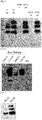
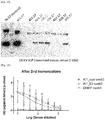
- VLP comprising the CSP repeat antigen 74, 76 or 78 conjugated with VEEV structural polypeptide was confirmed by Western Blot using an anti-VEEV antibody (see Figure 3 ). As seen in Figure 3 , antigen-inserted VLP was more efficiently produced when the antigen was inserted into E3 compared to when the antigen was inserted into E2.
- EXAMPLE 2 Preparation of Venezuelan equine encephalitis virus (VEEV)-virus like particle (VLP) comprising mouse malaria CSP repeat antigen inserted into envelope protein E3 of the viral structural protein
- VEEV Venezuelan equine encephalitis virus
- VLP virus like particle
- mice malaria CSP protein was used for preparing a VEEV-VLP comprising mouse malaria CSP repeat antigen.
- SGG is the N terminal linker and GGS is the C terminal linker for the antigen.
- the polynucleotides was inserted between the codons encoding Ser at 518-position and Ser at 519-position of SEQ ID NO: 3 to construct a plasmid (hereinafter referred to as pVEEV-261.25) for expressing VEEV-VLP where the antigen was inserted into E2 of Venezuelan equine encephalitis viral structural protein.
- the polynucleotide coding for the peptide was inserted between the codons encoding Gly at 330-position and Ser at 335-position of SEQ ID NO: 3 to construct a plasmid (hereinafter referred to as pVEEV-261.66) for expressing VEEV-VLP where the antigen was inserted into E3 of Venezuelan equine encephalitis viral structural protein.
- 293F cells (Lifetechnology) were transfected with 180 ⁇ g of each of the plasmid (i.e. pVEEV-261.25 and pVEEV-261.66, respectively) using PEI (GE Healthcare). 4 days after the transfection, the conditioned medium was collected and centrifuged at 3000rpm for 15 minutes to separate it from cells. The supernatant was filtrated using 0.45 ⁇ m filter to obtain virus like particles. The virus like particles were concentrated using TFF column and purified using QXL column (GE Healthcare) to obtain purified virus like particles. When animals were immunized with virus like particles, the purified virus like particles were further concentrated using spin column (Molecular Weight-cutoff: 100kDa) to prepare the virus like particles for the immunization.
- PEI GE Healthcare
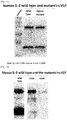
- VLP comprising the CSP repeat antigen 261 conjugated with VEEV structural polypeptide was confirmed by Western Blot using an anti-VEEV antibody (see Figure 4 ). As seen in Figure 4 , antigen-inserted VLP was more efficiently produced when the antigen was inserted into E3 compared to when the antigen was inserted into E2.
- EXAMPLE 3 Preparation of Venezuelan equine encephalitis virus (VEEV)-virus like particle (VLP) comprising malaria antigen inserted into envelope protein E3 of the viral structural protein
- VEEV Venezuelan equine encephalitis virus
- VLP virus like particle
- SGG is the N terminal linker (TCCGGAGGA in nuclear sequence)and GGS is the C terminal linker (GGAGGATCC in nuclear sequence)for the antigen.
- pVEEV-74.21 pVEEV-302R.21
- pVEEV-303R.21 pVEEV-303R.21
- pVEEV-74.66 pVEEV-302R.66
- pVEEV-303R.66 pVEEV-303R.66
- 293F cells (Lifetechnology) were transfected with 180 ⁇ g of each of the plasmid (i.e. pVEEV-74.21, pVEEV-302R.21, pVEEV-303R.2, pVEEV-74.66, pVEEV-302R.66 and pVEEV-303R.66, respectively) using PEI (GE Healthcare). 4 days after the transfection, the conditioned medium was collected and centrifuged at 3000rpm for 15 minutes to separate it from cells. The supernatant was filtrated using 0.45 ⁇ m filter to obtain virus like particles. The virus like particles were concentrated using TFF column and purified using QXL column (GE Healthcare) to obtain purified virus like particles. When animals were immunized with virus like particles, the purified virus like particles were further concentrated using spin column (Molecular Weight-cutoff: 100kDa) to prepare the virus like particles for the immunization.
- PEI GE Healthcare
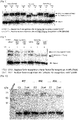
- VLP comprising antigen 74, 302R or 303R conjugated with VEEV structural polypeptide was confirmed by Western Blot using an anti-VEEV antibody (see Figure 5 ). As seen in Figure 5 , antigen-inserted VLP was more efficiently produced when the antigen was inserted into E3 compared to when the antigen was inserted into E2.
- EXAMPLE 4 Preparation of Chikungunya virus (CHIKV)-virus like particle comprising a viral structural protein and PD-1 antigen or PD-1 ligand antigen
- polypeptides of PD-1 or PD-L1 were used for preparing a CHIKV-VLP comprising PD-1 antigen or PD-1 ligand antigen.
- SGG is the N terminal linker (TCCGGAGGA in nuclear sequence)and GGS is the C terminal linker (GGAGGATCC in nuclear sequence)for the antigen.
- the respective polynucleotides was inserted between the codons encoding Ser at 531-position and Asn at 532-position of SEQ ID NO: 2 to construct a plasmid (hereinafter referred to as pCHIKV-299.15 and pCHIKV-274.11, respectively) for expressing Chikungunya viral structural protein where the PD-1-derived peptide or the PD-L1-derived peptide is inserted into E2 of Chikungunya viral structural protein.
- pCHIKV-299.15 and pCHIKV-274.11 plasmid
- pCHIKV-299.56 and pCHIKV-274.56, respectively were inserted between the codons encoding H at 321-position and S at 326-position of SEQ ID NO: 2 to construct a plasmid (hereinafter referred to as pCHIKV-299.56 and pCHIKV-274.56, respectively) for expressing Chikungunya viral structural protein where the PD-1-derived peptide or the PD-L1-derived peptide is inserted into E3 of Chikungunya viral structural protein.
- pCHIKV-299.56 and pCHIKV-274.56, respectively for expressing Chikungunya viral structural protein where the PD-1-derived peptide or the PD-L1-derived peptide is inserted into E3 of Chikungunya viral structural protein.
- 293F cells (Lifetechnology) were transfected with 180 ⁇ g of each of the plasmid (i.e. pCHIKV-274.11, pCHIKV-299.15, pCHIKV-274.56 and pCHIKV-299.56, respectively) using PEI (GE Healthcare). 4 days after the transfection, the conditioned medium was collected and centrifuged at 3000rpm for 15 minutes to separate it from cells. The supernatant was filtrated using 0.45 ⁇ m filter to obtain virus like particles. The virus like particles were concentrated using TFF column and purified using QXL column (GE Healthcare) to obtain purified virus like particles. When animals were immunized with virus like particles, the purified virus like particles were further concentrated using spin column (Molecular Weight-cutoff: 100kDa) to prepare the virus like particles for the immunization.
- PEI GE Healthcare
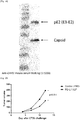
- VLP comprising antigen 274 or 299 conjugated with CHIKV structural polypeptide was confirmed by Western Blot using an anti-CHIKV antibody (see Figure 6 ). As seen in Figure 6 , antigen-inserted VLP was more efficiently produced when the antigen was inserted into E3 compared to when the antigen was inserted into E2.
- EXAMPLE 5 Preparation of Chikungunya virus (CHIKV)-virus like particle comprising a viral structural protein and malaria antigen
- SGG is the N terminal linker (TCCGGAGGA in nuclear sequence)and GGS is the C terminal linker (GGAGGATCC in nuclear sequence) for the antigen.
- CSP repeat antigen 74 (6 repeat of NPNA amino acid sequence) sggnpnanpnanpnanpnanpnaggs (SEQ ID NO: 56)
- the polynucleotide was inserted between the codons encoding Ser at 531-position and Asn at 532-position of SEQ ID NO: 2 to construct a plasmid (hereinafter referred to as pCHIKV-74.11) for expressing Chikungunya viral structural protein where the malaria CSP repeat antigen is inserted into E2 of Chikungunya viral structural protein.
- pCHIKV-74.11 a plasmid
- the malaria CSP repeat antigen was inserted between the codons encoding H at 321-position and S at 326-position of SEQ ID NO: 2 to construct a plasmid (hereinafter referred to as pCHIKV-74.16) for expressing Chikungunya viral structural protein where the malaria CSP repeat antigen is inserted into E3 of Chikungunya viral structural protein.
- pCHIKV-74.16 a plasmid
- 293F cells (Lifetechnology) were transfected with 180 ⁇ g of each of the plasmid (i.e. pCHIKV-74.11 and pCHIKV-74.16, respectively) using PEI (GE Healthcare). 4 days after the transfection, the conditioned medium was collected and centrifuged at 3000rpm for 15 minutes to separate it from cells. The supernatant was filtrated using 0.45 ⁇ m filter to obtain virus like particles. The virus like particles were concentrated using TFF column and purified using QXL column (GE Healthcare) to obtain purified virus like particles. When animals were immunized with virus like particles, the purified virus like particles were further concentrated using spin column (Molecular Weight-cutoff: 100kDa) to prepare the virus like particles for the immunization.
- PEI GE Healthcare
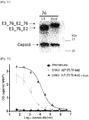
- VLP comprising VLP74 conjugated with CHIKV structural polypeptide was confirmed by Western Blot using an anti-CHIKV antibody (see Figure 7 ). As seen in Figure 7 , antigen-inserted VLP was more efficiently produced when the antigen was inserted into E3 compared to when the antigen was inserted into E2.
- EXAMPLE 6 Preparation of Chikungunya virus (CHIKV)-virus like particle comprising a viral structural protein and CTLA-4 antigen
- CTLA-4 protein was used for preparing a CHIKV-VLP comprising CTLA-4 antigen.
- SGG is the N terminal linker (TCCGGAGGA in nuclear sequence)and GGS is the C terminal linker (GGAGGATCC in nuclear sequence)for the antigen.
- the polynucleotide was inserted between the codons encoding H at 321-position and S at 326-position of SEQ ID NO: 2 to construct a plasmid for expressing Chikungunya viral structural protein where the mCTLA-4 antigen is inserted into E3 of Chikungunya viral structural protein.
- 293F cells (Lifetechnology) were transfected with 180 ⁇ g of each of the plasmid using PEI (GE Healthcare). 4 days after the transfection, the conditioned medium was collected and centrifuged at 3000rpm for 15 minutes to separate it from cells. The supernatant was filtrated using 0.45 ⁇ m filter to obtain virus like particles. The virus like particles were concentrated using TFF column and purified using QXL column (GE Healthcare) to obtain purified virus like particles. When animals were immunized with virus like particles, the purified virus like particles were further concentrated using spin column (Molecular Weight-cutoff: 100kDa) to prepare the virus like particles for the immunization.
- PEI GE Healthcare
- VLP comprising each of mCTLA-4_ver2, 4 and 5 conjugated with CHIKV structural polypeptide was confirmed by Western Blot using an anti-CHIKV monkey sera.
- CHIKV-P2 VLP expression plasmid that can express a CHIKV viral structural protein whose furin site RQRR at the end of E3 region of CHIKV is replaced with SGGGS; CHIKV-Xa VLP expression plasmid that can express a CHIKV viral structural protein whose furin site RQRR at the end of E3 region of CHIKV is replaced with Factor Xa recognition motif, IDGR and CHIKV-En VLP expression plasmid that can express a CHIKV viral structural protein whose furin site RQRR at the end of E3 region of CHIKV is replaced with Enterokinase recognition motif, DDDDK were used.
- the all three plasmid 10ug were transfected into 293F cells and 4 days after the transfection, the supernatants were harvested. 20ul of supernatants were treated with Water (Control), Factor Xa or Enterokinase for overnight. Then VLPs in the supernatants were measured by Western Blotting using serum against CHIKV. Results are shown in Figure 8 .
- Immature VLPs were expressed in the supernatant of the cells transfected with the plasmids, CHIKV-P2, CHIKV-Xa and CHIKV-En.
- the immature VLP generated from the CHIKV-Xa-transfected cells were digested with Factor Xa.
- the immature VLP leased E3 and it became mature VLP form (Lane 5).
- the immature VLP generated from the CHIKV-En-transfected cells were digested with Enterokinase.
- the immature VLP leased E3 and it became mature VLP form (Lane 9) .
- VEEV-P2 VLP expression plasmid that can express a VEEV viral structural protein whose furin site RQRR at the end of E3 region of VEEV is replaced with SGGGS; VEEV-IDGR VLP expression plasmid that can express a VEEV viral structural protein whose furin site RQRR at the end of E3 region of VEEV is replaced with Factor Xa recognition motif, IDGR; and VEEV-IEGR plasmid that can express a VEEV viral structural protein whose furin site RQRR at the end of E3 region of VEEV is replaced with another Xa recognition motif, IEGR were used.
- the all three plasmids 10ug were transfected into 293F cells and 4 days after the transfection, the supernatants were harvested. 20ul of supernatants were treated with Water (Control), Factor Xa for overnight. Then VLPs in the supernatants were measured by Western Blotting using serum against VEEV. Immature VLP were expressed in the supernatant of the cells transfected with the plasmids, VEEV-P2, VEEV-IDGR and VEEV-IEGR. The immature VLPs generated from the VEEV-IDGR and VEEV-IEGR-transfected cells were digested with Factor Xa. The result is shown in Figure 9 . The immature VLPs generated from the VEEV-IDGR and VEEV-IEGR-transfected cells leased E3 and they became the mature VLP forms (Lane 5 and 6).
- EXAMPLE 9 Preparation of Chikungunya virus (CHIKV)-virus like particle comprising DISC1 451, 452 or 454 inserted into envelope protein E3 of the viral structural protein
- SGG is the N terminal linker (TCCGGAGGA in nuclear sequence)and GGS is the C terminal linker (GGAGGATCC in nuclear sequence)for the antigen.
- the respective polynucleotides was inserted between the codons encoding Ser at 531-position and Asn at 532-position of SEQ ID NO: 2 as well as inserted between the codons encoding H at 321-position and S at 326-position of SEQ ID NO: 2 to construct a plasmid for expressing Chikungunya viral structural protein where the DISC1-derived peptide is inserted into both E2 and E3 of Chikungunya viral structural protein.
- the respective polynucleotides was inserted between the codons encoding H at 321-position and S at 326-position of SEQ ID NO: 2 to construct a plasmid (hereinafter referred to as pCHIKV-299.56 and pCHIKV-274.56, respectively) for expressing Chikungunya viral structural protein where the DISC1-derived peptide is inserted into E3 of Chikungunya viral structural protein.
- the 293F cells were transfected with the indicated DISC1 expressing VLP. 4 days after transfection, the supernatants were harvested.
- VLP comprising DISC1_451, _452 or _454 conjugated with CHIKV structural polypeptide was confirmed by Western Blot using an anti-CHIKV antibody (see Figure 10 ).
- 1 st antibody (1:1000 dilution) was anti-serum against Chikungunya and 2 nd antibody (1:5000 dilution) was antimouse IgG-HRP antibody.
- DISC1_451, _452 and _454 -inserted VLPs were produced when the antigen was inserted into E3 and into both E2 and E3 (dual).
- EXAMPLE 10 Preparation of Chikungunya virus (CHIKV)-virus like particle comprising IL-2 inserted into envelope protein E3 of the viral structural protein
- Human IL-2 mutant was prepared according to the method described in Levin et. al, Nature 484(7395): 529-533, 2012 .
- Mouse IL-2 mutants are F54A ( Mott HR et al. J.Mol.Biol. 247, 979-994, 1995 ) and D34K ( Berndt et al. Biochemistry 33, 6571, 1994 ).
- pCHIKV-299.56 and pCHIKV-274.56, respectively a plasmid for expressing Chikungunya viral structural protein where the IL-2-derived peptide is inserted into E3 of Chikungunya viral structural protein.
- pCHIKV-299.56 and pCHIKV-274.56, respectively a plasmid for expressing Chikungunya viral structural protein where the IL-2-derived peptide is inserted into E3 of Chikungunya viral structural protein.
- VLP comprising IL-2 conjugated with CHIKV structural polypeptide was confirmed by Western Blot using mouse anti CHIKV antibody (see Figure 11 and 12 ). As seen in Figures 11 and 12 , Human IL-2 wild type, human IL-2 mutant, mouse IL-2 wild type and mouse IL-2 mutant-inserted VLPs were produced when those antigens were inserted into E3.
- CHIKV viral structural proteins comprising IL-2 derived peptide in their envelope protein E3 provided as well as expression vectors expressing the viral structural proteins are SEQ ID NOs.: 83-92. Those sequences contains the 6K protein but the 6K protein acts as a signal sequence for transporting E1 protein to the endoplasmic reticulum, where it is processed by host signal peptidase and it is not assembled into virus particles.
- EXAMPLE 11 Protection of mice against malaria (Plasmodium yoelii) by intramuscle injection of CHIKV VLP comprising mouse malaria (Plasmodium yoelii) inserted into both envelope proteins E2 and E3 of the viral structural protein
- Chikungunya VLP comprising Malaria Plasmodium yoelii CSP 4X repeat inserted into both envelop proteins E2 and E3 (261.261 CHIKV VLP) and Chikungunya VLP comprising Malaria Plasmodium yoelii CSP 14X repeat inserted into both envelop proteins E2 and E3 (264.264 CHIKV VLP) were prepared and purified in the similar manner as the previous Examples.
- Amino acid sequences and nucleotide sequences of the repeat antigens with linker used in this example are SEQ ID NOs.: 93-96.
- CHIKV viral structural proteins containing the antigens in both E2 and E3 and expression vectors for those viral structural proteins are SEQ ID NOs.: 97-100. Those sequences contains the 6K protein but the 6K protein acts as a signal sequence for transporting E1 protein to the endoplasmic reticulum, where it is processed by host signal peptidase and it is not assembled into virus particles.
- mice were immunized with the 261.261 CHIKV VLP or 264.264 CHIKV VLP 2 times at week 0 and 3 (20ug VLP per mouse) by intramuscle injection. VLPs were mixed with alhydrogel adjuvant before the injection. At week 5, the mice immunized with the 261.261 CHIKV VLP, 264.264 CHIKV VLP and CHIKV VLP with no inserted antigen (Control group) were challenged intravenously with 1000 dose of P. yoelii sporozoites.
- FIG. 13 shows results of the PCR, indicating that among 10 mice immunized with Control VLP, 9 mice were infected with malaria; among 10 mice immunized with Chikungunya VLP comprising Malaria CSP 4X repeat inserted into both envelop proteins E2 and E3 (261.261 VLP), 9 mice were not infected with malaria; and among 10 mice immunized with Chikungunya VLP comprising Malaria CSP 14X repeat inserted into both envelop proteins E2 and E3, 9 mice were not infected with malaria.
- EXAMPLE 12 Immunogenicity of Chikungunya virus (CHIKV)-virus like particles comprising the viral structural protein and human malaria CSP repeat epitope: 74.74 (E2 and E3 (dual) insertion), 74(E2 insertion) and 74(E3 insertion)
- Chikungunya viral structural protein comprising Malaria CSP 6X repeat antigen (6XNPNA) in its E2 or E3, as well as in both E2 and E3 were prepared in the similar manner as the previous examples.
- CHIKV viral structural protein comprising CSP 6X repeat antigen in both E2 and E3 is SEQ ID NOs: 101 and expression vector for the viral structural protein is SEQ ID NO: 102(74.74.58).
- CHIKV VLPs comprising the CSP 6X repeat antigen were prepared and purified in the same manner as Example 6.
- Figure 14 shows that E3-inserted as well as E2- and E3-(dual) inserted VLP had higher titer than E2-inserted VLP.
- EXAMPLE 13 Preparation of Chikungunya virus (CHIKV)-virus like particle comprising a viral structural protein and hHER2 antigen
- SGG is the N terminal linker (TCCGGAGGA in nuclear sequence)and GGS is the C terminal linker (GGAGGATCC in nuclear sequence)for the antigen.
- the respective polynucleotides was inserted between the codons encoding Ser at 531-position and Asn at 532-position of SEQ ID NO: 2 to construct a plasmid for expressing Chikungunya viral structural protein where the hHER2-derived peptide is inserted into E2 of Chikungunya viral structural protein.
- the respective polynucleotides were inserted between the codons encoding H at 321-position and S at 326-position of SEQ ID NO: 2 to construct a plasmid for expressing Chikungunya viral structural protein where the hHER2-derived peptide is inserted into E3 of Chikungunya viral structural protein.
- VLP comprising hHER2 conjugated with CHIKV structural polypeptide was confirmed by Western Blot using mouse anti CHIKV antibody (see Figure 15 ).
- 401, 404, 406, and 409 were relatively high expression levels and because they code different epitopes.
- VLPs were mixed with alhydrogel adjuvant before the injection.
- the anti-hHER2 antibody titer in the serum of the immunized mice were measured by ELISA plate coated with recombinant hHER2.
- FIG 16 shows that CHIKV VLP comprising hHER2 antigen #401 in E2 or in both E2 and E3 (dual) generated antibody against hHER2 protein, and dual inserted VLP, i.e. antigen was inserted in both E2- and E3-, could provide higher titer than VLP whose antigen was inserted into E2.
- EXAMPLE 15 Preparation of Chikungunya virus (CHIKV)-virus like particle comprising a viral structural protein and hHER2 antigen
- amino acid sequences are corresponding to SEQ ID NOs. 128, 129, 130 and 131.
- SGG is the N terminal linker and GGS is the C terminal linker for the antigen.
- the respective polynucleotides were inserted between the codons encoding H at 321-position and S at 326-position of SEQ ID NO: 2 to construct a plasmid for expressing Chikungunya viral structural protein where the hHER2-derived peptide is inserted into E3 of Chikungunya viral structural protein.
- the respective polynucleotides was inserted between the codons encoding Ser at 531-position and Asn at 532-position of SEQ ID NO: 2 to construct a plasmid for expressing Chikungunya viral structural protein where the hHER2-derived peptide is inserted into E2 of Chikungunya viral structural protein.
- the Chikungunya virus like particle comprising hHER2 was prepared and purified.
- the expression of VLP comprising hHER2 that was inserted in E2, E3 or dual (both E2 and E3) of the CHIKV viral structural protein was confirmed by Western Blot using anti CHIKV antibody.
- EXAMPLE 16 Preparation of Chikungunya virus (CHIKV)-virus like particle comprising a viral structural protein and BTLA antigen
- the polypeptide of hBTLA (383: SGGCKLNGTTCGGS (SEQ ID NO: 132), derived from GENBANK number: NM_001085357) was used for preparing a CHIKV-VLP comprising hBTLA antigen.
- SGG is the N terminal linker and GGS is the C terminal linker for the antigen.
- the polynucleotide coding for the peptide was inserted between the codons encoding H at 321-position and S at 326-position of SEQ ID NO: 2 to construct a plasmid for expressing Chikungunya viral structural protein where the hBTLA-derived peptide is inserted into E3 of the Chikungunya viral structural protein.
- Monoclonal antibody was prepared by a conventional procedure from mince immunized with thus obtained VLP.
- the property of the monoclonal antibody to bind the antigen was measured by ELISA coated with BTLA proteins.
- Figure 17 shows that CHIKV VLP comprising BTLA antigen could generate monoclonal antibody that binds to both mouse BTLA (mBTLA) and human BTLA (hBTLA) proteins.
- EXAMPLE 17 Preparation of Chikungunya (CHIKV)-virus like particle comprising a viral structural protein and HVEM antigen
- HVEM human HVEM peptides
- SGG is the N terminal linker and GGS is the C terminal linker for the antigen.
- the polynucleotide coding for the peptide was inserted between the codons encoding H at 321-position and S at 326-position of SEQ ID NO: 2 to construct a plasmid for expressing Chikungunya viral structural protein where the hHVEM-derived peptide is inserted into E3 of Chikungunya viral structural protein.
- the transfected cell line that expresses immature VLP obtained in EXAMPLE 8 was prepared.
- the cloned cells were cultured for 3 months in a medium comprising sodium butyrate, supernatant of the culture was obtained and the immature VLP in the supernatant was confirmed. Result is shown in Figure 19 . This data shows that the obtained cell line was stable and could continuously generate immature VLP for long term.
- mice obtained according to Example 4 were used.
- mice were challenged with CT26 cell line (1 x 10 ⁇ 6 cells) at week 8. The tumor sizes were measured.
- Figure 20 shows that PD-L1 VLP protects the mice against tumor.
- EXAMPLE 20 Preparation of a pharmaceutical composition comprising CHikungunya virus (CHIKV) like particle comprising a viral structural protein and malaria antigen which is inserted both in envelope protein E2 and E3 of the viral structural protein
- Chikungunya viral structural protein comprising Malaria CSP 14X repeat antigen 76 (14XNPNA) in only E3 or in both E2 and E3 was expressed in 293F cells in the similar manner according to the previous Examples (CHIKV viral structural protein containing CSP 14X repeat antigen 76 in E2 and E3 is SEQ ID NO: 103 and expression vector for the viral structural protein is SEQ ID NO: 104).
- the Chikungunya virus like particle was prepared and purified in the similar manner as the previous Examples.
- the expression of VLP comprising the CSP repeat antigen 76 conjugated with CHIKV structural polypeptide was confirmed by Western Blot against CHIKV-VLP immunized monkey serum. See Figure 21 .
- a pharmaceutical composition which is a vaccine composition 80 ⁇ g of the prepared particles was mixed with 1ml of Sucrose Phosphate Solution, pH 7.2, Endotoxin Free (Teknova, SP buffer).
Landscapes
- Health & Medical Sciences (AREA)
- Life Sciences & Earth Sciences (AREA)
- Chemical & Material Sciences (AREA)
- General Health & Medical Sciences (AREA)
- Medicinal Chemistry (AREA)
- Veterinary Medicine (AREA)
- Immunology (AREA)
- Public Health (AREA)
- Pharmacology & Pharmacy (AREA)
- Animal Behavior & Ethology (AREA)
- Microbiology (AREA)
- Organic Chemistry (AREA)
- Mycology (AREA)
- Epidemiology (AREA)
- Oncology (AREA)
- Tropical Medicine & Parasitology (AREA)
- General Chemical & Material Sciences (AREA)
- Chemical Kinetics & Catalysis (AREA)
- Nuclear Medicine, Radiotherapy & Molecular Imaging (AREA)
- Virology (AREA)
- Engineering & Computer Science (AREA)
- Bioinformatics & Cheminformatics (AREA)
- Genetics & Genomics (AREA)
- Biochemistry (AREA)
- Zoology (AREA)
- Wood Science & Technology (AREA)
- Gastroenterology & Hepatology (AREA)
- Biomedical Technology (AREA)
- Proteomics, Peptides & Aminoacids (AREA)
- Molecular Biology (AREA)
- Biophysics (AREA)
- Cell Biology (AREA)
- General Engineering & Computer Science (AREA)
- Biotechnology (AREA)
- Neurosurgery (AREA)
- Neurology (AREA)
- Communicable Diseases (AREA)
- Micro-Organisms Or Cultivation Processes Thereof (AREA)
- Peptides Or Proteins (AREA)
- Medicines Containing Antibodies Or Antigens For Use As Internal Diagnostic Agents (AREA)
Applications Claiming Priority (6)
| Application Number | Priority Date | Filing Date | Title |
|---|---|---|---|
| US201462035037P | 2014-08-08 | 2014-08-08 | |
| US201462079128P | 2014-11-13 | 2014-11-13 | |
| US201562101514P | 2015-01-09 | 2015-01-09 | |
| US201562120569P | 2015-02-25 | 2015-02-25 | |
| US201562198949P | 2015-07-30 | 2015-07-30 | |
| PCT/JP2015/003997 WO2016021209A1 (en) | 2014-08-08 | 2015-08-07 | Virus like particle comprising modified envelope protein e3 |
Publications (3)
| Publication Number | Publication Date |
|---|---|
| EP3177720A1 EP3177720A1 (en) | 2017-06-14 |
| EP3177720A4 EP3177720A4 (en) | 2018-01-17 |
| EP3177720B1 true EP3177720B1 (en) | 2021-09-22 |
Family
ID=55263499
Family Applications (1)
| Application Number | Title | Priority Date | Filing Date |
|---|---|---|---|
| EP15829311.8A Active EP3177720B1 (en) | 2014-08-08 | 2015-08-07 | Virus like particle comprising modified envelope protein e3 |
Country Status (6)
| Country | Link |
|---|---|
| US (1) | US9969986B2 (enExample) |
| EP (1) | EP3177720B1 (enExample) |
| JP (1) | JP6824154B2 (enExample) |
| CN (1) | CN106795513B (enExample) |
| TW (1) | TWI720946B (enExample) |
| WO (1) | WO2016021209A1 (enExample) |
Families Citing this family (28)
| Publication number | Priority date | Publication date | Assignee | Title |
|---|---|---|---|---|
| MX357202B (es) | 2012-02-16 | 2018-06-28 | Vlp Therapeutics Llc | Composicion de particula tipo virus. |
| SG11201509614SA (en) | 2013-06-03 | 2015-12-30 | Vlp Therapeutics Llc | Malaria vaccine |
| TWI676636B (zh) | 2013-07-12 | 2019-11-11 | Vlp醫療股份有限公司 | 包含pd-1抗原或pd-1配體抗原的類病毒粒子 |
| EP3054971B1 (en) | 2013-10-11 | 2021-03-10 | The United States of America, represented by the Secretary, Department of Health and Human Services | Epstein-barr virus vaccines |
| US10385101B2 (en) | 2014-08-08 | 2019-08-20 | Vlp Therapeutics, Llc | Virus like particle comprising modified envelope protein E3 |
| TWI720946B (zh) | 2014-08-08 | 2021-03-11 | 美商Vlp醫療股份有限公司 | 包含改質套膜蛋白質e3之類病毒粒子 |
| CA2960102C (en) | 2014-09-11 | 2023-10-24 | Vlp Therapeutics, Llc | Flavivirus virus like particle |
| BR112017014219A2 (en) | 2014-12-31 | 2018-03-06 | The Usa, As Represented By The Secretary, Dept. Of Health And Human Services | multivalent nanoparticle-based vaccines |
| US10166281B2 (en) | 2015-09-04 | 2019-01-01 | Vlp Therapeutics, Llc | Method and composition for modulating immune response |
| WO2017150683A1 (en) * | 2016-03-04 | 2017-09-08 | Vlp Therapeutics, Llc | Zika virus virus like particle |
| WO2017221076A1 (en) * | 2016-06-24 | 2017-12-28 | Institut Pasteur | Compositions and methods comprising measles virus defective interfering particles for the prevention of infectious diseases |
| CN110167585B (zh) | 2016-09-02 | 2024-03-08 | 美国卫生与公众服务部 | 稳定化的第2组流感血凝素茎区三聚体及其用途 |
| EP3600406A4 (en) | 2017-03-28 | 2021-01-13 | Children's Hospital Medical Center | VLP-BASED BIVALENT EBOLA VACCINES AND METHOD FOR MANUFACTURING AND USING THEREOF |
| CN110636855B (zh) | 2017-03-28 | 2024-08-09 | 俄亥俄州创新基金会 | 人pd1肽疫苗及其用途 |
| KR102823029B1 (ko) * | 2017-12-20 | 2025-06-20 | 브이엘피 테라퓨틱스 인코포레이티드 | 알파바이러스 레플리콘 입자 |
| JP2021512966A (ja) * | 2018-02-07 | 2021-05-20 | イミュジーン、リミテッドImugene Limited | ワクチン組成物およびその使用 |
| WO2019156223A1 (ja) * | 2018-02-09 | 2019-08-15 | 国立大学法人大阪大学 | チクングニアウイルスに対する抗体またはその抗原結合断片、およびその用途 |
| FR3078536A1 (fr) * | 2018-03-05 | 2019-09-06 | Peptinov Sas | Composition vaccinale anti-pd-1 |
| FR3078535B1 (fr) * | 2018-03-05 | 2024-02-09 | Peptinov Sas | Composition vaccinale anti-pd-l1 |
| CN109536464B (zh) * | 2018-12-10 | 2022-06-10 | 中国科学院武汉病毒研究所 | 一种缺失衣壳蛋白基因的基孔肯雅病毒感染性克隆及构建方法和在制备减毒疫苗中的应用 |
| TWI891771B (zh) | 2020-04-17 | 2025-08-01 | 美商Vlp醫療股份有限公司 | 冠狀病毒疫苗 |
| MX2022013638A (es) | 2020-04-30 | 2023-01-24 | Vlp Therapeutics Inc | Inmunoterapia con citocina. |
| EP4326858A4 (en) * | 2021-04-23 | 2025-03-12 | VLP Therapeutics, Inc. | GALECTIN-TARGETED IMMUNOTHERAPY |
| CN115466330B (zh) * | 2021-06-10 | 2023-10-20 | 清华大学 | 一种基于病毒样颗粒呈递冠状病毒受体结合区的冠状病毒亚单位疫苗 |
| EP4377449A1 (en) * | 2021-07-26 | 2024-06-05 | Beam Therapeutics, Inc. | Pseudotyped recombinant lyssaviruses for gene therapy |
| JP2025513920A (ja) * | 2022-04-18 | 2025-04-30 | Cyn-Kバイオ株式会社 | 炎症性疾患の処置 |
| CN116042657A (zh) * | 2023-01-16 | 2023-05-02 | 上海复诺健生物科技有限公司 | 自复制信使核糖核酸疫苗 |
| WO2025084276A1 (ja) * | 2023-10-16 | 2025-04-24 | Cyn-Kバイオ株式会社 | 肥満の処置 |
Family Cites Families (46)
| Publication number | Priority date | Publication date | Assignee | Title |
|---|---|---|---|---|
| GB8923123D0 (en) | 1989-10-13 | 1989-11-29 | Connaught Lab | A vaccine for human immunodeficiency virus |
| EP1690935A3 (en) | 1990-01-12 | 2008-07-30 | Abgenix, Inc. | Generation of xenogeneic antibodies |
| JP3954643B2 (ja) | 1991-11-16 | 2007-08-08 | グラクソスミスクライン・バイオロジカルス・ソシエテ・アノニム | マラリア原虫由来のCSおよびHBsAG間のハイブリッド蛋白質 |
| US5580773A (en) | 1992-06-17 | 1996-12-03 | Korea Green Cross Corporation | Chimeric immunogenic gag-V3 virus-like particles of the human immunodeficiency virus (HIV) |
| CA2143491C (en) | 1994-03-01 | 2011-02-22 | Yasumasa Ishida | A novel peptide related to human programmed cell death and dna encoding it |
| CA2232669A1 (en) | 1995-09-27 | 1997-04-03 | Frances Joanne Morling | Recombinant viruses incorporating a protease cleavable protein |
| CA2320958A1 (en) | 1998-02-11 | 1999-08-19 | Maxygen, Inc. | Antigen library immunization |
| ES2539411T3 (es) | 1999-08-23 | 2015-06-30 | Dana-Farber Cancer Institute, Inc. | PD-1, receptor para la B7-4 y su utilización |
| CA2448908C (en) | 2001-05-30 | 2008-03-18 | Transgene S.A. | Adenovirus protein ix, its domains involved in capsid assembly, transcriptional activity and nuclear reorganization |
| DE60334303D1 (de) | 2002-07-03 | 2010-11-04 | Tasuku Honjo | Immunpotenzierende zusammensetzungen |
| WO2004043399A2 (en) | 2002-11-13 | 2004-05-27 | The United States Of America As Represented By The Secretary Of The Navy | Methods and compositions for inducing immune responses and protective immunity by priming with alphavirus replicon vaccines |
| MXPA05012754A (es) * | 2003-05-29 | 2006-05-17 | Army Medical Res Inst For I | Vacunas virales atenuadas vivas para virus de encefalitis equina oriental. |
| CA2547511A1 (en) | 2003-12-01 | 2005-07-28 | Dow Global Technolgies Inc. | Recombinant icosahedral virus like particle production in pseudomonads |
| BRPI0518146A (pt) | 2004-10-14 | 2008-10-28 | Crucell Holland Bv | kit de partes, uso de um adenovìrus recombinante defectivo na replicação, e, método de vacinação de um mamìfero para a infecção por malária |
| WO2006088229A1 (ja) | 2005-02-16 | 2006-08-24 | The Circle For The Promotion Of Science And Engineering | 改変されたウイルスカプシドタンパク質及びその使用 |
| DK1907000T4 (da) | 2005-06-08 | 2020-03-30 | The President And Fellows Of Harvard College | Fremgangsmåder og sammensætninger til behandling af persisterende HIV-infektioner ved hæmning af reaktionsvejen for programmeret celledød 1 (PD-1). |
| GB0513421D0 (en) | 2005-06-30 | 2005-08-03 | Glaxosmithkline Biolog Sa | Vaccines |
| CU23586A1 (es) | 2005-11-22 | 2010-10-30 | Ct Ingenieria Genetica Biotech | Métodos y proteínas para el tratamiento profiláctico y/o terapéutico de los cuatro serotipos del virus de dengue y otros flavivirus |
| EP2889309B1 (en) | 2006-03-03 | 2017-12-27 | Ono Pharmaceutical Co., Ltd. | Multimer of extracellular domain of pd-1 or pd-l1 |
| AU2007291936B2 (en) | 2006-08-30 | 2012-09-27 | Artes Biotechnology Gmbh | Recombinant proteins and virus like particles comprising L and S polypeptides of avian hepadnaviridae and methods, nucleic acid constructs, vectors and host cells for producing same |
| WO2009079185A2 (en) | 2007-11-26 | 2009-06-25 | Novartis Vaccines And Diagnostics, Inc. | Methods of generating alphavirus particles |
| CN102317308A (zh) * | 2008-11-26 | 2012-01-11 | 美国国有健康与人类服务部 | 类病毒组合物颗粒及其使用方法 |
| ES2987238T3 (es) * | 2008-12-09 | 2024-11-14 | Novavax Inc | Proteínas F del RSV modificadas y métodos de su uso |
| WO2011035004A1 (en) | 2009-09-18 | 2011-03-24 | Fraunhofer Usa Inc. | Virus like particles comprising target proteins fused to plant viral coat proteins |
| WO2012006180A1 (en) | 2010-06-29 | 2012-01-12 | The United States Of America, As Represented By The Secretary, Department Of Health And Human Services | Hiv immunogens |
| WO2012023995A1 (en) | 2010-08-18 | 2012-02-23 | Takayuki Shiratsuchi | Modification of recombinant adenovirus capsid protein with immunogenic plasmodium circumsporozoite protein epitopes |
| WO2012106356A2 (en) | 2011-01-31 | 2012-08-09 | GOVERNMENT OF THE USA, as represented by THE SECRETARY, DEPARTMENT OF HEALTH & HUMAN SERVICES | Virus-like particles and methods of use |
| WO2012123755A1 (en) | 2011-03-17 | 2012-09-20 | The University Of Birmingham | Re-directed immunotherapy |
| CN103796676B (zh) | 2011-06-17 | 2017-09-12 | 伯哈拉特生物技术国际有限公司 | 包含灭活的基孔肯亚病毒株的疫苗组合物 |
| CN102321639B (zh) | 2011-09-08 | 2013-06-26 | 中国疾病预防控制中心病毒病预防控制所 | 基孔肯雅病毒病毒样颗粒的制备方法和应用 |
| PH12014500911A1 (en) | 2011-10-25 | 2014-06-09 | Florida Gulf Coast Univ Board Of Trustees | Vaccines and methods for creating a vaccine for inducing immunity to all dengue virus serotypes |
| MX357202B (es) * | 2012-02-16 | 2018-06-28 | Vlp Therapeutics Llc | Composicion de particula tipo virus. |
| EP2834265A4 (en) | 2012-04-02 | 2015-10-14 | Univ North Carolina | METHOD AND COMPOSITIONS FOR DENGUE VIRUS EPITOPES |
| SMT201800368T1 (it) | 2012-05-16 | 2018-09-13 | Immune Design Corp | Vaccini per l'infezione da virus-2 herpes simplex |
| SG11201509614SA (en) | 2013-06-03 | 2015-12-30 | Vlp Therapeutics Llc | Malaria vaccine |
| TWI676636B (zh) | 2013-07-12 | 2019-11-11 | Vlp醫療股份有限公司 | 包含pd-1抗原或pd-1配體抗原的類病毒粒子 |
| WO2015139784A1 (en) | 2014-03-18 | 2015-09-24 | Fraunhofer-Gesellschaft zur Förderung der angewandten Forschung e.V. | Distinguishing flavivirus infection using a recombinant mutant envelope protein |
| TWI720946B (zh) | 2014-08-08 | 2021-03-11 | 美商Vlp醫療股份有限公司 | 包含改質套膜蛋白質e3之類病毒粒子 |
| US10385101B2 (en) | 2014-08-08 | 2019-08-20 | Vlp Therapeutics, Llc | Virus like particle comprising modified envelope protein E3 |
| US9363353B1 (en) | 2014-12-04 | 2016-06-07 | Hon Man Ashley Chik | Mobile phone docks with multiple circulating phone connectors |
| BR112017014219A2 (en) * | 2014-12-31 | 2018-03-06 | The Usa, As Represented By The Secretary, Dept. Of Health And Human Services | multivalent nanoparticle-based vaccines |
| JPWO2016199936A1 (ja) | 2015-06-12 | 2018-04-05 | 国立大学法人三重大学 | ヒトパラインフルエンザ2型ウイルスベクター及びワクチン |
| US10799575B2 (en) | 2015-06-25 | 2020-10-13 | Technovax, Inc. | Flavivirus and alphavirus virus-like particles (VLPS) |
| CA2992531C (en) | 2015-07-16 | 2023-09-26 | Bharat Biotech International Limited | Vaccine compositions |
| MA42502A (fr) | 2015-07-21 | 2018-05-30 | Modernatx Inc | Vaccins contre une maladie infectieuse |
| CN106085974B (zh) | 2016-06-07 | 2019-08-09 | 博奥生物集团有限公司 | 一种寨卡病毒假病毒颗粒及其制备方法 |
-
2015
- 2015-08-07 TW TW104125774A patent/TWI720946B/zh active
- 2015-08-07 CN CN201580054670.4A patent/CN106795513B/zh active Active
- 2015-08-07 US US14/820,785 patent/US9969986B2/en active Active
- 2015-08-07 WO PCT/JP2015/003997 patent/WO2016021209A1/en not_active Ceased
- 2015-08-07 EP EP15829311.8A patent/EP3177720B1/en active Active
- 2015-08-07 JP JP2017506955A patent/JP6824154B2/ja active Active
Also Published As
| Publication number | Publication date |
|---|---|
| CN106795513B (zh) | 2021-06-11 |
| US9969986B2 (en) | 2018-05-15 |
| EP3177720A1 (en) | 2017-06-14 |
| TWI720946B (zh) | 2021-03-11 |
| US20160040134A1 (en) | 2016-02-11 |
| WO2016021209A1 (en) | 2016-02-11 |
| JP6824154B2 (ja) | 2021-02-03 |
| CN106795513A (zh) | 2017-05-31 |
| EP3177720A4 (en) | 2018-01-17 |
| JP2017523796A (ja) | 2017-08-24 |
| TW201614067A (en) | 2016-04-16 |
Similar Documents
| Publication | Publication Date | Title |
|---|---|---|
| US9969986B2 (en) | Virus like particle comprising modified envelope protein E3 | |
| US10385101B2 (en) | Virus like particle comprising modified envelope protein E3 | |
| EP3019600B1 (en) | Virus like particle comprising pd-1 antigen or pd-1 ligand antigen | |
| US20190351041A1 (en) | Malaria vaccine | |
| EP2547695B1 (en) | Tumor vaccination involving a humoral immune response against self-protein cldn18.2 | |
| MX2014009916A (es) | Composicion de particula tipo virus. | |
| JP2007537761A (ja) | Tc−83由来アルファウイルスベクター、粒子および方法 | |
| JP2022547107A (ja) | インフルエンザウイルスワクチン及びその使用 | |
| CN117222734A (zh) | 靶向半乳凝素的免疫疗法 | |
| US20230105415A1 (en) | IgG VARIANTS FOR INDUCTION OF IMMUNE RESPONSE WITHOUT ADJUVANT | |
| OA17590A (en) | Malaria Vaccine |
Legal Events
| Date | Code | Title | Description |
|---|---|---|---|
| STAA | Information on the status of an ep patent application or granted ep patent |
Free format text: STATUS: THE INTERNATIONAL PUBLICATION HAS BEEN MADE |
|
| PUAI | Public reference made under article 153(3) epc to a published international application that has entered the european phase |
Free format text: ORIGINAL CODE: 0009012 |
|
| STAA | Information on the status of an ep patent application or granted ep patent |
Free format text: STATUS: REQUEST FOR EXAMINATION WAS MADE |
|
| 17P | Request for examination filed |
Effective date: 20170303 |
|
| AK | Designated contracting states |
Kind code of ref document: A1 Designated state(s): AL AT BE BG CH CY CZ DE DK EE ES FI FR GB GR HR HU IE IS IT LI LT LU LV MC MK MT NL NO PL PT RO RS SE SI SK SM TR |
|
| AX | Request for extension of the european patent |
Extension state: BA ME |
|
| DAV | Request for validation of the european patent (deleted) | ||
| DAX | Request for extension of the european patent (deleted) | ||
| A4 | Supplementary search report drawn up and despatched |
Effective date: 20171220 |
|
| RIC1 | Information provided on ipc code assigned before grant |
Ipc: A61K 39/12 20060101ALI20171214BHEP Ipc: C12N 5/10 20060101ALI20171214BHEP Ipc: A61P 31/00 20060101ALI20171214BHEP Ipc: C12N 15/09 20060101AFI20171214BHEP Ipc: A61P 35/00 20060101ALI20171214BHEP Ipc: A61P 37/02 20060101ALI20171214BHEP Ipc: C12N 7/00 20060101ALI20171214BHEP |
|
| STAA | Information on the status of an ep patent application or granted ep patent |
Free format text: STATUS: EXAMINATION IS IN PROGRESS |
|
| 17Q | First examination report despatched |
Effective date: 20181121 |
|
| GRAP | Despatch of communication of intention to grant a patent |
Free format text: ORIGINAL CODE: EPIDOSNIGR1 |
|
| STAA | Information on the status of an ep patent application or granted ep patent |
Free format text: STATUS: GRANT OF PATENT IS INTENDED |
|
| INTG | Intention to grant announced |
Effective date: 20210323 |
|
| RAP3 | Party data changed (applicant data changed or rights of an application transferred) |
Owner name: VLP THERAPEUTICS, INC. |
|
| GRAS | Grant fee paid |
Free format text: ORIGINAL CODE: EPIDOSNIGR3 |
|
| GRAA | (expected) grant |
Free format text: ORIGINAL CODE: 0009210 |
|
| STAA | Information on the status of an ep patent application or granted ep patent |
Free format text: STATUS: THE PATENT HAS BEEN GRANTED |
|
| AK | Designated contracting states |
Kind code of ref document: B1 Designated state(s): AL AT BE BG CH CY CZ DE DK EE ES FI FR GB GR HR HU IE IS IT LI LT LU LV MC MK MT NL NO PL PT RO RS SE SI SK SM TR |
|
| REG | Reference to a national code |
Ref country code: GB Ref legal event code: FG4D |
|
| REG | Reference to a national code |
Ref country code: DE Ref legal event code: R096 Ref document number: 602015073566 Country of ref document: DE |
|
| REG | Reference to a national code |
Ref country code: IE Ref legal event code: FG4D |
|
| REG | Reference to a national code |
Ref country code: CH Ref legal event code: EP Ref country code: AT Ref legal event code: REF Ref document number: 1432360 Country of ref document: AT Kind code of ref document: T Effective date: 20211015 |
|
| REG | Reference to a national code |
Ref country code: LT Ref legal event code: MG9D |
|
| REG | Reference to a national code |
Ref country code: NL Ref legal event code: MP Effective date: 20210922 |
|
| PG25 | Lapsed in a contracting state [announced via postgrant information from national office to epo] |
Ref country code: HR Free format text: LAPSE BECAUSE OF FAILURE TO SUBMIT A TRANSLATION OF THE DESCRIPTION OR TO PAY THE FEE WITHIN THE PRESCRIBED TIME-LIMIT Effective date: 20210922 Ref country code: RS Free format text: LAPSE BECAUSE OF FAILURE TO SUBMIT A TRANSLATION OF THE DESCRIPTION OR TO PAY THE FEE WITHIN THE PRESCRIBED TIME-LIMIT Effective date: 20210922 Ref country code: SE Free format text: LAPSE BECAUSE OF FAILURE TO SUBMIT A TRANSLATION OF THE DESCRIPTION OR TO PAY THE FEE WITHIN THE PRESCRIBED TIME-LIMIT Effective date: 20210922 Ref country code: FI Free format text: LAPSE BECAUSE OF FAILURE TO SUBMIT A TRANSLATION OF THE DESCRIPTION OR TO PAY THE FEE WITHIN THE PRESCRIBED TIME-LIMIT Effective date: 20210922 Ref country code: NO Free format text: LAPSE BECAUSE OF FAILURE TO SUBMIT A TRANSLATION OF THE DESCRIPTION OR TO PAY THE FEE WITHIN THE PRESCRIBED TIME-LIMIT Effective date: 20211222 Ref country code: LT Free format text: LAPSE BECAUSE OF FAILURE TO SUBMIT A TRANSLATION OF THE DESCRIPTION OR TO PAY THE FEE WITHIN THE PRESCRIBED TIME-LIMIT Effective date: 20210922 Ref country code: BG Free format text: LAPSE BECAUSE OF FAILURE TO SUBMIT A TRANSLATION OF THE DESCRIPTION OR TO PAY THE FEE WITHIN THE PRESCRIBED TIME-LIMIT Effective date: 20211222 |
|
| REG | Reference to a national code |
Ref country code: AT Ref legal event code: MK05 Ref document number: 1432360 Country of ref document: AT Kind code of ref document: T Effective date: 20210922 |
|
| PG25 | Lapsed in a contracting state [announced via postgrant information from national office to epo] |
Ref country code: LV Free format text: LAPSE BECAUSE OF FAILURE TO SUBMIT A TRANSLATION OF THE DESCRIPTION OR TO PAY THE FEE WITHIN THE PRESCRIBED TIME-LIMIT Effective date: 20210922 Ref country code: GR Free format text: LAPSE BECAUSE OF FAILURE TO SUBMIT A TRANSLATION OF THE DESCRIPTION OR TO PAY THE FEE WITHIN THE PRESCRIBED TIME-LIMIT Effective date: 20211223 |
|
| PG25 | Lapsed in a contracting state [announced via postgrant information from national office to epo] |
Ref country code: AT Free format text: LAPSE BECAUSE OF FAILURE TO SUBMIT A TRANSLATION OF THE DESCRIPTION OR TO PAY THE FEE WITHIN THE PRESCRIBED TIME-LIMIT Effective date: 20210922 |
|
| PG25 | Lapsed in a contracting state [announced via postgrant information from national office to epo] |
Ref country code: IS Free format text: LAPSE BECAUSE OF FAILURE TO SUBMIT A TRANSLATION OF THE DESCRIPTION OR TO PAY THE FEE WITHIN THE PRESCRIBED TIME-LIMIT Effective date: 20220122 Ref country code: SK Free format text: LAPSE BECAUSE OF FAILURE TO SUBMIT A TRANSLATION OF THE DESCRIPTION OR TO PAY THE FEE WITHIN THE PRESCRIBED TIME-LIMIT Effective date: 20210922 Ref country code: RO Free format text: LAPSE BECAUSE OF FAILURE TO SUBMIT A TRANSLATION OF THE DESCRIPTION OR TO PAY THE FEE WITHIN THE PRESCRIBED TIME-LIMIT Effective date: 20210922 Ref country code: PT Free format text: LAPSE BECAUSE OF FAILURE TO SUBMIT A TRANSLATION OF THE DESCRIPTION OR TO PAY THE FEE WITHIN THE PRESCRIBED TIME-LIMIT Effective date: 20220124 Ref country code: PL Free format text: LAPSE BECAUSE OF FAILURE TO SUBMIT A TRANSLATION OF THE DESCRIPTION OR TO PAY THE FEE WITHIN THE PRESCRIBED TIME-LIMIT Effective date: 20210922 Ref country code: NL Free format text: LAPSE BECAUSE OF FAILURE TO SUBMIT A TRANSLATION OF THE DESCRIPTION OR TO PAY THE FEE WITHIN THE PRESCRIBED TIME-LIMIT Effective date: 20210922 Ref country code: ES Free format text: LAPSE BECAUSE OF FAILURE TO SUBMIT A TRANSLATION OF THE DESCRIPTION OR TO PAY THE FEE WITHIN THE PRESCRIBED TIME-LIMIT Effective date: 20210922 Ref country code: EE Free format text: LAPSE BECAUSE OF FAILURE TO SUBMIT A TRANSLATION OF THE DESCRIPTION OR TO PAY THE FEE WITHIN THE PRESCRIBED TIME-LIMIT Effective date: 20210922 Ref country code: CZ Free format text: LAPSE BECAUSE OF FAILURE TO SUBMIT A TRANSLATION OF THE DESCRIPTION OR TO PAY THE FEE WITHIN THE PRESCRIBED TIME-LIMIT Effective date: 20210922 Ref country code: AL Free format text: LAPSE BECAUSE OF FAILURE TO SUBMIT A TRANSLATION OF THE DESCRIPTION OR TO PAY THE FEE WITHIN THE PRESCRIBED TIME-LIMIT Effective date: 20210922 |
|
| REG | Reference to a national code |
Ref country code: DE Ref legal event code: R097 Ref document number: 602015073566 Country of ref document: DE |
|
| PG25 | Lapsed in a contracting state [announced via postgrant information from national office to epo] |
Ref country code: DK Free format text: LAPSE BECAUSE OF FAILURE TO SUBMIT A TRANSLATION OF THE DESCRIPTION OR TO PAY THE FEE WITHIN THE PRESCRIBED TIME-LIMIT Effective date: 20210922 |
|
| PLBE | No opposition filed within time limit |
Free format text: ORIGINAL CODE: 0009261 |
|
| STAA | Information on the status of an ep patent application or granted ep patent |
Free format text: STATUS: NO OPPOSITION FILED WITHIN TIME LIMIT |
|
| 26N | No opposition filed |
Effective date: 20220623 |
|
| PG25 | Lapsed in a contracting state [announced via postgrant information from national office to epo] |
Ref country code: SI Free format text: LAPSE BECAUSE OF FAILURE TO SUBMIT A TRANSLATION OF THE DESCRIPTION OR TO PAY THE FEE WITHIN THE PRESCRIBED TIME-LIMIT Effective date: 20210922 |
|
| PG25 | Lapsed in a contracting state [announced via postgrant information from national office to epo] |
Ref country code: MC Free format text: LAPSE BECAUSE OF FAILURE TO SUBMIT A TRANSLATION OF THE DESCRIPTION OR TO PAY THE FEE WITHIN THE PRESCRIBED TIME-LIMIT Effective date: 20210922 |
|
| REG | Reference to a national code |
Ref country code: CH Ref legal event code: PL |
|
| PG25 | Lapsed in a contracting state [announced via postgrant information from national office to epo] |
Ref country code: LU Free format text: LAPSE BECAUSE OF NON-PAYMENT OF DUE FEES Effective date: 20220807 Ref country code: LI Free format text: LAPSE BECAUSE OF NON-PAYMENT OF DUE FEES Effective date: 20220831 Ref country code: CH Free format text: LAPSE BECAUSE OF NON-PAYMENT OF DUE FEES Effective date: 20220831 |
|
| REG | Reference to a national code |
Ref country code: BE Ref legal event code: MM Effective date: 20220831 |
|
| PG25 | Lapsed in a contracting state [announced via postgrant information from national office to epo] |
Ref country code: IE Free format text: LAPSE BECAUSE OF NON-PAYMENT OF DUE FEES Effective date: 20220807 |
|
| PG25 | Lapsed in a contracting state [announced via postgrant information from national office to epo] |
Ref country code: BE Free format text: LAPSE BECAUSE OF NON-PAYMENT OF DUE FEES Effective date: 20220831 |
|
| PG25 | Lapsed in a contracting state [announced via postgrant information from national office to epo] |
Ref country code: HU Free format text: LAPSE BECAUSE OF FAILURE TO SUBMIT A TRANSLATION OF THE DESCRIPTION OR TO PAY THE FEE WITHIN THE PRESCRIBED TIME-LIMIT; INVALID AB INITIO Effective date: 20150807 |
|
| PG25 | Lapsed in a contracting state [announced via postgrant information from national office to epo] |
Ref country code: SM Free format text: LAPSE BECAUSE OF FAILURE TO SUBMIT A TRANSLATION OF THE DESCRIPTION OR TO PAY THE FEE WITHIN THE PRESCRIBED TIME-LIMIT Effective date: 20210922 Ref country code: CY Free format text: LAPSE BECAUSE OF FAILURE TO SUBMIT A TRANSLATION OF THE DESCRIPTION OR TO PAY THE FEE WITHIN THE PRESCRIBED TIME-LIMIT Effective date: 20210922 |
|
| PG25 | Lapsed in a contracting state [announced via postgrant information from national office to epo] |
Ref country code: MK Free format text: LAPSE BECAUSE OF FAILURE TO SUBMIT A TRANSLATION OF THE DESCRIPTION OR TO PAY THE FEE WITHIN THE PRESCRIBED TIME-LIMIT Effective date: 20210922 |
|
| PG25 | Lapsed in a contracting state [announced via postgrant information from national office to epo] |
Ref country code: MT Free format text: LAPSE BECAUSE OF FAILURE TO SUBMIT A TRANSLATION OF THE DESCRIPTION OR TO PAY THE FEE WITHIN THE PRESCRIBED TIME-LIMIT Effective date: 20210922 |
|
| PGFP | Annual fee paid to national office [announced via postgrant information from national office to epo] |
Ref country code: DE Payment date: 20250826 Year of fee payment: 11 |
|
| PGFP | Annual fee paid to national office [announced via postgrant information from national office to epo] |
Ref country code: IT Payment date: 20250620 Year of fee payment: 11 |
|
| PGFP | Annual fee paid to national office [announced via postgrant information from national office to epo] |
Ref country code: GB Payment date: 20250818 Year of fee payment: 11 |
|
| PG25 | Lapsed in a contracting state [announced via postgrant information from national office to epo] |
Ref country code: TR Free format text: LAPSE BECAUSE OF FAILURE TO SUBMIT A TRANSLATION OF THE DESCRIPTION OR TO PAY THE FEE WITHIN THE PRESCRIBED TIME-LIMIT Effective date: 20210922 |
|
| PGFP | Annual fee paid to national office [announced via postgrant information from national office to epo] |
Ref country code: FR Payment date: 20260623 Year of fee payment: 12 |