EP3172261B2 - Verfahren zur spaltung von silicium-silicium-bindungen und/oder von silicium-chlor-bindungen in mono-, poly- und/oder oligosilanen - Google Patents
Verfahren zur spaltung von silicium-silicium-bindungen und/oder von silicium-chlor-bindungen in mono-, poly- und/oder oligosilanen Download PDFInfo
- Publication number
- EP3172261B2 EP3172261B2 EP15788316.6A EP15788316A EP3172261B2 EP 3172261 B2 EP3172261 B2 EP 3172261B2 EP 15788316 A EP15788316 A EP 15788316A EP 3172261 B2 EP3172261 B2 EP 3172261B2
- Authority
- EP
- European Patent Office
- Prior art keywords
- silicon
- hcl
- pcs
- oligosilanes
- polysilanes
- Prior art date
- Legal status (The legal status is an assumption and is not a legal conclusion. Google has not performed a legal analysis and makes no representation as to the accuracy of the status listed.)
- Not-in-force
Links
- 238000000034 method Methods 0.000 title claims description 40
- 229920000548 poly(silane) polymer Polymers 0.000 title claims description 39
- BLRPTPMANUNPDV-UHFFFAOYSA-N Silane Chemical class [SiH4] BLRPTPMANUNPDV-UHFFFAOYSA-N 0.000 title claims description 13
- SLLGVCUQYRMELA-UHFFFAOYSA-N chlorosilicon Chemical compound Cl[Si] SLLGVCUQYRMELA-UHFFFAOYSA-N 0.000 title description 5
- 230000027455 binding Effects 0.000 title 2
- 238000009739 binding Methods 0.000 title 2
- SBEQWOXEGHQIMW-UHFFFAOYSA-N silicon Chemical compound [Si].[Si] SBEQWOXEGHQIMW-UHFFFAOYSA-N 0.000 title 1
- RTZKZFJDLAIYFH-UHFFFAOYSA-N Diethyl ether Chemical compound CCOCC RTZKZFJDLAIYFH-UHFFFAOYSA-N 0.000 claims description 61
- VEXZGXHMUGYJMC-UHFFFAOYSA-N hydrochloric acid Substances Cl VEXZGXHMUGYJMC-UHFFFAOYSA-N 0.000 claims description 48
- 239000000460 chlorine Substances 0.000 claims description 34
- 238000006243 chemical reaction Methods 0.000 claims description 25
- -1 siloxanes Chemical class 0.000 claims description 21
- 239000000203 mixture Substances 0.000 claims description 12
- 238000003776 cleavage reaction Methods 0.000 claims description 11
- 238000004519 manufacturing process Methods 0.000 claims description 11
- 230000007017 scission Effects 0.000 claims description 11
- LBAQSKZHMLAFHH-UHFFFAOYSA-N ethoxyethane;hydron;chloride Chemical compound Cl.CCOCC LBAQSKZHMLAFHH-UHFFFAOYSA-N 0.000 claims description 8
- 229910008045 Si-Si Inorganic materials 0.000 claims description 6
- 229910006411 Si—Si Inorganic materials 0.000 claims description 6
- HRYZWHHZPQKTII-UHFFFAOYSA-N chloroethane Chemical compound CCCl HRYZWHHZPQKTII-UHFFFAOYSA-N 0.000 claims description 6
- 229910052801 chlorine Inorganic materials 0.000 claims description 5
- 229910052739 hydrogen Inorganic materials 0.000 claims description 5
- 230000015556 catabolic process Effects 0.000 claims description 4
- 238000006731 degradation reaction Methods 0.000 claims description 4
- 229960004132 diethyl ether Drugs 0.000 claims 2
- PPDADIYYMSXQJK-UHFFFAOYSA-N trichlorosilicon Chemical compound Cl[Si](Cl)Cl PPDADIYYMSXQJK-UHFFFAOYSA-N 0.000 claims 2
- 229910007245 Si2Cl6 Inorganic materials 0.000 claims 1
- 229910004151 SinCl2n+2 Inorganic materials 0.000 claims 1
- 229940035423 ethyl ether Drugs 0.000 claims 1
- LXEXBJXDGVGRAR-UHFFFAOYSA-N trichloro(trichlorosilyl)silane Chemical compound Cl[Si](Cl)(Cl)[Si](Cl)(Cl)Cl LXEXBJXDGVGRAR-UHFFFAOYSA-N 0.000 claims 1
- 239000000243 solution Substances 0.000 description 31
- 238000005481 NMR spectroscopy Methods 0.000 description 9
- 239000012634 fragment Substances 0.000 description 9
- 239000007789 gas Substances 0.000 description 9
- 239000000047 product Substances 0.000 description 9
- 238000002290 gas chromatography-mass spectrometry Methods 0.000 description 8
- PZPGRFITIJYNEJ-UHFFFAOYSA-N disilane Chemical group [SiH3][SiH3] PZPGRFITIJYNEJ-UHFFFAOYSA-N 0.000 description 7
- 230000015572 biosynthetic process Effects 0.000 description 6
- 150000001875 compounds Chemical class 0.000 description 6
- KPUWHANPEXNPJT-UHFFFAOYSA-N disiloxane Chemical class [SiH3]O[SiH3] KPUWHANPEXNPJT-UHFFFAOYSA-N 0.000 description 6
- 239000000126 substance Substances 0.000 description 6
- 238000002360 preparation method Methods 0.000 description 5
- 239000011541 reaction mixture Substances 0.000 description 5
- 239000012047 saturated solution Substances 0.000 description 5
- LFQSCWFLJHTTHZ-UHFFFAOYSA-N Ethanol Chemical compound CCO LFQSCWFLJHTTHZ-UHFFFAOYSA-N 0.000 description 4
- 229910003902 SiCl 4 Inorganic materials 0.000 description 4
- 238000009835 boiling Methods 0.000 description 4
- 238000004821 distillation Methods 0.000 description 4
- 238000003786 synthesis reaction Methods 0.000 description 4
- 239000004322 Butylated hydroxytoluene Substances 0.000 description 3
- NLZUEZXRPGMBCV-UHFFFAOYSA-N Butylhydroxytoluene Chemical compound CC1=CC(C(C)(C)C)=C(O)C(C(C)(C)C)=C1 NLZUEZXRPGMBCV-UHFFFAOYSA-N 0.000 description 3
- 230000005526 G1 to G0 transition Effects 0.000 description 3
- HEMHJVSKTPXQMS-UHFFFAOYSA-M Sodium hydroxide Chemical compound [OH-].[Na+] HEMHJVSKTPXQMS-UHFFFAOYSA-M 0.000 description 3
- 229940095259 butylated hydroxytoluene Drugs 0.000 description 3
- 235000010354 butylated hydroxytoluene Nutrition 0.000 description 3
- 239000003153 chemical reaction reagent Substances 0.000 description 3
- 238000009833 condensation Methods 0.000 description 3
- 230000005494 condensation Effects 0.000 description 3
- 125000004122 cyclic group Chemical group 0.000 description 3
- 238000002474 experimental method Methods 0.000 description 3
- 229920000642 polymer Polymers 0.000 description 3
- 239000002244 precipitate Substances 0.000 description 3
- 230000035484 reaction time Effects 0.000 description 3
- 229910000077 silane Inorganic materials 0.000 description 3
- 238000005133 29Si NMR spectroscopy Methods 0.000 description 2
- IJGRMHOSHXDMSA-UHFFFAOYSA-N Atomic nitrogen Chemical compound N#N IJGRMHOSHXDMSA-UHFFFAOYSA-N 0.000 description 2
- YMWUJEATGCHHMB-UHFFFAOYSA-N Dichloromethane Chemical compound ClCCl YMWUJEATGCHHMB-UHFFFAOYSA-N 0.000 description 2
- VSCWAEJMTAWNJL-UHFFFAOYSA-K aluminium trichloride Chemical compound Cl[Al](Cl)Cl VSCWAEJMTAWNJL-UHFFFAOYSA-K 0.000 description 2
- 239000003708 ampul Substances 0.000 description 2
- 238000010504 bond cleavage reaction Methods 0.000 description 2
- 239000003054 catalyst Substances 0.000 description 2
- 239000007795 chemical reaction product Substances 0.000 description 2
- GJCAUTWJWBFMFU-UHFFFAOYSA-N chloro-dimethyl-trimethylsilylsilane Chemical compound C[Si](C)(C)[Si](C)(C)Cl GJCAUTWJWBFMFU-UHFFFAOYSA-N 0.000 description 2
- KOPOQZFJUQMUML-UHFFFAOYSA-N chlorosilane Chemical class Cl[SiH3] KOPOQZFJUQMUML-UHFFFAOYSA-N 0.000 description 2
- 238000010276 construction Methods 0.000 description 2
- 238000001816 cooling Methods 0.000 description 2
- 150000002170 ethers Chemical class 0.000 description 2
- 125000001495 ethyl group Chemical group [H]C([H])([H])C([H])([H])* 0.000 description 2
- 239000011521 glass Substances 0.000 description 2
- 229910052736 halogen Inorganic materials 0.000 description 2
- 150000002367 halogens Chemical class 0.000 description 2
- NEXSMEBSBIABKL-UHFFFAOYSA-N hexamethyldisilane Chemical compound C[Si](C)(C)[Si](C)(C)C NEXSMEBSBIABKL-UHFFFAOYSA-N 0.000 description 2
- 238000011835 investigation Methods 0.000 description 2
- 230000014759 maintenance of location Effects 0.000 description 2
- 125000002496 methyl group Chemical group [H]C([H])([H])* 0.000 description 2
- 150000004756 silanes Chemical class 0.000 description 2
- 239000007787 solid Substances 0.000 description 2
- 239000002904 solvent Substances 0.000 description 2
- 239000007858 starting material Substances 0.000 description 2
- ZDHXKXAHOVTTAH-UHFFFAOYSA-N trichlorosilane Chemical class Cl[SiH](Cl)Cl ZDHXKXAHOVTTAH-UHFFFAOYSA-N 0.000 description 2
- 125000000391 vinyl group Chemical group [H]C([*])=C([H])[H] 0.000 description 2
- RHQQHZQUAMFINJ-GKWSUJDHSA-N 1-[(3s,5s,8s,9s,10s,11s,13s,14s,17s)-3,11-dihydroxy-10,13-dimethyl-2,3,4,5,6,7,8,9,11,12,14,15,16,17-tetradecahydro-1h-cyclopenta[a]phenanthren-17-yl]-2-hydroxyethanone Chemical compound C1[C@@H](O)CC[C@]2(C)[C@H]3[C@@H](O)C[C@](C)([C@H](CC4)C(=O)CO)[C@@H]4[C@@H]3CC[C@H]21 RHQQHZQUAMFINJ-GKWSUJDHSA-N 0.000 description 1
- WDFIBGBTIINTHZ-UHFFFAOYSA-N CCO[SiH2][SiH3] Chemical class CCO[SiH2][SiH3] WDFIBGBTIINTHZ-UHFFFAOYSA-N 0.000 description 1
- 239000005046 Chlorosilane Substances 0.000 description 1
- DGAQECJNVWCQMB-PUAWFVPOSA-M Ilexoside XXIX Chemical compound C[C@@H]1CC[C@@]2(CC[C@@]3(C(=CC[C@H]4[C@]3(CC[C@@H]5[C@@]4(CC[C@@H](C5(C)C)OS(=O)(=O)[O-])C)C)[C@@H]2[C@]1(C)O)C)C(=O)O[C@H]6[C@@H]([C@H]([C@@H]([C@H](O6)CO)O)O)O.[Na+] DGAQECJNVWCQMB-PUAWFVPOSA-M 0.000 description 1
- 238000006136 alcoholysis reaction Methods 0.000 description 1
- 125000000217 alkyl group Chemical group 0.000 description 1
- 229910021417 amorphous silicon Inorganic materials 0.000 description 1
- 238000004458 analytical method Methods 0.000 description 1
- 150000005840 aryl radicals Chemical class 0.000 description 1
- 125000004429 atom Chemical group 0.000 description 1
- 239000002585 base Substances 0.000 description 1
- RWCCWEUUXYIKHB-UHFFFAOYSA-N benzophenone Chemical compound C=1C=CC=CC=1C(=O)C1=CC=CC=C1 RWCCWEUUXYIKHB-UHFFFAOYSA-N 0.000 description 1
- 239000012965 benzophenone Substances 0.000 description 1
- 239000006227 byproduct Substances 0.000 description 1
- 229910052799 carbon Inorganic materials 0.000 description 1
- 239000012159 carrier gas Substances 0.000 description 1
- 125000002091 cationic group Chemical group 0.000 description 1
- 238000001311 chemical methods and process Methods 0.000 description 1
- 238000005660 chlorination reaction Methods 0.000 description 1
- YGZSVWMBUCGDCV-UHFFFAOYSA-N chloro(methyl)silane Chemical class C[SiH2]Cl YGZSVWMBUCGDCV-UHFFFAOYSA-N 0.000 description 1
- SFAZXBAPWCPIER-UHFFFAOYSA-N chloro-[chloro(dimethyl)silyl]-dimethylsilane Chemical compound C[Si](C)(Cl)[Si](C)(C)Cl SFAZXBAPWCPIER-UHFFFAOYSA-N 0.000 description 1
- IJOOHPMOJXWVHK-UHFFFAOYSA-N chlorotrimethylsilane Chemical compound C[Si](C)(C)Cl IJOOHPMOJXWVHK-UHFFFAOYSA-N 0.000 description 1
- 229910021419 crystalline silicon Inorganic materials 0.000 description 1
- 150000001923 cyclic compounds Chemical class 0.000 description 1
- 150000004292 cyclic ethers Chemical class 0.000 description 1
- 238000010908 decantation Methods 0.000 description 1
- 238000000354 decomposition reaction Methods 0.000 description 1
- 230000003247 decreasing effect Effects 0.000 description 1
- JTBAMRDUGCDKMS-UHFFFAOYSA-N dichloro-[dichloro(methyl)silyl]-methylsilane Chemical group C[Si](Cl)(Cl)[Si](C)(Cl)Cl JTBAMRDUGCDKMS-UHFFFAOYSA-N 0.000 description 1
- MROCJMGDEKINLD-UHFFFAOYSA-N dichlorosilane Chemical class Cl[SiH2]Cl MROCJMGDEKINLD-UHFFFAOYSA-N 0.000 description 1
- 238000010790 dilution Methods 0.000 description 1
- 239000012895 dilution Substances 0.000 description 1
- LIKFHECYJZWXFJ-UHFFFAOYSA-N dimethyldichlorosilane Chemical compound C[Si](C)(Cl)Cl LIKFHECYJZWXFJ-UHFFFAOYSA-N 0.000 description 1
- FHQRQPAFALORSL-UHFFFAOYSA-N dimethylsilyl(trimethyl)silane Chemical compound C[SiH](C)[Si](C)(C)C FHQRQPAFALORSL-UHFFFAOYSA-N 0.000 description 1
- 238000002845 discoloration Methods 0.000 description 1
- 238000009826 distribution Methods 0.000 description 1
- 238000001035 drying Methods 0.000 description 1
- CWAFVXWRGIEBPL-UHFFFAOYSA-N ethoxysilane Chemical class CCO[SiH3] CWAFVXWRGIEBPL-UHFFFAOYSA-N 0.000 description 1
- 238000013467 fragmentation Methods 0.000 description 1
- 238000006062 fragmentation reaction Methods 0.000 description 1
- 239000001307 helium Substances 0.000 description 1
- 229910052734 helium Inorganic materials 0.000 description 1
- SWQJXJOGLNCZEY-UHFFFAOYSA-N helium atom Chemical compound [He] SWQJXJOGLNCZEY-UHFFFAOYSA-N 0.000 description 1
- 125000004435 hydrogen atom Chemical group [H]* 0.000 description 1
- 239000012442 inert solvent Substances 0.000 description 1
- 239000007788 liquid Substances 0.000 description 1
- 238000002844 melting Methods 0.000 description 1
- 230000008018 melting Effects 0.000 description 1
- 229910052751 metal Inorganic materials 0.000 description 1
- 239000002184 metal Substances 0.000 description 1
- 125000004108 n-butyl group Chemical group [H]C([H])([H])C([H])([H])C([H])([H])C([H])([H])* 0.000 description 1
- 229910052757 nitrogen Inorganic materials 0.000 description 1
- 238000000655 nuclear magnetic resonance spectrum Methods 0.000 description 1
- 150000001367 organochlorosilanes Chemical class 0.000 description 1
- 229920001296 polysiloxane Polymers 0.000 description 1
- 239000002243 precursor Substances 0.000 description 1
- 239000012488 sample solution Substances 0.000 description 1
- 229920006395 saturated elastomer Polymers 0.000 description 1
- XUIMIQQOPSSXEZ-OUBTZVSYSA-N silicon-29 atom Chemical compound [29Si] XUIMIQQOPSSXEZ-OUBTZVSYSA-N 0.000 description 1
- 229910052708 sodium Inorganic materials 0.000 description 1
- 239000011734 sodium Substances 0.000 description 1
- 238000003756 stirring Methods 0.000 description 1
- 125000001424 substituent group Chemical group 0.000 description 1
- 238000006467 substitution reaction Methods 0.000 description 1
- QAOWNCQODCNURD-UHFFFAOYSA-N sulfuric acid Substances OS(O)(=O)=O QAOWNCQODCNURD-UHFFFAOYSA-N 0.000 description 1
- 239000000725 suspension Substances 0.000 description 1
- GQIUQDDJKHLHTB-UHFFFAOYSA-N trichloro(ethenyl)silane Chemical compound Cl[Si](Cl)(Cl)C=C GQIUQDDJKHLHTB-UHFFFAOYSA-N 0.000 description 1
- ZOYFEXPFPVDYIS-UHFFFAOYSA-N trichloro(ethyl)silane Chemical compound CC[Si](Cl)(Cl)Cl ZOYFEXPFPVDYIS-UHFFFAOYSA-N 0.000 description 1
- 229920002554 vinyl polymer Polymers 0.000 description 1
- 238000010792 warming Methods 0.000 description 1
- XLYOFNOQVPJJNP-UHFFFAOYSA-N water Substances O XLYOFNOQVPJJNP-UHFFFAOYSA-N 0.000 description 1
- XLYOFNOQVPJJNP-OUBTZVSYSA-N water-17o Chemical compound [17OH2] XLYOFNOQVPJJNP-OUBTZVSYSA-N 0.000 description 1
- 238000005303 weighing Methods 0.000 description 1
Images


Classifications
-
- C—CHEMISTRY; METALLURGY
- C07—ORGANIC CHEMISTRY
- C07F—ACYCLIC, CARBOCYCLIC OR HETEROCYCLIC COMPOUNDS CONTAINING ELEMENTS OTHER THAN CARBON, HYDROGEN, HALOGEN, OXYGEN, NITROGEN, SULFUR, SELENIUM OR TELLURIUM
- C07F7/00—Compounds containing elements of Groups 4 or 14 of the Periodic Table
- C07F7/02—Silicon compounds
- C07F7/08—Compounds having one or more C—Si linkages
- C07F7/12—Organo silicon halides
- C07F7/121—Preparation or treatment not provided for in C07F7/14, C07F7/16 or C07F7/20
-
- C—CHEMISTRY; METALLURGY
- C01—INORGANIC CHEMISTRY
- C01B—NON-METALLIC ELEMENTS; COMPOUNDS THEREOF; METALLOIDS OR COMPOUNDS THEREOF NOT COVERED BY SUBCLASS C01C
- C01B33/00—Silicon; Compounds thereof
- C01B33/08—Compounds containing halogen
- C01B33/107—Halogenated silanes
-
- C—CHEMISTRY; METALLURGY
- C01—INORGANIC CHEMISTRY
- C01B—NON-METALLIC ELEMENTS; COMPOUNDS THEREOF; METALLOIDS OR COMPOUNDS THEREOF NOT COVERED BY SUBCLASS C01C
- C01B33/00—Silicon; Compounds thereof
- C01B33/08—Compounds containing halogen
- C01B33/107—Halogenated silanes
- C01B33/1071—Tetrachloride, trichlorosilane or silicochloroform, dichlorosilane, monochlorosilane or mixtures thereof
- C01B33/10742—Tetrachloride, trichlorosilane or silicochloroform, dichlorosilane, monochlorosilane or mixtures thereof prepared by hydrochlorination of silicon or of a silicon-containing material
-
- C—CHEMISTRY; METALLURGY
- C01—INORGANIC CHEMISTRY
- C01B—NON-METALLIC ELEMENTS; COMPOUNDS THEREOF; METALLOIDS OR COMPOUNDS THEREOF NOT COVERED BY SUBCLASS C01C
- C01B33/00—Silicon; Compounds thereof
- C01B33/08—Compounds containing halogen
- C01B33/107—Halogenated silanes
- C01B33/1071—Tetrachloride, trichlorosilane or silicochloroform, dichlorosilane, monochlorosilane or mixtures thereof
- C01B33/10742—Tetrachloride, trichlorosilane or silicochloroform, dichlorosilane, monochlorosilane or mixtures thereof prepared by hydrochlorination of silicon or of a silicon-containing material
- C01B33/10757—Tetrachloride, trichlorosilane or silicochloroform, dichlorosilane, monochlorosilane or mixtures thereof prepared by hydrochlorination of silicon or of a silicon-containing material with the preferential formation of trichlorosilane
-
- C—CHEMISTRY; METALLURGY
- C01—INORGANIC CHEMISTRY
- C01B—NON-METALLIC ELEMENTS; COMPOUNDS THEREOF; METALLOIDS OR COMPOUNDS THEREOF NOT COVERED BY SUBCLASS C01C
- C01B33/00—Silicon; Compounds thereof
- C01B33/08—Compounds containing halogen
- C01B33/107—Halogenated silanes
- C01B33/10773—Halogenated silanes obtained by disproportionation and molecular rearrangement of halogenated silanes
-
- C—CHEMISTRY; METALLURGY
- C07—ORGANIC CHEMISTRY
- C07F—ACYCLIC, CARBOCYCLIC OR HETEROCYCLIC COMPOUNDS CONTAINING ELEMENTS OTHER THAN CARBON, HYDROGEN, HALOGEN, OXYGEN, NITROGEN, SULFUR, SELENIUM OR TELLURIUM
- C07F7/00—Compounds containing elements of Groups 4 or 14 of the Periodic Table
- C07F7/02—Silicon compounds
- C07F7/04—Esters of silicic acids
-
- C—CHEMISTRY; METALLURGY
- C07—ORGANIC CHEMISTRY
- C07F—ACYCLIC, CARBOCYCLIC OR HETEROCYCLIC COMPOUNDS CONTAINING ELEMENTS OTHER THAN CARBON, HYDROGEN, HALOGEN, OXYGEN, NITROGEN, SULFUR, SELENIUM OR TELLURIUM
- C07F7/00—Compounds containing elements of Groups 4 or 14 of the Periodic Table
- C07F7/02—Silicon compounds
- C07F7/08—Compounds having one or more C—Si linkages
- C07F7/12—Organo silicon halides
- C07F7/121—Preparation or treatment not provided for in C07F7/14, C07F7/16 or C07F7/20
- C07F7/125—Preparation or treatment not provided for in C07F7/14, C07F7/16 or C07F7/20 by reactions involving both Si-C and Si-halogen linkages, the Si-C and Si-halogen linkages can be to the same or to different Si atoms, e.g. redistribution reactions
-
- C—CHEMISTRY; METALLURGY
- C08—ORGANIC MACROMOLECULAR COMPOUNDS; THEIR PREPARATION OR CHEMICAL WORKING-UP; COMPOSITIONS BASED THEREON
- C08G—MACROMOLECULAR COMPOUNDS OBTAINED OTHERWISE THAN BY REACTIONS ONLY INVOLVING UNSATURATED CARBON-TO-CARBON BONDS
- C08G77/00—Macromolecular compounds obtained by reactions forming a linkage containing silicon with or without sulfur, nitrogen, oxygen or carbon in the main chain of the macromolecule
- C08G77/60—Macromolecular compounds obtained by reactions forming a linkage containing silicon with or without sulfur, nitrogen, oxygen or carbon in the main chain of the macromolecule in which all the silicon atoms are connected by linkages other than oxygen atoms
Definitions
- the present invention relates to a method for cleaving silicon-silicon bonds and/or silicon-chlorine bonds in polysilanes and/or oligosilanes.
- Polysilanes are chain-like silicon-hydrogen compounds of the general formula Si n H 2n+2 .
- the method described here also covers substituted polysilanes in which hydrogen atoms are replaced by corresponding substituents, in particular halogens.
- Oligosilanes are corresponding oligomers of polysilanes, which are obtained in particular by the degradation of polymers, but are also mostly undesired by-products in the production of mono- (Müller-Rochow/direct process) and oligosilanes.
- a thermal process for preparing halogenated polysilanes is in EP 2 296 804 B1 described.
- Such thermally produced halogenated polysilanes have a branched structure with a high content of branched, short-chain and cyclic compounds, the branching points of which account for more than 1 percent of the total mixture.
- halogenated polysilanes As a second way, a plasma-chemical process for the production of halogenated polysilanes is known, as is the case, for example, in DE 10 2008 025 261 B4 is described. Such plasma-chemically produced halogenated polysilanes have a predominantly linear structure. Both variants have different average molar masses.
- Halogenated oligosilanes which are important as starting materials for amorphous or crystalline silicon, can be derived from such halogenated polysilanes. Such oligosilanes are of particular interest for the production of Si layers and Si film deposits.
- the EP 0574912 B1 describes a process for the production of methylchlorosilanes from the high-boiling residue obtained by a direct process.
- the EP 1533315 A1 discloses a process for preparing alkylchlorosilanes from direct synthesis residues.
- the WO 2011/107360 A1 describes the preparation of disilanes that are amine-catalyzed and cleavable with HCl.
- the EP 1 179 534 A1 discloses a process for working up residues from the direct synthesis of organochlorosilanes. From the EP 0 250 823 B1 a process for preparing organooxyhalosilanes in the presence of catalysts is known.
- the DE 3 924 193 C2 describes a process for preparing an alkoxy-functional methylpolysilane.
- the DE 3 741 946 A1 discloses the preparation of polysilanes having at least 8 Si atoms.
- the object of the present invention is to provide a method for cleaving silicon-silicon bonds and/or silicon-chlorine bonds in polysilanes and/or oligosilanes which is particularly simple and therefore inexpensive.
- this object is achieved by a process for cleaving silicon-silicon bonds and/or silicon-chlorine bonds in polysilanes and/or oligosilanes, in which the polysilane and/or oligosilane is dissolved in ether or ether-hydrochloric acid Solution dissolves or suspends.
- the ethers used according to the invention are substances of the general formula R 1 -OR 2 , where R 1 and R 2 can each be any alkyl and/or aryl radicals. Under certain circumstances, cyclic ethers can also be used in high dilution with inert solvents. Diethyl ether is preferably used.
- an ether-hydrochloric acid solution in particular diethyl ether-hydrochloric acid solution, is used, which is preferably used.
- a preparatively simple cleavage of the silicon-silicon bonds and/or silicon-chlorine bonds in the polysilanes or oligosilanes is also achieved both with ether and with the ether-hydrochloric acid solution (diethyl ether-hydrochloric acid solution). corresponding end products can be produced in a single reaction step.
- the cleavage of the Si-Cl bonds in monosilanes does not take place with ether alone, but requires the use of ether-hydrochloric acid solutions (diethyl ether-hydrochloric acid solutions).
- An example of the process according to the invention relates to a process in which halogenated oligosilanes, in particular chlorinated oligosilanes, are prepared from halogenated polysilanes, in particular from chlorinated polysilanes, specifically perchlorinated polysilanes (PCS), by cleaving silicon-silicon bonds.
- This process variant thus relates to the targeted preparation of defined oligosilanes from halogenated polysilanes.
- a preferred variant of the method according to the invention is characterized in that the halogenated polysilane is dissolved in ethyl ether (Et 2 O) or ethyl ether-hydrochloric acid solution, in particular diethyl ether or diethyl ether-hydrochloric acid solution, solves or suspends.
- Et 2 O ethyl ether
- ethyl ether-hydrochloric acid solution in particular diethyl ether or diethyl ether-hydrochloric acid solution
- Halogenated oligosilanes are in particular those with the formula Si n X 2n+2 , in particular those with the formula Si n Cl 2n+2 .
- halogenated polysilane produced thermally in particular perchlorinated polysilane (T-PCS)
- halogenated polysilane produced plasma-chemically in particular perchlorinated polysilane (P-PCS)
- T-PCS perchlorinated polysilane
- P-PCS perchlorinated polysilane
- Si 2 Cl 6 T-PCS is reacted with Et 2 O to produce Si.
- T/P-PCS ie thermally and/or plasma-chemically produced PCS
- the solution recovered from the reaction is isolated, particularly from any solid precipitates formed, if any.
- At least one halogenated oligosilane is isolated from the solution obtained, for example by condensation, decantation or distillation.
- chlorinated oligosilanes are prepared from thermally produced perchlorinated polysilanes (T-PCS).
- Thermally produced PCS is synthetically more easily accessible by conventional means than plasma-chemically produced PCS (P-PCS).
- T-PCS is preferably dissolved in Et 2 O. The substance is completely soluble. The solution initially becomes cloudy, but then clears up again. After a reaction time of about 2 h at room temperature, the following products are obtained: Si 2 Cl 6 ⁇ SiCl 4 > Si 3 Cl 8 > iso-Si 4 Cl 10 ⁇ neo-Si 5 Cl 12
- the ether-hydrochloric acid solution used according to the invention in particular diethyl ether-hydrochloric acid solution (HCl-saturated ether solution), was prepared by passing HCl gas into ether at room temperature until a saturated solution (approx. 5 M) was obtained .
- T-PCS Thermally prepared perchlorinated polysilane
- a further embodiment of the method according to the invention is characterized in that a solution of HCl in Et 2 O is used for the cleavage of poly- or oligosilanes and the subsequent construction of siloxanes.
- a solution of HCl in diethyl ether is used here in particular, with which every Si-Si and Si-Cl bond, including in monosilanes, is cleaved and converted into a siloxane unit.
- the process according to the invention is also preferably used for breaking down mixtures of organohalodisilanes, in particular with chlorinated monosilanes.
- the products were characterized as follows: NMR analyzes were performed on a Bruker AV500 spectrometer. GC-MS analyzes were performed on a Thermo Scientific trace GC ultra gas chromatograph coupled to an ITQ 900 MS mass spectrometer.
- the stationary phase (Machery-Nagel PERMABOND Silane) was 50 m long with an internal diameter of 0.32 mm. One ⁇ L of the sample solution was injected, carrying 1/25 through the stationary phase using helium as the carrier gas and a flow rate of 1.7 mL/min. The temperature of the stationary phase is initially 50°C for ten minutes, then was increased at a rate of 20°C/min up to 250°C and held at this final temperature for a further 10 minutes. After exiting the column, ionization took place at 70 eV and cationic fragments were measured in the range of 34 - 600 and 34 - 900 m/z mass per charge.
- Diethyl ether (p.a. stabilized with butylated hydroxytoluene) was previously dried over sodium/benzophenone and distilled. HCl gas, which had previously been passed through concentrated sulfuric acid, was then introduced into the diethyl ether in a Schlenk flask with a gas inlet tube. There was also a slight warming of the solution. Saturation was recognized when the amount of gas vented equaled the amount of gas injected (indicated by bubble counters). To complete this state was maintained for another 30 minutes.
- T-PCS (mostly freed from SiCl 4 in vacuo; 64.64 g) was reacted with a saturated solution of HCl in diethyl ether (5 M, 113 mL) while cooling with ice (0 °C) (a). The brownish solution was stirred for 16 hours and gradually warmed to room temperature (24°C), whereupon the color changed to pale yellow. The volatile components of the reaction mixture were condensed in vacuo (0.1 mbar) into a cold trap cooled to -196° C. (fl. N 2 ) (b). This condensate (c, 145 g) was then warmed to room temperature and distilled at atmospheric pressure up to a boiling point of 80.degree.
- the composition of the distillate (d, 104 g) is given in column E (including the amounts in % and the compound-characteristic 29 Si NMR shift values).
- the residue from this distillation (e, 23 g) was fractionally distilled again at reduced pressure (diaphragm pump; 30 mbar) down to a maximum boiling point of 130° C., with two fractions being obtained.
- the distillation residue (f, 2 g) contains the compounds listed in column C , the distillate (g, 16 g) the compounds in column D.
- the condensation residue from (b) (h, 10 g) was distilled at reduced pressure using a rotary vane pump (0.1 mbar) down to a boiling point of 130.degree.
- the residue remaining after this distillation (1.7 g) mainly consists of insoluble chlorinated polysilanes and traces of the compounds mentioned in column A.
- the compounds of column B are identified.
- Disilanes 1 - 8 are listed in order of decreasing proportions in the residue of the disilane fraction of the Müller-Rochow process.
- Tab. 2 contains comparable data for monomeric silane cleavage products, also alkoxy-substituted.
- the cyclic siloxanes D3 to D10 are listed in Table 3 and Table 4 contains the values for linear siloxanes L2 to L13.
- Elevated temperature experiments were performed in glass ampoules.
- the ampoules have a length of 125 mm, an outer diameter of 26 mm and a wall thickness of 2 mm.
- the internal volume up to the melting point corresponds to ⁇ 43 mL.
- 3-5 mL of a saturated solution of HCl in Et 2 O were added to 100-300 mg of the disilane.
- the reaction mixture was frozen using liquid nitrogen and sealed in vacuo.
- the ampoule with the reaction solution was then brought to room temperature, placed in a screwable metal tube and finally heated to the appropriate reaction temperature in a suction-vented drying cabinet.
- the reaction pressure in the glass ampoule is estimated at 5-10 bar.
Landscapes
- Chemical & Material Sciences (AREA)
- Organic Chemistry (AREA)
- Inorganic Chemistry (AREA)
- Chemical Kinetics & Catalysis (AREA)
- Health & Medical Sciences (AREA)
- Medicinal Chemistry (AREA)
- Polymers & Plastics (AREA)
- Silicon Polymers (AREA)
- Silicon Compounds (AREA)
Description
- Die vorliegende Erfindung betrifft ein Verfahren zur Spaltung von Silicium-Silicium-Bindungen und/oder Silicium-Chlor-Bindungen in Poly- und/oder Oligosilanen.
- Polysilane sind an sich kettenförmig aufgebaute Silicium-Wasserstoff-Verbindungen der allgemeinen Formel SinH2n+2. Das hier beschriebene Verfahren deckt auch substituierte Polysilane ab, bei denen Wasserstoffatome durch entsprechende Substituenten, insbesondere Halogene, ersetzt sind.
- Bei Oligosilanen handelt es sich um entsprechende Oligomere der Polysilane, die insbesondere durch Abbau von Polymeren gewonnen werden, aber auch als meist unerwünschte Nebenprodukte bei der Herstellung von Mono- (Müller-Rochow/Direkt-Prozess) und Oligosilanen anfallen.
- Es ist bekannt, halogenierte Polysilane der allgemeinen Zusammensetzung (X2Si)n bzw. X3Si-(X2Si)n-SiX3 (X = Halogen) auf zwei Wegen zu synthetisieren. Ein thermisches Verfahren zur Herstellung von halogenierten Polysilanen ist in der
EP 2 296 804 B1 beschrieben. Derartige thermisch hergestellte halogenierte Polysilane besitzen einen verzweigten Aufbau mit einem hohen Gehalt an verzweigten kurzkettigen und zyklischen Verbindungen, wobei deren Verzweigungsstellen einen Anteil am Gesamtgemisch von mehr als 1 Prozent besitzen. - Als zweiter Weg ist ein plasmachemisches Verfahren zur Herstellung von halogenierten Polysilanen bekannt, wie dies beispielsweise in der
DE 10 2008 025 261 B4 beschrieben ist. Derartige plasmachemisch hergestellte halogenierte Polysilane besitzen einen vorwiegend linearen Aufbau. Beide Varianten haben unterschiedliche mittlere Molmassen. - Aus derartigen halogenierten Polysilanen lassen sich halogenierte Oligosilane ableiten, die als Ausgangsstoffe für amorphes bzw. kristallines Silicium Bedeutung haben. Solche Oligosilane sind besonders interessant für die Herstellung von Si-Schichten und Si-Filmabscheidungen.
- Es gibt eine Reihe von Schutzrechten, die sich mit dem hier angesprochenen Sachgebiet (und besonders dem Disilanrückstand des Direkten Prozesses) befassen. So ist beispielsweise in der
EP 0574912 B1 ein Verfahren für die Herstellung von Methylchlorsilanen aus dem durch einen Direktprozess gewonnenen hochsiedenden Rest beschrieben. DieEP 1533315 A1 offenbart ein Verfahren zur Herstellung von Alkylchlorsilanen aus Rückständen einer Direktsynthese. DieWO 2011/107360 A1 beschreibt die Herstellung von Disilanen, die aminkatalysiert und mit HCl spaltbar sind. - Eine Vielzahl von weiteren Schutzrechten betrifft die Umwandlung der entsprechenden Hochsieder in monomere Alkylchlorsilane. Sämtliche beschriebenen Verfahren sind jedoch sehr aufwändig und mit hohen apparativen Schwierigkeiten verbunden. Beispielsweise wird in der
EP 635510 A1 - Die
EP 1 179 534 A1 offenbart ein Verfahren zum Aufarbeiten von Rückständen der Direktsynthese von Organochlorsilanen. Aus derEP 0 250 823 B1 ist ein Verfahren zur Herstellung von Organooxyhalogensilanen in Gegenwart von Katalysatoren bekannt. DieDE 3 924 193 C2 beschreibt ein Verfahren zur Herstellung eines alkoxyfunktionellen Methylpolysilans. DieDE 3 741 946 A1 offenbart die Herstellung von Polysilanen mit mindestens 8 Si-Atomen. - Der vorliegenden Erfindung liegt die Aufgabe zugrunde, ein Verfahren zur Spaltung von Silicium-Silicium-Bindungen und/oder von Silicium-Chlor-Bindungen in Poly- und/oder Oligosilanen zur Verfügung zu stellen, das besonders einfach und damit kostengünstig ist.
- Diese Aufgabe wird erfindungsgemäß durch ein Verfahren zur Spaltung von Silicium-Silicium-Bindungen und/oder von Silicium-Chlor-Bindungen in Poly- und/oder Oligosilanen gelöst, bei dem man das Poly- und/oder Oligosilan in Ether oder Ether-Salzsäure-Lösung löst oder suspendiert.
- Bei den erfindungsgemäß verwendeten Ethern handelt es sich um Substanzen der allgemeinen Formel R1-O-R2, wobei R1 und R2 jeweils beliebige Alkyl- und/oder Aryl-Reste sein können. Unter Umständen können auch zyklische Ether in hoher Verdünnung mit inerten Lösungsmitteln Verwendung finden. Vorzugsweise findet Diethylether Verwendung.
- Ferner findet bei dem erfindungsgemäßen Verfahren eine Ether-Salzsäure-Lösung, insbesondere Diethylether-Salzsäure-Lösung, Verwendung, die bevorzugt zum Einsatz gelangt. Ebenfalls wird sowohl mit Ether als auch mit der Ether-Salzsäure-Lösung (Diethylether-Salzsäure-Lösung) eine präparativ einfache Spaltung der Silicium-Silicium-Bindungen und/oder Silicium-Chlor-Bindungen in den Poly- oder Oligosilanen erreicht, wobei hier insbesondere in einem einzigen Reaktionsschritt entsprechende Endprodukte erzeugt werden können. Die Spaltung der Si-Cl-Bindungen in Monosilanen erfolgt dagegen nicht durch Ether allein, sondern erfordert den Einsatz von Ether-Salzsäure-Lösungen (Diethylether-Salzsäure-Lösungen).
- Ein Beispiel des erfindungsgemäßen Verfahrens betrifft ein Verfahren, bei dem man aus halogenierten Polysilanen, insbesondere aus chlorierten Polysilanen, speziell perchlorierten Polysilanen (PCS), durch Spaltung von Silicium-Silicium-Bindungen halogenierte Oligosilane, insbesondere chlorierte Oligosilane, herstellt. Diese Verfahrensvariante bezieht sich somit auf die gezielte Darstellung definierter Oligosilane aus halogenierten Polysilanen.
- Eine bevorzugte Variante des erfindungsgemäßen Verfahrens zeichnet sich dadurch aus, dass man das halogenierte Polysilan in Ethylether (Et2O) oder Ethylether-Salzsäure-Lösung, insbesondere Diethylether oder Diethylether-Salzsäure-Lösung, löst oder suspendiert.
- Als halogenierte Oligosilane werden insbesondere solche mit der Formel SinX2n+2, insbesondere solche mit der Formel SinCl2n+2, dargestellt.
- Bei bevorzugten Ausführungsformen des erfindungsgemäßen Verfahrens wird thermisch hergestelltes halogeniertes Polysilan, insbesondere perchloriertes Polysilan (T-PCS), oder plasmachemisch hergestelltes halogeniertes Polysilan, insbesondere perchloriertes Polysilan (P-PCS), umgesetzt. Nachfolgend werden einige Verfahrensvarianten zur Darstellung definierter Oligosilane beschrieben.
- Bei einer ersten Variante wird zur Darstellung von Si2Cl6 T-PCS mit Et2O umgesetzt.
- Bei einer zweiten Variante wird zur Darstellung von X-Si(SiCl3)3 (X = H, Cl) T/P-PCS mit HCl in Et2O umgesetzt. Bei noch einer Variante setzt man zur Darstellung von X2Si(SiCl3)2 (X = H, Cl) T/P-PCS (also thermisch und/oder plasmachemisch hergestelltes PCS) mit HCl in Et2O um.
- Die aus der Umsetzung gewonnene Lösung wird isoliert, insbesondere von anfallenden festen Niederschlägen, wenn diese anfallen.
- Mindestens ein halogeniertes Oligosilan wird aus der erhaltenen Lösung isoliert, beispielsweise durch Abkondensieren, Abdekantieren oder Destillieren.
- Bei einer bevorzugten Ausführungsform des erfindungsgemäßen Verfahrens werden chlorierte Oligosilane aus thermisch hergestellten perchlorierten Polysilanen (T-PCS) dargestellt. Thermisch hergestelltes PCS ist synthetisch leichter auf konventionellem Weg zugänglich als plasmachemisch hergestelltes PCS (P-PCS). T-PCS wird vorzugsweise in Et2O gelöst. Die Substanz ist komplett löslich. Zunächst findet eine Eintrübung der Lösung statt, die sich dann aber wieder aufklärt. Nach etwa 2 h Reaktionszeit bei Raumtemperatur werden folgende Produkte erhalten:
Si2Cl6 ≥ SiCl4 > Si3Cl8 > iso-Si4Cl10 ≈ neo-Si5Cl12
- Die Produkte wurden durch Vergleich mit 29Si-NMR-Spektren von authentischen Proben charakterisiert.
- Bei einer weiteren Ausführungsform des erfindungsgemäßen Verfahrens wurde P-PCS in Et2O gelöst bzw. suspendiert. Es wurden eine gelb-braune Suspension und ein gelb-brauner Niederschlag erhalten. Nach Dekantieren der tiefbraunen Lösung werden folgende Produkte 29Si-NMR-spektroskopisch charakterisiert:
Si2Cl6 ≥ SiCl4 > Si3Cl8 > iso-Si4Cl10 ≈ neo-Si5Cl12
- Bei der Umsetzung von T-PCS oder P-PCS mit Ether entstehen neben den angegebenen Oligosilanen noch geringe Mengen an Si(SiCl3)4.
- Bei dem Feststoff handelte es sich offensichtlich um unlösliches hochpolymeres PCS. Dieses konnte durch eine anschließende Chlorierung ebenfalls in perchlorierte Oligosilane, besonders Si2Cl6, überführt werden.
- Im Vergleich zur Darstellung aus T-PCS ergab sich bei P-PCS ein deutlich schlechterer Si2Cl6-Zugang durch Bildung eines Niederschlages, d.h. ein Polymer mit höherem Molekulargewicht.
- Die erfindungsgemäß eingesetzte Ether-Salzsäure-Lösung, insbesondere Diethylether-Salzsäure-Lösung,(HCl-gesättigte Etherlösung) wurde hergestellt, indem bei Raumtemperatur so lange HCl-Gas in Ether eingeleitet wurde, bis eine gesättigte Lösung (ca. 5 M) erhalten wurde.
- Thermisch hergestelltes perchloriertes Polysilan (T-PCS) wurde mit dieser Lösung von HCl in Et2O in einem molaren Verhältnis SiCl2-Einheit/HCl von etwa 1/1 versetzt. Als Produkte der Umsetzung bei Raumtemperatur wurden nach 10 h Reaktionszeit erhalten:
Si2Cl6 > HSiCl3 > HSi (SiCl3)3 > H2Si(SiCl3)2 > H2SiCl2
u. a. hochmolekulare, unlösliche Polysilane. - Bei einer entsprechenden Umsetzung, jetzt mit einem molaren Verhältnis von 4:1 und 18 h Reaktionszeit bei Raumtemperatur, ergaben sich folgende Produkte:
Si2Cl6 >> HSi(SiCl3)3|HSiCl3|H2Si(SiCl3)2|Si3Cl8|H2SiCl2 + "höhere"
nicht mehr identifizierte H/Cl-Oligo bzw. Polysilane. - Es wurde festgestellt, dass der Abbau der perchlorierten Polysilane T/P-PCS zu niedermolekularen Chlorsilanen mit höherer HCl-Konzentration in Et2O zunimmt. Wenn eine gezielte Darstellung von höhermolekularen Oligosilanen, z.B. von HSi(SiCl3)3 und H2Si(SiCl3)2 gewünscht wird, wird vorzugsweise mit geringeren HCl-Mengen gearbeitet. Si2Cl6 fällt in beiden Syntheserouten bevorzugt an.
- Ferner wurde P-PCS mit Et2O und HCl in einem molaren Verhältnis von 4/1 (18 h, Raumtemperatur) umgesetzt. Als Produkte wurden erhalten:
Eine Mischung aus:
HSi(SiCl3)3 > ClSi(SiCl3)3 > Si2Cl6 > Si3Cl8 > HSiCl3 > H2Si(SiCl3)2 > H2SiCl2
- Daneben fielen weitere (noch nicht identifizierte) Oligosilane in geringen Mengen an.
- Eine weitere Ausführungsform des erfindungsgemäßen Verfahrens zeichnet sich dadurch aus, dass eine Lösung von HCl in Et2O zur Spaltung von Poly- oder Oligosilanen und dem nachfolgenden Aufbau von Siloxanen eingesetzt wird. Dabei findet speziell eine Lösung von HCl in Diethylether Verwendung, mit der jede Si-Si- sowie Si-Cl-Bindung, auch in Monosilanen, gespalten und in eine Siloxaneinheit überführt wird. Insbesondere lassen sich dabei aus Organohalogendisilanen, z.B. MenSi2Cl6-n (Rückstand des Direkten Prozesses, n = 1-6) zyklische, käfigartige und/oder lineare Siloxane erzeugen.
- Auch wird das erfindungsgemäße Verfahren vorzugsweise zum Abbau von Mischungen aus Organohalogendisilanen, insbesondere mit chlorierten Monosilanen, eingesetzt.
- Die Erfindung wird nachfolgend anhand von Ausführungsbeispielen erläutert.
- Die Produkte wurden hierbei wie folgt charakterisiert:
NMR-Analysen wurden an einem Bruker AV500 Spektrometer durchgeführt. GC-MS-Analysen wurden an einem Gaschromatographen Thermo Scientific trace GC ultra mit gekoppeltem Massenspektrometer ITQ 900 MS vorgenommen. Die stationäre Phase (Machery-Nagel PERMABOND Silane) hatte eine Lange von 50 m mit einem Innendurchmesser von 0,32 mm. Ein µL der Probenlösung wurde injiziert, wobei 1/25 mit Hilfe von Helium als Trägergas und einer Durchflussrate von 1,7 m L/min durch die stationäre Phase getragen wurden. Die Temperatur der stationären Phase ist zunächst 50°C für zehn Minuten, wurde dann mit einer Rate von 20°C/min bis auf 250°C erhöht und für weitere 10 Minuten auf dieser Endtemperatur gehalten. Nach Austritt aus der Säule wurde mit 70 eV ionisiert und kationische Fragmente wurden im Bereich von 34 - 600 bzw. 34 - 900 m/z Masse pro Ladung gemessen. - Diethylether (p.a. stabilisiert mit Butylhydroxytoluol) wurde vorher über Natrium/Benzophenon getrocknet und destilliert. Anschließend wurde in einem Schlenkkolben mit Gaseinleitungsrohr HCl-Gas, welches vorher durch konzentrierte Schwefelsäure geleitet wurde, in den Diethylether eingetragen. Hierbei kam es auch zu einer leichten Erwärmung der Lösung. Die Sättigung wurde erkenntlich, als die ausgeleitete Gasmenge gleich der eingeleiteten Gasmenge war (angezeigt durch Blasenzähler). Zur Vervollständigung wurde dieser Zustand weitere 30 Minuten aufrechterhalten.
- Durch Auswiegen wird ermittelt, dass sich 76 g HCl-Gas in 298 g Diethylether lösen (∼5 M). Die Molarität der HCl/Et2O-Lösung wurde zusätzlich noch durch Titration eines aliquoten Teils mit Wasser und NaOH bestimmt.
- T-PCS (im Vakuum weitestgehend von SiCl4 befreit; 64.64 g) wurde mit einer gesättigten Lösung von HCl in Diethylether (5 M, 113 mL) unter Eiskühlung (0 °C) umgesetzt (a). Die bräunliche Lösung wurde für 16 Stunden gerührt und graduell auf Raumtemperatur (24 °C) erwärmt, woraufhin ein Farbwechsel nach schwach gelb erfolgte.
Die flüchtigen Bestandteile der Reaktionsmischung wurden im Vakuum (0.1 mbar) in eine auf -196 °C (fl. N2) abgekühlte Kühlfalle einkondensiert (b). Dieses Kondensat (c, 145 g) wurde anschließend auf Raumtemperatur erwärmt und bei Normaldruck bis zu einer Siedetemperatur von 80 °C destilliert. Die Zusammensetzung des Destillats (d, 104 g) ist in Spalte E angegeben (einschließlich der Mengenangaben in % und den verbindungscharakteristischen 29Si-NMR-Verschiebungswerten). Der Rückstand dieser Destillation (e, 23 g) wurde erneut bei vermindertem Druck (Membranpumpe; 30 mbar) bis zu einer Siedetemperatur von max. 130 °C fraktioniert destilliert, wobei zwei Fraktionen erhalten wurden. Der Destillationsrückstand (f, 2 g) enthält die in Spalte C aufgelisteten Verbindungen, das Destillat (g, 16 g) die Verbindungen in Spalte D. Der Kondensationsrückstand aus (b) (h, 10 g) wurde bei vermindertem Druck an der Drehschieberpumpe (0.1 mbar) bis zu einer Siedetemperatur von 130 °C destilliert. Der nach dieser Destillation verbliebene Rückstand (i, 7 g) besteht größtenteils aus unlöslichen chlorierten Polysilanen sowie Spuren der in Spalte A genannten Verbindungen. Im Destillat aus (h) (j, 3 g) werden die Verbindungen der Spalte B identifiziert. - P-PCS (im Vakuum weitestgehend von SiCl4 befreit; 4.9 g) wurde mit einer gesättigten Lösung von HCl in Diethylether (5 M, 2.5 mL) unter Eiskühlung (0 °C) umgesetzt (a). Die rot-braune Lösung wurde für 14 Stunden gerührt und graduell auf Raumtemperatur (24 °C) erwärmt, woraufhin eine nur geringfügige Entfärbung erfolgte.
Die flüchtigen Bestandteile der Reaktionsmischung wurden im Vakuum (0.1 mbar) in eine auf -196 °C (fl. N2) abgekühlte Kühlfalle einkondensiert (b). Die Zusammensetzung dieses Kondensats (c, 4.2 g) ist in Spalte B angegeben (einschließlich der Mengenangaben in % und den verbindungscharakteristischen 29Si-NMR-Verschiebungswerten). Der Kondensationsrückstand (d, 2.2 g) besteht aus den in Spalte A angegebenen Verbindungen. - In diesem Verfahren werden "spaltbare" Disilane MexSi2Cl6-x (x = 0-3) und "nicht spaltbare" Disilane (x = 4-6) in einem einzigen Reaktionsschritt in monomere funktionelle Silane gespalten, die sich anschließend nach einer Austauschreaktion Si-X => Si-OEt (X = H, Cl) direkt bevorzugt in methyl- und/oder weniger bevorzugt in ethoxysubstituierte zyklische Siloxane überführen lassen. Das hier eingesetzte Reagenz zur Si-Si- und Si-Cl-Bindungsspaltung ist eine mit HCl-Gas gesättigte Diethyletherlösung (HCl/Et2O).
- Die für die Untersuchungen eingesetzten Disilane MexSi2Cl6-x (x = 0 bis 6) und Me5Si2H wurden käuflich erworben und sind literaturbekannt. Sie wurden GC-MS-analytisch und NMRspektroskopisch (1H, 29Si-NMR) auf ihre Reinheit überprüft. Die ermittelten stoffspezifischen chemischen Verschiebungswerte stimmen mit Literaturdaten überein (s. besonders R. Lehnert, M. Höppner, H. Kelling, Z. anorg. allg. Chem. 1990, 591, 209-213). Gleiches gilt für die cyclischen, linearen und käfigartigen Siloxane, die als Reaktionsprodukte aus der Umsetzung der Disilane MexSi2Cl6-x (x = 0 bis 6) und Me5Si2H erhalten wurden. Da diese Siloxane als Grundbausteine zum technischen Aufbau von Silikonen dienen, sind auch deren stoffspezifische NMR-Verschiebungswerte literaturbekannt (s. besonders H. Marsmann, 29Si-NMR Spectroscopic Results. In NMR: Oxygen-17 and Silicon-29; Springer-Verlag: New York, 1981, 17, 65-235). Da für alle Edukte und Produkte neben der massenspektrometrischen Fragmentierung die Retentionszeiten im Gaschromatogramm charakteristisch sind, sind in Tab. 1 die eingesetzten sowie durch Substitution Si-Cl => Si-OR (R = Et, n-Bu) dargestellten Disilane mit charakteristischer Retentionszeit (in Minuten) und dem zugehörigem Massenfragment aufgelistet. Die Disilane 1 - 8 sind in einer Reihung abnehmender Anteile im Rückstand der Disilanfraktion des Müller-Rochow-Prozesses aufgelistet. Tab. 2 enthält vergleichbare Daten für monomere Silanspaltprodukte, auch alkoxysubstituiert. Die cyclischen Siloxane D3 bis D10 sind in Tab. 3 aufgelistet und in Tab. 4 finden sich die Werte für lineare Siloxane L2 bis L13. Tab. 5 enthält die Daten für käfigartig aufgebaute Silsesquioxane (RSiO3/2)x (R = Me, Vi, Et; x = 8, 10, 12) sowie "offene" Vorstufen.
Tab. 1: GC-MS-Daten für Disilane. Nr. Disilan RT GC Massenfragment 1 Cl2MeSi-SiMeCl2 17.06 193 [M-CH3]+ 2 ClMe2Si-SiMe2Cl 16.63 186 [M]+ 3 Me3Si-SiMe2Cl 15.47 151 [M-H]+ 4 Me3Si-SiMe3 12.36 146 [M]+ 5 Me3Si-SiMe2H 11.02 131 [M-H]+ 6 Cl3Si-SiCl3 --- --- 7 Me3Si-SiMeCl2 16.40 151 [M-Cl]+ 8 ClMe2Si-SiMeCl2 17.02 171 [M-Cl]+ 9 Cl2MeSi-SiMeCl(OEt) 18.04 209 [M-C2H5]+ 10 (EtO)ClMeSi-SiMeCl(OEt) 18.64 211 [M-Cl]+ 11 Cl2MeSi-SiMeCl(OBu) 19.59 229 [M-Cl]+ 12 (BuO)ClMeSi-SiMeCl(OBu) 21.29 267 [M-Cl]+ 13 (BuO)2MeSi-SiMeCl(OBu) 22.63 341 [M+H]+ Tab. 2: GC-MS-Daten für Monosilane aus Si-Si-Bindungsspaltungen. Nr. Silan RT GC MS Basisfragment I Me3SiH 3.25 43 [M-H]+ II Me3SiCl 6.45 93 [M-CH3]+ III Me3SiOEt 7.61 103 [M-CH3]+ IV MeSiCl3 7.95 147 [M]+ V Me2SiCl2 8.53 113 [M-CH3]+ VI (EtO)2MeSiH 11.89 133 [M-H]+ VII (EtO)MeSiCl2 12.66 143 [M-CH3]+ VIII (EtO)2SiHCl 13.58 153 [M-H]+ IX (EtO)2MeSiCl 14.83 153 [M-CH3]+ X (BuO)MeSiCl2 16.30 151 [M-Cl]+ XI (BuO)2MeSiCl 18.87 225 [M+H]+ Tab. 3: GC-MS-Daten für cyclische Methylsiloxane. Nr. Siloxan RT GC Massenfragment D3 (Me2SiO)3 14.21 207 [M-CH3]+ D4 (Me2SiO)4 16.78 281 [M-CH3]+ D5 (Me2SiO)5 18.46 355 [M-CH3]+ D6 (Me2SiO)6 19.91 429 [M-CH3]+ D7 (Me2SiO)7 21.29 503 [M-CH3]+ D8 (Me(EtO)SiO)4 18.62 401 [M-CH3]+ D9 (Me(EtO)SiO)2(Me2SiO)3 19.26 415 [M-CH3]+ D10 (Me(EtO)SiO)5 21.11 505 [M-CH3]+ Tab. 4: GC-MS-Daten für lineare Methylsiloxane. Nr. Siloxan RT GC Massenfragment L2 Me3SiOSiMe3 10.45 147 [M-CH3]+ L3 Me3Si(OSiMe2)OSiMe3 15.50 221 [M-CH3]+ L4 Me3Si (OSiMe2)2OSiMe3 17.66 295 [M-CH3]+ L5 Me3Si (OSiMe2)3OSiMe3 19.19 369 [M-CH3]+ L6 Me3Si (OSiMe2)4OSiMe3 20.41 443 [M-CH3]+ L7 Me3Si (OSiMe2)5OSiMe3 21.66 517 [M-CH3]+ L8 (EtO)2MeSiO(EtOMeSiO)3SiMe(OEt)2 21.60 579 [M-CH3]+ L9 MeSi (OSiMe3)2O (OSiMe3) 2SiMe 20.21 443 [M-CH3]+ L10 (EtO)Me2SiOSiMe2Cl 16.28 213 [M+H]+ L11 (EtO)Me2SiOSiMe2(OEt) 16.55 207 [M-CH3]+ L12 ClMe2SiSiMe2-O-SiMe2SiMe2Cl 21.04 283 [M-Cl]+ L13 MeSi (OSiMe3)3 17.48 295 [M-CH3]+ Tab. 5: GC-MS-Daten für Silsesquioxane. Nr. Siloxan RT GC Massenfragment T1 (MeSiO3/2)8 20.65 521 [M-CH3]+ T2 (MeSiO3/2) 10 22.69 655 [M-CH3]+ T3 (MeSiO3/2)12 24.68 789 [M-CH3]+ T4 C12H34O13Si8 21.09 595 [M-CH3]+ T5 (ViSiO3/2)8 27.06 631 [M-H]+ T6 (ViSiO3/2)10 37.59 789 [M-H]+ T7 (EtSiO3/2) 8 27.76 619 [M-C2H5]+ T8 C16H44O14Si8 22.01 669 [M-CH3]+ T9 C20H54O15Si8 23.26 743 [M-CH3]+ - Weiterhin sind nachstehend in Tab. 6 die analytischen Daten von weiteren, in unseren Untersuchungen eingesetzten, Lösungsmitteln und Reagenzien aufgelistet.
Tab. 6: GC-MS-Daten der Lösungsmittel und HCl. Substanz RT GC Massenfragment HCl 2.70 36 [M]+ EtCl 3.87 63 [M-H]+ EtOH 4.08 47 [M+H]+ Et2O 4.35 75 [M+H]+ CH2Cl2 5.20 84 [M]+ THF 10.30 73 [M+H]+ Butyliertes Hydroxytoluol (BHT) 21.78 220 [M]+ - Versuche zur Disilan-Spaltung wurden mit Lösungen von HCl in Et2O unterschiedlicher Konzentrationen/Bedingungen durchgeführt.
- Experimente bei Raumtemperatur wurden in einem Schlenkkolben unter Rühren durchgeführt. Dazu wurden 100 - 300 mg des Disilans vorgelegt und mit 3-5 mL der gesättigten Lösung von HCL in Et2O versetzt. Nach einem entsprechenden Zeitraum wurde ein Teil (∼0.1 mL) der Reaktionslösung zur Analyse mittels GC-MS entnommen. Für NMR-Spektroskopie wurden 0.4 - 0.5 mL der Reaktionslösung mit 0.1 mL C6D6 in einem NMR-Röhrchen vermischt.
- Experimente bei erhöhter Temperatur wurden in Glasampullen durchgeführt. Die Ampullen haben eine Länge von 125 mm, einen Außendurchmesser von 26 mm und eine Wandstärke von 2 mm. Das Innenvolumen bis zur Abschmelzstelle entspricht ∼43 mL. Auch hier wurden 100 - 300 mg des Disilans mit 3 - 5 mL einer gesättigten Lösung von HCL in Et2O versetzt. Das Reaktionsgemisch wurde mit Hilfe von flüssigem Stickstoff eingefroren und im Vakuum abgeschmolzen. Die Ampulle mit der Reaktionslösung wurde anschließend auf Raumtemperatur gebracht, in ein verschraubbares Metallrohr gegeben und letztlich in einem abgesaugten Trockenschrank auf die entsprechende Reaktionstemperatur erhitzt. Der Reaktionsdruck in der Glasampulle wird auf 5-10 bar geschätzt.
- Hierbei wurde der Abbau von 1,1,2,2-Tetrachlordimethyldisilan, von 1,2,-Dichlortetramethyldisilan, Chlorpentamethyldisilan, Hexamethyldisilan, Pentamethyldisilan und von Mischungen aus den vorstehend genannten ersten vier Substanzen durchgeführt. Ferner wurden der Abbau des Disilan-Rückstands aus einer technischen Müller-Rochow-Synthese sowie die Umsetzung von monomeren Trichlorsilanen mit HCl/Et2O, die Umsetzung von monomeren Dichlorsilanen mit HCl/Et2O, die Umsetzung von monomeren Monochlorsilanen mit HCl/Et2O und von Mischungen aus Monosilanen mit HCl/Et2O-Lösungen vorgenommen. Dabei wurden folgende Ergebnisse erhalten:
Jede Si-Si- sowie Si-Cl-Bindung wurde mittels einer Lösung von HCl in Diethylether in einem Schritt gespalten und in eine Siloxan-Einheit überführt. Methylgruppen der Silane (mit Ausnahme von Hexamethyldisilan, das z.T. in Pentamethylchlordisilan abreagiert) blieben unberührt, und es entstanden die Siloxane der entsprechenden Restfunktionalität: - MeSi > trifunktionale Siloxane
- Me2Si > difunktionale Siloxane, Kettenverlängerung
- Me3Si > monofunktionale Siloxane, Überkappungsreagenz
- Diese Reaktionen erfolgten über eine Spaltung von Diethylether mittels HCl, die Ethanol zur Alkoholyse der Si-Cl-Gruppen lieferte. Die gebildeten Ethoxydisilane waren dabei anfälliger zur Si-Si-Bindungsspaltung und wurden so in die Monosilane überführt. Unter den gewählten Reaktionsbedingungen kam es anschließend direkt zur Kondensation der Ethoxysilane und damit zur Bildung der Siloxaneinheiten.
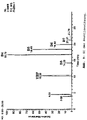
- a) Eine Umsetzung von Me2SiCl2 mit HCl/Et2O bei 120 °C für 67 h führt zu folgenden cyclischen Siloxanen (GC-MS-Analyse,
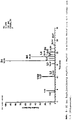
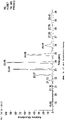
Abb. 3 ). - b) Eine Reaktion von Mischungen aus Me2SiCl2 und Me3SiCl mit HCl/Et2O führt nach 68 h bei 120 °C erwartungsgemäß zu einer Mischung aus cyclischen und linearen Siloxanen. Dies ist exemplarisch in
Abb. 4 dargestellt. - Eine Erhöhung des Me2SiCl2-Anteils (molares Verhältnis Me2SiC12:Me3SiCl = 4:1) führt unter vergleichbaren Bedingungen (120 °C, 68 h) zu einer deutlichen Erhöhung des Anteils an cyclischen Siloxanen in der Reaktionsmischung (
Abb. 5 , Seite 5). - Eine Erhöhung des Me3SiCl-Anteils (molares Verhältnis Me2SiCl2:Me3SiCl = 1:4) führt unter vergleichbaren Bedingungen (120 °C, 68 h) zu einer deutlichen Erhöhung des Anteils an linearen Siloxanen (
Abb. 5 , Seite 6) in der Reaktionsmischung. - c) Die Umsetzung von MeSiCl3 mit HCl/Et2O für 65 h bei 120 °C führt zu den Silsesquioxanen T1, T2 und T3. Zur Generalisierung dieser Reaktionssequenz werden exemplarisch weitere Trichlorsilane XSiCl3 (X = Vinyl, Ethyl) mit HCl/Et2O umgesetzt. Die Umsetzung von Trichlorvinylsilan (ViSiCl3) mit HCl/Et2O für 69 h bei 120 °C führt zur nahezu selektiven Bildung von (ViSiO3/2)8 (T5, RT = 27.06 min) neben Spuren von (ViSiO3/2)10 (T6, RT = 37.59 min) . Trichlorethylsilan (EtSiCl3) reagiert mit HCl/Et2O nach 68 h bei 120 °C ebenfalls selektiv zum entsprechenden Silsesquioxan (EtSiO3/2)8 (T7, RT = 27.75 min).
Erwartungsgemäß reagieren Mischungen aus MeSiCl3, EtSiCl3 und ViSiCl3 zu Silsesquioxanen mit statistischer Verteilung der Methyl-, Ethyl- und Vinylgruppen an den "Ecken" der Silsesquioxane (Abb. 6 , Tab. 7). -
Tab. 7: GC-MS-Daten "gemischter" Silsesquioxane. RT GC Silsesquioxan Massenfragment 22.37 (MeSiO3/2)6(ViSiO3/2)(EtSiO3/2) 562 [M-H]+ 23.08 (MeSiO3/2)5(ViSiO3/2)2 (EtSiO3/2) 574 [M-H]+ 23.88 (MeSiO3/2) 4(ViSiO3/2)2 (EtSiO3/2)2 589 [M-H]+ 24.85 (MeSiO3/2) 3(ViSiO3/2)3(EtSiO3/2)2 602 [M]+ 25.93 (MeSiO3/2) 2(ViSiO3/2)3(EtSiO3/2)3 602 [M-CH3]+
Claims (15)
- Verfahren zur Spaltung von Silicium-Silicium-Bindungen und/oder von Silicium-Chlor-Bindungen in Poly- und/oder Oligosilanen, dadurch gekennzeichnet, dass man das Poly- und/oder Oligosilan in Ether oder Ether-Salzsäure-Lösung löst oder suspendiert.
- Verfahren nach Anspruch 1, dadurch gekennzeichnet, dass man aus halogenierten Polysilanen, insbesondere aus chlorierten Polysilanen, speziell perchlorierten Polysilanen (PCS), durch Spaltung von Si-Si-Bindungen halogenierte Oligosilane, insbesondere chlorierte Oligosilane, herstellt.
- Verfahren nach Anspruch 1 oder 2 dadurch gekennzeichnet, dass man das halogenierte Polysilan in Ethylether (Et2O) oder Ethylether-Salzsäure-Lösung, insbesondere Diethylether oder Diethylether-Salzsäure-Lösung, löst oder suspendiert.
- Verfahren nach einem der vorangehenden Ansprüche, dadurch gekennzeichnet, dass man als halogenierte Oligosilane solche mit der Formel SinX2n+2, insbesondere solche mit der Formel SinCl2n+2, darstellt.
- Verfahren nach einem der vorangehenden Ansprüche, dadurch gekennzeichnet, dass man thermisch hergestelltes halogeniertes Polysilan, insbesondere perchloriertes Polysilan (T-PCS), umsetzt.
- Verfahren nach einem der Ansprüche 1 bis 4, dadurch gekennzeichnet, dass man plasmachemisch hergestelltes halogeniertes Polysilan, insbesondere perchloriertes Polysilan (P-PCS), umsetzt.
- Verfahren nach einem der Ansprüche 5 oder 6, da- durch gekennzeichnet, dass man zur Darstellung von Si2Cl6 T/P-PCS, insbesondere T-PCS, mit Et2O bzw. HCl in Et2O umsetzt.
- Verfahren nach einem der Ansprüche 5 oder 6, dadurch gekennzeichnet, dass man zur Darstellung von XSi(SiCl3)3 (X = H, Cl) T/P-PCS mit HCl in Et2O umsetzt.
- Verfahren nach einem der Ansprüche 5 oder 6 dadurch gekennzeichnet, dass man zur Darstellung von X2Si(SiCl3)2 (X = H, Cl) T/P-PCS mit HCl in Et2O umsetzt.
- Verfahren nach einem der vorangehenden Ansprüche, dadurch gekennzeichnet, dass die aus der Umsetzung gewonnene Lösung isoliert wird.
- Verfahren nach einem der vorangehenden Ansprüche, dadurch gekennzeichnet, dass mindestens ein halogeniertes Oligosilan aus der erhaltenen Lösung isoliert wird. Hauptantrag
- Verfahren nach einem der vorangehenden Ansprüche, dadurch gekennzeichnet, dass es zur Spaltung von Poly- und/oder Oligosilanen und zum Aufbau von Siloxanen eingesetzt wird.
- Verfahren nach Anspruch 12, dadurch gekennzeichnet, dass jede Si-Si- und/oder Si-Cl-Bindung durch eine Lösung von HCl in Diethylether thermisch gespalten und in eine Siloxaneinheit überführt wird.
- Verfahren nach Anspruch 12 oder 13, dadurch gekennzeichnet, dass es zum Abbau von Mischungen aus Organohalogendisilanen, insbesondere mit chlorierten Monosilanen, eingesetzt wird.
- Verfahren zur Spaltung von Si-Cl-Bindungen in Monosilanen dadurch gekennzeichnet, dass man das Monosilan in einer Lösung von HCl in Et2O löst oder suspendiert und damit Siloxane aufbaut.
Applications Claiming Priority (2)
| Application Number | Priority Date | Filing Date | Title |
|---|---|---|---|
| DE102014010674 | 2014-07-22 | ||
| PCT/DE2015/000359 WO2016011993A1 (de) | 2014-07-22 | 2015-07-20 | Verfahren zur spaltung von silicium-silicium-bindungen und/oder von silicium-chlor-bindungen in mono-, poly- und/oder oligosilanen |
Publications (3)
| Publication Number | Publication Date |
|---|---|
| EP3172261A1 EP3172261A1 (de) | 2017-05-31 |
| EP3172261B1 EP3172261B1 (de) | 2018-10-24 |
| EP3172261B2 true EP3172261B2 (de) | 2022-05-04 |
Family
ID=54365912
Family Applications (1)
| Application Number | Title | Priority Date | Filing Date |
|---|---|---|---|
| EP15788316.6A Not-in-force EP3172261B2 (de) | 2014-07-22 | 2015-07-20 | Verfahren zur spaltung von silicium-silicium-bindungen und/oder von silicium-chlor-bindungen in mono-, poly- und/oder oligosilanen |
Country Status (8)
| Country | Link |
|---|---|
| US (1) | US11104582B2 (de) |
| EP (1) | EP3172261B2 (de) |
| JP (1) | JP6655599B2 (de) |
| KR (1) | KR20170035981A (de) |
| CN (1) | CN106604924B (de) |
| DE (1) | DE102015009129B4 (de) |
| RU (1) | RU2673664C2 (de) |
| WO (1) | WO2016011993A1 (de) |
Families Citing this family (5)
| Publication number | Priority date | Publication date | Assignee | Title |
|---|---|---|---|---|
| WO2016095953A1 (de) * | 2014-12-15 | 2016-06-23 | Spawnt Private S.À.R.L. | Verfahren zur herstellung von chlorierten oligosilanen |
| RU2722027C1 (ru) * | 2016-11-16 | 2020-05-26 | АйЭйчАй КОРПОРЕЙШН | Способ стабилизации хлорсиланового полимера |
| WO2019060485A1 (en) * | 2017-09-20 | 2019-03-28 | Momentive Performance Materials Inc. | PROCESS FOR PRODUCING ORGANOHYDRIDOCHLOROSILANES |
| CN109686802A (zh) * | 2018-11-09 | 2019-04-26 | 惠州凯珑光电有限公司 | 一种电子元器件和模组的封装工艺 |
| WO2020205356A1 (en) * | 2019-03-29 | 2020-10-08 | Momentive Performance Materials Inc. | Low temperature process for the safe conversion of the siemens process side-product mixture to chloromonosilanes |
Citations (1)
| Publication number | Priority date | Publication date | Assignee | Title |
|---|---|---|---|---|
| US20120071678A1 (en) † | 2010-09-17 | 2012-03-22 | Gelest Technologies, Inc. | Trihydridosilyl-terminated polysilanes and methods of preparation |
Family Cites Families (24)
| Publication number | Priority date | Publication date | Assignee | Title |
|---|---|---|---|---|
| US3012006A (en) | 1958-04-24 | 1961-12-05 | Dow Corning | Fluorinated alkyl silanes and their use |
| US3878234A (en) * | 1973-07-30 | 1975-04-15 | Dow Corning | Preparation of hydrocarbon silanes from polysilanes |
| US4855473A (en) | 1986-05-27 | 1989-08-08 | Bayer Aktiengesellschaft | Process for the preparation of organooxychlorosilanes |
| GB8629593D0 (en) | 1986-12-11 | 1987-01-21 | Dow Corning Ltd | Polysilanes |
| US5025075A (en) | 1988-07-22 | 1991-06-18 | Dow Corning Corporation | Methylpolysilanes and method for their preparation |
| DE4220151A1 (de) | 1992-06-19 | 1993-12-23 | Wacker Chemie Gmbh | Verfahren zur Gewinnung von Methylchlorsilanen aus hochsiedenden Rückständen der Methylchlorsilansynthese |
| US5292912A (en) | 1993-07-19 | 1994-03-08 | Dow Corning Corporation | Catalytic conversion of direct process high-boiling component to chlorosilane monomers in the presence of hydrogen chloride |
| JP3644703B2 (ja) * | 1993-08-18 | 2005-05-11 | 信越化学工業株式会社 | 環状ジメチルポリシロキサンの製造方法 |
| EP0640642B1 (de) * | 1993-08-18 | 1998-03-11 | Shin-Etsu Chemical Co., Ltd. | Verfahren zur Herstellung von Polydimethylsiloxanen |
| JP3362630B2 (ja) * | 1997-02-28 | 2003-01-07 | 信越化学工業株式会社 | 直接法メチルクロルシラン合成より副生する高沸点成分からのモノシラン類の製造方法 |
| US6337415B1 (en) * | 1999-11-04 | 2002-01-08 | Shin-Etsu Chemical Co., Ltd. | Process for preparing tetrakis (trimethylsily) silane and tris (trimethysilyl) silane |
| DE10039172C1 (de) | 2000-08-10 | 2001-09-13 | Wacker Chemie Gmbh | Verfahren zum Aufarbeiten von Rückständen der Direktsynthese von Organochlorsilanen |
| DE10354262A1 (de) | 2003-11-20 | 2005-06-23 | Wacker-Chemie Gmbh | Verfahren zur Herstellung von Alkylchlorsilanen aus den Rückständen der Direktsynthese von Alkylchlorsilanen |
| DE102006034061A1 (de) | 2006-07-20 | 2008-01-24 | REV Renewable Energy Ventures, Inc., Aloha | Polysilanverarbeitung und Verwendung |
| DE102008025261B4 (de) | 2008-05-27 | 2010-03-18 | Rev Renewable Energy Ventures, Inc. | Halogeniertes Polysilan und plasmachemisches Verfahren zu dessen Herstellung |
| DE102008025260B4 (de) | 2008-05-27 | 2010-03-18 | Rev Renewable Energy Ventures, Inc. | Halogeniertes Polysilan und thermisches Verfahren zu dessen Herstellung |
| DE102008042934A1 (de) * | 2008-10-17 | 2010-04-22 | Wacker Chemie Ag | Verfahren zur Herstellung von Neopentasilanen |
| KR20110100249A (ko) * | 2008-12-03 | 2011-09-09 | 다우 코닝 코포레이션 | 트리클로로실란 및 테트라클로로실란의 제조 방법 |
| DE102009027194A1 (de) * | 2009-06-25 | 2010-12-30 | Wacker Chemie Ag | Verfahren zur Herstellung von Dodecahalogenneopentasilanen |
| DE102009056731A1 (de) * | 2009-12-04 | 2011-06-09 | Rev Renewable Energy Ventures, Inc. | Halogenierte Polysilane und Polygermane |
| DE102010002577A1 (de) | 2010-03-04 | 2011-09-08 | Wacker Chemie Ag | Verfahren zur Umwandlung von Disilanen |
| DE102010062984A1 (de) * | 2010-12-14 | 2012-06-14 | Evonik Degussa Gmbh | Verfahren zur Herstellung höherer Halogen- und Hydridosilane |
| DE102010063823A1 (de) | 2010-12-22 | 2012-06-28 | Evonik Degussa Gmbh | Verfahren zur Herstellung von Hydridosilanen |
| DE102013207441A1 (de) | 2013-04-24 | 2014-10-30 | Evonik Degussa Gmbh | Verfahren zur Herstellung von Hexachlordisilan durch Spaltung von höheren Polychlorsilanen wie Octachlortrisilan |
-
2015
- 2015-07-20 DE DE102015009129.8A patent/DE102015009129B4/de not_active Withdrawn - After Issue
- 2015-07-20 KR KR1020177004483A patent/KR20170035981A/ko not_active Abandoned
- 2015-07-20 EP EP15788316.6A patent/EP3172261B2/de not_active Not-in-force
- 2015-07-20 RU RU2017105446A patent/RU2673664C2/ru active
- 2015-07-20 WO PCT/DE2015/000359 patent/WO2016011993A1/de not_active Ceased
- 2015-07-20 CN CN201580041024.4A patent/CN106604924B/zh not_active Expired - Fee Related
- 2015-07-20 US US15/327,145 patent/US11104582B2/en not_active Expired - Fee Related
- 2015-07-20 JP JP2017503841A patent/JP6655599B2/ja not_active Expired - Fee Related
Patent Citations (1)
| Publication number | Priority date | Publication date | Assignee | Title |
|---|---|---|---|---|
| US20120071678A1 (en) † | 2010-09-17 | 2012-03-22 | Gelest Technologies, Inc. | Trihydridosilyl-terminated polysilanes and methods of preparation |
Also Published As
| Publication number | Publication date |
|---|---|
| KR20170035981A (ko) | 2017-03-31 |
| US20170166452A1 (en) | 2017-06-15 |
| CN106604924B (zh) | 2020-04-03 |
| RU2673664C2 (ru) | 2018-11-29 |
| CN106604924A (zh) | 2017-04-26 |
| DE102015009129A1 (de) | 2016-01-28 |
| DE102015009129B4 (de) | 2016-12-15 |
| RU2017105446A3 (de) | 2018-09-28 |
| JP2017527514A (ja) | 2017-09-21 |
| WO2016011993A1 (de) | 2016-01-28 |
| JP6655599B2 (ja) | 2020-02-26 |
| EP3172261A1 (de) | 2017-05-31 |
| EP3172261B1 (de) | 2018-10-24 |
| RU2017105446A (ru) | 2018-08-22 |
| US11104582B2 (en) | 2021-08-31 |
Similar Documents
| Publication | Publication Date | Title |
|---|---|---|
| EP3172261B2 (de) | Verfahren zur spaltung von silicium-silicium-bindungen und/oder von silicium-chlor-bindungen in mono-, poly- und/oder oligosilanen | |
| DE69517132T2 (de) | Alkylhydridsiloxane | |
| US20190311894A1 (en) | Si-CONTAINING FILM FORMING PRECURSORS AND METHODS OF USING THE SAME | |
| EP2296804B1 (de) | Halogeniertes polysilan und thermisches verfahren zu dessen herstellung | |
| EP2651825B1 (de) | Verfahren zur herstellung höherer halogen- und hydridosilane | |
| EP0927734B1 (de) | Kontinuierliches Verfahren zur Herstellung von Polyorganosiloxanen | |
| DE3785065T2 (de) | Verfahren zur herstellung von polysilazanen und silicium-nitriden. | |
| DE1570446C3 (de) | Verfahren zur Herstellung von Organosiloxanblockmisch polymeren | |
| Wakabayashi et al. | Nonhydrolytic synthesis of branched alkoxysiloxane oligomers Si [OSiH (OR) 2] 4 (R= Me, Et) | |
| Gerwig et al. | Challenges in the synthesis and processing of hydrosilanes as precursors for silicon deposition | |
| EP0980871A2 (de) | Verfahren zur Herstellung von Acetoxysilanen | |
| DE3518878A1 (de) | Phenylengruppen-haltige organosilane, verfahren zu ihrer herstellung | |
| DE69221670T2 (de) | Hexenylgruppen enthaltendes Siliconharz und Verfahren zu seiner Herstellung | |
| DE2133105B2 (de) | Verfahren zur Herstellung härtbarer Fluororganopolysiloxanharze | |
| DE69424503T2 (de) | Verfahren zur Herstellung von Dimethylchlorsilan und Triorganochlorsilan | |
| DE2542425C3 (de) | Verfahren zur Herstellung von Hexasiloxycyclosiloxanen | |
| DE2643469A1 (de) | Silacyclopentenyl-bis-epsilon-caprolactam | |
| Kawahara et al. | A spherosilicate oligomer with eight stable silanol groups as a building block of hybrid materials | |
| DE1645651A1 (de) | Verfahren zur Herstellung von Polysilarylensiloxanen | |
| DE69512995T2 (de) | Verfahren zur Härtung von einem Siloxan-Polymer | |
| DE4024600A1 (de) | Elektrochemische synthese von organosiliciumverbindungen | |
| DE102014007766B4 (de) | Verfahren zur plasmachemischen Herstellung halogenierter Oligosilane aus Tetrachlorsilan | |
| WO2019060481A1 (en) | CLEAVING DISILANE, CARBODISILANE AND OLIGOSILANE WITH CLEAVING COMPOUND AS CATALYST AND HYDROGENATION SOURCE | |
| WO2017167715A1 (de) | Gezielte herstellung von 2,2,3,3-tetrasilyltetrasilan | |
| DE2012683A1 (de) | Verfahren zur Reinigung von Gemischen von Organochlorsilanen |
Legal Events
| Date | Code | Title | Description |
|---|---|---|---|
| STAA | Information on the status of an ep patent application or granted ep patent |
Free format text: STATUS: THE INTERNATIONAL PUBLICATION HAS BEEN MADE |
|
| PUAI | Public reference made under article 153(3) epc to a published international application that has entered the european phase |
Free format text: ORIGINAL CODE: 0009012 |
|
| STAA | Information on the status of an ep patent application or granted ep patent |
Free format text: STATUS: REQUEST FOR EXAMINATION WAS MADE |
|
| 17P | Request for examination filed |
Effective date: 20170118 |
|
| AK | Designated contracting states |
Kind code of ref document: A1 Designated state(s): AL AT BE BG CH CY CZ DE DK EE ES FI FR GB GR HR HU IE IS IT LI LT LU LV MC MK MT NL NO PL PT RO RS SE SI SK SM TR |
|
| AX | Request for extension of the european patent |
Extension state: BA ME |
|
| DAV | Request for validation of the european patent (deleted) | ||
| DAX | Request for extension of the european patent (deleted) | ||
| GRAP | Despatch of communication of intention to grant a patent |
Free format text: ORIGINAL CODE: EPIDOSNIGR1 |
|
| STAA | Information on the status of an ep patent application or granted ep patent |
Free format text: STATUS: GRANT OF PATENT IS INTENDED |
|
| INTG | Intention to grant announced |
Effective date: 20180514 |
|
| GRAS | Grant fee paid |
Free format text: ORIGINAL CODE: EPIDOSNIGR3 |
|
| GRAA | (expected) grant |
Free format text: ORIGINAL CODE: 0009210 |
|
| STAA | Information on the status of an ep patent application or granted ep patent |
Free format text: STATUS: THE PATENT HAS BEEN GRANTED |
|
| AK | Designated contracting states |
Kind code of ref document: B1 Designated state(s): AL AT BE BG CH CY CZ DE DK EE ES FI FR GB GR HR HU IE IS IT LI LT LU LV MC MK MT NL NO PL PT RO RS SE SI SK SM TR |
|
| REG | Reference to a national code |
Ref country code: CH Ref legal event code: EP |
|
| REG | Reference to a national code |
Ref country code: IE Ref legal event code: FG4D Free format text: LANGUAGE OF EP DOCUMENT: GERMAN |
|
| REG | Reference to a national code |
Ref country code: AT Ref legal event code: REF Ref document number: 1056591 Country of ref document: AT Kind code of ref document: T Effective date: 20181115 |
|
| REG | Reference to a national code |
Ref country code: DE Ref legal event code: R096 Ref document number: 502015006609 Country of ref document: DE |
|
| REG | Reference to a national code |
Ref country code: NL Ref legal event code: MP Effective date: 20181024 |
|
| REG | Reference to a national code |
Ref country code: LT Ref legal event code: MG4D |
|
| PG25 | Lapsed in a contracting state [announced via postgrant information from national office to epo] |
Ref country code: NL Free format text: LAPSE BECAUSE OF FAILURE TO SUBMIT A TRANSLATION OF THE DESCRIPTION OR TO PAY THE FEE WITHIN THE PRESCRIBED TIME-LIMIT Effective date: 20181024 |
|
| PG25 | Lapsed in a contracting state [announced via postgrant information from national office to epo] |
Ref country code: LV Free format text: LAPSE BECAUSE OF FAILURE TO SUBMIT A TRANSLATION OF THE DESCRIPTION OR TO PAY THE FEE WITHIN THE PRESCRIBED TIME-LIMIT Effective date: 20181024 Ref country code: HR Free format text: LAPSE BECAUSE OF FAILURE TO SUBMIT A TRANSLATION OF THE DESCRIPTION OR TO PAY THE FEE WITHIN THE PRESCRIBED TIME-LIMIT Effective date: 20181024 Ref country code: ES Free format text: LAPSE BECAUSE OF FAILURE TO SUBMIT A TRANSLATION OF THE DESCRIPTION OR TO PAY THE FEE WITHIN THE PRESCRIBED TIME-LIMIT Effective date: 20181024 Ref country code: PL Free format text: LAPSE BECAUSE OF FAILURE TO SUBMIT A TRANSLATION OF THE DESCRIPTION OR TO PAY THE FEE WITHIN THE PRESCRIBED TIME-LIMIT Effective date: 20181024 Ref country code: BG Free format text: LAPSE BECAUSE OF FAILURE TO SUBMIT A TRANSLATION OF THE DESCRIPTION OR TO PAY THE FEE WITHIN THE PRESCRIBED TIME-LIMIT Effective date: 20190124 Ref country code: LT Free format text: LAPSE BECAUSE OF FAILURE TO SUBMIT A TRANSLATION OF THE DESCRIPTION OR TO PAY THE FEE WITHIN THE PRESCRIBED TIME-LIMIT Effective date: 20181024 Ref country code: IS Free format text: LAPSE BECAUSE OF FAILURE TO SUBMIT A TRANSLATION OF THE DESCRIPTION OR TO PAY THE FEE WITHIN THE PRESCRIBED TIME-LIMIT Effective date: 20190224 Ref country code: NO Free format text: LAPSE BECAUSE OF FAILURE TO SUBMIT A TRANSLATION OF THE DESCRIPTION OR TO PAY THE FEE WITHIN THE PRESCRIBED TIME-LIMIT Effective date: 20190124 Ref country code: FI Free format text: LAPSE BECAUSE OF FAILURE TO SUBMIT A TRANSLATION OF THE DESCRIPTION OR TO PAY THE FEE WITHIN THE PRESCRIBED TIME-LIMIT Effective date: 20181024 |
|
| PG25 | Lapsed in a contracting state [announced via postgrant information from national office to epo] |
Ref country code: AL Free format text: LAPSE BECAUSE OF FAILURE TO SUBMIT A TRANSLATION OF THE DESCRIPTION OR TO PAY THE FEE WITHIN THE PRESCRIBED TIME-LIMIT Effective date: 20181024 Ref country code: SE Free format text: LAPSE BECAUSE OF FAILURE TO SUBMIT A TRANSLATION OF THE DESCRIPTION OR TO PAY THE FEE WITHIN THE PRESCRIBED TIME-LIMIT Effective date: 20181024 Ref country code: GR Free format text: LAPSE BECAUSE OF FAILURE TO SUBMIT A TRANSLATION OF THE DESCRIPTION OR TO PAY THE FEE WITHIN THE PRESCRIBED TIME-LIMIT Effective date: 20190125 Ref country code: RS Free format text: LAPSE BECAUSE OF FAILURE TO SUBMIT A TRANSLATION OF THE DESCRIPTION OR TO PAY THE FEE WITHIN THE PRESCRIBED TIME-LIMIT Effective date: 20181024 Ref country code: PT Free format text: LAPSE BECAUSE OF FAILURE TO SUBMIT A TRANSLATION OF THE DESCRIPTION OR TO PAY THE FEE WITHIN THE PRESCRIBED TIME-LIMIT Effective date: 20190224 |
|
| REG | Reference to a national code |
Ref country code: DE Ref legal event code: R026 Ref document number: 502015006609 Country of ref document: DE |
|
| PLBI | Opposition filed |
Free format text: ORIGINAL CODE: 0009260 |
|
| PG25 | Lapsed in a contracting state [announced via postgrant information from national office to epo] |
Ref country code: IT Free format text: LAPSE BECAUSE OF FAILURE TO SUBMIT A TRANSLATION OF THE DESCRIPTION OR TO PAY THE FEE WITHIN THE PRESCRIBED TIME-LIMIT Effective date: 20181024 Ref country code: DK Free format text: LAPSE BECAUSE OF FAILURE TO SUBMIT A TRANSLATION OF THE DESCRIPTION OR TO PAY THE FEE WITHIN THE PRESCRIBED TIME-LIMIT Effective date: 20181024 Ref country code: CZ Free format text: LAPSE BECAUSE OF FAILURE TO SUBMIT A TRANSLATION OF THE DESCRIPTION OR TO PAY THE FEE WITHIN THE PRESCRIBED TIME-LIMIT Effective date: 20181024 |
|
| PLAZ | Examination of admissibility of opposition: despatch of communication + time limit |
Free format text: ORIGINAL CODE: EPIDOSNOPE2 |
|
| PLAX | Notice of opposition and request to file observation + time limit sent |
Free format text: ORIGINAL CODE: EPIDOSNOBS2 |
|
| PLAQ | Examination of admissibility of opposition: information related to despatch of communication + time limit deleted |
Free format text: ORIGINAL CODE: EPIDOSDOPE2 |
|
| 26 | Opposition filed |
Opponent name: EVONIK DEGUSSA GMBH Effective date: 20190715 |
|
| PG25 | Lapsed in a contracting state [announced via postgrant information from national office to epo] |
Ref country code: SK Free format text: LAPSE BECAUSE OF FAILURE TO SUBMIT A TRANSLATION OF THE DESCRIPTION OR TO PAY THE FEE WITHIN THE PRESCRIBED TIME-LIMIT Effective date: 20181024 Ref country code: RO Free format text: LAPSE BECAUSE OF FAILURE TO SUBMIT A TRANSLATION OF THE DESCRIPTION OR TO PAY THE FEE WITHIN THE PRESCRIBED TIME-LIMIT Effective date: 20181024 Ref country code: EE Free format text: LAPSE BECAUSE OF FAILURE TO SUBMIT A TRANSLATION OF THE DESCRIPTION OR TO PAY THE FEE WITHIN THE PRESCRIBED TIME-LIMIT Effective date: 20181024 Ref country code: SM Free format text: LAPSE BECAUSE OF FAILURE TO SUBMIT A TRANSLATION OF THE DESCRIPTION OR TO PAY THE FEE WITHIN THE PRESCRIBED TIME-LIMIT Effective date: 20181024 |
|
| PG25 | Lapsed in a contracting state [announced via postgrant information from national office to epo] |
Ref country code: SI Free format text: LAPSE BECAUSE OF FAILURE TO SUBMIT A TRANSLATION OF THE DESCRIPTION OR TO PAY THE FEE WITHIN THE PRESCRIBED TIME-LIMIT Effective date: 20181024 |
|
| PLAF | Information modified related to communication of a notice of opposition and request to file observations + time limit |
Free format text: ORIGINAL CODE: EPIDOSCOBS2 |
|
| PLBB | Reply of patent proprietor to notice(s) of opposition received |
Free format text: ORIGINAL CODE: EPIDOSNOBS3 |
|
| PG25 | Lapsed in a contracting state [announced via postgrant information from national office to epo] |
Ref country code: MC Free format text: LAPSE BECAUSE OF FAILURE TO SUBMIT A TRANSLATION OF THE DESCRIPTION OR TO PAY THE FEE WITHIN THE PRESCRIBED TIME-LIMIT Effective date: 20181024 |
|
| REG | Reference to a national code |
Ref country code: CH Ref legal event code: PL |
|
| PLAY | Examination report in opposition despatched + time limit |
Free format text: ORIGINAL CODE: EPIDOSNORE2 |
|
| PG25 | Lapsed in a contracting state [announced via postgrant information from national office to epo] |
Ref country code: TR Free format text: LAPSE BECAUSE OF FAILURE TO SUBMIT A TRANSLATION OF THE DESCRIPTION OR TO PAY THE FEE WITHIN THE PRESCRIBED TIME-LIMIT Effective date: 20181024 |
|
| PG25 | Lapsed in a contracting state [announced via postgrant information from national office to epo] |
Ref country code: CH Free format text: LAPSE BECAUSE OF NON-PAYMENT OF DUE FEES Effective date: 20190731 Ref country code: LU Free format text: LAPSE BECAUSE OF NON-PAYMENT OF DUE FEES Effective date: 20190720 Ref country code: LI Free format text: LAPSE BECAUSE OF NON-PAYMENT OF DUE FEES Effective date: 20190731 |
|
| PG25 | Lapsed in a contracting state [announced via postgrant information from national office to epo] |
Ref country code: IE Free format text: LAPSE BECAUSE OF NON-PAYMENT OF DUE FEES Effective date: 20190720 |
|
| PLBC | Reply to examination report in opposition received |
Free format text: ORIGINAL CODE: EPIDOSNORE3 |
|
| PLAP | Information related to despatch of examination report in opposition + time limit deleted |
Free format text: ORIGINAL CODE: EPIDOSDORE2 |
|
| PLAT | Information related to reply to examination report in opposition deleted |
Free format text: ORIGINAL CODE: EPIDOSDORE3 |
|
| PLAY | Examination report in opposition despatched + time limit |
Free format text: ORIGINAL CODE: EPIDOSNORE2 |
|
| PLBC | Reply to examination report in opposition received |
Free format text: ORIGINAL CODE: EPIDOSNORE3 |
|
| PLAY | Examination report in opposition despatched + time limit |
Free format text: ORIGINAL CODE: EPIDOSNORE2 |
|
| PG25 | Lapsed in a contracting state [announced via postgrant information from national office to epo] |
Ref country code: CY Free format text: LAPSE BECAUSE OF FAILURE TO SUBMIT A TRANSLATION OF THE DESCRIPTION OR TO PAY THE FEE WITHIN THE PRESCRIBED TIME-LIMIT Effective date: 20181024 |
|
| PG25 | Lapsed in a contracting state [announced via postgrant information from national office to epo] |
Ref country code: HU Free format text: LAPSE BECAUSE OF FAILURE TO SUBMIT A TRANSLATION OF THE DESCRIPTION OR TO PAY THE FEE WITHIN THE PRESCRIBED TIME-LIMIT; INVALID AB INITIO Effective date: 20150720 Ref country code: MT Free format text: LAPSE BECAUSE OF FAILURE TO SUBMIT A TRANSLATION OF THE DESCRIPTION OR TO PAY THE FEE WITHIN THE PRESCRIBED TIME-LIMIT Effective date: 20181024 |
|
| REG | Reference to a national code |
Ref country code: AT Ref legal event code: MM01 Ref document number: 1056591 Country of ref document: AT Kind code of ref document: T Effective date: 20200720 |
|
| PG25 | Lapsed in a contracting state [announced via postgrant information from national office to epo] |
Ref country code: AT Free format text: LAPSE BECAUSE OF NON-PAYMENT OF DUE FEES Effective date: 20200720 |
|
| PUAH | Patent maintained in amended form |
Free format text: ORIGINAL CODE: 0009272 |
|
| STAA | Information on the status of an ep patent application or granted ep patent |
Free format text: STATUS: PATENT MAINTAINED AS AMENDED |
|
| 27A | Patent maintained in amended form |
Effective date: 20220504 |
|
| AK | Designated contracting states |
Kind code of ref document: B2 Designated state(s): AL AT BE BG CH CY CZ DE DK EE ES FI FR GB GR HR HU IE IS IT LI LT LU LV MC MK MT NL NO PL PT RO RS SE SI SK SM TR |
|
| REG | Reference to a national code |
Ref country code: DE Ref legal event code: R102 Ref document number: 502015006609 Country of ref document: DE |
|
| PG25 | Lapsed in a contracting state [announced via postgrant information from national office to epo] |
Ref country code: MK Free format text: LAPSE BECAUSE OF FAILURE TO SUBMIT A TRANSLATION OF THE DESCRIPTION OR TO PAY THE FEE WITHIN THE PRESCRIBED TIME-LIMIT Effective date: 20181024 |
|
| PGFP | Annual fee paid to national office [announced via postgrant information from national office to epo] |
Ref country code: GB Payment date: 20220727 Year of fee payment: 8 Ref country code: DE Payment date: 20220727 Year of fee payment: 8 |
|
| PGFP | Annual fee paid to national office [announced via postgrant information from national office to epo] |
Ref country code: FR Payment date: 20220725 Year of fee payment: 8 Ref country code: BE Payment date: 20220727 Year of fee payment: 8 |
|
| REG | Reference to a national code |
Ref country code: DE Ref legal event code: R119 Ref document number: 502015006609 Country of ref document: DE |
|
| REG | Reference to a national code |
Ref country code: BE Ref legal event code: MM Effective date: 20230731 |
|
| GBPC | Gb: european patent ceased through non-payment of renewal fee |
Effective date: 20230720 |
|
| PG25 | Lapsed in a contracting state [announced via postgrant information from national office to epo] |
Ref country code: DE Free format text: LAPSE BECAUSE OF NON-PAYMENT OF DUE FEES Effective date: 20240201 Ref country code: GB Free format text: LAPSE BECAUSE OF NON-PAYMENT OF DUE FEES Effective date: 20230720 |
|
| PG25 | Lapsed in a contracting state [announced via postgrant information from national office to epo] |
Ref country code: FR Free format text: LAPSE BECAUSE OF NON-PAYMENT OF DUE FEES Effective date: 20230731 Ref country code: BE Free format text: LAPSE BECAUSE OF NON-PAYMENT OF DUE FEES Effective date: 20230731 |