EP3156128B1 - Ion exchange resin and method for adsorbing and separating metal - Google Patents
Ion exchange resin and method for adsorbing and separating metal Download PDFInfo
- Publication number
- EP3156128B1 EP3156128B1 EP15810881.1A EP15810881A EP3156128B1 EP 3156128 B1 EP3156128 B1 EP 3156128B1 EP 15810881 A EP15810881 A EP 15810881A EP 3156128 B1 EP3156128 B1 EP 3156128B1
- Authority
- EP
- European Patent Office
- Prior art keywords
- ion exchange
- exchange resin
- metal
- rare earth
- adsorbing
- Prior art date
- Legal status (The legal status is an assumption and is not a legal conclusion. Google has not performed a legal analysis and makes no representation as to the accuracy of the status listed.)
- Active
Links
Images
Classifications
-
- C—CHEMISTRY; METALLURGY
- C22—METALLURGY; FERROUS OR NON-FERROUS ALLOYS; TREATMENT OF ALLOYS OR NON-FERROUS METALS
- C22B—PRODUCTION AND REFINING OF METALS; PRETREATMENT OF RAW MATERIALS
- C22B3/00—Extraction of metal compounds from ores or concentrates by wet processes
- C22B3/20—Treatment or purification of solutions, e.g. obtained by leaching
- C22B3/42—Treatment or purification of solutions, e.g. obtained by leaching by ion-exchange extraction
-
- B—PERFORMING OPERATIONS; TRANSPORTING
- B01—PHYSICAL OR CHEMICAL PROCESSES OR APPARATUS IN GENERAL
- B01J—CHEMICAL OR PHYSICAL PROCESSES, e.g. CATALYSIS OR COLLOID CHEMISTRY; THEIR RELEVANT APPARATUS
- B01J20/00—Solid sorbent compositions or filter aid compositions; Sorbents for chromatography; Processes for preparing, regenerating or reactivating thereof
- B01J20/22—Solid sorbent compositions or filter aid compositions; Sorbents for chromatography; Processes for preparing, regenerating or reactivating thereof comprising organic material
-
- B—PERFORMING OPERATIONS; TRANSPORTING
- B01—PHYSICAL OR CHEMICAL PROCESSES OR APPARATUS IN GENERAL
- B01J—CHEMICAL OR PHYSICAL PROCESSES, e.g. CATALYSIS OR COLLOID CHEMISTRY; THEIR RELEVANT APPARATUS
- B01J45/00—Ion-exchange in which a complex or a chelate is formed; Use of material as complex or chelate forming ion-exchangers; Treatment of material for improving the complex or chelate forming ion-exchange properties
-
- B—PERFORMING OPERATIONS; TRANSPORTING
- B01—PHYSICAL OR CHEMICAL PROCESSES OR APPARATUS IN GENERAL
- B01J—CHEMICAL OR PHYSICAL PROCESSES, e.g. CATALYSIS OR COLLOID CHEMISTRY; THEIR RELEVANT APPARATUS
- B01J47/00—Ion-exchange processes in general; Apparatus therefor
- B01J47/12—Ion-exchange processes in general; Apparatus therefor characterised by the use of ion-exchange material in the form of ribbons, filaments, fibres or sheets, e.g. membranes
-
- C—CHEMISTRY; METALLURGY
- C22—METALLURGY; FERROUS OR NON-FERROUS ALLOYS; TREATMENT OF ALLOYS OR NON-FERROUS METALS
- C22B—PRODUCTION AND REFINING OF METALS; PRETREATMENT OF RAW MATERIALS
- C22B23/00—Obtaining nickel or cobalt
- C22B23/04—Obtaining nickel or cobalt by wet processes
- C22B23/0407—Leaching processes
- C22B23/0415—Leaching processes with acids or salt solutions except ammonium salts solutions
-
- C—CHEMISTRY; METALLURGY
- C22—METALLURGY; FERROUS OR NON-FERROUS ALLOYS; TREATMENT OF ALLOYS OR NON-FERROUS METALS
- C22B—PRODUCTION AND REFINING OF METALS; PRETREATMENT OF RAW MATERIALS
- C22B3/00—Extraction of metal compounds from ores or concentrates by wet processes
- C22B3/04—Extraction of metal compounds from ores or concentrates by wet processes by leaching
- C22B3/06—Extraction of metal compounds from ores or concentrates by wet processes by leaching in inorganic acid solutions, e.g. with acids generated in situ; in inorganic salt solutions other than ammonium salt solutions
-
- C—CHEMISTRY; METALLURGY
- C22—METALLURGY; FERROUS OR NON-FERROUS ALLOYS; TREATMENT OF ALLOYS OR NON-FERROUS METALS
- C22B—PRODUCTION AND REFINING OF METALS; PRETREATMENT OF RAW MATERIALS
- C22B3/00—Extraction of metal compounds from ores or concentrates by wet processes
- C22B3/20—Treatment or purification of solutions, e.g. obtained by leaching
- C22B3/26—Treatment or purification of solutions, e.g. obtained by leaching by liquid-liquid extraction using organic compounds
- C22B3/28—Amines
-
- C—CHEMISTRY; METALLURGY
- C22—METALLURGY; FERROUS OR NON-FERROUS ALLOYS; TREATMENT OF ALLOYS OR NON-FERROUS METALS
- C22B—PRODUCTION AND REFINING OF METALS; PRETREATMENT OF RAW MATERIALS
- C22B3/00—Extraction of metal compounds from ores or concentrates by wet processes
- C22B3/20—Treatment or purification of solutions, e.g. obtained by leaching
- C22B3/26—Treatment or purification of solutions, e.g. obtained by leaching by liquid-liquid extraction using organic compounds
- C22B3/32—Carboxylic acids
-
- C—CHEMISTRY; METALLURGY
- C22—METALLURGY; FERROUS OR NON-FERROUS ALLOYS; TREATMENT OF ALLOYS OR NON-FERROUS METALS
- C22B—PRODUCTION AND REFINING OF METALS; PRETREATMENT OF RAW MATERIALS
- C22B59/00—Obtaining rare earth metals
-
- C—CHEMISTRY; METALLURGY
- C22—METALLURGY; FERROUS OR NON-FERROUS ALLOYS; TREATMENT OF ALLOYS OR NON-FERROUS METALS
- C22B—PRODUCTION AND REFINING OF METALS; PRETREATMENT OF RAW MATERIALS
- C22B7/00—Working up raw materials other than ores, e.g. scrap, to produce non-ferrous metals and compounds thereof; Methods of a general interest or applied to the winning of more than two metals
- C22B7/006—Wet processes
- C22B7/007—Wet processes by acid leaching
-
- Y—GENERAL TAGGING OF NEW TECHNOLOGICAL DEVELOPMENTS; GENERAL TAGGING OF CROSS-SECTIONAL TECHNOLOGIES SPANNING OVER SEVERAL SECTIONS OF THE IPC; TECHNICAL SUBJECTS COVERED BY FORMER USPC CROSS-REFERENCE ART COLLECTIONS [XRACs] AND DIGESTS
- Y02—TECHNOLOGIES OR APPLICATIONS FOR MITIGATION OR ADAPTATION AGAINST CLIMATE CHANGE
- Y02P—CLIMATE CHANGE MITIGATION TECHNOLOGIES IN THE PRODUCTION OR PROCESSING OF GOODS
- Y02P10/00—Technologies related to metal processing
- Y02P10/20—Recycling
Definitions
- the present invention relates to an ion exchange resin and a method for adsorbing and separating a metal.
- Cobalt and rare earth metals are known as valuable metals, and have various uses in industry. Cobalt is used, for example, in positive electrode materials for secondary batteries, and further for superalloys (high strength heat resistant alloys), which are used in jet engines of aircraft, for example. Rare earth metals are used in phosphor materials, negative electrode materials for nickel-hydrogen batteries, additives for magnets built into motors, abrasives for glass substrates used for liquid crystal panels and hard drives, and the like.
- Examples of the above secondary batteries include nickel-hydrogen batteries and lithium-ion batteries and the like, and cobalt and further manganese, rare metals, are used in the positive electrode materials therefor.
- positive electrode materials for lithium-ion batteries the percentage of low-priced manganese tends to be raised in the place of high-priced cobalt.
- one recovery method is a dry method in which used batteries are put into a furnace and dissolved to separate into metals and slag and the metals are recovered. In this method, however, manganese moves to the slag, and thus only cobalt is recovered.
- a wet method in which used batteries are dissolved in an acid and metals are recovered using a separation method such as a precipitation method, a solvent extraction method or an electrowinning method is also known.
- a precipitation method for example, a method in which the pH of a solution containing cobalt and manganese is adjusted and a sulfurizing agent is added thereto to obtain precipitates of sulfurized cobalt, and a method in which an oxidizing agent is added to obtain precipitates of oxidized manganese are known (e.g., see Patent Document 1).
- this method there are problems in that, for example, coprecipitation occurs, and it is difficult to completely separate cobalt and manganese.
- Acid extractant is widely used when attempting to recover cobalt using the solvent extraction method. As described above, however, because a large amount of manganese is used in positive electrode materials for lithium-ion batteries recently, a high concentration of manganese exists in the solution of batteries. There are no effective extractants to selectively and effectively extract cobalt from such a system.
- a nickel ore, such as nickel oxide ore is used as a raw material in the recycling of used batteries and further cobalt smelting.
- the ratio of manganese is higher than that of cobalt in nickel oxide ore, and the existing ratio thereof is about 5 to 10 times that of cobalt, and separation from manganese is a large problem in cobalt smelting.
- a mixture of rare earth metals such as lanthanum, cerium, yttrium, terbium and europium is used in the phosphors used in the three-wavelength fluorescent tubes mentioned above. Furthermore, yttrium and europium together with a high ratio of zinc are contained and used in phosphors for cathode-ray tubes.
- a method for recovering the specific rare earth metal from a mixture of rare earth metals a method for recovering the specific rare earth metal from a liquid, in which the rare earth metals are dissolved in an acid such as mineral acid, by the solvent extraction method is generally used.
- An industrial example using the trade name PC88A manufactured by DAIHACHI CHEMICAL INDUSTRY CO., LTD.
- a phosphorus-based extractant exists for the mutual separation of rare earth metals, for example.
- an advanced wastewater treatment system is required to prevent the extractant and deteriorated materials thereof in discharged water polluting public water areas when industrially using the extractant.
- the extractant is subject to total volume control in accordance with the Water Pollution Law on specific areas in Japan, and thus there are concerns when using the extractant on an industrial scale.
- a carboxylic acid-based extractant e.g., 2-methyl-2-ethyl-1-heptanoic acid: neodecanoic acid
- this extractant acts in extraction only in a high pH range, neutral or higher, and thus when an acid solution as described above is used, a large amount of neutralizer is required, and so cost increases are a concern.
- the extraction ability of the carboxylic acid-based extractant is lower than that of the phosphorus-based extractant described above, and excessive equipment is required, and thus there is also a problem of cost increases.
- DODGAA having the skeleton of diglycol amic acid
- Patent Document 2 an extractant called DODGAA having the skeleton of diglycol amic acid
- Y yttrium
- Lu lutetium
- Yb ytterbium
- Tm thulium
- Er erbium
- Ho holmium
- Dy dysprosium
- Tb terbium
- Gd gadolinium
- Eu europium
- Sm samarium
- the concentration of scandium contained in the acid solution is about several to several tens mg/l, which is extremely low.
- the above amide derivative is used for solvent extraction treatment, because the concentration of scandium contained in the acid solution is extremely low, a large amount of extractant is required for the solvent extraction treatment.
- the equipment sizes, extraction tank and liquid storage tank for example are also expanded on a similar scale, and thus the increase in spending on the equipment necessary becomes a problem.
- An object of the present invention is to provide a system to efficiently recover a trace metal from a large amount of raw material, for example when a trace metal is recovered from nickel oxide ore.
- the present inventors found that the above object could be achieved by adsorbing a metal contained in an acid leaching solution of a raw material on a resin having an amide derivative represented by the following general formula (I) on a carrier and recovering the metal adsorbed on the resin, thereby completing the present invention.
- the present invention provides the following.
- the method may be used for adsorbing a metal contained in an acid leaching solution obtained by high pressure acid leaching of nickel oxide ore..
- a system can be provided to efficiently recover a trace metal from a large amount of raw material, for example when a trace metal is recovered from nickel oxide ore.
- the ion exchange resin used in the present invention has, on a carrier, an amide derivative represented by the following general formula (I).
- lipophilicity is increased by introducing an alkyl group into the skeleton of amide, and it can be used as a functional group when adsorbing one or more metals selected from cobalt, nickel, scandium and other rare earth elements.
- the ion exchange resin can suitably adsorb a trace metal (one or more trace metals selected from cobalt, nickel, scandium and other rare earth elements) contained in an acid leaching solution of, for example, nickel oxide ore, and the metal adsorbed on the resin can be suitably recovered by later treatment
- the type of ion exchange resin is not particularly limited.
- Solid extractants such as ion exchange resins have advantages including physically stable handling being possible, it being possible to carry out operations using simple equipment, and separation can be comparatively stably carried out even when operating conditions change.
- the reaction by ion exchange does not have many physical movements, for example mixing an extractant and a solution in the solvent extraction method, and the contact of the ion exchange resin and the solution is generally carried out in a sealed column in many cases. Therefore, there are also features in which catching e.g. air is prevented, the production of CRUD is thus suppressed, and operations are stably carried out.
- substituents R1 and R2 each represent the same or different alkyl groups.
- the alkyl group may be a straight chain or a branched chain.
- the number of carbons in an alkyl group is not particularly limited, and is preferably 5 or more and 11 or less.
- R3 represents a hydrogen atom or an alkyl group.
- R4 represents a hydrogen atom or an arbitrary group other than an amino group bonded to ⁇ carbon as an amino acid.
- the amide derivative can adsorb one or more metals selected from cobalt, nickel, scandium and other rare earth elements
- the type of the above amide derivative is not particularly limited, and the amide derivative is preferably a glycinamide derivative from the viewpoint that the derivative can be easily produced.
- the amide derivative is a glycinamide derivative
- the above glycinamide derivative can be synthesized by the following method.
- a 2-halogenated acetyl halide is added to an alkylamine having a structure represented by NHR1R2 (R1 and R2 are the same as the above substituents R1 and R2), and the hydrogen atom of amine is substituted with 2-halogenated acetyl by the nucleophilic substitution reaction to obtain 2-halogenated(N,N-di)alkylacetamide.
- the above 2-halogenated(N,N-di)alkylacetamide is added to a glycine or N-alkylglycine derivative, and one of the hydrogen atoms of the glycine or N-alkylglycine derivative is substituted with an (N,N-di)alkylacetamide group by the nucleophilic substitution reaction.
- a glycine alkylamide derivative can be synthesized by the two-step reaction.
- a histidinamide derivative, a lysinamide derivative or an aspartic acid amide derivative can be synthesized by substituting glycine with histidine, lysine or aspartic acid.
- the carrier is a solid material which can bond the above amide derivative, is chemically stable with the acid solution which is adsorbed, not physically affected when put into a column and a solution, and not deteriorated during adsorption operations and comprises 3-aminopropyl silica gel and/or, 3-(ethylenediamino)propyl silica gel.
- the techniques for adsorbing a valuable metal ion using e.g. the above ion exchange resin include a method called a batch method or a resin-in-pulp method, in which while adjusting the acid solution containing the target valuable metal ion, this acid solution is brought into contact with the above ion exchange resin etc., and further a column method in which the above ion exchange resin etc. is filled in a column and the above acid solution is applied to this column to come into contact therewith, and the like.
- a target valuable metal ion can be selectively adsorbed on the substituents R1 and R2 of the above ion exchange resin, etc.
- the pH of the acid solution is preferably 3.5 or higher and 5.5 or lower, and more preferably 4.0 or higher and 5.0 or lower.
- the pH is lower than 3.5, there is a possibility that cobalt cannot be sufficiently adsorbed.
- the pH is above 5.5, there is a possibility that not only cobalt but also manganese is adsorbed.
- the pH of the acid solution is preferably 0.5 or higher and 2.5 or lower, more preferably 1.0 or higher and 2.0 or lower, and even more preferably 1.5 or higher and 2.0 or lower.
- the pH is lower than 0.5, there is a possibility that scandium cannot be sufficiently adsorbed.
- the acid solution is an acid solution obtained by acid leaching of nickel oxide ore, for example, when the pH is above 2.5, there is a possibility that not only scandium but also aluminum, zinc, nickel, cobalt and the like contained in the acid solution are adsorbed, and thus the amount of work involved may increase, for example purification is required in the following step.
- the pH of the acid solution is preferably 2.0 or higher and 3.0 or lower.
- the pH is lower than 2.0, there is a possibility that europium cannot be sufficiently extracted.
- the pH is above 3.0, there is a possibility that not only europium but also other rare earth metals including yttrium are adsorbed.
- the ion exchange resin used in the present invention etc. has a feature in that light rare earth elements and middle rare earth elements are more easily adsorbed than heavy rare earth elements. Because of this, particularly while adjusting the pH of a solution containing both heavy rare earth elements and light rare earth elements, the solution is allowed to come into contact with the ion exchange resin of the present invention, thereby being able to selectively adsorb light rare earth elements from the solution. As a result, light rare earth elements and heavy rare earth elements can be separated. In addition, when a solution further contains middle rare earth elements, an eluent recovered from the above ion exchange resin etc.
- the pH of the acid solution is preferably 1.7 or higher and 2.7 or lower.
- the pH is lower than 1.7, there is a possibility that light rare earth elements cannot be sufficiently adsorbed.
- the pH is above 2.7, there is a possibility that not only light rare earth elements but also heavy rare earth elements are adsorbed.
- the ion exchange resin is washed with e.g. pure water to remove a part of the above acid solution attached to the surface, and an eluent adjusted to a pH lower than that of the above acid aqueous solution is then applied thereto as known in conventionally known methods, thereby being able to recover a target valuable metal ion from the ion exchange resin.
- the eluent is not particularly limited as long as the pH thereof is adjusted to be lower than that of the above acid aqueous solution, and examples thereof include an aqueous solution in which nitric acid, hydrochloric acid, or sulfuric acid is diluted, and the like.
- a target valuable metal ion can be concentrated by appropriately changing the contact time of the ion exchange resin and the eluent, i.e. the time the eluent is in the column, and the like.
- the eluent flow rate and eluent temperature can be appropriately set depending on an acid aqueous solution of valuable metal ions and conditions.
- the pH of an acid aqueous solution containing a metal ion can be also appropriately adjusted depending on the types of valuable metal.
- N-[N,N-bis(2-ethylhexyl)aminocarbonylmethyl]glycine or also referred to as N,N-di(2-ethylhexyl)acetamide-2-glycine, and hereinafter referred to as "D2EHAG" into which two 2-ethylhexyl groups were introduced was used.
- D2EHAG N-[N,N-bis(2-ethylhexyl)aminocarbonylmethyl]glycine
- D2EHAG N,N-di(2-ethylhexyl)acetamide-2-glycine
- An ion exchange resin having D2EHAG was prepared as follows.
- the ion exchange resin according to Example 2 (glycine aceto(ethylenediamino)propyl silica gel) was obtained in the same manner as in Example 1 except that 3-aminopropyl silica gel was changed to 3-(ethylenediamino)propyl silica gel.
- a glycinamide derivative and further a normal-methylglycine derivative, a histidinamide derivative and the like are also known as an amide derivative, and these can be also supported as a functional group on a carrier to make an ion exchange resin as in the case with the above glycinamide derivative.
- the ion exchange resin and a post-adsorption liquid were obtained by solid-liquid separation using filter paper, and the pH of the post-adsorption liquid was measured.
- the ion exchange resin was washed by a water pouring treatment using a small amount of pure water, and the post-adsorption liquid and washing water were combined to obtain a new post-adsorption liquid. The volume thereof was measured, and the concentration of the components, which were contained in the starting liquid, in the post-adsorption liquid was measured using an inductively coupled plasma atomic emission spectrometer (ICP-AES).
- ICP-AES inductively coupled plasma atomic emission spectrometer
- the adsorption rate (distribution) on the ion exchange resins was defined from changes in the amount of substance in an acid solution before and after adsorption using (1 - Amount of Substance after Adsorption/Amount of Substance before Adsorption), and found.
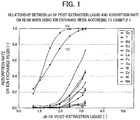
- the results for Example 1 are shown in Table 1 and Fig. 1
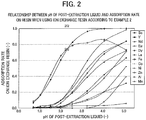
- the results for Example 2 are shown in Table 2 and Fig. 2 .
- the pH of an acid solution is the abscissa
- the extraction rate (Unit: -) of metal elements is the ordinate.
Landscapes
- Chemical & Material Sciences (AREA)
- Engineering & Computer Science (AREA)
- Organic Chemistry (AREA)
- Metallurgy (AREA)
- Mechanical Engineering (AREA)
- Materials Engineering (AREA)
- Manufacturing & Machinery (AREA)
- Life Sciences & Earth Sciences (AREA)
- Geology (AREA)
- General Life Sciences & Earth Sciences (AREA)
- Environmental & Geological Engineering (AREA)
- Geochemistry & Mineralogy (AREA)
- Chemical Kinetics & Catalysis (AREA)
- Inorganic Chemistry (AREA)
- Analytical Chemistry (AREA)
- Manufacture And Refinement Of Metals (AREA)
- Solid-Sorbent Or Filter-Aiding Compositions (AREA)
Applications Claiming Priority (2)
| Application Number | Priority Date | Filing Date | Title |
|---|---|---|---|
| JP2014131673A JP6053724B2 (ja) | 2014-06-26 | 2014-06-26 | イオン交換樹脂及び金属の吸着分離方法 |
| PCT/JP2015/068520 WO2015199224A1 (ja) | 2014-06-26 | 2015-06-26 | イオン交換樹脂及び金属の吸着分離方法 |
Publications (3)
| Publication Number | Publication Date |
|---|---|
| EP3156128A1 EP3156128A1 (en) | 2017-04-19 |
| EP3156128A4 EP3156128A4 (en) | 2017-06-14 |
| EP3156128B1 true EP3156128B1 (en) | 2019-03-20 |
Family
ID=54938301
Family Applications (1)
| Application Number | Title | Priority Date | Filing Date |
|---|---|---|---|
| EP15810881.1A Active EP3156128B1 (en) | 2014-06-26 | 2015-06-26 | Ion exchange resin and method for adsorbing and separating metal |
Country Status (7)
| Country | Link |
|---|---|
| US (1) | US9863018B2 (enExample) |
| EP (1) | EP3156128B1 (enExample) |
| JP (1) | JP6053724B2 (enExample) |
| AU (1) | AU2015281011B2 (enExample) |
| CA (1) | CA2954605C (enExample) |
| PH (1) | PH12016502610B1 (enExample) |
| WO (1) | WO2015199224A1 (enExample) |
Families Citing this family (4)
| Publication number | Priority date | Publication date | Assignee | Title |
|---|---|---|---|---|
| JP6409791B2 (ja) * | 2016-02-05 | 2018-10-24 | 住友金属鉱山株式会社 | スカンジウム回収方法 |
| JP6638939B2 (ja) * | 2016-03-30 | 2020-02-05 | 株式会社Gsユアサ | 亜鉛電極、及びその亜鉛電極を備えた蓄電池 |
| JP7274171B2 (ja) * | 2019-05-31 | 2023-05-16 | 国立研究開発法人産業技術総合研究所 | 希土類元素の吸着剤、及び希土類元素の分離方法 |
| JP7249317B2 (ja) * | 2020-08-07 | 2023-03-30 | 株式会社 イージーエス | 金属の分離方法、および、金属の分離装置 |
Family Cites Families (16)
| Publication number | Priority date | Publication date | Assignee | Title |
|---|---|---|---|---|
| DE3050800C2 (enExample) * | 1979-03-22 | 1989-06-22 | Continental Pharma Inc., Bruessel/Bruxelles, Be | |
| JP3121072B2 (ja) * | 1991-10-09 | 2000-12-25 | エーザイ株式会社 | コンアルブミンが結合した光学異性体分離剤 |
| JPH0680594A (ja) * | 1992-09-03 | 1994-03-22 | Daiso Co Ltd | 重金属除去方法 |
| JP3322952B2 (ja) * | 1993-10-01 | 2002-09-09 | 史朗 松本 | 希土類元素除去用吸着剤及びそれを用いた吸着分離法 |
| JP3385997B2 (ja) | 1999-02-12 | 2003-03-10 | 大平洋金属株式会社 | 酸化鉱石から有価金属を回収する方法 |
| AP1673A (en) * | 2001-09-14 | 2006-10-27 | Alexander Beckmann | Method for obtaining cobalt and nickel from ores and ore concentrates. |
| JP2004233278A (ja) * | 2003-01-31 | 2004-08-19 | Inst Of Research & Innovation | 金属元素の分離方法 |
| JP5035788B2 (ja) | 2006-06-06 | 2012-09-26 | 独立行政法人日本原子力研究開発機構 | 希土類金属の抽出剤と抽出方法 |
| CN101785991B (zh) * | 2009-12-12 | 2012-08-29 | 鲁东大学 | 一种硅胶键载氨基甘油吸附剂的制备方法 |
| JP5279938B1 (ja) | 2011-11-09 | 2013-09-04 | 国立大学法人九州大学 | 有価金属抽出剤及びこの抽出剤を用いた有価金属抽出方法 |
| JP5367862B2 (ja) | 2012-03-13 | 2013-12-11 | 国立大学法人九州大学 | スカンジウム抽出剤およびこの抽出剤を用いたスカンジウム抽出方法 |
| JP5734268B2 (ja) | 2012-12-12 | 2015-06-17 | 国立大学法人九州大学 | ニッケル抽出方法 |
| CN103055819B (zh) * | 2013-01-29 | 2015-08-19 | 湖南大学 | 一种重金属吸附剂及其制备和应用 |
| JP5595554B1 (ja) | 2013-03-18 | 2014-09-24 | 国立大学法人九州大学 | ニッケル、コバルト及び/又はスカンジウムを含有する酸性溶液から不純物を分離する方法 |
| AU2014245532B2 (en) | 2013-03-25 | 2016-11-10 | National Institute Of Advanced Industrial Science And Technology | Adsorbent for rare earth element and method for recovering rare earth element |
| JP5619238B1 (ja) | 2013-08-22 | 2014-11-05 | 住友金属鉱山株式会社 | スカンジウム回収方法 |
-
2014
- 2014-06-26 JP JP2014131673A patent/JP6053724B2/ja active Active
-
2015
- 2015-06-26 WO PCT/JP2015/068520 patent/WO2015199224A1/ja not_active Ceased
- 2015-06-26 CA CA2954605A patent/CA2954605C/en active Active
- 2015-06-26 AU AU2015281011A patent/AU2015281011B2/en active Active
- 2015-06-26 US US15/321,286 patent/US9863018B2/en not_active Expired - Fee Related
- 2015-06-26 EP EP15810881.1A patent/EP3156128B1/en active Active
-
2016
- 2016-12-23 PH PH12016502610A patent/PH12016502610B1/en unknown
Non-Patent Citations (1)
| Title |
|---|
| None * |
Also Published As
| Publication number | Publication date |
|---|---|
| EP3156128A1 (en) | 2017-04-19 |
| US20170166995A1 (en) | 2017-06-15 |
| AU2015281011A1 (en) | 2017-01-19 |
| CA2954605C (en) | 2018-01-23 |
| US9863018B2 (en) | 2018-01-09 |
| PH12016502610A1 (en) | 2017-04-24 |
| PH12016502610B1 (en) | 2017-04-24 |
| WO2015199224A1 (ja) | 2015-12-30 |
| AU2015281011B2 (en) | 2017-10-05 |
| JP6053724B2 (ja) | 2016-12-27 |
| CA2954605A1 (en) | 2015-12-30 |
| EP3156128A4 (en) | 2017-06-14 |
| JP2016007601A (ja) | 2016-01-18 |
Similar Documents
| Publication | Publication Date | Title |
|---|---|---|
| Liu et al. | Efficient recovery of end-of-life NdFeB permanent magnets by selective leaching with deep eutectic solvents | |
| JP5279938B1 (ja) | 有価金属抽出剤及びこの抽出剤を用いた有価金属抽出方法 | |
| KR102441721B1 (ko) | 희토류 원소의 추출 및 분리 방법 | |
| JP5496387B2 (ja) | アミド誘導体 | |
| KR20170061206A (ko) | 폐 리튬 이온 전지를 이용한 전구체 원료의 회수 방법 | |
| CN103443305B (zh) | 重稀土元素的回收方法 | |
| EP3156128B1 (en) | Ion exchange resin and method for adsorbing and separating metal | |
| EP2902511B1 (en) | Nickel extraction method | |
| EP2902512B1 (en) | Method for collecting scandium | |
| CA2827601C (en) | Cobalt extraction method | |
| CN118103533A (zh) | 一种用于萃取镧系元素的绿色方法 | |
| CN119194104A (zh) | 一种水-离子液体双相体系回收三元锂电池材料的方法 |
Legal Events
| Date | Code | Title | Description |
|---|---|---|---|
| STAA | Information on the status of an ep patent application or granted ep patent |
Free format text: STATUS: THE INTERNATIONAL PUBLICATION HAS BEEN MADE |
|
| PUAI | Public reference made under article 153(3) epc to a published international application that has entered the european phase |
Free format text: ORIGINAL CODE: 0009012 |
|
| STAA | Information on the status of an ep patent application or granted ep patent |
Free format text: STATUS: REQUEST FOR EXAMINATION WAS MADE |
|
| 17P | Request for examination filed |
Effective date: 20170112 |
|
| AK | Designated contracting states |
Kind code of ref document: A1 Designated state(s): AL AT BE BG CH CY CZ DE DK EE ES FI FR GB GR HR HU IE IS IT LI LT LU LV MC MK MT NL NO PL PT RO RS SE SI SK SM TR |
|
| AX | Request for extension of the european patent |
Extension state: BA ME |
|
| A4 | Supplementary search report drawn up and despatched |
Effective date: 20170516 |
|
| RIC1 | Information provided on ipc code assigned before grant |
Ipc: C22B 3/28 20060101ALI20170510BHEP Ipc: B01J 45/00 20060101AFI20170510BHEP Ipc: C22B 3/42 20060101ALI20170510BHEP Ipc: C22B 7/00 20060101ALI20170510BHEP Ipc: C22B 59/00 20060101ALI20170510BHEP Ipc: C22B 3/20 20060101ALI20170510BHEP Ipc: C22B 3/06 20060101ALI20170510BHEP Ipc: B01J 20/22 20060101ALI20170510BHEP Ipc: C22B 3/24 20060101ALI20170510BHEP Ipc: C22B 3/00 20060101ALI20170510BHEP Ipc: C22B 3/32 20060101ALI20170510BHEP |
|
| DAV | Request for validation of the european patent (deleted) | ||
| DAX | Request for extension of the european patent (deleted) | ||
| RIC1 | Information provided on ipc code assigned before grant |
Ipc: C22B 3/24 20060101ALI20180829BHEP Ipc: C22B 3/00 20060101ALI20180829BHEP Ipc: C22B 59/00 20060101ALI20180829BHEP Ipc: B01J 45/00 20060101AFI20180829BHEP Ipc: C22B 3/20 20060101ALI20180829BHEP Ipc: C22B 3/28 20060101ALI20180829BHEP Ipc: B01J 47/12 20170101ALI20180829BHEP Ipc: C22B 3/42 20060101ALI20180829BHEP Ipc: C22B 3/06 20060101ALI20180829BHEP Ipc: C22B 7/00 20060101ALI20180829BHEP Ipc: C22B 3/32 20060101ALI20180829BHEP Ipc: B01J 20/22 20060101ALI20180829BHEP |
|
| GRAP | Despatch of communication of intention to grant a patent |
Free format text: ORIGINAL CODE: EPIDOSNIGR1 |
|
| STAA | Information on the status of an ep patent application or granted ep patent |
Free format text: STATUS: GRANT OF PATENT IS INTENDED |
|
| INTG | Intention to grant announced |
Effective date: 20181005 |
|
| GRAS | Grant fee paid |
Free format text: ORIGINAL CODE: EPIDOSNIGR3 |
|
| GRAA | (expected) grant |
Free format text: ORIGINAL CODE: 0009210 |
|
| STAA | Information on the status of an ep patent application or granted ep patent |
Free format text: STATUS: THE PATENT HAS BEEN GRANTED |
|
| AK | Designated contracting states |
Kind code of ref document: B1 Designated state(s): AL AT BE BG CH CY CZ DE DK EE ES FI FR GB GR HR HU IE IS IT LI LT LU LV MC MK MT NL NO PL PT RO RS SE SI SK SM TR |
|
| REG | Reference to a national code |
Ref country code: GB Ref legal event code: FG4D |
|
| REG | Reference to a national code |
Ref country code: CH Ref legal event code: EP |
|
| REG | Reference to a national code |
Ref country code: DE Ref legal event code: R096 Ref document number: 602015026880 Country of ref document: DE |
|
| REG | Reference to a national code |
Ref country code: AT Ref legal event code: REF Ref document number: 1109993 Country of ref document: AT Kind code of ref document: T Effective date: 20190415 |
|
| REG | Reference to a national code |
Ref country code: IE Ref legal event code: FG4D |
|
| REG | Reference to a national code |
Ref country code: NL Ref legal event code: MP Effective date: 20190320 |
|
| PG25 | Lapsed in a contracting state [announced via postgrant information from national office to epo] |
Ref country code: FI Free format text: LAPSE BECAUSE OF FAILURE TO SUBMIT A TRANSLATION OF THE DESCRIPTION OR TO PAY THE FEE WITHIN THE PRESCRIBED TIME-LIMIT Effective date: 20190320 Ref country code: LT Free format text: LAPSE BECAUSE OF FAILURE TO SUBMIT A TRANSLATION OF THE DESCRIPTION OR TO PAY THE FEE WITHIN THE PRESCRIBED TIME-LIMIT Effective date: 20190320 Ref country code: SE Free format text: LAPSE BECAUSE OF FAILURE TO SUBMIT A TRANSLATION OF THE DESCRIPTION OR TO PAY THE FEE WITHIN THE PRESCRIBED TIME-LIMIT Effective date: 20190320 Ref country code: NO Free format text: LAPSE BECAUSE OF FAILURE TO SUBMIT A TRANSLATION OF THE DESCRIPTION OR TO PAY THE FEE WITHIN THE PRESCRIBED TIME-LIMIT Effective date: 20190620 |
|
| REG | Reference to a national code |
Ref country code: LT Ref legal event code: MG4D |
|
| PG25 | Lapsed in a contracting state [announced via postgrant information from national office to epo] |
Ref country code: HR Free format text: LAPSE BECAUSE OF FAILURE TO SUBMIT A TRANSLATION OF THE DESCRIPTION OR TO PAY THE FEE WITHIN THE PRESCRIBED TIME-LIMIT Effective date: 20190320 Ref country code: RS Free format text: LAPSE BECAUSE OF FAILURE TO SUBMIT A TRANSLATION OF THE DESCRIPTION OR TO PAY THE FEE WITHIN THE PRESCRIBED TIME-LIMIT Effective date: 20190320 Ref country code: LV Free format text: LAPSE BECAUSE OF FAILURE TO SUBMIT A TRANSLATION OF THE DESCRIPTION OR TO PAY THE FEE WITHIN THE PRESCRIBED TIME-LIMIT Effective date: 20190320 Ref country code: BG Free format text: LAPSE BECAUSE OF FAILURE TO SUBMIT A TRANSLATION OF THE DESCRIPTION OR TO PAY THE FEE WITHIN THE PRESCRIBED TIME-LIMIT Effective date: 20190620 Ref country code: GR Free format text: LAPSE BECAUSE OF FAILURE TO SUBMIT A TRANSLATION OF THE DESCRIPTION OR TO PAY THE FEE WITHIN THE PRESCRIBED TIME-LIMIT Effective date: 20190621 Ref country code: NL Free format text: LAPSE BECAUSE OF FAILURE TO SUBMIT A TRANSLATION OF THE DESCRIPTION OR TO PAY THE FEE WITHIN THE PRESCRIBED TIME-LIMIT Effective date: 20190320 |
|
| REG | Reference to a national code |
Ref country code: AT Ref legal event code: MK05 Ref document number: 1109993 Country of ref document: AT Kind code of ref document: T Effective date: 20190320 |
|
| PG25 | Lapsed in a contracting state [announced via postgrant information from national office to epo] |
Ref country code: PT Free format text: LAPSE BECAUSE OF FAILURE TO SUBMIT A TRANSLATION OF THE DESCRIPTION OR TO PAY THE FEE WITHIN THE PRESCRIBED TIME-LIMIT Effective date: 20190720 Ref country code: ES Free format text: LAPSE BECAUSE OF FAILURE TO SUBMIT A TRANSLATION OF THE DESCRIPTION OR TO PAY THE FEE WITHIN THE PRESCRIBED TIME-LIMIT Effective date: 20190320 Ref country code: IT Free format text: LAPSE BECAUSE OF FAILURE TO SUBMIT A TRANSLATION OF THE DESCRIPTION OR TO PAY THE FEE WITHIN THE PRESCRIBED TIME-LIMIT Effective date: 20190320 Ref country code: RO Free format text: LAPSE BECAUSE OF FAILURE TO SUBMIT A TRANSLATION OF THE DESCRIPTION OR TO PAY THE FEE WITHIN THE PRESCRIBED TIME-LIMIT Effective date: 20190320 Ref country code: CZ Free format text: LAPSE BECAUSE OF FAILURE TO SUBMIT A TRANSLATION OF THE DESCRIPTION OR TO PAY THE FEE WITHIN THE PRESCRIBED TIME-LIMIT Effective date: 20190320 Ref country code: SK Free format text: LAPSE BECAUSE OF FAILURE TO SUBMIT A TRANSLATION OF THE DESCRIPTION OR TO PAY THE FEE WITHIN THE PRESCRIBED TIME-LIMIT Effective date: 20190320 Ref country code: AL Free format text: LAPSE BECAUSE OF FAILURE TO SUBMIT A TRANSLATION OF THE DESCRIPTION OR TO PAY THE FEE WITHIN THE PRESCRIBED TIME-LIMIT Effective date: 20190320 Ref country code: EE Free format text: LAPSE BECAUSE OF FAILURE TO SUBMIT A TRANSLATION OF THE DESCRIPTION OR TO PAY THE FEE WITHIN THE PRESCRIBED TIME-LIMIT Effective date: 20190320 |
|
| PG25 | Lapsed in a contracting state [announced via postgrant information from national office to epo] |
Ref country code: PL Free format text: LAPSE BECAUSE OF FAILURE TO SUBMIT A TRANSLATION OF THE DESCRIPTION OR TO PAY THE FEE WITHIN THE PRESCRIBED TIME-LIMIT Effective date: 20190320 Ref country code: SM Free format text: LAPSE BECAUSE OF FAILURE TO SUBMIT A TRANSLATION OF THE DESCRIPTION OR TO PAY THE FEE WITHIN THE PRESCRIBED TIME-LIMIT Effective date: 20190320 |
|
| PG25 | Lapsed in a contracting state [announced via postgrant information from national office to epo] |
Ref country code: IS Free format text: LAPSE BECAUSE OF FAILURE TO SUBMIT A TRANSLATION OF THE DESCRIPTION OR TO PAY THE FEE WITHIN THE PRESCRIBED TIME-LIMIT Effective date: 20190720 Ref country code: AT Free format text: LAPSE BECAUSE OF FAILURE TO SUBMIT A TRANSLATION OF THE DESCRIPTION OR TO PAY THE FEE WITHIN THE PRESCRIBED TIME-LIMIT Effective date: 20190320 |
|
| REG | Reference to a national code |
Ref country code: DE Ref legal event code: R119 Ref document number: 602015026880 Country of ref document: DE |
|
| REG | Reference to a national code |
Ref country code: DE Ref legal event code: R097 Ref document number: 602015026880 Country of ref document: DE |
|
| PLBE | No opposition filed within time limit |
Free format text: ORIGINAL CODE: 0009261 |
|
| STAA | Information on the status of an ep patent application or granted ep patent |
Free format text: STATUS: NO OPPOSITION FILED WITHIN TIME LIMIT |
|
| PG25 | Lapsed in a contracting state [announced via postgrant information from national office to epo] |
Ref country code: DK Free format text: LAPSE BECAUSE OF FAILURE TO SUBMIT A TRANSLATION OF THE DESCRIPTION OR TO PAY THE FEE WITHIN THE PRESCRIBED TIME-LIMIT Effective date: 20190320 Ref country code: MC Free format text: LAPSE BECAUSE OF FAILURE TO SUBMIT A TRANSLATION OF THE DESCRIPTION OR TO PAY THE FEE WITHIN THE PRESCRIBED TIME-LIMIT Effective date: 20190320 |
|
| REG | Reference to a national code |
Ref country code: CH Ref legal event code: PL |
|
| 26N | No opposition filed |
Effective date: 20200102 |
|
| PG25 | Lapsed in a contracting state [announced via postgrant information from national office to epo] |
Ref country code: SI Free format text: LAPSE BECAUSE OF FAILURE TO SUBMIT A TRANSLATION OF THE DESCRIPTION OR TO PAY THE FEE WITHIN THE PRESCRIBED TIME-LIMIT Effective date: 20190320 |
|
| REG | Reference to a national code |
Ref country code: BE Ref legal event code: MM Effective date: 20190630 |
|
| PG25 | Lapsed in a contracting state [announced via postgrant information from national office to epo] |
Ref country code: TR Free format text: LAPSE BECAUSE OF FAILURE TO SUBMIT A TRANSLATION OF THE DESCRIPTION OR TO PAY THE FEE WITHIN THE PRESCRIBED TIME-LIMIT Effective date: 20190320 |
|
| PG25 | Lapsed in a contracting state [announced via postgrant information from national office to epo] |
Ref country code: IE Free format text: LAPSE BECAUSE OF NON-PAYMENT OF DUE FEES Effective date: 20190626 Ref country code: DE Free format text: LAPSE BECAUSE OF NON-PAYMENT OF DUE FEES Effective date: 20200101 |
|
| PG25 | Lapsed in a contracting state [announced via postgrant information from national office to epo] |
Ref country code: BE Free format text: LAPSE BECAUSE OF NON-PAYMENT OF DUE FEES Effective date: 20190630 Ref country code: LU Free format text: LAPSE BECAUSE OF NON-PAYMENT OF DUE FEES Effective date: 20190626 Ref country code: CH Free format text: LAPSE BECAUSE OF NON-PAYMENT OF DUE FEES Effective date: 20190630 Ref country code: LI Free format text: LAPSE BECAUSE OF NON-PAYMENT OF DUE FEES Effective date: 20190630 |
|
| PG25 | Lapsed in a contracting state [announced via postgrant information from national office to epo] |
Ref country code: CY Free format text: LAPSE BECAUSE OF FAILURE TO SUBMIT A TRANSLATION OF THE DESCRIPTION OR TO PAY THE FEE WITHIN THE PRESCRIBED TIME-LIMIT Effective date: 20190320 |
|
| PG25 | Lapsed in a contracting state [announced via postgrant information from national office to epo] |
Ref country code: HU Free format text: LAPSE BECAUSE OF FAILURE TO SUBMIT A TRANSLATION OF THE DESCRIPTION OR TO PAY THE FEE WITHIN THE PRESCRIBED TIME-LIMIT; INVALID AB INITIO Effective date: 20150626 Ref country code: MT Free format text: LAPSE BECAUSE OF FAILURE TO SUBMIT A TRANSLATION OF THE DESCRIPTION OR TO PAY THE FEE WITHIN THE PRESCRIBED TIME-LIMIT Effective date: 20190320 |
|
| PG25 | Lapsed in a contracting state [announced via postgrant information from national office to epo] |
Ref country code: MK Free format text: LAPSE BECAUSE OF FAILURE TO SUBMIT A TRANSLATION OF THE DESCRIPTION OR TO PAY THE FEE WITHIN THE PRESCRIBED TIME-LIMIT Effective date: 20190320 |
|
| P01 | Opt-out of the competence of the unified patent court (upc) registered |
Effective date: 20240326 |
|
| PGFP | Annual fee paid to national office [announced via postgrant information from national office to epo] |
Ref country code: GB Payment date: 20250508 Year of fee payment: 11 |
|
| PGFP | Annual fee paid to national office [announced via postgrant information from national office to epo] |
Ref country code: FR Payment date: 20250508 Year of fee payment: 11 |