EP3147643B1 - Verfahren und computerprogrammprodukt - Google Patents
Verfahren und computerprogrammprodukt Download PDFInfo
- Publication number
- EP3147643B1 EP3147643B1 EP15187129.0A EP15187129A EP3147643B1 EP 3147643 B1 EP3147643 B1 EP 3147643B1 EP 15187129 A EP15187129 A EP 15187129A EP 3147643 B1 EP3147643 B1 EP 3147643B1
- Authority
- EP
- European Patent Office
- Prior art keywords
- bending
- metallic material
- moment
- knife
- angle
- Prior art date
- Legal status (The legal status is an assumption and is not a legal conclusion. Google has not performed a legal analysis and makes no representation as to the accuracy of the status listed.)
- Active
Links
Images


Classifications
-
- G—PHYSICS
- G01—MEASURING; TESTING
- G01N—INVESTIGATING OR ANALYSING MATERIALS BY DETERMINING THEIR CHEMICAL OR PHYSICAL PROPERTIES
- G01N3/00—Investigating strength properties of solid materials by application of mechanical stress
- G01N3/20—Investigating strength properties of solid materials by application of mechanical stress by applying steady bending forces
-
- G—PHYSICS
- G01—MEASURING; TESTING
- G01N—INVESTIGATING OR ANALYSING MATERIALS BY DETERMINING THEIR CHEMICAL OR PHYSICAL PROPERTIES
- G01N3/00—Investigating strength properties of solid materials by application of mechanical stress
- G01N3/28—Investigating ductility, e.g. suitability of sheet metal for deep-drawing or spinning
-
- G—PHYSICS
- G01—MEASURING; TESTING
- G01N—INVESTIGATING OR ANALYSING MATERIALS BY DETERMINING THEIR CHEMICAL OR PHYSICAL PROPERTIES
- G01N2203/00—Investigating strength properties of solid materials by application of mechanical stress
- G01N2203/0001—Type of application of the stress
- G01N2203/0003—Steady
-
- G—PHYSICS
- G01—MEASURING; TESTING
- G01N—INVESTIGATING OR ANALYSING MATERIALS BY DETERMINING THEIR CHEMICAL OR PHYSICAL PROPERTIES
- G01N2203/00—Investigating strength properties of solid materials by application of mechanical stress
- G01N2203/0014—Type of force applied
- G01N2203/0023—Bending
-
- G—PHYSICS
- G01—MEASURING; TESTING
- G01N—INVESTIGATING OR ANALYSING MATERIALS BY DETERMINING THEIR CHEMICAL OR PHYSICAL PROPERTIES
- G01N2203/00—Investigating strength properties of solid materials by application of mechanical stress
- G01N2203/02—Details not specific for a particular testing method
- G01N2203/026—Specifications of the specimen
- G01N2203/0262—Shape of the specimen
- G01N2203/0278—Thin specimens
- G01N2203/0282—Two dimensional, e.g. tapes, webs, sheets, strips, disks or membranes
Definitions
- the present invention concerns a method for characterizing a metallic material, whereby said method may be used to determine the real response of the metallic material during bending.
- the present invention also concerns a computer program product that comprises a computer program containing computer program code means arranged to cause a computer or a processor to execute the calculating step of a method according to the present invention.
- ultra-high strength (UHS) steels i.e. steels with yield strength ⁇ 550 MPa or a tensile strength ⁇ 780 MPa
- UHS ultra-high strength
- the use of such material results in considerable improvements in the performance of products comprising such material and a reduction in their weight.
- the bendability of metallic materials is usually determined by performing conventional bending tests combined with tensile testing.
- a material's behaviour in a tensile test in which uniform tension is applied though the thickness of a test specimen is different to the behaviour exhibited by that material when it is bent. It has namely been found that tensile test does not provide accurate information concerning a material's bending behaviour, i.e. the real response of a material during bending.
- VDA 238-100:2010 Plate Bending Test for Metallic Materials (hereinafter referred to as the "VDA 238-100 standard”) is the standard test procedure that is commonly used to determine the bendability of metallic materials, especially cold-rolled steel. Bending angles are determined using a three point bending device according to the procedure described in the VDA 238-100 standard, which specifies the test conditions, tooling, geometry and experimental settings as well as bendability limit assessment.
- the VDA 238-100 standard also specifies a method for calculating the bending angle. In order to allow a direct comparison between metals with different thickness, a thickness correction factor equal to the square root of the material's thickness is commonly used.
- the force required to displace a knife that causes a metal sheet test specimen to bend is monitored. This allows the maximum force and stroke-length achieved during the bending test to be determined. The stroke-length can then be transposed to a corresponding bending angle..
- Testing of metallic sheets may be carried out in two directions, namely parallel and perpendicular to a metallic sheet's rolling direction.
- Figure 1 shows typical data obtained using a VDA 238-100 standard test for measuring the knife position or "punch stroke", S (i.e. the distance through which the knife has been displaced) and the applied force, F.
- S i.e. the distance through which the knife has been displaced
- F the applied force
- the knife position at maximum applied force, F max just before the applied force starts to drop, may be used to determine the bending angle when the test specimen fails.
- Elasto-plastic bending is usually a stable process in which the curvature of a test specimen increases uniformly without kinking. It has been found that the VDA 238-100 standard test does not accurately predict the real response of a metallic material during bending since many metallic materials do not exhibit this perfect elasto-plastic behaviour (i.e. no work-hardening) during bending, and kinking may occur.
- Z. Marciniak, J.L Duncan and S.J. Hu disclose the following in their book entitled “Mechanics of Sheet Metal Forming", ISBN 0 7506 5300 : "It is very difficult to predict precisely the moment curvature characteristic [of a metallic material] [i.e. a cross-section moment, M] from tensile data. The moment characteristic is extremely sensitive to material properties at very small strain and these properties often are not determined accurately in a tension test".
- Three-point bending on hollow members is also known, such as from L. Gardner et al., Journal of Constructional Steel Research, 60, 2004, pp1319-1332 .
- US2008/0216585 discloses a testing device that is capable of applying a constant moment to a material during bending.
- An object of the invention is to provide a method for characterizing a metallic material, whereby the method may be used to determine a real response of a metallic material during bending, i.e. to more accurately predict the response of a metallic material during bending than predictions based on the data obtained using bending tests (such as the VDA 238-100 standard test) in which the maximum applied force is used to predict the real response of a metallic material during bending.
- the bending angle, ⁇ 1 is the angle moved by the surface normal of the plate at the contact point with one of the rollers during bending by the external force (i.e. 90° (or ⁇ /2 radians) minus the acute angle between the normal vectors of the start and bent planes of the plate, the start plane corresponding to the plane formed by the centre lines of the two parallel rollers, and the bent plane corresponding to the plane formed by the centre line of one roller and the line of contact between that roller and the plate, which plane contains the normal of the plate at the point which contacts the roller).
- the external force i.e. 90° (or ⁇ /2 radians)
- this object is achieved by a method that comprises the steps of carrying out a bending test according to the VDA 238-100 standard or a similar friction-free bending test , i.e. by carrying out a plate bending test as described in said standard using the test equipment described in said standard, preparing the samples in the way described in said standard, under the test conditions described in said standard, using the procedure described in said standard and determining a bending angle, ⁇ 1 (equal to half the bending angle ⁇ from the VDA 238-100 standard), from the punch stroke as described in the standard.
- This calculated cross-section moment, M may then be used to predict the real response of the metallic material.
- the width, L , of the plate is the dimension that runs across the die opening (i.e. between the pair of parallel die supports)
- the length, B , of the plate is the dimension that runs parallel to the die supports
- the thickness, t, of the plate is the dimension that runs in the direction travelled by the knife during bending.
- die supports is meant the edges of the die that are in contact with the metallic plate.
- the die supports are the outer edges of the roller (i.e. cylinders that rotate freely around an axis).
- the two die supports are parallel to ensure an even distance across the die opening.
- the method according to the present invention allows all parts of a metallic material's response to bending to be determined throughout its entire thickness from its outer surface to its centre using just one simple bending test (rather than when using e.g. the VDA 238-100 standard test and determining only the maximum applied force).
- the method according to the present invention may also be used to indicate when a metallic material exhibits plastic strain localizations. Kinking may also be predicted using the method according to the present invention.
- the present invention is based on the insight that standard tests such as the VDA 238-100 standard do not accurately predict the real response of a metallic material to bending.
- VDA 238-100 standard test Experiments carried out by the inventor using the VDA 238-100 standard test have included cases in which no failure of metallic materials has occurred even when the maximum bending force as determined by the VDA 238-100 standard test has been exceeded.
- the inventor has found that the applied bending force in the VDA 238-100 standard test always reaches a maximum level and then decreases, due to a decreasing angular speed in bending (this can be demonstrated theoretically). Determination of the cross-section moment, M, (and not the applied bending force) therefore provides a more accurate prediction of the real response of a metallic material to bending.
- ⁇ F max sin ⁇ 1 L 0 ⁇ L 0 2 ⁇ R d + R k 2 R d + R k ⁇ 180 ⁇
- L 0 half die width (i.e. half the distance between the centres of the rollers)
- R d the roller radius
- R k the knife radius
- ⁇ F max is the bending angle at F max .
- an operator can be informed when a material passes the natural force maximum during the bending test.
- this natural force maximum may be reached before an apparent failure of the material in the bending test (i.e. the applied force drops during the bending test), showing the utility of the invention in determining the bending properties of materials that are not otherwise derivable using standard methodologies.
- the failure of standard methodologies such as the VDA 238-100 test in determining the maximum force arises due to the non-linearity of the applied force and bending angle, which is compensated for using the methodology of the present invention.
- the method according to the present invention is not intended to replace standard tests such as VDA 238-100, but to complement them. Also there is still a need for conventional air-bending tests to determine the recommended bendability limit of a metallic material in terms of the ratio of knife radius to thickness of the metallic material, i.e. the R/t-ratio. There is however also a need for a complementary method, such as the method according to the present invention, which enables a metallic material's behaviour during bending to be investigated in connection with its microstructure. The method according to the present invention namely allows inhomogeneity within a metallic material to be detected and analysed.
- the calculated cross-section moment, M, or the calculated flow stress, ⁇ 1 , or the estimated Young's modulus, E, or the ratio M/M e is used to optimize a product comprising the metallic material, i.e. the calculated cross-section moment, M, or the calculated flow stress, ⁇ 1 , or the estimated Young's modulus, E, or the ratio M/M e , is used to determine how a product utilizing the metallic material should be dimensioned, constructed and/or designed in order to withstand a particular bending force, whereby its suitability for a particular application may be ascertained.
- the metallic material may be a cold-rolled or hot-rolled metallic material, such as cold-rolled steel or hot-rolled steel.
- the metallic material may be steel (such as a high strength steel or ultra-high strength steel), an aluminium or magnesium alloy, or comprise any other metal or metal alloy.
- high strength steel has a yield strength of from 250 up to 550 MPa, while “ultra high strength steel” has a yield strength of ⁇ 550 MPa.
- the tensile strength is measured using ISO 6892-1 or EN 10002-1, preferably ISO 6892-1.
- the moment characteristics obtained for different materials, using the invented formula, may also be super-positioned, simulating cross-section behaviour of multi-layer type of materials.
- ⁇ ⁇ tot is the total amount of spring-back
- ⁇ Sel is spring-back of the flange
- ⁇ Cel is the spring-back related to material in contact with the knife
- M L is the reduced moment due to the limitation of curvature due to the knife radius
- L N is the moment arm (horizontal distance between the tangential contact points considering a curved flange)
- L S is the estimated length of the flange
- L C is length of material shaped by the knife
- R k is the knife radius
- ⁇ C is the contact angle between material and the knife
- ⁇ 1 is the bending angle.
- the present invention also concerns a computer program product that comprises a computer program containing computer program code means arranged to cause a computer or at least one processor to execute the calculating step of a method according to an embodiment of the present invention, stored on a computer-readable medium or a carrier wave, i.e. whereby the computer program product may be used to calculate the cross-section moment, M, and/or any of the other properties of the metallic material described herein.
- each end of the plate can freely rotate, therefore each end support has no bending moment. This is achieved by supporting the plate with parallel rollers, such that the moment created by the knife when the external force is applied is balanced by the moment created along the centre line where the bending takes place, and no additional bending or force dissipation takes place at the point of contact between the plate and the rollers.
- the plate is substantially horizontal when provided on the rollers.
- substantially horizontal is meant that the plate does not move due to gravity when balanced on the rollers prior to bending.
- the plate will typically be horizontal, though the skilled person would understand that very small variations from horizontal can also be used, providing the force applied by the bending knife is in a plane perpendicular to the plane formed by the centres of the rollers and which intersects the plate along the entire length of the centre line between the rollers.
- the plate is e.g. 2 degrees from horizontal when the test begins, the bending knife moves (and consequently applies the force) in a direction the same amount (2 degrees) from vertical during the test, such that the bending force is applied perpendicular to the plate's starting position.
- the bending force is applied across the entire length of the plate. This ensures that the plate is bent evenly during the test and the force resisting the knife corresponds to the bending moment of the metallic material, rather than internal forces arising due to buckling of the plate.
- the length of the bending knife typically is greater than the platelength. Typically, the bending knife extends beyond the edge of the plate during bending. Due to the end-effects, i.e. not plain-strain condition, the knife will however not be in contact with the material close to the edges. Therefore, the length of the specimen should be at least 10 times the thickness, to ensure the main response of plain strain condition.
- the plate is typically positioned such that cutting burs or fracture surface portions, possibly existing at the edges, are located on the knife side (i.e. on the sample side which will be under compression during bending).
- Figure 1 shows a diagram used to determine the bendability of a metallic material using the VDA 238-100 standard test according to the prior art in which the bendability of the metallic material is determined by measuring the knife position, S at the maximum applied bending force, F max .
- Figure 2 shows the steps of an exemplary method according to an embodiment of the present invention.
- the calculated cross-section moment, M may be used to predict a real response of the metallic material during bending.
- F is the applied force
- S is the knife position
- M is the moment of the metallic material test specimen
- ⁇ 2 is the true bending angle
- Figure 3a shows the forces and moment acting on the metallic material test specimen 10 during bending.
- L m ( ⁇ 1 ) is the moment arm that will start with the initial value of L 0 (which is half of the die width) and will decrease during the stroke.
- the bending angle, ⁇ 1 is half of the real bending angle.
- Figure 4 shows a typical force diagram from a VDA 238-100 standard test showing the applied force, F and the vertical displacement of the knife, S.
- L e L 0 ⁇ R k + R d + t ⁇ sin ⁇ 1 L e is almost equal to the moment-arm in bending, except for the material thickness, t.
- Figure 6 shows the total moment, M tot as a sum of M 1 and M 2 .
- M 1 is valid only for small bending angles (i.e. angles up to about 6°).
- the angle ⁇ 2 is the true angle that the material is bent to, not the same as the bending angle, ⁇ 1 applied.
- S is the vertical knife-movement
- S x is the horizontal movement of the contact point at the knife
- S y is the total vertical movement of the contact-point, taking into account that it moves upwards along the knife surface.
- the present invention also comprises a carrier containing a computer program code means that, when executed a computer or on at least one processor, causes the computer or at least one processor to carry out the method according to an embodiment of the present invention (i.e. whereby the computer program code means may be used to calculate the cross-section moment, M, and/or any of the other properties of the metallic material described herein), wherein the carrier is one of an electronic signal, optical signal, radio signal or computer readable storage medium.
- Typical computer readable storage media include electronic memory such as RAM, ROM, flash memory, magnetic tape, CD-ROM, DVD, Blueray disc etc.
- the present invention further comprises a computer program product comprising software instructions that, when executed in a processor, performs the calculating step of a method according to an embodiment of the present invention.
- the present invention further comprises an apparatus comprising a first module configured to perform the calculating step of a method according to an embodiment of the present invention, and optionally a second module configured to perform the calculating step of a method according to a further embodiment of the present invention.
- the first module may be configured to perform a calculating step to calculate the cross-section moment M, with the optional second module configured to perform a calculating step to calculate a further property of the metallic material, such as the flow stress, main strain etc..
- the invention further relates to a method in which said calculated cross-section moment, M, or the calculated flow stress, ⁇ 1 , or the estimated Young's modulus, E, or the ratio M/M e , or other property calculated using the methods disclosed herein, is used to optimize a product comprising said metallic material.
- the dimensionless ratio M/M e described further in Example 2 is particularly useful, as it shows the point at which a material becomes unstable during bending. Specifically, when M/M e is below 1.5, the material is stable during bending. When M/M e reaches the level of 1.5, the material becomes unstable and by that close to failure.
- the invention therefore relates to a method for determining the conditions under which M/M e remains below 1.5 for a given material.
- the skilled person is able to ascertain the suitability of a particular material to a given application. For instance, the skilled person can easily ascertain whether a material is capable of being bent into a desired configuration without failure, allowing the suitability of the material to be predicted without extensive testing.
- This method may therefore comprise a further step of utilizing the material as a structural element in a composite product, characterized in that the material is bent under conditions wherein the ratio of M/M e is below 1.5 during the manufacture of the composite product.
- the invention also relates to a method for determining the point at which a metallic material becomes unstable during bending, said method comprising determining the point at which the ratio M/M e becomes 1.5.
- the method may also be used to evaluate different metallic materials to determine which materials have bending properties that meet predetermined values necessary for a certain use.
- the moment characteristics obtained for different materials may also be super-positioned, allowing the cross-section behaviour of multi-layer materials to be predicted.
- the skilled person is able to use the methodology of the invention to design new composite materials, and to predict the bending properties of multi-layer materials based on knowledge of the individual layers.
- high strength metallic materials such as high strength steel often have poor bending properties.
- Adding a layer of more ductile, lower strength material can provide composite materials with improved bending properties.
- the skilled person can, without undue experimentation, determine what type of material is required in order to provide the desired bending properties to the high strength material.
- Example 5 Further details of how the moment characteristics for different materials may be super-positioned are provided in Example 5.
- the method may also be used to evaluate plates of the same metallic material having different thicknesses, e.g. by studying the ratio of M/M e .
- the bending force, F was calculated using tensile-stress data.
- the tensile-data is: ⁇ ⁇ ⁇ ⁇
- F 2 ⁇ cos 2 ⁇ 2 L m ⁇ 2 ⁇ B ⁇ t 2 2 ⁇ ⁇ 1 2 ⁇ 2 3 ⁇ ⁇ ⁇ ⁇ 1 ⁇ d ⁇ 1
- Figure 9 shows a comparison between the calculated bending force (curve 12) based on tensile test data and three individual bending tests performed on the same material but with different stroke length, S.
- the right-hand sides of the three bending test curves represent the unloading.
- the bending line was placed along the rolling direction (RD) and the tensile test data was performed perpendicular to the rolling direction (TD).
- Figure 10 schematically illustrates a coil of hot-rolled steel product 10 from which samples may be cut for a bending test. Bending tests may be performed in both the rolling (RD) direction and in a direction transverse to rolling (TD). Additionally, tests can also preferably be performed by turning the samples with rolling-mill side up and down verifying the symmetry of the textures. Figure 10 shows the bend orientation with respect to a coil of hot-rolled steel product 10.
- the non-dimensional moment may be derived by the ratio between the maximum cross-section moment, M max , and the elastic cross-section moment; M e .
- This ratio has two limits; a lower limit that is equal to 1.0 and an upper limit equal to 1.5.
- the first case is when the material is deformed elastically; the latter case is the state that the material reaches at its absolute maximum moment. Previously, it has not been possible to obtain the material plastification characteristics in between these limits.
- Figure 11 shows the equations representing these two limits, i.e. the theoretical elastic cross-section moment, M e and the maximum cross-section moment, M max , at bending, and also schematic drawings of the stress distributions in the both cases.
- the metallic material 10 that was investigated in this example was: Docol 1180 DPTM, a high strength cold-reduced dual phase grade steel having a thickness of 1.43 mm.
- Figure 12 shows the applied force versus the knife position S during bending in a VDA 238-100 standard test. From the bending test, the responses were obtained by measuring the force applied and the position of the knife. The material was tested in both transverse (TD) direction and along the rolling direction (RD). Then the force was transformed to the calculated cross-section moment, M, using the new invented expression, see Figure 13 .
- ⁇ 1 ⁇ 2 ⁇ t L m ⁇ 1
- Figure 15 shows a plot of the flow stresses versus main strain, ⁇ 1 .
- M M e B ⁇ t 2 2 ⁇ ⁇ 1 2 ⁇ ⁇ 1 ⁇ ⁇ 1 ⁇ d ⁇ 1
- Figure 17 shows a comparison between a tensile test and bending tests.
- the metallic material seems to harden approximately in similar way, comparing bending and uniform stretching.
- the method comprises the step of obtaining a cross-section moment, M, of a metallic material and using it to estimate the spring-back for a free choice of set up in bending.
- the method comprises three steps, see Figure 18 :
- the material is tested to determine the material-characteristics in bending, e.g. by performing a VDA 238-100 standard test type of bending, i.e. friction free bending, obtaining a fully plastified cross-section.
- the moment curve is transformed regarding geometry of a free choice of geometrical setup for a certain case in bending.
- these data are used to calculate the spring-back. Even thickness can be converted from the material that has been investigated in the first step. The most accurate result is obtained when using same batch of material in the first and second steps, due to differences in material characteristics.
- Material characteristics are obtained by performing the VDA 238-100 standard test, or another type of friction free bending equipment, giving a "thumb-print" of a current material, by obtaining a moment-curve vs angle diagram.
- a narrow die-width is used and a small radius of the knife, approximately 0.7*t for thicker hot-rolled material.
- the roller radii are friction free, i.e. able to rotate.
- the maximal bending angle (half bending angle, ⁇ 1) should not be more than 30-35°, eliminating every kind of friction adding a fault energy not connected to the material behaviour.
- a moment-diagram such as the moment-diagram shown in Figure 13
- the measured force vs knife-position such as the diagram shown in Figure 4
- the geometry for the trial-setup can be obtained, based on the measured force vs knife-position, such as the diagram shown in Figure 4 , and the geometry for the trial-setup.
- R d representing the roller radius may for example be 40.0 mm
- the knife radius may be 2.0 mm
- t the material thickness
- L 0 the half die-width may be 46 mm
- B the length of the material (i.e. bending length) may be 75 mm.
- the contact angle, ⁇ c is approximately equal to 0 during elastic deformation, see Figure 21 . This can be shown and confirmed using the integral for the curvature angle, ⁇ c , putting in the expression for the elastic moment.
- the contact angle, ⁇ c therefore starts to increase at the moment when the bend gets plastified.
- the dotted curve represents the bending angle
- the dashed curve represents true bending angle
- the dash-dot curve represents the contact angle between knife and material
- the solid curve represents the shape angle of the flange.
- L m The expression for the real moment-arm, L m , given on page 16 may be used when the knife radius is small, i.e. typically 0.7 times the material thickness or less (i.e. R k ⁇ 0.7t).
- the bend radius will become free to decrease without any limitation.
- the cross-section of moment, M will thereby finally reach its maximum, i.e. fully plastified. If a large knife radius is used, the bending radius will become limited by the knife's geometry, thus the cross-section of moment, M, will be reduced to a certain level, M L .
- M is the fully, maximal moment that the material can achieve (transformed geometrically from the reference friction free test) .
- M L is the moment, limited by the knife radius, representing the case to be simulated.
- sin ⁇ C 2 M cos 2 ⁇ 1 L 0 ⁇ R d ⁇ sin ⁇ 1 ⁇ R k .
- L 0 the half die-width
- R k knife radius
- R d roller radius
- ⁇ 1 bending angle [rad] transformed geometrically from the reference test
- M the full-moment, obtained from the reference test and transformed geometrically.
- the approximate length of the flange being tested is: L N cos ⁇ 1 and the length (along the neutral layer) of the material in contact with the knife is: R k + t 2 . ⁇ C
- Figure 22 shows the measured force versus displacement plus the curve obtained from a friction free bending.
- the dotted and dashed lines in Figure 22 represent forces calculated using a method according to the present invention and using data from the reference bending test performed similar to the VDA 238-100 standard (i.e. the high load curve in Figure 22 ).
- the solid lines represent actual measured values. It can be seen that using a method according to the present invention, substantially the exact bending force can be obtained using data from a reference-test as input. It was found that results obtained from the calculation of spring-back using a method according to the present invention were in very good agreement with performed tests.
- the method comprises the step of obtaining a cross-section moment, M of the metallic material by carrying out a friction-free bending test according to the VDA 238-100 standard, or a similar friction free bending-test, and using the cross-section moment, M to estimate a friction coefficient of the metallic material, whereby a friction coefficient can be determined during production.
- the bending force and knife position must be measured during the entire bending cycle. If the bending force increases more than what the metallic material is able to absorb in the form of energy (plastic and elastic energy), this has to be due to friction.
- By studying the cross-section moment behaviour of a metallic material it is thereby possible to isolate the energy-loss related to friction. It is therefore also possible to estimate the friction coefficient of the metallic material.
- Such a method can thereby be used not only to estimate the friction of coefficient of a metallic material in production, but also to determine coefficients of friction in general, using a dummy material with well-known behavior as a base for bending, and adding layers of materials whose friction properties are to be investigated.
- Figure 23 shows the force vectors representing the bending load during a bending test.
- the cross-section moment, M will make a normal force, F N against the roller radius, hence a friction force will be developed.
- the vertical force vector F y acting and measured during bending is shown in Figure 23 and corresponds to the bending force.
- M Measured is the moment-characteristics obtained from a test where friction is involved.
- M mtrl is the reference characteristics of the material, obtained from a friction-free test. However, as the moment characteristics is almost constant after full plastification, this parameter can be set to constant, see thick solid line in Figure 24 .
- This Example provides a demonstration of how the moment characteristics of composite materials may be calculated based on the characteristics of its component materials.
- the properties of a material formed from 5 mm of DX960 (i.e. base layer or the substrate material) and 1 mm skin-layer material made of DX355 (both forms of steel) can be predicted based on the moment characteristics of the individual materials.
- M B M Measured B ⁇ t B a s e Mateiral 2 t Measured 2
- the moment-characteristics of the full thickness material, t full minus the moment-characteristics for the reduced thickness, t full - t layer , provides the moment-impact (or contribution) of the skin layers.
- Figure 30 shows the unit-free moment curves for the original DX960 material and the predicted properties of the composite material having 5 mm DX960 and two 0.5 mm skin layers of DX355.
- the composite material is predicted to have unit-free moment of below 1.5 for higher strains, which means that the materials is predicted to be more stable during bending, with less risk of failure.
Landscapes
- Physics & Mathematics (AREA)
- Health & Medical Sciences (AREA)
- Life Sciences & Earth Sciences (AREA)
- Chemical & Material Sciences (AREA)
- Analytical Chemistry (AREA)
- Biochemistry (AREA)
- General Health & Medical Sciences (AREA)
- General Physics & Mathematics (AREA)
- Immunology (AREA)
- Pathology (AREA)
- Investigating Strength Of Materials By Application Of Mechanical Stress (AREA)
- Bending Of Plates, Rods, And Pipes (AREA)
Claims (16)
- Verfahrens eines Charakterisierens eines metallischen Materials (10), das die Schritte umfasst:a. Bereitstellen einer Platte aus metallischem Material (10), die einfach zwischen zwei parallelen Walzen abgestützt ist, wobei die Walzen denselben Durchmesser haben;b. Biegen der Platte durch Bereitstellen einer externen Kraft, F, über ein Biegemesser, wobei die Kraft in einer Ebene senkrecht zu der Ebene wirkt, die durch die Mitten der Walzen gebildet ist und die die Platte an der Mittenlinie zwischen den Walzen schneidet, wobei sich das Biegemesser mindestens entlang der gesamten Länge der Platte erstreckt;c. das Verfahren dadurch gekennzeichnet, dass es den Schritt eines Berechnens eines Querschnittsmoments, M, des metallischen Materials unter Verwendung der folgenden Gleichung umfasst:
 F die angewandte Biegekraft ist,Lm (β 1 ) der Hebelarm im Winkel β 1 ist, berechnet nach der folgenden Gleichung:
 L0 die Hälfte der Die-Breite ist,Rd der Radius der Die-Kante ist,Rk der Radius des Messers ist undβ 1 der Biegewinkel ist,wobei der Biegewinkel, β 1 , der Winkel ist, um den sich die Flächennormale der Platte an dem Kontaktpunkt mit einer der Rollen während Biegens durch die externe Kraft bewegt, berechnet als 90° minus dem spitzen Winkel zwischen den Normalenvektoren der anfänglichen und gebogenen Ebenen der Platte, wobei die anfängliche Ebene der Ebene entspricht, die durch die Mittenlinien der zwei parallelen Walzen gebildet ist, und die gebogene Ebene der Ebene entspricht, die durch die Mittenlinie einer Walze und der Kontaktlinie zwischen dieser Walze und der Platte gebildet ist, wobei diese Ebene die Normale der Platte an dem Punkt, der die Walze kontaktiert, beinhaltet.
 - Verfahren nach Anspruch 1, wobei das Verfahren ein Lösen des Energiegleichgewichtsausdrucks umfasst:


- Verfahren nach einem der vorstehenden Ansprüche, dadurch gekennzeichnet, dass es den Schritt eines Berechnens der Fließspannung, σ1, unter Verwendung der folgenden Gleichung umfasst:


- Verfahren nach einem der vorstehenden Ansprüche, dadurch gekennzeichnet, dass es den Schritt eines Abschätzens des Youngschen Moduls, E, des metallischen Materials (10) durch Zeichnen eines Graphen von β 2 und des berechneten Querschnittsmoments, M, und Bestimmens des Gradienten des elastischen Teils der Momentkurve umfasst, wobei der Gradient

wobei I das Trägheitsmoment ist und wobei E' der Youngsche Modul in ebenem Dehnungszustand ist und gegeben ist durch:
- Verfahren nach einem der vorstehenden Ansprüche, dadurch gekennzeichnet, dass es den Schritt eines Verwendens des Querschnittsmoments, M, des metallischen Materials umfasst, um Rückfedern des metallischen Materials unter Verwendung der folgenden Gleichungen abzuschätzen:


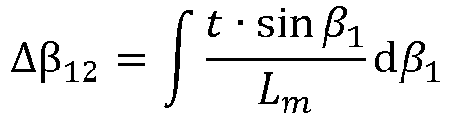


- Verfahren nach einem der vorstehenden Ansprüche, dadurch gekennzeichnet, dass es den Schritt eines Verwendens des Querschnittsmoments, M, des metallischen Materials umfasst, um einen Reibungskoeffizienten, µ, des metallischen Materials abzuschätzen, unter Verwendung der Gleichung:
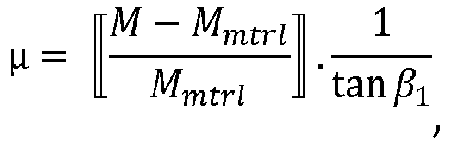
- Verfahren nach einem der vorstehenden Ansprüche, dadurch gekennzeichnet, dass das berechnete Querschnittsmoment, M, oder die berechnete Fließspannung, σ1, oder der abgeschätzte Youngsche Modul, E, verwendet wird, um ein Produkt zu optimieren, das das metallische Material (10) umfasst.
- Verfahren nach einem der vorstehenden Ansprüche, dadurch gekennzeichnet, dass das metallische Material (10) ein heißgewalztes metallisches Material (10) ist, wie beispielsweise heißgewalzter Stahl.
- Verfahren nach einem der Ansprüche 1 bis 7, dadurch gekennzeichnet, dass das metallische Material (10) ein kaltgewalztes metallisches Material ist, wie beispielsweise kaltgewalzter Stahl.
- Verfahren zum Charakterisieren eines metallischen Materials (10) nach einem der vorstehenden Ansprüche, dadurch gekennzeichnet, dass es die Schritte eines Durchführens eines Biegetests nach dem VDA 238-100 Standard umfasst.
- Verfahren nach einem der vorstehenden Ansprüche, dadurch gekennzeichnet, dass das Verfahren Berechnen des Verhältnisses M/Me umfasst, definiert als:

- Verfahren nach Anspruch 11, wobei das Verhältnis M/Me für mindestens zwei unterschiedliche Materialien berechnet wird und die Eigenschaften einer Zusammensetzung, die diese Materialien umfasst, aus den Werten der individuellen Materialien berechnet werden.
- Verfahren zum Bestimmen der Bedingungen, unter denen ein Material während Biegens stabil bleibt, wobei das Verfahren das Verfahren nach Anspruch 11 umfasst, und weiter gekennzeichnet durch Bestimmen der Bedingungen, unter denen das Verhältnis M/Me unterhalb von 1,5 bleibt.
- Verfahren nach einem der vorstehenden Ansprüche, wobei der Messerradius, Rk, kleiner oder gleich der Dicke des metallischen Materials, t, ist.
- Verfahren nach einem der vorstehenden Ansprüche, wobei der Messerradius, Rk, 0,7 mal die Dicke des metallischen Materials, t, oder kleiner ist.
- Computerprogrammprodukt (30), dadurch gekennzeichnet, dass es ein Computerprogramm umfasst, das Computerprogrammcodemittel beinhaltet, die dafür eingerichtet sind, einen Computer oder einen Prozessor zu veranlassen, den Berechnungsschritt eines Verfahrens nach einem der vorstehenden Ansprüche auszuführen, gespeichert auf einem computerlesbaren Medium oder einer Trägerwelle.
Priority Applications (10)
| Application Number | Priority Date | Filing Date | Title |
|---|---|---|---|
| ES15187129T ES2726273T3 (es) | 2015-09-28 | 2015-09-28 | Método y producto de programa informático |
| DK15187129.0T DK3147643T3 (en) | 2015-09-28 | 2015-09-28 | PROCEDURE AND COMPUTER PROGRAM PRODUCT |
| EP15187129.0A EP3147643B1 (de) | 2015-09-28 | 2015-09-28 | Verfahren und computerprogrammprodukt |
| PL15187129T PL3147643T3 (pl) | 2015-09-28 | 2015-09-28 | Sposób i produkt w postaci programu komputerowego |
| KR1020187012113A KR102645598B1 (ko) | 2015-09-28 | 2016-09-28 | 재료의 굽힘 응답을 특성화하기 위한 방법 및 컴퓨터 프로그램 제품 |
| CN201680064067.9A CN108369166B (zh) | 2015-09-28 | 2016-09-28 | 用于表征材料的弯曲响应的方法和计算机程序产品 |
| PCT/EP2016/073145 WO2017055367A1 (en) | 2015-09-28 | 2016-09-28 | Method & computer program product for characterising the bending response of a material |
| EP16775214.6A EP3356786B1 (de) | 2015-09-28 | 2016-09-28 | Verfahren und computerprogrammprodukt |
| JP2018516043A JP6856632B2 (ja) | 2015-09-28 | 2016-09-28 | 材料の曲げ応答を特徴付けるための方法及びコンピュータープログラム製品 |
| US15/763,672 US10883905B2 (en) | 2015-09-28 | 2016-09-28 | Method and computer program product for characterising the bending response of a material |
Applications Claiming Priority (1)
| Application Number | Priority Date | Filing Date | Title |
|---|---|---|---|
| EP15187129.0A EP3147643B1 (de) | 2015-09-28 | 2015-09-28 | Verfahren und computerprogrammprodukt |
Publications (2)
| Publication Number | Publication Date |
|---|---|
| EP3147643A1 EP3147643A1 (de) | 2017-03-29 |
| EP3147643B1 true EP3147643B1 (de) | 2019-01-16 |
Family
ID=54238312
Family Applications (2)
| Application Number | Title | Priority Date | Filing Date |
|---|---|---|---|
| EP15187129.0A Active EP3147643B1 (de) | 2015-09-28 | 2015-09-28 | Verfahren und computerprogrammprodukt |
| EP16775214.6A Active EP3356786B1 (de) | 2015-09-28 | 2016-09-28 | Verfahren und computerprogrammprodukt |
Family Applications After (1)
| Application Number | Title | Priority Date | Filing Date |
|---|---|---|---|
| EP16775214.6A Active EP3356786B1 (de) | 2015-09-28 | 2016-09-28 | Verfahren und computerprogrammprodukt |
Country Status (9)
| Country | Link |
|---|---|
| US (1) | US10883905B2 (de) |
| EP (2) | EP3147643B1 (de) |
| JP (1) | JP6856632B2 (de) |
| KR (1) | KR102645598B1 (de) |
| CN (1) | CN108369166B (de) |
| DK (1) | DK3147643T3 (de) |
| ES (1) | ES2726273T3 (de) |
| PL (1) | PL3147643T3 (de) |
| WO (1) | WO2017055367A1 (de) |
Cited By (2)
| Publication number | Priority date | Publication date | Assignee | Title |
|---|---|---|---|---|
| CN110823689A (zh) * | 2019-10-22 | 2020-02-21 | 首钢集团有限公司 | 一种板料的摩擦系数及回弹量的测量方法 |
| CN111189701A (zh) * | 2020-01-08 | 2020-05-22 | 吉林大学 | 一种金属双曲线试样的大应变压缩硬化曲线的测量方法 |
Families Citing this family (11)
| Publication number | Priority date | Publication date | Assignee | Title |
|---|---|---|---|---|
| US10746641B2 (en) * | 2017-03-24 | 2020-08-18 | Honda Motor Co., Ltd. | Peel bending moment calculation |
| KR102275867B1 (ko) * | 2017-09-07 | 2021-07-09 | 주식회사 엘지에너지솔루션 | 전극 취성 평가 장치 및 방법 |
| AT521529B1 (de) * | 2018-07-27 | 2020-04-15 | Trumpf Maschinen Austria Gmbh & Co Kg | Biegevorrichtung und Verfahren zur Ermittlung zumindest eines Materialparameters bzw. Bearbeitungsparameters für eine Werkstückbearbeitungsvorrichtung |
| CN109916736B (zh) * | 2018-11-23 | 2021-06-25 | 北方工业大学 | 板材反复纯弯曲的设备及方法 |
| CN110186792B (zh) * | 2019-06-20 | 2023-12-05 | 中国电建集团成都勘测设计研究院有限公司 | 双护盾tbm掌子面岩体强度快速测试装置 |
| CN110699540B (zh) * | 2019-11-05 | 2021-03-23 | 山东科技大学 | 一种不锈钢/碳钢复合板固溶热处理过程的翘曲预报方法 |
| CN111177944B (zh) * | 2020-01-09 | 2022-04-08 | 暨南大学 | 一种基于板壳理论的深海管道屈曲传播压力的计算方法 |
| CN111442978B (zh) * | 2020-03-12 | 2022-03-08 | 重庆大学 | 横向均布载荷作用下圆形薄膜弹性应变能的确定方法 |
| CN111982704A (zh) * | 2020-07-03 | 2020-11-24 | 中国兵器工业第五九研究所 | 一种金属材料海洋气候环境-弯曲载荷协同加速试验方法 |
| CN113790977B (zh) * | 2021-08-10 | 2023-07-07 | 武汉钢铁有限公司 | 金属板材极限弯曲断裂应变测量方法 |
| CN113720688A (zh) * | 2021-08-17 | 2021-11-30 | 重庆大学 | 气体压力下与刚性板接触的圆薄膜的弹性能的确定方法 |
Family Cites Families (18)
| Publication number | Priority date | Publication date | Assignee | Title |
|---|---|---|---|---|
| US4408471A (en) * | 1980-10-29 | 1983-10-11 | Massachusetts Institute Of Technology | Press brake having spring-back compensating adaptive control |
| CH654761A5 (fr) * | 1984-02-03 | 1986-03-14 | Beyeler Machines Sa | Presse-plieuse dont le dispositif de pliage permet un controle continu de l'angle de pliage de la piece a plier. |
| DE4007684A1 (de) | 1990-03-10 | 1991-09-12 | Man Nutzfahrzeuge Ag | Gelenkdaempfungsvorrichtung an gelenkomnibussen |
| JP3219496B2 (ja) * | 1992-11-18 | 2001-10-15 | 三菱重工業株式会社 | 板材の曲げ加工方法 |
| JPH08192230A (ja) | 1995-01-18 | 1996-07-30 | Sango Co Ltd | パイプの曲げ加工装置 |
| JP3594262B2 (ja) | 1995-05-30 | 2004-11-24 | 第一高周波工業株式会社 | 金属管の曲げ加工方法 |
| JPH10267813A (ja) | 1997-03-27 | 1998-10-09 | Fujikura Ltd | 通信ケーブルの可撓性試験方法 |
| DE19939549A1 (de) * | 1999-08-20 | 2001-02-22 | Volkswagen Ag | Prufstand zum Messen der Beulsteifigkeit von Bauteilen |
| JP2003149130A (ja) * | 2001-11-12 | 2003-05-21 | Univ Nihon | スポット溶接構造の疲労寿命予測方法 |
| JP2003307477A (ja) * | 2002-04-17 | 2003-10-31 | Hitachi Maxell Ltd | シート状試験片の3点曲げ試験方法およびそれに使用する装置 |
| US7461564B2 (en) * | 2006-10-04 | 2008-12-09 | Corning Incorporated | Method and apparatus for proof testing a sheet of brittle material |
| US7690265B2 (en) * | 2007-03-07 | 2010-04-06 | Pratt & Whitney Rocketdyne, Inc. | Constant moment testing device for elongated members |
| FR2915580B1 (fr) * | 2007-04-24 | 2009-06-05 | Areva Np Sas | Procede d'estimation d'un moment de flexion sur une zone sollicitee d'une tuyauterie d'un reacteur nucleaire |
| JP5187219B2 (ja) * | 2009-02-12 | 2013-04-24 | 富士通株式会社 | 計測装置、計測方法および計測プログラム |
| IT1403740B1 (it) | 2011-02-03 | 2013-10-31 | Tecnica Group Spa | Metodo di determinazione delle caratteristiche dinamiche di uno scarpone da sci |
| EP2570257B1 (de) * | 2011-09-15 | 2021-05-12 | Hydro Aluminium Rolled Products GmbH | Aluminiumverbundwerkstoff mit AlMgSi-Kernlegierungsschicht |
| JP5995634B2 (ja) * | 2012-09-28 | 2016-09-21 | 日東電工株式会社 | パターン粘着体およびその製造方法 |
| CN103801599B (zh) | 2014-01-23 | 2015-09-16 | 燕山大学 | 一种等截面直杆弯圆弧加工方法 |
-
2015
- 2015-09-28 EP EP15187129.0A patent/EP3147643B1/de active Active
- 2015-09-28 PL PL15187129T patent/PL3147643T3/pl unknown
- 2015-09-28 DK DK15187129.0T patent/DK3147643T3/en active
- 2015-09-28 ES ES15187129T patent/ES2726273T3/es active Active
-
2016
- 2016-09-28 JP JP2018516043A patent/JP6856632B2/ja active Active
- 2016-09-28 CN CN201680064067.9A patent/CN108369166B/zh active Active
- 2016-09-28 KR KR1020187012113A patent/KR102645598B1/ko active Active
- 2016-09-28 US US15/763,672 patent/US10883905B2/en active Active
- 2016-09-28 WO PCT/EP2016/073145 patent/WO2017055367A1/en not_active Ceased
- 2016-09-28 EP EP16775214.6A patent/EP3356786B1/de active Active
Non-Patent Citations (1)
| Title |
|---|
| None * |
Cited By (2)
| Publication number | Priority date | Publication date | Assignee | Title |
|---|---|---|---|---|
| CN110823689A (zh) * | 2019-10-22 | 2020-02-21 | 首钢集团有限公司 | 一种板料的摩擦系数及回弹量的测量方法 |
| CN111189701A (zh) * | 2020-01-08 | 2020-05-22 | 吉林大学 | 一种金属双曲线试样的大应变压缩硬化曲线的测量方法 |
Also Published As
| Publication number | Publication date |
|---|---|
| PL3147643T3 (pl) | 2019-08-30 |
| CN108369166B (zh) | 2020-11-03 |
| WO2017055367A1 (en) | 2017-04-06 |
| JP6856632B2 (ja) | 2021-04-07 |
| KR102645598B1 (ko) | 2024-03-07 |
| US10883905B2 (en) | 2021-01-05 |
| JP2018529963A (ja) | 2018-10-11 |
| CN108369166A (zh) | 2018-08-03 |
| DK3147643T3 (en) | 2019-04-29 |
| EP3356786B1 (de) | 2020-06-03 |
| KR20180084761A (ko) | 2018-07-25 |
| EP3147643A1 (de) | 2017-03-29 |
| ES2726273T3 (es) | 2019-10-03 |
| EP3356786A1 (de) | 2018-08-08 |
| US20180275033A1 (en) | 2018-09-27 |
Similar Documents
| Publication | Publication Date | Title |
|---|---|---|
| EP3147643A1 (de) | Verfahren und computerprogrammprodukt | |
| Hanabusa et al. | Numerical verification of a biaxial tensile test method using a cruciform specimen | |
| Pham et al. | Influence of the post-necking prediction of hardening law on the theoretical forming limit curve of aluminium sheets | |
| EP1985989B1 (de) | Bruchvorhersageverfahren | |
| Badr et al. | Applying a new constitutive model to analyse the springback behaviour of titanium in bending and roll forming | |
| Yin et al. | An experimental and numerical investigation of different shear test configurations for sheet metal characterization | |
| EP2508866B1 (de) | Verfahren zur bestimmung der leistung eines sprödigkeitsbruchweiterleitungsstopps in einer stahlplatte von hoher dicke | |
| Traphöner et al. | Methods for measuring large shear strains in in-plane torsion tests | |
| Chen et al. | Corner properties of cold-formed steel sections at elevated temperatures | |
| Brosius et al. | A new shear test for sheet metal characterization | |
| Nurcheshmeh et al. | Influence of out-of-plane compression stress on limit strains in sheet metals | |
| Choi et al. | Determining the coefficients of a homogeneous anisotropic hardening model for ultrathin steel sheets | |
| Grolleau et al. | Loading of mini-Nakazima specimens with a dihedral punch: Determining the strain to fracture for plane strain tension through stretch-bending | |
| Min et al. | An improved curvature method of detecting the onset of localized necking in Marciniak tests and its extension to Nakazima tests | |
| Noder et al. | New methodologies for fracture detection of automotive steels in tight radius bending: application to the VDA 238–100 V-bend test | |
| Wi et al. | Experimental and theoretical plasticity analyses of steel materials deformed under a nonlinear strain path | |
| Panich et al. | Investigation of anisotropic plastic deformation of advanced high strength steel | |
| Levy et al. | An approach to predicting the forming limit stress components from mechanical properties | |
| Zettl et al. | Improvement of process control in sheet metal forming by considering the gradual properties of the initial sheet metal | |
| Simon et al. | Phase-specific residual stresses induced by deep drawing of lean duplex steel: measurement vs. simulation | |
| Kofiani et al. | Experiments and fracture modeling of high-strength pipelines for high and low stress triaxialities | |
| Kacar et al. | Prediction of strain limits via the Marciniak-Kuczynski model and a novel semi-empirical forming limit diagram model for dual-phase DP600 advanced high strength steel | |
| Rasmussen | Bifurcation of locally buckled point symmetric columns—Experimental investigations | |
| Nurcheshmeh et al. | On the use of effective limit strains to evaluate the forming severity of sheet metal parts after nonlinear loading | |
| Denys et al. | Through-thickness work hardening variation in thick high strength steel plates: a novel inverse characterization method |
Legal Events
| Date | Code | Title | Description |
|---|---|---|---|
| PUAI | Public reference made under article 153(3) epc to a published international application that has entered the european phase |
Free format text: ORIGINAL CODE: 0009012 |
|
| STAA | Information on the status of an ep patent application or granted ep patent |
Free format text: STATUS: THE APPLICATION HAS BEEN PUBLISHED |
|
| AK | Designated contracting states |
Kind code of ref document: A1 Designated state(s): AL AT BE BG CH CY CZ DE DK EE ES FI FR GB GR HR HU IE IS IT LI LT LU LV MC MK MT NL NO PL PT RO RS SE SI SK SM TR |
|
| AX | Request for extension of the european patent |
Extension state: BA ME |
|
| STAA | Information on the status of an ep patent application or granted ep patent |
Free format text: STATUS: REQUEST FOR EXAMINATION WAS MADE |
|
| 17P | Request for examination filed |
Effective date: 20170927 |
|
| RBV | Designated contracting states (corrected) |
Designated state(s): AL AT BE BG CH CY CZ DE DK EE ES FI FR GB GR HR HU IE IS IT LI LT LU LV MC MK MT NL NO PL PT RO RS SE SI SK SM TR |
|
| GRAP | Despatch of communication of intention to grant a patent |
Free format text: ORIGINAL CODE: EPIDOSNIGR1 |
|
| STAA | Information on the status of an ep patent application or granted ep patent |
Free format text: STATUS: GRANT OF PATENT IS INTENDED |
|
| INTG | Intention to grant announced |
Effective date: 20180622 |
|
| GRAJ | Information related to disapproval of communication of intention to grant by the applicant or resumption of examination proceedings by the epo deleted |
Free format text: ORIGINAL CODE: EPIDOSDIGR1 |
|
| STAA | Information on the status of an ep patent application or granted ep patent |
Free format text: STATUS: REQUEST FOR EXAMINATION WAS MADE |
|
| GRAP | Despatch of communication of intention to grant a patent |
Free format text: ORIGINAL CODE: EPIDOSNIGR1 |
|
| STAA | Information on the status of an ep patent application or granted ep patent |
Free format text: STATUS: GRANT OF PATENT IS INTENDED |
|
| INTC | Intention to grant announced (deleted) | ||
| INTG | Intention to grant announced |
Effective date: 20181025 |
|
| GRAS | Grant fee paid |
Free format text: ORIGINAL CODE: EPIDOSNIGR3 |
|
| GRAA | (expected) grant |
Free format text: ORIGINAL CODE: 0009210 |
|
| STAA | Information on the status of an ep patent application or granted ep patent |
Free format text: STATUS: THE PATENT HAS BEEN GRANTED |
|
| AK | Designated contracting states |
Kind code of ref document: B1 Designated state(s): AL AT BE BG CH CY CZ DE DK EE ES FI FR GB GR HR HU IE IS IT LI LT LU LV MC MK MT NL NO PL PT RO RS SE SI SK SM TR |
|
| REG | Reference to a national code |
Ref country code: GB Ref legal event code: FG4D |
|
| REG | Reference to a national code |
Ref country code: CH Ref legal event code: EP |
|
| REG | Reference to a national code |
Ref country code: IE Ref legal event code: FG4D |
|
| REG | Reference to a national code |
Ref country code: DE Ref legal event code: R096 Ref document number: 602015023535 Country of ref document: DE |
|
| REG | Reference to a national code |
Ref country code: AT Ref legal event code: REF Ref document number: 1090056 Country of ref document: AT Kind code of ref document: T Effective date: 20190215 |
|
| REG | Reference to a national code |
Ref country code: SE Ref legal event code: TRGR |
|
| REG | Reference to a national code |
Ref country code: DK Ref legal event code: T3 Effective date: 20190423 |
|
| REG | Reference to a national code |
Ref country code: NL Ref legal event code: MP Effective date: 20190116 |
|
| REG | Reference to a national code |
Ref country code: LT Ref legal event code: MG4D |
|
| PG25 | Lapsed in a contracting state [announced via postgrant information from national office to epo] |
Ref country code: NL Free format text: LAPSE BECAUSE OF FAILURE TO SUBMIT A TRANSLATION OF THE DESCRIPTION OR TO PAY THE FEE WITHIN THE PRESCRIBED TIME-LIMIT Effective date: 20190116 |
|
| PG25 | Lapsed in a contracting state [announced via postgrant information from national office to epo] |
Ref country code: NO Free format text: LAPSE BECAUSE OF FAILURE TO SUBMIT A TRANSLATION OF THE DESCRIPTION OR TO PAY THE FEE WITHIN THE PRESCRIBED TIME-LIMIT Effective date: 20190416 Ref country code: LT Free format text: LAPSE BECAUSE OF FAILURE TO SUBMIT A TRANSLATION OF THE DESCRIPTION OR TO PAY THE FEE WITHIN THE PRESCRIBED TIME-LIMIT Effective date: 20190116 Ref country code: PT Free format text: LAPSE BECAUSE OF FAILURE TO SUBMIT A TRANSLATION OF THE DESCRIPTION OR TO PAY THE FEE WITHIN THE PRESCRIBED TIME-LIMIT Effective date: 20190516 |
|
| PG25 | Lapsed in a contracting state [announced via postgrant information from national office to epo] |
Ref country code: LV Free format text: LAPSE BECAUSE OF FAILURE TO SUBMIT A TRANSLATION OF THE DESCRIPTION OR TO PAY THE FEE WITHIN THE PRESCRIBED TIME-LIMIT Effective date: 20190116 Ref country code: RS Free format text: LAPSE BECAUSE OF FAILURE TO SUBMIT A TRANSLATION OF THE DESCRIPTION OR TO PAY THE FEE WITHIN THE PRESCRIBED TIME-LIMIT Effective date: 20190116 Ref country code: HR Free format text: LAPSE BECAUSE OF FAILURE TO SUBMIT A TRANSLATION OF THE DESCRIPTION OR TO PAY THE FEE WITHIN THE PRESCRIBED TIME-LIMIT Effective date: 20190116 Ref country code: IS Free format text: LAPSE BECAUSE OF FAILURE TO SUBMIT A TRANSLATION OF THE DESCRIPTION OR TO PAY THE FEE WITHIN THE PRESCRIBED TIME-LIMIT Effective date: 20190516 Ref country code: GR Free format text: LAPSE BECAUSE OF FAILURE TO SUBMIT A TRANSLATION OF THE DESCRIPTION OR TO PAY THE FEE WITHIN THE PRESCRIBED TIME-LIMIT Effective date: 20190417 Ref country code: BG Free format text: LAPSE BECAUSE OF FAILURE TO SUBMIT A TRANSLATION OF THE DESCRIPTION OR TO PAY THE FEE WITHIN THE PRESCRIBED TIME-LIMIT Effective date: 20190416 |
|
| REG | Reference to a national code |
Ref country code: ES Ref legal event code: FG2A Ref document number: 2726273 Country of ref document: ES Kind code of ref document: T3 Effective date: 20191003 |
|
| REG | Reference to a national code |
Ref country code: DE Ref legal event code: R097 Ref document number: 602015023535 Country of ref document: DE |
|
| PG25 | Lapsed in a contracting state [announced via postgrant information from national office to epo] |
Ref country code: EE Free format text: LAPSE BECAUSE OF FAILURE TO SUBMIT A TRANSLATION OF THE DESCRIPTION OR TO PAY THE FEE WITHIN THE PRESCRIBED TIME-LIMIT Effective date: 20190116 Ref country code: RO Free format text: LAPSE BECAUSE OF FAILURE TO SUBMIT A TRANSLATION OF THE DESCRIPTION OR TO PAY THE FEE WITHIN THE PRESCRIBED TIME-LIMIT Effective date: 20190116 Ref country code: SK Free format text: LAPSE BECAUSE OF FAILURE TO SUBMIT A TRANSLATION OF THE DESCRIPTION OR TO PAY THE FEE WITHIN THE PRESCRIBED TIME-LIMIT Effective date: 20190116 Ref country code: AL Free format text: LAPSE BECAUSE OF FAILURE TO SUBMIT A TRANSLATION OF THE DESCRIPTION OR TO PAY THE FEE WITHIN THE PRESCRIBED TIME-LIMIT Effective date: 20190116 |
|
| PGFP | Annual fee paid to national office [announced via postgrant information from national office to epo] |
Ref country code: SE Payment date: 20190918 Year of fee payment: 5 Ref country code: DE Payment date: 20190905 Year of fee payment: 5 Ref country code: FR Payment date: 20190927 Year of fee payment: 5 |
|
| PLBE | No opposition filed within time limit |
Free format text: ORIGINAL CODE: 0009261 |
|
| STAA | Information on the status of an ep patent application or granted ep patent |
Free format text: STATUS: NO OPPOSITION FILED WITHIN TIME LIMIT |
|
| PG25 | Lapsed in a contracting state [announced via postgrant information from national office to epo] |
Ref country code: SM Free format text: LAPSE BECAUSE OF FAILURE TO SUBMIT A TRANSLATION OF THE DESCRIPTION OR TO PAY THE FEE WITHIN THE PRESCRIBED TIME-LIMIT Effective date: 20190116 |
|
| 26N | No opposition filed |
Effective date: 20191017 |
|
| PG25 | Lapsed in a contracting state [announced via postgrant information from national office to epo] |
Ref country code: SI Free format text: LAPSE BECAUSE OF FAILURE TO SUBMIT A TRANSLATION OF THE DESCRIPTION OR TO PAY THE FEE WITHIN THE PRESCRIBED TIME-LIMIT Effective date: 20190116 |
|
| PG25 | Lapsed in a contracting state [announced via postgrant information from national office to epo] |
Ref country code: MC Free format text: LAPSE BECAUSE OF FAILURE TO SUBMIT A TRANSLATION OF THE DESCRIPTION OR TO PAY THE FEE WITHIN THE PRESCRIBED TIME-LIMIT Effective date: 20190116 |
|
| REG | Reference to a national code |
Ref country code: CH Ref legal event code: PL |
|
| PG25 | Lapsed in a contracting state [announced via postgrant information from national office to epo] |
Ref country code: IE Free format text: LAPSE BECAUSE OF NON-PAYMENT OF DUE FEES Effective date: 20190928 Ref country code: CH Free format text: LAPSE BECAUSE OF NON-PAYMENT OF DUE FEES Effective date: 20190930 Ref country code: LU Free format text: LAPSE BECAUSE OF NON-PAYMENT OF DUE FEES Effective date: 20190928 Ref country code: LI Free format text: LAPSE BECAUSE OF NON-PAYMENT OF DUE FEES Effective date: 20190930 |
|
| REG | Reference to a national code |
Ref country code: DE Ref legal event code: R119 Ref document number: 602015023535 Country of ref document: DE |
|
| PG25 | Lapsed in a contracting state [announced via postgrant information from national office to epo] |
Ref country code: CY Free format text: LAPSE BECAUSE OF FAILURE TO SUBMIT A TRANSLATION OF THE DESCRIPTION OR TO PAY THE FEE WITHIN THE PRESCRIBED TIME-LIMIT Effective date: 20190116 |
|
| REG | Reference to a national code |
Ref country code: AT Ref legal event code: UEP Ref document number: 1090056 Country of ref document: AT Kind code of ref document: T Effective date: 20190116 |
|
| PG25 | Lapsed in a contracting state [announced via postgrant information from national office to epo] |
Ref country code: MT Free format text: LAPSE BECAUSE OF FAILURE TO SUBMIT A TRANSLATION OF THE DESCRIPTION OR TO PAY THE FEE WITHIN THE PRESCRIBED TIME-LIMIT Effective date: 20190116 Ref country code: HU Free format text: LAPSE BECAUSE OF FAILURE TO SUBMIT A TRANSLATION OF THE DESCRIPTION OR TO PAY THE FEE WITHIN THE PRESCRIBED TIME-LIMIT; INVALID AB INITIO Effective date: 20150928 Ref country code: DE Free format text: LAPSE BECAUSE OF NON-PAYMENT OF DUE FEES Effective date: 20210401 Ref country code: FR Free format text: LAPSE BECAUSE OF NON-PAYMENT OF DUE FEES Effective date: 20200930 |
|
| PG25 | Lapsed in a contracting state [announced via postgrant information from national office to epo] |
Ref country code: SE Free format text: LAPSE BECAUSE OF NON-PAYMENT OF DUE FEES Effective date: 20200929 |
|
| REG | Reference to a national code |
Ref country code: SE Ref legal event code: EUG |
|
| PG25 | Lapsed in a contracting state [announced via postgrant information from national office to epo] |
Ref country code: MK Free format text: LAPSE BECAUSE OF FAILURE TO SUBMIT A TRANSLATION OF THE DESCRIPTION OR TO PAY THE FEE WITHIN THE PRESCRIBED TIME-LIMIT Effective date: 20190116 |
|
| PGFP | Annual fee paid to national office [announced via postgrant information from national office to epo] |
Ref country code: FI Payment date: 20250912 Year of fee payment: 11 |
|
| PGFP | Annual fee paid to national office [announced via postgrant information from national office to epo] |
Ref country code: DK Payment date: 20250910 Year of fee payment: 11 |
|
| PGFP | Annual fee paid to national office [announced via postgrant information from national office to epo] |
Ref country code: PL Payment date: 20250903 Year of fee payment: 11 Ref country code: IT Payment date: 20250908 Year of fee payment: 11 Ref country code: TR Payment date: 20250902 Year of fee payment: 11 |
|
| PGFP | Annual fee paid to national office [announced via postgrant information from national office to epo] |
Ref country code: BE Payment date: 20250910 Year of fee payment: 11 Ref country code: GB Payment date: 20250912 Year of fee payment: 11 |
|
| PGFP | Annual fee paid to national office [announced via postgrant information from national office to epo] |
Ref country code: AT Payment date: 20250915 Year of fee payment: 11 |
|
| PGFP | Annual fee paid to national office [announced via postgrant information from national office to epo] |
Ref country code: CZ Payment date: 20250905 Year of fee payment: 11 |
|
| PGFP | Annual fee paid to national office [announced via postgrant information from national office to epo] |
Ref country code: ES Payment date: 20260224 Year of fee payment: 11 |